Tag: solar system

  • Say Cheese!

    Eleven people pose for a picture in the International Space Station. The crew is composed of women and men from different missions and different countries. The portion of the space station that they're in is white with wires on many of the surfaces.
    NASA/Mike Fincke

    Eleven International Space Station crew members gather inside the space station’s Unity module for a portrait on Aug. 3, 2025. In the front row, from left are, Kimiya Yui of JAXA (Japan Aerospace Exploration Agency), Zena Cardman of NASA, Oleg Platonov of Roscosmos, and Mike Fincke of NASA. In the second row are, Nichole Ayers of NASA, Sergey Ryzhikov of Roscosmos, and Anne McClain of NASA. In the back are, Takuya Onishi of JAXA, Kirill Peskov of Roscosmos, Jonny Kim of NASA, and Alexey Zubritsky of Roscosmos.

    Ayers, McClain, Onishi, and Peskov recently returned to Earth, splashing down in the Pacific Ocean off the coast of California on Aug. 9, 2025.

    Keep up with daily activity aboard the orbital laboratory.

    Image credit: NASA/Mike Fincke

  • NASA’s Stennis Space Center Employees Receive NASA Honor Awards

    NASA Stennis Space Center Director John Bailey and Deputy Director Christine Powell presented NASA Honor Awards to employees during an onsite ceremony Aug. 13.

    One NASA Stennis employee received NASA’s Outstanding Leadership Medal. The medal is awarded to government employees for notable leadership accomplishments that have significantly influenced the NASA mission.

    Marvin Horne of Fulton, Maryland, received the NASA Outstanding Leadership Medal for his work in the Office of Procurement that has resulted in significant cost savings for the agency. Among his accomplishments, Horne designed, implemented, and led an integrated contract management office between NASA Stennis, NASA’s Michoud Assembly Facility in New Orleans, and NASA’s Marshall Space Flight Center in Huntsville, Alabama. The office transformed facility services from independent models to a shared model. The innovative solution was the first joint contract management office at NASA Stennis comprised of procurement, finance, and technical personnel designed to implement effective and efficient business processes. Horne currently serves as the NASA acting administrator for procurement.

    Three NASA Stennis employees received NASA’s Exceptional Service Medal. The medal is awarded to government employees for sustained performance that embodies multiple contributions to NASA projects, programs, or initiatives.

    Jared Grover of Diamondhead, Mississippi, received the NASA Exceptional Service Medal for his contributions to the success of the NASA Stennis E Test Complex through his dedication and technical expertise. As a NASA mechanical operations engineer, he has led various testing and facility preparation efforts, worked with challenging propellants, and trained new personnel. His work has supported numerous NASA and commercial aerospace projects Grover is also active in community outreach, promoting NASA’s mission and inspiring future engineers.

    Tim Pierce of Long Beach, Mississippi, received the NASA Exceptional Service Medal following 26 years with NASA and 41 years working at NASA Stennis as a contractor and civil servant in the Center Operations Directorate. Through Pierce’s contributions, NASA Stennis became a leader in drafting agreements with external agencies, streamlining administrative procedures, and enhancing partnerships. In one notable instance, he led efforts to collaborate with county officials on a sewer treatment project that will save costs and optimize underused infrastructure. Pierce retired from NASA in January 2025.

    Barry Robinson of Slidell, Louisiana, received the NASA Exceptional Service Medal in absentia for service to the nation’s space program and achievement across multiple propulsion test programs and projects. Robinson joined NASA in 1994 and worked on the space shuttle main engine test project, eventually becoming a test operations consultant. Over the years, Robinson held various roles, including chief of the NASA Stennis Mechanical Engineering Branch and project manager for projects supporting NASA’s SLS (Space Launch System) rocket for Artemis missions to the Moon and beyond. Robinson retired from NASA in December 2024.

    One NASA Stennis employee received NASA’s Exceptional Engineering Achievement Medal. The medal is awarded to both government and non-government individuals for exceptional engineering contributions toward achievement of NASA’s mission.

    Richard Wear of Slidell, Louisiana, received the NASA Exceptional Engineering Achievement Medal for his contributions to the NASA Stennis Engineering and Test Directorate. Wear serves as the subject matter expert in thermal and fluid systems analysis. In that role, he has greatly contributed to facilitating the use of liquid natural gas propellant in testing onsite, including by developing a Cryogenics in Propulsion Testing training course to support future test projects and programs. His contributions have significantly enhanced NASA’s support for commercial partners at NASA Stennis.

    Eight NASA Stennis employees received NASA’s Exceptional Achievement Medal. This medal is awarded to any government employee for a significant specific achievement or substantial improvement in operations, efficiency, service, financial savings, science, or technology which contributes to the mission of NASA.

    Leslie Anderson of Picayune, Mississippi, received the NASA Exceptional Achievement Medal in absentia for leadership and customer service as the lead accountant in the Office of the Chief Financial Officer at NASA Stennis. Anderson has successfully managed critical financial activities with technical expertise, project management, and strong customer service skills. Her efforts help maintain federal partnerships worth approximately $70 million annually and contribute to the success of NASA Stennis, demonstrating NASA’s core values of integrity, teamwork, excellence, and inclusion.

    Alison Dardar of Diamondhead, Mississippi, received the NASA Exceptional Achievement Medal for innovation in improving financial and technical processes associated with the $1 billion-plus consolidated operations and maintenance contract for NASA Stennis and NASA’s Michoud Assembly Facility in New Orleans. As senior budget analyst in the NASA Stennis Office of the Chief Financial Officer, Dardar led in identifying and addressing key reporting and accounting issues related to the contract. Her innovations resulted in a 55% improvement in cost reporting accuracy and $20 million in savings to the contract.

    Gina Ladner of Diamondhead, Mississippi, received the NASA Exceptional Achievement Medal for management, problem solving, and leadership during a year-long detail as chief of the NASA Stennis Facilities Services Division. During the year, Ladner led the division team through numerous changes and tackled unexpected challenges, including a severe weather event that featured confirmed tornados onsite and a contractor work stoppage activity, to ensure ongoing site operations. She also led in numerous infrastructure investments, including repairs to roadways, fire systems, and communications equipment.

    Rebecca Mataya of Carriere, Mississippi, received the NASA Exceptional Achievement Medal for service as a budget analyst in the NASA Stennis Office of the Chief Financial Officer in improving processes and operations. As an analyst on the procurement development team for a new operations, services, and infrastructure contract, Mataya identified creative methods to increase cost savings and maximize facility projects. She also has helped secure over $408 million for facility improvements, enhancing water systems, power generation, and more.

    Tom Stanley of Biloxi, Mississippi, received the NASA Exceptional Achievement Medal for contributions to improve NASA’s technology transfer process. As the NASA Stennis technology transfer officer, he developed a tool to standardize and automate evaluation of software usage agreements, reducing costs by 10 times and evaluation time by 75%. The changes led to record numbers of agreements awarded. Stanley also created a tool for contract closeouts, which has contributed to cost savings for the agency.

    Cary Tolman of Fort Walton Beach, Florida, received the NASA Exceptional Achievement Medal for work in the NASA Office of the General Counsel. Beyond her role as procurement attorney, Tolman established a software and management audit review team to provide consistent and timely legal advice on software licenses and terms. Tolman’s work has helped NASA save $85 million and simplified legal support for software issues while reducing cybersecurity and financial risk.

    Casey Wheeler of Gulfport, Mississippi, received the NASA Exceptional Achievement Medal for leadership and innovation in replacing the high pressure water industrial water system that supports crucial testing facilities at NASA Stennis. As project manager in the NASA Stennis Center Operations Directorate, Wheeler showcased his planning and coordination skills by completing the complex project without delaying rocket engine testing. His work restored the system to full design pressure in an area that directly supports NASA’s SLS (Space Launch System) rocket through RS-25 engine testing, and other critical projects.

    Dale Woolridge of Slidell, Louisiana, received the NASA Exceptional Achievement Medal in absentia for contributions as project manager in the NASA Stennis Center Operations Directorate. Woolridge successfully led multiple construction projects, completing them on time and within budget. One notable project was the refurbishment of the miter gates at NASA Stennis’ navigational lock, which supports NASA’s rocket engine testing operations. The team completed the refurbishment ahead of schedule and within budget, ensuring minimal disruption to NASA operations.

    Four NASA Stennis employees received NASA’s Early Career Achievement Medal. The medal is awarded to government employees for unusual and significant performance during the first 10 years of an individual’s career in support of the agency.

    Briou Bourgeois of Pass Christian, Mississippi, received the NASA Early Career Achievement for his contributions in the NASA Stennis Engineering and Test Directorate. Bourgeois joined NASA in 2017 and has worked on various projects, including the SLS (Space Launch System) core stage Green Run test series and RS-25 engine testing for Artemis missions. Bourgeois played a key role in modifying the liquid oxygen tanking process during the SLS core stage series. He has since become test director in the NASA Stennis E Test Complex and a leader in commercial test projects at NASA Stennis.

    Brandon Ladner of Poplarville, Mississippi, received the NASA Early Career Achievement Medal for contributions to the Exploration Upper Stage Test Project on the Thad Cochran Test Stand at NASA Stennis. As the NASA lead mechanical design engineer for the project, Ladner has significantly contributed to the design and build-up of the B-2 position of the Thad Cochran Test Stand in preparation for Green Run testing of the new SLS (Space Launch System) upper stage. He has led in completion of numerous large design packages and provided valuable engineering oversight to improve construction schedule.

    Robert Simmers of Slidell, Louisiana, received the NASA Early Career Achievement for his expertise and versatility since joining NASA in 2015 as a member of the NASA Stennis Safety and Mission Assurance Directorate team. He serves as the safety point of contact for the Thad Cochran Test Stand (B-2). In that role, he supported all operations during Green Run testing of NASA’s SLS (Space Launch System) core stage. Simmers also has supported safety audits at various NASA centers. In 2020, he became the NASA Stennis explosive safety officer responsible for explosive safety and compliance.

    Robert Williams of Gulfport, Mississippi, received the NASA Early Career Achievement for his work in the NASA Stennis Engineering and Test Directorate. Williams has worked with NASA for eight years, serving as a lead mechanical design engineer for several commercial test projects. Williams is recognized as a subject matter expert in structural systems and has contributed to various NASA Stennis projects, providing technical and modeling expertise.

    Two NASA Stennis employees received NASA’s Silver Achievement Medal. The medal is awarded to any government or non-government employee for a stellar achievement that supports one or more of NASA’s core values, when it is deemed to be extraordinarily important and appropriate to recognize such achievement in a timely and personalized manner.

    Brittany Bouche of Slidell, Louisiana, received the NASA Silver Achievement Medal for contributions in the NASA Stennis Center Operations Directorate. Bouche has held multiple key roles in the Facilities Services Division, including acting deputy, maintenance and operations lead, and project manager for several construction projects. She has successfully led various design and construction projects, completing them on time and within budget. These include a $9.1 million sewage system and treatment repair project, successfully completed with minimal service impact.

    Andrew Bracey of Picayune, Mississippi, received the NASA Silver Achievement Medal for contributions as a NASA electrical design engineer at NASA Stennis. He has provided critical design support for work related to Green Run testing of the new SLS (Space Launch System) exploration upper stage. Bracey also has been crucial to the NASA Stennis vision of supporting commercial aerospace testing, leading preliminary design reviews for multiple projects onsite.

    Details

    Last Updated

    Aug 14, 2025

    Editor
    NASA Stennis Communications
    Contact
    C. Lacy Thompson
    Location
    Stennis Space Center

    Related Terms

  • NASA Glenn Earns Commercial Invention of the Year Award

    NASA’s GRX-810 3D-Printable Alloy in the Shape of the NASA Insignia.
    NASA has demonstrated a breakthrough in 3D-printable high-temperature materials that could lead to stronger, more durable parts for airplanes and spacecraft.
    Credit: NASA/Jordan Salkin 

    NASA’s Inventions and Contributions Board (ICB) has awarded Commercial Invention of the Year to NASA Glenn Research Center’s GRX-810: A 3D Printable Alloy Designed for Extreme Environments.  

    NASA Alloy GRX–810, an oxide dispersion strengthened (ODS) alloy, can endure temperatures over 2,000 degrees Fahrenheit. It is more malleable and can survive more than 1,000 times longer than existing state-of-the-art alloys. This new alloy can be used to build aerospace parts for high-temperature applications, like those inside aircraft and rocket engines, because ODS alloys can withstand harsher conditions before reaching their breaking point. 

    The NASA Glenn team of inventors includes Dr. Timothy Smith (co-lead), Dr. Christopher Kantzos (co-lead), Robert Carter, and Dr. Michael Kulis. 

    Four American companies have been granted co-exclusive licenses to produce and market GRX-810 material. All four have replicated NASA Glenn’s patented process and are selling fully coated materials. This benefits the United States economy as a return on investment of taxpayer dollars.  

    For more information on this technology, visit 3D Printed Alloy and New Material Built to Withstand Extreme Conditions

    The NASA insignia is 3D printed using the GRX-810 superalloy. 
    Video Credit: NASA/Jordan Salkin

    Additionally, the ICB selected NASA Glenn’s High-Rate Delay Tolerant Networking (HDTN) project for an honorable mention in the Software of the Year category. HDTN is a protocol suite that extends terrestrial internet principles to the space environment, creating a high-speed data transfer path for spacecraft and different communication systems. It is an optimized version of the DTN standard for high-rate radio frequency and optical links.  

    The ICB reviews and recommends awards for significant scientific and technical contributions to the agency’s aeronautical and space activities. These awards recognize technologies that not only advance NASA’s mission but also benefit the public through commercialization.  

  • NASA’s SpaceX-33 Resupply Mission to Launch Research to Station

    Research traveling to the International Space Station aboard NASA’s SpaceX 33rd commercial resupply mission includes testing 3D bioprinting of an implantable medical device, observing behavior of engineered liver tissues, examining microgravity’s effects on bone-forming cells, and additional 3D printing of metal in space. The SpaceX Dragon spacecraft is scheduled to launch to the orbiting laboratory in late August.

    For nearly 25 years, the International Space Station has provided research capabilities used by scientists from over 110 countries to conduct more than 4,000 groundbreaking experiments in microgravity. Research conducted aboard the space station advances future space exploration – including missions to the Moon and Mars – and provides multiple benefits to humanity.

    Read more about some of the latest investigations headed to the orbiting lab.

    Better nerve bridge

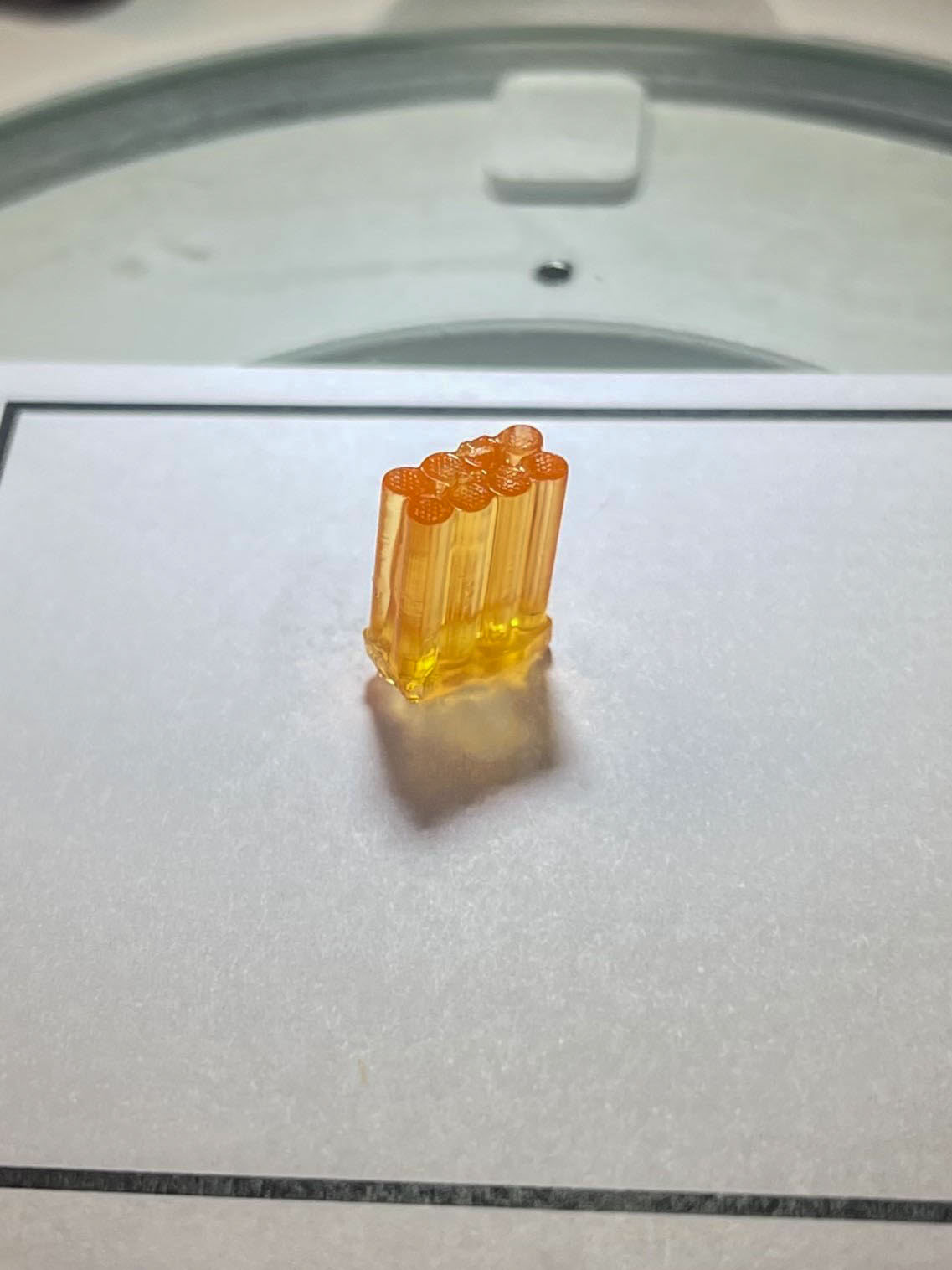
    Eight translucent orange cylinders that look a bit like gummy candies are attached to each other in two rows of four and sitting on a white surface.
    Eight implantable nerve devices printed on the space station.
    Auxilium Biotechnologies

    Scientists are creating an implantable device in microgravity that could support nerve regrowth after injuries. The device is created through bioprinting, a type of 3D printing that uses living cells or proteins as raw materials.

    Traumatic injuries can leave a gap between nerves, and existing treatments have limited ability to restore nerve function and may result in impaired physical function. A bioprinted device to bridge the nerve gap could accelerate recovery and preserve function.

    “On this mission, we plan to print up to 18 of the implants and anticipate using them in preclinical studies on the ground in 2026 and 2027,” said Jacob Koffler, principal investigator at Auxilium Biotechnologies Inc in San Diego. Tissues bioprinted in microgravity may be higher quality than those made on Earth and results could support future manufacturing of medical devices in space for crew members on space missions and patients on Earth.

    Bioprinted tissues with blood vessels

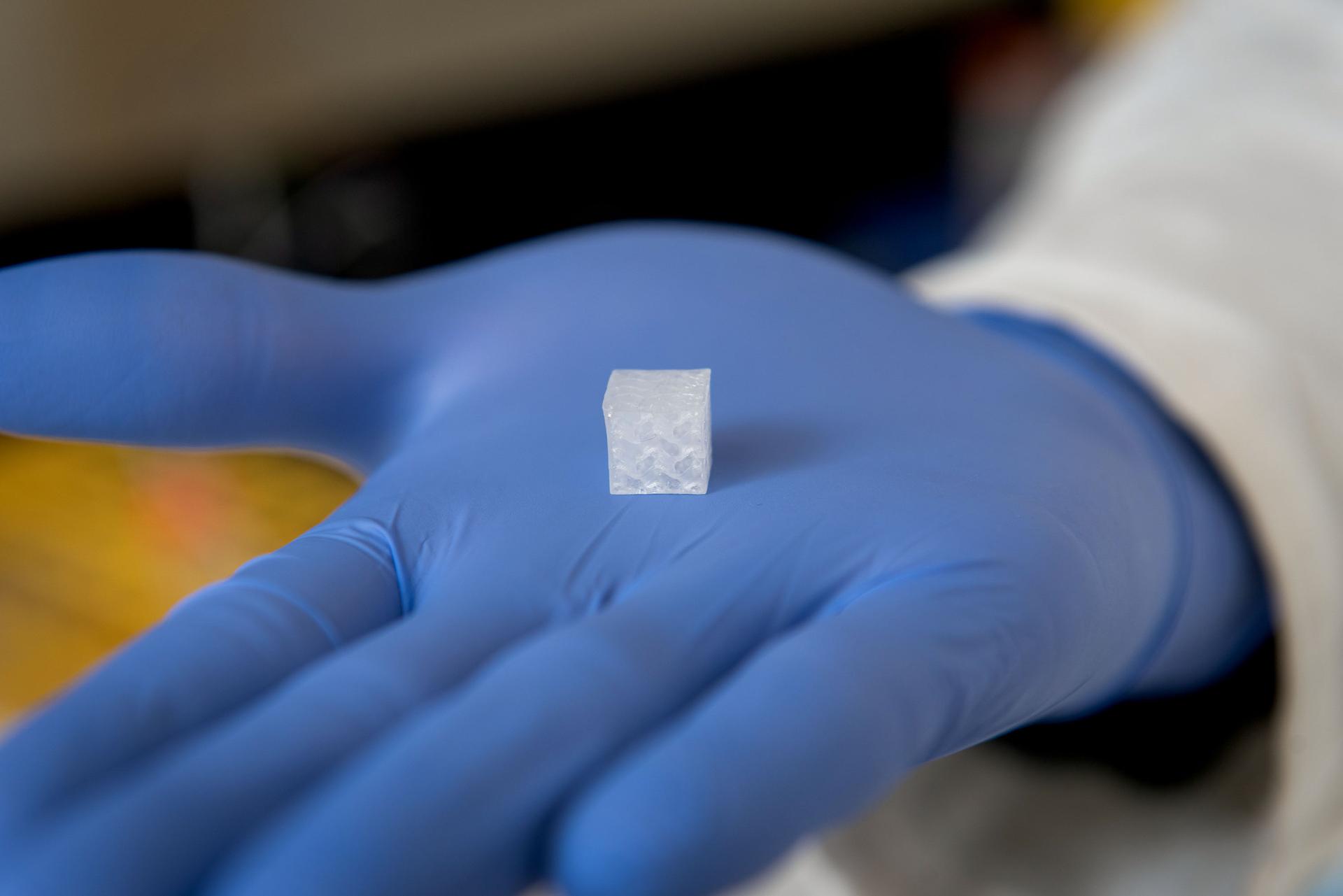
    A small, white gel-like cube, about the size of a sugar cube, sits in the palm of a hand wearing a blue latex glove. The cube has a pattern of open spaces inside of it.
    A researcher holds vascularized tissue bioprinted on the ground for study in space.
    The Wake Forest Institute of Regenerative Medicine

    Researchers plan to bioprint liver tissue containing blood vessels on the ground and examine how the tissue develops in microgravity. Results could help support the eventual production of entire functional organs for transplantation on Earth.

    A previous mission tested whether this type of bioprinted liver tissue survived and functioned in space, according to James Yoo, principal investigator at the Wake Forest Institute of Regenerative Medicine in Winston-Salem. This round could show whether microgravity improves development of the bioprinted tissue.

    “We are especially keen on accelerating the development of vascular networks in the tissue,” Yoo said. Vascular networks produce the blood vessels needed to keep these tissues functional and healthy.

    Blocking bone loss

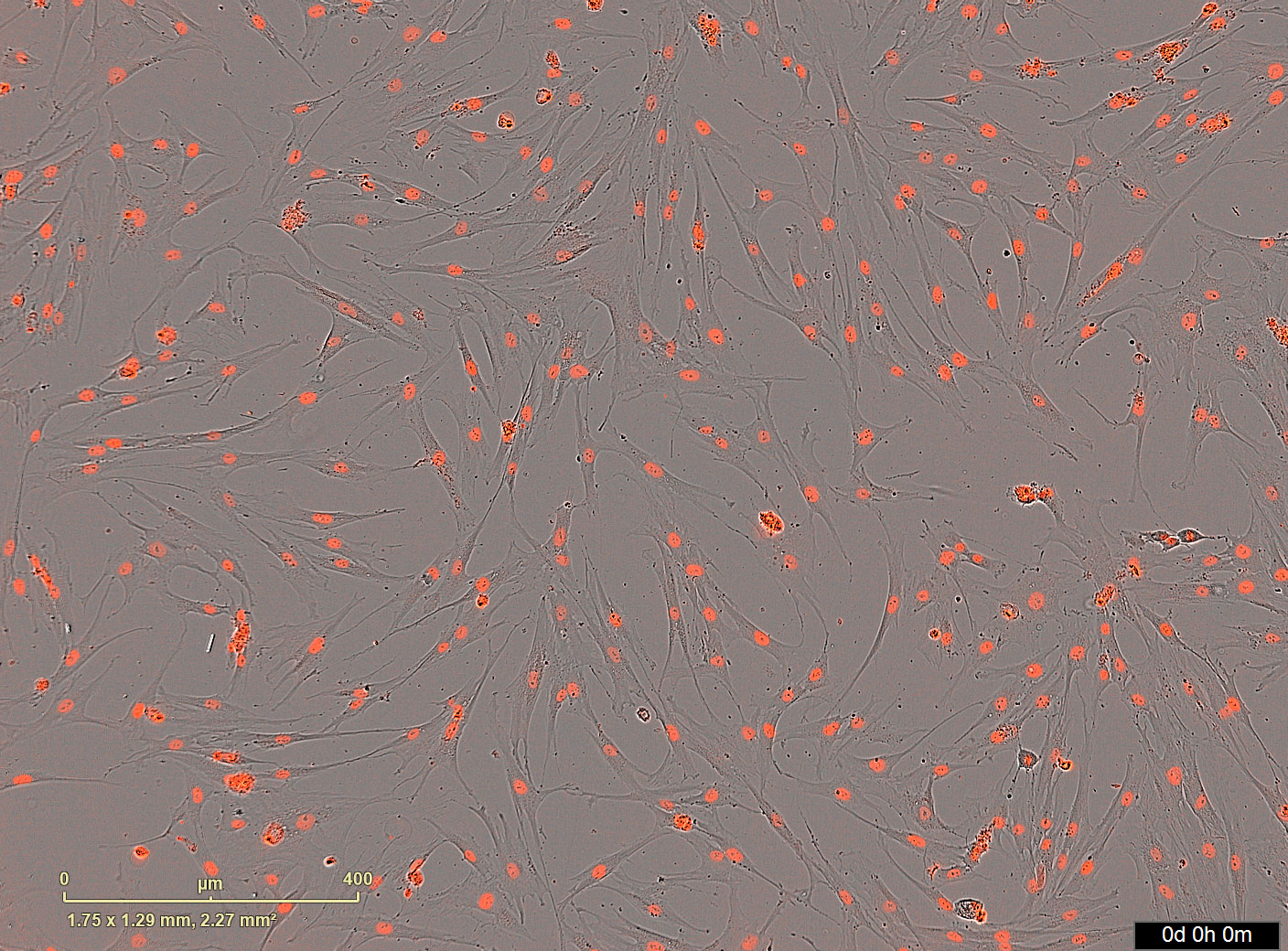
    Translucent, fiber-like cells cover this slide image, which has a grayish-tan background. Each of the cells has a small, rounded body in it that is stained an orange-red color.
    A microscopic image of stem cells derived from human bone marrow stained with red dye.
    Mayo Clinic

    A study of bone-forming stem cells in microgravity could provide insight into the basic mechanisms of the bone loss astronauts experience during space flight.

    Researchers identified a protein in the body called IL-6 that can send signals to stem cells to promote either bone formation or bone loss. This work evaluates whether blocking IL-6 signals could reduce bone loss during spaceflight.

    “If we are successful, the compound also can be evaluated for the treatment of conditions associated with bone loss on Earth, such as osteoporosis and certain types of cancers,” said Abba Zubair, principal investigator at the Mayo Clinic in Florida.

    Space printing goes metal

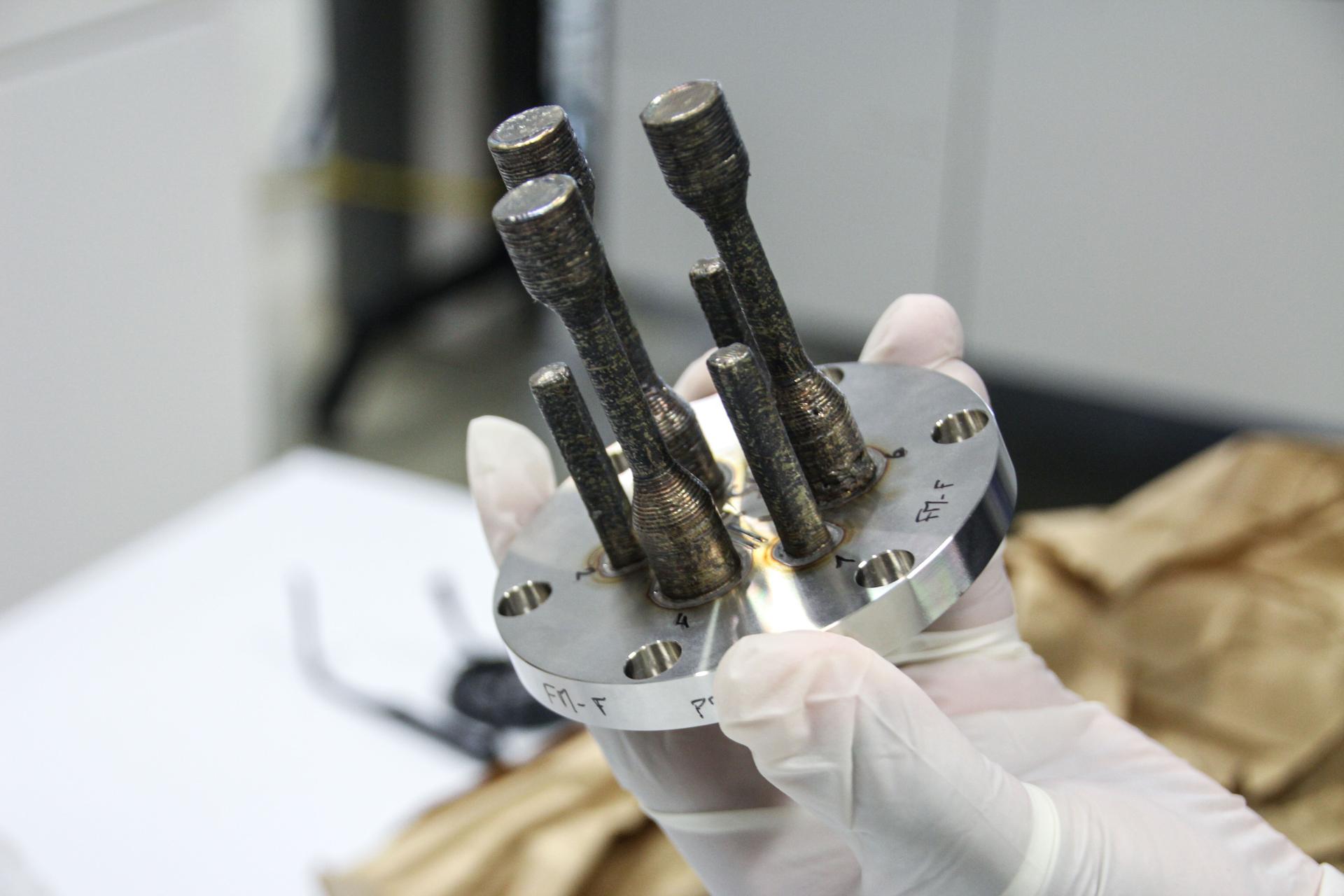
    A white-gloved hand holds a shiny metal cylinder about the size of a hockey puck. Three straight metal posts extend from the cylinder, alternating with three slightly taller posts that are thicker on each of their ends.
    Metal specimens printed on the ground for ESA’s Metal 3D Printer investigation.
    Airbus Defence and Space SAS

    As mission duration and distance from Earth increase, resupply becomes harder. Additive manufacturing or 3D printing could be used to make parts and dedicated tools on demand, enhancing mission autonomy.

    Research on the space station has made great strides in 3D printing with plastic, but it is not suitable for all uses. The ESA (European Space Agency) Metal 3D Printer investigation builds on recent successful printing of the first metal parts in space.

    “We’ll print several small cubes using different strategies to help determine the optimal approach for metal printers in space,” said Rob Postema, ESA technical officer. Quality of the space-printed items will be compared against reference prints made on the ground.

    This investigation is a continuation of ESA’s efforts to develop in-space manufacturing and materials recycling capabilities. The ESA investigation team includes Airbus Defence and Space SAS and the User Support Centre CADMOS in France.

    Download high-resolution photos and videos of the research mentioned in this article.

    Learn more about the research aboard the International Space Station at:

    www.nasa.gov/iss-science

  • Webb Narrows Atmospheric Possibilities for Earth-sized Exoplanet TRAPPIST-1 d

    6 Min Read

    Webb Narrows Atmospheric Possibilities for Earth-sized Exoplanet TRAPPIST-1 d

    Illustration of a planet silhouetted in front of a star. The star shows a large eruption on one side and more wisps of red coming from its southern hemisphere. Two more planets appear in the background.

    This artist’s concept depicts planet TRAPPIST-1 d passing in front of its turbulent star, with other members of the closely packed system shown in the background. Full illustration and caption show below.

    Credits:
    NASA, ESA, CSA, Joseph Olmsted (STScI)

    The exoplanet TRAPPIST-1 d intrigues astronomers looking for possibly habitable worlds beyond our solar system because it is similar in size to Earth, rocky, and resides in an area around its star where liquid water on its surface is theoretically possible. But according to a new study using data from NASA’s James Webb Space Telescope, it does not have an Earth-like atmosphere.

    “Ultimately, we want to know if something like the environment we enjoy on Earth can exist elsewhere, and under what conditions. While NASA’s James Webb Space Telescope is giving us the ability to explore this question in Earth-sized planets for the first time, at this point we can rule out TRAPPIST-1 d from a list of potential Earth twins or cousins,” said Caroline Piaulet-Ghorayeb of the University of Chicago and Trottier Institute for Research on Exoplanets (IREx) at Université de Montréal, lead author of the study published in The Astrophysical Journal.

    Planet TRAPPIST-1 d

    The TRAPPIST-1 system is located 40 light-years away and was revealed as the record-holder for most Earth-sized rocky planets around a single star in 2017, thanks to data from NASA’s retired Spitzer Space Telescope and other observatories. Due to that star being a dim, relatively cold red dwarf, the “habitable zone” or “Goldilocks zone” – where the planet’s temperature may be just right, such that liquid surface water is possible – lies much closer to the star than in our solar system. TRAPPIST-1 d, the third planet from the red dwarf star, lies on the cusp of that temperate zone, yet its distance to its star is only 2 percent of Earth’s distance from the Sun. TRAPPIST-1 d completes an entire orbit around its star, its year, in only four Earth days.

    Webb’s NIRSpec (Near-Infrared Spectrograph) instrument did not detect molecules from TRAPPIST-1 d that are common in Earth’s atmosphere, like water, methane, or carbon dioxide. However, Piaulet-Ghorayeb outlined several possibilities for the exoplanet that remain open for follow-up study.

    “There are a few potential reasons why we don’t detect an atmosphere around TRAPPIST-1 d. It could have an extremely thin atmosphere that is difficult to detect, somewhat like Mars. Alternatively, it could have very thick, high-altitude clouds that are blocking our detection of specific atmospheric signatures — something more like Venus. Or, it could be a barren rock, with no atmosphere at all,” Piaulet-Ghorayeb said.

    Image: TRAPPIST-1 d (Artist’s Concept)

    Illustration of a planet silhouetted in front of a star. The star shows a large eruption on one side and more wisps of red coming from its southern hemisphere. Two more planets appear in the background.
    This artist’s concept depicts planet TRAPPIST-1 d passing in front of its turbulent star, with other members of the closely packed system shown in the background. The TRAPPIST-1 system is intriguing to scientists for a few reasons. Not only does the system have seven Earth-sized rocky worlds, but its star is a red dwarf, the most common type of star in the Milky Way galaxy. If an Earth-sized world can maintain an atmosphere here, and thus have the potential for liquid surface water, the chance of finding similar worlds throughout the galaxy is much higher. In studying the TRAPPIST-1 planets, scientists are determining the best methods for separating starlight from potential atmospheric signatures in data from NASA’s James Webb Space Telescope. The star TRAPPIST-1’s variability, with frequent flares, provides a challenging testing ground for these methods.
    NASA, ESA, CSA, Joseph Olmsted (STScI)

    The Star TRAPPIST-1

    No matter what the case may be for TRAPPIST-1 d, it’s tough being a planet in orbit around a red dwarf star. TRAPPIST-1, the host star of the system, is known to be volatile, often releasing flares of high-energy radiation with the potential to strip off the atmospheres of its small planets, especially those orbiting most closely. Nevertheless, scientists are motivated to seek signs of atmospheres on the TRAPPIST-1 planets because red dwarf stars are the most common stars in our galaxy. If planets can hold on to an atmosphere here, under waves of harsh stellar radiation, they could, as the saying goes, make it anywhere.

    “Webb’s sensitive infrared instruments are allowing us to delve into the atmospheres of these smaller, colder planets for the first time,” said Björn Benneke of IREx at Université de Montréal, a co-author of the study. “We’re really just getting started using Webb to look for atmospheres on Earth-sized planets, and to define the line between planets that can hold onto an atmosphere, and those that cannot.”

    The Outer TRAPPIST-1 Planets

    Webb observations of the outer TRAPPIST-1 planets are ongoing, which hold both potential and peril. On the one hand, Benneke said, planets e, f, g, and h may have better chances of having atmospheres because they are further away from the energetic eruptions of their host star. However, their distance and colder environment will make atmospheric signatures more difficult to detect, even with Webb’s infrared instruments.

    “All hope is not lost for atmospheres around the TRAPPIST-1 planets,” Piaulet-Ghorayeb said. “While we didn’t find a big, bold atmospheric signature at planet d, there is still potential for the outer planets to be holding onto a lot of water and other atmospheric components.”

    “As NASA leads the way in searching for life outside our solar system, one of the most important avenues we can pursue is understanding which planets retain their atmospheres, and why,” said Shawn Domagal-Goldman, acting director of the Astrophysics Division at NASA Headquarters in Washington. “NASA’s James Webb Space Telescope has pushed our capabilities for studying exoplanet atmospheres further than ever before, beyond extreme worlds to some rocky planets – allowing us to begin confirming theories about the kind of planets that may be potentially habitable. This important groundwork will position our next missions, like NASA’s Habitable Worlds Observatory, to answer a universal question: Are we alone?”

    The James Webb Space Telescope is the world’s premier space science observatory. Webb is solving mysteries in our solar system, looking beyond to distant worlds around other stars, and probing the mysterious structures and origins of our universe and our place in it. Webb is an international program led by NASA with its partners, ESA (European Space Agency) and CSA (Canadian Space Agency).

    To learn more about Webb, visit:

    https://science.nasa.gov/webb

    Downloads

    Click any image to open a larger version.

    View/Download all image products at all resolutions for this article from the Space Telescope Science Institute.

    Media Contacts

    Laura Betz – laura.e.betz@nasa.gov
    NASA’s Goddard Space Flight Center, Greenbelt, Md.

    Hannah Braunhbraun@stsci.edu
    Space Telescope Science Institute, Baltimore, Md.

    Read more about the TRAPPIST-1 system

    Read more about changing views on the “habitable zone”

    Webb Blog: Reconnaissance of Potentially Habitable Worlds with NASA’s Webb

    Video: How to Study Exoplanets

    Video: How do we learn about a planet’s Atmosphere?

    Learn more about exoplanets

    Read more about studying TRAPPIST-1 c with Webb

    Read more about studying TRAPPIST-1 b with Webb

    More Webb News

    More Webb Images

    Webb Science Themes

    Webb Mission Page

    What is the Webb Telescope?

    SpacePlace for Kids

    En Español

    Ciencia de la NASA

    NASA en español 

    Space Place para niños

  • NASA Glenn Offers Students Work-Based Learning Through Engineering Institute  

    Three students stand next to a table and carefully prepare to place weights on top of a plastic rover with large red wheels. Additional plastic rover parts and wires sit on the table. Two students are in the background discussing their rover, which sits on a counter.
    NASA Glenn Research Center High School Engineering Institute participants, left to right: Evan Ricchetti, Edan Liahovetsky, and Doris Chen, prepare to add weights to their rover to test the effectiveness of their wheel grouser designs on Friday, July 18, 2025.
    Credit: NASA/Jef Janis 

    This summer, NASA’s Glenn Research Center in Cleveland hosted the NASA Glenn High School Engineering Institute, a free, work-based learning experience designed to prepare rising high school juniors and seniors for careers in the aerospace workforce. 

    “The institute immerses students in NASA’s work, providing essential career readiness tools for future science, technology, engineering, and mathematics-focused academic and professional pursuits,” said Jerry Voltz of NASA Glenn’s Office of STEM Engagement. 

    Throughout the five-day sessions (offered three separate weeks in July), students used authentic NASA mission content and collaborated with Glenn’s technical experts. They gained a deeper understanding of the engineering design process, developed practical engineering solutions to real-world challenges, and tested prototypes to address key mission areas such as: 

    • Acoustic dampening: How can we reduce noise pollution from jet engines? 
    • Power management and distribution: How can we develop a smart power system for future space stations? 
    • Simulated lunar operations: Can we invent tires that don’t use air? 
    Two students kneel and adjust wires in a small rover with large blue wheels while two other students stand between cabinets containing several clear plastic containers
    NASA Glenn Research Center High School Engineering Institute participants, left to right: Adriana Pudloski, Anadavel Sakthi, Aditya Rohatgi, and Alexa Apshago, make modifications to the control system program for their rover on Friday, July 18, 2025.
    Credit: NASA/Jef Janis 

    Voltz said he hoped students left the program with three key takeaways: a deeper curiosity and excitement for STEM careers, firsthand insight into how cutting-edge technology developed in Cleveland contributes to NASA’s most prominent missions, and most importantly, a feeling of empowerment gained from engaging with some of NASA’s brightest minds in the field. 

  • NASA Glenn Shoots for the Stars During WNBA All-Star Weekend

    An astronaut in a blue NASA flight suit leans forward to interact with an electronic screen on exhibit about the Orion spacecraft. A man beside him looks on. People look on from a distance.
    Astronaut Victor Glover interacts with an Orion spacecraft simulator during NASA’s “All-Star Shoot for the Stars” event at The Children’s Museum of Indianapolis on Saturday, July 18, 2025.
    Credit: NASA/Zach Lucas 

    From astronauts to athletes, researchers to referees, and communicators to coaches, NASA is much like basketball – we all train to reach the top of our game. Staff from NASA’s Glenn Research Center in Cleveland drove home this point during the “All-Star Shoot for the Stars” event at The Children’s Museum of Indianapolis, July 17-19. As part of WNBA All-Star Game activities, this event highlighted NASA technology while illuminating the intersection of sports and STEM. 

    The event offered a captivating look into space exploration, thanks to the combined efforts of NASA and museum staff. Highlights included a detailed Orion exhibit, a new spacesuit display featuring five full-scale spacesuits, and virtual reality demonstrations. Visitors also had the chance to enjoy an interactive spacesuit app and a unique cosmic selfie station. 

    An adult woman and several children look at large display cases containing spacesuits.
    On Friday, July 18, 2025, visitors at NASA’s “All-Star Shoot for the Stars” event at The Children’s Museum of Indianapolis look at a new spacesuit display featuring five full-scale spacesuits.
    Credit: NASA/Christopher Richards 

    The event was made even more memorable by Artemis II astronaut Victor Glover, who connected with visitors and posed for photos. WNBA legend Tamika Catchings also made a special appearance, inspiring attendees with a message to “aim high!” 

    “All Star Weekend presented an excellent opportunity to share NASA’s mission with the Indianapolis community and people across the Midwest who were in town for the game,” said Jan Wittry, Glenn’s news chief. “I saw children’s faces light up as they interacted with the exhibits and talked to NASA experts, sparking a curiosity among our potential future STEM workforce.” 

  • NASA Roman Core Survey Will Trace Cosmic Expansion Over Time

    NASA’s Nancy Grace Roman Space Telescope will be a discovery machine, thanks to its wide field of view and resulting torrent of data. Scheduled to launch no later than May 2027, with the team working toward launch as early as fall 2026, its near-infrared Wide Field Instrument will capture an area 200 times larger than the Hubble Space Telescope’s infrared camera, and with the same image sharpness and sensitivity. Roman will devote about 75% of its science observing time over its five-year primary mission to conducting three core community surveys that were defined collaboratively by the scientific community. One of those surveys will scour the skies for things that pop, flash, and otherwise change, like exploding stars and colliding neutron stars.

    Supernova SN 2018gv Before and After
    These two images, taken one year apart by NASA’s Hubble Space Telescope, show how the supernova designated SN 2018gv faded over time. The High-Latitude Time-Domain Survey by NASA’s Nancy Grace Roman Space Telescope will spot thousands of supernovae, including a specific type that can be used to measure the expansion history of the universe.
    Credit: NASA, ESA, Martin Kornmesser (ESA), Mahdi Zamani (ESA/Hubble), Adam G. Riess (STScI, JHU), SH0ES Team

    Called the High-Latitude Time-Domain Survey, this program will peer outside of the plane of our Milky Way galaxy (i.e., high galactic latitudes) to study objects that change over time. The survey’s main goal is to detect tens of thousands of a particular type of exploding star known as type Ia supernovae. These supernovae can be used to study how the universe has expanded over time. 

    “Roman is designed to find tens of thousands of type Ia supernovae out to greater distances than ever before,” said Masao Sako of the University of Pennsylvania, who served as co-chair of the committee that defined the High-Latitude Time-Domain Survey. “Using them, we can measure the expansion history of the universe, which depends on the amount of dark matter and dark energy. Ultimately, we hope to understand more about the nature of dark energy.”

    Probing Dark Energy

    Type Ia supernovae are useful as cosmological probes because astronomers know their intrinsic luminosity, or how bright they inherently are, at their peak. By comparing this with their observed brightness, scientists can determine how far away they are. Roman will also be able to measure how quickly they appear to be moving away from us. By tracking how fast they’re receding at different distances, scientists will trace cosmic expansion over time.

    Only Roman will be able to find the faintest and most distant supernovae that illuminate early cosmic epochs. It will complement ground-based telescopes like the Vera C. Rubin Observatory in Chile, which are limited by absorption from Earth’s atmosphere, among other effects. Rubin’s greatest strength will be in finding supernovae that happened within the past 5 billion years. Roman will expand that collection to much earlier times in the universe’s history, about 3 billion years after the big bang, or as much as 11 billion years in the past. This would more than double the measured timeline of the universe’s expansion history.

    Recently, the Dark Energy Survey found hints that dark energy may be weakening over time, rather than being a constant force of expansion. Roman’s investigations will be critical for testing this possibility.

    Seeking Exotic Phenomena

    To detect transient objects, whose brightness changes over time, Roman must revisit the same fields at regular intervals. The High-Latitude Time-Domain Survey will devote a total of 180 days of observing time to these observations spread over a five-year period. Most will occur over a span of two years in the middle of the mission, revisiting the same fields once every five days, with an additional 15 days of observations early in the mission to establish a baseline. 

    An infographic of Roman's High-Latitude Time-Domain Survey
    This infographic describes the High-Latitude Time-Domain Survey that will be conducted by NASA’s Nancy Grace Roman Space Telescope. The survey’s main component will cover over 18 square degrees — a region of sky as large as 90 full moons — and see supernovae that occurred up to about 8 billion years ago.
    Credit: NASA’s Goddard Space Flight Center

    “To find things that change, we use a technique called image subtraction,” Sako said. “You take an image, and you subtract out an image of the same piece of sky that was taken much earlier — as early as possible in the mission. So you remove everything that’s static, and you’re left with things that are new.”

    The survey will also include an extended component that will revisit some of the observing fields approximately every 120 days to look for objects that change over long timescales. This will help to detect the most distant transients that existed as long ago as one billion years after the big bang. Those objects vary more slowly due to time dilation caused by the universe’s expansion.

    “You really benefit from taking observations over the entire five-year duration of the mission,” said Brad Cenko of NASA’s Goddard Space Flight Center in Greenbelt, Maryland, the other co-chair of the survey committee. “It allows you to capture these very rare, very distant events that are really hard to get at any other way but that tell us a lot about the conditions in the early universe.”

    This extended component will collect data on some of the most energetic and longest-lasting transients, such as tidal disruption events — when a supermassive black hole shreds a star — or predicted but as-yet unseen events known as pair-instability supernovae, where a massive star explodes without leaving behind a neutron star or black hole.

    This sonification that uses simulated data from NASA’s OpenUniverse project shows the variety of explosive events that will be detected by NASA’s Nancy Grace Roman Space Telescope and its High-Latitude Time-Domain Survey. Different sounds represent different types of events, as shown in the key at right. A single kilonova seen about 12 seconds into the video is represented with a cannon shot. The sonification sweeps backward in time to greater distances from Earth, and the pitch of the instrument gets lower as you move outward. (Cosmological redshift has been converted to a light travel time expressed in billions of years.)
    Credit: Sonification: Martha Irene Saladino (STScI), Christopher Britt (STScI); Visualization: Frank Summers (STScI); Designer: NASA, STScI, Leah Hustak (STScI)

    Survey Details

    The High-Latitude Time-Domain Survey will be split into two imaging “tiers” —  a wide tier that covers more area and a deep tier that will focus on a smaller area for a longer time to detect fainter objects. The wide tier, totaling a bit more than 18 square degrees, will target objects within the past 7 billion years, or half the universe’s history. The deep tier, covering an area of 6.5 square degrees, will reach fainter objects that existed as much as 10 billion years ago. The observations will take place in two areas, one in the northern sky and one in the southern sky. There will also be a spectroscopic component to this survey, which will be limited to the southern sky.

    “We have a partnership with the ground-based Subaru Observatory, which will do spectroscopic follow-up of the northern sky, while Roman will do spectroscopy in the southern sky. With spectroscopy, we can confidently tell what type of supernovae we’re seeing,” said Cenko.

    Together with Roman’s other two core community surveys, the High-Latitude Wide-Area Survey and the Galactic Bulge Time-Domain Survey, the High-Latitude Time-Domain Survey will help map the universe with a clarity and to a depth never achieved before.

    Download the sonification here.

    The Nancy Grace Roman Space Telescope is managed at NASA’s Goddard Space Flight Center in Greenbelt, Maryland, with participation by NASA’s Jet Propulsion Laboratory in Southern California; Caltech/IPAC in Pasadena, California; the Space Telescope Science Institute in Baltimore; and a science team comprising scientists from various research institutions. The primary industrial partners are BAE Systems, Inc. in Boulder, Colorado; L3Harris Technologies in Melbourne, Florida; and Teledyne Scientific & Imaging in Thousand Oaks, California.

    By Christine Pulliam
    Space Telescope Science Institute, Baltimore, Md.

    Details

    Last Updated

    Aug 12, 2025

    Editor
    Ashley Balzer
    Location
    Goddard Space Flight Center

  • Juliana Barajas: Supporting NASA’s Mission, One Task at a Time 

    As an administrative assistant in the Safety and Mission Assurance Office at NASA’s White Sands Test Facility in Las Cruces, New Mexico, Juliana Barajas approaches her work with one clear mission: to help others succeed.  

    A person walks on a tarmac with a large, reflective aircraft in the background under a clear blue sky.
    Juliana Barajas stands in front of the Super Guppy at the El Paso Forwarding Operations Location (EPFOL) in El Paso, Texas.

    Being courteous, helpful, resourceful, and always willing to learn new things is what led me to NASA.

    Juliana Barajas

    Juliana Barajas

    Administrative Assistant

    For over two decades, she has supported NASA’s mission with a career grounded in service, perseverance, and gratitude. Whether coordinating tasks, solving problems, or lending a listening ear, Barajas plays a vital role in helping her team maintain safety and excellence.  

    “When I was young, I never imagined working at NASA,” said Barajas “I dreamed of studying mechanical engineering but never got the opportunity.”  

    Instead, she pursued a degree in computer secretarial studies. “I am grateful for the opportunity to prove I could do just about any job given to me,” she said.  

    Three people stand outside in front of a bush and trees. The woman in the middle is holding a plaque.
    Juliana Barajas received a Secretarial Excellence Award in 2009 at NASA’s Johnson Space Center in Houston.

    In 2009, Barajas earned the Secretarial Excellence Award, a recognition she calls a highlight of her career. But for Barajas, pride is not reserved for big moments alone. “I take pride in everything I do every day,” she said. “If I can help those around me succeed, then I have fulfilled my duty.” 

    Her career has also taught her invaluable personal lessons. “I’ve learned to be a good listener and to be myself,” she said. “I’ve also learned to be resourceful and to not give up. I am grateful for having wonderful people around me who don’t look down on me when I reach out for answers.” 

    Four women pose out
    Juliana Barajas (far right) and her colleagues at NASA’s White Sands Test Facility in Las Cruces, New Mexico. 

    As NASA continues preparing for future lunar missions, Barajas hopes to pass on courage, resilience, and the determination to persevere through challenges. She encourages the next generation to ask for help when needed and to speak up when it matters most.  

    “I love my job and would like to continue supporting my NASA family as long as I am able,” she said. “And I promise to keep being the person I am.” 

  • Three NASA Langley Employees Win Prestigious Silver Snoopy Awards 

    3 min read

    Preparations for Next Moonwalk Simulations Underway (and Underwater)

    From left to right, Astronaut Tracy Dyson, Jeremy Shidner, Sara R. Wilson, and Christopher Broadaway pose for a photo after the 2025 Silver Snoopy Awards ceremony.
    From left to right, Astronaut Tracy Dyson, Jeremy Shidner, Sara R. Wilson, and Christopher Broadaway pose for a photo after the 2025 Silver Snoopy Awards ceremony.
    NASA/Mark Knopp

    Three employees from NASA’s Langley Research Center in Hampton, Virginia recently earned the Silver Snoopy award, a prestigious honor given to NASA employees and contractors across the agency for exceptional achievements related to spaceflight safety or mission success. Christopher Broadaway, Jeremy Shidner, and Sara Wilson received the awards during a ceremony held at the center on July 22. 

    The Silver Snoopy award is given personally by NASA astronauts and is presented to less than one percent of the agency’s workforce annually. The award is one of several overseen by the Space Flight Awareness (SFA) Program at NASA. Established in 1963, the SFA Program is vital in ensuring quality and flight safety of America’s space program. The SFA Program works to highlight the individuals behind the success of NASA’s programs as well as motivate the next generation of innovators and cosmic explorers. 

    Astronaut Tracy Dyson visited Langley to present the Silver Snoopy lapel pin and a framed Silver Snoopy certificate. Dyson flew aboard the space shuttle Endeavor on STS-118, served as flight engineer for Expedition 23/24, and conducted hundreds of hours of scientific investigations aboard the International Space Station for Expedition 70/71. She has spent a total of 373 days in space and dedicated over 23 hours to spacewalks. 

    As a flight engineer with substantial experience, Dyson understands the importance of space flight safety.  

    “Those who are receiving this award didn’t do it because they came nine to five and left. It’s not because it was just their job,” she said. “It’s because it’s their life, and our lives are safer and better for it.” 

    Astronaut Tracy Dyson signs certificates of appreciation prior to the 2025 Silver Snoopy Awards ceremony.
    Astronaut Tracy Dyson signs certificates of appreciation prior to the 2025 Silver Snoopy Awards ceremony.
    NASA/Mark Knopp

    Silver Snoopy recipient and aerospace engineer Jeremey Shidner echoed Dyson’s perspective. 

    “This level of trust is particularly profound because astronauts understand better than anyone the countless systems, procedures, and people that must work flawlessly for a mission to succeed,” he said. “When astronauts single someone out for recognition, it reflects their confidence that this person embodies the same commitment to excellence and safety that they themselves must maintain.” 

    The prestigious award consists of a certificate of appreciation signed by Dyson, an authentication letter, and a miniature sterling silver lapel pin in the shape of the well-loved character Snoopy from the comic strip “Peanuts.” Each pin awarded has flown in space. The pins awarded to Langley’s recipients flew aboard STS-118. 

    The three 2025 Silver Snoopy Award pins
    The 2025 Silver Snoopy Award pins
    NASA/Mark Knopp

    Here are the three award recipients from Langley and their achievements: 

    Christopher Broadaway: For exemplary support in assisting the Commercial Crew Program ensure safety and mission success in industry partners’ human spaceflight missions. 

    Jeremy Shidner: For significant contributions to the Commercial Crew Program to ensure flight safety and mission success for Entry, Descent, and Landing. Collaborating closely with the Crew Flight Test team and Mission Operations Flight Dynamics Officers, he refined the simulation model to incorporate real pilot performance data, which resulted in increased entry accuracy, eliminating an elevated risk to crew safety. 

    Sara R. Wilson: For engineering excellence in the application of advanced statistical tools and methods characterizing NASA’s human spaceflight missions. She also played a key role in developing standardized tests for advanced lunar spacesuit gloves, creating consistency in evaluating materials for extreme lunar environments. 

    Sarah Reeps and Layla Smith
    NASA Langley Research Center

    Details

    Last Updated

    Aug 07, 2025

  • As NASA Missions Study Interstellar Comet, Hubble Makes Size Estimate

    4 min read

    As NASA Missions Study Interstellar Comet, Hubble Makes Size Estimate

    At the center of the image is a comet that appears as a teardrop-shaped bluish cocoon of dust coming off the cometu2019s solid, icy nucleus and seen against a black background. The comet appears to be heading to the bottom left corner of the image. About a dozen short, light blue diagonal streaks are seen scattered across the image, which are from background stars that appeared to move during the exposure because the telescope was tracking the moving comet.
    Hubble captured this image of the interstellar comet 3I/ATLAS on July 21, 2025, when the comet was 277 million miles from Earth. Hubble shows that the comet has a teardrop-shaped cocoon of dust coming off its solid, icy nucleus. 
    Image: NASA, ESA, David Jewitt (UCLA); Image Processing: Joseph DePasquale (STScI)

    A team of astronomers has taken the sharpest-ever picture of the unexpected interstellar comet 3I/ATLAS using the crisp vision of NASA’s Hubble Space Telescope. Hubble is one of many missions across NASA’s fleet of space telescopes slated to observe this comet, together providing more information about its size and physical properties. While the comet poses no threat to Earth, NASA’s space telescopes help support the agency’s ongoing mission to find, track, and better understand near-Earth objects.

    Hubble’s observations allow astronomers to more accurately estimate the size of the comet’s solid, icy nucleus. The upper limit on the diameter of the nucleus is 3.5 miles (5.6 kilometers), though it could be as small as 1,000 feet (320 meters) across, researchers report. Though the Hubble images put tighter constraints on the size of the nucleus compared to previous ground-based estimates, the solid heart of the comet presently cannot be directly seen, even by Hubble. Observations from other NASA missions including the James Webb Space Telescope, TESS (Transiting Exoplanet Survey Satellite), and the Neil Gehrels Swift Observatory, as well as NASA’s partnership with the W.M. Keck Observatory, will help further refine our knowledge about the comet, including its chemical makeup.

    Hubble also captured a dust plume ejected from the Sun-warmed side of the comet, and the hint of a dust tail streaming away from the nucleus. Hubble’s data yields a dust-loss rate consistent with comets that are first detected around 300 million miles from the Sun. This behavior is much like the signature of previously seen Sun-bound comets originating within our solar system.

    The big difference is that this interstellar visitor originated in some other solar system elsewhere in our Milky Way galaxy.

    3I/ATLAS is traveling through our solar system at a staggering 130,000 miles (209,000 kilometers) per hour, the highest velocity ever recorded for a solar system visitor. This breathtaking sprint is evidence that the comet has been drifting through interstellar space for many billions of years. The gravitational slingshot effect from innumerable stars and nebulae the comet passed added momentum, ratcheting up its speed. The longer 3I/ATLAS was out in space, the higher its speed grew.

    “No one knows where the comet came from. It’s like glimpsing a rifle bullet for a thousandth of a second. You can’t project that back with any accuracy to figure out where it started on its path,” said David Jewitt of the University of California, Los Angeles, science team leader for the Hubble observations.

    The paper will be published in The Astrophysical Journal Letters. It is already available on Astro-ph.

    New Evidence for Population of Wandering Space Relics

    “This latest interstellar tourist is one of a previously undetected population of objects bursting onto the scene that will gradually emerge,” said Jewitt. “This is now possible because we have powerful sky survey capabilities that we didn’t have before. We’ve crossed a threshold.”

    This comet was discovered by the NASA-funded Asteroid Terrestrial-impact Last Alert System (ATLAS) on July 1, 2025, at a distance of 420 million miles from the Sun. ATLAS is an asteroid impact early warning system developed by the University of Hawai’i. 

    In the meantime, other NASA missions will provide new insight into this third interstellar interloper, helping refine our understanding of these objects for the benefit of all. 3I/ATLAS should remain visible to ground-based telescopes through September, after which it will pass too close to the Sun to observe, and is expected to reappear on the other side of the Sun by early December.

    The Hubble Space Telescope has been operating for more than three decades and continues to make ground-breaking discoveries that shape our fundamental understanding of the universe. Hubble is a project of international cooperation between NASA and ESA (European Space Agency). NASA’s Goddard Space Flight Center in Greenbelt, Maryland, manages the telescope and mission operations. Lockheed Martin Space, based in Denver, also supports mission operations at Goddard. The Space Telescope Science Institute in Baltimore, which is operated by the Association of Universities for Research in Astronomy, conducts Hubble science operations for NASA.

    To learn more about Hubble, visit: https://science.nasa.gov/hubble


    Details

    Last Updated

    Aug 07, 2025

    Editor
    Andrea Gianopoulos
    Contact

    Media

    Claire Andreoli
    NASA’s Goddard Space Flight Center
    Greenbelt, Maryland
    claire.andreoli@nasa.gov

    Ray Villard
    Space Telescope Science Institute
    Baltimore, Maryland

  • Wade Sisler: Aficionado of Wonder Serving the Cosmos

    Across 42 years at NASA, Wade Sisler — executive producer at NASA’s Goddard Space Flight Center in Greenbelt, Maryland—watched the edge of human knowledge progress. During that time, the tools for visualizing and communicating those discoveries evolved just as rapidly.

    A selfie of Wade Sisler
    Executive Producer Wade Sisler has worked at NASA for 42 years, starting at the agency’s Ames Research Center in California’s Silicon Valley, and now at Goddard Space Flight Center in Greenbelt, Md.
    Credit: Courtesy of Wade Sisler

    “I’ve spent my career surrounded by people with amazing curiosity and intellect, pursuing questions that could change the way we see the universe, both literally and metaphorically,” Sisler said.

    From his start as a student photographer at NASA’s Ames Research Center in California’s Silicon Valley, Sisler ultimately became a creative force behind some of NASA’s most iconic science storytelling. He transitioned to videography when he realized the wonder and understanding the medium could convey.

    Gif of photos by Wade Sisler
    Photos taken by Sisler between 1985 and 1992 that showcase emerging NASA technologies.
    Credit: NASA/Wade Sisler

    “The fidelity of the story you could tell with pictures through video was so impactful,” he said. “It was just pure awe. So I gave up my Hasselblads, trading the sheer beauty of imagery for the much more powerful storytelling tools that came with the emerging field of video — specifically the ability to take the audience with you to experience the mission.”

    From Space Frogs to the Eagle Nebula 

    In the 1980s and ’90s, Sisler worked as a producer on a wide range of projects, translating complex research into short documentaries and educational broadcasts.

    “We were helping people see things that had never been seen before, and showing them relationships that they never knew existed,” he said.

    In one of his favorite early assignments, Sisler worked with astronaut Mae Jemison for a video project on space frogs. Jemison was studying how frog embryos develop in microgravity on the space shuttle. Sisler also had a hand in early virtual reality systems, producing one of the first videos depicting how VR could work.

    Photo of a young Wade Sisler with three coworkers
    Sisler (left) stands alongside coworkers Marty Curry, Eric James, and branch chief Roland Michealis — fellow members of the photography team at NASA Ames.
    Credit: Courtesy of Wade Sisler

    Sisler eventually moved from NASA Ames to NASA Headquarters in Washington. There, he helped modernize NASA TV.

    “They were shifting it from just mission-oriented content to a television news feed, exploring ideas to align with national news interests,” he said.

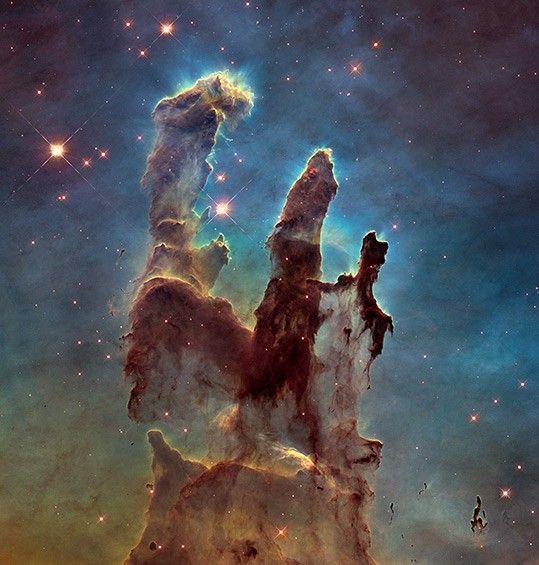
    In one of his pilot stories, he produced a video and story news package about the Hubble Space Telescope’s observations of the Eagle Nebula.

    “They handed me a 16-by-20-inch print of the Eagle Nebula right after Hubble imaged it,” he said. His team used a robotic camera to pan around the image while narration explained what viewers were seeing. “We wondered if we put that little microcosm of a story into a news feed, would anybody use it? And it ended up being used thousands and thousands of times, validating the NASA TV model with a bona fide science story and giving me a glimpse of the exciting stuff I could do.”

    While at NASA Headquarters, Sisler also negotiated an IMAX agreement that led to new 3D films (including ones Sisler worked on, like the 1997 “Mission to Mir” and 2002 “Space Station 3D”). After a few years, he moved on to NASA’s Goddard Space Flight Center in Greenbelt, Maryland, in 1997 as an executive producer. Goddard’s communications team was small and had little experience in visual storytelling, so he joined the team to nurture its growth.

    Wade and two coworkers stand in an immersive exhibit
    Sisler stands alongside Office of Communications collaborators Laura Betz and Thaddeus Cesari at the immersive “Beyond the Light” exhibit of James Webb Space Telescope imagery at ARTECHOUSE in Washington, D.C.
    Credit: Courtesy of Wade Sisler

    Science for the Senses 

    In the late ’90s, Wade teamed up with NASA’s Scientific Visualization Studio (based at NASA Goddard) and lead visualizer Horace Mitchell to explore a new frontier in science storytelling. While NASA was already known for its iconic space imagery, much of its data deals with invisible phenomena or abstract processes that aren’t inherently visual. By bringing together scientists, artists, and producers, Sisler helped transform data into visualizations and animations for broader audiences.

    “We had to invent ways of visualizing the invisible so meaning was more easily conveyed,” he said. “The result was stories that were not just newsworthy—they were often stunningly beautiful and showed the connections and workings of the Earth and universe in ways we had never seen before.”

    The team had a breakout hit in 1998 with an El Niño visualization, which helped drive public understanding of the phenomenon. Sisler also helped launch a NASA Goddard program to link scientific experts with news stations around the world.

    “We wanted to put the authentic voices of scientists in the chair to convey their sense of awe while telling people scientifically why it matters,” he said. “Pairing their voices with great visualizations was an unbeatable combination and that became the fundamental way we tell science stories.”

    Sisler’s storytelling journey evolved into increasingly ambitious creative partnerships that brought NASA science to new cultural spaces. With “Cosmic Cycles,” a collaboration with the National Philharmonic, Wade helped create a program that paired music from a live symphony with high-resolution NASA imagery, inviting viewers to experience the celestial scenery emotionally, not just intellectually.

    Instead of the NASA Goddard team creating a video to go along with music, “The composer drew inspiration from video produced by Goddard,” Sisler said. “It’s one of the best examples of science and art in mutual orbit.”

    A photo of Wade and collaborators on stage for a Cosmic Cycles panel discussion
    From left: Multimedia Producer Scott Wiessinger of NASA Goddard, Sisler, maestro Piotr Gajewski of the National Philharmonic, and composer Henry Dehlinger participate in a panel discussion about “Cosmic Cycles: A Space Symphony,” a collaboration between NASA Goddard and the National Philharmonic.
    Credit: NASA/Joel Kowsky

    That blending of science and artistic expression reached a new scale in “Beyond the Light,” an art show developed with ARTECHOUSE and James Webb Space Telescope communications lead Laura Betz. Sisler linked artists with NASA scientists to turn cutting-edge astrophysics into a gallery-scale sensory experience. Most recently, Sisler championed a major documentary on Webb called “Cosmic Dawn.” The 1.5-hour film brings viewers on an unprecedented journey through Webb’s delicate assembly, rigorous testing, and triumphant launch.

    Many of NASA’s flagship communication programs trace their roots to small teams that Sisler helped assemble and guide. He took a builder’s approach, rolling up his sleeves, testing ideas, and empowering others to scale them. From science storytelling and satellite media tours to the rise of NASA’s audio storytelling, Spanish-language content, Conceptual Image Laboratory animations, social media presence, and live broadcast programming, Sisler played a key role in turning bright ideas into enduring agency assets.

    For each of these projects, Sisler worked behind the scenes as a creative force and a connector, bringing together filmmakers, animators, composers, scientists, engineers, astronauts, museum curators, data visualizers, and educators.

    Lighting the Way

    Despite many accolades, Sisler said his proudest accomplishment is the success of the internship program he has led for NASA Goddard’s Office of Communications.

    Wade and a student and another coworker at a poster session
    Sisler has served as a mentor for many interns over the years, including students like Talya Lerner, center, standing next to Ed Campion, then-Goddard news chief. Sisler has referred to his own career as “the internship that never ended” because he had so many opportunities to explore different areas of communications. 
    Credit: NASA/Bill Hrybyk

    “The thing that stays with me most is seeing where our former interns have landed,” he said. Many now lead their own programs within NASA, shaping the next generation of science storytelling from inside the agency. Others have taken their skills beyond NASA, contributing to science and technology literacy through media, education, and public engagement. “It’s been a privilege to help launch so many of these careers. I’ve always believed that when you combine mentorship, meaningful work, and a little creative freedom, you create a ripple effect that lasts for decades.”

    Sisler’s own NASA journey began with a Pathways internship at NASA Ames while he was studying journalism at Baylor University in Texas. His work there drew him into visual storytelling, which led him to pursue photography, video, and science photography at the Rochester Institute of Technology in New York. As he alternated semesters between school and NASA Ames, he refined both his interests and his skills.

    Sisler’s goal as an internship program coordinator was to help give the next generation of science communicators the same opportunity. He developed a communication “boot camp” to help interns develop their storytelling chops in many areas and figure out which were their favorites.

    “All the interesting stuff happens at the intersections of people’s passions,” he said. “The best, most powerful thing I think I’ve done in my time at NASA is to help guide the next wave of science communicators. Seeing their success is the gift that keeps on giving.”

    By Ashley Balzer
    NASA’s Goddard Space Flight Center, Greenbelt, Md.

    Details

    Last Updated

    Aug 07, 2025

    Editor
    Ashley Balzer
    Contact
    Ashley Balzer
    Location
    Goddard Space Flight Center

  • Curiosity Blog, Sols 4622-4623: Kicking Off (Earth) Year 14 With an Investigation of Veins

    3 min read

    Curiosity Blog, Sols 4622-4623: Kicking Off (Earth) Year 14 With an Investigation of Veins

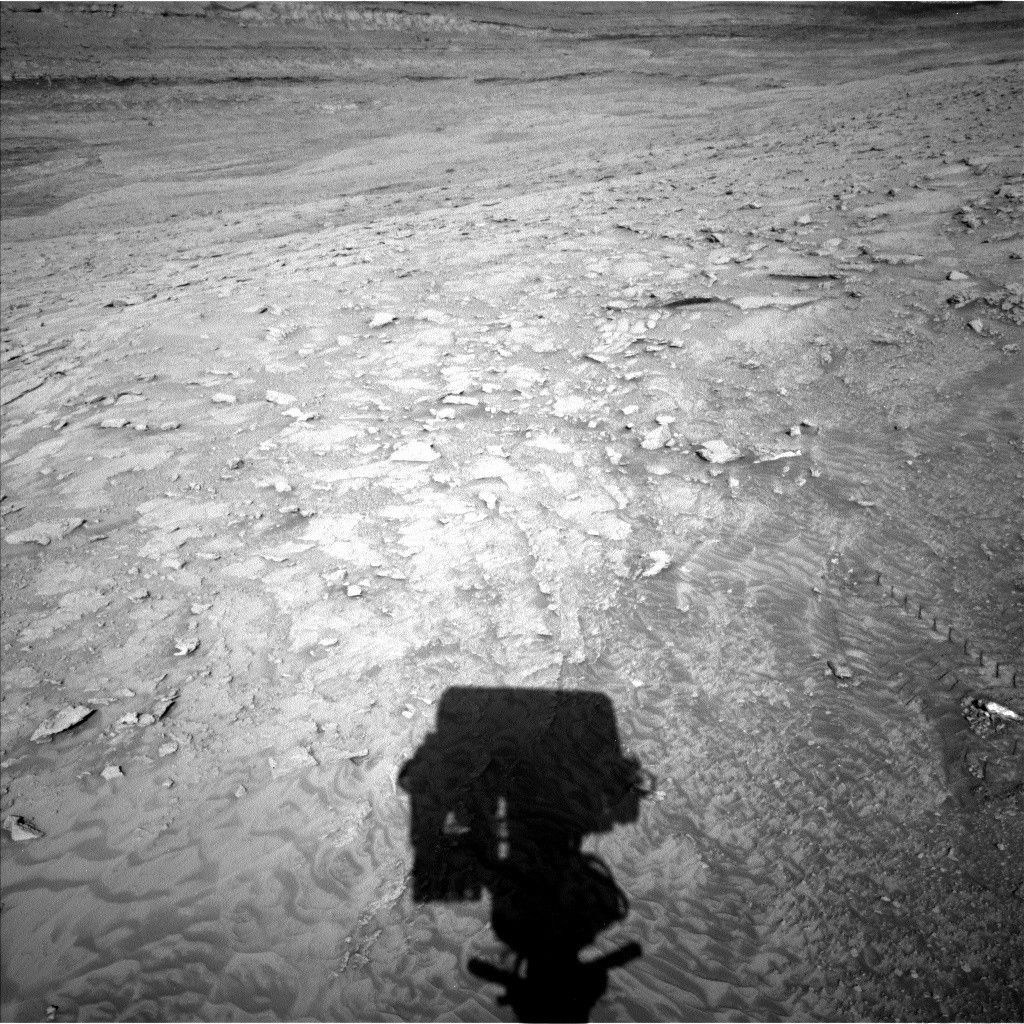
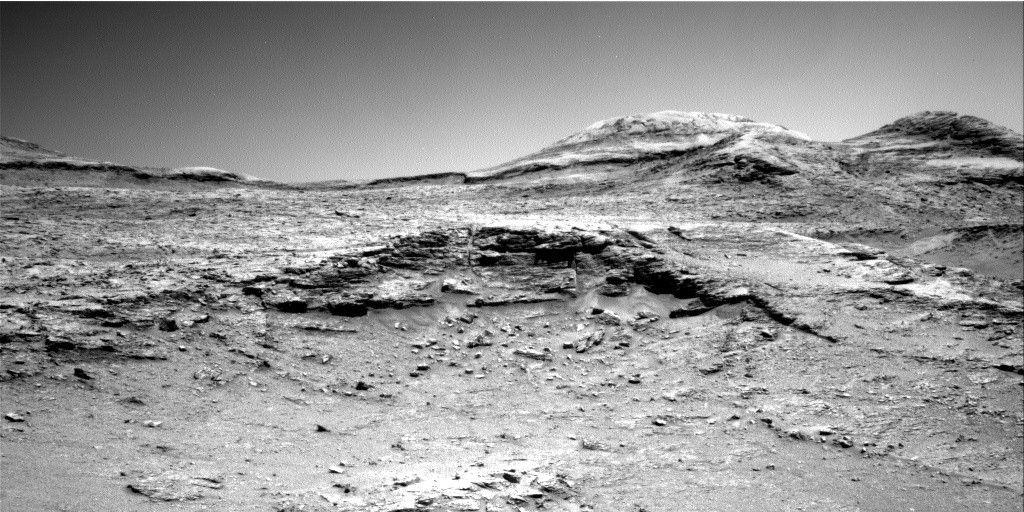
    A grayscale photo from the Martian surface shows a rough, rocky landscape in medium gray, with a shadow of the Curiosity rover’s boxy masthead showing at the bottom center of the frame.
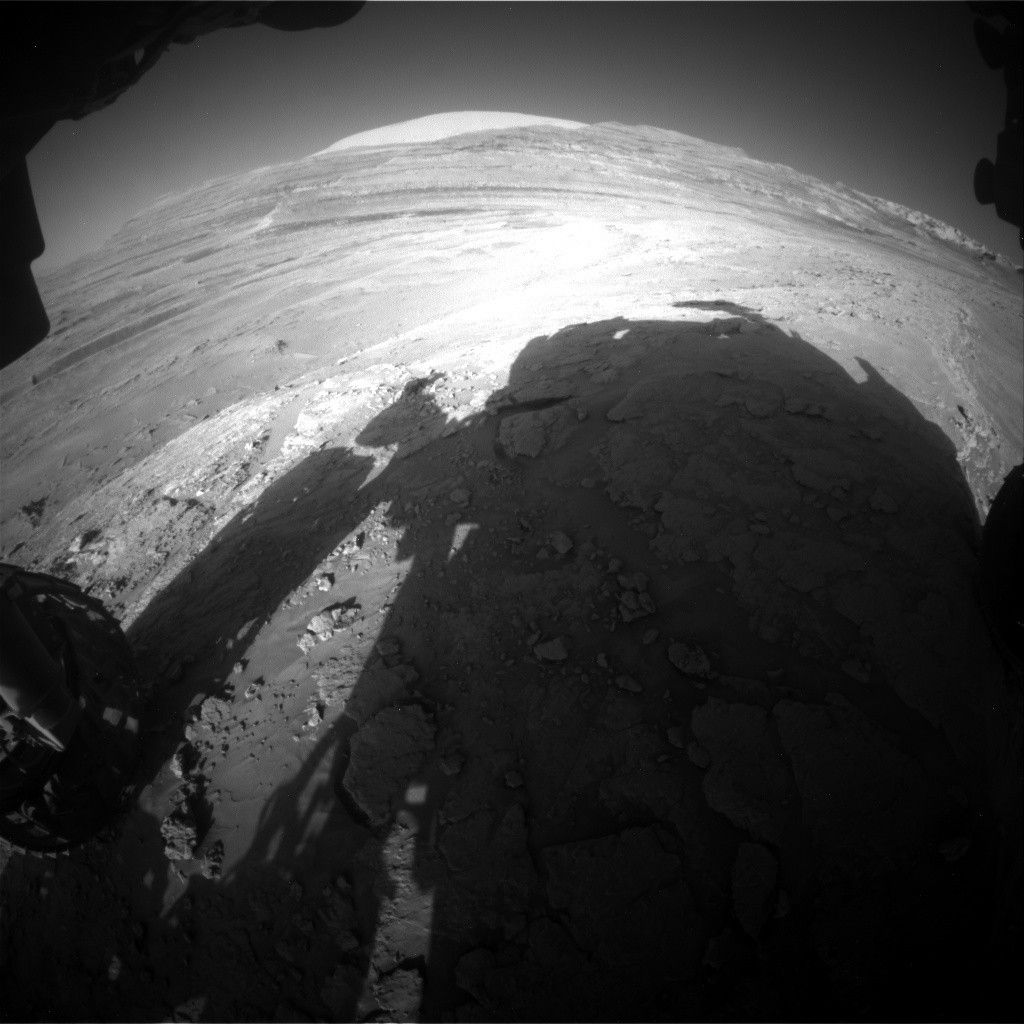
    NASA’s Mars rover Curiosity, using its Left Navigation Camera, caught the shadow of the rover’s mast looking ahead to new terrain as the mission started its 14th Earth year on Mars. Curiosity acquired this image on Aug. 6, 2025 — Sol 4621, or Martian day 4,621 of the Mars Science Laboratory mission — at 06:24:09 UTC.
    NASA/JPL-Caltech

    Written by Abigail Fraeman, Deputy Project Scientist at NASA’s Jet Propulsion Laboratory

    Earth planning date: Wednesday, Aug. 6, 2025.

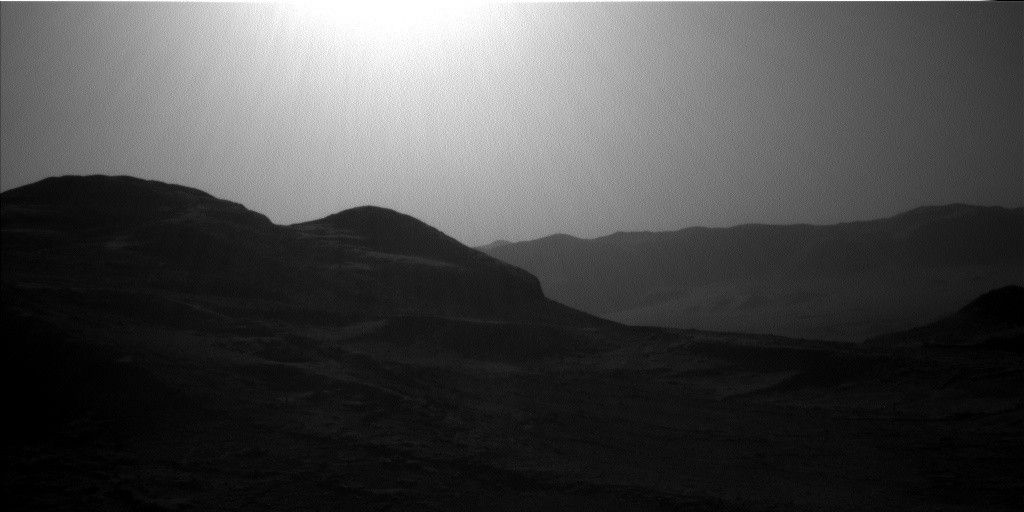
    Today was a very special day for Curiosity as the rover celebrated the start of a 14th year on Mars. Curiosity is currently exploring the mysterious boxwork formations. On Monday, the rover positioned itself at the side of one of the ridges, where the team had spotted tantalizing hints of a complex network of razor-thin veins that may give insight into what is holding the ridges up, compared to the surrounding hollows

    In this plan, the team will use the instruments on Curiosity’s arm and mast to investigate the geometry and composition of these veins to learn more about them. APXS and MAHLI will both observe “Repechón,” a loose block with dark-toned, mottled material exposed on top, as well as “Lago Poopó,” a bright, relatively clean vein network. MAHLI will also collect a side view of “Repechón.” ChemCam will use its laser to analyze two targets, “Vicguna,” a protruding vein edge with nodular texture, and “Ibare,” which has some exposed light-toned veins. Outside of the vein investigation, ChemCam’s telescopic RMI camera will observe layering in a nearby butte and the Mishe Mokwa feature, while Mastcam will take mosaics on “Cachiniba,” a broken block, “Yapacani,” the side of another large boxwork ridge, and “Llullaillaco,” a faraway feature that we imaged from a slightly different location in a previous plan. Additional environmental monitoring observations will round out the plan, followed by a straight-line drive to the east, to an area where several large boxwork ridges intersect that the team has been informally calling “the peace sign” because of its shape.

    I usually get nostalgic around landing anniversaries, or “landiversaries,” and this year, I found myself looking back through pictures of landing night. One of my favorites shows me standing next to science team member Kirsten Siebach right after we received the first images from Curiosity. The two of us have the biggest, most excited grins on our faces. We were both graduate students at the time, and both of us were writing thesis chapters analyzing orbital data over regions we hoped to explore with Curiosity one day. I was studying a layer in Mount Sharp that contained hematite, and the team named this feature “Vera Rubin ridge” when Curiosity reached it in 2017. Kirsten, who is now a professor at Rice University, was focused on the boxwork structures, pondering how they formed and hypothesizing what they might tell us about the history of Martian habitability when we reached them.

    Thirteen years later, I had another big grin on my face today, as I listened to Kirsten and our incredible science team members excitedly discussing Curiosity’s new images of these same boxwork structures. I was also filled with gratitude for the thousands of people it took to get us to this moment. It was the absolute best way to spend a landiversary.

    Details

    Last Updated

    Aug 07, 2025

    Related Terms