Tag: solar system

  • NASA to Provide Live Coverage of Crew-10 Return, Splashdown

    NASA's SpaceX Crew-10 members Kirill Peskov of Roscosmos, NASA astronauts Nichole Ayers and Anne McClain, and JAXA (Japan Aerospace Exploration Agency) astronaut Takuya Onishi share a light moment during a group portrait inside the International Space Station's Kibo laboratory module.
    From left, NASA’s SpaceX Crew-10 members Kirill Peskov of Roscosmos, NASA astronauts Nichole Ayers and Anne McClain, and JAXA (Japan Aerospace Exploration Agency) astronaut Takuya Onishi share a light moment during a group portrait inside the International Space Station’s Kibo laboratory module.
    Credit: NASA

    Editor’s Note: This advisory was updated Aug. 7, 2025, to reflect changes in the targeted undocking and splashdown dates.

    NASA and SpaceX are targeting no earlier than 6:05 p.m. EDT, Friday, Aug. 8, for the undocking of the agency’s SpaceX Crew-10 mission from the International Space Station. Pending weather conditions, splashdown is targeted at 11:33 a.m., Saturday, Aug. 9. Crew-10 will be the first mission to splash down off the California coast for NASA’s Commercial Crew Program.

    NASA astronauts Anne McClain and Nichole Ayers, JAXA (Japan Aerospace Exploration Agency) astronaut Takuya Onishi, and Roscosmos cosmonaut Kirill Peskov are completing a five-month science expedition aboard the orbiting laboratory and will return time-sensitive research to Earth.

    Mission managers continue monitoring weather conditions in the area, as undocking of the SpaceX Dragon depends on spacecraft readiness, recovery team readiness, weather, sea states, and other factors. NASA and SpaceX will select a specific splashdown time and location closer to the Crew-10 spacecraft undocking.

    NASA’s live coverage of return and related activities will stream on NASA+, Amazon Prime, and more. Learn how to stream NASA content through a variety of platforms.

    NASA’s coverage is as follows (all times Eastern and subject to changed based on real-time operations):

    Friday, Aug. 8

    3:45 p.m. – Hatch closure coverage begins on NASA+ and Amazon Prime.

    4:20 p.m. – Hatch closing

    5:45 p.m. – Undocking coverage begins on NASA+ and Amazon Prime.

    6:05 p.m. – Undocking

    Following the conclusion of undocking coverage, NASA will distribute audio-only discussions between Crew-10, the space station, and flight controllers during Dragon’s transit away from the orbital complex.

    Saturday, Aug. 9

    10:15 a.m. – Return coverage begins on NASA+ and Amazon Prime.

    10:39 a.m. – Deorbit burn

    11:33 a.m. – Splashdown

    1 p.m. – Return to Earth media teleconference will stream live on the agency’s YouTube channel, with the following participants:

    • Steve Stich, manager, NASA’s Commercial Crew Program
    • Dina Contella, deputy manager, NASA’s International Space Station Program
    • Sarah Walker, director, Dragon Mission Management, SpaceX
    • Kazuyoshi Kawasaki, associate director general, Space Exploration Center/Space Exploration Innovation Hub Center, JAXA

    To participate in the teleconference, media must contact the NASA Johnson newsroom by 5 p.m., Aug. 7, at: jsccommu@mail.nasa.gov or 281-483-5111. To ask questions, media must dial in no later than 10 minutes before the start of the call. The agency’s media credentialing policy is available online.

    Find full mission coverage, NASA’s commercial crew blog, and more information about the Crew-10 mission at:

    https://www.nasa.gov/commercialcrew

    -end-

    Joshua Finch
    Headquarters, Washington
    202-358-1100
    joshua.a.finch@nasa.gov

    Sandra Jones / Joseph Zakrzewski
    Johnson Space Center, Houston
    281-483-5111
    sandra.p.jones@nasa.gov / joseph.a.zakrzewski@nasa.gov

    Steve Siceloff / Stephanie Plucinsky
    Kennedy Space Center, Florida
    321-867-2468
    steven.p.siceloff@nasa.gov / stephanie.n.plucinsky@nasa.gov

  • Snapshot Wisconsin Celebrates 10 Years and 100 Million Photos Collected!

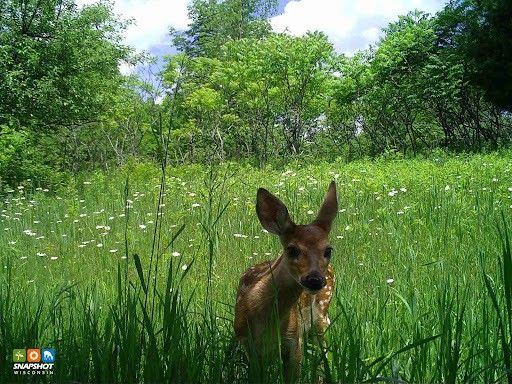
    A young deer stands in a lush green meadow surrounded by wildflowers and trees, captured by a Snapshot Wisconsin trail camera.
    A white-tailed deer fawn photographed on a Snapshot Wisconsin trail camera in Vernon County, WI
    Credit: WI DNR

    The Snapshot Wisconsin project recently collected their 100 millionth trail camera photo! What’s more, this milestone coincides with the project’s 10-year anniversary. Congratulations to the team and everyone who’s participated!

    Snapshot Wisconsin utilizes a statewide network of volunteer-managed trail cameras to monitor and better understand the state’s diverse wildlife from white-tailed deer to snowshoe hares, whooping cranes, and much more.

    “It’s been amazing to get a glimpse of our wild treasures via the Snapshot lens,” said volunteer Matt Dettlaff from Adams County, Wisconsin. “Satisfying to help advance wildlife research in the digital age.”

    Snapshot Wisconsin was launched in 2013 with help from a NASA grant, and is overseen by the Wisconsin Department of Natural Resources. It recently won a new grant from NASA’s Citizen Science for Earth Systems Program.

    Volunteer classifications of the species present in trail camera photos have fueled many different scientific investigations over the years. You, too, can get involved in the merriment by visiting the project’s site on the Zooniverse crowdsourcing platform and helping classify their latest photo season today!

    Details

    Last Updated

    Aug 07, 2025

  • NASA Science Activation Teams Unite to Support Neurodiverse Learners with Public Libraries

    3 min read

    NASA Science Activation Teams Unite to Support Neurodiverse Learners with Public Libraries

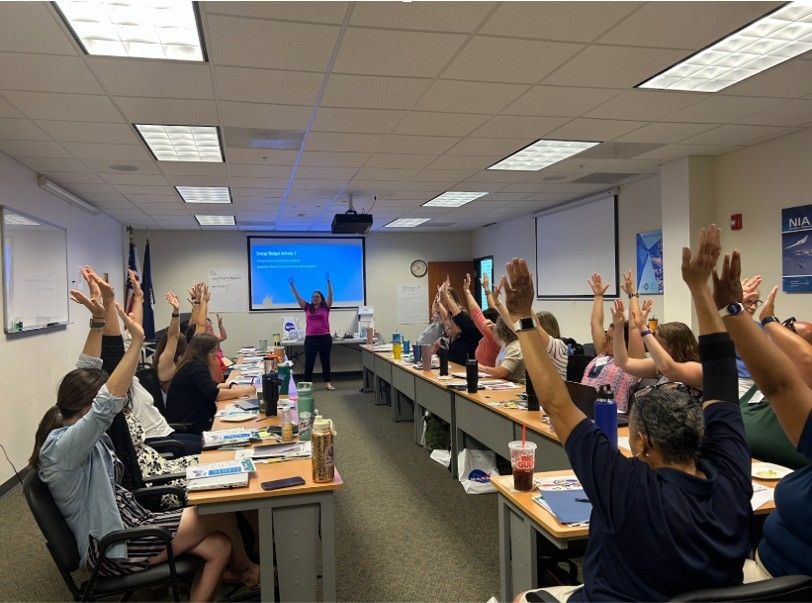
    On July 16, 2025, more than 400 public library staff from across the United States joined a powerful webinar, Serving Neurodiverse Library Patrons and Colleagues, hosted by two NASA Science Activation program teams: NASA@ My Library and NASA’s Neurodiversity Network (N3). The event brought together researchers, library professionals, and individuals with lived experience of neurodiversity to share insights and best practices for creating more inclusive and supportive environments in libraries.

    Designed to equip library staff with tools and awareness, this interactive webinar explored how libraries can better serve neurodiverse patrons, such as those with autism, attention deficit hyperactivity disorder (ADHD), dyslexia, and other cognitive variations, while also supporting neurodiverse colleagues. Breakout rooms allowed participants to dive deeper into specific topics, including accessible program facilitation, supporting neurodiverse colleagues, and an “Ask Me Anything” space that encouraged open dialogue and learning.

    Library staff everywhere are invited to watch the recorded webinar on YouTube and learn more about serving neurodiverse patrons and colleagues.

    The collaboration between NASA@ My Library (led by the Space Science Institute), and NASA’s Neurodiversity Network (N3) (led by Sonoma State University), reflects a shared commitment to broadening participation in STEM (Science, Technology, Engineering, and Mathematics). NASA@ My Library works with public libraries nationwide to engage diverse communities in NASA science and discoveries. N3 focuses on empowering neurodiverse learners – particularly those in high school – with opportunities to engage with NASA science and explore potential STEM career pathways.

    Participants left inspired, and the demand for more is clear: attendees and speakers alike expressed interest in continuing the conversation, requesting additional training, and expressing interest in organizing a future conference centered on neurodiversity and inclusion in libraries.

    Youth Services Librarian and webinar panelist Molly Creveling shared, “This was such a great opportunity, and I’m extremely proud to have been able to contribute to it, I wish I was able to attend everyone’s break out room!” And participant Jason Wood expressed in the chat, “Really, really appreciate this webinar. This is one of those days I am extra proud to be a librarian. Thank you all.” Another enthusiast participant said, “This was the best webinar I’ve attended in years…more of this!”

    Watch the recorded webinar.

    As NASA continues to reach for the stars, it’s equally committed to ensuring that the journey is accessible to all – especially those whose unique ways of thinking and learning bring fresh perspectives to science, exploration, and discovery.

    NASA@ My Library and N3, supported by NASA under cooperative agreement award numbers NNX16AE30A and  80NSSC21M0004, are part of NASA’s Science Activation Portfolio. Learn more about how Science Activation connects NASA science experts, real content, and experiences with community leaders to do science in ways that activate minds and promote deeper understanding of our world and beyond: https://science.nasa.gov/learn

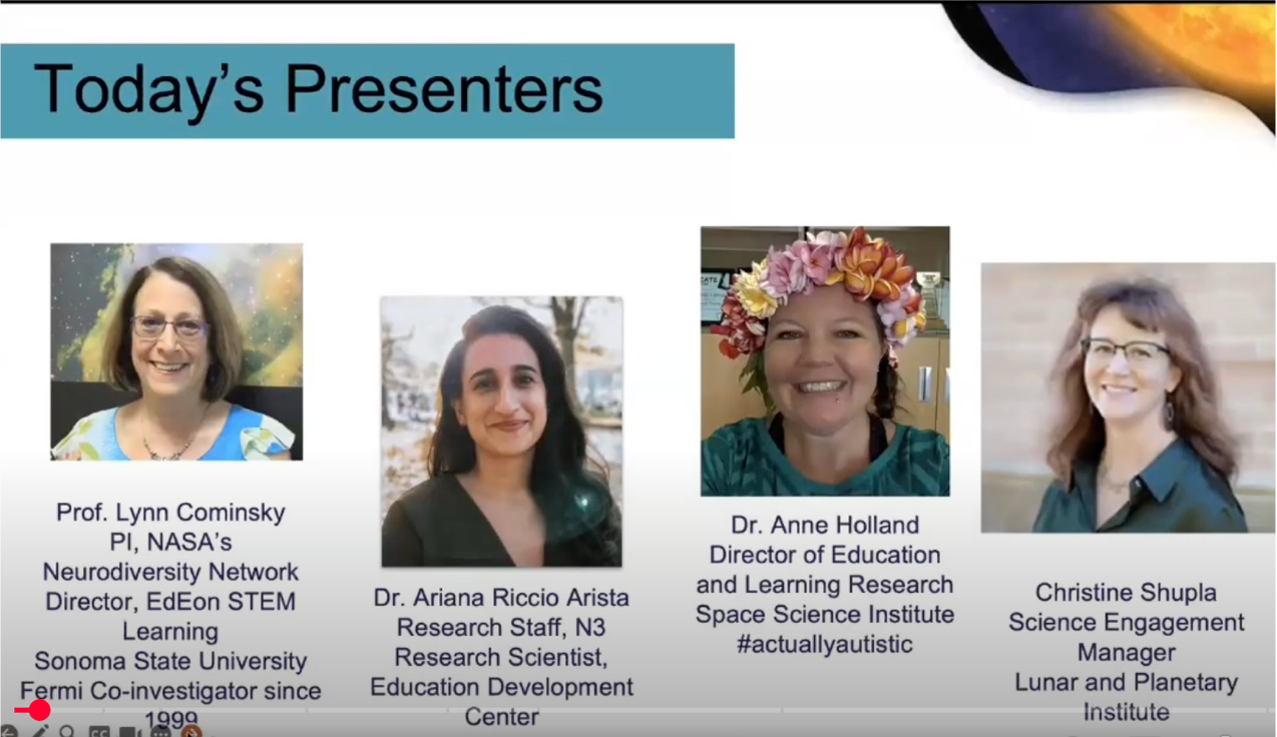
    Presentation slide showing photos of webinar presenters.
    Presenters included staff from NASA’s Neurodiversity Network, NASA@ My Library, Education Development Center, and the Lunar and Planetary Institute.

    Details

    Last Updated

    Aug 05, 2025

    Editor
    NASA Science Editorial Team

  • What is NASA’s Distributed Spacecraft Autonomy?

    Software designed to give spacecraft more autonomy could support a future where swarms of satellites navigate and complete scientific objectives with limited human intervention.

    A man stands in front of a computer server and gestures towards the racks and cables.
    Caleb Adams, Distributed Spacecraft Autonomy project manager, monitors testing alongside the test racks containing 100 spacecraft computers at NASA’s Ames Research Center in California’s Silicon Valley. The DSA project develops and demonstrates software to enhance multi-spacecraft mission adaptability, efficiently allocate tasks between spacecraft using ad-hoc networking, and enable human-swarm commanding of distributed space missions.
    Credit: NASA/Brandon Torres Navarrete

    Astronauts living and working on the Moon and Mars will rely on satellites to provide services like navigation, weather, and communications relays. While managing complex missions, automating satellite communications will allow explorers to focus on critical tasks instead of manually operating satellites.  

    Long duration space missions will require teaming between systems on Earth and other planets. Satellites orbiting the Moon, Mars, or other distant areas face communications delays with ground operators which could limit the efficiency of their missions.  

    The solution lies within the Distributed Spacecraft Autonomy (DSA) project, led by NASA’s Ames Research Center in California’s Silicon Valley, which tests how shared autonomy across distributed spacecraft missions makes spacecraft swarms more capable of self-sufficient research and maintenance by making decisions and adapting to changes with less human intervention. 

    Adding autonomy to satellites makes them capable of providing services without waiting for commands from ground operators. Distributing the autonomy across multiple satellites, operating like a swarm, gives the spacecraft a “shared brain” to accomplish goals they couldn’t achieve alone. 

    The DSA software, built by NASA researchers, provides the swarm with a task list, and shares each spacecraft’s distinct perspective – what it can observe, what its priorities are – and integrates those perspectives into the best plan of action for the whole swarm. That plan is supported by decision trees and mathematical models that help the swarm decide what action to take after a command is completed, how to respond to a change, or address a problem. 

    Sharing the Workload

    The first in-space demonstration of DSA began onboard the Starling spacecraft swarm, a group of four small satellites, demonstrating various swarm technologies. Operating since July 2023, the Starling mission continues providing a testing and validation platform for autonomous swarm operations. The swarm first used DSA to optimize scientific observations, deciding what to observe without pre-programmed instructions. These autonomous observations led to measurements that could have been missed if an operator had to individually instruct each satellite. 

    The Starling swarm measured the electron content of plasma between each spacecraft and GPS satellites to capture rapidly changing phenomena in Earth’s ionosphere – where Earth’s atmosphere meets space. The DSA software allowed the swarm to independently decide what to study and how to spread the workload across the four spacecraft. 

    Because each Starling spacecraft operates as an independent member within the swarm, if one swarm member was unable to accomplish its work, the other three swarm members could react and complete the mission’s goals. 

    The Starling 1.0 demonstration achieved several firsts, including the first fully distributed autonomous operation of multiple spacecraft, the first use of space-to-space communications to autonomously share status information between multiple spacecraft, the first demonstration of fully distributed reactive operations onboard multiple spacecraft, the first use of a general-purpose automated reasoning system onboard a spacecraft, and the first use of fully distributed automated planning onboard multiple spacecraft. These achievements laid the groundwork for Starling 1.5+, an ongoing continuation of the satellite swarm’s mission using DSA.  

    Illustrated image of four satellites orbiting Earth as the sun rises over the planet's horizon.
    Advanced testing of DSA onboard Starling shows that distributed autonomy in spacecraft swarms can improve efficiencies while reducing the workload on human operators.
    Credit: NASA/Daniel Rutter

    A Helping Hand in Orbit 

    After DSA’s successful demonstration on Starling 1.0, the team began exploring additional opportunities to use the software to support satellite swarm health and efficiency. Continued testing of DSA on Starling’s extended mission included PLEXIL (Plan Execution Interchange Language), a NASA-developed programming language designed for reliable and flexible automation of complex spacecraft operations. 

    Onboard Starling, the PLEXIL application demonstrated autonomous maintenance, allowing the swarm to manage normal spacecraft operations, correct issues, or distribute software updates across individual spacecraft.  

    Enhanced autonomy makes swarm operation in deep space feasible – instead of requiring spacecraft to communicate back and forth between their distant location and Earth, which can take minutes or hours depending on distance, the PLEXIL-enabled DSA software gives the swarm the ability to make decisions collaboratively to optimize their mission and reduce workloads. 

    Simulated Lunar Swarming 

    To understand the scalability of DSA, the team used ground-based flight computers to simulate a lunar swarm of virtual small spacecraft. The computers simulated a swarm that provides position, navigation, and timing services on the Moon, similar to GPS services on Earth, which rely on a network of satellites to pinpoint locations. 

    The DSA team ran nearly one hundred tests over two years, demonstrating swarms of different sizes at high and low lunar orbits. The lessons learned from those early tests laid the groundwork for additional scalability studies. The second round of testing, set to begin in 2026, will demonstrate even larger swarms, using flight computers that could later go into orbit with DSA software onboard. 

    The Future of Spacecraft Swarms 

    Orbital and simulated tests of DSA are a launchpad to increased use of distributed autonomy across spacecraft swarms. Developing and proving these technologies increases efficiency, decreases costs, and enhances NASA’s capabilities opening the door to autonomous spacecraft swarms supporting missions to the Moon, Mars, and beyond.  

    Milestones:

    • October 2018: DSA project development begins.
    • April 2020: Lunar position, navigation, and timing (LPNT) simulation demonstration development begins.
    • July 2023: DSA launches onboard the Starling spacecraft swarm.
    • March 2024: DSA experiments onboard Starling reach the necessary criteria for success.
    • July 2024: DSA software development begins for the Starling 1.5+ mission extension.
    • September 2024: LPNT simulation demonstration concludes successfully.
    • October 2024: DSA’s extended mission as part of Starling 1.5+ begins.

    Partners:

    NASA Ames leads the Distributed Spacecraft Autonomy and Starling projects. NASA’s Game Changing Development program within the agency’s Space Technology Mission Directorate provided funding for the DSA experiment. NASA’s Small Spacecraft Technology program within the Space Technology Mission Directorate funds and manages the Starling mission and the DSA project.  

    Learn More:

    For researchers:

    For media:

    Members of the news media interested in covering this topic should reach out to the NASA Ames newsroom.

  • Second Lady Usha Vance, NASA Astronaut Suni Williams Celebrate Reading

    Second Lady Usha Vance and astronaut Suni Williams sit in gray chairs on a stage. They are both smiling as they listen. The U.S. flag, the state flag of Texas, and a flag with the NASA seal are on the podium alongside them. There is a blue poster board with a white border promoting the Summer Reading Challenge between them.
    NASA/Robert Markowitz

    Second Lady Usha Vance and NASA astronaut Suni Williams listen to the audience in this image from Aug. 4, 2025. Ms. Vance joined Williams at NASA’s Johnson Space Center in Houston for a summer reading challenge event, through which the Second Lady encourages youth to seek adventure, imagination, and discovery between the pages of a book.

    Image credit: NASA/Robert Markowitz

  • Perseids Meteor Shower

    The night sky is covered in small white points of light - these are stars. Slightly right of middle, a green and yellow streak goes across the sky. The bottom of the picture is lined with the shadow of treetops.
    NASA/Bill Ingalls

    In this 30 second exposure photograph, a meteor streaks across the sky during the annual Perseid and Alpha Capricornids meteor showers, Sunday, Aug. 3, 2025, in Spruce Knob, West Virginia.

    The Perseids meteor shower, which peaks in mid-August, is considered the best of the year. With swift and bright meteors, Perseids frequently leave long “wakes” of light and color behind them as they streak through Earth’s atmosphere. The Perseids are one of the most plentiful showers with about 50 to 100 meteors seen per hour.

    This year, visibility will be hampered by an 84%-full Moon on the peak night. A few bright meteors may still be seen in the pre-dawn hours, but viewing conditions are not ideal.

    Image credit: NASA/Bill Ingalls

  • NASA’s Artemis Crew Trains in Moonbound Orion Ahead of Mission

    The Artemis II crew (from left to right) CSA (Canadian Space Agency) Jeremy Hansen, mission specialist; Christina Koch, mission specialist; Victor Glover, pilot; and Reid Wiseman, commander, don their Orion Crew Survival System Suits for a multi-day crew module training beginning Thursday, July 31, 2025 at the agency’s Kennedy Space Center in Florida. Behind the crew, wearing clean room apparel, are members of the Artemis II closeout crew.
    NASA/Rad Sinyak

    The first crew slated to fly in NASA’s Orion spacecraft during the Artemis II mission around the Moon early next year entered their spacecraft for a multi-day training at the agency’s Kennedy Space Center in Florida. Crew donned their spacesuits July 31 and boarded Orion to train and experience some of the conditions they can expect on their mission.

    NASA astronauts Reid Wiseman, Victor Glover, and Christina Koch, and CSA (Canadian Space Agency) astronaut Jeremy Hansen participated in a suited crew test and crew equipment interface test, performing launch day and simulated orbital activities inside Orion.

    Every milestone in the Artemis campaign brings us closer to landing Americans back on the Moon and pushing onward to Mars.

    sEAN dUFFY

    sEAN dUFFY

    acting NASA Administrator

    “In about six months, Artemis II astronauts will journey around the Moon for the first time in 53 years,” Duffy said. “America rallied behind Apollo because it represented the best of us – now it’s Artemis’ turn. They’re not just carrying a flag – they’re carrying the pride, power, and promise of the United States of America.”

    With Orion powered on, the suited crew test was a close representation of what the crew can expect on launch day. The crew began the day by suiting up inside the spaceport’s Multi-Operation Support Building, donning their Orion crew survival system spacesuits, boarding the zero-emission crew transportation vehicles, and entering Orion, which is currently inside the Multi-Payload Processing Facility, where engineers have loaded its propellants over the course of several weeks.

    Once in Orion, the crew performed several launch day activities, including communications checkouts and suit leak checks. For the first time, the crew was connected to the spacecraft and its communications and life control systems, and all umbilicals were connected while the spacecraft operated on full power.

    Teams simulated several different ground and flight conditions to give the crew more experience managing them in real time. Some of the activities simulated scenarios where the crew was challenged to address potential issues while in space such as leaks and failure of the air revitalization system fan, which is needed to provide oxygen and remove carbon dioxide from the cabin. Getting this hands-on experience and learning how to act fast to overcome potential challenges during flight helps ensure the crew is ready for any scenario.

    The test provides astronauts the ability to train on the actual hardware they will use during flight, allowing them and support teams the opportunity to familiarize themselves with the equipment in configurations very close to what will be experienced during flight. It also allows teams to verify compatibility between the equipment and systems with flight controller procedures, so they can make any final adjustments ahead of launch.

    This test brings together the Artemis II crew and the Orion spacecraft that will carry them to the Moon and back.

    Shawn Quinn

    Shawn Quinn

    NASA’s Exploration Ground Systems Program manager

    “It signifies the immense amount of work that our operations and development teams put into making sure we are ready for launch.” Quinn said. “They have meticulously planned each operation, timing them to perfection – and now we put it to the test.”

    Exchanging their spacesuits for cleanroom garments for the crew equipment interface test, and with the spacecraft powered off, the crew also performed many of the activities they are likely to do in flight and conducted additional equipment checks. The crew practiced removing and stowing the foot pans on the pilot and commander seats, which will allow them to have more open space in the cabin after launch. They also accessed the stowage lockers and familiarized themselves with cameras, associated cables and mounts, and the environmental control and life support system hardware.

    In addition to getting practical experience with the actual hardware they’ll use in space, they also prepared for life in deep space, reviewing cabin labels, sleep arrangements and checklists, and the hygiene bay.

    Through the Artemis campaign, NASA will send astronauts to explore the Moon for scientific discovery, economic benefits, and to build the foundation for the first crewed missions to Mars – for the benefit of all. 

  • Mark Cavanaugh: Integrating Safety into the Orion Spacecraft 

    Before astronauts venture around the Moon on Artemis II, the agency’s first crewed mission to the Moon since Apollo, Mark Cavanaugh is helping make sure the Orion spacecraft is safe and space-ready for the journey ahead.  

    As an Orion integration lead at NASA’s Johnson Space Center in Houston, he ensures the spacecraft’s critical systems— in both the U.S.-built crew module and European-built service module—come together safely and seamlessly. 

    Mark Cavanaugh stands in front of a mockup of the Orion spacecraft inside the Space Vehicle Mockup Facility at NASA’s Johnson Space Center in Houston.
    NASA/Robert Markowitz

    With nearly a decade of experience at NASA, Cavanaugh currently works within the Orion Crew and Service Module Office at Johnson. He oversees the technical integration of the European Service Module, which provides power, propulsion, and life support to Orion during Artemis missions to the Moon. His work includes aligning and verifying essential systems to keeping the crew alive, including oxygen, nitrogen, water storage, temperature regulation, and spacecraft structures. 

    In addition to his integration work, Cavanaugh is an Orion Mission Evaluation Room (MER) manager. The MER is the engineering nerve center during Artemis flights, responsible for real-time monitoring of the Orion spacecraft and real-time decision-making. From prelaunch to splashdown, Cavanaugh will lead a team of engineers who track vehicle health and status, troubleshoot anomalies, and communicate directly with the flight director to ensure the mission remains safe and on track. 

    A man wearing a headset looks intently at a monitor screen.
    Mark Cavanaugh supports an Artemis I launch attempt from the Passive Thermal Control System console on Aug. 29, 2022, in the Orion Mission Evaluation Room at NASA’s Johnson Space Center.
    NASA/Josh Valcarcel

    Cavanaugh’s passion for space exploration began early. “I’ve wanted to be an aerospace engineer since I was six years old,” he said. “My uncle, who is also an aerospace engineer, used to take me to wind tunnel tests and flight museums as a kid.” 

    That passion only deepened after a fifth-grade trip from Philadelphia to Houston with his grandfather. “My dream of working at NASA Johnson started when I visited the center for the first time,” he said. “Going from being a fifth grader riding the tram on the tour to contributing to the great work done at Johnson has been truly incredible.” 

    Turning that childhood dream into reality did not come with a straight path. Cavanaugh graduated from Pennsylvania State University in 2011, the same year NASA’s Space Shuttle Program ended. With jobs in the space industry in short supply, he took a position with Boeing in Houston, working on the International Space Station’s Passive Thermal Control System. He later supported thermal teams for the Artemis Moon rocket called the Space Launch System, and the Starliner spacecraft that flew astronauts Butch Wilmore and Suni Williams during their Boeing Crew Flight Test mission, before a mentor flagged a NASA job posting that turned out to be the perfect fit. 

    He joined NASA as the deputy system manager for Orion’s Passive Thermal Control System, eventually stepping into his current leadership role on the broader Orion integration team. “I’ve been very lucky to work with some of the best and most supportive teammates you can imagine,” he said. 

    Mark Cavanaugh with his mother, Jennifer, in front of the Artemis I Orion spacecraft following the thermal vacuum test at the Space Environments Complex at NASA’s Neil Armstrong Test Facility in Sandusky, Ohio.

    Cavanaugh says collaboration and empathy were key to solving challenges along the way. “I’ve learned to look at things from the other person’s perspective,” he said. “We’re all working toward the same incredible goal, even if we don’t always agree. That mindset helps keep things constructive and prevents misunderstandings.” 

    He also emphasizes the importance of creative problem-solving. “For me, overcoming technical challenges comes down to seeking different perspectives, questioning assumptions, and not being afraid to try something new—even if it sounds a little ridiculous at first.” 

    A person on a motorcycle races on a racetrack.
    Mark Cavanaugh riding his motorcycle on the Circuit of the Americas track in Austin, Texas.

    Outside of work, Cavanaugh fuels his love of speed and precision by riding one of his three motorcycles. He has even taken laps at the Circuit of the Americas track in Austin, Texas.  

    When he is not on the track or in the control room, Cavanaugh gives back through student outreach. “The thing I always stress when I talk to students is that nothing is impossible,” he said. “I never thought I’d get to work in the space industry, let alone at NASA. But I stayed open to opportunities—even the ones that didn’t match what I originally imagined for myself.” 

  • NASA’s SpaceX Crew-11 Launches to International Space Station

    A SpaceX Falcon 9 rocket carrying the company’s Dragon spacecraft is launched on NASA’s SpaceX Crew-11 mission to the International Space Station with NASA astronauts Zena Cardman, Mike Fincke, JAXA (Japan Aerospace Exploration Agency) astronaut Kimiya Yui, and Roscosmos cosmonaut Oleg Platonov onboard, Friday, Aug. 1, 2025, from NASA’s Kennedy Space Center in Florida. NASA’s SpaceX Crew-11 mission is the eleventh crew rotation mission of the SpaceX Dragon spacecraft and Falcon 9 rocket to the International Space Station as part of the agency’s Commercial Crew Program. Cardman, Fincke, Yui, Platonov launched at 11:43 a.m. EDT from Launch Complex 39A at the NASA’s Kennedy Space Center to begin a six month mission aboard the orbital outpost.
    Credit: NASA/Aubrey Gemignani

    Four crew members of NASA’s SpaceX Crew-11 mission launched at 11:43 a.m. EDT Friday from Launch Complex 39A at the agency’s Kennedy Space Center in Florida for a science expedition aboard the International Space Station.

    A SpaceX Falcon 9 rocket propelled the Dragon spacecraft into orbit carrying NASA astronauts Zena Cardman and Mike Fincke, JAXA (Japan Aerospace Exploration Agency) astronaut Kimiya Yui, and Roscosmos cosmonaut Oleg Platonov. The spacecraft will dock autonomously to the space-facing port of the station’s Harmony module at approximately 3 a.m. on Saturday, Aug. 2.

    “Thanks to the bold leadership of President Donald J. Trump, NASA is back! The agency’s SpaceX Crew-11 mission to the space station is the first step toward our permanent presence on the Moon. NASA, in conjunction with great American companies, continues the mission with Artemis in 2026. This Moon mission will ensure America wins the space race – critical to national security – and leads in the emerging, exciting and highly profitable private sector commercial space business,” said acting NASA Administrator Sean Duffy. “The Commercial Crew Program and Artemis missions prove what American ingenuity, and cutting-edge American manufacturing can achieve. We’re going to the Moon…to stay! After that, we go to Mars! Welcome to the Golden Age of exploration!”

    During Dragon’s flight, SpaceX will monitor a series of automatic spacecraft maneuvers from its mission control center in Hawthorne, California. NASA will monitor space station operations throughout the flight from the Mission Control Center at the agency’s Johnson Space Center in Houston.

    NASA’s live coverage resumes at 1 a.m., Aug. 2, on NASA+ with rendezvous, docking, and hatch opening. After docking, the crew will change out of their spacesuits and prepare cargo for offload before opening the hatch between Dragon and the space station’s Harmony module around 4:45 a.m. Once the new crew is aboard the orbital outpost, NASA will provide coverage of the welcome ceremony beginning at approximately 5:45 a.m.

    Learn how to watch NASA content through a variety of platforms, including social media.

    The number of crew aboard the space station will increase to 11 for a short time as Crew-11 joins NASA astronauts Anne McClain, Nichole Ayers, and Jonny Kim, JAXA astronaut Takuya Onishi, and Roscosmos cosmonauts Kirill Peskov, Sergey Ryzhikov, and Alexey Zubritsky.

    NASA’s SpaceX Crew-10 will depart the space station after the arrival of Crew-11 and a handover period. Ahead of Crew-10’s return, mission teams will review weather conditions at the splashdown sites off the coast of California prior to departure from station.

    During their mission, Crew-11 will conduct scientific research to prepare for human exploration beyond low Earth orbit and benefit humanity on Earth. Participating crew members will simulate lunar landings, test strategies to safeguard vision, and advance other human spaceflight studies led by NASA’s Human Research Program. The crew also will study plant cell division and microgravity’s effects on bacteria-killing viruses, as well as perform experiments to produce a higher volume of human stem cells and generate on-demand nutrients.

    The mission is part of NASA’s Commercial Crew Program, which provides reliable access to space, maximizing the use of the station for research and development and supporting future missions beyond low Earth orbit by partnering with private companies to transport astronauts to and from the space station.
    Learn more about the agency’s Commercial Crew Program at:

    https://www.nasa.gov/commercialcrew

    -end-

    Josh Finch / Claire O’Shea
    Headquarters, Washington
    202-358-1100
    joshua.a.finch@nasa.gov / claire.a.o’shea@nasa.gov

    Steven Siceloff
    Kennedy Space Center, Florida
    321-867-2468
    steven.p.siceloff@nasa.gov

    Sandra Jones
    Johnson Space Center, Houston
    281-483-5111
    sandra.p.jones@nasa.gov

  • How Joint NASA-ESA Sea Level Mission Will Help Hurricane Forecasts

    6 min read

    Preparations for Next Moonwalk Simulations Underway (and Underwater)

    Hurricane Elena
    Sea surface height can tell meteorologists a lot about extreme storms like hurricanes, including whether they will intensify within a day. This kind of information can help communities better prepare if a hurricane is headed their way. Hurricane Elena is seen here from the space shuttle Discovery in 1985.
    NASA

    Sentinel-6B will measure sea surface height for nearly all of the world’s ocean, providing important data for information products, including weather and hurricane forecasts.

    NASA has a long record of monitoring Earth’s sea surface height, information critical not only for tracking how the ocean changes over time but also for hurricane forecasting. These extreme storms can cost the United States billions of dollars each year, wreaking havoc on lives and property. Meteorologists have worked to improve forecasts for a hurricane’s path, or track, as well as its intensity, measured as surface wind speed. Sentinel-6B, the U.S.-European satellite launching later this year, will help in that effort.

    The satellite is the second of two spacecraft that constitute the Sentinel-6/Jason-CS (Continuity of Service) mission, a collaboration between NASA, ESA (European Space Agency), EUMETSAT (the European Organisation for the Exploitation of Meteorological Satellites), and the U.S. National Oceanic and Atmospheric Administration (NOAA). With its launch planned for no earlier than Nov. 16, 2025, Sentinel-6B will take over from its twin, Sentinel-6 Michael Freilich, which launched in November 2020 as part of a long line of U.S.-European missions that have monitored sea levels since 1992.

    “Sentinel-6 will track global changes in Earth’s ocean — height, heat, and movement — and will improve forecasts of local extremes like floods and hurricanes, linking planetary trends to real-world risks for communities,” said Nadya Vinogradova Shiffer, Sentinel-6 program scientist at NASA Headquarters in Washington.


    before
    after

    Hurricane Milton

    Hurricane Milton

    Hurricane Milton
    Hurricane Milton

    before

    after

    Before and After

    Hurricane Milton


    These illustrations show ocean heat on Oct. 7, 2024, left, and Oct. 9, right, as Hurricane Milton passed over very warm seawater and rapidly grew. Red and yellow indicate more heat; blue and green are cooler. A satellite image of the hurricane shows the storm’s position as it moves toward Florida’s west coast. Credit: NOAA

    The decades-long, U.S.-European ocean dataset has been key to helping researchers advance hurricane intensity forecasting. Warm water fuels hurricanes. And since water expands as it warms, sea surface height can tell researchers which regions of the ocean are warm enough to supercharge a hurricane.

    “A deep layer of warm seawater is literally taller than a shallow layer of warm water,” said Josh Willis, Sentinel-6B project scientist at NASA’s Jet Propulsion Laboratory in Southern California. So sea surface height can be used as a proxy for the amount of heat in the ocean.

    Fueling Hurricanes

    There are two main ways that forecasters use sea level measurements, said Mark DeMaria, a senior research scientist at Colorado State University in Fort Collins. One way is to help set the proper ocean conditions in ocean-atmosphere hurricane forecast models utilized by the National Hurricane Center.

    The second way is by feeding sea level data into machine learning models that forecasters use to predict whether a hurricane will undergo rapid intensification, where its wind speeds increase by 35 mph (56 kph) or more within 24 hours. Meteorologists include both water temperature measurements from sensors drifting in the ocean and sea surface height data collected by Sentinel-6 Michael Freilich as well as other satellites.

    Hurricanes churn the ocean as they pass overhead, mixing the top layers of seawater. If the storm encounters a shallow pool of warm seawater, its winds can stir things up, pulling cooler waters from the depths to the surface. This can hinder rapid intensification. But if the warm pool of seawater extends deep into the ocean, those winds will only stir up more warm water, potentially resulting in the hurricane’s rapid intensification.

    “Hurricane Milton is a perfect example of this,” said DeMaria, who was previously a branch chief at the National Hurricane Center in Miami and helped to develop hurricane intensity forecast models. Milton experienced an intense period of rapid intensification — an event that was forecast using a model fed partly with data from Sentinel-6 Michael Freilich. From Oct. 6 to Oct. 7, 2024, Milton exploded from a Category 1 hurricane to a Category 5, producing wind speeds as high as 180 mph (289 kph). The storm weakened to a Category 3 — still a major hurricane — by the time it made landfall near Sarasota, Florida, on Oct. 9.

    Forecast Improvements

    While the U.S.-European series of sea level satellites began collecting measurements in 1992, it wasn’t until the early 2000s that meteorologists started working with data from satellites in operational hurricane intensity forecasts such as the ones used by the National Hurricane Center. Before then, forecasts relied on models and ocean surface temperature measurements that weren’t always able to identify warm, deep pools of seawater that could induce rapid intensification in a hurricane.

    Improvement efforts got a boost when the U.S. federal government started a program in 2007 aimed at advancing these types of forecasts. Since then, the program has helped move improvements made in the research realm — such as in hurricane forecast reliability and accuracy, extensions in the lead time for predictions, and reduced forecast uncertainty — into operational use.

    The investment has been money well spent, said Renato Molina, an economist at the University of Miami who has analyzed the economic impact of improving hurricane forecasts. An accurate, timely forecast can give communities time to prepare, such as by boarding up homes and businesses or evacuating an area. The monetary savings can reach into the billions, he added.

    While a host of atmospheric and oceanic characteristics go into hurricane forecasts, the inclusion of sea level data from satellites like Sentinel-6 Michael Freilich and, soon, Sentinel-6B has been an important addition. “We need data from sensors in the ocean as well as satellite data — they go hand-in-hand,” said DeMaria. “It would be impossible to do what we do without the satellites.”

    More About Sentinel-6B

    Sentinel-6/Jason-CS was jointly developed by ESA, EUMETSAT, NASA, and NOAA, with funding support from the European Commission and technical support from France’s space agency CNES (Centre National d’Études Spatiales).

    NASA JPL, a division of Caltech in Pasadena, contributed three science instruments for each Sentinel-6 satellite: the Advanced Microwave Radiometer, the Global Navigation Satellite System – Radio Occultation, and the Laser Retroreflector Array. NASA is also contributing launch services, ground systems supporting operation of the NASA science instruments, the science data processors for two of these instruments, and support for the U.S. members of the international Ocean Surface Topography Science Team.

    For more about Sentinel-6/Jason-CS, visit:

    https://sealevel.jpl.nasa.gov/missions/jason-cs-sentinel-6

    News Media Contacts

    Jane J. Lee / Andrew Wang
    Jet Propulsion Laboratory, Pasadena, Calif.
    626-491-1943 / 626-379-6874
    jane.j.lee@jpl.nasa.gov / andrew.wang@jpl.nasa.gov

    2025-096

  • Hubble Surveys Supernova-Rich Spiral

    2 min read

    Hubble Surveys Supernova-Rich Spiral

    A top-down view of a spiral galaxy, showing its brightly-shining center, its broad spiral arms, and the faint halo around its disk, as well as distant galaxies and stars on a dark background. Large blue clouds of gas speckled with small stars and strands of dark dust swirl around the galaxy’s disk. A couple of the background galaxies are large enough that their own swirling spiral arms are visible.
    This NASA/ESA Hubble Space Telescope image features the face-on spiral galaxy NGC 1309.
    ESA/Hubble & NASA, L. Galbany, S. Jha, K. Noll, A. Riess

    Rich with detail, the spiral galaxy NGC 1309 shines in this NASA/ESA Hubble Space Telescope image. NGC 1309 is about 100 million light-years away in the constellation Eridanus.

    This stunning Hubble image encompasses NGC 1309’s bluish stars, dark brown gas clouds, and pearly-white core, as well as hundreds of distant background galaxies. Nearly every smudge, streak, and blob of light in this image is an individual galaxy, some shining through less dense regions of NGC 1309 itself. The only exception to this extragalactic ensemble is a star near the top of the frame identified by its diffraction spikes. The star is positively neighborly at just a few thousand light-years away in the Milky Way galaxy.

    Hubble turned its attention toward NGC 1309 several times; previous Hubble images of this galaxy were released in 2006 and 2014. Much of NGC 1309’s scientific interest derives from two supernovae, SN 2002fk in 2002 and SN 2012Z in 2012. SN 2002fk was a perfect example of a Type Ia supernova, which happens when the stripped-down core of a dead star (a white dwarf) explodes.

    SN 2012Z, on the other hand, was a bit of a renegade. It was classified as a Type Iax supernova: while its spectrum resembled that of a Type Ia supernova, the explosion wasn’t as bright as expected. Hubble observations showed that in this case, the supernova did not destroy the white dwarf completely, leaving behind a ‘zombie star’ that shone even brighter than it did before the explosion. Hubble observations of NGC 1309 taken across several years also made this the first time astronomers spotted a star system that later produced an unusual supernova explosion of a white dwarf.

    Text Credit: ESA/Hubble

    Media Contact:

    Claire Andreoli (claire.andreoli@nasa.gov)
    NASA’s Goddard Space Flight CenterGreenbelt, MD

  • Curiosity Blog, Sols 4614-4615: Driving Along the Boxwork

    2 min read

    Curiosity Blog, Sols 4614-4615: Driving Along the Boxwork

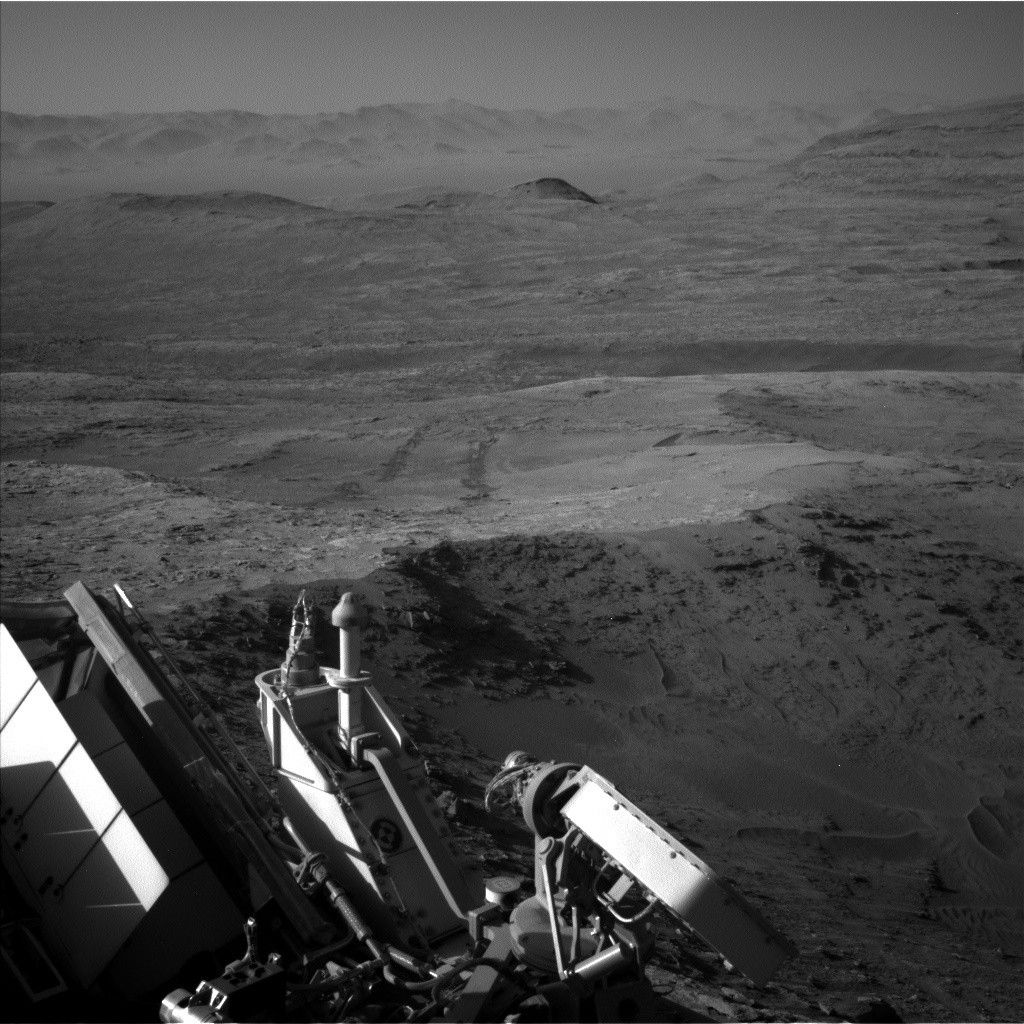
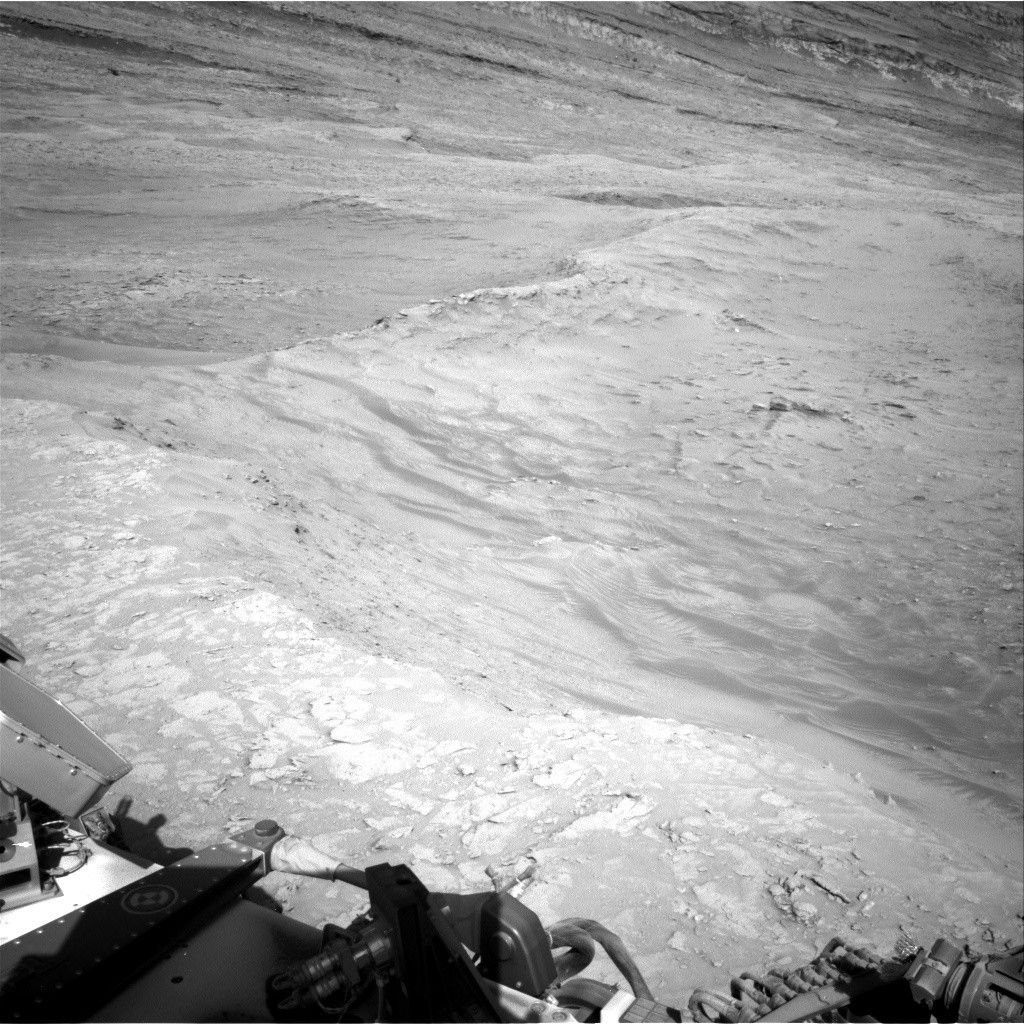
    A grayscale photo from the Martian surface shows a landscape of dark gray, slightly uneven, desert-like terrain stretching off into the distance, where a line of peaks that look like sand dunes create a hazy horizon line. Part of the rover is dimly visible in the bottom of the frame, and a pair of wheel tracks, darker than the surrounding ground, extend backward from there, scratched into the soil at the center of the frame.
    NASA’s Mars rover Curiosity acquired this image, looking out in the direction from where it came, with the rover’s tracks visible through the dust and sand covering the ground. Curiosity acquired this image using its Left Navigation Camera on July 28, 2025 — Sol 4612, or Martian day 4,612 of the Mars Science Laboratory mission — at 00:27:23 UTC.
    NASA/JPL-Caltech

    Written by Conor Hayes, Graduate Student at York University

    Earth planning date: Monday, July 28, 2025

    Today was a pretty straightforward day of planning. Our drive over the weekend completed successfully, and we quickly confirmed that we are parked in a stable position. Thus, we were able to unstow the rover’s arm to poke around in our new workspace, which features a large sand-filled fracture. Aside from all of the good geology work to be done, the view from our current location is quite spectacular. 

    We’re still in the time of year where the atmosphere at Gale is reasonably dust-free (at least, compared to later in the year), allowing us to look all the way out to and beyond the Gale crater rim. The upper slopes of Mount Sharp have also re-emerged to our east after spending months hidden behind the walls of Gediz Vallis. There’s a bit more sand and dust in this location than we’ve seen recently, so we can also see the trail left behind by the rover’s wheels as we drove to this location (see the image above).

    We’re still deep in our examination of the boxwork structures that we’re now driving through, so most of Curiosity’s attention in this plan is focused much closer to the rover than any of the scenic vista surrounding us. APXS, DRT, and MAHLI will all take a look at “Cañón de Palca,” some bedrock close to the large fracture in this workspace. Mastcam and ChemCam RMI will image some boxwork ridges at “Caine,” and will also collaborate on imaging of the weekend’s post-drive AEGIS target and a LIBS bedrock target “Doña Ines.” Mastcam’s solo activities include taking a look at some layering at “Paniri butte” and at MAHLI to examine a speck of dust that may have fallen on the lens.

    We’ll be driving away from this location along one of the boxwork ridges, which, at about 5 meters (about 16 feet) wide, is more than large enough to fit our car-sized rover. Post-drive activities are largely focused on environmental monitoring, including Navcam line-of-sight and dust-devil surveys to look at dust, and several Navcam cloud movies. As usual, ChemCam will also join the post-drive fun with an AEGIS observation. More environmental monitoring by REMS, RAD, and DAN fill out the remainder of this plan.

    Details

    Last Updated

    Jul 29, 2025

    Related Terms

  • Spheres in the Sand

    3 min read

    Spheres in the Sand

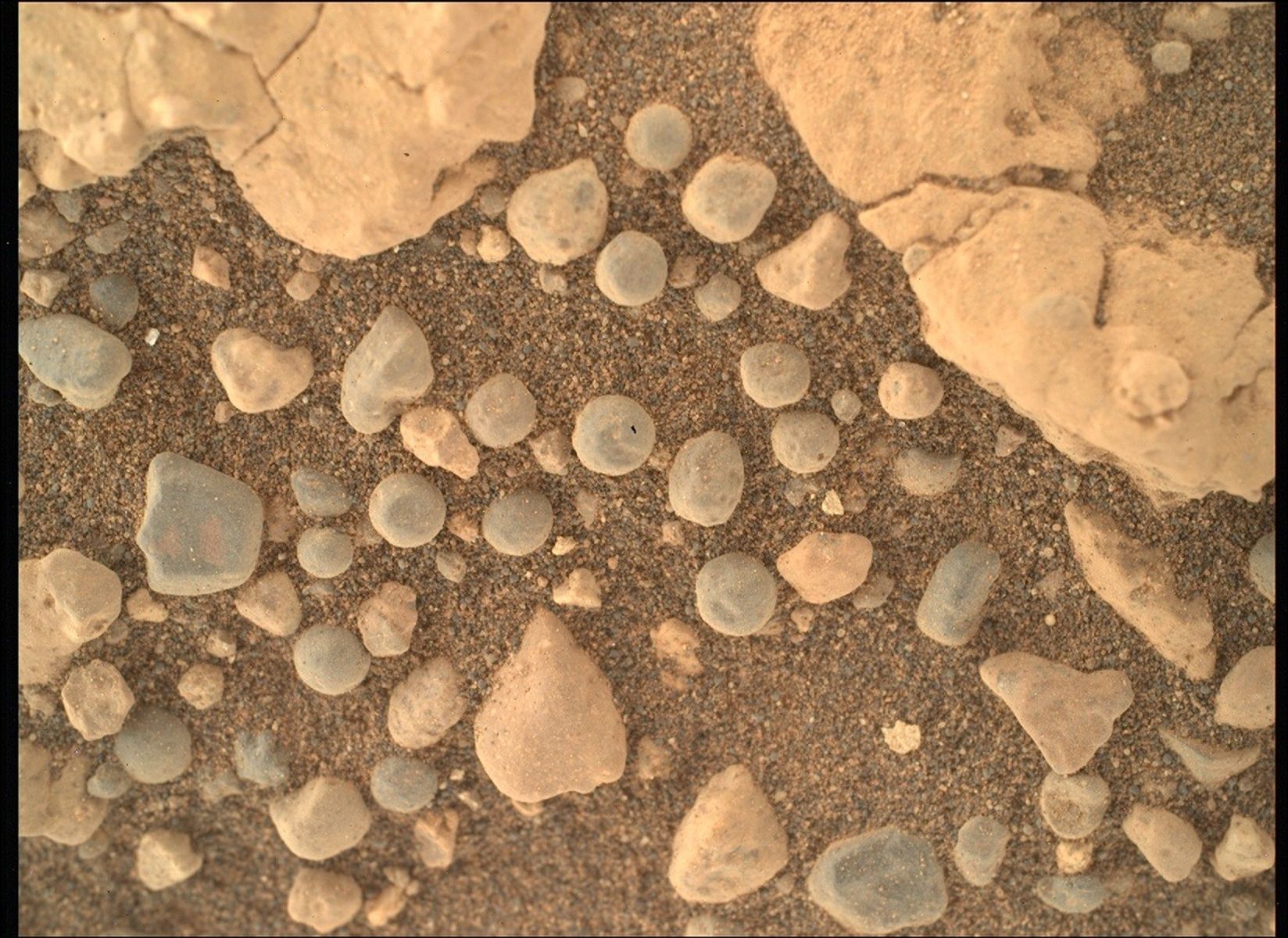
    A close-up color photograph from the Martian surface shows an overhead view of a patch of ground covered in what looks like very coarse, rust-colored sand, with numerous rocks in various colors resting atop the sand. Large pale-orange rocks, knobby and lined with small fractures, dominate the upper right and left corners of the frame. Most of the rest of the image is highlighted by dozens of smaller rocks, about half of them pale gray and nearly spherical, resembling dust-covered blueberries or frozen peas.
    NASA’s Perseverance rover captured this image of spherule-bearing regolith at Rowsell Hill using its arm-mounted WATSON camera on July 5, 2025 — Sol 1555, or Martian day 1,555 of the Mars 2020 mission — at the local mean solar time of 12:46:29. WATSON (Wide Angle Topographic Sensor for Operations and eNgineering) is a close-range color camera that works with the rover’s SHERLOC instrument (Scanning Habitable Environments with Raman and Luminescence for Organics and Chemicals); both are located on the turret at the end of the rover’s robotic arm.
    NASA/JPL-Caltech

    Written by Andrew Shumway, Postdoctoral Researcher at the University of Washington

    It is not common for a rover to spot nearly perfect spheres in the soil beneath its wheels. Over two decades ago, the Opportunity rover famously discovered spherules made of hematite (nicknamed “blueberries”) near its landing site in Meridiani Planum. More recently, the Perseverance rover has similarly encountered spherules embedded in bedrock and loosely scattered throughout the region informally called “Witch Hazel Hill.” In a previous blog post, we described Perseverance’s investigations of a spherule-bearing outcrop at the “Hare Bay” abrasion patch, where the team later collected a core. With the “Bell Island” sample added to the rover’s collection, the science team next decided to take a closer look at loose spherules in the area, which appear to have eroded out of the nearby bedrock.  

    On Sol 1555, while the United States was celebrating the Fourth of July with hotdogs and fireworks, Perseverance was hard at work studying spherule-rich regolith at the target “Rowsell Hill” using the proximity instruments on its robotic arm. SHERLOC’s Autofocus and Context Imager and WATSON camera both captured high resolution pictures of the target (shown above), while PIXL measured the elemental makeup of the spherules and surrounding grains. 

    Despite their superficial similarity to Opportunity’s “blueberries”, the spherules at “Rowsell Hill” have a very different composition and likely origin. In Meridiani Planum, the spherules were composed of the mineral hematite and were interpreted to have formed in groundwater-saturated sediments in Mars’ distant past. By comparison, the spherules in “Rowsell Hill” have a basaltic composition and likely formed during a meteoroid impact or volcanic eruption. When a meteoroid crashes into the surface of Mars, it can melt rock and send molten droplets spraying into the air. Those droplets can then rapidly cool, solidifying into spherules that rain down on the surrounding area.  Alternatively, the spherules may have formed from molten lava during a volcanic eruption. 

    With these new data in hand, the Perseverance science team continues to search for answers about where these spherules came from. If they formed during an ancient impact, they may be able to tell us about the composition of the meteoroid and the importance of impact cratering in early Mars’s history. If they instead formed during a volcanic eruption, they could preserve clues about past volcanism in the region around Jezero crater. Either way, these spherules are a remnant of an energetic and dynamic period in Mars’ history! 

    Details

    Last Updated

    Jul 29, 2025

    Related Terms