Tag: solar system

  • Perseverance Meets the Megabreccia

    2 min read

    Perseverance Meets the Megabreccia

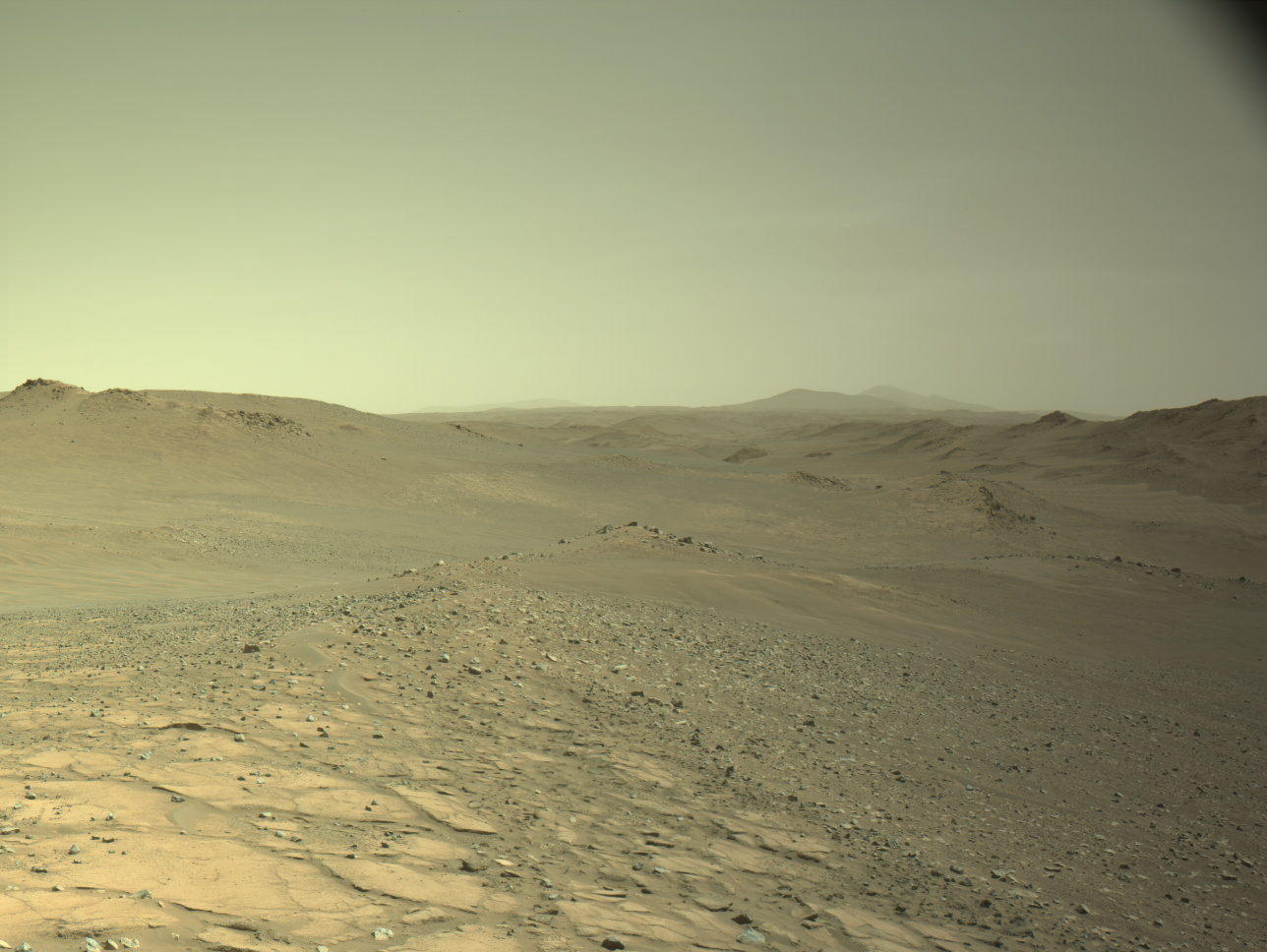
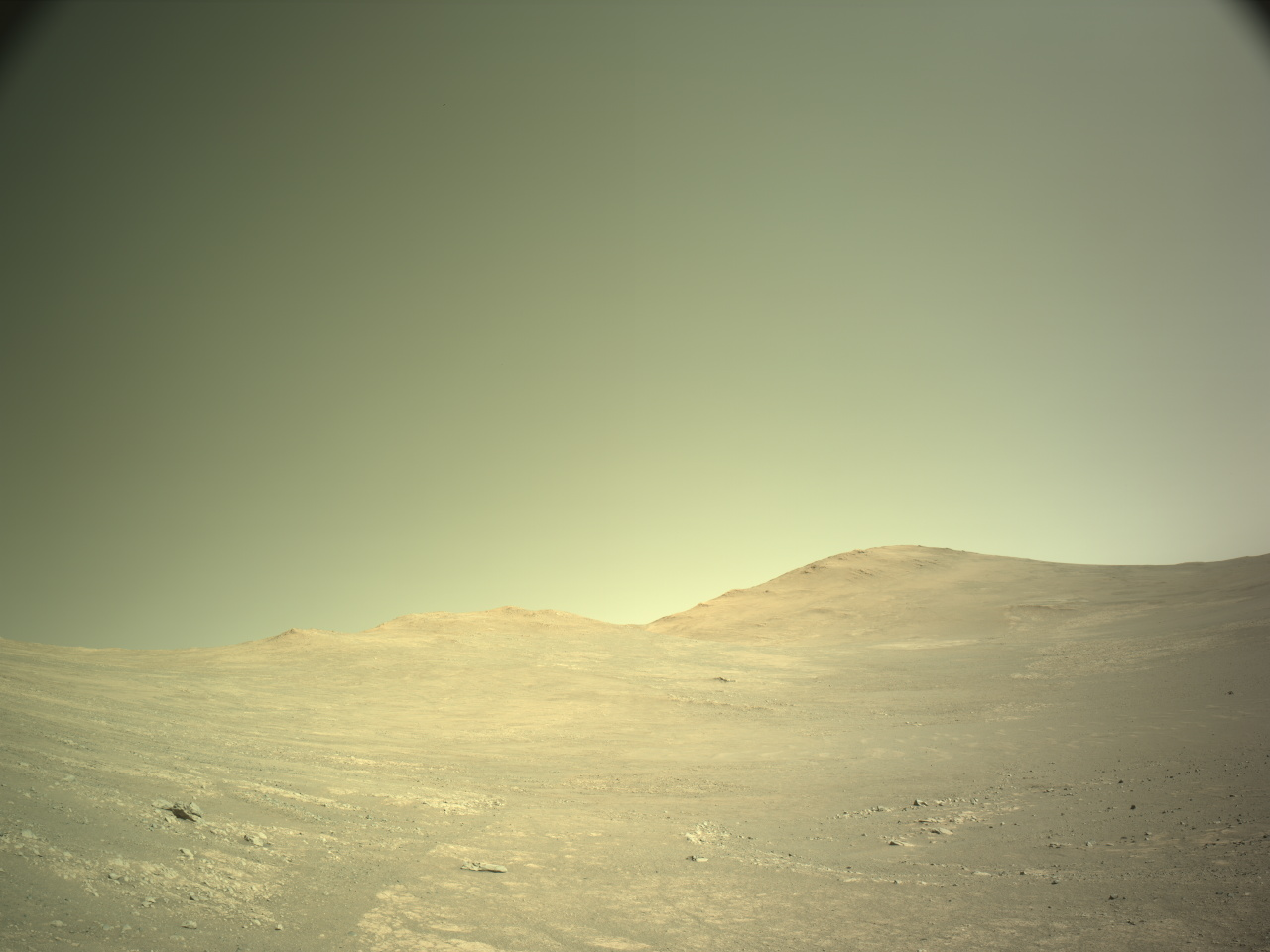
    A color photo from the Martian surface shows a landscape with terrain appearing light mustard brown, beneath a sky of gray-green gold. The ground is hilly but fairly smooth, with a few small scattered rocks, and a wavy horizon line about mid-frame.
    NASA’s Mars Perseverance rover acquired this image of the “Scotiafjellet” workspace on Aug. 31, 2025, using its onboard Left Navigation Camera (Navcam). The camera is located high on the rover’s mast and aids in driving. This image was acquired on Sol 1610, or Martian day 1,610 of the Mars 2020 mission, at the local mean solar time of 14:52:20.
    NASA/JPL-Caltech

    Written by By Henry Manelski, Ph.D. student at Purdue University

    Last week, the Perseverance rover began an exciting new journey. Driving northwest of the Soroya ridge, Perseverance entered an area filled with a diverse range of boulders that the science team believes could hold clues to Mars’ early history. The terrain we are exploring is known as megabreccia: a chaotic mixture of broken rock fragments likely produced during ancient asteroid impacts. Some blocks may have originated in the gargantuan Isidis impact event, which created a 1,200-mile-wide crater (about 1,930 kilometers) just east of Jezero. Studying megabreccia could help us link Jezero’s geology to the wider region around Isidis Basin, tying local observations to Mars’ global history. 

    The rover is now beginning a systematic exploration of these rocks, starting at Scotiafjellet. If they are truly megabreccia, they could contain pieces of deep crustal material, offering a rare glimpse into Mars’ interior. These rocks likely predate the deltaic and volcanic deposits we explored earlier in Jezero Crater, making them some of the oldest accessible rocks Perseverance will ever encounter. They may therefore reveal to what extent water was present on ancient Mars — a key question as we continue our search for signs of past life on the Red Planet. In short, by venturing into this jumbled terrain, Perseverance is giving us a front-row seat to the earliest chapters of Mars’ story.


    Details

    Last Updated

    Sep 08, 2025

    Related Terms

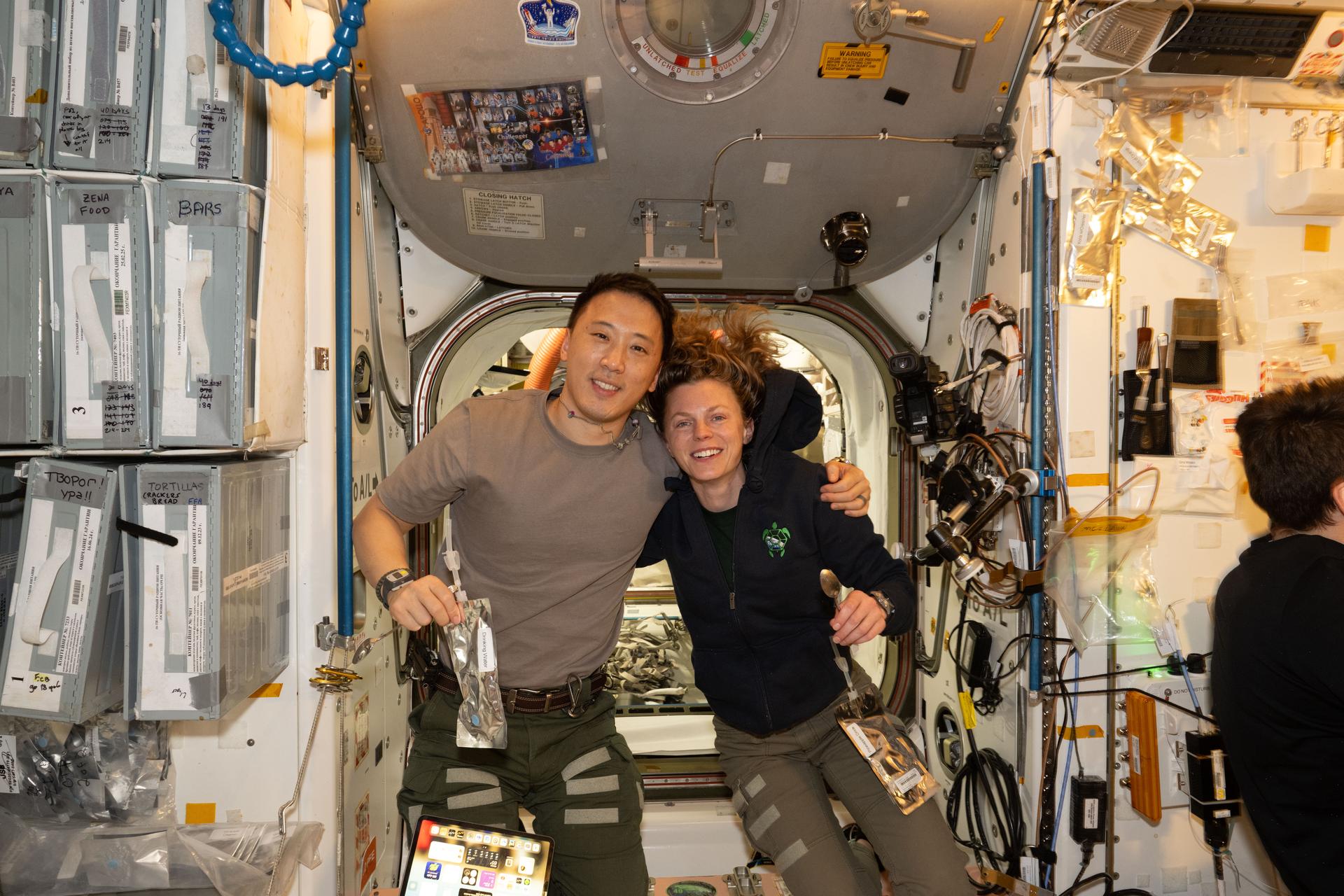
  • NASA astronauts Jonny Kim and Zena Cardman pose for a portrait in the Unity module

    NASA astronauts Jonny Kim and Zena Cardman, both Expedition 73 Flight Engineers, pose for a portrait inside the International Space Station's Unity module during a break in weekend housecleaning and maintenance activities. Kim and Cardman are both part of NASA Astronaut Group 22 selected in June 2017 with 12 other astronauts, including two Canadian Space Agency astronauts, and affectionately nicknamed
    NASA

    NASA astronauts Jonny Kim and Zena Cardman, both Expedition 73 Flight Engineers, pose for a portrait inside the International Space Station‘s Unity module during a break in weekend housecleaning and maintenance activities. Kim and Cardman are both part of NASA Astronaut Group 22 selected in June 2017 with 12 other astronauts, including two Canadian Space Agency astronauts, and affectionately nicknamed “The Turtles.”

    In its third decade of continuous human presence, the space station has a far-reaching impact as a microgravity lab hosting technology, demonstrations, and scientific investigations from a range of fields. The research done by astronauts on the orbiting laboratory will inform long-duration missions like Artemis and future human expeditions to Mars.

    Learn more about station activities by following the space station blog.

  • Glittering Glimpse of Star Birth From NASA’s Webb Telescope

    5 Min Read

    Glittering Glimpse of Star Birth From NASA’s Webb Telescope

    In what appears as a celestial dreamscape, a blue and black sky filled with brilliant stars covers about two thirds of the image. The stars are different sizes and shades of white, beige, yellow, and light orange. Across the bottom third of the scene is a craggy, mountain-like vista with spire-like peaks and deep, seemingly misty valleys. These so-called mountains appear in varying shades of orange, yellow, and brown. Above their soaring spires is a wispy, ethereal white cloud that stretched horizontally across the scene. Steam appears to rise from the mountaintops and join with this cloud. At the top, right corner of the image, a swath of orange and brown structure cuts diagonally across the sky.

    Webb captured this sparkling scene of star birth in Pismis 24. Full image and caption below.

    Credits:
    Image: NASA, ESA, CSA, STScI; Image Processing: A. Pagan (STScI)

    This is a sparkling scene of star birth captured by NASA’s James Webb Space Telescope. What appears to be a craggy, starlit mountaintop kissed by wispy clouds is actually a cosmic dust-scape being eaten away by the blistering winds and radiation of nearby, massive, infant stars.

    Called Pismis 24, this young star cluster resides in the core of the nearby Lobster Nebula, approximately 5,500 light-years from Earth in the constellation Scorpius. Home to a vibrant stellar nursery and one of the closest sites of massive star birth, Pismis 24 provides rare insight into large and massive stars. Its proximity makes this region one of the best places to explore the properties of hot young stars and how they evolve.

    At the heart of this glittering cluster is the brilliant Pismis 24-1. It is at the center of a clump of stars above the jagged orange peaks, and the tallest spire is pointing directly toward it. Pismis 24-1 appears as a gigantic single star, and it was once thought to be the most massive known star. Scientists have since learned that it is composed of at least two stars, though they cannot be resolved in this image. At 74 and 66 solar masses, respectively, the two known stars are still among the most massive and luminous stars ever seen.

    Image A: Pismis 24 (NIRCam Image)

    In what appears as a celestial dreamscape, a blue and black sky filled with brilliant stars covers about two thirds of the image. The stars are different sizes and shades of white, beige, yellow, and light orange. Across the bottom third of the scene is a craggy, mountain-like vista with spire-like peaks and deep, seemingly misty valleys. These so-called mountains appear in varying shades of orange, yellow, and brown. Above their soaring spires is a wispy, ethereal white cloud that stretched horizontally across the scene. Steam appears to rise from the mountaintops and join with this cloud. At the top, right corner of the image, a swath of orange and brown structure cuts diagonally across the sky.
    Webb captured this sparkling scene of star birth in Pismis 24, a young star cluster about 5,500 light-years from Earth in the constellation Scorpius. This region is one of the best places to explore the properties of hot young stars and how they evolve.
    Image: NASA, ESA, CSA, STScI; Image Processing: A. Pagan (STScI)

    Captured in infrared light by Webb’s NIRCam (Near-Infrared Camera), this image reveals thousands of jewel-like stars of varying sizes and colors. The largest and most brilliant ones with the six-point diffraction spikes are the most massive stars in the cluster. Hundreds to thousands of smaller members of the cluster appear as white, yellow, and red, depending on their stellar type and the amount of dust enshrouding them. Webb also shows us tens of thousands of stars behind the cluster that are part of the Milky Way galaxy.

    Super-hot, infant stars –some almost 8 times the temperature of the Sun – blast out scorching radiation and punishing winds that are sculpting a cavity into the wall of the star-forming nebula. That nebula extends far beyond NIRCam’s field of view. Only small portions of it are visible at the bottom and top right of the image. Streamers of hot, ionized gas flow off the ridges of the nebula, and wispy veils of gas and dust, illuminated by starlight, float around its towering peaks.

    Dramatic spires jut from the glowing wall of gas, resisting the relentless radiation and winds. They are like fingers pointing toward the hot, young stars that have sculpted them. The fierce forces shaping and compressing these spires cause new stars to form within them. The tallest spire spans about 5.4 light-years from its tip to the bottom of the image. More than 200 of our solar systems out to Neptune’s orbit could fit into the width its tip, which is 0.14 lightyears.

    In this image, the color cyan indicates hot or ionized hydrogen gas being heated up by the massive young stars. Dust molecules similar to smoke here on Earth are represented in orange. Red signifies cooler, denser molecular hydrogen. The darker the red, the denser the gas. Black denotes the densest gas, which is not emitting light. The wispy white features are dust and gas that are scattering starlight.

    Video A: Expedition to Star Cluster Pismis 24

    This scientific visualization takes viewers on a journey to a glittering young star cluster called Pismis 24. NASA’s James Webb Space Telescope captured this fantastical scene in the heart of the Lobster Nebula, approximately 5,500 light-years from Earth.
    Video: NASA, ESA, CSA, STScI, Leah Hustak (STScI), Christian Nieves (STScI); Image Processing: Alyssa Pagan (STScI); Script Writer: Frank Summers (STScI); Narration: Frank Summers (STScI); Music: Christian Nieves (STScI); Audio: Danielle Kirshenblat (STScI); Producer: Greg Bacon (STScI); Acknowledgment: VISTA

    Video B: Zoom to Pismis 24

    This zoom-in video shows the location of the young star cluster Pismis 24 on the sky. It begins with a ground-based photo of the constellation Scorpius by the late astrophotographer Akira Fujii. The sequence closes in on the Lobster Nebula, using views from the Digitized Sky Survey. As the video homes in on a select portion, it fades to a VISTA image in infrared light. The zoom continues in to the region around Pismis 24, where it transitions to the stunning image captured by NASA’s James Webb Space Telescope in near-infrared light.
    Video: NASA, ESA, CSA, STScI, Alyssa Pagan (STScI); Narration: Frank Summers (STScI); Script Writer: Frank Summers (STScI); Music: Christian Nieves (STScI); Audio: Danielle Kirshenblat (STScI); Producer: Greg Bacon (STScI); Acknowledgment: VISTA, Akira Fujii, DSS

    The James Webb Space Telescope is the world’s premier space science observatory. Webb is solving mysteries in our solar system, looking beyond to distant worlds around other stars, and probing the mysterious structures and origins of our universe and our place in it. Webb is an international program led by NASA with its partners, ESA (European Space Agency) and CSA (Canadian Space Agency).

    To learn more about Webb, visit:

    https://science.nasa.gov/webb

    Downloads

    Click any image to open a larger version.

    View/Download all image products at all resolutions for this article from the Space Telescope Science Institute.

    Media Contacts

    Laura Betz – laura.e.betz@nasa.gov
    NASA’s Goddard Space Flight Center, Greenbelt, Md.

    Ann Jenkinsjenkins@stsci.edu
    Space Telescope Science Institute, Baltimore, Md.

    Read more about Hubble’s view of Pismis 24

    Listen to a sonification of Hubble’s view of Pismis 24

    Animation Video:How Dense Pillars Form in Molecular Clouds

    Read more: Webb’s Star Formation Discoveries

    More Webb News

    More Webb Images

    Webb Science Themes

    Webb Mission Page

    What is the Webb Telescope?

    SpacePlace for Kids

    En Español

    Ciencia de la NASA

    NASA en español 

    Space Place para niños

  • NASA Contract Officer Helps Power Journey Back to the Moon

    Patricia White
    Patricia White is a contracting officer at NASA’s Stennis Space Center, where she contributes to NASA’s Artemis program that will send astronauts to the Moon to prepare for future human exploration of Mars.
    NASA/Danny Nowlin

    When NASA’s Artemis II mission launches in 2026, it will inspire the world through discovery in a new Golden Age of innovation and exploration.

    It will be another inspiring NASA moment Patricia White can add to her growing list.

    White supports the Artemis program to send astronauts to the Moon to prepare for future human exploration of Mars as a contracting officer at NASA’s Stennis Space Center near Bay St. Louis, Mississippi.

    White takes special pride in the test operations contract she helped draft. The contract provides support to the Fred Haise Test Stand, which tests the RS-25 engines that will help power NASA’s SLS (Space Launch System) rocket on Artemis missions.

    “I was awestruck the first time I witnessed an engine test,” White said. “I remember how small I felt in comparison to this big and fascinating world, and I wondered what that engine would see that I would never be able to see.”

    Four RS-25 engines tested at NASA Stennis will help launch Artemis II with four astronauts to venture around the Moon. As the first crewed Artemis mission, it will represent another milestone for the nation’s human space exploration effort.

    From Interstate Signs to NASA Career

    White describes NASA Stennis as a hidden gem. Growing up in nearby Slidell, Louisiana, she had driven by the interstate signs pointing toward NASA Stennis her entire life.

    When she heard about a job opportunity at the center, she immediately applied. Initially hired as a contractor with only a high school diploma in February 2008, White found her motivation among NASA’s ranks.

    “I work with very inspiring people, and it only took one person to say, ‘You should go to college’ to give me the courage to go so late in life,” she said.

    Hard But Worth It

    White began college classes in her 40s and finished at 50. She balanced a marriage, full-time job, academic studies, and household responsibilities. When she started her educational journey, her children were either toddlers or newborns. They were growing up as she stayed in school for nine years while meeting life’s challenges.

    “It was hard, but it was so worth it,” she said. “I love my job and what I do, and even though it is crazy busy, I look forward to working at NASA every single day.”

    She joined NASA officially in 2013, going from contractor to civil servant.

    Setting an Example

    White’s proudest work moment came when she brought home the NASA Early Career Achievement award and medal. It served as a tangible symbol of her success she could share with her family.

    “It was a long road from being hired as an intern, and we all made extraordinary sacrifices,” she said. “I wanted to share it with them and set a good example for my children.”

    As Artemis II prepares to carry humans back to lunar orbit for the first time in over 50 years, White takes pride knowing her work helps power humanity’s return to deep space exploration. Her work is proof that sometimes the most important journeys begin right in one’s own backyard.

  • NASA Glenn Tests Mini-X-Ray Technology to Advance Space Health Care  

    4 min read

    Preparations for Next Moonwalk Simulations Underway (and Underwater)

    NASA Glenn researchers pose in a lab surrounded by mini-X-ray systems, rover wheels, and astronaut suits. Team members don blue and white lab coats and stand in front of a table displaying portable X-ray machines, with posters and equipment showcasing space health and research in the background.
    Researchers Kelly Gilkey, Cy Peverill, Daniel Phan, Chase Haddix, and Ariel Tokarz test portable, handheld X-ray systems for use during future long-duration space missions at NASA’s Glenn Research Center in Cleveland on Friday, March 21, 2025.
    Credit: NASA/Sara Lowthian-Hanna

    As NASA plans future human exploration missions to the Moon, Mars, and beyond, new and unique challenges emerge — like communication delays and limited return-to-Earth options — so enhanced medical care capabilities are critical. Crews will need non-invasive imaging technology to diagnose medical conditions, like broken bones or dental injuries.  

    Scientists at NASA’s Glenn Research Center in Cleveland are testing portable, handheld X-ray systems for use during future extended space missions. Having portable X-ray capabilities aboard spacecraft would allow astronauts to immediately assess and treat potential injuries or identify equipment issues without having to disassemble the gear. 

    “Technological innovations like that of the mini-X-ray will help keep our astronauts healthy as we endeavor farther into space than ever before,” said acting NASA Administrator Sean Duffy. “Future missions to the Moon and Mars will be safer due to the research of our scientists at NASA Glenn.” 

    NASA reviewed more than 200 commercial systems — analyzing size, weight, image quality, ease-of-use, cost, and safety — and selected three systems for further testing: MinXray, Remedi, and Fujifilm. 

    “We’re working to provide evidence on why a mini-X-ray system should be included in future space exploration,” said Dr. Chase Haddix, a senior biomedical engineering research contractor working for Universities Space Research Association at NASA Glenn. “These X-rays could be used to detect both clinical and non-clinical diagnostics, meaning they can check an astronaut’s body or identify the location of a tear in an astronaut suit.” 

    Three researchers wearing protective lead aprons stand in a lab, analyzing a high-resolution X-ray image on a wall-mounted monitor. One researcher points at the screen displaying the scan of a rover wheel. Surrounding them are space exploration artifacts including an astronaut suit, rover wheel, and various testing equipment. Posters on the wall detail health research and exercise countermeasures.
    Researchers capture X-ray images of a shape memory alloy rover tire at NASA’s Glenn Research Center in Cleveland on Friday, March 21, 2025.
    Credit: NASA/Sara Lowthian-Hanna

    NASA Glenn is collaborating with other centers, including NASA’s Johnson Space Center in Houston and NASA’s Langley Research Center in Hampton, Virginia, and radiography experts at University Hospitals and Cuyahoga Community College in Cleveland. 

    “We’re fortunate to have enthusiastic medical and radiography experts right here in our community,” said Dr. Cy Peverill, project task lead at NASA Glenn. “Their knowledge and experience are invaluable as we work to test medical technologies that could significantly improve management of astronaut health on future missions to the Moon or Mars.” 

    Cuyahoga Community College contributed anatomical phantoms, which are lifelike models of the human body, in its radiography laboratory on the Western Campus and dental hygiene clinical facility at the Metropolitan Campus. Faculty and students consulted with NASA researchers on essential imaging principles, including patient positioning, image acquisition, and image quality.   

    University Hospitals is partnering with NASA Glenn on a medical study with real patients to compare the performance of the X-ray systems against hospital-grade equipment, focusing on usability, image clarity, and diagnostic accuracy.   

    “Astronauts live and work in small quarters, much smaller spaces than in a hospital,” Haddix said. “The system must be easy to use since astronauts may not be experienced in radiography. The data from these tests will guide the selection of the most suitable system for future missions.” 

    A researcher in a lead apron clicks the button on a portable handheld X-ray system to capture an image of a spacesuit. A flash of light beams from the system. A researcher stands next to her in the lab peering down at his computer. Behind them are two cameras on tall tripods and one small camera near the ground. On the walls are photos of NASA astronauts and posters displaying astronaut health research imagery.
    Researchers capture X-ray images of an astronaut spacesuit at NASA’s Glenn Research Center in Cleveland on Friday, March 21, 2025.
    Credit: NASA/Sara Lowthian-Hanna

    Using portable X-rays to improve health care in inaccessible areas is not new, with systems deployed to diagnose medical issues in places such as base camps in Nepal and remote villages in South Africa. NASA researchers theorize that if these systems are successful in high elevations and extreme temperatures on Earth, perhaps they are durable enough for space missions. 

    Glenn researchers will continue to collect data from all collaborators, including from an X-ray system sourced by SpaceX that launched in April during the Fram2 mission. The crew captured the first human X-ray images in space during their four-day mission to low Earth orbit. NASA plans to select a device near the end of 2025 and will test the chosen system aboard the International Space Station in 2026 or early 2027.  

    The Mars Campaign Office at NASA Headquarters in Washington and the agency’s Human Research Program at NASA Johnson fund this work as both organizations focus on pursuing technologies and methods to support safe, productive human space travel. 


  • Circular Star Trails

    Stars photographed over 31 minutes make a concentric pattern of white circles. At the bottom edge of the photo, there is a soft orange glow. A portion of the International Space Station can be seen in the foreground. This photo was taken through a window on the space station.
    NASA/Nichole Ayers

    On July 26, 2025, NASA astronaut Nichole Ayers took this long-exposure photograph – taken over 31 minutes from a window inside the International Space Station’s Kibo laboratory module – capturing the circular arcs of star trails.

    In its third decade of continuous human presence, the space station has a far-reaching impact as a microgravity lab hosting technology, demonstrations, and scientific investigations from a range of fields. The research done on the orbiting laboratory will inform long-duration missions like Artemis and future human expeditions to Mars.

    Image credit: NASA/Nichole Ayers

  • Advancing Single-Photon Sensing Image Sensors to Enable the Search for Life Beyond Earth

    Advancing Single-Photon Sensing Image Sensors to Enable the Search for Life Beyond Earth

    A NASA-sponsored team is advancing single-photon sensing Complementary Metal-Oxide-Semiconductor (CMOS) detector technology that will enable future NASA astrophysics space missions to search for life on other planets. As part of their detector maturation program, the team is characterizing sensors before, during, and after high-energy radiation exposure; developing novel readout modes to mitigate radiation-induced damage; and simulating a near-infrared CMOS pixel prototype capable of detecting individual photons.

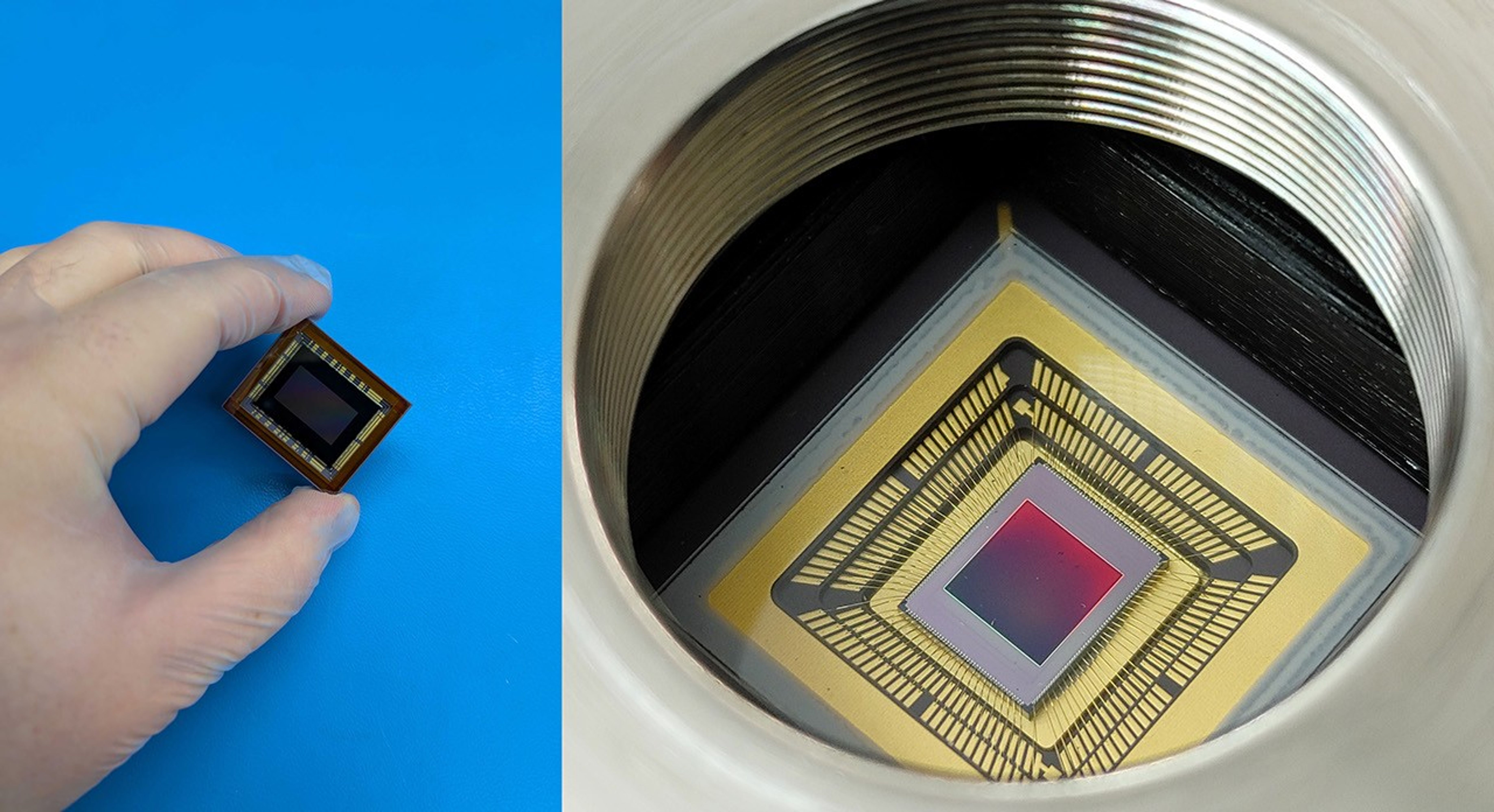
    Left: A small rectangular device is held between a researcher’s fingers (left). Right: A square yellow structure mounted in a circular device.
    Single-photon sensing and photon-number resolving CMOS image sensors: a 9.4 Mpixel sensor (left) and a 16.7 Mpixel sensor (right).
    Credit: CfD, RIT

    Are we alone in the universe? This age-old question has inspired scientific exploration for centuries. If life on other planets evolves similarly to life on Earth, it can imprint its presence in atmospheric spectral features known asbiosignatures. They include absorption and emission lines in the spectrum produced by oxygen, carbon dioxide, methane, and other molecules that could indicate conditions which can support life. A future NASA astrophysics mission, the Habitable Worlds Observatory (HWO), will seek to find biosignatures in the ultraviolet, optical, and near-infrared (NIR) spectra of exoplanet atmospheres to look for evidence that life may exist elsewhere in the universe.

    HWO will need highly sensitive detector technology to detect these faint biosignatures on distant exoplanets. The Single-Photon Sensing Complementary Metal-Oxide-Semiconductor (SPSCMOS) image sensor is a promising technology for this application. These silicon-based sensors can detect and resolve individual optical-wavelength photons using a low-capacitance, high-gain floating diffusion sense node. They operate effectively over a broad temperature range, including at room temperature. They have near-zero read noise, are tolerant to radiation, and generate very little unwanted signal—such as dark current. When cooled to 250 K, the dark current drops to just one electron every half-hour. If either the read noise or dark current is too high, the sensor will fail to detect the faint signals that biosignatures produce.

    A research team at the Rochester Institute of Technology (RIT) Center for Detectors (CfD) is accelerating the readiness of these SPSCMOS sensors for use in space missions through detector technology maturation programs funded by NASA’s Strategic Astrophysics Technology and Early Stage Innovations solicitations. These development programs include several key goals:

    • Characterize critical detector performance metrics like dark current, quantum efficiency, and read noise before, during, and after exposure to high-energy radiation
    • Develop new readout modes for these sensors to mitigate effects from short-term and long-term radiation damage
    • Design a new NIR version of the sensor using Technology Computer-Aided Design (TCAD) software

    SPSCMOS sensors operate similarly to traditional CMOS image sensors but are optimized to detect individual photons—an essential capability for ultra-sensitive space-based observations, such as measuring the gases in the atmospheres of exoplanets. Incoming photons enter the sensor and generate free charges (electrons) in the sensor material. These charges collect in a pixel’s storage well and eventually transfer to a low-capacitance component called the floating diffusion (FD) sense node where each free charge causes a large and resolved voltage shift. This voltage shift is then digitized to read the signal.

    Experiments that measure sensor performance in a space relevant environment use a vacuum Dewar and a thermally-controlled mount to allow precise tuning of the sensors temperature. The Dewar enables testing at conditions that match the expected thermal environment of the HWO instrument, and can even cool the sensor and its on-chip circuits to temperatures colder than any prior testing reported for this detector family. These tests are critical for revealing performance limitations with respect to detector metrics like dark current, quantum efficiency, and read noise. As temperatures change, the electrical properties of on-chip circuits can also change, which affects the read out of charge in a pixel.

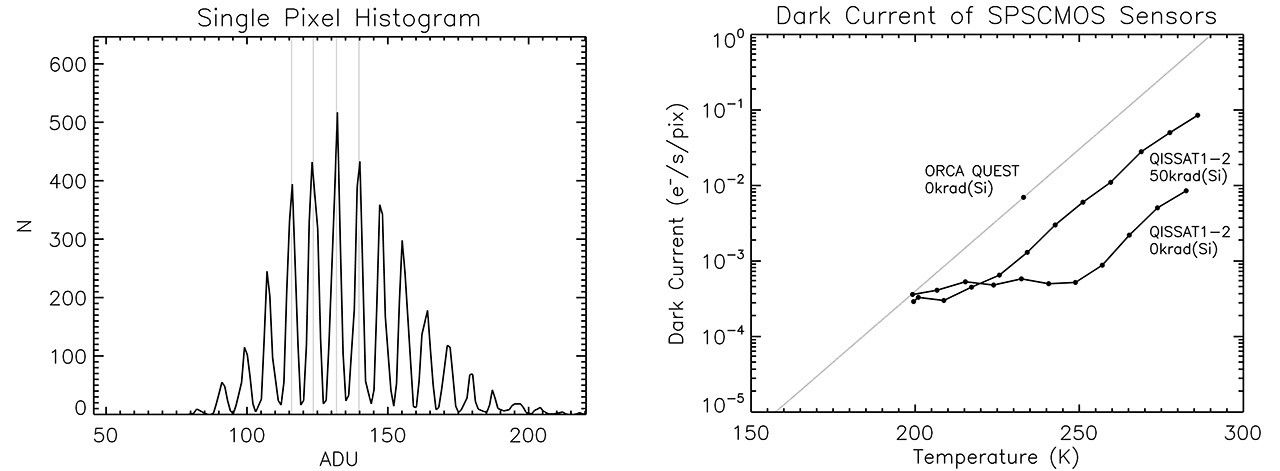
    The left graph consists of a set of peaks, while the right graph shows two lines depicting sensor dark current before and after radiation exposure.
    The two figures show results for SPSCMOS devices. The figure on the left shows a photon counting histogram with peaks that correspond to photon number. The figure on the right shows the dark current for a SPSCMOS device before and after exposure to 50 krad of 60 MeV protons.
    Credit: CfD, RIT

    The radiation-rich environment for HWO will cause temporary and permanent effects in the sensor. These effects can corrupt the signal measured in a pixel, interrupt sensor clocking and digital logic, and can cause cumulative damage that gradually degrades sensor performance. To mitigate the loss of detector sensitivity throughout a mission lifetime, the RIT team is developing new readout modes that are not available in commercial CMOS sensors. These custom modes sample the signal over time (a “ramp” acquisition) to enable the detection and removal of cosmic ray artifacts. In one mode, when the system identifies an artifact, it segments the signal ramp and selectively averages the segments to reconstruct the original signal—preserving scientific data that would otherwise be lost. In addition, a real-time data acquisition system monitors the detector’s power consumption, which may change from the accumulation of damage throughout a mission. The acquisition system records these shifts and communicates with the detector electronics to adjust voltages and maintain nominal operation. These radiation damage mitigation strategies will be evaluated during a number of test programs at ground-based radiation facilities. The tests will help identify unique failure mechanisms that impact SPSCMOS technology when it is exposed to radiation equivalent to the dose expected for HWO.

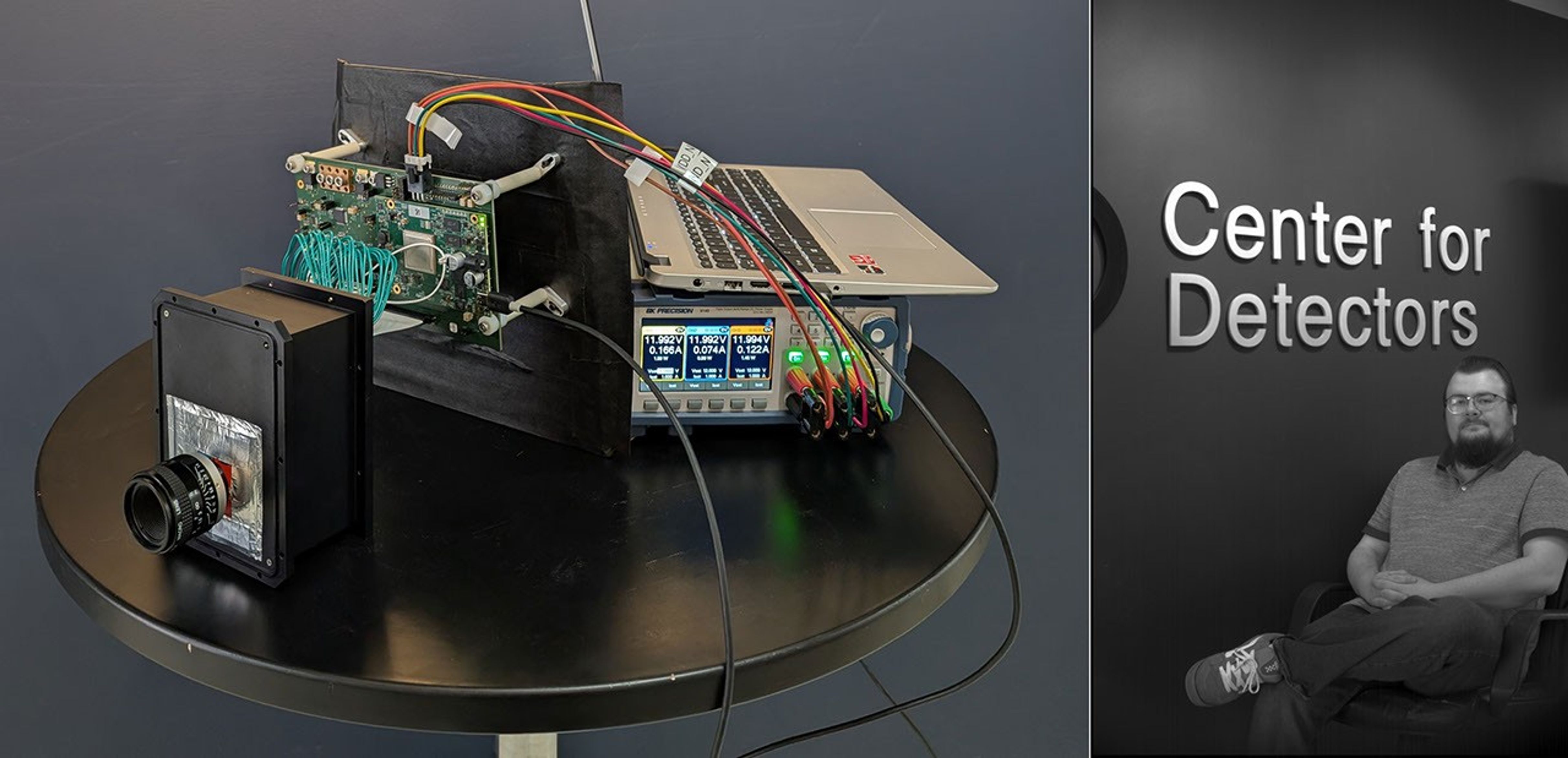
    Left: A complex set of electronics on a table, including a sensor in a black box, a laptop, and interconnected cables. Right: A CfD staff member sitting in front of a sign reading Center for Detectors.
    Custom acquisition electronics (left) that will control the sensors during radiation tests, and an image captured using this system (right).
    Credit: CfD, RIT

    While existing SPSCMOS sensors are limited to detecting visible light due to their silicon-based design, the RIT team is developing the world’s first NIR single-photon photodiode based on the architecture used in the optical sensors. The photodiode design starts as a simulation in TCAD software to model the optical and electrical properties of the low-capacitance CMOS architecture. The model simulates light-sensitive circuits using both silicon and Mercury Cadmium Telluride (HgCdTe or MCT) material to determine how well the pixel would measure photo-generated charge if a semiconductor foundry physically fabricated it. It has 2D and 3D device structures that convert light into electrical charge, and circuits to control charge transfer and signal readout with virtual probes that can measure current flow and electric potential. These simulations help to evaluate the key mechanisms like the conversion of light into electrons, storing and transferring the electrons, and the output voltage of the photodiode sampling circuit.

    In addition to laboratory testing, the project includes performance evaluations at a ground-based telescope. These tests allow the sensor to observe astronomical targets that cannot be fully replicated in lab. Star fields and diffuse nebulae challenge the detector’s full signal chain under real sky backgrounds with faint flux levels, field-dependent aberrations, and varying seeing conditions. These observations help identify performance limitations that may not be apparent in controlled laboratory measurements.

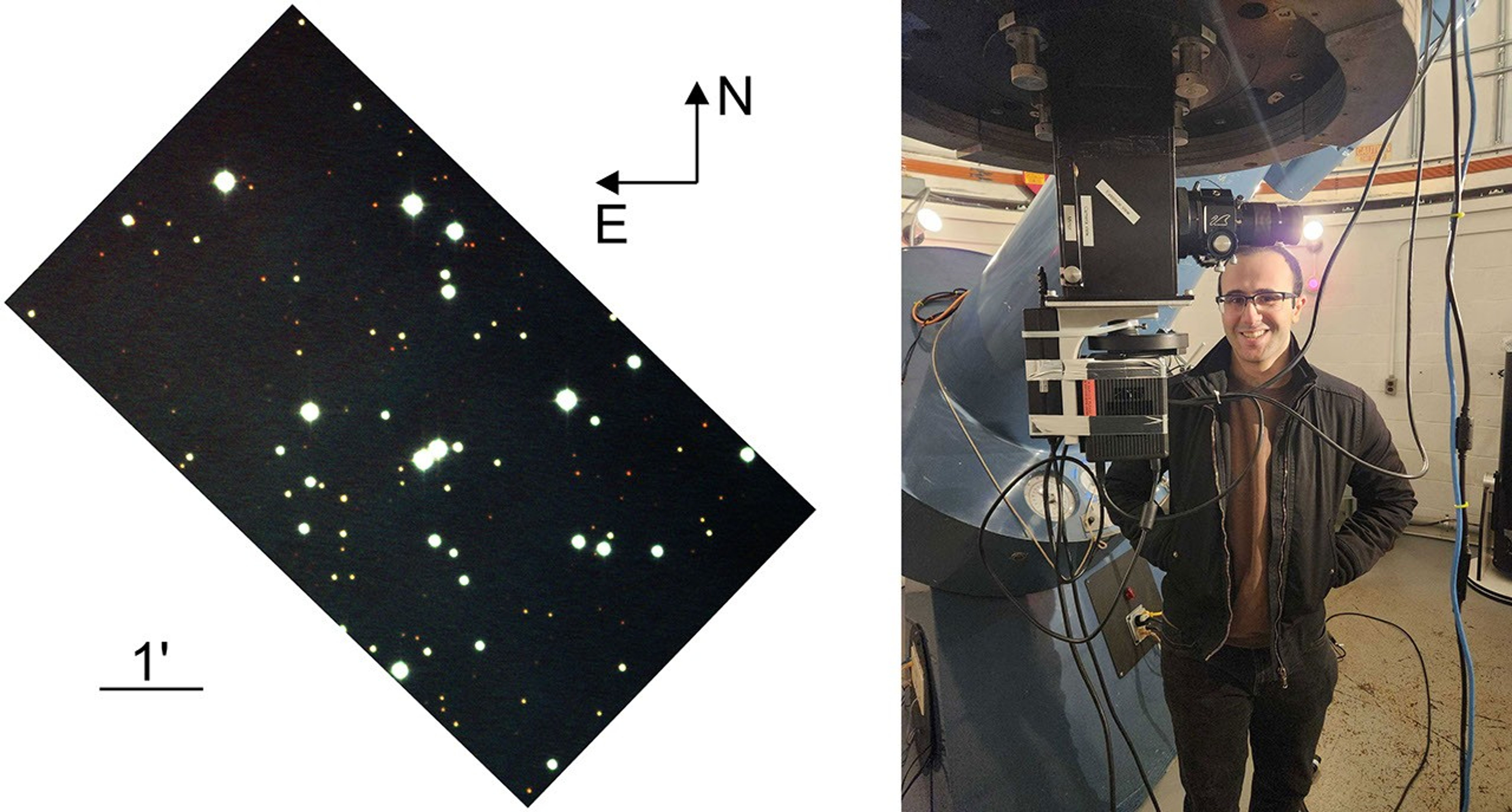
    In January 2025, a team of researchers led by PhD student Edwin Alexani used an SPSCMOS-based camera at the C.E.K. Mees Observatory in Ontario County, New York. They observed star cluster M36 to evaluate the sensor’s photometric precision, and the Bubble Nebula in a narrow-band H-alpha filter. The measured dark current and read noise were consistent with laboratory results.

    The team observed photometric reference stars to estimate the quantum efficiency (QE) or the ability for the detector to convert photons into signal. The calculated QE agreed with laboratory measurements, despite differences in calibration methods.

    The team also observed the satellite STARLINK-32727 as it passed through the telescope’s field of view and measured negligible persistent charge—residual signal that can remain in detector pixels after exposure to a bright source. Although the satellite briefly produced a bright streak across several pixels due to reflected sunlight, the average latent charge in affected pixels was only 0.03 e/pix – well below both the sky-background and sensor’s read noise.

    Left: A star field image of M36, showing bright white and dim red stars, with arrows indicating North and East for orientation. Right: Researcher Edwin Alexani stands behind a black camera with a filter wheel, mounted below a telescope.
    Images captured at the C.E.K. Mees Observatory. Left: The color image shows M36 in the Johnson color filters B (blue), V (green), and R (red) bands (left). Right: Edwin Alexani and the SPSCMOS camera (right).
    Credit: : CfD, RIT

    As NASA advances and matures the HWO mission, SPSCMOS technology promises to be a game-changer for exoplanet and general astrophysics research. These sensors will enhance our ability to detect and analyze distant worlds, bringing us one step closer to answering one of humanity’s most profound questions: are we alone?

    For additional details, see the entry for this project on NASA TechPort.

    Project Lead(s): Dr. Donald F. Figer, Future Photon Initiative and Center for Detectors, Rochester Institute of Technology (RIT), supported by engineer Justin Gallagher and a team of students.

    Sponsoring Organization(s): NASA Astrophysics Division, Strategic Astrophysics Technology (SAT) Program and NASA Space Technology Mission Directorate (STMD), Early Stage Innovations (ESI) Program

  • Tech From NASA’s Hurricane-hunting TROPICS Flies on Commercial Satellites

    NASA science and American industry have worked hand-in-hand for more than 60 years, transforming novel technologies created with NASA research into commercial products like cochlear implants, memory-foam mattresses, and more. Now, a NASA-funded device for probing the interior of storm systems has been made a key component of commercial weather satellites.

    The novel atmospheric sounder was originally developed for NASA’s TROPICS (short for Time-Resolved Observations of Precipitation structure and storm Intensity with a Constellation of SmallSats), which launched in 2023. Boston-based weather technology company Tomorrow.io integrated the same instrument design into some of its satellites.

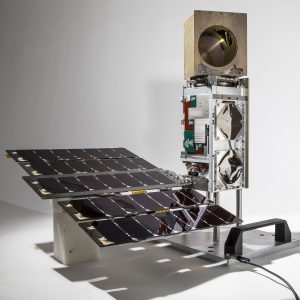
    NASA's TROPICs pathfinder satellite is shown in flight configuration. Rocket Lab is preparing to launch four TROPICS CubeSats from Launch Complex 1 in Mahia, New Zealand for the agency.
    NASA’s TROPICS instrument. TROPICS pioneered a novel, compact atmospheric sound now flying aboard a fleet of commercial small satellites created by the weather technology company Tomorrow.io.
    Credit: Blue Canyon Technologies

    Atmospheric sounders allow researchers to gather data describing humidity, temperature, and wind speed — important factors for weather forecasting and atmospheric analysis. From low-Earth orbit, these devices help make air travel safer, shipping more efficient, and severe weather warnings more reliable.

    Novel tools for Observing Storm Systems

    In the early 2000s, meteorologists and atmospheric chemists were eager to find a new science tool that could peer deep inside storm systems and do so multiple times a day. At the same time, CubeSat constellations (groupings of satellites each no larger than a shoebox) were emerging as promising, low-cost platforms for increasing the frequency with which individual sensors could pass over fast-changing storms, which improves the accuracy of weather models.

    The challenge was to create an instrument small enough to fit aboard a satellite the size of a toaster, yet powerful enough to observe the innermost mechanisms of storm development. Preparing these technologies required years of careful development that was primarily supported by NASA’s Earth Science Division.

    William Blackwell and his team at MIT Lincoln Laboratory in Cambridge, Massachusetts, accepted this challenge and set out to miniaturize vital components of atmospheric sounders. “These were instruments the size of a washing machine, flying on platforms the size of a school bus,” said Blackwell, the principal investigator for TROPICS. “How in the world could we shrink them down to the size of a coffee mug?”

    With a 2010 award from NASA’s Earth Science Technology Office (ESTO), Blackwell’s team created an ultra-compact microwave receiver, a component that can sense the microwave radiation within the interior of storms.

    The Lincoln Lab receiver weighed about a pound and took up less space than a hockey puck. This innovation paved the way for a complete atmospheric sounder instrument small enough to fly aboard a CubeSat. “The hardest part was figuring out how to make a compact back-end to this radiometer,” Blackwell said. “So without ESTO, this would not have happened. That initial grant was critical.”

    In 2023, that atmospheric sounder was sent into space aboard four TROPICS CubeSats, which have been collecting torrents of data on the interior of severe storms around the world.

    Transition to Industry

    By the time TROPICS launched, Tomorrow.io developers knew they wanted Blackwell’s microwave receiver technology aboard their own fleet of commercial weather satellites. “We looked at two or three different options, and TROPICS was the most capable instrument of those we looked at,” said Joe Munchak, a senior atmospheric data scientist at Tomorrow.io.

    In 2022, the company worked with Blackwell to adapt his team’s design into a CubeSat platform about twice the size of the one used for TROPICS. A bigger platform, Blackwell explained, meant they could bolster the sensor’s capabilities.

    “When we first started conceptualizing this, the 3-unit CubeSat was the only game in town. Now we’re using a 6-unit CubeSat, so we have room for onboard calibration,” which improves the accuracy and reliability of gathered data, Blackwell said.

    Tomorrow.io’s first atmospheric sounders, Tomorrow-S1 and Tomorrow-S2, launched in 2024. By the end of 2025, the company plans to have a full constellation of atmospheric sounders in orbit. The company also has two radar instruments that were launched in 2023 and were influenced by NASA’s RainCube instrument — the first CubeSat equipped with an active precipitation radar.

    More CubeSats leads to more accurate weather data because there are more opportunities each day — revisits — to collect data. “With a fleet size of 18, we can easily get our revisit rate down to under an hour, maybe even 40 to 45 minutes in most places. It has a huge impact on short-term forecasts,” Munchak said.

    Having access to an atmospheric sounder that had already flown in space and had more than 10 years of testing was extremely useful as Tomorrow.io planned its fleet. “It would not have been possible to do this nearly as quickly or nearly as affordably had NASA not paved the way,” said Jennifer Splaingard, Tomorrow.io’s senior vice president for space and sensors.

    A Cycle of Innovation

    The relationship between NASA and industry is symbiotic. NASA and its grantees can drive innovation and test new tools, equipping American businesses with novel technologies they may otherwise be unable to develop on their own. In exchange, NASA gains access to low-cost data sets that can supplement information gathered through its larger science missions.

    Tomorrow.io was among eight companies selected by NASA’s Commercial SmallSat Data Acquisition (CSDA) program in September 2024 to equip NASA with data that will help improve weather forecasting models. “It really is a success story of technology transfer. It’s that sweet spot, where the government partners with tech companies to really take an idea, a proven concept, and run with it,” Splaingard said.

    By Gage Taylor

    NASA’s Goddard Space Flight Center, Greenbelt, Md.
  • NASA, International Astronauts to Address Students from New York

    From left to right: JAXA astronaut Kimiya Yui, and NASA astronauts Jonny Kim (seated), Zena Cardman, and Mike Fincke conduct training scenarios with their instructors at NASA’s Johnson Space Center in Houston, Texas for their upcoming mission to the International Space Station.
    From left to right: JAXA (Japan Aerospace Exploration Agency) astronaut Kimiya Yui, and NASA astronauts Jonny Kim (seated), Zena Cardman, and Mike Fincke conduct training scenarios with their instructors at NASA’s Johnson Space Center in Houston, for their upcoming mission to the International Space Station.
    Credit: NASA/Helen Arase Vargas

    NASA astronaut Jonny Kim and JAXA (Japan Aerospace Exploration Agency) astronaut Kimiya Yui will connect with students in New York as they answer prerecorded science, technology, engineering, and mathematics (STEM) questions aboard the International Space Station.

    The Earth-to-space call will begin at 9:20 a.m. EDT on Friday, Sept. 5, and will stream live on the agency’s Learn With NASA YouTube channel.

    Media interested in covering the event must RSVP by 5 p.m. Wednesday, Sept. 3, to Sara Sloves at: 917-441-1234 or ssloves@thecomputerschool.org.

    The Computer School will host this event in New York for middle school students. The goal of this event is to extend learning by exposing students to the real-world experiences and engineering challenges of astronauts working and living aboard the International Space Station.

    For nearly 25 years, astronauts have continuously lived and worked aboard the space station, testing technologies, performing science, and developing skills needed to explore farther from Earth. Astronauts communicate with NASA’s Mission Control Center in Houston 24 hours a day through SCaN’s (Space Communications and Navigation) Near Space Network.

    Research and technology investigations taking place aboard the space station benefit people on Earth and lay the groundwork for other agency deep space missions. As part of NASA’s Artemis campaign, the agency will send astronauts to the Moon to prepare for future human exploration of Mars, inspiring the world through discovery in a new Golden Age of innovation and exploration.

    See more information on NASA in-flight calls at:

    https://www.nasa.gov/stemonstation

    -end-

    Gerelle Dodson
    Headquarters, Washington
    202-358-1600
    gerelle.q.dodson@nasa.gov

    Sandra Jones
    Johnson Space Center, Houston
    281-483-5111
    sandra.p.jones@nasa.gov

  • NASA Scientists Help Maryland County Plan to Beat Summer Heat Risks

    4 min read

    Preparations for Next Moonwalk Simulations Underway (and Underwater)

    Two maps with colors ranging from blue to bright yellow and a color bar idication the temperature associated with each color. color.
    These maps of Prince George’s County, MD, show surface temperatures collected a few hours apart on July 30, 2023 from the Landsat 9 satellite and the ECOsystem Spaceborne Thermal Radiometer Experiment on Space Station (ECOSTRESS) instrument. The dark blue spots in the right hand image are likely clouds that formed in the afternoon.
    Credit: Stephanie Schollaert Uz, NASA Goddard Space Flight Center

    Thousands of Americans are impacted each summer by excessive heat and humidity, some suffering from heat-related illnesses when the body can’t cool itself down. Data from NASA satellites could help local governments reduce the sweltering risks, thanks to a collaboration between NASA scientists and officials in Prince George’s County, Maryland. The effort demonstrates how local officials in other communities could turn to NASA data to inform decisions that provide residents with relief from summer heat.

    NASA researchers and their Prince George’s County collaborators reported in Frontiers in Environmental Science that they used the Landsat 8 satellite, jointly operated by NASA and the US Geological Survey, and NASA’s Aqua satellite, to gain insight into surface temperature trends across the county over the past few decades. The data also show how temperatures have responded to changing land use and construction. It is information that county planners and environmental experts hope can aid them in their attempts to remediate and prevent heat dangers in the future. The collaboration may also help the county’s first responders anticipate and prepare for heat-related emergencies and injuries.

    Cooperation with Prince George’s County expands on NASA’s historic role, said Stephanie Schollaert Uz, an applications scientist with NASA’s Goddard Space Flight Center in Greenbelt, Maryland, and one of the study authors. “Applying government satellite data to county-level problems is new here. We’re trying to make it easier for people outside of NASA to use our data, in part by including how-to guides referenced at the end of our paper,” Schollaert Uz said.

    In the long run, county officials hope to use NASA satellites to track the negative health impacts that arise from land use and modification. Removal of tree cover and the construction of non-permeable roads, parking lots, and structures that lead to water runoff are among the factors that create heat islands, where temperatures in localized areas soar relative to the surrounding landscape. In addition to the direct dangers of heat for county residents and workers, areas with higher-than-normal temperatures can drive intense local weather events.

    “There’s potentially a greater incidence of microbursts,” said Mary Abe of Prince George’s County’s sustainability division. “The atmosphere can become supercharged over hot spots,” causing high winds and flood-inducing rains.

    Prince George’s County planners anticipate relying on NASA satellites to determine where residents and county employees are at greater risk, predict how future construction could impact heat dangers, and develop strategies to moderate heat in areas currently experiencing elevated summer temperatures. Efforts might include protecting existing trees and planting new ones. It could include replacing impermeable surfaces (cement, pavement, etc.) with alternatives that let water soak into the ground rather than running off into storm drains. To verify and calibrate the satellite observations crucial for such planning, county experts are considering enlisting residents to act as citizen scientists to collect temperature and weather data on the ground, Abe said.

    Eventually, the NASA satellite temperature data could also lead to strategies to curb insect-borne diseases, said Evelyn Hoban, associate director for the Prince George’s County division of environmental health and communicable disease. “Once we know where the higher temperatures are, we can check to see if they create mosquito or tick breeding grounds,” said Hoban, who coauthored the study. “We could then focus our outreach and education, and perhaps prevention efforts, on areas of greater heat and risk.”

    A NASA guide is available to aid other communities who hope to duplicate the Prince George’s County study. The guide provides introductions on a variety of NASA satellite and ground-based weather station data. Instructions for downloading and analyzing the data are illustrated in an accompanying tutorial that uses the Prince George’s County study as an example for other communities to follow on their own.

    One of the greatest benefits of the collaboration, Abe said, is the boost in credibility that comes from incorporating NASA resources and expertise in the county’s efforts to improve safety and health. “It’s partly the NASA brand. People recognize it and they’re really intrigued by it,” she said. “Working with NASA builds confidence that the decision-making process is based firmly in science.”

    By James Riordon
    NASA Goddard Space Flight Center

    Media contact: Elizabeth Vlock
    NASA Headquarters

    Details

    Last Updated

    Aug 28, 2025

    Editor
    James Riordon
    Location
    NASA Goddard Space Flight Center

  • Strap In! NASA Aeroshell Material Takes Extended Space Trip

    4 min read

    Preparations for Next Moonwalk Simulations Underway (and Underwater)

    Robert Mosher, HIAD materials and processing lead at NASA Langley, holds up a piece of f webbing material, known as Zylon, which comprise the straps of the HIAD.
    Robert Mosher, HIAD materials and processing lead at NASA Langley, holds up a piece of webbing material, known as Zylon, which comprise the straps of the HIAD.
    NASA/Joe Atkinson

    Components of a NASA technology that could one day help crew and cargo enter harsh planetary environments, like that of Mars, are taking an extended trip to space courtesy of the United States Space Force.

    On Aug. 21, several pieces of webbing material, known as Zylon, which comprise the straps of the HIAD (Hypersonic Inflatable Aerodynamic Decelerator) aeroshell developed by NASA’s Langley Research Center in Hampton, Virginia, launched to low Earth orbit along with other experiments aboard the Space Force’s X-37B Orbital Test Vehicle. This trip will help researchers characterize how the Zylon webbing responds to long-duration exposure to the harsh vacuum of space.

    The strap material on the HIAD aeroshell serves two purposes – short strap lengths hold together HIAD’s inflatable rings and longer pieces help to distribute the load more evenly across the cone-shaped structure. The HIAD aeroshell technology could allow larger spacecraft to safely descend through the atmospheres of celestial bodies like Mars, Venus, and even Saturn’s moon, Titan.

    “We’re researching how HIAD technology could help get humans to Mars. We want to look at the effects of long-term exposure to space – as if the Zylon material is going for a potential six to nine-month mission to Mars,” said Robert Mosher, HIAD materials and processing lead at NASA Langley. “We want to make sure we know how to protect those structural materials in the long term.”

    The Zylon straps are visible here during the inflation of LOFTID as part of a November 2022 orbital flight test.
    The Zylon straps are visible here during the inflation of LOFTID as part of a November 2022 orbital flight test. LOFTID was a version of the HIAD aeroshell — a technology that could allow larger spacecraft to safely descend through the atmospheres of celestial bodies like Mars, Venus, and even Saturn’s moon, Titan.
    NASA

    Flying Zylon material aboard the Space Force’s X-37B mission will help NASA researchers understand what kind of aging might occur to the webbing on a long space journey before it experiences the extreme environments of atmospheric entry, during which it has to retain strength at high temperatures.

    Multiple samples are in small canisters on the X-37B. Mosher used two different techniques to put the strap material in the canisters. Some he tightly coiled up, others he stuffed in.

    “Typically, we pack a HIAD aeroshell kind of like you pack a parachute, so they’re compressed,” he said. “We wanted to see if there was a difference between tightly coiled material and stuff-packed material like you would normally see on a HIAD.”

    Some of the canisters also include tiny temperature and humidity sensors set to collect readings at regular intervals. When the Space Force returns the samples from the X-37B flight, Mosher will compare them to a set of samples that have remained in canisters here on Earth to look for signs of degradation.

    The material launched to space aboard the Space Force’s X-37B Orbital Test Vehicle, seen here earlier this year.
    Courtesy of the United States Space Force

    “Getting this chance to have the Zylon material exposed to space for an extended period of time will begin to give us some data on the long-term packing of a HIAD,” Mosher said.

    Uninflated HIAD aeroshells can be packed into small spaces within a spacecraft. This results in a decelerator that can be much larger than the diameter of its launch vehicle and can therefore land much heavier loads and deliver them to higher elevations on a planet or other celestial body.

    Rigid aeroshells, the sizes of which are dictated by the diameters of their launch vehicles, typically 4.5 to 5 meters, are capable of landing well-equipped, car-sized rovers on Mars. By contrast, an inflatable HIAD, with an 18-20m diameter, could land the equivalent of a small, fully furnished ranch house with a car in the garage on Mars.

    NASA’s HIAD aeroshell developments build on the success of the agency’s LOFTID (Low-Earth Orbit Flight Test of an Inflatable Decelerator) mission that launched on Nov. 10, 2022, resulting in valuable insights into how this technology performs under the stress of re-entering Earth’s atmosphere after being exposed to space for a short time period.

    Learn more: https://www.nasa.gov/space-technology-mission-directorate/tdm/

    About the Author

    Joe Atkinson

    Public Affairs Officer, NASA Langley Research Center

  • Portrait of an Astronaut

    A black and white photo of a woman wearing a spacesuit and helmet. She looks upward toward the right. The photo shows only her head and shoulders.
    NASA/Josh Valcarcel

    NASA astronaut Zena Cardman poses for a portrait in a photography studio on March 22, 2024, at NASA’s Johnson Space Center in Houston, Texas.

    Cardman is currently aboard the International Space Station, where she performs research, technology demonstrations, and maintenance activities. Recently, she took a robotics test on a computer for the portion of the CIPHER study that measures cognition, or space-caused changes to her brain structure and function; she also installed high-definition cameras on a spacesuit helmet.

    Cardman launched to the space station on NASA’s SpaceX Crew-11 mission. Members of Crew-11 will contribute to NASA’s Artemis program by simulating Moon landing scenarios that future crews may encounter near the lunar South Pole.

    Learn more about station activities by following the space station blog.

    Image credit: NASA/Josh Valcarcel

  • Astronomers Map Stellar ‘Polka Dots’ Using NASA’s TESS, Kepler

    5 min read

    Astronomers Map Stellar ‘Polka Dots’ Using NASA’s TESS, Kepler

    Scientists have devised a new method for mapping the spottiness of distant stars by using observations from NASA missions of orbiting planets crossing their stars’ faces. The model builds on a technique researchers have used for decades to study star spots.

    By improving astronomers’ understanding of spotty stars, the new model — called StarryStarryProcess — can help discover more about planetary atmospheres and potential habitability using data from telescopes like NASA’s upcoming Pandora mission.

    “Many of the models researchers use to analyze data from exoplanets, or worlds beyond our solar system, assume that stars are uniformly bright disks,” said Sabina Sagynbayeva, a graduate student at Stony Brook University in New York. “But we know just by looking at our own Sun that stars are more complicated than that. Modeling complexity can be difficult, but our approach gives astronomers an idea of how many spots a star might have, where they are located, and how bright or dark they are.”

    A paper describing StarryStarryProcess, led by Sagynbayeva, published Monday, August 25, in The Astrophysical Journal.

    Watch to learn how a new tool uses data from exoplanets, worlds beyond our solar system, to tell us about their polka-dotted stars.
    NASA’s Goddard Space Flight Center

    NASA’s TESS (Transiting Exoplanet Survey Satellite) and now-retired Kepler Space Telescope were designed to identify planets using transits, dips in stellar brightness caused when a planet passes in front of its star.

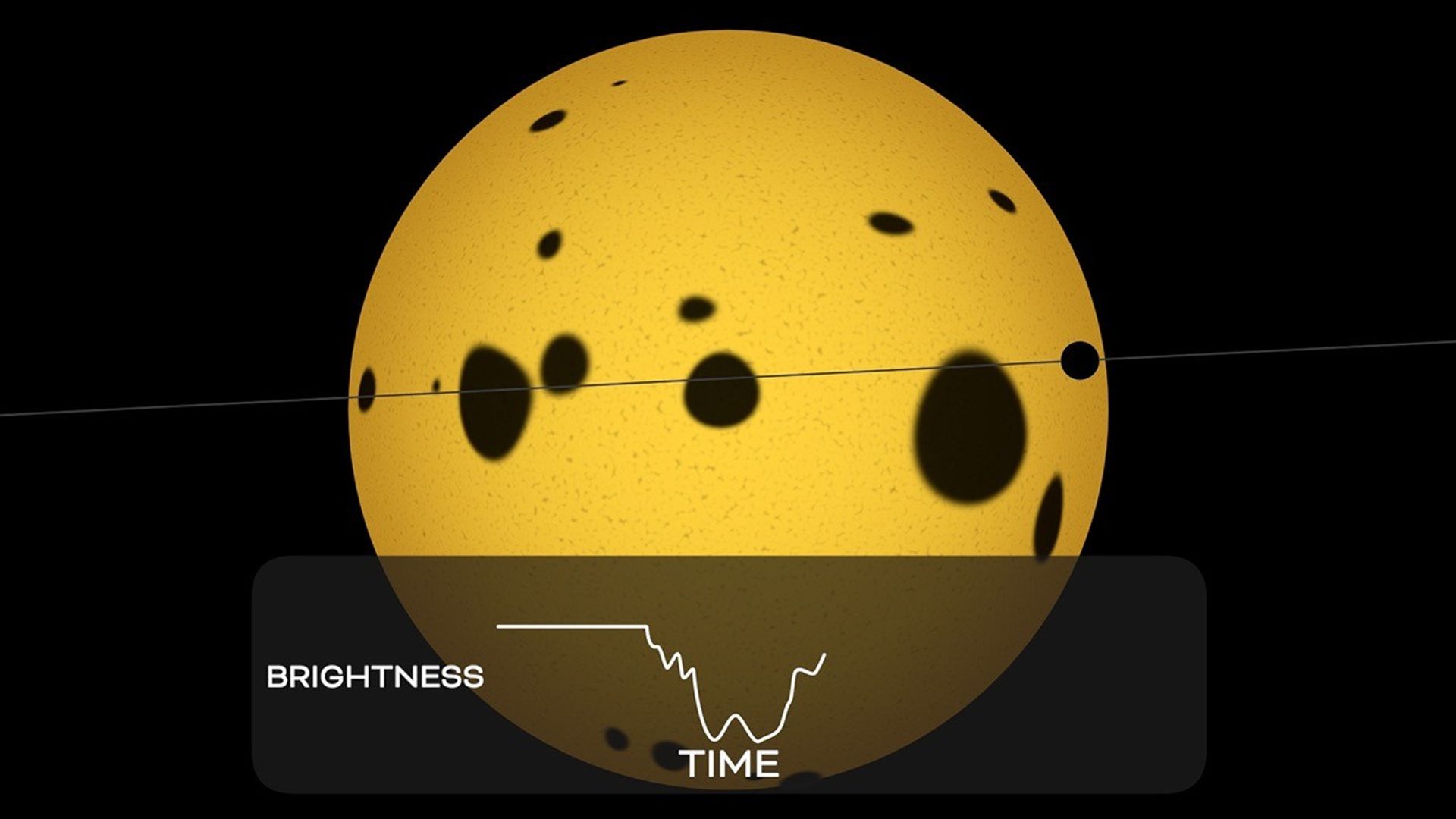
    These measurements reveal how the star’s light varies with time during each transit, and astronomers can arrange them in a plot astronomers call a light curve. Typically, a transit light curve traces a smooth sweep down as the planet starts passing in front of the star’s face. It reaches a minimum brightness when the world is fully in front of the star and then rises smoothly as the planet exits and the transit ends.  

    By measuring the time between transits, scientists can determine how far the planet lies from its star and estimate its surface temperature. The amount of missing light from the star during a transit can reveal the planet’s size, which can hint at its composition.

    Every now and then, though, a planet’s light curve appears more complicated, with smaller dips and peaks added to the main arc. Scientists think these represent dark surface features akin to sunspots seen on our own Sun — star spots.

    The Sun’s total number of sunspots varies as it goes through its 11-year solar cycle. Scientists use them to determine and predict the progress of that cycle as well as outbreaks of solar activity that could affect us here on Earth.

    Similarly, star spots are cool, dark, temporary patches on a stellar surface whose sizes and numbers change over time. Their variability impacts what astronomers can learn about transiting planets.

    Scientists have previously analyzed transit light curves from exoplanets and their host stars to look at the smaller dips and peaks. This helps determine the host star’s properties, such as its overall level of spottiness, inclination angle of the planet’s orbit, the tilt of the star’s spin compared to our line of sight, and other factors. Sagynbayeva’s model uses light curves that include not only transit information, but also the rotation of the star itself to provide even more detailed information about these stellar properties.

    This artist’s concept illustrates the varying brightness of star with a transiting planet and several star spots.
    NASA’s Goddard Space Flight Center

    “Knowing more about the star in turn helps us learn even more about the planet, like a feedback loop,” said co-author Brett Morris, a senior software engineer at the Space Telescope Science Institute in Baltimore. “For example, at cool enough temperatures, stars can have water vapor in their atmospheres. If we want to look for water in the atmospheres of planets around those stars — a key indicator of habitability — we better be very sure that we’re not confusing the two.”

    To test their model, Sagynbayeva and her team looked at transits from a planet called TOI 3884 b, located around 141 light-years away in the northern constellation Virgo.

    Discovered by TESS in 2022, astronomers think the planet is a gas giant about five times bigger than Earth and 32 times its mass.

    The StarryStarryProcess analysis suggests that the planet’s cool, dim star — called TOI 3384 — has concentrations of spots at its north pole, which also tips toward Earth so that the planet passes over the pole from our perspective.

    Currently, the only available data sets that can be fit by Sagynbayeva’s model are in visible light, which excludes infrared observations taken by NASA’s James Webb Space Telescope. But NASA’s upcoming Pandora mission will benefit from tools like this one. Pandora, a small satellite developed through NASA’s Astrophysics Pioneers Program, will study the atmospheres of exoplanets and the activity of their host stars with long-duration multiwavelength observations. The Pandora mission’s goal is to determine how the properties of a star’s light differs when it passes through a planet’s atmosphere so scientists can better measure those atmospheres using Webb and other missions.

    “The TESS satellite has discovered thousands of planets since it launched in 2018,” said Allison Youngblood, TESS project scientist at NASA’s Goddard Space Flight Center in Greenbelt, Maryland. “While Pandora will study about 20 worlds, it will advance our ability to pick out which signals come from stars and which come from planets. The more we understand the individual parts of a planetary system, the better we understand the whole — and our own.”

    By Jeanette Kazmierczak
    NASA’s Goddard Space Flight Center, Greenbelt, Md.

    Media Contact:
    Alise Fisher
    202-358-2546
    alise.m.fisher@nasa.gov
    NASA Headquarters, Washington