Participants are encouraged to dialogue before, during, and after the workshop. Contact the organizing committee for further questions.
Tag: solar system
-
NASA Armstrong to Host Partnership Day Oct. 21-22
1 min read
Preparations for Next Moonwalk Simulations Underway (and Underwater)
 NASA Graphics
NASA’s Armstrong Flight Research Center in Edwards, California, invites innovative companies, government agencies, and organizations to attend Partnership Days, scheduled for Oct. 21-22, 2025, at the center.
The event offers a unique opportunity to explore collaboration with NASA on cutting-edge research and development in areas such as aerospace, autonomy, sustainability, and more. Attendees will engage with NASA experts and learn how Armstrong’s capabilities can help accelerate innovation and bring transformative technologies to life.
Space is limited, and RSVP is required by Sept. 26.
To register, scan the QR code on the event poster or email AFRC-CAL-330-Partnerships@mail.nasa.gov.
What: NASA Armstrong Partnership Days
When: Oct. 21-22, 2025
Where: NASA’s Armstrong Flight Research Center, Edwards, California
Who: Industry leaders, government agencies, and organizations interested in research and development partnerships with NASA
For information about NASA Armstrong and other agency programs, visit:
https://www.nasa.gov/armstrong
-end-
Dede Dinius
Armstrong Flight Research Center, Edwards, California
661-276-5701
darin.l.dinius@nasa.govExplore More
-
NASA’s Northrop Grumman CRS-23 Infographics & Hardware
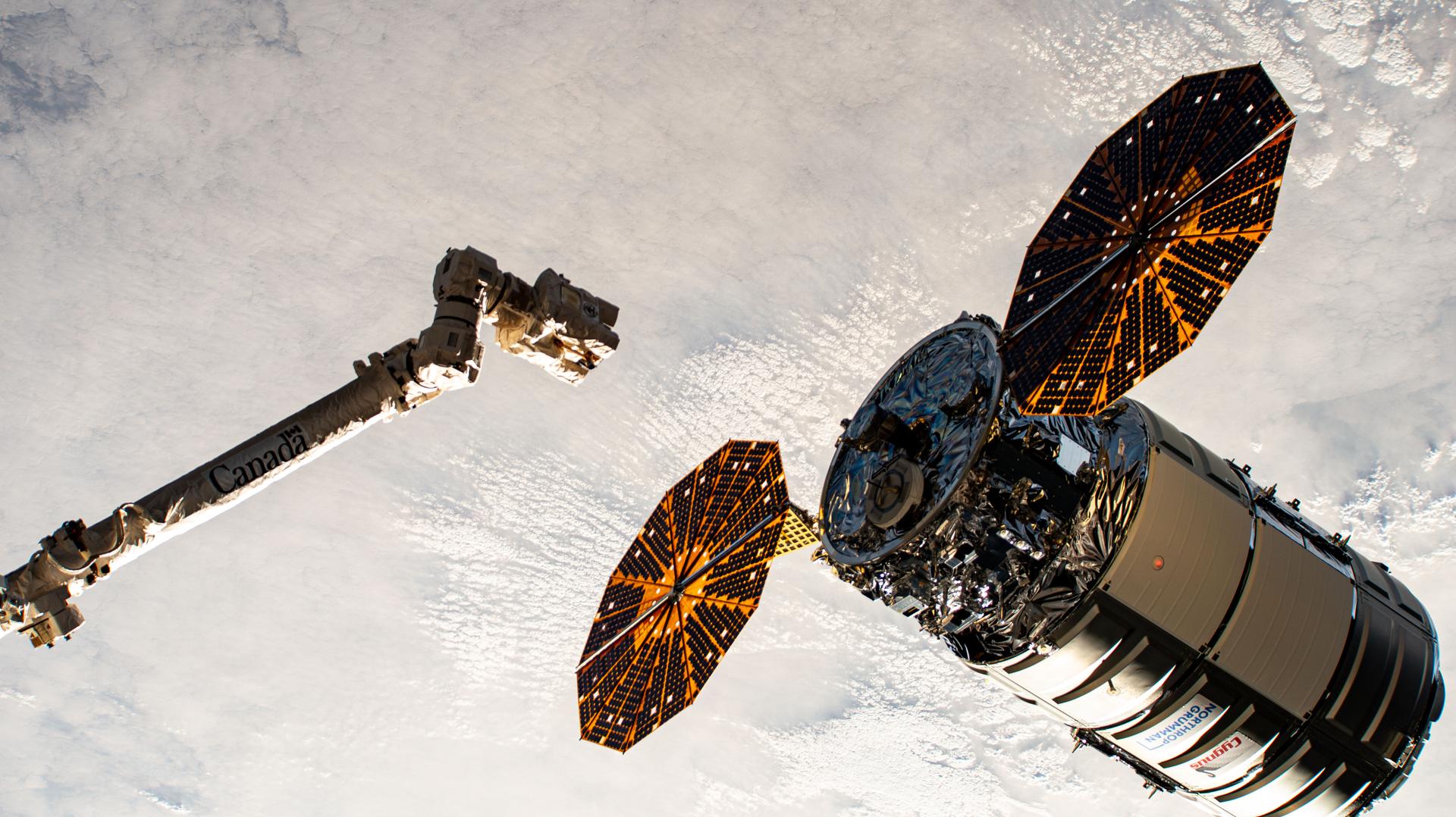
 Northrop Grumman’s Cygnus cargo craft awaits its capture by the International Space Stations’ Canadarm2 robotic arm, commanded by NASA astronaut Matthew Dominick on Aug. 6, 2024.Credit: NASA
NASA’s Northrop Grumman Commercial Resupply Services 23, or Northrop Grumman CRS-23, will deliver more than 11,000 pounds of science and supplies to the International Space Station. This mission will be the first flight of the Cygnus XL, the larger, more cargo-capable version of the company’s solar-powered spacecraft.
The Cygnus XL will launch on a SpaceX Falcon 9 rocket from the Cape Canaveral Space Force Station in Florida. Following arrival, astronauts aboard the space station will use the Canadarm2 to grapple Cygnus XL before robotically installing the spacecraft to the Unity module’s Earth-facing port for cargo unloading. Stream live launch and arrival coverage on NASA+, Amazon Prime, YouTube.
Mission Infographics
 NASA’s Northrop Grumman 23 commercial resupply mission will launch on a SpaceX Falcon 9 rocket to deliver research and supplies to the International Space Station.NASA
 NASA’s Northrop Grumman 23 commercial resupply mission will launch from Space Launch Complex 40 at Cape Canaveral Space Force Station in Florida.NASA
 NASA selected William “Willie” McCool as an astronaut in 1996. McCool flew as a pilot on STS-107, his first mission. The STS-107 crew, including McCool, died on February 1, 2003, when space shuttle Columbia was lost during reentry over east Texas at about 9 a.m. EST, 16 minutes prior to the scheduled touchdown and NASA’s Kennedy Space Center. NASA’s Northrop Grumman 23 spacecraft is named in his honor.NASA
 NASA astronauts Jonny Kim and Zena Cardman will be on duty during the Cygnus spacecraft’s approach and rendezvous. Kim will be at the controls of the Canadarm2 robotic arm ready to capture Cygnus as Cardman monitors the vehicle’s arrival.NASA
Mission Hardware
IDA Planar Reflector – This is a reflective element used by visiting spacecraft during docking. The spacecraft bounces a laser off the reflector to compute relative range, velocity, and attitude on approach to the International Space Station. Due to degradation found on the installed reflector, this unit will launch to support a future spacewalk to replace the damaged reflector.
Urine Processing Assembly (UPA) Distillation Assembly – The urine processor on the space station uses filtration and distillation to separate water from wastewater to produce potable water. This unit is launching as a spare.
Reactor Health Sensor – Part of the Environmental Control and Life Support System – Water Processing Assembly, includes two sensors with inlet and outlet ports to measure reactor health. This unit is being launched as a spare.
Pressure Management Device – This is an intravehicular activity system for performing pressurization and depressurization of the space station vestibules between the space station hatch and the hatch of a visiting spacecraft or other module, like the NanoRacks Airlock. During depressurization, most of the air will be added to the space station cabin air to save the valuable resource.
Air Selector Valve – This electro-mechanical assembly is used to direct airflow through the Carbon Dioxide Removal Assembly. Two units are launching as spares.
Major Constituent Analyzer Mass Spectrometer Assembly – This assembly monitors the partial pressure levels of nitrogen, oxygen, hydrogen, methane, water vapor, and carbon dioxide aboard station. This unit is launching as a contingency spare.
Major Constituent Analyzer Mass Sample/Series Pump Assembly – This contains plumbing and a pair of solenoid valves to direct sample gas flow to either of the redundant sample pumps. It draws sample gas from the space station’s atmosphere into the analyzer. This unit is launching as a contingency spare.
Major Constituent Analyzer Sample Distribution Assembly – This isolates the gas sample going to the Mass Spectrometer Assembly. The purpose is to distribute gas samples throughout the analyzer. This unit is launching as a contingency spare.
Charcoal Bed – The bed allows the Trace Contaminant Control System to remove high molecular weight contaminants from the station’s atmosphere. This unit is launching as a spare.
Common Cabin Air Assembly Heat Exchanger – This assembly controls cabin air temperature, humidity, and airflow aboard the space station. This unit is launching as a spare.
Sequential Shunt Unit – This regulates the solar array wing voltage when experiencing high levels of direct sunlight; in doing so, it provides usable power to the station’s primary power system. This unit is launching as a spare.
Solid State Lighting Assembly – This is a specialized internal lighting assembly aboard station. NASA will use one lighting assembly to replace a failed unit and will keep the others as spares.
Remote Power Control Module Type V – This module distributes 120V/DC electrical power and provides current-limiting and fault protection to secondary loads aboard the orbiting laboratory. This module is launching as a spare.
Treadmill Isolator Assembly – The Upper, X, Y, and Z Isolator Assemblies are launching as spares for the space station’s treadmill, where they work together to reduce vibration and force transfer when astronauts are running.
Pump Fan Motor Controller – The controller is an electronic controller to modulate the power to the motor windings, which are coils of conductive wire that are wrapped around its core carrying electric current to drive the motor. Windings are commonly used in household appliances, cars (power steering), pumps, and more.
Quick Don Mask Assembly – This mask is used by the crew, along with the Pre-Breath Assembly, in emergency situations. This unit is launching to replace a unit aboard station.
Anomaly Gas Analyzer – This analyzer senses various gases, like oxygen, carbon dioxide, carbon monoxide, ammonia, and others, along with cabin pressure, water vapor and temperature. Two units are launching as an upgrade to the current analyzer system used on board.
Nitrogen, Oxygen Resupply Maintenance Kit – One tank of nitrogen and one tank of oxygen used for gas replenishment aboard the space station are launching to maintain gas reserves.
Crew and Equipment Translation Aid Luminaire – This is a lighting unit used aboard station to illuminate the astronauts’ equipment cart and surrounding work areas during spacewalks.
-
NASA Invites Media to View Artemis Moon Rocket, Spacecraft at Kennedy
 The Artemis I SLS (Space Launch System) rocket and Orion spacecraft is pictured in the Vehicle Assembly Building at NASA’s Kennedy Space Center in Florida before rollout to launch pad 39B, in March 2022.Credit: NASA/Frank Michaux
Media are invited to see NASA’s fully assembled Artemis II SLS (Space Launch System) rocket and Orion spacecraft in mid-October before its crewed test flight around the Moon next year.
The event at NASA’s Kennedy Space Center in Florida will showcase hardware for the Artemis II lunar mission, which will test capabilities needed for deep space exploration. NASA and industry subject matter experts will be available for interviews.
Attendance is open to U.S. citizens and international media. Media accreditation deadlines are as follows:
- International media without U.S. citizenship must apply by 11:59 p.m. EDT on Monday, Sept. 22.
- U.S. media and U.S. citizens representing international media organizations must apply by 11:59 p.m. EDT on Monday, Sept. 29.
Media wishing to take part in person must apply for credentials at:
Credentialed media will receive a confirmation email upon approval, along with additional information about the specific date for the mid-October activities when they are determined. NASA’s media accreditation policy is available online. For questions about accreditation, please email: ksc-media-accreditat@mail.nasa.gov. For other questions, please contact the NASA Kennedy newsroom at: 321-867-2468.
Prior to the media event, the Orion spacecraft will transition from the Launch Abort System Facility to the Vehicle Assembly Building at NASA Kennedy, where it will be placed on top of the SLS rocket. The fully stacked rocket will then undergo complete integrated testing and final hardware closeouts ahead of rolling the rocket to Launch Pad 39B for launch. During this effort, technicians will conduct end-to-end communications checkouts, and the crew will practice day of launch procedures during their countdown demonstration test.
Artemis II will send NASA astronauts Reid Wiseman, Victor Glover, Christina Koch, and CSA (Canadian Space Agency) astronaut Jeremy Hansen on an approximately 10-day journey around the Moon and back. As part of a Golden Age of innovation and exploration, Artemis will pave the way for new U.S.-crewed missions on the lunar surface ahead in preparation toward the first crewed mission to Mars.
To learn more about the Artemis II mission, visit:
https://www.nasa.gov/mission/artemis-ii
-end-
Rachel Kraft / Lauren Low
Headquarters, Washington
202-358-1100
rachel.h.kraft@nasa.gov / lauren.e.low@nasa.govTiffany Fairley
Kennedy Space Center, Fla.
321-867-2468
tiffany.l.fairley@nasa.gov -
NASA Data, Trainings Help Uruguay Navigate Drought
5 Min ReadNASA Data, Trainings Help Uruguay Navigate Drought
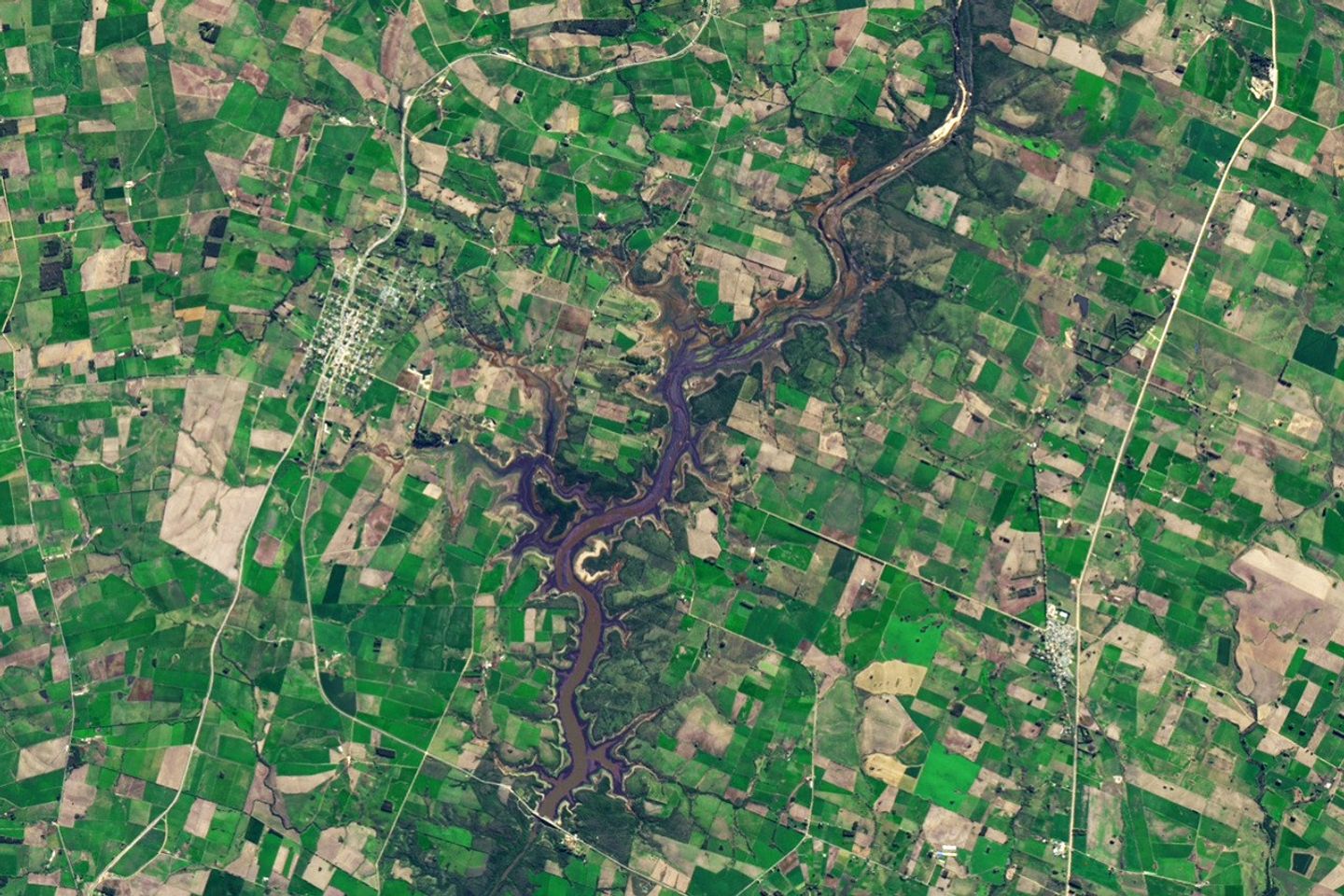
Uruguay’s Paso Severino Reservoir, the primary water source for Montevideo, on June 13, 2023, captured by Landsat 9. Credits:
NASA Earth Observatory/ Wanmei LiangLee esta historia en español aquí.
NASA satellite data and trainings helped Uruguay create a drought-response tool that its National Water Authority now uses to monitor reservoirs and guide emergency decisions. A similar approach could be applied in the United States and other countries around the world.
From 2018 to 2023, Uruguay experienced its worst drought in nearly a century. The capital city of Montevideo, home to nearly 2 million people, was especially hard hit. By mid-2023, Paso Severino, the largest reservoir and primary water source for Montevideo, had dropped to just 1.7% of its capacity. As water levels declined, government leaders declared an emergency. They began identifying backup supplies and asked: Was there water left in other upstream reservoirs — mainly used for livestock and irrigation — that could help?
That’s when environmental engineer Tiago Pohren and his colleagues at the National Water Authority (DINAGUA – Ministry of Environment) turned to NASA data and trainings to build an online tool that could help answer that question and improve monitoring of the nation’s reservoirs.
“Satellite data can inform everything from irrigation scheduling in the Great Plains to water quality management in the Chesapeake Bay,” said Erin Urquhart, manager of the water resources program at NASA Headquarters in Washington. “NASA provides the reliable data needed to respond to water crises anywhere in the world.”
Learning to Detect Water from Space
The DINAGUA team learned about NASA resources during a 2022 workshop in Buenos Aires, organized by the Interagency Science and Applications Team (ISAT). Led by NASA, the U.S. Army Corps of Engineers, and the U.S. Department of State, the workshop focused on developing tools to help manage water in the La Plata River Basin, which spans multiple South American countries including Uruguay.
At the workshop, researchers from NASA introduced participants to methods for measuring water resources from space. NASA’s Applied Remote Sensing (ARSET) program also provided a primer on remote sensing principles.
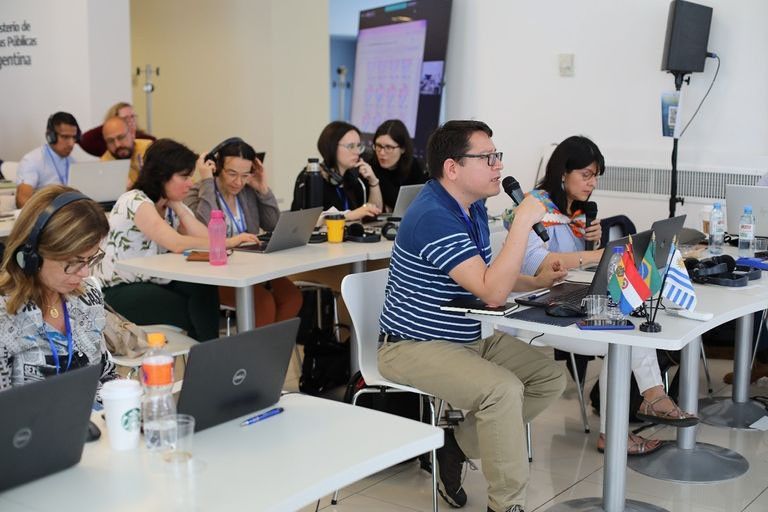 DINAGUA team supervisor Jose Rodolfo Valles León asks a question during a 2022 workshop in Buenos Aires. Other members of the Uruguay delegation — Florencia Hastings, Vanessa Erasun Rodríguez de Líma, Vanessa Ferreira, and Teresa Sastre (current Director of DINAGUA) — sit in the row behind.Organization of American States
“NASA doesn’t just deliver data,” said John Bolten, NASA’s lead scientist for ISAT and chief of the Hydrological Sciences Laboratory at NASA’s Goddard Space Flight Center in Greenbelt, Maryland. “We collaborate with our partners and local experts to translate the data into information that is useful, usable, and relevant. That kind of coordination is what makes NASA’s water programs so effective on the ground, at home and around the world.”
The DINAGUA team brought ideas and provided guidelines to Pohren for a tool that applies Landsat and Sentinel satellite imagery to detect changes in Uruguay’s reservoirs. Landsat, a joint NASA-U.S. Geological Survey mission, provides decades of satellite imagery to track changes in land and water. The Sentinel missions, a part of the European Commission managed Copernicus Earth Observation program and operated by ESA (the European Space Agency), provide complementary visible, infrared, and microwave imagery for surface water assessments.
From a young age, Pohren was familiar with water-related challenges, as floods repeatedly inundated his relatives’ homes in his hometown of Montenegro, Brazil. It was extra motivation for him as he scoured ARSET tutorials and taught himself to write computer code. The result was a monitoring tool capable of estimating the surface area of Uruguay’s reservoirs over time.
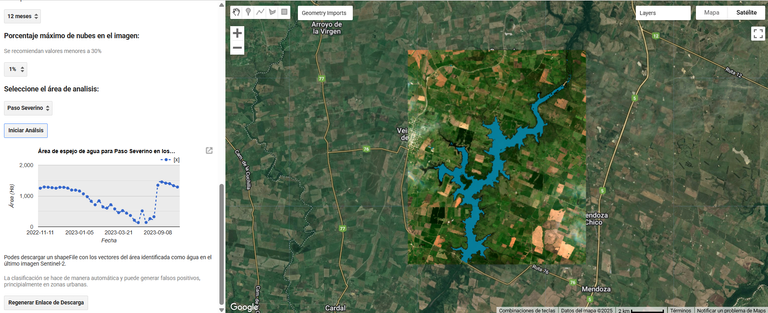 A screenshot of the reservoir monitoring tool shows the Paso Severino’s surface water coverage alongside time-series data tracking its variations.Tiago Pohren
The tool draws on several techniques to differentiate the surface water extent of reservoirs. These techniques include three optical indicators derived from the Landsat 8 and Sentinel-2 satellites:
- Normalized Difference Water Index, which highlights water by comparing how much green and near-infrared light is reflected. Water absorbs infrared light, so it stands out clearly from land.
- Modified Normalized Difference Water Index, which swaps near-infrared with shortwave infrared to improve the contrast and reduce errors when differentiating between water and built-up or vegetated areas.
- Automated Water Extraction Index, which combines four types of reflected light — green, near-infrared, and two shortwave infrared bands — to help separate water from shadows and other dark features.
From Emergency Tool to Everyday Asset
In 2023, the DINAGUA team used Pohren’s tool to examine reservoirs located upstream from Montevideo’s drinking water intake. But the data told a tough story.
“There was water available in other reservoirs, but it was a very small amount compared to the water demand of the Montevideo metropolitan region,” Pohren said. Simulations showed that even if all of the water were released, most of it would not reach the water intake for Montevideo or the Paso Severino reservoir.
Despite this news, the analysis prevented actions that might have wasted important resources for maintaining productive activities in the upper basin, Pohren said. Then, in August 2023, rain began to refill Uruguay’s reservoirs, allowing the country to declare an end to the water crisis.
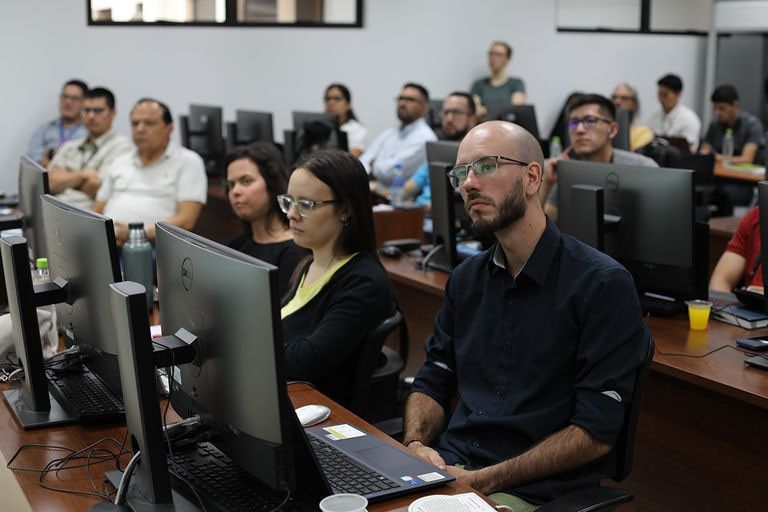 From right to left: Tiago Pohren, Vanessa Erasun, and Florencia Hastings at the second ISAT workshop in March 2024.Organization of American States
Though the immediate water crisis has passed, the tool Pohren created will be useful in the future in Uruguay and around the world. During an ISAT workshop in 2024, he shared his tool with international water resources managers with the hope it could aid their own drought response efforts. And DINAGUA officials still use it to identify and monitor dams, irrigation reservoirs, and other water bodies in Uruguay.
Pohren continues to use NASA training and data to advance reservoir management. He’s currently exploring an ARSET training on how the Surface Water and Ocean Topography (SWOT) mission will further improve the system by allowing DINAGUA to directly measure the height of water in reservoirs. He is also following NASA’s new joint mission with ISRO (the Indian Space Research Organization) called NISAR, which launched on July 30. The NISAR satellite will provide radar data that detects changes in water extent, regardless of cloud cover or time of day. “If a drought happens again,” Pohren said, “with the tools that we have now, we will be much more prepared to understand what the conditions of the basin are and then make predictions.”
 Environmental engineer Tiago Pohren conducts a field inspection on the Canelón Grande reservoir, the second-largest reservoir serving Montevideo, during the drought.Tiago Pohren
By Melody Pederson, Rachel Jiang
The authors would like to thank Noelia Gonzalez, Perry Oddo, Denise Hill, and Delfina Iervolino for interview support as well as Jerry Weigel for connecting with Tiago about the tool’s development.
Share
Details
Last UpdatedSep 10, 2025Related Terms
Explore More
-
NASA Aims to Keep Fuel Cool Under Pressure with Zero Boil-Off Experiment On NG-23
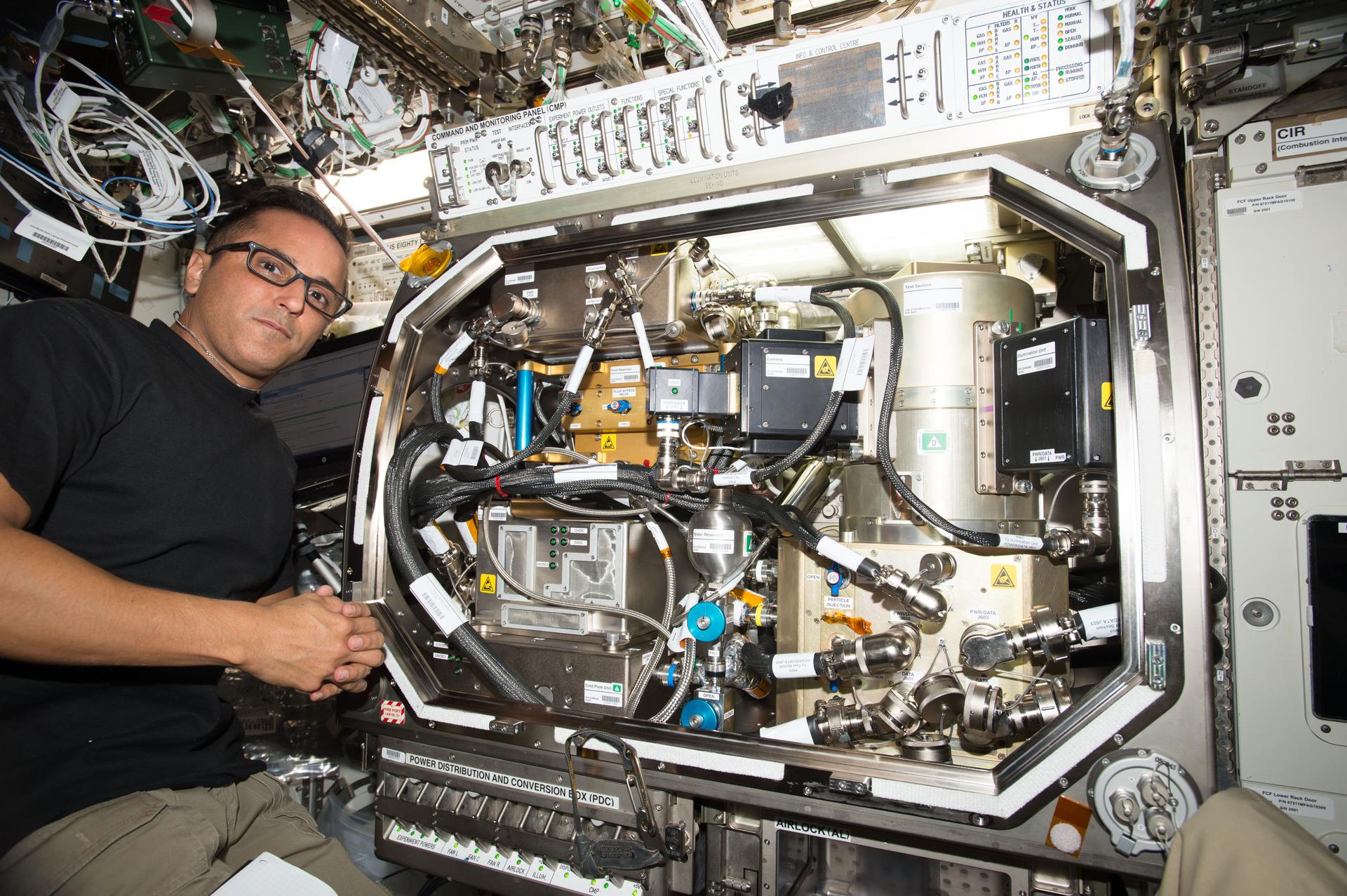 Flight Engineer Joe Acaba works in the U.S. Destiny laboratory module on the International Space Station, setting up hardware for the Zero Boil-Off Tank (ZBOT) experiment.Joe Acaba
Space missions rely on cryogenic fluids — extremely cold liquids like liquid hydrogen and oxygen — for both propulsion and life support systems. These fuels must be kept at ultra-low cryogenic temperatures to remain in liquid form; however, solar heating and other sources of heat increase the rate of evaporation of the liquid and cause the pressure in the storage tank to increase. Current storage methods require venting the cryogenic propellant to space to control the pressure in fuel tanks.
NASA’s Zero Boil-Off Tank Noncondensables (ZBOT-NC) experiment is the continuation of Zero Boil-Off studies gathering crucial data to optimize fuel storage systems for space missions. The experiment will launch aboard Northrop Grumman’s 23rd resupply mission to the International Space Station.
When Cold Fuel Gets Too Warm
Even with multilayer insulation, heat unavoidably seeps into cryogenic fuel tanks from surrounding structures and the space environment, causing an increase in the liquid temperature and an associated increase in the evaporation rate. In turn, the pressure inside the tank increases. This process is called “boil-off” and the increase in tank pressure is referred to as “self-pressurization.”
Venting excess gas to the environment or space when this process occurs is highly undesirable and becomes mission-critical on extended journeys. If crew members used current fuel storage methods for a years-long Mars expedition, all propellant might be lost to boil-off before the trip ends.
NASA’s ZBOT experiments are investigating active pressure control methods to eliminate wasteful fuel venting. Specifically, active control through the use of jet mixing and other techniques are being evaluated and tested in the ZBOT series of experiments.
The Pressure Control Problem
ZBOT-NC further studies how noncondensable gases (NCGs) affect fuel tank behavior when present in spacecraft systems. NCGs don’t turn into liquid under the tank’s operating conditions and can affect tank pressure.
The investigation, which is led out of Glenn Research Center, will operate inside the Microgravity Science Glovebox aboard the space station to gather data on how NCGs affect volatile liquid behavior in microgravity. It’s part of an effort to advance cryogenic fluid management technologies and help NASA better understand low-gravity fluid behavior.
Researchers will measure pressure and temperature as they study how these gases change evaporation and condensation rates. Previous studies indicate the gases create barriers that could reduce a tank’s ability to maintain proper pressure control — a potentially serious issue for extended space missions.
How this benefits space exploration
The research directly supports Mars missions and other long-duration space travel by helping engineers design more efficient fuel storage systems and future space depots. The findings may also benefit scientific instruments on space telescopes and probes that rely on cryogenic fluids to maintain the extremely low temperatures needed for operation.
How this benefits humanity
The investigation could improve tank design models for medical, industrial, and energy production applications that depend on long-term cryogenic storage on Earth.
Latest Content
Stay up-to-date with the latest content from NASA as we explore the universe and discover more about our home planet.
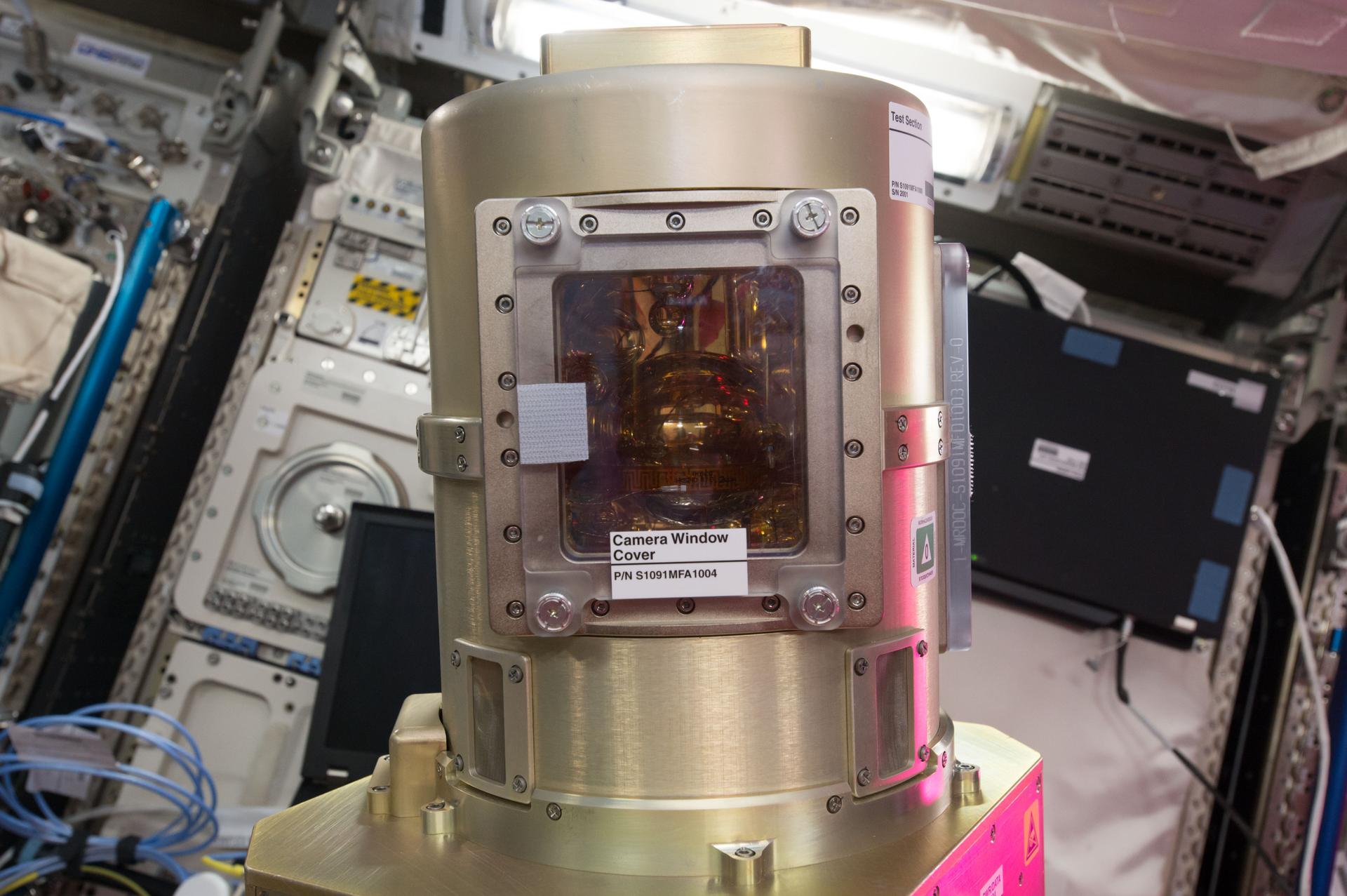 Zero Boil-Off Tank Noncondensables (ZBOT-NC)2 min read
Zero Boil-Off Tank Noncondensables (ZBOT-NC) Principal Investigator(s): Overview: Zero Boil-Off Tank Noncondensables (ZBOT-NC) investigates how noncondensable gases interfere with fuel…
Topic What Are Quasicrystals, and Why Does NASA Study Them?3 min read
For 40 years, finding new quasicrystals has been like searching for four-leaf clovers in a field. You’re lucky if you…
Topic Growing Beyond Earth®2 min read
Learn More Growing Beyond Earth student teams have helped select 5 of the 20 species that have been tested as…
TopicBiological & Physical Sciences Division
-
NASA’s Biological and Physical Sciences Division pioneers scientific discovery and enables exploration by using space environments to conduct investigations not possible on Earth. Studying biological and physical phenomenon under extreme conditions allows researchers to advance the fundamental scientific knowledge required to go farther and stay longer in space, while also benefitting life on Earth.
-
-
Dinner is Served!
 NASA/Jonny Kim
Dinnertime fare on the International Space Station takes center stage in this Aug. 15, 2025, photo. One tray features shrimp cocktail on whole grain wheat crackers, while the other holds sushi made with seaweed, Spam, tuna, and rice. Both trays are secured with Velcro strips to keep them stable inside the Unity module’s galley. The shrimp and crackers are held in place by condiments, while the sushi stays put thanks to surface tension from its moisture.
Activity aboard the space station will inform long-duration missions like Artemis and future human expeditions to Mars.
Image credit: NASA/Jonny Kim
-
NASA’s Webb Observes Immense Stellar Jet on Outskirts of Our Milky Way
6 Min ReadNASA’s Webb Observes Immense Stellar Jet on Outskirts of Our Milky Way
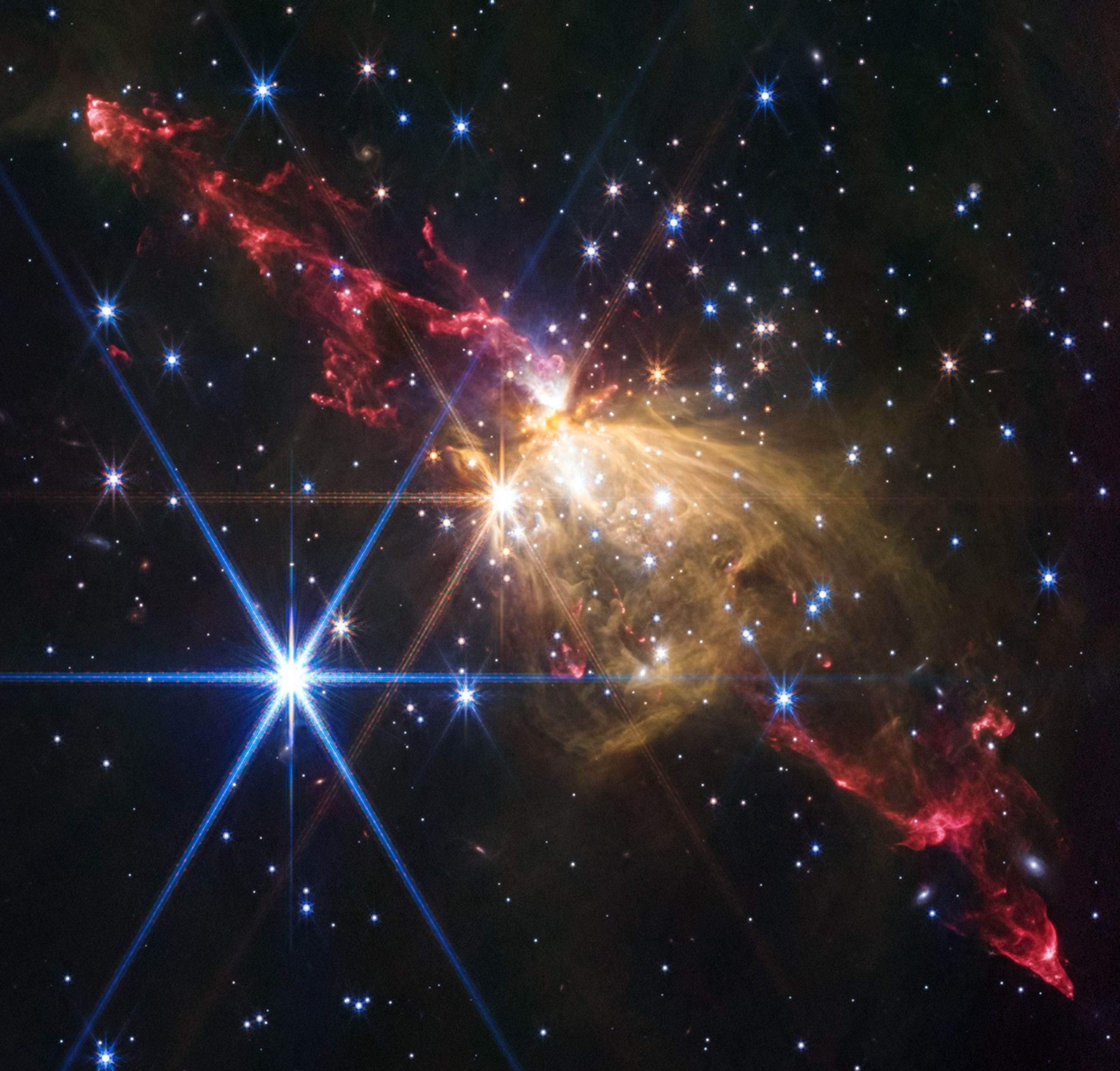
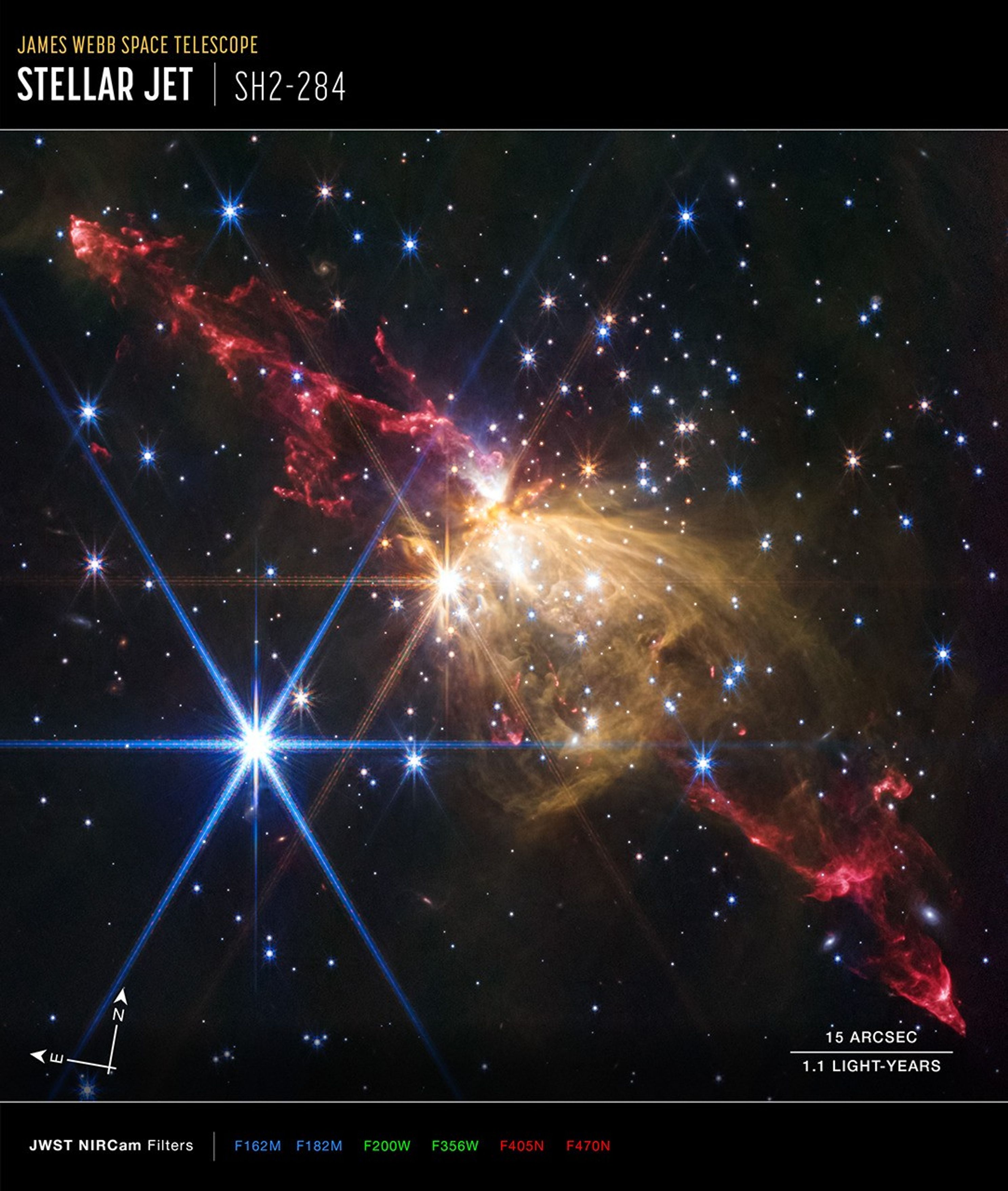
Webb’s image of the enormous stellar jet in Sh2-284 provides evidence that protostellar jets scale with the mass of their parent stars—the more massive the stellar engine driving the plasma, the larger the resulting jet. Full image shown below. Credits:
Image: NASA, ESA, CSA, STScI, Yu Cheng (NAOJ); Image Processing: Joseph DePasquale (STScI)A blowtorch of seething gasses erupting from a volcanically growing monster star has been captured by NASA’s James Webb Space Telescope. Stretching across 8 light-years, the length of the stellar eruption is approximately twice the distance between our Sun and the next nearest stars, the Alpha Centauri system. The size and strength of this particular stellar jet, located in a nebula known as Sharpless 2-284 (Sh2-284 for short), qualifies it as rare, say researchers.
Streaking across space at hundreds of thousands of miles per hour, the outflow resembles a double-bladed dueling lightsaber from the Star Wars films. The central protostar, weighing as much as ten of our Suns, is located 15,000 light-years away in the outer reaches of our galaxy.
The Webb discovery was serendipitous. “We didn’t really know there was a massive star with this kind of super-jet out there before the observation. Such a spectacular outflow of molecular hydrogen from a massive star is rare in other regions of our galaxy,” said lead author Yu Cheng of the National Astronomical Observatory of Japan.
Image A: Stellar Jet in Sh2-284 (NIRCam Image)
Webb’s image of the enormous stellar jet in Sh2-284 provides evidence that protostellar jets scale with the mass of their parent stars—the more massive the stellar engine driving the plasma, the larger the resulting jet.Image: NASA, ESA, CSA, STScI, Yu Cheng (NAOJ); Image Processing: Joseph DePasquale (STScI)This unique class of stellar fireworks are highly collimated jets of plasma shooting out from newly forming stars. Such jetted outflows are a star’s spectacular “birth announcement” to the universe. Some of the infalling gas building up around the central star is blasted along the star’s spin axis, likely under the influence of magnetic fields.
Today, while hundreds of protostellar jets have been observed, these are mainly from low-mass stars. These spindle-like jets offer clues into the nature of newly forming stars. The energetics, narrowness, and evolutionary time scales of protostellar jets all serve to constrain models of the environment and physical properties of the young star powering the outflow.
“I was really surprised at the order, symmetry, and size of the jet when we first looked at it,” said co-author Jonathan Tan of the University of Virginia in Charlottesville and Chalmers University of Technology in Gothenburg, Sweden.
Its detection offers evidence that protostellar jets must scale up with the mass of the star powering them. The more massive the stellar engine propelling the plasma, the larger the gusher’s size.
The jet’s detailed filamentary structure, captured by Webb’s crisp resolution in infrared light, is evidence the jet is plowing into interstellar dust and gas. This creates separate knots, bow shocks, and linear chains.
The tips of the jet, lying in opposite directions, encapsulate the history of the star’s formation. “Originally the material was close into the star, but over 100,000 years the tips were propagating out, and then the stuff behind is a younger outflow,” said Tan.
Outlier
At nearly twice the distance from the galactic center as our Sun, the host proto-cluster that’s home to the voracious jet is on the periphery of our Milky Way galaxy.
Within the cluster, a few hundred stars are still forming. Being in the galactic hinterlands means the stars are deficient in heavier elements beyond hydrogen and helium. This is measured as metallicity, which gradually increases over cosmic time as each passing stellar generation expels end products of nuclear fusion through winds and supernovae. The low metallicity of Sh2-284 is a reflection of its relatively pristine nature, making it a local analog for the environments in the early universe that were also deficient in heavier elements.
“Massive stars, like the one found inside this cluster, have very important influences on the evolution of galaxies. Our discovery is shedding light on the formation mechanism of massive stars in low metallicity environments, so we can use this massive star as a laboratory to study what was going on in earlier cosmic history,” said Cheng.
Unrolling Stellar Tapestry
Stellar jets, which are powered by the gravitational energy released as a star grows in mass, encode the formation history of the protostar.
“Webb’s new images are telling us that the formation of massive stars in such environments could proceed via a relatively stable disk around the star that is expected in theoretical models of star formation known as core accretion,” said Tan. “Once we found a massive star launching these jets, we realized we could use the Webb observations to test theories of massive star formation. We developed new theoretical core accretion models that were fit to the data, to basically tell us what kind of star is in the center. These models imply that the star is about 10 times the mass of the Sun and is still growing and has been powering this outflow.”
For more than 30 years, astronomers have disagreed about how massive stars form. Some think a massive star requires a very chaotic process, called competitive accretion.
In the competitive accretion model, material falls in from many different directions so that the orientation of the disk changes over time. The outflow is launched perpendicularly, above and below the disk, and so would also appear to twist and turn in different directions.
“However, what we’ve seen here, because we’ve got the whole history – a tapestry of the story – is that the opposite sides of the jets are nearly 180 degrees apart from each other. That tells us that this central disk is held steady and validates a prediction of the core accretion theory,” said Tan.
Where there’s one massive star, there could be others in this outer frontier of the Milky Way. Other massive stars may not yet have reached the point of firing off Roman-candle-style outflows. Data from the Atacama Large Millimeter Array in Chile, also presented in this study, has found another dense stellar core that could be in an earlier stage of construction.
The paper has been accepted for publication in The Astrophysical Journal.
The James Webb Space Telescope is the world’s premier space science observatory. Webb is solving mysteries in our solar system, looking beyond to distant worlds around other stars, and probing the mysterious structures and origins of our universe and our place in it. Webb is an international program led by NASA with its partners, ESA (European Space Agency) and CSA (Canadian Space Agency).
To learn more about Webb, visit:
Related Information
View more: Webb images of other protostar outflows – HH 49/50, L483, HH 46/47, and HH 211
View more: Data visualization of protostar outflows – HH 49/50
Animation Video: “Exploring Star and Planet Formation”
Explore the jets emitted by young stars in multiple wavelengths: ViewSpace Interactive
Read more about Herbig-Haro objects
Related For Kids
En Español
Related Images & Videos

Immense Stellar Jet in Sh2-284
This video shows the relative size of two different protostellar jets imaged by NASA’s James Webb Space Telescope. The first image shown is an extremely large protostellar jet located in Sh2-284, 15,000 light-years away from Earth. The outflows from the massive central prot…
Share
Details
Last UpdatedSep 10, 2025ContactMediaLaura Betz
NASA’s Goddard Space Flight Center
Greenbelt, Maryland
laura.e.betz@nasa.govRay Villard
Space Telescope Science Institute
Baltimore, MarylandChristine Pulliam
Space Telescope Science Institute
Baltimore, MarylandRelated Terms
Related Links and Documents
-
What Would It Take to Say We Found Life? We Asked a NASA Expert: Episode 63
4 min read
Preparations for Next Moonwalk Simulations Underway (and Underwater)
What Would It Take to Say We Found Life?
We call this the podium test. What would it take for you personally to confidently stand up in front of an international audience and make that claim? When you put it in that way, I think for a lot of scientists, the bar is really high.
So of course, there would be obvious things, you know, a very clear signature of technology or a skeleton or something like that. But we think that a lot of the evidence that we might encounter first will be much more subtle. For example, chemical signs of life that have to be detected above a background of abiotic chemistry. And really, what we see might depend a lot on where we look.
On Mars, for example, the long history of exploration there gives us a lot of context for what we might find. But we’re potentially talking about samples that are billions of years old in those cases, and on Earth, those kinds of samples, the evidence of life is often degraded and difficult to detect.
On the ocean worlds of our outer solar system, so places like Jupiter’s moon Europa and Saturn’s moon Enceladus, there’s the tantalizing possibility of extant life, meaning life that’s still alive. But potentially we’re talking about exceedingly small amounts of samples that would have to be analyzed with a relatively limited amount of instrumentation that can be carried from Earth billions of miles away.
And then for exoplanets, these are planets beyond our own solar system. Really, what we’re looking for there are very large magnitude signs of life that can be detectable through a telescope from many light-years away. So changes like the oxygenation of Earth’s atmosphere or changes in surface color.
So any one of those things, if they rose to the suspicion of being evidence of life, would be really heavily scrutinized in a very sort of specific and custom way to that particular observation. But I think there are also some general principles that we can follow. And the first is just: Are we sure we’re seeing what we think we’re seeing? Many of these environments are not very well known to us, and so we need to convince ourselves that we’re actually seeing a clear signal that represents what we think it represents.
Carl Sagan once said, “Life is the hypothesis of last resort,” meaning that we ought to work hard for such a claim to rule out alternative possibilities. So what are those possibilities? One is contamination. The spacecraft and the instruments that we use to look for evidence of life are built in an environment, Earth, that is full of life. And so we need to convince ourselves that what we’re seeing is not evidence of our own life, but evidence of indigenous life.
If that’s the case, we should ask, should life of the type we’re seeing live there? And finally, we need to ask, is there any other way than life to make that thing, any of the possible abiotic processes that we know and even the ones that we don’t know? And as you can imagine, that will be quite a challenge.
Once we have a piece of evidence in hand that we really do think represents evidence of life, now we can begin to develop hypotheses. For example, do we have separate independent lines of evidence that corroborate what we’ve seen and increase our confidence of life?
Ultimately, all of this has to be looked at hard by the entire scientific community, and in that sense, I think the really operative word in our question is we. What does it take to say we found evidence of life? Because really, the answer, I think, depends on the full scientific community scrutinizing and skepticizing this observation to finally say that we scientists, we as a community and we as humanity found life.
[END VIDEO TRANSCRIPT]
Share
Details
Last UpdatedSep 10, 2025Related Terms
Explore More
-
Envía tu nombre alrededor de la Luna en 2026 con la misión Artemis II de la NASA
 Los nombres de los participantes irán en tarjetas de embarque a bordo de la misión Artemis II de la NASA en 2026.Crédito: NASA
Read this press release in English here.
La NASA invita al público a unirse al vuelo de prueba Artemis II de la agencia en el que cuatro astronautas emprenderán un viaje alrededor de la Luna y de regreso a la Tierra para poner a prueba los sistemas y el hardware necesarios para la exploración del espacio profundo. Como parte de la iniciativa de la agencia “Envía tu nombre con Artemis II”, cualquiera puede asegurar su lugar a registrándose antes del 21 de enero.
Los nombres de los participantes en esta iniciativa viajarán en la nave espacial Orion y el cohete Sistema de Lanzamiento Espacial (SLS, por sus siglas en inglés) junto a los astronautas de la NASA Reid Wiseman, Victor Glover, Christina Koch y el astronauta de la CSA (Agencia Espacial Canadiense) Jeremy Hansen.
“Artemis II es un vuelo de prueba clave en nuestro esfuerzo por enviar de nuevo a seres humanos a la superficie de la Luna y desarrollar futuras misiones a Marte. También es una oportunidad para inspirar a personas de todo el mundo y darles la oportunidad de acompañarnos mientras lideramos el camino en la exploración humana hacia lugares más profundos en el espacio”, dijo Lori Glaze, administradora asociada interina en la Dirección de Misiones de Desarrollo de Sistemas de Exploración en la sede central de la NASA en Washington.
Los nombres recopilados se incluirán en una tarjeta de memoria SD que será cargada a bordo de Orion antes del lanzamiento. A cambio, los participantes pueden descargar una tarjeta de embarque con su nombre como un recuerdo coleccionable.
Para añadir tu nombre y recibir una tarjeta de embarque en español, visita el sitio web:
https://go.nasa.gov/TuNombreArtemis
Para añadir tu nombre y recibir una tarjeta de embarque en inglés, visita el sitio web:
https://go.nasa.gov/artemisnames
Como parte de una edad de oro de innovación y exploración, el vuelo de prueba Artemis II es el primer vuelo tripulado de la campaña Artemis de la NASA. Tendrá una duración aproximada de 10 días y despegará a más tardar en abril de 2026. Este es otro paso hacia nuevas misiones tripuladas de Estados Unidos a la superficie de la Luna que ayudarán a la agencia a prepararse para enviar a los primeros astronautas estadounidenses a Marte.
Para obtener más información acerca de esta misión, visita el sitio web (en inglés):
https://www.nasa.gov/mission/artemis-ii/
-fin-
Rachel Kraft / María José Viñas
Sede central, Washington
202-358-1600
rachel.h.kraft@nasa.gov / maria-jose.vinasgarcia@nasa.gov -
Launch Your Name Around Moon in 2026 on NASA’s Artemis II Mission
 Boarding passes will carry participants’ names on NASA’s Artemis II mission in 2026.Credit: NASA
Lee este comunicado de prensa en español aquí.
NASA is inviting the public to join the agency’s Artemis II test flight as four astronauts venture around the Moon and back to test systems and hardware needed for deep space exploration. As part of the agency’s “Send Your Name with Artemis II” effort, anyone can claim their spot by signing up before Jan. 21.
Participants will launch their name aboard the Orion spacecraft and SLS (Space Launch System) rocket alongside NASA astronauts Reid Wiseman, Victor Glover, Christina Koch, and CSA (Canadian Space Agency) astronaut Jeremy Hansen.
“Artemis II is a key test flight in our effort to return humans to the Moon’s surface and build toward future missions to Mars, and it’s also an opportunity to inspire people across the globe and to give them an opportunity to follow along as we lead the way in human exploration deeper into space,” said Lori Glaze, acting associate administrator, Exploration Systems Development Mission Directorate at NASA Headquarters in Washington.
The collected names will be put on an SD card loaded aboard Orion before launch. In return, participants can download a boarding pass with their name on it as a collectable.
To add your name and receive an English-language boarding pass, visit:https://go.nasa.gov/artemisnames
To add your name and receive a Spanish-language boarding pass, visit:
https://go.nasa.gov/TuNombreArtemis
As part of a Golden Age of innovation and exploration, the approximately 10-day Artemis II test flight, launching no later than April 2026, is the first crewed flight under NASA’s Artemis campaign. It is another step toward new U.S.-crewed missions on the Moon’s surface that will help the agency prepare to send the first astronauts – Americans – to Mars.
To learn more about the mission visit:
https://www.nasa.gov/mission/artemis-ii/
-end-
Rachel Kraft
Headquarters, Washington
202-358-1600
rachel.h.kraft@nasa.gov -
NASA Stennis Provides Ideal Location for Range of Site Tenants
 Teams at NASA’s Stennis Space Center conduct a hot fire test of an Aerojet AJ26 rocket engine on the E-1 Test Stand in November 2013.NASA/Stennis
If location, location, location is the overarching mantra in real estate, it is small wonder that NASA’s Stennis Space Center is considered a national asset and prime aerospace and technology operations site.
It has long stood as a premier – and the nation’s largest – rocket propulsion test site. With unparalleled test infrastructure and expertise, NASA Stennis has helped power the nation’s human space exploration for almost 60 years. It continues to do so, testing systems and engines for NASA’s Artemis program to send astronauts to the Moon to prepare for future human exploration of Mars.
In addition, NASA Stennis is the choice location for a range of agencies, organizations, offices, and companies, all of whom readily attest to the values of the setting. Ask resident tenants to note the value of their NASA Stennis location, and one hears terms like “strategic advantages,” “ideal location,” “local expertise and experience,” “collaborative opportunities,” “hub of innovation,” and “valuable security buffer.”
For the NASA Shared Services Center, its location at the south Mississippi test site provides “substantial strategic advantages” that helps the NSSC maximize its work and provide streamlined business operations for the agency.
Likewise, NASA Stennis provides an ideal location for the North Gulf Institute operated by Mississippi State University, as it conducts frontline work in hurricane forecasting, modeling and assessment, as well as fishery and ecosystem management. The location is strengthened further by the proximity to collaborative partners like the Naval Meteorology and Oceanography Command and the National Data Buoy Center.
The same holds true for the National Centers for Environmental Information operated by the National Oceanic and Atmospheric Administration. A spokesperson said the centers’ mission success is “firmly rooted in its strategic co-location with other federal partners,” including the Naval Meteorology and Oceanography Command, the National Data Buoy Center, and the Northern Gulf Institute.
For Relativity Space, the largest NASA Stennis test complex tenant, the “unparalleled infrastructure” at NASA Stennis has been key to enabling the company’s rocket engine testing. “NASA’s Stennis Space Center plays a vital role in getting Terran R to space,” said Clay Walker, vice president of test and launch for Relativity Space. “The infrastructure here allows us to test high-performance engines in ways no other place can.”
Other companies express similar sentiments, citing the unique opportunities NASA Stennis provides, as well as the value of the local workforce. For instance, L3Harris Technologies has operated at NASA Stennis under various names since the 1960s, providing support to the Apollo, Space Shuttle, and, now, Artemis programs. In 2008, Lockheed Martin opened a start-to-finish facility for production of propulsion systems, making use of the various NASA Stennis propulsion test services and resources.
Evolution Space is capitalizing on decades of aerospace experience at NASA Stennis, as well as “world-class” site infrastructure to establish production and test capabilities for solid rocket motors onsite.
Both Mississippi and Louisiana have established technology offices onsite. As a Mississippi Enterprise for Technology statement noted, “The NASA Stennis environment enhances our ability to support emerging technologies, strengthen Mississippi’s technology ecosystem, and contribute to the economic vitality of the region,” said Davis Pace, chief executive officer for the Mississippi Enterprise for Technology.
Meanwhile, the site’s most prominent tenant – the U.S. Navy – operates various offices at NASA Stennis. The Navy’s move to the site began in the 1970s to take advantage of the security provided by the surrounding NASA Stennis acoustical buffer zone. Various Navy functions eventually located continuing operations onsite, including the Naval Meteorology and Oceanography Command, the Naval Oceanographic Office, the Naval Small Craft Instruction and Technical Training School, the Navy Office of Civilian Human Resources, and the Naval Research Laboratory.
In similar fashion, the U.S. Department of Homeland Security credits the “high-quality, secure, and resilient” NASA Stennis site for its decision to location information technology and applications operations onsite.
As the very first NASA Stennis federal city tenant, arriving onsite in September 1970, the National Data Buoy Center has borne witness to it all.
“From its inception, Sen. John Stennis (and other leaders) envisioned a place where America would push the boundaries of the unknown – from the depths of the oceans to the far reaches of space,” said Dr. William Burnett, director of the National Data Buoy Center onsite. “That vision lives on at NASA Stennis, now home to one of the world’s largest concentrations of oceanographers. At the National Data Buoy Center, we proudly carry out our mission to safeguard maritime safety by harnessing the full strength of this unique scientific and technical community.
“We are deeply rooted in the community and grateful to thrive within the collaborative spirit that defines Stennis. It’s an honor to be part of its legacy – and its future.”
Share
Details
Last UpdatedSep 09, 2025EditorNASA Stennis CommunicationsContactC. Lacy Thompsoncalvin.l.thompson@nasa.gov / (228) 688-3333LocationStennis Space CenterRelated Terms
-
Life After Microgravity: Astronauts Reflect on Post-Flight Recovery
Space changes you. It strengthens some muscles, weakens others, shifts fluids within your body, and realigns your sense of balance. NASA’s Human Research Program works to understand—and sometimes even counter—those changes so astronauts can thrive on future deep space missions.
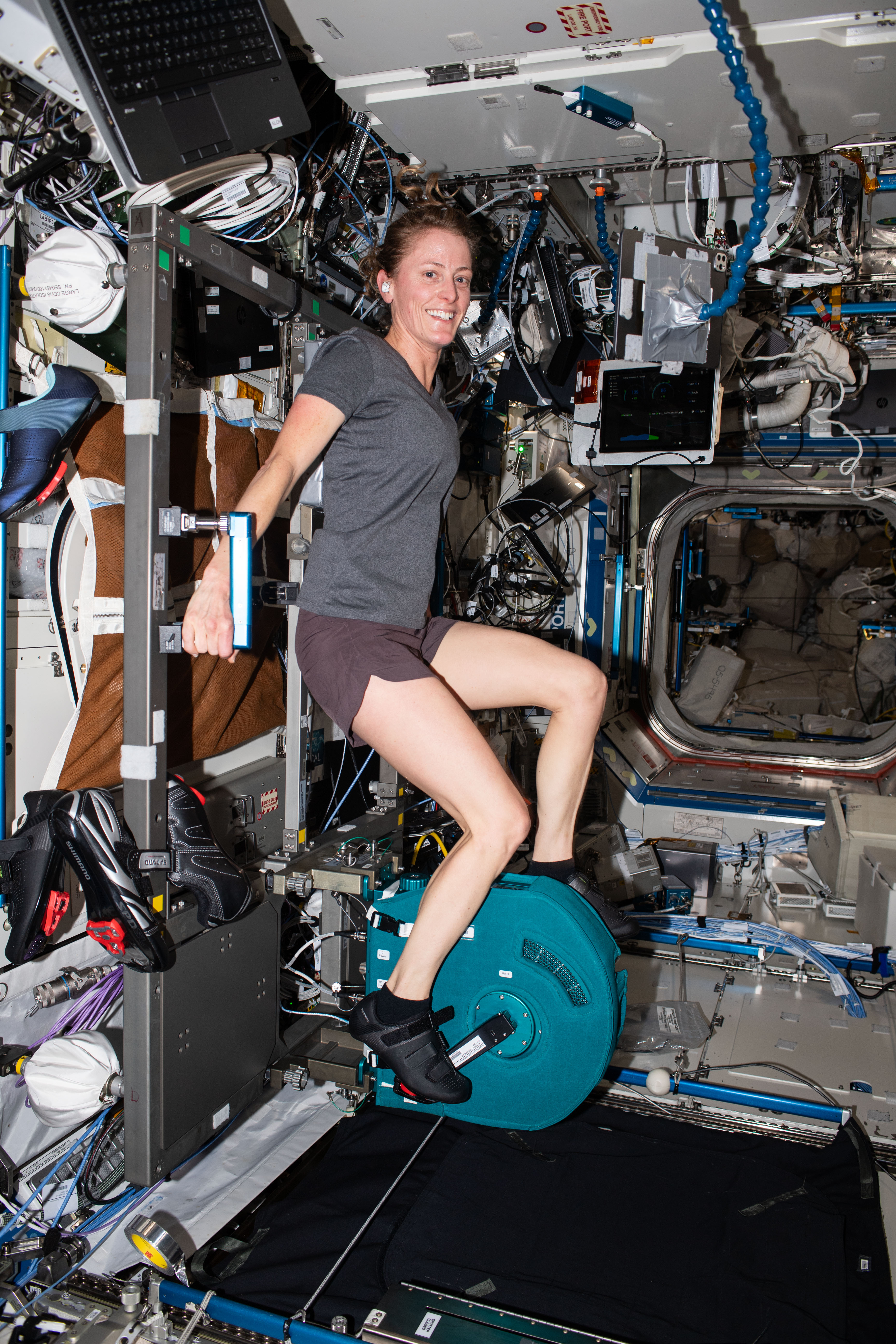
 NASA astronaut Loral O’Hara pedals on the Cycle Ergometer Vibration Isolation System (CEVIS) inside the International Space Station’s Destiny laboratory module.NASA
Astronauts aboard the International Space Station work out roughly two hours a day to protect bone density, muscle strength and the cardiovascular system, but the longer they are in microgravity, the harder it can be for the brain and body to readapt to gravity’s pull. After months in orbit, returning astronauts often describe Earth as heavy, loud, and strangely still. Some reacclimate within days, while other astronauts take longer to fully recover.
Adjusting to Gravity
 NASA’s SpaceX Crew-7 astronaut Jasmin Moghbeli after landing in the Gulf of America on March 12, 2024, completing 197 days in space.NASA/Joel Kowsky
The crew of NASA’s SpaceX Crew-7 mission— NASA astronaut Jasmin Moghbeli, ESA (European Space Agency) astronaut Andreas Mogensen, JAXA (Japan Aerospace Exploration Agency) astronaut Satoshi Furukawa, and Roscosmos cosmonaut Konstantin Borisov—landed in March 2024 after nearly 200 days in space. One of the first tests volunteer crew members completed was walking with their eyes open and then closed.
“With eyes closed, it was almost impossible to walk in a straight line,” Mogensen said. In space, vision is the primary way astronauts orient themselves, but back on Earth, the brain must relearn how to use inner-ear balance signals. Moghbeli joked her first attempt at the exercise looked like “a nice tap dance.”
“I felt very wobbly for the first two days,” Moghbeli said. “My neck was very tired from holding up my head.” She added that, overall, her body readapted to gravity quickly.
Astronauts each recover on their own timetable and may encounter different challenges. Mogensen said his coordination took time to return. Furukawa noted that he could not look down without feeling nauseated. “Day by day, I recovered and got more stable,” he said.
 NASA astronaut Loral O’Hara after landing in a remote area near the town of Zhezkazgan, Kazakhstan, on April 6, 2024.NASA/Bill Ingalls
NASA astronaut Loral O’Hara returned in April 2024 after 204 days in space. She said she felt almost completely back to normal a week after returning to Earth. O’Hara added that her prior experience as an ocean engineer gave her insight into space missions. “Having those small teams in the field working with a team somewhere else back on shore with more resources is a good analog for the space station and all the missions we’re hoping to do in the future,” she said.
NASA astronaut Nichole Ayers, who flew her first space mission with NASA’s SpaceX Crew-10, noted that the brain quickly adapts to weightlessness by tuning out the vestibular system, which controls balance. “Then, within days of being back on Earth, it remembers again—it’s amazing how fast the body readjusts,” she said.
 Expedition 69 NASA astronaut Frank Rubio outside the Soyuz MS-23 spacecraft after landing near the town of Zhezkazgan, Kazakhstan, on Sept. 27, 2023.NASA/Bill Ingalls
When NASA astronaut Frank Rubio landed in Kazakhstan in September 2023, he had just completed a record 371-day mission—the longest single U.S. spaceflight.
Rubio said his body adjusted to gravity right away, though his feet and lower back were sore after more than a year without weight on them. Thanks to consistent workouts, Rubio said he felt mostly recovered within a couple of weeks.
Mentally, extending his mission from six months to a year was a challenge. “It was a mixed emotional roller coaster,” he said, but regular video calls with family kept him grounded. “It was almost overwhelming how much love and support we received.”
Crew-8 astronauts Matt Dominick, Jeanette Epps, Michael Barratt, and cosmonaut Alexander Grebenkin splashed down in October 2024 after 235 days on station. Dominick found sitting on hard surfaces uncomfortable at first. Epps felt the heaviness of Earth immediately. “You have to move and exercise every day, regardless of how exhausted you feel,” she said.
Barratt, veteran astronaut and board certified in internal and aerospace medicine, explained that recovery differs for each crew member, and that every return teaches NASA something new.
Still a Challenge, Even for Space Veterans
 NASA astronaut Suni Williams is helped out of a SpaceX Dragon spacecraft aboard the SpaceX recovery ship after splashing down off the coast of Tallahassee, Florida, March 18, 2025.NASA/Keegan Barber
Veteran NASA astronauts Suni Williams and Butch Wilmore returned from a nine-month mission with Crew-9 in early 2025. Despite her extensive spaceflight experience, Williams said re-adapting to gravity can still be tough. “The weight and heaviness of things is surprising,” she said. Like others, she pushed herself to move daily to regain strength and balance.
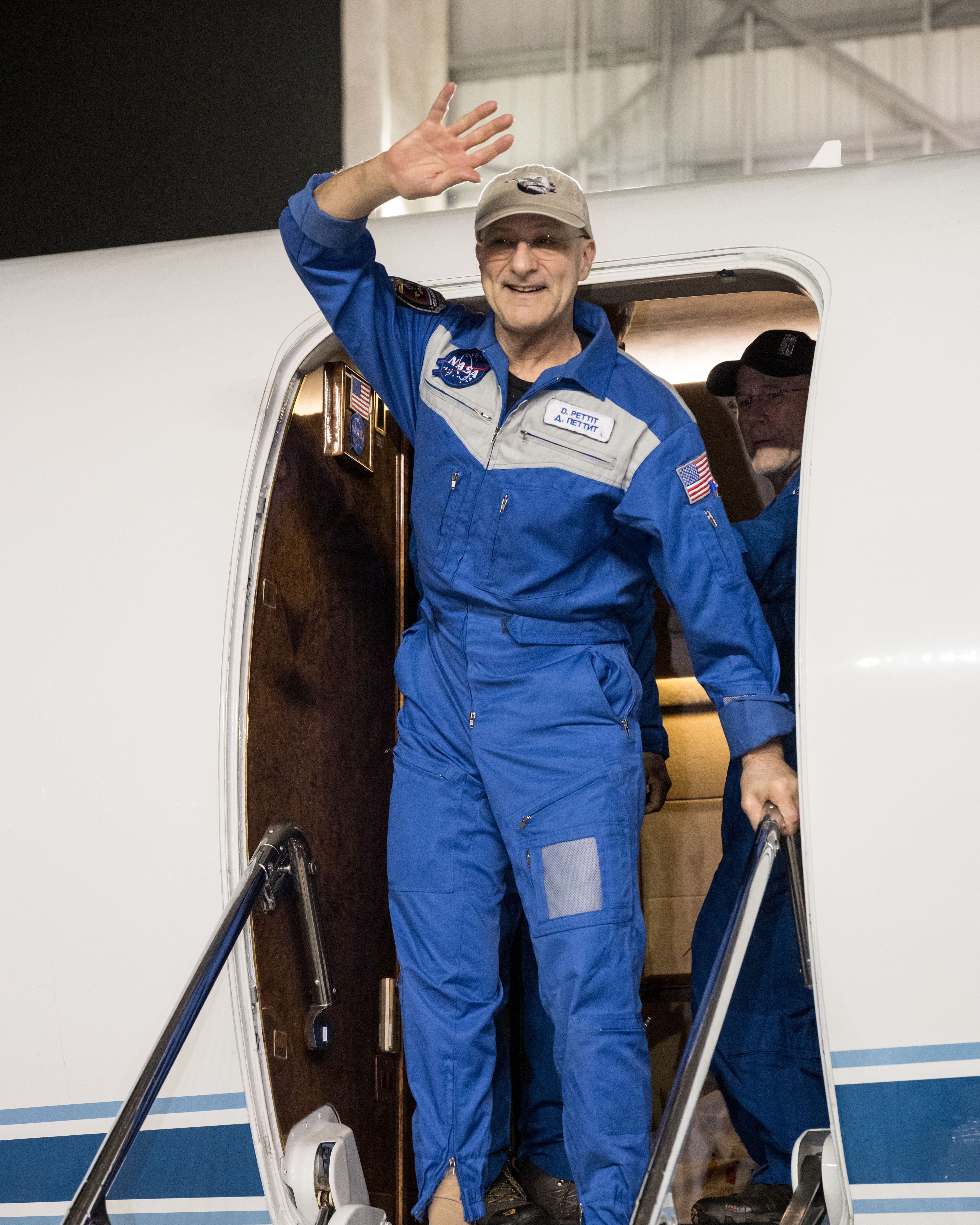
 NASA astronaut Don Pettit arrives at Ellington Field in Houston on April 20, 2025, after returning to Earth aboard the Soyuz MS-25 spacecraft.NASA/Robert Markowitz
NASA astronaut Don Pettit, also a veteran flyer, came home in April 2025 after 220 days on the space station. At 70 years old, he is NASA’s oldest active astronaut—but experience did not make gravity gentler. During landing, he says he was kept busy, “emptying the contents of my stomach onto the steppes of Kazakhstan.” Microgravity had eased the aches in his joints and muscles, but Earth’s pull brought them back all at once.
Pettit said his recovery felt similar to earlier missions. “I still feel like a little kid inside,” he said. The hardest part, he explained, isn’t regaining strength in big muscle groups, but retraining the small, often-overlooked muscles unused in space. “It’s a learning process to get used to gravity again.”
Recovery happens day by day—with help from exercise, support systems, and a little humor. No matter how long an astronaut is in space, every journey back to Earth is unique.
The Human Research Program help scientists understand how spaceflight environments affect astronaut health and performance and informs strategies to keep crews healthy for future missions to the Moon, Mars, and beyond. The program studies astronauts before, during, and after spaceflight to learn how the human body adapts to living and working in space. It also collects data through Earth-based analog missions that can help keep astronauts safer for future space exploration.
To learn more about how microgravity affects the human body and develop new ways to help astronauts stay healthy, for example, its scientists conduct bedrest studies – asking dozens of volunteers to spend 60 days in bed with their heads tilted down at a specific angle. Lying in this position tricks the body into responding as it would if the body was in space which allows scientists to trial interventions to hopefully counter some of microgravity’s effects. Such studies, through led by NASA, occur at the German Aerospace Center’s Cologne campus at a facility called :envihab – a combination of “environment” and “habitat.”
Additional Earth-based insights come from the Crew Health and Performance Exploration Analog (CHAPEA) and the Human Exploration Research Analog (HERA) at NASA’s Johnson Space Center in Houston. Both analogs recreate the remote conditions and scenarios of deep space exploration here on Earth with volunteer crews who agree to live and work in the isolation of ground-based habitats and endure challenges like delayed communication that simulates the type of interactions that will occur during deep space journeys to and from Mars. Findings from these ground-based missions and others will help NASA refine its future interventions, strategies, and protocols for astronauts in space.
NASA and its partners have supported humans continuously living and working in space since November 2000. After nearly 25 years of continuous human presence, the space station remains the sole space-based proving ground for training and research for deep space missions, enabling NASA’s Artemis campaign, lunar exploration, and future Mars missions.