Tag: solar system

  • President Trump’s FY26 Budget Revitalizes Human Space Exploration

    The letters NASA on a blue circle with red and white detail, all surrounded by a black background
    Credit: NASA

    The Trump-Vance Administration released toplines of the President’s budget for Fiscal Year 2026 on Friday. The budget accelerates human space exploration of the Moon and Mars with a fiscally responsible portfolio of missions.

    “This proposal includes investments to simultaneously pursue exploration of the Moon and Mars while still prioritizing critical science and technology research,” said acting NASA Administrator Janet Petro. “I appreciate the President’s continued support for NASA’s mission and look forward to working closely with the administration and Congress to ensure we continue making progress toward achieving the impossible.”

    • Increased commitment to human space exploration in pursuit of exploration of both the Moon and Mars. By allocating more than $7 billion for lunar exploration and introducing $1 billion in new investments for Mars-focused programs, the budget ensures America’s human space exploration efforts remain unparalleled, innovative, and efficient.
    • Refocus science and space technology resources to efficiently execute high priority research. Consistent with the administration’s priority of returning to the Moon before China and putting an American on Mars, the budget will advance priority science and research missions and projects, ending financially unsustainable programs including Mars Sample Return. It emphasizes investments in transformative space technologies while responsibly shifting projects better suited for private sector leadership.
    • Transition the Artemis campaign to a more sustainable, cost-effective approach to lunar exploration. The SLS (Space Launch System) rocket and Orion capsule will be retired after Artemis III, paving the way for more cost-effective, next-generation commercial systems that will support subsequent NASA lunar missions. The budget also ends the Gateway Program, with the opportunity to repurpose already produced components for use in other missions. International partners will be invited to join these renewed efforts, expanding opportunities for meaningful collaboration on the Moon and Mars.
    • Continue the process of transitioning the International Space Station to commercial replacements in 2030, focusing onboard research on efforts critical to the exploration of the Moon and Mars. The budget reflects the upcoming transition to a more cost-effective, open commercial approach to human activities in low Earth orbit by reducing the space station’s crew size and onboard research, preparing for the safe decommissioning of the station and its replacement by commercial space stations.
    • Work to minimize duplication of efforts and most efficiently steward the allocation of American taxpayer dollars. This budget ensures NASA’s topline enables a financially sustainable trajectory to complete groundbreaking research and execute the agency’s bold mission.
    • Focus NASA’s resources on its core mission of space exploration. This budget ends climate-focused “green aviation” spending while protecting the development of technologies with air traffic control and other U.S. government and commercial applications, producing savings. This budget also will ensure continued elimination any funding toward misaligned DEIA initiatives, instead designating that money to missions capable of advancing NASA’s core mission. NASA will continue to inspire the next generation of explorers through exciting, ambitious space missions that demonstrate American leadership in space.

    NASA will coordinate closely with its partners to execute these priorities and investments as efficiently and effectively as possible.

    Building on the President’s promise to increase efficiency this budget pioneers a focused, innovative, and fiscally-responsible path to America’s next great era of human space exploration.

    Learn more about the President’s budget request for NASA:

    https://www.nasa.gov/budget

    -end-

    Bethany Stevens
    Headquarters, Washington
    771-216-2606
    bethany.c.stevens@nasa.gov
    Details

    Last Updated

    May 02, 2025

    Editor
    Jennifer M. Dooren

    Related Terms

  • Hubble Images a Peculiar Spiral

    2 min read

    Hubble Images a Peculiar Spiral

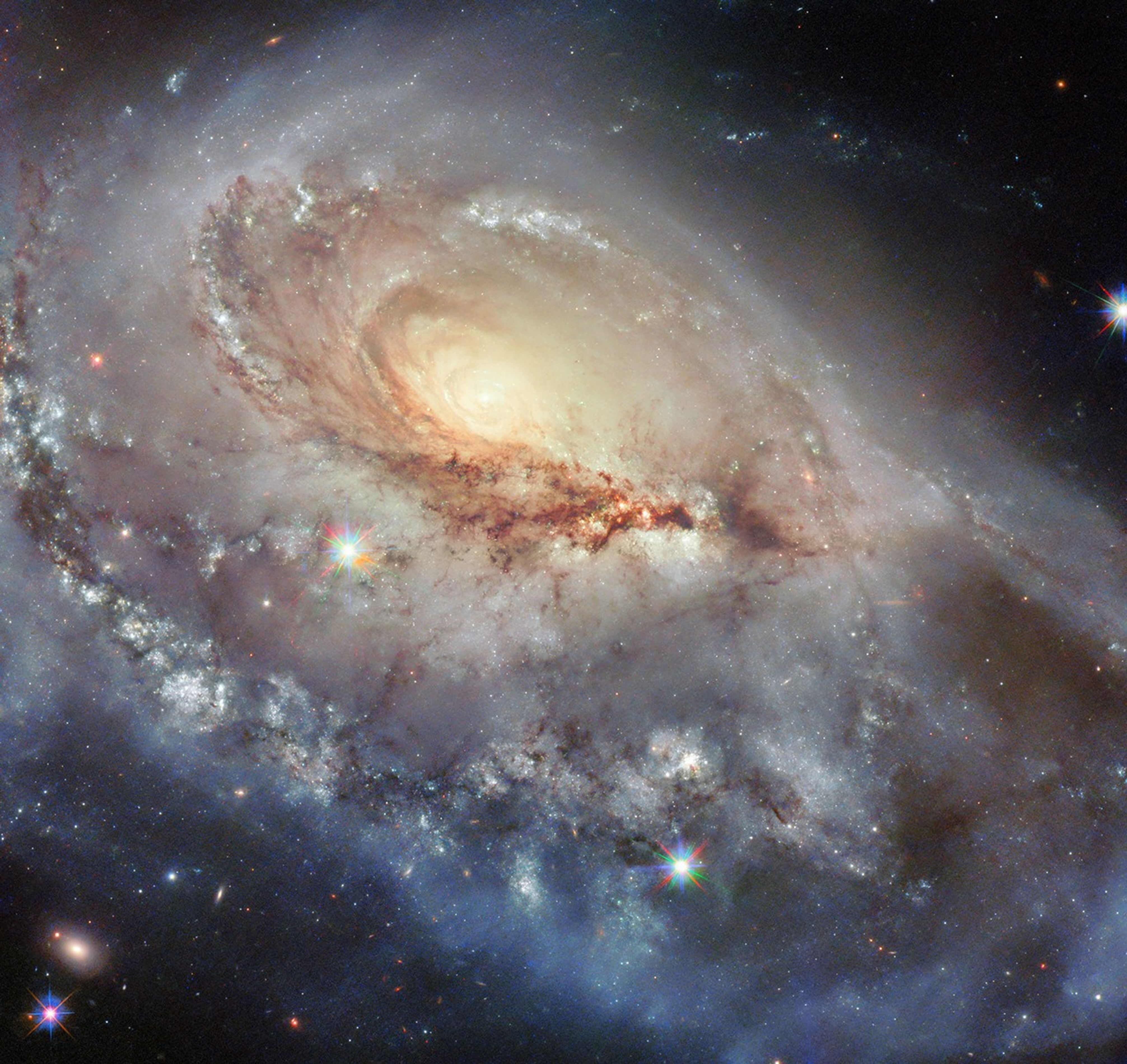
    A spiral galaxy seen at a skewed angle. Its center is a bright spot radiating light. A thick, stormy disk of material surrounds this bright center, with swirling strands of dark dust and bright spots of star formation strewn through the disk. A large spiral arm extends from the disk toward the viewer. Some foreground stars are visible atop the galaxy.
    This NASA/ESA Hubble Space Telescope image features a peculiar spiral galaxy called Arp 184 or NGC 1961.
    ESA/Hubble & NASA, J. Dalcanton, R. J. Foley (UC Santa Cruz), C. Kilpatrick

    A beautiful but skewed spiral galaxy dazzles in this NASA/ESA Hubble Space Telescope image. The galaxy, called Arp 184 or NGC 1961, sits about 190 million light-years away from Earth in the constellation Camelopardalis (The Giraffe).

    The name Arp 184 comes from the Atlas of Peculiar Galaxies compiled by astronomer Halton Arp in 1966. It holds 338 galaxies that are oddly shaped and tend to be neither entirely elliptical nor entirely spiral-shaped. Many of the galaxies are in the process of interacting with other galaxies, while others are dwarf galaxies without well-defined structures. Arp 184 earned its spot in the catalog thanks to its single broad, star-speckled spiral arm that appears to stretch toward us. The galaxy’s far side sports a few wisps of gas and stars, but it lacks a similarly impressive spiral arm.

    This Hubble image combines data from three Snapshot observing programs, which are short observations that slotted into time gaps between other proposals. One of the three programs targeted Arp 184 for its peculiar appearance. This program surveyed galaxies listed in the Atlas of Peculiar Galaxies as well as A Catalogue of Southern Peculiar Galaxies and Associations, a similar catalog compiled by Halton Arp and Barry Madore.

    The remaining two Snapshot programs looked at the aftermath of fleeting astronomical events like supernovae and tidal disruption events — like when a supermassive black hole rips a star apart after it wanders too closely. Since Arp 184 hosted four known supernovae in the past three decades, it is a rich target for a supernova hunt.

    Media Contact:

    Claire Andreoli (claire.andreoli@nasa.gov)
    NASA’s Goddard Space Flight CenterGreenbelt, MD

  • NASA’s SPHEREx Space Telescope Begins Capturing Entire Sky

    6 min read

    Preparations for Next Moonwalk Simulations Underway (and Underwater)

    After weeks of preparation, the space observatory has begun its science mission, taking about 3,600 unique images per day to create a map of the cosmos like no other.

    Launched on March 11, NASA’s SPHEREx space observatory has spent the last six weeks undergoing checkouts, calibrations, and other activities to ensure it is working as it should. Now it’s mapping the entire sky — not just a large part of it — to chart the positions of hundreds of millions of galaxies in 3D to answer some big questions about the universe. On May 1, the spacecraft began regular science operations, which consist of taking about 3,600 images per day for the next two years to provide new insights about the origins of the universe, galaxies, and the ingredients for life in the Milky Way.

    This video shows SPHEREx’s field of view as it scans across one section of sky inside the Large Magellanic Cloud, with rainbow colors representing the infrared wavelengths the telescope’s detectors see. The view from one detector array moves from purple to green, followed by the second array’s view, which changes from yellow to red. The images are looped four times. NASA/JPL-Caltech

    “Thanks to the hard work of teams across NASA, industry, and academia that built this mission, SPHEREx is operating just as we’d expected and will produce maps of the full sky unlike any we’ve had before,” said Shawn Domagal-Goldman, acting director of the Astrophysics Division at NASA Headquarters in Washington. “This new observatory is adding to the suite of space-based astrophysics survey missions leading up to the launch of NASA’s Nancy Grace Roman Space Telescope. Together with these other missions, SPHEREx will play a key role in answering the big questions about the universe we tackle at NASA every day.”

    From its perch in Earth orbit, SPHEREx peers into the darkness, pointing away from the planet and the Sun. The observatory will complete more than 11,000 orbits over its 25 months of planned survey operations, circling Earth about 14½ times a day. It orbits Earth from north to south, passing over the poles, and each day it takes images along one circular strip of the sky. As the days pass and the planet moves around the Sun, SPHEREx’s field of view shifts as well so that after six months, the observatory will have looked out into space in every direction.

    When SPHEREx takes a picture of the sky, the light is sent to six detectors that each produces a unique image capturing different wavelengths of light. These groups of six images are called an exposure, and SPHEREx takes about 600 exposures per day. When it’s done with one exposure, the whole observatory shifts position — the mirrors and detectors don’t move as they do on some other telescopes. Rather than using thrusters, SPHEREx relies on a system of reaction wheels, which spin inside the spacecraft to control its orientation.

    Hundreds of thousands of SPHEREx’s images will be digitally woven together to create four all-sky maps in two years. By mapping the entire sky, the mission will provide new insights about what happened in the first fraction of a second after the big bang. In that brief instant, an event called cosmic inflation caused the universe to expand a trillion-trillionfold.

    “We’re going to study what happened on the smallest size scales in the universe’s earliest moments by looking at the modern universe on the largest scales,” said Jim Fanson, the mission’s project manager at NASA’s Jet Propulsion Laboratory in Southern California. “I think there’s a poetic arc to that.”

    Cosmic inflation subtly influenced the distribution of matter in the universe, and clues about how such an event could happen are written into the positions of galaxies across the universe. When cosmic inflation began, the universe was smaller than the size of an atom, but the properties of that early universe were stretched out and influence what we see today. No other known event or process involves the amount of energy that would have been required to drive cosmic inflation, so studying it presents a unique opportunity to understand more deeply how our universe works.

    “Some of us have been working toward this goal for 12 years,” said Jamie Bock, the mission’s principal investigator at Caltech and JPL. “The performance of the instrument is as good as we hoped. That means we’re going to be able to do all the amazing science we planned on and perhaps even get some unexpected discoveries.”

    Color Field

    The SPHEREx observatory won’t be the first to map the entire sky, but it will be the first to do so in so many colors. It observes 102 wavelengths, or colors, of infrared light, which are undetectable to the human eye. Through a technique called spectroscopy, the telescope separates the light into wavelengths — much like a prism creates a rainbow from sunlight — revealing all kinds of information about cosmic sources.

    For example, spectroscopy can be harnessed to determine the distance to a faraway galaxy, information that can be used to turn a 2D map of those galaxies into a 3D one. The technique will also enable the mission to measure the collective glow from all the galaxies that ever existed and see how that glow has changed over cosmic time.

    And spectroscopy can reveal the composition of objects. Using this capability, the mission is searching for water and other key ingredients for life in these systems in our galaxy. It’s thought that the water in Earth’s oceans originated as frozen water molecules attached to dust in the interstellar cloud where the Sun formed.

    The SPHEREx mission will make over 9 million observations of interstellar clouds in the Milky Way, mapping these materials across the galaxy and helping scientists understand how different conditions can affect the chemistry that produced many of the compounds found on Earth today.

    More About SPHEREx

    The SPHEREx mission is managed by JPL for the agency’s Astrophysics Division within the Science Mission Directorate at NASA Headquarters. BAE Systems in Boulder, Colorado, built the telescope and the spacecraft bus. The science analysis of the SPHEREx data will be conducted by a team of scientists located at 10 institutions in the U.S., two in South Korea, and one in Taiwan. Caltech in Pasadena managed and integrated the instrument. The mission’s principal investigator is based at Caltech with a joint JPL appointment. Data will be processed and archived at IPAC at Caltech. The SPHEREx dataset will be publicly available at the NASA-IPAC Infrared Science Archive. Caltech manages JPL for NASA.

    For more about SPHEREx, visit:

    https://science.nasa.gov/mission/spherex/

    News Media Contact

    Calla Cofield
    Jet Propulsion Laboratory, Pasadena, Calif.
    626-808-2469
    calla.e.cofield@jpl.nasa.gov

    2025-063

  • NASA’s Chandra Diagnoses Cause of Fracture in Galactic “Bone”



    This image shows a structure that resembles a fractured bone called G359.13142- 0.20005 (G359.13 for short) near the center of our Galaxy. X-ray data from Chandra and MeerKAT radio data reveal that this ‘bone’ has been struck by a fast-moving, rapidly spinning neutron star, or pulsar. Neutron stars are the densest known stars and form from the collapse and explosion of massive stars. They often receive a powerful kick from these explosions, sending them away from the explosion’s location. Astronomers estimate the pulsar that caused this fracture was traveling between one and two million miles per hour.
    X-ray: NASA/CXC/Northwestern Univ./F. Yusef-Zadeh et al; Radio: NRF/SARAO/MeerKat; Image Processing: NASA/CXC/SAO/N. Wolk

    Astronomers have discovered a likely explanation for a fracture in a huge cosmic “bone” in the Milky Way galaxy, using NASA’s Chandra X-ray Observatory and radio telescopes.

    The bone appears to have been struck by a fast-moving, rapidly spinning neutron star, or pulsar. Neutron stars are the densest known stars and form from the collapse and explosion of massive stars. They often receive a powerful kick from these explosions, sending them away from the explosion’s location at high speeds.

    Enormous structures resembling bones or snakes are found near the center of the galaxy. These elongated formations are seen in radio waves and are threaded by magnetic fields running parallel to them. The radio waves are caused by energized particles spiraling along the magnetic fields.

    This image shows a structure that resembles a fractured bone called G359.13142- 0.20005 (G359.13 for short) near the center of our Galaxy. X-ray data from Chandra and MeerKAT radio data reveal that this ‘bone’ has been struck by a fast-moving, rapidly spinning neutron star, or pulsar. Neutron stars are the densest known stars and form from the collapse and explosion of massive stars. They often receive a powerful kick from these explosions, sending them away from the explosion’s location. Astronomers estimate the pulsar that caused this fracture was traveling between one and two million miles per hour.
    X-ray: NASA/CXC/Northwestern Univ./F. Yusef-Zadeh et al; Radio: NRF/SARAO/MeerKat; Image Processing: NASA/CXC/SAO/N. Wolk

    This new image shows one of these cosmic “bones” called G359.13142-0.20005 (G359.13 for short), with X-ray data from Chandra (colored blue) and radio data from the MeerKAT radio array in South Africa (colored gray). Researchers also refer to G359.13 as the Snake.

    Examining this image closely reveals the presence of a break, or fracture, in the otherwise continuous length of G359.13 seen in the image. The combined X-ray and radio data provides clues to the cause of this fracture.

    Astronomers have now discovered an X-ray and radio source at the location of the fracture, using the data from Chandra and MeerKAT and the National Science Foundation’s Very Large Array. A likely pulsar responsible for these radio and X-ray signals is labeled. A possible extra source of X-rays located near the pulsar may come from electrons and positrons (the anti-matter counterparts to electrons) that have been accelerated to high energies.

    The researchers think the pulsar likely caused the fracture by smashing into G359.13 at a speed between one million and two million miles per hour. This collision distorted the magnetic field in the bone, causing the radio signal to also become warped.

    At about 230 light-years long, G359.13 is one of the longest and brightest of these structures in the Milky Way. To put this into context, there are more than 800 stars within that distance from Earth. G359.13 is located about 26,000 light-years from Earth, near the center of the Milky Way.

    A paper describing these results appeared in the May 2024 issue of the Monthly Notices of the Royal Astronomical Society and is available here. The authors of the study are Farhad Yusuf-Zadeh (Northwestern University), Jun-Hui Zhao (Center for Astrophysics | Harvard & Smithsonian), Rick Arendt (University of Maryland, Baltimore County), Mark Wardle (Macquarie University, Australia), Craig Heinke (University of Alberta), Marc Royster (College of the Sequoias, California), Cornelia Lang (University of Iowa), and Joseph Michail (Northwestern).

    NASA’s Marshall Space Flight Center in Huntsville, Alabama, manages the Chandra program. The Smithsonian Astrophysical Observatory’s Chandra X-ray Center controls science operations from Cambridge, Massachusetts, and flight operations from Burlington, Massachusetts.

    Learn More

    Read more from NASA’s Chandra X-ray Observatory.

    Learn more about the Chandra X-ray Observatory and its mission here:

    https://www.nasa.gov/chandra

    https://chandra.si.edu

    Visual Description

    This release features two composite images of a long, thin, cosmic structure. With the structure’s vertical orientation, seemingly fragile dimensions, and pale grey color against the blackness of space, the images resemble medical X-rays of a long, thin, bone. The main image shows the structure in its entirety. The inset image is an annotated close-up highlighting an apparent fracture in the bone-like structure.

    The structure, called G359.13, or “The Snake”, is a Galactic Center Filament. These filament formations are threaded by parallel magnetic fields, and spiraling, energized particles. The particles cause radio waves, which can be detected by radio arrays, in this case by the MeerKAT array in South Africa.

    In the first composite image, the largely straight filament stretches from the top to the bottom of the vertical frame. At each end of the grey filament is a hazy grey cloud. The only color in the image is neon blue, found in a few specks which dot the blackness surrounding the structure. The blue represents X-rays seen by NASA’s Chandra X-ray Observatory.

    In the annotated close-up, one such speck appears to be interacting with the structure itself. This is a fast-moving, rapidly spinning neutron star, otherwise known as a pulsar. Astronomers believe that this pulsar has struck the filament halfway down its length, distorting the magnetic field and radio signal.

    In both images, this distortion resembles a small break, or spur, in the bone-like filament.

    News Media Contact

    Megan Watzke
    Chandra X-ray Center
    Cambridge, Mass.
    617-496-7998
    mwatzke@cfa.harvard.edu

    Lane Figueroa
    Marshall Space Flight Center, Huntsville, Alabama
    256-544-0034
    lane.e.figueroa@nasa.gov

  • NASA Invests in Future STEM Workforce Through Space Grant Awards 

    3 Min Read

    NASA Invests in Future STEM Workforce Through Space Grant Awards 

    NASA is awarding up to $870,000 annually to 52 institutions across the United States, the District of Columbia, and Puerto Rico over the next four years. The investments aim to create opportunities for the next generation of innovators by supporting workforce development, science, technology, engineering and math education, and aerospace collaboration nationwide. 

    The Space Grant College and Fellowship Program (Space Grant), established by Congress in 1989, is a workforce development initiative administered through NASA’s Office of STEM Engagement (OSTEM). The program’s mission is to produce a highly skilled workforce prepared to advance NASA’s mission and bolster the nation’s aerospace sector. 

    “The Space Grant program exemplifies NASA’s commitment to cultivating a new generation of STEM leaders,” said Torry Johnson, deputy associate administrator of the STEM Engagement Program at NASA Headquarters in Washington. “By partnering with institutions across the country, we ensure that students have the resources, mentorship, and experiences needed to thrive in the aerospace workforce.” 

    The following is a complete list of awardees: 

    • University of Alaska, Fairbanks 
    • University of Alabama, Huntsville 
    • University of Arkansas, Little Rock 
    • University of Arizona 
    • University of California, San Diego 
    • University of Colorado, Boulder 
    • University of Hartford, Connecticut 
    • American University, Washington, DC 
    • University of Delaware 
    • University of Central Florida 
    • Georgia Institute of Technology 
    • University of Hawaii, Honolulu 
    • Iowa State University, Ames 
    • University of Idaho, Moscow 
    • University of Illinois, Urbana-Champaign 
    • Purdue University, Indiana 
    • Wichita State University, Kansas 
    • University of Kentucky, Lexington 
    • Louisiana State University and A&M College 
    • Massachusetts Institute of Technology 
    • Johns Hopkins University, Maryland 
    • Maine Space Grant Consortium 
    • University of Michigan, Ann Arbor 
    • University of Minnesota 
    • Missouri University of Science and Technology 
    • University of Mississippi 
    • Montana State University, Bozeman 
    • North Carolina State University 
    • University of North Dakota, Grand Forks 
    • University of Nebraska, Omaha 
    • University of New Hampshire, Durham 
    • Rutgers University, New Brunswick, New Jersey 
    • New Mexico State University 
    • Nevada System of Higher Education 
    • Cornell University, New York 
    • Ohio Aerospace Institute 
    • University of Oklahoma 
    • Oregon State University 
    • Pennsylvania State University 
    • University of Puerto Rico 
    • Brown University, Rhode Island 
    • College of Charleston, South Carolina 
    • South Dakota School of Mines & Technology 
    • Vanderbilt University, Tennessee 
    • University of Texas, Austin 
    • University of Utah, Salt Lake City 
    • Old Dominion University Research Foundation, Virginia 
    • University of Vermont, Burlington 
    • University of Washington, Seattle 
    • Carthage College, Wisconsin 
    • West Virginia University 
    • University of Wyoming 

    Space Grant operates through state-based consortia, which include universities, university systems, associations, government agencies, industries, and informal education organizations engaged in aerospace activities. Each consortium’s lead institution coordinates efforts within its state, expanding opportunities for students and researchers while promoting collaboration with NASA and aerospace-related industries nationwide. 

    To learn more about NASA’s missions, visit: https://www.nasa.gov/ 

  • What’s Up: May 2025 Skywatching Tips from NASA

    Eta Aquarids & Waiting for a Nova! 

    The first week of May brings the annual Eta Aquarid meteors, peaking on the 6th. And sometime in the next few months, astronomers predict a “new star” or nova explosion will become visible to the unaided eye. 

    Skywatching Highlights

    All Month – Planet Visibility: 

    • Venus: Appears very bright and low in the east in the hour before sunrise all month. 
    • Mars: Easy to find in the west in the first few hours of the night, all month long. Sets around midnight to 1 a.m. local time. 
    • Jupiter: Shines brightly in the west following sunset all month. Early in the month it sets about two hours after the Sun, but by late May it’s setting only an hour after sunset. 
    • Saturn: Begins the month next to Venus, low in the eastern sky before sunrise. Quickly separates from Saturn and rises higher in the sky each day before dawn. 

    Daily Highlights

    May 6 – Eta Aquarid Meteors – The peak of this annual shower is early on the morning of May 6th. The two or three nights before that are also decent opportunities to spy a few shooting stars. On the peak night this year, the Moon sets by around 3 a.m., leaving dark skies until dawn, for ideal viewing conditions. Seeing 10-20 meteors per hour is common for the Northern Hemisphere, while south of the equator, observers tend to see substantially more. 

    May 3 – Mars & Moon: The first quarter Moon appears right next to the Red Planet on the 3rd. Find them in the west during the first half of the night that evening. 

    All month – Venus & Saturn: Low in the eastern sky each morning you’ll find bright Venus paired with much fainter Saturn. They start the month close together, but Saturn pulls away and rises higher over the course of the month. 

    All month – Mars & Jupiter: The planets to look for on May evenings are Mars and Jupiter. They’re visible for a couple of hours after sunset in the western sky. 

    All month – Corona Borealis: Practice finding this constellation in the eastern part of the sky during the first half of the night, so you have a point of comparison when the T CrB nova appears there, likely in the next few months. 

    Transcript

    What’s Up for May? Four bright planets, morning and night, a chance of meteor showers, and waiting for a nova. 

    May Planet Viewing 

    For planet watching this month, you’ll find Mars and Jupiter in the west following sunset. Mars sticks around for several hours after it gets dark out, but Jupiter is setting by 9:30 or 10 p.m., and getting lower in the sky each day. The first quarter Moon appears right next to the Red Planet on the 3rd. Find them in the west during the first half of the night that evening. 

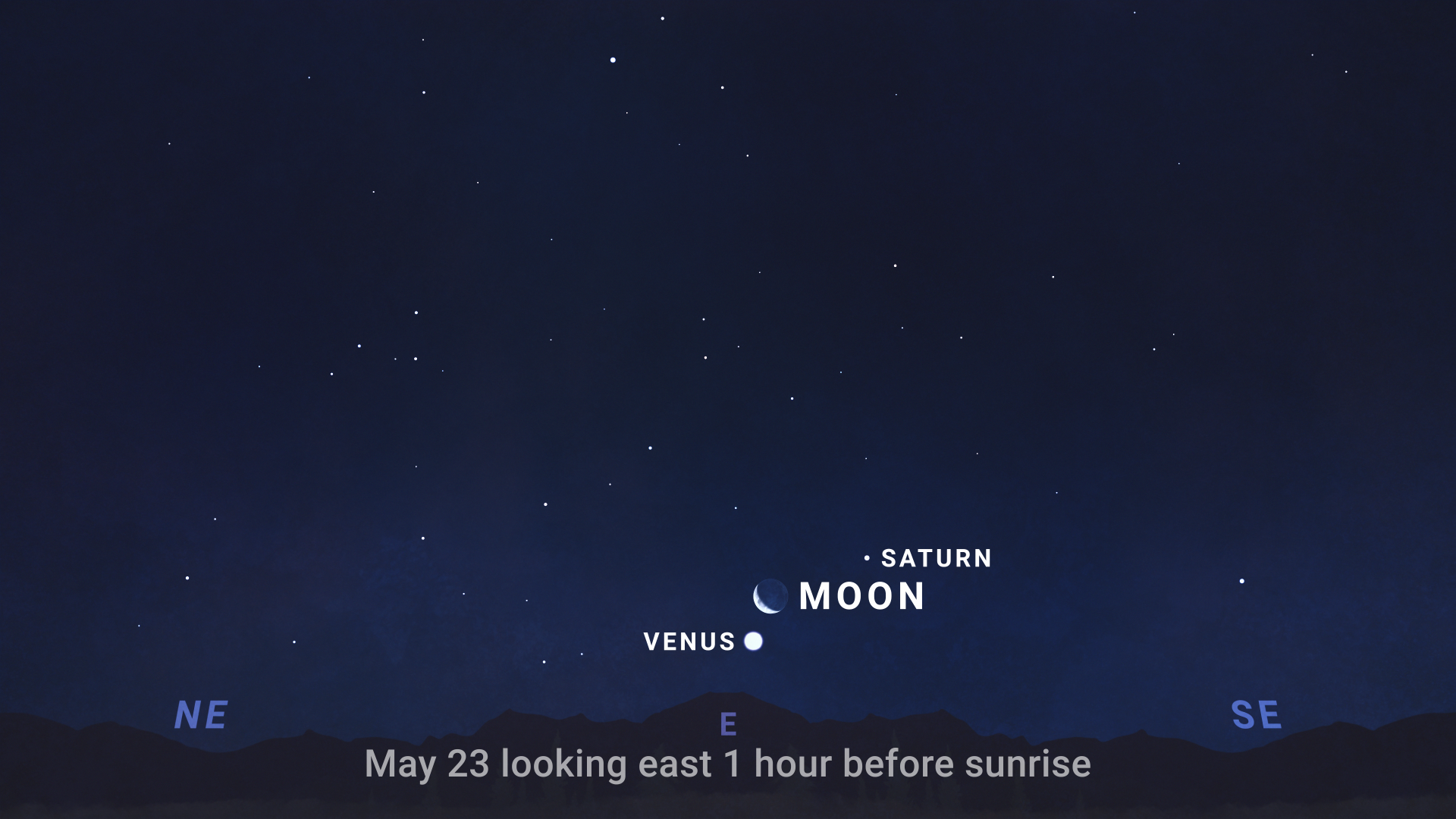
    Sky chart showing Venus and Saturn with the crescent Moon in the predawn sky on May 23., 2025.
    NASA/JPL-Caltech

    In the morning sky, Venus and Saturn are the planets to look for in May. They begin the month appearing close together on the sky, and progressively pull farther apart as the month goes on. For several days in late May, early risers will enjoy a gathering of the Moon with Saturn and Venus in the eastern sky before dawn. Watch as the Moon passes the two planets while becoming an increasingly slimmer crescent. You’ll find the Moon hanging between Venus and Saturn on the 23rd.   

    Eta Aquarid Meteor Shower 

    Early May brings the annual Eta Aquarid meteor shower. These are meteors that originate from Comet Halley. Earth passes through the comet’s dust stream each May, and again in October. Eta Aquarids are fast moving, and a lot of them produce persistent dust trains that linger for seconds after the meteor’s initial streak.  

    This is one of the best annual showers in the Southern Hemisphere, but tends to be more subdued North of the Equator, where we typically see 10-20 meteors per hour. On the peak night this year, the Moon sets by around 3 a.m., leaving dark skies until dawn, for ideal viewing conditions. While the peak is early on the morning of May 6th, the two or three nights before that are also decent opportunities to spy a few shooting stars. 

    Waiting for a Nova 

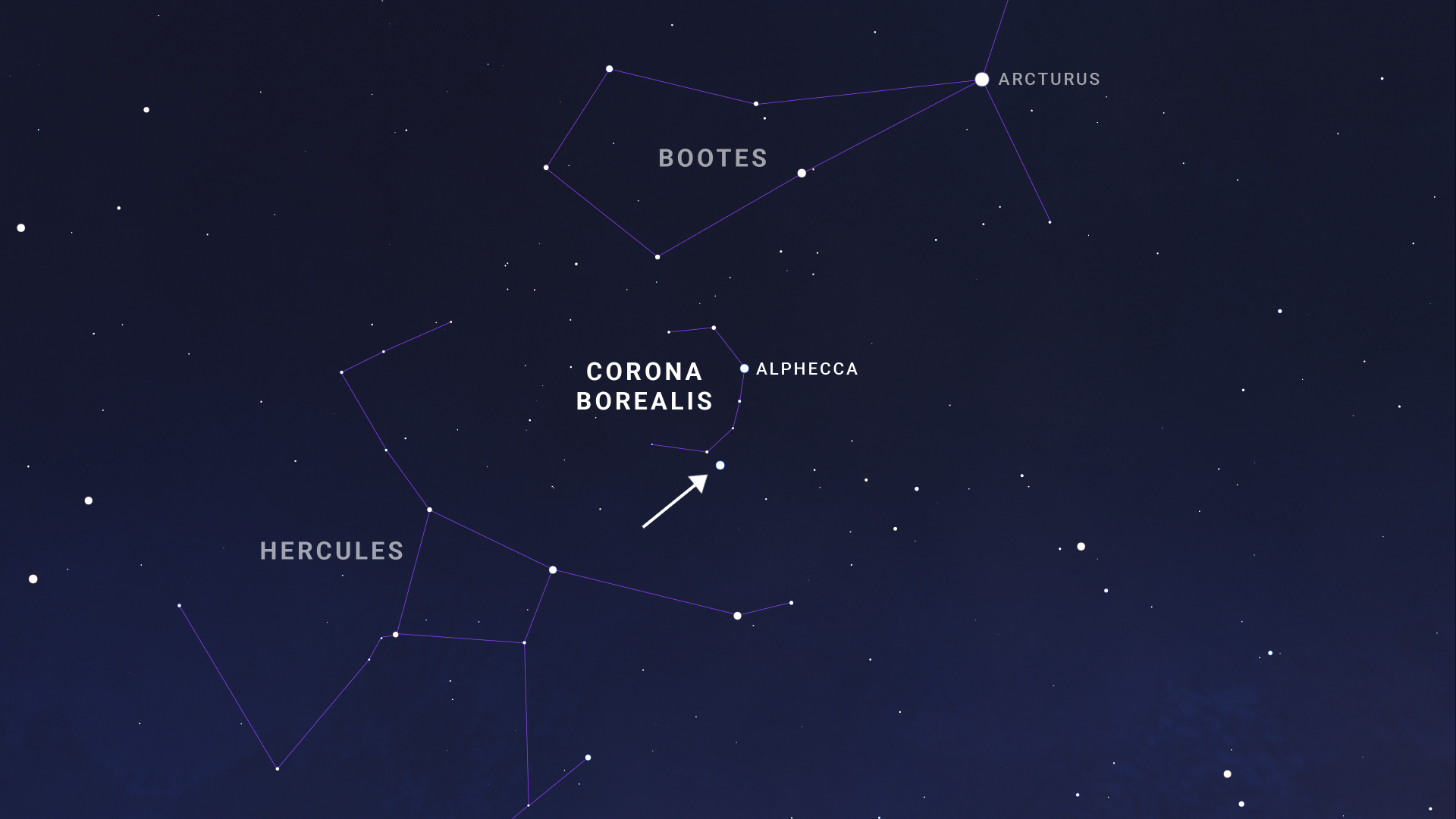
    An illustrated sky chart features a nighttime background with stars. Three constellations are labeled and have their outlines drawn: Hercules (at lower left), Corona Borealis (at center), and Bootes (at upper right). A white arrow points to the nova, which is represented by a bright white dot similar in size (or brightness) to the brightest star in the constellation, labeled as Alphecca.
    Sky chart showing constellation Corona Borealis with the location where nova “T CrB” is predicted to appear. The view depicts the constellation with the nova occurring, indicated by an arrow.
    NASA/JPL-Caltech

    Astronomers have been waiting expectantly for light from a distant explosion to reach us here on Earth. An event called a nova is anticipated to occur sometime in the coming months. Some 3,000 light years away is a binary star system called T Coronae Borealis, or “T CrB.” It consists of a red giant star with a smaller white dwarf star orbiting closely around it. Now the giant’s outer atmosphere is all puffed up, and the dwarf star is close enough that its gravity continually captures some of the giant’s hydrogen. About every 80 years, the white dwarf has accumulated so much of the other star’s hydrogen, that it ignites a thermonuclear explosion. And that’s the nova. 

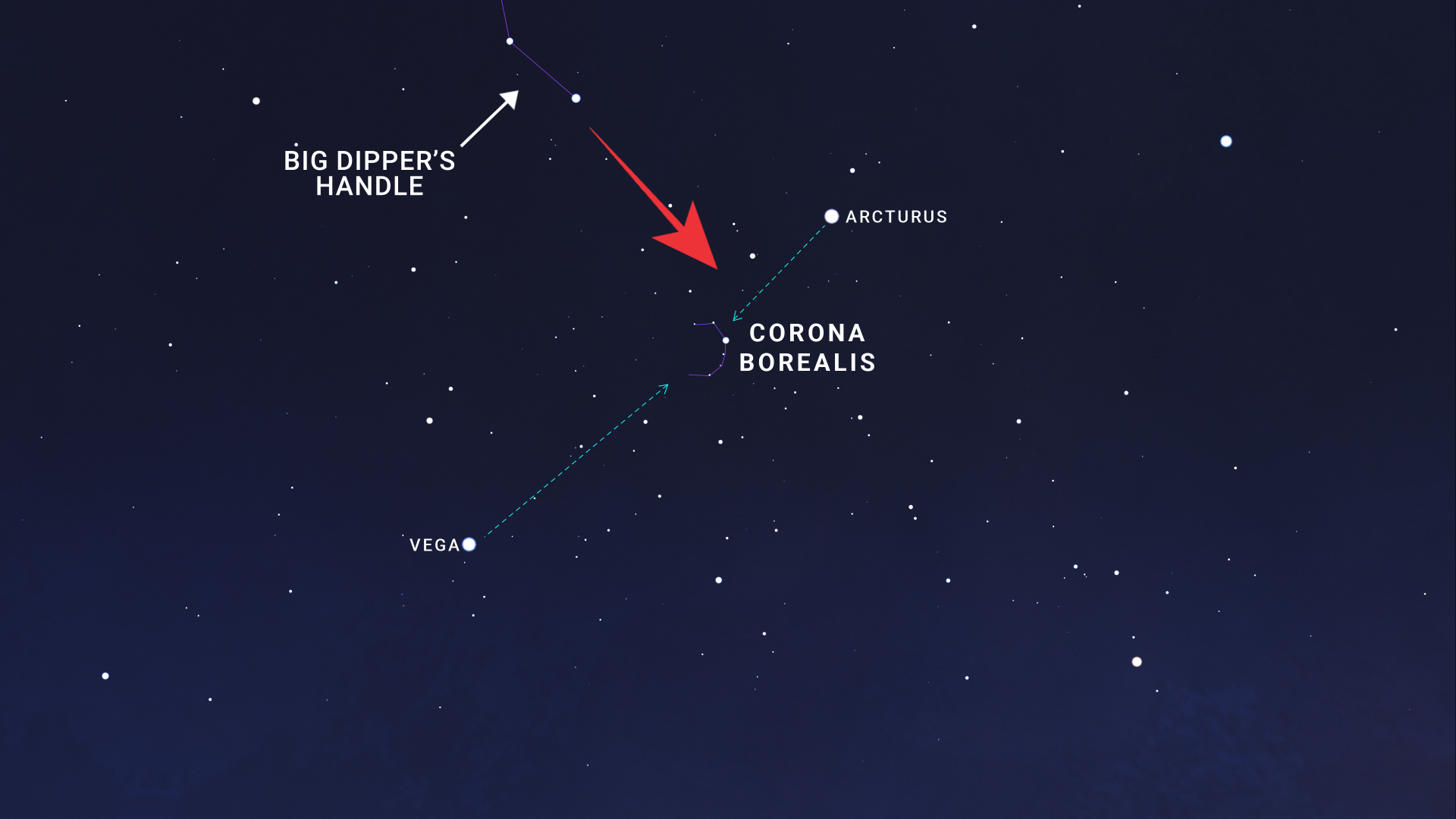
    T Coronae Borealis is located in the constellation Corona Borealis, or the “Northern Crown,” and it’s normally far too faint to see with the unaided eye. But it’s predicted the nova will be as bright as the constellation’s brightest star, which is about as bright as the North Star, Polaris. You’ll find Corona Borealis right in between the two bright stars Arcturus and Vega, and you can use the Big Dipper’s handle to point you to the right part of the sky. Try having a look for it on clear, dark nights before the nova, so you’ll have a comparison when a new star suddenly becomes visible there. 

    An illustrated sky chart shows the evening sky with stars spread across the scene. At center is constellation Corona Borealis, with its stars connected by lines. Dashed lines with arrows point toward Corona Borealis from Arcturus and Vega, bright stars to the upper right and power left, respectively. A red arrow from upper left also points toward Corona Borealis at center; this is a line pointing from the handle of the Big Dipper.
    A sky chart indicating how to locate the constellation Corona Borealis between the bright stars Arcturus and Vega. The Big Dipper’s handle points in the direction of Corona Borealis.
    NASA/JPL-Caltech

    Now, you may have heard about this months ago, as astronomers started keeping watch for the nova midway through 2024, but it hasn’t happened yet. Predicting exactly when novas or any sort of stellar outburst will happen is tricky, but excitement began growing when astronomers observed the star to dim suddenly, much as it did right before its previous nova in 1946. When the nova finally does occur, it won’t stay bright for long, likely flaring in peak brightness for only a few days. And since it’s not predicted again for another 80 years, you might just want to join the watch for this super rare, naked eye stellar explosion in the sky! 

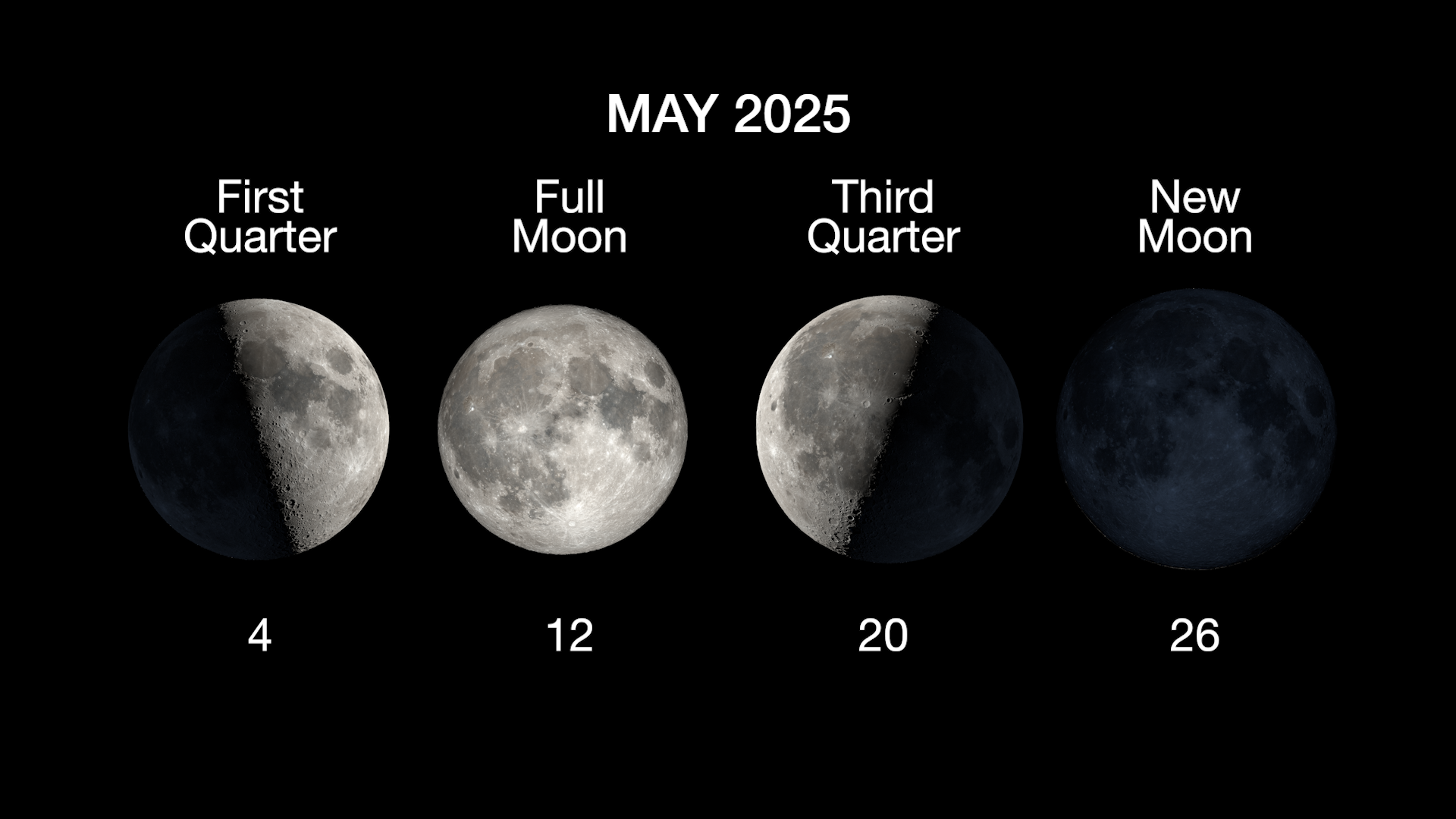
    Here are the phases of the Moon for May. 

    The main phases of the Moon are illustrated in a horizontal row, with the first quarter moon on May 4, full moon on May 12, third quarter on May 20, and the new moon on May 26.
    The phases of the Moon for May 2025.
    NASA/JPL-Caltech

    You can stay up to date on all of NASA’s missions exploring the solar system and beyond at NASA Science.

    I’m Preston Dyches from NASA’s Jet Propulsion Laboratory, and that’s What’s Up for this month. 

  • May’s Night Sky Notes: How Do We Find Exoplanets?

    4 min read

    May’s Night Sky Notes: How Do We Find Exoplanets?

    Astronomers have been trying to discover evidence that worlds exist around stars other than our Sun since the 19th century. By the mid-1990s, technology finally caught up with the desire for discovery and led to the first discovery of a planet orbiting another sun-like star, Pegasi 51b. Why did it take so long to discover these distant worlds, and what techniques do astronomers use to find them?

    The Transit Method

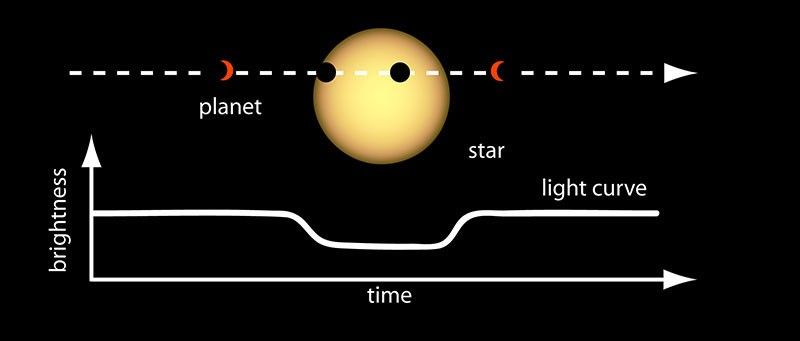
    Light Curve of a Planet Transiting Its Star
    A planet passing in front of its parent star creates a drop in the star’s apparent brightness, called a transit. Exoplanet Watch participants can look for transits in data from ground-based telescopes, helping scientists refine measurements of the length of a planet’s orbit around its star.
    Credit: NASA’s Ames Research Center

    One of the most famous exoplanet detection methods is the transit method, used by Kepler and other observatories. When a planet crosses in front of its host star, the light from the star dips slightly in brightness. Scientists can confirm a planet orbits its host star by repeatedly detecting these incredibly tiny dips in brightness using sensitive instruments. If you can imagine trying to detect the dip in light from a massive searchlight when an ant crosses in front of it, at a distance of tens of miles away, you can begin to see how difficult it can be to spot a planet from light-years away! Another drawback to the transit method is that the distant solar system must be at a favorable angle to our point of view here on Earth – if the distant system’s angle is just slightly askew, there will be no transits. Even in our solar system, a transit is very rare. For example, there were two transits of Venus visible across our Sun from Earth in this century. But the next time Venus transits the Sun as seen from Earth will be in the year 2117 – more than a century from the 2012 transit, even though Venus will have completed nearly 150 orbits around the Sun by then!

    The Wobble Method

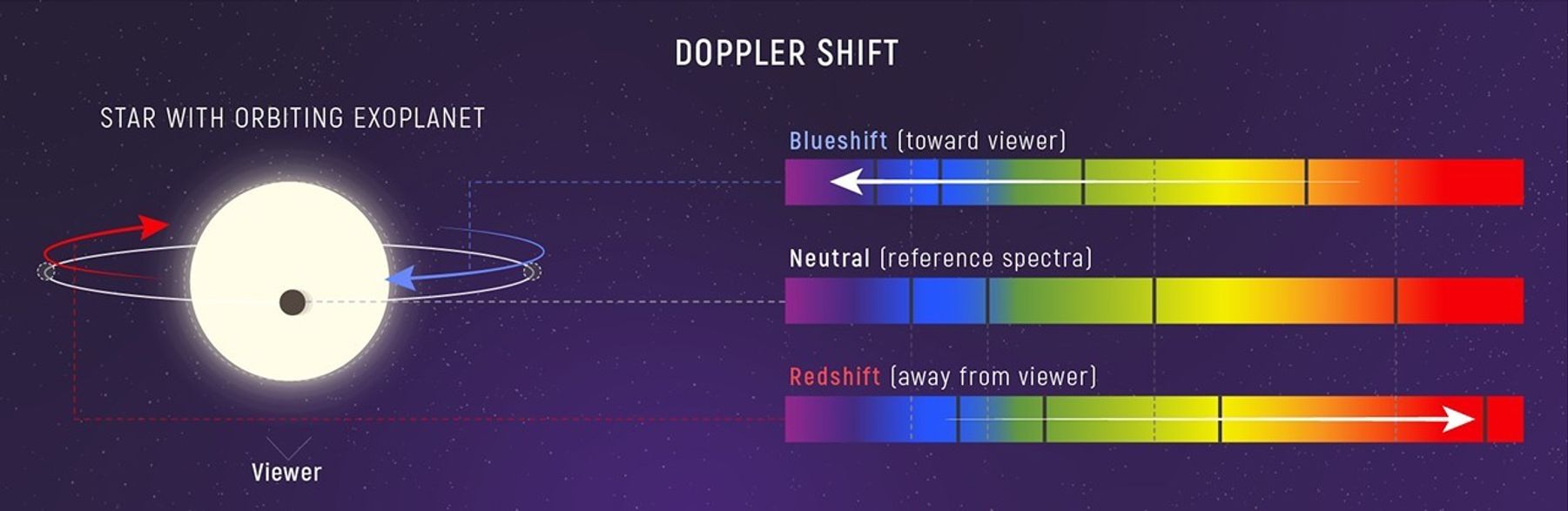
    An artist rendition of Doppler shift explaining how blueshifted light is compressed and redshifted light is elongated, with an image of an exoplanet moving in front of its star.
    As a planet orbits a star, the star wobbles. This causes a change in the appearance of the star’s spectrum called Doppler shift. Because the change in wavelength is directly related to relative speed, astronomers can use Doppler shift to calculate exactly how fast an object is moving toward or away from us. Astronomers can also track the Doppler shift of a star over time to estimate the mass of the planet orbiting it.
    NASA, ESA, CSA, Leah Hustak (STScI)

    Spotting the Doppler shift of a star’s spectra was used to find Pegasi 51b, the first planet detected around a Sun-like star. This technique is called the radial velocity or “wobble” method. Astronomers split up the visible light emitted by a star into a rainbow. These spectra, and gaps between the normally smooth bands of light, help determine the elements that make up the star. However, if there is a planet orbiting the star, it causes the star to wobble ever so slightly back and forth. This will, in turn, cause the lines within the spectra to shift ever so slightly towards the blue and red ends of the spectrum as the star wobbles slightly away and towards us. This is caused by the blue and red shifts of the star’s light. By carefully measuring the amount of shift in the star’s spectra, astronomers can determine the size of the object pulling on the host star and if the companion is indeed a planet. By tracking the variation in this periodic shift of the spectra, they can also determine the time it takes the planet to orbit its parent star.

    Direct Imaging

    Finally, exoplanets can be revealed by directly imaging them, such as this image of four planets found orbiting the star HR 8799! Space telescopes use instruments called coronagraphs to block the bright light from the host star and capture the dim light from planets. The Hubble Space Telescope has captured images of giant planets orbiting a few nearby systems, and the James Webb Space Telescope has only improved on these observations by uncovering more details, such as the colors and spectra of exoplanet atmospheres, temperatures, detecting potential exomoons, and even scanning atmospheres for potential biosignatures!

    This image shows the planetary system HR 8799. The background is black. At the center there is a symbol representing a star labeled HR 8799. The star’s light is blocked. There are four exoplanets, which look like fuzzy dots, pictured surrounding the star. Furthest from the star is a fuzzy, faint blue dot, labeled b, at the 10 o’clock position. At the 1 o’clock position, second furthest from the star is a blueish-white fuzzy dot labeled c. Just below that is an orange dot labeled e. At the 4 o’clock position, still near the star, is another fuzzy white dot labeled d.
    NASA’s James Webb Space Telescope has provided the clearest look in the infrared yet at the iconic multi-planet system HR 8799. The closest planet to the star, HR 8799 e, orbits 1.5 billion miles from its star, which in our solar system would be located between the orbit of Saturn and Neptune. The furthest, HR 8799 b, orbits around 6.3 billion miles from the star, more than twice Neptune’s orbital distance. Colors are applied to filters from Webb’s NIRCam (Near-Infrared Camera), revealing their intrinsic differences. A star symbol marks the location of the host star HR 8799, whose light has been blocked by the coronagraph. In this image, the color blue is assigned to 4.1 micron light, green to 4.3 micron light, and red to the 4.6 micron light.
    NASA, ESA, CSA, STScI, W. Balmer (JHU), L. Pueyo (STScI), M. Perrin (STScI)

    You can find more information and activities on NASA’s Exoplanets page, such as the Eyes on Exoplanets browser-based program, The Exoplaneteers, and some of the latest exoplanet news. Lastly, you can find more resources in our News & Resources section, including a clever demo on how astronomers use the wobble method to detect planets! 

    The future of exoplanet discovery is only just beginning, promising rich rewards in humanity’s understanding of our place in the Universe, where we are from, and if there is life elsewhere in our cosmos.

    Originally posted by Dave Prosper: July 2015
    Last Updated by Kat Troche: April 2025

  • Sols 4525-4526: The Day After Groundhog Day (Between Ghost Mountain and Texoli, Headed South)

    3 min read

    Sols 4525-4526: The Day After Groundhog Day (Between Ghost Mountain and Texoli, Headed South)

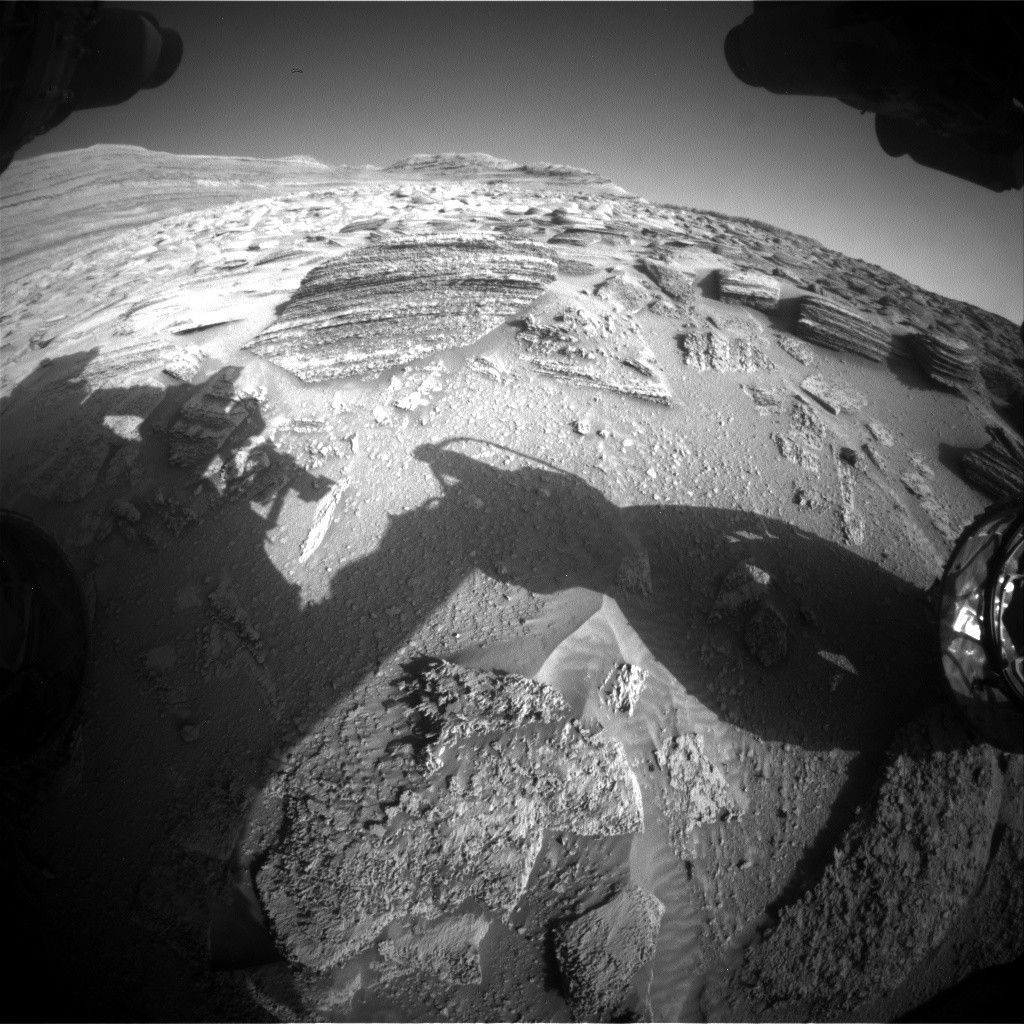
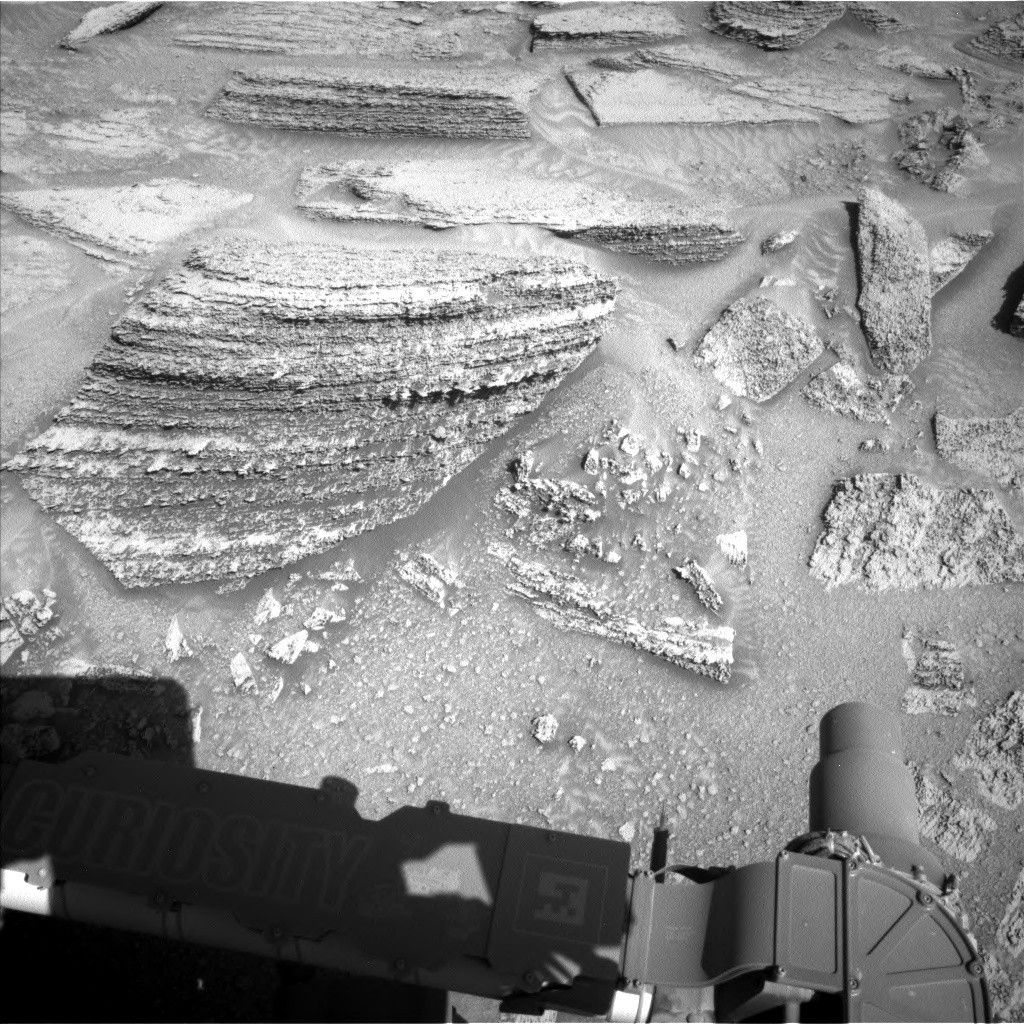
    A grayscale photograph of the Martian surface from the Curiosity rover captures medium-gray, coarse soil in front of the rover, with rocks everywhere protruding up through it. They are lighter-toned than the ground, some rounded, others looking like cracked, smooth plates. The largest rocks look like they’re built up from stacked layers. A part of the rover is visible in the frame, at bottom center, including one of its wheels.
    NASA’s Mars rover Curiosity acquired this image showing ChemCam/Mastcam targets “Breeze Hill” and “Laguna Mountain,” together with a rover wheel planted firmly on the Martian surface. Curiosity captured the image using its Left Navigation Camera on April 27, 2025 — Sol 4523, or Martian day 4,523 of the Mars Science Laboratory mission — at 13:23:32 UTC.
    NASA/JPL-Caltech

    Written by Lucy Lim, Planetary Scientist at NASA Goddard Space Flight Center

    Earth planning date: Monday, April 28, 2025

    Curiosity is back on the road! For sols 4525 and 4526, we have an isolated nominal plan in which the communication pass timing works out in such a way that the rover can fit in fully targeted science blocks on both sols rather than just the first sol. So in this power-hungry Martian winter season, we’re in a good position to take advantage of the power saved up during the missed uplink.

    The weekend drive went well and delivered the rover into a stable, arm-work-compatible position in a workspace with rock targets that we could brush with the DRT. Happy days! The DRT/APXS/MAHLI measurements will bring us geochemical and rock texture data from local bedrock blocks “Bradshaw Trail” and “Sweetwater River.” Further geochemical information will come from the ChemCam LIBS rasters on a more coarsely layered target, “Breeze Hill,” and an exposed layer expressing both polygonal features and a vein or coating of dark-toned material, “Laguna Mountain.”  

    Long-distance imaging with the ChemCam RMI included a mosaic to add to our coverage of the boxwork sedimentary features of the type Curiosity will soon be exploring in situ. A second RMI mosaic was planned to cover a truncated sedimentary horizon on the Texoli butte that may provide further evidence of ancient aeolian scouring events.  Meanwhile, the “Morrell Potrero” Mastcam mosaic will provide some detail on the base of the boxwork-bearing “Ghost Mountain” butte and on a ridge nearby. In the drive direction, the “Garnet Peak” mosaic will capture some potentially new rock textures and colors in the upcoming strata.

    Nearer-field imaging in the plan includes Mastcam documentation of some troughs that provide evidence for sand and dust movement in response to the modern aeolian environment. Additionally Mastcam mosaics went to “Breeze Hill” (covering the LIBS target) and “Live Oak” to document variations in bedding, color, and texture in the nearby bedrock. 

    A few observations of the modern environment were scheduled for the afternoon: a phase function sky survey to look for scattered light from thin water-ice clouds and a separate set of cloud altitude observations.

    Finally, a Mastcam documentation image was planned for the AEGIS LIBS target from the weekend plan! This reflects an update to the rover’s capability in which the AEGIS target can be determined and downlinked in time for the decisional downlink pass, so that we know where to look for it during the next planning cycle.

    Details

    Last Updated

    Apr 30, 2025

    Related Terms

  • NASA STEM Programs Ignite Curiosity Beyond the Classroom

    3 min read

    Preparations for Next Moonwalk Simulations Underway (and Underwater)

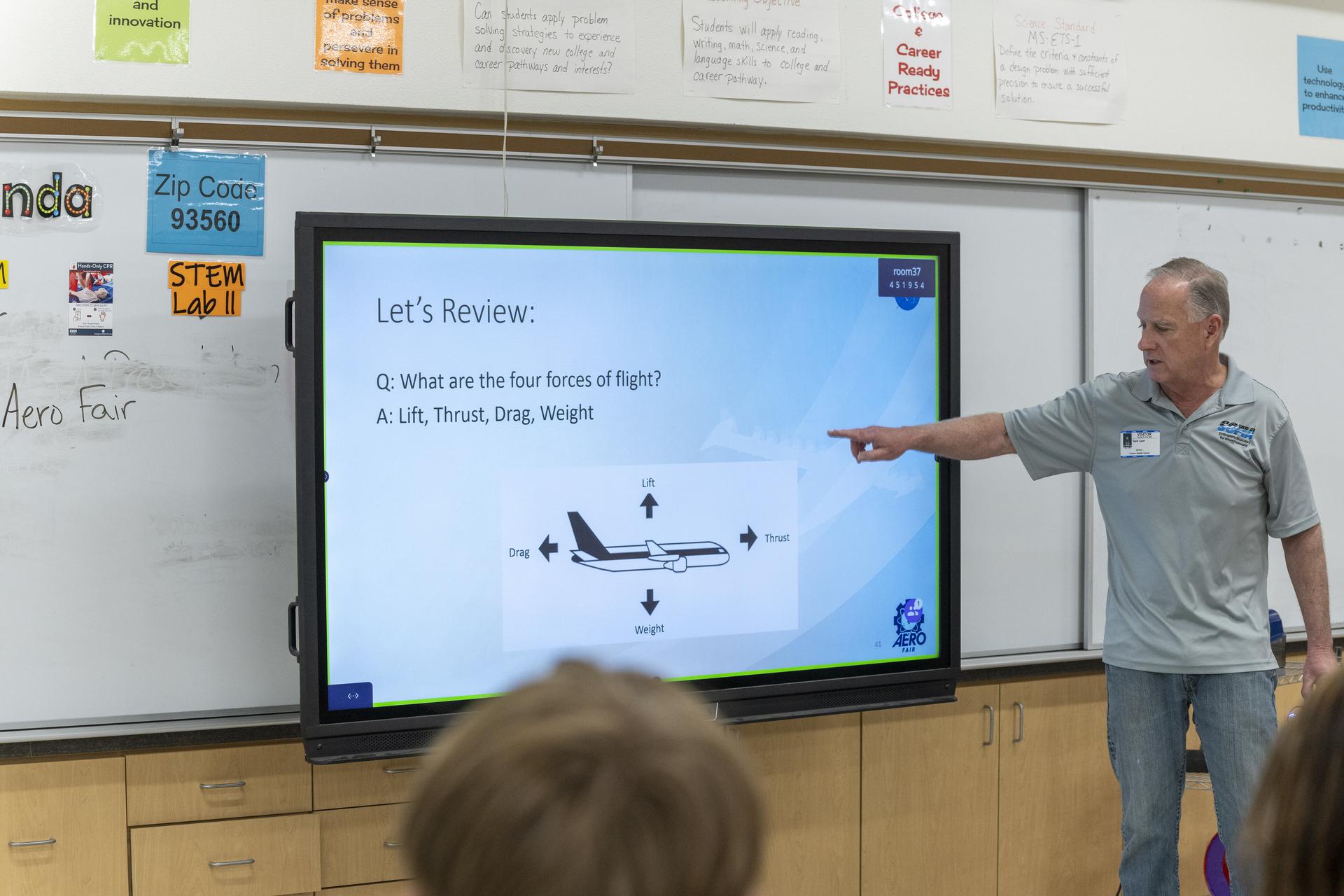
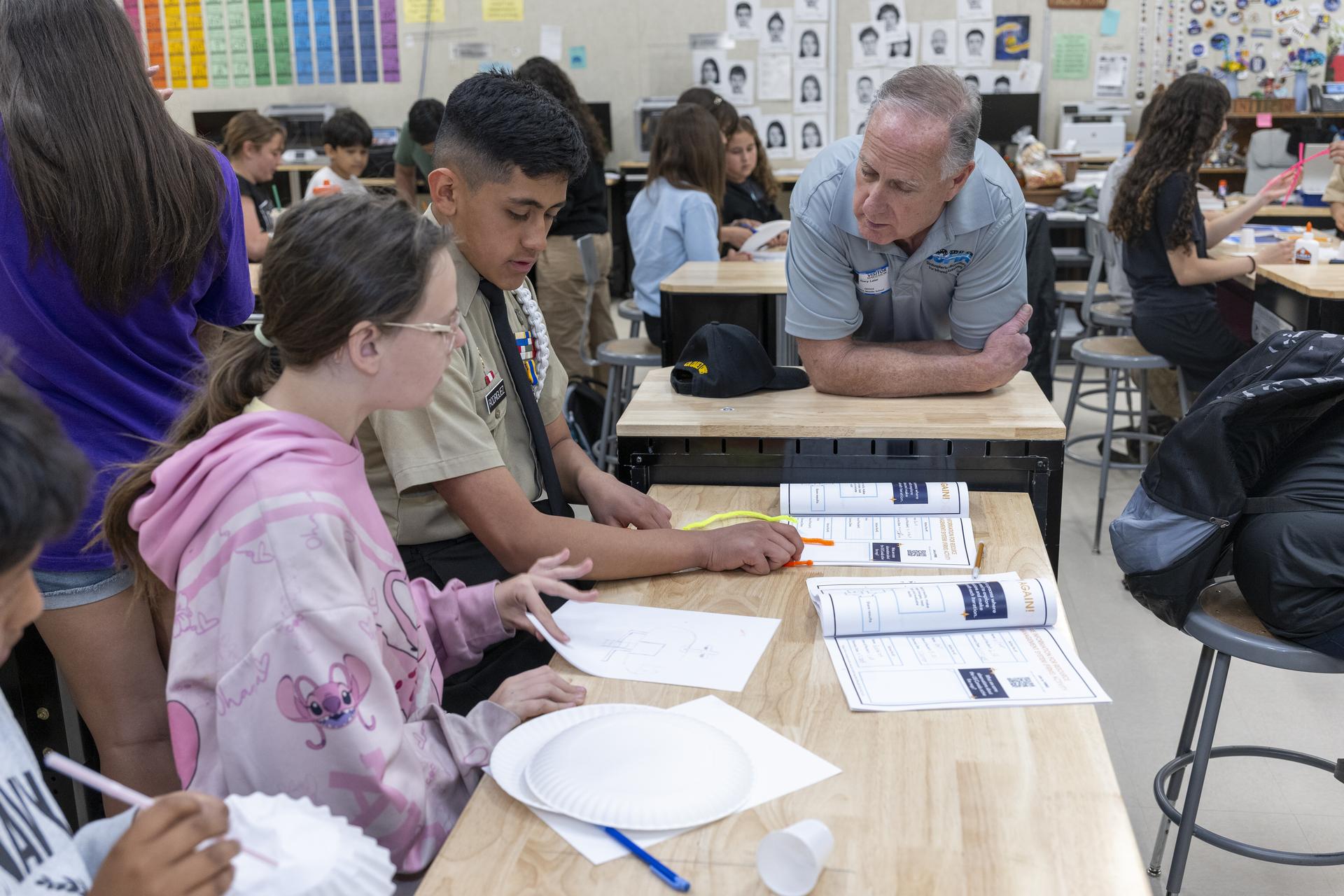
    A man wearing a gray shirt is pointing to a screen on a wall displaying an aircraft. Students in the classroom watch the screen and the man.
    Gary Laier, center liaison for the Small Business Innovation Research/Small Business Technology Transfer (SBIR/STTR) program at NASA’s Armstrong Flight Research Center in Edwards, California, teaches students about aeronautics during Aero Fair at Tropico Middle School in Rosamond, California, on April 9, 2025.
    NASA/Genaro Vavuris

    When curiosity takes flight, learning knows no bounds. The impact of supporting STEM education extends far beyond the classroom, shaping the future of innovation and exploration. NASA Engages is the agency’s outreach website that connects NASA experts and resources with communities, educators, and students across the country. Led by NASA’s Office of STEM Engagement, the platform fosters collaboration between educators, organizations, and NASA employees to inspire the next generation.

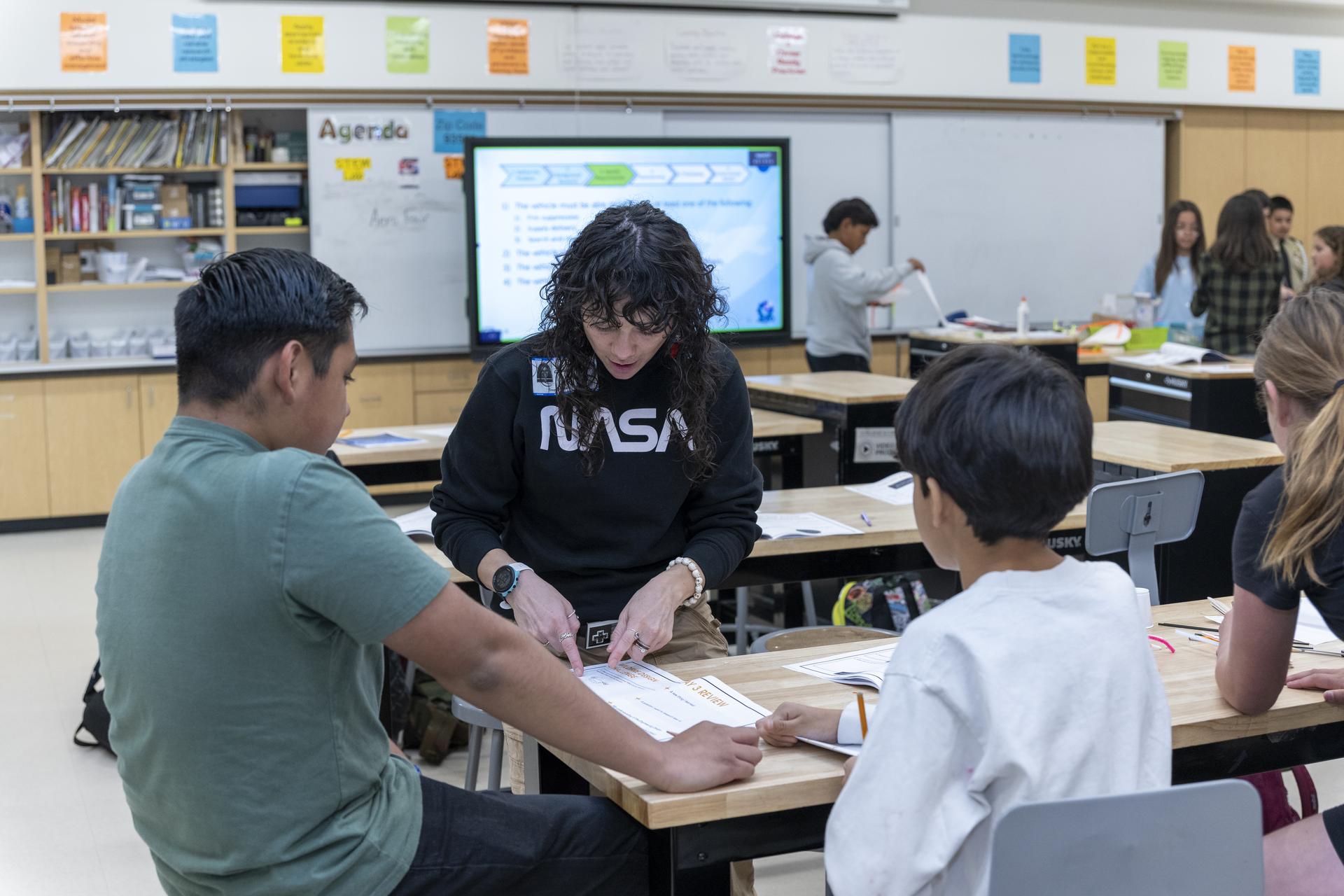
    A woman wearing a black sweatshirt with a NASA logo stands in front of a group of students sitting at desks in a classroom. The students watch the woman as she explains and points to a paper on the desk.
    Giovanna Camacho, Pathways systems engineering intern from NASA’s Armstrong Flight Research Center in Edwards, California, teaches students about aeronautics during Aero Fair at Tropico Middle School in Rosamond, California, on April 9, 2025.
    NASA/Genaro Vavuris

    Bringing NASA to the Classroom

    NASA employees dedicate their time and expertise through NASA Engages, whether they’re passionate about robotics, flight research, or inspiring young minds to pursue STEM careers. One example of this is Aero Fair, a STEM program led by the California Office of STEM Engagement at NASA’s Armstrong Flight Research Center in Edwards, California. This initiative brings aeronautics directly to students, with NASA Armstrong professionals visiting classrooms – both in person and virtually – to engage students during three-day experiences that allow them to learn about aeronautics, meet NASA professionals, and explore potential career paths they might not have previously considered.

    “When volunteers step up to help inspire and facilitate learning in the classroom, they are benefiting not only the students they interact with, but our future generation as well,” says Giovanna Camacho, Pathways systems engineering intern at NASA Armstrong, who volunteered at the event.

    Chloe Day, a student at Tropico Middle School in Rosamond, California, said Aero Fair inspired her to consider a STEM career. “When NASA employees were talking about what they do and how they help our world today, it made me feel like I want to do it too.”

    Educators can request an Aero Fair experience through NASA’s STEM Gateway. These programs “give students a chance to see themselves as real problem-solvers and innovators,” said Shauna Tinich, a Tropico Middle School teacher. “The most beneficial part of Aero Fair is the real-world connection to STEM. The connection to NASA makes it real and exciting for the students.”

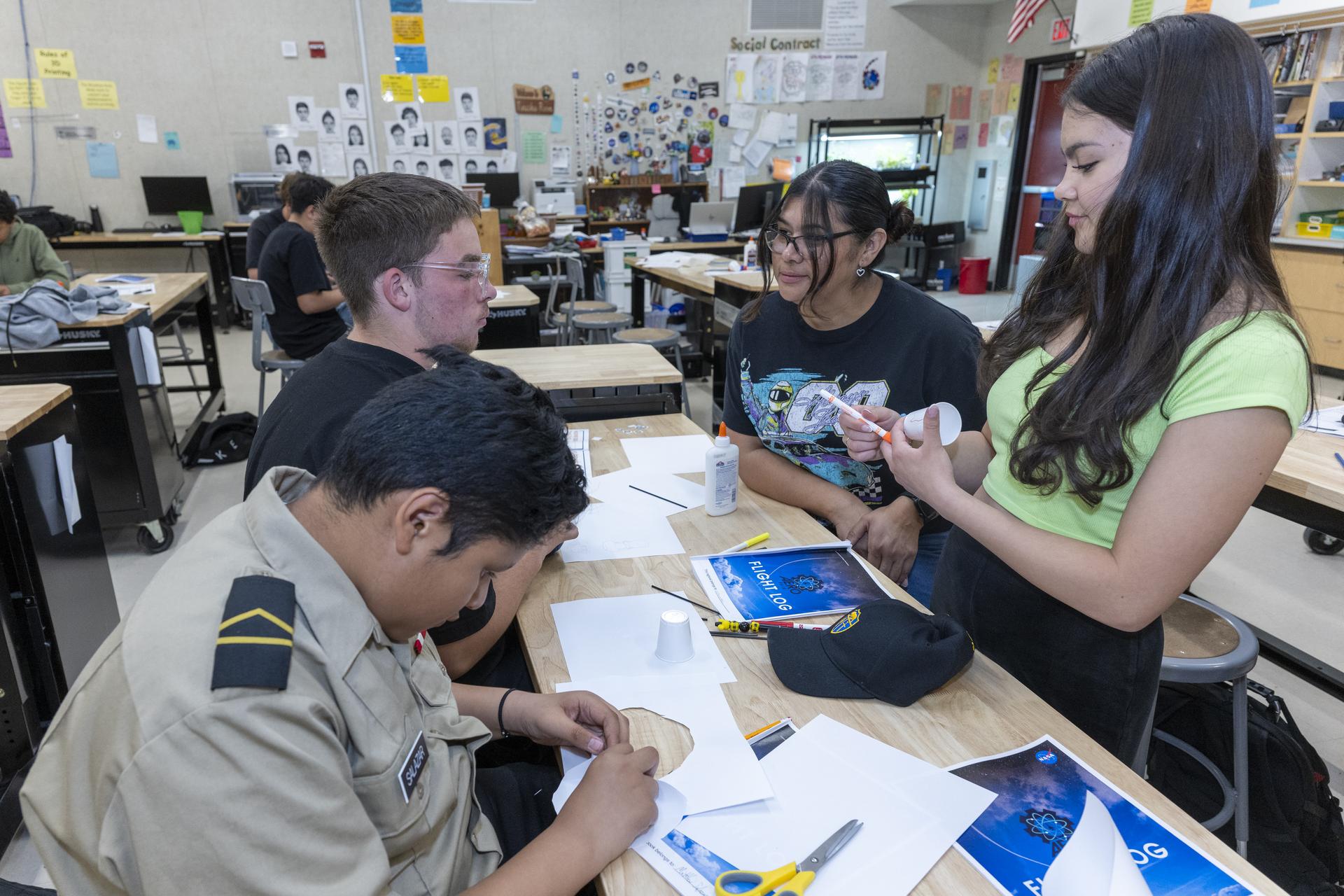
    A group of students sit around a desk in a classroom, cutting and gluing paper to make paper airplanes. Other desks with students are visible around them.
    Students from Tropico Middle School in Rosamond, California, build their own paper planes as part of a project during NASA Aero Fair on April 9, 2025.
    NASA/Genaro Vavuris

    A Program for Impact

    The NASA Engages website matches outreach opportunities to employee skills and interests, while educators and community organizations can use the website to request public speakers, classroom visits, and educational support at events.

    For many volunteers, the experience is just as inspiring as it is for the students. “Every time I volunteer, I walk out inspired,” Camacho said. “It motivates me to continue my pursuit of making a difference.”

    Gary Laier, center liaison for the Small Business Innovation Research and Small Business Technology Transfer programs at NASA Armstrong, and Aero Fair volunteer, agreed: “It’s a rewarding experience for students, teachers, and NASA volunteers alike. I enjoy the opportunity to inspire youth and get them excited about their futures.”

    By participating in outreach activities like Aero Fair, career panels, or events, NASA employees not only help ignite curiosity and provide knowledge to students and the community but also strengthen NASA’s connection to the communities it serves.

    A group of students sitting at a desk in a classroom work on constructing paper airplanes. A man leans on the desk, speaking with the students. Behind the man are other students seated at desks.
    Gary Laier, center liaison for the Small Business Innovation Research/Small Business Technology Transfer (SBIR/STTR) program at NASA’s Armstrong Flight Research Center in Edwards, California, teaches students about aeronautics during Aero Fair at Tropico Middle School in Rosamond, California, on April 9, 2025.
    NASA/Genaro Vavuris

    Explore NASA STEM Opportunities

    Educators, organizations, and community groups can connect with NASA in two ways. Through NASA Engages, external groups can request NASA support for their own events – such as inviting a NASA speaker or arranging classroom visits and providing outreach materials. Meanwhile, NASA STEM Gateway provides opportunities for individuals to participate in NASA-developed STEM events, internships, and programs like Aero Fair. To request NASA participation in an event or to learn more about NASA STEM opportunities, visit https://stemgateway.nasa.gov/nasaengages/s/.

    A woman wearing a black sweatshirt with a NASA logo stands in front of a group of students sitting at desks in a classroom. An open laptop computer screen on one desk displays brightly colored maps. In the background, another woman, wearing a red shirt, stands in the back talking to another group of students.
    Giovanna Camacho, Pathways systems engineering intern at NASA’s Armstrong Flight Research Center in Edwards, California, teaches students about aeronautics during Aero Fair at Tropico Middle School in Rosamond, California, on April 9, 2025.
    NASA/Genaro Vavuris
  • Saxophone in Space

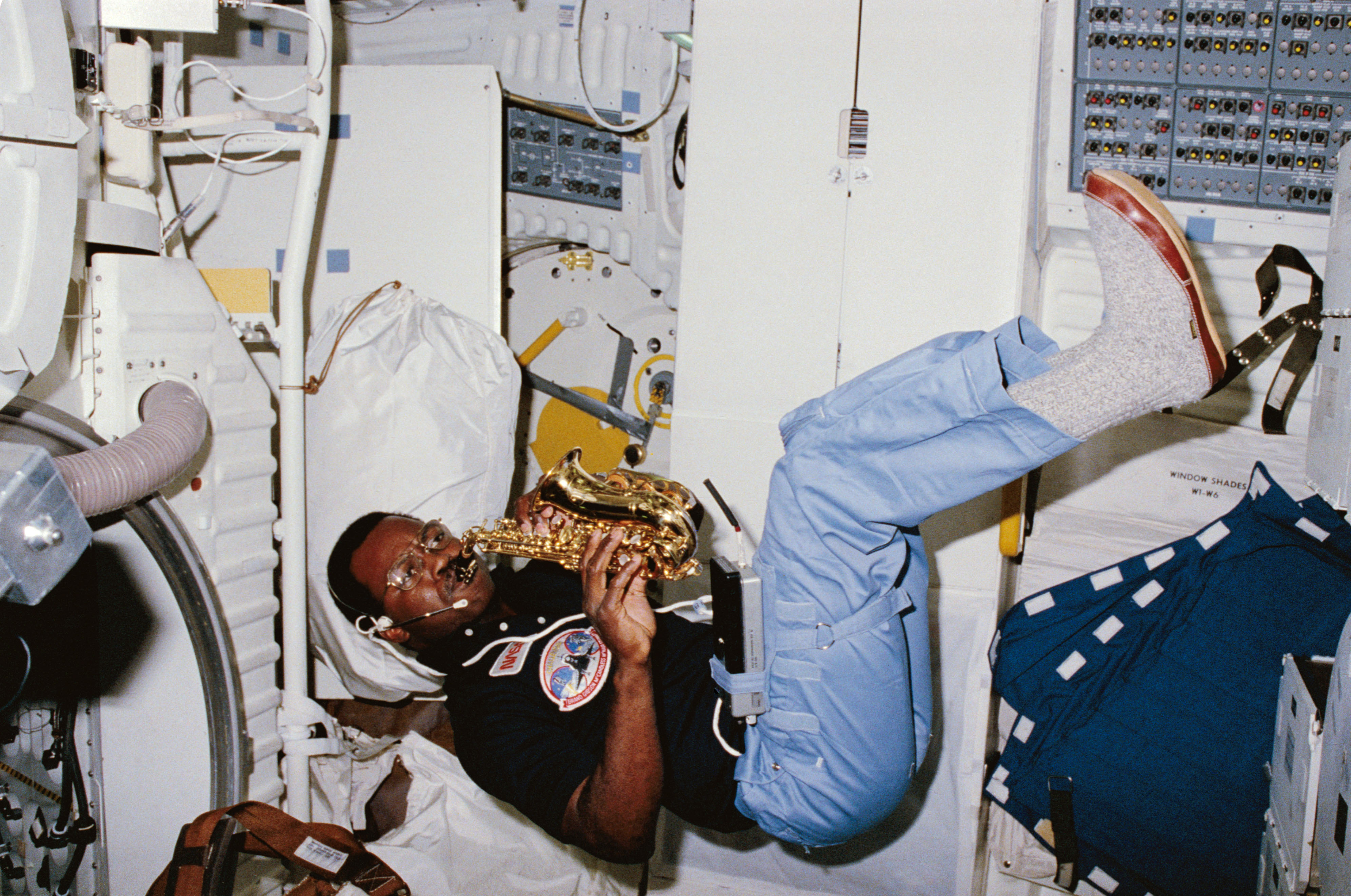
    A Black man plays a saxophone while floating. He wears a black short sleeve shirt with patches on it, blue pants, and gray shoes. He is inside the space shuttle Challenger.
    NASA

    In this photo taken on Feb. 8, 1984, NASA astronaut Ronald E. McNair plays his saxophone while off-duty during the STS-41B mission. He and fellow crew members Vance D. Brand, Robert L. Gibson, Robert L. Stewart, and Bruce McCandless II launched on the space shuttle Challenger from NASA’s Kennedy Space Center in Florida on Feb. 3, 1984. During the mission, McCandless and Stewart performed the first untethered spacewalks.

    McNair, who was nationally recognized for his work in laser physics, was selected as an astronaut candidate in January 1978. He completed a one-year training and evaluation period in August 1979, qualifying him for assignment as a mission specialist astronaut on space shuttle flight crews. STS-41B was his first flight.

    Check out STS-41B mission highlights, narrated by the crew.

    Image credit: NASA

  • The Universe’s Brightest Lights Have Some Dark Origins

    Did you know some of the brightest sources of light in the sky come from the regions around black holes in the centers of galaxies? It sounds a little contradictory, but it’s true! They may not look bright to our eyes, but satellites have spotted oodles of them across the universe. 

    One of those satellites is NASA’s Fermi Gamma-ray Space Telescope. Fermi has found thousands of these kinds of galaxies since it launched in 2008, and there are many more out there!

    Watch a cosmic gamma-ray fireworks show in this animation using just a year of data from the Large Area Telescope (LAT) aboard NASA’s Fermi Gamma-ray Space Telescope. Each object’s magenta circle grows as it brightens and shrinks as it dims. The yellow circle represents the Sun following its apparent annual path across the sky. The animation shows a subset of the LAT gamma-ray records available for more than 1,500 objects in a continually updated repository. Over 90% of these sources are a type of galaxy called a blazar, powered by the activity of a supermassive black hole.
    NASA’s Marshall Space Flight Center/Daniel Kocevski

    Black holes are regions of space that have so much gravity that nothing — not light, not particles, nada — can escape. Most galaxies have supermassive black holes at their centers, and these black holes are hundreds of thousands to billions of times the mass of our Sun. In active galactic nuclei (also called “AGN” for short, or just “active galaxies”) the central region is stuffed with gas and dust that’s constantly falling toward the black hole. As the gas and dust fall, they start to spin and form a disk. Because of the friction and other forces at work, the spinning disk starts to heat up.

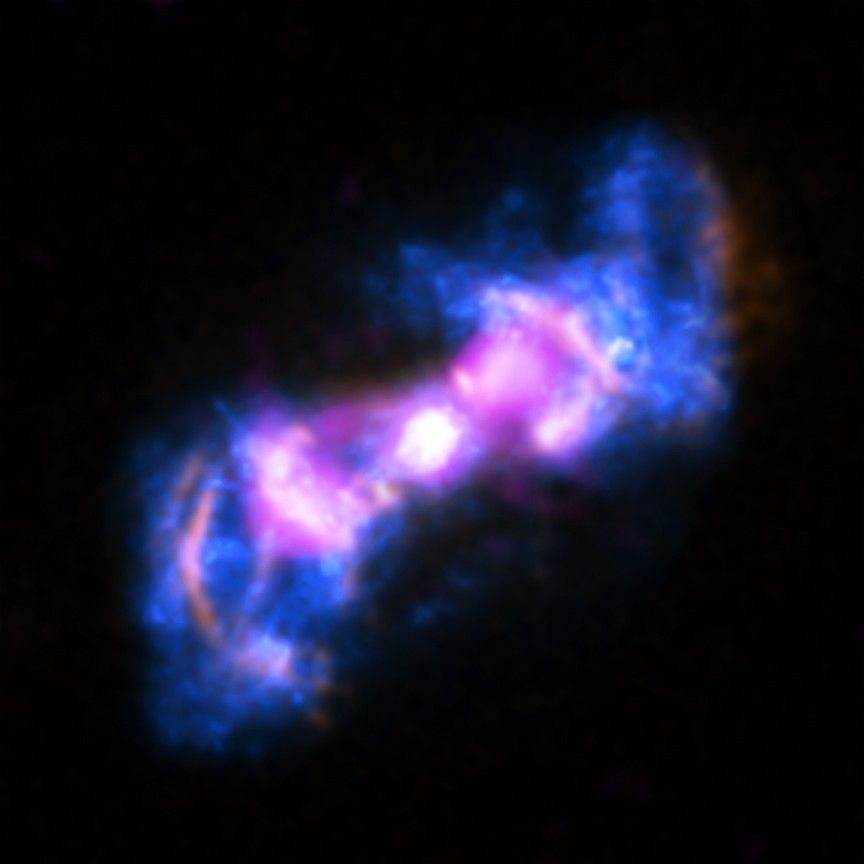
    Composite image of Markarian 573 in X-ray, radio, and visible light.
    This composite view of the active galaxy Markarian 573 combines X-ray data (blue) from NASA’s Chandra X-ray Observatory and radio observations (purple) from the Karl G. Jansky Very Large Array in New Mexico with a visible light image (gold) from the Hubble Space Telescope. Markarian 573 is an active galaxy that has two cones of emission streaming away from the supermassive black hole at its center.
    X-ray: NASA/CXC/SAO/A.Paggi et al; Optical: NASA/STScI; Radio: NSF/NRAO/VLA

    The disk’s heat gets emitted as light, but not just wavelengths of it that we can see with our eyes. We detect light from AGN across the entire electromagnetic spectrum, from the more familiar radio and optical waves through to the more exotic X-rays and gamma rays, which we need special telescopes to spot.
     

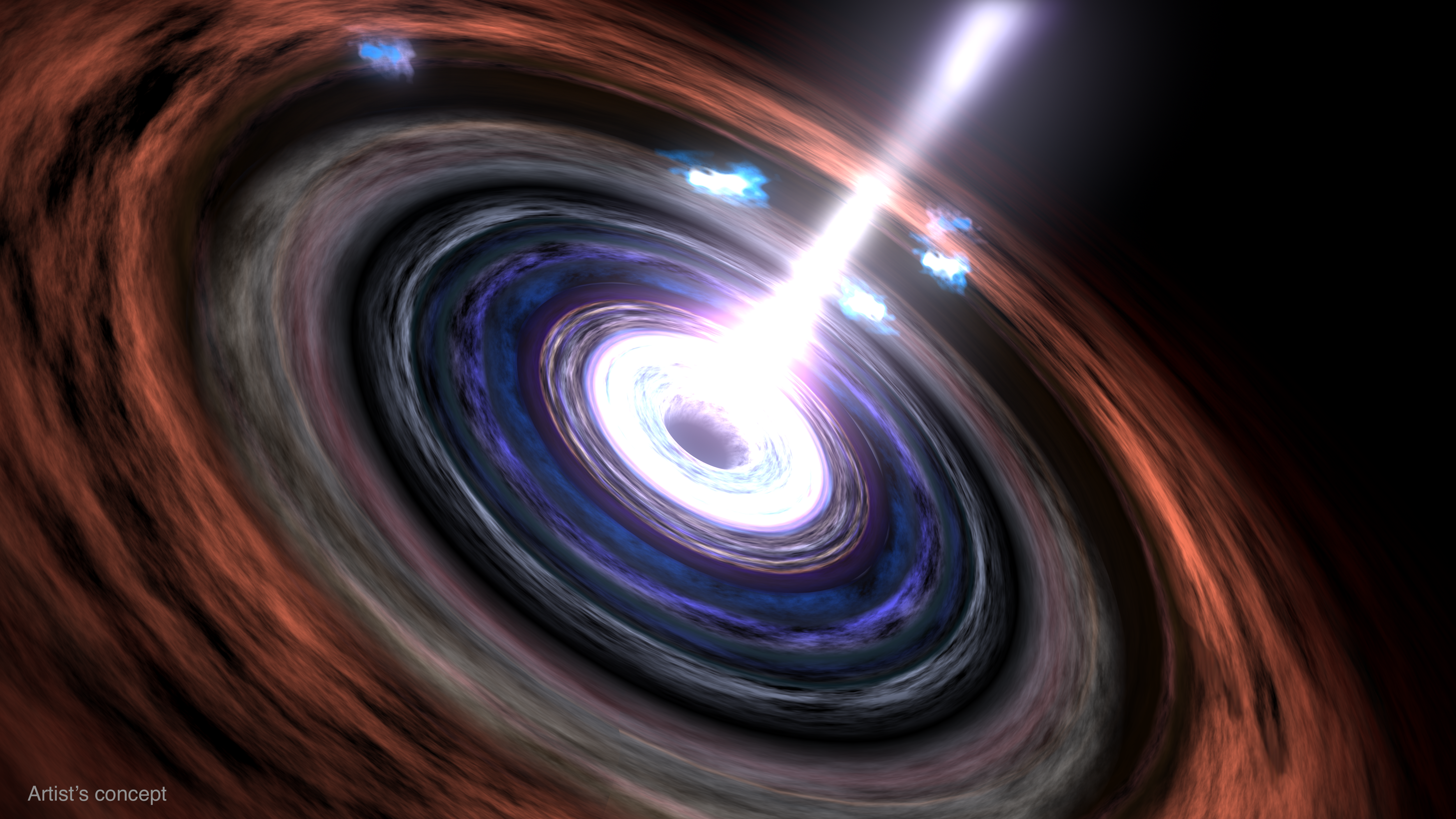
    An artist’s concept showing the black hole at the center of an active galaxy with a disk of material falling in toward the black hole and a jet accelerated away.
    In the heart of an active galaxy, matter falling toward a supermassive black hole creates jets of particles traveling near the speed of light as shown in this artist’s concept.
    NASA/Goddard Space Flight Center Conceptual Image Lab

    About one in 10 AGN beam out jets of energetic particles, which are traveling almost as fast as light. Scientists are studying these jets to try to understand how black holes — which pull everything in with their huge amounts of gravity — somehow provide the energy needed to propel the particles in these jets.

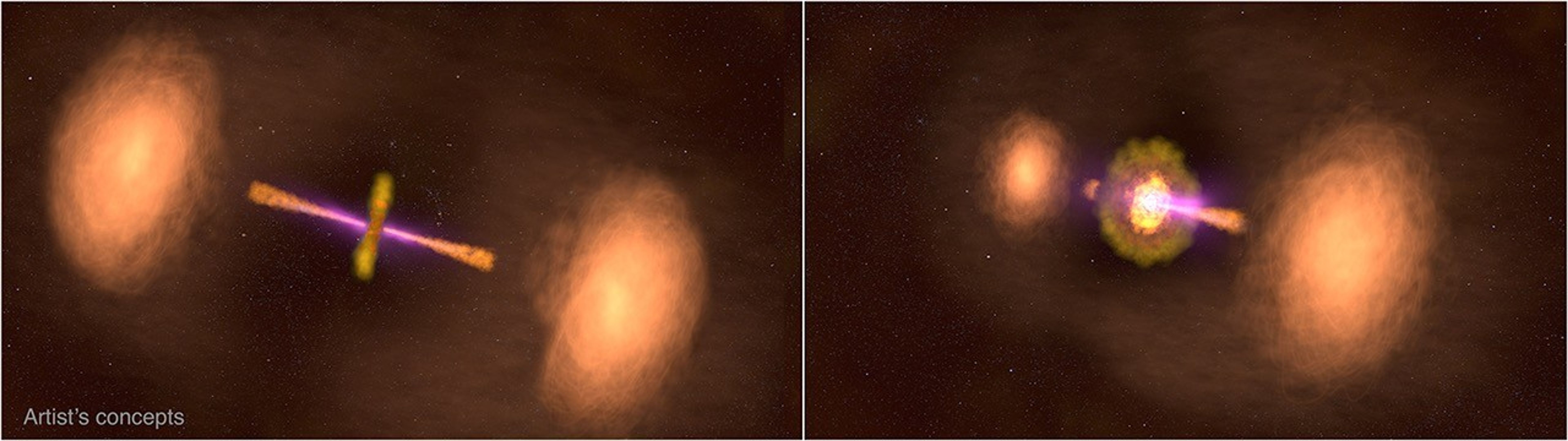
    Side-by-side artist’s concepts of active galaxy TXS 0128+554 as viewed at two different angles.
    This artist’s concept shows two views of the active galaxy TXS 0128+554, located around 500 million light-years away. Left: The galaxy’s central jets appear as they would if we viewed them both at the same angle. The black hole, embedded in a disk of dust and gas, launches a pair of particle jets traveling at nearly the speed of light. Scientists think gamma rays (magenta) detected by NASA’s Fermi Gamma-ray Space Telescope originate from the base of these jets. As the jets collide with material surrounding the galaxy, they form identical lobes seen at radio wavelengths (orange). The jets experienced two distinct bouts of activity, which created the gap between the lobes and the black hole. Right: The galaxy appears in its actual orientation, with its jets tipped out of our line of sight by about 50 degrees.
    NASA’s Goddard Space Flight Center

    Many of the ways we tell one type of AGN from another depend on how they’re oriented from our point of view. With radio galaxies, for example, we see the jets from the side as they’re beaming vast amounts of energy into space. Then there’s blazars, which are a type of AGN that have a jet that is pointed almost directly at Earth, which makes the AGN particularly bright. 

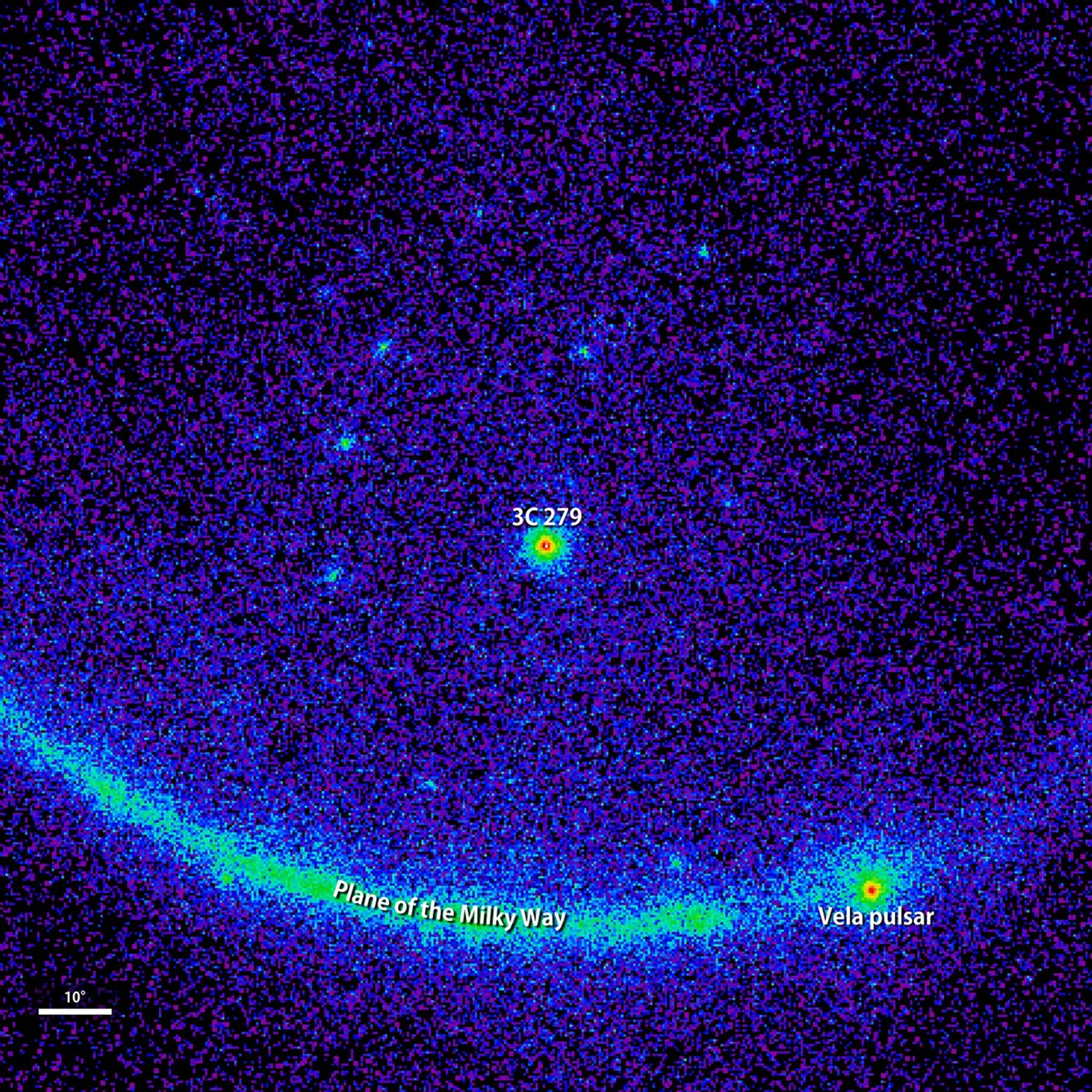
    Gamma-ray image of galaxy 3C 279 during a flare in June 2015 as seen by the Fermi Gamma-ray Space Telescope
    Blazar 3C 279’s historic gamma-ray flare in 2015 can be seen in this image from the Large Area Telescope on NASA’s Fermi satellite. During the flare, the blazar outshone the Vela pulsar, usually the brightest object in the gamma-ray sky.
    NASA/DOE/Fermi LAT Collaboration

    Fermi has been searching the sky for gamma ray sources since 2008. More than half of the sources it has found have been blazars. Gamma rays are useful because they can tell us a lot about how particles accelerate and how they interact with their environment.

    So why do we care about AGN? We know that some AGN formed early in the history of the universe. With their enormous power, they almost certainly affected how the universe changed over time. By discovering how AGN work, we can understand better how the universe came to be the way it is now.

    Details

    Last Updated

    Apr 30, 2025

    Keep Exploring

    Discover More Topics From NASA

  • NASA, International Astronauts to Connect with Students in Texas

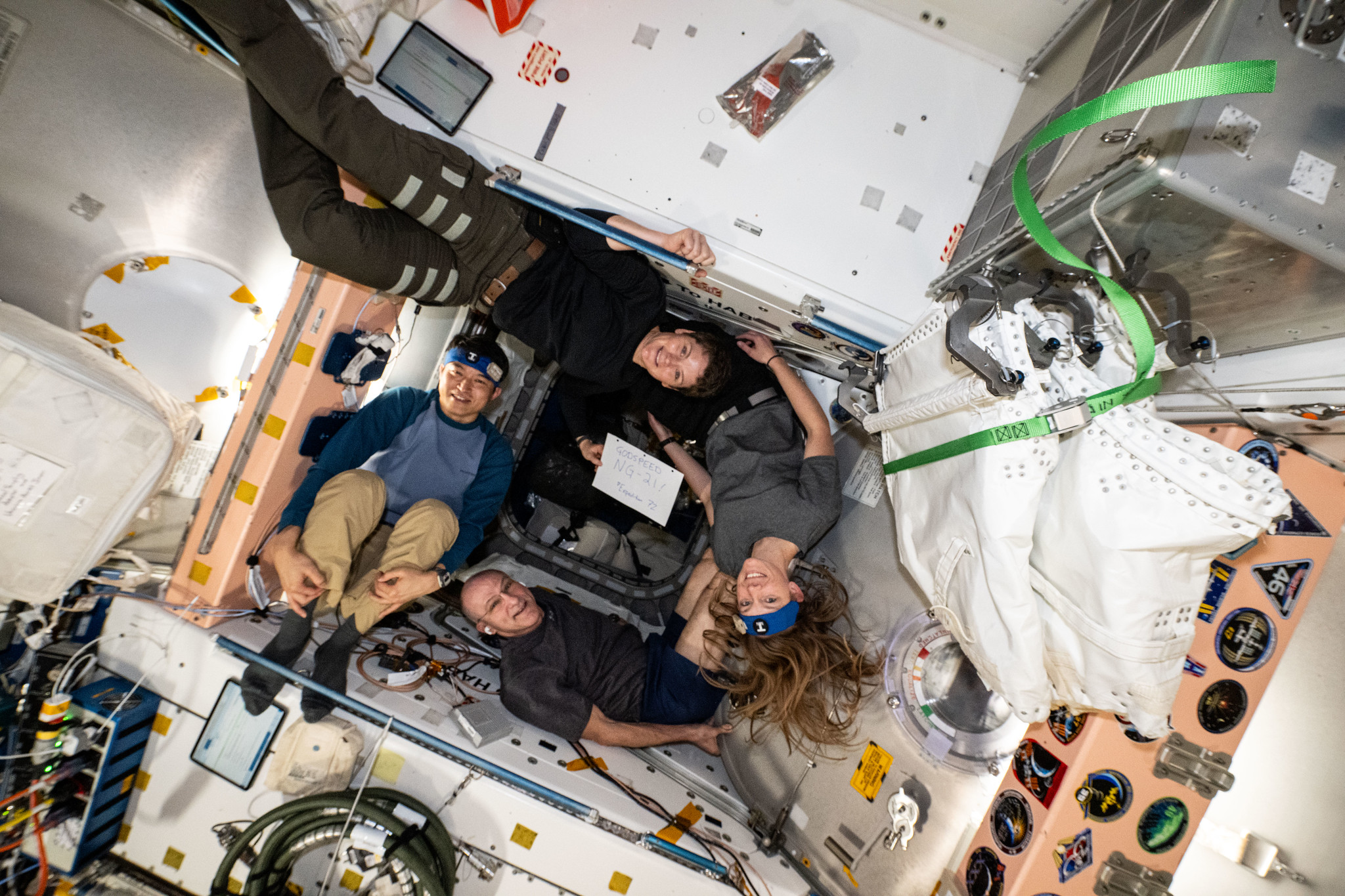
    Expedition 72 Flight Engineers Takuya Onishi from JAXA (Japan Aerospace Exploration Agency) and NASA astronauts Anne McClain, Nichole Ayers, and Don Pettit pose while inside the vestibule between the International Space Station's Unity module and the Cygnus space freighter.
    Expedition 72 Flight Engineers Takuya Onishi from JAXA (Japan Aerospace Exploration Agency) and NASA astronauts Anne McClain, Nichole Ayers, and Don Pettit pose while inside the vestibule between the International Space Station’s Unity module and the Cygnus space freighter.
    NASA

    NASA astronaut Nichole Ayers and JAXA (Japan Aerospace Exploration Agency) astronaut Takuya Onishi will answer prerecorded questions about science, technology, engineering, and mathematics from students in Mansfield, Texas, while aboard the International Space Station.

    The 20-minute space-to-Earth call will take place at 10:40 a.m. EDT on Monday, May 5, and can be watched on the NASA STEM YouTube Channel.

    Media interested in covering the event must RSVP no later than 5 p.m., Friday, May 2 by contacting Laura Jobe at laurajobe@misdmail.org or 817-299-6300.

    The event, hosted by Mansfield Independent School District, also will have students present from Brenda Norwood Elementary, Alma Martinez Intermediate, Charlene McKinzey Middle, Jerry Knight and Frontier STEM Academies in Mansfield. This opportunity will allow the students to relate what they have learned about space travel to personal experiences.

    For more than 24 years, astronauts have continuously lived and worked aboard the space station, testing technologies, performing science, and developing skills needed to explore farther from Earth. Astronauts aboard the orbiting laboratory communicate with NASA’s Mission Control Center in Houston 24 hours a day through SCaN’s (Space Communications and Navigation) Near Space Network.

    Important research and technology investigations taking place aboard the space station benefit people on Earth and lays the groundwork for other agency missions. As part of NASA’s Artemis campaign, the agency will send astronauts to the Moon to prepare for future human exploration of Mars; inspiring Artemis Generation explorers and ensuring the United States continues to lead in space exploration and discovery.

    See videos of astronauts aboard the space station at:

    https://www.nasa.gov/stemonstation

    -end-

    Gerelle Dodson
    Headquarters, Washington
    202-358-1600
    gerelle.q.dodson@nasa.gov

    Sandra Jones
    Johnson Space Center, Houston
    281-483-5111
    sandra.p.jones@nasa.gov
  • ¿Qué es una caminata espacial? (Grados 5.o a 8.o)

    Este artículo es para estudiantes de 5.o a 8.grado.

    Cada vez que un astronauta sale de un vehículo espacial, se dice que hace una actividad extravehicular (EVA, por sus siglas en inglés). A esto también se le llama caminata espacial.

    El astronauta ruso Alexei Leonov hizo la primera caminata espacial el 18 de marzo de 1965. La primera caminata espacial duró 10 minutos.
    El astronauta Ed White hizo la primera caminata espacial de un estadounidense durante la misión Géminis 4, el 3 de junio de 1965. La caminata espacial de White duró 23 minutos.

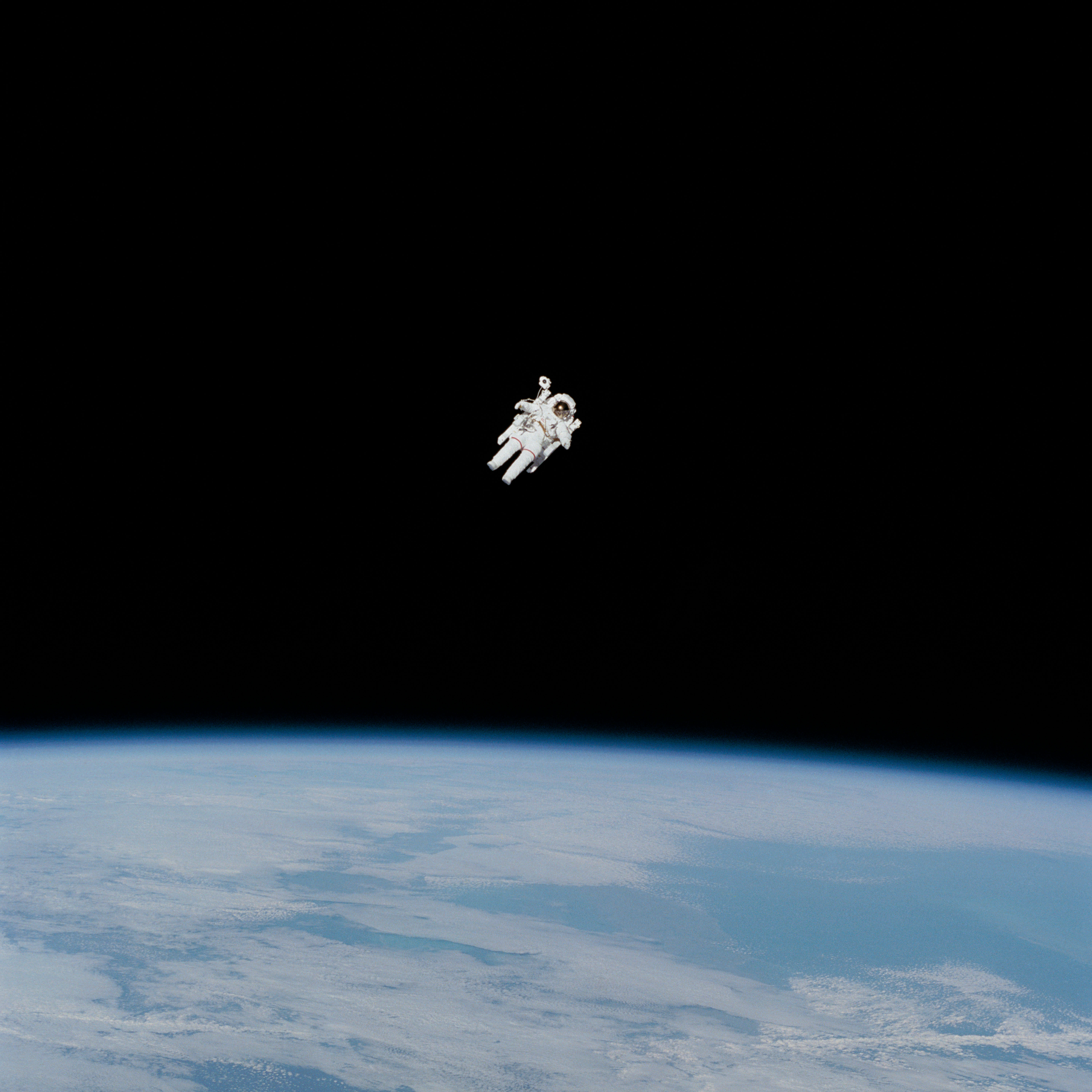
    Spacewalking astronaut on untethered spacewalk surrounded by empty space with Earth below

    Hoy en día, las caminatas espaciales se hacen en el exterior de la Estación Espacial Internacional (EEI). Las caminatas espaciales suelen durar entre cinco y ocho horas, según el trabajo a realizar.

    El récord mundial de más caminatas espaciales lo tiene el cosmonauta ruso Anatoly Solovyev. Hizo 16 caminatas espaciales por un total de más de 82 horas en el espacio exterior. Cuatro astronautas de la NASA tienen un empate para la mayor cantidad de caminatas espaciales. Michael López-Alegría (Mike L.A.), Peggy Whitson, Bob Behnken y Chris Cassidy han hecho 10 caminatas espaciales cada uno. Mike L.A. tiene el récord de Estados Unidos para la mayor cantidad de tiempo en caminatas espaciales. Su total es de más de 67 horas.

    ¿Por qué los astronautas llevan a cabo caminatas espaciales?

    Los astronautas hacen caminatas espaciales por muchas razones. Las caminatas espaciales permiten a los astronautas trabajar fuera de su nave espacial mientras aún están en el espacio. Un trabajo que hacen los astronautas en una caminata espacial son los experimentos científicos. Se pueden sujetar experimentos en el exterior de una nave espacial para ver cómo el entorno espacial afecta diferentes objetos. Los astronautas colocan los experimentos fuera de la nave espacial durante una caminata espacial. Vuelven a salir para recuperar los experimentos cuando terminan.

    Los astronautas también pueden poner a prueba nuevos equipos y reparar los satélites o sus naves espaciales mientras están en órbita. Al hacer caminatas espaciales, los astronautas pueden reparar equipos que, de otro modo, tendrían que ser devueltos a la Tierra para su reparación.

    _____________________________________________________________________________

    Palabras que debes saber

    radiación: una forma de energía que se emite, o transmite, en forma de rayos, ondas electromagnéticas o partículas

    _____________________________________________________________________________

    ¿Cómo hacen los astronautas las caminatas espaciales?

    Cuando los astronautas hacen caminatas espaciales, usan trajes espaciales. Los trajes espaciales los protegen del duro entorno del espacio. Protegen a los astronautas de las temperaturas extremas de calor y frío, del dañino polvo espacial y de la radiación. Los trajes espaciales también les dan a los astronautas oxígeno para respirar y agua para beber durante las caminatas espaciales.

    Los astronautas se visten con sus trajes espaciales varias horas antes de hacer una caminata espacial. Los trajes están presurizados. Esto significa que los trajes están llenos de oxígeno. Los trajes espaciales están presurizados para mantener los fluidos del cuerpo en estado líquido.

    Una vez que tienen puestos sus trajes, los astronautas respiran oxígeno al 100% durante varias horas hasta que todo el nitrógeno sale de su cuerpo. Tener nitrógeno en el cuerpo durante una caminata espacial puede hacer que se formen burbujas de gas en el cuerpo. Estas burbujas de gas pueden hacer que los astronautas sientan dolor en articulaciones como los hombros, los codos, las muñecas y las rodillas. Esta condición se llama “enfermedad de los buzos” o síndrome de descompresión. La misma condición puede afectar a los buceadores que usan tanques de oxígeno para respirar debajo del agua.

    Los astronautas ahora están listos para salir de la nave espacial. Salen de la nave espacial a través de una puerta especial llamada compuerta de aire. La compuerta de aire tiene dos puertas. Cuando los astronautas están dentro de la nave espacial, la compuerta de aire es hermética, lo que significa que no puede salir el aire. Cuando los astronautas se preparan para salir a una caminata espacial, pasan por la primera puerta y la cierran herméticamente detrás de ellos. Luego pueden abrir la segunda puerta sin que el aire se escape de la nave espacial. Después de una caminata espacial, los astronautas regresan al interior a través de la compuerta de aire. Cuando un astronauta se quita el traje espacial, se dice que sale del traje.

    Los astronautas usan pasamanos en la estación espacial para desplazarse de un lugar a otro. A veces, se usa un gran brazo robótico para mover a los astronautas en las caminatas espaciales. Los astronautas están sujetos al brazo robótico con una correa para los pies.

    Los astronautas ahora están listos para salir de la nave espacial. Salen de la nave espacial por una puerta especial llamada compuerta de aire. La compuerta de aire tiene dos puertas. Cuando los astronautas están dentro de la nave espacial, la compuerta de aire es hermética, lo que significa que no puede salir el aire. Cuando los astronautas se preparan para salir a una caminata espacial, pasan por la primera puerta y la cierran herméticamente detrás de ellos. Luego pueden abrir la segunda puerta sin que el aire se salga de la nave espacial. Después de una caminata espacial, los astronautas regresan al interior a través de la compuerta de aire.

    ¿Cómo se mantienen seguros los astronautas durante las caminatas espaciales?

    Cuando hacen una caminata espacial, los astronautas usan correas de seguridad para sujetarse a su nave espacial. Las correas son como cuerdas. Un extremo está enganchado al caminante espacial. El otro extremo está conectado al vehículo. Las correas de seguridad evitan que los astronautas se alejen flotando en el espacio. Los astronautas también usan correas para evitar que las herramientas se alejen flotando. Atan las herramientas a sus trajes espaciales con correas.

    Otra forma en que los astronautas se mantienen seguros durante las caminatas espaciales es usando una mochila llamada SAFER. SAFER son las siglas en inglés de Ayuda Simplificada para Rescate en Actividad Extravehicular. El SAFER se usa como una mochila. Utiliza pequeños propulsores a reacción para permitir que el astronauta se desplace por el espacio. Si un astronauta se soltara y se alejara flotando, SAFER le ayudaría a volar de regreso a la nave espacial. Los astronautas controlan SAFER con una pequeña palanca de mando.

    ¿Cómo entrenan los astronautas para las caminatas espaciales?

    Una forma en que los astronautas se entrenan para las caminatas espaciales es nadando. Flotar en el espacio es muy parecido a flotar en el agua. Los astronautas practican las caminatas espaciales debajo del agua en una gran piscina cerca del Centro Espacial Johnson de la NASA en Houston, Texas.

    La piscina se llama Laboratorio de Flotabilidad Neutral (NBL, por sus siglas en inglés). La piscina tiene capacidad para unos 23,5 millones de litros (6,2 millones de galones) de agua. Por cada hora que pasen en una caminata espacial, los astronautas deben entrenar siete horas en la piscina del NBL.

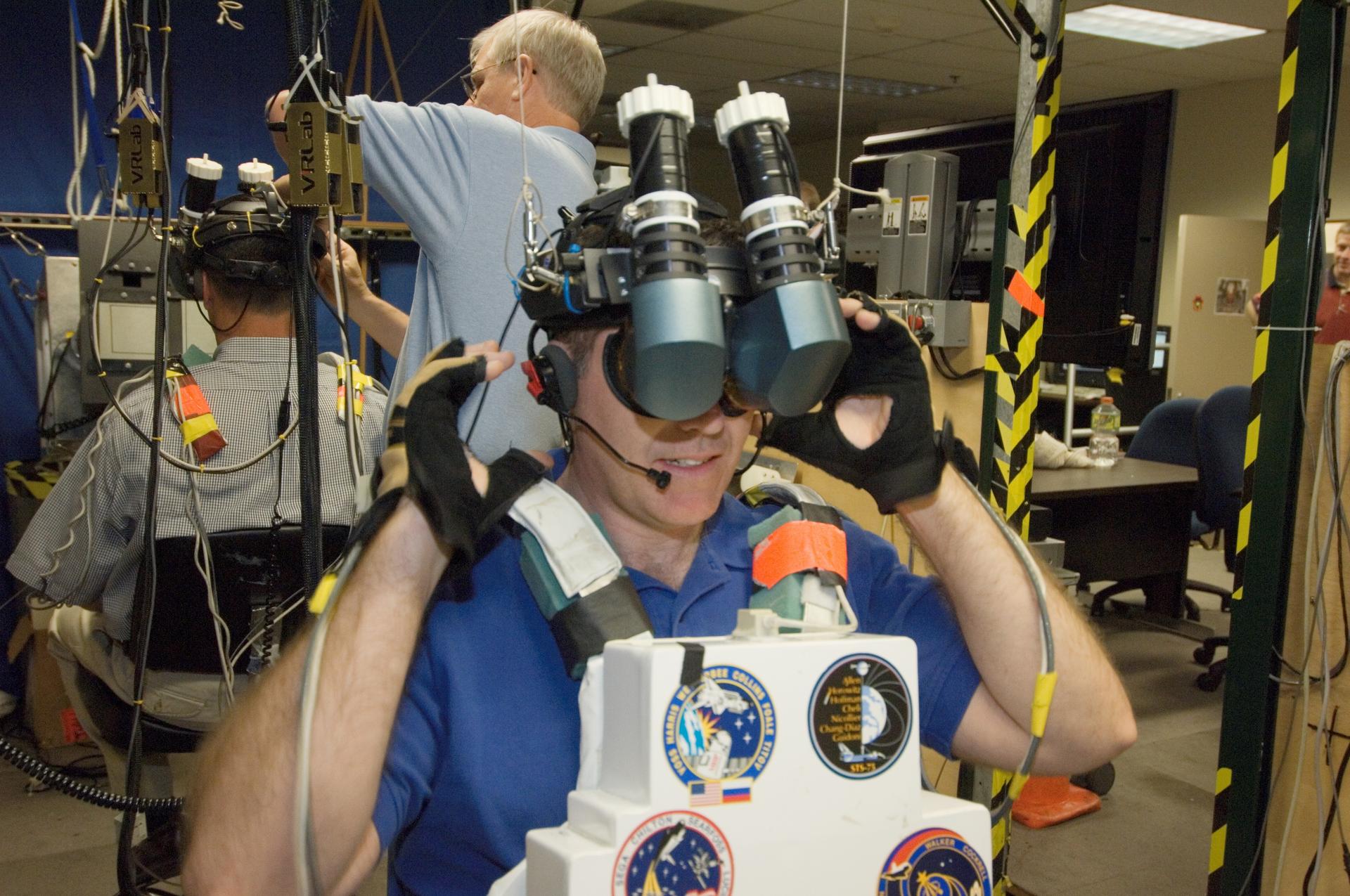
    Otra forma en que los astronautas practican para una caminata espacial es utilizando la realidad virtual. Los astronautas usan un casco que tiene una pantalla de video dentro y guantes especiales. En la pantalla dentro del casco se muestra un video de la simulación. Los guantes especiales permiten mostrar los movimientos de los astronautas con el video. La simulación de realidad virtual se ve y se siente como una caminata espacial.

    NASA astronauts Steve Swanson and Scott Tingle participate in a spacewalk training session

    Read this article in English here: What Is a Spacewalk? (Grades 5-8)