Tag: solar system

  • NASA Study Reveals Venus Crust Surprise

    3 min read

    NASA Study Reveals Venus Crust Surprise

    Venus appears orange, yellow, and brown in this simulated view.
    This global view of the surface of Venus is centered at 180 degrees east longitude. Magellan synthetic aperture radar mosaics from the first cycle of Magellan mapping are mapped onto a computer-simulated globe to create this image. Data gaps are filled with Pioneer Venus Orbiter data, or a constant mid-range value. Simulated color is used to enhance small-scale structure. The simulated hues are based on color images recorded by the Soviet Venera 13 and 14 spacecraft.
    NASA/JPL-Caltech

    New details about the crust on Venus include some surprises about the geology of Earth’s hotter twin, according to new NASA-funded research that describes movements of the planet’s crust.

    Scientists expected the outermost layer of Venus’ crust would grow thicker and thicker over time given its apparent lack of forces that would drive the crust back into the planet’s interior. But the paper, published in Nature Communications, proposes a crust metamorphism process based on rock density and melting cycles.

    Earth’s rocky crust is made up of massive plates that slowly move, forming folds and faults in a process known as plate tectonics. For example, when two plates collide, the lighter plate slides on top of the denser one, forcing it downward into the layer beneath it, the mantle. This process, known as subduction, helps control the thickness of Earth’s crust. The rocks making up the bottom plate experience changes caused by increasing temperature and pressure as it sinks deeper into the interior of the planet. Those changes are known as metamorphism, which is one cause of volcanic activity.

    In contrast, Venus has a crust that is all one piece, with no evidence for subduction caused by plate tectonics like on Earth, explained Justin Filiberto, deputy chief of NASA’s Astromaterials Research and Exploration Science Division at NASA’s Johnson Space Center in Houston and a co-author on the paper. The paper used modeling to determine that its crust is about 25 miles (40 kilometers) thick on average and at most 40 miles (65 kilometers) thick.

    “That is surprisingly thin, given conditions on the planet,” said Filiberto. “It turns out that, according to our models, as the crust grows thicker, the bottom of it becomes so dense that it either breaks off and becomes part of the mantle or gets hot enough to melt.” So, while Venus has no moving plates, its crust does experience metamorphism. This finding is an important step toward understanding geological processes and evolution of the planet.

    “This breaking off or melting can put water and elements back into the planet’s interior and help drive volcanic activity,” added Filiberto. “This gives us a new model for how material returns to the interior of the planet and another way to make lava and spur volcanic eruptions. It resets the playing field for how the geology, crust, and atmosphere on Venus work together.”

    The next step, he added, is to gather direct data about Venus’ crust to test and refine these models. Several upcoming missions, including NASA’s DAVINCI (Deep Atmosphere Venus Investigation of Noble gases, Chemistry, and Imaging) and VERITAS (Venus Emissivity, Radio Science, InSAR, Topography, and Spectroscopy) and, in partnership with ESA (European Space Agency), Envision, aim to study the planet’s surface and atmosphere in greater detail. These efforts could help confirm whether processes like metamorphism and recycling are actively shaping the Venusian crust today—and reveal how such activity may be tied to volcanic and atmospheric evolution.

    “We don’t actually know how much volcanic activity is on Venus,” Filiberto said. “We assume there is a lot, and research says there should be, but we’d need more data to know for sure.”

    Melissa Gaskill
    NASA Johnson Space Center

    Media Contacts:

    Karen Fox / Molly Wasser
    Headquarters, Washington
    202-358-1600
    karen.c.fox@nasa.gov / molly.l.wasser@nasa.gov

    Victoria Segovia
    NASA’s Johnson Space Center
    281-483-5111
    victoria.segovia@nasa.gov
    Details

    Last Updated

    May 09, 2025

    Related Terms

  • Using Our Facilities

    NASA’s Glenn Research Center in Cleveland provides ground test facilities to industry, government, and academia specializing in the following: 

    • Acoustics 
    • Engine Components Testing 
    • Full-Scale Engine Testing 
    • Flight Research 
    • Icing Research 
    • Materials and Structures 
    • Microgravity 
    • Space Power and Propulsion 
    • Wind Tunnels 
    • Electromagnetic Interference Laboratory 

    Our unique facilities offer superior customer service, flexible scheduling, and state-of-the-art testing capabilities. 

    Facility Request Process 

    1. Customer contacts the facility manager and/or submits a test request form. See below for the Facility Request Form. 
    1. The facility manager will contact the customer to discuss the request and obtain detailed test requirements. 
    1. After test requirements and schedule are finalized, the facility manager will provide a high-fidelity cost estimate for review and prepare a formal agreement for signature. 
    1. Once the agreement is signed by both NASA Glenn and the customer, and the work is funded, the test execution may begin per the agreement. 

    If you need further information about our facility capabilities or the general testing process, please complete the form below to have your inquiry answered or contact Michael McVetta at 216-433-2832. 

    Facility Request Form

    If you are considering testing in one of our facilities or would like further information about a specific facility or capability, please let us know:

    var gform;gform||(document.addEventListener(“gform_main_scripts_loaded”,function(){gform.scriptsLoaded=!0}),document.addEventListener(“gform/theme/scripts_loaded”,function(){gform.themeScriptsLoaded=!0}),window.addEventListener(“DOMContentLoaded”,function(){gform.domLoaded=!0}),gform={domLoaded:!1,scriptsLoaded:!1,themeScriptsLoaded:!1,isFormEditor:()=>”function”==typeof InitializeEditor,callIfLoaded:function(o){return!(!gform.domLoaded||!gform.scriptsLoaded||!gform.themeScriptsLoaded&&!gform.isFormEditor()||(gform.isFormEditor()&&console.warn(“The use of gform.initializeOnLoaded() is deprecated in the form editor context and will be removed in Gravity Forms 3.1.”),o(),0))},initializeOnLoaded:function(o){gform.callIfLoaded(o)||(document.addEventListener(“gform_main_scripts_loaded”,()=>{gform.scriptsLoaded=!0,gform.callIfLoaded(o)}),document.addEventListener(“gform/theme/scripts_loaded”,()=>{gform.themeScriptsLoaded=!0,gform.callIfLoaded(o)}),window.addEventListener(“DOMContentLoaded”,()=>{gform.domLoaded=!0,gform.callIfLoaded(o)}))},hooks:{action:{},filter:{}},addAction:function(o,r,e,t){gform.addHook(“action”,o,r,e,t)},addFilter:function(o,r,e,t){gform.addHook(“filter”,o,r,e,t)},doAction:function(o){gform.doHook(“action”,o,arguments)},applyFilters:function(o){return gform.doHook(“filter”,o,arguments)},removeAction:function(o,r){gform.removeHook(“action”,o,r)},removeFilter:function(o,r,e){gform.removeHook(“filter”,o,r,e)},addHook:function(o,r,e,t,n){null==gform.hooks[o][r]&&(gform.hooks[o][r]=[]);var d=gform.hooks[o][r];null==n&&(n=r+”_”+d.length),gform.hooks[o][r].push({tag:n,callable:e,priority:t=null==t?10:t})},doHook:function(r,o,e){var t;if(e=Array.prototype.slice.call(e,1),null!=gform.hooks[r][o]&&((o=gform.hooks[r][o]).sort(function(o,r){return o.priority-r.priority}),o.forEach(function(o){“function”!=typeof(t=o.callable)&&(t=window[t]),”action”==r?t.apply(null,e):e[0]=t.apply(null,e)})),”filter”==r)return e[0]},removeHook:function(o,r,t,n){var e;null!=gform.hooks[o][r]&&(e=(e=gform.hooks[o][r]).filter(function(o,r,e){return!!(null!=n&&n!=o.tag||null!=t&&t!=o.priority)}),gform.hooks[o][r]=e)}});

    * indicates a required field

    Name*


    If you are not sure of the facility you need, simply indicate that below.
    I’m not sure10×10 Supersonic Wind Tunnel1×1 Supersonic Wind Tunnel8×6 Wind Tunnel9×16 Wind Tunnel2.2 Second Drop TowerAero-Acoustic Propulsion LaboratoryAdvanced Subsonic Combustion RigCombined Effects ChamberElectric Propulsion LaboratoryElectric Propulsion Research BuildingElectromagnetic Interference LaboratoryEngine Research Building and Related FacilitiesFlight Research BuildingHypersonic Tunnel FacilityIcing Research TunnelIn-Space Propulsion FacilityPropulsion Systems LaboratoryStructural Dynamics LaboratoryStructural Static LaboratoryZero Gravity Research Facility

    This field is for validation purposes and should be left unchanged.

    gform.initializeOnLoaded( function() {gformInitSpinner( 105, ‘https://www.nasa.gov/wp-content/plugins/gravityforms/images/spinner.svg’, false );jQuery(‘#gform_ajax_frame_105’).on(‘load’,function(){var contents = jQuery(this).contents().find(‘*’).html();var is_postback = contents.indexOf(‘GF_AJAX_POSTBACK’) >= 0;if(!is_postback){return;}var form_content = jQuery(this).contents().find(‘#gform_wrapper_105’);var is_confirmation = jQuery(this).contents().find(‘#gform_confirmation_wrapper_105’).length > 0;var is_redirect = contents.indexOf(‘gformRedirect(){‘) >= 0;var is_form = form_content.length > 0 && ! is_redirect && ! is_confirmation;var mt = parseInt(jQuery(‘html’).css(‘margin-top’), 10) + parseInt(jQuery(‘body’).css(‘margin-top’), 10) + 100;if(is_form){jQuery(‘#gform_wrapper_105’).html(form_content.html());if(form_content.hasClass(‘gform_validation_error’)){jQuery(‘#gform_wrapper_105’).addClass(‘gform_validation_error’);} else {jQuery(‘#gform_wrapper_105’).removeClass(‘gform_validation_error’);}setTimeout( function() { /* delay the scroll by 50 milliseconds to fix a bug in chrome */ }, 50 );if(window[‘gformInitDatepicker’]) {gformInitDatepicker();}if(window[‘gformInitPriceFields’]) {gformInitPriceFields();}var current_page = jQuery(‘#gform_source_page_number_105’).val();gformInitSpinner( 105, ‘https://www.nasa.gov/wp-content/plugins/gravityforms/images/spinner.svg’, false );jQuery(document).trigger(‘gform_page_loaded’, [105, current_page]);window[‘gf_submitting_105’] = false;}else if(!is_redirect){var confirmation_content = jQuery(this).contents().find(‘.GF_AJAX_POSTBACK’).html();if(!confirmation_content){confirmation_content = contents;}jQuery(‘#gform_wrapper_105’).replaceWith(confirmation_content);jQuery(document).trigger(‘gform_confirmation_loaded’, [105]);window[‘gf_submitting_105’] = false;wp.a11y.speak(jQuery(‘#gform_confirmation_message_105’).text());}else{jQuery(‘#gform_105’).append(contents);if(window[‘gformRedirect’]) {gformRedirect();}}jQuery(document).trigger(“gform_pre_post_render”, [{ formId: “105”, currentPage: “current_page”, abort: function() { this.preventDefault(); } }]); if (event && event.defaultPrevented) { return; } const gformWrapperDiv = document.getElementById( “gform_wrapper_105” ); if ( gformWrapperDiv ) { const visibilitySpan = document.createElement( “span” ); visibilitySpan.id = “gform_visibility_test_105”; gformWrapperDiv.insertAdjacentElement( “afterend”, visibilitySpan ); } const visibilityTestDiv = document.getElementById( “gform_visibility_test_105” ); let postRenderFired = false; function triggerPostRender() { if ( postRenderFired ) { return; } postRenderFired = true; jQuery( document ).trigger( ‘gform_post_render’, [105, current_page] ); gform.utils.trigger( { event: ‘gform/postRender’, native: false, data: { formId: 105, currentPage: current_page } } ); gform.utils.trigger( { event: ‘gform/post_render’, native: false, data: { formId: 105, currentPage: current_page } } ); if ( visibilityTestDiv ) { visibilityTestDiv.parentNode.removeChild( visibilityTestDiv ); } } function debounce( func, wait, immediate ) { var timeout; return function() { var context = this, args = arguments; var later = function() { timeout = null; if ( !immediate ) func.apply( context, args ); }; var callNow = immediate && !timeout; clearTimeout( timeout ); timeout = setTimeout( later, wait ); if ( callNow ) func.apply( context, args ); }; } const debouncedTriggerPostRender = debounce( function() { triggerPostRender(); }, 200 ); if ( visibilityTestDiv && visibilityTestDiv.offsetParent === null ) { const observer = new MutationObserver( ( mutations ) => { mutations.forEach( ( mutation ) => { if ( mutation.type === ‘attributes’ && visibilityTestDiv.offsetParent !== null ) { debouncedTriggerPostRender(); observer.disconnect(); } }); }); observer.observe( document.body, { attributes: true, childList: false, subtree: true, attributeFilter: [ ‘style’, ‘class’ ], }); } else { triggerPostRender(); } } );} );

  • Hubble Comes Face-to-Face with Spiral’s Arms

    2 min read

    Hubble Comes Face-to-Face with Spiral’s Arms

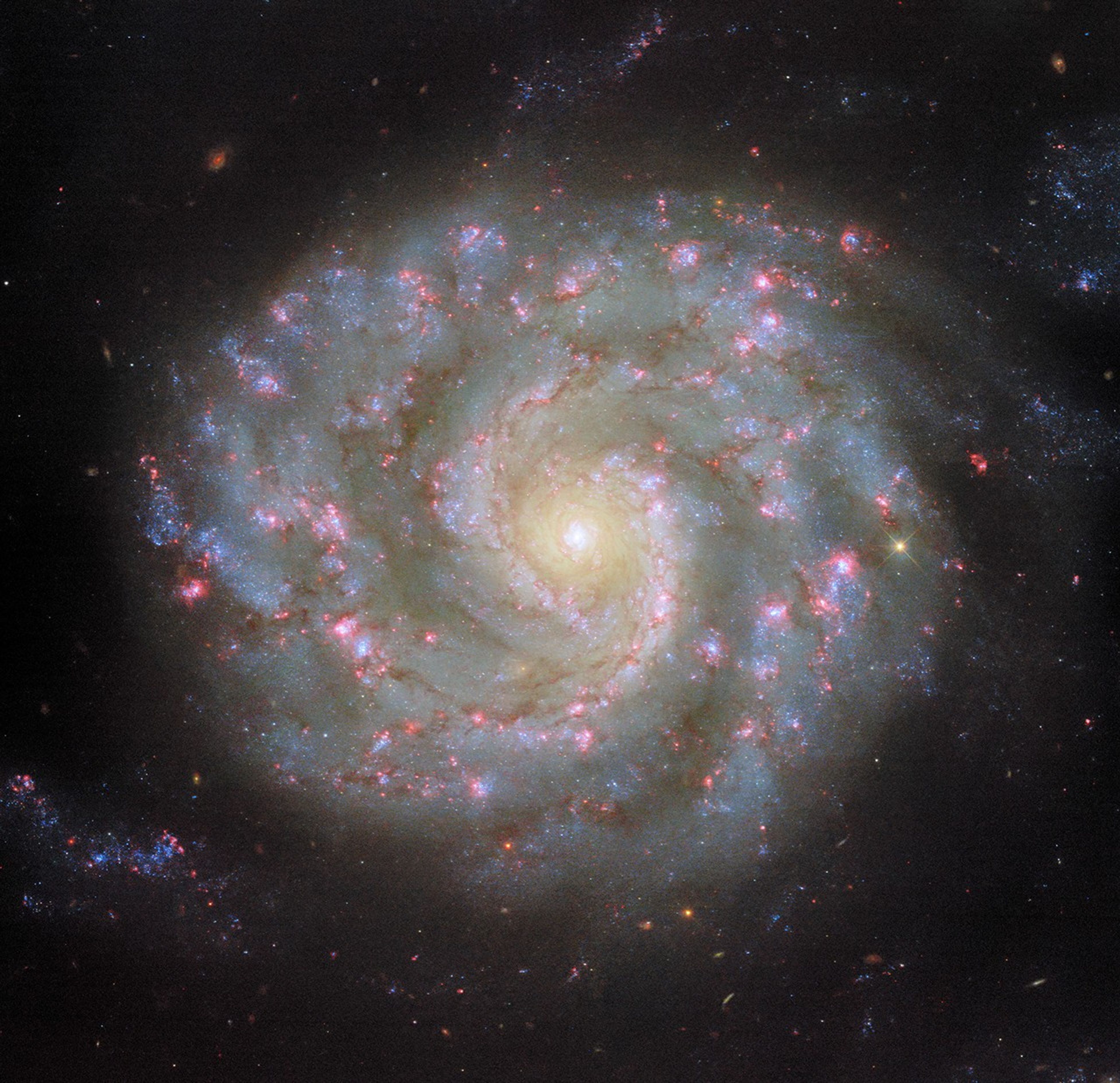
    A spiral galaxy viewed face-on, with a slightly oval-shaped disk. The galaxy’s center appears as a bright white spot surrounded by a golden glow. Two spiral arms extend out from the center, wrapping around the galaxy and broadening out to form the thick outer edge of the disk. Thin reddish strands of dust and bright pink spots follow the arms through the disk. Faint strands of stars extend from the tips of the spiral arms and out beyond the disk.
    This Hubble Space Telescope image showcases the spiral galaxy NGC 3596.
    ESA/Hubble & NASA, D. Thilker

    The spiral galaxy NGC 3596 is on display in this NASA/ESA Hubble Space Telescope image that incorporates six different wavelengths of light. NGC 3596 is situated 90 million light-years from Earth in the constellation Leo, the Lion. British astronomer Sir William Herschel first documented the galaxy in 1784.

    NGC 3596 appears almost perfectly face-on when viewed from Earth, showcasing the galaxy’s neatly wound spiral arms. These bright arms hold concentrations of stars, gas, and dust that mark the area where star formation is most active, illustrated by the brilliant pink star-forming regions and young blue stars tracing NGC 3596’s arms.

    What causes these spiral arms to form? It’s a surprisingly difficult question to answer, partly because spiral galaxies are so diverse. Some have clear spiral arms, while others have patchy, feathery arms. Some have prominent bars across their centers, while others have compact, circular nuclei. Some have close neighbors, while others are isolated.

    Early ideas of how spiral arms formed stumped astronomers with the ‘winding problem’. If a galaxy’s spiral arms are coherent structures, its arms would wind tighter and tighter as the galaxy spins, until the arms are no longer visible. Now, researchers believe that spiral arms represent a pattern of high-density and low-density areas rather than a physical structure. As stars, gas, and dust orbit within a galaxy’s disk, they pass in and out of the spiral arms. Much like cars moving through a traffic jam, these materials slow down and bunch up as they enter a spiral arm, before emerging and continuing their journey through the galaxy.

    Media Contact:

    Claire Andreoli (claire.andreoli@nasa.gov)
    NASA’s Goddard Space Flight CenterGreenbelt, MD

  • NASA Astronaut Anne McClain Works on Space Station

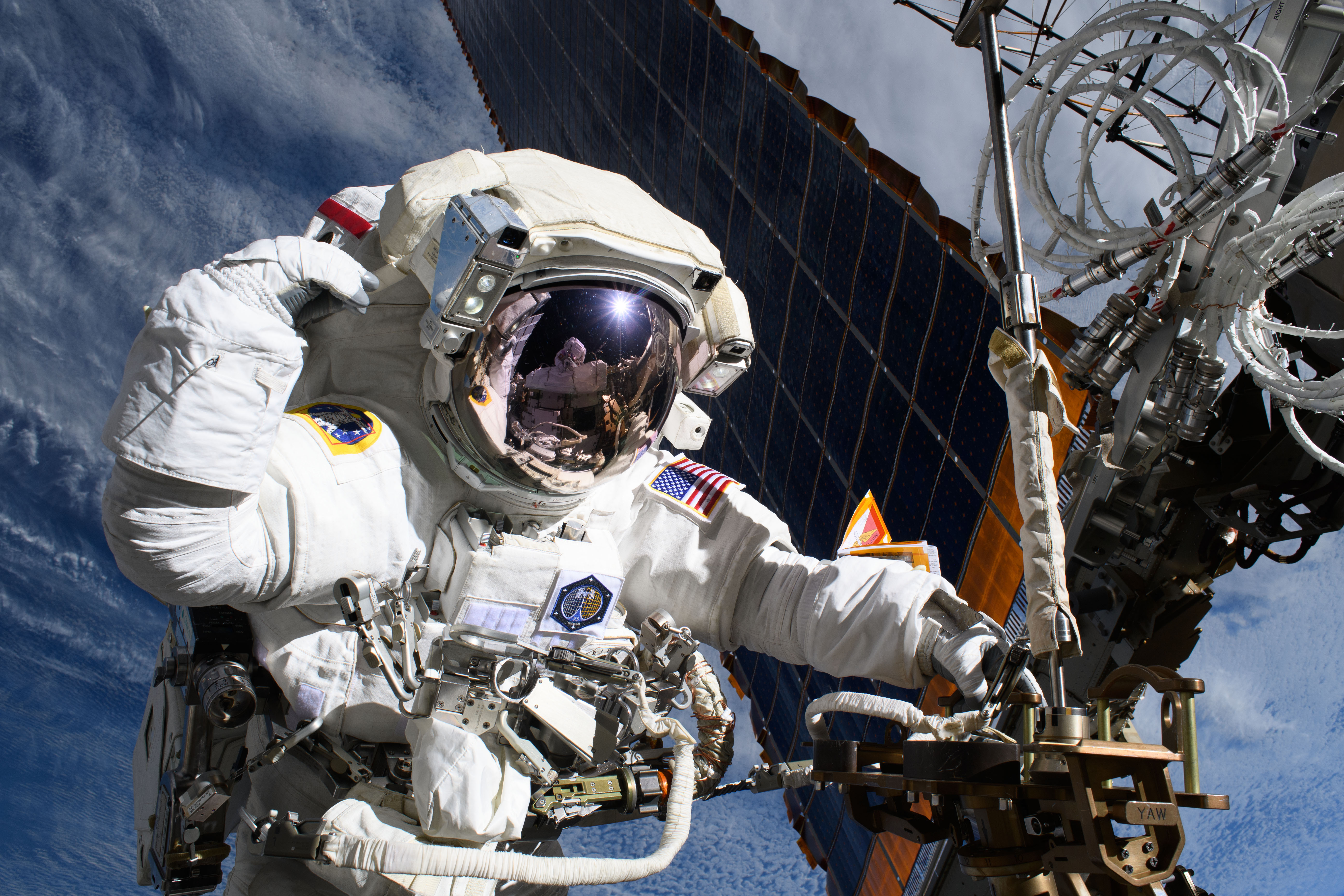
    An astronaut outside of the International Space Station has one hand on a truss near a solar panel. Her other hand is by her head. Reflected in her helmet is astronaut Nichole Ayers, also in a white spacesuit, taking the photo. Earth's blue water and white clouds can be seen in the background.
    NASA astronaut and Expedition 72 flight engineer Anne McClain is pictured near one of the International Space Station’s main solar arrays during a spacewalk.
    NASA/Nichole Ayers

    In this May 1, 2025, photo taken by fellow NASA astronaut Nichole Ayers, Anne McClain works near one of the International Space Station’s main solar arrays during a spacewalk. During the May 1 spacewalk – McClain’s third and Ayers’ first – the astronaut pair relocated a space station communications antenna and completed the initial mounting bracket installation steps for an International Space Station Rollout Solar Array, or IROSA, that will arrive on a future SpaceX commercial resupply services mission, in addition to some get ahead tasks.

    Learn more about station activities by following the space station blog.

    Image credit: NASA/Nichole Ayers

  • NASA Earns Two Emmy Nominations for 2024 Total Solar Eclipse Coverage

    3 min read

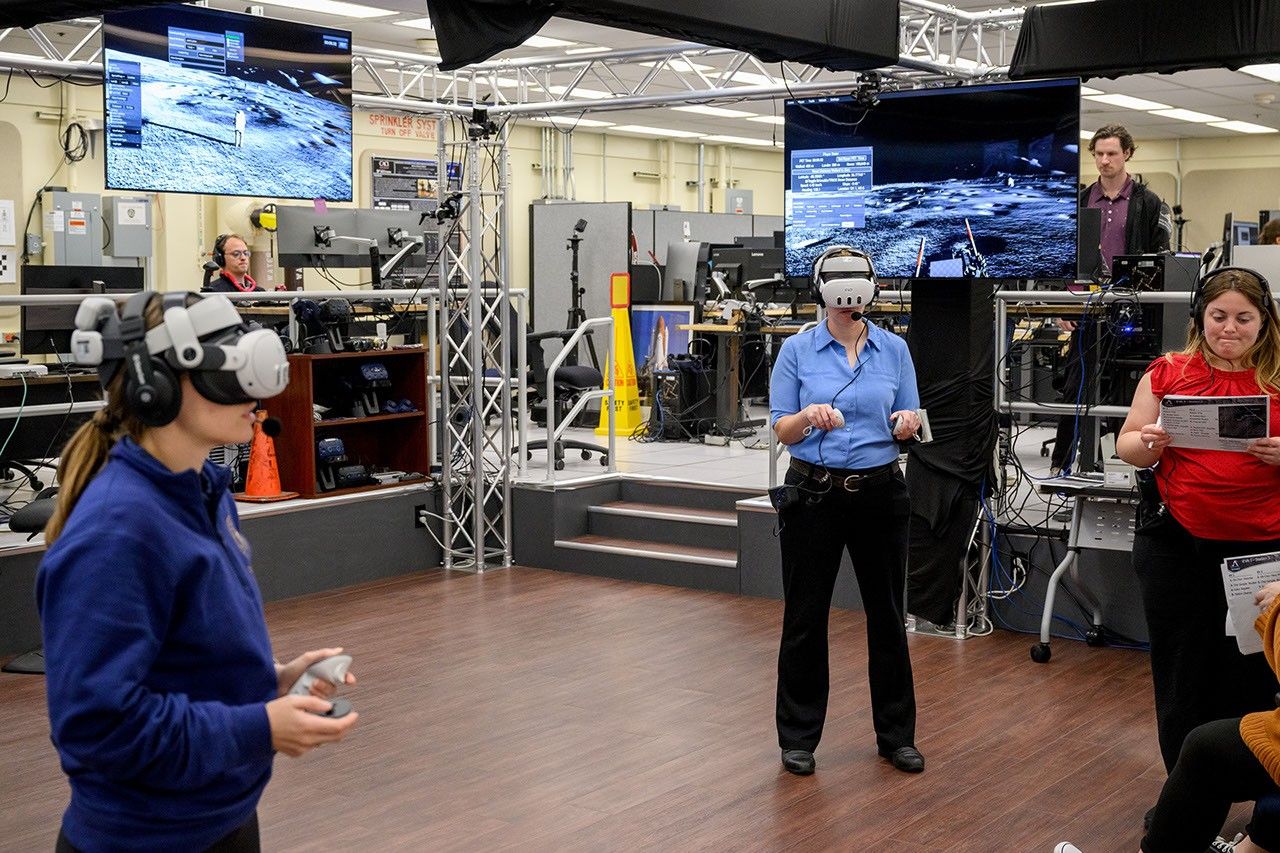
    Preparations for Next Moonwalk Simulations Underway (and Underwater)

    NASA’s coverage of the April 8, 2024, total solar eclipse has earned two nominations for the 46th Annual News & Documentary Emmy Awards.

    The Academy of Television Arts & Sciences announced the nominations on May 1, recognizing NASA’s outstanding work in sharing this rare celestial event with audiences around the world. The winners are set to be unveiled at a ceremony in late June.

    “Total solar eclipses demonstrate the special connection between our Earth, Moon, and Sun by impacting our senses during the breathtaking moments of total alignment that only occur at this time on Earth,” said Nicky Fox, associate administrator for science at NASA Headquarters in Washington. “NASA’s Eclipse coverage team perfectly encapsulated the awe-inspiring experience from start to finish for viewers around the world in this once-in-a-lifetime moment in American history. Congratulations to the entire NASA Eclipse coverage team for their two much-deserved Emmy award nominations!”

    The two nominations include:

    • Outstanding Live News Special for the agency’s live broadcast coverage of the 2024 total solar eclipse.

    NASA’s live broadcast coverage of the 2024 total solar eclipse was the most ambitious live project ever attempted by the agency. The broadcast spanned three hours as the eclipse traveled 3,000 miles across seven states and two countries. From cities, parks, and stadiums, 11 hosts and correspondents provided on air commentary, interviews, and live coverage. Viewers tuned in from all over the world, including at watch parties in 9 locations, from the Austin Public Library to New York’s Times Square. An interactive “Eclipse Board” provided real time data analysis as the Moon’s shadow crossed North America. Live feeds from astronauts aboard the International Space Station and NASA’s WB-57 high-altitude research aircraft were brought in to provide rare and unique perspectives of the solar event.

    In total, NASA received almost 40 million views across its own distribution. Externally, the main broadcast was picked up in 2,208 hits on 568 channels in 25 countries.

    • Outstanding Show Open or Title Sequence – News for the agency’s show open for the 2024 total solar eclipse.

    NASA’s show open for the 2024 total solar eclipse live broadcast explores the powerful connections between the Sun, humanity, and the rare moment when day turns to night. From witnessing the Sun’s atmosphere to feeling the dramatic drop in temperature, the video captures the psychological, emotional, and cultural impact of this celestial phenomenon.  

    For more information about NASA missions, visit:

    https://www.nasa.gov

  • NASA Statement on Nomination of Matt Anderson for Deputy Administrator

    President Trump has nominated Matt Anderson to serve as the agency’s deputy administrator.
    Credit: Photo courtesy of Matt Anderson

    Acting NASA Administrator Janet Petro issued the following statement regarding the nomination by President Donald Trump of Matt Anderson Wednesday to serve as the agency’s deputy administrator:

    “As a retired United States Air Force colonel and executive of the Space Force Association, Matt Anderson brings extensive knowledge of space operations, aeronautics expertise, and industry experience. If confirmed, he would join NASA’s leadership team at a time when partnerships and a sharpened focus on mission are essential to our continued success. Along with President Trump’s nominee to lead NASA, Jared Isaacman, he will strengthen collaboration across sectors and help NASA advance exploration, serve the American people, and deliver results for the benefit of all.”

    Throughout his over 24-year tenure in the U.S. Air Force, Anderson culminated his career as the U.S. Transportation Command’s senior liaison officer to North American Aerospace Defense Command (NORAD), U.S. Northern Command (USNORTHCOM), and U.S. Space Command (USSPACECOM). He retired as a colonel Oct. 1, 2021. Anderson is currently a vice president and Space Force & Air Force client executive at CACI. He also serves as the chief growth officer at the Space Force Association.

    An alum of the U.S. Air Force Academy, Embry-Riddle Aeronautical University, and the University of Colorado at Colorado Springs, Anderson holds degrees in biology, aeronautical science, and leadership & counseling. In 2024, Anderson was named by the Washington Exec as one of their “Top Space Execs to Watch.”

    For more about NASA’s mission, visit:

    https://www.nasa.gov

    -end-

    Bethany Stevens / Amber Jacobson
    Headquarters, Washington
    202-358-1600
    bethany.c.stevens@nasa.gov / amber.c.jacobson@nasa.gov

    Details

    Last Updated

    May 07, 2025

    Editor
    Jessica Taveau

    Related Terms

  • Key Portion of NASA’s Roman Space Telescope Clears Thermal Vacuum Test

    One half of NASA’s nearly complete Nancy Grace Roman Space Telescope just passed a lengthy test to ensure it will function properly in the space environment.

    A huge subsystem of the Roman observatory in a thermal vacuum chamber
    This photo shows half of the NASA’s Nancy Grace Roman observatory — the outer barrel assembly, deployable aperture cover, and test solar arrays — fully deployed in a thermal chamber at NASA’s Goddard Space Flight Center in Greenbelt, Md., for environmental testing.
    Credit: NASA/Sydney Rohde

    “This milestone tees us up to attach the flight solar array sun shield to the outer barrel assembly, and deployable aperture cover, which we’ll begin this month,” said Jack Marshall, who leads integration and testing for these elements at NASA’s Goddard Space Flight Center in Greenbelt, Maryland. “Then we’ll complete remaining environmental tests for the flight assembly before moving on to connect Roman’s two major assemblies and run the full observatory through testing, and then we’ll be ready to launch!”

    Prior to this thermal testing, technicians integrated Roman’s deployable aperture cover, a visor-like sunshade, to the outer barrel assembly, which will house the telescope and instruments, in January, then added test solar panels in March. They moved this whole structure into the Space Environment Simulator test chamber at NASA Goddard in April.

    There, it was subjected to the hot and cold temperatures it will experience in space. Next, technicians will join Roman’s flight solar panels to the outer barrel assembly and sunshade. Then the structure will undergo a suite of assessments, including a shake test to ensure it can withstand the vibrations experienced during launch.

    Solar panel installation in Goddard clean room
    This photo captures the installation of the test solar panels for NASA’s Nancy Grace Roman Space Telescope, which took place in March. One panel is lifted in the center of the frame on its way to being attached to the outer barrel assembly at right. The deployable aperture cover is stowed on the front of the outer barrel assembly, and the other half of the observatory — the spacecraft and integrated payload assembly, which consists of the telescope, instrument carrier, and two instruments — appears at the left of the photo.
    Credit: NASA/Jolearra Tshiteya

    Meanwhile, Roman’s other major portion — the spacecraft and integrated payload assembly, which consists of the telescope, instrument carrier, and two instruments — will undergo its own shake test, along with additional assessments. Technicians will install the lower instrument sun shade and put this half of the observatory through a thermal vacuum test in the Space Environment Simulator.

    “The test verifies the instruments will remain at stable operating temperatures even while the Sun bakes one side of the observatory and the other is exposed to freezing conditions — all in a vacuum, where heat doesn’t flow as readily as it does through air,” said Jeremy Perkins, an astrophysicist serving as Roman’s observatory integration and test scientist at NASA Goddard. Keeping the instrument temperatures stable ensures their readings will be precise and reliable.

    Technicians are on track to connect Roman’s two major parts in November, resulting in a complete observatory by the end of the year. Following final tests, Roman is expected to ship to the launch site at NASA’s Kennedy Space Center in Florida for launch preparations in summer 2026. Roman remains on schedule for launch by May 2027, with the team aiming for launch as early as fall 2026.

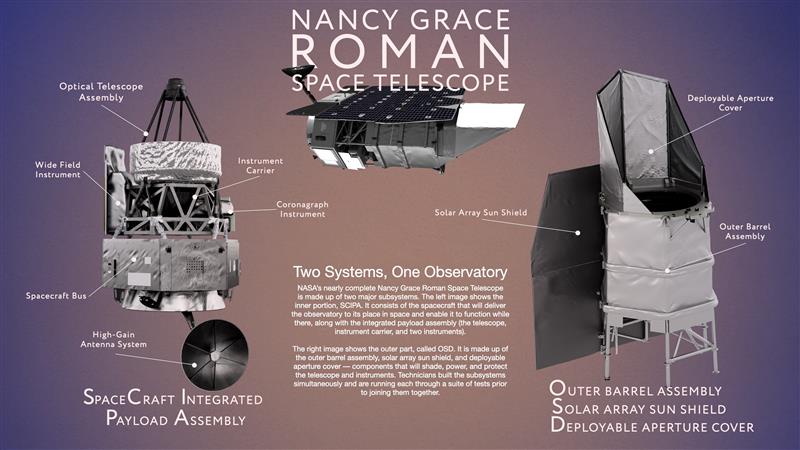
    Roman infographic showing two major subsystems
    This infographic shows the two major subsystems that make up NASA’s Nancy Grace Roman Space Telescope. The subsystems are each undergoing testing prior to being joined together this fall.
    Credit: NASA’s Goddard Space Flight Center

    To virtually tour an interactive version of the telescope, visit:

    https://roman.gsfc.nasa.gov/interactive

    The Nancy Grace Roman Space Telescope is managed at NASA’s Goddard Space Flight Center in Greenbelt, Maryland, with participation by NASA’s Jet Propulsion Laboratory in Southern California; Caltech/IPAC in Pasadena, California; the Space Telescope Science Institute in Baltimore; and a science team comprising scientists from various research institutions. The primary industrial partners are BAE Systems Inc. in Boulder, Colorado; L3Harris Technologies in Rochester, New York; and Teledyne Scientific & Imaging in Thousand Oaks, California.

    By Ashley Balzer
    NASA’s Goddard Space Flight Center, Greenbelt, Md.

    ​​Media Contact:
    Claire Andreoli
    NASA’s Goddard Space Flight Center
    301-286-1940

    Details

    Last Updated

    May 07, 2025

    Editor
    Ashley Balzer
    Contact
    Ashley Balzer
    Location
    NASA Goddard Space Flight Center

  • A Glimpse of a Meatball

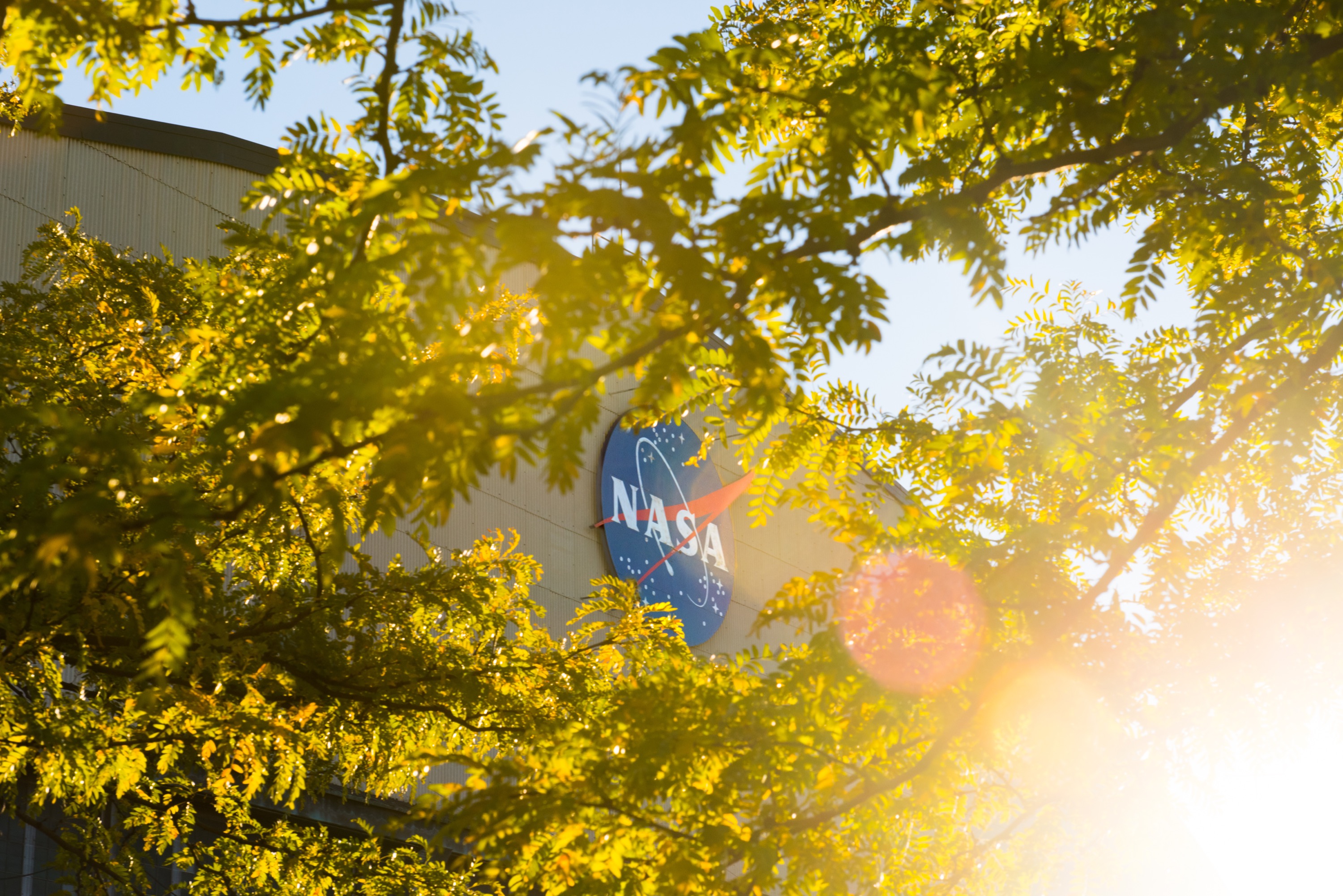
    The NASA meatball logo, attached to a gray building, is seen through bright green leaves lit by the Sun.
    NASA/Bridget Caswell

    The NASA “meatball” logo, mounted on the Flight Research Building at NASA’s Glenn Research Center in Cleveland, peeks through tree leaves in this June 10, 2016, photo. Built in the 1940s, the Flight Research Building, also known as the NASA Glenn Hangar, is a facility large enough to hold numerous aircraft of various sizes. It has been home to many unique and innovative aircraft over the years.

    Take a virtual tour of the Hangar.

    Image credit: NASA/Bridget Caswell

  • New Visualization From NASA’s Webb Telescope Explores Cosmic Cliffs

    5 Min Read

    New Visualization From NASA’s Webb Telescope Explores Cosmic Cliffs

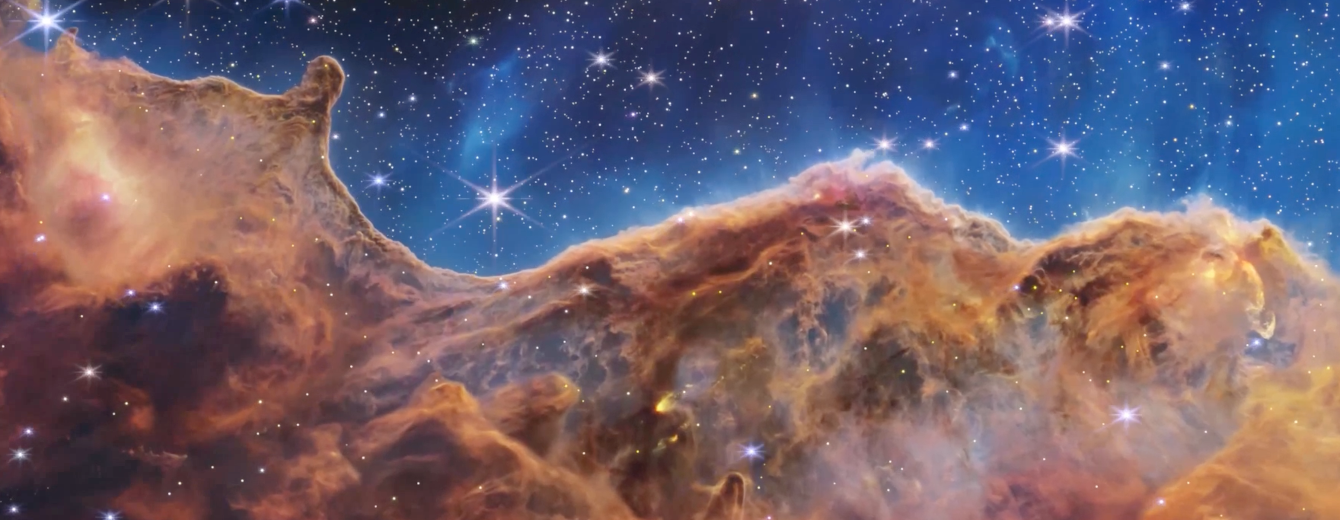
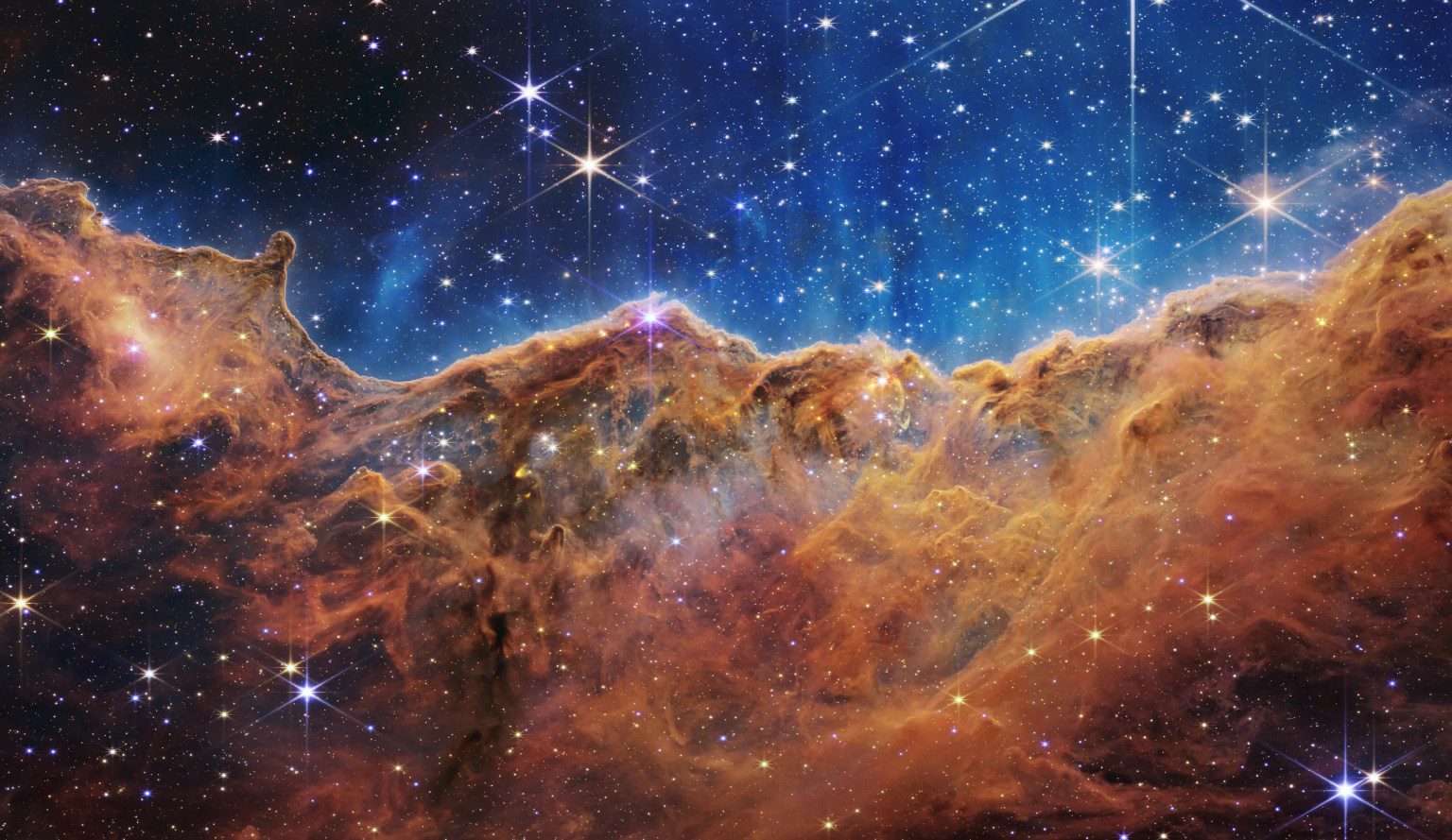
    The image is divided horizontally by an undulating line between a brown cloudscape forming a nebula along the bottom and a comparatively clear upper portion in blue. Speckled across both portions is a starfield, showing innumerable stars of many sizes. The upper blue portion has wispy translucent cloud-like streaks rising from the nebula below. The orange and brown cloudy formation in the bottom half varies in density and ranges from translucent to opaque. The nebula contains ridges, peaks, and valleys—an appearance similar to a mountain range. In the bottom left corner, a clearer area free of gas and dust appears black with speckled stars.

    The landscape of “mountains” and “valleys” known as the Cosmic Cliffs is actually a portion of the nebula Gum 31, which contains a young star cluster called NGC 3324. Both Gum 31 and NGC 3324 are part of a vast star-forming region known as the Carina Nebula Complex.

    Credits:
    NASA, ESA, CSA, STScI.

    In July 2022, NASA’s James Webb Space Telescope made its public debut with a series of breathtaking images. Among them was an ethereal landscape nicknamed the Cosmic Cliffs. This glittering realm of star birth is the subject of a new 3D visualization derived from the Webb data. The visualization, created by NASA’s Universe of Learning and titled “Exploring the Cosmic Cliffs in 3D,” breathes new life into an iconic Webb image.

    It is being presented today at a special event hosted by the International Planetarium Society to commemorate the 100th anniversary of the first public planetarium in Munich, Germany.

    The landscape of “mountains” and “valleys” known as the Cosmic Cliffs is actually a portion of the nebula Gum 31, which contains a young star cluster called NGC 3324. Both Gum 31 and NGC 3324 are part of a vast star-forming region known as the Carina Nebula Complex.

    Ultraviolet light and stellar winds from the stars of NGC 3324 have carved a cavernous area within Gum 31. A portion of this giant bubble is seen above the Cosmic Cliffs. (The star cluster itself is outside this field of view.)

    The Cliffs display a misty appearance, with “steam” that seems to rise from the celestial mountains. In actuality, the wisps are hot, ionized gas and dust streaming away from the nebula under an onslaught of relentless ultraviolet radiation.

    Eagle-eyed viewers may also spot particularly bright, yellow streaks and arcs that represent outflows from young, still-forming stars embedded within the Cosmic Cliffs. The latter part of the visualization sequence swoops past a prominent protostellar jet in the upper right of the image.

    Video: Exploring the Cosmic Cliffs in 3D

    In July 2022, NASA’s James Webb Space Telescope made history, revealing a breathtaking view of a region now nicknamed the Cosmic Cliffs.

    This glittering landscape, captured in incredible detail, is part of the nebula Gum 31 — a small piece of the vast Carina Nebula Complex — where stars are born amid clouds of gas and dust.

    This visualization brings Webb’s iconic image to life — helping us imagine the true, three-dimensional structure of the universe… and our place within it.

    Produced for NASA by the Space Telescope Science Institute (STScI) with partners at Caltech/IPAC, and developed by the AstroViz Project of NASA’s Universe of Learning, this visualization is part of a longer, narrated video that provides broad audiences, including youth, families, and lifelong learners, with a direct connection to the science and scientists of NASA’s Astrophysics missions. That video enables viewers to explore fundamental questions in science, experience how science is done, and discover the universe for themselves.

    “Bringing this amazing Webb image to life helps the public to comprehend the three-dimensional structure inherent in the 2D image, and to develop a better mental model of the universe,” said STScI’s Frank Summers, principal visualization scientist and leader of the AstroViz Project.

    More visualizations and connections between the science of nebulas and learners can be explored through other products produced by NASA’s Universe of Learning including a Carina Nebula Complex resource page and ViewSpace, a video exhibit that is currently running at almost 200 museums and planetariums across the United States. Visitors can go beyond video to explore the images produced by space telescopes with interactive tools now available for museums and planetariums.

    NASA’s Universe of Learning materials are based upon work supported by NASA under award number NNX16AC65A to the Space Telescope Science Institute, working in partnership with Caltech/IPAC, Center for Astrophysics | Harvard & Smithsonian, and NASA’s Jet Propulsion Laboratory.

    The James Webb Space Telescope is the world’s premier space science observatory. Webb is solving mysteries in our solar system, looking beyond to distant worlds around other stars, and probing the mysterious structures and origins of our universe and our place in it. Webb is an international program led by NASA with its partners, ESA (European Space Agency) and CSA (Canadian Space Agency).

    NASA’s Universe of Learning is part of the NASA Science Activation program, from the Science Mission Directorate at NASA Headquarters. The Science Activation program connects NASA science experts, real content and experiences, and community leaders in a way that activates minds and promotes deeper understanding of our world and beyond. Using its direct connection to the science and the experts behind the science, NASA’s Universe of Learning provides resources and experiences that enable youth, families, and lifelong learners to explore fundamental questions in science, experience how science is done, and discover the universe for themselves.

    To learn more about Webb, visit:

    https://science.nasa.gov/webb

    Downloads

    View/Download all image products at all resolutions for this article from the Space Telescope Science Institute.

    Media Contacts

    Laura Betz – laura.e.betz@nasa.gov
    NASA’s Goddard Space Flight Center, Greenbelt, Md.

    Christine Pulliamcpulliam@stsci.edu
    Space Telescope Science Institute, Baltimore, Md.

    Explore more: Carina Nebula Complex from NASA’s Universe of Learning

    Read more: Webb’s view of the Cosmic Cliffs

    Listen: Carina Nebula sonification

    Read more: Webb’s star formation discoveries

    More Webb News

    More Webb Images

    Webb Science Themes

    Webb Mission Page

    What is the Webb Telescope?

    SpacePlace for Kids

    En Español

    Ciencia de la NASA

    NASA en español 

    Space Place para niños

  • NASA Statement on Appointment of New JPL Director

    Dave Gallagher will become the director of NASA’s Jet Propulsion Laboratory in Southern California on Sunday, June 1.
    Dave Gallagher will become the director of NASA’s Jet Propulsion Laboratory in Southern California on Monday, June 2.
    Credit: NASA/JPL-Caltech

    The following is a statement from acting NASA Administrator Janet Petro on the appointment of David Gallagher as director of the agency’s Jet Propulsion Laboratory (JPL) in Southern California. NASA JPL announced Wednesday Laurie Leshin would step down effective Sunday, June 1.

    “Laurie Leshin’s leadership at JPL has been nothing short of extraordinary. She brought a sharp scientific mind, a strong sense purpose, and a clear vision that helped propel the lab forward during a pivotal time. From groundbreaking missions to remarkable technological milestones, Laurie advanced JPL’s legacy of exploration and innovation. We are grateful for her service and wish her the very best as she continues to inspire in the next phase of her career.

    “I’m equally confident in Dave Gallagher’s ability to lead JPL’s next chapter. He brings decades of experience, a steady hand, and a deep understanding of what makes JPL unique. With Dave at the helm, JPL remains well-positioned to continue delivering for NASA and the nation – pushing the boundaries of science and discovery for the benefit of all.”

    For more information about NASA, visit:

    https://www.nasa.gov

    -end-

    Bethany Stevens / Amber Jacobson
    Headquarters, Washington
    202-358-1600
    bethany.c.stevens@nasa.gov / amber.c.jacobson@nasa.gov 
    Details

    Last Updated

    May 07, 2025

    Editor
    Jennifer M. Dooren

  • Dave Gallagher Named 11th Director of JPL as Laurie Leshin Steps Down

    Dave Gallagher will become the director of NASA’s Jet Propulsion Laboratory in Southern California on Sunday, June 1.
    Dave Gallagher will become the director of NASA’s Jet Propulsion Laboratory in Southern California on Monday, June 2.
    NASA/JPL-Caltech

    Laurie Leshin has decided to step down as director of NASA’s Jet Propulsion Laboratory on Sunday, June 1. David Gallagher, who has been serving as the Lab’s associate director for Strategic Integration, has been selected by Caltech to lead the federally funded research and development center. Caltech manages JPL for NASA.

    A distinguished geochemist, Leshin was named by Caltech to lead the lab in early 2022. Her career has spanned academia and senior positions at NASA. Several NASA missions managed by JPL have launched under her leadership, including EMIT, SWOT, Psyche, PREFIRE, Europa Clipper, and SPHEREx, with the NASA-Indian Earth satellite NISAR set for a June launch. In addition, JPL has advanced the development of NASA’s asteroid-hunting NEO Surveyor mission as well as the trio of CADRE lunar rovers, and it delivered the Coronagraph Instrument, a technology demonstration with NASA’s forthcoming Roman Space Telescope.

    “I am proud of the many things JPL has accomplished over the past three years,” said Leshin. “In addition to the long list of missions that have launched or moved toward launch during that time, we saved Voyager more than once and flew into history on Mars with Ingenuity. We have made more amazing scientific discoveries than I can name, including finding potential ancient Martian biomarkers with Perseverance. And we’ve driven the forefront of technology on Earth and in space. I know those achievements will continue under Dave’s capable leadership.”

    Leshin, who has also served as Caltech vice president, is stepping down for personal reasons and will remain a Bren Professor of Geochemistry and Planetary Science at Caltech.

    “While we respect Laurie’s decision to step away from her leadership position at JPL, we will miss her drive, compassion, and dedication,” Caltech President Thomas Rosenbaum said. “At the same time, we are grateful to Dave Gallagher for his devotion to JPL and his continuing leadership and partnership going forward. Dave’s experience working across multiple government and private sector entities will help secure ongoing support for America’s agenda in space, with JPL continuing to play an essential role.”

    Gallagher will draw on his deep experience at JPL to lead the lab into the future. He arrived at JPL 36 years ago, in 1989, and went on to hold numerous leadership positions. Along with having served as the director and deputy director for Astronomy, Physics, and Space Technology, he was manager of JPL’s Advanced Optical Systems Program Office. An electrical engineer, Gallagher also managed the Spitzer Space Telescope and, among other roles, led the team that built and tested the Wide Field/Planetary Camera 2 (WF/PC-2) — a critical instrument that corrected the spherical aberration on NASA’s Hubble Space Telescope.

    “Laurie has made a significant impact on energizing and focusing the lab, guiding it back on track after the Covid-19 pandemic. I wish her great success in this next chapter of her career, and I look forward to a very smooth transition at the lab,” said Gallagher. “We have exciting opportunities ahead helping to advance our nation’s space agenda and a fantastic team to help realize them.”

    Founded by Caltech faculty and students in 1936, JPL has been managed by Caltech on behalf of NASA since 1958.

    News Media Contacts

    Matthew Segal / Veronica McGregor
    Jet Propulsion Laboratory, Pasadena, Calif.
    818-354-8307 / 818-354-9452
    matthew.j.segal@jpl.nasa.gov / veronica.c.mcgregor@jpl.nasa.gov
  • NASA Expands Youth Engagement With New Scouting America Agreement

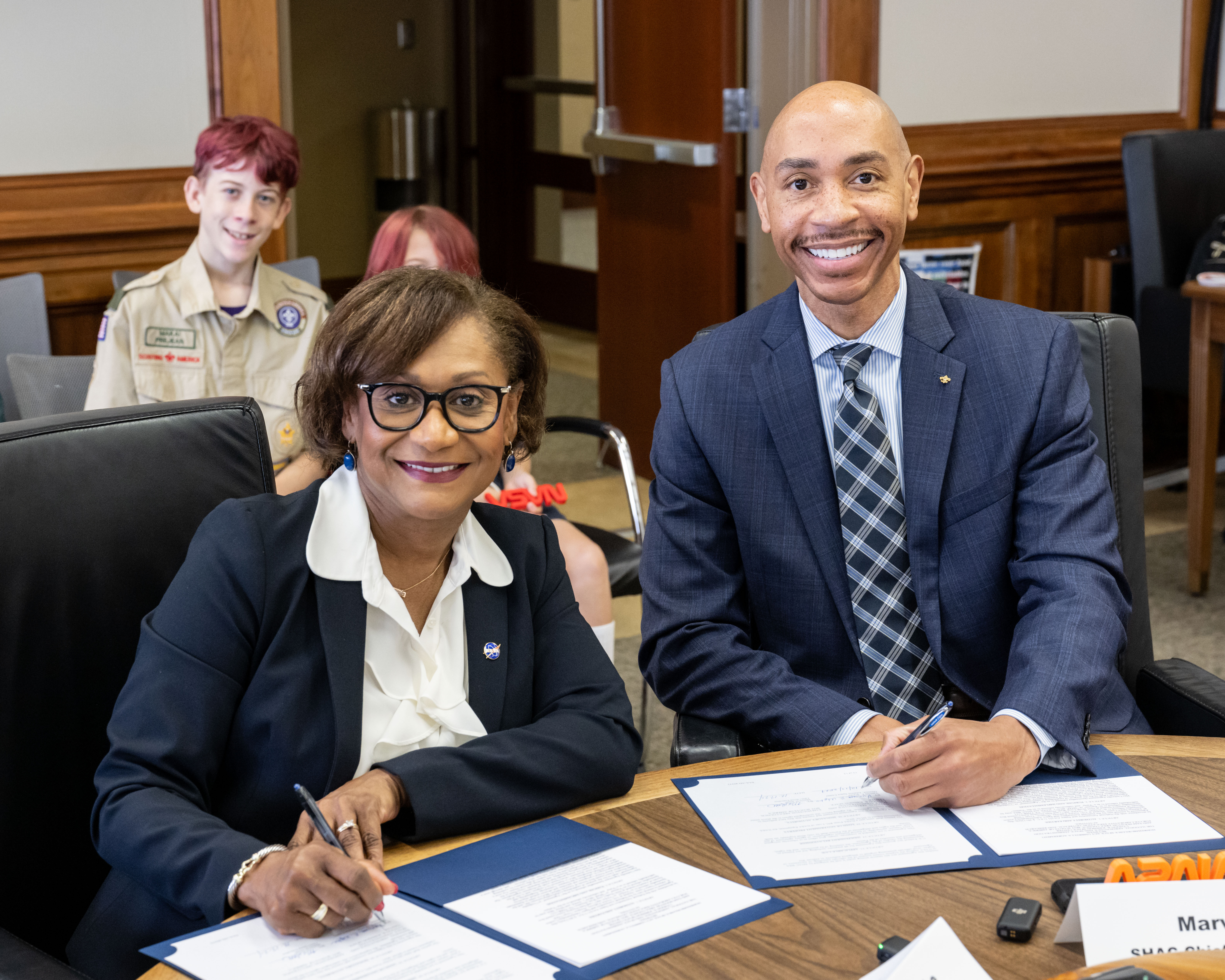
    NASA and the Sam Houston Area Council (SHAC) of Scouting America signed a collaborative Space Act Agreement on December 17, 2024, expanding youth access to programs and opportunities with the Johnson Space Center’s Office of STEM Engagement (OSTEM) in Houston.

    The agreement forges the first formal partnership between NASA OSTEM and Scouting America. It will leverage NASA’s educational outreach programs to enrich scout activities and experiences while providing the agency with new opportunities to engage youth around its mission, vision, and goals.

    NASA Acting Associate Administrator Vanessa Wyche and Sam Houston Area Council of Scouting America Executive Officer Marvin Smith sit at a conference room table, signing a paper document.
    NASA Acting Associate Administrator Vanessa Wyche (left), at the time serving as director of Johnson Space Center, and Sam Houston Area Council of Scouting America Executive Officer Marvin Smith sign a Space Act Agreement on Dec. 17, 2024.
    NASA/James Blair

    “Our ability to explore the unknown and innovate for the benefit of all humanity depends on a highly skilled and competitive STEM workforce,” said NASA Acting Associate Administrator Vanessa Wyche. “Together with SHAC, we can inspire future generations of explorers, scientists, and engineers to help us take the next giant leap toward exciting discoveries.”

    The agreement has already enabled NASA and SHAC to collaborate on a new space-focused summer experience at Camp Strake, the council’s premier camping facility in Southeast Texas. During the weeklong program, scouts will participate in hands-on STEM activities created in partnership with NASA, tour Johnson Space Center, attend robotics and space exploration workshops, and get an in-depth look at NASA’s current projects. SHAC serves approximately 25,000 youth in 16 counties in Southeast Texas.

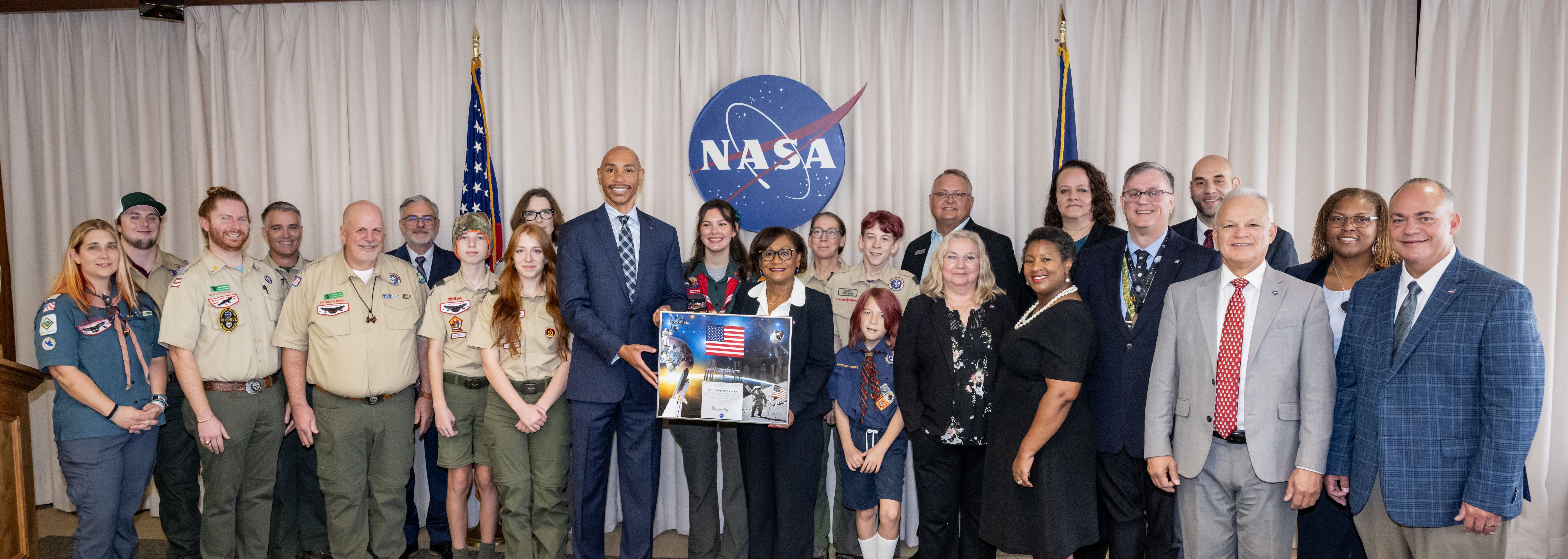
    Johnson Space Center directors present a framed honorarium with a space-flown American flag to Scouting America team members.
    Wyche and Johnson leadership presented Smith and members of local scout troops with an American flag that flew aboard NASA’s SpaceX Crew-8 mission.
    NASA/James Blair

    “NASA and SHAC share common goals of growing youth interest in science, technology, engineering, and math careers, and providing access to programs and experiences that prepare them to enter the STEM workforce,” said Gamaliel Cherry, director of Johnson’s Office of STEM Engagement. “We are excited to connect more students to NASA’s mission, work, and people through this partnership.”

    NASA OSTEM provides opportunities for the next generation of explorers to discover and hone the science, technology, engineering, and math skills needed for the agency’s bold exploration plans.

    For the latest NASA STEM events, news, and activities for students at any grade level, visit:

    https://stem.nasa.gov

  • NASA Live Coverage, Original Content Now Streaming on Prime Video

    NASA+ logo
    Credit: NASA

    NASA’s on-demand streaming service, NASA+, launched a FAST (Free Ad-Supported Television) channel on Prime Video Tuesday, giving viewers another way to watch the agency’s aeronautics, human spaceflight, science, and technology missions unfold on screen.

    As the agency continues to improve life on Earth and inspire new generations through innovation, exploration, and discovery, NASA+ is dedicated to sharing stories through live launch coverage, original documentaries, family-friendly content, and more.

    “Streaming NASA+ on multiple platforms allows the agency to more efficiently share its missions, from launching astronauts to the International Space Station, to going behind the scenes with the team that defends Earth against asteroids, to showcasing new, high-definition images of the cosmos,” said Wes Brown, acting associate administrator for the Office of Communications at NASA Headquarters in Washington. “NASA provides an up-close look at how the agency explores the secrets of the universe for the benefit of all by ensuring content is easily accessible and widely available to the public.”

    In addition to the FAST channel, NASA+ is available to download without a subscription on most major platforms via the NASA App on iOS and Android mobile and tablet devices, as well as streaming media players like Roku, Apple TV, and Fire TV. Users also may stream online at:

    https://plus.nasa.gov

    -end-

    Jennifer Dooren / Jessica Taveau
    Headquarters, Washington
    202-358-1600
    jennifer.m.dooren@nasa.gov / jessica.c.taveau@nasa.gov

    Details

    Last Updated

    May 06, 2025

    Editor
    Jessica Taveau

    Related Terms