Tag: solar system

  • NASA’s IXPE Reveals X-ray-Generating Particles in Black Hole Jets

    5 min read

    Preparations for Next Moonwalk Simulations Underway (and Underwater)

    The blazar BL Lacertae, a supermassive black hole surrounded by a bright disk and jets oriented toward Earth, provided scientists with a unique opportunity to answer a longstanding question: How are X-rays generated in extreme environments like this?

    NASA’s IXPE (Imaging X-ray Polarimetry Explorer) collaborated with radio and optical telescopes to find answers. The results (preprint available here), to be published in the journal Astrophysical Journal Letters, show that interactions between fast-moving electrons and particles of light, called photons, must lead to this X-ray emission. 

    This illustration depicts the central region of a galaxy like BL Lac. The galaxy’s central black hole is surrounded by swirls of orange in various shades representing the disk of material falling in toward the black hole. Two “arms” extend from the lower right and upper left side of the orange disk off the sides. The arms and disk are surrounded by puffy purple clouds of gas and dust. A cone of light starts at the central black hole at a small point and widens out until it spills off the bottom of the image. It is streaked with lines of white, pink and purple. It is surrounded by thin coiled lines in similar colors. All of this is against the backdrop of black speckled with a few white dots.
    This artist’s concept depicts the central region of the blazar BL Lacertae, a supermassive black hole surrounded by a bright disk and a jet oriented toward Earth. The galaxy’s central black hole is surrounded by swirls of orange in various shades representing the accretion disk of material falling toward the black hole. While black holes are known for pulling in material, this accretion process can result in the ejection of jets of electrons at nearly the speed of light. The jet of matter is represented by the cone of light that starts at the center of the black hole and widens out as it reaches the bottom of the image. It is streaked with lines of white, pink and purple which represent helix-shaped magnetic fields. We can observe these jets in many wavelengths of light including radio, optical, and X-ray. NASA’s Imaging X-ray Polarimetry Explorer (IXPE) recently collaborated with radio and optical telescopes to observe this jet and determine how the X-rays are generated in these types of celestial environments.
    NASA/Pablo Garcia

    Scientists had two competing possible explanations for the X-rays, one involving protons and one involving electrons. Each of these mechanisms would have a different signature in the polarization of X-ray light. Polarization is a property of light that describes the average direction of the electromagnetic waves that make up light.

    If the X-rays in a black hole’s jets are highly polarized, that would mean that the X-rays are produced by protons gyrating in the magnetic field of the jet or protons interacting with jet’s photons. If the X-rays have a lower polarization degree, it would suggest that electron-photons interactions lead to X-ray production.  

    IXPE, which launched Dec. 9, 2021, is the only satellite flying today that can make such a polarization measurement. 

    “This was one of the biggest mysteries about supermassive black hole jets” said Iván Agudo, lead author of the study and astronomer at the Instituto de Astrofísica de Andalucía – CSIC in Spain. “And IXPE, with the help of a number of supporting ground-based telescopes, finally provided us with the tools to solve it.”

    Astronomers found that electrons must be the culprits through a process called Compton Scattering. Compton scattering (or the Compton effect) happens when a photon loses or gains energy after interacting with a charged particle, usually an electron. Within jets from supermassive black holes, electrons move near the speed of light. IXPE helped scientists learn that, in the case of a blazar jet, the electrons have enough energy to scatter photons of infrared light up to X-ray wavelengths. 

    BL Lacertae (BL Lac for short) is one of the first blazars ever discovered, originally thought to be a variable star in the Lacerta constellation. IXPE observed BL Lac at the end of November 2023 for seven days along with several ground-based telescopes measuring optical and radio polarization at the same time. While IXPE observed BL Lac in the past, this observation was special. Coincidentally, during the X-ray polarization observations, the optical polarization of BL Lac reached a high number: 47.5%. 

    “This was not only the most polarized BL Lac has been in the past 30 years, this is the most polarized any blazar has ever been observed!” said Ioannis Liodakis, one of the primary authors of the study and astrophysicist at the Institute of Astrophysics – FORTH in Greece. 

    IXPE found the X-rays were far less polarized than the optical light. The team was not able to measure a strong polarization signal and determined that the X-rays cannot be more polarized than 7.6%. This proved that electrons interacting with photons, via the Compton effect, must explain the X-rays. 

    The fact that optical polarization was so much higher than in the X-rays can only be explained by Compton scattering.

    Steven Ehlert

    Steven Ehlert

    Project Scientist for IXPE at Marshall Space Flight Center

    “The fact that optical polarization was so much higher than in the X-rays can only be explained by Compton scattering”, said Steven Ehlert, project scientist for IXPE and astronomer at the Marshall Space Flight Center. 

    “IXPE has managed to solve another black hole mystery” said Enrico Costaastrophysicist in Rome at the Istituto di Astrofísica e Planetologia Spaziali of the Istituto Nazionale di Astrofísica. Costa is one of the scientists who conceived this experiment and proposed it to NASA 10 years ago, under the leadership of Martin Weisskopf, IXPE’s first principal investigator. “IXPE’s polarized X-ray vision has solved several long lasting mysteries, and this is one of the most important. In some other cases, IXPE results have challenged consolidated opinions and opened new enigmas, but this is how science works and, for sure, IXPE is doing very good science.”

    What’s next for the blazar research?

    “One thing we’ll want to do is try to find as many of these as possible,” Ehlert said. “Blazars change quite a bit with time and are full of surprises.”

    More about IXPE

    IXPE, which continues to provide unprecedented data enabling groundbreaking discoveries about celestial objects across the universe, is a joint NASA and Italian Space Agency mission with partners and science collaborators in 12 countries. IXPE is led by NASA’s Marshall Space Flight Center in Huntsville, Alabama. BAE Systems, Inc., headquartered in Falls Church, Virginia, manages spacecraft operations together with the University of Colorado’s Laboratory for Atmospheric and Space Physics in Boulder. Learn more about IXPE’s ongoing mission here:

    https://www.nasa.gov/ixpe

    Elizabeth Landau
    NASA Headquarters
    elizabeth.r.landau@nasa.gov
    202-358-0845

    Lane Figueroa
    Marshall Space Flight Center, Huntsville, Ala.
    lane.e.figueroa@nasa.gov
    256.544.0034 

    Details

    Last Updated

    May 06, 2025

    Editor
    Beth Ridgeway
    Contact
    Elizabeth R. Landau

  • NASA Progresses Toward Crewed Moon Mission with Spacecraft, Rocket Milestones

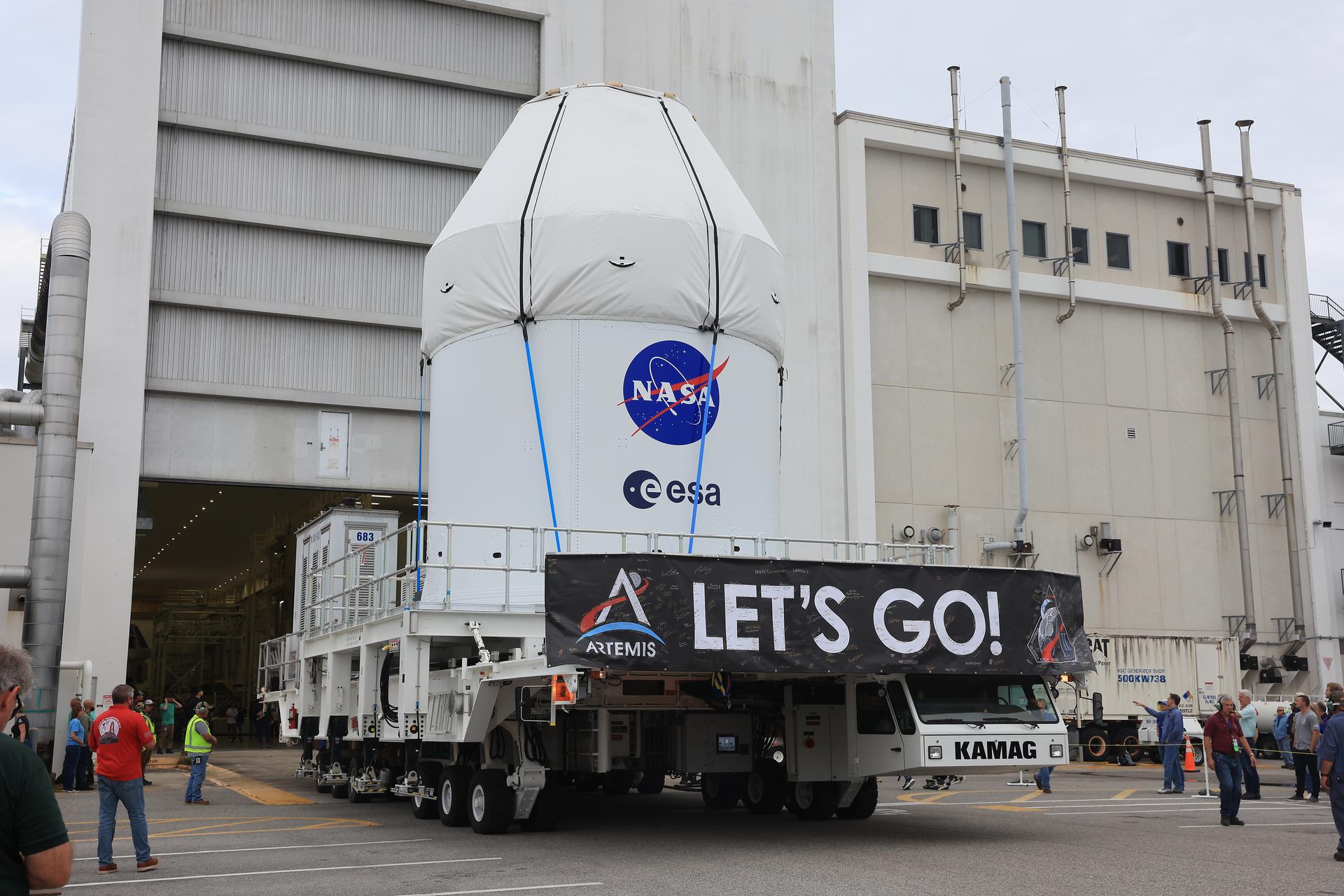
    Technicians move the Orion spacecraft for NASA’s Artemis II test flight out of the Neil A. Armstrong Operations and Checkout Building to the Multi-Payload Processing Facility at Kennedy Space Center in Florida on Saturday, May 3, 2025.
    NASA/Kim Shiflett

    Engineers, technicians, mission planners, and the four astronauts set to fly around the Moon next year on Artemis II, NASA’s first crewed Artemis mission, are rapidly progressing toward launch.

    At the agency’s Kennedy Space Center in Florida, teams are working around the clock to move into integration and final testing of all SLS (Space Launch System) and Orion spacecraft elements. Recently they completed two key milestones – connecting the SLS upper stage with the rest of the assembled rocket and moving Orion from its assembly facility to be fueled for flight.

    “We’re extremely focused on preparing for Artemis II, and the mission is nearly here,” said Lakiesha Hawkins, assistant deputy associate administrator for NASA’s Moon to Mars Program, who also will chair the mission management team during Artemis II. “This crewed test flight, which will send four humans around the Moon, will inform our future missions to the Moon and Mars.”

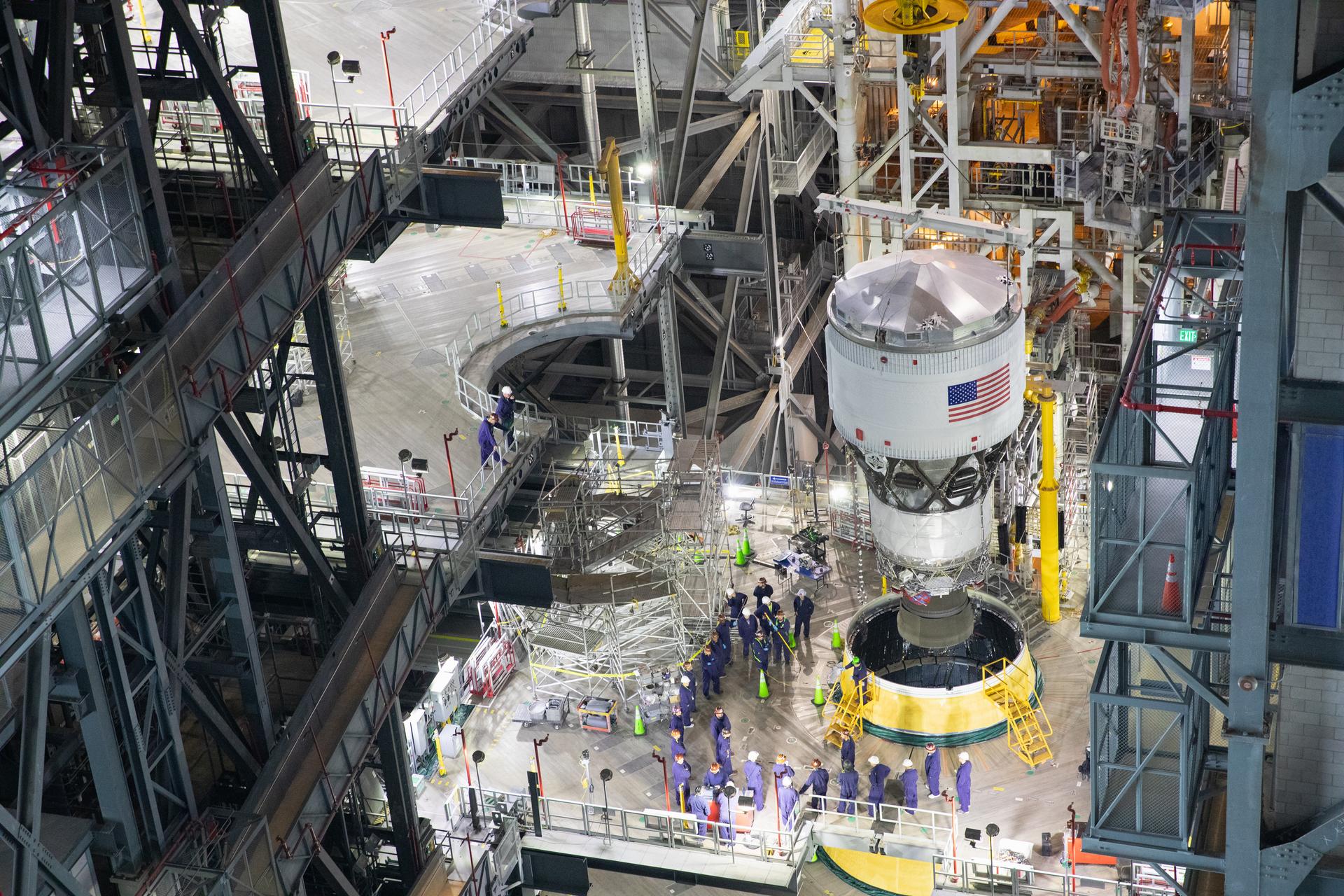
    Teams with NASA’s Exploration Ground Systems Program begin integrating the interim cryogenic propulsion stage to the SLS (Space Launch System) launch vehicle stage adapter on Wednesday, April 30, 2025, inside the Vehicle Assembly Building at NASA’s Kennedy Space Center in Florida.
    NASA/Isaac Watson

    On May 1, technicians successfully attached the interim cryogenic propulsion stage to the SLS rocket elements already poised atop mobile launcher 1, including its twin solid rocket boosters and core stage, inside the spaceport’s Vehicle Assembly Building (VAB). This portion of the rocket produces 24,750 pounds of thrust for Orion after the rest of the rocket has completed its job. Teams soon will move into a series of integrated tests to ensure all the rocket’s elements are communicating with each other and the Launch Control Center as expected. The tests include verifying interfaces and ensuring SLS systems work properly with the ground systems.

    Meanwhile, on May 3, Orion left its metaphorical nest, the Neil Armstrong Operations & Checkout Facility at Kennedy, where it was assembled and underwent initial testing. There the crew module was outfitted with thousands of parts including critical life support systems for flight and integrated with the service module and crew module adapter. Its next stop on the road to the launch pad is the Multi-Payload Processing Facility, where it will be carefully fueled with propellants, high pressure gases, coolant, and other fluids the spacecraft and its crew need to maneuver in space and carry out the mission.

    After fueling is complete, the four astronauts flying on the mission around the Moon and back over the course of approximately 10 days, will board the spacecraft in their Orion Crew Survival System spacesuits to test all the equipment interfaces they will need to operate during the mission. This will mark the first time NASA’s Reid Wiseman, Victor Glover, and Christina Koch, and CSA (Canadian Space Agency) astronaut Jeremy Hansen, will board their actual spacecraft while wearing their spacesuits. After the crewed testing is complete, technicians will move Orion to Kennedy’s Launch Abort System Facility, where the critical escape system will be added. From there, Orion will move to the VAB to be integrated with the fully assembled rocket.

    NASA also announced its second agreement with an international space agency to fly a CubeSat on the mission. The collaborations provide opportunities for other countries to work alongside NASA to integrate and fly technology and experiments as part of the agency’s Artemis campaign.

    While engineers at Kennedy integrate and test hardware with their eyes on final preparations for the mission, teams responsible for launching and flying the mission have been busy preparing for a variety of scenarios they could face.

    The launch team at Kennedy has completed more than 30 simulations across cryogenic propellant loading and terminal countdown scenarios. The crew has been taking part in simulations for mission scenarios, including with teams in mission control. In April, the crew and the flight control team at NASA’s Johnson Space Center in Houston simulated liftoff through a planned manual piloting test together for the first time. The crew also recently conducted long-duration fit checks for their spacesuits and seats, practicing several operations while under various suit pressures.

    NASA astronaut Christina Koch participates in a fit check April 18, 2025, in the spacesuit she will wear during Artemis II.
    NASA/Josh Valcarcel

    Teams are heading into a busy summer of mission preparations. While hardware checkouts and integration continue, in coming months the crew, flight controllers, and launch controllers will begin practicing their roles in the mission together as part of integrated simulations. In May, the crew will begin participating pre-launch operations and training for emergency scenarios during launch operations at Kennedy and observe a simulation by the launch control team of the terminal countdown portion of launch. In June, recovery teams will rehearse procedures they would use in the case of a pad or ascent abort off the coast of Florida, with launch and flight control teams supporting. The mission management team, responsible for reviewing mission status and risk assessments for issues that arise and making decisions about them, also will begin practicing their roles in simulations. Later this summer, the Orion stage adapter will arrive at the VAB from NASA’s Marshall Spaceflight Center in Huntsville, Alabama, and stacked on top of the rocket.

    NASA astronauts Reid Wiseman (foreground) and Victor Glover participate in a simulation of their Artemis II entry profile on March 13, 2025.
    NASA/Bill Stafford

    Through Artemis, NASA will send astronauts to explore the Moon for scientific discovery, economic benefits, and build the foundation for the first crewed missions to Mars.

  • SPHEREx Starts Scanning Entire Sky

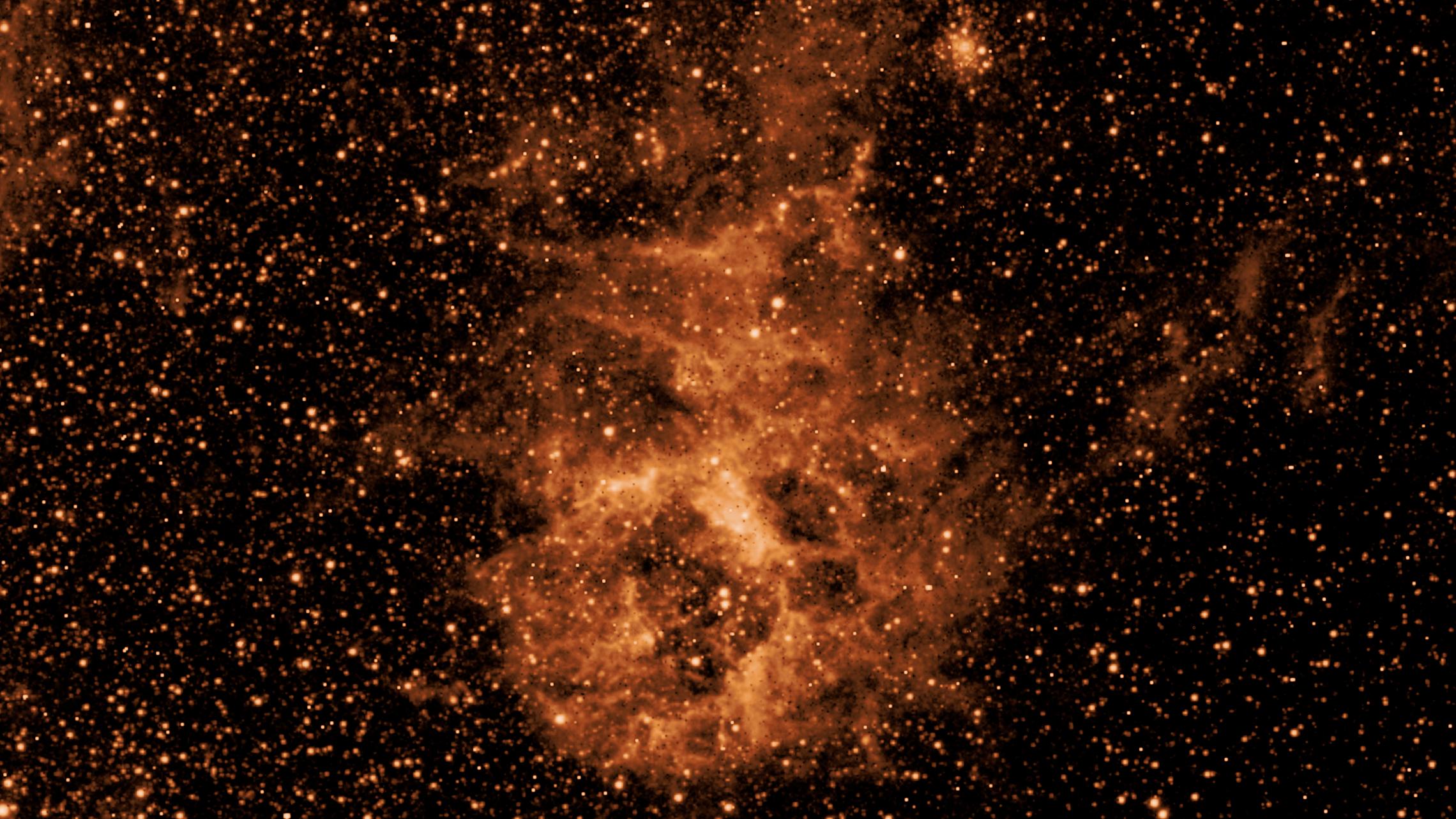
    Infrared image showing a field of copper stars with a distinct smoke-like cloud at the center.
    NASA/JPL-Caltech

    A soot-like cloud is revealed in a section of the sky in this May 1, 2025, image from NASA’S SPHEREx space observatory. On May 1, SPHEREx began regular science operations, which consist of taking about 3,600 images per day for the next two years to provide new insights about the origins of the universe, galaxies, and the ingredients for life in the Milky Way. The observatory won’t be the first to map the entire sky, but it will be the first to do so in so many colors. It observes 102 wavelengths, or colors, of infrared light, which are undetectable to the human eye.

    When SPHEREx takes a picture of the sky, the light is sent to six detectors that each produces a unique image capturing different wavelengths of light. These groups of six images are called an exposure, and SPHEREx takes about 600 exposures per day. When it’s done with one exposure, the whole observatory shifts position — the mirrors and detectors don’t move as they do on some other telescopes.

    Read more about SPHEREx and the images it will capture.

    Image credit: NASA/JPL-Caltech

  • NASA’s NICER Maps Debris From Recurring Cosmic Crashes

    5 min read

    NASA’s NICER Maps Debris From Recurring Cosmic Crashes

    Lee esta nota de prensa en español aquí.

    For the first time, astronomers have probed the physical environment of repeating X-ray outbursts near monster black holes thanks to data from NASA’s NICER (Neutron star Interior Composition Explorer) and other missions.

    Scientists have only recently encountered this class of X-ray flares, called QPEs, or quasi-periodic eruptions. A system astronomers have nicknamed Ansky is the eighth QPE source discovered, and it produces the most energetic outbursts seen to date. Ansky also sets records in terms of timing and duration, with eruptions every 4.5 days or so that last approximately 1.5 days.

    “These QPEs are mysterious and intensely interesting phenomena,” said Joheen Chakraborty, a graduate student at the Massachusetts Institute of Technology in Cambridge. “One of the most intriguing aspects is their quasi-periodic nature. We’re still developing the methodologies and frameworks we need to understand what causes QPEs, and Ansky’s unusual properties are helping us improve those tools.”

    Watch how astronomers used data from NASA’s NICER (Neutron star Interior Composition Explorer) to study a mysterious cosmic phenomenon called a quasi-periodic eruption, or QPE.
    NASA’s Goddard Space Flight Center

    Ansky’s name comes from ZTF19acnskyy, the moniker of a visible-light outburst seen in 2019. It was located in a galaxy about 300 million light-years away in the constellation Virgo. This event was the first indication that something unusual might be happening.

    A paper about Ansky, led by Chakraborty, was published Tuesday in The Astrophysical Journal.

    A leading theory suggests that QPEs occur in systems where a relatively low-mass object passes through the disk of gas surrounding a supermassive black hole that holds hundreds of thousands to billions of times the Sun’s mass.

    When the lower-mass object punches through the disk, its passage drives out expanding clouds of hot gas that we observe as QPEs in X-rays.

    Scientists think the eruptions’ quasi-periodicity occurs because the smaller object’s orbit is not perfectly circular and spirals toward the black hole over time. Also, the extreme gravity close to the black hole warps the fabric of space-time, altering the object’s orbits so they don’t close on themselves with each cycle. Scientists’ current understanding suggests the eruptions repeat until the disk disappears or the orbiting object disintegrates, which may take up to a few years.

    A snapshot of an all-sky survey.
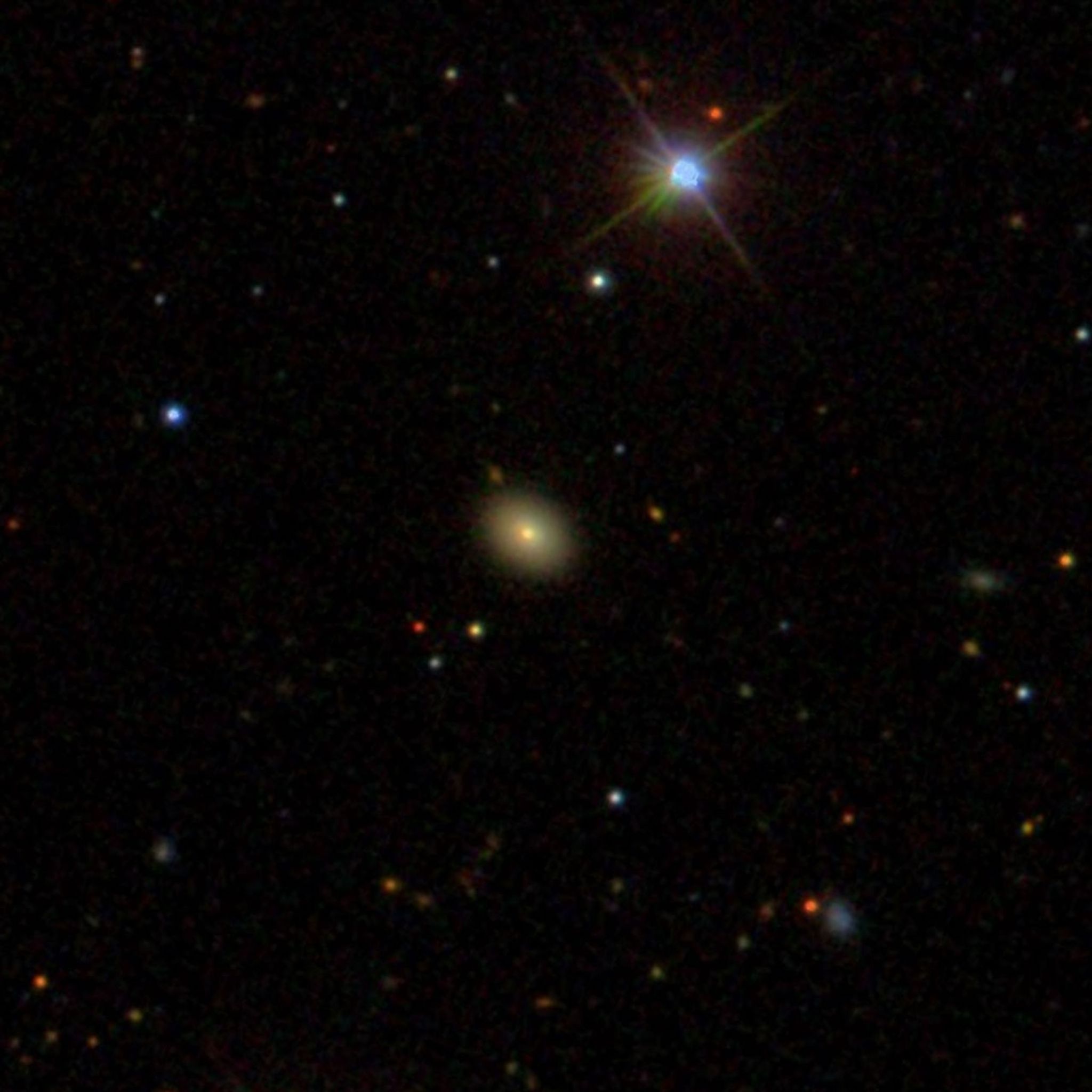
    A system astronomers call Ansky, in the galaxy at the center of this image, is home to a recently discovered series of quasi-periodic eruptions.
    Sloan Digital Sky Survey

    “Ansky’s extreme properties may be due to the nature of the disk around its supermassive black hole,” said Lorena Hernández-García, an astrophysicist at the Millennium Nucleus on Transversal Research and Technology to Explore Supermassive Black Holes, the Millennium Institute of Astrophysics, and University of Valparaíso in Chile. “In most QPE systems the supermassive black hole likely shreds a passing star, creating a small disk very close to itself. In Ansky’s case, we think the disk is much larger and can involve objects farther away, creating the longer timescales we observe.”

    Hernández-García, in addition to being a co-author on Chakraborty’s paper, led the study that discovered Ansky’s QPEs, which was published in April in Nature Astronomy and used data from NICER, NASA’s Neil Gehrels Swift Observatory and Chandra X-ray Observatory, as well as ESA’s (European Space Agency’s) XMM-Newton space telescope.

    NICER’s position on the International Space Station allowed it to observe Ansky about 16 times every day from May to July 2024. The frequency of the observations was critical in detecting the X-ray fluctuations that revealed Ansky produces QPEs.

    Chakraborty’s team used data from NICER and XMM-Newton to map the rapid evolution of the ejected material driving the observed QPEs in unprecedented detail by studying variations in X-ray intensity during the rise and fall of each eruption.

    The researchers found that each impact resulted in about a Jupiter’s worth of mass reaching expansion velocities around 15% of the speed of light.

    An astronaut takes a selfie with a telescope
    The NICER (Neutron star Interior Composition Explorer) X-ray telescope is reflected on NASA astronaut and Expedition 72 flight engineer Nick Hague’s spacesuit helmet visor in this high-flying “space-selfie” taken during a spacewalk on Jan. 16, 2025.
    NASA/Nick Hague

    The NICER telescope’s ability to frequently observe Ansky from the space station and its unique measurement capabilities also made it possible for the team to measure the size and temperature of the roughly spherical bubble of debris as it expanded.

    “All NICER’s Ansky observations used in these papers were collected after the instrument experienced a ‘light leak’ in May 2023,” said Zaven Arzoumanian, the mission’s science lead at NASA’s Goddard Space Flight Center in Greenbelt, Maryland. “Even though the leak – which was patched in January – affected the telescope’s observing strategy, NICER was still able to make vital contributions to time domain astronomy, or the study of changes in the cosmos on timescales we can see.”

    After the repair, NICER continued observing Ansky to explore how the outbursts have evolved over time. A paper about these results, led by Hernández-García and co-authored by Chakraborty, is under review.

    Observational studies of QPEs like Chakraborty’s will also play a key role in preparing the science community for a new era of multimessenger astronomy, which combines measurements using light, elementary particles, and space-time ripples called gravitational waves to better understand objects and events in the universe.

    One goal of ESA’s future LISA (Laser Interferometer Space Antenna) mission, in which NASA is a partner, is to study extreme mass-ratio inspirals — or systems where a low-mass object orbits a much more massive one, like Ansky. These systems should emit gravitational waves that are not observable with current facilities. Electromagnetic studies of QPEs will help improve models of those systems ahead of LISA’s anticipated launch in the mid-2030s.

    “We’re going to keep observing Ansky for as long as we can,” Chakraborty said. “We’re still in the infancy of understanding QPEs. It’s such an exciting time because there’s so much to learn.”

    By Jeanette Kazmierczak
    NASA’s Goddard Space Flight Center, Greenbelt, Md.

    Media Contact:
    Claire Andreoli
    301-286-1940
    claire.andreoli@nasa.gov
    NASA’s Goddard Space Flight Center, Greenbelt, Md.

  • Nilufar Ramji: Shaping Johnson’s Giant Leaps Forward 

    A first-generation college graduate, Nilufar Ramji was blazing trails long before arriving at NASA. With her multifaceted expertise, she is helping shape the messaging behind humanity’s return to the Moon, Mars, and beyond. 

    Ramji is currently on detail as the co-executive producer for NASA’s live broadcasts, ensuring the agency’s missions and discoveries are clearly and effectively communicated to the public. Through her work, she expands understanding of what space exploration means for all—and why it matters. 

    A portrait of a woman dressed in a white blazer and shirt. She is in front of the U.S. flag (left) and NASA flag (right).
    Official portrait of Nilufar Ramji.
    NASA/Josh Valcarcel

    Before stepping into her acting role, Ramji served as the lead public affairs officer for Moon to Mars activities at NASA’s Johnson Space Center in Houston. She spearheaded communication strategies for the Commercial Lunar Payload Services initiative, which works with private companies to deliver science and technology payloads to the lunar surface. She has also provided live commentary for International Space Station operations to learn and prepare for Artemis missions.  

    Ramji played a pivotal role in communicating NASA’s involvement in two major lunar missions in 2025 including Firefly Aerospace’s Blue Ghost Mission 1 which successfully delivered 10 NASA payloads to the Moon’s Mare Crisium on March 2. Ramji served as the live mission commentator, helping audiences around the world follow the historic moment—from lunar orbit insertion to touchdown. She also led communications for Intuitive Machines’ IM-2 mission, which landed near the Moon’s South Pole on March 6, marking the southernmost lunar landing ever achieved. 

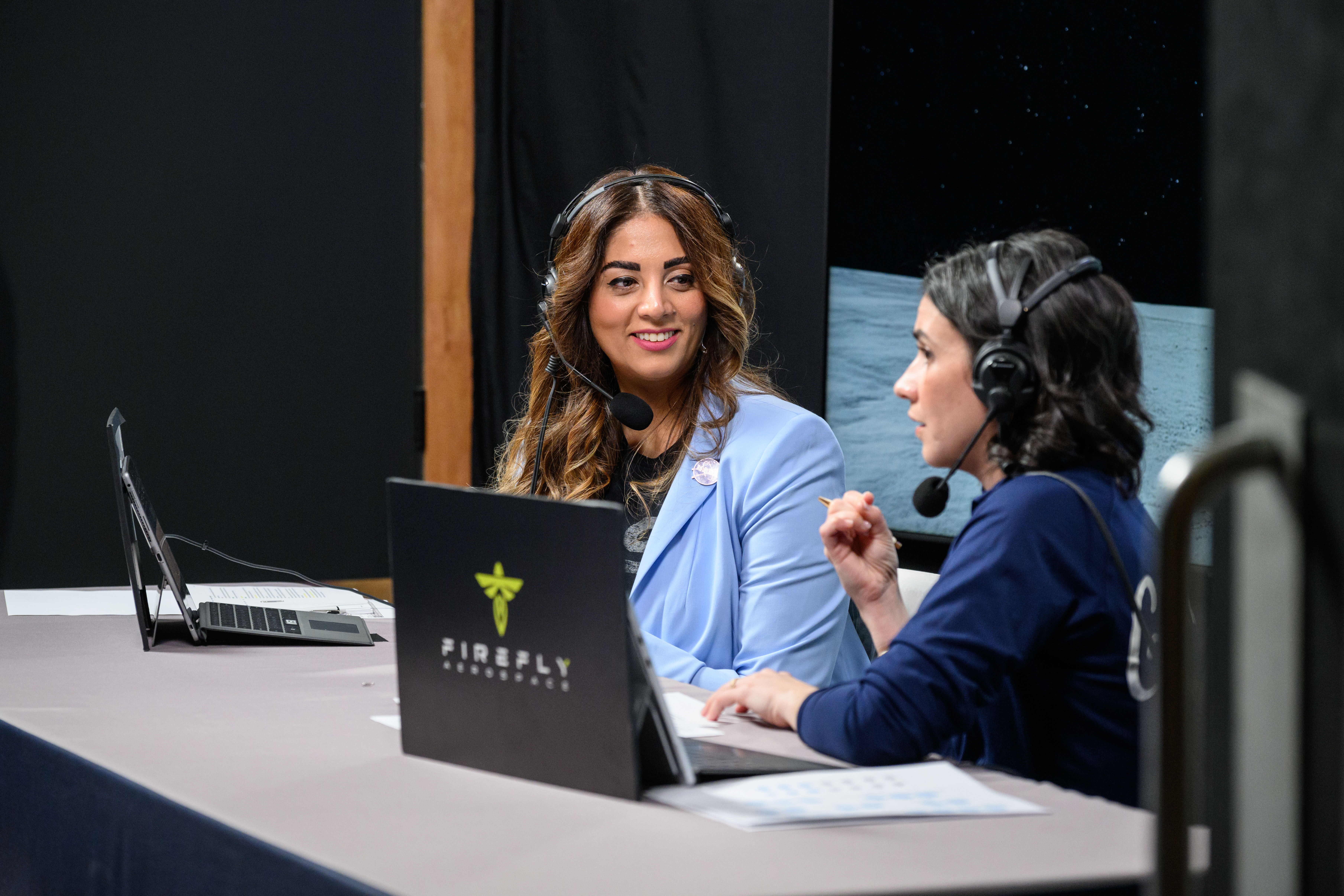
    Two women with headsets on converse during a live broadcast.
    Nilufar Ramji, left, and Brigette Oakes, vice president of engineering at Firefly Aerospace, in the company’s mission operations center in Cedar Park, Texas, during the Blue Ghost Mission 1 lunar landing.
    NASA/Helen Arase Vargas

    Early in her NASA career, she led agencywide STEM communications, shaping how NASA connects with students and educators. As a lead strategist, she developed messaging that made science and technology more accessible to younger audiences—helping inspire the Artemis Generation. 

    “Being one of the storytellers behind humanity’s return to the Moon is something I take pride in,” she said. “People don’t realize what exploring our solar system has done for us here on Earth. Going to the Moon and onto Mars will bring that message home.” 

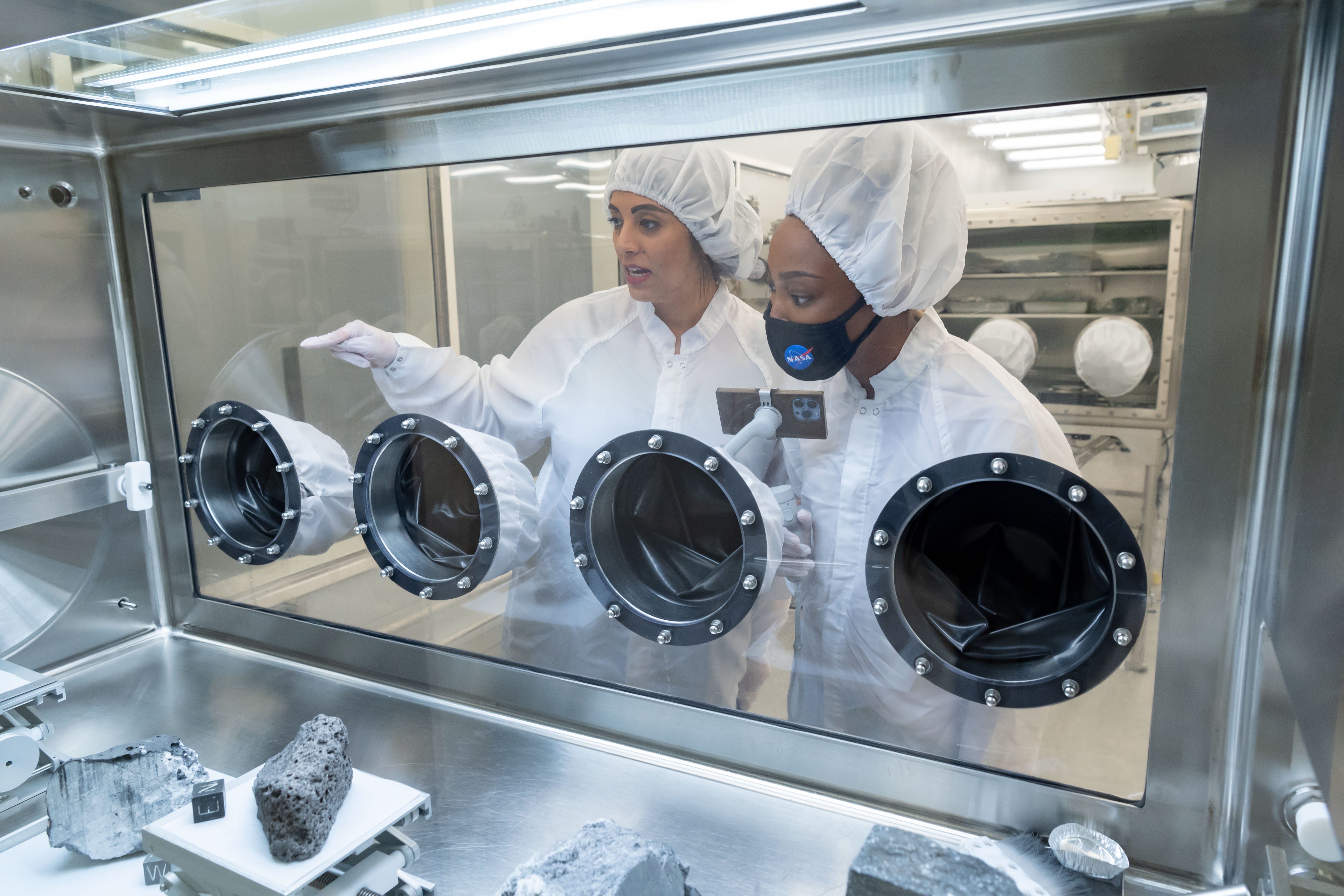
    Nilufar Ramji, left, and Aliyah Craddock, digital media lead for NASA Science in the Science Mission Directorate, in the Astromaterials Research and Exploration Science laboratory at NASA’s Johnson Space Center in Houston.
    NASA

    Ramji communicates not just the science of space, but its greater significance. “How can we be thoughtful in our communications?” is a question that drives her approach. Whether guiding a live broadcast or developing messaging about lunar science, she is constantly evaluating, executing, and refining NASA’s voice. 

    She also understands the importance of commercial partnerships in expanding human presence in space. “It’s exciting to see how many different people and organizations come together to make this a reality,” she said. “By creating a larger space economy, we’re able to do things faster and cheaper and still accomplish the same goals to make sure we’re all successful.” 

    Nilufar Ramji presents a TedX Talk, “Storytelling from Space” in Sugar Land, Texas.

    In Aug. 2023, Ramji delivered a TEDx Talk, “Storytelling from Space” in Sugar Land, Texas, where she emphasized the power of narrative to inspire and unite humanity in the quest to explore the universe. Drawing from her NASA experience, she illustrated how communication bridges the gap between complex science and public engagement. 

    She credits her mentors and colleagues for supporting her growth. “I have great mentors and people I can lean on if I need help,” she said. “It’s something I didn’t realize I had until I came to NASA.” 

    Ramji believes stepping outside your comfort zone is essential. “Discomfort brings new learning, understanding, and opportunities, so I like being uncomfortable at times,” she said. “I’m open and receptive to feedback. Constructive criticism has helped me grow and evolve—and better understand NASA’s mission.” 

    For her, balance means creating intentional space for reflection, growth, and meaningful connection. 

    A woman dressed in a light brown suit smiles and stands at a podium during an event.
    Nilufar Ramji gives remarks during Johnson’s building naming ceremony of the “Dorothy Vaughan Center in Honor of the Women of Apollo” on July 19, 2024.
    NASA/Robert Markowitz 

    Before joining NASA, Ramji had already built an international career rooted in service. She worked at the Aga Khan Foundation in Canada, a nonprofit organization focused on addressing challenges in underdeveloped communities through education and healthcare. 

    She led visitor programs, workshops and more than 250 events—often for diplomats and global leaders—to promote “quiet diplomacy” and dialogue. 

    “Transparency, quality, fairness and diversity of perspective are all important to me,” she said. “People come from different experiences that broaden our understanding.” 

    Ramji later moved to East Africa as the foundation’s sole communications representative across Kenya, Tanzania, and Uganda. There, she trained more than 300 staff and built a communications strategy to help local teams share stories of impact—both successes and challenges—with honesty and empathy. 

    Her work left a lasting mark on the communities she served and underscored the power of communication to drive positive change. 

    A woman sits outside dressed in a white t-shirt and takes notes on her lap. To her right is a man watchi
    Nilufar Ramji captures the story of a sesame farmer in Mtwara, Tanzania, whose livelihood improved through a rural development program initiated by the Aga Khan Foundation.

    In 2013, Ramji moved to the United States and started over, rebuilding her network and career. She worked for the Aga Khan Council for USA in Houston, leading a volunteer recruitment program that connected thousands of people with roles suited to their skills. 

    She later applied for a contractor position—not knowing it was with NASA. “I never thought my skills or expertise would be valued at a place like NASA,” she said. But in 2018, she accepted a role as a public relations specialist supporting International Space Station outreach. She has been shaping the agency’s storytelling ever since.  

    Ramji’s journey represents NASA’s commitment to pushing boundaries and expanding humanity’s knowledge of the universe. With collaboration, transparency, and vision, she is helping bring the next frontier of space exploration to life. 

  • Sols 4529-4531: Honeycombs and Waffles… on Mars!

    4 min read

    Sols 4529-4531: Honeycombs and Waffles… on Mars!

    An extreme wide-angle photo of the Martian surface in front of the Curiosity rover shows extremely rocky, rough terrain, with flat rocks in the foreground showing apparent honeycomb-shaped patterns on their exposed faces, and a larger rock at the center of the image, looking like an offset stack of waffles. Portions of the rover are visible in each corner of the frame, with two wheels visible, but shadowed, in the lower left and right corners.
    NASA’s Mars rover Curiosity captured this image of its current workspace, containing well-preserved polygonal shaped fractures, with waffle or honeycomb patterns. The rover acquired this image using its Front Hazard Avoidance Camera (Front Hazcam) on May 1, 2025 — Sol 4527, or Martian day 4,527 of the Mars Science Laboratory mission — at 16:41:35 UTC.
    NASA/JPL-Caltech

    Written by Catherine O’Connell-Cooper, Planetary Geologist at University of New Brunswick

    Earth planning date: Friday, May 2, 2025

    From our Wednesday stopping spot, the drive direction ahead (looking along the path we would follow in the Wednesday drive) appeared to be full of rough, gnarly material, which can be tricky targets for contact science instruments like APXS. However, coming into planning this morning, we found a workspace with amazingly well preserved polygonal shaped fractures, with raised ridges (about 1 centimeter, or about 0.39 inches, high), looking like a patchwork of honeycombs, or maybe a patch of waffles. We have spotted these before but usually not as well preserved and extensive as this — we can see these stretching away into the distance for 20-30 meters (about 66-98 feet), almost to the edge of the “boxwork” fracture structures at “Ghost Mountain” butte in this Navcam image. We are all counting down the drives to get to the boxwork structures — this will be such an exciting campaign to be part of.

    As APXS operations planner today, I was really interested to see if we could get APXS close to one of the raised ridges, to determine what they are made of. The Rover Planners were able to get a paired set of targets — “Orosco Ridge” along a ridge and “Box Canyon” in the adjacent, flat center of the polygon. The ChemCam team is also interested (in truth, everyone on the team is interested!!) in the composition of the ridges. So ChemCam will use LIBS to measure both bedrock and ridge fill at “Kitchen Creek” on the first sol of the plan and “Storm Canyon” on the second sol.  

    The “problem” with a workspace like this is picking which images to take in our short time here, before we drive on the second sol. We could stay here for a week and still find things to look at in this workspace. After much discussion, it was decided that MAHLI should focus on a “dog’s eye” mosaic (“Valley of the Moon”) along the vertical face of the large block. We hope this will allow us to examine how the fractures interact with each other, and with the preexisting layering in the bedrock.  

    Mastcam will then focus on the two main blocks in the workspace in an 8×4 (4 rows of 8 images) Kitchen Creek mosaic, which also encompasses the LIBS target of the same name, and a single image on the Storm Canyon LIBS target. Three smaller mosaics at “Green Valley Falls” (3×1), “Lost Palms Canyon” (7×2) and “San Andreas Fault” (1×2) will examine the relationships between the polygonal features and other fractures in the workspace, close to the rover. 

    Further afield, ChemCam will turn the “LD RMI” (Long-Distance Remote Micro Imager) on “Texoli” butte (the large butte to the side of the rover, visible in this image from sol 4528). Both Mastcam and ChemCam will image the boxwork fracture system near Ghost Mountain — they are so close now, it’s just a few drives away! Any information we get now may be able to help us answer some of the questions we have on the origin and timing of the boxwork structures, especially when we can combine it with the in situ analysis we will be getting shortly! (Did I mention how excited we all are about this campaign?)With all the excitement today on the wild fracture structures, it could be easy to overlook Curiosity’s dataset of environmental and atmospheric data. For more than 12 years now, we have been collecting information on dust and argon levels in the atmosphere, water and chlorine levels in the subsurface, wind speeds, humidity, temperature, ultraviolet radiation, pressure, and capturing movies and images of dust devils. This weekend is no different, adding a full complement of activities from almost every team — Navcam, REMS, DAN, Mastcam, ChemCam, and APXS will all collect data for the environmental and atmospheric theme group (ENV) in this plan.

    Details

    Last Updated

    May 06, 2025

    Related Terms

  • Searching for Spherules to Sample

    2 min read

    Searching for Spherules to Sample

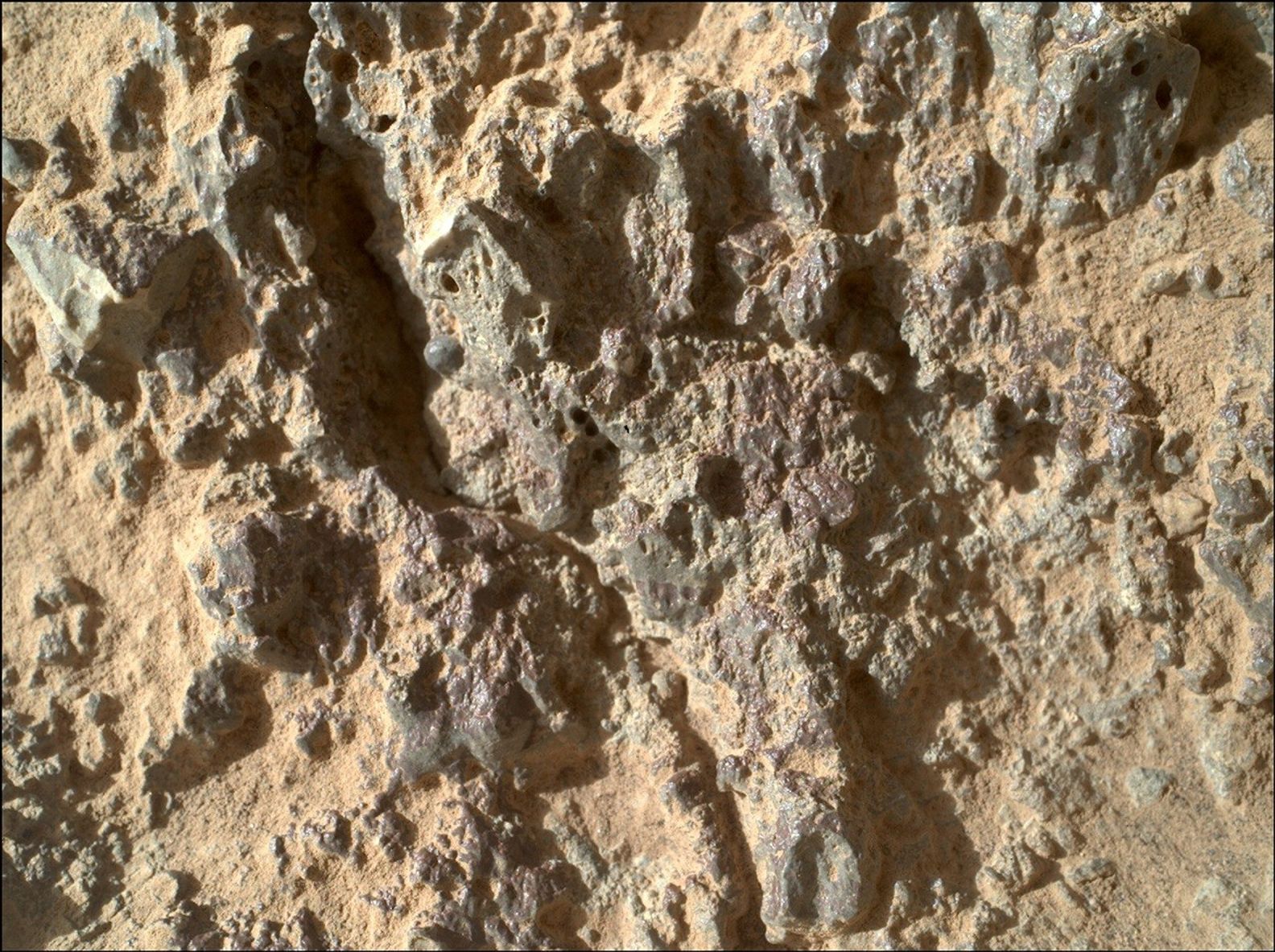
    A color close-up photo of the Martian surface shows a pale yellowish-tan rock, with grooves or lines emanating from a center point like rays, with scattered black spots and small indentations throughout its surface.
    Subsurface spherules: This image of the Hare Bay abrasion patch was acquired by the WATSON camera on Sol 1480 (April 19, 2025), showing dark-colored spherules set in a fine-grained light-toned matrix. These spherules appear to be smaller versions of similar structures that have been found in numerous rocks in the vicinity. Perseverance is currently working to collect a sample of these spherules to return to Earth. WATSON (Wide Angle Topographic Sensor for Operations and eNgineering) is a close-range color camera that works with the rover’s SHERLOC instrument (Scanning Habitable Environments with Raman and Luminescence for Organics and Chemicals); both are located on the turret at the end of the rover’s robotic arm.
    NASA/JPL-Caltech

    Written by Denise Buckner, Postdoctoral Fellow at NASA’s Goddard Space Flight Center 

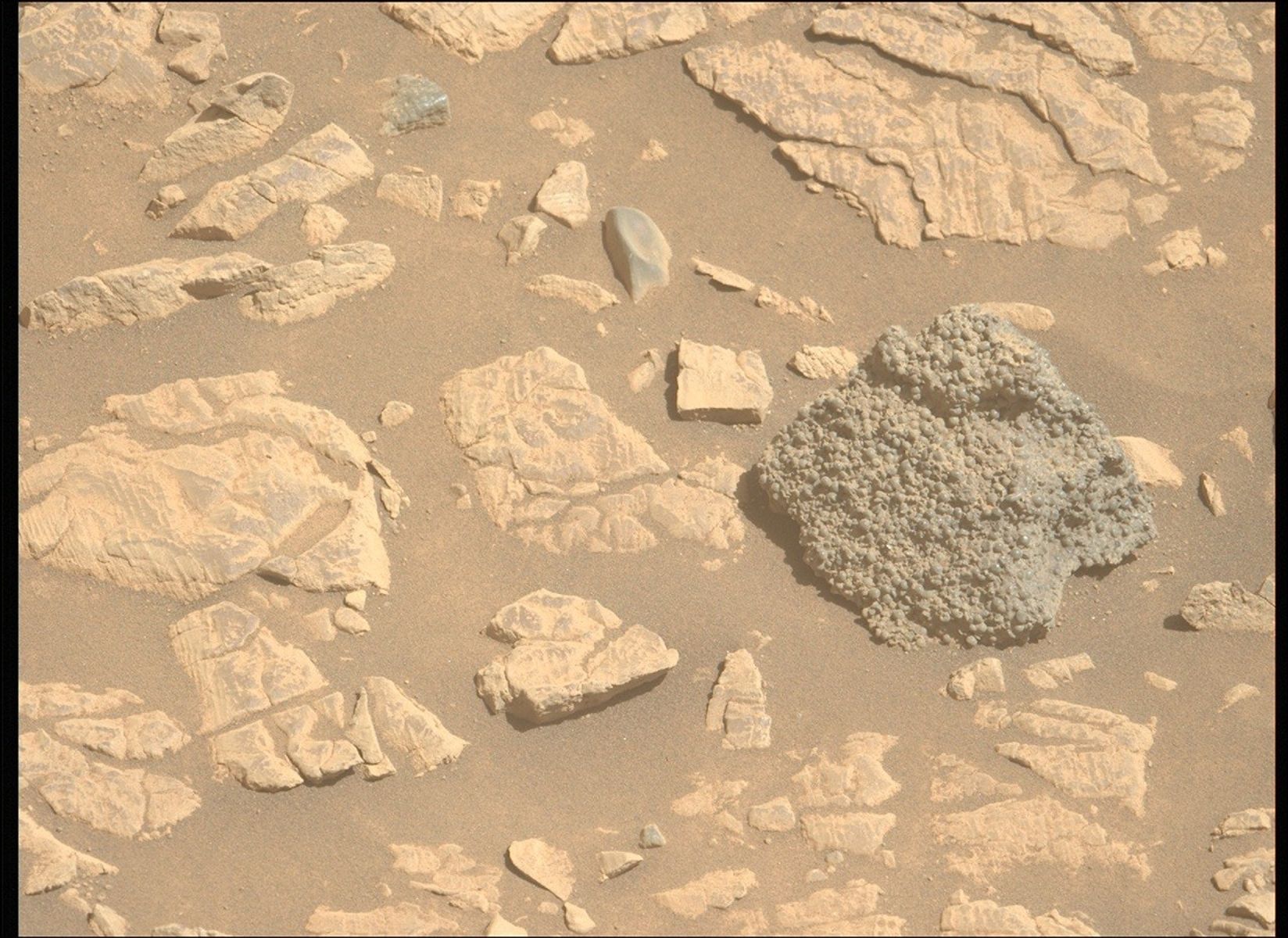
    Over the past few weeks, Perseverance has been investigating some curious spherules peppered across the “Witch Hazel Hill” region along the rim of Jezero crater. A striking cluster of the small bubble-shaped stones were first spotted by the Mastcam-Z instrument on Sol 1442 (March 11, 2025) at “Broom Point,” in a rock named “St. Pauls Bay.” A few sols later, a similar assemblage was discovered by the SuperCam instrument at the “Mattie Mitchell” outcrop near “Puncheon Rock.” As the rover continued along its traverse, spherules continued to appear. At the targets St. Pauls Bay and Mattie Mitchell, the spherules are densely packed and almost look like bunches of grapes. Elsewhere, similar smaller spherules were found intermixed with other grains within the rock. At a target called “Wreck Apple” at the “Sally’s Cove” outcrop, individual spherules were set in a matrix of coarse, dark grains. Even more of these circular features are embedded in finer-grained, layered bedrock at a nearby area called “Dennis Pond.”

    A color photo from the Martian surface shows pale brownish-orange fine soil with several small and medium sized rocks poking above the surface, lighter-toned than the surrounding soil, mostly flat with varied edges and cracks. One exception is a rock that stands out at the middle right of the image, dark gray and slightly larger than everything else around, vaguely diamond-shaped — from the viewer’s vantage point — and covered everywhere on its surface in tiny bumps.
    Spherules at St. Pauls Bay: NASA’s Mars Perseverance rover acquired this image, a striking cluster of spherules, on March 11, 2025 – Sol 1442, or Martian day 1,442 of the Mars 2020 mission – at the local mean solar time of 11:12:40. Perseverance used its Left Mastcam-Z camera; Mastcam-Z is a pair of cameras located high on the rover’s mast.
    NASA/JPL-Caltech/ASU
    A close-up of jagged, bumpy, grayish-orange rocks on the Martian surface. In several spots the rocks are pockmarked, or have bubble-like protrusions.
    Spherules at Wreck Apple: NASA’s Mars Perseverance rover found smaller spherules in a coarse-grained matrix. The rover captured this image using the WATSON camera on March 27, 2025 – Sol 1458, or Martian day 1,458 of the Mars 2020 mission – at the local mean solar time of 15:36:04. WATSON (Wide Angle Topographic Sensor for Operations and eNgineering) is a close-range color camera located on the turret at the end of the rover’s robotic arm.
    NASA/JPL-Caltech

    Although the team was intrigued by the spherule-rich layers at Sally’s Cove and Dennis Pond, these outcrops were challenging for the rover arm to access. After some searching to find an accessible target, the team decided to perform an abrasion at a neighboring outcrop, called “Pine Pond,” which contained an extension of the Dennis Pond layers. The team picked the target “Hare Bay” in hopes of finding spherules within a rock interior, and conducting proximity science observations with PIXL and SHERLOC to investigate their composition and internal structure. Images of the abrasion patch taken by WATSON show that Hare Bay contains light-toned medium-sized grains, with millimeter-sized spherules dotted throughout the rock! Leading hypotheses for the origin of these spherules include formation by volcanic activity or impact-related processes.

    Having found an accessible spherule-bearing rock, the team is currently hard at work collecting a spherule-filled sample! Combined with the information already gathered by Mastcam-Z, SuperCam, PIXL, SHERLOC, and WATSON, future laboratory analyses could help solve the mystery of when, where, and how these spherules formed, which can in turn detangle the geological events that formed and transformed the surface of Mars over billions of years!

    Details

    Last Updated

    May 05, 2025

    Related Terms

  • NASA Data Helps Map Tiny Plankton That Feed Giant Right Whales

    6 min read

    NASA Data Helps Map Tiny Plankton That Feed Giant Right Whales

    A North Atlantic right whale, partially submerged, swims in dark blue ocean water, creating white foam around its head and back.
    This North Atlantic right whale, named “Bowtie,” was spotted feeding in southern Maine waters in January 2025. A new technique aims to use NASA satellite data to see the plankton these whales depend on from space.
    Credit: New England Aquarium, taken under NMFS permit # 25739

    In the waters off New England, one of Earth’s rarest mammals swims slowly, mouth agape. The North Atlantic right whale filters clouds of tiny reddish zooplankton — called Calanus finmarchicus — from the sea. These zooplankton, no bigger than grains of rice, are the whale’s lifeline. Only about 370 of these massive creatures remain.

    For decades, tracking the tiny plankton meant sending research vessels out in the ocean, towing nets and counting samples by hand. Now, scientists are looking from above instead.

    Using NASA satellite data, researchers found a way to detect Calanus swarms at the ocean surface in the Gulf of Maine, picking up on the animals’ natural red pigment. This early-stage approach, described in a new study, may help researchers better estimate where the copepods gather, and where whales might follow.

    Tracking the zooplankton from space could aid both the whales and maritime industries. By predicting where these mammals are likely to feed, researchers and marine resource managers hope to reduce deadly vessel strikes and fishing gear entanglements — two major threats to the species. Knowing the feeding patterns could also help shipping and fishing industries operate more efficiently.

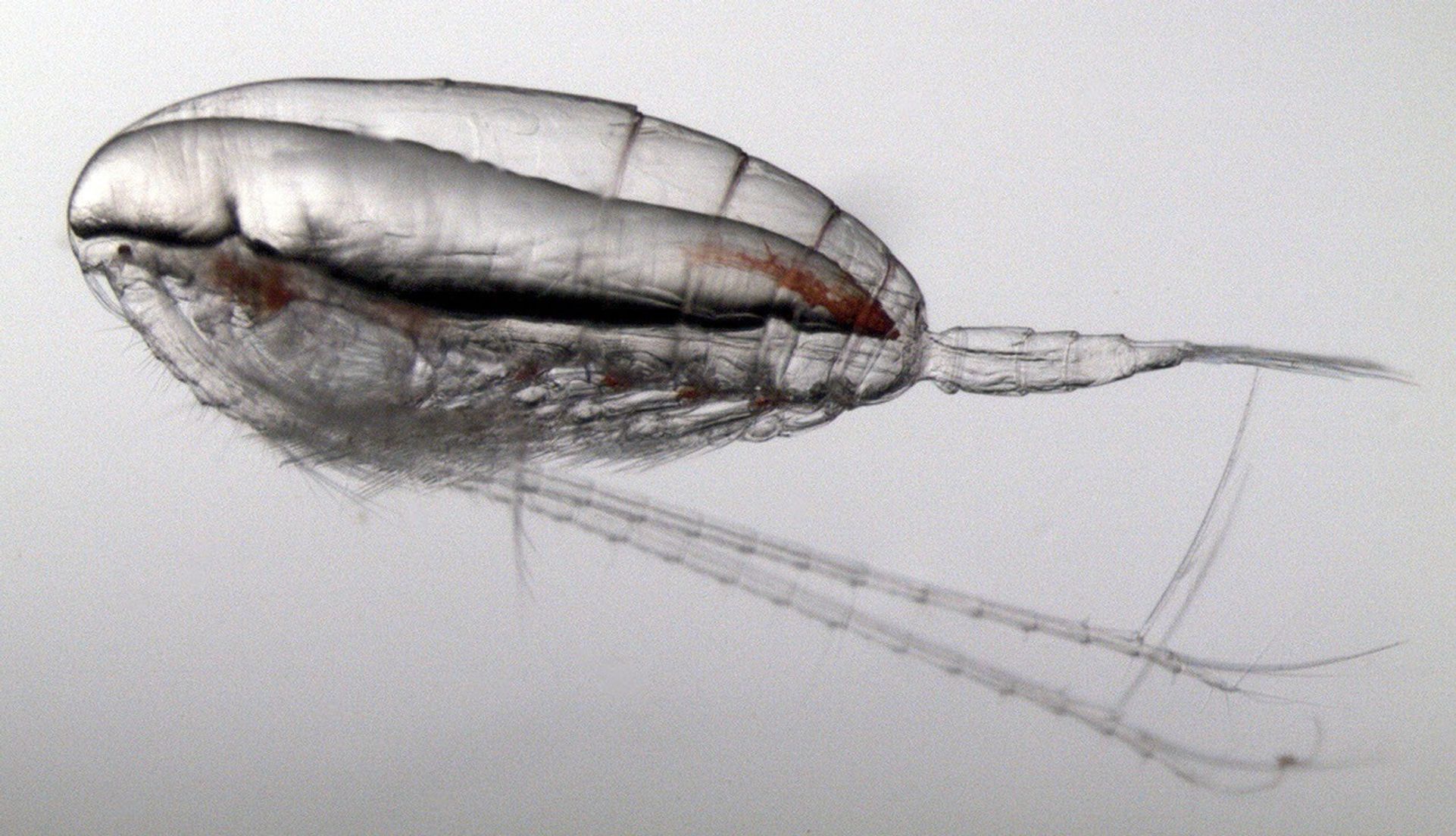
    A magnified view of a nearly translucent Calanus finmarchicus zooplankton, showing its segmented body, antennae, and internal structures.
    Calanus finmarchicus, a tiny zooplankton powering North Atlantic food webs, fuels right whale populations with its energy-rich lipid reserves.
    Credit: Cameron Thompson

    “NASA invests in this kind of research because it connects space-based observation with real-world challenges,” said Cynthia Hall, a support scientist at NASA headquarters in Washington. She works with the Early Career Research Program, which partly funded the work. “It’s yet another a way to put NASA satellite data to work for science, communities, and ecosystems.”

    Revealing the Ocean’s Hidden Patterns

    The new approach uses data from the Moderate Resolution Imaging Spectroradiometer (MODIS) aboard NASA’s Aqua satellite. The MODIS instrument doesn’t directly see the copepods themselves. Instead, it reads how the spectrum of sunlight reflected from the ocean surface changes in response to what’s in the water.

    When large numbers of the zooplankton rise to the surface, their reddish pigment — astaxanthin, the same compound that gives salmon its pink color — subtly alters how photons, or particles of light, from the sun are absorbed or scattered in the water. The fate of these photons in the ocean depends on the mix of living and non-living matter in seawater, creating a slight shift in color that MODIS can detect.

    “We didn’t know to look for Calanus before in this way,” said Catherine Mitchell, a satellite oceanographer at Bigelow Laboratory for Ocean Sciences in East Boothbay, Maine. “Remote sensing has typically focused on smaller things like phytoplankton. But recent research suggested that larger, millimeter-sized organisms like zooplankton can also influence ocean color.”

    A few years ago, researchers piloted a satellite method for detecting copepods in Norwegian waters. Now, some of those same scientists — along with Mitchell’s team — have refined the approach and applied it to the Gulf of Maine, a crucial feeding ground for right whales during their northern migration. By combining satellite data, a model, and field measurements, they produced enhanced images that revealed Calanus swarms at the sea surface, and were able to estimate numbers of the tiny animals.

    “We know the right whales are using habitats we don’t fully understand,” said Rebekah Shunmugapandi, also a satellite oceanographer at Bigelow and the study’s lead author. “This satellite-based Calanus information could eventually help identify unknown feeding grounds or better anticipate where whales might travel.”

    Tracking Elusive Giants

    Despite decades of study, North Atlantic right whales remain remarkably enigmatic to scientists. Once fairly predictable in their movements along the Eastern Seaboard of North America, these massive mammals began abandoning some traditional feeding grounds in 2010-2011. Their sudden shift to unexpected areas like the Gulf of Saint Lawrence caught people off guard, with deadly consequences.

    “We’ve had whales getting hit by ships and whales getting stuck in fishing gear,” said Laura Ganley, a research scientist in the Anderson Cabot Center for Ocean Life at the New England Aquarium in Boston, which conducts aerial and boat surveys of the whales.  

    In 2017, the National Oceanic and Atmospheric Administration designated the situation as an “unusual mortality event” in an effort to address the whales’ decline. Since then, 80 North Atlantic right whales have been killed or sustained serious injuries, according to NOAA.

    Map showing estimated concentrations of the copepod Calanus finmarchicus in the Gulf of Maine, with the highest densities (up to 150,000 individuals per cubic meter) marked in dark red. Areas with no data are shaded in a blue crosshatch pattern.
    NASA satellite imagery from June 2009 was used to test a new method for detecting the copepod Calanus finmarchicus in the Gulf of Maine and estimating their numbers from space.
    Credit: NASA Earth Observatory image by Wanmei Liang, using data from Shunmugapandi, R., et al. (2025)

    In the Gulf of Maine, there’s less shipping activity, but there can be a complex patchwork of lobster fishing gear, said Sarah Leiter, a scientist with the Maine Department of Marine Resources. “Each fisherman has 800 traps or so,” Leiter explained. “If a larger number of whales shows up suddenly, like they just did in January 2025, it is challenging. Fishermen need time and good weather to adjust that gear.”

    What excites Leiter the most about the satellite data is the potential to use it in a forecasting tool to help predict where the whales could go. “That would be incredibly useful in giving us that crucial lead time,” she said.

    PACE: The Next Generation of Ocean Observer

    For now, the Calanus-tracking method has limitations. Because MODIS detects the copepods’ red pigment, not the animals themselves, that means other small, reddish organisms can be mistaken for the zooplankton. And cloud cover, rough seas, or deeper swarms all limit what satellites can spot.

    MODIS is also nearing the end of its operational life. But NASA’s next-generation PACE (Plankton, Aerosol, Cloud, ocean Ecosystem) satellite — launched in 2024 — is poised to make dramatic improvements in the detection of zooplankton and phytoplankton.

    Swirling green phytoplankton blooms in the Gulf of Maine are seen in a satellite image taken by NASA’s PACE mission.
    NASA’s Ocean Color Instrument on the PACE satellite captured these swirling green phytoplankton blooms in the Gulf of Maine in April 2024. Such blooms fuel zooplankton like Calanus finmarchicus.
    Credit: NASA

    “The PACE satellite will definitely be able to do this, and maybe even something better,” said Bridget Seegers, an oceanographer and mission scientist with the PACE team at NASA’s Goddard Space Flight Center in Greenbelt, Maryland.

    The PACE mission includes the Ocean Color Instrument, which detects more than 280 wavelengths of light. That’s a big jump from the 10 wavelengths seen by MODIS. More wavelengths mean finer detail and better insights into ocean color and the type of plankton that the satellite can spot.

    Local knowledge of seasonal plankton patterns will still be essential to interpret the data correctly. But the goal isn’t perfect detection, the scientists say, but rather to provide another tool to inform decision-making, especially when time or resources are limited.

    By Emily DeMarco
    NASA Headquarters

  • NASA Langley Participates in Air Power Over Hampton Roads

    NASA Langley highlights its Cirrus Design SR22 during Air Power Over Hampton Roads STEM Day.
    NASA Langley highlights its Cirrus Design SR22 during Air Power Over Hampton Roads STEM Day.
    NASA/Angelique Herring

    NASA Langley Research Center’s integral role in the past, present, and future of flight was on full display April 25-27 during the Air Power Over Hampton Roads air show.

    The air show, held at Joint Base Langley-Eustis (JBLE), which neighbors NASA Langley in Hampton, Virginia, attracted thousands of spectators throughout the weekend.

    The weekend kicked off with a STEM Day on April 25. Langley’s Office of STEM Engagement (OSTEM) offered educational and engaging activities, exhibits, and displays to share NASA missions and encourage K-12 students from local schools to explore the possibilities that science, technology, engineering, and math offer.

    “Participation in the air show allows us to share NASA’s work in aeronautics with the public and provides an opportunity for Langley researchers and engineers to work directly with students and families to share the exciting work they do,” said Bonnie Murray, Langley OSTEM Student Services manager.

    NASA Langley personnel inspire young minds during Air Power Over Hampton Roads STEM Day.
    NASA Langley personnel inspire young minds during Air Power Over Hampton Roads STEM Day.
    NASA/Angelique Herring

    Langley OSTEM’s participation continued throughout the weekend as a part of the air show’s STEM Expo, where visitors to the NASA booths tested a paper helicopter in a small-scale wind tunnel to explore flight dynamics, learned how NASA uses X-planes for research and designed their own X-plane, and tested experimental paper airplanes of various designs. By observing flight of the plane designs and making improvements to each one, students participated in the engineering design process. NASA subject matter experts in attendance guided students through these activities, inspired young minds by sharing some of their innovations, and promoted a variety of STEM career paths.

    “Through engagement in the NASA STEM Zone activities, students had an opportunity to see themselves in the role of a NASA researcher,” Murray said. “Authentic learning experiences such as these help build children’s STEM identity, increasing the likelihood of them pursuing STEM careers in the future.”

    A child enjoys NASA STEM activities during Air Power Over Hampton Roads STEM Day.
    A child enjoys NASA STEM activities during Air Power Over Hampton Roads STEM Day.
    NASA/Angelique Herring

    The air show’s static aircraft displays included NASA Langley’s Cirrus Design SR22, a research aircraft used to support NASA’s airborne science program, the science community, and aeronautics research.

    “Reflective of our strong, long-standing partnership with JBLE, NASA Langley was proud to participate in this year’s Air Power Over Hampton Roads air show,” said Glenn Jamison, director of Langley’s Research Services Directorate. “Our relationship spans back to 1917 when NACA and Langley Field evolved together over formative years in aerodynamic research, sharing the airspace and facilities here in Hampton. Today, we continue our collaboration with JBLE in pursuing shared interests and finding innovative solutions to complex problems.”

    The displays also featured several small Unmanned Aircraft Systems (sUAS) and NASA’s P-3 Orion, a research aircraft based at NASA’s Wallops Flight Facility on Wallops Island, Virginia.

    Air show visitors could explore a picture display that highlighted NASA Langley’s rich aviation legacy, from its founding in 1917 to Langley’s work today to accelerate advancements in aeronautics, science, and space technology and exploration. Spacey Casey, a crowd favorite, greeted and took pictures with educators, students, and guests throughout the weekend, bringing out-of-this-world smiles to their faces. Members of Langley’s Office of the Director also represented the center at the event.

    Brittny McGraw
    NASA Langley Research Center

  • Hubble Images a Peculiar Spiral

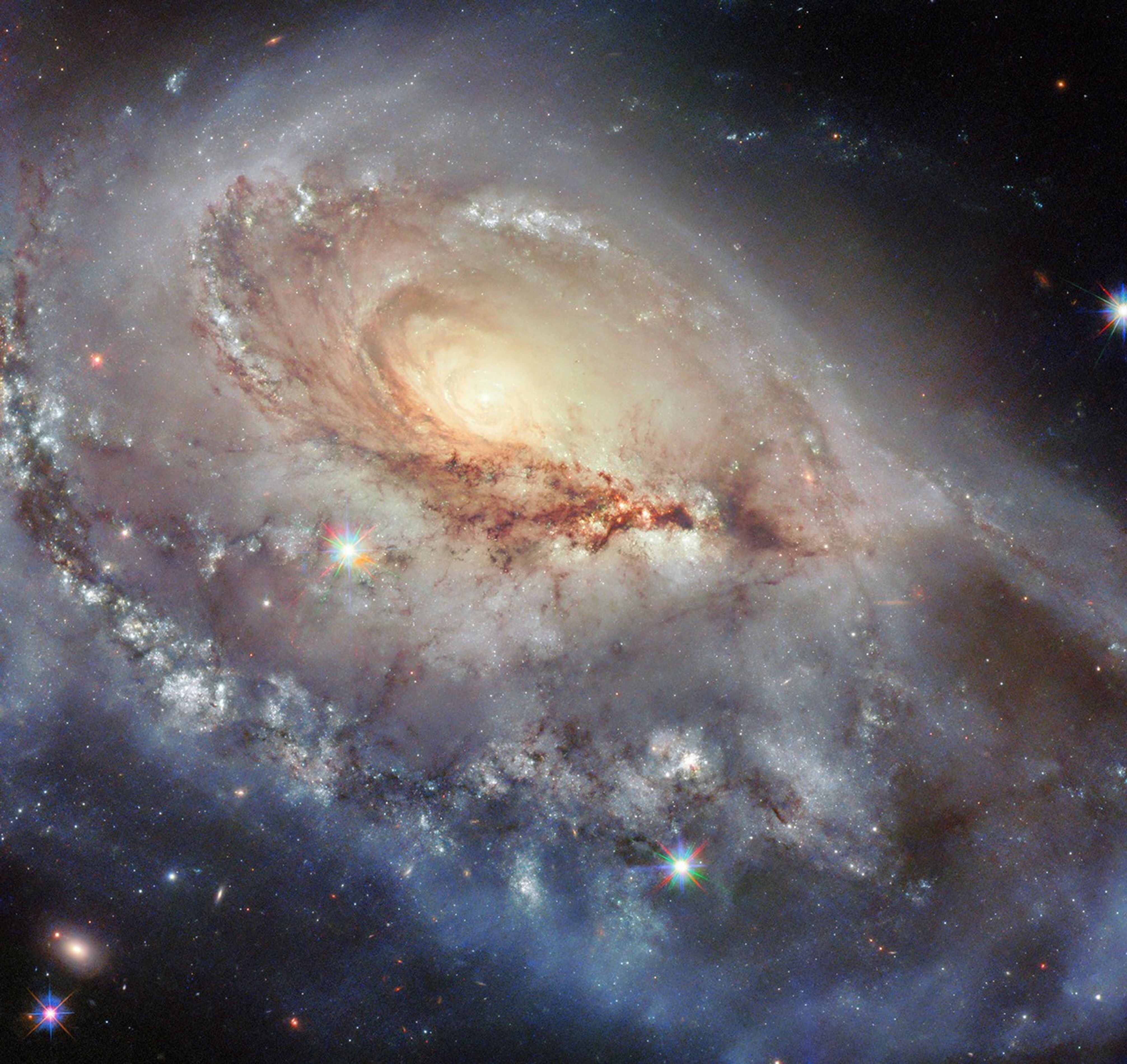
    A spiral galaxy seen at a skewed angle. Its center is a bright spot radiating light. A thick, stormy disk of material surrounds this bright center, with swirling strands of dark dust and bright spots of star formation strewn through the disk. A large spiral arm extends from the disk toward the viewer. Some foreground stars are visible atop the galaxy.
    This NASA/ESA Hubble Space Telescope image features a peculiar spiral galaxy called Arp 184 or NGC 1961.
    ESA/Hubble & NASA, J. Dalcanton, R. J. Foley (UC Santa Cruz), C. Kilpatrick

    A beautiful but skewed spiral galaxy dazzles in this NASA/ESA Hubble Space Telescope image. The galaxy, called Arp 184 or NGC 1961, sits about 190 million light-years away from Earth in the constellation Camelopardalis (The Giraffe).

    The name Arp 184 comes from the Atlas of Peculiar Galaxies compiled by astronomer Halton Arp in 1966. It holds 338 galaxies that are oddly shaped and tend to be neither entirely elliptical nor entirely spiral-shaped. Many of the galaxies are in the process of interacting with other galaxies, while others are dwarf galaxies without well-defined structures. Arp 184 earned its spot in the catalog thanks to its single broad, star-speckled spiral arm that appears to stretch toward us. The galaxy’s far side sports a few wisps of gas and stars, but it lacks a similarly impressive spiral arm.

    This Hubble image combines data from three Snapshot observing programs, which are short observations that slotted into time gaps between other proposals. One of the three programs targeted Arp 184 for its peculiar appearance. This program surveyed galaxies listed in the Atlas of Peculiar Galaxies as well as A Catalogue of Southern Peculiar Galaxies and Associations, a similar catalog compiled by Halton Arp and Barry Madore.

    The remaining two Snapshot programs looked at the aftermath of fleeting astronomical events like supernovae and tidal disruption events — like when a supermassive black hole rips a star apart after it wanders too closely. Since Arp 184 hosted four known supernovae in the past three decades, it is a rich target for a supernova hunt.

    Image credit: ESA/Hubble & NASA, J. Dalcanton, R. J. Foley (UC Santa Cruz), C. Kilpatrick

  • NASA Kennedy Breathes Life into Moon Soil Testing

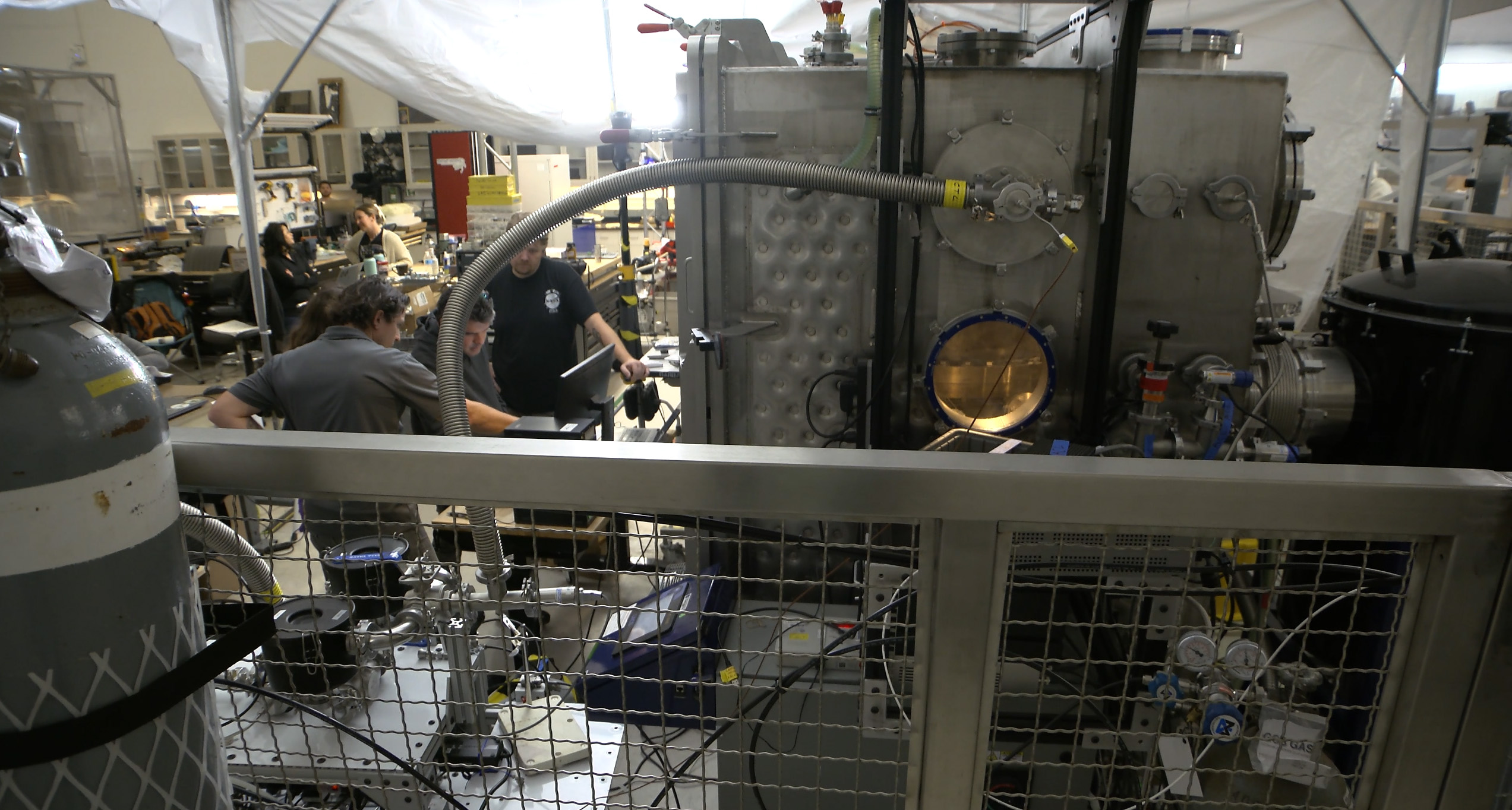
    Image shows a silver vacuum chamber with people working nearby.
    Researchers with NASA’s Exploration Research and Technology programs conduct molten regolith electrolysis testing inside Swamp Works at NASA’s Kennedy Space Center in Florida on Thursday, Dec. 5, 2024.
    NASA/Kim Shiflett

    As NASA works to establish a long-term presence on the Moon, researchers have reached a breakthrough by extracting oxygen at a commercial scale from simulated lunar soil at Swamp Works at NASA’s Kennedy Space Center in Florida. The achievement moves NASA one step closer to its goal of utilizing resources on the Moon and beyond instead of relying only on supplies shipped from Earth.

    NASA Kennedy researchers in the Exploration Research and Technology programs teamed up with Lunar Resources Inc. (LUNAR), a space industrial company in Houston, Texas, to perform molten regolith electrolysis. Researchers used the company’s resource extraction reactor, called LR-1, along with NASA Kennedy’s vacuum chamber. During the recent vacuum chamber testing, molecular oxygen was measured in its pure form along with the production of metals from a batch of dust and rock that simulates lunar soil, often referred to as “regolith,” in the industry.

    “This is the first time NASA has produced molecular oxygen using this process,” said Dr. Annie Meier, molten regolith electrolysis project manager at NASA Kennedy. “The process of heating up the reactor is like using an elaborate cooking pot. Once the lid is on, we are essentially watching the gas products come out.”

    During testing, the vacuum environment chamber replicated the vacuum pressure of the lunar surface. The extraction reactor heated about 55 pounds (25 kilograms) of simulated regolith up to a temperature of 3100°F (1700°C) until it melted. Researchers then passed an electric current through the molten regolith until oxygen in a gas form was separated from the metals of the soil. They measured and collected the molecular oxygen for further study.

    In addition to air for breathing, astronauts could use oxygen from the Moon as a propellant for NASA’s lunar landers and for building essential infrastructure. This practice of in-situ resource utilization (ISRU) also decreases the costs of deep space exploration by reducing the number of resupply missions needed from Earth.

    Once the process is perfected on Earth, the reactor and its subsystems can be delivered on future missions to the Moon. Lunar rovers, similar to NASA’s ISRU Pilot Excavator, could autonomously gather the regolith to bring back to the reactor system to separate the metals and oxygen.

    “Using this unique chemical process can produce the oxidizer, which is half of the propellant mix, and it can create vital metals used in the production of solar panels that in turn could power entire lunar base stations,” said Evan Bell, mechanical structures and mechatronics lead at NASA Kennedy.

    Post-test data analysis will help the NASA and LUNAR teams better understand the thermal and chemical function of full-scale molten regolith electrolysis reactors for the lunar surface. The vacuum chamber and reactor also can be upgraded to represent other locations of the lunar environment as well as conditions on Mars for further testing.

    Researchers at NASA Kennedy began developing and testing molten regolith electrolysis reactors in the early 1990s. Swamp Works is a hands-on learning environment facility at NASA Kennedy that takes ideas through development and into application to benefit space exploration and everyone living on Earth. From 2019 to 2023, Swamp Works developed an early concept reactor under vacuum conditions named Gaseous Lunar Oxygen from Regolith Electrolysis (GaLORE). Scientists at NASA’s Johnson Space Center in Houston conducted similar testing in 2023, removing carbon monoxide from simulated lunar regolith in a vacuum chamber.

    “We always say that Kennedy Space Center is Earth’s premier spaceport, and this breakthrough in molten regolith electrolysis is just another aspect of us being the pioneers in providing spaceport capabilities on the Moon, Mars, and beyond,” Bell said.

    NASA’s Exploration Research and Technology programs, related laboratories, and research facilities develop technologies that will enable human deep space exploration. NASA’s Game Changing Development program, managed by the agency’s Space Technology Mission Directorate funded the project.

  • Sols 4527-4528: ‘Boxwork Ahoy!’

    2 min read

    Sols 4527-4528: ‘Boxwork Ahoy!’

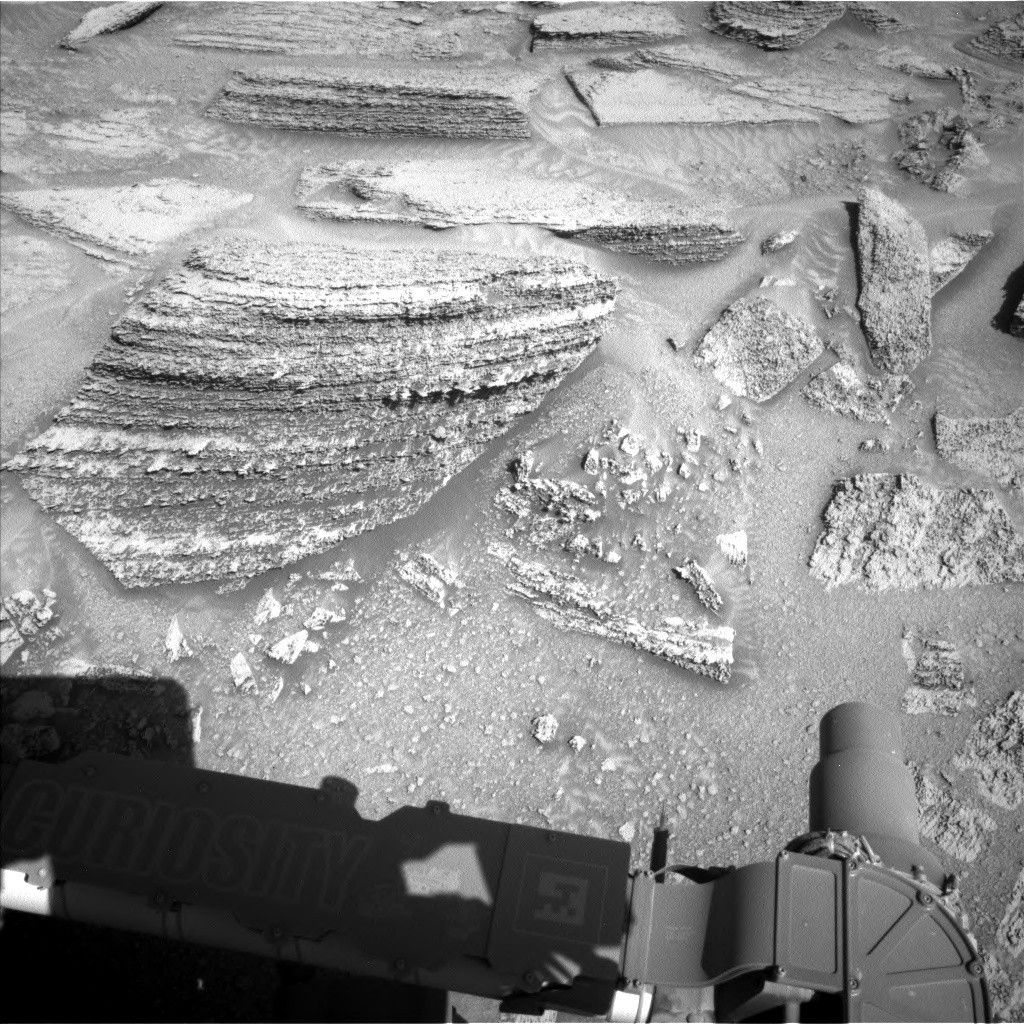
    A grayscale photograph of the Martian surface from the Curiosity rover shows a field of rough and jagged rocks covering the surface from the foreground extending to hills in the background, all medium to dark gray. The hills appear smoother overall, but have horizontal folds on their sides leading up to their peaks.
    NASA’s Mars rover Curiosity acquired this image looking directly west and showing a first ground view of the boxwork structures the rover is driving toward. The boxwork structures are visible in the distance as smoother terrain criss-crossed by ridges, just below the hilltops. Curiosity acquired this image using its Left Navigation Camera on April 30, 2025 – Sol 4526, or Martian day 4,526 of the Mars Science Laboratory mission – at 14:10:41 UTC.
    NASA/JPL-Caltech

    Written by Natalie Moore, Mission Operations Specialist at Malin Space Science Systems

    Earth planning date: Wednesday, April 30, 2025

    We’re back in our standard “touch and go” plan regime today, where we sandwich a midday remote science block between morning-APXS and afternoon-MAHLI contact science arm blocks. We had our first late-slide 9 a.m. PDT start in quite a while due to our “isolated nominal” plan on Monday! This meant the whole team was ready and “patiently” (read: not-so-patiently) waiting for our drive data to come down around 8:40 this morning. Thankfully, everything we were waiting for came down to Earth and told us Curiosity was right where we wanted her to be! The planning begins…

    Sol 4527 contains most of our activities in this plan. We start off about 10:00 local Gale time with a DRT and APXS analysis of contact science target “Tamarack Valley,” a rough but brushable bedrock target in our workspace. We leave the arm unstowed (and out of the way) for our remote science block spanning the hours of about 12:35-13:45. That block starts with a large, 76-frame stereo Mastcam mosaic covering the boxwork structures to the west while ChemCam’s instrument cools down to allow for LIBS.

    After Mastcam is done, ChemCam shoots their LIBS on a rougher bedrock target named “Aguanga,” and an RMI mosaic of the boxwork structures included in the Mastcam mosaic. About 14:00 local time, MAHLI finishes the contact science with a full suite of Tamarack Valley (25-centimeter, 5-centimeter stereo, and 1-centimeter images). Then we drive! Hopefully about 30 meters closer (about 98 feet) to the boxwork structures for our weekend plan. 

    Curiosity takes the second sol easier with some Navcam dust-devil and horizon movies, along with a rover-decided LIBS target at our new location to start off science decisions for Friday.

    Details

    Last Updated

    May 04, 2025

    Related Terms

  • Back to Earth

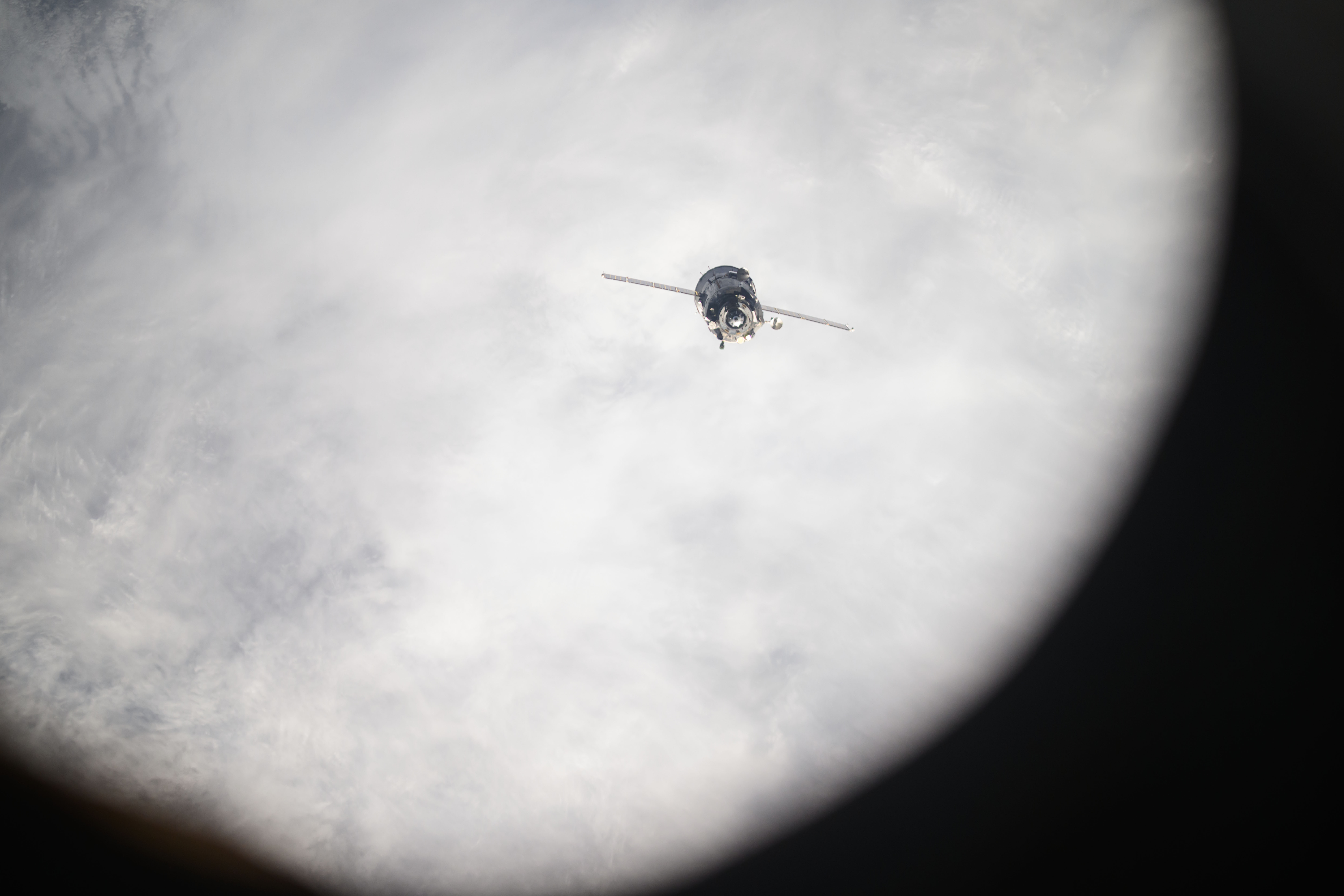
    The Soyuz spacecraft looks like a cylinder with two lines stretching outward from it. It is oriented toward Earth, which is covered with white clouds.
    NASA/Jonny Kim

    The Soyuz MS-26 spacecraft is pictured backing away from the International Space Station shortly after undocking on April 19, 2025. Three hours later, the spacecraft landed in Kazakhstan, returning astronaut Don Pettit and cosmonauts Alexey Ovchinin and Ivan Vagner to Earth.

    While aboard the International Space Station, Pettit conducted hundreds of hours of scientific investigations, including research to enhance on-orbit metal 3D printing capabilities, advance water sanitization technologies, explore plant growth under varying water conditions, and investigate fire behavior in microgravity, all contributing to future space missions.

    Image credit: NASA/Jonny Kim