Tag: solar system

  • NASA Observes First Visible-light Auroras at Mars

    6 min read

    NASA Observes First Visible-light Auroras at Mars

    On March 15, 2024, near the peak of the current solar cycle, the Sun produced a solar flare and an accompanying coronal mass ejection (CME), a massive explosion of gas and magnetic energy that carries with it large amounts of solar energetic particles. This solar activity led to stunning auroras across the solar system, including at Mars, where NASA’s Perseverance Mars rover made history by detecting them for the first time from the surface of another planet.
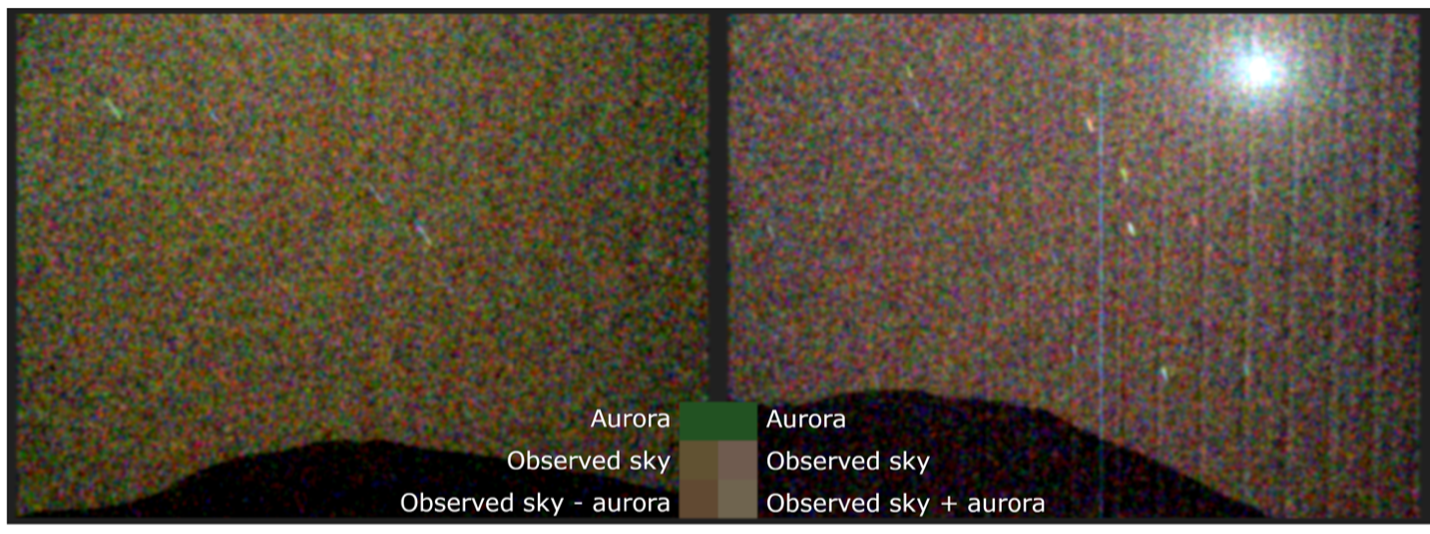
    The first visible-light image of green aurora on Mars (left), taken by the Mastcam-Z instrument on NASA’s Perseverance Mars rover. On the right is a comparison image of the night sky of Mars without aurora but featuring the Martian moon Deimos. The moonlit Martian night sky, lit up mostly by Mars’ nearer and larger moon Phobos (outside the frame) has a reddish-brown hue due to the dust in the atmosphere, so when green auroral light is added, the sky takes on a green-yellow tone, as seen in the left image.
    NASA/JPL-Caltech/ASU/MSSS/SSI

    “This exciting discovery opens up new possibilities for auroral research and confirms that auroras could be visible to future astronauts on Mars’ surface.” said Elise Knutsen, a postdoctoral researcher at the University of Oslo in Norway and lead author of the Science Advances study, which reported the detection.

    Picking the right aurora

    On Earth, auroras form when solar particles interact with the global magnetic field, funneling them to the poles where they collide with atmospheric gases and emit light. The most common color, green, is caused by excited oxygen atoms emitting light at a wavelength of 557.7 nanometers. For years, scientists have theorized that green light auroras could also exist on Mars but suggested they would be much fainter and harder to capture than the green auroras we see on Earth.

    Due to the Red Planet’s lack of a global magnetic field, Mars has different types of auroras than those we have on Earth. One of these is solar energetic particle (SEP) auroras, which NASA’s MAVEN (Mars Atmosphere and Volatile EvolutioN) mission discovered in 2014. These occur when super-energetic particles from the Sun hit the Martian atmosphere, causing a reaction that makes the atmosphere glow across the whole night sky.

    While MAVEN had observed SEP auroras in ultraviolet light from orbit, this phenomenon had never been observed in visible light from the ground. Since SEPs typically occur during solar storms, which increase during solar maximum, Knutsen and her team set their sights on capturing visible images and spectra of SEP aurora from Mars’ surface at the peak of the Sun’s current solar cycle.

    Coordinating the picture-perfect moment

    Through modeling, Knutsen and her team determined the optimal angle for the Perseverance rover’s SuperCam spectrometer and Mastcam-Z camera to successfully observe the SEP aurora in visible light. With this observation strategy in place, it all came down to the timing and understanding of CMEs.

    “The trick was to pick a good CME, one that would accelerate and inject many charged particles into Mars’ atmosphere,” said Knutsen.

    That is where the teams at NASA’s Moon to Mars (M2M) Space Weather Analysis Office and the Community Coordinated Modeling Center (CCMC), both located at NASA’s Goddard Space Flight Center in Greenbelt, Maryland, came in. The M2M team provides real-time analysis of solar eruptions to the CCMC for initiating simulations of CMEs to determine if they might impact current NASA missions. When the simulations suggest potential impacts, the team sends out an alert.

    At the University of California, Berkeley, space physicist Christina Lee received an alert from the M2M office about the March 15, 2024, CME. Lee, a member of the MAVEN mission team who serves as the space weather lead, determined there was a notable solar storm heading toward the Red Planet,which could arrive in a few days. She immediately issued the Mars Space Weather Alert Notification to currently operating Mars missions.

    “This allows the science teams of Perseverance and MAVEN to anticipate impacts of interplanetary CMEs and the associated SEPs,” said Lee.

    “When we saw the strength of this one,” Knutsen said, “we estimated it could trigger aurora bright enough for our instruments to detect.”

    A few days later, the CME impacted Mars, providing a lightshow for the rover to capture, showing the aurora to be nearly uniform across the sky at an emission wavelength of exactly 557.7 nm. To confirm the presence of SEPs during the aurora observation, the team looked to MAVEN’s SEP instrument, which was additionally corroborated by data from ESA’s (European Space Agency) Mars Express mission. Data from both missions confirmed that the rover team had managed to successfully catch a glimpse of the phenomenon in the very narrow time window available.

    “This was a fantastic example of cross-mission coordination. We all worked together quickly to facilitate this observation and are thrilled to have finally gotten a sneak peek of what astronauts will be able to see there some day,” said Shannon Curry, MAVEN principal investigator and research scientist at the Laboratory for Atmospheric and Space Physics (LASP) at the University of Colorado Boulder (CU Boulder).

    The future of aurora on Mars

    By coordinating the Perseverance observations with measurements from MAVEN’s SEP instrument, the teams could help each other determine that the observed 557.7 nm emission came from solar energetic particles. Since this is the same emission line as the green aurora on Earth, it is likely that future Martian astronauts would be able to see this type of aurora.

    “Perseverance’s observations of the visible-light aurora confirm a new way to study these phenomena that’s complementary to what we can observe with our Mars orbiters,” said Katie Stack Morgan, acting project scientist for Perseverance at NASA’s Jet Propulsion Laboratory in Southern California. “A better understanding of auroras and the conditions around Mars that lead to their formation are especially important as we prepare to send human explorers there safely.”
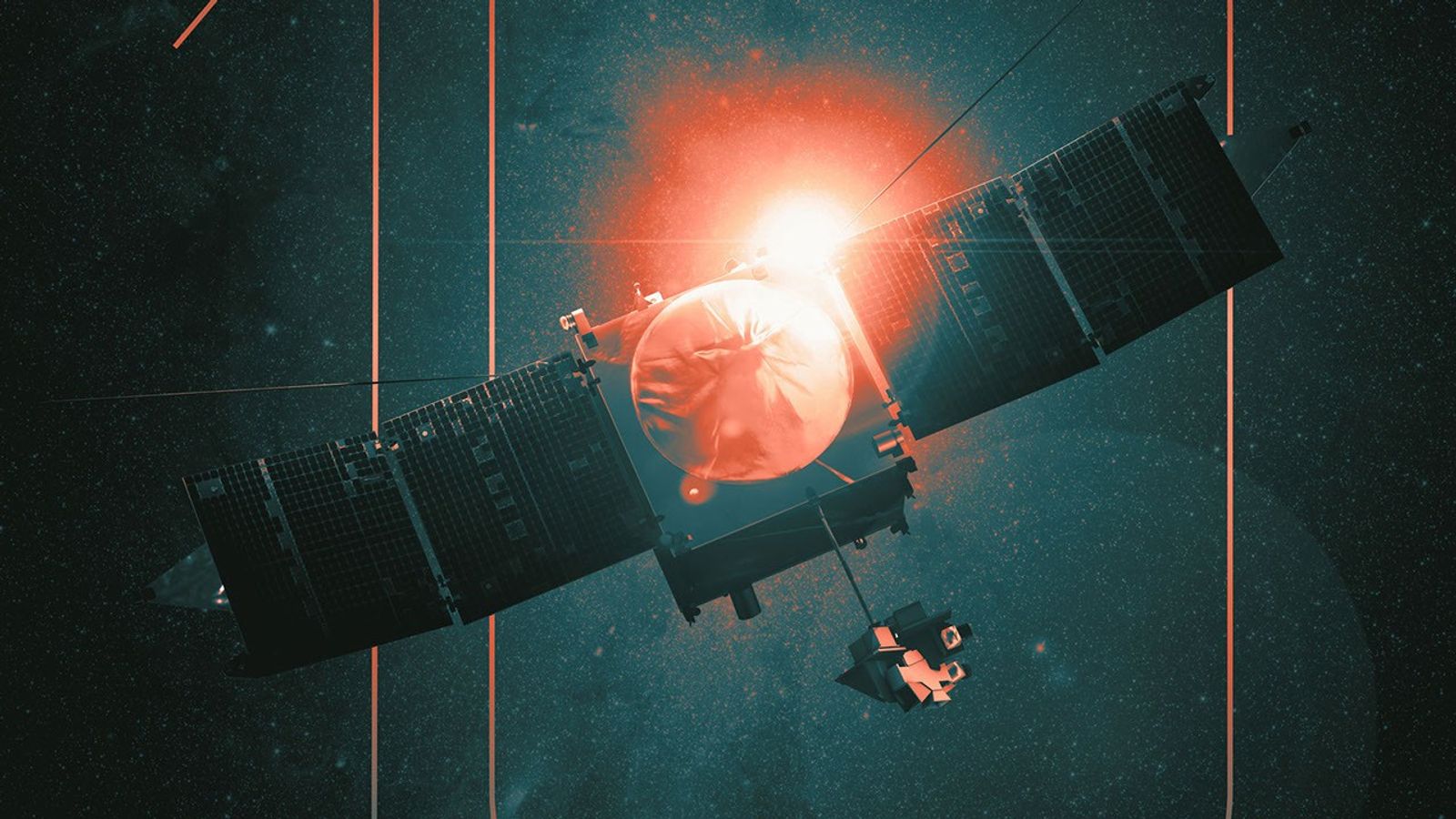
    On September 21, 2014, NASA’s MAVEN (Mars Atmosphere and Volatile EvolutioN) spacecraft entered orbit around Mars. The mission has produced a wealth of data about how Mars’ atmosphere responds to the Sun and solar wind
    NASA/JPL-Caltech

    More About Perseverance and MAVEN

    The Mars 2020 Perseverance mission is part of NASA’s Mars Exploration Program portfolio and NASA’s Moon to Mars exploration approach, which includes Artemis missions to the Moon that will help prepare for human exploration of the Red Planet. NASA’s Jet Propulsion Laboratory, which is managed for the agency by Caltech, built and manages operations of the Perseverance rover.

    The MAVEN mission, also part of NASA’s Mars Exploration Program portfolio, is led by LASP at CU Boulder. It’s managed by NASA’s Goddard Space Flight Center and was built and operated by Lockheed Martin Space, with navigation and network support from NASA’s JPL.

    By Willow Reed
    Laboratory for Atmospheric and Space Physics (LASP), University of Colorado Boulder

    Media Contact: 

    Karen Fox / Molly Wasser

    Headquarters, Washington

    202-358-1600

    karen.c.fox@nasa.gov / molly.l.wasser@nasa.gov  

    Nancy N. Jones
    NASA’s Goddard Space Flight Center, Greenbelt, Md.

    DC Agle
    Jet Propulsion Laboratory, Pasadena, Calif.
    818-393-9011
    agle@jpl.nasa.gov

  • NASA’s Magellan Mission Reveals Possible Tectonic Activity on Venus

    6 min read

    Preparations for Next Moonwalk Simulations Underway (and Underwater)

    Different views suggests vast surface features on Venus called coronae
    New research suggests vast surface features on Venus called coronae continue to be shaped by tectonic processes. Observations of these features from NASA’s Magellan mission include, clockwise from top left, Artemis Corona, Quetzalpetlatl Corona, Bahet Corona, and Fotla Corona.
    NASA/JPL-Caltech

    Using archival data from the mission, launched in 1989, researchers have uncovered new evidence that tectonic activity may be deforming the planet’s surface.

    Vast, quasi-circular features on Venus’ surface may reveal that the planet has ongoing tectonics, according to new research based on data gathered more than 30 years ago by NASA’s Magellan mission. On Earth, the planet’s surface is continually renewed by the constant shifting and recycling of massive sections of crust, called tectonic plates, that float atop a viscous interior. Venus doesn’t have tectonic plates, but its surface is still being deformed by molten material from below.

    Seeking to better understand the underlying processes driving these deformations, the researchers studied a type of feature called a corona. Ranging in size from dozens to hundreds of miles across, a corona is most often thought to be the location where a plume of hot, buoyant material from the planet’s mantle rises, pushing against the lithosphere above. (The lithosphere includes the planet’s crust and the uppermost part of its mantle.) These structures are usually oval, with a concentric fracture system surrounding them. Hundreds of coronae are known to exist on Venus.

    Published in the journal Science Advances, the new study details newly discovered signs of activity at or beneath the surface shaping many of Venus’ coronae, features that may also provide a unique window into Earth’s past. The researchers found the evidence of this tectonic activity within data from NASA’s Magellan mission, which orbited Venus in the 1990s and gathered the most detailed gravity and topography data on the planet currently available.

    “Coronae are not found on Earth today; however, they may have existed when our planet was young and before plate tectonics had been established,” said the study’s lead author, Gael Cascioli, assistant research scientist at the University of Maryland, Baltimore County, and NASA’s Goddard Space Flight Center in Greenbelt, Maryland. “By combining gravity and topography data, this research has provided a new and important insight into the possible subsurface processes currently shaping the surface of Venus.”

    artist’s concept of the large Quetzalpetlatl Corona located in Venus’ southern hemi-sphere
    This artist’s concept of the large Quetzalpetlatl Corona located in Venus’ southern hemisphere depicts active volcanism and a subduction zone, where the foreground crust plunges into the planet’s interior. A new study suggests coronae are the locations of several types of tectonic activity.
    NASA/JPL-Caltech/Peter Rubin

    As members of NASA’s forthcoming VERITAS (Venus Emissivity, Radio science, InSAR, Topography, and Spectroscopy) mission, Cascioli and his team are particularly interested in the high-resolution gravity data the spacecraft will provide. Study coauthor Erwan Mazarico, also at Goddard, will co-lead the VERITAS gravity experiment when the mission launches no earlier than 2031.

    Mystery Coronae

    Managed by NASA’s Jet Propulsion Laboratory in Southern California, Magellan used its radar system to see through Venus’ thick atmosphere and map the topography of its mountains and plains. Of the geological features the spacecraft mapped, coronae were perhaps the most enigmatic: It wasn’t clear how they formed. In the years since, scientists have found many coronae in locations where the planet’s lithosphere is thin and heat flow is high.

    “Coronae are abundant on Venus. They are very large features, and people have proposed different theories over the years as to how they formed,” said coauthor Anna Gülcher, Earth and planetary scientist at the University of Bern in Switzerland. “The most exciting thing for our study is that we can now say there are most likely various and ongoing active processes driving their formation. We believe these same processes may have occurred early in Earth’s history.”

    The researchers developed sophisticated 3D geodynamic models that demonstrate various formation scenarios for plume-induced coronae and compared them with the combined gravity and topography data from Magellan. The gravity data proved crucial in helping the researchers detect less dense, hot, and buoyant plumes under the surface — information that couldn’t be discerned from topography data alone. Of the 75 coronae studied, 52 appear to have buoyant mantle material beneath them that is likely driving tectonic processes.

    One key process is subduction: On Earth, it happens when the edge of one tectonic plate is driven beneath the adjacent plate. Friction between the plates can generate earthquakes, and as the old rocky material dives into the hot mantle, the rock melts and is recycled back to the surface via volcanic vents.

    illustrations depict various types of tectonic activity thought to persist beneath Venus’ coronae
    These illustrations depict various types of tectonic activity thought to persist beneath Venus’ coronae. Lithospheric dripping and subduction are shown at top; below are and two scenarios where hot plume material rises and pushes against the lithosphere, potentially driving volcanism above it.
    Anna Gülcher, CC BY-NC

    On Venus, a different kind of subduction is thought to occur around the perimeter of some coronae. In this scenario, as a buoyant plume of hot rock in the mantle pushes upward into the lithosphere, surface material rises and spreads outward, colliding with surrounding surface material and pushing that material downward into the mantle.

    Another tectonic process known as lithospheric dripping could also be present, where dense accumulations of comparatively cool material sink from the lithosphere into the hot mantle. The researchers also identify several places where a third process may be taking place: A plume of molten rock beneath a thicker part of the lithosphere potentially drives volcanism above it.

    Deciphering Venus

    This work marks the latest instance of scientists returning to Magellan data to find that Venus exhibits geologic processes that are more Earth-like than originally thought. Recently, researchers were able to spot erupting volcanoes, including vast lava flows that vented from Maat Mons, Sif Mons, and Eistla Regio in radar images from the orbiter.

    While those images provided direct evidence of volcanic action, the authors of the new study will need sharper resolution to draw a complete picture about the tectonic processes driving corona formation. “The VERITAS gravity maps of Venus will boost the resolution by at least a factor of two to four, depending on location — a level of detail that could revolutionize our understanding of Venus’ geology and implications for early Earth,” said study coauthor Suzanne Smrekar, a planetary scientist at JPL and principal investigator for VERITAS.

    Managed by JPL, VERITAS will use a synthetic aperture radar to create 3D global maps and a near-infrared spectrometer to figure out what the surface of Venus is made of.  Using its radio tracking system, the spacecraft will also measure the planet’s gravitational field to determine the structure of Venus’ interior. All of these instruments will help pinpoint areas of activity on the surface.

    For more information about NASA’s VERITAS mission, visit:

    https://science.nasa.gov/mission/veritas/

    News Media Contacts

    Ian J. O’Neill
    Jet Propulsion Laboratory, Pasadena, Calif.
    818-354-2649
    ian.j.oneill@jpl.nasa.gov
    Karen Fox / Molly Wasser
    NASA Headquarters, Washington
    202-358-1600
    karen.c.fox@nasa.govmolly.l.wasser@nasa.gov

    2025-068

  • Hubble Pinpoints Young Stars in Spiral Galaxy

    2 min read

    Hubble Pinpoints Young Stars in Spiral Galaxy

    A vast, face on spiral galaxy that holds an inner ring of bright-blue, young stars.
    This NASA/ESA Hubble Space Telescope image features the spiral galaxy NGC 1317.
    ESA/Hubble & NASA, J. Lee and the PHANGS-HST Team

    In this image, the NASA/ESA Hubble Space Telescope peers into the spiral galaxy NGC 1317 in the constellation Fornax, located more than 50 million light-years from Earth. Visible in this galaxy image is a bright blue ring that hosts hot, young stars. NGC 1317 is one of a pair, but its rowdy larger neighbor, NGC 1316, lies outside Hubble’s field of view. Despite the absence of its neighboring galaxy, this image finds NGC 1317 accompanied by two objects from very different parts of the universe. The bright point ringed with a crisscross pattern is a star from our own galaxy surrounded by diffraction spikes, whereas the redder elongated smudge is a distant galaxy lying far beyond NGC 1317.

    The data presented in this image are from a vast observing campaign of hundreds of observations from Hubble’s Wide Field Camera 3 and Advanced Camera for Surveys. Combined with data from the ALMA array in the Atacama Desert, these observations help astronomers chart the connections between vast clouds of cold gas and the fiercely hot, young stars that form within them. ALMA’s unparalleled sensitivity at long wavelengths identified vast reservoirs of cold gas throughout the local universe, and Hubble’s sharp vision pinpointed clusters of young stars, as well as measuring their ages and masses.

    Often the most exciting astronomical discoveries require this kind of telescope teamwork, with cutting-edge facilities working together to provide astronomers with information across the electromagnetic spectrum. The same applies to Hubble’s observations that laid the groundwork for the NASA/ESA/CSA James Webb Space Telescope’s scientific observations.

    Media Contact:

    Claire Andreoli (claire.andreoli@nasa.gov)
    NASA’s Goddard Space Flight CenterGreenbelt, MD

  • NASA Glenn Engineer Highlights Research for Hubble Servicing Missions 

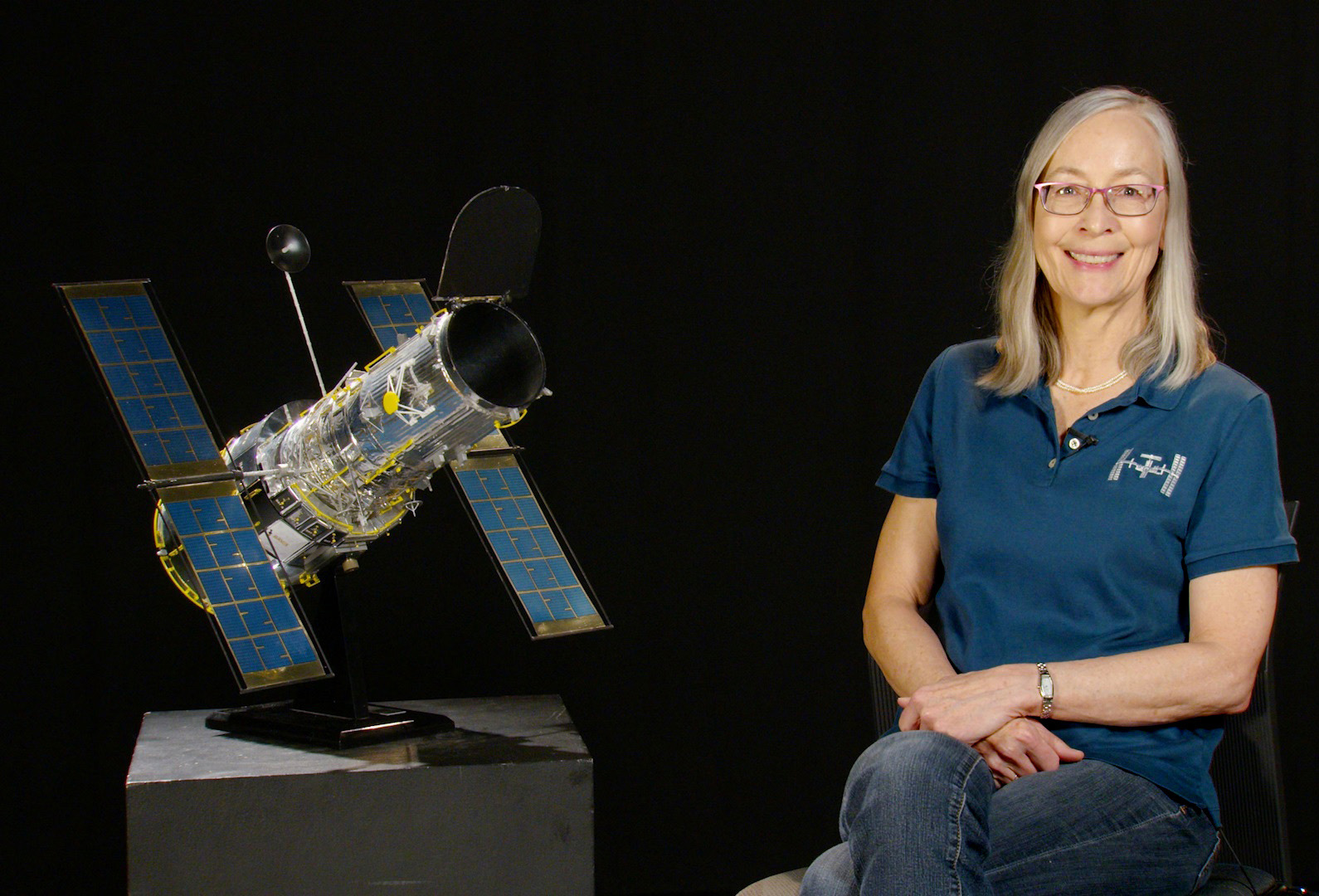
    NASA research engineer Kim de Groh, right, sits next to a model of the Hubble Space Telescope atop a black wooden stand.
    NASA Glenn Research Center senior materials research engineer Kim de Groh, who conducted research for Hubble Space Telescope servicing missions, shared her experiences during a presentation at Great Lakes Science Center, home of the NASA Glenn Visitor Center, in Cleveland on Thursday, May 8, 2025.
    Credit: NASA/Dennis Brown 

    April 24 marked the 35th anniversary of the launch of NASA’s Hubble Space Telescope. The iconic space observatory remains a household name —the most well-recognized and scientifically productive telescope in history. Engineers at NASA’s Glenn Research Center in Cleveland played a significant role in how the telescope functions today.  

    Glenn Visitor Center, in Cleveland on Thursday, May 8, 2025. Alt Text: NASA research engineers Kim de Groh, left, and Joyce Dever, pose for a photo with various interactive displays behind them at NASA Glenn Research Center’s Visitor Center.
    NASA’s Glenn Research Center researchers Kim de Groh, left, and Joyce Dever conducted research for Hubble Space Telescope servicing missions. De Groh shared her experiences during a presentation at Great Lakes Science Center, home of the NASA Glenn Visitor Center, in Cleveland on Thursday, May 8, 2025.
    Credit: NASA/Sara Lowthian-Hanna 

    NASA Glenn researchers assisted in all five Hubble servicing missions by testing damaged insulation, determining why it degraded in space, and recommending replacement materials.  

    One of those researchers, Kim de Groh, senior materials research engineer, shared some of that research in a special presentation at Great Lakes Science Center, home of the NASA Glenn Visitor Center, in Cleveland on May 8. She chronicled her Hubble experience with a presentation, a show-and-tell with samples directly from the telescope, and a Q&A addressing the audience’s Hubble-related questions. 

  • NASA Glenn Showcases Stirling Engine Technology at Piston Powered Auto-Rama

    A NASA subject matter expert stands behind a display table and explains the technology behind free-standing piston Stirling engines to a group of people.
    During the Piston Powered Auto-Rama at the I-X Center in Cleveland on Monday, March 31, 2025, NASA Glenn Research Center’s Salvadore Oriti, right, discusses the technology behind free-piston Stirling cycle machines.
    Credit: NASA/Kristin Jansen 

    NASA Glenn Research Center’s work in power and propulsion was on full display at the Piston Powered Auto-Rama at the I-X Center in Cleveland, March 28-30. The event is the largest indoor showcase of cars, trucks, motorcycles, tractors, and other engine-powered vehicles. 

    Center staff introduced guests to NASA’s Stirling engine technology, a free-piston Stirling power convertor that set records for accomplishing 14 years of maintenance-free operation at NASA Glenn in 2020. Attendees also explored how NASA is using space nuclear power to reach the deepest, dustiest, darkest, and most distant regions of our solar system through radioisotope power systems.  

    More than 57,500 people attended the event. 

  • NASA Glenn Hosts Slovenian Delegation and Ohio Governor’s Office

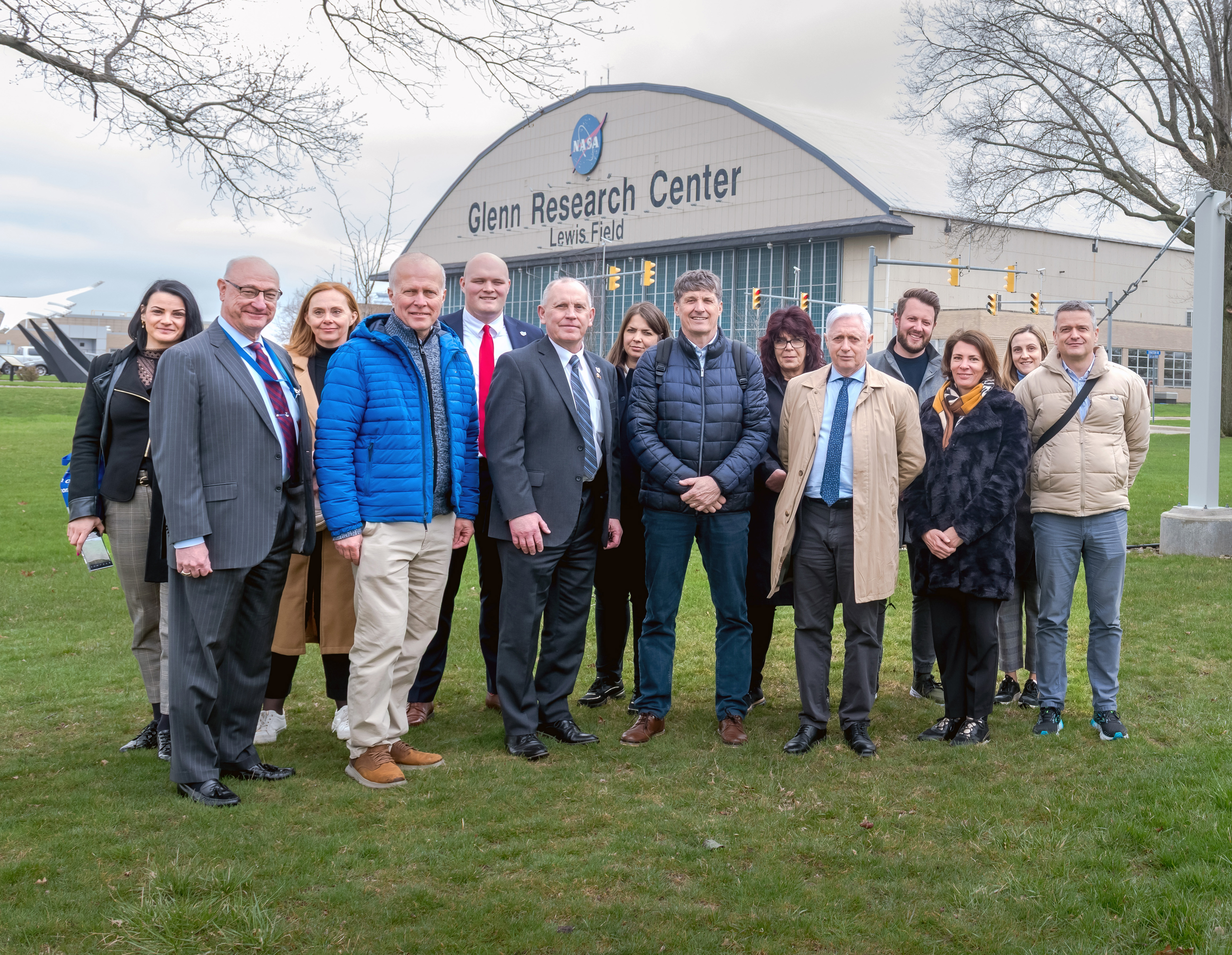
    A group of 14 guests pose on the lawn of NASA’s Glenn Research Center. An airplane hangar with the NASA logo and the words, “Glenn Research Center at Lewis Field,” is pictured in the background.
    NASA Glenn Research Center’s Associate Director Larry Sivic, front row, third from left, joins in a group photo with Slovenian government officials and representatives from the Ohio Governor’s Office during a visit to the center on Friday, April 11, 2025.
    Credit: NASA/Jef Janis 

    NASA’s Glenn Research Center in Cleveland hosted a delegation of Slovenian government officials and representatives from the Ohio Governor’s Office on April 11. NASA Glenn leadership provided the group with an overview of the center’s vital role within the agency. The delegation also visited key space-related and aeronautics facilities, including tours of the Zero Gravity Research Facility, Simulated Lunar Operations Laboratory, and Icing Research Tunnel. 

    Republic of Slovenia Minister of Defense Borut Sajovic and Ambassador of the Republic of Slovenia to the United States Iztok Mirosic headed the delegation. Joe Zeis, who is the senior advisor for Aerospace and Defense for the Office of the Governor, and Tobias Engel, who is with the Ohio Department of Development International Affairs, also attended. 

    A group of visitors inside a narrow, short tunnel listen as a NASA representative points to features in the tunnel.
    Facility Manager Dennis Eck, second from left, points out features of NASA Glenn Research Center’s Icing Research Tunnel to a delegation of Slovenian government officials and representatives from the Ohio Governor’s Office during a tour to the center on Friday, April 11, 2025.
    Credit: NASA/Jef Janis 

    The Slovenia Space Office — under the Ministry of the Economy, Industry, and Sport — coordinates Slovenia’s space activities within ESA (European Space Agency). Slovenia recently became a member state of ESA, enabling more international opportunities for Slovenian scientists and engineers. Last year, Slovenia joined the Artemis Accords, which provides a common set of principles to enhance the governance of the civil exploration and use of outer space, as the 39th participant.  

  • Specialty NASA Glenn License Plates Available  

    A license plate with the words, “NASAOH” and the NASA logo to the left. The bottom of the plate reads “NASA Glenn Research Center.” The top shows the Wright brothers’ original airplane, along with a banner displaying the shape of Ohio and the words “Ohio Birthplace of Aviation.”
    A specialty license plate showcasing NASA’s Glenn Research Center in Cleveland is now available on the Ohio Bureau of Motor Vehicles website.
    Credit: Courtesy of Ohio Bureau of Motor Vehicles 

    Ohio residents can now take their vehicle to new heights with a specialty license plate showcasing NASA’s Glenn Research Center in Cleveland. 

    It is available on the Ohio Bureau of Motor Vehicles (BMV) website under the “Special Interest Plates” section. Click the “Organizational Plates” drop-down tab for details on NASA Glenn’s plate. 

    The Ohio BMV will collect an additional $10 above the regular license plate fee. NASA will not receive any money from the sale. 

    NASA Glenn makes space exploration and aviation possible. This incredible work is happening right here in Northeast Ohio. The specialty license plate allows fans to show support for their community and Ohio’s NASA center. 

  • NASA Glenn Shows Students Temperature-Cooling Technology

    Three NASA staff members stand behind a table. Two use large syringes to dispense water into a tube that wraps around the garment on the hand of two students on the other side of the table. Large windows behind them show steel blue picnic tables on a tiled patio and Lake Erie in the background.
    During World Water Day at Great Lakes Science Center in Cleveland on Friday, March 21, 2025, NASA’s Glenn Research Center staff, left to right, Heather Roe, Debbie Welch, and Jacqueline Minerd show how NASA’s Liquid Cooling and Ventilation Garment uses water to regulate the body temperatures of astronauts during spacewalks. 
    Credit: NASA/Lillianne Hammel 

    Water is essential for life, and it is an important engineering tool as well. On March 21, NASA’s Glenn Research Center staff joined Great Lakes Science Center in celebrating World Water Day at the science center, home of the NASA Glenn Visitor Center, in downtown Cleveland. Staff conducted hands-on demonstrations highlighting NASA’s Liquid Cooling and Ventilation Garment during the free day for students.

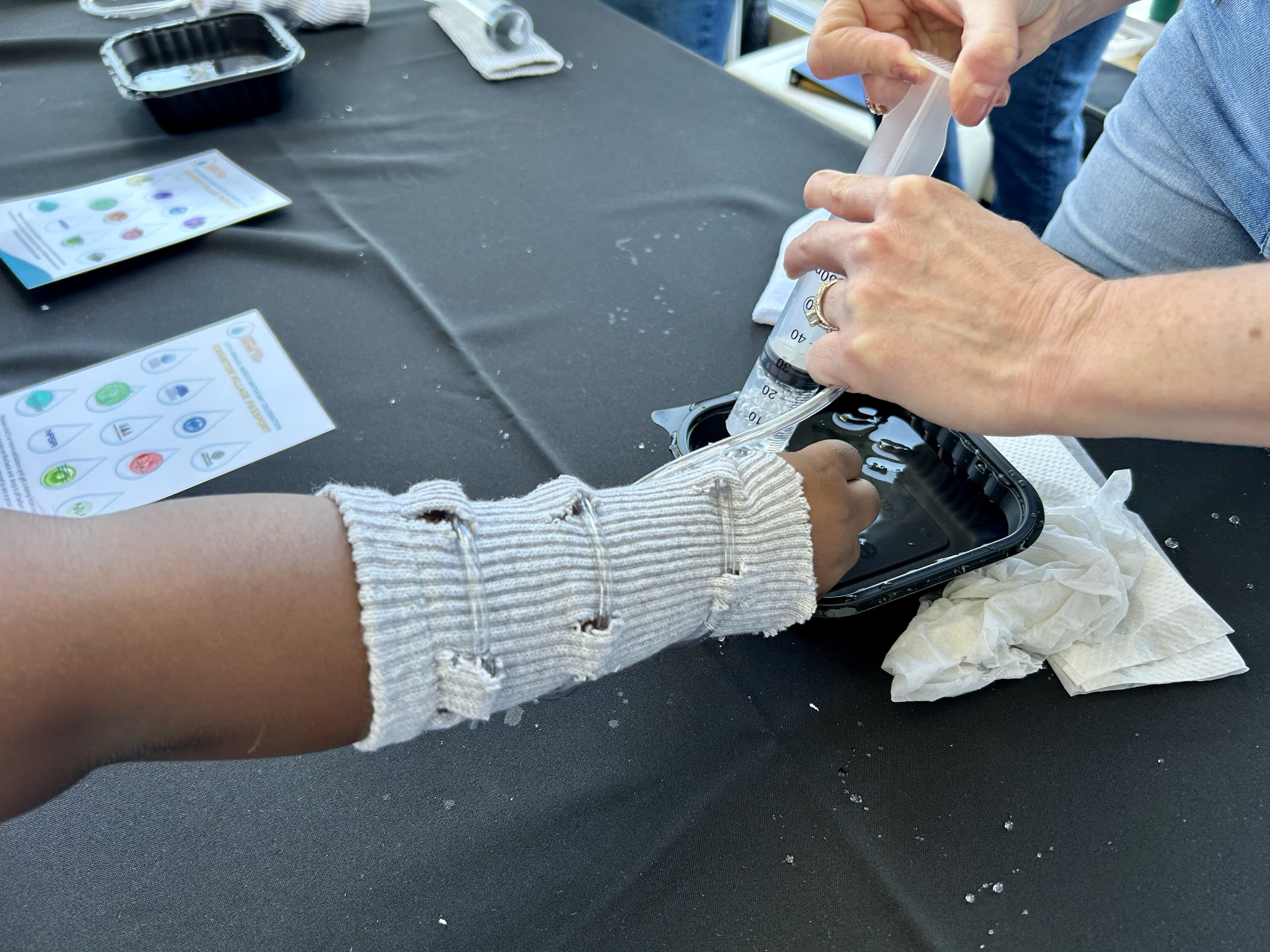
    An up-close view of a student’s hand and forearm wearing the Liquid Cooling and Ventilation Garment. A NASA staff member uses a large syringe to dispense water into a tube that wraps around the garment.
    A NASA Glenn Research Center staff member demonstrates how NASA’s Liquid Cooling and Ventilation Garment cools down the body using water during World Water Day at Great Lakes Science Center in Cleveland on Friday, March 21, 2025.
    Credit: NASA/Lillianne Hammel 

    This interactive activity helped students discover how NASA uses water to regulate the body temperatures of astronauts during spacewalks.  

    Approximately 450 students and educators attended the event.   

  • NASA Glenn Champions FIRST Robotics Competition Buckeye Regional

    Standing in the work area where robots are adjusted for competition, NASA Glenn’s center director and a FIRST Robotics participant casually discuss robotics and the competition.
    NASA Glenn Research Center’s Director Dr. Jimmy Kenyon, left, talks with a Youth Tech Academy Red Dragon participant at the FIRST Robotics Competition Buckeye Regional in Cleveland on Friday, April 4, 2025.
    Credit: NASA/Sara Lowthian-Hanna 

    NASA’s Glenn Research Center in Cleveland supported the 26th annual FIRST Robotics Competition Buckeye Regional, April 3-6, at Cleveland State University’s Wolstein Center. This international engineering design challenge combines the excitement of sports with the rigors of STEM. 

    Four team members stand inside a small work area and gather around a robot as they adjust its parts prior to the game. Shelves of toolboxes and logos of company supporters surround them on two sides.
    Mavericks Team participants adjust their robot prior to their turn to compete at the FIRST Robotics Competition Buckeye Regional in Cleveland on Friday, April 4, 2025.
    Credit: NASA/Sara Lowthian-Hanna 

    NASA Glenn Center Director Dr. Jimmy Kenyon helped kick off this year’s event by addressing the student participants. He shared that NASA Glenn specializes in propulsion and communications, that the center is vital to the region and country, and that “the road to Moon and Mars goes through Ohio” thanks to the center’s contributions to the agency’s missions. He also highlighted several aerospace projects underway at the center and explained how engineering and math skills used in robotics apply to real-life engineering challenges.  

    Fifty-six teams of high school students competed in the robotics competition, which aims to inspire young people to be STEM leaders and innovators by engaging them in mentor-based engineering. 

    vThree team members excitedly stare through plexiglass that surrounds an arena. They lean in and cheer on their robot inside the arena. Numerous wires and electrical boxes sit on a short shelf in front of them.
    Members from the Argonauts Team cheer as their robot competes in the FIRST Robotics Competition Buckeye Regional at Cleveland State University in Cleveland on Friday, April 4, 2025.
    Credit: NASA/Sara Lowthian-Hanna 

    NASA Glenn employees offered their time and expertise as mentors, machinists, or volunteers supporting FIRST Robotics teams leading up to the event as well as on competition day.  

  • Webb’s Titan Forecast: Partly Cloudy With Occasional Methane Showers

    7 Min Read

    Webb’s Titan Forecast: Partly Cloudy With Occasional Methane Showers

    A six-panel graphic with two rows and three columns, showing infrared images of Saturn’s moon Titan. The leftmost images show a mottled globe of brown and yellow with a hazy blue edge. At the top, a white spot that is somewhat faint in the top row image and brighter in the bottom row image. The middle column shows a dark orange globe with a brighter edge. The only features are bright spots near the top and bottom. The top spot is fainter in the top row image and brighter in the bottom row image. The rightmost images also show a dark orange globe with a brighter edge. The top row image is otherwise featureless. The bottom row image, taken three days later, has bright spots near the top and bottom.

    These images of Titan were taken by NASA’s James Webb Space Telescope on July 11, 2023 (top row) and the ground-based W.M. Keck Observatories on July 14, 2023 (bottom row). They show methane clouds appearing at different altitudes in Titan’s northern hemisphere. Full image and description below.

    Credits:
    NASA, ESA, CSA, STScI, and W.M. Keck Observatories

    Saturn’s moon Titan is an intriguing world cloaked in a yellowish, smoggy haze. Similar to Earth, the atmosphere is mostly nitrogen and has weather, including clouds and rain. Unlike Earth, whose weather is driven by evaporating and condensing water, frigid Titan has a methane cycle.

    NASA’s James Webb Space Telescope, supplemented with images from the Keck II telescope, has for the first time found evidence for cloud convection in Titan’s northern hemisphere, over a region of lakes and seas. Webb also has detected a key carbon-containing molecule that gives insight into the chemical processes in Titan’s complex atmosphere.

    Titan’s Weather

    On Titan, methane plays a similar role to water on Earth when it comes to weather. It evaporates from the surface and rises into the atmosphere, where it condenses to form methane clouds. Occasionally it falls as a chilly, oily rain onto a solid surface where water ice is hard as rocks.

    “Titan is the only other place in our solar system that has weather like Earth, in the sense that it has clouds and rainfall onto a surface,” explained lead author Conor Nixon of NASA’s Goddard Space Flight Center in Greenbelt, Maryland.

    The team observed Titan in November 2022 and July 2023 using both Webb and one of the twin ground-based W.M. Keck Observatories telescopes. Those observations not only showed clouds in the mid and high northern latitudes on Titan – the hemisphere where it is currently summer – but also showed those clouds apparently rising to higher altitudes over time. While previous studies have observed cloud convection at southern latitudes, this is the first time evidence for such convection has been seen in the north. This is significant because most of Titan’s lakes and seas are located in its northern hemisphere and evaporation from lakes is a major potential methane source. Their total area is similar to that of the Great Lakes in North America.

    On Earth the lowest layer of the atmosphere, or troposphere, extends up to an altitude of about 7 miles (12 kilometers). However, on Titan, whose lower gravity allows the atmospheric layers to expand, the troposphere extends up to about 27 miles (45 kilometers). Webb and Keck used different infrared filters to probe to different depths in Titan’s atmosphere, allowing astronomers to estimate the altitudes of the clouds. The science team observed clouds that appeared to move to higher altitudes over a period of days, although they were not able to directly see any precipitation occurring.

    Image A: Titan (Webb and Keck Image)

    A six-panel graphic with two rows and three columns, showing infrared images of Saturn’s moon Titan. The top row is labeled “Webb, 11 July 2023” and the bottom row is labeled “Keck, 14 July 2023.” The leftmost images are labeled “atmosphere and surface.” They show a mottled globe of brown and yellow with a hazy blue edge. At the top, a white spot that is somewhat faint in the Webb image and brighter in the Keck image has an arrow pointing to it. The middle column is labeled “troposphere” and shows a dark orange globe with a brighter edge. The only features are bright spots near the top and bottom. The top spot is fainter in the Webb image and brighter in the Keck image, and has an arrow pointing to it. The rightmost images are labeled “stratosphere” and also show a dark orange globe with a brighter edge. The top image from Webb is otherwise featureless. The bottom image from Keck, taken three days later, has bright spots near the top and bottom. The top spot has an arrow pointing to it.
    These images of Titan were taken by NASA’s James Webb Space Telescope on July 11, 2023 (top row) and the ground-based W.M. Keck Observatories on July 14, 2023 (bottom row). They show methane clouds (denoted by the white arrows) appearing at different altitudes in Titan’s northern hemisphere.

    On the left side are representative-color images from both telescopes. In the Webb image light at 1.4 microns is colored blue, 1.5 microns is green, and 2.0 microns is red (filters F140M, F150W, and F200W, respectively). In the Keck image light at 2.13 microns is colored blue, 2.12 microns is green, and 2.06 microns is red (H2 1-0, Kp, and He1b, respectively).

    In the middle column are single-wavelength images taken by Webb and Keck at 2.12 microns. This wavelength is sensitive to emission from Titan’s lower troposphere. The rightmost images show emission at 1.64 microns (Webb) and 2.17 microns (Keck), which favor higher altitudes, in Titan’s upper troposphere and stratosphere (an atmospheric layer above the troposphere). It demonstrates that the clouds are seen at higher altitudes on July 14 than earlier on July 11, indicative of upward motion.
     

    NASA, ESA, CSA, STScI, and W.M. Keck Observatories

    Titan’s Chemistry

    Titan is an object of high astrobiological interest due to its complex organic (carbon-containing) chemistry. Organic molecules form the basis of all life on Earth, and studying them on a world like Titan may help scientists understand the processes that led to the origin of life on Earth.

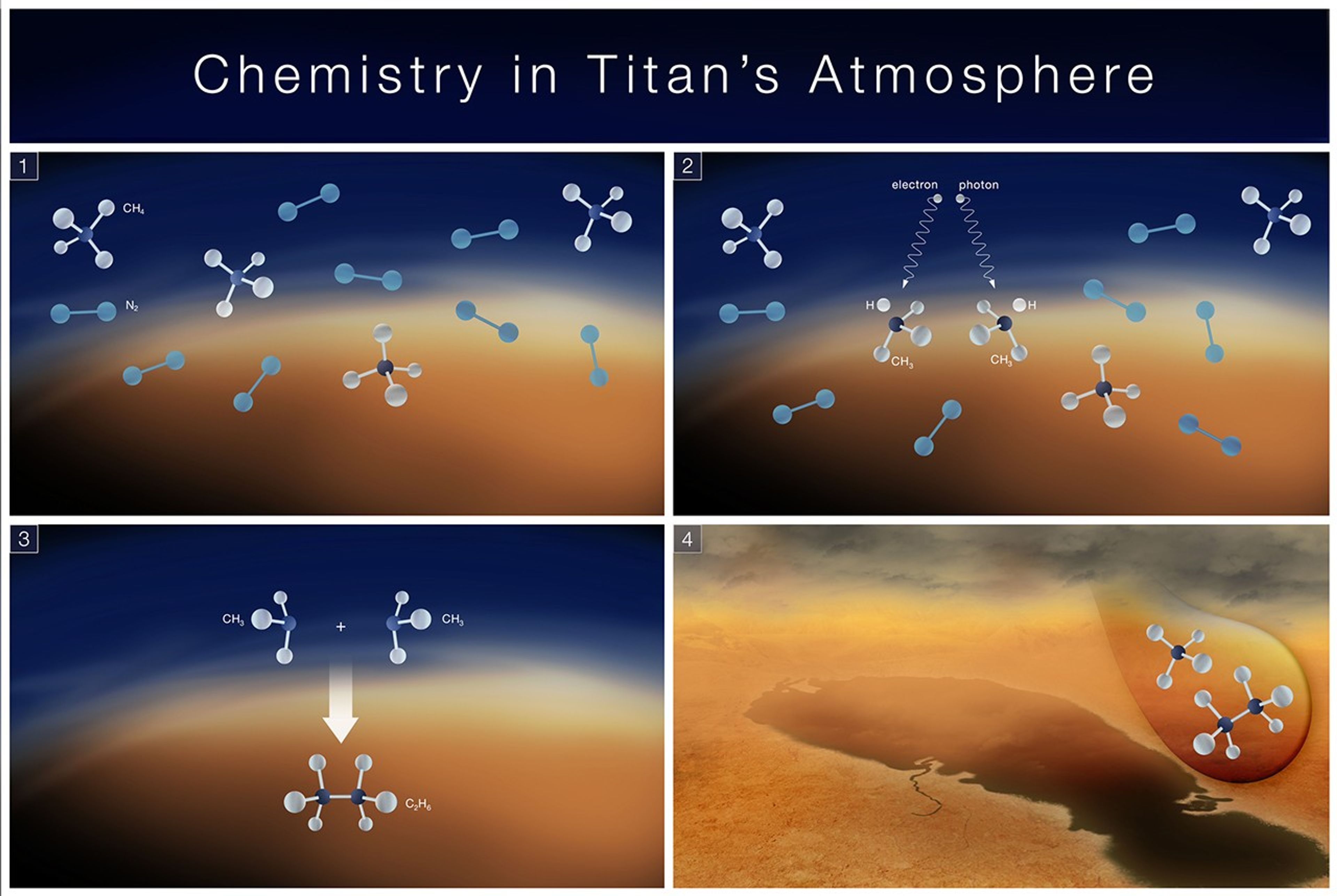
    The basic ingredient that drives much of Titan’s chemistry is methane, or CH4. Methane in Titan’s atmosphere gets split apart by sunlight or energetic electrons from Saturn’s magnetosphere, and then recombines with other molecules to make substances like ethane (C2H6) along with more complex carbon-bearing molecules.

    Webb’s data provided a key missing piece for our understanding of the chemical processes: a definitive detection of the methyl radical CH3. This molecule (called “radical” because it has a “free” electron that is not in a chemical bond) forms when methane is broken apart. Detecting this substance means that scientists can see chemistry in action on Titan for the first time, rather than just the starting ingredients and the end products.

    “For the first time we can see the chemical cake while it’s rising in the oven, instead of just the starting ingredients of flour and sugar, and then the final, iced cake,” said co-author Stefanie Milam of the Goddard Space Flight Center.

    Image B: Chemistry in Titan’s Atmosphere

    A four-panel infographic. The first three panels show the curved edge of an indistinct orange sphere on the bottom, implying the moon Titan, while the top of the image is dark to represent space. The fourth panel shows an illustration of Titan’s surface with a large, dark lake. 1)	Ball-and-stick diagrams show molecules of nitrogen (N2) and methane (CH4). 2)	From above, wiggly white lines labeled “electron” and “photon” drop down and intersect methane molecules that have been broken up into hydrogen atoms and the methyl radical (CH3). 3)	A plus sign between two methyl radicals represents a chemical reaction, with a down arrow pointing to a ball-and-stick diagram of ethane (C2H6). 4)	A large droplet containing methane and ethane is shown raining down toward the surface of Titan.
    This four-panel infographic demonstrates a key chemical process believed to occur in the atmosphere of Saturn’s moon Titan.
    1. Titan has a thick, nitrogen (N2) atmosphere that also contains methane (CH4).
    2. Molecules known as methyl radicals (CH3) form when methane is broken apart by sunlight or energetic electrons from Saturn’s magnetosphere.
    3. It then recombines with other molecules or with itself to make substances like ethane (C2H6).
    4. Methane, ethane, and other molecules condense and rain out of the atmosphere, forming lakes and seas on Titan’s surface. NASA’s James Webb Space Telescope detected the methyl radical on Titan for the first time, providing a key missing piece for our understanding of Titan’s chemical processes.
     
    NASA, ESA, CSA, and Elizabeth Wheatley (STScI)

    The Future of Titan’s Atmosphere

    This hydrocarbon chemistry has long-term implications for the future of Titan. When methane is broken apart in the upper atmosphere, some of it recombines to make other molecules that eventually end up on Titan’s surface in one chemical form or another, while some hydrogen escapes from the atmosphere. As a result, methane will be depleted over time, unless there is some source to replenish it.

    A similar process occurred on Mars, where water molecules were broken up and the resulting hydrogen lost to space. The result was the dry, desert planet we see today.

    “On Titan, methane is a consumable. It’s possible that it is being constantly resupplied and fizzing out of the crust and interior over billions of years. If not, eventually it will all be gone and Titan will become a mostly airless world of dust and dunes,” said Nixon.

    Video: Webb Spies Rain Clouds, New Molecule on Titan

    Of all the alien worlds in our solar system, one in particular resembles our home planet. Titan, the largest moon of Saturn, is the only other place we know of where you could walk along the seashore or stand in the rain. However, Titan’s exotic seas and its oily raindrops are not made of water, but of the natural gases methane and ethane, super-chilled into liquid form. Now, NASA’s James Webb Space Telescope has revealed a crucial, missing step in how ethane is formed, and its discovery could tell us about the future of Titan’s atmosphere.

    Credit: NASA’s Goddard Space Flight Center. Producer/Editor: Dan Gallagher. Lead Scientist/Narrator: Conor Nixon. Lead Animator: Jenny McElligott. Lead Visualizer: Andrew J Christensen. Scientist: Nicholas Lombardo. Animator/Art Director: Michael Lentz. Animation Lead: Walt Feimer. Animators: Jonathan North, Wes Buchanan, Kim Dongjae, Chris Meaney, Adriana Manrique Gutierrez. Data Visualizers: Mark SubbaRao, Kel Elkins, Ernie Wright. Data Provider: Juan Lora. Executive Producer: Wade Sisler. Social Media Support: Kathryn Mersmann. Public Affairs: Laura Betz.

    Complementing the Dragonfly Mission

    More of Titan’s mysteries will be probed by NASA’s Dragonfly mission, a robotic rotorcraft scheduled to land on Saturn’s moon in 2034. Making multiple flights, Dragonfly will explore a variety of locations. Its in-depth investigations will complement Webb’s global perspective.

    “By combining all of these resources, including Webb, NASA’s Hubble Space Telescope, and ground-based observatories, we maintain continuity between the former Cassini/Huygens mission to Saturn and the upcoming Dragonfly mission,” added Heidi Hammel, vice president of the Association of Universities for Research in Astronomy and a Webb Interdisciplinary Scientist.

    This data was taken as part of Hammel’s Guaranteed Time Observations program to study the Solar System. The results were published in the journal Nature Astronomy.

    The James Webb Space Telescope is the world’s premier space science observatory. Webb is solving mysteries in our solar system, looking beyond to distant worlds around other stars, and probing the mysterious structures and origins of our universe and our place in it. Webb is an international program led by NASA with its partners, ESA (European Space Agency) and CSA (Canadian Space Agency).

    To learn more about Webb, visit:

    https://science.nasa.gov/webb

    Downloads

    Click any image to open a larger version.

    View/Download all image products at all resolutions for this article from the Space Telescope Science Institute.

    View/Download the research results from the journal Nature Astronomy.

    Media Contacts

    Laura Betz – laura.e.betz@nasa.gov
    NASA’s Goddard Space Flight Center, Greenbelt, Md.

    Christine Pulliamcpulliam@stsci.edu
    Space Telescope Science Institute, Baltimore, Md.

    Science

    Conor Nixon (NASA-GSFC), Heidi Hammel (AURA)

    Learn more about Titan

    Read more: Webb’s Near-infrared Spectrograph (NIRSpec)

    Webb Blog: Webb, Keck Telescopes Team Up to Track Clouds on Saturn’s Moon Titan

    More Webb News

    More Webb Images

    Webb Science Themes

    Webb Mission Page

    What is the Webb Telescope?

    SpacePlace for Kids

    En Español

    Ciencia de la NASA

    NASA en español 

    Space Place para niños

  • Sols 4539-4540: Back After a Productive Weekend Plan

    1 min read

    Sols 4539-4540: Back After a Productive Weekend Plan

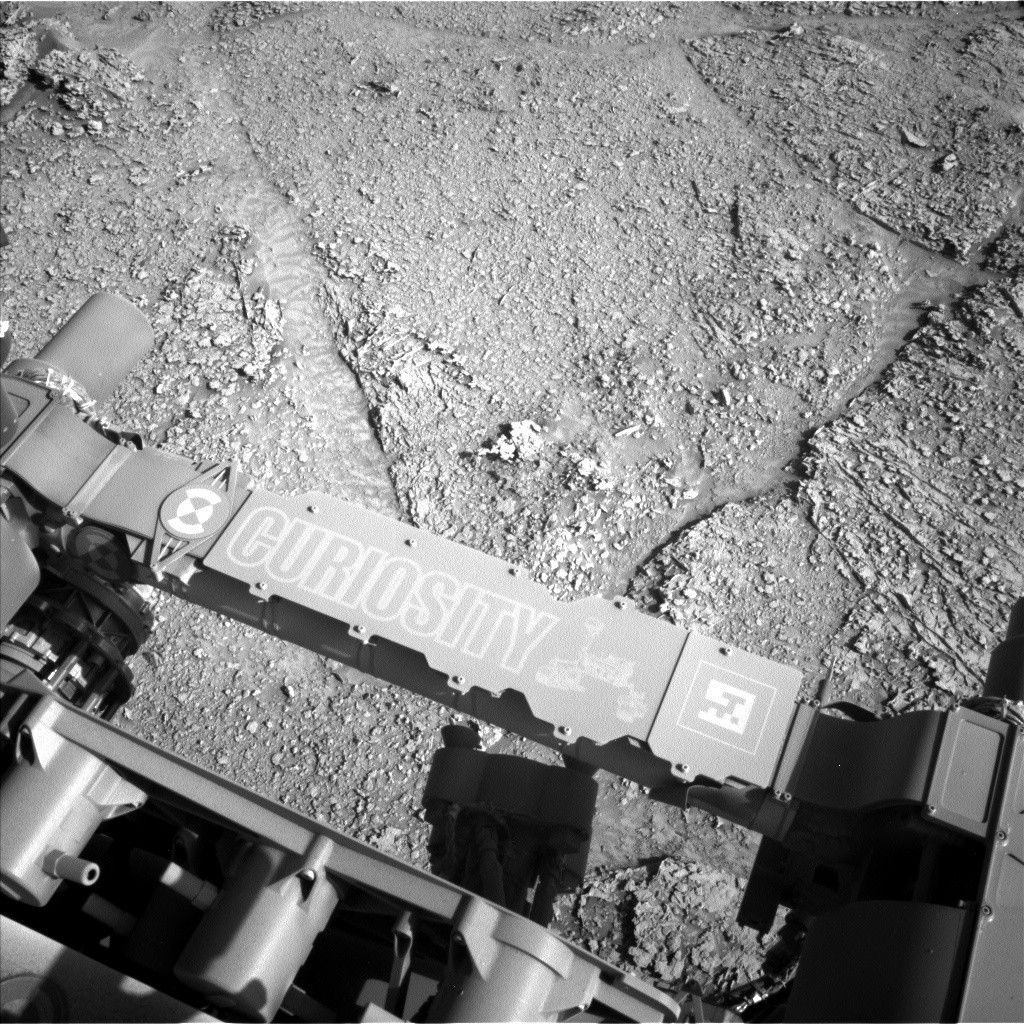
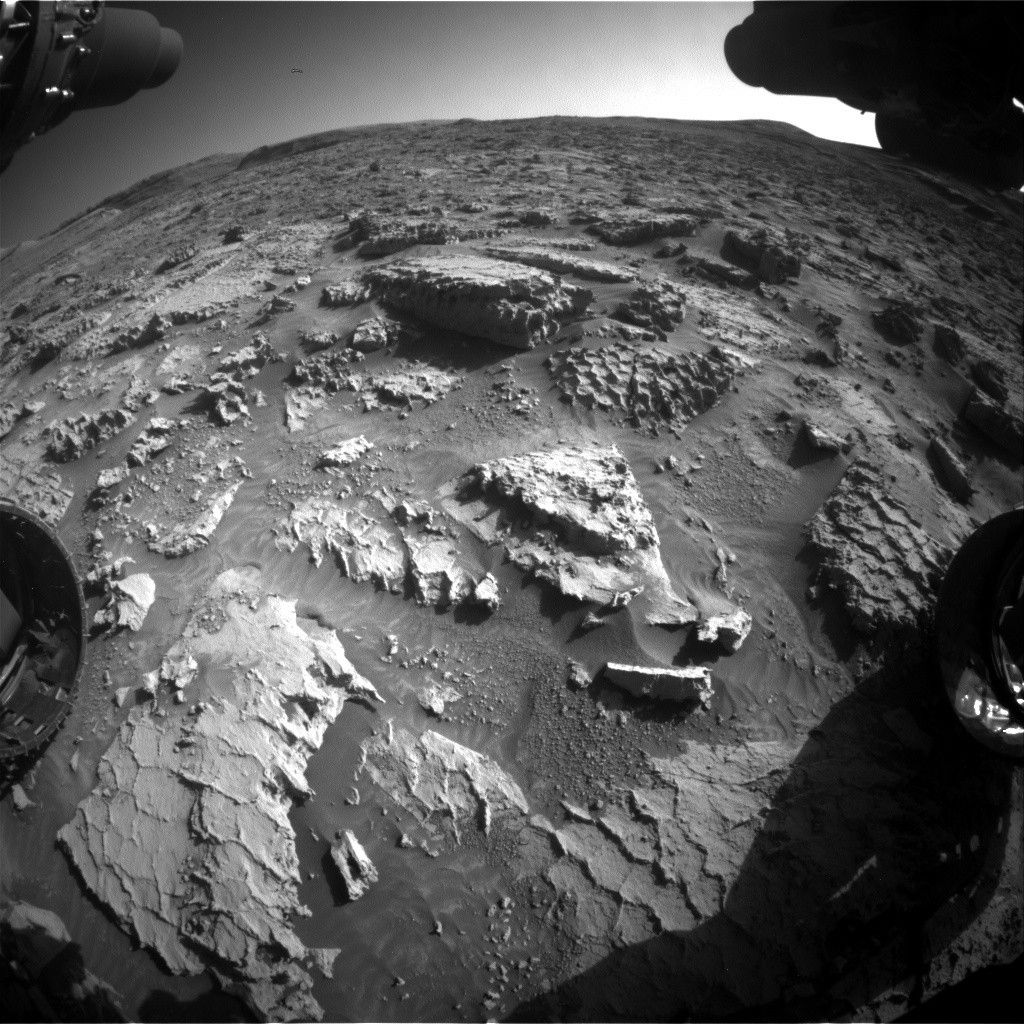
    A grayscale photograph of Martian terrain in front of the Curiosity rover shows flat, rough ground covered in gravel, with large, polygonal sections of rock on the surface separated by shallow gouges in the soil. The bottom of the frame shows parts of the rover, running from the middle left edge to the lower right corner of the image, including part of its robotic arm which carries a nameplate imprinted with “Curiosity” outlined in white, all-capital letters, and to the right of that a line drawing of the rover.
    NASA’’s Mars rover Curiosity acquired this image using its Left Navigation Camera on May 11, 2025 — Sol 4537, or Martian day 4,537 of the Mars Science Laboratory mission — at 22:26:23 UTC.
    NASA/JPL-Caltech

    Written by Scott VanBommel, Planetary Scientist at Washington University

    Earth planning date: Monday, May 12, 2025

    Curiosity was back to work Monday, picking up where it left off from Friday’s plan. Tosol’s plan started with an APXS analysis on the target “Jeffrey Pine,” though the DRT was kept on the sidelines this time. Curiosity then proceeded to image Jeffrey Pine and “Canyon Oak” with MAHLI while simultaneously executing a DAN passive analysis. Mastcam documented “Santiago Peak” as well as Canyon Oak, prior to a ChemCam 5-spot analysis on the latter. Following a drive of about 30 meters (about 98 feet), Curiosity rounded out the two-sol plan with untargeted and environmental monitoring activities, including Navcam dust-devil and cloud-shadow movies. 

    Details

    Last Updated

    May 13, 2025

    Related Terms

  • Sols 4536-4538: Dusty Martian Magnets

    2 min read

    Sols 4536-4538: Dusty Martian Magnets

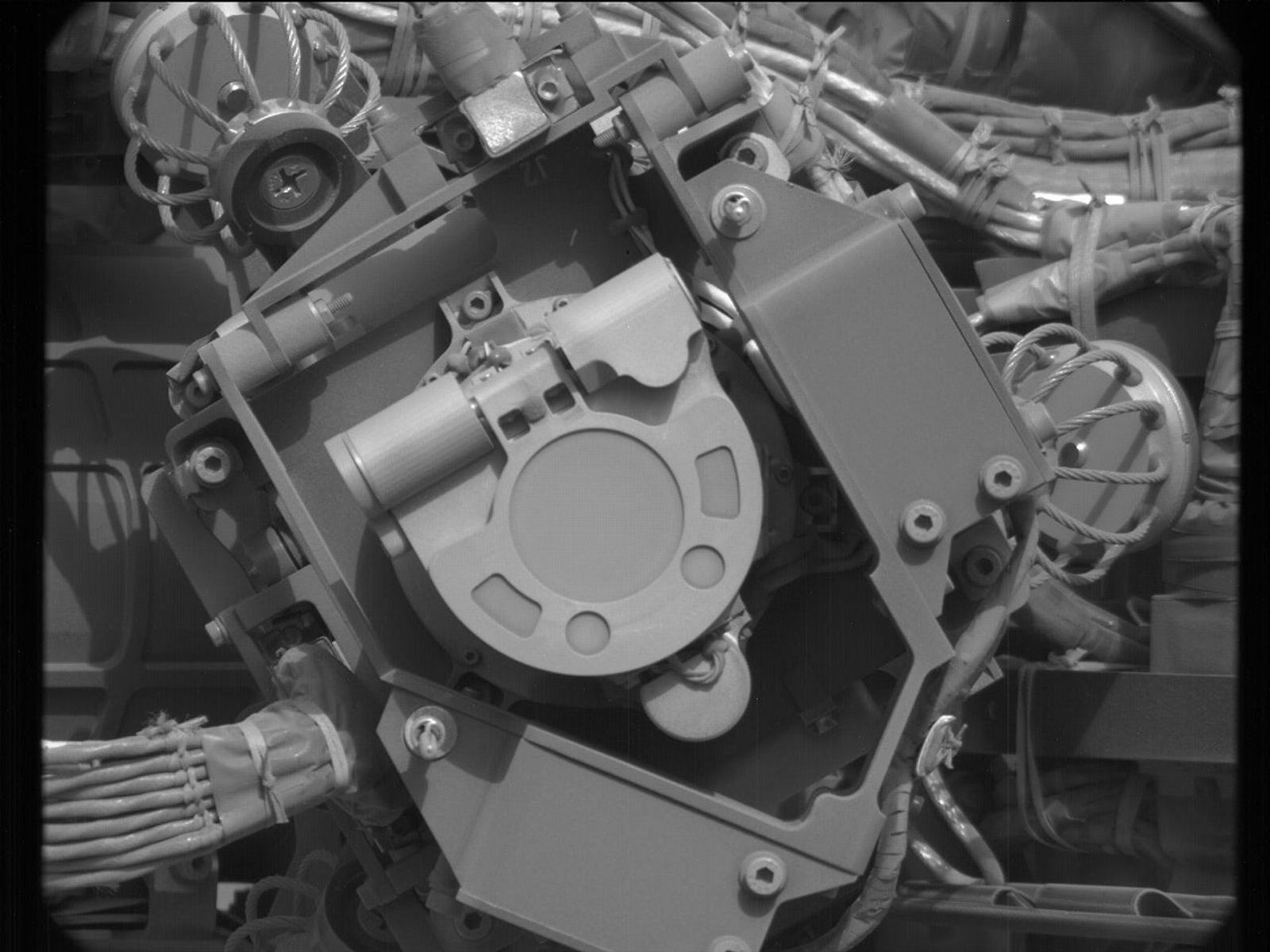
    A grayscale close-up image of an instrument on the Mars rover Curiosity, showing at the center of the image a U-shaped flat piece of metal face the camera, with its rounded bottom pointing toward the lower right corner of the image. It’s surrounded by metal plates at different angles, some parallel to the plane of the image, others perpendicular, and most of them secured with hex nuts. Braided bunches of cable are twisted behind these other sections, leading into the instrument.
    NASA’s Mars rover Curiosity acquired this image, used to inspect the magnet on its MAHLI (Mars Hand Lens Imager), a camera on the turret of tools at the end of the rover’s robotic arm. The main purpose of Curiosity’s MAHLI camera is to acquire close-up, high-resolution views of rocks and regolith in the field; it can focus on any target from about 0.8 inches (2.1 centimeters) to infinity. Curiosity used its Mast Camera (Mastcam) on Sept. 1, 2024 — Sol 4291, or Martian day 4,291 of the Mars Science Laboratory mission — at 05:48:14 UTC.
    NASA/JPL-Caltech/MSSS

    Written by Remington Free, Operations Systems Engineer at NASA’s Jet Propulsion Laboratory

    Earth planning date: Friday, May 9, 2025

    I was on downlink today for SA-SPaH, our robotic arm team. We successfully completed a number of fun arm activities, including a DRT brushing and APXS observations of a bedrock target, and also completed a traverse of about 25 meters (about 82 feet). Exciting!

    Today, our uplink team planned three sols of activities. On Sol 4536, we are using the arm to do some inspection imaging of the MAHLI magnet using Mastcam. This magnet allows us to determine whether or not the MAHLI cover has successfully opened or closed. These magnets accumulate a lot of Martian dust particles, so we periodically take imaging to inspect the quantity of dust and get a better understanding of the state of the hardware. I’ve included above an image of the MAHLI instrument, from our last inspection on Sol 4291. After the magnet inspection, we’ll do some more typical arm activities, which include some APXS placements, DRT brushing, and MAHLI imaging on targets of interest. 

    In this workspace, we are interested in targets characterizing the pale layered sulfate unit we’ve been driving on, as well as a target in the new ridge-forming unit. Beyond our arm activities, we’ll do additional science observations of the surface using Mastcam and ChemCam.  

    On Sol 4537, we’ll focus on driving! Prior to our drive, we’ll take some more scientific observations, including a Navcam cloud movie, Mastcam documentation of some geological units, and ChemCam LIBS on a ridge-forming unit. We have then planned a 21-meter drive (about 69 feet) to take us to a bedrock area of scientific interest. We’re excited because the terrain looks pretty benign, so we’re hoping it all goes smoothly!

    Post-drive, we’ll take some Mastcam survey imaging of clasts and soils along the traverse. Finally on Sol 4538, we’ll aim our focus upwards and take a number of observations of the sky. We’ll start with a Navcam large dust-devil survey, a Mastcam tau measurement of the atmospheric optical depth, and a ChemCam passive sky observation to study atmospheric composition. Early the following morning, we’ll take some additional Navcam observations of clouds, and complete another Mastcam tau measurement of optical depth.

    Details

    Last Updated

    May 13, 2025

    Related Terms

  • Hi-Rate Composite Aircraft Manufacturing Project 2025 Spring Review

    1 min read

    Preparations for Next Moonwalk Simulations Underway (and Underwater)

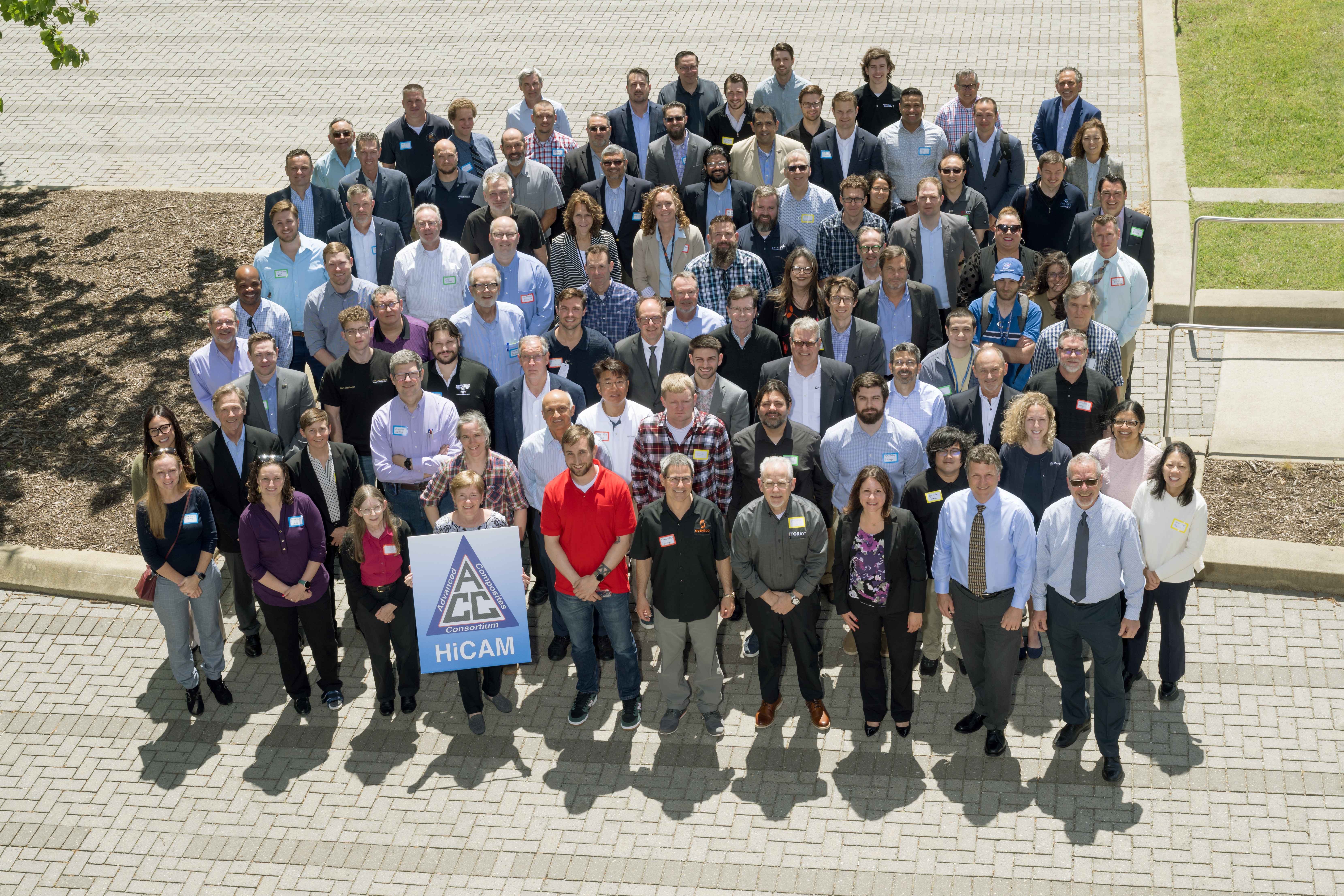
    A large group of people who work on composite aircraft pose outside in a parking lot.
    Advanced Composites Consortium team members gathered during May 2025 at NASA’s Langley Research Center in Virginia for a technical review of activities in the Hi-Rate Composite Aircraft Manufacturing project.
    NASA

    NASA and its partners in the Advanced Composites Consortium gathered at the agency’s Langley Research Center in Hampton, Virginia, on April 29-May 1, 2025.

    Team members from 22 organizations in the public-private partnership are collaborating to increase the production rate of composite aircraft, reduce costs, and improve performance.

    The team discussed results from the Technology Development Phase of NASA’s Hi-Rate Composite Aircraft Manufacturing (HiCAM) project.

    The project is evaluating concepts and competing approaches at the subcomponent scale to determine technologies with the greatest impact on manufacturing rate and cost. The most promising concepts will be demonstrated on full-scale wing and fuselage components during the next four years. 

    Through collaboration and shared investment, the team is increasing the likelihood of technologies being adopted for next-generation transports, ultimately lowering costs for operators and improving the U.S. competitive advantage in the commercial aircraft industry.

    Want to Learn More About Composite Aircraft Research?

    Details

    Last Updated

    May 13, 2025

    Editor
    Jim Banke
    Contact
    Shannon Eichorn