Tag: solar system

  • Top Prize Awarded in Lunar Autonomy Challenge to Virtually Map Moon’s Surface

    NASA named Stanford University of California winner of the Lunar Autonomy Challenge, a six-month competition for U.S. college and university student teams to virtually map and explore using a digital twin of NASA’s In-Situ Resource Utilization Pilot Excavator (IPEx). 

    The winning team successfully demonstrated the design and functionality of their autonomous agent, or software that performs specified actions without human intervention. Their agent autonomously navigated the IPEx digital twin in the virtual lunar environment, while accurately mapping the surface, correctly identifying obstacles, and effectively managing available power.

    The Lunar Autonomy Challenge has been a truly unique experience. The challenge provided the opportunity to develop and test methods in a highly realistic simulation environment.”

    Adam dai

    Adam dai

    Lunar Autonomy Challenge team lead, Stanford University

    Dai added, “It pushed us to find solutions robust to the harsh conditions of the lunar surface. I learned so much through the challenge, both about new ideas and methods, as well as through deepening my understanding of core methods across the autonomy stack (perception, localization, mapping, planning). I also very much enjoyed working together with my team to brainstorm different approaches and strategies and solve tangible problems observed in the simulation.” 

    The challenge offered 31 teams a valuable opportunity to gain experience in software development, autonomy, and machine learning using cutting-edge NASA lunar technology. Participants also applied essential skills common to nearly every engineering discipline, including technical writing, collaborative teamwork, and project management.

    The Lunar Autonomy Challenge supports NASA’s Lunar Surface Innovation Initiative (LSII), which is part of the Space Technology Mission Directorate. The LSII aims to accelerate technology development and pursue results that will provide essential infrastructure for lunar exploration by collaborating with industry, academia, and other government agencies.

    The work displayed by all of these teams has been impressive, and the solutions they have developed are beneficial to advancing lunar and Mars surface technologies as we prepare for increasingly complex missions farther from home.” 

    Niki Werkheiser

    Niki Werkheiser

    Director of Technology Maturation and LSII lead, NASA Headquarters

    “To succeed, we need input from everyone — every idea counts to propel our goals forward. It is very rewarding to see these students and software developers contributing their skills to future lunar and Mars missions,” Werkheiser added.  

    Through the Lunar Autonomy Challenge, NASA collaborated with the Johns Hopkins Applied Physics Laboratory, Caterpillar Inc., and Embodied AI. Each team contributed unique expertise and tools necessary to make the challenge a success.

    The Applied Physics Laboratory managed the challenge for NASA. As a systems integrator for LSII, they provided expertise to streamline rigor and engineering discipline across efforts, ensuring the development of successful, efficient, and cost-effective missions — backed by the world’s largest cohort of lunar scientists. 

    Caterpillar Inc. is known for its construction and excavation equipment and operates a large fleet of autonomous haul trucks. They also have worked with NASA for more than 20 years on a variety of technologies, including autonomy, 3D printing, robotics, and simulators as they continue to collaborate with NASA on technologies that support NASA’s mission objectives and provide value to the mining and construction industries. 

    Embodied AI collaborated with Caterpillar to integrate the simulation into the open-source  driving environment used for the challenge. For the Lunar Autonomy Challenge, the normally available digital assets of the CARLA simulation platform, such as urban layouts, buildings, and vehicles, were replaced by an IPEx “Digital Twin” and lunar environmental models.

    “This collaboration is a great example of how the government, large companies, small businesses, and research institutions can thoughtfully leverage each other’s different, but complementary, strengths,” Werkheiser added. “By substantially modernizing existing tools, we can turn today’s novel technologies into tomorrow’s institutional capabilities for more efficient and effective space exploration, while also stimulating innovation and economic growth on Earth.”

    FINALIST TEAMS

    First Place
    NAV Lab team
    Stanford University, Stanford, California

    Second Place
    MAPLE (MIT Autonomous Pathfinding for Lunar Exploration) team
    Massachusetts Institute of Technology, Cambridge, MA

    Third Place
    Moonlight team
    Carnegie Mellon University, Pittsburgh, PA

    OTHER COMPETING TEAMS

    Lunar Explorers Arizona State University Tempe, Arizona
    AIWVU West Virginia University Morgantown, West Virginia
    Stellar Sparks California Polytechnic Institute Pomona Pomona, California
    LunatiX Johns Hopkins University Whiting School of Engineering Baltimore
    CARLA CSU California State University, Stanislaus Turlock, California
    Rose-Hulman Rose-Hulman Institute of Technology Terre Haute, Indiana
    Lunar Pathfinders American Public University System Charles Town, West Virginia
    Lunar Autonomy Challenge digital simulation of lunar surface activity using a digital twin of NASA’s ISRU Pilot Excavator
    Johns Hopkins Applied Physics Laboratory
  • NASA Welcomes Norway as 55th Nation to Sign Artemis Accords

    Credit: NASA

    Following an international signing ceremony Thursday, NASA congratulated Norway on becoming the latest country to join the Artemis Accords, committing to the peaceful, transparent, and responsible exploration of space.

    “We’re grateful for the strong and meaningful collaboration we’ve already had with the Norwegian Space Agency,” said acting NASA Administrator Janet Petro. “Now, by signing the Artemis Accords, Norway is not only supporting the future of exploration, but also helping us define it with all our partners for the Moon, Mars, and beyond.”

    Norway’s Minster of Trade and Industry Cecilie Myrseth signed the Artemis Accords on behalf of the country during an event at the Norwegian Space Agency (NOSA) in Oslo. Christian Hauglie-Hanssen, director general of NOSA, and Robert Needham, U.S. Embassy Chargé d’Affaires for Norway, participated in the event. Petro contributed remarks in a pre-recorded video message.

    “We are pleased to be a part of the Artemis Accords,” said Myrseth. “This is an important step for enabling Norway to contribute to broader international cooperation to ensure the peaceful exploration and use of outer space.”

    In 2020, the United States, led by NASA and the U.S. Department of State, and seven other initial signatory nations established the Artemis Accords, the first set of practical guidelines for nations to increase safety of operations and reduce risk and uncertainty in their civil exploration activities.

    The Artemis Accords are grounded in the Outer Space Treaty and other agreements including the Registration Convention and the Rescue and Return Agreement, as well as best practices for responsible behavior that NASA and its partners have supported, including the public release of scientific data. 

    Learn more about the Artemis Accords at:

    https://www.nasa.gov/artemis-accords

    -end-

    Amber Jacobson / Elizabeth Shaw
    Headquarters, Washington
    202-358-1600
    amber.c.jacobson@nasa.gov / elizabeth.a.shaw@nasa.gov

    Details

    Last Updated

    May 15, 2025

    Editor
    Jessica Taveau

  • NASA Satellite Images Could Provide Early Volcano Warnings 

    5 min read

    Preparations for Next Moonwalk Simulations Underway (and Underwater)

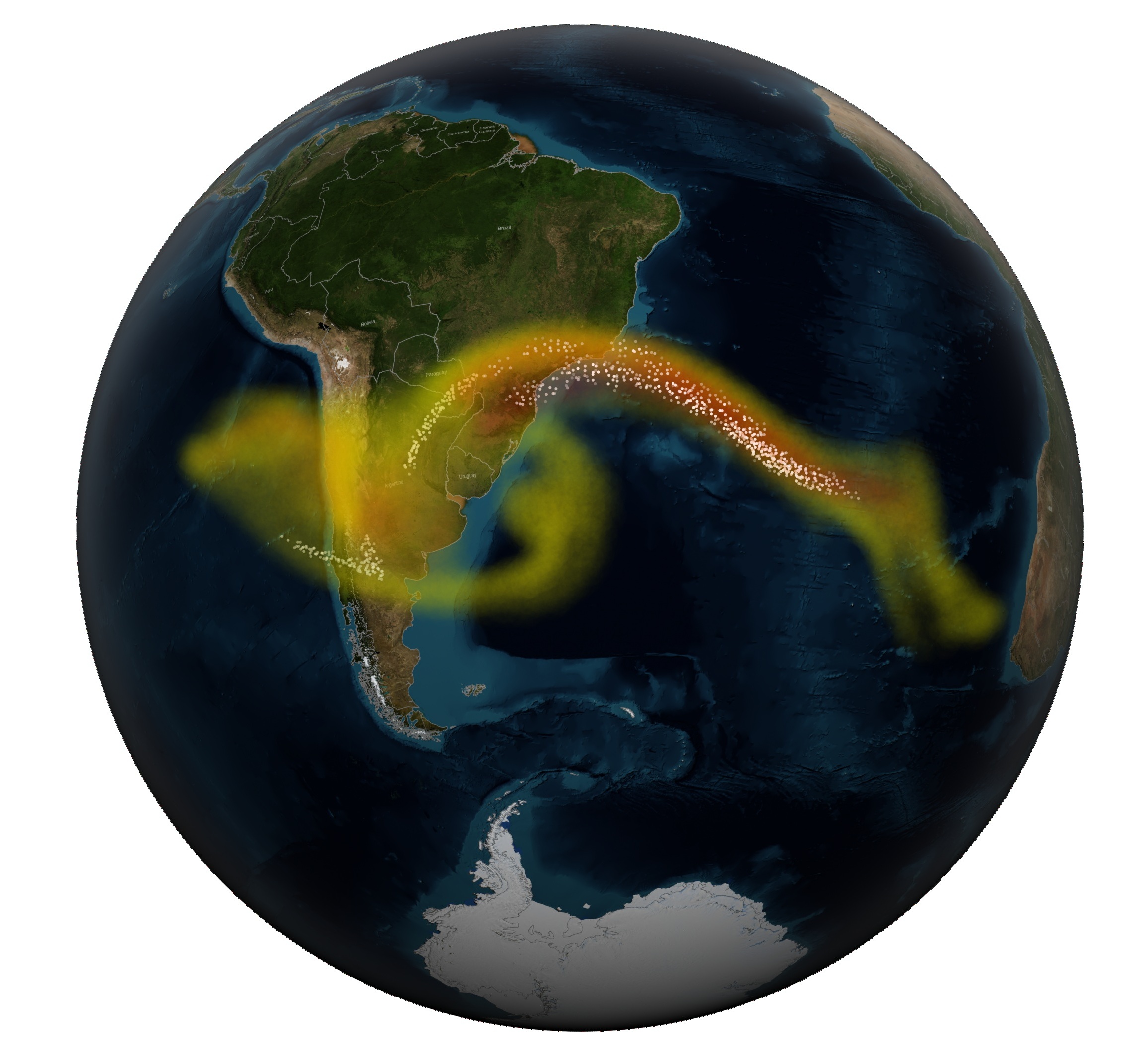
    Chaitén Volcano in southern Chile erupted on May 2, 2008 for the first time inn 9,000 years. NASA satellites that monitor changes in vegetation near volcanoes could aid in earlier eruption warnings.
    Jeff Schmaltz, MODIS Rapid Response Team, NASA Goddard Space Flight Center

    Scientists know that changing tree leaves can indicate when a nearby volcano is becoming more active and might erupt. In a new collaboration between NASA and the Smithsonian Institution, scientists now believe they can detect these changes from space.

    As volcanic magma ascends through the Earth’s crust, it releases carbon dioxide and other gases which rise to the surface. Trees that take up the carbon dioxide become greener and more lush. These changes are visible in images from NASA satellites such as Landsat 8, along with airborne instruments flown as part of the Airborne Validation Unified Experiment: Land to Ocean (AVUELO).

    Ten percent of the world’s population lives in areas susceptible to volcanic hazards. People who live or work within a few miles of an eruption face dangers that include ejected rock, dust, and surges of hot, toxic gases. Further away, people and property are susceptible to mudslides, ashfalls, and tsunamis that can follow volcanic blasts. There’s no way to prevent volcanic eruptions, which makes the early signs of volcanic activity crucial for public safety. According to the U.S. Geological Survey, NASA’s Landsat mission partner, the United States is one of the world’s most volcanically active countries.

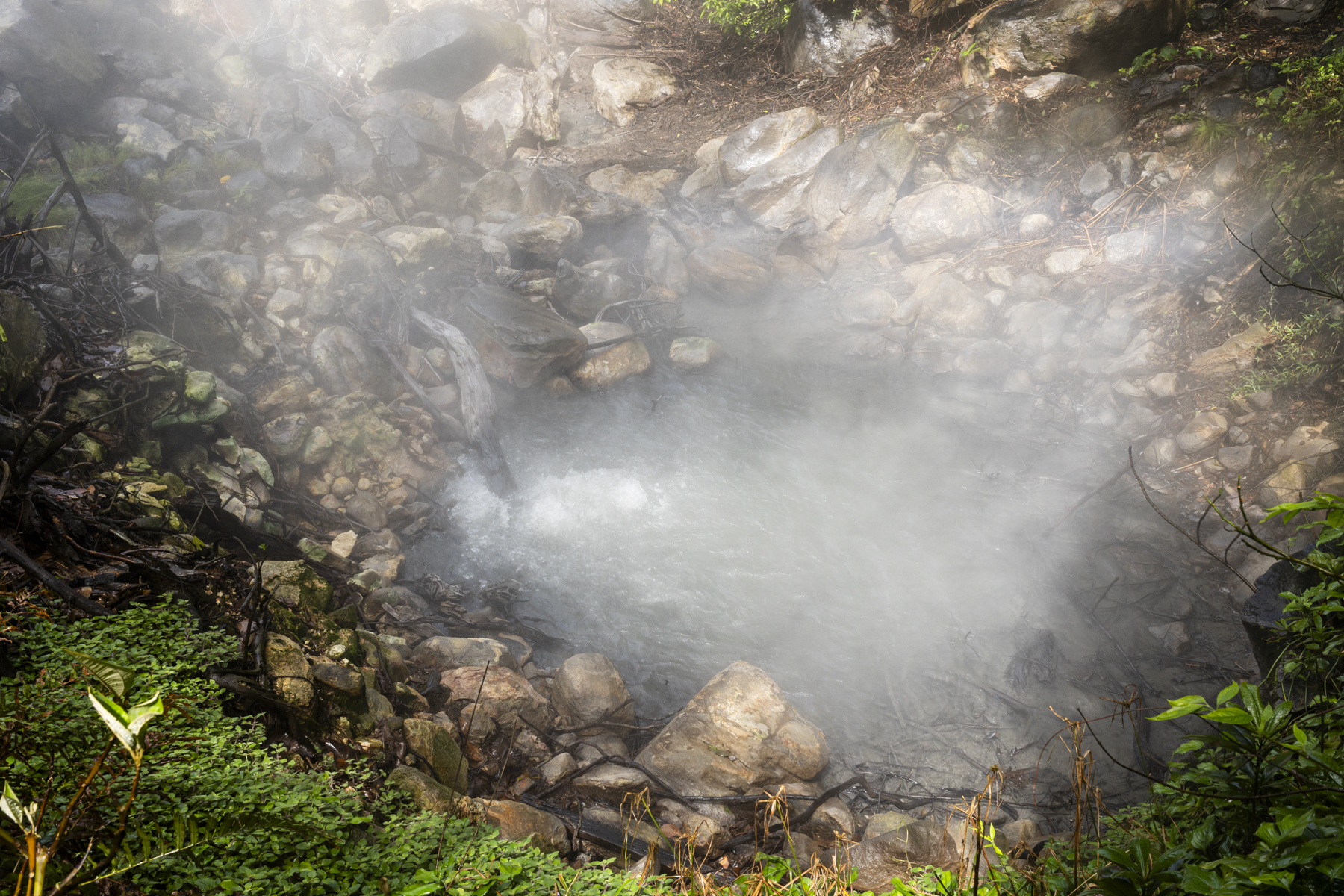
    Steam rises from a bubbling pool of water surrounded by rocks.
    Carbon dioxide released by rising magma bubbles up and heats a pool of water in Costa Rica near the Rincón de LaVieja volcano. Increases in volcanic gases could be a sign that a volcano is becoming more active.
    Alessandra Baltodano/Chapman University

    When magma rises underground before an eruption, it releases gases, including carbon dioxide and sulfur dioxide. The sulfur compounds are readily detectable from orbit. But the volcanic carbon dioxide emissions that precede sulfur dioxide emissions – and provide one of the earliest indications that a volcano is no longer dormant – are difficult to distinguish from space. 

    The remote detection of carbon dioxide greening of vegetation potentially gives scientists another tool — along with seismic waves and changes in ground height—to get a clear idea of what’s going on underneath the volcano. “Volcano early warning systems exist,” said volcanologist Florian Schwandner, chief of the Earth Science Division at NASA’s Ames Research Center in California’s Silicon Valley, who had teamed up with climate scientist Josh Fisher of Chapman University in Orange, California and and volcanologist Robert Bogue of McGill University in Montreal a decade ago. “The aim here is to make them better and make them earlier.”

    “Volcanoes emit a lot of carbon dioxide,” said Bogue, but there’s so much existing carbon dioxide in the atmosphere that it’s often hard to measure the volcanic carbon dioxide specifically. While major eruptions can expel enough carbon dioxide to be measurable from space with sensors like NASA’s Orbiting Carbon Observatory 2, detecting these much fainter advanced warning signals has remained elusive.  “A volcano emitting the modest amounts of carbon dioxide that might presage an eruption isn’t going to show up in satellite imagery,” he added.

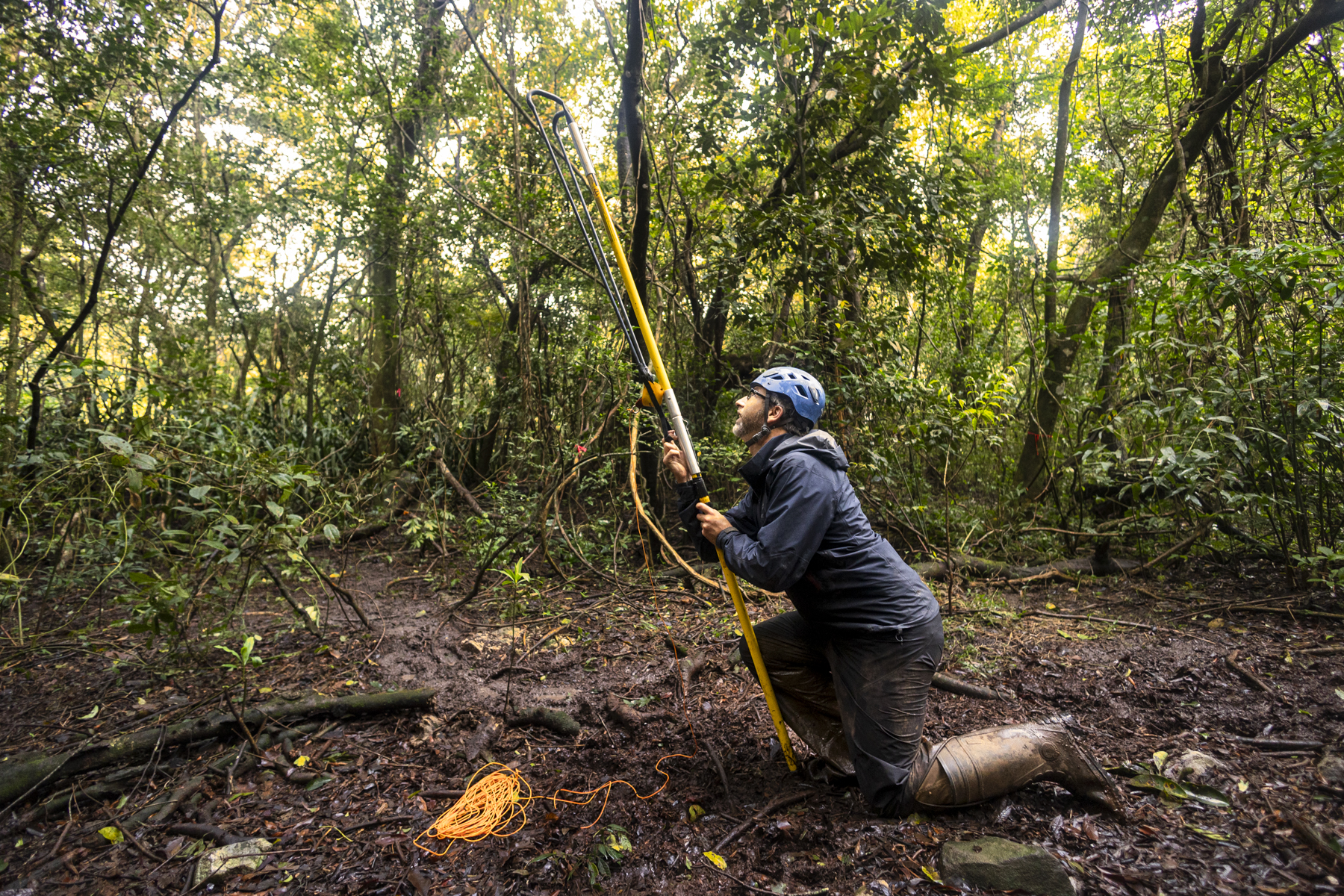
    A person wearing a helmet squats in a forest next to a yellow pole with rubber straps extended as they prepare to release a projectile.
    Gregory Goldsmith from Chapman University launches a slingshot into the forest canopy to install a carbon dioxide sensor in the canopy of a Costa Rican rainforest near the Rincón de LaVieja volcano.
    Alessandra Baltodano/Chapman University

    Because of this, scientists must trek to volcanoes to measure carbon dioxide directly. However, many of the roughly 1,350 potentially active volcanoes worldwide are in remote locations or challenging mountainous terrain. That makes monitoring carbon dioxide at these sites labor-intensive, expensive, and sometimes dangerous. 

    Volcanologists like Bogue have joined forces with botanists and climate scientists to look at trees to monitor volcanic activity. “The whole idea is to find something that we could measure instead of carbon dioxide directly,” Bogue said, “to give us a proxy to detect changes in volcano emissions.”

    “There are plenty of satellites we can use to do this kind of analysis,” said volcanologist Nicole Guinn of the University of Houston. She has compared images collected with Landsat 8, NASA’s Terra satellite, ESA’s (European Space Agency) Sentinel-2, and other Earth-observing satellites to monitor trees around the Mount Etna volcano on the coast of Sicily. Guinn’s study is the first to show a strong correlation between tree leaf color and magma-generated carbon dioxide.

    Confirming accuracy on the ground that validates the satellite imagery is a challenge that Fisher is tackling with surveys of trees around volcanoes. During the March 2025 Airborne Validation Unified Experiment: Land to Ocean mission with NASA and the Smithsonian Institution scientists deployed a spectrometer on a research plane to analyze the colors of plant life in Panama and Costa Rica.

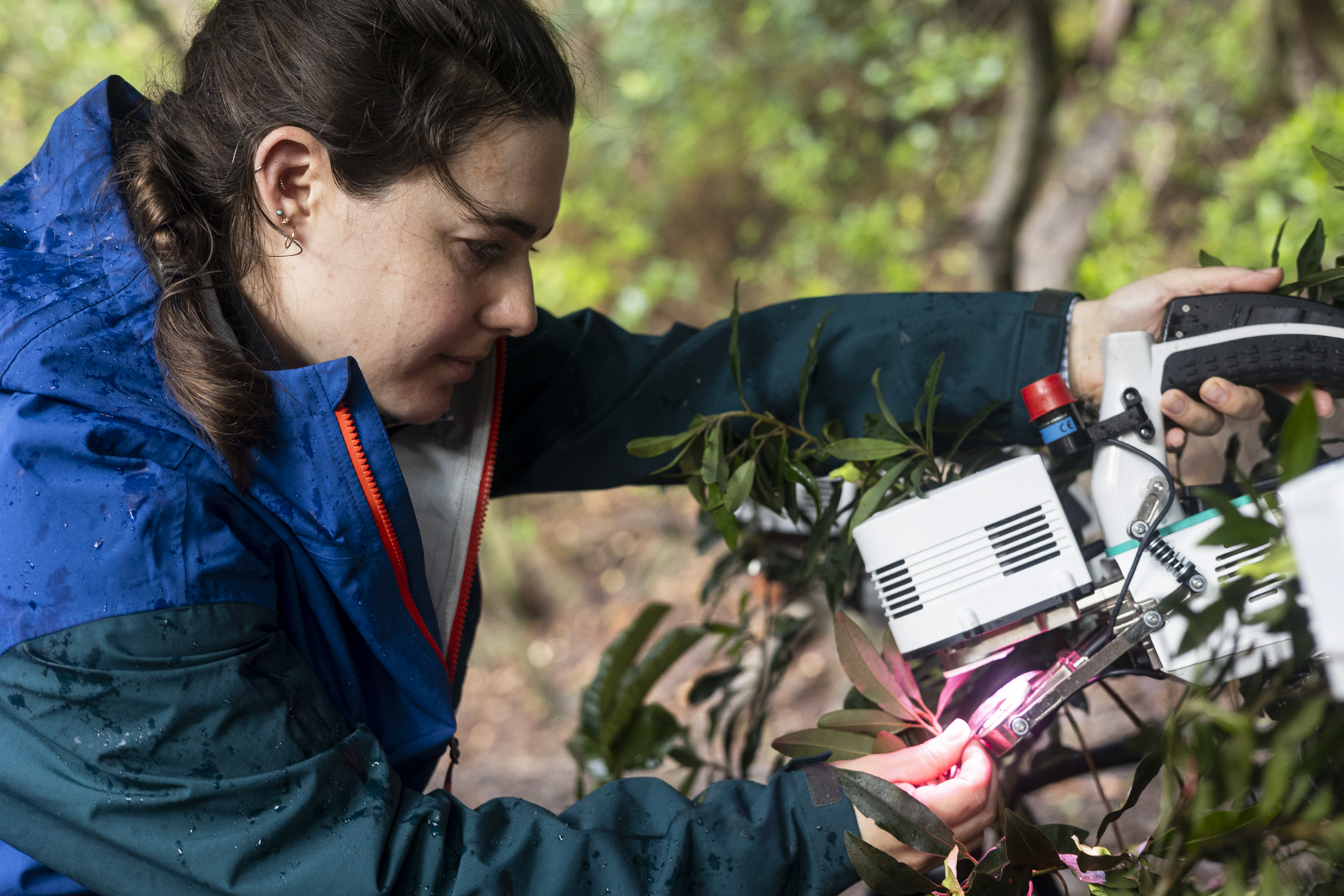
    A person wearing a blue jacket peers at instruments while illuminating a leaf with pink light.
    Alexandria Pivovaroff of Occidental College measures photosynthesis in leaves extracted from trees exposed to elevated levels of carbon dioxide near a volcano in Costa Rica.
    Alessandra Baltodano/Chapman University

    Fisher directed a group of investigators who collected leaf samples from trees near the active Rincon de la Vieja volcano in Costa Rica while also measuring carbon dioxide levels. “Our research is a two-way interdisciplinary intersection between ecology and volcanology,” Fisher said. “We’re interested not only in tree responses to volcanic carbon dioxide as an early warning of eruption, but also in how much the trees are able to take up, as a window into the future of the Earth when all of Earth’s trees are exposed to high levels of carbon dioxide.”

    Relying on trees as proxies for volcanic carbon dioxide has its limitations. Many volcanoes feature climates that don’t support enough trees for satellites to image. In some forested environments, trees that respond differently to changing carbon dioxide levels. And fires, changing weather conditions, and plant diseases can complicate the interpretation of satellite data on volcanic gases.

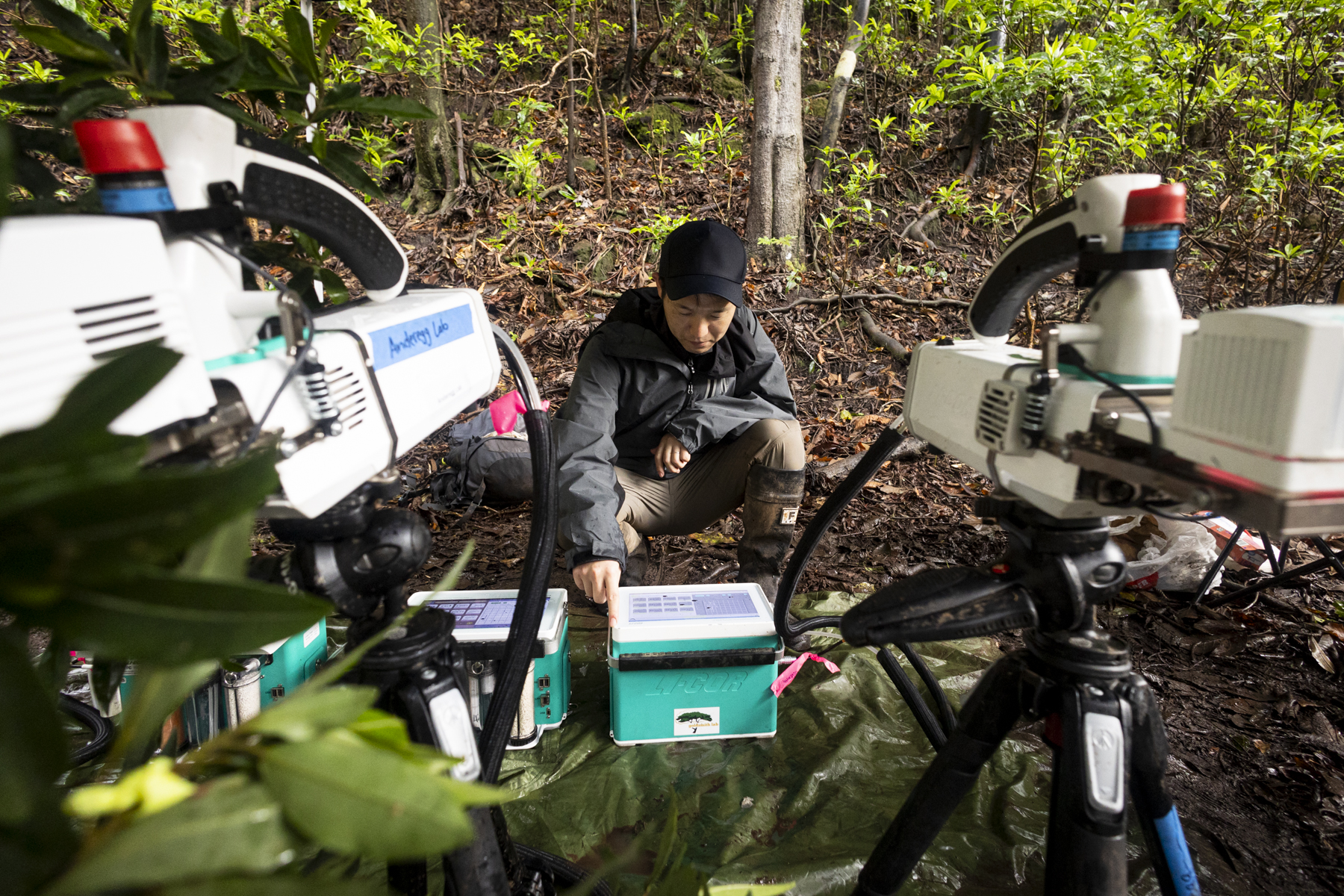
    A person squats in a forest and adjusts a machine in a box while surrounded by instrumentation.
    Chapman University visiting professor Gaku Yokoyama checks on the leaf-measuring instrumentation at a field site near the Rincón de LaVieja volcano.
    Alessandra Baltodano/Chapman University

    Still, Schwandner has witnessed the potential benefits of volcanic carbon dioxide observations first-hand. He led a team that upgraded the monitoring network at Mayon volcano in the Philippines to include carbon dioxide and sulfur dioxide sensors. In December 2017, government researchers in the Philippines used this system to detect signs of an impending eruption and advocated for mass evacuations of the area around the volcano. Over 56,000 people were safely evacuated before a massive eruption began on January 23, 2018. As a result of the early warnings, there were no casualties.

    Using satellites to monitor trees around volcanoes would give scientists earlier insights into more volcanoes and offer earlier warnings of future eruptions. “There’s not one signal from volcanoes that’s a silver bullet,” Schwandner said. “And tracking the effects of volcanic carbon dioxide on trees will not be a silver bullet. But it will be something that could change the game.”

    By James Riordon
    NASA’s Earth Science News Team

    Media contact: Elizabeth Vlock
    NASA Headquarters

    About the Author

    James R. Riordon

    James R. Riordon

    Details

    Last Updated

    May 16, 2025

  • Let’s Bake a Cosmic Cake!

    6 min read

    Let’s Bake a Cosmic Cake!

    To celebrate what would have been the 100th birthday of Dr. Nancy Grace Roman — NASA’s first chief astronomer and the namesake for the agency’s nearly complete Nancy Grace Roman Space Telescope — we’re baking a birthday cake! This isn’t your ordinary birthday treat — this cosmic cake represents the contents of our universe and everything the Roman telescope will uncover.

    A black cake with an excess of black piping covered shimmering gold dust on a white plate in front of a starry background covered in purple haze.
    NASA’s Nancy Grace Roman Space Telescope Cosmic Cake
    NASA

    The outside of our cosmic cake depicts the sky as we see it from Earth—inky black and dotted with sparkling stars. The inside represents the universe as Roman will see it. This three-layer cake charts the mysterious contents of our universe — mostly dark energy, then dark matter, and finally just five percent normal matter. As you cut into our universe cake, out spills a candy explosion symbolizing the wealth of cosmic objects Roman will see.

    Roman Cosmic Cake Instructions

    Ingredients:

    • Two boxes of vanilla cake mix and required ingredients
    • Food coloring in three colors
    • Black frosting
    • Edible glitter
    • Yellow sprinkles 
    • Nonpareil sprinkle mix 
    • Chocolate nonpareil candies 
    • Popping candy 
    • Miniature creme sandwich cookies 
    • Granulated sugar 
    • Sour candies 
    • Dark chocolate chips 
    • Jawbreakers 

    To make our cosmic cake, we first need to account for the universe’s building blocks — normal matter, dark matter, and dark energy. Comprising about five percent of the universe, normal matter is the stuff we see around us every day, from apples to stars in the sky. Outnumbering normal matter by five times, dark matter is an invisible mass that makes up about 25 percent of the universe. Finally, dark energy — a mysterious something accelerating our universe’s expansion — makes up about 68 percent of the cosmos.

    No one knows what dark matter and dark energy truly are, but we know they exist due to their effects on the universe. Roman will provide clues to these puzzles by 3D mapping matter alongside the expansion of the universe through time. 

    To depict the universe’s building blocks in our cosmic cake, mix the cake batter according to your chosen recipe. Pour one-fourth of the batter into one bowl for the dark matter layer, a little less than three-fourths into another bowl for dark energy, and the remainder into a separate bowl for normal matter. This will give you the quantities of batter for dark energy and dark matter, respectively. Use the remainder to represent normal matter. Color each bowl of batter differently using food coloring, then pour them into three separate cake pans and bake. The different sized layers will have different baking times, so watch them carefully to ensure proper cooking.

    While our cake bakes, we’ll create the cosmic candy mix — the core of our cake that represents the universe’s objects that Roman will uncover.

    First, pour yellow sprinkles into a bowl to symbolize the billions of stars Roman will see, including once-hidden stars on the far side of the Milky Way thanks to its ability to see starlight through gas and dust. 

    Roman’s data will also allow scientists to map gas and dust for the most complete picture yet of the Milky Way’s structure and how it births new stars. Add some granulated sugar to the candy mix as gas and dust.

    Next, add nonpareil sprinkles and chocolate nonpareil candies to symbolize galaxies and galaxy clusters. Roman will capture hundreds of millions of galaxies, precisely measuring their positions, shapes, sizes, and distances. By studying the properties of so many galaxies, scientists will be able to chart dark matter and dark energy’s effects more accurately than ever before.

    Now, add popping candies as explosive star deaths. Roman will witness tens of thousands of a special kind called type Ia supernovae. By studying how fast type Ia supernovae recede from us at different distances, scientists will trace cosmic expansion to better understand whether and how dark energy has changed throughout time.

    Supernovae aren’t the only stellar remnants that Roman will see. To represent neutron stars and black holes, add in jawbreakers and dark chocolate chips. Neutron stars are the remnants of massive stars that collapsed to the size of a city, making them the densest things we can directly observe. 

    The densest things we can’t directly observe are black holes. Most black holes are formed when massive stars collapse even further to a theoretical singular point of infinite density. Sometimes, black holes form when neutron stars merge—an epic event that Roman will witness. 

    Roman is also equipped to spot star-sized black holes in the Milky Way and supermassive black holes in other galaxies. Some supermassive black holes lie at the center of active galaxies—the hearts of which emit excessive energy compared to the rest of the galaxy. For these active cores, also spotted by Roman, add sour candies to the mix.

    Finally, add both whole and crushed miniature creme sandwich cookies to represent distant planets and planets-to-be. Peering into the center of our galaxy, Roman will scan for warped space-time indicating the presence of other worlds. The same set of observations could also reveal more than 100,000 more planets passing in front of other stars. Additionally, the Coronagraph Instrument will directly image both worlds and dusty disks around stars that can eventually form planets.

    After baking, remove the cake layers from the oven to cool. Cut a hole in the center of the thicker dark matter and dark energy layers. Then, stack these two layers using frosting to secure them. Pour the cosmic candy mix into the cake’s core. Then, place the thin normal matter layer on top, securing it with frosting. Frost the whole cake in black and dust it with edible glitter.

    Congratulations — your Roman Cosmic Cake is complete! As you look at the cake’s exterior, think of the night sky. As you slice the cake, imagine Roman’s deeper inspection to unveil billions of cosmic objects and clues about our universe’s mysterious building blocks.

    By Laine Havens
    NASA’s Goddard Space Flight Center

    Details

    Last Updated

    May 15, 2025

  • NASA Selects Student Teams for Drone Hurricane Response and Cybersecurity Research

    3 min read

    Preparations for Next Moonwalk Simulations Underway (and Underwater)

    USRC graphic showing a book and graduation cap representing student teams..
    Getty Images

    NASA has selected two more university student teams to help address real-world aviation challenges, through projects aimed at using drones for hurricane relief and improved protection of air traffic systems from cyber threats. 

    The research awards were made through NASA’s University Student Research Challenge (USRC), which provides student-led teams with opportunities to contribute their novel ideas to advance NASA’s Aeronautics research priorities.   

    As part of USRC, students participate in real-world aspects of innovative aeronautics research both in and out of the laboratory.  

    “USRC continues to be a way for students to push the boundary on exploring the possibilities of tomorrow’s aviation industry.” said Steven Holz, who manages the USRC award process. “For some, this is their first opportunity to engage with NASA. For others, they may be taking their ideas from our Gateways to Blue Skies competition and bringing them closer to reality.” 

    In the case of one of the new awardees, North Carolina State University in Raleigh applied for their USRC award after refining a concept that made them a finalist in NASA’s 2024 Gateways to Blue Skies competition.  

    Each team of students selected for a USRC award receives a NASA grant up to $80,000 and is tasked with raising additional funds through student-led crowdfunding. This process helps students develop skills in entrepreneurship and public communication. 

    The new university teams and research topics are: 

    North Carolina State University in Raleigh 

    “Reconnaissance and Emergency Aircraft for Critical Hurricane Relief” will develop and deploy advanced Unmanned Aircraft Systems (UAS) designed to locate, communicate with, and deliver critical supplies to stranded individuals in the wake of natural disasters. 

    The team includes Tobias Hullette (team lead), Jose Vizcarrondo, Rishi Ghosh, Caleb Gobel, Lucas Nicol, Ajay Pandya, Paul Randolph, and Hadie Sabbah, with faculty mentor Felix Ewere. 

    Texas A&M University, in College Station 

    “Context-Aware Cybersecurity for UAS Traffic Management” will develop, test, and pursue the implementation of an aviation-context-aware network authentication system for the holistic management of cybersecurity threats to enable future drone traffic control systems.  

    The team includes Vishwam Raval (team lead), Nick Truong, Oscar Leon, Kevin Lei, Garett Haynes, Michael Ades, Sarah Lee, and Aidan Spira, with faculty mentor Sandip Roy. 

    Complete details on USRC awardees and solicitations, such as what to include in a proposal and how to submit it, are available on the NASA Aeronautics Research Mission Directorate solicitation page

    About the Author

    John Gould

    John Gould

    Aeronautics Research Mission Directorate

    John Gould is a member of NASA Aeronautics’ Strategic Communications team at NASA Headquarters in Washington, DC. He is dedicated to public service and NASA’s leading role in scientific exploration. Prior to working for NASA Aeronautics, he was a spaceflight historian and writer, having a lifelong passion for space and aviation.

  • Deimos Before Dawn

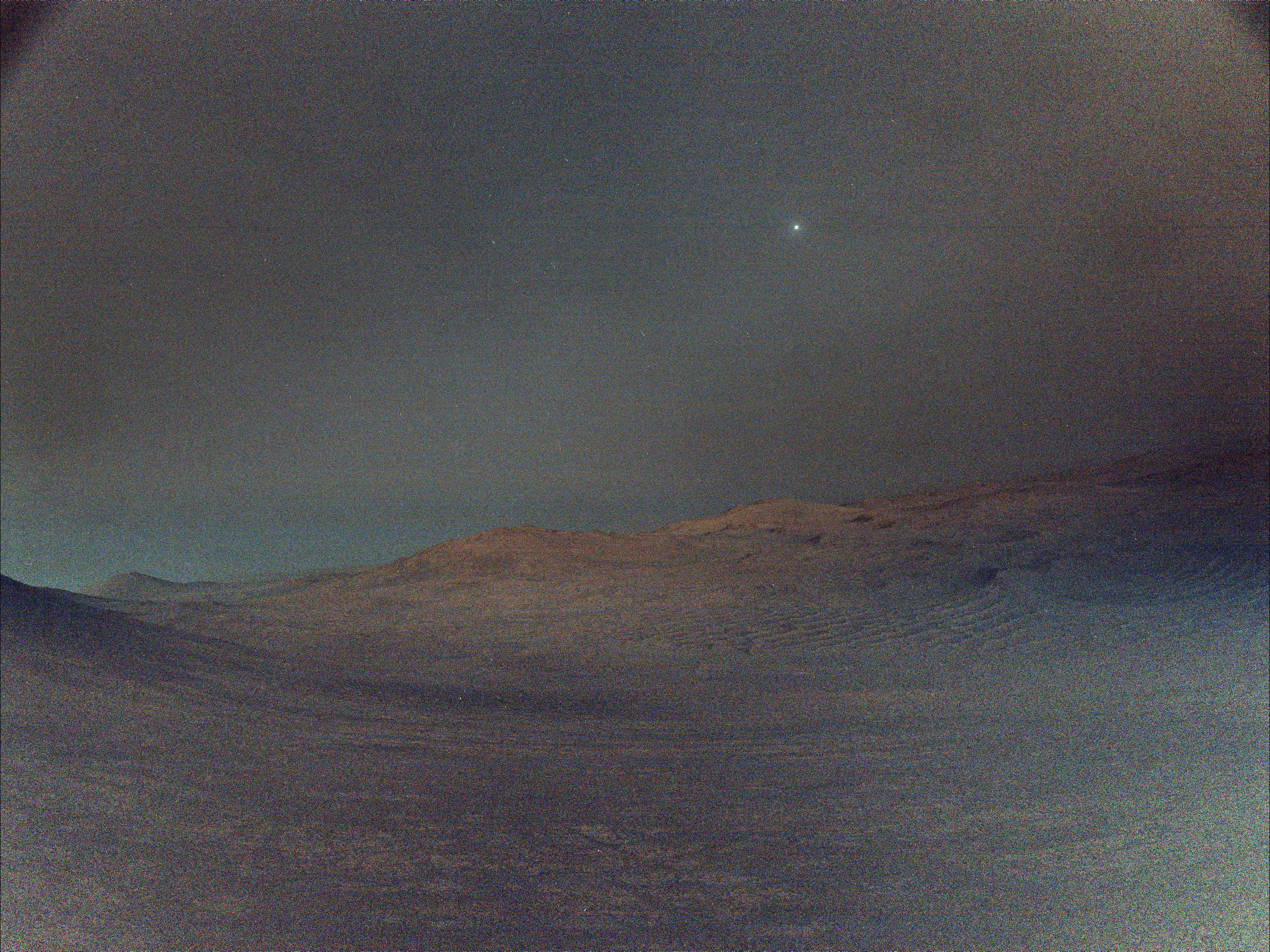
    NASA's Perseverance rover captured this view of Deimos (the brightest spot in the sky), the smaller of Mars two moons, shining in the sky at 4:27 a.m. local time on March 1, 2025. The low light makes the view hazy, and the sky and ground both have a gray tint. In the distance, the crest of a crater shows Mars' signature rusty red color.
    NASA/JPL-Caltech

    NASA’s Perseverance rover captured this view of Deimos, the smaller of Mars’ two moons, shining in the sky at 4:27 a.m. local time on March 1, 2025, the 1,433rd Martian day, or sol, of the mission. In the dark before dawn, the rover’s left navigation camera used its maximum long-exposure time of 3.28 seconds for each of 16 individual shots, all of which were combined onboard the camera into a single image that was later sent to Earth. In total, the image represents an exposure time of about 52 seconds.

    The low light and long exposures add digital noise, making the image hazy. Many of the white specks seen in the sky are likely noise; some may be cosmic rays. Two of the brighter white specks are Regulus and Algieba, stars that are part of the constellation Leo.

    Image credit: NASA/JPL-Caltech

  • Space Cloud Watch Needs Your Photos of Night-Shining Clouds 

    2 min read

    Space Cloud Watch Needs Your Photos of Night-Shining Clouds 

    Noctilucent clouds appear to glow against a dark blue sky. The clouds are an electric blue on top, fading to a dusty orange where they dip behind the hills on the horizon.
    Noctilucent Clouds observed from Bozeman, MT on 16 July 2009 at 4:29 MDT. The Space Cloud Watch project needs more photos like this one to diagnose changes in our atmosphere!
    Photo credit: Dr. Joseph A Shaw

    Noctilucent or night-shining clouds are rare, high-altitude clouds that glow with a blue silvery hue at dusk or dawn when the Sun shines on them from below the horizon. These ice clouds typically occur near the North and South Poles but are increasingly being reported at mid- and low latitudes. Observing them helps scientists better understand how human activities may affect our atmosphere. 

    Now, the Space Cloud Watch project is asking you to report your own observations of noctilucent clouds and upload your own photographs. Both recent photographs and photographs taken in the past are welcome and useful. Combined with satellite data and model simulations, your data can help us figure out why these noctilucent clouds are more frequently appearing at mid-low latitudes..  

    “I find these clouds fascinating and can’t wait to see the amazing pictures,” said project lead Dr. Chihoko Cullens from the University of Colorado, Boulder Laboratory for Atmospheric and Space Physics.  

    Did you see or photograph any night-shining clouds? Upload them here. Later, the science team will transfer them to a site on the Zooniverse platform where you or other volunteers can help examine them and identify wave structures in the cloud images. 

    If you love clouds, NASA has more citizen science projects for you. Try Cloudspotting on Mars, Cloudspotting on Mars: Shapes, or GLOBE Observer Clouds! 

    Details

    Last Updated

    May 15, 2025

  • Will the Sun Ever Burn Out? We Asked a NASA Expert: Episode 60

    1 min read

    Preparations for Next Moonwalk Simulations Underway (and Underwater)

    Will the Sun ever burn out?

    Well, the Sun, just like the stars we see at night, is a star. It’s a giant ball of super hot hydrogen.

    Gravity squeezes it in and it creates energy, which is what makes the Sun shine. Eventually, it will use up all of that hydrogen. But in the process, it’s creating helium. So it will then use the helium. And it will continue to use larger and larger elements until it can’t do this anymore.

    And when that happens, it will start to expand into a red giant about the size of the inner planets. Then it will shrink back down into a very strange star called a white dwarf — super hot, but not very bright and about the size of the Earth.

    But our Sun has a pretty long lifetime. It’s halfway through its 10-billion-year lifetime.

    So the Sun will never really burn out, but it will change and be a very, very different dim kind of star when it reaches the end of its normal life.

    [END VIDEO TRANSCRIPT]

    Full Episode List

    Full YouTube Playlist

  • A Tough Drill at Witch Hazel Hill

    2 min read

    A Tough Drill at Witch Hazel Hill

    A color image from the Martian surface shows uneven yellow-tan ground, covered in gravel and much larger flat, angular rocks showing above the surface. Parts of the rover are visible but shaded – a portion across the top of the frame, and a wheel in the lower left corner. A drill hole is visible in the ground near the center of the image, surrounded by lighter-colored soil.
    The Bell Island drill hole: This image of the Bell Island drill hole was acquired by the front left Hazcam, on May 7, 2025 (Sol 1497, or Martian day 1,497 of the Mars 2020 mission) at the local mean solar time of 15:31:16.
    NASA/JPL-Caltech

    Written by Alex Jones, Ph.D. candidate at Imperial College London 

    After a busy few months exploring the outer slopes of the Jezero crater rim at an area named “Witch Hazel Hill,” the Perseverance Science Team was eyeing another sample of these truly ancient rocks, which likely predate Jezero crater itself.  

    The target? A rock containing spherules, which could shed a light on volcanic- or impact-related processes occurring in Mars’ most ancient past. After a search of several outcrops, the “Hare Bay” abrasion patch at “Pine Pond” revealed suitably accessible and spherule-bearing bedrock for sampling. 

    On Sol 1483 of the mission, sampling was a-go… But Mars wasn’t keen to give its secrets away too easily. 

    As data began arriving on Earth, it became clear Perseverance had managed to drill into the rock but had stopped short of retracting the drill and storing the sample. It transpired that this rock was particularly hard — a far cry from the crumbly rocks of the upper crater rim that fell apart when faced with Perseverance’s drill bit.  

    This isn’t the first time a hard rock has gotten in the way of sampling; an extremely hard-to-crack boulder on the Jezero fan top stopped the drill short. This time though, the drill penetrated the rock as expected, but faulted during retraction. After a few sols of hard work by the engineering team, however, there were smiles all round as images of the successfully retracted drill reached Earth.

    But Mars wasn’t finished with surprises yet.

    The “Bell Island” core contained the spherules the team were looking for, but the sample tube was overfilled. This meant that excess core length would prevent the sample from being sealed. In the end, the team opted to execute a dump activity to clear at least some of the sample out of the tube. This activity succeeded in removing enough sample that the tube can now be sealed in the future. As has been the case in the past on Mars, the most exciting discoveries often require a little Perseverance


    before
    during

    A color photo from the Mars surface shows pale yellow-orange, gritty terrain with lighter-colored, rectangular flat rocks visible above the soil. The turret at the end of the rover’s robotic arm dominates the upper half of the image. It shows two cylindrical probes reaching down to the ground below it.
    Sampling the spherules: The first image (left) shows Perseverance placing its stabilizers, ready to drill into the layered, spherule-bearing bedrock at the local mean solar time of 15:19:19 on April 22, 2025 (Sol 1483).
    NASA/JPL-Caltech

    A color photo from the Mars surface shows pale yellow-orange, gritty terrain with lighter-colored, rectangular flat rocks visible above the soil. The turret at the end of the rover’s robotic arm dominates the upper half of the image. It shows two cylindrical probes reaching down to the ground below it.
    Sampling the spherules: The second image (right), acquired approximately 25 minutes later, shows Perseverance’s drill embedded into the rock, having covered the Hare Bay abrasion patch with rock powder during the drilling process. Several pebbles (most notably in the lower left) appear to have moved between the first and second image, due to vibrations caused by the drilling. Both images were acquired by the rover’s front left Hazcam.
    NASA/JPL-Caltech

    A color photo from the Mars surface shows pale yellow-orange, gritty terrain with lighter-colored, rectangular flat rocks visible above the soil. The turret at the end of the rover’s robotic arm dominates the upper half of the image. It shows two cylindrical probes reaching down to the ground below it.
    Sampling the spherules: The first image (left) shows Perseverance placing its stabilizers, ready to drill into the layered, spherule-bearing bedrock at the local mean solar time of 15:19:19 on April 22, 2025 (Sol 1483).
    NASA/JPL-Caltech

    A color photo from the Mars surface shows pale yellow-orange, gritty terrain with lighter-colored, rectangular flat rocks visible above the soil. The turret at the end of the rover’s robotic arm dominates the upper half of the image. It shows two cylindrical probes reaching down to the ground below it.
    Sampling the spherules: The second image (right), acquired approximately 25 minutes later, shows Perseverance’s drill embedded into the rock, having covered the Hare Bay abrasion patch with rock powder during the drilling process. Several pebbles (most notably in the lower left) appear to have moved between the first and second image, due to vibrations caused by the drilling. Both images were acquired by the rover’s front left Hazcam.
    NASA/JPL-Caltech


    before

    during

    ready, set, drill

    Sampling the Spherules

    April 22, 2025


    The first image (left) shows Perseverance placing its stabilizers, ready to drill into the layered, spherule-bearing bedrock at the local mean solar time of 15:19:19 on April 22, 2025 (Sol 1483). The second image (right), acquired approximately 25 minutes later, shows Perseverance’s drill embedded into the rock, having covered the Hare Bay abrasion patch with rock powder during the drilling process. Several pebbles (most notably in the lower left) appear to have moved between the first and second image, due to vibrations caused by the drilling. Both images were acquired by the rover’s front left Hazcam.

    Details

    Last Updated

    May 14, 2025

    Related Terms

  • Eclipses, Auroras, and the Spark of Becoming: NASA Inspires Future Scientists

    4 min read

    Eclipses, Auroras, and the Spark of Becoming: NASA Inspires Future Scientists

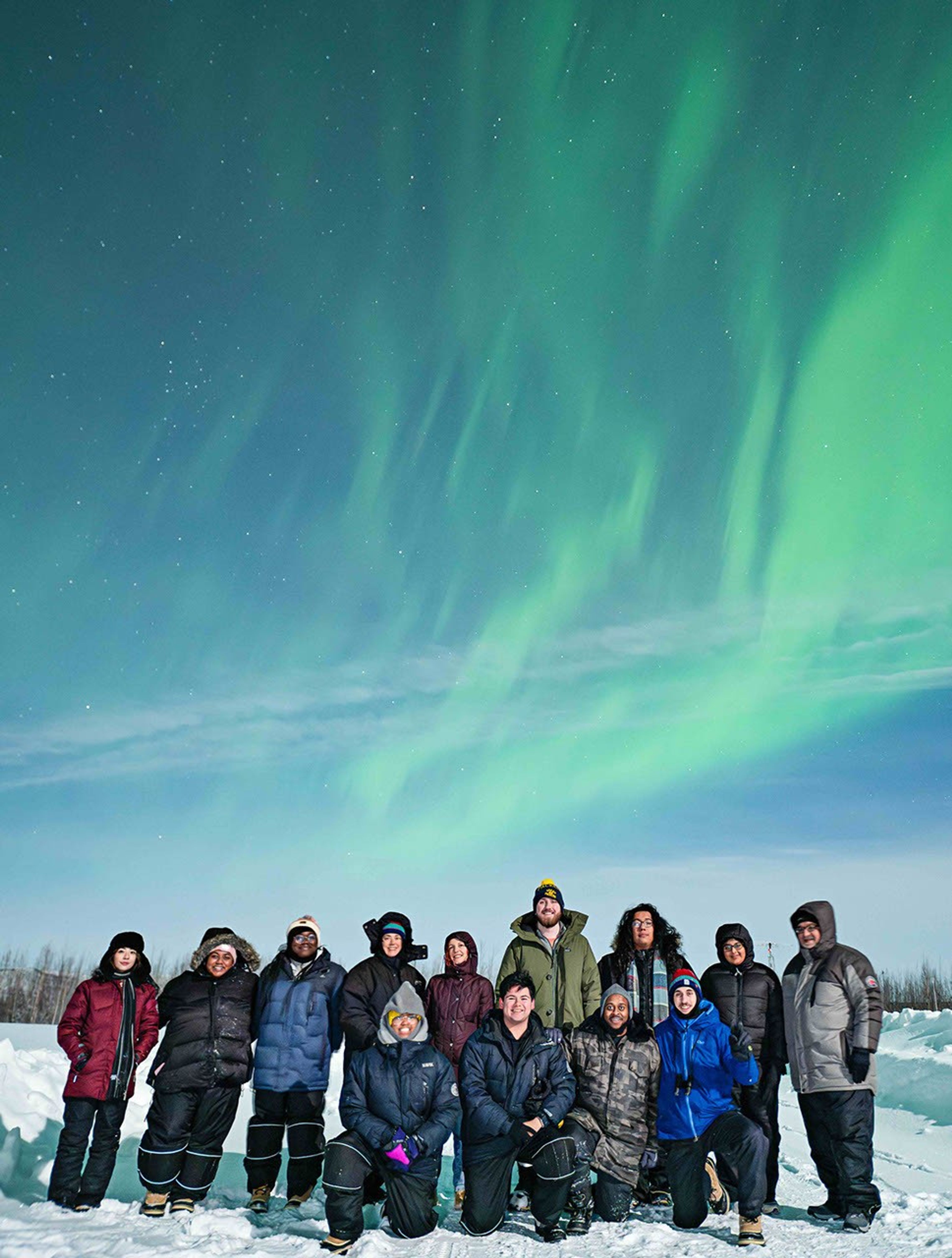
    In the heart of Alaska’s winter, where the night sky stretches endlessly and the aurora dances across the sky in a display of ethereal beauty, nine undergraduate students from across the United States were about to embark on a transformative journey. These students had been active ‘NASA Partner Eclipse Ambassadors’ in their home communities, nine of more than 700 volunteers who shared the science and awe of the 2024 eclipse with hundreds of thousands of people across the country as part of the NASA Science Activation program’s Eclipse Ambassadors project. Now, these nine were chosen to participate in a once-in a lifetime experience as a part of the “Eclipses to Aurora” Winter Field School at the University of Alaska Fairbanks. Organized by the Astronomical Society of the Pacific and NASA’s Aurorasaurus Citizen Science project, supported by NASA, this program offered more than just lectures—it was an immersive experience into the wonders of heliophysics and the profound connections between the Sun and Earth.

    From January 4 to 11, 2025, the students explored the science behind the aurora through seminars on solar and space physics, hands-on experiments, and tours of cutting-edge research facilities like the Poker Flat Research Range. They also gained invaluable insight from Athabaskan elders, who shared local stories and star knowledge passed down through generations. As Feras recalled, “We attended multiple panels on solar and space physics, spoke to local elders on their connection to the auroras, and visited the Poker Flat Research Range to observe the stunning northern lights.”

    For many students, witnessing the aurora was not only a scientific milestone, but a deeply personal and emotional experience. One participant, Andrea, described it vividly: “I looked to the darkest horizon I could find to see my only constant dream fulfilled before my eyes, so slowly dancing and bending to cradle the stars. All I could do, with my hands frozen and tears falling, I began to dream again with my eyes wide open.” Another student, Kalid, reflected on the shared human moment: “Standing there under the vast Alaskan sky… we were all just people, looking up, waiting for something magical. The auroras didn’t care about our majors or our knowledge—they brought us together under the same sky.”

    These moments of wonder were mirrored by a deeper sense of purpose and transformation. “Over the course of the week, I had the incredible opportunity to explore auroras through lectures on solar physics, planetary auroras, and Indigenous star knowledge… and to reflect on these experiences through essays and presentations,” said Sophia. The Winter Field School was more than an academic endeavor—it was a celebration of science, culture, and shared human experience. It fostered not only understanding but unity and awe, reminding everyone involved of the profound interconnectedness of our universe.

    The impact of the program continues to resonate. For many students, that one aurora-lit week in Alaska became a turning point in the focus of their careers. Sophia has since been accepted into graduate school to pursue heliophysics. Vishvi, inspired by the intersection of science and society, will begin a program in medical physics at the University of Pennsylvania this fall. And Christy, moved by her time at the epicenter of aurora research, has applied to the Ph.D. program in Space Physics at the University of Alaska Fairbanks—the very institution that helped spark her journey. Their stories are powerful proof that the Winter Field School didn’t just teach—it awakened purpose, lit new paths, and left footprints on futures still unfolding.

    Eclipse Ambassadors is supported by NASA under cooperative agreement award number 80NSS22M0007 and is part of NASA’s Science Activation Portfolio. Learn more about how Science Activation connects NASA science experts, real content, and experiences with community leaders to do science in ways that activate minds and promote deeper understanding of our world and beyond: https://science.nasa.gov/learn/about-science-activation/

    A group of 13 people standing together on snow-covered ground, dressed in warm winter clothing, with the aurora glowing in the sky above them. Some are kneeling, while others stand in front of them, all facing the camera and smiling.
    Participants at the Winter Field School are enjoying the trip to Anchorage, AK.
    Andy Witteman

    Details

    Last Updated

    May 14, 2025

    Editor
    NASA Science Editorial Team
  • NASA Awards Launch Service Task Order for Aspera’s Galaxy Mission

    The letters NASA on a blue circle with red and white detail, all surrounded by a black background
    Credit: NASA

    NASA has selected Rocket Lab USA Inc. of Long Beach, California, to launch the agency’s Aspera mission, a SmallSat to study galaxy formation and evolution, providing new insights into how the universe works.

    The selection is part of NASA’s Venture-Class Acquisition of Dedicated and Rideshare (VADR) launch services contract. This contract allows the agency to make fixed-price indefinite-delivery/indefinite-quantity launch service task order awards during VADR’s five-year ordering period, with a maximum total contract value of $300 million.

    Through the observation of ultraviolet light, Aspera will examine hot gas in the space between galaxies, called the intergalactic medium. The mission will study the inflow and outflow of gas from galaxies, a process thought to contribute to star formation.

    Aspera is part of NASA’s Pioneers Program in the Astrophysics Division at NASA Headquarters in Washington, which funds compelling astrophysics science at a lower cost using small hardware and modest payloads. The principal investigator for Aspera is Carlos Vargas at the University of Arizona in Tucson. NASA’s Launch Services Program, based at the agency’s Kennedy Space Center in Florida, manages the VADR contract.

    To learn more about NASA’s Aspera mission and the Pioneers Program, visit:

    https://go.nasa.gov/42U1Wkn

    -end-

    Joshua Finch / Tiernan Doyle
    Headquarters, Washington
    202-358-1600
    joshua.a.finch@nasa.gov / tiernan.doyle@nasa.gov

    Patti Bielling
    Kennedy Space Center, Florida
    321-501-7575
    patricia.a.bielling@nasa.gov

  • Pretty in Pink

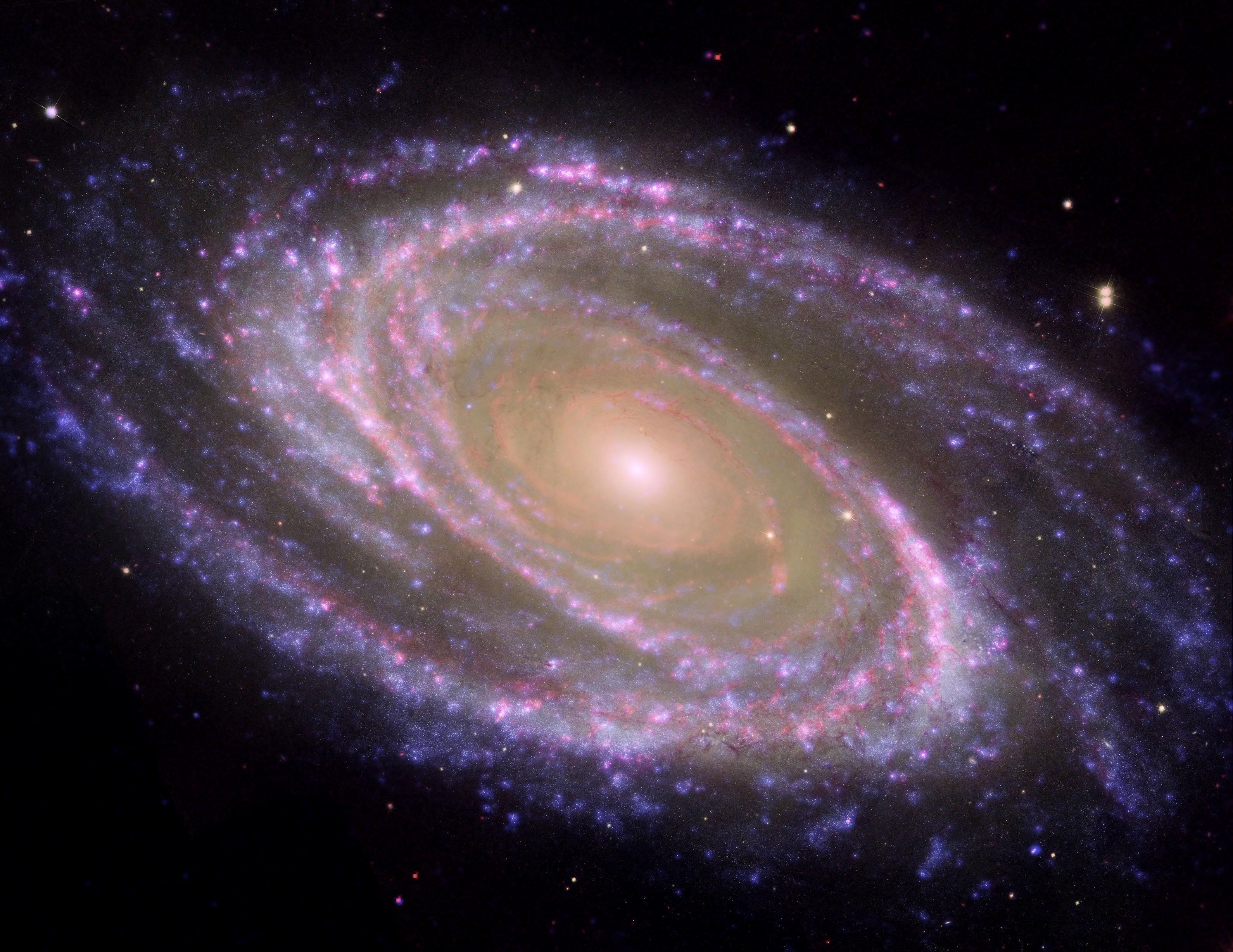
    A spiral galaxy's winding arms are shades of pink and purple in this image. At the center is a bright, hazy yellow light.
    NASA/JPL-Caltech/ESA/Harvard-Smithsonian CfA

    The spiral galaxy known as Messier 81 (M81) has a rosy tint in this June 1, 2007, composite image that incorporates data from NASA’s Spitzer and Hubble Space Telescopes, and NASA’s Galaxy Evolution Explorer. Discovered by the German astronomer Johann Elert Bode in 1774, M81 is one of the brightest galaxies in the night sky. It is located 11.6 million light-years from Earth in the constellation Ursa Major.

    The galaxy’s spiral arms, which wind all the way down into its nucleus, are made up of young, bluish, hot stars formed in the past few million years. They also host a population of stars formed in an episode of star formation that started about 600 million years ago.

    Learn more about M81 in Hubble’s Messier Catalog.

    Image credit: NASA/JPL-Caltech/ESA/Harvard-Smithsonian CfA

  • NASA to Participate in Next Private Astronaut Mission Teleconference

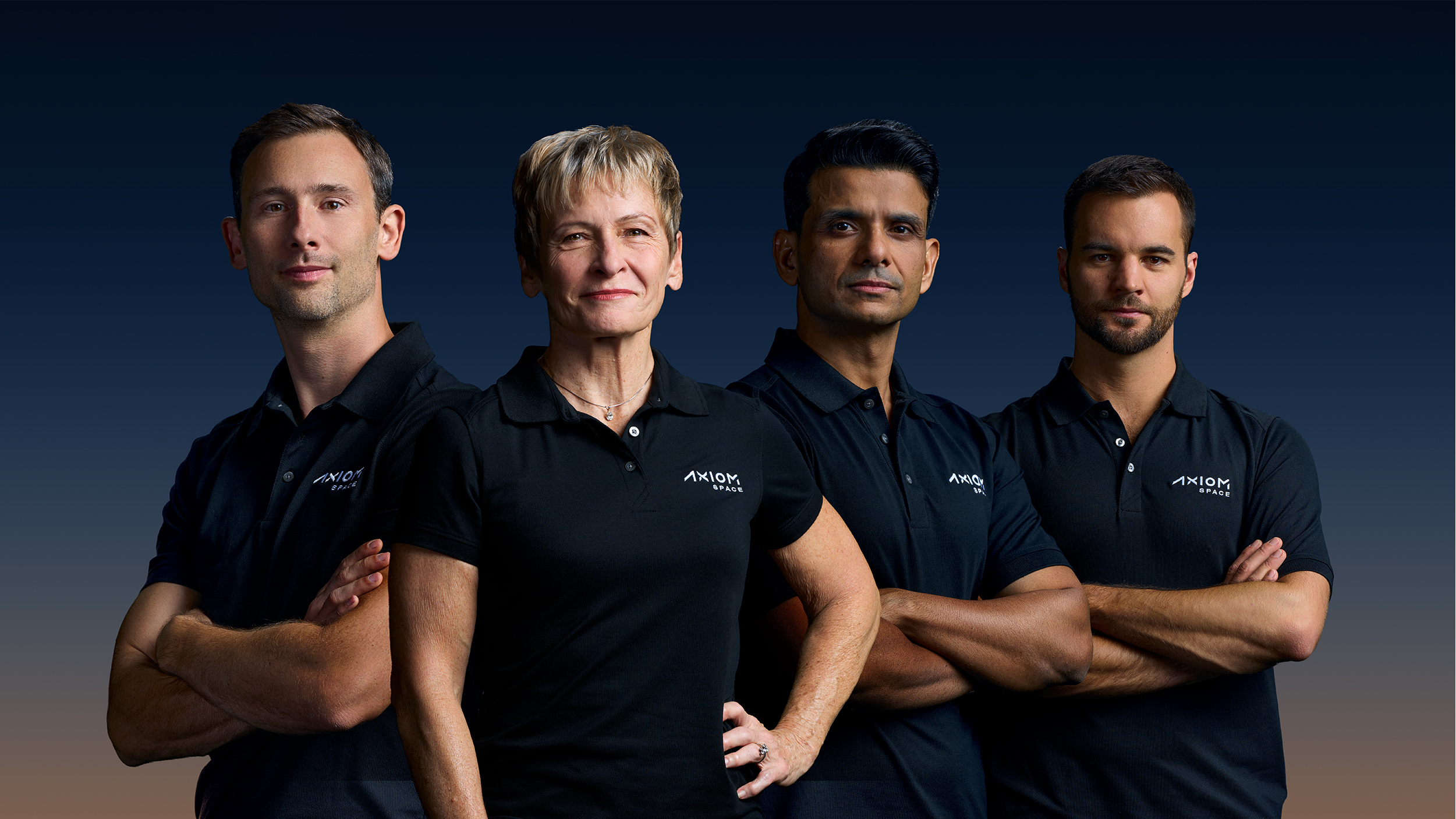
    The Axiom Mission 4, or Ax-4, crew will launch aboard a SpaceX Dragon spacecraft to the International Space Station from NASA’s Kennedy Space Center in Florida. From left to right: ESA (European Space Agency) astronaut Sławosz Uznański-Wiśniewski of Poland, former NASA astronaut Peggy Whitson, ISRO (Indian Space Research Organization) astronaut Shubhanshu Shukla, and Tibor Kapu of Hungary.
    The Axiom Mission 4, or Ax-4, crew will launch aboard a SpaceX Dragon spacecraft to the International Space Station from NASA’s Kennedy Space Center in Florida. From left to right: ESA (European Space Agency) astronaut Sławosz Uznański-Wiśniewski of Poland, former NASA astronaut Peggy Whitson, ISRO (Indian Space Research Organization) astronaut Shubhanshu Shukla, and Tibor Kapu of Hungary.
    Credit: Axiom Space

    NASA will join a media teleconference hosted by Axiom Space at 10:30 a.m. EDT, Tuesday, May 20, to discuss the launch of Axiom Mission 4 (Ax-4), the fourth private astronaut mission to the International Space Station.

    Briefing participants include:

    • Dana Weigel, manager, International Space Station Program, NASA
    • Allen Flynt, chief of mission services, Axiom Space
    • Sarah Walker, director, Dragon mission management, SpaceX
    • Sergio Palumberi, mission manager, ESA (European Space Agency)
    • Aleksandra Bukała, project manager, head of strategy and international cooperation, POLSA (Polish Space Agency)
    • Orsolya Ferencz, ministerial commissioner of space research, HUNOR (Hungarian to Orbit)

    To join the call, media must register with Axiom Space by 12 p.m., Monday, May 19, at:

    https://bit.ly/437SAAh

    The Ax-4 launch aboard a SpaceX Dragon spacecraft on the company’s Falcon 9 rocket is targeted no earlier than 9:11 a.m., Sunday, June 8, from NASA’s Kennedy Space Center in Florida.

    During the mission aboard the space station, a four-person multi-national crew will complete about 60 research experiments developed for microgravity in collaboration with organizations across the globe.

    Peggy Whitson, former NASA astronaut and director of human spaceflight at Axiom Space, will command the commercial mission, while ISRO astronaut Shubhanshu Shukla will serve as pilot. The two mission specialists are ESA project astronaut Sławosz Uznański-Wiśniewski of Poland and Tibor Kapu of Hungary.

    The first private astronaut mission to the station, Axiom Mission 1, lifted off in April 2022 for a 17-day mission aboard the orbiting laboratory. The second private astronaut mission to the station, Axiom Mission 2, also was commanded by Whitson and launched in May 2023 for eight days in orbit. The most recent private astronaut mission, Axiom Mission 3, launched in January 2024; the crew spent 18 days docked to the space station.

    The International Space Station is a springboard for developing a low Earth economy. NASA’s goal is to achieve a strong economy off the Earth where the agency can purchase services as one of many customers to meet its science and research objectives in microgravity. NASA’s commercial strategy for low Earth orbit provides the government with reliable and safe services at a lower cost, enabling the agency to focus on Artemis missions to the Moon in preparation for Mars while also continuing to use low Earth orbit as a training and proving ground for those deep space missions.

    Learn more about NASA’s commercial space strategy at:

    https://www.nasa.gov/commercial-space

    -end-

    Claire O’Shea
    Headquarters, Washington
    202-358-1100
    claire.a.o’shea@nasa.gov

    Anna Schneider
    Johnson Space Center, Houston
    281-483-5111
    anna.c.schneider@nasa.gov

    Alexis DeJarnette
    Axiom Space, Houston
    alexis@axiomspace.com