Tag: solar system

  • Station Nation: Meet Megan Harvey, Utilization Flight Lead and Capsule Communicator 

    Megan Harvey is a utilization flight lead and capsule communicator, or capcom, in the Research Integration Office at NASA’s Johnson Space Center in Houston. She integrates science payload constraints related to vehicles’ launch and landing schedules. She is also working to coordinate logistics for the return of SpaceX vehicles to West Coast landing sites. 

    Read on to learn about Harvey’s career with NASA and more! 

    Megan Harvey talking to a flight director from the Remote Interface Officer console in the Mission Control Center at NASA’s Johnson Space Center in Houston.
    NASA/Mark Sowa

    Johnson Space Center is home to the best teams, both on and off the planet!

    Megan Harvey

    Megan Harvey

    Utilization Flight Lead and Capsule Communicator

    Where are you from? 

    I am from Long Valley, New Jersey. 

    How would you describe your job to family or friends who may not be familiar with NASA?  

    Many biological experiments conducted on the space station have specific time constraints, including preparation on the ground and when crew interacts with them on orbit. I help coordinate and communicate those kinds of constraints within the International Space Station Program and with the scientific community. This is especially important because launch dates seldom stay where they are originally planned! I am also currently working in a cross-program team coordinating the logistics for the return to West Coast landings of SpaceX vehicles. 

    As a capcom, I’m the position in the Mission Control Center in Houston that talks to the crew. That would be me responding to someone saying, “Houston, we have a problem!” 

    I’ve worked in the Research Integration Office since the beginning of 2024 and have really enjoyed the change of pace after 11 years in the Flight Operations Directorate, where I supported several different consoles for the International Space Station. I’ve kept my capcom certification since 2021, and it is an absolute dream come true every time I get to sit in the International Space Station Flight Control Room. Johnson Space Center is home to the best teams, both on and off the planet! 

    How long have you been working for NASA?  

    I have been working for the agency for 13 years. 

    What advice would you give to young individuals aspiring to work in the space industry or at NASA?  

    Some things that I have found that helped me excel are: 

    1. Practice: I am surprised over and over again how simply practicing things makes you better at them, but it works! 

    2. Preparation: Don’t wing things!  

    3. Curiosity: Keep questioning! 

    4. Enthusiasm! 
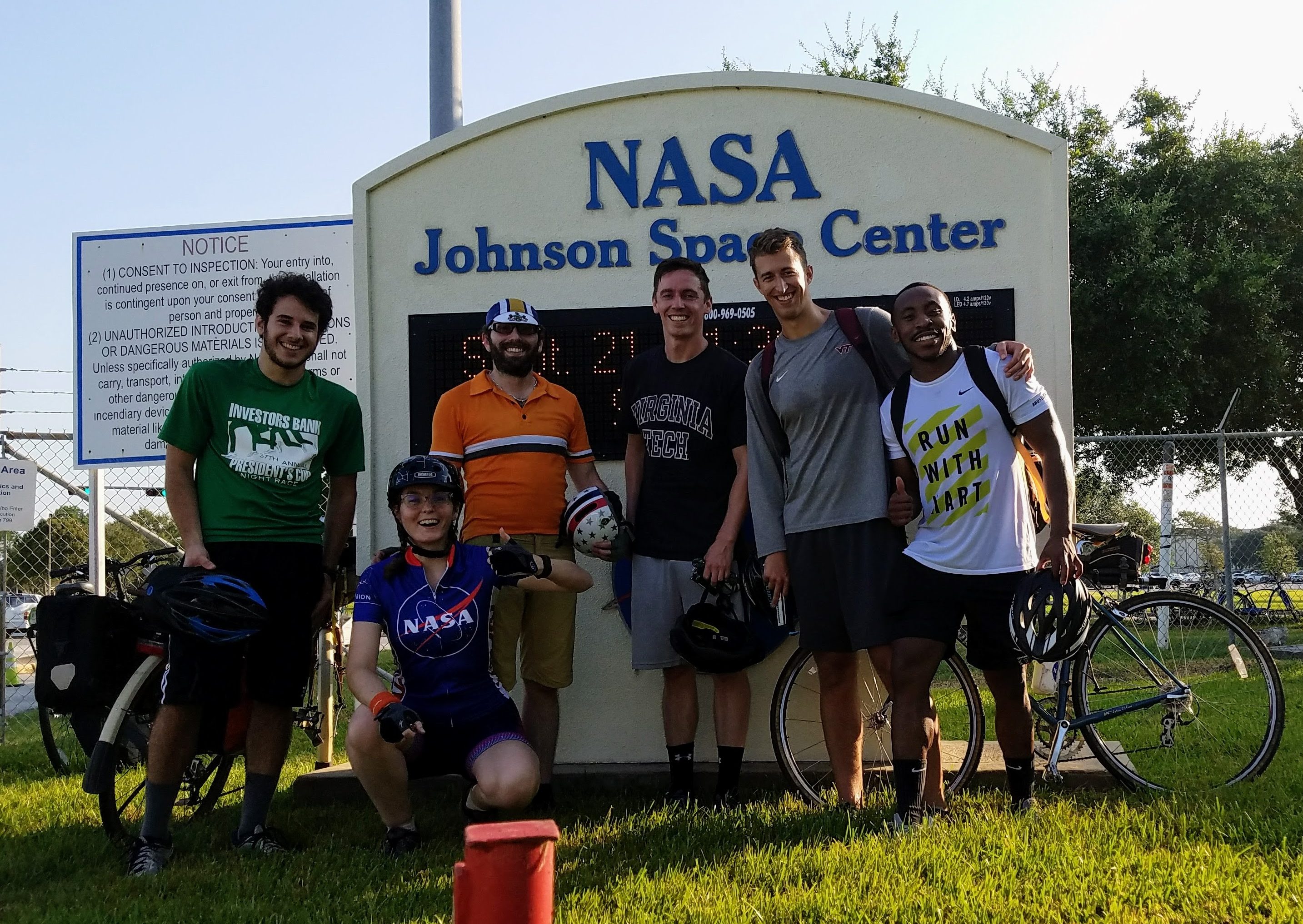
    Six people stand outside on a sunny day in front of a NASA Johnson Space Center sign. They are all wearing workout apparel.
    Megan Harvey and friends after biking 25 miles to work.

    Since going to Space Camp in Huntsville, Alabama, when I was 10 years old, I wanted to be a capcom and work for NASA.

    Megan Harvey

    Megan Harvey

    Utilization Flight Lead and Capsule Communicator

    What was your path to NASA?  

    I had a very circuitous path to NASA. Since going to Space Camp in Huntsville, Alabama, when I was 10 years old, I wanted to be a capcom and work for NASA. I also traveled to Russia in high school and loved it. I thought working on coordination between the Russian and U.S. space programs would be awesome. In pursuit of those dreams, I earned a bachelor’s degree in physics with a minor in Russian language from Kenyon College in Gambier, Ohio, but I had so much fun also participating in music extracurriculars that my grades were not quite up to the standards of working at NASA. After graduation, I worked at a technology camp for a summer and then received a research assistant position in a neuroscience lab at Princeton University in New Jersey. 

    After a year or so, I realized that independent research was not for me. I then worked in retail for a year before moving to California to be an instructor at Astrocamp, a year-round outdoor education camp. I taught a number of science classes, including astronomy, and had the opportunity to see the Perseverance Mars rover being put together at NASA’s Jet Propulsion Laboratory in Southern California. It dawned on me that I should start looking into aerospace-related graduate programs. After three years at Embry-Riddle in Daytona Beach, Florida, I received a master’s degree in engineering physics and a job offer for a flight control position, initially working for a subcontractor of United Space Alliance. I started in mission control as an attitude determination and control officer in 2012 and kept that certification until the end of 2023. Along the way, I was a Motion Control Group instructor; a Russian systems specialist and operations lead for the Houston Support Group working regularly in Moscow; a Remote Interface Officer (RIO); and supported capcom and the Vehicle Integrator team in a multipurpose support room for integration and systems engineers. I have to pinch myself when I think about how I somehow made my childhood dreams come true. 

    Is there someone in the space, aerospace, or science industry that has motivated or inspired you to work for the space program? Or someone you discovered while working for NASA who inspires you?   

    After I switched offices to Houston Support Group/RIO, most of my training was led by Sergey Sverdlin. He was a real character. Despite his gruffness, he and I got along really well. We were very different people, but we truly respected each other. I was always impressed with him and sought out his approval. 

    Megan Harvey in Red Square in Moscow, Russia.

    What is your favorite NASA memory?  

    The most impactful experience I’ve had at NASA was working together with the Increment 68 leads during the days and months following the Soyuz coolant leak. I was increment lead RIO and just happened to be in the Increment Management Center the day of a planned Russian spacewalk. The increment lead RIO is not typically based in the Increment Management Center, but that day, things were not going well. All of our Russian colleagues had lost access to a critical network, and I was troubleshooting with the Increment Manager and the International Space Station Mission Management Team chair. 

    I was explaining to International Space Station Deputy Program Manager Dina Contella the plan for getting our colleagues access before their off-hours spacewalk when we saw a snowstorm of flakes coming out of the Soyuz on the downlink video on her office’s wall. Those flakes were the coolant. It was incredible watching Dina switch from winding down for the day to making phone call after phone call saying, “I am calling you in.” The Increment Management Center filled up and I didn’t leave until close to midnight that day. The rest of December was a flurry (no pun intended) of intense and meaningful work with the sharpest and most caring people I know. 

    What do you love sharing about station? What’s important to get across to general audiences to help them understand the benefits to life on Earth?  

    There is so much to talk about! I love giving insight into the complexities of not only the space station systems themselves, but also the international collaboration of all the teams working to keep the systems and the science running. 

    If you could have dinner with any astronaut, past or present, who would it be?  

    I would have dinner with Mae Jemison or Sally Ride. It’s too hard to pick! 

    Do you have a favorite space-related memory or moment that stands out to you?  

    I was selected by my management a few years ago to visit a Navy aircraft carrier with the SpaceX Crew-1 crew and some of the Crew-1 team leads. We did a trap landing on the deck and were launched off to go home, both via a C-2 Greyhound aircraft. It was mind blowing! I am also very lucky that I saw the last space shuttle launch from Florida when I was in graduate school. 
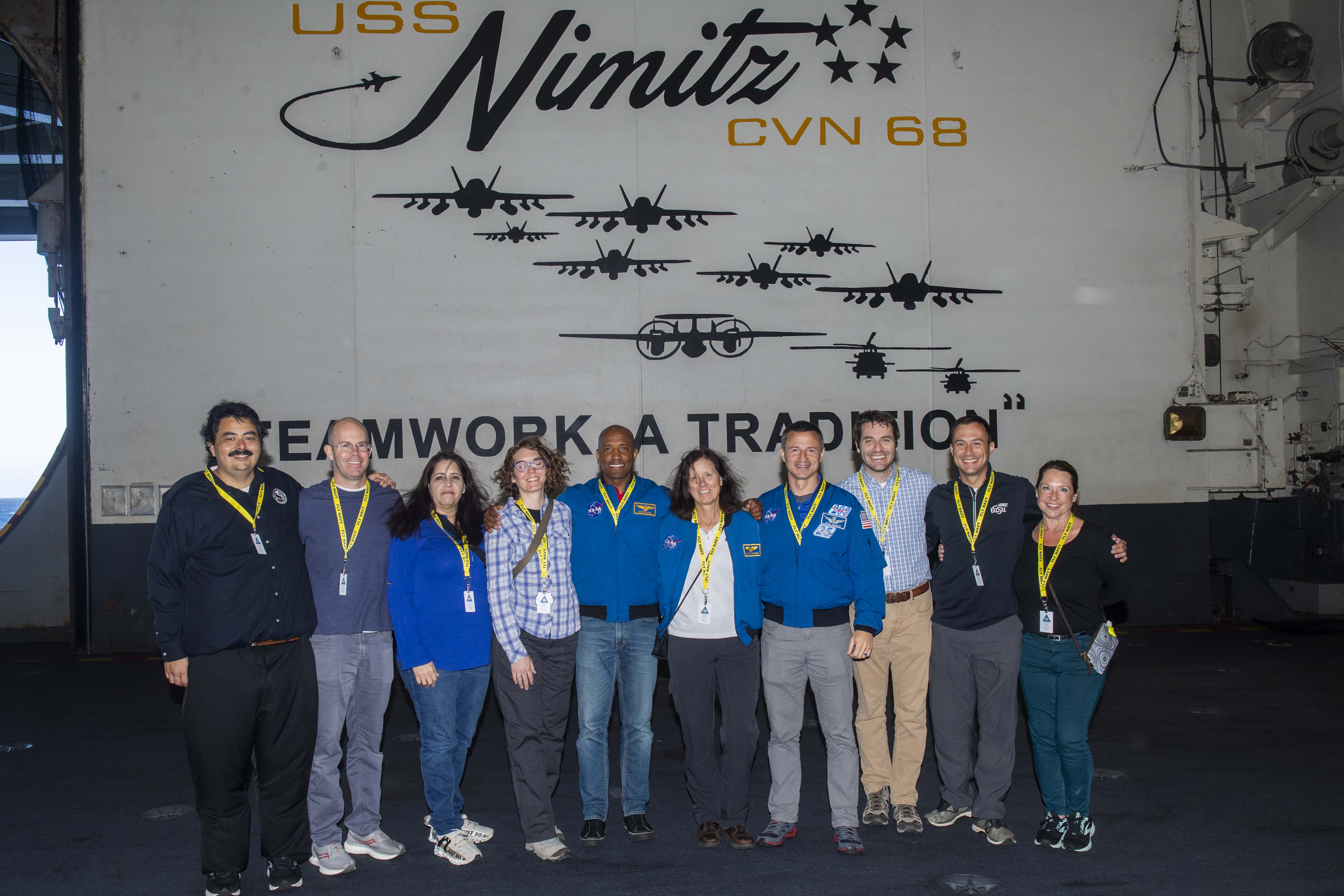
    Ten people, four wearing blue flight suit jackets, pose in front of a building labeled,
    Megan Harvey and NASA colleagues on the Nimitz aircraft carrier.

    What are some of the key projects you’ve worked on during your time at NASA? What have been your favorite?   

    My first increment lead role was RIO for Increment 59 and there was a major effort to update all our products in case of needing to decrew the space station. It was eye-opening to work with the entire increment team in this effort. I really enjoyed all the work and learning and getting to know my fellow increment leads better, including Flight Director Royce Renfrew. 

    Also, in 2021 I was assigned as the Integration Systems Engineer (ISE) lead for the Nanorack Airlock. I had never worked on a project with so many stakeholders before. I worked close to 100 revisions of the initial activation and checkout flowchart, coordinating with the entire flight control team. It was very cool to see the airlock extracted from NASA’s SpaceX Dragon trunk and installed, but it paled in comparison to the shift when we did the first airlock trash deploy. I supported as lead ISE, lead RIO, and capcom all from the capcom console, sitting next to the lead Flight Director TJ Creamer. I gave a countdown to the robotics operations systems officer commanding the deploy on the S/G loop so that the crew and flight control team could hear, “3, 2, 1, Engage!”  

    I’ll never forget the satisfaction of working through all the complications with that stellar team and getting to a successful result while also having so much fun. 

    A woman climbs up a wall at a bouldering gym.
    Megan Harvey at a bouldering gym.

    What are your hobbies/things you enjoy outside of work?  

    I love biking, rock climbing, cooking, board games, and singing. 

    Day launch or night launch?   

    Night launch! 

    Favorite space movie?  

    Space Camp. It’s so silly. And it was the first DVD I ever bought! 

    NASA “worm” or “meatball” logo?  

    Worm 

    NASA spelled out in red letters.

    Every day, we’re conducting exciting research aboard our orbiting laboratory that will help us explore further into space and bring benefits back to people on Earth. You can keep up with the latest news, videos, and pictures about space station science on the Station Research & Technology news page. It’s a curated hub of space station research digital media from Johnson and other centers and space agencies.  

    Sign up for our weekly email newsletter to get the updates delivered directly to you.  

    Follow updates on social media at @ISS_Research on Twitter, and on the space station accounts on Facebook and Instagram.  
  • Sols 4543-4545: Leaving the Ridge for the Ridges

    5 min read

    Sols 4543-4545: Leaving the Ridge for the Ridges

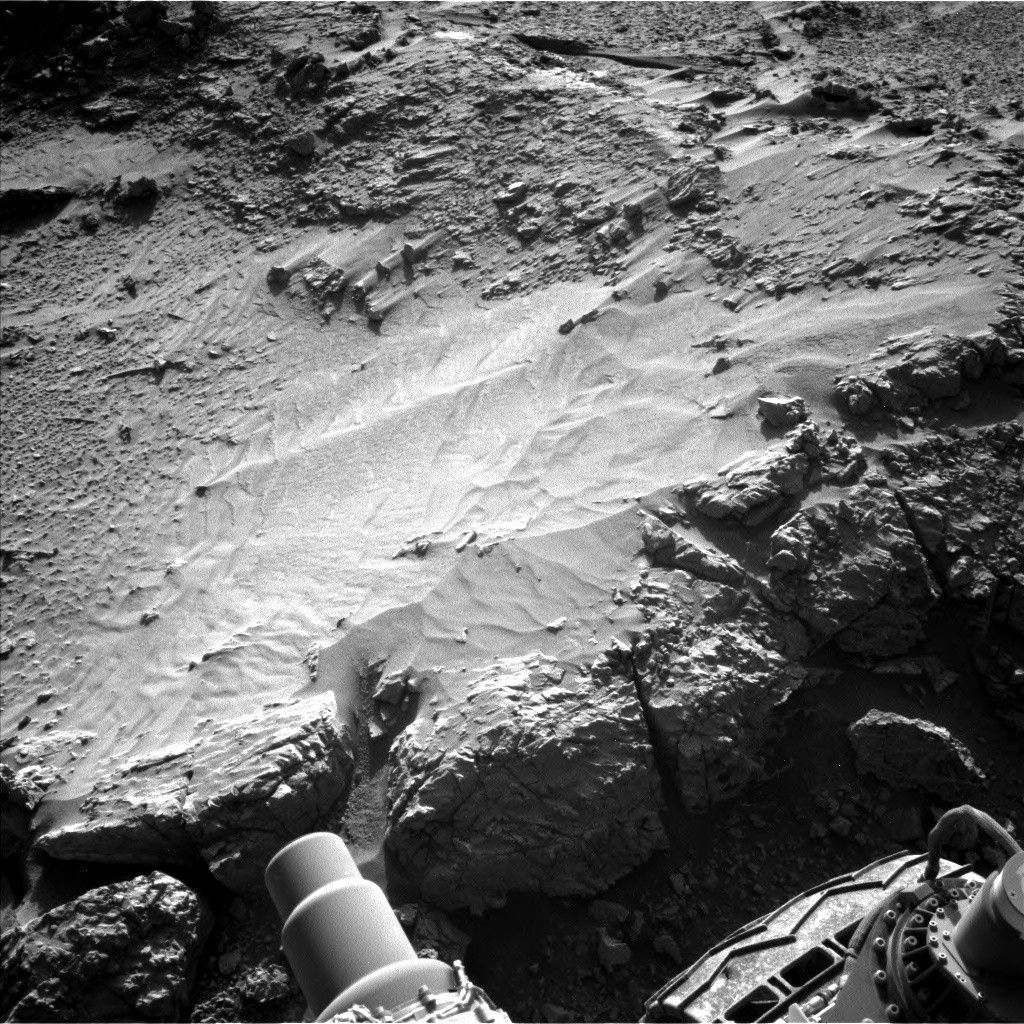
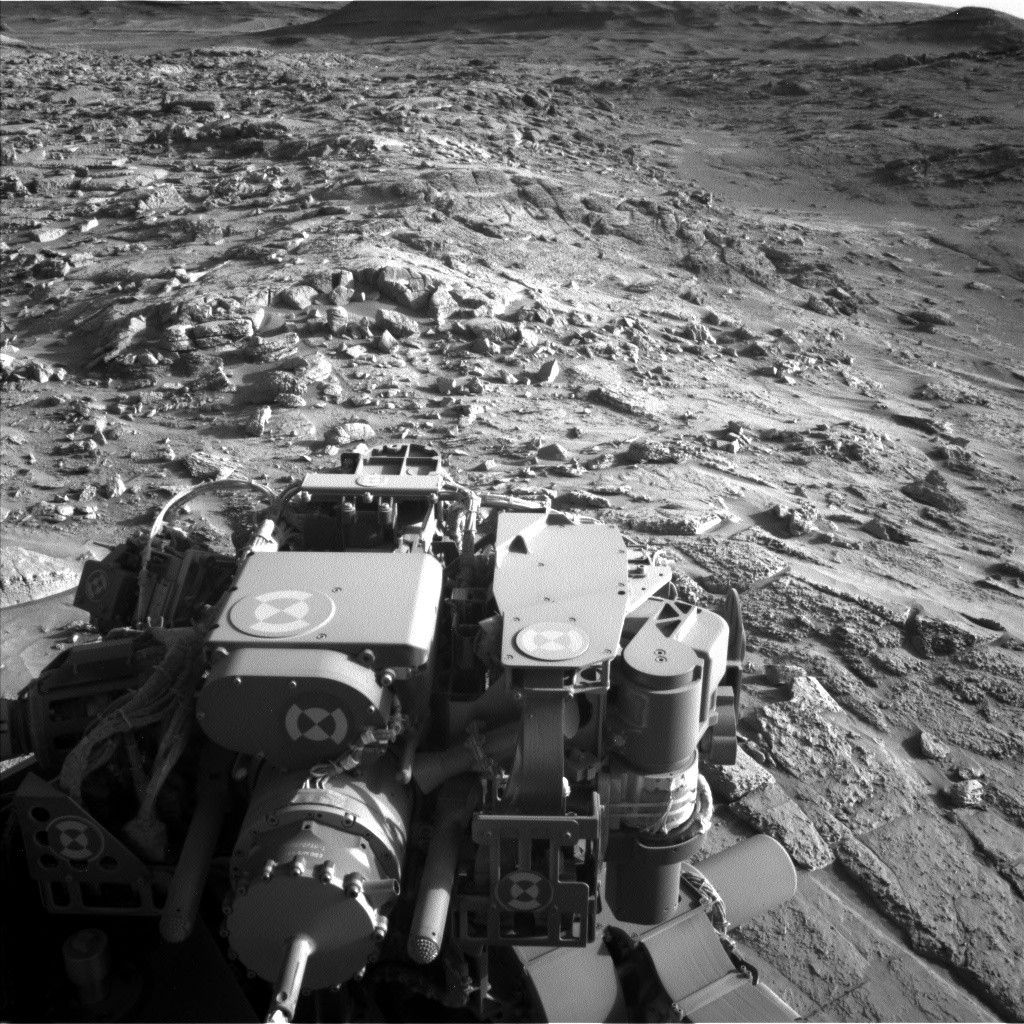
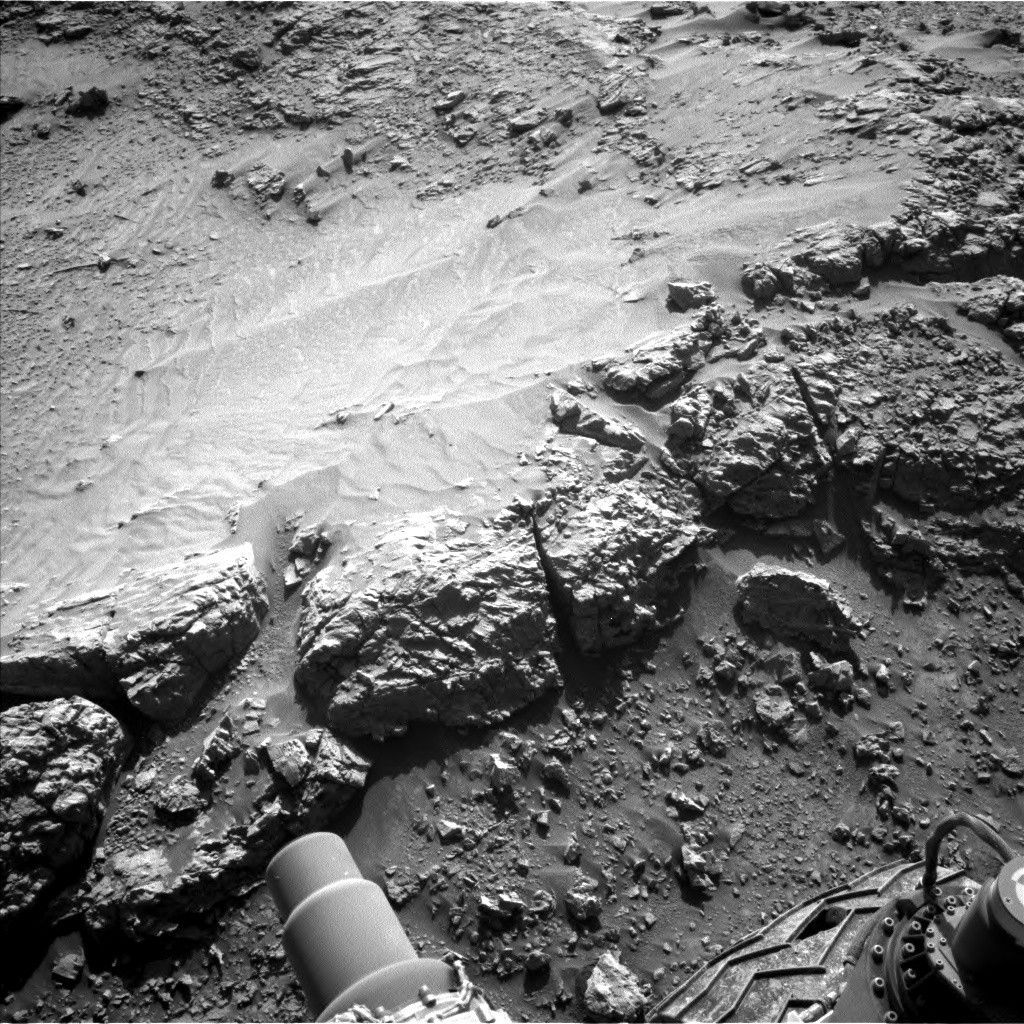
    A grayscale photograph of Martian terrain in front of the Curiosity rover shows a ledge of flat, rough ground that appears to drop off just in front of the rover. Portions of the rover are visible at the bottom of the frame, including a wheel in the lower-right corner. An area of the ground ahead is smoother than the rest, looking like small, wavy sand dunes. Many of the small to medium sized rocks surrounding this patch have trails of sandy soil running off to their right, as if wind or water had flowed from left to right and sculpted these pointed tails of runoff.
    NASA’s Mars rover Curiosity acquired this image, which shows parts of the linear feature in front of where the rover is parked, with lots of textures and structures that will be the topic of today’s investigation. Curiosity captured the image using its Left Navigation Camera on May 16, 2025 — Sol 4541, or Martian day 4,541 of the Mars Science Laboratory mission — at 00:50:45 UTC.
    NASA/JPL-Caltech

    Written by Susanne Schwenzer, Planetary Geologist at The Open University

    Earth planning date: Friday, May 16, 2025

    As Curiosity progresses up Mount Sharp, it crosses different terrains, which the team has mapped from orbit. If you want to follow the path and see for yourself, you can have a look on the “Where is Curiosity?” map, an interactive tool that allows you to see all the stops the rover has made. If you look very closely, you can see that the stop on sol 4532 is on an area that has a very textured and red expression on this map, and the next stop on sol 4534 is in an area that appears more gray, while the stop after that (sol 4537) is on redder material again, but that looks much less textured. The next two stops, including today’s parking position, are both very close to a north-south running linear feature. Just looking at the locations of those different stops, and what you can see on this interactive tool, gives you the full story of the latest planning days.

    We were driving through the rough-looking terrain for quite a while now. So when that change came closer and closer the team started to make plans for how to investigate it. Of course we added the ground-based images to the picture as we edged closer with every drive. Last week, we could finally start to put the plans in place, when we stood at the edge of the changes in the landscape on sol 4532. As you can see from the interactive map, the drives got a bit shorter to make sure we stop at an example of every new feature. So we stopped in the grayish-looking area on sol 4534, then in the middle of the reddish-looking area on sol 4537, and then arrived at the linear feature. 

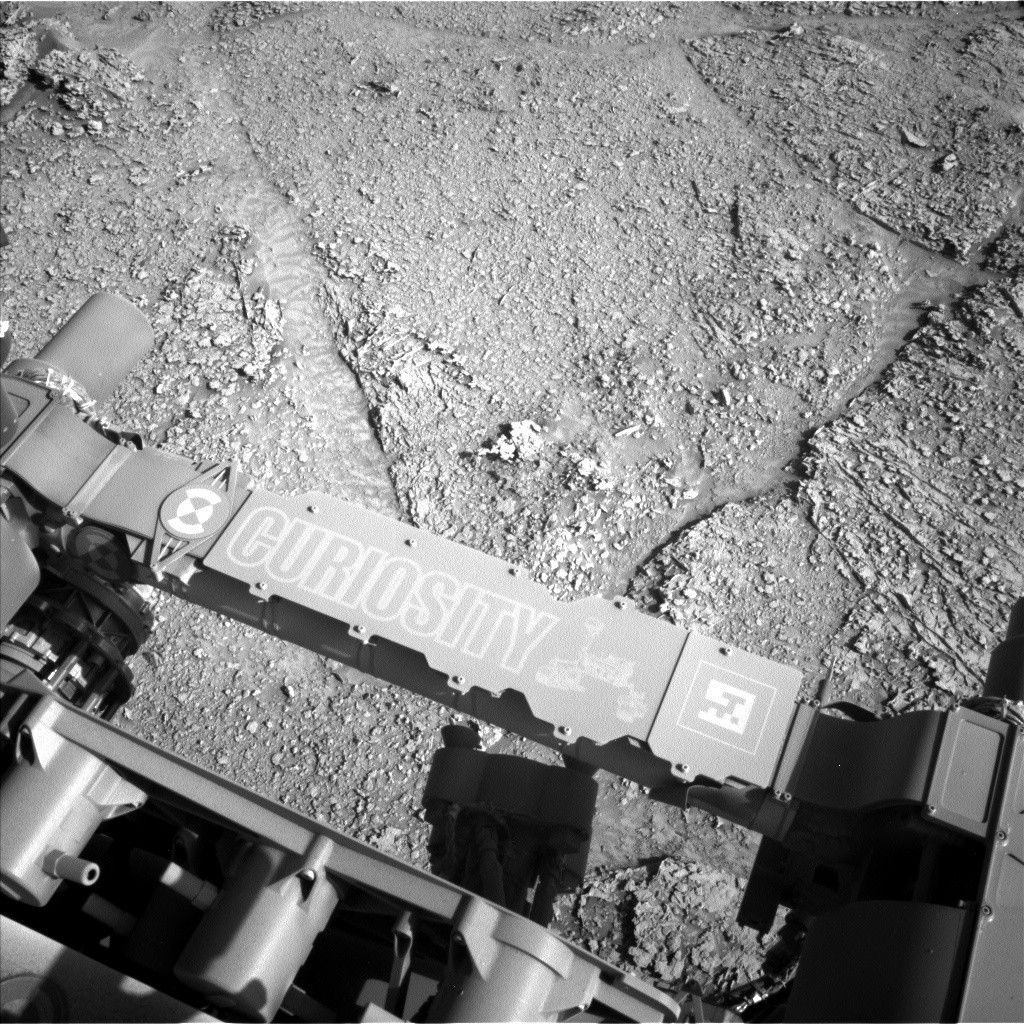
    Unfortunately, Mars didn’t read the script and placed a pesky pebble under one of our wheels (see the blog post “Sols 4541–4542: Boxwork Structure, or Just ‘Box-Like’ Structure?”). Whenever the rover isn’t on firm ground, we cannot take the arm out. So the engineers used the drive in the last plan to pull the rover back by less than a wheel’s turn; we are now parked on solid ground at the linear feature, and we can do arm activities! That always makes the planning team cheer.

    Being on stable ground gave us many opportunities for contact science. After careful discussions of what is in front of us, we decided on target “Arroyo Seco,” where it is possible to apply the brush – DRT as we say – and do an APXS measurement on the brushed material. APXS will then measure the edge of that big feature, where the rocks are a little more resistant to weathering — at least that’s what the fact that they are sticking out might suggest. That is the target “Mesa Grande.” Near Mesa Grande is target “Paso Picacho,” which is on the same part of the ridge as the second APXS target. In addition, ChemCam investigates the ridge feature at target “Pauma Valley.”

    On a weekend there is always a little more time, and Curiosity will make the most of it! In addition to the two APXS and ChemCam LIBS targets, ChemCam will also get a passive spectral investigation on the target “San Ysidro” to investigate the texture we are seeing hints of in the Mastcam image. Talking about Mastcam… There are many interesting features in the vicinity that will add to our investigation of this new expression of the landscape. Thus, Mastcam has more than 50 frames in the plan to image the ridges, fractures, and textures around the rover. Most of the targets have descriptive names today, such as “Fractures,” but there are two names (all from the area in California where JPL is, too!): “Dos Palmas Oasis” is looking at brighter stones in the midfield, and “Sespe Gorge” takes a look at the big, rubbly looking rock right in front of the rover. Of course Mastcam will document the LIBS investigations, too, which includes the AEGIS location from the last plan.

    The atmospheres and environment investigations are looking at the occurrence of clouds, dust devils and opacity, and we are looking at the surface with the DAN instrument. While you might think, “as always,” it’s important to get a consistent record to understand the patterns, but also to understand when a deviation from them occurs. Thus, I don’t want to forget them here just because we are all so excited about the new expression of the landscape.

    With all those investigations in the (electronic) bags, it’s time to get back on the road. The next drive is about 20 meters (about 66 feet) and navigates around the ridge in front of us, which at this point has turned from a science target into an obstacle to getting back on the road. After safely maneuvering around it, the next drive will take us closer to the next ridges, and there are many more to come in the distance. They might even get bigger and more beautiful; who knows?! It’s exploration, after all — going places that no rover has gone before. 

    Details

    Last Updated

    May 20, 2025

    Related Terms

  • Sunset on Mars

    The Sun, a small white dot, sets in this photo from Mars. The sky is dusty and slightly red.
    NASA/JPL-Caltech/Texas A&M/Cornell

    NASA’s Mars Exploration Rover Spirit captured this stunning view as the Sun sank below the rim of Gusev crater on Mars 20 years ago. In this image, the bluish glow in the sky above the Sun would be visible to us if we were there, but an artifact of the panoramic camera’s infrared imaging capabilities is that with this filter combination, the redness of the sky farther from the sunset is exaggerated compared to the daytime colors of the Martian sky.

    Read more about this photo.

    Image credit: NASA/JPL-Caltech/Texas A&M/Cornell

  • Hubble Images Galaxies Near and Far

    2 min read

    Hubble Images Galaxies Near and Far

    A field full of distant galaxies on a dark background. Most of the galaxies are very small, but there are a few larger galaxies and some stars where detail is visible. In the very center is an elliptical galaxy with a brightly glowing core and a broad disk. A reddish, warped, ring of light, thicker at one side, surrounds its core. A small galaxy intersects the ring as a bright dot.
    This NASA/ESA Hubble Space Telescope image features the remote galaxy HerS 020941.1+001557, which appears as a red arc that partially encircles a foreground elliptical galaxy.
    ESA/Hubble & NASA, H. Nayyeri, L. Marchetti, J. Lowenthal

    This NASA/ESA Hubble Space Telescope image offers us the chance to see a distant galaxy now some 19.5 billion light-years from Earth (but appearing as it did around 11 billion years ago, when the galaxy was 5.5 billion light-years away and began its trek to us through expanding space). Known as HerS 020941.1+001557, this remote galaxy appears as a red arc partially encircling a foreground elliptical galaxy located some 2.7 billion light-years away. Called SDSS J020941.27+001558.4, the elliptical galaxy appears as a bright dot at the center of the image with a broad haze of stars outward from its core. A third galaxy, called SDSS J020941.23+001600.7, seems to be intersecting part of the curving, red crescent of light created by the distant galaxy.

    The alignment of this trio of galaxies creates a type of gravitational lens called an Einstein ring. Gravitational lenses occur when light from a very distant object bends (or is ‘lensed’) around a massive (or ‘lensing’) object located between us and the distant lensed galaxy. When the lensed object and the lensing object align, they create an Einstein ring. Einstein rings can appear as a full or partial circle of light around the foreground lensing object, depending on how precise the alignment is. The effects of this phenomenon are much too subtle to see on a local level but can become clearly observable when dealing with curvatures of light on enormous, astronomical scales.

    Gravitational lenses not only bend and distort light from distant objects but magnify it as well. Here we see light from a distant galaxy following the curve of spacetime created by the elliptical galaxy’s mass. As the distant galaxy’s light passes through the gravitational lens, it is magnified and bent into a partial ring around the foreground galaxy, creating a distinctive Einstein ring shape.

    The partial Einstein ring in this image is not only beautiful, but noteworthy. A citizen scientist identified this Einstein ring as part of the SPACE WARPS project that asked citizen scientists to search for gravitational lenses in images.

    Text Credit: ESA/Hubble

    Media Contact:

    Claire Andreoli (claire.andreoli@nasa.gov)
    NASA’s Goddard Space Flight CenterGreenbelt, MD

  • Andrea Harrington’s Vision Paves the Way for Lunar Missions 

    When future astronauts set foot on Mars, they will stand on decades of scientific groundwork laid by people like Andrea Harrington.  

    As NASA’s sample return curation integration lead, Harrington is helping shape the future of planetary exploration and paving the way for interplanetary discovery.  

    An image of a woman standing in front of a blue background with two flags behind her, a U.S. flag (left) and NASA flag (right). She is wearing a black cardigan and shirt.
    Official portrait of Andrea Harrington.
    NASA/Josh Valcarcel

    Harrington works in NASA’s Astromaterials Research and Exploration Sciences Division, or ARES, at Johnson Space Center in Houston, where she integrates curation, science, engineering, and planetary protection strategies into the design and operation of new laboratory facilities and sample handling systems. She also helps ensure that current and future sample collections—from lunar missions to asteroid returns—are handled with scientific precision and preserved for long-term study.  

    “I am charged with protecting the samples from Earth—and protecting Earth from the restricted samples,” Harrington said. This role requires collaboration across NASA centers, senior leadership, engineers, the scientific community, and international space exploration agencies. 

    With a multidisciplinary background in biology, planetary science, geochemistry, and toxicology, Harrington has become a key expert in developing the facility and contamination control requirements needed to safely preserve and study sensitive extraterrestrial samples. She works closely with current and future curators to improve operational practices and inform laboratory specifications—efforts that will directly support future lunar missions. 

    A woman wearing a black suit stands in front of a brown wall emulating
    Andrea Harrington in front of NASA’s Astromaterials Research and Exploration Sciences Division Mars Wall at Johnson Space Center in Houston.

    Her work has already made a lasting impact. She helped develop technologies such as a clean closure system to reduce contamination during sample handling and ultraclean, three-chamber inert isolation cabinets. These systems have become standard equipment and are used for preserving samples from missions like OSIRIS-REx and Hayabusa2. They have also supported the successful processing of sensitive Apollo samples through the Apollo Next Generation Sample Analysis Program

    In addition to technology development, Harrington co-led the assessment of high-containment and pristine facilities to inform future technology and infrastructural requirements for Restricted Earth Returns, critical for sample returns Mars, Europa, and Enceladus.

    Harrington’s leadership, vision, and technical contribution have reached beyond ARES and have earned her two Director’s Commendations.   

    “The experiences I have acquired at NASA have rounded out my background even more and have provided me with a greater breadth of knowledge to draw upon and then piece together,” said Harrington. “I have learned to trust my instincts since they have allowed me to quickly assess and effectively troubleshoot problems on numerous occasions.” 

    A woman dressed in a white cleanroom suit in a curation laboratory.
    Andrea Harrington in Johnson’s newly commissioned Advanced Curation Laboratory.

    Harrington also serves as the Advanced Curation Medical Geology lead. She and her team are pioneering new exposure techniques that require significantly less sample material to evaluate potential health risks of astromaterials.  

    Her team is studying a range of astromaterial samples and analogues to identify which components may trigger the strongest inflammatory responses, or whether multiple factors are at play. Identifying the sources of inflammation can help scientists assess the potential hazards of handling materials from different planetary bodies, guide decisions about protective equipment for sample processors and curators, and may eventually support astronaut safety on future missions. 

    Harrington also spearheaded a Space Act Agreement to build a science platform on the International Space Station that will enable planetary science and human health experiments in microgravity, advancing both human spaceflight and planetary protection goals.

    A woman wearing a red blouse stands at a podium in a conference room.
    Andrea Harrington at the National Academies Committee on Planetary Protection and Committee on Astrobiology and Planetary Sciences in Irvine, California.

    Harrington credits her NASA career for deepening her appreciation of the power of communication. “The ability to truly listen and hear other people’s perspectives is just as important as the ability to deliver a message or convey an idea,” she said.  

    Her passion for space science is rooted in purpose. “What drew me to NASA is the premise that what I would be doing was not just for myself, but for the benefit of all,” she said. “Although I am personally passionate about the work I am doing, the fact that the ultimate goal is to enable the fulfillment of those passions for generations of space scientists and explorers to come is quite inspiring.” 

    A collage of three images of two sisters posing outside together as kids (top two images) and adults.
    Andrea Harrington and her twin sister, Jane Valenti, as children (top two photos) and at Brazos Bend State Park in Needville, Texas, in 2024.

    Harrington loves to travel, whether she is mountain biking through Moab, scuba diving in the Galápagos, or immersing herself in the architecture and culture of cities around the world. She shares her passion for discovery with her family—her older sister, Nicole Reandeau; her twin sister, Jane Valenti; and especially her husband, Alexander Smirnov.

    A lesson she hopes to pass along to the Artemis Generation is the spirit of adventure along with a reminder that exploration comes in many forms.  

    “Artemis missions and the return of pristine samples from another planetary bodies to Earth are steppingstones that will enable us to do even more,” Harrington said. “The experience and lessons learned could help us safely and effectively explore distant worlds, or simply inspire the next generation of explorers to do great things we can’t yet even imagine.” 

  • Sols 4541–4542: Boxwork Structure, or Just “Box-Like” Structure?

    3 min read

    Sols 4541–4542: Boxwork Structure, or Just “Box-Like” Structure?

    A grayscale photograph of Martian terrain in front of the Curiosity rover shows a ledge of flat, rough ground that appears to drop off just in front of the rover. Portions of the rover are visible at the bottom of the frame, including a wheel in the lower-right corner. An area of the ground ahead is smoother than the rest, looking like small, wavy sand dunes. Many of the small to medium sized rocks surrounding this patch have trails of sandy soil running off to their right, as if wind or water had flowed from left to right and sculpted these pointed tails of runoff.
    NASA’s Mars rover Curiosity acquired this image using its Left Navigation Camera on May 14, 2025 — Sol 4539, or Martian day 4,539 of the Mars Science Laboratory mission — at 00:57:26 UTC.
    NASA/JPL-Caltech

    Written by Ashley Stroupe, Mission Operations Engineer at NASA’s Jet Propulsion Laboratory

    Earth planning date: Wednesday, May 14, 2025

    Today we came into another strange and interesting workspace (see image above) that is as exciting as the one we had on Monday. This is our first arrival at a potential boxwork structure — a series of web-like, resistant ridges visible in orbital images that we have been looking forward to visiting since we first saw them. Today’s observations will be the first step to figure out if these ridges (at least the one in front of us) is part of a boxwork structure. Unfortunately, we can’t quite reach their targets safely today because one of the rover’s front wheels is perched on a small pebble and might slip off if we move the arm. Instead, we will take a lot of remote sensing observations and reposition the rover slightly so that we can try again on Friday. 

    But before repositioning, Curiosity will start off by taking a huge Mastcam mosaic of all terrain around the rover to help us document how it is changing along our path and with elevation. Mastcam then will look at “Temblor Range,” which is a nearby low and resistant ridge that also has some rover tracks from where we previously crossed it. Mastcam is also imaging a trough that is similar to the other troughs we have been seeing locally and that have multiple possible origins. Then, Mastcam will image the AEGIS target from the prior plan. ChemCam is taking a LIBS observation of “Glendale Peak,” a rugged top portion of the ridge defining the potential boxwork structure, which is to the right of the workspace, and an RMI mosaic of Texoli butte. Mastcam follows up the ChemCam observation of Glendale Peak by imaging it. 

    In parallel with all the imaging is our monthly test and maintenance of our backup pump for the Heat Rejection System (the HRS) The HRS is a fluid loop that distributes the heat from the rover’s power source to help keep all the subsystems within reasonable temperatures. We need to periodically make sure it stays in good working order just in case our primary pump has issues. 

    After all the imaging, the rover will bump 30 centimeters backwards (about 12 inches)  to come down off the pebble and put the interesting science targets in the arm workspace. This should leave us in a position where it is safe to unstow the arm and put instruments down on the surface.

    On the second, untargeted sol of the plan, we have some additional atmospheric science including a large dust-devil survey, as well as a Navcam suprahorizon movie and a Mastcam solar tau to measure the dust in the atmosphere. We finish up with another autonomous targeting of ChemCam with AEGIS.

    Details

    Last Updated

    May 19, 2025

    Related Terms

  • NASA’s Perseverance Mars Rover to Take Bite Out of ‘Krokodillen’

    5 min read

    Preparations for Next Moonwalk Simulations Underway (and Underwater)

    Rover’s tracks coming from an area called “Witch Hazel Hill”
    One of the navigation cameras on NASA’s Perseverance captured the rover’s tracks coming from an area called “Witch Hazel Hill,” on May 13, 2025, the 1,503rd Martian day, or sol, of the mission.
    NASA/JPL-Caltech

    Scientists expect the new area of interest on the lower slope of Jezero Crater’s rim to offer up some of the oldest rocks on the Red Planet.

    NASA’s Perseverance Mars rover is exploring a new region of interest the team is calling “Krokodillen” that may contain some of the oldest rocks on Mars. The area has been on the Perseverance science team’s wish list because it marks an important boundary between the oldest rocks of Jezero Crater’s rim and those of the plains beyond the crater.

    “The last five months have been a geologic whirlwind,” said Ken Farley, deputy project scientist for Perseverance from Caltech in Pasadena. “As successful as our exploration of “Witch Hazel Hill” has been, our investigation of Krokodillen promises to be just as compelling.”

    Named by Perseverance mission scientists after a mountain ridge on the island of Prins Karls Forland, Norway, Krokodillen (which means “the crocodile” in Norwegian) is a 73-acre (about 30-hectare) plateau of rocky outcrops located downslope to the west and south of Witch Hazel Hill.

    A quick earlier investigation into the region revealed the presence of clays in this ancient bedrock. Because clays require liquid water to form, they provide important clues about the environment and habitability of early Mars. The detection of clays elsewhere within the Krokodillen region would reinforce the idea that abundant liquid water was present sometime in the distant past, likely before Jezero Crater was formed by the impact of an asteroid. Clay minerals are also known on Earth for preserving organic compounds, the building blocks of life.

    “If we find a potential biosignature here, it would most likely be from an entirely different and much earlier epoch of Mars evolution than the one we found last year in the crater with ‘Cheyava Falls,’” said Farley, referring to a rock sampled in July 2024 with chemical signatures and structures that could have been formed by life long ago. “The Krokodillen rocks formed before Jezero Crater was created, during Mars’ earliest geologic period, the Noachian, and are among the oldest rocks on Mars

    Data collected from NASA’s Mars orbiters suggest that the outer edges of Krokodillen may also have areas rich in olivine and carbonate. While olivine forms from magma, carbonate minerals on Earth typically form during a reaction in liquid water between rock and dissolved carbon dioxide. Carbonate minerals on Earth are known to be excellent preservers of fossilized ancient microbial life and recorders of ancient climate.

    The rover, which celebrated its 1,500th day of surface operations on May 9, is currently analyzing a rocky outcrop in Krokodillen called “Copper Cove” that may contain Noachian rocks.

    Ranking Mars Rocks

    The rover’s arrival at Krokodillen comes with a new sampling strategy for the nuclear-powered rover that allows for leaving some cored samples unsealed in case the mission finds a more scientifically compelling geologic feature down the road.

    To date, Perseverance has collected and sealed two regolith (crushed rock and dust) samples, three witness tubes, and one atmospheric sample. It has also collected 26 rock cores and sealed 25 of them. The rover’s one unsealed sample is its most recent, a rock core taken on April 28 that the team named “Bell Island,” which contains small round stones called spherules. If at some point the science team decides a new sample should take its place, the rover could be commanded to remove the tube from its bin in storage and dump the previous sample.

    “We have been exploring Mars for over four years, and every single filled sample tube we have on board has its own unique and compelling story to tell,” said Perseverance acting project scientist Katie Stack Morgan of NASA’s Jet Propulsion Laboratory in Southern California. “There are seven empty sample tubes remaining and a lot of open road in front of us, so we’re going to keep a few tubes — including the one containing the Bell Island core — unsealed for now. This strategy allows us maximum flexibility as we continue our collection of diverse and compelling rock samples.”

    Before the mission adopted its new strategy, the engineering sample team assessed whether leaving a tube unsealed could diminish the quality of a sample. The answer was no.

    “The environment inside the rover met very strict standards for cleanliness when the rover was built. The tube is also oriented in such a way within its individual storage bin that the likelihood of extraneous material entering the tube during future activities, including sampling and drives, is very low,” said Stack Morgan.   

    In addition, the team assessed whether remnants of a sample that was dumped could “contaminate” a later sample. “Although there is a chance that any material remaining in the tube from the previous sample could come in contact with the outside of a new sample,” said Stack Morgan, “it is a very minor concern — and a worthwhile exchange for the opportunity to collect the best and most compelling samples when we find them.”

    News Media Contact

    DC Agle
    Jet Propulsion Laboratory, Pasadena, Calif.
    818-393-9011
    agle@jpl.nasa.gov

    Karen Fox / Molly Wasser
    NASA Headquarters, Washington
    202-358-1600
    karen.c.fox@nasa.gov / molly.l.wasser@nasa.gov  

    2025-071

    Details

    Last Updated

    May 19, 2025

  • A Defining Era: NASA Stennis and Space Shuttle Main Engine Testing

    6 Min Read

    A Defining Era: NASA Stennis and Space Shuttle Main Engine Testing

    artful photo of test stand during engine test with an overlay of space shuttle

    The numbers are notable – 34 years of testing space shuttle main engines at NASA’s Stennis Space Center near Bay St. Louis, Mississippi, 3,244 individual tests, more than 820,000 seconds (totaling more than nine days) of cumulative hot fire.

    The story behind the numbers is unforgettable.

    “It is hard to describe the full impact of the space shuttle main engine test campaign on NASA Stennis,” Center Director John Bailey said. “It is hundreds of stories, affecting all areas of center life, within one great story of team achievement and accomplishment.”

    NASA Stennis tested space shuttle main engines from May 19, 1975, to July 29, 2009. The testing made history, enabling 135 shuttle missions and notable space milestones, like deployment of the Hubble Space Telescope and construction of the International Space Station.

    The testing also:

    • Established NASA Stennis as the center of excellence for large propulsion testing.
    • Broadened and deepened the expertise of the NASA Stennis test team.
    • Demonstrated and expanded the propulsion test capabilities of NASA Stennis.
    • Ensured the future of the Mississippi site.
    The first space shuttle main engine is installed on test stand; the start of a defining era
    The first space shuttle main engine is installed on May 8, 1975, at the Fred Haise Test Stand (formerly A-1). The engine would be used for the first six tests and featured a shortened thrust chamber assembly.
    NASA

    Assignment and Beginning

    NASA Stennis was not the immediate choice to test space shuttle main engines. Two other sites also sought the assignment – NASA’s Marshall Flight Center in Alabama and Edwards Air Force Base in California. However, following presentations and evaluations, NASA announced March 1, 1971, that the test campaign would take place in south Mississippi.

    “(NASA Stennis) was now assured of a future in propulsion testing for decades,” summarized Way Station to Space, a history of the center’s first decades.

    Testing did not begin immediately. First, NASA Stennis had to complete an ambitious project to convert stands built the previous decade for rocket stage testing to facilities supporting single-engine hot fire.

    Propellant run tanks were installed and calibrated. A system was fashioned to measure and verify engine thrust. A gimbaling capability was developed on the Fred Haise Test Stand to allow operators to move engines as they must pivot in flight to control rocket trajectory. Likewise, engineers designed a diffuser capability for the A-2 Test Stand to allow operators to test at simulated altitudes up to 60,000 feet.

    NASA Stennis teams also had to learn how to handle cryogenic propellants in a new way. For Apollo testing, propellants were loaded into stage tanks to support hot fires. For space shuttle, propellants had to be provided by the stand to the engine. New stand run tanks were not large enough to support a full-duration (500 seconds) hot fire, so teams had to provide real-time transfer of propellants from barges, to the run tanks, to the engine.

    The process required careful engineering and calibration. “There was a lot to learn to manage real-time operations,” said Maury Vander, chief of NASA Stennis test operations. “Teams had to develop a way to accurately measure propellant levels in the tanks and to control the flow from barges to the tanks and from the tanks to the engine. It is a very precise process.”

    a plume of hot fire of the space shuttle Main Propulsion Test Article in 1979 on the B-2 side of the Thad Cochran Test Stand.
    NASA Stennis teams conduct a hot fire of the space shuttle Main Propulsion Test Article in 1979 on the B-2 side of the Thad Cochran Test Stand. The testing involved installing a shuttle external fuel tank, a mockup of the shuttle orbiter, and the vehicle’s three-engine configuration on the stand, then firing all three engines simultaneously as during an actual launch.
    NASA

    Testing the Way

    The biggest challenge was operation of the engine itself. Not only was it the most sophisticated ever developed, but teams would be testing a full engine from the outset. Typically, individual components are developed and tested prior to assembling a full engine. Shuttle testing began on full-scale engines, although several initial tests did feature a trimmed down thrust chamber assembly.

    The initial test on May 19, 1975, provided an evaluation of team and engine. The so-called “burp” test did not feature full ignition, but it set the stage for moving forward.

    “The first test was a monstrous milestone,” Vander said. “Teams had to overcome all sorts of challenges, and I can only imagine what it must have felt like to go from a mostly theoretical engine to seeing it almost light. It is the kind of moment engineers love – fruits-of-all-your-hard-labor moment.”

    NASA Stennis teams conducted another five tests in quick succession. On June 23/24, with a complete engine thrust chamber assembly in place, teams achieved full ignition. By year’s end, teams had conducted 27 tests. In the next five years, they recorded more than 100 annual hot fires, a challenging pace. By the close of 1980, NASA Stennis had accumulated over 28 hours of hot fire.

    The learning curve remained steep as teams developed a defined engine start, power up, power down, and shutdown sequences. They also identified anomalies and experienced various engine failures.

    “Each test is a semi-controlled explosion,” Vander said. “And every test is like a work of art because of all that goes on behind the scenes to make it happen, and no two tests are exactly the same. There were a lot of knowledge and lessons learned that we continue to build on today.”

    a view of employees monitoring activities inside the Test Control Center during the 1000th test of a space shuttle main engine
    NASA Stennis test conductor Brian Childers leads Test Control Center operations during the 1000th test of a space shuttle main engine on the Fred Haise Test Stand (formerly A-1). on Aug. 17, 2006.
    NASA

    Powering History

    Teams took a giant step forward in 1978 to 1981 with testing of the Main Propulsion Test Article, which involved installing three engines (configured as during an actual launch), with a space shuttle external tank and a mock orbiter, on the B-2 side of the Thad Cochran Test Stand.

    Teams conducted 18 tests of the article, proving conclusively that the shuttle configuration would fly as needed. On April 12, 1981, shuttle Columbia launched on the maiden STS-1 mission of the new era. Unlike previous vehicles, this one had no uncrewed test flight. The first launch of shuttle carried astronauts John Young and Bob Crippen.

    “The effort that you contributed made it possible for us to sit back and ride,” Crippen told NASA Stennis employees during a post-test visit to the site. “We couldn’t even make it look hard.”

    Testing proceeded steadily for the next 28 years. Engine anomalies, upgrades, system changes – all were tested at NASA Stennis. Limits of the engine were tested and proven. Site teams gained tremendous testing experience and expertise. NASA Stennis personnel became experts in handling cryogenics.

    Following the loss of shuttles Challenger and Columbia, NASA Stennis teams completed rigorous test campaigns to ensure future mission safety. The space shuttle main engine arguably became the most tested, and best understood, large rocket engine in the world – and NASA Stennis teams were among those at the forefront of knowledge.

    a crowd is gathered along a fence to witness the final space shuttle main engine test on July 29, 2009, on the A-2 Test Stand at NASA Stennis.
    NASA conducts the final space shuttle main engine test on July 29, 2009, on the A-2 Test Stand at NASA Stennis. The Space Shuttle Program concluded two years later with the STS-135 shuttle mission in July 2011.
    NASA

    A Foundation for the Future

    NASA recognized the effort of the NASA Stennis team, establishing the site as the center of excellence for large propulsion test work. In the meanwhile, NASA Stennis moved to solidify its future, growing as a federal city, home to more than 50 resident agencies, organizations, and companies.

    Shuttle testing opened the door for the variety of commercial aerospace test projects the site now supports. It also established and solidified the test team’s unique capabilities and gave all of Mississippi a sense of prideful ownership in the Space Shuttle Program – and its defining missions.

    No one can say what would have happened to NASA Stennis without the space shuttle main engine test campaign. However, everything NASA Stennis now is rests squarely on the record and work of that history-making campaign.

    “Everyone knows NASA Stennis as the site that tested the Apollo rockets that took humans to the Moon – but space shuttle main engine testing really built this site,” said Joe Schuyler, director of NASA Stennis engineering and test operations. “We are what we are because of that test campaign – and all that we become is built on that foundation.”

    Details

    Last Updated

    May 19, 2025

    Editor
    NASA Stennis Communications
    Contact
    C. Lacy Thompson
    Location
    Stennis Space Center

    Related Terms

  • NASA’s LRO Views Japan’s RESILENCE Lunar Lander Landing Area

    1 min read

    Preparations for Next Moonwalk Simulations Underway (and Underwater)

    A black and white image of the surface of the Moon taken from NASA's Lunar Reconnaissance Orbiter showing the Mare Frigoris landing site on the surface of the Moon.

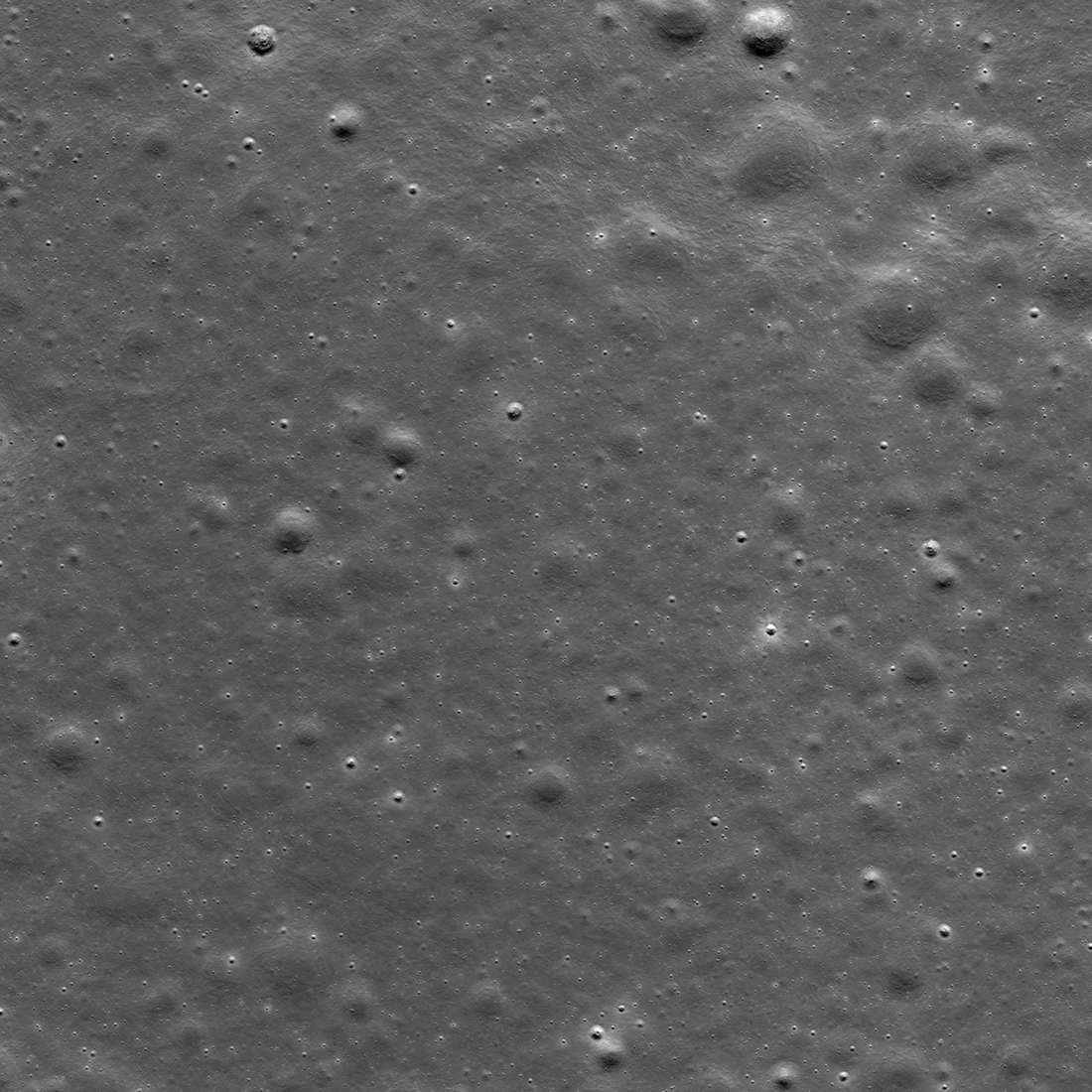
    NASA’s Lunar Reconnaissance Orbiter Camera (LROC) imaged the landing area of the ispace SMBC x HAKUTO-R Venture Moon Mission 2 RESILIENCE lunar lander which is slated to land on the surface of the Moon no earlier than June 5, 2025 (UTC). This view of the primary landing area is 3.13 miles (5,040 meters) wide and north is up. The site is in Mare Frigoris, a volcanic region interspersed with large-scale faults known as wrinkle ridges. Mare Frigoris formed over 3.5 billion years ago as massive basalt eruptions flooded low-lying terrain.

  • Nancy Grace Roman’s 100th Birthday

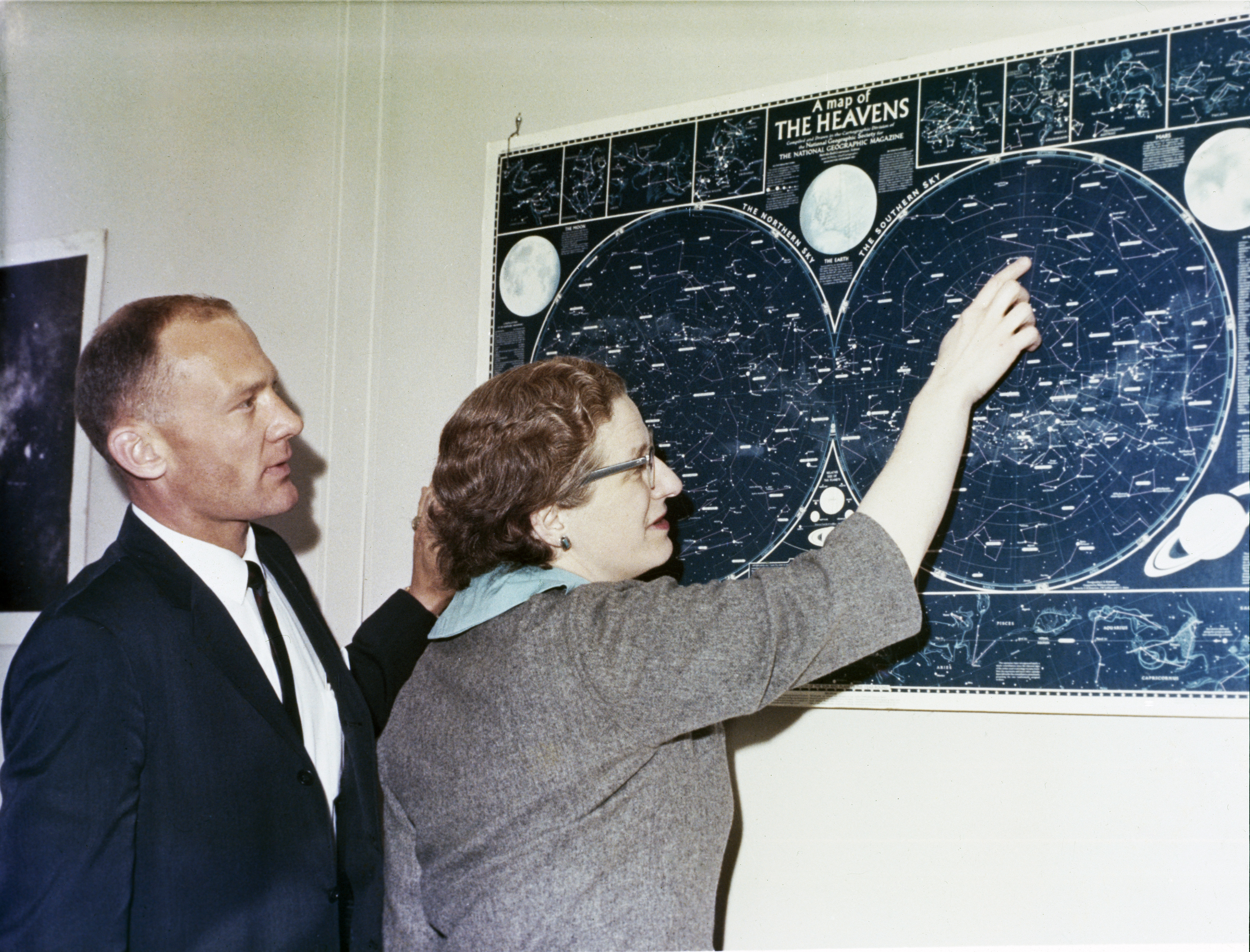
    Two people - astronaut Buzz Aldrin and Dr. Nancy Grace Roman - look at a map of celestial objects hanging on a wall in front of them. The photos is taken from the side, so their profiles are visible. Aldrin wears a dark suit and tie, while Roman wears a gray short sleeved jacket. She is pointing at a constellation on the blue and white map.
    NASA

    Dr. Nancy Grace Roman, NASA’s first Chief of Astronomy and namesake of the Nancy Grace Roman Telescope, briefs astronaut Edwin “Buzz” Aldrin on celestial objects in 1965 in Washington, D.C. Nancy Grace Roman passed away on December 25, 2018, in Germantown, Maryland at the age of 93. May 16, 2025, would have been her 100th birthday.

    Prior to joining NASA in 1959, Dr. Roman was a well-respected and influential astronomer, publishing some of the most cited papers in the mid-20th century, one included in a list of 100 most influential papers in 100 years. At the agency, Roman worked to gain science support for space-based observatories. She established NASA’s scientific ballooning and airborne science, oversaw the start of the Great Observatory program with the first decade of Hubble Space Telescope development, and invested early in charge-coupled devices technology development used on Hubble – and now in digital cameras everywhere.  

    She was also key to the decision to link the development of the Large Space Telescope (that became Hubble) and the Space Transportation System – more commonly known as the Space Shuttle. Finally, after retiring from NASA, Dr. Roman often worked with young students in underserved communities, hoping her story and mentoring could inspire them to join humanity’s quest for knowledge in a STEM field.

    Learn more about Dr. Roman.

    Text credit: NASA/Jackie Townsend

    Image credit: NASA

  • NASA, International Astronauts Address Students from New York, Ohio

    Astronaut Anne McClain is pictured on May 1, 2025, near one of the International Space Station's main solar arrays.
    Astronaut Anne McClain is pictured on May 1, 2025, near one of the International Space Station’s main solar arrays.
    Credit: NASA

    NASA astronaut Nichole Ayers and JAXA (Japan Aerospace Exploration Agency) astronaut Takuya Onishi will answer prerecorded questions submitted by middle and high school students from New York and Ohio. Both groups will hear from the astronauts aboard the International Space Station in two separate events.

    The first event at 10:20 a.m. EDT on Tuesday, May 20, includes students from Long Beach Middle School in Lido Beach, New York. Media interested in covering the event at Long Beach Middle School must RSVP no later than 5 p.m. Monday, May 19, to Christi Tursi at: ctursi@lbeach.org or 516-771-3960.

    The second event at 11 a.m. EDT on Friday, May 23, is with students from Vermilion High School in Vermilion, Ohio. Media interested in covering the event at Vermilion High School must RSVP no later than 5 p.m. Thursday, May 22, to Jennifer Bengele at: jbengele@vermilionschools.org or 440-479-7783.

    Watch both 20-minute Earth-to-space calls live on NASA STEM YouTube Channel.

    Long Beach Middle School will host the event for students in grades 6 through 8. The school aims to provide both the students and community with an experience that bridge gaps in space sciences with teaching and learning in classrooms.

    Vermilion High School will host the event for students in grades 9 through 12, to help increase student interest in science, technology, engineering, and mathematics career pathways.

    For more than 24 years, astronauts have continuously lived and worked aboard the space station, testing technologies, performing science, and developing skills needed to explore farther from Earth. Astronauts aboard the orbiting laboratory communicate with NASA’s Mission Control Center in Houston 24 hours a day through SCaN’s (Space Communications and Navigation) Near Space Network.

    Research and technology investigations taking place aboard the space station benefit people on Earth and lay the groundwork for other agency missions. As part of NASA’s Artemis campaign, the agency will send astronauts to the Moon to prepare for future human exploration of Mars, inspiring Artemis Generation explorers and ensuring the United States continues to lead in space exploration and discovery.

    See videos of astronauts aboard the space station at:

    https://www.nasa.gov/stemonstation

    -end-

    Gerelle Dodson
    Headquarters, Washington
    202-358-1600
    gerelle.q.dodson@nasa.gov

    Sandra Jones
    Johnson Space Center, Houston
    281-483-5111
    sandra.p.jones@nasa.gov

  • Hubble Captures Cotton Candy Clouds

    2 min read

    Hubble Captures Cotton Candy Clouds

    Part of a nebula in space. Layers of gas and dust clouds in different colors, from blue and green shades to pink, red, and black, each indicating light emitted by different molecules, comprise the nebula. The background cloud layers are thicker and puffier, though still translucent, and the upper layers are thin and bright at the edges. Behind the clouds are many small, mostly orange and some blue, stars.
    This NASA/ESA Hubble Space Telescope image features a cloudscape in the Large Magellanic Cloud., a dwarf satellite galaxy of the Milky Way.
    ESA/Hubble & NASA, C. Murray

    This NASA/ESA Hubble Space Telescope image features a sparkling cloudscape from one of the Milky Way’s galactic neighbors, a dwarf galaxy called the Large Magellanic Cloud. Located 160,000 light-years away in the constellations Dorado and Mensa, the Large Magellanic Cloud is the largest of the Milky Way’s many small satellite galaxies.

    This view of dusty gas clouds in the Large Magellanic Cloud is possible thanks to Hubble’s cameras, such as the Wide Field Camera 3 (WFC3) that collected the observations for this image. WFC3 holds a variety of filters, and each lets through specific wavelengths, or colors, of light. This image combines observations made with five different filters, including some that capture ultraviolet and infrared light that the human eye cannot see.

    The wispy gas clouds in this image resemble brightly colored cotton candy. When viewing such a vividly colored cosmic scene, it is natural to wonder whether the colors are ‘real’. After all, Hubble, with its 7.8-foot-wide (2.4 m) mirror and advanced scientific instruments, doesn’t bear resemblance to a typical camera! When image-processing specialists combine raw filtered data into a multi-colored image like this one, they assign a color to each filter. Visible-light observations typically correspond to the color that the filter allows through. Shorter wavelengths of light such as ultraviolet are usually assigned blue or purple, while longer wavelengths like infrared are typically red.

    This color scheme closely represents reality while adding new information from the portions of the electromagnetic spectrum that humans cannot see. However, there are endless possible color combinations that can be employed to achieve an especially aesthetically pleasing or scientifically insightful image.

    Media Contact:

    Claire Andreoli (claire.andreoli@nasa.gov)
    NASA’s Goddard Space Flight CenterGreenbelt, MD

  • NASA X-59’s Latest Testing Milestone: Simulating Flight from the Ground

    5 min read

    Preparations for Next Moonwalk Simulations Underway (and Underwater)

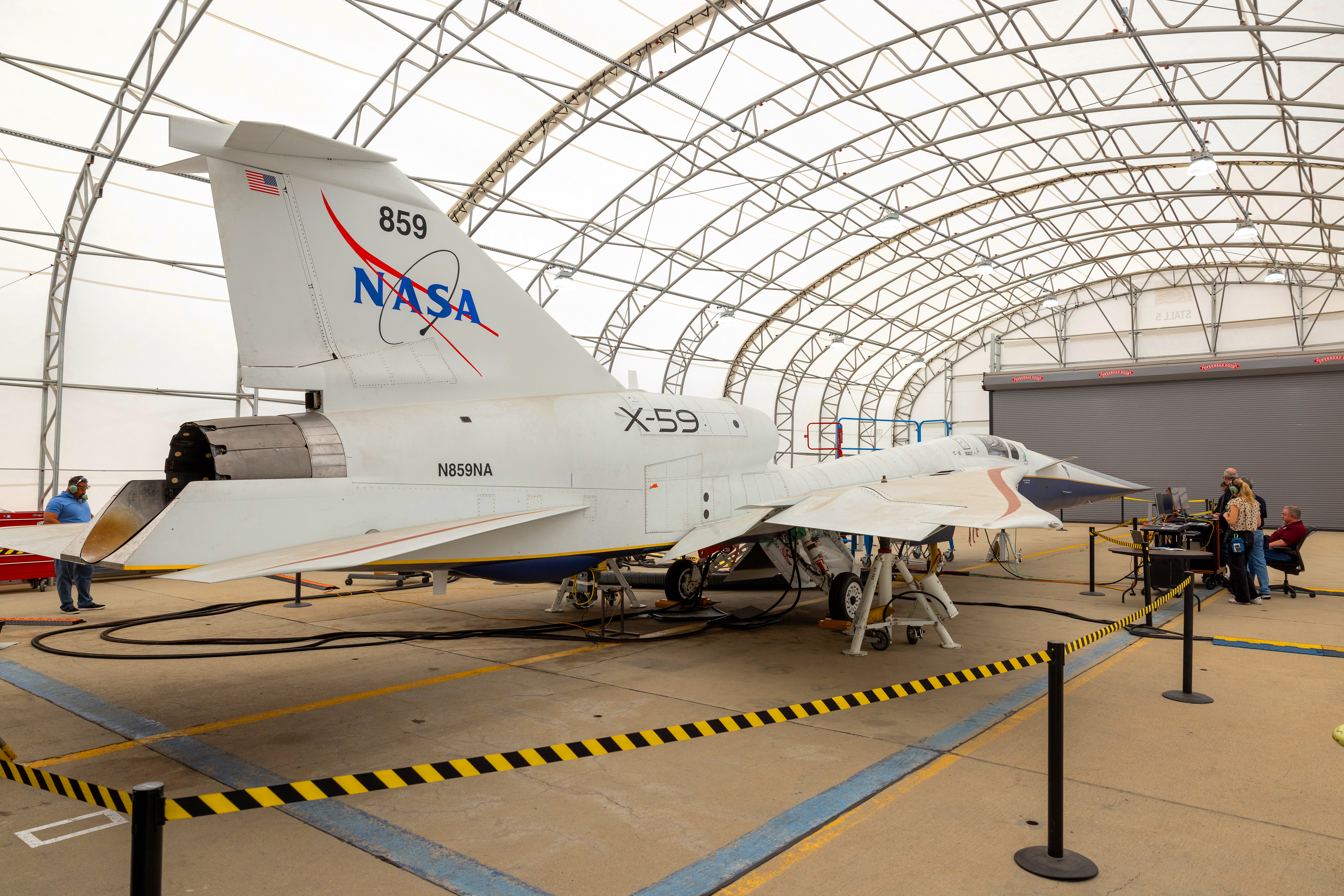
    A white NASA jet airplane sits inside a fabric-covered-roof hangar with several people working at a nearby table with computers.
    NASA’s X-59 quiet supersonic research aircraft is seen during its “aluminum bird” systems testing at Lockheed Martin’s Skunk Works facility in Palmdale, California. The test verified how the aircraft’s hardware and software work together, responding to pilot inputs and handling injected system failures.
    Lockheed Martin / Garry Tice

    NASA’s X-59 quiet supersonic research aircraft successfully completed a critical series of tests in which the airplane was put through its paces for cruising high above the California desert – all without ever leaving the ground.

    “The idea behind these tests is to command the airplane’s subsystems and flight computer to function as if it is flying,” said Yohan Lin, the X-59’s lead avionics engineer at NASA’s Armstrong Flight Research Center in Edwards, California.

    The goal of ground-based simulation testing was to make sure the hardware and software that will allow the X-59 to fly safely are properly working together and able to handle any unexpected problems.

    Any new aircraft is a combination of systems, and identifying the little adjustments required to optimize performance is an important step in a disciplined approach toward flight.

    “We thought we might find a few things during the tests that would prompt us to go back and tweak them to work better, especially with some of the software, and that’s what we wound up experiencing. So, these tests were very helpful,” Lin said.

    Completing the tests marks another milestone off the checklist of things to do before the X-59 makes its first flight this year, continuing NASA’s Quesst mission to help enable commercial supersonic air travel over land.

    Simulating the Sky

    During the testing, engineers from NASA and contractor Lockheed Martin turned on most of the X-59’s systems, leaving the engine off. For example, if the pilot moved the control stick a certain way, the flight computer moved the aircraft’s rudder or other control surfaces, just as it would in flight.

    At the same time, the airplane was electronically connected to a ground computer that sends simulated signals – which the X-59 interpreted as real – such as changes in altitude, speed, temperature, or the health of various systems.

    Sitting in the cockpit, the pilot “flew” the aircraft to see how the airplane would respond.

    “These were simple maneuvers, nothing too crazy,” Lin said. “We would then inject failures into the airplane to see how it would respond. Would the system compensate for the failure? Was the pilot able to recover?”

    Unlike in typical astronaut training simulations, where flight crews do not know what scenarios they might encounter, the X-59 pilots mostly knew what the aircraft would experience during every test and even helped plan them to better focus on the aircraft systems’ response.

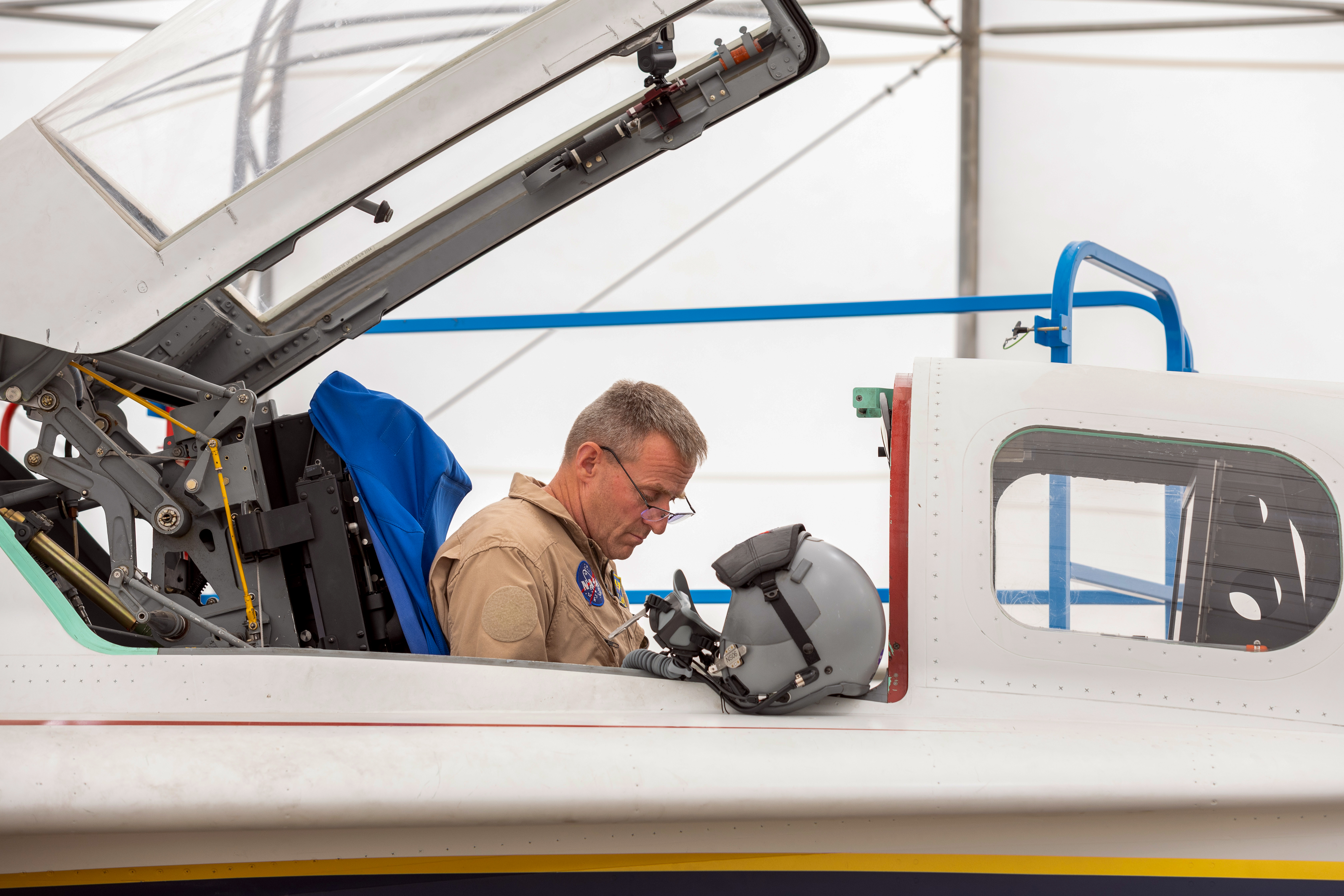
    A NASA test pilot sits in the cockpit of a jet aircraft.
    NASA test pilot James Less sits in the cockpit of the X-59 quiet supersonic research aircraft as he participates in a series of “aluminum bird” systems tests at Lockheed Martin’s Skunk Works facility in Palmdale, California.
    Lockheed Martin / Garry Tice

    Aluminum vs. Iron

    In aircraft development, this work is known as “iron bird” testing, named for a simple metal frame on which representations of the aircraft’s subsystems are installed, connected, and checked out.

    Building such a testbed is a common practice for development programs in which many aircraft will be manufactured. But since the X-59 is a one-of-a-kind airplane, officials decided it was better and less expensive to use the aircraft itself.

    As a result, engineers dubbed this series of exercises “aluminum bird” testing, since that’s the metal the X-59 is mostly made of.

    So, instead of testing an “iron bird” with copies of an aircraft’s systems on a non-descript frame, the “aluminum bird” used the actual aircraft and its systems, which in turn meant the test results gave everyone higher confidence in the design,

    “It’s a perfect example of the old tried and true adage in aviation that says ‘Test what you fly. Fly what you test,’” Lin said.

    Still Ahead for the X-59

    With aluminum bird testing in the rearview mirror, the next milestone on the X-59’s path to first flight is take the airplane out on the taxiways at the airport adjacent to Lockheed Martin’s Skunk Works facility in Palmdale, California, where the X-59 was built. First flight would follow those taxi tests.

    Already in the X-59’s logbook since the fully assembled and painted airplane made its public debut in January 2024:

    • Testing the aircraft’s ability to maintain a certain speed while flying, essentially a check of the X-59’s version of cruise control.

    The X-59 Tests in 59

    Watch this video about the X-59 aluminum bird testing. It only takes a minute. Well, 59 seconds to be precise.

    About the Author

    Jim Banke

    Jim Banke

    Managing Editor/Senior Writer

    Jim Banke is a veteran aviation and aerospace communicator with more than 40 years of experience as a writer, producer, consultant, and project manager based at Cape Canaveral, Florida. He is part of NASA Aeronautics’ Strategic Communications Team and is Managing Editor for the Aeronautics topic on the NASA website.