Tag: solar system

  • Hubble Captures an Active Galactic Center

    2 min read

    Hubble Captures an Active Galactic Center

    A spiral galaxy, seen at an angle that gives it an oval shape. It has two spiral arms that curl out from the center. They start narrow but broaden out as they wrap around the galaxy before merging into a faint halo. The galaxy’s disk is golden in the center with a bright core, and pale blue outside that. A swirl of dark dust strands and speckled blue star-forming regions follow the arms through the disk.
    This Hubble image shows the spiral galaxy UGC 11397.
    ESA/Hubble & NASA, M. J. Koss, A. J. Barth

    The light that the NASA/ESA Hubble Space Telescope collected to create this image reached the telescope after a journey of 250 million years. Its source was the spiral galaxy UGC 11397, which resides in the constellation Lyra (The Lyre). At first glance, UGC 11397 appears to be an average spiral galaxy: it sports two graceful spiral arms that are illuminated by stars and defined by dark, clumpy clouds of dust.

    What sets UGC 11397 apart from a typical spiral lies at its center, where a supermassive black hole containing 174 million times the mass of our Sun grows. As a black hole ensnares gas, dust, and even entire stars from its vicinity, this doomed matter heats up and puts on a fantastic cosmic light show.

    Material trapped by the black hole emits light from gamma rays to radio waves, and can brighten and fade without warning. But in some galaxies, including UGC 11397, thick clouds of dust hide much of this energetic activity from view in optical light. Despite this, UGC 11397’s actively growing black hole was revealed through its bright X-ray emission — high-energy light that can pierce the surrounding dust. This led astronomers to classify it as a Type 2 Seyfert galaxy, a category used for active galaxies whose central regions are hidden from view in visible light by a donut-shaped cloud of dust and gas.

    Using Hubble, researchers will study hundreds of galaxies that, like UGC 11397, harbor a supermassive black hole that is gaining mass. The Hubble observations will help researchers weigh nearby supermassive black holes, understand how black holes grew early in the universe’s history, and even study how stars form in the extreme environment found at the very center of a galaxy.

    Media Contact:

    Claire Andreoli (claire.andreoli@nasa.gov)
    NASA’s Goddard Space Flight CenterGreenbelt, MD

    Details

    Last Updated

    Jun 27, 2025

    Related Terms

  • By Air and by Sea: Validating NASA’s PACE Ocean Color Instrument

    6 min read

    Preparations for Next Moonwalk Simulations Underway (and Underwater)

    A woman in a blue facemask sits in an airplane, typing on a laptop with a large screen in front of her. The scene is lit by a round window in the middle of the frame.
    NASA Ames research scientist Kristina Pistone monitors instrument data while onboard the Twin Otter aircraft, flying over Monterey Bay during the October 2024 deployment of the AirSHARP campaign.
    NASA/Samuel Leblanc

    In autumn 2024, California’s Monterey Bay experienced an outsized phytoplankton bloom that attracted fish, dolphins, whales, seabirds, and – for a few weeks in October – scientists. A team from NASA’s Ames Research Center in Silicon Valley, with partners at the University of California, Santa Cruz (UCSC), and the Naval Postgraduate School, spent two weeks on the California coast gathering data on the atmosphere and the ocean to verify what satellites see from above. In spring 2025, the team returned to gather data under different environmental conditions.

    Scientists call this process validation.

    Setting up the Campaign

    The PACE mission, which stands for Plankton, Aerosol, Cloud, ocean Ecosystem, was launched in February  2024 and designed to transform our understanding of ocean and atmospheric environments. Specifically, the satellite will give scientists a finely detailed look at life near the ocean surface and the composition and abundance of aerosol particles in the atmosphere.

    Whenever NASA launches a new satellite, it sends validation science teams around the world to confirm that the data from instruments in space match what traditional instruments can see at the surface. AirSHARP (Airborne aSsessment of Hyperspectral Aerosol optical depth and water-leaving Reflectance Product Performance for PACE) is one of these teams, specifically deployed to validate products from the satellite’s Ocean Color Instrument (OCI).

    The OCI spectrometer works by measuring reflected sunlight. As sunlight bounces off of the ocean’s surface, it creates specific shades of color that researchers use to determine what is in the water column below. To validate the OCI data, research teams need to confirm that measurements directly at the surface match those from the satellite. They also need to understand how the atmosphere is changing the color of the ocean as the reflected light is traveling back to the satellite.

    In October 2024 and May 2025, the AirSHARP team ran simultaneous airborne and seaborne campaigns. Going into the field during different seasons allows the team to collect data under different environmental conditions, validating as much of the instrument’s range as possible.

    Over 13 days of flights on a Twin Otter aircraft, the NASA-led team used instruments called 4STAR-B (Spectrometer for sky-scanning sun Tracking Atmospheric Research B), and the C-AIR (Coastal Airborne In-situ Radiometer) to gather data from the air. At the same time, partners from UCSC used a host of matching instruments onboard the research vessel R/V Shana Rae to gather data from the water’s surface.

    Ocean Color and Water Leaving Reflectance

    The Ocean Color Instrument measures something called water leaving reflectance, which provides information on the microscopic composition of the water column, including water molecules, phytoplankton, and particulates like sand, inorganic materials, and even bubbles. Ocean color varies based on how these materials absorb and scatter sunlight. This is especially useful for determining the abundance and types of phytoplankton.

    Four panels of image look at the ocean from a plane window. The water is various shades of teal, deep blue, and red.
    Photographs taken out the window of the Twin Otter aircraft during the October 2024 AirSHARP deployment showcase the variation in ocean color, which indicates different molecular composition of the water column beneath. The red color in several of these photos is due to a phytoplankton bloom – in this case a growth of red algae.
    NASA/Samuel Leblanc

    The AirSHARP team used radiometers with matching technology – C-AIR from the air and C-OPS (Compact Optical Profiling System) from the water – to gather water leaving reflectance data.

    “The C-AIR instrument is modified from an instrument that goes on research vessels and takes measurements of the water’s surface from very close range,” said NASA Ames research scientist Samuel LeBlanc. “The issue there is that you’re very local to one area at a time. What our team has done successfully is put it on an aircraft, which enables us to span the entire Monterey Bay.”

    The larger PACE validation team will compare OCI measurements with observations made by the sensors much closer to the ocean to ensure that they match, and make adjustments when they don’t. 

    Aerosol Interference

    One factor that can impact OCI data is the presence of manmade and natural aerosols, which interact with sunlight as it moves through the atmosphere. An aerosol refers to any solid or liquid suspended in the air, such as smoke from fires, salt from sea spray, particulates from fossil fuel emissions, desert dust, and pollen.

    Imagine a 420 mile-long tube, with the PACE satellite at one end and the ocean at the other. Everything inside the tube is what scientists refer to as the atmospheric column, and it is full of tiny particulates that interact with sunlight. Scientists quantify this aerosol interaction with a measurement called aerosol optical depth.

    “During AirSHARP, we were essentially measuring, at different wavelengths, how light is changed by the particles present in the atmosphere,” said NASA Ames research scientist Kristina Pistone. “The aerosol optical depth is a measure of light extinction, or how much light is either scattered away or absorbed by aerosol particulates.” 

    The team measured aerosol optical depth using the 4STAR-B spectrometer, which was engineered at NASA Ames and  enables scientists to identify which aerosols are present and how they interact with sunlight.

    Twin Otter Aircraft

    A small white plane with orange details sits on the tarmac with a silver hangar and blue sky behind it. A woman with blonde hair walks towards it.
    AirSHARP principal investigator Liane Guild walks towards a Twin Otter aircraft owned and operated by the Naval Postgraduate School. The aircraft’s ability to perform complex, low-altitude flights made it the ideal platform to fly multiple instruments over Monterey Bay during the AirSHARP campaign.
    NASA/Samuel Leblanc

    Flying these instruments required use of a Twin Otter plane, operated by the Naval Postgraduate School (NPS). The Twin Otter is unique for its ability to perform extremely low-altitude flights, making passes down to 100 feet above the water in clear conditions.

    “It’s an intense way to fly. At that low height, the pilots continually watch for and avoid birds, tall ships, and even wildlife like breaching whales,” said Anthony Bucholtz, director of the Airborne Research Facility at NPS.

    With the phytoplankton bloom attracting so much wildlife in a bay already full of ships, this is no small feat. “The pilots keep a close eye on the radar, and fly by hand,” Bucholtz said, “all while following careful flight plans crisscrossing Monterey Bay and performing tight spirals over the Research Vessel Shana Rae.”

    Campaign Data

    Data gathered from the 2024 phase of this campaign is available on two data archive systems. Data from the 4STAR instrument is available in the PACE data archive  and data from C-AIR is housed in the SeaBASS data archive.

    Other data from the NASA PACE Validation Science Team is available through the PACE website: https://pace.oceansciences.org/pvstdoi.htm#

    Samuel LeBlanc and Kristina Pistone are funded via the Bay Area Environmental Research Institute (BAERI), which  is a scientist-founded nonprofit focused on supporting Earth and space sciences.

    About the Author

    Milan Loiacono

    Milan Loiacono

    Science Communication Specialist

    Milan Loiacono is a science communication specialist for the Earth Science Division at NASA Ames Research Center.

  • NASA Mars Orbiter Learns New Moves After Nearly 20 Years in Space

    6 min read

    Preparations for Next Moonwalk Simulations Underway (and Underwater)

    Artist's concept of NASA’s Mars Reconnaissance Orbiter
    An antenna sticks out like whiskers from NASA’s Mars Reconnaissance Orbiter in this artist’s concept of the spacecraft, which has been orbiting the Red Planet since 2006. This antenna is part of SHARAD, a radar that peers below the Martian surface.
    NASA/JPL-Caltech

    The Mars Reconnaissance Orbiter is testing a series of large spacecraft rolls that will help it hunt for water.

    After nearly 20 years of operations, NASA’s Mars Reconnaissance Orbiter (MRO) is on a roll, performing a new maneuver to squeeze even more science out of the busy spacecraft as it circles the Red Planet. Engineers have essentially taught the probe to roll over so that it’s nearly upside down. Doing so enables MRO to look deeper underground as it searches for liquid and frozen water, among other things.

    The new capability is detailed in a paper recently published in the Planetary Science Journal documenting three “very large rolls,” as the mission calls them, that were performed between 2023 and 2024.

    “Not only can you teach an old spacecraft new tricks, you can open up entirely new regions of the subsurface to explore by doing so,” said one of the paper’s authors, Gareth Morgan of the Planetary Science Institute in Tucson, Arizona.

    This animation depicts NASA’s Mars Reconnaissance Orbiter performing a 120-degree roll that increases the strength of its radar signal by 10 times or more.
    NASA/JPL-Caltech

    The orbiter was originally designed to roll up to 30 degrees in any direction so that it can point its instruments at surface targets, including potential landing sites, impact craters, and more.

    “We’re unique in that the entire spacecraft and its software are designed to let us roll all the time,” said Reid Thomas, MRO’s project manager at NASA’s Jet Propulsion Laboratory in Southern California.

    The process for rolling isn’t simple. The spacecraft carries five operating science instruments that have different pointing requirements. To target a precise spot on the surface with one instrument, the orbiter has to roll a particular way, which means the other instruments may have a less-favorable view of Mars during the maneuver.

    That’s why each regular roll is planned weeks in advance, with instrument teams negotiating who conducts science and when. Then, an algorithm checks MRO’s position above Mars and automatically commands the orbiter to roll so the appropriate instrument points at the correct spot on the surface. At the same time, the algorithm commands the spacecraft’s solar arrays to rotate and track the Sun and its high-gain antenna to track Earth to maintain power and communications.

    Very large rolls, which are 120 degrees, require even more planning to maintain the safety of the spacecraft. The payoff is that the new maneuver enables one particular instrument, called the Shallow Radar (SHARAD), to have a deeper view of Mars than ever before.


    radargrams from the SHARAD instrument on NASA’s MRO

    radargrams from the SHARAD instrument on NASA’s MRO

    radargrams from the SHARAD instrument on NASA’s MRO
    radargrams from the SHARAD instrument on NASA’s MRO


    SHARAD’s View of Mars During a ‘Very Large Roll’


    These two radargrams from the SHARAD instrument on NASA’s MRO reveal how the spacecraft’s new “very large roll” maneuver produces a stronger signal, providing a brighter, clearer picture of the Martian subsurface. Use the slider to compare the 120-degree roll, left, to the standard 28-degree roll. NASA/JPL-Caltech/University of Rome/ASI/PSI

    Bigger Rolls, Better Science

    Designed to peer from about half a mile to a little over a mile (1 to 2 kilometers) belowground, SHARAD allows scientists to distinguish between materials like rock, sand, and ice. The radar was especially useful in determining where ice could be found close enough to the surface that future astronauts might one day be able to access it. Ice will be key for producing rocket propellant for the trip home and is important for learning more about the climate, geology, and potential for life at Mars.

    But as great as SHARAD is, the team knew it could be even better.

    To give cameras like the High-Resolution Imaging Science Experiment (HiRISE) prime viewing at the front of MRO, SHARAD’s two antenna segments were mounted at the back of the orbiter. While this setup helps the cameras, it also means that radio signals SHARAD pings onto the surface below encounter parts of the spacecraft, interfering with the signals and resulting in images that are less clear.

    “The SHARAD instrument was designed for the near-subsurface, and there are select regions of Mars that are just out of reach for us,” said Morgan, a co-investigator on the SHARAD team. “There is a lot to be gained by taking a closer look at those regions.”

    In 2023, the team decided to try developing 120-degree very large rolls to provide the radio waves an unobstructed path to the surface. What they found is that the maneuver can strengthen the radar signal by 10 times or more, offering a much clearer picture of the Martian underground.

    But the roll is so large that the spacecraft’s communications antenna is not pointed at Earth, and its solar arrays aren’t able to track the Sun.

    “The very large rolls require a special analysis to make sure we’ll have enough power in our batteries to safely do the roll,” Thomas said.

    Given the time involved, the mission limits itself to one or two very large rolls a year. But engineers hope to use them more often by streamlining the process.

    Learning to Roll With It

    While SHARAD scientists are benefiting from these new moves, the team working with another MRO instrument, the Mars Climate Sounder, is making the most of MRO’s standard roll capability. 

    The JPL-built instrument is a radiometer that serves as one of the most detailed sources available of information on Mars’ atmosphere. Measuring subtle changes in temperature over the course of many seasons, Mars Climate Sounder reveals the inner workings of dust storms and cloud formation. Dust and wind are important to understand: They are constantly reshaping the Martian surface, with wind-borne dust blanketing solar panels and posing a health risk for future astronauts.

    Mars Climate Sounder was designed to pivot on a gimbal so that it can get views of the Martian horizon and surface. It also provides views of space, which scientists use to calibrate the instrument. But in 2024, the aging gimbal became unreliable. Now Mars Climate Sounder relies on MRO’s standard rolls.

    “Rolling used to restrict our science,” said Mars Climate Sounder’s interim principal investigator, Armin Kleinboehl of JPL, “but we’ve incorporated it into our routine planning, both for surface views and calibration.”

    More About MRO

    NASA’s Jet Propulsion Laboratory in Southern California manages MRO for the agency’s Science Mission Directorate in Washington as part of its Mars Exploration Program portfolio. The SHARAD instrument was provided by the Italian Space Agency. Its operations are led by Sapienza University of Rome, and its data is analyzed by a joint U.S.-Italian science team. The Planetary Science Institute in Tucson, Arizona, leads U.S. involvement in SHARAD. Lockheed Martin Space in Denver built MRO and supports its operations.

    For more information, visit:

    science.nasa.gov/mission/mars-reconnaissance-orbiter

    News Media Contacts

    Andrew Good
    Jet Propulsion Laboratory, Pasadena, Calif.
    818-393-2433
    andrew.c.good@jpl.nasa.gov

    Karen Fox / Molly Wasser
    NASA Headquarters, Washington
    202-358-1600
    karen.c.fox@nasa.gov / molly.l.wasser@nasa.gov

    2025-084

    Details

    Last Updated

    Jun 26, 2025

  • NASA Citizen Scientists Find New Eclipsing Binary Stars

    When two stars orbit one another in such a way that one blocks the other’s light each time it swings around, that’s an eclipsing binary. A new paper from NASA’s Eclipsing Binary Patrol citizen science project presents more than 10,000 of these rare pairs – 10,001 to be precise. These objects will help future researchers study the physics and formation of stars and search for new exoplanets.

    “Together, humans and computers excel at investigating hundreds of thousands of eclipsing binaries,” said Dr. Veselin Kostov, research scientist at NASA Goddard Space Flight Center and the SETI Institute and lead author of the paper. “I can’t wait to search them for exoplanets!”

    To make their catalog, the team examined data from NASA’s Transiting Exoplanet Survey Satellite (TESS), which surveyed nearly the entire sky looking for objects with varying brightness. They used a two-tiered approach, combining the scalability of artificial intelligence with the nuanced judgment of human expertise. First, advanced machine learning methods efficiently sifted through hundreds of millions of targets observed by TESS, identifying hundreds of thousands of promising candidates. Then, humans scrutinized the most interesting systems. 

    Of the 10,001 objects they listed in their paper, 7,936 are new eclipsing binaries they discovered. The rest were already known, but the team made new measurements of the timing of their eclipses.
    You can join the Eclipsing Binary Patrol team too! Just go to the project’s website.

    Eclipsing Binary stars change in brightness over time as they orbit one another and block each other’s light.
    Credit: NASA GSFC
  • Meet the Space Ops Team: Derrick Bailey

    3 min read

    Preparations for Next Moonwalk Simulations Underway (and Underwater)

    Since childhood, Derrick Bailey always had an early fascination with aeronautics. Military fighter jet pilots were his childhood heroes, and he dreamed of joining the aerospace industry. This passion was a springboard into his 17-year career at NASA, where Bailey plays an important role in enabling successful rocket launches.

    Bailey is the Launch Vehicle Certification Manager in the Launch Services Program (LSP) within the Space Operations Mission Directorate. In this role, he helps NASA outline the agency’s risk classifications of new rockets from emerging and established space companies.

    “Within my role, I formulate a series of technical and process assessments for NASA LSP’s technical team to understand how companies operate, how vehicles are designed and qualified, and how they perform in flight,” Bailey said.

    Beyond technical proficiency and readiness, a successful rocket launch relies on establishing a strong foundational relationship between NASA and the commercial companies involved. Bailey and his team ensure effective communication with these companies to provide the guidance, data, and analysis necessary to support them in overcoming challenges.

    “We work diligently to build trusting relationships with commercial companies and demonstrate the value in partnering with our team,” Bailey said.

    Bailey credits a stroke of fate that landed him at the agency. During his senior year at Georgia Tech, where he was pursuing a degree in aerospace engineering, Bailey almost walked past the NASA tent at a career fair. However, he decided to grab a NASA sticker and strike up a conversation, which quickly turned into an impromptu interview. He walked away that day with a job offer to work on the now-retired Space Shuttle Program at the agency’s Kennedy Space Center in Florida.

    “I never imagined working at NASA,” Bailey said. “Looking back, it’s unbelievable that a chance encounter resulted in securing a job that has turned into an incredible career.”

    Thinking about the future, Bailey is excited about new opportunities in the commercial space industry. Bailey sees NASA as a crucial advisor and mentor for commercial sector while using industry capabilities to provide more cost-effective access to space.

    A graphic features a photo of Derrick Bailey, launch vehicle certification manager for the Launch Services Program. Next to the photo is a quote from Bailey:
    Derrick Bailey, launch vehicle certification manager for NASA’s Launch Services Program

    “We are the enablers,” Bailey said of his role in the directorate. “It is our responsibility to provide the best opportunity for future explorers to begin their journey of discovery in deep space and beyond.”

    Outside of work, Bailey enjoys spending time with his family, especially his two sons, who keep him busy with trips to the baseball diamond and homework sessions. Bailey also enjoys hands-on activities, like working on cars, off-road vehicles, and house projects – hobbies he picked up from his mechanically inclined father. Additionally, at the beginning of 2025, his wife accepted a program specialist position with LSP, an exciting development for the entire Bailey family.

    “One of my wife’s major observations early on in my career was how much my colleagues genuinely care about one another and empower people to make decisions,” Bailey explained. “These are the things that make NASA the number one place to work in the government.”

    NASA’s Space Operations Mission Directorate maintains a continuous human presence in space for the benefit of people on Earth. The programs within the directorate are the hub of NASA’s space exploration efforts, enabling Artemis, commercial space, science, and other agency missions through communication, launch services, research capabilities, and crew support.

    To learn more about NASA’s Space Operation Mission Directorate, visit: 

    https://www.nasa.gov/directorates/space-operations

    Details

    Last Updated

    Jun 26, 2025

  • NASA’s Webb Digs into Structural Origins of Disk Galaxies

    5 Min Read

    NASA’s Webb Digs into Structural Origins of Disk Galaxies

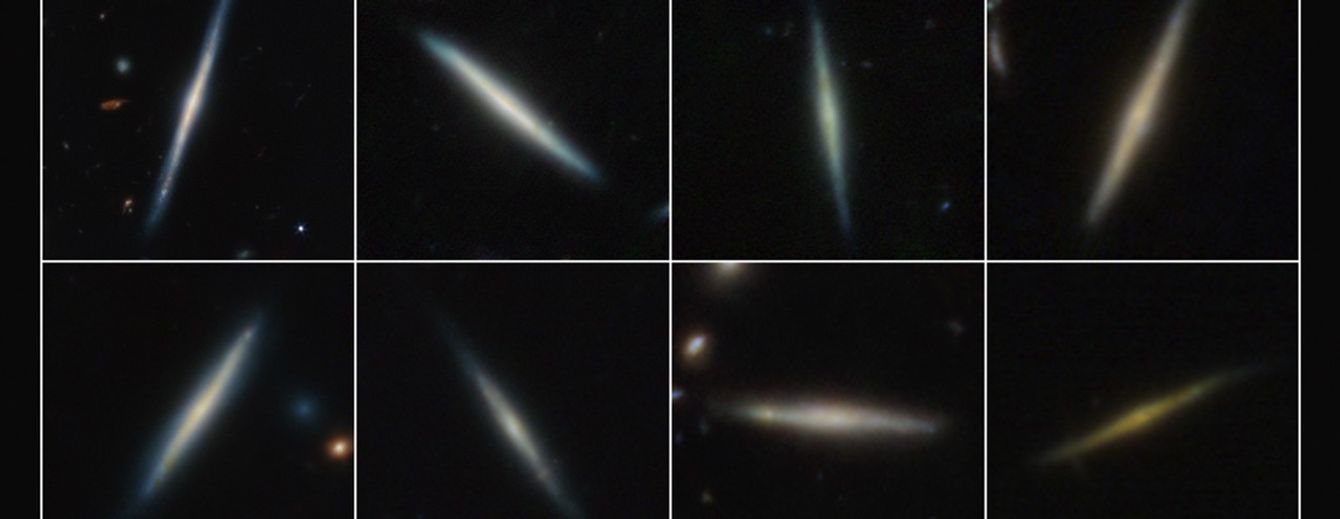
    Eight edge-on disk galaxies observed by the James Webb Space Telescope, split in two rows. Each disk galaxy is centered within a square frame and lies against the black background of space. They appear as thin lines with a slight bulge in their centers. A few of the galaxies are horizontal or vertical, but many are angled diagonally.

    Astronomers pulled from NASA’s James Webb Space Telescope’s data to analyze a sample of 111 edge-on galaxies. The team’s analysis suggests that thick disk formation occurs first, and thin disk formation follows. Full image and caption below.

    Credits:
    NASA, ESA, CSA, T. Tsukui (Australian National University).

    Present-day disk galaxies often contain a thick, star-filled outer disk and an embedded thin disk of stars. For instance, our own Milky Way galaxy’s thick disk is approximately 3,000 light-years in height, and its thin disk is roughly 1,000 light-years thick.

    How and why does this dual disk structure form? By analyzing archival data from multiple observational programs by NASA’s James Webb Space Telescope, a team of astronomers is closer to answers, as well as understanding the origins of disk galaxies in general.

    The team carefully identified, visually verified, and analyzed a statistical sample of 111 edge-on disk galaxies at various periods — up to 11 billion years ago (or approximately 2.8 billion years after the big bang). This is the first time scientists have investigated thick- and thin-disk structures spanning such vast distances, bridging the gap between observers probing the early universe and galactic archaeologists seeking to understand our own galaxy’s history.

    “This unique measurement of the thickness of the disks at high redshift, or at times in the early universe, is a benchmark for theoretical study that was only possible with Webb,” said Takafumi Tsukui, lead author of the paper and a researcher at the Australian National University in Canberra. “Usually, the older, thick disk stars are faint, and the young, thin disk stars outshine the entire galaxy. But with Webb’s resolution and unique ability to see through dust and highlight faint old stars, we can identify the two-disk structure of galaxies and measure their thickness separately.”

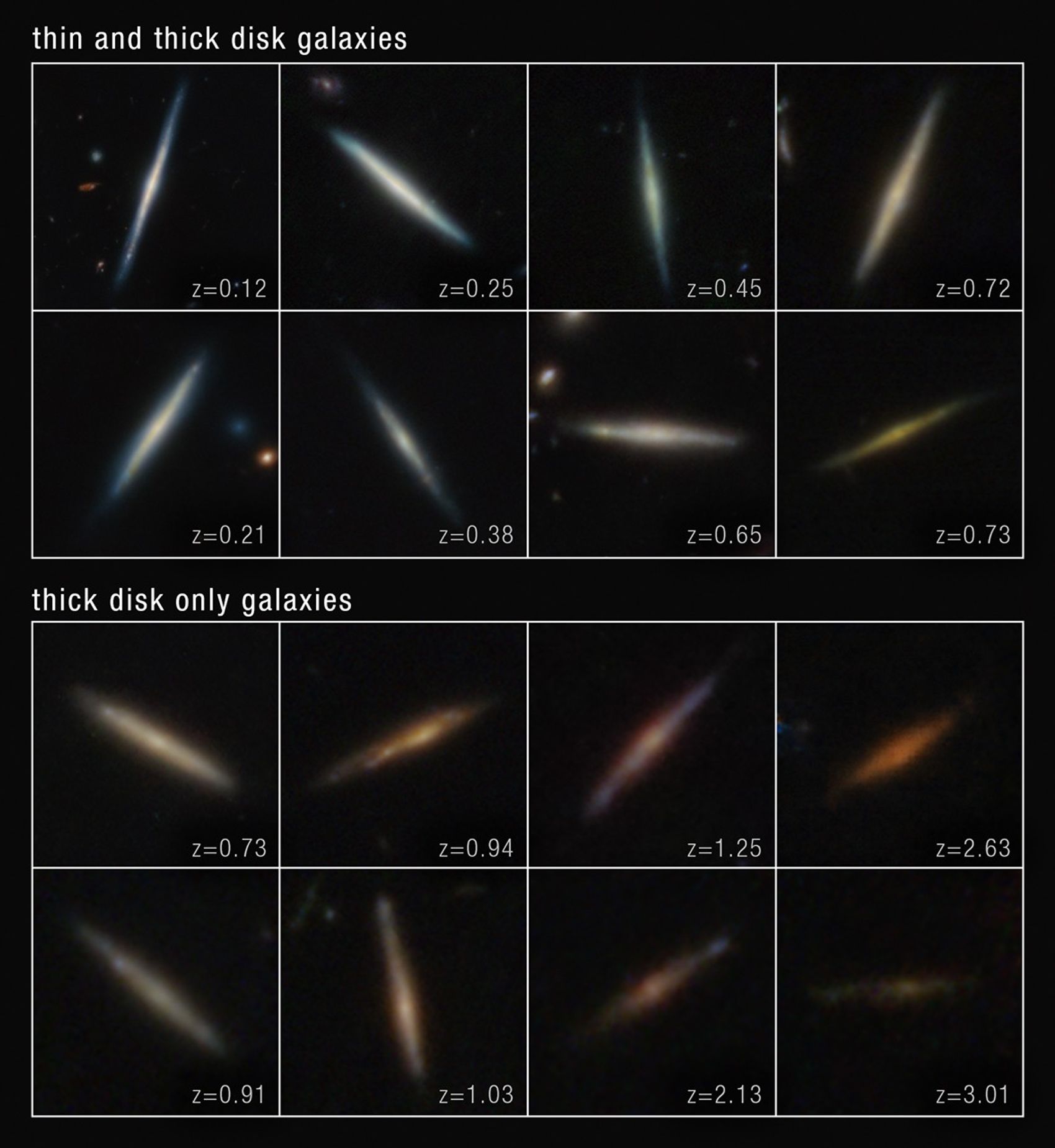
    Image: A Sample of Galaxy Disks (NIRCam)

    Two mosaics of edge-on disk galaxies observed by the James Webb Space Telescope. Each mosaic has eight images, split in two rows. The mosaic at the top is titled “thin and thick disk galaxies.” The mosaic at the bottom is titled “thick disk only galaxies.” Each disk galaxy is centered within a square frame and lies against the black background of space. They appear as thin lines with a slight bulge in their centers. A few of the galaxies are horizontal or vertical, but many are angled diagonally. The thin and thick disk galaxies are overall whiter and brighter compared to the thick disk only galaxies, which are fainter and brown-orange. Text in the bottom right of each box lists the galaxy’s redshift. From left to right, the first row of the top mosaic reads z =0.12; z = 0.25; z = 0.45; and z = 0.72. The second row reads z = 0.21; z = 0.38; z =0.65; and z = 0.73. The top row of the bottom mosaic reads z = 0.73, z = 0.94; z = 1.25; and z = 2.63. The bottom row reads z = 0.91; z = 1.03; z = 2.13; and z = 3.01.
    Astronomers pulled from NASA’s James Webb Space Telescope’s data to analyze a sample of 111 edge-on galaxies. The team’s analysis suggests that thick disk formation occurs first, and thin disk formation follows. When this process occurs depends on the galaxy’s mass.
    NASA, ESA, CSA, T. Tsukui (Australian National University).

    Data Through Thick and Thin

    By analyzing these 111 targets over cosmological time, the team was able to study single-disk galaxies and double-disk galaxies. Their results indicate that galaxies form a thick disk first, followed by a thin disk. The timing of when this takes place is dependent on the galaxy’s mass: high-mass, single-disk galaxies transitioned to two-disk structures around 8 billion years ago. In contrast, low-mass, single-disk galaxies formed their embedded thin disks later on, about 4 billion years ago.

    “This is the first time it has been possible to resolve thin stellar disks at higher redshift. What’s really novel is uncovering when thin stellar disks start to emerge,” said Emily Wisnioski, a co-author of the paper at the Australian National University in Canberra. “To see thin stellar disks already in place 8 billion years ago, or even earlier, was surprising.”

    A Turbulent Time for Galaxies

    To explain this transition from a single, thick disk to a thick and thin disk, and the difference in timing for high- and low-mass galaxies, the team looked beyond their initial edge-on galaxy sample and examined data showing gas in motion from the Atacama Large Millimeter/submillimeter Array (ALMA) and ground-based surveys.

    By taking into consideration the motion of the galaxies’ gas disks, the team finds their results align with the “turbulent gas disk” scenario, one of three major hypotheses that has been proposed to explain the process of thick- and thin-disk formation. In this scenario, a turbulent gas disk in the early universe sparks intense star formation, forming a thick stellar disk. As stars form, they stabilize the gas disk, which becomes less turbulent and, as a result, thinner.

    Since massive galaxies can more efficiently convert gas into stars, they settle sooner than their low-mass counterparts, resulting in the earlier formation of thin disks. The team notes that thick- and thin-disk formation are not siloed events: The thick disk continues to grow as the galaxy develops, though it’s slower than the thin disk’s rate of growth.

    How This Applies to Home

    Webb’s sensitivity is enabling astronomers to observe smaller and fainter galaxies, analogous to our own, at early times and with unprecedented clarity for the first time. In this study, the team noted that the transition period from thick disk to a thick and thin disk roughly coincides with the formation of the Milky Way galaxy’s thin disk. With Webb, astronomers will be able to further investigate Milky Way-like progenitors — galaxies that would have preceded the Milky Way — which could help explain our galaxy’s formation history.

    In the future, the team intends to incorporate other data points into their edge-on galaxy sample.

    “While this study structurally distinguishes thin and thick disks, there is still much more we would like to explore,” said Tsukui. “We want to add the type of information people usually get for nearby galaxies, like stellar motion, age, and metallicity. By doing so, we can bridge the insights from galaxies near and far, and refine our understanding of disk formation.”

    These results were published in the Monthly Notices of the Royal Astronomical Society.

    The James Webb Space Telescope is the world’s premier space science observatory. Webb is solving mysteries in our solar system, looking beyond to distant worlds around other stars, and probing the mysterious structures and origins of our universe and our place in it. Webb is an international program led by NASA with its partners, ESA (European Space Agency) and CSA (Canadian Space Agency).

    To learn more about Webb, visit:

    https://science.nasa.gov/webb

    Downloads

    Click any image to open a larger version.

    View/Download all image products at all resolutions for this article from the Space Telescope Science Institute.

    View/Download the research results from the Monthly Notices of the Royal Astronomical Society.

    Media Contacts

    Laura Betz – laura.e.betz@nasa.gov
    NASA’s Goddard Space Flight Center, Greenbelt, Md.

    Abigail Majoramajor@stsci.edu
    Space Telescope Science Institute, Baltimore, Md.

    Hannah Braunhbraun@stsci.edu
    Space Telescope Science Institute, Baltimore, Md.

    Article: Types of Galaxies

    Video: Celestial Tour: Different types of galaxies

    Article: Learn more about Webb’s views of nearby spiral galaxies

    Visualization Video: Galaxy Traverse

    More Webb News

    More Webb Images

    Webb Science Themes

    Webb Mission Page

    What is the Webb Telescope?

    SpacePlace for Kids

    En Español

    Ciencia de la NASA

    NASA en español 

    Space Place para niños

  • NASA, Australia Team Up for Artemis II Lunar Laser Communications Test

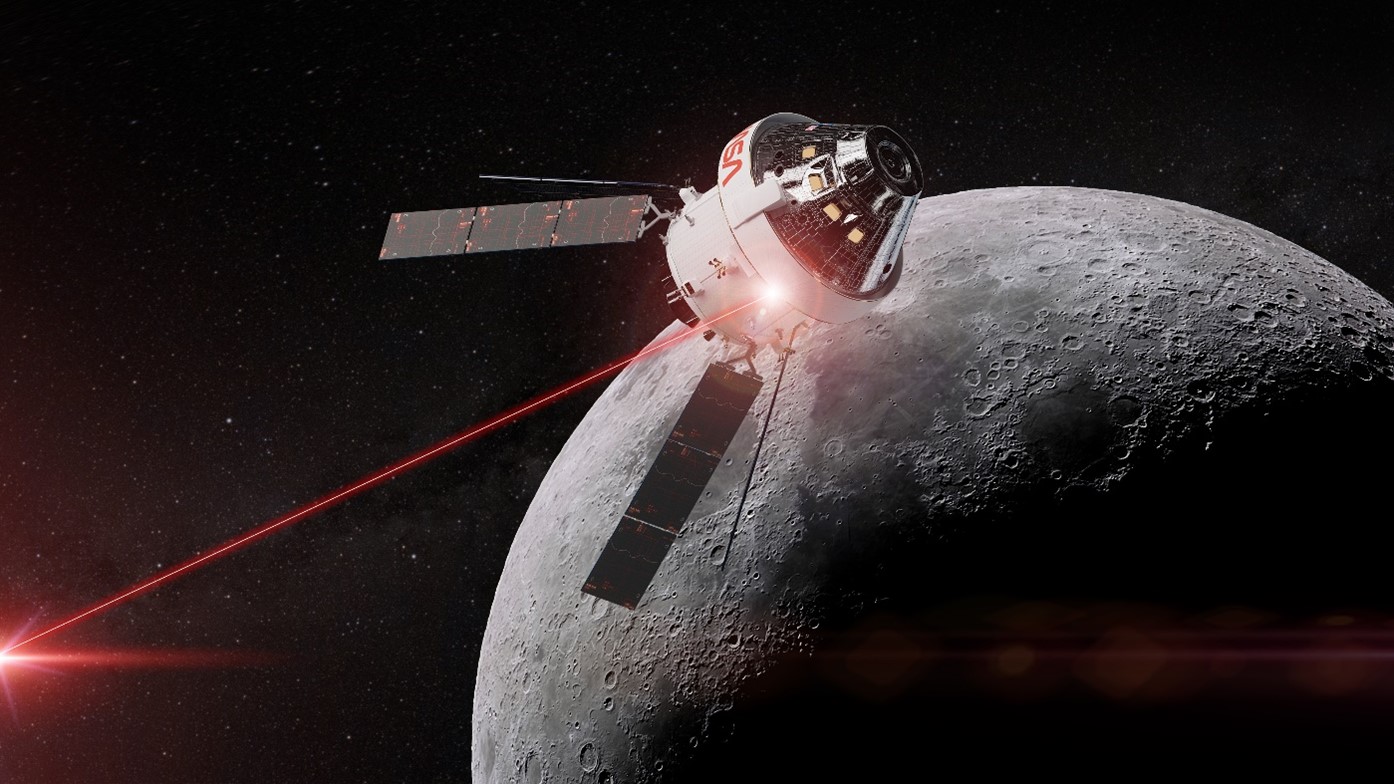
    An artist rendering of the Orion Spacecraft in the middle of the frame traveling close to the Moon in the right side of the frame. A red beam representing optical communications is being transmit from the side of the capsule out of frame to the left.
    An artist’s concept of NASA’s Orion spacecraft orbiting the Moon while using laser communications technology through the Orion Artemis II Optical Communications System.
    Credit: NASA/Dave Ryan

    As NASA prepares for its Artemis II mission, researchers at the agency’s Glenn Research Center in Cleveland are collaborating with The Australian National University (ANU) to prove inventive, cost-saving laser communications technologies in the lunar environment.

    Communicating in space usually relies on radio waves, but NASA is exploring laser, or optical, communications, which can send data 10 to 100 times faster to the ground. Instead of radio signals, these systems use infrared light to transmit high-definition video, picture, voice, and science data across vast distances in less time. NASA has proven laser communications during previous technology demonstrations, but Artemis II will be the first crewed mission to attempt using lasers to transmit data from deep space.

    To support this effort, researchers working on the agency’s Real Time Optical Receiver (RealTOR) project have developed a cost-effective laser transceiver using commercial-off-the-shelf parts. Earlier this year, NASA Glenn engineers built and tested a replica of the system at the center’s Aerospace Communications Facility, and they are now working with ANU to build a system with the same hardware models to prepare for the university’s Artemis II laser communications demo.

    “Australia’s upcoming lunar experiment could showcase the capability, affordability, and reproducibility of the deep space receiver engineered by Glenn,” said Jennifer Downey, co-principal investigator for the RealTOR project at NASA Glenn. “It’s an important step in proving the feasibility of using commercial parts to develop accessible technologies for sustainable exploration beyond Earth.”

    During Artemis II, which is scheduled for early 2026, NASA will fly an optical communications system aboard the Orion spacecraft, which will test using lasers to send data across the cosmos. During the mission, NASA will attempt to transmit recorded 4K ultra-high-definition video, flight procedures, pictures, science data, and voice communications from the Moon to Earth.

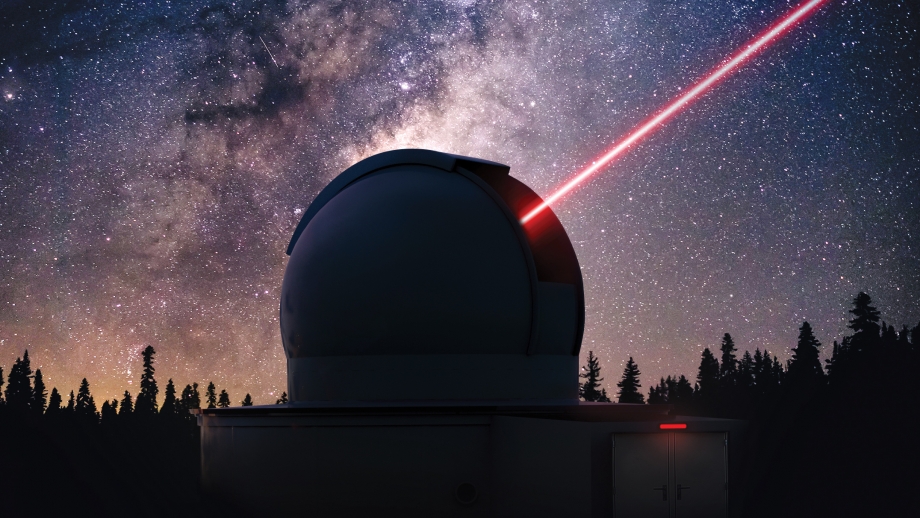
    An artistic rendering of a circular ground station on Earth, shaded with shadows. The ground station sits in front of a row of shadowed pine trees and a bright night sky full of colorful stars. A red beam is shown transmitted from the ground station up to the upper right corner and out of frame, representing laser communications.
    An artist’s concept of the optical communications ground station at Mount Stromlo Observatory in Canberra, Australia, using laser communications technology.
    Credit: The Australian National University

    Nearly 10,000 miles from Cleveland, ANU researchers working at the Mount Stromlo Observatory ground station hope to receive data during Orion’s journey around the Moon using the Glenn-developed transceiver model. This ground station will serve as a test location for the new transceiver design and will not be one of the mission’s primary ground stations. If the test is successful, it will prove that commercial parts can be used to build affordable, scalable space communication systems for future missions to the Moon, Mars, and beyond.

    “Engaging with The Australian National University to expand commercial laser communications offerings across the world will further demonstrate how this advanced satellite communications capability is ready to support the agency’s networks and missions as we set our sights on deep space exploration,” said Marie Piasecki, technology portfolio manager for NASA’s Space Communications and Navigation (SCaN) Program.

    As NASA continues to investigate the feasibility of using commercial parts to engineer ground stations, Glenn researchers will continue to provide critical support in preparation for Australia’s demonstration.

    Strong global partnerships advance technology breakthroughs and are instrumental as NASA expands humanity’s reach from the Moon to Mars, while fueling innovations that improve life on Earth. Through Artemis, NASA will send astronauts to explore the Moon for scientific discovery, economic benefits, and build the foundation for the first crewed missions to Mars.

    A group of eight individuals from the RealTOR research team stand in a line posing for a group photo. The team is smiling standing in front of a bright blue NASA banner, in a large room with tall windows that let in natural lighting.
    The Real Time Optical Receiver (RealTOR) team poses for a group photo in the Aerospace Communications Facility at NASA’s Glenn Research Center in Cleveland on Friday, Dec. 13, 2024. From left to right: Peter Simon, Sarah Tedder, John Clapham, Elisa Jager, Yousef Chahine, Michael Marsden, Brian Vyhnalek, and Nathan Wilson.
    Credit: NASA

    The RealTOR project is one aspect of the optical communications portfolio within NASA’s SCaN Program, which includes demonstrations and in-space experiment platforms to test the viability of infrared light for sending data to and from space. These include the LCOT (Low-Cost Optical Terminal) project, the Laser Communications Relay Demonstration, and more. NASA Glenn manages the project under the direction of agency’s SCaN Program at NASA Headquarters in Washington.

    The Australian National University’s demonstration is supported by the Australian Space Agency Moon to Mars Demonstrator Mission Grant program, which has facilitated operational capability for the Australian Deep Space Optical Ground Station Network.

    To learn how space communications and navigation capabilities support every agency mission, visit:

    https://www.nasa.gov/communicating-with-missions

  • NASA to Welcome Fourth Private Astronaut Mission to Space Station

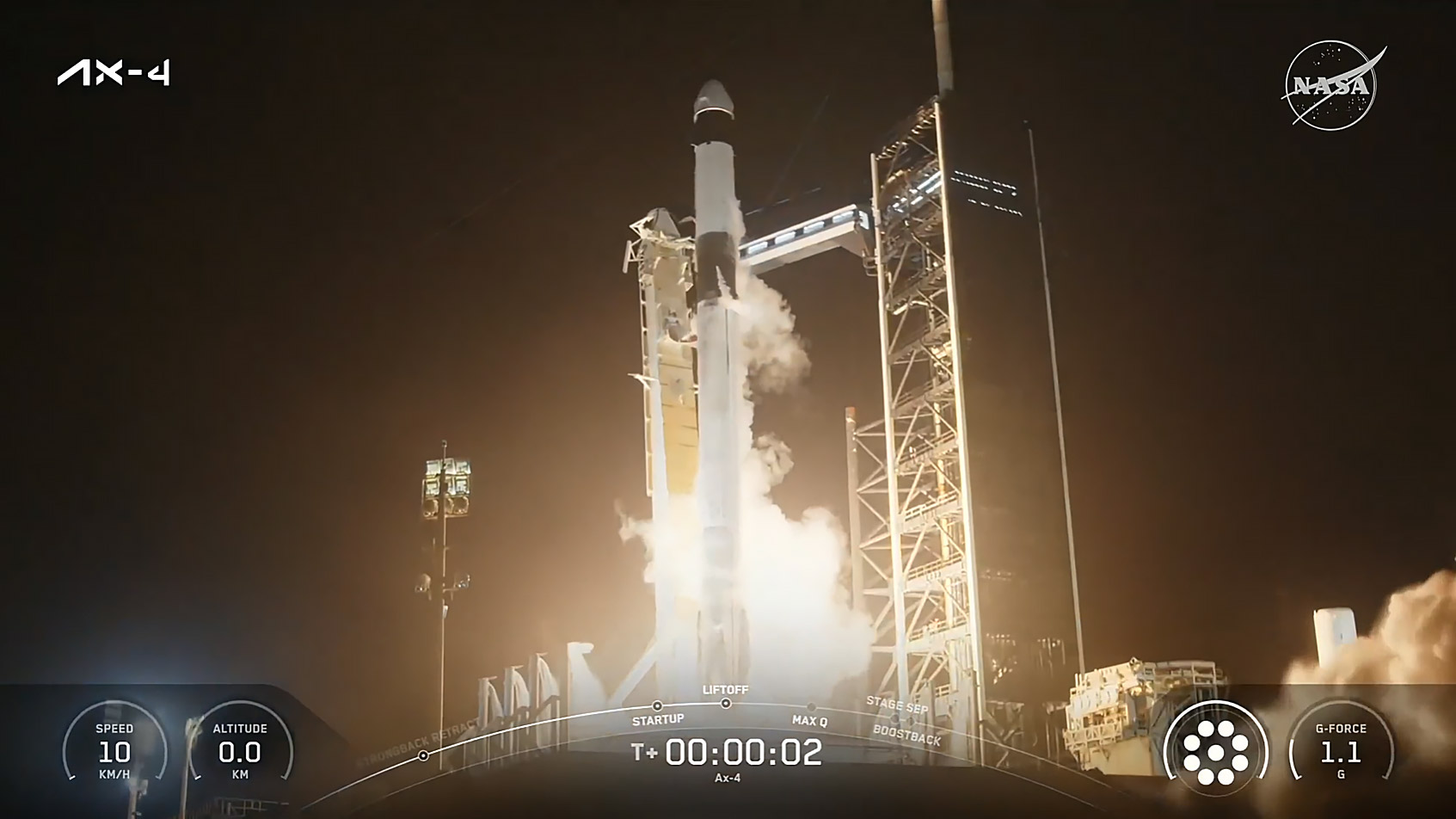
    The SpaceX Dragon spacecraft carrying the Axiom Mission 4 crew launches atop the Falcon 9 rocket from NASA's Kennedy Space Center to the International Space Station.
    The SpaceX Dragon spacecraft carrying the Axiom Mission 4 crew launches atop the Falcon 9 rocket from NASA’s Kennedy Space Center to the International Space Station.
    Credit: NASA

    As part of NASA’s efforts to expand access to space, four private astronauts are in orbit following the successful launch of the fourth all private astronaut mission to the International Space Station.

    A SpaceX Dragon spacecraft lifted off at 2:31 a.m. EDT Wednesday from Launch Complex 39A at NASA’s Kennedy Space Center in Florida, carrying Axiom Mission 4 crew members Peggy Whitson, former NASA astronaut and director of human spaceflight at Axiom Space as commander, ISRO (Indian Space Research Organisation) astronaut and pilot Shubhanshu Shukla, and mission specialists ESA (European Space Agency) project astronaut Sławosz Uznański-Wiśniewski of Poland and HUNOR (Hungarian to Orbit) astronaut Tibor Kapu of Hungary.

    “Congratulations to Axiom Space and SpaceX on a successful launch,” said NASA acting Administrator Janet Petro. “Under President Donald Trump’s leadership, America has expanded international participation and commercial capabilities in low Earth orbit. U.S. industry is enabling astronauts from India, Poland, and Hungary to return to space for the first time in over forty years. It’s a powerful example of American leadership bringing nations together in pursuit of science, discovery, and opportunity.”

    A collaboration between NASA and ISRO allowed Axiom Mission 4 to deliver on a commitment highlighted by President Trump and Indian Prime Minister Narendra Modi to send the first ISRO astronaut to the station. The space agencies are participating in five joint science investigations and two in-orbit science, technology, engineering, and mathematics demonstrations. NASA and ISRO have a long-standing relationship built on a shared vision to advance scientific knowledge and expand space collaboration.

    This mission serves as an example of the success derived from collaboration between NASA’s international partners and American commercial space companies.

    Live coverage of the spacecraft’s arrival will begin at 5 a.m., Thursday, June 26, on NASA+. Learn how to watch NASA content through a variety of platforms, including social media.

    The spacecraft is scheduled to autonomously dock at approximately 7 a.m. to the space-facing port of the space station’s Harmony module.

    Once aboard the station, Expedition 73 crew members, including NASA astronauts, Nicole Ayers, Anne McClain, and Jonny Kim, JAXA (Japan Aerospace Exploration Agency) astronaut Takuya Onishi, and Roscosmos cosmonauts Kirill Peskov, Sergey Ryzhikov, and Alexey Zubritsky will welcome the astronauts.

    The crew is scheduled to remain at the space station, conducting microgravity research, educational outreach, and commercial activities for about two weeks before a return to Earth and splashdown off the coast of California.

    The International Space Station is a springboard for developing a low Earth economy. NASA’s goal is to achieve a strong economy off the Earth where the agency can purchase services as one of many customers to meet its science and research objectives in microgravity. NASA’s commercial strategy for low Earth orbit provides the government with reliable and safe services at a lower cost, empowers U.S. industry, and enables the agency to focus on Artemis missions to the Moon in preparation for Mars while also continuing to use low Earth orbit as a training and proving ground for those deep space missions.

    Learn more about NASA’s commercial space strategy at:

    https://www.nasa.gov/commercial-space

    -end-

    Josh Finch
    Headquarters, Washington
    202-358-1100
    joshua.a.finch@nasa.gov

    Anna Schneider
    Johnson Space Center, Houston
    281-483-5111
    anna.c.schneider@nasa.gov

  • NASA’s SLS Solid Rocket Boosters: What is DM-1?

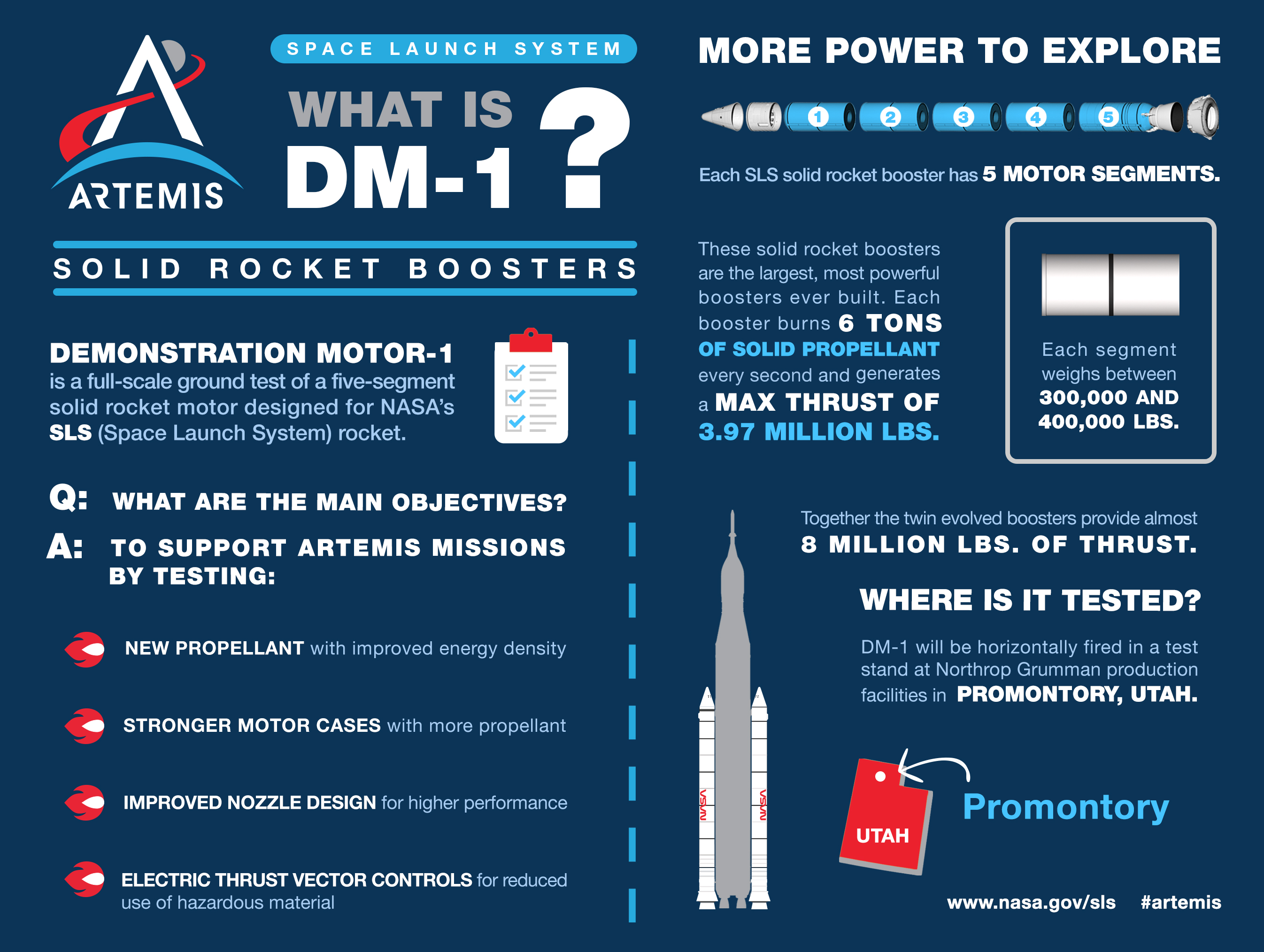
    An infographic titled “What is DM-1” offers a detailed visual and textual breakdown of the Demonstration Motor-1 test at Northrop Grumman’s facility in Promontory, Utah. The left side features a Q&A section that explains the purpose of the event and outlines key testing objectives, such as evaluating upgraded booster components for NASA’s SLS (Space Launch System). On the right, the infographic highlights the critical role SLS boosters play during Artemis missions, emphasizing their immense thrust and engineering significance. At the bottom right, a silhouette of the state of Utah includes an arrow pinpointing the location of Promontory, visually grounding the event’s geographic setting.
    NASA/Kevin O’Brien

    Demonstration Motor-1 (DM-1) is the first full-scale ground test of the evolved five-segment solid rocket motor of NASA’s SLS (Space Launch System) rocket. The event will take place in Promontory, Utah, and will be used as an opportunity to test several upgrades made from the current solid rocket boosters. Each booster burns six tons of solid propellant every second and together generates almost eight million pounds of thrust.

    News Media Contact

    Jonathan Deal
    Marshall Space Flight Center, Huntsville, Ala. 
    256-544-0034 
    jonathan.e.deal@nasa.gov

  • Mission Accomplished! Artemis ROADS III National Challenge Competitors Celebrate their Achievements

    5 min read

    Mission Accomplished! Artemis ROADS III National Challenge Competitors Celebrate their Achievements

    The NASA Science Activation program’s Northwest Earth and Space Sciences Pathways (NESSP) team has successfully concluded the 2024–2025 Artemis ROADS III National Challenge, an educational competition that brought real NASA mission objectives to student teams (and reached more than 1,500 learners) across the country. From December 2024 through May 2025, over 300 teams of upper elementary, middle, and high school students from 22 states participated, applying STEM (Science, Technology, Engineering, and Mathematics) skills in exciting and creative ways.

    Participants tackled eight Mission Objectives inspired by NASA’s Artemis missions, which aim to return humans to the Moon. Students explored challenges such as:

    • Designing a water purification system for the Moon inspired by local water cycles
    • Developing a Moon-based agricultural plan based on experimental results
    • Programming a rover to autonomously navigate lunar tunnels
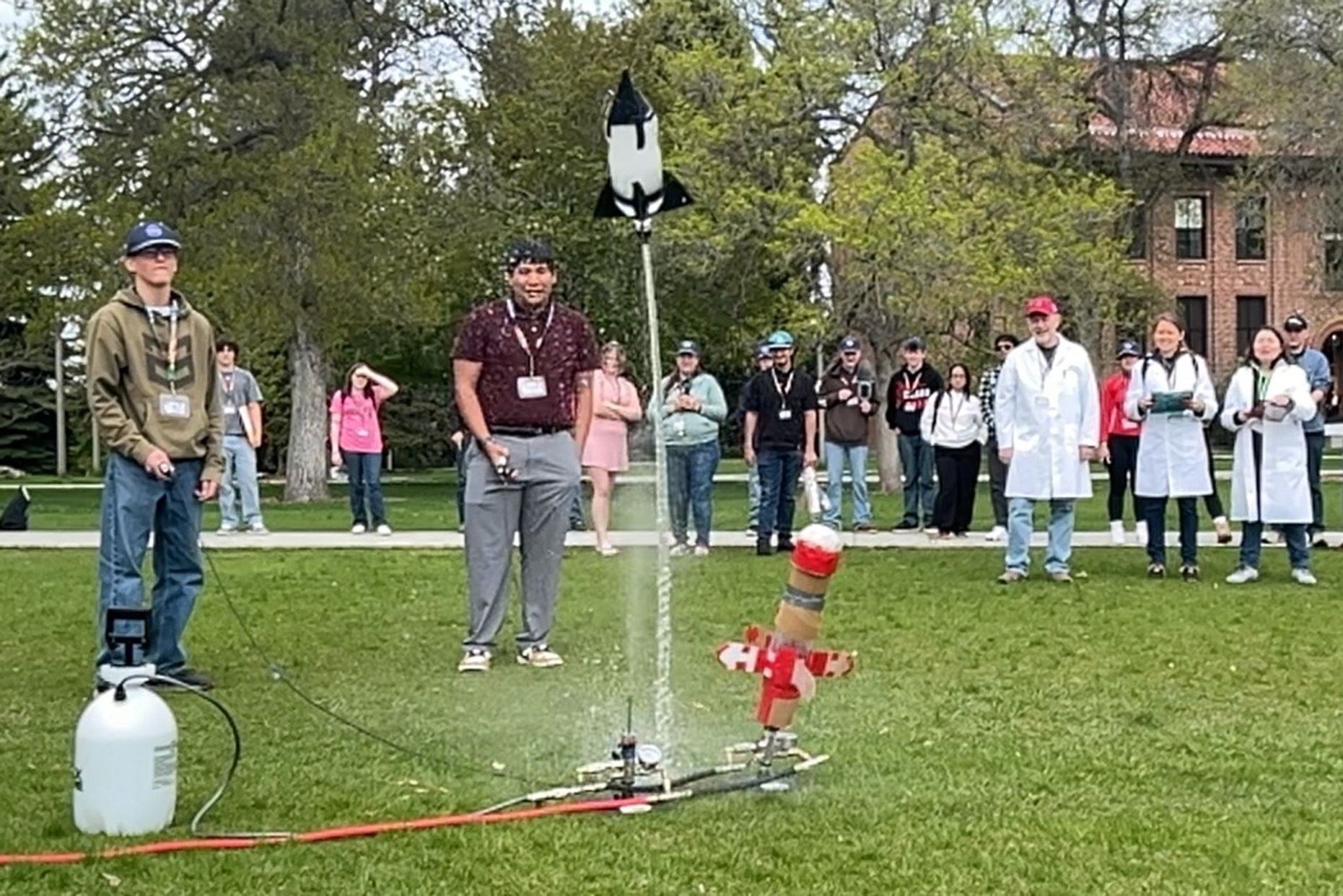
    • Engineering and refining a human-rated water bottle rocket capable of safely returning a “chip-stronaut” to Earth
    • Envisioning their future careers through creative projects like graphic novels or video interviews
    • Exploring NASA’s Artemis program through a new Artemis-themed Lotería game

    In-person hub events were hosted by Northern Arizona University, Central Washington University, and Montana State University, where teams from Washington, Montana, and Idaho gathered to present their work, collaborate with peers, and experience life on a college campus. Students also had the chance to connect virtually with NASA scientists and engineers through NESSP’s NASA Expert Talks series.

    “Artemis ROADS III is NESSP’s eighth ROADS challenge, and I have to say, I think it’s the best one yet. It’s always inspiring to see so many students across the country engage in a truly meaningful STEM experience. I heard from several students and educators that participating in the challenge completely changed their perspective on science and engineering. I believe that’s because this program is designed to let students experience the joy of discovery and invention—driven by both teamwork and personal creativity—that real scientists and engineers love about their work. We also show students the broad range of STEM expertise NASA relies on to plan and carry out a mission like Artemis. Most importantly, it gives them a chance to feel like they are part of the NASA mission, which can be truly transformative.”
     – Dr. Darci Snowden, Director, NESSP

    NESSP proudly recognizes the following teams for completing all eight Mission Objectives and the Final Challenge:

    • Space Pringles, 3rd-5th Grade, San Antonio, TX 
    • Space Axolotls, 3rd-5th Grade, Roberts, MT 
    • TEAM Wild, 6th-8th Grade, Eagle Mountain, UT 
    • Pessimistic Penguins, 6th-8th Grade, Eagle Mountain, UT 
    • Dwarf Planets, 6th-8th Grade, Eagle Mountain, UT 
    • Astronomical Rovers, 6th-8th Grade, Eagle Mountain, UT 
    • Cosmic Honeybuns, 6th-8th Grade, Eagle Mountain, UT 
    • Houston we have a Problem, 6th-8th Grade, Eagle Mountain, UT 
    • FBI Wanted List, 6th-8th Grade, Eagle Mountain, UT 
    • Lunar Legion, 6th-8th Grade, San Antonio, TX 
    • Artemis Tax-Free Space Stallions, 6th-8th Grade, Egg Harbor, NJ 
    • Aquila, 6th-8th Grade, Gooding, ID 
    • Space Warriors, 6th-8th Grade, Wapato, WA 
    • Team Cygnus, 6th-8th Grade, Red Lodge, MT 
    • Maple RocketMen, 6th-8th Grade, Northbrook, IL 
    • RGB Hawks, 6th-8th Grade, Sagle, ID 
    • The Blue Moon Bigfoots, 6th-8th Grade, Medford, OR 
    • W.E.P.Y.C.K., 6th-8th Grade, Roberts, MT 
    • Lunar Dawgz, 6th-8th Grade, Safford, AZ 
    • ROSEBUD ROCKETEERS, 6th-8th Grade, Rosebud, MT 
    • The Cosmic Titans, 6th-8th Grade, Thomson Falls, MT 
    • The Chunky Space Monkeys, 6th-8th Grade, Naches, WA 
    • ROSEBUD RED ANGUS, 9th-12th Grade, Rosebud, MT 
    • Bulky Bisons, 9th-12th Grade, Council Grove, KS 
    • The Falling Stars, 9th-12th Grade, Thomson Falls, MT 
    • The Roadkillers, 9th-12th Grade, Thomson Falls, MT 
    • The Goshawks, 9th-12th Grade, Thomson Falls, MT 
    • Sequim Cosmic Catalysts, 9th-12th Grade, Sequim, WA 
    • Spuddie Buddies, 9th-12th Grade, Moses Lake, WA 
    • Astrocoquí 2, 9th-12th Grade, Mayaguez, PR 
    • Big Sky Celestials, 9th-12th Grade, Billings, MT 
    • TRYOUTS, 9th-12th Grade, Columbus, MT 
    • Cosmonaughts, 9th-12th Grade, Columbus, MT 
    • TCCS 114, 9th-12th Grade, Tillamook, OR 
    • Marvin’s Mighty Martians, 9th-12th Grade, Simms, TX

    You can see highlights of these teams’ work in the Virtual Recognition Ceremony video on the NESSP YouTube channel. The presentation also features the teams selected to travel to Kennedy Space Center in August of 2025, the ultimate prize for these future space explorers!

    In addition to student engagement, the ROADS program provided professional development workshops and NGSS-aligned classroom resources to support K–12 educators. Teachers are invited to explore these materials and register for the next round of workshops, beginning in August 2025: https://nwessp.org/professional-development-registration.

    For more information about NESSP, its programs, partners, and the ROADS National Challenge, visit www.nwessp.org or contact info@nwessp.org.

     ———–

    NASA’s Northwest Earth and Space Science Pathways’ (NESSP) project is supported by NASA cooperative agreement award number 80NSSC22M0006 and is part of NASA’s Science Activation Portfolio. Learn more about how Science Activation connects NASA science experts, real content, and experiences with community leaders to do science in ways that activate minds and promote deeper understanding of our world and beyond: https://science.nasa.gov/learn/about-science-activation/

    A water bottle rocket takes off in front of a crowd.
    A water bottle rocket launches into the air carrying its precious chip-stronaut cargo.

    Details

    Last Updated

    Jun 23, 2025

    Editor
    NASA Science Editorial Team
  • NASA’s Curiosity Mars Rover Starts Unpacking Boxwork Formations

    5 min read

    Preparations for Next Moonwalk Simulations Underway (and Underwater)

    Drag your mouse or move your phone to pan around within this 360-degree view to explore the boxwork patterns on Mars that NASA’s Curiosity is investigating for the first time. The rover captured the 291 images that make up this mosaic between May 15 and May 18.
    Credit: NASA/JPL-Caltech/MSSS

    The rover recently drilled a sample from a new region with features that could reveal whether Mars’ subsurface once provided an environment suitable for life.

    New images from NASA’s Curiosity Mars rover show the first close-up views of a region scientists had previously observed only from orbit. The images and data being collected are already raising new questions about how the Martian surface was changing billions of years ago. The Red Planet once had rivers, lakes, and possibly an ocean. Although scientists aren’t sure why, its water eventually dried up and the planet transformed into the chilly desert it is today.

    By the time Curiosity’s current location formed, the long-lived lakes were gone in Gale Crater, the rover’s landing area, but water was still percolating under the surface­. The rover found dramatic evidence of that groundwater when it encountered crisscrossing low ridges, some just a few inches tall, arranged in what geologists call a boxwork pattern. The bedrock below these ridges likely formed when groundwater trickling through the rock left behind minerals that accumulated in those cracks and fissures, hardening and becoming cementlike. Eons of sandblasting by Martian wind wore away the rock but not the minerals, revealing networks of resistant ridges within.

    The ridges Curiosity has seen so far look a bit like a crumbling curb. The boxwork patterns stretch across miles of a layer on Mount Sharp, a 3-mile-tall (5-kilometer-tall) mountain whose foothills the rover has been climbing since 2014. Intriguingly, boxwork patterns haven’t been spotted anywhere else on the mountain, either by Curiosity or orbiters passing overhead.

    NASA’s Curiosity Mars rover viewed this low ridge on Mars
    NASA’s Curiosity Mars rover viewed this low ridge, which looks a bit like a crumbling curb, on May 16. Scientists think the hardened edges of such ridges — part of the boxwork region the rover is exploring — may have been formed by ancient groundwater.
    NASA/JPL-Caltech/MSSS

    “A big mystery is why the ridges were hardened into these big patterns and why only here,” said Curiosity’s project scientist, Ashwin Vasavada of NASA’s Jet Propulsion Laboratory in Southern California. “As we drive on, we’ll be studying the ridges and mineral cements to make sure our idea of how they formed is on target.”

    Important to the boxwork patterns’ history is the part of the mountain where they’re found. Mount Sharp consists of multiple layers, each of which formed during different eras of ancient Martian climate. Curiosity essentially “time travels” as it ascends from the oldest to youngest layers, searching for signs of water and environments that could have supported ancient microbial life.

    The rover is currently exploring a layer with an abundance of salty minerals called magnesium sulfates, which form as water dries up. Their presence here suggests this layer emerged as the climate became drier. Remarkably, the boxwork patterns show that even in the midst of this drying, water was still present underground, creating changes seen today.

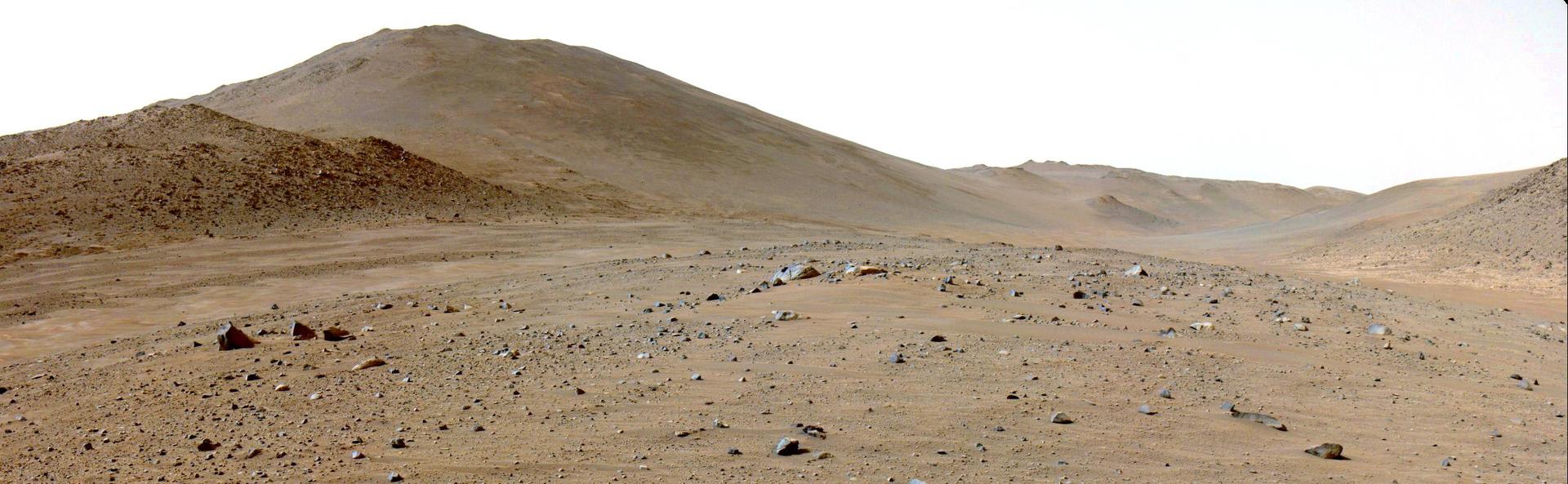
    Panoramic image of Mars captured by Curiosity rover, showing a broad, rocky landscape with layered hills, eroded formations, and scattered loose stones under a hazy, reddish sky.
    NASA’s Curiosity Mars rover captured this scene while looking out across a region filled with boxwork patterns, low ridges that scientists think could have been formed by groundwater billions of years ago.
    NASA/JPL-Caltech/MSSS

    Scientists hope to gain more insight into why the boxwork patterns formed here, and Mars recently provided some unexpected clues. The bedrock between the boxwork ridges has a different composition than other layers of Mount Sharp. It also has lots of tiny fractures filled with white veins of calcium sulfate, another salty mineral left behind as groundwater trickles through rock cracks. Similar veins were plentiful on lower layers of the mountain, including one enriched with clays, but had not been spotted in the sulfate layer until now.

    “That’s really surprising,” said Curiosity’s deputy project scientist, Abigail Fraeman of JPL. “These calcium sulfate veins used to be everywhere, but they more or less disappeared as we climbed higher up Mount Sharp. The team is excited to figure out why they’ve returned now.”

    New Terrain, New Findings

    On June 8, Curiosity set out to learn about the unique composition of the bedrock in this area, using the drill on the end of its robotic arm to snag a sample of a rock nicknamed “Altadena.” The rover then dropped the pulverized sample into instruments within its body for more detailed analysis.

    Drilling additional samples from more distant boxwork patterns, where the mineral ridges are much larger, will help the mission make sense of what they find. The team will also search for organic molecules and other evidence of an ancient habitable environment preserved in the cemented ridges.

    As Curiosity continues to explore, it will be leaving a new assortment of nicknames behind, as well. To keep track of features on the planet, the mission applies nicknames to each spot the rover studies, from hills it views with its cameras to specific calcium sulfate veins it zaps with its laser. (Official names, such as Aeolis Mons — otherwise known as Mount Sharp — are approved by the International Astronomical Union.)

    The previous names were selected from local sites in Southern California, where JPL is based. The Altadena sample, for instance, bears the name of a community near JPL that was severely burned during January’s Eaton Canyon fire. Now on a new part of their Martian map, the team is selecting names from around Bolivia’s Salar de Uyuni, Earth’s largest salt flat. This exceptionally dry terrain crosses into Chile’s Atacama Desert, and astrobiologists study both the salt flat and the surrounding desert because of their similarity to Mars’ extreme dryness.

    More About Curiosity

    Curiosity was built by NASA’s Jet Propulsion Laboratory, which is managed by Caltech in Pasadena, California. JPL leads the mission on behalf of NASA’s Science Mission Directorate in Washington as part of NASA’s Mars Exploration Program portfolio.

    For more about Curiosity, visit:

    science.nasa.gov/mission/msl-curiosity

    News Media Contacts

    Andrew Good
    Jet Propulsion Laboratory, Pasadena, Calif.
    818-393-2433
    andrew.c.good@jpl.nasa.gov

    Karen Fox / Molly Wasser
    NASA Headquarters, Washington
    202-358-1600
    karen.c.fox@nasa.gov / molly.l.wasser@nasa.gov

    2025-080

  • A Martian Volcano in the Mist

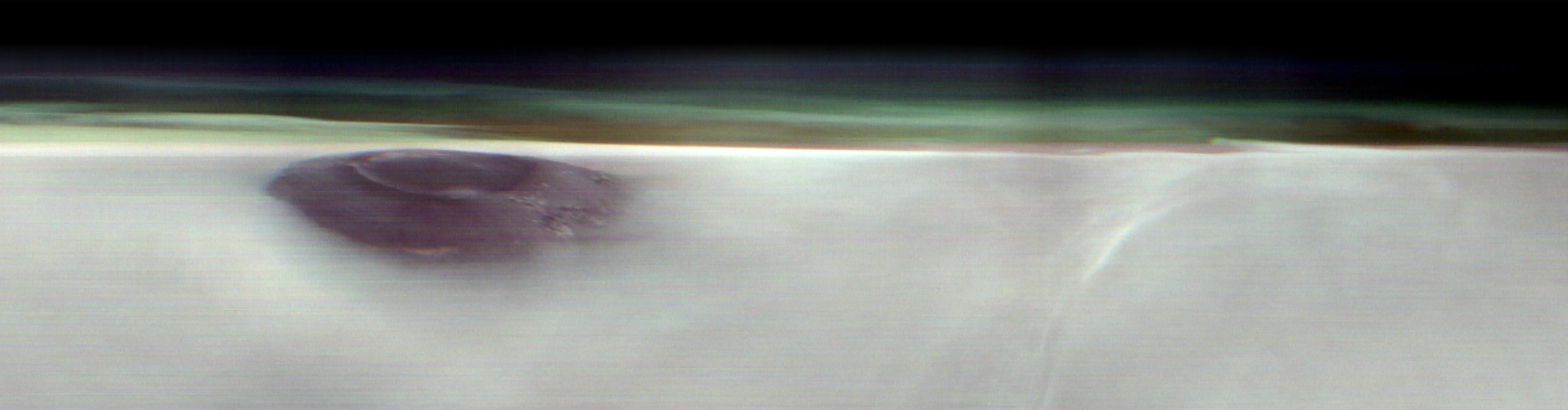
    A black mountain peak shows through water ice clouds on Mars. Just above the clouds is the hazy green Martian atmosphere.
    NASA/JPL-Caltech/ASU

    Arsia Mons, one of the Red Planet’s largest volcanoes, peeks through a blanket of water ice clouds in this image captured by NASA’s 2001 Mars Odyssey orbiter on May 2, 2025. Odyssey used a camera called the Thermal Emission Imaging System (THEMIS) to capture this view while studying the Martian atmosphere, which appears here as a greenish haze above the scene. A large crater known as a caldera, produced by massive volcanic explosions and collapse, is located at the summit. At 72 miles (120 kilometers) wide, the Arsia Mons summit caldera is larger than many volcanoes on Earth.

    Learn more about Arsia Mons and Mars Odyssey.

    Image Credit: NASA/JPL-Caltech/ASU

  • NASA Intern Took Career from Car Engines to Cockpits

    3 min read

    Preparations for Next Moonwalk Simulations Underway (and Underwater)

    Some career changes involve small shifts. But for one NASA engineering intern, the leap was much bigger –moving from under the hood of a car to helping air taxis take to the skies.

    Saré Culbertson spent more than a decade in the auto industry and had been working as a service manager in busy auto repair shops. Today, she supports NASA’s Air Mobility Pathfinders project as a flight operations engineer intern at NASA’s Armstrong Flight Research Center in Edwards, California, through NASA’s Pathways program.

    “NASA has helped me see opportunities I didn’t even know existed

    Saré Culbertson

    Saré Culbertson

    NASA Intern

    “NASA has helped me see opportunities I didn’t even know existed,” she said. “I realized that being good at something isn’t enough – you have to be passionate about it too.”

    With a strong foundation in mechanical engineering – earning a bachelor’s degree from California State University, Long Beach, Antelope Valley Engineering Program – she graduated magna cum laude and delivered her class’s commencement speech. Culbertson also earned two associate’s degrees, one in engineering and one in fine arts.

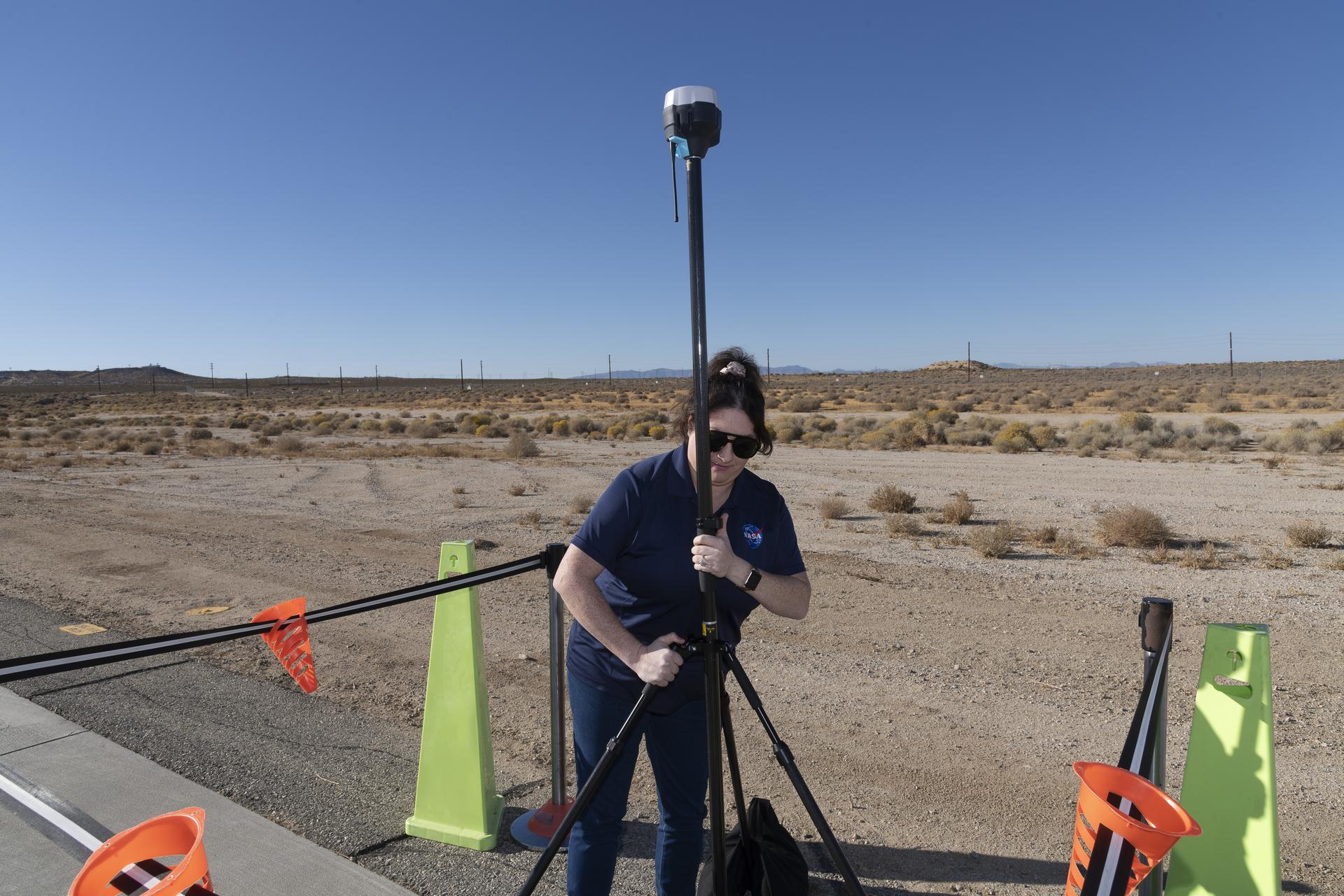
    NASA Pathways intern, Saré Culbertson, right, wearing a dark blue shirt with a NASA meatball logo, verifies the coordinates for an Emlid Reach RS2+ receiver mounted on a black metal tripod. The equipment is cordoned off with metal stands and black tape. Bright neon green cones mark the corners and orange plastic triangular cups hang from the center of the black tape. NASA operations engineer stands to the right of Culbertson, observing the validation data on the test equipment in her right hand. They are surrounded by desert scrub and sand at NASA’s Armstrong Flight Research Center in Edwards, California on November 7, 2024.
    NASA Pathways intern Saré Culbertson, right, works with NASA operations engineer Jack Hayes at NASA’s Armstrong Flight Research Center in Edwards, California, on Nov. 7, 2024. They are verifying GPS and global navigation satellite system coordinates using Emlid Reach RS2+ receiver equipment, which supports surveying, mapping, and navigation in preparation for future air taxi test flight research.
    NASA/Genaro Vavuris

    Before making the switch to aeronautics, she worked at car dealerships and independent car repair facilities while in college. She also led quality control efforts to help a manufacturer meet international standards for quality.

    “I never thought land surveying would have anything to do with flying. But it’s a key part of supporting our research with GPS and navigation verification,” Culbertson said. “GPS measures exact positions by analyzing how long signals take to travel from satellites to ground receivers. In aviation testing, it helps improve safety by reducing signal errors and ensuring location data of the aircraft is accurate and reliable.”

    A musician since childhood, Culbertson has also performed in 21 states, playing everything from tuba to trumpet, and even appeared on HBO’s “Silicon Valley” with her tuba. She’s played in ska, punk, and reggae bands and now performs baritone in the Southern Sierra Pops Orchestra.

    Surrounded by desert scrub and sand at NASA’s Armstrong Flight Research Center in Edwards, California, NASA Pathways intern Saré Culbertson adjusts a Emlid Reach RS2+ receiver. Wearing a dark blue shirt with the NASA meatball logo, Culbertson holds the black tripod-mounted pole with a white and black receiver attached at the top. Culbertson and the equipment are encircled by black tape and bright neon green cones. Orange cone-shaped cups hang from the center of the black tape warning passersby of the equipment.
    Saré Culbertson, NASA Pathways intern at NASA’s Armstrong Flight Research Center in Edwards, California, adjusts the Emlid Reach RS2+ receiver equipment that connects with GPS and global navigation satellite systems on Nov. 7, 2024, in preparation for future air taxi test flight research.
    NASA/Genaro Vavuris

    The NASA Pathways internship, she says, changed everything. Culbertson was recently accepted into the Master of Science in Flight Test Engineering program at the National Test Pilot School, where she will be specializing in fixed wing performance and flying qualities.

    Her advice for anyone starting out?

    “Listen more than you talk,” she said. “Don’t get so focused on the next promotion that you forget to be great at the job you have now.”

    During her internship, Culbertson is making meaningful contributions toward NASA’s Urban Air Mobility research. She collects location data for test landing sites as part of the first evaluation of an experimental commercial electric vertical takeoff landing aircraft, a significant milestone in the development of next generation aviation technologies. From fixing cars to helping air taxis become a reality, Saré Culbertson is proof that when passion meets persistence, the sky isn’t the limit – it’s just the beginning.

    Details

    Last Updated

    Jun 23, 2025

    Editor
    Dede Dinius
    Contact
    Laura Mitchell