Tag: solar system

  • Registration Opens for 2025 NASA International Space Apps Challenge

    3 min read

    Preparations for Next Moonwalk Simulations Underway (and Underwater)

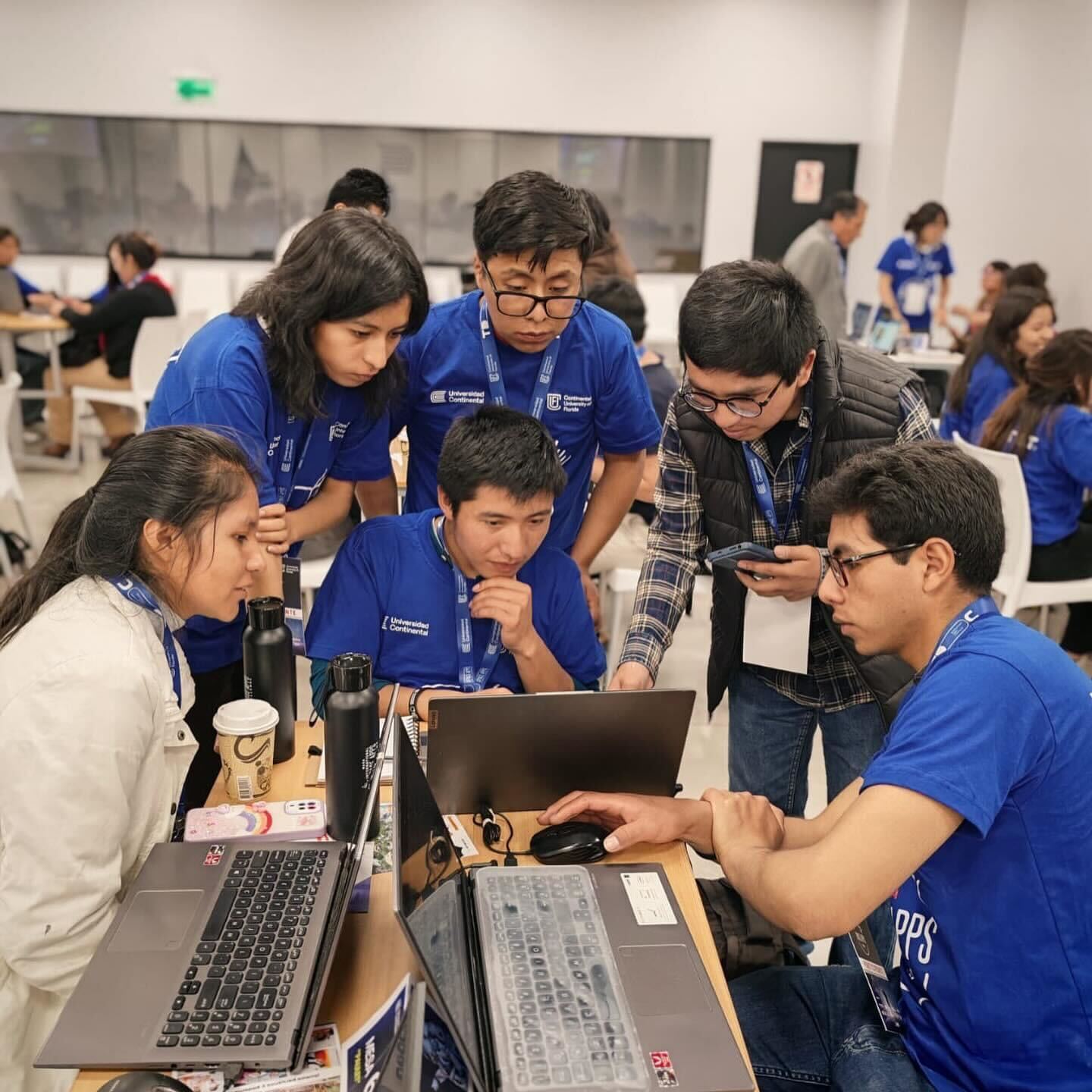
    Six people look at a laptop computer in a classroom setting. Four wear blue t-shirts, one wears a white jacket, and one wears a plaid shirt with a black vest.
    A team works together on their project during the 2024 NASA Space Apps Challenge event in in Arequipa, Peru. Teams have two days to respond to the challenges and submit their project for the chance to win one of 10 global awards.

    Lee esta historia en español aquí

    NASA invites innovators of all ages to register for the NASA Space Apps Challenge, held on Oct. 4-5. The 2025 theme is Learn, Launch, Lead, and participants will work alongside a vibrant community of scientists, technologists, and storytellers at more than 450 events worldwide. Participants can expect to learn skills to succeed in STEM fields, launch ideas that transform NASA’s open data into actionable tools, and lead their communities in driving technological innovation.
     
    During the NASA Space Apps Challenge, participants in the U.S. and around the world gather at hundreds of in-person and virtual events to address challenges authored by subject matter experts across NASA divisions. These challenges range in complexity and topic, tasking participants with everything from creating machine learning models and leveraging artificial intelligence, to improving access to NASA research, to designing sustainable recycling systems for Mars, and to developing tools to evaluate local air quality here on Earth.
     
    Dr. Yoseline Angel Lopez, a former space apps challenge winner and now an assistant research scientist at NASA’s Goddard Spaceflight Center in Greenbelt, Maryland, can attest that the opportunity to Learn, Launch, Lead goes far beyond the hackathon.   
     
    “The NASA Space Apps Challenge gave me and my team a meaningful opportunity to apply science to real-world problems and gain validation from NASA scientists and industry experts,” said Angel.
     
    In 2021, her team’s winning web-app prototype was adopted by Colombia’s Ministry of Agriculture, connecting smallholder farmers with local buyers. The platform also supported agricultural land-use monitoring using satellite imagery.
     
    After the hackathon, project submissions are judged by NASA and space agency experts. Winners are selected for one of 10 global awards.
     
    “Participating in the hackathon is exciting on its own. But when your project can lead to greater opportunities and make a difference in your community, that’s a dream come true,” said Angel. She will return to the 2025 hackathon as a NASA subject matter expert and challenge author, giving a Golden Age of innovators the opportunity to make a difference in their communities through the use of data from NASA and 14 space agency partners.
     
    This year’s partners include: Bahrain Space Agency; Brazilian Space Agency; CSA (Canadian Space Agency); ESA (European Space Agency); ISRO (Indian Space Research Organisation); Italian Space Agency; JAXA (Japan Aerospace Exploration Agency); Mohammed Bin Rashid Space Centre of the United Arab Emirates; National Space Activities Commission of Argentina;  Paraguayan Space Agency; South African National Space Agency; Spanish Space Agency; Turkish Space Agency; and the UK Space Agency.
     
    NASA Space Apps is funded by NASA’s Earth Science Division through a contract with Booz Allen Hamilton, Mindgrub, and SecondMuse.
     
    We invite you to register for the 2025 NASA Space Apps Challenge and choose a virtual or in-person event near you at:

    https://www.spaceappschallenge.org

    Find videos about Space Apps at:

    youtube.com/c/NASASpaceAppsChallenge

    Social Media

    Stay up to date with #SpaceApps by following these accounts:

  • NASA Program Builds Bridge From Military to Civilian Careers for Johnson Team Members

    Of all the possible entry points to NASA, the agency’s SkillBridge Program has been instrumental in helping servicemembers transition from the military and into civilian careers. Offered in partnership with the Department of Defense (DoD), the program enables individuals to spend their final months of military service working with a NASA office or organization. SkillBridge fellows work anywhere from 90 to 180 days, contributing their unique skillsets to the agency while building their network and knowledge.

    The Johnson Space Center in Houston hosted NASA’s first SkillBridge fellow in 2019, paving the way for dozens of others to follow. SkillBridge participants are not guaranteed a job offer at the end of their fellowship, but many have gone on to accept full-time positions with NASA. About 25 of those former fellows currently work at Johnson, filling roles as varied as their military experiences.

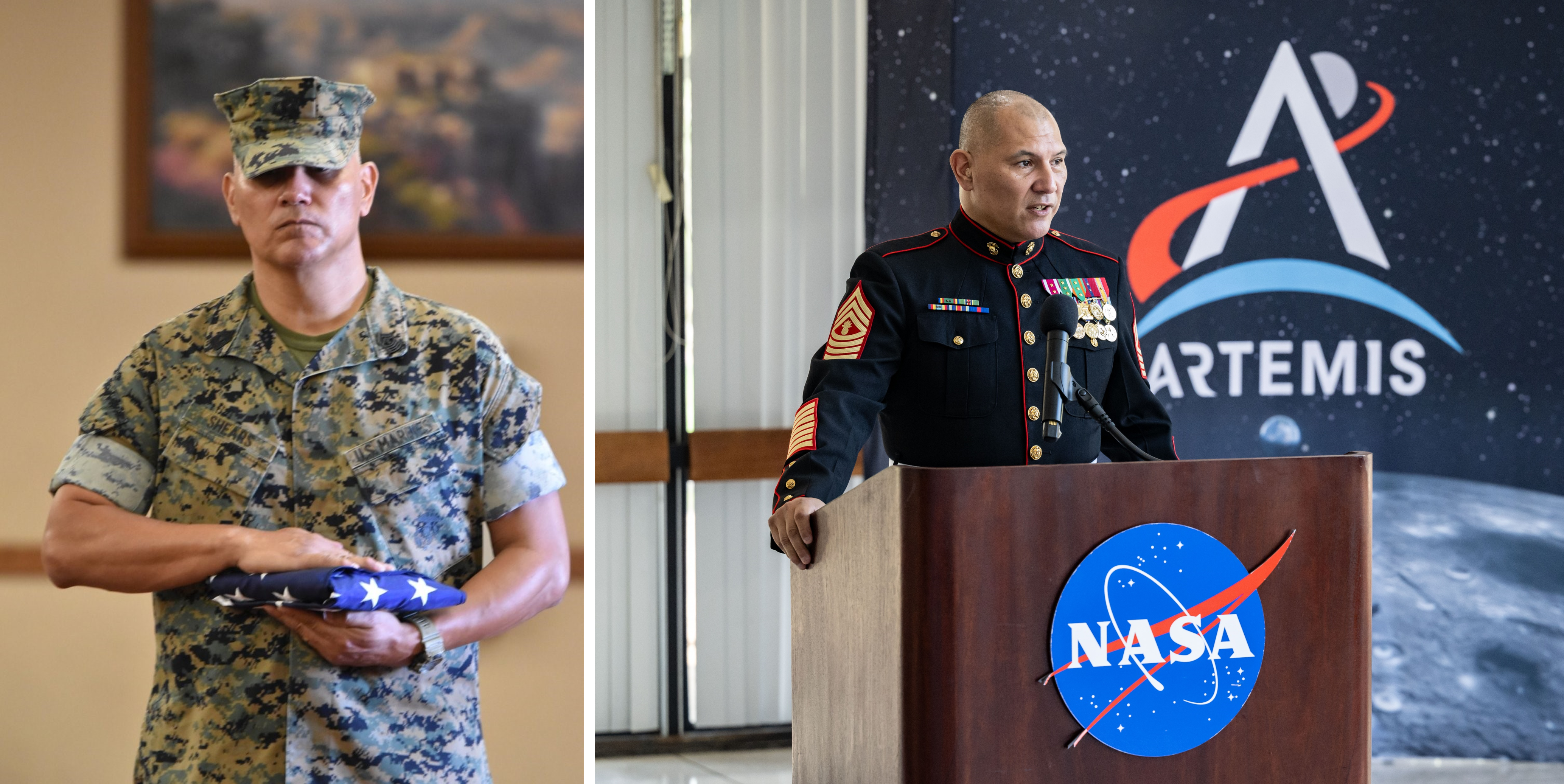
    Side-by-side photos of Miguel Shears show him during his military service and during his SkillBridge fellowship at Johnson Space Center.
    Miguel Shears during his military service (left) and his SkillBridge fellowship at Johnson Space Center.
    Images courtesy of Miguel Shears

    Miguel Shears retired from the Marine Corps in November 2023. He ended his 30 years of service as the administration, academics, and operations chief for the Marine Corps University in Quantico, Virginia, where he was also an adjunct professor. Shears completed a SkillBridge fellowship with FOD in the summer and fall of 2023, supporting the instructional systems design team. He was hired as a full-time employee upon his military retirement and currently serves as an instructional systems designer for the Instructor Training Module, Mentorship Module, and Spaceflight Academy. He conducts training needs analysis for FOD, as well.

    Side-by-side images show Johnson Space Center employee Ever Zavala in a military airplane cockpit and the Mission Control Center.
    Ever Zavala as a flight test engineer in the U.S. Air Force (left) and as a capsule communicator in the Mission Control Center at Johnson Space Center.
    Images courtesy of Ever Zavala

    Ever Zavala was very familiar with Johnson before becoming a SkillBridge fellow. He spent the last three of his nearly 24-year Air Force career serving as the deputy director of the DoD Human Spaceflight Payloads Office at Johnson. His team oversaw the development, integration, launch, and operation of payloads hosting DoD experiments on small satellites and the International Space Station. He also became a certified capsule communicator, or capcom, in December 2022, and was the lead capcom for SpaceX’s 28th commercial resupply services mission to the orbiting laboratory.

    Zavala’s SkillBridge fellowship was in Johnson’s Astronaut Office, where he worked as a capcom, capcom instructor, and an integration engineer supporting the Extravehicular Activity and Human Surface Mobility Program. He was involved in developing a training needs analysis and agency simulators for the human landing system, among other projects.

    He officially joined the center team as a full-time contractor in August 2024. He is currently a flight operations safety officer within the Flight Operations Directorate (FOD) and continues to serve as a part-time capcom.

    Side-by-side photos of Johnson Space Center employee Carl Johnson show him during a tour of the center with his wife, and working on some electrical components during his SkillBridge fellowship.
    Carl Johnson with his wife during his first visit to Johnson Space Center (left) and completing some electrical work as part of his SkillBridge fellowship.
    Images courtesy of Carl Johnson

    Carl Johnson thanks his wife for helping him find a path to NASA. While she was a Pathways intern — and his girlfriend at the time — she gave him a tour of the center that inspired him to join the agency when he was ready to leave the Army. She helped connect him to one of the center’s SkillBridge coordinators and the rest is history.

    Johnson was selected for a SkillBridge fellowship in the Dynamic System Test Branch. From February to June 2023, he supported development of the lunar terrain vehicle ground test unit and contributed to the Active Response Gravity Offload System (ARGOS), which simulates reduced gravity for astronaut training.

    Johnson officially joined the center team as an electrical engineer in the Engineering Directorate’s Software, Robotics, and Simulation Division in September 2023. He is currently developing a new ARGOS spacewalk simulator and training as an operator and test director for another ARGOS system. 

    Johnson holds an electrical engineering degree from the United States Military Academy. He was on active duty in the Army for 10 years and concluded his military career as an instructor and small group leader for the Engineer Captains Career Course. In that role, he was responsible for instructing, mentoring, and preparing the next generation of engineer captains.

    Black man wearing a military-green flight suit stands in front of an American flag.
    Kevin Quinn during his Navy service.
    Image courtesy of Kevin Quinn

    Kevin Quinn served in the Navy for 22 years. His last role was maintenance senior chief with Air Test and Evaluation Squadron 31, known as “the Dust Devils.” Quinn managed the operations and maintenance of 33 aircraft, ensuring their readiness for complex missions and contributing to developmental flight tests and search and rescue missions. He applied that experience to his SkillBridge fellowship in quality assurance at Ellington Field in 2024. Quinn worked to enhance flight safety and astronaut training across various aircraft, including the T-38, WB-57, and the Super Guppy. He has continued contributing to those projects since being hired as a full-time quality assurance employee in 2025.

    A bald Asian man wearing an Air Force dress uniform stands in front of an American flag.
    Andrew Ulat during his Air Force career.
    Image courtesy of Andrew Ulat

    Andrew Ulat retired from the Air Force after serving for 21 years as an intercontinental ballistic missile launch control officer and strategic operations advisor. His last role in the military was as a director of staff at the Air Command and Staff College at Maxwell Air Force Base in Montgomery, Alabama. There he served as a graduate-level instructor teaching international security concepts to mid-level officers and civilian counterparts from all branches of the military and various federal agencies. 

    Ulat started his SkillBridge fellowship as an integration engineer in Johnson’s X-Lab, supporting avionics, power, and software integration for the Gateway lunar space station. Ulat transitioned directly from his fellowship into a similar full-time position at Johnson in May 2024.

    Side-by-side pictures of Ariel Vargas show him receiving an award during his military service and in his official NASA employee portrait.
    Ariel Vargas receives a commendation during his Army service (left) and in his official NASA portrait.

    Ariel Vargas transitioned to NASA after serving for five years in the Army. His last role in the military was as a signal officer, which involved leading teams managing secure communications and network operations in dynamic and mission-critical environments in the Middle East and the United States.

    Vargas completed his SkillBridge fellowship in November 2023, supporting Johnson’s Office of the Chief Information Officer (OCIO). During his fellowship, he led a center-wide wireless augmentation project that modernized Johnson’s connectivity.

    He became a full-time civil servant in May 2024 and currently serves as the business operations and partnerships lead within OCIO, supporting a digital transformation initiative. In this role, he leads efforts to streamline internal business operations, manage strategic partnerships, and drive cross-functional collaboration.

    My time in the military taught me the value of service, leadership, and adaptability—qualities that I now apply daily in support of NASA’s mission,” Vargas said. “I’m proud to be part of the Johnson team and hope my story can inspire other service members considering the SkillBridge pathway.”

  • NASA Sees Key Progress on Starlab Commercial Space Station

    An artist’s concept of the Starlab commercial space station.
    Starlab

    As NASA continues its transition toward a commercial low Earth orbit marketplace, an agency-supported commercial space station, Starlab, recently completed five development and design milestones. Starlab’s planned design consists of a service module and a habitat that will be launched to orbit on a single flight.

    The milestones, part of a NASA Space Act Agreement awarded in 2021, focused on reviews of Starlab’s preliminary design and safety, as well as spacecraft mockup and procurement plans. Each milestone provides NASA insight into the company’s development progress.

    “As we work toward the future of low Earth orbit, these milestones demonstrate Starlab’s dedication to building a commercial space station that can support human life and advance scientific research,” said Angela Hart, program manager for NASA’s Commercial Low Earth Orbit Development Program at the agency’s Johnson Space Center in Houston. “Both the insight shared by Starlab and the expertise shared by NASA are critical to future mission success.”

    Starlab recently completed a preliminary design and safety review of its station’s architecture and systems. The company now will begin detailed design and hardware development, culminating in a critical design review later this year. Critical design reviews are an important step in a station’s development, assessing design maturity before proceeding with fabrication and assembly.

    An artist’s concept of the Starlab commercial space station.
    Starlab

    Starlab also has begun construction of a full-scale, high-fidelity mockup of the station. The mockup, which will be housed in the Space Vehicle Mockup Facility at NASA Johnson, will be used for human-in-the-loop testing, during which participants perform day-in-the-life walkthroughs and evaluate the interior design, crew training, procedure development, hardware checks, and in-flight issue resolution.

    In addition, Starlab completed reviews of the system design architecture, procurement plan, and Northrop Grumman Cygnus spacecraft docking system design. In 2023, Northrop Grumman teamed up with Starlab to provide cargo logistics services and engineering consultation to support the commercial space station. These reviews included design configuration updates of solar arrays, docking ports, crew quarters, and more.

    NASA supports the design and development of multiple commercial space stations through funded and unfunded agreements. Following the design and development phase, NASA plans to procure services from one or more companies as part of its strategy to become one of many customers for low Earth orbit stations.

    Learn more about commercial space stations at:

    www.nasa.gov/commercialspacestations

  • NASA Citizen Science and Your Career: Stories of Exoplanet Watch Volunteers

    3 min read

    NASA Citizen Science and Your Career: Stories of Exoplanet Watch Volunteers

    Doing NASA Science brings many rewards. But can taking part in NASA citizen science help your career? To find out, we asked participants in NASA’s Exoplanet Watch project about their experiences. In this project, amateur astronomers work together with professionals to track planets around other stars.

    First, we heard from professional software programmers. Right away, one of them told us about getting a new job through connections made in the project.

    “I decided to create the exoplanet plugin, [for citizen science] since it was quite a lot of manual work to check which transits were available for your location. The exoplanet plugin and its users got me in contact with the Stellar group… Through this group, I got into contact with a company called OurSky and started working for them… the point is, I created a couple of plugins for free and eventually got a job at an awesome company.”

    Another participant talked about honing their skills and growing their confidence through Exoplanet Watch.

    “There were a few years when I wasn’t actively coding. However, Exoplanet Watch rekindled that spark…. Participating in Exoplanet Watch even gave me the confidence to prepare again for a technical interview at Meta—despite having been thoroughly defeated the first time I tried.”

    Teachers and teaching faculty told us how Exoplanet Watch gives them the ability to better convey what scientific research is all about – and how the project motivates students! 

    Exoplanet Watch makes it easy for undergraduate students to gain experience in data science and Python, which are absolutely necessary for graduate school and many industry jobs.

    Experience with this collaborative work is a vital piece of the workforce development of our students who are seeking advanced STEM-related careers or ongoing education in STEM (Science, Technology, Engineering, & Mathematics) fields after graduation… Exoplanet Watch, in this way, is directly training NASA’s STEM workforce of tomorrow by allowing CUNY (The City University of New York) students to achieve the science goals that would otherwise be much more difficult without its resources.”

    One aspiring academic shared how her participation on the science team side of the project has given her research and mentorship experience that strengthens her resume. 

    “I ended up joining the EpW team to contribute my expertise in stellar variability… My involvement with Exoplanet Watch has provided me with invaluable experience in mentoring a broad range of astronomy enthusiasts and working in a collaborative environment with people from around the world. … Being able to train others, interact in a team environment, and work independently are all critical skills in any work environment, but these specific experiences have also been incredibly valuable towards building my portfolio as I search for faculty positions around the USA.”

    There are no guarantees, of course. What you get out of NASA citizen science depends on what you put in. But there is certainly magic to be found in the Exoplanet Watch project.  As one student said:

    “Help will always be found at Hogwarts, to those who need it.” Exoplanet Watch was definitely Hogwarts for me in my career as an astronomer!”

    For more information about NASA and your career, check out NASA’s Surprisingly STEM series highlighting exciting and unexpected jobs at NASA, or come to NASA Career Day, a virtual event for students and educators. Participants must register by September 4, 2025. The interactive platform will be open from September 15-19, with live panels and events taking place on September 18.

    Man standing next to a large red telescope on an outdoor observatory platform at sunset.

    Exoplanet Watch volunteer Bryan Martin

    Credit: Bryan Martin

  • Ejection Mechanism Design for the SPEED Test Architecture Challenge

    The The Stratospheric Projectile Entry Experiment on Dynamics (SPEED), a two-stage stratospheric drop test architecture, is currently under development to bridge the state-of-the-art gap that many NASA flagship missions require to reduce system risk and enable more optimized designs via margin reduction. To do this, a two-stage vehicle will drop from a high-altitude balloon and use the first stage (an LV-Haack cone aeroshell) to accelerate the sub-scale test model to supersonic conditions. The onboard avionics will then release the test model into freestream flow at the proper altitude in Earth’s atmosphere for dynamic Mach scaling to the full-scale flight trajectory. SPEED leverages low-cost methods of manufacturing such as 3D printing and laser/water-jet cutting to enable 8 or more two-stage vehicles to be dropped in a single test, making the science-to-dollar density much higher than any current ground-test facility NASA has at its disposal. The goal is to develop a robust ejection system that can reliably introduce the test models into supersonic flow with a tight variance on initial condition perturbation. The separation system must be capable of handling a range of initial angle-of-attacks, keep the test model secure in the first stage during take-off and descent, and eject the test model in such a way that it does not linger behind the first stage and be affected by the resulting wake. As current ejection system designs are conceptual, complex, and untested, NASA is looking for alternative ideas that can be incorporated into the design of their next iteration of SPEED flight vehicles to increase system reliability. We are challenging the public to design innovative concepts for a separation mechanism that can be used to assess NASA and commercial reentry vehicle stability.

    Award: $7,000 in total prizes

    Open Date: July 14, 2025

    Close Date: September 8, 2025

    For more information, visit: https://grabcad.com/challenges/ejection-mechanism-design-for-the-speed-test-architecture

  • NASA Funds Early Career Employee Research

    Portrait of Sylvie Crowell with an American flag and NASA flag partially shown behind her.
    Sylvie Crowell
    Credit: NASA 

    Sylvie Crowell, a materials researcher at NASA’s Glenn Research Center in Cleveland, has received a NASA Early Career Initiative (ECI) award for a research proposal titled “Lunar Dust Reduction through Electrostatic Adhesion Mitigation (L-DREAM).” The research focuses on developing a passive lunar dust mitigation coating for solar cells and thermal control surfaces. 

    Operated under the NASA Space Technology Mission Directorate, the award will fund Crowell’s research in fiscal year 2026, beginning Oct. 1, 2025.  

    NASA’s ECI is a unique opportunity for the best and brightest of NASA’s early career researchers to lead hands-on technology development projects. The initiative aims to invigorate NASA’s technological base and best practices by partnering early career NASA leaders with external innovators. 

  • One Survey by NASA’s Roman Could Unveil 100,000 Cosmic Explosions

    Scientists predict one of the major surveys by NASA’s upcoming Nancy Grace Roman Space Telescope may reveal around 100,000 celestial blasts, ranging from exploding stars to feeding black holes. Roman may even find evidence of some of the universe’s first stars, which are thought to completely self-destruct without leaving any remnant behind.

    Simulated supernova animation
    This simulation showcases the dynamic universe as NASA’s Nancy Grace Roman Space Telescope could see it over the course of its five-year primary mission. The video sparkles with synthetic supernovae from observations of the OpenUniverse simulated universe taken every five days (similar to the expected cadence of Roman’s High-Latitude Time-Domain Survey, which OpenUniverse simulates in its entirety). On top of the static sky of stars in the Milky Way and other galaxies, more than a million exploding stars flare into visibility and then slowly fade away. To highlight the dynamic physics happening and for visibility at this scale, the true brightness of each transient event has been magnified by a factor of 10,000 and no background light has been added to the simulated images. The video begins with Roman’s full field of view, which represents a single pointing of Roman’s camera, and then zooms into one square.
    Credit: NASA’s Goddard Space Flight Center and M. Troxel

    Cosmic explosions offer clues to some of the biggest mysteries of the universe. One is the nature of dark energy, the mysterious pressure thought to be accelerating the universe’s expansion.

    “Whether you want to explore dark energy, dying stars, galactic powerhouses, or probably even entirely new things we’ve never seen before, this survey will be a gold mine,” said Benjamin Rose, an assistant professor at Baylor University in Waco, Texas, who led a study about the results. The paper is published in The Astrophysical Journal.

    Called the High-Latitude Time-Domain Survey, this observation program will scan the same large region of the cosmos every five days for two years. Scientists will stitch these observations together to create movies that uncover all sorts of cosmic fireworks.

    Chief among them are exploding stars. The survey is largely geared toward finding a special class of supernova called type Ia. These stellar cataclysms allow scientists to measure cosmic distances and trace the universe’s expansion because they peak at about the same intrinsic brightness. Figuring out how fast the universe has ballooned during different cosmic epochs offers clues to dark energy.

    High-Latitude Time-Domain Survey infographic
    This infographic describes the High-Latitude Time-Domain Survey that will be conducted by NASA’s Nancy Grace Roman Space Telescope. The survey’s main component will cover over 18 square degrees — a region of sky as large as 90 full moons — and see supernovae that occurred up to about 8 billion years ago. Smaller areas within the survey will pierce even farther, potentially back to when the universe was around a billion years old. The survey will be split between the northern and southern hemispheres, located in regions of the sky that will be continuously visible to Roman. The bulk of the survey will consist of 30-hour observations every five days for two years in the middle of Roman’s five-year primary mission.
    Credit: NASA’s Goddard Space Flight Center

    In the new study, scientists simulated Roman’s entire High-Latitude Time-Domain Survey. The results suggest Roman could see around 27,000 type Ia supernovae—about 10 times more than all previous surveys combined.

    Beyond dramatically increasing our total sample of these supernovae, Roman will push the boundaries of how far back in time we can see them. While most of those detected so far occurred within approximately the last 8 billion years, Roman is expected to see vast numbers of them earlier in the universe’s history, including more than a thousand that exploded more than 10 billion years ago and potentially dozens from as far back as 11.5 billion years. That means Roman will almost certainly set a new record for the farthest type Ia supernova while profoundly expanding our view of the early universe and filling in a critical gap in our understanding of how the cosmos has evolved over time.

    “Filling these data gaps could also fill in gaps in our understanding of dark energy,” Rose said. “Evidence is mounting that dark energy has changed over time, and Roman will help us understand that change by exploring cosmic history in ways other telescopes can’t.”

    But type Ia supernovae will be hidden among a much bigger sample of exploding stars Roman will see once it begins science operations in 2027. The team estimates Roman will also spot about 60,000 core-collapse supernovae, which occur when a massive star runs out of fuel and collapses under its own weight.

    That’s different from type Ia supernovae, which originate from binary star systems that contain at least one white dwarf — the small, hot core remnant of a Sun-like star — siphoning material from a companion star. Core-collapse supernovae aren’t as useful for dark energy studies as type Ias are, but their signals look similar from halfway across the cosmos.

    “By seeing the way an object’s light changes over time and splitting it into spectra — individual colors with patterns that reveal information about the object that emitted the light—we can distinguish between all the different types of flashes Roman will see,” said Rebekah Hounsell, an assistant research scientist at the University of Maryland-Baltimore County working at NASA’s Goddard Space Flight Center in Greenbelt, Maryland and a co-author of the study.

    “With the dataset we’ve created, scientists can train machine-learning algorithms to distinguish between different types of objects and sift through Roman’s downpour of data to find them,” Hounsell added. “While searching for type Ia supernovae, Roman is going to collect a lot of cosmic ‘bycatch’—other phenomena that aren’t useful to some scientists, but will be invaluable to others.”

    Hidden Gems

    Thanks to Roman’s large, deep view of space, scientists say the survey should also unearth extremely rare and elusive phenomena, including even scarcer stellar explosions and disintegrating stars.

    Upon close approach to a black hole, intense gravity can shred a star in a so-called tidal disruption event. The stellar crumbs heat up as they swirl around the black hole, creating a glow astronomers can see from across vast stretches of space-time. Scientists think Roman’s survey will unveil 40 tidal disruption events, offering a chance to learn more about black hole physics.

    The team also estimates Roman will find about 90 superluminous supernovae, which can be 100 times brighter than a typical supernova. They pack a punch, but scientists aren’t completely sure why. Finding more of them will help astronomers weigh different theories.

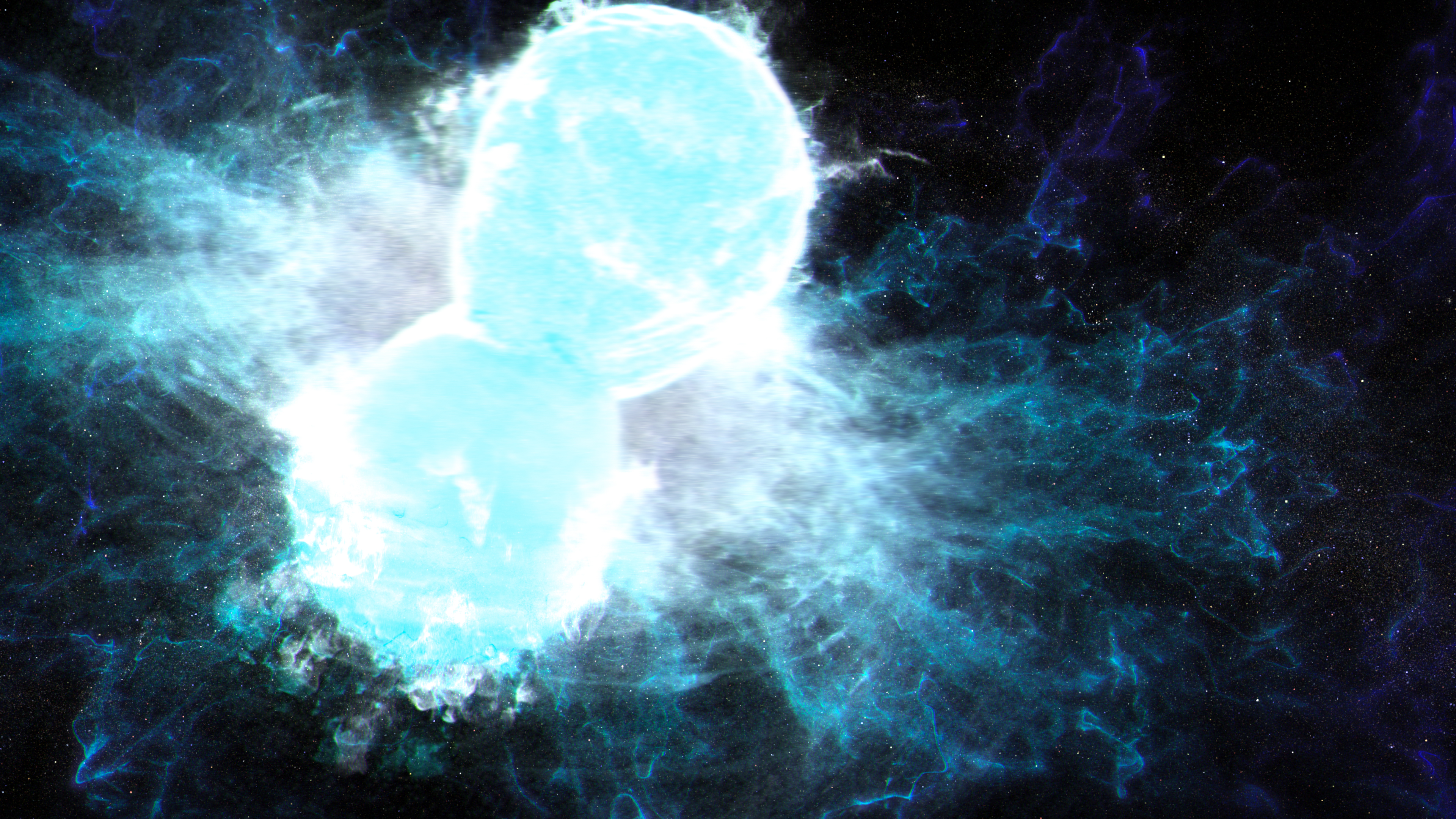
    Even rarer and more powerful, Roman could also detect several kilonovae. These blasts occur when two neutron stars — extremely dense cores leftover from stars that exploded as supernovae — collide. To date, there has been only one definitive kilonova detection. The team estimates Roman could spot five more.

    An artist's concept of a kilonova
    This artist’s concept visualizes a kilonova – an explosion that happens when two neutron stars or a neutron star and a black hole collide and merge. When these collisions happen, a fraction of the resulting debris is ejected as jets, which move near the speed of light. The remaining debris produces hot, glowing, neutron-rich clouds that forge heavy elements, like gold and platinum. Researchers will mine data from NASA’s Nancy Grace Roman Space Telescope, which will survey the same areas of the sky every few days, to identify kilonovae. Roman’s extensive data will help astronomers better identify how often these events occur, how much energy they give off, and how near or far they are.
    Credit: NASA, ESA, J. Olmsted (STScI)

    That would help astronomers learn much more about these mysterious events, potentially including their fate. As of now, scientists are unsure whether kilonovae result in a single neutron star, a black hole, or something else entirely.

    Roman may even spot the detonations of some of the first stars that formed in the universe. These nuclear furnaces were giants, up to hundreds of times more massive than our Sun, and unsullied by heavy elements that hadn’t yet formed.

    They were so massive that scientists think they exploded differently than modern massive stars do. Instead of reaching the point where a heavy star today would collapse, intense gamma rays inside the first stars may have turned into matter-antimatter pairs (electrons and positrons). That would drain the pressure holding the stars up until they collapsed, self-destructing in explosions so powerful they’re thought to leave nothing behind.

    So far, astronomers have found about half a dozen candidates of these “pair-instability” supernovae, but none have been confirmed.

    “I think Roman will make the first confirmed detection of a pair-instability supernova,” Rose said — in fact the study suggests Roman will find more than 10. “They’re incredibly far away and very rare, so you need a telescope that can survey a lot of the sky at a deep exposure level in near-infrared light, and that’s Roman.”

    A future rendition of the simulation could include even more types of cosmic flashes, such as variable stars and active galaxies. Other telescopes may follow up on the rare phenomena and objects Roman discovers to view them in different wavelengths of light to study them in more detail.

    “Roman’s going to find a whole bunch of weird and wonderful things out in space, including some we haven’t even thought of yet,” Hounsell said. “We’re definitely expecting the unexpected.”

    For more information about the Roman Space Telescope visit www.nasa.gov/roman.

    The Nancy Grace Roman Space Telescope is managed at NASA’s Goddard Space Flight Center in Greenbelt, Maryland, with participation by NASA’s Jet Propulsion Laboratory in Southern California; Caltech/IPAC in Pasadena, California; the Space Telescope Science Institute in Baltimore; and a science team comprising scientists from various research institutions. The primary industrial partners are BAE Systems Inc. in Boulder, Colorado; L3Harris Technologies in Rochester, New York; and Teledyne Scientific & Imaging in Thousand Oaks, California.

    By Ashley Balzer
    NASA’s Goddard Space Flight Center, Greenbelt, Md.
  • Fourth NASA-Enabled Private Flight to Space Station Completes Safely

    The Axiom Mission 4 crew launched on June 25, 2025, aboard a SpaceX Dragon spacecraft to the International Space Station from NASA’s Kennedy Space Center in Florida. From left to right: Tibor Kapu of Hungary, ISRO (Indian Space Research Organization) astronaut Shubhanshu Shukla, former NASA astronaut Peggy Whitson, and ESA (European Space Agency) astronaut Sławosz Uznański-Wiśniewski of Poland (Credit: Axiom Space).

    The NASA-supported fourth private astronaut mission to the International Space Station, Axiom Mission 4, completed its flight as part of the agency’s efforts to demonstrate demand and build operational knowledge for future commercial space stations.

    The four-person crew safely returned to Earth, splashing down off the coast of California at 5:31 a.m. EDT on Tuesday, aboard a SpaceX Dragon spacecraft. Teams aboard SpaceX recovery vessels retrieved the spacecraft and astronauts. 

    Peggy Whitson, former NASA astronaut and director of human spaceflight at Axiom Space, ISRO (Indian Space Research Organization) astronaut Shubhanshu Shukla, and ESA (European Space Agency) project astronaut Sławosz Uznański-Wiśniewski of Poland, and Hungarian to Orbit (HUNOR) astronaut Tibor Kapu of Hungary, completed about two and a half weeks in space.

    The Axiom Mission 4 crew launched at 2:31 a.m. on June 25, on a Falcon 9 rocket from NASA’s Kennedy Space Center in Florida. Approximately 28 hours later, Dragon docked to the space-facing port of the space station’s Harmony module. The astronauts undocked at 7:15 a.m. on July 14, to begin the trip home.

    The crew conducted microgravity research, educational outreach, and commercial activities. The spacecraft will return to Florida for inspection and processing at SpaceX’s refurbishing facilities. Throughout their mission, the astronauts conducted about 60 science experiments, and returned science, including NASA cargo, back to Earth.

    A collaboration between NASA and ISRO allowed Axiom Mission 4 to deliver on a commitment highlighted by President Trump and Indian Prime Minister Narendra Modi to send the first ISRO astronaut to the station. The space agencies participated in five joint science investigations and two in-orbit science, technology, engineering, and mathematics demonstrations. NASA and ISRO have a long-standing relationship built on a shared vision to advance scientific knowledge and expand space collaboration.

    The private mission also carried the first astronauts from Poland and Hungary to stay aboard the space station.

    The International Space Station is a springboard for developing a low Earth orbit economy. NASA’s goal is to achieve a strong economy off the Earth where the agency can purchase services as one of many customers to meet its science and research objectives in microgravity. NASA’s commercial strategy for low Earth orbit provides the government with reliable and safe services at a lower cost, enabling the agency to focus on Artemis missions to the Moon in preparation for Mars while also continuing to use low Earth orbit as a training and proving ground for those deep space missions.

    Learn more about NASA’s commercial space strategy at:

    https://www.nasa.gov/commercial-space

    News Media Contacts:
    Claire O’Shea 
    Headquarters, Washington 
    202-358-1100 
    claire.a.o’shea@nasa.gov

    Anna Schneider 
    Johnson Space Center, Houston 
    281-483-5111 
    anna.c.schneider@nasa.gov

  • Melissa Harris: Shaping NASA’s Vision for a Future in Low Earth Orbit

    A woman wearing a teal blouse and a black sweater sits in front of an American flag and a NASA flag for an official portrait.
    Melissa Harris’ official NASA portrait.
    NASA/Robert Markowitz

    With over 25 years of experience in human spaceflight programs, Melissa Harris has contributed to numerous programs and projects during key moments in NASA’s history. As the life cycle lead and Independent Review Team review manager for the Commercial Low Earth Orbit Development Program, she guides the agency through development initiatives leading to a new era of space exploration.  

    Harris grew up near NASA’s Johnson Space Center in Houston and spent time exploring the center and trying on astronaut helmets. She later earned her bachelor’s degree in legal studies from the University of Houston, master and subject matter expert certifications in configuration management, and ISO 9001 Lead Auditors Certification. When the opportunity arose, she jumped at the chance to join the International Space Station Program. 

    Twin women wearing matching sunglasses and NASA Artemis polo shirts sit next to each other inside a tour bus.
    Harris (right) and her twin sister, Yvonne (left), at the Artemis I launch.
    Image courtesy of Melissa Harris

    Starting as a board specialist, Harris spent eight years supporting the space station program boards, panels, and flight reviews. Other areas of support included the International Space Station Mission Evaluation Room and the EVA Crew Systems and Robotics Division managing changes for the acquisition and building of mockups in the Neutral Buoyancy Laboratory and Space Vehicle Mockup Facility in Houston. She then took a leap to join the Constellation Program, developing and overseeing program and project office processes and procedures. Harris then transitioned to the Extravehicular Activity (EVA) Project Office where she was a member of the EVA 23 quality audit team tasked with reviewing data to determine the cause of an in-orbit failure. She also contributed to the Orion Program and Artemis campaign. After spending two years at Axiom Space, Harris returned to NASA and joined the commercial low Earth orbit team. 

    Harris said the biggest lesson she has learned during her career is that “there are always ups and downs and not everything works out, but if you just keep going and at the end of the day see that the hard work and dedication has paid off, it is always the proudest moment.”  

    Her dedication led to a nomination for the Stellar Award by the Rotary National Award for Space Achievement Foundation.

    A woman in a one-shoulder, red evening dress stands next to her son, who is wearing a tuxedo and bowtie.
    Harris and her son, Tyler, at the Rotary National Award Banquet in 2024.
    Image courtesy of Melissa Harris

    Harris’ favorite part of her role at NASA is working “closely with brilliant minds” and being part of a dedicated and hard-working team that contributes to current space programs while also planning for future programs. Looking forward, she anticipates witnessing the vision and execution of a self-sustaining commercial market in low Earth orbit come to fruition. 

    Outside of work, Harris enjoys being with family, whether cooking on the back porch, over a campfire, or traveling both in and out of the country. She has been married for 26 years to her high school sweetheart, Steve, and has one son, Tyler. Her identical twin sister, Yvonne, also works at Johnson. 

    Two women wear bald caps, aviator sunglasses, and blue flight suits for their NASA astronaut Halloween costumes.
    Harris and her twin sister Yvonne dressed as Mark and Scott Kelly for Halloween in 2024.
    Image courtesy of Melissa Harris

    Learn more about NASA’s Commercial Low Earth Orbit Development Program at: 

    www.nasa.gov/commercialspacestations

  • Curiosity Blog, Sols 4595-4596: Just Another Beautiful Day on Mars

    3 min read

    Curiosity Blog, Sols 4595-4596: Just Another Beautiful Day on Mars

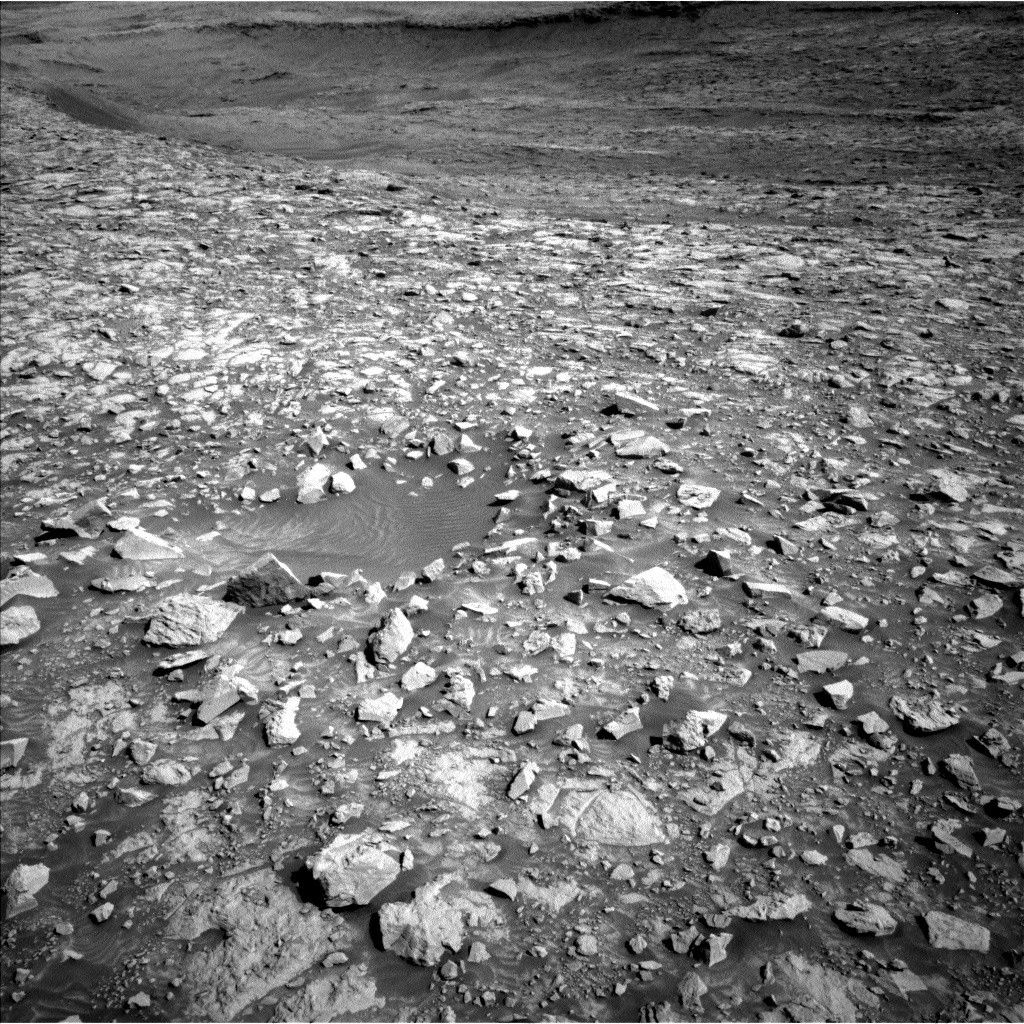
    A grayscale image from the Martian surface shows a field of extremely rough, rocky terrain in medium gray, stretching from the foreground to the edge of the distant horizon.
    NASA’s Mars rover Curiosity acquired this image using its Left Navigation Camera on July 9, 2025 — Sol 4594, or Martian day 4,594 of the Mars Science Laboratory mission — at 11:03:48 UTC.
    NASA/JPL-Caltech

    Written by Ashley Stroupe, Mission Operations Engineer at NASA’s Jet Propulsion Laboratory

    Earth planning date: Wednesday, July 9, 2025

    In today’s plan, we have a little bit of everything. With it being winter still, we are taking advantage of the ability to let the rover sleep in, doing most of the activities in the afternoon when it is warmer and we need less heating. As the Systems Engineer (Engineering Uplink Lead) today, I sequenced the needed heating and some other engineering housekeeping activities.

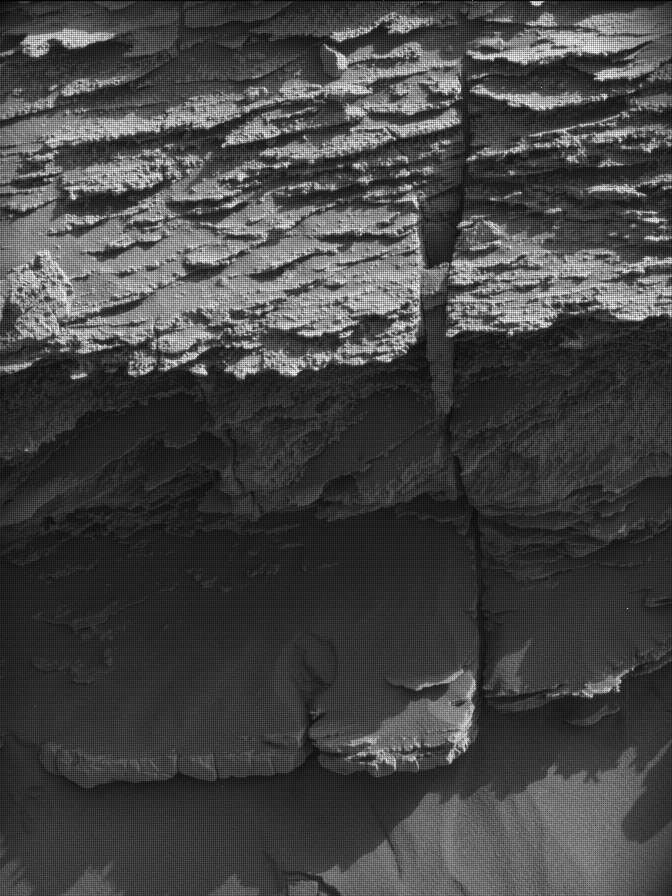
    We start off with an extensive remote science block with Mastcam imaging of a nearby trough to look for potential sand activity. There is color imaging of a displaced block, “Ouro,” near a circular depression — could this be a small crater? Mastcam also takes a look at a ridge “Volcán Peña Blanca” to look at the sedimentary structures, which may provide insights into its formation. ChemCam LIBS and Mastcam team up to look at the “Los Andes” target, which is the dark face of a nearby piece of exposed bedrock. ChemCam RMI and Mastcam check out a distant small outcrop to examine the geometry of the layers. We also throw in environmental observations, a Mastcam solar Tau and a Navcam line-of-site looking at dust in the atmosphere. After a nap, Curiosity will be doing some contact science activities on “Cataratas del Jardín” and “Rio Ivirizu” bedrock targets. Looking at two nearby targets for variability can help us understand the local geology. Cataratas del Jardín gets a brushing to clear away the dust before both targets are examined by MAHLI and APXS. Fortunately for the Arm Rover Planner, both of these targets are fairly flat and easy to reach.  Before going to sleep for the night, Curiosity will stow the arm to be ready for driving on the next sol.On the second sol, there is more remote science. ChemCam LIBS and Mastcam will examine “Torotoro,” another piece of layered bedrock. ChemCam RMI will take a mosaic of “Paniri,” which is an interesting incision in the rock that is filled with another material. There are also environmental observations, a Navcam dust devil survey and a suprahorizon movie. After another nap, Curiosity is getting on the road. We’re heading southwest (direction shown in the image) about 50 meters (about 164 feet), but we need to sneak between sandy pits and skirt around some terrain that we can’t see behind. The terrain here provides pretty nice driving, though, without a lot of big boulders, steep slopes, or pointy rocks that can poke holes in our wheels. After the standard post-drive imaging for our next plan, there are some Navcam observations to look for clouds and our normal look under the rover with MARDI before Curiosity goes to sleep for the night.

    Details

    Last Updated

    Jul 15, 2025

    Related Terms

  • Hubble Snaps Galaxy Cluster’s Portrait

    2 min read

    Hubble Snaps Galaxy Cluster’s Portrait

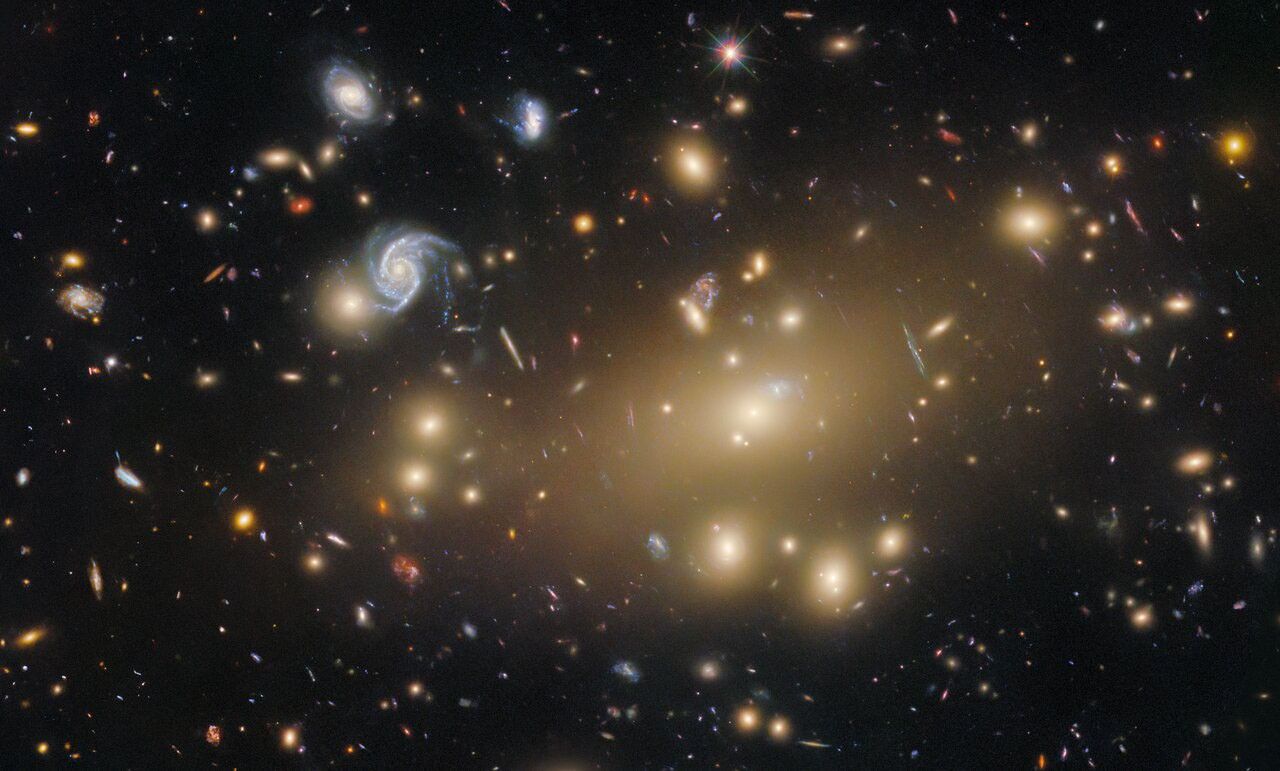
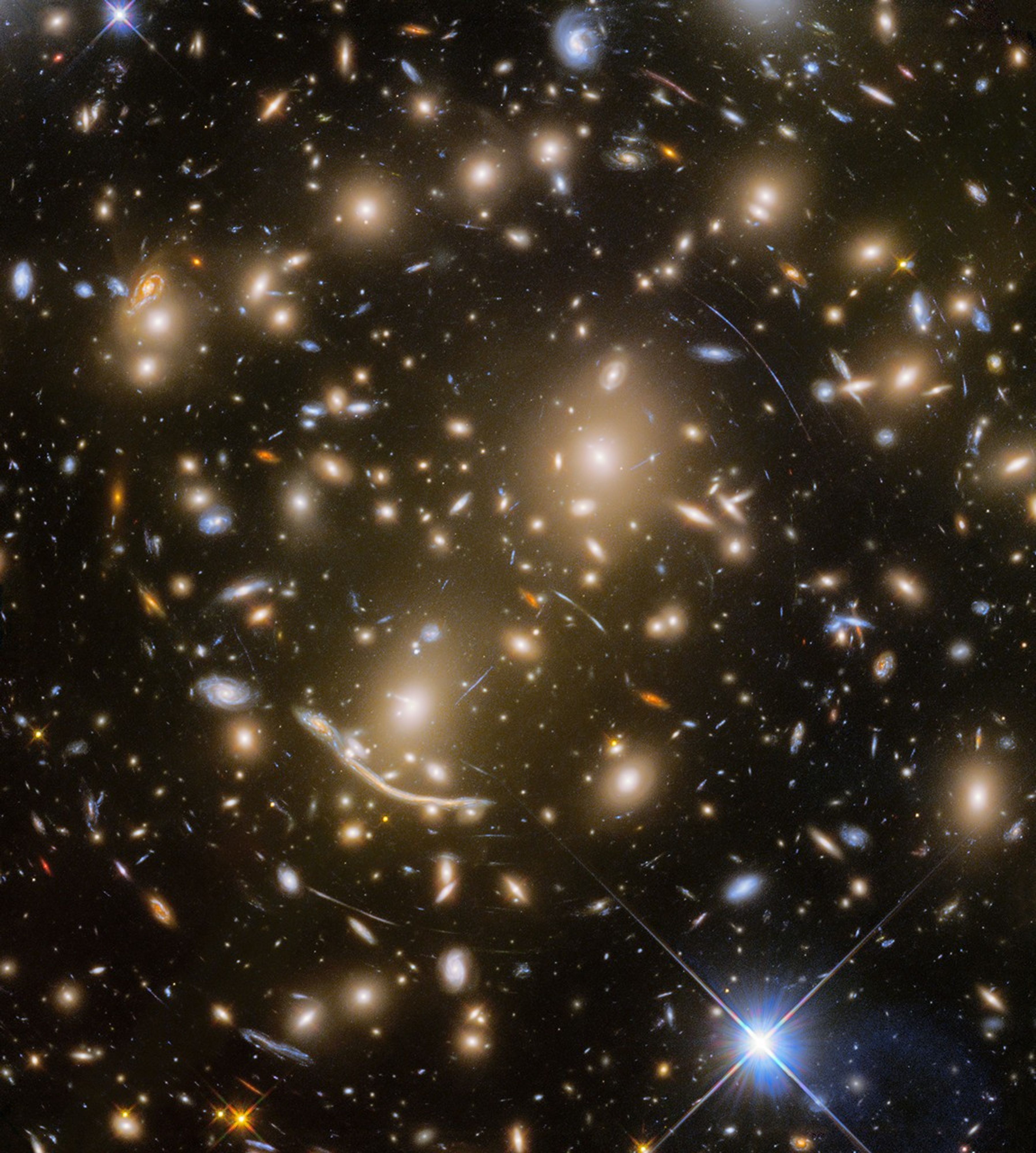
    A cluster of distant, mainly elliptical galaxies. They appear as brightly shining points radiating golden light that each take the shape of a smooth, featureless oval. They crowd around one that is extremely large and bright. A few spiral galaxies of comparable size appear too, bluer in color and with unique shapes. Of the other more small and distant galaxies covering the scene, a few are warped into long lines.
    This NASA/ESA Hubble Space Telescope image features the galaxy cluster Abell 209.
    ESA/Hubble & NASA, M. Postman, P. Kelly

    A massive, spacetime-warping cluster of galaxies is the setting of today’s NASA/ESA Hubble Space Telescope image. The galaxy cluster in question is Abell 209, located 2.8 billion light-years away in the constellation Cetus (the Whale).

    This Hubble image of Abell 209 shows more than a hundred galaxies, but there’s more to this cluster than even Hubble’s discerning eye can see. Abell 209’s galaxies are separated by millions of light-years, and the seemingly empty space between the galaxies is filled with hot, diffuse gas that is visible only at X-ray wavelengths. An even more elusive occupant of this galaxy cluster is dark matter: a form of matter that does not interact with light. Dark matter does not absorb, reflect, or emit light, effectively making it invisible to us. Astronomers detect dark matter by its gravitational influence on normal matter. Astronomers surmise that the universe is comprised of 5% normal matter, 25% dark matter, and 70% dark energy.

    Hubble observations, like the ones used to create this image, can help astronomers answer fundamental questions about our universe, including mysteries surrounding dark matter and dark energy. These investigations leverage the immense mass of a galaxy cluster, which can bend the fabric of spacetime itself and create warped and magnified images of background galaxies and stars in a process called gravitational lensing.

    While this image lacks the dramatic rings that gravitational lensing can sometimes create, Abell 209 still shows subtle signs of lensing at work, in the form of streaky, slightly curved galaxies within the cluster’s golden glow. By measuring the distortion of these galaxies, astronomers can map the distribution of mass within the cluster, illuminating the underlying cloud of dark matter. This information, which Hubble’s fine resolution and sensitive instruments help to provide, is critical for testing theories of how our universe evolved.

    Text Credit: ESA/Hubble

    Media Contact:

    Claire Andreoli (claire.andreoli@nasa.gov)
    NASA’s Goddard Space Flight CenterGreenbelt, MD

  • NASA’s Webb Scratches Beyond Surface of Cat’s Paw for 3rd Anniversary

    8 Min Read

    NASA’s Webb Scratches Beyond Surface of Cat’s Paw for 3rd Anniversary

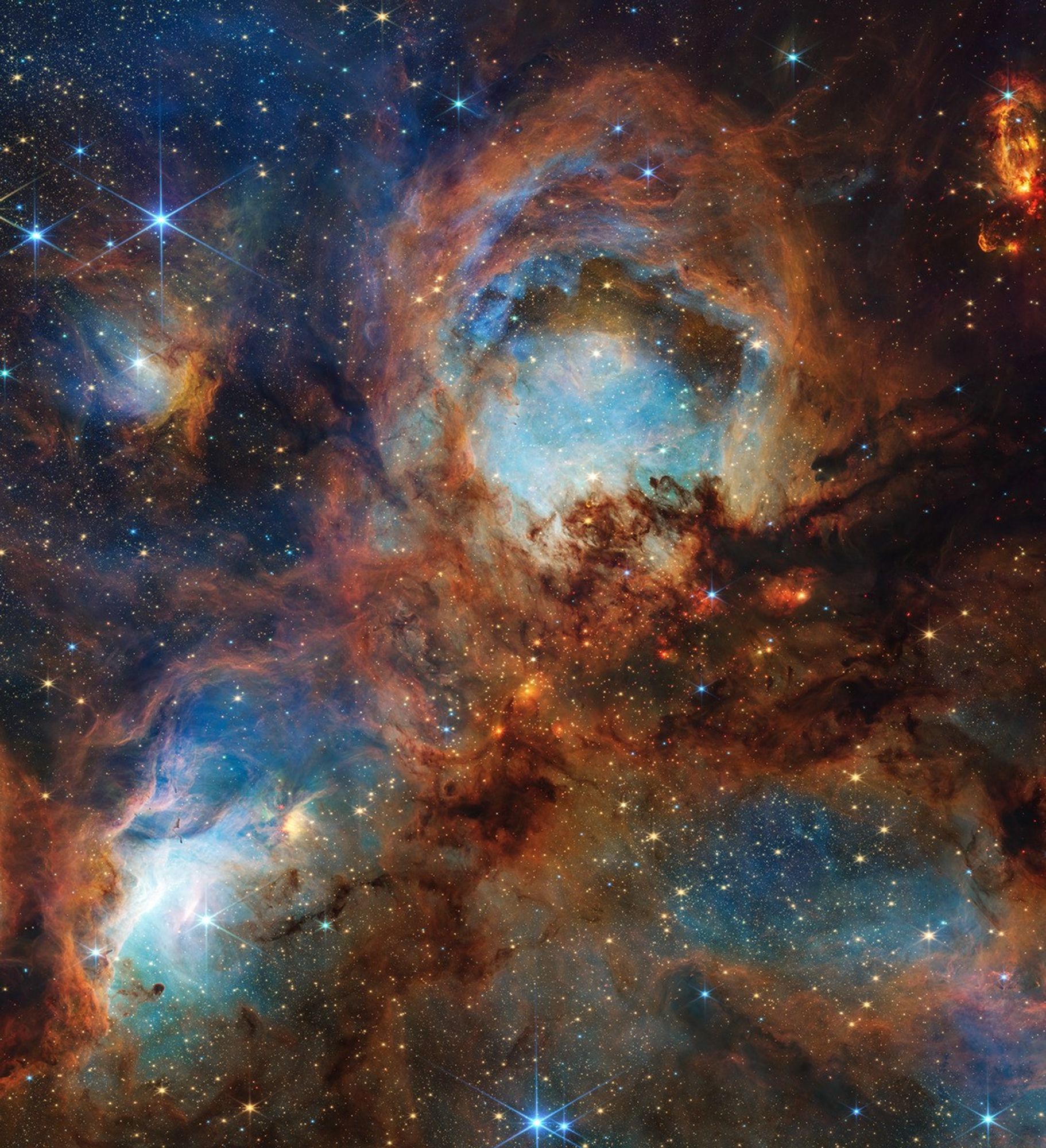
    A section of the Cat’s Paw Nebula, a local star-forming region composed of gas, dust, and young stars. Four roughly circular areas are toward the center of the frame: a small oval toward the top left, a large circle in the top center, and two ovals at bottom left and right. Each circular area has a luminous blue glow, with the top center and bottom left areas the brightest. Brown-orange filaments of dust, which vary in density, surround these four bluish patches and stretch toward the frame’s edges. Small zones, such as to the left and right of the top-center blue circular area, appear darker and seemingly vacant of stars. Toward the center are small, fiery red clumps scattered among the brown dust. Many small, yellow-white stars are spread across the scene, some with eight-pointed diffraction spikes that are characteristic of Webb. A few larger blue-white stars with diffraction spikes are scattered throughout, mostly toward the top left and bottom right. In the top right corner is a bright red-orange oval.

    NASA’s James Webb Space Telescope’s near-infrared view of the Cat’s Paw Nebula reveals mini “toe beans.” Massive young stars are carving the gas and dust while their bright starlight is producing a bright nebulous glow. Eventually this turbulent region will quench star formation. Full image below.

    Credits:
    NASA, ESA, CSA, STScI.

    It’s the cat’s meow! To celebrate its third year of revealing stunning scenes of the cosmos in infrared light, NASA’s James Webb Space Telescope has “clawed” back the thick, dusty layers of a section within the Cat’s Paw Nebula (NGC 6334). Focusing Webb’s NIRCam (Near-Infrared Camera) on a single “toe bean” within this active star-forming region revealed a subset of mini toe beans, which appear to contain young stars shaping the surrounding gas and dust.

    Webb’s look at this particular area of the Cat’s Paw Nebula just scratches the surface of the telescope’s three years of groundbreaking science.

    “Three years into its mission, Webb continues to deliver on its design – revealing previously hidden aspects of the universe, from the star formation process to some of the earliest galaxies,” said Shawn Domagal-Goldman, acting director of the Astrophysics Division at NASA Headquarters in Washington. “As it repeatedly breaks its own records, Webb is also uncovering unknowns for new generations of flagship missions to tackle. Whether it’s following up on the mysteries of dark matter with NASA’s nearly complete Nancy Grace Roman Space Telescope, or narrowing our search for life to Earth-like planets with the Habitable Worlds Observatory, the questions Webb has raised are just as exciting as the answers it’s giving us.”

    Image: Cat’s Paw Nebula (NIRCam Image)

    A section of the Cat’s Paw Nebula, a local star-forming region composed of gas, dust, and young stars. Four roughly circular areas are toward the center of the frame: a small oval toward the top left, a large circle in the top center, and two ovals at bottom left and right. Each circular area has a luminous blue glow, with the top center and bottom left areas the brightest. Brown-orange filaments of dust, which vary in density, surround these four bluish patches and stretch toward the frame’s edges. Small zones, such as to the left and right of the top-center blue circular area, appear darker and seemingly vacant of stars. Toward the center are small, fiery red clumps scattered among the brown dust. Many small, yellow-white stars are spread across the scene, some with eight-pointed diffraction spikes that are characteristic of Webb. A few larger blue-white stars with diffraction spikes are scattered throughout, mostly toward the top left and bottom right. In the top right corner is a bright red-orange oval.
    NASA’s James Webb Space Telescope’s near-infrared view of the Cat’s Paw Nebula reveals mini “toe beans.” Massive young stars are carving the gas and dust while their bright starlight is producing a bright nebulous glow. Eventually this turbulent region will quench star formation.
    NASA, ESA, CSA, STScI.

    Star Formation Flex

    The progression from a large molecular cloud to massive stars entails multiple steps, some of which are still not well understood by astronomers. Located approximately 4,000 light-years away in the constellation Scorpius, the Cat’s Paw Nebula offers scientists the opportunity to study the turbulent cloud-to-star process in great detail. Webb’s observation of the nebula in near-infrared light builds upon previous studies by NASA’s Hubble and retired Spitzer Space Telescope in visible- and infrared-light, respectively.

    With its sharp resolution, Webb shows never-before-seen structural details and features: Massive young stars are carving away at nearby gas and dust, while their bright starlight is producing a bright nebulous glow represented in blue. It’s a temporary scene where the disruptive young stars, with their relatively short lives and luminosity, have a brief but important role in the region’s larger story. As a consequence of these massive stars’ lively behavior, the local star formation process will eventually come to a stop.

    Opera House’s Intricate Structure

    Start with the toe bean at top center, which is nicknamed the “Opera House” for its circular, tiered-like structure. The primary drivers for the area’s cloudy blue glow are most likely toward its bottom: either the light from the bright yellowish stars or from a nearby source still hidden behind the dense, dark brown dust.

    Just below the orange-brown tiers of dust is a bright yellow star with diffraction spikes. While this massive star has carved away at its immediate surroundings, it has been unable to push the gas and dust away to greater distances, creating a compact shell of surrounding material.

    Look closely to notice small patches, like the tuning fork-shaped area to the Opera House’s immediate left, that contain fewer stars. These seemingly vacant zones indicate the presence of dense foreground filaments of dust that are home to still-forming stars and block the light of stars in the background.

    Spotlight on Stars

    Toward the image’s center are small, fiery red clumps scattered amongst the brown dust. These glowing red sources mark regions where massive star formation is underway, albeit in an obscured manner.

    Some massive blue-white stars, like the one in the lower left toe bean, seem to be more sharply resolved than others. This is because any intervening material between the star and the telescope has been dissipated by stellar radiation.

    Near the bottom of that toe bean are small, dense filaments of dust. These tiny clumps of dust have managed to remain despite the intense radiation, suggesting that they are dense enough to form protostars. A small section of yellow at the right notes the location of a still-enshrouded massive star that has managed to shine through intervening material.

    Across this entire scene are many small yellow stars with diffraction spikes. Bright blue-white stars are in the foreground of this Webb image, but some may be a part of the more expansive Cat’s Paw Nebula area.

    One eye-catching aspect of this Webb image is the bright, red-orange oval at top right. Its low count of background stars implies it is a dense area just beginning its star-formation process. A couple of visible and still-veiled stars are scattered throughout this region, which are contributing to the illumination of the material in the middle. Some still-enveloped stars leave hints of their presence, like a bow shock at the bottom left, which indicates an energetic ejection of gas and dust from a bright source.

    Further explore this subset of toe beans by embarking on a narrated tour or getting closer to the image. We also invite you to reminisce about Webb’s three years of science observations.

    Video A (Narrated Visualization): Cosmic Caverns in the Cat’s Paw Nebula

    This visualization explores a subset of toe bean-reminiscent structures within a section of the Cat’s Paw Nebula, a massive, local star-forming region located approximately 4,000 light-years away in the constellation Scorpius.

    This image by NASA’s James Webb Space Telescope in near-infrared light was released in honor of the telescope’s third science operations anniversary. Since it began science operations in July 2022, Webb’s observations of our universe have wowed scientists and the public alike.

    Glide into the lower left toe bean, moving past many small yellow stars along the way, where filaments of gas and dust frame the cavernous area. The region’s nebulous glow, represented in blue, is from the bright light of massive young stars.

    Float toward the top toe bean, which is nicknamed the “Opera House” for its circular, tiered-like structure. As you move, you’ll pass plumes of orange-brown dust that vary in density and small, fiery red clumps where star formation is occurring, albeit in an obscured manner.

    Credits: Producers: Greg Bacon (STScI), Frank Summers (STScI); Image Processing: Joe DePasquale (STScI); Music: Joe DePasquale (STScI); Designers: Ralf Crawford (STScI), Leah Hustak (STScI), Christian Nieves (STScI), Alyssa Pagan (STScI); Images: NASA, ESA, CSA, STScI; ESO/VISTA.

    Video B: Zoom into the Cat’s Paw Nebula

    This zoom-in video shows the location of the Cat’s Paw Nebula on the sky. It begins with a ground-based photo by the late astrophotographer Akira Fujii, then shows views from the Digitized Sky Survey. The video then hones in on a select portion of the sky to reveal a European Southern Observatory image of the Cat’s Paw Nebula in visible light. The video continues to zoom in on a section of the Cat’s Paw, which gradually transitions to the stunning image captured by NASA’s James Webb Space Telescope in near-infrared light.
     
    Credits: Video: NASA, ESA, CSA, Danielle Kirshenblat (STScI); Acknowledgement: Akira Fujii, DSS, VISTA.

    The James Webb Space Telescope is the world’s premier space science observatory. Webb is solving mysteries in our solar system, looking beyond to distant worlds around other stars, and probing the mysterious structures and origins of our universe and our place in it. Webb is an international program led by NASA with its partners, ESA (European Space Agency) and CSA (Canadian Space Agency).

    To learn more about Webb, visit:

    https://science.nasa.gov/webb

    Downloads

    Click any image to open a larger version.

    View/Download all image products at all resolutions for this article from the Space Telescope Science Institute.

    Media Contacts

    Laura Betz – laura.e.betz@nasa.gov
    NASA’s Goddard Space Flight Center, Greenbelt, Md.

    Abigail Majoramajor@stsci.edu
    Space Telescope Science Institute, Baltimore, Md.

    Hannah Braunhbraun@stsci.edu
    Space Telescope Science Institute, Baltimore, Md.

    View other images of the Cat’s Paw Nebula

    Animation Video: “How Dense Pillars Form in Molecular Clouds”

    Explore a larger view of the Cat’s Paw Nebula: ViewSpace Video

    Read more: Webb Star Formation Discoveries

    More Webb News

    More Webb Images

    Webb Science Themes

    Webb Mission Page

    What is the Webb Telescope?

    SpacePlace for Kids

    En Español

    Este artículo en español

    Ciencia de la NASA

    NASA en español 

    Space Place para niños

  • NASA’s Roman Space Telescope Team Installs Observatory’s Solar Panels

    On June 14 and 16, technicians installed solar panels onto NASA’s Nancy Grace Roman Space Telescope, one of the final steps in assembling the observatory. Collectively called the Solar Array Sun Shield, these panels will power and shade the observatory, enabling all the mission’s observations and helping keep the instruments cool.

    Roman solar panels being installed in the Goddard clean room
    In this photo, technicians install solar panels onto the outer portion of NASA’s Nancy Grace Roman Space Telescope. Roman’s inner portion is in the background just left of center. By the end of the year, technicians plan to connect the two halves and complete the Roman observatory.
    Credit: NASA/Sydney Rohde

    “At this point, the observatory is about 90% complete,” said Jack Marshall, the Solar Array Sun Shield lead at NASA’s Goddard Space Flight Center in Greenbelt, Maryland. “We just need to join two large assemblies, and then we’ll run the whole Roman observatory through a series of tests. We’re currently on track for launch several months earlier than the promised date of no later than May 2027.” The team is working toward launch as early as fall 2026.

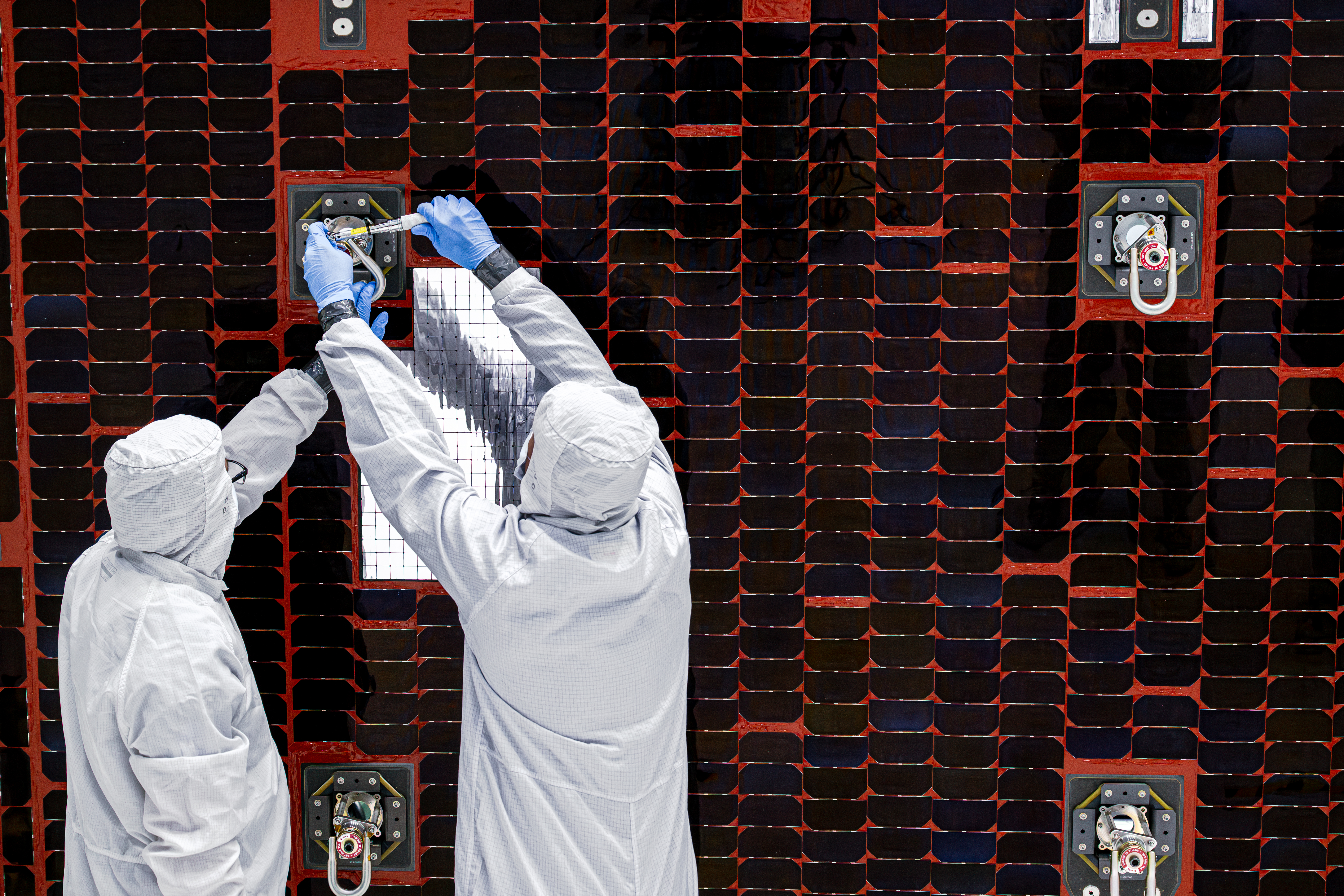
    Over the course of two days, eight technicians installed solar panels onto the outer portion of NASA’s Nancy Grace Roman Space Telescope. Each of the six panels is about 23 by 33 feet (7 by 10 meters), fitted with photovoltaic cells which will harness energy from sunlight to power the observatory. The solar panels were designed, built, and installed at NASA’s Goddard Space Flight Center in Greenbelt, Md.
    Credit: NASA/Sophia Roberts

    The Solar Array Sun Shield is made up of six panels, each covered in solar cells. The two central panels will remain fixed to the outer barrel assembly (the observatory’s outer shell) while the other four will deploy once Roman is in space, swinging up to align with the center panels.

    The panels will spend the entirety of the mission facing the Sun to provide a steady supply of power to the observatory’s electronics. This orientation will also shade much of the observatory and help keep the instruments cool, which is critical for an infrared observatory. Since infrared light is detectable as heat, excess warmth from the spacecraft’s own components would saturate the detectors and effectively blind the telescope.

    A close-up of technicians working on a Roman solar panel
    The solar panels on NASA’s Nancy Grace Roman Space Telescope are covered in a total of 3,902 solar cells that will convert sunlight directly into electricity much like plants convert sunlight to chemical energy. When tiny bits of light, called photons, strike the cells, some of their energy transfers to electrons within the material. This jolt excites the electrons, which start moving more or jump to higher energy levels. In a solar cell, excited electrons create electricity by breaking free and moving through a circuit, sort of like water flowing through a pipe. The panels are designed to channel that energy to power the observatory.
    Credit: NASA/Sydney Rohde

    “Now that the panels have been installed, the outer portion of the Roman observatory is complete,” said Goddard’s Aaron Vigil, a mechanical engineer working on the array. Next, technicians will test deploy the solar panels and the observatory’s “visor” (the deployable aperture cover). The team is also testing the core portion of the observatory, assessing the electronics and conducting a thermal vacuum test to ensure the system operates as planned in the harsh space environment.

    This will keep the project on track to connect Roman’s inner and outer segments in November, resulting in a whole observatory by the end of the year that can then undergo pre-launch tests.

    A technician works on one of Roman's solar panels
    Now that the solar panels are installed on the outer portion of NASA’s Nancy Grace Roman Space Telescope, technicians are readying the assembly for vibration testing to ensure it will withstand the extreme shaking experienced during launch.
    Credit: NASA/Sydney Rohde

    To virtually tour an interactive version of the telescope, visit: https://roman.gsfc.nasa.gov/interactive/

    Download high-resolution video and images from NASA’s Scientific Visualization Studio

    The Nancy Grace Roman Space Telescope is managed at NASA’s Goddard Space Flight Center in Greenbelt, Maryland, with participation by NASA’s Jet Propulsion Laboratory in Southern California; Caltech/IPAC in Pasadena, California; the Space Telescope Science Institute in Baltimore; and a science team comprising scientists from various research institutions. The primary industrial partners are BAE Systems Inc. in Boulder, Colorado; L3Harris Technologies in Rochester, New York; and Teledyne Scientific & Imaging in Thousand Oaks, California.

    By Ashley Balzer
    NASA’s Goddard Space Flight Center, Greenbelt, Md.

    Details

    Last Updated

    Jul 10, 2025

    Editor
    Ashley Balzer
    Contact
    Ashley Balzer
    Location
    Goddard Space Flight Center