Polar Tourists Give Positive Reviews to NASA Citizen Science in Antarctica
Citizen science projects result in an overwhelmingly positive impact on the polar tourism experience. That’s according to a new paper analyzing participant experiences in the first two years of FjordPhyto, a NASA Citizen Science project..
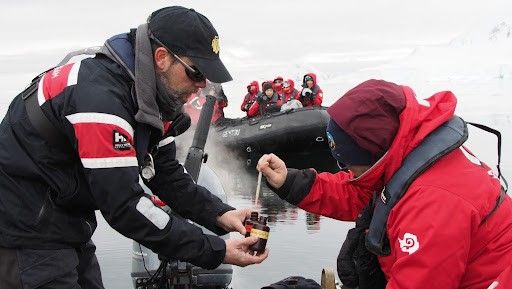
The FjordPhyto citizen science project invites travelers onboard expedition cruise vessels to gather data and samples during the polar summer season, helping researchers understand changes in microalgae communities in response to melting glaciers. Travelers in Antarctica from November to March help collect phytoplankton and ocean data from polar regions facilitated by trained expedition guides.
The new research found that ninety-seven percent of respondents reported that participating in citizen science enriched their travel experience. The paper provides a first understanding of the impact of citizen science projects on the tourism experience.
“I was worried that I would feel guilty being a tourist in a place as remote and untouched as Antarctica,” said one anonymous FjordPhyto participant. “But being able to learn and be a part of citizen science, whilst constantly being reminded of our environmental responsibilities, made me feel less like just a visitor and more a part of keeping the science culture that Antarctica is known for alive and well.”
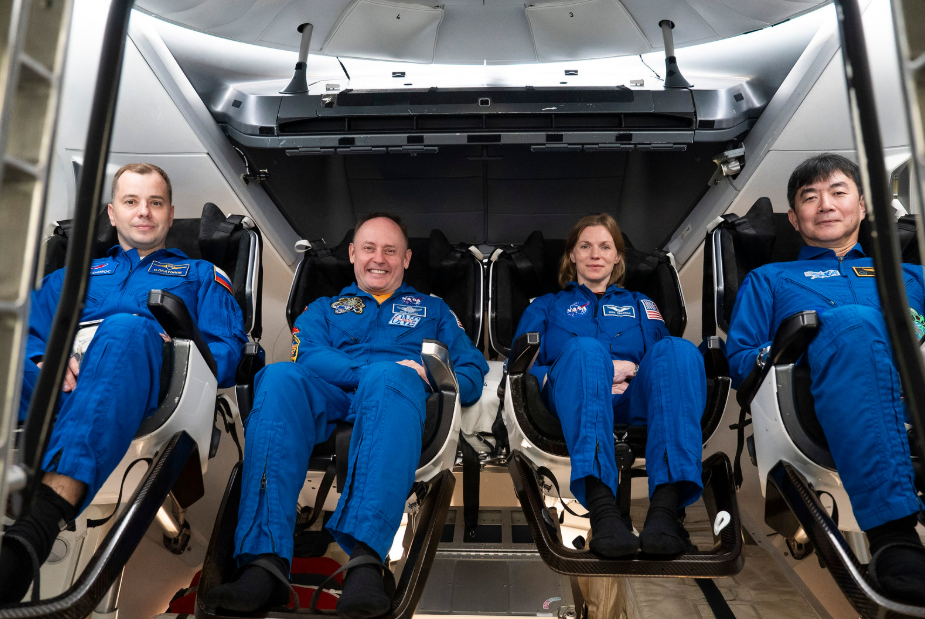
The four crew members of NASA’s SpaceX Crew-11 mission to the International Space Station train inside a SpaceX Dragon spacecraft in Hawthorne, California. From left to right: Roscosmos cosmonaut Oleg Platonov, NASA astronauts Mike Fincke and Zena Cardman, and JAXA astronaut Kimiya Yui.
Credit: SpaceX
NASA and its partners will discuss the upcoming crew rotation to the International Space Station during a pair of news conferences on Thursday, July 10, from the agency’s Johnson Space Center in Houston.
First is an overview news conference at 12 p.m. EDT with mission leadership discussing final launch and mission preparations on the agency’s YouTube channel.
Next, crew will participate in a news conference at 2 p.m. on NASA’s YouTube channel, followed by individual astronaut interviews at 3 p.m. This is the final media opportunity with Crew-11 before they travel to NASA’s Kennedy Space Center in Florida for launch.
The Crew-11 mission, targeted to launch in late July/early August, will carry NASA astronauts Zena Cardman and Mike Fincke, JAXA (Japan Aerospace Exploration Agency) astronaut Kimiya Yui, and Roscosmos cosmonaut Oleg Platonov to the orbiting laboratory. The crew will launch aboard a SpaceX Dragon spacecraft on the company’s Falcon 9 rocket from Launch Complex 39A.
United States-based media seeking to attend in person must contact the NASA Johnson newsroom no later than 5 p.m. on Monday, July 7, at 281-483-5111 or jsccommu@mail.nasa.gov. A copy of NASA’s media accreditation policy is available online.
Any media interested in participating in the news conferences by phone must contact the Johnson newsroom by 9:45 a.m. the day of the event. Media seeking virtual interviews with the crew must submit requests to the Johnson newsroom by 5 p.m. on Monday, July 7.
Briefing participants are as follows (all times Eastern and subject to change based on real-time operations):
12 p.m.: Mission Overview News Conference
Steve Stich, manager, Commercial Crew Program, NASA Kennedy
Bill Spetch, operations integration manager, International Space Station Program, NASA Johnson
NASA’s Space Operations Mission Directorate representative
Sarah Walker, director, Dragon Mission Management, SpaceX
Mayumi Matsuura, vice president and director general, Human Spaceflight Technology Directorate, JAXA
Crew-11 members available for a limited number of interviews
Selected as a NASA astronaut in 2017, Cardman will conduct her first spaceflight. The Williamsburg, Virginia, native holds a bachelor’s degree in Biology and a master’s in Marine Sciences from the University of North Carolina at Chapel Hill. At the time of selection, she was pursuing a doctorate in geosciences. Cardman’s geobiology and geochemical cycling research focused on subsurface environments, from caves to deep sea sediments. Since completing initial training, Cardman has supported real-time station operations and lunar surface exploration planning. Follow @zenanaut on X and @zenanaut on Instagram.
This will be Fincke’s fourth trip to the space station, having logged 382 days in space and nine spacewalks during Expedition 9 in 2004, Expedition 18 in 2008, and STS-134 in 2011, the final flight of space shuttle Endeavour. Throughout the past decade, Fincke has applied his expertise to NASA’s Commercial Crew Program, advancing the development and testing of the SpaceX Dragon spacecraft and Boeing Starliner spacecraft toward operational certification. The Emsworth, Pennsylvania, native is a graduate of the United States Air Force Test Pilot School and holds bachelors’ degrees from the Massachusetts Institute of Technology, Cambridge, in both aeronautics and astronautics, as well as Earth, atmospheric and planetary sciences. He also has a master’s degree in aeronautics and astronautics from Stanford University in California. Fincke is a retired U.S. Air Force colonel with more than 2,000 flight hours in over 30 different aircraft. Follow @AstroIronMike on X and Instagram.
With 142 days in space, this will be Yui’s second trip to the space station. After his selection as a JAXA astronaut in 2009, Yui flew as a flight engineer for Expedition 44/45 and became the first Japanese astronaut to capture JAXA’s H-II Transfer Vehicle using the station’s robotic arm. In addition to constructing a new experimental environment aboard Kibo, he conducted a total of 21 experiments for JAXA. In November 2016, Yui was assigned as chief of the JAXA Astronaut Group. He graduated from the School of Science and Engineering at the National Defense Academy of Japan in 1992. He later joined the Air Self-Defense Force at the Japan Defense Agency (currently the Ministry of Defense). In 2008, Yui joined the Air Staff Office at the Ministry of Defense as a lieutenant colonel. Follow @astro_kimiya on X.
The Crew-11 mission also will be Platonov’s first spaceflight. Before his selection as a cosmonaut in 2018, Platonov earned a degree in engineering from Krasnodar Air Force Academy in aircraft operations and air traffic management. He also earned a bachelor’s degree in state and municipal management in 2016 from the Far Eastern Federal University in Vladivostok, Russia. Assigned as a test cosmonaut in 2021, he has experience in piloting aircraft, zero gravity training, scuba diving, and wilderness survival.
In this Nov. 1, 1964, image, three members of NASA’s Lewis Research Center’s (now NASA’s Glenn Research Center in Cleveland) Educational Services Office pose with one of the center’s Spacemobile space science demonstration units. Once the NACA (National Advisory Committee for Aeronautics) became NASA, public outreach became one of the agency’s core tenets. Lewis, which had previously been a closed laboratory, began hosting open houses and elaborate space fairs in the early 1960s.
In addition, the center initiated educational programs that worked with local schools and a robust speaker’s bureau that explained NASA activities to the community. One aspect of these efforts was the Spacemobile Program. These vehicles included a delegated speaker, exhibits, models, and other resources. The Spacemobiles, which made forays across the Midwest, were extremely active throughout the 1960s.
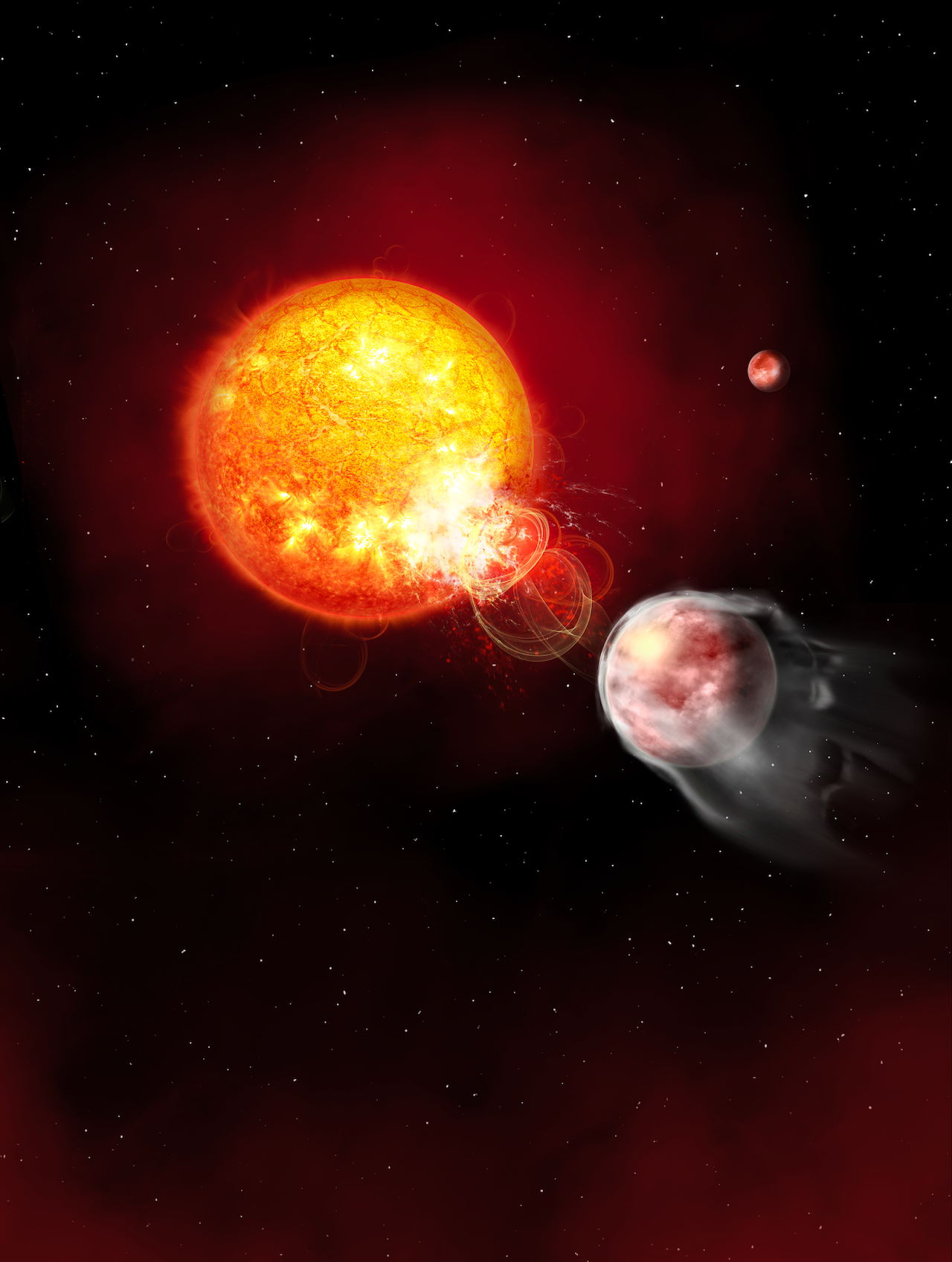
Artist’s concept of the star HIP 67522 with a flare erupting toward an orbiting planet, HIP 67522 b. A second planet, HIP 67522 c, is shown in the background.
Janine Fohlmeister, Leibniz Institute for Astrophysics Potsdam
The Discovery
A giant planet some 400 light-years away, HIP 67522 b, orbits its parent star so tightly that it appears to cause frequent flares from the star’s surface, heating and inflating the planet’s atmosphere.
Key Facts
On planet Earth, “space weather” caused by solar flares might disrupt radio communications, or even damage satellites. But Earth’s atmosphere protects us from truly harmful effects, and we orbit the Sun at a respectable distance, out of reach of the flares themselves.
Not so for planet HIP 67522 b. A gas giant in a young star system – just 17 million years old – the planet takes only seven days to complete one orbit around its star. A “year,” in other words, lasts barely as long as a week on Earth. That places the planet perilously close to the star. Worse, the star is of a type known to flare – especially in their youth.
In this case, the proximity of the planet appears to result in fairly frequent flaring.
Details
The star and the planet form a powerful but likely a destructive bond. In a manner not yet fully understood, the planet hooks into the star’s magnetic field, triggering flares on the star’s surface; the flares whiplash energy back to the planet. Combined with other high-energy radiation from the star, the flare-induced heating appears to have increased the already steep inflation of the planet’s atmosphere, giving HIP 67522 b a diameter comparable to our own planet Jupiter despite having just 5% of Jupiter’s mass.
This might well mean that the planet won’t stay in the Jupiter size-range for long. One effect of being continually pummeled with intense radiation could be a loss of atmosphere over time. In another 100 million years, that could shrink the planet to the status of a “hot Neptune,” or, with a more radical loss of atmosphere, even a “sub-Neptune,” a planet type smaller than Neptune that is common in our galaxy but lacking in our solar system.
Fun Facts
Four hundred light-years is much too far away to capture images of stellar flares striking orbiting planets. So how did a science team led by Netherlands astronomer Ekaterina Ilin discover this was happening? They used space-borne telescopes, NASA’s TESS (Transiting Exoplanet Survey Satellite) and the European Space Agency’s CHEOPS (CHaracterising ExoPlanets Telescope), to track flares on the star, and also to trace the path of the planet’s orbit.
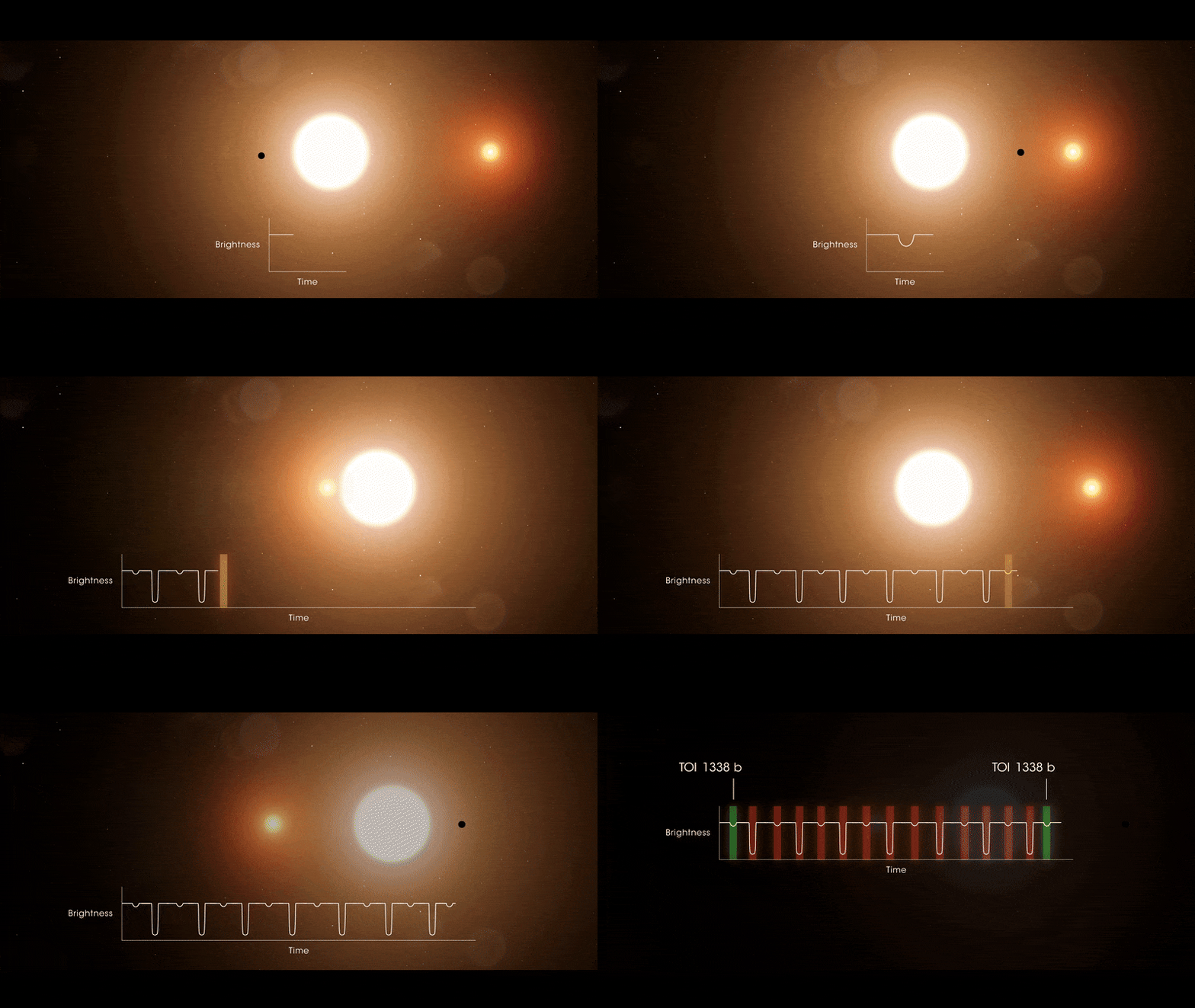
Both telescopes use the “transit” method to determine the diameter of a planet and the time it takes to orbit its star. The transit is a kind of mini-eclipse. As the planet crosses the star’s face, it causes a tiny dip in starlight reaching the telescope. But the same observation method also picks up sudden stabs of brightness from the star – the stellar flares. Combining these observations over five years’ time and applying rigorous statistical analysis, the science team revealed that the planet is zapped with six times more flares than it would be without that magnetic connection.
The Discoverers
A team of scientists from the Netherlands, Germany, Sweden, and Switzerland, led by Ekaterina Ilin of the Netherlands Institute for Radio Astronomy, published their paper on the planet-star connection, “Close-in planet induces flares on its host star,” in the journal Nature on July 2, 2025.
Since July 2022, NASA’s James Webb Space Telescope has been unwaveringly focused on our universe. With its unprecedented power to detect and analyze otherwise invisible infrared light, Webb is making observations that were once impossible, changing our view of the cosmos from the most distant galaxies to our own solar system.
Webb was built with the promise of revolutionizing astronomy, of rewriting the textbooks. And by any measure, it has more than lived up to the hype — exceeding expectations to a degree that scientists had not dared imagine. Since science operations began, Webb has completed more than 860 scientific programs, with one-quarter of its time dedicated to imaging and three-quarters to spectroscopy. In just three years, it has collected nearly 550 terabytes of data, yielding more than 1,600 research papers, with intriguing results too numerous to list and a host of new questions to answer.
Here are just a few noteworthy examples.
1. The universe evolved significantly faster than we previously thought.
Webb was specifically designed to observe “cosmic dawn,” a time during the first billion years of the universe when the first stars and galaxies were forming. What we expected to see were a few faint galaxies, hints of what would become the galaxies we see nearby.
Instead, Webb has revealed surprisingly bright galaxies that developed within 300 million years of the big bang; galaxies with black holes that seem far too massive for their age; and an infant Milky Way-type galaxy that existed when the universe was just 600 million years old. Webb has observed galaxies that already “turned off” and stopped forming stars within a billion years of the big bang, as well as those that developed quickly into modern-looking “grand design” spirals within 1.5 billion years.
Hundreds of millions of years might not seem quick for a growth spurt, but keep in mind that the universe formed in the big bang roughly 13.8 billion years ago. If you were to cram all of cosmic time into one year, the most distant of these galaxies would have matured within the first couple of weeks, rapidly forming multiple generations of stars and enriching the universe with the elements we see today.
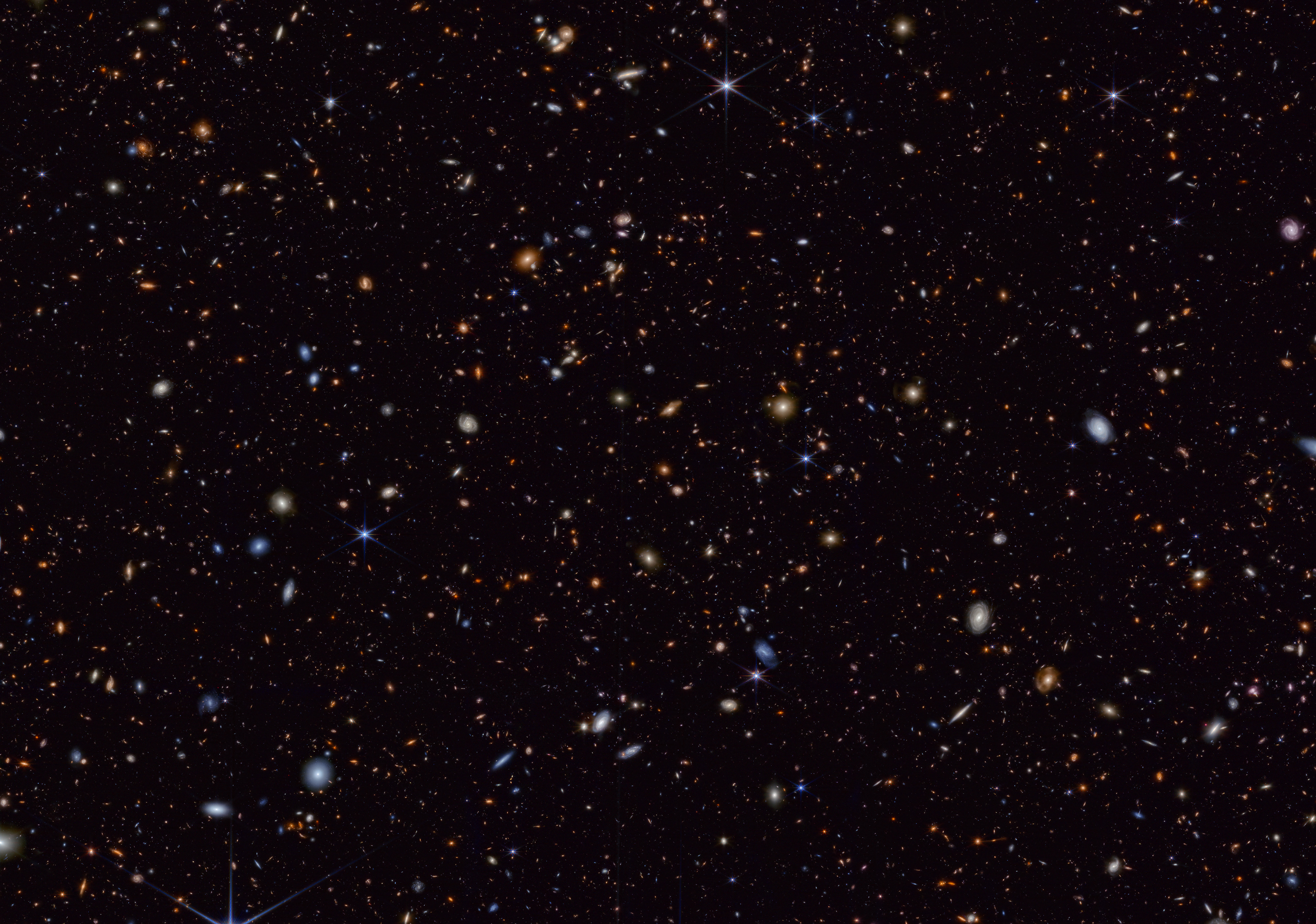
The JADES Deep Field uses observations taken by NASA’s James Webb Space Telescope (JWST) as part of the JADES (JWST Advanced Deep Extragalactic Survey) program. A team of astronomers studying JADES data identified about 80 objects that changed in brightness over time. Most of these objects, known as transients, are the result of exploding stars or supernovae.
Prior to this survey, only a handful of supernovae had been found above a redshift of 2, which corresponds to when the universe was only 3.3 billion years old — just 25% of its current age. The JADES sample contains many supernovae that exploded even further in the past, when the universe was less than 2 billion years old. It includes the farthest one ever spectroscopically confirmed, at a redshift of 3.6. Its progenitor star exploded when the universe was only 1.8 billion years old.
NASA, ESA, CSA, STScI, JADES Collaboration
2. Deep space is scattered with enigmatic “Little Red Dots.”
Webb has revealed a new type of galaxy: a distant population of mysteriously compact, bright, red galaxies dubbed Little Red Dots. What makes Little Red Dots so bright and so red? Are they lit up by dense groupings of unusually bright stars or by gas spiraling into a supermassive black hole, or both? And whatever happened to them? Little Red Dots seem to have appeared in the universe around 600 million years after the big bang (13.2 billion years ago), and rapidly declined in number less than a billion years later. Did they evolve into something else? If so, how? Webb is probing Little Red Dots in more detail to answer these questions.
3. Pulsating stars and a triply lensed supernova are further evidence that the “Hubble Tension” is real.
How fast is the universe expanding? It’s hard to say because different ways of calculating the current expansion rate yield different results — a dilemma known as the Hubble Tension. Are these differences just a result of measurement errors, or is there something weird going on in the universe? So far, Webb data indicates that the Hubble Tension is not caused by measurement errors. Webb was able to distinguish pulsating stars from nearby stars in a crowded field, ensuring that the measurements weren’t contaminated by extra light. Webb also discovered a distant, gravitationally lensed supernova whose image appears in three different locations and at three different times during its explosion. Calculating the expansion rate based on the brightness of the supernova at these three different times provides an independent check on measurements made using other techniques. Until the matter of the Hubble Tension is settled, Webb will continue measuring different objects and exploring new methods.
4. Webb has found surprisingly rich and varied atmospheres on gas giants orbiting distant stars.
While NASA’s Hubble Space Telescope made the first detection of gases in the atmosphere of a gas giant exoplanet (a planet outside our solar system), Webb has taken studies to an entirely new level. Webb has revealed a rich cocktail of chemicals, including hydrogen sulfide, ammonia, carbon dioxide, methane, and sulfur dioxide — none of which had been clearly detected in an atmosphere outside our solar system before. Webb has also been able to examine exotic climates of gas giants as never before, detectingflakes of silica “snow” in the skies of the puffy, searing-hot gas giant WASP-17 b, for example, and measuring differences in temperature and cloud cover between the permanent morning and evening skies of WASP-39 b.
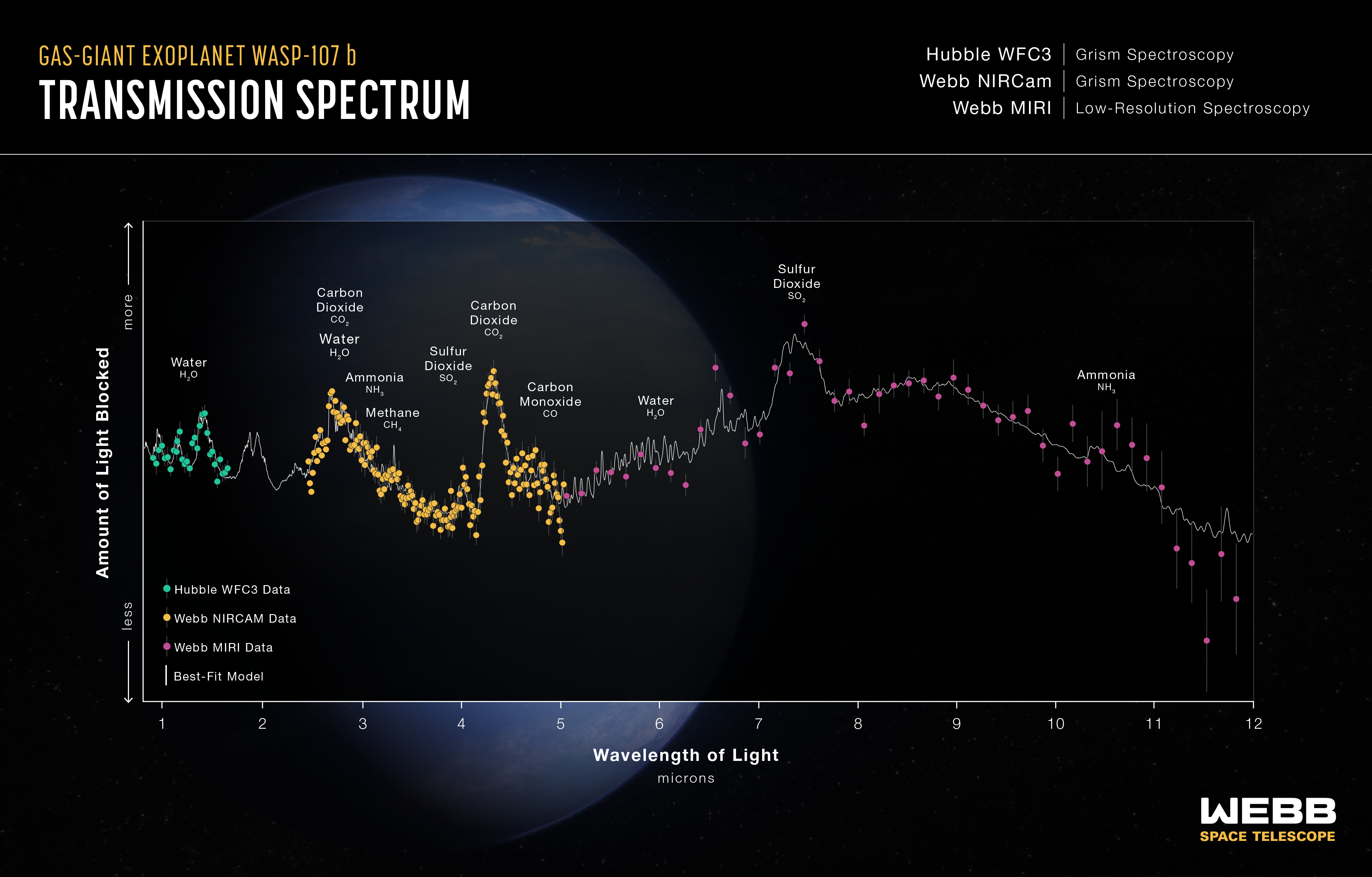
Image: Spectrum of WASP-107 b
A transmission spectrum of the “warm Neptune” exoplanet WASP-107 b captured by NASA’s Hubble and Webb space telescopes, shows clear evidence for water, carbon dioxide, carbon monoxide, methane, sulfur dioxide, and ammonia in the planet’s atmosphere. These measurements allowed researchers to estimate the interior temperature and mass of the core of the planet, as well as understand the chemistry and dynamics of the atmosphere.
NASA, ESA, CSA, Ralf Crawford (STScI)
5. A rocky planet 40 light-years from Earth may have an atmosphere fed by gas bubbling up from its lava-covered surface.
Detecting, let alone analyzing, a thin layer of gas surrounding a small rocky planet is no easy feat, but Webb’s extraordinary ability to measure extremely subtle changes in the brightness of infrared light makes it possible. So far, Webb has been able to rule out significant atmosphere on a number of rocky planets, and has found tantalizing signs of carbon monoxide or carbon dioxide on 55 Cancri e, a lava world that orbits a Sun-like star. With findings like these, Webb is laying the groundwork for NASA’s future Habitable Worlds Observatory, which will be the first mission purpose-built to directly image and search for life on Earth-like planets around Sun-like stars.
6. Webb exposes the skeletal structure of nearby spiral galaxies in mesmerizing detail.
We already knew that galaxies are collections of stars, planets, dust, gas, dark matter, and black holes: cosmic cities where stars form, live, die, and are recycled into the next generation. But we had never been able to see the structure of a galaxy and the interactions between stars and their environment in such detail. Webb’s infrared vision reveals filaments of dust that trace the spiral arms, old star clusters that make up galactic cores, newly forming stars still encased in dense cocoons of glowing dust and gas, and clusters of hot young stars carving enormous cavities in the dust. It also elucidates how stellar winds and explosions actively reshape their galactic homes.
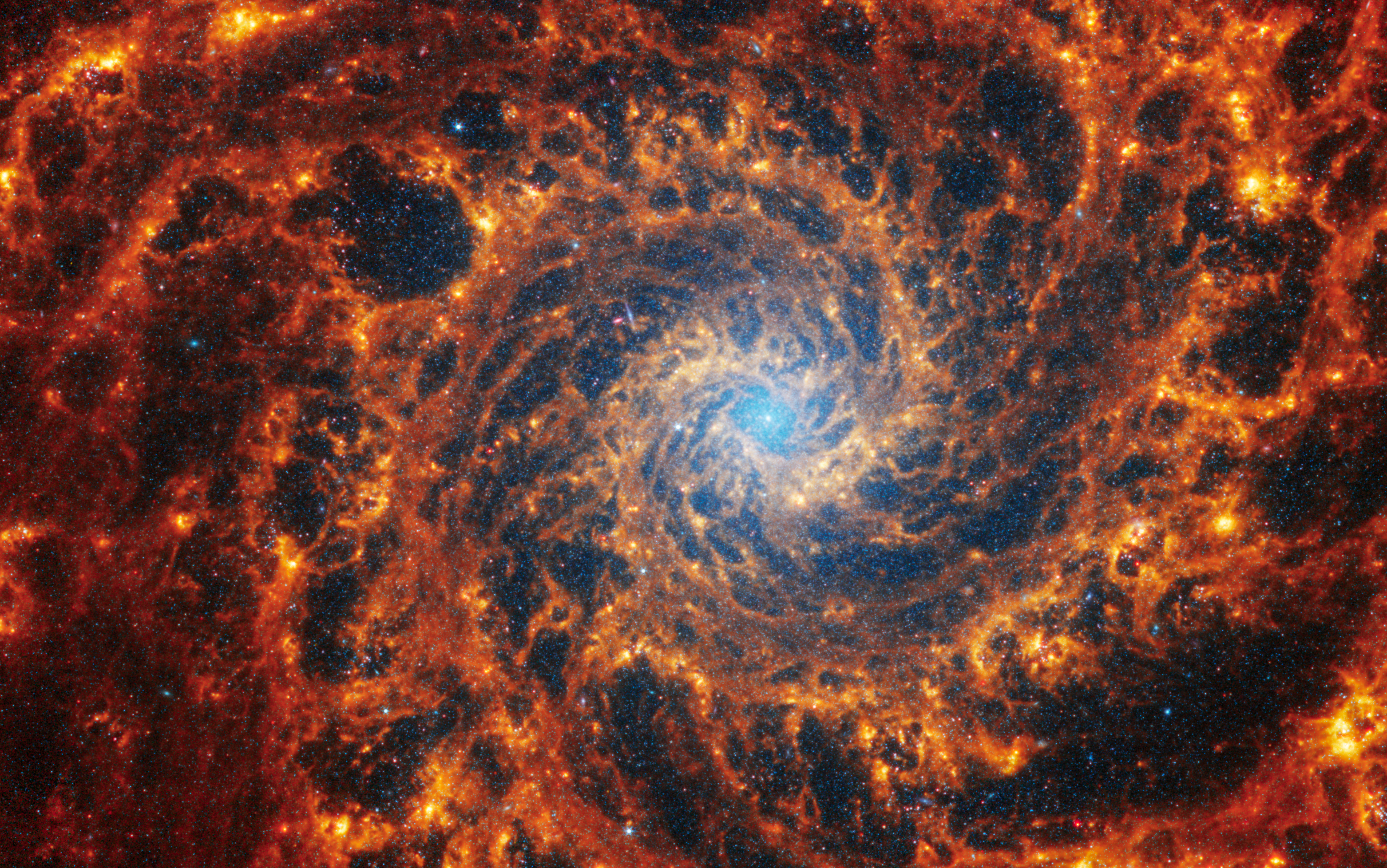
Image: PHANGS Phantom Galaxy (M74/NGC 628)
A near- to mid-infrared image from NASA’s James Webb Space Telescope highlights details in the complex structure of a nearby galaxy that are invisible to other telescopes. The image of NGC 628, also known as the Phantom Galaxy, shows spiral arms with lanes of warm dust (represented in red), knots of glowing gas (orange-yellow), and giant bubbles (black) carved by hot, young stars. The dust-free core of the galaxy is filled with older, cooler stars (blue).
NASA, ESA, CSA, STScI, Janice Lee (STScI), Thomas Williams (Oxford), PHANGS team
7. It can be hard to tell the difference between a brown dwarf and a rogue planet.
Brown dwarfs form like stars, but are not dense or hot enough to fuse hydrogen in their cores like stars do. Rogue planets form like other planets, but have been ejected from their system and no longer orbit a star. Webb has spotted hundreds of brown-dwarf-like objects in the Milky Way, and has even detected some candidates in a neighboring galaxy. But some of these objects are so small — just a few times the mass of Jupiter — that it is hard to figure out how they formed. Are they free-floating gas giant planets instead? What is the least amount of material needed to form a brown dwarf or a star? We’re not sure yet, but thanks to three years of Webb observations, we now know there is a continuum of objects from planets to brown dwarfs to stars.
8. Some planets might be able to survive the death of their star.
When a star like our Sun dies, it swells up to form a red giant large enough to engulf nearby planets. It then sheds its outer layers, leaving behind a super-hot core known as a white dwarf. Is there a safe distance that planets can survive this process? Webb might have foundsome planets orbiting white dwarfs. If these candidates are confirmed, it would mean that it is possible for planets to survive the death of their star, remaining in orbit around the slowly cooling stellar ember.
9. Saturn’s water supply is fed by a giant fountain of vapor spewing from Enceladus.
Among the icy “ocean worlds” of our solar system, Saturn’s moon Enceladus might be the most intriguing. NASA’s Cassini mission first detected water plumes coming out of its southern pole. But only Webb could reveal the plume’s true scale as a vast cloud spanning more than 6,000 miles, about 20 times wider than Enceladus itself. This water spreads out into a donut-shaped torus encircling Saturn beyond the rings that are visible in backyard telescopes. While a fraction of the water stays in that ring, the majority of it spreads throughout the Saturnian system, even raining down onto the planet itself. Webb’s unique observations of rings, auroras, clouds, winds, ices, gases, and other materials and phenomena in the solar system are helping us better understand what our cosmic neighborhood is made of and how it has changed over time.
Video: Water plume and torus from Enceladus
A combination of images and spectra captured by NASA’s James Webb Space Telescope show a giant plume of water jetting out from the south pole of Saturn’s moon Enceladus, creating a donut-shaped ring of water around the planet. Credit: NASA, ESA, CSA, G. Villanueva (NASA’s Goddard Space Flight Center), A. Pagan (STScI), L. Hustak (STScI)
10. Webb can size up asteroids that may be headed for Earth.
In 2024 astronomers discovered an asteroid that, based on preliminary calculations, had a chance of hitting Earth. Such potentially hazardous asteroids become an immediate focus of attention, and Webb was uniquely able to measure the object, which turned out to be the size of a 15-story building. While this particular asteroid is no longer considered a threat to Earth, the study demonstrated Webb’s ability to assess the hazard.
Webb also provided support for NASA’s Double Asteroid Redirection Test (DART) mission, which deliberately smashed into the Didymos binary asteroid system, showing that a planned impact could deflect an asteroid on a collision course with Earth. Both Webb and Hubble observed the impact, serving witness to the resulting spray of material that was ejected. Webb’s spectroscopic observations of the system confirmed that the composition of the asteroids is probably typical of those that could threaten Earth.
—-
In just three years of operations, Webb has brought the distant universe into focus, revealing unexpectedly bright and numerous galaxies. It has unveiled new stars in their dusty cocoons, remains of exploded stars, and skeletons of entire galaxies. It has studied weather on gas giants, and hunted for atmospheres on rocky planets. And it has provided new insights into the residents of our own solar system.
But this is only the beginning. Engineers estimate that Webb has enough fuel to continue observing for at least 20 more years, giving us the opportunity to answer additional questions, pursue new mysteries, and put together more pieces of the cosmic puzzle.
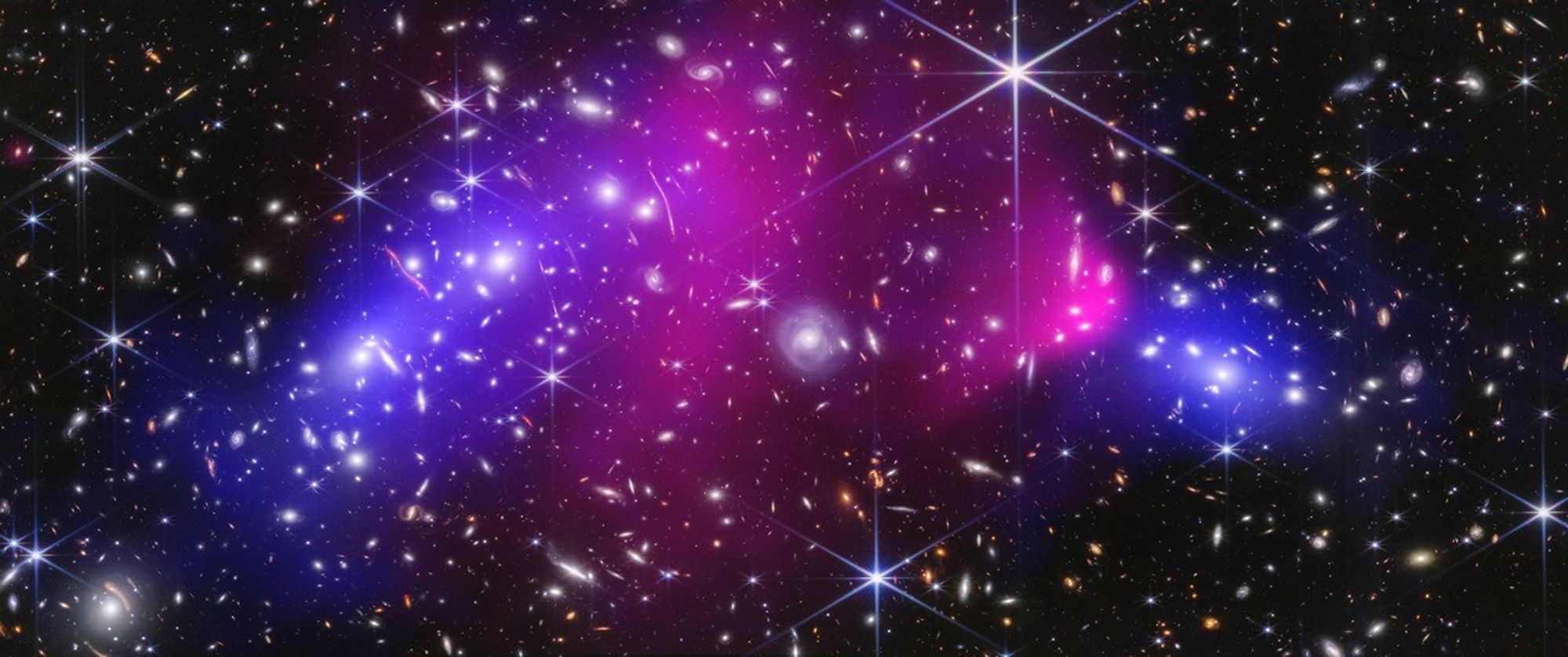
For example: What were the very first stars like? Did stars form differently in the early universe? Do we even know how galaxies form? How do stars, dust, and supermassive black holes affect each other? What can merging galaxy clusters tell us about the nature of dark matter? How do collisions, bursts of stellar radiation, and migration of icy pebbles affect planet-forming disks? Can atmospheres survive on rocky worlds orbiting active red dwarf stars? Is Uranus’s moon Ariel an ocean world?
As with any scientific endeavor, every answer raises more questions, and Webb has shown that its investigative power is unmatched. Demand for observing time on Webb is at an all-time high, greater than any other telescope in history, on the ground or in space. What new findings await?
By Dr. Macarena Garcia Marin and Margaret W. Carruthers, Space Telescope Science Institute, Baltimore, Maryland
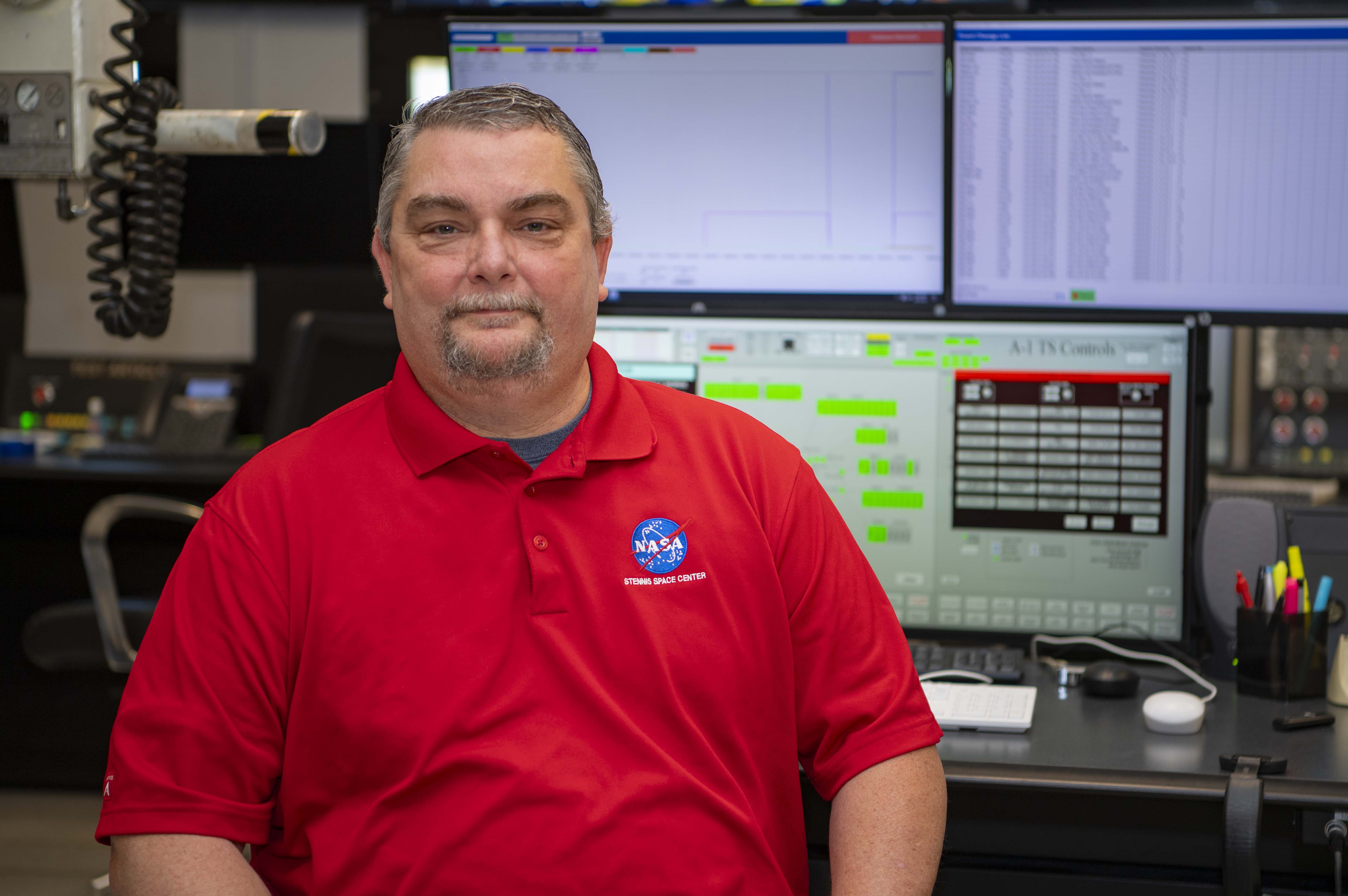
Dwayne Lavigne works as a controls engineer at NASA’s Stennis Space Center, where he supports NASA’s Artemis mission by programming specialized computers for engine testing.
NASA/Danny Nowlin
As a controls engineer at NASA’s Stennis Space Center near Bay St. Louis, Mississippi, Dwayne Lavigne does not just fix problems – he helps put pieces together at America’s largest rocket propulsion test site.
“There are a lot of interesting problems to solve, and they are never the same,” Lavigne said. “Sometimes, it is like solving a very cool puzzle and can be pretty satisfying.”
Lavigne programs specialized computers called programmable logic controllers. They are extremely fast and reliable for automating precisely timed operations during rocket engine tests as NASA Stennis supports the agency’s Artemis missions to explore the Moon and build the foundation for the first crewed mission to Mars.
However, the system will not act unless certain parameters are met in the proper sequence. It can be a complex relationship. Sometimes, 20 or 30 things must be in the correct configuration to perform an operation, such as making a valve open or close, or turning a motor on or off.
The Picayune, Mississippi, native is responsible for establishing new signal paths between test hardware and the specialized computers.
He also develops the human machine interface for the controls. The interface is a screen graphic that test engineers use to interact with hardware.
Lavigne has worked with NASA for more than a decade. One of his proudest work moments came when he contributed to development of an automated test sequencing routine used during all RS-25 engine tests on the Fred Haise Test Stand.
“We’ve had many successful tests over the years, and each one is a point of pride,” he said.
When Lavigne works on the test stand, he works with the test hardware and interacts with technicians and engineers who perform different tasks than he does. It provides an appreciation for the group effort it takes to support NASA’s mission.
“The group of people I work with are driven to get the job done and get it done right,” he said.
In total, Lavigne has been part of the NASA Stennis federal city for 26 years. He initially worked as a contractor with the Naval Oceanographic Office as a data entry operator and with the Naval Research Laboratory as a software developer.
September marks 55 years since NASA Stennis became a federal city. NASA, and more than 50 companies, organizations, and agencies located onsite share in operating costs, which allows tenants to direct more of their funding to individual missions.
“Stennis has a talented workforce accomplishing many different tasks,” said Lavigne. “The three agencies I’ve worked with at NASA Stennis are all very focused on doing the job correctly and professionally. In all three agencies, people realize that lives could be at risk if mistakes are made or shortcuts are taken.”
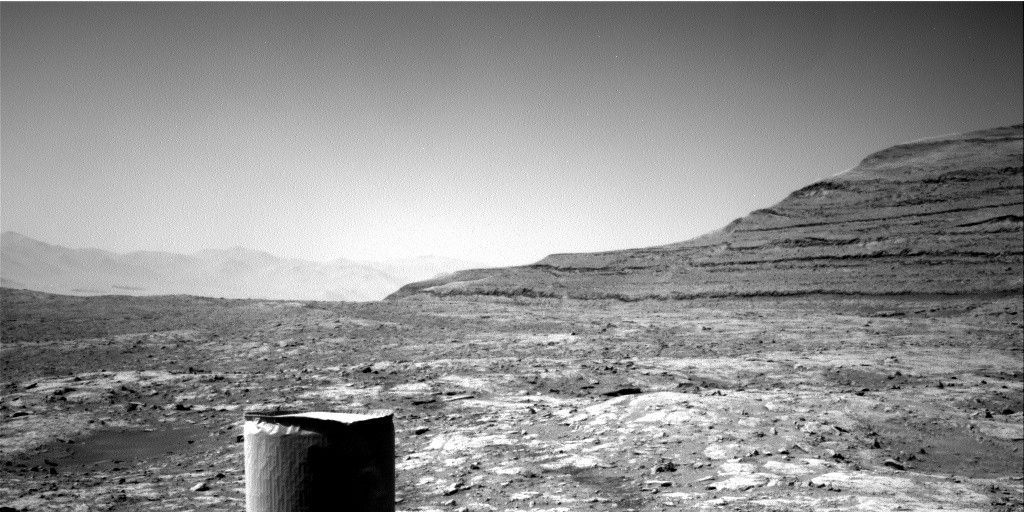
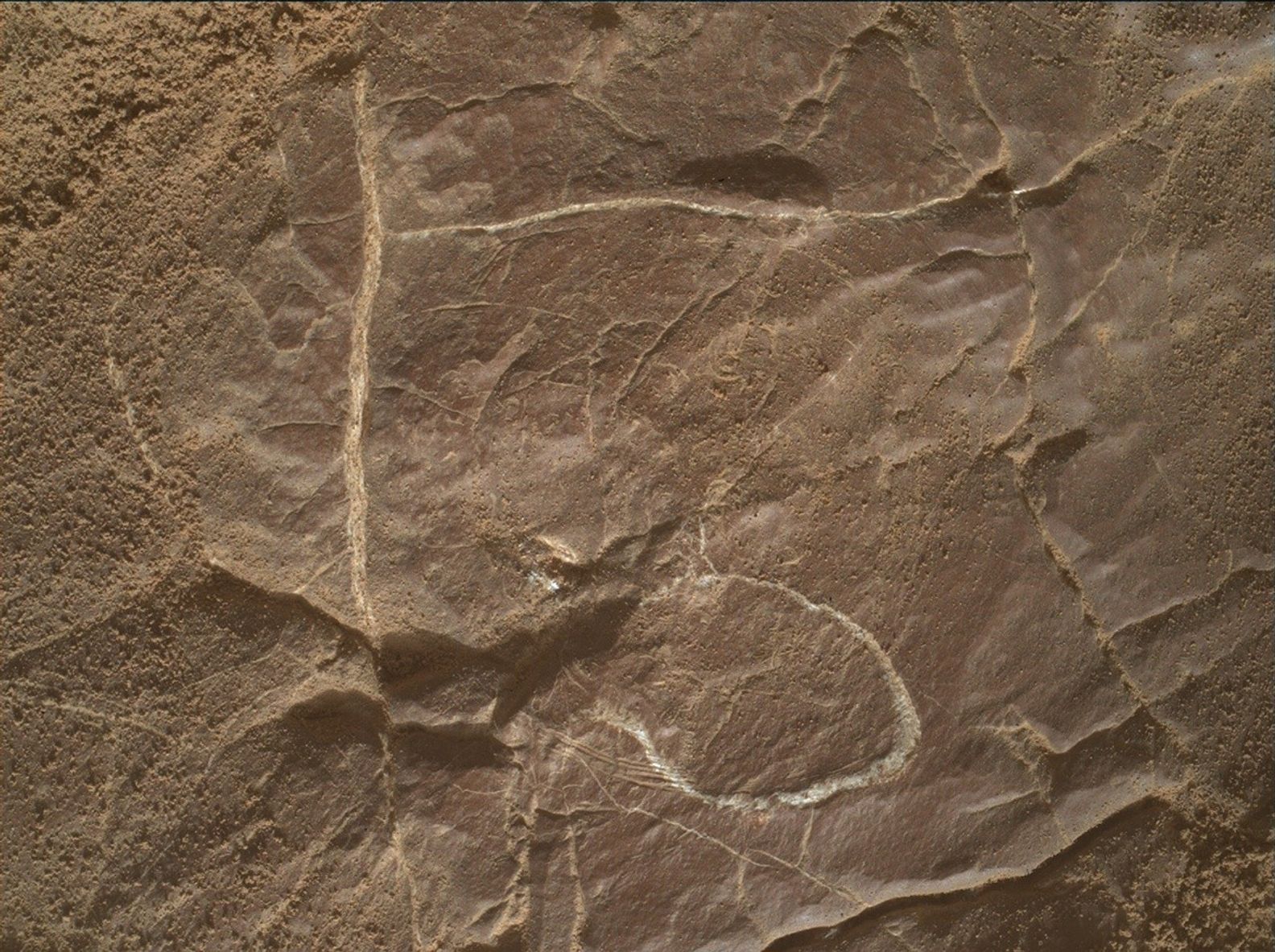
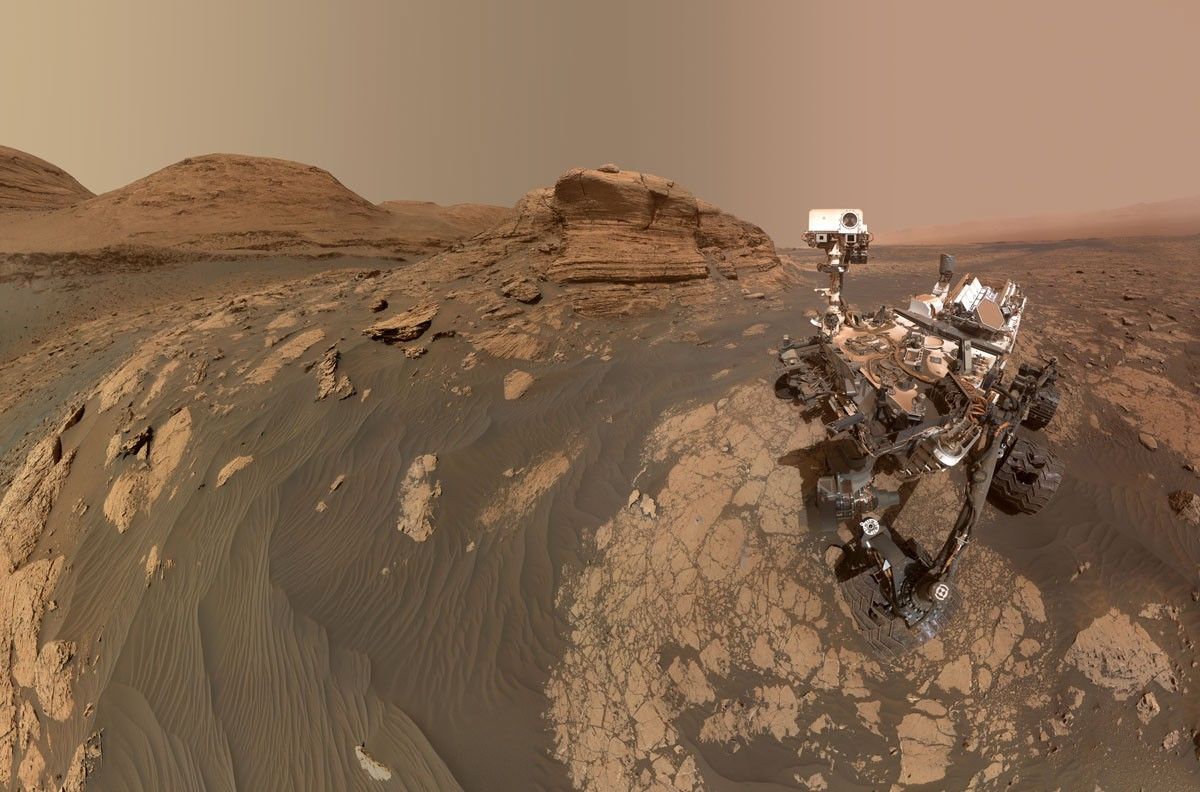
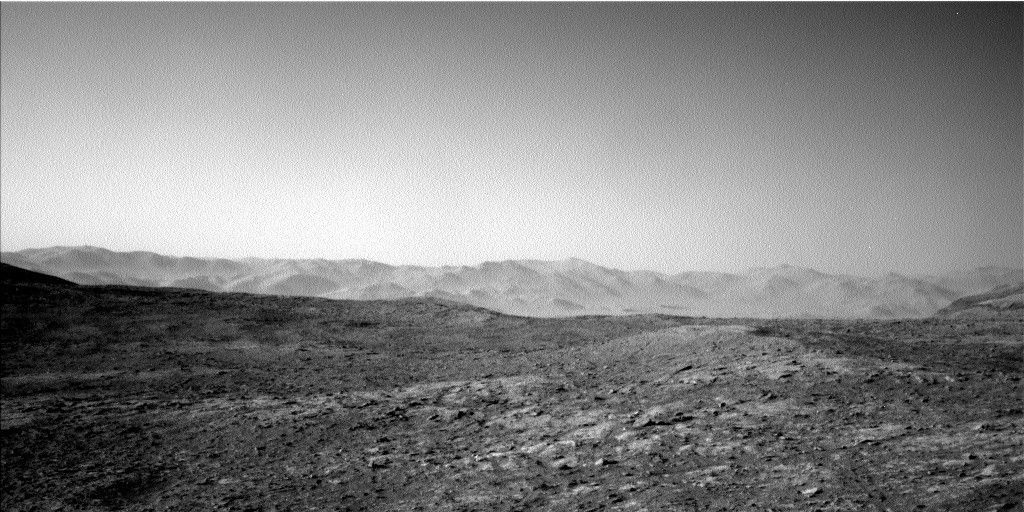
NASA’s Mars rover Curiosity acquired this image using its Right Navigation Camera on June 28, 2025 — Sol 4583, or Martian day 4,583 of the Mars Science Laboratory mission — at 03:20:22 UTC.
NASA/JPL-Caltech
Written by Scott VanBommel, Planetary Scientist at Washington University in St. Louis
Earth planning date: Monday, June 30, 2025
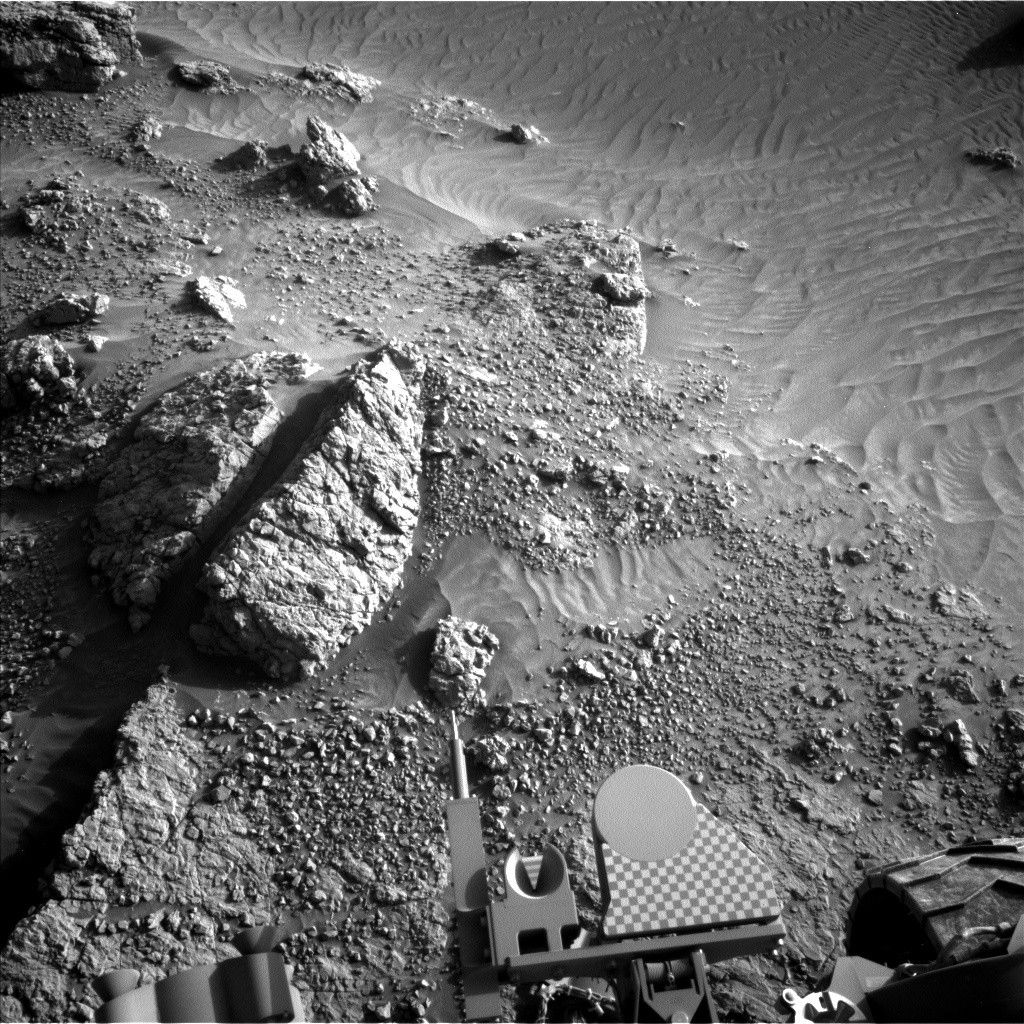
Our weekend drive placed Curiosity exactly where we had hoped: on lighter-toned, resistant bedrock we have been eyeing for close study. Curiosity’s workspace tosol did not contain any targets suitable for DRT. After a detailed discussion by the team, weighing science not only in tosol’s plan but the holiday-shifted sols ahead, the decision was made to perform contact science at the current workspace and then drive in the second sol of the plan.
Normally, drives in the second sol of a two-sol plan are uncommon, as we require information on the ground to assess in advance of the next sol’s planning. At present however, the current “Mars time” is quite favorable, enabling Curiosity’s team to operate within “nominal sols” and receive the necessary data in time for Wednesday’s one-sol plan. DAN kicked off the first sol of the plan with a passive measurement, complemented by another in the afternoon and two more on the second sol. Arm activities focused on placing MAHLI and APXS on “La Paz” and “Playa Agua de Luna,” two lighter-toned, laminated rocks.
The rest of the first sol was rounded out with ChemCam LIBS analyses on “La Joya” followed by further LIBS analyses on “La Vega” on the second sol, once Curiosity’s arm was out of the way of the laser. ChemCam and Mastcam additionally imaged “Mishe Mokwa” prior to the nearly straight drive of about 20 meters (about 66 feet). Environmental monitoring activities, imaging of the CheMin inlet cover, and a SAMEBT activity rounded out Curiosity’s efforts on the second sol.
An Update From the 2025 Mars 2020 Science Team Meeting
A behind-the-scenes look at the annual Mars 2020 Science Team Meeting
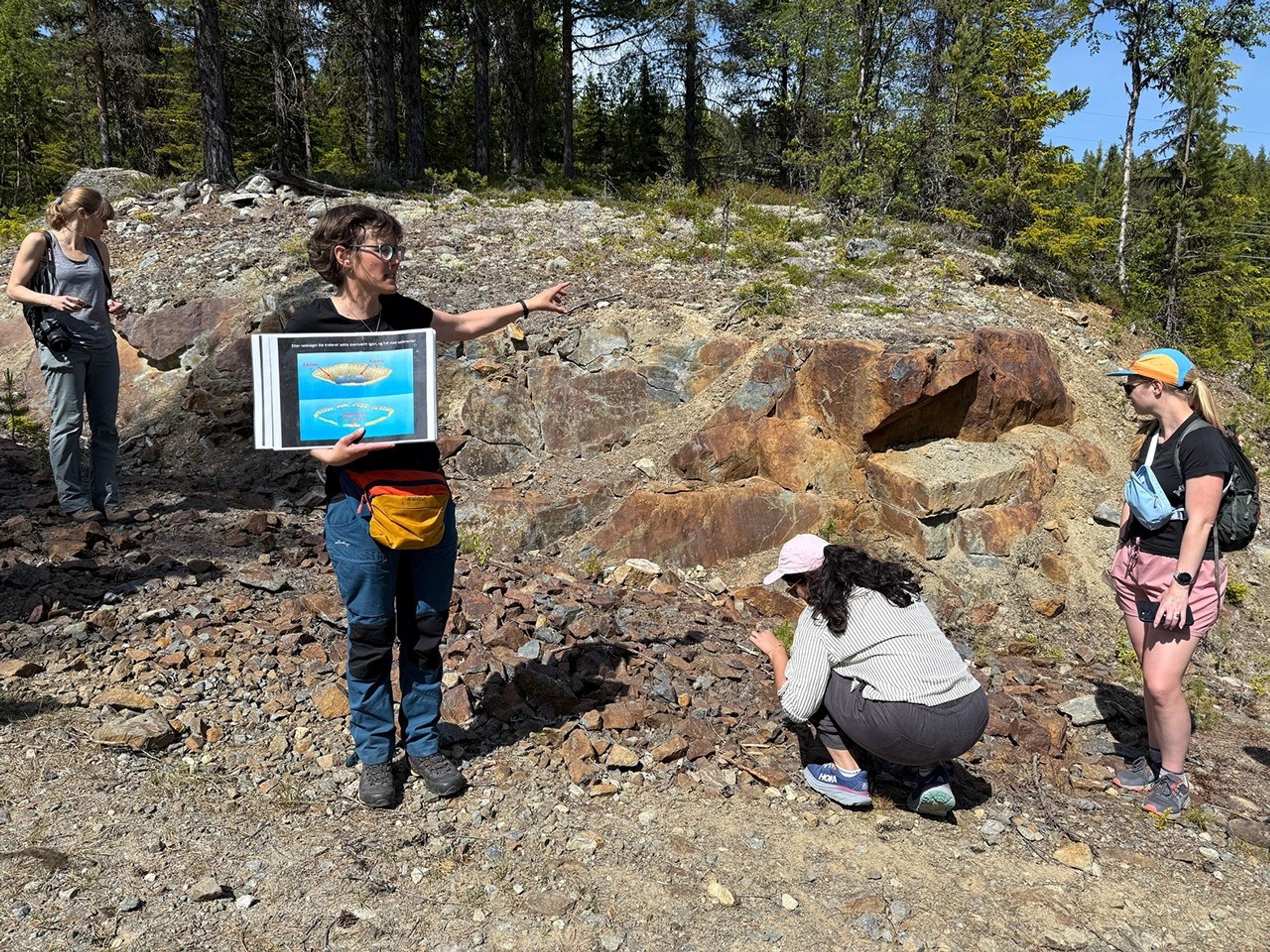
Members of the Mars 2020 Science Team examine post-impact sediments within the Gardnos impact structure, northwest of Oslo, Norway, as part of the June 2025 Science Team Meeting.
NASA/Katie Stack Morgan
Written by Katie Stack Morgan, Mars 2020 Acting Project Scientist
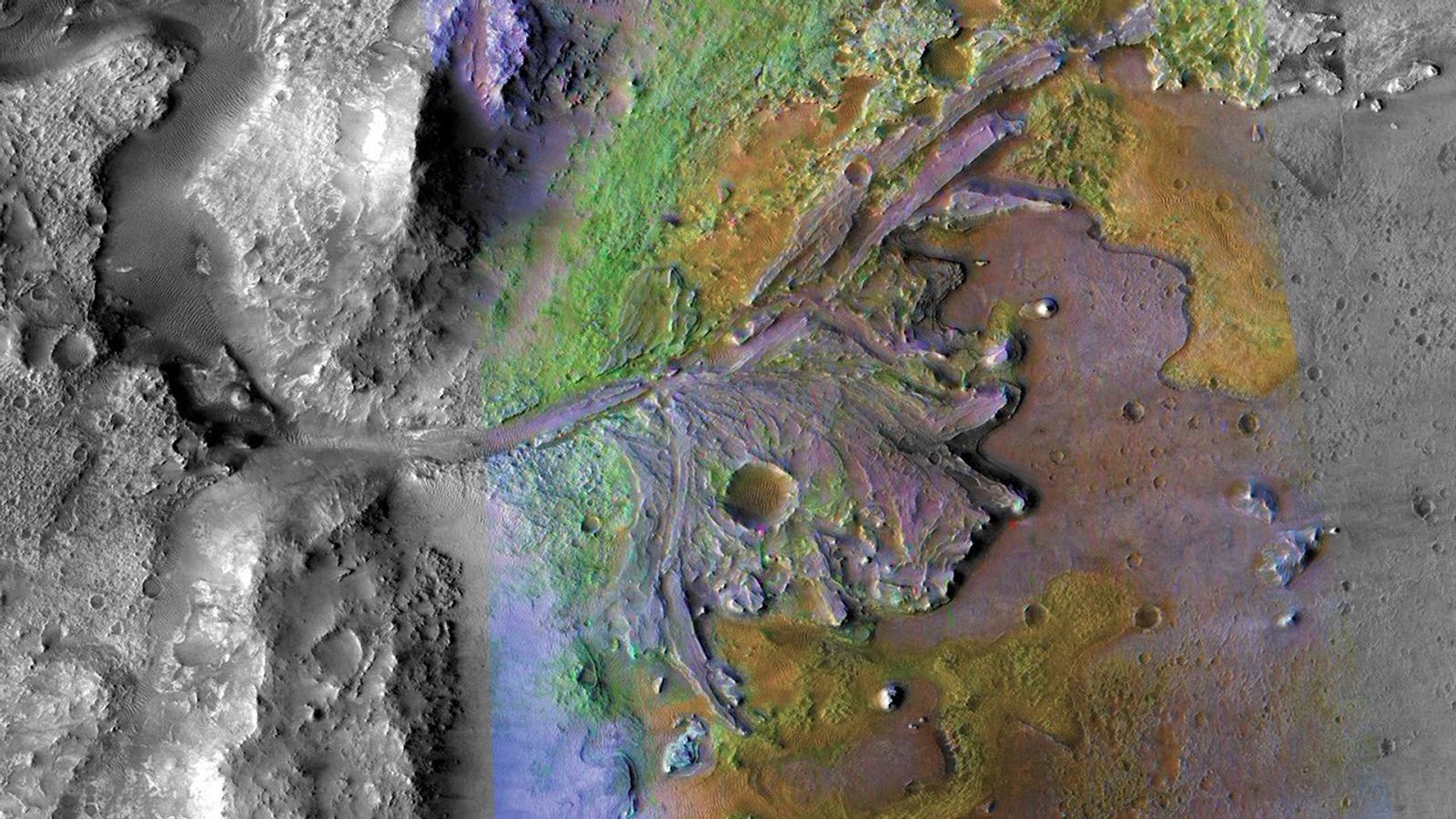
The Mars 2020 Science Team gathered for a week in June to discuss recent science results, synthesize earlier mission observations, and discuss future plans for continued exploration of Jezero’s crater rim. It was also an opportunity to celebrate what makes this mission so special: one of the most capable and sophisticated science missions ever sent to Mars, an experienced and expert Science Team, and the rover’s many science accomplishments this past year.
We kicked off the meeting, which was hosted by our colleagues on the RIMFAX team at the University of Oslo, with a focus on our most recent discoveries on the Jezero crater rim. A highlight was the team’s in-depth discussion of spherules observed at Witch Hazel Hill, features which likely provide us the best chance of determining the origin of the crater rim rock sequence.
On the second day, we heard status updates from each of the science instrument teams. We then transitioned to a session devoted to “traverse-scale” syntheses. After 4.5 years of Perseverance on Mars and more than 37 kilometers of driving (more than 23 miles), we’re now able to analyze and integrate science datasets across the entire surface mission, looking for trends through space and time within the Jezero rock record. Our team also held a poster session, which was a great opportunity for in-person and informal scientific discussion.
The team’s modern atmospheric and environmental investigations were front and center on Day 3. We then rewound the clock, hearing new and updated analyses of data acquired during Perseverance’s earlier campaigns in Jezero’s Margin unit, crater floor, and western fan. The last day of the meeting was focused entirely on future plans for the Perseverance rover, including a discussion of our exploration and sampling strategy during the Crater Rim Campaign. We also looked further afield, considering where the rover might explore over the next few years.
Following the meeting, the Science Team took a one-day field trip to visit Gardnos crater, a heavily eroded impact crater with excellent examples of impact melt breccia and post-impact sediment fill. The team’s visit to Gardnos offered a unique opportunity to see and study impact-generated rock units like those expected on the Jezero crater rim and to discuss the challenges we have recognizing similar units with the rover on Mars. Recapping our Perseverance team meetings has been one of my favorite yearly traditions (see summaries from our 2022, 2023, and 2024 meetings) and I look forward to reporting back a year from now. As the Perseverance team tackles challenges in the year to come, we can seek inspiration from one of Norway’s greatest polar explorers, Fridtjof Nansen, who said while delivering his Nobel lecture, “The difficult is that which can be done at once; the impossible is that which takes a little longer.”
A New Alloy is Enabling Ultra-Stable Structures Needed for Exoplanet Discovery
A unique new material that shrinks when it is heated and expands when it is cooled could help enable the ultra-stable space telescopes that future NASA missions require to search for habitable worlds.
Advancements in material technologies are needed to meet the science needs of the next great observatories. These observatories will strive to find, identify, and study exoplanets and their ability to support life.
Credit: NASA JPL
One of the goals of NASA’s Astrophysics Division is to determine whether we are alone in the universe. NASA’s astrophysics missions seek to answer this question by identifying planets beyond our solar system (exoplanets) that could support life. Over the last two decades, scientists have developed ways to detect atmospheres on exoplanets by closely observing stars through advanced telescopes. As light passes through a planet’s atmosphere or is reflected or emitted from a planet’s surface, telescopes can measure the intensity and spectra (i.e., “color”) of the light, and can detect various shifts in the light caused by gases in the planetary atmosphere. By analyzing these patterns, scientists can determine the types of gasses in the exoplanet’s atmosphere.
Decoding these shifts is no easy task because the exoplanets appear very near their host stars when we observe them, and the starlight is one billion times brighter than the light from an Earth-size exoplanet. To successfully detect habitable exoplanets, NASA’s future Habitable Worlds Observatory will need a contrast ratio of one to one billion (1:1,000,000,000).
Achieving this extreme contrast ratio will require a telescope that is 1,000 times more stable than state-of-the-art space-based observatories like NASA’s James Webb Space Telescope and its forthcoming Nancy Grace Roman Space Telescope. New sensors, system architectures, and materials must be integrated and work in concert for future mission success. A team from the company ALLVAR is collaborating with NASA’s Marshall Space Flight Center and NASA’s Jet Propulsion Laboratory to demonstrate how integration of a new material with unique negative thermal expansion characteristics can help enable ultra-stable telescope structures.
Material stability has always been a limiting factor for observing celestial phenomena. For decades, scientists and engineers have been working to overcome challenges such as micro-creep, thermal expansion, and moisture expansion that detrimentally affect telescope stability. The materials currently used for telescope mirrors and struts have drastically improved the dimensional stability of the great observatories like Webb and Roman, but as indicated in the Decadal Survey on Astronomy and Astrophysics 2020 developed by the National Academies of Sciences, Engineering, and Medicine, they still fall short of the 10 picometer level stability over several hours that will be required for the Habitable Worlds Observatory. For perspective, 10 picometers is roughly 1/10th the diameter of an atom.
NASA’s Nancy Grace Roman Space Telescope sits atop the support structure and instrument payloads. The long black struts holding the telescope’s secondary mirror will contribute roughly 30% of the wave front error while the larger support structure underneath the primary mirror will contribute another 30%.
Credit: NASA/Chris Gunn
Funding from NASA and other sources has enabled this material to transition from the laboratory to the commercial scale. ALLVAR received NASA Small Business Innovative Research (SBIR) funding to scale and integrate a new alloy material into telescope structure demonstrations for potential use on future NASA missions like the Habitable Worlds Observatory. This alloy shrinks when heated and expands when cooled—a property known as negative thermal expansion (NTE). For example, ALLVAR Alloy 30 exhibits a -30 ppm/°C coefficient of thermal expansion (CTE) at room temperature. This means that a 1-meter long piece of this NTE alloy will shrink 0.003 mm for every 1 °C increase in temperature. For comparison, aluminum expands at +23 ppm/°C.
While other materials expand while heated and contract when cooled, ALLVAR Alloy 30 exhibits a negative thermal expansion, which can compensate for the thermal expansion mismatch of other materials. The thermal strain versus temperature is shown for 6061 Aluminum, A286 Stainless Steel, Titanium 6Al-4V, Invar 36, and ALLVAR Alloy 30.
Because it shrinks when other materials expand, ALLVAR Alloy 30 can be used to strategically compensate for the expansion and contraction of other materials. The alloy’s unique NTE property and lack of moisture expansion could enable optic designers to address the stability needs of future telescope structures. Calculations have indicated that integrating ALLVAR Alloy 30 into certain telescope designs could improve thermal stability up to 200 times compared to only using traditional materials like aluminum, titanium, Carbon Fiber Reinforced Polymers (CFRPs), and the nickel–iron alloy, Invar.
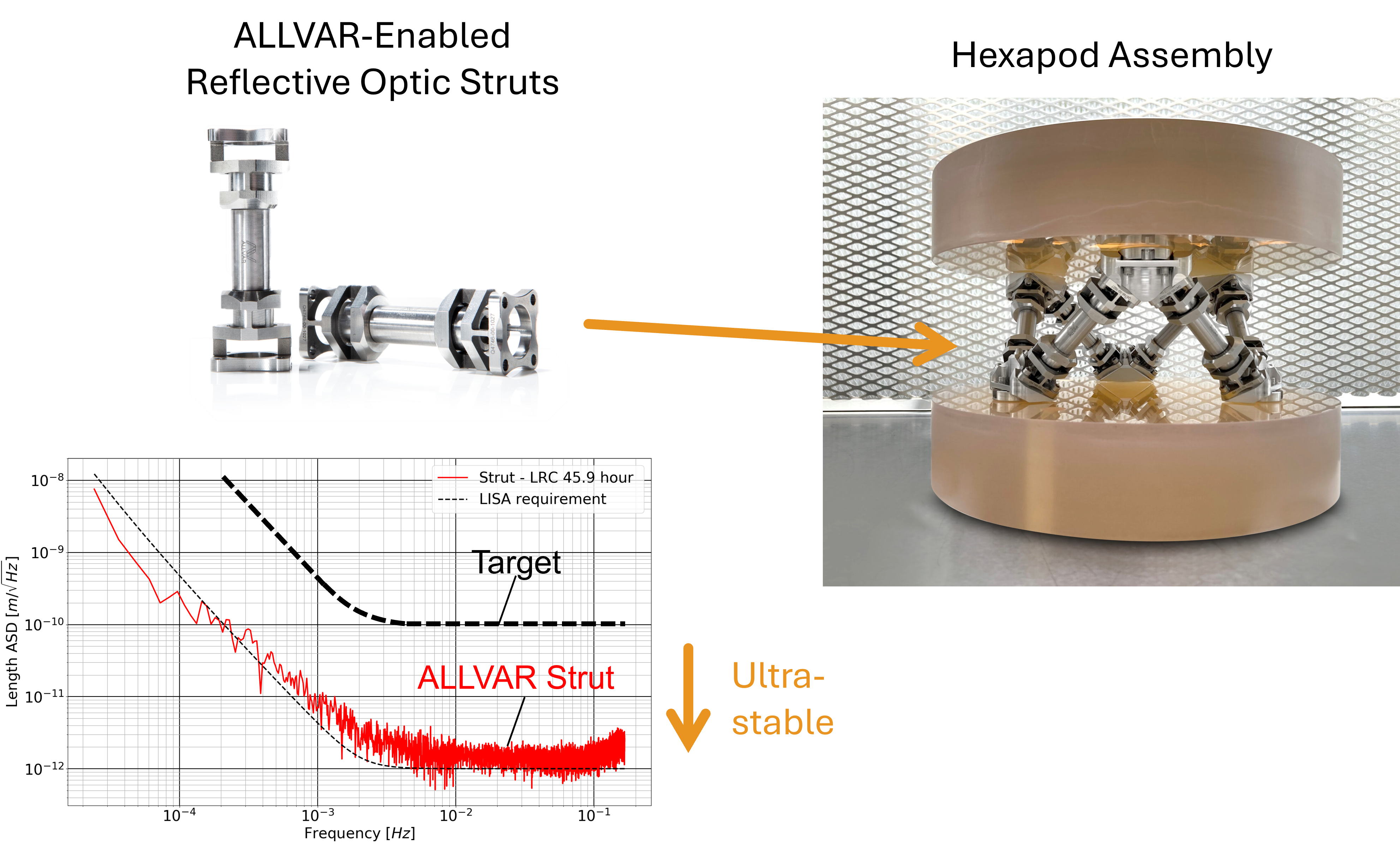
The hexapod assembly with six ALLVAR Alloy struts was measured for long-term stability. The stability of the individual struts and the hexapod assembly were measured using interferometry at the University of Florida’s Institute for High Energy Physics and Astrophysics. The struts were found to have a length noise well below the proposed target for the success criteria for the project.
Credit: (left) ALLVAR and (right) Simon F. Barke, Ph.D.
To demonstrate that negative thermal expansion alloys can enable ultra-stable structures, the ALLVAR team developed a hexapod structure to separate two mirrors made of a commercially available glass ceramic material with ultra-low thermal expansion properties. Invar was bonded to the mirrors and flexures made of Ti6Al4V—a titanium alloy commonly used in aerospace applications—were attached to the Invar. To compensate for the positive CTEs of the Invar and Ti6Al4V components, an NTE ALLVAR Alloy 30 tube was used between the Ti6Al4V flexures to create the struts separating the two mirrors. The natural positive thermal expansion of the Invar and Ti6Al4V components is offset by the negative thermal expansion of the NTE alloy struts, resulting in a structure with an effective zero thermal expansion.
The stability of the structure was evaluated at the University of Florida Institute for High Energy Physics and Astrophysics. The hexapod structure exhibited stability well below the 100 pm/√Hz target and achieved 11 pm/√Hz. This first iteration is close to the 10 pm stability required for the future Habitable Worlds Observatory. A paper and presentation made at the August 2021 Society of Photo-Optical Instrumentation Engineers conference provides details about this analysis.
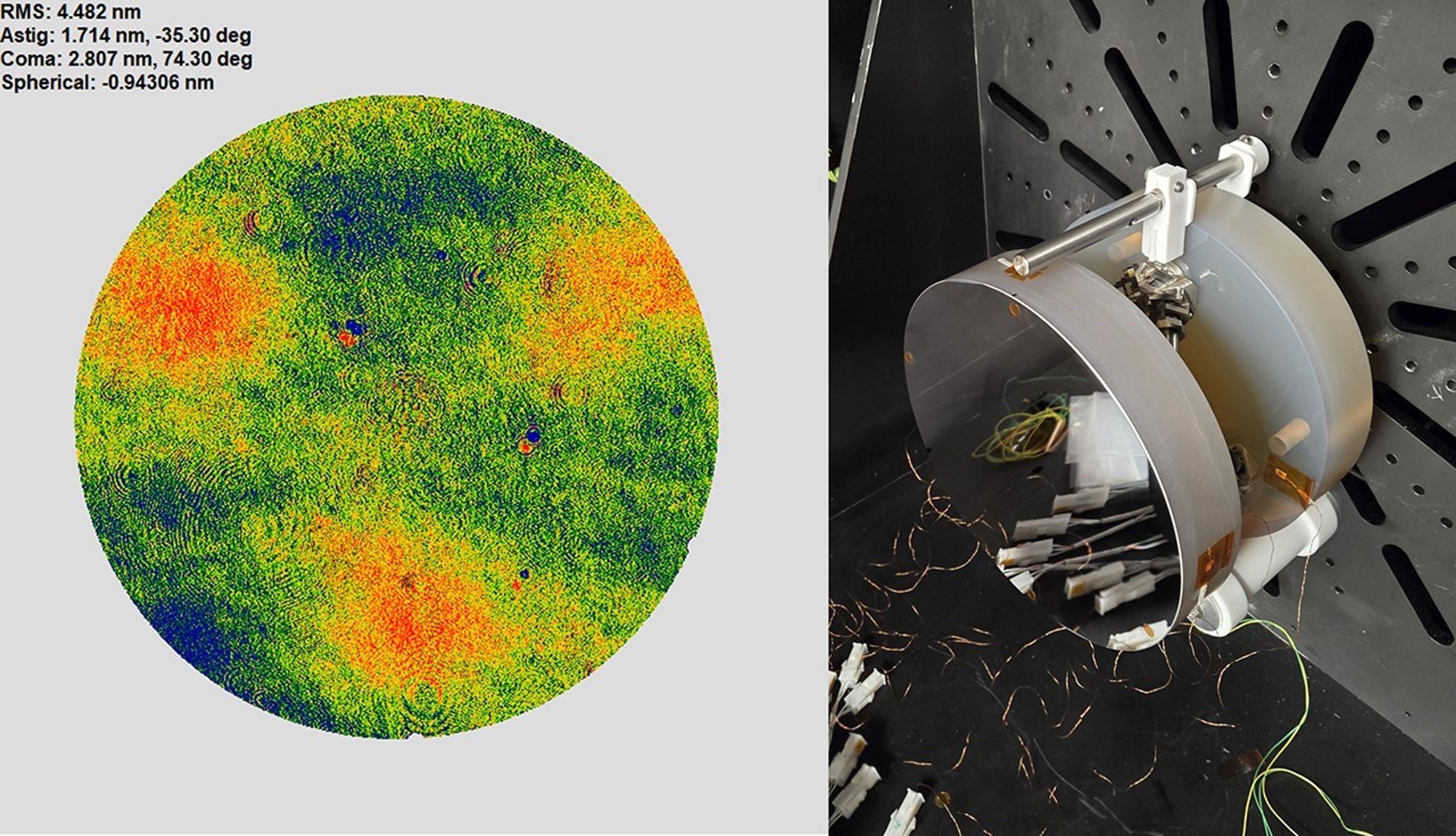
Furthermore, a series of tests run by NASA Marshall showed that the ultra-stable struts were able to achieve a near-zero thermal expansion that matched the mirrors in the above analysis. This result translates into less than a 5 nm root mean square (rms) change in the mirror’s shape across a 28K temperature change.
The ALLVAR enabled Ultra-Stable Hexapod Assembly undergoing Interferometric Testing between 293K and 265K (right). On the left, the Root Mean Square (RMS) changes in the mirror’s surface shape are visually represented. The three roughly circular red areas are caused by the thermal expansion mismatch of the invar bonding pads with the ZERODUR mirror, while the blue and green sections show little to no changes caused by thermal expansion. The surface diagram shows a less than 5 nanometer RMS change in mirror figure.
Credit: NASA’s X-Ray and Cryogenic Facility [XRCF]
Beyond ultra-stable structures, the NTE alloy technology has enabled enhanced passive thermal switch performance and has been used to remove the detrimental effects of temperature changes on bolted joints and infrared optics. These applications could impact technologies used in other NASA missions. For example, these new alloys have been integrated into the cryogenic sub-assembly of Roman’s coronagraph technology demonstration. The addition of NTE washers enabled the use of pyrolytic graphite thermal straps for more efficient heat transfer. ALLVAR Alloy 30 is also being used in a high-performance passive thermal switch incorporated into the UC Berkeley Space Science Laboratory’s Lunar Surface Electromagnetics Experiment-Night (LuSEE Night) project aboard Firefly Aerospace’s Blue Ghost Mission 2, which will be delivered to the Moon through NASA’s CLPS (Commercial Lunar Payload Services) initiative. The NTE alloys enabled smaller thermal switch size and greater on-off heat conduction ratios for LuSEE Night.
Through another recent NASA SBIR effort, the ALLVAR team worked with NASA’s Jet Propulsion Laboratory to develop detailed datasets of ALLVAR Alloy 30 material properties. These large datasets include statistically significant material properties such as strength, elastic modulus, fatigue, and thermal conductivity. The team also collected information about less common properties like micro-creep and micro-yield. With these properties characterized, ALLVAR Alloy 30 has cleared a major hurdle towards space-material qualification.
As a spinoff of this NASA-funded work, the team is developing a new alloy with tunable thermal expansion properties that can match other materials or even achieve zero CTE. Thermal expansion mismatch causes dimensional stability and force-load issues that can impact fields such as nuclear engineering, quantum computing, aerospace and defense, optics, fundamental physics, and medical imaging. The potential uses for this new material will likely extend far beyond astronomy. For example, ALLVAR developed washers and spacers, are now commercially available to maintain consistent preloads across extreme temperature ranges in both space and terrestrial environments. These washers and spacers excel at counteracting the thermal expansion and contraction of other materials, ensuring stability for demanding applications.
The following NASA organizations sponsored this effort: NASA Astrophysics Division, NASA SBIR Program funded by the Space Technology Mission Directorate (STMD).
The NASA Ames Science Directorate recognizes the outstanding contributions of (pictured left to right) Sigrid Reinsch, Lori Munar, Kevin Sims, and Matthew Fladeland. Their commitment to the NASA mission represents the entrepreneurial spirit, technical expertise, and collaborative disposition needed to explore this world and beyond.
Space Biosciences Star: Sigrid Reinsch
As Director of the SHINE (Space Health Impacts for the NASA Experience) program and Project Scientist for NBISC (NASA Biological Institutional Scientific Collection), Sigrid Reinsch is a high-performing scientist and outstanding mentor in the Space Biosciences Research Branch. Her dedication to student training and her efforts to streamline processes have significantly improved the experience of welcoming summer interns at NASA Ames.
Space Science and Astrobiology Star: Lori Munar
Lori Munar serves as the assistant Branch Chief of the Exobiology Branch. In the past few months, she has gone above and beyond to organize a facility and laboratory surplus event that involved multiple divisions over multiple days. The event resulted in considerable savings across the groups involved and improved the safety of N239 staff and the appearance of offices and labs.
Space Science and Astrobiology Star: Kevin Sims
Kevin Sims is a NASA Technical Project Manager serving the Astrophysics Branch as a member of the Flight Systems Implementation Branch in the Space Biosciences Division. Kevin is recognized for outstanding project management for exoplanet imaging instrumentation development in support of the Habitable Worlds Observatory. Kevin has streamlined, organized, and improved the efficiency of the Ames Photonics Testbed being developed as part the AstroPIC Early Career Initiative project.
Earth Science Star: Matthew Fladeland
Matthew Fladeland is a research scientist in the Earth Science Division managing NASA SMD’s Program Office for the Airborne Science Program, located at Ames. He is recognized for exemplary leadership and teamwork leading to new reimbursable agreements with the Department of Defense, for accelerating science technology solutions through the SBIR program, and for advancing partnerships with the US Forest Service on wildland ecology and fire science.
NASA has awarded a task order to Florida Power and Light of Juno Beach, Florida, to provide electric distribution utility service at the agency’s Kennedy Space Center in Florida.
This is a fixed-price task order with an estimated value of $70 million over five years. The contract consists of a two-year base period beginning July 1, 2025, followed by a two-year and a one-year option period.
Under the contract, the awardee will provide all management, labor, transportation, facilities, materials, and equipment to provide electric distribution utility service up to and including all meters across the spaceport.
The Roscosmos Progress 90 cargo craft approaches the International Space Station for a docking to the Poisk module delivering nearly three tons of food, fuel, and supplies replenishing the Expedition 72 crew.
Credit: NASA
NASA will provide live coverage of the launch and docking of a Roscosmos cargo spacecraft delivering approximately three tons of food, fuel, and supplies to the Expedition 73 crew aboard the International Space Station.
The unpiloted Roscosmos Progress 92 spacecraft is scheduled to launch at 3:32 p.m. EDT, Thursday, July 3 (12:32 a.m. Baikonur time, Friday, July 4), on a Soyuz rocket from the Baikonur Cosmodrome in Kazakhstan.
Live launch coverage will begin at 3:10 p.m. on NASA+. Learn how to watch NASA content through a variety of platforms, including social media.
After a two-day, in-orbit journey to the station, the spacecraft will dock autonomously to the space-facing port of the orbiting laboratory’s Poisk module at 5:27 p.m. on Saturday, July 5. NASA’s rendezvous and docking coverage will begin at 4:45 p.m. on NASA+.
The Progress 92 spacecraft will remain docked to the space station for approximately six months before departing for re-entry into Earth’s atmosphere to dispose of trash loaded by the crew.
Ahead of the spacecraft’s arrival, the Progress 90 spacecraft will undock from the Poisk module on Tuesday, July 1. NASA will not stream undocking.
The International Space Station is a convergence of science, technology, and human innovation that enables research not possible on Earth. For nearly 25 years, NASA has supported a continuous U.S. human presence aboard the orbiting laboratory, through which astronauts have learned to live and work in space for extended periods of time. The space station is a springboard for developing a low Earth economy and NASA’s next great leaps in exploration, including missions to the Moon under Artemis and, ultimately, human exploration of Mars.
Learn more about the International Space Station, its research, and crew, at:
Astrophysics Science Video Producer – Goddard Space Flight Center
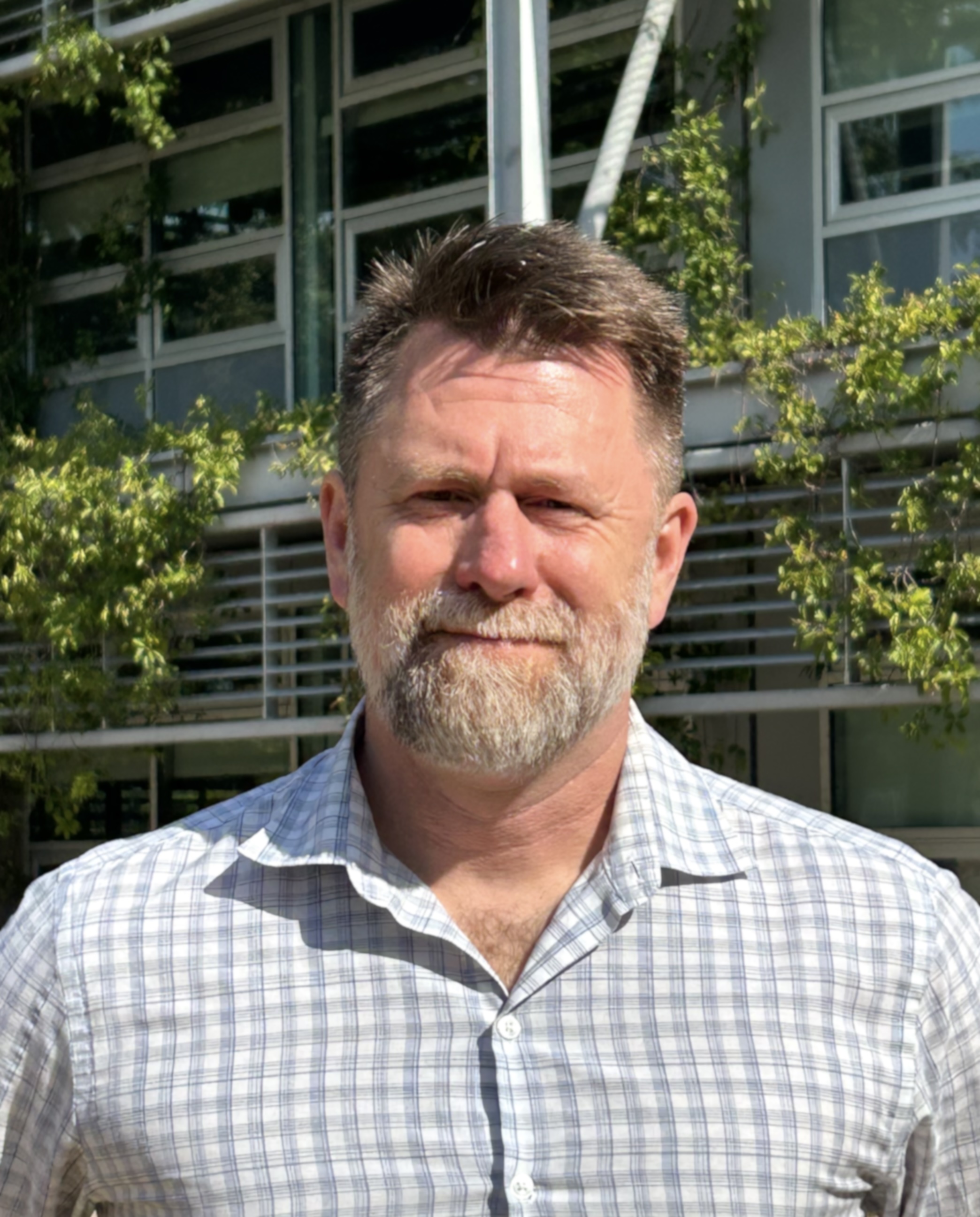
Growing up in Detroit with a camera in her hand, Sophia Roberts — now an award-winning astrophysics science video producer—never imagined that one day her path would wind through clean rooms, vacuum chambers, and even a beryllium mine. But framing the final frontier sometimes requires traveling through some of Earth’s less-explored corners.
Sophia Roberts is an astrophysics Science video producer at NASA’s Goddard Space Flight Center in Greenbelt, Md. She films space hardware assembly and explains complicated topics, weaving science and art together.
Credit: Courtesy of Sophia Roberts
Sophia received her first camera from her father, a photography enthusiast, when she was just five or six years old. “I’ve basically been snapping away ever since!” she says.
With a natural curiosity and enthusiasm for science, Sophia pursued a degree in biology at Oberlin College in Ohio. There, she discovered that she could blend her two passions.
“I often lingered in lab sessions, not to finish an experiment but to photograph it,” Sophia says. “I had an epiphany at the beginning of class one day, which always opened with clips from BBC nature documentaries. I decided right then that I would be one of the people who make those videos one day.”
Part of Sophia’s role currently involves documenting NASA’s Nancy Grace Roman Space Telescope, which is taking shape and being tested at NASA Goddard. She captured a cosmic selfie while photographing the telescope’s primary mirror, which was designed and built by L3Harris Technologies in Rochester, New York, before it was integrated with other components.
Credit: NASA/Sophia Roberts
She initially thought that meant wildlife filmmaking—perched in a blind on a mountainside, waiting hours for an animal to appear. That dream led her to Montana State University, where she learned to blend scientific rigor with visual storytelling through their science and natural history filmmaking master’s program.
While completing her degree, Sophia worked as a traveling presenter for the Montana Space Grant Consortium. “I was mainly giving presentations about NASA missions and showing kids beautiful images of space,” she says. “That was my first true introduction to NASA. I loved being able to watch the children’s eyes light up when they saw what’s out there in space.”
Sophia then completed an internship at the Smithsonian’s National Museum of Natural History while completing her thesis. Once she graduated, she landed a year-long fellowship at NASA’s Goddard Space Flight Center in Greenbelt, Maryland, as an Earth science news fellow. In this role, she focused on packaging up stories through satellite imagery and explanations.
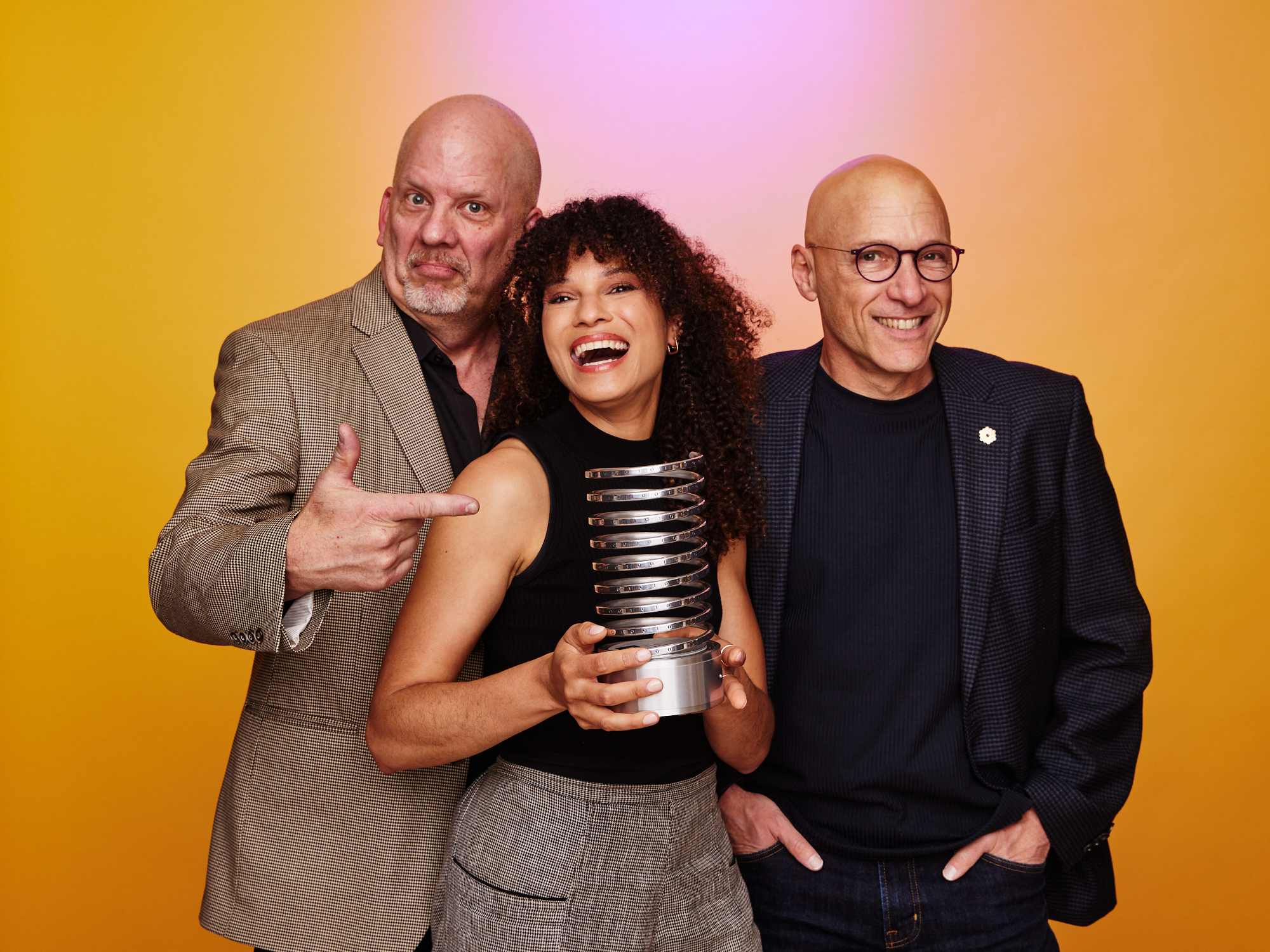
Sophia holds a Webby award she, Mike McClare (left), and Michael Starobin (right) won for their broadcasts of the James Webb Space Telescope’s launch, deployment, and first images.
Credit: James Hartley
She leaned into her videography skills in her next role, as part of NASA’s James Webb Space Telescope team.
“Webb is one of my great loves in life,” she says. “I learned to negotiate with engineers for the perfect shot, navigate NASA’s protocols, and work with mission partners. I only spent five years on Webb, but it feels like it was half my life. Still—it was everything.”
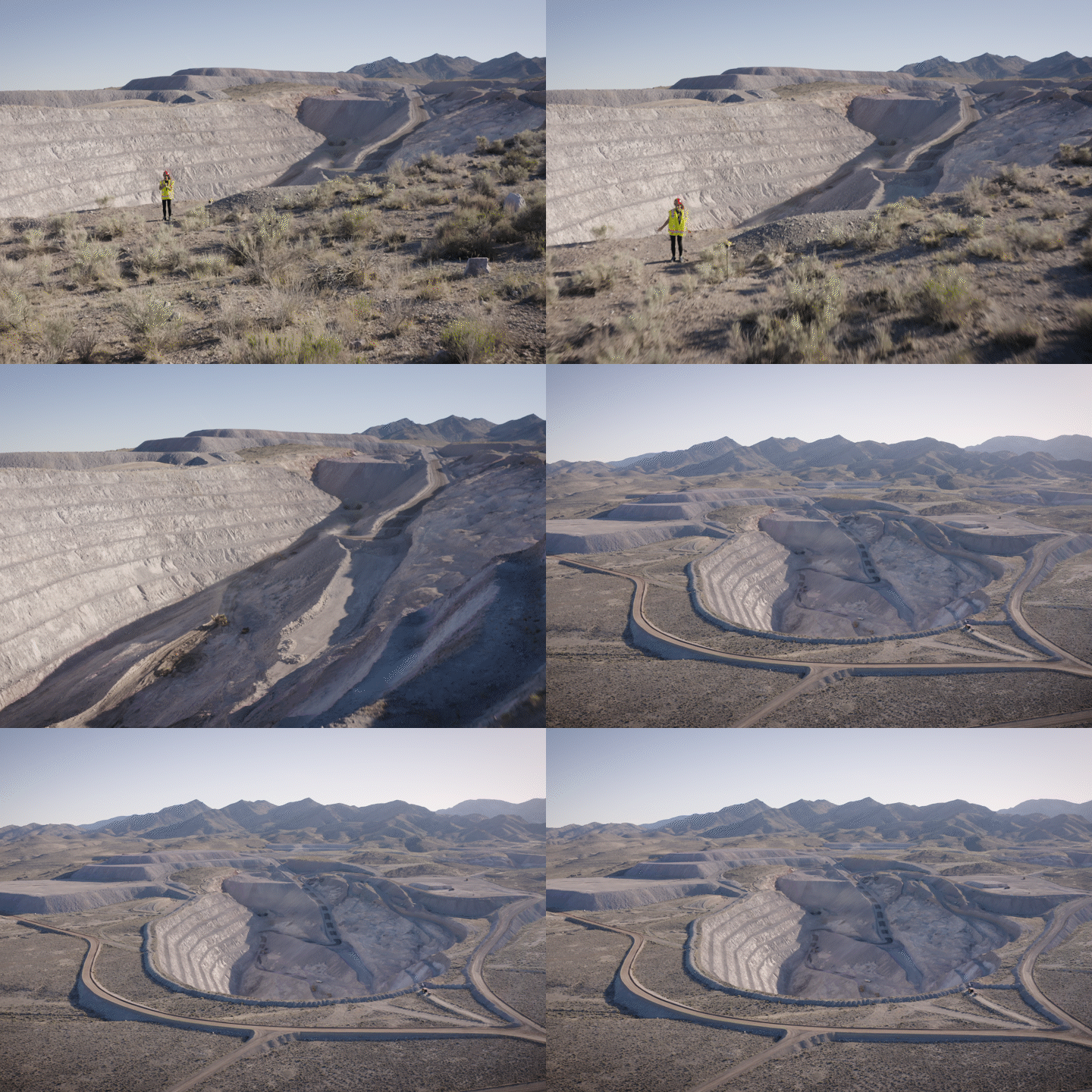
That mission took her to some unforgettable places, like a mine in Delta, Utah, where raw material for Webb’s mirrors was unearthed. “It was this giant, spiral pit where they were mining beryllium at just 0.02% concentration,” Sophia says. The process was as otherworldly as the location.
In 2021, Sophia traveled to Delta, Utah to capture behind-the-scenes footage of raw material for the James Webb Space Telescope’s mirrors being unearthed. In this gif, a drone captures an aerial view of the site.
Credit: Scott Rogers
She also documented thermal vacuum testing at NASA’s Johnson Space Center in Houston in a giant pill-shaped chamber with a 40-foot round door. “I had to take confined space training to crawl around in the area underneath the chamber,” she says. “It felt like spelunking.”
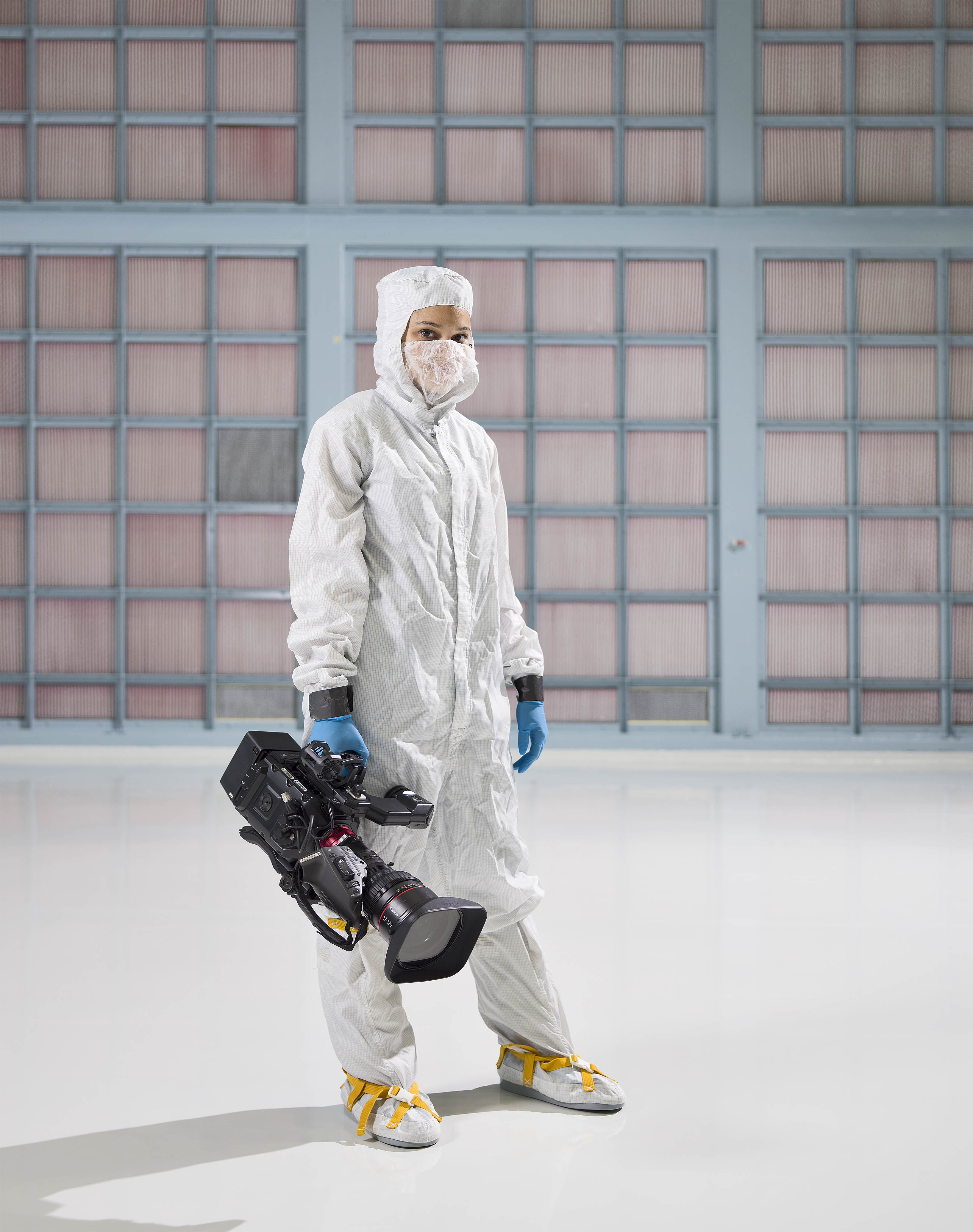
Once Webb launched, Sophia pivoted to covering many of NASA’s smaller astrophysics missions along with the upcoming Nancy Grace Roman Space Telescope. These days, she can often be found gowned up in a “bunny suit” in the largest clean room at Goddard to document space telescope assembly, or in a studio recording science explanations.
Sophia stands in the largest clean room at Goddard, where she documents space hardware coming together.
Credit: NASA/Chris Gunn
“I love capturing the visual stories and helping fill in the gaps to help people understand NASA research,” Sophia says. “I try to focus on the things that will get people excited about the science so they’ll stop scrolling to find out more.”
For Sophia, the process is often as exhilarating as the result. “I love venturing out to remote places where science is being done,” she says. “I’d love to film a balloon launch in Antarctica someday!”
Jacob Pinter (left), host of NASA’s Curious Universe Podcast, leads a discussion with Sophia Roberts (center), a NASA video producer who documented the Webb project, and Paul Geithner (right), former deputy project manager for NASA’s James Webb Space Telescope, following a screening of the new NASA+ documentary “Cosmic Dawn: The Untold Story of the James Webb Space Telescope,” Wednesday, June 11, 2025, at the Greenbelt Cinema in Greenbelt, Md. Featuring never-before-seen footage, Cosmic Dawn offers an unprecedented glimpse into Webb’s assembly, testing, and launch.
Credit: NASA/Joel Kowsky
To others who dream of pursuing a similar career, Sophia recommends diving in headfirst. “With cameras readily available and free online platforms, it’s never been easier to get into the media,” she says. “You just have to be careful to research your topic and sources, making sure you really know what you’re sharing and understand that science is always evolving as we learn more.” And Sophia emphasizes how important storytelling is for conveying information, especially when it’s as complex as astrophysics. “Studying science is wonderful, but I also think helping people visualize it is magical.”
By Ashley Balzer NASA’s Goddard Space Flight Center in Greenbelt, Md.
This website uses cookies to improve your experience. We'll assume you're ok with this, but you can opt-out if you wish.AcceptRead More
Privacy & Cookies Policy
Privacy Overview
This website uses cookies to improve your experience while you navigate through the website. Out of these, the cookies that are categorized as necessary are stored on your browser as they are essential for the working of basic functionalities of the website. We also use third-party cookies that help us analyze and understand how you use this website. These cookies will be stored in your browser only with your consent. You also have the option to opt-out of these cookies. But opting out of some of these cookies may affect your browsing experience.
Necessary cookies are absolutely essential for the website to function properly. This category only includes cookies that ensures basic functionalities and security features of the website. These cookies do not store any personal information.
Any cookies that may not be particularly necessary for the website to function and is used specifically to collect user personal data via analytics, ads, other embedded contents are termed as non-necessary cookies. It is mandatory to procure user consent prior to running these cookies on your website.