Tag: solar system

  • NASA Fosters Innovative, Far-Out Tech for the Future of Aerospace

    4 min read

    Preparations for Next Moonwalk Simulations Underway (and Underwater)

    A collage of artist concepts include colorful science, space, and health imagery to represent innovation.
    A collage of artist concepts highlighting the novel approaches proposed by the 2025 NIAC awardees for possible future missions.

    Through the NASA Innovative Advanced Concepts (NIAC) program, NASA nurtures visionary yet credible concepts that could one day “change the possible” in aerospace, while engaging America’s innovators and entrepreneurs as partners in the journey.  

    These concepts span various disciplines and aim to advance capabilities such as finding resources on distant planets, making space travel safer and more efficient, and even providing benefits to life here on Earth. The NIAC portfolio of studies also includes several solutions and technologies that could help NASA achieve a future human presence on Mars. One concept at a time, NIAC is taking technology concepts from science fiction to reality.  

    Breathing beyond Earth 

    Astronauts have a limited supply of water and oxygen in space, which makes producing and maintaining these resources extremely valuable. One NIAC study investigates a system to separate oxygen and hydrogen gas bubbles in microgravity from water, without touching the water directly. Researchers found the concept can handle power changes, requires less clean water, works in a wide range of temperatures, and is more resistant to bacteria than existing oxygen generation systems for short-term crewed missions. These new developments could make it a great fit for a long trip to Mars.  

    Newly selected for another phase of study, the team wants to understand how the system will perform over long periods in space and consider ways to simplify the system’s build. They plan to test a large version of the system in microgravity in hopes of proving how it may be a game changer for future missions. 

    Detoxifying water on Mars

    Unlike water on Earth, Mars’ water is contaminated with toxic chemical compounds such as perchlorates and chlorates. These contaminants threaten human health even at tiny concentrations and can easily corrode hardware and equipment. Finding a way to remove contaminates from water will benefit future human explorers and prepare them to live on Mars long term. 

    Researchers are creating a regenerative perchlorate reduction system that uses perchlorate reduction pathways from naturally occurring bacteria. Perchlorate is a compound comprised of oxygen and chlorine that is typically used for rocket propellant. These perchlorate reduction pathways can be engineered into a type of bacterium that is known for its remarkable resilience, even in the harsh conditions of space. The system would use these enzymes to cause the biochemical reduction of chlorate and perchlorate to chloride and oxygen, eliminating these toxic molecules from the water. With the technology to detoxify water on Mars, humans could thrive on the Red Planet with an abundant water supply. 

    Tackling deep space radiation exposure 

    Mitochondria are the small structures within cells often called the “powerhouse,” but what if they could also power human health in space? Chronic radiation exposure is among the many threats to long-term human stays in space, including time spent traveling to and from Mars. One NIAC study explores transplanting new, undamaged mitochondria to radiation-damaged cells and investigates cell responses to relevant radiation levels to simulate deep-space travel. Researchers propose using in vitro human cell models – complex 3D structures grown in a lab to mimic aspects of organs – to demonstrate how targeted mitochondria replacement therapy could regenerate cellular function after acute and long-term radiation exposure.  

    While still in early stages, the research could help significantly reduce radiation risks for crewed missions to Mars and beyond. Here on Earth, the technology could also help treat a wide variety of age-related degenerative diseases associated with mitochondrial dysfunction. 

    Suiting up for Mars 

    Mars is no “walk in the park,” which is why specialized spacesuits are essential for future missions. Engineers propose using a digital template to generate custom, cost-effective, high-performance spacesuits. This spacesuit concept uses something called digital thread technology to protect crewmembers from the extreme Martian environment, while providing the mobility to perform daily Mars exploration endeavors, including scientific excursions. 

    This now completed NIAC study focused on mapping key spacesuit components and current manufacturing technologies to digital components, identifying technology gaps, benchmarking required capabilities, and developing a conceptional digital thread model for future spacesuit development and operational support. This research could help astronauts suit up for Mars and beyond in a way like never before.   

    Redefining what’s possible 

    From studying Mars to researching black holes and monitoring the atmosphere of Venus, NIAC concepts help us push the boundaries of exploration. By collaborating with innovators and entrepreneurs, NASA advances concepts for future and current missions while energizing the space economy.  

    If you have a visionary idea to share, you can apply to NIAC’s 2026 Phase I solicitation now until July 15.

    Details

    Last Updated

    Jun 23, 2025

    Editor
    Loura Hall

  • Curiosity Blog, Sols 4577-4579: Watch the Skies

    4 min read

    Curiosity Blog, Sols 4577-4579: Watch the Skies

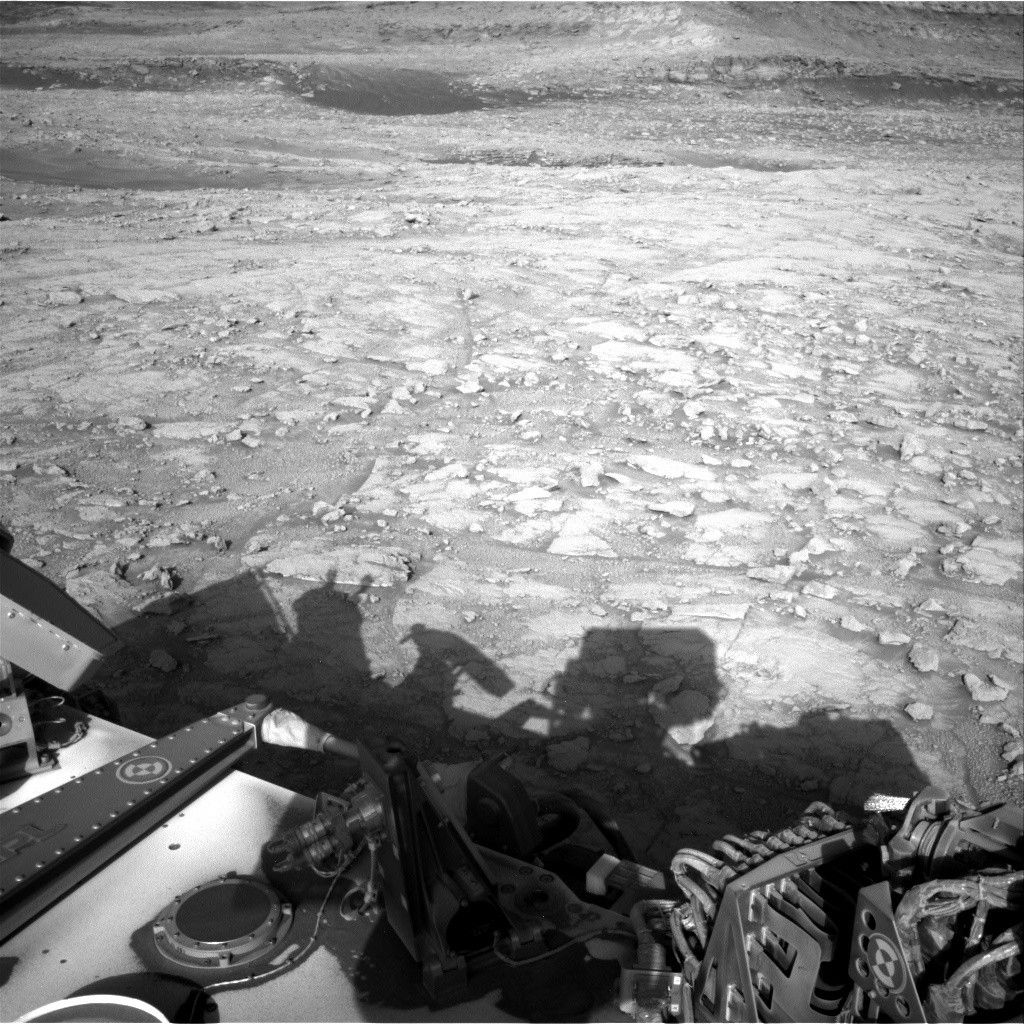
    A grayscale photograph from the Martian surface shows rough terrain covered in a multitude of small- to medium-sized rocks, resting atop timeworn surface features, all colored a fairly light gray. Part of the Curiosity rover, and a shadow it is casting, are visible at the bottom of the frame.
    NASA’s Mars rover Curiosity acquired this image inside a trough in the boxwork terrain on Mars, using its Right Navigation Camera. Curiosity captured the image on June 20, 2025 — Sol 4575, or Martian day 4,575 of the Mars Science Laboratory mission — at 00:30:12 UTC.
    NASA/JPL-Caltech

    Written by Deborah Padgett, OPGS Task Lead at NASA’s Jet Propulsion Laboratory

    Earth planning date: Friday, June 20, 2025

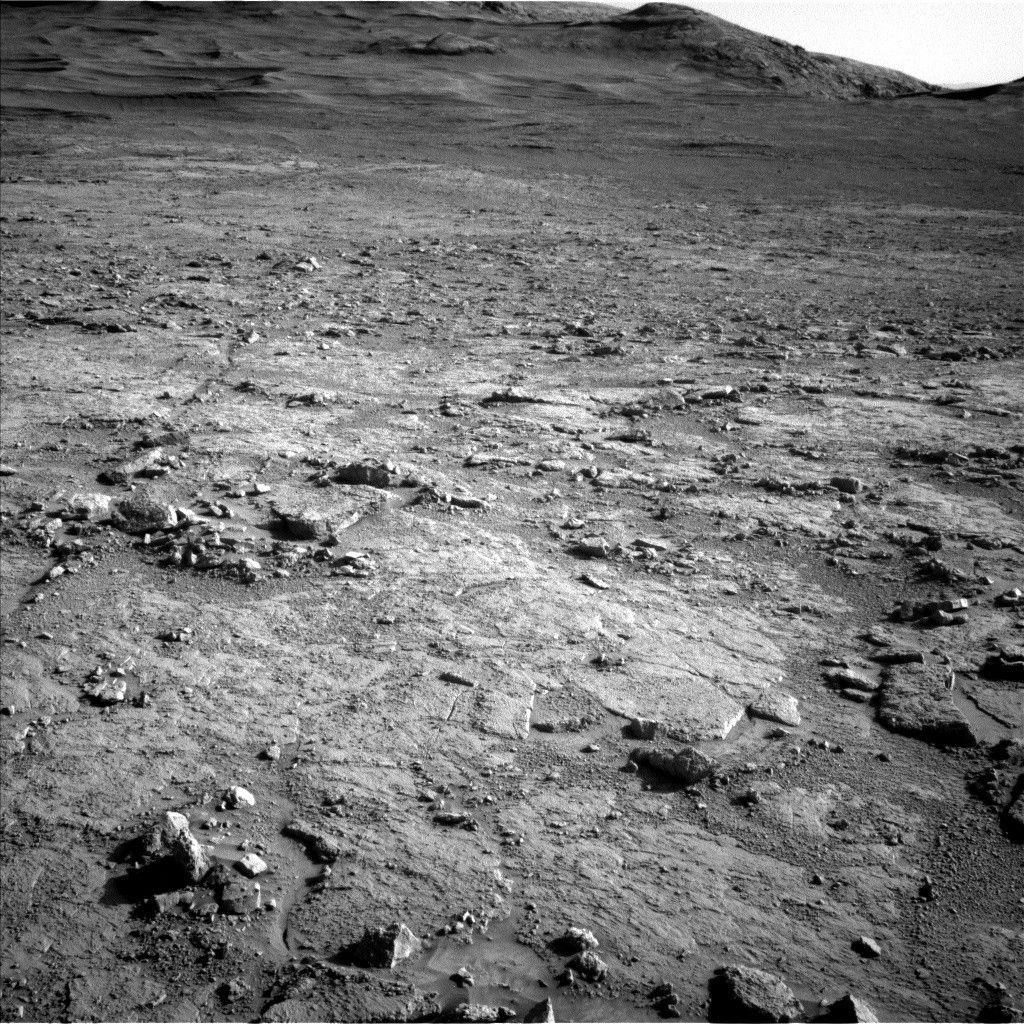
    During the plan covering Sols 4575-4576, Curiosity continued our investigation of mysterious boxwork structures on the shoulders of Mount Sharp. After a successful 56-meter drive (about 184 feet), Curiosity is now parked in a trough cutting through a highly fractured region covered by linear features thought to be evidence of groundwater flow in the distant past of Mars. With all six wheels firmly planted on solid ground, our rover is ready for contact science! Unfortunately, a repeat of the frost-detection experiment expected for the weekend plan is postponed for a few days due to a well-understood ChemCam issue. In the meantime, our atmospheric investigations have a chance to shine, as they received additional time to observe the Martian sky.

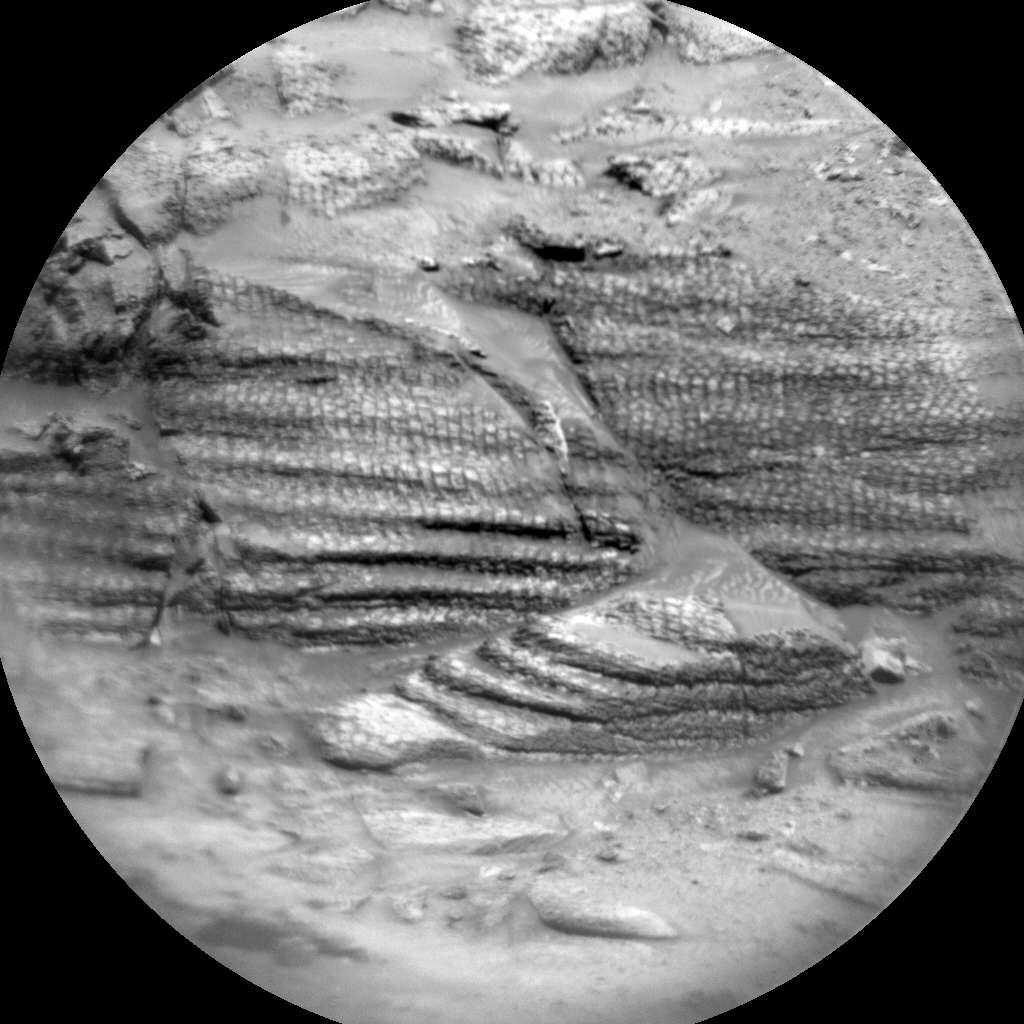
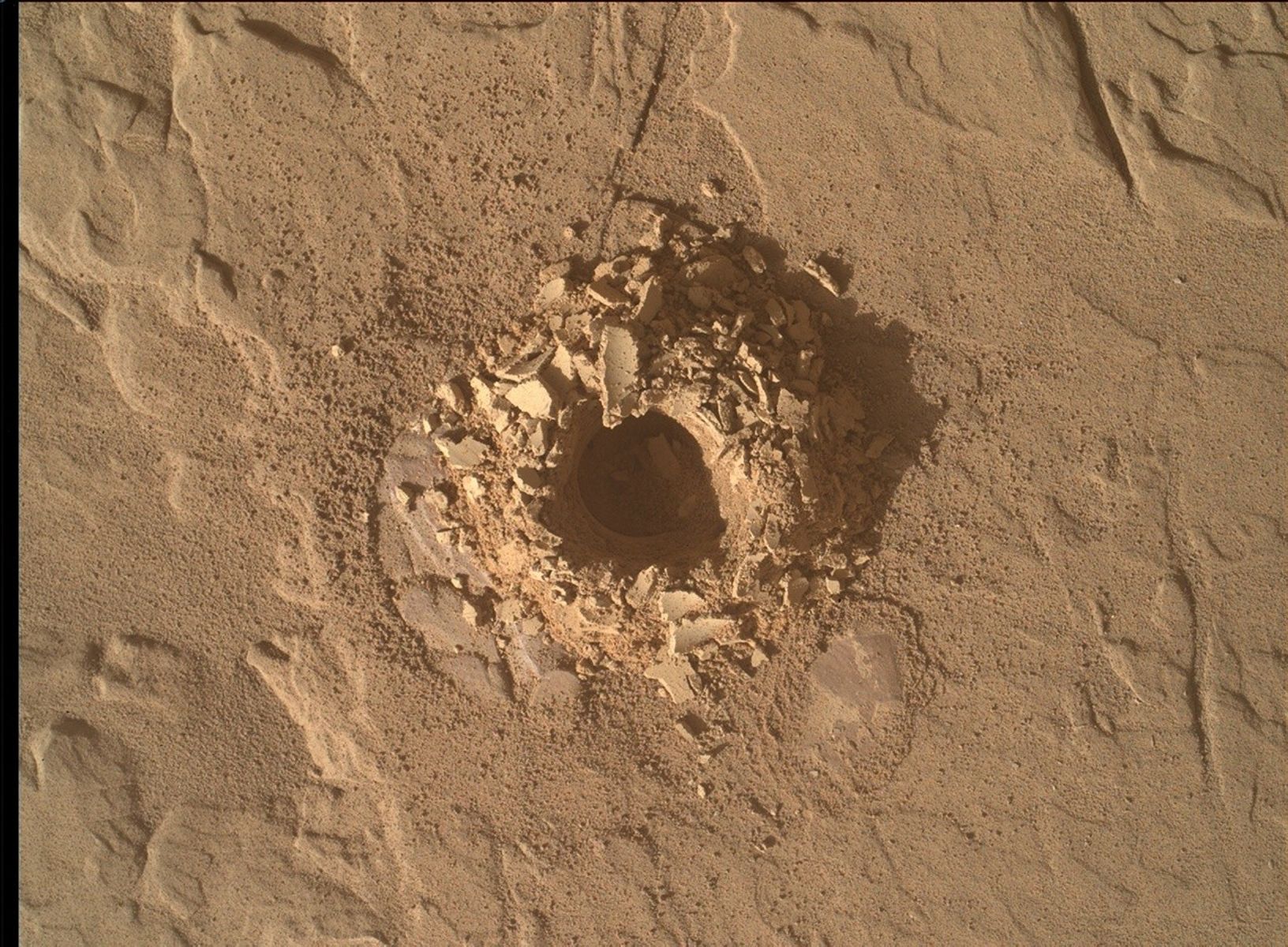
    In the early afternoon of Sol 4577, Curiosity’s navigation cameras will take a movie of the upper reaches of Aeolis Mons (Mount Sharp), hoping to see moving cloud shadows. This observation enables the team to calculate the altitude of clouds drifting over the peak. Next, Navcam will point straight up, to image cloud motion at the zenith and determine wind direction at their altitude. Mastcam will then do a series of small mosaics to study the rover workspace and features of the trough that Curiosity has entered. First is a 6×4 stereo mosaic of the workspace and the contact science targets “Copacabana” and “Copiapo.” The first target is a representative sample of the trough bedrock, and its name celebrates a town in Bolivia located on the shores of Lake Titicaca. The second target is a section of lighter-toned material, which may be associated with stripes or “veins” filling the many crosscutting fractures in the local stones. These are the deposits potentially left by groundwater intrusion long ago. The name “Copiapo” honors a silver mining city in the extremely dry Atacama desert of northern Chile. A second 6×3 Mastcam stereo mosaic will look at active cracks in the trough. Two additional 5×1 Mastcam stereo mosaics target “Ardamarca,” a ridge parallel to the trough walls, and a cliff exposing layers of rock at the base of “Mishe Mokwa” butte. At our current location, all the Curiosity target names are taken from the Uyuni geologic quadrangle named after the otherworldly lake bed and ephemeral lake high on the Bolivian altiplano, but the Mishe Mokwa butte is back in the Altadena quad, named for a popular hiking trail in the Santa Monica Mountains. After this lengthy science block, Curiosity will deploy its arm, brush the dust from Copacabana with the DRT, then image both it and Copiapo with the MAHLI microscopic imager. Overnight, APXS will determine the composition of these two targets. 

    Early in the morning of Sol 4578, Mastcam will take large 27×5 and 18×3 stereo mosaics of different parts of the trough, using morning light to highlight the terrain shadows. Later in the day, Navcam will do a 360 sky survey, determining phase function across the entire sky. A 25-meter drive (about 82 feet) will follow, and the post-drive imaging includes both a 360-degree Navcam panorama of our new location and an image of the ground under the rover with MARDI in the evening twilight. The next sol is all atmospheric science, with an extensive set of afternoon suprahorizon movies and a dust-devil survey for Navcam, as well as a Mastcam dust opacity observation. The final set of observations in this plan happens on the morning of Sol 4580 with more Navcam suprahorizon and zenith movies to observe clouds, a Navcam dust opacity measurement across Gale Crater, and a last Mastcam tau. On Monday, we expect to plan another drive and hope to return to the frost-detection experiment soon as we explore the boxwork canyons of Mars.

    Details

    Last Updated

    Jun 20, 2025

    Related Terms

  • NASA History News and Notes – Summer 2025

    7 min read

    Preparations for Next Moonwalk Simulations Underway (and Underwater)

    In the summer 2025 issue of the NASA History Office’s News & Notes newsletter, examples of leadership and critical decision-making in NASA’s history form the unifying theme. Among the topics discussed are NASA’s Shuttle-Centaur program, assessing donations to the NASA Archives, how the discovery of the first exoplanet orbiting a sun-like star catalyzed NASA’s exoplanet program, and Chief of the Medical Operations Office Charles A. Berry’s decisions surrounding crew health when planning the Project Gemini missions.

    Cover page for News and Notes Volume 42 Number 2

    Volume 42, Number 2
    Summer 2025

    Featured Articles

    From the Chief Historian

    By Brian Odom

    NASA’s is a history marked by critical decisions. From George Mueller’s 1963 decision for “all up” testing of the Saturn V rocket to Michael Griffin’s 2006 decision to launch a final servicing mission to the Hubble Space Telescope, the agency has continually met key inflection points with bold decisions. These choices, such as the decision to send a crewed Apollo 8 mission around the Moon in December 1968, stand at the center of the agency’s national legacy and promote confidence in times of crisis.  Continue Reading

    Shuttle-Centaur: Loss of Launch Vehicle Redundancy Leads to Discord

    By Robert Arrighi

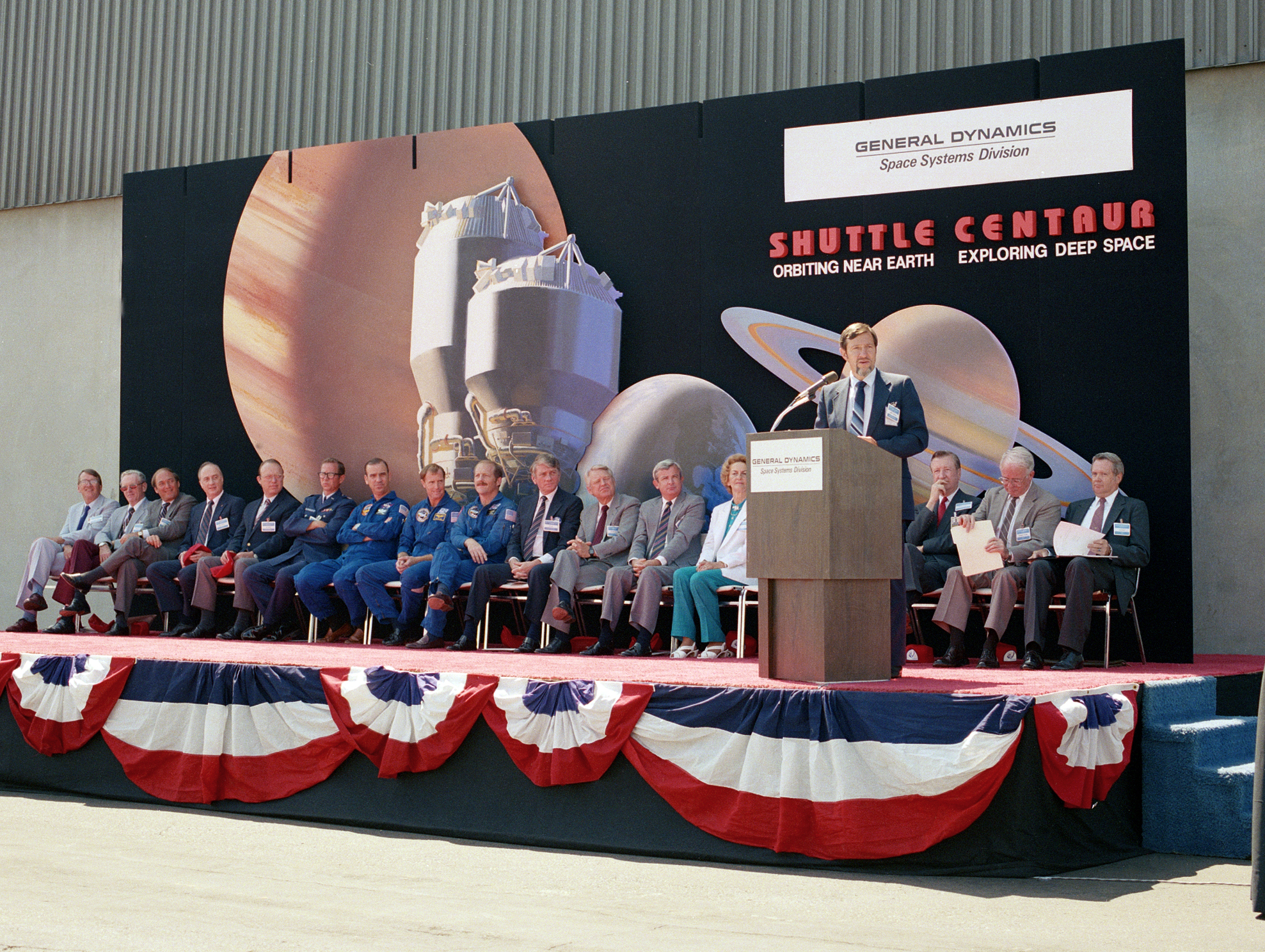
    “Although the Shuttle/Centaur decision was very difficult to make, it is the proper thing to do, and this is the time to do it.” With those words on June 19, 1986, NASA Administrator James Fletcher canceled the intensive effort to integrate the Centaur upper stage with the Space Shuttle to launch the Galileo and Ulysses spacecraft. The decision, which was tied to increased safety measures following the loss of Challenger several months earlier, brought to the forefront the 1970s decision to launch all U.S. payloads with the Space Shuttle. Continue Reading

    Speaker and seated guests on outdoor stage.
    Lewis Director Andy Stofan speaks at the Shuttle-Centaur rollout ceremony on August 23, 1985 at General Dynamics’s San Diego headquarters. Galileo mission crew members Dave Walker, Rick Hauck, and John Fabian were among those on stage. 
    NASA

    A View into NASA’s Response to the Apollo 1 Tragedy

    By Kate Mankowski

    On January 27, 1967, Mission AS-204 (later known as Apollo 1) was conducting a simulated countdown when a fire suddenly broke out in the spacecraft, claiming the lives of astronauts Virgil I. “Gus” Grissom, Edward H. White, and Roger B. Chaffee. The disaster highlighted the risks that come with spaceflight and the work that still needed to be accomplished to meet President Kennedy’s challenge of going to the Moon before the end of the decade. With the complexity of the Apollo spacecraft, discerning the cause of the fire proved to be incredibly difficult. Continue Reading

    The Fight to Fund AgRISTARS

    By Brad Massey

    Robert MacDonald, the manager of NASA’s Large Area Crop Inventory Experiment (LACIE), was not pleased in January 1978 after he read a draft copy of the U.S. General Accounting Office’s (GAO’s) “Crop Forecasting by Satellite: Progress and Problems” report. The draft’s authors argued that LACIE had not achieved its goals of accurately predicting harvest yields in the mid-1970s. Therefore, congressional leaders should “be aware of the disappointing performance of LACIE to date when considering the future direction of NASA’s Landsat program and the plans of the Department of Agriculture.” Continue Reading

    The Hubble Space Telescope: The Right Project at the Right Time

    By Jillian Rael

    This year, NASA commemorates 35 years of the Hubble Space Telescope’s study of the cosmos. From observations of never-before-seen phenomena within our solar system, to the discovery of distant galaxies, the confirmation of the existence of supermassive black holes, and precision measurements of the universe’s expansion, Hubble has made incredible contributions to science, technology, and even art. Yet, for all its contemporary popularity, the Hubble program initially struggled for congressional approval and consequential funding. For its part, NASA found new ways to compromise and cut costs, while Congress evaluated national priorities and NASA’s other space exploration endeavors against the long-range value of Hubble. Continue Reading

    c92-2
    Within the tempestuous Carina Nebula lies “Mystic Mountain.”
    NASA/ESA/M. Livio/Hubble 20th Anniversary Team

    Appraisal: The Science and Art of Assessing Donations to the NASA Archives

    By Alan Arellano

    The major functions of an archivist center include appraising, arranging, describing, preserving, and providing access to historical records and documents. While together these are pillars of archival science, they are more of an art than a science in their application, fundamentally necessitating skilled decision making. Throughout the NASA archives, staff members make these decisions day in and day out. Continue Reading

    Orbit Shift: How 50 Pegasi b Helped Pull NASA Toward the Stars in the 1990s

    By Lois Rosson

    On October 20, 1995, the New York Times reported the detection of a distant planet orbiting a Sun-like star. The star, catalogued as 51 Pegasi by John Flamsteed in the 18th century, was visible to the naked eye as part of the constellation Pegasus—and had wobbled on its axis just enough that two Swiss astronomers were able to deduce the presence of another object exerting its gravitational pull on the star’s rotation. The discovery was soon confirmed by other astronomers, and 51 Pegasi b was heralded as the first confirmed exoplanet orbiting a star similar to our own Sun. Continue Reading

    Exoplanet infographic
    Detail from an infographic about 51 Pegasi b and the significance of its discovery.
    NASA

    Four, Eight, Fourteen Days: Charles A. Berry, Gemini, and the Critical Steps to Living and Working in Space

    By Jennifer Ross-Nazzal

    In 1963, critical decisions had to be made about NASA’s upcoming Gemini missions if the nation were to achieve President John F. Kennedy’s lunar goals. Known as the bridge to Apollo, Project Gemini was critical to landing a man on the Moon by the end of the decade and returning him safely to Earth. The project would demonstrate that astronauts could rendezvous and dock their spacecraft to another space vehicle and give flight crews the opportunity to test the planned extravehicular capabilities in preparation for walking on the lunar surface on future Apollo flights. Perhaps most importantly, Gemini had to show that humans could live and work in space for long periods of time, a fiercely debated topic within and outside of the agency.  Continue Reading

    Astronaut Jim McDivitt gets a checkup
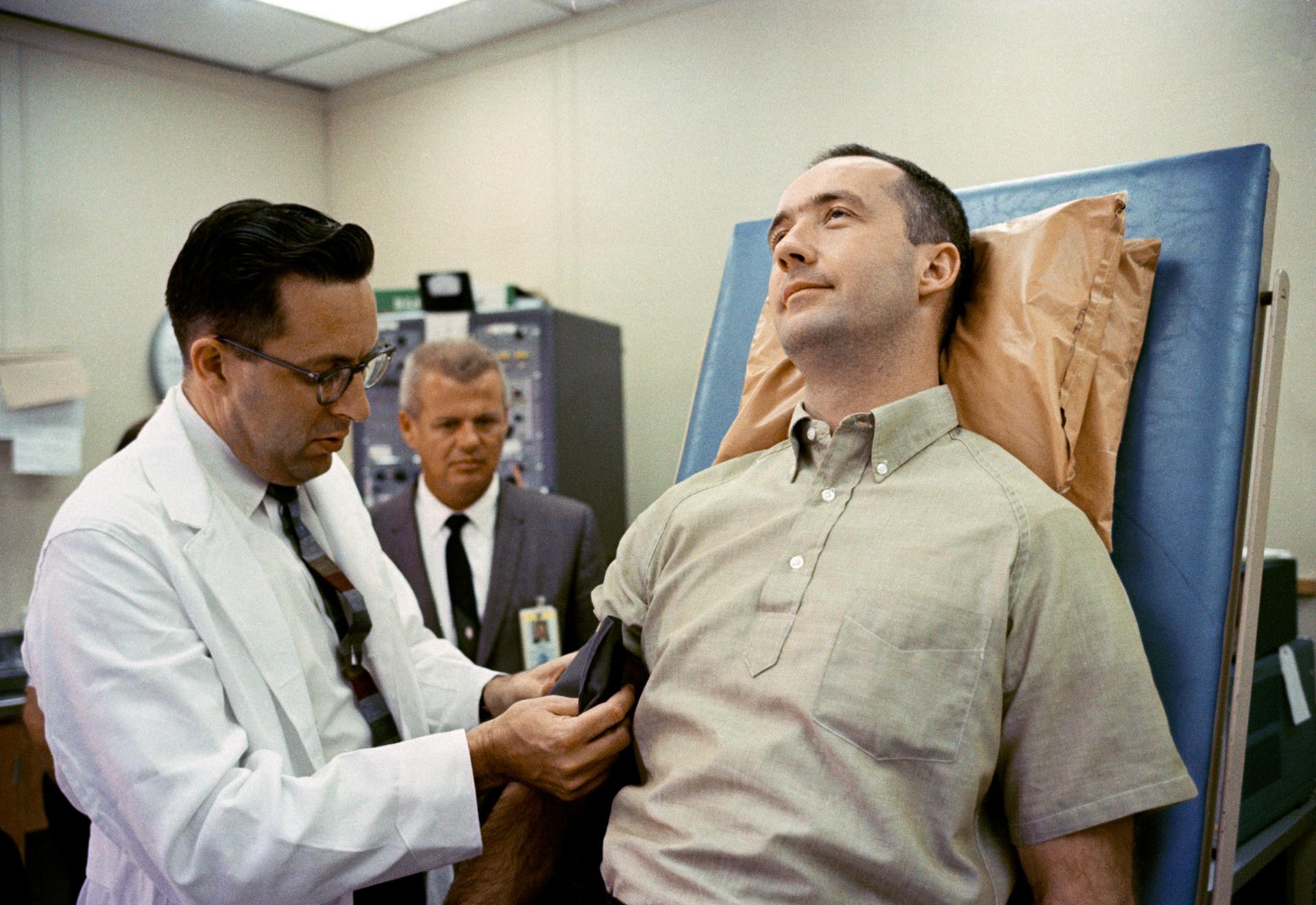
    Dr. Charles Berry prepares to check the blood pressure of James A. McDivitt, Command Pilot for the Gemini IV mission. McDivitt is on the tilt table at the Aero Medical Area, Merritt Island, FL, where he and Gemini IV pilot Edward H. White II underwent preflight physicals in preparation for their four-day spaceflight.
    NASA

    Imagining Space: The Life and Art of Robert McCall

    By Sandra Johnson

    As we walked into Bob McCall’s Arizona home, it quickly became obvious that two talented and creative people lived there. Tasked with interviewing one of the first artists to be invited to join the NASA Art Program, our oral history team quickly realized the session with McCall would include a unique perspective on NASA’s history. We traveled to Arizona in the spring of 2000 to capture interviews with some of the pioneers of spaceflight and had already talked to an eclectic group of subjects in their homes, including a flight controller for both Gemini and Apollo, an astronaut who had flown on both Skylab and Space Shuttle missions, a former NASA center director, and two former Women’s Airforce Service Pilots (WASPs) who ferried airplanes during WWII. However, unlike most interviews, the setting itself provided a rare glimpse into the man and his inspiration.  Continue Reading

    Inside the Archives: Biomedical Branch Files

    By Alejandra Lopez

    The Biomedical Branch Files (1966–2008) in the Johnson Space Center archives showcase the inner workings of a NASA office established to perform testing to provide a better understanding of the impacts of spaceflight on the human body. Ranging from memos and notes to documents and reports, this collection is an invaluable resource on the biomedical research done with NASA’s Apollo, Skylab, Space Shuttle, and Space Station projects. Files in the collection cover work done by groups within the branch such as the Toxicology, Microbiology, Clinical, and Biochemistry Laboratories. It also reveals the branch’s evolution and changes in its decision-making process over the years. Continue Reading

    Portrait of Carolyn Huntoon wearing a lab coat and sitting at her desk.
    Dr. Carolyn S. Huntoon, shown here in 1972, became the Biomedical Branch’s first chief in 1977.
    NASA

    Details

    Last Updated

    Jun 20, 2025

    Editor
    Michele Ostovar

    Related Terms

  • NASA Aircraft to Make Low-Altitude Flights in Mid-Atlantic, California

    2 min read

    Preparations for Next Moonwalk Simulations Underway (and Underwater)

    From Sunday, June 22 to Wednesday, July 2, two research aircraft will make a series of low-altitude atmospheric research flights near Philadelphia, Baltimore, and some Virginia cities, including Richmond, as well as over the Los Angeles Basin, Salton Sea, and Central Valley in California.

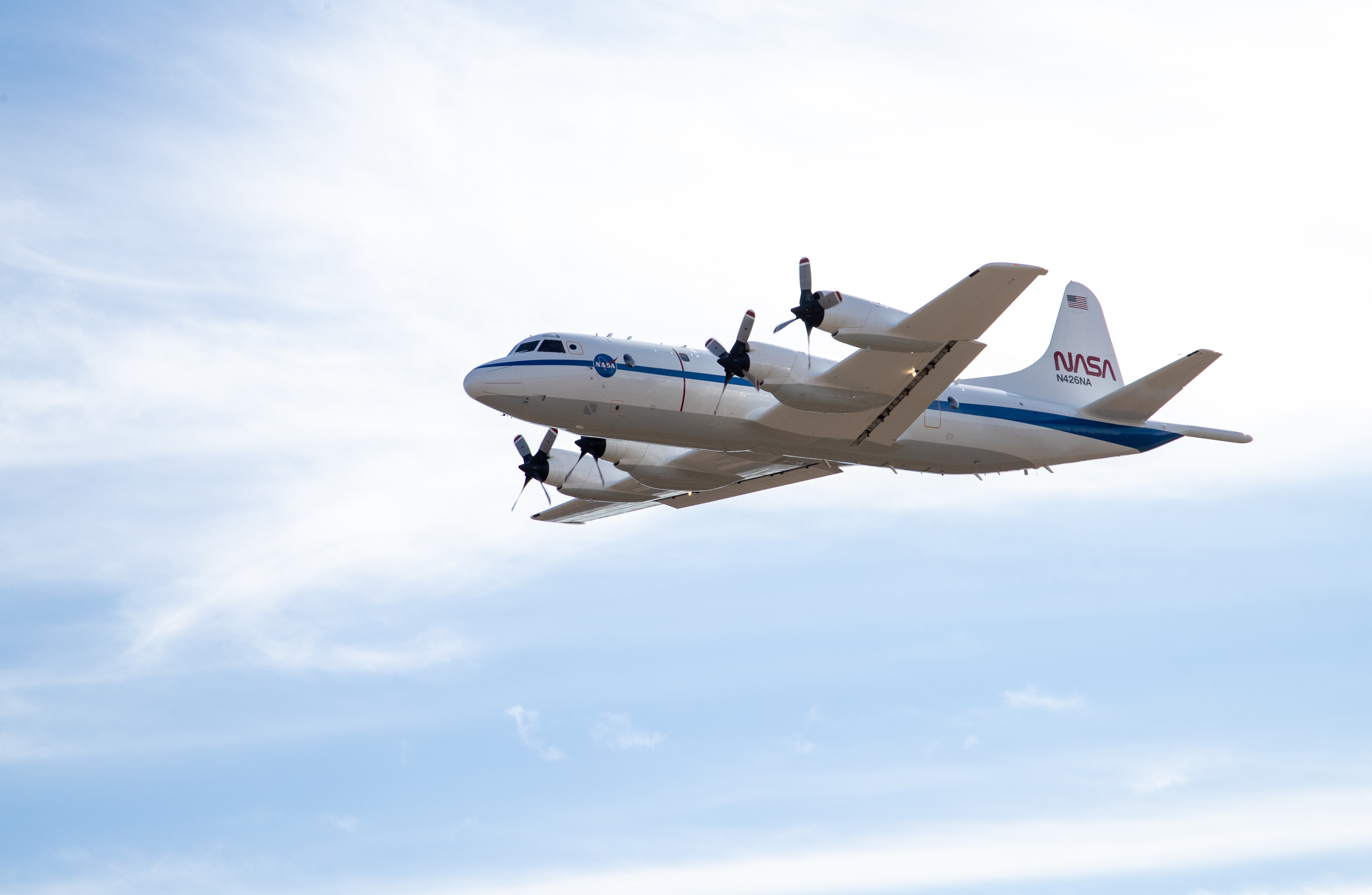
    An aircraft with four propellers and NASA logos on the side is airborne and surrounded by blue sky.
    NASA’s P-3 Orion aircraft, based out of the agency’s Wallops Flight Facility in Virginia, along with Dynamic Aviation’s King Air B200 aircraft, will fly over parts of the East and West coasts during the agency’s Student Airborne Research Program. The science flights will be conducted between June 22 and July 2, 2025.
    NASA/Garon Clark

    Pilots will operate the aircraft at altitudes lower than typical commercial flights, executing specialized maneuvers such as vertical spirals between 1,000 and 10,000 feet, circling above power plants, landfills, and urban areas. The flights will also include occasional missed approaches at local airports and low-altitude flybys along runways to collect air samples near the surface.

    The East Coast flights will be conducted between June 22 and Thursday, June 26 over Baltimore and near Philadelphia, as well as near the Virginia cities of Hampton, Hopewell, and Richmond. The California flights will occur from Sunday, June 29 to July 2.

    The flights, part of NASA’s Student Airborne Research Program (SARP), will involve the agency’s Airborne Science Program’s P-3 Orion aircraft (N426NA) and a King Air B200 aircraft (N46L) owned by Dynamic Aviation and contracted by NASA. The program is an eight-week summer internship program that provides undergraduate students with hands-on experience in every aspect of a scientific campaign.

    The P-3, operated out of NASA’s Wallops Flight Facility in Virginia, is a four-engine turboprop aircraft outfitted with a six-instrument science payload to support a combined 40 hours of SARP science flights on each U.S. coast. The King Air B200 will fly at the same time as the P-3 but in an independent flight profile. Students will assist in the operation of the science instruments on the aircraft to collect atmospheric data.

    “The SARP flights have become mainstays of NASA’s Airborne Science Program, as they expose highly competitive STEM students to real-world data gathering within a dynamic flight environment,” said Brian Bernth, chief of flight operations at NASA Wallops.

    “Despite SARP being a learning experience for both the students and mentors alike, our P-3 is being flown and performing maneuvers in some of most complex and restricted airspace in the country,” said Bernth. “Tight coordination and crew resource management is needed to ensure that these flights are executed with precision but also safely.”

    For more information about Student Airborne Research Program, visit:

    https://science.nasa.gov/earth-science/early-career-opportunities/student-airborne-research-program/

    By Olivia Littleton
    NASA’s Wallops Flight Facility, Wallops Island, Va.

    Details

    Last Updated

    Jun 20, 2025

  • Hubble Studies Small but Mighty Galaxy

    2 min read

    Hubble Studies Small but Mighty Galaxy

    This Hubble image shows the galaxy NGC 4449. The field is dominated by dust that appears dark red, with scattered brighter regions of star formation as bright pink globules. The background shows countless blue stars peeking around the dusty regions.
    This NASA/ESA Hubble Space Telescope features the nearby galaxy NGC 4449.
    ESA/Hubble & NASA, E. Sabbi, D. Calzetti, A. Aloisi

    This portrait from the NASA/ESA Hubble Space Telescope puts the nearby galaxy NGC 4449 in the spotlight. The galaxy is situated just 12.5 million light-years away in the constellation Canes Venatici (the Hunting Dogs). It is a member of the M94 galaxy group, which is near the Local Group of galaxies that the Milky Way is part of.

    NGC 4449 is a dwarf galaxy, which means that it is far smaller and contains fewer stars than the Milky Way. But don’t let its small size fool you — NGC 4449 packs a punch when it comes to making stars! This galaxy is currently forming new stars at a much faster rate than expected for its size, which makes it a starburst galaxy. Most starburst galaxies churn out stars mainly in their centers, but NGC 4449 is alight with brilliant young stars throughout. Researchers believe that this global burst of star formation came about because of NGC 4449’s interactions with its galactic neighbors. Because NGC 4449 is so close, it provides an excellent opportunity for Hubble to study how interactions between galaxies can influence the formation of new stars.

    Hubble released an image of NGC 4449 in 2007. This new version incorporates several additional wavelengths of light that Hubble collected for multiple observing programs. These programs encompass an incredible range of science, from a deep dive into NGC 4449’s star-formation history to the mapping of the brightest, hottest, and most massive stars in more than two dozen nearby galaxies.

    The NASA/ESA/CSA James Webb Space Telescope has also observed NGC 4449, revealing in intricate detail the galaxy’s tendrils of dusty gas, glowing from the intense starlight radiated by the flourishing young stars.

    Text Credit: ESA/Hubble

    Media Contact:

    Claire Andreoli (claire.andreoli@nasa.gov)
    NASA’s Goddard Space Flight CenterGreenbelt, MD

  • DIP RFI Outbrief Session

    2 min read

    Preparations for Next Moonwalk Simulations Underway (and Underwater)

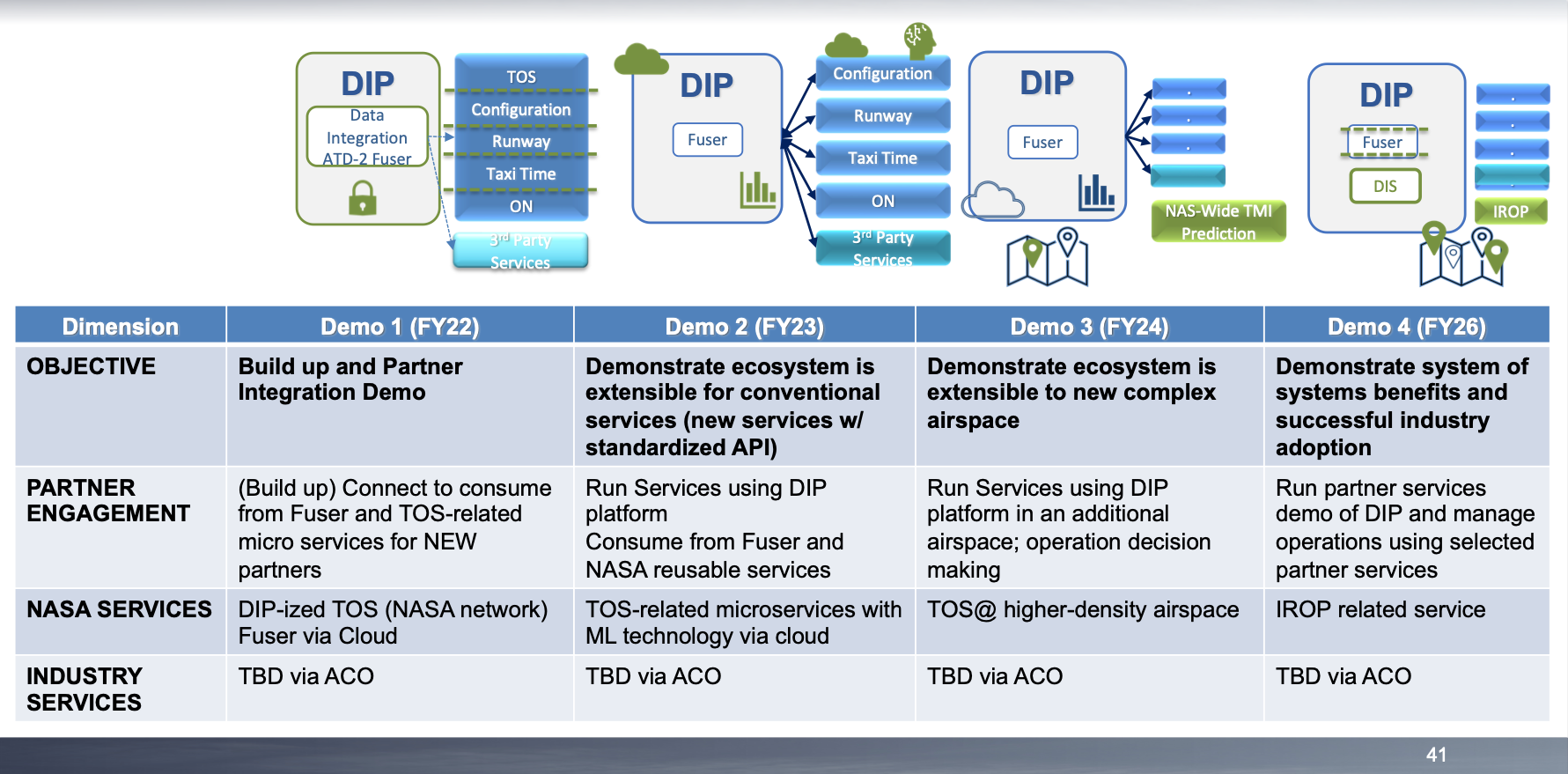
    DIP RFI Outbrief screen shot showing the DIP Collaborative Demo Milestones.
    Start
    August 18, 2021 at 10:00 AM EST
    End
    August 18, 2021 at 12:00 PM EST

    DIP RFI Outbrief Session

    NASA’s Digital Information Platform (DIP) sub-project as part of Air Traffic Management -eXploration (ATM-X) project has received responses to the Request for Information (RFI) from aviation community. As a follow-on activity, DIP is hosting an online information session to brief out to the community with the summary of RFI inputs as well as the latest updates on DIP sub-project planning. The purpose of this session is to share the valuable inputs from the RFI responses on data & service needs for airspace operations, recommended use cases for DIP collaborative demos, and potential data and technology services that can be provided by the DIP platform through NASA-industry collaboration.

    Interested parties are encouraged to register for the outbrief session by submitting the registration form shown below. The outbrief session will be organized by a series of presentation followed by a Q&A session, and will be available through MS Teams.

    • Date: Wednesday, August 18, 2021
    • Time: 10 am – 12 pm Pacific

    Agenda

    • DIP Overview
    • Partner Engagement Strategy
    • Request for Information
    • Responses Summary
    • Demo Plan Overview
    • Next Steps,
    • Q&A

    Resources

    Digital Information Platform

    Digital Information Platform Events

    Details

    Last Updated

    Jun 18, 2025

    Editor
    Lillian Gipson
    Contact
    Jim Banke

  • DIP Workshop Series 1: DIP Architecture and Date Integration Services

    3 min read

    Preparations for Next Moonwalk Simulations Underway (and Underwater)

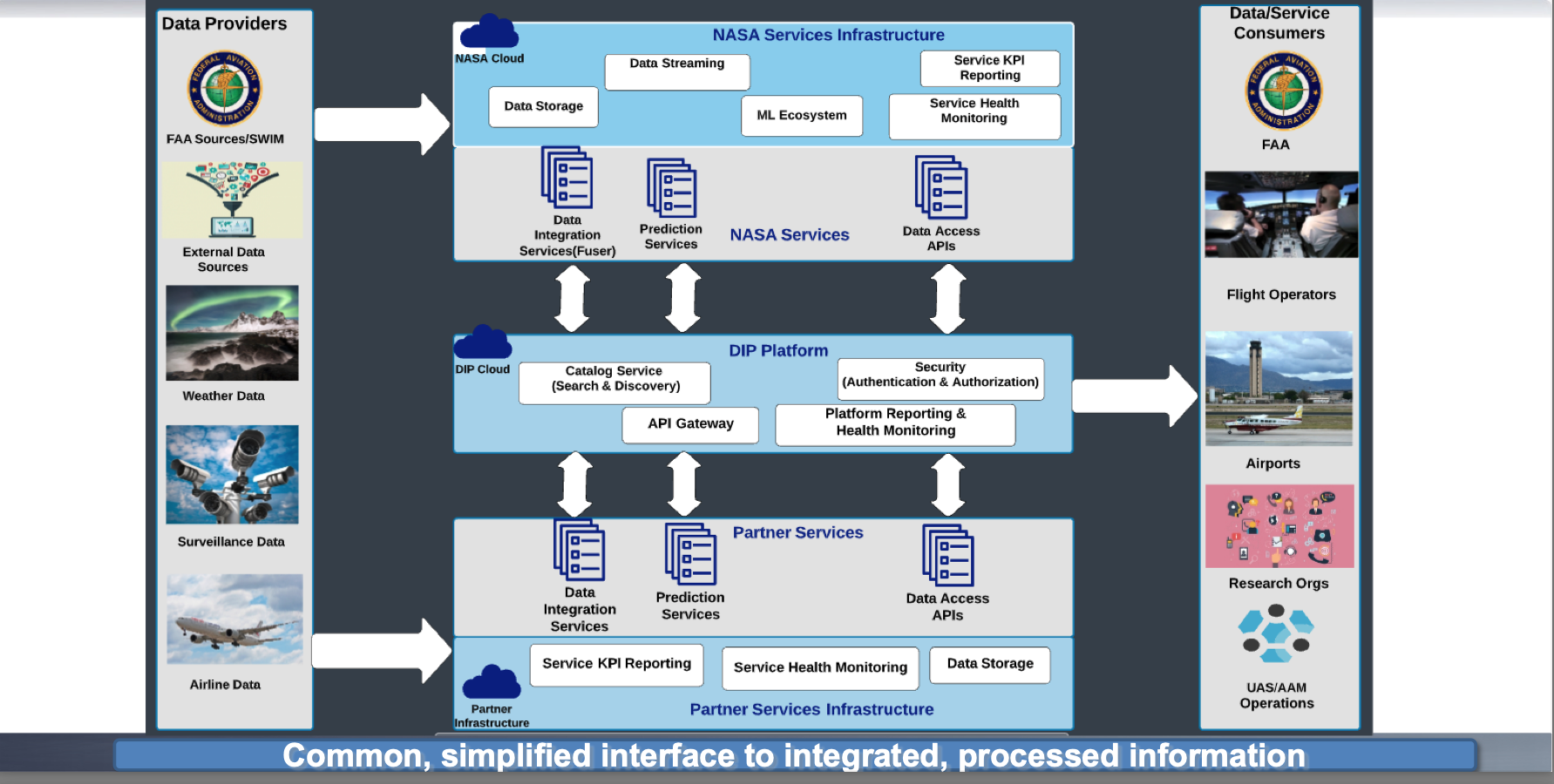
    Screenshot of the DIP Architecture.
    NASA / DIP
    Start
    November 17, 2021 at 10:00 AM EST
    End
    November 17, 2021 at 12:00 PM EST

    Workshop Series: What It’s About

    The Digital Information Platform (DIP) workshop series is intended to provide a deeper dive and a closer look at some of the core features being developed by the DIP sub-project under ATM-X.

    These workshops will give insight into DIP development, technology, and assumptions as well as providing a forum for engaging with the DIP team to pose questions and provide feedback on proposed designs. Engagement with the broader aviation community is a critical component to success of the DIP sub-project!

    There will be several workshops within this series spanning a variety of topics. Participants are encouraged to sign up for any workshop topics they feel they could contribute to or provide feedback on.

    Please keep an eye on the DIP homepage, under the upcoming events section, for future announcements of additional workshop topics!

    Workshop #1: DIP Architecture and Data Integration Services

    This workshop will cover DIP architecture and data integration services. Participants will get a look at how the DIP architecture is set-up as well as how data integration services are planned to be hosted on the platform.

    The DIP architecture review is intended to cover how DIP was envisioned and how DIP is being developed to address data needs across the industry. Participants will have a chance to provide feedback on the DIP architecture and gain insight into how one might interface with the DIP to send or receive data.

    The data integration services portion is intended to cover DIP’s technical approach to data integration. As an example implementation, there will be a first look at possible data fusion on the platform , including utilizing NASA’s Fuser, and tailoring for industry data consumers. Descriptions, at a high-level, of input to and output of the Fuser will also be discussed.

    Who Should Register?

    Participants interested in partnering with DIP and registering their service with the DIP platform are highly encouraged to attend this workshop. This is a unique opportunity for the aviation community to provide feedback and input on how this platform is structured to meet your needs.

    Data and service consumers as well as data and service providers are encouraged to attend this workshop to provide their feedback and input for DIP development.

    Participants looking to gain insight into upcoming DIP demonstrations or to learn more about DIP are encouraged to attend this workshop.

    Resources

    Digital Information Platform

    Digital Information Platform Events

    Details

    Last Updated

    Jun 18, 2025

    Editor
    Lillian Gipson
    Contact
    Jim Banke

  • DIP Workshop Series 2: DIP for Service Providers

    2 min read

    Preparations for Next Moonwalk Simulations Underway (and Underwater)

    Screenshot from the DIP Workshop Series 2: DIP for Service Providers graphic.
    Start
    January 12, 2022 at 10:00 AM EST
    End
    January 12, 2022 at 12:00 PM EST

    Workshop Series: What It’s About

    The Digital Information Platform (DIP) workshop series intends to provide a deeper dive and a closer look at some of the core features being developed by the DIP sub-project under ATM-X.

    These workshops will give insight into DIP development, technology, and assumptions as well as providing a forum for engaging with the DIP team to pose questions and provide feedback on proposed designs. Engagement with the broader aviation community is a critical component to success of the DIP sub-project!

    There will be several workshops within this series spanning a variety of topics. Participants are encouraged to sign up for any workshop topics they feel they could contribute to or provide feedback on.

    Please keep an eye on the DIP homepage, under the upcoming events section, for future announcements of additional workshop topics!

    Workshop #2: DIP for Service Providers

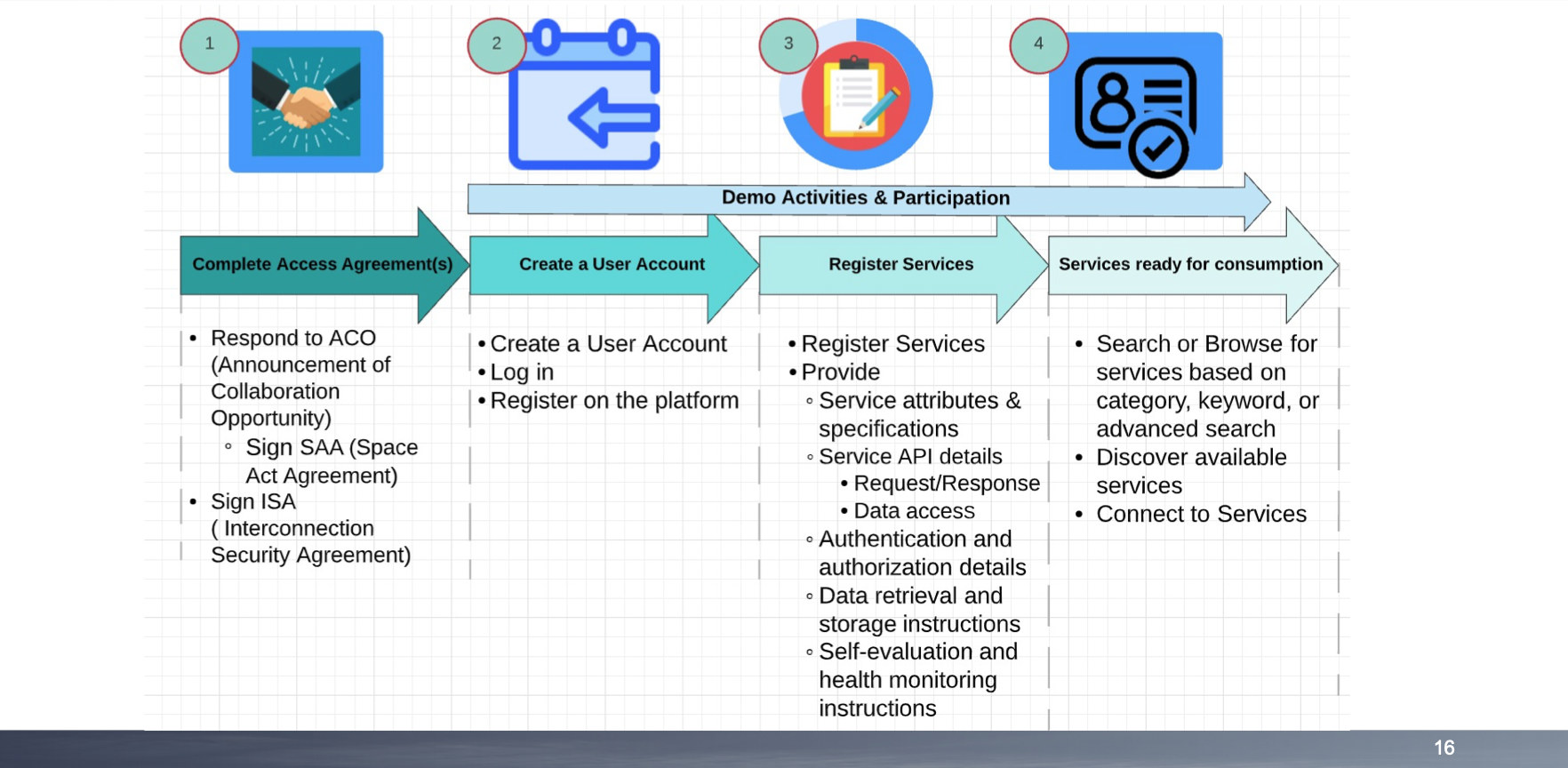
    This workshop will cover topics related to Service Providers. Participants will get a look at how the DIP architecture supports the onboarding process as well as how NASA services are planned to be made available via the platform.

    The DIP for Service Providers is intended to cover how DIP was envisioned with regards to the following:

    • Onboarding​
    • Announcement for Collaborative Opportunity, Space Act Agreements
      • Interconnection Security Agreements & Authentication​
    • Catalog Service Capabilities​
    • Service Registration, Discovery & Try it now feature​
    • API Requirements, Service Specifications​
    • NASA Services and Access Points​
    • Machine Learning Services​
      • Data Access APIs​
      • Streaming Fuser Data​
      • S3 Bucket​
    • Data Requirements for Service Providers

    Who Should Register?

    Participants interested in partnering with DIP and registering their service with the DIP platform are highly encouraged to attend this workshop. This is a unique opportunity for the aviation community to provide feedback and input on how this platform is structured to meet your needs.

    Data and service consumers as well as data and service providers are encouraged to attend this workshop to provide their feedback and input for DIP development.

    Participants looking to gain insight into upcoming DIP demonstrations or to learn more about DIP are encouraged to attend this workshop.

    Agenda

    • Onboarding​
    • Catalog Service Capabilities​
    • API Requirements, Service Specifications​
    • NASA Services and Access Points​
    • Data Requirements for Service Providers

    Resources

    Digital Information Platform

    Digital Information Platform Events

    Details

    Last Updated

    Jun 18, 2025

    Editor
    Lillian Gipson
    Contact
    Jim Banke

  • NASA to Gather In-Flight Imagery of Commercial Test Capsule Re-Entry

    4 Min Read

    NASA to Gather In-Flight Imagery of Commercial Test Capsule Re-Entry

    During the September 2023 daytime reentry of the OSIRIS-REx sample return capsule, the SCIFLI team captured visual data similar to what they’re aiming to capture during Mission Possible.

    Credits:
    NASA/SCIFLI

    A NASA team specializing in collecting imagery-based engineering datasets from spacecraft during launch and reentry is supporting a European aerospace company’s upcoming mission to return a subscale demonstration capsule from space.

    NASA’s Scientifically Calibrated In-Flight Imagery (SCIFLI) team supports a broad range of mission needs across the agency, including Artemis, science missions like OSIRIS-REx (Origins, Spectral Interpretation, Resource Identification, and Security – Regolith Explorer), and NASA’s Commercial Crew Program. The SCIFLI team also supports other commercial space efforts, helping to develop and strengthen public-private partnerships as NASA works to advance exploration, further cooperation, and open space to more science, people, and opportunities.

    Later this month, SCIFLI intends to gather data on The Exploration Company’s Mission Possible capsule as it returns to Earth following the launch on a SpaceX Falcon 9 rocket. One of the key instruments SCIFLI will employ is a spectrometer detects light radiating from the capsule’s surface, which researchers can use to determine the surface temperature of the spacecraft. Traditionally, much of this data comes from advanced Computational Fluid Dynamics modeling of what happens when objects of various sizes, shapes, and materials enter different atmospheres, such as those on Earth, Mars, or Venus.

    “While very powerful, there is still some uncertainty in these Computational Fluid Dynamics models. Real-world measurements made by the SCIFLI team help NASA researchers refine their models, meaning better performance for sustained flight, higher safety margins for crew returning from the Moon or Mars, or landing more mass safely while exploring other planets,” said Carey Scott, SCIFLI capability lead at NASA’s Langley Research Center in Hampton, Virginia.

    A rendering of a space capsule from The Exploration Company re-entering Earth's atmosphere.
    A rendering of a space capsule from The Exploration Company re-entering Earth’s atmosphere.
    Image courtesy of The Exploration Company
    The Exploration Company

    The SCIFLI team will be staged in Hawaii and will fly aboard an agency Gulfstream III aircraft during the re-entry of Mission Possible over the Pacific Ocean.

    “The data will provide The Exploration Company with a little bit of redundancy and a different perspective — a decoupled data package, if you will — from their onboard sensors,” said Scott.

    From the Gulfstream, SCIFLI will have the spectrometer and an ultra-high-definition telescope trained on Mission Possible. The observation may be challenging since the team will be tracking the capsule against the bright daytime sky. Researchers expect to be able to acquire the capsule shortly after entry interface, the point at roughly 200,000 feet, where the atmosphere becomes thick enough to begin interacting with a capsule, producing compressive effects such as heating, a shock layer, and the emission of photons, or light.

    Real-world measurements made by the SCIFLI team help NASA researchers refine their models, meaning better performance for sustained flight, higher safety margins for crew returning from the Moon or Mars, or landing more mass safely while exploring other planets.

    Carey Scott

    Carey Scott

    SCIFLI Capability Lead

    In addition to spectrometer data on Mission Possible’s thermal protection system, SCIFLI will capture imagery of the parachute system opening. First, a small drogue chute deploys to slow the capsule from supersonic to subsonic, followed by the deployment of a main parachute. Lastly, cloud-cover permitting, the team plans to image splashdown in the Pacific, which will help a recovery vessel reach the capsule as quickly as possible.

    If flying over the ocean and capturing imagery of a small capsule as it zips through the atmosphere during the day sounds difficult, it is. But this mission, like all SCIFLI’s assignments, has been carefully modeled, choreographed, and rehearsed in the months and weeks leading up to the mission. There will even be a full-dress rehearsal in the days just before launch.

    Not that there aren’t always a few anxious moments right as the entry interface is imminent and the team is looking out for its target. According to Scott, once the target is acquired, the SCIFLI team has its procedures nailed down to a — pardon the pun — science.

    “We rehearse, and we rehearse, and we rehearse until it’s almost memorized,” he said.

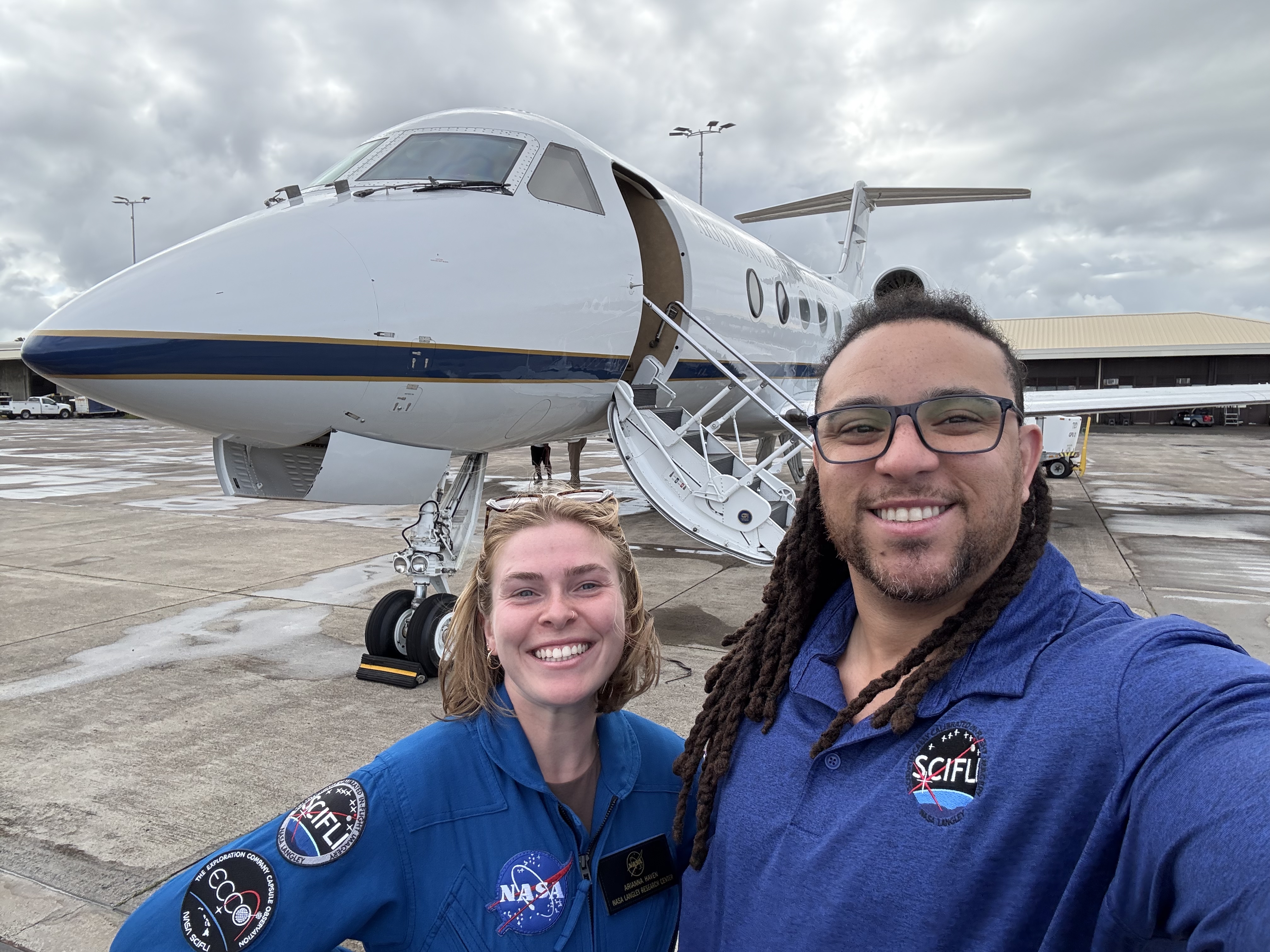
    SCIFLI Asset Coordinator Ari Haven, left, and Principal Engineer Carey Scott in front of the G-III aircraft that will help the team image The Exploration Company’s Mission Possible demonstration capsule as it reenters Earth’s atmosphere.
    Ari Haven, left, asset coodinator for SCIFLI’s support of Mission Possible, and Carey Scott, principal engineer for the mission, in front of the G-III aircraft the team will fly on.
    Credit: NASA/Carey Scott
    NASA/Carey Scott

    The Exploration Company, headquartered in Munich, Germany, and Bordeaux,

    France, enlisted NASA’s support through a reimbursable Space Act Agreement and will use SCIFLI data to advance future capsule designs.

    “Working with NASA on this mission has been a real highlight for our team. It shows what’s possible when people from different parts of the world come together with a shared goal,” said Najwa Naimy, chief program officer at The Exploration Company. “What the SCIFLI team is doing to spot and track our capsule in broad daylight, over the open ocean, is incredibly impressive. We’re learning from each other, building trust, and making real progress together.”

    NASA Langley is known for its expertise in engineering, characterizing, and developing spacecraft systems for entry, descent, and landing. The Gulfstream III aircraft is operated by the Flight Operations Directorate at NASA’s Armstrong Flight Research Center in Edwards, California.

  • Career Exploration: Using Ingenuity and Innovation to Create ‘Memory Metals’

    Othmane Benafan is a NASA engineer whose work is literally reshaping how we use aerospace materials — he creates metals that can shape shift. Benafan, a materials research engineer at NASA’s Glenn Research Center in Cleveland, creates metals called shape memory alloys that are custom-made to solve some of the most pressing challenges of space exploration and aviation.

    “A shape memory alloy starts off just like any other metal, except it has this wonderful property: it can remember shapes,” Benafan says. “You can bend it, you can deform it out of shape, and once you heat it, it returns to its shape.”

    An alloy is a metal that’s created by combining two or more metallic elements. Shape memory alloys are functional metals. Unlike structural metals, which are fixed metal shapes used for construction or holding heavy objects, functional metals are valued for unique properties that enable them to carry out specific actions.

    NASA often needs materials with special capabilities for use in aircraft and spacecraft components, spacesuits, and hardware designed for low-Earth orbit, the Moon, or Mars. But sometimes, the ideal material doesn’t exist. That’s where engineers like Benafan come in.

    “We have requirements, and we come up with new materials to fulfill that function,” he said. The whole process begins with pen and paper, theories, and research to determine exactly what properties are needed and how those properties might be created. Then he and his teammates are ready to start making a new metal.

    “It’s like a cooking show,” Benafan says. “We collect all the ingredients — in my case, the metals would be elements from the periodic table, like nickel, titanium, gold, copper, etc. — and we mix them together in quantities that satisfy the formula we came up with. And then we cook it.”

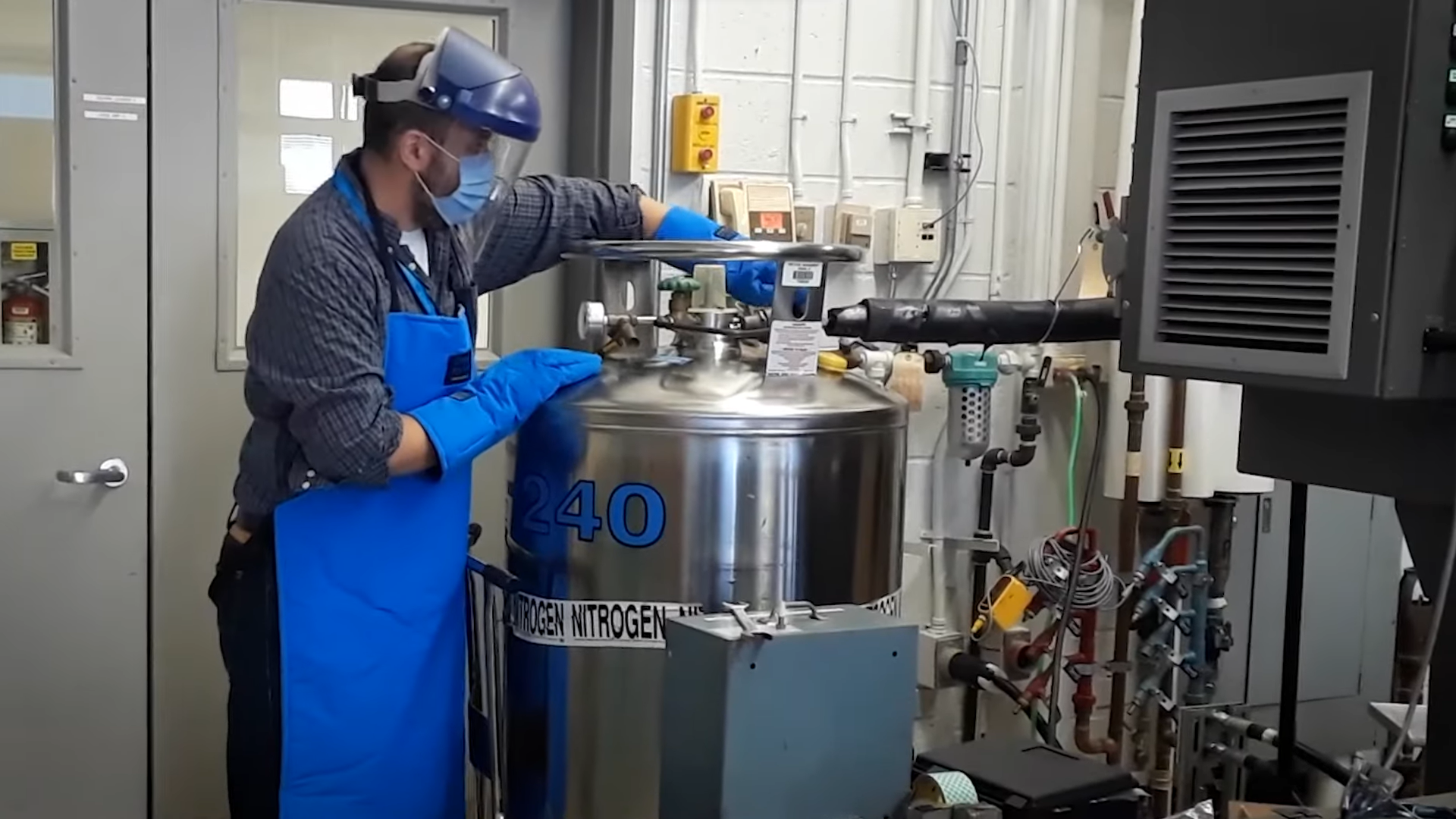
    A man wearing a surgical mask, protective plastic face covering, and thick blue gloves, works with a large metal can that has the text
    Othmane Benafan, a materials research engineer, develops a shape memory alloy in a laboratory at NASA’s Glenn Research Center in Cleveland.

    These elemental ingredients are melted in a container called a crucible, then poured into the required shape, such as a cylinder, plate, or tube. From there, it’s subjected to temperatures and pressures that shape and train the metal to change the way its atoms are arranged every time it’s heated or cooled.

    Shape memory alloys created by Benafan and his colleagues have already proven useful in several applications. For example, the Shape Memory Alloy Reconfigurable Technology Vortex Generator (SMART VG) being tested on Boeing aircraft uses the torque generated by a heat-induced twisting motion to raise and lower a small, narrow piece of hardware installed on aircraft wings, resulting in reduced drag during cruise conditions. In space, the 2018 Advanced eLectrical Bus (ALBus) CubeSat technology demonstration mission included the use of a shape memory alloy to deploy the small satellite’s solar arrays and antennas. And Glenn’s Shape Memory Alloy Rock Splitters technology benefits mining and geothermal applications on Earth by breaking apart rocks without harming the surrounding environment. The shape memory alloy device is wrapped in a heater and inserted into a predrilled hole in the rock, and when the heater is activated, the alloy expands, creating intense pressure that drives the rock apart.

    Benafan’s fascination with shape memory alloys started after he immigrated to the United States from Morocco at age 19. He began attending night classes at the Valencia Community College (now Valencia College), then went on to graduate from the University of Central Florida in Orlando. A professor did a demonstration on shape memory alloys and that changed Benafan’s life forever. Now, Benafan enjoys helping others understand related topics.
     
    “Outside of work, one of the things I like to do most is make technology approachable to someone who may be interested but may not be experienced with it just yet. I do a lot of community outreach through camps or lectures in schools,” he said.
     
    He believes a mentality of curiosity and a willingness to fail and learn are essential for aspiring engineers and encourages others to pursue their ideas and keep trying.

    “You know, we grow up with that mindset of falling and standing up and trying again, and that same thing applies here,” Benafan said. “The idea is to be a problem solver. What are you trying to contribute? What problem do you want to solve to help humanity, to help Earth?”

    To learn more about the wide variety of exciting and unexpected jobs at NASA, check out the Surprisingly STEM video series.

  • NASA Welcomes Community, Astronauts to Marshall’s 65th Anniversary Celebration July 19

    2 min read

    Preparations for Next Moonwalk Simulations Underway (and Underwater)

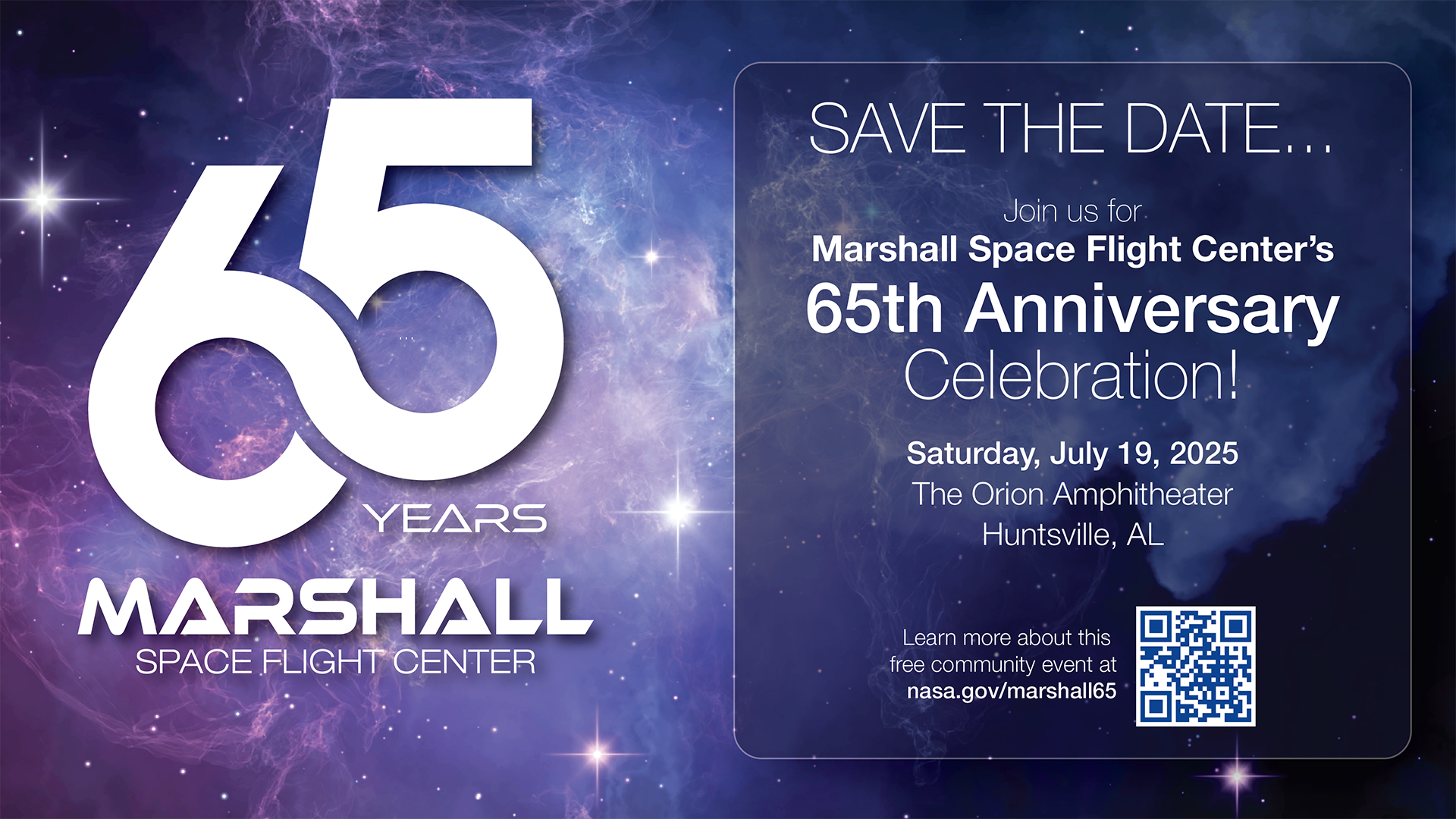
    NASA’s Marshall Space Flight Center invites the community to help celebrate the center’s 65th anniversary during a free public event noon to 5 p.m. CDT Saturday, July 19, at The Orion Amphitheater in Huntsville, Alabama.

    An invitation to the Marshall 65 event.
    NASA

    Marshall, along with its partners and collaborators, will fill the amphitheater with space exhibits, music, food vendors, and hands-on activities for all ages. The summer celebration will mark 65 years of innovation and exploration, not only for Marshall, but for Huntsville and other North Alabama communities.

    “Our success has been enabled by the continuous support we receive from Huntsville and the North Alabama communities, and this is an opportunity to thank community members and share some of our exciting mission activities,” Joseph Pelfrey, director of NASA Marshall, said.

    Some NASA astronauts from Expedition 72 who recently returned from missions aboard the International Space Station will participate in the celebratory event.  The Expedition 72 crew dedicated more than 1,000 combined hours to scientific research and technology demonstrations aboard the space station and crew members in attendance will share their experiences in space.

    The official portrait of the International Space Station’s Expedition 72 crew. At the top (from left) are Roscosmos cosmonaut and Flight Engineer Alexey Ovchinin, NASA astronaut and space station Commander Suni Williams, and NASA astronaut and Flight Engineer Butch Wilmore. In the middle row are Roscosmos cosmonaut and Flight Engineer Ivan Vagner and NASA astronaut and Flight Engineer Don Pettit. In the bottom row are Roscosmos cosmonaut and Flight Engineer Aleksandr Gorbunov and NASA astronaut and Flight Engineer Nick Hague. Some NASA astronauts from Expedition 72 will participate in Marshall Space Flight Center’s 65th anniversary celebration during a free public event  noon to 5 p.m. CDT Saturday, July 19, at The Orion Amphitheater in Huntsville, Alabama.
    NASA/Bill Stafford and Robert Markowitz

    “Every day, our Marshall team works to advance human spaceflight and discovery, such as working with our astronauts on the International Space Station.” Pelfrey said. “We are honored Expedition 72 crew members will join us to help commemorate our 65-year celebration.”

    The anniversary event will also include remarks from Pelfrey, other special presentations, and fun for the whole family.

    Learn more about this free community event at:

    https://www.nasa.gov/marshall65

    Lance D. Davis
    Marshall Space Flight Center, Huntsville, Ala. 
    256-640-9065 
    lance.d.davis@nasa.gov

    Details

    Last Updated

    Jun 17, 2025

    Editor
    Beth Ridgeway

  • NASA’s Lunar Rescue System Challenge Supports Astronaut Safety

    Challenge logo for the South Pole Safety challenge overlayed on an image of the lunar surface.

    by Dary Felix Garcia

    NASA is preparing to make history by sending humans to the Moon’s South Pole. There, astronauts will conduct moonwalks for exploration, science experiments, and prepare humanity for the journey to Mars. Missions of this scale require extensive planning, especially when accounting for emergency scenarios such as a crew member becoming incapacitated.  

    To address this critical risk, the South Pole Safety Challenge invited the public to develop a compact, effective device capable of safely rescuing astronauts during emergency situations on the Moon’s surface. Given the harsh and unpredictable conditions of the lunar South Pole, the rescue system must be lightweight, easy to use, and able to transport an incapacitated crew member weighing approximately 755 lbs. (343 kg), representing the crew member and their suit, without the help of the lunar rover. It must also be capable of covering up to 1.24 miles (2 kilometers) across slopes as steep as 20 degrees. 

    “The initiative saved the government an estimated $1,000,000 and more than three  years of work had the solutions been produced using in-house existing resources,” said Ryon Stewart, acting Program Manager of NASA’s Center of Excellence for Collaborative Innovation. “The effort demonstrated how crowdsourcing provides NASA with a wide diversity of innovative ideas and skills.”

    The global challenge received 385 unique ideas from 61 countries. Five standout solutions received a share of the $45,000 prize purse.  Each of the selected solutions demonstrated creativity, practicality, and direct relevance to NASA’s needs for future Moon missions.

    • First Place: VERTEX by Hugo Shelley – A self-deploying four-wheeled motorized stretcher that converts from a compact cylinder into a frame that securely encases an immobilized crew member for transport up to 6.2 miles (10 kilometers).  
    • Second Place: MoonWheel by Chamara Mahesh – A foldable manual trolley designed for challenging terrain and rapid deployment by an individual astronaut.  
    • Third Place: Portable Foldable Compact Emergency Stretcher by Sbarellati team – A foldable stretcher compatible with NASA’s Exploration Extravehicular Activity spacesuit. 
    • Third Place: Advanced Surface Transport for Rescue (ASTRA) by Pierre-Alexandre Aubé – A collapsible three-wheeled device with a 1.2 mile (2 kilometer) range.
    • Third Place: Getting Rick to Roll! by InventorParents – A rapidly deployable, tool-free design suited for functionality in low gravity settings. 

    NASA is identifying how to integrate some features of the winning ideas into current and future mission designs. Most intriguing are the collapsible concepts of many of the designs that would save crucial mass and volume. Additionally, the submissions offered innovative wheel designs to enhance current concepts. NASA expects to incorporate some features into planning for surface operations of the Moon. 

    HeroX hosted the challenge on behalf of NASA’s Extravehicular Activity and Human Surface Mobility Program. The NASA Tournament Lab, part of the Prizes, Challenges, and Crowdsourcing program in the Space Technology Mission Directorate, managed the challenge. The program supports global public competitions and crowdsourcing as tools to advance NASA research and development and other mission needs.   

    Find more opportunities at https://www.nasa.gov/get-involved/ 

  • Driven by a Dream: Farah Al Fulfulee’s Quest to Reach the Stars

    Farah Al Fulfulee was just four years old when she started climbing onto the roof of her family’s house in Iraq to gaze at the stars.

    “It scared me how vast and quiet the sky was, but it made me very curious. I grew a deep passion for the stars and constellations and what they might represent,” she said.

    Her father noticed her interest and began bringing home books and magazines about space. Al Fulfulee first read about NASA in those pages and was fascinated by the agency’s mission to explore the cosmos for the benefit of all humanity.

    “Right then I knew I had to be an astronaut! I must go to space myself and get a closer look,” she said. “I knew I must find a way to go and work for NASA and fulfill my dream, working with other people like me who had a passion to explore the universe.”

    A woman in casual clothes poses in front of a sign for the Johnson Space Center's Sonny Carter Training Facility.
    Farah Al Fulfulee poses outside the Sonny Carter Training Facility at NASA’s Johnson Space Center in Houston.
    Image courtesy of Farah Al Fulfulee

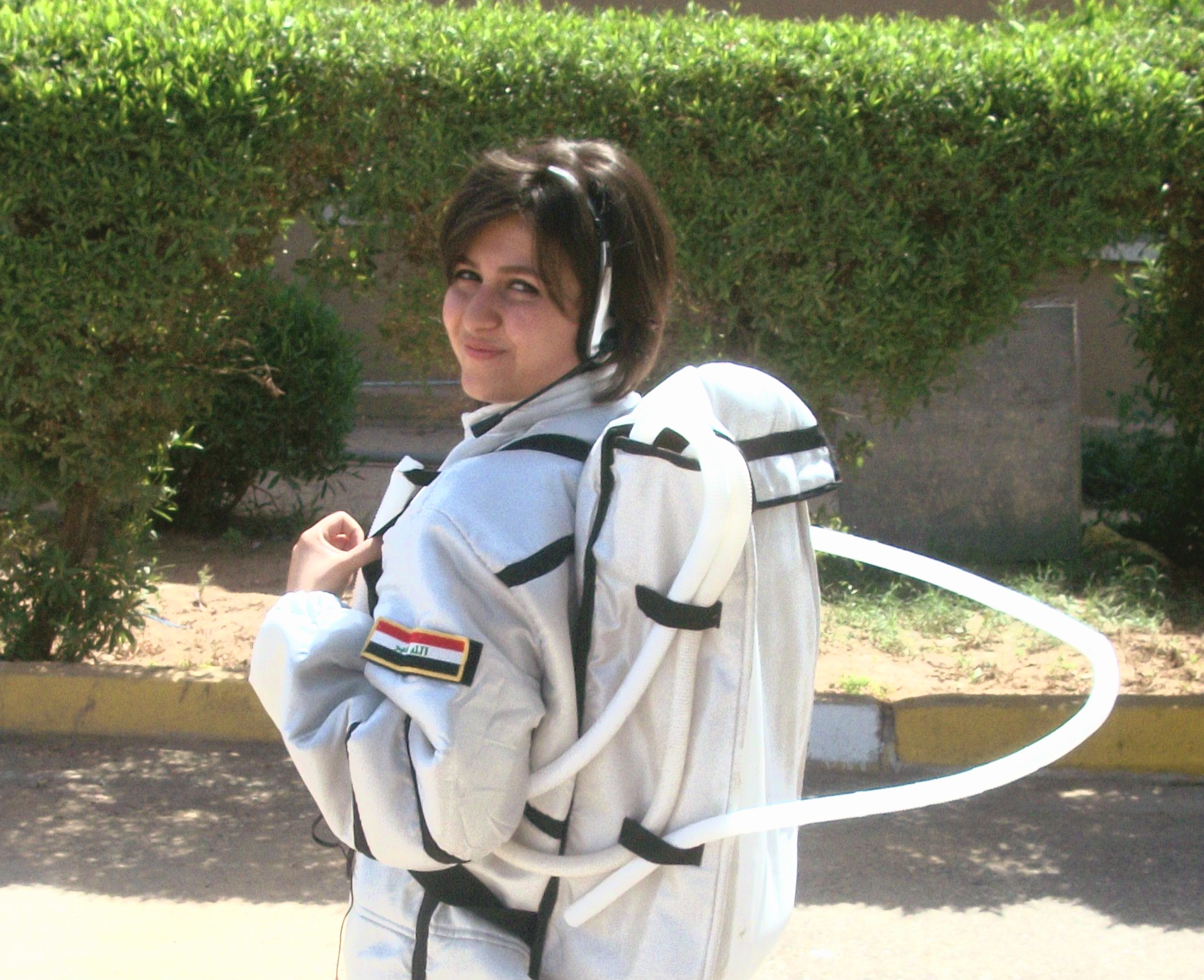
    As a girl growing up in the Middle East, Al Fulfulee had few opportunities to pursue this dream, but she refused to give up. Her dedication to schoolwork and excellence in science and math earned her a spot at the University of Baghdad College of Engineering. She completed a degree in electronic and communication engineering — similar to American electrical and computer engineering programs — and graduated as one of the top 10 students in her class. “We had a graduation party where you dress up as what you want to be in the future,” she recalled. “I wore a spacesuit.”

    A young woman with short brown hair wears a self-designed spacesuit costume with a headset.
    Farah Al Fulfulee celebrates her graduation from the University of Baghdad while wearing a spacesuit costume.
    Image courtesy of Farah Al Fulfulee

    Al Fulfulee was ready to launch her career, but Iraq did not have a developed space industry and finding work as a female engineer was a challenge. She accepted a project engineer position with a prominent Iraqi engineering firm in the information technology sector and spent four years working for the company in Iraq, Turkey, and Jordan, but she was disappointed to discover that her role involved very little engineering. “I was the only female on the team,” she said. “It was not common for a woman to work in the field or with customers, so I was always left behind to do office work. The job was not fulfilling.”

    Still determined to join NASA, Al Fulfulee kept looking for her chance to come to the United States and finally found one in 2016, when she moved to Oklahoma to be near her sister. A new challenge soon rose: Without a degree from an American school or previous work experience in the United States, engineering opportunities were hard to come by. Al Fulfulee spent the next six years working in quality assurance for a human resources software company while she completed a MicroMasters program in software verification and management from the University of Maryland and honed her English and leadership skills.

    Her big break came in 2022, when she landed a job with Boeing Defense, Space, and Security as a software quality engineer. “I was so excited,” she said. “I knew I was much closer to my dream since Boeing worked in the space industry and I would be able to apply internally to work on a space program.”

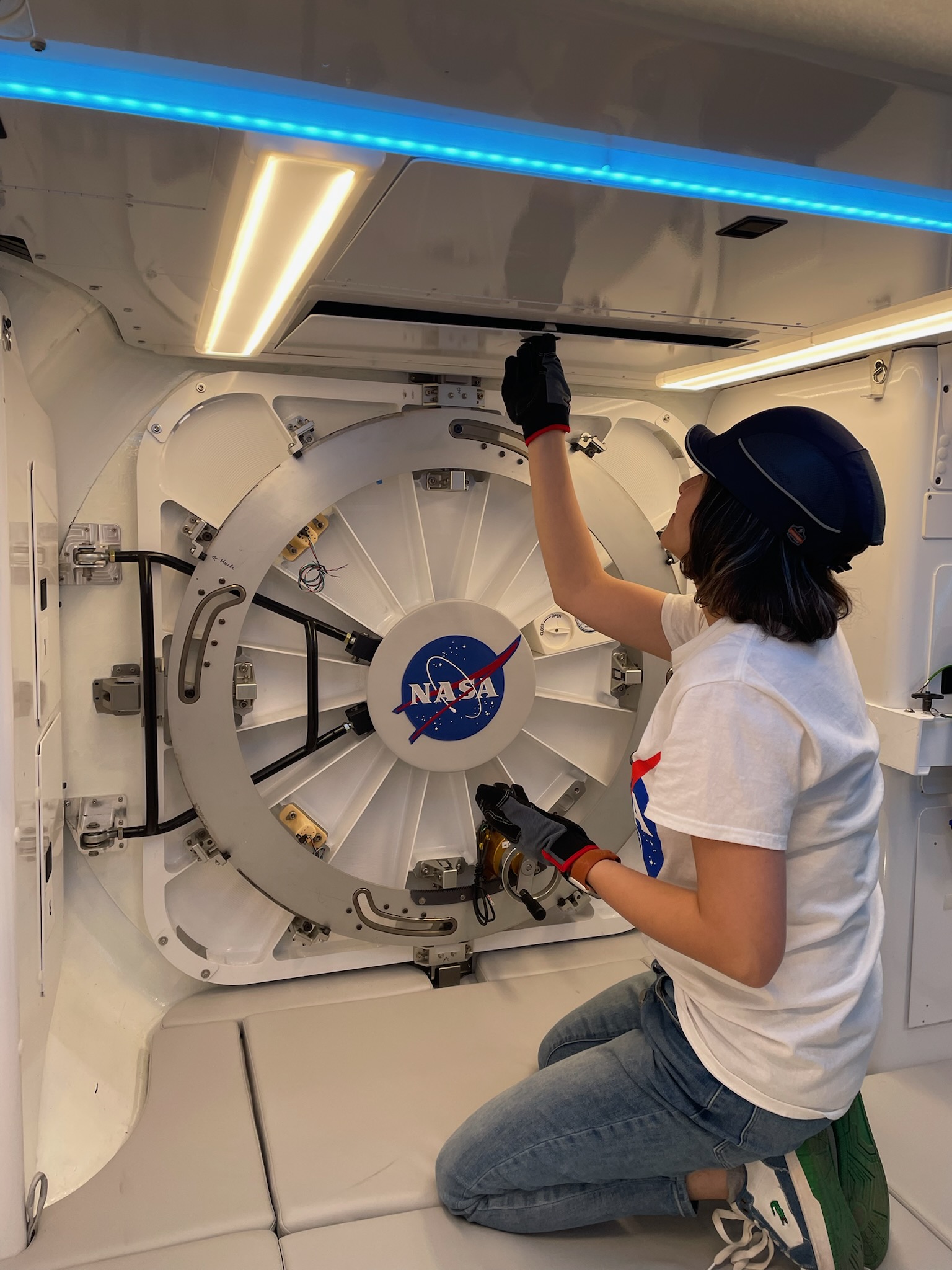
    A woman wearing casual clothes and work gloves screws a metal panel down inside of a space vehicle mockup.
    Farah Al Fulfulee participates in a NASA study that evaluated and compared the use of virtual reality and physical mockups to assess space vehicle and systems designs.
    Image courtesy of Farah Al Fulfulee

    Less than one year later, Al Fulfulee became a system design and analysis engineer for the International Space Station Program and joined the Station Management and Control Team at NASA’s Johnson Space Center in Houston. She helps develop requirements, monitors performance, and validates testing for electrical systems and software supporting space station payloads. She also designs hardware, software, and interface specifications for those systems. Al Fulfulee has served as the team’s point of contact, delivering verification assessment and data assessment reports for NASA’s SpaceX Crew-9 and Crew-10 missions, as well as the upcoming Axiom Mission 4 flight. She is currently working to support testing and verification for NASA’s SpaceX Crew-11.

    “I could not be happier,” she declared.

    She is also not stopping. “I won’t quit until I wear the blue suit.”

    A woman crouches next to a raised garden bed, harvesting potatoes.
    Farah Al Fulfulee tending to her backyard garden.
    Image courtesy of Farah Al Fulfulee

    Al Fulfulee has been an enthusiastic volunteer for various NASA studies, including the Exploration Atmosphere Studies that tested spacewalk safety protocols in an analog environment. She is pursuing a master’s degree in Space Operations Engineering from the University of Colorado, Colorado Springs. She is an avid gardener and learning how to grow produce indoors as a volunteer experimental botanist with the Backyard Produce Project, noting that such knowledge might come in handy on Mars.

    She is also helping to inspire the next generation. Earlier this year, Al Fulfulee was a guest speaker at the Women in Tech & Business Summit in Iraq – an event designed to encourage Iraqi women to pursue technology careers. “I was the only person representing women in space,” she said. “It was a really moving experience.” Al Fulfulee provided practical advice on breaking barriers in aerospace and shared her story with the crowd.

    “I know my path is long and across the continents,” she said, “but I am enjoying my journey.”