Tag: solar system

  • NASA History News and Notes–Spring 2025

    5 min read

    Preparations for Next Moonwalk Simulations Underway (and Underwater)

    The NASA History Office brings you the new Spring 2025 issue of NASA History News & Notes reflecting on some of the transitional periods in NASA’s history, as well as the legacies of past programs. Topics include NASA’s 1967 class of astronauts, historic experiments in airborne astronomy, NASA’s aircraft consolidation efforts in the 1990s, lightning observations from space, the founding of the NACA, the DC-8 airborne science laboratory, and more!

    Front Cover for the Spring 2025 edition of NASA History News & Notes

    Volume 42, Number 1
    Spring 2025

    Featured Articles

    From the Chief Historian

    By Brian Odom

    In the first few months of 2025, NASA will celebrate several significant anniversaries, including the 110th anniversary of the National Advisory Committee for Aeronautics (NACA) (March 3), the 55th anniversary of the launch of Apollo 13 (April 11), and the 35th anniversary of the launch of the Hubble Space Telescope (April 24). Celebrating these important milestones is a way for us as an agency and for the public to reflect upon where we have been and what we have accomplished and to think about what we might accomplish next. Continue Reading

    The XS-11 and the Transition Away from Mandatory Jet Pilot Training for NASA Astronauts

    By Jennifer Ross-Nazzal

    Flying in space has been associated with pilots ever since 1959, when NASA announced its first class of astronauts, known as the Mercury 7. Part of being a professional astronaut meant you were a certified jet pilot. Even the scientist-astronauts, so named to differentiate them from the astronauts assigned to the Mercury and Gemini missions, selected in 1965 and in 1967, received pilot training. Until NASA better understood the impact of weightlessness on the human body, Robert R. Gilruth, head of the Manned Spacecraft Center (MSC) in Houston, believed all astronauts should meet this qualification. But when five scientist-astronauts from the 1967 class had a rocky transition, leading them to resign—due to their disinterest in flying at the cost of their scientific training and no spaceflight opportunities—it eventually led NASA to rethink their idea of having all astronauts become jet pilots. Continue Reading

    Portrait of NASA's 1967 class of astronauts at a table
    Portrait of NASA’s 1967 group of astronauts. Seated at the table, left to right, are Philip K. Chapman, Robert A. R. Parker, William E. Thornton, and John A. Llewellyn. Standing, left to right, are Joseph P. Allen IV, Karl G. Henize, Anthony W. England, Donald L. Holmquest, Story Musgrave, William B. Lenoir, and Brian T. O’Leary.
    NASA

    The High-Flying Legacy of Airborne Observation: How Experimental Aircraft Contributed to Astronomy at NASA

    By Lois Rosson

    In June 2011, the Stratospheric Observatory for Infrared Astronomy (SOFIA) chased down Pluto’s occultation of a far-away star. … SOFIA’s 2011 observation of Pluto followed up on a historic 1988 observation made by the airborne Kuiper Airborne Observatory (KAO) that proved that Pluto had an atmosphere at all. The technical versatility of both flights, conducted from aircraft hurtling stabilized telescopes through the air, speaks to the legacy of airborne astronomical observation at NASA. But how did this idiosyncratic format emerge in the first place? Airborne astronomy, in which astronomical observations are made from a moving aircraft, was attempted almost as soon as airplanes themselves were developed. Continue Reading

    NASA’s Tortuous Effort to Consolidate its Aircraft

    By Robert Arrighi

    Thirty years ago, on January 6, 1995, NASA Administrator Dan Goldin announced, “We’ve started a revolution at NASA. It’s real. We have a road map for change. We’ve already begun.” Thus began one of the agency’s most daunting endeavors, a top-to-bottom reassessment of NASA’s processes, programmatic assignments, and staffing levels. One of the most controversial aspects of this effort was the proposal to transfer nearly all of the agency’s research aircraft to Dryden Flight Research Center (today known as Armstrong). Continue Reading
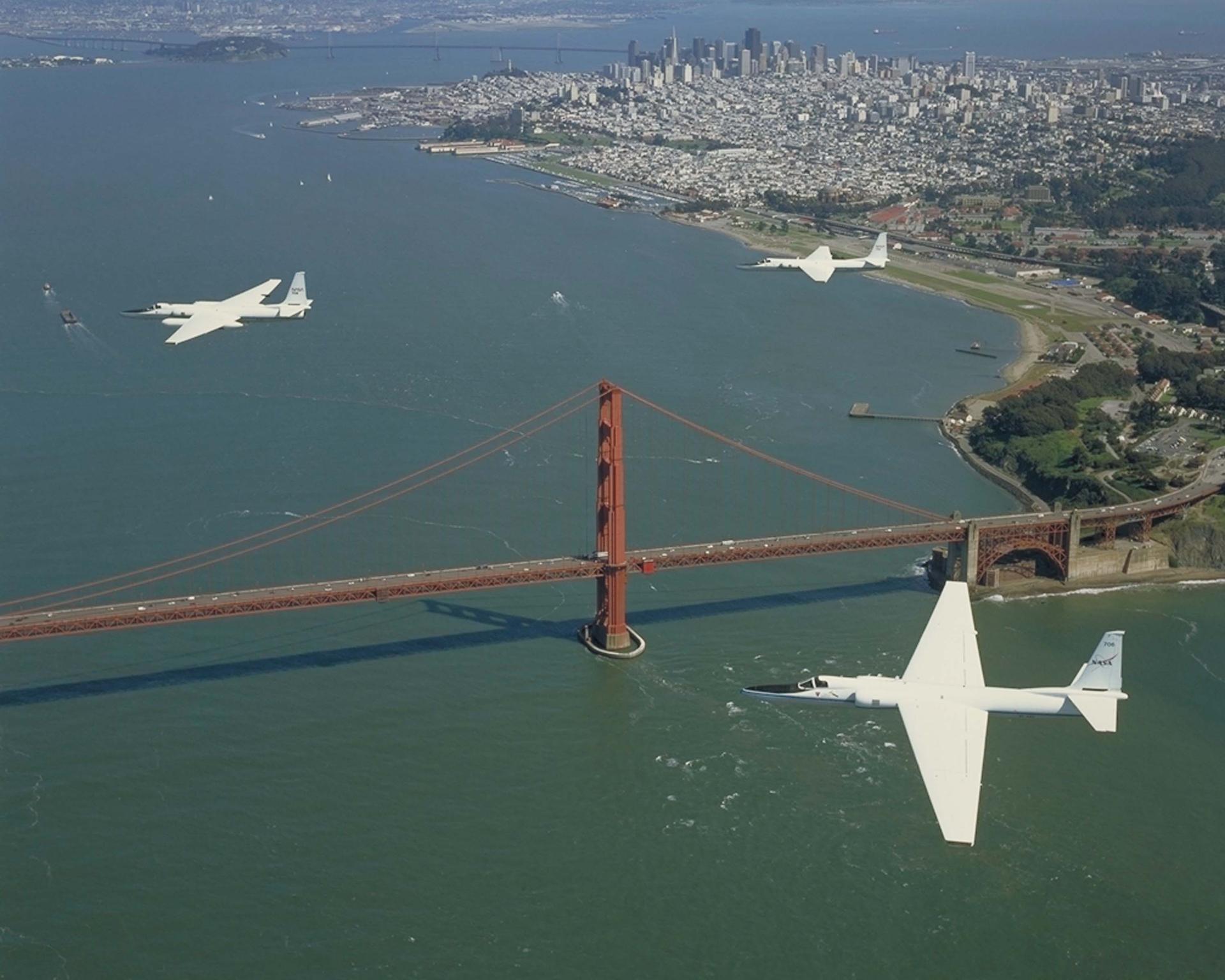
    Three ER-2 aircraft fly in formation over the Golden Gate Bridge in California.
    Three ER-2 Aircraft in formation over Golden Gate Bridge, San Francisco, CA on their final flight out of NASA Ames Research Center before redeployment to NASA’s Dryden Flight Research Center, now known as NASA Armstrong.
    NASA/Eric James

    The Space Between: Mesoscale Lightning Observations and Weather Forecasting, 1965–82

    By Brad Massey

    Skylab astronaut Edward G. Gibson looked down at Earth often during his 84 days on NASA’s first space station. From his orbital vantage point, Gibson took in the breathtaking views of our planet’s diverse landscapes. He also noted the interesting behavior of the planet’s most powerful electrical force: lightning. … Gibson’s words were of great interest to the lightning researchers affiliated with NASA’s Severe Storms and Local Research Program and others who believed observing Earth’s lightning from low Earth orbit generated valuable data that meteorologists could use to better forecast dangerous storm characteristics and behavior. With these motivations in mind, researchers created new Earth- and space-based experiments from the mid-1960s to the first Space Shuttle missions in the early 1980s that observed lightning on a regional level. Continue Reading

    Adding Color to the Moon: Jack Kinzler’s Oral History Interviews

    By Sandra Johnson

    Manned Spacecraft Center (MSC) Director Robert R. Gilruth placed a call to Jack Kinzler less than four months before the Apollo 11 launch. Gilruth asked him to attend a meeting with a high-level group of individuals from both MSC and NASA Headquarters to discuss ideas for celebrating the first lunar landing. Kinzler, in his capacity as the chief of the Technical Services Division, arrived ready to present his suggestions for commemorating the achievement. Continue Reading

    Astronaut Edwin E. Aldrin Jr., lunar module pilot of the first lunar landing mission, poses for a photograph beside the deployed United States flag during an Apollo 11 extravehicular activity (EVA) on the lunar surface. The Lunar Module (LM) is on the left, and the footprints of the astronauts are clearly visible in the soil of the moon. Astronaut Neil A. Armstrong, commander, took this picture with a 70mm Hasselblad lunar surface camera. While astronauts Armstrong and Aldrin descended in the LM, the
    Apollo 11 astronaut Edwin E. “Buzz” Aldrin Jr. poses for a photograph beside the deployed United States flag during the mission’s extravehicular activity (EVA) on the lunar surface.
    NASA

    The Founding of the NACA

    By James Anderson

    One hundred ten years ago this month, NASA’s predecessor organization, the National Advisory Committee for Aeronautics (NACA), was founded. The date of the anniversary marks the passage of a rider to a naval appropriations bill that established the NACA for the modest sum of $5,000 annually. Telling the story of the NACA’s founding in this manner—using March 3, 1915, as the moment in time to represent the NACA’s beginning—is true, but it overlooks two crucial aspects of the founding. The founding was both a culmination and a turning point for science and aeronautics in the United States. Continue Reading

    Remembering the DC-8 Airborne Science Laboratory at NASA

    By Bradley Lynn Coleman

    The NASA History Office and NASA Earth Science Division cohosted a workshop on the recently retired NASA DC-8 Airborne Science Laboratory (1986–2024) at the Mary W. Jackson NASA Headquarters Building in Washington, DC, October 24 and 25, 2024. The workshop celebrated the history of the legendary aircraft; documented DC-8–enabled scientific, engineering, education, and outreach activities; and captured lessons of the past for future operators. Continue Reading
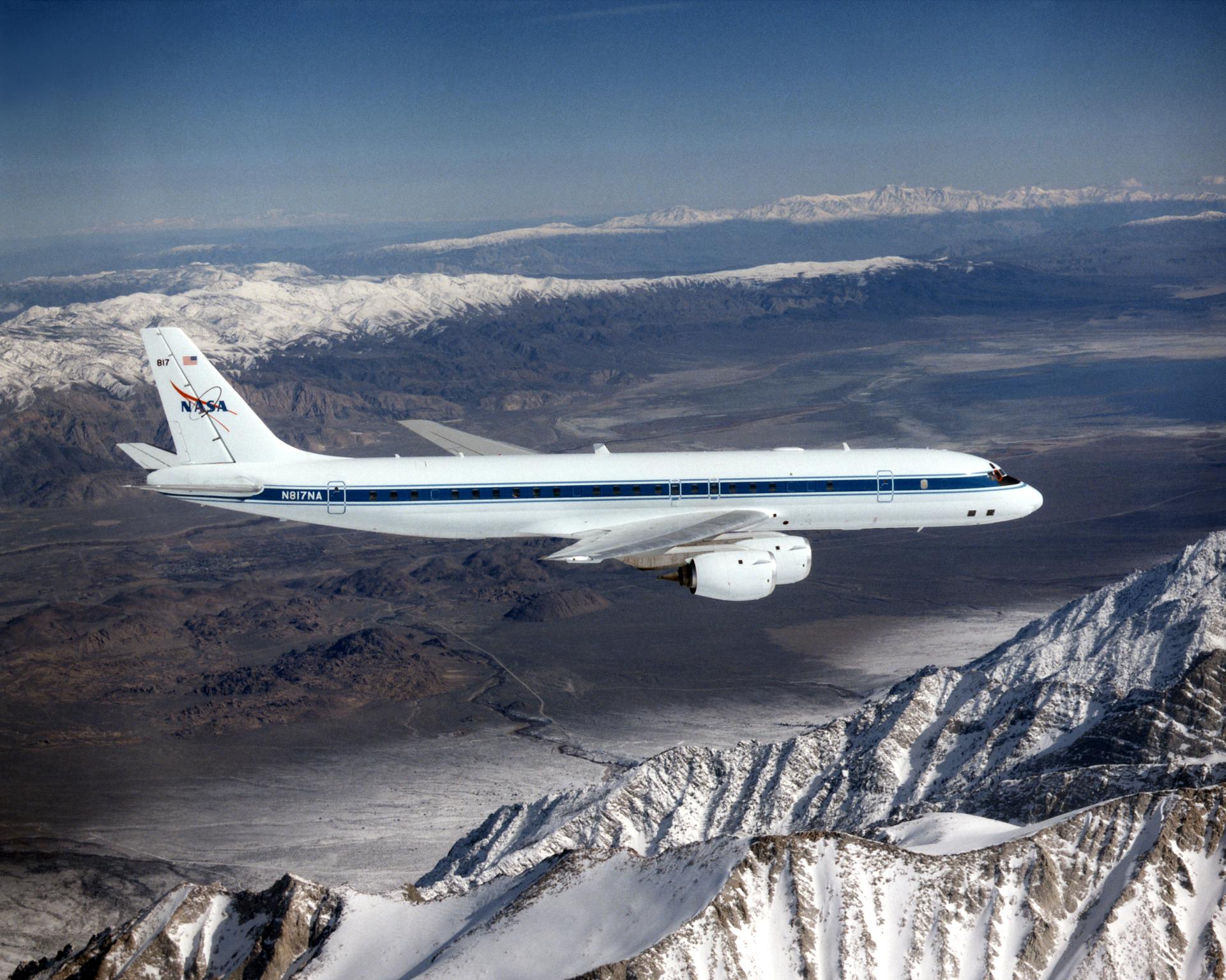
    The DC-8 in flight near Lone Pine, California.
    NASA/Jim Ross

    Details

    Last Updated

    Apr 01, 2025

    Related Terms

  • Ways Community College Students Can Get Involved With NASA

    4 Min Read

    Ways Community College Students Can Get Involved With NASA

    A group male and female students walk along a grassy field in Huntsville, Alabama with a Rocket as part of NASA's Student Launch. The American flag is in the foreground.

    For many students, the path to a NASA career begins at a community college. These local, two-year institutions offer valuable flexibility and options to those aspiring to be part of the nation’s next generation STEM workforce. NASA offers several opportunities for community college students to expand their horizons, make connections with agency experts, add valuable NASA experiences to their resumes, and home in on the types of STEM roles that best fit their skills and interests. Below are some of the exciting NASA activities and experiences available to community college students.

    NASA Community College Aerospace Scholars

    Get an introduction to NASA, its missions, and its workplace culture through NASA Community College Aerospace Scholars (NCAS). This three-part series enables students to advance their knowledge of the agency, grow their STEM capabilities, interact with NASA experts, and learn about the different pathways to a NASA career.

    Mission 1: Discover is a five-week, online orientation course that serves as an introduction to NASA.

    Mission 2: Explore is a gamified mission to the Moon or Mars in which students develop a design solution while learning about the agency as a workplace.

    Mission 3: Innovate is a three-week hybrid capstone project consisting of two weeks of online preparation and one week participating in a hands-on engineering design challenge at a NASA center.

    NCAS begins with Mission 1 and students must complete each mission to be eligible for the next.

    A student sitting down using a cell phone to monitor the performance of a robot
    Members of a college student team monitor the performance of their robot during a NASA Community College Aerospace Scholars (NCAS) Mission 3: Innovate robotics competition.
    NASA

    Student Challenges

    NASA’s student challenges and competitions invite students across a range of ages and education levels to innovate and build solutions to many of the agency’s spaceflight and aviation needs – and community college students across the U.S. are eligible for many of these opportunities. In NASA’s Student Launch challenge, each team designs, builds, and tests a high-powered rocket carrying a scientific or engineering payload. In the MUREP Innovation Tech Transfer Idea Competition (MITTIC)Teams from U.S.-designated Minority-Serving Institutions, including community colleges, have the opportunity to brainstorm and pitch new commercial products based on NASA technology.

    NASA’s student challenges and competitions are active at varying times throughout the year – new challenges are sometimes added, and existing opportunities evolve – so we recommend students visit the NASA STEM Opportunities and Activities page and research specific challenges to enable planning and preparation for future participation.

    A NASA Student Launch sign with two people walking and carrying a rocket on their shoulders
    NASA’s Student Launch tasks student teams from across the U.S. to design, build, test, and launch a high-powered rocket carrying a scientific or engineering payload. The annual challenge culminates with a final launch in Huntsville, Alabama, home of NASA’s Marshall Space Flight Center.
    NASA

    NASA RockOn! and RockSat Programs

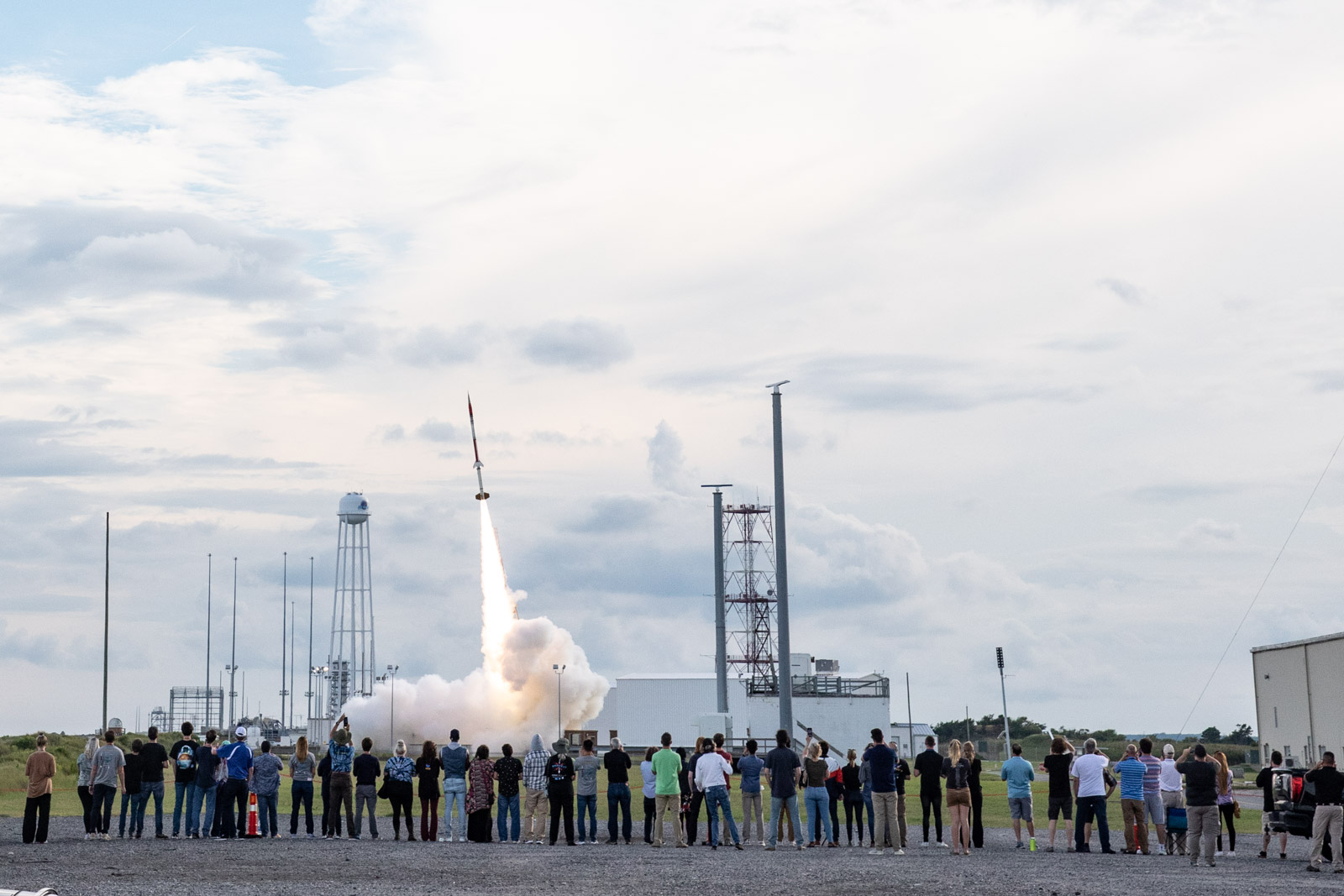
    Build an experiment and launch it aboard a sounding rocket! Through the hands-on RockOn! and RockSat programs, students gain experience designing and building an experiment to fly as a payload aboard a sounding rocket launched from NASA’s Wallops Flight Facility in Wallops Island, Virginia. In RockOn!, small teams get an introduction to creating a sounding rocket experiment, while RockSat-C and RockSat-X are more advanced experiment flight opportunities.

    In the foreground, a line of people stand at a safe distance away from a sounding rocket launching in the background. The rocket is just off the pad with a plume of fire and smoke underneath.
    Students watch as their experiments launch aboard a sounding rocket for the RockSat-X program from NASA’s Wallops Flight Facility Aug. 11, 2022, at 6:09 p.m. EDT. The Terrier-Improved Malemute rocket carried the experiments to an altitude of 99 miles before descending via a parachute and landing in the Atlantic Ocean.
    NASA Wallops/Terry Zaperach

    NASA Internships

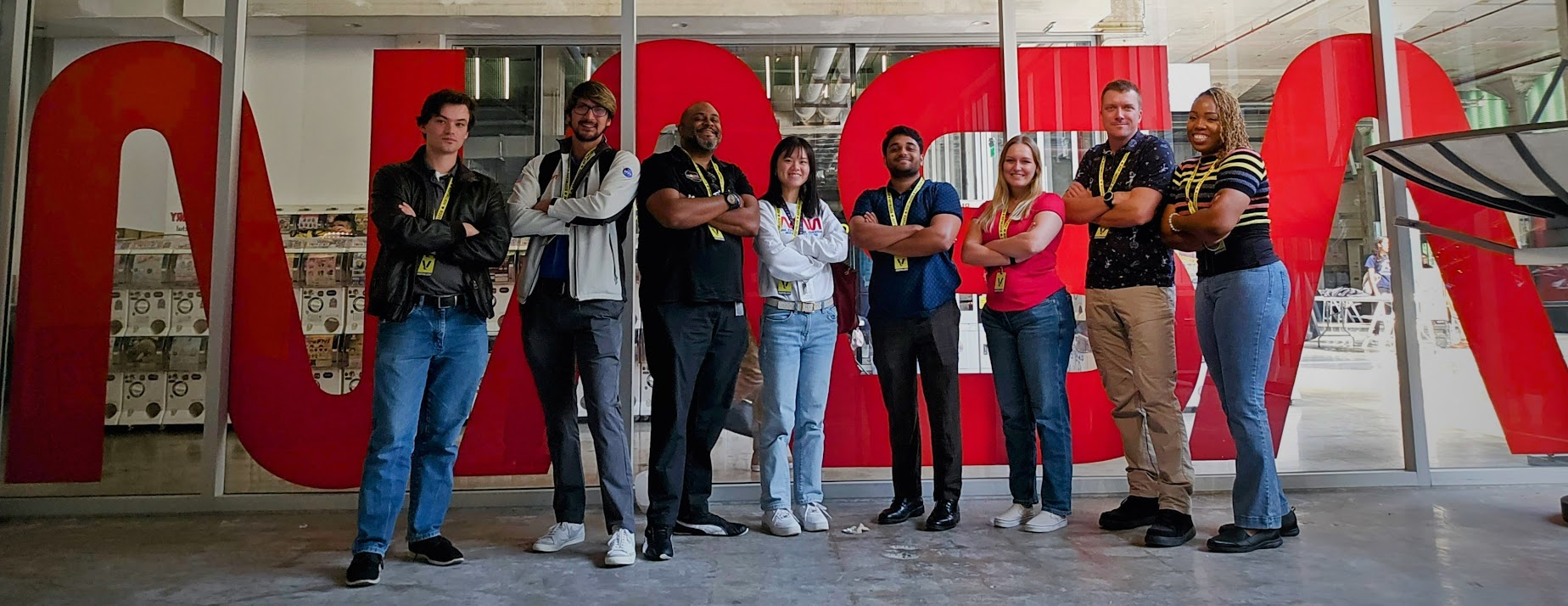
    Be a part of the NASA team! With a NASA internship, students work side-by-side with agency experts, gaining authentic workforce experience while contributing to projects that align with NASA’s goals. Internships are available in a wide variety of disciplines in STEM and beyond, including communications, finance, and more. Each student has a NASA mentor to help guide and coach them through their internship.

    A group of students standing in front of a NASA (a/k/a NASA Worm) backdrop.
    NASA interns gain hands-on experience while contributing to agency projects under the guidance of a NASA mentor.
    NASA

    National Space Grant College and Fellowship Program

    The National Space Grant College and Fellowship Project, better known as Space Grant, is a national network of colleges and universities working to expand opportunities for students and the public to participate in NASA’s aeronautics and space projects. Each state has its own Space Grant Consortium that may provide STEM education and training programs; funding for scholarships and/or internships; and opportunities to take part in research projects, public outreach, state-level student challenges, and more. Programs, opportunities, and offerings vary by state; students should visit their state’s Space Grant Consortium website to find out about opportunities available near them.

    Students receive a tutorial in welding techniques from Senior Welder and Engineering Technician Tom Dixon at NASA Glenn
    Students from the Erie Huron Ottawa Vocational Education Career Center are pictured at the 3KVA Mobile Photovoltaic Power Plant at NASA’s Glenn Research Center.
    NASA

    Additional Resources

  • Sols 4495-4497: Yawn, Perched, and Rollin’

    2 min read

    Sols 4495-4497: Yawn, Perched, and Rollin’

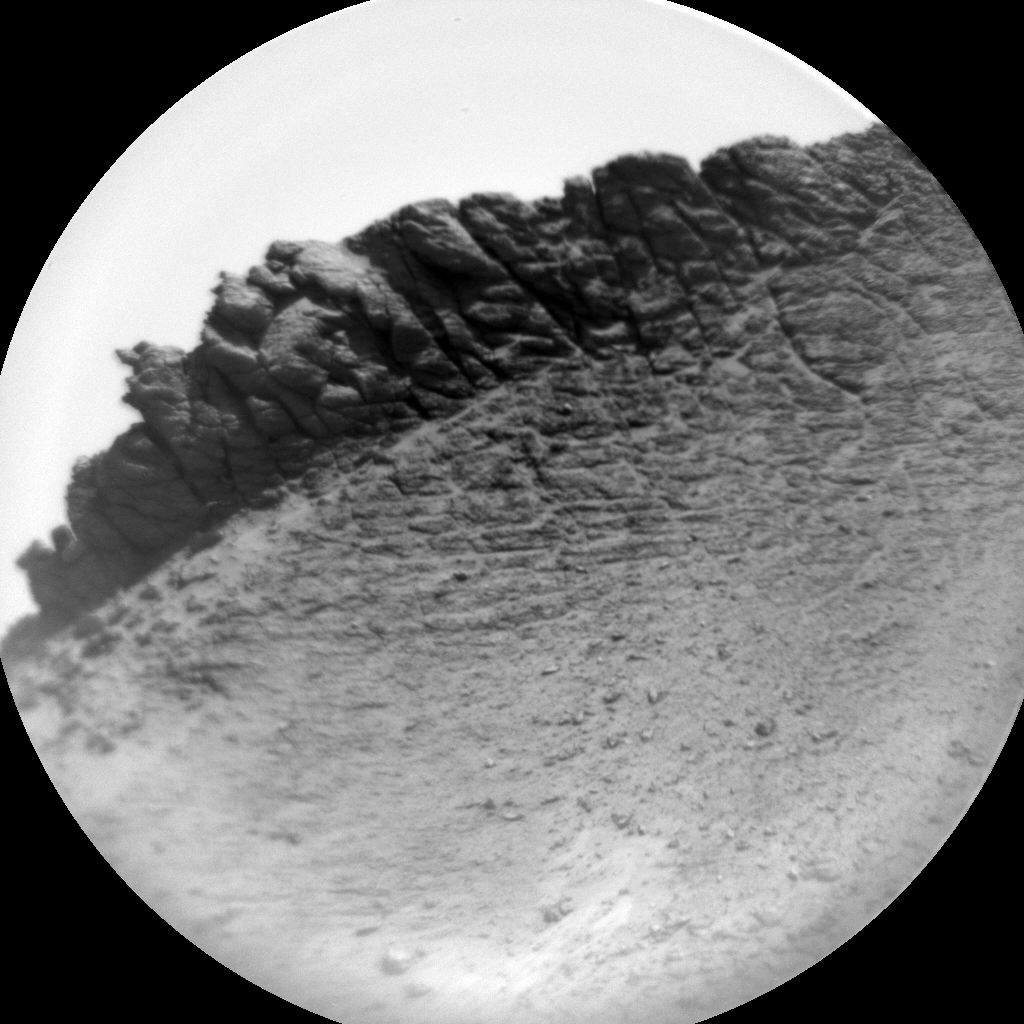
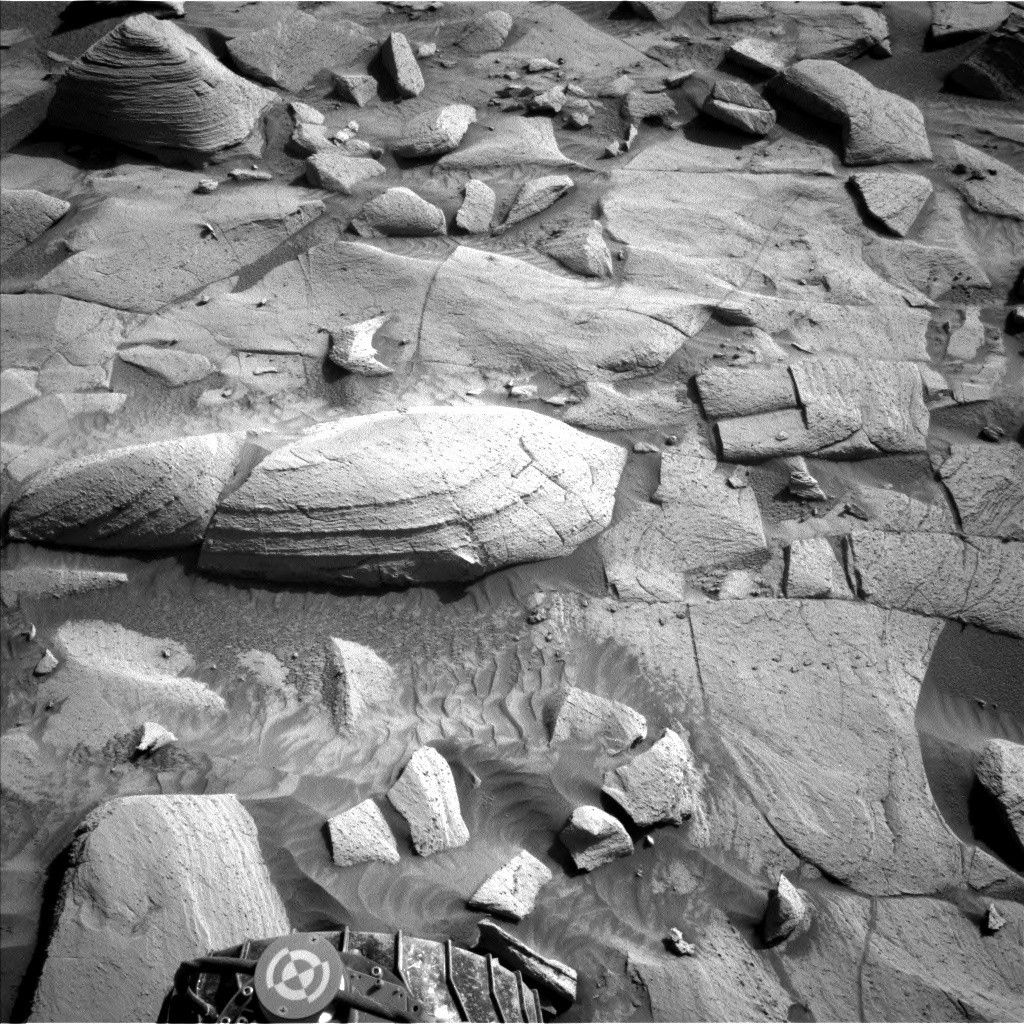
    A circular grayscale image from the Martian surface is skewed slightly left, so the horizon line runs from about the 8 o’clock position on a clock face to about 2 o’clock. Gritty, gravelly terrain in the foreground leads to a spiky, ragged outcrop with vertical ridges and grooves rising on the horizon.
    NASA’s Mars rover Curiosity acquired this image of the upcoming “boxwork” structures to its west, using its Chemistry & Camera (ChemCam) Remote Micro-Imager (RMI). The ChemCam instrument studies the chemical composition of rocks and soil, using a laser to vaporize materials, then analyze their elemental composition using an on-board spectrograph. The ChemCam RMI is a high-resolution camera atop the rover’s mast. Curiosity captured this image on March 27, 2025 — Sol 4493, or Martian day 4,493 of the Mars Science Laboratory mission — at 15:35:21 UTC.
    NASA/JPL-Caltech/LANL

    Written by Natalie Moore, Mission Operations Specialist at Malin Space Science Systems

    Earth planning date: Friday, March 28, 2025

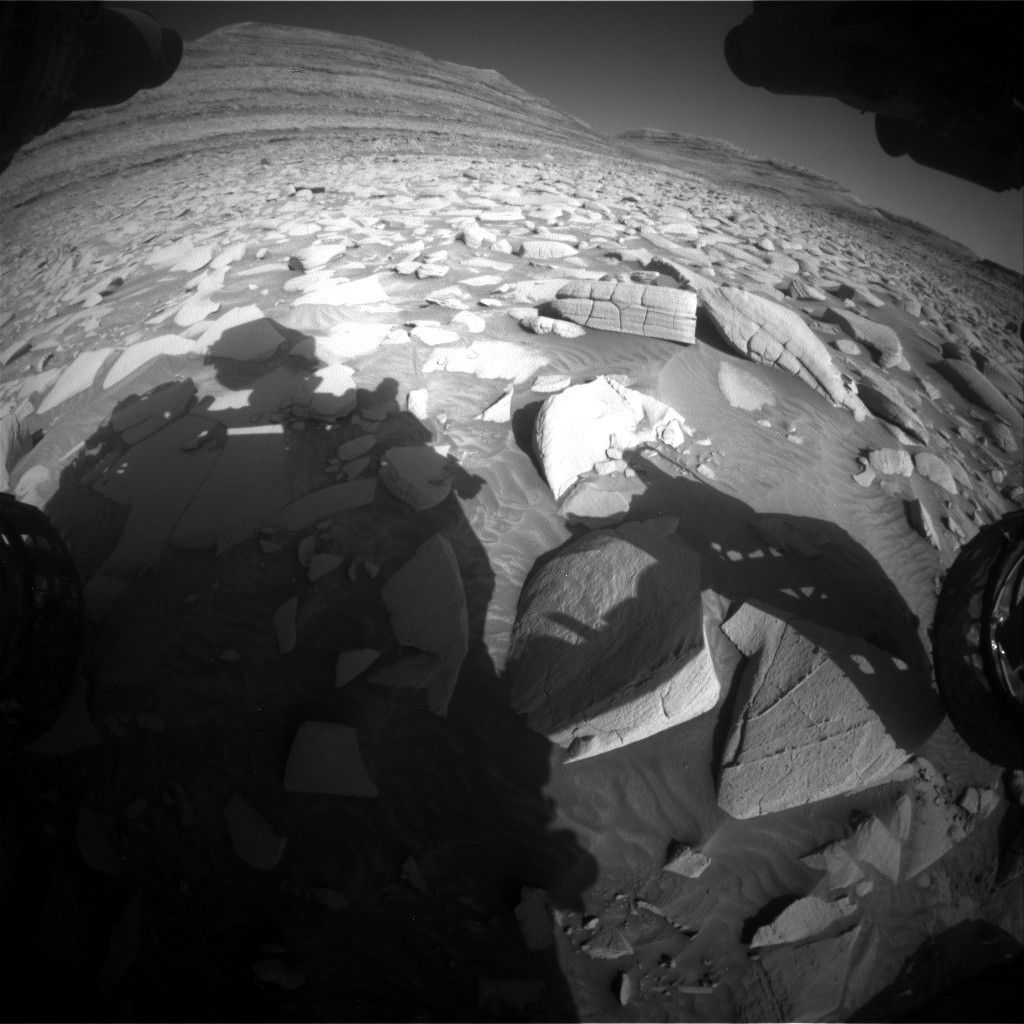
    Womp, womp. Another SRAP (Slip Risk Assessment Process) issue due to wheels being perched on these massive layered sulfate rocks. With our winter power constraints as tight as they are, though, keeping the arm stowed freed up more time to check some lines off our rover’s weekend list. To do: SAM activity to exercise Oven 2 (check!), Navcam 360-degree “phase function” sky movie to monitor scattering of Martian clouds (check!), APXS atmospheric measurements of argon (check!), ChemCam passive sky measurements of oxygen (check!), and a drive of about 50 meters (about 164 feet) to the southwest (check!). Curiosity gets busy on the weekends so us PULs can do some lounging. 

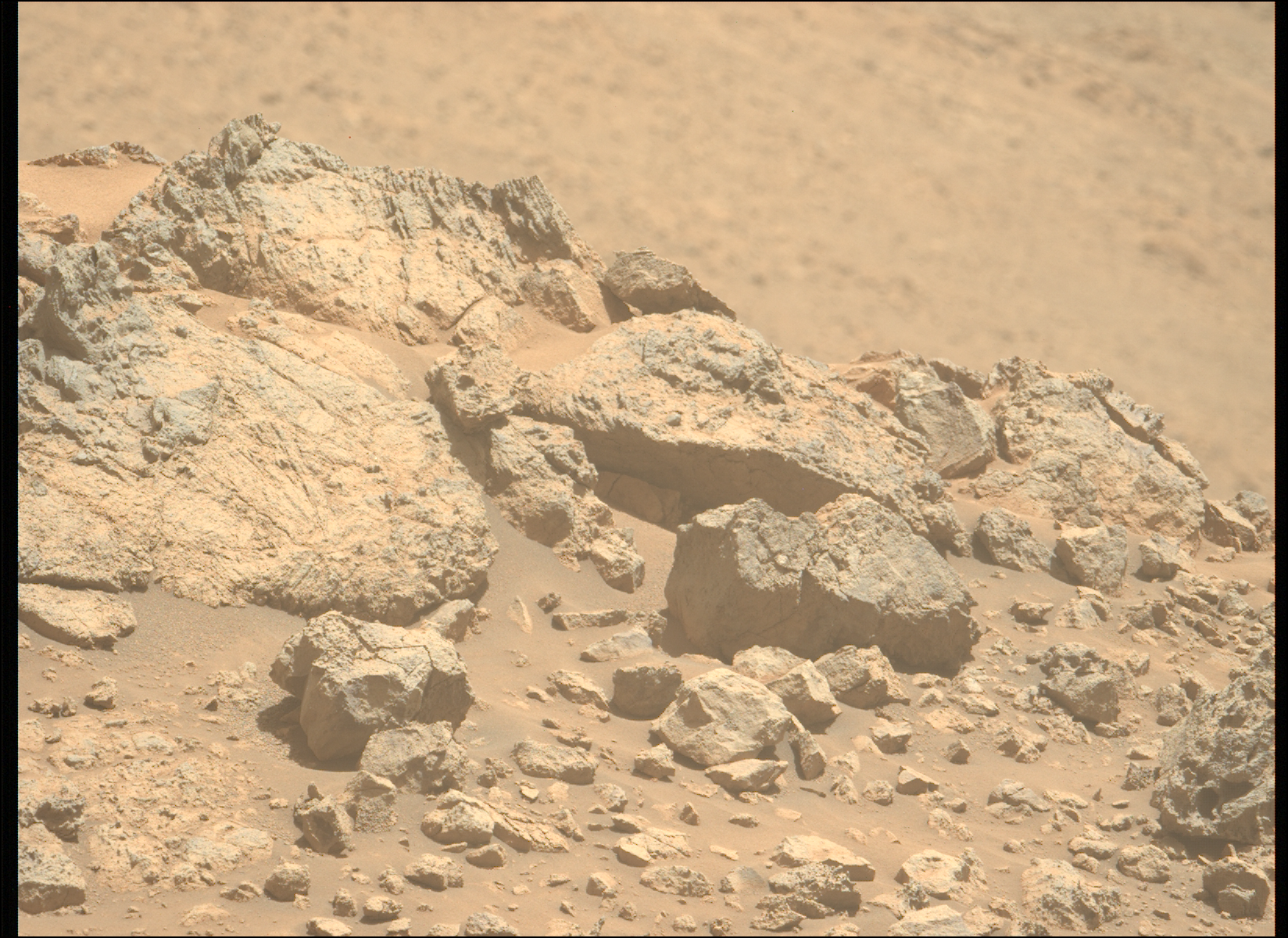
    On the Mastcam team, we’ve been pretty busy in the layered sulfate unit. The rocks are rippled, layered, fractured, and surrounded by sandy troughs. Where did it all come from? What current and past processes are at play in this area? This weekend we’re collecting 70 images to help figure that out. ChemCam is helping by collecting chemistry measurements of the lowest block in this Navcam image, with two targets close by aptly named “Solana Beach” and “Del Mar.” To help conserve power, we’ve been trying to parallelize our activities as much as possible. Recently this means Mastcam has been taking images while ChemCam undergoes “TEC Cooling” to get as cold as possible before using their laser. 

    We’re all hoping the arm can come back from vacation next week.

    Details

    Last Updated

    Apr 01, 2025

    Related Terms

  • Discovery Alert: Four Little Planets, One Big Step

    An artist’s view from what appears to be just above the surface of a small Barnard’s Star planet, covering the lower three-quarters of the image, the surface reddish brown, pocked with craters and a canyon-like trough stretching from the bottom center to the horizon. Above the curved horizon of the planet, at center, is the reddish Barnard’s Star, the other three small planets visible in the otherwise black background of space on either side of it – to the left of the star, one planet, lit about half-phase on the planet’s right side, and to the right of the star two planets, lit half-phase on their left sides.
    This artist’s concept pictures the planets orbiting Barnard’s Star, as seen from close to the surface of one of them.
    Image credit: International Gemini Observatory/NOIRLab/NSF/AURA/P. Marenfeld

    The Discovery

    Four rocky planets much smaller than Earth orbit Barnard’s Star, the next closest to ours after the three-star Alpha Centauri system. Barnard’s is the nearest single star.

    Key Facts

    Barnard’s Star, six light-years away, is notorious among astronomers for a history of false planet detections. But with the help of high-precision technology, the latest discovery — a family of four — appears to be solidly confirmed. The tiny size of the planets is also remarkable: Capturing evidence of small worlds at great distance is a tall order, even using state-of-the-art instruments and observational techniques.

    Details

    Watching for wobbles in the light from a star is one of the leading methods for detecting exoplanets — planets orbiting other stars. This “radial velocity” technique tracks subtle shifts in the spectrum of starlight caused by the gravity of a planet pulling its star back and forth as the planet orbits. But tiny planets pose a major challenge: the smaller the planet, the smaller the pull. These four are each between about a fifth and a third as massive as Earth. Stars also are known to jitter and quake, creating background “noise” that potentially could swamp the comparatively quiet signals from smaller, orbiting worlds.
    Astronomers measure the back-and-forth shifting of starlight in meters per second; in this case the radial velocity signals from all four planets amount to faint whispers — from 0.2 to 0.5 meters per second (a person walks at about 1 meter per second). But the noise from stellar activity is nearly 10 times larger at roughly 2 meters per second.

    How to separate planet signals from stellar noise? The astronomers made detailed mathematical models of Barnard’s Star’s quakes and jitters, allowing them to recognize and remove those signals from the data collected from the star.

    The new paper confirming the four tiny worlds — labeled b, c, d, and e — relies on data from MAROON-X, an “extreme precision” radial velocity instrument attached to the Gemini Telescope on the Maunakea mountaintop in Hawaii. It confirms the detection of the “b” planet, made with previous data from ESPRESSO, a radial velocity instrument attached to the Very Large Telescope in Chile. And the new work reveals three new sibling planets in the same system.

    Fun Facts

    These planets orbit their red-dwarf star much too closely to be habitable. The closest planet’s “year” lasts a little more than two days; for the farthest planet, it’s is just shy of seven days. That likely makes them too hot to support life. Yet their detection bodes well in the search for life beyond Earth. Scientists say small, rocky planets like ours are probably the best places to look for evidence of life as we know it. But so far they’ve been the most difficult to detect and characterize. High-precision radial velocity measurements, combined with more sharply focused techniques for extracting data, could open new windows into habitable, potentially life-bearing worlds.

    Barnard’s star was discovered in 1916 by Edward Emerson Barnard, a pioneering astrophotographer.

    The Discoverers

    An international team of scientists led by Ritvik Basant of the University of Chicago published their paper on the discovery, “Four Sub-Earth Planets Orbiting Barnard’s Star from MAROON-X and ESPRESSO,” in the science journal, “The Astrophysical Journal Letters,” in March 2025. The planets were entered into the NASA Exoplanet Archive on March 13, 2025.

    Details

    Last Updated

    Apr 01, 2025

  • NASA Trains for Orion Water Recovery Ahead of Artemis II Launch

    4 min read

    Preparations for Next Moonwalk Simulations Underway (and Underwater)

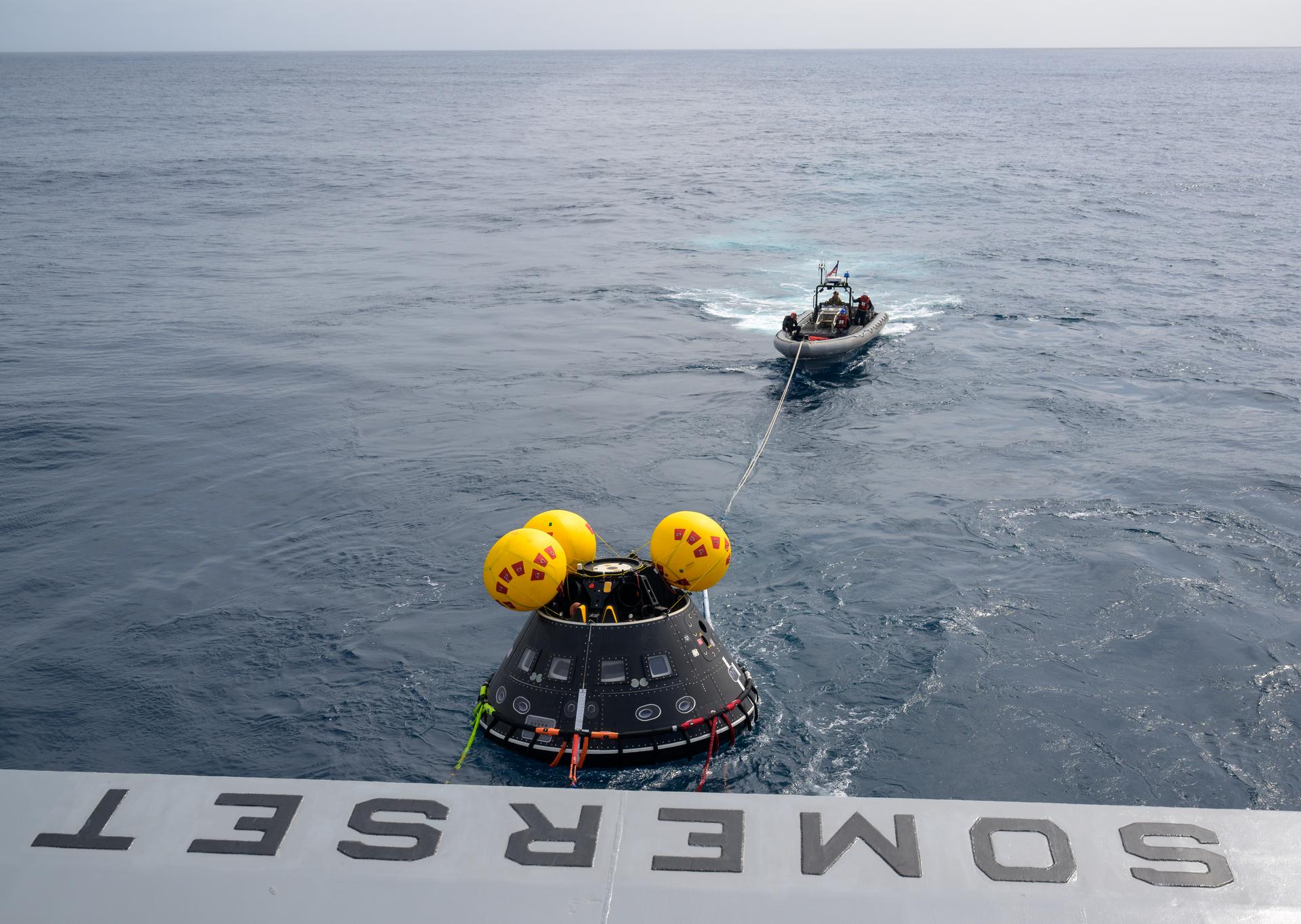
    The Crew Module Test Article (CMTA), a full scale mockup of the Orion spacecraft, is seen in the Pacific Ocean as teams practice Artemis recovery operations during Underway Recovery Test-12 onboard USS Somerset off the coast of California, Saturday, March 29, 2025.
    NASA/Bill Ingalls

    Preparations for NASA’s next Artemis flight recently took to the seas as a joint NASA and Department of Defense team, led by NASA’s Exploration Ground Systems Program, spent a week aboard the USS Somerset off the coast of California practicing procedures for recovering the Artemis II spacecraft and crew.

    Following successful completion of Underway Recovery Test-12 (URT-12) on Monday, NASA’s Landing and Recovery team and their Defense Department counterparts are certified to recover the Orion spacecraft as part of the upcoming Artemis II test flight that will send NASA astronauts Reid Wiseman, Victor Glover, and Christina Koch, as well as CSA (Canadian Space Agency) astronaut Jeremy Hansen, on a 10-day journey around the Moon.  

    “This will be NASA’s first crewed mission to the Moon under the Artemis program,” said Lili Villarreal, the landing and recovery director for Artemis II. “A lot of practice led up to this week’s event, and seeing everything come together at sea gives me great confidence that the air, water, ground, and medical support teams are ready to safely recover the spacecraft and the crew for this historic mission.”

    Image shows Orion spacecraft replica in Pacific Ocean
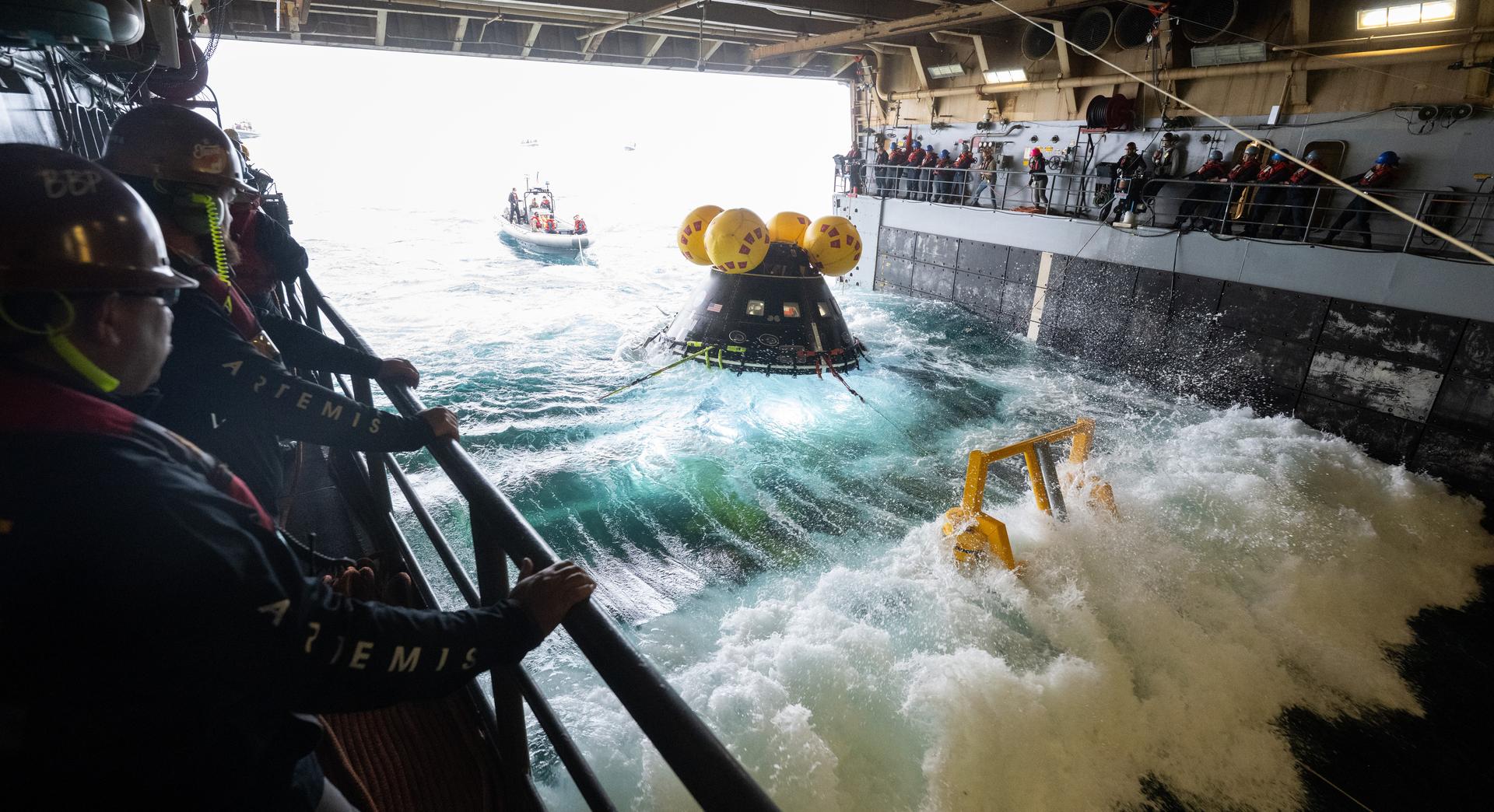
    A wave breaks inside the well deck of USS Somerset as teams work to recover the Crew Module Test Article (CMTA), a full scale replica of the Orion spacecraft, as they practice Artemis recovery operations during Underway Recovery Test-12 off the coast of California, Thursday, March 27, 2025.
    NASA/Joel Kowsky

    Once Orion reenters Earth’s atmosphere, the capsule will keep the crew safe as it slows from nearly 25,000 mph to about 325 mph. Then its system of 11 parachutes will deploy in a precise sequence to slow the capsule and crew to a relatively gentle 20 mph for splashdown off the coast of California. From the time it enters Earth’s atmosphere, the Artemis II spacecraft will fly 1,775 nautical miles to its landing spot in the Pacific Ocean. This direct approach allows NASA to control the amount of time the spacecraft will spend in extremely high temperature ranges.

    The Artemis II astronauts trained during URT-11 in February 2024, when they donned Orion Crew Survival System suits and practiced a range of recovery operations at sea using the Crew Module Test Article, a stand -in for their spacecraft.

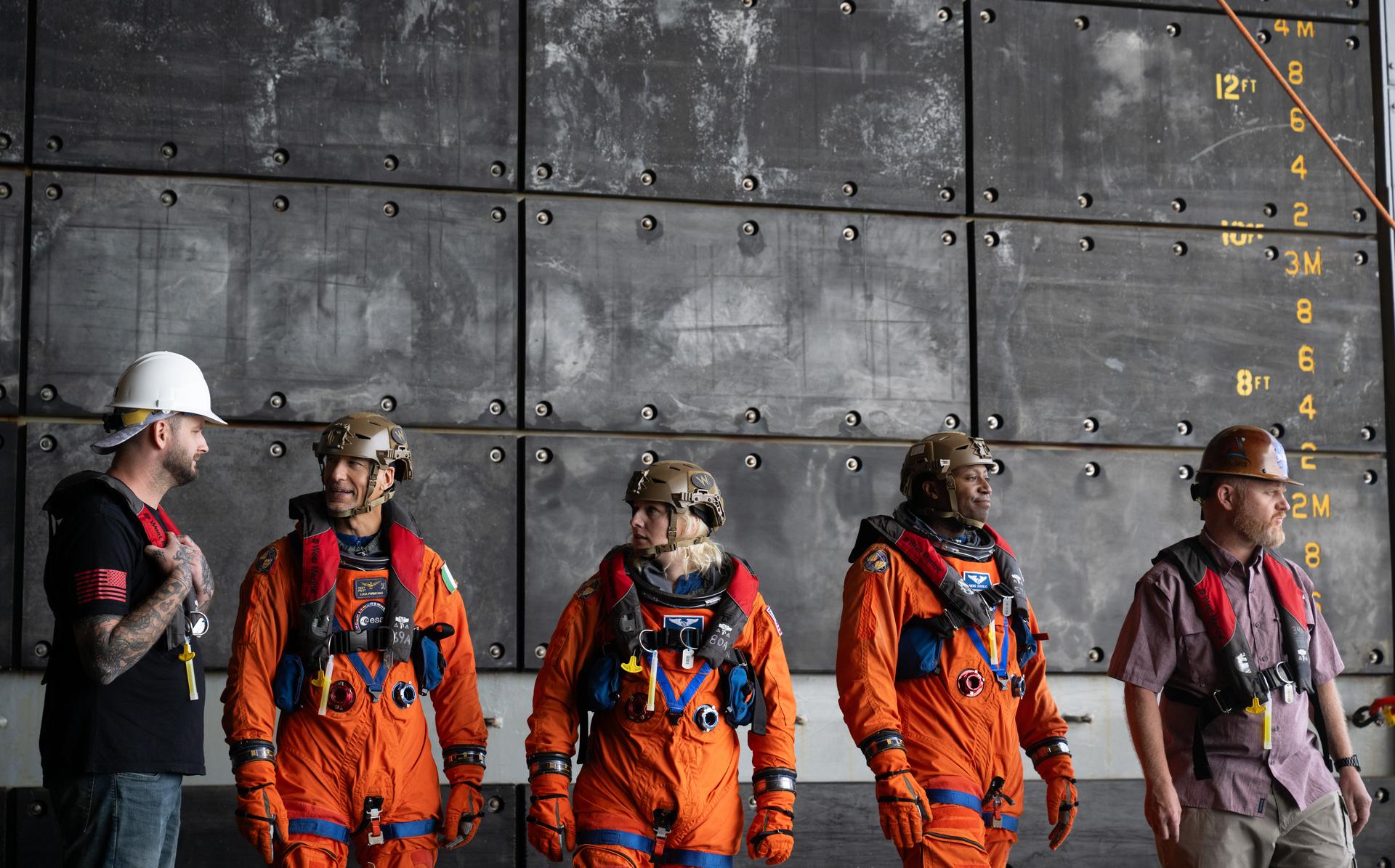
    For the 12th training exercise, NASA astronauts Deniz Burnham and Andre Douglas, along with ESA (European Space Agency) astronaut Luca Parmitano, did the same, moving from the simulated crew module to USS Somerset, with helicopters, a team of Navy divers in small boats, NASA’s open water lead – a technical expert and lead design engineer for all open water operations – as well as Navy and NASA medical teams rehearsing different recovery scenarios.

    Image shows astronauts in orange suits completing a mock training
    Grant Bruner, left, and Gary Kirkendall, right, Orion suit technicians, are seen with ESA (European Space Agency) astronaut Luca Parmitano, second from left, and NASA astronauts Deniz Burnham, center, and Andre Douglas, as they prepare to take part in Artemis recovery operations as part of Underway Recovery Test-12 onboard USS Somerset off the coast of California, Thursday, March 27, 2025.
    NASA/Joel Kowsky

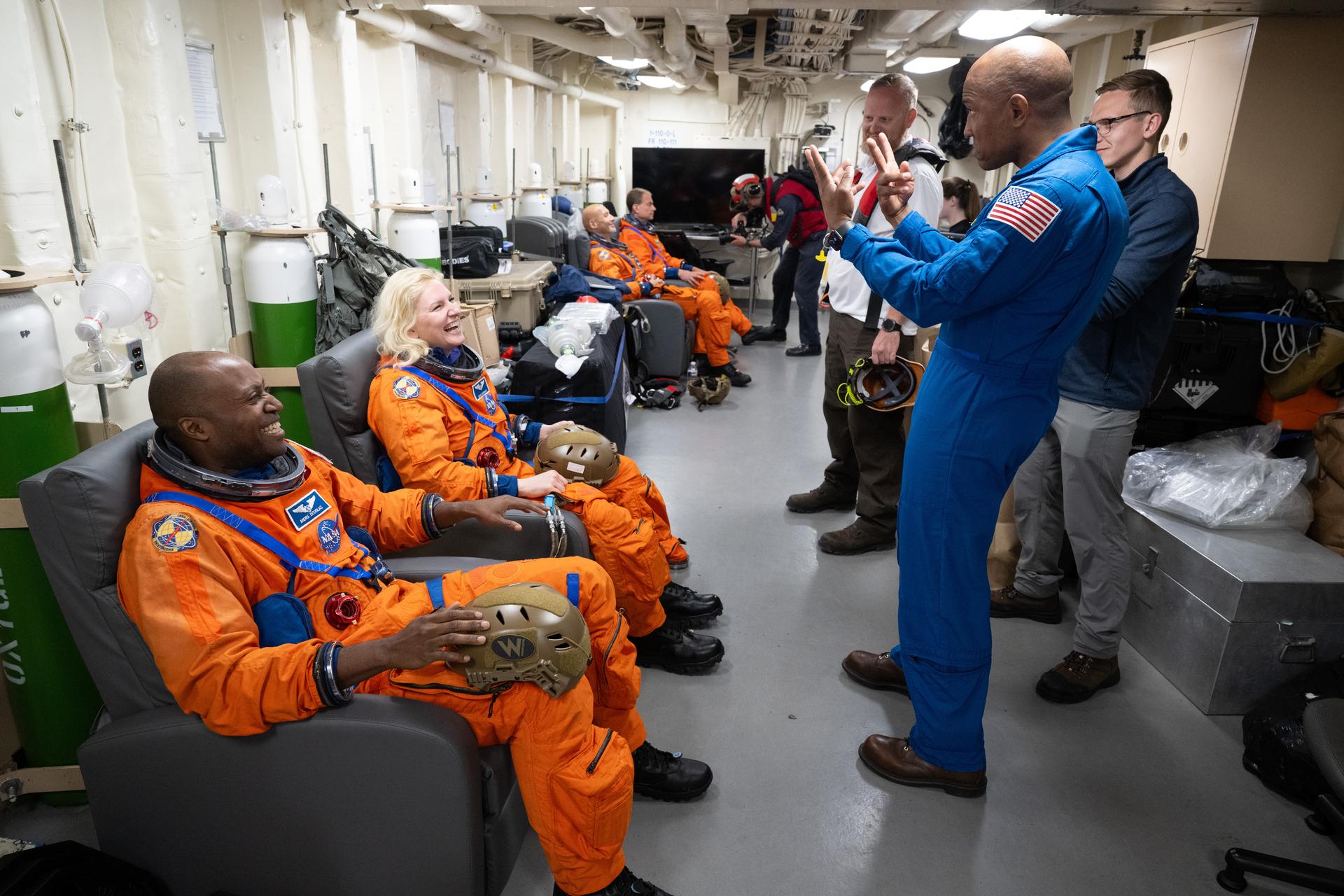
    “Allowing astronauts to participate when they are not directly involved in a mission gives them valuable experience by exposing them to a lot of different scenarios,” said Glover, who will pilot Artemis II. “Learning about different systems and working with ground control teams also broadens their skillsets and prepares them for future roles. It also allows astronauts like me who are assigned to the mission to experience other roles – in this case, I am serving in the role of Joe Acaba, Chief of the Astronaut Office.” 

    Image shows astronauts speaking to one another during mock training
    NASA astronaut and Artemis II pilot Victor Glover, right, speaks to NASA astronauts Andre Douglas and Deniz Burnham as they prepare to take part in practicing Artemis recovery procedures during Underway Recovery Test-12 onboard USS Somerset off the coast of California, Friday, March 28, 2025.
    NASA/Joel Kowsky
    Image shows a man giving a thumbs up to a woman in an orange astronaut suit
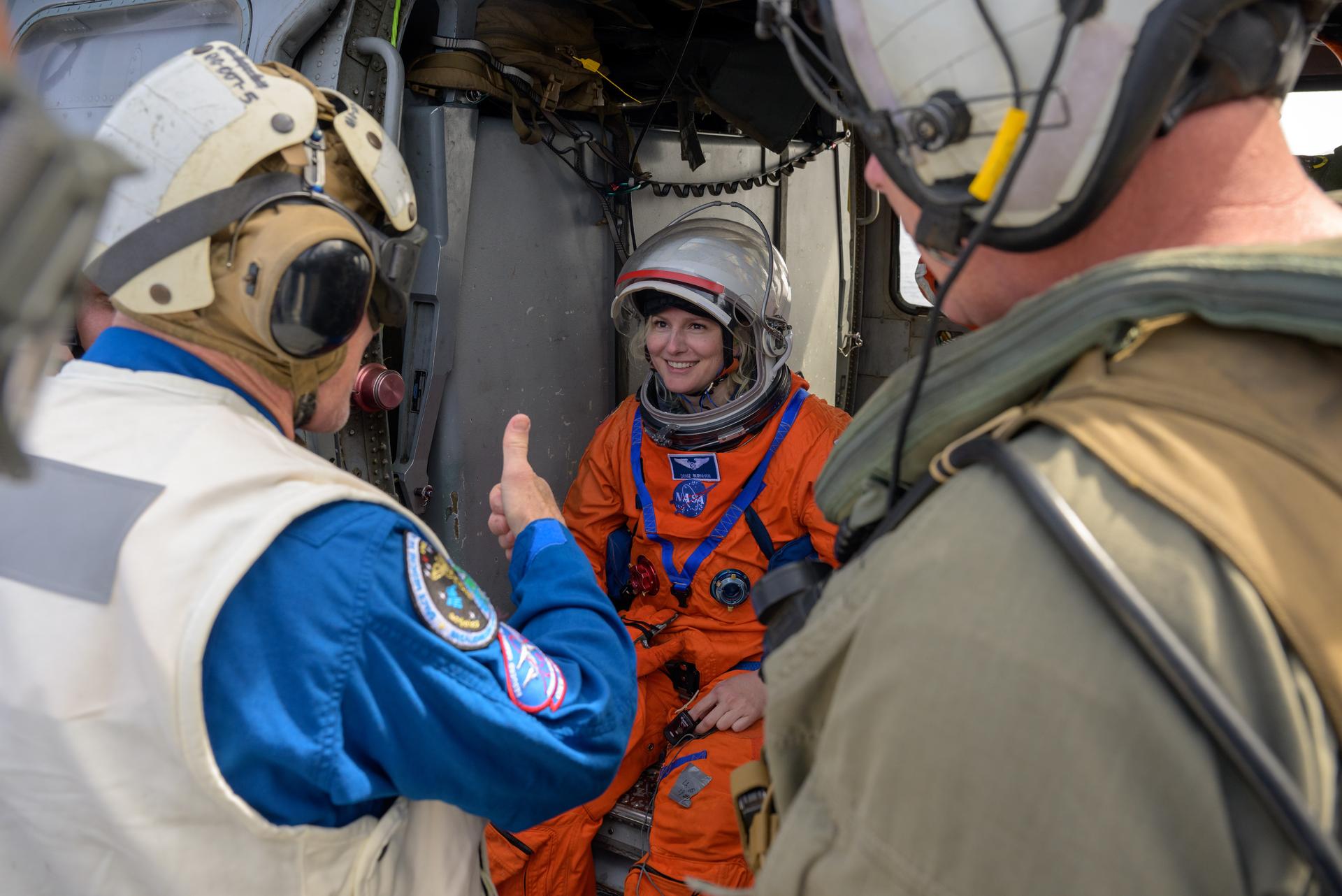
    NASA astronaut Deniz Burnham smiles after landing in a Navy helicopter onboard USS Somerset during Underway Recovery Test-12 off the coast of California, Thursday, March 27, 2025.
    NASA/Bill Ingalls

    As the astronauts arrive safely at the ship for medical checkouts, recovery teams focus on returning the spacecraft and its auxiliary ground support hardware to the amphibious transport dock.

    Navy divers attach a connection collar to the spacecraft and an additional line to a pneumatic winch inside the USS Somerset’s well deck, allowing joint NASA and Navy teams to tow Orion toward the ship. A team of sailors and NASA recovery personnel inside the ship manually pull some of the lines to help align Orion with its stand, which will secure the spacecraft for its trip to the shore. Following a safe and precise recovery, sailors will drain the well deck of water, and the ship will make its way back to Naval Base San Diego.

    The Artemis II test flight will confirm the foundational systems and hardware needed for human deep space exploration, taking another step toward missions on the lunar surface and helping the agency prepare for human missions to Mars.

    About the Author

    Allison Tankersley

    Public Affairs Specialist

  • Old Missions, New Discoveries: NASA’s Data Archives Accelerate Science

    5 min read

    Old Missions, New Discoveries: NASA’s Data Archives Accelerate Science

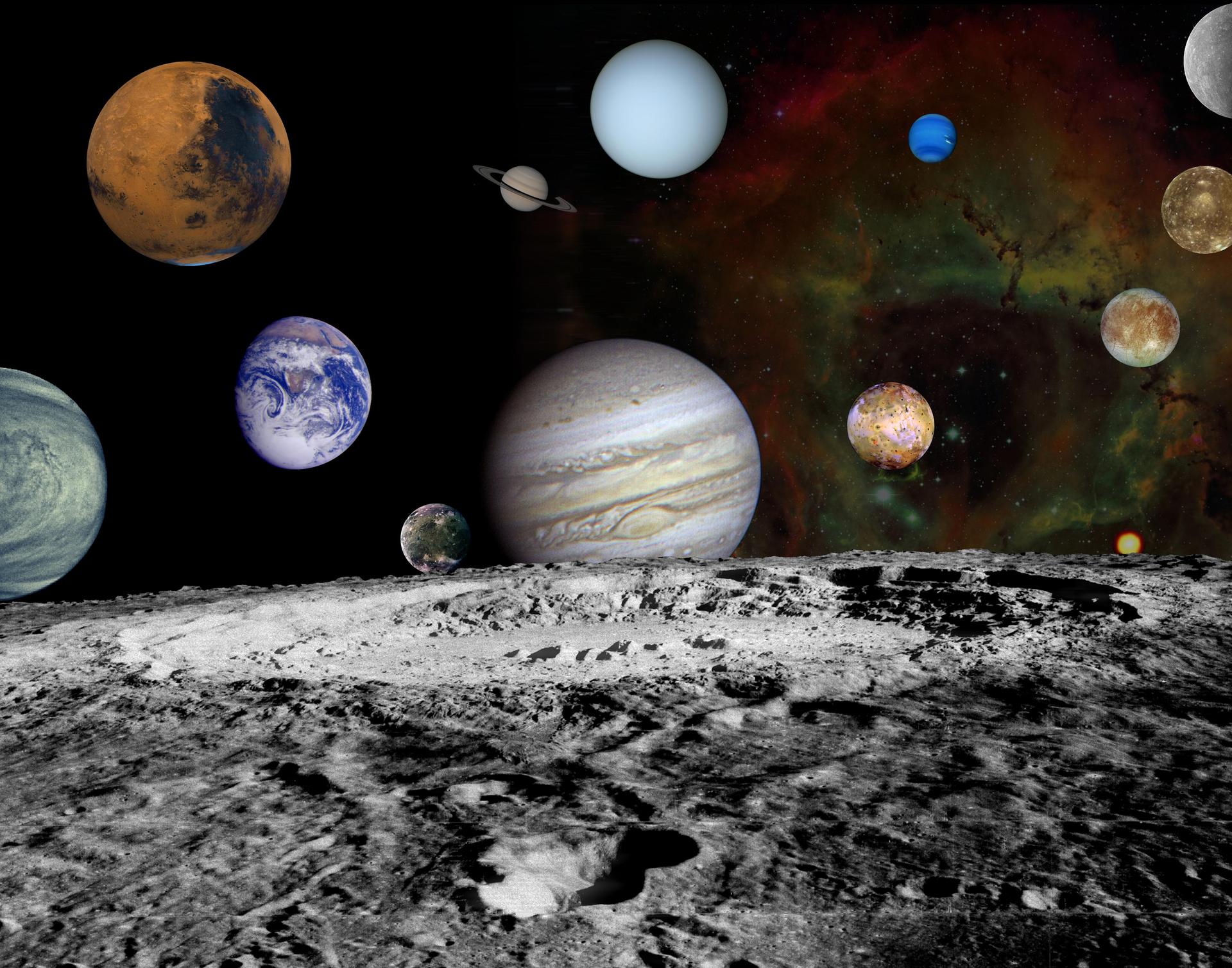
     This solar system montage of the nine planets and four large moons of Jupiter in our solar system are set against a false-color view of the Rosette Nebula.
    This montage of images taken by the Voyager spacecraft of the planets and four of Jupiter’s moons is set against a false-color picture of the Rosette Nebula with Earth’s moon in the foreground. Archival data from the Voyager missions continue to produce new scientific discoveries.
    NASA/JPL/ASU

    Every NASA mission represents a leap into the unknown, collecting data that pushes the boundaries of human understanding. But the story doesn’t end when the mission concludes. The data carefully preserved in NASA’s archives often finds new purpose decades later, unlocking discoveries that continue to benefit science, technology, and society.

    “NASA’s science data is one of our most valuable legacies,” said Kevin Murphy, NASA’s chief science data officer at NASA Headquarters in Washington. “It carries the stories of our missions, the insights of our discoveries, and the potential for future breakthroughs.”

    NASA’s science data is one of our most valuable legacies.

    Kevin Murphy

    Kevin Murphy

    Chief Science Data Officer, NASA’s Science Mission Directorate

    NASA’s Science Mission Directorate manages an immense amount of data, spanning astrophysics, biological and physical sciences, Earth science, heliophysics, and planetary science. Currently, NASA’s science data holdings exceed 100 petabytes—enough to store 20 billion photos from the average modern smartphone. This volume is expected to grow significantly with new missions.

    This vast amount of data enables new discoveries, connecting scientific observations together in meaningful ways. Over 50% of scientific publications rely on archived data, which NASA provides to millions of commercial, government, and scientific users.

    Image snippets showing Earth, the Carina nebula, Jupiter, the surface of the Sun, and a cell.
    NASA’s five science divisions — Astrophysics, Biological and Physical Sciences, Earth Science, Heliophysics, and Planetary Science — store petabytes’ worth of data in their archives that enable scientists to continually make discoveries.
    NASA

    Managing and stewarding such massive volumes of information requires careful planning, robust infrastructure, and innovative strategies to ensure the data is accessible, secure, and sustainable. Continued support for data storage and cutting-edge technology is key to ensuring future generations of researchers can continue to explore using science data from NASA missions. 

    Modern technology, such as image processing and artificial intelligence, helps unlock new insights from previous observations. For example, in 1986, NASA’s Voyager 2 spacecraft conducted a historic flyby of Uranus, capturing detailed data on the planet and its environment. Decades later, in the early 2000s, scientists used advanced image processing techniques on this archival data to discover two small moons, Perdita and Cupid, which had gone unnoticed during the initial analysis.

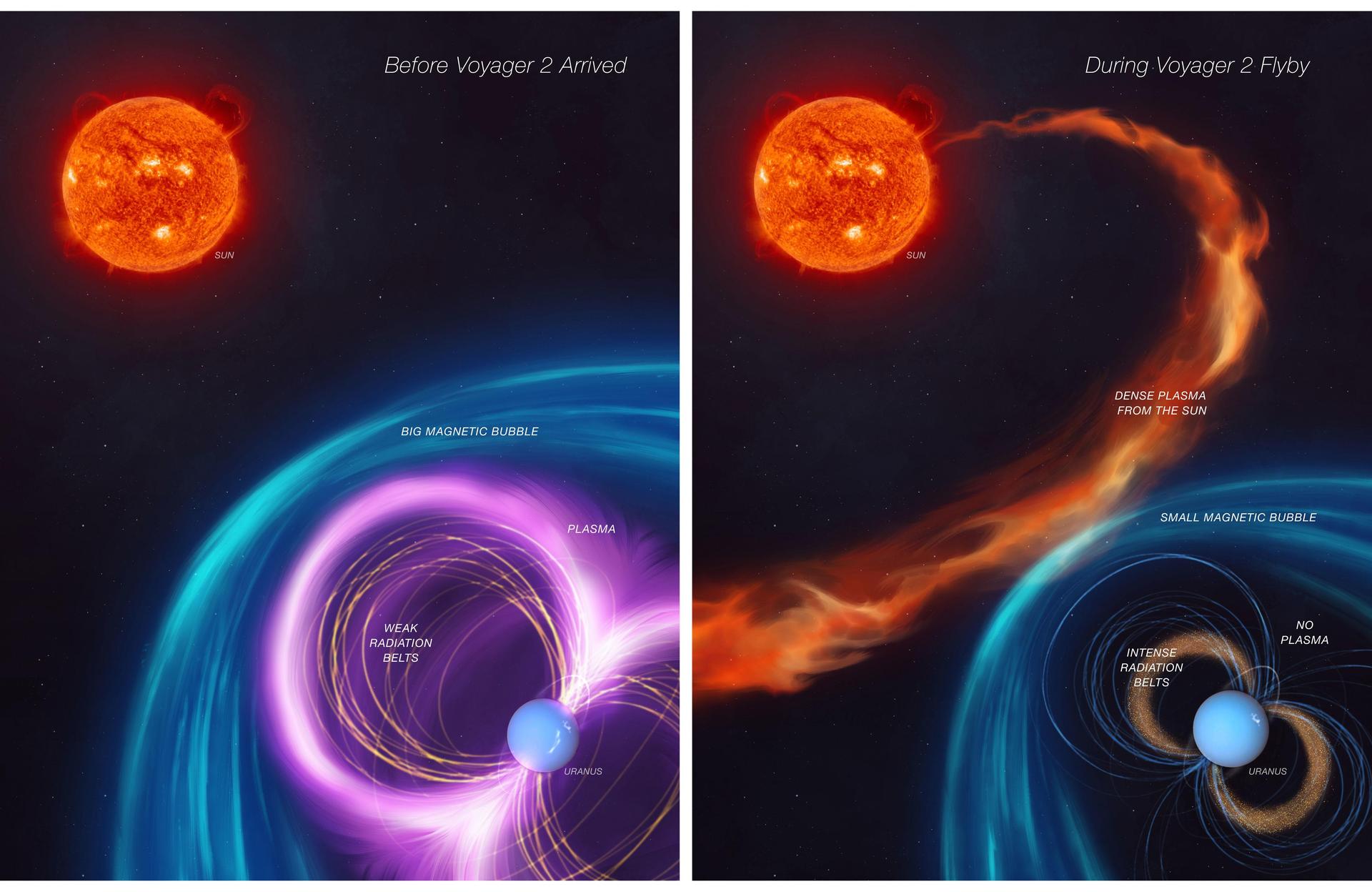
    In 2024, researchers revisited this 38-year-old archival data and identified a critical solar wind event that compressed Uranus’s magnetosphere just before the Voyager 2 flyby. This rare event, happening only about four percent of the time, provided unique insights into Uranus’s magnetic field and its interaction with space weather.

    The energized particles around Uranus defied scientist's understanding of how magnetic fields work to trap particle radiation.
    The first panel of this artist’s concept depicts how Uranus’s magnetosphere (its protective bubble) was behaving before Voyager 2’s flyby. The second panel shows that an unusual kind of solar weather was happening at the same time as the spacecraft’s flyby, giving scientists a skewed view of Uranus’s magnetosphere. The work enabled by archival Voyager data contributes to scientists’ understanding of this enigmatic planet.
    NASA/JPL-Caltech

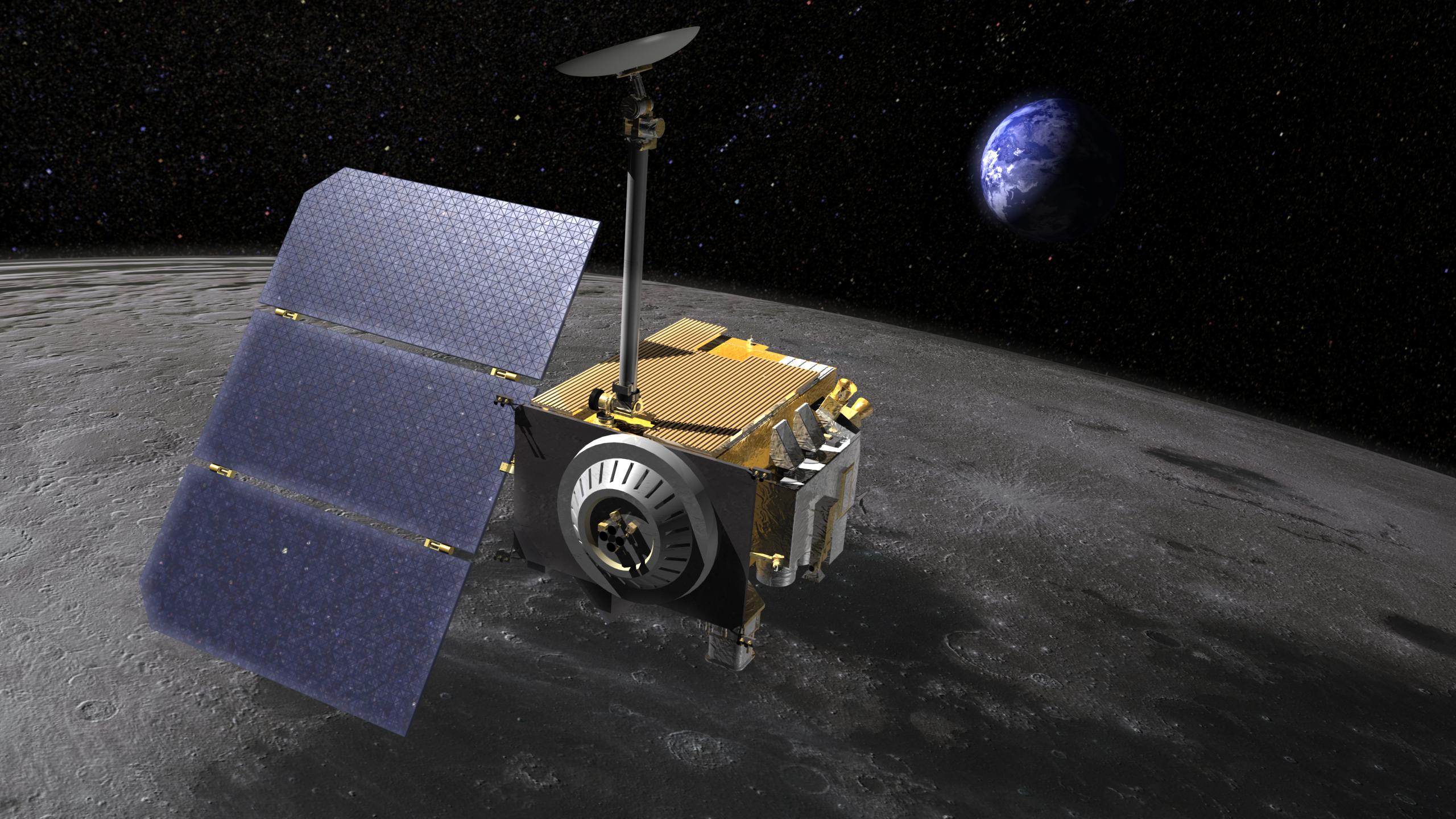
    NASA’s Lunar Reconnaissance Orbiter (LRO), launched in 2009, continues to provide data that reshapes our understanding of the Moon. In 2018, scientists analyzing the LRO’s archival data confirmed the presence of water ice in permanently shadowed regions at the Moon’s poles. 

    In 2024, new studies out of NASA’s Goddard Space Flight Center in Greenbelt, Maryland, showed widespread evidence of water ice within the permanently shadowed regions outside the lunar South Pole, further aiding lunar mission planners. This discovery not only holds implications for lunar exploration but also demonstrates how existing data can yield groundbreaking insights.

    Artist rendering of the Lunar Reconnaissance Orbiter LRO, above the moon.
    Artist rendering of the Lunar Reconnaissance Orbiter (LRO) above the Moon. LRO carries seven instruments that make comprehensive remote sensing observations of the Moon and measurements of the lunar radiation environment. Archival data from LRO continues to help scientists make discoveries about the Moon.
    NASA/GSFC

    NASA’s data archives uncover the secrets of our own planet as well as others. In 2024, archaeologists published a study revealing a “lost” Mayan city in Campeche, Mexico that was previously unknown to the scientific community. The researchers identified the city in archival airborne Earth science data, including a 2013 dataset from NASA Goddard’s LiDAR Hyperspectral & Thermal Imager (G-LiHT) mission.

    The Harmonized Landsat and Sentinel-2 (HLS) project provides frequent high-resolution observations of Earth’s surface. Data from HLS has been instrumental in tracking urban growth over time. By analyzing changes in land cover, researchers have used HLS to monitor the expansion of cities and infrastructure development. For example, in rapidly growing metropolitan areas, HLS data has revealed patterns of urban sprawl, helping planners analyze past trends to predict future metropolitan expansion.


    1985
    2010

    This natural color Landsat 5 image shows the city of Ontario, California, from above in the year 1985. Vegetation is green and brown and urban structures are bright white and gray. There is a large dry riverbed in the northeast corner that is also bright white, but its nonlinear appearance sets it apart visually.
    NASA’s Goddard Space Flight Center

    This natural color Landsat 5 image shows the city of Ontario, California, from above in the year 2010. The airport, found in the southwest portion of the image, added a number of runways since 1985, and large warehousing structures now dominate the once rural areas surrounding the airport. Vegetation is green and brown and urban structures are bright white and gray. There is a large dry riverbed in the northeast corner that is also bright white, but its nonlinear appearance sets it apart visually.
    NASA’s Goddard Space Flight Center

    This natural color Landsat 5 image shows the city of Ontario, California, from above in the year 1985. Vegetation is green and brown and urban structures are bright white and gray. There is a large dry riverbed in the northeast corner that is also bright white, but its nonlinear appearance sets it apart visually.
    NASA’s Goddard Space Flight Center

    This natural color Landsat 5 image shows the city of Ontario, California, from above in the year 2010. The airport, found in the southwest portion of the image, added a number of runways since 1985, and large warehousing structures now dominate the once rural areas surrounding the airport. Vegetation is green and brown and urban structures are bright white and gray. There is a large dry riverbed in the northeast corner that is also bright white, but its nonlinear appearance sets it apart visually.
    NASA’s Goddard Space Flight Center


    1985

    2010

    Before and After

    Urban Growth in Ontario, California

    1985-2010


    Thirty-five miles due east of downtown Los Angeles lies the city of Ontario, California. These natural color Landsat 5 images show the massive growth of the city between 1985 and 2010. The airport, found in the southwest portion of the images, added a number of runways, and large warehousing structures now dominate the once rural areas surrounding the airport. In these images, vegetation is green and brown, while urban structures are bright white and gray. A large dry riverbed in the northeast corner is also bright white, but its nonlinear appearance sets it apart visually. Researchers use archival data from Landsat and other satellites to track the growth of cities like Ontario, CA over time.

    These discoveries represent only a fraction of what’s possible. NASA is investing in new technologies to harness the full potential of its data archives, including artificial intelligence (AI) foundation models—open-source AI tools designed to extract new findings from existing science data.

    “Our vision is to develop at least one AI model for each NASA scientific discipline, turning decades of legacy data into a treasure trove of discovery,” said Murphy. “By embedding NASA expertise into these tools, we ensure that our scientific data continues to drive innovation across science, industry, and society for generations to come.”

    Developed under a collaboration between NASA’s Office of the Chief Science Data Officer, IBM, and universities, these AI models are scientifically validated and adaptable to new datasets, making them invaluable for researchers and industries alike.

    “It’s like having a virtual assistant that leverages decades of NASA’s knowledge to make smarter, quicker decisions,” said Murphy.

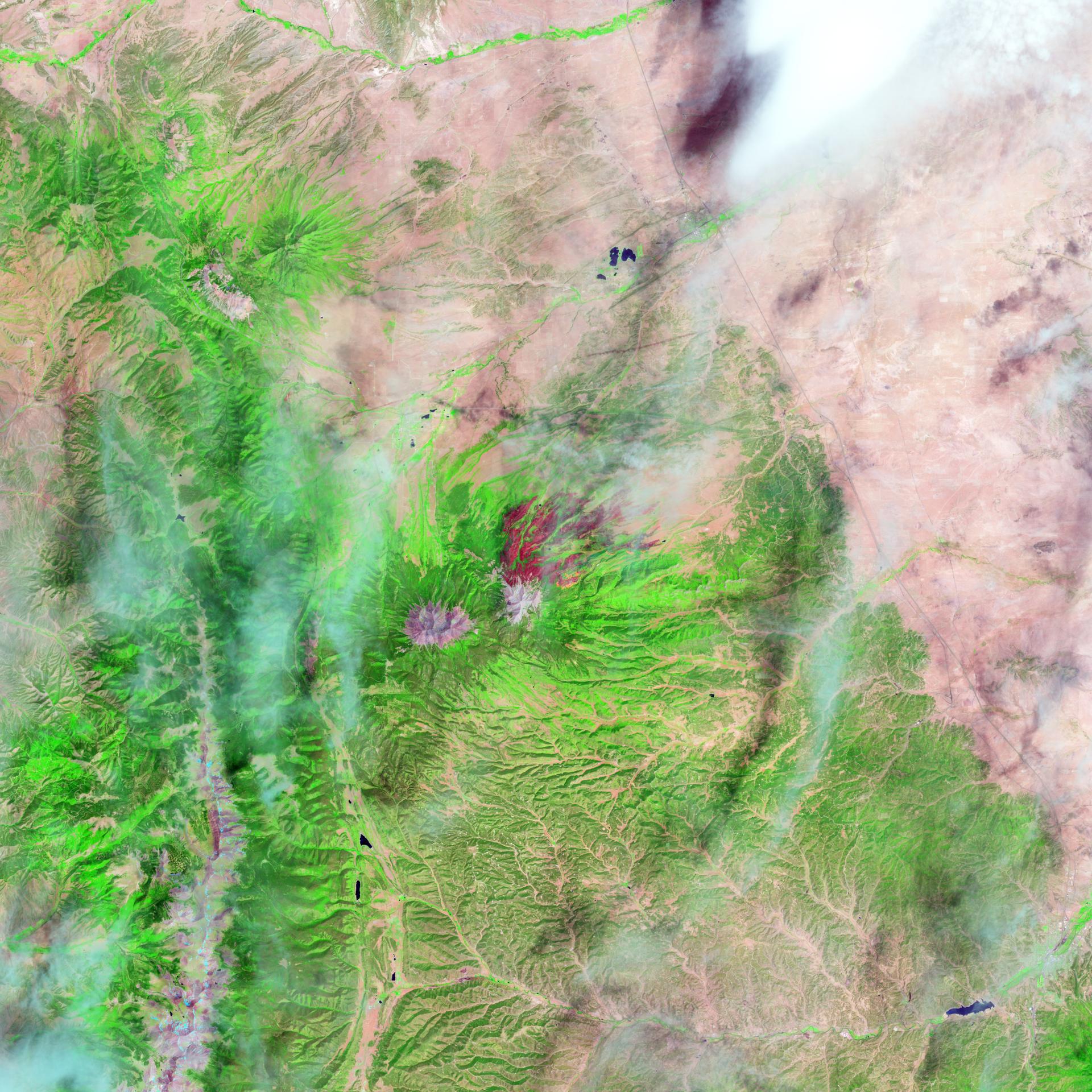
    On June 22, 2013, the Operational Land Imager (OLI) on Landsat 8 captured this false-color image of the East Peak fire burning in southern Colorado near Trinidad. Burned areas appear dark red, while actively burning areas look orange. Dark green areas are forests; light green areas are grasslands. Data from Landsat 8 were used to train the Prithvi artificial intelligence model, which can help detect burn scars.
    NASA Earth Observatory

    The team’s Earth science foundation models—the Prithvi Geospatial model and Prithvi Weather model—analyze vast datasets to monitor Earth’s changing landscape, track weather patterns, and support critical decision-making processes.

    Building on this success, the team is now developing a foundation model for heliophysics. This model will unlock new insights about the dynamics of solar activity and space weather, which can affect satellite operations, communication systems, and even power grids on Earth. Additionally, a model designed for the Moon is in progress, aiming to enhance our understanding of lunar resources and environments.

    This investment in AI not only shortens the “data-to-discovery” timeline but also ensures that NASA’s data archives continue to drive innovation. From uncovering new planets to informing future exploration and supporting industries on Earth, the possibilities are boundless.

    By maintaining extensive archives and embracing cutting-edge technologies, the agency ensures that the data collected today will continue to inspire and inform discoveries far into the future. In doing so, NASA’s legacy science data truly remains the gift that keeps on giving.

    By Amanda Moon Adams
    Communications Lead for the Office of the Chief Science Data Officer

  • Artemis II Core Stage Integration – Complete!

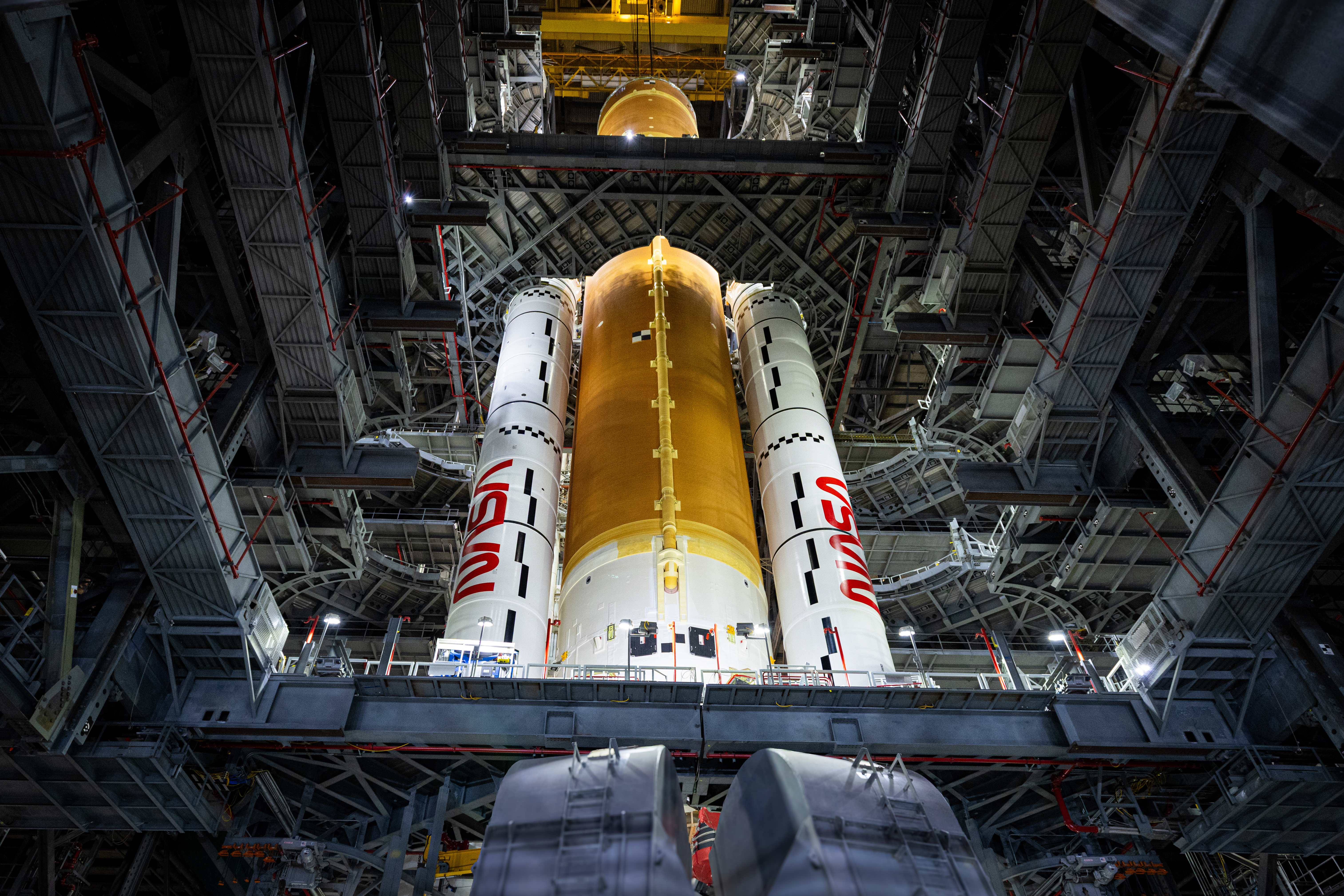
    The Artemis II core stage (a butterscotch orange cylinder in the middle) and solid rocket boosters (the white cylinders, branded with the NASA
    NASA/Frank Michaux

    Technicians from NASA and primary contractor Amentum join the SLS (Space Launch System) rocket with the stacked solid rocket boosters for the Artemis II mission at NASA’s Kennedy Space Center in Florida on March 23, 2025. The core stage is the largest component of the rocket, standing 212 feet tall and weighing about 219,000 pounds with its engines. The stage is the backbone of the rocket, supporting the launch vehicle stage adapter, interim cryogenic propulsion stage, Orion stage adapter, and the Orion spacecraft.

    Artemis II is the first crewed test flight under NASA’s Artemis campaign and is another step toward missions on the lunar surface and helping the agency prepare for future human missions to Mars.

    Image credit: NASA/Frank Michaux

  • Career Spotlight: Technologist (Ages 14-18)

    4 Min Read

    Career Spotlight: Technologist (Ages 14-18)

    NASA astronaut Kate Rubins uses tongs to pick up a geologic sample while wearing the Joint AR (Joint Augmented Reality Visual Informatics System) display during an advanced technology run

    What does a technologist do?

    Technologists are professionals who research, develop, and test emerging technologies. They also find useful ways to put new technologies to work. A technologist is an expert in a specific type of technology, often within a specific field. Many industries rely on innovations developed by technologists. Some of these include aerospace, research, manufacturing, healthcare, and information technology.

    NASA technologists make use of technological advancements to improve NASA’s capabilities and better meet the needs of its missions. They also oversee how technologies developed by NASA can improve life on Earth through commercial products. These products are called spinoffs. For examples of how NASA shows up in your everyday life, visit: https://spinoff.nasa.gov.

    What are some technology careers at NASA?

    Instrument scientist: Works to improve or develop instruments that collect data. In aerospace, an instrument is a sensor or other device that takes measurements or gathers scientific information. This role may include working with other specialties to design, create, and test scientific instruments.

    Data scientist: Uses computer science to create tools that manage data. Some of the tasks a data scientist might perform include developing predictive models, machine learning algorithms, or software to extract useful information from large sets of data.

    Information technology (IT) specialist: Designs, maintains, implements, and protects IT systems across the agency. Develops software, manages IT projects, and develops applications to support both organizational and mission operations.

    Members of a JPL team
    One of three small lunar rovers that are part of a NASA technology demonstration called CADRE (Cooperative Autonomous Distributed Robotic Exploration) is prepared for shipping in a clean room at the agency’s Jet Propulsion Laboratory in Southern California.
    NASA/JPL-Caltech

    How can I become a technologist?

    There are many different types of careers in technology, and the requirements vary. While you’re in high school, explore the possibilities and learn about the specialties and roles that will fit your interests. Then, investigate the academic path and experience you’ll need to eventually be hired into those roles. Current job openings, guidance counselors, and mentors can shed light on the types of certifications or degrees required. With this information, you can begin planning for the skills and education you’ll need.

    It’s important to remember that technology is always advancing. Even after you’ve launched your technologist career, a “lifelong learning” mindset will help you keep up with new innovations and skills.

    How can I start preparing today to become a technologist?

    Start growing your technology skills today with hands-on activities created by NASA STEM. Looking for something more involved? Many of NASA’s student challenges, competitions, and activities offer authentic experience in aerospace technology, computer science, and more.

    Students aged 16 and up who are U.S. citizens are eligible to apply for a paid NASA internship. Interns work on real projects with the guidance of a NASA mentor. Internship sessions are held each year in spring, summer, and fall; visit NASA’s Internships website to learn about important deadlines and current opportunities.

    Frank Pena, test director, checks on the 10-foot Mock Truss-Braced Wing at NASA’s Armstrong Flight Research Center in Edwards, California. The aircraft concept involves a wing braced on an aircraft using diagonal struts that also add lift and could result in significantly improved aerodynamics.
    NASA

    Advice from NASA technologists

    “Think about your personal interests and passions, and also the impact you’d like your work to have. What do you feel personally interested in when it comes to science and technology? Is there a problem that you think is very important for our society to solve? Often there is a research or technology field that can combine those two things!” – Olivia Tyrrell, NASA research engineer

    What do you feel personally interested in when it comes to science and technology?

    Olivia Tyrrell

    Olivia Tyrrell

    NASA Research Engineer

    “If you like to create things or find solutions to problems, working in technology is a great choice. Scientists identify problems, engineers solve problems, but ultimately, we need to create new technologies, new things, new gadgets.  Technologists are building the next generation toolbox for engineers and scientists to pull from, enabling everyone to solve problems in more effective and innovative ways. (Technologists invent things… what’s cooler than that?!)” – Kristen John, technical integration manager for lunar dust mitigation

    Additional Resources

    NASA Data Science, Cybersecurity, and IT Careers

    NASA Space Technology

    Technology | NASA+

  • Career Spotlight: Scientist (Ages 14-18)

    4 Min Read

    Career Spotlight: Scientist (Ages 14-18)

    A scientist in a white coat, mask, hair net, and purple gloves holds up a clear vial with a black substance inside near the camera.

    What does a scientist do?

    Science is about exploring answers to questions. A scientist uses research and evidence to form hypotheses, test variables, and then share their findings.

    NASA scientists conduct groundbreaking research to answer some of humanity’s most profound questions. Most scientists start as project scientists in their early careers. They spend a lot of time publishing their peer-reviewed literature and presenting scientific research. Senior-level scientists provide leadership in the NASA community, actively publish research group work, and take on management roles.

    What are some of the different types of scientists that work at NASA?

    Many types of scientists work at NASA to support its wide variety of missions. The agency’s scientists research the foods we send to space, the habitability of other planets, the weather in space, and so much more. Here are a few examples of types of scientists at NASA.

    Planetary scientist: Discovers and studies the planetary objects in our solar system. These efforts shed light on the history of the solar system and the distribution of life within it.

    Astrobiologist: Studies the origins of life, how life evolves, and where it might be found in the universe.

    Astrophysicist: Studies the physical and chemical structures of stars, planets, and other natural objects found in space.

    Biological/physical scientist: Studies how biological and physical processes work in challenging environments like space. This information helps NASA design longer human space missions and also benefits life on Earth.

    Earth scientist: Uses observations and data from satellites and other sources to study Earth’s atmosphere, oceans, land cover, and land use.

    Heliophysicist: Studies the Sun and its behaviors, such as magnetic fields, solar wind, and space weather. This knowledge helps us better understand and predict the Sun’s effects on Earth and in space.

    Jess Bunchek, a pseudonaut and associate scientist at NASA’s Kennedy Space Center in Florida, prepares red romaine lettuce seeds for a germination test inside the Space Station Processing Facility.

    How can I become a scientist?

    Focus on building your scientific knowledge and skills. You can do this by taking challenging academic courses, participating in science fairs, and joining extracurricular activities that have a scientific focus. This is also a good time to research what types of sciences you’re most interested in, possible careers in those fields, and academic degrees required for those jobs.

    Scientists typically need at least a four-year degree. Most pursue a master’s degree or even a doctorate (Ph.D.) to become experts in their field.

    How can I start preparing today to become a scientist?

    Interested in applying some science skills right away? NASA provides a variety of hands-on activities for a range of skill levels. The space agency also offers student challenges, competitions, and activities that provide authentic experience in a variety of science fields. For up-to-date opportunities, visit:

    NASA also offers paid internships for U.S. citizens aged 16 and up. Interns work on real projects with the guidance of a NASA mentor. Internship sessions are held each year in spring, summer, and fall; visit NASA’s Internships website to learn about important deadlines and current opportunities.

    NASA scientist Trevor Graff peers at a calibration target designed to help fine-tune settings on the Scanning Habitable Environments with Raman & Luminescence for Organics and Chemicals (SHERLOC) instrument carried aboard NASA's Perseverance Mars rover.

    Advice from NASA scientists

      “Take advantage of opportunities in different fields like attending summer classes, volunteering on the weekends, visiting museums, attending community lectures, and reading introductory books at the library. These are a few ways to expand your scope of possibility within the sciences, while simultaneously narrowing your focus in a field.” – Angela Garcia, exploration geologist

      “The key to being a scientist is to love asking questions. If you are fascinated about how and why things work — you are already a scientist.”

      Nicola Fox

      Nicola Fox

      NASA Associate Administrator, Science Mission Directorate

      “One general skill that is often overlooked is the ability to write well and clearly. There’s a misconception that being a scientist means using big words and writing in ways that no one understands, when it’s actually the opposite. The ability to communicate your thoughts and ideas so that a child can understand is not easy, but it’s essential for good scientific writing.” – Matt Mickens, NASA horticulturist

      Additional Resources

      Careers in Science and Research

      NASA Science Career Path Navigator

      NASA Science Mission Directorate

      People of NASA Science

      Explore NASA+ Scientist Resources

    • 20-Year Hubble Study of Uranus Yields New Atmospheric Insights

      5 Min Read

      20-Year Hubble Study of Uranus Yields New Atmospheric Insights

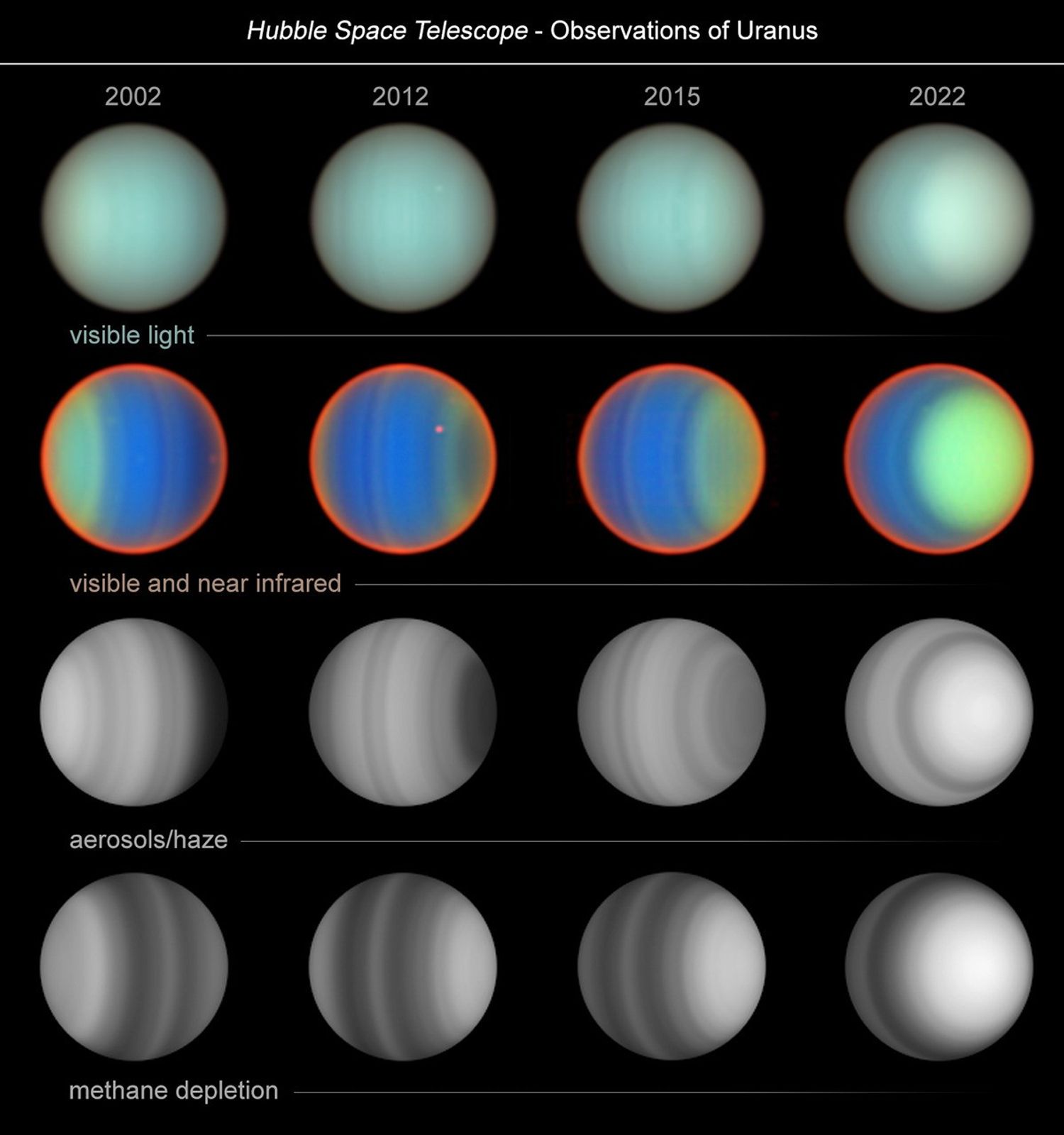
      Graphic titled “Hubble Space Telescope – Observations of Uranus,” with 16 images of Uranus, arranged in a 4 by 4 grid showing changes in appearance of Uranus as observed by Hubble between 2002 and 2022. Columns are labeled with observation year, from left to right: 2002; 2012; 2015; and 2022. Rows are labeled from top to bottom: visible light; visible and near infrared; aerosols/haze; and methane depletion. In the visible light images in the top row, Uranus appears blue-green with faint vertical bends of slightly lighter or darker color. In the visible and near infrared images in the second row, Uranus is very colorful, with deep neon blue to neon green bands within an orange-red glow that outlines the edge of the planet. In the two bottom rows of images, Uranus appears in grayscale, with vertical bands ranging from dark gray to almost white. All four rows of images show changes from observation to observation (left to right). For a given year, all four images in the column show similar banding patterns.
      The image columns show the change of Uranus for the four years that STIS observed Uranus across a 20-year period. Over that span of time, the researchers watched the seasons of Uranus as the south polar region darkened going into winter shadow while the north polar region brightened as northern summer approaches.
      Credits:
      NASA, ESA, Erich Karkoschka (LPL)

      The ice-giant planet Uranus, which travels around the Sun tipped on its side, is a weird and mysterious world. Now, in an unprecedented study spanning two decades, researchers using NASA’s Hubble Space Telescope have uncovered new insights into the planet’s atmospheric composition and dynamics. This was possible only because of Hubble’s sharp resolution, spectral capabilities, and longevity. 

      The team’s results will help astronomers to better understand how the atmosphere of Uranus works and responds to changing sunlight. These long-term observations provide valuable data for understanding the atmospheric dynamics of this distant ice giant, which can serve as a proxy for studying exoplanets of similar size and composition.

      When Voyager 2 flew past Uranus in 1986, it provided a close-up snapshot of the sideways planet. What it saw resembled a bland, blue-green billiard ball. By comparison, Hubble chronicled a 20-year story of seasonal changes from 2002 to 2022. Over that period, a team led by Erich Karkoschka of the University of Arizona, and Larry Sromovsky and Pat Fry from the University of Wisconsin used the same Hubble instrument, STIS (the Space Telescope Imaging Spectrograph), to paint an accurate picture of the atmospheric structure of Uranus. 

      Uranus’ atmosphere is mostly hydrogen and helium, with a small amount of methane and traces of water and ammonia. The methane gives Uranus its cyan color by absorbing the red wavelengths of sunlight.

      The Hubble team observed Uranus four times in the 20-year period: in 2002, 2012, 2015, and 2022. They found that, unlike conditions on the gas giants Saturn and Jupiter, methane is not uniformly distributed across Uranus. Instead, it is strongly depleted near the poles. This depletion remained relatively constant over the two decades. However, the aerosol and haze structure changed dramatically, brightening significantly in the northern polar region as the planet approaches its northern summer solstice in 2030.

      Graphic titled “Hubble Space Telescope – Observations of Uranus,” with 16 images of Uranus, arranged in a 4 by 4 grid showing changes in appearance of Uranus as observed by Hubble between 2002 and 2022. Columns are labeled with observation year, from left to right: 2002; 2012; 2015; and 2022. Rows are labeled from top to bottom: visible light; visible and near infrared; aerosols/haze; and methane depletion. In the visible light images in the top row, Uranus appears blue-green with faint vertical bends of slightly lighter or darker color. In the visible and near infrared images in the second row, Uranus is very colorful, with deep neon blue to neon green bands within an orange-red glow that outlines the edge of the planet. In the two bottom rows of images, Uranus appears in grayscale, with vertical bands ranging from dark gray to almost white. All four rows of images show changes from observation to observation (left to right). For a given year, all four images in the column show similar banding patterns.
      The image columns show the change of Uranus for the four years that STIS observed Uranus across a 20-year period. Over that span of time, the researchers watched the seasons of Uranus as the south polar region darkened going into winter shadow while the north polar region brightened as northern summer approaches.
      NASA, ESA, Erich Karkoschka (LPL)

      Uranus takes a little over 84 Earth years to complete a single orbit of the Sun. So, over two decades, the Hubble team has only seen mostly northern spring as the Sun moves from shining directly over Uranus’ equator toward shining almost directly over its north pole in 2030. Hubble observations suggest complex atmospheric circulation patterns on Uranus during this period. The data that are most sensitive to the methane distribution indicate a downwelling in the polar regions and upwelling in other regions. 

      The team analyzed their results in several ways. The image columns show the change of Uranus for the four years that STIS observed Uranus across a 20-year period. Over that span of time, the researchers watched the seasons of Uranus as the south polar region (left) darkened going into winter shadow while the north polar region (right) brightened as it began to come into a more direct view as northern summer approaches.

      The top row, in visible light, shows how the color of Uranus appears to the human eye as seen through even an amateur telescope. 

      In the second row, the false-color image of the planet is assembled from visible and near-infrared light observations. The color and brightness correspond to the amounts of methane and aerosols. Both of these quantities could not be distinguished before Hubble’s STIS was first aimed at Uranus in 2002. Generally, green areas indicate less methane than blue areas, and red areas show no methane. The red areas are at the limb, where the stratosphere of Uranus is almost completely devoid of methane. 

      The two bottom rows show the latitude structure of aerosols and methane inferred from 1,000 different wavelengths (colors) from visible to near infrared. In the third row, bright areas indicate cloudier conditions, while the dark areas represent clearer conditions. In the fourth row, bright areas indicate depleted methane, while dark areas show the full amount of methane. 

      At middle and low latitudes, aerosols and methane depletion have their own latitudinal structure that mostly did not change much over the two decades of observation.  However, in the polar regions, aerosols and methane depletion behave very differently. 

      In the third row, the aerosols near the north pole display a dramatic increase, showing up as very dark during early northern spring, turning very bright in recent years. Aerosols also seem to disappear at the left limb as the solar radiation disappeared. This is evidence that solar radiation changes the aerosol haze in the atmosphere of Uranus. On the other hand, methane depletion seems to stay quite high in both polar regions throughout the observing period. 

      Astronomers will continue to observe Uranus as the planet approaches northern summer.

      The Hubble Space Telescope has been operating for over three decades and continues to make ground-breaking discoveries that shape our fundamental understanding of the universe. Hubble is a project of international cooperation between NASA and ESA (European Space Agency). NASA’s Goddard Space Flight Center in Greenbelt, Maryland, manages the telescope and mission operations. Lockheed Martin Space, based in Denver, also supports mission operations at Goddard. The Space Telescope Science Institute in Baltimore, which is operated by the Association of Universities for Research in Astronomy, conducts Hubble science operations for NASA.

      Details

      Last Updated

      Mar 31, 2025

      Editor
      Andrea Gianopoulos
      Contact

      Media

      Claire Andreoli
      NASA’s Goddard Space Flight Center
      Greenbelt, Maryland
      claire.andreoli@nasa.gov

      Ann Jenkins
      Space Telescope Science Institute, Baltimore, Maryland

      Ray Villard
      Space Telescope Science Institute, Baltimore, Maryland

    • University High Triumphs at JPL-Hosted Ocean Sciences Bowl

      3 min read

      Preparations for Next Moonwalk Simulations Underway (and Underwater)

      Team from University High School in Irvine, California
      This team from University High School in Irvine, California, won the 2025 regional Oceans Science Bowl, hosted by NASA’s Jet Propulsion Laboratory. From left: Nethra Iyer, Joanne Chen, Matthew Feng, Avery Hexun, Angelina Yan, and coach David Knight.
      NASA/JPL-Caltech

      The annual regional event puts students’ knowledge of ocean-related science to the test in a fast-paced academic competition.

      A team of students from University High School in Irvine earned first place at a fast-paced regional academic competition focused on ocean science disciplines and hosted by NASA’S Jet Propulsion Laboratory in Southern California.

      Eight teams from Los Angeles and Orange counties competed at the March 29 event, dubbed the Los Angeles Surf Bowl. It was the last of about 20 regional competitions held across the U.S. this year in the lead-up to the virtual National Ocean Sciences Bowl finals event in mid-May.

      Santa Monica High School earned second place; Francisco Bravo Medical Magnet High School in Los Angeles came in third. With its victory, University repeated its winning performance from last year. The school also won the JPL-hosted regional Science Bowl earlier this month.

      Team from University High School in Irvine, California
      Teams from all eight schools that participated in the JPL-hosted 2025 regional Ocean Sciences Bowl pose alongside volunteers and coaches.
      NASA/JPL-Caltech

      For the Ocean Sciences Bowl, teams are composed of four to five students and a coach. To prepare for the event, team members spend months answering multiple-choice questions with a “Jeopardy!”-style buzzer in just five seconds. Questions come in several categories, including biology, chemistry, geology, and physics along with related geography, technology, history, policy, and current events topics.

      A question in the chemistry category might be “What chemical is the principal source of energy at many of Earth’s hydrothermal vent systems?” (It’s hydrogen sulfide.) Other questions can be considerably more challenging.

      When a team member buzzes in and gives the correct answer to a multiple-choice question, the team earns a bonus question, which allows teammates to consult with one another to come up with an answer. More complicated “team challenge questions” prompt students to work together for a longer period. The theme of this year’s competition is “Sounding the Depths: Understanding Ocean Acoustics.”

      University High junior Matthew Feng, a return competitor, said the team’s success felt like a payoff for hours of studying together, including on weekends. He keeps coming back to the competition partly for the sense of community and also for the personal challenge, he said. “It’s nice to compete and meet people, see people who were here last year,” Matthew added. “Pushing yourself mentally — the first year I was shaking so hard because I wasn’t used to that much adrenaline.”

      Since 2000, JPL’s Public Services Office has coordinated the Los Angeles regional contest with the help of volunteers from laboratory staff and former Ocean Sciences Bowl participants in the local community. JPL is managed for NASA by Caltech.

      The National Ocean Sciences Bowl is a program of the Center for Ocean Leadership at the University Corporation for Atmospheric Research, a nonprofit consortium of colleges and universities focused in part on Earth science-related education.

      News Media Contact

      Melissa Pamer
      Jet Propulsion Laboratory, Pasadena, Calif.
      626-314-4928
      melissa.pamer@jpl.nasa.gov

      2025-044

      Details

      Last Updated

      Mar 31, 2025

    • NASA Awards Launch Services Contract for SpaceX Starship

      NASA logo.

      NASA has awarded SpaceX of Starbase, Texas, a modification under the NASA Launch Services (NLS) II contract to add Starship to their existing Falcon 9 and Falcon Heavy launch service offerings.

      The NLS II contracts provide a broad range of commercial launch services for NASA’s planetary, Earth-observing, exploration, and scientific satellites. These high-priority, low and medium risk tolerant missions have full NASA technical oversight and mission assurance, resulting in the highest probability of launch success.

      The NLS II contracts are multiple award, indefinite-delivery/indefinite-quantity, with an ordering period through June 2030 and an overall period of performance through December 2032. The contracts include an on-ramp provision that provides an opportunity annually for new launch service providers to add their launch service on an NLS II contract and compete for future missions and allows existing contractors to introduce launch services not currently on their NLS II contracts.

      The contracts support the goals and objectives of the agency’s Science Mission Directorate, Space Operations Mission Directorate, Explorations Systems Development Mission Directorate, and the Space Technology Mission Directorate. Under the contracts, NASA also can provide launch services to other federal government agencies.

      NASA’s Launch Services Program Office at the agency’s Kennedy Space Center in Florida manages the NLS II contracts. For more information about NASA and agency programs, visit:

      https://www.nasa.gov

      -end-

      Tiernan Doyle / Joshua Finch
      Headquarters, Washington
      202-358-1600 / 202-358-1100
      tiernan.doyle@.nasa.gov / joshua.a.finch@nasa.gov

      Patti Bielling
      Kennedy Space Center, Florida
      321-501-7575
      patricia.a.bielling@nasa.gov

      Details

      Last Updated

      Mar 28, 2025

    • NASA Boosts Efficiency with Custom X-66 Flooring

      2 min read

      Preparations for Next Moonwalk Simulations Underway (and Underwater)

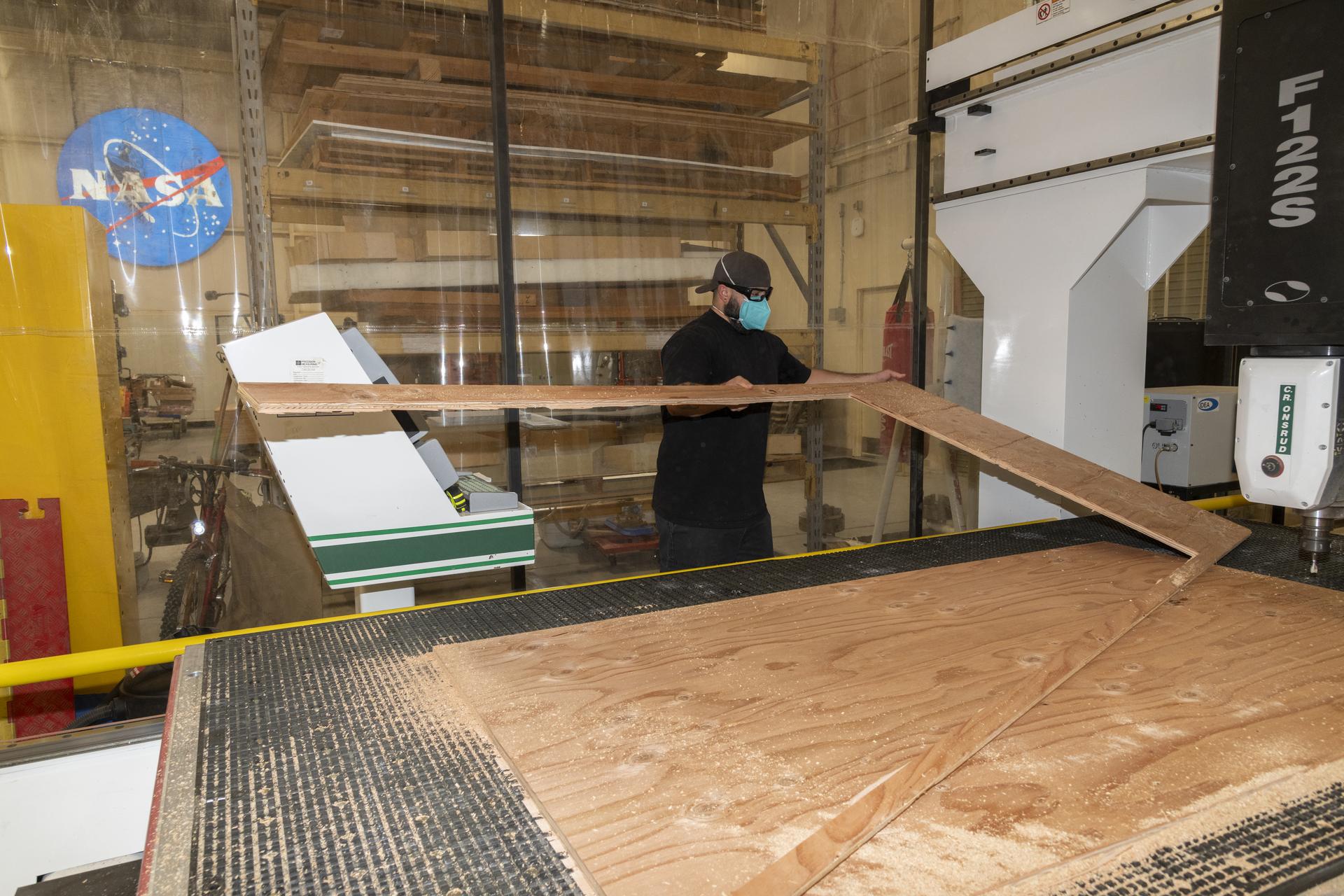
      A man wearing a black shirt, a mask, glasses, and a baseball cap backwards handles part of a piece of light brown plywood as he is pulling it off a machine. There is clear plastic hanging from the wall behind him. The NASA logo is also hanging on the wall behind the plastic. There is wood dust around the area of the machine.
      Eric Garza, an engineering technician in the Experimental Fabrication Shop at NASA’s Armstrong Flight Research Center in Edwards, California, cuts plywood to size for temporary floorboards for the X-66 experimental demonstrator aircraft on Aug. 26, 2024.
      NASA/Steve Freeman

      NASA designed temporary floorboards for the MD-90 aircraft to use while it is transformed into the X-66 experimental demonstrator aircraft. These floorboards will protect the original flooring and streamline the modification process.

      Supporting the agency’s Sustainable Flight Demonstrator project, a small team in the Experimental Fabrication Shop at NASA’s Armstrong Flight Research Center in Edwards, California, built temporary floorboards to save the project time and resources. Repeated removal and installation of the original flooring during the modification process was time-consuming. Using temporary panels also ensures the original floorboards are protected and remain flightworthy for when modifications are complete, and the original flooring is reinstalled.

      “The task of creating the temporary floorboards for the MD-90 involves a meticulous process aimed at facilitating modifications while maintaining safety and efficiency. The need for these temporary floorboards arises from the detailed procedure required to remove and reinstall the Original Equipment Manufacturer (OEM) floorboards,” said Jason Nelson, experimental fabrication lead. He is one of two members of the fabrication team – one engineering technician and one inspector – manufacturing about 50 temporary floorboards, which range in size from 20 inches by 36 inches to 42 inches by 75 inches.

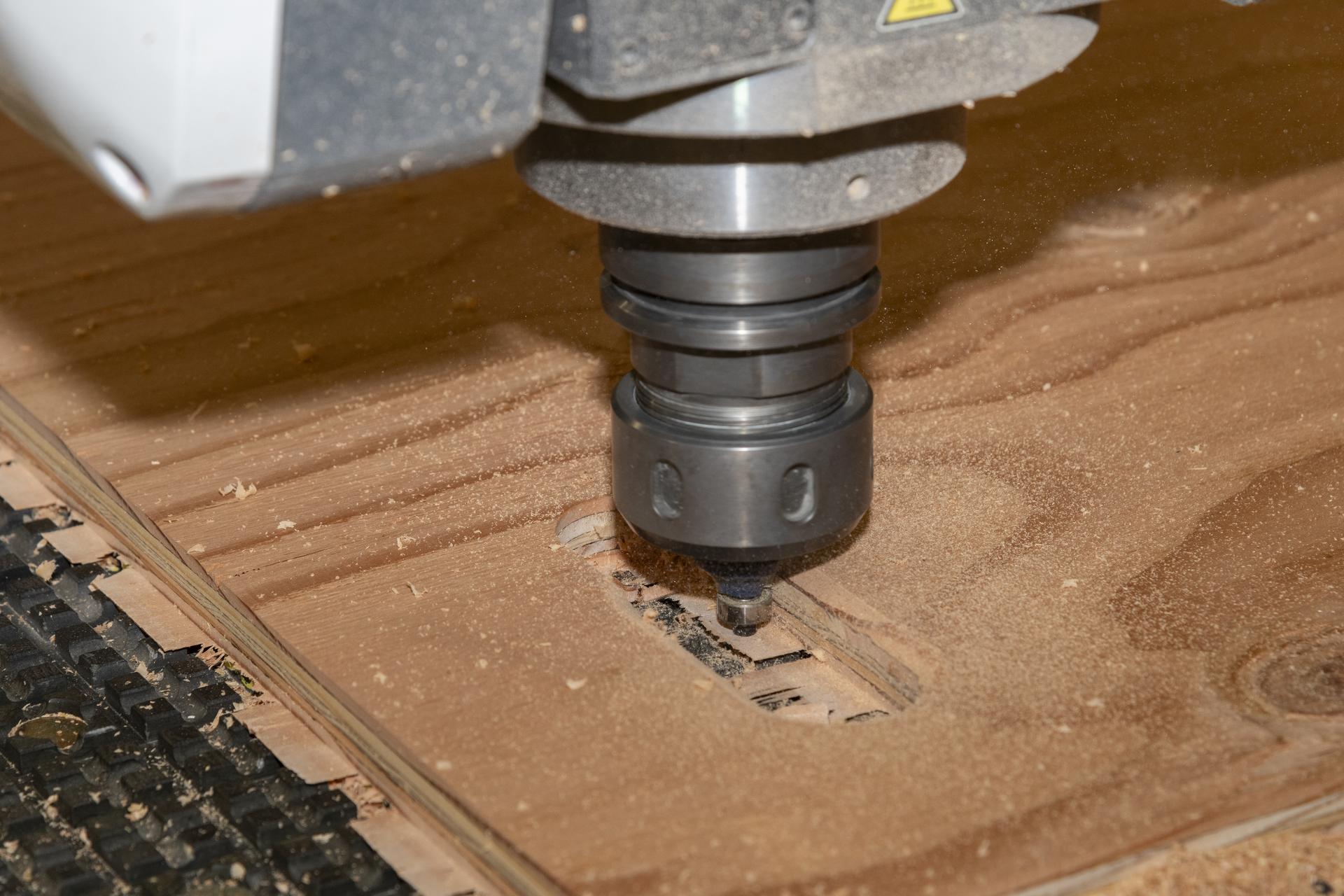
      A silver drill-like machine cuts holes in light brown plywood. There are specks of wood dust around the cut.
      A wood router cuts precise holes in plywood for temporary floorboards on Aug. 26, 2024, in the Experimental Fabrication Shop at NASA’s Armstrong Flight Research Center in Edwards, California. The flooring was designed for the X-66 experimental demonstrator aircraft.
      NASA/Steve Freeman

      Nelson continued, “Since these OEM boards will be removed and reinstalled multiple times to accommodate necessary modifications, the temporary floorboards will save the team valuable time and resources. They will also provide the same level of safety and strength as the OEM boards, ensuring that the process runs smoothly without compromising quality.”

      Designing and prototyping the flooring was a meticulous process, but the temporary solution plays a crucial role in optimizing time and resources as NASA works to advance safe and efficient air travel. The agency’s Sustainable Flight Demonstrator project seeks to inform the next generation of single-aisle airliners, the most common aircraft in commercial aviation fleets around the world. NASA partnered with Boeing to develop the X-66 experimental demonstrator aircraft.

      NASA Armstrong’s Experimental Fabrication Shop carries out modifications and repair work on aircraft, ranging from the creation of something as small as an aluminum bracket to modifying wing spars, fuselage ribs, control surfaces, and other tasks to support missions.

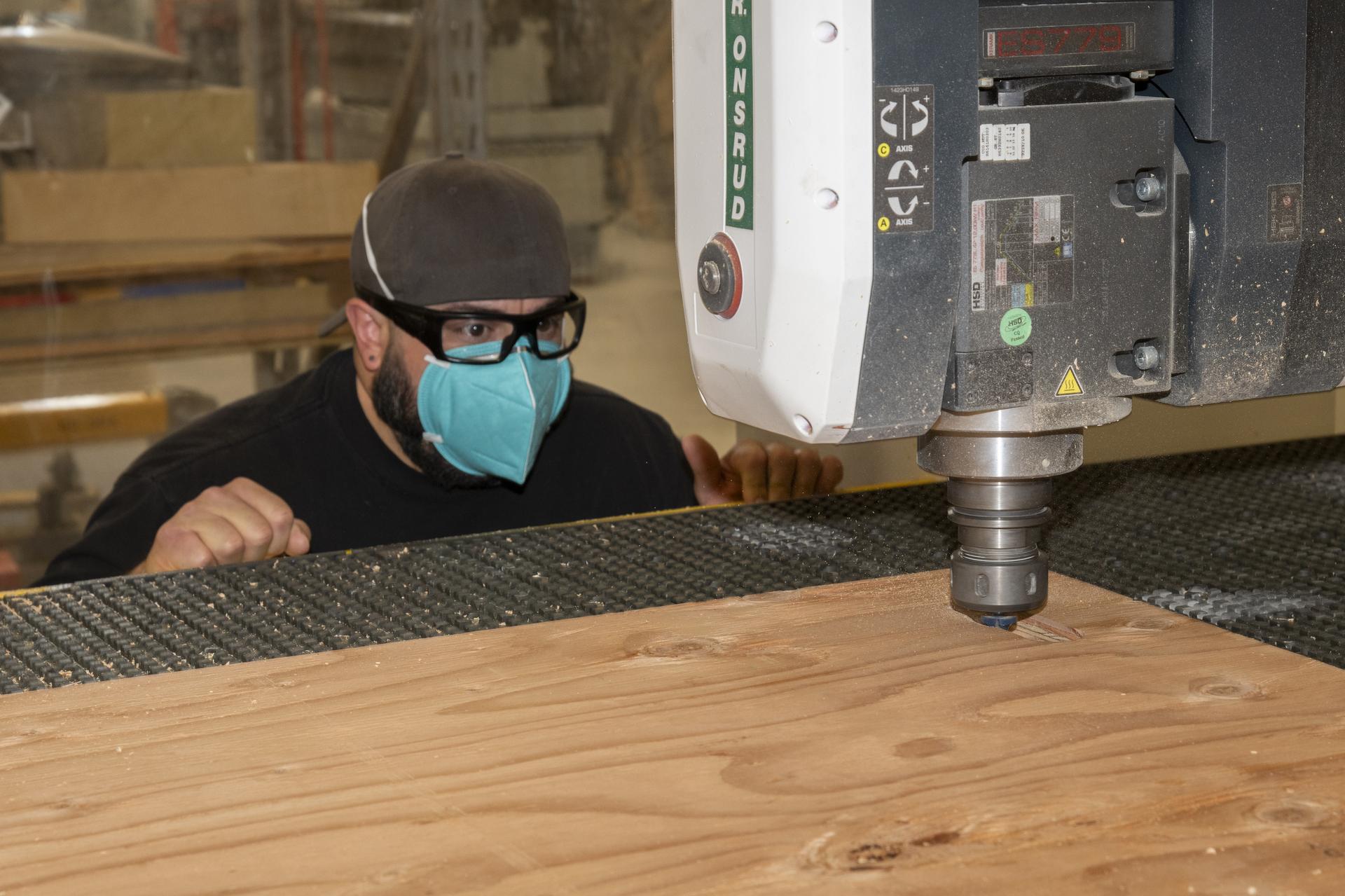
      A man wearing a mask, glasses, and a baseball cap backwards watches as a silver drill-like machine cuts holes into plywood.
      Eric Garza, an engineering technician in the Experimental Fabrication Shop at NASA’s Armstrong Flight Research Center in Edwards, California, observes a wood router cut holes for temporary floorboards on Aug. 26, 2024. The flooring was designed for the X-66 experimental demonstrator aircraft. 
      NASA/Steve Freeman