Preparations for Next Moonwalk Simulations Underway (and Underwater)
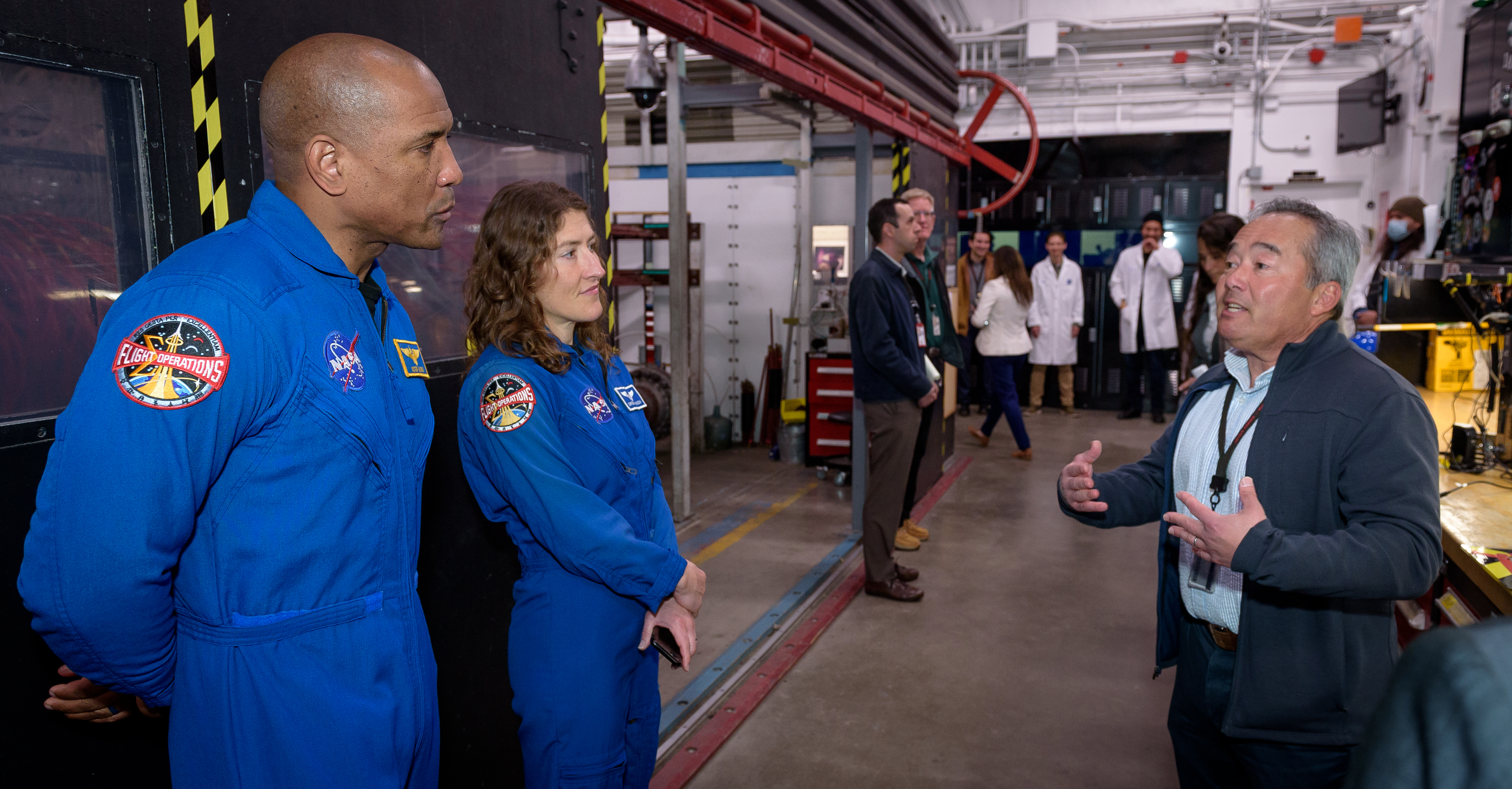
Astronauts Victor Glover and Christina Koch tour the Arc Jet Facility at NASA’s Ames Research Center, learning more about the testing equipment’s capabilities to analyze thermal protection systems from George Raiche, thermophysics facilities branch chief at Ames.
NASA/Donald Richey
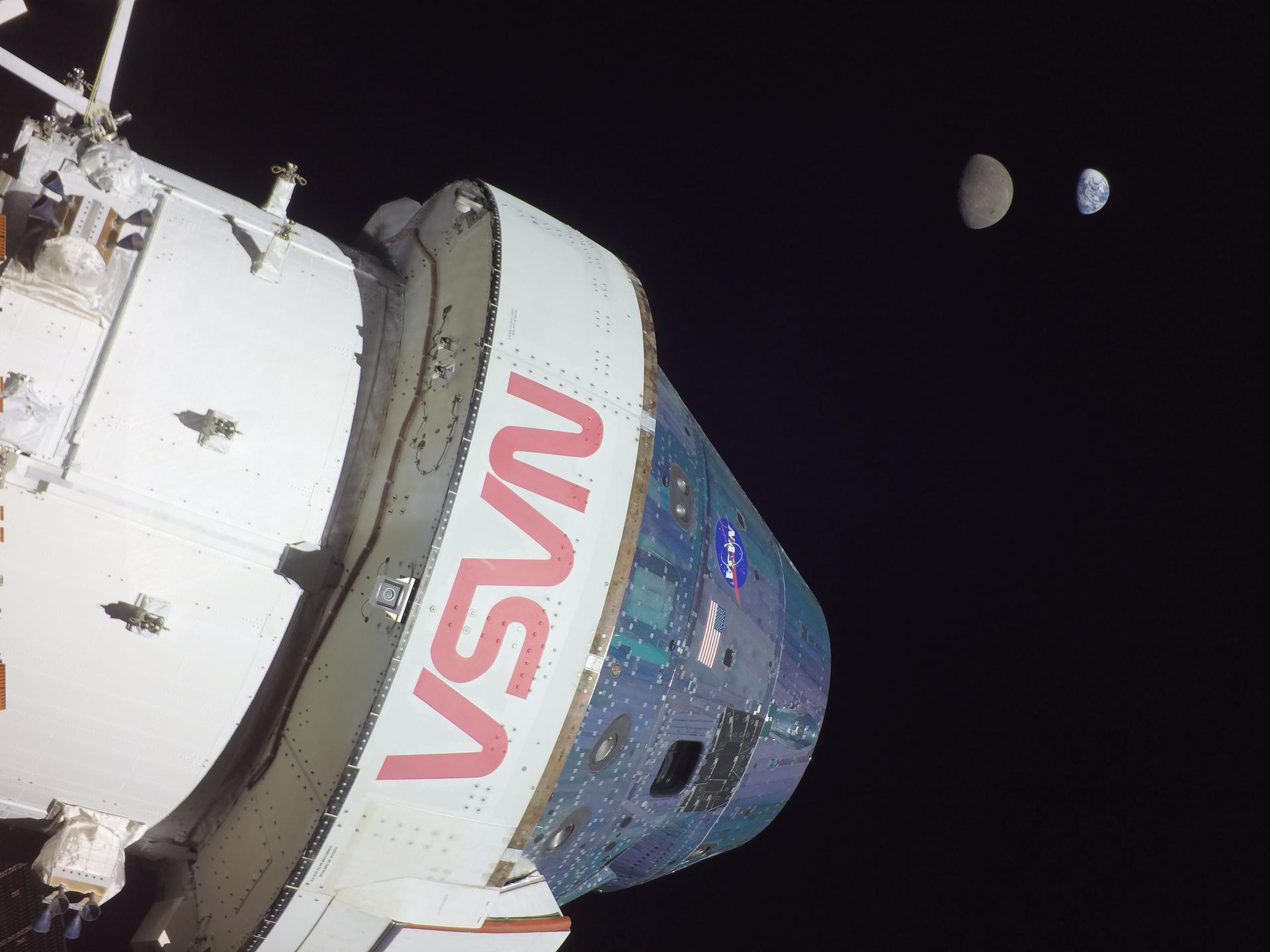
As NASA prepares to send astronauts to the Moon aboard the Orion spacecraft, research, testing, and development at NASA’s Ames Research Center in California’s Silicon Valley has played a critical role.
Recently, Ames welcomed Artemis II astronauts Christina Koch and Victor Glover and Orion leaders Debbie Korth, deputy program manager, and Luis Saucedo, deputy crew and service module manager, to tour Ames facilities that support the Orion Program and celebrate the achievements of employees.
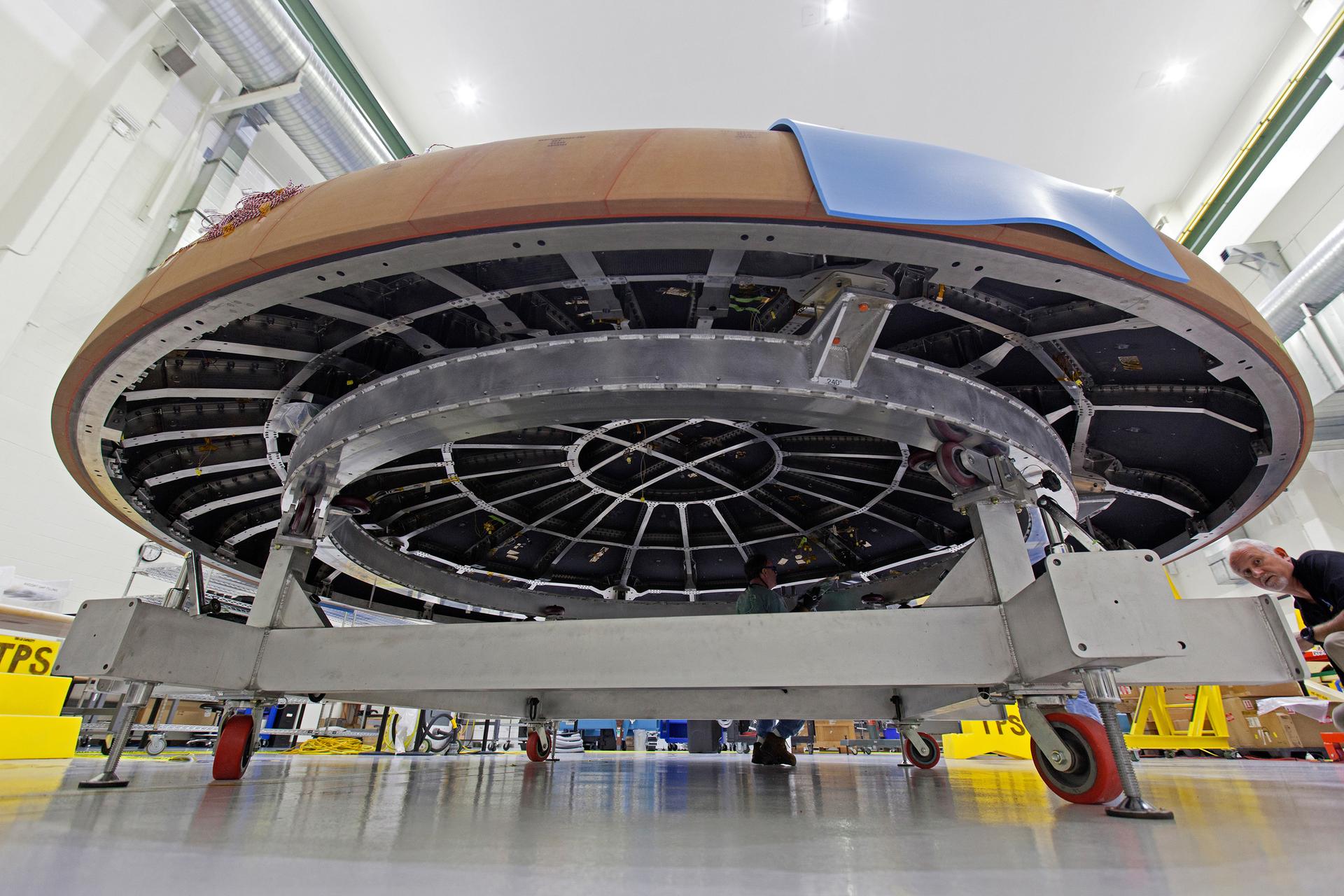
The group started their visit at the Arc Jet Complex, where researchers use extremely hot, high-speed gases to simulate the intense heat of atmospheric reentry before visiting the Sensors & Thermal Protection Systems Advanced Research Laboratories. The team works to develop sensors and flight instrumentation that measure heat shield response throughout a mission.
These systems were used to develop and test Orion’s thermal protection system to ensure the safety of astronauts during future missions. After the successful return of the Artemis I Orion spacecraft, Ames research was essential when analyzing unexpected charring loss on the heat shield.
Debbie Korth, Orion deputy program manager, presents awards to the Ames workforce at the Orion Circle of Excellence Awards Ceremony, while astronauts Christina Koch and Victor Glover look on.
NASA/Donald Richey
The visit culminated in an award ceremony to honor employees with outstanding performance and a legacy of service to the Orion Program. Thirty-two employees were honored for their individual or team contributions.
“The Ames workforce has played an important role in developing, testing, and validating the Orion spacecraft’s thermal protection system as well as supporting its software and guidance, navigation, and control,” said Eugene Tu, NASA Ames center director. “I’m pleased to see their contributions recognized and celebrated by program leadership and two of the astronauts whose safety and success were in mind when ensuring these systems are safe, reliable, and the highest quality possible.”
Preparations for Next Moonwalk Simulations Underway (and Underwater)
What are the dangers of going to space?
For human spaceflight, the first thing I think about is the astronauts actually strapping themselves to a rocket. And if that isn’t dangerous enough, once they launch and they’re out into space in deep exploration, we have to worry about radiation.
Radiation is coming at them from all directions. From the Sun, we have solar particles. We have galactic cosmic rays that are all over in the universe. And those cause damage to DNA. On Earth here, we use sunscreen to protect us from DNA damage. Our astronauts are protected from the shielding that’s around them in the space vehicles.
We also have to worry about microgravity. So what happens there? We see a lot of bone and muscle loss in our astronauts. And so to prevent this, we actually have the astronauts exercising for hours every day. And of course we don’t want to run out of food on a space exploration mission. So we want to make sure that we have everything that the astronauts need to take with them to make sure that we can sustain them.
There are many risks associated with human space exploration. NASA has been planning for these missions to make our astronauts return home safely.
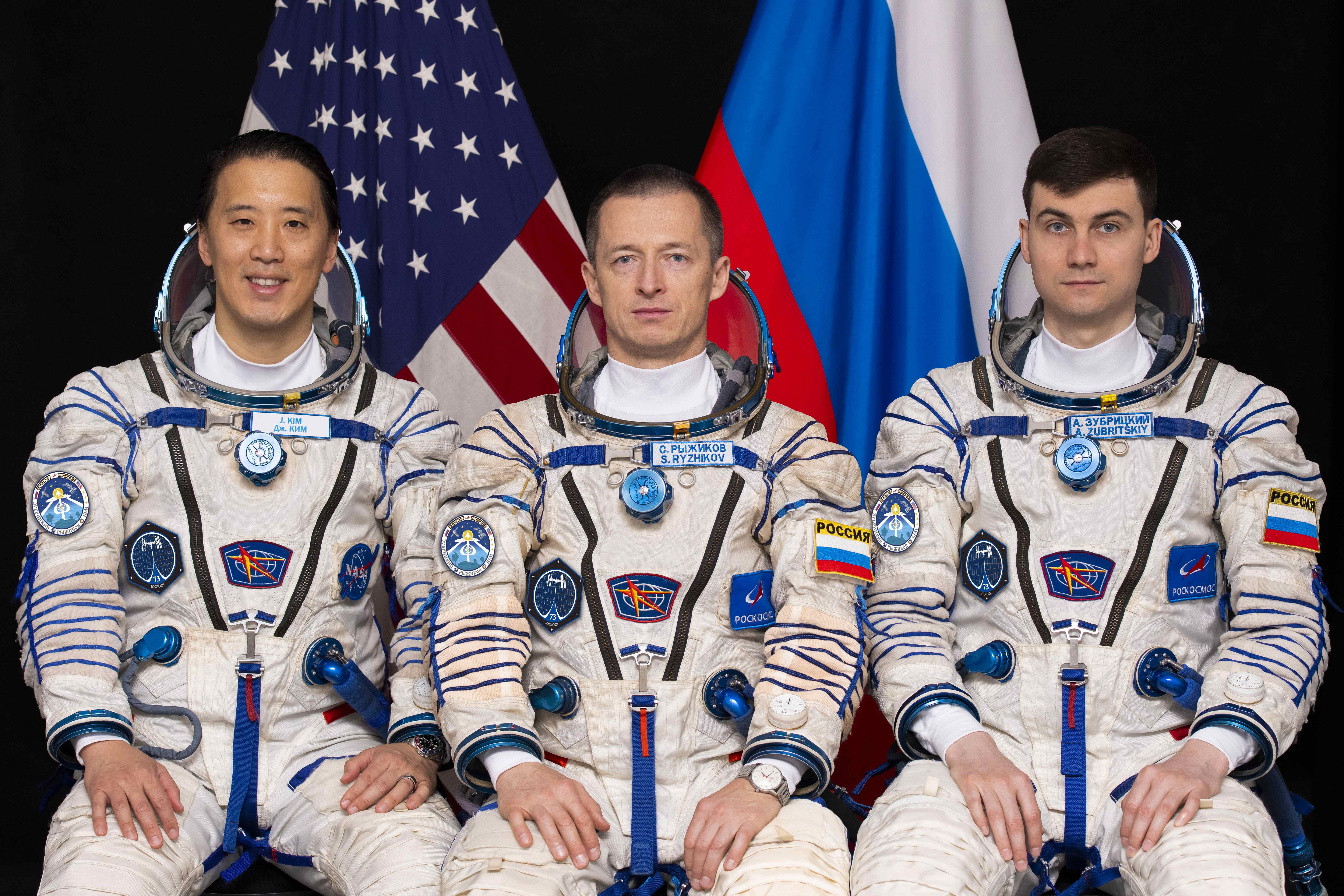
The Roscosmos Soyuz MS-27 spacecraft will launch from the Baikonur Cosmodrome in Kazakhstan to the International Space Station with (pictured left to right) NASA astronaut Jonny Kim and Roscosmos cosmonauts Sergey Ryzhikov and Alexey Zubritsky.
Credit: Gagarin Cosmonaut Training Center
NASA astronaut Jonny Kim will launch aboard the Roscosmos Soyuz MS-27 spacecraft to the International Space Station, accompanied by cosmonauts Sergey Ryzhikov and Alexey Zubritsky, where they will join the Expedition 72/73 crew in advancing scientific research.
Kim, Ryzhikov, and Zubritsky will lift off at 1:47 a.m. EDT Tuesday, April 8 (10:47 a.m. Baikonur time) from the Baikonur Cosmodrome in Kazakhstan.
Watch live launch and docking coverage on NASA+. Learn how to watch NASA content through a variety of platforms.
After a two-orbit, three-hour trajectory to the station, the spacecraft will dock automatically to the station’s Prichal module at approximately 5:03 a.m. Shortly after, hatches will open between Soyuz and the space station.
Once aboard, the trio will join NASA astronauts Nichole Ayers, Anne McClain, and Don Pettit, JAXA (Japan Aerospace Exploration Agency) astronaut Takuya Onishi, and Roscosmos cosmonauts Alexey Ovchinin, Kirill Peskov, and Ivan Vagner.
NASA’s coverage is as follows (all times Eastern and subject to change based on real-time operations):
4:15 a.m. – Rendezvous and docking coverage begins on NASA+.
5:03 a.m. – Docking
7 a.m. – Hatch opening and welcome remarks coverage begins on NASA+.
7:20 a.m. – Hatch opening
The trio will spend approximately eight months aboard the orbital laboratory as Expedition 72 and 73 crew members before returning to Earth in December. This will be the first flight for Kim and Zubritsky, and the third for Ryzhikov.
For more than two decades, people have lived and worked continuously aboard the International Space Station, advancing scientific knowledge and making research breakthroughs that are not possible on Earth. The station is a critical testbed for NASA to understand and overcome the challenges of long-duration spaceflight and to expand commercial opportunities in low Earth orbit. As commercial companies focus on providing human space transportation services and destinations as part of a robust low Earth orbit economy, NASA is focusing more resources on deep space missions to the Moon as part of the Artemis campaign in preparation for future human missions to Mars.
Learn more about International Space Station research and operations at:
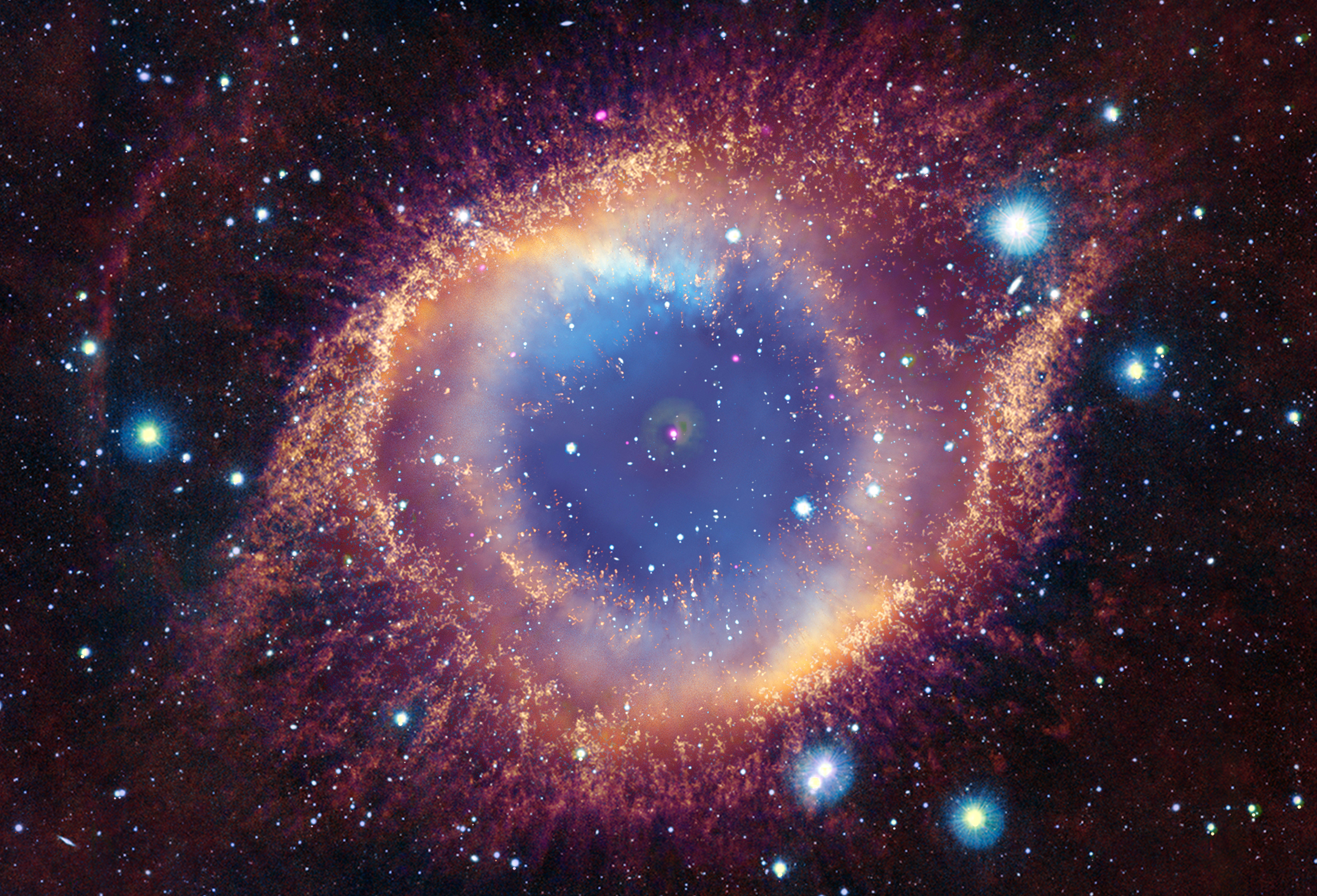
In about 5 billion years, our Sun will run out of fuel and expand, possibly engulfing Earth. These end stages of a star’s life can be utterly beautiful – as is the case with this planetary nebula called the Helix Nebula. Astronomers study these objects by looking at all kinds of light.
This image of the Helix Nebula, released on March 4, 2025, shows a potentially destructive white dwarf at the nebula’s center: this star may have destroyed a planet. This has never been seen before – and could explain a mysterious X-ray signal that astronomers have detected from the nebula for over 40 years.
This view combines X-rays from NASA’s Chandra X-ray Observatory (magenta), optical light data from NASA’s Hubble Space Telescope (orange, light blue), infrared data from the European Southern Observatory VISTA telescope (gold, dark blue), and ultraviolet data from GALEX (purple) of the Helix Nebula. Data from Chandra indicates that this white dwarf has destroyed a very closely orbiting planet.
Preparations for Next Moonwalk Simulations Underway (and Underwater)
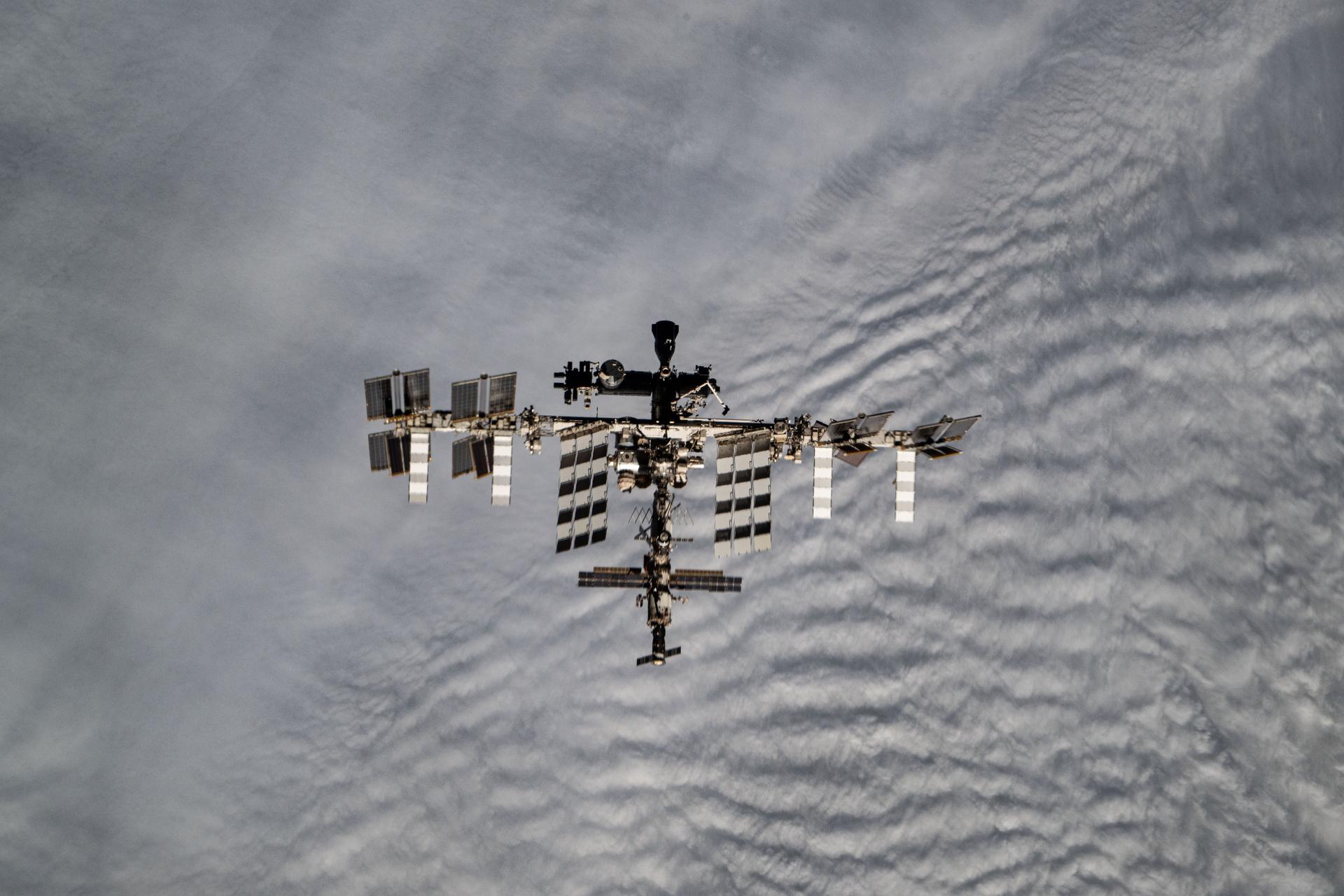
The International Space Station is pictured from the SpaceX Dragon spacecraft by a Crew-8 member shortly after undocking from the Harmony module’s space-facing port as the orbital outpost was soaring 272 miles above the cloudy Patagonia region of South America.
NASA
NASA is seeking proposals for two new private astronaut missions to the International Space Station, targeted for 2026 and 2027, as the agency continues its commitment to expanding access to space. These private missions enable American commercial companies to further develop capabilities and support a continuous human presence in low Earth orbit.
“We are in an incredible time for human spaceflight, with more opportunities to access space and grow a thriving commercial economy in low Earth orbit,” said Dana Weigel, program manager for the International Space Station at NASA’s Johnson Space Center in Houston. “NASA remains committed to supporting this expansion by leveraging our decades of expertise to help industry gain the experience needed to train and manage crews, conduct research, and develop future destinations. Private astronaut missions are a key part of this effort, providing companies with hands-on opportunities to refine their capabilities and build partnerships that will shape the future of low Earth orbit.”
The new flight opportunities will be the fifth and sixth private astronaut missions to the orbiting laboratory coordinated by NASA. The first three missions were accomplished by Axiom Space in April 2022, May 2023, and January 2024, with a fourth scheduled for no earlier than May 2025.
Each of the new missions may be docked to the space station for up to 14 days. Specific dates depend on spacecraft traffic at the space station and in-orbit activity planning and constraints. Private astronaut missions must be brokered by a U.S. entity and use U.S. transportation spacecraft that meet NASA’s International Space Station visiting vehicle requirements, policies, and procedures. For additional details, refer to Focus Area 4A of NASA Research Announcement (NRA) NNJ13ZBG001N.
Proposals are due by 5 p.m. EDT on Friday, May 30, 2025.
For more than two decades, people have lived and worked continuously aboard the International Space Station, advancing scientific knowledge and demonstrating new technologies, making research breakthroughs not possible on Earth. The station is a critical testbed for NASA to understand and overcome the challenges of long-duration spaceflight and to expand commercial opportunities in low Earth orbit. As commercial companies focus on providing human space transportation services and destinations as part of a robust low Earth orbit economy, NASA’s Artemis campaign is underway at the Moon, where the agency is preparing for future human exploration of Mars.
Learn more about the International Space Station at:
Explore the April 2025 issue, highlighting the NASA-sponsored FIRST Robotics competition, Space Flight Awareness honorees and more!
Credits: NASA/Danny Nowlin
Explore Lagniappe for April 2025 featuring:
NASA-Sponsored FIRST Robotics Welcomes Teams to Magnolia Regional
NASA Leaders Visit Representatives
Blood Moon in South Mississippi
Gator Speaks
Gator Speaks
NASA/Stennis
New beginnings feel a lot like the month of April. It is the heart of spring and the season that symbolizes growth and renewal.
April is the perfect time to break free from old routines and try something new.
If you have landed here in this website corner of our digital world, consider this your open invitation to continue ahead on the journey with NASA Stennis by following us on social media.
It is time to say goodbye to the Lagniappe publication as we know it, but do not worry. All of the great news about the center and its frontline activities still will be available, just in a new way – via our social media platforms! Gator wants you to feel more connected than ever as we continue to help power space dreams in south Mississippi. Moving forward, join NASA Stennis in our digital playground for even more of that extra-something special.
This playground is not limited to only fun, or making new friends, or learning new stuff.
Whether you are on Facebook, Instagram, YouTube, or X, there is a place, and space, for all of that and more.
As we close out the website edition of NASA Stennis Lagniappe, we turn the page and look forward to new possibilities ahead.
Let’s keep building one connection at a time because here at America’s largest rocket propulsion test site, it is more than just content.
It is where the NASA Stennis team will continue building on its proven expertise in all areas of work, and where you will have a front row seat to experience it unfold.
So, click the links below to become a NASA Stennis follower today. Then, invite your friends to become followers as well.
NASA-Sponsored FIRST Robotics Welcomes Teams to Magnolia Regional
NASA serves as a lead sponsor, along with NASA Stennis employees and interns volunteering, for the third annual FIRST Robotics Magnolia Regional Competition on March 14. The event in Laurel, Mississippi, welcomed 37 teams from eight states (Alabama, California, Florida, Louisiana, Minnesota, Missouri, Mississippi, and Tennessee) and one team from Mexico. The FIRST (For the Inspiration and Recognition of Science and Technology) Robotics event joined NASA’s Robotics Alliance Project to combine the excitement of sport with the rigors of science, technology, engineering, and mathematics (STEM) in field games using industrial-sized robots.
NASA/Danny Nowlin
NASA serves as a lead sponsor, along with NASA Stennis employees and interns volunteering, for the third annual FIRST Robotics Magnolia Regional Competition on March 14. The event in Laurel, Mississippi, welcomed 37 teams from eight states (Alabama, California, Florida, Louisiana, Minnesota, Missouri, Mississippi, and Tennessee) and one team from Mexico. The FIRST (For the Inspiration and Recognition of Science and Technology) Robotics event joined NASA’s Robotics Alliance Project to combine the excitement of sport with the rigors of science, technology, engineering, and mathematics (STEM) in field games using industrial-sized robots.
NASA/Danny Nowlin
NASA serves as a lead sponsor, along with NASA Stennis employees and interns volunteering, for the third annual FIRST Robotics Magnolia Regional Competition on March 14. The event in Laurel, Mississippi, welcomed 37 teams from eight states (Alabama, California, Florida, Louisiana, Minnesota, Missouri, Mississippi, and Tennessee) and one team from Mexico. The FIRST (For the Inspiration and Recognition of Science and Technology) Robotics event joined NASA’s Robotics Alliance Project to combine the excitement of sport with the rigors of science, technology, engineering, and mathematics (STEM) in field games using industrial-sized robots.
NASA/Danny Nowlin
NASA serves as a lead sponsor, along with NASA Stennis employees and interns volunteering, for the third annual FIRST Robotics Magnolia Regional Competition on March 14. The event in Laurel, Mississippi, welcomed 37 teams from eight states (Alabama, California, Florida, Louisiana, Minnesota, Missouri, Mississippi, and Tennessee) and one team from Mexico. The FIRST (For the Inspiration and Recognition of Science and Technology) Robotics event joined NASA’s Robotics Alliance Project to combine the excitement of sport with the rigors of science, technology, engineering, and mathematics (STEM) in field games using industrial-sized robots.
NASA/Danny Nowlin
NASA serves as a lead sponsor, along with NASA Stennis employees and interns volunteering, for the third annual FIRST Robotics Magnolia Regional Competition on March 14. The event in Laurel, Mississippi, welcomed 37 teams from eight states (Alabama, California, Florida, Louisiana, Minnesota, Missouri, Mississippi, and Tennessee) and one team from Mexico. The FIRST (For the Inspiration and Recognition of Science and Technology) Robotics event joined NASA’s Robotics Alliance Project to combine the excitement of sport with the rigors of science, technology, engineering, and mathematics (STEM) in field games using industrial-sized robots.
NASA/Danny Nowlin
NASA serves as a lead sponsor, along with NASA Stennis employees and interns volunteering, for the third annual FIRST Robotics Magnolia Regional Competition on March 14. The event in Laurel, Mississippi, welcomed 37 teams from eight states (Alabama, California, Florida, Louisiana, Minnesota, Missouri, Mississippi, and Tennessee) and one team from Mexico. The FIRST (For the Inspiration and Recognition of Science and Technology) Robotics event joined NASA’s Robotics Alliance Project to combine the excitement of sport with the rigors of science, technology, engineering, and mathematics (STEM) in field games using industrial-sized robots.
NASA/Danny Nowlin
NASA serves as a lead sponsor, along with NASA Stennis employees and interns volunteering, for the third annual FIRST Robotics Magnolia Regional Competition on March 14. The event in Laurel, Mississippi, welcomed 37 teams from eight states (Alabama, California, Florida, Louisiana, Minnesota, Missouri, Mississippi, and Tennessee) and one team from Mexico. The FIRST (For the Inspiration and Recognition of Science and Technology) Robotics event joined NASA’s Robotics Alliance Project to combine the excitement of sport with the rigors of science, technology, engineering, and mathematics (STEM) in field games using industrial-sized robots.
NASA/Danny Nowlin
NASA serves as a lead sponsor, along with NASA Stennis employees and interns volunteering, for the third annual FIRST Robotics Magnolia Regional Competition on March 14. The event in Laurel, Mississippi, welcomed 37 teams from eight states (Alabama, California, Florida, Louisiana, Minnesota, Missouri, Mississippi, and Tennessee) and one team from Mexico. The FIRST (For the Inspiration and Recognition of Science and Technology) Robotics event joined NASA’s Robotics Alliance Project to combine the excitement of sport with the rigors of science, technology, engineering, and mathematics (STEM) in field games using industrial-sized robots.
NASA/Danny Nowlin
NASA serves as a lead sponsor, along with NASA Stennis employees and interns volunteering, for the third annual FIRST Robotics Magnolia Regional Competition on March 14. The event in Laurel, Mississippi, welcomed 37 teams from eight states (Alabama, California, Florida, Louisiana, Minnesota, Missouri, Mississippi, and Tennessee) and one team from Mexico. The FIRST (For the Inspiration and Recognition of Science and Technology) Robotics event joined NASA’s Robotics Alliance Project to combine the excitement of sport with the rigors of science, technology, engineering, and mathematics (STEM) in field games using industrial-sized robots.
NASA/Danny Nowlin
NASA serves as a lead sponsor, along with NASA Stennis employees and interns volunteering, for the third annual FIRST Robotics Magnolia Regional Competition on March 14. The event in Laurel, Mississippi, welcomed 37 teams from eight states (Alabama, California, Florida, Louisiana, Minnesota, Missouri, Mississippi, and Tennessee) and one team from Mexico. The FIRST (For the Inspiration and Recognition of Science and Technology) Robotics event joined NASA’s Robotics Alliance Project to combine the excitement of sport with the rigors of science, technology, engineering, and mathematics (STEM) in field games using industrial-sized robots.
U.S. Sen. Cindy Hyde-Smith of Mississippi, center, greets NASA Stennis Deputy Director Christine Powell, right, and NASA Stennis Legislative Affairs Officer and Chief of Staff Troy Frisbie on March 4. Powell and Frisbie visited with Smith and other congressional members in conjunction with the recent NASA Artemis Suppliers Conference in Washington, D.C.
NASA/Stennis
U.S. Sen. Roger Wicker of Mississippi welcomes NASA Stennis Deputy Director Christine Powell and other guests on March 5. Powell visited Wicker in conjunction with the NASA Artemis Suppliers Conference in Washington, D.C.
NASA/Stennis
U.S. Rep. Mike Ezell of Mississippi, fourth from right, stands with acting NASA Kennedy Space Center Director Kelvin Manning, fifth from right; NASA Stennis Deputy Director Christine Powell, third from right; NASA Stennis Legislative Affairs Officer and Chief of Staff Troy Frisbie, far left; and several congressional staff members March 5. The NASA officials visited with Ezell and other congressional members in conjunction with the recent NASA Artemis Suppliers Conference in Washington, D.C.
NASA/Stennis
NASA Space Flight Awareness Program Recognizes Stennis Employees
NASA’s Stennis Space Center employees were recognized with Honoree Awards from NASA’s Space Flight Awareness Program during a March 10 ceremony in Orlando, Florida, for outstanding support of human spaceflight.
Images show the total lunar eclipse, known as a Blood Moon, over south Mississippi during the early morning hours of March 14. A lunar eclipse occurs when the Sun, Earth, and Moon align so that the Moon passes into Earth’s shadow. In a total lunar eclipse, the entire Moon falls within the darkest part of Earth’s shadow, called the umbra. When the Moon is within the umbra, it appears red-orange. Lunar eclipses are sometimes called “Blood Moons” because of this phenomenon.
NASA/Rebecca Mataya
Images show the total lunar eclipse, known as a Blood Moon, over south Mississippi during the early morning hours of March 14. A lunar eclipse occurs when the Sun, Earth, and Moon align so that the Moon passes into Earth’s shadow. In a total lunar eclipse, the entire Moon falls within the darkest part of Earth’s shadow, called the umbra. When the Moon is within the umbra, it appears red-orange. Lunar eclipses are sometimes called “Blood Moons” because of this phenomenon.
NASA/Rebecca Mataya
Images show the total lunar eclipse, known as a Blood Moon, over south Mississippi during the early morning hours of March 14. A lunar eclipse occurs when the Sun, Earth, and Moon align so that the Moon passes into Earth’s shadow. In a total lunar eclipse, the entire Moon falls within the darkest part of Earth’s shadow, called the umbra. When the Moon is within the umbra, it appears red-orange. Lunar eclipses are sometimes called “Blood Moons” because of this phenomenon.
NASA/Rebecca Mataya
Images show the total lunar eclipse, known as a Blood Moon, over south Mississippi during the early morning hours of March 14. A lunar eclipse occurs when the Sun, Earth, and Moon align so that the Moon passes into Earth’s shadow. In a total lunar eclipse, the entire Moon falls within the darkest part of Earth’s shadow, called the umbra. When the Moon is within the umbra, it appears red-orange. Lunar eclipses are sometimes called “Blood Moons” because of this phenomenon.
NASA/Rebecca Mataya
Images show the total lunar eclipse, known as a Blood Moon, over south Mississippi during the early morning hours of March 14. A lunar eclipse occurs when the Sun, Earth, and Moon align so that the Moon passes into Earth’s shadow. In a total lunar eclipse, the entire Moon falls within the darkest part of Earth’s shadow, called the umbra. When the Moon is within the umbra, it appears red-orange. Lunar eclipses are sometimes called “Blood Moons” because of this phenomenon.
NASA/Rebecca Mataya
Images show the total lunar eclipse, known as a Blood Moon, over south Mississippi during the early morning hours of March 14. A lunar eclipse occurs when the Sun, Earth, and Moon align so that the Moon passes into Earth’s shadow. In a total lunar eclipse, the entire Moon falls within the darkest part of Earth’s shadow, called the umbra. When the Moon is within the umbra, it appears red-orange. Lunar eclipses are sometimes called “Blood Moons” because of this phenomenon.
NASA’s Stennis Space Center hosts staff members of U.S. Sen. Roger Wicker of Mississippi on March 21 for a site visit. Pictured (left to right) are Kelly McCarthy, NASA Stennis partnership development lead; Troy Frisbie, NASA Stennis legislative affairs officer and chief of staff; Jason Richard, NASA Stennis propulsion business manager; Joe Schuyler, director of the NASA Stennis Engineering and Test Directorate; Emily Yetter, Wicker’s military legislative assistant; Dan Hillenbrand, Wicker’s legislative director; Terry Miller, U.S. Navy Fellow assigned to Wicker’s office; NASA Stennis Associate Director Rodney McKellip; Duane Armstrong, manager of the NASA Stennis Strategic Business Development Office; Drew Parks, Navy Senate liaison officer to Wicker’s office. The members representing the Mississippi senator’s staff toured NASA Stennis, including the Thad Cochran Test Stand, where NASA Stennis is preparing for future Artemis testing.
NASA/Danny Nowlin
NASA Stennis Hosts Leadership Class
Approximately 50 members of the Leadership Hancock Class of 2025 visit NASA Stennis on March 26 for a full-day tour that included meeting NASA Stennis leaders and seeing center facilities, such as the Thad Cochran Test Stand pictured in the background. Leadership Hancock is an annual program by the Hancock County Chamber of Commerce designed to identify and cultivate future community leaders.
NASA/Danny Nowlin
NASA Stennis Interns Tour Site
NASA student interns stand in the flame deflector at the Fred Haise Test Stand on March 7 during a NASA Stennis site tour. Interns include (left to right): Addison Mitchell (Pathways intern for Engineering and Test Directorate); Andrew Evans (Office of STEM Engagement intern for Autonomous Systems Lab); Mikayla Chandler (Office of STEM Engagement intern for ASTRO CAMP Community Partners); and Kristen Zack (Office of STEM Engagement intern for Autonomous Systems Lab). NASA Office of STEM Engagement paid internships allow high school and college-level students to contribute to agency projects under the guidance of a NASA mentor. The Pathways program offers current students and recent graduates paid internships that can be direct pipelines to full-time employment at NASA upon graduation.
NASA/Danny Nowlin
Rocket Test Group Visits NASA Stennis
NASA Stennis partnered with Mississippi Enterprise for Technology to host more than 100 members of the 57th Rocket Test Group on March 18-19.
The group toured the south Mississippi NASA center on March 19, learning how NASA Stennis operates as NASA’s primary, and America’s largest, rocket propulsion test site to serve the nation and commercial sector with its unique capabilities and expertise.
Rebecca Mataya is a budget analyst at NASA’s Stennis Space Center. “Whether you are an engineer, analyst, lawyer, technician, communicator or innovator, there is a place for you here at NASA,” she said. “Every skill contributes to the greater mission of pushing the boundaries of exploration, discovery, and progress. If you have a passion, determination, and willingness to learn, NASA is a place where you can grow and leave a lasting impact on the future of space.”
NASA/Stennis
A career path can unfold in unexpected ways. Ask NASA’s Rebecca Mataya. The journey to NASA’s Stennis Space Center near Bay St. Louis, Mississippi, was not planned but “meant to be,” she said.
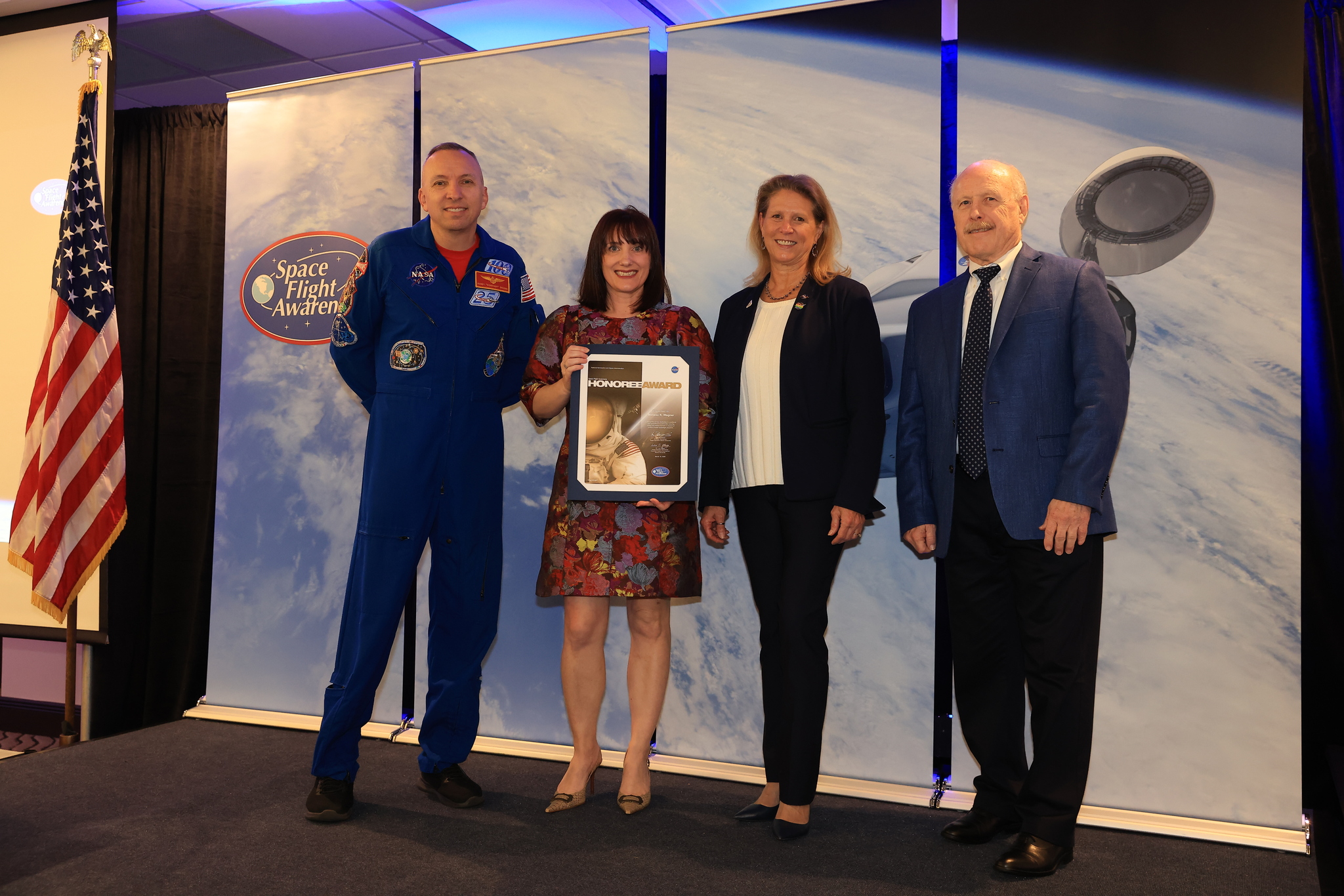
NASA’s Stennis Space Center employees were recognized with Honoree Awards from NASA’s Space Flight Awareness Program during a March 10 ceremony in Orlando, Florida, for outstanding support of human spaceflight.
Stennis Space Center employee Melissa Wagner of Pass Christian, Mississippi, is presented with the NASA Space Flight Awareness Program Honoree Award during a March 10 ceremony. Wagner (second from left) receives the award from (left to right): NASA astronaut Randy Bresnik, NASA Exploration Systems Development Mission Directorate Acting Associate Administrator Dr. Lori Glaze, and NASA Space Operations Mission Directorate Associate Administrator Kenneth Bowersox.
NASA/Kennedy Space Center
Melissa Wagner of Pass Christian, Mississippi, is a NASA contract specialist in the Office of Procurement at NASA Stennis. She received the honor for contributions to NASA’s Artemis campaign by identifying potential risks related to propulsion test efforts in support of the initiative, resulting in successful mitigation actions.
NASA’s Stennis Space Center employee Samone Wilson of Hattiesburg, Mississippi, is presented with the NASA Space Flight Awareness Program Honoree Award during a March 10 ceremony. Wilson (second from left) receives the award from (left to right): NASA astronaut Randy Bresnik, NASA Space Operations Mission Directorate Associate Administrator Kenneth Bowersox, and NASA Exploration Systems Development Mission Directorate Acting Associate Administrator Dr. Lori Glaze.
NASA/Kennedy Space Center
Samone Wilson of Hattiesburg, Mississippi, is a NASA public affairs specialist in the Office of Communications at NASA Stennis. She received the honor for her work in telling others about NASA and NASA Stennis activities and missions.
Timothy Miller of Pearl River, Louisiana, is a senior drafter for Syncom Space Services at NASA Stennis. Although unable to attend the ceremony, he received the honor for contributions supporting flight systems integration, facility readiness, and cost reduction with his use of Creo Parametric modeling, a powerful 3D software.
Madison Monti of Kiln, Mississippi, is a security support specialist for Chenega Global Protection at NASA Stennis. Although unable to attend the ceremony, she received the honor for contributions supporting the badging office at NASA Stennis to ensure a consistent, efficient, and secure process.
NASA astronaut Randy Bresnik, Space Operations Mission Directorate Associate Administrator Kenneth Bowersox, and Exploration Systems Development Mission Directorate Acting Associate Administrator Dr. Lori Glaze presented the awards.
Bresnik, assistant-to-the-chief of the Astronaut Office for Exploration, was selected as a NASA astronaut in 2004. He manages the development and testing of everything that will operate beyond low-Earth orbit on Artemis missions. Bresnik previously served as commander of the International Space Station for Expedition 53 and flight engineer for Expedition 52.
In recognition of flight program contributions, honorees toured NASA’s Kennedy Space Center in Florida and viewed the SpaceX Dragon spacecraft named Endurance in conjunction with the launch of NASA’s SpaceX Crew-10.
The spacecraft carried NASA astronauts Anne McClain and Nichole Ayers, JAXA (Japan Aerospace Exploration Agency) astronaut Takuya Onishi, and Roscomos cosmonaut Kirill Pesko to the International Space Station on March 14 as part of NASA’s Commercial Crew Program. NASA’s Space Flight Awareness Program recognizes outstanding job performances and contributions by civil service and contract employees throughout the year and focuses on excellence in quality and safety in support of human spaceflight. The Honoree Award is one of the highest honors presented to employees for their dedication to quality work and flight safety. Recipients must have contributed beyond their normal work requirements toward achieving a particular human spaceflight program goal; contributed to a major cost savings; been instrumental in developing material that increases reliability, efficiency or performance; assisted in operational improvements; or been a key player in developing a beneficial process improvement.
For information about Silver Snoopy and other Space Flight Awareness awards, visit:
NASA Stennis partnered with Mississippi Enterprise for Technology to host more than 100 members of the 57th Rocket Test Group on March 18-19.
NASA Stennis partnered with Mississippi Enterprise for Technology to host more than 100 members of the 57th Rocket Test Group on March 18-19.
NASA/Jason Richard
The group toured the south Mississippi NASA center on March 19, learning how NASA Stennis operates as NASA’s primary, and America’s largest, rocket propulsion test site to serve the nation and commercial sector with its unique capabilities and expertise.
NASA Stennis partnered with Mississippi Enterprise for Technology to host more than 100 members of the 57th Rocket Test Group on March 18-19.
NASA/Jason Richard
The day included tours of test stands and facilities hosted by NASA Stennis test complex personnel. Visits included the Fred Haise Test Stand, where NASA Stennis tests RS-25 engines to help power NASA’s Artemis missions to the Moon and beyond; the Thad Cochran Test Stand, where NASA Stennis will test NASA’s exploration upper stage for future Artemis missions; the E Test Complex, where NASA Stennis supports agency and commercial propulsion test activity; and the L3Harris Technologies (formerly Aerojet Rocketdyne) Engine Assembly Facility, where RS-25 engines are produced.
NASA Stennis partnered with Mississippi Enterprise for Technology to host more than 100 members of the 57th Rocket Test Group on March 18-19.
NASA/Jason Richard
The group also received overviews from site personnel on the Rocket Propulsion Test Program Office located at NASA Stennis, on lessons learned from testing at the E Test Complex, and on the NASA Data Acquisition System developed onsite.
NASA Stennis partnered with Mississippi Enterprise for Technology to host more than 100 members of the 57th Rocket Test Group on March 18-19.
NASA/Jason Richard
The Rocket Test Group originally formed in response to a congressional demand for an ongoing working group crossing agency and company boundaries. It is a volunteer organization intended to allow rocket test facility operators to come together to recommend solutions for difficult testing problems; lower testing costs by reducing time spent on solving critical issues and eliminating duplicate programs; facilitate the activation of new facilities; learn from each other by viewing different methods and touring various facilities; provide a networking opportunity for testing advice and problem solving support; and allow test facility operators to stay informed on the newest developments.
NASA Stennis partnered with Mississippi Enterprise for Technology to host more than 100 members of the 57th Rocket Test Group on March 18-19.
NASA Webb Explores Effect of Strong Magnetic Fields on Star Formation
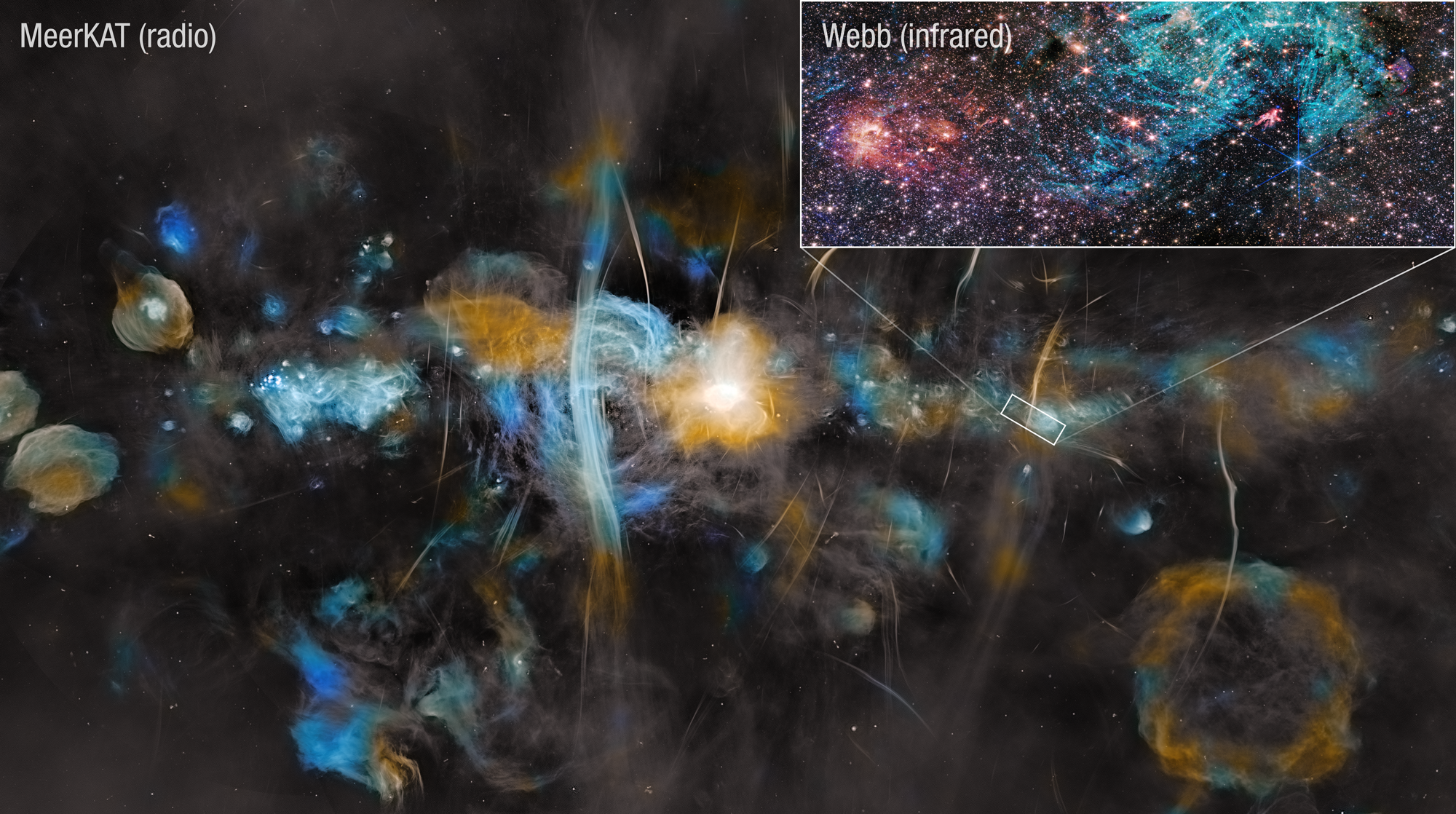
An image of the Milky Way captured by the MeerKAT radio telescope array puts the James Webb Space Telescope’s image of the Sagittarius C region in context. Full image below.
Credits: NASA, ESA, CSA, STScI, SARAO, Samuel Crowe (UVA), John Bally (CU), Ruben Fedriani (IAA-CSIC), Ian Heywood (Oxford)
Follow-up research on a 2023 image of the Sagittarius C stellar nursery in the heart of our Milky Way galaxy, captured by NASA’s James Webb Space Telescope, has revealed ejections from still-forming protostars and insights into the impact of strong magnetic fields on interstellar gas and the life cycle of stars.
“A big question in the Central Molecular Zone of our galaxy has been, if there is so much dense gas and cosmic dust here, and we know that stars form in such clouds, why are so few stars born here?” said astrophysicist John Bally of the University of Colorado Boulder, one of the principal investigators. “Now, for the first time, we are seeing directly that strong magnetic fields may play an important role in suppressing star formation, even at small scales.”
Detailed study of stars in this crowded, dusty region has been limited, but Webb’s advanced near-infrared instruments have allowed astronomers to see through the clouds to study young stars like never before.
“The extreme environment of the galactic center is a fascinating place to put star formation theories to the test, and the infrared capabilities of NASA’s James Webb Space Telescope provide the opportunity to build on past important observations from ground-based telescopes like ALMA and MeerKAT,” said Samuel Crowe, another principal investigator on the research, a senior undergraduate at the University of Virginia and a 2025 Rhodes Scholar.
Bally and Crowe each led a paper published in The Astrophysical Journal.
Image A: Milky Way Center (MeerKAT and Webb)
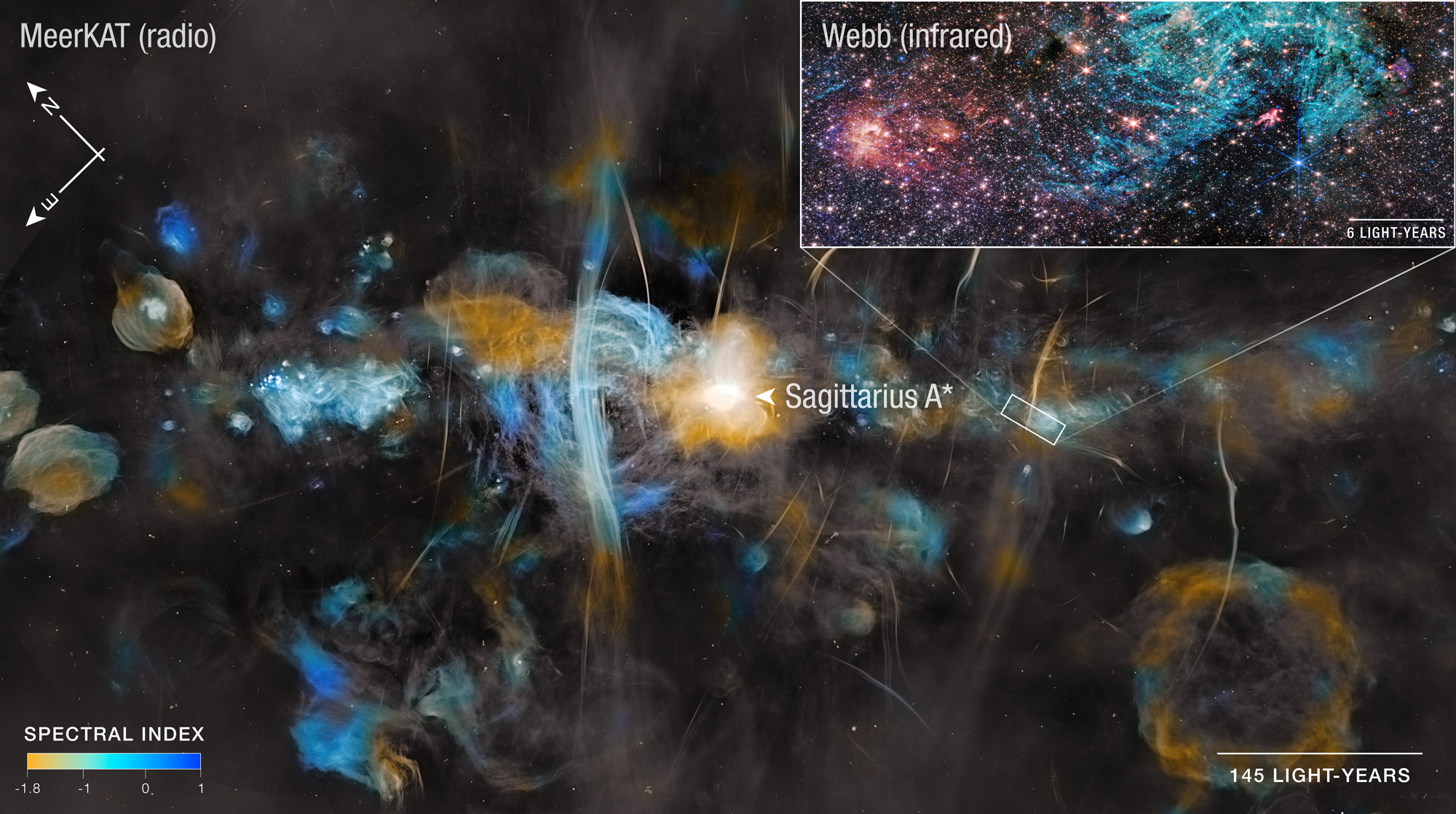
An image of the Milky Way captured by the MeerKAT (formerly the Karoo Array Telescope) radio telescope array puts the James Webb Space Telescope’s image of the Sagittarius C region in context. Like a super-long exposure photograph, MeerKAT shows the bubble-like remnants of supernovas that exploded over millennia, capturing the dynamic nature of the Milky Way’s chaotic core. At the center of the MeerKAT image the region surrounding the Milky Way’s supermassive black hole blazes bright. Huge vertical filamentary structures echo those captured on a smaller scale by Webb in Sagittarius C’s blue-green hydrogen cloud.
NASA, ESA, CSA, STScI, SARAO, Samuel Crowe (UVA), John Bally (CU), Ruben Fedriani (IAA-CSIC), Ian Heywood (Oxford)
Image B: Milky Way Center (MeerKAT and Webb), Labeled
The star-forming region Sagittarius C, captured by the James Webb Space Telescope, is about 200 light-years from the Milky Way’s central supermassive black hole, Sagittarius A*. The spectral index at the lower left shows how color was assigned to the radio data to create the image. On the negative end, there is non-thermal emission, stimulated by electrons spiraling around magnetic field lines. On the positive side, thermal emission is coming from hot, ionized plasma. For Webb, color is assigned by shifting the infrared spectrum to visible light colors. The shortest infrared wavelengths are bluer, and the longer wavelengths appear more red.
NASA, ESA, CSA, STScI, SARAO, Samuel Crowe (UVA), John Bally (CU), Ruben Fedriani (IAA-CSIC), Ian Heywood (Oxford)
Using Infrared to Reveal Forming Stars
In Sagittarius C’s brightest cluster, the researchers confirmed the tentative finding from the Atacama Large Millimeter Array (ALMA) that two massive stars are forming there. Along with infrared data from NASA’s retired Spitzer Space Telescope and SOFIA (Stratospheric Observatory for Infrared Astronomy) mission, as well as the Herschel Space Observatory, they used Webb to determine that each of the massive protostars is already more than 20 times the mass of the Sun. Webb also revealed the bright outflows powered by each protostar.
Even more challenging is finding low-mass protostars, still shrouded in cocoons of cosmic dust. Researchers compared Webb’s data with ALMA’s past observations to identify five likely low-mass protostar candidates.
The team also identified 88 features that appear to be shocked hydrogen gas, where material being blasted out in jets from young stars impacts the surrounding gas cloud. Analysis of these features led to the discovery of a new star-forming cloud, distinct from the main Sagittarius C cloud, hosting at least two protostars powering their own jets.
“Outflows from forming stars in Sagittarius C have been hinted at in past observations, but this is the first time we’ve been able to confirm them in infrared light. It’s very exciting to see, because there is still a lot we don’t know about star formation, especially in the Central Molecular Zone, and it’s so important to how the universe works,” said Crowe.
Magnetic Fields and Star Formation
Webb’s 2023 image of Sagittarius C showed dozens of distinctive filaments in a region of hot hydrogen plasma surrounding the main star-forming cloud. New analysis by Bally and his team has led them to hypothesize that the filaments are shaped by magnetic fields, which have also been observed in the past by the ground-based observatories ALMA and MeerKAT (formerly the Karoo Array Telescope).
“The motion of gas swirling in the extreme tidal forces of the Milky Way’s supermassive black hole, Sagittarius A*, can stretch and amplify the surrounding magnetic fields. Those fields, in turn, are shaping the plasma in Sagittarius C,” said Bally.
The researchers think that the magnetic forces in the galactic center may be strong enough to keep the plasma from spreading, instead confining it into the concentrated filaments seen in the Webb image. These strong magnetic fields may also resist the gravity that would typically cause dense clouds of gas and dust to collapse and forge stars, explaining Sagittarius C’s lower-than-expected star formation rate.
“This is an exciting area for future research, as the influence of strong magnetic fields, in the center of our galaxy or other galaxies, on stellar ecology has not been fully considered,” said Crowe.
The James Webb Space Telescope is the world’s premier space science observatory. Webb is solving mysteries in our solar system, looking beyond to distant worlds around other stars, and probing the mysterious structures and origins of our universe and our place in it. Webb is an international program led by NASA with its partners, ESA (European Space Agency) and CSA (Canadian Space Agency).
Preparations for Next Moonwalk Simulations Underway (and Underwater)
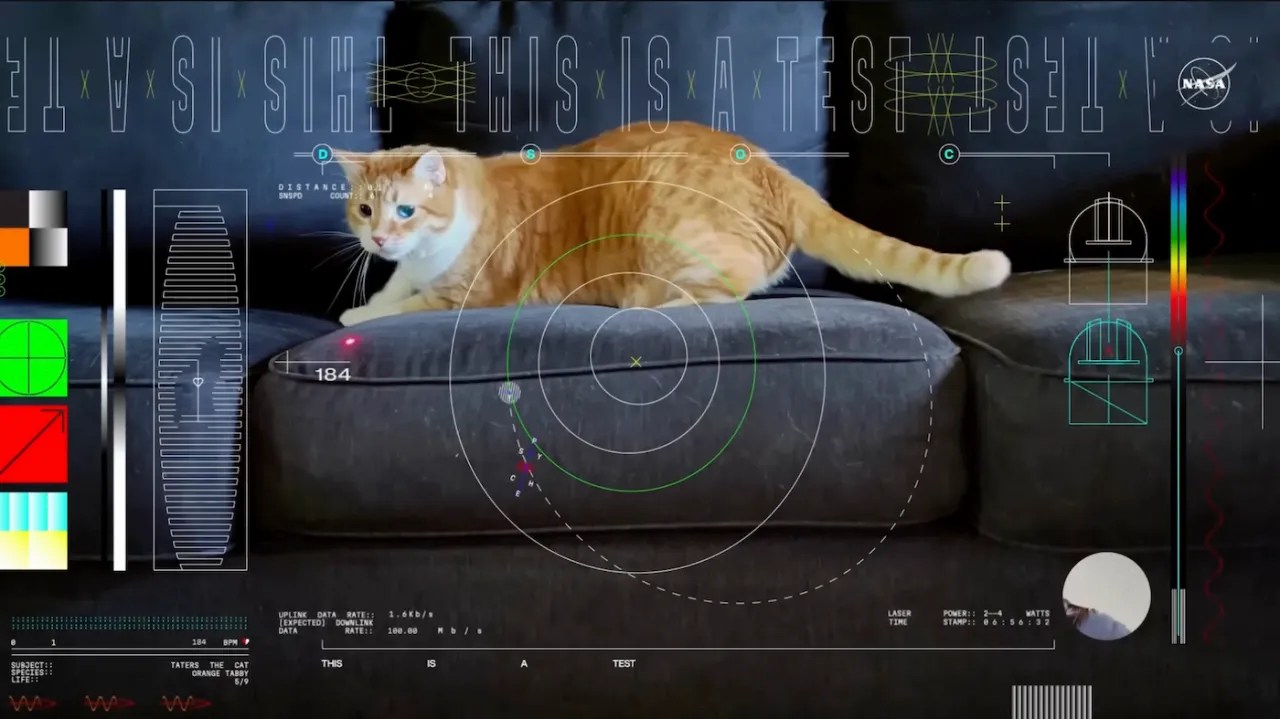
This ultra high-definition video featuring an orange tabby cat named Taters, was streamed from nearly 19 million miles away via laser by NASA’s Deep Space Optical Communications (DSOC) experiment, marking a historic milestone for space communications.
Jet Propulsion Laboratory
Since it began in 1958, NASA has been charged by law with spreading the word about its work to the widest extent practicable. From typewritten press releases to analog photos and film, the agency has effectively moved into social media and other online communications. NASA’s broad reach across digital platforms has been recognized by the International Academy of Digital Arts and Sciences (IADAS), with 10 nominations across multiple categories for the academy’s 29th annual Webby Awards.
The 2025 Webby nominations demonstrate NASA’s dedication to sharing the wonders of space through digital platforms. We believe in the power of digital storytelling to inspire the next generation of explorers.
Michelle R. Jones
Deputy Associate Administrator for Communications
Public Voting Opportunities
Voting for the Webby People’s Voice Awards—chosen by the public—is open now through Thursday, April 17. Voting links for each category are listed below.
Established in 1996 during the web’s infancy, The Webbys is presented by the IADAS—a 3000+ member judging body. The Academy is comprised of Executive Members—leading Internet experts, business figures, luminaries, visionaries, and creative celebrities—and associate members who are former Webby winners, nominees and other internet professionals.
The Webby Awards presents two honors in every category—the Webby Award and the Webby People’s Voice Award. Members of the International Academy of Digital Arts and Sciences (IADAS) select the nominees for both awards in each category, as well as the winners of the Webby Awards. In the spirit of the open web, the Webby People’s Voice is chosen by the voting public, and garners millions of votes from all over the world.
Preparations for Next Moonwalk Simulations Underway (and Underwater)
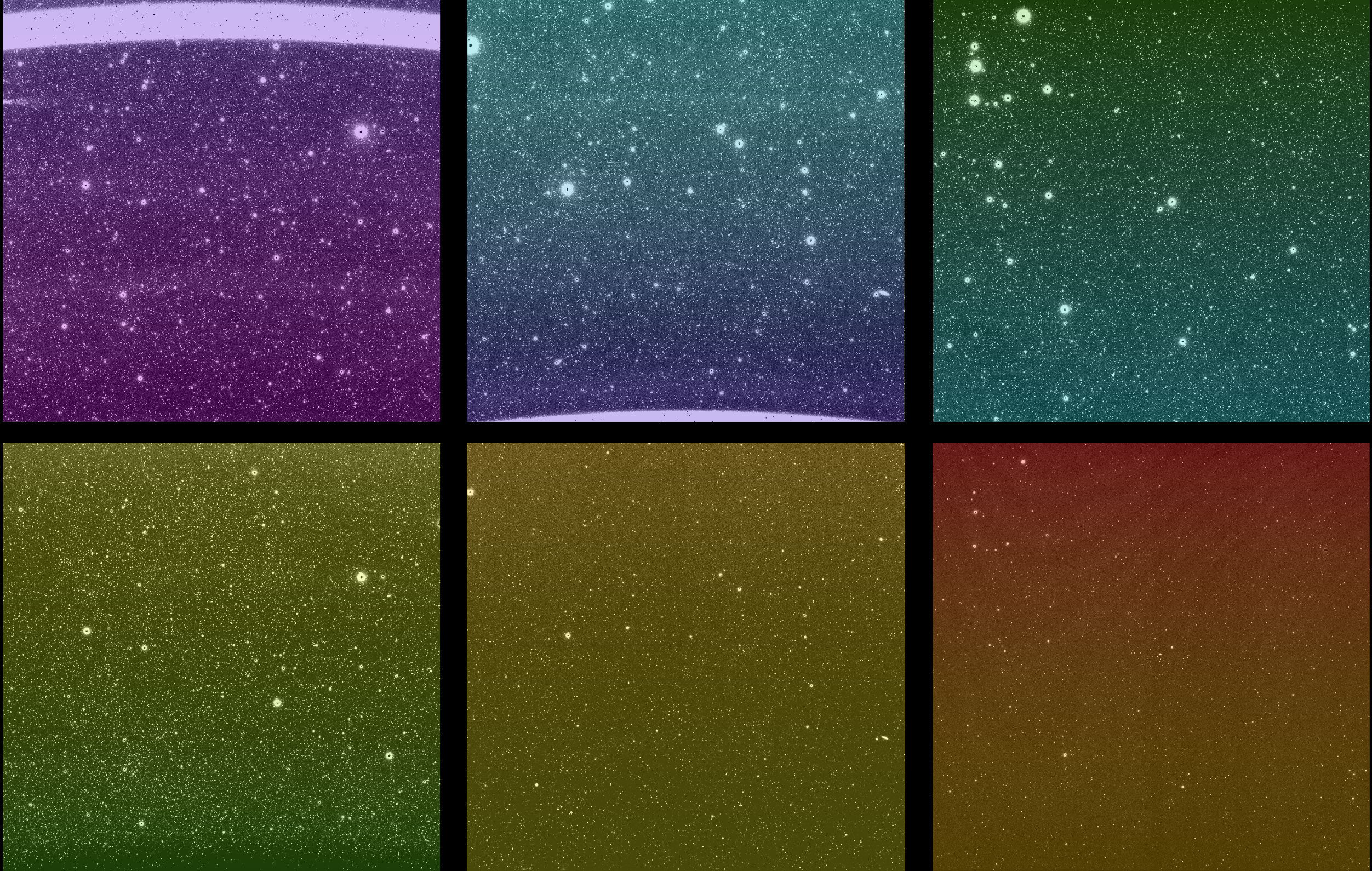
NASA’s SPHEREx, which will map millions of galaxies across the entire sky, captured one of its first exposures March 27. The observatory’s six detectors each captured one of these uncalibrated images, to which visible-light colors have been added to represent infrared wavelengths. SPHEREx’s complete field of view spans the top three images; the same area of the sky is also captured in the bottom three images.
NASA/JPL-Caltech
Processed with rainbow hues to represent a range of infrared wavelengths, the new pictures indicate the astrophysics space observatory is working as expected.
NASA’s SPHEREx (short for Spectro-Photometer for the History of the Universe, Epoch of Reionization and Ices Explorer) has turned on its detectors for the first time in space. Initial images from the observatory, which launched March 11, confirm that all systems are working as expected.
Although the new images are uncalibrated and not yet ready to use for science, they give a tantalizing look at SPHEREx’s wide view of the sky. Each bright spot is a source of light, like a star or galaxy, and each image is expected to contain more than 100,000 detected sources.
There are six images in every SPHEREx exposure — one for each detector. The top three images show the same area of sky as the bottom three images. This is the observatory’s full field of view, a rectangular area about 20 times wider than the full Moon. When SPHEREx begins routine science operations in late April, it will take approximately 600 exposures every day.
Each image in this uncalibrated SPHEREx exposure contains about 100,000 light sources, including stars and galaxies. The two insets at right zoom in on sections of one image, showcasing the telescope’s ability to capture faint, distant galaxies. These sections are processed in grayscale rather than visible-light color for ease of viewing.
NASA/JPL-Caltech
“Our spacecraft has opened its eyes on the universe,” said Olivier Doré, SPHEREx project scientist at Caltech and NASA’s Jet Propulsion Laboratory, both in Southern California. “It’s performing just as it was designed to.”
The SPHEREx observatory detects infrared light, which is invisible to the human eye. To make these first images, science team members assigned a visible color to every infrared wavelength captured by the observatory. Each of the six SPHEREx detectors has 17 unique wavelength bands, for a total of 102 hues in every six-image exposure.
Breaking down color this way can reveal the composition of an object or the distance to a galaxy. With that data, scientists can study topics ranging from the physics that governed the universe less than a second after its birth to the origins of water in our galaxy.
“This is the high point of spacecraft checkout; it’s the thing we wait for,” said Beth Fabinsky, SPHEREx deputy project manager at JPL. “There’s still work to do, but this is the big payoff. And wow! Just wow!”
During the past two weeks, scientists and engineers at JPL, which manages the mission for NASA, have executed a series of spacecraft checks that show all is well so far. In addition, SPHEREx’s detectors and other hardware have been cooling down to their final temperature of around minus 350 degrees Fahrenheit (about minus 210 degrees Celsius). This is necessary because heat can overwhelm the telescope’s ability to detect infrared light, which is sometimes called heat radiation. The new images also show that the telescope is focused correctly. Focusing is done entirely before launch and cannot be adjusted in space.
“Based on the images we are seeing, we can now say that the instrument team nailed it,” said Jamie Bock, SPHEREx’s principal investigator at Caltech and JPL.
How It Works
Where telescopes like NASA’s Hubble and James Webb space telescopes were designed to target small areas of space in detail, SPHEREx is a survey telescope and takes a broad view. Combining its results with those of targeted telescopes will give scientists a more robust understanding of our universe.
The observatory will map the entire celestial sky four times during its two-year prime mission. Using a technique called spectroscopy, SPHEREx will collect the light from hundreds of millions of stars and galaxies in more wavelengths any other all-sky survey telescope.
When light enters SPHEREx’s telescope, it’s directed down two paths that each lead to a row of three detectors. The observatory’s detectors are like eyes, and set on top of them are color filters, which are like color-tinted glasses. While a standard color filter blocks all wavelengths but one, like yellow- or rose-tinted glasses, the SPHEREx filters are more like rainbow-tinted glasses: The wavelengths they block change gradually from the top of the filter to the bottom.
“I’m rendered speechless,” said Jim Fanson, SPHEREx project manager at JPL. “There was an incredible human effort to make this possible, and our engineering team did an amazing job getting us to this point.”
More About SPHEREx
The SPHEREx mission is managed by JPL for the agency’s Astrophysics Division within the Science Mission Directorate at NASA Headquarters. BAE Systems (formerly Ball Aerospace) built the telescope and the spacecraft bus. The science analysis of the SPHEREx data will be conducted by a team of scientists located at 10 institutions in the U.S., two in South Korea, and one in Taiwan. Caltech managed and integrated the instrument. Data will be processed and archived at IPAC at Caltech. The mission’s principal investigator is based at Caltech with a joint JPL appointment. The SPHEREx dataset will be publicly available at the NASA-IPAC Infrared Science Archive. Caltech manages JPL for NASA.
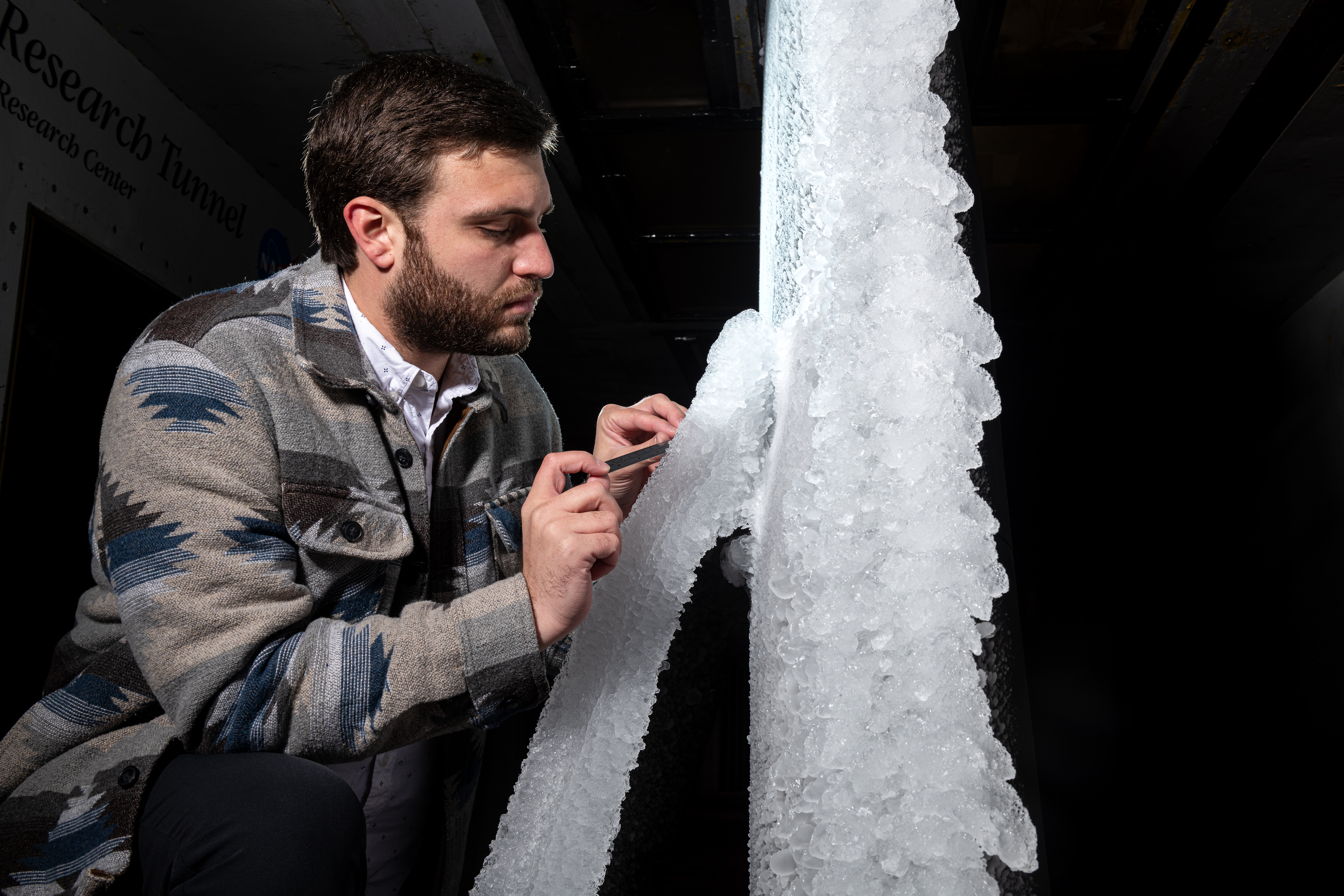
Thomas Ozoroski, a researcher at NASA’s Glenn Research Center in Cleveland, takes icing accretion measurements in October 2024 as part of transonic truss-braced wing concept research.
In the future, aircraft with long, thin wings supported by aerodynamic braces could help airlines save on fuel costs – but those same wings could be susceptible to ice buildup. In the historic Icing Research Tunnel at NASA Glenn, scientists and engineers are testing a concept for a transonic truss-braced wing. Their goal: to collect important data to inform the design of these potential efficient aircraft of the future.
NASA Glenn can simulate icing conditions in its Icing Research Tunnel to identify potential challenges for new aircraft designs. These tests provide valuable information about how ice builds up on wings and can help identify the most critical icing conditions for safety.
Enjoy observing planets in the morning and evening sky, look for Lyrid meteors, and hunt for the “faint fuzzy” wonder that is the distant and ancient city of stars known as globular cluster M3.
Skywatching Highlights
All Month – Planet Visibility:
Mercury: Visible for a few days in the second half of April, extremely low in the east before sunrise.
Venus: Rising low in the east in the hour before dawn.
Mars: Bright and easy to view after dark all month. Setting a couple of hours after midnight.
Jupiter: Bright and easy to spot in the west after dark, setting a couple of hours after sunset.
Saturn: Visible low in the east below Venus, before dawn in the last two weeks of April.
Daily Highlights:
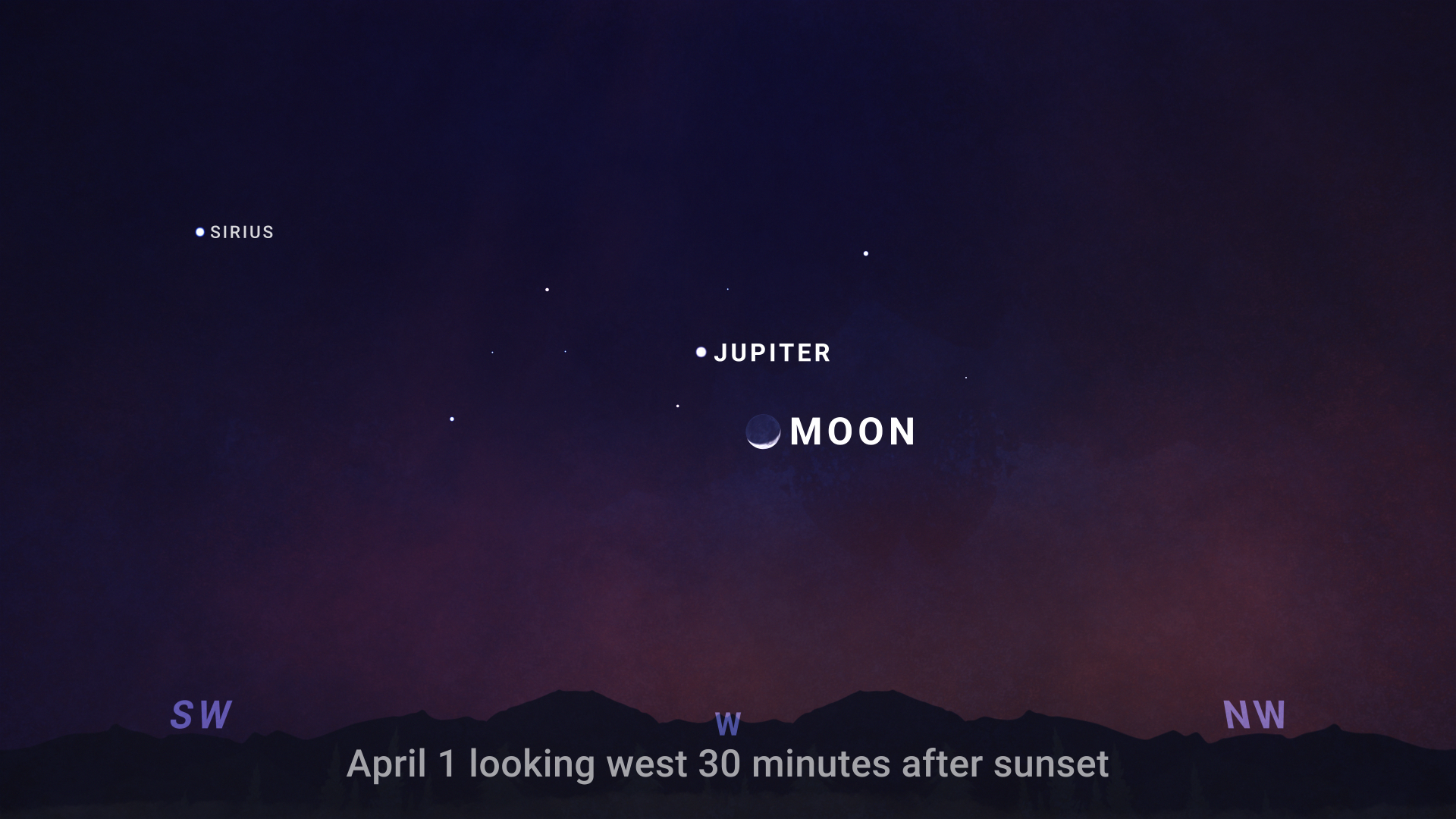
April 1 & 30 – Jupiter & Crescent Moon: Find the charming pair in the west as the sky darkens, setting about 3 hours after sunset.
April 4 & 5 – Mars & Moon: The Moon, around its first quarter phase, appears near Mars in the sky for two nights.
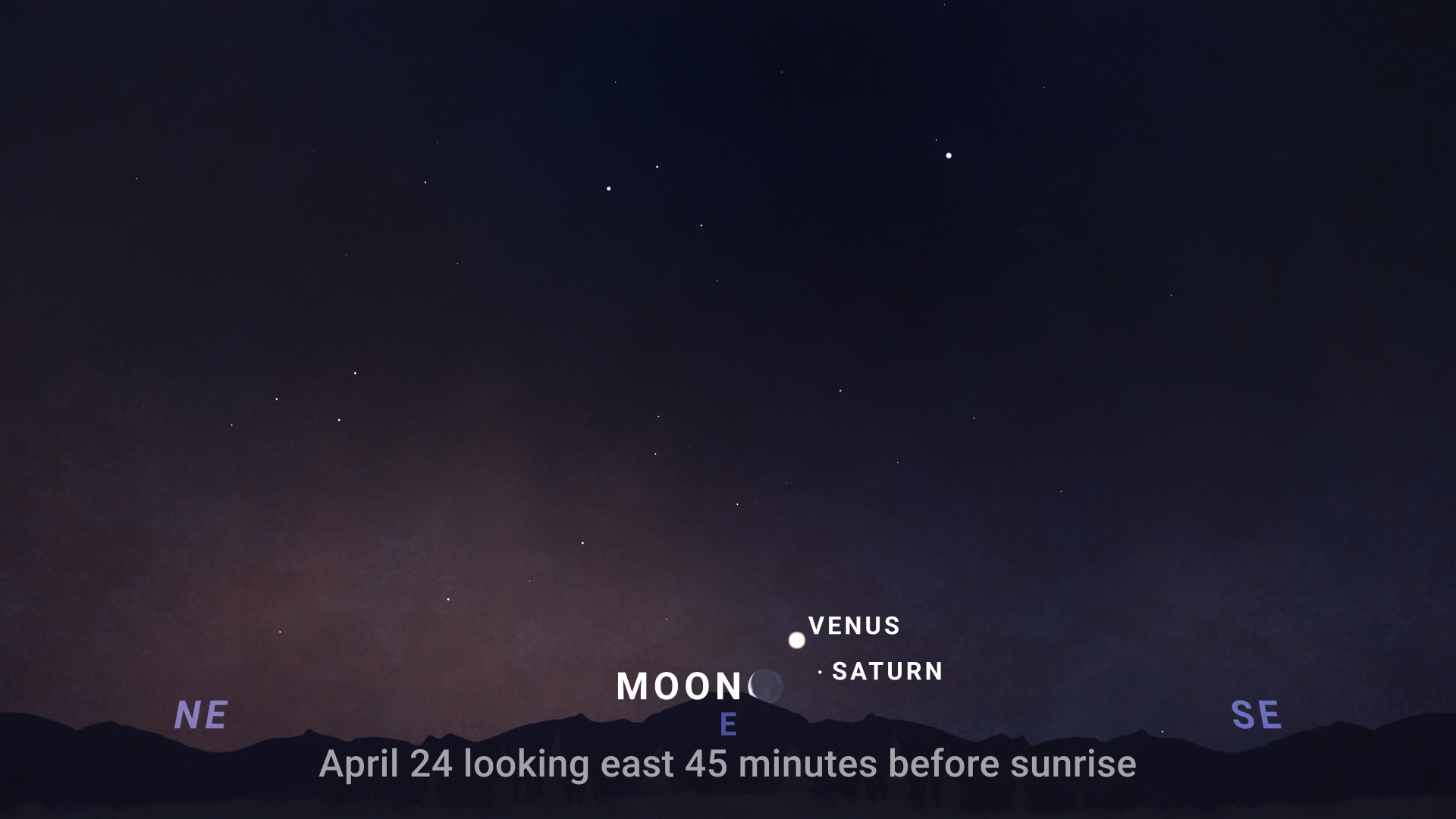
April 24-25 – Grouping of the Moon & Three Planets: Find Venus, Saturn, and the crescent moon gathered low in the east as dawn warms the morning sky. Mercury is also visible below them for those with a clear view to the horizon.
All month – Venus: Earth’s hothouse twin planet has made the shift from an evening object to a morning sight. You’ll notice it rising low in the east before dawn, looking a little higher each morning through the month.
All month – Mars: Looking bright and reddish in color, Mars is visible high overhead after dark all month. At the start of the month it lies along a line with bright stars Procyon and Pollux, but you’ll notice it moves noticeably over the course of April (~12 degrees or the width of your outstretched fist at arm’s length).
Transcript
What’s Up for April? Planets at dusk and dawn, April showers, and observing a distant city of stars.
Sky chart showing Jupiter and the crescent Moon on April 1. A similar scene repeats on April 30, but with the Moon appearing above Jupiter.
NASA/JPL-Caltech
First up, in the evening sky, we begin and end the month with Jupiter and the crescent Moon shining brightly together in the western sky as sunset fades. On both April 1st and 30th, you can find the charming pair about half an hour after sunset, setting about 3 hours later.
Mars is high overhead in the south on April evenings. At the start of the month, it’s directly in between bright stars Procyon and Pollux, but it moves noticeably during the month. You’ll find the first-quarter moon right next to Mars on April 4th and 5th.
Moving to the morning sky, Venus has now made the switch from an evening object to a morning one. You may start to notice it rising low in the east before dawn, looking a little higher each morning through the month.
Sky chart showing the eastern sky 45 minutes before sunrise on April 24, with Venus, Saturn and the crescent Moon forming a grouping low in the sky. Mercury might also be visible for those with a completely clear view to the horizon.
NASA/JPL-Caltech
Around April 24th and 25th, you’ll find Venus, Saturn, and the crescent moon gathered low in the east as dawn warms up the morning sky. Those with a clear view to the horizon might also pick out Mercury looking bright, but very low in the sky.
April brings shooting stars as Earth passes through one the streams of comet dust that create our annual meteor showers. The Lyrids are a modest meteor shower that peaks overnight on April 21st and into the morning of the 22nd. You can expect up to 15 meteors per hour near the peak under dark skies.
The Lyrids are best observed from the Northern Hemisphere, but can be seen from south of the equator as well. View them after about 10:30pm local time until dawn, with the best viewing around 5 a.m. The waning crescent moon will rise around 3:30am, but at only 27% full, it shouldn’t interfere too much with your meteor watching. For the best experience, face roughly toward the east, lie down in a safe, dark place away from bright lights, and look straight overhead. Meteors can appear anywhere in the sky, and some Lyrids can leave bright trails that last for a few seconds after they’ve passed.
NASA studies meteors from the ground, in the air, and from orbit to forecast meteor activity and protect spacecraft, and to understand the composition of comets and asteroids throughout our solar system.
Sky chart facing east around 9pm in April 2025 showing the location of globular cluster M3. The chart depicts the cluster’s position relative to the Big Dipper and bright stars Arcturus and Cor Caroli. The Big Dipper star Megrez serves as an indicator for the brightness of Cor Caroli. For easy visibility, M3 is depicted brighter and larger than its actual appearance.
NASA/JPL-Caltech
April offers a chance to observe a truly distant wonder – a globular cluster known as “M3.” It’s a vast collection of stars that lies 34,000 light-years from Earth in our galaxy’s outer reaches. Astronomer Charles Messier discovered this object in 1764, while searching for new comets. Realizing it wasn’t one, he added it to his list of interesting objects that were not comets, which today we know as Messier’s catalog.
Through binoculars, Messier 3, or M3, appears as a small, fuzzy, star-like patch of light. With a small telescope, you’ll see a more defined glow with a slightly grainy texture. And with telescopes 8 inches or larger, the cluster begins to resolve into hundreds of individual stars.
Now, globular clusters contain some of the oldest stars in the universe, often over 10 billion years old. Unlike open clusters like the Pleiades, which sit within the Milky Way’s spiral arms, globular clusters are found in the galaxy’s halo, orbiting far above and below the Milky Way’s disk. Our galaxy has around 150 confirmed globular clusters. M3 itself is probably 11 to 13 billion years old and contains around half a million stars. And it’s relatively easy to spot in April under dark skies with binoculars or a small telescope.
Finding M3 starts with the Big Dipper. Facing east, use the Dipper’s handle to “arc to Arcturus,” the fourth-brightest star in the night sky. From there, look higher in the sky to find the star Cor Caroli located here to the west of the Dipper’s handle. It’s about as bright as this star in the Dipper’s cup. M3 is located roughly a third of the way from Arcturus to Cor Caroli. With binoculars or a finder scope, sweep within this area until you spot a faint, round glow.
M3 is an excellent target for beginners and seasoned observers alike. Whether using binoculars or a telescope, you’ll be rewarded with a view of one of the oldest objects in our galaxy.
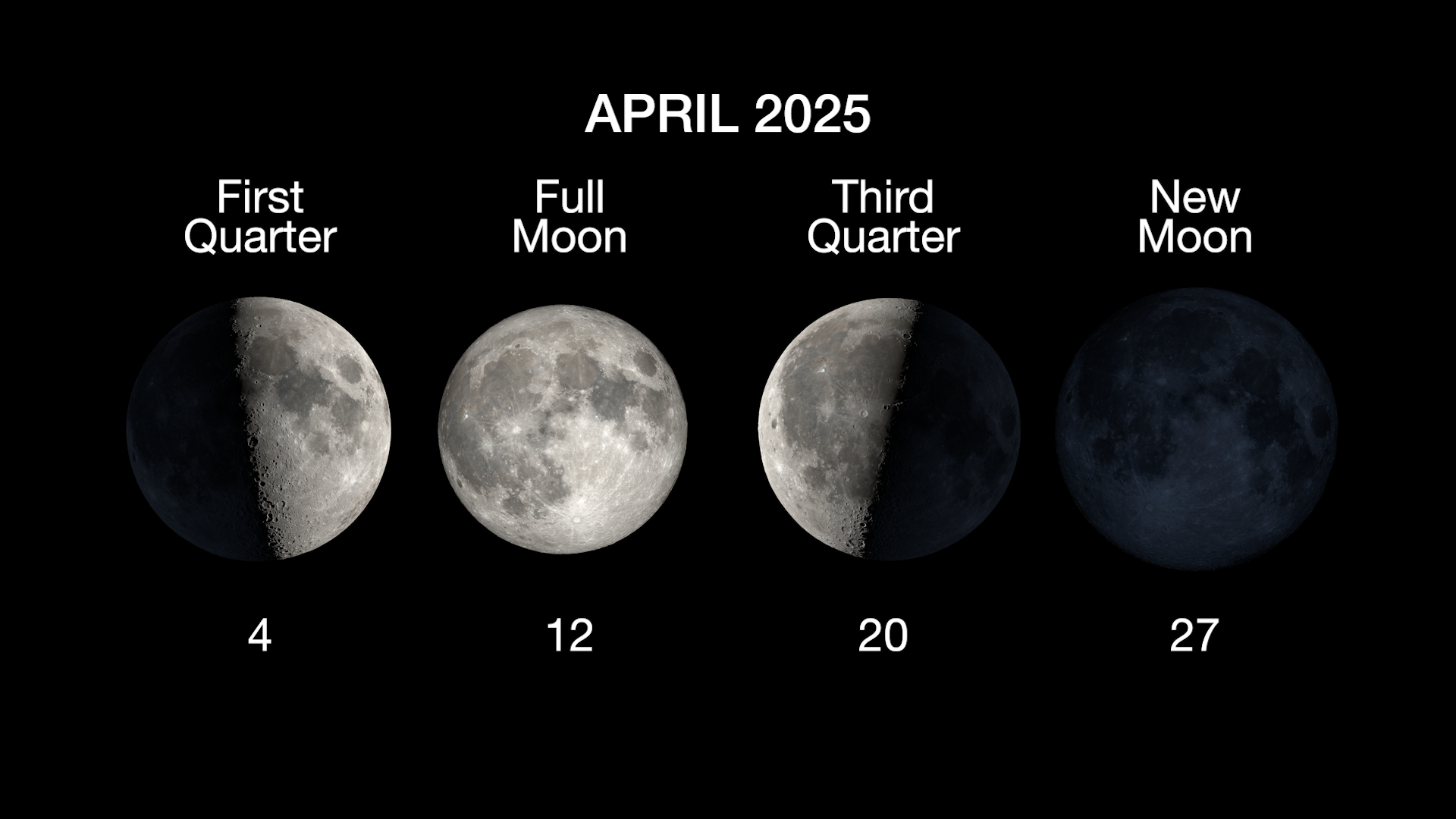
The phases of the Moon for April 2025.
NASA/JPL-Caltech
Above are the phases of the Moon for April.
Stay up to date on all of NASA’s missions exploring the solar system and beyond at NASA Science. I’m Preston Dyches from NASA’s Jet Propulsion Laboratory, and that’s What’s Up for this month.
This website uses cookies to improve your experience. We'll assume you're ok with this, but you can opt-out if you wish.AcceptRead More
Privacy & Cookies Policy
Privacy Overview
This website uses cookies to improve your experience while you navigate through the website. Out of these, the cookies that are categorized as necessary are stored on your browser as they are essential for the working of basic functionalities of the website. We also use third-party cookies that help us analyze and understand how you use this website. These cookies will be stored in your browser only with your consent. You also have the option to opt-out of these cookies. But opting out of some of these cookies may affect your browsing experience.
Necessary cookies are absolutely essential for the website to function properly. This category only includes cookies that ensures basic functionalities and security features of the website. These cookies do not store any personal information.
Any cookies that may not be particularly necessary for the website to function and is used specifically to collect user personal data via analytics, ads, other embedded contents are termed as non-necessary cookies. It is mandatory to procure user consent prior to running these cookies on your website.