Tag: solar system

  • How Can I See the Northern Lights? We Asked a NASA Expert: Episode 54

    2 min read

    Preparations for Next Moonwalk Simulations Underway (and Underwater)

    How can I see the northern lights?

    To see the northern lights, you need to be in the right place at the right time.

    Auroras are the result of charged particles and magnetism from the Sun called space weather dancing with the Earth’s magnetic field. And they happen far above the clouds. So you need clear skies, good space weather at your latitude and the higher, more polar you can be, the better. You need a lot of patience and some luck is always helpful.

    A smartphone can also really help confirm whether you saw a little bit of kind of dim aurora, because cameras are more sensitive than our eyes.

    The best months to see aurorae, statistically, are March and September. The best times to be looking are around midnight, but sometimes when the Sun is super active, it can happen any time from sunset to sunrise.

    You can also increase your chances by learning more about space weather data and a great place to do that is at the NOAA Space Weather Prediction Center.

    You can also check out my project, Aurorasaurus.org, where we have free alerts that are based on your location and we offer information about how to interpret the data. And you can also report and tell us if you were able to see aurora or not and that helps others.

    One last tip is finding a safe, dark sky viewing location with a great view of the northern horizon that’s near you.

    [END VIDEO TRANSCRIPT]

    Full Episode List

    Full YouTube Playlist

  • Norman Rockwell Commemorates Gemini Program with Grissom and Young

    A painting by Norman Rockwell shows technicians in white jumpsuits (far left and far right) helping two astronauts (middle) in their spacesuits. Behind them is a large rectangular machine with wires, dials, and switches. The wall behind them and the floor are both shades of yellow. Norman Rockwell's signature is at bottom right.
    Norman Rockwell

    In his painting called Grissom and Young, American painter and illustrator Norman Rockwell captures technicians helping NASA astronauts John Young and Gus Grissom suit up for the first flight of the Gemini program in March 1965. NASA loaned Norman Rockwell a Gemini spacesuit to make this painting as accurate as possible.

    Since its beginning, NASA has used the power of art to communicate the extraordinary aspects of its missions in a way that connects uniquely with humanity. NASA’s original art program, started in 1962 under the direction of Administrator James Webb, included a diverse collection of works from artists such as Rockwell, Andy Warhol, and Annie Leibovitz.

    See more art inspired by NASA.

    Image credit: Norman Rockwell

  • The Sky’s Not the Limit: Testing Precision Landing Tech for Future Space Missions

    2 min read

    Preparations for Next Moonwalk Simulations Underway (and Underwater)

    F/A-18 research aircraft in flight with blue sky
    A NASA F/A-18 research aircraft flies above California near NASA’s Armstrong Flight Research Center in Edwards, California, testing a commercial precision landing technology for future space missions. The Psionic Space Navigation Doppler Lidar (PSNDL) system is installed in a pod located under the right wing of the aircraft.
    NASA

    Nestled in a pod under an F/A-18 Hornet aircraft wing, flying above California, and traveling up to the speed of sound, NASA put a commercial sensor technology to the test. The flight tests demonstrated the sensor accuracy and navigation precision in challenging conditions, helping prepare the technology to land robots and astronauts on the Moon and Mars. 

    The Psionic Space Navigation Doppler Lidar (PSNDL) system is rooted in NASA technology that Psionic, Inc. of Hampton, Virginia, licensed and further developed. They miniaturized the NASA technology, added further functionality, and incorporated component redundancies that make it more rugged for spaceflight. The PSNDL navigation system also includes cameras and an inertial measurement unit to make it a complete navigation system capable of accurately determining a vehicle’s position and velocity for precision landing and other spaceflight applications. 

    3 men install the PSNDL system onto an aircraft.
    NASA engineers and technicians install the Psionic Space Navigation Doppler Lidar (PSNDL) system into a testing pod on a NASA F/A-18 research aircraft ahead of February 2025 flight tests at NASA’s Armstrong Flight Research Center in Edwards, California.
    NASA

    The aircraft departed from NASA’s Armstrong Flight Research Center in Edwards, California, and conducted a variety of flight paths over several days in February 2025. It flew a large figure-8 loop and conducted several highly dynamic maneuvers over Death Valley, California, to collect navigation data at various altitudes, velocities, and orientations relevant for lunar and Mars entry and descent. Refurbished for these tests, the NASA F/A-18 pod can support critical data collection for other technologies and users at a low cost. 

    Doppler Lidar sensors provide a highly accurate measurement of speed by measuring the frequency shift between laser light emitted from the sensor reflected from the ground. Lidar are extremely useful in sunlight-challenged areas that may have long shadows and stark contrasts, such as the lunar South Pole. Pairing PSNDL with cameras adds the ability to visually compare pictures with surface reconnaissance maps of rocky terrain and navigate to landing at interesting locations on Mars. All the data is fed into a computer to make quick, real-time decisions to enable precise touchdowns at safe locations. 

    Open backside of the Psionic Space Navigation Doppler Lidar.
    Psionic Space Navigation Doppler Lidar (PSNDL) system installed in a testing pod on a NASA F/A-18 research aircraft ahead of February 2025 flight tests at NASA’s Armstrong Flight Research Center in Edwards, California.
    NASA

    Since licensing NDL in 2016, Psionic has received funding and development support from NASA’s Space Technology Mission Directorate through its Small Business Innovative Research program and Tipping Point initiative. The company has also tested PSNDL prototypes on suborbital vehicles via the Flight Opportunities program. In 2024, onboard a commercial lunar lander, NASA successfully demonstrated the predecessor NDL system developed by the agency’s Langley Research Center in Hampton, Virginia. 

  • NASA’s Webb Sees Galaxy Mysteriously Clearing Fog of Early Universe

    5 Min Read

    NASA’s Webb Sees Galaxy Mysteriously Clearing Fog of Early Universe

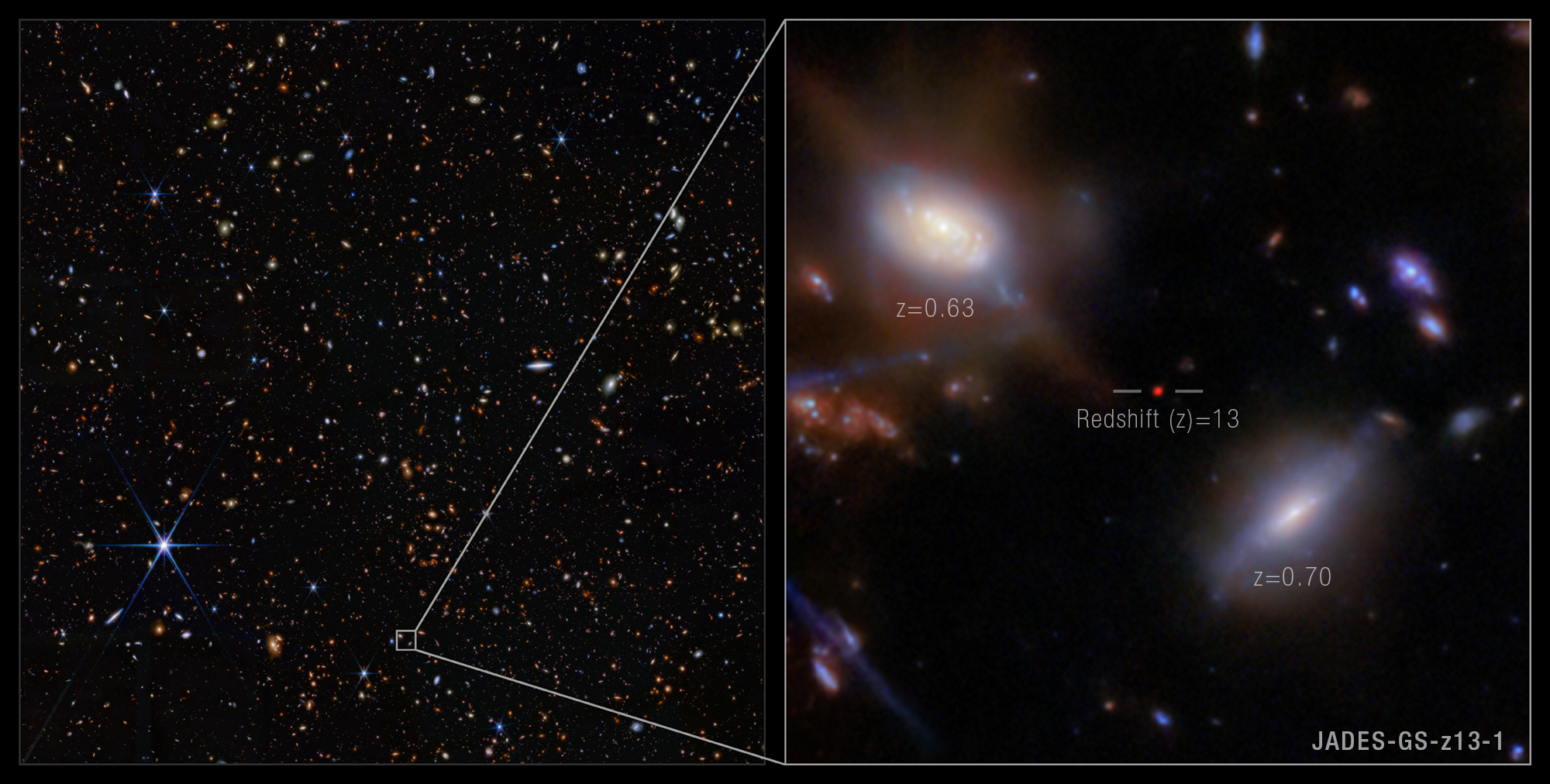
    A two panel image. At left, hundreds of tiny galaxies are scattered across the black background of space. A small portion of the sky near the bottom is outlined with a white box. Lines extend from the corners of the box to the right panel. At right, a small red dot at the middle is highlighted with white lines and labeled redshift z = 13. At upper left, a face-on spiral galaxy is labeled z = 0.63. At lower right, an edge-on spiral galaxy is labeled z = 0.70. A handful of other small background galaxies are seen against the black background of space. At lower right, the panel is labeled JADES-GS-z-13-1.

    The incredibly distant galaxy JADES-GS-z13-1, observed just 330 million years after the big bang, was initially discovered with deep imaging from NASA’s James Webb Space Telescope’s NIRCam (Near-Infrared Camera). Full image below.

    Credits:
    NASA, ESA, CSA, JADES Collaboration, J. Witstok (University of Cambridge/University of Copenhagen), P. Jakobsen (University of Copenhagen), A. Pagan (STScI), M. Zamani (ESA/Webb)

    Using the unique infrared sensitivity of NASA’s James Webb Space Telescope, researchers can examine ancient galaxies to probe secrets of the early universe. Now, an international team of astronomers has identified bright hydrogen emission from a galaxy in an unexpectedly early time in the universe’s history. The surprise finding is challenging researchers to explain how this light could have pierced the thick fog of neutral hydrogen that filled space at that time.

    The Webb telescope discovered the incredibly distant galaxy JADES-GS-z13-1, observed to exist just 330 million years after the big bang, in images taken by Webb’s NIRCam (Near-Infrared Camera) as part of the James Webb Space Telescope Advanced Deep Extragalactic Survey (JADES). Researchers used the galaxy’s brightness in different infrared filters to estimate its redshift, which measures a galaxy’s distance from Earth based on how its light has been stretched out during its journey through expanding space.

    Image A: JADES-GS-z13-1 in the GOODS-S field (NIRCam Image)

    A two panel image. At left, hundreds of tiny galaxies are scattered across the black background of space. A small portion of the sky near the bottom is outlined with a white box. Lines extend from the corners of the box to the right panel. At right, a small red dot at the middle is highlighted with white lines and labeled redshift z = 13. At upper left, a face-on spiral galaxy is labeled z = 0.63. At lower right, an edge-on spiral galaxy is labeled z = 0.70. A handful of other small background galaxies are seen against the black background of space. At lower right, the panel is labeled JADES-GS-z-13-1.
    The incredibly distant galaxy JADES-GS-z13-1, observed just 330 million years after the big bang, was initially discovered with deep imaging from NASA’s James Webb Space Telescope’s NIRCam (Near-Infrared Camera). Now, an international team of astronomers definitively has identified powerful hydrogen emission from this galaxy at an unexpectedly early period in the universe’s history. JADES-GS-z-13 has a redshift (z) of 13, which is an indication of its age and distance.
    NASA, ESA, CSA, JADES Collaboration, J. Witstok (University of Cambridge/University of Copenhagen), P. Jakobsen (University of Copenhagen), A. Pagan (STScI), M. Zamani (ESA/Webb)

    Image B: JADES-GS-z13-1 (NIRCam Close-Up)

    A small red dot is in the middle of the image. To its upper left is a face-on spiral galaxy, and to its lower right is an edge-on spiral galaxy. A handful of other small background galaxies are seen against the black background of space.
    This image shows the galaxy JADES GS-z13-1 (the red dot at center), imaged with NASA’s James Webb Space Telescope’s NIRCam (Near-Infrared Camera) as part of the JWST Advanced Deep Extragalactic Survey (JADES) program. These data from NIRCam allowed researchers to identify GS-z13-1 as an incredibly distant galaxy, and to put an estimate on its redshift value. Webb’s unique infrared sensitivity is necessary to observe galaxies at this extreme distance, whose light has been shifted into infrared wavelengths during its long journey across the cosmos.
    NASA, ESA, CSA, JADES Collaboration, J. Witstok (University of Cambridge/University of Copenhagen), P. Jakobsen (University of Copenhagen), M. Zamani (ESA/Webb)

    The NIRCam imaging yielded an initial redshift estimate of 12.9. Seeking to confirm its extreme redshift, an international team lead by Joris Witstok of the University of Cambridge in the United Kingdom, as well as the Cosmic Dawn Center and the University of Copenhagen in Denmark, then observed the galaxy using Webb’s Near-Infrared Spectrograph instrument.

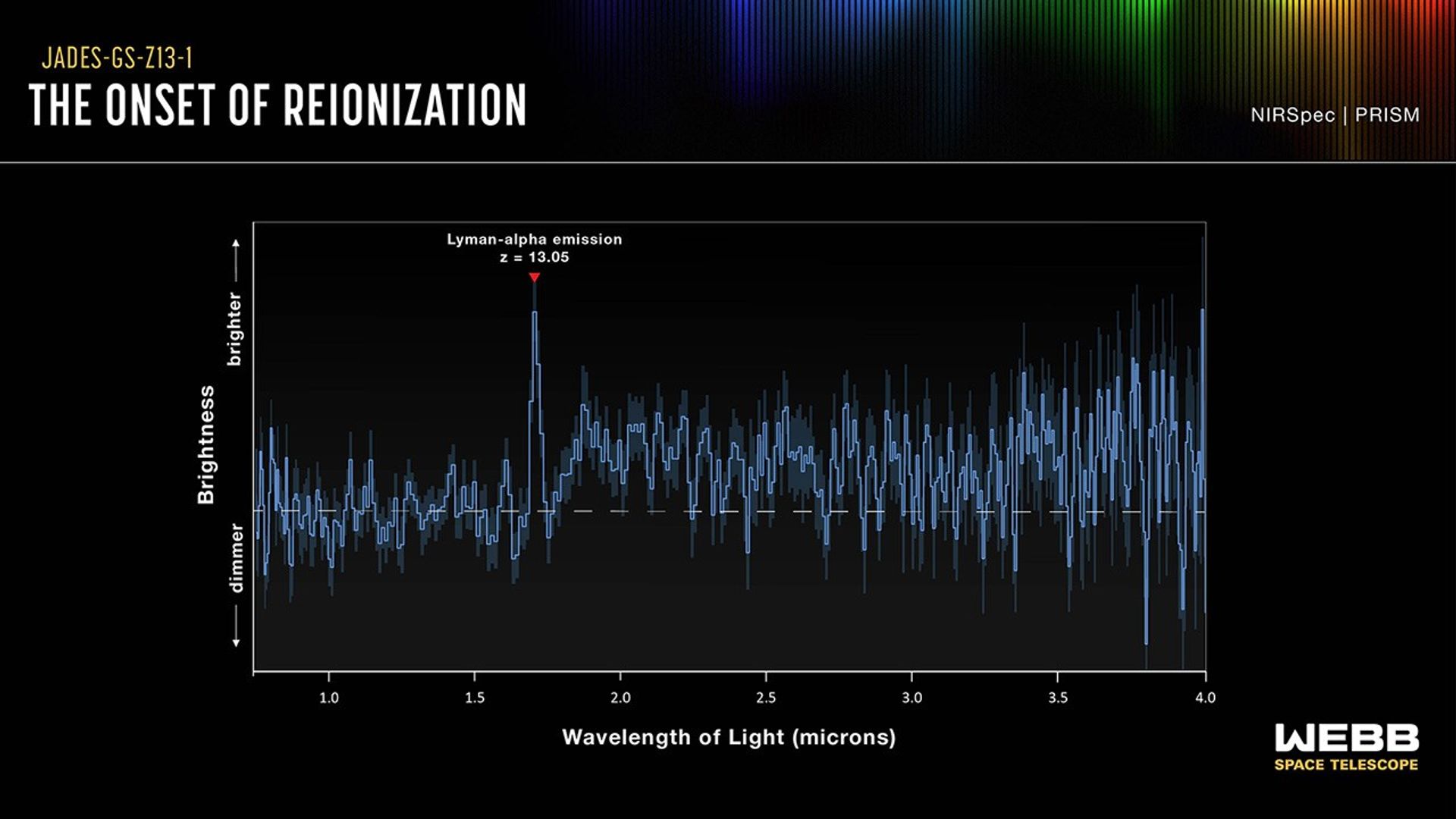
    In the resulting spectrum, the redshift was confirmed to be 13.0. This equates to a galaxy seen just 330 million years after the big bang, a small fraction of the universe’s present age of 13.8 billion years old. But an unexpected feature stood out as well: one specific, distinctly bright wavelength of light, known as Lyman-alpha emission, radiated by hydrogen atoms. This emission was far stronger than astronomers thought possible at this early stage in the universe’s development.

    “The early universe was bathed in a thick fog of neutral hydrogen,” explained Roberto Maiolino, a team member from the University of Cambridge and University College London. “Most of this haze was lifted in a process called reionization, which was completed about one billion years after the big bang. GS-z13-1 is seen when the universe was only 330 million years old, yet it shows a surprisingly clear, telltale signature of Lyman-alpha emission that can only be seen once the surrounding fog has fully lifted. This result was totally unexpected by theories of early galaxy formation and has caught astronomers by surprise.”

    Image C: JADES-GS-z13-1 Spectrum Graphic

    A graph labeled “JADES-GS-Z13-1, The Onset of Reionization, NIRSpec, PRISM.” The x-axis is labeled “Wavelength of Light, microns” and extends from about 0.5 microns to 4.0 microns, with tick marks every 0.5 microns from 1.0 to 4.0. The y-axis is labeled “Brightness” and has a horizontal, dashed line about a third of the way up from the bottom. An up arrow is labeled “brighter” at the top of the y-axis, and a down arrow is labeled “dimmer.” A jagged blue line runs horizontally across the graph. It fluctuates above and below the dashed line until reaching a wavelength of about 1.7 microns, at which point it peaks before gradually decreasing again, and going just below the dashed line. The wavelength where the emission peaks has an arrow pointing down labeled “Lyman-alpha emission, z = 13.05.”
    NASA’s James Webb Space Telescope has detected unexpected light from a distant galaxy. The galaxy JADES-GS-z13-1, observed just 330 million years after the big bang (corresponding to a redshift of z=13.05), shows bright emission from hydrogen known as Lyman-alpha emission. This is surprising because that emission should have been absorbed by a dense fog of neutral hydrogen that suffused the early universe.
    NASA, ESA, CSA, J. Witstok (University of Cambridge, University of Copenhagen), J. Olmsted (STScI)

    Before and during the era of reionization, the immense amounts of neutral hydrogen fog surrounding galaxies blocked any energetic ultraviolet light they emitted, much like the filtering effect of colored glass. Until enough stars had formed and were able to ionize the hydrogen gas, no such light — including Lyman-alpha emission — could escape from these fledgling galaxies to reach Earth. The confirmation of Lyman-alpha radiation from this galaxy, therefore, has great implications for our understanding of the early universe.

    “We really shouldn’t have found a galaxy like this, given our understanding of the way the universe has evolved,” said Kevin Hainline, a team member from the University of Arizona. “We could think of the early universe as shrouded with a thick fog that would make it exceedingly difficult to find even powerful lighthouses peeking through, yet here we see the beam of light from this galaxy piercing the veil. This fascinating emission line has huge ramifications for how and when the universe reionized.”

    The source of the Lyman-alpha radiation from this galaxy is not yet known, but it may include the first light from the earliest generation of stars to form in the universe.

    “The large bubble of ionized hydrogen surrounding this galaxy might have been created by a peculiar population of stars — much more massive, hotter, and more luminous than stars formed at later epochs, and possibly representative of the first generation of stars,” said Witstok. A powerful active galactic nucleus, driven by one of the first supermassive black holes, is another possibility identified by the team.

    This research was published Wednesday in the journal Nature.

    The James Webb Space Telescope is the world’s premier space science observatory. Webb is solving mysteries in our solar system, looking beyond to distant worlds around other stars, and probing the mysterious structures and origins of our universe and our place in it. Webb is an international program led by NASA with its partners, ESA (European Space Agency) and CSA (Canadian Space Agency).

    Downloads

    Click any image to open a larger version.

    View/Download all image products at all resolutions for this article from the Space Telescope Science Institute.

    View/Download the research results from the journal Nature.

    Media Contacts

    Laura Betz – laura.e.betz@nasa.gov
    NASA’s Goddard Space Flight Center, Greenbelt, Md.

    Bethany DownerBethany.Downer@esawebb.org
    ESA/Webb, Baltimore, Md.

    Christine Pulliamcpulliam@stsci.edu
    Space Telescope Science Institute, Baltimore, Md.

    Read more about cosmic history, the early universe, and cosmic reionization.

    Article: Learn about what Webb has revealed about galaxies through time.

    Video: How Webb reveals the first galaxies

    More Webb News

    More Webb Images

    Webb Science Themes

    Webb Mission Page

    What Is a Galaxy?

    What is the Webb Telescope?

    SpacePlace for Kids

    En Español

    ¿Qué es una galaxia?

    Ciencia de la NASA

    NASA en español 

    Space Place para niños

  • NASA Starling and SpaceX Starlink Improve Space Traffic Coordination

    4 min read

    Preparations for Next Moonwalk Simulations Underway (and Underwater)

    Illustrated image of four satellites orbiting Earth as the sun rises over the planet's horizon.
    The Starling swarm’s extended mission tested advanced autonomous maneuvering capabilities.
    NASA/Daniel Rutter

    As missions to low Earth orbit become more frequent, space traffic coordination remains a key element to efficiently operating in space. Different satellite operators using autonomous systems need to operate together and manage increasing workloads. NASA’s Starling spacecraft swarm recently tested a coordination with SpaceX’s Starlink constellation, demonstrating a potential solution to enhance space traffic coordination.

    Led by the Small Spacecraft Technology program at NASA’s Ames Research Center in California’s Silicon Valley, Starling originally set out to demonstrate autonomous planning and execution of orbital maneuvers with the mission’s four small spacecraft. After achieving its primary objectives, the Starling mission expanded to become Starling 1.5, an experiment to demonstrate maneuvers between the Starling swarm and SpaceX’s Starlink satellites, which also maneuver autonomously.

    Coordination in Low Earth Orbit

    Current space traffic coordination systems screen trajectories of spacecraft and objects in space and alert operators on the ground of potential conjunctions, which occur when two objects exceed an operator’s tolerance for a close approach along their orbital paths. Spacecraft operators can request notification at a range of probabilities, often anywhere from a 1 in 10,000 likelihood of a collision to 1 in 1,000,000 or lower.

    Conjunction mitigation between satellite operators requires manual coordination through calls or emails on the ground. An operator may receive a notification for a number of reasons including recently maneuvering their satellite, nearby space debris, or if another satellite adjusts its orbit.

    Once an operator is aware of a potential conjunction, they must work together with other operators to reduce the probability of a collision. This can result in time-consuming calls or emails between ground operations teams with different approaches to safe operations. It also means maneuvers may require several days to plan and implement. This timeline can be challenging for missions that require quick adjustments to capture important data.

    “Occasionally, we’ll do a maneuver that we find out wasn’t necessary if we could have waited before making a decision. Sometimes you can’t wait three days to reposition and observe. Being able to react within a few hours can make new satellite observations possible,” said Nathan Benz, project manager of Starling 1.5 at NASA Ames.

    Improving Coordination for Autonomous Maneuvering

    The first step in improving coordination was to develop a reliable way to signal maneuver responsibility between operators. “Usually, SpaceX takes the responsibility to move out of the way when another operator shares their predicted trajectory information,” said Benz.

    SpaceX and NASA collaborated to design a conjunction screening service, which SpaceX then implemented. Satellite operators can submit trajectories and receive conjunction data quickly, then accept responsibility to maneuver away from a potential conjunction.

    “For this experiment, NASA’s Starling accepted responsibility to move using the screening service, successfully tested our system’s performance, then autonomously planned and executed the maneuver for the NASA Starling satellite, resolving a close approach with a Starlink satellite,” said Benz.

    Through NASA’s Starling 1.5 experiment, the agency helped validate SpaceX’s Starlink screening service. The Office of Space Commerce within the U.S. Department of Commerce also worked with SpaceX to understand and assess the Starlink screening service.

    Quicker Response to Changes on Earth

    The time it takes to plan maneuvers in today’s orbital traffic environment limits the number of satellites a human operator can manage and their ability to collect data or serve customers.

    “A fully automated system that is flexible and adaptable between satellite constellations is ideal for an environment of multiple satellite operators, all of whom have differing criteria for mitigating collision risks,” said Lauri Newman, program officer for NASA’s Conjunction Assessment Risk Analysis program at the agency’s headquarters in Washington.

    Reducing the time necessary to plan maneuvers could open up a new class of missions, where quick responses to changes in space or on Earth’s surface are possible. Satellites capable of making quicker movements could adjust their orbital position to capture a natural disaster from above, or respond to one swarm member’s interesting observations, moving to provide a more thorough look.

    “With improved access and use of low Earth orbit and the necessity to provide a more advanced space traffic coordination system, Starling 1.5 is providing critical data.  Starling 1.5 is the result of a successful partnership between NASA, the Department of Commerce, and SpaceX, maturing technology to solve such challenges,” said Roger Hunter, program manager of the Small Spacecraft Technology program. “We look forward to the sustained impact of the Starling technologies as they continue demonstrating advancements in spacecraft coordination, cooperation, and autonomy.”    

    NASA Ames leads the Starling projects. NASA’s Small Spacecraft Technology program within the Space Technology Mission Directorate funds and manages the Starling mission. 

  • NSTA Hyperwall Schedule

    3 min read

    NSTA Hyperwall Schedule

    National Science Teaching Association (NSTA) Annual Conference, March 26-29, 2025

    Join NASA in the Exhibit Hall (Booth #779) for Hyperwall Storytelling by NASA experts. Full Hyperwall Agenda below.

    separater line

    THURSDAY, MARCH 27

    • 11:00 – 11:15 AM —— Do NASA Science in Your Classroom —— Marc Kuchner
    • 11:15 – 11:30 AM —— My NASA Data Satellite Data for All —— Angie Rizzi
    • 11:30 – 11:45 AM —— Lunar and Meteorite Sample Disk Program —— Suzanne Foxworth
    • 11:45 – 12:00 PM —— DIY Digital Tools: Creating Smart Assets —— Jessica Swann
    • 1:00 – 1:15 PM —— DIY: Immersive Virtual Field Trips —— Jessica Swann
    • 1:15 – 1:30 PM —— Kahoot- Weather Terms —— Erin McKinley
    • 1:30 – 1:45 PM —— Digital Plug and Play Lessons for Your Middle or High School Classroom —— Jessica Swann
    • 1:45 – 2:00 PM —— Soar to New Heights with the NASA TechRise Student Challenge —— Marisa Cleghorn
    • 2:00 – 2:15 PM —— GLOBE Clouds: Connecting Satellite Data to Your Classroom —— Jessica Taylor
    • 2:15 – 2:30 PM —— Step Up to Remote Sensing with STELLA (Science and Technology Education for Land/Life Assessment) —— Mike Taylor
    • 2:30 – 2:45 PM —— My NASA Data’s New Earth System Data Explorer —— Angie Rizzi
    • 2:45 – 3:00 PM —— Apollo to Artemis: Sample Collection and Curation —— Kim Willis
    • 3:30 – 3:45 PM —— Interactive Ways for Learners to Explore NASA Content & Assets —— Astro Materials Docent
    • 4:00 – 4:15 PM —— Soar to New Heights with the NASA TechRise Student Challenge —— Marisa Cleghorn
    • 4:15 – 4:30 PM —— Lunar and Meteorite Sample Disk Program —— Suzanne Foxworth
    • 4:30 – 4:45 PM —— Step Up to Remote Sensing with STELLA (Science and Technology Education for Land/Life Assessment) —— Mike Taylor

    FRIDAY, MARCH 28

    • 9:15 – 9:30 AM —— Soar to New Heights with the NASA TechRise Student Challenge —— Marisa Cleghorn
    • 9:45 – 10:00 AM —— Interactive Ways for Learners to Explore NASA Content & Assets —— Astro Materials Docent
    • 10:00 – 10:15 AM —— Digital Plug and Play Lessons for Your Middle or High School Classroom —— Jessica Swann
    • 10:15 – 10:30 AM —— GLOBE Clouds: Connecting Satellite Data to Your Classroom —— Jessica Taylor
    • 10:30 – 10:45 AM —— Do NASA Science in Your Classroom —— Marc Kuchner
    • 10:45 – 11:00 AM —— DIY: Immersive Virtual Field Trips —— Jessica Swann
    • 11:00 – 11:15 AM —— Apollo to Artemis: Sample Collection and Curation —— Kim Willis
    • 11:15 – 11:30 AM —— My NASA Data’s New Earth System Data Explorer —— Angie Rizzi
    • 11:30 – 11:45 AM —— Step Up to Remote Sensing with STELLA —— Mike Taylor
    • 11:45 – 12:00 PM —— DIY Digital Tools: Creating Smart Assets —— Jessica Swann
    • 1:00 – 1:15 PM —— Lunar and Meteorite Sample Disk Program —— Suzanne Foxworth
    • 1:15 – 1:30 PM —— Soar to New Heights with the NASA TechRise Student Challenge —— Marisa Cleghorn
    • 1:30 – 1:45 PM —— Kahoot
    • 1:45 – 2:00 PM —— Apollo to Artemis: Sample Collection and Curation —— Kim Willis
    • 2:00 – 2:15 PM —— Step Up to Remote Sensing with STELLA —— Mike Taylor
    • 2:15 – 2:30 PM —— SpacePhys Lab: A Heliophysics VR Experience for Education and Outreach —— Stephen Zaffke
    • 2:30 – 2:45 PM —— Do NASA Science in Your Classroom —— Marc Kuchner
    • 2:45 – 3:00 PM —— GLOBE Clouds: Connecting Satellite Data to Your Classroom —— Jessica Talyor
    • 3:30 – 3:45 PM —— Interactive Ways for Learners to Explore NASA Content & Assets —— Astro Materials Docent
    • 3:45 – 4:00 PM —— Lunar and Meteorite Sample Disk Program —— Suzanne Foxworth
    • 4:00 – 4:15 PM —— My NASA Data Satellite Data for All —— Angie Rizzi
    • 4:15 – 4:30 PM —— Kahoot

    SATURDAY, MARCH 29

    • 9:15 – 9:30 AM —— Apollo to Artemis: Sample Collection and Curation —— Kim Willis
    • 9:45 – 10:00 AM —— DIY: Immersive Virtual Field Trips —— Jessica Swann
    • 10:00 – 10:15 AM —— Lunar and Meteorite Sample Disk Program —— Suzanne Foxworth
    • 10:15 – 10:30 AM —— Do NASA Science in Your Classroom —— Marc Kuchner
    • 10:30 – 10:45 AM —— Digital Plug and Play Lessons for Your Middle or High School Classroom —— Jessica Swann
    • 10:45 – 11:00 AM —— Step Up to Remote Sensing with STELLA (Science and Technology Education for Land/Life Assessment) —— Mike Taylor
    • 11:15 – 11:30 AM —— DIY Digital Tools: Creating Smart Assets —— Jessica Swann
    • 11:30 – 11:45 AM —— Kahoot
    • 11:45 – 12:00 PM —— My NASA Data’s New Earth System Data Explorer —— Angie Rizzi

    Details

    Last Updated

    Mar 26, 2025

    Related Terms

  • How NASA’s Perseverance Is Helping Prepare Astronauts for Mars

    6 min read

    Preparations for Next Moonwalk Simulations Underway (and Underwater)

    Perseverance Mars rover, with a circle indicating the location of the calibration target for the rov-er’s SHERLOC instrument
    At left is NASA’s Perseverance Mars rover, with a circle indicating the location of the calibration target for the rover’s SHERLOC instrument. At right is a close-up of the calibration target. Along the bottom row are five swatches of spacesuit materials that scientists are studying as they de-grade.
    NASA/JPL-Caltech/MSSS

    The rover carries several swatches of spacesuit materials, and scientists are assessing how they’ve held up after four years on the Red Planet.

    NASA’s Perseverance rover landed on Mars in 2021 to search for signs of ancient microbial life and to help scientists understand the planet’s climate and geography. But another key objective is to pave the way for human exploration of Mars, and as part of that effort, the rover carries a set of five spacesuit material samples. Now, after those samples have endured four years of exposure on Mars’ dusty, radiation-soaked surface, scientists are beginning the next phase of studying them.

    The end goal is to predict accurately the usable lifetime of a Mars spacesuit. What the agency learns about how the materials perform on Mars will inform the design of future spacesuits for the first astronauts on the Red Planet.

    Illustration of a prototype astronaut suit
    This graphic shows an illustration of a prototype astronaut suit, left, along with suit samples included aboard NASA’s Perseverance rover. They are the first spacesuit materials ever sent to Mars. 
    NASA

    “This is one of the forward-looking aspects of the rover’s mission — not just thinking about its current science, but also about what comes next,” said planetary scientist Marc Fries of NASA’s Johnson Space Center in Houston, who helped provide the spacesuit materials. “We’re preparing for people to eventually go and explore Mars.”

    The swatches, each three-quarters of an inch square (20 millimeters square), are part of a calibration target used to test the settings of SHERLOC (Scanning Habitable Environments with Raman & Luminescence for Organics and Chemicals), an instrument on the end of Perseverance’s arm.

    The samples include a piece of polycarbonate helmet visor; Vectran, a cut-resistant material used for the palms of astronaut gloves; two kinds of Teflon, which has dust-repelling nonstick properties; and a commonly used spacesuit material called Ortho-Fabric. This last fabric features multiple layers, including Nomex, a flame-resistant material found in firefighter outfits; Gore-Tex, which is waterproof but breathable; and Kevlar, a strong material used in bulletproof vests that makes spacesuits more rip-resistant.

    Martian Wear and Tear

    Mars is far from hospitable. It has freezing temperatures, fine dust that can stick to solar panels and spacesuits (causing wear and tear on the latter), and a surface rife with perchlorates, a kind of corrosive salt that can be toxic to humans.

    There’s also lots of solar radiation. Unlike Earth, which has a magnetic field that deflects much of the Sun’s radiation, Mars lost its magnetic field billions of years ago, followed by much of its atmosphere. Its surface has little protection from the Sun’s ultraviolet light (which is why researchers have looked into how rock formations and caves could provide astronauts some shielding).

    “Mars is a really harsh, tough place,” said SHERLOC science team member Joby Razzell Hollis of the Natural History Museum in London. “Don’t underestimate that — the radiation in particular is pretty nasty.”

    Razzell Hollis was a postdoctoral fellow at NASA’s Jet Propulsion Laboratory in Southern California from 2018 to 2021, where he helped prepare SHERLOC for arrival on Mars and took part in science operations once the rover landed. A materials scientist, Razzell Hollis has previously studied the chemical effects of sunlight on a new kind of solar panel made from plastic, as well as on plastic pollution floating in the Earth’s oceans.

    He likened those effects to how white plastic lawn chairs become yellow and brittle after years in sunlight. Roughly the same thing happens on Mars, but the weathering likely happens faster because of the high exposure to ultraviolet light there.

    The key to developing safer spacesuit materials will be understanding how quickly they would wear down on the Martian surface. About 50% of the changes SHERLOC witnessed in the samples happened within Perseverance’s first 200 days on Mars, with the Vectran appearing to change first.

    Another nuance will be figuring out how much solar radiation different parts of a spacesuit will have to withstand. For example, an astronaut’s shoulders will be more exposed — and likely encounter more radiation — than his or her palms.

    Next Steps

    The SHERLOC team is working on a science paper detailing initial data on how the samples have fared on Mars. Meanwhile, scientists at NASA Johnson are eager to simulate that weathering in special chambers that mimic the carbon dioxide atmosphere, air pressure, and ultraviolet light on the Martian surface. They could then compare the results generated on Earth while putting the materials to the test with those seen in the SHERLOC data. For example, the researchers could stretch the materials until they break to check if they become more brittle over time.

    “The fabric materials are designed to be tough but flexible, so they protect astronauts but can bend freely,” Fries said. “We want to know the extent to which the fabrics lose their strength and flexibility over time. As the fabrics weaken, they can fray and tear, allowing a spacesuit to leak both heat and air.”

    More About Perseverance

    A key objective for Perseverance’s mission on Mars is astrobiology, including the search for signs of ancient microbial life. The rover is characterizing the planet’s geology and past climate, to help pave the way for human exploration of the Red Planet, and is the first mission to collect and cache Martian rock and regolith.

    NASA’s Mars Sample Return Program, in cooperation with ESA (European Space Agency), is designed to send spacecraft to Mars to collect these sealed samples from the surface and return them to Earth for in-depth analysis.

    The Mars 2020 Perseverance mission is part of NASA’s Mars Exploration Program (MEP) portfolio and the agency’s Moon to Mars exploration approach, which includes Artemis missions to the Moon that will help prepare for human exploration of the Red Planet.

    NASA’s Jet Propulsion Laboratory, which is managed for the agency by Caltech in Pasadena, California, built and manages operations of the Perseverance rover.

    For more about Perseverance:

    News Media Contacts

    Andrew Good
    Jet Propulsion Laboratory, Pasadena, Calif.
    818-393-2433
    andrew.c.good@jpl.nasa.gov

    Karen Fox / Molly Wasser
    NASA Headquarters, Washington
    202-358-1600
    karen.c.fox@nasa.gov / molly.l.wasser@nasa.gov

  • NASA’s Webb Captures Neptune’s Auroras For First Time

    6 Min Read

    NASA’s Webb Captures Neptune’s Auroras For First Time

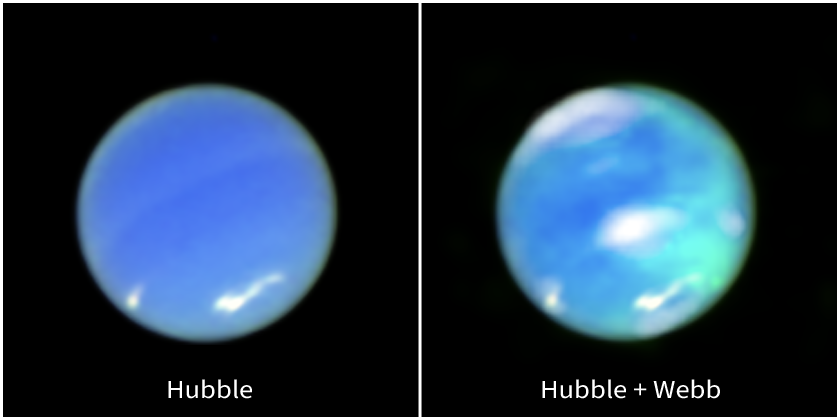
    A two-panel horizontal image. On the left is Neptune, as seen from the Hubble Space Telescope. It is a blue circle, tilted about 25 degrees to the left. There are white smudges at 7 o’clock and just above 5 o’clock. At the right is an opposing view of the planet, using data from Hubble and Webb. It is a multi-hued blue orb. There are white smudges in the same spots as the image on the left, but also at the center of the planet and at the top. There are cyan smudges vertically along the right side, with the top of the smudging more translucent than the bottom.

    At the left, an enhanced-color image of Neptune from NASA’s Hubble Space Telescope. At the right, that image is combined with data from NASA’s James Webb Space Telescope.

    Credits:
    NASA, ESA, CSA, STScI, Heidi Hammel (AURA), Henrik Melin (Northumbria University), Leigh Fletcher (University of Leicester), Stefanie Milam (NASA-GSFC)

    Long-sought auroral glow finally emerges under Webb’s powerful gaze

    For the first time, NASA’s James Webb Space Telescope has captured bright auroral activity on Neptune. Auroras occur when energetic particles, often originating from the Sun, become trapped in a planet’s magnetic field and eventually strike the upper atmosphere. The energy released during these collisions creates the signature glow.

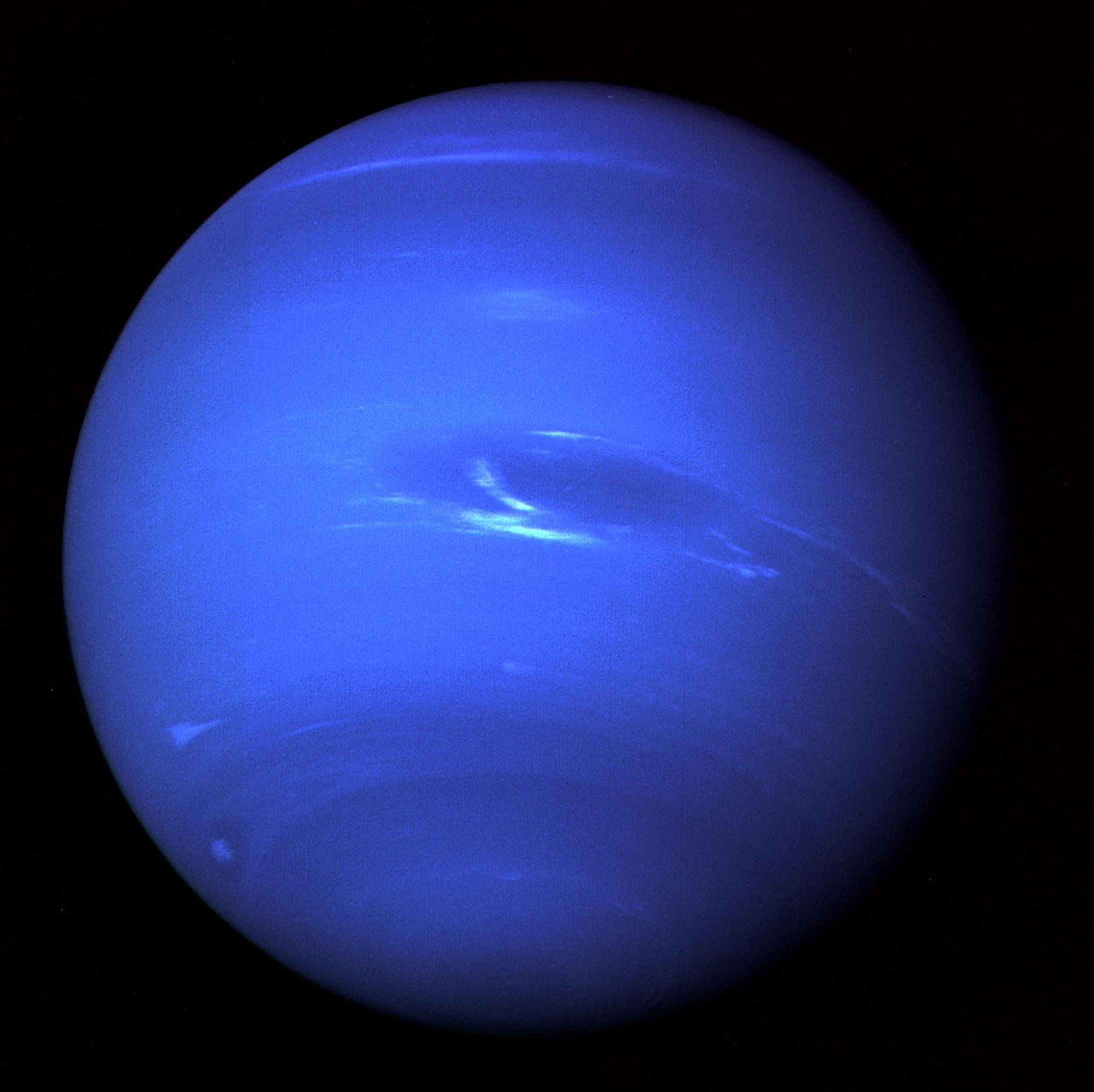
    In the past, astronomers have seen tantalizing hints of auroral activity on Neptune, for example, in the flyby of NASA’s Voyager 2 in 1989. However, imaging and confirming the auroras on Neptune has long evaded astronomers despite successful detections on Jupiter, Saturn, and Uranus. Neptune was the missing piece of the puzzle when it came to detecting auroras on the giant planets of our solar system.

    “Turns out, actually imaging the auroral activity on Neptune was only possible with Webb’s near-infrared sensitivity,” said lead author Henrik Melin of Northumbria University, who conducted the research while at the University of Leicester. “It was so stunning to not just see the auroras, but the detail and clarity of the signature really shocked me.”

    The data was obtained in June 2023 using Webb’s Near-Infrared Spectrograph. In addition to the image of the planet, astronomers obtained a spectrum to characterize the composition and measure the temperature of the planet’s upper atmosphere (the ionosphere). For the first time, they found an extremely prominent emission line signifying the presence of the trihydrogen cation (H3+), which can be created in auroras. In the Webb images of Neptune, the glowing aurora appears as splotches represented in cyan.

    Image A:
    Neptune’s Auroras – Hubble and Webb

    A two-panel horizontal image. On the left is Neptune, as seen from the Hubble Space Telescope. It is a blue circle, tilted about 25 degrees to the left. There are white smudges at 7 o’clock and just above 5 o’clock. At the right is an opposing view of the planet, using data from Hubble and Webb. It is a multi-hued blue orb. There are white smudges in the same spots as the image on the left, but also at the center of the planet and at the top. There are cyan smudges vertically along the right side, with the top of the smudging more translucent than the bottom.
    At the left, an enhanced-color image of Neptune from NASA’s Hubble Space Telescope. At the right, that image is combined with data from NASA’s James Webb Space Telescope. The cyan splotches, which represent auroral activity, and white clouds, are data from Webb’s Near-Infrared Spectrograph (NIRSpec), overlayed on top of the full image of the planet from Hubble’s Wide Field Camera 3.
    NASA, ESA, CSA, STScI, Heidi Hammel (AURA), Henrik Melin (Northumbria University), Leigh Fletcher (University of Leicester), Stefanie Milam (NASA-GSFC)

    “H3+ has a been a clear signifier on all the gas giants — Jupiter, Saturn, and Uranus — of auroral activity, and we expected to see the same on Neptune as we investigated the planet over the years with the best ground-based facilities available,” explained Heidi Hammel of the Association of Universities for Research in Astronomy, Webb interdisciplinary scientist and leader of the Guaranteed Time Observation program for the Solar System in which the data were obtained. “Only with a machine like Webb have we finally gotten that confirmation.”

    The auroral activity seen on Neptune is also noticeably different from what we are accustomed to seeing here on Earth, or even Jupiter or Saturn. Instead of being confined to the planet’s northern and southern poles, Neptune’s auroras are located at the planet’s geographic mid-latitudes — think where South America is located on Earth.

    This is due to the strange nature of Neptune’s magnetic field, originally discovered by Voyager 2 in 1989 which is tilted by 47 degrees from the planet’s rotation axis. Since auroral activity is based where the magnetic fields converge into the planet’s atmosphere, Neptune’s auroras are far from its rotational poles.

    The ground-breaking detection of Neptune’s auroras will help us understand how Neptune’s magnetic field interacts with particles that stream out from the Sun to the distant reaches of our solar system, a totally new window in ice giant atmospheric science.

    From the Webb observations, the team also measured the temperature of the top of Neptune’s atmosphere for the first time since Voyager 2’s flyby. The results hint at why Neptune’s auroras remained hidden from astronomers for so long.

    “I was astonished — Neptune’s upper atmosphere has cooled by several hundreds of degrees,” Melin said. “In fact, the temperature in 2023 was just over half of that in 1989.” 

    Through the years, astronomers have predicted the intensity of Neptune’s auroras based on the temperature recorded by Voyager 2. A substantially colder temperature would result in much fainter auroras. This cold temperature is likely the reason that Neptune’s auroras have remained undetected for so long. The dramatic cooling also suggests that this region of the atmosphere can change greatly even though the planet sits over 30 times farther from the Sun compared to Earth.
    Equipped with these new findings, astronomers now hope to study Neptune with Webb over a full solar cycle, an 11-year period of activity driven by the Sun’s magnetic field. Results could provide insights into the origin of Neptune’s bizarre magnetic field, and even explain why it’s so tilted.

    “As we look ahead and dream of future missions to Uranus and Neptune, we now know how important it will be to have instruments tuned to the wavelengths of infrared light to continue to study the auroras,” added Leigh Fletcher of Leicester University, co-author on the paper. “This observatory has finally opened the window onto this last, previously hidden ionosphere of the giant planets.”

    These observations, led by Fletcher, were taken as part of Hammel’s Guaranteed Time Observation program 1249. The team’s results have been published in Nature Astronomy.

    The James Webb Space Telescope is the world’s premier space science observatory. Webb is solving mysteries in our solar system, looking beyond to distant worlds around other stars, and probing the mysterious structures and origins of our universe and our place in it. Webb is an international program led by NASA with its partners, ESA (European Space Agency) and CSA (Canadian Space Agency).

    Downloads

    Click any image to open a larger version.

    View/Download all image products at all resolutions for this article from the Space Telescope Science Institute.

    Read the research results published in Nature Astronomy.

    Media Contacts

    Laura Betz – laura.e.betz@nasa.gov
    NASA’s Goddard Space Flight Center, Greenbelt, Md.

    Hannah Braun- hbraun@stsci.edu
    Space Telescope Science Institute, Baltimore, Maryland

    Christine Pulliamcpulliam@stsci.edu
    Space Telescope Science Institute, Baltimore, Md.

    Science

    Henrik Melin (Northumbria University)

    View more: Webb images of Neptune

    WatchVisualization of Neptune’s tilted magnetic axis

    Learn more : about Neptune

    More Webb News

    More Webb Images

    Webb Science Themes

    Webb Mission Page

    About Neptune

    About the Solar System

    What is the Webb Telescope?

    SpacePlace for Kids

    En Español

    Ciencia de la NASA

    NASA en español 

    Space Place para niños

  • NASA Statement on Nomination of Greg Autry for Agency CFO

    Photo of Greg Aultry
    Photo of Greg Autry
    Credit: University of Central Florida

    The following is a statement from NASA acting Administrator Janet Petro regarding the nomination by President Donald Trump of Greg Autry on March 24 to serve as the agency’s chief financial officer (CFO):

    “The NASA CFO is responsible for executing more than $25 billion in agency funding across a variety of missions, including the Moon and Mars, for the benefit of humanity. With his previous experience as the White House liaison during President Trump’s first administration, as well as his extensive experience in space policy, I look forward to welcoming Greg as our next CFO. If confirmed, we will work together with the current Trump Administration to ensure NASA’s success in maximizing efficiencies, refining our processes, and remaining effective stewards of every tax dollar invested in our agency.”

    In addition to his previous experience on the agency review team and as White House liaison at NASA, he also has served on the Commercial Space Transportation Advisory Committee (COMSTAC) at the FAA and is the vice president of the National Space Society.

    Autry is the associate provost for Space Commercialization and Strategy at the University of Central Florida, a published author, and entrepreneur. He also serves as a visiting professor at Imperial College London. He formerly served as the director of Space Leadership, Policy, and Business in the Thunderbird School of Global Management and a professor at Arizona State University. He also has taught technology entrepreneurship at the University of Southern California and macroeconomics at the University of California, Irvine.

    For more about NASA’s mission, visit:

    https://www.nasa.gov

    -end-

    Bethany Stevens/Amber Jacobson
    Headquarters, Washington
    202-358-1600
    bethany.c.stevens@nasa.gov / amber.c.jacobson@nasa.gov

    Details

    Last Updated

    Mar 25, 2025

    Editor
    Jennifer M. Dooren

  • NASA Cloud Software Helps Companies Find their Place in Space 

    2 min read

    Preparations for Next Moonwalk Simulations Underway (and Underwater)

    Thrusters fire as the DART impactor accelerates towards its asteroid moon target.
    The Double Asteroid Redirection Test required extreme precision in mission planning to achieve its mission of impacting an asteroid. The founders of Continuum Space worked on astrodynamics relating to this mission, which they used to inform their product.
    NASA

    Planning space missions is a very involved process, ensuring orbits are lined up and spacecraft have enough fuel is imperative to the long-term survival of orbital assets. Continuum Space Systems Inc. of Pasadena, California, produces a cloud-based platform that gives mission planners everything they need to certify that their space resources can accomplish their goals. 

    Continuum’s story begins at NASA’s Jet Propulsion Laboratory in Southern California. Loic Chappaz, the company’s co-founder, started at JPL as an intern working on astrodynamics related to NASA’s Double Asteroid Redirection Test. There he met Leon Alkalai, a JPL technical fellow who spent his 30-year career at the center planning deep space missions. After Alkalai retired from NASA, he founded Mandala Space Ventures, a startup that explored several avenues of commercial space development. Chappaz soon became Mandala’s first employee, but to plan their future, Mandala’s leadership began thinking about the act of planning itself. 

    Because the staff had decades of combined experience at JPL, they knew the center had the building blocks for the software they needed. After licensing several pieces of software from JPL, the company began building planning systems that were highly adaptable to any space mission they could come up with. Mandala eventually evolved into a venture firm that incubated space-related startups. However, because Mandala had invested considerably in developing mission-planning tools, further development could be performed by a new company, and Continuum was fully spun off from Mandala in 2021. 

    On a laptop, software runs showing orbital paths going around a 3D representation of Earth
    Continuum’s platform includes several features for mission planners, such as plotting orbital maneuvers and risk management evaluations. Some of these are built upon software licensed from the Jet Propulsion Laboratory.
    Continuum Space Systems Inc.

    Continuum’s tools are designed to take a space mission from concept to completion. There are three different components to their “mission in a box” — design, build and test, and mission operations. The base of these tools are several pieces of software developed at NASA. As of 2024, several space startups have begun planning missions with Continuum’s NASA-inspired software, as well as established operators of satellite constellations. From Continuum to several startups, NASA technologies continue to prove a valuable foundation for the nation’s space economy.  

    Details

    Last Updated

    Mar 25, 2025

  • NASA’s Spirit Rover Gets Looked Over

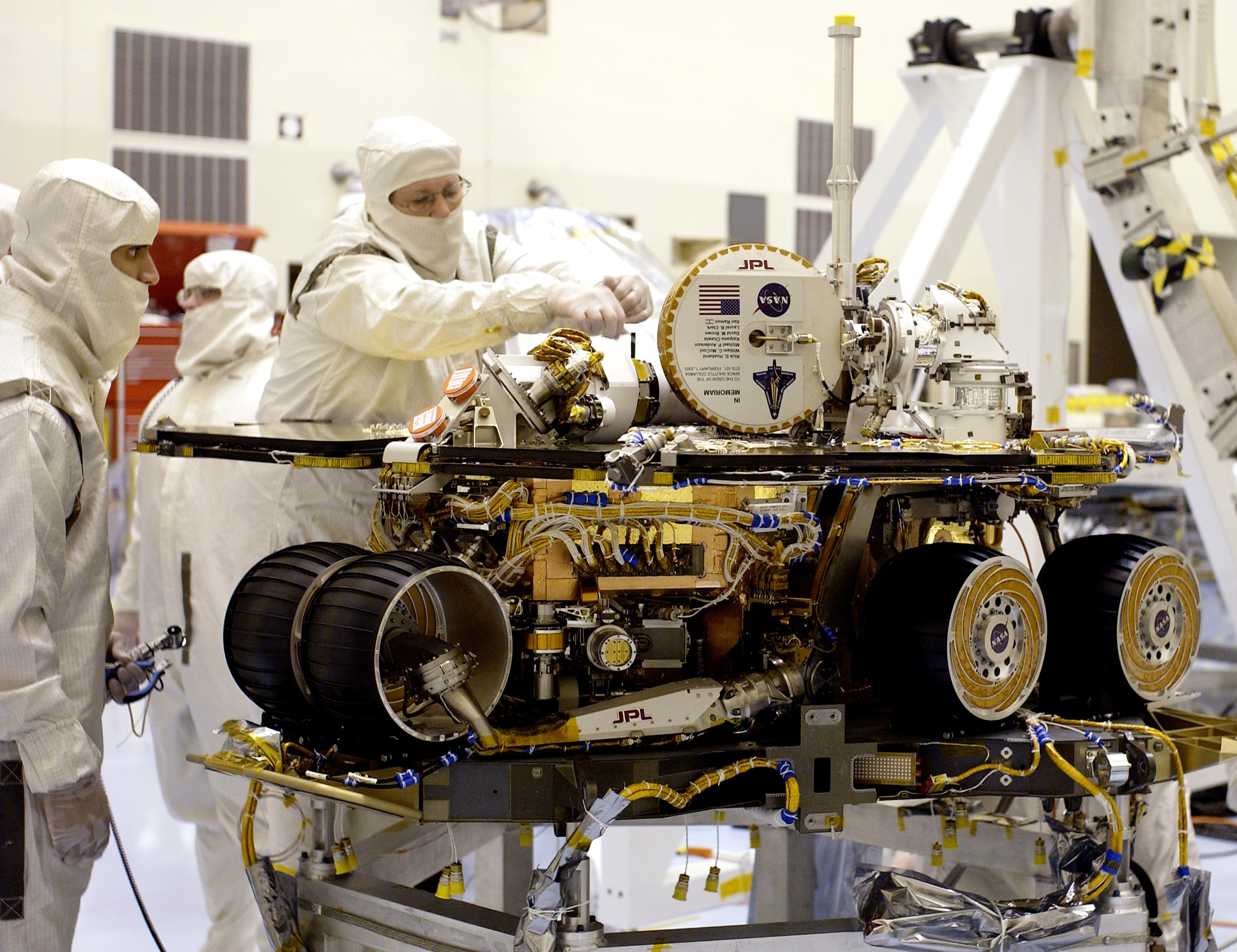
    Technicians in white jumpsuits that cover everything but their eyes and nose work on the Spirit rover. The rover has four visible wheels, covered by a rectangular platform. There are many yellow and white cords all over the rover. There is a circular plaque attached to a white antenna.
    NASA

    Technicians do final checks on NASA’s Spirit rover in this image from March 28, 2003. The rover – and its twin, Opportunity – studied the history of climate and water at sites on Mars where conditions may once have been favorable to life. Each rover is about the size of a golf cart and seven times heavier (about 405 pounds or 185 kilograms) than the Sojourner rover launched on the Mars Pathfinder to Mars mission in 1996.

    Spirit and Opportunity were sent to opposite sides of Mars to locations that were suspected of having been affected by liquid water in the past. Spirit was launched first, on June 10, 2003. Spirit landed on the Martian surface on Jan. 3, 2004, about 8 miles (13.4 kilometers) from the planned target and inside the Gusev crater. The site became known as Columbia Memorial Station to honor the seven astronauts killed when the space shuttle Columbia broke apart Feb. 1, 2003, as it returned to Earth. The plaque commemorating the STS-107 Space Shuttle Columbia crew can be seen in the image above.

    Spirit operated for 6 years, 2 months, and 19 days, more than 25 times its original intended lifetime, traveling 4.8 miles (7.73 kilometers) across the Martian plains.

    Image credit: NASA

  • NASA Invites Media to Learn About Artemis Moon Mission Recovery

    Artemis II crew members and U.S. Navy personnel practice recovery procedures in the Pacific Ocean using a test version of NASA’s Orion spacecraft in February 2024.
    Artemis II crew members and U.S. Navy personnel practice recovery procedures in the Pacific Ocean using a test version of NASA’s Orion spacecraft in February 2024.
    Credit: NASA

    NASA and the Department of Defense will host a media event on the recovery operations that will bring the Artemis II astronauts and the agency’s Orion spacecraft home at the conclusion of next year’s mission around the Moon. The in-person event will take place at 3 p.m. PDT on Monday, March 31, at Naval Base San Diego in California.

    A team of NASA and Department of Defense personnel are at sea in the Pacific Ocean where splashdown will take place. The team currently is practicing the procedures it will use to recover the astronauts after their more than 600,000 mile journey from Earth and back on the first crewed mission under the Artemis campaign. A test version of Orion and other hardware also will be on-hand for media representatives to view.

    Interested media must RSVP no later than 4 p.m. PDT Friday, March 28, to Naval Base San Diego Public Affairs at nbsd.pao@us.navy.mil or 619-556-7359. The start time of the event may change based on the conclusion of testing activities.

    Participants include:

    • Liliana Villarreal, NASA’s Artemis II landing and recovery director, Exploration Ground Systems Program, NASA’s Kennedy Space Center in Florida
    • Capt. Andrew “Andy” Koy, commanding officer of USS Somerset (LPD 25), U.S. Navy
    • Lt. Col. David Mahan, commander, U.S. Air Force’s 1st Air Force, Detachment 3, Patrick Space Force Base, Florida

    Several astronauts participating in the testing will be available for interviews.

    Artemis II will be the first test flight of the SLS (Space Launch System) rocket, Orion spacecraft, and supporting ground system with crew aboard. NASA astronauts Reid Wiseman, Victor Glover, and Christina Koch, and CSA (Canadian Space Agency) astronaut Jeremy Hansen will venture around the Moon and back. The mission is another step toward missions on the lunar surface and helping the agency prepare for future astronaut missions to Mars.

    Learn more about Artemis II at:

    https://www.nasa.gov/mission/artemis-ii/

    -end-

    Jim Wilson
    Headquarters, Washington
    202-358-1100
    jim.wilson@nasa.gov

    Madison Tuttle/Allison Tankersley
    Kennedy Space Center, Florida
    321-298-5968/321-867-2468
    madison.e.tuttle@nasa.gov / allison.p.tankersley@nasa.gov

    Details

    Last Updated

    Mar 25, 2025

  • NASA’s Parker Solar Probe Team Wins 2024 Collier Trophy

    The innovative team of engineers and scientists from NASA, the Johns Hopkins Applied Physics Laboratory in Laurel, Maryland, and more than 40 other partner organizations across the country that created the Parker Solar Probe mission has been awarded the 2024 Robert J. Collier Trophy by the National Aeronautic Association (NAA). This annual award recognizes the most exceptional achievement in aeronautics and astronautics in America with respect to improving the performance, efficiency, and safety of air or space vehicles in the previous year.   

    “Congratulations to the entire Parker Solar Probe team for this well-earned recognition,” said NASA acting Administrator Janet Petro. “This mission’s trailblazing research is rewriting the textbooks on solar science by going to a place no human-made object has ever been and advancing NASA’s efforts to better understand our solar system and the Sun’s influence, with lasting benefits for us all. As the first to touch the Sun and fastest human-made object ever built, Parker Solar Probe is a testament to human ingenuity and discovery.”

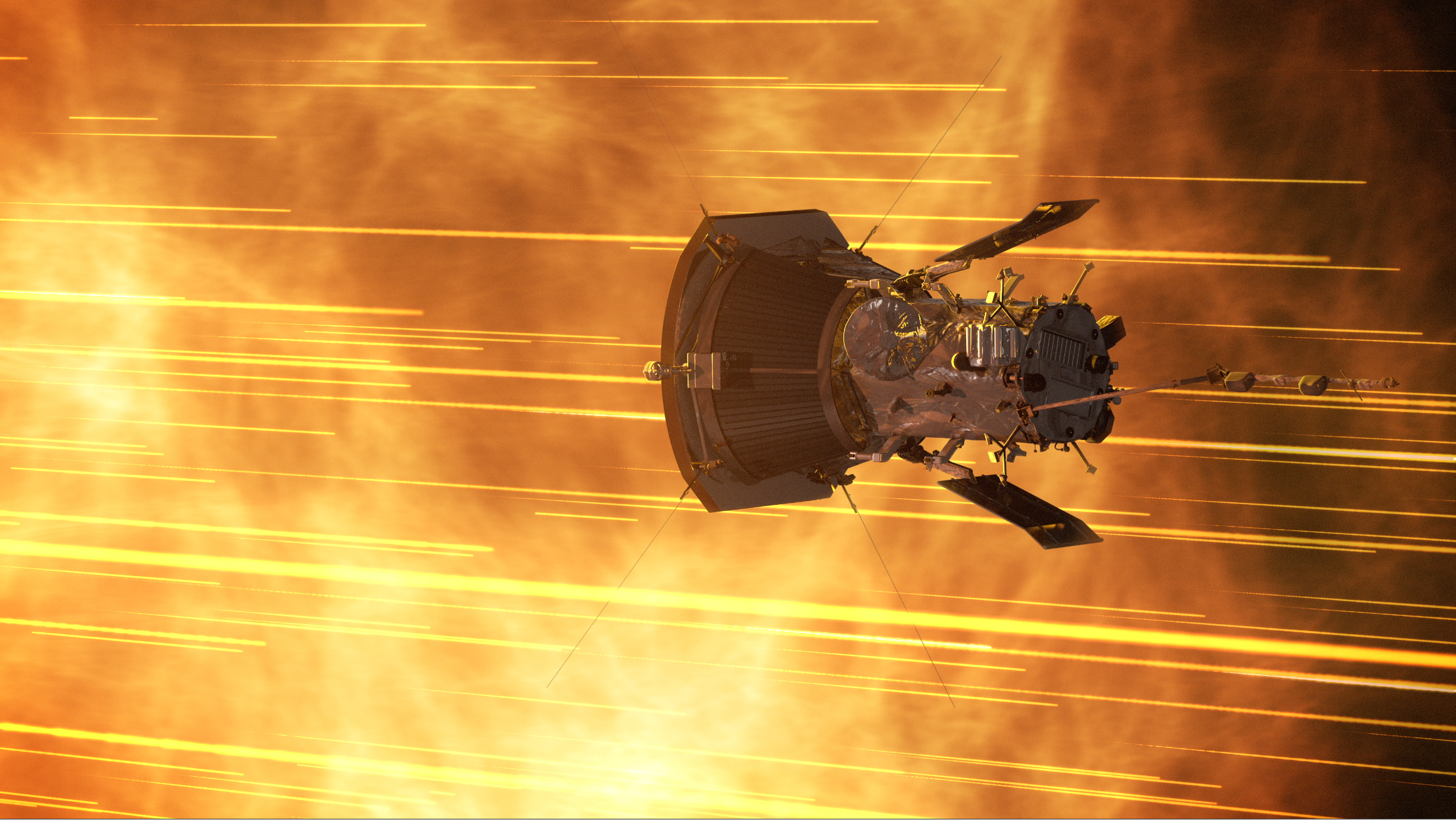
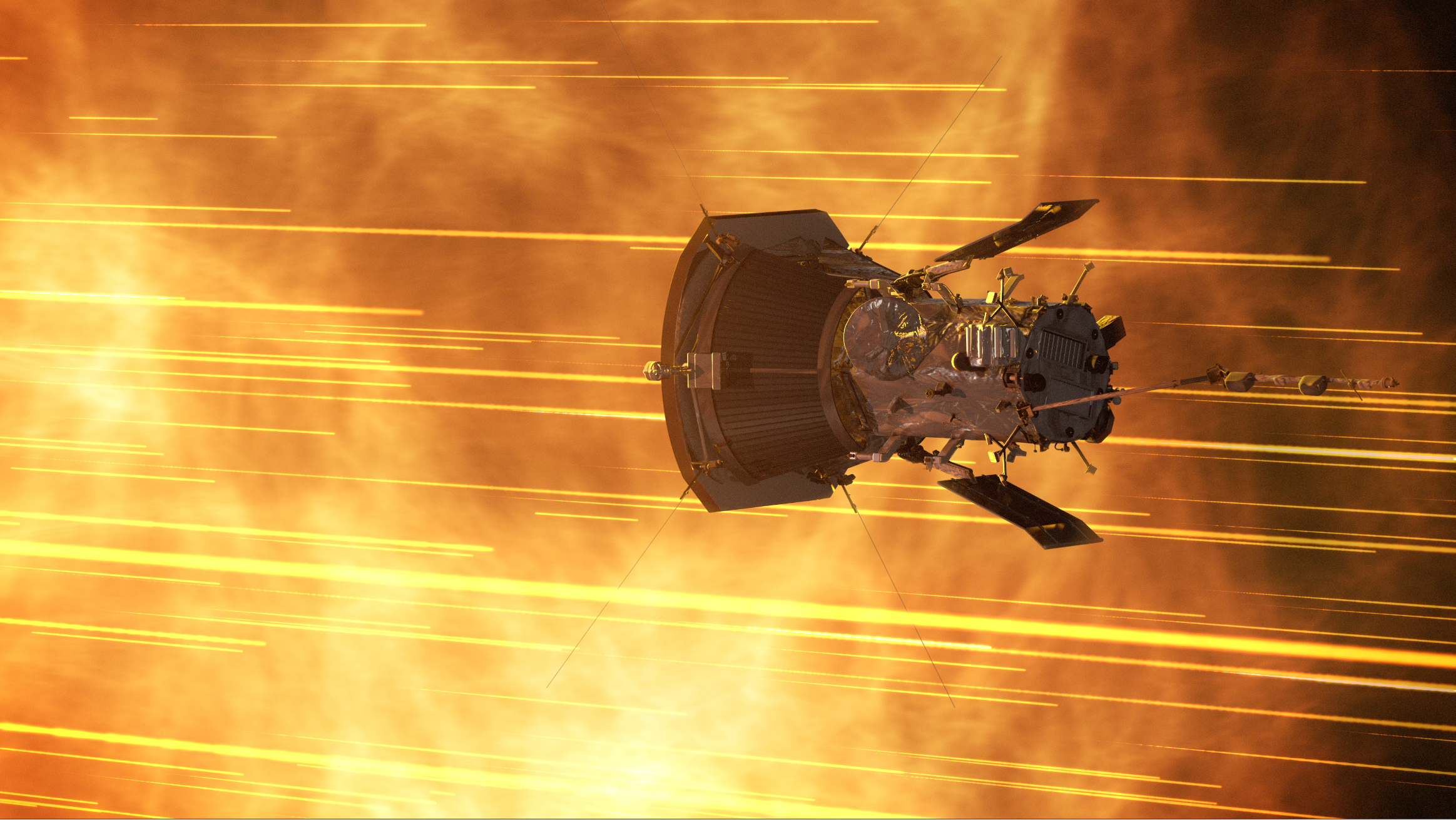
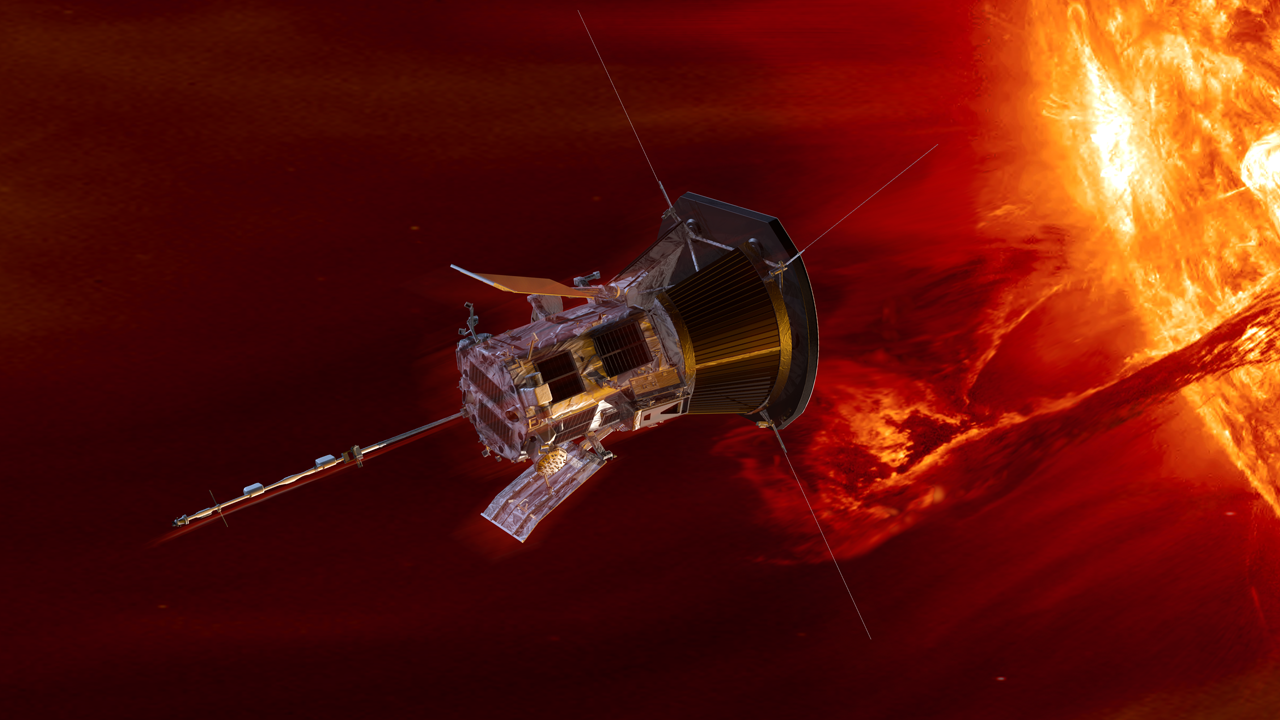
    NASA's Parker Solar Probe -- with its heat shield facing forward and twin solar panels partially extended -- flies through particles in space.
    An artist’s concept of NASA’s Parker Solar Probe.
    NASA

    On Dec. 24, 2024, Parker Solar Probe made its closest approach to the Sun, passing deep within the Sun’s corona, just 3.8 million miles above the Sun’s surface and at a top speed of close to 430,000 mph, ushering in a new era of scientific discovery and space exploration.

    “This award is a recognition of the unrelenting dedication and hard work of the Parker Solar Probe team. I am so proud of this team and honored to have been a part of it,” said Nicky Fox, associate administrator, Science Mission Directorate, NASA Headquarters in Washington. “By studying the Sun closer than ever before, we continue to advance our understanding of not only our closest star, but also stars across our universe. Parker Solar Probe’s historic close approaches to the Sun are a testament to the incredible engineering that made this record-breaking journey possible.”

    Three novel aerospace technology advancements were critical to enabling this record performance: The first is the Thermal Protection System, or heat shield, that protects the spacecraft and is built to withstand brutal temperatures as high as 2,500 degrees Fahrenheit. The Thermal Protection System allows Parker’s electronics and instruments to operate close to room temperature.

    Additional Parker innovations included first-of-their-kind actively cooled solar arrays that protect themselves from overexposure to intense solar energy while powering the spacecraft, and a fully autonomous spacecraft system that can manage its own flight behavior, orientation, and configuration for months at a time. Parker has relied upon all of these vital technologies every day since its launch almost seven years ago, in August 2018.

    “I am thrilled for the Parker Solar Probe team on receiving this well-deserved award,” said Joe Westlake, director of the Heliophysics Division at NASA Headquarters. “The new information about the Sun made available through this mission will improve our ability to prepare for space weather events across the solar system, as well as better understand the very star that makes life possible for us on Earth.”

    Parker’s close-up observations of solar events, such as coronal mass ejections and solar particle events, are critical to advancing our understanding of the science of our Sun and the phenomena that drive high-energy space weather events that pose risks to satellites, air travel, astronauts, and even power grids on Earth. Understanding the fundamental physics behind events which drive space weather will enable more reliable predictions and lower astronaut exposure to hazardous radiation during future deep space missions to the Moon and Mars.

    “This amazing team brought to life an incredibly difficult space science mission that had been studied, and determined to be impossible, for more than 60 years. They did so by solving numerous long-standing technology challenges and dramatically advancing our nation’s spaceflight capabilities,” said APL Director Ralph Semmel. “The Collier Trophy is well-earned recognition for this phenomenal group of innovators from NASA, APL, and our industry and research partners from across the nation.”

    First awarded in 1911, the Robert J. Collier Trophy winner is selected by a group of aviation leaders chosen by the NAA. The Collier Trophy is housed in the Smithsonian’s National Air and Space Museum in Washington.

    “Traveling three times closer to the Sun and seven times faster than any spacecraft before, Parker’s technology innovations enabled humanity to reach inside the Sun’s atmosphere for the first time,” said Bobby Braun, head of APL’s Space Exploration Sector. “We are all immensely proud that the Parker Solar Probe team will join a long legacy of prestigious aerospace endeavors that redefined technology and changed history.”

    “The Parker Solar Probe team’s achievement in earning the 2024 Collier is a shining example of determination, genius, and teamwork,” said NAA President and CEO Amy Spowart. “It’s a distinct honor for the NAA to acknowledge and celebrate the remarkable team that turned the impossible into reality.”

    Parker Solar Probe was developed as part of NASA’s Living With a Star program to explore aspects of the Sun-Earth system that directly affect life and society. The Living With a Star program is managed by the agency’s Goddard Space Flight Center in Greenbelt, Maryland, for NASA’s Science Mission Directorate in Washington. The Applied Physics Laboratory designed, built, and operates the spacecraft and manages the mission for NASA.

    By Geoff Brown
    Johns Hopkins University Applied Physics Laboratory

    Details

    Last Updated

    Mar 25, 2025

    Editor
    Sarah Frazier
    Contact
    Abbey Interrante
    Location
    Goddard Space Flight Center