Tag: solar system

  • All Hands for Artemis III

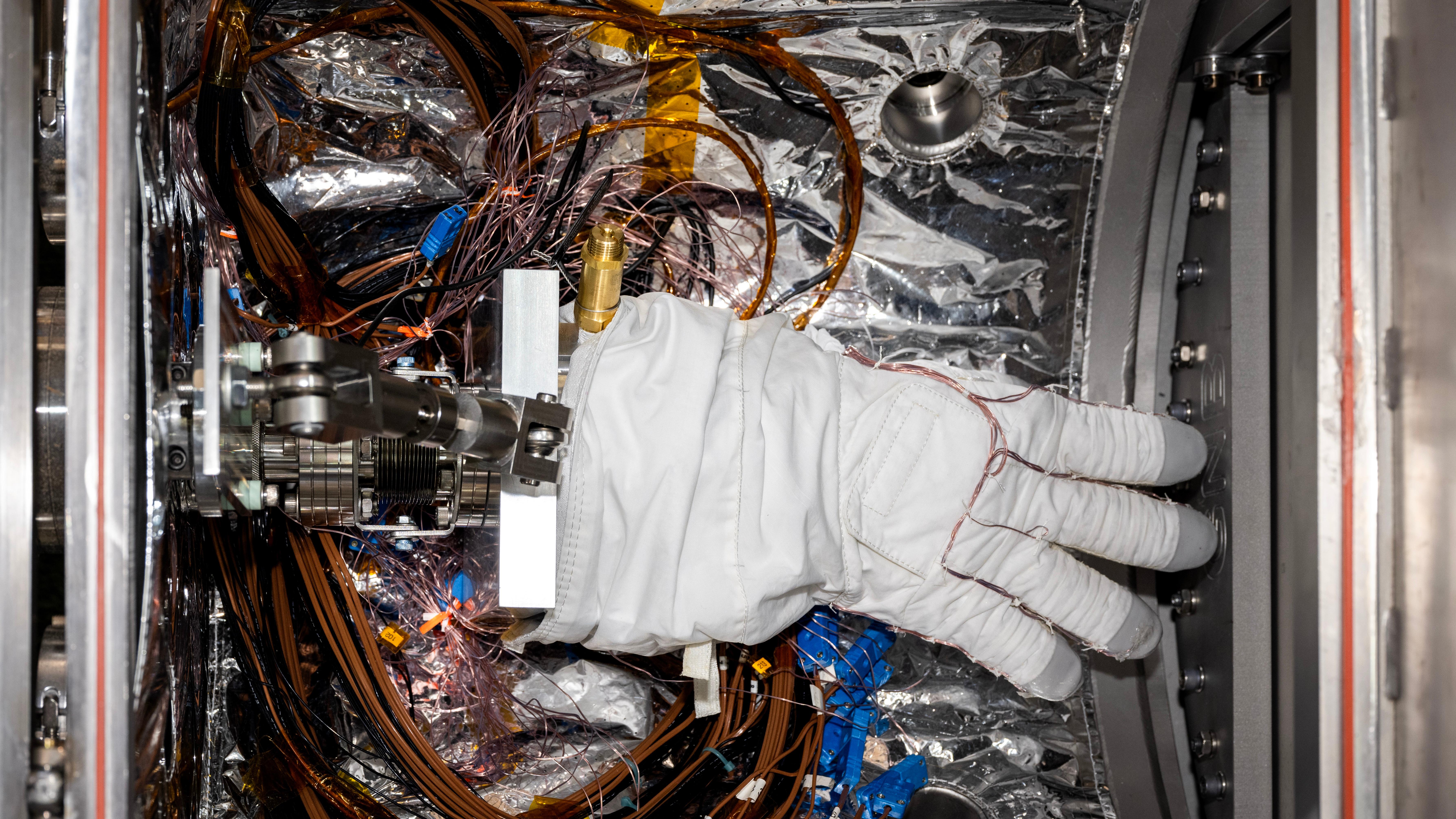
    A bulky white spacesuit glove with gray fingertips sits inside a small chamber lined with silvery material. Multiple wires wrap around the fingers of the glove and loop around the floor of the chamber beneath the glove.
    NASA/JPL-Caltech

    A NASA spacesuit glove designed for use during spacewalks on the International Space Station is prepared for thermal vacuum testing inside a one-of-a-kind chamber called CITADEL (Cryogenic Ice Testing, Acquisition Development, and Excavation Laboratory) at NASA’s Jet Propulsion Laboratory in Southern California on Nov. 1, 2023.

    Part of a NASA spacesuit design called the Extravehicular Mobility Unit, the glove was tested at vacuum and minus 352 degrees Fahrenheit (minus 213 degrees Celsius) — temperatures as frigid as those Artemis III astronauts could experience on the Moon’s South Pole. A team from NASA JPL, NASA’s Johnson Space Center in Houston, and the NASA Engineering and Safety Center have collaborated on testing gloves and boots in CITADEL. Elbow joints are slated for testing next. In addition to spotting vulnerabilities with existing NASA suit designs, the experiments will help the agency prepare criteria for test methods for the next-generation lunar suit — being built by Axiom Space — which NASA astronauts will wear during the Artemis III mission.

    Read more about the testing needed for Artemis III.

    Text credit: Melissa Pamer

    Image credit: NASA/JPL-Caltech

  • NASA, Boeing, Consider New Thin-Wing Aircraft Research Focus

    2 min read

    Preparations for Next Moonwalk Simulations Underway (and Underwater)

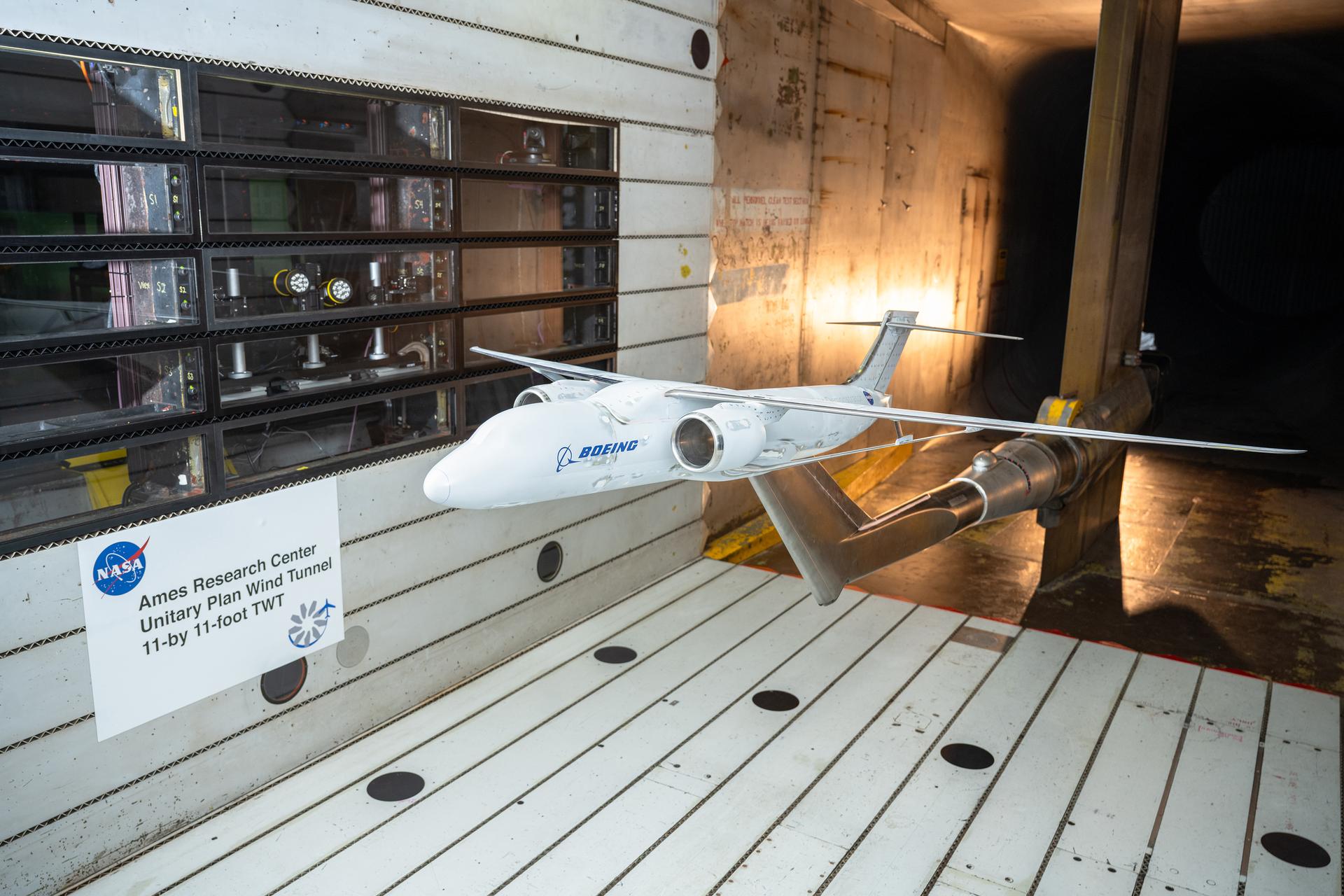
    A white and silver model of a plane with thin-wings is mounted on a pole with orange light illuminating the back of the room.
    A Boeing-built X-66 full-span model underwent testing in the 11-Foot Transonic Unitary Plan Facility at NASA’s Ames Research Center in California’s Silicon Valley between January and March 2025.
    NASA / Brandon Torres

    NASA and Boeing are currently evaluating an updated approach to the agency’s Sustainable Flight Demonstrator project that would focus on demonstrating thin-wing technology with broad applications for multiple aircraft configurations.

    Boeing’s proposed focus centers on a ground-based testbed to demonstrate the potential for long, thin-wing technology. Work on the X-66 flight demonstrator – which currently incorporates a more complex transonic truss braced wing concept that uses the same thin wing technology as well as aerodynamic, structural braces — would pause for later consideration based on the thin-wing testbed results and further truss-braced configuration studies. 

    Under this proposal, all aspects of the X-66 flight demonstrator’s design, as well as hardware acquired or modified for it, would be retained while the long, thin-wing technology is being investigated with more focus. NASA and Boeing would also continue to collaborate on research into the transonic truss-braced wing concept.

    The proposal is based on knowledge gained through research conducted under the Sustainable Flight Demonstrator project so far.

    Since NASA issued the Sustainable Flight Demonstrator award in 2023, the project has made significant progress toward its goal of informing future generations of more sustainable commercial airliners. Boeing and NASA have collaborated on wind tunnel tests, computational fluid dynamics modeling, and structural design and analysis aimed at exploring how best to approach fuel-efficient, sustainable designs.

    This research has built confidence in the substantial potential energy-savings benefits that technologies investigated through the Sustainable Flight Demonstrator project and other NASA research can make possible. The Boeing proposal identifies the thin-wing concept as having broad applications for potential incorporation into aircraft with and without truss braces. 

    NASA and Boeing are discussing potential options for advancing these sustainable flight technologies. NASA’s ultimate goal for this sustainable aircraft research is to achieve substantial improvements for next-generation airliner efficiency, lower costs for travelers, reduced fuel costs and consumption, and increase U.S. aviation’s technological leadership. 

  • NASA Tests Key Spacesuit Parts Inside This Icy Chamber

    6 min read

    Preparations for Next Moonwalk Simulations Underway (and Underwater)

    A JPL facility built to support potential robotic spacecraft missions to frozen ocean worlds helps engineers develop safety tests for next-generation spacesuits.

    When NASA astronauts return to the Moon under the Artemis campaign and eventually venture farther into the solar system, they will encounter conditions harsher than any humans have experienced before. Ensuring next-generation spacesuits protect astronauts requires new varieties of tests, and a one-of-a-kind chamber called CITADEL (Cryogenic Ice Testing, Acquisition Development, and Excavation Laboratory) at NASA’s Jet Propulsion Laboratory in Southern California is helping.

    Built to prepare potential robotic explorers for the frosty, low-pressure conditions on ocean worlds like Jupiter’s frozen moon Europa, CITADEL also can evaluate how spacesuit gloves and boots hold up in extraordinary cold. Spearheaded by the NASA Engineering and Safety Center, a glove testing campaign in CITADEL ran from October 2023 to March 2024. Boot testing, initiated by the Extravehicular Activity and Human Surface Mobility Program at NASA’s Johnson Space Center in Houston, took place from October 2024 to January 2025.

    A white space boot is secured in a metal fixture surrounded by wires, tubes, and reflective foil inside a test chamber, likely simulating lunar or space conditions for equipment evaluation.
    An astronaut boot — part of a NASA lunar spacesuit prototype, the xEMU — is readied for testing in JPL’s CITADEL. A thick aluminum plate stands in for the cold surface of the lunar South Pole, where Artemis III astronauts will confront conditions more extreme than any humans have yet experienced.
    NASA/JPL-Caltech

    In coming months, the team will adapt CITADEL to test spacesuit elbow joints to evaluate suit fabrics for longevity on the Moon. They’ll incorporate abrasion testing and introduce a simulant for lunar regolith, the loose material that makes up the Moon’s surface, into the chamber for the first time.

    “We’ve built space robots at JPL that have gone across the solar system and beyond,” said Danny Green, a mechanical engineer who led the boot testing for JPL. “It’s pretty special to also use our facilities in support of returning astronauts to the Moon.”

    Astronauts on the Artemis III mission will explore the Moon’s South Pole, a region of much greater extremes than the equatorial landing sites visited by Apollo-era missions. They’ll spend up to two hours at a time inside craters that may contain ice deposits potentially important to sustaining long-term human presence on the Moon. Called permanently shadowed regions, these intriguing features rank among the coldest locations in the solar system, reaching as low as minus 414 degrees Fahrenheit (minus 248 degrees Celsius). The CITADEL chamber gets close to those temperatures.

    Engineers from JPL and NASA Johnson set up a test of the xEMU boot inside CITADEL. Built to prepare potential robotic explorers for conditions on ocean worlds like Jupiter’s moon Europa, the chamber offers unique capabilities that have made it useful for testing spacesuit parts.
    NASA/JPL-Caltech

    “We want to understand what the risk is to astronauts going into permanently shadowed regions, and gloves and boots are key because they make prolonged contact with cold surfaces and tools,” said Zach Fester, an engineer with the Advanced Suit Team at NASA Johnson and the technical lead for the boot testing.

    Keeping Cool

    Housed in the same building as JPL’s historic 10-Foot Space Simulator, the CITADEL chamber uses compressed helium to get as low as minus 370 F (minus 223 C) — lower than most cryogenic facilities, which largely rely on liquid nitrogen. At 4 feet (1.2 meters) tall and 5 feet (1.5 meters) in diameter, the chamber is big enough for a person to climb inside.

    An engineer in a white spacesuit with red and blue accents kneels in a sandbox, using a scoop to collect simulated lunar soil into a bag during a training or equipment test indoors. A harness supports the suit from above.
    An engineer collects simulated lunar samples while wearing the Axiom Extravehicular Mobility Unit spacesuit during testing at NASA Johnson in late 2023. Recent testing of existing NASA spacesuit designs in JPL’s CITADEL chamber will ultimately support development of next-generation suits being built by Axiom Space.
    Axiom Space

    More important, it features four load locks, drawer-like chambers through which test materials are inserted into the main chamber while maintaining a chilled vacuum state. The chamber can take several days to reach test conditions, and opening it to insert new test materials starts the process all over again. The load locks allowed engineers to make quick adjustments during boot and glove tests.

    Cryocoolers chill the chamber, and aluminum blocks inside can simulate tools astronauts might grab or the cold lunar surface on which they’d walk. The chamber also features a robotic arm to interact with test materials, plus multiple visible-light and infrared cameras to record operations.

    Testing Extremities

    The gloves tested in the chamber are the sixth version of a glove NASA began using in the 1980s, part of a spacesuit design called the Extravehicular Mobility Unit. Optimized for spacewalks at the International Space Station, the suit is so intricate it’s essentially a personal spacecraft. Testing in CITADEL at minus 352 F (minus 213 C) showed the legacy glove would not meet thermal requirements in the more challenging environment of the lunar South Pole. Results haven’t yet been fully analyzed from boot testing, which used a lunar surface suit prototype called the Exploration Extravehicular Mobility Unit. NASA’s reference design of an advanced suit architecture, this spacesuit features enhanced fit, mobility, and safety.

    In addition to spotting vulnerabilities with existing suits, the CITADEL experiments will help NASA prepare criteria for standardized, repeatable, and inexpensive test methods for the next-generation lunar suit being built by Axiom Space — the Axiom Extravehicular Mobility Unit, which NASA astronauts will wear during the Artemis III mission.

    “This test is looking to identify what the limits are: How long can that glove or boot be in that lunar environment?” said Shane McFarland, technology development lead for the Advanced Suit Team at NASA Johnson. “We want to quantify what our capability gap is for the current hardware so we can give that information to the Artemis suit vendor, and we also want to develop this unique test capability to assess future hardware designs.”

    In the past, astronauts themselves have been part of thermal testing. For gloves, an astronaut inserted a gloved hand into a chilled “glove box,” grabbed a frigid object, and held it until their skin temperature dropped as low as 50 F (10 C). McFarland stressed that such human-in-the-loop testing remains essential to ensuring future spacesuit safety but doesn’t produce the consistent data the team is looking for with the CITADEL testing.

    To obtain objective feedback, the CITADEL testing team used a custom-built manikin hand and foot. A system of fluid loops mimicked the flow of warm blood through the appendages, while dozens of temperature and heat flux sensors provided data from inside gloves and boots.

    “By using CITADEL and modern manikin technology, we can test design iterations faster and at much lower cost than traditional human-in-the-loop testing,” said Morgan Abney, NASA technical fellow for Environmental Control and Life Support, who conceived the glove testing effort. “Now we can really push the envelope on next-generation suit designs and have confidence we understand the risks. We’re one step closer to landing astronauts back on the Moon.”

    Through Artemis, NASA will send astronauts to explore the Moon for scientific discovery, economic benefits, and build the foundation for the first crewed missions to Mars.

    News Media Contact

    Melissa Pamer
    Jet Propulsion Laboratory, Pasadena, Calif.
    626-314-4928
    melissa.pamer@jpl.nasa.gov

    2025-060

  • NASA’s Roman Mission Shares Detailed Plans to Scour Skies

    NASA’s Nancy Grace Roman Space Telescope team shared Thursday the designs for the three core surveys the mission will conduct after launch. These observation programs are designed to investigate some of the most profound mysteries in astrophysics while enabling expansive cosmic exploration that will revolutionize our understanding of the universe.

    “Roman’s setting out to do wide, deep surveys of the universe in a way that will help us answer questions about how dark energy and dark matter govern cosmic evolution, and the demographics of worlds beyond our solar system,” said Gail Zasowski, an associate professor at the University of Utah and co-chair of the ROTAC (Roman Observations Time Allocation Committee). “But the overarching goal is that the surveys have broad appeal and numerous science applications. They were designed by and for the astronomical community to maximize the science they’ll enable.”

    NASA’s Nancy Grace Roman Space Telescope’s three main observing programs, highlighted in this infographic, can enable astronomers to view the universe as never before, revealing billions of cosmic objects strewn across enormous swaths of space-time.
    Credit: NASA’s Goddard Space Flight Center

    Roman’s crisp, panoramic view of space and fast survey speeds provide the opportunity for astronomers to study the universe as never before. The Roman team asked the science community to detail the topics they’d like to study through each of Roman’s surveys and selected committees of scientists across many organizations to evaluate the range of possibilities and formulate three compelling options for each.

    In April, the Roman team received the recommendations and has now determined the survey designs. These observations account for no more than 75 percent of Roman’s surveys during its five-year primary mission, with the remainder allocated to additional observations that will be proposed and developed by the science community in later opportunities.

    “These survey designs are the culmination of two years of input from more than 1,000 scientists from over 350 institutions across the globe,” said Julie McEnery, Roman’s senior project scientist at NASA Goddard. “We’re thrilled that we’ve been able to hear from so many of the people who’ll use the data after launch to investigate everything from objects in our outer solar system, planets across our galaxy, dark matter and dark energy, to exploding stars, growing black holes, galaxies by the billions, and so much more.”

    With all major hardware now delivered, Roman has entered its final phase of preparation for launch, undergoing integration and key environmental testing at NASA Goddard. Roman is targeted to launch by May 2027, with the team working toward a potential launch as early as October 2026.

    An infographic of Roman's High-Latitude Wide-Area Survey
    This infographic describes the High-Latitude Wide-Area Survey that will be conducted by NASA’s Nancy Grace Roman Space Telescope. This observation program has three components, covering more than 5,000 square degrees (about 12 percent of the sky) altogether in just under a year and a half. The main part covers about 2,500 square degrees, doing both spectroscopy (splitting light into individual colors to study patterns that reveal detailed information) and imaging in multiple filters (which allow astronomers to select specific wavelengths of light) to provide the rich dataset needed for precise studies of our universe. A wider component spans more than twice the area using a single filter, specifically covering a large area that can be viewed by ground-based telescopes located in both the northern and southern hemispheres. The final component focuses on a smaller region to provide a deeper view that will help astronomers study faint, distant galaxies.
    Credit: NASA’s Goddard Space Flight Center

    High-Latitude Wide-Area Survey

    Roman’s largest survey, the High-Latitude Wide-Area Survey, combines the powers of imaging and spectroscopy to unveil more than a billion galaxies strewn across a wide swath of cosmic time. Roman can look far from the dusty plane of our Milky Way galaxy (that’s what the “high-latitude” part of the survey name means), looking up and out of the galaxy rather than through it to get the clearest view of the distant cosmos.

    The distribution and shapes of galaxies in Roman’s enormous, deep images can help us understand the nature of dark energy — a pressure that seems to be speeding up the universe’s expansion — and how invisible dark matter, which Roman will detect by its gravitational effects, influences the evolution of structure in our universe.

    For the last two years, researchers have been discussing ways to expand the range of scientific topics that can be studied using the same dataset. That includes studying galaxy evolution, star formation, cosmic voids, the matter between galaxies, and much more.
    This infographic describes the High-Latitude Time-Domain Survey that will be conducted by NASA’s Nancy Grace Roman Space Telescope. The survey’s main component covers over 18 square degrees — a region of sky as large as 90 full moons — and sees supernovae that occurred up to about 8 billion years ago. Smaller areas within the survey can pierce even farther, potentially back to when the universe was around a billion years old. The survey is split between the northern and southern hemispheres, located in regions of the sky that will be continuously visible to Roman. The bulk of the survey consists of 30-hour observations every five days for two years in the middle of Roman’s five-year primary mission.
    Credit: NASA’s Goddard Space Flight Center

    High-Latitude Time-Domain Survey

    Roman’s High-Latitude Time-Domain Survey can probe our dynamic universe by observing the same region of the cosmos repeatedly. Stitching these observations together to create movies can allow scientists to study how celestial objects and phenomena change over time periods of days to years.

    This survey can probe dark energy by finding and studying many thousands of a special type of exploding star called type Ia supernovae. These stellar cataclysms allow scientists to measure cosmic distances and trace the universe’s expansion.

    “Staring at a large volume of the sky for so long will also reveal black holes being born as neutron stars merge, and tidal disruption events –– flares released by stars falling into black holes,” said Saurabh Jha, a professor at Rutgers University in New Brunswick, New Jersey, and ROTAC co-chair. “It will also allow astronomers to explore variable objects, like active galaxies and binary systems. And it enables more open-ended cosmic exploration than most other space telescopes can do, offering a chance to answer questions we haven’t yet thought to ask.”

    This infographic describes the Galactic Bulge Time-Domain Survey that will be conducted by NASA’s Nancy Grace Roman Space Telescope. The smallest of Roman’s core surveys, this observation program consists of repeat visits to six fields covering 1.7 square degrees total. One field pierces the very center of the galaxy, and the others are nearby — all in a region of the sky that will be visible to Roman for two 72-day stretches each spring and fall. The survey mainly consists of six seasons (three early on, and three toward the end of Roman’s primary mission), during which Roman views each field every 12 minutes. Roman also views the six fields with less intensity at other times throughout the mission, allowing astronomers to detect microlensing events that can last for years, signaling the presence of isolated, stellar-mass black holes.
    Credit: NASA’s Goddard Space Flight Center

    Galactic Bulge Time-Domain Survey

    Unlike the high-latitude surveys, Roman’s Galactic Bulge Time-Domain Survey will look inward to provide one of the deepest views ever of the heart of our Milky Way galaxy. Roman’s crisp resolution and infrared view can allow astronomers to watch hundreds of millions of stars in search of microlensing signals — gravitational boosts of a background star’s light that occur when an intervening object passes nearly in front of it. While astronomers have mainly discovered star-hugging worlds, Roman’s microlensing observations can find planets in the habitable zone of their star and farther out, including analogs of every planet in our solar system except Mercury.

    The same set of observations can reveal “rogue” planets that drift through the galaxy unbound to any star, brown dwarfs (“failed stars” too lightweight to power themselves by fusion the way stars do), and stellar corpses like neutron stars and white dwarfs. And scientists could discover 100,000 new worlds by seeing stars periodically get dimmer as an orbiting planet passes in front of them, events called transits. Scientists can also study the stars themselves, detecting “starquakes” on a million giant stars, the result of sound waves reverberating through their interiors that can reveal information about their structures, ages, and other properties.

    Data from all of Roman’s surveys will be made public as soon as it is processed, with no periods of exclusive access.

    “Roman’s unprecedented data will offer practically limitless opportunities for astronomers to explore all kinds of cosmic topics,” McEnery said. “We stand to learn a tremendous amount of new information about the universe very rapidly after the mission launches.”

    Download high-resolution video and images from NASA’s Scientific Visualization Studio

    By Ashley Balzer
    NASA’s Goddard Space Flight Center, Greenbelt, Md.

    Media contact:
    Claire Andreoli
    NASA’s Goddard Space Flight Center, Greenbelt, Md.
    301-286-1940

  • NASA Orbiter Spots Curiosity Rover Making Tracks to Next Science Stop

    3 min read

    Preparations for Next Moonwalk Simulations Underway (and Underwater)

    High-resolution grayscale image of Mars showing layered terrain with smooth slopes, rocky ridges, and a small dark speck near the center, identified as NASA's Curiosity rover
    NASA’s Curiosity rover appears as a dark speck in this contrast-enhanced view captured on Feb. 28, 2025, by the HiRISE camera aboard NASA’s Mars Reconnaissance Orbiter. Trailing Curiosity are the rover’s tracks, which can linger on the Martian surface for months before being erased by the wind.
    NASA/JPL-Caltech/University of Arizona

    The image marks what may be the first time one of the agency’s Mars orbiters has captured the rover driving.

    NASA’s Curiosity Mars rover has never been camera shy, having been seen in selfies and images taken from space. But on Feb. 28 — the 4,466th Martian day, or sol, of the mission — Curiosity was captured in what is believed to be the first orbital image of the rover mid-drive across the Red Planet.

    Taken by the HiRISE (High-Resolution Imaging Science Experiment) camera aboard NASA’s Mars Reconnaissance Orbiter, the image shows Curiosity as a dark speck at the front of a long trail of rover tracks. Likely to last for months before being erased by wind, the tracks span about 1,050 feet (320 meters). They represent roughly 11 drives starting on Feb. 2 as Curiosity trucked along at a top speed of 0.1 mph (0.16 kph) from Gediz Vallis channel on the journey to its next science stop: a region with potential boxwork formations, possibly made by groundwater billions of years ago.

    How quickly the rover reaches the area depends on a number of factors, including how its software navigates the surface and how challenging the terrain is to climb. Engineers at NASA’s Jet Propulsion Laboratory in Southern California, which leads Curiosity’s mission, work with scientists to plan each day’s trek.

    “By comparing the time HiRISE took the image to the rover’s commands for the day, we can see it was nearly done with a 69-foot drive,” said Doug Ellison, Curiosity’s planning team chief at JPL.

    Designed to ensure the best spatial resolution, HiRISE takes an image with the majority of the scene in black and white and a strip of color down the middle. While the camera has captured Curiosity in color before, this time the rover happened to fall within the black-and-white part of the image.

    In the new image, Curiosity’s tracks lead to the base of a steep slope. The rover has since ascended that slope since then, and it is expected to reach its new science location within a month or so.

    More About Curiosity and MRO

    NASA’s Curiosity Mars rover was built at JPL, which is managed for the agency by Caltech in Pasadena, California. JPL manages both the Curiosity and Mars Reconnaissance Orbiter missions on behalf of NASA’s Science Mission Directorate in Washington as part of the agency’s Mars Exploration Program portfolio. The University of Arizona, in Tucson, operates HiRISE, which was built by BAE Systems in Boulder, Colorado.

    For more about the missions, visit:

    science.nasa.gov/mission/msl-curiosity

    science.nasa.gov/mission/mars-reconnaissance-orbiter

    News Media Contacts

    Andrew Good
    Jet Propulsion Laboratory, Pasadena, Calif.
    818-393-2433
    andrew.c.good@jpl.nasa.gov

    Karen Fox / Molly Wasser
    NASA Headquarters, Washington
    202-358-1600
    karen.c.fox@nasa.gov / molly.l.wasser@nasa.gov

    2025-059

  • 2025 EGU Hyperwall Schedule

    2 min read

    2025 EGU Hyperwall Schedule

    EGU General Assembly, April 27 – May 2, 2025

    Join NASA in the Exhibit Hall (Booth #204) for Hyperwall Storytelling by NASA experts. Full Hyperwall Agenda below.

    separater line

    MONDAY, APRIL 28

    • 10:15 – 10:30 AM —— PACE —— Ivona Cetinic
    • 3:45 – 4:00 PM —— Science Explorer (SciX): Accelerating the Discovery of NASA Science —— Mike Kurtz
    • 4:00 – 4:15 PM —— Juno’s Extended Vision in its Extended Mission —— Glenn Orton
    • 6:05 – 6:20 PM —— Getting the Big Picture with Global Precipitation —— George Huffman
    • 6:20 – 6:35 PM —— Exploring Europa with Europa Clipper —— Jonathan Lunine

    TUESDAY, APRIL 29

    • 10:15 – 10:30 AM —— Science Explorer (SciX): Accelerating the Discovery of NASA Science —— Jennifer Lynn Bartlett
    • 10:30 – 10:45 AM —— From ESTO to PACE, A CubeSat’s Journey to Space —— Brent McBride
    • 12:30 – 2:00 PM —— Ask Me Anything with NASA Scientists —— Informal Office Hours
    • 3:45 – 4:00 PM —— Exoplanets (Virtual) —— Jonathan H. Jiang
    • 4:00 – 4:15 PM —— Scattering of Realistic Hydrometeors for Precipitation Remote Sensing ——Kwo-Sen Kuo
    • 6:05 – 6:20 PM —— Space Weather Center of Excellence CLEAR: All-CLEAR SEP Forecast —— Lulu Zhao

    WEDNESDAY, APRIL 30

    • 10:15 – 10:30 AM —— SPEXone on PACE: First year in Orbit —— Otto Hasekamp
    • 12:30 – 2:00 PM —— Ask Me Anything with NASA Scientists —— Informal Office Hours
    • 3:45 – 4:00 PM —— Science Explorer (SciX): Accelerating the Discovery of NASA Science —— Jennifer Lynn Bartlett
    • 4:00 – 4:15 PM —— Scattering of Realistic Hydrometeors for Precipitation Remote Sensing ——Kwo-Sen Kuo
    • 6:05 – 6:20 PM —— Ship Tracks Tell the Story of Climate Forcing by Aerosols through Clouds —Tianle Yuan
    • 6:20 – 6:35 PM —— The Excitement of Mars Exploration —— Jonathan Lunine
    • 6:35 – 6:50 PM —— Using NASA Earth Observations for Disaster Response —— Kristen Okorn

    THURSDAY, MAY 1

    • 10:15 – 10:30 AM —— Getting the Big Picture with Global Precipitation —— George Huffman
    • 3:45 – 4:00 PM —— PACE —— Morgaine McKibben
    • 4:00 – 4:15 PM —— Using AI to Model Global Clouds Better Than Current GCRMs —— Tianle Yuan
    • 6:05 – 6:20 PM —— Science Explorer (SciX): Accelerating the Discovery of NASA Science —— Mike Kurtz

    Details

    Last Updated

    Apr 24, 2025

    Related Terms

  • NASA Astronaut to Answer Questions from Students in California

    NASA astronaut and Expedition 73 Flight Engineer Jonny Kim
    NASA astronaut and Expedition 73 Flight Engineer Jonny Kim.
    Credit: Gagarin Cosmonaut Training Center

    Students from Santa Monica, California, will connect with NASA astronaut Jonny Kim as he answers prerecorded science, technology, engineering, and mathematics-related questions aboard the International Space Station.

    Watch the 20-minute space-to-Earth call at 12:10 p.m. EDT on Tuesday, April 29, on the NASA STEM YouTube Channel.

    Media interested in covering the event must RSVP by 5 p.m., Friday, April 25, to Esmi Careaga at: ecareaga@smmusd.org or 805-651-3204 x71582.

    The event is hosted by Santa Monica High School, Kim’s alma mater, and includes students from Roosevelt Elementary School and Lincoln Middle School in Santa Monica. The schools hope to inspire students to follow their dreams and explore their passions through curiosity, service, and interest in learning.

    For more than 24 years, astronauts have continuously lived and worked aboard the space station, testing technologies, performing science, and developing skills needed to explore farther from Earth. Astronauts aboard the orbiting laboratory communicate with NASA’s Mission Control Center in Houston 24 hours a day through SCaN’s (Space Communications and Navigation) Near Space Network.

    Important research and technology investigations taking place aboard the space station benefit people on Earth and lays the groundwork for other agency missions. As part of NASA’s Artemis campaign, the agency will send astronauts to the Moon to prepare for future human exploration of Mars, inspiring Artemis Generation explorers and ensuring the United States continues to lead in space exploration and discovery.

    See videos highlighting space station research at:

    https://www.nasa.gov/stemonstation

    -end-

    Gerelle Dodson
    Headquarters, Washington
    202-358-1600
    gerelle.q.dodson@nasa.gov

    Sandra Jones
    Johnson Space Center, Houston
    281-483-5111
    sandra.p.jones@nasa.gov

  • Sols 4518-4519: Thumbs up from Mars

    5 min read

    Sols 4518-4519: Thumbs up from Mars

    Black-and-white image from a Mars rover showing layered rock formations on a slope, with the rover's shadow and part of its wheels visible in the foreground
    This image was taken by Front Hazard Avoidance Camera (Front Hazcam) onboard NASA’s Mars rover Curiosity on Sol 4516.
    NASA/JPL-Caltech

    Written by Susanne Schwenzer, Planetary Geologist at The Open University

    Earth planning date: Monday, 21st April 2025

    It is Easter Monday, a bank holiday here in the United Kingdom. I am Science Operations Working Group Chair today, a role that is mainly focused on coordinating all the different planning activities on a given day, and ensuring all the numbers are communicated to everyone. And with that I mean making sure that everyone knows how much power we have and other housekeeping details. It’s a fun role, but on the more technical side of the mission, which means I don’t get to look at the rocks in the workspace as closely as my colleagues who are planning the activities of the instruments directly investigating the rocks. It’s a lot of fun to see how planning day after planning day things come together. But why am I doing this on a bank holiday, when I could well be on my sofa? I just was reminded in the hours before planning how much fun it actually is to spend a little more time looking at all the images  – and not the usual hectic rush coming out of an almost complete work day (we start at 8 am PDT, which is 4 pm here in the UK!). So, I enjoyed the views of Mars, and I think Mars gave me a thumbs up for it, or better to say a little pointy ‘rock up’ in the middle of a sandy area, as you can see in the image above!

    I am sure you noticed that our team has a lot to celebrate! Less than a month after the publication about alkanes made headlines in many news outlets, we have another big discovery from our rover, now 4518 sols on Mars: in three drill holes, the rover instruments detected the mineral siderite, a carbonate. That allowed a group of scientists from our team to piece together the carbon cycle of Mars. If you want to know more, the full story is here. I am looking forward to our next big discovery. Who knows that that is? Well, it would not be exploration, if we knew!

    But today’s workspace looks intriguing with all its little laminae (the very fine layers) and its weathering patterns that look like a layered cake that little fingers have picked the icing off! (Maybe I had too many treats of the season this weekend? That’s for you to decide!) But then Mars did what it did so many times lately: we did not pass our slip risk assessment and therefore had to keep the arm stowed. I think there is a direct link between geologists getting exciting about all the many rocks, and a wheel ending up on one of them, making it unsafe to unstow the arm. There was a collective sigh of disappointment – and then we moved on to what we actually can do.

    And that is a lot of imaging. As exciting as getting an APXS measurement and MAHLI images would be, Mastcam images, ChemCam chemistry and RMI images are exciting, too. The plan starts with three Mastcam activities to document the small troughs that form around some of the rocks. Those amount to 15 frames already, then we have a ten-frame mosaic on a target called “West Fork,” which is looking at rocks in the middle ground of the scenery and display interesting layering. Finally, a 84 frame mosaic will image Texoli, one of the large buttes in our neighbourhood, in all its beauty. It shows a series of interesting layers and structures, including some that might be akin to what we expect the boxwork structures to look like. Now, did you keep count? Yes, that’s 109 frames from Mastcam – and add the one for the documentation of the LIBS target, too, and Mastcam takes exactly 110 frames!

    ChemCam is busy with a target called “Lake Poway,” which represents the bedrock around us. Also in the ChemCam activities is a long distance RMI upwards Mt Sharp to the Yardang unit. After the drive – more of that later – ChemCam as an automated observation, we call it AEGIS, where ChemCam uses a clever algorithm to pick its own target.

    The drive will be very special today. As you may have seen, we are imaging our wheels in regular intervals to make sure that we are keeping track of the wear and tear that over 34 km of offroad driving on Mars have caused. For that, we need a very flat area and our rover drivers did locate one due West of the current rover positions. So, that’s where we will drive first, do the full MAHLI wheel imaging and then return to the originally planned path. That’s where we’ll do a MARDI image, post drive imaging to prepare the planning for the next sols, and the above mentioned AEGIS.

    In addition to all the geologic investigations, there is continuous environmental monitoring ongoing. Curiosity will look at opacity and dust devils, and REMS will switch on regularly to measure wind speeds, humidity, temperature, ultraviolet radiation and pressure throughout the plan. Let’s not forget DAN, which monitors water and chlorine in the subsurface as we are driving along. It’s so easy to forget the ones that sit quietly in the back – but in this case, they have important data to contribute!

  • NASA Airborne Sensor’s Wildfire Data Helps Firefighters Take Action

    5 min read

    Preparations for Next Moonwalk Simulations Underway (and Underwater)

    Data from the AVIRIS-3 sensor was recently used to create detailed fire maps in minutes, enabling firefighters in Alabama to limit the spread of wildfires and save buildings.

    A NASA sensor recently brought a new approach to battling wildfire, providing real-time data that helped firefighters in the field contain a blaze in Alabama. Called AVIRIS-3, which is short for Airborne Visible Infrared Imaging Spectrometer 3, the instrument detected a 120-acre fire on March 19 that had not yet been reported to officials.

    As AVIRIS-3 flew aboard a King Air B200 research plane over the fire about 3 miles (5 kilometers) east of Castleberry, Alabama, a scientist on the plane analyzed the data in real time and identified where the blaze was burning most intensely. The information was then sent via satellite internet to fire officials and researchers on the ground, who distributed images showing the fire’s perimeter to firefighters’ phones in the field.

    All told, the process from detection during the flyover to alert on handheld devices took a few minutes. In addition to pinpointing the location and extent of the fire, the data showed firefighters its perimeter, helping them gauge whether it was likely to spread and decide where to add personnel and equipment.

    infrared fire map
    As firefighters worked to prevent a wildfire near Perdido, Alabama, from reaching nearby buildings, they saw in an infrared fire map from NASA’s AVIRIS-3 sensor that showed the fire’s hot spot was inside its perimeter. With that intelligence, they shifted some resources to fires in nearby Mount Vernon.
    NASA/JPL-Caltech, NASA Earth Observatory

    “This is very agile science,” said Robert Green, the AVIRIS program’s principal investigator and a senior research scientist at NASA’s Jet Propulsion Laboratory in Southern California, noting AVIRIS-3 mapped the burn scar left near JPL by the Eaton Fire in January.

    Observing the ground from about 9,000 feet (3,000 meters) in altitude, AVIRIS-3 flew aboard several test flights over Alabama, Mississippi, Florida, and Texas for a NASA 2025 FireSense Airborne Campaign. Researchers flew in the second half of March to prepare for prescribed burn experiments that took place in the Geneva State Forest in Alabama on March 28 and at Fort Stewart-Hunter Army Airfield in Georgia from April 14 to 20. During the March span, the AVIRIS-3 team mapped at least 13 wildfires and prescribed burns, as well as dozens of small hot spots (places where heat is especially intense) — all in real time.

    infrared fire map
    At one of the Mount Vernon, Alabama, fires, firefighters used AVIRIS-3 maps to determine where to establish fire breaks beyond the northwestern end of the fire. They ultimately cut the blaze off within about 100 feet (30 meters) of four buildings.
    NASA/JPL-Caltech, NASA Earth Observatory

    Data from imaging spectrometers like AVIRIS-3 typically takes days or weeks to be processed into highly detailed, multilayer image products used for research. By simplifying the calibration algorithms, researchers were able to process data on a computer aboard the plane in a fraction of the time it otherwise would have taken. Airborne satellite internet connectivity enabled the images to be distributed almost immediately, while the plane was still in flight, rather than after it landed.

    The AVIRIS team generated its first real-time products during a February campaign covering parts of Panama and Costa Rica, and they have continued to improve the process, automating the mapping steps aboard the plane.

    ‘Fan Favorite’

    The AVIRIS-3 sensor belongs to a line of imaging spectrometers built at JPL since 1986. The instruments have been used to study a wide range of phenomena — including fire — by measuring sunlight reflecting from the planet’s surface.

    During the March flights, researchers created three types of maps. One, called the Fire Quicklook, combines brightness measurements at three wavelengths of infrared light, which is invisible to the human eye, to identify the relative intensity of burning. Orange and red areas on the Fire Quicklook map show cooler-burning areas, while yellow indicates the most intense flames. Previously burned areas show up as dark red or brown.

    Another map type, the Fire 2400 nm Quicklook, looks solely at infrared light at a wavelength of 2,400 nanometers. The images are particularly useful for seeing hot spots and the perimeters of fires, which show brightly against a red background.

    A third type of map, called just Quicklook, shows burned areas and smoke.

    The Fire 2400 nm Quicklook was the “fan favorite” among the fire crews, said Ethan Barrett, fire analyst for the Forest Protection Division of the Alabama Forestry Commission. Seeing the outline of a wildfire from above helped Alabama Forestry Commission firefighters determine where to send bulldozers to stop the spread. 

    Additionally, FireSense personnel analyzed the AVIRIS-3 imagery to create digitized perimeters of the fires. This provided firefighters fast, comprehensive intelligence of the situation on the ground.

    That’s what happened with the Castleberry Fire. Having a clear picture of where it was burning most intensely enabled firefighters to focus on where they could make a difference — on the northeastern edge. 

    Then, two days after identifying Castleberry Fire hot spots, the sensor spotted a fire about 4 miles (2.5 kilometers) southwest of Perdido, Alabama. As forestry officials worked to prevent flames from reaching six nearby buildings, they noticed that the fire’s main hot spot was inside the perimeter and contained. With that intelligence, they decided to shift some resources to fires 25 miles (40 kilometers) away near Mount Vernon, Alabama.

    To combat one of the Mount Vernon fires, crews used AVIRIS-3 maps to determine where to establish fire breaks beyond the northwestern end of the fire. They ultimately cut the blaze off within about 100 feet (30 meters) of four buildings. 

    “Fire moves a lot faster than a bulldozer, so we have to try to get around it before it overtakes us. These maps show us the hot spots,” Barrett said. “When I get out of the truck, I can say, ‘OK, here’s the perimeter.’ That puts me light-years ahead.”

    AVIRIS and the Firesense Airborne Campaign are part of NASA’s work to leverage its expertise to combat wildfires using solutions including airborne technologies. The agency also recently demonstrated a prototype from its Advanced Capabilities for Emergency Response Operations project that will provide reliable airspace management for drones and other aircraft operating in the air above wildfires.

    News Media Contacts

    Andrew Wang / Jane J. Lee
    Jet Propulsion Laboratory, Pasadena, Calif.
    626-379-6874 / 818-354-0307
    andrew.wang@jpl.nasa.gov / jane.j.lee@jpl.nasa.gov

    2025-058

  • NASA Collaborates to Enable Spectrum-Dependent Science, Exploration, and Innovation   

    2 min read

    Preparations for Next Moonwalk Simulations Underway (and Underwater)

    In our modern wireless world, almost all radio frequency (RF) spectrum bands are shared among multiple users. In some domains, similar users technically coordinate to avoid interference. The spectrum management team, part of NASA’s SCaN (Space Communications and Navigation) Program, represents the collaborative efforts across U.S. agencies and the international community to protect and enable NASA’s current and future spectrum-dependent science, exploration, and innovation.     

    Coordination with Other Spectrum Stakeholders

    NASA works to promote the collaborative use of the RF spectrum around Earth, and beyond. For example, NASA coordinates closely with other U.S. government agencies, international civil space agencies, and the private sector to ensure missions that overlap in time, location, and frequency do not cause or receive interference that could jeopardize their success. The spectrum management team protects NASA’s various uses of the spectrum by collaborating with U.S. and international spectrum users on technical matters that inform regulatory discussions.  

    As a founding member of the Space Frequency Coordination Group, NASA works with members of governmental space- and science-focused agencies from more than 35 countries. The Space Frequency Coordination Group annual meetings provide a forum for multilateral discussion and consideration of international spectrum regulatory issues related to Earth, lunar, and deep space research and exploration. The Space Frequency Coordination Group also provides a forum for the exchange of technical information to facilitate coordination for specific missions and enable efficient use of limited spectrum resources in space. 

    Domestic and International Spectrum Regulators 

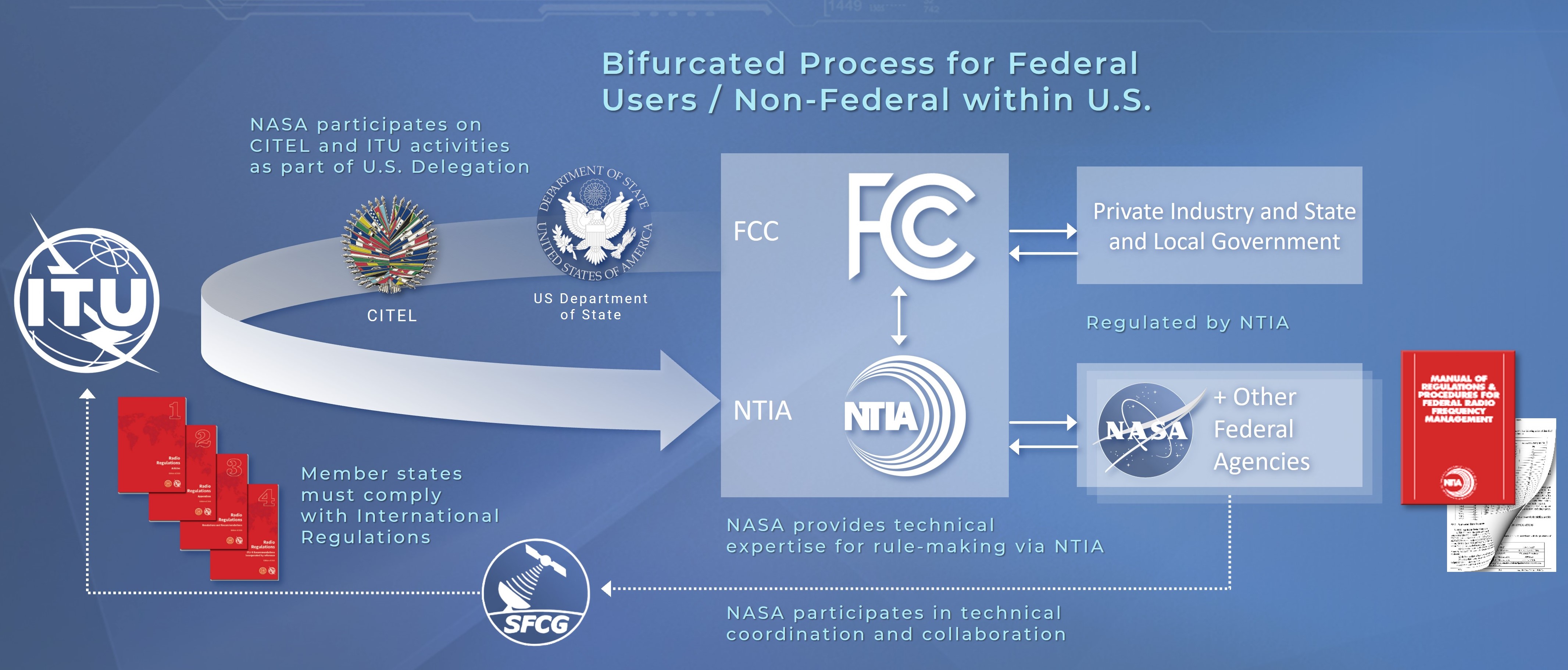
    Creating and maintaining the global spectrum regulations that govern spectrum sharing requires collaboration and negotiation among all its diverse users. The International Telecommunication Union manages the global spectrum regulatory framework to optimize the increasing, diverse uses of the RF spectrum and reduce the likelihood of RF systems experiencing interference. U.S. regulators at the National Telecommunications and Information Administration and the Federal Communications Commission are responsible for developing and administering domestic spectrum regulations.  Organizations across the world cooperatively plan and regulate spectrum use.  The spectrum management team participates on behalf of NASA at both national and international levels to ensure that the U.S. domestic and international spectrum regulatory framework supports and enables NASA’s current and future missions.  

    A light blue diagram titled “Bifurcated Process for Federal Users/Non-Federal within U.S.” visualizes spectrum management between the FCC (Federal Communications Commission) and NTIA (National Telecommunications and Information Administration). Images of the red international regulations documentation are on the left and right sides of the diagram sit beside white text that reads, “Member states must comply with International Regulations.” On the left, logos for CITEL (Inter-American Telecommunication Commission) and the U.S. Department of State sit under white text that reads, “NASA participates on CITEL and ITU (International Telecommunication Union) activities as part of U.S. Delegation.” A large white arrow connects the two logos to the NTIA, while small white arrows split the path to show the FCC handling spectrum management for “Private Industry and State and Local Government,” while “NASA + Other Federal Agencies” are managed by the NTIA. White text beneath the NTIA and FCC logos explain, “NASA provides technical expertise for rule-making via NTIA.” Finally, an additional dotted-line connects NASA and the other agencies to the logos for SFCG (Space Frequency Coordination Group) and ITU, accompanied by white text that reads, “NASA participates in technical coordination and collaboration.
    NASA collaborates with domestic and international spectrum stakeholders to provide technical expertise on space spectrum topics to ensure regulations continue to enable space exploration, science, and innovation.
    NASA

    Details

    Last Updated

    Apr 23, 2025

    Related Terms

  • Management and Regulation Ensure Effective Spectrum Sharing 

    4 min read

    Preparations for Next Moonwalk Simulations Underway (and Underwater)

    Spectrum is a shared resource. Since the discovery of radio waves and the invention of the telegraph, humanity has exponentially increased its use of the radio frequency (RF) spectrum.  Consider how many wireless devices are around you right now.  You’re probably reading this on a smartphone or laptop connected to the internet through Wi-Fi or 5G. You might be listening to music on Bluetooth headphones. If you are in a car or bus, the driver may be using signals from GPS satellites. To meet this increasing need, RF engineers and regulators continue to develop ways to enable users to share the same frequencies at the same time in the same place — think of modern cell phone technology. Avoiding or lessening interference between users requires regulators and users alike to maintain and enforce the ‘rules of the road’ that describe who can use which frequencies where, when, and how. NASA, like all other users, must comply with these regulations and collaborate with other users to ensure our use of the RF spectrum can continue and evolve. 

    On a dark blue-gray background, an illustration of a busy city block sits over a small section of the United States Frequency Allocations graph. An overhead image of a busy city block, symbolizing how spectrum managers must accommodate multiple users within the same frequency space. To the left of the graphic, the words “Sharing the RF Spectrum is like sharing space in a dense city…” are displayed in light white font.
    Just as architects design taller buildings to accommodate more residences on the same plot of land, radio frequency engineers design methods to allow more users on the same frequency, at the same place and time.
    NASA

    Supporting and Protecting NASA’s Spectrum Users

    NASA’s spectrum professionals work with users early in the project planning phase to understand the type, location, and duration of their data, and in turn determine what kind of antennas, transmitters, and receivers will be required. With that information, a spectrum manager helps to define the spectrum requirements, such as bandwidths, modulation, and other technical characteristics of the radio signals to be used. Understanding a project’s objectives helps define the appropriate service allocation and potential frequency ranges.   
    Once these spectrum requirements are determined, NASA’s spectrum professionals work with other relevant spectrum users within and beyond NASA to coordinate the use of the spectrum.  
     
    In the unfortunate event of harmful RF interference, working to identify, resolve, and report the interference is another critical function of NASA’s spectrum professionals. For example as Jeff Hayes — NASA’s current SCaN (Space Communications and Navigation) Program liaison to the Science Mission Directorate and the former program executive for operating missions in the Heliophysics and Astrophysics Divisions — recounts, “The NICER (Neutron Star Interior Composition Explorer) observatory did actually experience bouts of RF interference over certain parts of the world. As NICER uses GPS to understand where it is pointing to in the sky, interference can make the location information of the source imprecise, and that impacts the quality of the data collected. That data could potentially be attributed to the wrong star.” 

    When NASA identifies interference to a mission like NICER or to a device at an agency center or facility, NASA center and facility spectrum managers work to identify, resolve, and report the interference.  

    Identifying and reporting sources of interference helps to raise awareness of the impacts and causes of interference. When the sources of interference are international, which is especially common for space systems like NICER, SCaN’s spectrum management team works with U.S. regulators to report the incident to international regulators. These interference reports can be used to advocate for regulatory protections that help ensure the integrity of valuable science data and the safety of human spaceflight activities.  

    Advocating for NASA’s Current and Future Spectrum Use 

    NASA’s spectrum analysts and engineers perform analyses and simulations to support spectrum planning and management activities. For example, passive remote sensing instruments like the radiometer on the Soil Moisture Active Passive mission detect natural energy (radiation) emitted or reflected by an object or scene being observed. This energy is much fainter than human-generated radio signals and require highly sensitive radiometers that are susceptible to interference from more powerful signals. The spectrum management team works to ensure regulatory protections are in place and followed to ensure the integrity of NASA’s scientific missions. 

    Sometimes NASA’s future missions envision new ways and places to use radio waves. For example, when NASA’s Artemis campaign began taking steps to return humans to the Moon, SCaN’s spectrum professionals began working with other stakeholders to develop a RF architecture that enables the use of radio waves for science data, communications, positioning, navigation, and timing while also limiting the risk of interference with systems on or orbiting Earth. NASA’s spectrum professionals further the agency’s spectrum management goals and objectives by analyzing potential changes in international or domestic regulations and proposing technical solutions that promote collaborative spectrum use with both foreign and domestic partners.   

    NASA’s technical expertise is critical to ensuring domestic and international regulators are well informed as they develop new or revised regulations that effectively enable the exciting innovation and exploration central to NASA’s mission.  

    Details

    Last Updated

    Apr 23, 2025

    Related Terms

  • NASA’s Use of the Radio Frequency Spectrum

    3 min read

    Preparations for Next Moonwalk Simulations Underway (and Underwater)

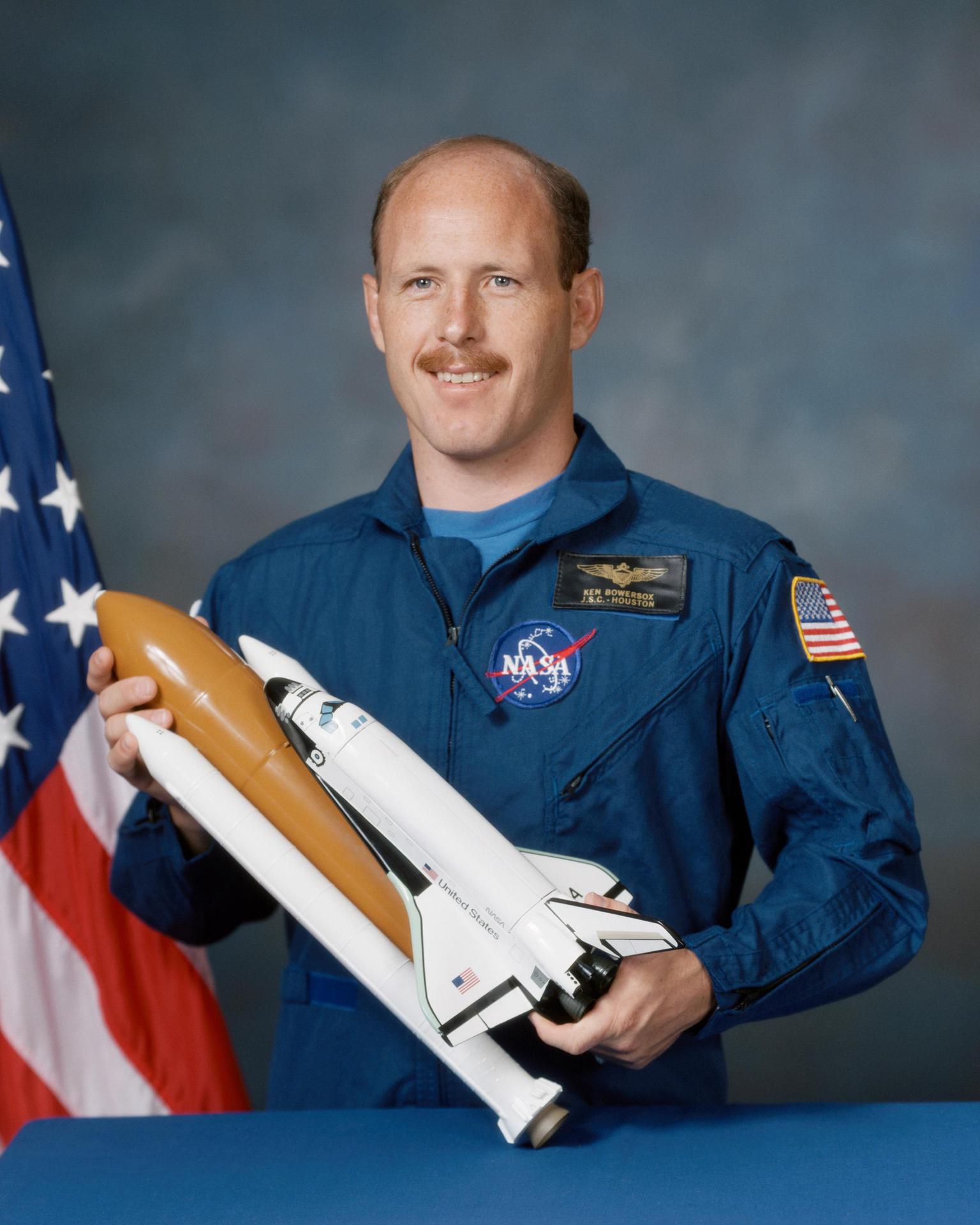
    As associate administrator for NASA’s Space Operations Mission Directorate Ken Bowersox puts it, “nothing happens without communications.”  

    And effective communications require the use of radio waves.  

    None of NASA’s exciting science and engineering endeavors would be possible without the use of radio waves to send data, communications, and commands between researchers or flight controllers and their flight platforms or instruments.  

    Reflecting on his time as a pilot, commander, and mission specialist during the Space Shuttle Program, Bowersox says, “If you’re not there physically, you can’t be a part of the team. But if you’re getting the data, whether it’s video, telemetry data with states of switches, or individual parameters on temperatures or pressures, then you can act on it and provide information to the spacecraft team so they can do the right thing in their operation.”  

    These vital data and communications functions, as well as the gathering of valuable scientific data through remote sensing applications, all use radio frequencies (RF) within the electromagnetic spectrum. NASA centers and facilities also use the RF spectrum to support their everyday operations, including the walkie-talkies used by security guards, air traffic control systems around airfields, and even office Wi-Fi routers and wireless keyboards.  

    Nothing happens without communications.

    Ken Bowersox

    Ken Bowersox

    NASA Astronaut & Associate Administrator for NASA’s Space Operations Mission Directorate

    All of NASA’s uses of the RF spectrum are shared, with different radio services supporting other kinds of uses. Service allocation is a fundamental concept in spectrum regulation and defines how the spectrum is shared between different types of applications. A service allocation defines ranges, or bands, of radio frequencies that can be used by a particular type of radio service. For example, a television broadcasting satellite operates in frequency bands allocated to the broadcasting satellite service, terrestrial cellular services operate in bands allocated for the mobile service, and the communications antennas on the International Space Station (ISS) operate in bands allocated to space operations service.   

    However, an allocation is not a license to operate — it does not authorize a specific system or operator to use particular frequencies. Such authority is granted through domestic and international regulatory processes.  

    Most frequency bands of the RF spectrum are shared, and each frequency band typically has two or more radio services allocated to it. Careful spectrum regulation, planning, and management aim to identify mutually compatible services to share frequency bands while limiting its negative impacts. 

    NASA’s Most Notable Spectrum Uses 

    Many of NASA’s most notable uses of spectrum rely on the following service allocations: 

    • Earth exploration-satellite service   
    • Space research service     
    • Space operations service 
    • Inter-satellite service 

    Note that allocations in the Earth exploration-satellite service and the space research service are designated either for communications links in the Earth-to-space, space-to-Earth, or space-to-space directions or designated for active or passive sensing of Earth or celestial objects (respectively) to differentiate the types of uses within the service and afford the requisite protections.

    Watch the video to learn more about how each kind of system uses the radio frequency spectrum
    NASA

    Details

    Last Updated

    Apr 23, 2025

  • NASA Astronaut Don Pettit to Discuss Seven-Month Space Mission

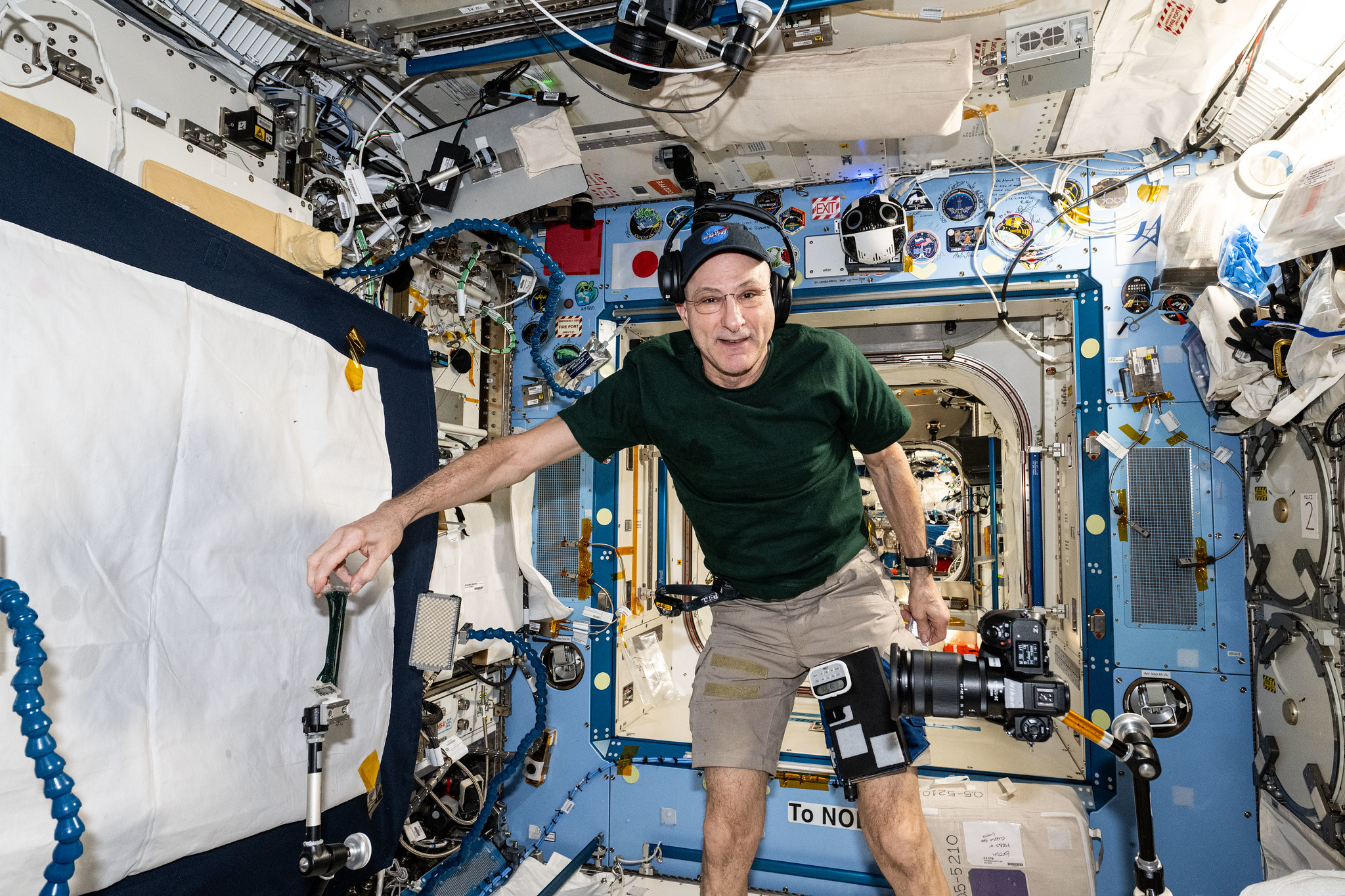
    An image of NASA astronaut and Expedition 72 Flight Engineer Don Pettit setting up camera hardware in the International Space Station.
    NASA astronaut and Expedition 72 Flight Engineer Don Pettit sets up camera hardware to photograph research activities inside the International Space Station’s Kibo laboratory module on March 15, 2025.
    Credit: NASA

    Media are invited to a news conference at 2 p.m. EDT Monday, April 28, at NASA’s Johnson Space Center in Houston where astronaut Don Pettit will share details of his recent mission aboard the International Space Station.

    The news conference will stream live on NASA’s website. Learn how to stream NASA content through a variety of platforms.

    To participate in person, U.S. media must contact the NASA Johnson newsroom no later than 5 p.m. Thursday, April 24, at 281-483-5111 or jsccommu@mail.nasa.gov. Media wishing to participate by phone must contact the newsroom no later than two hours before the start of the event. To ask questions by phone, media must dial into the news conference no later than 10 minutes prior to the start of the call. NASA’s media accreditation policy is available online.

    Questions also may be submitted on social media during the news conference by using #AskNASA. Following the news conference, NASA will host a live question and answer session with Pettit on the agency’s Instagram. For more information, visit @NASA on social media.

    Pettit returned to Earth on April 19 (April 20, Kazakhstan time), along with Roscosmos cosmonauts Alexey Ovchinin and Ivan Vagner. Pettit celebrated his 70th birthday on April 20. He spent 220 days in space as an Expedition 71/72 flight engineer, bringing his career total to 590 days in space during four spaceflights. Pettit and his crewmates completed 3,520 orbits of Earth over the course of their 93-million-mile journey. They also saw the arrival of six visiting spacecraft and the departure of seven.

    During his time on orbit, Pettit conducted hundreds of hours of scientific investigations, including research to enhance on-orbit metal 3D printing capabilities, advance water sanitization technologies, explore plant growth under varying water conditions, and investigate fire behavior in microgravity, all contributing to future space missions.

    He also spent time aboard the space station sharing his photography, often posting images to his X account. He took more than 670,000 photos during his stay.

    Learn more about International Space Station research and operations at:

    http://www.nasa.gov/station

    -end-

    Joshua Finch / Claire O’Shea
    Headquarters, Washington
    202-358-1100
    joshua.a.finch@nasa.gov / claire.a.o’shea@nasa.gov

    Chelsey Ballarte
    Johnson Space Center, Houston
    281-483-5111
    chelsey.n.ballarte@nasa.gov