Sprites, those beguiling electrical flashes of light above thunderstorms, raise so many questions: Why do they take the shapes they do? What conditions in the upper atmosphere trigger them? How do sprites affect Earth’s global electric circuit, and what is their contribution to the energy in Earth’s upper atmosphere? On October 26, 2022, NASA’s Spritacular project began asking volunteers to help answer these questions. Happy Birthday, Spritacular!
“It has been an amazing journey,” said Dr. Burcu Kosar, space physicist at NASA’s Goddard Space Flight Center in Greenbelt, Maryland and Spritacular principal investigator. “Our community is growing steadily. We have been so thankful for all the participation so far.”
The project has 308 volunteers that have contributed 189 observations from 13 different countries. The database analysis is underway, so stay tuned for some exciting research outcomes!
Have a camera? Join the chase of sprites from the ground, engage with our global community of observers, and contribute your observations for NASA Science!
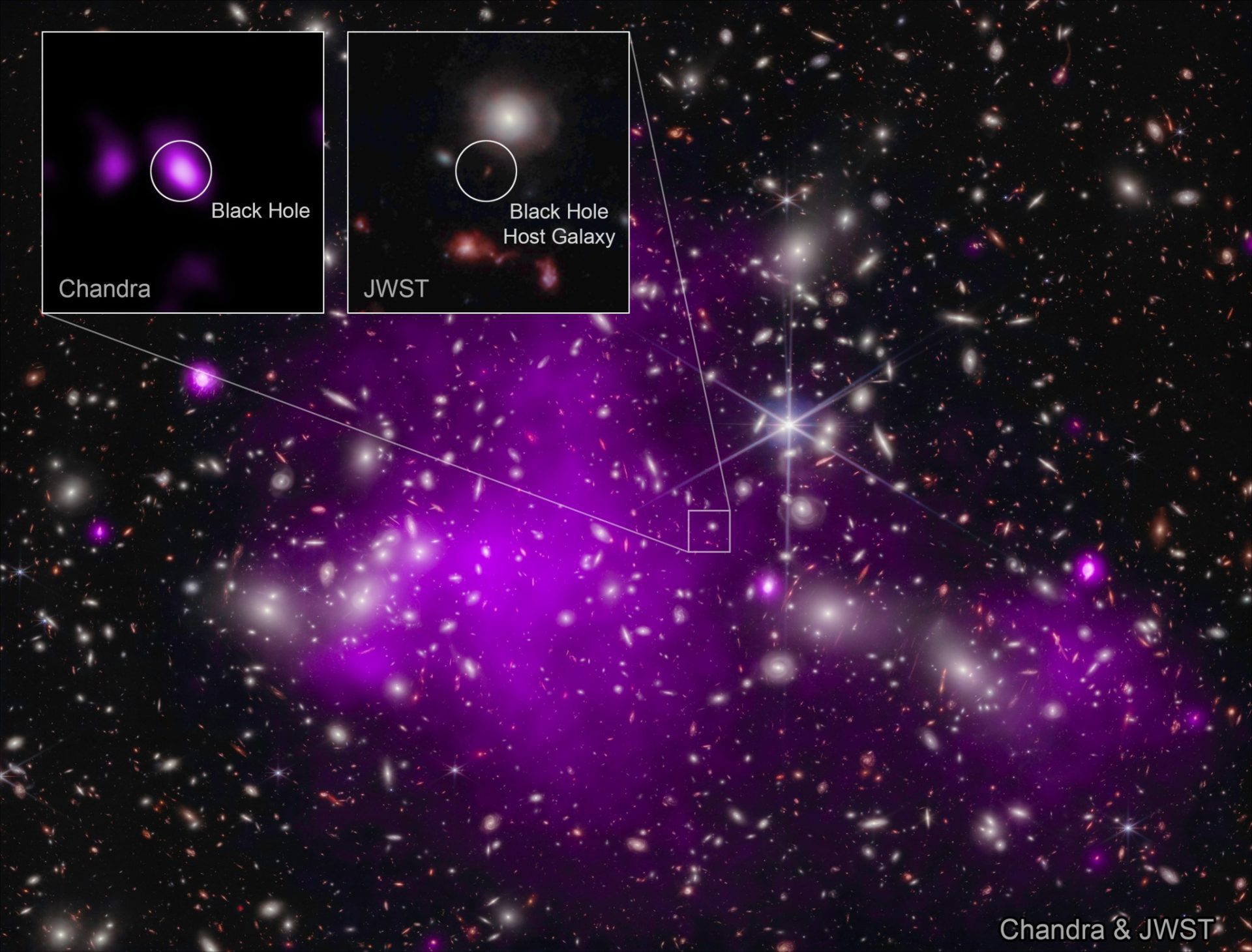
Astronomers have discovered the most distant black hole yet seen in X-rays, using NASA telescopes. The black hole is at an early stage of growth that had never been witnessed before, where its mass is similar to that of its host galaxy.
This result may explain how some of the first supermassive black holes in the universe formed.
By combining data from NASA’s Chandra X-ray Observatory and NASA’s James Webb Space Telescope, a team of researchers was able to find the telltale signature of a growing black hole just 470 million years after the big bang.
Astronomers found the most distant black hole ever detected in X-rays (in a galaxy dubbed UHZ1) using the Chandra and Webb space telescopes. X-ray emission is a telltale signature of a growing supermassive black hole. This result may explain how some of the first supermassive black holes in the universe formed. These images show the galaxy cluster Abell 2744 that UHZ1 is located behind, in X-rays from Chandra and infrared data from Webb, as well as close-ups of the black hole host galaxy UHZ1.
“We needed Webb to find this remarkably distant galaxy and Chandra to find its supermassive black hole,” said Akos Bogdan of the Center for Astrophysics | Harvard & Smithsonian (CfA) who leads a new paper in the journal Nature Astronomy describing these results. “We also took advantage of a cosmic magnifying glass that boosted the amount of light we detected.” This magnifying effect is known as gravitational lensing.
Bogdan and his team found the black hole in a galaxy named UHZ1 in the direction of the galaxy cluster Abell 2744, located 3.5 billion light-years from Earth. Webb data, however, has revealed the galaxy is much more distant than the cluster, at 13.2 billion light-years from Earth, when the universe was only 3% of its current age.
Then over two weeks of observations with Chandra showed the presence of intense, superheated, X-ray emitting gas in this galaxy – a trademark for a growing supermassive black hole. The light from the galaxy and the X-rays from gas around its supermassive black hole are magnified by about a factor of four by intervening matter in Abell 2744 (due to gravitational lensing), enhancing the infrared signal detected by Webb and allowing Chandra to detect the faint X-ray source.
This discovery is important for understanding how some supermassive black holes can reach colossal masses soon after the big bang. Do they form directly from the collapse of massive clouds of gas, creating black holes weighing between about 10,000 and 100,000 Suns? Or do they come from explosions of the first stars that create black holes weighing only between about 10 and 100 Suns?
“There are physical limits on how quickly black holes can grow once they’ve formed, but ones that are born more massive have a head start. It’s like planting a sapling, which takes less time to grow into a full-size tree than if you started with only a seed”, said Andy Goulding of Princeton University. Goulding is a co-author of the Nature Astronomy paper and lead author of a new paper in The Astrophysical Journal Letters that reports the galaxy’s distance and mass using a spectrum from Webb.
Bogdan’s team has found strong evidence that the newly discovered black hole was born massive. Its mass is estimated to fall between 10 and 100 million Suns, based on the brightness and energy of the X-rays. This mass range is similar to that of all the stars in the galaxy where it lives, which is in stark contrast to black holes in the centers of galaxies in the nearby universe that usually contain only about a tenth of a percent of the mass of their host galaxy’s stars.
The large mass of the black hole at a young age, plus the amount of X-rays it produces and the brightness of the galaxy detected by Webb, all agree with theoretical predictions in 2017 by co-author Priyamvada Natarajan of Yale University for an “Outsize Black Hole” that directly formed from the collapse of a huge cloud of gas.
“We think that this is the first detection of an ‘Outsize Black Hole’ and the best evidence yet obtained that some black holes form from massive clouds of gas,” said Natarajan. “For the first time we are seeing a brief stage where a supermassive black hole weighs about as much as the stars in its galaxy, before it falls behind.”
The researchers plan to use this and other results pouring in from Webb and those combining data from other telescopes to fill out a larger picture of the early universe.
NASA’s Hubble Space Telescope previously showed that light from distant galaxies is highly magnified by matter in the intervening galaxy cluster, providing part of the motivation for the Webb and Chandra observations described here.
The paper describing the results by Bogdan’s team appears in Nature Astronomy, and a preprint is available online.
The Webb data used in both papers is part of a survey called the Ultradeep Nirspec and nirCam ObserVations before the Epoch of Reionization (UNCOVER). The paper led by UNCOVER team member Andy Goulding appears in the Astrophysical Journal Letters. The co-authors include other UNCOVER team members, plus Bogdan and Natarajan. A detailed interpretation paper that compares observed properties of UHZ1 with theoretical models for Outsize Black Hole Galaxies is forthcoming.
NASA’s Marshall Space Flight Center manages the Chandra program. The Smithsonian Astrophysical Observatory’s Chandra X-ray Center controls science operations from Cambridge, Massachusetts, and flight operations from Burlington, Massachusetts.
The James Webb Space Telescope is the world’s premier space science observatory. Webb is solving mysteries in our solar system, looking beyond to distant worlds around other stars, and probing the mysterious structures and origins of our universe and our place in it. Webb is an international program led by NASA with its partners, ESA (European Space Agency) and the Canadian Space Agency.
On Oct. 1, 1958, NASA, the newly established agency to lead America’s civilian space program, officially began operations, with T. Keith Glennan and Hugh L. Dryden as administrator and deputy administrator, respectively. One of the new agency’s top priorities involved the development of a spacecraft capable of sending a human into space and returning him safely to Earth. On Oct. 7, Glennan approved the project, and the next day informally established the Space Task Group (STG) to implement it. On Nov. 5, the STG formally came into existence, with Robert R. Gilruth named as project manager and Charles J. Donlan as his assistant. In January 1959, the STG selected a contractor to build the spacecraft for Project Mercury and in April chose the seven astronauts to fly it in space.
Left: NASA Deputy Administrator Hugh L. Dryden, left, and NASA Administrator T. Keith Glennan address the employees of the newly established NASA. Right: Space Task Group leaders Charles J. Donlan, left, Robert R. Gilruth, Maxime “Max” A. Faget, and Robert O. Piland at NASA’s Langley Research Center in Hampton, Virginia.
Glennan established the STG at the newly renamed Langley Research Center in Hampton, Virginia. Thirty-five Langley employees plus 10 more detailed from the Lewis Research Center in Cleveland, Ohio, formed the initial core of the STG. In early 1959, 25 engineers from AVRO Canada added their talents to the core team, with more following later. Since 1952, when the Langley Aeronautical Laboratory formed a part of the National Advisory Committee for Aeronautics, NASA’s predecessor agency, engineers there including Gilruth and Donlan had studied the problems associated with putting humans in space. An engineer named Maxime “Max” A. Faget, who in the STG led the Flight Systems Division, had determined that a cone-shaped object with a blunt end to act as a heat shield during reentry into Earth’s atmosphere would make the optimal spacecraft for humanity’s first foray into space. When presented to Glennan on Oct. 7, 1958, he approved the project by saying, “Let’s get on with it.”
Left: The headquarters building for the Space Task Group (STG) at NASA’s Langley Research Center in Hampton, Virginia. Middle: An early cutaway representation of the Mercury capsule. Right: A technician, right, demonstrates a model of a Mercury spacecraft to STG leaders Charles J. Donlan, left, Robert R. Gilruth, and Maxime “Max” A. Faget.
The advance work allowed STG engineers to quickly draft specifications for the crewed capsule. The STG presented the project to representatives of 40 companies on Nov. 7, and 10 days later mailed detailed specifications to 20 firms that had expressed an interest in submitting a proposal. On Nov. 26, NASA formally designated the project as Project Mercury. Eleven companies submitted proposals by the Dec. 11 deadline, and STG engineers began reviewing them the next day. On Jan. 9, 1959, NASA selected the McDonnell Aircraft Corporation of St. Louis as the prime contractor to develop and build the Mercury spacecraft. McDonnell delivered the first three capsules within 12 months. Plans for the program envisioned suborbital and orbital missions, in both cases beginning with uncrewed test flights, followed by flights with primates, leading eventually to astronaut missions. Suborbital flights would utilize the Redstone missile with orbital flights using the larger Atlas rocket. On Dec. 8, 1958, NASA ordered nine Atlas missiles from the U.S. Air Force.
Left: The Mercury 7 astronauts Donald K. Slayton, left, Alan B. Shepard, Walter M. Schirra, Virgil I. “Gus” Grissom, John H. Glenn, L. Gordon Cooper, and M. Scott Carpenter during their introductory press conference. Right: The Mercury 7 astronauts in a more relaxed setting in front of a Mercury capsule at Ellington Air Force Base facilities leased by the Manned Spacecraft Center, now NASA’s Johnson Space Center in Houston.
In addition to building the spacecraft, the STG focused its attention on selecting the pilots to fly it. President Dwight D. Eisenhower decided that military test pilots would make the most suitable astronauts. On Jan. 5, 1959, NASA established the qualifications for the astronauts: less than 40 years of age; less than 5 feet 11 inches tall; excellent physical condition; bachelor’s degree or equivalent; graduate of test pilot school; and 1,500 hours of jet flight time. A screening in late January of the files of 508 graduates of the Navy and Air Force test pilot schools who met the basic age and flying requirements resulted in 110 qualified candidates. The selection committee ranked these candidates and divided them into three groups of about 35 each. The first two groups, comprising 69 candidates, received classified briefings at the Pentagon about the Mercury spacecraft and their potential participation. From this group, 53 volunteered for further evaluation and NASA decided not to call in the third group of candidates. Following an initial medical screening, 32 from this group advanced to undergo thorough medical evaluations at the Lovelace Foundation for Medical Education and Research, commonly known as the Lovelace Clinic, in Albuquerque, New Mexico. Beginning on Feb. 7, the candidates in six groups of five or six spent one week at Lovelace undergoing comprehensive medical examinations. From there, 31 of the 32 (one candidate failed a blood test at Lovelace) advanced to the Aero Medical Laboratory at Wright-Patterson Air Force Base in Dayton, Ohio, where weeklong testing of the six groups took place between Feb. 15 and March 28. Rather than simply examining them physically, testing at AML consisted of stressing the candidates in centrifuges, altitude chambers, and other devices to gauge their reactions. The selection committee met at Langley in late March and based on all the available data selected seven candidates for Project Mercury. The 24 unsuccessful candidates were notified by telephone on April 1 with a follow up letter from Donlan on April 3, also advising them to apply for any possible future astronaut selections. The seven selected as Mercury astronauts received telephone calls from Donlan on April 2. On April 9, NASA Administrator Glennan introduced them to the public during a press conference at the Dolley Madison House, NASA’s headquarters in Washington, D.C. They reported for work at Langley on April 27.
Left: Space Task Group (STG) Director Robert R. Gilruth, left, and his special assistant Paul E. Purser hold the Nov. 1, 1961, edition of the Space News Roundup employee newsletter announcing the move of the STG to Houston and its renaming as the Manned Spacecraft Center (MSC), now NASA’s Johnson Space Center. Middle: The initial edition dated Nov. 1, 1961, of the Space News Roundup. Right: The location of the MSC showing initial site preparation in 1962.
For the next two years, the STG busied itself with putting the first American in space as part of Project Mercury. Among other ground-breaking activities, this included overseeing the building of the Mercury spacecraft, training the astronauts, putting the necessary infrastructure in place such as Mercury Mission Control Center at Cape Canaveral, Florida, and a worldwide tracking network, acquiring Redstone and Atlas rockets from the U.S. Air Force, and working with the U.S. Navy to arrange for recovery of the astronauts after splashdown. The efforts paid off and on May 5, 1961, Alan B. Shepard became the first American in space during his 15-minute suborbital Mercury-Redstone 3 mission. Twenty days later, in an address to a Joint Session of Congress, President John F. Kennedy committed the nation to land a man on the Moon and return him safely to Earth before the end of the decade. The work to achieve this new challenge compelled the STG to seek larger facilities. Talk of a dedicated field center to manage human spaceflight begun in early 1961 intensified, with a site selection team established in August 1961. On Sept. 19, NASA Administrator James E. Webb announced the selection of a site 25 miles southeast of Houston on Clear Lake to build the Manned Spacecraft Center (MSC), now NASA’s Johnson Space Center, and named Gilruth as the center’s director. Although the STG ceased to exist in name, the work on Project Mercury continued at Langley, while advanced work on the Gemini and Apollo programs transitioned to the MSC’s temporary facilities in Houston as construction began on the new center on Clear Lake in April 1962. Although some STG personnel elected to remain in Virginia, 751 made the move to Houston, a workforce soon expanded by 689 new hires.
The first United States commercial robotic landing on the Moon’s surface as part of NASA’s Commercial Lunar Payload Services initiative and Artemis program are scheduled to occur in early 2024.
Credit: NASA/LRO
Media accreditation is open for the first United States commercial robotic flight to the Moon’s surface as part of NASA’s CLPS (Commercial Lunar Payload Services) initiative and Artemis program.
Carrying NASA and commercial payloads, Astrobotic will launch its Peregrine lander on United Launch Alliance’s (ULA) Vulcan rocket no earlier than Sunday, Dec. 24, from Space Launch Complex 41 at the Cape Canaveral Space Force Station in Florida. This is the inaugural launch of ULA’s new Vulcan rocket.
Astrobotic’s Peregrine Mission One will land on the Moon in early 2024. The NASA payloads aboard the lunar lander aim to help the agency develop capabilities needed to explore the Moon under Artemis ahead of sending astronauts to the lunar surface.
Media prelaunch and launch activities will take place at NASA’s Kennedy Space Center in Florida. Attendance for this launch is open to U.S. citizens and international media. U.S. media must apply by Friday, Dec. 8, and international media must apply by Thursday, Nov. 9.
Media interested in participating in person must apply at:
Credentialed media will receive a confirmation email upon approval. NASA’s media accreditation policy is available online. For questions about accreditation or to request special logistical support such as space for satellite trucks, tents, or electrical connections, please email by Wednesday, Dec. 13, to: ksc-media-accreditat@mail.nasa.gov. For other questions, please contact NASA Kennedy’s newsroom at: 321-867-2468.
Para obtener información sobre cobertura en español en el Centro Espacial Kennedy o si desea solicitar entrevistas en español, comuníquese con Antonia Jaramillo o Messod Bendayan a: antonia.jaramillobotero@nasa.gov o messod.c.bendayan@nasa.gov.
In May 2019, NASA awarded Astrobotic its first CLPS task order. The commercial flight is tracking to become the first launch of the eight delivery orders the agency has awarded to date. NASA is working with multiple vendors to establish a regular cadence of payload lunar deliveries to perform experiments, test technologies, and demonstrate capabilities. Robotically exploring the lunar surface through CLPS will help NASA collect relevant science data, ultimately advancing our lunar knowledge ahead of Artemis missions with crew on and around the Moon.
For more information about the agency’s Commercial Lunar Payload Services initiative at:
Technicians at NASA’s Michoud Assembly Facility in New Orleans have completed a major portion of a weld confidence article for the advanced upper stage of NASA’s SLS (Space Launch System) rocket. The hardware was rotated to a horizontal position and moved to another part of the facility Oct. 24.
The weld confidence article forms part of the liquid oxygen tank for the SLS rocket’s exploration upper stage and is the fifth of seven weld confidence articles engineers are manufacturing for the evolved SLS Block 1B configuration of the SLS rocket. Beginning with Artemis IV, SLS will evolve to its more powerful Block 1B configuration with the advanced upper stage that gives the rocket the capability to launch 40% more to the Moon along with Artemis astronauts inside NASA’s Orion spacecraft.
Teams use weld confidence articles to verify welding procedures, interfaces between the tooling and hardware, and structural integrity of the welds. The dome of the liquid oxygen tank weld confidence article was first welded to its structural ring at NASA’s Marshall Space Flight Center in Huntsville, Alabama, using friction stir welding tooling. The hardware was transported to Michoud, where Michoud crews in the Liquid Oxygen Tank Assembly Center (LTAC) finished welding the hardware. Marshall and Michoud engineers simultaneously conducted testing and analysis on the hardware to validate welding parameters.
In tandem, NASA and Boeing, the SLS lead contractor for the core stage and exploration upper stage, are producing structural test articles and flight hardware structures for the upper stage at Marshall and Michoud.
NASA is working to land the first woman and first person of color on the Moon under Artemis. SLS is part of NASA’s backbone for deep space exploration, along with Orion and the Gateway in orbit around the Moon, and commercial human landing systems. SLS is the only rocket that can send Orion, astronauts, and supplies to the Moon in a single mission.
NASA’s Hubble Space Telescope reveals an ultraviolet view of Jupiter.
NASA, ESA, and M. Wong (University of California – Berkeley); Processing: Gladys Kober (NASA/Catholic University of America)
This newly released image from the NASA Hubble Space Telescope shows the planet Jupiter in a color composite of ultraviolet wavelengths. Released in honor of Jupiter reaching opposition, which occurs when the planet and the Sun are in opposite sides of the sky, this view of the gas giant planet includes the iconic, massive storm called the “Great Red Spot.” Though the storm appears red to the human eye, in this ultraviolet image it appears darker because high altitude haze particles absorb light at these wavelengths. The reddish, wavy polar hazes are absorbing slightly less of this light due to differences in either particle size, composition, or altitude.
The data used to create this ultraviolet image is part of a Hubble proposal that looked at Jupiter’s stealthy superstorm system. The researchers plan to map deep water clouds using the Hubble data to define 3D cloud structures in Jupiter’s atmosphere.
Hubble has a long history of observing the outer planets. From the Comet Shoemaker-Levy 9 impacts to studying Jupiter’s storms, Hubble’s decades-long career and unique vantage point provide astronomers with valuable data to chart the evolution of this dynamic planet.
Hubble’s ultraviolet-observing capabilities allow astronomers to study the short, high-energy wavelengths of light beyond what the human eye can see. Ultraviolet light reveals fascinating cosmic phenomena, including light from the hottest and youngest stars embedded in local galaxies; the composition, densities, and temperatures of the material between stars; and the evolution of galaxies.
This is a false-color image because the human eye cannot detect ultraviolet light. Therefore, colors in the visible light spectrum were assigned to the images, each taken with a different ultraviolet filter. In this case, the assigned colors for each filter are: Blue: F225W, Green: F275W, and Red: F343N.
Ingenieros y técnicos ensamblan y ponen a prueba el primer vehículo lunar robótico de la NASA en una sala limpia del Centro Espacial Johnson de la NASA en Houston.
NASA/Robert Markowitz
El público tendrá un asiento de primera fila y en directo para ver cómo el primer rover lunar robótico de la NASA cobra forma en la sala limpia de la Instalación de Pruebas de Integración de Segmentos de Superficie en el Centro Espacial Johnson de la agencia en Houston. Los integrantes de la misión del Vehículo de Exploración Polar para Investigación de Volátiles (VIPER, por sus siglas en inglés), y la Oficina de Comunicaciones del Centro de Investigación Ames de la NASA en Silicon Valley, California, organizarán “watch parties” y responderán las preguntas del público sobre la misión, en inglés y español.
Estas “watch parties” y chats en la web se llevarán a cabo a medida que el rover sea ensamblado y sometido a pruebas, aproximadamente una vez al mes desde noviembre de 2023 hasta enero de 2024. A finales de 2024, VIPER se embarcará en una misión al polo sur lunar para adentrarse en las regiones que están permanentemente en la sombra y desentrañar los misterios del agua en la Luna.
“Estamos muy entusiasmados con que la gente vea cómo se se va montando el hardware del rover VIPER”, dijo Daniel Andrews, gerente de proyectos de la misión VIPER en el centro Ames de la NASA. “Toda nuestra planificación y nuestras ideas se están dedicando a la construcción de este rover lunar, el primero en su tipo”.
Los componentes individuales —tales como los instrumentos científicos, las luces y las ruedas del rover— ya se han ensamblado y puesto a prueba. Una vez que sean entregados a la instalación de pruebas, otros componentes se integrarán entre sí para convertirse en el vehículo VIPER, que tendrá un peso de unos 454 kilogramos (1.000 libras).
Quedan meses de ensamblaje final y pruebas antes de que VIPER esté listo para ser trasladado a la Instalación Astrobotic de Procesamiento de Carga Útil en Florida, a mediados de 2024. El aterrizaje lunar de VIPER en la cima de Mons Mouton está programado para finales de 2024, y desde allí tendrá una vista cercana de la superficie lunar y medirá la ubicación y concentración de hielo de agua y otros recursos. Utilizando su taladro y sus tres instrumentos científicos, los investigadores obtendrán una mejor comprensión de cómo se distribuyen el agua congelada y otros volátiles en la Luna, su origen cósmico y lo que los ha mantenido preservados en el suelo lunar durante miles de millones de años. VIPER también orientará las futuras misiones del programa Artemis al ayudar a caracterizar el entorno lunar y determinar los lugares donde se podría recolectar agua y otros recursos para mantener a los seres humanos durante misiones prolongadas.
El centro Ames de la NASA gestiona la misión VIPER y también lidera la investigación científica de la misión, la ingeniería de sistemas, las operaciones de superficie del rover en tiempo real y su software de vuelo. Este vehículo explorador está siendo diseñado y construido por el Centro Espacial Johnson de la NASA en Houston, mientras que los instrumentos son proporcionados por el Centro de Investigación Ames, el Centro Espacial Kennedy en Florida y el socio comercial Honeybee Robotics de Altadena, California. La nave espacial, el módulo de aterrizaje y el vehículo de lanzamiento que llevarán a VIPER a la superficie de la se suministrarán mediante la iniciativa de Servicios Comerciales de Carga Útil Lunar de la NASA, que llevará las cargas útiles de ciencia y tecnología a la Luna y sus alrededores.
Para obtener más información (en inglés) acerca de VIPER, visita el sitio web:
Engineers assemble and test NASA’s first robotic Moon rover in a clean room at NASA’s Johnson Space Center in Houston.
NASA/Robert Markowitz
The public now has a live, front row seat to see NASA’s first robotic Moon rover take shape in the Surface Segment Integration and Testing Facility clean room at the agency’s Johnson Space Center in Houston. Members of VIPER — short for the Volatiles Investigating Polar Exploration Rover — and the Office of Communications at NASA’s Ames Research Center in California’s Silicon Valley, will host watch parties and answer questions from the public about the mission in both English and Spanish.
These webchats and watch parties will occur as the rover is assembled and tested, approximately once a month from November 2023 through January 2024 . In late 2024, VIPER will embark on a mission to the lunar South Pole to trek into permanently shadowed areas and unravel the mysteries of the Moon’s water.
“We’re really excited for people to see the VIPER rover hardware coming together,” said Daniel Andrews, the VIPER mission project manager at NASA Ames. “All of our planning and ideas are now going into building this first-of-its-kind Moon rover.”
Individual components such as the rover’s science instruments, lights, and wheels, have already been assembled and tested. Once delivered to the testing facility, other components will be integrated together to become the approximately 1,000-pound VIPER.
Months of final assembly and testing lie ahead before VIPER is ready to ship to the Astrobotic Payload Processing Facility in Florida in mid-2024. VIPER’s lunar landing atop Mons Mouton is scheduled for late-2024, where it will get a close-up view of the lunar surface and measure the location and concentration of water ice and other resources. Using its drill and three science instruments, researchers will gain a better understanding of how frozen water and other volatiles are distributed on the Moon, their cosmic origin, and what has kept them preserved in the lunar soil for billions of years. VIPER will also inform future Artemis missions by helping to characterize the lunar environment and help determine locations where water and other resources could be harvested to sustain humans for extended missions.
NASA Ames manages the VIPER mission and also leads the mission’s science, systems engineering, real-time rover surface operations, and the rover’s flight software. The rover vehicle is being designed and built by NASA’s Johnson Space Center in Houston, while the instruments are provided by Ames, Kennedy Space Center in Florida and commercial partner Honeybee Robotics in Altadena, California. The spacecraft, lander, and launch vehicle that will deliver VIPER to the surface of the Moon will be provided through NASA’s Commercial Lunar Payload Services initiative, delivering science and technology payloads to and near the Moon.
Choctaw Nation of Oklahoma (CNO) and NASA’s Science Activation Program, Native Earth | Native Sky at Oklahoma State University (OSU) have partnered with Boeing to send about 500 grams of heirloom seeds from the Choctaw Nation of Oklahoma to the International Space Station this November. With the initial launch attempt coming up on November 7th, the seeds will take flight into space and spend several months on the space station before being returned to CNO. Five different important seeds native to the Choctaw Nation will be sent, returned, and later planted within CNO. The seeds are Isito (Choctaw Sweet Potato Squash), Tvnishi (a spinach-like leafy green), Tobi (Smith Peas), Chukfi (Peas), and Tanchi Tohbi (Flour Corn).
Native Earth | Native Sky (NENS) has worked alongside the Choctaw Nation to create STEM curriculum that interweaves Choctaw culture and stories over the past year. Once the seeds have flown in space, they will return to OK and be planted by students at Jones Academy, the Choctaw Nation boarding school. The seeds’ journey to space and the students’ experiences will be documented in a NENS curriculum piece. Through NASA’s SciAct funding, NENS’s overall goal is to engage middle school students in Native Nations with science, technology, engineering, and mathematics (STEM) and to increase their overall interest in STEM braided with Native culture. OSU’s 4-million-dollar cooperative agreement with NASA also includes curriculum development with the Chickasaw Nation and Cherokee Nation, which is in development now.
NENS Principal Investigator (PI) is Dr. Kathryn Gardner-Vandy. She is a citizen of Choctaw Nation of Oklahoma and an Assistant Professor of Aviation and Space at Oklahoma State University. PI Gardner-Vandy has been a driving force in partnering with CNO and Boeing to get Choctaw’s Heirloom Seeds to the space station. The entire NENS Team is looking forward to this historical launch and return of Choctaw’s Heirloom Seeds.
NASA ASTRO CAMP® Sets New Record While Providing STEM Opportunities
Another year equals another record as NASA’s ASTRO CAMP® initiative reached across the nation and beyond to help a broad spectrum of students learn about NASA and STEM (science, technology, engineering, and mathematics).
A NASA ASTRO CAMP® participant engages with a NASA STEM (science, technology, engineering, and mathematics) activity at the Arizona Science Center in Phoenix, Arizona.
Arizona Science Center
The NASA ASTRO CAMP® Community Partners (ACCP) program surpassed previous milestone marks during fiscal year 2023 by partnering with 331 community sites, including 31 outside the United States, to inspire youth, families, and educators. Participants included students from various population segments, focusing on students from underrepresented groups, accessibility for differently-abled students, and reaching under-resourced urban and rural settings.
“We honor the schools and organizations that have created programs to inspire and encourage young people who may be interested in a future career in STEM,” said Kelly Martin-Rivers, principal investigator for NASA’s ACCP. “Many STEM programs are not recognized for their success, dedication, and mentorship for underrepresented students. ACCP partner sites provide a minimum of 30 hours of NASA STEM activities, and we are proud to honor these programs for bringing quality STEM programs and open access to students everywhere.”
In addition to reaching communities across the country during the most-recent fiscal year, the NASA ACCP program partnered with international sites in Qatar, Ecuador, Mexico, India, Ukraine, and Spain. Overall, more than 115,000 students took part in the program, a more than 300% increase from the 35,000-plus who participated the previous year.
A NASA ASTRO CAMP® participant shows his handmade satellite at the Arizona Science Center in Phoenix, Arizona.
Arizona Science Center
A NASA ASTRO CAMP® participant looks at a model of NASA’s powerful SLS (Space Launch System) rocket at an event in Sugarland, Texas.
STEM Pioneers
An additional 74,454 students took part in special STEM activities, also an increase from the previous year’s total of almost 44,000. ACCP trained 1,160 facilitators during the fiscal year as well.
As part of the NASA Science Mission Directorate Science Activation program, ACCP continues making strides to bridge disparities and break barriers in STEM. A breakdown of participants from the most-recent year includes 30,828 African American students, 24,285 Hispanic students, 6,928 Asian students, and 1,300 Native American students. Half (51%) of all participants were elementary students, with the remainder split among middle school (28%) and high school (21%) students. A bit more than half (53%) of participants were male.
ACCP activities offer real-world opportunities for students to enhance scientific understanding and contribute to NASA science missions, while also inspiring lifelong learning. The ACCP theme was “2023 NASA Science…Discovering Our Future Together!” The program featured materials and activities related to NASA science missions, astrophysics, heliophysics, Earth science, and planetary science.
The unique methodology teaches students to work collaboratively to complete missions and provides trained community educators to implement the themed NASA modules, developed by the ACCP team, seated at NASA’s Stennis Space Center near Bay St. Louis, Mississippi.
ASTRO CAMP began at NASA Stennis as a single one-week camp in the 1990s. Since then, it has developed into several adaptable models for schools, museums, universities, libraries, and youth service organizations, enabling a worldwide expansion.
For more information about becoming a NASA ASTRO CAMP Collaborative Community Partner, contact: Kelly Martin-Rivers at kelly.e.martin-rivers@nasa.gov or 228-688-1500; or Maria Lott at maria.l.lott@nasa.gov or 228-688-1776.
This NASA Hubble Space Telescope image features the spiral galaxy NGC 1566.
ESA/Hubble & NASA, D. Calzetti and the LEGUS team, R. Chandar
This vibrant Hubble Space Telescope image features the spiral galaxy NGC 1566, sometimes informally referred to as the ‘Spanish Dancer Galaxy’. Like the subject of another recent image, NGC 1566 is a weakly-barred or intermediate spiral galaxy. This means that it does not have a clearly present or a clearly absent bar-shaped structure at its center. The galaxy owes its nickname to the vivid and dramatic swirling lines of its spiral arms, which could evoke the shapes and colors of a dancer’s moving form. NGC 1566 lies around 60 million light-years from Earth in the constellation Dorado and is a member of the Dorado galaxy group.
A galaxy group is a collection of gravitationally bound galaxies. They differ from galaxy clusters in size and mass: galaxy clusters may hold hundreds of galaxies, while galaxy groups might only hold several tens of galaxies. However, groups are the most common collection of galaxies in the universe, holding more than 50% of all galaxies. Although there is currently no precise number delineation between the definition of a galaxy group and a galaxy cluster, some astronomers have suggested that collections with less than 80 trillion Suns should be classified as galaxy groups.
The Dorado group membership has fluctuated over the past few decades, as various scientific papers changed its list of constituent galaxies. This is one example of why it is so challenging for astronomers to pin down members of galaxy groups like the Dorado group. One way to better understand this problem is by imagining a photograph of an adult human and a large oak tree. We know the approximate size of the person and the tree, so if we see a photo where the person appears roughly the same size as the tree, then we would assume that, in reality, the person was much closer to the camera than the tree. When astronomers try to figure out which galaxies are members of a galaxy group, they do not necessarily know the size of the individual galaxies. Instead, they have to work out whether the galaxies really are relatively close together in space, or whether some of them are actually much closer or much further away. This process is easier with more sophisticated observation techniques, but it still can present a challenge.
The following is a statement from NASA Administrator Bill Nelson on the passing of former NASA astronaut Rear Adm. (ret.) Thomas K. (TK) Mattingly II.
“We lost one of our country’s heroes on Oct. 31. NASA astronaut TK Mattingly was key to the success of our Apollo Program, and his shining personality will ensure he is remembered throughout history.
“Beginning his career with the U.S. Navy, TK received his wings in 1960 and flew various aircraft across multiple assignments. Once he joined the Air Force Aerospace Research Pilot School as a student, NASA chose him to be part of the astronaut class in 1966. Before flying in space, he aided the Apollo Program working as the astronaut support crew and took leadership in the development of the Apollo spacesuit and backpack.
“His unparalleled skill as a pilot aided us when he took on the role of command module pilot for Apollo 16 and spacecraft commander for space shuttle missions STS-4 and STS 51-C. The commitment to innovation and resilience toward opposition made TK an excellent figure to embody our mission and our nation’s admiration.
“Perhaps his most dramatic role at NASA was after exposure to rubella just before the launch of Apollo 13. He stayed behind and provided key real-time decisions to successfully bring home the wounded spacecraft and the crew of Apollo 13 – NASA astronauts James Lovell, Jack Swigert, and Fred Haise.
“TK’s contributions have allowed for advancements in our learning beyond that of space. He described his experience in orbit by saying, ‘I had this very palpable fear that if I saw too much, I couldn’t remember. It was just so impressive.’ He viewed the universe’s vastness as an unending forum of possibilities. As a leader in exploratory missions, TK will be remembered for braving the unknown for the sake of our country’s future.”
For more information about Mattingly’s NASA career, and his agency biography, visit:
NASA astronaut Steve Swanson and ESA astronaut Alex Gerst set up SPHERES satellites.
Credits: NASA
Crew time is a valuable resource on the International Space Station and its value only increases for future space missions. One way to make the most of crew time is using robotic technology either to assist crew members with various tasks and or to completely automate others.
A current investigation on the space station, JEM Internal Ball Camera 2, is part of ongoing efforts to develop this technology. The free floating remote-controlled panoramic camera launched to the space station in 2018 and this investigation from JAXA (Japan Aerospace Exploration Agency) demonstrates using the camera to autonomously capture video and photos of research activities. Currently, crew members are assigned time to take video and photos of scientific activities, which are important tools for researchers. Successful demonstration of the autonomous capture technology ultimately could free up that crew time. The investigation also serves as a test platform for other tasks robots might perform.
NASA astronaut Peggy Whitson works with the JEM Internal Ball Camera.
NASA
Three free-flying robots on the space station, known as Astrobees, support multiple demonstrations of technology for various types of robotic assistance on space exploration missions and on Earth. Results from these investigations are contributing to improvements in robotic technology and its potential.
The SoundSee Mission demonstrates using sound to monitor equipment on a spacecraft, with a sensor mounted on an Astrobee. The sensor detects anomalies in the sounds made by life support systems, exercise equipment, and other infrastructure. Sound anomalies can indicate potential malfunctions. Preliminary results from this investigation highlighted the difference between simulations and in-space experiments and noted that small changes in a simulated environment can approximate differences in expected and observed values in the target environment1. The investigation also helps characterize sound sources in the constantly changing acoustic landscape of the space station, which can inform future use of this technology.
Designing robots to traverse the surface of the Moon or Mars presents specific challenges. The landscape may be rough and uneven, requiring a robot to make time-consuming detours, and thick regolith or dust can bog down a robot and burn up a lot of fuel. One possible solution is for robots to hop over such landscapes. The Astrobatics investigation uses the Astrobees to demonstrate propulsion via a hopping or self-toss maneuver using arm-like manipulators. This approach could expand the capabilities of robotic vehicles for tasks such as assisting crews on intra- or extravehicular activities, servicing equipment, removing orbital debris, conducting on-orbit assembly, and exploring. Results show that self-toss maneuvers have a greater range of motion and provide a greater displacement from a start position2.
One of the Astrobee robots performs a self-toss or hopping maneuver for the Astrobatics investigation.
NASA
The Gecko-Inspired Adhesive Grasping investigation tested an adhesive for robotic grasping and manipulation using a special gripper on an Astrobee. Geckos are a type of lizard that can grasp a smooth surface without needing features such as nicks and knobs to hold on to. Adhesive grippers inspired by these reptiles, already proven to work in space, could allow robots to rapidly attach to and detach from surfaces, even on objects that are moving or spinning. Researchers report that the adhesives functioned as anticipated and suggested some considerations for their future use, including launching redundant adhesive tiles and ensuring complete adhesive contact in microgravity3. In addition, on robots used for intravehicular activities or spacewalks, the gecko grippers should be able to absorb kinetic energy and accommodate misalignment. The grippers also need sensors to determine when all the tiles are in contact with the surface so tension can be applied at the right moment.
ESA (European Space Agency) astronaut Samantha Cristoforetti monitors a pair of Astrobees performing autonomous maneuvers.
NASA
Space debris includes satellites that could be repaired or taken out of orbit. Many of these objects are tumbling, which makes rendezvous and docking with them a challenge. The ROAM investigation used Astrobees to demonstrate a technology to observe how a target tumbles and to use this information to plan ways to safely reach them. Simulation results validated the accuracy of the method prior to the experiment4.
A previous robotic technology, SPHERES, used bowling-ball sized spherical satellites to test formation flying and algorithms for control of multiple spacecraft as well as to host physical and material science investigations. One of those investigations tested autonomous rendezvous and docking maneuvers. The technology was able to handle increasingly complex scenarios that added static and moving obstacles5.
Expedition 60 Flight Engineer Andrew Morgan of NASA monitors a pair of free-floating satellites known as SPHERES.
NASA
The design of an earlier robot tested on the space station, Robonaut, resembled a human. It had a torso, arms with human-like hands, a head, and legs with end effectors that allowed it to move around inside the space station. While on the station, Robonaut flipped switches, removed dust covers, and cleaned handrails6.
The ISAAC investigation combined Robonaut and the Astrobees to demonstrate a technology to track the health of exploration vehicles, transfer and unpack cargo, and respond to issues such as leaks and fires. A second phase of testing aboard the station focuses on managing multiple robots as they transport cargo between an uncrewed space station and visiting cargo craft. In the third and final phase of testing, the team will create more difficult fault scenarios for the robots and develop robust techniques to respond to anomalies.
These and other robotics investigations contribute to the success of future missions, where robots could help crew members with a variety of tasks, freeing up their time and reducing the risks of working outside spacecraft and habitats. Robotic assistants have important applications in harsh and dangerous environments on Earth as well.
1 Bondi L, Chuang G, Ick C, Dave A, Shelton C, Coltin B, Smith T, Das S. Acoustic imaging aboard the International Space Station (ISS): Challenges and preliminary results. ICASSP 2022 – 2022 IEEE International Conference on Acoustics, Speech and Signal Processing, Singapore, Singapore. 2022 May; 5108-5112. (https://ieeexplore.ieee.org/document/9746256)
3 Chen TG, Cauligi A, Suresh SA, Pavone M, Cutkosky MR. Testing gecko-inspired adhesives with Astrobee aboard the International Space Station: Readying the technology for space. IEEE Robotics and Automation Magazine. 2022 May 27; 2-11 (https://ieeexplore.ieee.org/document/9783137)
4 Oestreich CE, Espinoza AT, Todd J, Albee KE, Linares R. On-orbit inspection of an unknown, tumbling target using NASA’s Astrobee robotic free-flyers. IEEE/CVF Conference on Computer Vision and Pattern Recognition (CVPR) Workshops, 2021, Virtual Event. 2021 June 19-25; 2039–2047 (https://www.nasa.gov/mission/station/research-explorer/investigation/?#id=8324)
5 Chamitoff GE, Saenz-Otero A, Katz JG, Ulrich S, Morrell BJ, Gibbens PW. Real-time maneuver optimization of space-based robots in a dynamic environment: Theory and on-orbit experiments. Acta Astronautica. 2018 January 1; 142170-183 (https://www.sciencedirect.com/science/article/pii/S0094576516300431?via%3Dihub)
6 Diftler MA, Ahlstrom TD, Ambrose RO, Radford NA, Joyce CA, De La Pena N, Parsons AH, Noblitt AL. Robonaut 2 – Initial Activities On-Board the ISS. 2012 IEEE Aerospace Conference, Big Sky, MT. 2012 pp.1-12. (https://ieeexplore.ieee.org/document/6187268)
This website uses cookies to improve your experience. We'll assume you're ok with this, but you can opt-out if you wish.AcceptRead More
Privacy & Cookies Policy
Privacy Overview
This website uses cookies to improve your experience while you navigate through the website. Out of these, the cookies that are categorized as necessary are stored on your browser as they are essential for the working of basic functionalities of the website. We also use third-party cookies that help us analyze and understand how you use this website. These cookies will be stored in your browser only with your consent. You also have the option to opt-out of these cookies. But opting out of some of these cookies may affect your browsing experience.
Necessary cookies are absolutely essential for the website to function properly. This category only includes cookies that ensures basic functionalities and security features of the website. These cookies do not store any personal information.
Any cookies that may not be particularly necessary for the website to function and is used specifically to collect user personal data via analytics, ads, other embedded contents are termed as non-necessary cookies. It is mandatory to procure user consent prior to running these cookies on your website.