NASA+ es un servicio de transmisión gratis y sin publicidad, con coberturas en directo y series de video originales. No requiere suscripción.
Ya están disponibles el nuevo servicio de programación a la carta y la aplicación actualizada de la NASA, dando paso a un nuevo mundo de contenido original producido por esta agencia espacial para el beneficio de todos. Estas nuevas plataformas digitales son el lugar de aterrizaje de series de videos originales, coberturas en vivo de lanzamientos, contenido para niños, programación en español y las últimas noticias, mientras la NASA continúa mejorando la vida en la Tierra mediante la innovación, la exploración y el descubrimiento.
El nuevo servicio de transmisión a demanda está disponible para descargar en la mayoría de las principales plataformas mediante la aplicación de la NASA para dispositivos móviles y tabletas iOS y Android, así como para los reproductores de transmisión multimedia Roku y Apple TV. Los usuarios también pueden ver la programación en línea visitando el sitio web:
“La NASA es líder en el gobierno federal [de Estados Unidos] en la creación de contenidos inspiradores que llegan a los espectadores dondequiera que estos se encuentren”, dijo la administradora adjunta de la NASA, Pam Melroy. “Estoy emocionada de que hayamos creado una poderosa trifecta con el recientemente renovado sitio web de la NASA, el lanzamiento de NASA+ y la aplicación actualizada de la NASA que muestra los muchos beneficios que nuestros datos pueden tener para toda la humanidad”.
Estas plataformas son parte de un esfuerzo para garantizar que el contenido de la agencia sea más accesible, fácil de descubrir y seguro para el público. A principios de este año, la NASA lanzó sus renovados sitios web nasa.gov y science.nasa.gov, así como sus versiones en español NASA.gov/es y ciencia.nasa.gov, creando una nueva central de información para la investigación científica, datos sobre el clima, información sobre programa Artemis y muchos otros contenidos.
“La nueva plataforma de programación y la aplicación actualizada de la NASA son los sitios donde el mundo puede acompañarnos en nuestra exploración de lo desconocido”, dijo Marc Etkind, administrador asociado de la Oficina de
Comunicaciones en la sede de la NASA. “La NASA es el catalizador de algunas de las mejores historias de la humanidad; y ahora, con nuestra nueva presencia digital, todos tendrán acceso a estas historias las 24 horas del día los siete días de la semana”.
Acceso gratuito a las mejores historias de la humanidad
Con este servicio de transmisión sin publicidad, sin costo y para toda la familia, los usuarios tendrán acceso a la cobertura en vivo de la NASA, ganadora de varios Premios Emmy, y a panorámicas de las misiones de la agencia, a través de una extensa colección de contenidos originales, incluyendo nuevas series que debutarán en este servicio de transmisión.
A partir de hoy, todos pueden disfrutar del contenido original de NASA+, que incluye:
Una serie documental que cubre cada imagen del telescopio espacial James Webb, así como una segunda serie que destaca el telescopio espacial más poderoso del mundo, desde los laboratorios hasta su lanzamiento;
Programas infantiles animados sobre los planetas, los misterios del universo y mundos intergalácticos;
Una serie que relata las historias personales de los astronautas negros de la NASA;
Una serie que lleva a los espectadores entre bastidores mientras un grupo de científicos trabaja para traer a la Tierra la primera muestra de un asteroide obtenida por Estados Unidos;
Imágenes del cosmos en ultra alta definición con una banda sonora espacial
Contenidos en español, los cuales incluyen una serie que destaca a empleados hispanos y latinos de la NASA, contenidos sobre el clima, y más.
NASA+ también cubrirá eventos en vivo y directo, para que la gente de todo el mundo pueda ver en tiempo real cómo la agencia lanza astronautas y experimentos científicos al espacio y, más adelante, cómo llevará a la primera mujer y a la primera persona no blanca a la Luna.
El universo al alcance de la mano
Con más de 30 millones de descargas, la aplicación de la NASA presenta una enorme colección del contenido más reciente de la agencia, que incluye más de 21.000 imágenes, podcasts, noticias, historias destacadas y la cobertura de eventos en vivo y directo. Las nuevas actualizaciones de la aplicación incluyen:
Acceso total al servicio de transmisión a la carta de NASA+;
Notificaciones automáticas en la nube;
Avistamientos y notificaciones que permiten a los usuarios ver sobrevolar la Estación Espacial Internacional;
La posibilidad de puntuar fotografías y de explorar y compartir las mejor valoradas;
Realidad aumentada que permite a los usuarios ver, rotar y ampliar modelos 3D de cohetes, naves espaciales y vehículos exploradores de la NASA.
La aplicación de la NASA está disponible sin costo alguno. Conoce más sobre la aplicación de la NASA en línea.
Para estar al día con las últimas noticias y obtener más información sobre la NASA, visita el nuevo sitio web:
NASA+ is the agency’s no cost, ad-free streaming service featuring live coverage and original video series. No subscription required.
Credits: NASA
NASA’s new on-demand streaming service and upgraded app are now available, ushering in a new world of original content from the space agency for the benefit of all. These new digital platforms are the landing place of original video series, live launch coverage, kids’ content, Spanish-language programming, and the latest news as NASA continues to improve life on Earth through innovation, exploration, and discovery.
The new on-demand streaming service is available to download on most major platforms via the NASA App on iOS and Android mobile and tablet devices, as well as streaming media players Roku and Apple TV. Users also may stream online at:
“NASA is a leader in the federal government for creating inspirational content that meets people where they are,” said NASA Deputy Administrator Pam Melroy. “I am excited we have created a powerful trifecta with the recently revamped NASA website, the launch of NASA+, and the updated NASA App that showcases the many benefits our data can have for all humanity.”
These platforms are part of an effort to ensure agency content is more accessible, discoverable, and secure for the public. Earlier this year, NASA launched its revamped nasa.gov and science.nasa.gov websites, creating a new homebase for research, climate data, Artemis information, and more.
“NASA’s new streaming platform and app are where the world can join us as we explore the unknown,” said Marc Etkind, associate administrator, Office of Communications, NASA Headquarters. “NASA is the catalyst behind some of humanity’s greatest stories; and now, with our new digital presence, everyone will have access to these stories 24/7.”
No Cost Access to Humanity’s Greatest Stories
Through the ad-free, no cost, and family-friendly streaming service, users will gain access to the agency’s Emmy Award-winning live coverage and views into NASA’s missions through collections of original video series, including new series debuting on the streaming service.
Beginning today, everyone can enjoy original NASA+ content, including:
A documentary series following each image from the James Webb Space Telescope, as well as a second series highlighting the world’s most powerful space telescope from lab to launch
Animated children shows about the planets, mysteries of the universe, and intergalactic worlds
A series telling the personal stories of Black NASA astronauts
A series that takes viewers behind-the-scenes as a group of scientists work to return America’s first asteroid sample
Ultra-high-definition visuals of the cosmos set to a spaced-out soundtrack
Spanish-language content, including a series highlighting Hispanic and Latino NASA employees, climate content for kids, and more
NASA+ also will stream live event coverage, where people everywhere can watch in real-time as the agency launches science experiments and astronauts to space, and ultimately, the first woman and person of color to the Moon.
Turn on, tune in, and space out to relaxing music and ultra-high-definition visuals of the cosmos, from the surface of Mars to a Uranian sunset. Now live on NASA+.
Universe at Your Fingertips
Downloaded over 30 million times, the NASA app showcases a huge collection of the agency’s latest content, including more than 21,000 images, podcasts, news and feature stories, and live event coverage. The app’s new updates include:
Full access to on-demand streaming with NASA+
Cloud push notifications
International Space Station sightings and notifications that allows users to watch it pass overhead
The ability to rate photos and explore and share the highest rated ones
Augmented reality that allows users to view, rotate, and enlarge 3D models of NASA rockets, spacecraft, and rovers
The NASA app is available at no cost. Learn more about the NASA App online.
To keep up with the latest news from NASA and learn more about the agency, visit the agency’s new website at:
Still Serving: Honoring Marshall, Michoud Veterans
Many members of the workforce at NASA’s Marshall Space Flight Center and Michoud Assembly Facility served in the U.S. Armed Forces before beginning their NASA careers, and some are still serving in both capacities today.
Their defense careers have been in a range of services, including the Army, Air Force, Marine Corps, National Guard, and Reserves. Today, they continue to serve the nation through their work at NASA. As we approach Veterans Day, we pause to acknowledge their military service and hear their stories.
Get to know some of our Marshall and Michoud veterans.
Marshall’s First Woman Director of Engineering Directorate Celebrates Retirement
By Celine Smith
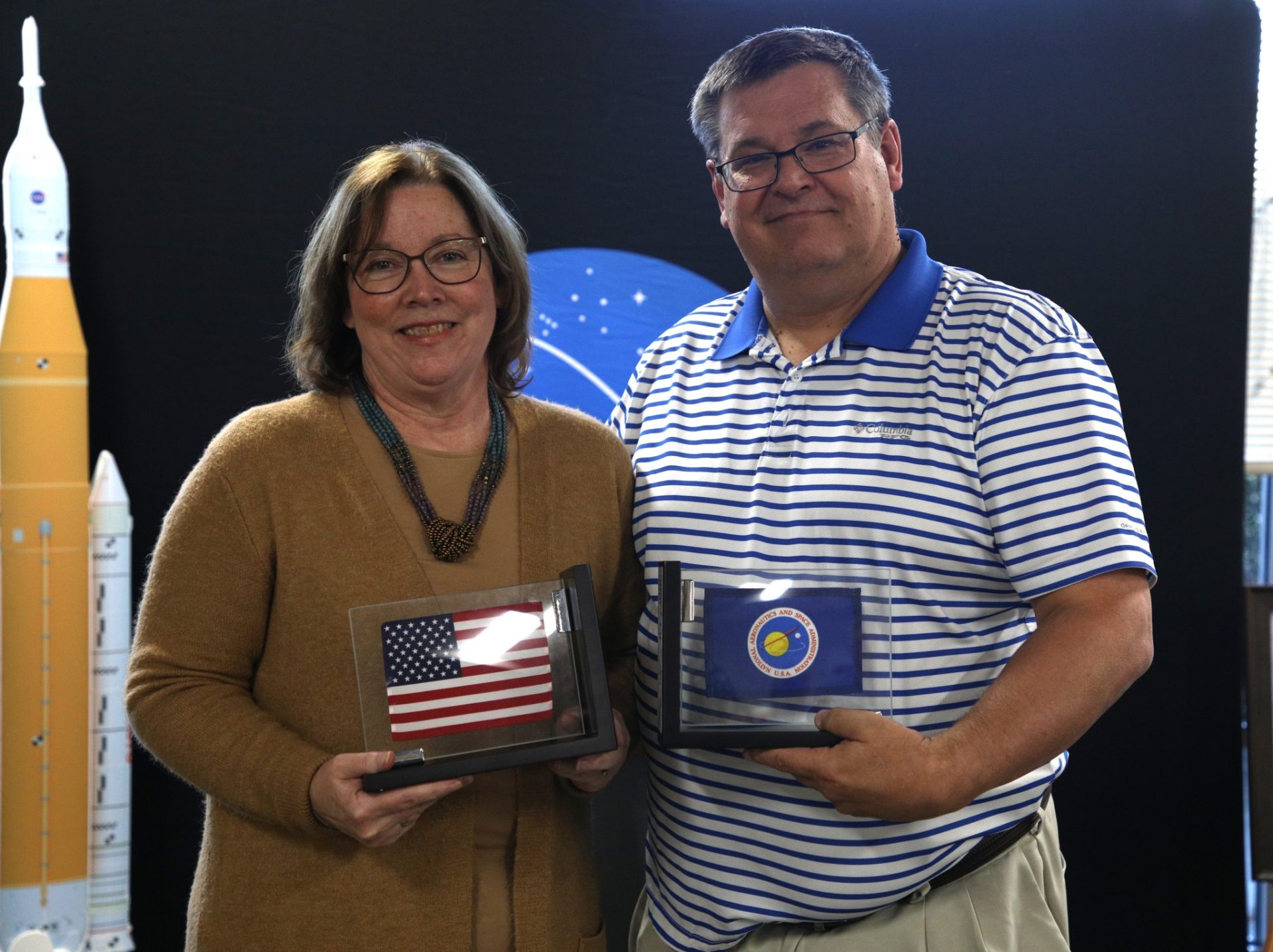
Mary Beth Koelbl, the first woman to serve as director of the Engineering Directorate at NASA’s Marshall Space Flight Center, celebrated her retirement among Marshall team members and family Nov. 2. Koelbl retires after serving 37 years at Marshall.
Marshall Associate Director, Technical, Larry Leopard gave a speech in honor of Koelbl’s impactful career. Both Leopard and Holder stressed how Koelbl’s personable character and great collaborative efforts made her career and teams successful.
NASA’s Marshall Space Flight Center Associate Director, Technical, Larry Leopard, right, presents Mary Beth Koelbl with bookends for her retirement. Encapsulated in them are flags that were flown in space.
NASA/Celine Smith
“Mary Beth has provided outstanding public service to not only engineering but to the center,” Leopard said. “She has been a standard for everybody to follow.”
Appointed to the position in July 2019, Koelbl helped oversee Marshall’s largest organization, comprised of more than 2,000 civil servants and contractors responsible for the design, testing, evaluation and operation of flight hardware and software associated with space transportation and spacecraft systems, science instruments and payloads now in development at Marshall. The directorate provides critical support to NASA’s SLS (Space Launch System) Program, which is managing the construction and testing of the world’s most powerful rocket.
Don Holder was named new director of engineering after previously serving in the role of deputy director under Koelbl.
“Mary Beth Koelbl’s positive attitude toward people and caring about their development has benefited the organization tremendously,” Holder said.
Prior to this appointment, Koelbl was director of the Propulsion Systems Department from 2015 to 2019. In that position, she also served as NASA’s senior executive overseeing the agency’s chemical propulsion capability, leading work across multiple field centers to effectively develop, mature, and apply chemical propulsion capabilities in support of NASA’s missions.
Throughout her NASA career, Koelbl has supported large, complex propulsion systems development and operations efforts for SLS, NASA’s Commercial Crew Program, and various planetary lander development activities. She also contributed to historic efforts such as the space shuttle main engine technology test bed, the Fastrac 60K engine, all shuttle propulsion elements, the Altair spacecraft, and the Ares launch vehicle upper stage and upper stage engine.
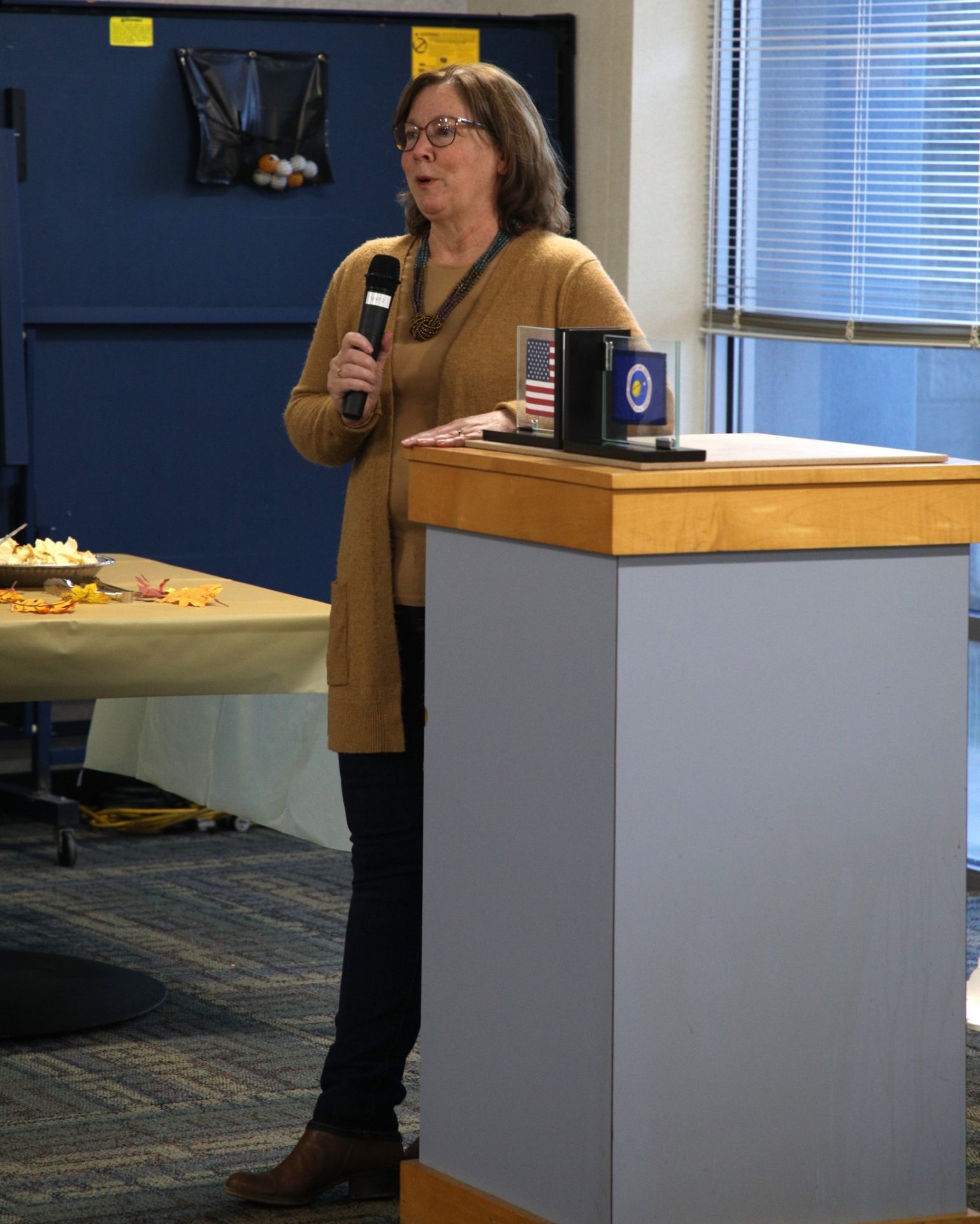
Koelbl extends a thanks to her team members and fondly speaks about her career during her retirement celebration held Nov. 2 in the Building 4203 cafeteria.
NASA/Celine Smith
Koelbl joined Marshall in 1986 as an aerospace engineer in the Turbomachinery and Combustion Devices Branch. She was named deputy group lead of the Engineering Directorate’s Engine Systems Engineering Group in 2000 and group leader in 2003. In 2005, following a center wide reorganization, Koelbl was named branch chief of the Engine and Main Propulsion Systems Branch. She was promoted to division chief of the Propulsion Systems Division in 2011, and later that year was named to the Senior Executive Service position of deputy director of the Propulsion Systems Department. The Senior Executive Service is the personnel system covering most of the top managerial positions in federal agencies.
“I have no plans of working after retirement because nothing could be better than this,” Koelbl said in her closing remarks at the reception.
A native of Iowa City, Iowa, Koelbl earned a bachelor’s degree in mechanical engineering in 1985 from the University of Iowa. She has been the recipient of many prestigious awards, including a NASA Exceptional Service Medal in 2018, NASA Leadership Medal in 2007, Space Flight Awareness Award in 2005, and Silver Snoopy in 1996.
Koelbl and her husband, Terry, who is also a NASA engineer at Marshall, reside in Madison with their three sons. She plans on enjoying her retirement by spending time with her children and grandchildren.
“I’m surely going to miss the people at Marshall – they’re the best,” Koelbl said.
Smith, a Media Fusion employee, supports the Marshall Office of Communications.
Don Holder Named Director of Marshall’s Engineering Directorate
Don Holder has been named director of the Engineering Directorate at NASA’s Marshall Space Flight Center.
In his new role, Holder will be responsible for the center’s largest organization, comprised of more than 2,000 civil service and contractor personnel, leading the design, testing, evaluation, and operation of flight hardware and software associated with space transportation, spacecraft systems, science instruments, and payloads under development at the center.
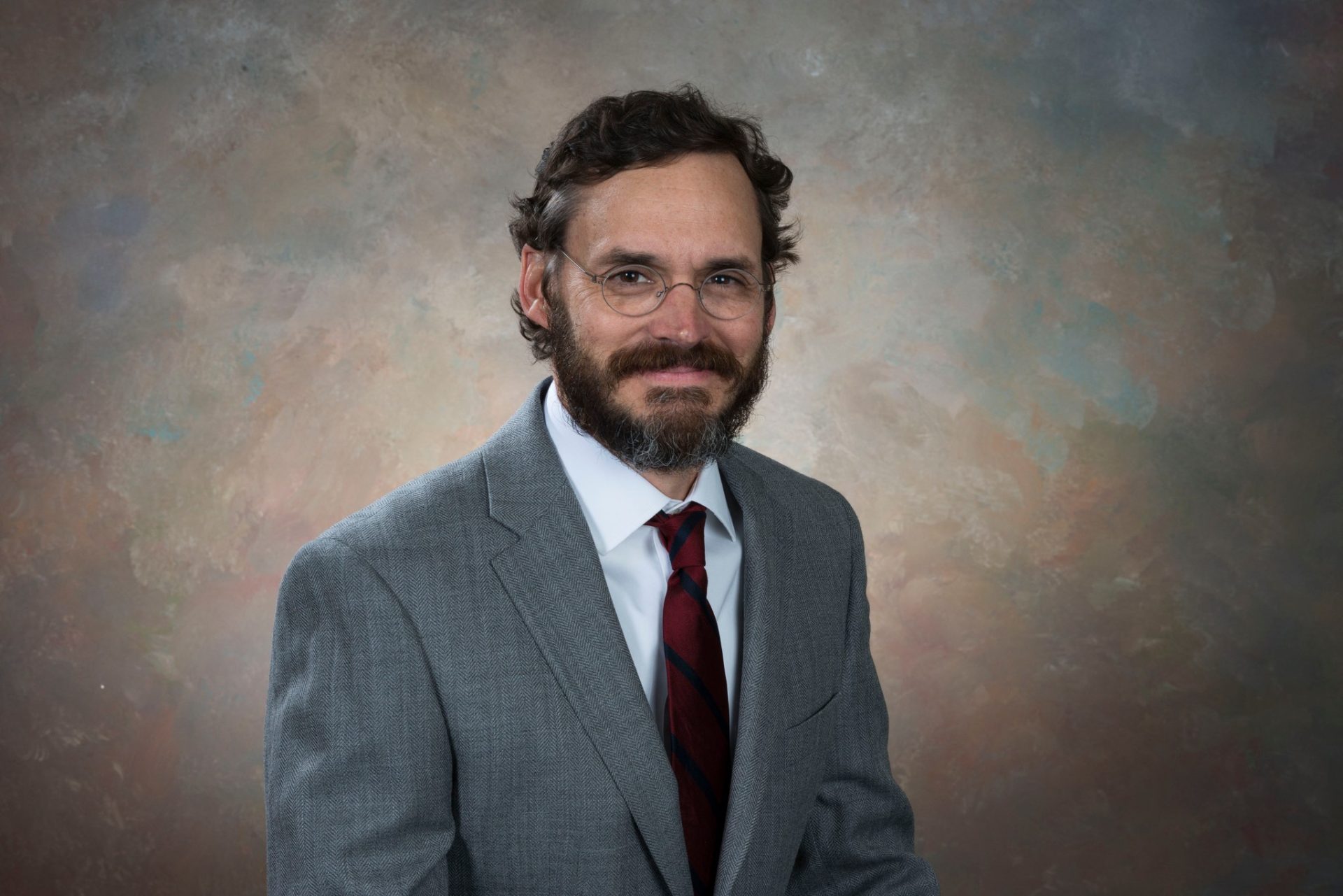
Don Holder, director of the Engineering Directorate at NASA’s Marshall Space Flight Center.
NASA
He previously served as the Engineering Directorate’s deputy director.
Holder joined Marshall in 1986 as a quality engineer supporting the Shuttle Propulsion Office. Since then, he has served in a multitude of technical leadership roles and has distinguished himself as a subject matter expert in ECLSS (Environmental Control and Life Support Systems). From 1989 to 1999, he served as a water recovery systems engineer supporting the development of water recovery technologies for the International Space Station.
Holder supported the ECLSS Project in positions of increasing scope and responsibility, including ECLSS Design team lead, technical assistant, and assistant chief engineer from 2000 to 2008.
In 2008, Holder was assigned as a project chief engineer for the space station, providing leadership for Marshall-provided flight hardware. From 2011 to 2013, he served as chief of the Mechanical Fabrication Branch in the Space Systems Department where he led a workforce of engineers and technicians and managed the numerous facilities required to support Marshall’s manufacturing needs.
Holder served as deputy chief engineer of the FPPO (Flight Programs and Partnerships Office) from 2013 to 2014 until being appointed to the Senior Level position of FPPO chief engineer in mid-2014 and subsequently Human Exploration Development and Operations chief engineer in 2017. He served as deputy director of the Space Systems Department from May 2019 to February 2021.
Lisa Bates Named Deputy Director of Marshall’s Engineering Directorate
Lisa Bates has been named deputy director of the Engineering Directorate at NASA’s Marshall Space Flight Center.
In her new role, Bates will be jointly responsible for the center’s largest organization, comprised of more than 2,000 civil service and contractor personnel, who design, test, evaluate, and operate flight hardware and software associated with Marshall-developed space transportation and spacecraft systems, science instruments, and payloads.
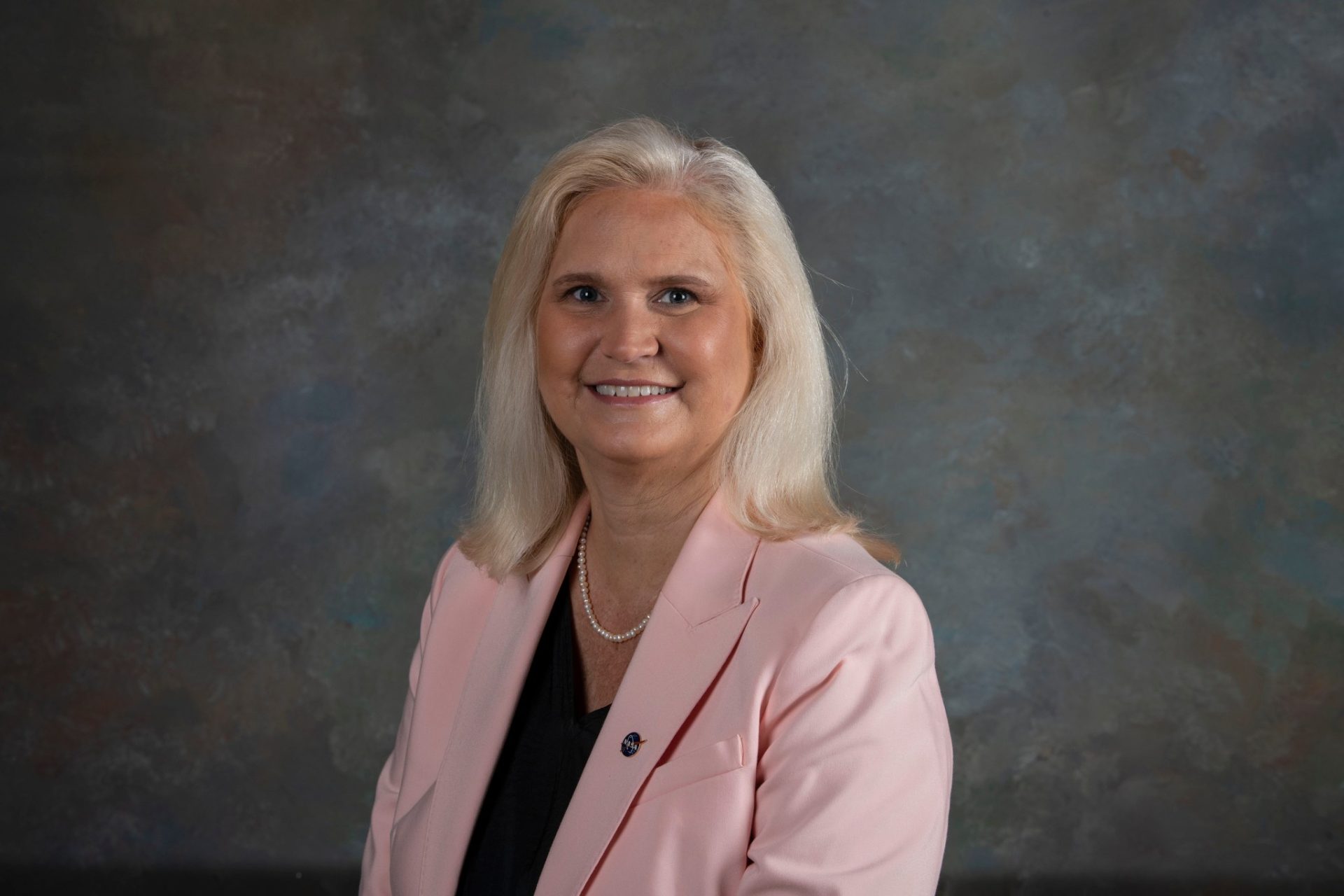
Portrait: Lisa Bates
NASA
She was previously director of Marshall’s Test Laboratory. Appointed to the position in 2021, Bates provided executive leadership for all aspects of the Laboratory, including workforce, budget, infrastructure, and operations for testing.
She joined Marshall in 2008 as the Ares I Upper Stage Thrust Vector Control lead in the Propulsion Department. Since then, she has served in positions of increasing responsibility and authority. From 2009 to 2017, she served as the first chief of the new TVC Branch, which was responsible for defining operational requirements, performing analysis, and evaluating Launch Vehicle TVC systems and TVC components.
As the Space Launch System (SLS) Program Executive from 2017 to 2018, Bates supported the NASA Deputy Associate Administrator for Exploration Systems Development as the liaison and advocate of the SLS. Upon returning to MSFC in 2018, she was selected as deputy manager of the SLS Booster Element Office. Bates also served as deputy manager of the SLS Stages Office from 2018 to 2021 where she shared the responsibilities, accountability, and authorities for all activities associated with the requirements definition, design, development, manufacturing, assembly, green run test, and delivery of the SLS Program’s Stages Element.
Prior to her NASA career, Bates worked 18 years in private industry for numerous aerospace and defense contractors, including Jacobs Engineering, Marotta Scientific Controls, United Technologies (USBI), United Defense, and Sverdrup Technologies.
She holds a bachelor’s degree in mechanical engineering from the University of Alabama in Huntsville. She was awarded a NASA Outstanding Leadership Medal in 2013 and 2022 and has received numerous group and individual achievement awards. Bates and her husband, Don, reside in Madison and have four children.
Michoud Celebrates Family Day 2023 with Treats and No Tricks
By Matt Higgins
For the second consecutive year, NASA’s Michoud Assembly Facility hosted Family Day, a day when team members can invite their families to visit “America’s Rocket Factory.”
This year’s Family Day was Oct. 28.
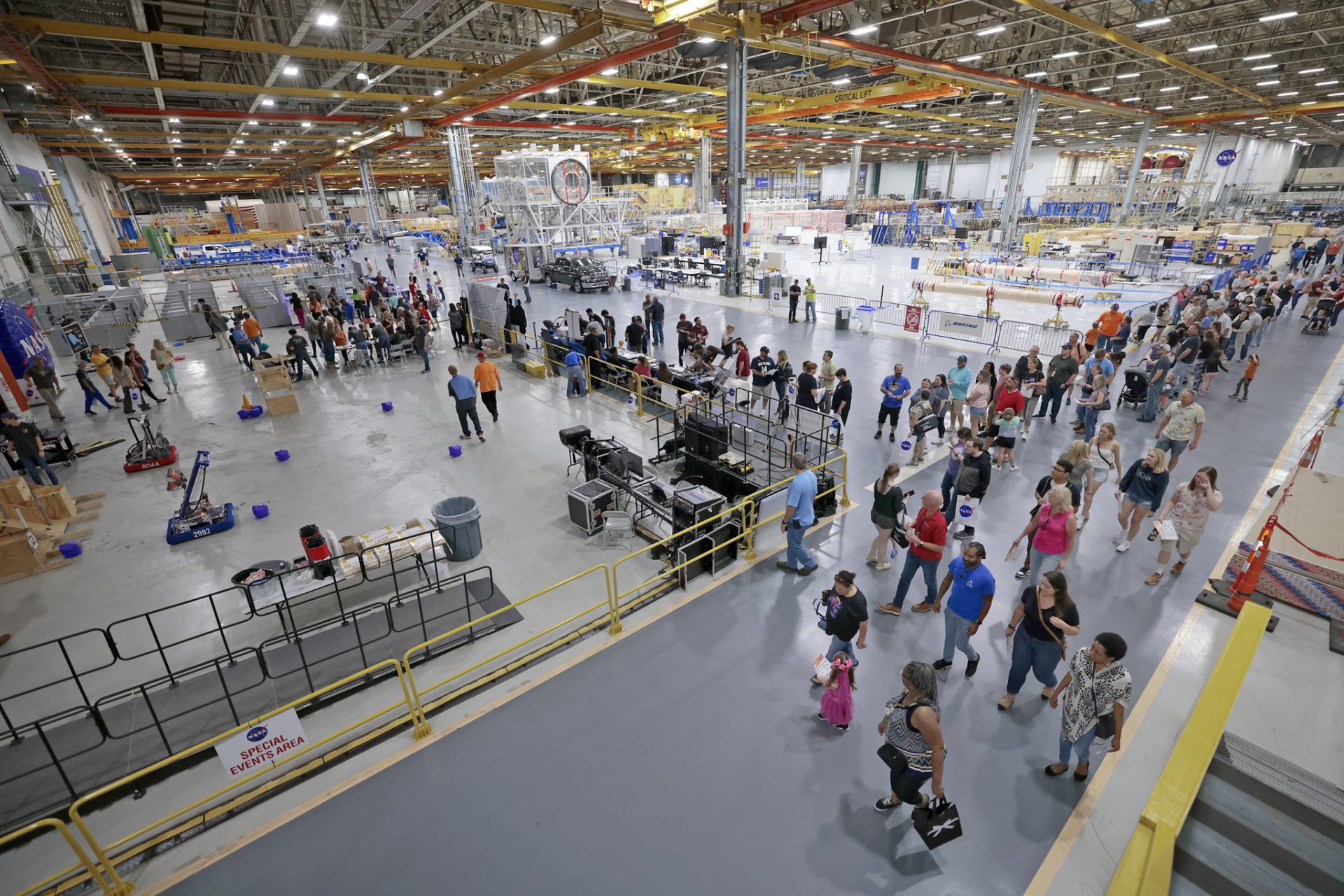
Thousands attend Michoud Family 2023 on Oct. 28 to observe Artemis production, interact with Michoud tenants, and enjoy Halloween festivities.
NASA/Michael DeMocker
“Family Day 2023 was a huge success,” said Michoud Director Lonnie Dutreix. “I enjoyed seeing the employees bring their families and seeing the looks of awe and smiling faces all around.”
Family Day occurred the weekend before Halloween. Team members and their families had the opportunity to view the latest stages of production in the 43-acre factory, including the fully assembled core stage for NASA’s SLS (Space Launch System) rocket for NASA’s Artemis II mission, and were treated to trunk-or-treat as they exited the factory. Michoud passed out candy and Moon Pies to trick-or-treaters of all ages.
“Family Day 2023 was an opportunity to build on last year’s success,” said Heather Keller, Michoud communications strategist and Family Day coordinator. “We even took advantage of the holiday weekend to include a trunk-or-treat for the kids.”
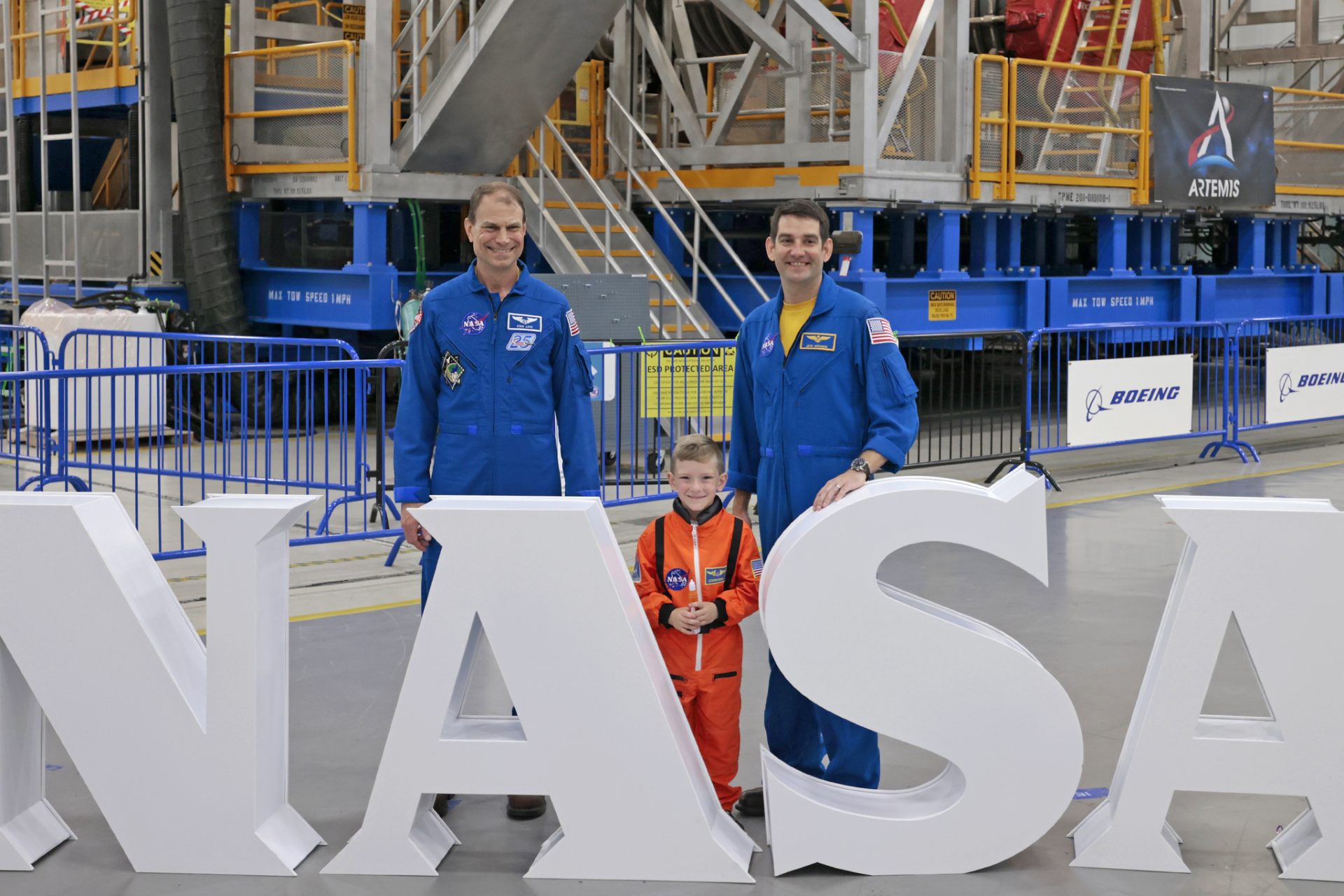
NASA astronaut Stan Love, left, and astronaut candidate Jack Hathaway pose for pictures with a young attendee at Michoud Family Day.
NASA/Michael DeMocker
Mother Nature spared the heavy rains that occurred during Family Day 2022. The lack of rain and threatening skies allowed for more displays and attractions. There were food trucks outside the factory gates, and a Coast Guard Sikorsky MH-60 Jayhawk helicopter landed on the facility grounds. Attendees viewed the distinct orange and white helicopter up close, sat inside, and took pictures. NASA astronaut Stan Love and astronaut candidate Jack Hathaway took pictures with families in front of the SLS core stage for Artemis II in the Final Assembly area.
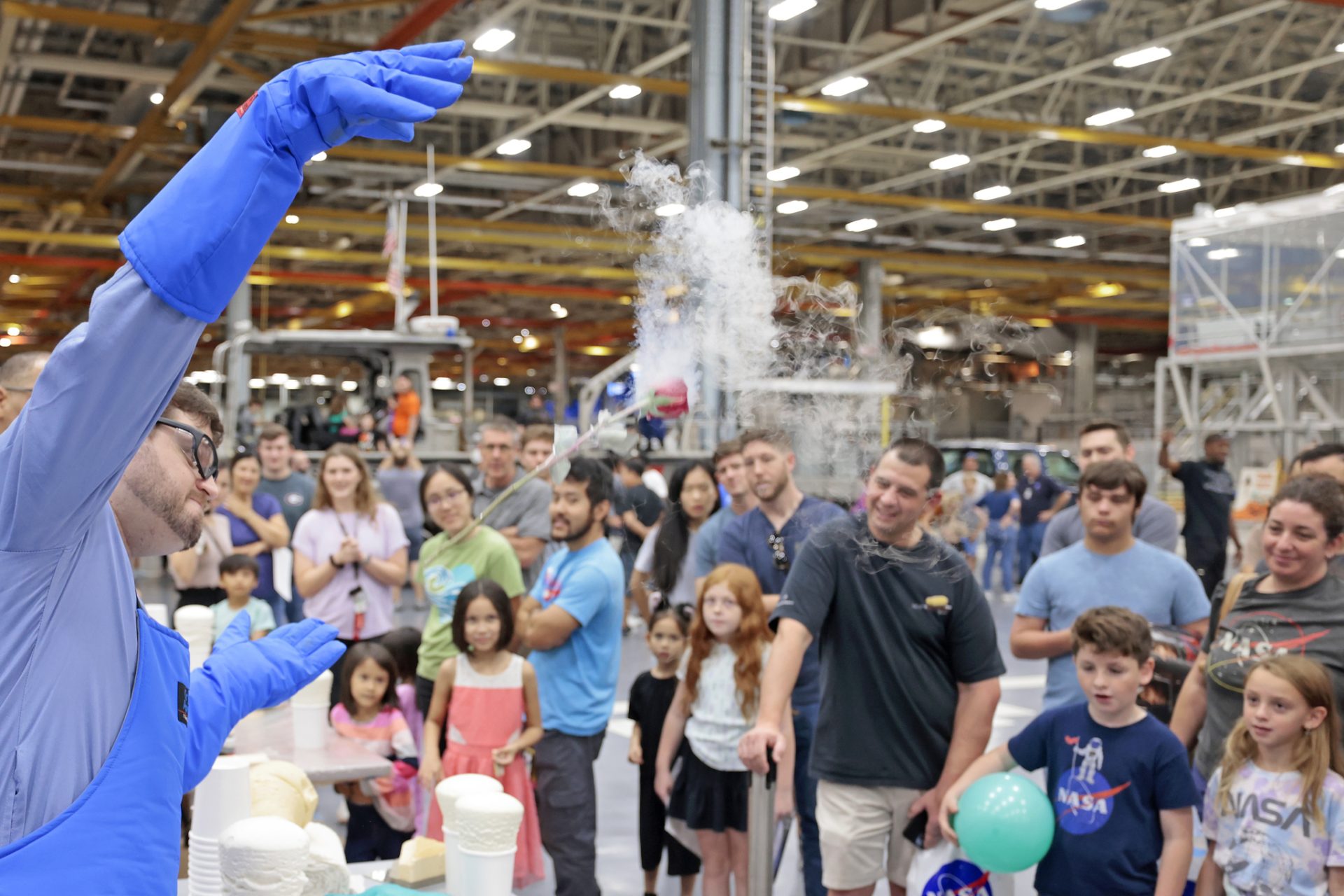
Michoud’s tenants, including its prime contractors Boeing and Lockheed Martin, set up booths and provided swag for those who passed by. Some tenants included interactive virtual reality displays and science experiments.
“With the addition of astronauts, a USCG rescue helicopter, food trucks, and emergency and heavy equipment static displays, there really was something for everyone,” Keller said.
Attendees observe a liquid nitrogen demonstration at the Boeing table at Michoud Family Day.
NASA/Michael DeMocker
Prior to 2022’s celebration, Michoud Family Day hadn’t occurred since before the COVID-19 pandemic, and strong thunderstorms kept many people away in 2022. It meant that this year’s event was the first time many family members had seen Michoud in years and the first for many others. Organizers estimated more than 5,000 attended the event.
For Dutreix, it marked one of the final major events of his tenure. He will retire in December.
“It’s my last Family Day as director,” he said. “I’m going to miss it, but I’m proud of the family atmosphere we have at Michoud. The workforce looks out for each other, and we’re committed to seeing Artemis succeed.”
Higgins, a Manufacturing Technical Solutions Inc. employee, works in communications at Michoud Assembly Facility.
Watch Crews Add RS-25 Engines to NASA Artemis II SLS Rocket
Artemis II reached a significant milestone as teams fully installed all four RS-25 engines to the 212-foot-tall core stage for NASA’s SLS (Space Launch System) rocket at NASA’s Michoud Assembly Facility.
During Artemis II, the four engines, arranged like legs on a chair at the bottom of the mega rocket, will fire for eight minutes at launch, producing more than 2 million pounds of thrust to send the Artemis II crew around the Moon.
Boeing is the lead contractor for the SLS core stage. Aerojet Rocketdyne, an L3Harris Technologies company, is the lead contractor for the SLS engines. NASA’s Marshall Space Flight Center manages the SLS Program and Michoud.
NASA Telescopes Discover Record-breaking Black Hole
Astronomers have discovered the most distant black hole yet seen in X-rays, using NASA telescopes. The black hole is at an early stage of growth that had never been witnessed before, where its mass is similar to that of its host galaxy.
This result may explain how some of the first supermassive black holes in the universe formed.
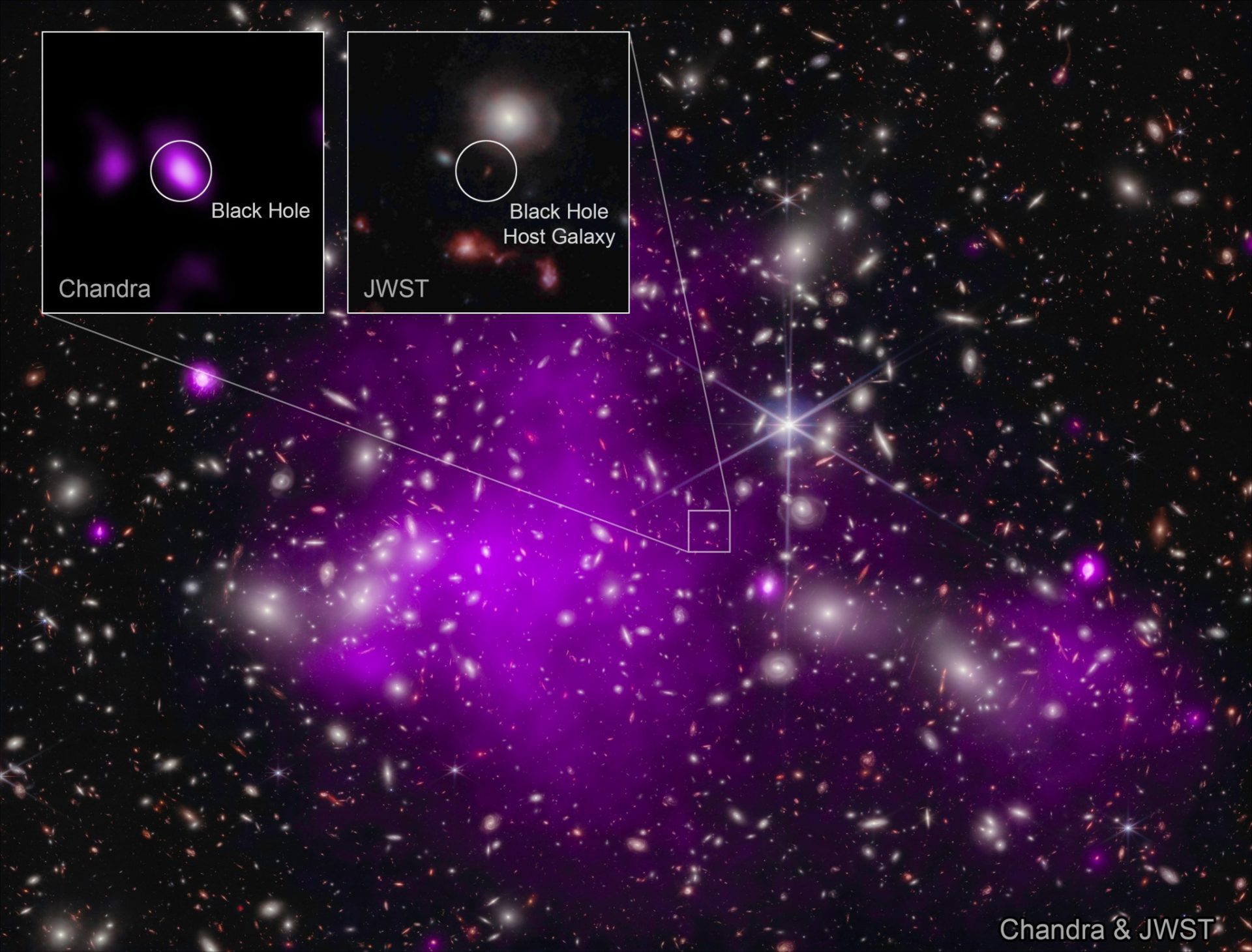
By combining data from NASA’s Chandra X-ray Observatory and NASA’s James Webb Space Telescope, a team of researchers was able to find the telltale signature of a growing black hole just 470 million years after the big bang.
Astronomers found the most distant black hole ever detected in X-rays (in a galaxy dubbed UHZ1) using the Chandra and Webb space telescopes. X-ray emission is a telltale signature of a growing supermassive black hole. This result may explain how some of the first supermassive black holes in the universe formed. These images show the galaxy cluster Abell 2744 that UHZ1 is located behind, in X-rays from Chandra and infrared data from Webb, as well as close-ups of the black hole host galaxy UHZ1.
“We needed Webb to find this remarkably distant galaxy and Chandra to find its supermassive black hole,” said Akos Bogdan of the Center for Astrophysics | Harvard & Smithsonian (CfA) who leads a new paper in the journal Nature Astronomy describing these results. “We also took advantage of a cosmic magnifying glass that boosted the amount of light we detected.” This magnifying effect is known as gravitational lensing.
Bogdan and his team found the black hole in a galaxy named UHZ1 in the direction of the galaxy cluster Abell 2744, located 3.5 billion light-years from Earth. Webb data, however, has revealed the galaxy is much more distant than the cluster, at 13.2 billion light-years from Earth, when the universe was only 3% of its current age.
Then over two weeks of observations with Chandra showed the presence of intense, superheated, X-ray emitting gas in this galaxy – a trademark for a growing supermassive black hole. The light from the galaxy and the X-rays from gas around its supermassive black hole are magnified by about a factor of four by intervening matter in Abell 2744 (due to gravitational lensing), enhancing the infrared signal detected by Webb and allowing Chandra to detect the faint X-ray source.
This discovery is important for understanding how some supermassive black holes can reach colossal masses soon after the big bang. Do they form directly from the collapse of massive clouds of gas, creating black holes weighing between about 10,000 and 100,000 Suns? Or do they come from explosions of the first stars that create black holes weighing only between about 10 and 100 Suns?
“There are physical limits on how quickly black holes can grow once they’ve formed, but ones that are born more massive have a head start. It’s like planting a sapling, which takes less time to grow into a full-size tree than if you started with only a seed”, said Andy Goulding of Princeton University. Goulding is a co-author of the Nature Astronomy paper and lead author of a new paper in The Astrophysical Journal Letters that reports the galaxy’s distance and mass using a spectrum from Webb.
Bogdan’s team has found strong evidence that the newly discovered black hole was born massive. Its mass is estimated to fall between 10 and 100 million Suns, based on the brightness and energy of the X-rays. This mass range is similar to that of all the stars in the galaxy where it lives, which is in stark contrast to black holes in the centers of galaxies in the nearby universe that usually contain only about a tenth of a percent of the mass of their host galaxy’s stars.
The large mass of the black hole at a young age, plus the amount of X-rays it produces and the brightness of the galaxy detected by Webb, all agree with theoretical predictions in 2017 by co-author Priyamvada Natarajan of Yale University for an “Outsize Black Hole” that directly formed from the collapse of a huge cloud of gas.
“We think that this is the first detection of an ‘Outsize Black Hole’ and the best evidence yet obtained that some black holes form from massive clouds of gas,” said Natarajan. “For the first time we are seeing a brief stage where a supermassive black hole weighs about as much as the stars in its galaxy, before it falls behind.”
The researchers plan to use this and other results pouring in from Webb and those combining data from other telescopes to fill out a larger picture of the early universe.
NASA’s Hubble Space Telescope previously showed that light from distant galaxies is highly magnified by matter in the intervening galaxy cluster, providing part of the motivation for the Webb and Chandra observations described here.
The paper describing the results by Bogdan’s team appears in Nature Astronomy, and a preprint is available online.
The Webb data used in both papers is part of a survey called the Ultradeep Nirspec and nirCam ObserVations before the Epoch of Reionization (UNCOVER). The paper led by UNCOVER team member Andy Goulding appears in the Astrophysical Journal Letters. The co-authors include other UNCOVER team members, plus Bogdan and Natarajan. A detailed interpretation paper that compares observed properties of UHZ1 with theoretical models for Outsize Black Hole Galaxies is forthcoming.
NASA’s Marshall Space Flight Center manages the Chandra program. The Smithsonian Astrophysical Observatory’s Chandra X-ray Center controls science operations from Cambridge, Massachusetts, and flight operations from Burlington, Massachusetts.
The James Webb Space Telescope is the world’s premier space science observatory. Webb is solving mysteries in our solar system, looking beyond to distant worlds around other stars, and probing the mysterious structures and origins of our universe and our place in it. Webb is an international program led by NASA with its partners, ESA (European Space Agency) and the Canadian Space Agency.
NASA’s Lucy spacecraft got a surprise when it flew by asteroid Dinkinesh on Nov. 1 – the first of multiple asteroids Lucy will visit on its 12-year voyage. The mission is featured in “This Week @ NASA,” a weekly video program broadcast on NASA-TV and posted online.
Images captured by Lucy revealed that Dinkinesh is not just a single asteroid, as was thought, but a binary pair. The primary aim of the Lucy mission is to survey the Jupiter Trojan asteroids, a never-before-explored population of small bodies that orbit the Sun in two “swarms” that lead and follow Jupiter in its orbit.
NASA’s Goddard Space Flight Center provides overall mission management, systems engineering, and safety and mission assurance. Lockheed Martin Space in Littleton, Colorado, built the spacecraft. Lucy is the 13th mission in NASA’s Discovery Program. NASA’s Marshall Space Flight Center manages the Discovery Program for the Science Mission Directorate at NASA Headquarters.
View this and previous episodes at “This Week @NASA” on NASA’s YouTube page.
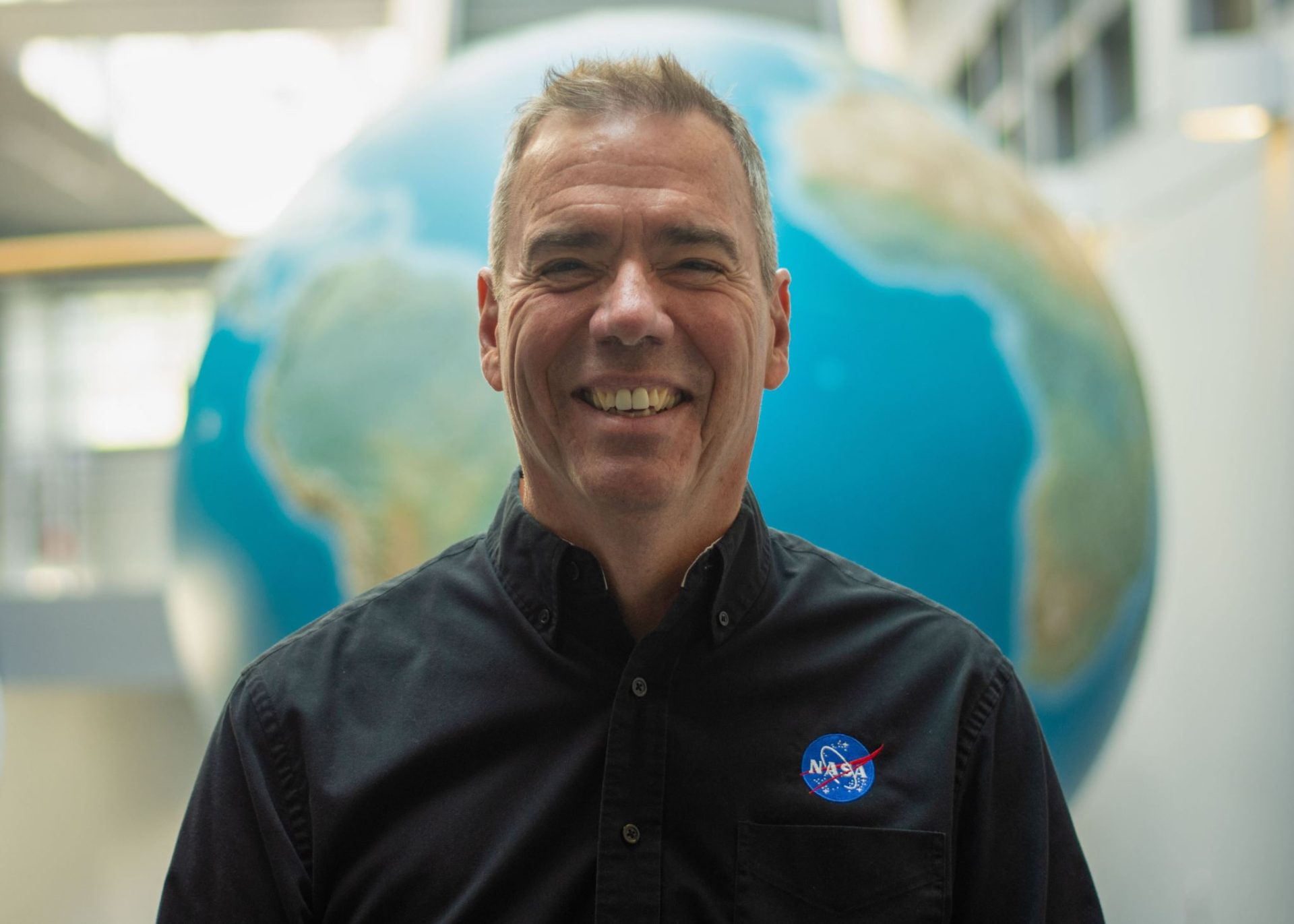
Dr. Peter Griffith is the director of NASA’s Carbon Cycle and Ecosystems Office. “As a scientist, I started off in the water and then gradually moved to on top of the water, and then ultimately went up into the air and into space, at least with the instrument eyes that we have on the world,” he said. “In some respects, I was a carbon cycle scientist since before it was cool.”
NASA / Angeles Miron
Name: Peter Griffith
Title: Director, NASA Carbon Cycle and Ecosystems Office
I lead NASA’s Carbon Cycle and Ecosystems Office, which is in the Biospheric Sciences Laboratory at Goddard. We answer to NASA Headquarters, we support the Carbon Cycle and Ecosystems Focus area, and we support different elements of the funded program that comes out of that. To a great extent, we support the terrestrial ecology program, but also ocean biology and biogeochemistry, biodiversity, the Carbon Monitoring System, and some application work.
A lot of our work consists of supporting field campaigns. These are activities where dozens and sometimes hundreds of investigators go out into amazing parts of the world and do the work on the ground – or on the water – to have an up-close view of what’s happening in critical parts of the planet and couple that fine-scale information with observations from remote sensing instruments on aircraft and ultimately on satellites.
What do you do on a day-to-day basis?
One of the really fun things I get to do is coordinate with our teams that are out in the field and the flight crews. We’ve got an aircraft, a relatively small twin-engine turboprop that’s flown in Alaska with an instrument called AVIRIS, a very fancy camera that sees lots of colors and makes images from it that have far more wavelengths than what your cell phone camera has in it. It’s called an imaging spectrometer. We fly that to look at vegetation characteristics and methane emissions across Alaska and some parts of Canada.
A couple months ago, I got to go up and spend some time in Fairbanks working with the instrument crew from NASA’s Jet Propulsion Laboratory in Southern California and the flight crew and fine-tune when and where we would fly each day. I don’t do lab work or very much field work at this point, so an awful lot of it is coordination with scientists and engineers to help us go to the right places and measure the right things.
How did your path to Goddard start?
I was a kid growing up in the in the Apollo program era, and I lived in my parents’ house on a lake in Central Florida about 50 miles from Cape Canaveral. A lot of my childhood consisted of catching alligators in the lake and watching Saturn V rockets take off. It was very exciting.
Because I was a giant nerd with big, thick glasses, being an astronaut was completely off the table, I knew that. But that whole thing about swimming in the lake took me in, ultimately, into being a scuba diver and going into marine biology. As a scientist, I started off in the water and then gradually moved to on top of the water, and then, ultimately went up into the air and into space, at least with the instrument eyes that we have on the world. In some respects, I was a carbon cycle scientist since before it was cool.
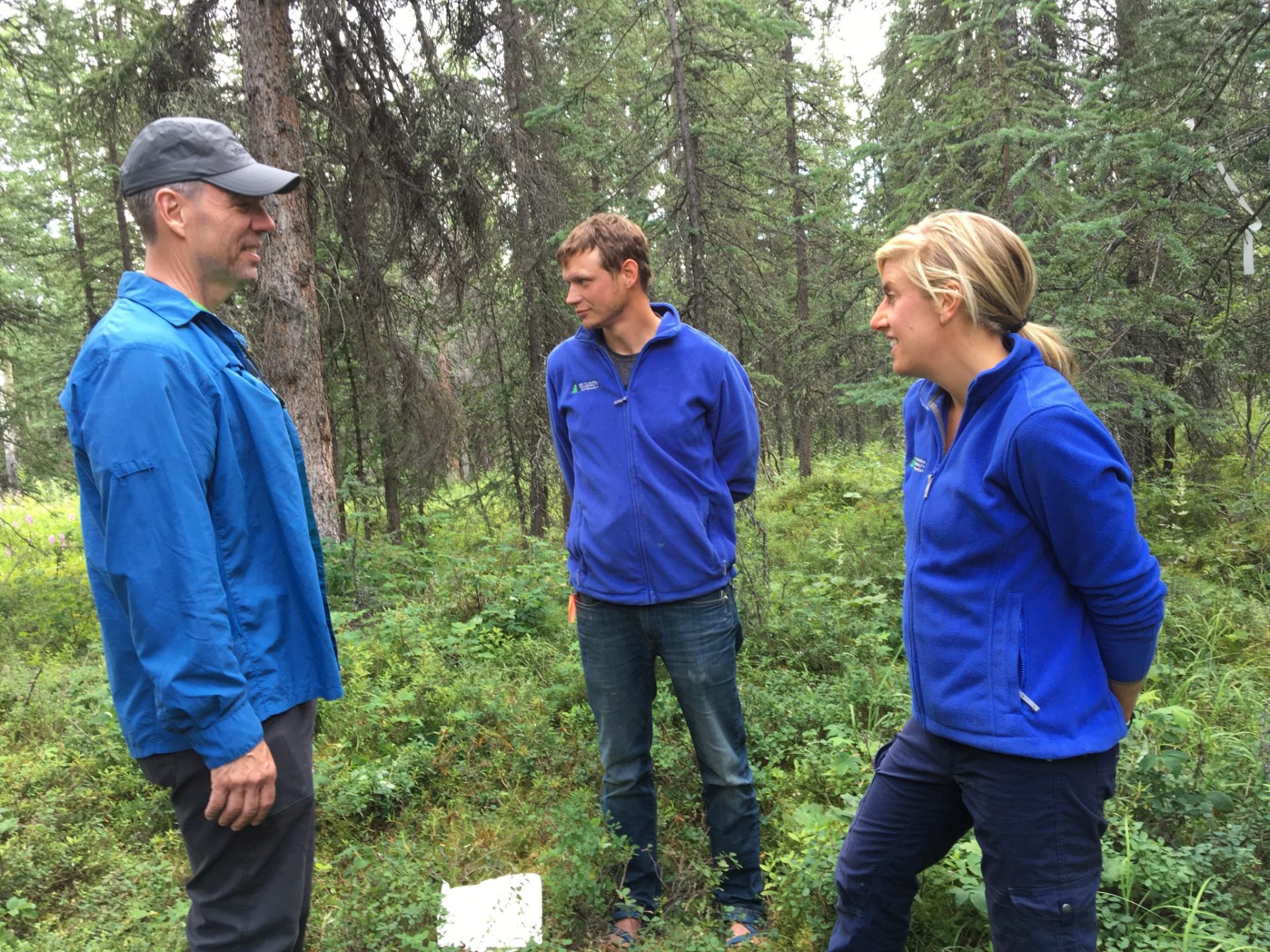
Peter Griffith, Brian Howard and Xanthe Walker discuss field work in Denali National Park during a 2016 expedition.
NASA / Kate Ramsayer
Do you have any cool stories from the field?
Oh, boy. We have several 100 investigators that have been funded over the years and probably 100 or more who are involved in one way or another, and I probably credit a lot of them for having the coolest stories, But in my own role, I’ve had conversations and consultations with federal and state and local folks in Alaska and Canada about where and when we fly our airborne instruments, so in the course of that, I’ve had the chance to talk with representatives from First Nations about what their concerns are. It’s been really interesting for me, very broadening of my knowledge from my narrow view as a scientist. We like to think we know a lot of things, but in talking with many of our Indigenous partners, I continue to learn that there are a lot of things that we don’t know, and that I don’t know.
One of the great things about this job is getting to learn new things all the time. Sometimes it’s about new satellites or new ways of using different kinds of radar and lidar to observe the planet. That is certainly a stimulating part of the job, but another really stimulating part of the job is getting to know people and getting to see their world and hear them explain how they see the world through their eyes.
Do you ever miss doing field work?
That’s a really good question. It’s a challenge because, there are a lot of sacrifices that you make as a field scientist. It may put you a very long way away from your family, for instance. One of the reasons, actually, that I moved into project management was that it gave me a better work-life balance at a time when I had small kids.
It’s been so fun working at Goddard Space Flight Center. There are still times when – and particularly after having to work remotely for a while – that I come on campus and see the great, big NASA emblem on the side of the High Bay Clean Room building and I go, “I can’t believe I get to work here.”
Conversations With Goddard is a collection of Q&A profiles highlighting the breadth and depth of NASA’s Goddard Space Flight Center’s talented and diverse workforce. The Conversations have been published twice a month on average since May 2011. Read past editions on Goddard’s “Our People” webpage.
By Ananya Udaygiri NASA’s Goddard Space Flight Center, Greenbelt, Md.
Casey Denham, aerospace engineer with the Systems Analysis and Concepts Directorate at NASA’s Langley Research Center in Hampton, Virginia, works with tribal students during a STEM activity at the American Indian Engineering Sciences (AISES) National Conference in Spokane, Washington, Oct. 19-21, 2023. Denham, whose heritage is Meskwaki, was part of a NASA group that presented sessions and shared their passion about their work with more than 3500 attendees. Denham was previously a Pathways Intern at Langley.
An unusually high tide, called a King Tide, floods a highway on-ramp in Northern California in January 2023. Sea level rise and El Niños can exacerbate this type of flooding.
California King Tides Project
Such high-tide flooding that inundates roads and buildings along the west coast of the Americas tends to be uncommon outside of ElNiño years, but that could change by the 2030s.
An analysis by NASA’s sea level change science team finds that if a strong El Niño develops this winter, cities along the western coasts of the Americas could see an increase in the frequency of high-tide flooding that can swamp roads and spill into low-lying buildings.
El Niño is a periodic climate phenomenon characterized by higher-than-normal sea levels and warmer-than-average ocean temperatures along the equatorial Pacific. These conditions can spread poleward along the western coasts of the Americas. El Niño, which is still developing this year, can bring more rain than usual to the U.S. Southwest and drought to countries in the western Pacific like Indonesia. These impacts typically occur in January through March.
The NASA analysis finds that a strong El Niño could result in up to five instances of a type of flooding called a 10-year flood event this winter in cities including Seattle and San Diego. Places like La Libertad and Baltra in Ecuador could get up to three of these 10-year flood events this winter. This type of flooding doesn’t normally occur along the west coast of the Americas outside of El Niño years. The researchers note that by the 2030s, rising seas and climate change could result in these cities experiencing similar numbers of 10-year floods annually, with no El Niño required.
Data from the SWOT satellite shows sea level anomalies – how much higher or lower sea levels are compared to the average height – off the coast of Ecuador and Peru on Aug. 12, 2023, and Oct. 3, 2023. The data indicates the development of an El Niño along the west coast of the Americas.
NASA/JPL-Caltech
“I’m a little surprised that the analysis found these 10-year events could become commonplace so quickly,” said Phil Thompson, an oceanographer at the University of Hawaii and a member of NASA’s sea level change science team, which performed the analysis. “I would have thought maybe by the 2040s or 2050s.”
Ten-year floods are those that have a one in 10 chance of occurring in any given year. They’re a measure of how high local sea levels become: The extent of flooding in a particular city or community depends on several factors, including a region’s topography and the location of homes and infrastructure relative to the ocean. Ten-year floods can result in what the National Oceanic and Atmospheric Administration classifies as moderate flooding, with some inundation of roads and buildings, and the possible need to evacuate people or move belongings to higher ground.
NASA’s coastal flooding analysis finds that by the 2030s, during strong El Niño years, cities on the west coast of the Americas could see up to 10 of these 10-year flood events. By the 2050s, strong El Niños may result in as many as 40 instances of these events in a given year.
Watching Sea Levels Rise
Water expands as it warms, so sea levels tend to be higher in places with warmer water. Researchers and forecasters monitor ocean temperatures as well as water levels to spot the formation and development of an El Niño.
“Climate change is already shifting the baseline sea level along coastlines around the world,” said Ben Hamlington, a sea level researcher at NASA’s Jet Propulsion Laboratory in Southern California and lead for the agency’s sea level change science team.
Sea levels are rising in response to planetary warming, as Earth’s atmosphere and ocean are heating up and ice sheets and shelves melt. This has already increased the number of high-tide, or nuisance, flooding days coastal cities experience throughout the year. Phenomena like El Niños and storm surges, which temporarily boost sea levels, compound these effects.
Missions that monitor sea levels, including the Surface Water and Ocean Topography (SWOT) satellite and Sentinel-6 Michael Freilich, help to monitor El Niños in the near term. SWOT in particular, collects data on sea levels right up to the coast, which can help to improve sea level rise projections. That kind of information could aid policymakers and planners in preparing their communities for rising seas in the next decades.
“As climate change accelerates, some cities will see flooding five to 10 times more often. SWOT will keep watch on these changes to ensure coastal communities are not caught off guard,” said Nadya Vinogradova Shiffer, SWOT program scientist and director of the ocean physics program at NASA Headquarters in Washington.
To learn more about how NASA studies sea level, visit:
Six Growing Beyond Earth Student Teams to Present at the 2023 American Association for Gravitational and Space Research Conference
To join Growing Beyond Earth, visit us www.fairchildgarden.org/gbe.
Credit: Fairchild Tropical Botanic Garden
Congratulations to the six Growing Beyond Earth high school teams who will present their original research at this year’s American Association for Gravitational and Space Research Conference in Washington D.C.! The teams represent Biotech@Richmond Heights (Miami FL), Herbert Henry Dow High School (Midland, MI), iMater Preparatory Academy High School (Hialeah, FL), and Institute for Collaborative Education (New York, NY). The student projects include:
Exploring Autonomous Sensing and Watering Systems,
Plant Growth and Gene Expression in Simulating Microgravity,
3D Printed Materials Property Impact on Plant Growth, and
Optimizing Light to Maximum Anthocyanin Content in Plants.
Growing Beyond Earth is a classroom-based citizen science project designed to advance NASA research on growing plants in space. For more information or to get involved, please visit: www.fairchildgarden.org/gbe.
A sounding rocket launched from Poker Flat Research Range in Fairbanks, Alaska, Nov. 8, 2023, carrying NASA’s Goddard Space Flight Center’s DISSIPATION mission. The rocket launched into aurora and successfully captured data to understand how auroras heat the atmosphere and cause high-altitude winds.
The teams continue to support a second sounding rocket launch for BEAM-PIE, a mission for Los Alamos National Laboratory that will use an electron beam to create radio waves, measuring how atmospheric conditions modulate them. The data is key to interpreting measurements from many other missions.
Scientists using NASA’s James Webb Space Telescope just made a breakthrough discovery in revealing how planets are made. By observing water vapor in protoplanetary disks, Webb confirmed a physical process involving the drifting of ice-coated solids from the outer regions of the disk into the rocky-planet zone.
Theories have long proposed that icy pebbles forming in the cold, outer regions of protoplanetary disks — the same area where comets originate in our solar system — should be the fundamental seeds of planet formation. The main requirement of these theories is that pebbles should drift inward toward the star due to friction in the gaseous disk, delivering both solids and water to planets.
A fundamental prediction of this theory is that as icy pebbles enter into the warmer region within the “snowline” — where ice transitions to vapor — they should release large amounts of cold water vapor. This is exactly what Webb observed.
“Webb finally revealed the connection between water vapor in the inner disk and the drift of icy pebbles from the outer disk,” said principal investigator Andrea Banzatti of Texas State University, San Marcos, Texas. “This finding opens up exciting prospects for studying rocky planet formation with Webb!”
“In the past, we had this very static picture of planet formation, almost like there were these isolated zones that planets formed out of,” explained team member Colette Salyk of Vassar College in Poughkeepsie, New York. “Now we actually have evidence that these zones can interact with each other. It’s also something that is proposed to have happened in our solar system.”
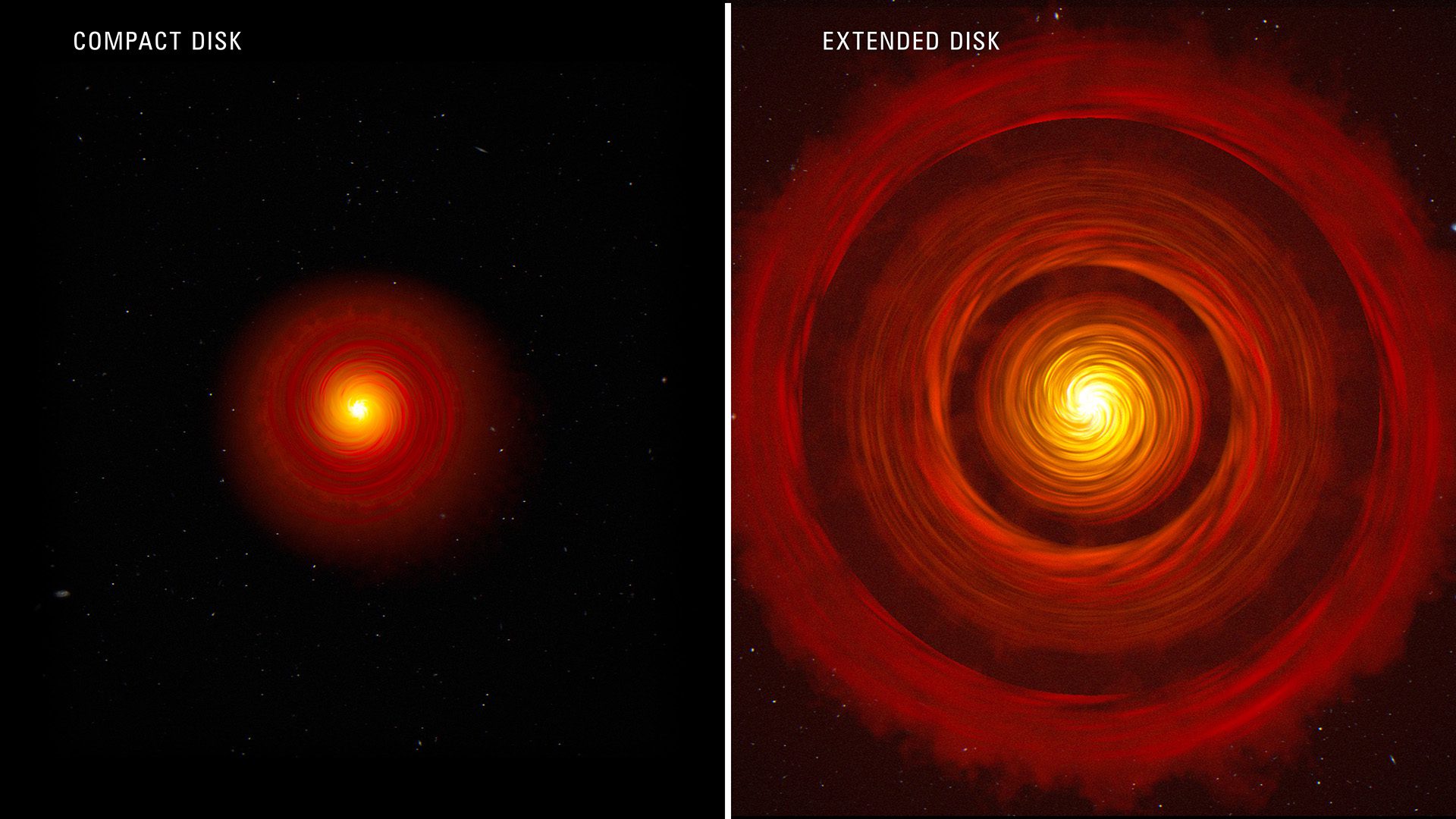
Image: Planet-forming Disks
Artist’s Concept: This artist’s concept compares two types of typical, planet-forming disks around newborn, Sun-like stars. On the left is a compact disk, and on the right is an extended disk with gaps. Scientists using Webb recently studied four protoplanetary disks—two compact and two extended. The researchers designed their observations to test whether compact planet-forming disks have more water in their inner regions than extended planet-forming disks with gaps. This would happen if ice-covered pebbles in the compact disks drift more efficiently into the close-in regions nearer to the star and deliver large amounts of solids and water to the just-forming, rocky, inner planets. Current research proposes that large planets may cause rings of increased pressure, where pebbles tend to collect. As the pebbles drift, any time they encounter an increase in pressure, they tend to collect there. These pressure traps don’t necessarily shut down pebble drift, but they do impede it. This is what appears to be happening in the large disks with rings and gaps. This also could have been a role of Jupiter in our solar system — inhibiting pebbles and water delivery to our small, inner, and relatively water-poor rocky planets.
NASA, ESA, CSA, Joseph Olmsted (STScI)
Harnessing the Power of Webb
The researchers used Webb’s MIRI (the Mid-Infrared Instrument) to study four disks — two compact and two extended — around Sun-like stars. All four of these stars are estimated to be between 2 and 3 million years old, just newborns in cosmic time.
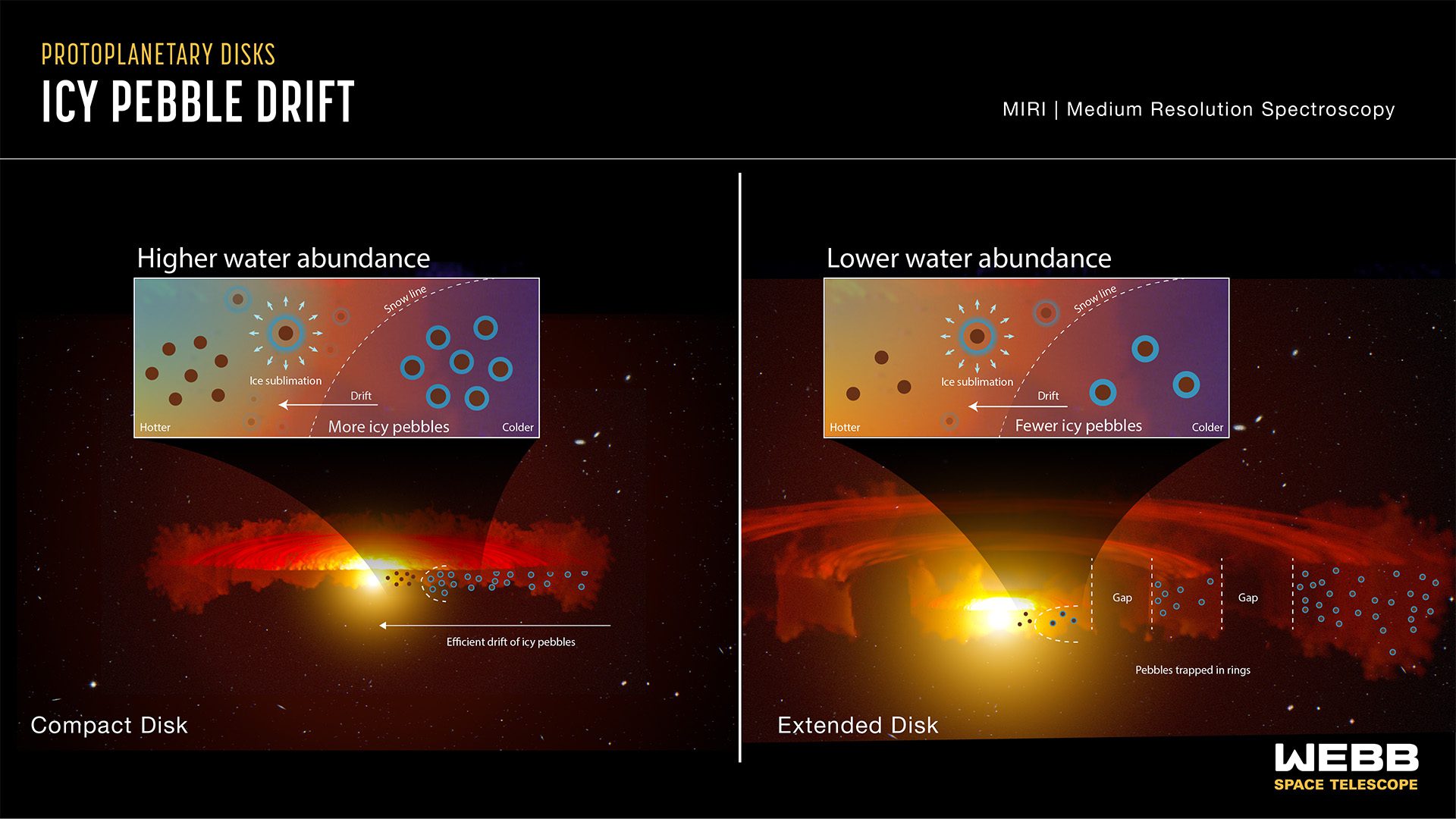
The two compact disks are expected to experience efficient pebble drift, delivering pebbles to well within a distance equivalent to Neptune’s orbit. In contrast, the extended disks are expected to have their pebbles retained in multiple rings as far out as six times the orbit of Neptune.
The Webb observations were designed to determine whether compact disks have a higher water abundance in their inner, rocky planet region, as expected if pebble drift is more efficient and is delivering lots of solid mass and water to inner planets. The team chose to use MIRI’s MRS (the Medium-Resolution Spectrometer) because it is sensitive to water vapor in disks.
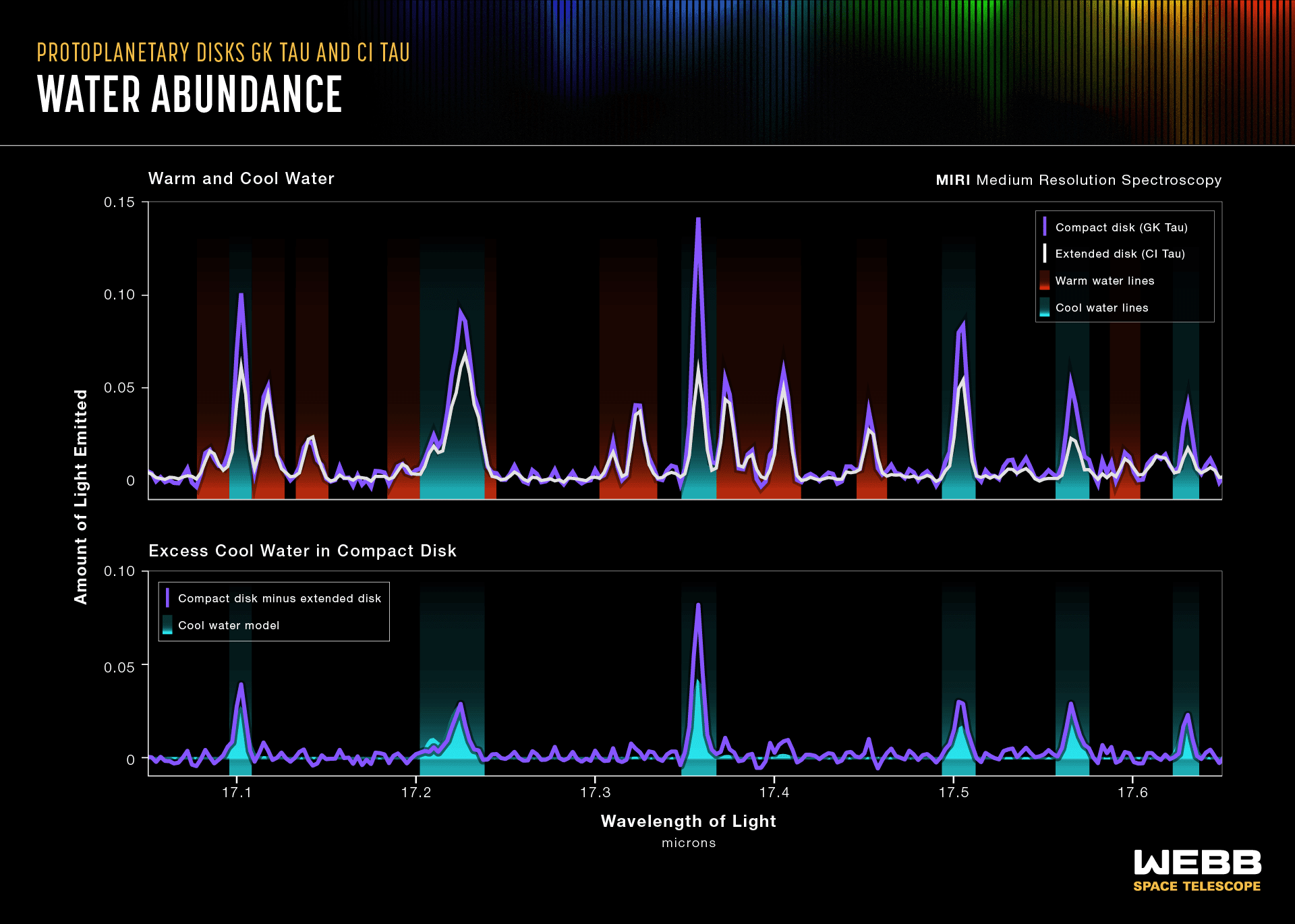
The results confirmed expectations by revealing excess cool water in the compact disks, compared with the large disks.
Image: Water Abundance
Emission Spectrum – Water Abundance: This graphic compares the spectral data for warm and cool water in the GK Tau disk, which is a compact disk without rings, and extended CI Tau disk, which has at least three rings on different orbits. The science team employed the unprecedented resolving power of MIRI’s MRS (the Medium-Resolution Spectrometer) to separate the spectra into individual lines that probe water at different temperatures. These spectra, seen in the top graph, clearly reveal excess cool water in the compact GK Tau disk, compared with the large CI Tau disk. The bottom graph shows the excess cool water data in the compact GK Tau disk minus the cool water data in the extended CI Tau disk. The actual data, in purple, are overlaid on a model spectrum of cool water. Note how closely they align.
NASA, ESA, CSA, Leah Hustak (STScI)
As the pebbles drift, any time they encounter a pressure bump — an increase in pressure — they tend to collect there. These pressure traps don’t necessarily shut down pebble drift, but they do impede it. This is what appears to be happening in the large disks with rings and gaps.
Current research proposes that large planets may cause rings of increased pressure, where pebbles tend to collect. This also could have been a role of Jupiter in our solar system — inhibiting pebbles and water delivery to our small, inner, and relatively water-poor rocky planets.
Solving the Riddle
When the data first came in, the results were puzzling to the research team. “For two months, we were stuck on these preliminary results that were telling us that the compact disks had colder water, and the large disks had hotter water overall,” remembered Banzatti. “This made no sense, because we had selected a sample of stars with very similar temperatures.”
Only when Banzatti overlaid the data from the compact disks onto the data from the large disks did the answer clearly emerge: the compact disks have extra cool water just inside the snowline, at about ten times closer than the orbit of Neptune.
“Now we finally see unambiguously that it is the colder water that has an excess,” said Banzatti. “This is unprecedented and entirely due to Webb’s higher resolving power!”
Image: Icy Pebble Drift
This graphic is an interpretation of data from Webb’s MIRI, the Mid-Infrared Instrument, which is sensitive to water vapor in disks. It shows the difference between pebble drift and water content in a compact disk versus an extended disk with rings and gaps. In the compact disk on the left, as the ice-covered pebbles drift inward toward the warmer region closer to the star, they are unimpeded. As they cross the snow line, their ice turns to vapor and provides a large amount of water to enrich the just-forming, rocky, inner planets. On the right is an extended disk with rings and gaps. As the ice-covered pebbles begin their journey inward, many become stopped by the gaps and trapped in the rings. Fewer icy pebbles are able to make it across the snow line to deliver water to the inner region of the disk.
The James Webb Space Telescope is the world’s premier space science observatory. Webb is solving mysteries in our solar system, looking beyond to distant worlds around other stars, and probing the mysterious structures and origins of our universe and our place in it. Webb is an international program led by NASA with its partners, ESA (European Space Agency) and the Canadian Space Agency.
Media Contacts
Laura Betz – laura.e.betz@nasa.gov NASA’s Goddard Space Flight Center, Greenbelt, Md.
The Artemis Accords describe a shared vision for principles, grounded in the Outer Space Treaty of 1967, to create a safe and transparent environment which facilitates space exploration and science for all of humanity to enjoy.
Credits: NASA
Bulgaria will sign the Artemis Accords during a ceremony at 10 a.m. EST on Thursday, Nov. 9, at NASA Headquarters in Washington.
NASA Administrator Bill Nelson will host officials from Bulgaria and the U.S. Department of State for the accords signing ceremony.
This event is in-person only. Media interested in attending must RSVP by 7 a.m. on Nov. 9, to the NASA Headquarters newsroom at hq-media@mail.nasa.gov. NASA’s media accreditation policy is online.
The Artemis Accords establish a practical set of principles to guide space exploration cooperation among nations, including those participating in NASA’s Artemis program.
NASA, in coordination with the U.S. Department of State, announced the Artemis Accords in 2020 along with the original signatories. The accords reinforce and implement the 1967 Outer Space Treaty. They also reinforce the commitment by the United States and partner nations to the Registration Convention, the Rescue and Return Agreement, as well as best practices and norms of responsible behavior that NASA and its partners have supported, including the public release of scientific data.
The event will take place at the agency’s James E. Webb Auditorium in the West Lobby inside NASA Headquarters located at 300 E St. SW.
NASA’s Super Guppy arrives in Alabama on Nov. 6, 2023, carrying the heat shield that protected Orion’s crew module during its flight on Artemis I. The one-of-a-kind, turboprop-powered aircraft ferried the heat shield from NASA’s Kennedy Space Center in Florida to Huntsville Regional Airport for transport to the agency’s Marshall Space Flight Center. Technicians at Marshall will use the center’s specialized milling tool to remove the heat shield’s outer layer of ablative material, a protective coating called Avcoat, as part of routine post-flight analysis.
CO2 Conversion Challenge (2020) – NASA’s Centennial Challenges has an impact far greater than just space travel – just ask Air Co., a Brooklyn-based company that competed and won a three-way tie in the CO2 Conversion Challenge, which ran from 2018 to 2021. Air Co. founders Gregory Constantine (left) and Stafford Sheehan (right) used their innovative idea, which originally existed to convert carbon dioxide into glucose, to create immediately usable hand sanitizer at the height of the COVID-19 pandemic.
Image courtesy of Air Co.
NASA’s Space Technology Mission Directorate connects the public to the agency’s missions and explores creative possibilities for addressing the agency’s research and technology development needs through prizes, challenges, and crowdsourcing opportunities. These challenges bridge NASA’s institutional expertise with the ingenuity of industry experts, universities, and the public at large, resulting in collaborations that help advance space technology solutions. For many solvers, success doesn’t stop when the NASA challenge ends. Past participants have gone on to work with NASA in other ways and take their technology to new heights in the commercial sector.
Commercializing Challenge-Supported CO2 Technology
Air Company of Brooklyn, New York, was one of three teams to win the final round of NASA’s CO2 Conversion Challenge, which concluded in August 2021. This challenge asked the public to develop ways to convert carbon dioxide (CO2), an abundant resource on Mars, into sugar, which could be used by astronauts to make products including plastics, adhesives, fuels, food, and medicine. Air Company received a $700,000 award in the final phase of the competition for its thermochemical sugar production. First, CO2 and hydrogen are combined to make methanol, then hydrogen is removed to turn methanol into formaldehyde. The third chemical reaction produces a simple sugar called D-glucose.
Since participating in the CO2 Conversion Challenge, Air Company has commercialized its CO2-converting technology in unique ways, producing hand sanitizer, fragrance oil, and even vodka. The CO2 used is sourced from biogenic emissions – mitigating emissions that are released into the atmosphere from ethanol fermentation facilities.1 The company has also gone on to compete in NASA’s Deep Space Food Challengeand developed a system and processes for turning air, water, electricity, and yeast into food. In May 2023, Air Company was named a winner in Phase 2 of the challenge, receiving a $150,000 prize from NASA and a chance to compete in Phase 3 for a grand prize of $750,000 from a total prize purse of up to $1.5 million.
Cross-Program Competitors Advance Lunar Power Solutions
Astrobotic Technology, a small business based in Pittsburgh, was named a grand prize winner of Phase 1 of NASA’s Watts on the Moon Challenge in May 2021. The company is no stranger to NASA – in fact, John Thornton, CEO of Astrobotic, credits early NASA Small Business Innovation Research (SBIR) funding as “the lifeblood of the company,” starting with its first award in 2009. Astrobotic has also received funding from NASA’s Tipping Point program and was selected to deliver scientific and technology payloads to the Moon as part of the agency’s Commercial Lunar Payloads Services (CLPS) initiative.
Having continuous power throughout the lunar day and night during missions on the surface of the Moon is an essential technology asset for long-term crew and scientific exploration.
For the Watts on the Moon Challenge, teams were asked to submit ideas for up to three parts of a hypothetical mission scenario: generating power from a plant to harvest water and oxygen from a dark crater on the Moon’s South Pole. Astrobotic received the grand prize in response to the first part of the scenario, proposing a fleet of small rovers that transport power cables between the solar array power source and the rover that operates inside the crater. The team also received a prize for collaborating with Montreal startup Eternal Light Photonics Corp. for a wireless mobile power beaming solution.
According to Astrobotic, the prizes contribute to the company’s development of lunar surface power infrastructure.2 In August 2022, the company was selected by NASA to receive $6.2 million to help advance Vertical Solary Array Technology (VSAT) under the agency’s Game Changing Development program.3
Printing Homes for Extraterrestrial Lands and on Earth
In November 2022, small business ICON, based in Austin, Texas, received a $57.2 million contract from NASA to develop construction technologies that could support infrastructure such as landing pads, habitats, and roads on the Moon. This effort supports NASA’s Moon to Mars Planetary Autonomous Construction Technologies (MMPACT) project. Preceding this, the company participated in NASA’s 3D-Printed Habitat Challenge, which ran from 2015 to 2019. This challenge asked competitors to design, develop, and test several areas of 3D printing that could contribute to potential human shelter on Mars. ICON partnered with the Colorado School of Mines in Phase 3: Level 1 of the challenge. The team was named a top ten finalist for their digital representation of a house on Mars using building information modeling software tools.
The technology ICON initially developed through the NASA challenge has helped pave several paths for the company. In addition to designing extraterrestrial infrastructure, ICON also impacts global housing by constructing 3D printed homes on Earth. The company created the first 3D printed community of homes in Nacajuca, Mexico.4 Taking its challenge journey full circle, ICON has also released its own global architecture competition open to the public.
Global Participation Leads to Mini Rover Missions
Based in Budapest, Hungary, Puli Space Technologies is an example of the global collaboration that is possible through prize, challenge, and crowdsourcing opportunities. In 2020, the company participated in the Honey, I Shrunk the NASA Payloadcompetition, which sought designs for miniature science instruments – about the size of a bar of soap – that could help scout the lunar surface, collecting key information about the Moon, its resources, and the environment. The challenge was sponsored by NASA’s Lunar Surface Innovation Initiative to cultivate new ideas, spur innovation and enhance the development of capabilities for exploration of the lunar surface. The challenge received 132 entries from 29 countries. Puli Space won first prize in the first iteration of the challenge for its conceptual Puli Lunar Water Snooper (PLWS) to identify hydrogen and all hydrogen-bearing volatiles, like water-ice, on the Moon.
Following the challenge, NASA released Honey, I Shrunk the NASA Payload Challenge, the Sequel, a two-year challenge that asked teams to develop, build, and prototype their miniature rover payloads. Out of the 14 finalists from the original challenge, four teams were chosen to advance to stage 2 of the sequel challenge. As part of the challenge, NASA provided $675,000, which was split between the four teams to fund development. Puli Space placed second in the sequel challenge for developing PLWS. According to Puli Space CEO Tibor Pacher, the connections made in preparing for the challenge led to PLWS’s placement on at least two planned commercial Moon missions.5
Reaching New Frontiers in Science Supported by Public Participation
A brown dwarf roaming the Milky Way galaxy. Image by citizen scientist/artist William Pendrill.
Credit: William Pendrill
NASA’s Science Mission Directorate seeks knowledge and answers to profound questions that impact all people. Through competitions, challenges, crowdsourcing, and citizen science activities, NASA collaborates with the public to make scientific discoveries that help us better understand our planet and the space beyond. Multiple NASA science projects were supported through public participation in Fiscal Years 2021 and 2022, spanning pursuits in astrophysics, Earth science, heliophysics,1 and more.
Astrophysics
NASA challenges in astrophysics seek to uncover new information about the origin, structure, evolution, and future of the universe, as well as other worlds outside our solar system.
Seeking potential planets in the backyard of our solar system, NASA invited the public to examine data from the Wide-field Infrared Survey Explorer (WISE) mission to discern moving celestial bodies. Human eyes are needed for the task because anomalies in the images often fool image processing technologies. The WISE mission continues to collect data, and the Backyard Worlds: Planet 9 citizen science project is still ongoing. But the project has discovered so far more than 3500 brown dwarfs (balls of gas too small to be considered stars), and one notable citizen scientist himself found 34 ultracool brown dwarfs with companions, now published in The Astronomical Journal.
To understand stars better, a citizen science project called Disk Detective 2.0 was launched in 2020 to evaluate disks, or belts, of material around stars. The original 2014 project resulted in the discovery of the longest-lived disks that form planets—dubbed “Peter Pan” disks—as well as the discovery of the youngest nearby disk around a brown dwarf. The relaunch offered a new batch of 150,000 stars in infrared wavelengths from NASA’s WISE mission and other data. As of May 2023, more than 12,000 volunteers had contributed to the project and 14 of those co-authored scientific papers based on their findings.
The Hybrid Observatory for Earth-like Exoplanets (HOEE) is a concept for a mission that would combine a ground-based telescope with a space-based starshade to enable better views of exoplanets from Earth. The Hybrid Observatory for Earth-like Exoplanets (HOEE) is a concept for a mission that would combine a ground-based telescope with a space-based starshade to enable better views of exoplanets from Earth. As part of early-stage study of this concept, NASA invited the public to develop 3D computer models of a lightweight starshade. Requirements for the starshade design included compact packaging, successful deployment in orbit, and a low-mass structure capable of maintaining its shape and alignment using as little spacecraft fuel as possible. The Ultralight Starshade Structural Design Challenge received 60 entries, and the top five shared a $7,000 prize. First place combined inflatable tubes for compression structures and cables for tension.
The Ultralight Starshade Structural Design Challenge asked participants to develop a lightweight starshade structure that could be used as part of the Hybrid Observatory for Earth-like Exoplanets (HOEE) concept
Earth Science
One goal of NASA’s Earth science pursuits is to map the connections between Earth’s vital processes and the climate effects of natural and human-caused changes. Multiple competitions are aiding our understanding of these interconnected systems.
A worldwide program called Global Learning and Observation to Benefit the Environment (GLOBE) has brought educators and students together since 1995, promoting science and learning about the environment. As one of the partner organizations for the program, NASA sponsored the NASA GLOBE Trees Challenge 2022: Trees in a Changing Climate to gather tree height observations. The data collected is compared with space-based observation systems to track tree height and growth rate as an indicator of ecosystem health. Volunteers from around the world have amassed more than 4,700 tree-height observations from over 1,500 locations in 50 countries.
A similar data-gathering effort—the Cooperative Open Online Landslide Repository (COOLR)—utilizes a web-based platform developed by NASA to share reports of landslides. The repository’s data is validating a model in development at NASA’s Goddard Space Flight Center in Greenbelt Maryland, the Landslide Hazard Assessment for Situational Awareness (LHASA), to map areas of potential landslide hazard in real-time. LHASA incorporates landslide inventories from people around the world in a machine-learning framework to estimate the relative probability of landslide occurrence.
To develop more accurate air quality data products from NASA satellite missions, a public competition called NASA Airathon: Predict Air Quality2 asked participants to develop algorithms for estimating daily levels of surface-level air pollutants on Earth. Using NASA satellite data, model outputs, and ground measurements, the public estimated daily levels of particulate matter (PM) and nitrogen dioxide (NO2) across urban areas in the U.S., India, and Taiwan—all of which have readily available satellite data. The contest generated more than 1,200 submissions from over 1,000 participants and awarded $25,000 in prizes.
The ocean: it’s Earth’s largest ecosystem and the habitat for coral – one of the planet’s most unique and oldest life forms.
While the concept for an iPad game called NeMO-Netcould be applied to the search for life across the universe, the current application is assessing the health of coral reefs. Players help NASA classify coral reefs by painting 3D and 2D images of coral captured using the NASA FluidCam instrument, the highest-resolution remote sensing benthic imaging technology capable of removing ocean wave distortion. Data from the painted images feeds into NASA NeMO-Net, the first neural multi-modal observation and training network for global coral reef assessment. With 43,000 unique downloads of the game, there have been 71,000 classifications, of which 56,400 have been reviewed and confirmed by NASA.
Planetary Science
NASA’s spacecraft, which arrived at Jupiter in 2016, continues to explore the planet and its satellites with a suite of scientific instruments and a camera called JunoCam. The camera takes visible frequency images of Jupiter’s polar regions and its moons. Via the project website, citizen scientists create images from the raw JunoCam data and post their creations on the Juno website and social media platforms. Early during the prime mission, the project engaged with the public in an online voting campaign to plan image-taking during orbital passes around Jupiter (“perijoves”), but the effort was abandoned after the transition to the 53 day–orbit mission due to unfavorable evolution of the approach geometry.
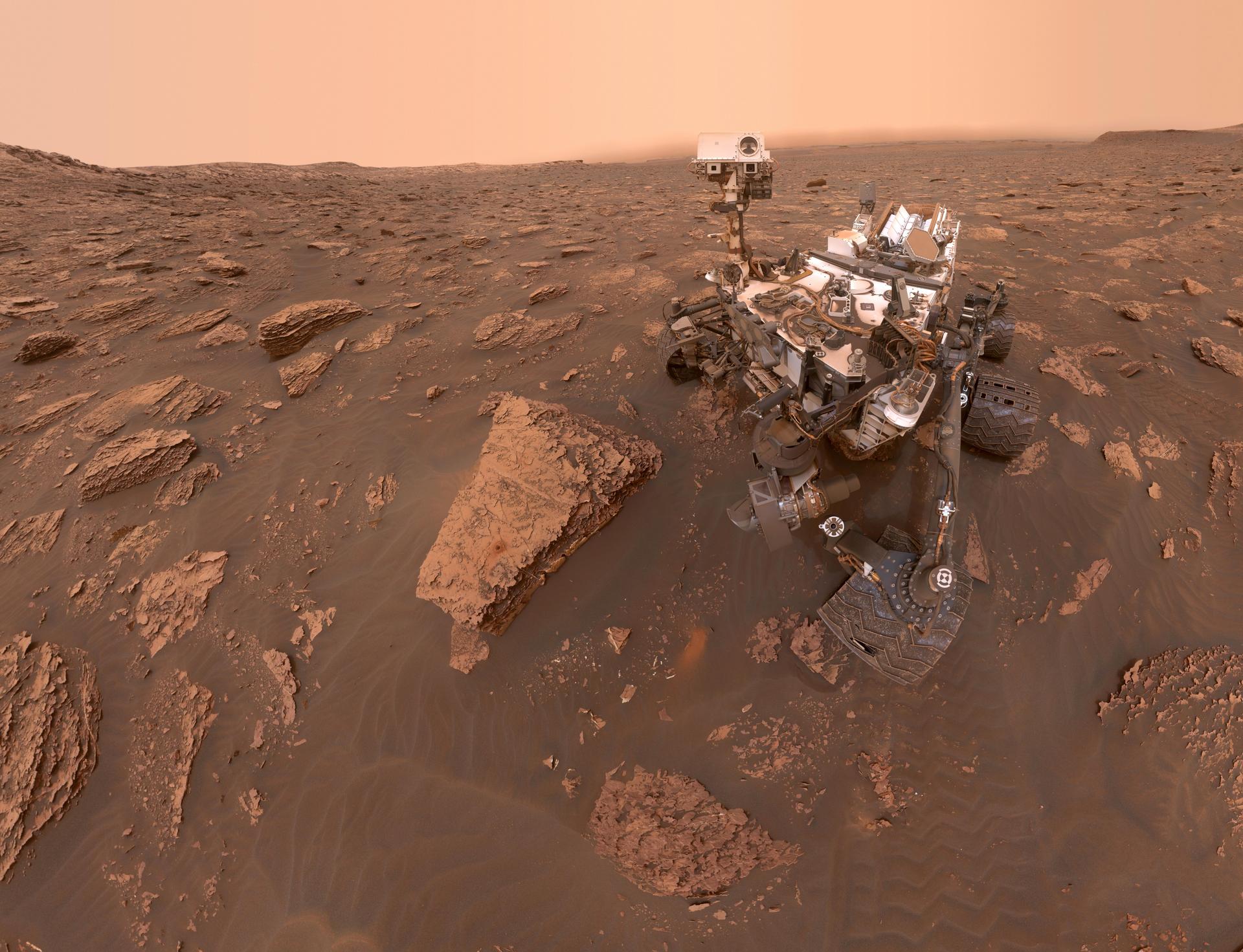
Ideally, when a space rover lands on Mars, it will know where it is safe to drive, land, sleep, and hibernate—without any guidance from a human operator. An early step in developing this capability, AI4Mars, invited the public to label images of Mars terrain taken by the Curiosity rover. The goal is to train a machine learning algorithm to improve the rover’s ability to identify and avoid hazardous terrain, which is essential for autonomous exploration. Over 16,000 volunteers completed more than 632,000 classifications, and a model developed using the data has a total accuracy of 91%.
A self-portrait of NASA’s Curiosity rover taken on Sol 2082 (June 15, 2018). A Martian dust storm has reduced sunlight and visibility at the rover’s location in Gale Crater. Self-portraits are created using images taken by Curiosity’s Mars Hands Lens Imager (MAHLI). https://photojournal.jpl.nasa.gov/catalog/PIA22486
Another ideal capability for a Mars rover is independent analysis of data to avoid the tedious process of data transmission from Mars to Earth and back. In the Mars Spectrometry: Detect Evidence for Past Habitabilitychallenge, NASA engaged the public to build a model to automatically analyze mass spectrometry data from rock and soil samples. Out of 656 entries, a software engineer from Brisbane, Australia, won $15,000 for first place. The second-place winner from the United States received $7,500, and the third-place winner from India won $5,000.
Biological and Physical Sciences
One of the aims of biological science research at NASA is to understand how biological systems acclimate to spaceflight environments.
A unique classroom-based citizen science program called Growing Beyond Earthadvances NASA’s research on growing plants in space. In its seventh year, the NASA program provides all the materials needed for the experiments. In total, more than 40,000 participating students and teachers have contributed hundreds of thousands of data points and tested 180 varieties of edible plants. As a result of their efforts, four types of vegetables were grown by NASA off-Earth, and two varieties have been successfully grown on the International Space Station.
Heliophysics
NASA studies the Sun and its effects on Earth and the solar system—or heliophysics—to increase understanding of how the universe works, how to protect technology and astronauts in space, and how stars contribute to the habitability of planets throughout the universe.
SOHO captured this image of a gigantic coronal hole hovering over the sun’s north pole on July 18, 2013.
To enable better discovery and tracking of sungrazing comets—the large but faint objects made of dust and ice in close orbit of the Sun—NASA held the NASA SOHO Comet Search. Over $55,000 in prizes was awarded to solutions to reduce background noise in data recorded by the Large Angle and Spectrometric Coronagraph (LASCO), one of the instruments on the Solar and Heliospheric Observatory (SOHO) spacecraft. Hundreds of participants from around the world devised artificial intelligence and machine learning approaches, which led to the discovery of two previously unidentified comets, including a difficult-to-detect non-group comet.
The preliminary results we’re already seeing come out of this challenge highlight the value of the open science movement.
Katie Baynes
NASA’s Deputy Chief Science Data Officer
Space Apps 2021
In its tenth year, NASA’s 2021 International Space Apps Challengetook place in 320 locations across 162 countries or territories. The hackathon for coders, scientists, designers, storytellers, makers, technologists, and innovators around the world offered 28 different topics to solve using open data from NASA and others. This year’s winners included an app for homeowners to simplify data from NASA’s Prediction of Worldwide Renewable Energy Resources (POWER) web services portal to help make solar panel purchasing decisions and encourage solar energy use. Another winning app detects, quantifies, follows, and projects the movement of plastic debris in the ocean with high accuracy.
This website uses cookies to improve your experience. We'll assume you're ok with this, but you can opt-out if you wish.AcceptRead More
Privacy & Cookies Policy
Privacy Overview
This website uses cookies to improve your experience while you navigate through the website. Out of these, the cookies that are categorized as necessary are stored on your browser as they are essential for the working of basic functionalities of the website. We also use third-party cookies that help us analyze and understand how you use this website. These cookies will be stored in your browser only with your consent. You also have the option to opt-out of these cookies. But opting out of some of these cookies may affect your browsing experience.
Necessary cookies are absolutely essential for the website to function properly. This category only includes cookies that ensures basic functionalities and security features of the website. These cookies do not store any personal information.
Any cookies that may not be particularly necessary for the website to function and is used specifically to collect user personal data via analytics, ads, other embedded contents are termed as non-necessary cookies. It is mandatory to procure user consent prior to running these cookies on your website.