Tag: planethunt

  • Wolf Moon in Washington

    A golden full moon rises over the Lincoln Memorial, a stone building with columns. In the foreground is a gray stone bridge, as well as some water and trees.
    NASA/Bill Ingalls

    A NASA photographer captured the full “wolf” moon rising over the Lincoln Memorial and Memorial Bridge on Jan. 13, 2025.

    The Maine Farmers’ Almanac began publishing Native American names for full moons in the 1930s. Over time, these names have become widely known and used. According to this almanac, the full moon in January is called the Wolf Moon, from the packs of wolves heard howling outside the villages amid the cold and deep snows of winter.

    Get tips and guides on skywatching.

    Image credit: NASA/Bill Ingalls

  • NASA to Preview Sky-Mapping Space Telescope Ahead of Launch

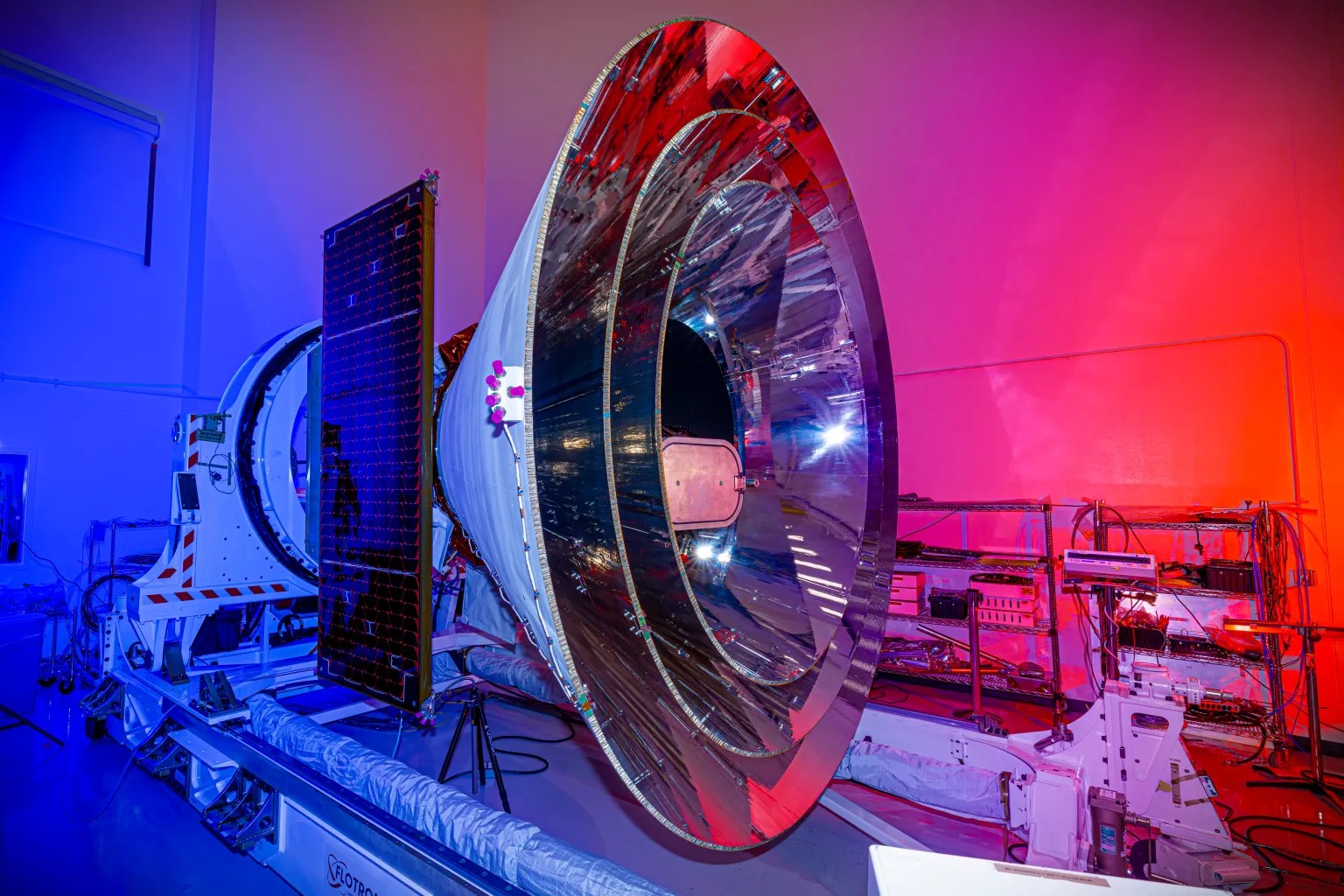
    NASA’s SPHEREx space observatory was photographed at BAE Systems in Boulder, Colorado, in November 2024 after completing environmental testing. The spacecraft’s three concentric cones help direct heat and light away from the telescope and other components, keeping them cool.
    Credit: BAE Systems

    NASA will host a news conference at 12 p.m. EST Friday, Jan. 31, to discuss a new telescope that will improve our understanding of how the universe evolved and search for key ingredients for life in our galaxy.

    Agency experts will preview NASA’s SPHEREx (Spectro-Photometer for the History of the Universe, Epoch of Reionization and Ices Explorer) mission, which will help scientists better understand the structure of the universe, how galaxies form and evolve, and the origins and abundance of water. Launch is targeted for no earlier than Thursday, Feb. 27.

    The news conference will be hosted at the agency’s Jet Propulsion Laboratory in Southern California. Watch live on NASA+, as well as JPL’s X and YouTube channels. Learn how to watch NASA content through a variety of platforms, including social media.

    Laurie Leshin, director, NASA JPL, will provide opening remarks. Additional briefing participants include:

    • Shawn Domagal-Goldman, acting director, Astrophysics Division, NASA Headquarters
    • James Fanson, project manager, SPHEREx, NASA JPL
    • Beth Fabinsky, deputy project manager, SPHEREx, NASA JPL  
    • Jamie Bock, principal investigator, SPHEREx, Caltech
    • Cesar Marin, SPHEREx integration engineer, Launch Services Program, NASA’s Kennedy Space Center in Florida

    To ask questions by phone, members of the media must RSVP no later than two hours before the start of the event to: rexana.v.vizza@jpl.nasa.gov. NASA’s media accreditation policy is available online. Questions also can be asked on social media during the briefing using #AskNASA.

    The SPHEREx observatory will survey the entire celestial sky in near-infrared light to help answer cosmic questions involving the birth of the universe, and the subsequent development of galaxies. It also will search for ices of water and organic molecules — essentials for life as we know it — in regions where stars are born from gas and dust, as well as disks around stars where new planets could be forming. Astronomers will use the mission to gather data on more than 450 million galaxies, as well as more than 100 million stars in our own Milky Way galaxy.

    The space observatory will share its ride on a SpaceX Falcon 9 rocket with NASA’s PUNCH (Polarimeter to Unify the Corona and Heliosphere) mission, which will lift off from Launch Complex 4E at Vandenberg Space Force Base in Central California. 

    The SPHEREx mission is managed by NASA JPL for the agency’s Astrophysics Division within the Science Mission Directorate at NASA Headquarters in Washington. The principal investigator is based at Caltech in Pasadena, California, which manages NASA JPL for the agency. 

    The spacecraft is supplied by BAE Systems. The Korea Astronomy and Space Science Institute contributed the non-flight cryogenic test chamber. Mission data will be publicly available through IPAC at Caltech.

    For more information about the mission, visit:

    https://nasa.gov/spherex

    -end-

    Alise Fisher
    Headquarters, Washington
    202-358-2546
    alise.m.fisher@nasa.gov

    Val Gratias / Calla Cofield
    Jet Propulsion Laboratory, Pasadena, Calif.
    818-393-6215 / 626-808-2469
    valerie.m.gratias@jpl.nasa.gov / calla.e.cofield@jpl.nasa.gov

  • Station Science Top News: Jan. 24, 2025

    Reducing reliance on resupply missions

    Resupply of life support elements such as air, water, food, clothing, and hygiene items will be impractical on missions to the Moon and beyond. This research assessed current use and resupply of these elements on the International Space Station and outlines technologies needed for sustained human presence in space, such as 3D printing maintenance parts, systems for laundering clothes, and improved recovery and recycling of elements.

    Researchers analyzed the types and mass of elements supplied from Earth to the station and astronaut feedback from various studies and interviews. The paper also used data from ISS Internal Environments, a wide-ranging investigation that samples various aspects of the space station environment in support of many types of research.

    Japan Aerospace Exploration Agency astronaut Satoshi Furukawa exercises on the station’s treadmill. Astronauts currently have no way to launder clothes in space.
    NASA

    Verifying a technique for analyzing emulsions

    This paper presents a review of examining the behavior of emulsions (suspensions of particles in a liquid) in microgravity using a technique called diffusing wave spectroscopy. Results offer insights that could support development of technologies to improve living environments and foods for crew members on future missions.

    FSL Soft Matter Dynamics – PASTA studied the dynamics of droplets in emulsions. Accurate study and characterization of the effects of additives on emulsion stability is possible in microgravity. Emulsions have applications in foods, cosmetics, pharmaceuticals, fuels, paints and coatings, chemical processing, and materials.

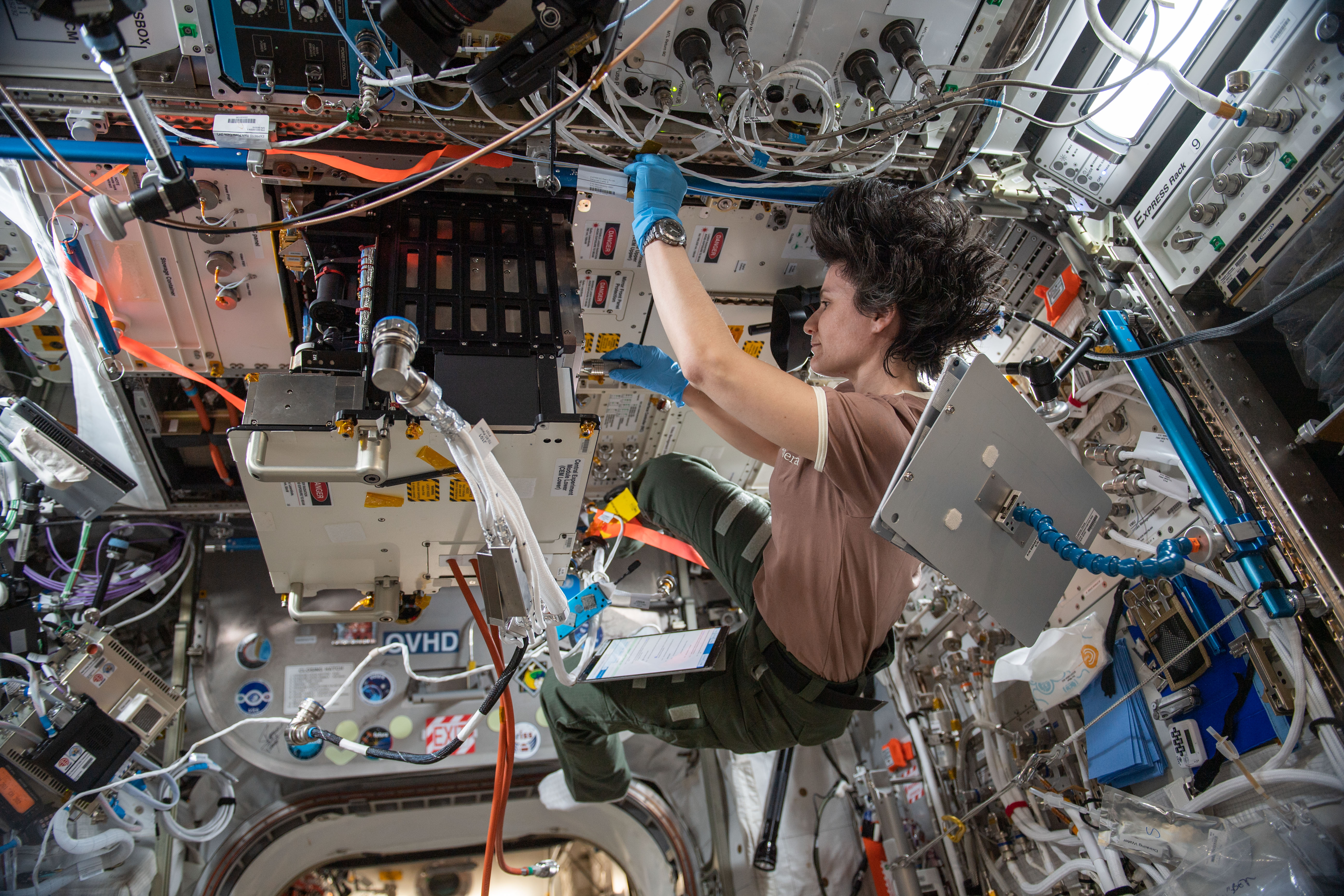
    An astronaut floats aboard the International Space Station while conducting an experiment.
    European Space Agency astronaut Samantha Cristoforetti exchanges samples for the FSL Soft Matter Dynamics-PASTA investigation.
    NASA

    EEG measurements and predicting cognitive changes in spaceflight

    Researchers used an electroencephalogram (EEG) to measure brainwave activity during a relaxed, wakeful state in crew members and found no significant differences before, during, and after flight. These types of measurements could serve as biomarkers of brain health status, helping to predict changes in cognitive performance and the need for prevention and countermeasure strategies during future missions.

    Studies have shown that spaceflight can affect key cognitive and motor skills such as task management, attention, and movement speed and accuracy. Neurowellness in Space Ax-1 tested using a portable, easy to use EEG headset to measure ongoing and task-related brain activity in microgravity. The data could help predict and monitor neural changes on future space missions.

    Group photo of the 11-person crew aboard the International Space Station in April 2022.
    The 11-person crew aboard the station in April 2022 included Axiom Mission 1 astronauts (center row from left) Mark Pathy, Eytan Stibbe, Larry Conner, and Michael Lopez-Alegria.
    NASA
  • Get My Good Side

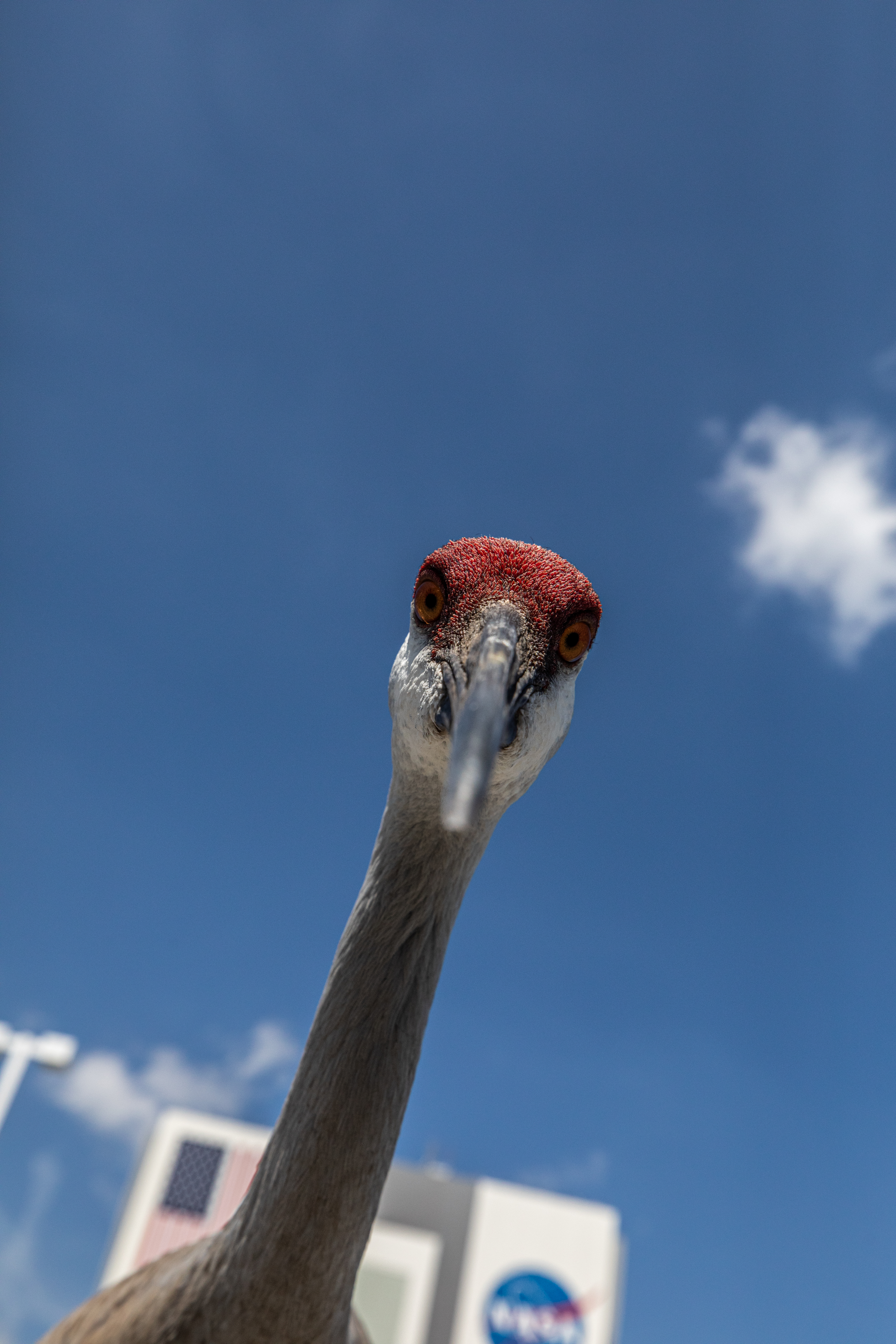
    A bird looks directly into the camera. The bird's head is red on top and white on the bottom. Its eyes are orange-brown. The blue sky makes up the backdrop of this photo. Part of the Vehicle Assembly Building, a rectangular building with a NASA meatball and a US flag on it, can be seen behind the bird.
    NASA/Ben Smegelsky

    A NASA photographer took this portrait of a curious sandhill crane on March 24, 2021, near the Vehicle Assembly Building at NASA’s Kennedy Space Center in Florida. Sandhill cranes are just one of the hundreds of types of birds that call the Merritt Island National Wildlife Refuge, which shares space with NASA Kennedy, their home.

    See more photos of birds at NASA Kennedy.

    Image credit: NASA/Ben Smegelsky

  • Black Holes Can Cook for Themselves, Chandra Study Shows

    Astronomers have taken a crucial step in showing that the most massive black holes in the universe can create their own meals. Using X-ray data from Chandra and optical light data, this study, based on observations of seven galaxy clusters in total, provides new evidence that outbursts from black holes can cool down gas to feed themselves. Massive galaxies at the centers of the clusters contain huge black holes that power outbursts in the form of jets, driven by the black holes feasting on gas. These images show the X-ray and optical data of the Perseus and Centaurus clusters from the survey.
    Perseus Cluster: X-ray: NASA/CXC/SAO/V. Olivares et al.; Optical/IR: DSS; H-alpha: CFHT/SITELLE; Centaurus Cluster: X-ray: NASA/CXC/SAO/V. Olivaresi et al.; Optical/IR: NASA/ESA/STScI; H-alpha: ESO/VLT/MUSE; Image Processing: NASA/CXC/SAO/N. Wolk

    Astronomers have taken a crucial step in showing that the most massive black holes in the universe can create their own meals. Data from NASA’s Chandra X-ray Observatory and the Very Large Telescope (VLT) provide new evidence that outbursts from black holes can help cool down gas to feed themselves.

    This study was based on observations of seven clusters of galaxies. The centers of galaxy clusters contain the universe’s most massive galaxies, which harbor huge black holes with masses ranging from millions to tens of billions of times that of the Sun. Jets from these black holes are driven by the black holes feasting on gas.

    These images show two of the galaxy clusters in the study, the Perseus Cluster and the Centaurus Cluster. Chandra data represented in blue reveals X-rays from filaments of hot gas, and data from the VLT, an optical telescope in Chile, shows cooler filaments in red.

    The results support a model where outbursts from the black holes trigger hot gas to cool and form narrow filaments of warm gas. Turbulence in the gas also plays an important role in this triggering process.

    According to this model, some of the warm gas in these filaments should then flow into the centers of the galaxies to feed the black holes, causing an outburst. The outburst causes more gas to cool and feed the black holes, leading to further outbursts.

    This model predicts there will be a relationship between the brightness of filaments of hot and warm gas in the centers of galaxy clusters. More specifically, in regions where the hot gas is brighter, the warm gas should also be brighter. The team of astronomers has, for the first time, discovered such a relationship, giving critical support for the model.

    This result also provides new understanding of these gas-filled filaments, which are important not just for feeding black holes but also for causing new stars to form. This advance was made possible by an innovative technique that isolates the hot filaments in the Chandra X-ray data from other structures, including large cavities in the hot gas created by the black hole’s jets.

    The newly found relationship for these filaments shows remarkable similarity to the one found in the tails of jellyfish galaxies, which have had gas stripped away from them as they travel through surrounding gas, forming long tails. This similarity reveals an unexpected cosmic connection between the two objects and implies a similar process is occurring in these objects.

    This work was led by Valeria Olivares from the University of Santiago de Chile, and was published Monday in Nature Astronomy. The study brought together international experts in optical and X-ray observations and simulations from the United States, Chile, Australia, Canada, and Italy. The work relied on the capabilities of the MUSE (Multi Unit Spectroscopic Explorer) instrument on the VLT, which generates 3D views of the universe.

    NASA’s Marshall Space Flight Center in Huntsville, Alabama, manages the Chandra program. The Smithsonian Astrophysical Observatory’s Chandra X-ray Center controls science operations from Cambridge, Massachusetts, and flight operations from Burlington, Massachusetts.

    Read more from NASA’s Chandra X-ray Observatory.

    Learn more about the Chandra X-ray Observatory and its mission here:

    https://www.nasa.gov/chandra

    https://chandra.si.edu

    Visual Description

    This release features composite images shown side-by-side of two different galaxy clusters, each with a central black hole surrounded by patches and filaments of gas. The galaxy clusters, known as Perseus and Centaurus, are two of seven galaxy clusters observed as part of an international study led by the University of Santiago de Chile.

    In each image, a patch of purple with neon pink veins floats in the blackness of space, surrounded by flecks of light. At the center of each patch is a glowing, bright white dot. The bright white dots are black holes. The purple patches represent hot X-ray gas, and the neon pink veins represent filaments of warm gas. According to the model published in the study, jets from the black holes impact the hot X-ray gas. This gas cools into warm filaments, with some warm gas flowing back into the black hole. The return flow of warm gas causes jets to again cool the hot gas, triggering the cycle once again.

    While the images of the two galaxy clusters are broadly similar, there are significant visual differences. In the image of the Perseus Cluster on the left, the surrounding flecks of light are larger and brighter, making the individual galaxies they represent easier to discern. Here, the purple gas has a blue tint, and the hot pink filaments appear solid, as if rendered with quivering strokes of a paintbrush. In the image of the Centaurus Cluster on the right, the purple gas appears softer, with a more diffuse quality. The filaments are rendered in more detail, with feathery edges, and gradation in color ranging from pale pink to neon red.

    News Media Contact

    Megan Watzke
    Chandra X-ray Center
    Cambridge, Mass.
    617-496-7998
    mwatzke@cfa.harvard.edu

    Lane Figueroa
    Marshall Space Flight Center, Huntsville, Alabama
    256-544-0034
    lane.e.figueroa@nasa.gov

  • NASA Invites Media to Pre-Super Bowl Tours at New Orleans Facility

    NASA’s Michoud Assembly Facility in New Orleans, includes 43 acres of manufacturing space under one roof — a space large enough to contain more than 31 professional football fields. Credit: NASA
    NASA’s Michoud Assembly Facility in New Orleans, includes 43 acres of manufacturing space under one roof — a space large enough to contain more than 31 professional football fields. Credit: NASA

    Media are invited to visit NASA’s Michoud Assembly Facility in New Orleans between Tuesday, Feb. 4, and Thursday, Feb. 6, ahead of Super Bowl LIX for an inside look at America’s rocket factory, as well as interview agency experts.

    During this behind-the-scenes visit, media will tour NASA’s location for the manufacturing and production of large-scale space structures and see hardware that will carry astronauts back to the Moon as part of the Artemis campaign.

    Registered members of the media will have the opportunity to:

    • Capture images and video of hardware NASA Michoud is building for the SLS (Space Launch System) rocket, Orion spacecraft, and SLS exploration upper stage for the agency’s Artemis campaign.
    • Tour special locations around NASA Michoud, one of the largest facilities in the world, with 43 acres of manufacturing space under one roof — a space large enough to contain more than 31 professional football fields.
    • Learn about NASA’s state-of-the-art manufacturing and welding equipment — including the world’s largest friction-stir welding tool.

    Media must RSVP no later than 6 p.m. EST, Thursday, Jan. 30, to Jonathan Deal at: jonathan.e.deal@nasa.gov and Craig Betbeze at: craig.c.betbeze@nasa.gov. Please indicate a preferred date to visit between Feb. 4 and Feb. 6. This event is open to U.S. media. NASA’s media accreditation policy is available online.

    Through Artemis, NASA will send astronauts to explore the Moon for scientific discovery, economic benefits, and to build the foundation for the first crewed missions to Mars.

    Learn more about NASA’s Artemis campaign:

    https://www.nasa.gov/artemis

    -end- 

    Rachel Kraft
    NASA Headquarters, Washington
    202-358-1100
    rachel.h.kraft@nasa.gov

    Jonathan Deal
    Marshall Space Flight Center, Huntsville, Ala. 
    256-544-0034 
    jonathan.e.deal@nasa.gov

  • NASA Invites Media to Second Intuitive Machines Launch to Moon

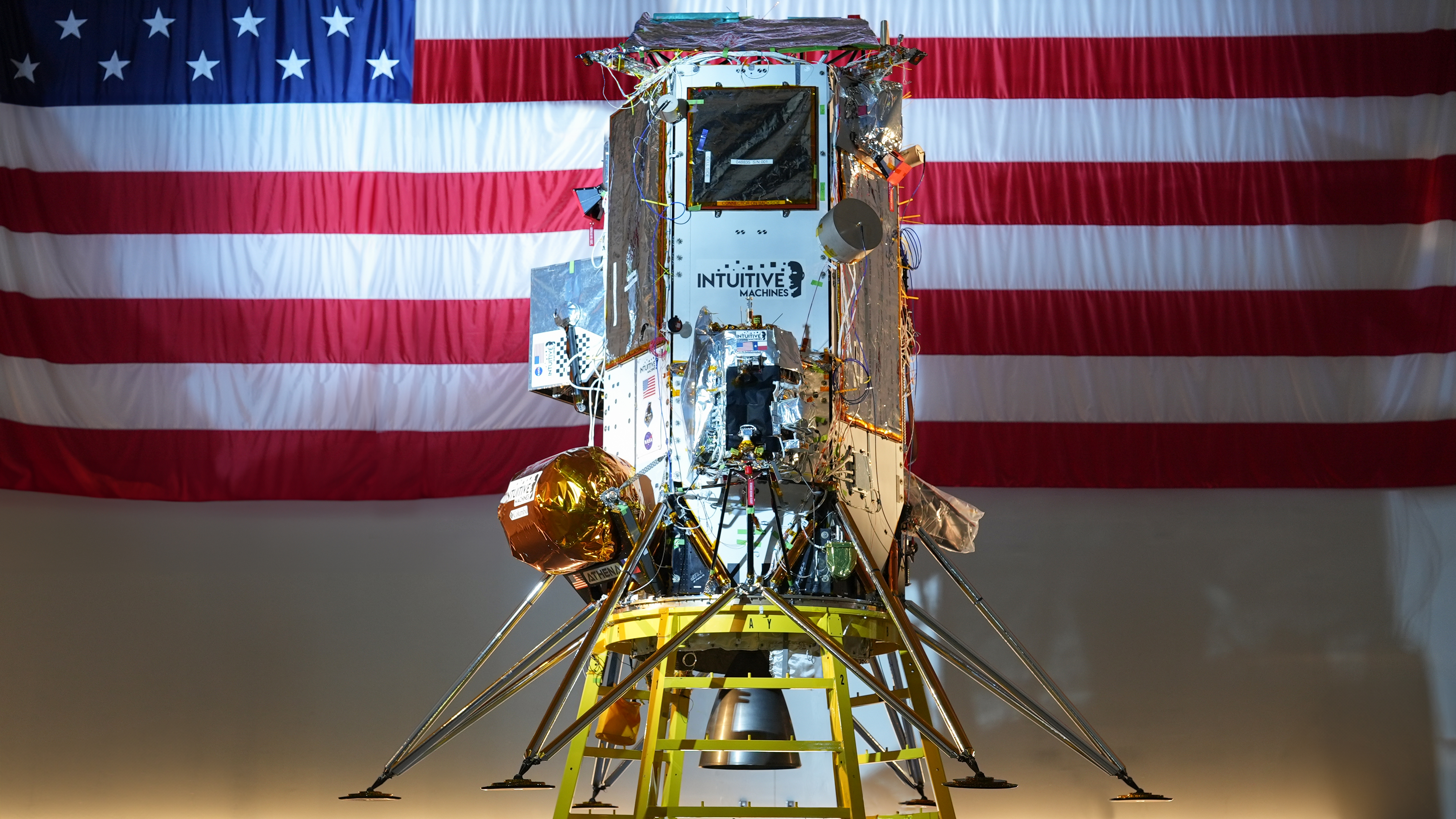
    Caption: As part of NASA’s CLPS (Commercial Lunar Payload Services) initiative and Artemis campaign, Intuitive Machines’ second delivery to the Moon will carry NASA technology demonstrations and science investigations on their Nova-C class lunar lander. Credit: Intuitive Machines
    Caption: As part of NASA’s CLPS (Commercial Lunar Payload Services) initiative and Artemis campaign, Intuitive Machines’ second delivery to the Moon will carry NASA technology demonstrations and science investigations on their Nova-C class lunar lander.
    Credit: Intuitive Machines

    For the second time, Intuitive Machines will launch a lunar lander to deliver NASA technology demonstrations and science investigations to the Moon for the benefit of all. Media accreditation is open for the IM-2 launch, part of NASA’s CLPS (Commercial Lunar Payload Services) initiative and Artemis campaign to establish a long-term presence on the Moon

    The Intuitive Machines Nova-C class lunar lander will launch on a SpaceX Falcon 9 rocket and carry NASA science, technology demonstrations, and other commercial payloads to Mons Mouton, a lunar plateau near the Moon’s South Pole region. Liftoff is targeted for a multi-day launch window, which opens no earlier than late February, from Launch Complex 39A at NASA’s Kennedy Space Center in Florida.

    Media prelaunch and launch activities will take place at NASA Kennedy and are open to U.S. citizens and international media. U.S. media must apply by Wednesday, Feb. 12, and international media must apply by Wednesday, Feb. 5.

    Media wishing to take part in person must apply for credentials at:

    https://media.ksc.nasa.gov


    Credentialed media will receive a confirmation email upon approval. NASA’s media accreditation policy is available online. For questions about accreditation or to request special logistical support, such as space for satellite trucks, tents, or electrical connections, please email by Wednesday, Feb. 12, to: ksc-media-accreditat@mail.nasa.gov. For other questions, please contact NASA Kennedy’s newsroom at: 321-867-2468.

    Para obtener información sobre cobertura en español en el Centro Espacial Kennedy o si desea solicitar entrevistas en español, comuníquese con Antonia Jaramillo o Messod Bendayan a: antonia.jaramillobotero@nasa.gov o messod.c.bendayan@nasa.gov.
    Among the items on its lander, the IM-2 mission will deliver one of the first on-site, or in-situ, demonstrations of resource utilization on the Moon, using a drill and mass spectrometer to measure the volatiles content of subsurface materials. Other technology instruments on this delivery will demonstrate a robust surface communications system and deploy a propulsive drone mobility solution.

    Launching as a rideshare alongside the IM-2 delivery NASA’s Lunar Trailblazer spacecraft also will begin its journey to lunar orbit, where it will map the distribution of the different forms of water on the Moon.

    A successful landing will help support the CLPS model for commercial payload deliveries to the lunar surface, as another step toward a sustainable lunar future. As a primary customer of CLPS, NASA is investing in lower-cost methods of Moon deliveries and is one of multiple customers for these flights.

    NASA is working with several U.S. companies to deliver science and technology to the lunar surface through the agency’s CLPS initiative. This pool of companies may bid on task orders to deliver NASA payloads to the Moon. Contract awards cover end-to-end commercial payload delivery services, including payload integration, mission operations, launch from Earth, and landing on the surface of the Moon. These contracts are indefinite-delivery/indefinite-quantity contracts with a cumulative maximum value of $2.6 billion through 2028.

    For more information about the agency’s Commercial Lunar Payload Services initiative, see:

    https://www.nasa.gov/clps

    -end-

    Alise Fisher / Jasmine Hopkins
    Headquarters, Washington
    202-358-1600
    alise.m.fisher@nasa.gov / jasmine.s.hopkins@nasa.gov
    Natalia Riusech / Nilufar Ramji
    Johnson Space Center, Houston
    281-483-5111
    natalia.s.riusech@nasa.gov / nilufar.ramji@nasa.gov  

    Antonia Jaramillo
    Kennedy Space Center, Florida
    321-867-2468
    antonia.jaramillobotero@nasa.gov

    Details

    Last Updated

    Jan 24, 2025

  • NASA to Brief Media on Asteroid Sample Mission Findings

    Jason Dworkin, project scientist for OSIRIS-REx at NASA’s Goddard Space Flight Center in Greenbelt, Maryland, views a portion of the asteroid Bennu sample in the center’s astrobiology lab under microscope in November 2023, shortly after it arrived from the curation team at the agency’s Johnson Space Center in Houston.
    Credit: NASA/Molly Wasser

    NASA will brief media at 11 a.m. EST Wednesday, Jan. 29, to provide an update on science results from NASA’s OSIRIS-REx (Origins, Spectral Interpretation, Resource Identification, and Security – Regolith Explorer) mission, which delivered a sample of asteroid Bennu to Earth in September 2023.

    Audio of the media call will stream live on the agency’s website.

    Participants in the teleconference include:

    • Nicky Fox, associate administrator, Science Mission Directorate, NASA Headquarters, Washington
    • Danny Glavin, senior scientist for sample return, NASA’s Goddard Space Flight Center Greenbelt, Maryland
    • Jason Dworkin, OSIRIS-REx project scientist, NASA Goddard
    • Tim McCoy, curator of meteorites, Smithsonian Natural History Museum, Washington 
    • Sara Russell, cosmic mineralogist, Natural History Museum, London

    Media interested in participating by phone must RSVP no later than two hours prior to the start of the call to: molly.l.wasser@nasa.gov. A copy of NASA’s media accreditation policy is online.

    After the teleconference, NASA Goddard will host a limited onsite media availability for reporters local to the greater Washington area. The availability will include opportunities to tour the center’s astrobiology lab, which contributed to the study of the Bennu sample. Interested reporters should request participation by Sunday, Jan. 26, to: rob.garner@nasa.gov.

    Launched on Sept. 8, 2016, OSIRIS-REx was the first U.S. mission to collect a sample from an asteroid in space. The spacecraft traveled to near-Earth asteroid Bennu and collected a sample of rocks and dust from the surface in 2020. It delivered the sample to Earth on Sept. 24, 2023.

    To learn more about OSIRIS-REx, visit:

    https://science.nasa.gov/mission/osiris-rex/

    -end-

    Karen Fox / Molly Wasser
    Headquarters, Washington
    202-358-1600
    karen.c.fox@nasa.gov / molly.l.wasser@nasa.gov

  • NICER Status Update

    Jan. 24, 2025

    NASA’s NICER Continues Science Operations Post Repair

    NASA crew aboard the International Space Station installed patches to the agency’s NICER (Neutron star Interior Composition Explorer) mission during a spacewalk on Jan. 16. NICER, an X-ray telescope perched near the station’s starboard solar array, resumed science operations later the same day.

    The patches cover areas of NICER’s thermal shields where damage was discovered in May 2023. These thin filters block sunlight while allowing X-rays to pass through. After the discovery, the NICER team restricted their observations during the station’s daytime to avoid overwhelming the mission’s sensitive detectors. Nighttime observations were unaffected, and the team was able to continue collecting data for the science community to make groundbreaking measurements using the instrument’s full capabilities.

    The repair went according to plan. Data since collected shows the detectors behind the patched areas are performing better than before during station night, and the overall level of sunlight inside NICER during the daytime is reduced substantially.

    While NICER experiences less interference from sunlight than before, after analyzing initial data, the team has determined the telescope still experiences more interference than expected. The installed patches cover areas of known damage identified using astronomical observations and from photos taken by both external robotic cameras and astronauts inside the space station. Measurements collected since the repair and close-up, high-resolution photos obtained during the spacewalk are providing new information that may point the way toward further daytime data collection.

    In the meantime, NICER continues operations with its full measurement capabilities during orbit night to enable further trailblazing discoveries in time domain and multimessenger astrophysics.

    Media contact: Alise Fisher, NASA Headquarters / Claire Andreoli, NASA Goddard

    June 8, 2023

    Sunlight ‘Leak’ Impacting NASA’s NICER Telescope, Science Continues

    On Tuesday, May 22, NASA’s NICER (Neutron Star Interior Composition Explorer), an X-ray telescope on the International Space Station, developed a “light leak,” in which unwanted sunlight enters the instrument. While analyzing incoming data since then, the team identified an impact to daytime observations. Nighttime observations seem to be unaffected.

    The team suspects that at least one of the thin thermal shields on NICER’s 56 X-ray Concentrators has been damaged, allowing sunlight to reach its sensitive detectors.

    To mitigate the effects on measurements, the NICER team has limited daytime observations to objects far away from the Sun’s position in the sky. The team has also updated commands to NICER that automatically lower its sensitivity during the orbital day to reduce the effects from sunlight contamination. The team is evaluating these changes and assessing additional measures to reduce the impact on science observations.

    To date, more than 300 scientific papers have used NICER observations, and the team is confident that NICER will continue to produce world-class science.

    Media contact: Alise Fisher, NASA Headquarters / Claire Andreoli, NASA Goddard

  • I am Artemis: Jon Carabello

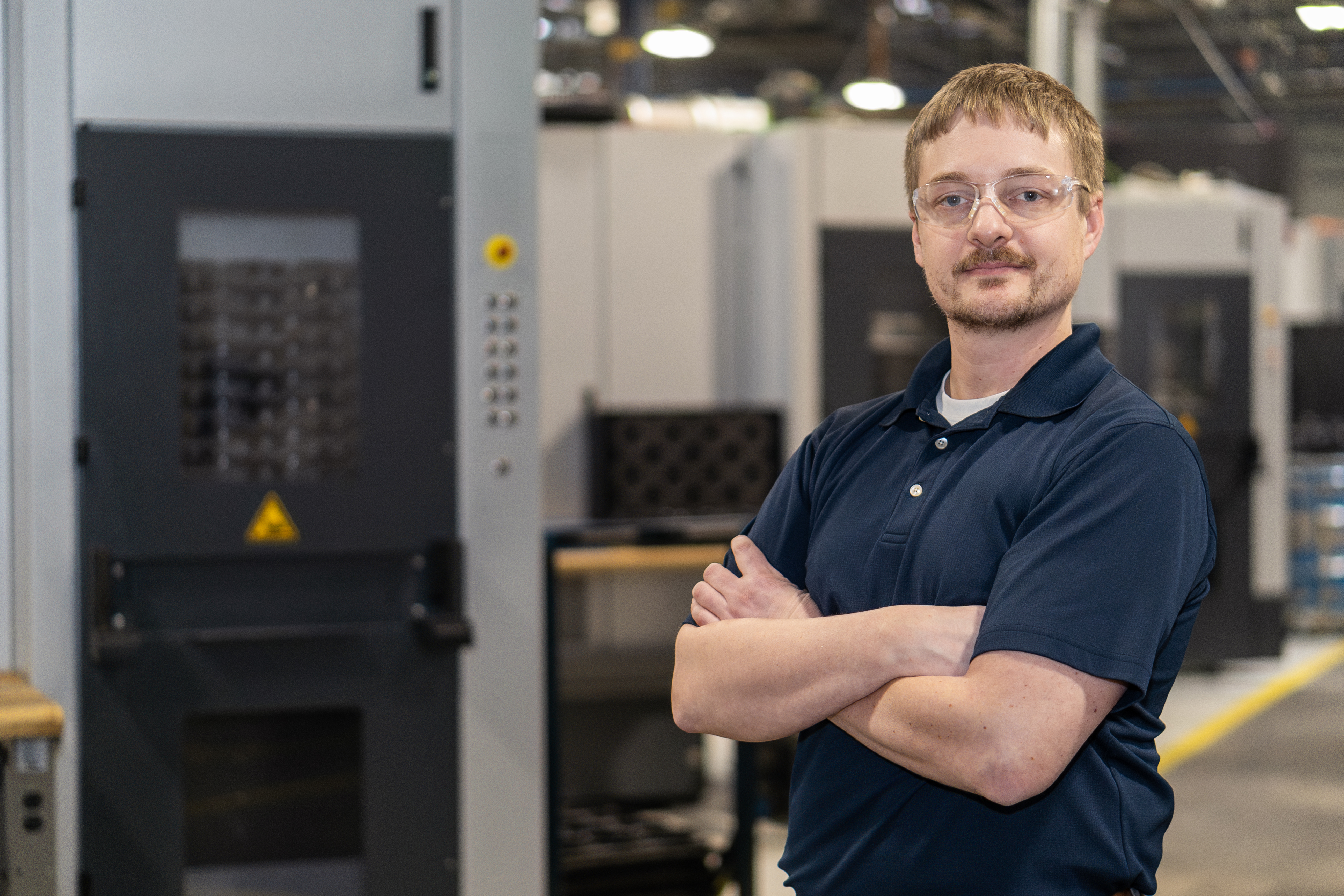
    A young white man with red hair and glasses stands with his arms crossed.
    Jon Carabello has spent his entire career at TURBOCAM, which produces 10 core stage main engine turbomachinery components for the RS-25 main engine on NASA’s SLS (Space Launch System) heavy lift exploration rocket.
    Photo: TURBOCAM

    Jon Carabello did not begin his career journey with an eye on space, but when NASA’s Artemis lunar exploration campaign came calling, he was all in.

    Born, raised, and college-educated in New Hampshire, Carabello has spent his entire professional career at TURBOCAM – a turbomachinery development and manufacturing company – in the southeast corner of the Granite State. 

    That’s a long way from the southern and western states commonly associated with U.S. human spaceflight activities.

    Asked about his early memories of America’s space program, Carabello mentions movies like Apollo 13, and notes that Christa McAulliffe, the teacher-astronaut who died in the 1986 Space Shuttle Challenger accident, taught high school in New Hampshire.

    Little did he know that his future employer, a maker of complex machined hardware for a variety of industrial applications, has long been a component supplier to programs including the Space Shuttle and the International Space Station.

    There was never much question that Carabello, who started tinkering with engines and other machinery at a young age, would make a career of mechanical engineering. “I like to solve problems – that’s my big thing,” he says. 

    He learned about TURBOCAM when company representatives made a presentation to his University of New Hampshire engineering class. “That’s how I figured out I knew wanted to work at TURBOCAM and work with 5-axis machining,” he says. “Machining amazes me.”

    Five axis machine tools can machine metal blanks from multiple angles to create geometrically complex parts for industrial hardware. TURBOCAM produces 10 core stage main engine turbomachinery components for the RS-25 main engine on NASA’s SLS (Space Launch System) heavy lift exploration rocket. L3Harris Technologies is the prime contractor for the RS-25 engines.

    It was his fascination with machining rather than the opportunity to work on rocket engines that drew Carabello to TURBOCAM, where he initially worked on machinery for the oil and gas industry, heating and air conditioning systems, and aerospace. 

    But then one day, a supervisor asked him to take over the company’s RS-25 portfolio. He remembers the conversion quite clearly.

    “It was a Thursday afternoon,” he says. “I was sitting in my office and my manager came in and said, ‘we have somebody leaving and need someone to take over project management and ownership of the RS-25.’ I said, ‘yes’ and he said, ‘you have a call with the program tomorrow.’ That was about five years ago.”

    It was a significant change, but Carabello knew the company needed his problem-solving skills on the RS-25 program. “I know how to bring a team together to deliver a quality product. It’s rewarding to know I’m helping return humans to the Moon and paving the way to Mars with the Artemis campaign.”

    Self-confidence notwithstanding, Carabello admits to being a bit nervous given that NASA astronauts will be relying on his work. That point was driven home when NASA and L3Harris representatives visited TURBOCAM in the spring of 2024 for a series of presentations on Artemis. The remark that resonated with him the most was by NASA astronaut Dr. Lee Morin, who said the most important part of any human spaceflight mission is bringing astronauts safely home. 

    “That meant a lot to me,” says Carabello, whose team is responsible for all aspects of TURBOCAM’S RS-25 effort, including quality control, inspection, and resource allocation. He is constantly reminding his team of what’s really at stake for astronauts bound for space: “We’re helping them to return home,” he says. 

    Read other I am Artemis features.

  • NASA Marshall Invites Media to Local Day of Remembrance Event

    1 min read

    Preparations for Next Moonwalk Simulations Underway (and Underwater)

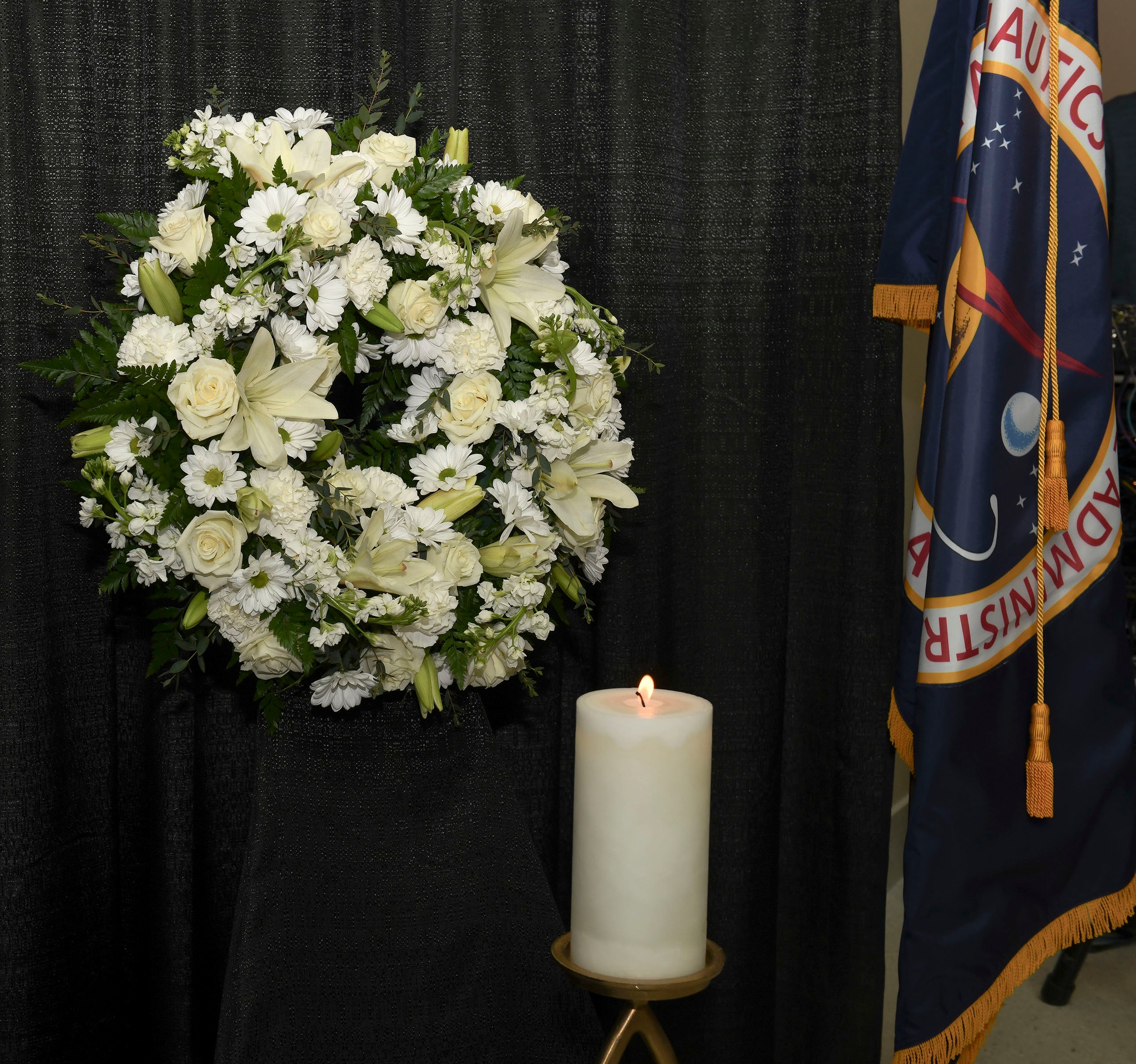
    Marshall Space Flight Center Day of Remembrance photo featuring a white candle, wreath of flowers and the NASA flag.
    NASA Marshall will hold a candle-lighting ceremony and wreath placement at 9:30 a.m. CST. The ceremony will include remarks from Larry Leopard, associate director, and Bill Hill, director of Marshall’s Office of Safety and Mission Assurance. 
    NASA/ Krisdon Manecke

    NASA’s Marshall Space Flight Center in Huntsville, Alabama, invites media to attend its observance of the agency’s Day of Remembrance at 9:30 a.m. CST Thursday, Jan. 23, in the lobby of Building 4221.

    Day of Remembrance honors the members of the NASA family who lost their lives while furthering the cause of exploration and discovery. 

    The event will include brief remarks from NASA Marshall leaders, followed by a candle lighting and moment of silence for the crews of Apollo 1 and space shuttles Challenger and Columbia. Speakers will include:

    • Larry Leopard, associate director, technical.
    • Bill Hill, director, Office of Safety and Mission Assurance.

    Media interested in attending the event must confirm by 12 p.m. Wednesday, Jan. 22, with Molly Porter at: molly.a.porter@nasa.gov.

    The agency will also pay tribute to its fallen astronauts with special online content, updated on NASA’s Day of Remembrance, at: 

    https://www.nasa.gov/dor/

    Molly Porter
    Marshall Space Flight Center, Huntsville, Ala.
    256-424-5158
    molly.a.porter@nasa.gov

    Details

    Last Updated

    Jan 21, 2025

    Editor
    Beth Ridgeway
    Contact

  • 60 Years Ago: Uncrewed Gemini 2 Paves the Way for the First Crewed Mission

    On Jan. 19, 1965, Gemini 2 successfully completed the second of two uncrewed test flights of the spacecraft and its Titan II booster, clearing the way for the first crewed mission. The 18-minute suborbital mission achieved the primary goals of flight qualifying the Gemini spacecraft, especially its heat shield during a stressful reentry. Recovery forces retrieved the capsule following its splashdown, allowing engineers to evaluate how its systems fared during the flight. The success of Gemini 2 enabled the first crewed mission to fly two months later, beginning a series of 10 flights over the following 20 months. The astronauts who flew these missions demonstrated the rendezvous and docking techniques necessary to implement the Lunar Orbit Rendezvous method NASA chose for the Moon landing mission. They also proved that astronauts could work outside their spacecraft during spacewalks and that spacecraft and astronauts could function for at least eight days, the minimum time for a roundtrip lunar mission. The Gemini program proved critical to fulfill President John F. Kennedy’s goal of landing a man on the Moon and returning him safely to Earth before the end of the 1960s. 

    Following the success of Gemini 1 in April 1964, NASA had hoped to fly the second mission before the end of the year and the first crewed mission by January 1965. The two stages of the Titan II rocket arrived at Cape Kennedy from the Martin Marietta factory in Baltimore on July 11, and workers erected it on Launch Pad 19 five days later. A lightning strike at the pad on Aug. 17 invalidated all previous testing and required replacement of some pad equipment. A series of three hurricanes in August and September forced workers to partially or totally unstack the vehicle before stacking it for the final time on Sept. 14. The Gemini 2 spacecraft arrived at Cape Kennedy from its builder, the McDonnell Company in St. Louis, on Sept. 21, and workers hoisted it to the top of the Titan II on Oct. 18. Technical issues delayed the spacecraft’s physical mating to the rocket until Nov. 5. These accumulated delays pushed the launch date back to Dec. 9. 

    Fueling of the rocket began late on Dec. 8, and following three brief holds in the countdown, the Titan’s two first stage engines ignited at 11:41 a.m. EST on Dec. 9. and promptly shut down one second later. Engineers later determined that a cracked valve resulted in loss of hydraulic pressure, causing the malfunction detection system to switch to its backup mode, forcing a shutdown of the engines. Repairs meant a delay into the new year. On Jan. 19, 1965, following a mostly smooth countdown, Gemini 2 lifted off from Pad 19 at 9:04 a.m. EST. 

    In the Gemini Mission Control Center at NASA’s Kennedy Space Center in Florida, Flight Director Christopher C. Kraft led a team of flight controllers that monitored all aspects of the flight. At the Manned Spacecraft Center (MSC), now NASA’s Johnson Space Center in Houston, a team of controllers led by Flight Director John Hodge passively monitored the flight from the newly built Mission Control Center. They would act as observers for this flight and Gemini 3, the first crewed mission, before taking over full control with Gemini IV, and control all subsequent American human spaceflights. The Titan rocket’s two stages placed Gemini 2 into a suborbital trajectory, reaching a maximum altitude of 98.9 miles, with the vehicle attaining a maximum velocity of 16,709 miles per hour. Within a minute after separating from the Titan’s second stage, Gemini 2 executed a maneuver to orient its heat shield in the direction of flight to prepare for reentry. Flight simulators installed where the astronauts normally would sit controlled the maneuvers. About seven minutes after liftoff, Gemini 2 jettisoned its equipment section, followed by firing of the retrorockets, and then separation of the retrorocket section, exposing the spacecraft’s heat shield. 

    Gemini 2 then began its reentry, the heat shield protecting the spacecraft from the 2,000-degree heat generated by friction with the Earth’s upper atmosphere. A pilot parachute pulled away the rendezvous and recovery section. At 10,000 feet, the main parachute deployed, and Gemini 2 descended to a splashdown 2,127 miles from its launch pad, after a flight of 18 minutes 16 seconds. The splashdown took place in the Atlantic Ocean about 800 miles east of San Juan, Puerto Rico, and 25 miles from the prime recovery ship, the U.S.S. Lake Champlain (CVS-39). 

    U.S. Navy helicopters delivered divers to the splashdown area, who installed a flotation collar around the spacecraft. The Lake Champlain pulled alongside, and sailors hoisted the capsule onto the carrier, securing it on deck one hour forty minutes after liftoff. The spacecraft appeared to be in good condition and arrived back at Cape Kennedy on Jan. 22 for a thorough inspection. As an added bonus, sailors recovered the rendezvous and recovery section. Astronaut Virgil “Gus” Grissom, whom along with John Young NASA had selected to fly the first crewed Gemini mission, said after the splashdown, “We now see the road clear to our flight, and we’re looking forward to it.” Flight Director Kraft called it “very successful.” Gemini Program Manager Charles Matthews predicted the first crewed mission could occur within three months. Gemini 3 actually launched on March 23. 

    Enjoy this NASA video of the Gemini 2 mission. 

    Postscript 

    Gemini 2 not only cleared the way for the first crewed Gemini mission and the rest of the program, it also took on a second life as a test vehicle for the U.S. Air Force’s Manned Orbiting Laboratory (MOL). The Air Force modified the spacecraft, including cutting a hatch through its heat shield, renamed it Gemini-B, and launched it on Nov. 3, 1966, atop a Titan IIIC rocket. The test flight successfully demonstrated the hatch in the heat shield design during the capsule’s reentry after a 33-minute suborbital flight. Recovery forces retrieved the Gemini-B capsule in the South Atlantic Ocean and returned it to the Air Force for postflight inspection. This marked the only repeat flight of an American spacecraft intended for human spaceflight until the advent of the space shuttle. Visitors can view Gemini 2/Gemini-B on display at the Cape Canaveral Space Force Museum.  

  • Astronauts Set to Swab the Exterior of Station for Microbial Life

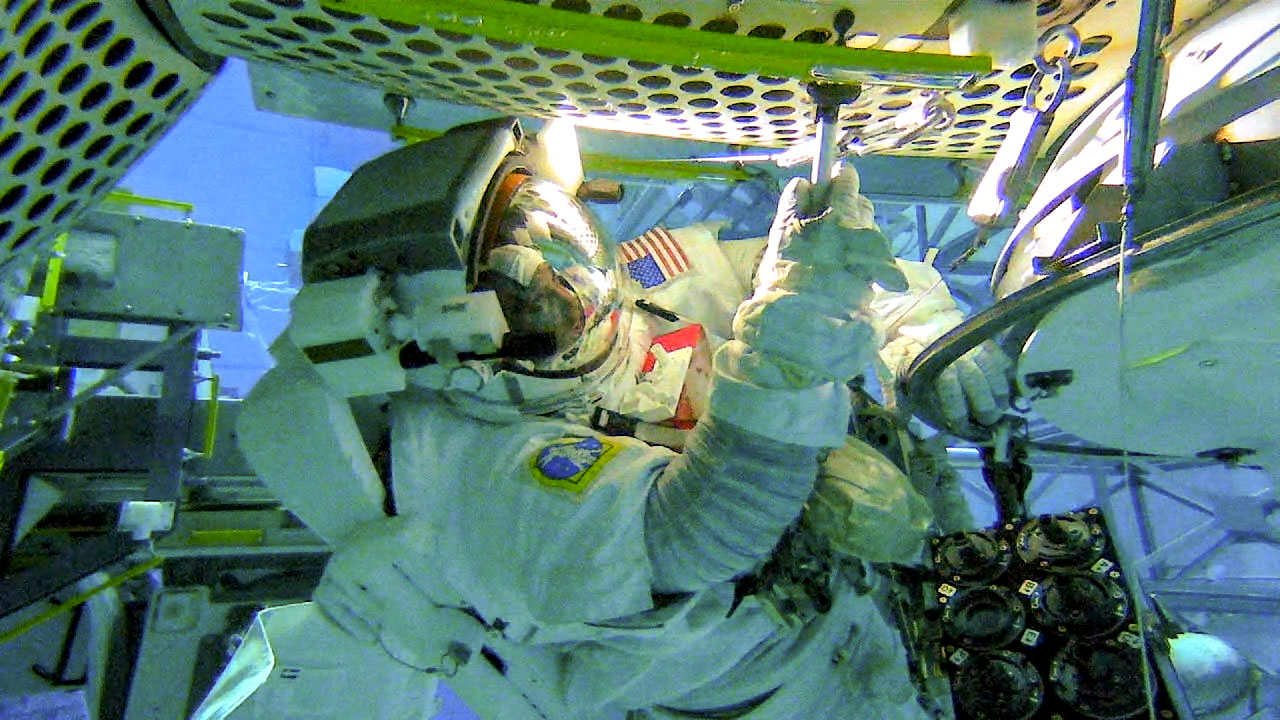
    A view of NASA astronaut Victor Glover in the Neutral Buoyancy Lab at Johnson Space Center, wearing a space suit and helmet. He tests a tool for swabbing the exterior of space station. Various mock spacecraft parts used for training are submerged underwater in the background. The astronaut's face is vaguely visible in the helmet visor, showing the bright lights of the spacecraft.
    NASA astronaut Victor Glover tests collection methods for ISS External Microorganisms in the Neutral Buoyancy Lab at Johnson Space Center.
    NASA

    Astronauts are scheduled to venture outside the International Space Station to collect microbiological samples during crew spacewalks for the ISS External Microorganisms experiment. This investigation focuses on sampling at sites near life support system vents to examine whether the spacecraft releases microorganisms, how many, and how far they may travel.

    This experiment could help researchers understand whether and how these microorganisms survive and reproduce in the harsh space environment and how they may perform at planetary destinations such as the Moon and Mars. Extremophiles, or microorganisms that can survive harsh environments, are also of interest to industries on Earth such as pharmaceuticals and agriculture.

    Spacecrafts and spacesuits are thoroughly sterilized before missions; however, humans carry their own microbiomes and continuously regenerate microbial communities. It’s important to understand and address how well current designs and processes prevent or limit the spread of human contamination.  The data could help determine whether changes are needed to crewed spacecraft, including spacesuits, that are used to explore destinations where life may exist now or in the past.

    Learn more about how researchers monitor microbes on the space station.