Tag: planethunt

  • NASA’s Aerospace Safety Advisory Panel Releases 2024 Annual Report

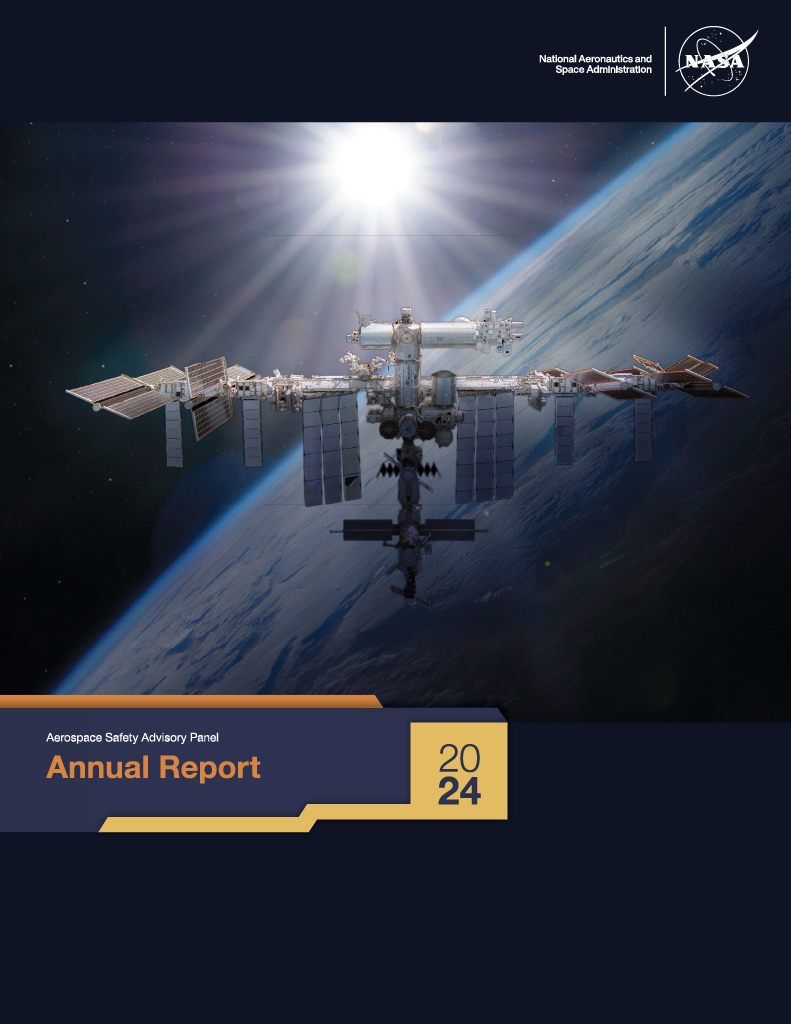
    Annual report cover art featuring the International Space Station orbiting the Earth, with the sun shining behind it. The NASA logo is in the top left corner. The title at the bottom says,
    Credit: NASA

    The Aerospace Safety Advisory Panel (ASAP), an advisory committee that reports to NASA and Congress, issued its 2024 annual report Thursday examining the agency’s safety performance, accomplishments, and challenges during the past year.

    The report highlights 2024 activities and observations on NASA’s work, including:

    • strategic vision and agency governance
    • Moon to Mars management
    • future of U.S. presence in low Earth orbit
    • health and medical risks in human space exploration

    “Over the past year, NASA has continued to make meaningful progress toward meeting the intent of the broad-ranging recommendations the panel has made over the last several years,” said retired U.S. Air Force Lt. Gen. Susan J. Helms, chair of ASAP. “We believe that the agency’s careful attention to vision, strategy, governance, and program management is vital to the safe execution of NASA’s complex and critical national mission.”

    This year’s report reflects the panel’s continued focus on NASA’s strategies for risk management and safety culture in an environment of growing space commercialization. Specifically, the panel cites its 2021 recommendations for NASA on preparing for future challenges in a changing landscape, including the need to evaluate NASA’s approach to safety and technical risk and to evolve its role, responsibilities, and relationships with private sector and international partners.

    Overall, the panel finds NASA is continuing to make progress with respect to the agency’s strategic vision, approach to governance, and integrated program management. The NASA 2040 new agencywide initiative is working to operationalize the agency’s vision and strategic objectives across headquarters and centers. With the establishment of NASA’s Moon to Mars Program Office in 2023, it finds NASA has implemented safety and risk management as a key focus for NASA’s Artemis campaign.

    The 2024 report provides details on the concrete actions the agency should take to fulfill its previous recommendations and spotlights its recommendations for the agency moving ahead. It addresses safety assessments for Moon to Mars and current International Space Station operations, as well as risk-related issues surrounding NASA’s planned transition to commercial low Earth orbit destinations.

    It covers relevant areas of human health and medicine in space and the impact of budget constraints and uncertainty on safety.

    The annual report is based on the panel’s 2024 fact-finding and quarterly public meetings; direct observations of NASA operations and decision-making; discussions with NASA management, employees, and contractors; and the panel members’ experiences.

    Congress established the panel in 1968 to provide advice and make recommendations to the NASA administrator on safety matters after the 1967 Apollo 1 fire claimed the lives of three American astronauts.

    To learn more about the ASAP, and view annual reports, visit:

    https://www.nasa.gov/asap

    -end-

    Jennifer Dooren / Elizabeth Shaw
    Headquarters, Washington
    202-358-1600
    jennifer.m.dooren@nasa.gov / elizabeth.a.shaw@nasa.gov
    Details

    Last Updated

    Feb 06, 2025

    Editor
    Jessica Taveau

  • What You Need To Know About the March 2025 Total Lunar Eclipse

    4 min read

    What You Need To Know About the March 2025 Total Lunar Eclipse

    The Moon will pass into Earth’s shadow and appear to turn red on the night of March 13 or early in the morning of March 14, depending on time zone. Here’s what you need to know about the total lunar eclipse.

    The March 2025 total lunar eclipse will take place between late night on March 13 and early morning on March 14 across several time zones. In this data visualization, the Moon moves from right to left, passing through Earth’s shadow and leaving in its wake an eclipse diagram with the times (in UTC) at various stages of the eclipse. Credit: NASA’s Scientific Visualization Studio

    What is a lunar eclipse?

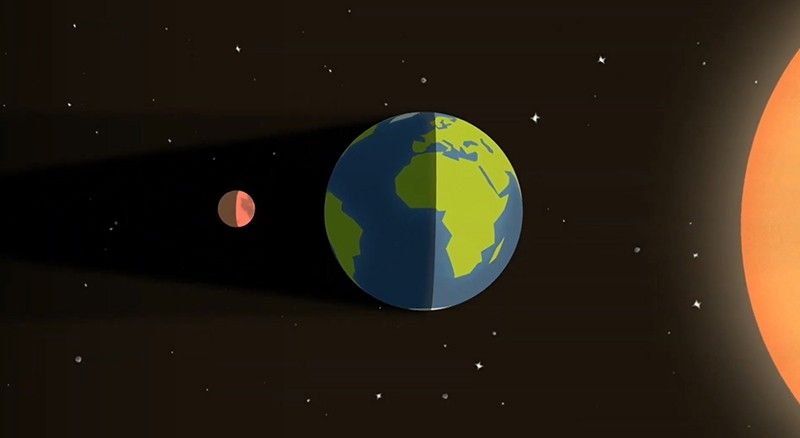
    lunar eclipse occurs when the Sun, Earth, and Moon align so that the Moon passes into Earth’s shadow. In a total lunar eclipse, the entire Moon falls within the darkest part of Earth’s shadow, called the umbra. When the Moon is within the umbra, it turns red-orange. Lunar eclipses are sometimes called “Blood Moons” because of this phenomenon.

    Lunar Eclipse Cartoon
    Alignment of the Moon, Earth, and Sun during a lunar eclipse (not to scale).
    NASA’s Scientific Visualization Studio

    How can I observe the eclipse?

    You don’t need any special equipment to observe a lunar eclipse, although binoculars or a telescope will enhance the view. A dark environment away from bright lights makes for the best viewing conditions.

    This eclipse will be visible from Earth’s Western Hemisphere.

    A map showing where the March 13-14, 2025 lunar eclipse is visible. Contours mark the edge of the visibility region at eclipse contact times. The map shows that the eclipse will be visible from Earth's Western Hemisphere, with totality beginning at about 06:26 UTC / 2:26 a.m. EDT /11:26 p.m. PDT.
    Map showing where the March 13-14, 2025 lunar eclipse is visible. Contours mark the edge of the visibility region at eclipse contact times, labeled in UTC.

    What can I expect to observe?

    Milestone: What’s happening:
    Penumbral eclipse begins (8:57pm PDT, 11:57pm EDT, 03:57 UTC) The Moon enters the Earth’s penumbra, the outer part of the shadow. The Moon begins to dim, but the effect is quite subtle.
    Partial eclipse begins (10:09pm PDT, 1:09am EDT, 05:09 UTC) The Moon begins to enter Earth’s umbra and the partial eclipse begins. To the naked eye, as the Moon moves into the umbra, it looks like a bite is being taken out of the lunar disk. The part of the Moon inside the umbra will appear very dark.
    Totality begins (11:26pm PDT, 2:26am EDT, 06:26 UTC) The entire Moon is now in the Earth’s umbra. The Moon will turn a coppery-red. Try binoculars or a telescope for a better view. If you want to take a photo, use a camera on a tripod with exposures of at least several seconds.
    Totality ends (12:31am PDT, 3:31am EDT, 07:31 UTC) As the Moon exits Earth’s umbra, the red color fades. It will look as if a bite is being taken out of the opposite side of the lunar disk as before.
    Partial eclipse ends (1:47am PDT, 4:47am EDT, 08:47 UTC) The whole Moon is in Earth’s penumbra, but again, the dimming is subtle.
    Penumbral eclipse ends (3:00am PDT, 6:00am EDT, 10:00 UTC) The eclipse is over.
    Data visualization showing a telescopic view of the Moon as the March 2025 total lunar eclipse unfolds. Credit: NASA’s Scientific Visualization Studio

    Why does the Moon turn red during a lunar eclipse?

    The same phenomenon that makes our sky blue and our sunsets red causes the Moon to turn reddish-orange during a lunar eclipse. Sunlight appears white, but it actually contains a rainbow of components—and different colors of light have different physical properties. Blue light scatters relatively easily as it passes through Earth’s atmosphere. Reddish light, on the other hand, travels more directly through the air.

    When the Sun is high on a clear day, we see blue light scattered throughout the sky overhead. At sunrise and sunset, when the Sun is near the horizon, incoming sunlight travels a longer, low-angle path through Earth’s atmosphere to observers on the ground. The bluer part of the sunlight scatters away in the distance (where it’s still daytime), and only the yellow-to-red part of the spectrum reaches our eyes.

    During a lunar eclipse, the Moon appears red or orange because any sunlight that’s not blocked by our planet is filtered through a thick slice of Earth’s atmosphere on its way to the lunar surface. It’s as if all the world’s sunrises and sunsets are projected onto the Moon.

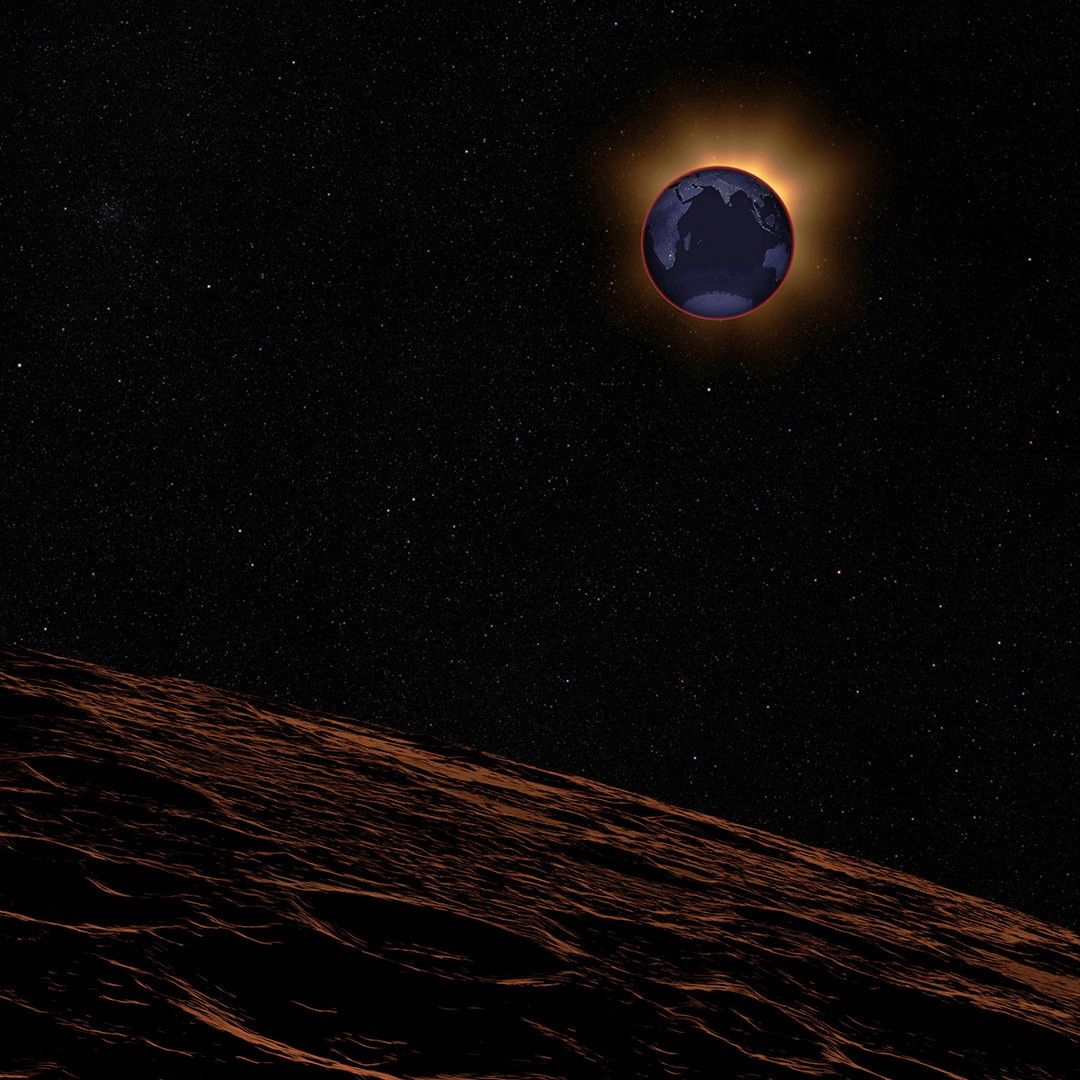
    The landscape of the Moon, foreground, is reddened. In a black sky, Earth is backlit by the Sun.
    During a total lunar eclipse, the Moon is reddened by sunlight filtered through Earth’s atmosphere.
    NASA’s Scientific Visualization Studio

    What else can I observe on the night of the eclipse?

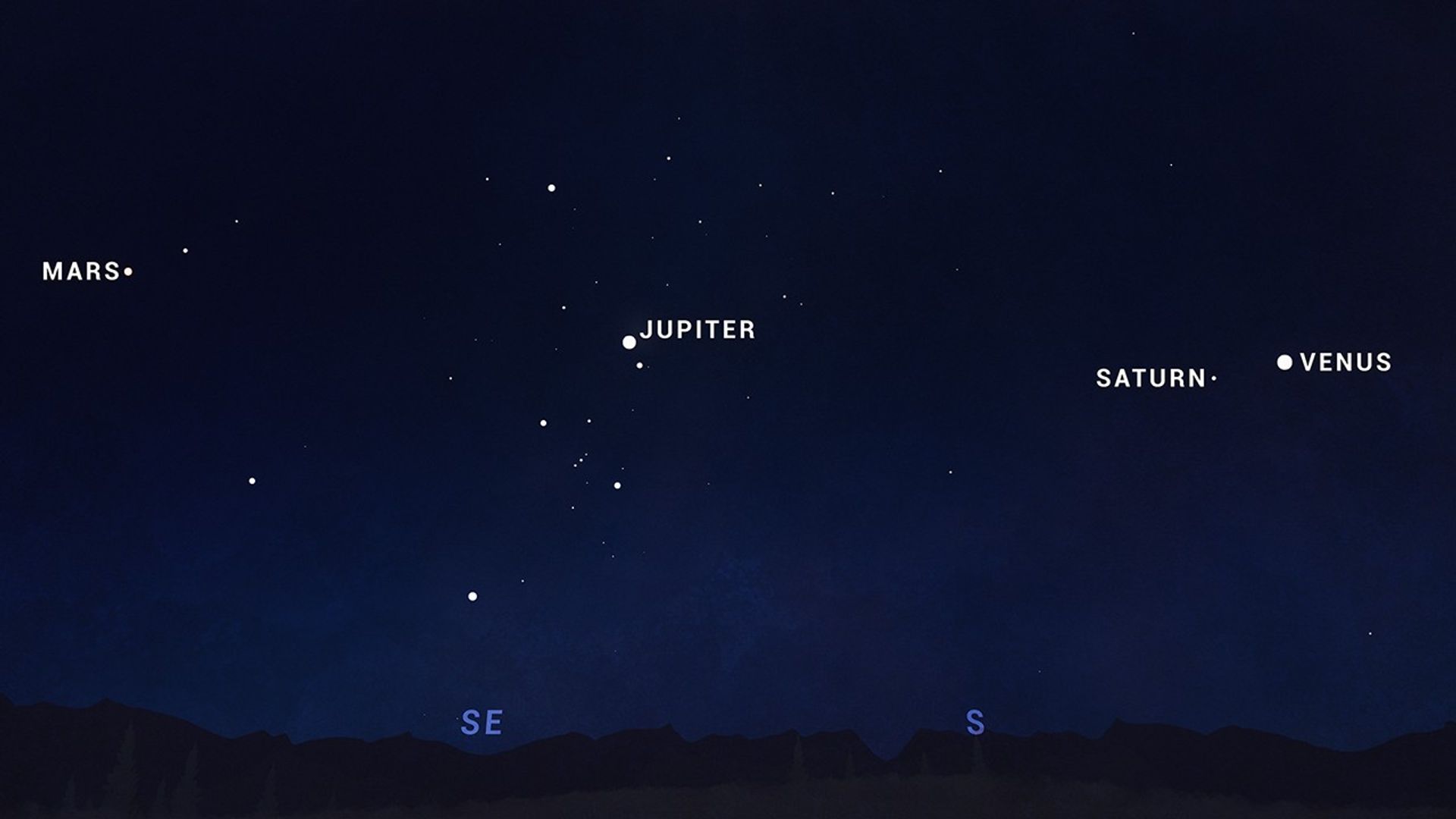
    Look to the western sky on the night of the eclipse for a glimpse of planets Jupiter and Mars. The Moon will be in the constellation Leo, under the lion’s hind paw, at the beginning of the eclipse; soon afterward, it will cross into the constellation Virgo. As Earth’s shadow dims the Moon’s glow, constellations may be easier to spot than usual.

    Visit our What’s Up guide for monthly skywatching tips, and find lunar observing recommendations for each day of the year in our Daily Moon Guide.

    Writers: Caela Barry, Ernie Wright, and Molly Wasser

    Details

    Last Updated

    Feb 06, 2025

  • Robot Gets a Grip


    Blue tentacle-like arms grip onto a black cube with gold foil patches on it.
    NASA/Suni Williams

    Blue tentacle-like arms attached to an Astrobee free-flying robot grab onto a “capture cube” in this image from Feb. 4, 2025. The experimental grippers demonstrated autonomous detection and capture techniques that may be used to remove space debris and service satellites in low Earth orbit.

    The Astrobee system was designed and built at NASA’s Ames Research Center in Silicon Valley for use inside the International Space Station. The system consists of three cube-shaped robots (named Bumble, Honey, and Queen), software, and a docking station used for recharging. The robots use electric fans as a propulsion system that allows them to fly freely through the microgravity environment of the station. Cameras and sensors help them to “see” and navigate their surroundings. The robots also carry a perching arm that allows them to grasp station handrails to conserve energy or to grab and hold items.

    Image credit: NASA/Suni Williams

  • NASA Brings Space to New Jersey Classroom with Astronaut Q&A

    Astronaut Nick Hague swaps samples of materials to observe how they burn in weightlessness.
    (Jan. 13, 2025) Astronaut Nick Hague swaps samples of materials to observe how they burn in weightlessness.
    Credit: NASA

    Students from the Thomas Edison EnergySmart Charter School in Somerset, New Jersey, will have the chance to connect with NASA astronaut Nick Hague as he answers prerecorded science, technology, engineering, and mathematics (STEM) related questions from aboard the International Space Station.

    Watch the 20-minute space-to-Earth call at 11:10 a.m. EST on Tuesday, Feb. 11, on NASA+ and learn how to watch NASA content on various platforms, including social media.

    Media interested in covering the event must RSVP by 5 p.m., Thursday, Feb. 6, to Jeanette Allison at: oyildiz@energysmartschool.org or 732-412-7643.

    For more than 24 years, astronauts have continuously lived and worked aboard the space station, testing technologies, performing science, and developing skills needed to explore farther from Earth. Astronauts aboard the orbiting laboratory communicate with NASA’s Mission Control Center in Houston 24 hours a day through SCaN’s (Space Communications and Navigation) Near Space Network.

    Important research and technology investigations taking place aboard the space station benefit people on Earth and lay the groundwork for other agency missions. As part of NASA’s Artemis campaign, the agency will send astronauts to the Moon to prepare for future human exploration of Mars; inspiring Artemis Generation explorers and ensuring the United States continues to lead in space exploration and discovery.

    See videos and lesson plans highlighting space station research at:

    https://www.nasa.gov/stemonstation

    -end-

    Abbey Donaldson
    Headquarters, Washington
    202-358-1600
    Abbey.a.donaldson@nasa.gov

    Sandra Jones 
    Johnson Space Center, Houston
    281-483-5111
    sandra.p.jones@nasa.gov

  • NASA Invites Media to Learn about Spacecraft Autonomous Tech Firsts

    NASA’s Ames Research Center in Silicon Valley invites media to learn more about Distributed Spacecraft Autonomy (DSA), a technology that allows individual spacecraft to make independent decisions while collaborating with each other to achieve common goals – without human input. The DSA team achieved multiple firsts during tests of such swarm technology as part of the agency’s project. 

    DSA develops software tools critical for future autonomous, distributed, and intelligent spacecraft that will need to interact with each other to achieve complex mission objectives. Testing onboard the agency’s Starling mission resulted in accomplishments including the first fully distributed autonomous operation of multiple spacecraft, the first use of space-to-space communications to autonomously share status information between multiple spacecraft, and more. 

    DSA’s accomplishments mark a significant milestone in advancing autonomous systems that will make new types of science and exploration possible. 

    Caleb Adams, DSA project manager, is available for interview on Wednesday, Feb. 5 and Thursday, Feb. 6. To request an interview, media can contact the Ames Office of Communications by email at arc-dl-newsroom@nasa.gov or by phone at 650-604-4789.  

    Learn more about NASA Ames’ world-class research and development in aeronautics, science, and exploration technology at: 

    https://www.nasa.gov/ames

    -end- 

    Tiffany Blake
    Ames Research Center, Silicon Valley 
    650-604-4789 
    tiffany.n.blake@nasa.gov  

    To receive local NASA Ames news, email local-reporters-request@lists.arc.nasa.gov with “subscribe” in the subject line. To unsubscribe, email the same address with “unsubscribe” in the subject line.  

  • Wind Over Its Wing: NASA’s X-66 Model Tests Airflow

    2 min read

    Preparations for Next Moonwalk Simulations Underway (and Underwater)

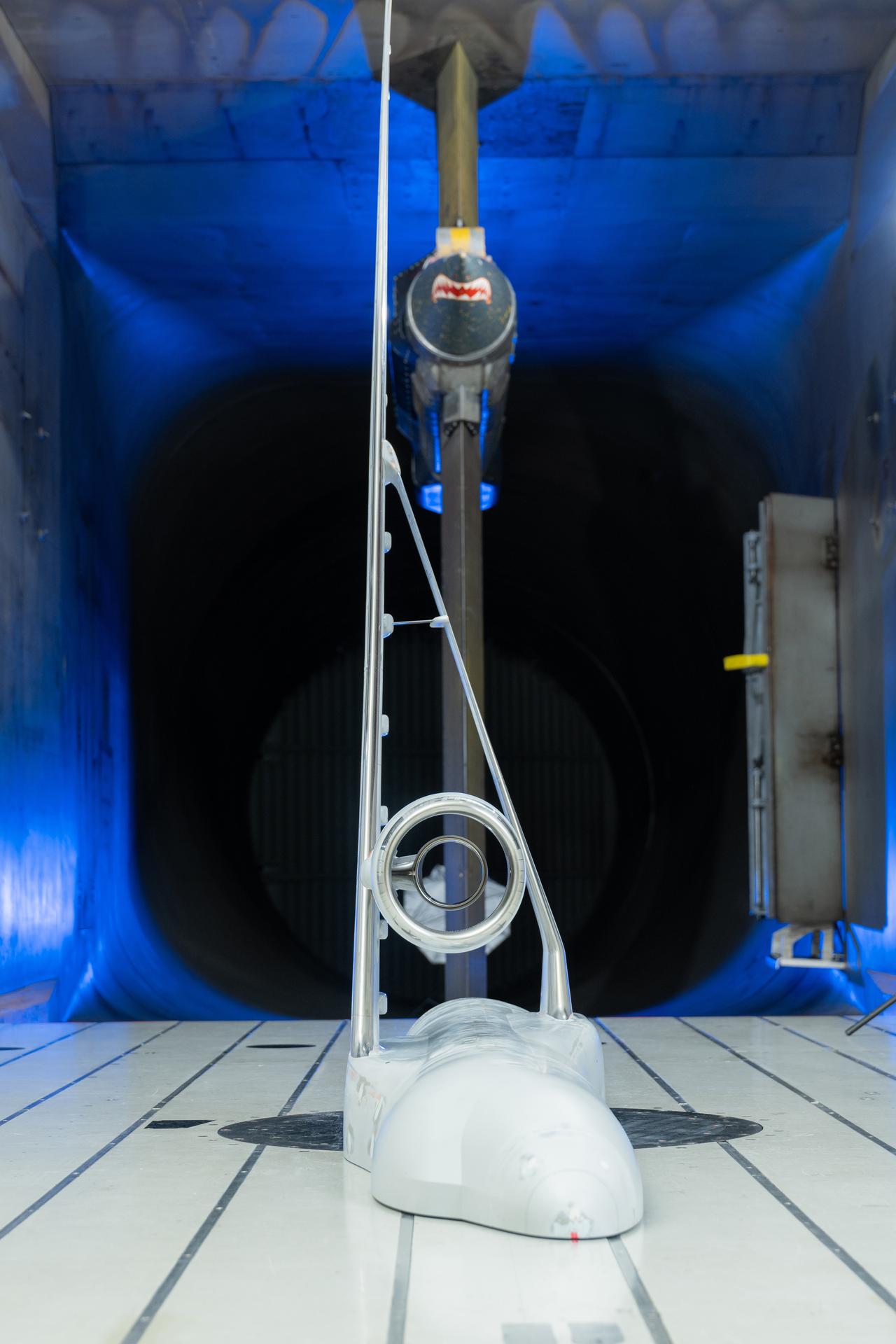
    There is a half model of an airplane in the center of the photo that is painted white, the background of the photo is black in the center with blue lights all around the side. The floor that the half model of the plane sits on is white.
    NASA’s Sustainable Flight Demonstrator project concluded wind tunnel testing in the fall of 2024. Tests on a Boeing-built X-66 model were completed at NASA’s Ames Research Center in California’s Silicon Valley in its 11-Foot Transonic Unitary Plan Facility. The model underwent tests representing expected flight conditions to obtain engineering information to influence design of the wing and provide data for flight simulators.
    NASA/Brandon Torres Navarrete

    NASA’s Sustainable Flight Demonstrator (SFD) project recently concluded wind tunnel tests of its X-66 semi-span model in partnership with Boeing. The model, designed to represent half the aircraft, allows the research team to generate high-quality data about the aerodynamic forces that would affect the actual X-66.

    Test results will help researchers identify areas where they can refine the X-66 design – potentially reducing drag, enhancing fuel efficiency, or adjusting the vehicle shape for better flying qualities.

    Tests on the Boeing-built X-66 semi-span model were completed at NASA’s Ames Research Center in California’s Silicon Valley in its 11-Foot Transonic Unitary Plan Facility. The model underwent tests representing expected flight conditions so the team could obtain engineering information to influence the design of the aircraft’s wing and provide data for flight simulators.

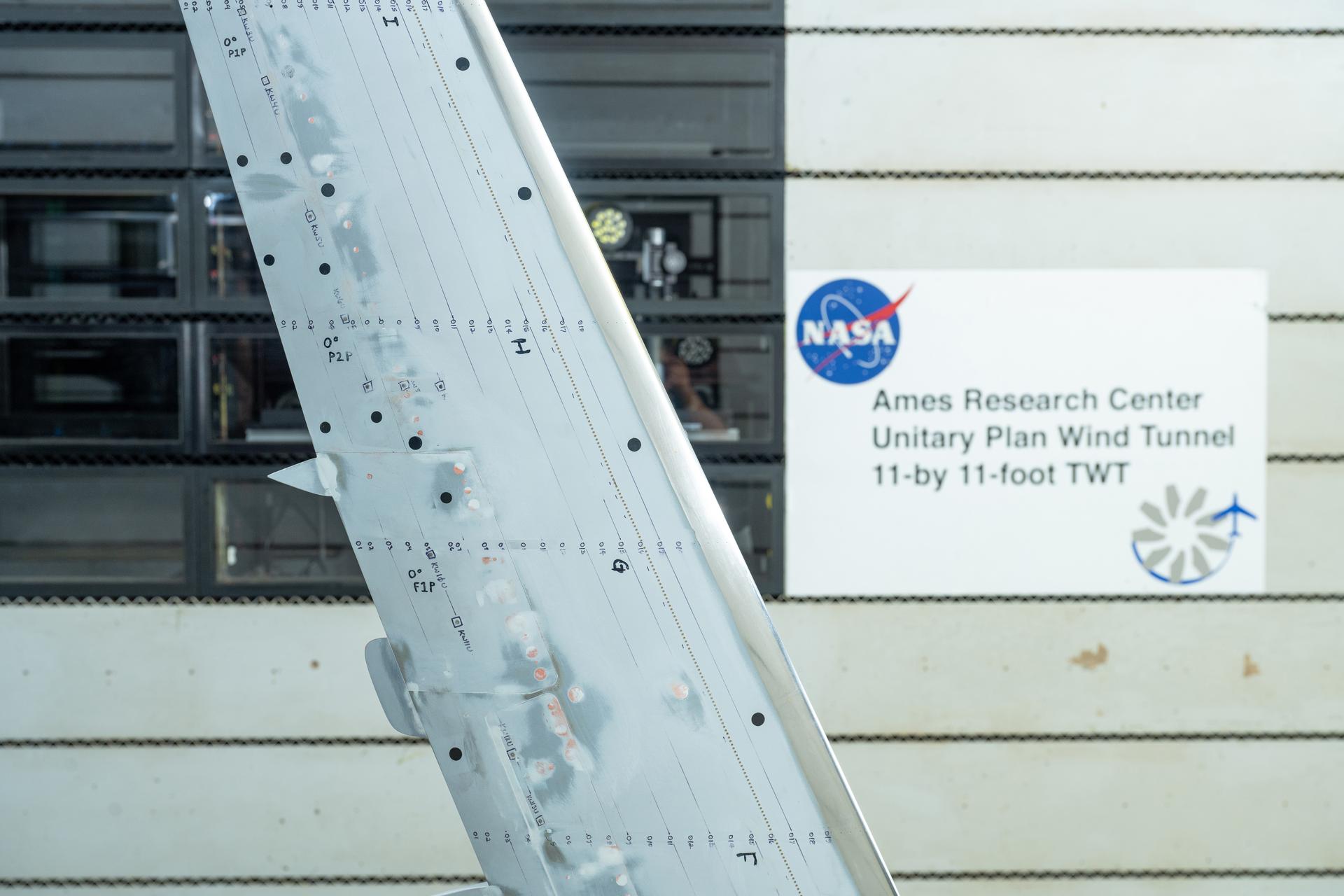
    Photo with part of an airplane wing colored white, with markings is in the foreground, the background has white vertical lines.
    NASA’s Sustainable Flight Demonstrator project concluded wind tunnel testing in the fall of 2024. Tests on a Boeing-built X-66 model were completed at NASA’s Ames Research Center in California’s Silicon Valley in its 11-Foot Transonic Unitary Plan Facility. Pressure points, which are drilled holes with data sensors attached, are installed along the edge of the wing and allow engineers to understand the characteristics of airflow and will influence the final design of the wing.
    NASA/Brandon Torres Navarrete

    Semi-span tests take advantage of symmetry. The forces and behaviors on a model of half an aircraft mirror those on the other half. By using a larger half of the model, engineers increase the number of surface pressure measurements. Various sensors were placed on the wing to measure forces and movements to calculate lift, drag, stability, and other important characteristics.

    The semi-span tests follow earlier wind tunnel work at NASA’s Langley Research Center in Hampton, Virginia, using a smaller model of the entire aircraft. Engineers will study the data from all of the X-66 wind tunnel tests to determine any design changes that should be made before fabrication begins on the wing that will be used on the X-66 itself.

    The SFD project is NASA’s effort to develop more efficient aircraft configurations as the nation moves toward aviation that’s more economically, societally, and environmentally sustainable. The project seeks to provide information to inform the next generation of single-aisle airliners, the most common aircraft in commercial aviation fleets around the world.  Boeing and NASA are partnering to develop the X-66 experimental demonstrator aircraft.

  • NASA Tests in Simulated Lunar Gravity to Prep Payloads for Moon

    3 min read

    Preparations for Next Moonwalk Simulations Underway (and Underwater)

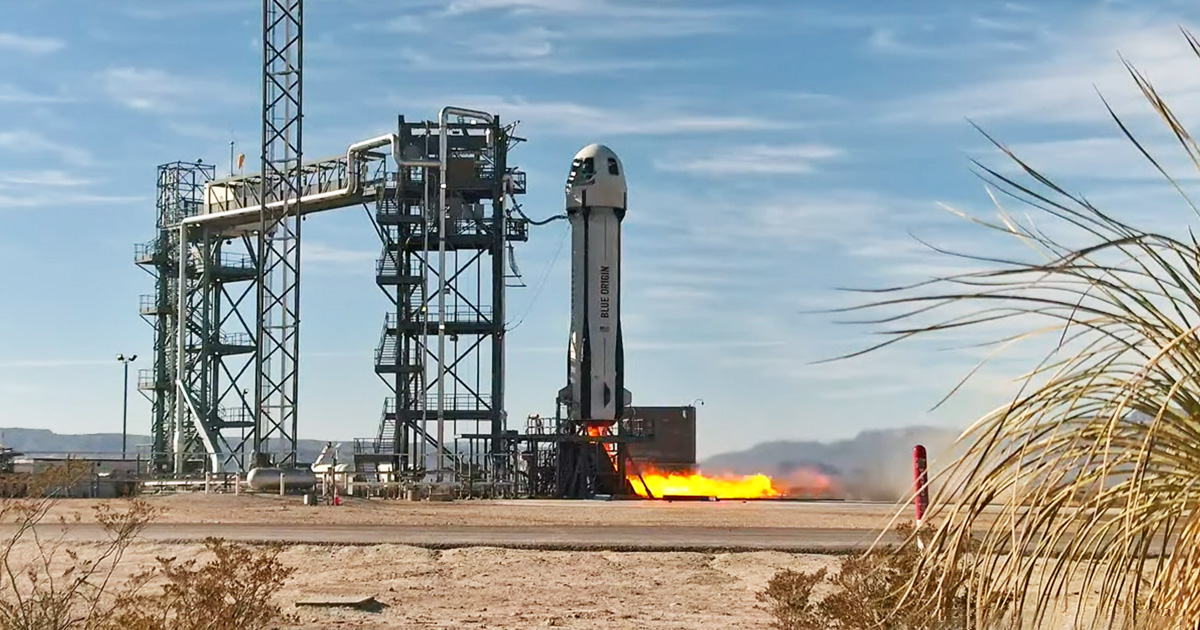
    Launch of Blue Origins New Shepard suborbital rocket system.
    Launch of Blue Origin’s New Shepard suborbital rocket system on Feb. 4, 2025. During the flight test, the capsule at the top detached from the booster and spun at approximately 11 rpm to simulate lunar gravity for the NASA-supported payloads inside.
    Blue Origin

    The old saying — “Practice makes perfect!” — applies to the Moon too. On Tuesday, NASA gave 17 technologies, instruments, and experiments the chance to practice being on the Moon… without actually going there. Instead, it was a flight test aboard a vehicle adapted to simulate lunar gravity for approximately two minutes.

    The test began on February 4, 2025, with the 10:00 a.m. CST launch of Blue Origin’s New Shepard reusable suborbital rocket system in West Texas. With support from NASA’s Flight Opportunities program, the company, headquartered in Kent, Washington, enhanced the flight capabilities of its New Shepard capsule to replicate the Moon’s gravity — which is about one-sixth of Earth’s — during suborbital flight.

    “Commercial companies are critical to helping NASA prepare for missions to the Moon and beyond,” said Danielle McCulloch, program executive of the agency’s Flight Opportunities program. “The more similar a test environment is to a mission’s operating environment, the better. So, we provided substantial support to this flight test to expand the available vehicle capabilities, helping ensure technologies are ready for lunar exploration.”

    NASA’s Flight Opportunities program not only secured “seats” for the technologies aboard this flight — for 16 payloads inside the capsule plus one mounted externally — but also contributed to New Shepard’s upgrades to provide the environment needed to advance their readiness for the Moon and other space exploration missions.

    “An extended period of simulated lunar gravity is an important test regime for NASA,” said Greg Peters, program manager for Flight Opportunities. “It’s crucial to reducing risk for innovations that might one day go to the lunar surface.”

    One example is the LUCI (Lunar-g Combustion Investigation) payload, which seeks to understand material flammability on the Moon compared to Earth. This is an important component of astronaut safety in habitats on the Moon and could inform the design of potential combustion devices there. With support from the Moon to Mars Program Office within the Exploration Systems Development Mission Directorate, researchers at NASA’s Glenn Research Center in Cleveland, together with Voyager Technologies, designed LUCI to measure flame propagation directly during the Blue Origin flight.

    The rest of the NASA-supported payloads on this Blue Origin flight included seven from NASA’s Game Changing Development program that seek to mitigate the impact of lunar dust and to perform construction and excavation on the lunar surface. Three other NASA payloads tested instruments to detect subsurface water on the Moon as well as to study flow physics and phase changes in lunar gravity. Rounding out the manifest were payloads from Draper, Honeybee Robotics, Purdue University, and the University of California in Santa Barbara.

    Flight Opportunities is part of the agency’s Space Technology Mission Directorate and is managed at NASA’s Armstrong Flight Research Center.

    By Nancy Pekar, NASA’s Flight Opportunities program

  • NASA to Talk Science, Tech Aboard Next Intuitive Machines Moon Flight

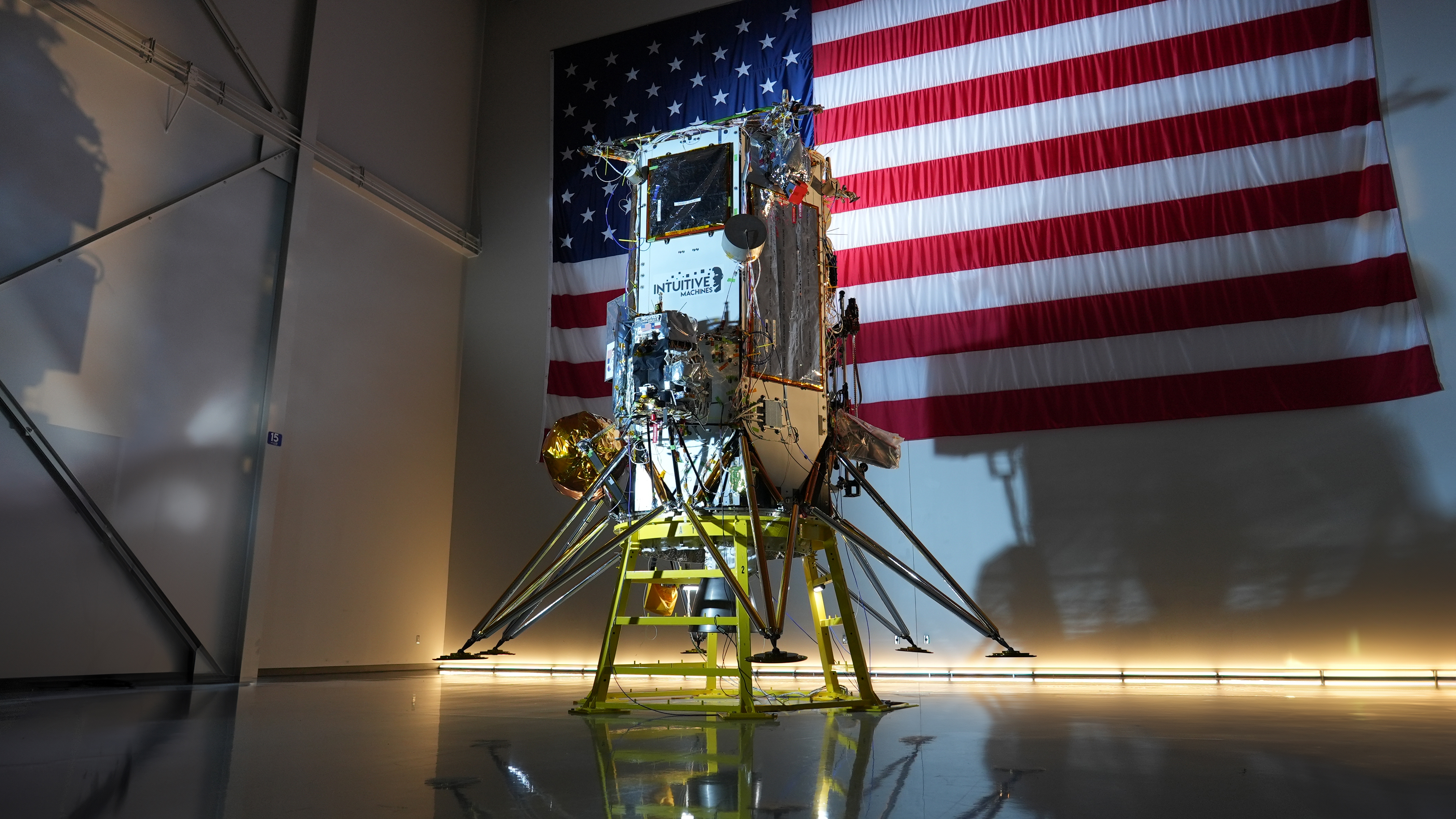
    As part of NASA’s CLPS (Commercial Lunar Payload Services) initiative and Artemis campaign, Intuitive Machines’ second delivery to the Moon will carry NASA technology demonstrations and science investigations on their Nova-C class lunar lander. Credit: Intuitive Machines
    As part of NASA’s CLPS (Commercial Lunar Payload Services) initiative and Artemis campaign, Intuitive Machines’ second delivery to the Moon will carry NASA technology demonstrations and science investigations on their Nova-C class lunar lander.
    Credit: Intuitive Machines

    NASA will host a media teleconference at 1 p.m. EST Friday, Feb. 7, to discuss the agency’s science and technology flying aboard Intuitive Machines’ second flight to the Moon. The mission is part of NASA’s CLPS (Commercial Lunar Payload Services) initiative and Artemis campaign to establish a long-term lunar presence. 

    Audio of the call will stream on the agency’s website at:

    https://www.nasa.gov/live

    Briefing participants include:

    • Nicky Fox, associate administrator, Science Mission Directorate, NASA Headquarters
    • Niki Werkheiser, director, technology maturation, Space Technology Mission Directorate, NASA Headquarters
    • Trent Martin, senior vice president, space systems, Intuitive Machines

    To participate by telephone, media must RSVP no later than two hours before the briefing to: ksc-newsroom@mail.nasa.gov. NASA’s media accreditation policy is available online.

    Intuitive Machines’ lunar lander, Athena, will launch on a SpaceX Falcon 9 rocket from Launch Complex 39A at NASA’s Kennedy Space Center in Florida. The four-day launch window opens no earlier than Wednesday, Feb. 26.

    Among the items on Intuitive Machines’ lander, the IM-2 mission will be one of the first on site, or in-situ, demonstrations of resource utilization on the Moon. A drill and mass spectrometer will measure the potential presence of volatiles or gases from lunar soil in Mons Mouton, a lunar plateau near the Moon’s South Pole. In addition, a passive Laser Retroreflector Array on the top deck of the lander will bounce laser light back at any orbiting or incoming spacecraft to give future spacecraft a permanent reference point on the lunar surface. Other technology instruments on this delivery will demonstrate a robust surface communications system and deploy a propulsive drone that can hop across the lunar surface.

    Launching as a rideshare with the IM-2 delivery, NASA’s Lunar Trailblazer spacecraft also will begin its journey to lunar orbit, where it will map the distribution of the different forms of water on the Moon.

    Under the CLPS model, NASA is investing in commercial delivery services to the Moon to enable industry growth and support long-term lunar exploration. As a primary customer for CLPS deliveries, NASA is one of many customers for these flights.

    For updates, follow on:

    https://blogs.nasa.gov/artemis

    -end-

    Alise Fisher / Jasmine Hopkins
    Headquarters, Washington
    202-358-2546
    alise.m.fisher@nasa.gov / jasmine.s.hopkins@nasa.gov

    Natalia Riusech / Nilufar Ramji
    Johnson Space Center, Houston
    281-483-5111
    nataila.s.riusech@nasa.gov / nilufar.ramji@nasa.gov

    Antonia Jaramillo
    Kennedy Space Center, Florida
    321-867-2468
    antonia.jaramillobotero@nasa.gov

  • SPHEREx’s Concentric Cones

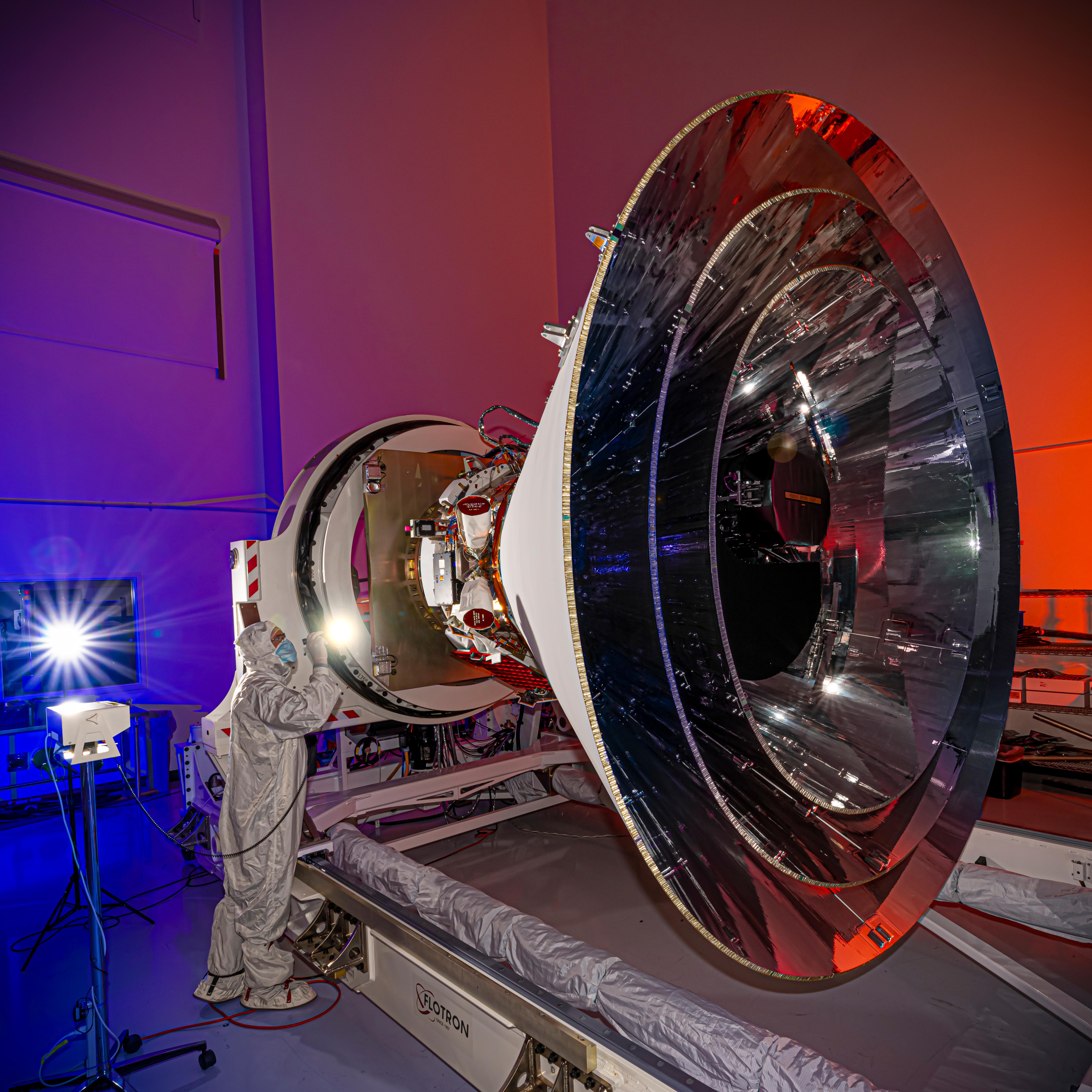
    A spacecraft with a distinct cone shape sits in a clean room. A person in a white suit that covers them from head to toe shines a penlight on the observatory. The walls of the clean room are lit with blue and red lights.
    Short for Spectro-Photometer for the History of the Universe, Epoch of Reionization and Ices Explorer, SPHEREx will create a map of the cosmos like no other. Using a technique called spectroscopy to image the entire sky in 102 wavelengths of infrared light, SPHEREx will gather information about the composition of and distance to millions of galaxies and stars. With this map, scientists will study what happened in the first fraction of a second after the big bang, how galaxies formed and evolved, and the origins of water in planetary systems in our galaxy.
    NASA/JPL-Caltech/BAE Systems

    NASA’s SPHEREx (Spectro-Photometer for the History of the Universe, Epoch of Reionization and Ices Explorer) observatory rests horizontally in this April 2024 image taken at BAE Systems in Boulder, Colorado. This orientation shows the observatory’s three layers of photon shields – the metallic concentric cones.

    Over a two-year planned mission, the SPHEREx Observatory will collect data on more than 450 million galaxies along with more than 100 million stars in the Milky Way in order to explore the origins of the universe.

    Tune in at 12 p.m. EST Jan. 31, 2025, to hear agency experts preview the mission. SPHEREx is targeted to launch no earlier than Feb. 27, 2025.

    Image credit: NASA/JPL-Caltech/BAE Systems

  • NASA Invites Media to Discuss PUNCH Mission to Study Solar Wind

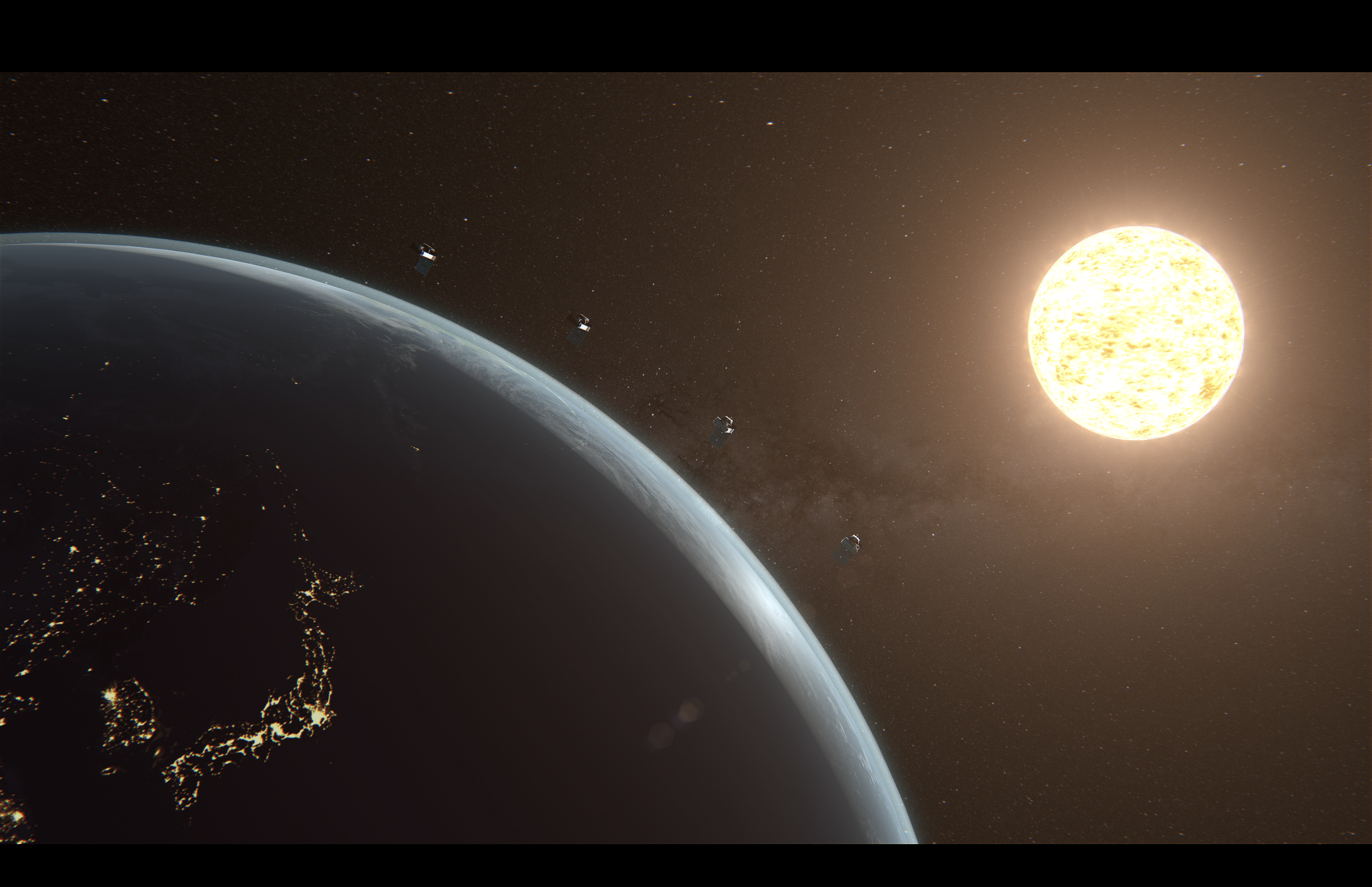
    Caption: Illustration of the four PUNCH spacecraft in low Earth orbit. Credit: NASA's Goddard Space Flight Center Conceptual Image Lab
    Caption: Illustration of the four PUNCH spacecraft in low Earth orbit. Credit: NASA’s Goddard Space Flight Center Conceptual Image Lab

    NASA will hold a media teleconference at 2 p.m. EST on Tuesday, Feb. 4, to share information about the agency’s upcoming PUNCH (Polarimeter to Unify the Corona and Heliosphere) mission, which is targeted to launch no earlier than Thursday, Feb. 27.

    The agency’s PUNCH mission is a constellation of four small satellites. When they arrive in low Earth orbit, the satellites will make global, 3D observations of the Sun’s outer atmosphere, the corona, and help NASA learn how the mass and energy there become solar wind. By imaging the Sun’s corona and the solar wind together, scientists hope to better understand the entire inner heliosphere – Sun, solar wind, and Earth – as a single connected system.

    Audio of the teleconference will stream live on the agency’s website at:

    https://www.nasa.gov/live

    Participants include:

    • Madhulika Guhathakurta, NASA program scientist, NASA Headquarters
    • Nicholeen Viall, PUNCH mission scientist, NASA’s Goddard Space Flight Center
    • Craig DeForest, PUNCH principal investigator, Southwest Research Institute

    To participate in the media teleconference, media must RSVP no later than 12 p.m. on Feb. 4 to: Abbey Interrante at: abbey.a.interrante@nasa.gov. NASA’s media accreditation policy is available online. 

    The PUNCH mission will share a ride to space with NASA’s SPHEREx (Spectro-Photometer for the History of the Universe, Epoch of Reionization and Ices Explorer) space telescope on a SpaceX Falcon 9 rocket from Space Launch Complex 4 East at Vandenberg Space Force Base in California. 

    The Southwest Research Institute in Boulder, Colorado, leads the PUNCH mission. The mission is managed by the Explorers Program Office at NASA’s Goddard Space Flight Center in Greenbelt, Maryland, for NASA’s Science Mission Directorate in Washington. 

    To learn more about PUNCH, please visit:  

    https://nasa.gov/punch

    -end-

    Karen Fox
    Headquarters, Washington
    202-358-1600
    karen.fox@nasa.gov

    Sarah Frazier
    Goddard Space Flight Center, Greenbelt, Md.
    202-853-7191
    sarah.frazier@nasa.gov

  • NASA, Partners to Welcome Fourth Axiom Space Mission to Space Station

    The Axiom Mission 4, or Ax-4, crew will launch aboard a SpaceX Dragon spacecraft to the International Space Station from NASA’s Kennedy Space Center in Florida no earlier than Spring 2025. From left to right: Tibor Kapu of Hungary, ISRO (Indian Space Research Organisation) astronaut Shubhanshu Shukla, former NASA astronaut Peggy Whitson, and ESA (European Space Agency) astronaut Sławosz Uznański-Wiśniewski of Poland.
    The Axiom Mission 4, or Ax-4, crew will launch aboard a SpaceX Dragon spacecraft to the International Space Station from NASA’s Kennedy Space Center in Florida no earlier than Spring 2025. From left to right: Tibor Kapu of Hungary, ISRO (Indian Space Research Organization) astronaut Shubhanshu Shukla, former NASA astronaut Peggy Whitson, and ESA (European Space Agency) astronaut Sławosz Uznański-Wiśniewski of Poland.
    Credit: SpaceX

    NASA and its international partners have approved the crew for Axiom Space’s fourth private astronaut mission to the International Space Station, launching from the agency’s Kennedy Space Center in Florida no earlier than spring 2025.

    Peggy Whitson, former NASA astronaut and director of human spaceflight at Axiom Space, will command the commercial mission, while ISRO (Indian Space Research Organization) astronaut Shubhanshu Shukla will serve as pilot. The two mission specialists are ESA (European Space Agency) project astronaut Sławosz Uznański-Wiśniewski of Poland and Tibor Kapu of Hungary.

    “I am excited to see continued interest and dedication for the private astronaut missions aboard the International Space Station,” said Dana Weigel, manager of NASA’s International Space Station Program at the agency’s Johnson Space Center in Houston. “As NASA looks toward the future of low Earth orbit, private astronaut missions help pave the way and expand access to the unique microgravity environment.”

    The Axiom Mission 4, or Ax-4, crew will launch aboard a SpaceX Dragon spacecraft and travel to the space station. Once docked, the private astronauts plan to spend up to 14 days aboard the orbiting laboratory, conducting a mission comprised of science, outreach, and commercial activities. The mission will send the first ISRO astronaut to the station as part of a joint effort between NASA and the Indian space agency. The private mission also carries the first astronauts from Poland and Hungary to stay aboard the space station.

    “Working with the talented and diverse Ax-4 crew has been a deeply rewarding experience,” said Whitson. “Witnessing their selfless dedication and commitment to expanding horizons and creating opportunities for their nations in space exploration is truly remarkable. Each crew member brings unique strengths and perspectives, making our mission not just a scientific endeavor, but a testament to human ingenuity and teamwork. The importance of our mission is about pushing the limits of what we can achieve together and inspiring future generations to dream bigger and reach farther.”

    The first private astronaut mission to the station, Axiom Mission 1, lifted off in April 2022 for a 17-day mission aboard the orbiting laboratory. The second private astronaut mission to the station, Axiom Mission 2, also was commanded by Whitson and launched in May 2023 with four private astronauts who spent eight days in orbit. The most recent private astronaut mission, Axiom Mission 3, launched in January 2024; the crew spent 18 days docked to the space station.

    The International Space Station is a convergence of science, technology, and human innovation that enables research not possible on Earth. For more than 24 years, NASA has supported a continuous human presence aboard the orbiting laboratory, through which astronauts have learned to live and work in space for extended periods of time.

    The space station is a springboard for developing a low Earth economy. NASA’s goal is to achieve a strong economy in low Earth orbit where the agency can purchase services as one of many customers to meet its science and research objectives in microgravity. NASA’s commercial strategy for low Earth orbit will provide the government with reliable and safe services at a lower cost, enabling the agency to focus on Artemis missions to the Moon in preparation for Mars while also continuing to use low Earth orbit as a training and proving ground for those deep space missions. 

    Learn more about NASA’s commercial space strategy at:

    https://www.nasa.gov/commercial-space

    -end-

    Josh Finch / Claire O’Shea
    Headquarters, Washington
    202-358-1100
    joshua.a.finch@nasa.gov / claire.a.o’shea@nasa.gov

    Anna Schneider
    Johnson Space Center, Houston
    281-483-5111
    anna.c.schneider@nasa.gov

    Alexis DeJarnette
    Axiom Space
    850-368-9446
    alexis@axiomspace.com

  • 6 NASA Experiments on Materials, Benefitting Space and Earth

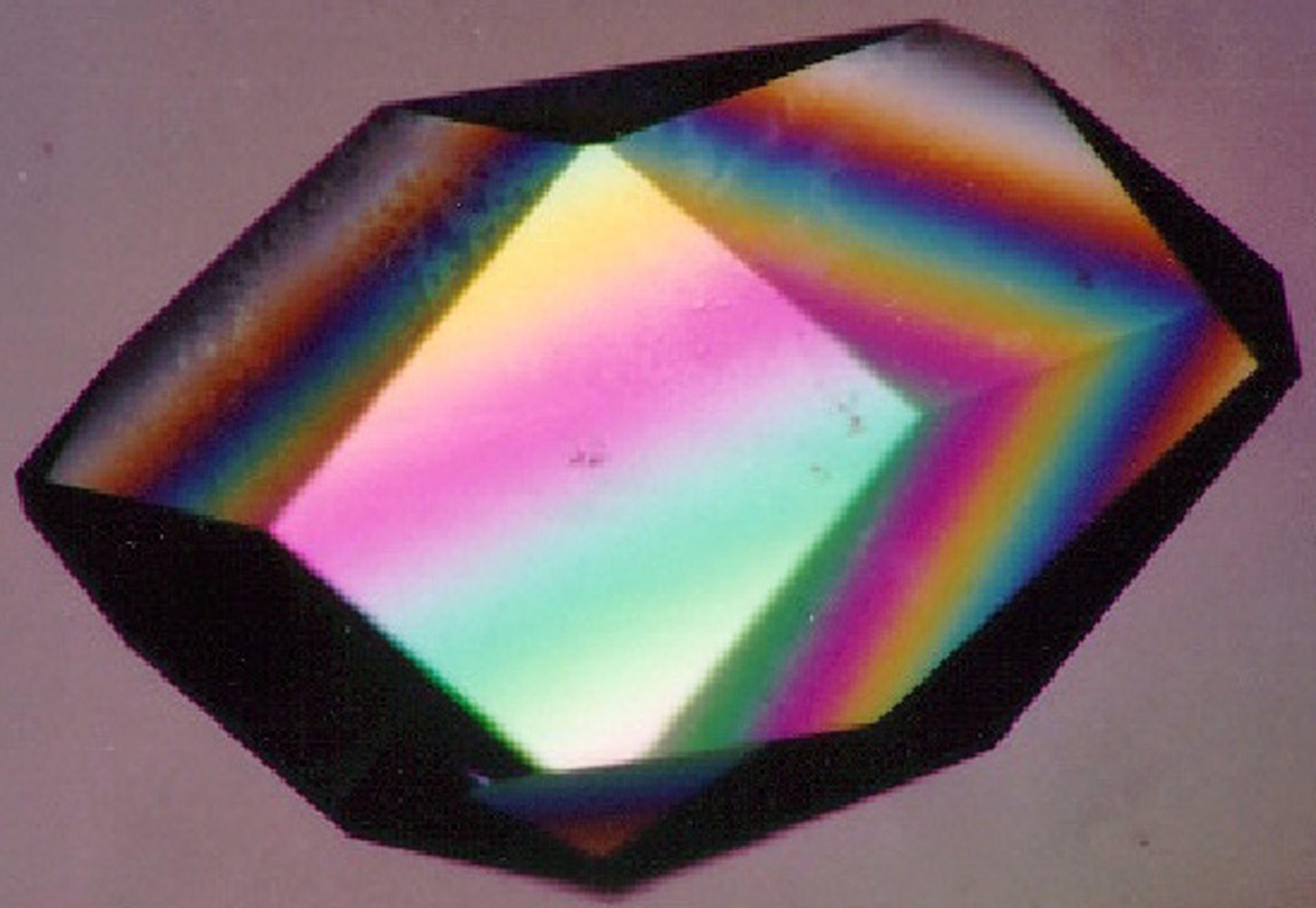
    A Lysozyme crystal grown in microgravity, viewed under a microscope using X-ray crystallography.
    NASA

    Did you know that NASA conducts ground-breaking research in space on materials like metals, foams, and crystals? This research could lead to next-generation technology that both enables deep-space exploration and benefits humanity.  

    Here are six studies scientists have conducted on the International Space Station that could have profound implications for future space travel and also improve products widely used on Earth:  

    • 01

      Advancing construction and repairing techniques with liquid metals 

      Researchers are looking at the effects of microgravity on the liquid metals formed during brazing, a technology used to bond materials at temperatures above 450 degrees Celsius.  The Brazing of Aluminum alloys In Space (BRAINS) experiment aboard the International Space Station studies how alloys join with a range of other materials, such as ceramics or other metals. 
       
      In space, brazing could be used to construct vehicles, habitats, and other systems needed for space missions, and repair them if damaged. Advanced brazing technologies discovered in space may also be used in the construction and repair of structures on Earth.

    • 02

      Improving materials used for high-powered lasers 

      Another study on the space station is looking at the growth of semiconductor crystals based on Zinc selenide (ZnSe) in microgravity.  ZnSe is an important semiconductor used on Earth for optical devices and infrared lasers.  
       
      Researchers are investigating the impact of microgravity on the growth of these crystals and comparing the results to those grown on Earth.  A better understanding of the impact of microgravity on crystal growth could open the door to expanded commercial use of space.  

    • 03

      Researching ways to make stronger metal 

      Metal alloys, which are created by combining two or more metallic elements, are used in everything from hardware to kitchen appliances, automobiles, and even the space station itself. Alloys are created by cooling a liquid metal until it hardens into a solid.  
       
      Researchers on the space station are investigating how metal alloys melt and take shape in a controlled microgravity environment. While brazing aims to repair or bond two separate materials, this experiment looks at casting or molding things from liquid metals. In metal castings, the solid grows by forming millions of snowflake-like crystals called dendrites. The shape of the dendrites affects the strength of the metal alloys.  
       
      Findings are expected to significantly impact our ability to produce metals with greater strength, for both space and on Earth applications.  

    • 04

      Exploring stability and mechanics of foams and bubbly liquids

      Studying how foams and bubbly liquids evolve in microgravity over time is another important NASA investigation. These experiments will provide guidance for how to control the flow and separation of bubbly liquids. This knowledge is crucial for developing a water recovery and recycling device for future space exploration to Mars.  
       
      On Earth, foams are found in everything from food and cosmetics to paper and petroleum. A better understanding of their stability and mechanics is important for creating sustainable, more efficient processes and improved materials.  

    • 05

      Improving performance and lowering cost of “superglass” 

      Scientists are conducting experiments on supercooled metal oxides (space soil and rock) to better understand how molten materials can be processed in microgravity. Manufacturing new products in space is critical to long-term efforts to develop habitats in space and on other planets. It will require the use of available resources in space, including soil and rocks.  
       
      Data from the research also has far-reaching implications on Earth. It could help improve the performance and lower the cost of materials that are used in the production of cell phone displays, lasers, and glass for automobiles.  

    • 06

      Advancing 3D printing and manufacturing through “soft matter” research

      Space exploration to Mars and beyond will require astronauts to have the ability to build new equipment and materials in space. To make that a reality, space station researchers conducted a number of experiments looking at the behavior of colloids, or “soft matter,” in a microgravity environment.  
       
      This research could have a variety of applications on Earth, including the development of chemical energy, improvements to communications technologies, and enhancements to photonic materials used to control and manipulate light.   

    Related Resources: 

    NASA’s Biological and Physical Sciences Division pioneers scientific discovery and enables exploration by using space environments to conduct investigations not possible on Earth. Studying biological and physical phenomenon under extreme conditions allows researchers to advance the fundamental scientific knowledge required to go farther and stay longer in space, while also benefitting life on Earth. 

  • How to Fly NASA’s Orion Spacecraft

    During the Artemis II mission to the Moon, NASA astronauts Reid Wiseman and Victor Glover will take control and manually fly Orion for the first time, evaluating the handling qualities of the spacecraft during a key test called the proximity operations demonstration. This is how to fly Orion.

    On NASA’s Artemis II test flight, the first crewed mission under the agency’s Artemis campaign, astronauts will take the controls of the Orion spacecraft and periodically fly it manually during the flight around the Moon and back. The mission provides the first opportunity to ensure the spacecraft operates as designed with humans aboard, ahead of future Artemis missions to the Moon’s surface.

    The first key piloting test, called the proximity operations demonstration, will take place after the four crew members — NASA’s Reid Wiseman, Victor Glover, and Christina Koch, and CSA (Canadian Space Agency) astronaut Jeremy Hansen — are safely in space, about three hours into the mission. To evaluate the spacecraft’s manual handling qualities, the crew will pilot Orion to approach and back away from the detached upper stage of the SLS (Space Launch System) rocket.

    Crew members participating in the demonstration will use two different controllers, called rotational and translational hand controllers, to steer the spacecraft. Three display screens provide the astronauts with data, and another device, called the cursor control device, allows the crew to interact with the displays.

    Astronauts will use the rotational hand controller (RHC), gripped in the right hand, to rotate the spacecraft. It controls Orion’s attitude, or the direction the spacecraft is pointing. If the crew wants to point Orion’s nose left, the RHC is twisted left – for nose right, they will twist the RHC right. Similarly, the RHC can control the nose to pitch up or down or roll right or left.

    “On Artemis II, most of the time the spacecraft will fly autonomously, but having humans aboard is a chance to help with future mission success,” said Reid Wiseman. “If something goes wrong, a crewmember can jump on the controls and help fix the problem. One of our big goals is to check out this spacecraft and have it completely ready for our friends on Artemis III.”

    The commander and pilot seats are each equipped with a rotational hand controller (RHC), gripped in the right hand, to rotate the spacecraft. It controls Orion’s attitude, or the direction the spacecraft is pointing. If the crew wants to point Orion’s nose left, the RHC is twisted left — for nose right, they will twist the RHC right. Similarly, the RHC can control the nose to pitch up or down or roll right or left.

    The translational hand controller (THC), located to the right or left of the display screens, will move Orion from one point to another. To move the spacecraft forward, the crew pushes the controller straight in — to back up, they will pull the controller out. And similarly, the controller can be pushed up or down and left or right to move in those directions.

    When the crew uses one of the controllers, their command is detected by Orion’s flight software, run by the spacecraft’s guidance, navigation, and control system. The flight software was designed, developed, and tested by Orion’s main contractor, Lockheed Martin.

    The crew will use translational hand controller (THC), located to the right or left of the display screens, will move Orion from one point to another. To move the spacecraft forward, the crew pushes the controller straight in – to back up, they will pull the controller out. And similarly, the controller can be pushed up or down and left or right to move in those directions.

    “We’re going to perform flight test objectives on Artemis II to get data on the handling qualities of the spacecraft and how well it maneuvers,” said Jeffrey Semrau, Lockheed Martin’s manual controls flight software lead for Artemis missions. “We’ll use that information to upgrade and improve our control systems and facilitate success for future missions.”

    Depending on what maneuver the pilot has commanded, Orion’s software determines which of its 24 reaction control system thrusters to fire, and when. These thrusters are located on Orion’s European-built service module. They provide small amounts of thrust in any direction to steer the spacecraft and can provide torque to allow rotation control.

    The cursor control device allows the crew to interact with the three display screens that show spacecraft data and information. This device allows the crew to interact with Orion even under the stresses of launch or entry when gravitational forces can prevent them from physically reaching the screens.

    The cursor control device allows the crew to interact with the three display screens that show spacecraft data and information. This device allows the crew to interact with Orion even under the stresses of launch or entry when gravitational forces can prevent them from physically reaching the screens.

    Next to Orion’s displays, the spacecraft also has a series of switches, toggles, and dials on the switch interface panel. Along with switches the crew will use during normal mission operations, there is also a backup set of switches they can use to fly Orion if a display or hand controller fails.

    “This flight test will simulate the flying that we would do if we were docking to another spacecraft like our lander or to Gateway, our lunar space station,” said Victor Glover. “We’re going to make sure that the vehicle flies the way that our simulators approximate. And we’re going to make sure that it’s ready for the more complicated missions ahead.”

    The approximately 10-day Artemis II flight will test NASA’s foundational human deep space exploration capabilities, the SLS rocket, Orion spacecraft, and supporting ground systems, for the first time with astronauts and will pave the way for lunar surface missions.