Tag: JAXA

  • [ISS / Japanese Experiment Module (KIBO)] High-altitude drop test results of a simulated small return capsule for the H-II Transfer Vehicle (HTV) KOUNOTORI

    High-altitude drop test results of a simulated small return capsule for the H-II Transfer Vehicle (HTV) KOUNOTORI

    Last Updated:
    January 11, 2018

    Japan Aerospace Exploration Agency (JAXA) is developing a small return capsule that will be released from the H-II Transfer Vehicle (HTV) KOUNOTORI undocked from the International Space Station (ISS) , and then returned to earth, in order to establish the technology needed to collect samples obtained through space experiments on the ISS.

    The sample-collecting technology, which will enable the return of samples of space experiment results to earth more frequently once acquired, is expected to further maximize the ISS utilization results.

    We will analyze the test data obtained and continue to develop the small return capsule aboard KOUNOTORI.

    Overview of the drop test

    • This test marks the fourth one for pre-flight final confirmation to be conducted based on the results of drop tests on October 2015, September 2016, and July 2017.
    • In this test, the test capsule was dropped from a helicopter at an altitude of 1.5 km, off the coast of Taiki-cho, Hokkaido on November 16, 2017. The parachute and other equipment including the buoyancy bag were confirmed to function normally, and technical data was obtained.
    • The test capsule floating on the sea surface after its splashdown was collected by ship.

    The capsule hanging by helicopter

    Onboard camera view from capsule

    Descended capsule


    Floating capsule before recovery

    Capsule recovery operations

    Small capsule drop test team

    * All photo credit: JAXA

    Let’s block ads! (Why?)

  • [ISS / Japanese Experiment Module (KIBO)] Turkey hands over samples to Japan for a space materials exposure experiment – Experiment to begin next spring on the exposed facility of "Kibo"!

    Turkey hands over samples to Japan for a space materials exposure experiment – Experiment to begin next spring on the exposed facility of “Kibo”!

    Last Updated:
    January 11, 2018

    On November 21, 2017, experiment samples were handed over from Tukey to the Japan Aerospace Exploration Agency (JAXA) at the JAXA Tsukuba Space Center (TKSC), where preparations for delivering the samples to the International Space Station (ISS) are now underway.

    In September 2016, JAXA and the Republic of Turkey’s Ministry of Transport, Maritime Affairs and Communications (MTMAC) signed a cooperation agreement related to Kibo utilization for two long-term exposure experiments using the Experiment Handrail Attachment Mechanism (ExHAM) installed on the Exposed Facility of the Japanese Experiment Module (“Kibo”) and one-CubeSat deployment from Kibo. The first joint experiment has been underway since April 2017 and will be succeeded by a second experiment using the samples, which is scheduled to begin around the spring of 2018.

    【The first experiment】Initiating the joint exposed experiment with the Republic of Turkey utilizing the Exposed Experiment Handrail Attachment Mechanism (ExHAM)

    On November 21, two officials Istanbul Technical University, which proposed the experiment, hand-carried the experiment samples to TKSC and ensured that the samples were ready for installation on ExHAM by using a mockup and other means.

    The images below show the handover and confirmation of samples on November 21 (with the fitting of samples with the ExHAM mockup being checked).

    Officials from Turkey installing the experiment samples on ExHAM (Credit: JAXA)

    Officials from Turkey and JAXA engaged in confirmation work (Credit: JAXA)


    Turkey’s experiment samples (for launch) (Credit: JAXA)

    After fully completing the confirmation work, Turkish officials handed over the experiment samples to JAXA, which in turn presented the handover acknowledgement to the Turkish officials. The samples will be shipped to the US from Japan for delivery to the ISS onboard the US commercial cargo ship, which is scheduled for launch in March 2018.

    Officials from Turkey receiving the handover acknowledgement from JAXA Officials on November 21, at sample handover at TKSC (Credit: JAXA)

    Under overall coordination by MTMAC, the second experiment is expected to provide samples for the “verification experiment of radiation shielding material for spacecraft equipments” proposed by Istanbul Technical University. In the experiment, materials with self-repairing properties against damage caused by radiation exposure will be installed on ExHAM and exposed to the space radiation environment for about one year to examine their potential use in space.

    Figure1 Experiment samples hand-carried from Istanbul Technical University, Turkey
    (External view on the left and internal view on the right) (Credit: Istanbul Technical University)

    Japan-Turkey cooperation on Kibo utilization is expected to contribute to the development of space utilization technology in Asia through Kibo utilization, aimed at establishing a future reciprocal and cooperative relationship among space agencies in the region, by taking full advantage of the fact that Japan is the only ISS partner from Asia.

    *All times are Japan Standard Time (JST)

    Let’s block ads! (Why?)

  • [Hayabusa2 Project site] What will asteroid Ryugu look like?

    We are looking for host organisations for a space art contest!

    Our asteroid explorer, Hayabusa2, is getting close to its destination. Between June and July 2018, the spacecraft will reach asteroid (162173) Ryugu and start to investigate this small world.

    At the moment, we know very little about the appearance of Ryugu. We therefore are issuing a challenge to imagine what Hayabusa2 is going to see!

    We invite science museums, planetariums, public observatories and other centres with space-related activities to become contest “nodes” and help us gather the most imaginative artwork from around the world.

    (1) Contest name:

    Imagining Ryugu

    (2) Organiser and co-organiser

    Organiser: The JAXA Hayabusa2 Project
    Co-organiser: The local hosts that will be the contest “nodes”.

    (3) Application procedure
    1. We are looking for institutions or organisations that will become local contest hosts known as “nodes”.
      • We invite you to submit a simple proposal for locally hosting the contest. We will check if your organisation can act as a node and if your plan meets the purpose of the contest.
      • We accept applications until the end of February 2018.
      • The selected nodes will be announced on the Hayabusa2 website.
    2. Each node will gather artwork of asteroid Ryugu created by members of the public.
      • Each node can decide the type of artwork they will invite and the period for submission.
      • Artwork can be collected until the end of April 2018 (Hayabusa2 will be able to see asteroid Ryugu from May 2018!)
    3. When Ryugu is clearly observable by Hayabusa2 (expected to be at the end of August 2018), the best artwork (one or more entries) at each node can be nominated to entre a global contest, judged by the Hayabusa2 team.
      • Nomination deadline is the end of September 2018.
    4. The Hayabusa2 project team will select and award a prize.
      • Award announcement will be Fall 2018.
    (4) What is the role of a node?
    • The node will collect artwork of asteroid Ryugu.
    • The node will select winning entries for each of the contest categories and nominate one or more entries to be judged in the global contest by the Hayabusa2 project team. (The procedure for nomination is described below.)
    • Each node can carry out their own event or contest to gather artwork submissions.
    • Each node can decided on specific conditions for the contest, e.g. specifying the paper size or deciding whether to accept only illustrations or also photographs of sculptures and models.

    • Institutes and organisations eligible to become nodes are science museums, museums, planetariums, public observatories and other organisations engages in space-related outreach and education.
    (5) Entries for nomination to the global contest
    • Both illustrations and photographs of three-dimensional models are accepted as nominations in the global contest. We are happy to accept any method of illustrating, including computer graphics. However, each node may impose additional rules for submission.
    • Nominations may include a brief description explaining the size of Ryugu and the appearance of the surface.
    • The work must be original and only one submission is allowed per person. (In the case of artwork produced by several people, only one submission can come from that group.)
    • Artwork can be submitted at any node without charge, although exact rules of entry may differ from node to node.
    (6) Contest Categories
    • Ryugu look-a-like award
    • The most fun submission
    • The most imaginative entry

    (Other categories are also currently being considered.)

    Entries will also be subdivided approximately by age (exact division can be determined by the node, based on the most suitable groups for where they are based): below elementary school, lower elementary grades, upper elementary grades, middle school, high school, university student and general.

    (7) The selected artwork
    • Winning entries will be introduced on the Hayabusa2 website.
    • There will be a fun prize awarded!
    (8) Remarks
    • Information that is currently known about asteroid Ryugu will be available for making the artwork (although it may be better to create without any prior knowledge!)
    (9) Contact information

    z-hayabusa2-contact@ml.jaxa.jp
    (Hayabusa2 Mission Manager, Makoto Yoshikawa)

    December 27, 2017
    Hayabusa2 project

    Let’s block ads! (Why?)

  • Items for Asian Try Zero-G 2018 launched by Dragon-13

    Items for Asian Try Zero-G 2018 launched by Dragon-13

    Last Updated: December 25, 2017

    Falcon9/Dragon CRS-13 was successfully launched (Credit: NASA)

    Kibo-ABC member countries decided to prepare unique flight items for Asian Try Zero-G 2018. This required many kinds of activities for flight preparation, which were completed, and launched on Dec. 15th, 2017 and delivered to the ISS on Dec. 16th, 2017.

    Flight items are mostly delivered to the ISS with Japanese Konotori, American Cygnus, and American Dragon space vehicles. Each country who prepared flight items–Indonesia, Singapore, and Japan–first sent the items to the Tsukuba Space Center (TKSC) before sending them to the launch site to ISS.

    One of flight items of Asian Try zero-G 2018 (Credit:JAXA)

    At TKSC, JAXA staff measured the size and weight of each item. All flight items of Asian Try Zero-G 2018 are light, but it is important to have the measurement data for the whole cargo as they can affect the trajectory of the rocket when the cargo is heavy.

    Then, JAXA named Operational Nomenclature, so called OpNom, on every item. OpNom is subject to approval and registration by NASA to prevent confusing astronauts, who may encounter many nicknames from hardware providers. Nicknames, especially when abbreviated, may become quite different from what they are. Since there is a large amount of hardware in ISS, identification of each item, tool, and equipment may become difficult and result in operation failure. Therefore, it is important to control the nomenclature.

    After that, labels to indicate OpNom were attached to every item. Labels are also subject to NASA approval. This is so they are attached in appropriate places and their contents do not confuse astronauts. All labels of Asian Try Zero-G 2018 have been approved and sent from NASA.

    Wire Top covered with silicon tube to eliminate sharp edge (Credit:JAXA)

    In the meantime, the safety requirements for the flight items were verified. JAXA collected material information from each country and developed a list called Material Identification and Usage List (MIUL). This was intended for cross checking the satisfaction of ISS safety requirements such as flammability, toxicity, off-gassing and others by decomposing each item by its material level. In addition, JAXA identified the existence of hazardous events throughout the experiments and studied the method of hazard controls, then developed a document called Safety Assessment Report (SAR) which was approved by JAXA internal Safety Control Board. Although there were no dangers identified in Asian Try Zero-G 2018, sharp edges were removed to protect astronauts from injury.

    There are some flight items which JAXA uniquely modified and arranged to establish an experiment with considering intention of a proposer. One example, proposed by the Philippines was the Double Layered Liquid Ball. The objective of the experiment is to form a double ball using water and oil to check whether the double ball can be formed in zero-G. To form suitably-shaped liquid balls, JAXA made a wire hoop and coated it with water/oil repellent agent. The wire hoop has minimum torsion to prevent capillary action.

    Medium Wire Hoop(left), its region of water and oil repellent agent coating (right) (Credit:JAXA)

    Markings on Wood Plane (Credit:JAXA)

    Another example is the wood planes of Aircraft Stability, proposed by Singapore. The objective of the experiment is to test the effect of ‘teardrop’ wings, and the effect of changing the neutral point of the aircraft. JAXA had to erase an irrelevant name on the main wings of the wood planes and put some markings so that astronauts can follow the procedure quickly. JAXA also verified how to fly one with the ‘teardrop’ attachment.

    Packing at TKSC (Credit:JAXA)

    On October 23rd, 2017, the flight items were packed at TKSC for delivery to Johnson Space Center (JSC). Arriving at JSC on October 31st ,2017, NASA’s cargo integration team checked every item in the package, label exists, and manifest consistency. The items were then stowed in a soft bag called a Cargo Transfer Bag (CTB) which protects its contents from rocket vibration. This was finally transported to the Kennedy Space Center (KSC) for loading into Dragon 13.

    All Flight Items packed in a Ziploc Bag (Credit:JAXA)

    None of the flight items of Asian Try Zero-G 2018 were damaged nor malfunctioned by the launch vibration. However, care was taken not to bend in CTB and packed into a Ziploc bag so that astronauts could find the items easily.

    The flight items were launched with Dragon 13 on December 15th, 2017 and docked to ISS on 16th, 2017, and waiting for Astronaut Norishige Kanai to perform the experiments.

    Reports on procedure development and astronaut training will be coming soon.

    Let’s block ads! (Why?)

  • Release on updated images of Kibo's internal drone "Int-Ball" (Int-Ball Letter Vol. 7)

    Release on updated images of Kibo’s internal drone “Int-Ball” (Int-Ball Letter Vol. 7)

    Last Updated:
    December 14, 2017

    The Japan Aerospace Exploration Agency (JAXA) has disclosed “Int-Ball Letter” Vol. 7 in which the latest video of the Kibo’s internal drone called “Int-Ball” on the International Space Station (ISS) is presented.

    On upcoming December 17, the Soyuz spacecraft with JAXA Astronaut Norishige Kanai on board is going to be launched for the ISS from the Baikonur Cosmodrome in Kazakhstan.

    This time, we will introduce the preparation currently being held on the ground and in space, at a countdown of Astronaut Kanai’s arrival on the ISS.

    JEM Internal Ball Camera (Int-Ball) (1m48s) (Credit:JAXA)

    Int-Ball Letter Vol. 1: Started working in space!
    Int-Ball Letter Vol. 2: Body control
    Int-Ball Letter Vol. 3: Exploring inside “Kibo”!
    Int-Ball Letter Vol. 4: Encounter with Astronaut Kanai
    Int-Ball Letter Vol. 5: Buddy of Astronauts
    Int-Ball Letter Vol. 6: Secret of Int-Ball’s round body
    See here for further information on Int-Ball and the first disclosures of images: 
    First disclosure of images taken by the Kibo’s internal drone “Int-Ball”
    See here for further information on the Miniaturized Attitude Control Sensors and Actuators in an All-in-one Module installed in the Int-Ball: 
    JAXA Research and Development Directorate

    *All times are Japan Standard Time (JST)

    Let’s block ads! (Why?)

  • Kibo-ABC Member Countries' News: Kibo-ABC Workshop at the 24th APRSAF, in India

    Kibo-ABC Member Countries’ News: Kibo-ABC Workshop at the 24th APRSAF, in India

    Last Updated: December 14, 2017

    The Kibo-ABC workshop was held on November 13 at the Sheraton Grand Bangalore Hotel at Brigade Gateway, in Bangalore, India. It was organized under the Space Environment Utilization Working Group (SEUWG), and the 24th session of the Asia-Pacific Regional Space Agency Forum (APRSAF-24). Thirty-three participants from sixteen organizations in ten countries attended. While Kibo-ABC initiative members are continuing the monthly WEB meeting, this workshop also provides opportunities for face-to-face meetings.

    Each member country reported their various activities since the last APRSAF, and spent a fair amount of time reporting on Asian Try Zero-G 2018 preparations, including how many proposals they received from domestic students, how they were screened, and the plans for the execution of real time experiments.

    Mr. Fumiaki Tanigaki, JAXA

    First, Japan/JAXA reported the preparation status of Asian Try Zero-G 2018 operation, including the flight item packing, astronaut training, and introduction of the selected proposals from Japanese high school students, who also had the chance to discuss their ideas with Astronaut Norishige Kanai. The students also joined JAXA’s open house event at Tsukuba Space Center.

    Ms. Rasdewita Kesumaningrum, LAPAN

    Indonesia/LAPAN reported that they developed paper boomerangs through trial-and-error to fly in a limited room to simulate a Kibo cabin. They also prepared a guidance video to support astronauts for better understanding. The selected proposal was announced in their Science Festival and the prize was given by the Chairman of LAPAN.

    Mr. Helmy Hashim, ANGKASA

    As mentioned in previous KUOA news, Malaysia/ANGKASA reported that they gained expertise from specialists such as teachers from the Ministry of Education (MOE), researchers from the Ministry of Science, Technology and Innovation (MOSTI) and experts from universities with experience in previous onboard Asian Try Zero-G experiments and Asian Parabolic Flight mission for their selection process. They also reported that Prize Giving Ceremony to the winner was conducted and presented by the Deputy Minister of MOSTI during closing ceremony of the National Space Challenge program at Kuala Lumpur.

    Mr.Paritat Theanthong, NSTDA

    Thailand is one of the most sophisticated countries in terms of outreach of space activities. NSTDA reported on the heavy media exposure of the winner of Asian Try Zero-G 2016. They then introduced the winner of Asian Try Zero-G 2018, who joined “Asian Try Zero-G Exhibition” at National Science Museum under Thailand Aviation and Space Festival, and enlightened the people of Thailand.

    Ms. Jermaine Tan, SSTA

    Singapore/SSTA reported that the number of proposals doubled from last time, which was their first opportunity to join the Asian Try Zero-G program. They also reported the media exposure of Asian Try Zero-G 2016, and the selection results of Asian Try Zero-G 2018 along with their preparation efforts. Finally they introduced their excellent plan to increase the participation of Singapore students through public awareness and outreach.

    Mr. Nguyen Tuan Dat, STI

    Vietnam/STI reported how calls for proposal were made, and the selection process for Asian Try Zero-G 2018. They also announced their future plans, emphasizing the importance of space science and technology. One such occasion is Space Talk, where exhibitions about achievements of space science are displayed.

    Ms. Hoshiko Nakata, JAXA/AES

    After all of the reports were addressed, JAXA demonstrated the preliminary procedure for each experiment using items which are identical to those used on flights. The members then discussed the procedures for execution of the experiments.

    The participating countries identified the difference from the original procedure and understood the rationale for the changes.

    Kibo-ABC WS meeting on-going

    They also acknowledged that the duration of the on-orbit experiment was extended for Asian Try Zero-G 2018. Some flight items were prepared by the proposed countries, then modified by JAXA for space use.

    All member countries agreed to conduct the space experiment successfully with the cooperation of all participating countries, to do more public relations activities about the outcome in each country, and to accumulate best practices for the improvement of the next Asian Try Zero-G.

    Asian Try Zero-G 2018 will be conducted in February 2018, during Astronaut Norishige Kanai’s stay in International Space Station. Preparations for on-orbit experiments are in progress to execute the proposals from Indonesia, Japan, Malaysia, The Philippines, Singapore, Thailand, and Vietnam.

    Participants of Kibo-ABC Workshop

    * All photo credit: JAXA

    Let’s block ads! (Why?)

  • [Aeronautical Technology Directorate] [FQUROH] JAXA demonstrated effect of airframe noise reduction technologies in a flight test campaign

    November 10, 2017

    JAXA demonstrated effect of airframe noise reduction technologies in a flight test campaign
    – the 2nd flight demonstration successfully carried out in September 2017

    The FQUROH project team conducted the second flight demonstration on airframe noise reduction technologies with JAXA’s jet research aircraft “Hisho” at Noto Satoyama Airport (Ishikawa, Japan) between 13 September and 1 October 2017. Following the first flight demonstration in 2016 to establish process for flight tests and to evaluate preliminary noise reduction designs, the team carried out this second flight demonstration to verify the final noise reduction designs for “Hisho”. The FQUROH project team successfully performed flyover noise source measurements for 222 times in total with 17 flights of “Hisho”, and obtained all the data necessary for technology verifications.

    The aircraft was modified on its flap and main landing gear with further optimized noise reduction designs from the first flight demonstration. The project focuses on noise reduction of flap (or high-lift device) noise and landing gear noise which are the major sources of aircraft noise during approach to airports. It is very important to measure these noise sources in real flight environment with actual aircraft to verify effect and practicability of the noise reduction technologies.

    Preliminary results clearly show the effects of the noise reduction designs. The obtained noise reduction in overall level is 3dB for the flaps and 4dB for the main landing gear at the moment when the aircraft just fly over the measurement point, which is consistent with the applied noise reduction designs. These airframe noise reduction technologies to be established through the project could lead to overall noise reduction of 4dB for whole aircraft when applied to newly developed aircraft in the future.

    Comparison of noise source maps (preliminary results)

    The FQUROH project team continues carrying out further analysis of the obtained data more in details. In parallel, the team starts preparation for the flight demonstration with Mitsubishi Regional Jet (MRJ), which is the final phase of the project to establish the noise reduction technologies for civil transport aircraft.

    JAXA intends to transfer accomplished technologies to aircraft industries including three industrial partners of the project (Aerospace Company of Kawasaki Heavy Industries, Ltd., Sumitomo Precision Products Co., Ltd., Mitsubishi Aircraft Corporation) with hope to realize quieter aircraft in the future.


    Overall (sound pressure) level:
    Total sound pressure level (SPL) that adds up levels of all frequency bands. Note that the SPLs in the figures are levels in 630 Hz and 1 kHz frequency bands.

    Let’s block ads! (Why?)

  • [Institute of Space and Astronautical Science (ISAS)] NASA – ISAS/JAXA Joint Press Conference for Cooperation in Space Science Exploration

    On September 22, 2017 (JST), NASA and JAXA held a joint press conference at JAXA Tokyo office to confirm plans to cooperate on three space science missions.

    Thomas Zurbuchen, the Associate Administrator for the Science Mission Directorate of NASA and Saku Tsuneta, the Director General of ISAS/JAXA expressed their strong determination to further strengthen such cooperation between the agencies. NASA and ISAS/JAXA have already promoted collaborative research activities in many areas including space science and unmanned explorations.

    The joint release on NASA – JAXA Cooperation in Space Science includes;

    • Plans to cooperate on three space science missions; MMX, X-ray Astronomy Recovery Mission, and a follow-on mission for the Chromospheric Lyman-Alpha Spectro-Polarimeter (CLASP) experiment
    • Plans for continuous cooperation on the Venus Climate Orbiter (Akatsuki) and Hisaki (SPRINT-A) and to work closely for analyzing the scientific data obtained from these spacecraft
    • Affirming the importance of continuing the close dialogue at all levels that have been the hallmark of NASA-JAXA collaboration

    Thomas Zurbuchen said, “The U.S. and Japan have kept close ties for nearly 60 years. This relationship is one of the most extended and most fruitful partnerships. I visited JAXA’s facilities in Sagamihara and Tsukuba and communicated with world-class scientists and engineers. Although this was a short stay, for only a week, I was involved in productive meetings and discussions. I would like to express gratitude for the depth and strength of our relationship and anticipate future outcomes.”

    Saku Tsuneta stated, “Based on this inter-agency meeting, I have a strong impression that U.S.- Japan cooperation has entered a new era of development. Our close cooperation based on mutual trust between the U.S. and Japan enabled us to minimize the blank period in X-ray astronomy using X-ray Astronomy Recovery Mission. In addition, we have started a new joint project on exploration around the Mars.”

    In the question and answer session, Zurbuchen mentioned MMX, “We may be working on the first Mars sample return mission.” To this statement, Tsuneta added, “Phobos may be covered by Mars substances. It can be said that it will be the first sample-return mission to get Mars substance. “

    The video of this press conference is available on JAXA TV at the following URL: http://fanfun.jaxa.jp/jaxatv/detail/10697.html

    Thomas Zurbuchen, the Associate Administrator for the Science Mission Directorate of NASA and Saku Tsuneta, the Director General of ISAS/JAXA

    Thomas Zurbuchen (left), the Associate Administrator for the Science Mission Directorate of NASA
    Saku Tsuneta (right), the Director General of ISAS/JAXA

    Let’s block ads! (Why?)

  • [Institute of Space and Astronautical Science (ISAS)] Detection of intact lunar lava tubes in the data from SELENE (Kaguya) radar sounding

    Main points of this study

    • A new result based on the data from the Lunar Radar Sounder onboard SELENE(Selenological and Engineering Explorer/ Kaguya)
    • Detection of a 50-km long intact lava tube underground along a lava flow river “rille” on the Marius Hills of the Moon
    • This research result is very significant because lunar lava tubes have unique values for both science and human expansion to space:

    1) We can obtain valuable lunar rock samples that have not been brecciated, fragmented, or space-weathered, and thus may contain gases (including water) trapped in the past, and also may have maintained records of the past intrinsic magnetic dynamo field. Lunar lava tube also offers analog environments that can provide insights into Martian subsurface lava tubes, where Martian life might have emerged and perhaps might even survive to this day.

    2) Lava tubes may be the best place to build large-scale lunar bases because their interiors protect from dangerous space radiation, micrometeorite bombardment, and wide temperature oscillations.

    Outline of study

    Lunar lava tubes, or subsurface caves formed by lava flows, are important from the perspectives of both science and human exploration. If they exist, they might be the best candidate sites for future lunar bases, because of their stable thermal conditions and potential to protect people and instruments from micrometeorites and cosmic ray radiation. The same stable and protected environment that would benefit future human explorers also makes them an enticing science target: original lava compositions, textures, and even magmatic volatiles are expected to be preserved in pristine condition within these lava tubes. Careful examination of their interiors could provide unique insights concerning the evolutionary history of the Moon.

    In 2009, large, deep vertical holes were discovered at Marius Hills, Mare Tranquillitatis, and Mare Ingenii using lunar surface image data acquired by the high-resolution Terrain Camera (TC) onboard SELENE (Kaguya). Later, higher resolution nadir and oblique angle observations performed by the Lunar Reconnaissance Orbiter Narrow Angle Camera confirmed that the floor of the holes extends at least several meters eastward and westward under the ceiling. The three biggest holes on the Moon are possible skylights opening into an ample space. However, whether these large spaces are subsurface lava tubes is still unknown.

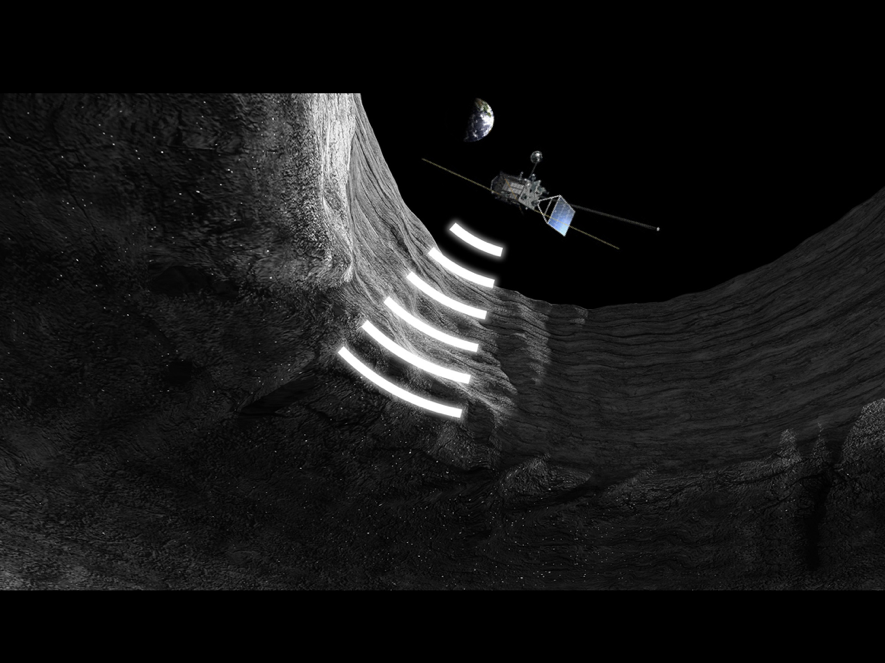
    The Lunar Radar Sounder (LRS) onboard SELENE consists of two sets of dipole antennas transmitting electromagnetic (4-6MHz) waves and receiving echoes from the Moon. We used radar echo data from the LRS to investigate the existence of underground lava tubes at Marius Hills (Figure 1).

    Figure 1

    Figure 1. Artists’ rendering of SELENE (Kaguya) sounding lava tubes in orbit.
    (c) JAXA/SELENE/Crescent/Akihiro Ikeshita for Kaguya image

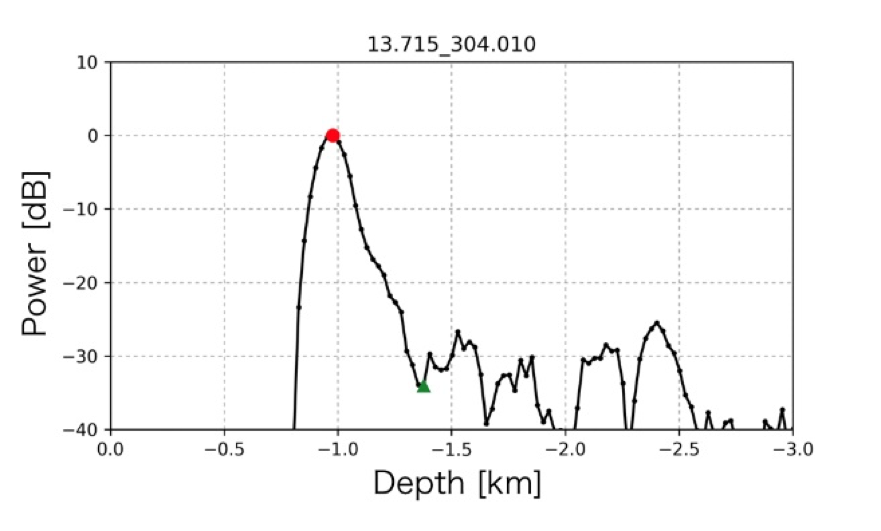
    Figure 2 plots a typical LRS echo power data profile in a mare region (13.715°N, 304.010°E). The time differences of received echoes were converted to corresponding depths where the LRS transmitted EM waves by the LRS were reflected. The largest echo peak (red point) is from the nadir surface of the Moon. The dielectric constant used here for converting time to depth is unity (1) as if it were a vacuum. The true location of the deflection is, therefore shallower than tentatively given with the vacuum dielectric constant value.

    Figure 2

    Figure 2. Typical LRS echo power versus subsurface depth. (The depth of 0km corresponds to the lunar mean surface radius.)

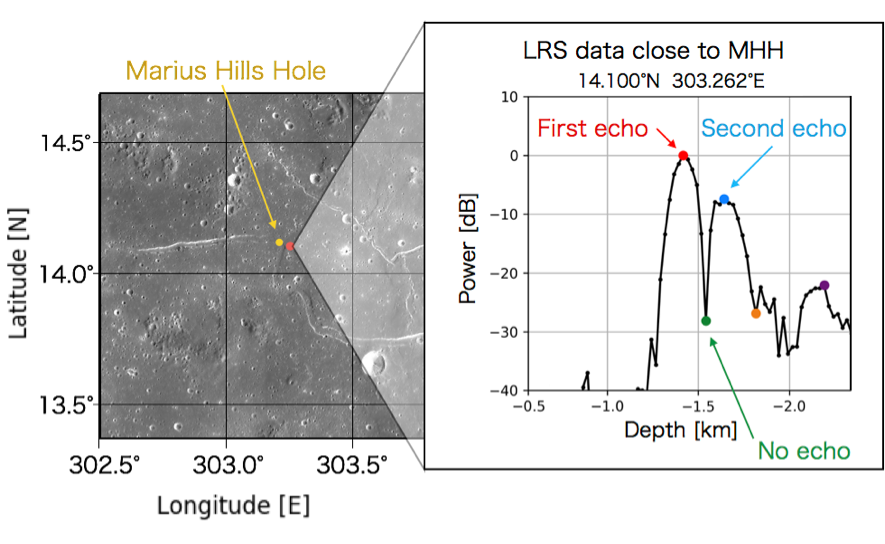
    We first investigated the LRS data from a SELENE orbit approaching the Marius Hills Hole (MHH) (14.100°N, 303.262°E) and found a strong echo from subsurface at a depth of 225 m from the surface close to MHH (second echo on the right side in Figure 3). Prior to the second echo peak, the received echo power precipitously decreased (“No echo” point on the right side in Figure 3). This echo pattern implies the existence of a cave, such as an underlying lava tube. When we assume a dielectric constant of 4 or higher, an appropriate value for lunar subsurface materials, we obtain a depth of 100 m or shallower from the surface.

    Figure 3

    Figure 3. LRS data close to Marius Hills Hole.

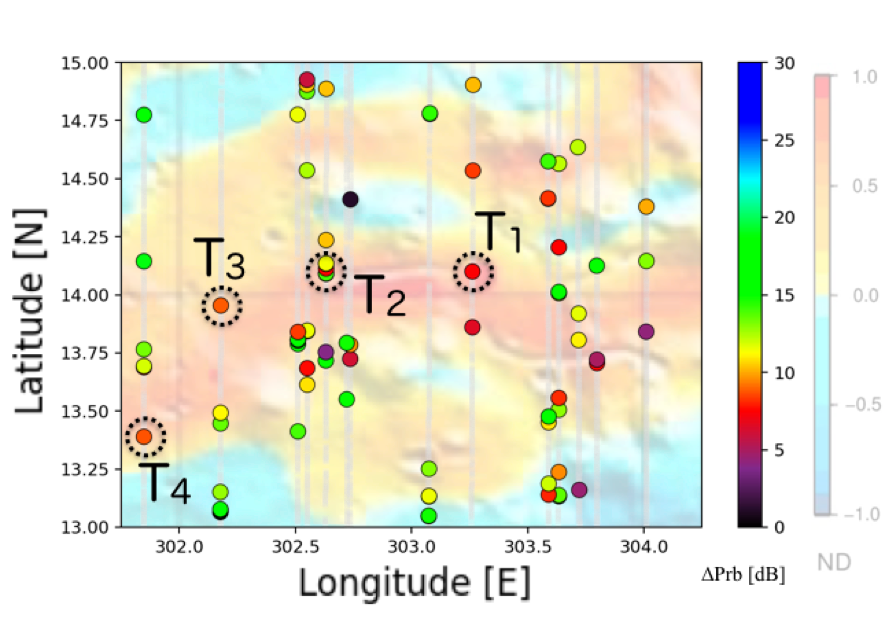
    Figure 4 presents the locations of candidate sites of possible subsurface caves. The background of the figure is an image from the SELENE TC. The gray lines correspond to the LRS observation tracks. The circular points on these lines indicate locations where strong subsurface echoes are observed. The color of the circular points denotes the power difference between the first and second echo peaks (ΔPrb). Some of the candidate cave sites are aligned along rille A formed by lava flows (T1, T2) and on a possible extension of rille A (T3 and T4). The locations (T1~T4) are a possible lava tube, in which the MHH was discovered, and on a possible underground extension southwest of the rille to about 50km.

    Figure 4

    Figure 4. The locations of candidate sites of possible subsurface caves.

    Figure 5 indicates the lava tube candidate sites as suggested by the LRS data overlaid on Bouguer gravity map by GRAIL spacecraft data. The hot colors correspond to mass deficits as low-density space or voids. Most lava tube candidate sites suggested by LRS data are also apparent as LRS data correlate with the area of mass deficits in Bouguer gravity map.

    Figure 5

    Figure 5. The lava tube candidate sites as suggested by the LRS data overlaid on Bouguer gravity map by GRAIL spacecraft data.

    In this study, we identified candidate sites for the presence of significant intact lava tubes. These sites are intriguing from a science perspective and may offer potential sites for future lunar base construction around the Marius Hills Hole.

    In the future, we will expand our search to other regions on the Moon where additional subsurface lava tubes may be present. We will also continue to investigate the origin and history of known candidate lava tubes using composition, topography and magnetic field data to direct future exploration of lava tubes or lunar base construction.

    Paper information:

    Title of the letterDetection of Intact Lava Tubes at Marius Hills on the Moon by SELENE (Kaguya) Lunar Radar Sounder

    Authors:T. Kaku (JAXA/Tokai University) 、J. Haruyama (JAXA) 、W. Miyake (Tokai University) 、A. Kumamoto (Tohoku University) 、K. Ishiyama (JAXA) 、 T. Nishibori (JAXA) 、K. Yamamoto (NAOJ) 、S.T. Crites (JAXA) 、T. Michikami (Kinki University) 、Y. Yokota (Kochi University) 、R. Sood (Alabama University) 、H. J. Melosh (Purdue University) 、L. Chappaz (AstroLabs) 、K. C. Howell (Purdue University)
    Journal:American Geophysical Union Publications Geophysical Research Letters
    DOI: 10.1002/2017GL074998

    Let’s block ads! (Why?)

  • [Earth Observation Research Center (EORC)] "EarthCARE Research A-Train Product" is now available

    Oct 13, 2017 (JST)
    Japan Aerospace Exploration Agency

    “EarthCARE Research A-Train Product” is now available

    JAXA Earth Observation Research Center (EORC) opened a new website to display and distribute “EarthCARE Research A-Train Product” derived from A-train (CloudSat/CALIOP/MODIS) data by using algorithms developing for the JAXA EarthCARE mission. In this system, the data from 2006 to 2014 are now available via ftp.

    In numerical climate models used for predicting climate change, there are still many uncertainties in the treatment of cloud process, as pointed out in the fifth assessment report (AR5) of the Intergovernmental Panel on Climate Change (IPCC). By comparing and verifying the outputs of the numerical climate models with this product, we expect to clarify issues in the numerical models and to contribute to the improvements of the climate change predictions.

    EarthCARE Research A-Train Product
    http://www.eorc.jaxa.jp/EARTHCARE/research_product/ecare_monitor_e.html

    EarthCARE is a joint European-Japanese earth observation mission. Using its four payloads (Cloud Profiling Radar, Backscatter Lidar, Multi-Spectral Imager and Broadband Radiometer), clouds and aerosols (small atmospheric particles such as PM2.5 and desert dust) will be observed on a global scale to improve the accuracy of climate change predictions. The launch is scheduled on JFY2019. The “EarthCARE Research A-Train Product” is released to maximize the outcomes of our algorithm development activities using A-train data and prepare for the distribution of the JAXA EarthCARE products before the launch.

    Related information:

    Earth Cloud, Aerosol and Radiation Explorer (EarthCARE):

    Let’s block ads! (Why?)

  • [Institute of Space and Astronautical Science (ISAS)] Hidden Solar Nanoflares Confirmed by Ultra-high Sensitivity Observations

    20171012_2.jpg

    (c) ISAS/JAXA Download:[JPG: 4.8MB]

    An international research team led by Dr. Shin-nosuke Ishikawa, (ISAS/JAXA) succeeded in detecting the subtle signs of nanoflares (tiny flares) in a region of the solar corona where no discernible flare activity was taking place. The finding was made by a combination of hard X-ray data from FOXSI (Focusing Optics X-ray Solar Imager) sounding rocket experiment and data from Hinode solar observatory. The frequent occurrence of nanoflares has been regarded as a promising agent for maintaining the solar corona at a high temperature of several million Kelvin. The result from the research group is expected to put strong constraints to theories accounting for the coronal heating.

    The results are to be published in Nature Astronomy, 9 October 2017 issue.

    Above the visible surface of the Sun, there extends hot and tenuous atmosphere called the corona. Why the corona is so hot (a few million Kelvin) above the cooler surface of the Sun (5,800 Kelvin), and how the corona is heated up to that temperature still remain unanswered. The apparent controversy of the higher temperature at a location in the solar atmosphere farther from the heat source has been known as the coronal heating problem. The problem has been a decades-long mystery in the field of solar physics.

    There are several hypotheses for possible mechanisms of coronal heating. One of them assumes heating by the frequent occurrence of very tiny flares, nanoflares. This hypothesis has been regarded as promising for explaining the hot corona. With the nanoflare hypothesis, numerical studies have suggested the creation of very hot plasmas exceeding ten-million Kelvin which is by far hotter than the typical temperature of the corona.

    However, so far there was no observation that conclusively showed the presence of such very hot plasmas.

    Dr. Shin-nosuke Ishikawa’s international research group launched FOXSI sounding rocket for hard X-ray observation of the Sun and was successful in observing multiple coronal regions during its 6-minutes observation window during the rocket flight.

    “The FOXSI’s data clearly demonstrated that our experiments succeeded to obtain qualitatively new data”, said Dr. Ishikawa.

    20171010_1.jpg

    (c) ISAS/JAXA, UC Berkeley, NASA, NAOJ Download: [PNG: 10.1MB] [JPG: 5.9MB]

    FOXSI was realized under the international collaboration of state-of-the-art technologies; the X-ray optics for FOXSI was developed by U.S. colleagues of the team while Japanese members developed semi-conductor X-ray imaging detector of low-noise and fine pixel pitch. Thanks to the collaboration, FOXSI was able to observe weak X-ray signals from very hot (exceeded 10-million Kelvin) plasmas in the corona, with unprecedentedly-high sensitivity.

    The X-ray telescope (XRT) aboard Hinode is sensitive to soft (several million Kelvin) X-ray emissions. Therefore, Combining observations from these two instruments makes it possible to investigate in detail temperature structure of the region observed.

    By analyzing data from FOXSI and Hinode XRT, the research team was able to estimate, with high accuracy, the temperature structure of the corona for the region observed. It became clear that, albeit small in its amount, there certainly existed very hot plasmas. The hard X-ray emission detected by the FOXSI observation was emitted for a quiet solar active region which was not showing X-ray brightening nor flaring activity.

    This result strongly suggests the occurrence of nanoflares even in a region without apparent flaring activities. The finding is expected to pose a strong constraint on theoretical models explaining coronal heating. The research group succeeded in, not only confirming the persistent presence of very hot plasmas in the solar corona but also demonstrating the power of high sensitivity and high spatial resolution X-ray observations of the corona.

    Unfortunately, the duration of the observation with the FOXSI sounding rocket was only 6 minutes. One would argue that the result presented here is from only a single region in the corona.
    “In order to reveal the mechanism of coronal heating with nanoflares, it is necessary to increase the number of regions to be observed as well as to conduct observations with a longer time span. We are keen to examine if nanoflares are general phenomena”, said Dr. Ishikawa.

    The group is now working towards possible future satellite missions to be realized in Japan, or in U.S. together with U.S. colleagues.

    Manuscript information

    To appear in: Nature Astronomy (9 October 2017)
    Paper title: Detection of nanoflare-heated plasma in the solar corona by the FOXSI-2
    sounding rocket
    Authors: Shin-nosuke Ishikawa, Lindsay Glesener, Säm Krucker, Steven Christe, Juan Camilo Buitrago-Casas, Noriyuki Narukage and Juliana Vievering
    DOI: 10.1038/s41550-017-0269-z

    Let’s block ads! (Why?)

  • [Institute of Space and Astronautical Science (ISAS)] UV-irradiated amorphous ice behaves like liquid at low temperatures

    Ice analogs mimicking interstellar ice behave like liquids at temperatures between -210°C and -120°C according to Hokkaido University researchers. This liquid-like ice may enhance the formation of organic compounds including prebiotic molecules and the accretion of dust to form planets.

    Bubbling of the UV-irradiated amorphous ice (H2O-CH3OH-NH3) mimicking interstellar ice at around -145C/-229F.

    [ Movie https://youtu.be/M0udrmZlHMA] Bubbling of the UV-irradiated amorphous ice (H2O-CH3OH-NH3) mimicking interstellar ice at around -145C/-229F.

    This research results appear in Science Advances in its September 29, 2017 issue (Tachibana S., et al., Science Advances, September 29, 2017)

    See the website of Hokkaido University for more details.

    Let’s block ads! (Why?)