Tag: JAXA

  • [Hayabusa2 project site] Completion of forward cruise ion engine operation

    Since January 10 this year (2018), the third phase of the ion engine operation has been underway. This was completed this week on June 3, ending the use of the ion engines for the outward approach towards asteroid Ryugu.

    During the operation on June 3, Hayabusa2’s velocity was confirmed via Doppler data (the shift in radio wave frequency corresponding to the speed of the spacecraft along the line-of-sight from Earth) and the decision was made to stop ion engine operation at 14:59 JST at machine time (the time recorded by Hayabusa2’s on-board clock). The telemetry data from the spacecraft received at 15:16 confirmed that ion engine operation has ended normally.

    In this third phase of ion operation, the continuous operation time was about 2,426 hours, producing a velocity increase of 393 m/s (hourly speed of 1,400 km/hr).

    From here on, accurate orbital determination of both the spacecraft and the asteroid will be made via radio and optical navigation as Hayabusa2 approaches Ryugu. We will return to report on the results of the ion engine operation and up-coming optical navigation soon.


    • A group photo after the operation on June 3, 2018.

    Hayabusa2 Project
    2018.06.04

    Let’s block ads! (Why?)

  • A Special TV Program about JJ-FAST will be broadcasted on NHK WORLD/jibtv on 17 and 18 May 2018!

    Topics

    Introduction in Japanese follows English.

    How to watch the program

    STORY
    Forests play various roles: nourishing many life forms, generating oxygen, protecting the soil, and producing water.
    But deforestation continues to be an issue worldwide. It is even being said that they will have completely vanished 100 years from now if the current situation remains unchanged.
    In response to this threat, the Japan International Cooperation Agency (JICA) has made a move. JICA is a public agency that provides bilateral aid as part of Japan’s Official Development Assistance (ODA).
    With the theme ‘Forests can change the world’, JICA has been supporting developing countries in their initiatives related to sustainable forest management in association with JAXA, the Japan Aerospace Exploration Agency.
    One of their supporting activities is the development and exploitation of the ‘JICA-JAXA Forest Early Warning System in the Tropics (JJ-FAST)’ using the Advanced Land Observing Satellite-2 (ALOS-2), the JAXA satellite launched in 2014.
    The satellite is equipped with radar sensors that can even penetrate clouds to observe forest changes, making it possible to monitor deforestation all year round.
    This system is of tremendous value for the monitoring of forest resources and zoning activities.

    The program presents on-site investigations carried out in Indonesia and Peru, reports on the international conference held in Japan to consider how forests can change the world, and introduces the forefront of JICA’s initiatives that are now proceeding on a global scale.

    How to Watch :

    1. Via Satellite, Cable TV, etc.
    NHK WORLD/jibtv can be viewed through local satellite TV broadcasters, cable TV networks, IPTV etc. Direct reception from our broadcasting satellite is also available in some areas.
    24 hour coverage in approximately 235.39 million households in 160 regions and countries worldwide. (As of the end of March 2018) Please check your local operator on the jibtv website.
    2. Via jibtv Official Website
    Watch our programs at our official website via live streaming available in any country/region outside Japan.
    Full videos of our past programs are also available at: https://www.jibtv.com/programs/

    In Japanese

    JJ-FASTに関する特別番組「森から世界を変える!~日本の衛星技術を使った森林保全~」(全編英語)がNHK WORLD / jibtv で放送されます。番組は2018年5月18日(金)8:30~9:00、14:30~15:00、21:30~22:00(JST)、5月19日(土)2:30~3:00(JST)に放送予定です。日本国内からは視聴できませんが、ビデオストリーミングは、5月21日(月)よりご利用いただけます。是非、ご覧ください。

    【番組概要】
    様々な命が育まれ、酸素を生み、土壌を守り、水をも生み出している森林。その森林が今、地球上から減りつつあり、この現状が続けば、100年後には世界から森林が消えるとさえ言われています。そこで、JICAは行動を起こしました。
    JICAとは、日本政府によるODAを実施する、独立行政法人国際協力機構。JICAが、日本の航空宇宙技術をけん引するJAXA宇宙航空研究開発機構と協力し、「森から世界を変える」をテーマに世界各地で“森林保全に関連する開発途上国の取り組み”を支援しているのです。取り組みの一つが、2014年に打ち上げられたJAXAの衛星「だいち2号(ALOS-2)」を用いた『JICA-JAXA 熱帯林早期警戒システム(JJ-FAST)』の開発と活用。「だいち2号」が搭載するレーダーは雲を透過し、森林の変化をとらえることができるため、森林減少の常時のモニタリングが可能です。
    番組では、インドネシアやペルーで行われた現場検証や、JICAが開催した日本での国際会議の様子などを交え、森から世界をどう変えるのか、地球規模で進められるJICAの取り組みの最前線をご紹介します。

    【番組視聴案内】
    番組は「NHK WORLD / jibtv」で、2018年5月18日(金)8:30~9:00、14:30~15:00、21:30~22:00(JST)、5月19日(土)2:30~3:00(JST)に放送予定です(日本国内からは視聴できません)。ビデオストリーミングは、5月21日(月)よりJIBのwebサイトでご覧いただけます(日本国内からも視聴可能です。)。

    【番組視聴方法】
    1. テレビで見る
    「NHK WORLD / jibtv」は、放送衛星やケーブル局などを通じて約160の国・地域の約2億3539万世帯でご覧いただけます。(2018年3月31日現在)
    各地の提携事業者については、JIB のwebサイト「How to Watch」よりご確認ください。
    2.インターネットで見る
    「NHK WORLD / jibtv」は、放送と同時にJIBのwebサイトでご覧いただけます。
    (日本国内からはご覧いただけません) https://www.jibtv.com/

    Let’s block ads! (Why?)

  • JAXA's Activity of JEM Small Satellite Orbital Deployer (J-SSOD) win MEXT's Prize for Science and Technology in the 2018 Commendation

    JAXA’s Activity of JEM Small Satellite Orbital Deployer (J-SSOD) win MEXT’s Prize for Science and Technology in the 2018 Commendation

    Last Updated:
    May 10, 2018

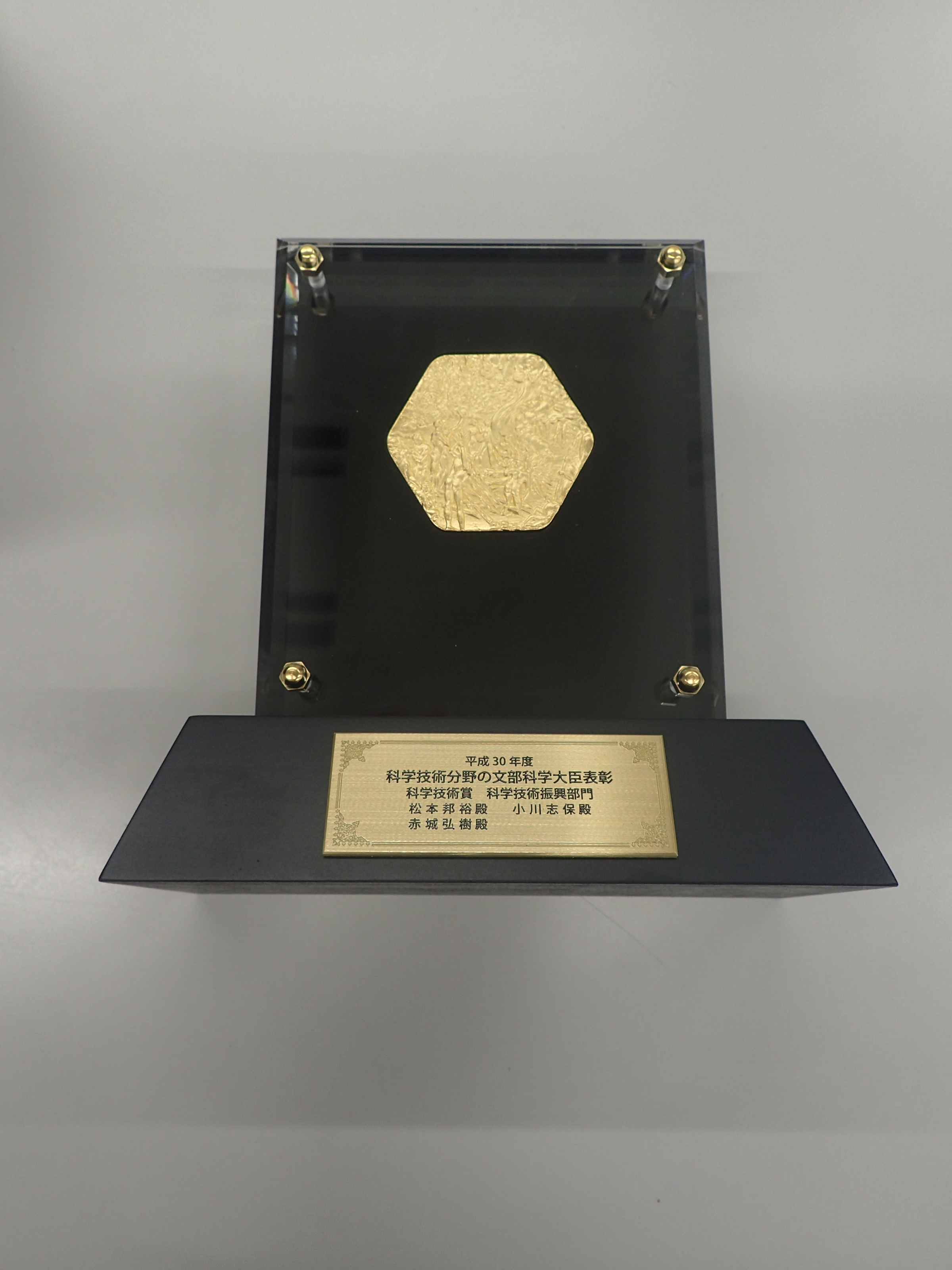
    JAXA’s activity using JEM Small Satellite Orbital Deployer (J-SSOD) took Prizes for Science and Technology (in the Science and Technology Promotion Category) at the 2018 Commendation for Science and Technology by the Minister of Education, Culture, Sports, Science and Technology (MEXT), the latest in a series of accolades that the Ministry presents to those who have made noteworthy contributions in the fields of science and technology.

    At the commemoration ceremony held on April 17, 2018, at Lecture Hall MEXT, Kunihiro Matsumoto (Senior Engineer of the JEM Utilization Center), Shiho Ogawa (Director), and Hiroki Akagi (Engineer) were awarded certificates and plates of achievement by the MEXT Minister Hayashi.

    Awarded JAXA personnel (Credit: JAXA)
    (From left, Kunihiro Matsumoto, Shiho Ogawa, Hiroki Akagi)

    Plate and certificate of achievement (Credit: JAXA)

    Japanese Experiment Module “Kibo” is the only place to deploy the
    small satellites remotely from the ISS.
    We have been deployed many small satellites for colleges and enterprises around the world.

    Awardee’s comment

    This award is given to a fruit of concerted efforts and support among concerned agencies, JAXA personnel, the operation team, strategic partners, international partners for the realization and continued operation of the JEM Small Satellite Orbital Deployer (J-SSOD)program. We would like to extend here our sincere gratitude to each person concerned in the program.

    Overview of the award-winning program

    Name of award-winning program

    Promotion of space utilization technology through JEM Small Satellite Orbital Deployer (J-SSOD)

    Awardees

    Kunihiro Matsumoto Senior Engineer of the JEM Utilization Center, Shiho Ogawa Director, and Hiroki Akagi Engineer (JAXA)

    Overview

    Recently, many researchers and companies have been studying and developing microsatellites as a means for easy-to-use technical demonstration and human resource development, increasing its utilization demand worldwide. Despite the growing demand, microsatellites faced a challenge, which was their markedly limited utilization opportunities hampered by the main utilization condition of launching on board rockets scheduled to be launched to deploy them.

    In the program, the Japan Aerospace Exploration Agency (JAXA) developed an initially unexpected new means, the JEM Small Satellite Orbital Deployer (J-SSOD), by using the functions unique to “Kibo”, Airlock and Japanese Experiment Module Remote Manipulator System (JEMRMS), ahead of the US and announced its utilization opportunity. Currently, along with the doubled satellite deployment capacity, JAXA has released 205 micro/nano-satellites from “Kibo” (as of February 23, 2018) by supporting the operation of a satellite deployment mechanism developed by a US company, thus contributing to the promotion of space utilization in the world as well as in Japan.

    The program has enabled JAXA to contribute to the deployment of the first satellites of emerging countries in the space field by providing them stable deployment opportunities, essentially under the cooperation with the United Nations Office for Outer Space Affairs and the strategic partners (Hokkaido University, Tohoku University, and Kyushu Institute of Technology), consequently enhancing Japan’s presence as an approach to boost the country’s achieving the Sustainable Development Goals (SDGs).

    *All times are Japan Standard Time (JST)

    Let’s block ads! (Why?)

  • [About us] Message from the Director General

    [unable to retrieve full-text content]

  • JAXA's Operations support for Cygnus spacecraft completed

    JAXA’s Operations support for Cygnus spacecraft completed

    Last Updated:
    March 7, 2018

    The JAXA H-II Transfer Vehicle (HTV) “KOUNOTORI” Operation Control Team had long supported operations of the Cygnus spacecraft -the US unmanned resupply cargo ship.

    Starting with Cygnus Orb D1 launched on Sept. 18, 2013, JAXA had supported the Cygnus operations for five years until the unberth of Cygnus OA-8 launched on November 12, 2017, thus marking the end of its support in completing the contract with NASA.

    To commemorate the completion of this operational support, NASA and Orbital ATK Inc. visited Japan and held a closing ceremony with the JAXA HTV Operation Control Team.

    Commemorative photo of the JAXA, NASA and Orbital ATK staff concerned (Credit: JAXA)

    Recollection video of the Cygnus spacecraft and JAXA (Produced in January 2018) (Credit: JAXA)

    Cygnus spacecraft operations support

    The Cygnus spacecraft employs the same method of rendezvous and berthing with the ISS as that used by “KOUNOTORI”. This cutting-edge method was realized highly reliable by “KOUNOTORI” for the first time ever by using a robotic arm, currently established as a new standard of the ISS.

    Once in proximity to the ISS, the Cygnus spacecraft first established communications link with the Proximity Communication System (PROX) developed by Japan for “KOUNOTORI”, and then communicated with the ISS via PROX. The Cygnus PROX operations were also supported by the HTV Operation Control Team.

    Let’s block ads! (Why?)

  • The International Space Station (ISS) Multilateral Coordination Board (MCB) held

    The International Space Station (ISS) Multilateral Coordination Board (MCB) held

    Last Updated:
    March 7, 2018

    On January 23, 2018, the Ministry of Education, Culture, Sports, Science and Technology held the International Space Station (ISS) Multilateral Coordination Board (MCB) meeting, where JAXA participated as an ISS program partner.

    The ISS MCB meeting is a high-level international coordination board meeting that intends to regularly discuss important issues related to ISS operations and utilization.

    At the meeting, Canada, Europe, Russia, Japan, and the US discussed the operations of ISS as an in-obit laboratory, which included important research and verifications for future space exploration. In addition, the board members explored ways to continuously promote ISS utilization aimed at commercial and economic activities that will enable mankind to obtain benefits and reduce costs in low-earth orbit, and ISS utilization aimed for an expanded area of manned activities in the solar system.

    Photo of the board members (Credit:JAXA)


    Let’s block ads! (Why?)

  • Kibo-ABC Member Countries' News: So excited with unexpected results! Asian Try Zero-G 2018 was performed by JAXA astronaut Norishige Kanai

    Kibo-ABC Member Countries’ News: So excited with unexpected results! Asian Try Zero-G 2018 was performed by JAXA astronaut Norishige Kanai

    Last Updated: February 15, 2018

    On February 13th, experiments for Asian Try Zero-G 2018 were successfully conducted by JAXA astronaut Norishige Kanai at ISS/ Kibo. Eight experiments which were selected from over 160 ideas submitted from students and young scientist/engineers around Asia were conducted.

    Kibo-ABC members and students watching onboard experiment (Credit:JAXA)

    Kibo-ABC members and students watching onboard experiment (Credit:JAXA)

    19 students and young scientist/engineers from Indonesia, Japan, Philippines, Singapore and Thailand whose ideas were selected visited the “Kibo” Mission Control Room (MCR) in JAXA Tsukuba Space Center on February 13th to observe their onboard experiments with Kibo-ABC member agencies, Indonesia:National Institute of Aeronautics and Space (LAPAN); Singapore:Singapore Space and Technology Association (SSTA); and Thailand:National Science and Technology Development Agency (NSTDA). They watched their experiments conducted onboard Kibo and had a great experience observing the real-time operation.

    Singapore students examining the experiment’s results (Credit:JAXA)

    Astronaut Kanai performing the experiment (Credit:JAXA)


    Meikei High School students watching the experiment (Credit:JAXA)

    Namiki Secondary School students watching the experiment (Credit:JAXA)

    For the first time, Japanese students (Namiki Secondary School and Meikei High School) participated to Asian Try Zero-G as a member of Asian countries. Also, some of the experiment items were prepared by the proposed countries and launched, then used by astronaut Kanai as the first attempt.

    When all the experiments were completed, Astronaut Kanai expressed his thankfulness toward the students and young scientist/engineers around Asia who participated to this program, and anticipation of their future. He also mentioned that he hoped the Asian cooperation would be facilitated through using Kibo.

    Closing remarks by Astronaut Kanai

    Thank you very much for the very very interesting and fun ideas and proposals. And I’d like to say thank you so much for all the individuals and organizations of the member of Kibo-ABC, make this event happen. I really appreciate that.

    Couple words to today’s guests, these were very very interesting experiments, ideas and I was very very impressed.

    Please keep asking questions and continue making questions for your teachers, for your friends and for yourself. Sometimes no one can answer your question, it’s OK. Because eventually you can try experiments and find the answer to your original question by yourself.

    That is the way that science and our culture have developed. This is very good example of how we research, how we study scientific fact. And you are very very talented people.
    Maybe in the future, let’s say 5 years from now, 10 years from now, you, yourself may be working in space. in the space station or other outpost in the space, doing same kind of interesting experiments for the younger generations all over the world.
    Nowadays, space is getting closer and closer for everyone to use, or can fly to space. I hope Japanese Module “Kibo” is opening door for you to utilize the space environment.

    This is very unique environment. And we are doing lots of research every day in the space station. That is a purpose of why the astronauts are working and living in space. I hope everybody enjoyed today’s session. Again, thank you so much for your cooperation and participation.

    Thank you for coming, special guests! I’m looking forward to seeing you in person in the future.

    Astronaut Kanai shaking hands (Credit:JAXA)

    Group photo of Kibo-ABC members and students (Credit:JAXA)

    Please refer the link below about experiment themes.

    Asian Try Zero-G 2018 Experiment Ideas Selected

    Photos & Videos of experiments are available below.
    Please refer to the enclosed paper for using photos & videos.

    Photo [ZIP: 14.9MB]
    Videos1 (Opening remarks) [ZIP: 219MB]
    Videos2 (Paper Boomerang) [ZIP: 1.3GB]
    Videos3 (Aircraft Stability) [ZIP: 1.5GB]
    Videos4 (Spinning Ring) [ZIP: 399MB]
    Videos5 (Gyroscope & Tippe Top) [ZIP: 1.4GB]
    Videos6 (Wire Top) [ZIP: 1.1GB]
    Videos7 (Balls inside Slinky) [ZIP: 972MB]
    Videos8 (Paper Spring) [ZIP: 1.2GB]
    Videos9 (Double-Layered Liquid Ball) [ZIP: 2.1GB]
    Videos10 (Closing remarks) [ZIP: 464MB]

    Related Links

    Kibo Utilization Office for Asia (KUOA)

    Let’s block ads! (Why?)

  • [Institute of Space and Astronautical Science (ISAS)] HINODE Captures Record Breaking Solar Magnetic Field

    National Astronomical Observatory of Japan (NAOJ)
    Institute of Space and Astronautical Science /Japan Aerospace Exploration Agency (ISAS/JAXA)

    Snapshot of a sunspot observed by the Hinode spacecraft.

    Snapshot of a sunspot observed by the Hinode spacecraft. (top) Visible light continuum image. (bottom) Magnetic field strength map. The color shows the field strength, from weak (cool colors) to strong (warm colors). Red indicates a location with a strength of more than 6,000 gauss (600 mT).
    ©NAOJ/JAXA 

    Astronomers at the National Astronomical Observatory of Japan (NAOJ) using the HINODE spacecraft observed the strongest magnetic field ever directly measured on the surface of the Sun. Analyzing data for 5 days around the appearance of this record breaking magnetic field, the astronomers determined that it was generated as a result of gas outflow from one sunspot pushing against another sunspot.

    Magnetism plays a critical role in various solar phenomena such as flares, mass ejections, flux ropes, and coronal heating. Sunspots are areas of concentrated magnetic fields. A sunspot usually consists of a circular dark core (the umbra) with a vertical magnetic field and radially-elongated fine threads (the penumbra) with a horizontal field. The penumbra harbors an outward flow of gas along the horizontal threads. The darkness of the umbrae is generally correlated with the magnetic field strength. Hence, the strongest magnetic field in each sunspot is located in the umbra in most cases.

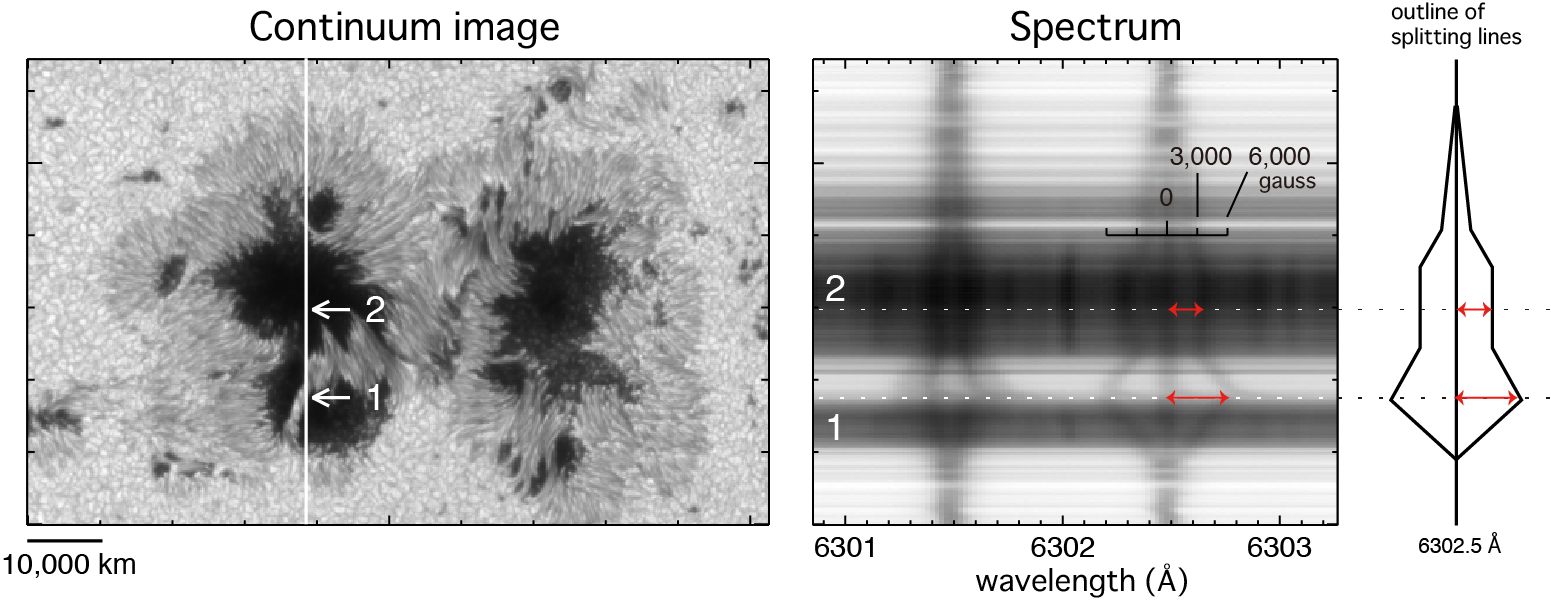
    Joten Okamoto (Specially Appointed Assistant Professor at NAOJ) and Takashi Sakurai (Professor Emeritus of NAOJ) were analyzing data taken by the Solar Optical Telescope onboard HINODE, when they noticed the signature of strongly magnetized iron atoms in a sunspot (Figure 1). Surprisingly the data indicated a magnetic field strength of 6,250 gauss (*1). This is more than double the 3,000 gauss field found around most sunspots. Previously, magnetic fields this strong on the Sun had only been inferred indirectly. More surprisingly, the strongest field was not in the dark part of the umbra, as would be expected, but was actually located at a bright region between two umbrae.

    Figure 1.

    Figure 1. (left) Snapshot of the sunspot with the strongest magnetic field. (middle) Spectrum taken along the white line in the left panel. “1” indicates the location of the strongest magnetic field. “2” indicates the location of the umbra. (right) Simplified diagram of the splitting of the iron absorption line. A large distance in the splitting means a strong magnetic field. (©NAOJ/JAXA)

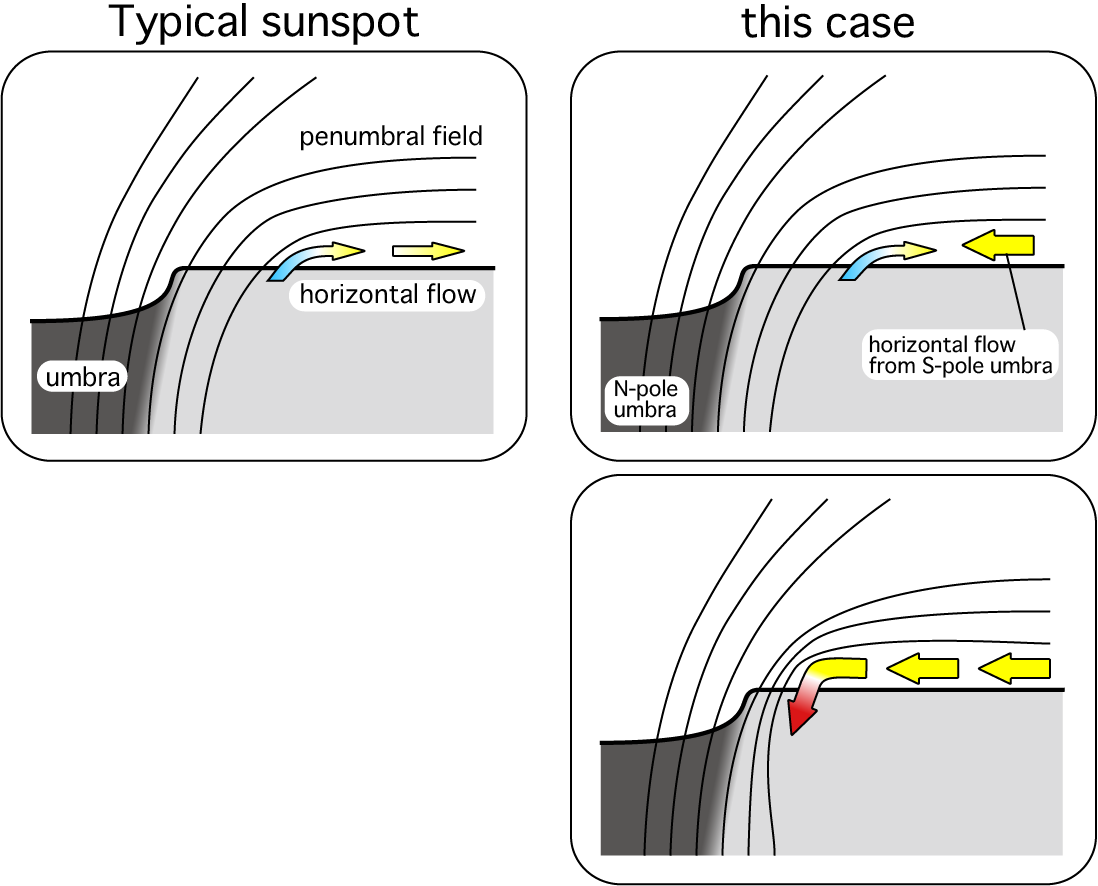
    HINODE continuously tracked the same sunspot with high spatial resolution for several days. This is impossible for ground-based telescopes because the Earth’s rotation causes the Sun to set and night to fall on the observatories. These continuous data showed that the strong field was always located at the boundary between the bright region and the umbra, and that the horizontal gas flows along the direction of the magnetic fields over the bright region turned down into the Sun when they reached the strong-field area (Figure 2). This indicates that the bright region with the strong field is a penumbra belonging to the southern umbra (S-pole). The horizontal gas flows from the southern umbra compressed the fields near the other umbra (N-pole) and enhanced the field strength to more than 6,000 gauss.

    Figure 2

    Figure 2. Schematic illustration of the formation mechanism of the strong field. The horizontal flows from the right (S-pole umbra) compress the magnetic field near the left umbra (N-pole) and the magnetic field is enhanced. (©NAOJ)

    Okamoto explains, “HINODE’s continuous high-resolution data allowed us to analyze the sunspots in detail to investigate the distribution and time evolution of the strong magnetic field and also the surrounding environment. Finally, the longtime mystery of the formation mechanism of a stronger field outside an umbra than in the umbra, has been solved.” These results were published as Joten Okamoto and Takashi Sakurai, “Super-strong Magnetic Field in Sunspots,” in The Astrophysical Journal Letters, 852 (2018).

    (*1) 10 gauss = 1 milli-tesla.

    Let’s block ads! (Why?)
  • [Space Transportation Systems] Successful Launch Experiment, SS-520 No. 5 Followed by Separation of Payload TRICOM-1R and Orbital Insertion

    Topics List

    Feb. 3, 2018 Updated
    Successful Launch Experiment, SS-520 No. 5 Followed by Separation of Payload TRICOM-1R and Orbital Insertion

    Exactly at 2:03 pm (Japan Standard Time) at the JAXA Uchinoura Space Center, JAXA experimented SS-520 No. 5 launch with a microsatellite TRICOM-1R aboard.
    After liftoff, flight of SS-520 No. 5 proceeded normally. Around 7 minutes 30 seconds into flight, TRICOM-1R separated and was inserted into its target orbit.
    SS-520 No. 5 launch experiment was the second attempt following the failure of SS-520 No. 4, which occurred in January 2017. Identification of the error and subsequent countermeasures resulted in the success of No.5 launch experiment. The No. 5 launch experiment was carried out to demonstrate the technology used for small satellite launcher.

    Successful Launch Experiment, SS-520 No. 5 Followed by Separation of Payload TRICOM-1R and Orbital Insertion

    Feb. 1, 2018 Updated
    New launch date and time of SS-520 No. 5/Microsatellite decided

    The launch experiment time of the microsatellite aboard SS-520 No. 5 was set for 2:03 on February 3 (Sat.), 2018 (Japan Standard Time). The SS-520 No. 5 is a three-stage rocket that is a modification of the SS-520 two-stage sounding rocket.
    JAXA will broadcast a live launch report from the Uchinoura Space Center from 1:45 a.m. on the day. You can watch it through the Internet. Please have a look!

    Photo: New launcher for SS-520 No.5 at KS center

    New launch date and time of SS-520 No. 5/Microsatellite decided

    Jan. 25, 2017 Updated
    Is there little metallic iron in the universe?

    Solid particles containing iron (dust particles) act to promote the formation of molecules in interstellar space, and are key to understanding physical and chemical processes there.
    Iron contained in dust particles comes in various forms such as metallic iron and iron oxide, each with different properties. Previous studies have suggested that iron is present mainly in forms other than iron oxide, iron carbide, and iron sulfide. To verify the possibility that metallic iron is present, a research team led by Dr. Kimura (Hokkaido University) performed in situ observations of gaseous iron cooling in a microgravity environment, and investigated the ease of iron aggregation (the efficiency at which metallic iron forms).
    The experimental results showed that, unlike in the results of ground experiments, it was difficult for iron atoms to aggregate. In other words, it is difficult for metallic iron to form in outer space.
    The team speculates that iron in dust particles is not a metal, but rather contained as a compound, or adhered to other particles as an impurity.
    The results of this research were published in the online journal Science Advances of the American Association for the Advancement of Science on 21 January 2017.

    Is there little metallic iron in the universe?

    Jan. 15, 2017 Updated
    SS-520 No. 4 Launch Results

    At 8:33 a.m., (Japan Standard Time) January 15, 2017, SS-520 No. 4, JAXA’s sounding rocket launched from the Uchinoura Space Center. Through SS-520 No. 4 launch, JAXA sought for research and development of launch vehicles and satellites and the launch demonstration of TRICOM-1, its onboard nanosat that weighs about 3 kilograms. The launch was part of Japanese government’s program for development of launch vehicles and satellites in public-private partnerships.

    The first stage flight of SS-520 No. 4 proceeded according to schedule. Thereafter, however, ground teams could not receive telemetry from the launch vehicle and the call was made to abort the second stage ignition.
    JAXA tracked the launch vehicle and confirmed that it fell into the south eastern ocean off the Uchinoura Space Center, within the projected drop area.

    SS-520 No. 4 Launch Results

    Jan. 15, 2016 Updated
    The launch results of the S-310-44 sounding rocket

    On Friday, January 15, JAXA launched the S-310-44 sounding rocket from the Uchinoura Space Center. The launch had the objective of “The Clarification of the Heated Phenomenon of Ionospheric Plasma”.
    The flight was a success and the S-310-44 dropped into the southeastern ocean off Uchinoura.
    The ensuing experiment will clarify the heated phenomenon which occurs in the proximity of the focus of Sq current system (*), generated in the lower ionosphere. Therefore, the detailed measurements were performed on the plasma and the electric and the magnetic fields in the high temperature layer. JAXA and other institutes will thoroughly analyze the observation data. (Photo: S-310-36 sounding rocket)
    (*) Sq current system: the electric current in the lower ionosphere, which originates with the atmospheric movement. The energy input from the sun generates the movement.

    The launch results of the S-310-44 sounding rocket

    Sep. 11, 2015 Updated
    Launch result of S-520-30 sounding rocket

    JAXA successfully launched the S-520-30 sounding rocket from the Uchinoura Space Center on September 11 (Fri.), 2015, with the objective of “clarifying the nucleation process of oxide-based cosmic dusts”.
    The flight went smoothly, and the onboard instruments worked properly.
    After completing its mission, the S-520-30 dropped into the south eastern ocean off Uchinoura Through the experiment this time, we evaporated oxides under the micro-gravity environment by ballistic flight of the S-520-30, and directly measured the generation and growth process of oxide particles that were condensing after the evaporation.

    Launch result of S-520-30 sounding rocket

    Aug. 17, 2014 Updated
    Launch Result of S-520-29 Sounding Rocket

    JAXA launched the S-520-29 sounding rocket from the Uchinoura Space
    Center on August 17 (Sunday), 2014, with the objective of the
    “stereoscope observation of Sporadic E layer space structure.” The
    experiment was successful.

    The S-520-29 dropped into the south eastern ocean off Uchinoura after
    its normal flight and operation of onboard experiment instruments.

    Launch Result of S-520-29 Sounding Rocket

    Dec. 17, 2012 Updated
    S-520-28 launch completed

    JAXA launched the sounding rocket S-520-28 at 4:00:00 p.m. on December 17, 2012 (Japan Standard Time) from the Uchinoura Space Center. The launch aims at conducting a homogeneous nucleation experiment* using the microgravity environment. The vertical angle at the launch was 76 degrees and the experiment went smoothly as planned. The flight and operation of the onboard equipment went well, and, at 10 seconds after liftoff, the nucleation experiment with calcium carbonate started, then at 100 seconds, the nucleation reproduction test started as planned.
    The sounding rocket then reached its maximum altitude of 312 km at 283 seconds after liftoff, then dropped into the south eastern ocean off Uchinoura. The acquired data this time will be analyzed in detail.

    *In the homogeneous nucleation experiment, we aimed at observing nucleation, which was the first phase of crystallization, by utilizing the microgravity environment during the first few minutes of flight while the sounding rocket was on a ballistic trajectory, then to understand the physics of nucleation. In addition, the experiment also had a purpose of acquiring basic data for future long-term tests to be held repeatedly at the International Space Station.

    S-520-28 launch completed

    Aug. 7, 2012 Updated
    S-310-41 launch completed

    JAXA launched the sounding rocket S-310-41 at 4:30:00 p.m. on Aug. 7, 2012 (Japan Standard time) from the Uchinoura Space Center. The purpose of the launch was a flight experiment of the small inflatable capsule. The vertical angle at the launch was 81 degrees.
    The flight and operation of the onboard devices were all normal, and its top part (the nose fairing) opened at the preordained timing of 60 seconds after liftoff, reached its highest altitude of 150 km at 191 seconds, then dropped onto the south eastern ocean of Uchinoura.
    The onboard experiment device, the small inflatable capsule, released its aero-shell cover at 90 seconds after liftoff as scheduled, and started injecting gas at 95 seconds, then separated from the launch vehicle at 100 seconds to be released. The capsule sent various observation data namely temperature, pressure, acceleration, attitude and images to the ground station for about 20 minutes while descending.
    The acquired data will be further analyzed in detail.
    Image: Capsule released from the launch vehicle (three seconds after separation)

    Jan. 12, 2012 Updated
    S-520-26 launch result

    JAXA launched the sounding rocket S-520-26 at 5:51 a.m. on January 12, 2012 (Japan Standard Time) from the Uchinoura Space Center. The vertical angle at the launch was 72.5 degrees. The S-520-26 was designated to clarify the combining process of the neutral atmosphere and plasma in the thermosphere.
    The rocket flew smoothly, and opened its top part (the nose fairing) at 56 seconds after liftoff to start observations at 58 seconds. When it reached its maximum altitude of 298 km at 278 seconds, the lithium emission system was ignited to release lithium vapor to be dropped into the south eastern ocean of Uchinoura.
    One of the onboard devices (the ion mass energy analyzer) did not perform observations successfully, but other devices, including an impedance probe, Langumuir probe, beacon transmitter, electromagnetic measurement device, and solar sensor, worked properly throughout the ascending and descending of the rocket. Reddish clouds due to lithium gas released from the rocket were seen for about 30 minutes from the ground observation points in Uchinoura, Shukumo, and Muroto. The acquired data this time will be analyzed in detail.


    Photo: Reddish clouds due to lithium gas emitted from the rocket (6:16 a.m. from Uchinoura)

    Dec. 20, 2011 Updated
    S-310-40 launch result

    JAXA launched the sounding rocket S-310-40 at 11:48 p.m. on Dec. 19, 2011 (Japan Standard time) from the Uchinoura Space Center. The vertical angle at the launch was 76 degrees. The S-310-40 was designated to analyze radio wave propagation in the mid-latitude ionosphere during the night.
    The flight and operation of the onboard devices were all normal, and its top part (the nose fairing) opened at the preordain timing of 60 seconds after liftoff, reached its highest altitude of 180 km at 210 seconds, then dropped onto the south eastern ocean of Uchinoura after completing its observation missions.
    All onboard devices worked properly throughout the ascending and descending, and, at about 80 seconds, the high electron density area was observed at an altitude of around 103 km. It means that the rocket passed through the expected high density plasma area.
    We are currently analyzing acquired data for more details.

    Aug. 31, 2010 Updated
    S-520-25 successfully launched

    The sounding rocket S-520-25 was successfully launched at 5:00 a.m. on August 31, 2010 (Japan Standard Time,) from the Uchinoura Space Center. The vertical angle at the launch was 82.5 degrees. The S-520-25 was designated to conduct basic experiments on the electro-dynamic tether (EDT) in the ionosphere and to control the attitude of a robot using a tether under the micro-gravity environment while the rocket was making a sub-orbit flight for about 10 minutes to reach its maximum altitude of some 300 km.
    The rocket flew normally, and, at 55 seconds after liftoff, its top part opened, and at 58 seconds, the plasma measurement probe (FLP, SSP) was deployed to start observations. The conductive tether was extended at about 120 seconds, and the extension image was transmitted to the ground through the Ku telemetry. The Tethered Space Robot (TSR) was separated from the auxiliary unit of the rocket (DAU) at 297 seconds, and its attitude was controlled by the TSR arm until 310 seconds after liftoff. Concerning the plasma collection experiment, we were able to successfully extend the conductive tether and boom and verify the high-speed ignition function of the Hollow Cathode (HC) despite the fact that the high-voltage control was not carried out as scheduled, thus we have gained a perspective to develop a more efficient plasma collection device.
    The S-520-25 rocket reached a maximum altitude of 309 km at 283 seconds after liftoff, completed all observation projects, and fell down to the ocean south-east of Uchinoura.

    Jan. 26, 2009 Updated
    S-310-39 successfully launched!

    JAXA successfully launched the S-310-39 rocket at 9:15 a.m. on January 26, 2009 (Japan Standard Time, JST, or 1:15 a.m. local time) from the Andoya Rocket Range (Norway) with a launch angle of 77.5 degrees. The purpose of the S-310-39 launch is to study the dynamics and energetics in the lower polar thermosphere under the effects of aurora activities.
    The rocket flight and time sequence were normal, and the yo-yo despinner system was actuated 56 seconds after liftoff, and at 61 seconds, the nose cone was opened. According to an early report from the Andoya Range, the rocket carried out its scheduled observations after reaching an altitude of 140 km, and splashed down in the northern ocean of Andoya.
    Detailed data analysis will be performed later in Japan.
    Image: At the moment of the launch (at the Andoya Rocket Range)

    Aug. 2, 2008 Updated
    S-520-24 observation rocket successfully launched!

    The observation rocket S-520-24, which aims to uncover the mechanism for crystal growth utilizing a microgravity environment during its flight, was launched at a vertical angle of 78.4 degrees at 17:30 on August 2, 2008 (Japanese Standard Time) from the Uchinoura Space Center.
    The rocket’s flight and on-board equipment all performed normally and the nose-cone was opened 55 seconds after launch. The rocket reached an altitude of 293 kilometers high in 274 seconds from the launch and all the experiments were completed. The rocket then descended to its scheduled ocean landing area southeast of Uchinoura.
    Two pieces of equipment for the crystal growth experiment aboard the rocket were operated normally and acquired data.
    A detailed analysis will be later performed using the acquired data.

    Feb. 7, 2008 Updated
    Launch success of “S-310-38”

    JAXA launched the sounding rocket “S-310-38” at 6:14:40 p.m. on February 6, 2008, from the Uchinoura Space Center to observe three dimensional plasma distribution up to an altitude of 150 km. The launch angle was 72.4 degrees.
    The rocket flight and operations of its onboard equipment all went as expected, and, at 60 seconds after liftoff, the top part of the rocket opened as scheduled to start observations at 62 seconds. The rocket then reached its highest altitude of 157 km at 196 seconds, released its chaff at 298 seconds to complete its observation mission, and fell into the sea southwest of Uchinoura.
    The data acquired through the experiment will be analyzed in detail and the results will be released later.

    Jan. 16, 2007 Updated
    Launch success of “S-310-37”

    On January 16, the sounding rocket “S-310-37” was launched at 11:20 a.m. from the Uchinoura Space Center. The purpose of the rocket is to elucidate the mechanism of the generation of the high electron temperature sphere in the lower part of the ionosphere.
    The flight and operation of the on-board equipment went normally, and at 59 seconds after liftoff, the top part of the rocket opened.
    Subsequently, the rocket started observations at 60 seconds. All observations were completed after it reached its highest altitude of 138 km at 184 seconds, then it fell into the sea south-east of Uchinoura.
    The experiment went smoothly as planned, and through the on board electronic temperature measurement equipment we have confirmed that the high-temperature sphere existed at an altitude of 99 to 101 km.

    Let’s block ads! (Why?)
  • [Institute of Space and Astronautical Science (ISAS)] ISAS Website System Maintenance Info (Jan. 21 to 22)

    Due to system maintenance, ISAS Website (http://www.isas.jaxa.jp/en/) will be closed as follows;

    January 21 (Sun.) 6:00 a.m. to January 22 (Mon.) 12:00 p.m. (JST)
    * Time schedule may differ slightly.

    We apologize for any inconvenience and ask for your understanding.

    Let’s block ads! (Why?)

  • [Earth Observation Research Center (EORC)] SHIKISAI Observation Data Acquired by SGLI.

    Image Gallery

    Jan. 12, 2018
    SHIKISAI Observation Data Acquired by SGLI.

    The Japan Aerospace Exploration Agency (JAXA) has released some observation images on the Earth acquired by the Global Changing Observation Mission – Climate “SHIKISAI” (GCOM-C). The SHIKISAI was launched from the Tanegashima Space Center at 10:26:22, 2017 (Japan Standard Time). These images are obtained by using the test radio wave transmitted from GCOM-C/SGLI on January 1st to 6th, 2018 (JST).

    Color composite image of vegetation in Japan

    The image shown in the left is a true color composite* image and the image in the right is a false color composite image** of 250 m spatial resolution captured over Kanto area in Japan with SGLI onboard the SHIKISAI around 10:30 on January 6th 2018 (JST). Evergreen forests are seen in dark green in the true color image and are not discriminable, while in the false color image evergreen forests are clearly visible in bright green colors. On the other hand, small yellow patches are seen in the enlarged false color image shown in the lower right. These are golf courses covered with faded grasses in winter.

    • *: Reflectances of SGLI VN8, VN5, VN3 channels are assigned to red, green, and blue colors
    • **: Reflectances of SGLI VN8, VN11, VN3 channels are assigned to red, green, and blue colors

    PDF Download

    Images of aerosol over Ganges river

    The images are (left) left is a true color composite* image, (middle) near-ultraviolet (NUV) image, and (right) degree of polarization (POL) image captured over Ganges river, India with SGLI onboard the SHIKISAI around 11:40 on January 3th 2018 (JST). Dense aerosols are seen around the mouth of Ganges river to coastal ocean in the NUV image. In the DPOL image the solar light reflected at ocean surface are seen to be highly polarized. SGLI can observe aerosols over land and ocean using the functions of NUV and polarization observations.

    • *: Reflectances of SGLI VN8, VN5, VN3 channels are assigned to red, green, and blue colors

    PDF Download

    Images of ocean color around Japan

    These images are color composite* images of around Tsushima island (middle) and around Kanto area (right) observed with SGLI onboard the SHIKISAI around 11:10 on January 1st 2018 (JST). Locations of the images are shown in the left image. SGLI can observe the spatial distribution of ocean colors with the spectral channels of high sensitivity designed for ocean color observation in order to retrieve the concentrations of suspended matter and phytoplankton in water. These observations are useful for fishery prediction and the monitoring of red tide occurrence.

    • *: Reflectances of SGLI VN7, VN6, VN4 channels are assigned to red, green, and blue colors

    PDF Download

    Color composite image around the Okhotsk Sea Ice

    This image is a true color composite* image of 250 m spatial resolution captured over the Okhotsuk Sea and Japan Islands with SGLI onboard the SHIKISAI around 10:20 on January 6th 2018 (JST). Snow, sea ice, and clouds are shown in white. Land and ocean areas are seen in dark brown and blue colors.

    • *: Reflectances of SGLI VN8, VN5, VN3 channels are assigned to red, green, and blue colors

    PDF Download

    This image is a false color composite* image of 250 m spatial resolution captured over the Okhotsk Sea and Japan islands with SGLI onboard the SHIKISAI around 10:20 on January 6th 2018 (JST). Snow and sea ice are shown in deep blue while water and ice clouds are seen in white and light blue, respectively. Sea ice are formed along the eastern coast of the Eurasia Continents and spreads along the east side of Sakhalin flowing down to the south.

    • *: Reflectances of SGLI SW3, VN11, VN8 channels are assigned to red, green, and blue colors

    PDF Download

    We will continue the initial functional verification (for about three months after launch,) then confirm data accuracy by comparing it with observation data acquired on land, and perform initial calibration and inspection operations including data correction.

    Let’s block ads! (Why?)