Category: News

http://www.subtome.com/#/subscribe?feeds=http%3A%2F%2Fftr.fivefilters.org%2Fmakefulltextfeed.php%3Furl%3Dglobal.jaxa.jp%252Frss%252Fnew.rdf%26max%3D3%26links%3Dpreserve&back=http%3A%2F%2Fftr.fivefilters.org%2Fmakefulltextfeed.php%3Furl%3Dglobal.jaxa.jp%252Frss%252Fnew.rdf%26max%3D3%26links%3Dpreserve

  • [Project Topics] Let Geospace satellite “ERG” carry your support message!

    Topics List

    Feb. 25, 2016 Updated
    Let Geospace satellite “ERG” carry your support message!

    We are inviting you to have your message travel on the ERG satellite to explore the Van Allen belts, which is the last frontier in space around the Earth.
    Please send your support message to the mission of the “Exploration of energization and Radiation in Geospace” or “ERG”, which is scheduled to be launched in JFY2016. The messages will be printed on an aluminum plate that will be installed on the satellite as part of a balance weight.

    Let Geospace satellite “ERG” carry your support message!

    This entry passed through the Full-Text RSS service – if this is your content and you’re reading it on someone else’s site, please read the FAQ at fivefilters.org/content-only/faq.php#publishers.

  • [Video] The technologies developed in Kakuda will evolve the space transpotation in future

    [embedded content]

    This entry passed through the Full-Text RSS service – if this is your content and you’re reading it on someone else’s site, please read the FAQ at fivefilters.org/content-only/faq.php#publishers.

  • [Video] Let's SAR Land use and land cover classification (video tutorial)

    [embedded content]

    This entry passed through the Full-Text RSS service – if this is your content and you’re reading it on someone else’s site, please read the FAQ at fivefilters.org/content-only/faq.php#publishers.

  • [Project Topics] ASTRO-H successfully launched and named “Hitomi”.

    Topics List

    Feb. 17, 2016 Updated
    ASTRO-H successfully launched and named “Hitomi”.

    H-IIA F30 with the “ASTRO-H” onboard launched at 5:45 p.m. on Feb 17, 2016 (JST) from the Tanegashima Space Center. The rocket flew smoothly, and, at about 14 minutes after liftoff, “ASTRO-H” was separated from the H-IIA F30.
    ASTRO-H is the eye to study the hot and energetic universe. Therefore we name ASTRO-H, “Hitomi”. The word “Hitomi”.generally means “eye”, and specifically the pupil, or entrance window of the eye – the aperture!

    ASTRO-H successfully launched and named “Hitomi”.

    Feb. 14, 2016 Updated
    ASTRO-H Launch rescheduled to 5:45 p.m. on Feb 17 (Wed. ,JST)

    The launch of the The X-ray Astronomy Satellite “ASTRO-H” by the H-IIA Launch Vehicle No. 30 was rescheduled at 5:45 p.m. on Feb 17 (Wed. Japan Standard Time, JST) after carefully studying the weather conditions.

    The live launch report will begin at 5:25 p.m. on Feb 17(Wed. ,JST). The report will be broadcast through the Internet.
    Please send your support messages for the mission!

    ASTRO-H Launch rescheduled to 5:45 p.m. on Feb 17 (Wed. ,JST)

    Feb. 12, 2016 Updated
    The X-ray Astronomy Satellite “ASTRO-H” launch postponement

    H-IIA Launch Vehicle No.30 with the X-ray Astronomy Satellite “ASTRO-H” onboard, which was originally scheduled for February 12 (Fri.), 2016 (Japan Standard Time), has been rescheduled because bad weather is expected. The new launch day will be announced as soon as it is determined. Your warm support messages are welcomed at the support site.

    Feb. 3, 2016 Updated
    ASTRO-H Press Kit

    As the launch day approaches, JAXA has released the press kit for the X-ray Astronomy Satellite “ASTRO-H”. It covers ASTRO-H’s satellite and  mission overview, scientific missions, and observation instruments. Please have a look.

    ASTRO-H Press Kit

    Jan. 21, 2016 Updated
    ASTRO-H’s development and preparation status is updated on the ASTRO-H diary site

    Aiming at the launch and success of the mission, for some years the Astro-H team members have been hard at work at research and development, making steady progress. They have faced many tough obstacles along this long road. They have had many moments of success.
    This diary is an introduction to the daily work life — and to the excitements — of these members.

    ASTRO-H's development and preparation status is updated on the ASTRO-H diary site

    Jan. 12, 2016 Updated
    ASTRO-H Satellite Shown to the Public

    On the day marking exactly one month to launch, the ASTRO-H spacecraft was exhibited to the public at the Tanegashima Space Center. Many questions were asked both about the science goals of ASTRO-H and about its engineering.

    ASTRO-H Satellite Shown to the Public

    Dec. 11, 2015 Updated
    X-ray Astronomy Satellite “ASTRO-H” to be launched on Feb. 12

    The new generation X-ray astronomy satellite ASTRO-H is set for launch on February 12 (Fri.), by the H-IIA Launch Vehicle No. 30 from the Tanegashima Space Center.

    JAXA will broadcast a live launch report on the launch day. We will announce more details later. Please look forward to the launch!

    Dec. 2, 2015 Updated
    ASTRO-H press day

    The X-ray Astronomy Satellite “ASTRO-H” was revealed to the media on Nov. 27 at the Tsukuba Space Center.
    The ASTRO-H is an astronomy satellite to elucidate the structure of space and its evolution through studying high-temperature and high-energy celestial bodies, such as black holes, supernova remnants, and galaxy clusters by X-rays and gamma-rays.
    X-rays and gamma-rays from space are absorbed in the Earth’s atmosphere, thus they cannot be observed on the Earth. Therefore observation in space is necessary.
    The ASTRO-H was developed as a successor to the Suzaku, also an X-ray astronomy satellite. The ASTRO-H is a flagship mission of X-ray astronomy with the participation of over 200 researchers in its development from various domestic and international universities and research institutions including JAXA and NASA. Four new observation systems developed based on broad-scale international cooperation are installed on the ASTRO-H, hence, compared to the Suzaku, it will be able to perform spectroscopic observations on celestial bodies 10 times to 100 times darker than what the Suzaku was capable of doing.

    ASTRO-H press day

    Nov. 2, 2015 Updated
    ASTRO-H sinusoidal vibration test

    The sinusoidal vibration test of the X-ray astronomy satellite “ASTRO-H” was held between Aug. 29 and Oct. 2 at the Tsukuba Space Center. The sinusoidal vibration test aims at two major evaluation objectives, namely evaluating dynamic characteristics of a satellite structure and assessing its strength by loading vibrations equivalent to that at the launch.
    On Oct. 2, the last vibration test was completed, then planned dynamic characteristics data was acquired and the strength of the satellite structure against a vibration load equivalent to that at the time of launch was verified.

    ASTRO-H sinusoidal vibration test

    Aug. 3, 2015 Updated
    ASTRO-H thermal vacuum test

    The thermal vacuum test was held for the X-ray Astronomy Satellite “ASTRO-H” between June 24 and July 9 in a 13-meter chamber at the Tsukuba Space Center. The purposes of the thermal vacuum test are to verify the thermal model by exposing a satellite to the vacuum and thermal environment, and to confirm the function and performance of observation instruments in the on-orbit environment through an electric test.
    All tested items were satisfactorily confirmed including the expected performance of the onboard instruments, verification of the command function to be used in orbit, and calibration data acquisition.

    ASTRO-H thermal vacuum test

    Apr. 21, 2015 Updated
    Soft Gamma-ray Detectors (SGDs) installation on ASTRO-H completed

    Two Soft Gamma-ray Detectors (SGDs), which successfully went through the thermal vacuum test and the cooling test, were installed onto the ASTRO-H. The photo shows the SGD2 on the ASTRO-H with a debris cover and a radiator. A golden color MLI (multi-layer insulation) will wrap them so that they will not be seen from outside.
    All the observation instruments are now installed on the ASTRO-H, so its preparations for launch are turning the final corner. We will work harder to overcome the many remaining hurdles including the functional test, thermal vacuum test, and vibration test.

    Soft Gamma-ray Detectors (SGDs) installation on ASTRO-H completed

    Jan. 25, 2015 Updated
    Thermal vacuum test for Soft Gamma-ray Detectors

    The Soft Gamma-ray Detectors (SGD) to observe the soft gamma-ray region of 60 to 600 keV are under the thermal vacuum test in the 8-meter chamber at the Tsukuba Space Center to confirm their thermal design.
    The sensor part of the SGD does not activate till the temperature hits a low temperature of minus 20 degrees (C). However, the SGDs will be installed outside of the satellite panel, thus their temperature will increase from radiation from the Sun and the Earth, thermal input from the satellite panel, and heat from a large amount of LSI (large-scale integrated circuits) and an amplifier if nothing is done. Therefore, the accumulating heat will be carried to the radiator through thermal transfer and a heat pipe to be released, and the SGD will be covered by the multi-layer insulation (MLI), which looks like a bunch of aluminum foils, to shut out heat input. The semiconductor sensor is also activated with high voltage of 200 to 1000 V, hence it should also be tested if it would discharge in vacuum.
    Photo: The SGD-2 sits in the 8-meter chamber.

    Thermal vacuum test for Soft Gamma-ray Detectors

    May 29, 2014 Updated
    First Integration Test for ASTRO-H (for XRT)

    As manufacturing of two Hard X-ray Telescopes (HXTs) and two Soft X-ray Telescopes (SXTs) has been completed and their performance has been confirmed, they are going to be subject to the first integration test. During the test, the telescopes will be mounted on an optical board to make sure that there is no interference with other structures or the satellite bus as well as that no problems arise with operations for controlling the telescope position or angle and operation tools.
    Photo: Satellite surrounded by a scaffold

    First Integration Test for ASTRO-H (for XRT)

    Mar. 26, 2013 Updated
    ASTRO-H development status

    Aug. 10, 2012 Updated
    Satellite development going well: Development test status

    Mar. 15, 2010 Updated
    ASTRO-H passed the basic design review, new logo published

    On May 13 and 14, 2010, the basic design review was held for the ASTRO-H, and the satellite passed the examination. We are moving to the detailed design phase. To celebrate this opportunity, we revised the official logo mark for the ASTRO-H and published it on Feb. 25. The launch of the ASTRO-H is coming closer, and we are working hard for the project to proceed smoothly. Your support will be very much appreciated.

    Oct. 28, 2009 Updated
    SRON-JAXA agreement on Space Science

    On October 28th, 2009, SRON Netherlands Institute for Space Research and JAXA signed a cooperative framework agreement with the aim of promoting joint activities in the field of space science in the presence of Dr. De Heer, the Ambassador Extraordinary and Plenipotentiary of the Kingdome of the Netherlands to Japan, and Dr. Tachikawa, the President of JAXA.
    On the same day, the Implementing Arrangement for collaboration on ASTRO-H (International X-ray astronomy mission) was also concluded. Through ASTRO-H mission, SRON will be in charge of developing an onboard instrument “Soft X-ray Spectrometer (SXS)” and take part in a science team to carry our scientific research.

    SRON-JAXA agreement on Space Science

    This entry passed through the Full-Text RSS service – if this is your content and you’re reading it on someone else’s site, please read the FAQ at fivefilters.org/content-only/faq.php#publishers.

  • [Satellites and Spacecraft] ASTRO-H International Collaboration

    Highly anticipated ASTRO-H

    ASTRO-H is a joint project with JAXA (Japan Aerospace Exploration Agency) and NASA (National Aeronautics and Space Administration) as the principal partners. Led by Japan, it is a large-scale international collaboration, boasting the participation of 8 countries including the United States, the Netherlands, and Canada, with additional partnership by ESA (European Space Agency). After launch, proposals for observations will be accepted from all over the world. As the sole large-scale public X-ray observatory, ASTRO-H will offer over 10 years of data to the public, and is highly anticipated by researchers who wish to understand “the physics of the hot universe.”

    Open Observatory ASTRO-H

    International proposal calls for observations

    ASTRO-H observing time will be available for any scientist across the world, based upon proposal selection (Guest Observation), following the initial operation and the calibration observation (Phase 0) and the ASTRO-H Science Working Group observing time (Phase 1). Submitted proposals will be selected by a peer review and the selected proposals will be awarded observing time. All the data will be subjected to a proprietary period, and will thereafter be made available publicly along with analysis software. ASTRO-H data will be a worldwide asset that anyone can access.

    Schedule through Guest Observation

    Phase 0 3 months Initial operation and calibration (100%)
    Phase 1 6 months Performance Verification (100%)
    Phase 2 12 months Performance Verification (25%) / Guest Observations (75%)
    Phase 3 Rest Performance Verification (10%) / Guest Observations (90%)

    Analysis software

    The hardware team and the software team have been working together to understand characteristics of the science instruments and build the calibration database. In order to obtain enough calibration accuracy to archive the ASTRO-H science goals, the team has developed an algorithm to best utilize the database. In order to make the ASTRO-H data widely available to the community, the data format adopted is the world standard defined by NASA for easy access. In addition, the easy-to-use ASTRO-H software package will be made available for free, which will allow anyone to analyze the data.

    International open observatory

    ASTRO-H is open to scientists in any field outside the team. The project will be not only soliciting observation proposals, but also providing an analysis guide and a technical description document. Those documents will be updated regularly. A help-desk will also be open in several locations around the world. ASTRO-H users can ask questions about any aspect of the data analysis.

    This entry passed through the Full-Text RSS service – if this is your content and you’re reading it on someone else’s site, please read the FAQ at fivefilters.org/content-only/faq.php#publishers.

  • [Satellites and Spacecraft] ASTRO-H Science Goals

    Shortly after the beginning of the universe, there were only 3 elements: hydrogen, helium, and lithium. After that, close to 100 heavy elements were created from the inside of stars and supernovae, including carbon, oxygen, iron, and gold. Since then, the universe evolved into its current diverse state including planets and lifeforms. By observing supernova remnants which are the main birth places of heavy elements, and galaxy cluster plasma which have high concentrations of heavy elements, measurements of X-ray strengths of various heavy elements including rare metals such as chromium and manganese can be made which will allow a better understanding of where, when, and how much of these elements were created.

    This entry passed through the Full-Text RSS service – if this is your content and you’re reading it on someone else’s site, please read the FAQ at fivefilters.org/content-only/faq.php#publishers.

  • [Satellites and Spacecraft] ASTRO-H Instruments

    Introduction of the subsystem instruments on board ASTRO-H, and how each instrument will contribute to unraveling the hot, violent universe. ASTRO-H carries the most leading edge X-ray instruments and the satellite technology that will implement their successful operation.

    Instrument Positions on Spacecraft

    The 4 telescopes and 2 soft gamma-ray detectors face the same direction, and are capable of observing simultaneously. The 4 types of detectors (6 systems) detect X-ray photons from space one at a time.

    Two Telescopes and Four Detectors

    There are 2 types of telescopes, and 4 types of detectors with various features on board ASTRO-H.

    Soft X-ray Telescope (SXT-S)
    Soft X-ray Telescope (SXT-I)

    X-ray telescope that corresponds to the lens of the optical telescope. Unlike the optical case, the X-ray telescope is structured with over 200 aluminum shells that reflect X-rays concentrically aligned.
    The diameter is 45 cm, focal length 5.6 m.

    Hard X-ray Telescope (HXT) x2

    Same structure as soft X-ray telescope, has the ability to image hard X-rays up to 80 keV using Japanese nano technology.
    45 cm diameter, 12 m focal length.

    Soft X-ray Spectrometer (SXS)

    Uses US-led technology called microcalorimetry. Includes multiple stages of coolers to lower the temperature of the sensor to near absolute zero (-273.15 degrees C). By measuring the slight increase in temperature from incoming X-ray photons, it is capable of measuring the X-ray energy in never before achieved high resolution. The most highly anticipated device on ASTRO-H by scientists.

    Soft X-ray Imager (SXI)

    X-ray camera that achieves wide field of view of 38 arcmin by arranging 4 large X-ray CCDs together. Simultaneously implements X-ray imaging and spectrometry of sources in soft X-ray band. Located inside the satellite at the focal plane of SXT-I.

    Hard X-ray Imager (HXI) x2

    Camera that observes sources in hard X-ray with energy 5 keV and higher using silicon and Cadmium Telluride semiconductors. Located at the focus of the HXT with 12m focal length, which is realized by the extensible optical bench (EOB) that gets deployed in orbit.

    Soft Gamma-ray Detector (SGD) x2

    High sensitivity gamma-ray detector layered with semiconductor detectors and using Compton camera theory. Cannot image sources since it does not use a telescope, but anticipated to reveal high energy phenomena by detecting soft gamma-rays with higher energy than X-ray.

    ASTRO-H is capable of observing a wide energy range of 0.3 – 600 keV by uniting the multiple observing instruments above. The detector sensitivity achieves 10 to 100 times that of Suzaku as shown in Figure below.

    This entry passed through the Full-Text RSS service – if this is your content and you’re reading it on someone else’s site, please read the FAQ at fivefilters.org/content-only/faq.php#publishers.

  • [Video] Introduction video of ASTRO-H

    This entry passed through the Full-Text RSS service – if this is your content and you’re reading it on someone else’s site, please read the FAQ at fivefilters.org/content-only/faq.php#publishers.

  • [Institute of Space and Astronautical Science (ISAS)] The Forefront of Space Science: The chemical composition of the Universe on the largest scales

    The chemical composition of the Universe on the largest scales

    | 1 | 2 | 3 |

    The stars are parts of our lives much more than we realize. Essentially, everything that is around us – and in us – was forged a long time ago inside a stellar furnace. All of the chemical elements that are heavier than carbon, the oxygen we breathe, the silicon that makes up the sand on the beach, all originate during the life cycle of stars.

    Stars produce these chemical elements through nuclear fusion, the same process that gives them the energy that is radiated in the form of light. Most stars fuse hydrogen atoms into helium, and helium into carbon and oxygen, and end their life as a “carbon-oxygen white dwarf”: a really tightly packed ball of atoms for which the pull of gravity is counteracted by the so-called “electron degenerate pressure”. This means simply that there is a limit beyond which electrons don’t like to be too close to each other; this causes a repelling force that balances gravitational attraction. For the most massive 1% of stars, however, gravity wins over the electron degenerate pressure. These stars go on to transform carbon and oxygen into a cascade of elements, like neon, sodium, magnesium, aluminum, silicon, sulphur, argon, calcium, nickel and iron. This process eventually ends in a big explosion which sends many of the chemical elements that the star had produced in its outer layers hurling into space. For a few days, the dying star shines extremely bright, sometimes brighter than the galaxy that it is a part of, earning it the term “supernova”. The most massive and luminous stars burn their hydrogen into heavier elements at a furious pace, and thus run out of fuel quickly, so that this sort of “core-collapse” stellar explosions happen relatively shortly after a new generation of stars has been born.

    There is one other way in which stars can become supernovae. This happens when one of the white dwarfs has a companion star, whose atmosphere spills over with time, bringing the white dwarf’s mass above the threshold that quantum mechanical forces can support against the squeeze of gravity. Carbon and oxygen then rapidly get transformed into heavier elements up to iron and nickel, and the energy released causes the entire white dwarf to explode and disperse these elements into space. This is called a “type Ia” or “thermonuclear” supernova. This process was thought to take a much longer time than a core-collapse supernova, because the white dwarf first has to form from a lower-mass star, and then requires additional time to accrete matter from its companion before the explosion occurs.

    Core collapse and type Ia supernovae tend to produce very different chemical abundance patterns, with the former generating mostly lighter elements like oxygen and magnesium, while the latter are mainly responsible for iron and nickel. Intermediate elements like Si and S are produced in roughly equal amounts by both supernova types. We can then hope that, by measuring the chemical composition of the Universe, we can reconstruct the history of how, when, and where each of the chemical elements so necessary for the evolution of life were produced. Was the early Universe very different than today? Are there parts of the Universe that have a very different composition than ours?

    | 1 | 2 | 3 |

    This entry passed through the Full-Text RSS service – if this is your content and you’re reading it on someone else’s site, please read the FAQ at fivefilters.org/content-only/faq.php#publishers.

  • [Project Topics] ASTRO-H Press Kit

    Topics List

    Feb. 3, 2016 Updated
    ASTRO-H Press Kit

    As the launch day approaches, JAXA has released the press kit for the X-ray Astronomy Satellite “ASTRO-H”. It covers ASTRO-H’s satellite and  mission overview, scientific missions, and observation instruments. Please have a look.

    ASTRO-H Press Kit

    Jan. 21, 2016 Updated
    ASTRO-H’s development and preparation status is updated on the ASTRO-H diary site

    Aiming at the launch and success of the mission, for some years the Astro-H team members have been hard at work at research and development, making steady progress. They have faced many tough obstacles along this long road. They have had many moments of success.
    This diary is an introduction to the daily work life — and to the excitements — of these members.

    ASTRO-H's development and preparation status is updated on the ASTRO-H diary site

    Jan. 12, 2016 Updated
    ASTRO-H Satellite Shown to the Public

    On the day marking exactly one month to launch, the ASTRO-H spacecraft was exhibited to the public at the Tanegashima Space Center. Many questions were asked both about the science goals of ASTRO-H and about its engineering.

    ASTRO-H Satellite Shown to the Public

    Dec. 11, 2015 Updated
    X-ray Astronomy Satellite “ASTRO-H” to be launched on Feb. 12

    The new generation X-ray astronomy satellite ASTRO-H is set for launch on February 12 (Fri.), by the H-IIA Launch Vehicle No. 30 from the Tanegashima Space Center.

    JAXA will broadcast a live launch report on the launch day. We will announce more details later. Please look forward to the launch!

    Dec. 2, 2015 Updated
    ASTRO-H press day

    The X-ray Astronomy Satellite “ASTRO-H” was revealed to the media on Nov. 27 at the Tsukuba Space Center.
    The ASTRO-H is an astronomy satellite to elucidate the structure of space and its evolution through studying high-temperature and high-energy celestial bodies, such as black holes, supernova remnants, and galaxy clusters by X-rays and gamma-rays.
    X-rays and gamma-rays from space are absorbed in the Earth’s atmosphere, thus they cannot be observed on the Earth. Therefore observation in space is necessary.
    The ASTRO-H was developed as a successor to the Suzaku, also an X-ray astronomy satellite. The ASTRO-H is a flagship mission of X-ray astronomy with the participation of over 200 researchers in its development from various domestic and international universities and research institutions including JAXA and NASA. Four new observation systems developed based on broad-scale international cooperation are installed on the ASTRO-H, hence, compared to the Suzaku, it will be able to perform spectroscopic observations on celestial bodies 10 times to 100 times darker than what the Suzaku was capable of doing.

    ASTRO-H press day

    Nov. 2, 2015 Updated
    ASTRO-H sinusoidal vibration test

    The sinusoidal vibration test of the X-ray astronomy satellite “ASTRO-H” was held between Aug. 29 and Oct. 2 at the Tsukuba Space Center. The sinusoidal vibration test aims at two major evaluation objectives, namely evaluating dynamic characteristics of a satellite structure and assessing its strength by loading vibrations equivalent to that at the launch.
    On Oct. 2, the last vibration test was completed, then planned dynamic characteristics data was acquired and the strength of the satellite structure against a vibration load equivalent to that at the time of launch was verified.

    ASTRO-H sinusoidal vibration test

    Aug. 3, 2015 Updated
    ASTRO-H thermal vacuum test

    The thermal vacuum test was held for the X-ray Astronomy Satellite “ASTRO-H” between June 24 and July 9 in a 13-meter chamber at the Tsukuba Space Center. The purposes of the thermal vacuum test are to verify the thermal model by exposing a satellite to the vacuum and thermal environment, and to confirm the function and performance of observation instruments in the on-orbit environment through an electric test.
    All tested items were satisfactorily confirmed including the expected performance of the onboard instruments, verification of the command function to be used in orbit, and calibration data acquisition.

    ASTRO-H thermal vacuum test

    Apr. 21, 2015 Updated
    Soft Gamma-ray Detectors (SGDs) installation on ASTRO-H completed

    Two Soft Gamma-ray Detectors (SGDs), which successfully went through the thermal vacuum test and the cooling test, were installed onto the ASTRO-H. The photo shows the SGD2 on the ASTRO-H with a debris cover and a radiator. A golden color MLI (multi-layer insulation) will wrap them so that they will not be seen from outside.
    All the observation instruments are now installed on the ASTRO-H, so its preparations for launch are turning the final corner. We will work harder to overcome the many remaining hurdles including the functional test, thermal vacuum test, and vibration test.

    Soft Gamma-ray Detectors (SGDs) installation on ASTRO-H completed

    Jan. 25, 2015 Updated
    Thermal vacuum test for Soft Gamma-ray Detectors

    The Soft Gamma-ray Detectors (SGD) to observe the soft gamma-ray region of 60 to 600 keV are under the thermal vacuum test in the 8-meter chamber at the Tsukuba Space Center to confirm their thermal design.
    The sensor part of the SGD does not activate till the temperature hits a low temperature of minus 20 degrees (C). However, the SGDs will be installed outside of the satellite panel, thus their temperature will increase from radiation from the Sun and the Earth, thermal input from the satellite panel, and heat from a large amount of LSI (large-scale integrated circuits) and an amplifier if nothing is done. Therefore, the accumulating heat will be carried to the radiator through thermal transfer and a heat pipe to be released, and the SGD will be covered by the multi-layer insulation (MLI), which looks like a bunch of aluminum foils, to shut out heat input. The semiconductor sensor is also activated with high voltage of 200 to 1000 V, hence it should also be tested if it would discharge in vacuum.
    Photo: The SGD-2 sits in the 8-meter chamber.

    Thermal vacuum test for Soft Gamma-ray Detectors

    May 29, 2014 Updated
    First Integration Test for ASTRO-H (for XRT)

    As manufacturing of two Hard X-ray Telescopes (HXTs) and two Soft X-ray Telescopes (SXTs) has been completed and their performance has been confirmed, they are going to be subject to the first integration test. During the test, the telescopes will be mounted on an optical board to make sure that there is no interference with other structures or the satellite bus as well as that no problems arise with operations for controlling the telescope position or angle and operation tools.
    Photo: Satellite surrounded by a scaffold

    First Integration Test for ASTRO-H (for XRT)

    Mar. 26, 2013 Updated
    ASTRO-H development status

    Aug. 10, 2012 Updated
    Satellite development going well: Development test status

    Mar. 15, 2010 Updated
    ASTRO-H passed the basic design review, new logo published

    On May 13 and 14, 2010, the basic design review was held for the ASTRO-H, and the satellite passed the examination. We are moving to the detailed design phase. To celebrate this opportunity, we revised the official logo mark for the ASTRO-H and published it on Feb. 25. The launch of the ASTRO-H is coming closer, and we are working hard for the project to proceed smoothly. Your support will be very much appreciated.

    Oct. 28, 2009 Updated
    SRON-JAXA agreement on Space Science

    On October 28th, 2009, SRON Netherlands Institute for Space Research and JAXA signed a cooperative framework agreement with the aim of promoting joint activities in the field of space science in the presence of Dr. De Heer, the Ambassador Extraordinary and Plenipotentiary of the Kingdome of the Netherlands to Japan, and Dr. Tachikawa, the President of JAXA.
    On the same day, the Implementing Arrangement for collaboration on ASTRO-H (International X-ray astronomy mission) was also concluded. Through ASTRO-H mission, SRON will be in charge of developing an onboard instrument “Soft X-ray Spectrometer (SXS)” and take part in a science team to carry our scientific research.

    SRON-JAXA agreement on Space Science

    This entry passed through the Full-Text RSS service – if this is your content and you’re reading it on someone else’s site, please read the FAQ at fivefilters.org/content-only/faq.php#publishers.

  • [ISS / Japanese Experiment Module (KIBO)] The Philippine’s 50-kg-class microsatellite “DIWATA-1” has been received. DIWATA-1 will be released from Kibo this spring.

    The Philippine’s 50-kg-class microsatellite “DIWATA-1” has been received. DIWATA-1 will be released from Kibo this spring.

    Last Updated: February 3, 2016

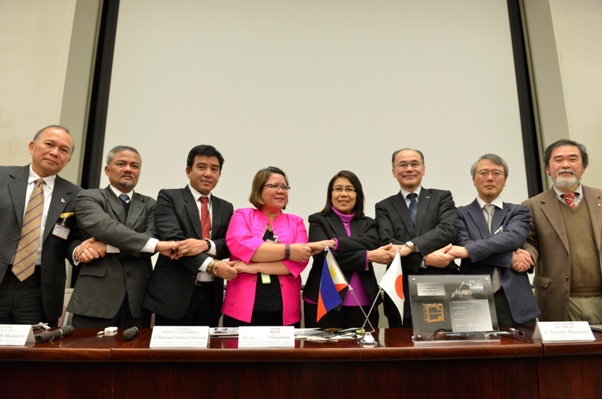
    On January 13, 2016, a 50-kg-class microsatellite called “DIWATA-1” (meaning “fairy” in Filipino) was handed over to JAXA. This satellite was co-developed by the Department of Science and Technology (DOST) of the Republic of Philippines, University of the Philippines, Hokkaido University, and Tohoku University.

    The release of a 50-kg-class satellite using the JEM Small Satellite Orbital Deployer (J-SSOD) from the ISS Japanese Experiment Module (“Kibo”) will mark the first time ever.

    The Philippine government sponsored the development and launch of the satellite, while its deployment from Kibo will be conducted under a paid-utilization contract between JAXA and Tohoku University.

    chick to enlarge

    Officials shake hands during the press conference (January 13)

    According to DOST, DIWATA-1 is the first microsatellite owned by the Philippine government involving Filipino engineers in its development. The satellite is intended to observe Earth, monitor climate changes, and develop human resources. Tohoku University and Hokkaido University each welcomed the reception of Filipino students and researchers. As such, DIWATA-1 was co-built in Japan by Japanese and Filipino engineers, whereas Tohoku University technically supported its satellite bus, and Hokkaido University supported the development of such payload as a mission sensor.

    The most noteworthy feature of the DIWATA-1 mission is Japan’s contribution to the Philippines’ national project by offering the opportunity to use Kibo. While Japanese universities develop human resources through the development of hardware, as Japan is the only country in Asia participating in the ISS, JAXA offers an opportunity to demonstrate the mission in space to share part of the advances made in science and technology in the Philippines.

    According to DOST, the Philippines is working to establish their own space agency toward the Asia-Pacific Regional Space Agency Forum (APRSAF) to be held later this year in the Philippines. Thus, this year will be memorable in terms of space development in the Philippines.

    Prior to the press conference, a technological review was conducted on DIWATA-1.

    Left: DIWATA-1 Right: satellite install case for J-SSOD 50-kg class

    Logos of participating organizations
    (From left, University of the Philippines, Tohoku University, Hokkaido University, Philippines Department of Science and Technology)

    Having completed its final review, DIWATA-1 was housed in the satellite install case and shipped out to the United States on January 18.

    After arriving in the U.S., DIWATA-1 will be delivered to NASA and launched by a U.S. commercial cargo vehicle. Its release from Kibo is scheduled by around May.

    *All times are Japan Standard Time (JST)

    This entry passed through the Full-Text RSS service – if this is your content and you’re reading it on someone else’s site, please read the FAQ at fivefilters.org/content-only/faq.php#publishers.

  • [Institute of Space and Astronautical Science (ISAS)] The Forefront of Space Science: The Night Sky Is Bright!? – About the Mysteries of the Near-infrared Background Radiation –

    The Night Sky Is Bright!? - About the Mysteries of the Near-infrared Background Radiation -

    | 1 | 2 | 3 |

    The Key to Deciphering the History of Universe: Cosmic Background Radiation

    As we all know, the night sky is dark. However, the astronomer Olbers in the 19th century had questions on this fact. Why is the night sky dark? If the universe is infinite and static, we must see stellar surface everywhere in the sky, so the night sky should be completely bright like the surface of the sun. This is the well-known “Olbers’ paradox”. As you know, this paradox is solved, since the universe is finite.

    It is true that the night sky is dark. In fact, however, it is not totally dark. There are weak radiations shining across the sky called the “Cosmic Background Radiation”. What is the Cosmic Background Radiation shining in the sky? Actually, the Cosmic Background Radiation is the aggregation of the history of universe from the beginning to now. To say it in another word, with the researches on the Cosmic Background Radiation, we can decipher the history of universe.

    The Cosmic Microwave Background Radiation, which is one of the traces of the Big Bang, is especially famous (For details, please check the article by Dr. Tomotake Matsumura in the ISAS News August 2015 Issue (No.413)). However, the universe is filled not only with the microwaves, but also with radio waves, infrared lights, visible lights, X-rays and gamma rays. If we can reveal the origin of the Cosmic Background Radiation, we will be able to understand the entire history of the universe. For example, we can look back at the history of the stars and the galaxies, which are the basic components of the universe, from the visible and infrared lights, as well as the formation history of black holes from the X-rays.

    In the ISAS News February 2005 Issue (No.287), Prof. Toshio Matsumoto (professor emeritus of JAXA, now works at the Academia Sinica, Taiwan) wrote an article called “The Night Sky is Bright!? – Exploring the First Light in the Universe -”. In this article, focusing on the near infrared (0.75~1.4μm) near the visible lights which we can see every day, we will introduce the progress and discussions, together with our researches, on the Cosmic Near-infrared Background during the 10 years after Prof. Matsumoto’s article. You will be interested in the progress of science if you read this article together with Prof. Matsumoto’s article. (*1)

    (*1):So far, there have been many articles on the Cosmic Background Radiation in ISAS News. Such as the article on the microwave field by Dr. Tomotake Matsumura, the article on the far infrared ray field by Prof. Shuji Matsuura and the article on the X-ray field by Prof. Yoshihiro Ueda. Although there has not been any article on the gamma ray field, I wrote an article in the Butsuri (Journal of the Physical Society of Japan) and I hope you can read it. It is a fact worthy of special mention that Japan’s space science researches have made great contributions to the researches on the Cosmic Background Radiation.

    | 1 | 2 | 3 |

    This entry passed through the Full-Text RSS service – if this is your content and you’re reading it on someone else’s site, please read the FAQ at fivefilters.org/content-only/faq.php#publishers.

  • [ISS / Japanese Experiment Module (KIBO)] JAXA Astronaut Activity Report, October 2015

    JAXA Astronaut Activity Report, October, 2015

    Last Updated: January 25, 2016

    This is JAXA’s Japanese astronaut activity report for October, 2015.

    Astronaut Takuya Onishi continues training for his ISS long-duration stay

    Astronaut Takuya Onishi, who was assigned as a crew member for the Expedition 48/49 mission to the International Space Station (ISS) underwent training for the long-duration mission mainly at the NASA Johnson Space Center (JSC) in October, and then at the GCTC at the end of the month.

    photo

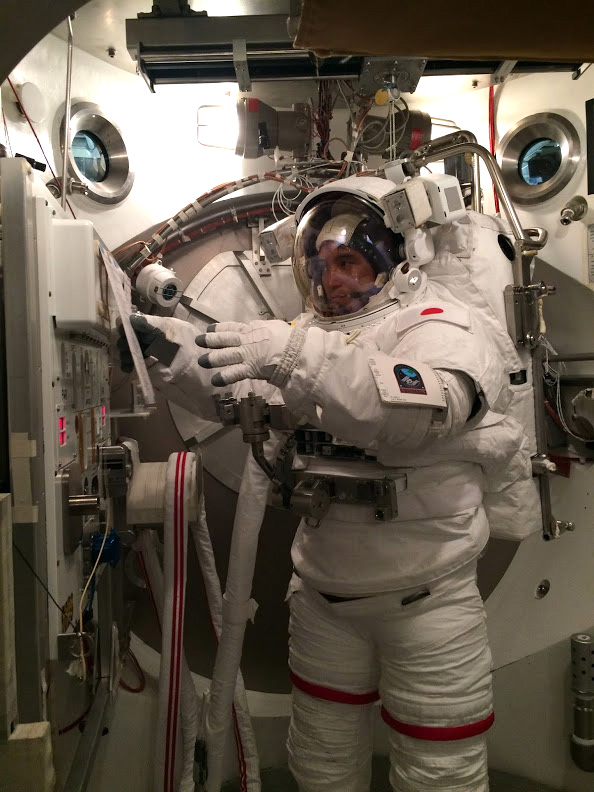
    Onishi donning the EMU in the Airlock (Photo courtesy of Takuya Onishi)

    At the JSC, Onishi continued training for Extravehicular Activity (EVA) from last month. Onishi this month practiced the procedure for donning an actual Extravehicular Mobility Unit (EMU) in the Airlock, and then depressurizing the Airlock (a vacuum chamber) and restoring it to the original pressure level.

    The training began with a check of health status, followed by Onishi donning cooling underwear (Liquid Cooling and Ventilation Garment: LCVG) and the EMU, checking for leaks, remaining in that condition for four hours to excrete nitrogen, and then finally depressurized the Airlock. While the pressure of the Airlock is lowered, the internal pressure of the EMU is also lowered to 0.3 atm. For that reason, astronauts breathe pure oxygen, not air while donning the EMU.

    In that condition Onishi responded to several irregularities and performed EVA closing procedures, and then returned air to the Airlock.

    Onishi and his crewmates training in the Soyuz simulator (Photo courtesy of Takuya Onishi)

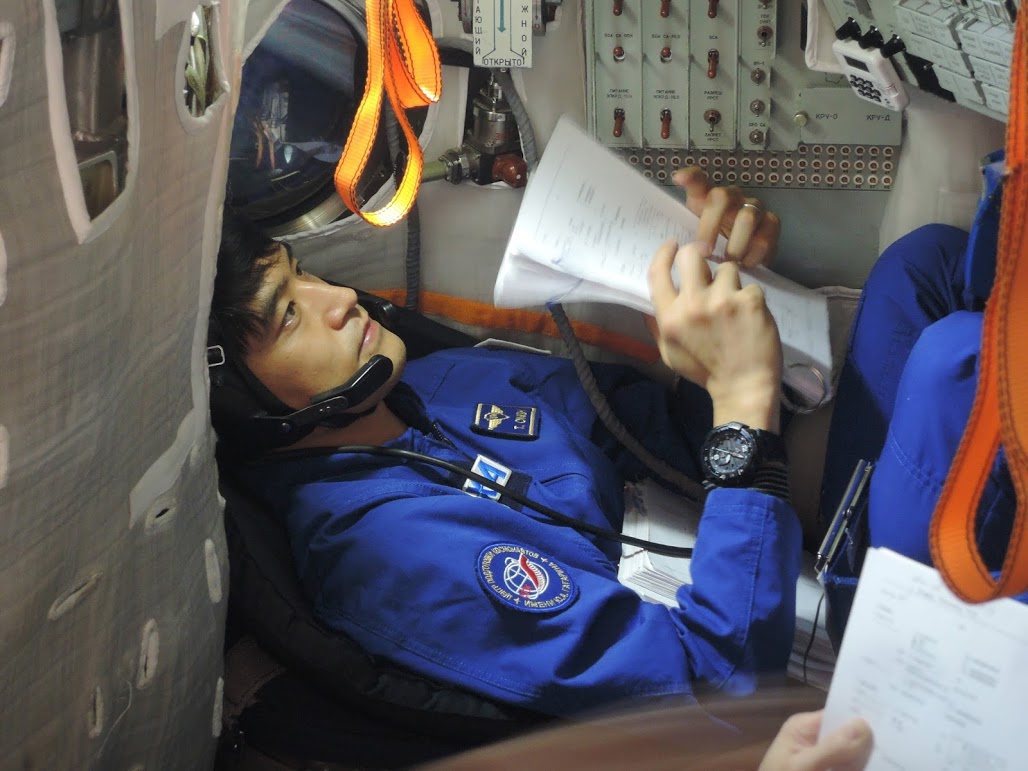
    Onishi and his crewmates training in the Soyuz simulator (Photo courtesy of Takuya Onishi)

    Training in late October at the GCTC covered simulated operation of the Soyuz spacecraft as backup crew for the Expedition 46/47 crew. Onishi and his crewmates proceeded with the simulation according to three divided stages: from preparing to launch to initiating rendezvous with the ISS, rendezvous and docking to the ISS, and undocking from the ISS to return to Earth. The simulation included several scenarios where the trainees would have to deal with trouble. The crew responded to the trouble as per the specified procedures.

    Exams for the Soyuz spacecraft will continue toward the final examination in November.

    Astronaut Soichi Noguchi attends the 66th International Astronautical Congress

    From October 12-16, the 66th International Astronautical Congress (IAC 2015) was held in Jerusalem, Israel with the theme of “Space — The Gateway for Mankind’s Future.”

    The IAC is hosted by the International Astronautical Federation (IAF), International Academy of Astronautics (IAA), and International Institute of Space Law (IISL), and is known as the world’s largest space-related event.

    Noguchi moderated the plenary session entitled “Fifty Years of Spacewalking — The Ultimate Human Space Adventure.” The panelists included Buzz Aldrin (the lunar module pilot on Apollo 11), Christer Fuglesang (holding the longest spacewalk duration record among ESA astronauts), Michael Lopez-Alegria (holding the longest spacewalk duration record among NASA astronauts), and Sunita Williams (holding the longest spacewalk duration by a woman), and they discussed next-generation spacesuits and other topics of interest.

    Noguchi’s other activities included participation in the IAF Human Space Flight Committee and an interview with the director of the Israel Space Agency.

    Astronaut Satoshi Furukawa’s research activity

    logo

    On October 6, a kickoff meeting was held for a new research project* headed by Astronaut Satoshi Furukawa.

    * Grant-in-Aid for Scientific Research on Innovative Areas: Living in Space

    The research project was established based on Furukawa’s career as an astronaut as well as a medical doctor. He assumed that the effects of each kind of stress that astronauts experience on the ISS could be common issues with some specific problems on the ground, and believed an integrated study should be pursued.

    In front of over 130 researchers gathered at the meeting, Furukawa stressed the meaning of the research theme in stating that overcoming biological impediments posed the biggest challenge for a prolonged stay in space, and that the successful results of doing so could be applicable to our aging and stressful society on the ground.

    Living in Space Website

    This entry passed through the Full-Text RSS service – if this is your content and you’re reading it on someone else’s site, please read the FAQ at fivefilters.org/content-only/faq.php#publishers.