Category: News

http://www.subtome.com/#/subscribe?feeds=http%3A%2F%2Fftr.fivefilters.org%2Fmakefulltextfeed.php%3Furl%3Dglobal.jaxa.jp%252Frss%252Fnew.rdf%26max%3D3%26links%3Dpreserve&back=http%3A%2F%2Fftr.fivefilters.org%2Fmakefulltextfeed.php%3Furl%3Dglobal.jaxa.jp%252Frss%252Fnew.rdf%26max%3D3%26links%3Dpreserve

  • [Project Topics] Current Status of Communication Anomaly of X-ray Astronomy Satellite “Hitomi” (ASTRO-H) (Mar. 29)

    Topics List

    Mar. 29, 2016 Updated
    Current Status of Communication Anomaly of X-ray Astronomy Satellite “Hitomi” (ASTRO-H) (Mar. 29)

    The Japan Aerospace Exploration Agency (JAXA) has been trying to communicate with the X-ray Astronomy Satellite “Hitomi” (ASTRO-H), using ground stations both in Japan and overseas.
    By utilizing two opportunities of communicating with Hitomi, JAXA received signals from the satellite: the first time was at about 10:00 p.m. on 28 at the Uchinoura Ground Station, and the second one was at around 0:30 a.m. on 29 at the Santiago Tracking Station in Chile. JAXA has not been able to figure out the state of its health, as the time frames for receiving the signals were very short.

    According to the U.S. Joint Space Operations Center (JSpOC), it is estimated that Hitomi separated to five pieces at about 10:42 a.m. In order to investigate the situation, JAXA is observing the objects, using a radar located at the Kamisaibara Space Guard Center (KSGC) and telescopes at the Bisei Space Guard Center (BSGC) owned by the Japan Space Forum. Up to now, the telescopes at BSGC detected two objects around the satellite’s original orbit, while the radar at KSGC identified one of them. It is confirmed that the signal received at the Santiago Tracking Station came from the orbital direction of the object identified at KSGC.
    JAXA continues to investigate the relationship between the information announced by JSpOC and the communication anomaly.

    JAXA will continue to do its best to recover communications with Hitomi and investigate the cause of the anomaly.

    Mar. 27, 2016 Updated
    Communication anomaly of X-ray Astronomy Satellite “Hitomi” (ASTRO-H) (Mar. 27)

    The Japan Aerospace Exploration Agency (JAXA) found that communication with the X-ray Astronomy Satellite “Hitomi” (ASTRO-H), launched on February 17, 2016 (JST), failed from the start of its operation originally scheduled at 16:40, Saturday March 26 (JST). Up to now, JAXA has not been able to figure out the state of health of the satellite.

    While the cause of communication anomaly is under investigation, JAXA received short signal from the satellite, and is working for recovery.

    Under this circumstance, JAXA set up emergency headquarters, headed by the President, for recovery and investigation. The headquarters held its first meeting today, and has been working for recovery and the investigation of the cause. Updates will be announced as available, at the JAXA website.

    Feb. 29, 2016 Updated
    Hitomi critical operation phase successfully completed!

    JAXA confirmed the completion of a sequence of important operations of the X-ray Astronomy Satellite “Hitomi” (ASTRO-H), including turning the cooling system on, test operation of the Soft X-ray Spectrometer (SXS), and extending the Extensible Optical Bench (EOB). With this confirmation, the critical operation phase of Hitomi was completed.
    The Hitomi will take about one and half months to verify the function of its onboard equipment and instruments in space, then we will conduct calibration observations for another one and half months.

    Hitomi critical operation phase successfully completed!

    Feb. 17, 2016 Updated
    ASTRO-H successfully launched and named “Hitomi”.

    H-IIA F30 with the “ASTRO-H” onboard launched at 5:45 p.m. on Feb 17, 2016 (JST) from the Tanegashima Space Center. The rocket flew smoothly, and, at about 14 minutes after liftoff, “ASTRO-H” was separated from the H-IIA F30.
    ASTRO-H is the eye to study the hot and energetic universe. Therefore we name ASTRO-H, “Hitomi”. The word “Hitomi”.generally means “eye”, and specifically the pupil, or entrance window of the eye – the aperture!

    ASTRO-H successfully launched and named “Hitomi”.

    Feb. 14, 2016 Updated
    ASTRO-H Launch rescheduled to 5:45 p.m. on Feb 17 (Wed. ,JST)

    The launch of the The X-ray Astronomy Satellite “ASTRO-H” by the H-IIA Launch Vehicle No. 30 was rescheduled at 5:45 p.m. on Feb 17 (Wed. Japan Standard Time, JST) after carefully studying the weather conditions.

    The live launch report will begin at 5:25 p.m. on Feb 17(Wed. ,JST). The report will be broadcast through the Internet.
    Please send your support messages for the mission!

    ASTRO-H Launch rescheduled to 5:45 p.m. on Feb 17 (Wed. ,JST)

    Feb. 12, 2016 Updated
    The X-ray Astronomy Satellite “ASTRO-H” launch postponement

    H-IIA Launch Vehicle No.30 with the X-ray Astronomy Satellite “ASTRO-H” onboard, which was originally scheduled for February 12 (Fri.), 2016 (Japan Standard Time), has been rescheduled because bad weather is expected. The new launch day will be announced as soon as it is determined. Your warm support messages are welcomed at the support site.

    Feb. 3, 2016 Updated
    ASTRO-H Press Kit

    As the launch day approaches, JAXA has released the press kit for the X-ray Astronomy Satellite “ASTRO-H”. It covers ASTRO-H’s satellite and  mission overview, scientific missions, and observation instruments. Please have a look.

    ASTRO-H Press Kit

    Jan. 21, 2016 Updated
    ASTRO-H’s development and preparation status is updated on the ASTRO-H diary site

    Aiming at the launch and success of the mission, for some years the Astro-H team members have been hard at work at research and development, making steady progress. They have faced many tough obstacles along this long road. They have had many moments of success.
    This diary is an introduction to the daily work life — and to the excitements — of these members.

    ASTRO-H's development and preparation status is updated on the ASTRO-H diary site

    Jan. 12, 2016 Updated
    ASTRO-H Satellite Shown to the Public

    On the day marking exactly one month to launch, the ASTRO-H spacecraft was exhibited to the public at the Tanegashima Space Center. Many questions were asked both about the science goals of ASTRO-H and about its engineering.

    ASTRO-H Satellite Shown to the Public

    Dec. 11, 2015 Updated
    X-ray Astronomy Satellite “ASTRO-H” to be launched on Feb. 12

    The new generation X-ray astronomy satellite ASTRO-H is set for launch on February 12 (Fri.), by the H-IIA Launch Vehicle No. 30 from the Tanegashima Space Center.

    JAXA will broadcast a live launch report on the launch day. We will announce more details later. Please look forward to the launch!

    Dec. 2, 2015 Updated
    ASTRO-H press day

    The X-ray Astronomy Satellite “ASTRO-H” was revealed to the media on Nov. 27 at the Tsukuba Space Center.
    The ASTRO-H is an astronomy satellite to elucidate the structure of space and its evolution through studying high-temperature and high-energy celestial bodies, such as black holes, supernova remnants, and galaxy clusters by X-rays and gamma-rays.
    X-rays and gamma-rays from space are absorbed in the Earth’s atmosphere, thus they cannot be observed on the Earth. Therefore observation in space is necessary.
    The ASTRO-H was developed as a successor to the Suzaku, also an X-ray astronomy satellite. The ASTRO-H is a flagship mission of X-ray astronomy with the participation of over 200 researchers in its development from various domestic and international universities and research institutions including JAXA and NASA. Four new observation systems developed based on broad-scale international cooperation are installed on the ASTRO-H, hence, compared to the Suzaku, it will be able to perform spectroscopic observations on celestial bodies 10 times to 100 times darker than what the Suzaku was capable of doing.

    ASTRO-H press day

    Nov. 2, 2015 Updated
    ASTRO-H sinusoidal vibration test

    The sinusoidal vibration test of the X-ray astronomy satellite “ASTRO-H” was held between Aug. 29 and Oct. 2 at the Tsukuba Space Center. The sinusoidal vibration test aims at two major evaluation objectives, namely evaluating dynamic characteristics of a satellite structure and assessing its strength by loading vibrations equivalent to that at the launch.
    On Oct. 2, the last vibration test was completed, then planned dynamic characteristics data was acquired and the strength of the satellite structure against a vibration load equivalent to that at the time of launch was verified.

    ASTRO-H sinusoidal vibration test

    Aug. 3, 2015 Updated
    ASTRO-H thermal vacuum test

    The thermal vacuum test was held for the X-ray Astronomy Satellite “ASTRO-H” between June 24 and July 9 in a 13-meter chamber at the Tsukuba Space Center. The purposes of the thermal vacuum test are to verify the thermal model by exposing a satellite to the vacuum and thermal environment, and to confirm the function and performance of observation instruments in the on-orbit environment through an electric test.
    All tested items were satisfactorily confirmed including the expected performance of the onboard instruments, verification of the command function to be used in orbit, and calibration data acquisition.

    ASTRO-H thermal vacuum test

    Apr. 21, 2015 Updated
    Soft Gamma-ray Detectors (SGDs) installation on ASTRO-H completed

    Two Soft Gamma-ray Detectors (SGDs), which successfully went through the thermal vacuum test and the cooling test, were installed onto the ASTRO-H. The photo shows the SGD2 on the ASTRO-H with a debris cover and a radiator. A golden color MLI (multi-layer insulation) will wrap them so that they will not be seen from outside.
    All the observation instruments are now installed on the ASTRO-H, so its preparations for launch are turning the final corner. We will work harder to overcome the many remaining hurdles including the functional test, thermal vacuum test, and vibration test.

    Soft Gamma-ray Detectors (SGDs) installation on ASTRO-H completed

    Jan. 25, 2015 Updated
    Thermal vacuum test for Soft Gamma-ray Detectors

    The Soft Gamma-ray Detectors (SGD) to observe the soft gamma-ray region of 60 to 600 keV are under the thermal vacuum test in the 8-meter chamber at the Tsukuba Space Center to confirm their thermal design.
    The sensor part of the SGD does not activate till the temperature hits a low temperature of minus 20 degrees (C). However, the SGDs will be installed outside of the satellite panel, thus their temperature will increase from radiation from the Sun and the Earth, thermal input from the satellite panel, and heat from a large amount of LSI (large-scale integrated circuits) and an amplifier if nothing is done. Therefore, the accumulating heat will be carried to the radiator through thermal transfer and a heat pipe to be released, and the SGD will be covered by the multi-layer insulation (MLI), which looks like a bunch of aluminum foils, to shut out heat input. The semiconductor sensor is also activated with high voltage of 200 to 1000 V, hence it should also be tested if it would discharge in vacuum.
    Photo: The SGD-2 sits in the 8-meter chamber.

    Thermal vacuum test for Soft Gamma-ray Detectors

    May 29, 2014 Updated
    First Integration Test for ASTRO-H (for XRT)

    As manufacturing of two Hard X-ray Telescopes (HXTs) and two Soft X-ray Telescopes (SXTs) has been completed and their performance has been confirmed, they are going to be subject to the first integration test. During the test, the telescopes will be mounted on an optical board to make sure that there is no interference with other structures or the satellite bus as well as that no problems arise with operations for controlling the telescope position or angle and operation tools.
    Photo: Satellite surrounded by a scaffold

    First Integration Test for ASTRO-H (for XRT)

    Mar. 26, 2013 Updated
    ASTRO-H development status

    Aug. 10, 2012 Updated
    Satellite development going well: Development test status

    Mar. 15, 2010 Updated
    ASTRO-H passed the basic design review, new logo published

    On May 13 and 14, 2010, the basic design review was held for the ASTRO-H, and the satellite passed the examination. We are moving to the detailed design phase. To celebrate this opportunity, we revised the official logo mark for the ASTRO-H and published it on Feb. 25. The launch of the ASTRO-H is coming closer, and we are working hard for the project to proceed smoothly. Your support will be very much appreciated.

    Oct. 28, 2009 Updated
    SRON-JAXA agreement on Space Science

    On October 28th, 2009, SRON Netherlands Institute for Space Research and JAXA signed a cooperative framework agreement with the aim of promoting joint activities in the field of space science in the presence of Dr. De Heer, the Ambassador Extraordinary and Plenipotentiary of the Kingdome of the Netherlands to Japan, and Dr. Tachikawa, the President of JAXA.
    On the same day, the Implementing Arrangement for collaboration on ASTRO-H (International X-ray astronomy mission) was also concluded. Through ASTRO-H mission, SRON will be in charge of developing an onboard instrument “Soft X-ray Spectrometer (SXS)” and take part in a science team to carry our scientific research.

    SRON-JAXA agreement on Space Science

    Let’s block ads! (Why?)

  • [Project Topics] Communication failure of X-ray Astronomy Satellite “Hitomi” (ASTRO-H)

    Topics List

    Mar. 27, 2016 Updated
    Communication failure of X-ray Astronomy Satellite “Hitomi” (ASTRO-H)

    The Japan Aerospace Exploration Agency (JAXA) found that communication with the X-ray Astronomy Satellite “Hitomi” (ASTRO-H), launched on February 17, 2016 (JST), failed from the start of its operation originally scheduled at 16:40, Saturday March 26 (JST). Up to now, JAXA has not been able to figure out the state of health of the satellite.

    While the cause of communication failure is under investigation, JAXA received short signal from the satellite, and is working for recovery.

    Under this circumstance, JAXA set up emergency headquarters, headed by the President, for recovery and investigation. The headquarters held its first meeting today, and has been working for recovery and the investigation of the cause. Updates will be announced as available, at the JAXA website.

    Feb. 29, 2016 Updated
    Hitomi critical operation phase successfully completed!

    JAXA confirmed the completion of a sequence of important operations of the X-ray Astronomy Satellite “Hitomi” (ASTRO-H), including turning the cooling system on, test operation of the Soft X-ray Spectrometer (SXS), and extending the Extensible Optical Bench (EOB). With this confirmation, the critical operation phase of Hitomi was completed.
    The Hitomi will take about one and half months to verify the function of its onboard equipment and instruments in space, then we will conduct calibration observations for another one and half months.

    Hitomi critical operation phase successfully completed!

    Feb. 17, 2016 Updated
    ASTRO-H successfully launched and named “Hitomi”.

    H-IIA F30 with the “ASTRO-H” onboard launched at 5:45 p.m. on Feb 17, 2016 (JST) from the Tanegashima Space Center. The rocket flew smoothly, and, at about 14 minutes after liftoff, “ASTRO-H” was separated from the H-IIA F30.
    ASTRO-H is the eye to study the hot and energetic universe. Therefore we name ASTRO-H, “Hitomi”. The word “Hitomi”.generally means “eye”, and specifically the pupil, or entrance window of the eye – the aperture!

    ASTRO-H successfully launched and named “Hitomi”.

    Feb. 14, 2016 Updated
    ASTRO-H Launch rescheduled to 5:45 p.m. on Feb 17 (Wed. ,JST)

    The launch of the The X-ray Astronomy Satellite “ASTRO-H” by the H-IIA Launch Vehicle No. 30 was rescheduled at 5:45 p.m. on Feb 17 (Wed. Japan Standard Time, JST) after carefully studying the weather conditions.

    The live launch report will begin at 5:25 p.m. on Feb 17(Wed. ,JST). The report will be broadcast through the Internet.
    Please send your support messages for the mission!

    ASTRO-H Launch rescheduled to 5:45 p.m. on Feb 17 (Wed. ,JST)

    Feb. 12, 2016 Updated
    The X-ray Astronomy Satellite “ASTRO-H” launch postponement

    H-IIA Launch Vehicle No.30 with the X-ray Astronomy Satellite “ASTRO-H” onboard, which was originally scheduled for February 12 (Fri.), 2016 (Japan Standard Time), has been rescheduled because bad weather is expected. The new launch day will be announced as soon as it is determined. Your warm support messages are welcomed at the support site.

    Feb. 3, 2016 Updated
    ASTRO-H Press Kit

    As the launch day approaches, JAXA has released the press kit for the X-ray Astronomy Satellite “ASTRO-H”. It covers ASTRO-H’s satellite and  mission overview, scientific missions, and observation instruments. Please have a look.

    ASTRO-H Press Kit

    Jan. 21, 2016 Updated
    ASTRO-H’s development and preparation status is updated on the ASTRO-H diary site

    Aiming at the launch and success of the mission, for some years the Astro-H team members have been hard at work at research and development, making steady progress. They have faced many tough obstacles along this long road. They have had many moments of success.
    This diary is an introduction to the daily work life — and to the excitements — of these members.

    ASTRO-H's development and preparation status is updated on the ASTRO-H diary site

    Jan. 12, 2016 Updated
    ASTRO-H Satellite Shown to the Public

    On the day marking exactly one month to launch, the ASTRO-H spacecraft was exhibited to the public at the Tanegashima Space Center. Many questions were asked both about the science goals of ASTRO-H and about its engineering.

    ASTRO-H Satellite Shown to the Public

    Dec. 11, 2015 Updated
    X-ray Astronomy Satellite “ASTRO-H” to be launched on Feb. 12

    The new generation X-ray astronomy satellite ASTRO-H is set for launch on February 12 (Fri.), by the H-IIA Launch Vehicle No. 30 from the Tanegashima Space Center.

    JAXA will broadcast a live launch report on the launch day. We will announce more details later. Please look forward to the launch!

    Dec. 2, 2015 Updated
    ASTRO-H press day

    The X-ray Astronomy Satellite “ASTRO-H” was revealed to the media on Nov. 27 at the Tsukuba Space Center.
    The ASTRO-H is an astronomy satellite to elucidate the structure of space and its evolution through studying high-temperature and high-energy celestial bodies, such as black holes, supernova remnants, and galaxy clusters by X-rays and gamma-rays.
    X-rays and gamma-rays from space are absorbed in the Earth’s atmosphere, thus they cannot be observed on the Earth. Therefore observation in space is necessary.
    The ASTRO-H was developed as a successor to the Suzaku, also an X-ray astronomy satellite. The ASTRO-H is a flagship mission of X-ray astronomy with the participation of over 200 researchers in its development from various domestic and international universities and research institutions including JAXA and NASA. Four new observation systems developed based on broad-scale international cooperation are installed on the ASTRO-H, hence, compared to the Suzaku, it will be able to perform spectroscopic observations on celestial bodies 10 times to 100 times darker than what the Suzaku was capable of doing.

    ASTRO-H press day

    Nov. 2, 2015 Updated
    ASTRO-H sinusoidal vibration test

    The sinusoidal vibration test of the X-ray astronomy satellite “ASTRO-H” was held between Aug. 29 and Oct. 2 at the Tsukuba Space Center. The sinusoidal vibration test aims at two major evaluation objectives, namely evaluating dynamic characteristics of a satellite structure and assessing its strength by loading vibrations equivalent to that at the launch.
    On Oct. 2, the last vibration test was completed, then planned dynamic characteristics data was acquired and the strength of the satellite structure against a vibration load equivalent to that at the time of launch was verified.

    ASTRO-H sinusoidal vibration test

    Aug. 3, 2015 Updated
    ASTRO-H thermal vacuum test

    The thermal vacuum test was held for the X-ray Astronomy Satellite “ASTRO-H” between June 24 and July 9 in a 13-meter chamber at the Tsukuba Space Center. The purposes of the thermal vacuum test are to verify the thermal model by exposing a satellite to the vacuum and thermal environment, and to confirm the function and performance of observation instruments in the on-orbit environment through an electric test.
    All tested items were satisfactorily confirmed including the expected performance of the onboard instruments, verification of the command function to be used in orbit, and calibration data acquisition.

    ASTRO-H thermal vacuum test

    Apr. 21, 2015 Updated
    Soft Gamma-ray Detectors (SGDs) installation on ASTRO-H completed

    Two Soft Gamma-ray Detectors (SGDs), which successfully went through the thermal vacuum test and the cooling test, were installed onto the ASTRO-H. The photo shows the SGD2 on the ASTRO-H with a debris cover and a radiator. A golden color MLI (multi-layer insulation) will wrap them so that they will not be seen from outside.
    All the observation instruments are now installed on the ASTRO-H, so its preparations for launch are turning the final corner. We will work harder to overcome the many remaining hurdles including the functional test, thermal vacuum test, and vibration test.

    Soft Gamma-ray Detectors (SGDs) installation on ASTRO-H completed

    Jan. 25, 2015 Updated
    Thermal vacuum test for Soft Gamma-ray Detectors

    The Soft Gamma-ray Detectors (SGD) to observe the soft gamma-ray region of 60 to 600 keV are under the thermal vacuum test in the 8-meter chamber at the Tsukuba Space Center to confirm their thermal design.
    The sensor part of the SGD does not activate till the temperature hits a low temperature of minus 20 degrees (C). However, the SGDs will be installed outside of the satellite panel, thus their temperature will increase from radiation from the Sun and the Earth, thermal input from the satellite panel, and heat from a large amount of LSI (large-scale integrated circuits) and an amplifier if nothing is done. Therefore, the accumulating heat will be carried to the radiator through thermal transfer and a heat pipe to be released, and the SGD will be covered by the multi-layer insulation (MLI), which looks like a bunch of aluminum foils, to shut out heat input. The semiconductor sensor is also activated with high voltage of 200 to 1000 V, hence it should also be tested if it would discharge in vacuum.
    Photo: The SGD-2 sits in the 8-meter chamber.

    Thermal vacuum test for Soft Gamma-ray Detectors

    May 29, 2014 Updated
    First Integration Test for ASTRO-H (for XRT)

    As manufacturing of two Hard X-ray Telescopes (HXTs) and two Soft X-ray Telescopes (SXTs) has been completed and their performance has been confirmed, they are going to be subject to the first integration test. During the test, the telescopes will be mounted on an optical board to make sure that there is no interference with other structures or the satellite bus as well as that no problems arise with operations for controlling the telescope position or angle and operation tools.
    Photo: Satellite surrounded by a scaffold

    First Integration Test for ASTRO-H (for XRT)

    Mar. 26, 2013 Updated
    ASTRO-H development status

    Aug. 10, 2012 Updated
    Satellite development going well: Development test status

    Mar. 15, 2010 Updated
    ASTRO-H passed the basic design review, new logo published

    On May 13 and 14, 2010, the basic design review was held for the ASTRO-H, and the satellite passed the examination. We are moving to the detailed design phase. To celebrate this opportunity, we revised the official logo mark for the ASTRO-H and published it on Feb. 25. The launch of the ASTRO-H is coming closer, and we are working hard for the project to proceed smoothly. Your support will be very much appreciated.

    Oct. 28, 2009 Updated
    SRON-JAXA agreement on Space Science

    On October 28th, 2009, SRON Netherlands Institute for Space Research and JAXA signed a cooperative framework agreement with the aim of promoting joint activities in the field of space science in the presence of Dr. De Heer, the Ambassador Extraordinary and Plenipotentiary of the Kingdome of the Netherlands to Japan, and Dr. Tachikawa, the President of JAXA.
    On the same day, the Implementing Arrangement for collaboration on ASTRO-H (International X-ray astronomy mission) was also concluded. Through ASTRO-H mission, SRON will be in charge of developing an onboard instrument “Soft X-ray Spectrometer (SXS)” and take part in a science team to carry our scientific research.

    SRON-JAXA agreement on Space Science

    Let’s block ads! (Why?)

  • [Institute of Space and Astronautical Science (ISAS)] Solar Wind Induces Jupiter’s X-ray Aurora

    Artistic rendering of the Jupiter’s aurora and magnetosphere.

    Artistic rendering of the Jupiter’s aurora and magnetosphere. [Click for large image]

    Jupiter boasts some of the most powerful aurora in the solar system. Compared to the Earth’s aurora, it is a few hundred times more powerful and brighter in the all spectrum range. What causes Jupiter’s powerful aurora? Several hypotheses have been proposed, but it has remained a mystery due to a lack of observational evidences.

    Jupiter’s X-ray aurora, which is observed in the X-ray spectrum region, is thought to sparkle when oxygen and sulfur ion particles moving at nearly the velocity of light strike the Jupiter’s atmosphere. How can these ions be accelerated to such high speed? There are two leading hypotheses. The first one assumes that the solar wind speeding up the ions, similar to the case of the Earth’s aurora. The other proposes that the ions are being accelerated by the rapid spin of the Jupiter, the Jupiter’s own magnetic field and plasma provided by the Jupiter’s satellite Io.

    Monitor observations of the Jupiter’s X-ray aurora are essential to compare several parameters of the X-ray aurora, such as brightness at each location, with the changes in the solar wind. For example, a correlation between the solar wind and the X-ray aurora supports the first hypothesis (the ions are accelerated by the solar wind) observationally.

    Using the Spectroscopic Planet Observatory for Recognition of Interaction of Atmosphere “HISAKI” (SPRINT-A), the Chandra X-ray Observatory and X-ray Multi-Mirror Mission (XMM-Newton), scientists monitored the Jupiter’s X-ray aurora for two weeks in April 2014.

    “We estimated the variation of the solar wind at Jupiter by HISAKI’s data. The data of the solar wind at the Earth was available. However, when this observation was conducted, Jupiter was in particular far from the Earth. The estimated pressure and velocity of the solar wind at the Jupiter location is much less accurate if we extrapolated these values observed at the Earth.” Kimura, the research team lead, explains. The results show the strong correlation between the velocity of the solar wind and the strength of the X-ray aurora. Although previous studies indicated the correlation between the pressure of the solar wind and the strength of the X-ray aurora, this is the first time to show the velocity of the solar wind affects the strength of the X-ray aurora. Since the Jupiter’s aurora at other spectral range is thought to get kicked off by the planet-moon interaction, not by solar activity, this study suggests the X-ray aurora sparks by different mechanism from the Jupiter’s aurora emitting light in other wavelength ranges.

    Kimura continues, “We observed the X-ray aurora for 10 hours once-daily, 6 times in total. Thanks to the high resolving power of the Chandra X-ray observatory, we could obtain the detailed spatial structure and its time variations of the X-ray aurora. The spectral data taken by the XMM-Newton told us the volcanic gases from the satellite Io and oxygen atoms can exist in the solar wind emit X-ray. “

    Spatial distribution of the magnetic flux line of the X-ray aurora at the Jupiter’s magnetosphere.

    Spatial distribution of the magnetic flux line of the X-ray aurora at the Jupiter’s magnetosphere. [Click for large image]

    The long-time observation by the Chandra also elucidated the fine spatial structure of the X-ray aurora and precise measurement of time variations. Kimura says, “Using the observational data and a numerical model of the Jupiter’s magnetic field, we studied the spatial distribution of the magnetic flux line of the X-ray aurora at the Jupiter’s magnetosphere. Our estimation shows the lines of magnetic force piercing the X-ray aurora connect with the boundary surface between the Jupiter’s magnetosphere and the solar wind. Together with this and the correlation between the velocity of the solar wind and the strength of the X-ray aurora, we believe the solar wind causes the X-ray aurora.”

    Another study out today, led by William Dunn from UCL and co-authored by the JAXA research team also analyzed the X-ray data taken in 2011. Despite the complete difference in condition of the solar wind observed in 2014, the team found the similar trends, i.e., the correlation between the solar wind and the strength of the X-ray aurora, and the lines of magnetic force connected with the outer region of the Jupiter’s magnetosphere. These are consistent with the results based on the observations in 2014.’

    So you are aware, we’ve included the following paragraph in our release about Tomoki’s paper (as well as including a full list of authors and bibliographic information of the paper):

    ‘Another study out today, led by Tomoki Kimura from the Japan Aerospace Exploration Agency (JAXA) and co-authored by the UCL researchers, reports that the X-ray aurora responds to quieter ‘gusts’ of solar wind, deepening this connection between Jupiter and the solar wind.’

    Observation by HISAKI and the Hubble Space Telescope in January 2014 focused on precipitations of the Jupiter’s aurora in UV. This research concluded the Jupiter’s high spin resulted in the precipitations of the UV aurora. The results of the X-ray and UV aurora suggest that the both mechanisms, the Jupiter’s rapid spin and the solar wind, cause the Jupiter’s powerful aurora phenomenon.

    Yamazaki, the HISAKI project manager tells, “Auroras in atmospheres of other planets can be formed by the mechanisms similar to the Jupiter. For example, there is a high possibility of similar phenomena in the atmosphere of Saturn, because plasma particles originated from water of the Saturn’s satellite Enceladus are captured by the Saturn’s magnetic field and turn rapidly around the Saturn. Of course, auroras can form in the atmosphere of an exoplanet. In some day, our research may apply to study aurora phenomena of exoplanets.“

    Kimura tells about his future researches as follows, “We plan further observations of the Jupiter’s auroras by the X-ray Astronomical Satellite “HITOMI” (ASTRO-H) and JUNO probe which will perform a polar orbit insertion. By using HISAKI’s data complementary, we would like to understand the acceleration mechanism of particles inducing the Jupiter’s aurora phenomena. “

    Let’s block ads! (Why?)

  • [Institute of Space and Astronautical Science (ISAS)] The Forefront of Space Science: The Scientific Achievements and Issues Brought by SMILES

    The Scientific Achievements and Issues Brought by SMILES

    | 1 | 2 | 3 |

    SMILES Full of “First Times”

    Are you aware of the SMILES (Superconducting Submillimeter-Wave Limb Emission Sounder)? Above the troposphere (0~15km) where there will be weather phenomena such as typhoon and thunder, there covers the stratosphere (15~50km) with the ozone layer. The ozone layer is playing an important role in absorbing ultraviolet which is harmful for creatures on the ground. However, it was severely depleted by anthropogenic substances (generally chlorofluorocarbons called Freon). Afterwards, an international treaty (the Montreal Protocol in 1987 and its amendments) was adopted to regulate the emission of ozone depleting substances and it is gradually taking effects. However, predictions on the recovery of the ozone layer by various research institutes differ greatly with each other, and there are concerns on the effects of global warming on the concentration of ozone. To know the situations correctly and to evaluate the future, it is required to perform the high-sensitivity global observations of the stratospheric ozone along with the trace gases (the other molecules except dinitrogen and hydrogen), and the SMILES was responsible for that (Figure 1).

    Figure 1a

    Figure 1b
    Figure 1. Structure of SMILES and observation schematic [Click for larger image]
    The SMILES, heading its antennas towards the Earth’s atmospheric limb, observed emission from the stratospheric trace gasses within the submillimeter-wave region with a high-sensitivity.

    SMILES was launched on 11th September 2009 by the H-IIB testing rocket, carried to the International Space Station (ISS) on the 25th by the HTV “Kounotori” testing vehicle and was attached to the outside platform of the Japanese Experiment Module “Kibo”. It was as well supposed to conduct the first space technology demonstration of the 4K mechanical cooler (absolute temperature 4K= -269°C) and the superconducting mixers for detecting the weak submillimeter waves from the trace gasses . I felt concerned whether it was able to conduct the observation with so many “first times”, but during a half year since the October of 2009, it has conducted the atmospheric observation with the highest-sensitivity among the observations so far and has brought us a lot of new knowledge in the atmospheric science field. In this article, I’m going to introduce two researches on the achievements of SMILES and give an overview on the next observation plan.

    Diurnal Variation of the Stratosphere Ozone Revealed

    As mentioned above, the stratospheric ozone is preventing creatures on the ground from the harmful ultraviolet and is additionally taking effects on the heat balance of the earth, playing a very important role in the formation of the climate. Therefore, we have been monitoring the ozone through many methods so far.

    On the other hand, Takatoshi Sakazaki, the Japan Society for the Promotion of Science Research Fellow (PD) of Research Institute for Sustainable Humanosphere, found that there is a diurnal variation in the ozone in the stratosphere (Figure 2) with the high-sensitive and non-sun-synchronous observation data (*1), which is the features of SMILES. Additionally, according to the analysis of chemical transport model (one of the numerical models for calculating the distribution and variation of the chemical substances in the atmosphere), they found that for the diurnal variation of the stratospheric ozone is not only the photochemical change (influences from the diurnal variation of sunlight) but is also influenced by the dynamics effects (vertical transport effects from the updrafts and downdrafts following the atmospheric tide).

    Figure 2
    Figure 2. Time-hight sectional view of the diurnal variation of the tropical ozone concentrations (10°S~10°N). [Click for larger image]
    The left is the observation result of SMILES while the right is the simulation result of the chemical transport model (SD-WACCM). The unit is the ratio to the daily average. (Sakazaki et al., 2013)

    The result is important because the mean deviation of the diurnal variation reaches 8% at most and we cannot ignore this amount for evaluating the trend analysis of ozone concentration. Since the observation data from almost all the satellites on the sun- synchronous orbits or the scheduled balloon and ground-based observations used for trend analysis has a deviation in observation time, there is a need to make corrections in regard of the diurnal variation. This result has been published on the journal of geophysics, “Journal of Geophysical Research (JGR)”. Additionally, the new knowledge about the variation in ozone concentration has been included in the “Scientific Assessments of Ozone Depletion: 2014” published by United Nations Environment Programme (UNEP) and World Meteorological Organization every 3 or 4 years which describes the current situation and forecast of ozone depletion.

    (*1) Non-sun-synchronous observation data: while the satellite is on a non-sun-synchronous orbit, it is able to conduct observations at different local time, so as to be able to investigate the diurnal variation phenomenon.

    | 1 | 2 | 3 |

    Let’s block ads! (Why?)

  • [ISS / Japanese Experiment Module (KIBO)] Kibo-ABC Member Countries' News: The Philippines

    Kibo-ABC Member Countries’ News: The Philippines

    Last Updated: March 18, 2016

    The First Philippine-made 50kg Class Satellite “DIWATA-1” Ready for Launch

    J-SSOD on ISS/Kibo

    DIWATA-1, the first Philippine-made satellite has been handed over to JAXA at Tsukuba Space Center on January 13, to prepare for its launch to International Space Station into space in April 2016. The diligent students from the Philippines leveraged the technical guidance by Japanese universities to lead this international collaboration project sponsored by the government of the Philippines to succeed. The great success of this project has made its mark on the history of space development in Philippines, which is currently planning for the creation of a Philippine space agency.

    Filipino satellite development starts from Diwata-1

    DIWATA-1 Installed to deployer case at Tsukuba Space Center

    The Philippines often face the risks of natural disasters such as typhoon, hence the needs for the satellite data is increasing. However, as the Philippines did not have their own satellites, the government official says that they had to purchase satellite imagery from other countries costing millions of dollars annually. By having their own satellite, the Philippines can get data 365 days a year and task the satellite to take a picture of a particular location, to obtain information needed rapidly and more easily.

    Diwata-1 has several scientific instrument such as the High Precision Telescope (HPT); Space-borne Multispectral Imager (SMI) with Liquid Crystal Tunable Filter (LCTF); and the Wide Field Camera (WFC). These instruments will monitor the surface of the lands and waters of the Philippines, to estimate damages from natural disasters, monitor vegetation changes, forecast weather and similar activities.

    Collaboration with Japan for development and deployment

    The development of Diwata-1 is part of the Department of Science and Technology’s Philippine Scientific Earth Observation Micro-Satellite (PHL-Microsat) Program which was initiated in 2014.. The project decided to choose Japan as a partner to develop their first Filipino-made satellite, and sent nine engineers and students from the DOST-Advanced Science and Technology Institute (ASTI) and the University of the Philippines to two Japanese universities, Tohoku University and Hokkaido University to learn satellite development. The program is also intended to building capacity of young engineers and students in the Philippines. The microsatellite development was completed in December 2015, an astonishing speed for developing satellites. The satellite will be deployed from JEM Small Satellite Orbital Deployer (J-SSOD) on Japanese Experiment Module “Kibo” in the International Space Station (ISS), in cooperation with JAXA.

    The second satellite, PHL-Microsat-2 or DIWATA-2, is already under development and targeted to be launched in late 2017.

    Official conference; Philippines the Department of Science and Technology (DOST), Embassy of Japan in the Philippines the University of the Philippines, Tohoku University, Hokkaido University, and JAXA.

    Let’s block ads! (Why?)

  • [Project Topics] DAICHI-2 honored by central emergency communications council

    Topics List

    Mar. 17, 2016 Updated
    DAICHI-2 honored by central emergency communications council

    DAICHI-2 received an award for its contributions to anti-disaster operations by the council (*) on March 16, 2016. DAICHI-2 performs emergency observations in response to requests from disaster preparation agencies, and swiftly provides data to understand signs of disasters and their status.
    For emergency observations of a volcanic eruption at Kuchinoerabu Island, we provided observation data about four hours after the explosion following a request from the Japan Meteorological Agency (JMA). The data analysis results by disaster prevention agencies was then reported to the Coordinating Committee for the Prediction of Volcanic Eruptions of the JMA to learn about the changes in the crater, falling ash, and pyroclastic flows. (Image: Kuchinoerabu Island just after the eruption shot by DAICHI-2)
    When volcanic activity begun at Sakurajima and Hakone, DAICHI-2 also observed the status with its capacity of detecting tectonic movements down to centimeters. The acquired data was also analyzed by disaster prevention agencies for use by JMA to determine the level of alert/warning issues and for respective municipal governments to set up access restrictions.
    JAXA continues to support disaster measures through satellite technology.

    * Central emergency communications council: The council was established for smooth communication in times of emergencies like a natural disaster, and it honors individuals and organizations that make significant achievements in this area.

    DAICHI-2 honored by central emergency communications council

    May 14, 2015 Updated
    Agreement concluded with MLIT on DAICHI-2 observation data

    JAXA concluded an agreement with the Kyushu Regional Development Bureau of the Ministry of Land, Infrastructure, Transport and Tourism (MLIT) on April 30, 2015, to provide observation data by the Advanced Land Observing Satellite-2 “DAICHI-2” (ALOS-2). The purpose of the agreement is to survey (1) secular changes of landscape and ash fall and (2) isolated islands for their up keep. We will work together to conduct surveys more efficiently with broader covering areas by mutually sharing and studying observation data possessed by the Kyushu Regional Development Bureau and JAXA’s satellite data.
    Taking this opportunity of concluding the agreement, we would like to contribute to a safe and secure society by expanding the use of satellites.

    Agreement concluded with MLIT on DAICHI-2 observation data

    Jan. 23, 2015 Updated
    ALOS-2/CIRC data is open to public!

    After the calibration and validation of ALOS-2/CIRC, JAXA confirmed the data quality of ALOS-2/CIRC is adequate. All ALOS-2/CIRC data is avaliable from CIRC observation data search, if user follows the CIRC data policy.
    The ultimate goal of the CIRC project is to minimize the damage and impact caused by forest fires, as well as contributing to urban planning and our understanding of volcanic disasters.

    ALOS-2/CIRC data is open to public!

    Nov. 25, 2014 Updated
    “DAICHI-2” Regular Provision of Observation Data

    JAXA began regular provision of the Advanced Land Observing Satellite-2 “DAICHI-2” (ALOS-2) observation data today as we have completed its initial functional confirmation and calibration operations as scheduled.
    The ALOS-2 Data Distribution Consortium is the contact point for general users to receive DAICHI-2 observation data. Please refer to the press release for further information.

    “DAICHI-2” Regular Provision of Observation Data

    Sep. 30, 2014 Updated
    DAICHI-2 captured Mt. Ontake eruption

    Mt. Ontake straddling Nagano and Gifu prefectures erupted at 11:52 a.m. on Sept. 27, 2014. JAXA has been observing the volcanic activity and its impact by earth observation satellites. The DAICHI-2 acquired data on Mt. Ontake on Sept. 27, 28, and 29. As it started regular observation operations in early August and captured some images of Mt. Ontake prior to the eruption, we can compare images taken before and after the incident to study changes and the situation.
    The following image is a bird’s-eye view near the peak of Mt. Ontake after the eruption. A depression is found in the area circled yellow.
    For more details of the observation result by the DAICHI-2, please refer to the following website.

    DAICHI-2 captured Mt. Ontake eruption

    Aug. 11, 2014 Updated
    First Image Data Acquisition by CIRC onboard DAICHI-2

    Compact Infrared Camera (CIRC) is a technology demonstration payload onboard the DAICHI-2. CIRC is an infrared sensor intended for observing forest fires, volcanoes, and heat island phenomena.
    Since the initial functional verification phase (July 4-14, 2014), CIRC has acquired the following images of Earth.
    Image: Night image of California (CST 00:20).

    First Image Data Acquisition by CIRC onboard DAICHI-2

    Jun. 27, 2014 Updated
    First Image Data from“DAICHI-2” (ALOS-2)

    JAXA acquired images from the PALSAR-2 aboard the “DAICHI-2” (ALOS-2).
    The DAICHI-2 was launched on May 24, 2014, and it is currently under initial functional verification. The images were captured during the verification stage.

    The DAICHI-2’s observation data is expected to contribute to understanding damages from a disaster, monitoring deforestation, and more efficiently understanding farming areas.
    We plan to start offering images to the general public in late November.

    Comparison of images taken by PALSAR-2 and DAICHI PALSAR (Urayasu City)

    before
    after

    Comparison of images taken by PALSAR-2 and the synthetic aperture radar aboard airplane (Nishinoshima Island)

    before
    after

    PALSAR-2 movies

    [embedded content]

    First Image Data from“DAICHI-2” (ALOS-2)

    May 27, 2014 Updated
    DAICHI-2 critical operation phase successfully completed! Initial function verification starts!

    The DAICHI-2 launched from the Tanegashima Space Center on May 24 performed important tasks including L-band synthetic aperture radar deployment after its injection into the orbit, thus its critical operation phase was successfully completed.
    The DAICHI-2 will take about two and a half months to verify the function of its onboard equipment and instruments in space. We expect to be able to publish images taken by the DAICHI-2 for the first time in a few weeks to a month, if everything goes as scheduled.

    DAICHI-2 critical operation phase successfully completed! Initial function verification starts!

    May 24, 2014 Updated
    Successful launch of H-IIA F 24 with DAICHI-2 (ALOS-2)!

    The launch of the H-IIA Launch Vehicle No. 24 with The Advanced Land Observing Satellite-2 “DAICHI-2” (ALOS-2) aboard was successfully performed at 12:05:14 p.m. on May 24 (Sat.) 2014 (Japan Standard Time).
    The launch vehicle flew normally and separated the DAICHI-2 at about 15 minutes and 47 seconds after liftoff. The DAICHI-2 will conduct critical phase operations including deploying the PALSER-2 antenna. We await your support messages!

    Successful launch of H-IIA F 24 with DAICHI-2 (ALOS-2)!

    May 22, 2014 Updated
    DAICHI-2/H-IIA F24 to be launched soon! Live broadcast from 11:15 a.m. on May 24 (Sat.)

    The launch time of the H-IIA Launch Vehicle No. 14 (H-IIA F14) with the DAICHI-2 onboard was set for 12:05:14 p.m. on May 24 (Sat.) 2014 (Japan Standard Time).
    JAXA will broadcast a live launch report from the Tanegashima Space Center from 11:15 a.m. on the day. You can watch it through the Internet at home. Please do not miss this event!
    Please send your support messages for the mission, or tweet it including the hashtag #daichi2.

    DAICHI-2/H-IIA F24 to be launched soon! Live broadcast from 11:15 a.m. on May 24 (Sat.)

    May 1, 2014 Updated
    DAICHI-2 (ALOS-2) revealed to the media at TNSC

    On March 28 (Fri.), the Advanced Land Observing Satellite-2 “DAICHI-2”(ALOS-2) was revealed to the press at the Spacecraft Test and Assembly Building 2 (STA-2) at the Tanegashima Space Center (TNSC.)
    Project manager Shinichi Suzuki, who has been involved in the project since the DAICHI, the predecessor of the DAICHI-2, commented, “We have developed high-quality radar and data transmission technologies this time. Whenever our test results did not seem logical, we discussed the results in cooperation with the manufacturer and related workers to find a solution. Now, I would like to brace myself for the launch.”

    The DAICHI-2 will be launched by the H-IIA Launch Vehicle No. 24 on May 24 (Sat.) after going through final preparations. Once the DAICHI-2 is launched, we hope it will work hard for us without coming back to the Earth again.
    DAICHI-2, have a safe trip under the best preparations!

    Support messages for the DAICHI-2 launch are welcomed at the special site.

    DAICHI-2 (ALOS-2) revealed to the media at TNSC

    Mar. 31, 2014 Updated
    DAICHI-2 (ALOS-2) transportation to Tanegashima

    We would like to report to you the transportation of the DAICHI-2 (ALOS-2) from the Mitsubishi Electric’s Kamakura Works, where its assembly and tests were conducted, to the Tanegashima Space Center (TNSC).
    Preparation for the transportation began around noon on Feb. 21.After midnight, or in the very early morning of the 22nd, the DAICHI, packed in a container, was loaded onto a large truck to go to Kawasaki Port.
    The container was then placed on a boat at the port to make a 56-hour trip by sea to Shimama Port on Tanegashima Island.
    The container unloaded from the ship waited on a large tractor till late at night when traffic became lighter, and it was transported to the TNSC.
    The DAICH-2 was moved into the Spacecraft Test and Assembly Building 2 (STA2) at the TNSC and unpacked there. The satellite will undergo various checks there.

    DAICHI-2 (ALOS-2) transportation to Tanegashima

    Mar. 14, 2014 Updated
    Launch date set for DAICHI-2 on H-IIA F24!

    The launch date and time for the H-IIA Launch Vehicle No. 24 (H-IIA F24) with the Advanced Land Observing Satellite-2 “DAICHI-2” (ALOS-2) onboard was decided to be at around 12:05 p.m. thru 12:20 p.m. (JST) on May 24 (Sat.,) 2014 (Japan Standard Time.)
    The “DAICHI-2” (ALOS-2) is a follow-on mission from the “DAICHI” (ALOS). It is equipped with the L-band Synthetic Aperture Radar (PALSAR-2), and its major mission objectives are to secure the safety of people’s lives and to solve global environmental problems.
    The latest information about the DAICHI-2 and its launch preparation status will be updated on this page.

    Launch date set for DAICHI-2 on H-IIA F24!

    Oct. 17, 2012 Updated
    Advanced Land Observing Satellite-2: System thermal vacuum test

    The thermal vacuum test for the Advanced Land Observing Satellite-2 “ALOS-2” started on Oct. 16th at the Tsukuba Space Center. It is scheduled to be completed in late November.
    The thermal vacuum test is to verify if electric functions and thermal controls of the satellite properly work in the 13mφ space chamber that simulates the space environment.
    The photo here was taken on Oct. 3rd. It shows the satellite’s main body preparing for the test.

    Advanced Land Observing Satellite-2: System thermal vacuum test

    Apr. 18, 2012 Updated
    PALSAR-2 impulse response evaluation under vacuum environment

    From March 5 to 9, JAXA conducted impulse response evaluation of the Phased Array type L-band Synthetic Aperture Radar (PALSAR-2) aboard Advanced Land Observing Satellite-2 (ALOS-2) under vacuum environment in 6-Meter-Diameter Radiometer Space Chamber Building at the Tsukuba Space Center.
    The impulse response evaluation under vacuum environment is to verify the PALSAR-2’s performance and functions in a vacuum environment that is close to that in space.
    PALSAR-2 is additionally installed with a new observation function called“Spotlight mode.” Thus its resolution target is one to three meters, which is far better than its predecessor ALOS/PALSAR, whose resolution is about 10 meters. Also, the PALSAR-2 can enlarge its observation area by about three times so that it can quickly provide data with higher accuracy and increase observation frequency.

    Let’s block ads! (Why?)

  • [Institute of Space and Astronautical Science (ISAS)] Send your name and a message for ERG! Deadline for accepting messages extended [12:00, April 25, 2016 (JST)]

    [Japanese]

    Send your message
    Deadline: 12:00, April 25, 2016
    (Japan Standard Time)

      In the early days of space exploration, 1958, the first US satellite Explorer 1 discovered existence of high energy charged particles in geospace by the onboard radiation detector. The observations by subsequent explorers identified that high energy charged particles are distributed in doughnut shape surrounding Earth. This radiative zone is called the Van Allen belts named after the discoverer, Dr. James Van Allen of University of Iowa, US. The Van Allen belts dynamically change their amount of high energy charged particles depending on the solar activity (especially, during geospace storms).

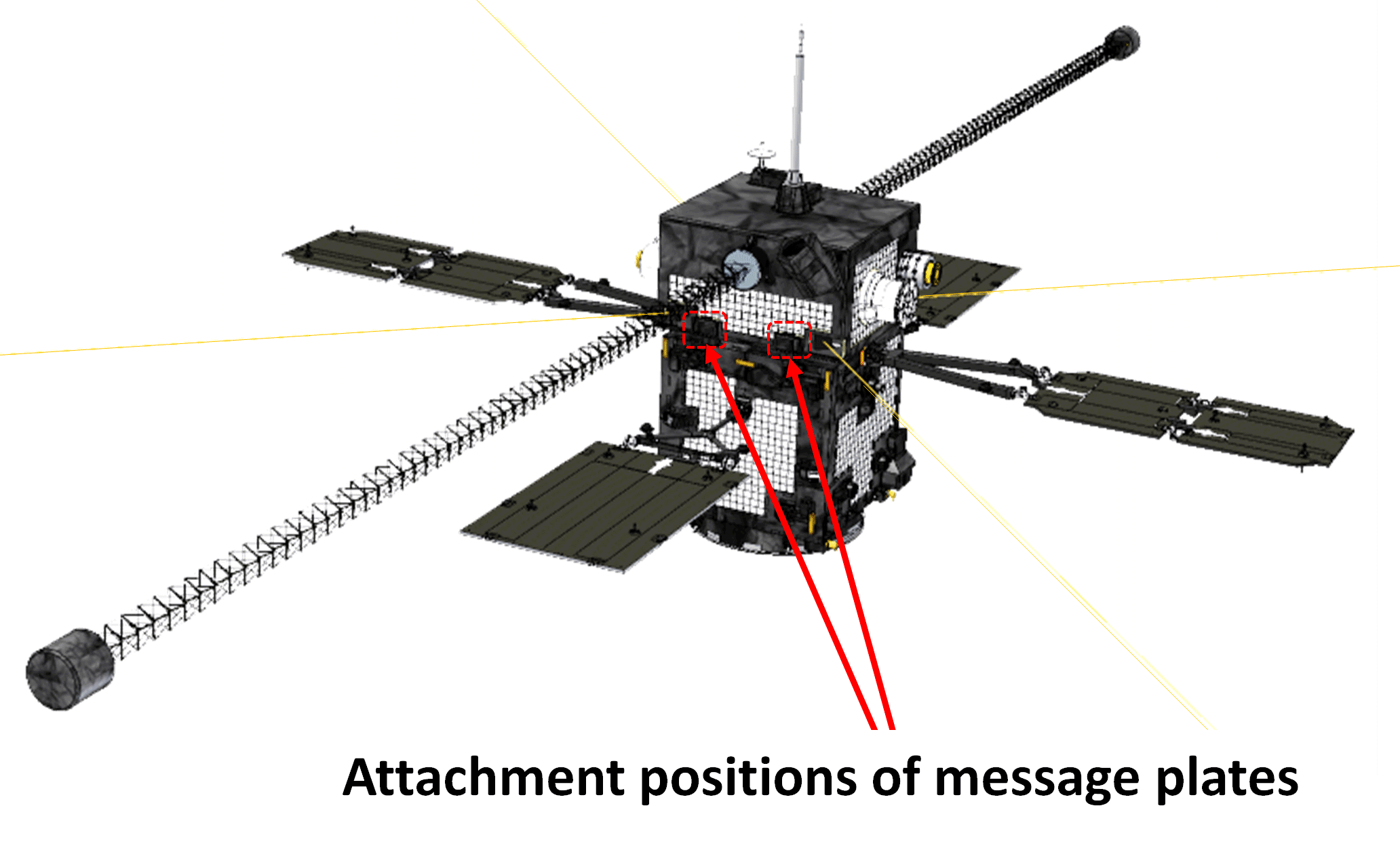
    Attachment positions of message plates

      However, a large number of high energy charged particles in the Van Allen belts cause failure in electronic devices mounted on spacecraft and disturb accurate measurement of the charged particles inside the belts, therefore, it was very hard to observe the heart of the Van Allen belts. Consequently, the question, “Why, When, Where, and How the high energy particles are generated and lost,” has been an over a half century standing scientific mystery since the discovery of the Van Allen belts.

      The ERG satellite (ERG: Exploration of energization and Radiation in Geospace) will challenge to reveal this mystery of the Van Allen belts with the most advanced nine science instruments. Since the Van Allen belts are distributed in wide altitude range, the ERG satellite takes a highly elliptical orbit to make comprehensive observations of high energy charged particles and electromagnetic fields in the Van Allen belts. (The apogee and perigee altitudes are about 30,000 km and 300 km, respectively, and the orbital period is about 9 hours.)

      We would like to take this opportunity to collect your support messages for ERG that is about to leave the Earth toward the exploration to the Van Allen belts. Your messages and names will be printed on the aluminum plates, and these plates are going to be attached on the satellite as a part of the balance weight to commemorate your support to ERG. Now, together with ERG, let’s go out to the exploration of the Van Allen belts that are the last frontier in geospace!

    February, 2016
    Iku Shinohara
    Project Manager, ERG Project Team
    Institute of Space and Astronautical Science

    Let’s block ads! (Why?)

  • [Institute of Space and Astronautical Science (ISAS)] Eclipse on 9 March 2016: public release of images and videos taken by the "Hinode" satellite

    March 10, 2016
    Institute of Space and Astronautical Science / Japan Aerospace Exploration Agency (ISAS/JAXA)
    Naional Astronomical Observatory of Japan (NAOJ)
    National Aeronautics and Space Administration (NASA)

    The Japan Aerospace Exploration Agency (JAXA), the National Astronomical Observatory of Japan (NAOJ/NINS), and the US National Aeronautics and Space Administration (NASA), release partial eclipse images and videos taken on March 9 with the solar observation satellite “Hinode”.

    The images and videos were taken on March 9, 2016 at 9:08 JST with the X-Ray Telescope (XRT) aboard “Hinode” during its flight above the Indonesian sky at an altitude of 680km. In the images and videos, the dark new moon appeared from the south west (the lower right side of the image) and passed across the solar disk toward the north of the sun which is seen shining in X-rays. Most of the sun as seen from “Hinode” was hidden (a maximum of 97.8% of the solar diameter), which was still a partial eclipse albeit very close to entering the total eclipse zone. Since the flight speed of “Hinode” is very fast (27,000 km per hour), the duration of the partial eclipse was only about 15 minutes.

    During this period, international joint observations were performed between “Hinode” and ground-based observation teams in Indonesia. In addition to the X-ray observations, observations of ultraviolet emission lines emanating from the corona were conducted by the Extreme ultraviolet Imaging Spectrometer (EIS). These data are scheduled to be used to investigate the relationship between the coronal structures seen in visible light during the total solar eclipse and X-ray jets, and to study the physical state of the hot coronal material.

    The X-ray solar images and videos can be downloaded from below.

    Solar eclipse captured by “Hinode”

    • The solar eclipse videos taken with the X-Ray Telescope
      Format: MPEG4(H.264) 1Mbps, image size: 1024×1024
      File size: about 10MB each. The response may become slow in case of many accesses at the same time.
    • The solar eclipse images taken with the X-Ray Telescope
      Left: the images with color, right: black and white images
      Click to enlarge.
    • BMP-format image files for the videos
      Zip-compressed files including the BMP images which were used to make the videos. The size of each image is 1024×1024. The last 6 digits number in the name of each bmp file gives Universal Time when the image was taken. Time intervals may not be equal because of telemetry drop-off.

      The images in these files are original and no higher resolution versions are available.

    About Hinode

    Hinode is a Japanese mission developed and launched by ISAS/JAXA, with NAOJ as domestic partner and NASA and STFC (UK) as international partners. It is operated by these agencies in co-operation with ESA and NSC (Norway).

    Past eclipse observations (in Japanese)

    Institute of Space and Astronautical Science / Japan Aerospace Exploration Agency
    Naional Astronomical Observatory of Japan

    Let’s block ads! (Why?)

  • [JAXA President Monthly Press Conference] JAXA President Monthly Regular Press Conference February 2016

    JAXA President Monthly Regular Press Conference

    Date and time: From 10:30 – 11:00 a.m. on Feb. 25 (Thu.), 2016
    Venue: JAXA Tokyo Office Presentation Room (B1 floor)
    MC: Yoshikazu Shoji, JAXA Public Affairs Department Director

    X-ray Astronomy Satellite “Hitomi” (ASTRO-H) launch

    “Hitomi”, launched at 5:45:00 p.m. on February 17 (Wed.), 2016, is flying smoothly. It is now in the critical phase, thus we are prudently conducting initial functional verification until sometime around February 28. We are especially happy as we have confirmed one of the critical points, if the cooling system to maintain cryogenic temperature for increasing the X-ray resolution works properly to reach and keep the preordained temperature. We will further check if the expected functions are properly activating. Everything is currently going well.

    JAXA astronauts’ activity

    Astronaut Kimiya Yui will stay in Japan for four weeks to hold a mission debriefing session in five locations in the country. We will do our utmost to facilitate better understanding of people in Japan about his activities at the International Space Station (ISS) and the Japanese Experiment Module “Kibo”.

    Agreement on paid use of High-Quality Protein Crystal Growth (PCG) experiment on Kibo

    As I told you in my joint press conference yesterday, JAXA and Japan’s first biopharmaceutical venture company, PeptiDream Inc. (PeptiDream), signed an outsourcing agreement on the “comprehensive implementation of the High-Quality Protein Crystal Growth (PCG) experiment on the Kibo of the ISS”. From our point of view, the agreement this time is slightly different from a conventional PCG experiment, as PeptiDream is not just a company for creating innovative drugs, but also has a role to perform PCG experiments that lead to drug discoveries or research in a style of creating a drug discovery platform. Talking about a platform, our Kibo is also a platform of the micro-gravity environment. Therefore, activities based on this agreement will be novel and different from the conventional operation of crystalizing a specific protein to analyze its structure to create a certain medicine. PepiDream is a venture company, and I heard it collaborates with various drug discovery companies. I expect that this agreement will contribute to gain more knowledge that will be a bud of chance to create a new drug. Another point is that, I believe, this agreement is based on the fact that our PCG experiment technology in the micro-gravity environment is highly regarded. It is also important to improve this technology. In addition, the business speed of the venture company is very fast, thus it is imperative and also a good opportunity for us to speed up our operations. In that sense, the agreement is welcomed. We would like to steadily make progress to meet expectations. We also hope to make further appeals for the use of the Kibo to private companies.

    New agreement with the DLR

    Executives of the German Aerospace Center (Deutsches Zentrum für Luft- und Raumfahrt, DLR) are now in Japan, and the chairperson of the DLR executive board and I will sign a cooperative agreement at the German Embassy this evening. Today, the environment surrounding space development has been changing significantly. Under such circumstances, we both agreed to strengthen our more strategic and cooperative partnership. We would like to develop such a relationship by selecting themes that can benefit from the agreement.

    First hiring through the “cross appointment system”

    The Japanese government set up a “cross appointment system” to utilize outside excellent human resources, and we have been working to use this system for the Space Exploration Innovation Hub Center. As a result, one person from a private company started working for us on Feb. 1. We will coordinate with individual cases to increase the number of people hired through this system.

    Upgrade of mainstay launch vehicle

    Data was acquired for the low-impact separation mechanism for the mainstay launch vehicle when the H-IIA Launch Vehicle No. 30 was launched. We still need to analyze more details, but the data acquired to date shows that the expected results have been mostly achieved, hence, we can drastically reduce gravity at the time of payload separation. I hope to make this achievement one of the strong selling points of Japan’s launch technology. This result will also be incorporated into the H3 Launch Vehicle.

    Support message

    JAXA will begin the support message campaign to the Exploration of energization and Radiation in Geospace “EGR” project this afternoon. For more details please look at the website.

    This entry passed through the Full-Text RSS service – if this is your content and you’re reading it on someone else’s site, please read the FAQ at fivefilters.org/content-only/faq.php#publishers.

  • [ISS / Japanese Experiment Module (KIBO)] JAXA Astronaut Activity Report, January 2016

    JAXA Astronaut Activity Report, January, 2016

    Last Updated: March 7, 2016

    This is JAXA’s Japanese astronaut activity report for January, 2016.

    Astronaut Kimiya Yui visits Star City in Russia

    Click to enlarge

    Expedition 44/45 crew holding a press conference (Credit: JAXA/GCTC)

    Astronaut Kimiya Yui, who accomplished his ISS Expedition 44/45 mission, visited the Gagarin Cosmonaut Training Center (GCTC) in Star City, Russia, for a debriefing on his mission and to attend a welcome home ceremony.

    Click to enlarge

    Yui and fellow crewmates at the welcome home ceremony (Credit: JAXA/GCTC)

    At the press conference held by Yui and fellow crewmates Oleg Kononenko and Kjell Lindgren, Yui spoke fluent Russian and mentioned that capturing KOUNOTORI5 was a big achievement, although he felt the pressure. Moreover, he felt as if returning home because he considers Russia his second home; and if allowed, he wants to return to space soon.

    Click to enlarge Click to enlarge Click to enlarge

    The Expedition 44/45 crew placing a floral tribute before the statue of Yuri Gagarin (Credit: JAXA/GCTC)

    The trio and related people posing for a group photo (Credit: JAXA/GCTC)

    Long-duration ISS mission training of astronaut Takuya Onishi

    Click to enlarge

    Two astronauts undergo Kibo robotic arm training (Credit: JAXA)

    Astronaut Takuya Onishi, a crew member for the Expedition 48/49 mission to the International Space Station (ISS), made a last visit to Japan before the mission to finalize his training in the Kibo module and the H-II Transfer Vehicle “KOUNOTORI” at the Tsukuba Space Center (TKSC), and then held a press conference following the training for emergencies and Extravehicular Activity at the NASA Jonson Space Center (JSC).

    Training in the Kibo module entailed closing the airlock and performing robotic arm operations and daily maintenance in a repetitive manner to achieve mastery.

    Click to enlarge

    Training on Kibo’s airlock operations (Credit: JAXA)

    Airlock operations using the mockup included attaching the IVA-replaceable Small Exposed Experiment Platform (i-SEEP*) and JEM Small Satellite Orbital Deployer (J-SSOD) to the slide table in the airlock. The training was open to the press.

    * A new hardware adapter for the Exposed Facility (EF), to which several units of exposed experimental hardware weighing up to 200 kg can be attached. It allows for more frequent installation and return of the experimental devices.

    Training for KOUNOTORI focused on the systems that astronauts should know and the actual onboard operations performed by the astronauts.

    In case of fire or sudden depressurization in KOUNOTORI, Onishi discussed the onboard tasks and procedures for astronauts with the instructors and members of the Flight Control Team (FCT).

    On January 27, a press conference was held to introduce Onishi’s mission.

    Astronaut Satoshi Furukawa completes domestic-flight pilot training

    In January, astronaut Satoshi Furukawa completed flight training at Oita Airport aboard a Hawker Beechcraft Type G58 (Baron), a twin-engine aircraft owned by Honda Airways.

    This training is intended to maintain and improve multitasking ability, one of the qualifications required of astronauts.

    Prior to actual flight, Furukawa used a flight simulator to familiarize himself with flying the aircraft, and attended lectures on meteorology and flight plans. He also confirmed the preflight inspection procedure and actually inspected the aircraft they were to use.

    During the flight training, Furukawa operated the aircraft in response to such simulated irregularities as engine failure and made an aborted landing (go-around).

    This entry passed through the Full-Text RSS service – if this is your content and you’re reading it on someone else’s site, please read the FAQ at fivefilters.org/content-only/faq.php#publishers.

  • [Earth Observation Research Center (EORC)] Global Precipitation Measurement (GPM) Products (Version 4) Release

    3 March 2016
    Japan Aerospace Exploration Agency
    Earth Observation Research Center

    Global Precipitation Measurement (GPM) Products (Version 4) Release

    JAXA and NASA have started to provide a new version (Version 4) of Global Precipitation Measurement (GPM) standard products. The GPM Version 4 data are available from March 3, 2015.
    Concurrently, existing GPM data are also being reprocessed back to the start of the mission.

    GPM Version 4 products are available from G-Portal.
    Various improvements of the Dual-frequency Precipitation Radar (DPR) were implemented in the Version 4 product. Moreover, the latent heat product based on the Spectral Latent Heating (SLH) algorithm is available since Version 4 product.
    Major algorithm & data format changes from Version 3 to Version 4 are described in the “GPM Products (Version 4) Release” page of the EORC Web site.

    The GSMaP Version 4 Product will be planned to be provided since July 2016.

    This entry passed through the Full-Text RSS service – if this is your content and you’re reading it on someone else’s site, please read the FAQ at fivefilters.org/content-only/faq.php#publishers.

  • [ISS / Japanese Experiment Module (KIBO)] Logo for the next Kibo-ABC small space experiment “AHiS” has been selected

    Logo for the next Kibo-ABC small space experiment “AHiS” has been selected

    Last Updated: February 29, 2016

    The logo for SSAF2016 / AHiS (Asian Herb in Space) mission has been selected by Kibo-ABC member countries. The logo design is provided by NSTDA, a Kibo-ABC member agency from Thailand. With its simple form which describes growing seedling cracking out of seed and changing color from blue to green along its upward growth, the logo indicates a life growing in space. This design also indicates the Milky Way galaxy.

    Third mission “SSAF 2016 / AHiS”: Analyzation of returned sample cultivated in Kibo

    ≫See previous SSAF missions

    Holy Basil Seed

    This year, with the third SSAF program, Kibo-ABC will step forward into next stage of small space experiment in Kibo. Mission name “AHiS” is named by ANGKASA Malaysia, the proposer of this mission. The Malaysian herb seed “Ocimuum (Green)” called “Holy Basil” and Japanese herb seed “Sweet Basil” will be launched together to Kibo/ISS and germinated on board “Kibo” for around one month, and then the samples of the each herb seedlings will be brought back to the earth, for further experiments and analyzation.

    Sweet Basil (Ground experiment)

    The seeds will be packed in the “AHiS flight plants box” made originally for this experiment, and stays inside this box during flight. As they did in former mission SSAF2013, astronauts on ISS will conduct procedure to cultivate the seeds while the seeds grown on board Kibo this time as well. The herb seed used for this experiment is very small compared to Azuki seed (SSAF2013), and the germination of the seeds takes longer time. Light will be necessary for germination therefore the seeds will be cultivated under the fluorescent lamp of Kibo module instead of the sunlight. SSAF is a simplified experiment program which is devised to be operational for beginners of Kibo experiments and also elaborated to save time and expense compared to the regular space experiments. By setting the AHiS plant box under the fluorescent light of Kibo module, ISS astronauts can easily observe the growing seedlings, which might give a sense of comfort for them.

    AHiS mission is tentatively scheduled to be conducted this year, with participation of all Kibo-ABC member countries. The website of AHiS program will be opened to public soon, and the details of the mission will be updated there.

    History of SSAF program

    The SSAF (Space Seeds for Asian Future) program is one of the main 3 programs of Kibo-ABC activities, aimed to accumulate experience of Kibo using experiment process that leads to member countries’ potential for capacity building of more advanced space experiments utilizing Kibo.

    First mission “SSAF 2010-2011”: Sample Launch and Return

    Seeds from Asian countries which had launched to the ISS/Kibo and returned to earth were distributed to students who participated in this program, and the students grew the seeds on the ground for observation experiment.

    Second mission “SSAF 2013”: Sample Launch, Cultivation on ISS and Ground reference experiment

    The Azuki seed has been launched by HTV-4 to the Kibo/ISS and the germination of seed in microgravity environment on board Kibo had been observed with the help of astronaut in the ISS. Participants observed the on-ground germination experiment of the same kind of seeds as the seeds grown in space, and compared with the imaged sent from ISS showing the growing seedlings. The seeds were cultivated in light-blocked aluminum container bag with only water supplied from outside to grow them. As the Azuki seed has nutrients inside its embryo by nature, the seed germinated in 7 days without light. The event of germination and tensile test of the stem was filmed on orbit. The participants experienced the procedure of ground reference experiment, by cultivating the same Azuki seed on ground with similar environment with Kibo/ISS and compared them with the seed cultivated on Kibo/ISS.

    This entry passed through the Full-Text RSS service – if this is your content and you’re reading it on someone else’s site, please read the FAQ at fivefilters.org/content-only/faq.php#publishers.

  • [Project Topics] Hitomi critical operation phase successfully completed!

    Topics List

    Feb. 29, 2016 Updated
    Hitomi critical operation phase successfully completed!

    JAXA confirmed the completion of a sequence of important operations of the X-ray Astronomy Satellite “Hitomi” (ASTRO-H), including turning the cooling system on, test operation of the Soft X-ray Spectrometer (SXS), and extending the Extensible Optical Bench (EOB). With this confirmation, the critical operation phase of Hitomi was completed.
    The Hitomi will take about one and half months to verify the function of its onboard equipment and instruments in space, then we will conduct calibration observations for another one and half months.

    Hitomi critical operation phase successfully completed!

    Feb. 17, 2016 Updated
    ASTRO-H successfully launched and named “Hitomi”.

    H-IIA F30 with the “ASTRO-H” onboard launched at 5:45 p.m. on Feb 17, 2016 (JST) from the Tanegashima Space Center. The rocket flew smoothly, and, at about 14 minutes after liftoff, “ASTRO-H” was separated from the H-IIA F30.
    ASTRO-H is the eye to study the hot and energetic universe. Therefore we name ASTRO-H, “Hitomi”. The word “Hitomi”.generally means “eye”, and specifically the pupil, or entrance window of the eye – the aperture!

    ASTRO-H successfully launched and named “Hitomi”.

    Feb. 14, 2016 Updated
    ASTRO-H Launch rescheduled to 5:45 p.m. on Feb 17 (Wed. ,JST)

    The launch of the The X-ray Astronomy Satellite “ASTRO-H” by the H-IIA Launch Vehicle No. 30 was rescheduled at 5:45 p.m. on Feb 17 (Wed. Japan Standard Time, JST) after carefully studying the weather conditions.

    The live launch report will begin at 5:25 p.m. on Feb 17(Wed. ,JST). The report will be broadcast through the Internet.
    Please send your support messages for the mission!

    ASTRO-H Launch rescheduled to 5:45 p.m. on Feb 17 (Wed. ,JST)

    Feb. 12, 2016 Updated
    The X-ray Astronomy Satellite “ASTRO-H” launch postponement

    H-IIA Launch Vehicle No.30 with the X-ray Astronomy Satellite “ASTRO-H” onboard, which was originally scheduled for February 12 (Fri.), 2016 (Japan Standard Time), has been rescheduled because bad weather is expected. The new launch day will be announced as soon as it is determined. Your warm support messages are welcomed at the support site.

    Feb. 3, 2016 Updated
    ASTRO-H Press Kit

    As the launch day approaches, JAXA has released the press kit for the X-ray Astronomy Satellite “ASTRO-H”. It covers ASTRO-H’s satellite and  mission overview, scientific missions, and observation instruments. Please have a look.

    ASTRO-H Press Kit

    Jan. 21, 2016 Updated
    ASTRO-H’s development and preparation status is updated on the ASTRO-H diary site

    Aiming at the launch and success of the mission, for some years the Astro-H team members have been hard at work at research and development, making steady progress. They have faced many tough obstacles along this long road. They have had many moments of success.
    This diary is an introduction to the daily work life — and to the excitements — of these members.

    ASTRO-H's development and preparation status is updated on the ASTRO-H diary site

    Jan. 12, 2016 Updated
    ASTRO-H Satellite Shown to the Public

    On the day marking exactly one month to launch, the ASTRO-H spacecraft was exhibited to the public at the Tanegashima Space Center. Many questions were asked both about the science goals of ASTRO-H and about its engineering.

    ASTRO-H Satellite Shown to the Public

    Dec. 11, 2015 Updated
    X-ray Astronomy Satellite “ASTRO-H” to be launched on Feb. 12

    The new generation X-ray astronomy satellite ASTRO-H is set for launch on February 12 (Fri.), by the H-IIA Launch Vehicle No. 30 from the Tanegashima Space Center.

    JAXA will broadcast a live launch report on the launch day. We will announce more details later. Please look forward to the launch!

    Dec. 2, 2015 Updated
    ASTRO-H press day

    The X-ray Astronomy Satellite “ASTRO-H” was revealed to the media on Nov. 27 at the Tsukuba Space Center.
    The ASTRO-H is an astronomy satellite to elucidate the structure of space and its evolution through studying high-temperature and high-energy celestial bodies, such as black holes, supernova remnants, and galaxy clusters by X-rays and gamma-rays.
    X-rays and gamma-rays from space are absorbed in the Earth’s atmosphere, thus they cannot be observed on the Earth. Therefore observation in space is necessary.
    The ASTRO-H was developed as a successor to the Suzaku, also an X-ray astronomy satellite. The ASTRO-H is a flagship mission of X-ray astronomy with the participation of over 200 researchers in its development from various domestic and international universities and research institutions including JAXA and NASA. Four new observation systems developed based on broad-scale international cooperation are installed on the ASTRO-H, hence, compared to the Suzaku, it will be able to perform spectroscopic observations on celestial bodies 10 times to 100 times darker than what the Suzaku was capable of doing.

    ASTRO-H press day

    Nov. 2, 2015 Updated
    ASTRO-H sinusoidal vibration test

    The sinusoidal vibration test of the X-ray astronomy satellite “ASTRO-H” was held between Aug. 29 and Oct. 2 at the Tsukuba Space Center. The sinusoidal vibration test aims at two major evaluation objectives, namely evaluating dynamic characteristics of a satellite structure and assessing its strength by loading vibrations equivalent to that at the launch.
    On Oct. 2, the last vibration test was completed, then planned dynamic characteristics data was acquired and the strength of the satellite structure against a vibration load equivalent to that at the time of launch was verified.

    ASTRO-H sinusoidal vibration test

    Aug. 3, 2015 Updated
    ASTRO-H thermal vacuum test

    The thermal vacuum test was held for the X-ray Astronomy Satellite “ASTRO-H” between June 24 and July 9 in a 13-meter chamber at the Tsukuba Space Center. The purposes of the thermal vacuum test are to verify the thermal model by exposing a satellite to the vacuum and thermal environment, and to confirm the function and performance of observation instruments in the on-orbit environment through an electric test.
    All tested items were satisfactorily confirmed including the expected performance of the onboard instruments, verification of the command function to be used in orbit, and calibration data acquisition.

    ASTRO-H thermal vacuum test

    Apr. 21, 2015 Updated
    Soft Gamma-ray Detectors (SGDs) installation on ASTRO-H completed

    Two Soft Gamma-ray Detectors (SGDs), which successfully went through the thermal vacuum test and the cooling test, were installed onto the ASTRO-H. The photo shows the SGD2 on the ASTRO-H with a debris cover and a radiator. A golden color MLI (multi-layer insulation) will wrap them so that they will not be seen from outside.
    All the observation instruments are now installed on the ASTRO-H, so its preparations for launch are turning the final corner. We will work harder to overcome the many remaining hurdles including the functional test, thermal vacuum test, and vibration test.

    Soft Gamma-ray Detectors (SGDs) installation on ASTRO-H completed

    Jan. 25, 2015 Updated
    Thermal vacuum test for Soft Gamma-ray Detectors

    The Soft Gamma-ray Detectors (SGD) to observe the soft gamma-ray region of 60 to 600 keV are under the thermal vacuum test in the 8-meter chamber at the Tsukuba Space Center to confirm their thermal design.
    The sensor part of the SGD does not activate till the temperature hits a low temperature of minus 20 degrees (C). However, the SGDs will be installed outside of the satellite panel, thus their temperature will increase from radiation from the Sun and the Earth, thermal input from the satellite panel, and heat from a large amount of LSI (large-scale integrated circuits) and an amplifier if nothing is done. Therefore, the accumulating heat will be carried to the radiator through thermal transfer and a heat pipe to be released, and the SGD will be covered by the multi-layer insulation (MLI), which looks like a bunch of aluminum foils, to shut out heat input. The semiconductor sensor is also activated with high voltage of 200 to 1000 V, hence it should also be tested if it would discharge in vacuum.
    Photo: The SGD-2 sits in the 8-meter chamber.

    Thermal vacuum test for Soft Gamma-ray Detectors

    May 29, 2014 Updated
    First Integration Test for ASTRO-H (for XRT)

    As manufacturing of two Hard X-ray Telescopes (HXTs) and two Soft X-ray Telescopes (SXTs) has been completed and their performance has been confirmed, they are going to be subject to the first integration test. During the test, the telescopes will be mounted on an optical board to make sure that there is no interference with other structures or the satellite bus as well as that no problems arise with operations for controlling the telescope position or angle and operation tools.
    Photo: Satellite surrounded by a scaffold

    First Integration Test for ASTRO-H (for XRT)

    Mar. 26, 2013 Updated
    ASTRO-H development status

    Aug. 10, 2012 Updated
    Satellite development going well: Development test status

    Mar. 15, 2010 Updated
    ASTRO-H passed the basic design review, new logo published

    On May 13 and 14, 2010, the basic design review was held for the ASTRO-H, and the satellite passed the examination. We are moving to the detailed design phase. To celebrate this opportunity, we revised the official logo mark for the ASTRO-H and published it on Feb. 25. The launch of the ASTRO-H is coming closer, and we are working hard for the project to proceed smoothly. Your support will be very much appreciated.

    Oct. 28, 2009 Updated
    SRON-JAXA agreement on Space Science

    On October 28th, 2009, SRON Netherlands Institute for Space Research and JAXA signed a cooperative framework agreement with the aim of promoting joint activities in the field of space science in the presence of Dr. De Heer, the Ambassador Extraordinary and Plenipotentiary of the Kingdome of the Netherlands to Japan, and Dr. Tachikawa, the President of JAXA.
    On the same day, the Implementing Arrangement for collaboration on ASTRO-H (International X-ray astronomy mission) was also concluded. Through ASTRO-H mission, SRON will be in charge of developing an onboard instrument “Soft X-ray Spectrometer (SXS)” and take part in a science team to carry our scientific research.

    SRON-JAXA agreement on Space Science

    This entry passed through the Full-Text RSS service – if this is your content and you’re reading it on someone else’s site, please read the FAQ at fivefilters.org/content-only/faq.php#publishers.