Category: News

http://www.subtome.com/#/subscribe?feeds=http%3A%2F%2Fftr.fivefilters.org%2Fmakefulltextfeed.php%3Furl%3Dglobal.jaxa.jp%252Frss%252Fnew.rdf%26max%3D3%26links%3Dpreserve&back=http%3A%2F%2Fftr.fivefilters.org%2Fmakefulltextfeed.php%3Furl%3Dglobal.jaxa.jp%252Frss%252Fnew.rdf%26max%3D3%26links%3Dpreserve

  • [ISS / Japanese Experiment Module (KIBO)] JAXA PCG (fourth session of the second series) begins

    JAXA PCG (fourth session of the second series) begins

    Last Updated: May 2, 2016

    The Protein Crystal Growth experiment (JAXA PCG, fourth session of the second series) has begun in the Japanese Experiment Module (“Kibo”) attached to the International Space Station (ISS). The experiment materials and samples were carried aboard the Progress resupply vehicle (63P) launched at 1:23 a.m., April 1, 2016 (JST). The experiment began after all the samples were installed in the Protein Crystallization Research Facility (PCRF) on April 3.

    The protein samples will be grown under controlled temperature for about two months. Then the samples will be returned to the ground aboard the Soyuz TMA-18M spacecraft (45S) on June 5.

    There are 16 investigators for the fourth session of the second series; two are from private organizations and the other 14 are mostly from universities intending to conduct basic research.

    JAXA PCG website has been renewed!

    *All times are Japan Standard Time (JST)

    Let’s block ads! (Why?)

  • [ISS / Japanese Experiment Module (KIBO)] JAXA Astronaut Activity Report, March 2016

    This is the final issue of the JAXA Astronaut Activity Report that began in April 2004. Thank you for your interest and support regarding various articles over many years. The activities of JAXA astronauts will be introduced in part of the ISS/Kibo Monthly News series beginning next month.

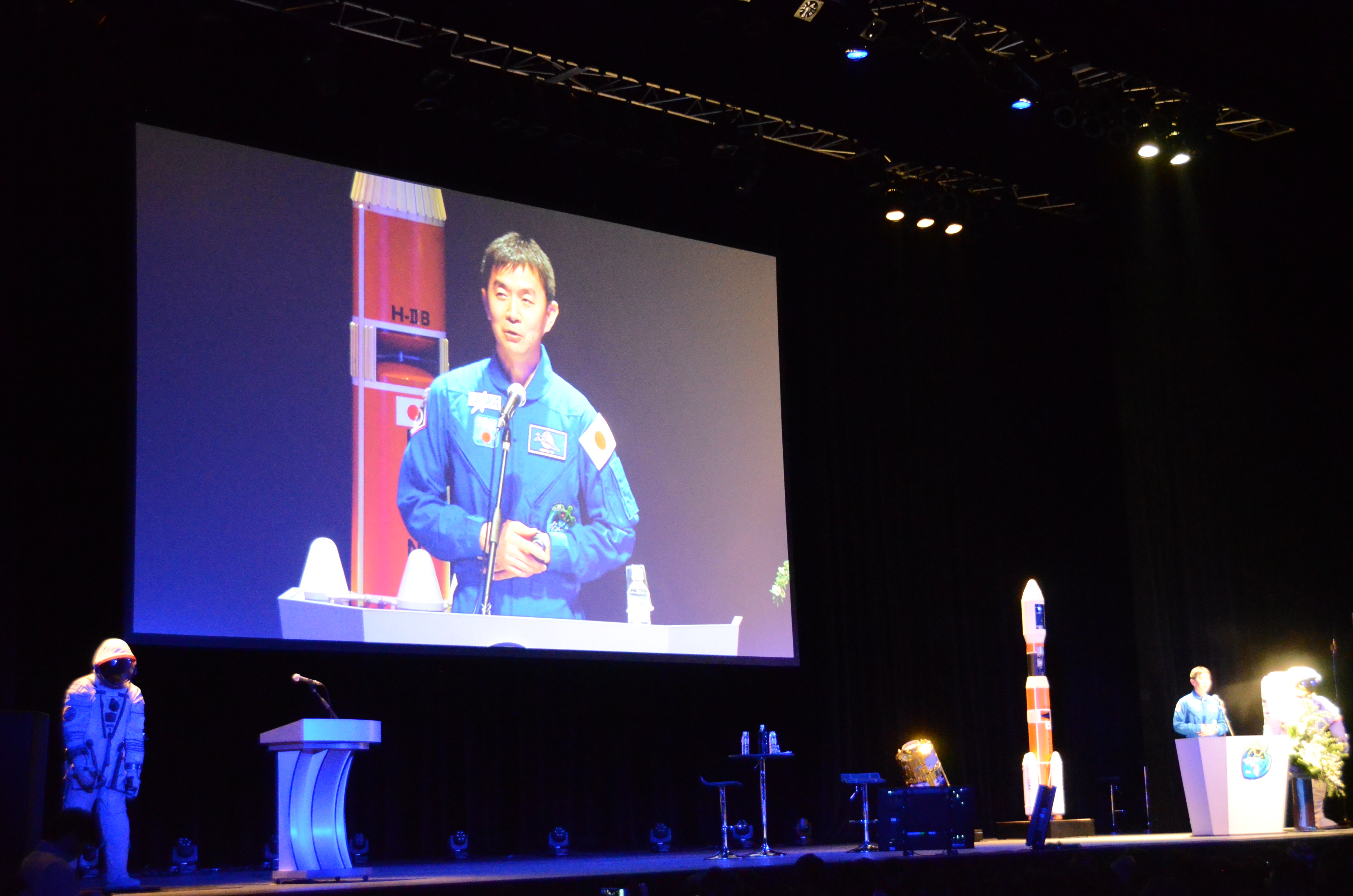
    Astronaut Kimiya Yui’s mission reporting event in Tokyo

    Articles on display at the venue (Credit: JAXA)

    Articles on display at the venue (Credit: JAXA)

    Part 1: Mission report

    In airing the mission highlight video, Yui described his many experiences, such as being launched aboard the Soyuz rocket, using the ISS robotic arm to capture the H-II Transfer Vehicle KOUNOTORI5, engaging in science activities, daily life in space, the view of Earth from the ISS, and returning to the ground.

    Yui specifically acknowledged Japan’s high technology through his capture of the H-II Transfer Vehicle KOUNOTORI5 (HTV5), which carried a full load of cargo including vital replacement parts needed to address a long-term shortage of consumables on the ISS.

    Mission reporting event in Tokyo (Credit: JAXA)

    Mission reporting event in Tokyo (Credit: JAXA)

    He also noted that whenever he spotted a giant typhoon, he felt compelled to warn people about its strength. He also commented on the great joy of sharing a picture of sparkling Mt. Fuji in the morning sun with people on the ground via Twitter.

    Yui further introduced his science activities that included the following:

    Protein Crystal Growth (JAXA PCG)
    Plant circumnutation and its dependence on the gravity response (Plant Rotation)
    Assembly and checkout of the Mouse Habitat Unit (MHU)
    Initial checkout of the Electrostatic Levitation Furnace (ELF)
    Deployment of CubeSats
    Preparation of the samples for exposed experiments using the ExHAM2

    Part 2: Exclusive interview with Yui

    Part Two was proceeded by the moderator interviewing Yui about his mission in order to give the audience a better understanding. Yui smiled as he answered the various questions collected via a website beforehand, and sometimes included untold stories.

    When asked about having tweeted with many pictures from space, Yui responded by saying how difficult it was to find free time to take photographs under a demanding minute-to-minute schedule. He revealed that astronauts do make free time to share space pictures with the ground, even though no time is reserved even for a restroom break during business hours, and that they work smartly to stay ahead of schedule, sometimes even doing extra tasks.

    The one thing he wanted to say via Twitter concerned the thinness of Earth’s atmosphere. “When viewing Earth from space, you can see clouds below what appears to be a very thin blue layer. I realized that human beings can only live under them, so we must protect our Earth.”

    Part 3 Talk session: Toward the advancement and maximization of the fruits of research in Kibo

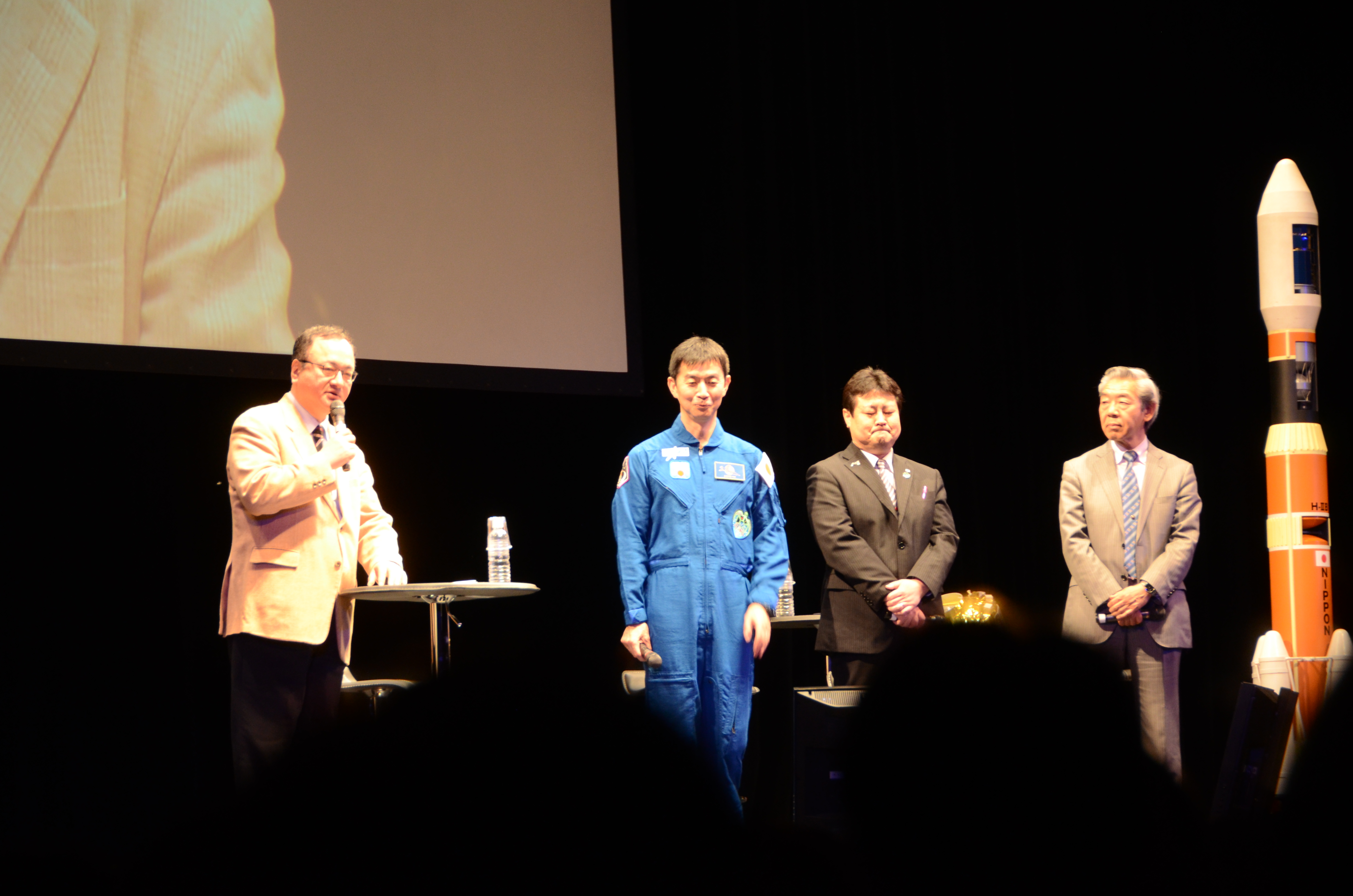
    Talk session (Credit: JAXA)

    Talk session (Credit: JAXA)

    During the talk session, Yui was joined by NHK news commentator Tetsuya Muroyama (as moderator), JAXA Increment Manager (IM) Takeru Yamagami, and Kazumi Nishijima of Mochida Pharmaceutical Co. Ltd., representing the users of Kibo, and discussed why human space activity is necessary and specifically the need for Kibo.

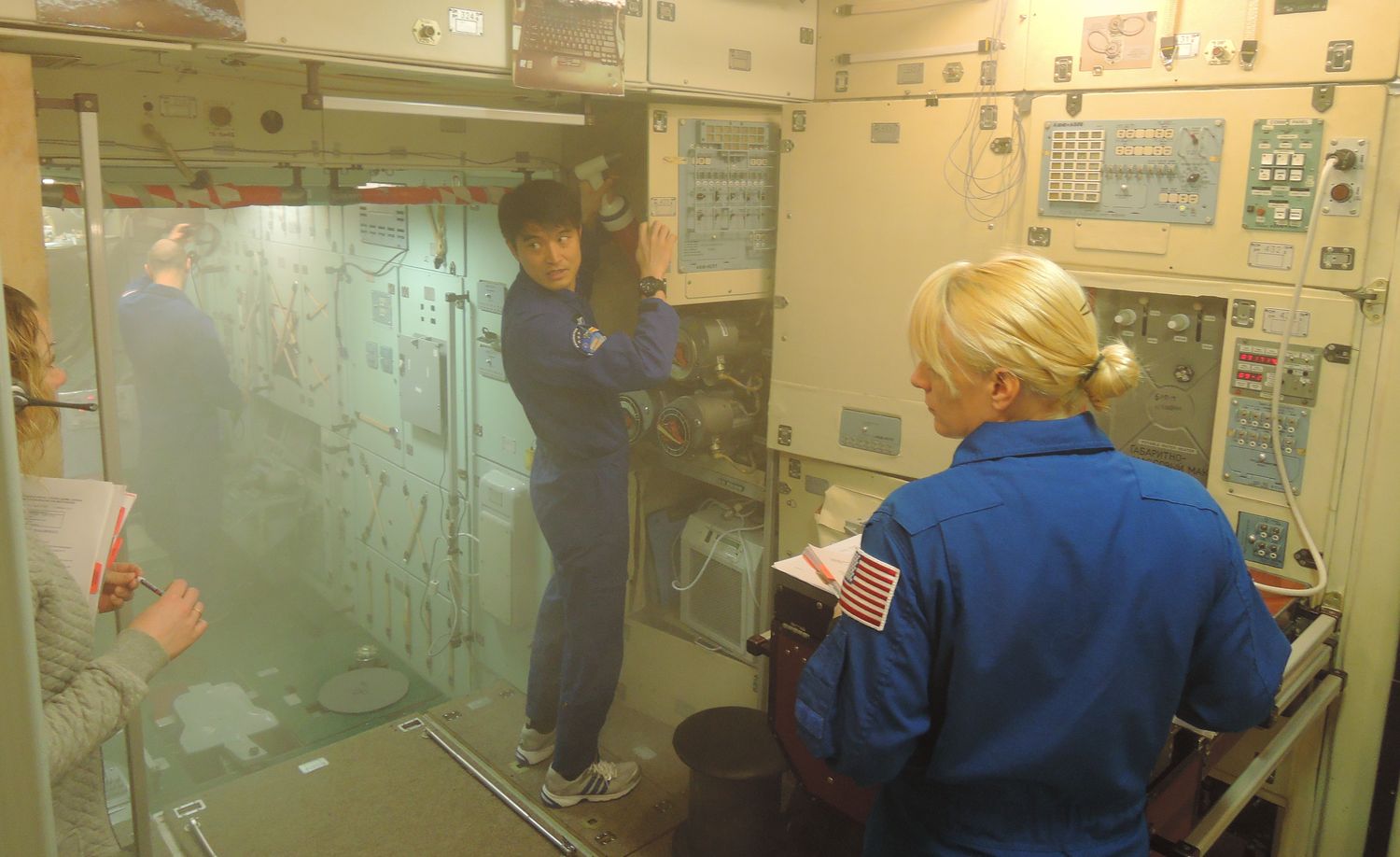
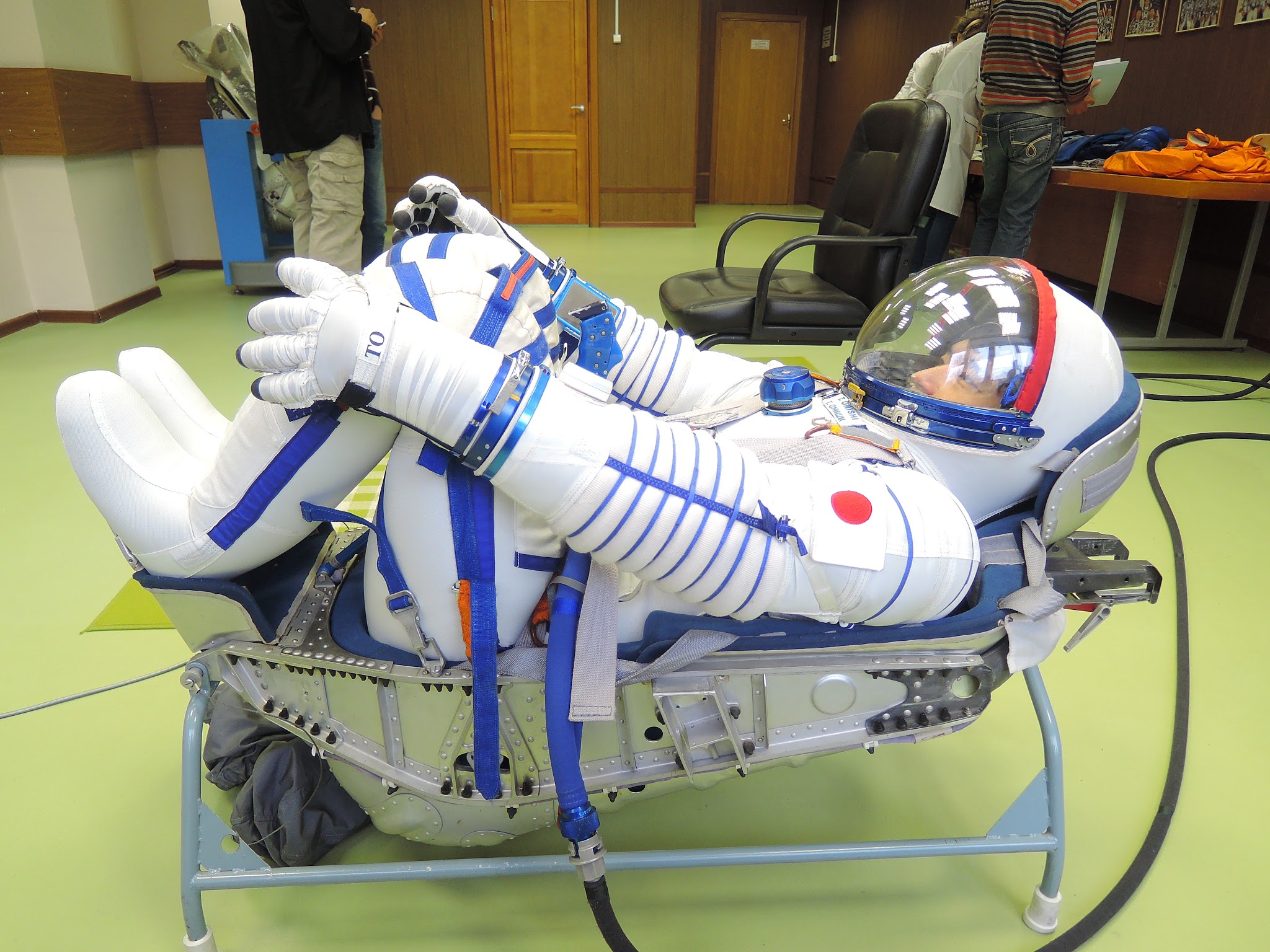
    Training of Astronaut Takuya Onishi

    Astronaut Takuya Onishi, a long-duration crew member for the ISS Expedition 48/49 mission, is finalizing this training toward his mission.

    Onishi and his crewmates simulated a day of operations typically conducted on the ISS according to a determined schedule. In the ISS mockup, the trainees began with the morning meeting with the ground, and then performed such tasks as maintenance. In case any problem occurred, they communicated with the Mission Control Center (MCC) in Houston, and for any task related to an experiment, they consulted with the Payload Operations Center (POC) in Huntsville, Alabama.

    In addition, various training programs will continue from Extravehicular Activities to filming and photographing.

    Let’s block ads! (Why?)

  • [Earth Observation Research Center (EORC)] Prof. Teruyuki Nakajima (the director of the EORC) received the Gold Medal of the International Radiation Symposium (IRS)

    Gold Medal Winner

    Teruyuki Nakajima, Prof.

    terry

    Currently the director, Earth Observation Research Center (EORC), Japan Aerospace Exploration Agency (JAXA). Professor Emeritus, University of Tokyo. Contributing to research for radiative transfer of the atmosphere and ocean, remote sensing of aerosol and cloud microphysics, and modeling study of anthropogenic aerosol effects to the earth’s climate. IPCC lead authors for TAR, AR5, and Special Report for Aviation. Past president of IRC; an officer of Joint Scientific Committee, WCRP; Serving as the secretary general of ICSU/International Association of Meteorology and Atmospheric Sciences (IAMAS), associate member of Science Council of Japan, president of Atmospheric and Hydrospheric Sciences Section/Japan Geoscience Union, executive member of Japan Meteorological Society.


    Young Scientist Award

    Zhibo Zhang

    Zhibo

    Zhibo Zhang received the B.S. degree in Atmospheric Sciences from the Nanjing University in China in 2001, and the M.S. and Ph.D. degrees in Atmospheric Sciences from the Texas A&M University in 2004 and 2008, respectively. He joined the Joint Center for Earth Systems Technology of the University of Maryland Baltimore County (UMBC) in 2008, working onsite in the Climate and Radiation Laboratory (613) of NASA’s Goddard Space Flight Center. In 2011, he joined the Physics Department of UMBC as an Assistant Professor. Dr. Zhang was a winner of the NASA’s New Investigator Program (NIP) in Earth Science in 2014, a member of the American Geophysical Union and American Meteorology Society, and also a science team member of NASA’s MODIS and PACE missions.

    Let’s block ads! (Why?)

  • [JAXA President Monthly Press Conference] JAXA President Monthly Regular Press Conference April 2016

    JAXA President Monthly Regular Press Conference

    Date and time: From 11:00 – 11:30 a.m. on April 14 (Thu), 2016
    Venue: JAXA Tokyo Office Presentation Room (B1 floor)
    MC: Yoshikazu Shoji, JAXA Public Affairs Department Director

    X-ray Astronomy Satellite “Hitomi” (ASTRO-H)

    We have been informing you of the investigation status regarding the Hitomi’s condition. JAXA recognizes this situation as “very serious.” Hitomi was supposed to start calibration observations in mid April to be ready for full-scale observations. Unfortunately, an anomaly was found in Hitomi and we are now forced to change the observation plan drastically. Representing JAXA, I would like to express my deep regret to all people who have been supporting Hitomi and expecting its observation results, to those relevant and cooperative organizations including NASA, and to those domestic and overseas astronomy researchers who plan to use Hitomi’s observation data.
    After the anomaly took place, under my leadership we have been investigating the cause and studying countermeasures through JAXA-wide efforts, not only by ISAS. While trying hard to recover the communication, we analyzed telemetry data, and conducted a simulation to understand the whole picture and satellite’s condition. We also asked for cooperation from domestic and overseas related organizations to provide observation data from the ground to understand the situation, and we actually received very useful data. I would like to send my sincere appreciation to those organizations. We hope for your continued cooperation.
    As communication with Hitomi has been severed, we are investigating the cause with limited information. We keep working on estimating and finding the cause while studying the background reasons for this anomaly. We will explain the status of Hitomi at the committee for space development and application, the Ministry of Education, Culture, Sports, Science and Technology (MEXT), on April 19. We will update you, the press, as soon as we find something new, as we always do.

    Astronaut Wakata

    Astronaut Wakata assumed the post of International Space Station Program manager of JAXA on April 1. He is working at the Tsukuba Space Center. I hold high expectations for him to exert his strong leadership to coordinate with domestic and overseas counterparts for the ISS.

    Philippine satellite DIWATA-1 deployed

    Some of you may have already heard about a small Philippine satellite, the 50-kg class DIWATA-1. On March 26 (Sat.) the satellite was launched by a Cygnus Spacecraft from the U.S., and is now stored at the ISS. The DIWATA-1 is scheduled to be deployed by the Kibo’s Small Satellite Orbital Deployer on April 27 (Wed.) This is the first attempt to deploy a 50-kg class satellite by the Japanese system. I heard that dignitaries of the Philippine Government and pertinent personnel of Tohoku and Hokkaido Universities will witness the deployment. I will inform you of the press coverage schedule for this event. Please join us.
    I told you that the United Nations Office for Outer Space Affairs (UNOOSA) agreed to cooperate in providing opportunities to deploy cube satellites (CubeSats) from the Kibo. We have completed our public offering of this opportunity on March 31. UNOOSA told us that they accepted 13 proposals. We will proceed to the selection in cooperation with UNOOSA to decide the finalists by the summer.

    Winning JFY 2016 MEXT science and technology award

    Some JAXA programs received the JFY 2016 science and technology award from the Minister of MEXT. This news is released from MEXT on April 12 (Tue.) The following three programs are awardees.

    1)
    Development of the next generation traffic system, Distributed and Revolutionary Efficient Air-traffic Management System (DREAMES) (Aeronautical Technology Directorate)
    2)
    DAICHI-2’s high accuracy tectonic movement observation technology (Space Technology Directorate I)
    3)
    Promoting technology for the Quasi-real time Global Satellite Mapping of Precipitation (GSMaP) (Space Technology Directorate I)

    Let’s block ads! (Why?)

  • [Project Topics] Handout of press briefing (April 15).

    Topics List

    Apr. 21, 2016 Updated
    Handout of press briefing (April 15).

    Apr. 13, 2016 Updated
    Handout of press briefing (April 8).

    On April 8 (JST), JAXA held a press briefing to explain the status of the X-ray Astronomy Satellite “Hitomi” (ASTRO-H) and our activities to re-establish communications with “Hitomi.”

    Apr. 7, 2016 Updated
    Handout of press briefing (April 1).

    On April 1 (JST), JAXA held a press briefing to explain the status of the X-ray Astronomy Satellite “Hitomi” (ASTRO-H) and our activities to re-establish communications with “Hitomi.”

    Mar. 29, 2016 Updated
    Current Status of Communication Anomaly of X-ray Astronomy Satellite “Hitomi” (ASTRO-H) (Mar. 29)

    JAXA has been trying to communicate with the X-ray Astronomy Satellite “Hitomi” (ASTRO-H), using ground stations both in Japan and overseas.

    By utilizing two opportunities of communicating with Hitomi, JAXA received signals from the satellite: the first time was at about 10:00 p.m. on 28 at the Uchinoura Ground Station, and the second one was at around 0:30 a.m. on 29 at the Santiago Tracking Station in Chile. JAXA has not been able to find the state of its health, as the time frames for receiving the signals were very short.

    According to the U.S. Joint Space Operations Center (JSpOC), it is estimated that Hitomi separated to five pieces at about 10:42 a.m. on 26. In order to investigate the situation, JAXA is observing the objects, using a radar located at the Kamisaibara Space Guard Center (KSGC) and telescopes at the Bisei Space Guard Center (BSGC) owned by the Japan Space Forum. Up to now, the telescopes at BSGC detected two objects around the satellite’s original orbit, while the radar at KSGC identified one of them. It is confirmed that the signal received at the Santiago Tracking Station came from the orbital direction of the object identified at KSGC.

    JAXA continues to investigate the relationship between the information from JSpOC and the communication anomaly.

    JAXA will do its utmost to recover communications with Hitomi and investigate the cause of the anomaly.

    * In the above report, it is written in the third paragraph that “According to the U.S. Joint Space Operations Center (JSpOC), it is estimated that Hitomi separated to five pieces….” JAXA re-confirmed the situation with JSpOC and found that their estimation actually meant, “five objects fell off from the satellite (meaning the satellite is now separated into six parts).”

    Mar. 27, 2016 Updated
    Communication anomaly of X-ray Astronomy Satellite “Hitomi” (ASTRO-H) (Mar. 27)

    JAXA found that communication with the X-ray Astronomy Satellite “Hitomi” (ASTRO-H), launched on February 17, 2016 (JST), failed from the start of its operation originally scheduled at 16:40, Saturday March 26 (JST). Up to now, JAXA has not been able to figure out the state of health of the satellite.

    While the cause of communication anomaly is under investigation, JAXA received short signal from the satellite, and is working for recovery.

    Under this circumstance, JAXA set up emergency headquarters, headed by the President, for recovery and investigation. The headquarters held its first meeting today, and has been working for recovery and the investigation of the cause. Updates will be announced as available, at the JAXA website.

    Feb. 29, 2016 Updated
    Hitomi critical operation phase successfully completed!

    JAXA confirmed the completion of a sequence of important operations of the X-ray Astronomy Satellite “Hitomi” (ASTRO-H), including turning the cooling system on, test operation of the Soft X-ray Spectrometer (SXS), and extending the Extensible Optical Bench (EOB). With this confirmation, the critical operation phase of Hitomi was completed.
    The Hitomi will take about one and half months to verify the function of its onboard equipment and instruments in space, then we will conduct calibration observations for another one and half months.

    Hitomi critical operation phase successfully completed!

    Feb. 17, 2016 Updated
    ASTRO-H successfully launched and named “Hitomi”.

    H-IIA F30 with the “ASTRO-H” onboard launched at 5:45 p.m. on Feb 17, 2016 (JST) from the Tanegashima Space Center. The rocket flew smoothly, and, at about 14 minutes after liftoff, “ASTRO-H” was separated from the H-IIA F30.
    ASTRO-H is the eye to study the hot and energetic universe. Therefore we name ASTRO-H, “Hitomi”. The word “Hitomi”.generally means “eye”, and specifically the pupil, or entrance window of the eye – the aperture!

    ASTRO-H successfully launched and named “Hitomi”.

    Feb. 14, 2016 Updated
    ASTRO-H Launch rescheduled to 5:45 p.m. on Feb 17 (Wed. ,JST)

    The launch of the The X-ray Astronomy Satellite “ASTRO-H” by the H-IIA Launch Vehicle No. 30 was rescheduled at 5:45 p.m. on Feb 17 (Wed. Japan Standard Time, JST) after carefully studying the weather conditions.

    The live launch report will begin at 5:25 p.m. on Feb 17(Wed. ,JST). The report will be broadcast through the Internet.
    Please send your support messages for the mission!

    ASTRO-H Launch rescheduled to 5:45 p.m. on Feb 17 (Wed. ,JST)

    Feb. 12, 2016 Updated
    The X-ray Astronomy Satellite “ASTRO-H” launch postponement

    H-IIA Launch Vehicle No.30 with the X-ray Astronomy Satellite “ASTRO-H” onboard, which was originally scheduled for February 12 (Fri.), 2016 (Japan Standard Time), has been rescheduled because bad weather is expected. The new launch day will be announced as soon as it is determined. Your warm support messages are welcomed at the support site.

    Feb. 3, 2016 Updated
    ASTRO-H Press Kit

    As the launch day approaches, JAXA has released the press kit for the X-ray Astronomy Satellite “ASTRO-H”. It covers ASTRO-H’s satellite and  mission overview, scientific missions, and observation instruments. Please have a look.

    ASTRO-H Press Kit

    Jan. 21, 2016 Updated
    ASTRO-H’s development and preparation status is updated on the ASTRO-H diary site

    Aiming at the launch and success of the mission, for some years the Astro-H team members have been hard at work at research and development, making steady progress. They have faced many tough obstacles along this long road. They have had many moments of success.
    This diary is an introduction to the daily work life — and to the excitements — of these members.

    ASTRO-H's development and preparation status is updated on the ASTRO-H diary site

    Jan. 12, 2016 Updated
    ASTRO-H Satellite Shown to the Public

    On the day marking exactly one month to launch, the ASTRO-H spacecraft was exhibited to the public at the Tanegashima Space Center. Many questions were asked both about the science goals of ASTRO-H and about its engineering.

    ASTRO-H Satellite Shown to the Public

    Dec. 11, 2015 Updated
    X-ray Astronomy Satellite “ASTRO-H” to be launched on Feb. 12

    The new generation X-ray astronomy satellite ASTRO-H is set for launch on February 12 (Fri.), by the H-IIA Launch Vehicle No. 30 from the Tanegashima Space Center.

    JAXA will broadcast a live launch report on the launch day. We will announce more details later. Please look forward to the launch!

    Dec. 2, 2015 Updated
    ASTRO-H press day

    The X-ray Astronomy Satellite “ASTRO-H” was revealed to the media on Nov. 27 at the Tsukuba Space Center.
    The ASTRO-H is an astronomy satellite to elucidate the structure of space and its evolution through studying high-temperature and high-energy celestial bodies, such as black holes, supernova remnants, and galaxy clusters by X-rays and gamma-rays.
    X-rays and gamma-rays from space are absorbed in the Earth’s atmosphere, thus they cannot be observed on the Earth. Therefore observation in space is necessary.
    The ASTRO-H was developed as a successor to the Suzaku, also an X-ray astronomy satellite. The ASTRO-H is a flagship mission of X-ray astronomy with the participation of over 200 researchers in its development from various domestic and international universities and research institutions including JAXA and NASA. Four new observation systems developed based on broad-scale international cooperation are installed on the ASTRO-H, hence, compared to the Suzaku, it will be able to perform spectroscopic observations on celestial bodies 10 times to 100 times darker than what the Suzaku was capable of doing.

    ASTRO-H press day

    Nov. 2, 2015 Updated
    ASTRO-H sinusoidal vibration test

    The sinusoidal vibration test of the X-ray astronomy satellite “ASTRO-H” was held between Aug. 29 and Oct. 2 at the Tsukuba Space Center. The sinusoidal vibration test aims at two major evaluation objectives, namely evaluating dynamic characteristics of a satellite structure and assessing its strength by loading vibrations equivalent to that at the launch.
    On Oct. 2, the last vibration test was completed, then planned dynamic characteristics data was acquired and the strength of the satellite structure against a vibration load equivalent to that at the time of launch was verified.

    ASTRO-H sinusoidal vibration test

    Aug. 3, 2015 Updated
    ASTRO-H thermal vacuum test

    The thermal vacuum test was held for the X-ray Astronomy Satellite “ASTRO-H” between June 24 and July 9 in a 13-meter chamber at the Tsukuba Space Center. The purposes of the thermal vacuum test are to verify the thermal model by exposing a satellite to the vacuum and thermal environment, and to confirm the function and performance of observation instruments in the on-orbit environment through an electric test.
    All tested items were satisfactorily confirmed including the expected performance of the onboard instruments, verification of the command function to be used in orbit, and calibration data acquisition.

    ASTRO-H thermal vacuum test

    Apr. 21, 2015 Updated
    Soft Gamma-ray Detectors (SGDs) installation on ASTRO-H completed

    Two Soft Gamma-ray Detectors (SGDs), which successfully went through the thermal vacuum test and the cooling test, were installed onto the ASTRO-H. The photo shows the SGD2 on the ASTRO-H with a debris cover and a radiator. A golden color MLI (multi-layer insulation) will wrap them so that they will not be seen from outside.
    All the observation instruments are now installed on the ASTRO-H, so its preparations for launch are turning the final corner. We will work harder to overcome the many remaining hurdles including the functional test, thermal vacuum test, and vibration test.

    Soft Gamma-ray Detectors (SGDs) installation on ASTRO-H completed

    Jan. 25, 2015 Updated
    Thermal vacuum test for Soft Gamma-ray Detectors

    The Soft Gamma-ray Detectors (SGD) to observe the soft gamma-ray region of 60 to 600 keV are under the thermal vacuum test in the 8-meter chamber at the Tsukuba Space Center to confirm their thermal design.
    The sensor part of the SGD does not activate till the temperature hits a low temperature of minus 20 degrees (C). However, the SGDs will be installed outside of the satellite panel, thus their temperature will increase from radiation from the Sun and the Earth, thermal input from the satellite panel, and heat from a large amount of LSI (large-scale integrated circuits) and an amplifier if nothing is done. Therefore, the accumulating heat will be carried to the radiator through thermal transfer and a heat pipe to be released, and the SGD will be covered by the multi-layer insulation (MLI), which looks like a bunch of aluminum foils, to shut out heat input. The semiconductor sensor is also activated with high voltage of 200 to 1000 V, hence it should also be tested if it would discharge in vacuum.
    Photo: The SGD-2 sits in the 8-meter chamber.

    Thermal vacuum test for Soft Gamma-ray Detectors

    May 29, 2014 Updated
    First Integration Test for ASTRO-H (for XRT)

    As manufacturing of two Hard X-ray Telescopes (HXTs) and two Soft X-ray Telescopes (SXTs) has been completed and their performance has been confirmed, they are going to be subject to the first integration test. During the test, the telescopes will be mounted on an optical board to make sure that there is no interference with other structures or the satellite bus as well as that no problems arise with operations for controlling the telescope position or angle and operation tools.
    Photo: Satellite surrounded by a scaffold

    First Integration Test for ASTRO-H (for XRT)

    Mar. 26, 2013 Updated
    ASTRO-H development status

    Aug. 10, 2012 Updated
    Satellite development going well: Development test status

    Mar. 15, 2010 Updated
    ASTRO-H passed the basic design review, new logo published

    On May 13 and 14, 2010, the basic design review was held for the ASTRO-H, and the satellite passed the examination. We are moving to the detailed design phase. To celebrate this opportunity, we revised the official logo mark for the ASTRO-H and published it on Feb. 25. The launch of the ASTRO-H is coming closer, and we are working hard for the project to proceed smoothly. Your support will be very much appreciated.

    Oct. 28, 2009 Updated
    SRON-JAXA agreement on Space Science

    On October 28th, 2009, SRON Netherlands Institute for Space Research and JAXA signed a cooperative framework agreement with the aim of promoting joint activities in the field of space science in the presence of Dr. De Heer, the Ambassador Extraordinary and Plenipotentiary of the Kingdome of the Netherlands to Japan, and Dr. Tachikawa, the President of JAXA.
    On the same day, the Implementing Arrangement for collaboration on ASTRO-H (International X-ray astronomy mission) was also concluded. Through ASTRO-H mission, SRON will be in charge of developing an onboard instrument “Soft X-ray Spectrometer (SXS)” and take part in a science team to carry our scientific research.

    SRON-JAXA agreement on Space Science

    Let’s block ads! (Why?)

  • [Interview] Takeshi Imamura Project Scientist, AKATSUKI "Venus Unveiled: A Planet Beyond Our Imagination"

    Venus Unveiled: A Planet Beyond Our Imagination Takeshi Imamura Project Scientist, AKATSUKI (Venus Climate Orbiter)

    AKATSUKI was successfully inserted into orbit around Venus in December 2015. A previous attempt, five years ago, failed due to a damaged engine, and since then the probe has been orbiting the Sun, waiting for the next opportunity to approach Venus. Now, tests of observation equipment have been completed, and full-scale observation is due to begin around April. We asked AKATSUKI Project Scientist Takeshi Imamura what kind of results we can expect.

    Focus on the climate

    — First of all, tell us what is interesting about Venus.

    Venus covered with acid clouds (courtesy of ESA/MPS/DLR/IDA) Venus covered with acid clouds (courtesy of ESA/MPS/DLR/IDA)

    The most appealing thing about Venus is the question, “Why is Venus so different from Earth?” Venus is the same kind of solid-rock planet as Earth, and does not differ much from it in size or mass. Therefore, we think that the composition of its atmosphere at birth may have closely resembled that of Earth. But Venus’s current environment is completely different. Earth’s atmosphere is composed mainly of nitrogen and oxygen, whereas Venus’s is almost completely carbon dioxide, and its skies are covered with thick sulfuric acid clouds.

    Venus looks bright from Earth because these sulfuric acid clouds reflect the light of the Sun – this is why it’s always captured people’s interest. But Venus is a very difficult planet to explore. Until fairly recently, only American and Soviet probes had studied Venus, but because of these clouds, they had trouble seeing the planet underneath. Also, because the surface temperature is more than 400℃ and the atmospheric pressure is over 90 Earth atmospheres, the probes were not able to move around freely and study the planet. As a result, many puzzles remain, which AKATSUKI is going to try to solve. For example, we’re going to do a thorough study of the climate. Venus’s atmosphere is in a state of super-rotation – it circles the planet at speeds of up to 400 km/h, at an altitude of 60 km – a kind of ultra-high-speed wind. Venus rotates slowly, with one rotation taking 243 Earth days, but in the skies above it there is a ferocious wind. Where does this wind come from? How are the sulfuric acid clouds formed? AKATSUKI will attempt to answer these questions.

    — The current environments on Venus and Earth are totally different, but when the planets were formed they were similar. Is that correct?

    Venus and Earth (courtesy of NASA, JPL)Venus and Earth (courtesy of NASA, JPL)

    Yes. The surface temperature on Venus today is very high, and there are no oceans. But some scientists think there may have once been oceans on Venus. Its atmosphere is made up mainly of carbon dioxide, but Earth also has a lot of carbon dioxide. The difference is that on Earth it’s hidden underground, and absorbed into oceans and rivers. Carbon dioxide that is dissolved in water combines with minerals such as calcium to form carbonate minerals, which are hidden at the bottom of the oceans. But if Earth were to move closer to the Sun, like Venus, it is possible that its temperature would rise with the heat of the Sun, all the water would evaporate, the carbon dioxide in the ground would be released, and it would become like Venus – a planet covered in a thick layer of carbon dioxide.

    If we can find out how Venus became the scorching-hot world that it is now, we should be able to understand how special Earth’s environment really is. We need to know more about Venus in order to know more about Earth. Environmental problems on Earth are becoming more serious, and Venus may be an example of the ultimate result of global warming. Studying Venus may allow us to see how Earth’s climate will change if greenhouse gas emissions continue to increase. That’s another reason that exploring Venus is really significant.

    New aspects of Venus unveiled

    — Tell us about the current status of the probe.

    AKATSUKI (courtesy of Akihiro Ikeshita)AKATSUKI (courtesy of Akihiro Ikeshita)

    Since our probe started its orbit of Venus last December, we have been testing its six observation instruments and performing initial observations. When we start using a camera, for example, we can make adjustments such as changing the exposure. We will be able to start full-scale observation – around April of this year.

    — Will all the equipment be used simultaneously?

    AKATSUKI is equipped with five cameras, which observe Venus at different light wavelengths, and one instrument for measurement using electromagnetic waves. The cameras observe the atmosphere at different heights: the visible-ray camera looks for lightning; mid- infrared looks at cloud temperature distribution; ultraviolet looks at the chemical substances at the top of the clouds; near-infrared (1μm) looks at the planet surface, and another near-infrared (2μm) observes the lower atmosphere. Electromagnetic waves sent from the probe and received on Earth tell us about the vertical structures of the temperature and other features of the Venusian atmosphere. Looking from Earth, there are times when the probe is hidden behind Venus. When the probe is just coming back into view, its electromagnetic waves glance off the edge of the Venusian atmosphere. By studying the fluctuations of the electromagnetic waves at such times, we can get information on the atmosphere.

    All this observation equipment will be working simultaneously, although not necessarily in unison. Cameras that only observe Venus on the dayside will be resting while the probe is on the nightside. The most important thing about AKATSUKI is the simultaneous and continuous study of the Venusian atmosphere with multiple wavelengths of light, and the three-dimensional capture of these movements. We can’t achieve our goals using just one camera taking one type of image. Venus looks completely different depending on the wavelength, so by combining multiple data, we can get a more complete picture of the movement of the atmosphere and the origin of the clouds.

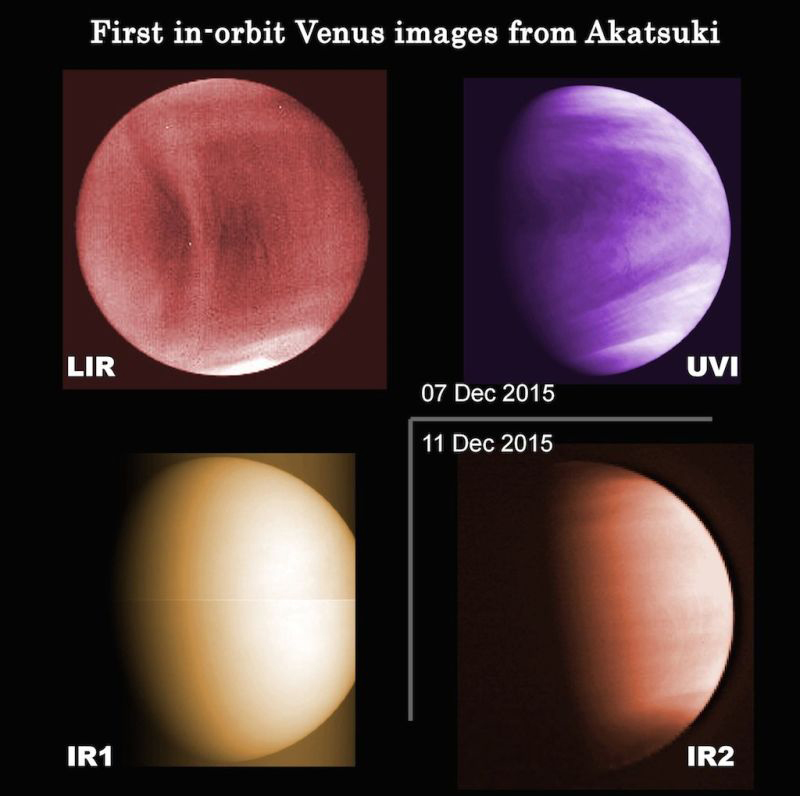
    — Some early images from AKATSUKI have now been released. How did that feel?

    Venus photographed with different wavelengths. Cloud temperature distribution (top left, mid-infrared), distribution of sulfur dioxide, which becomes a component of the sulfuric acid clouds (top right, ultraviolet), sunlight scattering caused by clouds (bottom left, near-infrared), difference in the elevation of clouds (bottom right, near-infrared). (There is no significance in the coloring.)Venus photographed with different wavelengths. Cloud temperature distribution (top left, mid-infrared), distribution of sulfur dioxide, which becomes a component of the sulfuric acid clouds (top right, ultraviolet), sunlight scattering caused by clouds (bottom left, near-infrared), difference in the elevation of clouds (bottom right, near-infrared). (There is no significance in the coloring.)ZOOM

    I had a pretty strong reaction to seeing the images that were taken right after AKATSUKI was inserted into orbit. Even with just these images, we have made a number of discoveries, and our science team is extremely excited. When we saw full images of Venus taken by the observation cameras that we had personally developed, we were beside ourselves with joy! That’s when we really felt that we had finally arrived at Venus.

    — What kinds of discoveries have been made from these images?

    The thing that we scientists are most excited about are the images taken by the mid-infrared camera. Looking at these images, which capture the temperature distribution of Venusian clouds, we can see a bow-like white pattern from the northern hemisphere to the southern hemisphere, straddling the equatorial area. The white coloring shows areas where temperatures are high. High-speed winds of 400 km/h blow from east to west on Venus, so we can see the streaks from east to west, but how a band structure can run from north to south is a puzzle. We never imagined that we would see this kind of thing.

    Images that are taken with the ultraviolet imager have also shown us aspects of Venus that we had never seen before. This is the first time we have imaged Venus with the ultraviolet wavelength that allows us to see sulfur dioxide. Ultraviolet rays from the Sun cause a chemical reaction, and the sulfur dioxide in the atmosphere changes into sulfuric acid. This is the origin of the sulfuric acid clouds that cover the planet, but we don’t know where and how this sulfur dioxide is carried to the top of the clouds. As we continue our analysis of these images, we hope to understand how the sulfuric acid clouds are created, and why the planet is covered with them. Personally, I am very interested in this.

    In addition, the images captured by the near-infrared camera are very interesting. From these images, we can see that the clouds are low at the north and south poles, but high near the equator. This large-scale difference of elevation is overlain with striped pattern from east to west. This striped pattern may be caused by the super-rotation, which blows from east to west, but it is a mystery why clouds should be higher or lower depending on location. So even these initial observation images are giving us one piece of new information after another. So we are delighted! At the moment, we are taking only still images, but starting April we will be recording the first ever video of the movements of the atmosphere and clouds of Venus. I think after that our understanding will progress in leaps and bounds.

    Changing the Last Five Years to a Positive

    — AKATSUKI waited five years for an orbit insertion opportunity. How did you feel when insertion was successful?

    When I saw that our second attempt to insert AKATSUKI into orbit had worked, I got so emotional I could hardly speak. This happened on December 7, 2015, five years to the day after our first attempt had failed. That failure happened because a fuel-supply valve had closed and an abnormal combustion occurred in the main engine leading to its destruction. This time we maneuvered the probe by firing its four attitude-control thrusters instead of the damaged main engine. These thrusters are quite small – the four of them together have just one-fifth the power of the main engine. We fired them for about 20 minutes in the opposite direction to the probe’s flight path – in other words, applying the brakes. And then AKATSUKI was pulled into orbit by Venus’s gravity. This was the first time in history that a probe had been inserted into planetary orbit using just the attitude control engines. The day of the operation we were watching with bated breath, trusting the skill of the orbit control team. When we saw that the engine thrust had gone exactly according to plan, we knew that we had been successful.

    — How did you maintain your motivation over the five years it took until the second attempt?

    Takeshi Imamura

    When the initial orbit insertion failed, our goal seemed very far away, but we always had a strong will to succeed with AKATSUKI. If you think too much about the five-year period, it becomes really hard to stay motivated, so I tried to just keep looking ahead. And it’s not just me. There is an entire AKATSUKI science team. As a group we have the advantage of a thorough knowledge of the abilities and limits of the probe, so we were able to continue refining our observation plans.

    Over the past five years, the daily work in the operation control room has been to send commands to the probe. We have also worked on improving not only our methods of analyzing observation data but also our numerical simulation models. Technology has greatly improved in these five years, and we’ve been able to create a system that will produce more results. So we haven’t wasted these five years.

    — The orbit around Venus is larger than originally planned. Will this affect the observation plans?

    AKATSUKIAKATSUKI

    AKATSUKI is currently in an elliptical orbit around the equator of Venus, at an altitude of between 1,000 and 10,000 km at its nearest point, and about 360,000 km at its farthest, orbiting the planet in around 10 days. The initial plan was to have AKATSUKI complete one orbit in around 30 hours, so it is true that the orbit is much larger than originally planned. But we haven’t abandoned any of the original plans – we intend to accomplish them all. Luckily, the observation equipment is functioning properly, and as the cameras have some of the highest levels of resolution in the world, we believe that we will obtain satisfactory results from this orbit. I am sure you have also seen images from the meteorological satellite Himawari. Weather forecasts only show images of the skies above Japan, but in fact Himawari images the entire planet Earth. Orbiting the Earth from afar and getting a full view with one camera, it is possible to observe our planet’s climate as a whole. Similarly, AKATSUKI can study the Venusian climate from a position where it can observe the entire planet.

    — Are you worried about AKATSUKI’s design lifespan?

    We have already passed the original design lifespan of four and a half years, but AKATSUKI’s observation equipment is in very good condition. There has been no major deterioration, so, given the amount of fuel it has left, I feel we will be able to carry on for quite a long time. We will continue to operate with caution in order to keep the probe going as long as possible.

    The long wait for AKATSUKI is over

    — What has the international reaction been to the successful orbit insertion?

    Venus Express (courtesy of ESA)Venus Express (courtesy of ESA)

    When the news broke that we had managed to put AKATSUKI into orbit, our mailboxes filled with congratulations from scientists all over the world. The Venus Express conference was held just after this, and I participated by videoconference. Everyone cheered and applauded for us. Venus Express is a European probe that observed Venus from 2006 to 2014. We have a great collaborative relationship with that team, to the point that we had a shared observation plan if AKATSUKI had arrived at Venus in 2010. In order to solve the puzzles discovered by Venus Express, we knew that we had to wait for AKATSUKI to arrive, so everyone was waiting eagerly for that day. Now there are a lot of expectations. More than anything we want to make sure that AKATSUKI’s observations are successful.

    — What role will the Venus Express observations play in the AKATSUKI mission?

    Artist’s concept of lightning on Venus (courtesy of ESA/Christophe Carreau)Artist’s concept of lightning on Venus (courtesy of ESA/Christophe Carreau)

    The main goal of Venus Express was to study the chemical composition of the atmosphere and the surface, atmospheric motions to some extent, and electromagnetic environment around Venus. AKATSUKI is going to visualize the movements of the Venusian atmosphere in three dimensions. These are very different missions, but by combining the results of the two, we expect to be able to make a whole new set of discoveries.

    Venus Express also observed the atmosphere using electromagnetic waves, and it did capture some waves that could feasibly have come from lightning. If there really is lightning on Venus, this will create another big puzzle for us. Lightning on Earth is caused by ice particles in clouds colliding and creating static electricity through friction. So if ice particles are required to create lightning, but there are no ice particles on Venus because of the scorching heat, how is that lightning created?

    It may be that the mechanism that creates lightning on Venus defies conventional wisdom. On the other hand, there are scientists who don’t accept that there is lightning on Venus. They postulate that there is a high-altitude atmosphere around Venus that is charged with electricity, and that due to some kind of movement in this atmosphere, electromagnetic waves resembling lightning are created. AKATSUKI is equipped with a sensor that can capture the luminescence phenomenon of lightning, so we hope to settle this once and for all.

    The mysteries of the wind

    — What puzzle would you particularly like AKATSUKI to solve?

    Super-rotation of Venus atmosphereSuper-rotation of Venus atmosphere

    Sandstorm on Mars (courtesy of NASA/JPL/University of Arizona)Sandstorm on Mars (courtesy of NASA/JPL/University of Arizona)

    I would like to be able to solve the puzzle of the super-rotation of the Venusian atmosphere. There are a number of hypotheses about the cause of the super-rotation, but they are all theoretical, and we lack conclusive evidence. I think AKATSUKI will allow us to find a definitive answer, through observation of key phenomena and simulations using numerical models.

    My own interest, though, is not just in Venus itself. My original interest was wind. When I was a student, I studied the Earth’s atmosphere, and I always had questions about why the wind blows the way it does. Around that time, I found out that the wind on the planet next door blew in a completely different, incomprehensible way. What are the differences between wind on Earth and wind on Venus? I thought that if we could understand these differences, we would finally be able to truly understand the wind on Earth. Once we understand the reasons wind behaves the way it does on Earth, we should be able to understand how our environment could change to become like Venus’s, and vice versa. I want to know about the boundaries of the differences between Earth and Venus.

    Did you know that each celestial body has a different kind of wind blowing on it? Mars also has wind and storms and sometimes tornadoes. The planet next to Mars, Jupiter, also has many intriguing meteorological phenomena, including wind and lightning. Not to mention the fact that the Sun also has an atmosphere with blowing winds. Each of these celestial bodies has a different type of wind, but where do the differences come from? I really want to understand the fundamental reasons behind these differences. And furthermore, I would like to find out whether super-rotation exists on planets outside our solar system. We’ve discovered many planets outside our solar system that, like Venus, orbit a central star. Under the right conditions, I think we’ll be able to find similar phenomena outside the solar system.

    — You really do like wind, don’t you?

    I really do. I have always been very interested in the rotational mechanism of the flow of the atmosphere. In the end, we are all alive on Earth because the atmosphere flows. For example, Earth’s atmosphere distributes heat over the planet as a whole. If this stopped, heat would no longer be carried from south to north, the oceans in the equatorial zone would all evaporate, and the high latitude zones would freeze over. People would no longer be able to live in such a world of extremes. We are all able to breathe fresh air precisely because the atmosphere circulates. The circulation of the atmosphere creates a planet’s climate. In this sense, I think wind is very important.

    Atmospheres are basically fluid, and fluids are connected. Therefore, wind is not a local thing but a continuum. For example, if a very strong wind blows in one location, it isn’t just blowing in that particular place. It’s only a small part of the wind that is blowing all over the world. And that wind is part of the jet stream that surrounds the entire planet. So when I feel the wind, what I’m feeling is the flow of the atmosphere that surrounds the whole Earth. That’s why I love being outside on really windy days!

    The joy of turning conventional wisdom on its head

    — What are your current goals?

    Takeshi Imamura

    First of all, there are the original goals of AKATSUKI: obtaining a proper explanation for the phenomenon of super-rotation and the sulfuric acid clouds. After that, I want to see how far I can get with solving the new puzzles that will come up in the future. Before we started getting the initial observation images, we scientists had long been imagining what kinds of pictures of Venus these cameras would give us. But our imagination was completely turned on its head. Thee images are different from what was accepted knowledge until now, and they’ve have created another new puzzle. But the more conventional wisdom is overturned, the happier we are. This is because each time that happens, it’s a starting point for new research. AKATSUKI will show us new images of Venus that are beyond our imagination. I think the challenge for researchers when they see these is to let go of preconceived notions and make as many new discoveries as possible. I want to broaden the results we get from AKATSUKI – not just discovering new puzzles, but creating new science.

    Something else that requires consideration is future development. How are planets formed? What is the secret behind the creation of an environment like Earth’s? When we think about questions like this, there is no way that everything will end with AKATSUKI. The next mission might be to Mars, to Venus, or another planet. My biggest goal is to launch the next probe as soon as possible, in order to explain the structure of another planet’s environment.

    — Do you have a final message for the readers?

    Please continue to pay attentions to AKATSUKI. Once full-scale observation begins this spring, we will be able to see video of the Venusian atmosphere. If we achieve this, we would very much like to make this video public. Following this, we plan to announce results from AKATSUKI. We would be very happy if you were able to join us in experiencing the fun of finding out that what you imagined is completely wrong. We would like you to look at a new world in a new way along with us. And I would also be very happy if some of the readers developed an interest in the science of planetary atmospheres. I hope you will join us in following AKATSUKI’s scientific journey on Venus.

    Takeshi Imamura, Ph.D.

    Takeshi Imamura, Ph.D.

    Associate Professor, Department of Solar System Sciences, Institute of Space and Astronautical Science, JAXA

    Dr. Imamura received his Ph.D. in 1998 from the Department of Earth and Planetary Physics at the University of Tokyo.
    He has been involved in radio science observations of the Mars explorer NOZOMI, the SELenological and Engineering Explorer KAGUYA (SELENE), and AKATSUKI. He specializes in planetary atmospheric science.

    [ April. 14, 2016 ]

    Let’s block ads! (Why?)

  • [Special] Japan Plays an Important Role on the International Space Station

    Japan Plays an Important Role on the International Space Station

    On August 24, 2015, the KOUNOTORI 5 cargo spacecraft arrived at the International Space Station. KOUNOTORI 5 was captured by astronaut Kimiya Yui, who was on a long-duration mission on the ISS. On the ground, astronaut Koichi Wakata assisted the docking as lead CAPCOM (capsule communicator). It was the first time that the two roles were handled by Japanese at the same time.
    In the meantime, the Japanese Experiment Module Kibo has been operating securely since its completion in July 2009, and its utilization is expanding with new space-based experiments and private-sector use. With plans to further extend the utilization of Kibo, JAXA’s ambition is to contribute even more to the international community. In this special feature, learn about Japan’s new activities and role on the ISS, which are enhancing the country’s presence around the world.

    Team Japan Earns the Trust of the World Koichi Wakata JAXA Astronaut
    Rock-Solid Technology, Made in Japan Dai Asoh Flight Director, H-II Transfer Vehicle KOUNOTORI (HTV) Manager, JEM/HTV operations and HTV Cargo Integration, JEM Mission Operations and Integration Center, Human Spaceflight Technology Directorate, JAXA
    New Directions for Research on Kibo Tetsuya Sakashita Manager, Kibo Promotion Office, JEM Utilization Center, Human Spaceflight Technology Directorate, JAXA
    In Space There Is So Much to Learn Yasuhiro Nakamura Senior Engineer Manager, Materials and Physical Science Mission Team, JEM Utilization Center, Human Spaceflight Technology Directorate, JAXA
    Studying the Human Body in Space Can Shed Light on Life on Earth Satoshi Furukawa JAXA Astronaut Head of JAXA Space Biomedical Research Group Representative of the Living in Space Research Project

    [ April 13, 2016 ]

    Let’s block ads! (Why?)

  • [Project Topics] Handout of press briefing (April. 8).

    Topics List

    Apr. 13, 2016 Updated
    Handout of press briefing (April. 8).

    On April 8 (JST), JAXA held a press briefing to explain the status of the X-ray Astronomy Satellite “Hitomi” (ASTRO-H) and our activities to re-establish communications with “Hitomi.”

    Apr. 7, 2016 Updated
    Handout of press briefing (April. 1).

    On April 1 (JST), JAXA held a press briefing to explain the status of the X-ray Astronomy Satellite “Hitomi” (ASTRO-H) and our activities to re-establish communications with “Hitomi.”

    Mar. 29, 2016 Updated
    Current Status of Communication Anomaly of X-ray Astronomy Satellite “Hitomi” (ASTRO-H) (Mar. 29)

    JAXA has been trying to communicate with the X-ray Astronomy Satellite “Hitomi” (ASTRO-H), using ground stations both in Japan and overseas.

    By utilizing two opportunities of communicating with Hitomi, JAXA received signals from the satellite: the first time was at about 10:00 p.m. on 28 at the Uchinoura Ground Station, and the second one was at around 0:30 a.m. on 29 at the Santiago Tracking Station in Chile. JAXA has not been able to find the state of its health, as the time frames for receiving the signals were very short.

    According to the U.S. Joint Space Operations Center (JSpOC), it is estimated that Hitomi separated to five pieces at about 10:42 a.m. on 26. In order to investigate the situation, JAXA is observing the objects, using a radar located at the Kamisaibara Space Guard Center (KSGC) and telescopes at the Bisei Space Guard Center (BSGC) owned by the Japan Space Forum. Up to now, the telescopes at BSGC detected two objects around the satellite’s original orbit, while the radar at KSGC identified one of them. It is confirmed that the signal received at the Santiago Tracking Station came from the orbital direction of the object identified at KSGC.

    JAXA continues to investigate the relationship between the information from JSpOC and the communication anomaly.

    JAXA will do its atmost to recover communications with Hitomi and investigate the cause of the anomaly.

    * In the above report, it is written in the third paragraph that “According to the U.S. Joint Space Operations Center (JSpOC), it is estimated that Hitomi separated to five pieces….” JAXA re-confirmed the situation with JSpOC and found that their estimation actually meant, “five objects fell off from the satellite (meaning the satellite is now separated into six parts).”

    Mar. 27, 2016 Updated
    Communication anomaly of X-ray Astronomy Satellite “Hitomi” (ASTRO-H) (Mar. 27)

    JAXA found that communication with the X-ray Astronomy Satellite “Hitomi” (ASTRO-H), launched on February 17, 2016 (JST), failed from the start of its operation originally scheduled at 16:40, Saturday March 26 (JST). Up to now, JAXA has not been able to figure out the state of health of the satellite.

    While the cause of communication anomaly is under investigation, JAXA received short signal from the satellite, and is working for recovery.

    Under this circumstance, JAXA set up emergency headquarters, headed by the President, for recovery and investigation. The headquarters held its first meeting today, and has been working for recovery and the investigation of the cause. Updates will be announced as available, at the JAXA website.

    Feb. 29, 2016 Updated
    Hitomi critical operation phase successfully completed!

    JAXA confirmed the completion of a sequence of important operations of the X-ray Astronomy Satellite “Hitomi” (ASTRO-H), including turning the cooling system on, test operation of the Soft X-ray Spectrometer (SXS), and extending the Extensible Optical Bench (EOB). With this confirmation, the critical operation phase of Hitomi was completed.
    The Hitomi will take about one and half months to verify the function of its onboard equipment and instruments in space, then we will conduct calibration observations for another one and half months.

    Hitomi critical operation phase successfully completed!

    Feb. 17, 2016 Updated
    ASTRO-H successfully launched and named “Hitomi”.

    H-IIA F30 with the “ASTRO-H” onboard launched at 5:45 p.m. on Feb 17, 2016 (JST) from the Tanegashima Space Center. The rocket flew smoothly, and, at about 14 minutes after liftoff, “ASTRO-H” was separated from the H-IIA F30.
    ASTRO-H is the eye to study the hot and energetic universe. Therefore we name ASTRO-H, “Hitomi”. The word “Hitomi”.generally means “eye”, and specifically the pupil, or entrance window of the eye – the aperture!

    ASTRO-H successfully launched and named “Hitomi”.

    Feb. 14, 2016 Updated
    ASTRO-H Launch rescheduled to 5:45 p.m. on Feb 17 (Wed. ,JST)

    The launch of the The X-ray Astronomy Satellite “ASTRO-H” by the H-IIA Launch Vehicle No. 30 was rescheduled at 5:45 p.m. on Feb 17 (Wed. Japan Standard Time, JST) after carefully studying the weather conditions.

    The live launch report will begin at 5:25 p.m. on Feb 17(Wed. ,JST). The report will be broadcast through the Internet.
    Please send your support messages for the mission!

    ASTRO-H Launch rescheduled to 5:45 p.m. on Feb 17 (Wed. ,JST)

    Feb. 12, 2016 Updated
    The X-ray Astronomy Satellite “ASTRO-H” launch postponement

    H-IIA Launch Vehicle No.30 with the X-ray Astronomy Satellite “ASTRO-H” onboard, which was originally scheduled for February 12 (Fri.), 2016 (Japan Standard Time), has been rescheduled because bad weather is expected. The new launch day will be announced as soon as it is determined. Your warm support messages are welcomed at the support site.

    Feb. 3, 2016 Updated
    ASTRO-H Press Kit

    As the launch day approaches, JAXA has released the press kit for the X-ray Astronomy Satellite “ASTRO-H”. It covers ASTRO-H’s satellite and  mission overview, scientific missions, and observation instruments. Please have a look.

    ASTRO-H Press Kit

    Jan. 21, 2016 Updated
    ASTRO-H’s development and preparation status is updated on the ASTRO-H diary site

    Aiming at the launch and success of the mission, for some years the Astro-H team members have been hard at work at research and development, making steady progress. They have faced many tough obstacles along this long road. They have had many moments of success.
    This diary is an introduction to the daily work life — and to the excitements — of these members.

    ASTRO-H's development and preparation status is updated on the ASTRO-H diary site

    Jan. 12, 2016 Updated
    ASTRO-H Satellite Shown to the Public

    On the day marking exactly one month to launch, the ASTRO-H spacecraft was exhibited to the public at the Tanegashima Space Center. Many questions were asked both about the science goals of ASTRO-H and about its engineering.

    ASTRO-H Satellite Shown to the Public

    Dec. 11, 2015 Updated
    X-ray Astronomy Satellite “ASTRO-H” to be launched on Feb. 12

    The new generation X-ray astronomy satellite ASTRO-H is set for launch on February 12 (Fri.), by the H-IIA Launch Vehicle No. 30 from the Tanegashima Space Center.

    JAXA will broadcast a live launch report on the launch day. We will announce more details later. Please look forward to the launch!

    Dec. 2, 2015 Updated
    ASTRO-H press day

    The X-ray Astronomy Satellite “ASTRO-H” was revealed to the media on Nov. 27 at the Tsukuba Space Center.
    The ASTRO-H is an astronomy satellite to elucidate the structure of space and its evolution through studying high-temperature and high-energy celestial bodies, such as black holes, supernova remnants, and galaxy clusters by X-rays and gamma-rays.
    X-rays and gamma-rays from space are absorbed in the Earth’s atmosphere, thus they cannot be observed on the Earth. Therefore observation in space is necessary.
    The ASTRO-H was developed as a successor to the Suzaku, also an X-ray astronomy satellite. The ASTRO-H is a flagship mission of X-ray astronomy with the participation of over 200 researchers in its development from various domestic and international universities and research institutions including JAXA and NASA. Four new observation systems developed based on broad-scale international cooperation are installed on the ASTRO-H, hence, compared to the Suzaku, it will be able to perform spectroscopic observations on celestial bodies 10 times to 100 times darker than what the Suzaku was capable of doing.

    ASTRO-H press day

    Nov. 2, 2015 Updated
    ASTRO-H sinusoidal vibration test

    The sinusoidal vibration test of the X-ray astronomy satellite “ASTRO-H” was held between Aug. 29 and Oct. 2 at the Tsukuba Space Center. The sinusoidal vibration test aims at two major evaluation objectives, namely evaluating dynamic characteristics of a satellite structure and assessing its strength by loading vibrations equivalent to that at the launch.
    On Oct. 2, the last vibration test was completed, then planned dynamic characteristics data was acquired and the strength of the satellite structure against a vibration load equivalent to that at the time of launch was verified.

    ASTRO-H sinusoidal vibration test

    Aug. 3, 2015 Updated
    ASTRO-H thermal vacuum test

    The thermal vacuum test was held for the X-ray Astronomy Satellite “ASTRO-H” between June 24 and July 9 in a 13-meter chamber at the Tsukuba Space Center. The purposes of the thermal vacuum test are to verify the thermal model by exposing a satellite to the vacuum and thermal environment, and to confirm the function and performance of observation instruments in the on-orbit environment through an electric test.
    All tested items were satisfactorily confirmed including the expected performance of the onboard instruments, verification of the command function to be used in orbit, and calibration data acquisition.

    ASTRO-H thermal vacuum test

    Apr. 21, 2015 Updated
    Soft Gamma-ray Detectors (SGDs) installation on ASTRO-H completed

    Two Soft Gamma-ray Detectors (SGDs), which successfully went through the thermal vacuum test and the cooling test, were installed onto the ASTRO-H. The photo shows the SGD2 on the ASTRO-H with a debris cover and a radiator. A golden color MLI (multi-layer insulation) will wrap them so that they will not be seen from outside.
    All the observation instruments are now installed on the ASTRO-H, so its preparations for launch are turning the final corner. We will work harder to overcome the many remaining hurdles including the functional test, thermal vacuum test, and vibration test.

    Soft Gamma-ray Detectors (SGDs) installation on ASTRO-H completed

    Jan. 25, 2015 Updated
    Thermal vacuum test for Soft Gamma-ray Detectors

    The Soft Gamma-ray Detectors (SGD) to observe the soft gamma-ray region of 60 to 600 keV are under the thermal vacuum test in the 8-meter chamber at the Tsukuba Space Center to confirm their thermal design.
    The sensor part of the SGD does not activate till the temperature hits a low temperature of minus 20 degrees (C). However, the SGDs will be installed outside of the satellite panel, thus their temperature will increase from radiation from the Sun and the Earth, thermal input from the satellite panel, and heat from a large amount of LSI (large-scale integrated circuits) and an amplifier if nothing is done. Therefore, the accumulating heat will be carried to the radiator through thermal transfer and a heat pipe to be released, and the SGD will be covered by the multi-layer insulation (MLI), which looks like a bunch of aluminum foils, to shut out heat input. The semiconductor sensor is also activated with high voltage of 200 to 1000 V, hence it should also be tested if it would discharge in vacuum.
    Photo: The SGD-2 sits in the 8-meter chamber.

    Thermal vacuum test for Soft Gamma-ray Detectors

    May 29, 2014 Updated
    First Integration Test for ASTRO-H (for XRT)

    As manufacturing of two Hard X-ray Telescopes (HXTs) and two Soft X-ray Telescopes (SXTs) has been completed and their performance has been confirmed, they are going to be subject to the first integration test. During the test, the telescopes will be mounted on an optical board to make sure that there is no interference with other structures or the satellite bus as well as that no problems arise with operations for controlling the telescope position or angle and operation tools.
    Photo: Satellite surrounded by a scaffold

    First Integration Test for ASTRO-H (for XRT)

    Mar. 26, 2013 Updated
    ASTRO-H development status

    Aug. 10, 2012 Updated
    Satellite development going well: Development test status

    Mar. 15, 2010 Updated
    ASTRO-H passed the basic design review, new logo published

    On May 13 and 14, 2010, the basic design review was held for the ASTRO-H, and the satellite passed the examination. We are moving to the detailed design phase. To celebrate this opportunity, we revised the official logo mark for the ASTRO-H and published it on Feb. 25. The launch of the ASTRO-H is coming closer, and we are working hard for the project to proceed smoothly. Your support will be very much appreciated.

    Oct. 28, 2009 Updated
    SRON-JAXA agreement on Space Science

    On October 28th, 2009, SRON Netherlands Institute for Space Research and JAXA signed a cooperative framework agreement with the aim of promoting joint activities in the field of space science in the presence of Dr. De Heer, the Ambassador Extraordinary and Plenipotentiary of the Kingdome of the Netherlands to Japan, and Dr. Tachikawa, the President of JAXA.
    On the same day, the Implementing Arrangement for collaboration on ASTRO-H (International X-ray astronomy mission) was also concluded. Through ASTRO-H mission, SRON will be in charge of developing an onboard instrument “Soft X-ray Spectrometer (SXS)” and take part in a science team to carry our scientific research.

    SRON-JAXA agreement on Space Science

    Let’s block ads! (Why?)

  • [Project Topics] Handout of press briefing (April. 1).

    Topics List

    Apr. 7, 2016 Updated
    Handout of press briefing (April. 1).

    On April 1(JST), JAXA held a press briefing to explain the status of the X-ray Astronomy Satellite “Hitomi”(ASTRO-H) and our activities to re-establish communications with “Hitomi.”

    Mar. 29, 2016 Updated
    Current Status of Communication Anomaly of X-ray Astronomy Satellite “Hitomi” (ASTRO-H) (Mar. 29)

    JAXA has been trying to communicate with the X-ray Astronomy Satellite “Hitomi” (ASTRO-H), using ground stations both in Japan and overseas.

    By utilizing two opportunities of communicating with Hitomi, JAXA received signals from the satellite: the first time was at about 10:00 p.m. on 28 at the Uchinoura Ground Station, and the second one was at around 0:30 a.m. on 29 at the Santiago Tracking Station in Chile. JAXA has not been able to find the state of its health, as the time frames for receiving the signals were very short.

    According to the U.S. Joint Space Operations Center (JSpOC), it is estimated that Hitomi separated to five pieces at about 10:42 a.m. on 26. In order to investigate the situation, JAXA is observing the objects, using a radar located at the Kamisaibara Space Guard Center (KSGC) and telescopes at the Bisei Space Guard Center (BSGC) owned by the Japan Space Forum. Up to now, the telescopes at BSGC detected two objects around the satellite’s original orbit, while the radar at KSGC identified one of them. It is confirmed that the signal received at the Santiago Tracking Station came from the orbital direction of the object identified at KSGC.

    JAXA continues to investigate the relationship between the information from JSpOC and the communication anomaly.

    JAXA will do its atmost to recover communications with Hitomi and investigate the cause of the anomaly.

    * In the above report, it is written in the third paragraph that “According to the U.S. Joint Space Operations Center (JSpOC), it is estimated that Hitomi separated to five pieces….” JAXA re-confirmed the situation with JSpOC and found that their estimation actually meant, “five objects fell off from the satellite (meaning the satellite is now separated into six parts).”

    Mar. 27, 2016 Updated
    Communication anomaly of X-ray Astronomy Satellite “Hitomi” (ASTRO-H) (Mar. 27)

    JAXA found that communication with the X-ray Astronomy Satellite “Hitomi” (ASTRO-H), launched on February 17, 2016 (JST), failed from the start of its operation originally scheduled at 16:40, Saturday March 26 (JST). Up to now, JAXA has not been able to figure out the state of health of the satellite.

    While the cause of communication anomaly is under investigation, JAXA received short signal from the satellite, and is working for recovery.

    Under this circumstance, JAXA set up emergency headquarters, headed by the President, for recovery and investigation. The headquarters held its first meeting today, and has been working for recovery and the investigation of the cause. Updates will be announced as available, at the JAXA website.

    Feb. 29, 2016 Updated
    Hitomi critical operation phase successfully completed!

    JAXA confirmed the completion of a sequence of important operations of the X-ray Astronomy Satellite “Hitomi” (ASTRO-H), including turning the cooling system on, test operation of the Soft X-ray Spectrometer (SXS), and extending the Extensible Optical Bench (EOB). With this confirmation, the critical operation phase of Hitomi was completed.
    The Hitomi will take about one and half months to verify the function of its onboard equipment and instruments in space, then we will conduct calibration observations for another one and half months.

    Hitomi critical operation phase successfully completed!

    Feb. 17, 2016 Updated
    ASTRO-H successfully launched and named “Hitomi”.

    H-IIA F30 with the “ASTRO-H” onboard launched at 5:45 p.m. on Feb 17, 2016 (JST) from the Tanegashima Space Center. The rocket flew smoothly, and, at about 14 minutes after liftoff, “ASTRO-H” was separated from the H-IIA F30.
    ASTRO-H is the eye to study the hot and energetic universe. Therefore we name ASTRO-H, “Hitomi”. The word “Hitomi”.generally means “eye”, and specifically the pupil, or entrance window of the eye – the aperture!

    ASTRO-H successfully launched and named “Hitomi”.

    Feb. 14, 2016 Updated
    ASTRO-H Launch rescheduled to 5:45 p.m. on Feb 17 (Wed. ,JST)

    The launch of the The X-ray Astronomy Satellite “ASTRO-H” by the H-IIA Launch Vehicle No. 30 was rescheduled at 5:45 p.m. on Feb 17 (Wed. Japan Standard Time, JST) after carefully studying the weather conditions.

    The live launch report will begin at 5:25 p.m. on Feb 17(Wed. ,JST). The report will be broadcast through the Internet.
    Please send your support messages for the mission!

    ASTRO-H Launch rescheduled to 5:45 p.m. on Feb 17 (Wed. ,JST)

    Feb. 12, 2016 Updated
    The X-ray Astronomy Satellite “ASTRO-H” launch postponement

    H-IIA Launch Vehicle No.30 with the X-ray Astronomy Satellite “ASTRO-H” onboard, which was originally scheduled for February 12 (Fri.), 2016 (Japan Standard Time), has been rescheduled because bad weather is expected. The new launch day will be announced as soon as it is determined. Your warm support messages are welcomed at the support site.

    Feb. 3, 2016 Updated
    ASTRO-H Press Kit

    As the launch day approaches, JAXA has released the press kit for the X-ray Astronomy Satellite “ASTRO-H”. It covers ASTRO-H’s satellite and  mission overview, scientific missions, and observation instruments. Please have a look.

    ASTRO-H Press Kit

    Jan. 21, 2016 Updated
    ASTRO-H’s development and preparation status is updated on the ASTRO-H diary site

    Aiming at the launch and success of the mission, for some years the Astro-H team members have been hard at work at research and development, making steady progress. They have faced many tough obstacles along this long road. They have had many moments of success.
    This diary is an introduction to the daily work life — and to the excitements — of these members.

    ASTRO-H's development and preparation status is updated on the ASTRO-H diary site

    Jan. 12, 2016 Updated
    ASTRO-H Satellite Shown to the Public

    On the day marking exactly one month to launch, the ASTRO-H spacecraft was exhibited to the public at the Tanegashima Space Center. Many questions were asked both about the science goals of ASTRO-H and about its engineering.

    ASTRO-H Satellite Shown to the Public

    Dec. 11, 2015 Updated
    X-ray Astronomy Satellite “ASTRO-H” to be launched on Feb. 12

    The new generation X-ray astronomy satellite ASTRO-H is set for launch on February 12 (Fri.), by the H-IIA Launch Vehicle No. 30 from the Tanegashima Space Center.

    JAXA will broadcast a live launch report on the launch day. We will announce more details later. Please look forward to the launch!

    Dec. 2, 2015 Updated
    ASTRO-H press day

    The X-ray Astronomy Satellite “ASTRO-H” was revealed to the media on Nov. 27 at the Tsukuba Space Center.
    The ASTRO-H is an astronomy satellite to elucidate the structure of space and its evolution through studying high-temperature and high-energy celestial bodies, such as black holes, supernova remnants, and galaxy clusters by X-rays and gamma-rays.
    X-rays and gamma-rays from space are absorbed in the Earth’s atmosphere, thus they cannot be observed on the Earth. Therefore observation in space is necessary.
    The ASTRO-H was developed as a successor to the Suzaku, also an X-ray astronomy satellite. The ASTRO-H is a flagship mission of X-ray astronomy with the participation of over 200 researchers in its development from various domestic and international universities and research institutions including JAXA and NASA. Four new observation systems developed based on broad-scale international cooperation are installed on the ASTRO-H, hence, compared to the Suzaku, it will be able to perform spectroscopic observations on celestial bodies 10 times to 100 times darker than what the Suzaku was capable of doing.

    ASTRO-H press day

    Nov. 2, 2015 Updated
    ASTRO-H sinusoidal vibration test

    The sinusoidal vibration test of the X-ray astronomy satellite “ASTRO-H” was held between Aug. 29 and Oct. 2 at the Tsukuba Space Center. The sinusoidal vibration test aims at two major evaluation objectives, namely evaluating dynamic characteristics of a satellite structure and assessing its strength by loading vibrations equivalent to that at the launch.
    On Oct. 2, the last vibration test was completed, then planned dynamic characteristics data was acquired and the strength of the satellite structure against a vibration load equivalent to that at the time of launch was verified.

    ASTRO-H sinusoidal vibration test

    Aug. 3, 2015 Updated
    ASTRO-H thermal vacuum test

    The thermal vacuum test was held for the X-ray Astronomy Satellite “ASTRO-H” between June 24 and July 9 in a 13-meter chamber at the Tsukuba Space Center. The purposes of the thermal vacuum test are to verify the thermal model by exposing a satellite to the vacuum and thermal environment, and to confirm the function and performance of observation instruments in the on-orbit environment through an electric test.
    All tested items were satisfactorily confirmed including the expected performance of the onboard instruments, verification of the command function to be used in orbit, and calibration data acquisition.

    ASTRO-H thermal vacuum test

    Apr. 21, 2015 Updated
    Soft Gamma-ray Detectors (SGDs) installation on ASTRO-H completed

    Two Soft Gamma-ray Detectors (SGDs), which successfully went through the thermal vacuum test and the cooling test, were installed onto the ASTRO-H. The photo shows the SGD2 on the ASTRO-H with a debris cover and a radiator. A golden color MLI (multi-layer insulation) will wrap them so that they will not be seen from outside.
    All the observation instruments are now installed on the ASTRO-H, so its preparations for launch are turning the final corner. We will work harder to overcome the many remaining hurdles including the functional test, thermal vacuum test, and vibration test.

    Soft Gamma-ray Detectors (SGDs) installation on ASTRO-H completed

    Jan. 25, 2015 Updated
    Thermal vacuum test for Soft Gamma-ray Detectors

    The Soft Gamma-ray Detectors (SGD) to observe the soft gamma-ray region of 60 to 600 keV are under the thermal vacuum test in the 8-meter chamber at the Tsukuba Space Center to confirm their thermal design.
    The sensor part of the SGD does not activate till the temperature hits a low temperature of minus 20 degrees (C). However, the SGDs will be installed outside of the satellite panel, thus their temperature will increase from radiation from the Sun and the Earth, thermal input from the satellite panel, and heat from a large amount of LSI (large-scale integrated circuits) and an amplifier if nothing is done. Therefore, the accumulating heat will be carried to the radiator through thermal transfer and a heat pipe to be released, and the SGD will be covered by the multi-layer insulation (MLI), which looks like a bunch of aluminum foils, to shut out heat input. The semiconductor sensor is also activated with high voltage of 200 to 1000 V, hence it should also be tested if it would discharge in vacuum.
    Photo: The SGD-2 sits in the 8-meter chamber.

    Thermal vacuum test for Soft Gamma-ray Detectors

    May 29, 2014 Updated
    First Integration Test for ASTRO-H (for XRT)

    As manufacturing of two Hard X-ray Telescopes (HXTs) and two Soft X-ray Telescopes (SXTs) has been completed and their performance has been confirmed, they are going to be subject to the first integration test. During the test, the telescopes will be mounted on an optical board to make sure that there is no interference with other structures or the satellite bus as well as that no problems arise with operations for controlling the telescope position or angle and operation tools.
    Photo: Satellite surrounded by a scaffold

    First Integration Test for ASTRO-H (for XRT)

    Mar. 26, 2013 Updated
    ASTRO-H development status

    Aug. 10, 2012 Updated
    Satellite development going well: Development test status

    Mar. 15, 2010 Updated
    ASTRO-H passed the basic design review, new logo published

    On May 13 and 14, 2010, the basic design review was held for the ASTRO-H, and the satellite passed the examination. We are moving to the detailed design phase. To celebrate this opportunity, we revised the official logo mark for the ASTRO-H and published it on Feb. 25. The launch of the ASTRO-H is coming closer, and we are working hard for the project to proceed smoothly. Your support will be very much appreciated.

    Oct. 28, 2009 Updated
    SRON-JAXA agreement on Space Science

    On October 28th, 2009, SRON Netherlands Institute for Space Research and JAXA signed a cooperative framework agreement with the aim of promoting joint activities in the field of space science in the presence of Dr. De Heer, the Ambassador Extraordinary and Plenipotentiary of the Kingdome of the Netherlands to Japan, and Dr. Tachikawa, the President of JAXA.
    On the same day, the Implementing Arrangement for collaboration on ASTRO-H (International X-ray astronomy mission) was also concluded. Through ASTRO-H mission, SRON will be in charge of developing an onboard instrument “Soft X-ray Spectrometer (SXS)” and take part in a science team to carry our scientific research.

    SRON-JAXA agreement on Space Science

    Let’s block ads! (Why?)

  • [JAXA President Monthly Press Conference] JAXA President Monthly Regular Press Conference March 2016

    JAXA President Monthly Regular Press Conference

    Date and time: From 10:30 – 11:00 a.m. on March 17 (Thu), 2016
    Venue: JAXA Tokyo Office Presentation Room (B1 floor)
    MC: Yoshikazu Shoji, JAXA Public Affairs Department Director

    Personnel change of executive appointments

    Vice President Nakahashi retired on Feb. 26, as we have already told you, and Fumikazu Ito assumed the post of Vice President on March 1. Vice President Ito will take responsibilities of all work his predecessor did, hence he concurrently assumed the post of Director General of the Aeronautical Technology Directorate. Vice President Ito will later introduce himself and tell you his job resolution.

    Work-Life Support and Diversity Office

    Through an organizational change on April 1, we decided to newly set up the “Work-Life Support and Diversity Office”. We already introduced the Gender Equality Office established in October 2013 for supporting working women to play more active roles. As a law for promoting more active roles for women will be enforced this coming April, and we also became a National Research and Development Agency last April to be a more creative organization to attain novel achievements, we decided to establish the Work-Life Support and Diversity Office with the aim to change the overall working styles in addition to the Gender Equality Office. We will also continue to operate the Gender Equality Office. To sum up, we are targeting to improve the productivity of all employees. We hope that, as a result of changing working customs, we can reduce overtime work in some sections that habitually require staff to work late, and we can also support female employees so that we can gradually establish a system for a better working environment to contribute to JAXA qualitatively and quantitatively.

    Award wining

    We have been telling you that our Advanced Land Observing Satellite “DAICHI-2” (ALOS-2) has been dispatching disaster information in a timely manner, and the satellite regularly observes land bulging in volcanic regions even prior to disasters. The central emergency communications council of the Ministry of Internal Affairs and Communications decided to honor the DAICHI-2 project, and we are very pleased as our operation and observation results are highly recognized. We continue to work hard to dispatch accurate information and contribute to disaster prevention.

    Mirai Kyoso seminar (meaning “future co-creation” seminar)

    JAXA plans to hold a “Mirai Kyoso seminar” (future co-creation seminar) on March 23 (Wed.) As we’ve already announced the content of the seminar on the website and through other means, we hope to discuss how to define space and space development for the future with a broad range of organizations and industries participating beyond the space-related field. Space and space development have multiple facades including space technology, children’s dreams, and places for satellites to assist on the ground. Therefore, it cannot be explained in a single sentence. We will discuss how to determine the future space use with participating companies from various industries.

    Venus Climate Orbiter “AKATSUKI” (PLANET-C)

    We mentioned about the loss of communication with the AKATSUKI. Its cause was clarified, and countermeasures have already been determined. Communication loss is fatal, hence we incorporated the measures into the manual for preventing a recurrence, and set up specific steps for these measures.

    X-ray Astronomy Satellite “Hitomi” (ASTRO-H)

    Hitomi completed its critical phase and everything is going normally. The Soft X-ray Spectrometer (SXS) reached cryogenic temperature, and other instruments are also being verified for their functions.

    Asteroid Explorer “Hayabusa2”

    Hayabusa2 will turn on its ion engine on March 22 (Tue.), and it will emit thrust from the engine sometime by mid May. We will inform you of the detailed schedule when it is determined. Hayabusa2 is currently flying about 28.54 million kilometers from the Earth.

    WEATHER-Eye technology consortium (consortium for preventive technology against weather influence)

    We established the Next Generation Aeronautical Innovation Hub Center last April, and, in order to further improve some of Center’s activities namely aviation flight safety of private planes, we decided to set up the “WEATHER-Eye Consortium” with 18 organizations including some airline companies, manufacturers, and research institutes. Accordingly we concluded the collaboration agreement. We will have a press meeting for the media on this matter at 2:00 p.m. on March 28 (Mon.)

    Let’s block ads! (Why?)

  • [ISS / Japanese Experiment Module (KIBO)] JAXA Astronaut Activity Report, February 2016

    JAXA Astronaut Activity Report, February, 2016

    Last Updated: April 4, 2016

    This is JAXA’s Japanese astronaut activity report for February, 2016.

    Astronaut Kimiya Yui holds a press conference after returning to Japan

    Yui at the press conference (Credit: JAXA)

    Yui at the press conference (Credit: JAXA)

    After attending the debriefing session and welcome home ceremonies in the U.S. and Russia, Astronaut Kimiya Yui returned to Japan for the first time since completing his mission as a member of the ISS Expedition 44/45 crew.

    Following the opening remarks by Takashi Hamazaki, Director General of the JAXA Human Spaceflight Technology Directorate, Yui reported his experiences and activities on the ISS using the mission highlight video.

    During the Q&A session, Yui discussed the taste of lettuce cultivated on the ISS, the view of Earth from the Soyuz decent module, plasma seen during reentry, condition of his rehabilitation after returning home, and his successful capture of the H-II Transfer Vehicle KOUNOTORI5 (HTV5). He also acknowledged Japan’s high technology and was delighted to have received fresh fruit delivered by KOUNOTORI5.

    Yui at the press conference (Credit: JAXA)

    (Credit: JAXA)

    When viewing Earth from space, he felt keenly aware that we must protect both our environment and life on Earth, for which science technology and space development should be promoted through international cooperation.

    When asked about his next goal, he simply replied: “The farther the destination, the better.” Before achieving such goal, he intends to do his best with the task at hand, and his present goal is to support Onishi’s mission.

    Long-duration ISS mission training of Astronaut Takuya Onishi

    Click to enlarge

    Onishi discharging a fire extinguisher (Photo courtesy of Takuya Onishi)

    Astronaut Takuya Onishi, a crew member for the ISS Expedition 48/49 mission, underwent training in February, mainly at the Gagarin Cosmonaut Training Center (GCTC) in Russia.

    At the GCTC, Onishi practiced emergency responses in several cases of simulated fire accidents in the Russian segment.In responding to a fire alarm, Onishi and fellow crewmates rehearsed a series of operations where they first identified the origin of the fire, extinguished the fire, restored the automated safety response (such as power supply and shutdown air circulation), and finally performed post-fire atmospheric recovery.

    Click to enlarge

    Wearing the pressurized Sokol spacesuit, a fit-check is made with the custom-made seat liner (Photo courtesy of Takuya Onishi)

    The training included other scenarios such as responding to a smoke detector generating a false alarm, a case that would otherwise require evacuation from the ISS with the Soyuz spacecraft if the crew were unable to extinguish the fire.

    On another day, Onishi visited Zvezda, the manufacturer of Sokol spacesuits, for a fitting of his Sokol spacesuit to be worn during flight and a custom-made seat liner for the Soyuz spacecraft.

    The seat liner for the Soyuz spacecraft is custom-made to properly fit the body of each cosmonaut or astronaut. To alleviate the impact of touchdown, Onishi’s center of body while seated was measured, and the spacesuit was pressurized at 0.4 atm* to determine whether there are any painful or uncomfortable parts.

    *Even if air pressure in the spacecraft drops to zero, 0.4 atm oxygen is maintained inside the Sokol spacesuits.

    The fit-check was made with an inflated Sokol spacesuit where internal pressure was increased by 0.4 atm (and thereby tested with absolute pressure of 1.4 atm).

    Astronaut Norishige Kanai undergoes winter survival training in Russia

    In early February, Astronaut Norishige Kanai, assigned as a crew member for the Expedition 54/55 mission, underwent outdoor winter survival training in Russia.

    This training is intended to teach participants survival skills in the event that the Soyuz spacecraft is forced to make an emergency landing.

    Kanai experienced life outdoors in sub-zero temperatures along with two other participants; one from NASA and one from Roscosmos. The training lasted two nights and three days, because it may take two or three days to conduct search and rescue operations in case the Soyuz spacecraft is forced to touch down at an unpredictable and remote location.

    Simulating that they had just landed on the ground, they began by removing their Sokol spacesuits and changing into snowsuits aboard the Soyuz spacecraft. Then they selected a camping location and set up a shelter by using the spacecraft’s parachute and hewn wood they had collected.The trio made a fire with the wood they collected, and then took turns tending the fire at night.

    The training included a case of simulated injury to one crew member. They practiced how to treat the injured part, such as applying a splint and covering the injured crewmate with a rescue sheet.

    And in following the specified procedure, they also ignited flares to draw the attention of any rescue team.

    Click to enlarge
    Click to enlarge

    The participants changing from Sokol spacesuits into snowsuits (Credit: JAXA/GCTC)

    Kanai setting up a shelter (Credit: JAXA/GCTC)

    Click to enlarge Click to enlarge

    Kanai igniting a flare for any rescue team (Credit: JAXA/GCTC)

    Kanai practicing emergency treatment (Credit: JAXA/GCTC)

    Let’s block ads! (Why?)

  • [Project Topics] AKATSUKI test observation smoothly progressing, regular observation to begin in mid April

    One of the five cameras aboard the Venus Climate Orbiter “PLANET-C” is the “IR2,” whose observation target is infrared rays that are about two micron in wavelength. It aims to measure the high-temperature atmosphere of Venus under thick clouds, its movement, and distribution of its trace components. In other words, the IR2 is a camera that can see through the real surface of Venus. The IR2 is made of materials suitable for infrared ray observations (manufactured by Nikon) and its photo-taking device (element) which is equivalent to a CCD in a digital camera is made of Platinum Silicide (PtSi) element (manufactured by Mitsubishi Electric.)

    The PtSi element is one million pixels (1024 x 1024). We are very proud of its high performance, which is far superior to commercially sold digital cameras or video cameras. It can work stably in the harsh environment of space with an excellent ability to capture both dark and bright objects (dynamic range) and a very high accuracy of measurement (linearity.) Currently, one million pixels is the highest level for this type of camera.

    The PtSi detector shown in the photo is a trial piece. The one million pixel (1024 x 1024) light receiving surface is about 17 mm x 17 mm in size and attached to the IC package. We have already acquired satisfactory results for this element through a cooling evaluation test. In May 2006, we began to manufacture the prototype and flight model elements by slightly modifying the design of the trial piece.

    The “IR2” and the other onboard infrared camera, “IR1,” are the main cameras of the orbiter. Although the two cameras target different observation wavelength ranges, their elements are almost the same. In addition to the lenses and elements, the camera unit itself, equipped with a cooling device for both the IR1 and the IR2, is developed by a Japanese precision equipment manufacturer (Sumitomo Heavy Industries, Ltd.) thus they are being developed 100% domestically.

    It is not easy for Japan to challenge the space development field by itself, as Japan lags behind Western countries. Still, we believe that we can accumulate knowledge through the challenge to sophisticate our own advanced technologies and promote our cutting-edge space science. Therefore both the engineers and scientists are working together for this development.

    Let’s block ads! (Why?)

  • [Aeronautical Technology Directorate] [PR brochure] JAXA Aeronautics Magazine "FLIGHT PATH" No. 11/12

    Featuring hot topics at the Aeronautical Technology Directorate, our quarterly magazine “FLIGHT PATH” introduces JAXA’s R&D activities in aeronautical field with plain articles.
    (English version issued twice a year in March and October)

    Latest issue: No.11/12 | 2016 MARCH

    Main contents

    Feature 1
    The Next Generation Aeronautical Innovation Hub Center

    • Facilitating collaboration with a wide variety of stakeholders in diverse field
    • Snow and ice monitoring sensors

    Feature 2
    JAXA’s contributions to the Japanese aviation industry

    • How JAXA’s technologies benefit to the Japanese aviation industry
    • Supersonic transport research : Current trends and future prospects

    “FLIGHT PATH” back numbers

    Archives

    Let’s block ads! (Why?)