Category: News

http://www.subtome.com/#/subscribe?feeds=http%3A%2F%2Fftr.fivefilters.org%2Fmakefulltextfeed.php%3Furl%3Dglobal.jaxa.jp%252Frss%252Fnew.rdf%26max%3D3%26links%3Dpreserve&back=http%3A%2F%2Fftr.fivefilters.org%2Fmakefulltextfeed.php%3Furl%3Dglobal.jaxa.jp%252Frss%252Fnew.rdf%26max%3D3%26links%3Dpreserve

  • [ISS / Japanese Experiment Module (KIBO)] JAXA Astronaut Activity Report, November 2015

    This is JAXA’s Japanese astronaut activity report for November, 2015.

    Astronaut Takuya Onishi continues training for his ISS long-duration stay

    click to enlarge

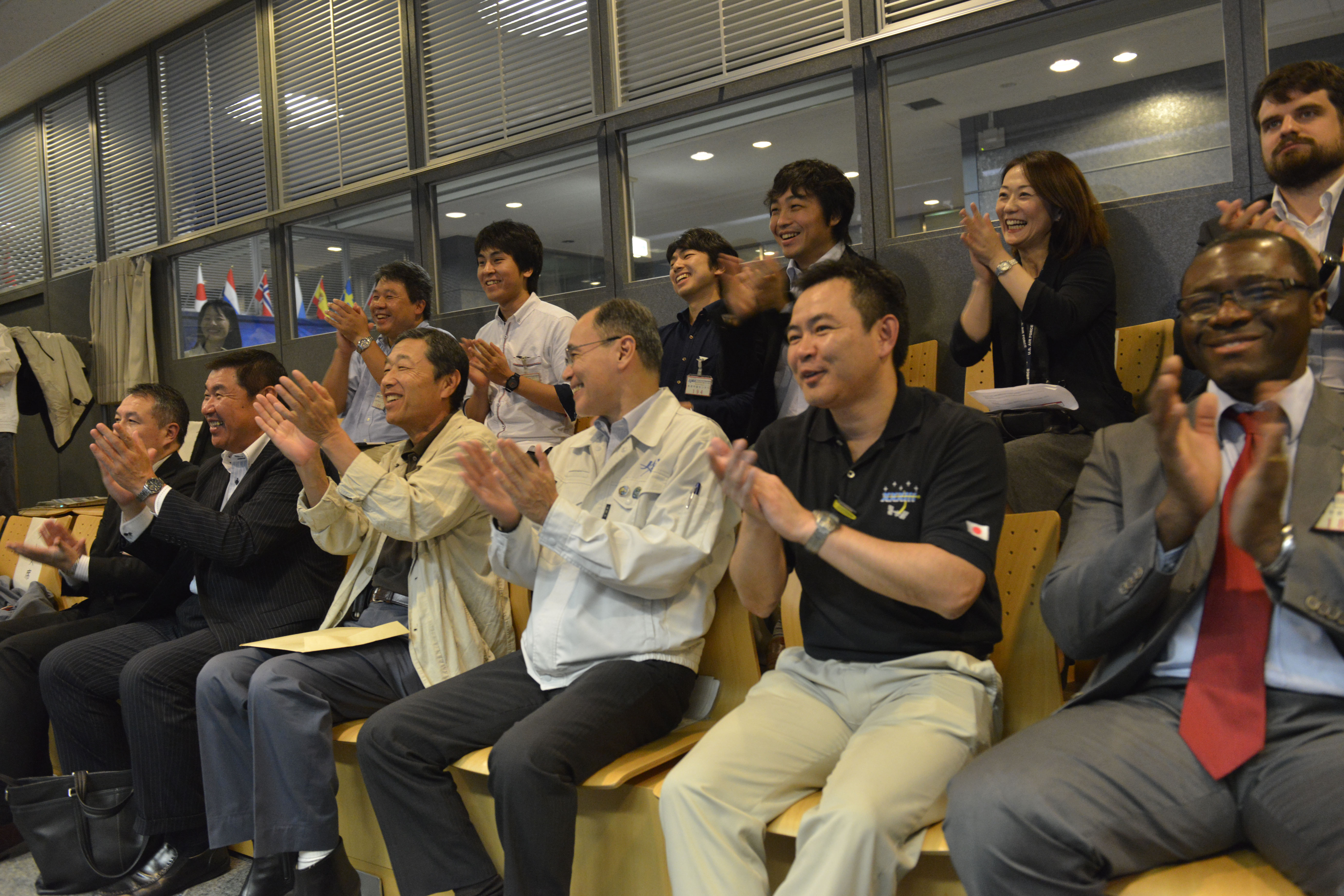
    Astronaut Takuya Onishi and his fellow members receive final examination for the 45S flight (Credit: JAXA/NASA)

    Astronaut Takuya Onishi, assigned as an ISS Expedition 48/49 crew member, participated in the final examination session as a backup crew member for the 45S flight, which was held at the Gagarin Cosmonaut Training Center (GCTC).

    After completing various exams, the final examination was held for two days on the Soyuz TMA spacecraft and in the Russian segment of the ISS.

    Attired in the Sokol spacesuits, Onishi and his crewmates boarded the Soyuz simulator and went through the same operational procedure for the actual operations as divided into three stages: from preparing to launch to initiating rendezvous with the ISS, rendezvous and docking to the ISS, and undocking from the ISS to landing on Earth.

    click to enlarge

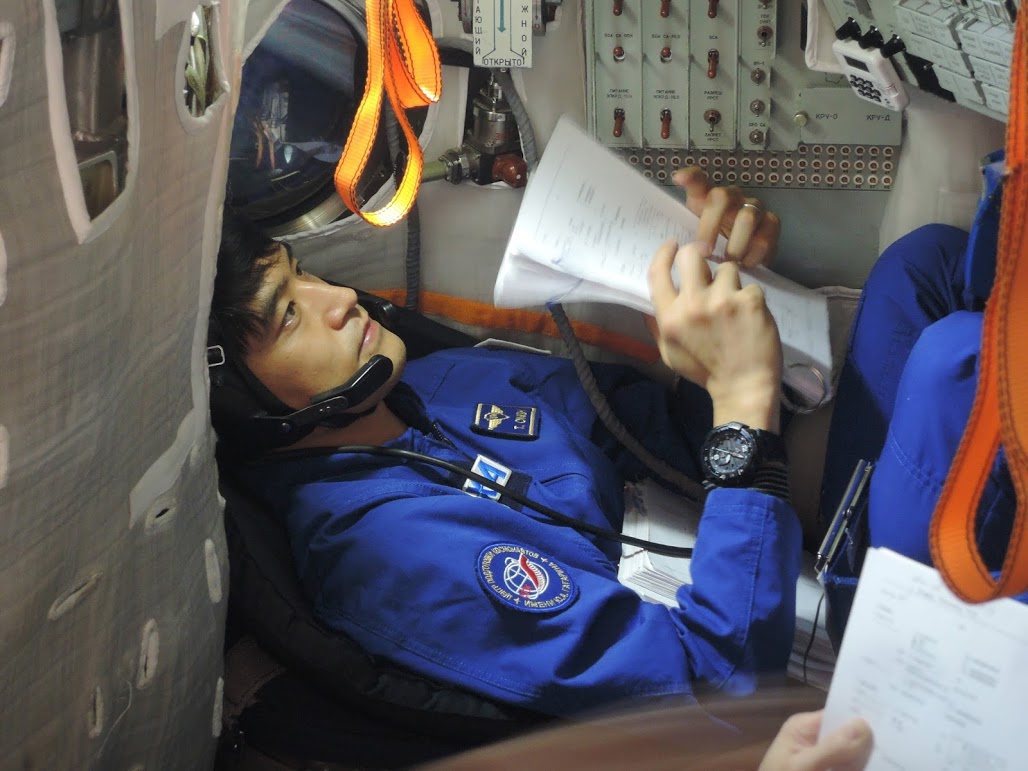
    Onishi and crewmate Kathleen Rubins in the Russian module mockup (Photo courtesy of Takuya Onishi)

    For the exam in the Russian segment, the crew went through daily operations conducted in the Russian segment of the ISS, starting with the daily planning conference with ground control in the morning, followed by the preparation of meals, recording of video messages, checking of air composition, maintaining the toilet system, transferring cargo, and reviewing the emergency response equipment.

    During the operations, they wore oxygen masks in response to a simulated fire, identified and extinguished the fire, and then restored the modules. The occurrence of such emergencies is not known to the examinees beforehand.

    During the post-exam debriefing, the crew was informed that they had passed the exams with excellent results.

    Astronauts Koichi Wakata and Akihiko Hoshide participate in the KOUNOTORI’s technical interchange meeting

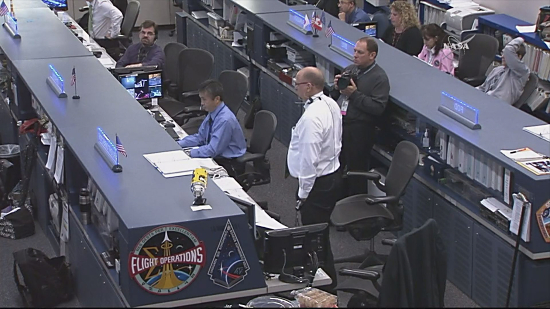
    Wakata at the meeting (Credit: JAXA)

    From November 9-12, a debriefing session for the H-II Transfer Vehicle KOUNOTORI5 (HTV5) mission and coordination for the planned HTV6 mission were held.

    In addition to the JAXA Flight Control Team (FCT) of KOUNOTORI, the NASA ISS flight controllers and Astronauts Koichi Wakata and Akihiko Hoshide participated in the meeting. Wakata participated by representing the NASA astronaut corps as he served as lead Capsule Communicator (CAPCOM: ground communicator with the ISS) during the HTV5 mission, while Hoshide participated as a JAXA astronaut in conducting the Flight Crew Interface Test (FCIT) on the KOUNOTORI5 from the perspective of an experienced astronaut.

    During the meeting, results of the HTV5 mission and improvements for the future, as well as a review of the changed systems and plan to deliver batteries for the ISS aboard the KOUNOTORI6 were discussed.

    Astronaut Soichi Noguchi attends a board meeting of the Association of Space Explorers (ASE) in the Asian region

    On November 6 and 7, a board meeting of the Association of Space Explorers in the Asian region (ASE-Asia) was held in Beijing, China.

    During the board meeting, their annual activities, status of China’s manned space activities, and cooperation on space education events in Asia were discussed.

    ASE is a worldwide, non-profit organization consisting of 37 countries, and more than 400 astronauts and cosmonauts who have flown in space.

    This entry passed through the Full-Text RSS service – if this is your content and you’re reading it on someone else’s site, please read the FAQ at fivefilters.org/content-only/faq.php#publishers.

  • [Special] Eriko Masaki General Manager, Space Museum TeNQ "Sharing the Beauty of the Universe"

    Sharing the Beauty of the Universe Eriko Masaki General Manager, Space Museum TeNQ

    The Space Museum TeNQ (pron: ten-cue) celebrated its first anniversary in July 2015. Throughout the museum there are many creative exhibits that help visitors feel closer to the universe. The museum’s general manager, Eriko Masaki, reveals the secrets of the museum’s success.

    Mapping the Visitors’ “Mind Stories”

    — What is the concept of Space Museum TeNQ?

    TeNQ is an entertainment museum designed to be enjoyed whether the visitor is already interested in the universe or not. When the topic is space, some people automatically assume that it is difficult and put up their guard. So at TeNQ, we would like visitors to loosen up, and allow themselves to simply enjoy and be enchanted by the universe. We want to make TeNQ an exciting museum where people can feel close to the universe.

    — So the museum focuses on using entertainment to engage people.

    Entertainment is a key element, since TeNQ is located in an entertainment facility consisting of the Tokyo Dome (an all-weather multipurpose stadium), a hotel, an amusement park, and a spa complex. We have chosen “the universe” as the concept for the museum because we saw good potential for involving everyone, from children to the elderly. But the universe can cover such a wide range of topics, and you can approach it from so many different angles. Frankly speaking, I didn’t have a particular interest in space before, so in the early stages of planning I wasn’t quite sure what we should do at TeNQ. Then I had a chance to see the magnificent starry night sky at Mauna Kea on the island of Hawaii, where the Subaru Telescope is located. I was so moved. This was when I realized that the concept of TeNQ should be about excitement: about being awed by the beauty of the universe, about the thrill of discovery, about the joy of learning something new and sharing it with others. Our hope is that such an exciting experience will encourage visitors to develop an interest in the universe.

    — What’s your strategy for achieving this?

    Starting RoomStarting Room

    Theater SORATheater SORA

    ScienceScience

    ImaginationImagination

    When designing the visitor experience, we thought about our guests’ “mind stories” – how their mind would work – and designed the exhibition space accordingly. We created nine areas: Entrance, Tunnel ZERO, Starting Room, Theater SORA, Science, Imagination, Exhibition, Connection Place, and Space Store.

    The flow of the story we designed goes like this: First, you reset your mind as you walk from the entrance through a dark tunnel. Then, in the Starting Room, which is full of white cubes, there is a surprise waiting for you: with the help of projection mapping, we use the entire room to introduce how humans have viewed the universe from ancient times to the present day. We don’t go into detail, but instead use a montage of historic images to stimulate your imagination.

    The next area is the Theater SORA. The theater has a unique shape: 11 meters in diameter, with a hole at the center. You look down through the hole to watch video. There, you see real images of the Earth and other planets, galaxies, the starry night sky shot at Mauna Loa in Hawaii, and the Earth seen from the International Space Station, for example – in greater than 4K ultra high definition video. The highlight is that, by looking down into outer space, you can simulate the sensation of floating in space. I’ve heard it said that seeing the Earth from space changes astronauts’ view of the world. This is called the overview effect. Right now only a very small number of people can go to space, but at TeNQ you can feel as if you’re there. We guarantee you a memorable experience.

    After the video images stimulate your emotions, the next step is to inspire you with science. Because you are already excited, you are more open to things that you may normally think are too difficult for you, and you can make connections with the video you just saw in the other areas. So we have designed the exhibits by imagining how visitors’ minds would work. The video show emphasizes entertainment, but in the Science area, by contrast, we introduce a lot of real, cutting-edge research.

    Then in the area called Imagination, you can enjoy the universe in whatever way you want, having fun with the various exhibits. There are interactive exhibits, including a quiz, a puzzle that allows you to create your own planet, and a game where you fly a rocket by operating a robot. There is also a corner for viewing art and watching videos about the universe.

    So each area is given a different role, but they are also sort of mixed intentionally. We have combined various elements here and there, and it is up to visitors where and how they become excited or moved. We would like them to feel something at TeNQ, and to go home with memorable experiences. So we design the exhibits thinking about how our visitors’ minds will work.

    — You’re also trying to provide a comfortable environment for visitors.

    We allow visitors to enter the museum every 15 minutes, with a maximum of 70 people at any one time, so it is very rare that it becomes crowded. In the Theater SORA, for example, everyone can watch the video from the front row. After the theater experience, they are invited to move to the next area, so we can usually avoid situations where there are too many people crowded in one exhibit. We work hard to make sure that visitors are exposed to the universe in a comfortable environment.

    Authenticity Moves People

    — I was surprised to hear that there is a real laboratory in the Science area.

    Research CenterResearch Center

    Visitors can touch a piece of a Martian meteoriteVisitors can touch a piece of a Martian meteorite

    Yes, our exhibit includes a Research Center, which is a satellite office of the University Museum of the University of Tokyo, under the supervision of associate professor Hideaki Miyamoto. Prof. Miyamoto specializes in planetary science and solar system exploration. He is a leading scientist in the study of Mars and its exploration, and is also involved in the HAYABUSA 2 project. At the Research Center, scientists are actually working on research, and visitors can watch them work. The latest results are presented directly to the public, and this is one of our big highlights. For example, images sent from NASA’s Mars explorer are shown on the monitor, and the information is constantly updated.

    Conventional science museums restrict their exhibits to things that have already been proven. But at TeNQ, we show what is under debate at this very moment. Visitors can see information that regular people normally don’t have access to, and the information is updated daily, so visitors can get the latest every time they come to the museum. In addition, there is a corner where visitors can touch a piece of a Martian meteorite, and the Mars Research Project allows them to take part in actual research. I think that these events are unique experiences. After all, authenticity touches people. We hope that, having seen real research data and real-life scientists working, some people will be inspired to pursue an interest in space development or in the universe.

    — Frequently updating the information must contribute to the number of repeat visitors.

    That’s correct. We want people to come back to TeNQ many times, so we plan different exhibitions and seasonal events, for example for Christmas and Halloween. We have also hosted lectures by world-class scientists, and a public viewing of a rocket launch with the help of JAXA. We try to offer excitement that you can only get at our museum, rather than just providing knowledge that you only need to hear once.

    — Could you tell us about your past exhibitions.

    Aerospace Professionals – JAXA and its comrades (Exhibition is held until February 28.)Aerospace Professionals – JAXA and its comrades (Exhibition is held until February 28.)

    We change the content every three or four months. The first exhibition was about TeNQ-style space travel, the second was about Ultraman (a popular Japanese science fiction TV series), followed by exhibitions featuring illustrations of the universe, and the manga Space Brothers. The current exhibition is about people with space-related careers – people working at JAXA and elsewhere in the space field. I had the opportunity to meet some of them in the course of curating our past exhibitions, and really enjoyed the experience. I thought the public would enjoy learning about space-related work through the people who work in the field – empathizing with their words, the way they work, and the stories behind what they do. Let’s say there is a woman who is not interested in the universe or technology at all. Even someone like her will be touched if she hears the story of someone getting in trouble in space and surviving, wouldn’t you say? So we introduce people whose jobs are space-related – astronauts, scientists and engineers – along with their anecdotes and messages to the public. We also introduce space technologies used in daily life, for example in fishing or growing rice.

    — To show how space technology is used in fishing, you provide a lot of detail about people – for example interviews with people working in the industry – but at the same time, you show satellites as simply yellow boxes. I found the contrast very interesting.

    Space technology used in fishingSpace technology used in fishing

    Typical exhibition facilities may use sophisticated satellite models, but our objective is to show the relationship between satellites and people – how satellites are being used in real life – so it’s enough to just show the satellites as icons. If visitors would like further information, we think that they can look into it themselves or visit other facilities. In fact, when we consulted JAXA about the idea for this exhibition, they told us they’d held a similar exhibition before.

    Changing the style of the exhibits and the décor of the museum space can really affect the visitor’s experience. For instance, displaying a product beautifully in a stylish shop can make it look much nicer. So in our case, we try to show things differently from other facilities in order to offer visitors a sense of intimacy. Take for example the entrance of TeNQ: the décor uses a lot of wood, so it feels like a café. We wanted to go with softness and unpredictability to distinguish us from typical science museums, space theme parks and science fiction.

    — Even the toilet signs are different, right?

    Toilet signToilet sign

    We try to use as many fun and surprising elements as we can, so we used male and female astronauts for the toilet signs. There are aliens hidden in many places, too. Please come and look for them! Mind you, there are no aliens in the Science area, because we only show real research there. I think otherwise the scientists would be upset. (Laughs.)

    The Universe as Entertainment!

    — Do you often collaborate with research institutions?

    We are not space experts, so for the current exhibition, about people with space-related careers, we worked with JAXA employees and other experts, and for the exhibition on illustrations of the universe we collaborated with the Four-Dimensional Digital Universe Project at the National Astronomical Observatory of Japan. Our collaborators introduce us to the people we need to meet for our workshops, and this way our space network is gradually expanding. Our biggest strength is being able to show the universe as entertainment. Prof. Miyamoto at the University of Tokyo decided to collaborate with us because he saw a new opportunity for public outreach. We are hoping we can continue to plan and implement exhibitions in collaboration with those who specialize in space research and technology, as well as others from the space industry.

    — It has been a year and a half since the museum opened. How have visitors’ reactions been so far? Which area is the most popular?

    Word-ariumWord-arium

    EntranceEntrance

    Photo backdropsPhoto backdrops

    We would like families to visit TeNQ, of course, but our main target is women in their 20s and 30s. We want to have a museum where women feel comfortable to come alone. And indeed, we’ve met our target: 60 percent of our visitors are women, many in their 20s and 30s. Theater SORA is very popular, but some say that their favorite is the Starting Room, because it gives them a real sense of being “there,” while others spend hours with the Mission Rally Q, where they have to find answers in the exhibits as they go. So everyone is different. But we didn’t expect that so many visitors would be taking photos in the Word-arium, a room that introduces words inspired by the universe. Surprisingly many take selfies beside the words displayed in this dark and mysterious room. Knowing that people like taking photos to share on social media, we made a special effort to create good photo backdrops, but this phenomenon was truly unexpected. While we are happy to see things working as we originally planned, we are often surprised to find that people are intrigued by things we never expected to be so popular.

    — So people can take pictures freely?

    They can take photos anywhere, except in the Starting Room, Theater SORA and the Research Center. We are happy to see photos spread through social media because that way more people hear about TeNQ. But at the Research Center, visitors are asked not to take photos, to avoid interfering with the scientists at work.

    — Have you been in the entertainment business for a long time?

    I was involved in the opening of the spa complex LaQua, which opened in 2003 at Tokyo Dome City, and also worked on the shopping mall and the redevelopment of the old amusement park area. Tokyo Dome City was originally a place that appealed mainly to men, with baseball, martial arts and horse racing. The objective of the redevelopment was to bring women and families to the site. The experience I have gained with the other projects was very useful for planning a space museum that targets women.

    — Have you developed a fondness for the universe?

    I think so. I can look at the universe only from an average person’s point of view, but I definitely feel more familiar with it and more interested, as I meet more people who work around space. Everyone is so passionate about their job, that I am totally drawn to their stories, regardless of their specialty. It is much more interesting than learning from books. After I heard about the moon, I look up at it at night and appreciate its beauty. Also, meeting with JAXA employees and researchers gives me more awareness of space-related news. I think my perspective has broadened thanks to this job.

    New Space Stories All the Time

    — Are there new things you would like to try in the future?

    Eriko Masaki

    Many people expect to get something extraordinary in entertainment every time. Of course there is a type of entertainment for times when you don’t want to think about your daily concerns and just refresh yourself. But I think that there can also be a kind of entertainment that can make the everyday more enjoyable. Going to a museum or a spa after work – I would like to suggest that people add such forms of entertainment to their daily lives. TeNQ is open until 9 pm, so I think visitors have enough time to enjoy the museum after work. I would like TeNQ to be an entertainment museum where people can stop by casually when they feel tired from work and want to relax watching video of the beautiful universe. Our museum is not well-known enough to achieve this goal yet, so we need to make a greater effort in promoting it by planning interesting exhibitions, for instance. We want to strive to continue to offer excitement at TeNQ.

    — What kind of expectations do you have for JAXA?

    I think it’s possible for even a commercial complex such as ours to introduce the public to the beauty and excitement of the universe, in a different way than JAXA. The universe has always been something that catches people’s attention – its attraction is universal. By collaborating with JAXA, we are sure that we can offer excitement and memorable experiences. For the asteroid explorer HAYABUSA 2, for example, we would like to take advantage of our permanent facility, and not just feature the launch but also follow up on its mission later on. TeNQ opened only a year and a half ago, and there is still a long way to go. We will be delighted if JAXA can continue to work with us in the future.

    Related link: Space Museum TeNQ

    Eriko Masaki

    Eriko Masaki

    TeNQ General Manager, Space Museum Department, Tokyo Dome Corp.

    After joining Tokyo Dome Corporation, Ms. Masaki was assigned to the Tokyo Dome City redevelopment project team, and worked on the spa complex LaQua. Subsequently, she was involved in the development of the food court, GO-FUN, which opened in 2011. The same year, she joined the Space Museum TeNQ project, in its planning stage. TeNQ opened in July 2014, and she was appointed to her current position in August 2015.

    [ Jan. 25, 2016 ]

    This entry passed through the Full-Text RSS service – if this is your content and you’re reading it on someone else’s site, please read the FAQ at fivefilters.org/content-only/faq.php#publishers.
  • [ISS / Japanese Experiment Module (KIBO)] The second experiment using the ExHAM now underway

    The second experiment using the ExHAM now underway

    Last Updated: January 19, 2016

    JAXA’s Exposed Experiment Handrail Attachment Mechanism (ExHAM) provides an easy way to conduct material tests in an extreme space environment for the use of future artificial satellites and spacecraft, in order to clarify the following:

    • To see how materials or parts actually change in space.
    • To see how materials or parts degrade over a period of time.
    • To search what kinds of particles are floating in space.

    The ExHAM offers the advantage of being able to return samples directly to the cabin after exposure to the space environment, without the need to perform Extravehicular Activities.

    Following the first experiment in May 2015, this marks the second experiment using the ExHAM. The following test samples were attached to the ExHAM2.

    • Space Environment Exposure Tests of Functional Thin Film Devices for Future Solar Sail Mission (Solar Sail)
    • Space Environmental Testing of Lightweight and High-Precision Carbon Composite Mirrors (CFRP Mirror)
    • Astrobiology Exposure and Micrometeoroid Capture Experiments (TANPOPO)
    • Space Environment Exposure Experiment of Carbon Nanotube Material for Space Application (CNT)
    • Space Environmental Testing of PEEK and PFA sample (PEEK)

    Among the above, samples of the Solar Sail and CFRP Mirror were reproduced in a short time, despite both being lost at launch failure of the Cygnus spacecraft (Orb-3). The ExHAM2 hardware was carried aboard KOUNOTORI5 (HTV5); the Dragon spacecraft (SpX-6) and KOUNOTORI5 delivered the samples in April and August 2015, respectively.

    photo

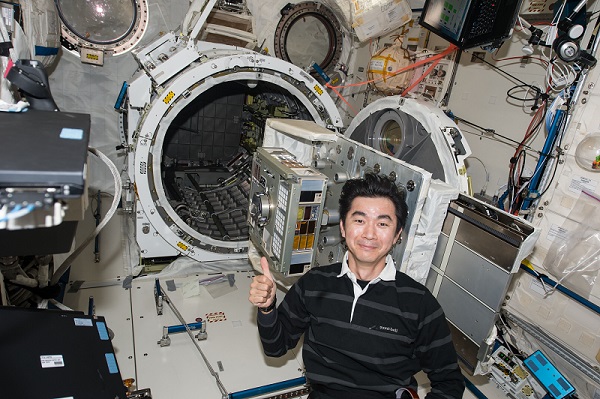
    Astronaut Yui posing with the prepared ExHAM2 (Credit: JAXA/NASA)

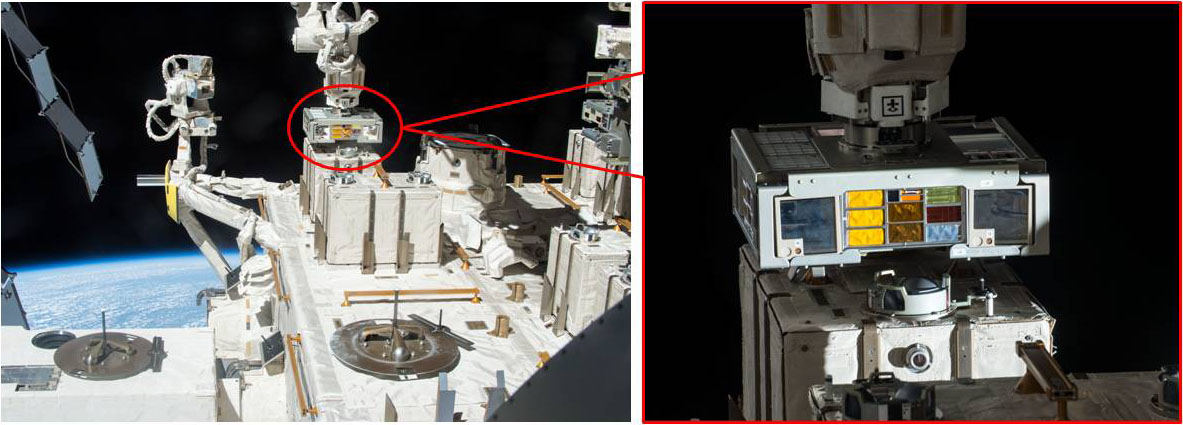
    On October 30, Astronaut Kimiya Yui attached the samples to surfaces of the ExHAM2. Then during the evening to night on November 11, the ExHAM2 was pushed out to the Kibo’s EF, captured and transferred by Kibo’s robotic arm (Japanese Experiment Module Remote Manipulator System: JEMRMS), and then attached to the handrail on the EF.

    photo

    ExHAM2 being attached to the handrail (Credit: JAXA/NASA)

    photo photo

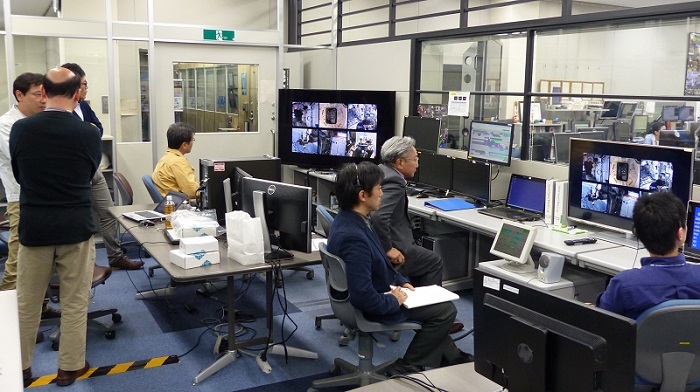
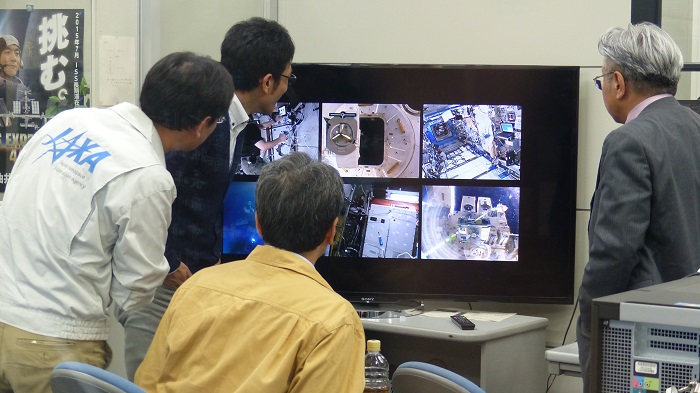
    The researchers and other personnel concerned monitoring the ExHAM2 attachment operations (Credit: JAXA)

    ExHAM

    *All times are Japan Standard Time (JST)

    This entry passed through the Full-Text RSS service – if this is your content and you’re reading it on someone else’s site, please read the FAQ at fivefilters.org/content-only/faq.php#publishers.
  • [ISS / Japanese Experiment Module (KIBO)] Increasingly evident effects of a long-term culture in the space environment on Medaka fish genes

    Increasingly evident effects of a long-term culture in the space environment on Medaka fish genes

    Last Updated: January 18, 2016

    An experiment rearing Medaka fish* (Oryzias latipes) was conducted for two months from October 2012 in the Aquatic Habitat (AQH) on the Japanese Experiment Module (“Kibo”) of the International Space Station (ISS). The research intends to clarify the mechanisms of bone metabolism in microgravity.

    * Effect of microgravity on osteoclasts and analysis of the gravity sensing system in medaka (Medaka osteoclast)
    Principal Investigator (PI): Akira Kudo, Professor, Department of Biological Information, Graduate School of Bioscience and Biotechnology, Tokyo Institute of Technology

    The results of the study have been published in an academic journal by the Tokyo Institute of Technology and JAXA.*1 This time, another joint research group headed by Professor Hiroshi Mitani of Tokyo University and Professor Shuji Terai of Niigata University analyzed the gene expression of medaka cultured on the ISS, with the results being published in PLOS ONE, *2 a U.S. scientific journal.

    The team conducted a comprehensive analysis of the six kinds of tissues in juvenile medaka cultured on the ISS for two months, and found that multiple genes are expressed differently than those on the ground. In addition, some genes showed common expression changes in all tissues cultured on the ISS.

    Finding how such changes in gene expression occur will help prevent or solve health problems that astronauts may face during prolonged space travel.

    *1 Microgravity promotes osteoclast activity in medaka fish reared on the International Space Station Scientific Reports, 21 September 2015
    *2 Histological and Transcriptomic Analysis of Adult Japanese Medaka Sampled Onboard the International Space Station PLOS ONE, October 1, 2015

    *All times are Japan Standard Time (JST)

    This entry passed through the Full-Text RSS service – if this is your content and you’re reading it on someone else’s site, please read the FAQ at fivefilters.org/content-only/faq.php#publishers.

  • [Earth Observation Research Center (EORC)] ALOS-2/PALSAR-2 Observation Results of Flooding on the Mississippi River

    ALOS-2/PALSAR-2 Observation Results of Flooding on the Mississippi River

    Corresponding to emergency requests from NASA and the International Charter of Space and Major Disasters for flooding of the Mississippi River, the Japan Aerospace Exploration Agency (JAXA) performed an emergency observation over the area shown in figure 1 by means of the Phased Array type L-band Synthetic Aperture Radar-2 (PALSAR-2) aboard the Advanced Land Observing Satellite-2 (ALOS-2, “DAICHI-2”) on January 6, 2016.

    Figure 2 is an interactive comparison of the post-disaster image on Jan. 6, 2016 and a pre-disaster image on Sep. 30, 2015. Both images are acquired by high-resolution 10m mode.

    Fig.1: Observation area of the PALSAR-2 on January 6, 2016 (Red box). Fig.1: Observation area of the PALSAR-2 on January 6, 2016 (Red box).
    (Click to view enlarged image)
    The post-disaster image on Jan. 6, 2016 acquired by PALSAR-2.
    The pre-disaster image on Sep. 30, 2015 acquired by PALSAR-2.
    Fig.2: Interactive comparison of images before and after flooding (HH polarization)

    * Drag a slider over the image or click on the arbitrary position of the image to compare the images. Required browser: IE9 or later, Safari5.1 or later, Chrome, Firefox or Opera.

    Figure 3 is the flood map obtained by change detection of the observation images. Blue area is considered to be covered with water but also contains normal seasonal change of agriculture fields. Red is inundation area under forests.

    Fig.3: Estimated inundation map on Jan 6, 2016.

    Fig.3: Estimated inundation map on Jan 6, 2016
    (Click to view enlarged image)

    KMZ File is here

    © JAXA EORC

    This entry passed through the Full-Text RSS service – if this is your content and you’re reading it on someone else’s site, please read the FAQ at fivefilters.org/content-only/faq.php#publishers.
  • [JAXA President Monthly Press Conference] JAXA President Monthly Regular Press Conference December 2015

    JAXA President Monthly Regular Press Conference

    Date and time: From 11:00 – 11:25 a.m. on Dec. 17 (Thu.), 2015
    Venue: JAXA Tokyo Office Presentation Room (B1 floor)
    MC: Shigeki Kamigaichi, JAXA Public Affairs Department Director

    It’s already the year end, and I can summarize that 2015 was a very busy year for JAXA. The new Basic Plan on Space Policy was issued in January, then our organization status was politically changed to a national research and development agency in April, thus we have been coping with those changes. Concerning projects, as we have already announced, the H3 Launch Vehicle project started in full scale. Recently, we have been promoting and implementing various projects that link to commercialization, including upgraded technology verification, and we were fortunately able to achieve their preliminary objectives in 2015. In that sense, this year was very busy but fulfilled. I would like to express my gratitude not only to members of the projects, but also to all JAXA employees who support those projects in the background.

    The Venus Climate orbiter “AKATSUKI” was inserted into the orbit circling around Venus. Although it took five years, Japan was able to inject a satellite into the orbit of a planet other than the Earth for the first time. It was a very big step in the field of space exploration. The AKATSUKI is now undergoing function verification for onboard observation instruments. Each function is being checked, and, so far, the health of four cameras with high resolution performance is confirmed to be maintained. As we have previously announced, we plan to start full-scale observations in April 2016.

    The Asteroid Explorer “Hayabusa2” is flying to the asteroid “Ryugu” on its scheduled orbit as we have informed you.

    The closest important event was Astronaut Yui’s recent return to Earth after completing his expedition mission of about five months at the International Space Station (ISS), as we have already reported. He is currently under rehabilitation in Houston, U.S. Astronaut Yui actively dispatched information very often from the ISS through Twitter, thus I feel that he also played and satisfied his role as a “reporter in space”. We will have a press interview next Monday by connecting to Houston. Please join us. He is scheduled to come back to Japan in February 2016 after completing his rehabilitation, so we are planning to hold a mission debriefing session in some regions in Japan.
    Following Astronaut Yui, Astronauts Onishi and Kani will participate in expedition missions at the ISS in June 2016 and in November 2017, respectively. We are working hard to support them as well as other coming Japanese astronauts to enable them to attain further achievements based on what have been done by Astronaut Yui.

    The 22nd Asia-Pacific Regional Space Agency Forum (APRSAF-22) was held in Indonesia between Dec. 1 (Tue.) and 4 (Fri.) The APRSAF is hosted by the Ministry of Education, Culture, Sports, Science and Technology, Japan , and JAXA, and each member country holds an annual meeting in turn. This year, Indonesia’s Ministry of Research, Technology and Higher Education of Indonesia (RISTEK-DIKTI) and National Institute of Aeronautics and Space (LAPAN) jointly held the meeting. About 480 participants from 28 countries and regions and 10 international organizations gathered there for the presentation and thorough discussions. One of the notable discussion topics is the issue of “space and ocean” as a special feature presented by Indonesia. The host country is a major maritime nation that is said to consist of about 17,000 islands. The total length of shorelines of the Indonesian islands is over 80,000 kilometers, which is about the twice the length of the equator. It was actually my first time to learn that Indonesia was such a maritime nation, and the country faces various challenges of marine migrations, shipping navigation information and other marine-related issues. Therefore, they presented their expectations that satellite observations from space may be useful for their challenges, and I thought it was a very unique and interesting presentation. Another feature of the Forum this time was that we can clearly see more and more people from countries and regions other than Asia participating in the APRSAF to study the status quo of Asian space development and to incorporate that into their activities. In other words, the Asian region will play a more important role in the space field in various senses. We also want to strengthen our space activity. The APRSAF will be held in the Philippines next year.

    A commercial mission was successfully launched by the H-IIA Launch Vehicle No. 29, as we have reported. I understand that, with this success, JAXA’s space activities are now entering a new area of supporting commercial launches by taking one step forward from our conventional field of science and technology, thus it was a significant launch in the sense that we added a new page in JAXA’s history. The successor launch vehicle, the H3, which is under development, aims at entering the commercial launch market from the beginning of its operation, and the upgraded technology verified by the H-IIA F29 will also be incorporated in the H3.
    Concerning a rocket launch, we will launch the H-IIA F30 on Feb. 12 (Fri.) The payload will be the X-ray Astronomy Satellite “ASTRO-H.” Preparations are going well.

    At the COP 21 in Paris in December, JAXA and JICA (Japan International Cooperation Agency) jointly made a presentation on a system that can detect changes in forests. I previously talked about our detection of illegal deforestation in Brazil, and the idea presented this time is to do a similar activity in other countries and regions that possess rich tropical rainforests. Forests play an important role of absorbing CO2; however, how much of overall forests have been lost due to deforestation is difficult to understand. To contribute to solving this challenge, we are studying the possibility of using our land observation satellite “DAICHI-2”.

    A group of male leaders who will create “A Society in which Women Shine” supported by the Gender Equality Bureau, Cabinet Office, issued the “Declaration on Action”. As I read it, approved its purpose, and agreed with the action, I am now a member of this group of male leaders. In the Declaration of Action, there are many meaningful keywords, and especially the idea of “Taking actions and sending messages ourselves”, “Disrupting the status quo”, and “Developing networking” are useful phrases not only for gender equality activities but also for improving productivity and efficiency in various working environments. I hope many women can play active roles in such work places, and that is why I agreed to the Declaration and joined the group.

    On Dec. 12 (Sat.) the Kakuda Space Center (KSPC) celebrated its 50th anniversary. The KSPC is equipped with an imperative R&D function for launch vehicle development. The center has made significant achievements and tremendous contributions to developing rocket engines currently in use. Moreover, the center will be used for the H3 Launch Vehicle development, especially its turbo pump will be tested at the KSPC. We will keep utilizing the KSPC facility for the future development. The center is also strongly supported by local residents, thus we signed a collaboration agreement with them on this occasion to further strengthen cooperation with them. Former Director General Jean-Jacques Dordain of the European Space Agency also participated in the ceremony, and as I happened to carry out research with him about 30 years ago at the KSPC, we lively talked about old tales.

    This entry passed through the Full-Text RSS service – if this is your content and you’re reading it on someone else’s site, please read the FAQ at fivefilters.org/content-only/faq.php#publishers.
  • [Project Topics] APRSAF-22 successfully held in Bali, Indonesia

    The nineteenth session of the Asia-Pacific Regional Space Agency Forum (APRSAF-19), under the main theme entitled “Enriching the quality of life through innovative space programs,” successfully concluded its 4-day program on Friday, December 14, 2012, at the Berjaya Times Square Hotel Malaysia, in Kuala Lumpur, Malaysia. APRSAF-19 was jointly organized by the Ministry of Science, Technology and Innovation of Malaysia (MOSTI), the National Space Agency of Malaysia (ANGKASA), the Ministry of Education, Culture, Sports, Science and Technology of Japan (MEXT), and the Japan Aerospace Exploration Agency (JAXA). Approximately 380 participants from 33 countries and 14 international organizations attended the session.

    APRSAF-19, as was the case in the past, consisted of four working group (EO WG, CSA WG, SEA WG, and SEU WG) sessions that were held in parallel and the plenary. There were also relevant events in conjunctions with APRSAF-19 such as the water rocket event, Colloquium on Astronomy from ISS Kibo, SAFE workshop, Kibo-ABC workshop, Poster Contest, and APRSAF-19 exhibition.

    At the plenary session on Day 3, on December 13, opening remarks were made by the general co-chairs, Dr. Mustafa Din Subari, Director General, ANGKASA, Malaysia and Dr. Satoru Otake, Deputy Director General, Research and Development Bureau, MEXT, Japan, and Keynote addresses were delivered by Mr. Yoshinari Akeno, Deputy Director-General, Office of National Space Policy, Cabinet Office, Japan and Prof. Datin Paduka Dr. Khatijah Bt. Mohd. Yusoff, Deputy Secretary General (Science), MOSTI, Malaysia. In the afternoon, a special session entitled “Enriching the quality of life through innovative space programs” was held with the participation as speakers of representatives of space agencies, such as ISRO/India, LAPAN/Indonesia, JAXA/Japan, KAZCOSMOS/Kazakhstan, GISTDA/Thailand and VAST/Vietnam. The session was chaired by Dr. Mustafai, Director General, ANGKASA.

    It was announced at the last plenary session, on December 14, that the next session, APRSAF-20, would be hosted by the Vietnam Academy of Science and Technology (VAST) and would take place in Hanoi, Vietnam.

    This entry passed through the Full-Text RSS service – if this is your content and you’re reading it on someone else’s site, please read the FAQ at fivefilters.org/content-only/faq.php#publishers.
  • [ISS / Japanese Experiment Module (KIBO)] Call for Proposals Asian Try Zero-G, 2016

    Call for Proposals Asian Try Zero-G, 2016

    Last Updated: December 25, 2015

    Kibo-ABC renewed “Try Zero-G for Asian youth” as “Asian Try Zero-G” program and invites your idea of the simple space experiment to be conducted in the International Space Station (ISS)/Kibo. Most updated point is the selection area became to 2 categories such as Category 1; under 18 years old, and Category 2; Young scientists and Engineers, ages up to 27 years old. The next of JAXA ISS crew, astronaut Takuya Onishi will be assigned for this mission in Japanese experiment module “Kibo” during his stay. Kibo-ABC expects unique, novel and/or informative ideas that have never been done in ISS/Kibo.

    Past of Asian Try Zero-G movies

    ★NEW!http://iss.jaxa.jp/en/kuoa/news/yui_try_zero-g_2015.html


    Information

    • Guideline [PDF: 176KB]
    • Application form [Excel: 65KB]
    • Available onboard items [PDF: 611KB]
    • Schedule and Deadline
      February 29, 2016(JST 17:00): Deadline of application submittal.
      March 18, 2016: Selection announcement.
      PLEASE submit to your country’s Kibo-ABC member agency. If you plan to submit the application by e-mail, the application must be postmarked by the deadline. The selection result and the winner of the candidate ideas will be announced by circulation mail. The announcement will include the contents of the proposal, the outcome/reason, as well as the applicant’s name, address (prefecture and country), and occupation.
      Moreover, the result of activity will be announced on this JAXA HP.

    • General contact point
      Kibo-ABC secretariat
      E-mail : kibo-abc@aprsaf.org

    This entry passed through the Full-Text RSS service – if this is your content and you’re reading it on someone else’s site, please read the FAQ at fivefilters.org/content-only/faq.php#publishers.
  • [International Cooperation] JICA and JAXA Announce Forest Monitoring System Using ALOS-2 Satellite: Constant monitoring of deforestation throughout the tropics and open data access on the Internet

    The nineteenth session of the Asia-Pacific Regional Space Agency Forum (APRSAF-19), under the main theme entitled “Enriching the quality of life through innovative space programs,” successfully concluded its 4-day program on Friday, December 14, 2012, at the Berjaya Times Square Hotel Malaysia, in Kuala Lumpur, Malaysia. APRSAF-19 was jointly organized by the Ministry of Science, Technology and Innovation of Malaysia (MOSTI), the National Space Agency of Malaysia (ANGKASA), the Ministry of Education, Culture, Sports, Science and Technology of Japan (MEXT), and the Japan Aerospace Exploration Agency (JAXA). Approximately 380 participants from 33 countries and 14 international organizations attended the session.

    APRSAF-19, as was the case in the past, consisted of four working group (EO WG, CSA WG, SEA WG, and SEU WG) sessions that were held in parallel and the plenary. There were also relevant events in conjunctions with APRSAF-19 such as the water rocket event, Colloquium on Astronomy from ISS Kibo, SAFE workshop, Kibo-ABC workshop, Poster Contest, and APRSAF-19 exhibition.

    At the plenary session on Day 3, on December 13, opening remarks were made by the general co-chairs, Dr. Mustafa Din Subari, Director General, ANGKASA, Malaysia and Dr. Satoru Otake, Deputy Director General, Research and Development Bureau, MEXT, Japan, and Keynote addresses were delivered by Mr. Yoshinari Akeno, Deputy Director-General, Office of National Space Policy, Cabinet Office, Japan and Prof. Datin Paduka Dr. Khatijah Bt. Mohd. Yusoff, Deputy Secretary General (Science), MOSTI, Malaysia. In the afternoon, a special session entitled “Enriching the quality of life through innovative space programs” was held with the participation as speakers of representatives of space agencies, such as ISRO/India, LAPAN/Indonesia, JAXA/Japan, KAZCOSMOS/Kazakhstan, GISTDA/Thailand and VAST/Vietnam. The session was chaired by Dr. Mustafai, Director General, ANGKASA.

    It was announced at the last plenary session, on December 14, that the next session, APRSAF-20, would be hosted by the Vietnam Academy of Science and Technology (VAST) and would take place in Hanoi, Vietnam.

    This entry passed through the Full-Text RSS service – if this is your content and you’re reading it on someone else’s site, please read the FAQ at fivefilters.org/content-only/faq.php#publishers.

  • [Institute of Space and Astronautical Science (ISAS)] Akatsuki's IR2 successfully visualizes fine-scale undulations of Venus clouds!

    TOP > Topics > 2015 > Akatsuki’s IR2 successfully visualizes fine-scale undulations of Venus clouds!

    The first light image taken by Akatsuki’s IR2 has arrived.

    The 2-micron camera IR2 is one of four high-resolution science imagers onboard Akatsuki. It takes a time to take the first image, because the sensor array on IR2 should be cooled down to -200 °C before starting observations.

    This photo was taken on December 11, 4 days behind the other three cameras. By considering the super-rotation of the Venus atmosphere, this image should capture almost the same region that observed 4 days before by the other cameras.

    The filter bandpass (2-micron) is within a strong absorption band of carbon dioxide, and undulations of clouds appear in 2-micron images as brightness. The IR2 image shows the cloud tops are lower both the South and North Polar Regions, as already known. On the other hand, it reveals, for the first time, striped patterns at low latitude region and meridionary-extended structures. We expect to get clues to unveil the dynamics of cloud layers and atmosphere of Venus by future observations and analysis.

    [Click for large image]

    December 18, 2015

    This entry passed through the Full-Text RSS service – if this is your content and you’re reading it on someone else’s site, please read the FAQ at fivefilters.org/content-only/faq.php#publishers.

  • [ISS / Japanese Experiment Module (KIBO)] JAXA Astronaut Activity Report, September 2015

    JAXA Astronaut Activity Report, September, 2015

    Last Updated: December 17, 2015

    This is JAXA’s Japanese astronaut activity report for September, 2015.

    Astronaut Takuya Onishi continues training for his ISS long-duration stay

    Astronaut Takuya Onishi, a crew member for the Expedition 48/49 mission to the International Space Station (ISS), underwent training for a long-duration mission at the NASA Johnson Space Center in the U.S. during the first half of September, followed in the second half by training at the European Astronaut Centre (EAC) of the European Space Agency (ESA) in Cologne, Germany.

    Click to enlarge

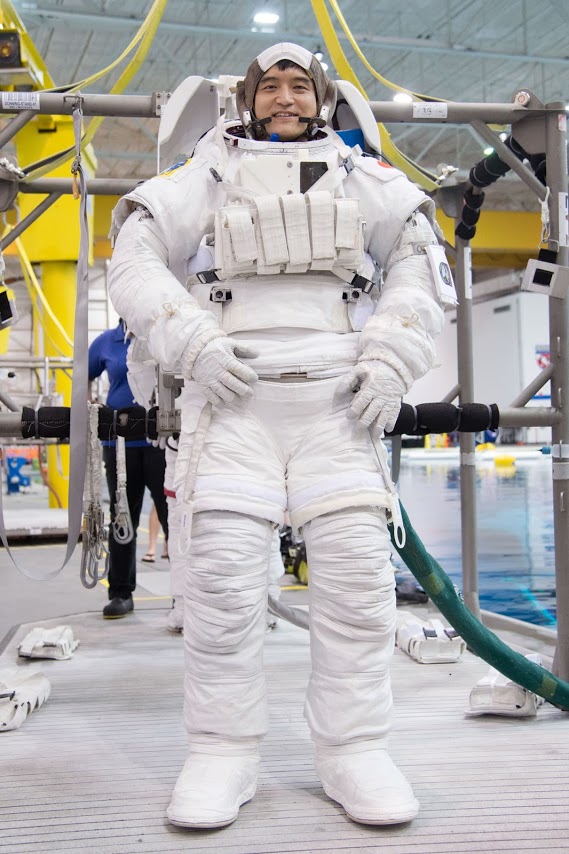
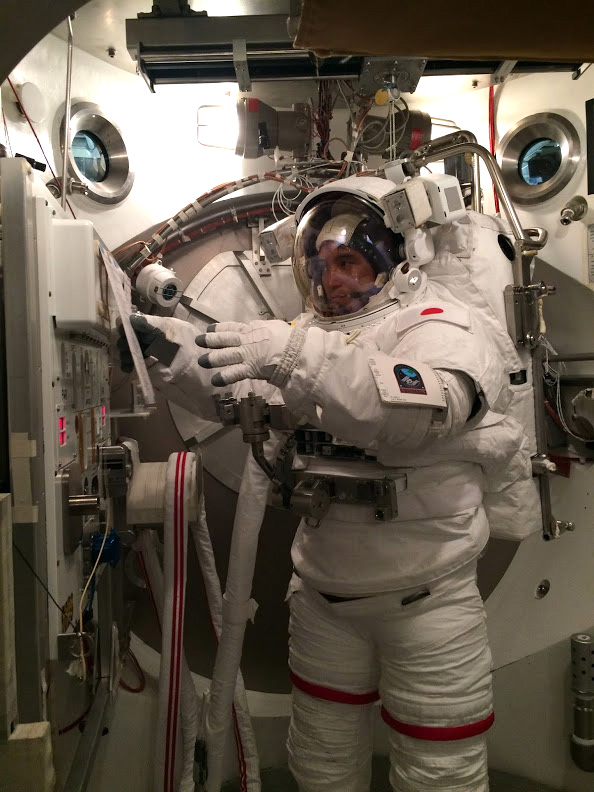
    Onishi donning the EMU (Photo courtesy of Takuya Onishi)

    At the JSC, a series of training was conducted on experiments, medical data acquisition, emergency response, and Extravehicular Activity (EVA).

    Training for EVA this time was conducted in case of experiencing decompression sickness (the bends).

    In order to perform EVA, the internal atmospheric pressure of the Extravehicular Mobility Unit (EMU) must be lowered to 0.3 atm of pure oxygen. In preparation for lowering atmospheric pressure from 1 to 0.3, the astronauts exercise beforehand while wearing oxygen masks to excrete nitrogen, and then take several steps before and while donning the EMU to reduce the risk of getting the bends.

    The general treatment for decompression sickness is to place the person in a small chamber, pressurize and fill it with concentrated oxygen so that nitrogen bubbles are excreted in the body, and then slowly return the chamber to 1 atm. Since oxygen is precious in the ISS, the EMU is used as the treatment chamber. This time Onishi learned how to configure the EMU to use it as such a chamber.

    Click to enlarge

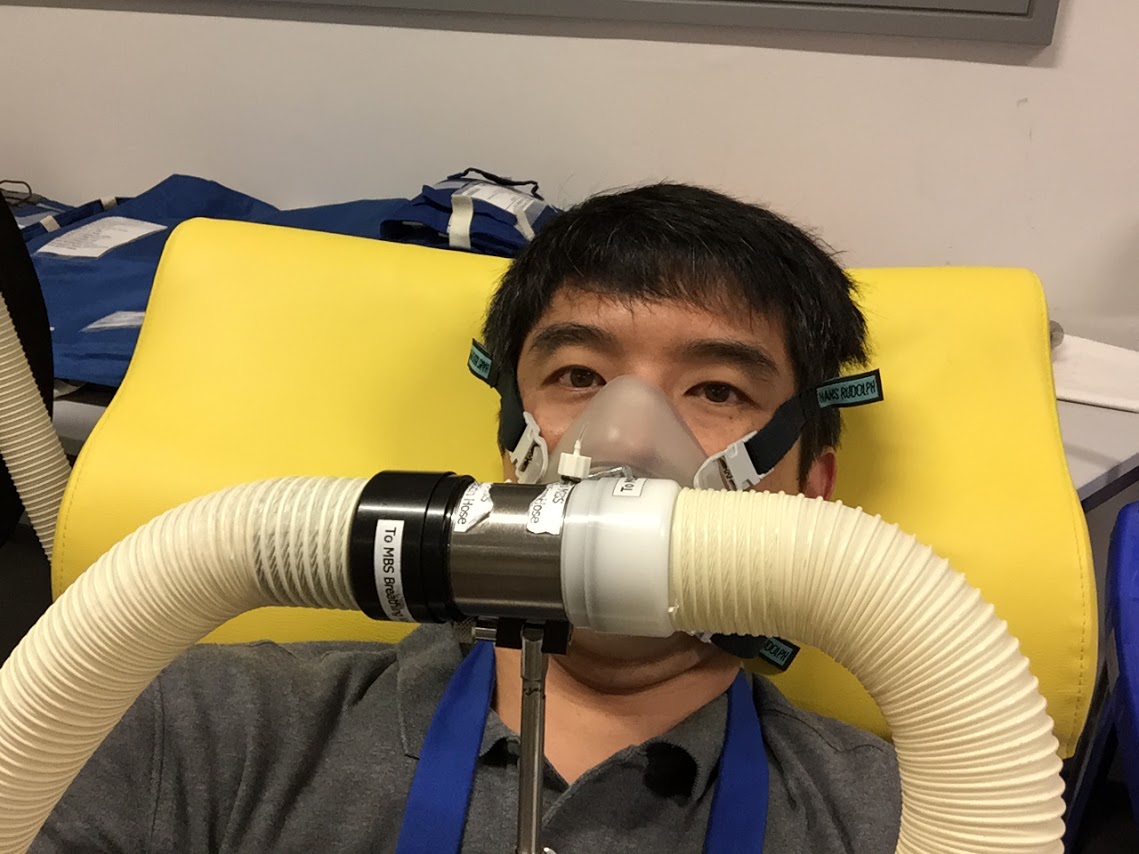
    Measuring oxygen intake and CO2 discharge as part of metabolic rate assessment (Photo courtesy of Takuya Onishi)

    The purposes of training at ESA were to practice ESA-sponsored experiments and become qualified as a “specialist” for ESA’s Columbus module.

    As one of ESA’s experiments, Onishi obtained his baseline data for an experiment called “Energy” (an astronaut’s energy requirements for long-term space flight).

    The “Energy” experiment examines how energy metabolic rates in space differ from those on the ground. The research will help provide appropriate amounts and kinds of foods to keep astronauts healthy for successful future missions. Onishi ate certain space foods and measured the amount of taken and consumed energy.

    Other training covered maintenance operations and failure responses in the Columbus module.

    JAXA astronauts support the HTV5 mission

    Click to enlarge

    Astronaut Wakata on duty at NASA MCC during KOUNOTORI5 releasing operations (Credit: JAXA/NASA)

    At around 5:33 a.m., on September 30 (JST), the H-II Transfer Vehicle (HTV) “KOUNOTORI5” reentered the atmosphere, completing its 42-day mission.

    In addition to participating in KOUNOTORI5’s capture and berthing operations, JAXA astronauts played an important role in its unberthing operations as well.

    Astronaut Kimiya Yui onboard the ISS closed the KOUNOTORI5’s hatch, and then SSRMS operations controlled from the ground unberthed KOUNOTORI5 from the Harmony (Node 2). Yui then maneuvered the SSRMS and released KOUNOTORI5.

    On the ground, Astronaut Koichi Wakata served as lead Capsule Communicator (CAPCOM: lead ground communicator with the ISS) to support onboard astronauts in conducting system and SSRMS operations.

    Astronaut Kimiya Yui’s activities aboard the ISS

    Click to enlarge

    Onboard joint press conference (Credit: JAXA/NASA)

    On September 8, Astronaut Kimiya Yui attended a press conference lasting about 45 minutes.

    All crew members including two short-time visitors gathered in the Destiny module for the press conference, and then answered questions from the mass media from U.S., Russia, Japan, and Europe.

    In answering questions from the Japanese press, Yui discussed the importance of conducting space experiments, described life onboard the ISS, and gave a message for his hometown.

    Click to enlarge

    Astronaut Kimiya Yui announces the success of S-CUBE deployment (Credit: JAXA)

    On September 17, two CubeSats — SERPENS developed by the University of Brasilia (UnB) and meteorite observation satellite S-CUBE of the Chiba Institute of Technology — were successfully deployed using the JEM Small Satellite Orbital Deployer (J-SSOD).

    First, S-CUBE was deployed via command operation by Yui. Then, SERPENS was deployed under command of the JAXA Flight Control Team (JFCT) at the Tsukuba Space Center (TKSC).

    Astronaut Akihiko Hoshide at the TKSC, gave some insights to the representatives of Brazil and Chiba Institute of Technology.

    Click to enlarge

    Representatives of Brazil, Chiba Institute of Technology and JAXA at the TKSC applauding the successful deployment, with Hoshide in the first row, second from the right (Credit: JAXA)

    Hoshide experienced the deployment of two CubeSats for the technology demonstration mission during his Expedition 32/33 in 2012.

    SERPENS and S-CUBE are both 3U-sized micro satellites (10 cm×10 cm×30 cm) that were delivered aboard the H-II Transfer Vehicle (HTV) KOUNOTORI5.

    The 28th Association of Space Explorers’ Planetary Congress

    Photo

    Noguchi giving a presentation (Credit: JAXA)

    The 28th Association of Space Explorers (ASE) Planetary Congress was held from September 20-27 (local time) in Stockholm, Sweden.

    ASE is the only international organization consisting of astronauts and cosmonauts from many countries, and holds a Planetary Congress almost every year.

    As the president of ASE, Noguchi made a speech at the opening ceremony and served as chairperson or deputy chairperson for some sessions. Astronauts Koichi Wakata and Chiaki Mukai also attended the event. Noguchi and Mukai made presentations at the technical sessions.

    This entry passed through the Full-Text RSS service – if this is your content and you’re reading it on someone else’s site, please read the FAQ at fivefilters.org/content-only/faq.php#publishers.

  • [Project Topics] Hayabusa2: Successful Earth swing-by and heading to Ryugu

    Topics List

    Dec. 14, 2015 Updated
    Hayabusa2: Successful Earth swing-by and heading to Ryugu

    JAXA confirmed that the Asteroid Explorer “Hayabusa2” entered its target orbit to travel to an asteroid Ryugu after the Earth-swing-by on Dec. 3.

    The Hayabusa2 took images of the Earth using its onboard Optical Navigation Camera – Telescopic (ONC-T) after the swing-by. You can see the Australian continent and Antarctica in the image. Meteorological satellites including the Himawari cannot take images of the Antarctic area hence the shot this time is precious.

    Hayabusa2: Successful Earth swing-by and heading to Ryugu

    Dec. 3, 2015 Updated
    Hayabusa2 Earth Swing-by

    JAXA performed an Earth swing-by operation of the “Hayabusa2” on the night of Dec 3 (Thu.), 2015 (Japan Standard Time). The “Hayabusa2 flew closest to the Earth at 7:08 p.m. (JST) and passed over the Pacific Ocean around the Hawaii islands at an altitude of about 3,090 km.
    After its closest flight to the Earth, we have confirmed the good health of the “Hayabusa2”.
    It will take about a week to confirm if the explorer entered the target orbit.

    Hayabusa2 Earth Swing-by

    Nov. 27, 2015 Updated
    Hayabusa2 took images of the moon and Earth

    The Hayabusa2, which is flying closer to the Earth for its scheduled swing-by, photographed the moon and the Earth simultaneously using its onboard Optical Navigation Camera-Telephoto (ONC-T) at 12:46 p.m. on November 26, 2015 (Japan Standard Time).
    On the right is the Earth, and you can see the moon on the left. The ONC-T has a multiple number of filters for observing the asteroid “Ryugu”. The image data this time was acquired by using three of the filters, and a pseudo-color image was compiled by assigning the three as R (red), G (green) and B (blue). The distance between the Hayabusa2 and the Earth was about three million kilometers.
    You can see the Australian continent on the right, the Eurasian continent covered by clouds on the left, and the white vertical areas between them are clouds over the equator.
    The ONC-T was jointly developed by JAXA, the University of Tokyo, Chiba Institute of Technology, Rikkyo University, Meiji University, Nagoya University, the University of Aizu, and Kochi University.

    *The images here were trimmed for the sake of the website. Please have a look at JAXA Digital Archives for the original image.

    Hayabusa2 took images of the moon and Earth

    Nov. 2, 2015 Updated
    Hayabusa2 set for Earth swing-by! Your support messages welcomed.

    The Asteroid Explorer “Hayabusa2” will fly near the Earth to perform an Earth swing-by utilizing the Earth’s gravity on Dec. 3 (Thur.) for its orbit control.
    The Hayabusa2, which soared into space on Dec. 3, 2014, will coincidentally come close to the Earth on Dec. 3 (Thur.), 2015, to conduct the Earth swing-by. The explorer will fly closest to the Earth at around 7:07 p.m. on that day (Japan Standard Time).
    After the swing-by, the Hayabusa2 will head to its target asteroid “Ryugu”. Your support for the mission will be very welcomed. We are waiting for your support messages to the explorer itself, project personnel, and the overall mission.

    Hayabusa2 set for Earth swing-by! Your support messages welcomed.

    Oct. 5, 2015 Updated
    “Ryugu” was selected as name of Hayabusa2 target asteroid

    Asteroid 1999 JU3, a target of the Asteroid Explorer “Hayabusa2,” was named “Ryugu”.
    One major reason for the selection was that, in the Japanese ancient story “Urashima Taro”, the main character, Taro Urashima, brought back a casket from the Dragon’s palace, or the “Ryugu” Castle, at the bottom of the ocean, and the theme of “bringing back a treasure” is common as the Hayabusa2 will also bring back a capsule with samples. It was selected among 7,336 entries.
    The Lincoln Near Earth Asteroid Research (LINEAR) Team of the United States, which discovered 1999 JU3, proposed the suggested name of “Ryugu” to the International Asteroid Union (IAU), and it was finalized by being listed on the Minor Planet Names: Alphabetical List of the IAU Minor Planet Center.
    Thank you very much to so many of you who took part in the naming campaign.

    “Ryugu” was selected as name of Hayabusa2 target asteroid

    Sep. 2, 2015 Updated
    Hayabusa2 additional ion engine operation for Earth swing-by

    On Sept. 1 (Tue.) and 2 (Wed.), the ion engine of the Hayabusa2 was additionally operated in order to increase the orbit control accuracy for the Earth swing-by.
    The additional jet emission was completed as scheduled, and the ion engine was operated for about 12 hours in total.
    We will analyze telemetry data (data sent from the explorer to indicate its condition) in detail to confirm the status of the engine during the operation and orbit control before and after the emission.
    Figure: Positional relation of Hayabusa2, the Earth, the Sun, and Asteroid 1999JU3 (Schematic as of Sept. 1, 2015)

    Hayabusa2 additional ion engine operation for Earth swing-by

    Jul. 22, 2015 Updated
    Naming Proposal Campaign: Become a godparent of asteroid “1999 JU3”, destination of Hayabusa2!

    JAXA is holding a naming proposal campaign to christen the asteroid “1999 JU3″,which the Hayabusa2 is scheduled to visit in June or July 2018. Why don’t you try to become a godparent of the asteroid?
    The application period is from 1:30 p.m. on July 22 thru 11:59 p.m. on August 31 (Japan Standard Time.)

    August 31, 2015 at 11:59 p.m. (Japan Standard Time). (Extended from 10:00)

    Jun. 8, 2015 Updated
    Hayabusa2 second ion engine continuous operation completed

    The Hayabusa2 has been continuously operating its ion engine for the second time since June 2, and successfully completed its operations at 0:25 a.m. on June 7 (Japan Standard Time.) The second continuous operation lasted for 102 hours as scheduled.
    The Hayabusa2 performed the ion engine continuous operation in preparation for the Earth swing-by planned in December, and the total hours of the first and second operations (409 hours and 102 hours respectively) reached 511 hours.
    The ion engine operation may be conducted again if needs arise for subtle orbit change after carefully examining the second operation result.

    Hayabusa2 second ion engine continuous operation completed

    Apr. 10, 2015 Updated
    Baton pass to new Hayabusa2 project manager

    The Hayabusa2 is stably flying in space. The new fiscal year has just started in Japan, and JAXA is taking a new step as we became a National Research and Development Agency from the previous independent administrative agency. The Hayabusa2 project is also taking a fresh step with a new team, including handing the baton over to a new project manager. All members of the project are engaged in the mission with a fresh mindset.

    Message from New Project Manager Yuichi Tsuda

    The Hayabusa2 is stably flying since its launch and smoothly continuing it interplanetary cruising. I can, therefore, take over the mission at the best condition from my predecessor, former Project Manager Hitoshi Kuninaka, who led the development of the project. With many operation experts joining the new team, we would like to successfully send the Hayabusa2 to the asteroid 1999JU3, and have it come home safely.
    The Hayabusa2 mission is challenging an unexplored field. We would like to contribute to enhancing the value of technology, science and space exploration through our accomplishments in traveling through the solar system in this six-year mission.

    Message from Former Project Manager Hitoshi Kuninaka

    As the development phase is over, Hayabusa2’s deep space exploration has started.
    At the beginning of this fiscal year, a multiple number of our project members including myself were subject to personnel changes. Our team worked well with good team spirit to tackle and overcome various obstacles and difficulties. Therefore, I felt a bit disappointed to see part of the team was shuffled. Having said that, those who remain in the team as well as the leaving members vow to work hard and do our best using our expertise in space projects no matter what department we are assigned to. Your continued support for the Hayabusa2 is very much appreciated.

    Photo: left: New Project Manager Yuichi Tsuda, right: Former Project Manager Hitoshi Kuninaka

    Baton pass to new Hayabusa2 project manager

    Mar. 5, 2015 Updated
    Hayabusa2 initial functional confirmation completed and moved to cruising phase to asteroid

    The Asteroid Explorer “Hayabusa2,” launched on Dec. 3, 2014, completed its initial functional confirmation period of about three months. The explorer was moving to the cruising phase on March 3 while heading to the asteroid “1999 JU3.”
    The Hayabusa2 is in good health. It will be under preparatory operation including speed increase by continuous operation of the ion engines for an Earth swing-by scheduled in Nov. or Dec., 2015.

    Hayabusa2 initial functional confirmation completed and moved to cruising phase to asteroid

    Feb. 3, 2015 Updated
    Hayabusa2 in great shape – Initial functional confirmation going smoothly

    The Hayabusa2, launched on Dec. 3, 2014 (JST), is now undergoing the initial functional confirmation. Basic operations and performance of onboard instruments and ground systems have been tested one by one as of the end of January.
    Here are some major examples of what we confirmed.

    1. Ion engine test operation (one unit at a time)
      Four ion engines were being operated one by one. A thrust of 7-10 mN was generated on the orbit for the first time.
    2. Establishing communication by Ka band communication equipment (Between Jan. 5 to 10, 2015)
      Communication was successful between the Hayabusa2 and NASA DSN stations to establish deep-space Ka-band communication for the first time for a Japanese space explorer. Ka-band communication will be used to send observation data during the mission for the Hayabusa2 to stay near the asteroid.
    3. Ion engine can autonomously operate for 24 hours.
      Long duration of autonomous operation (*1) with two or three ion engines was tested, and 24-hour continuous operation was attained.
      The maximum thrust was confirmed to be about 28 mN, which is the expected value.

    The explorer is currently in good shape.
    We will further confirm the coordinated function of multiple instruments of the Hayabusa2, and plan to move to the cruise operation phase (*2) sometime in March.

    *1 The autonomous operation is automatic control of an engine without instructions from the ground.
    *2 The mode of full-scale navigation operation toward the asteroid through acceleration and orbit control by ion engine thrust.

    Hayabusa2 in great shape – Initial functional confirmation going smoothly

    Dec. 5, 2014 Updated
    Hayabusa2 flying smoothly!

    JAXA confirmed the completion of a sequence of the important operations for the “Hayabusa2” mission. With this confirmation, the critical operation phase* of the Hayabusa2 was completed.
    The explorer is now in a stable condition.

    We would like to express our sincere appreciation to all parties and personnel concerned for their support and cooperation with the Hayabusa2 launch and tracking control operations.
    In addition, we would also like to ask for your continued cooperation and support for the long-term Hayabusa2 space exploration mission.

    Please send your support messages for the mission! (you can send a message from Hayabusa2 Project page or tweet with hashtag #hayabusa2).

    Hayabusa2 flying smoothly!

    Dec. 3, 2014 Updated
    “Hayabusa2” successfully launched!

    H-IIA F26 with the Asteroid Explorer “Hayabusa2” onboard launched at 1:22:04 p.m. on Dec 3, 2014 (JST) from the Tanegashima Space Center.
    The rocket flew smoothly, and, at about approximately one hour, 47 minutes and 21 seconds after liftoff, “Hayabusa2” was separated from the H-IIA F26. We will update you with the latest information on the “Hayabusa2” on the project page.
    Please send your support messages for the mission! (you can send a message from Hayabusa2 Project page or tweet with hashtag #hayabusa2).

    Nov. 30, 2014 Updated
    “Hayabusa2” Launch rescheduled to 1:22:04 p.m. on December 3 (Mon.) 2014

    Mitsubishi Heavy Industries, Ltd. and JAXA have decided to postpone the launch of “Hayabusa2” and piggyback payloads by the H-IIA F26 to 1:22:04 p.m. on Dec 3 (Wed. JST).

    The live launch report will begin at 12:25 p.m. on December 3 (Mon. , JST). The report will be broadcast through the Internet.
    Please send your support messages for the mission! (you can send a message from Hayabusa2 Project page or tweet with hashtag #hayabusa2).

    We decided to postpone as a result of the go/no go decision meeting today which carefully checked the weather forecast and found that strong wind exceeding the weather restrictions was projected around the launch pad at the scheduled launch time on the previous schedule launch day of Dec. 1 (Mon.), 2014.
    *The launch may be delayed further depending on weather conditions and other factors.

    Nov. 29, 2014 Updated
    “Hayabusa2” Launch rescheduled to 1:22:43 p.m. on December 1 (Mon.) 2014

    The launch of the Asteroid Explorer “Hayabusa2” and three micro piggyback payloads by the H-IIA Launch Vehicle No. 26 was rescheduled at 1:22:43 p.m. on December 1 (Mon. Japan Standard Time, JST) after carefully studying the weather conditions.
    Accordingly, the live launch report will begin at 12:25 p.m. on December 1 (Mon. , JST). The report will be broadcast through the Internet.
    Please send your support messages for the mission, or tweet it including the hashtag #hayabusa2.

    Nov. 28, 2014 Updated
    Hayabusa2 launch postponement

    H-IIA Launch Vehicle No.26 with the Asteroid Explorer “Hayabusa2” onboard has been rescheduled as clouds including a freezing layer that exceeds the restrictions for suitable weather are forecast to be generated at around the scheduled launch time on November 30 (Sun.), 2014 (Japan Standard Time.)
    The new launch day will be announced as soon as it is determined.

    Hayabusa2 launch postponement

    Nov. 27, 2014 Updated
    New movie “Ready to Face New Challenges -Hayabusa2- “

    The new video clip titled “Ready to Face New Challenges -Hayabusa2- ” was uploaded to the YouTube.
    It has been four years since the Hayabusa’s dramatic return from space,bringing back the world’s first samples from an asteroid. To further clarify the mystery of the origin and evolution of human beings, the Hayabusa2 is leaving for space. This video explains the special features and significance of the Hayabusa2 mission in an easy and simple manner.

    Nov. 4, 2014 Updated
    “Hayabusa2″ Launch Live Broadcast (by H-IIA F26)

    JAXA will broadcast a live report of the Asteroid Explorer Hayabusa2’s launch by the H-IIA Launch Vehicle No.26 (H-IIA F26) from the Tanegashima Space Center. The report will cover launch events from the liftoff to the payload separation from the launch vehicle.

    Program summary

    The broadcast program consists of two parts. The first half mainly focuses on launch events prior to and after liftoff. Then the latter half covers events before and after the Hayabusa2’s separation from the launch vehicle.

    *Please be aware that the time schedule of the program is subject to change due to progress of the launch operations.

    Program contents

    Part I
    Prior and after liftoff of H-IIA F26/Hayabusa2

    • Introduction of the Hayabusa2 mission including a VTR of its preparation operation
    • Introduction of piggyback payloads
    • Live launch report from the control room

    *The scheduled launch time is 1:24 p.m.

    Part I broadcast day and time
    12:30 p.m. thru 1:45 p.m. (75 minutes) on Nov. 30 (Sun.)

    • Prior to and after the Hayabusa2’s separation from the launch vehicle

    * Images of piggyback payloads’ separation will NOT be broadcast.
    * Hayabusa2’s separation is scheduled to take place one hour and 47 minutes after liftoff.

    Part II broadcast day and time
    3:00 p.m. to 3:30 p.m. (30 minutes) on Nov. 30 (Sun.)

    Internet live broadcast

    JAXA will distribute our live report through the following Internet channels.

    * The copyright of the live broadcast belongs to JAXA.
    * Please be aware that a slight time lag up to a few minutes may occur due to the Internet’s characteristics.

    We are welcoming support messages at the special site. Please send your messages for the mission, or tweet it. To tweet on Twitter, please attach the hashtag, #hayabusa2.
    Click the following link to send a message to JAXA.

    “Hayabusa2

    Sep. 30, 2014 Updated
    New voyager to travel deep into space! Hayabusa2 to be launched on Nov. 30

    The launch date and time for the H-IIA Launch Vehicle No. 26 (H-IIA F26) with the Asteroid Explorer “Hayabusa2” onboard was decided to be at 1:24:48 p.m. on November 30 (Sunday), 2014 (Japan Standard Time)*.
    Launch site is Yoshinobu Launch Complex at the Tanegashima Space Center.
    * Launch time will be set for each launch day if the launch is delayed.

    The latest information about “Hayabusa2” and its launch preparation status will be updated on the “Hayabusa2” project page.
    We welcome your support message for the Hayabusa2.
    Please send your support messages for the mission, or tweet it including the hashtag #hayabusa2.

    New voyager to travel deep into space! Hayabusa2 to be launched on Nov. 30

    Sep. 5, 2014 Updated
    Hayabusa2 revealed to the media

    The Asteroid Explorer “Hayabusa2” was shown to the media at Sagamihara Campus on August 31, 2014.

    The Hayabusa2 is the successor of the Hayabusa, which captured sample particles from an asteroid and returned to the Earth in 2010. By capitalizing on the experience of the Hayabusa, the Hayabusa2 aims at acquiring samples and bringing them back from the C-type asteroid “1999JU3” to elucidate the origin and evolution of the solar system and material for life.

    “I am bracing for the new voyage of the Hayabusa2.” said Project Manager Kuninaka.
    The Hayabusa2 will be transferred to the Tanegashima Space Center for its launch in this winter after its final check there.

    Hayabusa2 revealed to the media

    Nov. 20, 2013 Updated
    Hayabusa2 Small Carry-on Impactor undergoes test

    Hayabusa2’s Small Carry-on Impactor (SCI) underwent a test in October, 2013.
    The SCI is a device to create an artificial crater of the asteroid 1999JU3, which the Hayabusa 2 will travel toward. By making and observing an artificial crater, we can acquire data not only about the surface but also about the inside of the asteroid. In addition, by sampling near the crater, we can collect inside samples of the asteroid.
    Hayabusa2 applies a method to throw a metal projectile against the asteroid with high speed to create an artificial crater. Through the test this time, we confirmed the accelerating part of the projectile while aiming to verify if its speed, configuration, and thrown direction precision met the design when the pyrotechnics, which were comparable to those of actual ones for the flight, were ignited to set off the projectile.
    The test results were very impressive as the speed and configuration were almost as designed, and the direction precision was also good as the SCI precisely hit a target that was 100 meters away. We were able to successfully complete the performance confirmation test of the SCI pyrotechnic part.

    Hayabusa2 SCI test [JAXA Digital Archives]

    Hayabusa2 Small Carry-on Impactor undergoes test

    Jul. 17, 2013 Updated
    Campaign extended till August 9 (Fri.)!
    – Let’s attach your name and message to Hayabusa2 –

    JAXA has been conducting a campaign to attach names and messages of Hayabusa2 mission supporters from all over the world to the space probe! We would love to share this superb moment and feeling of achievement with you through this campaign.

    We would like to express our sincere appreciation to all of you who joined the campaign since it began on April 10 till today. Also we appreciate your cooperation for registering or sending your names and messages on time. Thank you very much.

    As we read the support messages for the Hayabusa2, we strongly felt that we would like to support this mission by being united with more of you.
    Luckily, the Hayabusa2 manufacturing schedule has allowed us to extend the campaign period!

    We are looking forward to hearing from more of you as an individual and/or as a community such as a family, a school or a company, and/or with your friends!

    With the Hayabusa2
    Let’s go to asteroid 1999 JU3, and return to Earth

    Jun. 14, 2013 Updated
    Hayabusa2 completes first integration test

    All processes of the Hayabusa2’s first integration test since January this year were completed on June 7. The test aimed at installing all onboard devices onto the satellite structure and confirming interfaces among them. During the mass property measurement, the last process of the integration test, the “Hayabusa2” exposed its full shape for the first time with all devices for the test installed.
    We will remove each device from the main body of the Hayabusa2, then the devices will be given their final touches. They will be tested again and assembled again to the explorer for the next-phase test. All the project team members will do our best as we have done to steadily implement the Hayabusa2 project.

    Mar. 29, 2013 Updated
    Hayabusa2 can carry your names and messages to space

    JAXA is holding a campaign to record your names, messages and illustrations onboard the asteroid probe Hayabusa2.
    Hayabusa2 is scheduled to be launched by the H-IIA launch vehicle in FY2014, then arrive at an asteroid in 2018 and investigate it for about one and half years, before returning to the earth in 2020.
    The campaign will start from April 10. We welcome your participation!

    Dec. 27, 2012 Updated
    Hayabusa2 revealed before the first integration test

    On Dec. 26, the Hayabusa2 was revealed at the Sagamihara Campus. As its design was completed this spring, the Hayabusa2 will soon undergo the first integration test to confirm the interfaces among onboard devices as well as between the devices and the explorer’s bus after assembling them onto the bus. Also, the flight models of the Hayabusa2’s main body and solar array paddles have already been manufactured, thus those models will be verified through a vibration test. In addition, the exposed environment for the onboard devices will also be measured. JAXA is developing the Hayabusa2 to be ready for its launch in FY2014.

    This entry passed through the Full-Text RSS service – if this is your content and you’re reading it on someone else’s site, please read the FAQ at fivefilters.org/content-only/faq.php#publishers.

  • [Project Topics] X-ray Astronomy Satellite "ASTRO-H" to be launched on Feb. 12

    Topics List

    Dec. 11, 2015 Updated
    X-ray Astronomy Satellite “ASTRO-H” to be launched on Feb. 12

    The new generation X-ray astronomy satellite ASTRO-H is set for launch on February 12 (Fri.), by the H-IIA Launch Vehicle No. 30 from the Tanegashima Space Center.

    JAXA will broadcast a live launch report on the launch day. We will announce more details later. Please look forward to the launch!

    Dec. 2, 2015 Updated
    ASTRO-H press day

    The X-ray Astronomy Satellite “ASTRO-H” was revealed to the media on Nov. 27 at the Tsukuba Space Center.
    The ASTRO-H is an astronomy satellite to elucidate the structure of space and its evolution through studying high-temperature and high-energy celestial bodies, such as black holes, supernova remnants, and galaxy clusters by X-rays and gamma-rays.
    X-rays and gamma-rays from space are absorbed in the Earth’s atmosphere, thus they cannot be observed on the Earth. Therefore observation in space is necessary.
    The ASTRO-H was developed as a successor to the Suzaku, also an X-ray astronomy satellite. The ASTRO-H is a flagship mission of X-ray astronomy with the participation of over 200 researchers in its development from various domestic and international universities and research institutions including JAXA and NASA. Four new observation systems developed based on broad-scale international cooperation are installed on the ASTRO-H, hence, compared to the Suzaku, it will be able to perform spectroscopic observations on celestial bodies 10 times to 100 times darker than what the Suzaku was capable of doing.

    ASTRO-H press day

    Nov. 2, 2015 Updated
    ASTRO-H sinusoidal vibration test

    The sinusoidal vibration test of the X-ray astronomy satellite “ASTRO-H” was held between Aug. 29 and Oct. 2 at the Tsukuba Space Center. The sinusoidal vibration test aims at two major evaluation objectives, namely evaluating dynamic characteristics of a satellite structure and assessing its strength by loading vibrations equivalent to that at the launch.
    On Oct. 2, the last vibration test was completed, then planned dynamic characteristics data was acquired and the strength of the satellite structure against a vibration load equivalent to that at the time of launch was verified.

    ASTRO-H sinusoidal vibration test

    Aug. 3, 2015 Updated
    ASTRO-H thermal vacuum test

    The thermal vacuum test was held for the X-ray Astronomy Satellite “ASTRO-H” between June 24 and July 9 in a 13-meter chamber at the Tsukuba Space Center. The purposes of the thermal vacuum test are to verify the thermal model by exposing a satellite to the vacuum and thermal environment, and to confirm the function and performance of observation instruments in the on-orbit environment through an electric test.
    All tested items were satisfactorily confirmed including the expected performance of the onboard instruments, verification of the command function to be used in orbit, and calibration data acquisition.

    ASTRO-H thermal vacuum test

    Apr. 21, 2015 Updated
    Soft Gamma-ray Detectors (SGDs) installation on ASTRO-H completed

    Two Soft Gamma-ray Detectors (SGDs), which successfully went through the thermal vacuum test and the cooling test, were installed onto the ASTRO-H. The photo shows the SGD2 on the ASTRO-H with a debris cover and a radiator. A golden color MLI (multi-layer insulation) will wrap them so that they will not be seen from outside.
    All the observation instruments are now installed on the ASTRO-H, so it’s preparations for launch are turning the final corner. We will work harder to overcome the many remaining hurdles including the functional test, thermal vacuum test, and vibration test.

    Soft Gamma-ray Detectors (SGDs) installation on ASTRO-H completed

    Jan. 25, 2015 Updated
    Thermal vacuum test for Soft Gamma-ray Detectors

    The Soft Gamma-ray Detectors (SGD) to observe the soft gamma-ray region of 60 to 600 keV are under the thermal vacuum test in the 8-meter chamber at the Tsukuba Space Center to confirm their thermal design.
    The sensor part of the SGD does not activate till the temperature hits a low temperature of minus 20 degrees (C). However, the SGDs will be installed outside of the satellite panel, thus their temperature will increase from radiation from the Sun and the Earth, thermal input from the satellite panel, and heat from a large amount of LSI (large-scale integrated circuits) and an amplifier if nothing is done. Therefore, the accumulating heat will be carried to the radiator through thermal transfer and a heat pipe to be released, and the SGD will be covered by the multi-layer insulation (MLI), which looks like a bunch of aluminum foils, to shut out heat input. The semiconductor sensor is also activated with high voltage of 200 to 1000 V, hence it should also be tested if it would discharge in vacuum.
    Photo: The SGD-2 sits in the 8-meter chamber.

    Thermal vacuum test for Soft Gamma-ray Detectors

    May 29, 2014 Updated
    First Integration Test for ASTRO-H (for XRT)

    As manufacturing of two Hard X-ray Telescopes (HXTs) and two Soft X-ray Telescopes (SXTs) has been completed and their performance has been confirmed, they are going to be subject to the first integration test. During the test, the telescopes will be mounted on an optical board to make sure that there is no interference with other structures or the satellite bus as well as that no problems arise with operations for controlling the telescope position or angle and operation tools.
    Photo: Satellite surrounded by a scaffold

    First Integration Test for ASTRO-H (for XRT)

    Mar. 26, 2013 Updated
    ASTRO-H development status

    Aug. 10, 2012 Updated
    Satellite development going well: Development test status

    Mar. 15, 2010 Updated
    ASTRO-H passed the basic design review, new logo published

    On May 13 and 14, 2010, the basic design review was held for the ASTRO-H, and the satellite passed the examination. We are moving to the detailed design phase. To celebrate this opportunity, we revised the official logo mark for the ASTRO-H and published it on Feb. 25. The launch of the ASTRO-H is coming closer, and we are working hard for the project to proceed smoothly. Your support will be very much appreciated.

    Oct. 28, 2009 Updated
    SRON-JAXA agreement on Space Science

    On October 28th, 2009, SRON Netherlands Institute for Space Research and JAXA signed a cooperative framework agreement with the aim of promoting joint activities in the field of space science in the presence of Dr. De Heer, the Ambassador Extraordinary and Plenipotentiary of the Kingdome of the Netherlands to Japan, and Dr. Tachikawa, the President of JAXA.
    On the same day, the Implementing Arrangement for collaboration on ASTRO-H (International X-ray astronomy mission) was also concluded. Through ASTRO-H mission, SRON will be in charge of developing an onboard instrument “Soft X-ray Spectrometer (SXS)” and take part in a science team to carry our scientific research.

    SRON-JAXA agreement on Space Science

    This entry passed through the Full-Text RSS service – if this is your content and you’re reading it on someone else’s site, please read the FAQ at fivefilters.org/content-only/faq.php#publishers.