Category: News

http://www.subtome.com/#/subscribe?feeds=http%3A%2F%2Fftr.fivefilters.org%2Fmakefulltextfeed.php%3Furl%3Dglobal.jaxa.jp%252Frss%252Fnew.rdf%26max%3D3%26links%3Dpreserve&back=http%3A%2F%2Fftr.fivefilters.org%2Fmakefulltextfeed.php%3Furl%3Dglobal.jaxa.jp%252Frss%252Fnew.rdf%26max%3D3%26links%3Dpreserve

  • [Project Topics] AKATSUKI successfully inserted into Venus' orbit

    One of the five cameras aboard the Venus Climate Orbiter “PLANET-C” is the “IR2,” whose observation target is infrared rays that are about two micron in wavelength. It aims to measure the high-temperature atmosphere of Venus under thick clouds, its movement, and distribution of its trace components. In other words, the IR2 is a camera that can see through the real surface of Venus. The IR2 is made of materials suitable for infrared ray observations (manufactured by Nikon) and its photo-taking device (element) which is equivalent to a CCD in a digital camera is made of Platinum Silicide (PtSi) element (manufactured by Mitsubishi Electric.)

    The PtSi element is one million pixels (1024 x 1024). We are very proud of its high performance, which is far superior to commercially sold digital cameras or video cameras. It can work stably in the harsh environment of space with an excellent ability to capture both dark and bright objects (dynamic range) and a very high accuracy of measurement (linearity.) Currently, one million pixels is the highest level for this type of camera.

    The PtSi detector shown in the photo is a trial piece. The one million pixel (1024 x 1024) light receiving surface is about 17 mm x 17 mm in size and attached to the IC package. We have already acquired satisfactory results for this element through a cooling evaluation test. In May 2006, we began to manufacture the prototype and flight model elements by slightly modifying the design of the trial piece.

    The “IR2” and the other onboard infrared camera, “IR1,” are the main cameras of the orbiter. Although the two cameras target different observation wavelength ranges, their elements are almost the same. In addition to the lenses and elements, the camera unit itself, equipped with a cooling device for both the IR1 and the IR2, is developed by a Japanese precision equipment manufacturer (Sumitomo Heavy Industries, Ltd.) thus they are being developed 100% domestically.

    It is not easy for Japan to challenge the space development field by itself, as Japan lags behind Western countries. Still, we believe that we can accumulate knowledge through the challenge to sophisticate our own advanced technologies and promote our cutting-edge space science. Therefore both the engineers and scientists are working together for this development.

    This entry passed through the Full-Text RSS service – if this is your content and you’re reading it on someone else’s site, please read the FAQ at fivefilters.org/content-only/faq.php#publishers.

  • [Project Topics] AKATSUKI attitude control engine thrust operation performed as scheduled

    One of the five cameras aboard the Venus Climate Orbiter “PLANET-C” is the “IR2,” whose observation target is infrared rays that are about two micron in wavelength. It aims to measure the high-temperature atmosphere of Venus under thick clouds, its movement, and distribution of its trace components. In other words, the IR2 is a camera that can see through the real surface of Venus. The IR2 is made of materials suitable for infrared ray observations (manufactured by Nikon) and its photo-taking device (element) which is equivalent to a CCD in a digital camera is made of Platinum Silicide (PtSi) element (manufactured by Mitsubishi Electric.)

    The PtSi element is one million pixels (1024 x 1024). We are very proud of its high performance, which is far superior to commercially sold digital cameras or video cameras. It can work stably in the harsh environment of space with an excellent ability to capture both dark and bright objects (dynamic range) and a very high accuracy of measurement (linearity.) Currently, one million pixels is the highest level for this type of camera.

    The PtSi detector shown in the photo is a trial piece. The one million pixel (1024 x 1024) light receiving surface is about 17 mm x 17 mm in size and attached to the IC package. We have already acquired satisfactory results for this element through a cooling evaluation test. In May 2006, we began to manufacture the prototype and flight model elements by slightly modifying the design of the trial piece.

    The “IR2” and the other onboard infrared camera, “IR1,” are the main cameras of the orbiter. Although the two cameras target different observation wavelength ranges, their elements are almost the same. In addition to the lenses and elements, the camera unit itself, equipped with a cooling device for both the IR1 and the IR2, is developed by a Japanese precision equipment manufacturer (Sumitomo Heavy Industries, Ltd.) thus they are being developed 100% domestically.

    It is not easy for Japan to challenge the space development field by itself, as Japan lags behind Western countries. Still, we believe that we can accumulate knowledge through the challenge to sophisticate our own advanced technologies and promote our cutting-edge space science. Therefore both the engineers and scientists are working together for this development.

    This entry passed through the Full-Text RSS service – if this is your content and you’re reading it on someone else’s site, please read the FAQ at fivefilters.org/content-only/faq.php#publishers.

  • [Project Topics] Test image acquisition by AKATSUKI onboard cameras (on Dec. 1, 2015)

    One of the five cameras aboard the Venus Climate Orbiter “PLANET-C” is the “IR2,” whose observation target is infrared rays that are about two micron in wavelength. It aims to measure the high-temperature atmosphere of Venus under thick clouds, its movement, and distribution of its trace components. In other words, the IR2 is a camera that can see through the real surface of Venus. The IR2 is made of materials suitable for infrared ray observations (manufactured by Nikon) and its photo-taking device (element) which is equivalent to a CCD in a digital camera is made of Platinum Silicide (PtSi) element (manufactured by Mitsubishi Electric.)

    The PtSi element is one million pixels (1024 x 1024). We are very proud of its high performance, which is far superior to commercially sold digital cameras or video cameras. It can work stably in the harsh environment of space with an excellent ability to capture both dark and bright objects (dynamic range) and a very high accuracy of measurement (linearity.) Currently, one million pixels is the highest level for this type of camera.

    The PtSi detector shown in the photo is a trial piece. The one million pixel (1024 x 1024) light receiving surface is about 17 mm x 17 mm in size and attached to the IC package. We have already acquired satisfactory results for this element through a cooling evaluation test. In May 2006, we began to manufacture the prototype and flight model elements by slightly modifying the design of the trial piece.

    The “IR2” and the other onboard infrared camera, “IR1,” are the main cameras of the orbiter. Although the two cameras target different observation wavelength ranges, their elements are almost the same. In addition to the lenses and elements, the camera unit itself, equipped with a cooling device for both the IR1 and the IR2, is developed by a Japanese precision equipment manufacturer (Sumitomo Heavy Industries, Ltd.) thus they are being developed 100% domestically.

    It is not easy for Japan to challenge the space development field by itself, as Japan lags behind Western countries. Still, we believe that we can accumulate knowledge through the challenge to sophisticate our own advanced technologies and promote our cutting-edge space science. Therefore both the engineers and scientists are working together for this development.

    This entry passed through the Full-Text RSS service – if this is your content and you’re reading it on someone else’s site, please read the FAQ at fivefilters.org/content-only/faq.php#publishers.

  • [Video] Monitoring Climate Change from Space – UNFCCC/COP21, 2015 –

    This entry passed through the Full-Text RSS service – if this is your content and you’re reading it on someone else’s site, please read the FAQ at fivefilters.org/content-only/faq.php#publishers.

  • [Earth Observation Research Center (EORC)] Seen from Space – El Niño phenomenon being close to the strongest on record


    El Niño phenomenon has been strengthened in this summer and now is close to that in 1997/98 which has recorded the strongest El Niño since 1950. The Japan Meteorological Agency (JMA) reported on November 10, 2015 that sea surface temperature anomaly from average level in the El Niño monitoring region in October recorded +2.7 degree Celsius, and this is the second-warmest values after 1997.

    “El Niño” usually indicates the phenomenon that sea surface temperature in the central and eastern equatorial Pacific Ocean, where usually shows low sea surface temperature, increases dues to weakening of trade winds in equator. Although El Niño and La Niña, which is known as an opposite phenomenon of El Niño, occur over the open ocean, satellite observation can clearly capture their status from beginning to termination. Especially, microwave radiometer can observe sea surface temperature through the clouds, and enables frequent observations of sea surface temperature over the tropical ocean where large convective system develops. Figure 1 shows sea surface temperature over the tropical Indian and Pacific Oceans during November 21-25, 2015, observed by the Advanced Microwave Scanning Radiometer 2 (AMSR2) on board the JAXA’s Global Change Observation Mission – Water (GCOM-W or “SHIZUKU”). Rectangles within the figure indicate the monitoring regions related to El Niño phenomena. It is difficult to see whether sea surface temperature is high or low only from this figure, so Figure 2 indicates sea surface temperature differences from climatological values (anomaly) for the same period. Light blue and green colors indicate temperature is almost normal status, and red and blue colors indicate warmer and colder temperature than normal status respectively. You can see sea surface temperature over the central and eastern equatorial Pacific Ocean shows almost 3 degree Celsius higher than normal year. Figure 3 shows temporal variation of sea surface temperature anomaly averaged over the El Niño monitoring region-3 (NINO.3) since 2002.

    Sea surface temperature over the tropical Indian and Pacific Oceans during November 21-25, 2015, observed by the GCOM-W/AMSR2
    Figure 1. Sea surface temperature over the tropical Indian and Pacific Oceans during November 21-25, 2015, observed by the GCOM-W/AMSR2.
    Same as Figure 1 but for anomaly from climatological values provided by JMA.
    Figure 2. Same as Figure 1 but for anomaly from climatological values provided by JMA.
    Temporal variation of averaged sea surface temperature anomaly of the El Niño monitoring region-3 (NINO.3) from June 2002 to November 2015.
    Figure 3. Temporal variation of averaged sea surface temperature anomaly of the El Niño monitoring region-3 (NINO.3) from June 2002 to November 2015.

    When El Niño phenomena alter the distribution of sea surface temperature, locations of strong convective systems in tropics, and consequently, atmospheric circulation and rainfall distribution are changed. Figure 4 shows accumulated surface precipitation distribution, observed by the Dual-frequency Precipitation Radar (DPR) on board the US-Japan joint Global Precipitation Measurement (GPM) Core Observatory, from t October 1 to November 28, 2015 for the same area as Figure 1. You may find heavy precipitation in tropics corresponding to the area of warmer sea surface temperature in Figure 1. On another front, Figure 5 shows differences of surface precipitation between 2015 and 2014 for the same period. Red color indicates more precipitation in 2015 than 2014, and blue color indicates less precipitation. Precipitation over the central and eastern equatorial Pacific Ocean is increasing in wider areas in corresponding to strong El Niño status in 2015, whereas precipitation over the Maritime Continents around Indonesia is extremely decreasing. Usually, changes of atmospheric and oceanic conditions may cause abnormal weather. Since July 2015, Indonesia experiences serious and continuous wild fires, which is said as the worst in the record. In normal year, fires by broadcast burning die down by rainy season, but onset of this year’s rainy season was delayed and there are droughts caused by El Niño.

    Accumulated surface precipitation from October 1 to November 28, 2015 observed by GPM-Core/DPR.
    Figure 4. Accumulated surface precipitation from October 1 to November 28, 2015 observed by GPM-Core/DPR.
    Anomaly of accumulated precipitation between 2015 and 2014 for the same period to Figure 4.
    Figure 5. Anomaly of accumulated precipitation between 2015 and 2014 for the same period to Figure 4.

    At the last of this article, we would like to show you how sea surface temperature over the tropical ocean varies when El Niño phenomenon occurs by using movie of AMSR2 observation since its launch. Figure 6 shows animation of sea surface temperature anomaly observed by AMSR2 from July 24, 2012 to November 23, 2015. In July 2012, warmer temperature region over the eastern equatorial Pacific Ocean is not so wide. For a while after that, sea surface temperature over that region shows colder status. Since April 2014, warmer sea surface temperature regions have broadened in the eastern equatorial Pacific Ocean, and El Niño occurred in the summer of 2014. The status of warmer sea surface temperature has been strengthened since this summer, and now it shows strong El Niño status. Normally, the strongest status of El Niño is often recorded in northern winter. JMA predicts that this El Niño status will be maximized in the early winter. We should continue to monitor the status of this year’s El Niño if it will be the strongest one on record.

    [embedded content]
    Figure 6. Animation of 5-day averaged sea surface temperature anomaly from July 24, 2012 to November 23, 2015, observed by GCOM-W/AMSR2.

    Explanation of the Images:

    (Figs.1-2,6)

    Satellite: Global Change Observation Mission – Water “SHIZUKU” (GCOM-W)
    Sensor: Advanced Microwave Scanning Radiometer 2 (AMSR2)
    Date: November 21-25, 2015 (Figs 1-2), July 24, 2012 – November 23, 2015 (Fig 6)

    (Fig.3)

    Satellite: EOS-Aqua, Coriolis, Global Change Observation Mission – Water “SHIZUKU” (GCOM-W)
    Sensor: Advanced Microwave Scanning Radiometer for EOS (AMSR-E), Windsat, Advanced Microwave Scanning Radiometer 2 (AMSR2)
    Date: July 2002 – November 2015

    (Figs.4-5)

    Satellite: Global Precipitation Measurement (GPM) Core Observatory
    Sensor: Dual-frequency Precipitation Radar (DPR)
    Date: October 1 – November 28, 2015 (Figs.4-5), October 1 – November 30, 2014 (Fig.5)

    Related Sites:

    This entry passed through the Full-Text RSS service – if this is your content and you’re reading it on someone else’s site, please read the FAQ at fivefilters.org/content-only/faq.php#publishers.

  • [Project Topics] Hayabusa2 took images of the moon and Earth

    Topics List

    Dec. 3, 2015 Updated
    Hayabusa2 Earth Swing-by

    JAXA performed an Earth swing-by operation of the “Hayabusa2” on the night of Dec 3 (Thu.), 2015 (Japan Standard Time). The “Hayabusa2 flew closest to the Earth at 7:08 p.m. (JST) and passed over the Pacific Ocean around the Hawaii islands at an altitude of about 3,090 km.
    After its closest flight to the Earth, we have confirmed the good health of the “Hayabusa2”.
    It will take about a week to confirm if the explorer entered the target orbit.

    Hayabusa2 Earth Swing-by

    Nov. 27, 2015 Updated
    Hayabusa2 took images of the moon and Earth

    The Hayabusa2, which is flying closer to the Earth for its scheduled swing-by, photographed the moon and the Earth simultaneously using its onboard Optical Navigation Camera-Telephoto (ONC-T) at 12:46 p.m. on November 26, 2015 (Japan Standard Time).
    On the right is the Earth, and you can see the moon on the left. The ONC-T has a multiple number of filters for observing the asteroid “Ryugu”. The image data this time was acquired by using three of the filters, and a pseudo-color image was compiled by assigning the three as R (red), G (green) and B (blue). The distance between the Hayabusa2 and the Earth was about three million kilometers.
    You can see the Australian continent on the right, the Eurasian continent covered by clouds on the left, and the white vertical areas between them are clouds over the equator.
    The ONC-T was jointly developed by JAXA, the University of Tokyo, Chiba Institute of Technology, Rikkyo University, Meiji University, Nagoya University, the University of Aizu, and Kochi University.

    *The images here were trimmed for the sake of the website. Please have a look at JAXA Digital Archives for the original image.

    Hayabusa2 took images of the moon and Earth

    Nov. 2, 2015 Updated
    Hayabusa2 set for Earth swing-by! Your support messages welcomed.

    The Asteroid Explorer “Hayabusa2” will fly near the Earth to perform an Earth swing-by utilizing the Earth’s gravity on Dec. 3 (Thur.) for its orbit control.
    The Hayabusa2, which soared into space on Dec. 3, 2014, will coincidentally come close to the Earth on Dec. 3 (Thur.), 2015, to conduct the Earth swing-by. The explorer will fly closest to the Earth at around 7:07 p.m. on that day (Japan Standard Time).
    After the swing-by, the Hayabusa2 will head to its target asteroid “Ryugu”. Your support for the mission will be very welcomed. We are waiting for your support messages to the explorer itself, project personnel, and the overall mission.

    Hayabusa2 set for Earth swing-by! Your support messages welcomed.

    Oct. 5, 2015 Updated
    “Ryugu” was selected as name of Hayabusa2 target asteroid

    Asteroid 1999 JU3, a target of the Asteroid Explorer “Hayabusa2,” was named “Ryugu”.
    One major reason for the selection was that, in the Japanese ancient story “Urashima Taro”, the main character, Taro Urashima, brought back a casket from the Dragon’s palace, or the “Ryugu” Castle, at the bottom of the ocean, and the theme of “bringing back a treasure” is common as the Hayabusa2 will also bring back a capsule with samples. It was selected among 7,336 entries.
    The Lincoln Near Earth Asteroid Research (LINEAR) Team of the United States, which discovered 1999 JU3, proposed the suggested name of “Ryugu” to the International Asteroid Union (IAU), and it was finalized by being listed on the Minor Planet Names: Alphabetical List of the IAU Minor Planet Center.
    Thank you very much to so many of you who took part in the naming campaign.

    “Ryugu” was selected as name of Hayabusa2 target asteroid

    Sep. 2, 2015 Updated
    Hayabusa2 additional ion engine operation for Earth swing-by

    On Sept. 1 (Tue.) and 2 (Wed.), the ion engine of the Hayabusa2 was additionally operated in order to increase the orbit control accuracy for the Earth swing-by.
    The additional jet emission was completed as scheduled, and the ion engine was operated for about 12 hours in total.
    We will analyze telemetry data (data sent from the explorer to indicate its condition) in detail to confirm the status of the engine during the operation and orbit control before and after the emission.
    Figure: Positional relation of Hayabusa2, the Earth, the Sun, and Asteroid 1999JU3 (Schematic as of Sept. 1, 2015)

    Hayabusa2 additional ion engine operation for Earth swing-by

    Jul. 22, 2015 Updated
    Naming Proposal Campaign: Become a godparent of asteroid “1999 JU3”, destination of Hayabusa2!

    JAXA is holding a naming proposal campaign to christen the asteroid “1999 JU3″,which the Hayabusa2 is scheduled to visit in June or July 2018. Why don’t you try to become a godparent of the asteroid?
    The application period is from 1:30 p.m. on July 22 thru 11:59 p.m. on August 31 (Japan Standard Time.)

    August 31, 2015 at 11:59 p.m. (Japan Standard Time). (Extended from 10:00)

    Jun. 8, 2015 Updated
    Hayabusa2 second ion engine continuous operation completed

    The Hayabusa2 has been continuously operating its ion engine for the second time since June 2, and successfully completed its operations at 0:25 a.m. on June 7 (Japan Standard Time.) The second continuous operation lasted for 102 hours as scheduled.
    The Hayabusa2 performed the ion engine continuous operation in preparation for the Earth swing-by planned in December, and the total hours of the first and second operations (409 hours and 102 hours respectively) reached 511 hours.
    The ion engine operation may be conducted again if needs arise for subtle orbit change after carefully examining the second operation result.

    Hayabusa2 second ion engine continuous operation completed

    Apr. 10, 2015 Updated
    Baton pass to new Hayabusa2 project manager

    The Hayabusa2 is stably flying in space. The new fiscal year has just started in Japan, and JAXA is taking a new step as we became a National Research and Development Agency from the previous independent administrative agency. The Hayabusa2 project is also taking a fresh step with a new team, including handing the baton over to a new project manager. All members of the project are engaged in the mission with a fresh mindset.

    Message from New Project Manager Yuichi Tsuda

    The Hayabusa2 is stably flying since its launch and smoothly continuing it interplanetary cruising. I can, therefore, take over the mission at the best condition from my predecessor, former Project Manager Hitoshi Kuninaka, who led the development of the project. With many operation experts joining the new team, we would like to successfully send the Hayabusa2 to the asteroid 1999JU3, and have it come home safely.
    The Hayabusa2 mission is challenging an unexplored field. We would like to contribute to enhancing the value of technology, science and space exploration through our accomplishments in traveling through the solar system in this six-year mission.

    Message from Former Project Manager Hitoshi Kuninaka

    As the development phase is over, Hayabusa2’s deep space exploration has started.
    At the beginning of this fiscal year, a multiple number of our project members including myself were subject to personnel changes. Our team worked well with good team spirit to tackle and overcome various obstacles and difficulties. Therefore, I felt a bit disappointed to see part of the team was shuffled. Having said that, those who remain in the team as well as the leaving members vow to work hard and do our best using our expertise in space projects no matter what department we are assigned to. Your continued support for the Hayabusa2 is very much appreciated.

    Photo: left: New Project Manager Yuichi Tsuda, right: Former Project Manager Hitoshi Kuninaka

    Baton pass to new Hayabusa2 project manager

    Mar. 5, 2015 Updated
    Hayabusa2 initial functional confirmation completed and moved to cruising phase to asteroid

    The Asteroid Explorer “Hayabusa2,” launched on Dec. 3, 2014, completed its initial functional confirmation period of about three months. The explorer was moving to the cruising phase on March 3 while heading to the asteroid “1999 JU3.”
    The Hayabusa2 is in good health. It will be under preparatory operation including speed increase by continuous operation of the ion engines for an Earth swing-by scheduled in Nov. or Dec., 2015.

    Hayabusa2 initial functional confirmation completed and moved to cruising phase to asteroid

    Feb. 3, 2015 Updated
    Hayabusa2 in great shape – Initial functional confirmation going smoothly

    The Hayabusa2, launched on Dec. 3, 2014 (JST), is now undergoing the initial functional confirmation. Basic operations and performance of onboard instruments and ground systems have been tested one by one as of the end of January.
    Here are some major examples of what we confirmed.

    1. Ion engine test operation (one unit at a time)
      Four ion engines were being operated one by one. A thrust of 7-10 mN was generated on the orbit for the first time.
    2. Establishing communication by Ka band communication equipment (Between Jan. 5 to 10, 2015)
      Communication was successful between the Hayabusa2 and NASA DSN stations to establish deep-space Ka-band communication for the first time for a Japanese space explorer. Ka-band communication will be used to send observation data during the mission for the Hayabusa2 to stay near the asteroid.
    3. Ion engine can autonomously operate for 24 hours.
      Long duration of autonomous operation (*1) with two or three ion engines was tested, and 24-hour continuous operation was attained.
      The maximum thrust was confirmed to be about 28 mN, which is the expected value.

    The explorer is currently in good shape.
    We will further confirm the coordinated function of multiple instruments of the Hayabusa2, and plan to move to the cruise operation phase (*2) sometime in March.

    *1 The autonomous operation is automatic control of an engine without instructions from the ground.
    *2 The mode of full-scale navigation operation toward the asteroid through acceleration and orbit control by ion engine thrust.

    Hayabusa2 in great shape – Initial functional confirmation going smoothly

    Dec. 5, 2014 Updated
    Hayabusa2 flying smoothly!

    JAXA confirmed the completion of a sequence of the important operations for the “Hayabusa2” mission. With this confirmation, the critical operation phase* of the Hayabusa2 was completed.
    The explorer is now in a stable condition.

    We would like to express our sincere appreciation to all parties and personnel concerned for their support and cooperation with the Hayabusa2 launch and tracking control operations.
    In addition, we would also like to ask for your continued cooperation and support for the long-term Hayabusa2 space exploration mission.

    Please send your support messages for the mission! (you can send a message from Hayabusa2 Project page or tweet with hashtag #hayabusa2).

    Hayabusa2 flying smoothly!

    Dec. 3, 2014 Updated
    “Hayabusa2” successfully launched!

    H-IIA F26 with the Asteroid Explorer “Hayabusa2” onboard launched at 1:22:04 p.m. on Dec 3, 2014 (JST) from the Tanegashima Space Center.
    The rocket flew smoothly, and, at about approximately one hour, 47 minutes and 21 seconds after liftoff, “Hayabusa2” was separated from the H-IIA F26. We will update you with the latest information on the “Hayabusa2” on the project page.
    Please send your support messages for the mission! (you can send a message from Hayabusa2 Project page or tweet with hashtag #hayabusa2).

    Nov. 30, 2014 Updated
    “Hayabusa2” Launch rescheduled to 1:22:04 p.m. on December 3 (Mon.) 2014

    Mitsubishi Heavy Industries, Ltd. and JAXA have decided to postpone the launch of “Hayabusa2” and piggyback payloads by the H-IIA F26 to 1:22:04 p.m. on Dec 3 (Wed. JST).

    The live launch report will begin at 12:25 p.m. on December 3 (Mon. , JST). The report will be broadcast through the Internet.
    Please send your support messages for the mission! (you can send a message from Hayabusa2 Project page or tweet with hashtag #hayabusa2).

    We decided to postpone as a result of the go/no go decision meeting today which carefully checked the weather forecast and found that strong wind exceeding the weather restrictions was projected around the launch pad at the scheduled launch time on the previous schedule launch day of Dec. 1 (Mon.), 2014.
    *The launch may be delayed further depending on weather conditions and other factors.

    Nov. 29, 2014 Updated
    “Hayabusa2” Launch rescheduled to 1:22:43 p.m. on December 1 (Mon.) 2014

    The launch of the Asteroid Explorer “Hayabusa2” and three micro piggyback payloads by the H-IIA Launch Vehicle No. 26 was rescheduled at 1:22:43 p.m. on December 1 (Mon. Japan Standard Time, JST) after carefully studying the weather conditions.
    Accordingly, the live launch report will begin at 12:25 p.m. on December 1 (Mon. , JST). The report will be broadcast through the Internet.
    Please send your support messages for the mission, or tweet it including the hashtag #hayabusa2.

    Nov. 28, 2014 Updated
    Hayabusa2 launch postponement

    H-IIA Launch Vehicle No.26 with the Asteroid Explorer “Hayabusa2” onboard has been rescheduled as clouds including a freezing layer that exceeds the restrictions for suitable weather are forecast to be generated at around the scheduled launch time on November 30 (Sun.), 2014 (Japan Standard Time.)
    The new launch day will be announced as soon as it is determined.

    Hayabusa2 launch postponement

    Nov. 27, 2014 Updated
    New movie “Ready to Face New Challenges -Hayabusa2- “

    The new video clip titled “Ready to Face New Challenges -Hayabusa2- ” was uploaded to the YouTube.
    It has been four years since the Hayabusa’s dramatic return from space,bringing back the world’s first samples from an asteroid. To further clarify the mystery of the origin and evolution of human beings, the Hayabusa2 is leaving for space. This video explains the special features and significance of the Hayabusa2 mission in an easy and simple manner.

    Nov. 4, 2014 Updated
    “Hayabusa2″ Launch Live Broadcast (by H-IIA F26)

    JAXA will broadcast a live report of the Asteroid Explorer Hayabusa2’s launch by the H-IIA Launch Vehicle No.26 (H-IIA F26) from the Tanegashima Space Center. The report will cover launch events from the liftoff to the payload separation from the launch vehicle.

    Program summary

    The broadcast program consists of two parts. The first half mainly focuses on launch events prior to and after liftoff. Then the latter half covers events before and after the Hayabusa2’s separation from the launch vehicle.

    *Please be aware that the time schedule of the program is subject to change due to progress of the launch operations.

    Program contents

    Part I
    Prior and after liftoff of H-IIA F26/Hayabusa2

    • Introduction of the Hayabusa2 mission including a VTR of its preparation operation
    • Introduction of piggyback payloads
    • Live launch report from the control room

    *The scheduled launch time is 1:24 p.m.

    Part I broadcast day and time
    12:30 p.m. thru 1:45 p.m. (75 minutes) on Nov. 30 (Sun.)

    • Prior to and after the Hayabusa2’s separation from the launch vehicle

    * Images of piggyback payloads’ separation will NOT be broadcast.
    * Hayabusa2’s separation is scheduled to take place one hour and 47 minutes after liftoff.

    Part II broadcast day and time
    3:00 p.m. to 3:30 p.m. (30 minutes) on Nov. 30 (Sun.)

    Internet live broadcast

    JAXA will distribute our live report through the following Internet channels.

    * The copyright of the live broadcast belongs to JAXA.
    * Please be aware that a slight time lag up to a few minutes may occur due to the Internet’s characteristics.

    We are welcoming support messages at the special site. Please send your messages for the mission, or tweet it. To tweet on Twitter, please attach the hashtag, #hayabusa2.
    Click the following link to send a message to JAXA.

    “Hayabusa2

    Sep. 30, 2014 Updated
    New voyager to travel deep into space! Hayabusa2 to be launched on Nov. 30

    The launch date and time for the H-IIA Launch Vehicle No. 26 (H-IIA F26) with the Asteroid Explorer “Hayabusa2” onboard was decided to be at 1:24:48 p.m. on November 30 (Sunday), 2014 (Japan Standard Time)*.
    Launch site is Yoshinobu Launch Complex at the Tanegashima Space Center.
    * Launch time will be set for each launch day if the launch is delayed.

    The latest information about “Hayabusa2” and its launch preparation status will be updated on the “Hayabusa2” project page.
    We welcome your support message for the Hayabusa2.
    Please send your support messages for the mission, or tweet it including the hashtag #hayabusa2.

    New voyager to travel deep into space! Hayabusa2 to be launched on Nov. 30

    Sep. 5, 2014 Updated
    Hayabusa2 revealed to the media

    The Asteroid Explorer “Hayabusa2” was shown to the media at Sagamihara Campus on August 31, 2014.

    The Hayabusa2 is the successor of the Hayabusa, which captured sample particles from an asteroid and returned to the Earth in 2010. By capitalizing on the experience of the Hayabusa, the Hayabusa2 aims at acquiring samples and bringing them back from the C-type asteroid “1999JU3” to elucidate the origin and evolution of the solar system and material for life.

    “I am bracing for the new voyage of the Hayabusa2.” said Project Manager Kuninaka.
    The Hayabusa2 will be transferred to the Tanegashima Space Center for its launch in this winter after its final check there.

    Hayabusa2 revealed to the media

    Nov. 20, 2013 Updated
    Hayabusa2 Small Carry-on Impactor undergoes test

    Hayabusa2’s Small Carry-on Impactor (SCI) underwent a test in October, 2013.
    The SCI is a device to create an artificial crater of the asteroid 1999JU3, which the Hayabusa 2 will travel toward. By making and observing an artificial crater, we can acquire data not only about the surface but also about the inside of the asteroid. In addition, by sampling near the crater, we can collect inside samples of the asteroid.
    Hayabusa2 applies a method to throw a metal projectile against the asteroid with high speed to create an artificial crater. Through the test this time, we confirmed the accelerating part of the projectile while aiming to verify if its speed, configuration, and thrown direction precision met the design when the pyrotechnics, which were comparable to those of actual ones for the flight, were ignited to set off the projectile.
    The test results were very impressive as the speed and configuration were almost as designed, and the direction precision was also good as the SCI precisely hit a target that was 100 meters away. We were able to successfully complete the performance confirmation test of the SCI pyrotechnic part.

    Hayabusa2 SCI test [JAXA Digital Archives]

    Hayabusa2 Small Carry-on Impactor undergoes test

    Jul. 17, 2013 Updated
    Campaign extended till August 9 (Fri.)!
    – Let’s attach your name and message to Hayabusa2 –

    JAXA has been conducting a campaign to attach names and messages of Hayabusa2 mission supporters from all over the world to the space probe! We would love to share this superb moment and feeling of achievement with you through this campaign.

    We would like to express our sincere appreciation to all of you who joined the campaign since it began on April 10 till today. Also we appreciate your cooperation for registering or sending your names and messages on time. Thank you very much.

    As we read the support messages for the Hayabusa2, we strongly felt that we would like to support this mission by being united with more of you.
    Luckily, the Hayabusa2 manufacturing schedule has allowed us to extend the campaign period!

    We are looking forward to hearing from more of you as an individual and/or as a community such as a family, a school or a company, and/or with your friends!

    With the Hayabusa2
    Let’s go to asteroid 1999 JU3, and return to Earth

    Jun. 14, 2013 Updated
    Hayabusa2 completes first integration test

    All processes of the Hayabusa2’s first integration test since January this year were completed on June 7. The test aimed at installing all onboard devices onto the satellite structure and confirming interfaces among them. During the mass property measurement, the last process of the integration test, the “Hayabusa2” exposed its full shape for the first time with all devices for the test installed.
    We will remove each device from the main body of the Hayabusa2, then the devices will be given their final touches. They will be tested again and assembled again to the explorer for the next-phase test. All the project team members will do our best as we have done to steadily implement the Hayabusa2 project.

    Mar. 29, 2013 Updated
    Hayabusa2 can carry your names and messages to space

    JAXA is holding a campaign to record your names, messages and illustrations onboard the asteroid probe Hayabusa2.
    Hayabusa2 is scheduled to be launched by the H-IIA launch vehicle in FY2014, then arrive at an asteroid in 2018 and investigate it for about one and half years, before returning to the earth in 2020.
    The campaign will start from April 10. We welcome your participation!

    Dec. 27, 2012 Updated
    Hayabusa2 revealed before the first integration test

    On Dec. 26, the Hayabusa2 was revealed at the Sagamihara Campus. As its design was completed this spring, the Hayabusa2 will soon undergo the first integration test to confirm the interfaces among onboard devices as well as between the devices and the explorer’s bus after assembling them onto the bus. Also, the flight models of the Hayabusa2’s main body and solar array paddles have already been manufactured, thus those models will be verified through a vibration test. In addition, the exposed environment for the onboard devices will also be measured. JAXA is developing the Hayabusa2 to be ready for its launch in FY2014.

    This entry passed through the Full-Text RSS service – if this is your content and you’re reading it on someone else’s site, please read the FAQ at fivefilters.org/content-only/faq.php#publishers.

  • [ISS / Japanese Experiment Module (KIBO)] Try Zero-G 2015 performed by JAXA astronaut Kimiya Yui

    Try Zero-G 2015 performed by JAXA astronaut Kimiya Yui

    Last Updated: November 27, 2015

    Try Zero-G 2015 performed by JAXA astronaut Kimiya Yui, the following 6 proposals were selected out of 80 proposals. (Similar proposals were merged through the selection process.) He also gave us special message to Asian youth.

    The next call for proposal of Try zero-G for Asia 2016 will be open very soon with renewal application.

    This entry passed through the Full-Text RSS service – if this is your content and you’re reading it on someone else’s site, please read the FAQ at fivefilters.org/content-only/faq.php#publishers.

  • [Project Topics] International Advisory Board Workshop "Assessing the Impact of Satellite Earth Observation on Society and Policy"

    The nineteenth session of the Asia-Pacific Regional Space Agency Forum (APRSAF-19), under the main theme entitled “Enriching the quality of life through innovative space programs,” successfully concluded its 4-day program on Friday, December 14, 2012, at the Berjaya Times Square Hotel Malaysia, in Kuala Lumpur, Malaysia. APRSAF-19 was jointly organized by the Ministry of Science, Technology and Innovation of Malaysia (MOSTI), the National Space Agency of Malaysia (ANGKASA), the Ministry of Education, Culture, Sports, Science and Technology of Japan (MEXT), and the Japan Aerospace Exploration Agency (JAXA). Approximately 380 participants from 33 countries and 14 international organizations attended the session.

    APRSAF-19, as was the case in the past, consisted of four working group (EO WG, CSA WG, SEA WG, and SEU WG) sessions that were held in parallel and the plenary. There were also relevant events in conjunctions with APRSAF-19 such as the water rocket event, Colloquium on Astronomy from ISS Kibo, SAFE workshop, Kibo-ABC workshop, Poster Contest, and APRSAF-19 exhibition.

    At the plenary session on Day 3, on December 13, opening remarks were made by the general co-chairs, Dr. Mustafa Din Subari, Director General, ANGKASA, Malaysia and Dr. Satoru Otake, Deputy Director General, Research and Development Bureau, MEXT, Japan, and Keynote addresses were delivered by Mr. Yoshinari Akeno, Deputy Director-General, Office of National Space Policy, Cabinet Office, Japan and Prof. Datin Paduka Dr. Khatijah Bt. Mohd. Yusoff, Deputy Secretary General (Science), MOSTI, Malaysia. In the afternoon, a special session entitled “Enriching the quality of life through innovative space programs” was held with the participation as speakers of representatives of space agencies, such as ISRO/India, LAPAN/Indonesia, JAXA/Japan, KAZCOSMOS/Kazakhstan, GISTDA/Thailand and VAST/Vietnam. The session was chaired by Dr. Mustafai, Director General, ANGKASA.

    It was announced at the last plenary session, on December 14, that the next session, APRSAF-20, would be hosted by the Vietnam Academy of Science and Technology (VAST) and would take place in Hanoi, Vietnam.

    This entry passed through the Full-Text RSS service – if this is your content and you’re reading it on someone else’s site, please read the FAQ at fivefilters.org/content-only/faq.php#publishers.

  • [Project Topics] Telstar 12 VANTAGE lifted off for space! Launch Success of H-IIA F29.

    Topics List

    Nov. 24, 2015 Updated
    Telstar 12 VANTAGE lifted off for space! Launch Success of H-IIA F29.

    The H-IIA F29 with Telstar 12 VANTAGE onboard lifted off at 3:50:00 p.m. on Nov. 24, (Japan Standard Time) from the Tanegashima Space Center.
    The launch vehicle flew smoothly, and, at about 4 hours and 27 minutes after liftoff, the separation of the Telstar 12 VANTAGE was confirmed.

    H-IIA F29 incorporates the outcome of the H-IIA UPGRADE. Following a long coast, the 3rd burn of the upgraded 2nd stage was conducted successfully. Then, Telstar 12 VANTAGE was injected closer to geostationary orbit than previous standard transfer orbit.

    Telstar 12 VANTAGE lifted off for space! Launch Success of H-IIA F29.

    Nov. 22, 2015 Updated
    H-IIA F29 to be launched soon! Live broadcast from 2:45 p.m. on Nov. 24 (Tue.)

    The launch time of the Upgraded H-IIA (H-IIA F29) was set for 3:23 p.m. on November 24 (Tue.) 2015 (Japan Standard Time).
    JAXA will broadcast a live launch report from the Tanegashima Space Center from 2:45 p.m. on the day. You can watch it through the Internet at home. Please do not miss this event!
    Please send your support messages for the mission, or tweet it including the hashtag #h2af29.

    H-IIA F29 to be launched soon! Live broadcast from 2:45 p.m. on Nov. 24 (Tue.)

    Sep. 18, 2015 Updated
    Upgraded H-IIA (H-IIA F29) launch on Nov. 24

    The launch of the H-IIA Launch Vehicle No..29 (H-IIA F29) was set to be between 3:23 p.m. thru 5:07 p.m. on Nov. 24 (Tue.), 2015 (Japan Standard Time).
    Our achievement of developing an upgraded flagship launch vehicle for acquiring global-level launch capacity of a geostationary satellite (upgraded specifications) is incorporated into the second stage of the H-IIA F29. With the upgraded technology, our launch vehicle will be further improved to be more user friendly and useful than the conventional H-IIA.
    H-IIA F29 launch will be broadcasted live.

    Upgraded H-IIA (H-IIA F29) launch on Nov. 24

    Dec. 3, 2014 Updated
    “Hayabusa2” successfully launched!

    H-IIA F26 with the Asteroid Explorer “Hayabusa2” onboard launched at 1:22:04 p.m. on Dec 3, 2014 (JST) from the Tanegashima Space Center.
    The rocket flew smoothly, and, at about approximately one hour, 47 minutes and 21 seconds after liftoff, “Hayabusa2” was separated from the H-IIA F26. We will update you with the latest information on the “Hayabusa2” on the project page.
    Please send your support messages for the mission! (you can send a message from Hayabusa2 Project page or tweet with hashtag #hayabusa2).

    Nov. 30, 2014 Updated
    “Hayabusa2” Launch rescheduled to 1:22:04 p.m. on December 3 (Mon.) 2014

    Mitsubishi Heavy Industries, Ltd. and JAXA have decided to postpone the launch of “Hayabusa2” and piggyback payloads by the H-IIA F26 to 1:22:04 p.m. on Dec 3 (Wed. JST).

    The live launch report will begin at 12:25 p.m. on December 3 (Mon. , JST). The report will be broadcast through the Internet.
    Please send your support messages for the mission! (you can send a message from Hayabusa2 Project page or tweet with hashtag #hayabusa2).

    We decided to postpone as a result of the go/no go decision meeting today which carefully checked the weather forecast and found that strong wind exceeding the weather restrictions was projected around the launch pad at the scheduled launch time on the previous schedule launch day of Dec. 1 (Mon.), 2014.
    *The launch may be delayed further depending on weather conditions and other factors.

    Nov. 29, 2014 Updated
    “Hayabusa2” Launch rescheduled to 1:22:43 p.m. on December 1 (Mon.) 2014

    The launch of the Asteroid Explorer “Hayabusa2” and three micro piggyback payloads by the H-IIA Launch Vehicle No. 26 was rescheduled at 1:22:43 p.m. on December 1 (Mon. Japan Standard Time, JST) after carefully studying the weather conditions.
    Accordingly, the live launch report will begin at 12:25 p.m. on December 1 (Mon. , JST). The report will be broadcast through the Internet.
    Please send your support messages for the mission, or tweet it including the hashtag #hayabusa2.

    Nov. 28, 2014 Updated
    Hayabusa2 launch postponement

    H-IIA Launch Vehicle No.26 with the Asteroid Explorer “Hayabusa2” onboard has been rescheduled as clouds including a freezing layer that exceeds the restrictions for suitable weather are forecast to be generated at around the scheduled launch time on November 30 (Sun.), 2014 (Japan Standard Time.)
    The new launch day will be announced as soon as it is determined.

    Hayabusa2 launch postponement

    This entry passed through the Full-Text RSS service – if this is your content and you’re reading it on someone else’s site, please read the FAQ at fivefilters.org/content-only/faq.php#publishers.

  • [Project Topics] H-IIA F29 to be launched soon! Live broadcast from 2:45 p.m. on Nov. 24 (Tue.)

    Topics List

    Nov. 24, 2015 Updated
    Telstar 12 VANTAGE lifted off for space! Launch Success of H-IIA F29.

    The H-IIA F29 with Telstar 12 VANTAGE onboard lifted off at 3:50:00 p.m. on Nov. 24, (Japan Standard Time) from the Tanegashima Space Center.
    The launch vehicle flew smoothly, and, at about 4 hours and 27 minutes after liftoff, the separation of the Telstar 12 VANTAGE was confirmed.

    H-IIA F29 incorporates the outcome of the H-IIA UPGRADE. Following a long coast, the 3rd burn of the upgraded 2nd stage was conducted successfully. Then, Telstar 12 VANTAGE was injected closer to geostationary orbit than previous standard transfer orbit.

    Telstar 12 VANTAGE lifted off for space! Launch Success of H-IIA F29.

    Nov. 22, 2015 Updated
    H-IIA F29 to be launched soon! Live broadcast from 2:45 p.m. on Nov. 24 (Tue.)

    The launch time of the Upgraded H-IIA (H-IIA F29) was set for 3:23 p.m. on November 24 (Tue.) 2015 (Japan Standard Time).
    JAXA will broadcast a live launch report from the Tanegashima Space Center from 2:45 p.m. on the day. You can watch it through the Internet at home. Please do not miss this event!
    Please send your support messages for the mission, or tweet it including the hashtag #h2af29.

    H-IIA F29 to be launched soon! Live broadcast from 2:45 p.m. on Nov. 24 (Tue.)

    Sep. 18, 2015 Updated
    Upgraded H-IIA (H-IIA F29) launch on Nov. 24

    The launch of the H-IIA Launch Vehicle No..29 (H-IIA F29) was set to be between 3:23 p.m. thru 5:07 p.m. on Nov. 24 (Tue.), 2015 (Japan Standard Time).
    Our achievement of developing an upgraded flagship launch vehicle for acquiring global-level launch capacity of a geostationary satellite (upgraded specifications) is incorporated into the second stage of the H-IIA F29. With the upgraded technology, our launch vehicle will be further improved to be more user friendly and useful than the conventional H-IIA.
    H-IIA F29 launch will be broadcasted live.

    Upgraded H-IIA (H-IIA F29) launch on Nov. 24

    Dec. 3, 2014 Updated
    “Hayabusa2” successfully launched!

    H-IIA F26 with the Asteroid Explorer “Hayabusa2” onboard launched at 1:22:04 p.m. on Dec 3, 2014 (JST) from the Tanegashima Space Center.
    The rocket flew smoothly, and, at about approximately one hour, 47 minutes and 21 seconds after liftoff, “Hayabusa2” was separated from the H-IIA F26. We will update you with the latest information on the “Hayabusa2” on the project page.
    Please send your support messages for the mission! (you can send a message from Hayabusa2 Project page or tweet with hashtag #hayabusa2).

    Nov. 30, 2014 Updated
    “Hayabusa2” Launch rescheduled to 1:22:04 p.m. on December 3 (Mon.) 2014

    Mitsubishi Heavy Industries, Ltd. and JAXA have decided to postpone the launch of “Hayabusa2” and piggyback payloads by the H-IIA F26 to 1:22:04 p.m. on Dec 3 (Wed. JST).

    The live launch report will begin at 12:25 p.m. on December 3 (Mon. , JST). The report will be broadcast through the Internet.
    Please send your support messages for the mission! (you can send a message from Hayabusa2 Project page or tweet with hashtag #hayabusa2).

    We decided to postpone as a result of the go/no go decision meeting today which carefully checked the weather forecast and found that strong wind exceeding the weather restrictions was projected around the launch pad at the scheduled launch time on the previous schedule launch day of Dec. 1 (Mon.), 2014.
    *The launch may be delayed further depending on weather conditions and other factors.

    Nov. 29, 2014 Updated
    “Hayabusa2” Launch rescheduled to 1:22:43 p.m. on December 1 (Mon.) 2014

    The launch of the Asteroid Explorer “Hayabusa2” and three micro piggyback payloads by the H-IIA Launch Vehicle No. 26 was rescheduled at 1:22:43 p.m. on December 1 (Mon. Japan Standard Time, JST) after carefully studying the weather conditions.
    Accordingly, the live launch report will begin at 12:25 p.m. on December 1 (Mon. , JST). The report will be broadcast through the Internet.
    Please send your support messages for the mission, or tweet it including the hashtag #hayabusa2.

    Nov. 28, 2014 Updated
    Hayabusa2 launch postponement

    H-IIA Launch Vehicle No.26 with the Asteroid Explorer “Hayabusa2” onboard has been rescheduled as clouds including a freezing layer that exceeds the restrictions for suitable weather are forecast to be generated at around the scheduled launch time on November 30 (Sun.), 2014 (Japan Standard Time.)
    The new launch day will be announced as soon as it is determined.

    Hayabusa2 launch postponement

    This entry passed through the Full-Text RSS service – if this is your content and you’re reading it on someone else’s site, please read the FAQ at fivefilters.org/content-only/faq.php#publishers.

  • [JAXA President Monthly Press Conference] JAXA President Monthly Regular Press Conference November 2015

    JAXA President Monthly Regular Press Conference

    Date and time: From 11:00 – 11:45 a.m. on Nov. 12 (Thu.), 2015
    Venue: JAXA Tokyo Office Presentation Room (B1 floor)
    MC: Shigeki Kamigaichi, JAXA Public Affairs Department Director

    The Space Exploration Innovation Hub was approved as a support project by the Japan Science and Technology Agency (JST), and JAXA has constructed the inside of the Hub. We are now requesting for proposals (RFP) to collect ideas for a research theme.
    As I have already informed you, JAXA’s status was changed from an “independent administrative agency” to a “national research and development agency” in April. This was not a mere title change. We have to substantially function as Japan’s core R&D organization. To bolster such a shift, the JST led actions to seek proposals how to change our conventional work style to that suitable for a national R&D agency. JAXA made a proposal as an “Open Innovation Hub construction,” which was selected, thus it has been supported by the JST since then for the next five years.
    One of the main tasks of the RFP this time is to collect proposals not only from space-related companies but also from those in various other fields so that we can establish Japan’s unique space exploration technology. We have already explained it to many people and parties outside JAXA to seek their opinions. At the “request for information (RFI)” prior to the RFP this time, we received 107 suggestions. More than half of them were from non space-related companies. I felt that many companies correctly understood our objective. We are issuing the RFP to collect specific themes, and select the theme by the end of December. We plan to start research in January 2016. By taking this opportunity of my monthly press meeting, let me emphasize that your cooperation would be very much appreciated to receive as many proposals as possible. The deadline of the RFP is Nov. 25 (Wed.)

    We have also asked themes for an innovative satellite technology demonstration program from the public, and received 30 proposals. JAXA will carefully examine their contents to select an appropriate one that meets our policy and program objective. We are now coordinating technical issues with those who made proposals. We hope to decide the theme by the end of this year, and will select a company who will lead the program within this fiscal year (which ends at the end of March 2016).

    The return to Earth day of Astronaut Yui is slightly earlier than the original schedule, as was announced on our website. We are currently coordinating the schedule to set the date as Dec. 11. Obviously it has not been the officially decided date. We will inform you of the date once it is determined.

    JAXA promotes space education while engaging in R&D activities. The “JAXA Space Education Center” has been stimulating the interests of children, students and their teachers in science through space to improve their scientific problem solving ability. We have recruited a Center Director from outside of JAXA, and, on Nov. 1, Nozomu Sakuraba was invited to the post. I will introduce him to you later. He has lengthy first-hand experience in the educational field, mainly in Hokkaido, thus is a very appropriate person to further promote our activities along with our policy. I have high expectations for him and your support will be appreciated.

    The Hayabusa2’s swing-by is scheduled on Dec. 3, as I told you last month. A minor orbit correction in preparation for the swing-by was conducted on Nov. 3, and it went as planned. We will decide if we carry out another orbit correction while examining the latest orbit. The satellite is in a good shape.

    The operation of the AKATSUKI is also going well while it is aiming to enter the Venus orbit on Dec. 7. Three orbit controls were performed in July. The satellite is in good health although it passed through the very harsh environment of the perihelion in August.

    The X-ray Astronomy Satellite “ASTRO-H” is scheduled to be launched within this fiscal year. It is currently at the Tsukuba Space Center (TKSC) to undergo a final checkup. When it passes the test, it will be transported to Tanegashima, so we plan to hold a media day at the TKSC on Nov. 27 (Fri.) Members of the media can inspect the ASTRO-H then, and a project overview will be explained. We hope many of you will participate in the media day.

    Finally, the H-IIA Launch Vehicle No. 29, which will be launched on Nov. 24, is steadily under preparation. It will be launched as scheduled unless any issue arises.

    This entry passed through the Full-Text RSS service – if this is your content and you’re reading it on someone else’s site, please read the FAQ at fivefilters.org/content-only/faq.php#publishers.

  • [Institute of Space and Astronautical Science (ISAS)] Sokendai International Internship 2015

    Sokendai International Internship 2013 / The Graduate University for Advanced Studies, School of Physical Science, Space and Astronautical Science

    The Graduate University for Advanced Studies, School of Physical Science, Space and Astronautical Science

    The department of Space and Astronautical Science, School of Physical Science of the Graduate University for Advanced Studies (SOKENDAI) will welcome international internship students from outside Japan. This program aims to encourage students in the space science fields and related fields to enter SOKENDAI.

    An internship student can experience research as well as educational activities in the field he/she wishes during their one-month stay at the department.

    Details

    Date

    About one month between January 5, 2016 and March 11, 2016.

    Venue

    Sagamihara Campus, Japan Aerospace Exploration Agency
    3-1-1, Yoshinodai, Chuo-ku, Sagamihara, Kanagawa 252-5210 Japan

    Intern Program

    An internship student can:

    • experience research as well as educational activities in a field the student wishes, (list of candidate supervisors are available on the web page: http://www.isas.jaxa.jp/sokendai/e/research/ )
    • experience some special lectures in the fields of space science and technology,
    • promote friendship with researches and students in the department.

    Language

    Lectures and research discussions will be given in English.
    The internship student also have opportunity to learn Japanese language through conversation with members of the laboratory.

    Transportation and Accommodation expense

    All transportation expenses will be granted from Sokendai and ISAS/JAXA. Also, part of accommodation expenses will be granted.

    Contact / inquiry

    e-mail:SII@jaxa.jp

    *When you send the application, please use the mailing system except the free mails. (Sometimes free mails such as gmail, hotmail or yahoo mail are not delivered due to our server security.)

    Application

    Qualification Requirements

    Undergraduate or Graduate Student, or Young researcher living outside Japan who wishes to enter SOKENDAI in the future. Experiences in the fields of space science and technology or related fields are preferable.

    Number of Internship Students

    a few students

    Deadline for Application

    • November 30(Mon), 2015

    Application Documents

    #The following three documents are required for those who enter 3-year doctoral course students only.

    How to Apply

    Fill out the required all documents and send them by Email to the above contact address.

    * It is not possible to apply more than once of the same fiscal year.

    This entry passed through the Full-Text RSS service – if this is your content and you’re reading it on someone else’s site, please read the FAQ at fivefilters.org/content-only/faq.php#publishers.

  • [ISS / Japanese Experiment Module (KIBO)] JAXA Astronaut Activity Report, August 2015

    JAXA Astronaut Activity Report, August, 2015

    Last Updated: November 10, 2015

    This is JAXA’s Japanese astronaut activity report for August, 2015.

    JAXA astronauts support the HTV5 mission

    Click to enlarge

    Launch of the H-IIB rocket with the HTV5 on board (Credit: JAXA)

    On August 19, at 8:50 p.m., the H-II transfer vehicle (HTV) “KOUNOTORI” (white stork) 5 was launched aboard the H-IIB rocket from the Tanegashima Space Center (TNSC).

    JAXA astronauts engaged in the HTV5 mission in various ways.

    At the launch site, Astronaut Akihiko Hoshide explained the HTV5 mission to the visiting press corps.

    On the International Space Station (ISS), Astronaut Kimiya Yui welcomed KOUNOTORI5’s arrival.

    Click to enlarge

    KOUNOTORI5 being grappled by the SSRMS (Credit: JAXA/NASA)

    On August 24 (Japan time), Yui assumed responsibility for capturing KOUNOTORI5 with the Space Station Remote Manipulator System (SSRMS). In demonstrating the results of his training, Yui succeeded in the capture of KOUNOTORI5.

    Meanwhile, at the NASA Mission Control Room (MCR) in Houston, Astronaut Koichi Wakata was on duty serving as CAPCOM (a communicator with the onboard astronauts) in support of Yui’s duty and other crew for the series of operations involved in KOUNOTORI5’s rendezvous for capture by the SSRMS.

    The success of KOUNOTORI capture was the result of collaboration among Yui in orbit, Wakata at NASA, and the HTV Flight Control Team directed by HTV5 Flight Director Mayumi Matsuura in Japan.

    The next day after KOUNOTORI’s arrival, Yui opened the hatch between KOUNOTORI and the ISS, and then the crew began transferring cargo to the ISS.

    Yui floating fresh fruits (oranges and lemons)

    Yui floating fresh fruits (oranges and lemons)

    KOUNOTORI5’s cargo included fresh fruits (oranges and lemons), marking the first time that KOUNOTORI had delivered fresh food. Accepting goods that cannot be kept for a long time is one of the features of KOUNOTORI. The so-called “late access” service of loading last-minute cargo and taking them first flexibly answers such urgent requests as changing the content of cargo and experiment samples that require high-quality retention.

    HTV5 mission

    Astronaut Takuya Onishi continues training for his ISS long-duration stay

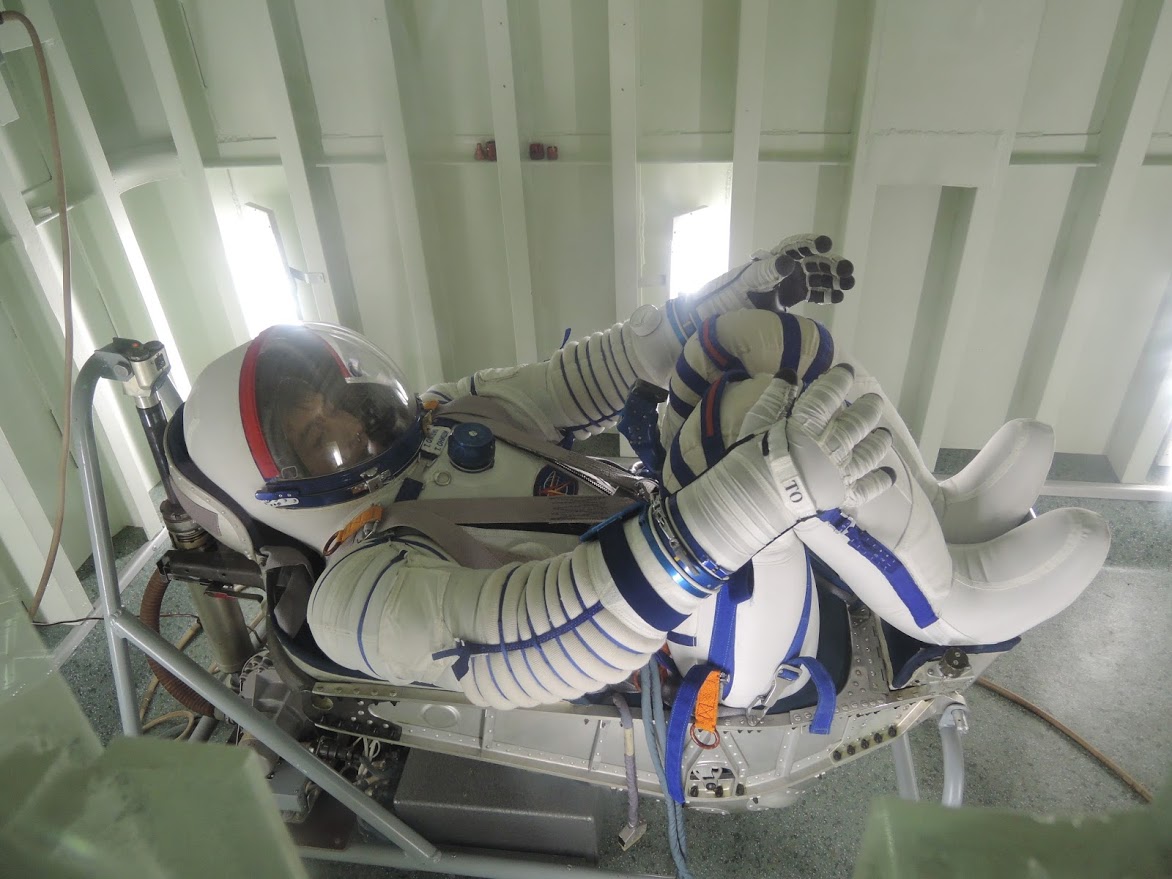
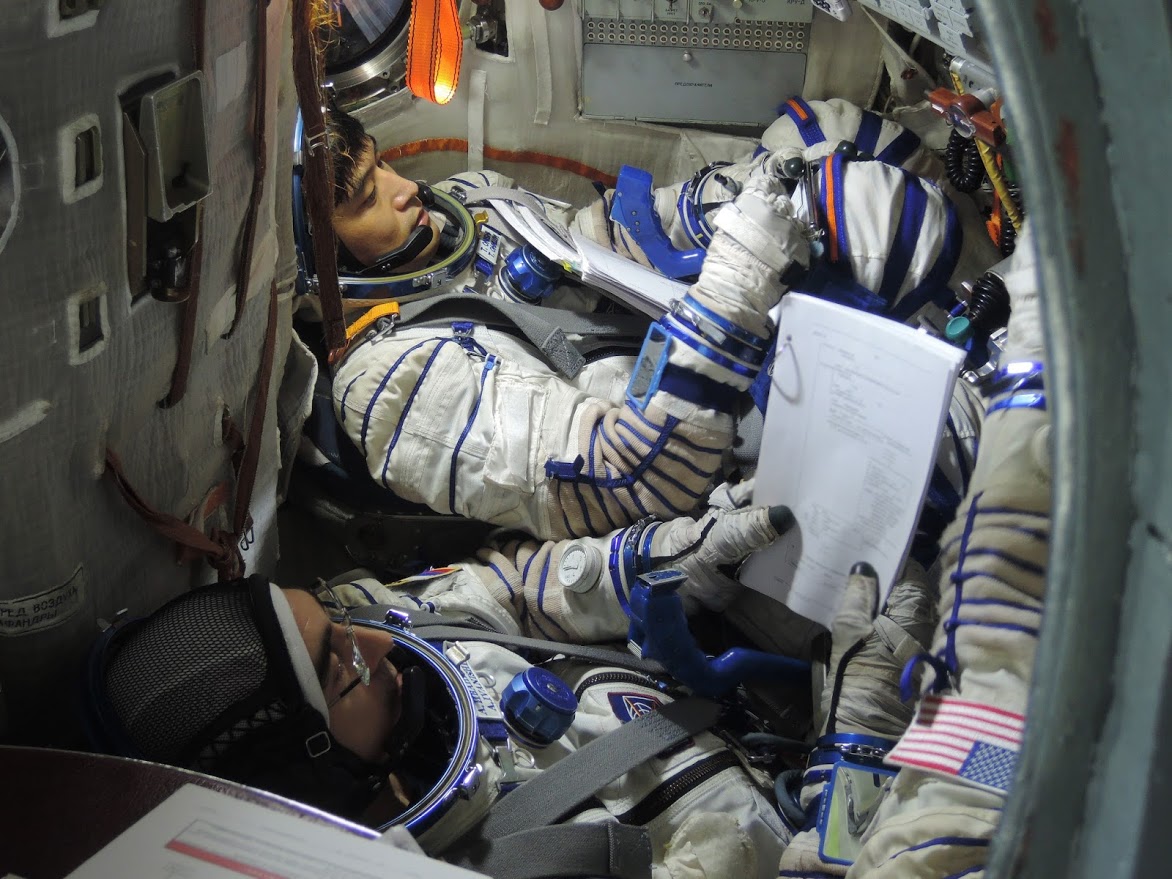
    Astronaut Takuya Onishi, a crew member for the ISS Expedition 48/49 mission, underwent training at Russia’s Gagarin Cosmonaut Training Center (GCTC) in early August, followed in the latter half of the month by training at the NASA Johnson Space Center (JSC).

    In Russia, flight simulation training aboard the Soyuz spacecraft was conducted at the GCTC.

    Click to enlarge

    Part of the simulation training (Photo courtesy of Takuya Onishi)

    By using a simulator, Onishi and his crewmates practiced a series of crew operations from launch to docking with the ISS, and then undocking from the ISS and returning to Earth.

    By repeating simulations, they enhanced their techniques for flying safely while responding to possible anomalies. Using the Soyuz simulator, Onishi practiced how to deal with hardware failure and air leaks, and also performed manual operations.

    At the GCTC, Onishi experienced the hypergravity condition generated by a huge centrifuge accelerator, which he would experience during the launch and descent of the Soyuz spacecraft. Specifically, he experienced acceleration of 4G – 8G and learned the proper respiratory strategy to prevent a loss of consciousness while under the accelerated condition.

    Click to enlarge

    Onishi experiencing the depressurization test in the Sokol spacesuit (Photo courtesy of Takuya Onishi)

    Aside from training, Onishi had an opportunity to visit RSC Energia, the Soyuz spacecraft developer, and was able check out the actual spacecraft he would be aboard. He also visited NPP Zvezda, the manufacturer of Sokol spacesuits, to check the functions of his custom-made spacesuit.

    He also visited a facility equipped with the depressurization function where he practiced opening and closing hatches to identify any air-leaking points in the ISS Russian segment in an actual depressurized environment.

    At the JSC, Onishi underwent training for Extravehicular Activity (EVA) to simulate maintenance operations for exposed equipment installed on the exterior of the ISS. Onishi also trained on how to obtain his own medical data for onboard medical experiments, and practiced hardware operations to be used for experiments.

    Astronaut Norishige Kanai holds a press conference following his assignment to an ISS long-duration mission

    琦慲敤儻真:挦物㭣☰捓牡湯〻大きな琦慲敤儻真へ

    JAXA Astronaut Norishige Kanai (Credit: JAXA)

    On August 26 (Japan time), JAXA announced that they had assigned Astronaut Norishige Kanai as a member of a future ISS long-duration mission.

    Kanai will commence his stay on the ISS for about six months from around November 2017 as a flight engineer of Expedition 54/55.

    Following the assignment, Kanai held a press conference at the JAXA Tokyo Office on August 27.

    During the press conference, Kanai mentioned that new experiments were ongoing on Kibo, such as micro satellite (CubeSat) deployment that had not been intended at Kibo’s development stage. Talking about his enthusiasm for the mission, Kanai said, “I imagine many interesting or breakthrough experiments will be conducted in 2017. I will do my best until then.”

    Astronaut Kimiya Yui receives a VIP call

    Click to enlarge

    Yui and his crewmates speaking with the ground (Credit: JAXA/NASA)

    The venue on the ground (Credit: JAXA)

    The venue on the ground (Credit: JAXA)

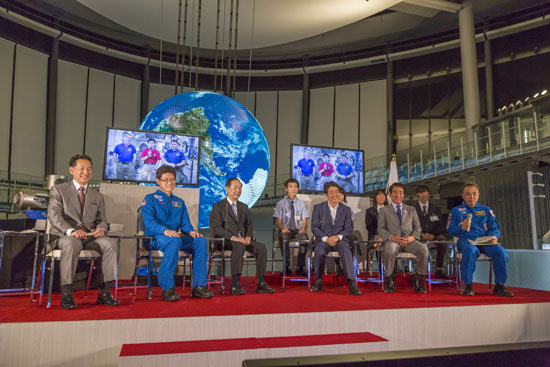
    On the night of August 26 (Japan time), Astronaut Kimiya Yui and NASA Astronauts Scott Kelly and Kjell Lindgren communicated with the ground for 20 minutes, and spoke with Japanese Prime Minister Shinzo Abe in an event called “VIP call.” Abe was joined by Hirofumi Shimomura, Minister of Education, Culture, Sports, Science and Technology (MEXT), Shunichi Yamaguchi, Minister of State for Special Missions, and high school students in Tokyo.
    Astronaut Satoshi Furukawa moderated the communication event. In addition, Mamoru Mohri, a former JAXA astronaut and current director of the National Museum of Emerging Science and Innovation (MeSci), and Astronaut Norishige Kanai also participated in the event.

    Prime Minister Abe congratulated the successful berthing of KOUNOTORI5 and said that he believes that Japanese space technology has become more reliable. And he also believes that many Japanese are proud of the fact that all of the main tasks involved Japanese personnel.

    In reply, Yui thanked Prime Minister Abe saying “Space development is quite difficult, but I’m glad that Japan took an important role and coordinated internationally to achieve success.”

    During the event, Prime Minister Abe announced that Astronaut Kanai had been assigned as a crew member for the ISS Expedition 54/55.

    Kanai stated, “Human space development resembles a road running relay. Astronaut Mohri wore a sash and began running as the first runner. In two years I will wear the sash, which is now worn by Astronaut Yui onboard the ISS. I will do my best so as to pass down it to younger generations.”

    This entry passed through the Full-Text RSS service – if this is your content and you’re reading it on someone else’s site, please read the FAQ at fivefilters.org/content-only/faq.php#publishers.