Category: News

http://www.subtome.com/#/subscribe?feeds=http%3A%2F%2Fftr.fivefilters.org%2Fmakefulltextfeed.php%3Furl%3Dglobal.jaxa.jp%252Frss%252Fnew.rdf%26max%3D3%26links%3Dpreserve&back=http%3A%2F%2Fftr.fivefilters.org%2Fmakefulltextfeed.php%3Furl%3Dglobal.jaxa.jp%252Frss%252Fnew.rdf%26max%3D3%26links%3Dpreserve

  • [Project Topics] Hitomi Experience Report – Handout for the Specialists advisory panel meeting called by MEXT.

    Topics List

    Jun. 10, 2016 Updated
    Hitomi Experience Report – Handout for the Specialists advisory panel meeting called by MEXT.

    Jun. 3, 2016 Updated
    Handout for the Specialists advisory panel meeting called by MEXT (Ministry of Education, Culture, Sports, Science and Technology).

    May 27, 2016 Updated
    Handout for the Specialists advisory panel meeting called by MEXT (Ministry of Education, Culture, Sports, Science and Technology).

    Apr. 28, 2016 Updated
    Operation Plan of ASTRO-H (Hitomi)

    JAXA established the emergency headquarters and has been doing its utmost to understand the anomaly of ASTRO-H (“Hitomi”). We have made every effort to confirm the status of ASTRO-H and to regain its functions. Unfortunately, based on our rigorous technical investigation, we had to conclude.
    On April 28 (JST), JAXA held a press briefing and sent out press releases on ASTRO-H (“Hitomi”).

    JAXA have determined that we cannot restore the ASTRO-H’s functions. Accordingly, JAXA will cease the efforts to restore ASTRO-H and will focus on the investigation of anomaly causes. We will carefully review all phases from design, manufacturing, verification, and operations to identify the causes that may have led to this anomaly including background factors.

    JAXA expresses the deepest regret for the fact that we had to discontinue the operations of ASTRO-H and extends our most sincere apologies to everyone who has supported ASTRO-H believing in the excellent results ASTRO-H would bring, to all overseas and domestic partners including NASA, and to all foreign and Japanese astrophysicists who were planning to use the observational results from ASTRO-H for their studies.

    Apr. 21, 2016 Updated
    Handout of press briefing (April 15)

    Apr. 13, 2016 Updated
    Handout of press briefing (April 8)

    On April 8 (JST), JAXA held a press briefing to explain the status of the X-ray Astronomy Satellite “Hitomi” (ASTRO-H) and our activities to re-establish communications with “Hitomi.”

    Apr. 7, 2016 Updated
    Handout of press briefing (April 1)

    On April 1 (JST), JAXA held a press briefing to explain the status of the X-ray Astronomy Satellite “Hitomi” (ASTRO-H) and our activities to re-establish communications with “Hitomi.”

    Mar. 29, 2016 Updated
    Current Status of Communication Anomaly of X-ray Astronomy Satellite “Hitomi” (ASTRO-H) (Mar. 29)

    JAXA has been trying to communicate with the X-ray Astronomy Satellite “Hitomi” (ASTRO-H), using ground stations both in Japan and overseas.

    By utilizing two opportunities of communicating with Hitomi, JAXA received signals from the satellite: the first time was at about 10:00 p.m. on 28 at the Uchinoura Ground Station, and the second one was at around 0:30 a.m. on 29 at the Santiago Tracking Station in Chile. JAXA has not been able to find the state of its health, as the time frames for receiving the signals were very short.

    According to the U.S. Joint Space Operations Center (JSpOC), it is estimated that Hitomi separated to five pieces at about 10:42 a.m. on 26. In order to investigate the situation, JAXA is observing the objects, using a radar located at the Kamisaibara Space Guard Center (KSGC) and telescopes at the Bisei Space Guard Center (BSGC) owned by the Japan Space Forum. Up to now, the telescopes at BSGC detected two objects around the satellite’s original orbit, while the radar at KSGC identified one of them. It is confirmed that the signal received at the Santiago Tracking Station came from the orbital direction of the object identified at KSGC.

    JAXA continues to investigate the relationship between the information from JSpOC and the communication anomaly.

    JAXA will do its utmost to recover communications with Hitomi and investigate the cause of the anomaly.

    * In the above report, it is written in the third paragraph that “According to the U.S. Joint Space Operations Center (JSpOC), it is estimated that Hitomi separated to five pieces….” JAXA re-confirmed the situation with JSpOC and found that their estimation actually meant, “five objects fell off from the satellite (meaning the satellite is now separated into six parts).”

    Mar. 27, 2016 Updated
    Communication anomaly of X-ray Astronomy Satellite “Hitomi” (ASTRO-H) (Mar. 27)

    JAXA found that communication with the X-ray Astronomy Satellite “Hitomi” (ASTRO-H), launched on February 17, 2016 (JST), failed from the start of its operation originally scheduled at 16:40, Saturday March 26 (JST). Up to now, JAXA has not been able to figure out the state of health of the satellite.

    While the cause of communication anomaly is under investigation, JAXA received short signal from the satellite, and is working for recovery.

    Under this circumstance, JAXA set up emergency headquarters, headed by the President, for recovery and investigation. The headquarters held its first meeting today, and has been working for recovery and the investigation of the cause. Updates will be announced as available, at the JAXA website.

    Feb. 29, 2016 Updated
    Hitomi critical operation phase successfully completed!

    JAXA confirmed the completion of a sequence of important operations of the X-ray Astronomy Satellite “Hitomi” (ASTRO-H), including turning the cooling system on, test operation of the Soft X-ray Spectrometer (SXS), and extending the Extensible Optical Bench (EOB). With this confirmation, the critical operation phase of Hitomi was completed.
    The Hitomi will take about one and half months to verify the function of its onboard equipment and instruments in space, then we will conduct calibration observations for another one and half months.

    Hitomi critical operation phase successfully completed!

    Feb. 17, 2016 Updated
    ASTRO-H successfully launched and named “Hitomi”.

    H-IIA F30 with the “ASTRO-H” onboard launched at 5:45 p.m. on Feb 17, 2016 (JST) from the Tanegashima Space Center. The rocket flew smoothly, and, at about 14 minutes after liftoff, “ASTRO-H” was separated from the H-IIA F30.
    ASTRO-H is the eye to study the hot and energetic universe. Therefore we name ASTRO-H, “Hitomi”. The word “Hitomi”.generally means “eye”, and specifically the pupil, or entrance window of the eye – the aperture!

    ASTRO-H successfully launched and named “Hitomi”.

    Feb. 14, 2016 Updated
    ASTRO-H Launch rescheduled to 5:45 p.m. on Feb 17 (Wed. ,JST)

    The launch of the The X-ray Astronomy Satellite “ASTRO-H” by the H-IIA Launch Vehicle No. 30 was rescheduled at 5:45 p.m. on Feb 17 (Wed. Japan Standard Time, JST) after carefully studying the weather conditions.

    The live launch report will begin at 5:25 p.m. on Feb 17(Wed. ,JST). The report will be broadcast through the Internet.
    Please send your support messages for the mission!

    ASTRO-H Launch rescheduled to 5:45 p.m. on Feb 17 (Wed. ,JST)

    Feb. 12, 2016 Updated
    The X-ray Astronomy Satellite “ASTRO-H” launch postponement

    H-IIA Launch Vehicle No.30 with the X-ray Astronomy Satellite “ASTRO-H” onboard, which was originally scheduled for February 12 (Fri.), 2016 (Japan Standard Time), has been rescheduled because bad weather is expected. The new launch day will be announced as soon as it is determined. Your warm support messages are welcomed at the support site.

    Feb. 3, 2016 Updated
    ASTRO-H Press Kit

    As the launch day approaches, JAXA has released the press kit for the X-ray Astronomy Satellite “ASTRO-H”. It covers ASTRO-H’s satellite and  mission overview, scientific missions, and observation instruments. Please have a look.

    ASTRO-H Press Kit

    Jan. 21, 2016 Updated
    ASTRO-H’s development and preparation status is updated on the ASTRO-H diary site

    Aiming at the launch and success of the mission, for some years the Astro-H team members have been hard at work at research and development, making steady progress. They have faced many tough obstacles along this long road. They have had many moments of success.
    This diary is an introduction to the daily work life — and to the excitements — of these members.

    ASTRO-H's development and preparation status is updated on the ASTRO-H diary site

    Jan. 12, 2016 Updated
    ASTRO-H Satellite Shown to the Public

    On the day marking exactly one month to launch, the ASTRO-H spacecraft was exhibited to the public at the Tanegashima Space Center. Many questions were asked both about the science goals of ASTRO-H and about its engineering.

    ASTRO-H Satellite Shown to the Public

    Dec. 11, 2015 Updated
    X-ray Astronomy Satellite “ASTRO-H” to be launched on Feb. 12

    The new generation X-ray astronomy satellite ASTRO-H is set for launch on February 12 (Fri.), by the H-IIA Launch Vehicle No. 30 from the Tanegashima Space Center.

    JAXA will broadcast a live launch report on the launch day. We will announce more details later. Please look forward to the launch!

    Dec. 2, 2015 Updated
    ASTRO-H press day

    The X-ray Astronomy Satellite “ASTRO-H” was revealed to the media on Nov. 27 at the Tsukuba Space Center.
    The ASTRO-H is an astronomy satellite to elucidate the structure of space and its evolution through studying high-temperature and high-energy celestial bodies, such as black holes, supernova remnants, and galaxy clusters by X-rays and gamma-rays.
    X-rays and gamma-rays from space are absorbed in the Earth’s atmosphere, thus they cannot be observed on the Earth. Therefore observation in space is necessary.
    The ASTRO-H was developed as a successor to the Suzaku, also an X-ray astronomy satellite. The ASTRO-H is a flagship mission of X-ray astronomy with the participation of over 200 researchers in its development from various domestic and international universities and research institutions including JAXA and NASA. Four new observation systems developed based on broad-scale international cooperation are installed on the ASTRO-H, hence, compared to the Suzaku, it will be able to perform spectroscopic observations on celestial bodies 10 times to 100 times darker than what the Suzaku was capable of doing.

    ASTRO-H press day

    Nov. 2, 2015 Updated
    ASTRO-H sinusoidal vibration test

    The sinusoidal vibration test of the X-ray astronomy satellite “ASTRO-H” was held between Aug. 29 and Oct. 2 at the Tsukuba Space Center. The sinusoidal vibration test aims at two major evaluation objectives, namely evaluating dynamic characteristics of a satellite structure and assessing its strength by loading vibrations equivalent to that at the launch.
    On Oct. 2, the last vibration test was completed, then planned dynamic characteristics data was acquired and the strength of the satellite structure against a vibration load equivalent to that at the time of launch was verified.

    ASTRO-H sinusoidal vibration test

    Aug. 3, 2015 Updated
    ASTRO-H thermal vacuum test

    The thermal vacuum test was held for the X-ray Astronomy Satellite “ASTRO-H” between June 24 and July 9 in a 13-meter chamber at the Tsukuba Space Center. The purposes of the thermal vacuum test are to verify the thermal model by exposing a satellite to the vacuum and thermal environment, and to confirm the function and performance of observation instruments in the on-orbit environment through an electric test.
    All tested items were satisfactorily confirmed including the expected performance of the onboard instruments, verification of the command function to be used in orbit, and calibration data acquisition.

    ASTRO-H thermal vacuum test

    Apr. 21, 2015 Updated
    Soft Gamma-ray Detectors (SGDs) installation on ASTRO-H completed

    Two Soft Gamma-ray Detectors (SGDs), which successfully went through the thermal vacuum test and the cooling test, were installed onto the ASTRO-H. The photo shows the SGD2 on the ASTRO-H with a debris cover and a radiator. A golden color MLI (multi-layer insulation) will wrap them so that they will not be seen from outside.
    All the observation instruments are now installed on the ASTRO-H, so its preparations for launch are turning the final corner. We will work harder to overcome the many remaining hurdles including the functional test, thermal vacuum test, and vibration test.

    Soft Gamma-ray Detectors (SGDs) installation on ASTRO-H completed

    Jan. 25, 2015 Updated
    Thermal vacuum test for Soft Gamma-ray Detectors

    The Soft Gamma-ray Detectors (SGD) to observe the soft gamma-ray region of 60 to 600 keV are under the thermal vacuum test in the 8-meter chamber at the Tsukuba Space Center to confirm their thermal design.
    The sensor part of the SGD does not activate till the temperature hits a low temperature of minus 20 degrees (C). However, the SGDs will be installed outside of the satellite panel, thus their temperature will increase from radiation from the Sun and the Earth, thermal input from the satellite panel, and heat from a large amount of LSI (large-scale integrated circuits) and an amplifier if nothing is done. Therefore, the accumulating heat will be carried to the radiator through thermal transfer and a heat pipe to be released, and the SGD will be covered by the multi-layer insulation (MLI), which looks like a bunch of aluminum foils, to shut out heat input. The semiconductor sensor is also activated with high voltage of 200 to 1000 V, hence it should also be tested if it would discharge in vacuum.
    Photo: The SGD-2 sits in the 8-meter chamber.

    Thermal vacuum test for Soft Gamma-ray Detectors

    May 29, 2014 Updated
    First Integration Test for ASTRO-H (for XRT)

    As manufacturing of two Hard X-ray Telescopes (HXTs) and two Soft X-ray Telescopes (SXTs) has been completed and their performance has been confirmed, they are going to be subject to the first integration test. During the test, the telescopes will be mounted on an optical board to make sure that there is no interference with other structures or the satellite bus as well as that no problems arise with operations for controlling the telescope position or angle and operation tools.
    Photo: Satellite surrounded by a scaffold

    First Integration Test for ASTRO-H (for XRT)

    Mar. 26, 2013 Updated
    ASTRO-H development status

    Aug. 10, 2012 Updated
    Satellite development going well: Development test status

    Mar. 15, 2010 Updated
    ASTRO-H passed the basic design review, new logo published

    On May 13 and 14, 2010, the basic design review was held for the ASTRO-H, and the satellite passed the examination. We are moving to the detailed design phase. To celebrate this opportunity, we revised the official logo mark for the ASTRO-H and published it on Feb. 25. The launch of the ASTRO-H is coming closer, and we are working hard for the project to proceed smoothly. Your support will be very much appreciated.

    Oct. 28, 2009 Updated
    SRON-JAXA agreement on Space Science

    On October 28th, 2009, SRON Netherlands Institute for Space Research and JAXA signed a cooperative framework agreement with the aim of promoting joint activities in the field of space science in the presence of Dr. De Heer, the Ambassador Extraordinary and Plenipotentiary of the Kingdome of the Netherlands to Japan, and Dr. Tachikawa, the President of JAXA.
    On the same day, the Implementing Arrangement for collaboration on ASTRO-H (International X-ray astronomy mission) was also concluded. Through ASTRO-H mission, SRON will be in charge of developing an onboard instrument “Soft X-ray Spectrometer (SXS)” and take part in a science team to carry our scientific research.

    SRON-JAXA agreement on Space Science

    Let’s block ads! (Why?)

  • [Project Topics] Atmospheric balloon experiment B16-02 to capture microorganisms in the stratosphere

    Topics List

    Jun. 8, 2016 Updated
    Atmospheric balloon experiment B16-02 to capture microorganisms in the stratosphere

    JAXA released the first atmospheric balloon in Japan Fiscal Year 2016 from the Taiki Aerospace Research Field, which is a base for cooperation between the host town and JAXA, at 3:43 a.m. on June 8 (Wed.), 2016. The purpose of this experiment is to capture microorganisms in the stratosphere. The balloon used this time is a large-size one with a maximum expansion volume of 15,000 cubic meters (33.5 meters in diameter), and it ascended at a speed of 300 meters/minute.
    The balloon entered in a state of horizontal floating at an altitude of 28 km over the Pacific Ocean some 35 km east from the Taiki Aerospace Research Field at one hour and 40 minutes after its release. At 5:50 a.m., the balloon and an instrument to collect microorganisms were detached by a radio command and they landed softly on the ocean about 30 km east from the Taiki Field. They were recovered by a boat at 6:28 a.m.

    * We so far have a few reports about the existence of microorganisms in the upper Earth atmosphere (in the stratosphere and mesosphere) through collecting microorganisms. Understanding the kinds of organisms in the upper atmosphere and clarifying their distribution are very important to learn about the upper end of the Earth’s biosphere. The experiment this time aimed at capturing microorganisms while the instrument to collect them was detached from the balloon and descending by a parachute. After collection, microorganisms and particle specimens in the instrument are to be analyzed.

    Atmospheric balloon experiment B16-02 to capture microorganisms in the stratosphere

    Aug. 24, 2015 Updated
    Atmospheric balloon experiment BS15-07 and completion of the first series of balloon experiments in JFY2015

    JAXA released the balloon “BS15-07” from the Taiki Aerospace Research Field at 5:02 a.m. on Aug. 22 (Sat.), 2015, aiming at verifying onboard instruments and operation of the satellite “EGG”*, which will be deployed from the International Space Station (ISS). The balloon was 11 meters in diameter when it was fully expanded, and it was ascending at a speed of about 380 meters per minute.
    The weather balloon reached an altitude of 31.7 km over the Pacific Ocean at about 55 km east north east from the Taiki Field. The test object was slowly descending by a parachute and splash-landed at 95 km east north east from the Field. With this experiment, we completed the first series of balloon experiments in JFY 2015. We would like to express our profound appreciation to all pertinent parties who have supported the experiments.
    *The experiment this time is part of the development project of the “Membrane Aeroshell for Atmospheric-entry Capsule”, which is expected to be applied for a future Earth re-entry (return) system. The experiment this time is a preliminary-phase test prior to the actual satellite “EGG” (re-Entry satellite with Gossamer aeroshell and GPS/Iridium) under development by a group led by the University of Tokyo. EGG will be deployed from the ISS.

    Atmospheric balloon experiment BS15-07 and completion of the first series of balloon experiments in JFY2015

    Aug. 7, 2015 Updated
    Completion of Atmospheric balloon experiment BS15-03

    JAXA released the balloon “BS15-03” from the Taiki Aerospace Research Field at 4:12 a.m. on Aug. 6 (Thu.), 2015, for the purpose of cryogenic sampling in the atmosphere at the stratosphere. The volume of the balloon when it was fully expanded was 100,000 m3 (with a diameter of 63.4 m), and it was ascending while gathering the atmosphere of the stratosphere.
    The balloon reached an altitude of 34.8 km over the Pacific Ocean at about 50 km east from the Taiki field in three hours, then it was in a state of horizontally floating. At 7:49 a.m., the balloon and observation instrument was detached by a command radio wave to slowly descend to the ocean at about 30 km south east of the field. They were retrieved by a boat before 8:30 a.m.
    *The purpose of this experiment was to gather a large amount of stratospheric atmosphere, which is thin, by solidifying it using a cryogenic method to collect most atmospheric contents via condensation solidification, then to provide the gathered atmosphere for density and isotope ratio measurement of various atmosphere contents including greenhouse gas.
    While the balloon was ascending, horizontally floating and descending slowly, atmosphere was collected for each altitude. The gathered atmosphere will be analyzed in detail using an analyzer at each university.

    Completion of Atmospheric balloon experiment BS15-03

    May 15, 2015 Updated
    Big balloon experiment in Australia

    On May 12, JAXA conducted a big balloon experiment in cooperation with some universities including Kobe University and Nagoya University from the balloon release base of the University of New South Wales, Australia. The experiment aims at elucidating the spatial structure of a celestial body and the gamma-ray emission mechanism by attaining high resolution observations using the emulsion gamma-ray telescope of Kobe and Nagoya Universities.
    The balloon was released at 6:03 a.m. on May 12 (Japan Standard Time), and landed at 8:25 p.m. on the same day.

    Big balloon experiment in Australia

    Sep. 9, 2010 Updated
    Atmospheric balloon experiment BS10-06 completed

    At 5:38 a.m. on September 8, 2010, JAXA released the fourth balloon of the second balloon experiment in Japan Fiscal Year 2010 from the Taiki Aerospace Research Field, the base of the collaborative work. The release experiment, called BS10-06, aimed at testing the high-altitude thin film balloon flight performance and observing the ozone and atmospheric gravitational waves. The balloon that was expanded to its full capacity of 60,000 m3 was made of a thin film for high altitude with a thickness of 3.4 micrometers, and it ascended about 300 meters per minute.
    In this experiment, we achieved the scheduled objectives of flight verification for a thin-film high-altitude balloon using the polyethylene thin film that is wider than conventional films, and the balloon’s tearing mechanism for a thin-film balloon. At the same time, the balloon carried out precise observations on the ozone, wind velocity, temperature and air pressure using two kinds of ozone measurement devices — an optical type and electrochemical type (ECC,) — to observe the ozone’s altitude distribution and atmospheric gravitational waves between the near ground area and the upper stratosphere. Both the high-precision ECC ozonesonde and the precision optical ozonsonde functioned properly at an altitude of less than 30 km and higher than 30 km respectively, and we successfully observed the upper stratospheric regions at an altitude of 46.8 km.
    We were able to acquire enough data to study changes in the ozone and atmospheric gravitational waves over years and places by comparing the data from this experiment with the first data acquisition at the Taiki Aerospace Research Field, and past observation results acquired at the Sanriku Balloon Center.

    Atmospheric balloon experiment BS10-06 completed

    Aug. 30, 2010 Updated
    Atmospheric balloon experiment B10-03 completed

    At 5:41 a.m. on August 27, 2010, JAXA released the second balloon of the second balloon experiment season in JFY 2010 from the Taiki Aerospace Research Field, the base of the collaborative work. The release was part of the B10-03 experiment which aims at flying a bale (or a straw rice bag) shaped balloon. The balloon that was expanded to its full capacity of 5,000 m3 ascended 250 meters per minute.
    The balloon reached an altitude of 25.2 km above the Pacific Ocean about 90 km east-north-east of the Taiki Aerospace Research Field in one hour and 45 minutes after the release, and the pressure inside the balloon, which was fully inflated by then, became higher than the atmospheric pressure. However, the film tore at the lower part of the balloon and the inside pressure was not maintained when the pressure difference between the inside and the outside reached 64 Pa at 7:25 a.m. while the inside pressure was increasing.
    The main purpose of this experiment and research is to develop a bale shaped pressurized balloon whose air resistance is one digit lower than a conventional zero-pressure balloon due to its shape in order to realize the power balloon whose flight trajectory can be controllable at a future altitude of some 35 km. In this experiment, we used a smaller model of 5,000 m3 at full capacity volume, and confirmed the expansion process till full deployment under the stratospheric environment. We have also verified the movement of the balloon rupture mechanism of a pressurized balloon. The balloon film was actually torn at the lower pressure difference than we expected, thus we would like to study the reasons why the internal pressure was not maintained by investigating the pressure difference record and image data of the balloon deployment process, then incorporate the study results into future research and development.

    Aug. 23, 2010 Updated
    Atmospheric balloon release experiment B10-02 completed

    At 5:12 a.m. on August 22, 2010, the B10-02 balloon, which aims to acquire cryogenic samples from the stratospheric atmosphere, was released from the Taiki Aerospace Research Field, the base of the first collaborative work for the second balloon experiment session in JFY 2010. The B10-02 is a large balloon with a full expansion volume of 100,000m3. It was ascending while taking samples from the stratospheric atmosphere.
    The purpose of this experiment is to acquire a large volume of samples by solidifying the stratospheric atmosphere through a cryogenic method using liquid helium. The sample air will be provided to measure the concentration and isotopic ratio of various atmospheric contents including greenhouse effect gases. Acquisition of the stratospheric atmosphere was carried out between 14.6 km and 30.0 km in altitude while the balloon was ascending, during its horizontally floating, and at an altitude between 33.8 km and 28.3 km while descending. We successfully collected 12 sample containers of air in total from different altitudes.
    The samples will be analyzed using cutting-edge analysis devices at participating institutions including Tohoku University, Tokyo Institute of Technology, Miyagi University of Education and the National Institute of Polar Research.
    (Photo: Helium gas is loaded onto the balloon at JAXA’s hangar.)

    Aug. 17, 2009 Updated
    BESS-Polar project receives NASA Group Achievement Award

    The Balloon-borne Experiment with a Superconducting Spectrometer (BESS-Polar) project received the NASA Group Achieving Award. The project aimed at observing cosmic particles using a superconducting spectrometer installed on a balloon that circulated around the Antarctic. The first experiment was carried out in 2004, and a balloon circled above the Antarctic observing cosmic particles and rays. After the first experiment, the observation device was upgraded, and between December 2007 and January 2008, the second experiment was conducted. The balloon launched from the U.S. MacMurdo Base made almost two cycles above the Antarctic taking about 30 days, and observed 4.7 billion cosmic ray phenomena. Among them, the experiment detected over 8,000 phenomena of low-energy cosmic ray antiproton. The award this time was given for the development of the BESS-Polar observation device, which led to the global-leading investigation method of cosmic antimatter, and the successful 30-day balloon project.
    (Photo: The release of the balloon)

    Let’s block ads! (Why?)

  • [Project Topics] Handout for the Specialists advisory panel meeting called by MEXT (Ministry of Education, Culture, Sports, Science and Technology). (May 31, 2016)

    Topics List

    May 31, 2016 Updated
    Handout for the Specialists advisory panel meeting called by MEXT (Ministry of Education, Culture, Sports, Science and Technology).

    May 24, 2016 Updated
    Handout for the Specialists advisory panel meeting called by MEXT (Ministry of Education, Culture, Sports, Science and Technology).

    Apr. 28, 2016 Updated
    Operation Plan of ASTRO-H (Hitomi)

    JAXA established the emergency headquarters and has been doing its utmost to understand the anomaly of ASTRO-H (“Hitomi”). We have made every effort to confirm the status of ASTRO-H and to regain its functions. Unfortunately, based on our rigorous technical investigation, we had to conclude.
    On April 28 (JST), JAXA held a press briefing and sent out press releases on ASTRO-H (“Hitomi”).

    JAXA have determined that we cannot restore the ASTRO-H’s functions. Accordingly, JAXA will cease the efforts to restore ASTRO-H and will focus on the investigation of anomaly causes. We will carefully review all phases from design, manufacturing, verification, and operations to identify the causes that may have led to this anomaly including background factors.

    JAXA expresses the deepest regret for the fact that we had to discontinue the operations of ASTRO-H and extends our most sincere apologies to everyone who has supported ASTRO-H believing in the excellent results ASTRO-H would bring, to all overseas and domestic partners including NASA, and to all foreign and Japanese astrophysicists who were planning to use the observational results from ASTRO-H for their studies.

    Apr. 21, 2016 Updated
    Handout of press briefing (April 15)

    Apr. 13, 2016 Updated
    Handout of press briefing (April 8)

    On April 8 (JST), JAXA held a press briefing to explain the status of the X-ray Astronomy Satellite “Hitomi” (ASTRO-H) and our activities to re-establish communications with “Hitomi.”

    Apr. 7, 2016 Updated
    Handout of press briefing (April 1)

    On April 1 (JST), JAXA held a press briefing to explain the status of the X-ray Astronomy Satellite “Hitomi” (ASTRO-H) and our activities to re-establish communications with “Hitomi.”

    Mar. 29, 2016 Updated
    Current Status of Communication Anomaly of X-ray Astronomy Satellite “Hitomi” (ASTRO-H) (Mar. 29)

    JAXA has been trying to communicate with the X-ray Astronomy Satellite “Hitomi” (ASTRO-H), using ground stations both in Japan and overseas.

    By utilizing two opportunities of communicating with Hitomi, JAXA received signals from the satellite: the first time was at about 10:00 p.m. on 28 at the Uchinoura Ground Station, and the second one was at around 0:30 a.m. on 29 at the Santiago Tracking Station in Chile. JAXA has not been able to find the state of its health, as the time frames for receiving the signals were very short.

    According to the U.S. Joint Space Operations Center (JSpOC), it is estimated that Hitomi separated to five pieces at about 10:42 a.m. on 26. In order to investigate the situation, JAXA is observing the objects, using a radar located at the Kamisaibara Space Guard Center (KSGC) and telescopes at the Bisei Space Guard Center (BSGC) owned by the Japan Space Forum. Up to now, the telescopes at BSGC detected two objects around the satellite’s original orbit, while the radar at KSGC identified one of them. It is confirmed that the signal received at the Santiago Tracking Station came from the orbital direction of the object identified at KSGC.

    JAXA continues to investigate the relationship between the information from JSpOC and the communication anomaly.

    JAXA will do its utmost to recover communications with Hitomi and investigate the cause of the anomaly.

    * In the above report, it is written in the third paragraph that “According to the U.S. Joint Space Operations Center (JSpOC), it is estimated that Hitomi separated to five pieces….” JAXA re-confirmed the situation with JSpOC and found that their estimation actually meant, “five objects fell off from the satellite (meaning the satellite is now separated into six parts).”

    Mar. 27, 2016 Updated
    Communication anomaly of X-ray Astronomy Satellite “Hitomi” (ASTRO-H) (Mar. 27)

    JAXA found that communication with the X-ray Astronomy Satellite “Hitomi” (ASTRO-H), launched on February 17, 2016 (JST), failed from the start of its operation originally scheduled at 16:40, Saturday March 26 (JST). Up to now, JAXA has not been able to figure out the state of health of the satellite.

    While the cause of communication anomaly is under investigation, JAXA received short signal from the satellite, and is working for recovery.

    Under this circumstance, JAXA set up emergency headquarters, headed by the President, for recovery and investigation. The headquarters held its first meeting today, and has been working for recovery and the investigation of the cause. Updates will be announced as available, at the JAXA website.

    Feb. 29, 2016 Updated
    Hitomi critical operation phase successfully completed!

    JAXA confirmed the completion of a sequence of important operations of the X-ray Astronomy Satellite “Hitomi” (ASTRO-H), including turning the cooling system on, test operation of the Soft X-ray Spectrometer (SXS), and extending the Extensible Optical Bench (EOB). With this confirmation, the critical operation phase of Hitomi was completed.
    The Hitomi will take about one and half months to verify the function of its onboard equipment and instruments in space, then we will conduct calibration observations for another one and half months.

    Hitomi critical operation phase successfully completed!

    Feb. 17, 2016 Updated
    ASTRO-H successfully launched and named “Hitomi”.

    H-IIA F30 with the “ASTRO-H” onboard launched at 5:45 p.m. on Feb 17, 2016 (JST) from the Tanegashima Space Center. The rocket flew smoothly, and, at about 14 minutes after liftoff, “ASTRO-H” was separated from the H-IIA F30.
    ASTRO-H is the eye to study the hot and energetic universe. Therefore we name ASTRO-H, “Hitomi”. The word “Hitomi”.generally means “eye”, and specifically the pupil, or entrance window of the eye – the aperture!

    ASTRO-H successfully launched and named “Hitomi”.

    Feb. 14, 2016 Updated
    ASTRO-H Launch rescheduled to 5:45 p.m. on Feb 17 (Wed. ,JST)

    The launch of the The X-ray Astronomy Satellite “ASTRO-H” by the H-IIA Launch Vehicle No. 30 was rescheduled at 5:45 p.m. on Feb 17 (Wed. Japan Standard Time, JST) after carefully studying the weather conditions.

    The live launch report will begin at 5:25 p.m. on Feb 17(Wed. ,JST). The report will be broadcast through the Internet.
    Please send your support messages for the mission!

    ASTRO-H Launch rescheduled to 5:45 p.m. on Feb 17 (Wed. ,JST)

    Feb. 12, 2016 Updated
    The X-ray Astronomy Satellite “ASTRO-H” launch postponement

    H-IIA Launch Vehicle No.30 with the X-ray Astronomy Satellite “ASTRO-H” onboard, which was originally scheduled for February 12 (Fri.), 2016 (Japan Standard Time), has been rescheduled because bad weather is expected. The new launch day will be announced as soon as it is determined. Your warm support messages are welcomed at the support site.

    Feb. 3, 2016 Updated
    ASTRO-H Press Kit

    As the launch day approaches, JAXA has released the press kit for the X-ray Astronomy Satellite “ASTRO-H”. It covers ASTRO-H’s satellite and  mission overview, scientific missions, and observation instruments. Please have a look.

    ASTRO-H Press Kit

    Jan. 21, 2016 Updated
    ASTRO-H’s development and preparation status is updated on the ASTRO-H diary site

    Aiming at the launch and success of the mission, for some years the Astro-H team members have been hard at work at research and development, making steady progress. They have faced many tough obstacles along this long road. They have had many moments of success.
    This diary is an introduction to the daily work life — and to the excitements — of these members.

    ASTRO-H's development and preparation status is updated on the ASTRO-H diary site

    Jan. 12, 2016 Updated
    ASTRO-H Satellite Shown to the Public

    On the day marking exactly one month to launch, the ASTRO-H spacecraft was exhibited to the public at the Tanegashima Space Center. Many questions were asked both about the science goals of ASTRO-H and about its engineering.

    ASTRO-H Satellite Shown to the Public

    Dec. 11, 2015 Updated
    X-ray Astronomy Satellite “ASTRO-H” to be launched on Feb. 12

    The new generation X-ray astronomy satellite ASTRO-H is set for launch on February 12 (Fri.), by the H-IIA Launch Vehicle No. 30 from the Tanegashima Space Center.

    JAXA will broadcast a live launch report on the launch day. We will announce more details later. Please look forward to the launch!

    Dec. 2, 2015 Updated
    ASTRO-H press day

    The X-ray Astronomy Satellite “ASTRO-H” was revealed to the media on Nov. 27 at the Tsukuba Space Center.
    The ASTRO-H is an astronomy satellite to elucidate the structure of space and its evolution through studying high-temperature and high-energy celestial bodies, such as black holes, supernova remnants, and galaxy clusters by X-rays and gamma-rays.
    X-rays and gamma-rays from space are absorbed in the Earth’s atmosphere, thus they cannot be observed on the Earth. Therefore observation in space is necessary.
    The ASTRO-H was developed as a successor to the Suzaku, also an X-ray astronomy satellite. The ASTRO-H is a flagship mission of X-ray astronomy with the participation of over 200 researchers in its development from various domestic and international universities and research institutions including JAXA and NASA. Four new observation systems developed based on broad-scale international cooperation are installed on the ASTRO-H, hence, compared to the Suzaku, it will be able to perform spectroscopic observations on celestial bodies 10 times to 100 times darker than what the Suzaku was capable of doing.

    ASTRO-H press day

    Nov. 2, 2015 Updated
    ASTRO-H sinusoidal vibration test

    The sinusoidal vibration test of the X-ray astronomy satellite “ASTRO-H” was held between Aug. 29 and Oct. 2 at the Tsukuba Space Center. The sinusoidal vibration test aims at two major evaluation objectives, namely evaluating dynamic characteristics of a satellite structure and assessing its strength by loading vibrations equivalent to that at the launch.
    On Oct. 2, the last vibration test was completed, then planned dynamic characteristics data was acquired and the strength of the satellite structure against a vibration load equivalent to that at the time of launch was verified.

    ASTRO-H sinusoidal vibration test

    Aug. 3, 2015 Updated
    ASTRO-H thermal vacuum test

    The thermal vacuum test was held for the X-ray Astronomy Satellite “ASTRO-H” between June 24 and July 9 in a 13-meter chamber at the Tsukuba Space Center. The purposes of the thermal vacuum test are to verify the thermal model by exposing a satellite to the vacuum and thermal environment, and to confirm the function and performance of observation instruments in the on-orbit environment through an electric test.
    All tested items were satisfactorily confirmed including the expected performance of the onboard instruments, verification of the command function to be used in orbit, and calibration data acquisition.

    ASTRO-H thermal vacuum test

    Apr. 21, 2015 Updated
    Soft Gamma-ray Detectors (SGDs) installation on ASTRO-H completed

    Two Soft Gamma-ray Detectors (SGDs), which successfully went through the thermal vacuum test and the cooling test, were installed onto the ASTRO-H. The photo shows the SGD2 on the ASTRO-H with a debris cover and a radiator. A golden color MLI (multi-layer insulation) will wrap them so that they will not be seen from outside.
    All the observation instruments are now installed on the ASTRO-H, so its preparations for launch are turning the final corner. We will work harder to overcome the many remaining hurdles including the functional test, thermal vacuum test, and vibration test.

    Soft Gamma-ray Detectors (SGDs) installation on ASTRO-H completed

    Jan. 25, 2015 Updated
    Thermal vacuum test for Soft Gamma-ray Detectors

    The Soft Gamma-ray Detectors (SGD) to observe the soft gamma-ray region of 60 to 600 keV are under the thermal vacuum test in the 8-meter chamber at the Tsukuba Space Center to confirm their thermal design.
    The sensor part of the SGD does not activate till the temperature hits a low temperature of minus 20 degrees (C). However, the SGDs will be installed outside of the satellite panel, thus their temperature will increase from radiation from the Sun and the Earth, thermal input from the satellite panel, and heat from a large amount of LSI (large-scale integrated circuits) and an amplifier if nothing is done. Therefore, the accumulating heat will be carried to the radiator through thermal transfer and a heat pipe to be released, and the SGD will be covered by the multi-layer insulation (MLI), which looks like a bunch of aluminum foils, to shut out heat input. The semiconductor sensor is also activated with high voltage of 200 to 1000 V, hence it should also be tested if it would discharge in vacuum.
    Photo: The SGD-2 sits in the 8-meter chamber.

    Thermal vacuum test for Soft Gamma-ray Detectors

    May 29, 2014 Updated
    First Integration Test for ASTRO-H (for XRT)

    As manufacturing of two Hard X-ray Telescopes (HXTs) and two Soft X-ray Telescopes (SXTs) has been completed and their performance has been confirmed, they are going to be subject to the first integration test. During the test, the telescopes will be mounted on an optical board to make sure that there is no interference with other structures or the satellite bus as well as that no problems arise with operations for controlling the telescope position or angle and operation tools.
    Photo: Satellite surrounded by a scaffold

    First Integration Test for ASTRO-H (for XRT)

    Mar. 26, 2013 Updated
    ASTRO-H development status

    Aug. 10, 2012 Updated
    Satellite development going well: Development test status

    Mar. 15, 2010 Updated
    ASTRO-H passed the basic design review, new logo published

    On May 13 and 14, 2010, the basic design review was held for the ASTRO-H, and the satellite passed the examination. We are moving to the detailed design phase. To celebrate this opportunity, we revised the official logo mark for the ASTRO-H and published it on Feb. 25. The launch of the ASTRO-H is coming closer, and we are working hard for the project to proceed smoothly. Your support will be very much appreciated.

    Oct. 28, 2009 Updated
    SRON-JAXA agreement on Space Science

    On October 28th, 2009, SRON Netherlands Institute for Space Research and JAXA signed a cooperative framework agreement with the aim of promoting joint activities in the field of space science in the presence of Dr. De Heer, the Ambassador Extraordinary and Plenipotentiary of the Kingdome of the Netherlands to Japan, and Dr. Tachikawa, the President of JAXA.
    On the same day, the Implementing Arrangement for collaboration on ASTRO-H (International X-ray astronomy mission) was also concluded. Through ASTRO-H mission, SRON will be in charge of developing an onboard instrument “Soft X-ray Spectrometer (SXS)” and take part in a science team to carry our scientific research.

    SRON-JAXA agreement on Space Science

    Let’s block ads! (Why?)

  • [Project Topics] Handout for the Specialists advisory panel meeting called by MEXT (Ministry of Education, Culture, Sports, Science and Technology).

    Topics List

    May 24, 2016 Updated
    Handout for the Specialists advisory panel meeting called by MEXT (Ministry of Education, Culture, Sports, Science and Technology).

    Apr. 28, 2016 Updated
    Operation Plan of ASTRO-H (Hitomi)

    JAXA established the emergency headquarters and has been doing its utmost to understand the anomaly of ASTRO-H (“Hitomi”). We have made every effort to confirm the status of ASTRO-H and to regain its functions. Unfortunately, based on our rigorous technical investigation, we had to conclude.
    On April 28 (JST), JAXA held a press briefing and sent out press releases on ASTRO-H (“Hitomi”).

    JAXA have determined that we cannot restore the ASTRO-H’s functions. Accordingly, JAXA will cease the efforts to restore ASTRO-H and will focus on the investigation of anomaly causes. We will carefully review all phases from design, manufacturing, verification, and operations to identify the causes that may have led to this anomaly including background factors.

    JAXA expresses the deepest regret for the fact that we had to discontinue the operations of ASTRO-H and extends our most sincere apologies to everyone who has supported ASTRO-H believing in the excellent results ASTRO-H would bring, to all overseas and domestic partners including NASA, and to all foreign and Japanese astrophysicists who were planning to use the observational results from ASTRO-H for their studies.

    Apr. 21, 2016 Updated
    Handout of press briefing (April 15)

    Apr. 13, 2016 Updated
    Handout of press briefing (April 8)

    On April 8 (JST), JAXA held a press briefing to explain the status of the X-ray Astronomy Satellite “Hitomi” (ASTRO-H) and our activities to re-establish communications with “Hitomi.”

    Apr. 7, 2016 Updated
    Handout of press briefing (April 1)

    On April 1 (JST), JAXA held a press briefing to explain the status of the X-ray Astronomy Satellite “Hitomi” (ASTRO-H) and our activities to re-establish communications with “Hitomi.”

    Mar. 29, 2016 Updated
    Current Status of Communication Anomaly of X-ray Astronomy Satellite “Hitomi” (ASTRO-H) (Mar. 29)

    JAXA has been trying to communicate with the X-ray Astronomy Satellite “Hitomi” (ASTRO-H), using ground stations both in Japan and overseas.

    By utilizing two opportunities of communicating with Hitomi, JAXA received signals from the satellite: the first time was at about 10:00 p.m. on 28 at the Uchinoura Ground Station, and the second one was at around 0:30 a.m. on 29 at the Santiago Tracking Station in Chile. JAXA has not been able to find the state of its health, as the time frames for receiving the signals were very short.

    According to the U.S. Joint Space Operations Center (JSpOC), it is estimated that Hitomi separated to five pieces at about 10:42 a.m. on 26. In order to investigate the situation, JAXA is observing the objects, using a radar located at the Kamisaibara Space Guard Center (KSGC) and telescopes at the Bisei Space Guard Center (BSGC) owned by the Japan Space Forum. Up to now, the telescopes at BSGC detected two objects around the satellite’s original orbit, while the radar at KSGC identified one of them. It is confirmed that the signal received at the Santiago Tracking Station came from the orbital direction of the object identified at KSGC.

    JAXA continues to investigate the relationship between the information from JSpOC and the communication anomaly.

    JAXA will do its utmost to recover communications with Hitomi and investigate the cause of the anomaly.

    * In the above report, it is written in the third paragraph that “According to the U.S. Joint Space Operations Center (JSpOC), it is estimated that Hitomi separated to five pieces….” JAXA re-confirmed the situation with JSpOC and found that their estimation actually meant, “five objects fell off from the satellite (meaning the satellite is now separated into six parts).”

    Mar. 27, 2016 Updated
    Communication anomaly of X-ray Astronomy Satellite “Hitomi” (ASTRO-H) (Mar. 27)

    JAXA found that communication with the X-ray Astronomy Satellite “Hitomi” (ASTRO-H), launched on February 17, 2016 (JST), failed from the start of its operation originally scheduled at 16:40, Saturday March 26 (JST). Up to now, JAXA has not been able to figure out the state of health of the satellite.

    While the cause of communication anomaly is under investigation, JAXA received short signal from the satellite, and is working for recovery.

    Under this circumstance, JAXA set up emergency headquarters, headed by the President, for recovery and investigation. The headquarters held its first meeting today, and has been working for recovery and the investigation of the cause. Updates will be announced as available, at the JAXA website.

    Feb. 29, 2016 Updated
    Hitomi critical operation phase successfully completed!

    JAXA confirmed the completion of a sequence of important operations of the X-ray Astronomy Satellite “Hitomi” (ASTRO-H), including turning the cooling system on, test operation of the Soft X-ray Spectrometer (SXS), and extending the Extensible Optical Bench (EOB). With this confirmation, the critical operation phase of Hitomi was completed.
    The Hitomi will take about one and half months to verify the function of its onboard equipment and instruments in space, then we will conduct calibration observations for another one and half months.

    Hitomi critical operation phase successfully completed!

    Feb. 17, 2016 Updated
    ASTRO-H successfully launched and named “Hitomi”.

    H-IIA F30 with the “ASTRO-H” onboard launched at 5:45 p.m. on Feb 17, 2016 (JST) from the Tanegashima Space Center. The rocket flew smoothly, and, at about 14 minutes after liftoff, “ASTRO-H” was separated from the H-IIA F30.
    ASTRO-H is the eye to study the hot and energetic universe. Therefore we name ASTRO-H, “Hitomi”. The word “Hitomi”.generally means “eye”, and specifically the pupil, or entrance window of the eye – the aperture!

    ASTRO-H successfully launched and named “Hitomi”.

    Feb. 14, 2016 Updated
    ASTRO-H Launch rescheduled to 5:45 p.m. on Feb 17 (Wed. ,JST)

    The launch of the The X-ray Astronomy Satellite “ASTRO-H” by the H-IIA Launch Vehicle No. 30 was rescheduled at 5:45 p.m. on Feb 17 (Wed. Japan Standard Time, JST) after carefully studying the weather conditions.

    The live launch report will begin at 5:25 p.m. on Feb 17(Wed. ,JST). The report will be broadcast through the Internet.
    Please send your support messages for the mission!

    ASTRO-H Launch rescheduled to 5:45 p.m. on Feb 17 (Wed. ,JST)

    Feb. 12, 2016 Updated
    The X-ray Astronomy Satellite “ASTRO-H” launch postponement

    H-IIA Launch Vehicle No.30 with the X-ray Astronomy Satellite “ASTRO-H” onboard, which was originally scheduled for February 12 (Fri.), 2016 (Japan Standard Time), has been rescheduled because bad weather is expected. The new launch day will be announced as soon as it is determined. Your warm support messages are welcomed at the support site.

    Feb. 3, 2016 Updated
    ASTRO-H Press Kit

    As the launch day approaches, JAXA has released the press kit for the X-ray Astronomy Satellite “ASTRO-H”. It covers ASTRO-H’s satellite and  mission overview, scientific missions, and observation instruments. Please have a look.

    ASTRO-H Press Kit

    Jan. 21, 2016 Updated
    ASTRO-H’s development and preparation status is updated on the ASTRO-H diary site

    Aiming at the launch and success of the mission, for some years the Astro-H team members have been hard at work at research and development, making steady progress. They have faced many tough obstacles along this long road. They have had many moments of success.
    This diary is an introduction to the daily work life — and to the excitements — of these members.

    ASTRO-H's development and preparation status is updated on the ASTRO-H diary site

    Jan. 12, 2016 Updated
    ASTRO-H Satellite Shown to the Public

    On the day marking exactly one month to launch, the ASTRO-H spacecraft was exhibited to the public at the Tanegashima Space Center. Many questions were asked both about the science goals of ASTRO-H and about its engineering.

    ASTRO-H Satellite Shown to the Public

    Dec. 11, 2015 Updated
    X-ray Astronomy Satellite “ASTRO-H” to be launched on Feb. 12

    The new generation X-ray astronomy satellite ASTRO-H is set for launch on February 12 (Fri.), by the H-IIA Launch Vehicle No. 30 from the Tanegashima Space Center.

    JAXA will broadcast a live launch report on the launch day. We will announce more details later. Please look forward to the launch!

    Dec. 2, 2015 Updated
    ASTRO-H press day

    The X-ray Astronomy Satellite “ASTRO-H” was revealed to the media on Nov. 27 at the Tsukuba Space Center.
    The ASTRO-H is an astronomy satellite to elucidate the structure of space and its evolution through studying high-temperature and high-energy celestial bodies, such as black holes, supernova remnants, and galaxy clusters by X-rays and gamma-rays.
    X-rays and gamma-rays from space are absorbed in the Earth’s atmosphere, thus they cannot be observed on the Earth. Therefore observation in space is necessary.
    The ASTRO-H was developed as a successor to the Suzaku, also an X-ray astronomy satellite. The ASTRO-H is a flagship mission of X-ray astronomy with the participation of over 200 researchers in its development from various domestic and international universities and research institutions including JAXA and NASA. Four new observation systems developed based on broad-scale international cooperation are installed on the ASTRO-H, hence, compared to the Suzaku, it will be able to perform spectroscopic observations on celestial bodies 10 times to 100 times darker than what the Suzaku was capable of doing.

    ASTRO-H press day

    Nov. 2, 2015 Updated
    ASTRO-H sinusoidal vibration test

    The sinusoidal vibration test of the X-ray astronomy satellite “ASTRO-H” was held between Aug. 29 and Oct. 2 at the Tsukuba Space Center. The sinusoidal vibration test aims at two major evaluation objectives, namely evaluating dynamic characteristics of a satellite structure and assessing its strength by loading vibrations equivalent to that at the launch.
    On Oct. 2, the last vibration test was completed, then planned dynamic characteristics data was acquired and the strength of the satellite structure against a vibration load equivalent to that at the time of launch was verified.

    ASTRO-H sinusoidal vibration test

    Aug. 3, 2015 Updated
    ASTRO-H thermal vacuum test

    The thermal vacuum test was held for the X-ray Astronomy Satellite “ASTRO-H” between June 24 and July 9 in a 13-meter chamber at the Tsukuba Space Center. The purposes of the thermal vacuum test are to verify the thermal model by exposing a satellite to the vacuum and thermal environment, and to confirm the function and performance of observation instruments in the on-orbit environment through an electric test.
    All tested items were satisfactorily confirmed including the expected performance of the onboard instruments, verification of the command function to be used in orbit, and calibration data acquisition.

    ASTRO-H thermal vacuum test

    Apr. 21, 2015 Updated
    Soft Gamma-ray Detectors (SGDs) installation on ASTRO-H completed

    Two Soft Gamma-ray Detectors (SGDs), which successfully went through the thermal vacuum test and the cooling test, were installed onto the ASTRO-H. The photo shows the SGD2 on the ASTRO-H with a debris cover and a radiator. A golden color MLI (multi-layer insulation) will wrap them so that they will not be seen from outside.
    All the observation instruments are now installed on the ASTRO-H, so its preparations for launch are turning the final corner. We will work harder to overcome the many remaining hurdles including the functional test, thermal vacuum test, and vibration test.

    Soft Gamma-ray Detectors (SGDs) installation on ASTRO-H completed

    Jan. 25, 2015 Updated
    Thermal vacuum test for Soft Gamma-ray Detectors

    The Soft Gamma-ray Detectors (SGD) to observe the soft gamma-ray region of 60 to 600 keV are under the thermal vacuum test in the 8-meter chamber at the Tsukuba Space Center to confirm their thermal design.
    The sensor part of the SGD does not activate till the temperature hits a low temperature of minus 20 degrees (C). However, the SGDs will be installed outside of the satellite panel, thus their temperature will increase from radiation from the Sun and the Earth, thermal input from the satellite panel, and heat from a large amount of LSI (large-scale integrated circuits) and an amplifier if nothing is done. Therefore, the accumulating heat will be carried to the radiator through thermal transfer and a heat pipe to be released, and the SGD will be covered by the multi-layer insulation (MLI), which looks like a bunch of aluminum foils, to shut out heat input. The semiconductor sensor is also activated with high voltage of 200 to 1000 V, hence it should also be tested if it would discharge in vacuum.
    Photo: The SGD-2 sits in the 8-meter chamber.

    Thermal vacuum test for Soft Gamma-ray Detectors

    May 29, 2014 Updated
    First Integration Test for ASTRO-H (for XRT)

    As manufacturing of two Hard X-ray Telescopes (HXTs) and two Soft X-ray Telescopes (SXTs) has been completed and their performance has been confirmed, they are going to be subject to the first integration test. During the test, the telescopes will be mounted on an optical board to make sure that there is no interference with other structures or the satellite bus as well as that no problems arise with operations for controlling the telescope position or angle and operation tools.
    Photo: Satellite surrounded by a scaffold

    First Integration Test for ASTRO-H (for XRT)

    Mar. 26, 2013 Updated
    ASTRO-H development status

    Aug. 10, 2012 Updated
    Satellite development going well: Development test status

    Mar. 15, 2010 Updated
    ASTRO-H passed the basic design review, new logo published

    On May 13 and 14, 2010, the basic design review was held for the ASTRO-H, and the satellite passed the examination. We are moving to the detailed design phase. To celebrate this opportunity, we revised the official logo mark for the ASTRO-H and published it on Feb. 25. The launch of the ASTRO-H is coming closer, and we are working hard for the project to proceed smoothly. Your support will be very much appreciated.

    Oct. 28, 2009 Updated
    SRON-JAXA agreement on Space Science

    On October 28th, 2009, SRON Netherlands Institute for Space Research and JAXA signed a cooperative framework agreement with the aim of promoting joint activities in the field of space science in the presence of Dr. De Heer, the Ambassador Extraordinary and Plenipotentiary of the Kingdome of the Netherlands to Japan, and Dr. Tachikawa, the President of JAXA.
    On the same day, the Implementing Arrangement for collaboration on ASTRO-H (International X-ray astronomy mission) was also concluded. Through ASTRO-H mission, SRON will be in charge of developing an onboard instrument “Soft X-ray Spectrometer (SXS)” and take part in a science team to carry our scientific research.

    SRON-JAXA agreement on Space Science

    Let’s block ads! (Why?)

  • [JAXA President Monthly Press Conference] JAXA President Monthly Regular Press Conference May 2016

    JAXA President Monthly Regular Press Conference

    Date and time: From 11:00 – 11:40 a.m. on May 12 (Thu), 2016
    Venue: JAXA Tokyo Office Presentation Room (B1 floor)
    MC: Yoshikazu Shoji, JAXA Public Affairs Department Director

    X-ray Astronomy Satellite “Hitomi” (ASTRO-H)

    Concerning the X-ray Astronomy Satellite “Hitomi,” we previously held a press conference on April 28. As we told you at that opportunity, we decided to give up the operation because the possibility of its recovery is extremely slim. As JAXA president, I am very sorry about such a serious situation.
    We have been explaining this situation based on three factors that brought about this incident. We will further analyze those factors in relation to technical issues in each phase, including the design phase, manufacture, demonstration, and operation, to clarify the cause. We will also ask for cooperation from private companies that were in charge of design and operation, and continue to specify the reasons behind the incident.
    We will report the investigation result including background causes to a committee for space development and application at the Ministry of Education, Culture, Sports, Science and Technology (MEXT).
    While studying the cause, I also gave instructions to reconfirm if this incident may have any impact on other JAXA projects, especially in view of system quality and reliability, within the scope of our findings to date. If we find any impact, we may have to take new measures. Again, I feel very sorry for gravely disappointing many Japanese people, overseas research institutions who have cooperated, and astronomers in the world.

    JAXA activity for the 2016 Kumamoto Earthquake

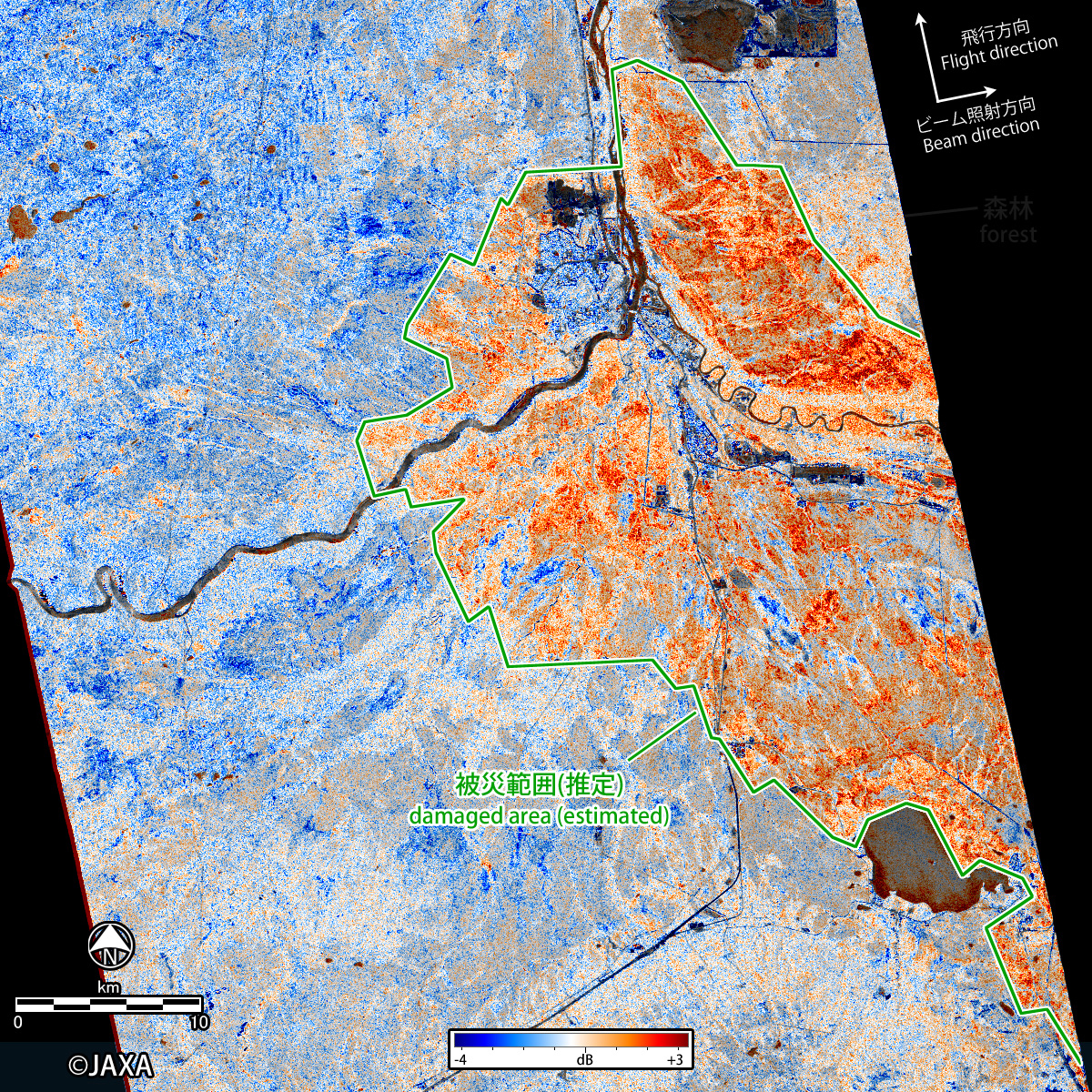
    First of all, I would like to express my deep sympathy for the victims of the 2016 Kumamoto Earthquake, which caused significant damage on April 14.While the central, municipal, and local governments are working together for early recovery, JAXA renders its utmost support by utilizing its ability in cooperation with disaster-prevention agencies. We are mobilizing our satellites and aeronautic technologies. JAXA performed emergency observations on the damaged area immediately after the earthquake till April 19 using the Advanced Land Observing Satellite-2 “DAICHI-2” to contribute to disaster prevention in cooperation with other agencies. As I have already introduced to you before, we have a method called the “interference analysis” to observe uplifts in land using the DAICHI-2. We lately experienced natural disasters such as volcanic activities and earthquakes in many places, hence we decided to ask a specialist to come to JAXA from the Geospatial Information Authority of Japan (GSI) in April to work together to strengthen our disaster-preparation/prevention activities.
    Regarding satellites monitoring the Earth’s environment, as discussed in the draft of the “Comprehensive Strategy on Science, Technology and Innovation 2016,” I heard that discussion is going on to steadily develop such satellites to secure sustainable observations of the Earth’s environment. To respond to such a discussion, JAXA continues to work hard by setting up and coordinating a steady organization and enhancing operations.
    I would also like to introduce some aeronautical technology used for helping stricken areas due to the 2016 Kumamoto Earthquake. The Disaster Relief Aircraft Information Sharing Network (D-NET) was mobilized in the quake-hit areas by dispatching JAXA employees according to a request from the Ministry of Internal Affairs and Communications. In the latest D-NET case, some helicopters were not equipped with a system that could be controlled while flying. We brought a special system to install it onto such a helicopter so that we were able to construct a centralized operation and control mechanism involving all helicopters through D-NET. Another activity in the stricken area is the Disaster Medical Assistance Team (DMAT). DMAT’s doctor helicopters are usually operated outside of the framework of the D-NET, but in Kumamoto this time, we were able to achieve a collaborative system between DMAT doctor helicopters and D-NET for the first time based on cooperation among pertinent organizations. We have received positive reactions from doctors in emergency medicine that their practice became more efficient. We would like to contribute to disaster preparation and prevention through our space and aviation technologies.

    Press day to show new batteries to be transported by KOUNOTORI6

    We are preparing to launch KOUNOTORI6 within this fiscal year. One of the important cargos to be loaded onto KOUNOTORI6 is the new batteries for the International Space Station (ISS). The batteries for the overall operation on the ISS have been scheduled to be replaced, and NASA decided to buy Japanese lithium-ion batteries manufactured by GS Yuasa International Ltd. Transporting them is one of the important missions for KOUNOTORI6. I heard that the batteries currently used are Nickel-metal hydride batteries, which have been in use for 10 years after their installation in 2007, hence they have deteriorated. For their replacement, this is the first time for Japanese lithium-ion batteries to be chosen for a common power source for the ISS, and KOUNOTORI was selected as their transportation means. This is not a one-time operation. We will ship six batteries on one KOUNOTORI trip, and will make four shipments to bring 24 batteries in total. After four KOUNOTORI trips, Japanese batteries manufactured by GS Yuasa will be used as the ISS power source. We plan to pack those batteries at the Tanegashima Space Center (TNSC) onto KOUNOTORI6, so we hope to show them to the press there prior to their loading. We will inform you of the press day schedule as soon as it is decided.

    United Arab Emirates Space Agency (UAESA)

    As JAXA signed a cooperation agreement with the United Arab Emirates Space Agency (UAESA) on March 22, UAESA Chairman Romaithi and Director General Ahbabi visited Japan this week for the first time after the signing, and I had an opportunity to talk to them yesterday.
    The major purpose of their visit was to discuss and arrange more specific issues based on the agreement while showing them JAXA’s capability in Tsukuba. They commented that JAXA is their very important partner in many senses including strategically, thus we hope to respond to their expectations by making our best effort.

    Astronaut Onishi

    Astronaut Onishi, who is scheduled to go to space in late June, moved to Russia and is now under final training. He will hold a press conference at the Gagarin Cosmonauts Training Center (GCTC) in late May. JAXA has scheduled to have the mission explanation session for Astronaut Onishi’s expedition in late May. We will inform you of the schedule later.

    Let’s block ads! (Why?)

  • [Project Topics] A movie of the Venus' night-side produced by IR2

    Topics List

    May 23, 2016 Updated
    A movie of the Venus’ night-side produced by IR2

    This movie is produced from the IR2 2.26-μm images, acquired on 29 March 2016 at a distance of 0.36 million km. Original 4 images were acquired with 4-hour intervals from 16:03 JST (07:03 UT).

    In 4 hours, the super-rotating clouds move by ~10 degrees. Such images are numerically derotated to produce intermediate images so that the resultant motion becomes smoother. Deformation, appearance and disapperance of clouds are obvious in this movie. As the mission enters the “nominal” observing phase, we plan to shorten the intervals to 2 hours or even shorter so the high-definition movies will definitely help understanding of the Venus atmosphere.

    A movie of the Venus' night-side produced by IR2

    Apr. 28, 2016 Updated
    AKATSUKI onboard instruments to move to regular operation

    JAXA decided to shift the operation mode of the five onboard instruments of AKATSUKI to the regular operation mode, namely 1μm camera (IR1), 2μm camera (IR2), Longwave IR camera (LIR), Ultraviolet image (UVI), and Ultra-stable Oscillator (USO).
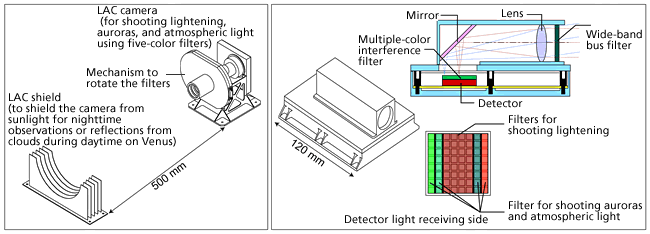
    Lightening and airglow camera (LAC) continues to be in the preparation mode for its conditions to be carefully coordinated.

    [Message from Project Manager Masato Nakamura]
    Thanks to your support, we were able to move the four cameras and the Ultra-sable Oscillator to regular operations. Thank you very much. We continuously acquire data for the world’s leading Venus research while we are aiming at early regular operation of the LAC. Please look forward to the operation and data acquisition of the Venus climate orbiter “AKATSUKI.”

    Image: Night side of Venus taken by the IR2.
    The night side image shows the whole of Venus, and the image captured the most detailed Venus state. We will closely and precisely study the 3D structure and movement of the Venus atmosphere by combining data of different wavelengths from other cameras.

    AKATSUKI onboard instruments to move to regular operation

    Apr. 1, 2016 Updated
    AKATSUKI regular observation to begin in mid April

    AKATSUKI has been performing test observations by turning on its onboard observation instruments one by one. The instruments are starting up normally, and we have already conducted successful observations that are equivalent to a “minimum success” (*), thus we will move to regular operations in mid April.

    * Minimum success: The minimum goal for achieving a mission. For AKATSUKI, the minimum success is to capture Venus’s all-globe cloud structure by continuously acquiring image data (for every few hours) using some of its onboard cameras from Venus orbit.

    Image: Test observation results by the Longwave IR camera (LIR) The image shows bow-shape clouds running from the Southern hemisphere to the Northern one of Venus. This is the first time to learn such a phenomenon.

    AKATSUKI regular observation to begin in mid April

    Dec. 9, 2015 Updated
    AKATSUKI successfully inserted into Venus’ orbit

    As a result of measuring and calculating the AKATSUKI’s orbit after its thrust ejection on Dec. 7, JAXA found that the AKATSUKI was inserted into the Venus orbit.
    We have already received images from three instruments whose function has already been confirmed, namely the Ultraviolet Imager (UVI), the Longwave IR camera (LIR), and the 1μm camera (IR1).
    We will check the function of the three other scientific mission instruments and perform initial observation for about three months while gradually adjusting the orbit for shifting its elliptical orbit to the period of about nine days. The regular operation is scheduled to start in April, 2016.

    Image: Venus taken by UVI on Dec. 7 (JST).

    AKATSUKI successfully inserted into Venus' orbit

    Dec. 7, 2015 Updated
    AKATSUKI attitude control engine thrust operation performed as scheduled

    JAXA performed the attitude control engine thrust operation of the Venus Climate Orbiter “AKATSUKI” for its Venus orbit insertion from 8:51 a.m. on December 7 (Japan Standard Time).
    As a result of analyzing data transmitted from the orbiter, we confirmed that the thrust emission of the attitude control engine was conducted for about 20 minutes as scheduled!
    The orbiter is now in good health. We are currently measuring and calculating its orbit after the operation. It will take a few days to estimate the orbit, thus we will announce the operation result once it is determined.
    We welcome your support messages to the AKATSUKI mission and its project team members!

    AKATSUKI attitude control engine thrust operation performed as scheduled

    Dec. 7, 2015 Updated
    Test image acquisition by AKATSUKI onboard cameras (on Dec. 1, 2015)

    The AKATSUKI had been maintaining a safe posture by facing its mounting surface of the high-gain antenna toward the sun as that surface is relatively strong against heat. In that posture, the onboard cameras, which were stowed in the main body of the orbiter, were not able to change their view direction.
    Since the end of November, 2015, even in that position, Venus came into the view of the cameras, and, on Dec. 1, three onboard cameras, Ultraviolet imager (UVI), 1μm camera (IR1) and Longwave IR camera (LIR),shot images of the planet. The distance between the AKATSUKI and Venus at that time was about 1.1 million kilometers, which is about three times that between the moon and the Earth. We were able to download the acquired ultraviolet images (wavelength 365 nm) by the UVI and near infrared image (wavelength 900 nm) by IR1 on Dec. 7, and confirmed that the image shooting went well.
    Left image by UVI and right ones by IR1

    Test image acquisition by AKATSUKI onboard cameras (on Dec. 1, 2015)

    Nov. 9, 2015 Updated
    AKATSUKI: Second attempt to enter Venus orbit

    The Venus Climate Orbiter AKATSUKI will try to enter the orbit of Venus on Dec. 7 (Mon.) after five years of operation. We are welcoming support messages.
    After AKATSUKI’s failure to enter Venus’ orbit on Dec. 7, 2010, JAXA investigated the cause and considered a second attempt schedule while operating the satellite for a long period. Now, on Dec. 7, 2015, coincidentally the same day on the calendar as the previous attempt, we will perform the injection for the second time.
    The AKATSUKI is in a good condition and it will take a few days of confirmation to know the result. Your support for the AKATSUKI and its project team members is very much appreciated.

    AKATSUKI: Second attempt to enter Venus orbit

    Aug. 31, 2015 Updated
    AKATSUKI passed the perihelion

    The Venus Climate Orbiter “AKATSUKI” flew at the closest point to the Sun, the perihelion, on its orbit at around 2:00 a.m. on Aug. 30, 2015. It is the ninth time of passing the perihelion since its launch in 2010. The AKATSUKI is still in a difficult state regarding the thermal environment, even after it flew away from the perihelion.
    We will keep watching and checking the condition of the AKATSUKI’s onboard instruments very carefully.

    AKATSUKI passed the perihelion

    Aug. 5, 2015 Updated
    AKATSUKI: Orbit successfully controlled

    JAXA performed an orbit control maneuver for the Venus Climate Orbiter “AKATSUKI” in late July in preparation for its re-injection into the Venus orbit scheduled for Dec. 7, 2015. According to the analysis of telemetry data acquired up to Aug. 2, the orbit control and correction was successfully conducted as scheduled by 5:30 p.m. on August 4. (All dates and time are Japan Standard Time.)

    AKATSUKI: Orbit successfully controlled

    Jul. 9, 2015 Updated
    AKATSUKI to perform fourth orbit control to Venus

    The AKATSUKI will perform an orbit control for the fourth time (DV4: Delta Velocity 4) from July 17, targeting to be injected into the Venus orbit again in December 2015. The control will be divided into three performances.
    The orbit control this time aims at correcting AKATSUKI’s orbit to one that is advantageous to its observations after being injected into the Venus orbit. We will use four attitude control engines on the upper part of the explorer this time to take this opportunity to also verify their performance for re-entry in December.

    AKATSUKI to perform fourth orbit control to Venus

    Feb. 6, 2015 Updated
    AKATSUKI to be re-injected into Venus orbit on Dec. 7

    After failing to be injected into the Venus orbit in Dec. 2010, JAXA has been carefully considering another injection attempt opportunity for the Venus Climate Orbiter “AKATSUK” to the Venus orbit when the orbiter meets Venus in the winter of 2015. As a result of detailed study, JAXA decided to inject the AKATSUKI into the orbit on December 7 (Mon.), 2015.
    After being injected into the orbit, the AKATSUKI will observe the atmosphere of Venus, which is often referred to as a twin sister of the Earth, through remote sensing. Its observations are expected to develop “Planetary Meteorology” further by elucidating the atmospheric circulation mechanism and studying the comparison with the Earth.

    AKATSUKI to be re-injected into Venus orbit on Dec. 7

    Jan. 9, 2015 Updated
    AKATSUKI heading to Venus again

    The Venus Climate Orbiter “AKATUSKI” has been flying on an orbit in which it could meet Venus again in 2015 since it carried out orbit control maneuvers three times in 2011 after its failure to be injected into the target orbit due to damage to its main engine in Dec. 2010.
    On the current orbit, the orbiter has been exposed to heat that is about three times hotter than that of the Earth, thus we are concerned if some instruments might have been damaged. Fortunately, the deterioration rate of the thermal insulation material has been subsided and we are now planning to control the AKATSUKI to inject it into the Venus orbit while monitoring the conditions of the orbiter including the temperature of each instrument and part.

    AKATSUKI heading to Venus again

    Jan. 31, 2012 Updated
    AKATSUKI current status and future operation

    JAXA decided to carry out orbit control of the AKATSUKI using its liquid-fuel thrusters for altitude control (or the reaction control subsystem, RCS.) Based on this decision, almost all of the unnecessary oxidizer was discarded in Oct. 2011. As a result, the satellite became lighter, and remaining fuel can be more efficiently used for orbit control.
    In November 2011, orbit control operation at perihelion was performed three times using the RCS for the future rendezvous with Venus, and the orbit has been shifted as planned. The AKATSUKI is now flying on an orbit where it can meet with Venus in 2015(*).
    The satellite has to be exposed to the extremely harsh thermal environment every time it passes through the perihelion until it is injected into the Venus orbit; therefore, we are operating the AKATSUKI with great care to maintain its condition.

    (*) It is desirable to inject the satellite into the Venus orbit in 2016 from a scientific observation point of view because we can put the satellite in an orbit that is closer to the equator in 2016. However, as we take the satellite’s operational challenges after its design life into consideration, we keep comparing the insertion in 2015 and that in 2016 to finalize our plan in order to maximize our observation achievements while monitoring the satellite’s status.

    Nov. 1, 2011 Updated
    AKATSUKI orbit control at perihelion

    For the rendezvous with Venus, JAXA performed the first orbit control of the Venus Climate Orbiter “AKATSUKI” using the attitude control thruster (or the reactor control system, RCS) at perihelion. The operation lasted about 10 minutes from 1:22 p.m. on November 1 (Japan Standard Time.)
    We will analyze telemetry data acquired throughout the operation this time, then determine the next orbit for the second orbit control scheduled for Nov. 10.

    Sep. 30, 2011 Updated
    AKATSUKI scheduled to perform orbit maneuver in Nov. to meet with Venus

    The Venus Climate Orbiter “AKATSUKI” (PLANET-C) conducted a trial jet thrust of its onboard orbit maneuver engine (OME) twice on September 7 and 14, but acceleration by the thrust was only about one ninth of expectations, and the generated thrust was also only about 40 Newton. With these results, we found that we cannot gain enough specific impulse for orbit maneuvering by the OME. Also, we suspect that the OME may have gradually been damaged; therefore, we decided not to use the OME. We will carry out the orbit maneuver using the reactoion control system (RCS) thruster to meet Venus in 2015. We plan to conduct a peri-Venus orbit maneuver in early November.

    Drawing: Relative locations between Akatsuki, Venus and Earth at orbit maneuver (Sun orbit/Current orbit)

    Sep. 30, 2011 Updated
    AKATSUKI to perform orbit maneuver in Nov. to meet with Venus in 2015

    The Venus Climate Orbiter “AKATSUKI” (PLANET-C) conducted a trial jet thrust of its onboard orbit maneuver engine (OME) twice on September 7 and 14, but acceleration by the thrust was only about one ninth of expectations, and the generated thrust was also only about 40 Newton.
    With these results, we found that we cannot gain enough specific impulse for orbit maneuvering by the OME. Also, we suspect that the OME may have gradually been damaged; therefore, we decided not to use the OME. We will carry out the orbit maneuver using the reactoion control system (RCS) thruster to meet Venus in 2015. We plan to conduct a peri-Venus orbit maneuver in early November.
    Drawing: Relative locations between Akatsuki, Venus and Earth at orbit maneuver/ Sun orbit (current orbit)

    Sep. 15, 2011 Updated
    AKATSUKI: Second orbit maneuver engine test result

    JAXA conducted the second jet thrust test(*1) from the orbit maneuver engine (OME) aboard the Venus Climate Orbiter “AKATSUKI” (PLANET-C) on Sept. 14 (Japan Standard Time.) Through analysis of acquired test data, we found that acceleration by the jet thrust was less than the expected value similarly to the first test result.
    Based on those test results, we would like to study the measures to be taken.
    The satellite is in condition after the second test.
    *1: The second test aimed at reconfirming the status of the jet thrust from the OME. The test duration was about five seconds as planned.

    Sep. 14, 2011 Updated
    AKATSUKI: Second orbit maneuver engine test

    JAXA performed the second jet thrust(*1) test from the orbit maneuver engine (OME) aboard the Venus Climate Orbiter “AKATSUKI” (PLANET-C) at the scheduled time of 11:50 a.m. on Sept. 14 (Japan Standard Time) as part of studying an orbit change plan for the AKATSUKI to meet with Venus. We have confirmed the jet thrust from the OME.
    We will analyze acquired telemetry data, and study the orbit change plan of the AKATSUKI.
    *1: The second test aimed at reconfirming the status of the jet thrust from the OME. The planned test duration was about five seconds.

    Sep. 9, 2011 Updated
    AKATSUKI: Second orbit maneuver engine test plan changed

    JAXA performed the first test jet thrust(*1) from the orbit maneuver engine (OME) aboard the Venus Climate Orbiter “AKATSUKI” (PLANET-C) on Sept. 7 as part of studying an orbit change plan for the AKATSUKI to meet with Venus. Through this test, we found that acceleration by the jet thrust was less than the expected value; therefore, we decided to shorten the time duration of the second test(*2) slated for Sept. 14 to about 5 seconds because the originally expected acceleration value was the baseline for the second test. We will jet the thrust for about five seconds again to reconfirm the thrusting condition of the OME.
    The satellite is in good condition after the first test jet thrust.
    *1: Test thrust aimed at quantitatively understanding postural disturbance (including horizontal thrust.) The thrust duration was two seconds as planned.
    *2: The second test originally aimed to verify the attitude control logic. The planned thrust duration was 20 seconds.

    Sep. 7, 2011 Updated
    AKATSUKI: First test thrust from orbit maneuver engine

    JAXA carried out the first test jet thrust(*1) from the orbit maneuver engine (OME) aboard the Venus Climate Orbiter “AKATSUKI” (PLANET-C) as part of studying an orbit change plan for the AKATSUKI to visit Venus.We have confirmed that the OME jetted out thrust at 11:50 a.m. on September 7 (Japan Standard Time.)
    We will analyze the acquired telemetry data and prepare for the second test jet thrust(*2) scheduled for Sept. 14 (JST.)

    *1: Test thrust aimed at quantitatively understanding postural disturbance (including horizontal thrust.) The planned thrust duration was two seconds.
    *2: The second test aims to verify the attitude control logic. The planned thrust duration is 20 seconds.

    Jul. 4, 2011 Updated
    AKATSUKI set to try and enter orbit of Venus in November 2015

    JAXA made the following report at the AKATSUKI’s third investigation meeting for the Space Activities Commission on June 30.
    As a result of analysis and verifications of the AKATSUKI’s anomaly cause estimated at the first and second investigation meetings, the highest possibility was found to be damage to the thruster nozzle of the orbit maneuver engine due to closure of the check valve during the orbit injection maneuver.
    We will determine if we can reignite the damaged thruster nozzle through a ground test as well as an emission test of the onboard engine. Based on the results of these tests, we will prepare for an orbit injection maneuver to Venus hoping for the AKATSUKI to meet with Venus in November 2015.
    Photo: A firing test for Venus orbit injection

    Dec. 10, 2010 Updated
    AKATSUKI takes images of Venus during functional verification

    JAXA is currently investigating the failure cause of the Venus orbit injection of the Venus Climate Orbiter “AKATSUKI.” During the course of the orbiter functional verification after data acquisition at the periVenus, we were able to obtain some Venus images captured by the AKATSUKI at around 9:00 a.m. on Dec. 9 (Japan Standard Time.)
    (Images: from left, an image shot by the UVI, IR1, and LIR. The images are artificially colored: The UVI image with blue, and the IR1 image with orange.)

    Dec. 8, 2010 Updated
    AKATSUKI Venus orbit injection plan to be reviewed

    JAXA found that we have failed to inject the Venus Climate Orbiter “AKATSUKI” into the planned Venus orbit after conducting the Venus orbit insertion maneuver (VOI-1) on December 7. While we set up a new investigation team to study the cause and countermeasures, we will also review the Venus orbit injection plan again to take the next opportunity in six years when the AKATSUKI flies closest to Venus.

    Dec. 8, 2010 Updated
    AKATSUKI Venus observation orbit injection result

    JAXA conducted the Venus orbit insertion maneuver (VOI-1) for the Venus Climate Orbiter “AKATSUKI” at 8:49 a.m. on December 7 (Japan Standard Time,) but, unfortunately, we have found that the orbiter was not injected into the planned orbit as a result of orbit estimation. The “AKATSUKI” was launched from the Tanegashima Space Center on May 21.
    JAXA has set up an investigation team to study the cause of the failure.
    We will update you with the investigation results and AKATSUKI operation status on the web.

    Nov. 18, 2010 Updated
    Date of AKATSUKI injection to Venus orbit

    JAXA decided to emit jets from the orbital maneuvering engine (OME) of the AKATSUKI at 8:49:00 a.m. on Dec. 7 (Japan Standard Time, all the following dates and time are in JST) to inject the orbiter into the Venus orbit. Under the current schedule, the OME jet emission will be completed at 9:01:00 a.m. on the same day, and the Venus orbit will be determined around 9:00 p.m. also on the same day after some attitude control maneuvers including the Earth pointing maneuver of the Z axis.
    The AKATSUKI will study the Venus atmosphere for about two years after being injected into the Venus orbit.

    Oct. 25, 2010 Updated
    AKATSUKI takes images of Sagittarius using its onboard cameras

    On October 8, the onboard cameras of the AKATSUKI took images of a part of Sagittarius. For this image shooting, we made the AKATSUKI face its cameras’ installed side to Sagittarius while the explorer was communicating with the Usuda Deep Space Center, and took images by activating the Longwave IR camera (IRC,) Ultraviolet Image (UVI,) 1µ m camera (IR1,) and 2µ m camera (IR2.)
    The AKATSUKI onboard cameras can capture invisible light such as ultraviolet or infrared rays. Thus Sagittarius shot by the UVI, which observes ultraviolet rays, and the IR1, which catches infrared rays, looks different from what the human eye can see.
    Concerning the LIR and IR2, it was predicted in advance that they could not detect a star under the observed wave-length region and temperature conditions of the observation this time. We, therefore, confirmed that each camera works properly according to their respective functional conditions.

    Jul. 6, 2010 Updated
    AKATSUKI successfully controls orbit by the world’s first ceramic thruster

    On June 28 (Japan Standard Time,) the Venus Climate Orbiter “AKATSUKI” successfully jetted the thrust of 500 Newton by its orbital maneuvering engine (OME) at a distance of 14.6 million km from the Earth or 1.06 Astronomical Units (AU) from the sun. The OME was a newly developed ceramic thruster made of silicon nitride (Si3N4.) It is the first time in the world to successfully generate the thrust by the ceramic thruster in space.
    This engine is mainly used for retrofiring when the orbiter enters the Venus orbit, and the verification this time enabled us to confirm that the orbit control was carried out as scheduled.
    The next orbit control is scheduled to be in early November, and the orbiter will be at the closest point to Venus and injected into the Venus orbit on December 7 (JST.)

    May 23, 2010 Updated
    AKATSUKI flying smoothly!

    On May 21, JAXA confirmed that the Venus Climate Orbiter “AKATSUKI,”
    launched by the H-IIA F17, successfully performed a sequence of scheduled operations such as the deployment of the solar array paddles and sun acquisition.

    We have also received earth images taken by the AKATSUKI while verifying the condition of onboard devices at about 250,000 km above the Earth at around 8:50 p.m. on May 21.

    May 21, 2010 Updated
    AKATSUKI successfully launched!!

    The H-IIA Launch Vehicle No. 17 (H-IIA F17) with the Venus Climate Orbiter “AKATSUKI” onboard was launched at 6:58:22 a.m. on May 21 (Japan Standard Time) from the Tanegashima Space Center. The H-IIA F17 flew smoothly, and, at 27 minutes and 29 seconds after liftoff, the AKATSUKI was separated from the H-IIA.
    We will update you with the latest information on the AKATSUKI on the special site.
    (Photo: Mitsubishi Heavy Industries)

    May 18, 2010 Updated
    AKATSUKI/IKAROS Launch rescheduled to 6:58 a.m. on the 21st (Fri)

    The launch of the Venus Climate Orbiter “AKATSUKI” and the Small Solar Power Demonstrator “IKAROS” by the H-IIA Launch Vehicle No. 17 was rescheduled at 6:58:22 a.m. on May 21 (Fri. Japan Standard Time, JST) after carefully studying the weather conditions.

    Accordingly, the live launch report will begin at 6:30 a.m. on May 21(Fri., JST.) The report will be broadcast not only through the Internet, but also at JAXA i, Sagamihara Campus and other public viewing locations including some universities. You can also watch it through some CATV and cell phone providers.

    May 10, 2010 Updated
    AKATSUKI and IKAROS moved to VAB

    On May 9, the encapsulated Venus Climate Orbiter “AKATSUKI” and the Small Solar Power Sail Demonstrator “IKAROS” were transported to the Vehicle Assembly Building (VAB), where the H-IIA Launch Vehicle No. 17 was waiting for their payloads. They will be loaded onto the launch vehicle, and the final inspection will be carried out to be ready for the launch on the 18th.

    May 6, 2010 Updated
    AKATSUKI encapsulated in the fairing

    On May 4, the Venus Climate Orbiter “AKATSUKI” and the Small Solar Power Sail Demonstrator “IKAROS” were encapsulated in the fairing at the Spacecraft and Fairing Assembly Building (SFA) at the Tanegashima Space Center (TNSC.) The fairing covers the payloads to protect them from air resistance, friction heat, and acoustic vibrations during launch.

    The encapsulated payloads will be transported to the Vehicle Assembly Building and loaded on to the H-IIA Launch Vehicle No. 17.

    Apr. 30, 2010 Updated
    AKATSUKI mated with the PAF

    On April 30, the Venus Climate Orbiter “AKATSUKI” was mated with the Payload Attach Fitting (PAF,) which connects the AKATSUKI and the launch vehicle, at the Spacecraft and Fairing Assembly Building (SFA) at the Tanegashima Space Center (TNSC.)
    The Small Solar Power Sail Demonstrator “IKAROS,” a co-payload of the AKATSUKI, has already been packed in the PAF.
    The AKATSUKI will be encapsulated in the fairing, and transported to the Vehicle Assembly Building (VAB) to be loaded onto the H-IIA Launch Vehicle No. 17.

    Mar. 19, 2010 Updated
    AKATSUKI arrives at the Tanegashima Space Center

    The Venus Climate Orbiter “AKATSUKI,” which left the Sagamihara Campus on March 17, arrived at the Spacecraft Test and Assembly Building 2 (STA2) in the Tanegashima Space Center at 5:30 p.m. on the 19th.

    Mar. 18, 2010 Updated
    AKATSUKI leaves for Tanegashima

    The Venus Climate Orbiter “AKATSUKI” left the Sagamihara Campus for theTanegashima Space Center (TNSC) on the evening of March 17.
    The AKATSUKI will be delivered to the TNSC on the 19th. It will undergo final launch preparations there.

    Mar. 12, 2010 Updated
    AKATSUKI open to the media at Sagamihara Campus

    On March 12, the Venus Climate Orbiter “AKATSUKI” and the Small Solar Power Sail Demonstrator “IKAROS” were displayed to the media at the Sagamihara Campus.
    The two payloads will be transported to the Tanegashima Space Center to be ready for launch.

    Mar. 3, 2010 Updated
    “AKATSUKI” launch date set! Special site open

    The launch time and day of the H-IIA Launch Vehicle No. 17 (H-IIA F17) has been set for 6:44:14 a.m. on May 18. The H-IIA will carry the Venus Climate Orbiter “AKATSUKI,” the Small Solar Power Sail Demonstrator “IKAROS,” and four other small satellites to space.
    The AKATSUKI special website opens today to keep you updated about its preparation status before its arrival to the Venus orbit. Please enjoy the site.

    Feb. 10, 2010 Updated
    Thank you very much for participating in the AKATSUKI message campaign

    We have received many support messages from all over the world for the “AKATSUKI” message campaign, which was completed on January 10. The number of participants reached 260,214 people in total including those who registered through the Internet and those who signed up as a group from local areas, schools and science museums. We have also received messages from some celebrities. The messages will be printed on an aluminum plate, and attached to the body of the AKATSUKI. The satellite will then be transferred to the Tanegashima Space Center for launch preparations.

    Dec. 17, 2009 Updated
    AKATSUKI message campaign over New Year holidays!

    JAXA is currently holding a message campaign to carry your name and message to Venus by placing them on the Venus Climate Orbiter “AKATSUKI.”
    We have so far received massages from some well-known people including Minister Sakihito Ozawa of the Ministry of the Environment, and Astronaut Koichi Wakata and his fellow crewmembers of the STS-127. We have also received a lot of messages from groups. In the case of a group message, the image of written messages of your group on paper will be printed as it is.
    The deadline for accepting messages has been extended till January 10 (Sun.,) 2010 (Japan Standard Time.) Why don’t you send a message with your family members or friends during the New Year holidays?

    Nov. 30, 2009 Updated
    AKATSUKI revealed to the public
    Less than a month remains to send an onboard message

    On Nov. 27, the Venus Climate Orbiter “AKATSUKI” was revealed to the press at the Flight Environment Test Building at the JAXA Sagamihara Campus. Comprehensive tests on the AKATSUKI will be continued further to be ready for its launch.
    The AKATSUKI Message Campaign has already passed the halfway mark, and less than a month remains to send in your messages. For those who have not sent us a message, we are looking forward to hearing from you! One unique feature of the campaign this time is that the image of written messages of your group on paper will be printed as it is in the case of a group message. Why don’t you send a group message, such as from a school or an office, on one piece of paper?

    Oct. 23, 2009 Updated
    We will deliver your message to the bright star Venus

    The Venus Climate Orbiter “AKATSUKI” (PLANET-C,) which is scheduled to be launched in Japan Fiscal Year 2010, will reach the orbit of Venus about half a year after its launch. It is scheduled to explore the Venus atmosphere for some two years. JAXA will deliver your name and message to Venus on this Venus explorer. We accept messages both from individuals and from a group such as a message from a school or a work place. Please participate in the message campaign by yourself, with your family, or with your friends.We are looking forward to receiving your thoughts. We will accept your messages up to December 25.

    Jun. 1, 2009 Updated
    Comprehensive tests start on PLANET-C

    The PLANET-C project team started comprehensive tests in June. During testing, we first temporarily assemble all the parts to inspect the satellite comprehensively, disassemble it to check the components individually, then reassemble all the devices and components again to carry out various tests.

    Photo: A container carrying the satellite structure is being brought into the test facility.

    Jan. 6, 2009 Updated
    Operations start for 2009

    The satellite disassembly continues after the New Year holidays. The top photo show the removal of the 2μm infrared camera for observation (IR2) from the upper panel. Many pieces of equipment had been installed on the upper panel, but most of them were already removed. You can see the removed cameras on the table in the bottom photo. From the near side, they are the Ultra Violet Imager (UVI, a black camera under the blue plate), the 1μm Infrared Camera (IR1), the Longwave IR Camera (LIR, in a clear case) and the Lightening and Airflow Camera (LAC, wrapped in a golden sheet.)

    Dec. 26, 2008 Updated
    Operations for 2008 completed

    On Dec. 23, we tested the observation cameras by turning all five cameras on and sending actual observation commands to them to check if all the cameras worked properly. The top photo shows that the 1μm infrared camera was lit. In the photo, the structure with a white disk-shaped antenna at the top is the main body of the PLANET-C. As the solar array paddles were removed, the white round antenna that had been covered before was revealed. The cameras were attached at the right edge on the near side. There is a bright light instead of Venus in front of the cameras, thus a silhouette of the satellite is clear on the back wall.

    On December 25, various tests were completed, and the satellite was started to be disassembled. The bottom photo shows that the upper panel was carefully being removed from the satellite’s main body.

    Dec. 18, 2008 Updated
    First integration test underway

    Since October 1, 2008, JAXA has been carrying out the first integration test for the PLANET-C. The test takes about three months to build up the satellite with most of the parts of the flight model into almost the launch configuration. The test is being held in the big clean room, and it is a very important test to verify mechanical and electric integration and function in the quasi launch configuration. It has been spectacular to witness all the individually developed parts and observation devices collected in one room to be set up as the satellite.
    The top photo shows the testing scene, and the upper panel to which many parts including the observation equipment are attached is on the right hand side, and the black cylinder on the left is a thrust tube that supports the propellant tank. On December 8 and 9, the satellite was built up. The upper panel and lower panel of the orbiter were attached, and it now looks like a satellite. After performing various tests with the integrated satellite, it will be disassembled again at the end of this month, then each part will be adjusted, if necessary, and individually tested further.
    The lower photo is the completed PLANET-C. Four observation cameras are installed on the right hand side of the satellite. They are the Long-wave IR camera, the Ultraviolet imager, the 1µm camera, and 2μm camera (from the top to the bottom.) The object looks like an arm holding the head is a folded solar array paddle.

    Jul. 9, 2008 Updated
    Small secondary satellites to be launched with “PLANET-C” selected

    On July 3, 2008, JAXA held the “Selection Committee Meeting for Small Secondary Payloads Launched with PLANET-C,” and the following four satellites were chosen as candidates for a piggyback launch with PLANET-C by H-IIA.

    • WASEDA-SAT2 (Waseda University)
    • Atmospheric Water Vapor Observation Satellite (Kagoshima University)
    • Negai (Soka University)
    • UNITEC-1 (UNISEC, University Space Energy Consortium)

    Among them, UNITEC-1 will be the world’s first satellite developed by a non-space organization to travel to Venus.

    May 17, 2006 Updated
    Developing a high-performance detector for seeing through the real surface of Venus

    One of the five cameras aboard the Venus Climate Orbiter “PLANET-C” is the “IR2,” whose observation target is infrared rays that are about two micron in wavelength. It aims to measure the high-temperature atmosphere of Venus under thick clouds, its movement, and distribution of its trace components. In other words, the IR2 is a camera that can see through the real surface of Venus. The IR2 is made of materials suitable for infrared ray observations (manufactured by Nikon) and its photo-taking device (element) which is equivalent to a CCD in a digital camera is made of Platinum Silicide (PtSi) element (manufactured by Mitsubishi Electric.)

    The PtSi element is one million pixels (1024 x 1024). We are very proud of its high performance, which is far superior to commercially sold digital cameras or video cameras. It can work stably in the harsh environment of space with an excellent ability to capture both dark and bright objects (dynamic range) and a very high accuracy of measurement (linearity.) Currently, one million pixels is the highest level for this type of camera.

    The PtSi detector shown in the photo is a trial piece. The one million pixel (1024 x 1024) light receiving surface is about 17 mm x 17 mm in size and attached to the IC package. We have already acquired satisfactory results for this element through a cooling evaluation test. In May 2006, we began to manufacture the prototype and flight model elements by slightly modifying the design of the trial piece.

    The “IR2” and the other onboard infrared camera, “IR1,” are the main cameras of the orbiter. Although the two cameras target different observation wavelength ranges, their elements are almost the same. In addition to the lenses and elements, the camera unit itself, equipped with a cooling device for both the IR1 and the IR2, is developed by a Japanese precision equipment manufacturer (Sumitomo Heavy Industries, Ltd.) thus they are being developed 100% domestically.

    It is not easy for Japan to challenge the space development field by itself, as Japan lags behind Western countries. Still, we believe that we can accumulate knowledge through the challenge to sophisticate our own advanced technologies and promote our cutting-edge space science. Therefore both the engineers and scientists are working together for this development.

    Aug. 29, 2005 Updated
    Developing an infrared camera to explain mysteries of volcanoes and “super rotation of the atmosphere”

    The Venus explorer, Planet C, was developed to observe the atmospheric movement of Venus by taking images of lights in various frequencies using five onboard cameras. By doing so, we try to elucidate the “super rotation of the atmosphere” that is the biggest mystery of meteorology in the solar system. Super rotation is a phenomenon where the atmosphere of Venus rotates about 60 times faster than Venus’ rotation. (The Venus rotation period is 243 days, whereas the atmosphere is 4 days.) The IR1 Camera, designed to capture infrared lights in one micron range wavelength, can carry out observations both day and night to contribute to the clarification of the mystery.

    During the day time, the IR1 will detect atmospheric movement in lower clouds, catching the deranged light of the Sun from the cloud layer (45 to 65 km) covering all of the surface of Venus. In the night, we plan to make it observe material compositions on the surface of Venus and look for an active volcano. It is well known that there are traces of volcanic activity on Venus, but no active volcano has been found yet. The observation team has high expectations of finding an active volcano, because, if we succeed, we can obtain clues to learn about the inside of Venus and its evolution.

    When we observe the night side of Venus, strong sunlight obstructs observation activities. Therefore, a sun shield cylinder plays an important role to protect our observation data by cutting off sunlight. The photo shows the testing of a new sun shield cylinder consisting of square and round shaped boards (in the big darkroom at the Usuda Deep Space Center in Nagano.)

    Apr. 13, 2005 Updated
    Lightning and airglow camera (LAC) becomes drastically lighter

    The Venus probe “PLANET-C” is equipped with five cameras, one of which is the first lightening and airglow camera (LAC) for a planet-probing mission in the world. The LAC can shoot 50,000 times per second using its high-speed mechanism to ensure it captures the precise moment when lightning strikes. (People think that we can see lightening flashes with our naked eyes, but it is actually through persistence of vision.)
    The camera also has an “automatic event detection” function to determine if lightening really took place. This function is a unique feature to sort out only “real” lightning data from a large amount of trial image data.
    In order to pass very strict weight constraints, the LAC design was modified in the fall of 2004, and we successfully reduced its weight by more than 70 percent (from about 5.2 kilograms to about 1.5 kilograms.) We have been verifying the possibility by using a prototype to change the image-pickup element (pixels) from MCP (Micro Channel Plate) to APD (Avalanche Photodiode), which is a more reliable and durable element.
    The development team holds high expectations that the LAC will end a dispute over the “existence of lightning and electric discharging on Venus” which has been debated for more than 20 years.

    Outline of the Lightning and Airglow Camera (The latest version, Spring 2005)

    1) LAC before design change (left)
    2) External view of the LAC after design change (center) and the optical system (right)
    As the new design does not have a hood to shield it from sunlight or reflections from clouds over Venus, it will carry out observations only when the PLANET-C is in the night side of Venus.
    3) Arrangement of filters on the light receiving side
    By dividing the detector’s light receiving side in five, five kinds of filters of which each penetrates specific wavelengths of light, are attached directly to the image-pickup elements (pixels) to shoot different observation targets pixel by pixel. In the new design, we do not need the filter rotation mechanism, and that greatly contributed to make the camera lighter.

    Oct. 20, 2004 Updated
    Designing a prototype model of a probe

    The Planet-C project, which was officially started this past April, is now at the stage of designing a prototype model of a probe.

    Planet C is equipped with five special onboard cameras for measuring infrared lights and ultraviolet rays in various wavelengths to observe from the surface to the upper atmosphere of Venus. For observation purposes, it is challenge to keep the inside temperature of the probe cool. Infrared lights are also known as “heat rays”, and a device may not be able to measure properly if it becomes too hot.

    Venus is 40 million kilometers closer to the Sun than the Earth. Therefore, the prerequisites to control the thermal environment for a Venus probe are far stricter than for a satellite cycling around the Earth. More specifically, the project faces challenges to design a more efficient method to release heat from the probe into space (thermal structure design) and to control the heat generated by onboard equipment. We need to adopt some parts that do not have any history of use in the space development area, thus we are carefully carrying out radiation exposure tests.

    The development team, consisting of research institutes and manufacturers across Japan, is working hard to achieve future applications for Earth observation missions.

    * Photo : The photo is a test image taken by a model device for evaluating the performance of one of the onboard cameras, the mid-infrared camera. The photographed subjects are two black boards whose temperatures are slightly different. The temperature difference is clearly shown in the photo. On the upper left side, you can see a camera called a “non-cooling bolometer” with a new detector that enables it to perform infrared measurements without being cooled down. Thanks to this new detector, the camera becomes much smaller than the conventional one that requires a system to cool a detector. We expect that the camera will elucidate the temperature and movement of clouds around Venus.

    Feb. 27, 2004 Updated
    JAXA to manufacture “trial model” of probe

    The PLANET-C Project Team has been engaging in the initial design of the probe and development of a set of observation cameras for Venus. Many of the cameras are embedded with high pixel infrared sensors. Therefore, many tests, including radiation exposure, were carried out to verify their reliability in a space environment and to maximize their performance.
    In order to acquire emissions of thin infrared or thunder lights from the atmosphere or ground surface on the night side of Venus, the development of a high-performance “hood” is critical to eliminate the impact of strong sunlight. It is also imperative to maintain a cool temperature inside the probe to accurately measure infrared lights that are called “heat rays”. A more proficient design and structure is required for the Venusian orbit probe to dissipate heat to space as it travels much closer to the sun than earth orbit satellites.
    The designing is almost completed, and we will begin to develop and manufacture the trial model of the probe in April 2004. We are now fully prepared for moving to the next step.

    * Photo : Infrared cameras under development. Universities and research institutes, including Hokkaido University, Tohoku University, National Institute of Polar Research, Tokyo University, Osaka Prefecture University, and Kumamoto University, participate in the development of scientific observation equipment such as a set of infrared cameras.

    Let’s block ads! (Why?)

  • [Project Topics] Whole-atmospheric monthly CO2 concentration tops 400 ppm based on observations by IBUKI

    Topics List

    May 20, 2016 Updated
    Whole-atmospheric monthly CO2 concentration tops 400 ppm based on observations by IBUKI

    A recent provisional analysis of IBUKI (GOSAT) observational data shows that the global atmospheric monthly mean CO2 concentration observed vertically through the whole atmosphere exceeded 400 ppm in December 2015 for the first time since GOSAT was launched in 2009.
    Several meteorological agencies such as the World Meteorological Organization (WMO) have already reported that the global monthly mean CO2 concentration based on data obtained at surface-level monitoring sites has exceeded 400 ppm. However, it is the first time that the whole-atmospheric CO2 mean exceeded 400 ppm monitored by GOSAT, which can observe CO2 concentrations from the surface to the top of the atmosphere (about 70km). It means that CO2 concentrations are increasing not only at the global surface but also in the global atmosphere.

    Whole-atmospheric monthly CO2 concentration tops 400 ppm based on observations by IBUKI

    Nov. 27, 2015 Updated
    IBUKI methane observation data: close correlation between methane concentration and human activity

    As a result of analyzing three-year observation data acquired by the Greenhouse Gas Observing Satellite “IBUKI” (GOSAT) until Dec. 2012, the concentration of methane is higher in areas where anthropogenically-derived methane emission is intense, such as densely populated areas, large-scale agricultural regions, natural gas and oil producing/refining areas, compared to other surround areas.
    In addition, intimate correlation was found between anthropogenically derived methane concentration observed by IBUKI and the concentration estimated by actual emission data (inventory*); therefore, IBUKI can be a viable monitor/verification tool for methane emission by human activity.
    We will survey, research and analyze anthropogenically derived methane concentration more frequently by using a multiple number of satellite data to further enhance estimation accuracy. Our achievements will be applied to the successor of IBUKI (GOSAT-2) to contribute to promotion of global warming measures.

    * Statistic data indicating how much of specific substance (such as air pollutant and hazardous chemical substance) is emitted from where in a specific period of time.

    IBUKI methane observation data: close correlation between methane concentration and human activity

    Nov. 16, 2015 Updated
    Public release of whole-atmosphere monthly mean CO2 concentration based on observations by IBUKI

    “IBUKI” (GOSAT) has been in operation since its launch on January 23, 2009. The whole-atmosphere monthly mean concentration of carbon dioxide (CO2), calculated by using GOSAT data that reflect CO2 levels in all layers of the atmosphere, was found to have reached 398.8 ppm in May 2015, while showing seasonal oscillation and yearly rise over the analyzed period. It was also confirmed that the trend line of the whole-atmosphere CO2 mean (average seasonal cycle removed) had reached 398.2 ppm in July 2015. The trend line is expected to exceed 400 ppm within the year 2016, given that the rising trend continues. The GOSAT observation elucidates for the first time that CO2 concentration averaged over all layers of the atmosphere will soon reach the level of 400 ppm, and demonstrates the importance of global greenhouse gas monitoring from space.

    Public release of whole-atmosphere monthly mean CO2 concentration based on observations by IBUKI

    Dec. 25, 2014 Updated
    “IBUKI” (GOSAT) Satellite’s Historically Unprecedented Observation of Anthropogenic CO2 Emissions of Mega-City Regions from Space

    The Greenhouse gases Observing SATellite “IBUKI”, developed jointly by the Ministry of the Environment (MOE), the National Institute for Environmental Studies (NIES), and the Japan Aerospace Exploration Agency (JAXA) is the world’s only satellite designed specifically to monitor greenhouse gases from space. The satellite has continued to fulfill its main mission in monitoring atmospheric carbon dioxide (CO2) and methane concentrations from space to improve the accuracy of sink/source estimates, and achieve its target to contribute to precision refinement for the ongoing elucidation of carbon cycles, since its launch on January 23, 2009.

    Dec. 6, 2012 Updated
    Public release of carbon dioxide flux estimates based on observation data by IBUKI

    The data of global CO2 fluxes on a monthly and regional basis for the one-year period between June 2009 and May 2010 has been publicly distributed for the first time in the world. These flux values were estimated by combining ground-based CO2 monitoring data and CO2 concentration data acquired through the improved observation method of the Greenhouse gases Observing SATellite “IBUKI.” (GOSAT). The calculation method has been improved for the concentration of greenhouse gases. The usefulness of the concentration data acquired by the satellite was quantitatively verified.
    In order to obtain better CO2 flux estimates, we will continue to refine the data processing algorithms for the retrieval of CO2 concentrations from GOSAT data and the estimation of CO2 fluxes.

    Public release of carbon dioxide flux estimates based on observation data by IBUKI

    Oct. 28, 2011 Updated
    IBUKI observations help reduce estimation error of the CO2 absorption and emission

    The Ministry of the Environment, the National Institute for Environmental Studies, and JAXA calculated the error or uncertainty of the estimation results for monthly global and regional CO2 absorptions and emissions using data acquired by the Greenhouse Gases Observing Satellite “IBUKI.” As a result, we can reduce the error of the estimated values when we introduce IBUKI’s observation data compared to that of the values calculated in a conventional way based on ground observation data.
    This achievement will be published in the Scientific Online Letters on the Atmosphere (an online thesis magazine) issued by the Meteorological Society of Japan on Oct. 29. We will offer our estimate result data to researchers who are working on related fields that were selected through public solicitation. After being evaluated, compared and verified by researchers, we will further revise the data, if necessary, then publish the finalized data to the public.

    Aug. 20, 2010 Updated
    Third Research Announcement on the “IBUKI” (GOSAT)

    JAXA, the National Institute for Environmental Studies, and the Ministry of the Environment would like to make the third Research Announcement (RA) prior to the publication of the data acquired by the IBUKI (GOSAT) to the general public. The RA aims at evaluating the quality of data including calibration and validation data, and promoting usage and study of data.
    The RA is for the following five same areas as the first and the second RA:

    • Calibration
    • Data processing algorithms
    • Carbon balance estimation, atmospheric transport models
    • Validation
    • Data application

    Apr. 28, 2010 Updated
    IBUKI provides images of Iceland volcano eruption to the British Government

    The Greenhouse Gases Observing Satellite “IBUKI” shoots all-globe images every three days using its onboard supplement sensor “Cloud and Aerosol Imager, TANSO-CAI.” Since April 15, it took images of the fumes billowing over Iceland and other European countries, and of a major eruption on the 17th.
    We were asked by the British Government to provide observation data for verifying a prediction model, and, accordingly, we started offering processed images taken by the IBUKI. We will keep providing them through the end of April.

    Feb. 16, 2010 Updated
    IBUKI to provide analysis results of observation data (CO2 and methane concentration)

    JAXA completed the initial validation of the concentration of carbon dioxide (CO2) and methane based on the analysis results of observation data in the clear region taken by the Greenhouse Gases Observing Satellite “IBUKI.” Accordingly, we would like to begin to provide the above results as well as information on cloud covering to the general public on February 18, 2010.

    We will continue to improve data quality of analysis results, and plan to provide monthly region-by-region data of CO2 absorption and emission volume (in and out balance) in the first half of Japan Fiscal Year 2011.

    Nov. 11, 2009 Updated
    Technical Interface Meeting over IBUKI observation data

    Between November 10 (Tue.) and 13 (Fri.), a GOSAT-ACOS* technical interface meeting is being held at the JAXA Tsukuba Space Center and at the National Institute for Environmental Studies. In the meeting, we are discussing the calibration and verification of observation data acquired by the IBUKI to improve data accuracy so as to be ready for the distribution of density data to the general public that is scheduled to start in January 2010.

    *The ACOS (Atmospheric CO2 Observations from Space) Team is in charge of analyzing IBUKI observation data. The team is formed by a number of institutions including the NASA Jet Propulsion Laboratory (JPL), the California Institute of Technology (Caltech), and Colorado State University.

    Photo: At the JAXA Tsukuba Space Center

    Oct. 30, 2009 Updated
    Public Release of Observation Data (Radiance Spectrum and Images) from “IBUKI”

    The Level 1 data products, which are radiance spectra observed by TANSO-FTS and images by the TANSO-CAI onboard the Greenhouse gasses Observing SATellite “IBUKI”, will begin to be released to general users following the completion of the initial calibration.
    In the future, after further calibration and validation of the data, the atmospheric concentration of carbon dioxide and methane data and corresponding analyzed products will be made available to registered users among the general public from around the end of January, 2010 target period.

    Oct. 20, 2009 Updated
    IBUKI Project won the Nikkei Global Environmental Technology Award

    The “IBUKI” (GOSAT) project team received the “19th Nikkei Global Environmental Technology Award” (sponsored by Nikkei Inc., the publisher of Japan’s leading financial newspaper) after its satellite development and launch activities won praise. The award is granted to supreme achievements that contribute to “global environmental conservation and sustainable development” through investigation and research on environmental problems and/or development of technologies for such measures.
    Photo: Accepting the award Director Hamazaki (right) and Associate Senior Engineer Kuze of the Program Management and Integration Dept.

    Jul. 22, 2009 Updated
    IBUKI took images of total solar eclipse

    May 28, 2009 Updated
    IBUKI analyzed greenhouse gas density for first time

    JAXA, the National Institute for Environmental Studies, and the Ministry of the Environment acquired analysis results of the density of CO2 and methane in the fine weather areas on the ground for the first time from the Greenhouse Gases Observing Satellite “IBUKI,” which is currently under initial calibration and verification operations. As a result of the analysis, we found that the density data was mostly consistent with the conventional data observed on the ground: the density is high in the Northern Hemisphere and low in the Southern Hemisphere. We will further calibrate and verify the data, and publish and distribute the observation data and analyses when they are ready. (Image: JAXA/NIES/MOE)

    Apr. 22, 2009 Updated
    IBUKI moves to the initial calibration and verification operation

    The Greenhouse Gases Observing Satellite “IBUKI” has been under the initial functional verification mode to check the normal operation of onboard mission equipment, the satellite itself, and the ground system. On April 10, we moved to the initial calibration and verification operation phase. During this phase, all mission equipment will be calibrated and verified.
    JAXA, the National Institute for Environmental Studies and the Ministry of the Environment announced the second research opportunity application for evaluating the quality of calibration and verification data and promoting data application and research. Your proposals and applications are welcome.
    Photo: Eastern Japan by “IBUKI” Monitor Camera

    Apr. 7, 2009 Updated
    Second Research Announcement on the “IBUKI” (GOSAT)

    JAXA, the National Institute for Environmental Studies, and the Ministry of the Environment would like to make the second Research Announcement (RA) prior to the publication of the data acquired by the IBUKI (GOSAT) to the general public. The RA aims at evaluating the quality of data including calibration and validation data, and promoting usage and study of data. The RA is for the following five same areas as the first RA:
    – Calibration
    – Data processing algorithms
    – Carbon balance estimation, atmospheric transport models
    – Validation
    – Data application.

    Mar. 19, 2009 Updated
    Greenhouse Gases Observing Satellite “IBUKI” (GOSAT) ” First Thermal infrared spectra” Acquired by Onboard Sensors

    The Japan Aerospace Exploration Agency (JAXA) would like to announce that we successfully acquired the “First Thermal Infrared (TIR) spectra” by the Greenhouse Gases Observing Satellite “IBUKI” (GOSAT) during the course of its initial functional check. The data was acquired by the onboard sensors of the IBUKI, the Thermal And Near infrared Sensor for carbon Observation-Fourier Transform Spectrometer (TANSO-FTS) after the functional check of detector cooler. which had been completed recently.

    We will continue to carry out the initial functional check, which is scheduled to be completed in three months after its launch. JAXA, the National Institute for Environmental Studies (NIES), and the Ministry of the Environment (MOE) will then cooperatively carry out the initial calibration and validation operations including comparing IBUKI data and the ground data, confirming the data accuracy, and making compensations based on the data.

    Feb. 9, 2009 Updated
    IBUKI “First Light” Acquisition

    JAXA successfully acquired the “First Light” by the Greenhouse Gases Observing Satellite “IBUKI” (GOSAT) during the course of its initial functional check. The data was acquired by the onboard sensors of the IBUKI, the Fourier Transform Spectrometer (TANSO-FTS) and the Cloud and Aerosol Imager (TANSO-CAI), which were just activated. The IBUKI was launched at 12:54 p.m. on January 23 (Japan Standard Time.) Its initial functional check has been carried out on schedule, and the satellite is in good condition.
    We will continue to carry out the initial functional check, which is scheduled to be completed in three months after its launch. JAXA, the National Institute for Environmental Studies (NIES), and the Ministry of the Environment (MOE) will then cooperatively carry out the initial calibration and validation operations including comparing IBUKI data and data acquired on the ground, confirming the data accuracy, and making compensations based on the data.

    Jan. 24, 2009 Updated
    “IBUKI” End of Critical Phase Operation

    The Japan Aerospace Exploration Agency confirmed that the Greenhouse Gases Observing Satellite “IBUKI” (GOSAT) is now ready for the initial functional verification operation after shifting its attitude control system to the regular mode. Therefore, the critical phase operation of the IBUKI was completed at 5:15 p.m. on January 24, 2009 (Japan Standard Time, JST.)

    The IBUKI was launched at 12:54 p.m. on January 23, 2009 (JST.)

    We will start the initial functional verification phase to check the onboard equipment function for about three months.

    Jan. 23, 2009 Updated
    “IBUKI” successfully launched!

    The Greenhouse Gases Observing Satellite “IBUKI” (GOSAT) was launched by the H-IIA Launch Vehicle No. 15 (H-IIA F15) at 12:54:00 p.m. on January, 23, 2009 (Japan Standard Time, JST) from the Tanegashima Space Center.

    The launch vehicle flew smoothly, and, at about 16 minutes after liftoff, the separation of the IBUKI was confirmed.

    Jan. 7, 2009 Updated
    IBUKI encapsulated in payload fairing

    On January 4, the “IBUKI” was mated with the “Payload Attach Fitting (PAF)” at the Spacecraft and Fairing Assembly Building (SFA.) The PAF is a base that connects the satellite and the launch vehicle.

    On January 7, the encapsulation of the IBUKI by a fairing was carried out at the SFA. The fairing type for this launch is the same one for the previous launch of the “KIZUNA” satellite. It is a 4S type that is 4 meters in diameter, and 12 meters in height.

    The fairing is a cover for the IBUKI to protect it from air resistance, friction heat, and acoustic vibrations from the moment of liftoff till it passes through the atmosphere.

    The encapsulated IBUKI will be loaded onto the launch vehicle at the Vehicle Assembly Building (VAB.)

    (Left: The IBUKI mated with the PAF. Right: The IBUKI covered by the fairing)

    Dec. 9, 2008 Updated
    IBUKI open to the press at TNSC

    On December 9, the Greenhouse Gases Observing Satellite “IBUKI” was revealed to the press at the Spacecraft Test and Assembly Building #2 (STA2) at the Tanegasima Space Center (TNSC.) The IBUKI is now in its final preparation phase.

    JAXA is accepting supportive messages to the IBUKI and its project team. We welcome your messages and images.

    Nov. 5, 2008 Updated
    Launch day of “IBUKI” set! Launch Special Site open

    The launch day and lift-off time of the H-IIA Launch Vehicle No. 15 (H-IIA F15) was announced to be between 12:54 and 1:16 p.m. on January 21, 2009. The main payload of the H-IIA F15 is the Greenhouse Gases Observing Satellite “IBUKI” (GOSAT.)
    At the same time, the “IBUKI Launch Special Site” was also opened. We will provide updated information on the IBUKI there. Please enjoy it.
    The IBUKI was open to the press on Nov. 4 at the Tsukuba Space Center. It will be transported to the Tanegashima Space Center for final launch preparations.

    Oct. 15, 2008 Updated
    ‘IBUKI’ Chosen as Nickname of the GOSAT

    “IBUKI” was selected as the nickname of the Greenhouse Gases Observing Satellite (GOSAT), which is scheduled to be launched this Japan fiscal year, after 12,683 applications were received from the general public.

    IBUKI means “breath” or “puff”, and as the GOSAT is a satellite to observe carbon dioxide, which is the Earth’s puff (breath), the name reflects its mission. It also is hoped that the IBUKI will provide people with “vigor” and a “bright future.”

    The IBUKI is going to be transported to the Tanegashima Space Center soon for launch preparations.

    Oct. 9, 2008 Updated
    Solar Array Paddle Deployment Shock Test

    On August 26, 2008, the GOSAT project team performed the solar array paddle deployment shock test. The paddles are essential for the satellite to generate the necessary power for its onboard equipment. They are stowed at the time of launch to be released by firing pyrotechnics when the satellite is injected into its initial orbit.

    The test this time verified if the satellite was strong enough under the shock level of pyrotechnics firing and if the paddles were successfully deployed.

    Oct. 2, 2008 Updated
    GOSAT: Pyro-shock Test of the Proto-flight Model

    Launch preparations for the GOSAT are smoothly underway targeting a launch within this fiscal year.
    The pyro-shock test was successfully completed following the vibration test.

    The pyro-shock test aims at verifying if a satellite is strong enough to bear the shocks generated by its separation from the launch vehicle.

    The satellite attached to the launch vehicle by the Payload Attach Fitting (PAF) is separated from the launch vehicle by firing the pyrotechnics installed in the PAF.


    Before separation

    After separation

    Aug. 19, 2008 Updated
    PFM vibration test going smoothly

    The GOSAT is currently undergoing a proto-flight model (PFM) vibration test.
    When a satellite is launched by a launch vehicle, it is subjected to roaring sounds and fierce vibrations. Therefore, it has to be tested under the harsh acoustic and vibration environment to make sure that it can work properly when it reaches space. During the PFM vibration test, the satellite will be shaken vertically and horizontally to acquire various acceleration data.

    Jul. 10, 2008 Updated
    Want to be a godparent of a satellite?
    Seeking a nickname for the Greenhouse Gases Observing Satellite (GOSAT)

    The “GOSAT” is the first satellite to observe greenhouse gas around the Earth from space in order to further promote measures to deal with global warming.

    Prior to its launch to space, we are asking your help to give the GOSAT a nickname. The nickname should be either in Japanese Hiragana or Katakana characters.
    Please send us some appropriate nicknames by September 10 (Wed,) 2008.

    Apr. 16, 2008 Updated
    Thermal Vacuum Test on Greenhouse Gas Observation Sensor and General Test using the Proto Flight Model were performed

    On January 28, 2008, the Thermal Vacuum Test on the Greenhouse Gases Observing Satellite “GOSAT” was performed at the Tsukuba Space Center. (Top Photo) During the Thermal Vacuum Test, the Greenhouse Gas Observation Sensor that will aboard the satellite is placed in the chamber simulating the space environment in order to test if it works properly or not. On March 1, 2008, a General Test was also performed using the Proto Flight Model. (Bottom Photo) During this General Test, the wires and antennas were assembled.

    Jan. 30, 2007 Updated
    GOSAT STM open to the press

    The structural thermal model (STM) of the Greenhouse Gases Observing Satellite “GOSAT” was open to the press on January 29 at the Tsukuba Space Center.

    The GOSAT was jointly developed by JAXA, Japan’s Ministry of the Environment, and the National Institute for Environmental Studies (NIES) to observe the density of carbon dioxide, one of the gases causing the green house effect. JAXA is in charge of developing and launching the satellite and acquiring data after the launch to provide to the Ministry and the NIES.

    May 31, 2006 Updated
    The third GOSAT symposium

    On May 29, the third Greenhouse Gases Observing Satellite (GOSAT) symposium was held at Akihabara Convention Hall (Tokyo.) Following the project status report, lectures were given on the collaboration between the NASA OCO plan and the CO2 observation project of the GOSAT, as well as the latest research results on climatic change, and the role of electric cars for solving the global warming trend. Some 300 participants enthusiastically listened to the speakers. At the symposium, the project team felt people’s expectations for the GOSAT firsthand.
    We would like to extend our sincere appreciation to all of you who supported the symposium and attended it.
    The GOSAT is in a full-scale development phase to be ready for its scheduled launch in 2008. We are looking forward to your participation again in the fourth symposium scheduled to be held around the same time next year.

    Photo: Dr. Davit Crisp of NASA/JPL (Jet Propulsion Laboratory)

    Apr. 22, 2004 Updated
    Symposium on the Utilization of GOSAT

    On April 21, a symposium was held in Tokyo by organizations that are in charge of the development and operation of the GOSAT. They are the Ministry of Environment, the National Institute for Environmental Studies, and JAXA. After guest speakers Prof. Berrien Moor III of the University of New Hampshire and Prof. Yoshifumi Yasuoka of the University of Tokyo talked, a panel discussion was held by domestic and international academics on global warming issues, the necessity of CO2 observations, and the status of the GOSAT project. For more details, please check the site for the Symposium on the Utilization of Greenhouse Gases Observing Satellite (GOSAT).

    Symposium on the Utilization of GOSAT

    Let’s block ads! (Why?)

  • [ISS / Japanese Experiment Module (KIBO)] ISS/Kibo Monthly News (First issue)

    ISS/Kibo Monthly News (First issue)

    Last Updated: May 19, 2016

    ISS/Kibo Monthly News introduces events on the Japanese Experiment Module (“Kibo”) and the International Space Station (ISS) and activities of JAXA Astronauts.

    Topic of the Month

    Philippine’s 50-kg-class microsatellite “DIWATA-1” deployed from Kibo

    Click to enlarge

    Deployment of DIWATA-1 (Credit: JAXA/NASA)

    On April 27 at 8:45 pm, a 50-kg-class microsatellite called “DIWATA-1” (meaning “fairy” in Filipino) was released from the JEM Small Satellite Orbital Deployer (J-SSOD) of the Japanese Experiment Module (“Kibo”). This satellite was co-developed by the Department of Science and Technology (DOST) of the Republic of Philippines, University of the Philippines, Hokkaido University, and Tohoku University.

    This marks the fifth deployment (13th microsatellite) using the J-SSOD, and the first time that a 50-kg-class microsatellite has been released.

    DIWATA-1 arrived at the ISS aboard the Cygnus spacecraft (OA-6) on March 26. On April 18, the Multi-Purpose Experiment Platform (MPEP) that interfaces with the airlock and Japanese Experiment Module Remote Manipulator System (JEMRMS) was attached to Kibo’s airlock, and then on April 21 a satellite install case containing DIWATA-1 was installed on the MPEP. On the next day, the airlock was depressurized in preparation for the deployment.

    On the day of the deployment, the slide table was pulled outside of Kibo by the onboard crew’s operation. The ground control team at the Tsukuba Space Center then remotely controlled the SSRMS and grappled the MPEP, positioned it to the release point, and finally released DIWATA-1 into orbit.

    The personnel concerned and the press had gathered in the Mission Control Room (MCR) at the TKSC to monitor the deployment.

    DIWATA-1 is equipped with four types of cameras with different resolutions and wavelengths, including a high-resolution telescope with a ground resolution of three meters and a wide-view camera with an angle of 180º x 134º.

    During the duration of its mission scheduled for one year, DIWATA-1 will provide remote sensing capability for monitoring typhoons and floods, as well as farming, fishing, forest and environmental conditions in the Philippines.

    click to enlarge

    Personnel concerned applauding the successful deployment

    Click to enlarge

    The JAXA Flight Control Team also applauding the personnel concerned

    JAXA Astronauts this Month

    Astronaut Takuya Onishi’s training for his long-duration mission

    写真

    Onishi practices using the ESA’s glove box (Photo courtesy of Takuya Onishi)

    Astronaut Takuya Onishi, flight engineer for Expedition 48/49, underwent training for a long-duration mission at the NASA Johnson Space Center (JSC) and the European Space Agency (ESA) in Germany.

    At the JSC, he underwent training regarding the U.S. experiments and ISS system maintenance operations. For an experiment called Muscle Biospy that investigates how microgravity affects human muscles, Onishi had muscle cells taken from his calf and thigh as pre-flight samples.

    At the ESA, he practiced operating the Doppler velocimeter to be used for Vascular Echo, an experiment intended to clarify how microgravity affects the cardiovascular system of human beings. In microgravity, the arteries of astronauts are known to harden as if aging faster. Onishi learned how to use a Doppler velocimeter to measure his blood stream.

    Other training covered how to use the radiation detector on the ISS and operations for an experiment that tests the water clarification method in microgravity, which may be used for the Water Supply System on the ISS, etc.

    He completed all the series of training conducted in the U.S. and Europe. In late April, Onishi went to Russia to prepare for final exams regarding the Soyuz spacecraft.

    Kibo this Month

    JAXA PCG experiment (fourth session of the second series) begins

    Click to enlarge

    Protein Crystallization Research Facility (PCRF) (Credit: JAXA/NASA)

    A lot of ongoing experiments are being conducted simultaneously in the Japanese Experiment Module (“Kibo”), including many that have been conducted repeatedly or for a long time. While a few experiments are only conducted once, most experiments require a long-term collection of data or must be repeated by changing the test conditions.

    The fourth session of the second series of the Protein Crystal Growth (JAXA PCG), Japan’s specialty experiment, began this month.

    The protein samples will be grown under controlled temperature for about two months. Then the samples will be returned to the ground aboard the Soyuz spacecraft in June. There are 16 investigators for the fourth session of the second series; two are from private organizations and the other 14 are mostly from universities intending to conduct basic research.

    A new website has been launched for JAXA PCG:
    http://iss.jaxa.jp/kiboexp/theme/first/protein/en/index.html

    ISS this Month

    BEAM installed on the ISS

    After the arrival of the Dragon spacecraft (SpX-8), a U.S. commercial cargo ship, on April 9, a total of six spacecraft including two commercial resupply vehicles had been docked to the International Space Station (ISS) in April.

    In its exposed trunk, Dragon SpX-8 carried the folded Bigelow Expandable Activity Module (BEAM) — an inflatable habitat module built by Bigelow Aerospace, a U.S. startup company.

    BEAM was taken out of the trunk by the Space Station Remote Manipulator System (SSRMS) and then attached to Tranquility (Node 3) on April 16.

    BEAM is a test module intended to launch space hotels in the future, for which an official contract was concluded with NASA in 2013. The module is scheduled to be inflated in late May. Once the BEAM is inflated, its dimensions will become 16 m3; nearly 4.5 times larger than its original size of 3.6 m3.

    Because the BEAM is a test module, astronauts won’t live there. Astronauts will enter the module several times to obtain various data such as temperature and radiation level, and check the internal conditions during two years of testing.

    Click to enlarge

    BEAM being loaded into the trunk of the Dragon spacecraft (Credit: SpaceX)

    Click to enlarge

    BEAM being transferred by the SSRMS (Credit: JAXA/NASA)

    [embedded content]

    BEAM Installation Animation(NASA YouTube)

    Let’s block ads! (Why?)

  • [Space Transportation Systems] H3 Launch Vehicle

    About H3 Launch Vehicle

    Safer, more useful, more accessible
    Supports future space applications
    Japan quality, global standard

    The H3 Launch Vehicle is a liquid propellant launch vehicle currently under development. This is the first full-scale development of the 21st century. The aim of this development is to respond to launch demands from global customers. Based on our operation experience and the reliability of launch vehicles, we will further improve the payload launch capability and reduce the launch price to triumph among international competition in the commercial launch market. We are developing the H3 with the goal of a maiden launch in Japan Fiscal Year 2020 as a mainstay launch vehicle.

    Aim of the H3

    Our aim of the H3 is to have a launch vehicle that launches a payload “quicker” and “easier” with “high reliability” while securing flexibility to answer the voices of customers. We have set a target for launch capability and price while focusing on the flexibility of launch services to cope with worldwide payload launch needs.

    Flexible launch service

    The Upgraded H-IIA Launch Vehicle was designed to launch up to a 4.9-ton payload in orbit (geostationary transfer orbit). The launch capacity of the H3 will increase to 6.5 tons or more to steadily respond to launch demand for a geostationary satellites, which are getting bigger and heavier. In addition, we can flexibly deal with payload weight and orbit by offering choices for the number of solid rocket boosters of zero, two, or four.

    Changing the number of solid rocket boosters depending on payload mass

    Shorten launch preparation time

    We are also responding to the voices of customers to “swiftly launch” their payloads by shortening the launch service period after receiving their launch orders and by increasing the number of launch opportunities per year. More specifically, we will reduce the preparation period at the launch site by half from that for the H-IIA Launch Vehicle. The preparation tasks includes launch vehicle assembly and payload encapsulation in the launch vehicle.

    Target operation concept

    Lower price

    We will decrease our launch service price through the introduction of components that are excellent in quality and available in other domestic industries such as automobile industry instead of components specialized only for space use, and also through changing their production method from current build-to-order manufacturing to something similar to flow line manufacturing seen in general industrial productions. We are targeting a launch price of about five billion yen for a light-weighed version of the H3 without a solid rocket booster (mainly for launches to lower orbits).

    High reliability

    An engine is one of the most difficult parts to develop and manufacture, hence it significantly influences on the reliability and cost of a launch vehicle. Japan has been focusing on the development of the liquid hydrogen engine to reach the equivalent technological level to that of European and American counterparts. For the H3, we are developing the new first-stage engine “LE-9” by making active use of g the numerical simulation. Furthermore, we will boost the reliability by simplifying the engine structual configuration.

    JAXA is striving to develop the H3 Launch Vehicle to create a launch vehicle that is more easily accessible with reliability, that will support future space use, and that people in the world want to use, by compiling all the data and experience of our launch vehicle technology we have accumulated to date.

    Let’s block ads! (Why?)

  • [Earth Observation Research Center (EORC)] ALOS-2/PALSAR-2 Observation Results on Wildfire in Canada

    ALOS-2/PALSAR-2 Observation Results on Wildfire in Canada

    Responding to an emergency observation requests from the International Charter of Space and Major Disasters, the Japan Aerospace Exploration Agency (JAXA) performed an emergency observation for the wildfire in Canada by means of the Phased Array type L-band Synthetic Aperture Radar-2 (PALSAR-2) aboard the Advanced Land Observing Satellite-2 (ALOS-2, “DAICHI-2”) on May 9, 2016.

    Fig.1: the area of the observation on May 9, 2016Fig.1 : Area of the PALSAR-2 observation on May 9, 2016
    PALSAR-2 images around Fort McMurray, Alberta (May 9, 2016).
    PALSAR-2 images around Fort McMurray, Alberta (May 11, 2015).
    Fig.2: Interactive comparison of images around Fort McMurray, Alberta.

    * Drag a slider over the image or click an arbitrary position in the images to compare the images.

    Fig. 1 shows the area of the observation on May 9, 2016. Figure 2 is an interactive image comparison between post-disaster (May 9, 2016) and pre-disaster (May 11, 2015). Both data were acquired by high-resolution (6m) fully-polarimetric mode, and the images are pseudo-color composite of red: HH-VV, green: HV and blue: HH+VV polarization. Damaged areas changed from green to red in the images probably due to a change of scattering mechanism caused by the wildfire.

    Fig. 3 is a difference image of HH-VV polarization, which describes change of double-bounce scattering. Red color in this image represents increase of HH-VV scattering and roughly corresponding to damaged forest area.

    Fig.3: Change of HH-VV polarization. Estimated area of damaged forest is enclosed by green line.

    Fig.3: Change of HH-VV polarization. Estimated area of damaged forest is enclosed by green line.
    (Click to view enlarged image)

    © JAXA EORC

    Let’s block ads! (Why?)

  • [ISS / Japanese Experiment Module (KIBO)] Achievements of the “Space Environment and Kibo Utilization Workshop (SEKUW)”

    Achievements of the “Space Environment and Kibo Utilization Workshop (SEKUW)”

    Last Updated: May 16, 2016

    Space Environment and Kibo Utilization Workshop
    (SEKUW)

    National Planetarium, Kuala Lumpur, Malaysia
    April 18-19 2016

    The Space Environment and Kibo Utilization Workshop (SEKUW) was successfully convened at the National Planetarium, National Space Agency (ANGKASA), Kuala Lumpur, Malaysia, from April 18 to 19, 2016. Approximately 50 participants from Malaysia, Singapore and Japan attended the SEKUW from 15 organizations such as research institutions, ministries, agencies and space related corporations. Valuable presentations for the space environment and the Kibo utilization were provided from life sciences, agriculture, material sciences and space technology fields. During the SEKUW, researchers who have an idea of Kibo utilization had a meeting with JAXA specialists to get suggestions to implement their ideas, especially for the ExHAM (Exposed Experiment Handrail Attachment Mechanism) and the J-SSOD (JEM Small Satellite Orbital Deployer) utilization.

    The workshop concluded that all participants recognized the importance of information exchange in the Kibo-ABC/SEUWG/APRSAF community on the space environment and the Kibo utilization, the ideas and proposals regarding the Kibo utilization have to be discussed more intensively. Feasibility study of the proposals will start soon and status of the feasibility study will be reported at APRSAF-23 in Manila, the Philippines.

    It has been known that the workshop for space environment and Kibo utilization for Asia is a precious opportunity as a first step to achieve your ideas of Kibo utilization. We look forward to continuation of the workshop in the future.

    Let’s block ads! (Why?)

  • [Earth Observation Research Center (EORC)] EORC GOSAT web site has been redesigned

    The Greenhouse gases Observing SATellite “IBUKI” (GOSAT) is designed to measure the concentration of major greenhouse gases from space.

    GOSAT Project is a joint effort promoted by the Japan Aerospace Exploration Agency (JAXA), the National Institute for Environmental Studies (NIES) and the Ministry of the Environment (MOE).

    Let’s block ads! (Why?)

  • [Project Topics] AKATSUKI onboard instruments to move to regular operation

    Topics List

    Apr. 28, 2016 Updated
    AKATSUKI onboard instruments to move to regular operation

    JAXA decided to shift the operation mode of the five onboard instruments of AKATSUKI to the regular operation mode, namely 1μm camera (IR1), 2μm camera (IR2), Longwave IR camera (LIR), Ultraviolet image (UVI), and Ultra-stable Oscillator (USO).
    Lightening and airglow camera (LAC) continues to be in the preparation mode for its conditions to be carefully coordinated.

    [Message from Project Manager Masato Nakamura]
    Thanks to your support, we were able to move the four cameras and the Ultra-sable Oscillator to regular operations. Thank you very much. We continuously acquire data for the world’s leading Venus research while we are aiming at early regular operation of the LAC. Please look forward to the operation and data acquisition of the Venus climate orbiter “AKATSUKI.”

    Image: Night side of Venus taken by the IR2.
    The night side image shows the whole of Venus, and the image captured the most detailed Venus state. We will closely and precisely study the 3D structure and movement of the Venus atmosphere by combining data of different wavelengths from other cameras.

    AKATSUKI onboard instruments to move to regular operation

    Apr. 1, 2016 Updated
    AKATSUKI regular observation to begin in mid April

    AKATSUKI has been performing test observations by turning on its onboard observation instruments one by one. The instruments are starting up normally, and we have already conducted successful observations that are equivalent to a “minimum success” (*), thus we will move to regular operations in mid April.

    * Minimum success: The minimum goal for achieving a mission. For AKATSUKI, the minimum success is to capture Venus’s all-globe cloud structure by continuously acquiring image data (for every few hours) using some of its onboard cameras from Venus orbit.

    Image: Test observation results by the Longwave IR camera (LIR) The image shows bow-shape clouds running from the Southern hemisphere to the Northern one of Venus. This is the first time to learn such a phenomenon.

    AKATSUKI regular observation to begin in mid April

    Dec. 9, 2015 Updated
    AKATSUKI successfully inserted into Venus’ orbit

    As a result of measuring and calculating the AKATSUKI’s orbit after its thrust ejection on Dec. 7, JAXA found that the AKATSUKI was inserted into the Venus orbit.
    We have already received images from three instruments whose function has already been confirmed, namely the Ultraviolet Imager (UVI), the Longwave IR camera (LIR), and the 1μm camera (IR1).
    We will check the function of the three other scientific mission instruments and perform initial observation for about three months while gradually adjusting the orbit for shifting its elliptical orbit to the period of about nine days. The regular operation is scheduled to start in April, 2016.

    Image: Venus taken by UVI on Dec. 7 (JST).

    AKATSUKI successfully inserted into Venus' orbit

    Dec. 7, 2015 Updated
    AKATSUKI attitude control engine thrust operation performed as scheduled

    JAXA performed the attitude control engine thrust operation of the Venus Climate Orbiter “AKATSUKI” for its Venus orbit insertion from 8:51 a.m. on December 7 (Japan Standard Time).
    As a result of analyzing data transmitted from the orbiter, we confirmed that the thrust emission of the attitude control engine was conducted for about 20 minutes as scheduled!
    The orbiter is now in good health. We are currently measuring and calculating its orbit after the operation. It will take a few days to estimate the orbit, thus we will announce the operation result once it is determined.
    We welcome your support messages to the AKATSUKI mission and its project team members!

    AKATSUKI attitude control engine thrust operation performed as scheduled

    Dec. 7, 2015 Updated
    Test image acquisition by AKATSUKI onboard cameras (on Dec. 1, 2015)

    The AKATSUKI had been maintaining a safe posture by facing its mounting surface of the high-gain antenna toward the sun as that surface is relatively strong against heat. In that posture, the onboard cameras, which were stowed in the main body of the orbiter, were not able to change their view direction.
    Since the end of November, 2015, even in that position, Venus came into the view of the cameras, and, on Dec. 1, three onboard cameras, Ultraviolet imager (UVI), 1μm camera (IR1) and Longwave IR camera (LIR),shot images of the planet. The distance between the AKATSUKI and Venus at that time was about 1.1 million kilometers, which is about three times that between the moon and the Earth. We were able to download the acquired ultraviolet images (wavelength 365 nm) by the UVI and near infrared image (wavelength 900 nm) by IR1 on Dec. 7, and confirmed that the image shooting went well.
    Left image by UVI and right ones by IR1

    Test image acquisition by AKATSUKI onboard cameras (on Dec. 1, 2015)

    Nov. 9, 2015 Updated
    AKATSUKI: Second attempt to enter Venus orbit

    The Venus Climate Orbiter AKATSUKI will try to enter the orbit of Venus on Dec. 7 (Mon.) after five years of operation. We are welcoming support messages.
    After AKATSUKI’s failure to enter Venus’ orbit on Dec. 7, 2010, JAXA investigated the cause and considered a second attempt schedule while operating the satellite for a long period. Now, on Dec. 7, 2015, coincidentally the same day on the calendar as the previous attempt, we will perform the injection for the second time.
    The AKATSUKI is in a good condition and it will take a few days of confirmation to know the result. Your support for the AKATSUKI and its project team members is very much appreciated.

    AKATSUKI: Second attempt to enter Venus orbit

    Aug. 31, 2015 Updated
    AKATSUKI passed the perihelion

    The Venus Climate Orbiter “AKATSUKI” flew at the closest point to the Sun, the perihelion, on its orbit at around 2:00 a.m. on Aug. 30, 2015. It is the ninth time of passing the perihelion since its launch in 2010. The AKATSUKI is still in a difficult state regarding the thermal environment, even after it flew away from the perihelion.
    We will keep watching and checking the condition of the AKATSUKI’s onboard instruments very carefully.

    AKATSUKI passed the perihelion

    Aug. 5, 2015 Updated
    AKATSUKI: Orbit successfully controlled

    JAXA performed an orbit control maneuver for the Venus Climate Orbiter “AKATSUKI” in late July in preparation for its re-injection into the Venus orbit scheduled for Dec. 7, 2015. According to the analysis of telemetry data acquired up to Aug. 2, the orbit control and correction was successfully conducted as scheduled by 5:30 p.m. on August 4. (All dates and time are Japan Standard Time.)

    AKATSUKI: Orbit successfully controlled

    Jul. 9, 2015 Updated
    AKATSUKI to perform fourth orbit control to Venus

    The AKATSUKI will perform an orbit control for the fourth time (DV4: Delta Velocity 4) from July 17, targeting to be injected into the Venus orbit again in December 2015. The control will be divided into three performances.
    The orbit control this time aims at correcting AKATSUKI’s orbit to one that is advantageous to its observations after being injected into the Venus orbit. We will use four attitude control engines on the upper part of the explorer this time to take this opportunity to also verify their performance for re-entry in December.

    AKATSUKI to perform fourth orbit control to Venus

    Feb. 6, 2015 Updated
    AKATSUKI to be re-injected into Venus orbit on Dec. 7

    After failing to be injected into the Venus orbit in Dec. 2010, JAXA has been carefully considering another injection attempt opportunity for the Venus Climate Orbiter “AKATSUK” to the Venus orbit when the orbiter meets Venus in the winter of 2015. As a result of detailed study, JAXA decided to inject the AKATSUKI into the orbit on December 7 (Mon.), 2015.
    After being injected into the orbit, the AKATSUKI will observe the atmosphere of Venus, which is often referred to as a twin sister of the Earth, through remote sensing. Its observations are expected to develop “Planetary Meteorology” further by elucidating the atmospheric circulation mechanism and studying the comparison with the Earth.

    AKATSUKI to be re-injected into Venus orbit on Dec. 7

    Jan. 9, 2015 Updated
    AKATSUKI heading to Venus again

    The Venus Climate Orbiter “AKATUSKI” has been flying on an orbit in which it could meet Venus again in 2015 since it carried out orbit control maneuvers three times in 2011 after its failure to be injected into the target orbit due to damage to its main engine in Dec. 2010.
    On the current orbit, the orbiter has been exposed to heat that is about three times hotter than that of the Earth, thus we are concerned if some instruments might have been damaged. Fortunately, the deterioration rate of the thermal insulation material has been subsided and we are now planning to control the AKATSUKI to inject it into the Venus orbit while monitoring the conditions of the orbiter including the temperature of each instrument and part.

    AKATSUKI heading to Venus again

    Jan. 31, 2012 Updated
    AKATSUKI current status and future operation

    JAXA decided to carry out orbit control of the AKATSUKI using its liquid-fuel thrusters for altitude control (or the reaction control subsystem, RCS.) Based on this decision, almost all of the unnecessary oxidizer was discarded in Oct. 2011. As a result, the satellite became lighter, and remaining fuel can be more efficiently used for orbit control.
    In November 2011, orbit control operation at perihelion was performed three times using the RCS for the future rendezvous with Venus, and the orbit has been shifted as planned. The AKATSUKI is now flying on an orbit where it can meet with Venus in 2015(*).
    The satellite has to be exposed to the extremely harsh thermal environment every time it passes through the perihelion until it is injected into the Venus orbit; therefore, we are operating the AKATSUKI with great care to maintain its condition.

    (*) It is desirable to inject the satellite into the Venus orbit in 2016 from a scientific observation point of view because we can put the satellite in an orbit that is closer to the equator in 2016. However, as we take the satellite’s operational challenges after its design life into consideration, we keep comparing the insertion in 2015 and that in 2016 to finalize our plan in order to maximize our observation achievements while monitoring the satellite’s status.

    Nov. 1, 2011 Updated
    AKATSUKI orbit control at perihelion

    For the rendezvous with Venus, JAXA performed the first orbit control of the Venus Climate Orbiter “AKATSUKI” using the attitude control thruster (or the reactor control system, RCS) at perihelion. The operation lasted about 10 minutes from 1:22 p.m. on November 1 (Japan Standard Time.)
    We will analyze telemetry data acquired throughout the operation this time, then determine the next orbit for the second orbit control scheduled for Nov. 10.

    Sep. 30, 2011 Updated
    AKATSUKI scheduled to perform orbit maneuver in Nov. to meet with Venus

    The Venus Climate Orbiter “AKATSUKI” (PLANET-C) conducted a trial jet thrust of its onboard orbit maneuver engine (OME) twice on September 7 and 14, but acceleration by the thrust was only about one ninth of expectations, and the generated thrust was also only about 40 Newton. With these results, we found that we cannot gain enough specific impulse for orbit maneuvering by the OME. Also, we suspect that the OME may have gradually been damaged; therefore, we decided not to use the OME. We will carry out the orbit maneuver using the reactoion control system (RCS) thruster to meet Venus in 2015. We plan to conduct a peri-Venus orbit maneuver in early November.

    Drawing: Relative locations between Akatsuki, Venus and Earth at orbit maneuver (Sun orbit/Current orbit)

    Sep. 30, 2011 Updated
    AKATSUKI to perform orbit maneuver in Nov. to meet with Venus in 2015

    The Venus Climate Orbiter “AKATSUKI” (PLANET-C) conducted a trial jet thrust of its onboard orbit maneuver engine (OME) twice on September 7 and 14, but acceleration by the thrust was only about one ninth of expectations, and the generated thrust was also only about 40 Newton.
    With these results, we found that we cannot gain enough specific impulse for orbit maneuvering by the OME. Also, we suspect that the OME may have gradually been damaged; therefore, we decided not to use the OME. We will carry out the orbit maneuver using the reactoion control system (RCS) thruster to meet Venus in 2015. We plan to conduct a peri-Venus orbit maneuver in early November.
    Drawing: Relative locations between Akatsuki, Venus and Earth at orbit maneuver/ Sun orbit (current orbit)

    Sep. 15, 2011 Updated
    AKATSUKI: Second orbit maneuver engine test result

    JAXA conducted the second jet thrust test(*1) from the orbit maneuver engine (OME) aboard the Venus Climate Orbiter “AKATSUKI” (PLANET-C) on Sept. 14 (Japan Standard Time.) Through analysis of acquired test data, we found that acceleration by the jet thrust was less than the expected value similarly to the first test result.
    Based on those test results, we would like to study the measures to be taken.
    The satellite is in condition after the second test.
    *1: The second test aimed at reconfirming the status of the jet thrust from the OME. The test duration was about five seconds as planned.

    Sep. 14, 2011 Updated
    AKATSUKI: Second orbit maneuver engine test

    JAXA performed the second jet thrust(*1) test from the orbit maneuver engine (OME) aboard the Venus Climate Orbiter “AKATSUKI” (PLANET-C) at the scheduled time of 11:50 a.m. on Sept. 14 (Japan Standard Time) as part of studying an orbit change plan for the AKATSUKI to meet with Venus. We have confirmed the jet thrust from the OME.
    We will analyze acquired telemetry data, and study the orbit change plan of the AKATSUKI.
    *1: The second test aimed at reconfirming the status of the jet thrust from the OME. The planned test duration was about five seconds.

    Sep. 9, 2011 Updated
    AKATSUKI: Second orbit maneuver engine test plan changed

    JAXA performed the first test jet thrust(*1) from the orbit maneuver engine (OME) aboard the Venus Climate Orbiter “AKATSUKI” (PLANET-C) on Sept. 7 as part of studying an orbit change plan for the AKATSUKI to meet with Venus. Through this test, we found that acceleration by the jet thrust was less than the expected value; therefore, we decided to shorten the time duration of the second test(*2) slated for Sept. 14 to about 5 seconds because the originally expected acceleration value was the baseline for the second test. We will jet the thrust for about five seconds again to reconfirm the thrusting condition of the OME.
    The satellite is in good condition after the first test jet thrust.
    *1: Test thrust aimed at quantitatively understanding postural disturbance (including horizontal thrust.) The thrust duration was two seconds as planned.
    *2: The second test originally aimed to verify the attitude control logic. The planned thrust duration was 20 seconds.

    Sep. 7, 2011 Updated
    AKATSUKI: First test thrust from orbit maneuver engine

    JAXA carried out the first test jet thrust(*1) from the orbit maneuver engine (OME) aboard the Venus Climate Orbiter “AKATSUKI” (PLANET-C) as part of studying an orbit change plan for the AKATSUKI to visit Venus.We have confirmed that the OME jetted out thrust at 11:50 a.m. on September 7 (Japan Standard Time.)
    We will analyze the acquired telemetry data and prepare for the second test jet thrust(*2) scheduled for Sept. 14 (JST.)

    *1: Test thrust aimed at quantitatively understanding postural disturbance (including horizontal thrust.) The planned thrust duration was two seconds.
    *2: The second test aims to verify the attitude control logic. The planned thrust duration is 20 seconds.

    Jul. 4, 2011 Updated
    AKATSUKI set to try and enter orbit of Venus in November 2015

    JAXA made the following report at the AKATSUKI’s third investigation meeting for the Space Activities Commission on June 30.
    As a result of analysis and verifications of the AKATSUKI’s anomaly cause estimated at the first and second investigation meetings, the highest possibility was found to be damage to the thruster nozzle of the orbit maneuver engine due to closure of the check valve during the orbit injection maneuver.
    We will determine if we can reignite the damaged thruster nozzle through a ground test as well as an emission test of the onboard engine. Based on the results of these tests, we will prepare for an orbit injection maneuver to Venus hoping for the AKATSUKI to meet with Venus in November 2015.
    Photo: A firing test for Venus orbit injection

    Dec. 10, 2010 Updated
    AKATSUKI takes images of Venus during functional verification

    JAXA is currently investigating the failure cause of the Venus orbit injection of the Venus Climate Orbiter “AKATSUKI.” During the course of the orbiter functional verification after data acquisition at the periVenus, we were able to obtain some Venus images captured by the AKATSUKI at around 9:00 a.m. on Dec. 9 (Japan Standard Time.)
    (Images: from left, an image shot by the UVI, IR1, and LIR. The images are artificially colored: The UVI image with blue, and the IR1 image with orange.)

    Dec. 8, 2010 Updated
    AKATSUKI Venus orbit injection plan to be reviewed

    JAXA found that we have failed to inject the Venus Climate Orbiter “AKATSUKI” into the planned Venus orbit after conducting the Venus orbit insertion maneuver (VOI-1) on December 7. While we set up a new investigation team to study the cause and countermeasures, we will also review the Venus orbit injection plan again to take the next opportunity in six years when the AKATSUKI flies closest to Venus.

    Dec. 8, 2010 Updated
    AKATSUKI Venus observation orbit injection result

    JAXA conducted the Venus orbit insertion maneuver (VOI-1) for the Venus Climate Orbiter “AKATSUKI” at 8:49 a.m. on December 7 (Japan Standard Time,) but, unfortunately, we have found that the orbiter was not injected into the planned orbit as a result of orbit estimation. The “AKATSUKI” was launched from the Tanegashima Space Center on May 21.
    JAXA has set up an investigation team to study the cause of the failure.
    We will update you with the investigation results and AKATSUKI operation status on the web.

    Nov. 18, 2010 Updated
    Date of AKATSUKI injection to Venus orbit

    JAXA decided to emit jets from the orbital maneuvering engine (OME) of the AKATSUKI at 8:49:00 a.m. on Dec. 7 (Japan Standard Time, all the following dates and time are in JST) to inject the orbiter into the Venus orbit. Under the current schedule, the OME jet emission will be completed at 9:01:00 a.m. on the same day, and the Venus orbit will be determined around 9:00 p.m. also on the same day after some attitude control maneuvers including the Earth pointing maneuver of the Z axis.
    The AKATSUKI will study the Venus atmosphere for about two years after being injected into the Venus orbit.

    Oct. 25, 2010 Updated
    AKATSUKI takes images of Sagittarius using its onboard cameras

    On October 8, the onboard cameras of the AKATSUKI took images of a part of Sagittarius. For this image shooting, we made the AKATSUKI face its cameras’ installed side to Sagittarius while the explorer was communicating with the Usuda Deep Space Center, and took images by activating the Longwave IR camera (IRC,) Ultraviolet Image (UVI,) 1µ m camera (IR1,) and 2µ m camera (IR2.)
    The AKATSUKI onboard cameras can capture invisible light such as ultraviolet or infrared rays. Thus Sagittarius shot by the UVI, which observes ultraviolet rays, and the IR1, which catches infrared rays, looks different from what the human eye can see.
    Concerning the LIR and IR2, it was predicted in advance that they could not detect a star under the observed wave-length region and temperature conditions of the observation this time. We, therefore, confirmed that each camera works properly according to their respective functional conditions.

    Jul. 6, 2010 Updated
    AKATSUKI successfully controls orbit by the world’s first ceramic thruster

    On June 28 (Japan Standard Time,) the Venus Climate Orbiter “AKATSUKI” successfully jetted the thrust of 500 Newton by its orbital maneuvering engine (OME) at a distance of 14.6 million km from the Earth or 1.06 Astronomical Units (AU) from the sun. The OME was a newly developed ceramic thruster made of silicon nitride (Si3N4.) It is the first time in the world to successfully generate the thrust by the ceramic thruster in space.
    This engine is mainly used for retrofiring when the orbiter enters the Venus orbit, and the verification this time enabled us to confirm that the orbit control was carried out as scheduled.
    The next orbit control is scheduled to be in early November, and the orbiter will be at the closest point to Venus and injected into the Venus orbit on December 7 (JST.)

    May 23, 2010 Updated
    AKATSUKI flying smoothly!

    On May 21, JAXA confirmed that the Venus Climate Orbiter “AKATSUKI,”
    launched by the H-IIA F17, successfully performed a sequence of scheduled operations such as the deployment of the solar array paddles and sun acquisition.

    We have also received earth images taken by the AKATSUKI while verifying the condition of onboard devices at about 250,000 km above the Earth at around 8:50 p.m. on May 21.

    May 21, 2010 Updated
    AKATSUKI successfully launched!!

    The H-IIA Launch Vehicle No. 17 (H-IIA F17) with the Venus Climate Orbiter “AKATSUKI” onboard was launched at 6:58:22 a.m. on May 21 (Japan Standard Time) from the Tanegashima Space Center. The H-IIA F17 flew smoothly, and, at 27 minutes and 29 seconds after liftoff, the AKATSUKI was separated from the H-IIA.
    We will update you with the latest information on the AKATSUKI on the special site.
    (Photo: Mitsubishi Heavy Industries)

    May 18, 2010 Updated
    AKATSUKI/IKAROS Launch rescheduled to 6:58 a.m. on the 21st (Fri)

    The launch of the Venus Climate Orbiter “AKATSUKI” and the Small Solar Power Demonstrator “IKAROS” by the H-IIA Launch Vehicle No. 17 was rescheduled at 6:58:22 a.m. on May 21 (Fri. Japan Standard Time, JST) after carefully studying the weather conditions.

    Accordingly, the live launch report will begin at 6:30 a.m. on May 21(Fri., JST.) The report will be broadcast not only through the Internet, but also at JAXA i, Sagamihara Campus and other public viewing locations including some universities. You can also watch it through some CATV and cell phone providers.

    May 10, 2010 Updated
    AKATSUKI and IKAROS moved to VAB

    On May 9, the encapsulated Venus Climate Orbiter “AKATSUKI” and the Small Solar Power Sail Demonstrator “IKAROS” were transported to the Vehicle Assembly Building (VAB), where the H-IIA Launch Vehicle No. 17 was waiting for their payloads. They will be loaded onto the launch vehicle, and the final inspection will be carried out to be ready for the launch on the 18th.

    May 6, 2010 Updated
    AKATSUKI encapsulated in the fairing

    On May 4, the Venus Climate Orbiter “AKATSUKI” and the Small Solar Power Sail Demonstrator “IKAROS” were encapsulated in the fairing at the Spacecraft and Fairing Assembly Building (SFA) at the Tanegashima Space Center (TNSC.) The fairing covers the payloads to protect them from air resistance, friction heat, and acoustic vibrations during launch.

    The encapsulated payloads will be transported to the Vehicle Assembly Building and loaded on to the H-IIA Launch Vehicle No. 17.

    Apr. 30, 2010 Updated
    AKATSUKI mated with the PAF

    On April 30, the Venus Climate Orbiter “AKATSUKI” was mated with the Payload Attach Fitting (PAF,) which connects the AKATSUKI and the launch vehicle, at the Spacecraft and Fairing Assembly Building (SFA) at the Tanegashima Space Center (TNSC.)
    The Small Solar Power Sail Demonstrator “IKAROS,” a co-payload of the AKATSUKI, has already been packed in the PAF.
    The AKATSUKI will be encapsulated in the fairing, and transported to the Vehicle Assembly Building (VAB) to be loaded onto the H-IIA Launch Vehicle No. 17.

    Mar. 19, 2010 Updated
    AKATSUKI arrives at the Tanegashima Space Center

    The Venus Climate Orbiter “AKATSUKI,” which left the Sagamihara Campus on March 17, arrived at the Spacecraft Test and Assembly Building 2 (STA2) in the Tanegashima Space Center at 5:30 p.m. on the 19th.

    Mar. 18, 2010 Updated
    AKATSUKI leaves for Tanegashima

    The Venus Climate Orbiter “AKATSUKI” left the Sagamihara Campus for theTanegashima Space Center (TNSC) on the evening of March 17.
    The AKATSUKI will be delivered to the TNSC on the 19th. It will undergo final launch preparations there.

    Mar. 12, 2010 Updated
    AKATSUKI open to the media at Sagamihara Campus

    On March 12, the Venus Climate Orbiter “AKATSUKI” and the Small Solar Power Sail Demonstrator “IKAROS” were displayed to the media at the Sagamihara Campus.
    The two payloads will be transported to the Tanegashima Space Center to be ready for launch.

    Mar. 3, 2010 Updated
    “AKATSUKI” launch date set! Special site open

    The launch time and day of the H-IIA Launch Vehicle No. 17 (H-IIA F17) has been set for 6:44:14 a.m. on May 18. The H-IIA will carry the Venus Climate Orbiter “AKATSUKI,” the Small Solar Power Sail Demonstrator “IKAROS,” and four other small satellites to space.
    The AKATSUKI special website opens today to keep you updated about its preparation status before its arrival to the Venus orbit. Please enjoy the site.

    Feb. 10, 2010 Updated
    Thank you very much for participating in the AKATSUKI message campaign

    We have received many support messages from all over the world for the “AKATSUKI” message campaign, which was completed on January 10. The number of participants reached 260,214 people in total including those who registered through the Internet and those who signed up as a group from local areas, schools and science museums. We have also received messages from some celebrities. The messages will be printed on an aluminum plate, and attached to the body of the AKATSUKI. The satellite will then be transferred to the Tanegashima Space Center for launch preparations.

    Dec. 17, 2009 Updated
    AKATSUKI message campaign over New Year holidays!

    JAXA is currently holding a message campaign to carry your name and message to Venus by placing them on the Venus Climate Orbiter “AKATSUKI.”
    We have so far received massages from some well-known people including Minister Sakihito Ozawa of the Ministry of the Environment, and Astronaut Koichi Wakata and his fellow crewmembers of the STS-127. We have also received a lot of messages from groups. In the case of a group message, the image of written messages of your group on paper will be printed as it is.
    The deadline for accepting messages has been extended till January 10 (Sun.,) 2010 (Japan Standard Time.) Why don’t you send a message with your family members or friends during the New Year holidays?

    Nov. 30, 2009 Updated
    AKATSUKI revealed to the public
    Less than a month remains to send an onboard message

    On Nov. 27, the Venus Climate Orbiter “AKATSUKI” was revealed to the press at the Flight Environment Test Building at the JAXA Sagamihara Campus. Comprehensive tests on the AKATSUKI will be continued further to be ready for its launch.
    The AKATSUKI Message Campaign has already passed the halfway mark, and less than a month remains to send in your messages. For those who have not sent us a message, we are looking forward to hearing from you! One unique feature of the campaign this time is that the image of written messages of your group on paper will be printed as it is in the case of a group message. Why don’t you send a group message, such as from a school or an office, on one piece of paper?

    Oct. 23, 2009 Updated
    We will deliver your message to the bright star Venus

    The Venus Climate Orbiter “AKATSUKI” (PLANET-C,) which is scheduled to be launched in Japan Fiscal Year 2010, will reach the orbit of Venus about half a year after its launch. It is scheduled to explore the Venus atmosphere for some two years. JAXA will deliver your name and message to Venus on this Venus explorer. We accept messages both from individuals and from a group such as a message from a school or a work place. Please participate in the message campaign by yourself, with your family, or with your friends.We are looking forward to receiving your thoughts. We will accept your messages up to December 25.

    Jun. 1, 2009 Updated
    Comprehensive tests start on PLANET-C

    The PLANET-C project team started comprehensive tests in June. During testing, we first temporarily assemble all the parts to inspect the satellite comprehensively, disassemble it to check the components individually, then reassemble all the devices and components again to carry out various tests.

    Photo: A container carrying the satellite structure is being brought into the test facility.

    Jan. 6, 2009 Updated
    Operations start for 2009

    The satellite disassembly continues after the New Year holidays. The top photo show the removal of the 2μm infrared camera for observation (IR2) from the upper panel. Many pieces of equipment had been installed on the upper panel, but most of them were already removed. You can see the removed cameras on the table in the bottom photo. From the near side, they are the Ultra Violet Imager (UVI, a black camera under the blue plate), the 1μm Infrared Camera (IR1), the Longwave IR Camera (LIR, in a clear case) and the Lightening and Airflow Camera (LAC, wrapped in a golden sheet.)

    Dec. 26, 2008 Updated
    Operations for 2008 completed

    On Dec. 23, we tested the observation cameras by turning all five cameras on and sending actual observation commands to them to check if all the cameras worked properly. The top photo shows that the 1μm infrared camera was lit. In the photo, the structure with a white disk-shaped antenna at the top is the main body of the PLANET-C. As the solar array paddles were removed, the white round antenna that had been covered before was revealed. The cameras were attached at the right edge on the near side. There is a bright light instead of Venus in front of the cameras, thus a silhouette of the satellite is clear on the back wall.

    On December 25, various tests were completed, and the satellite was started to be disassembled. The bottom photo shows that the upper panel was carefully being removed from the satellite’s main body.

    Dec. 18, 2008 Updated
    First integration test underway

    Since October 1, 2008, JAXA has been carrying out the first integration test for the PLANET-C. The test takes about three months to build up the satellite with most of the parts of the flight model into almost the launch configuration. The test is being held in the big clean room, and it is a very important test to verify mechanical and electric integration and function in the quasi launch configuration. It has been spectacular to witness all the individually developed parts and observation devices collected in one room to be set up as the satellite.
    The top photo shows the testing scene, and the upper panel to which many parts including the observation equipment are attached is on the right hand side, and the black cylinder on the left is a thrust tube that supports the propellant tank. On December 8 and 9, the satellite was built up. The upper panel and lower panel of the orbiter were attached, and it now looks like a satellite. After performing various tests with the integrated satellite, it will be disassembled again at the end of this month, then each part will be adjusted, if necessary, and individually tested further.
    The lower photo is the completed PLANET-C. Four observation cameras are installed on the right hand side of the satellite. They are the Long-wave IR camera, the Ultraviolet imager, the 1µm camera, and 2μm camera (from the top to the bottom.) The object looks like an arm holding the head is a folded solar array paddle.

    Jul. 9, 2008 Updated
    Small secondary satellites to be launched with “PLANET-C” selected

    On July 3, 2008, JAXA held the “Selection Committee Meeting for Small Secondary Payloads Launched with PLANET-C,” and the following four satellites were chosen as candidates for a piggyback launch with PLANET-C by H-IIA.

    • WASEDA-SAT2 (Waseda University)
    • Atmospheric Water Vapor Observation Satellite (Kagoshima University)
    • Negai (Soka University)
    • UNITEC-1 (UNISEC, University Space Energy Consortium)

    Among them, UNITEC-1 will be the world’s first satellite developed by a non-space organization to travel to Venus.

    May 17, 2006 Updated
    Developing a high-performance detector for seeing through the real surface of Venus

    One of the five cameras aboard the Venus Climate Orbiter “PLANET-C” is the “IR2,” whose observation target is infrared rays that are about two micron in wavelength. It aims to measure the high-temperature atmosphere of Venus under thick clouds, its movement, and distribution of its trace components. In other words, the IR2 is a camera that can see through the real surface of Venus. The IR2 is made of materials suitable for infrared ray observations (manufactured by Nikon) and its photo-taking device (element) which is equivalent to a CCD in a digital camera is made of Platinum Silicide (PtSi) element (manufactured by Mitsubishi Electric.)

    The PtSi element is one million pixels (1024 x 1024). We are very proud of its high performance, which is far superior to commercially sold digital cameras or video cameras. It can work stably in the harsh environment of space with an excellent ability to capture both dark and bright objects (dynamic range) and a very high accuracy of measurement (linearity.) Currently, one million pixels is the highest level for this type of camera.

    The PtSi detector shown in the photo is a trial piece. The one million pixel (1024 x 1024) light receiving surface is about 17 mm x 17 mm in size and attached to the IC package. We have already acquired satisfactory results for this element through a cooling evaluation test. In May 2006, we began to manufacture the prototype and flight model elements by slightly modifying the design of the trial piece.

    The “IR2” and the other onboard infrared camera, “IR1,” are the main cameras of the orbiter. Although the two cameras target different observation wavelength ranges, their elements are almost the same. In addition to the lenses and elements, the camera unit itself, equipped with a cooling device for both the IR1 and the IR2, is developed by a Japanese precision equipment manufacturer (Sumitomo Heavy Industries, Ltd.) thus they are being developed 100% domestically.

    It is not easy for Japan to challenge the space development field by itself, as Japan lags behind Western countries. Still, we believe that we can accumulate knowledge through the challenge to sophisticate our own advanced technologies and promote our cutting-edge space science. Therefore both the engineers and scientists are working together for this development.

    Aug. 29, 2005 Updated
    Developing an infrared camera to explain mysteries of volcanoes and “super rotation of the atmosphere”

    The Venus explorer, Planet C, was developed to observe the atmospheric movement of Venus by taking images of lights in various frequencies using five onboard cameras. By doing so, we try to elucidate the “super rotation of the atmosphere” that is the biggest mystery of meteorology in the solar system. Super rotation is a phenomenon where the atmosphere of Venus rotates about 60 times faster than Venus’ rotation. (The Venus rotation period is 243 days, whereas the atmosphere is 4 days.) The IR1 Camera, designed to capture infrared lights in one micron range wavelength, can carry out observations both day and night to contribute to the clarification of the mystery.

    During the day time, the IR1 will detect atmospheric movement in lower clouds, catching the deranged light of the Sun from the cloud layer (45 to 65 km) covering all of the surface of Venus. In the night, we plan to make it observe material compositions on the surface of Venus and look for an active volcano. It is well known that there are traces of volcanic activity on Venus, but no active volcano has been found yet. The observation team has high expectations of finding an active volcano, because, if we succeed, we can obtain clues to learn about the inside of Venus and its evolution.

    When we observe the night side of Venus, strong sunlight obstructs observation activities. Therefore, a sun shield cylinder plays an important role to protect our observation data by cutting off sunlight. The photo shows the testing of a new sun shield cylinder consisting of square and round shaped boards (in the big darkroom at the Usuda Deep Space Center in Nagano.)

    Apr. 13, 2005 Updated
    Lightning and airglow camera (LAC) becomes drastically lighter

    The Venus probe “PLANET-C” is equipped with five cameras, one of which is the first lightening and airglow camera (LAC) for a planet-probing mission in the world. The LAC can shoot 50,000 times per second using its high-speed mechanism to ensure it captures the precise moment when lightning strikes. (People think that we can see lightening flashes with our naked eyes, but it is actually through persistence of vision.)
    The camera also has an “automatic event detection” function to determine if lightening really took place. This function is a unique feature to sort out only “real” lightning data from a large amount of trial image data.
    In order to pass very strict weight constraints, the LAC design was modified in the fall of 2004, and we successfully reduced its weight by more than 70 percent (from about 5.2 kilograms to about 1.5 kilograms.) We have been verifying the possibility by using a prototype to change the image-pickup element (pixels) from MCP (Micro Channel Plate) to APD (Avalanche Photodiode), which is a more reliable and durable element.
    The development team holds high expectations that the LAC will end a dispute over the “existence of lightning and electric discharging on Venus” which has been debated for more than 20 years.

    Outline of the Lightning and Airglow Camera (The latest version, Spring 2005)

    1) LAC before design change (left)
    2) External view of the LAC after design change (center) and the optical system (right)
    As the new design does not have a hood to shield it from sunlight or reflections from clouds over Venus, it will carry out observations only when the PLANET-C is in the night side of Venus.
    3) Arrangement of filters on the light receiving side
    By dividing the detector’s light receiving side in five, five kinds of filters of which each penetrates specific wavelengths of light, are attached directly to the image-pickup elements (pixels) to shoot different observation targets pixel by pixel. In the new design, we do not need the filter rotation mechanism, and that greatly contributed to make the camera lighter.

    Oct. 20, 2004 Updated
    Designing a prototype model of a probe

    The Planet-C project, which was officially started this past April, is now at the stage of designing a prototype model of a probe.

    Planet C is equipped with five special onboard cameras for measuring infrared lights and ultraviolet rays in various wavelengths to observe from the surface to the upper atmosphere of Venus. For observation purposes, it is challenge to keep the inside temperature of the probe cool. Infrared lights are also known as “heat rays”, and a device may not be able to measure properly if it becomes too hot.

    Venus is 40 million kilometers closer to the Sun than the Earth. Therefore, the prerequisites to control the thermal environment for a Venus probe are far stricter than for a satellite cycling around the Earth. More specifically, the project faces challenges to design a more efficient method to release heat from the probe into space (thermal structure design) and to control the heat generated by onboard equipment. We need to adopt some parts that do not have any history of use in the space development area, thus we are carefully carrying out radiation exposure tests.

    The development team, consisting of research institutes and manufacturers across Japan, is working hard to achieve future applications for Earth observation missions.

    * Photo : The photo is a test image taken by a model device for evaluating the performance of one of the onboard cameras, the mid-infrared camera. The photographed subjects are two black boards whose temperatures are slightly different. The temperature difference is clearly shown in the photo. On the upper left side, you can see a camera called a “non-cooling bolometer” with a new detector that enables it to perform infrared measurements without being cooled down. Thanks to this new detector, the camera becomes much smaller than the conventional one that requires a system to cool a detector. We expect that the camera will elucidate the temperature and movement of clouds around Venus.

    Feb. 27, 2004 Updated
    JAXA to manufacture “trial model” of probe

    The PLANET-C Project Team has been engaging in the initial design of the probe and development of a set of observation cameras for Venus. Many of the cameras are embedded with high pixel infrared sensors. Therefore, many tests, including radiation exposure, were carried out to verify their reliability in a space environment and to maximize their performance.
    In order to acquire emissions of thin infrared or thunder lights from the atmosphere or ground surface on the night side of Venus, the development of a high-performance “hood” is critical to eliminate the impact of strong sunlight. It is also imperative to maintain a cool temperature inside the probe to accurately measure infrared lights that are called “heat rays”. A more proficient design and structure is required for the Venusian orbit probe to dissipate heat to space as it travels much closer to the sun than earth orbit satellites.
    The designing is almost completed, and we will begin to develop and manufacture the trial model of the probe in April 2004. We are now fully prepared for moving to the next step.

    * Photo : Infrared cameras under development. Universities and research institutes, including Hokkaido University, Tohoku University, National Institute of Polar Research, Tokyo University, Osaka Prefecture University, and Kumamoto University, participate in the development of scientific observation equipment such as a set of infrared cameras.

    Let’s block ads! (Why?)