Category: News

http://www.subtome.com/#/subscribe?feeds=http%3A%2F%2Fftr.fivefilters.org%2Fmakefulltextfeed.php%3Furl%3Dglobal.jaxa.jp%252Frss%252Fnew.rdf%26max%3D3%26links%3Dpreserve&back=http%3A%2F%2Fftr.fivefilters.org%2Fmakefulltextfeed.php%3Furl%3Dglobal.jaxa.jp%252Frss%252Fnew.rdf%26max%3D3%26links%3Dpreserve

  • [Project Topics] AJISAI marked 30th anniversary on Aug. 13, 2016, and its operation still continues

    Topics List

    Aug. 12, 2016 Updated
    AJISAI marked 30th anniversary on Aug. 13, 2016, and its operation still continues

    The Experimental Geodetic Satellite “AJISAI” (EGS)” was launched at 5:45 a.m. on Aug 13, 1986 (JST) from the Tanegashima Space Center and it was put into a circular orbit at an altitude of 1,500 km by the maiden H-I Launch Vehicle.
    AJISAI is the first Japanese geometric satellite, and its major missions are rectifying Japan’s domestic geodetic triangular net — determining the exact position of many isolated Japanese islands and establishing Japan’s geodetic point of origin. AJISAI is a ball-shaped satellite, 2.15 meters in diameter and weighing about 685 kilograms. Its surface is covered with 1,486 prisms and 318 reflectors. Satellite Laser Ranging (SLR) stations around the world are observing AJISAI using laser pulse. The SLR system at JAXA’s Masuda Tracking and Communications Station also keeps monitoring AJISAI. Researchers around the world highly evaluate the 30-year long operation and precious observation data of AJISAI.

    AJISAI marked 30th anniversary on Aug. 13, 2016, and its operation still continues

    May 26, 2011 Updated
    AJISAI received the Tsuboi Prize of the Geodetic Society of Japan (Group Prize)

    The 25-year operation and precious observation data of the Experimental Geodetic Satellite “AJISAI” (EGS) was highly evaluated by the Geodetic Society of Japan, and, on May 23, 2011, the Tsuboi Prize (Group Prize) was awarded to a group led by former space verification team project manager Eiichi Hashimoto. The group consists of JAXA, the National Institute of Information and Communications Technology (NICT), the Japan Coast Guard (JCG), Geospatial Information Authority of Japan (GSI), and Hitotsubashi University. The AJISAI was launched on August 13, 1986, to establish the Japan’s geodetic datum. The Tsuboi Prize of the Geodetic Society of Japan (Group Prize) is awarded to a group that has made outstanding contributions to geodetic studies as organizational activities are particularly important for geodetic research.

    AJISAI’s major achievements

    • Contributions to updating a nautical chart of Japan’s neighboring waters and determining locations of islets (JCG’s original objectives)
    • Communications and positioning experiments and technological developments (NICT, Hitotsubashi Univ.)
    • Research on satellite rotation (GSI)
    • Acquired technology for accurate orbit determination by laser ranging (JAXA)
    • Decided the 36th to 50th gravity field model (world research institutes, such as Jet Propulsion Laboratory, JPL, and Deutsches Zentrum für Luft- und Raumfahrt, DLR)
    • Contributed to construct the International Terrestrial Reference Frames (ITRF)
    • Determined the absolute value of the velocity field for plate tectonics motion thanks to the long-term motion analysis of 25 years by the AJISAI
    • Recently verified that the core inside the Earth is vibrating through the analysis combined with the LAGIOS1/2 . The result of the verified fact was incorporated into the new earth rotation model (IERS2010.)

    AJISAI received the Tsuboi Prize of the Geodetic Society of Japan (Group Prize)

    Apr. 12, 2011 Updated
    AJISAI received a letter of appreciation from ILRS

    The Experimental Geodetic Satellite “AJISAI” (EGS) was launched on Aug.13, 1986, to confirm and establish Japan’s geodetic datum. After almost 25 years since its launch, the AJISAI received a letter of appreciation from the International Laser Ranging Service (ILRS) on March 8, 2011.
    The AJISAI has been observing the Earth for such a long time to contribute to various fields including mapping nautical charts (Japan Coast Guard), communication and positioning experiments and technological development (National Institute of Information and Communications Technology), research on rotation of satellites (Geospatial Information and Authority of Japan), and acquisition of precision orbit determination technology by laser ranging (JAXA), as well as the determination of about the 36th to 50th gravity field model (world research institutes.) Above all, AJISAI’s observations were very helpful for the long-term analysis of the Earth’s movement. AJISAI was, therefore, highly evaluated by the ILRS, which supports the world’s geodetic science, for its scientific and international significance and its technological ability through its long-term observations and research. On March 8, 2011, the 25th operation and liaison meeting for the EGS was held at JAXA’s Masuda Tracking and Communication Station (in Tanegashima,) and Hidekazu Hashimoto (from JAXA Space Technology Demonstration Research Center), who is one of the developers of the AJISAI, gave a lecture about its development and scientific achievements over 25 years, and received a letter of appreciation from the ILRS.

    Let’s block ads! (Why?)

  • [ISS / Japanese Experiment Module (KIBO)] ISS/Kibo Monthly News: June, 2016

    ISS/Kibo Monthly News: June, 2016

    Last Updated: August 16, 2016

    Topic of the Month

    Launch date set for Astronaut Takuya Onishi

    Photo

    Expedition 48/49 crew being interviewed
    (June 24) (Credit: JAXA/NASA/Stephanie Stoll)

    At the Flight Readiness Review (FRR) held on June 23 in Houston, the date (July 7) and time (10:36 a.m.) for launching the Soyuz MS-01 spacecraft (47S) that will carry Astronaut Takuya Onishi and his crewmates were officially scheduled.

    On June 24, Astronaut Takuya Onishi and his crewmates Anatoly Ivanishin and Kathleen Rubins flew from the Gagarin Cosmonaut Training Center (GCTC) to Baikonur Cosmodrome in Kazakhstan where they made final preparations for their launch, checked the preparation of the Soyuz MS-01 spacecraft, had their Sokol spacesuits fit-checked, and confirmed their launch procedures.

    While donning their Sokol spacesuits, the trio boarded the Soyuz MS-01 spacecraft and confirmed operations of the actual hardware.

    Confirmation of the operational procedures document covered everything from launch to docking with the ISS, hatch opening and ingress to the ISS.

    After docking with the ISS, it takes about an hour and a half to enter the ISS as the crew must first check for any leaks between the Soyuz spacecraft and the ISS after injecting air into the docking port.

    Click to enlarge Click to enlarge

    Manual docking simulation (June 28. Photo courtesy of Takuya Onishi)

    The Expedition 48/49 prime and backup crewmembers raise national flags (June 26. JAXA/NASA/Alexander Vysotsky)

    JAXA Astronauts This Month

    Astronaut Akihiko Hoshide participates in CAVES training

    Astronaut Akihiko Hoshide attended the European Space Agency (ESA)’s Cooperative Adventure for Valuing and Exercising human behaviour and performance Skills (CAVES) training, together with astronauts from NASA, Roscosmos, ESA, and China.

    The participants in CAVES training live together as a group for one week in a cave located 800 meters underground on the island of Sardinia, Italy. CAVES is intended to improve the skills required for long-duration missions on the ISS, such as cooperativeness and self-management skills in a severe environment lacking sunlight and where food and equipment are limited.

    The participants this time will test new equipment that will lead to the mapping of three-dimensional drawings of caves.

    The training includes pre-training to learn about cave exploration, safety management, and how to use tools. After the completion of pre-training, CAVES will be held from July 1 – 6.

    Click to enlarge Click to enlarge

    Six CAVES participants (Hoshide, third from the right) (Credit: JAXA/ESA-S.Sechi)

    Hoshide navigating a narrow alley in a cave (Credit: JAXA/ESA-V.Crobu)

    Kibo this Month

    Retrieval of the first samples of ExHAM

    A set of the first samples attached to the Exposed Experiment Handrail Attachment Mechanism (ExHAM) was retrieved inside the Japanese Experiment Module (“Kibo”) after having been exposed to the space environment for about a year since May 26, 2015.

    ExHAM is a mechanism to which more than ten experiment samples can be attached, and is fixed to a handrail on the Kibo’s Exposed Facility (EF) to conduct space experiments in an exposed environment.

    On June 13, ExHAM was grappled by Kibo’s robotic arm–Japanese Experiment Module Remote Manipulator System Small Fine Arm (JEMRMS SFA)–and then retrieved inside Kibo via the Kibo’s airlock.

    At the Tsukuba Space Center (TKSC), the researchers for each experiment theme and related personnel gathered to monitor the operation.

    Following the retrieval of samples from ExHAM, NASA Astronaut Jeffrey Williams attached new experiment samples to ExHAM from June 17 – 23.

    On June 29, ExHAM was again pulled out into the space environment to undergo the next experiment. As such, ExHAM allows for a quicker installation and return of the experimental samples.

    Photo Photo Photo

    Researchers monitor ExHAM operation at the TKSC (June 23)

    ExHAM taken out to the outside through airlock by the SFA (June 29)

    ExHAM being attached to a handrail of the EF (June 29)

    ISS this Month

    The Expedition 46/47 crew returns to Earth

    Photo

    The Expedition 46/47 crew after landing (Credit: JAXA/NASA/Bill Ingalls)

    On June 18, the Expedition 46/47 crew consisting of Astronauts Timothy Kopra, Timothy Peake, and Cosmonaut Yuri Malenchenko returned to Earth after spending 186 days aboard the ISS.

    Among them, Malenchenko, a veteran of six space flights, has accumulated a total of 828 days spent in space, thereby setting the second longest record in space just behind that of Cosmonaut Gennady Padalka.

    Combustion experiment conducted in the Cygnus spacecraft

    Click to enlarge

    Cygnus departing the ISS (Credit: JAXA/NASA)

    On June 14, the Cygnus spacecraft (Orbital ATK CRS-5) was unberthed from the ISS. After Cygnus had traveled a safe distance away, NASA’s combustion experiment called Saffire-1 was conducted by remote control from the ground.

    The Saffire-1 experiment investigates how fire behaves in microgravity so that engineers can design safer spacecraft for further exploration in the near future.

    A large sample 40 cm×95 cm in size was ignited and the video image was sent to the ground. In the ISS or Space Shuttles, samples as small as a few cm in size have been used for combustion experiments for the safety of crews. The sample used this time is the largest ever.

    And during the flight of Cygnus until its reentry on June 22, four CubeSats were deployed from the spacecraft.

    Crew completes ingression of BEAM

    On June 6, Expedition 47 crew entered BEAM for the first time to collect an air sample and obtain data during its expansion.

    [embedded content]

    Astronaut Jeff Williams Enters BEAM Expandable Module (NASA YouTube)

    Let’s block ads! (Why?)

  • [ISS / Japanese Experiment Module (KIBO)] Technological demonstration of protein crystallization at 4℃

    Technological demonstration of protein crystallization at 4℃

    Last Updated: August 16, 2016

    JAXA has conducted protein crystallization (the JAXA PCG experiment) at 20℃ for a long period of time. Meanwhile, new devices to realize the experiment at 4℃ have been organized.

    Crystallization at 4℃ realizes the crystallization of candidate drugs in high demand, such as unstable hydrosoluble proteins and membrane proteins. The first demonstration at 4℃ was conducted from April 10 – May 10 in the Japanese Experiment Module (“Kibo”) whose samples were carried aboard the Dragon spacecraft (SpX-8) for both launch and return. For this demonstration mission, in addition to reference proteins that we prepared, researchers provided several protein samples.

    Protein crystals returned from the International Space Station (ISS) were then transferred to Japan for immediate retrieval and viewing under a microscope on May 20 and 23, in order to grasp their condition. These obtained samples will be handed over to researchers for analysis at synchrotron radiation facilities (such as SPring-8).

    Here we introduce some microscopic images of the JAXA-sponsored protein crystals. The results will be further studied, and we will strive to increase acceptable conditions for the JAXA PCG experiment.

    Research theme: Analysis of high-resolution structures of protein kinase for the development of drugs

    Principal Investigator: Kinoshita Takayoshi, Associate Professor at Osaka Prefecture University

    【Overview】

    Dr. Kinoshita’s research group is studying the structure and drug development of protein kinase* that is an important target protein as pertaining to the development of molecularly-targeted drugs for rheumatism, cardiac enlargement, and cancers.

    *Protein kinase: Protein-phosphorylating enzyme that involves the control of intracellular information (such as cell division and death)

    It has been quite difficult to obtain the precise data of this research because when crystals of the target protein are grown on the ground, they tend to be clustered (where several crystals are combined together). Hence, the goal of the space experiment this time was to obtain single crystals so that precise 3D conformation could be determined.

    The microscopic image below shows that the crystals grown in space are larger and that clusters are suppressed. These results will hopefully lead the acquisition of important knowledge about designing drugs for rheumatism, cardiac enlargement, and cancers.

    【Remarks from Dr. Kinoshita】
    1. Target of this crystallization experiment

    Protein kinase that we study is the target protein of curative drugs for rheumatism and cardiac enlargement. Although we have studied its inhibitor complex, the positions of water molecules have yet to be identified.

    When designing drugs, design based on a high-resolution structure including water molecules is very advantageous; therefore, we want to obtain high-quality crystals to realize the analysis of high-resolution structures by taking the opportunity afforded by a space experiment.

    2. Feedback and expectations

    Since 2011, we have sought to apply a space-crystallization experiment to protein kinase and repeated our proposals. However, at the ground test under the condition of 20℃, stable crystallization failed to reach that of a space experiment. Under 20℃, kinase proteins agglomerate and precipitate rapidly; therefore, we conduct experiments under 4℃ to suppress agglomeration.

    JAXA now offers the opportunity for conducting a crystallization experiment at 4℃, thereby opening the door to space experiments involving unstable proteins. Although we have yet to conduct X-ray diffraction analysis, judging from the appearance, we consider the crystal to be of high quality and are satisfied with the experiment.

    Crystals of protein kinase (© Osaka Prefecture University/JAXA)

    A crystal grown in space


    Clustered crystal grown on the ground (comparative experiment)

    *All times are Japan Standard Time (JST)

    Let’s block ads! (Why?)

  • [JAXA President Monthly Press Conference] JAXA President Monthly Regular Press Conference July 2016

    JAXA President Monthly Regular Press Conference

    Date and time: From 11:00 – 11:30 a.m. on July 14 (Thu), 2016
    Venue: JAXA Tokyo Office Presentation Room (B1 floor)
    MC: Yoshikazu Shoji, JAXA Public Affairs Department Director

    Activities of Astronaut Onishi

    As you may already know, on July 9th, Astronaut Onishi safely arrived at International Space Station (ISS) and began his long-term stay. He has since then played an active role on the ISS, and I am very glad that he is doing well. I am also very thankful that the media covered both the launch and the opening of the hatch many times.

    You may have read about Astronaut Onishi’s activities via his Google+ already. I know that I look forward to his continued personal reports on the details and significance of his activities. In fact, there will be a press conference for twenty minutes with Astronaut Onishi via phone on the night of the 19th. I hear that we already decided on a specific time that works for him. I hope this will be a very useful opportunity.

    For a long time, JAXA has been working hard to spread our astronaut’s activities, and the significance of said activities, to the Japanese people. Right now, we ask not only mainstream media, but the general public to share our astronaut’s activities. To this end, we have already planned several events. Soon, [mobile messaging application] LINE will conduct an event on July 7. Another communication event will occur on August 16th, hosted by [Japanese soccer team] Kawasaki Frontale.

    I heard that via LINE, about 390 thousand people followed the livestream of the launch, and about 480 thousand people followed the livestream of the opening of the hatch. I am very glad, as these events encourage more people to understand the astronaut’s activities.

    Celebrating the 20th anniversary of the founding of their club, Kawasaki Frontale is collaborating with Kawasaki city and JAXA to promote topics such as space education via a collaboration with “Space Brothers,” a popular manga. I am grateful that the club and its leading athletes are spreading topics regarding Astronaut Onishi.

    Applying Space Safety to Safety in Medical Practices

    Safety management in manned space activities is very strict. Via JAXA Astronaut Mukai’s suggestion, we have held discussions on how to apply JAXA’s safety management and way of thinking for manned space activities to life on Earth. In a collaboration with the University of Tsukuba, the safety management methods used for the ISS’s manned space activities have been applied to safety management in the Tsukuba University hospital. In this project, the focus was developing preventative measures to counteract falling. From what we heard, there are about 400 cases a year of people who end up seeking medical attention because they fall on the ground or down the stairs. Such cases are considered to be very serious. The University worked on prevention, but the results were minimal. To fix this issue, we presented a more effective preventative measure. When patients age and falling accidents become more common, the impact on their bodies is very serious, and it correlates with a lower quality of life and longer hospitalization, the later of which results in more expensive medical fees. The countermeasure we developed is an example of our social impact, and I hope that our knowledge and experience will be useful to society in one way or another. On July 23, we will hold a symposium with the University of Tsukuba at its Tokyo campus in Myougadani. If you are interested, please join us.

    H3’s Development Status

    As we are currently reporting, the basic design phase of the H3 is now complete, and it has entered the detailed design phase. We will hold a press conference on July 20 to present its development status in further detail.

    Progress Report for GEOTAIL (Earth’s Magnetosphere Observation Satellite)

    GEOTAIL (Earth’s Magnetosphere Observation Satellite), launched in 1992, continues to observe earth’s magnetosphere as it was originally intended. It has now been in operation for 24 years, and is a collaborative project between Japan and the United States.

    In 2015, NASA launched their Magnetospheric Multiscale (MMS) Mission spacecraft. This spacecraft has very high time resolution, and can capture change very accurately, so we have gained valuable results from MMS working in tandem with GEOTAIL regarding changes in the Earth’s magnetic field. To discuss the data collected by these crafts in further detail, we will hold a press conference on July 20.

    Similarly, another satellite for observing the magnetosphere, the Geospace Exploration Satellite (ERG), will launch during this fiscal year. With the combined observation power of these three spacecraft, we expect to gain a deeper understanding of the magnetosphere that surrounds Earth.

    Supporting Space Industries

    Interstellar Technologies, Inc. is currently developing a small-scale launch vehicle in Japan, and JAXA agreed to act as a consultant for the project. Interstellar Technologies, Inc. is planning on sending their launch vehicles into low earth orbit, and inquired into our insight on engines and test facilities. We are willing to actively support them in this project. Although they will consult us for only three months, we expect that our experience will be useful in the development of their launch vehicle.

    JAXA Symposium 2016

    This has already been covered by the press, but we will hold our annual JAXA Symposium on July 28th at Yakult Hall in Shimbashi. Last year, we became a national research and development agency, and through our new slogan since 2015, “Open JAXA,” we will reflect on our initiatives of the past year and think towards the future.

    This year, the theme we will explore is “Innovation Hub*”. Initiated by the Japan Science and Technology Agency (JST) at the same time that JAXA became a national research and development agency, this is a theme that aims to promote innovation on the ground. JAXA was chosen by JST as one of the agencies to pursue the theme. Accordingly, we established the Space Exploration Innovation Hub Center at JAXA’s Sagamihara Campus to gather specialists and knowledge from various fields and create new research teams for new projects. At the symposium, we will hold a panel discussion regarding this topic. We hope that by collecting the variety of views of both participants and observers of the panel, we will be able to foster a better Innovation Hub. We look forward to your participation.

    *
    In Japanese, the term ‘hub’ refers to the abstract concept of centralizing the collection of ideas, instead of the actual physical manifestation of such an activity.

    Let’s block ads! (Why?)

  • [Project Topics] Happy Birthday, Akatsuki!

    Topics List

    Jul. 29, 2016 Updated
    Happy Birthday, Akatsuki!

    On July 19, Akatsuki celebrated 1st Venus’s year anniversary (a year on Venus is 225 Earth days). Akatsuki keeps working well and continues to gather lots of data. The four cameras aboard the Venus Climate Orbiter “Akatsuki” keep sending down images.

    Happy Birthday, Akatsuki!

    May 23, 2016 Updated
    A movie of the Venus’ night-side produced by IR2

    This movie is produced from the IR2 2.26-μm images, acquired on 29 March 2016 at a distance of 0.36 million km. Original 4 images were acquired with 4-hour intervals from 16:03 JST (07:03 UT).

    In 4 hours, the super-rotating clouds move by ~10 degrees. Such images are numerically derotated to produce intermediate images so that the resultant motion becomes smoother. Deformation, appearance and disapperance of clouds are obvious in this movie. As the mission enters the “nominal” observing phase, we plan to shorten the intervals to 2 hours or even shorter so the high-definition movies will definitely help understanding of the Venus atmosphere.

    A movie of the Venus' night-side produced by IR2

    Apr. 28, 2016 Updated
    AKATSUKI onboard instruments to move to regular operation

    JAXA decided to shift the operation mode of the five onboard instruments of AKATSUKI to the regular operation mode, namely 1μm camera (IR1), 2μm camera (IR2), Longwave IR camera (LIR), Ultraviolet image (UVI), and Ultra-stable Oscillator (USO).
    Lightening and airglow camera (LAC) continues to be in the preparation mode for its conditions to be carefully coordinated.

    [Message from Project Manager Masato Nakamura]
    Thanks to your support, we were able to move the four cameras and the Ultra-sable Oscillator to regular operations. Thank you very much. We continuously acquire data for the world’s leading Venus research while we are aiming at early regular operation of the LAC. Please look forward to the operation and data acquisition of the Venus climate orbiter “AKATSUKI.”

    Image: Night side of Venus taken by the IR2.
    The night side image shows the whole of Venus, and the image captured the most detailed Venus state. We will closely and precisely study the 3D structure and movement of the Venus atmosphere by combining data of different wavelengths from other cameras.

    AKATSUKI onboard instruments to move to regular operation

    Apr. 1, 2016 Updated
    AKATSUKI regular observation to begin in mid April

    AKATSUKI has been performing test observations by turning on its onboard observation instruments one by one. The instruments are starting up normally, and we have already conducted successful observations that are equivalent to a “minimum success” (*), thus we will move to regular operations in mid April.

    * Minimum success: The minimum goal for achieving a mission. For AKATSUKI, the minimum success is to capture Venus’s all-globe cloud structure by continuously acquiring image data (for every few hours) using some of its onboard cameras from Venus orbit.

    Image: Test observation results by the Longwave IR camera (LIR) The image shows bow-shape clouds running from the Southern hemisphere to the Northern one of Venus. This is the first time to learn such a phenomenon.

    AKATSUKI regular observation to begin in mid April

    Dec. 9, 2015 Updated
    AKATSUKI successfully inserted into Venus’ orbit

    As a result of measuring and calculating the AKATSUKI’s orbit after its thrust ejection on Dec. 7, JAXA found that the AKATSUKI was inserted into the Venus orbit.
    We have already received images from three instruments whose function has already been confirmed, namely the Ultraviolet Imager (UVI), the Longwave IR camera (LIR), and the 1μm camera (IR1).
    We will check the function of the three other scientific mission instruments and perform initial observation for about three months while gradually adjusting the orbit for shifting its elliptical orbit to the period of about nine days. The regular operation is scheduled to start in April, 2016.

    Image: Venus taken by UVI on Dec. 7 (JST).

    AKATSUKI successfully inserted into Venus' orbit

    Dec. 7, 2015 Updated
    AKATSUKI attitude control engine thrust operation performed as scheduled

    JAXA performed the attitude control engine thrust operation of the Venus Climate Orbiter “AKATSUKI” for its Venus orbit insertion from 8:51 a.m. on December 7 (Japan Standard Time).
    As a result of analyzing data transmitted from the orbiter, we confirmed that the thrust emission of the attitude control engine was conducted for about 20 minutes as scheduled!
    The orbiter is now in good health. We are currently measuring and calculating its orbit after the operation. It will take a few days to estimate the orbit, thus we will announce the operation result once it is determined.
    We welcome your support messages to the AKATSUKI mission and its project team members!

    AKATSUKI attitude control engine thrust operation performed as scheduled

    Dec. 7, 2015 Updated
    Test image acquisition by AKATSUKI onboard cameras (on Dec. 1, 2015)

    The AKATSUKI had been maintaining a safe posture by facing its mounting surface of the high-gain antenna toward the sun as that surface is relatively strong against heat. In that posture, the onboard cameras, which were stowed in the main body of the orbiter, were not able to change their view direction.
    Since the end of November, 2015, even in that position, Venus came into the view of the cameras, and, on Dec. 1, three onboard cameras, Ultraviolet imager (UVI), 1μm camera (IR1) and Longwave IR camera (LIR),shot images of the planet. The distance between the AKATSUKI and Venus at that time was about 1.1 million kilometers, which is about three times that between the moon and the Earth. We were able to download the acquired ultraviolet images (wavelength 365 nm) by the UVI and near infrared image (wavelength 900 nm) by IR1 on Dec. 7, and confirmed that the image shooting went well.
    Left image by UVI and right ones by IR1

    Test image acquisition by AKATSUKI onboard cameras (on Dec. 1, 2015)

    Nov. 9, 2015 Updated
    AKATSUKI: Second attempt to enter Venus orbit

    The Venus Climate Orbiter AKATSUKI will try to enter the orbit of Venus on Dec. 7 (Mon.) after five years of operation. We are welcoming support messages.
    After AKATSUKI’s failure to enter Venus’ orbit on Dec. 7, 2010, JAXA investigated the cause and considered a second attempt schedule while operating the satellite for a long period. Now, on Dec. 7, 2015, coincidentally the same day on the calendar as the previous attempt, we will perform the injection for the second time.
    The AKATSUKI is in a good condition and it will take a few days of confirmation to know the result. Your support for the AKATSUKI and its project team members is very much appreciated.

    AKATSUKI: Second attempt to enter Venus orbit

    Aug. 31, 2015 Updated
    AKATSUKI passed the perihelion

    The Venus Climate Orbiter “AKATSUKI” flew at the closest point to the Sun, the perihelion, on its orbit at around 2:00 a.m. on Aug. 30, 2015. It is the ninth time of passing the perihelion since its launch in 2010. The AKATSUKI is still in a difficult state regarding the thermal environment, even after it flew away from the perihelion.
    We will keep watching and checking the condition of the AKATSUKI’s onboard instruments very carefully.

    AKATSUKI passed the perihelion

    Aug. 5, 2015 Updated
    AKATSUKI: Orbit successfully controlled

    JAXA performed an orbit control maneuver for the Venus Climate Orbiter “AKATSUKI” in late July in preparation for its re-injection into the Venus orbit scheduled for Dec. 7, 2015. According to the analysis of telemetry data acquired up to Aug. 2, the orbit control and correction was successfully conducted as scheduled by 5:30 p.m. on August 4. (All dates and time are Japan Standard Time.)

    AKATSUKI: Orbit successfully controlled

    Jul. 9, 2015 Updated
    AKATSUKI to perform fourth orbit control to Venus

    The AKATSUKI will perform an orbit control for the fourth time (DV4: Delta Velocity 4) from July 17, targeting to be injected into the Venus orbit again in December 2015. The control will be divided into three performances.
    The orbit control this time aims at correcting AKATSUKI’s orbit to one that is advantageous to its observations after being injected into the Venus orbit. We will use four attitude control engines on the upper part of the explorer this time to take this opportunity to also verify their performance for re-entry in December.

    AKATSUKI to perform fourth orbit control to Venus

    Feb. 6, 2015 Updated
    AKATSUKI to be re-injected into Venus orbit on Dec. 7

    After failing to be injected into the Venus orbit in Dec. 2010, JAXA has been carefully considering another injection attempt opportunity for the Venus Climate Orbiter “AKATSUK” to the Venus orbit when the orbiter meets Venus in the winter of 2015. As a result of detailed study, JAXA decided to inject the AKATSUKI into the orbit on December 7 (Mon.), 2015.
    After being injected into the orbit, the AKATSUKI will observe the atmosphere of Venus, which is often referred to as a twin sister of the Earth, through remote sensing. Its observations are expected to develop “Planetary Meteorology” further by elucidating the atmospheric circulation mechanism and studying the comparison with the Earth.

    AKATSUKI to be re-injected into Venus orbit on Dec. 7

    Jan. 9, 2015 Updated
    AKATSUKI heading to Venus again

    The Venus Climate Orbiter “AKATUSKI” has been flying on an orbit in which it could meet Venus again in 2015 since it carried out orbit control maneuvers three times in 2011 after its failure to be injected into the target orbit due to damage to its main engine in Dec. 2010.
    On the current orbit, the orbiter has been exposed to heat that is about three times hotter than that of the Earth, thus we are concerned if some instruments might have been damaged. Fortunately, the deterioration rate of the thermal insulation material has been subsided and we are now planning to control the AKATSUKI to inject it into the Venus orbit while monitoring the conditions of the orbiter including the temperature of each instrument and part.

    AKATSUKI heading to Venus again

    Jan. 31, 2012 Updated
    AKATSUKI current status and future operation

    JAXA decided to carry out orbit control of the AKATSUKI using its liquid-fuel thrusters for altitude control (or the reaction control subsystem, RCS.) Based on this decision, almost all of the unnecessary oxidizer was discarded in Oct. 2011. As a result, the satellite became lighter, and remaining fuel can be more efficiently used for orbit control.
    In November 2011, orbit control operation at perihelion was performed three times using the RCS for the future rendezvous with Venus, and the orbit has been shifted as planned. The AKATSUKI is now flying on an orbit where it can meet with Venus in 2015(*).
    The satellite has to be exposed to the extremely harsh thermal environment every time it passes through the perihelion until it is injected into the Venus orbit; therefore, we are operating the AKATSUKI with great care to maintain its condition.

    (*) It is desirable to inject the satellite into the Venus orbit in 2016 from a scientific observation point of view because we can put the satellite in an orbit that is closer to the equator in 2016. However, as we take the satellite’s operational challenges after its design life into consideration, we keep comparing the insertion in 2015 and that in 2016 to finalize our plan in order to maximize our observation achievements while monitoring the satellite’s status.

    Nov. 1, 2011 Updated
    AKATSUKI orbit control at perihelion

    For the rendezvous with Venus, JAXA performed the first orbit control of the Venus Climate Orbiter “AKATSUKI” using the attitude control thruster (or the reactor control system, RCS) at perihelion. The operation lasted about 10 minutes from 1:22 p.m. on November 1 (Japan Standard Time.)
    We will analyze telemetry data acquired throughout the operation this time, then determine the next orbit for the second orbit control scheduled for Nov. 10.

    Sep. 30, 2011 Updated
    AKATSUKI scheduled to perform orbit maneuver in Nov. to meet with Venus

    The Venus Climate Orbiter “AKATSUKI” (PLANET-C) conducted a trial jet thrust of its onboard orbit maneuver engine (OME) twice on September 7 and 14, but acceleration by the thrust was only about one ninth of expectations, and the generated thrust was also only about 40 Newton. With these results, we found that we cannot gain enough specific impulse for orbit maneuvering by the OME. Also, we suspect that the OME may have gradually been damaged; therefore, we decided not to use the OME. We will carry out the orbit maneuver using the reactoion control system (RCS) thruster to meet Venus in 2015. We plan to conduct a peri-Venus orbit maneuver in early November.

    Drawing: Relative locations between Akatsuki, Venus and Earth at orbit maneuver (Sun orbit/Current orbit)

    Sep. 30, 2011 Updated
    AKATSUKI to perform orbit maneuver in Nov. to meet with Venus in 2015

    The Venus Climate Orbiter “AKATSUKI” (PLANET-C) conducted a trial jet thrust of its onboard orbit maneuver engine (OME) twice on September 7 and 14, but acceleration by the thrust was only about one ninth of expectations, and the generated thrust was also only about 40 Newton.
    With these results, we found that we cannot gain enough specific impulse for orbit maneuvering by the OME. Also, we suspect that the OME may have gradually been damaged; therefore, we decided not to use the OME. We will carry out the orbit maneuver using the reactoion control system (RCS) thruster to meet Venus in 2015. We plan to conduct a peri-Venus orbit maneuver in early November.
    Drawing: Relative locations between Akatsuki, Venus and Earth at orbit maneuver/ Sun orbit (current orbit)

    Sep. 15, 2011 Updated
    AKATSUKI: Second orbit maneuver engine test result

    JAXA conducted the second jet thrust test(*1) from the orbit maneuver engine (OME) aboard the Venus Climate Orbiter “AKATSUKI” (PLANET-C) on Sept. 14 (Japan Standard Time.) Through analysis of acquired test data, we found that acceleration by the jet thrust was less than the expected value similarly to the first test result.
    Based on those test results, we would like to study the measures to be taken.
    The satellite is in condition after the second test.
    *1: The second test aimed at reconfirming the status of the jet thrust from the OME. The test duration was about five seconds as planned.

    Sep. 14, 2011 Updated
    AKATSUKI: Second orbit maneuver engine test

    JAXA performed the second jet thrust(*1) test from the orbit maneuver engine (OME) aboard the Venus Climate Orbiter “AKATSUKI” (PLANET-C) at the scheduled time of 11:50 a.m. on Sept. 14 (Japan Standard Time) as part of studying an orbit change plan for the AKATSUKI to meet with Venus. We have confirmed the jet thrust from the OME.
    We will analyze acquired telemetry data, and study the orbit change plan of the AKATSUKI.
    *1: The second test aimed at reconfirming the status of the jet thrust from the OME. The planned test duration was about five seconds.

    Sep. 9, 2011 Updated
    AKATSUKI: Second orbit maneuver engine test plan changed

    JAXA performed the first test jet thrust(*1) from the orbit maneuver engine (OME) aboard the Venus Climate Orbiter “AKATSUKI” (PLANET-C) on Sept. 7 as part of studying an orbit change plan for the AKATSUKI to meet with Venus. Through this test, we found that acceleration by the jet thrust was less than the expected value; therefore, we decided to shorten the time duration of the second test(*2) slated for Sept. 14 to about 5 seconds because the originally expected acceleration value was the baseline for the second test. We will jet the thrust for about five seconds again to reconfirm the thrusting condition of the OME.
    The satellite is in good condition after the first test jet thrust.
    *1: Test thrust aimed at quantitatively understanding postural disturbance (including horizontal thrust.) The thrust duration was two seconds as planned.
    *2: The second test originally aimed to verify the attitude control logic. The planned thrust duration was 20 seconds.

    Sep. 7, 2011 Updated
    AKATSUKI: First test thrust from orbit maneuver engine

    JAXA carried out the first test jet thrust(*1) from the orbit maneuver engine (OME) aboard the Venus Climate Orbiter “AKATSUKI” (PLANET-C) as part of studying an orbit change plan for the AKATSUKI to visit Venus.We have confirmed that the OME jetted out thrust at 11:50 a.m. on September 7 (Japan Standard Time.)
    We will analyze the acquired telemetry data and prepare for the second test jet thrust(*2) scheduled for Sept. 14 (JST.)

    *1: Test thrust aimed at quantitatively understanding postural disturbance (including horizontal thrust.) The planned thrust duration was two seconds.
    *2: The second test aims to verify the attitude control logic. The planned thrust duration is 20 seconds.

    Jul. 4, 2011 Updated
    AKATSUKI set to try and enter orbit of Venus in November 2015

    JAXA made the following report at the AKATSUKI’s third investigation meeting for the Space Activities Commission on June 30.
    As a result of analysis and verifications of the AKATSUKI’s anomaly cause estimated at the first and second investigation meetings, the highest possibility was found to be damage to the thruster nozzle of the orbit maneuver engine due to closure of the check valve during the orbit injection maneuver.
    We will determine if we can reignite the damaged thruster nozzle through a ground test as well as an emission test of the onboard engine. Based on the results of these tests, we will prepare for an orbit injection maneuver to Venus hoping for the AKATSUKI to meet with Venus in November 2015.
    Photo: A firing test for Venus orbit injection

    Dec. 10, 2010 Updated
    AKATSUKI takes images of Venus during functional verification

    JAXA is currently investigating the failure cause of the Venus orbit injection of the Venus Climate Orbiter “AKATSUKI.” During the course of the orbiter functional verification after data acquisition at the periVenus, we were able to obtain some Venus images captured by the AKATSUKI at around 9:00 a.m. on Dec. 9 (Japan Standard Time.)
    (Images: from left, an image shot by the UVI, IR1, and LIR. The images are artificially colored: The UVI image with blue, and the IR1 image with orange.)

    Dec. 8, 2010 Updated
    AKATSUKI Venus orbit injection plan to be reviewed

    JAXA found that we have failed to inject the Venus Climate Orbiter “AKATSUKI” into the planned Venus orbit after conducting the Venus orbit insertion maneuver (VOI-1) on December 7. While we set up a new investigation team to study the cause and countermeasures, we will also review the Venus orbit injection plan again to take the next opportunity in six years when the AKATSUKI flies closest to Venus.

    Dec. 8, 2010 Updated
    AKATSUKI Venus observation orbit injection result

    JAXA conducted the Venus orbit insertion maneuver (VOI-1) for the Venus Climate Orbiter “AKATSUKI” at 8:49 a.m. on December 7 (Japan Standard Time,) but, unfortunately, we have found that the orbiter was not injected into the planned orbit as a result of orbit estimation. The “AKATSUKI” was launched from the Tanegashima Space Center on May 21.
    JAXA has set up an investigation team to study the cause of the failure.
    We will update you with the investigation results and AKATSUKI operation status on the web.

    Nov. 18, 2010 Updated
    Date of AKATSUKI injection to Venus orbit

    JAXA decided to emit jets from the orbital maneuvering engine (OME) of the AKATSUKI at 8:49:00 a.m. on Dec. 7 (Japan Standard Time, all the following dates and time are in JST) to inject the orbiter into the Venus orbit. Under the current schedule, the OME jet emission will be completed at 9:01:00 a.m. on the same day, and the Venus orbit will be determined around 9:00 p.m. also on the same day after some attitude control maneuvers including the Earth pointing maneuver of the Z axis.
    The AKATSUKI will study the Venus atmosphere for about two years after being injected into the Venus orbit.

    Oct. 25, 2010 Updated
    AKATSUKI takes images of Sagittarius using its onboard cameras

    On October 8, the onboard cameras of the AKATSUKI took images of a part of Sagittarius. For this image shooting, we made the AKATSUKI face its cameras’ installed side to Sagittarius while the explorer was communicating with the Usuda Deep Space Center, and took images by activating the Longwave IR camera (IRC,) Ultraviolet Image (UVI,) 1µ m camera (IR1,) and 2µ m camera (IR2.)
    The AKATSUKI onboard cameras can capture invisible light such as ultraviolet or infrared rays. Thus Sagittarius shot by the UVI, which observes ultraviolet rays, and the IR1, which catches infrared rays, looks different from what the human eye can see.
    Concerning the LIR and IR2, it was predicted in advance that they could not detect a star under the observed wave-length region and temperature conditions of the observation this time. We, therefore, confirmed that each camera works properly according to their respective functional conditions.

    Jul. 6, 2010 Updated
    AKATSUKI successfully controls orbit by the world’s first ceramic thruster

    On June 28 (Japan Standard Time,) the Venus Climate Orbiter “AKATSUKI” successfully jetted the thrust of 500 Newton by its orbital maneuvering engine (OME) at a distance of 14.6 million km from the Earth or 1.06 Astronomical Units (AU) from the sun. The OME was a newly developed ceramic thruster made of silicon nitride (Si3N4.) It is the first time in the world to successfully generate the thrust by the ceramic thruster in space.
    This engine is mainly used for retrofiring when the orbiter enters the Venus orbit, and the verification this time enabled us to confirm that the orbit control was carried out as scheduled.
    The next orbit control is scheduled to be in early November, and the orbiter will be at the closest point to Venus and injected into the Venus orbit on December 7 (JST.)

    May 23, 2010 Updated
    AKATSUKI flying smoothly!

    On May 21, JAXA confirmed that the Venus Climate Orbiter “AKATSUKI,”
    launched by the H-IIA F17, successfully performed a sequence of scheduled operations such as the deployment of the solar array paddles and sun acquisition.

    We have also received earth images taken by the AKATSUKI while verifying the condition of onboard devices at about 250,000 km above the Earth at around 8:50 p.m. on May 21.

    May 21, 2010 Updated
    AKATSUKI successfully launched!!

    The H-IIA Launch Vehicle No. 17 (H-IIA F17) with the Venus Climate Orbiter “AKATSUKI” onboard was launched at 6:58:22 a.m. on May 21 (Japan Standard Time) from the Tanegashima Space Center. The H-IIA F17 flew smoothly, and, at 27 minutes and 29 seconds after liftoff, the AKATSUKI was separated from the H-IIA.
    We will update you with the latest information on the AKATSUKI on the special site.
    (Photo: Mitsubishi Heavy Industries)

    May 18, 2010 Updated
    AKATSUKI/IKAROS Launch rescheduled to 6:58 a.m. on the 21st (Fri)

    The launch of the Venus Climate Orbiter “AKATSUKI” and the Small Solar Power Demonstrator “IKAROS” by the H-IIA Launch Vehicle No. 17 was rescheduled at 6:58:22 a.m. on May 21 (Fri. Japan Standard Time, JST) after carefully studying the weather conditions.

    Accordingly, the live launch report will begin at 6:30 a.m. on May 21(Fri., JST.) The report will be broadcast not only through the Internet, but also at JAXA i, Sagamihara Campus and other public viewing locations including some universities. You can also watch it through some CATV and cell phone providers.

    May 10, 2010 Updated
    AKATSUKI and IKAROS moved to VAB

    On May 9, the encapsulated Venus Climate Orbiter “AKATSUKI” and the Small Solar Power Sail Demonstrator “IKAROS” were transported to the Vehicle Assembly Building (VAB), where the H-IIA Launch Vehicle No. 17 was waiting for their payloads. They will be loaded onto the launch vehicle, and the final inspection will be carried out to be ready for the launch on the 18th.

    May 6, 2010 Updated
    AKATSUKI encapsulated in the fairing

    On May 4, the Venus Climate Orbiter “AKATSUKI” and the Small Solar Power Sail Demonstrator “IKAROS” were encapsulated in the fairing at the Spacecraft and Fairing Assembly Building (SFA) at the Tanegashima Space Center (TNSC.) The fairing covers the payloads to protect them from air resistance, friction heat, and acoustic vibrations during launch.

    The encapsulated payloads will be transported to the Vehicle Assembly Building and loaded on to the H-IIA Launch Vehicle No. 17.

    Apr. 30, 2010 Updated
    AKATSUKI mated with the PAF

    On April 30, the Venus Climate Orbiter “AKATSUKI” was mated with the Payload Attach Fitting (PAF,) which connects the AKATSUKI and the launch vehicle, at the Spacecraft and Fairing Assembly Building (SFA) at the Tanegashima Space Center (TNSC.)
    The Small Solar Power Sail Demonstrator “IKAROS,” a co-payload of the AKATSUKI, has already been packed in the PAF.
    The AKATSUKI will be encapsulated in the fairing, and transported to the Vehicle Assembly Building (VAB) to be loaded onto the H-IIA Launch Vehicle No. 17.

    Mar. 19, 2010 Updated
    AKATSUKI arrives at the Tanegashima Space Center

    The Venus Climate Orbiter “AKATSUKI,” which left the Sagamihara Campus on March 17, arrived at the Spacecraft Test and Assembly Building 2 (STA2) in the Tanegashima Space Center at 5:30 p.m. on the 19th.

    Mar. 18, 2010 Updated
    AKATSUKI leaves for Tanegashima

    The Venus Climate Orbiter “AKATSUKI” left the Sagamihara Campus for theTanegashima Space Center (TNSC) on the evening of March 17.
    The AKATSUKI will be delivered to the TNSC on the 19th. It will undergo final launch preparations there.

    Mar. 12, 2010 Updated
    AKATSUKI open to the media at Sagamihara Campus

    On March 12, the Venus Climate Orbiter “AKATSUKI” and the Small Solar Power Sail Demonstrator “IKAROS” were displayed to the media at the Sagamihara Campus.
    The two payloads will be transported to the Tanegashima Space Center to be ready for launch.

    Mar. 3, 2010 Updated
    “AKATSUKI” launch date set! Special site open

    The launch time and day of the H-IIA Launch Vehicle No. 17 (H-IIA F17) has been set for 6:44:14 a.m. on May 18. The H-IIA will carry the Venus Climate Orbiter “AKATSUKI,” the Small Solar Power Sail Demonstrator “IKAROS,” and four other small satellites to space.
    The AKATSUKI special website opens today to keep you updated about its preparation status before its arrival to the Venus orbit. Please enjoy the site.

    Feb. 10, 2010 Updated
    Thank you very much for participating in the AKATSUKI message campaign

    We have received many support messages from all over the world for the “AKATSUKI” message campaign, which was completed on January 10. The number of participants reached 260,214 people in total including those who registered through the Internet and those who signed up as a group from local areas, schools and science museums. We have also received messages from some celebrities. The messages will be printed on an aluminum plate, and attached to the body of the AKATSUKI. The satellite will then be transferred to the Tanegashima Space Center for launch preparations.

    Dec. 17, 2009 Updated
    AKATSUKI message campaign over New Year holidays!

    JAXA is currently holding a message campaign to carry your name and message to Venus by placing them on the Venus Climate Orbiter “AKATSUKI.”
    We have so far received massages from some well-known people including Minister Sakihito Ozawa of the Ministry of the Environment, and Astronaut Koichi Wakata and his fellow crewmembers of the STS-127. We have also received a lot of messages from groups. In the case of a group message, the image of written messages of your group on paper will be printed as it is.
    The deadline for accepting messages has been extended till January 10 (Sun.,) 2010 (Japan Standard Time.) Why don’t you send a message with your family members or friends during the New Year holidays?

    Nov. 30, 2009 Updated
    AKATSUKI revealed to the public
    Less than a month remains to send an onboard message

    On Nov. 27, the Venus Climate Orbiter “AKATSUKI” was revealed to the press at the Flight Environment Test Building at the JAXA Sagamihara Campus. Comprehensive tests on the AKATSUKI will be continued further to be ready for its launch.
    The AKATSUKI Message Campaign has already passed the halfway mark, and less than a month remains to send in your messages. For those who have not sent us a message, we are looking forward to hearing from you! One unique feature of the campaign this time is that the image of written messages of your group on paper will be printed as it is in the case of a group message. Why don’t you send a group message, such as from a school or an office, on one piece of paper?

    Oct. 23, 2009 Updated
    We will deliver your message to the bright star Venus

    The Venus Climate Orbiter “AKATSUKI” (PLANET-C,) which is scheduled to be launched in Japan Fiscal Year 2010, will reach the orbit of Venus about half a year after its launch. It is scheduled to explore the Venus atmosphere for some two years. JAXA will deliver your name and message to Venus on this Venus explorer. We accept messages both from individuals and from a group such as a message from a school or a work place. Please participate in the message campaign by yourself, with your family, or with your friends.We are looking forward to receiving your thoughts. We will accept your messages up to December 25.

    Jun. 1, 2009 Updated
    Comprehensive tests start on PLANET-C

    The PLANET-C project team started comprehensive tests in June. During testing, we first temporarily assemble all the parts to inspect the satellite comprehensively, disassemble it to check the components individually, then reassemble all the devices and components again to carry out various tests.

    Photo: A container carrying the satellite structure is being brought into the test facility.

    Jan. 6, 2009 Updated
    Operations start for 2009

    The satellite disassembly continues after the New Year holidays. The top photo show the removal of the 2μm infrared camera for observation (IR2) from the upper panel. Many pieces of equipment had been installed on the upper panel, but most of them were already removed. You can see the removed cameras on the table in the bottom photo. From the near side, they are the Ultra Violet Imager (UVI, a black camera under the blue plate), the 1μm Infrared Camera (IR1), the Longwave IR Camera (LIR, in a clear case) and the Lightening and Airflow Camera (LAC, wrapped in a golden sheet.)

    Dec. 26, 2008 Updated
    Operations for 2008 completed

    On Dec. 23, we tested the observation cameras by turning all five cameras on and sending actual observation commands to them to check if all the cameras worked properly. The top photo shows that the 1μm infrared camera was lit. In the photo, the structure with a white disk-shaped antenna at the top is the main body of the PLANET-C. As the solar array paddles were removed, the white round antenna that had been covered before was revealed. The cameras were attached at the right edge on the near side. There is a bright light instead of Venus in front of the cameras, thus a silhouette of the satellite is clear on the back wall.

    On December 25, various tests were completed, and the satellite was started to be disassembled. The bottom photo shows that the upper panel was carefully being removed from the satellite’s main body.

    Dec. 18, 2008 Updated
    First integration test underway

    Since October 1, 2008, JAXA has been carrying out the first integration test for the PLANET-C. The test takes about three months to build up the satellite with most of the parts of the flight model into almost the launch configuration. The test is being held in the big clean room, and it is a very important test to verify mechanical and electric integration and function in the quasi launch configuration. It has been spectacular to witness all the individually developed parts and observation devices collected in one room to be set up as the satellite.
    The top photo shows the testing scene, and the upper panel to which many parts including the observation equipment are attached is on the right hand side, and the black cylinder on the left is a thrust tube that supports the propellant tank. On December 8 and 9, the satellite was built up. The upper panel and lower panel of the orbiter were attached, and it now looks like a satellite. After performing various tests with the integrated satellite, it will be disassembled again at the end of this month, then each part will be adjusted, if necessary, and individually tested further.
    The lower photo is the completed PLANET-C. Four observation cameras are installed on the right hand side of the satellite. They are the Long-wave IR camera, the Ultraviolet imager, the 1µm camera, and 2μm camera (from the top to the bottom.) The object looks like an arm holding the head is a folded solar array paddle.

    Jul. 9, 2008 Updated
    Small secondary satellites to be launched with “PLANET-C” selected

    On July 3, 2008, JAXA held the “Selection Committee Meeting for Small Secondary Payloads Launched with PLANET-C,” and the following four satellites were chosen as candidates for a piggyback launch with PLANET-C by H-IIA.

    • WASEDA-SAT2 (Waseda University)
    • Atmospheric Water Vapor Observation Satellite (Kagoshima University)
    • Negai (Soka University)
    • UNITEC-1 (UNISEC, University Space Energy Consortium)

    Among them, UNITEC-1 will be the world’s first satellite developed by a non-space organization to travel to Venus.

    May 17, 2006 Updated
    Developing a high-performance detector for seeing through the real surface of Venus

    One of the five cameras aboard the Venus Climate Orbiter “PLANET-C” is the “IR2,” whose observation target is infrared rays that are about two micron in wavelength. It aims to measure the high-temperature atmosphere of Venus under thick clouds, its movement, and distribution of its trace components. In other words, the IR2 is a camera that can see through the real surface of Venus. The IR2 is made of materials suitable for infrared ray observations (manufactured by Nikon) and its photo-taking device (element) which is equivalent to a CCD in a digital camera is made of Platinum Silicide (PtSi) element (manufactured by Mitsubishi Electric.)

    The PtSi element is one million pixels (1024 x 1024). We are very proud of its high performance, which is far superior to commercially sold digital cameras or video cameras. It can work stably in the harsh environment of space with an excellent ability to capture both dark and bright objects (dynamic range) and a very high accuracy of measurement (linearity.) Currently, one million pixels is the highest level for this type of camera.

    The PtSi detector shown in the photo is a trial piece. The one million pixel (1024 x 1024) light receiving surface is about 17 mm x 17 mm in size and attached to the IC package. We have already acquired satisfactory results for this element through a cooling evaluation test. In May 2006, we began to manufacture the prototype and flight model elements by slightly modifying the design of the trial piece.

    The “IR2” and the other onboard infrared camera, “IR1,” are the main cameras of the orbiter. Although the two cameras target different observation wavelength ranges, their elements are almost the same. In addition to the lenses and elements, the camera unit itself, equipped with a cooling device for both the IR1 and the IR2, is developed by a Japanese precision equipment manufacturer (Sumitomo Heavy Industries, Ltd.) thus they are being developed 100% domestically.

    It is not easy for Japan to challenge the space development field by itself, as Japan lags behind Western countries. Still, we believe that we can accumulate knowledge through the challenge to sophisticate our own advanced technologies and promote our cutting-edge space science. Therefore both the engineers and scientists are working together for this development.

    Aug. 29, 2005 Updated
    Developing an infrared camera to explain mysteries of volcanoes and “super rotation of the atmosphere”

    The Venus explorer, Planet C, was developed to observe the atmospheric movement of Venus by taking images of lights in various frequencies using five onboard cameras. By doing so, we try to elucidate the “super rotation of the atmosphere” that is the biggest mystery of meteorology in the solar system. Super rotation is a phenomenon where the atmosphere of Venus rotates about 60 times faster than Venus’ rotation. (The Venus rotation period is 243 days, whereas the atmosphere is 4 days.) The IR1 Camera, designed to capture infrared lights in one micron range wavelength, can carry out observations both day and night to contribute to the clarification of the mystery.

    During the day time, the IR1 will detect atmospheric movement in lower clouds, catching the deranged light of the Sun from the cloud layer (45 to 65 km) covering all of the surface of Venus. In the night, we plan to make it observe material compositions on the surface of Venus and look for an active volcano. It is well known that there are traces of volcanic activity on Venus, but no active volcano has been found yet. The observation team has high expectations of finding an active volcano, because, if we succeed, we can obtain clues to learn about the inside of Venus and its evolution.

    When we observe the night side of Venus, strong sunlight obstructs observation activities. Therefore, a sun shield cylinder plays an important role to protect our observation data by cutting off sunlight. The photo shows the testing of a new sun shield cylinder consisting of square and round shaped boards (in the big darkroom at the Usuda Deep Space Center in Nagano.)

    Apr. 13, 2005 Updated
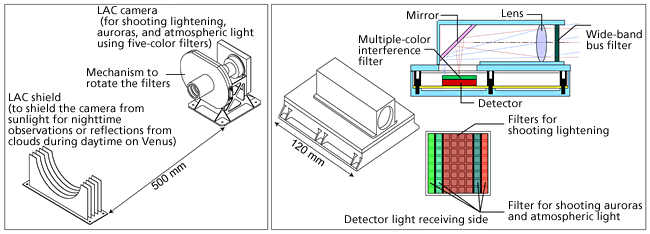
    Lightning and airglow camera (LAC) becomes drastically lighter

    The Venus probe “PLANET-C” is equipped with five cameras, one of which is the first lightening and airglow camera (LAC) for a planet-probing mission in the world. The LAC can shoot 50,000 times per second using its high-speed mechanism to ensure it captures the precise moment when lightning strikes. (People think that we can see lightening flashes with our naked eyes, but it is actually through persistence of vision.)
    The camera also has an “automatic event detection” function to determine if lightening really took place. This function is a unique feature to sort out only “real” lightning data from a large amount of trial image data.
    In order to pass very strict weight constraints, the LAC design was modified in the fall of 2004, and we successfully reduced its weight by more than 70 percent (from about 5.2 kilograms to about 1.5 kilograms.) We have been verifying the possibility by using a prototype to change the image-pickup element (pixels) from MCP (Micro Channel Plate) to APD (Avalanche Photodiode), which is a more reliable and durable element.
    The development team holds high expectations that the LAC will end a dispute over the “existence of lightning and electric discharging on Venus” which has been debated for more than 20 years.

    Outline of the Lightning and Airglow Camera (The latest version, Spring 2005)

    1) LAC before design change (left)
    2) External view of the LAC after design change (center) and the optical system (right)
    As the new design does not have a hood to shield it from sunlight or reflections from clouds over Venus, it will carry out observations only when the PLANET-C is in the night side of Venus.
    3) Arrangement of filters on the light receiving side
    By dividing the detector’s light receiving side in five, five kinds of filters of which each penetrates specific wavelengths of light, are attached directly to the image-pickup elements (pixels) to shoot different observation targets pixel by pixel. In the new design, we do not need the filter rotation mechanism, and that greatly contributed to make the camera lighter.

    Oct. 20, 2004 Updated
    Designing a prototype model of a probe

    The Planet-C project, which was officially started this past April, is now at the stage of designing a prototype model of a probe.

    Planet C is equipped with five special onboard cameras for measuring infrared lights and ultraviolet rays in various wavelengths to observe from the surface to the upper atmosphere of Venus. For observation purposes, it is challenge to keep the inside temperature of the probe cool. Infrared lights are also known as “heat rays”, and a device may not be able to measure properly if it becomes too hot.

    Venus is 40 million kilometers closer to the Sun than the Earth. Therefore, the prerequisites to control the thermal environment for a Venus probe are far stricter than for a satellite cycling around the Earth. More specifically, the project faces challenges to design a more efficient method to release heat from the probe into space (thermal structure design) and to control the heat generated by onboard equipment. We need to adopt some parts that do not have any history of use in the space development area, thus we are carefully carrying out radiation exposure tests.

    The development team, consisting of research institutes and manufacturers across Japan, is working hard to achieve future applications for Earth observation missions.

    * Photo : The photo is a test image taken by a model device for evaluating the performance of one of the onboard cameras, the mid-infrared camera. The photographed subjects are two black boards whose temperatures are slightly different. The temperature difference is clearly shown in the photo. On the upper left side, you can see a camera called a “non-cooling bolometer” with a new detector that enables it to perform infrared measurements without being cooled down. Thanks to this new detector, the camera becomes much smaller than the conventional one that requires a system to cool a detector. We expect that the camera will elucidate the temperature and movement of clouds around Venus.

    Feb. 27, 2004 Updated
    JAXA to manufacture “trial model” of probe

    The PLANET-C Project Team has been engaging in the initial design of the probe and development of a set of observation cameras for Venus. Many of the cameras are embedded with high pixel infrared sensors. Therefore, many tests, including radiation exposure, were carried out to verify their reliability in a space environment and to maximize their performance.
    In order to acquire emissions of thin infrared or thunder lights from the atmosphere or ground surface on the night side of Venus, the development of a high-performance “hood” is critical to eliminate the impact of strong sunlight. It is also imperative to maintain a cool temperature inside the probe to accurately measure infrared lights that are called “heat rays”. A more proficient design and structure is required for the Venusian orbit probe to dissipate heat to space as it travels much closer to the sun than earth orbit satellites.
    The designing is almost completed, and we will begin to develop and manufacture the trial model of the probe in April 2004. We are now fully prepared for moving to the next step.

    * Photo : Infrared cameras under development. Universities and research institutes, including Hokkaido University, Tohoku University, National Institute of Polar Research, Tokyo University, Osaka Prefecture University, and Kumamoto University, participate in the development of scientific observation equipment such as a set of infrared cameras.

    Let’s block ads! (Why?)

  • [ISS / Japanese Experiment Module (KIBO)] HTV6 site has been opened

    HTV6ミッションロゴ

    HTV6 mission logo

    HTV6 Mission

    Developed and built in Japan, the H-II Transfer Vehicle (HTV) known as “KOUNOTORI (white stork)” is an unmanned cargo transfer spacecraft that delivers supplies to the International Space Station (ISS).

    With the world’s largest loading capacity of approximately six tons and such unique functions as the International Standard Racks, “KOUNOTORI” plays a key role in ISS operations.

    News

    ISS batteries loaded into KOUNOTORI6

    ISS batteries loaded into KOUNOTORI6 (July 26, 2016)

    From June 1-2, the operations for loading the ISS battery Orbital Replacement Units (ORUs) into the H-II Transfer Vehicle KOUNOTORI6 and filling the water bags were unveiled to the press at the Tanegashima Space Center (TNSC).

    ≫ HTV6 Mission News

    Flight Schedule

    HTV6 Mission Schedule (as of July 26, 2016)
    All times are Japan Standard Time (UTC + 9 hours)
    Item Description
    Launch date and time 2:16 a.m.*1, October 1, 2016
    Launch window Oct. 2 (Sun.) – Nov. 30 (Wed.), 2016*2
    Launch site Yoshinobu Launch Complex, Tanegashima Space Center (TNSC)
    HTV6 capture October 4, 2016 (TBD)

    *1: Time will be determined by the updated orbit of the International Space Station (ISS).
    *2: The launch day and time during the launch windows shall be decided by the international coordination for ISS operations.

    Let’s block ads! (Why?)

  • [Institute of Space and Astronautical Science (ISAS)] The Magnetosphere Has a Large Intake of Solar Wind Energy

    Solar wind forms the energy source for aurora explosions. How does the Earth’s magnetosphere take in the energy of the solar wind? An international team led by Hiroshi Hasegawa and Naritoshi Kitamura (ISAS/JAXA) analyzed data taken by the US-Japan collaborative mission GEOTAIL and NASA’s MMS satellites and revealed that the interaction between the magnetic fields of Earth and the Sun, or more precisely the phenomenon known as magnetic reconnection, can feed the aurora explosions.


    Artist concept of the GEOTAIL and the MMS missions to study how does the Earth’s magnetosphere take in the energy of the solar wind. (Credits: ISAS/JAXA) [Click for large image]

    The region of outer space near Earth, also called geospace, is not a peaceful region. For example, solar wind, a fast flow of charged particles driven by the Sun’s magnetic field that blows against the Earth, is harmful for lives on the Earth. Fortunately, our planet has a shield. The Earth’s magnetosphere provides an invisible protection from the solar wind.

    The interaction between the solar wind and Earth’s magnetosphere can cause various phenomena, such as aurora.
    According to the prevailing theory, an aurora explosion involves four main processes:
    (1) The energy of the solar wind enters the Earth’s magnetosphere,
    (2) The tail of the magnetosphere stores the energy,
    (3) The stored energy is released quickly and transferred to the plasma particles,
    (4) These plasma particles move toward the Earth’s polar region along magnetic field lines, and finally cause an aurora explosion.

    Magnetic reconnection is believed to be the key mechanism involved in the entry (1) and release (3) of the energy of the solar wind.
    Using data from the GEOTAIL (*1) and MMS (*2) missions, the international team led by Hiroshi Hasegawa and Naritoshi Kitamura (ISAS/JAXA) studied the first of the four processes mentioned above. The data was collected in October and November 2015. On one day, GEOTAIL and MMS both detected plasma jets produced by magnetic reconnection lasting over a period of 5 hours.

    The team first focused on detecting the disappearance of magnetic ropes. When the magnetic reconnection process occurs at multiple sites, magnetic ropes composed of twisted magnetic field lines are produced. It was commonly believed that magnetic ropes become larger when swept away by the plasma jets. However, this study revealed that magnetic ropes sometimes disappear. This means that the energy of the solar wind does not necessarily enter the magnetosphere even when magnetic reconnection occurs. In other words, this implies that magnetic ropes can prevent the entry of the solar wind energy.

    This study also showed that magnetic reconnection continues over a period of at least 5 hours. Considering the orbits of the satellites together, the team estimated that the magnetic reconnection line extends over a distance of about 70,000 km.

    Combining these results, the team concluded that the magnetic reconnection process is sufficient for taking in the energy of the solar wind and inducing aurora explosions.

    Furthermore, this study revealed that the magnetic reconnection line shifts to the winter hemisphere side. A previous study pointed out that a shift may result in a decline in the efficiency of the energy intake from the solar wind. Also, aurora activities are known to decrease during the summer and winter seasons. Therefore, the shift of the magnetic reconnection line may be related with the seasonal variations of the auroral activities.

    In this context, JAXA plans to launch a new spacecraft called the ERG satellite (*3) that aims to observe the inner region of the magnetosphere. Collaborative observations with GEOTAIL and ERG satellites will help to understand phenomena taking place in the geospace.

    Notes:
    *1 Geotail satellite: GEOTAIL is a satellite whose primary objective is to study the structure and dynamics of Earth’s magnetotail. The satellite was named “GEOTAIL” because it explores that magnetotail. (“Geo” is a prefix for words relating to the Earth.) The GEOTAIL mission is a collaborative project between Japan and the United States. The satellite was developed and is operated by Japan’s Institute of Space and Astronautical Science (ISAS), one of the predecessor bodies of JAXA. It was launched by the National Aeronautics and Space Administration (NASA) in 1992, using the Delta II launch vehicle.

    *2 MMS (Magnetospheric MultiScale) Mission: MMS investigates how the Sun’s and Earth’s magnetic fields connect and disconnect, explosively transferring energy from one to the other in a process that is important at the Sun, other planets, and everywhere in the universe, known as magnetic reconnection. Reconnection limits the performance of fusion reactors and is the final governor of geospace weather that affects modern technological systems such as telecommunications networks, GPS navigation, and electrical power grids. Four identically instrumented spacecraft measure plasmas, fields, and particles in a near-equatorial orbit that will frequently encounters reconnection in action.
    http://mms.gsfc.nasa.gov/about_mms.html
    The four MMS Observatories launched on-time on 3.12.2015 at 10:44 pm EDT and were inserted with perfect accuracy and attitude into our initial orbit by the Atlas-Centaur AV-53.
    http://mms.gsfc.nasa.gov/mission_highlights_post.html

    *3 The ERG (Exploration of energization and Radiation in Geospace) satellite is being developed as a science satellite by ISAS/JAXA, and is a part of the ERG project. The project consists of the satellite observation team, the ground-based network observation team, and the integrated data analysis/simulation team, and is a mission to elucidate acceleration and loss mechanisms of relativistic electrons around Earth during geospace storms.

    References:
    Decay of mesoscale flux transfer events during quasi-continuous spatially extended reconnection at the magnetopause”, Hiroshi Hasegawa et al., 2016 May 21, Geophysical Research Letters, DOI: 10.1002/2016GL069225
    and
    “Shift of the magnetopause reconnection line to the winter hemisphere under southward IMF conditions: Geotail and MMS”, Naritoshi Kitamura, et al., 2016, June 6, Geophysical Research Letters, DOI: 10.1002/2016GL069095

    Let’s block ads! (Why?)

  • [Institute of Space and Astronautical Science (ISAS)] The Forefront of Space Science: "Hinode", the chromosphere, magnetic waves, and coronal heating

    | 1 | 2 | 3 |

    Why is the solar corona so hot? The question of why the solar corona is so hot has puzzled solar physicists for many years. In order to solve the mystery, a number of ground-based telescopes and satellites were developed around the world. Despite of such an effort, we have not found the answer to the question. The “coronal heating problem” has been one of the main focuses of missions currently being developed or discussed. This current situation may give you an impression that have not advanced at all in the study of coronal heating. This is not true. The understanding of the mechanism through satellite observations has greatly advanced, and the substantial research content has evolved dramatically. Specifically, observations though the Hinode satellite have found some magnetic waves that seem to be playing an important role in heating the corona. This discovery, together with the data collected by NASA’s solar observation satellite IRIS (Interface Region Imaging Spectrograph), has finally led to the detection of magnetic wave dissipation.

    In this article, I will talk about the approaches to the study of Coronal Heating using these solar observation satellites.

    Chromospheric activity observed by Hinode

    So, why am I talking about the chromosphere when our focus is on the corona? Because we cannot talk about the corona without understanding the chromosphere. The solar atmosphere consists of three layers: the photosphere (whose temperature is about 6,000 degrees), chromosphere (10,000 degrees), and corona (1 million degrees). The photosphere has a thickness of about 500km, while the chromosphere is about 2,000km thick. The corona is the layer above these two layers. Explanation of the solar atmosphere would have been much simpler if these three layers consisting it were parallel to each other. In reality, however, some part of the chromosphere is extending into the layer above it, or the corona, and part of it is even moving through the layer (see Figure 1). This inconsistency is due to the fact that the sun’s atmosphere is divided into these layers based on the temperature. The gas with a temperature of around 10,000 degrees is called “chromosphere”, regardless of how far it is from the Sun’s surface. Likewise, the corona is the gas with a temperature of around 1 million degrees. Due to this, plasma with a temperature of around 10,000 degrees that exists within the corona, such as prominences and spicules, is also defined as chromosphere. I should note that these prominences and spicules which are categorized as chromosphere should not be treated in the same way as the regular, flat chromospheric layer.

    When we look at the chromosphere observed through Hinode (Figure 1), we can see that it has a structure consisting of fine thread. A video which captured its motion shows that it keeps moving very actively. This is one of the “surprising” facts that Hinode has discovered, which reaffirmed how complex the study of coronal heating is. Until this discovery, it was believed by solar physicists that the chromosphere is just a layer which lies between the photosphere and the corona and is of no importance in exchange of energy between these layers. Now that we know the middle layer is this active, it is natural to think that understanding how the corona is heated requires the understanding the behavior of the chromosphere as well as the amount of energy accumulated within the layer.

    Figure 1. An image captured through Hinode and the parallel model for the sun's atmosphere
    Figure 1. An image captured through Hinode and the parallel model for the sun’s atmosphere [Click for large image]
    Left: Chromospheric structures on the solar limb captured through Hinode. What is shown on the bottom of the image is the surface of the Sun, while the thick layer shown on the upper half of the image is the corona. The trailing streaky flux is a prominence. This false-color image includes the light emanating from the plasma with a temperature of about 10,000 degrees.
    Right: the conventional model for the solar atmosphere. In this model, the transition layer, which exists on the boundary between the chromosphere and corona, is omitted and shown as part of the chromosphere. The temperature of the chromosphere rises sharply at this transition layer.
    | 1 | 2 | 3 |

    This entry passed through the Full-Text RSS service – if this is your content and you’re reading it on someone else’s site, please read the FAQ at fivefilters.org/content-only/faq.php#publishers.
    Recommended article from FiveFilters.org: Most Labour MPs in the UK Are Revolting.

  • [Institute of Space and Astronautical Science (ISAS)] An Unexpectedly Calm Hot Gas in the Center of the Perseus Cluster

    Topics List

    Jul. 7, 2016 Updated
    An Unexpectedly Calm Hot Gas in the Center of the Perseus Cluster

    An international team observed the hot gas in the Perseus cluster with the Soft X-ray Spectrometer (SXS) on board the X-ray Astronomy Satellite ASTRO-H (“Hitomi”) during its initial operation phase, which started one week after liftoff. The total integration time was 230,000 s.
    The energy resolution of the SXS data was high, equaling the best resolution estimated during ground testing. The observation data demonstrated the good in-orbit performance of the SXS and its ability to measure the velocity of hot gas with at least 20 times better resolution than previous instruments.
    This observation resulted in the first determination of the velocity of hot gas in the center of a galaxy cluster.
    At the center of the Perseus cluster, a gigantic black hole emits powerful jets that collide with the surrounding hot gas and push it outward. For this reason, large turbulent flows of the hot gas were expected. However, the SXS observation revealed that the chaotic motion was small and the hot gas was calm, despite the violent conditions.
    These results are presented in a paper published on July 7, 2016, in the journal Nature.

    An Unexpectedly Calm Hot Gas in the Center of the Perseus Cluster

    Jun. 15, 2016 Updated
    JAXA Executives Take Pay Cut Due to ASTRO-H (Hitomi) Anomaly

    Due to the anomaly experienced with X-Ray Astronomy Satellite ASTRO-H (Hitomi), three of the Japan Aerospace Exploration Agency’s executive employees have decided to take a 10% pay cut to their monthly salary for four months, to be effective July 2016.

    Jun. 10, 2016 Updated
    Hitomi Experience Report – Handout for the Specialists advisory panel meeting called by MEXT.

    Jun. 3, 2016 Updated
    Handout for the Specialists advisory panel meeting called by MEXT (Ministry of Education, Culture, Sports, Science and Technology).

    May 27, 2016 Updated
    Handout for the Specialists advisory panel meeting called by MEXT (Ministry of Education, Culture, Sports, Science and Technology).

    Apr. 28, 2016 Updated
    Operation Plan of ASTRO-H (Hitomi)

    JAXA established the emergency headquarters and has been doing its utmost to understand the anomaly of ASTRO-H (“Hitomi”). We have made every effort to confirm the status of ASTRO-H and to regain its functions. Unfortunately, based on our rigorous technical investigation, we had to conclude.
    On April 28 (JST), JAXA held a press briefing and sent out press releases on ASTRO-H (“Hitomi”).

    JAXA have determined that we cannot restore the ASTRO-H’s functions. Accordingly, JAXA will cease the efforts to restore ASTRO-H and will focus on the investigation of anomaly causes. We will carefully review all phases from design, manufacturing, verification, and operations to identify the causes that may have led to this anomaly including background factors.

    JAXA expresses the deepest regret for the fact that we had to discontinue the operations of ASTRO-H and extends our most sincere apologies to everyone who has supported ASTRO-H believing in the excellent results ASTRO-H would bring, to all overseas and domestic partners including NASA, and to all foreign and Japanese astrophysicists who were planning to use the observational results from ASTRO-H for their studies.

    Apr. 21, 2016 Updated
    Handout of press briefing (April 15)

    Apr. 13, 2016 Updated
    Handout of press briefing (April 8)

    On April 8 (JST), JAXA held a press briefing to explain the status of the X-ray Astronomy Satellite “Hitomi” (ASTRO-H) and our activities to re-establish communications with “Hitomi.”

    Apr. 7, 2016 Updated
    Handout of press briefing (April 1)

    On April 1 (JST), JAXA held a press briefing to explain the status of the X-ray Astronomy Satellite “Hitomi” (ASTRO-H) and our activities to re-establish communications with “Hitomi.”

    Mar. 29, 2016 Updated
    Current Status of Communication Anomaly of X-ray Astronomy Satellite “Hitomi” (ASTRO-H) (Mar. 29)

    JAXA has been trying to communicate with the X-ray Astronomy Satellite “Hitomi” (ASTRO-H), using ground stations both in Japan and overseas.

    By utilizing two opportunities of communicating with Hitomi, JAXA received signals from the satellite: the first time was at about 10:00 p.m. on 28 at the Uchinoura Ground Station, and the second one was at around 0:30 a.m. on 29 at the Santiago Tracking Station in Chile. JAXA has not been able to find the state of its health, as the time frames for receiving the signals were very short.

    According to the U.S. Joint Space Operations Center (JSpOC), it is estimated that Hitomi separated to five pieces at about 10:42 a.m. on 26. In order to investigate the situation, JAXA is observing the objects, using a radar located at the Kamisaibara Space Guard Center (KSGC) and telescopes at the Bisei Space Guard Center (BSGC) owned by the Japan Space Forum. Up to now, the telescopes at BSGC detected two objects around the satellite’s original orbit, while the radar at KSGC identified one of them. It is confirmed that the signal received at the Santiago Tracking Station came from the orbital direction of the object identified at KSGC.

    JAXA continues to investigate the relationship between the information from JSpOC and the communication anomaly.

    JAXA will do its utmost to recover communications with Hitomi and investigate the cause of the anomaly.

    * In the above report, it is written in the third paragraph that “According to the U.S. Joint Space Operations Center (JSpOC), it is estimated that Hitomi separated to five pieces….” JAXA re-confirmed the situation with JSpOC and found that their estimation actually meant, “five objects fell off from the satellite (meaning the satellite is now separated into six parts).”

    Mar. 27, 2016 Updated
    Communication anomaly of X-ray Astronomy Satellite “Hitomi” (ASTRO-H) (Mar. 27)

    JAXA found that communication with the X-ray Astronomy Satellite “Hitomi” (ASTRO-H), launched on February 17, 2016 (JST), failed from the start of its operation originally scheduled at 16:40, Saturday March 26 (JST). Up to now, JAXA has not been able to figure out the state of health of the satellite.

    While the cause of communication anomaly is under investigation, JAXA received short signal from the satellite, and is working for recovery.

    Under this circumstance, JAXA set up emergency headquarters, headed by the President, for recovery and investigation. The headquarters held its first meeting today, and has been working for recovery and the investigation of the cause. Updates will be announced as available, at the JAXA website.

    Feb. 29, 2016 Updated
    Hitomi critical operation phase successfully completed!

    JAXA confirmed the completion of a sequence of important operations of the X-ray Astronomy Satellite “Hitomi” (ASTRO-H), including turning the cooling system on, test operation of the Soft X-ray Spectrometer (SXS), and extending the Extensible Optical Bench (EOB). With this confirmation, the critical operation phase of Hitomi was completed.
    The Hitomi will take about one and half months to verify the function of its onboard equipment and instruments in space, then we will conduct calibration observations for another one and half months.

    Hitomi critical operation phase successfully completed!

    Feb. 17, 2016 Updated
    ASTRO-H successfully launched and named “Hitomi”.

    H-IIA F30 with the “ASTRO-H” onboard launched at 5:45 p.m. on Feb 17, 2016 (JST) from the Tanegashima Space Center. The rocket flew smoothly, and, at about 14 minutes after liftoff, “ASTRO-H” was separated from the H-IIA F30.
    ASTRO-H is the eye to study the hot and energetic universe. Therefore we name ASTRO-H, “Hitomi”. The word “Hitomi”.generally means “eye”, and specifically the pupil, or entrance window of the eye – the aperture!

    ASTRO-H successfully launched and named “Hitomi”.

    Feb. 14, 2016 Updated
    ASTRO-H Launch rescheduled to 5:45 p.m. on Feb 17 (Wed. ,JST)

    The launch of the The X-ray Astronomy Satellite “ASTRO-H” by the H-IIA Launch Vehicle No. 30 was rescheduled at 5:45 p.m. on Feb 17 (Wed. Japan Standard Time, JST) after carefully studying the weather conditions.

    The live launch report will begin at 5:25 p.m. on Feb 17(Wed. ,JST). The report will be broadcast through the Internet.
    Please send your support messages for the mission!

    ASTRO-H Launch rescheduled to 5:45 p.m. on Feb 17 (Wed. ,JST)

    Feb. 12, 2016 Updated
    The X-ray Astronomy Satellite “ASTRO-H” launch postponement

    H-IIA Launch Vehicle No.30 with the X-ray Astronomy Satellite “ASTRO-H” onboard, which was originally scheduled for February 12 (Fri.), 2016 (Japan Standard Time), has been rescheduled because bad weather is expected. The new launch day will be announced as soon as it is determined. Your warm support messages are welcomed at the support site.

    Feb. 3, 2016 Updated
    ASTRO-H Press Kit

    As the launch day approaches, JAXA has released the press kit for the X-ray Astronomy Satellite “ASTRO-H”. It covers ASTRO-H’s satellite and  mission overview, scientific missions, and observation instruments. Please have a look.

    ASTRO-H Press Kit

    Jan. 21, 2016 Updated
    ASTRO-H’s development and preparation status is updated on the ASTRO-H diary site

    Aiming at the launch and success of the mission, for some years the Astro-H team members have been hard at work at research and development, making steady progress. They have faced many tough obstacles along this long road. They have had many moments of success.
    This diary is an introduction to the daily work life — and to the excitements — of these members.

    ASTRO-H's development and preparation status is updated on the ASTRO-H diary site

    Jan. 12, 2016 Updated
    ASTRO-H Satellite Shown to the Public

    On the day marking exactly one month to launch, the ASTRO-H spacecraft was exhibited to the public at the Tanegashima Space Center. Many questions were asked both about the science goals of ASTRO-H and about its engineering.

    ASTRO-H Satellite Shown to the Public

    Dec. 11, 2015 Updated
    X-ray Astronomy Satellite “ASTRO-H” to be launched on Feb. 12

    The new generation X-ray astronomy satellite ASTRO-H is set for launch on February 12 (Fri.), by the H-IIA Launch Vehicle No. 30 from the Tanegashima Space Center.

    JAXA will broadcast a live launch report on the launch day. We will announce more details later. Please look forward to the launch!

    Dec. 2, 2015 Updated
    ASTRO-H press day

    The X-ray Astronomy Satellite “ASTRO-H” was revealed to the media on Nov. 27 at the Tsukuba Space Center.
    The ASTRO-H is an astronomy satellite to elucidate the structure of space and its evolution through studying high-temperature and high-energy celestial bodies, such as black holes, supernova remnants, and galaxy clusters by X-rays and gamma-rays.
    X-rays and gamma-rays from space are absorbed in the Earth’s atmosphere, thus they cannot be observed on the Earth. Therefore observation in space is necessary.
    The ASTRO-H was developed as a successor to the Suzaku, also an X-ray astronomy satellite. The ASTRO-H is a flagship mission of X-ray astronomy with the participation of over 200 researchers in its development from various domestic and international universities and research institutions including JAXA and NASA. Four new observation systems developed based on broad-scale international cooperation are installed on the ASTRO-H, hence, compared to the Suzaku, it will be able to perform spectroscopic observations on celestial bodies 10 times to 100 times darker than what the Suzaku was capable of doing.

    ASTRO-H press day

    Nov. 2, 2015 Updated
    ASTRO-H sinusoidal vibration test

    The sinusoidal vibration test of the X-ray astronomy satellite “ASTRO-H” was held between Aug. 29 and Oct. 2 at the Tsukuba Space Center. The sinusoidal vibration test aims at two major evaluation objectives, namely evaluating dynamic characteristics of a satellite structure and assessing its strength by loading vibrations equivalent to that at the launch.
    On Oct. 2, the last vibration test was completed, then planned dynamic characteristics data was acquired and the strength of the satellite structure against a vibration load equivalent to that at the time of launch was verified.

    ASTRO-H sinusoidal vibration test

    Aug. 3, 2015 Updated
    ASTRO-H thermal vacuum test

    The thermal vacuum test was held for the X-ray Astronomy Satellite “ASTRO-H” between June 24 and July 9 in a 13-meter chamber at the Tsukuba Space Center. The purposes of the thermal vacuum test are to verify the thermal model by exposing a satellite to the vacuum and thermal environment, and to confirm the function and performance of observation instruments in the on-orbit environment through an electric test.
    All tested items were satisfactorily confirmed including the expected performance of the onboard instruments, verification of the command function to be used in orbit, and calibration data acquisition.

    ASTRO-H thermal vacuum test

    Apr. 21, 2015 Updated
    Soft Gamma-ray Detectors (SGDs) installation on ASTRO-H completed

    Two Soft Gamma-ray Detectors (SGDs), which successfully went through the thermal vacuum test and the cooling test, were installed onto the ASTRO-H. The photo shows the SGD2 on the ASTRO-H with a debris cover and a radiator. A golden color MLI (multi-layer insulation) will wrap them so that they will not be seen from outside.
    All the observation instruments are now installed on the ASTRO-H, so its preparations for launch are turning the final corner. We will work harder to overcome the many remaining hurdles including the functional test, thermal vacuum test, and vibration test.

    Soft Gamma-ray Detectors (SGDs) installation on ASTRO-H completed

    Jan. 25, 2015 Updated
    Thermal vacuum test for Soft Gamma-ray Detectors

    The Soft Gamma-ray Detectors (SGD) to observe the soft gamma-ray region of 60 to 600 keV are under the thermal vacuum test in the 8-meter chamber at the Tsukuba Space Center to confirm their thermal design.
    The sensor part of the SGD does not activate till the temperature hits a low temperature of minus 20 degrees (C). However, the SGDs will be installed outside of the satellite panel, thus their temperature will increase from radiation from the Sun and the Earth, thermal input from the satellite panel, and heat from a large amount of LSI (large-scale integrated circuits) and an amplifier if nothing is done. Therefore, the accumulating heat will be carried to the radiator through thermal transfer and a heat pipe to be released, and the SGD will be covered by the multi-layer insulation (MLI), which looks like a bunch of aluminum foils, to shut out heat input. The semiconductor sensor is also activated with high voltage of 200 to 1000 V, hence it should also be tested if it would discharge in vacuum.
    Photo: The SGD-2 sits in the 8-meter chamber.

    Thermal vacuum test for Soft Gamma-ray Detectors

    May 29, 2014 Updated
    First Integration Test for ASTRO-H (for XRT)

    As manufacturing of two Hard X-ray Telescopes (HXTs) and two Soft X-ray Telescopes (SXTs) has been completed and their performance has been confirmed, they are going to be subject to the first integration test. During the test, the telescopes will be mounted on an optical board to make sure that there is no interference with other structures or the satellite bus as well as that no problems arise with operations for controlling the telescope position or angle and operation tools.
    Photo: Satellite surrounded by a scaffold

    First Integration Test for ASTRO-H (for XRT)

    Mar. 26, 2013 Updated
    ASTRO-H development status

    Aug. 10, 2012 Updated
    Satellite development going well: Development test status

    Mar. 15, 2010 Updated
    ASTRO-H passed the basic design review, new logo published

    On May 13 and 14, 2010, the basic design review was held for the ASTRO-H, and the satellite passed the examination. We are moving to the detailed design phase. To celebrate this opportunity, we revised the official logo mark for the ASTRO-H and published it on Feb. 25. The launch of the ASTRO-H is coming closer, and we are working hard for the project to proceed smoothly. Your support will be very much appreciated.

    Oct. 28, 2009 Updated
    SRON-JAXA agreement on Space Science

    On October 28th, 2009, SRON Netherlands Institute for Space Research and JAXA signed a cooperative framework agreement with the aim of promoting joint activities in the field of space science in the presence of Dr. De Heer, the Ambassador Extraordinary and Plenipotentiary of the Kingdome of the Netherlands to Japan, and Dr. Tachikawa, the President of JAXA.
    On the same day, the Implementing Arrangement for collaboration on ASTRO-H (International X-ray astronomy mission) was also concluded. Through ASTRO-H mission, SRON will be in charge of developing an onboard instrument “Soft X-ray Spectrometer (SXS)” and take part in a science team to carry our scientific research.

    SRON-JAXA agreement on Space Science

    This entry passed through the Full-Text RSS service – if this is your content and you’re reading it on someone else’s site, please read the FAQ at fivefilters.org/content-only/faq.php#publishers.
    Recommended article from FiveFilters.org: Most Labour MPs in the UK Are Revolting.

  • [ISS / Japanese Experiment Module (KIBO)] CALET has succeeded in observing electron precipitation

    CALET has succeeded in observing electron precipitation

    Last Updated: July 6, 2016

    National Institute of Polar Research (NIPR)

    Waseda University

    JAXA

    The CALorimetric Electron Telescope (CALET) onboard the Japanese Experiment Module “Kibo” of the International Space Station (ISS) since 2015 has succeeded in observing a tremendous shower of electrons*1(called “Relativistic Electron Precipitation: REP”) for a few minutes as the ISS passed through a high geomagnetic latitude*2 area, indicating that REP had also occurred around the ISS. From the data obtained, REP is considered to be electrons precipitated from the Van Allen radiation belts*3 that were affected by electromagnetic ion cyclotron waves.

    *1 Electrons: This research describes electrons as those having about one million electron volts (MeV), which is different from the main target of CALET.

    *2 Geomagnetic latitude: The bearing of geomagnetic latitude is determined based on the magnetic poles of Earth, not on such axis as the geographic latitude.

    *3 Van Allen radiation belts : The area where intense energetic electrons are held in place at around 10,000 to 40,000 kilometers above the Equator. Electrons in the Van Allen radiation belts surround and circle Earth without falling to Earth.

    Photo

    Installation location of CALET (Credit: JAXA/NASA)

    As REP can damage satellite electronics and be a cause of ozone destruction in the middle atmosphere, further study may contribute to the prediction of space weather and atmospheric chemistry.

    The result of the study was published online on Geophysical Research Letters dated May 7, 2016.

    Relativistic electron precipitation at the International Space Station: Space weather monitoring by Calorimetric Electron Telescope

    URL: http://onlinelibrary.wiley.com/doi/10.1002/2016GL068930/full

    CALorimetric Electron Telescope (CALET)

    *This article is a brief translation of an article published on the correspondent website on May 18, 2016)

    *All times are Japan Standard Time (JST)

    This entry passed through the Full-Text RSS service – if this is your content and you’re reading it on someone else’s site, please read the FAQ at fivefilters.org/content-only/faq.php#publishers.
    Recommended article from FiveFilters.org: Most Labour MPs in the UK Are Revolting.

  • [Project Topics] Ryugu Observation Campaign (for expert observers)

    The target asteroid of Hayabusa2 is (162173) Ryugu, 1999 JU3 in the provisional designation. Hayabusa2 will arrive at this asteroid in June – July 2018. In this summer, we have a opportunity to observe Ryugu, so we set up “Ryugu Observation Campaign” from July 1 to August 15, 2016. This is the last chance to observe Ryugu before Hayabusa2 arrives there.

    However the maximum apparent magnitude will be just 18th mag (Fig.1), so it is rather dark. Maybe you need a telescope with the diameter of 1m or so. Or you must follow the motion of Ryugu with your telescope. Therefor the observation will be rather difficult, but please try it if you can. Good luck!

    • Fig.1 Information related Asteroid Ryugu

    June 21, 2016
    Ground-based Observation Team, Hayabsua2 Project

    Let’s block ads! (Why?)

  • [Earth Observation Research Center (EORC)] Providing the SAR level 0 products of Japanese Earth Resources Satellite-1 (JERS-1)

    物理量の対応表はこちら 大気圏 降水 雨、雪などの降水に関する物理量で、降水量、降水分類、降水粒子径の三つの物理量があります。 大気中に浮かぶ雲に関する物理量で、雲水量・雲氷量、雲マスク・分類、雲粒径・形状、雲頂特性、雲量、光学的厚さ、雲相、ドップラー速度、雲消>散係数、雲後方散乱係数、雲ライダー比、雲偏光解消度があります。 水蒸気 空気中の水蒸気に関する物理量で、積算水蒸気量があります。 エアロゾル 大気中に浮遊する微小粒子であるエアロゾルに関する光学的厚さ、粒子径、マスク、種、消散係数、後方散乱係数、ライダー比、偏光解消度>の8の物理量が含まれる物理量です。 放射収支 地球は太陽から放射エネルギーを受け取ると同時に、表面(陸面、海面、雪氷面、雲頂等)からエネルギーを宇宙へ放出しています。その放射エ>ネルギーの出入りをまとめたものが放射収支です。潜熱加熱率プロファイル、短波放射フラックス、長波放射フラックス、短波加熱比、長波加熱比の物理量があります。 放射輝度 衛星が観測した放射輝度 雪氷圏 海氷 海氷域の海氷密接度、海氷分布、表面温度、積雪粒子径などの表面状態を観測した物理量が含まれます。 積雪 積雪域の積雪深、積雪分布、表面温度、積雪粒子径などの表面状態を観測した物理量が含まれます。 陸圏 土壌水分 土壌水分は、地表面付近の土壌に含まれる水分です。 積雪 積雪域の積雪深、積雪分布、表面温度、積雪粒子径などの表面状態を観測した物理量が含まれます。 地表面 地表面の状態観測により得られら物理量が含まれます。 放射輝度・反射率 光線の強度を表す放射輝度・反射率の物理量です。 放射輝度 衛星が観測した放射輝度 植生 陸地に生育している植物の集団である植生に関する物理量で、植生パラメータとバイオマスがあります 海洋圏 海面水温 大気と海洋の境界である、数cm~10m程度の海面の水温に関する海面水温の物理量です。 海上風 海上における風速である海上風速の物理量です。 海色 正規化海水射出放射輝度、クロロフィルa濃度、懸濁物質濃度、有色溶存有機物の物理量があります。 その他 放射輝度・輝度温度 物体の熱放射と同じ輝度を持つ黒体の温度である輝度温度、光線の強度を表す放射輝度、放射輝度・反射率の物理量があります。 レーダ 衛星から発射されるレーダに関する物理量で、受信電力、レーダ反射因子、後方散乱断面積があります。 幾何情報 幾何学補正をするための情報です。 環境補助 全球客観解析値(GANAL)および全球予報値(FCST)を入力とし、衛星軌道で時空間内挿したもの。

    Let’s block ads! (Why?)

  • [JAXA President Monthly Press Conference] JAXA President Monthly Regular Press Conference June 2016

    JAXA President Monthly Regular Press Conference

    Date and time: From 11:00 – 11:45 a.m. on June 15 (Wed), 2016
    Venue: JAXA Tokyo Office Presentation Room (B1 floor)
    MC: Yoshikazu Shoji, JAXA Public Affairs Department Director

    X-ray Astronomy Satellite ASTRO-H (“Hitomi”)

    Through a subcommittee for Hitomi under the Committee for Space Development and Application of MEXT (Ministry of Education, Culture, Sports, Science and Technology), JAXA has been explaining the factors that resulted in the ASTRO-H (Hitomi) anomaly. During the investigation, we found that the Institute of Space and Astronautical Science’s (ISAS) project management method was the root cause of this anomaly. The conventional management method at the ISAS was to develop a satellite or a probe with a limited number of employees on a low budget by working together with a manufacturer as a team. As a member of the subcommittee commented, this method worked well for small-scale projects. However, as is the international trend, satellites and spacecraft that are currently under development at JAXA are relatively large, and have far more complex systems compared to ones prior. In such a context, the previously conventional ISAS methods were not necessarily suited for the production of modern satellites and spacecraft. JAXA understands that, in the wake of the ASTRO-H anomaly, we must take responsibility for and deeply reflect upon our production methods.

    We take the fact that we had to abandon the ASTRO-H operation very seriously. Taking this opportunity, I sincerely apologize for our failure from the bottom of my heart to the people of Japan and astrophysical researchers.

    As the president of JAXA, due to the disappointment experienced by the Japanese people and a lost sense of reliability in Japan’s space enterprises upon this setback, I decided on the following.

    To express our regret and caution ourselves, three executives, namely myself (President Naoki Okumura), JAXA’s operations supervisor, Senior Vice President Mamoru Endo, who supports me, and Vice President Saku Tsuneta, who is also the ISAS Director General and in charge of the ASTRO-H project, were repremanded by the president andwill take a 10% pay cut from our monthly salaries for four months, to be effective July 2016.

    We would like to use this incident as an opportunity to remind ourselves again that JAXA, including ISAS, takes ultimate responsibility to verify the overall viability of a spacecraft’s systems, and that we must continuously improve our working methods. More specifically, we will clarify responsibility shared between companies and thoroughly remind everyone to share information regarding ISAS project operations in writing, not only among pertinent members, but also with members of all other relevant departments; we will more strictly keep records of quality control; and we will reconsider our operation of reviews and independent evaluation methods. We will perform the aforementioned as soon as possible. We will first focus on more immediately relevant projects, but will simultaneously begin improving our basic working methods, which we acknowledge may take a longer to resolve.

    Considering these changes for our latest project, I have ordered the project manager of the Exploration of energization and Radiation in Geospace “ERG” to focus on the system management of the spacecraft, which is scheduled to be launched within this Japan Fiscal Year. I have also assigned another person to be responsible for generating scientific achievements in order to reconstruct the organizational structure such that responsibilities are more clarified and specialized. In addition, ERG development and operation preparation will be comprehensively reviewed by a team that consists of members from overall JAXA departments, including the Space Technology Directorate. So that we can transport ERG to the Uchinoura Space Center for launch, we expect to finalize the review by the end of August.
    From now on, we would also ask manufacturers who understand the reforms we are currently undertaking, and are willing to take major role and responsibility in joining JAXA’s projects, to actively participate in our enterprises.

    NASA and the European Space Agency (ESA), the cooperative organizations for the ASTRO-H project, have informed us that, if JAXA considers the development of a successor to the ASTRO-H, both NASA and ESA will once again be open to discuss the possibility of cooperation. Going forth, JAXA will consider the originally intended international role of ASTRO-H in its future space enterprises.

    Astronaut Onishi

    Astronaut Takuya Onishi passed the final test held on May 26 and 27 in Russia for boarding the International Space Station. He was then officially certified to complete training as a crewmember at the crew certification ceremony on May 31. I also participated in the ceremony and felt that his ability is highly appreciated. As we have already announced, the target launch date of the Soyuz spacecraft, which Astronaut Onishi will be aboard, has been postponed to July 7, and accordingly, we will perform the final check for the operation plan, procedures and other things regarding the operation and utilization of the ISS’s Japanese Experiment Module “Kibo.” For that purpose, Astronaut Onishi returned to Japan for a short period of time. I hope he takes this mission as an opportunity to further strengthen ties with the Flight Director such that the utilization of ISS/Kibo is fully realized and that he makes achievements there.

    Global Satellite Mapping of Precipitation (GSMaP)

    Let me also introduce some examples of using the GSMaP, Global Satellite Mapping of Precipitation. The GSMaP has been utilized all over the world, and it is highly appreciated as a very effective tool. Its use is becoming more and more popular, especially in areas where no ground radar is available, as the GSMaP can provide real-time information.
    One example is the Ogasawara Islands. They are outside the cover area of the Meteorological Agency’s ground radar, and both Chichijima and Hahajima islands only have one rain gauge each.
    Therefore, precipitation information provided by the GSMaP is very useful, and the town hall website uses the GSMaP. I am very pleased to see such a usage, and hope the GSMaP will be applied widely.
    On May 17, heavy rain caused a major landslide in Sri Lanka, and GSMaP data was used for the indication map for precipitation conditions in the report issued by the Sri Lanka disaster control center.
    Currently, users from 76 countries have registered to be able to use GSMaP, and users from 46 of those countries are public entities, including meteorological agencies.
    JAXA would like to continue to engage in activities that return our achievements in space to the Earth for the benefit of our daily lives.

    Let’s block ads! (Why?)