[unable to retrieve full-text content]
Category: News
http://www.subtome.com/#/subscribe?feeds=http%3A%2F%2Fftr.fivefilters.org%2Fmakefulltextfeed.php%3Furl%3Dglobal.jaxa.jp%252Frss%252Fnew.rdf%26max%3D3%26links%3Dpreserve&back=http%3A%2F%2Fftr.fivefilters.org%2Fmakefulltextfeed.php%3Furl%3Dglobal.jaxa.jp%252Frss%252Fnew.rdf%26max%3D3%26links%3Dpreserve
-
[Project Topics] KOUNOTORI6 (HTV6) Makes Debut to Media
Topics List
Oct. 19, 2016 Updated
KOUNOTORI6 (HTV6) Makes Debut to MediaOn October 19, members of the media were invited to view KOUNOTORI6 (HTV6), H-II transfer vehicle to the Space Station. The event was held at Tanegashima Space Center (TNSC) and attracted many as it showed actual HTV6 before launch.
At the premiere, Hirohiko Uematsu, Director of HTV Technology Center, Human Spaceflight Technology Directorate, JAXA explained the general facts and the payloads of HTV6, and addressed the records of past HTV operations, improvements, and the progress of launch preparation.
Koichi Inoue, Team Leader of KITE, Research and Development Directorate, JAXA spoke about KITE, Kounotori Integrated Tether Experiment. JAXA is making an attempt of on-orbit demonstration of electrodynamic tether (EDT) on HTV. KITE is expected to develop the system which through the use of EDT eliminates space debris on low-earth orbits. The tether length is approximately 700 m, on an unprecedented scale. Space debris has increasingly become a serious issue.
HTV6 will shortly undergo its final preparation procedure, where loading of propellant, encapsulation in its payload fairing, and docking to HTV6 will ensue. The launch is scheduled at around 10:26 pm on December 9 (Fri.), (Japan Standard Time) (subject to change by the international coordination for ISS operations) at TNSC.
Oct. 7, 2016 Updated
Launch Schedule of “KOUNOTORI6” (HTV6) Updated to December 9The launch schedule of the H-IIB Launch Vehicle No. 6 with the H-II Transfer Vehicle “KOUNOTORI6” (HTV6) on board, temporarily postponed has been updated to around 10:26 p.m. on December 9 (Fri.), (Japan Standard Time, JST).
JAXA appreciates messages to KOUNOTORI mission and the project team. Please write to following site.
Aug. 10, 2016 Updated
Launch Postponement of “KOUNOTORI6” (HTV6)Mitsubishi Heavy Industries, Ltd. and JAXA decided to postpone the launch of the H-IIB Launch Vehicle No. 6 with “KOUNOTORI6” (HTV6) onboard which was scheduled for October 1 (Sat.), 2016 (Japan Standard Time), as unfavorable.
The new launch date will be announced as soon as it is determined.
(Reason for the delay)
A slight leak was detected from piping of the HTV6 during an air tightness test. The test is part of HTV6 launch preparations at the launch site. We will disband the HTV6 module and take necessary measures.
Jul. 26, 2016 Updated
Launch day set for KOUNOTORI6/H-IIB F6!Sep. 30, 2015 Updated
KOUNOTORI5 completed its mission with re-entry!The KOUNOTORI5 (HTV5, a cargo transporter to the International Space Station) left the ISS on Sept. 29 and re-entered the atmosphere at around 5:33 a.m. on Sept. 30 (Japan Standard Time.)
The KOUNOTORI 5 successfully achieved its mission of taking cargo to the ISS, then completed all its tasks over about 42 days.
We would like to send our sincere appreciation to all of you who have been supporting the KOUNOTORI project. (Photo: JAXA/NASA)
Sep. 16, 2015 Updated
Live Internet broadcast of KOUNOTORI5’s departure from ISS on Sept. 28 (Mon.)The KOUNOTORI5 will leave the International Space Station (ISS) at 0:20 a.m. on September 29 (Tue.), and re-enter the Earth’s atmosphere at around 5:31 a.m. on the 30th (Wed.) to burn up. JAXA will broadcast the live report of its separation from the ISS through the Internet from around 11:50 p.m. on Sept. 28 (Mon.). Please don’t miss it! (All dates and time are Japan Standard Time.) (Photo: JAXA/NASA)

Aug. 25, 2015 Updated
KOUNOTORI5 captured and berthed at the ISSThe “KOUNOTORI5” launched by the H-IIB F5 on Aug. 19 (Wed. Japan Standard Time) was captured by the robotic arm of the International Space Station (ISS), which was maneuvered by Astronaut Kimiya Yui, at 7:29 p.m. on August 24 (Mon. JST). The HTV5 was then successfully berthed at the ISS at 2:28 a.m. on August 25 (Tue. JST).
The internal cargo as well as external cargo, such as CALET, on the KOUNOTORI5 will be unloaded by the onboard crew. (Photo: NASA TV)
Aug. 19, 2015 Updated
KOUNOTORI5 successfully launched by H-IIB F5!The KOUNOTORI5, a regular cargo transporter to space, was launched by the H-IIB Launch Vehicle No.5 (H-IIB F5) at 8:50:49 p.m. on August 19 (Wed.) 2015 (Japan Standard Time, JST) from the Tanegashima Space Center. The launch vehicle flew smoothly, and, at about 14 minutes and 54 seconds after liftoff, the separation of the KOUNOTORI5 was confirmed.
The KOUNOTORI5 will fly near the International Space Station, and Astronaut Yui will maneuver the robotic arm to capture it. We plan to broadcast his performance through the Internet from around 7:05 p.m. on Aug. 24 (Mon.) Please don’t miss it!
Aug. 17, 2015 Updated
KOUNOTORI5 launch rescheduled to 8:50:49 p.m. on August 19 (Wed.) 2015The KOUNOTORI5(HTV5)/H-IIB F5 launch was postponed to 8:50:49 p.m. on August 19 due to adverse weather.
Accordingly, the live launch report will begin at 8:00 p.m. on August 19 (Wed. , JST). The report will be broadcast through the Internet.
Please send your support messages for the mission, or tweet it including the hashtag #HTV5.
Aug. 16, 2015 Updated
KOUNOTORI5 launch postponed to Aug. 19 (Wed., JST)The launch date of the H-IIB Launch Vehicle No. 5 carrying the KOUNOTORI5 has been postponed as unfavorable weather is forecasted. The launch was originally scheduled for August 17. The live broadcast of the launch will also be put off accordingly.
Your support messages are very much welcome through Twitter (Hashtag “#HTV5”) or via the following website.
Aug. 15, 2015 Updated
New launch date and time of KOUNOTORI5/H-IIB F5 decidedAug. 14, 2015 Updated
KOUNOTORI5 launch postponed to Aug. 17 (Mon., JST)The launch date of the H-IIB Launch Vehicle No. 5 carrying the KOUNOTORI5 has been postponed as unfavorable weather is forecasted. The launch was originally scheduled for August 16. The live broadcast of the launch will also be put off accordingly.
Your support messages are very much welcome through Twitter (Hashtag “#HTV5”) or via the following website.Jul. 21, 2015 Updated
Dates set for capturing the KOUNOTORI5 and its berthing with ISS Astronaut Yui to be in charge of operationAfter international coordination, the dates for capturing the KOUNOTORI5, a cargo transporter to the International Space Station (ISS), and its berthing have been respectively set as August 20 (Thu.) and 21 (Fri.) The KOUNOTORI5 is scheduled to be launched on August 16 (Sun.) from the Tahegashima Space Center.
It was also decided that Astronaut Kimiya Yui will manipulate the ISS robotic arm to capture the KOUNOTORI2.
Jul. 10, 2015 Updated
KOUNOTORI5 and operation simulation training opened to the pressOn July 1, the KOUNOTORI5, a cargo transporter to the ISS, was revealed to the media at the Tanegashima Space Center. The mission was also explained there.
From the evening of July 9 to the morning of the 10th, simulation training for the KOUNOTORI5 operation and control was held in the KOUNOTORI operation room at the Tsukuba Space Center, and part of it was also open to the press. This training was a last opportunity for a joint session between JAXA and NASA before the KOUNOTORI5 launch. On the NASA side, Astronaut Wakata participated in the training as a CAPCOM (capsule/spacecraft communicator).
Jun. 9, 2015 Updated
Launch day set for KOUNOTORI5/H-IIB F5!The launch date and time for the H-IIB Launch Vehicle No. 5 (H-IIB F5) with the H-II Transfer Vehicle “KOUNOTORI5” (HTV5) onboard was set for around 10:01 p.m. on August 16 (Sun.), 2015 (Japan Standard Time).
The H-IIB F5 has already been transported to the TNSC, and it is now being assembled there.
* Launch time will be determined by the updated orbit of the ISS.
Sep. 7, 2013 Updated
KOUNOTORI4 completed its mission with re-entry!The KOUNOTORI4 (HTV4, a cargo transporter to the International Space Station) left the ISS on Sept. 5 and re-entered the atmosphere at 3:37 p.m. on Sept. 7 (Japan Standard Time.)
The KOUNOTORI 4 successfully achieved its mission of taking cargo to the ISS, then completed all its tasks over about 36 days.
We would like to send our sincere appreciation to all of you who have been supporting the KOUNOTORI project.
Sep. 3, 2013 Updated
Re-entry date and time for KOUNOTORI4 decidedSchedules of departure from the International Space Station (ISS) and of re-entry to the atmosphere for the H-II Transfer Vehicle “KOUNOTORI 4” (HTV4) are determined as follows.
Departure from the ISS:
September 5, 2013 / 1:00 a.m.(Japanese Standard Time, JST)*
Re-entry to the atmosphere:
September 7, 2013 / 3:36 p.m.(JST)** The time may vary according to the actual operation.

Aug. 10, 2013 Updated
KOUNOTORI4 berthed at ISS!The KOUNOTORI4 (HTV4, a cargo transporter to the International Space Station) was captured by the ISS robotic arm at 8:22 p.m. on August 9 (Japan Standard Time) and berthed at the ISS at 3:38 a.m. on August 10 (JST). The KOUNOTORI4 was launched by the H-IIB Launch Vehicle No.4 on August 4. ISS astronauts will take cargo out from the Pressurized and Unpressurized Logistic Carriers into the ISS.

Aug. 9, 2013 Updated
Live broadcast of KOUNOTORI4 trip to ISS!The KOUNOTORI3 (HTV4, the cargo transporter to the International Space Station) launched on August 4 has been traveling to the ISS while adjusting its altitude. Between the evening on August 9 and early on the morning of August 10, the KOUNOTORI4 will make a final approach and berth at the ISS. JAXA will provide a live broadcast of its final access, capture, and berthing.
The KOUNOTORI4’s approach and the ISS’s capture of the vehicle by the robotic arm is scheduled for about one hour from 7:40 p.m. on the 9th (Japan Standard Time.) Then the telecast of its berthing will last for about one hour from 22:00 p.m. on the 9th (JST.)
Please don’t miss the broadcast!
(Photo: The KOUNOTORI3 approaching the ISS, JAXA/NASA)
Aug. 4, 2013 Updated
Launch Success of KOUNOTORI4/H-IIB F4The H-IIB Launch Vehicle No. 4 with the KOUNOTORI4 (HTV4, a cargo transporter to the International Space Station) onboard lifted off from the Tanegashima Space Center at4:48:46 a.m. on August 4 (Sun., Japan Standard Time.)
The launch vehicle flew smoothly, and at 14 minutes and 59 seconds after liftoff, the KOUNOTORI4 separation was confirmed.
The KOUNOTORI4 will gradually go closer to the International Space Station, and it will be berthed at the ISS. We will broadcast the berthing on our website, so don’t miss it!
Jun. 19, 2013 Updated
KOUNOTORI4 revealed at TNSCOn June 19, the H-II Transfer Vehicle (HTV, a cargo transporter to the International Space Station) “KOUNOTORI4” was shown to the media at the Tanegashima Space Center (TNSC.)
The KOUNOTORI4 will be launched by the H-IIB Launch Vehicle No. 4 on Aug. 4 from the TNSC. It will carry various goods to the ISS including food and water for astronauts, as well as experiment devices and materials for the Japanese Experiment Module “Kibo.” Launch preparations continue for the KOUNOTORI4.
May 21, 2013 Updated
KOUNOTORI4/H-IIB F4 launch schedule decided!The H-IIB Launch Vehicle No. 4 (H-IIB F4) carrying the H-II Transfer Vehicle (HTV4, a cargo transporter to the International Space Station) will be launched on August 4 (Sunday, Japan Standard Time.) The launch time will be around 4:48 a.m. (JST.) It will be blasted off from the Yoshinobu Launch Complex at the Tanegahsima Space Center. Why don’t you take this opportunity to come to Tanegahima to witness the liftoff at hand!

Sep. 14, 2012 Updated
KOUNOTORI3 completed its mission with re-entry!The KOUNOTORI3 (HTV3, a cargo transporter to the International Space Station) left the ISS on Sept. 13 and re-entered the atmosphere at 2:27 p.m. on Sept. 14 (Japan Standard Time.)
The KOUNOTORI 3 successfully achieved its mission of taking cargo to the ISS, then completed all its tasks over about 56 days.
We would like to send our sincere appreciation to all of you who have been supporting the KOUNOTORI project.
Sep. 11, 2012 Updated
KOUNOTORI3 departure and re-entry live report!The H-II Transfer Vehicle “KOUNOTORI3” (HTV3,a cargo transporter to the International Space Station) will leave from the ISS at around 0:50 a.m. on Sept. 13 (Japan Standard Time, all the following dates and time are JST,) and will re-enter the atmosphere at around 2:24 p.m. on Sept. 14.
JAXA will offer a live report of its departure from the ISS from 0:20 a.m. on the 13th (Thu.), then a live scene of the HTV operation room at the time of its re-entry from 1:45 p.m. on the 14th (Fri.) through the Internet. Please do not miss the footage!
Sep. 7, 2012 Updated
Re-entry date and time for KOUNOTORI3 decidedThe re-entry schedule for the KOUNOTORI3 was set as follows after extended mooring at the International Space Station due to an additional extravascular activity.
Departure from the ISS:
September 13, 2012 / 0:50 a.m.(Japanese Standard Time, JST)*
Re-entry to the atmosphere:
September 14, 2012 / 2:24 p.m.(JST)** The time is subject to change due to actual operational status.
The KOUNOTORI3 will carry a re-entry data recorder, the i-Ball, which was developed in cooperation between the public and private sectors to acquire atmosphere re-entry data as well as scenes of KOUNOTORI3’s destruction.

Jul. 28, 2012 Updated
KOUNOTORI3 berthed at ISS!The KOUNOTORI3 (HTV3, a cargo transporter to the International Space Station) was captured by the ISS robotic arm at 9:23 p.m. on July 27 (Japan Standard Time) and berthed at the ISS at 2:31 a.m. on July 28. The KOUNOTORI3 was launched by the H-IIB Launch Vehicle No.3 on July 21. ISS astronauts will take cargo out from the Pressurized and Unpressurized Logistic Carriers into the ISS.
(Photo: The KOUNOTORI3 to a Common Berthing Mechanism at the nadir port of Harmony, JAXA/NASA)
Jul. 21, 2012 Updated
Launch Success of KOUNOTORI3/H-IIB F3The H-IIB Launch Vehicle No. 3 with the KOUNOTORI3 (HTV3, a cargo transporter to the International Space Station) onboard lifted off from the Tanegashima Space Center at 11:06:18 on July 21 (Sat., Japan Standard Time.)
The launch vehicle flew smoothly, and at 14 minutes and 53 seconds after liftoff, the KOUNOTORI3 separation was confirmed.
The KOUNOTORI3 will gradually go closer to the International Space Station, and it will be berthed at the ISS. We will broadcast the berthing on our website, so don’t miss it!
Jun. 21, 2012 Updated
KOUNOTORI3/H-IIB F3 Special Site now open!JAXA will launch the KOUNOTORI3 (a cargo transporter to the International Space Station, ISS) by H-IIB Launch vehicle No.3 on July 21 from the Tanegashima Space Center. We have opened the KOUNOTORI3/H-IIB F3 Special Site to be ready for the launch.
Please check the special site for more information. We have also started welcoming your support messages, so please send them to us!
Jun. 7, 2012 Updated
KOUNOTORI3 revealed to the media at TNSCOn June 1 (Fri.), the H-II Transfer Vehicle “KOUNOTORI3” (HTV3, a cargo transporter to the International Space Station) was revealed to the media at the Spacecraft and Fairing Assembly Building 2 at the Tanegashima Space Center. The KOUNOTORI3 will be packed with food and daily necessities for astronauts aboard the ISS, test equipment for aquatic organisms, and other experiment devices including a small satellite, then will be launched by the H-IIB Launch Vehicle No. 3 at 11:18 a.m. on July 21, 2012 (Japan Standard Time.) The KOUNOTORI is currently under preparations for its journey to space.

Mar. 21, 2012 Updated
KOUNOTORI3/H-IIB F3 launch schedule decided!The launch date and time for the H-IIB Launch Vehicle No. 3 (H-IIB F3) with the H-II Transfer Vehicle “KOUNOTORI3” (HTV3), a cargo transporter to the International Space Station, has been set to be at around 11:18 a.m. on July 21 (Sat.), 2012 (Japan Standard Time.) The launch preparation operation for the KOUNOTORI is smoothly in progress at the Tanegashima Space Center.

Mar. 30, 2011 Updated
KOUNOTORI2 re-entered the atmosphere to complete its mission!The KOUNOTORI2 (HTV2, a cargo transporter to the International Space Station,) which left the ISS at around 0:46 a.m. on March 29 (Japan Standard Time,) re-entered the atmosphere at around 12:09 p.m. on March 30 (JST.)
The KOUNOTORI2 successfully completed its role to transport materials to the ISS, then re-entered the Earth’s atmosphere to complete its mission of approximately 67 days.
Thank you very much for supporting the KOUNOTORI2 and H-IIB Launch Vehicle No.2 missions.
Mar. 29, 2011 Updated
KOUNOTORI2 left ISS!The KOUNOTORI2 (HTV2, a cargo transporter to the ISS) was detached from the International Space Station (ISS) using the ISS robotic arm at 10:29 p.m. on March 28 (Japan Standard time,) and it emitted a jet to leave the ISS after being transported to the release point at 0:46 a.m. on the 30th.
The KOUNOTORI2 will re-enter the Earth’s atmosphere at around 12:09 on March 30. From some areas, you can see the KOUNOTORI2 flying around the Earth between the 29th and the 30th. Also, please witness the scene of the HTV operation and control room when it re-enters the atmosphere through the live Internet broadcast, which will begin at 11:30 a.m. on the 30th.
Mar. 25, 2011 Updated
KOUNOTORI2 leaving ISS on the 29th! Live broadcast scheduledThe KOUNOTORI2 (HTV2, a cargo transporter to the International Space Station) will depart from the ISS with used material loaded on March 29 (Japan Standard Time,) and will be slated for re-entry to the atmosphere on the 30th (JST.) JAXA will broadcast a live Internet report of the KOUNOTORI departure from the ISS from 0:00 a.m. on the 29th (JST,) then its re-entry to the atmosphere from 11:30 a.m. on the 30th (JST.) Please watch the events through the Internet!

Mar. 22, 2011 Updated
KOUNOTORI2 to leave ISSThe departure date of the KOUNOTORI2 (HTV2, a cargo transporter to the ISS), which is loaded with used materials, from the International Space Station (ISS) has been decided.
The KOUNOTORI2 will leave the ISS at around 0:45 a.m. on March 29 (Japan Standard Time) after completing its role at the ISS. After departure, it will be burned when it re-enters the atmosphere at around 12:10 p.m. on March 30. Following its combustion, its mission will be accomplished.
We will broadcast a live report of the departure and re-entry of the KOUNOTORI2. More details will be posted on our website. (Photo by NASA)
Mar. 11, 2011 Updated
KOUNOTORI2 relocation to the earth-facing port completedAt 8:49 p.m. on March 10 (Japan Standard Time), the KOUNOTORI2 (HTV2, a cargo transporter to the International Space Station) began to be moved from the zenith port to the earth-facing port using the robotic arm of the International Space Station. At 3:55 a.m. on the 11th (JST,) KOUNOTORI2’s electric and communication systems were connected to the ISS to complete the relocation. After being loaded with used items, the KOUNOTORI2 will re-enter the atmosphere to be burned.

Mar. 9, 2011 Updated
KOUNOTORI2 to return to earth-facing port from March 10The KOUNOTORI2 (HTV2, a cargo transporter to the International Space Station), will move back to the earth-facing port of the Harmony (Node 2) from its zenith port now that the Space Shuttle Discovery left the ISS to go home on March 7 (Japan Standard Time.) The relocation is scheduled to be performed on the 10th and 11th (JST.) More cargo will be taken out of the KOUNOTORI2, then, after being packed with used materials, the KOUNOTORI2 will re-enter the atmosphere.
(Photo by NASA)
Feb. 21, 2011 Updated
KOUNOTORI2 relocation to the zenith port completedAs part of preparations for the Space Shuttle Discovery’ s docking with the International Space Station (ISS,) the KOUNOTORI2 , or the HTV2, a cargo transporter to the ISS, was moved from the earth-facing port of the Harmony (Node 2) to its zenith port. This was the first time to perform such a relocation. The KOUNOTORI2 was successfully transported at 1:45 a.m. on Feb. 19 (Japan Standard Time,) and the electric cables were connected with the Harmony at 4:26 a.m. (JST) to complete its relocation.

Jan. 28, 2011 Updated
KOUNOTORI2 berthing at ISSThe KOUNOTORI2, or the HTV2, a cargo transporter to the International Space Station (ISS) launched by the H-IIB Launch Vehicle No.2, was captured by the ISS robotic arm at around 8:41 p.m. on January 27 (Japan Standard Time,) and, at around 3:34 a.m. on the 28th (JST,) the KOUNOTORI berthed at the ISS. Cargo in the Pressurized Section will be transported to the ISS by the ISS astronauts followed by cargo in unpressurized areas.

Jan. 22, 2011 Updated
KOUNOTORI2/H-IIB F2 successfully launchedThe H-IIB Launch Vehicle No. 2 with the KOUNOTORI2 (HTV2, a cargo transporter to the International Space Station, ISS) onboard was launched from the Tanegashima Space Center at 2:37:57 p.m. on January 22 (Sat., Japan Standard Time.) The launch vehicle flew smoothly, and, at about 15 minutes and 13 seconds after liftoff, the separation of the KOUNOTORI2 was confirmed.
The KOUNOTORI2 will fly to the ISS, then, on Jan. 28 (Fri., JST,) it is slated for berthing with the ISS.
Dec. 14, 2010 Updated
KOUNOTORI2 system checkup completedAt the Tanegashima Space Center, all parts of the H-II Transfer Vehicle “KOUNOTORI2” (HTV2) were integrated electrically and mechanically in the end of October. Throughout November, the assembled KOUNOTORI2 has been checked as one system to confirm that no problem was found in the vehicle.
After a thorough inspection, propellants were loaded onto the KOUNOTORI2 tanks, and currently the tank pressure is being adjusted. Preparation for launch is smoothly progressing.
The final launch preparation including battery charge and loading onto the H-IIA Launch Vehicle No.2 will now be carried out for the KOUNOTORI2.
Dec. 1, 2010 Updated
KOUNOTORI2 control and operation simulation revealed to the pressOn November 30, JAXA showed part of the control and operation simulation of the KOUNOTORI2 to the media at the Tsukuba Space Center. The KOUNOTORI2 (HTV2) is a cargo transfer vehicle to the International Space Station (ISS.)
The purpose of the simulation was to train and improve operators’ skills. It takes about 20 hours with NASA to simulate events, from the KOUNOTORI2’s arrival at around 12-km beneath the ISS, to its gradual approach to the ISS, to the capture of the KOUNOTORI2 by the ISS robotic arm, and then the docking of the KOUNOTORI2.
Nov. 26, 2010 Updated
KOUNOTORI2 shown to the Press at TNSCOn Nov. 25, the H-II Transfer Vehicle “KOUNOTORI”2 (a cargo transporter to the International Space Station) was revealed to the media at the Spacecraft and Fairing Assembly Building No. 2 at the Tanegashima Space Center. We are engaging in preparation for the launch of the KOUNOTORI2 including propellant loading and mating with the launch vehicle.
JAXA provides updated information about the KOUNOTORI2 and H-IIB Launch Vehicle No.2 at the special site. Your support messages are welcome there, too.
Nov. 11, 2010 Updated
HTV nickname selected & special site open!“KOUNOTORI” (meaning “a white stork” in English) was chosen as the nickname of the H-II Transfer Vehicle (HTV, a cargo transfer vehicle to the International Space Station.)
During a month-long nickname campaign, we received 17,236 suggestions.
Among them, “KOUNOTORI” was selected because a white stork carries an image of conveying an important thing (a baby, happiness, and other joyful things); therefore, it precisely expresses the mission to transport essential materials to the ISS.
The KOUNOTORI2 is scheduled to be launched by the H-IIB Launch Vehicle No. 2 (H-IIB F2) at around 3:29 p.m. (Japan Standard Time) on January 20 (Thu.), 2011.
Taking this opportunity of selecting the nickname, we would also like to open the “KOUNOTORI2/H-IIB F2 Special Site.” We will provide you with updated information about the project including a column by project personnel and launch related matters. Please enjoy the site!
* Launch time will be determined by the updated orbit of the ISS.
Nov. 10, 2010 Updated
Launch day set for HTV2/H-IIB F2!The launch date and time for the H-IIB Launch Vehicle No. 2 (H-IIB F2) with the H-II Transfer Vehicle (HTV2) onboard was set for around 3:29 p.m. on January 20 (Thu.), 2011 (Japan Standard Time). The HTV2 is a cargo transporter to the International Space Station (ISS.) The integration of all modules of the HTV2 was completed at the Tanegashima Space Center (TNSC), and it will enter the final launch preparation phase. The H-IIB F2 has already been transported to the TNSC, and it is now being assembled there.
* Launch time will be determined by the updated orbit of the ISS.
Nov. 2, 2010 Updated
HTV2: all modules connected, moved to final launch preparations(Left) All HTV2 modules are being connected (Center) Integrated HTV2 (front side) (Right) Integrated HTV2 (back side) (Images by JAXA)
On Oct. 29, we completed connecting all modules of the second H-II Transfer Vehicle (HTV2, a cargo transporter to the International Space Station) electrically and mechanically at the Second Spacecraft and Fairing Assembly Building (SFA2) at the Tanegashima Space Center. The HTV2 is now in its configuration for launch.
After a comprehensive check on the integrated HTV2, it will go through final launch preparations including propellant loading and fairing encapsulation. The HTV2 is scheduled to be launched in the winter launch period of Japan Fiscal Year 2010.
Oct. 13, 2010 Updated
Full assembly started for the second HTVThe assembly operation for all modules of the second H-II Transfer Vehicle (HTV, the cargo transporter to the International Space Station) started on October 6 at the second Spacecraft and Fairing Assembly Building (SFA2) at the Tanegashima Space Center. Prior to full assembly, in mid September, cargo to the ISS was loaded onto the Pressurized and Unpressurized Carriers.

Apr. 7, 2010 Updated
Development of HTV/H-IIB received Japan industry technology/MEXT awardJAXA was selected as one of 12 organizations to receive the Ministry of Education, Culture, Sports, Science and Technology award at the 39th Japan industry technology awards for its development of the HTV and H-IIB launch vehicle.
The Japan industry technology awards are presented by Nikkan Kogyo Shimbun Ltd. (Business and Technology Daily News, Japan) to encourage development of original and unique technology that contributes to the promotion of industry. The news company bestows the awards to development projects of distinctive large-scale technological systems.
Feb. 10, 2010 Updated
HTV Project Team awarded for researchSince 2005, the National Institute of Science Technology Policy (NISTEP) of the Ministry of Education, Culture, Sports, Science and Technology (MEXT) has been choosing researchers who have made significant contributions to science and technology every year to praise their efforts. In 2009, the demonstration flight of the H-II Transfer Vehicle (HTV, a cargo transporter to the International Space Station) was highly evaluated, and on February 9, Mr. Torano, HTV Project Manager, Mr. Koyari, Sub-project Manager, and Mr. Sasaki, Functional Manager, received a memento of the selection.

Nov. 2, 2009 Updated
HTV re-entered the atmosphere, mission completedThe H-II Transfer Vehicle (HTV) Demonstration Flight, which departed from the International Space Station (ISS) on October 31, re-entered the atmosphere at around 6:26 a.m. on November 2.
The HTV successfully completed its cargo transportation operations to the ISS, and accomplished all its missions in about 52 days following the re-entry today.
Oct. 31, 2009 Updated
HTV released from ISSThe H-II Transfer Vehicle (HTV) Demonstration Flight, which completed its cargo transportation mission at the International Space Station (ISS), was unberthed from the ISS by its robotic arm (SSRMS) at 0:02 a.m. on October 31 (Japan Standard Time, the following dates and times are JST.) The HTV departed from the ISS at 2:32 a.m. on the 31st. The HTV will leave the ISS orbit, and is scheduled to re-enter the Earth’s atmosphere at around 6:25 a.m. on November 2 (Mon.)
You may be able to see the HTV just prior to re-entry from Okinawa at around 6:13 a.m. on the 2nd if the deorbit process goes smoothly and the weather cooperates. (Photo by NASA)
Oct. 27, 2009 Updated
Internet Live Report: HTV leaving ISS on Oct. 31 (Sat)The H-II Transfer Vehicle (HTV) Demonstration Flight, which is currently berthed at the International Space Station (ISS), is scheduled to depart from the ISS at 2:30 a.m. on Oct. 31 (Sat) (Japan Standard Time, all the following days and times are in JST.) The HTV will be unberthed from the ISS by the ISS robotic arm (SSRMS) late at night on Oct. 30 (Fri) after its hatch to the ISS is closed at dawn of Oct. 30, then depart from the ISS. If everything goes smoothly, the HTV will re-enter the Earth’s atmosphere around 6:25 a.m. on Nov. 2 (Mon).
We will broadcast a live report of the HTV unberthing and departure from the ISS through the Internet from 11:45 p.m. on Oct. 30 (Fri) and from 2:15 a.m. on Oct. 31 (Sat) respectively. (Sorry, the live reports are broadcasted only in the Japanese language.) Please enjoy the HTV live reports over the weekend!
The live broadcast time schedule has changed due to the delay of the HTV departure.
Oct. 21, 2009 Updated
The HTV PLC unloading operations completed, trash loading continuesHTV-1, being berthed to the ISS, is operating nominally. The Small Fine Arm (SFA) of the Kibo Remote Manipulator System (JEMRMS), packed in a Cargo Transfer Bag (CTB) and delivered to the ISS, was transferred from the HTV Pressurized Logistics Carrier (PLC) to Kibo on October 4. The Pressurized Stowage Resupply Rack (PSRR), also delivered on the HTV-1, was transferred to Kibo’s Experiment Logistics Module-Pressurized Section (ELM-PS) on October 14. All the cargo transfer operation from the HTV PLC to the ISS was completed on October 20.
Aboard the ISS, trash loading into the HTV PLC is currently underway. With this trash stow activity completed, the HTV-1 will depart from the ISS, and enter the atmosphere early next month.
Photo (provided by NASA): Astronaut Robert Thirsk taking cargo out from the HTV Pressurized Carrier.
Oct. 14, 2009 Updated
HTV operations running smoothly, cargo unloading continuesCargo unloading operations continued from the Pressurized Logistics Carrier of the H-II Transfer Vehicle (HTV) Demonstration Flight berthed at the International Space Station (ISS). On Oct. 4, the Small Fine Arm (SFA) of the Kibo’s Robotic Arm was moved to the ISS. The SFA was transported to the ISS as it was still packed in the Cargo Transfer Bag. One unit of the Pressurized Stowage Resupply Rack will be transferred to the ISS on the 14th.
Photo (provided by NASA): Astronaut Nicole Stott taking cargo out from the HTV Pressurized Carrier.
Sep. 26, 2009 Updated
Exposed Pallet stored back in HTVThe Exposed Pallet of the H-II Transfer Vehicle (HTV) Demonstration Flight was retrieved and stored back in the HTV Unpressurized Carrier at 10:20 p.m. on Sept. 25 (Japan Standard Time) by the robotic arms of the Kibo and the International Space Station (SSRMS) after its two cargoes, the experiment devices in the unpressurized environment, had been installed in the Kibo’s Exposed Facility.
Cargo in the HTV Pressurized Carrier will now be unloaded by the astronauts aboard the ISS. After the unloading, used material and equipment on the ISS will be packed into the Pressurized Carrier. The HTV will depart from the ISS in mid-November to re-enter the atmosphere. (The detailed schedule will be decided based on the ISS/HTV operational status.) (Photo by NASA)
Sep. 25, 2009 Updated
Two experiment devices installed onto Kibo Exposed FacilityOn Sept. 24 and 25 (Japan Standard Time), two experiment devices that were shipped by the H-II Transfer Vehicle (HTV) Demonstration Flight were unloaded from the HTV Exposed Pallet and installed onto the Exposed Facility of the Japanese Experiment Module “Kibo.”
The two devices are the “Superconducting Submilimeter-Wave Limb-Emission Sounder (SMILES)” and the “Hyperspectral Imager for the Coastal Ocean (HICO) & Remote Atmospheric & Ionospheric Detection System (RAIDS) Experimental Payload (HREP.)” The HREP and the SMILES were mounted at 8:15 p.m. on the 24th and 1:12 a.m on the 25th respectively. (Photo by NASA)
Sep. 24, 2009 Updated
HTV Exposed Pallet attached to the Kibo Exposed FacilityAt 6:06 p.m. on Sept. 23rd (Japan Standard Time, JST), the Exposed Pallet was taken out from the H-II Transfer Vehicle (HTV) Demonstration Flight, which is now berthed at the International Space Station (ISS). The Pallet was then attached onto the Exposed Facility of the Japanese Experiment Module “Kibo” at 11:33 p.m. (JST). The experiment devices on the Pallet will be moved to be installed onto the Kibo’s Exposed Facility. (Photo by NASA)

Sep. 18, 2009 Updated
HTV Demonstration Flight successfully berthed at ISSThe H-II Transfer Vehicle (HTV) Demonstration Flight, launched by the H-IIB Launch Vehicle Test Flight at 2:01 a.m. on Sept. 11 (Japan Standard Time, JST,) took almost one week to approach the International Space Station (ISS) and arrived at the Berthing Point 10 meters below the ISS at 4:27 a.m. on the 18th (JST, following times are all JST.) At 4:51 a.m., the HTV was captured by the ISS robotic arm (Space Station Remote Manipulator System, SSRMS) manipulated by the ISS crew, and it was installed onto the Common Berthing Mechanism (CBM) on the lower side (earth side) of the Harmony (Node 2) at 7:26 a.m. At 10:49 a.m., electric and communication lines were connected, and the HTV was successfully berthed at the ISS.

Sep. 15, 2009 Updated
Live reports of the HTV final approach to the ISS on Sept. 18 (Fri.)The H-II Transfer Vehicle (HTV) Demonstration Flight, which was launched by the H-IIB Launch Vehicle at 2:01:46 a.m. on September 11 (Fri.) has been smoothly flying on its scheduled course. Its final approach to the International Space Station (ISS) was approved at the ISS Mission Management Team (IMMT) meeting on Sept. 15, thus, from the 16th, the altitude of the HTV will be maneuvered to gradually approach the ISS. The HTV is scheduled to be berthed at the ISS on Sept. 18 (Fri.)
JAXA will broadcast the live reports of the ISS robotic arm capturing the HTV from 4:00 a.m., and the berthing of the HTV at the ISS from 7:00 a.m. They are early in the morning, but don’t miss them!
Sep. 11, 2009 Updated
HTV/H-IIB Successfully Launched!!The Japan Aerospace Exploration Agency (JAXA) launched the H-II Transfer Vehicle (HTV) Demonstration Flight aboard the H-IIB Launch Vehicle Test Flight (H-IIB TF1) at 2:01:46 a.m. on September 11, 2009 (Japan Standard Time, JST) from the Tanegashima Space Center. The launch vehicle flew smoothly, and, at about 15 minutes and 6 seconds after liftoff, the separation of the HTV Demonstration Flight was confirmed.
The HTV will gradually approach the International Space Station (ISS) and berth at the ISS on the 18th (Friday, JST.)

Aug. 31, 2009 Updated
HTV moved to the VAB! Final launch preparation phaseOn August 30, the encapsulated HTV Demonstration Flight was transported to the Vehicle Assembly Building (VAB.) It will be loaded onto the H-IIB Launch Vehicle to be ready for the launch on September 11. We published a promotion movie of the HTV/H-IIB mission. Please watch it before witnessing the actual launch!

Aug. 24, 2009 Updated
HTV encapsulatedOn August 21, the H-II Transfer Vehicle (HTV) Demonstration Flight was mated with the Payload Attach Fitting (PAF) at the Spacecraft and Fairing Assembly Building #2.
On the 23rd, the HTV on the PAF was encapsulated by the payload fairing, which covers the payload to protect it from air resistance, friction and the acoustic vibrations of launch. The fairing for the HTV is a 5S-H type and is about 5 meters in diameter and about 15 meters in length. It was developed for the HTV launch.
The encapsulated HTV Demonstration Flight will be transported to the Vehicle Assembly Building (VAB) and loaded onto the H-IIB Launch Vehicle Test Flight.
Jul. 9, 2009 Updated
HTV opened to the press at TNSCOn July 9, the H-II Transfer Vehicle (HTV, a cargo transporter to the International Space Station) was opened to the press at the Spacecraft and Fairing Assembly Building #2 (SFA2) at the Tanegashima Space Center (TNSC.)
We are providing updated information on the HTV and H-IIB at the HTV/H-IIB Special Site.
Jul. 8, 2009 Updated
HTV/H-IIB launch date decided! Special site openedThe H-IIB Launch Vehicle Test Flight with the H-II Transfer Vehicle (HTV, a cargo transporter to the International Space Station) will be launched at 2:04 a.m. on September 11 (Fri.). (*)
The HTV has been fully assembled at the Tanegashima Space Center, and it will be under final launch preparations including comprehensive checkout and propellant loading to be ready for launch.
The ground comprehensive test for the H-IIB Launch Vehicle using the Ground Test Vehicle (the GTV test) is scheduled on the 11th.
Please check the updated information on the HTV and H-IIB at the “HTV/H-IIB Special Site,” which was opened today. We hope you enjoy the site.
(*) Time will be determined by the updated orbit of the International Space Station (ISS.)
Jun. 30, 2009 Updated
Preparations for the HTV Demonstration Flight going smoothly at TNSCPreparations for the Demonstration Flight of the H-II Transfer Vehicle (HTV) are underway at the Tanegashima Space Center (TNSC).
At dawn on April 23, the HTV arrived at the TNSC and was moved into the Spacecraft and Fairing Assembly Building #2 for a post-transportation inspection on each element of the vehicle.
Payloads to be shipped to the International Space Station (ISS) by the HTV were then loaded onto the HTV’s Pressurized Logistic Carrier and Unpressurized Logistic Carrier.In the Pressurized Logistic Carrier, life-related supplies, such as food and clothes, which were packed in the Cargo Transfer Bag (CTB) and other experiment materials were stored on the HTV Re-supply Rack (HRR) of the Carrier. In the Unpressurized Logistic Carrier, the Superconducting Submilimeter-Wave Limb-Emission Sounder (SMILES,) which is an experiment device for the Kibo’s Exposed Facility, and NASA experimental equipment were loaded onto the Exposed Pallet of the Carrier.
After completing the payload loading, the two carriers were mated.
On June 24, all HTV modules including the Avionics Module and Propulsion Module were connected.
The HTV demonstration flight is now fully assembled, and will start final launch preparations such as a comprehensive vehicle inspection and propellant loading.
Apr. 24, 2009 Updated
HTV arrives at TNSCAt dawn on April 23, the First H-II Transfer Vehicle (HTV) was transported from Shimama Port at Tanegashima to the Tanegashima Space Center (TNSC.) The HTV left the Tsukuba Space Center on April 17. The Pressurized Logistic Carrier, Unpressurized Logistic Carrier, the Avionics Module, and the Propulsion Module were detached for the transportation, thus they will be assembled after arrival. A final functional checkup will be held prior to the launch.

Apr. 17, 2009 Updated
HTV left for the TNSCThe first H-II Transfer Vehicle (HTV), or the HTV Technology Demonstrator, left the Tsukuba Space Center at dawn on April 17, 2009, for the Tanegashima Space Center (TNSC.) After arrival, the HTV will be assembled and checked for launch by the H-IIB Launch Vehicle, which is now under testing.

The first HTV leaving the TKSC (Unpressurized Logistics Carrier, Avionics Module, and Plopulsion Module)
The first HTV arrived at Tsuchiura Port
(Unpressurized Logistics Carrier)
Dec. 26, 2008 Updated
HTV open to the pressOn Dec. 25, 2008, JAXA revealed the maiden H-II Transfer Vehicle (HTV), an unmanned supply transfer vehicle that will fly to the International Space Station (ISS), to the press at the Tsukuba Space Center (TKSC.) It was the first press conference since assembling all the modules of the first HTV.
At the press conference, the HTV and its launch by the H-IIB Launch Vehicle were explained by HTV Project Manager Yoshihiko Torano and H-IIB Launch Vehicle Project Manger Tomihisa Nakamura. The Superconducting Submilimeter-Wave Limb-Emission Sounder (SMILES,) which will be transported to the ISS by the first HTV, was also introduced by Professor Masato Shiotani of the Research Institute for Sustainable Humanosphere of Kyoto University. The SMILES is one of the experiment devices that will be installed onto the Exposed Facility of the Japanese Experiment Module “Kibo.”
Also at the press conference, the first HTV and the SMILES undergoing an all-vehicle functional test were shown to the media at the Spacecraft Integration and Test Building at the TKSC. The modules of the cargo section (“Pressurized Carrier” and “Unpressurized Carrier,”) “Avionics Module” and “Propulsion Module” were assembled for the test. The “Exposed Pallet” loaded with a dummy cargo for the test and the SMILES were also displayed.
We will conduct comprehensive functional tests with the mechanically and electrically integrated HTV, such as conductivity verification of the pipes and electric system, and other compatibility tests. The HTV is then scheduled to be transported to the Tanegashima Space Center in April, 2009, at the earliest, and be launched by the H-IIB Launch Vehicle in the summer launch season of 2009 or later.

Dec. 18, 2008 Updated
All flight modules assembled for first time for inaugural HTV flightOn Dec. 12, all the parts of the H-II Transfer Vehicle (HTV,) the supply transfer vehicle to the International Space Station, were assembled for an all-vehicle functional test ahead of its first flight. They are the “Logistic Carrier Pressurized Section,” the cargo section of the “Un-pressurized Carrier,” the “Exposed Pallet,” the “Avionics Module” and the “Propellant Module.” This was the first time that all the modules were assembled. The size of the assembled HTV was about the same size as the Pressurized Module of the Japanese Experiment Module “Kibo.” The HTV will be the largest payload that JAXA has ever launched.
During the all-vehicle functional test, all the modules are mechanically and electrically connected to verify their function as one piece of the vehicle such as proper pipe routing and electric conductivity.
The first HTV is scheduled to be launched by the H-IIB Launch Vehicle in September 2009 at the earliest.

Aug. 28, 2008 Updated
Thermal Vacuum Test for first flight of HTVA thermal vacuum test on the first flight vehicle of the H-II Transfer Vehicle (HTV) has been carried out at the Spacecraft Integration and Test Building at the Tsukuba Space Center.
The purpose of the test is to evaluate the thermal design of the structure and to verify its endurance in the harsh environment of space by simulating the vacuum and thermal environment in space.
Thermal vacuum tests for the Pressurized Carrier and Unpressurized Carrier have already been completed, and the main part with the Avionics Module and Propulsion Module combined is now in the 13-meter diameter space chamber for testing.
The test will be completed in early September before the acoustic test and functional test are performed. After all the test results are reviewed to make sure that no problem is left unsolved, the vehicle will be transported to the Tanegashima Space Center for final launch preparations.(Photo: The main part of the HTV (Avionics Module and Propulsion Module) moved into the 13-meter diameter space chamber)

Apr. 18, 2008 Updated
The first model HTV (Technology Demonstration Model) was shown to the pressOn April 17, 2008, a press review was held for the first model H-II Transfer Vehicle (HTV) (Technology Demonstration Model), which is an unmanned cargo transfer spacecraft to the International Space Station. On display separately were the Pressurized Logistics Carrier for supply transportation, the Avionics Module for vehicle body control and the Propulsion Module which carries the propulsion system. When the HTV is completed and fully equipped, it will be the largest spacecraft in Japan with a length of 10 meters and a weight of 16.5 tons. After going through performance tests like the Thermal Vacuum Test and Acoustic Test, the first model HTV is scheduled for launch from Tanegashima on the H-IIB Launch Vehicle No. 1 (Test Model) in the summer of 2009.


Jul. 2, 2007 Updated
Proximity Communication System (PROX) undergoes testingTests are currently being performed on the Proximity Communication System (PROX) at NASA’s Kennedy Space Center (KSC).
The PROX system will be installed in the Japanese Experiment Module “Kibo” to communicate between the H-II Transfer Vehicle (HTV) and transmit and receive data between the International Space Station (ISS). It will also measure the relative distance and speed between the ISS and the HTV in order to support the HTV’s rendezvous with the ISS.
Since last year, tests on the PROX and a compatibility test for the PROX/rack had been carried out before it went through a pre-shipping examination and was shipped out to the U.S. in January 2007. After performing several tests like the JEM/PROX compatibility test, it will be installed in the Experiment Logistics Module Pressurized Section (ELM-PS) and is scheduled for launch on Assembly Flight 1J/A at the end of February 2008.
Photo1 : A general view of the PROX (Bottom right is the PROX before shipping at Tsukuba Space Center).
Photo2 : A scene from a test on the PROX at the Kennedy Space Center.
Photo3 : A crew review scene performed by astronaut Furukawa (taken from behind the PROX rack.)

Jun. 26, 2006 Updated
Prototype HTV unveiled to press at Tsukuba Space CenterOn June 23, a prototype of the H-II Transfer Vehicle (HTV) was unveiled to the press at the Tsukuba Space Center (TKSC.) The HTV is an unmanned orbital carrier to the International Space Station (ISS.) It is equipped with both the function of a “manned cargo carrier” for ISS crews to actually embark and carry out supportive work on it and the function of an “inter-orbital carrier” to perform “inter-orbit transportation to a selected attitude,” “rendezvous flights to the ISS,” and “re-entry” to aim to acquire the necessary technology for autonomous activities in space.
The prototype will be used for various environment tests to make sure it can bear the extreme temperatures in space and acoustic and vibration environment at the time of launch. Through the tests, the project team will verify basic design data, and incorporate test results into future development.
Outline of the HTV project
Length about 10 m (including thruster) Diameter about 4.4 m Mass about 10.5 ton (excluding cargo) Loading capacity (for supply) about 6 tons Loading capacity (for waste) about 6 tons - Target orbit: ISS orbit
Altitude: 350 to 460 km
Inclination: about 51.6 degrees - Mission hours
Solo flight: about 100 hours
Stand-by: more than a week
Docked with the ISS: about 30 days

May 28, 2004 Updated
Debris protection function was verified by shooting aluminum balls at the HTV at 6 km per second.Each module of the Space Station including the Japan Experiment Module has a “debris bumper” for protecting itself from losing its functions by colliding with space debris.
The level of protection depends on the location (position) of each module and the probability of collision. Many technological ideas are incorporated to achieve the required protection effect, such as making the distance between the debris bumper and the pressurized wall longer.
Solar array panels around the HTV have been considered to be part of the protective walls, but they needed to be verified.
The verification was performed by a high-speed collision test using a HTV mockup. Aluminum balls of various sizes were shot at the protective walls at a speed of 6 km per second. After the test, the pressurized wall behind the protective walls was checked for holes. As a result, the solar array panels and the panel structure (an aluminum honeycomb structure) were verified to be effective for protection, and necessary data were also acquired for the further debris protection design assessment for the HTV.Upper Photo: A mockup for the verification (The thick wall on the right is a solar array panel.)
Lower Photo:A solar panel from the back after the verification.
Mar. 28, 2003 Updated
Manufacturing “Thermal Structural Test Models ” for Tests in the Next Fiscal YearHTV is about four meters in diameter and a bit shorter than 10 meters in length. In other words, its size can be explained as a container that could accommodate a sightseeing bus. In the process of developing HTV, therefore, it is divided into four modules namely Logistic Carrier Pressurized section, Logistic Carrier Un-Pressurized section, Avionics module, and Propulsion module. Thermal structural test models are being manufactured for each module. A thermal structural test model is a mimic model to test it in simulated harsh launch and space environments for checking acoustic condition, vibration, shock at separation and endurance in the space.
The main structure is in conical semi-monocoque structure based on a launch vehicle design, and four modules will be assembled at the final fabrication phase and be tested for evaluating comprehensive strength and stiffness.
Furthermore, tests for evaluating strength, pressure, acoustic data, shock, and heat balance, and acquisition of resonance frequency will be carried out to collect data for specifying environmental conditions of onboard loads and to find environmental characteristics data. The series of these tests will start in the next fiscal year.
Upper Photo: Structural Thermal Test Model for Main Structure
Lower Photo: Thermal Structural Test Model for Propulsion System “Helium Gas Supply Sub-Module”
Oct. 5, 2001 Updated
After HTV’s arrival to International Space Station (ISS), Exposed Pallet is taken out of HTV, and cargoes are replaced by robotic arm. This Exposed Pallet has rollers on its sides to minimize the friction and to keep the position accurately when it is brought back to HTV.
A series of roller rotation slip tests was conducted from August to September 2001. The rollers are made of plastic to reduce the weight and they have solid lubricant on their surfaces. This combination of plastic and solid lubricant is rare. The purpose of this test is to confirm the manufacturing process and to collect the basic data of friction in the various environments (hot, cold, vacuum, air) and the wearing life.
In addition, by conducting the test with the full-size model, the friction data closer to the actual operation were collected. The data will be applied not only for the HTV design and robotics analysis but also the future satellite programs and space equipment.Upper Photo: Setup for the rotation test in vacuum heat chamber
Lower Photo: Setup for the full-size roller test
Jun. 29, 2001 Updated
Post Development Review of HTV Pressurized Carrier Aft Dome
NASDA conducted additional preliminary design review (delta-PDR) with lots of participant from NASA and CSA (including ISS program manager) at Tsukuba Space Center as following schedule.
Pre-Board Meeting : May 15th and 16th, 2001
Board Meeting : May 18th, 2001
We focused on two kinds of items in this review panel. One was a kind of additional items which were not reviewed in PDR held in 1999 (e.g.Un-pressurized carrier / Exposed pallet, GPS receivers in JEM, Crew operation panel, etc.) and another was a kind of items which had been changed the design from PDR (e.g. Solar power generation system, Approaching trajectory, etc.).
Prior to holding the review panel, NASDA delivered review documents toward NASA, CSA and ESA and received a thousand of “Review Item Disposition Sheets (RID)” on these documents. We determined all dispositions for these RIDs after the discussions within three weeks. NASDA/NASA/CSA founded a few issues related to the ISS safety in this review panel and we determined to give high priority to these issues.Photo: HTV Delta-PDR Pre-Board Panel

Feb. 19, 2001 Updated
Post Development Review of HTV Pressurized Carrier Aft Dome A pressurized carrier equipped in HTV was designed based on the JEM Experiment Logistics Module Pressurized Section (ELM-PS). NASDA determined to use a newly designed integral molded structure for the Aft Dome of pressurized carrier to reduce the weight of 260 kg and the similar structure has already been used by the propellant tanks of Launch vehicles. Similar to H-IIA rocket, MAN-Technologie in Germany took the charge of the development under the supervision of Mitsubishi Heavy Industries LTD. Through this development, MAN-Technologie cleared the manufacturing problems such as thickness, welding, strength, etc., and completed them successfully. The photo shows a manufacturing sample that will be used for following engineering tests in Japan. After this review, NASDA will start manufacturing of the Flight Model and mass production.
Photo: Aft Dome Structure for HTV Pressurized Carrier Engineering Test

Dec. 8, 2000 Updated
Succeeding to the previous tests conducted from April 18 to 20, 2000, NASDA/NASA/CSA conducted a series of real-time HTV capturing operation tests with expanded SSRMS conditions, evaluators, and facility by following schedule.
Date: Nov. 8th to Nov. 10th, 2000
Place: Canadian Space Agency Headquarter in Saint-Hubert, Quebec, CANADA
In this series of tests, Astronaut Doi and other four astronauts executed total of up to 120 simulation- run cases with MOTS (MSS Operations and Training Simulator) in CSA, the facility with more complicated and numerous equipments. Just like previous tests, Astronauts evaluated the operability, by controlling SSRMS and executing capturing operation with free drifting HTV within predefined time. Though the results are still under investigation, the operation time was improved by re-designed operation sequence based on the experience in last tests.
Photo (Upper): Astronaut Doi trying to capture Photo (Lower): CSA members supporting
Nov. 9, 2000 Updated
When crew enters HTV pressurized carrier berthed to ISS, it is necessary to circulate atmosphere in pressured cabin. The fan system for air circulation should meet several requirements such as large flow rate, low noise, lightweight, compact size, and high durability for severe environment during launch. Because each HTV mission period is relatively short, NASDA plans to develop a new air circulation fan system that is appropriate to HTV requirements.
NASDA is conducting a series of development tests with this new fan system in Shinko-Denki Co. The purpose of tests is to ensure the silent and low vibration design with multi-stage/coaxial concept and new blade/housing shape. NASDA will then review the test results and reflect them to the final fan design.Photo: Test Setup

Oct. 6, 2000 Updated
The Pre-Shipping Review (PSR) for 28 R-1E thrusters, that will be used for HTV attitude control was held by Primex Space Systems Co. in the United States. These thrusters will be delivered to Ishikawajima-Harima Heavy Industries Co. Then after used in System Firing Test (SFT) in which NASDA confirms the Propulsion-system performance, they will be installed to the first HTV.
The same thrusters have been used in Space Shuttle for attitude control and they will be installed in Propulsion Module of International Space Station.Photo: 28 sets of R-1E thruster (Offered by Primex Space Systems Co.)

Jul. 7, 2000 Updated
HTV has two carrier sections, one is a pressurized section which carries the logistics to ISS pressurized section and another is an un-pressurized section which carries experiment devices in ISS exposed section. The exposed experiment devices will be taken out from un-pressurized section with exposed pallet by ISS manipulator (SSRMS).
From April 10 to June 8, NASDA had conducted Breadboard test in Mizuho facility of Ishikawajima-Harima Heavy Industries Ltd. for Paraffin Actuator that will be used for separation mechanism between exposed pallet and experiment devices. The Paraffin Actuator drives the output pin using phenomena of increasing of volume when paraffin changes its phases from solid to liquid and this attracts attention as a shock-less separation mechanism. In this series of tests, NASDA conducted a nominal driving test, environmental (vacuum/high temperature/low temperature) driving tests and a data-gathering test. NASDA obtained several data and the results will be used to improve the design of HCAM (HTV Cargo Attachment Mechanism).
May 26, 2000 Updated
HTV will perform autonomous rendezvous flight to the ISS, however, in the final operation, HTV will be captured by ISS manipulator system (SSRMS) controlled by ISS crew and be berthed to the ISS. Such operation is a peculiar requirement for HTV and we must confirm that it can be certainly captured by ISS crew within the limited time.
To investigate the feasibility of this operation, a series of SSRMS capturing simulation test was conducted at MD-R (MacDonald Dettwiler Space and Advanced Robotics Limited) in Brampton City, Ontario, Canada from April 18 through 20. Besides four astronauts including Mr. Takao Doi, engineers from NASDA, CSA, and NASA had joined this test.
In this simulation test, astronauts evaluated by controlling SSRMS and executing capturing operation in computer simulator: MDSF-RT (Manipulator Development and Simulation Facility in Real-Time) which HTV dynamics data from NASDA had been already input. Though details of the result are still under investigation, astronauts judged that this operation is feasible difficulty and it seemed that there are not any critical issues.Photo: HTV Capture Real-Time Crew Evaluation (offered by MD-R)

Apr. 21, 2000 Updated
In this month, NASA held the following safety review panel toconfirm the HTV safeness regarding to the International Space Station.
HTV Safety Review Panel (Phase 1): March 13th to March 17th at Johnson Space Center in Houston.
NASA holds the Safety Review Panel to all segments that compose the ISS and all approaching vehicles in rendezvousing to the ISS. Especially, HTV, which is the first newly designed transfer vehicle, turned out to be reviewed first in this panel. In this review panel, NASA and NASDA members had an animated discussion focused not only upon the hardware safety for the transfer vehicles such as logistics carrier and propulsion system but also upon the safety of flight-plan for rendezvous to the ISS. As a result, NASA confirmed the feasible of the HTV safety design and approved NASDA to progress the next design phase.Photo: Safety Review Panel Members

Jan. 31, 2000 Updated
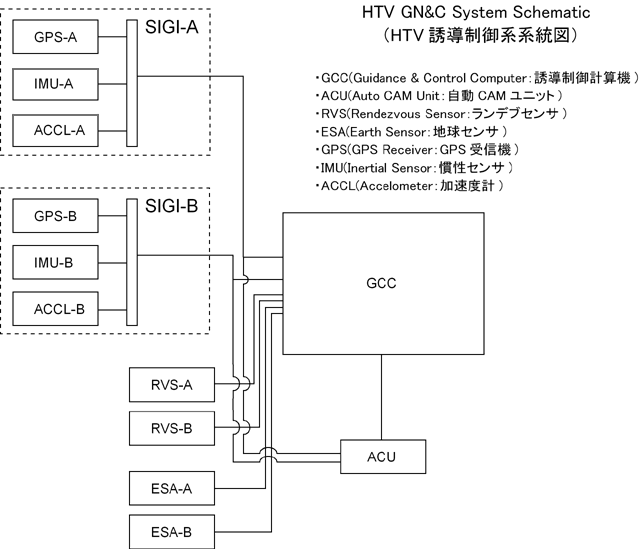
PDR (Preliminary Design Review) for SIGI (Space Integrated GPSR/IMU) which is most important sensor of HTV Guidance and Navigation System was conducted at Honeywell co. in Tampa, Florida in United States from Dec. 9 to 10.
In addition to accelerometers and ring laser gyros for control of HTV attitude/maneuver, this sensor unifies GPS receiver for navigation into one package.
SIGI is also used in International Space Station to measure the attitude, and H764, the base of SIGI, are used in many aircraft.Figure: HTV Guidance and Control Schematic

Dec. 17, 1999 Updated
PDR (Preliminary Design Review) for Rendezvous Sensor which to be used during the HTV final approach was conducted at Daimler Chrysler Jena-Optronik in Jena, Germany from Nov.15 to 18. This sensor will also be used for ATV(Autonomous Transfer Vehicle) being developed by ESA.
We expect a cost reduction / risk decrease become possible by this joint supply of NASDA-ESA.The figure: rendezous sensor function during final approach

Nov. 19, 1999 Updated
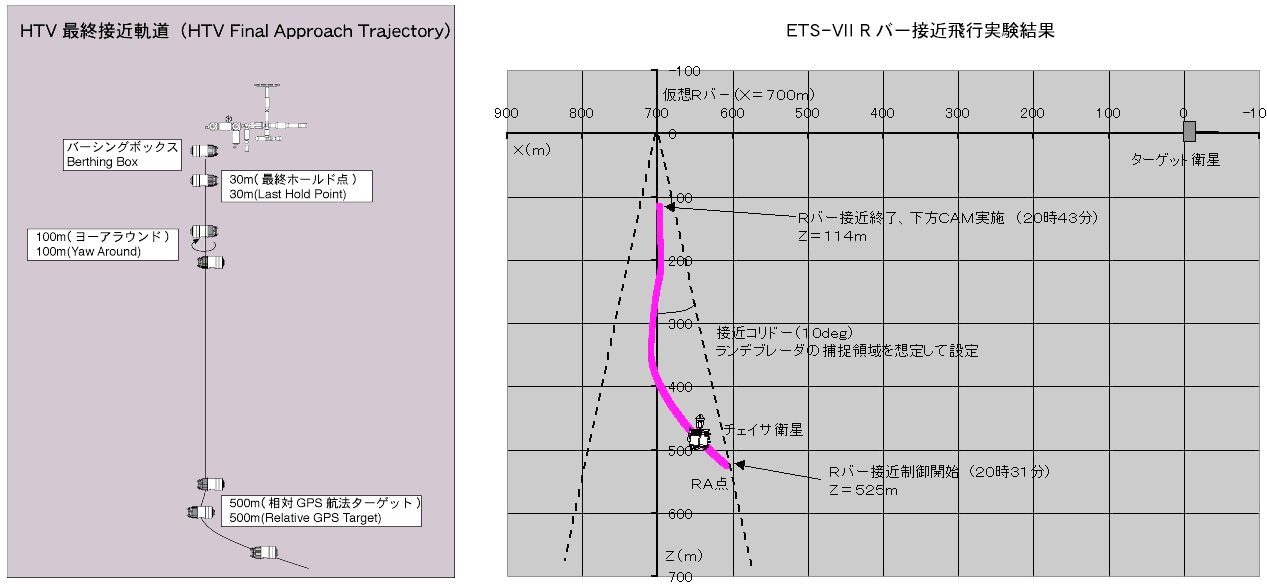
NASDA conducted the Approach/Release (Rendezvous) Flight Technology Test on the ETS-VII, which has close relation to the HTV rendezvous technology from Oct. 26 to 27.
During the test, ETS-VII tried the R-bar approach which simulates the HTV final approach trajectory to the ISS. HIKOBOSHI satellite regarded as HTV, approached to the virtual R-bar formed by ORIHIME, using the algorithm developed for HTV. As a result, HIKOBOSHI raised the appropriate orbit within the expected corridor determined for rendezvous sensor and successfully finished at the 114 meters close.
We are now analyzing the data obtained from this experiment. It will greatly contribute to the establishment of all HTV flight algorithm.
Sep. 17, 1999 Updated
NASDA held two major review meetings. One was the HTV Phase 1 Safety Review, which examined the HTV design from the point of safety. The another was HTV Preliminary Design Review (PDR), which examined the HTV design from the point of technique.
The safety review meeting was held from August 18 to 20. The safety design of HTV was generally confirmed. After some additional study, HTV project will take a NASA safety review.
The HTV PDR meeting was held by NASDA from August 23 to September 3. Approximately forty NASA, European Space Agency (ESA), and Canadian Space Agency (CSA) people attended the meeting and examined the HTV design. As the result of review, design of HTV was confirmed to be adequate. Therefore, the production of HTV Engineering Model (EM) and the progress to detailed design phase were admitted.
Jul. 26, 1999 Updated
The documents for PDR (Preliminary Design Review), which will be conducted from July 15th to September 3rd have been released. These documents have also been sent to NASA, CSA, and ESA in the end of June.
We will continue to coordinate with reviewers of both NASDA and other organizations on matters which they point out until PDR Main Board.
At the same time, the documents for Phase 1 Safety Review have been released.
- Target orbit: ISS orbit
-
[Earth Observation Research Center (EORC)] Calibration Result of ALOS-2/PALSAR-2 JAXA Standard Products:Evaluation results of PALSAR-2 standard products were added.
JAXA/EORC are regularly conducting the calibration and validation of the PALSAR-2 and its standard products using the data over the calibration sites in the world. This page reports evaluation results of the PALSAR-2 standard products and radiometric calibration factors to convert digital number to backscatter value.
Oct. 19, 2016: - Evaluation results of PALSAR-2 standard products were added.
- The Calibration Factor (CF) for ScanSAR mode (beam W2) products ordered before Sep. 28, 2016, 7:00 UT has been changed from -83.0 dB to -79.0 dB because an analysis using a lot of data accumulated over Amazonian forests after initial calibration phase revealed that the backscattering coefficient of ScanSAR W2 was low. This issue was corrected in the processing software released on Sep. 28, 2016. We apologize for the incovenience.
Digital number in the PALSAR-2 JAXA standard product is converted to backscattering coefficient (sigma naught, sigma zero) using the following equations:

- (for L1.5, L2.1)

- (for L1.1)
σ0: Backscattering coefficient (Sigma naught or Sigma zero) [unit: dB]
DN: Digital number (or raw pixel value)
CF1, A: Calibration factor [unit: dB]Table 1: Values of CF1 and A Date and time of order products
(Version of the PALSAR-2 processing software)Observation mode/beam Value [dB] CF1 Products ordered from Sep. 11, 2014 to Sep. 28, 2016, 7:00 UT (ver. 000.001 ~ 002.021) Except for ScanSAR beam W2 -83.0 ScanSAR beam W2 -79.0 Products ordered after Sep. 28, 2016, 7:00 UT (ver. 002.022 ~) All -83.0 A All All 32.0 - * Version of the PALSAR-2 processing software can be found in the field No.12 of the file descripter records of each CEOS file.
- M. Shimada, O. Isoguchi, T. Tadono, and K. Isono, “PALSAR Radiometric and Geometric Calibration,” IEEE Trans. Geoscience and Remote Sensing, Vol. 47, No. 12, pp.3915-3932, Dec. 2009.
-
[Project Topics] Geospace satellite "ERG" released to the media

To elucidate high-energy electrons that repeat their generation and disappearance.
Geospace is the region of outer space near the Earth. The radiation belt called the “Van Allen radiation belt” lies within the geospace, and the belt captures a huge volume of highly charged energy particles that exceed mega electron volts.
This project aims at elucidating how highly charged electrons have been born while they generate and vanish repeatedly along with space storms caused by the disturbance of solar wind caused by space storms, and how space storms are developed. -
[ISS / Japanese Experiment Module (KIBO)] ISS/Kibo Monthly News: August, 2016
ISS/Kibo Monthly News: August, 2016
Last Updated: September 28, 2016
Topic of the Month
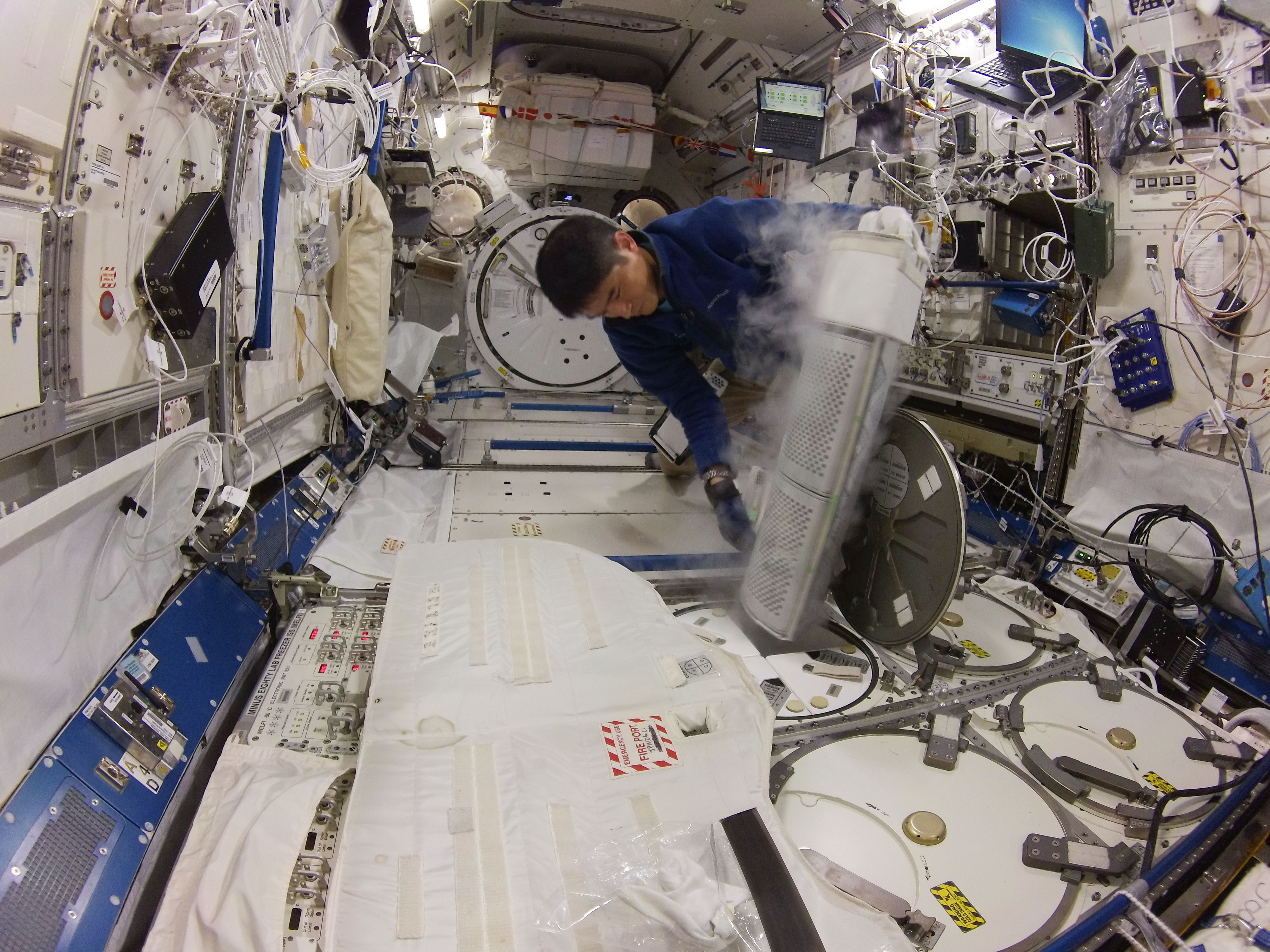
Onboard activities of Astronaut Takuya Onishi

Onishi maneuvering SSRMS to release Dragon spacecraft
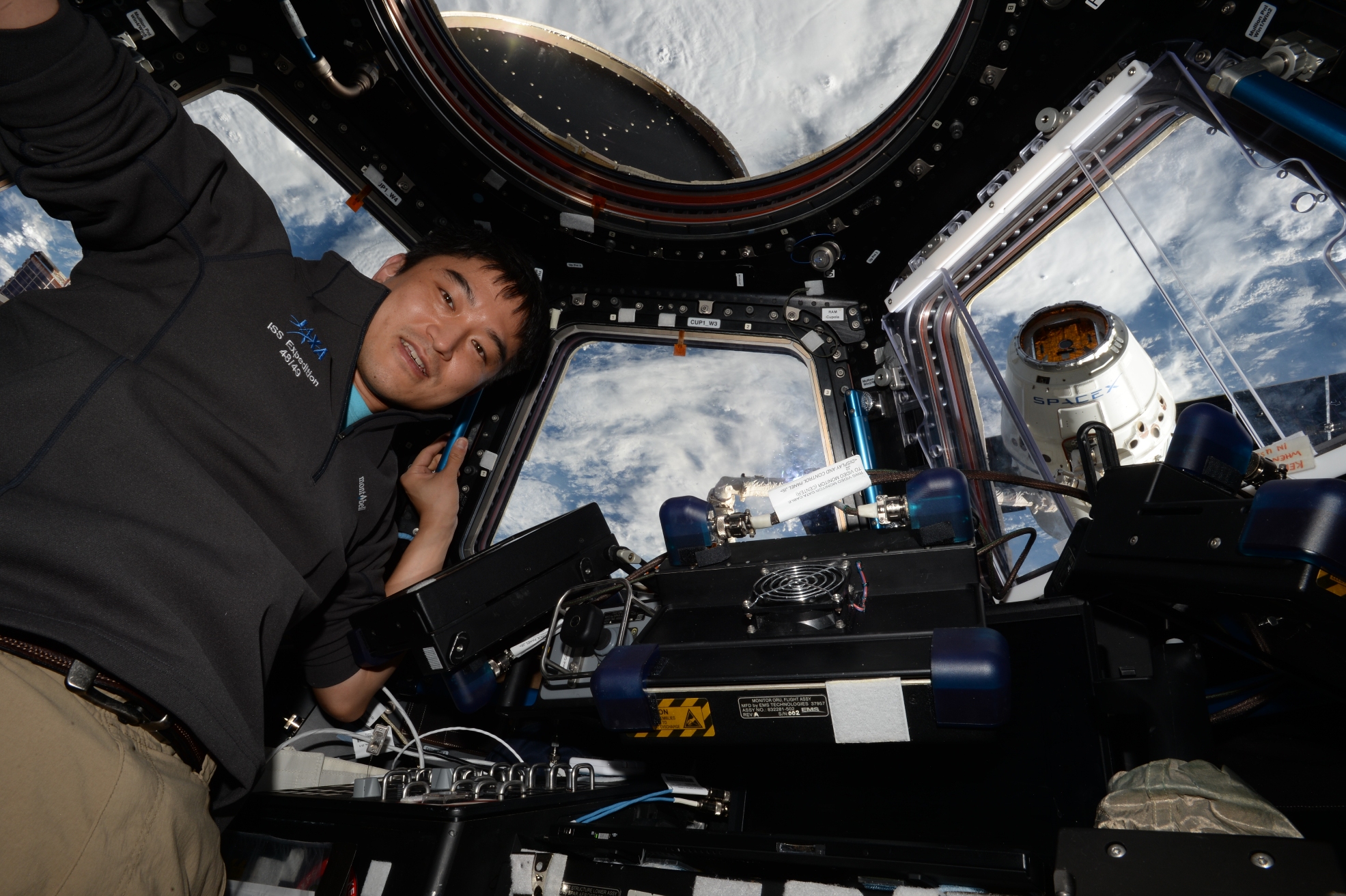
(August 26. Credit: JAXA/NASA/Takuya Onishi)Astronaut Takuya Onishi was busy in August conducting science/medical experiments and tasks related to the Dragon spacecraft (SpaceX CRS-9), and supporting an Extravehicular Activity (EVA).
As medical experiments require the acquisition of data at fixed intervals, Onishi performed eye examinations and weight and body measurements, obtained blood samples, ran electrocardiograms and cardiac ultrasounds, and measured heart rates and amounts of exercise. When his fellow crewmates conduct experiments, he supports data acquisition and vice versa.
Onishi was also involved in tasks related to the return of the Dragon spacecraft. According to the packing list, he collected goods to be returned to Earth from all the modules and fixed the goods to predetermined points in the Dragon’s capsule. Then prior to Dragon’s unberthing, Onishi closed the hatch, disconnected cables, and checked for any leaks.
The Dragon spacecraft was unberthed on August 26 from Harmony (Node 2) by the Space Station Remote Manipulator System (SSRMS) that was maneuvered by the ground team and then released by Onishi and Rubins’ SSRMS operation.
The Dragon spacecraft later splashed down in the Pacific Ocean off the southwest coast of California on August 27.

Onishi working on the ESA’s Airway Monitoring experiment (Credit: JAXA/NASA/Takuya Onishi)

Onishi packing goods prior to loading into the Dragon Spacecraft (Credit: JAXA/NASA)
NASA Administrator Charles Bolden visits the Tsukuba Space Center

JAXA President Naoki Okumura and NASA Administrator Charles Bolden pose for a photo in front of Kibo’s MCR (Credit:JAXA)
On August 5, NASA Administrator Charles Bolden visited the Tsukuba Space Center (TKSC) for the first time after assuming Administrator and observed the laboratories used for experiments conducted in Kibo and Kibo’s newly renovated Mission Control Room (MCR).
Mr. Bolden expressed his gratitude for the close relationship between the U.S. and Japan and the Japanese government’s agreement to an extension of ISS operations, and also conveyed his expectations for Japan to continue playing an important role in the field of space development.
Kibo this Month
JAXA’s ongoing medical experiment–“Multi-omics analysis of human-microbial metabolic cross-talk in the space ecosystem” (Multi Omics)
The space environment features microgravity, a closed environment, and radiation that can cause physiological changes resulting in bone loss, muscular atrophy, sleep disorders, and immune impairment, the symptoms of which are similar to those of aging.
Onishi obtained samples of saliva and other samples for storage in the Minus Eighty degree Celsius Laboratory Freezer for ISS (MELFI). These samples will later be returned to Earth for analysis.
The results will contribute to the development of preventive medicines and enhanced health for the elderly.
Biological Rhythms 48
“The Effect of Long-term Microgravity Exposure on Cardiac Autonomic Function by Analyzing 24-hour Electrocardiogram” (Biological Rhythms) is used to comprehensively evaluate the electrical activity of cardiac autonomic nerves and the biological rhythms between wakefulness and sleep, by recording an electrocardiogram for 48 hours and activities for 96 hours.
To record an electrocardiogram, a portable Holter monitor is used to record the body’s inner clock (called biological rhythms). In addition, Actiwatch, a wristwatch-type activity monitor, is used to record 96 hours of activities.
For this Japanese experimental theme, Japanese astronauts as well as international partner astronauts cooperate and provide data with this program.
Installation of the NanoRacks External Platform

NREP assembled in Kibo (August 4. Credit: JAXA/NASA/Takuya Onishi)
The NanoRacks External Platform (NREP) developed by NanoRacks LLC in the U.S. is the first commercial exposed platform, and had been stored in the ISS since being delivered by the H-II Transfer Vehicle KOUNOTORI5.
Onishi assembled NREP and then pulled it outside through Kibo’s airlock. NREP was then installed in the Kibo’s Exposed Facility (EF) by the ground team using Kibo’s robotic arm (Japanese Experiment Module Remote Manipulator System: JEMRMS).
ISS this Month
Installation of the International Docking Adapter completed
From August 19-20, an Extravehicular Activity (U.S. EVA-36) was performed by U.S. astronauts Jeffrey Williams and Kathleen Rubins.
During the EVA, the second International Docking Adapter (IDA-2) that will enable the dockings of future spacecraft was installed to Harmony (Node 2) in the travel direction of the ISS.
Prior to the EVA, IDA-2 had been removed from the trunk of the Dragon spacecraft and then transferred in front of Node 2 by the SSRMS operated from the ground. During the EVA that lasted 5 hours, 58 minutes, the two spacewalkers installed IDA-2 on the PMA-2 and connected the power and data cables.
During the EVA that lasted 5 hours, 58 minutes, the two spacewalkers installed IDA-2 on the PMA-2 and connected the power and data cables.

Onishi supporting EMU donning (Credit: JAXA/NASA/Takuya Onishi)

Jeff Williams performing EVA (Credit: JAXA/NASA)
-
[Institute of Space and Astronautical Science (ISAS)] SELENE (Kaguya) HDTV data taken in 2007 are released
SELENE(Kaguya) High Definition Television Data Archive (SELENE, HDTV) 
This website provides all still images in the movies taken by SELENE(Kaguya) High Definition Television System, Kaguya HDTV, for educational and scientific purposes.
Terms of use
Your use of all data (movies and still images based on Kaguya HDTV) on the Kaguya HDTV Data Publication System (hereinafter reffered to as the “Site”) operated by Japan Aerospace Exploration Agency (hereinafter reffered to as “JAXA”) shall be in compliance with the terms and conditions set forth herein (the “Terms of Use”). Your browsing or linking of the Site, downloading or reprinting of the materials contained in the Site, or otherwise using the Site constitutes your agreement to be bound by the Terms of Use.
- DisclaimerPlease be aware in advance that:
Although JAXA has taken every care to manage the Site, JAXA assumes no responsibility regarding the safety of the contents of the Site or the reliability of information provided on the Site. JAXA is not responsible to you for any damage that may be caused by the use of the Site and/or the information on the Site.
JAXA may change or delete the information on the Site, or may suspend or terminate the operation of the Site without any prior notice. JAXA is not responsible to you for any inconvenience that may be caused by such changes or deletion of the information, or by such suspension or termination of the operation of the Site. - Scope and Conditions for Use of the Contents of the Site
(1) Scope of Use
Unless otherwise stated, all data published on the Site (the “Data”) and the copyrights therein are the property of JAXA and Japan Braodcasting Corporation (hereinafter reffered to as the “NHK”), and the Data are protected in Japan and internationally by copyright laws and international copyright treaties. When you use the Data, you are requested to comply with the conditions stipulated by JAXA and NHK. It is to be noted that, under copyright laws, you may use the Data without obtaining permission of the copyright holder (JAXA and NHK) to the extent that your use is for the purpose of scientific research/educational activity. Your use of the Data for business or commercial purposes without the prior permission of the copyright holder (JAXA and NHK) is strictly prohibited. If you wish to use the Materials for such business or commercial purposes, please be sure to contact us for prior permission at:
Public Affairs Department Japan Aerospace Exploration Agency (JAXA)
(2) Conditions of Use
(Indications of Source)
When you use the Data on the Site, you are requested to indicate their source in such a manner as designated by JAXA and NHK, for example, “©JAXA/NHK”.
Please click the link in below to search and download products if you agree with the statement above.
Announcement
- September 21, 2016 SELENE(Kaguya) HDTV data taken in 2007 are released. The others will be released sequentially.
- DisclaimerPlease be aware in advance that:
-
[Institute of Space and Astronautical Science (ISAS)] How were they formed? : Submicrometer craters in samples returned from the asteroid Itokawa
It is previously reported that precious few Itokawa particles show submicrometer craters on their surface. An international research team led by Dr. Dennis Harries (Friedrich Schiller University Jena) has investigated these craters in details using scanning electron microscopy and transmission electron microscopy. As a result of their observations, 15 craters were confirmed on a new particle. Though particles showing such craters had also been found in previous studies, those particles showed only 1–2 craters on their surface. Thus, the new particle found by the research team shows unusual number of craters on the surface of one particle.
Also, the research team found that the crater was secondary craters formed by fragments produced by the impact process of a tiny celestial body on the surface of asteroid Itokawa.It was thought that the presence of such small craters is an indication that the particles had been exposed on the surface of Itokawa for a long time (10,000 years or more). However, this research revealed that craters are formed as secondary craters even on particles whose surface exposure time was 1,000 years or less. This type of impact phenomenon changes the reflectance spectrum of the surface of Itokawa, and thus this is likely one major mechanism causing progression of space weathering on Itokawa.
Dr. Masayuki Uesugi (SPring-8), one of the research team members, has this to say: “Craters like this are present even on particles of the asteroid Itokawa with extremely weak gravity and exposure time of the surface material of 1,000 years or less. We were able to clearly confirm that the craters were secondary formed by impact phenomenon of celestial bodies. This fact is extremely important for understanding the process of surface evolution on the surface of celestial bodies in the solar system.”
In the initial stage of analyzing particles returned by Hayabusa, there were craters found to be the traces of impact in only one case. However, in the initial analysis stage, the mechanism which produced the craters was not clear.
The research team discovered that fragments of iron-nickel alloy were stuck inside the crater. This shows that fragments of iron-nickel alloy flew in at high speed, resulting in the formation of craters. There are no large blocks of iron-nickel alloy on asteroid Itokawa. In other words, it is likely that a celestial body containing a large amount of iron-nickel alloy impacted asteroid Itokawa, and submicro craters were formed due to those fragments.
Going forward, it may be possible, by investigating more craters in detail, to obtain important clues regarding the composition and size distribution of small celestial bodies which cannot be investigated through observation with telescopes and similar instruments.
According to Dr. Uesugi: “If we can understand the composition and size distribution of small celestial bodies, it may be possible to resolve questions about the difference in composition between meteorites and cosmic dust (mainly interplanetary dust particles, IDP) impinging on the earth.
Ordinary chondrites comprise the majority of meteorites, while IDP recovered in the earth’s stratosphere are similar to carbonaceous chondrites containing hydrous minerals. Thus, compositions of the extraterrestrial materials found on the surface of earth vary depending on their size. Whether this is limited to objects which have fallen to earth, or whether it is true of the solar system in general, is a problem which also affects the chemical composition of all rock materials in the solar system (asteroids).”
These research results are featured in “Earth and Planetary Science Letters,” an academic journal specializing in earth and planetary science.
Journal name: Earth and Planetary Science Letters (Date: Sept. 15, 2016)
Paper title: Secondary submicrometer impact cratering on the surface of asteroid 25143 Itokawa
Authors: Dennis Harries, Shogo Yakame, Yuzuru Karouji, Masayuki Uesugi, Falko Langenhorst
DOI No.: 10.1016/j.epsl.2016.06.033These results were obtained through an international call for research on particles from the asteroid Itokawa, issued by the Astromaterials Science Research Group, Institute of Space and Astronautical Science, JAXA. This internationally solicited research is the open type whose purpose is to obtain greater scientific knowledge by issuing a broad appeal to researchers throughout the world for research themes. Previously a total of more than 40 research themes have been selected, and research using particles derived from the asteroid Itokawa is being carried out by researchers all over the world.
-
[Institute of Space and Astronautical Science (ISAS)] HINODE: the 10th Anniversary of its Launch
Happy Birthday “Hinode”!
The solar observing satellite “Hinode” will celebrate the 10th anniversary of its launch on 23 September (Japan standard time). This 3-minutes movie presents the solar atmosphere fulfilled with active phenomena much more than ever imagined, captured with the Hinode telescopes.
On 23 September 2006 (Japan standard time), the last vehicle in the series of M-V rocket carried Hinode into its orbit around the Earth.
In a couple of years after Hinode started its observations, the Sun became its solar minimum phase, which continued for an extremely long period. Even in the minimum phase, the solar atmosphere captured by Hinode was fulfilled with dynamic phenomena, such as spicules, granulation, and prominences, and their behaviors were more than you could imagine.
Hinode also recorded rare astronomical events, such as the transit of Venus and solar eclipses, and delivered spectacular images and movies, which could not been acquired from the ground.
Owing to its highest spatial resolution, Hinode has monitored the monthly evolution of the solar polar regions, which are difficult to view from the Earth, and successfully captured the reversal of the magnetic polarity at the solar poles.
When the solar activity reached the maximum around 2014, the Sun has shown active corona, large sunspots, active chromosphere around sunspots, solar flares, plasma ejections. They were well observed with Hinode.
The movies and pictures included in this short movie are just a limited portion of the data captured by Hinode in the past 10 years. Using the data from Hinode, scientists over the world have been investigating the Sun to understand various mysteries in the Sun. By continuing its observations, Hinode will lead solar researches in the world.
Hinode (SOLAR-B) Project
-
[Interview] Kenichi Shishido Deputy Director General, JICA "Japanese Space Technology Protecting Forests Around the World"

The Japan International Cooperation Agency (JICA) is an independent administrative institution that coordinates official development assistance for the Government of Japan. The agency uses data collected by JAXA’s Earth observation satellites to plan its activities in the areas of forestry and conservation, water resources, disaster management, and cartography. We interviewed Kenichi Shishido, who is in charge of forestry and conservation projects at JICA.
Using space technology to protect the Earth’s forests
— Could you tell us about JICA’s forest-conservation work in developing countries.
 Amazon
About 70 percent of Japan’s land is covered by forests, so our country is quite advanced in terms of experience, knowledge and technology in forest management. When we help developing countries establish forest-management practices, we bring all that experience. In these countries, forest-management infrastructure has not been developed, because of a lack of technology and funds. This has allowed uncontrolled or illegal logging, and as a result deforestation has been accelerating. In fact, every year around the world, about 3,300,000 hectares of forest are lost. The decrease in tropical forests in Brazil, Southeast Asia and Africa has become particularly concerning. Forests absorb carbon dioxide, so protecting them is an important element of preventing global warming.
When we get involved in a developing country, we first map its forests. Based on these maps, we work with local staff to plan forest management and the utilization of forest resources. For example, we advise them on which areas can be safely logged by private industry, and which ones should be reserved for national parks. In developing countries, even establishing nature reserves is not a guaranteed solution. As the population grows, people need more space, and many enter reserves without permission, cut down trees, and start farming. In such cases, we work with local foresters to educate residents on the importance of forest conservation. In exchange for their respecting the boundaries of nature reserves, we sometimes make deals with them to help increase their agricultural productivity or assist with other means of income, such as livestock. We have different approaches depending on the circumstances in each country, but forest management is not possible without the understanding and cooperation of the locals.
— Has illegal logging in developing countries become a critical problem?
 Illegal logging in the Amazon
 Satellite images being analyzed at the Remote Sensing Center in Brazil
There has been a crackdown on illegal logging in all countries, but it is a difficult practice to stop, as sometimes large-scale organized crime is involved, and bribes are often paid to foresters and local police. In Africa, in the interest of forest conservation, an increasing number of countries are introducing bans on raw wood exports, so that only finished wood products can be sold abroad. But in reality, a large volume of raw wood from Africa is still being sold around the world. Deforestation is also moving quickly in the Amazon basin – hundreds or thousands of hectares of forests are illegally burned to create fields or pastures. If deforestation continues at the current rate, it will have a great impact not only on global warming but on biodiversity, as many unique species in those areas will become extinct. It will also affect the local populations more directly, as the frequency of large-scale floods and landslides will increase. For the profit of a small minority, what ought to be protected is not properly protected. This is the reality.
On the other hand, Brazil’s government has shown strong leadership, and has been making good progress. In 2004, it issued a presidential decree ordering the enforcement of anti-logging regulations. The Brazilian Institute of the Environment and Renewable Natural Resources [IBAMA: Instituto Brasileiro do Meio Ambiente e dos Recursos Naturais Renováveis], working in partnership with the police, achieved dramatic decreases in illegal logging in the Amazon.
The satellite that was used to monitor the region at the time was a U.S. Landsat. The Amazon rainforest is more than 10 times the area of Japan. Monitoring from space is very effective because a wide area can be covered at once. But a Landsat satellite uses an optical sensor, which is not effective when there is cloud cover. And in the Amazon, the rainy season lasts half the year. So, knowing this weakness of the satellite, some illegal loggers would get to work when the rainy season came. Obviously, by the time the clouds cleared and the satellite could detect the logging, it was too late. Thus, when JAXA’s Advanced Land Observing Satellite (ALOS, also known as DAICHI) was launched in 2006, there was a lot of international interest. ALOS was equipped with cloud-penetrating radar, so it could observe the Earth’s surface even through clouds. ALOS’s data made it possible to monitor illegal logging in the Amazon year round.
ALOS’s contribution to reducing illegal logging in Brazil
 New logging detected by ALOS. Locations are indicated in red.
— For about three years starting in 2009, Brazil used ALOS to monitor illegal logging. Could you explain in detail how JICA and JAXA assisted with this.
We built a system that could immediately detect an illegal-logging site using data from ALOS. The total area of the Brazilian Amazon is about 3,500,000 square kilometers. It is such a wide region that to create an overview map, you need to synthesize about 300 scenes of satellite data. Once you have that map, by comparing images taken at different times, you can see where trees have been cut down. ALOS observed the Amazon every 46 days, and JAXA provided all the images to Brazil free of charge.
The data system was developed by the Remote Sensing Technology Center of Japan (RESTEC). After being approached by Brazil, JICA coordinated between the Japanese and Brazilian governments. We planned the project’s framework, and managed it, working with JAXA and RESTEC.
What was great about this project was that the Brazilian government and police cooperated from the very beginning. This became the key factor in their successful battle against illegal logging. Both IBAMA and the Federal Police received training in using the system. IBAMA is under the jurisdiction of Brazil’s Ministry of the Environment, and has the power to arrest illegal loggers. But the loggers can be heavily armed, so IBAMA has to work with police. When the ALOS data revealed an illegal-logging operation, local IBAMA officials and police would head there by helicopter to shut it down.
— What was accomplished over the three years of monitoring using ALOS images?
 Clear-cut area in a forest discovered by ALOS
In Brazil, satellite data has been used for monitoring illegal logging since the 1970s, but with the introduction of ALOS, remarkable improvements were made. During the three-year project, starting in 2009, over 100 cases were identified, and the volume of illegal logging was reduced by more than half.
In addition to extracting the location, we built a system for finding the landowners by cross-referencing with land registries, in order to check whether the locations had been permitted for logging. We also developed a system to transmit the data immediately to the police. Making satellite data easy to visualize by adding information from land registries was especially appreciated, as it could be used as evidence in court.
As a matter of fact, I heard that Brazil was initially considering using data collected by other satellites, too, but they decided to go with ALOS because its L-band radar image showed the clearest distinction between forest and non-forest. Thanks to advanced technology from Japan, illegal logging in the Amazon was successfully reduced, but unfortunately the project ended in May 2011, when ALOS ceased operations. We are now discussing with JAXA the possibility of using its successor, ALOS-2, launched in 2014, to conduct similar monitoring of tropical forests in Brazil and other countries.
ALOS-2: the new standard in monitoring illegal logging
— In December 2015, the Initiative for Improvement of Forest Governance, a collaboration between JICA and JAXA, was announced at the 21st session of the Conference of the Parties (COP 21) to the United Nations Framework Convention on Climate Change (UNFCCC). How does this program use ALOS-2 to help developing countries?
 Kenichi Shishido presenting the JICA-JAXA tropical forest monitoring system at COP 21
 Forest Monitoring System website
JICA and JAXA have teamed up to create a new forest-monitoring system using data collected by ALOS-2, which allows open access from around the world. It observes changes in the forest cover in tropical rainforests about every six weeks, with a resolution of 50 meters, and updates the data. The program’s web interface is currently under construction, aiming for the data to be available on the website of JAXA’s Earth Observation Research Center (EORC) around November.
This monitoring system will target 52 countries, covering almost all the tropical forests on Earth. The findings will be available not only to governments but also to businesses, NGOs and the general public. When we introduced the system to Japanese companies that own large-scale plantations overseas, we received a lot of feedback noting that it would also be very effective in preventing the theft of trees.
At the early stage, satellite images will be analyzed by visual interpretation, then it will gradually shift to automated assessment, which will provide better accuracy. We are designing the system to make the data easily accessible to anyone with a tablet or smartphone. You will be able to get information about the location of logging, updated every six weeks and displayed on a map on your device. With conventional systems, this kind of information is usually sent first to computers at forestry ministries, and then gets forwarded to ministry staff on site. Our new system, by contrast, cuts out that middle step, and makes the data available directly to local forestry stations, businesses and NGOs. So this will be a good tool to improve the transparency of forestry management, and also greatly reduce costs.
— What is your biggest challenge in building the new forest monitoring system?
 ALOS-2
I think that we will face many challenges once the system is in operation, but before anything else, the success of this project depends on whether JAXA can keep providing images for free.
JAXA is an institution that promotes research, development and applications in the field of aerospace. In the ALOS period, illegal logging monitoring in Brazil was still at the experimental stage, and it was carried out as a joint research project between JAXA and the government of Brazil. With the new forest monitoring system, however, we were informed that satellite data usage would be considered a practical application, not a research project, so JAXA is no longer involved and we have to purchase the satellite data from a supplier. For example, to make a complete map of the Brazilian Amazon, you need approximately 300 scenes. This means that one map will cost 90,000,000 yen (about 900,000 USD), so to update the map eight times in a year would cost a fortune. It is difficult for developing countries to pay such prices. Brazil was fully aware of the effectiveness of ALOS-2 data, but still had to give up the program for financial reasons.
But I could not let the achievements and experience gained through ALOS go to waste. Based on the results in Brazil, other Amazon countries, such as Peru and Colombia, as well as Southeast Asian and African countries, had expressed interest in using the same system, so I really did not want to disappoint them. After much exchange of ideas with JAXA, we agreed on a basic policy where JAXA and JICA jointly use our resources to make international contributions towards the prevention of illegal logging in all tropical forests. This announcement was made at COP 21 last year.
Continuous contribution from JAXA
— The key is “continuous” support, isn’t it?

JICA is promoting an international initiative called REDD+, to reduce the impact of climate change. It’s a program through which developed countries reward developing countries financially when they reduce greenhouse-gas emissions or increase carbon stocks through forest conservation. It is possible to measure the amount of carbon absorbed when you know the size of a forest, so satellite data is also used here.
Unfortunately, though, ALOS is used only as a complementary satellite in this program. The standard is a Landsat satellite. The reason is that NASA can provide Landsat data collected under the same conditions on a constant basis over a long period of time. In order to study the increase and decrease of the amount of carbon, you need to compare current data to past data obtained the same way. When data is not consecutive, it is hard to use. So I hope that JAXA will continue to launch satellites that can provide measurements non-stop. Once the forest monitoring system starts operations around the world, we are going to accumulate increasing amounts of empirical data. It would be such a shame to end the project when ALOS-2 ceases operations.
And I have one more request to JAXA, regarding the expansion of the provision of open data. Along side the United States with the Landsat missions, and Europe with the Sentinel missions, JAXA is providing lower-resolution images free of charge for the monitoring of natural disasters. I understand that satellite data needs to be analyzed and processed based on its use, and that the process is very expensive. But it is not realistic to charge such fees to developing countries, which are already in a tough financial situation, and I am worried that they may stop using JAXA’s data altogether. In addition to ALOS and ALOS-2, I hope that JAXA will continue making international contributions by collecting satellite data on a continuous basis for a long time to come.
— Finally, could you tell us your outlook for the future.
Global warming cannot be solved by Japan alone. Action has to be taken on a global scale. I believe that the new forest monitoring system will be an important tool for Japan to take the initiative and build the framework. I hope that the system will be introduced around the world, and that Japanese technology can help protect the Earth’s environment.
In addition, the Global Change Observation Mission – Climate (GCOM-C) satellite is scheduled for launch in fiscal 2016. There are discussions about using its data to detect forest fires. I find it a great honor to be able to contribute to the world with the technology JAXA can offer.
Kenichi Shishido

Deputy Director General, and Group Director for Forestry and Nature Conservation,Global Environment Department, JICA
After graduating from the Faculty of Agriculture of the University of Tokyo, Shishido joined the Japan International Cooperation Agency (JICA) in 1986. He worked at the headquarters and at the Indonesia Office, and also served as an officer for forestry. He became a Resident Representative of the Ghana office in 2004 and of the Sudan office in 2007, assuming his current position in 2013. He has published a book about his 1500 days of helping in the reconstruction of the disputed African country of Sudan.
[Sep 13, 2016 ]
-
[Earth Observation Research Center (EORC)] ALOS-2/PALSAR-2 Observation Results on M 6.2 earthquake in central Italy
ALOS-2/PALSAR-2 Observation Results on M 6.2 earthquake in central Italy
Posted: August 25, 2016, 8:00 (UTC)
On August 24, 2016 at 23:00 (UTC), an emergency observation with the Phased Array-type L-band Synthetic Aperture Radar-2 (PALSAR-2) aboard the Advanced Land Observing Satellite-2 (ALOS-2, “DAICHI-2”) was performed in response to the magnitude-6.2 earthquake in central Italy on August 24, 2016 at 1:36 (UTC). Japan Aerospace Exploration Agency (JAXA) has provided the acquired data to corresponding authorities.
Table 1. Emergency observation information Observation date (UTC) Path No. Observation mode Polarization Direction Beam No. 2016/08/24 197 Stripmap 10 m HH+HV Right F2-7  Fig.1: Area of the emergency observation
(Click to view enlarged image)Fig. 2 shows a differential interferometry (DInSAR) result derived from the PALSAR-2 data acquired before (September 9, 2015; UTC) and after (August 24, 2016; UTC) the earthquake. Approximately 15 cm deformation away from the satellite (eastward movement and / or subsidence) is detected in the east region of the epicenter. The deformation area extends approx. 20 km from north to south and 10 km from west to east. The city of Amatrice places its south end.

Fig.2: Differential interferometry (DInSAR) result using the ALOS-2 PALSAR-2 data acquired before (September 9, 2015; UTC) and after (August 24, 2016; UTC) the earthquake.
(Click to view enlarged image)Fig. 3 and Fig. 4 show the damage proxy map of Amatrice and Illica generated by comparing the interferometric coherence values before and after the earthquake. The dense orange parts illustrate significant decrease of coherence caused by surface changes including collapse of buildings.

Fig.3: Damage proxy map of Amatrice generated by the interferometric coherence change analysis.
(Click to view enlarged image)
Fig.4: Damage proxy map of Illica generated by the interferometric coherence change analysis.
(Click to view enlarged image)© JAXA EORC
-
[Interview] JAXA&YOU – The Women of JAXA –
JAXA&YOU
JAXA&YOU is a series started by two JAXA interns in the summer of 2016 to showcase both the accomplishments of individual employees of JAXA and to introduce the ways that JAXA supports and is connected to our life on Earth.
The Women of JAXA
A sub-series of JAXA&YOU, “The Women of JAXA” includes video interviews and articles particularly showcasing some of the contributions that the women who work at JAXA have made to the space community.


About the Authors

Miranda Feliciano Tyson (left) is a rising Junior at Harvard College in Massachusetts, USA, concentrating in East Asian Studies with a focus on social issues in Japan. Originally from New York City, she spends her free time delving into international affairs and humanity’s space-oriented enterprises. She originally became interested in the intersection of international affairs and space when watching Star Trek: The Original Series, which featured an array of diplomatic adventures in a space context.
Fumika Miyamoto (right) was born and raised in Nagasaki, Japan. She attends Denison University in Ohio, USA, and is doing a double major in International Studies and Environmental Studies. She is interested in space’s potential for fostering international relationships. Fumika’s favorite space-related publication is Space Brothers, a comic that was later turned into both an animated TV-show and a live-action movie in Japan.
During the summer of 2016, Miranda and Fumika interned at JAXA’s Tokyo Office’s Public Affairs Department, during which they conducted interviews with JAXA’s employees.
[ August 29, 2016 ]
-
[ISS / Japanese Experiment Module (KIBO)] Asian Try Zero-G 2016 ideas selected
Asian Try Zero-G 2016 ideas selected
Last Updated: August 30, 2016

Kibo-ABC called for proposal of “Asian Try Zero-G 2016″ to be conducted in Kibo, expected to be performed by ISS crew JAXA astronaut Takuya Onishi this year.
Over 120 proposals were submitted from students and young scientists/engineers of Asian countries. Each Kibo-ABC participating agencies conducted screening these proposals from view points; “feasibility of crew time (approx. 10 minutes)”, “science visibility”, “safety” and “availability of onboard materials/equipment”.
As result of the screening, 20 proposals were recommended and have been discussed about candidates at Kibo-ABC selection meeting. Finally six proposals passed final review of JAXA.
By combining two similar proposals, five experiment candidates exist. All of results will be announced by the recorded videos on this Kibo-ABC NEWS.
Original proposals from six Asian countries of five experiment candidates, “Asian Try Zero-G 2016”
Title The Flying Paper Plane Country Singapore 
Experiment Throwing paper planes with some variations of aileron, rudder, in ISS/Kibo to observe how they fly in the absence of gravity. 
Title Magnus Effect (two proposals combined) Country Vietnam and Malaysia 

Experiment Throwing ball with or without spinning in ISS/Kibo to observe how Magnus Effect appears under micro gravity environment. 
Title Blocks in Jar Country Indonesia 
Experiment Shaking water bag which contains balls made of various materials to observe how they move in the bag. 
Title Capillary in Zero Gravity Country Thailand 
Experiment Sucking air and various liquid in a syringe to observe shape of boundary surface between air and the liquid. 
Title Liquid Density Action Country New Zealand 
Experiment Attaching two liquid balls that made of different materials under micro gravity environment to observe how they are mixed. 
-
[ISS / Japanese Experiment Module (KIBO)] ISS/Kibo Monthly News: July, 2016
ISS/Kibo Monthly News: July, 2016
Last Updated: August 24, 2016
Topic of the Month
Astronaut Takuya Onishi commences his ISS Expedition mission

Onishi storing medical samples in the Minus Eighty degree Celsius
Laboratory Freezer for ISS (MELFI)
(July 18. Credit: JAXA/NASA/Takuya Onishi)At 10:36 a.m. on July 7, the International Space Station (ISS) Expedition 48/49 crew including Astronaut Takuya Onishi was launched aboard the Soyuz MS-01 spacecraft (47S) from the Baikonur Cosmodrome in Kazakhstan.
Within nine minutes from the launch, following the third-stage engine cutoff, the Soyuz spacecraft was separated and then entered orbit. Following repetitive orbital maneuvers on July 9, the spacecraft then docked with the Rassvet (Mini-Research Module 1: MRM1) at 1:06 p.m. over the South Pacific Ocean, just off the coast of Chile.
After checking for any leaks between the Soyuz spacecraft and the ISS, the crew entered the ISS at 3:53 p.m. After receiving a warm welcome from ISS Commander Jeffrey Williams and the onboard crew, the newcomers communicated with the ground.

Launch of the Soyuz MS-01 spacecraft (July 7)
As Saturday and Sunday are basically holidays on the ISS, Onishi began his work on Monday, July 11, and is engaged in experiments and maintenance tasks.
On the ISS, extensive biomedical research is being conducted to study physiological changes caused by a long-term stay under microgravity. Onishi also measured his blood stream, and obtained blood and urine samples.
Onishi also underwent onboard training on the Space Station Remote Manipulator System (SSRMS). Unlike using a simulator in training on the ground, he practiced using the actual SSRMS for the first time.
On July 19, he attended the onboard press conference connecting the ISS and the JAXA Tokyo office. In response to questions received from the reporters (with about 50 news people in attendance), Onishi discussed the meaning of staying in space and his aspirations for the mission.

Onishi poses in Cupola with the Dragon spacecraft behind (July 20. Credit: JAXA/NASA/Takuya Onishi)

Onishi speaking at the press conference (July 20. Credit: JAXA/NASA)
JAXA Astronauts This Month
Astronaut Akihiko Hoshide completes ESA CAVES training
In early July, Astronaut Akihiko Hoshide participated in the Cooperative Adventure for Valuing and Exercising human behaviour and performance Skills (CAVES) along with astronauts from NASA, Roscosmos, the European Space Agency (ESA), and China, which was held in a cave located 800 meters underground on the island of Sardinia, Italy.
During the week-long training, the participants explored the cave for conducting a survey, mapping and a geological investigation, harvesting biological samples, and photographing. CAVES is intended to improve the skills required for long-duration missions on the ISS, such as leadership, followership, teamwork, and decision making in a multinational team.

Astronauts standing by an underground lake of emerald green waters (Credit: JAXA/ESA-V.Crobu)

Secured with a rope, Hoshide navigating in a cave (Credit: JAXA/ESA-S.Sechi)
Kibo this Month
Results of JAXA experiments receive ISS Research Awards
In July, the results of JAXA experiments were recognized by receiving the 2016 ISS Research Award–“Space Station Top Results for Discoveries” during the ISS R&D Conference held in San Diego, California.

Electron density map of peptide-degrading enzyme DPP11 (Credit: Yasumitsu Sakamoto, Iwate Medical University)
Of the two JAXA experiment themes that have been awarded, one is the result of Protein Crystal Growth (JAXA PCG).
Based on the crystals grown in Kibo, the detailed 3D conformation of peptide-degrading enzyme DPP11 that is important for the growth of periodontal disease bacteria has been identified for the first time ever.
A drug that inhibits the function of enzyme DPP11 in degrading peptides (polymers of amino acids linked by amide bonds) blocks the absorption of nutrition into periodontal disease bacteria, and thus can be a candidate drug for treating periodontal disease. In addition, the result will hopefully lead to the development of a new antibacterial drug for multi-drug resistant bacteria.

MAXI attached to the Kibo’s Exposed Facility (EF) (Credit: JAXA/NASA)
Another award given to Japan was in recognition of the findings obtained by the Monitor of All-sky X-ray Image (MAXI). Since August 2009, MAXI has been monitoring X-rays in the universe and contributing to the advancement of X-ray astronomy, which has made such world-class discoveries as a black hole candidate and an X-ray binary pulsar. Such results were published in scientific journals including Nature.
Candidates for the ISS Research Award are nominated by NASA, the Center for the Advancement of Science in Space (CASIS), and International Partners (IP), undergo a selection process conducted by the American Astronomical Society (AAS), and then the winners are announced at the ISS R&D Conference.
ISS this Month
Dragon spacecraft carries the International Docking Adapter to the ISS
On July 18, the Dragon spacecraft (SpaceX CRS-9) was launched from the Cape Canaveral Air Force Station in Florida.
On July 20, NASA Astronauts Jeffrey Williams and Kathleen Rubins used the SSRMS to capture the Dragon spacecraft, which was then berthed with the ISS.
The Dragon spacecraft carried about 1,790 kg of pressurized cargo and the second International Docking Adapter (IDA-2) in its exposed trunk. IDA-2 is a docking adapter used between the ISS and spacecraft; it is built in compliance with the International Docking System Standard (IDSS) to enable the docking of future spacecraft equipped with a uniform docking mechanism.

An image of Node 2 with IDA-2 installed (Credit: JAXA/NASA)
IDA-2 will be installed to Harmony (Node 2), the docking port of Space Shuttles in the past. An extravehicular activity (EVA) will be conducted for IDA-2 installation and preparations have already been made, such as routing cable inside and outside the ISS.