Category: News

http://www.subtome.com/#/subscribe?feeds=http%3A%2F%2Fftr.fivefilters.org%2Fmakefulltextfeed.php%3Furl%3Dglobal.jaxa.jp%252Frss%252Fnew.rdf%26max%3D3%26links%3Dpreserve&back=http%3A%2F%2Fftr.fivefilters.org%2Fmakefulltextfeed.php%3Furl%3Dglobal.jaxa.jp%252Frss%252Fnew.rdf%26max%3D3%26links%3Dpreserve

  • [ISS / Japanese Experiment Module (KIBO)] Decision of CubeSats deployment date carried aboard KOUNOTORI 6

    Decision of CubeSats deployment date carried aboard KOUNOTORI 6

    Last Updated: January 13, 2017

    Six of the seven CubeSats launched aboard KOUNOTORI 6 from Tanegashima space center on December 9th will be deployed from Kibo on the night of January 16th (JST. GMT + 9 hours).

    Planned deployment date: January 16th (Mon), 2017

    ① 18:00-18:30 timeframe (JST): Deployment of 4 CubeSats
    ② 19:30-20:00 timeframe (JST): Deployment of 2 CubeSats

    via Internet:
    CubeSats deployment from Kibo, the Japanese Experiment Module, will be broadcasted via JAXA YouTube channel with view of the Kibo mission control center.

    Streaming start: January 16th (Mon), 2017, 17:50 (JST)
    URL: https://www.youtube.com/watch?v=R4xq_rj0QiQ

    [embedded content]

    Let’s block ads! (Why?)

  • [ISS / Japanese Experiment Module (KIBO)] World's first survival return of all mice reared for a long time in ISS Kibo and the birth of next-generation mice

    World’s first survival return of all mice reared for a long time in ISS Kibo and the birth of next-generation mice

    JAXA
    University of Tsukuba
    Osaka University

    【Points】

    • A small animal rearing mission conducted in the Kibo module successfully completed the simultaneous rearing of mice under artificial (1G) and microgravity (0G) environments, and the return of all mice to Earth in a live condition. This marked the first time ever that mice were simultaneously reared at different gravity levels, and that all the mice survived upon their return.
    • Mice returned from space gave birth to their offspring.

    【Overview】

    The Japan Aerospace Exploration Agency (JAXA), University of Tsukuba, and Osaka University are pleased to announce the successful completion of rearing mice for 35 days using the Cell Biology Experiment Facility (CBEF) with an exclusive centrifuge function in the Japanese Experiment Module (“Kibo”) of the International Space Station (ISS).

    This long-term rearing featured simultaneous rearing under an artificial gravity environment (1G) in orbit and under a microgravity environment (0G) by using Japan’s unique experimental device featuring a centrifuge function to only study the effects of gravity. After 35 days of observation under both gravity levels, all mice were successfully returned alive.

    The twelve male mice were launched from Florida on July 19 (JST), and returned to Earth in good health on August 27. Later, in collaboration between the University of Tsukuba and Osaka University, the offspring pup mice fathered by space mice reared in the 1G and 0G environments were born on September 28.

    【Importance of long-term rearing】

    Due to a long-term stay in space, the bodies of onboard astronauts are adapted to a gravity-free environment and show a declining vestibular function (decrease in the sense of balance), a shift in fluids (with excess body fluids shifting to the upper body), atrophy of lower-limb muscles, and bone loss, all of which are symptoms similar to those seen among elderly, bedridden people.

    Many researchers struggle to elucidate the causes of declining physical functions of the elderly due to being bedridden, but such causes have yet to be clarified. Given the success of this rearing experiment, research may be conducted from a novel viewpoint for the first time ever, and such an approach may lead to discovering new drugs that will suppress the decline of such functions.

    The accumulation of such fundamental knowledge will also become a foothold for mankind in distant space in the future, such as how children can inherit the effects of a long-stay in space from their parents.

    While working for the birth of offspring mice, we completed a primary evaluation of the changes in the bodies of parent mice that stayed in space. Symptoms similar to those of the physical deterioration of the elderly, such as the attenuation of leg muscles, accumulation of fat, changes in liver tissue, and especially symptoms of sarcopenia were observed in space-cultured mice. We plan to conduct detailed analysis on the gene levels of mice that stayed in space, so as to provide a trigger for taking measures for Japan’s rapidly aging society.

    Regarding the rearing of the mice, such as feeding them and replenishing drinking water, the onboard astronauts, Flight Control Team on the ground, mice health management team (including a veterinarian), and the experimental equipment development team worked together around the clock to monitor the health of the mice and status of the equipment, in order to safely return all the mice to Earth.

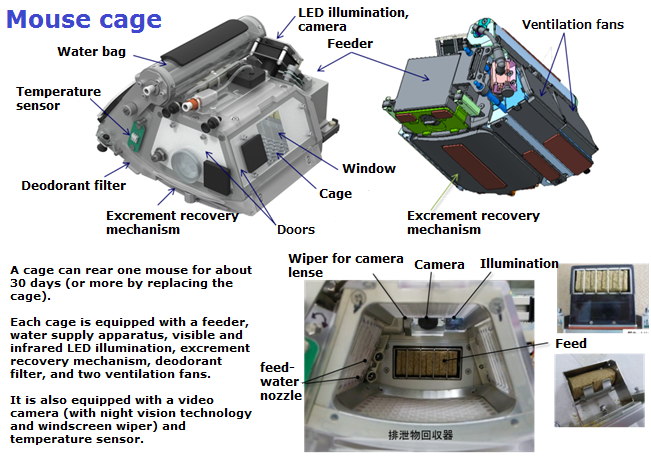
    ※ Onboard Mouse cage

    0G

    1G

    [Both movies taken on July 25, 2016. Credit: JAXA]

    ※ Baby mouse of a space mouse

    [Photo taken on September 28, 2016.
    Credit: JAXA/University of Tsukuba/Osaka University]
    The baby is being cared for by a mouse of a different
    species who is good at parenting.

    *All times are Japan Standard Time (JST)

    Let’s block ads! (Why?)

  • [ISS / Japanese Experiment Module (KIBO)] Genes other than bone-related genes also show rapid enhancement of expression under microgravity

    Genes other than bone-related genes also show rapid enhancement of expression under microgravity
    –Results of eight consecutive days of live imaging Medaka fish in Kibo

    Last Updated: January 13, 2017

    Tokyo Institute of Technology
    Japan Aerospace Exploration Agency

    Joint research by the Tokyo Institute of Technology and JAXA that studied the mechanisms of how bone mass decreases in microgravity using Medaka fish (Oryzias latipes) was conducted onboard the Japanese Experiment Module (“Kibo”) of the International Space Station (ISS). This research has been conducted twice: the first time in 2012 (long-term culture) and the second time in 2014 (short-term culture).

    The results obtained this time were achieved from the short-term culture conducted in February 2014 when Astronaut Koichi Wakata onboard the ISS successfully video-taped live Medaka fish for eight consecutive days using a fluorescence microscope for the first time ever.

    The research outcomes reveal the following:

    • Rapid enhancement of the fluorescent signals of osteoblast (cells that synthesize bone) and osteoclast (cells that break bone tissue) was observed.
    • Five genes related to gravity response were identified.

    This research achievement was published as an online journal in Scientific Reports of the Nature Publishing Group of the United Kingdom, on December 22, 2016, at 10:00 a.m. (British time).

    To read the detailed research results, refer to the webpage below.

    Journal: Scientific Reports

    Title: Acute transcriptional up-regulation specific for osteoblasts/osteoclasts in medaka fish immediately after exposure to microgravity DOI: 10.1038/srep39545

    Authers: Masahiro Chatani,1,✝ Hiroya Morimoto,1 Kazuhiro Takeyama,1 Akiko Mantoku,1 Naoki Tanigawa,2 Koji Kubota,2 Hiromi Suzuki,3 Satoko Uchida,3 Fumiaki Tanigaki,4 Masaki Shirakawa,4 Oleg Gusev,5,‡ Vladimir Sychev,6 Yoshiro Takano,7 Takehiko Itoh,1 and Akira Kudo1
    1 Graduate School of Bioscience and Biotechnology, Tokyo Institute of Technology, Yokohama 226-8501, Japan
    2 Chiyoda Corporation, Yokohama 220-8765, Japan
    3 Department of Science and Applications, Japan Space Forum, Tokyo 101-0062, Japan
    4 Japan Aerospace Exploration Agency, Tsukuba 305-8505, Japan
    5 Institute of Fundamental Medicine and Biology, Kazan Federal University, Kazan 420008, Russia
    6 SSC RF-Institute of Biomedical Problems RAS, Moscow, Russia
    7 Section of Biostructural Science, Graduate School of Medical and Dental Sciences, Tokyo Medical and Dental University, Tokyo 113-8549, Japan
    Current address: Department of Pharmacology, School of Dentistry, Showa University, Tokyo 142-8555, Japan
    Current address: RIKEN Innovation Center, RIKEN, Yokohama 230-0045, Japan

    *All times are Japan Standard Time (JST)

    Let’s block ads! (Why?)

  • [Interview] Toward a New Era of Deep Space Exploration Kenji Numata Project Manager, Ground Station for Deep Space Exploration and Telecommunication Project

    Toward a New Era of Deep Space Exploration Kenji Numata Project Manager, Ground Station for Deep Space Exploration and Telecommunication Project

    The JAXA Usuda Deep Space Center in Saku, Nagano Prefecture, is home to the largest parabolic antenna in Japan. This large antenna, 64 meters in diameter, was built in 1984, and it was used to communicate with Japan’s first two interplanetary space probes, Sakigake and Suisei, which were launched to study Halley’s Comet in 1985. The antenna has since handled communications with the asteroid probe Hayabusa and other deep-space probes. It is now being used to communicate with the Venus probe Akatsuki and the asteroid probe Hayabusa 2. Today, however, the antenna’s age has become an issue – it is now more than 30 years old – and a new antenna is planned for completion by the end of JFY 2019.

    Developing a New Parabolic Antenna

    — Tell us about the GRound station for deep space Exploration And Telecommunication (GREAT) Project.

    Conceptual image of the new antenna (courtesy of Mitsubishi Electric)Conceptual image of the new antenna (courtesy of Mitsubishi Electric)

    We are building a new parabolic antenna to succeed the aging 64-meter one at the Usuda Deep Space Center, and to increase downlink capacity for the next period of deep-space exploration. The GREAT project team was set up officially in November 2015 for that purpose.

    — What kind of antenna is being planned?

    The new antenna will be 54 meters in diameter and will communicate with space probes in the X band (8 GHz) and Ka band (32 GHz). The antenna will be located in a national forest along the Tateshina Skyline road, about 1.3 km in a straight line from the existing antenna.

    — Why was this location chosen?

    Preparation of the planned construction site for the new antenna (courtesy of Takehana-Gumi)Preparation of the planned construction site for the new antenna (courtesy of Takehana-Gumi)Preparation of the planned construction site for the new antenna (courtesy of Takehana-Gumi)

    Radio signals from probes navigating deep space are extremely weak. That’s why antennas are constructed in remote areas, where there is less interference from radio waves emitted by TV stations, mobile phones, etc. We chose the location where the antenna can pick up weak signals from probes. Think of this as someone trying to whisper to you from across the room when you’re surrounded by a group of noisy people. It would be easier to hear if you were somewhere quiet, right? Other reasons for choosing this site were relatively little rain, which weakens radio signals; accessibility for construction vehicles thanks to a well-maintained road; and the local support, as we already have a facility nearby. Some local people did wonder why we couldn’t build the new antenna at the Usuda Deep Space Center, where the existing antenna is located. Due to their size, it was necessary to separate the antennas enough to ensure that there would be no signal interference.

    — How is development proceeding?

    The basic design of the overall system, including the antenna, was finished in early October 2016, and we’re working toward completion in JFY 2019. At present, site preparation is underway and detailed blueprints are drawn up. The antenna is going to weigh roughly 2,100 tons. Groundwork for the concrete foundation that will support that weight is set to start in April 2017, with assembly of the antenna itself scheduled to begin a year later. Due to snow, we cannot do any outdoor work during the four winter months, from December to March, but we still hope to be finished and operational in time for Hayabusa 2, though that is a pretty tight schedule. Hayabusa 2 is currently on its way to the asteroid Ryugu, and is expected to arrive in mid-2018, before leaving the asteroid in late 2019.

    A High-Performance Antenna Using the Latest Technology

    — The new antenna will have a diameter of 54 meters, which is smaller than the existing antenna at Usuda. What reception capabilities will it have?

    Conceptual drawing of the new antenna (courtesy of Mitsubishi Electric)Conceptual drawing of the new antenna (courtesy of Mitsubishi Electric)

    The new antenna’s primary reflector will be 54 meters in diameter for financial reasons. The existing antenna is 64 meters in diameter, and its aperture has roughly the surface area of 12 tennis courts. The surface area of the new antenna will be closer to nine tennis courts. Although the antenna’s capacity to receive signals will scale down by 30 percent, we are taking steps to compensate for this and maintain receiving performance.

    One way of doing this is to increase the mirror surface precision of the primary reflector, which will improve receiving performance by a factor of 1.6 over the existing antenna. Radio waves cannot be collected properly if the reflector has an irregular surface, but if the entire reflector is finished to the same degree of smoothness, that enables radio waves to be properly concentrated on the focus, and receiving performance is improved. Surface imperfections on the new antenna’s primary reflector will be no more than 0.6 mm, which is less than the thickness of a credit card. An antenna this size will be deformed just from being moved or jostled – even from wind or changes in temperature. So to make sure the new antenna works as precisely as possible, we wanted to use mature technology that has been tested in the field. Japan was responsible for the development of some of the parabolic antennas used in the ALMA telescope in Chile, which was completed in 2013. Some of that technology will be incorporated into this new high-performance antenna.

    — If a smaller antenna can now provide the higher performance as the older, bigger one, that means technology must have improved a lot in the past 30 years.

    Yes. The new antenna will also have better pointing accuracy. Pointing accuracy refers to how accurately the antenna can be pointed at a space probe. The role of a parabolic antenna in this respect is to track and control satellites and probes using radio waves. An antenna must be able to accurately point at satellites and probes, precisely determine their position and attitude, check the state of their onboard instruments, and control them by sending command data whenever required. Now you see the degree of precision this requires. The new antenna will be able to point at a space probe with the same degree of accuracy that it would take to shoot a target roughly 40 cm in diameter from a position 2.4 km away.

    The existing antenna works on the S-band (2 GHz) and X-band (8 GHz) frequencies; the new one will use the X-band and Ka-band (32 GHz) frequencies. The high-frequency Ka band is suited to high-capacity transmissions. This is why recent deep-space probes from NASA and ESA (European Space Agency) currently communicate on it. At the same time, because the Ka band has a shorter wavelength, the antenna beam is four times narrower than that of X-band frequencies. Therefore, in order to track our probes accurately, we have to increase our antenna’s pointing accuracy. I guess it could be said that we are also able to use the Ka band today because of advances in Japanese technology.

    — Ka-band frequencies are also used on Hayabusa 2, right?

    Hayabusa 2 is also equipped with a Ka-band antenna. However, as Japan does not yet have any ground stations that can use Ka band frequencies to communicate with space probes, at the moment we use NASA’s ground stations. Once the new antenna is completed and starts communicating with Hayabusa 2, we will be able to receive twice as much data as before. The new antenna should also play a major role in communicating with the Mercury probe scheduled to be launched in cooperation with ESA in 2018.

    Operating Deep Space Probes Without Interruption

    — Tell us about the history of the Usuda Deep Space Center.

    Usuda Deep Space Center’s 64-meter parabolic antennaUsuda Deep Space Center’s 64-meter parabolic antenna

    The Usuda Deep Space Center was established about thirty years ago as the only ground station in Japan for deep-space probes. It has been involved in tracking and controlling all of Japan’s space probes, from the Halley’s Comet probes Sakigake and Suisei, which were the first probes launched by Japan into interplanetary orbit, to the recent lunar orbiter Kaguya, the asteroid probe Hayabusa and the Venus probe Akatsuki. I don’t think it was until the missing Hayabusa probe was rediscovered after three months that the role of the Usuda antenna became widely known. At the time, I heard that the center had been carefully searching for faint signals from Hayabusa every day, not knowing when it would re-appear. The center has also helped the tracking and control of NASA’s Voyager probes and so on.

    You have convinced us that the antenna at Usuda is essential for the deep-space exploration.

    It has been supporting the deep-space exploration program for more than 30 years. But it has exceeded its design life by more than ten years, and some of its components cannot be repaired. We need the new antenna to ensure the reliable and uninterrupted operation of deep-space probes now and in the future. I just mentioned the rediscovery of the Hayabusa probe. I believe that was possible only because there was a ground station in Japan.

    — What difficulties have you experienced so far?

    We don’t have anyone on our team who worked on the development of the old Usuda antenna, and without that experience we often face issues that are difficult to overcome. In particular, I was not involved in the preparation phase prior to the launch of the project, so at times it has been extremely difficult to balance the demands of the user side – the probe teams – with the pressure from management to reduce costs, while working within the confines of a budget. We understand the need to maximize antenna performance so we can accurately receive large amounts of observation data from space probes. But I believe that a project’s value stems from attaining its goals within the restrictions of its resources. This is a fundamental principle of project management, but for me, in the position of responsibility, it has been a real struggle to achieve this in practice.

    — What plans are there for the future?

    We experienced many birth pangs during the first year of the project, but we were able to complete the preliminary design successfully, with the support of Saku City and many others. Now, while maintaining the principles of project management, we want to do our best to ensure the project’s success. Our project team consists of researchers and engineers from two different workplaces: the Institute of Space and Astronautical Science in Sagamihara, and the Tsukuba Space Center. I hope that we can learn to work more effectively as a team and to compensate for one another’s weaknesses. If each of us can harness the spirit of teamwork, I’m sure we will be able to accomplish our goal. I have learned from experience that it is important to face any difficulties with a positive attitude, no matter what has happened. Yes, there will probably be many unanticipated problems throughout the project, but we have no choice but to confront them one at a time. Bearing this in mind, we are working toward the successful completion of the new antenna.

    Although attention is usually focused on the achievements of probes in space, these could not function without the support of ground stations. I would be delighted if everyone knew about JAXA’s ground-based projects such as this one.

    Kenji Numata

    Kenji Numata

    Project Manager, JAXA Ground Station for Deep Space Exploration and Telecommunication Project

    After graduating from the National Kumamoto Radio Technical College, he joined NASDA (now JAXA) and was appointed to the Masuda Tracking and Communication Station on Tanegashima Island. Subsequently, after holding positions at the Tracking and Control Center at the Tsukuba Space Center, the Space Technology Directorate II, and the Chief Engineer’s Office, he was appointed Head of the Pre-Project Team for the GREAT Project in July 2015. He has held his current position since November 2015.

    [Jan 12, 2017]

    Let’s block ads! (Why?)

  • [Project Topics] Paper published on the long-distance laser link experiment with LIDAR

    Researchers successfully established a laser link with the LIDAR instrument on the Japanese asteroid probe spacecraft Hayabusa2 after its Earth swing-by in the winter of 2015. This is the third time in the world that such a link was established with a spacecraft beyond the Earth-Moon distance. The researchers used the laser link to determine the alignment of the LIDAR receiving telescope and calibrate its internal clock. These engineering improvements will allow theLIDAR to take better scientific data once Hayabusa2 reaches its destination, the asteroid 162173 Ryugu.

    Like laser range finders used on Earth, normally Hayabusa2’s laser altimeter (known as Light Detection And Ranging, or LIDAR ) emits a short laser pulse and then waits for reflected laser light to come back to it. But in this experiment we instead had the LIDAR watch for laser pulses fired from Earth. We confirmed that the LIDAR detected laser pulses from the ground-based laser station at Mt. Stromlo Observatory in Canberra, Australia. We checked the alignment of the LIDAR receiving telescope by having the spacecraft change its attitude (pointing) little by little and seeing at what angle it could best detect the laser light coming from Earth. In this way, we were able to precisely determine the direction of the LIDAR field-of-view relative to the body of the spacecraft. We found that the field-of-view was in fact tilted by roughly 3.5 milli-radian (~0.2°) with respect to the spacecraft frame.

    In addition, the LIDAR is equipped with an observation mode in which it can time the interval between two pulses. By comparing the interval recorded by Hayabusa2 with the actual known interval between when the pulses were sent, we also succeeded in calibrating the onboard clock frequency.

    The longest distance to the spacecraft during the successful laser link was 6.6 million km. Hayabusa2 became the third example of a long-distance laser link experiment farther than the Earth-Moon distance (ca. 380 thousand km), following the MESSENGER mission to Mercury and the Mars Global Surveyor of the United States.

    These results were published online on January 3, 2017 in the Earth, Planets, and Space as “Laser Link Experiment with the Hayabusa2 Laser Altimeter for In-flight Alignment Measurement” by Noda et al.

    More detailed information is provided on the following site:
    NAOJ/RISE project website: Hayabusa2/LIDAR Laser Link Experiment Helps Calibrate Spacecraft

    • Credit: NAOJ/NICT/JAXA/CIT/SERC/NEC, Noda et al.

    Jan. 10, 2017
    Hirotomo Noda, Hayabusa2 LIDAR team

    Let’s block ads! (Why?)

  • [ISS / Japanese Experiment Module (KIBO)] Space experiment reveals the mechanisms of how PIN proteins direct one of the plant hormones "auxin" to form a seedling of a cucumber

    Space experiment reveals the mechanisms of how PIN proteins direct one of the plant hormones “auxin” to form a seedling of a cucumber

    Last Updated: December 28, 2016

    Tohoku University Graduate School of Life Sciences
    JAXA

    Professor Hideyuki Takahashi’s group at Tohoku University Graduate School of Life Sciences elucidated that the transfer of auxin, one of the plant hormones, in plants is seen differently between under the gravity environment on the ground and under the microgravity environment in space.

    The past space experiment revealed that plants grow differently in space than plants grown on the ground. The experiment conducted this time clarified the detailed movement of plant hormones in plants by observing cucumber seedlings. The results suggest that plants on the ground may have evolved by acquiring a sense of gravity direction and transferring auxin downward to control growth.

    “PIN proteins” that play a role in transporting auxin out of plant cells direct the transfer of auxin in plants.

    Through collaborative research with JAXA, Professor Takahashi’s group clarified that the plant seedlings emerged differently on the ground than in space depending on the level of gravity, and that PIN proteins which transfer auxin play an important role in forming the shape of plants.

    The past space experiment revealed that plants grow differently in space than plants grown on the ground. This time the research reveals that PIN proteins move in cells as induced by gravitational stimulation, and cells having PIN proteins cooperate to create previously unknown paths (such as the endodermal cell layer becoming a canal through which auxin is laterally transported from the upper to lower flank). Auxins on the upper side of cucumber seedlings transfer the pathway downward to form an ideal shape for growth.

    The results also suggest that this growth mechanism may easily collapse under a microgravity environment, therefore, future food cropping in space may require artificial gravity or alternative means.

    The experiment was conducted by Astronaut Satoshi Furukawa while onboard the ISS and Kibo’s Payload Flight Control Team (PL FCT) on the ground.

    The results were published in npj Microgravity, part of the Nature Partner Journals on September 15, 2016.

    Published research
    Title: The gravity-induced re-localization of auxin efflux carrier CsPIN1 in cucumber seedlings: spaceflight experiments for immunohistochemical microscopy
    Authors: Chiaki Yamazaki, Nobuharu Fujii, Yutaka Miyazawa, Motoshi Kamada, Haruo Kasahara, Ikuko Osada, Toru Shimazu, Yasuo Fusejima, Akira Higashibata, Takashi Yamazaki, Noriaki Ishioka, Hideyuki Takahashi
    Journal: npj Microgravity Volume Page: npj Microgravity 2, Article number: 16030 (2016) DOI:10.1038/npjmgrav.2016.30

    Read more about Prof. Takahashi’s research at:
    How Do Plants Grow in Microgravity?

    *All times are Japan Standard Time (JST)

    Let’s block ads! (Why?)

  • [ISS / Japanese Experiment Module (KIBO)] Protein crystals grown in Kibo are returned to the ground alongside Astronaut Takuya Onishi (completion of the shortest-term protein growth experiment ever conducted)

    Protein crystals grown in Kibo are returned to the ground alongside Astronaut Takuya Onishi (completion of the shortest-term protein growth experiment ever conducted)

    Last Updated: December 28, 2016

    Photo:Click to enlarge

    Taking a bag for protein sample delivery out of the Soyuz spacecraft (47S) (Credit:JAXA)

    Photo:Click to enlarge

    Soyuz Decent Module landed on Earth carrying Onishi and the samples (Credit:JAXA/NASA/Bill Ingalls)

    Samples of the protein crystals launched aboard the Soyuz spacecraft (48S) on October 21 for the JAXA PCG experiment have completed growth in space, and were returned to Earth alongside Astronaut Takuya Onishi on October 30. The samples were later handed over to each researcher for analysis.

    写真:より大きな写真へ

    Handover of samples from Russian staff to Japanese staff (Credit: JAXA)

    The set of samples of this growth experiment was initially scheduled for launch in mid-September aboard the Soyuz Spacecraft and to return by the end of October; however, the launch was postponed for technical reasons of the Soyuz spacecraft at the Baikonur Cosmodrome.

    As there was no chance for another launch opportunity, JAXA experts at the launch site and in Japan focused on the retention of samples and prepared additional protein samples in coordination with researchers in a short time. As a result, the samples are ready for the next launch opportunity that was set for one month later.

    Given their full grasp of the candidate proteins, JAXA experts flexibly chose suitable samples for a short-term experiment to optimize the limited opportunity of ten days.

    Photo:Click to enlarge

    Onishi taking samples from the Protein Crystallization Research Facility (PCRF) (Credit: JAXA/NASA)

    Onishi making a final check of the samples stored in a shipping bag (Credit: JAXA/NASA)

    Protein Crystal Growth in the International Space Station
    http://iss.jaxa.jp/kiboexp/theme/first/protein/en/index.html

    *All times are Japan Standard Time (JST)

    Let’s block ads! (Why?)

  • [JAXA President Monthly Press Conference] JAXA President Monthly Regular Press Conference November 2016

    JAXA President Monthly Regular Press Conference

    Date and time: From 11:00 – 11:30 a.m. on November 9 (Wed), 2016
    Venue: JAXA Tokyo Office Presentation Room (B1 floor)
    MC: Yoshikazu Shoji, JAXA Public Affairs Department Director

    Astronaut Onishi Returns

    As you are well informed, on October 30 JAXA’ astronaut Takuya Onishi safely returned to Earth. At this moment he is on the post-landing rehabilitation period. Yesterday Onishi got back behind the wheel and has had little difficulty getting back to normal life. Back to 80 % are his own words. He feels that the recovery from microgravity to 80 % is relatively quick, yet the rest 20 % takes longer. However, he is very eager to report his missions and activity to the public, which is in order.
    I would like to express my appreciation for the support of members of the media who covered his return at the landing point and TsUP control center on the outskirts of Moscow.

    The 23rd APRSAF, Asia-Pacific Regional Space Agency Forum will be held next week in Manila, the Philippines. Japanese Ministry of Education, Culture, Sports, Science and Technology and JAXA will co-organize the conference in association with other Asia-Pacific space agencies. The objective of APRSAF is development of space technology and problem solving of the Region. I am attending this annual event in which a total of 37 countries and territories will participate. Among noteworthy facts about APRSAF-23 is that Cambodia, Mongolia and Iran from Asia, and Italy, Spain, Norway from Europe are taking part in it for the first time. Considering that they are added to the old party of the U.S., Russia, Germany, France, and the U.K., countries where space industry is well established, APRSAF has truly become an international platform. Natural disasters will be a focus item of the agenda, as they pose a common threat to the Pacific and South East Asia. Domestically, interagency and interorganizational efforts have been put forth, with a view to utilizing space technology to quickly respond to the damage. A number of APRSAF-23 sessions are devoted to this topic, which certainly will yield active discussion.
    The theme of APRSAF-23 is “Building a Future through Space Science, Technology and Innovation”. Under the theme respectively pertinent topics will be discussed. One important subject is application of space technology in minimizing the harm that extreme natural events cause. Another is future expectations of space development in Asia. Last April, DIWATA-1, the first Pilipino microsatellite was deployed from Japanese KIBO experiment module aboard the International Space Station. An event for local and Japanese university students engaged in the development of DIWATA-1 is scheduled where JAXA’s astronaut Koichi Wakata will moderate and share the experience in space. Still another is an appeal of science to young generation. JAXA asked the countries of APRSAF for ideas for the physical experiments to be done by Astronaut Onishi on ISS. 5 test plans out of some 120 were actually carried out. Students who proposed green light project were invited to Japan to observe how their ideas took shape as Onishi was executing the tests. They were given rewards: Thai University students had the honor of meeting Thai Minister of Science and Technology and receiving his words of praise. Indonesian high school students were awarded with scholarship sponsored by the cities of their residence. JAXA is pleased to contribute to the growth of interest in space science and to see effort bear fruit among young people and communities of the APRSAF members.

    JAXA’s Approach for the Environmental Issues

    COP22, The 22nd UN Climate Change Conference is currently in session in Marrakech, Morocco. At the official side event of COP22, JAXA, with Japanese Ministry of Environment and National Institute for Environmental Studies will present the surveillance method of greenhouse gas and tropical forest through satellite operation. The IPCC, The Intergovernmental Panel on Climate Change will revise Guidelines for National Greenhouse Gas Inventories in May, 2019. The Guidelines are updates of their 2006 version of greenhouse gas emission and removal estimates. In preparation for the 2019 Guidelines, JAXA, Japanese Ministry of Environment and National Institute for Environmental Studies have published “The Estimated Data Obtained by Ibuki (GOSAT) of Urban Carbon Dioxide (CO2) Emissions through Human Activities”. The significance of this publication is that it shows potentials of earth orbiting satellite, be it GOSAT or any other, that obtaining estimate CO2 emission data through human activities from specific areas is now within reach. The application of the method that was used to compile the data, if adopted in the Guidelines, would provide an international platform of CO2 monitoring. It would be a data verification mechanism of report that each country currently submits to institutions such as the United Nations. Satellite Carbon observation will be on the agenda of the side event at COP22. Development of GOSAT-2, successor of GOSAT is underway. GOSAT-2 will provide heightened data accuracy.
    * English translation is pending.

    MHI Adopts JAXA’s “FaSTAR”

    JAXA has had a licensing agreement with Mitsubishi Heavy Industries, Ltd. with regard to the use of “FaSTAR”, a numerical simulation tool that JAXA’s Aeronautical Technology Directorate has developed. “FaSTAR” outruns many other similar programs of numerical simulation analysis. Production of airplanes is an enormous undertaking that calls for very complex wind tunnel tests and repeated computer simulation for the best solution. It demands mind-boggling amounts of energy, time and cost. To an airplane maker, fast, precise calculate capacity is essential for efficient aerodynamic engineering. Just to cite a simple example to help our readers grasp the dynamics, calculation of one thousand cases of wing shape variation took almost one thousand days before, whereas the same calculation with “FaSTAR” is done in one and a half days. Now you see how “FaSTAR” will change the game of quality of work. “FaSTAR” is in use within JAXA, to figure out the best solution for D-SEND, a set of flight demonstrations of “low sonic boom design technology” and more. JAXA regards as its responsibility putting “FaSTAR” to good use.

    HISHO to Conduct 2 Flight Tests

    With its Weather-Eye (WEATHER-Endurance Aircraft Technology to Hold, Evade and Recover by Eye) technology, JAXA does research and development for technology that ensures aviation safety. HISHO, JAXA’s jet test bed based in Nagoya will conduct experiment in relation to Weather-Eye. Noise is always a common issue for urban dwellers. Even more so for Tokyoites as Haneda Airport (Tokyo International Airport) is increasing international departures and arrivals. Discussion to settle routes above the Metropolitan ensued. Application of HISHO test results is expected to ease the problem. Another major aviation issue is ice buildup on the lower surface of plane’s wings. JAXA is planning to test “Hybrid anti ice buildup system”, which is designed to efficiently remove ice accumulation.
    The other purpose that HISHO flies for is the acquisition of airplane body strain distribution data. Striking the best balance of rigidity and weight saving is the aeronautical holy grail. Rigidity data of mid-flight aircraft are of great value. The results will be analyzed based on strain distribution with the optical fiber that JAXA develops. They will demonstrate actual change of strain distribution in midair. JAXA will conduct the experiment from November 7 to 14 and publish the report thereafter.

    Let’s block ads! (Why?)

  • [Project Topics] Epsilon-2/ERG launch time decided! Live broadcast from 7:40 p.m. on December 20 (Tue.)

    Topics List

    Dec. 20, 2016 Updated
    Success of Epsilon-2 Launch with ERG Aboard

    JAXA successfully launched the second Epsilon Launch Vehicle with Exploration of energization and Radiation in Geospace (ERG) aboard at 8:00 p.m. on December 20, 2016 (JST) from the Uchinoura Space Center. The launch vehicle flew as planned, and at approximately 13 minutes and 27 seconds after liftoff, the separation of ERG was confirmed.

    The signals were received in the Santiago Ground Station, the Republic of Chile at 8:37 p.m. (JST). ERG’s solar array paddles have been deployed as planned. Also, ERG has completed the attitude control based on the sun acquisition.
    JAXA has nicknamed ERG “ARASE”.

    Success of Epsilon-2 Launch with ERG Aboard

    Dec. 19, 2016 Updated
    Epsilon-2/ERG launch time decided! Live broadcast from 7:40 p.m. on December 20 (Tue.)

    Nov. 15, 2016 Updated
    The Launch date of the Epsilon-2 with the ERG satellite on board- December 20

    JAXA announced that the second Epsilon Launch Vehicle with Exploration of energization and Radiation in Geospace (ERG) on board will be launched sometime between 8 p.m. to 9 p.m. on December 20, 2016 (Japan Standard Time). Live launch coverage from the Uchinoura Space Center will be carried on YouTube. More detail will be available shortly.
    JAXA is happy to hear from dear readers. Please send words of encouragement to the project members of the Epsilon and of the ERG mission.

    The Launch date of the Epsilon-2 with the ERG satellite on board- December 20

    Oct. 24, 2016 Updated
    “ERG” Put on View to Media

    On October 20, “ERG”, the Exploration of energization and Radiation in Geospace was shown to the media in the Uchinoura Space Center, Kimotsuki-cho, Kimotsuki-gun, Kagoshima.

    Image: “ERG” in clean room of the M rocket launch site
    In the Telemeter Center on the premises, Project Manager Iku Shinohara and Project Scientist Yoshizumi Miyoshi addressed the general facts of “ERG” and the scientific contributions that “ERG” is expected to make. Enhanced Epsilon will carry “ERG” on board. Preparation for launch is underway.

    Sep. 30, 2016 Updated
    Geospace satellite “ERG” released to the media

    On September 29 (Thu.), the Exploration of energization and Radiation in Geospace “ERG” made its appearance to the press at the Sagamihara Campus.
    The ERG satellite carries nine cutting-edge instruments as well as hope of many to discover the mystery of the Van Allen belts. The geo probe is scheduled to be launched by the Epsilon launch vehicle from Uchinoura Space Center in JFY2016.

    Feb. 25, 2016 Updated
    Let Geospace satellite “ERG” carry your support message!

    We are inviting you to have your message travel on the ERG satellite to explore the Van Allen belts, which is the last frontier in space around the Earth.
    Please send your support message to the mission of the “Exploration of energization and Radiation in Geospace” or “ERG”, which is scheduled to be launched in JFY2016. The messages will be printed on an aluminum plate that will be installed on the satellite as part of a balance weight.

    Let Geospace satellite “ERG” carry your support message!

    Let’s block ads! (Why?)

  • [Satellites and Spacecraft] Message for the ERG by Chang, Tzu-Fang

    Message for the ERG

    Chang, Tzu-Fang
    Institute of Space and Plasma Sciences, National Cheng Kung University, Taiwan

    ERG mission (Exploration of energization and Radiation in Geospace) is the first formal space research exploration mission in which Taiwan has collaborated with ISAS/JAXA by delivering a particle instrument. For many years, Taiwan has already performed several campaigns to observe the Earth’s ionosphere. For the first time, Taiwan is competent to take charge of an advanced space instrument for participation in a JAXA-led magnetospheric mission-ERG mission. Through years of efforts, Taiwan has successfully delivered the Low-Energy Particle Sensor for Electron (LEP-e) for deployment on the ERG satellite. The LEP-e instrument is an analyzer which enables the ERG satellite to observe the energy distribution and density of low energy electrons surrounding the Earth. In Taiwan, the project is led by Academia Sinica Institute of Astronomy and Astrophysics (ASIAA) in partnership with National Cheng Kung University (NCKU).

    LEP-e PI team in NCKU and members of Taiwan ERG Data Center

    The primary task of the Taiwanese ERG team is to design and develop the LEP-e instrument hardware and perform data pipeline processing. The cooperative activities at NCKU are performed by Institute of Space and Plasma Sciences (ISAPS). As a researcher at ISAPS, my research subjects are about auroral/magnetospheric substorms, magnetosphere-ionosphere coupling and low-latitude nightglow variations. Since Academia Sinica (AS), the most preeminent academic institution in Taiwan, signed an agreement with ISAS/JAXA in 2014, the Taiwanese ERG team has been set up kicking off the development of the LEP-e instrument, and I have been one of the team members. Since I joined the project, I have participated in parts of the LEP-e instrument tests. My main task is about LEP-e data reduction pipeline and development of Taiwan ERG Data Center.

    For the Taiwan-Japan collaboration on the ERG project, I have visited Japan ISAS/ JAXA and Tsukuba Space Center/JAXA to participate in environmental tests for the LEP-e instrument. Thanks to the great efforts of all the team members, we had LEP-e instrument completed and delivered for integration onto the ERG spacecraft. The team work has made significant strides in developing Taiwan’s capability in building advanced space instrument. During my visits, I realized that Japan can have huge potential for space development because of excellent space centers like JAXA. Japan also has excellent space science teams in universities. As a member of LEP-e PI team, I also visited the ERG Science Center team at Institute for Space-Earth Environmental Research (ISEE), Nagoya University, discussing the details of LEP‐e data processing. Efforts have been made in the tasks of data reduction pipeline. The LEP-e PI team is also responsible for providing the calibration parameters and program codes for ERG Science Center to apply the calibration parameters for Level 1 to Level 2 data processing. Through all the efforts, our tasks go beyond delivering the LEP-e instrument. At the moment, we are preparing for the establishment of Taiwan ERG Data Center, which will launch activities to promote the importance of the ERG project, dedicate to participation in research related to ERG mission, investigate the space weather and raise the interest of other Taiwanese space scientists in relevant research topics.

    The LEP-e is one of the nine instruments to be onboard the ERG satellite. Every instrument is essential for the scientific goals of the ERG mission. The mission of ERG is scheduled to be launched in JFY 2016 and the event excites Taiwan’s space science community. Researchers in Taiwan are expecting to use the combined data from several instruments to address many scientific topics. For example: (1) by combining both the electron and ion measurements, the electron and ion acceleration mechanisms can be mutually compared to help identify the particle acceleration mechanism; (2) whether/how electrons are accelerated from low energy to high energy in the radiation belts or the high energy electrons are transported from outside into the radiation belts; (3) whether the low energy electron velocity distribution measured by LEP-e can produce the whistler waves with significant intensity; (4) whether/how the whistler waves can accelerate electrons to high energy; (5) whether/how high energy electrons are scattered by the whistler waves into loss-cone pitch angle and then lost to the ionosphere or they are transported by these waves out of the radiation belt. Since Taiwan’s FOEMOSAT-5 and FOEMOSAT-7 satellites are slated for launch in 2017, comparing ERG science data with observations of the upcoming FORMOSAT-5 and FOEMOSAT-7 satellites may allow scientists to study research topics about magnetosphere-ionosphere coupling.

    Over the past 20 years, Taiwan’s space campaigns have been focusing on the ionosphere observations. It is the first time that a Taiwan-made advanced space instrument is to be deployed by a magnetospheric mission aiming at observing radiation belts. In particular, the Earth’s radiation belts are very critical for understanding the space weather of our geospace environment. There are many potentially adverse effects of anomalous space weather to our communication systems and space technology. If the LEP-e instrument can withstand the rigors of harsh environment in the radiation belts, it can be deployed in almost all space missions in the solar system. Thus, for Taiwan, it is a significant milestone to have the LEP-e instrument completed and delivered for integration onto the ERG spacecraft, and thus help achieve success of the ERG mission.

    Together with the National Aeronautics and Space Administration (NASA) and European Space Agency (ESA), JAXA is one of the world’s major space agencies. From the perspective of Taiwanese ERG team, participation in the JAXA-led ERG project strikes a balance between cost and space development for a breakthrough that Taiwan wants to make. Through participating in the project, it allows Taiwanese scientists to personally join the LEP-e instrument tests and establish working relationships with Japanese experts in space technologies and space science. The practical experience of participation in the ERG project greatly benefits Taiwan’s space development. Taiwan gets to establish the heritage in the advanced space instrument development as well as specialist cultivation, key to reproducing experience of success in Taiwan. The heritage via practical experiences-rooted in Taiwan-has been mostly desired over more than 20 years during which Taiwan has invested much in space development. Taiwan should have long-term perspective and goals in space technology and science, including facilities establishment, human resources of specialist development and management, etc.

    It relies on the cooperation of Taiwan’s most preeminent academic institution and one of the famous national universities so that Taiwan has got to participate in the ERG project. Taiwan’s academic communities have made joint efforts to work on the JAXA-led ERG project, through which to achieve the goal of promoting Taiwan’s space development. We deeply appreciate ISAS/JAXA providing the opportunity of Japan-Taiwan collaboration on the ERG project. Paving the way for future international opportunities in space research, Taiwanese participation in the ERG project has become an excellent example in Taiwan. Through the ERG mission, it is the first time that a Taiwan-made particle instrument is to cruise in the magnetosphere exploring the regions of intense ionizing radiation and monitoring the essential regions that affect our space weather. It allows Taiwanese scientists to access ERG data and increases world-class space research opportunities, and strengthens Taiwan’s capability in building top-notch instruments for future space science missions. The ERG mission is about to help unravel the complicated physics of the Van Allen radiation belts and help monitor the space weather to protect our environment and modern technologies. It is the final moments before launching the ERG spacecraft. With all the blessings, we are expecting the ERG satellite to have a successful launch and a fruitful operation.

    ASIAA team

    ASIAA team

    Chang, Tzu-Fang

    I was born and grew up in Hualien City, the capital of mountainous Hualien County, Taiwan. It sits on an alluvial fan, facing the Pacific Ocean and leaning against the majestic mountains. It only took ten minutes to get to my grandparents’ house, which was located on the seashore. My brothers and I used to play on the beach searching for special stones or shells. I remember staring at the shimmering ocean surface, keenly aware that the vastness of the ocean was beyond my imagination. As waves continuously rolled onto the beach, the beauty and the power of nature have deeply rooted in my heart.
    My parents were very observant of young children. I started to wear corrective glasses and a patch for treating visual impairments when aged nearly 3. Based on my young physical attributes, my glasses frames were specially made, and they were not cheap in those years. My parents worked very hard, and they took children’s education seriously. I enjoyed painting natural scenery the most before I got to the teen years. In my teenage years, I became entranced by the natural science. When I was a graduate student in physics, I also began to study the Bible. I was baptized and started my journey of Christian faith.
    Gradually, my vision was functioning properly in my teenage years. I was blessed to have started treatment since early childhood. Later on, my vision has been further enriched by my faith. From my perspective, I do experience the joy of finding out exquisite shells on the beach once again whenever revealing natural morphology or physics of the Earth’s magnetosphere. As a scientist, I am engaged in research at the forefront of physics in praise of God.

    Let’s block ads! (Why?)

  • [ISS / Japanese Experiment Module (KIBO)] Transfer of the Exposed Pallet (EP) begins

    Transfer of the Exposed Pallet (EP) begins

    Last Updated: December 14, 2016

    The Exposed Pallet (EP) with the new ISS battery Orbital Replacement Units (ORUs) onboard was pulled out from the Unpressurized Logistics Carrier (ULC) of KOUNOTORI6 on December 14, at 4:44 p.m.

    The EP will be transferred and temporarily placed on the designated location of an ISS truss.

    *All times are Japan Standard Time (JST)

    Let’s block ads! (Why?)

  • [ISS / Japanese Experiment Module (KIBO)] First announcement for the third "Space Environment and Kibo Utilization Workshop (SEKUW)"

    First announcement for the third “Space Environment and Kibo Utilization Workshop (SEKUW)”

    Last Updated: December 14, 2016

    First Announcement

    Space Environment and Kibo Utilization Workshop

    Vayupak Convention Center
    Centara Government Complex Hotel & Convention Centre Chaeng Watthana
    Bangkok, Thailand
    9-10 February 2017

    We are pleased to inform you that the 3rdSpace Environment and Kibo Utilization Workshop (SEKUW) will be held in Bangkok, Thailand on 9-10 February 2017. SEKUW is jointly organized by Geo-Informatics and the Space Technology Development Agency (GISTDA), National Science and Technology Development Agency (NSTDA), and Japan Aerospace Exploration Agency (JAXA) under the Space Environment Utilization Working Group (SEUWG), Asia-Pacific Regional Space Agency Forum (APRSAF).

    Tentative program (PDF file)
    Registration (Excel File)
    Workshop Information
    Reference

    Objectives

    SEKUW is an international workshop conferred by those countries participating in the Asian Kibo Utilization Workshop in order to provide the latest information from various fields of space research, especially microgravity experiments. The main objective of the workshop is finding potential space experiments to be conducted in the “Kibo” module on the International Space Station. The previous workshop was successfully held in Kuala Lumpur, Malaysia in April 2016, and a feasibility study on several Kibo utilization experiments proposed at that workshop has begun.

    The third workshop will be held this year in Bangkok, Thailand. Thailand has participated in past space activities toward realizing Kibo/ISS missions and has a long history of collaboration with Japan. We expect to see new proposals for the advancement of space research as a result of this workshop.

    Beneficial and instructive talks will be provided by an experienced JAXA technical team consisting of the life science specialist and exposed experiment expert of Kibo during this workshop.

    We sincerely hope that you will actively join our 3rd SEKUW, and look forward to meeting you soon in Bangkok.

    Space Environment Utilization Working Group
    APRSAF-24

    Workshop Information

    Date and Venue
    Date: 9-10 February 2017
    Venue: Vayupak Convention Center, Room BB404 Centara Government Complex Hotel & Convention Centre Chaeng Watthana
    120 Mu 3 Convention Centre Building Road,
    Chaeng Watthana, Lak Si, Bangkok 10210 Thailand

    Organizers
    Thailand: Geo-Informatics and Space Technology Development Agency (GISTDA)
         National Science and Technology Development Agency (NSTDA)
    Japan: Japan Aerospace Exploration Agency (JAXA)
    Space Environment Utilization Working Group (SEUWG), APRSAF-24

    Hosted by
    Thailand: Geo-Informatics and the Space Technology Development Agency (GISTDA)

    Registration
    Please email to SEUWG@aprsaf.org by January 27(Friday).

    Points of Contact
    E-mail: SEUWG@aprsaf.org Phone: + 661414605 (Thailand)
    Mr. Paritat Theanthong (NSTDA), Ms. Napasorn Jongjittanon (GISTDA),
    Ms.Yoshimi Osada (JAXA)

    Reference

    SEKUW Announcement from NSTDA, Thailand
    GEOINFOTECH 2017
    Geo-Informatics and the Space Technology Development Agency (GISTDA)
    National Science and Technology Development Agency (NSTDA)
    JAXA Kibo/ISS Utilization for Asia-Pacific region
    Space Environment Utilization Working Group (SEUWG) (PDF file)
    Kibo-ABC Initiatives of SEUWG
    Asia-Pacific Regional Space Agency Forum (APRSAF)

    Let’s block ads! (Why?)

  • [ISS / Japanese Experiment Module (KIBO)] ISS/Kibo Monthly News: October – November, 2016

    ISS/Kibo Monthly News: October – November, 2016

    Last Updated: December 8, 2016

    Topic of the Month

    Astronaut Takuya Onishi undergoing rehabilitation after returning to Earth

    Photo

    Onishi just after landing (October 30. Credit: JAXA/NASA/Bill Ingalls)

    Astronaut Takuya Onishi, who landed on Earth on October 30, has returned to Ellington Airport near the NASA Johnson Space Center in the wee hours of the next day.

    Onishi underwent a simple medical checkup and motor function test, and then began full-fledged rehabilitation the next day. Thanks to the exercise Onishi underwent almost every day on orbit, his muscles and bone density showed little deterioration. His rehabilitation thus focuses on recovering a sense of balance.

    On the fifth day of his rehabilitation, Onishi wrote in his Google+ that the motions he felt difficult to do may be similar to those that elderly people experience. On the ninth day, Onishi started running on a dedicated treadmill created by NASA for rehabilitation that generates air pressure to alleviate strain on such joints as the knees.

    Photo

    Onishi undergoing motor function test after returning to Houston (October 31. Credit: JAXA/Takuya Onishi)

    Photo

    Onishi undergoing medical checkup (November 8. Credit: JAXA/Takuya Onishi)

    KOUNOTORI6 and CubeSats unveiled to the media

    Photo

    KOUNOTORI6 opened to the media at the TNSC (October 19)

    On October 19, the H-II Transfer Vehicle KOUNOTORI6 (HTV6) was opened to the media and a briefing session for the mission was held at the Tanegashima Space Center (TNSC).

    The payload of KOUNOTORI6, the improvements made to KOUNOTORI6, and delivery of the new ISS batteries were explained.

    On November 7, seven microsatellites (CubeSats) and the upgraded CubeSat deployer (JEM Small Satellite Orbital Deployer: J-SSOD) with double the deployment capacity, both of which will be delivered aboard KOUNOTORI6, were also unveiled to the media.

    Photo

    Upgraded J-SSOD (November 7)

    The number of deployments from the J-SSOD during one mission term will be the largest ever. JAXA has been and will be enhancing the deployment capacity in response to the growing demand for CubeSat deployment.

    KOUNOTORI6 is scheduled for launch on December 9, at 10:26 p.m.

    HTV6 payload

    Results of Onishi’s mission

    Return of the protein crystal samples and initial microscopic results

    Onishi taking samples from the Protein Crystallization Research Facility (PCRF) (JAXA/NASA)

    High Quality Protein Crystal Growth (JAXA PCG) research is one of Japan’s specialty experiments.

    The protein samples that were carried to the ISS on October 19 aboard the Soyuz spacecraft (48S) underwent a short-term experiment of about 10 days, and then were returned to Earth with Astronaut Onishi on October 30.

    On November 2, immediately after being returned from Russia to Japan, the samples were viewed under a microscope to determine their condition. About 60% of the samples were admitted as being bearable for detailed analysis.

    Protein crystals obtained in space

    These obtained samples will be handed over to researchers for analysis at synchrotron radiation facilities (such as SPring-8).

    One recent achievement of this experiment is seen in the successful collaborative experiment conducted between JAXA and Chuo University that involved the synthesis and structural analysis of artificial blood for dogs.

    Capture of the Cygnus spacecraft

    (Credit:JAXA/NASA)

    The Cygnus spacecraft (Orbital ATK CRS-5 or OA-5) was launched on October 18 with system hardware, experiment equipment, food, and other supplies for the onboard crew.

    Onishi maneuvered the Space Station Remote Manipulator System (SSRMS) and became the first Japanese astronaut to capture the Cygnus spacecraft in space.

    Later, the ground team maneuvered the SSRMS to transfer the Cygnus spacecraft and then berthed it to the Unity (Node 1) module.

    Preparation for the combustion experiment

    (Credit:JAXA/NASA)

    In Kibo, preparations have been completed for the combustion experiment.

    The experiment titled “Elucidation of Flame Spread and Group Combustion Excitation Mechanism of Randomly-distributed Droplet Clouds (Group Combustion)” will be the first combustion experiment to be conducted in Kibo. Onishi placed the Group Combustion Experiment Module (GCEM) into the Chamber for Combustion Experiment (CCE), and then installed it in the Multi-purpose Small Payload Rack (MSPR). Later he performed the leak check.

    Initial checkout of the Electrostatic Levitation Furnace (ELF)

    (Credit:JAXA/NASA)

    The Electrostatic Levitation Furnace (ELF) enables the acquisition of the high-precision thermophysical properties of materials with high-melting points (e.g. 3,000℃). In the ELF, sample materials are levitated using electrostatic force and then melted by laser, in order to study their physical properties, such as viscosity, density and surface tension.

    Onishi prepared for the initial checkout and exchanged sample cartridges.

    Kibo this month

    CALET data supports the finding of LIGO

    The CALorimetric Electron Telescope (CALET) that has been attached to the Exposed Facility (EF) of Kibo supported the finding of the Laser Interferometer Gravitational-Wave Observatory (LIGO) of the United States. At the time, LIGO detected gravitational waves, but CALET didn’t detect X-rays or gamma rays. Therefore, as speculated, the data of CALET confirmed that the gravitational waves detected were derived from the merger of a pair of black holes.

    Receipt of samples from Turkey for the exposed experiment

    Astronaut and JAXA ISS program manager Koichi Wakata receives samples at the TKSC (November 2)

    In September, JAXA and the Republic of Turkey signed a new cooperation arrangement concerning the utilization of Kibo for deploying a microsatellite (CubeSat) from the Kibo module and conducting material experiments in an exposed environment using the Exposed Experiment Handrail Attachment Mechanism (ExHAM) attached to Kibo’s EF.

    Let’s block ads! (Why?)