Category: News

http://www.subtome.com/#/subscribe?feeds=http%3A%2F%2Fftr.fivefilters.org%2Fmakefulltextfeed.php%3Furl%3Dglobal.jaxa.jp%252Frss%252Fnew.rdf%26max%3D3%26links%3Dpreserve&back=http%3A%2F%2Fftr.fivefilters.org%2Fmakefulltextfeed.php%3Furl%3Dglobal.jaxa.jp%252Frss%252Fnew.rdf%26max%3D3%26links%3Dpreserve

  • [Interview] JAXA&YOU / Teamwork and HTV: An Interview with Maki Maeda

    Please tell us about your current job.

    I am currently acting as the Flight Director for HTV (nicknamed “Kounotori”) at the HTV Technology Center. As such, I am the manager of the control room that oversees the flight of Kounotori.

    What kind of role to you hold at the HTV Technology Center in the Department for Human Space Technology?

    The HTV Technology Center currently has Kounotori’s flights planned through the 9th iteration. At the Center, we have teams for three different large operations: The soon-to-operate-HTV6 team, the team that is making HTV7, 8 and 9, and the HTV-X team. The HTV-X team has already begun discussion including key technologies which will be applicable for future expeditions, such as going to the moon or exploring beyond that. We are also working on a micro recovery capsule that will be able to return to Earth via HTV. I personally am mainly working on the team that will operate HTV6, which will launch rather soon.*

    *HTV6 launched on December 9, 2016 and completed its mission on February 6 of the following year.

    You are currently serving as HTV6’s Flight Director, and in aerospace one often hears that teamwork is very important. How do you encourage the ideal team environment?

    Well, there are a lot of things, but one of them is that we need to identify what our final objective is and focus on that. In this case, we have to ensure that HTV delivers its payload to the ISS and reenters the atmosphere. Even when you have more immediate small objectives or little incidents, I emphasize that we are all working towards accomplishing the same objective to ensure that we all work well together. And of course, I want to make sure we all enjoy our work!

    So how do you make that work fun for everyone?

    Our Flight Controllers are not all in Tsukuba Space Center— we have manufacturers in Kamakura, Nagoya, Tomioka, really all over Japan. We’re physically separated but working on the same technology, which can be difficult because we don’t always get to talk face to face. So to find out what’s going on in Tsukuba, or even on the ISS, we only talk via email. But I always write something funny so the emails are more enjoyable for the team. Then, when everyone reads my email, they think: “Whenever we get an email from Maeda she writes something funny, so I’ll always read it.” I think that that small jokes really help with ensuring that people are happy and having a good time.

    Do you think there’s anything that Japan, in particular, does well in aerospace?

    The ISS could not have been built without American leadership— however, within that, literally within the ISS, there are Japanese modules and parts that no other agency has developed. For example, the robot arm and airlock that JAXA built allows things to be carried from pressurized areas within the station to ones exposed to space outside of the station, which is a unique tool for conducting experiments via the ISS. Kounotori, our vehicle for transferring supplies from the Earth to the ISS, is also unique.

    The Japanese people have invented and built small but unique tools in aerospace that end up highly desired by many different countries. We still might not hold a really large leadership position, but in small areas here and there, we do very well. I think that’s what’s great about Japan.

    So what originally got you interested in space?

    The first time I really became interested in space was when Halley’s comet made its approach to Earth in the 80’s. At that time, it was a big event, and everyone was talking about whether they got a telescope and went to watch the comet pass. Then at school, in my science class, we had a two-week sky observation activity for homework. We took tissue paper boxes and cut one of the sides, and then pulled a wire across it, and then opened a small peeping hole in the bottom of the box. And then with that contraption, every night from the same spot on the windowsill, we peeked through the hole and observed. Through that activity, you could really see that the stars actually move ever so slightly every night. I thought that my science class was really fascinating because of that homework, and even when the assignment was over I continued to do my own observations. That experience, in addition to Halley’s comet, greatly contributed to my interest in space.

    Out of your time working at JAXA, what has left the largest impression on you and why?

    Since I’ve been here for at least 20 years, there have been lots of things— but seeing Kounotori 1 from the ISS’s camera during its approach left the largest impression on me. I was continuously managing satellites, launches, and data, but before seeing Kounotori 1 from the ISS’s camera, I had never before actually seen a satellite in space that I had worked on. Thus, to see HTV, the vehicle that we had flown, from another perspective— It was a moving experience.

    Please give us a message to young girls interested in aerospace.

    At the beginning, I had an interest in aerospace, but I didn’t plan on pursuing it as a career. I thought I wouldn’t be able to do something like that, that I couldn’t reach that, that I wasn’t someone who could go that far. But then my friends pushed me to try out aerospace, saying that I wouldn’t know I couldn’t do it unless I tried. Then I was accepted by NASDA [now JAXA], and now I’m doing this job. So don’t decide to limit your own world. If the path is there, you should go, and if the path isn’t there but you have a goal you want to achieve, then I think it’s important to find your own path. I definitely want you to believe in that. There isn’t anything you can’t do.

    I’m quite jealous of this generation, really. There’s the Internet, TV, there are Japanese people active on the space station every year, it’s covered by the news, those kinds of opportunities have really been increasing recently. That didn’t used to be the case! In my time, all of the news on TV about space was about the launch of NASA’s space shuttles. But now, Japan actually has a place in space development, and people want to work here enough that we end up on rankings of the most desired companies. So definitely don’t give up! That’s my feeling on the matter.

    More on HTV

    An image taken from the ISS after HTV5’s undocking in September, 2015.

    The H-II Transfer Vehicle, HTV for short, is a vehicle designed and built by JAXA to transport cargo and supplies to the International Space Station (ISS). Also referred to as Kounotori [lit: stork], the HTV has successfully completed five launches and delivery of cargo since 2009. It can carry a maximum of 6,000kg per flight, and launches from JAXA’s Tanegashima Space Center. After delivering supplies, the astronauts aboard the ISS re-load HTV with waste. HTV then undocks from the ISS and falls back to Earth, burning up in reentry and disposing of the astronaut’s waste in the process. HTV has proved to be an efficient way to deliver and dispose of the ISS’s necessities and waste, respectively, which is why it continues to be employed by the ISS.

    More on Asteroid Explorer
    “Hayabusa 2”

    CGI of Hayabusa 2 with solar panels expanded

    The successor of Hayabusa [lit: peregrine falcon], “Hayabusa 2” is an asteroid explorer that was launched in December of 2014 from Tanegashima Space Center to survey asteroid 162173 Ryugu. Once it lands on Ryugu in 2018, Hayabusa 2 will collect scientific samples for a year and a half, and then make its way back to Earth for analysis. Such expeditions are expected to give us clues to the origins of life and the universe, making them crucial for not just understanding space, but ourselves.

    Let’s block ads! (Why?)

  • [ISS / Japanese Experiment Module (KIBO)] Call for Proposals: Asian Try Zero-G 2017-2018

    Call for Proposals: Asian Try Zero-G 2017-2018

    Last Updated: February 9, 2017

    Kibo-ABC would like to invite your ideas for the simple space experiment “Asian Try Zero-G 2017-2018” program to be conducted in the International Space Station (ISS)/Kibo. The selection area has 2 categories: Category 1 for those under 18 years old, and Category 2 for young scientists and engineers up to 27 years old. The next member of the JAXA ISS crew, astronaut Norishige Kanai, will be assigned for this mission for the Japanese experiment module “Kibo” during his stay. Kibo-ABC expects unique, novel and/or informative ideas that have never been done in ISS/Kibo.

    JAXA astronaut Norishige Kanai (Credit:JAXA)

    Past Asian Try Zero-G experiments

    Information

    Special announcement

    An example of airplane image (Courtesy of JAXA)

    In conjunction with “Asian Try Zero-G 2017-2018”, JAXA is planning to conduct the parabolic flight experiment project for Asian students and young scientists this year.

    Call for Proposals will be released around April, 2017.
    You can fly and make your Zero-G experiment under the microgravity condition on an airplane in Japan.
    LOOK OUT FOR IT !

    Let’s block ads! (Why?)

  • [ISS / Japanese Experiment Module (KIBO)] KOUNOTORI6 Mission Completed

    KOUNOTORI6 Mission Completed

    Last Updated: February 7, 2017

    Photo
    Photo

    Post-mission press conference (Credit:JAXA)

    KOUNOTORI6 (HTV6) descended to an altitude of 120km over the east coast of New Zealand and reentered the Earth’s atmosphere at around 0:06 a.m. on February 6. KOUNOTORI6 successfully completed its cargo supply mission to the ISS.

    Estimated Reentry* Time 0:06 a.m. February 6
    (3:06 p.m., February 5, UTC)
    Estimated Splashdown Time 0:18 a.m. ― 0:42 a.m., February 6
    (3:18 p.m. ― 3:42 p.m., February 5, UTC)

    * Altitude:120km

    In addition to hardware for the ISS, experiment devices and water and fresh food grown in Japan, the HTV6 mission delivered six new battery Orbital Replacement Units (ORUs) consisting of new lithium-ion battery cells manufactured in Japan. Later, the batteries were installed and activated successfully. These batteries are the crucial parts of the ISS as they store electrical energy generated by the station’s solar panels. Additional 18 battery ORUs will be delivered by the future HTV missions to sustain prolonged operations of the ISS until 2024.

    *All times are Japan Standard Time (JST. UTC + 9 hours)

    Let’s block ads! (Why?)

  • [ISS / Japanese Experiment Module (KIBO)] Reentry of KOUNOTORI6 was confirmed

    Reentry of KOUNOTORI6 was confirmed

    Last Updated: February 6, 2017

    写真

    HTV Mission Control Room during the reentry of KOUNOTORI6 at the Tsukuba Space Center (Credit:JAXA)

    The reentry of the H-II Transfer Vehicle KOUNOTORI6 (HTV6) into Earth’s atmosphere was confirmed.

    *All times are Japan Standard Time (JST. UTC + 9 hours)

    Let’s block ads! (Why?)

  • [ISS / Japanese Experiment Module (KIBO)] ISS/Kibo Monthly News: December, 2016

    Topic of the Month

    Exercise using a medicine ball (weighted ball) (November 22)

    Exercise for preventing falls (November 22)

    Fall prevention exercise using uneven bars (November 24. All photos taken at the Tsukuba Space Center)

    Astronaut Takuya Onishi completes rehabilitation program

    Onishi undergoing rehabilitation (Movie: 2 min., 29 s.)

    Astronaut Takuya Onishi, who had been undergoing rehabilitation since returning to Earth, returned to Japan on November 20 to continue rehabilitation at the Tsukuba Space Center (TKSC). Upon completinghis rehabilitation in Japan, he went back to the U.S. to continue the series of the rehabilitation, and then completed the program on December 14.

    This marked the first time that JAXA has conducted part of post-flight rehabilitation. By accumulating vast experience and advanced technology through the selection of astronaut candidates, a series of training, and certification processes, Japan now has an independent rehabilitation program and can execute it using its own facility.

    A program for post-flight rehabilitation normally lasts 45 days. As Onishi’s data of physical fitness showed a smooth recovery toward his pre-flight condition, his rehabilitation program was completed as scheduled.

    Onishi wrote in his Google+ stating,
    “It has been 45 days since my return from the ISS, and my rehabilitation program has officially concluded.
    Today I ran two miles on a normal treadmill. My legs still feel a little heavy, but expect that this discomfort will disappear the more I run.
    Thanks to all the trainers and supporters, I could complete my rehabilitation without any injury.
    I sincerely thank you for everything.”

    On December 27, Onishi held a press conference in Tokyo.

    Onishi speaking to the press (Credit: JAXA)

    Using video, Onishi introduced his mission and pointed out the onboard rearing of small animals and use of the Electrostatic Levitation Furnace (ELF) as being among the most remarkable achievements. Onishi also discussed how proud he was in being assigned to handle the rearing of small animals, explained how he and the ground team struggled together to overcome difficulties, and described the installation and initial checkout of the ELF that enabled controlled sample flotation using an advanced technique.

    KOUNOTORI6 arrives at the ISS

    Photo

    KOUNOTORI6 captured by the SSRMS (Credit: JAXA/NASA)

    Photo

    HTV Mission Control Room applauding the successful capture (Credit: JAXA)

    Video file of the launch of KOUNOTORI6

    On December 9, at 10:26 p.m., the H-II transfer vehicle (HTV) “KOUNOTORI6” (‘white stork’) was launched aboard the H-IIB rocket from the Tanegashima Space Center (TNSC).

    Approximately 15 minutes after launch, KOUNOTORI6 was successfully separated from the H-IIB rocket and inserted into orbit. Takesaki Range Control Center (RCC) at the TNSC applauded the successful insertion. Soon after the insertion into orbit, the establishment of communications between KOUNOTORI6 and the TKSC was confirmed and HTV6 operations control initiated.

    The role of the rocket ends at this stage, but the HTV mission includes all series of operations, such as approaching to the ISS, berthing to the ISS, transferring cargo and waste, unberthing from the ISS, and reentry into the atmosphere.

    trashwaste transfer, unberthing from the ISS, and reentry into the atmosphere.

    After separating from the rocket, KOUTNOTORI6 performed several height adjustment maneuvers and gradually approached to the ISS by taking about four days. About six hours prior to berthing to the ISS, KOUNOTORI6 passed 500 meters below the ISS and then approached the ISS at a rate of 1-10 meters per minute.

    Two hours later, KOUNOTORI6 was traveling just 10 meters beneath the ISS, and could be seen from the ISS as if it were motionless. In a cautious manner, KOUNOTORI6 again began approaching the ISS.

    Video file of KOUNOTORI6 berthing operation

    Thanks to the collaboration among the onboard astronauts, NASA ISS Mission Control Room, and JAXA HTV Mission Control Team, KOUNOTORI6 was captured by the Space Station Remote Manipulator System (SSRMS) manipulated by astronaut Shane Kimbrough at 7:39 p.m., on December 13, and then berthed to the Common Berthing Mechanism (CBM) of the Harmony module (Node 2) at 11:48 p.m. The operations were concluded by activating electric power and communication lines at 3:24 a.m. the following day.

    Photo: Click to enlarge

    A container containing fresh food grown in Japan inside was taken out first (December 14. Credit: JAXA/NASA)

    At 4:44 a.m., on December 14, the station crew opened the hatch between the ISS and KOUNOTORI6, and entered the Pressurized Logistics Carrier (PLC).

    Later, the ground team manipulated the SSRMS and pulled out the Exposed Pallet (EP) with the new ISS battery Orbital Replacement Units (ORUs) mounted on it from the Unpressurized Logistics Carrier (ULC), and then placed the EP at a designated location on the ISS truss.

    Kibo this Month

    Successful deployment of a CubeSat delivered by KOUNOTORI6

    Photo: Click to enlarge

    STARS-C deployed from J-SSOD (Credit: JAXA/NASA)

    Video file of STARS-C deployment

    On December 19, 2016, at 5:50 p.m., a microsatellite named “STARS-C” was successfully deployed into orbit after being removed from the Japanese Experiment Module (“Kibo”).

    At the Tsukuba Space Center (TKSC), the personnel concerned from Shizuoka University monitored and applauded the successful deployment.

    STARS-C is a CubeSat with the size of 2U (10cm×10cm×20cm). The STARS-C mission demonstrates tether extension technology in space by dividing the unit into two sub-units, with each being connected by tether (wire).

    KOUNOTORI6 delivered seven CubeSats (including STARS-C) and an upgraded JEM Small Satellite Orbital Deployer (J-SSOD) featuring doubled deployment capacity at one time. Using this upgraded J-SSOD, the other six CubeSats were deployed on January 16.

    A flash report of on-ground analysis of space mice

    A small animal rearing mission conducted from July 22 – August 25 in the Kibo module successfully completed the simultaneous rearing of mice under artificial (1G) and microgravity (0G) environments, and the return of all mice to Earth in a live condition.

    As a result of examination, the amounts of bones and muscles of mice reared in each environment showed significant differences.

    1. Changes in bone tissues (analysis by Tokyo Medical and Dental University)

    1G μG
    Changes in bone composition of mice reared in Kibo
    Outer bone:Cortical bone, Inner bone:Cancellous bone

    The team analyzed femur tissues, parts that are strongly affected by dynamic loads, of the returned mice by using micro CT and found that cancellous bones* in the femur had dramatically decreased among mice reared in the μG environment compared with those reared in the 1G environment. Structural analysis of cancellous bones and examination of the bone mineral content revealed a decrease in the number of trabecular bones and in the amount of bone mineral in the cancellous bones, indicating that severe osteoporosis had occurred.

    Decreases in bone mass are known to be caused by a long-term stay in space, but the mechanism for such loss has hardly been elucidated.

    We will clarify the molecular mechanisms of bone loss induced by microgravity.

    *Bone consists of a hard part called cortical bone in the outer part, and a mesh-like part called cancellous (spongy) bone inside the bone. Cancellous bones metabolize more actively than cortical bones.

    2. Changes in muscles (analysis by the University of Tsukuba)

    The change in weight of the soleus muscle (a skeletal muscle in the calf), one of the antigravity muscles, showed that the muscle weight of mice reared in the μG environment was reduced by 10% compared with the mice reared in the 1G environment.

    In addition, in comprehensive genetic analysis using a next-generation sequencer, gene expression was also altered in 300 genes out of approximately 40,000 genes in mice reared under microgravity.

    The soleus muscle is one of the muscles whose function declines the longer you stay in space.

    We will examine whether the changes in gene expression observed this time were caused by the epigenetic changes resulting from adaptation to a given environment.

    Let’s block ads! (Why?)

  • [ISS / Japanese Experiment Module (KIBO)] Rapid decrease in the amount of bones and muscles as a result of a long-term rearing for 35 days–A flash report of on-ground analysis of space mice

    Rapid decrease in the amount of bones and muscles as a result of a long-term rearing for 35 days
    –A flash report of on-ground analysis of space mice

    Last Updated: January 30, 2017

    Japan Aerospace Exploration Agency
    University of Tsukuba
    Tokyo Medical and Dental University

    A mission to rear small animals in the Kibo module successfully completed the simultaneous rearing of mice under artificial (1G) and microgravity (μG) environments. An analysis of these space mice revealed notable differences in the amount of muscles between mice reared under 1G and μG environments. One of the features of the Kibo module is the experimental environment that enables simultaneous comparison under the same conditions except the level of gravity; consequently, we can expect the discovery of epigenetic alterations caused by the level of gravity.

    【Overview of the space experiment】

    The Japan Aerospace Exploration Agency (JAXA) and the University of Tsukuba reared mice for 35 days (from July to August 2016) using the Cell Biology Experiment Facility (CBEF) with an exclusive centrifuge function in the Japanese Experiment Module (“Kibo”) of the International Space Station (ISS).

    Each mouse was housed in an individual cage and six mice each were reared under two different gravity environments: artificial gravity (1G) and microgravity (μG).

    Figure 1

    Figure 1. Rearing environment in Kibo

    【Flash analysis report】

    As a result of examination, the amounts of bones and muscles of mice reared in each environment showed significant differences.

    (1) Changes in bone tissues (analysis by Tokyo Medical and Dental University)
    The team analyzed femur tissues, parts that are strongly affected by dynamic loads, of the returned mice by using micro CT and found that cancellous bones* in the femur had dramatically decreased among mice reared in the μG environment compared with those reared in the 1G environment.

    *Bone consists of a hard part called cortical bone in the outer part, and a mesh-like part called cancellous (spongy) bone inside the bone. Cancellous bones metabolize more actively than cortical bones.

    Structural analysis of cancellous bones and examination of the bone mineral content revealed a decrease in the number of trabecular bones and in the amount of bone mineral in the cancellous bones, indicating that severe osteoporosis had occurred.

    Decreases in bone mass are known to be caused by a long-term stay in space, but the mechanism for such loss has hardly been elucidated. In the future, we will clarify the gene expressions and epigenetic changes of cells responsible for bone metabolism, in order to elucidate the molecular mechanisms of bone loss induced by microgravity.

    Figure 2: Click to enlarge

    Figure 2. Changes in bone composition of mice reared in Kibo (Credit:JAXA/University of Tsukuba/Tokyo Medical and Dental University)

    (2) Changes in muscles (analysis by the University of Tsukuba)
    The change in weight of the soleus muscle (a skeletal muscle in the calf), one of the antigravity muscles, showed that the muscle weight of mice reared in the μG environment was reduced by 10% compared with the mice reared in the 1G environment.

    Figure 3Figure 4

    Figure 3. Change in muscle weight of the returned mice (left) and their gene analysis (right)(Credit:JAXA/University of Tsukuba/Tokyo Medical and Dental University)

    In comprehensive genetic analysis using a next-generation sequencer, gene expression was also altered in 300 genes out of approximately 40,000 genes in mice reared under microgravity. (In the panel on the right, colors from black → red → yellow → green clearly show expression levels from low to higher expression.) Although this analysis was only a preliminary analysis, muscle atrophy has occurred in antigravity muscles developed to counteract gravity. Rearing in space was conducted in the past for a comparison with rearing on the ground, however, this experiment only enabled a comparison of the difference in gravity levels. The soleus muscle is one of the muscles whose function declines the longer you stay in space. We will examine whether the changes in gene expression observed this time were caused by the epigenetic changes*2 resulting from adaptation to a given environment.

    *2Epigenetic changes direct the function of genes without changing the DNA base sequence, and are caused by acquired environmental factors.

    *All times are Japan Standard Time (JST)

    Let’s block ads! (Why?)

  • [ISS / Japanese Experiment Module (KIBO)] KOUNOTORI6 Leaves the ISS

    KOUNOTORI6 Leaves the ISS

    Last Updated: January 28, 2017

    写真

    KOUNOTORI6 being released by the ISS robotic arm
    (Credit: JAXA/NASA)

    Grappled by the Space Station Remote Manipulator System (SSRMS), KOUNOTORI6 was moved to the releasing point below the ISS and was released at 0:45 a.m., January 28.

    KOUNOTORI6 initiated separation maneuvers to leave the ISS proximity.

    Later, for about seven days until its reentry into the atmosphere, “Kounotori Integrated Tether Experiment (KITE)” that intends to establish the removal technology of space debris will be demonstrated using KOUNOTORI6.

    Please refer to the Research and Development Directorate website for experiment details.

    Kounotori Integrated Tether Experiment (KITE)

    Photo

    KITE experiment (this image is for illustrative purposes only.)

    After the experiment is over, KOUNOTORI6 will perform deorbiting maneuvers and reenter into the atmosphere on February 6, at around 0:06 a.m.

    *All times are Japan Standard Time (JST. UTC + 9 hours)

    Let’s block ads! (Why?)

  • [JAXA President Monthly Press Conference] JAXA President Monthly Regular Press Conference December 2016

    JAXA President Monthly Press Conference

    Speech Abstracts by Naoki Okumura, President of JAXA
    Date and time: From 1:30 – 2:00 p.m. on December 16 (Fri), 2016
    Venue: JAXA Tokyo Office Presentation Room (B1 floor)
    MC: Yoshikazu Shoji, Director, Public Affairs Department

    KOUNOTORI6 Launch

    On December 9, cargo transporter to the International Space Station, KOUNOTORI6 was launched by H-IIB rocket, and 5 days later, docked to the International Space Station(ISS). The main cargo that KOUNOTORI6 carried was 6 ISS batteries consisting of Japanese-made lithium-ion battery cells. The transporter also brought 7 nanosat class probes, in addition to basic supplies for the ISS crew. JAXA’s personnel who worked on KOUNOTORI6 launch were holding their breath, since shortly earlier on December 1, the launch of Russian Progress, also a cargo supplier to the ISS, had failed. Though KOUNOTORI6 launch success was a relief, the mission is still halfway through. JAXA sees to it that the mission will come all the way to a complete close.
    KOUNOTORI6 launch attracted quite a few foreign dignitaries, among whom were the Turkish ambassador to Japan, and American and French Deputy Chiefs of Mission. NASA sent the Agency’s Deputy Manager of International Space Station Program and Project Manager of the Lithium-ion Battery Project Team, to whom KOUNOTORI6’s delivery of the Li-ion batteries was of great interest. Observers noted it was an impressive launch.
    Last year, JAXA signed a cooperation agreement with Turkey regarding Turkey’s use of the Japanese Experiment Module KIBO. KOUNOTORI6 therefore was loaded with their materials used for testing. The Turkish ambassador, after watching the launch expressed words of appreciation, which say: “I congratulate that the cooperation between the two countries has realized KIBO experiments. It is significant to see our long-standing cordial relationship blossom into something concrete, progressing the field of space technology. My hope is that the two nations will continue contributing to global development and prosperity of science and technology.”
    JAXA echoes the spirit of those remarks.

    Updates on Astronaut Onishi

    JAXA’s astronaut Takuya Onishi made a brief return to Japan in November, and was headed back to Houston, USA for rehabilitation and collection of medical data. When he comes back to the county for a longer period around late December, a public platform will be provided where he gives reports on his stay aboard the ISS. Details will be available as soon as confirmed.

    Astronautical Science

    For the last few years in JAXA, December spells important events. About a year ago in December 2015, the orbit insertion occurred of JAXA’s Venus Climate Orbiter AKATSUKI / PLANET-C. Since then, PLANET-C has kept vast records of Venus. As some space enthusiasts may recall, a fascinating phenomenon called superrotation is observed in Venus, and Akatsuki project members are eager to reveal its mechanisms. More data analysis is underway and will be compiled into publication.
    2 years ago on December 3, 2014, HAYABUSA2 launched to Asteroid Ryugu. As of November 2016, the ion engine of the Explorer has been on its second term operation. JAXA expects the operation will continue sustained acceleration until May, 2017, and that HAYABUSA2 will reach Ryugu in 2018 summer. Meantime on the ground, researchers are making the one-and-a-half-year waiting period count by getting ready for publishing the mission results. A couple of international science conferences are planned.
    JAXA reports another technological development that supports HAYABUSA, HAYABUSA2 missions and JAXA’s other deep space studies. The parabolic antenna, 64 meters in diameter, of the Agent’s Usuda Deep Space Center, Nagano, has served as Japan’s only ground station for deep space investigation for over the last 3 decades. The Usuda antenna has by far exceeded its design life, and recent interplanetary missions call for highly advanced receiving performance. Therefore JAXA started construction of a new deep space research center. The site has just been developed. The completed facility will begin operation in Japanese fiscal year 2019.

    JAXA in Collaboration with Space Entrepreneurial Ventures

    Here are JAXA’s 2 latest projects with private businesses. JAXA has concluded a memorandum of understanding with ispace, Inc., a private company that runs operations of Team HAKUTO, a Google Lunar XPRIZE Competition participant. ispace seeks to take up an economy on the Moon. JAXA gladly works hand-in-hand with them to bring to the table ideas about production and expansion of lunar mining and infrastructure industries. JAXA’s New Enterprise Promotion Department initiated the undertaking. The Space Exploration Innovation Hub Center on JAXA’s Sagamihara Campus too does fundamental research on the related study field, establishment of infrastructure in other celestial bodies with gravity than Earth. JAXA’s expertise certainly will turn out to be a mutual asset in advancing the project.
    JAXA has also entered into a memorandum of understanding with Axelspace. com, which promotes AxelGlobe, the Earth observation infrastructure consisting of 50 microsatellites. In the framework of the memorandum, JAXA provides technical assistance to Axelspace as it produces earth observation data. In return, Axelspace supplies JAXA with the data. JAXA will then utilize the data into further application. The vision of the mutually beneficial relationship thus takes shape.
    The 2 new bills on Space that recently passed the Japanese Parliament have ushered in the new era where the private sector actively promotes the commercial use of the Space. The movement agrees with JAXA’s basic principle, benefitting society through robust public and private relationship in aerospace exploration.

    Let’s block ads! (Why?)

  • [Earth Observation Research Center (EORC)] Release of GOSAT GHGs trend viewer

    GHGs Trend Viewer

    GHGs Trend Viewer
    with GOSAT long term target observation

    There is no data at this point.

    Icon ON/OFF:

    EORC-GOSAT

    Let’s block ads! (Why?)

  • [ISS / Japanese Experiment Module (KIBO)] The Exposed Pallet (EP) of KOUNOTORI6 was reinstalled into KOUNOTORI6's Unpressurized Logistics Carrier (ULC)

    The Exposed Pallet (EP) of KOUNOTORI6 was reinstalled into KOUNOTORI6’s Unpressurized Logistics Carrier (ULC)

    Last Updated: January 23, 2017

    The Exposed Pallet (EP) of KOUNOTORI6 was reinstalled into KOUNOTORI6’s Unpressurized Logistics Carrier (ULC) at 11:20 a.m., January 23.

    Meanwhile, station crew continues cargo and trash transfer between the Pressurized Logistics Carrier (PLC) and the ISS.

    KOUNOTORI6 will be unberthed from Harmony (Node 2) on January 27 and will be released by the Space Station Remote Manipulator System (SSRMS) on January 28, at 0:30 a.m.

    *All times are Japan Standard Time (JST. UTC + 9 hours)

    Let’s block ads! (Why?)

  • [Earth Observation Research Center (EORC)] Global Precipitation Measurement (GPM) Global Satellite Mapping of Precipitation (GSMaP) Products (Version 04) Release

    January 17, 2017 (JST)
    Japan Aerospace Exploration Agency

    Global Precipitation Measurement (GPM) Global Satellite Mapping of Precipitation (GSMaP) Products (Version 04) Release

    JAXA has started to provide a new version (Version 04) of Global Precipitation Measurement (GPM) Global Satellite Mapping of Precipitation (GSMaP) product. The GPM Version 04 data are available from January 17, 2017.
    Concurrently, existing GPM/GSMaP data are also being reprocessed back to the start of the mission.

    GPM/GSMaP Version 04 products are available from G-Portal and JAXA Global Rainfall Watch. Figure 1 shows a comparison between GSMaP_GMI Version 03 and Version 04 on January 2015. In the Version 03, detections of snowfall were lacked and missing values (grey color) were found in the Eurasian Continent and North American Continent. On the other hand, the detections of snowfall were found over the high latitudes in the Version 04.

    Major algorithm changes from Version 03 to Version 04 (algorithm version v6 to v7) were described in the “GPM/GSMaP Product V04 (Algorithm version 7) Release Note” of the EORC Web site.

    Comparison of surface precipitation rate between GSMaP GMI V03 and GSMaP GMI V04 on January 2015.

    Figure 1: Comparison of surface precipitation rate between GSMaP GMI V03 and GSMaP GMI V04 on January 2015.

    Let’s block ads! (Why?)

  • [Event] JAXA Symposium for Earth observing satellites

    Contact :
    Secretariat of JAXA Symposium for earth observing satellites
    c/o Keiso Shobo Publishing Co., Ltd.
    2-1-1 Suido, Bunkyo-ku, Tokyo 112-0005 Japan

    E-mail  :  30seos@keiso-comm.com
    HP  :  http://30seos.com/en/

    Let’s block ads! (Why?)

  • [ISS / Japanese Experiment Module (KIBO)] Successful deployment of six CubeSats delivered by KOUNOTORI6

    Successful deployment of six CubeSats delivered by KOUNOTORI6

    Last Updated: January 16, 2017

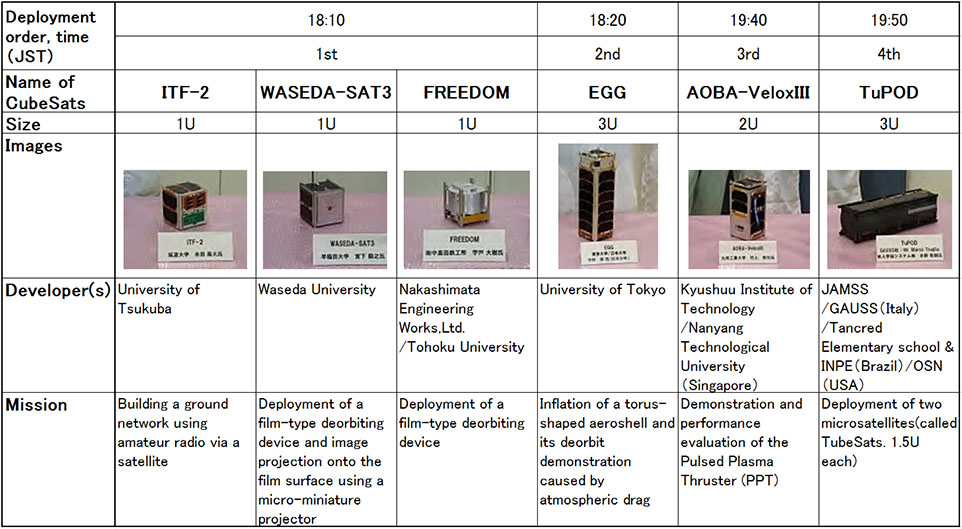
    On December 19, 2016, from 6:10 p.m. – 7:50 p.m. (Japan time), a total of six microsatellites were successfully deployed into orbit from the Japanese Experiment Module (“Kibo”).

    The series of deployments were conducted in the following order.

    First: three 1U-sized CubeSats, each developed by University of Tsukuba (ITF-2), Waseda University (WASEDA-SAT3), and Nakashimata Engineering Works, Ltd./Tohoku University (FREEDOM)

    Second: A 3U-sized CubeSat by the University of Tokyo (EGG)

    Third: A 2U-sized CubeSat co-developed by Kyushu Institute of Technology and Nanyang Technological University of Singapore (AOBA-Velox III)

    Last: A 3U-sized CubeSat, TuPOD (containing two microsatellites called TubeSats) co-developed by JAMSS/GAUSS/Tancred elementary school and INPE (Brazil)/OSN (U.S.)

    Photo: Click to enlarge Photo: Click to enlarge
    ITF-2/WASEDA-SAT3/FREEDOM EGG
    Photo: Click to enlarge Photo: Click to enlarge
    AOBA-VeloxIII TuPOD
    Deployments of CubeSats (Credit:JAXA/NASA)

    At the Tsukuba Space Center (TKSC), the personnel concerned monitored and applauded the successful deployments.

    Photo: Click to enlarge

    Personnel concerned monitoring the deployments (Credit:JAXA)

    The CubeSats deployed this time are the following:

    List of CubeSats

    These CubeSats were launched on December 9 aboard the H-II Transfer Vehicle KOUNOTORI6 and arrived at the ISS on December 14 alongside STARS-C CubeSat that has already been deployed.

    Photo

    J-SSOD having the deployment capacity of up to 12U (Credit:JAXA)

    For the series of deployments, an upgraded JEM Small Satellite Orbital Deployer (J-SSOD) featuring doubled deployment capacity at one time was used for the first time.

    J-SSOD consists of four Satellite Install Cases. One case can contain up to three CubeSats (3U in total) and can deploy up to a total of 12U at one time.

    CubeSat specification currently requires users to make satellites any one of the following sizes: 1U, 2U, or 3U. By flexibly combining different sizes of CubeSats, it can maximize the number of deployable CubeSats at one time.

    *About CubeSats:
    CubeSat is a microsatellite whose basic size is 10 cubic cm (called 1U), with 2U (20 cm in height) and 3U (30 cm in height) sizes also being available. JAXA’s J-SSOD was made in compliance with the CubeSat specification and can deploy a total of 12U at one deployment opportunity. In the near future, the deployment capacity of J-SSOD will be upgraded up to 48U.

    *All times are Japan Standard Time (JST)

    Let’s block ads! (Why?)