Category: News

http://www.subtome.com/#/subscribe?feeds=http%3A%2F%2Fftr.fivefilters.org%2Fmakefulltextfeed.php%3Furl%3Dglobal.jaxa.jp%252Frss%252Fnew.rdf%26max%3D3%26links%3Dpreserve&back=http%3A%2F%2Fftr.fivefilters.org%2Fmakefulltextfeed.php%3Furl%3Dglobal.jaxa.jp%252Frss%252Fnew.rdf%26max%3D3%26links%3Dpreserve

  • [Interview] Opening the Gates to Space Simonetta Di Pippo Director United Nations Office for Outer Space Affairs (UNOOSA)

    Opening the Gates to Space Simonetta Di Pippo Director United Nations Office for Outer Space Affairs (UNOOSA)

    For more than 50 years, the United Nations Office for Outer Space Affairs (UNOOSA) has played an important role in the development of a legal regime for space activities, known as space law; in the spread of new science and technology resulting from space activities; and in the promotion of international cooperation in the space arena. The Japan Aerospace Exploration Agency and UNOOSA have deepened their collaboration by launching KiboCUBE, a joint program that gives educational and research institutions in developing countries the opportunity to gain experience in space technology through the use of the Kibo module on the International Space Station. We spoke with UNOOSA Director Simonetta Di Pippo about her experience of working with JAXA and the importance of international cooperation in the realm of space.

    Helping Developing Countries Participate in Space

    — Please tell us about UNOOSA.

    A scene from the STSC meeting on January 30, 2017. (courtesy of UNOOSA)A scene from the STSC meeting on January 30, 2017. (courtesy of UNOOSA)

    UNOOSA is the UN body that deals with space science, technology, law and policy. You could say that we are the gateway to outer space in the United Nations system. We promote international cooperation for the peaceful use of space, and are involved in a wide range of activities to spread the benefits of space activities throughout the world. One of our important missions is to provide training in the utilization of remote sensing data from satellites, satellite communications, and satellite positioning technology, and to provide support for developing countries in using space technology for sustainable development.

    In addition, we maintain the Register of Objects Launched into Outer Space, and serve the Committee on the Peaceful Uses of Outer Space (COPUOS) and its two subcommittees: the Scientific and Technical Subcommittee (STSC) and the Legal Subcommittee (LSC). COPUOS, which is a permanent committee of the United Nations and promotes international cooperation and the creation of rules on the peaceful uses of outer space, currently consists of 84 member states. The STSC usually meets in February and the LSC usually meets in April every year to debate various topics, after which COPUOUS itself meets in June in Vienna. The committee’s final report goes to the General Assembly in the fall, where the annual resolution on international cooperation in the peaceful uses of outer space is adopted.

    Japan’s Contributions to the Promotion of Peaceful Uses of Outer Space

    — In recent years, several Japanese have worked with UNOOSA: JAXA Technical Counselor Yasushi Horikawa, who served as Chair of COPUOS; JAXA Space Environment Group Leader Takahiro Obara, who was a Co-Chair of Expert Group C on Space Weather, which was established under the Working Group on the Long-term Sustainability of Outer Space Activities and has subsequently completed its work (currently a professor at Tohoku University); Professor Setzuko Aoki of Keio University, who was Chair of the Legal Subcommittee’s Working Group on International Mechanisms; and JAXA astronaut Takao Doi (currently a specially appointed professor at Kyoto University). This year, JAXA Technical Counselor Chiaki Mukai is serving as chair of COPUOS STSC. There are more and more opportunities for people to contribute to the promotion of the peaceful uses of outer space.

    Ms. Di Pippo and JAXA Technical Counselor Chiaki Mukai at the STSC meeting. (courtesy of UNOOSA)Ms. Di Pippo and JAXA Technical Counselor Chiaki Mukai at the STSC meeting. (courtesy of UNOOSA)

    Astronaut Mukai’s term as chair of the STSC began on January 30, and will continue for a year. Her role is very important. In addition to debating things like space debris countermeasures and the use of satellites for disaster monitoring and prevention, she will contribute to preparations for UNISPACE+50, including details of the various priorities already established by the committee.

    — What is UNISPACE+50?

    In June 2018, the international community will commemorate the 50th anniversary of the first United Nations Conference on the Exploration and Peaceful Uses of Outer Space, which took place in 1968 in Vienna. On one side, UNISPACE+50 will look at the past – at changes that have occurred surrounding the global use of space, and on the other hand we will consider strategies that will shape future space activities, in terms of how to develop and promote space science and technology for the benefit of humanity.

    The seven UNISPACE+50 thematic priorities include Global Partnership in Space Exploration and Innovation, and Capacity-Building for the Twenty-First Century. We want to involve more countries and other space actors in the quest to explore the solar system, and we need to look at how to carry out capacity-building for the 21st century. Clearly today’s situation in the space arena is completely different from 60 years ago, when the astronautical era started with Sputnik 1 and Yuri Gagarin. The biggest difference is that, whereas before we were reliant on government support for space development, now there are commercially driven activities, such as private enterprises that are launching satellites into space. Some of our future challenges involve focusing on the impacts of climate change on Earth, and also more and more on disaster management, because this is linked to climate change. I would like to see space technology used for such purposes. And then there are topics relating to space and global health – investigating how we can use space to improve our well-being and quality of life, etc. These discussions will help to shape the global Space2030 agenda.

    — What exactly do you mean by “Space2030”?

    The four pillars of the UNISPACE+50 vision are space accessibility, space diplomacy, space economy, and space society. These will form a blueprint for the global Space2030 agenda, which is the long-term strategy for the future activities of UNOOSA and the entire global community. They tie in with other important agendas that were approved by UN member states in 2015. The first of those is the 2030 Agenda for Sustainable Development, approved in September 2015, which is an important framework for eradicating poverty and tackling climate change, and which also encompasses the 17 Sustainable Development Goals. The second agenda is the Climate Change Agreement, approved at the Conference of Parties 21 (COP21) in Paris in December 2015, which aims to achieve greenhouse gas reduction targets. And third is the Sendai Framework for Disaster Risk Reduction 2015–2030, which was adopted in March 2015 at the Third United Nations World Conference on Disaster Risk Reduction. These are the three main agendas that we have to deal with, and all of them have an important milestone in 2030.

    Expanding Opportunities to Utilize Space

    — Tell us about KiboCUBE.

    Announcing the second round of the KiboCUBE program at the International Astronautical Congress (IAC) in September 2016. (courtesy of UNOOSA)Announcing the second round of the KiboCUBE program at the International Astronautical Congress (IAC) in September 2016. (courtesy of UNOOSA)

    KiboCUBE is an unprecedented joint UN-JAXA initiative. It was started in September 2015, and aims to provide educational and research institutions in developing countries with the opportunity to deploy their own CubeSats from the Japanese Kibo Module on the International Space Station. This means that countries that do not have the ability to launch their own satellites, and which have never been involved in space before, can now participate in space development. We run workshops and training sessions on aspects of spacecraft engineering, such as design and assembly, according to the needs of each country. So it’s a way of building their capacity to go through the entire cycle of a space mission.

    We received 13 proposals from all over the world for the first round of the KiboCUBE program (September 10, 2015–March 31, 2016), and in August 2016 we selected the satellite from University of Nairobi in Kenya. This is the first time Kenya has a chance to develop a satellite, working with international experts. Students have learned how to do basically everything, from manufacturing the satellite and loading it into the rocket, to all aspects of the launch. Their satellite is scheduled for insertion into orbit from Kibo, and we hope this will help them develop a larger Earth-monitoring satellite in the future.

    Applications are currently open for the second round of the KiboCUBE program (September 27, 2016–March 31, 2017). We are hoping that many countries will be able to take advantage of this innovative program and become part of the global space family.

    — What is the significance of KiboCUBE?

    UNOOSA’s Human Space Technology Initiative (HSTI), which we launched in 2010, was the first attempt to increase the global benefits of space activities and make space exploration a true international effort. The aims of that program are to increase international cooperation, share knowledge, and train personnel, so we hope that KiboCUBE will bear some fruit along those lines.

    KiboCUBE is really a very good example of how UNOOSA can work with a space agency. One of the features of this program is that the flight of each CubeSat selected is provided free of charge by JAXA. So, for developing countries that do not have a big budget available for such activities, this is highly significant. It also shows Japan’s willingness to support our activities, and its strong commitment to helping developing countries. So it’s a great project from all standpoints, and I can not possibly say enough to thank JAXA and the Japanese government for their support, and for what they are doing on behalf of UN member states.

    — What are your expectations for KiboCUBE?

    KiboCUBE is the first step in UNOOSA’s mission to create opportunities for developing countries to participate in space development. For us, the deployment of the University of Nairobi’s CubeSat from the ISS will be a key moment in history, and I hope I can visit JAXA soon and witness it with my own eyes. In the first round, we learned a lot about the aspirations of developing countries: their goal, abilities, and willingness to be part of space activities. We hope to put this to good use in the second round.

    This is part of a more general strategy under the HSTI. In March 2016 I also signed an agreement with the China National Space Administration to allow developing countries access to microgravity conditions on the Chinese Space Station (Tiangong, or “Heavenly Palace”), which is scheduled for completion in 2022. And we’ve also started to work on the first UN space mission with the Sierra Nevada Corporation, to use their Dream Chaser spacecraft to give developing countries the opportunity to develop and fly microgravity payloads for an extended period in orbit.

    So I hope that our efforts to support developing countries with KiboCUBE will lead to further participation by these and other countries, and that through the peaceful use of outer space we can solve global socioeconomic problems and improve the quality of life on Earth.

    Encouraging Women to Participate in Space

    — Chiaki Mukai was the first female Japanese astronaut, and has been a leader in Japan’s space program for a long time. She is also now the first Japanese and the first woman astronaut to be appointed Chair of COPUOS STSC. Could you talk a little about the achievements of women in the field of space?

    (courtesy of UNOOSA)(courtesy of UNOOSA)

    I’m always thinking about the need for more involvement from women in the realm of space. Peggy Whitson is currently in space for the third time, and she was the first female commander of the ISS. There is a famous picture from 2007 showing her, as commander of the ISS, with Pamela Melroy, who was commander of the space shuttle Discovery on STS-120, marking the first time that both spacecraft had been commanded by women at the same time. So the fact that these two women met in orbit as commanders of their respective spacecraft is quite an achievement, and it has not happened again since then.

    In my case, when I was appointed Director of Human Space Flight at the European Space Agency in 2008, there had only been two female directors in the history of ESA since its founding in 1975 – myself and a French woman. And this is still the case today. Just as we do not have balanced representation of women and men in key positions in society, we do not have a balance in the field of aerospace.

    UNOOSA is currently putting together a new program called Space for Women, which will focus on women in STEM (Science, Technology, Engineering and Mathematics), mainly from developing countries. We hope that this will be presented for approval by member states at UNISPACE+50. I have to say that Dr. Mukai is a great role model because not only is she a medical doctor, she is an astronaut, and, as you mentioned, she was the first Japanese woman in space. We need more women in the space sector and in leadership positions, and I hope that the Space for Women project, with the support of Dr. Mukai and others, can help to fix this gender imbalance.

    — What are your goals and expectations for future cooperation with JAXA?

    Overall in the past, cooperation with the government of Japan has always been very, very good, but this is the first time that we have entered into formal cooperation with JAXA, and the results have been outstanding. I am sure we can build on it and work toward the next logical step. Speaking of which, Japan will be hosting the next International Space Exploration Forum (ISEF) in 2018, which will discuss how to proceed with human exploration of space. This will actually be quite important in terms of bringing together all of the main stakeholders and top level countries in this field, and should really help in the process of defining the agenda for UNISPACE+50 in June 2018, as one of the UNISPACE+50 thematic priorities is Global Partnership in Space Exploration and Innovation.

    So from that perspective, I expect we will be dealing with the Japanese government and JAXA more and more, especially if our partnership extends into the realm of space exploration. As I already mentioned, our aim is to promote international cooperation on the peaceful use of space, and in order to achieve that, the cooperation and assistance of JAXA and the space agencies of other countries is absolutely vital.

    Simonetta Di Pippo

    Simonetta Di Pippo

    Director, United Nations Office for Outer Space Affairs

    After graduating with a Masters degree in Astrophysics and Space Physics from the Sapienza University of Rome, Italy in 1984, Ms. Di Pippo joined the Italian Space Agency (ASI) in 1986. Her responsibilities ranged from Earth observation to automation and robotics, science, and human spaceflight. In 2002 she assumed the role of Director of ASI’s Observation of the Universe. From 2008 to 2011, Ms. Di Pippo served as Director of Human Spaceflight at the European Space Agency, before returning to ASI to lead the European Space Policy Observatory at ASI-Brussels until March 2014, at which time she joined the UN Office for Outer Space Affairs. Ms. Di Pippo is Honorary President of Women in Aerospace Europe (WIA-E), which she co-founded in 2009. She has also been an academician of the International Academy of Astronautics (IAA) since 2013, serving on the Board of Trustees of the Academy since 2015. In 2008, the International Astronomical Union named asteroid 21887 “Dipippo” in honour of her contribution to space activities.

    [April 7, 2017]

    Let’s block ads! (Why?)

  • [Employment Opportunities] Position Available: Internship 2017

    JAXA is looking for talented and motivated individuals who are willing to work at the frontline of Japanese space development, space science and aviation technology.

    The following position openings are already closed. You can take a look at them as a reference.

    We are looking to recruit people who understand the roles of the Institute of Space and AeronauticalScience (ISAS,) which also has a function of providing cooperative study opportunities with universities, who pursue research in cooperation with domestic and overseas researchers, and who are also enthusiastic about educating and guiding graduate students.

    * We are not currently recruiting for this position.

    Let’s block ads! (Why?)

  • [Institute of Space and Astronautical Science (ISAS)] Subaru Telescope Detects the Shadow of a Gas Cloud in an Ancient Proto-supercluster

    Mar 29, 2017

    20170328_1.jpg

    The Subaru Telescope Suprime-Cam image used in this work. Neutral hydrogen gas distribution is superposed on the Subaru image. The red color indicates denser regions of the neutral hydrogen gas. Cyan squares correspond to member galaxies in the proto-supercluster, while objects without cyan squares are foreground galaxies and stars. The distribution of neutral hydrogen gas does not align perfectly with the galaxies. (c) Osaka Sangyo University / NAOJ

    A team led by researchers from Osaka Sangyo University, with members from Tohoku University, Japan Aerospace Exploration Agency (JAXA) and others, has used the Suprime-Cam on the Subaru Telescope to create the most-extensive map of neutral hydrogen gas in the early universe. This cloud appears widely spread out across 160 million light-years in and around a structure called the proto-supercluster. It is the largest structure in the distant universe, and existed some 11.5 billion years ago. Such a huge gas cloud is extremely valuable for studying large-scale structure formation and the evolution of galaxies from gas in the early universe, and merits further investigation.

    This research will be published in the journal of the British Royal Astronomical Society (Monthly Notices of the Royal Astronomical Society, publisher Oxford University Press) in its June, 2017 issue of the printed version (Mawatari et al. 2017, MNRAS, 467, 3951, “Imaging of diffuse HI absorption structure in the SSA22 protocluster region at z = 3.1“).

    Let’s block ads! (Why?)

  • [JAXA President Monthly Press Conference] JAXA President Monthly Press Conference March 2017

    JAXA President Monthly Press Conference

    Speech Abstracts by Naoki Okumura, President of JAXA
    Date and time: From 1:30 – 2:00 p.m. on March 10 (Fri), 2017
    Venue: JAXA Tokyo Office Presentation Room (B1 floor)
    MC: Yoshikazu Shoji, Director, Public Affairs Department

    JAXA in Comprehensive Agreement with Hokkaido and Tohoku Universities

    On March 9, 2017, JAXA, Tohoku University and Hokkaido University made a comprehensive agreement on the use of nanosatellites. The agreement is designed to expand the use of microsatellites released from KIBO, Japanese Experiment Module onboard the International Space Station. As mentioned in my past speech, JAXA has had as one of its priorities the deployment of microsatellites from KIBO and the reinforcement of KIBO’s deployment capabilities. The agreement will meet the demands of Asian regions- JAXA can provide the platform where they discharge their microsatellites. Careful consideration of the Universities’ records of accomplishment and their potentials led JAXA to forming the arrangement. Their academics, infused with JAXA’s experience are expected to promote microsatellite development.
    DIWATA-1, the first Philippine microsatellite, approximately 50 kilograms, deployed last April, was coproduced by Hokkaido and Tohoku Universities and the Philippine government. Last November, the two Universities led initiation of AMC, Asian Micro-Satellite Consortium, which comprises of 16 space agencies and universities from 9 Asian countries. AMC is an undertaking through which the Universities activate the use of data collected from microsatellites.
    It is JAXA’s earnest desire, through establishing and managing the aforementioned mechanisms, to respond to the needs of the Asia and to contribute to human resources of the area, thus to achieve international development.

    On February 23 and 24, I attended GSTC, Global Space Technology Convention, hosted by the Singapore Space and Technology Association. GSTC is an annual convention that Singapore has organized since 2008, making this year’s its 10th. Attendees were space institutions of France and the United Kingdom, and European and North American space industries as well as those from Asia- Japan, Indonesia and the Philippines.
    JAXA has not yet had strong relationship with Singapore. Attending GSTC drove me home that there, businesses and university researchers have very high technology and that the country is actively involved in use of outer space. Topics of interest were the entrepreneurial space industry, so-called new space, and the operation of microsatellites, which in my impression match the needs of Singapore’s current economic and social landscape. JAXA will seek to strengthen ties with agencies, corporations and academic institutions of Singapore and other counties to pursue mutual benefit.
    This trip included visiting two space-related startups in the country. I found them with excellent technology enters business. If JAXA decides to work with those up-and -coming enterprises, they will turn out to be a great partner, or otherwise a competitor. At any rate, I hope JAXA will cultivate a new frontier for partnership.
    Last year, while onboard the International Space Station, JAXA’s astronaut Takuya Onishi ran simple physics experiments, ideas that JAXA had offered to Asian students. The project named Asian Try Zero-G, was filmed and played at GSTC. The Convention provided a platform which makes KIBO missions known to the Asian public. Local Singaporeans seemed to be informed of the missions. JAXA is delighted if GSTC and other functions of similar nature advance its relationship with other Asian nations.

    Space Exploration Innovation Hub

    JAXA’s Space Exploration Innovation Hub is a rather aggressive operation that aims at application of ground technology in Space with the objective of bringing the benefit back to Earth. Space Exploration Innovation Hub has announced research initiatives to the public twice thus far, and has selected 40 applications. Following are some results of the first group of research applicants.
    A team led by Taguchi Industrial Co., Ltd., Japanese manufacturer of construction machine attachments, created a prototype of the mechanic arm synthesized from light metals and CFRP, carbon fiber reinforced polymer. A hydraulic excavator’s CFRP arm weighs a third of its conventional iron counterpart, with excavation performance improvements- the prototype arm can mine higher outputs thus raises productivity, one significant advantage of weight reduction.
    Tokyo University of Agriculture and JAXA’s Structures and Advanced Composite Research Unit took part of the project. Application of this technology is construction of space structures with the use of similar machinery, possibly on the Moon in the future.
    JAXA informs updates on results that Space Exploration Innovation Hub will continuously yield.

    New Gas Sensor to Illustrate JAXA Boosts Japanese Businesses

    In an endeavor to ensure autonomy of aerospace exploration, JAXA, in cooperation with Japanese enterprises, initiates domestic research and development of the important components of space structures, which foreign manufacturers currently monopolize and oligopolizes.
    I will cite one example of such endeavor.
    A spacecraft in flight releases gases from itself. Attachment of the gases on the surfaces of telephoto lenses and other similar apparatus deteriorates the light intensity and beclouds the vision. Minimizing the gas contamination has been one of the top priorities for solar astronomical satellite Hinode and X-ray astronomy satellite Suzaku. Presently, preventive measures that JAXA takes are eliminating the use of volatile materials to the extent possible and killing the gases by preflight baking. Accurate gauging of gases is essential while excitation is in process. However, the sole vendor of the gas sensor is foreign-made and the prices and the functions of their sensor are not satisfactory to JAXA and other Japanese companies. JAXA’s Research and Development Directorate and private partner have therefore sought to produce a new sensor. I hereby announce that Nihon Dempa Kogyo Co., Ltd. and JAXA succeeded in the production of a new sensor with the world’s first system. Refer to the press release to be published shortly for details. The new sensor, once merchandized, will turn out to be highly competitive. Nihon Dempa Kogyo Co., Ltd has the clear vison of engaging in the sale of the sensor. JAXA continues its quest for research and development to foster Japanese technological advancement.

    Let’s block ads! (Why?)

  • [Institute of Space and Astronautical Science (ISAS)] The Third ISAS Award (FY 2016)

    The JAXA Institute of Space and Astronautical Science gave the Third ISAS Award to the following three people in January and February of 2017. We gratefully appreciate the cooperation and support we have received from external organizations, and we will continue to place greater emphasis on such cooperation.

    Yuki Kimura

    Associate Professor
    Hokkaido University Institute of Low Temperature Science

    Awarded for

    Study on nucleation of cosmic dust in a microgravity environment using S-520 observation rockets

    Mr. Kimura self-developed equipment with high originality for the purpose of determining the initial state of materials in solar system celestial bodies, including the earth, through microgravity experiments using S-520 observation rockets Nos. 28 and 30. As a result of these successful launches, he clarified part of the process of dust nucleation generated by late-type giant stars.

    Iron is abundant in the universe, but the state in which it exists remains unknown.

    Mr. Kimura successfully used an independently developed and mounted dual-wavelength interferometer to measure nucleation environments to simulate the process of dust formation from iron vapor and directly perform homogeneous nucleation experiments compatible with nucleation theory. This revealed that very high supersaturation (supercooling of around 1200 K) is necessary for homogeneous nucleation.

    In addition, by establishing a group with experts on dust formation and nucleation simulation and working on analysis of experimental data, the adhesion probability at nucleation of iron atoms was found to be highly unlikely (as low as 0.001–0.01%). They showed that most of the rest is incorporated as dust impurities or condensed as dust compounds in interstellar space.

    In addition, by developing a proprietary, compact “floating dust infrared spectrum in-situ measuring device,” Mr. Kimura established a method for experimentally comparing the infrared spectra of dust near celestial bodies. Using this device, we expect to determine in detail various physical and chemical parameters, such as the chemical composition, density, and temperature environment of stellar wind.

    The S-520 rockets Nos. 28 and 30 made possible the significant contributions of Mr. Kimura’s experimental results.

    Yuki Kimura
    After working as an overseas special researcher (at NASA Goddard Space Flight Center) under the Japan Society for the Promotion of Science, and as Assistant Professor of Geology at Tohoku University, Mr. Yuki joined us in April 2014. By utilizing “in situ” observation methods using a transmission electron microscope based on materials science studies of physical properties and phenomena peculiar to nano-domains, he has been developing interdisciplinary experimental research into planetary science, astronomy, and crystal growth. In particular, he believes that the key to elucidating the cause of dust-like nanoparticles existing in the universe lies in nano-domains. He is developing the field of astro/nano-mineralogy by incorporating the unique growth modes and physical properties that characteristically appear in the nano-region into research on planetary science and astronomy.

    Yoshiya Kasahara

    Professor
    Kanazawa University Integrated Media Platform Center (Radio Science)

    Awarded for

    Data Analysis of Magnetospheric Plasma Wave Phenomena by Very Low-Frequency Plasma Wave Observation Apparatus Onboard Magnetospheric Observation Satellite Akebono

    Mr. Kasahara made great contributions to the operation, data analysis, database construction, and scientific results production of the very low-frequency (VLF) plasma wave measurement device mounted on the satellite “Akebono,” which completed 26 years of operation in 2015.

    The VLF device performs electromagnetic field wave observations at 20 KHz or less, and was installed for the purpose of studying plasma waves associated with accelerated auroral luminescent particles and the interaction between plasma particles and waves occurring in the earth’s magnetosphere.

    Mr. Kasahara was involved in the long-term operation of the VLF device, and he developed and led the VLF device database for 26 years.

    Many studies have used the VLF device data, including ionic composition studies of the inner magnetosphere by ion cyclotron wave observation, the study of Whistler waves, broad electron density distributions in the plasma zone, and the cause of extremely low frequency (ELF) waves observed in the equatorial region. These studies have produced important discoveries related to the earth’s magnetosphere.

    From his experience with plasma wave observations using the Akebono satellite, Mr. Kasahara contributed as a primary member to the development of a lunar radar sounder mounted on the satellite “Kaguya,” and to a plasma wave and electric field observation device onboard the Mercury Magnetospheric Orbiter (MMO). He also leads the plasma wave and electric field observation device team for the satellite “Arase,” and expects to further develop research related to wave propagation promoted by VLF waves and plasma–particle interactions.

    He has greatly contributed to the creation of many of the scientific achievements of the Akebono project and related fields.

    Yoshiya Kasahara
    Mr. Kasahara joined us in 2008, after serving as Associate Professor of Engineering at Kyoto University, as Assistant Professor at the Graduate School of Informatics and Associate Professor in the Engineering Department of Kanazawa University, and as Associate Professor of the Center for Integrated Media Platforms. Since immediately following the Akebono launch, he has been involved in research on ELF/VLF-band plasma waves using VLF observation instruments and the operation of and databases for such observation instruments. He led the design and development of onboard processing software for the Kaguya lunar radar sounder and waveform capture (LRS/WFC) devices, the plasma wave investigation (PWI) onboard the MMO, and the plasma wave and electromagnetic observer (PWE) onboard Arase. He has been the primary investigator for the Arase PWE since 2015.

    Richard L Kelley

    Astrophysicist
    NASA Goddard Space Flight Center

    Reason for Award

    The history of X-ray microcalorimeters began in 1984 with the publication by Moseley, Mather, and McCammon (MMM paper, J. Appl. Phys., 56, 1257). Immediately afterwards, Dr. Kelley started research and development of X-ray microcalorimeters at NASA Goddard Space Flight Center. Since then, he has led a large team that has pioneered both the basic physics of these devices as well as applications, including the semiconductor X-ray microcalorimeter aboard ASTRO-H SXS.

    Around 1988, Dr. Kelley developed a bilinear microcalorimeter array that was used on the XQC (X-ray Quantum Calorimeter) rocket experiment. He also developed a signal processing algorithm for optimal energy resolution that has been used extensively in this field. These detector elements and the signal processing system became the prototype of ASTRO-E XRS. He has not only conducted research but has also led projects on ASTRO-E2 XRS and ASTRO-H SXS as an American PI, in close collaboration with many scientists in Japan.

    Without the accumulation of his numerous research and development efforts on the X-ray microcalorimeter, namely his lifetime’s work starting in 1984, the SXS’s outstanding performance and its scientific achievement would not have been possible. Along with his great achievements, he made major contributions to the success of the SXS since the MMM publication in 1984. He also deserves praise as a representative of many American researchers.

    The SXS successfully delivered superb X-ray spectra of astronomical objects with unprecedented energy resolution. This extraordinary achievement has opened a door to a new world to explore in X-ray astronomy and is paving the way for next generation space instrumentation.

    Let’s block ads! (Why?)

  • [unable to retrieve full-text content]

  • [ISS / Japanese Experiment Module (KIBO)] ISS/Kibo Monthly News: February, 2017

    Topic of the Month

    Photo: click to enlarge

    Mission reporting by Astronaut Onishi

    Astronaut Takuya Onishi holds a mission reporting event

    On February 21, Astronaut Takuya Onishi held a mission reporting event for the general public in Tokyo. Prior to the reporting, JAXA President Naoki Okumura gave an opening speech, followed by a guest speech by Taizo Tanose, Parliamentary Vice-Minister of Education, Culture, Sports, Science and Technology (MEXT).

    Part 1: Mission report

    In airing the mission highlight video, Onishi described his many experiences, such as being launched aboard the Soyuz rocket, the deployment of CubeSats through Kibo’s airlock, using the ISS robotic arm to capture the Cygnus spacecraft, engaging in science activities, daily life in space, the view of Earth from the ISS, returning to the ground, and post-flight rehabilitation.

    In particular, Onishi explained the tasks that he considers to be his remarkable achievements. Onishi covered the onboard rearing of 12 mice for 35 days in space. He stated that six mice each were reared under two different gravity environments of artificial gravity (1G) and microgravity (μG), in order to compare the different levels of gravity, and that all the mice were returned to Earth in a live condition.

    Next, he introduced Japan’s specialty Protein Crystal Growth (JAXA PCG) experiment and explained why high-quality crystals can be made in microgravity, and that analyzing the structures of protein crystals may lead to the discovery of new medicinal drugs.

    Regarding the ISS operations, he reminisced about the capture of the Cygnus spacecraft and revealed that the task was just like maneuvering an airplane, and taking great pleasure in being assigned that task so that he could demonstrate his area of specialty.

    Part 2: Interview with Astronaut Onishi and Kibo Flight Director Yurika Nakano

    Part 2: Interview with Onishi and Nakano

    Part 2 was proceeded by a moderator interviewing Onishi and Kibo Flight Director Yurika Nakano in regard to various questions collected from the general public beforehand. They introduced some successful tasks where Onishi and the ground team earned mutual trust and cooperated to overcome difficulties, which sometimes included inside stories.

    Given his career as an airplane co-pilot, Onishi stressed the importance of sharing and discussing onboard mistakes or failures with the ground team, so as to prevent any recurrence.

    Nakano discussed that the success of daily operations depends on how well they are prepared, stressing the importance of preparation and rehearsal. Finally, Onishi and Nakano responded with smiles in that both astronauts and flight directors are unspectacular jobs that require continuous preparations.

    Part 3: Talk session

    Part 3: Talk session

    In Part 3 of the talk session, Onishi was joined by an NHK news commentator serving as moderator, JAXA personnel, and Prof. Satoru Takahashi of the University of Tsukuba, representing the users of Kibo, and discussed why the ISS is necessary for human beings and specifically Japan’s need for Kibo. They further discussed how Kibo could enhance its value to improve our life.

    Kibo This Month

    First combustion experiment begins in Kibo

    Flame spread in microgravity (MP4 short movie, no sound)

    A combustion experiment titled “Elucidation of Flame Spread and Group Combustion Excitation Mechanism of Randomly Distributed Droplet Clouds (Group Combustion)” began on February 17. This is the first combustion experiment conducted in the Kibo module.
    This experiment observes how a flame spreads over randomly distributed droplet clouds in microgravity.

    Verifying the hypothesis that governs the spreading rate of a flame and the marginal spreading distance will allow the results to be applied to more sophisticated numerical simulations used to develop various engines that atomize and burn fuels, and may enable the effective development of new hardware.

    This experiment is being conducted in the Group Combustion Experiment Module (GCEM) installed in the Work Volume (WV) of the Multi-purpose Small Payload Rack (MSPR), and researchers can observe the spread of flame over droplet clouds consisting of more than 150 fuel droplets arranged on a two-dimensional grid.

    Protein crystallization at 4℃ begins

    The first samples of Low Temperature Protein Crystal Growth (LTPCG#1) were delivered to the ISS by the Dragon spacecraft (SpaceX CRS-10), and crystallization began in Kibo.

    Protein crystallization on the ground is normally conducted at 4℃ or 20℃. In space, JAXA has conducted protein crystallization at 20℃ for a long time. To meet the growing demand for utilization, a technological demonstration of crystallization at 4℃ was conducted in 2016. Finally, the first experiment was realized aboard the U.S. cargo spacecraft.

    U.S. and Russian cargo spacecraft can now be used to transport protein samples, thereby increasing more experiment opportunities and enabling flexible sample selections. Moreover, crystallization at 4℃ realizes the crystallization of candidate drugs having high demand, such as unstable hydrosoluble proteins and membrane proteins.

    The first samples will be collected upon the return of the Dragon spacecraft.

    Research on the effects of probiotics on the immune system and intestinal microbiota of astronauts

    Yakult Honsha Co., Ltd. (Yakult) and JAXA have been conducting joint research on the effects of probiotics* on the human immune system and intestinal microbiota in a microgravity environment since 2014.

    *Probiotics: “Live micro-organisms which, when administered in adequate amounts, confer a health benefit for the host” (FAO/WHO, 2001)

    Preparations were made to begin the first ever experiment on the consecutive consumption of probiotics by crewmembers on the ISS, based on the outcomes of ground-based research activities and the storage test of capsules containing freeze-dried live probiotic bacteria onboard the ISS.

    Yakult and JAXA will initiate the experiment in 2017, which marks the first scientific study on the effects caused by the consecutive consumption of probiotics on the human immune system and intestinal microbiota of astronauts staying on the ISS for long periods of time.

    ISS This Month

    Launch of the Dragon spacecraft

    SpaceX CRS-10 approaching the ISS (Credit: JAXA/NASA)

    The Dragon spacecraft (SpaceX CRS-10) was launched on February 19 from the NASA Kennedy Space Center (KSC) in Florida, and then arrived at the ISS on February 23. Dragon delivered about 2,500 kg of supplies and payloads, including JAXA’s second FROST (Freezer-Refrigerator Of STirling cycle 2) and samples of the LTPCG experiment.

    Let’s block ads! (Why?)

  • [JAXA President Monthly Press Conference] JAXA President Monthly Press Conference February 2017

    JAXA President Monthly Press Conference

    Speech Abstracts by Naoki Okumura, President of JAXA
    Date and time: From 1:30 – 2:00 p.m. on February 17 (Fri), 2017
    Venue: JAXA Tokyo Office Presentation Room (B1 floor)
    MC: Yoshikazu Shoji, Director, Public Affairs Department

    SS-520 No. 4 Launch Result

    JAXA regrets to inform the failure of the experiment of SS-520, JAXA’s sounding rocket launched on January 15. Through SS-520 No. 4 launch, JAXA wished to verify commercial technology on launch vehicles. The launch was part of Japanese government’s program for development of launch vehicles and satellites in public-private partnerships. JAXA is disappointed that it fell short of expectations of the Japanese public and the private sector. Following the failure, investigation team was set up and report was made to the Research and Development in the Aerospace Field of Japanese Ministry of Education, Culture, Sports Science and Technology. The cause lies, put simply, in unprecedentedly high demands for rocket’s weight saving and for the mass of the weight. JAXA had sought for drastic reduction of the size and weight, but in hindsight the attempt was hardly enough. In my opinion, efforts to save rocket’s size and weight will accelerate and businesses welcome the endeavor. JAXA is resolved to meet the demands through retry. Once the investigation team gets to the bottom of the problem and comes up with clear solution, we are going to measure up to the demands through retry. Down the road there will be challenges that JAXA needs to tackle- ensuring ample funding allocations, manufacturing equipment, and others. At this moment, the root cause of the last launch failure is thoroughly identified, which almost brings the investigation to closure. We are determined to give the process an impetus, by addressing to individual roadblocks and coordinating efforts between JAXA and other pertinent organizations.

    Updates on JAXA’s Astronauts

    JAXA will present the mission reports prepared by Astronaut Onishi at Suidobashi, Tokyo on Tuesday, 21. We are expecting a large turnout. Astronaut Kanai, scheduled for a mission in autumn, will make a temporary homecoming for training, sometime in late March or April.

    ARASE to Undergo Transition of New Phase

    ARASE, formerly known as ERG, Exploration of energization and Radiation in Geospace which launched on December 20 last year, has been in the phase of initial operations. The current operations are expected to last for another month or so until late March. Transition to the science operation phase occurs after successful completion of initial phase, which we assume will take place in April.

    Curtain Falls on COPUOS Subcommittee

    As mentioned in my last month’s Press Conference, Chiaki Mukai, Dr., JAXA’s Senior Advisor to the Executive Director was appointed as Chair of the Scientific and Technical Subcommittee of COPUOS, the Committee on the Peaceful Use of Outer Space of the United Nations. COPUOS 2017, held in Vienna on January 30 through February 10, discussed a technical approach to three major issues facing the global community- the use of space technology applications which goes in line with the SDGs, Sustainable Development Goals, the long-term sustainability of outer space and attempts to reduce space debris. Dr. Mukai will report the results as Chair to COPUOS, to be summoned in June. I am glad and proud that she, one of our colleagues serves well in such capacity on the internationally significant platform.

    Let’s block ads! (Why?)

  • [Institute of Space and Astronautical Science (ISAS)] Two cameras on Akatsuki pause observations

    JAXA decides that two of five cameras on-board Akatsuki (1-µm and 2-µm cameras) pause scientific observations. Other cameras (longwave-infrared camera, ultraviolet imager, and lightening and airglow camera) continue normal operation.

    On 9 December 2016, the electronic device, which controls both 1-µm (IR1) and 2-µm (IR2) cameras, indicated unstable power consumption and it became unable to control IR1 and IR2. The team started recovery trials on 10 December but the symptom remains to date.

    In parallel, trouble shooting continues. Several possible causes, likely related deterioration of electronic parts, are identified and reproduction of the symptom in the laboratory is performed. It is almost 7 years since Akatsuki was launched in May 2010. In addition, between the failed VOI-1 in 2010 and , spacecraft and the successful VOI-R1 in 2015, instruments were exposed to higher radiation environment than anticipated. This likely caused deterioration of instruments.

    Although scientific observations by IR1 and IR2 are paused, JAXA continues investigation of possible recovery of two cameras. Attempts of switching ON these cameras will regularly be made with hope.

    Akatsuki aims to initiate “Planetary Meteorology” by revealing Venus’ atmospheric dynamics in 3 dimension through various observations. (Please refer to: Overview of Venus orbiter, Akatsuki )
    The spacecraft was successfully inserted to Venus orbit in December 2015, and regular scientific observation commenced in April 2016. The mission is so designed to probe Venus’ atmosphere at various altitudes with 6 on-board instruments. (See Akatsuki’s project site for more details.)
    The achievement includes 3-dimensional view of cloud motion and discovery of phenomena that were never seen before.

    Figure: A localized vortex near the cloud base as imaged with IR2. Although similar vortices are seen in the earth atmosphere, this is seen for the first time in Venus' atmosphere.

    Figure: A localized vortex near the cloud base as imaged with IR2. Although similar vortices are seen in the earth atmosphere, this is seen for the first time in Venus’ atmosphere.

    One of such is the localized vortex. Although similar vortices are seen in the earth atmosphere, this is seen for the first time in Venus’ atmosphere with IR2. The phenomenon suggests existence of strong meridional flow blocked by something (high-pressure system in the earth cases). It is mysterious how this could happen while Venus atmosphere is dominated by “super rotation”, a strong westward flow that reaches 100 m/s at the cloud top.

    Akatsuki team continues recovery efforts of IR1 and IR2, while continues scientific observations with other instruments. The scientific data are analyzed to enhance our understandings of Venus’ atmosphere.

    Let’s block ads! (Why?)

  • [ISS / Japanese Experiment Module (KIBO)] ISS/Kibo Monthly News: January, 2017

    Topic of the Month

    Click to enlarge

    Deployment of CubeSats (January 16. Credit: JAXA/NASA)

    Successful deployment of six CubeSats delivered by KOUNOTORI6

    Live broadcast of CubeSat deployment (Recorded Video)

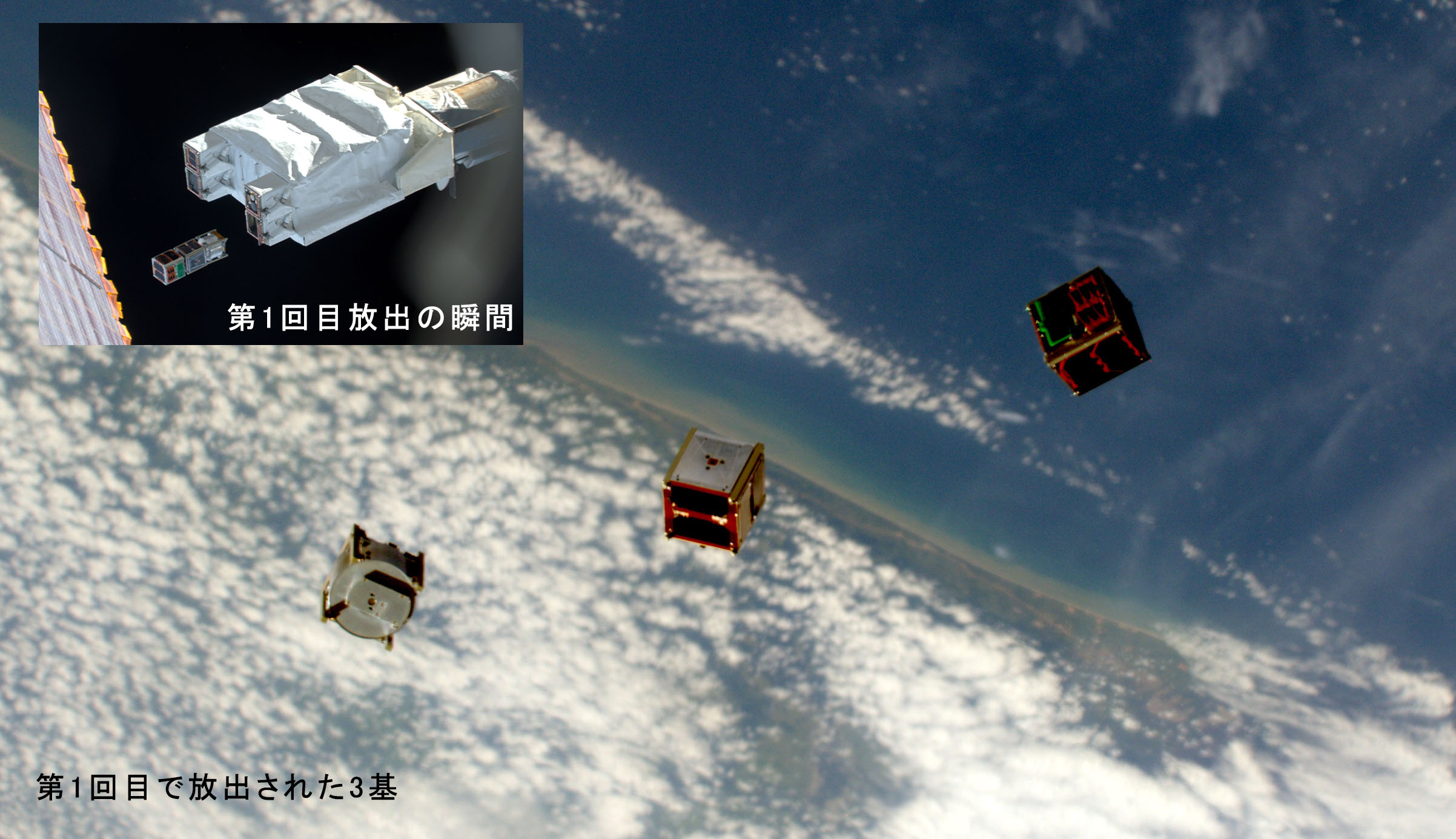
    On January 16, 2017, from 6:10 p.m. to 7:50 p.m. (JST), during four deployment opportunities, a total of six microsatellites were successfully deployed into orbit from the Japanese Experiment Module (“Kibo”). The series of deployments was conducted in the following order:

    • First: three 1U-sized CubeSats, each developed by the University of Tsukuba (ITF-2), Waseda University (WASEDA-SAT3), and Nakashimata Engineering Works, Ltd./Tohoku University (FREEDOM)
    • Second: A 3U-sized CubeSat by the University of Tokyo (EGG)
    • Third: A 2U-sized CubeSat co-developed by Kyushu Institute of Technology and Nanyang Technological University of Singapore (AOBA-Velox III)
    • Last: A 3U-sized CubeSat, TuPOD (containing two microsatellites called TubeSats) co-developed by JAMSS/GAUSS/Tancred elementary school and INPE (Brazil)/OSN (U.S.)

    For the series of deployments, an upgraded JEM Small Satellite Orbital Deployer (J-SSOD) featuring deployment capacity of up to 12 microsatellites (12U) at one time was used for the first time. Given the dramatically increased demand for CubeSat deployment in the past few years, JAXA has upgraded the deployer to meet that demand.

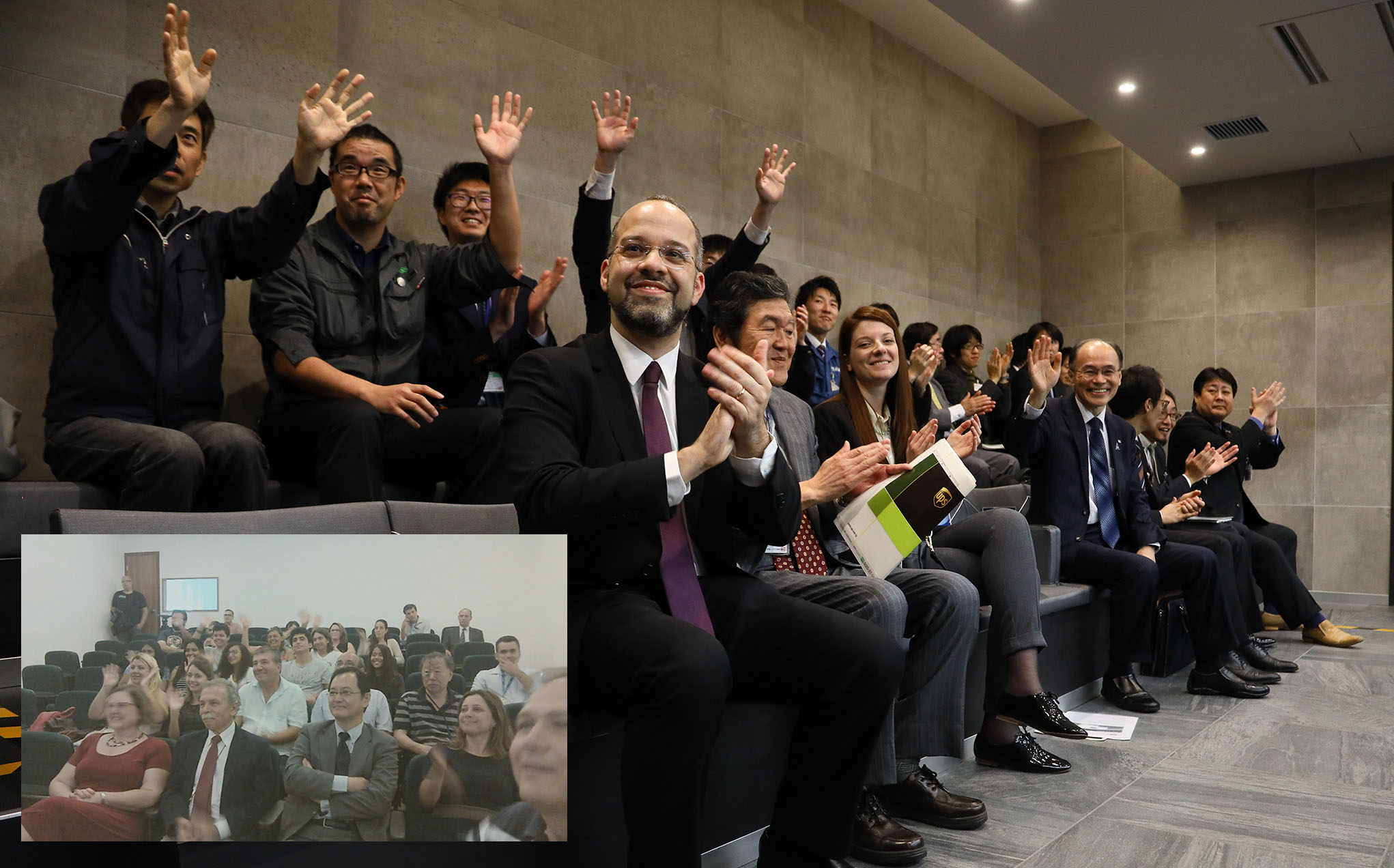
    At the Tsukuba Space Center, the personnel involved in development of each CubeSat monitored and applauded the successful deployment. In Brazil, others involved in development monitored the deployment of TuPOD live via the Internet.

    JAXA will continue to offer CubeSat deployment opportunities using the mechanisms of Kibo.

    Photo: click to enlarge

    Related personnel applauding the successful deployment (January 16. Credit: JAXA)

    Photo: click to enlarge

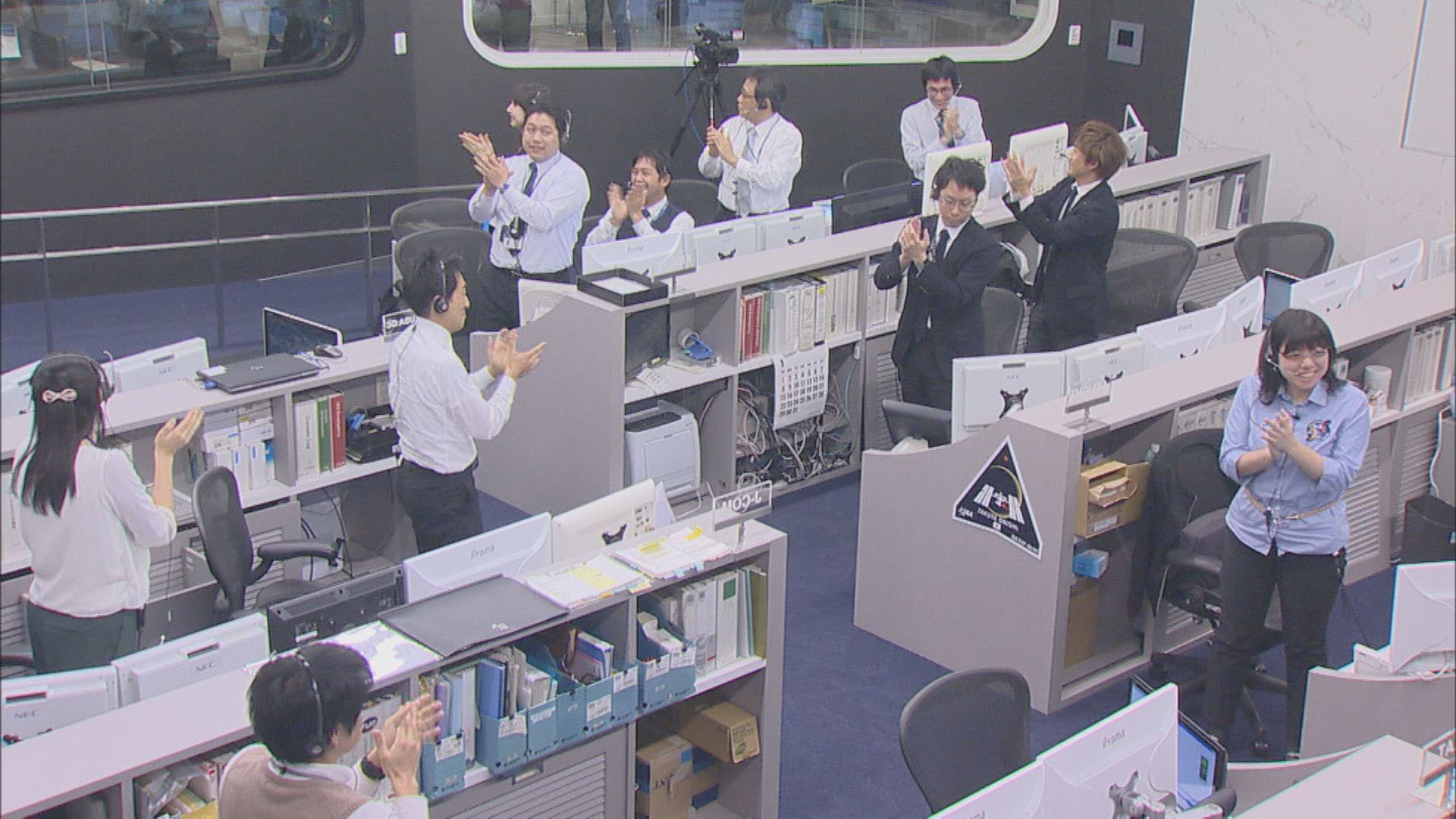
    Kibo Mission Control Team applauding the successful deployment (January 16. Credit: JAXA)

    Exchange of ISS Batteries

    Removal and replacement of the ISS battery Orbital Replacement Units (ORUs) delivered by KOUNOTORI6 were conducted from December 31 – January 14, 2017.

    There are 48 sets of nickel-hydrogen batteries currently used on the ISS, but given the approaching end of their service life, a new type of Japanese lithium-ion battery cell was adopted as the replacement. The new battery ORUs will provide sufficient power with only 24 battery ORUs. This time, nine of the 12 battery sets installed on the S4 truss were replaced by six new battery sets.

    The NASA ground team conducted removal and replacement operations by maneuvering the ISS robotic arm (Space Station Remote Manipulator System or SSRMS), followed by two Extravehicular Activities (EVAs) conducted by Astronauts Shane Kimbrough and Peggy Whitson on January 6, and by Shane Kimbrough and Thomas Pesquet on January 13.

    An additional 18 battery ORUs will be delivered by the future HTV 7-9 missions to sustain prolonged operations of the ISS.

    Photo: click to enlarge

    Special live broadcast of new battery installation (Recorded Video)

    Photo: click to enlarge

    KOUNOTORI6 moves away from the ISS (January 28. Credit: JAXA/NASA)

    Kibo This Month

    Preparation for the first combustion experiment in Kibo

    Photo: click to enlarge

    Composition for the combustion experiment (Credit: JAXA)

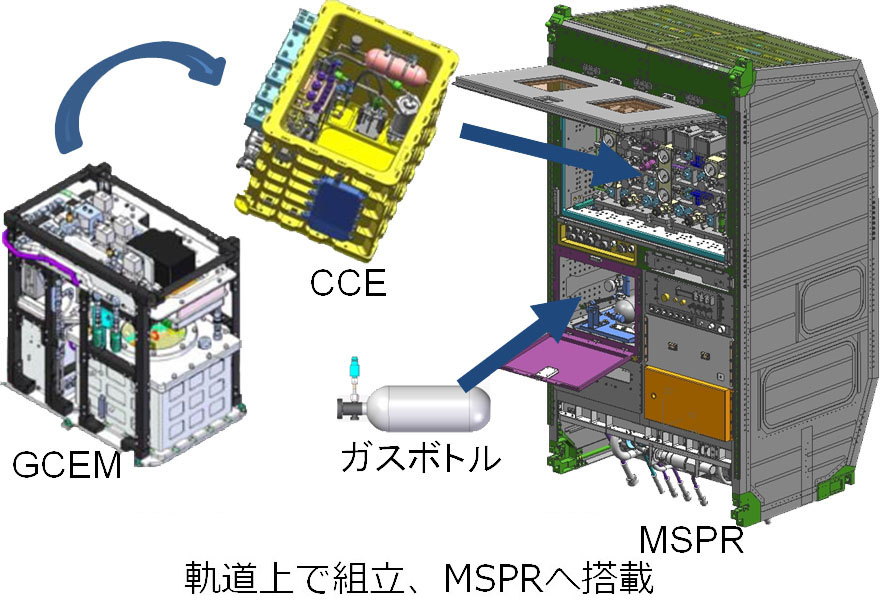
    Preparations are ongoing for the group combustion experiment, for which Astronaut Onishi conducted assembly and verification while onboard the ISS.

    The Group Combustion Experiment Module (GCEM) is the device used to conduct the first Japanese combustion experiment in space on investigating the combustion mechanism of fuel droplet groups (gathering of fuel particles).

    When conducting combustion experiments on the ground, strong natural convection occurs due to the difference in temperature between the high-temperature flame and ambient air. On the ISS, detailed observation of combustion itself is possible because such convection does not occur in a microgravity environment.

    On January 16, in cooperation with the ground controllers, the air tightness and supply lines of nitrogen gas and air were verified in the Multi-purpose Small Payload Rack (MSPR) in which the Chamber for Combustion Experiment (CCE) was installed aiming to begin the experiment in mid-February.

    Technological demonstration of the real-time dosimeter begins

    On December 15, 2016, a real-time radiation monitor called the “Position Sensitive Tissue Equivalent Proportional Chamber (PS-TEPC)” was installed in the Kibo module and activated by an onboard crew member.

    System checkout of PS-TEPC was performed until December 28, and then the technological demonstration began.

    PS-TEPC is a compact, high-precision inboard dosimeter that enables real-time measurement, and which will compare its data with the data of existing dosimeters.

    Immunization research for the health of onboard astronauts

    JAXA’s medical experiment called “Multi-omics analysis of human-microbial metabolic cross-talk in the space ecosystem” (Multi Omics) is ongoing.

    This experiment evaluates the influence on immune disorders by investigating changes in the intestinal environment such as intestinal flora and the intestinal metabolism of astronauts onboard the ISS.

    ISS This Month

    Maintenance for the Carbon Dioxide Removal Assembly (CDRA)

    Photo: click to enlarge

    CDRA ORU (Credit: JAXA/NASA)

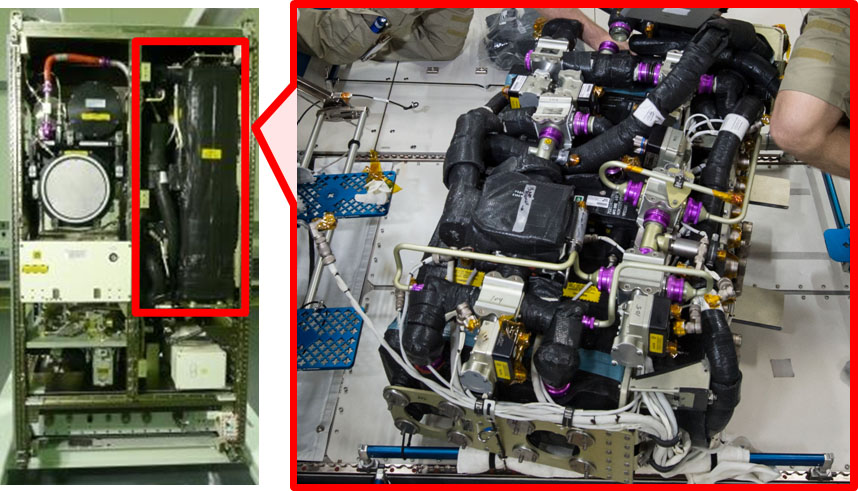
    On January 23, the removal and replacement operations for the Orbital Replacement Units (ORUs) of the Carbon Dioxide Removal Assembly (CDRA) delivered on KOUNOTORI6 were conducted.

    Onboard crew removed the Air Selector Valve (ASV) from the CDRA and installed a new CDRA valve. This new valve was developed to improve its operational lifetime. The removed valve was stowed as a spare.

    JAXA Astronauts This Month

    Below we introduce the current brief status of JAXA Astronauts.

    Photo:click to enlarge

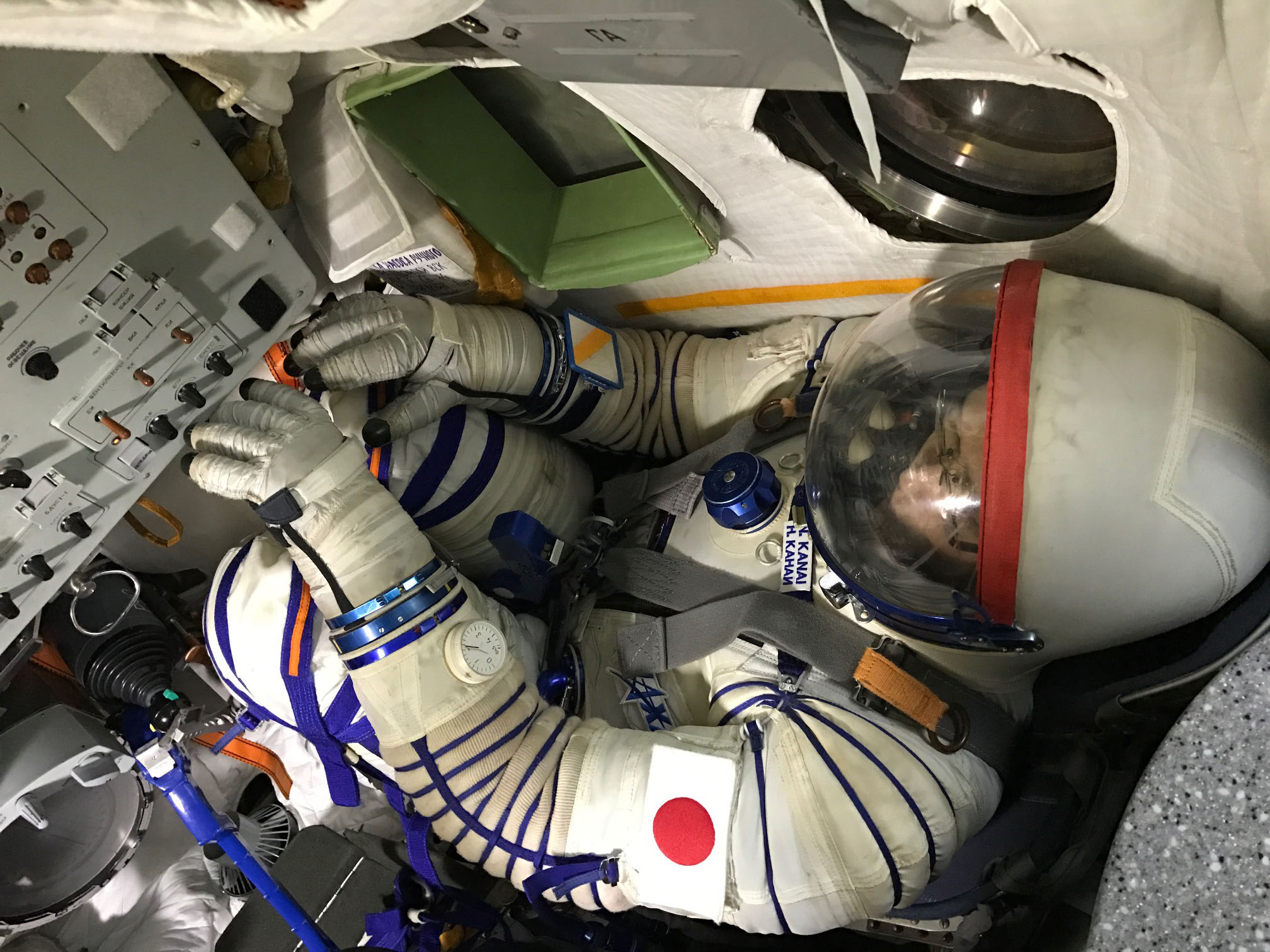
    Kanai simulating operations of the Soyuz spacecraft (Credit: JAXA/ROSCOSMOS/Takuya Onishi)

    • Norishige Kanai
      Kanai continues training for the upcoming ISS Expedition 54/55. He underwent training for EVA and robotic operations at the NASA Johnson Space Center.
      Kanai also visited the Gagarin Cosmonaut Training Center (GCTC) in Russia for training on how to support EVA by Russian crew, simulate Soyuz spacecraft operations, and perform fit checking of his Sokol spacesuit.
    • Koichi Wakata
      Wakata underwent flight piloting training in several areas of Japan (to maintain various skills as an astronaut) while being very busy as JAXA ISS Program Manager.
    • Soichi Noguchi, Satoshi Furukawa, and Akihiko Hoshide
      They underwent training for Extravehicular Activities (EVAs) at the NASA Johnson Space Center (JSC).
    • Takuya Onishi
      Onishi underwent a set of debriefings on health and psychological management, space food, medical and other experiments at the TKSC. He also visited Star City in Russia for a debriefing and attended a welcome home ceremony.
    • Kimiya Yui
      Yui is currently on duty at the TKSC. In February, he will undergo training for EVA at the NASA Johnson Space Center.

    Let’s block ads! (Why?)

  • [Institute of Space and Astronautical Science (ISAS)] Finding the cause of a bow-shaped feature on Venus: Observations by the Venus Climate Orbiter "Akatsuki" and analysis of numerical simulations

    Feb 17, 2017

    In December 2015, the longwave-infrared (LIR) camera mounted on the Venus Climate Orbiter “Akatsuki” discovered a bow-shaped feature stretching about 10,000 km in a north-south direction. This pattern remained in nearly the same place over the observation period of four days, without being affected by the easterly wind (super-rotation) in the Venus atmosphere. Examination using numerical simulations suggested that turbulence in the lower atmosphere generates waves that propagate through the atmosphere. The waves propagate north and south through the sky, creating a bow-like temperature distribution passing through the upper end of clouds at an altitude of about 65 km. This study showed that the state of Venus’ lower atmosphere can be inferred from observations of its cloud tops.

    This research result was published on 17 January 2017 in the online edition of the UK scientific journal Nature Geoscience.

    Figure 1

    Figure 1: Images of Venus taken by Akatsuki in December 2015

    Observations by the longwave-infrared (LIR, note 1) camera mounted on the Venus Climate Orbiter “Akatsuki” discovered a bow-like formation stretching about 10,000 km in a north-south direction in December 2015.

    It was confirmed that the LIR discovered a bow-shaped formation extending in a north-south direction that remained in place without being swept away by the super-rotation, an easterly wind of about 100 m/s, during the initial observation period. Researchers seeing the returned images were amazed, saying things like “We’ve never seen anything like this, on any planet,” and “What could that possibly be?”

    Planetary science and meteorology researchers were highly interested, wondering by what mechanism such a large-scale temperature structure could form.

    LIR is a form of thermography with sensitivity near wavelengths of 10 μm. Observation in LIR make it possible to distinguish between cloud-top temperatures on Venus to a temperature difference of 0.3 °C.

    Meanwhile, the ultraviolet imager (UVI, note 2) aboard Akatsuki is a camera that captures ultraviolet rays at wavelengths of 283 and 365 nm. Through observations with the UVI, we can investigate the distribution of unknown substances thought to be located at close to the same altitude as the LIR observations.

    Initial LIR and UVI observations were conducted for four days, from 7 to 10 December 2015. The research team examined the features of the bow-shaped structure by applying an image processing technique called a high-pass filter to the acquired images and emphasizing the otherwise inconspicuous structure. As a result, it was confirmed that the bow-shaped structure appeared geographically at nearly the same place for four days, and was not affected by the super-rotation. While faint, UVI images too confirmed the bow-shaped structure.

    Comparing Venus’ topography with the location of the bow-shaped structure, we determined that the center of the structure was located just over the Venusian continent called Aphrodite Terra, which reaches an altitude of approximately 5 km (Fig. 2).

    To investigate the cause of the observed bow-shaped structure, the researchers performed numerical simulations of a simplified Venusian atmosphere and investigated under what conditions such a structure might occur.

    Assuming local pressure variations to the lower atmosphere at an altitude of 10 km, simulations revealed a “gravity wave” appeared in the sky. When reaching an altitude of 65 km, this wave was shown to spread throughout the sky into a bow-like shape (Fig. 3). In other words, the lower atmospheric pressure changes in a limited area propagate throughout the atmosphere, ultimately creating the large bow-shaped structure.

    On Earth, for example, artificial satellites can observe gravity waves leeward of the Andes mountains. However, the bow-shaped structure found on Venus was much larger. It is expected that such waves affect the atmosphere far above the cloud layer.

    The bow-shaped structure observed in December 2015 was no longer observed from January 2016, but unclear observations of a similar structure were made at another place and another time. The research team speculates that specific conditions are necessary for the appearance of these structures.

    Clarifying all aspects of the generation mechanism of such bow-shaped structures will require narrowing down the conditions under which they occur. To do so, the team need more data of larger time and area coverages. The observation team has improved observation programming and the observations of bow-shaped structures. By analyzing these data and performing more detailed simulations, we expect to advance our understanding of Venus’ lower-atmosphere weather, which is the source of these waves.

    Figure 2

    Figure 2: Image processing applied to LIR images from 7 December 2015 emphasizing the bow-shaped pattern and mapping it against the terrain. The distance between terrain contour lines is 1 km. These images show that the observed structure appears above highlands (the western part of the Venusian continent Aphrodite Terra).

    Figure 3

    Figure 3: (Left) Below the bow-shaped pattern seen in LIR observation images from 7 December 2015 is a highlands area called Aphrodite Terra.
    (Right) The bow-shaped pattern around an altitude of 65 km reproduced by computer simulation. When atmospheric turbulence occurs in the lower layer of the Venusian atmosphere, generated waves propagate through the sky, and spread in a bow-like shape.

    Glossary

    Note 1: Longwave-infrared (LIR) camera

    Rikkyo University, ISAS/JAXA, and other institutes developed a method of thermography for capturing infrared rays at a wavelength of 10 μm. A detector called an uncooled microbolometer is adopted, realizing the compactness and weight reduction that are indispensable for spacecraft installations. This was the first microbolometer developed based on popular consumer technology, and it became the first such product equipped on a spacecraft. The LIR camera can distinguish temperature differences of 0.3 °C at the observation target, the cloud tops of Venus, which have temperatures of around – 40 °C. First put to practical use in Akatsuki, a similar camera was also mounted in the asteroid explorer “Hayabusa 2,” under the name “TIR.” Since the LIR camera, many similar devices equipped with uncooled microbolometers have been developed for mounting on next-generation spacecraft. These have been installed in Earth observation satellites and are being increasingly used in the field of space.

    Note 2: Ultraviolet imager UVI

    Hokkaido University and JAXA have developed cameras that capture ultraviolet rays at wavelengths of 283 and 365 nm. Sulfur dioxide and unknown chemical substances that absorb ultraviolet wavelengths are related to the formation of clouds on Venus. This imager uses ultraviolet rays to capture the distribution of these materials and determine wind-speed distributions from their variations at cloud-top altitudes.

    Let’s block ads! (Why?)

  • [Institute of Space and Astronautical Science (ISAS)] "Hisaki" Revealed the Effects of the Solar Wind Extend to within the Jovian Magnetosphere

    Feb 22, 2017

    Observations by “Hisaki”, the Extreme ultraviolet spectroscope for Exospheric Dynamics mission, showed that the effects of the solar wind extend to within the Jovian magnetosphere, the strongest in the solar system. This research result overturns the conventional idea the solar wind cannot reach near Jupiter, which is strongly protected by its powerful magnetosphere.

    To clarify the process by which the solar wind enters the Jovian magnetosphere, a research team lead by Go Murakami (ISAS/JAXA) is preparing to work with overseas researchers to conduct simultaneous in situ observations by NASA’s Jupiter probe “Juno” and ISAS’s Hisaki.

    The research result was published in the 20 December 2016 issue of Geophysical Research Letters.

    Artist's concept of this research

    Artist’s concept of this research

    The solar wind is a high-speed plasma flow, which travels at several hundreds of kilometers per second. The planets of the solar system are continually bombarded by this wind. One important effect on the solar wind is that of the large magnetic fields of some planets, which act as a protective barrier.

    Not every planet has such a barrier. Earth does, and its surrounding magnetosphere prevents the direct impact of the solar wind. However, some part of solar wind energy encroaches upon the magnetosphere, causing phenomena such as auroras and radiation bands. Mars and Venus, which do not have large magnetic fields, are directly affected by the solar wind, which even today blows part of their atmospheres into outer space.

    Jupiter has a strong magnetic field, about 20,000 times stronger than Earth’s, making it the largest and strongest in the solar system. Jupiter is furthermore much farther from the Sun than Earth is. Because of these it was thought that the solar wind would not affect Jupiter, which lies deep inside its magnetosphere.

    Even so, observations have been made suggesting an effect of the solar wind. This effect is seen in a plasma cloud (the Io plasma torus) caused by volcanic gas from the Jovian satellite Io, which is distributed in a donut shape at a distance of about six times the Jovian radius.

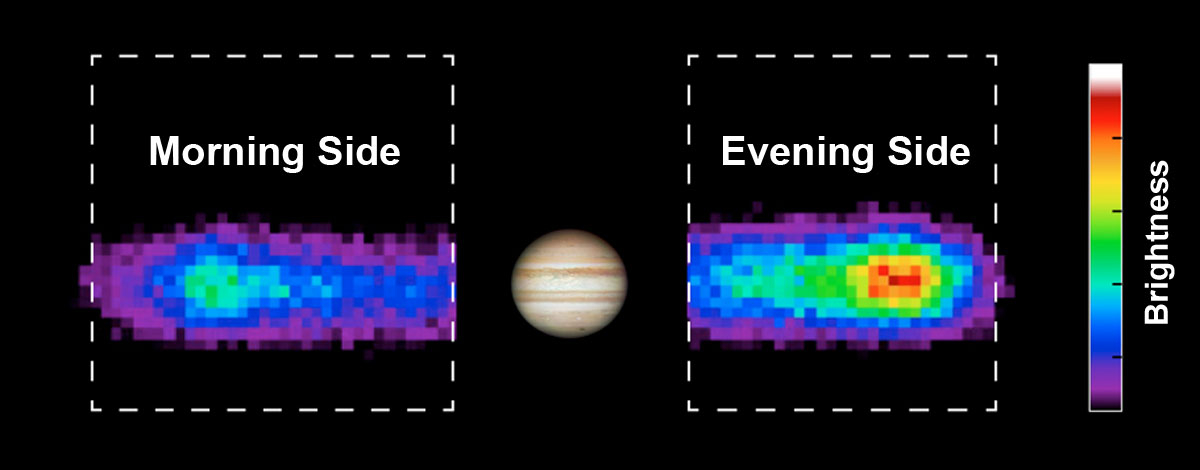
    It was known that the brightness of plasma in the torus is asymmetric, being brighter on the evening side with respect to the Sun and darker on the morning side (Fig. 1). The causes of this asymmetry remained unknown, however, due to a lack of observational evidence.

    Figure 1

    Figure 1. Spectral image of the Io plasma torus near Jupiter, taken by Hisaki on 1 January 2014. The image shows the emission intensity of sulfur ions around Jupiter, following its rotation. The evening side clearly glows brighter than the morning side. (Source: Adapted from Fig. 1 in Murakami et al. (2016)).

    Believing that the solar wind somehow influences this morning and evening asymmetry in the Io plasma torus, a research team led by Gō Murakami (ISAS/JAXA) used “Hisaki” to conduct long-term observations. Hisaki is a space telescope dedicated to planetary observations, enabling continuous, long-term observations of Jupiter. These observations lasted for over a month, during which the Io plasma torus was observed in extreme ultraviolet wavelengths.

    Figure 2

    Figure 2. Change over time of (a) morning and evening asymmetry in the Io plasma torus and (b) solar wind strength (dynamic pressure) as observed by Hisaki in January 2014. Arrows and dotted lines indicate times when strong solar wind arrived near Jupiter and asymmetric strengthening in the morning and evening (the evening side is brighter than the morning side) in the Io plasma torus. (Source: Adapted from Fig. 2 in Murakami et al. (2016)).

    Figure 2(a) shows the change over time of morning and evening asymmetry (differences in morning and evening brightness) in the Io plasma torus. From these results, the research team confirmed previous observations that the evening side is brighter (the evening/morning ratio is greater than 1), and that the change over time is very large, with the evening side suddenly becoming 2.5 times brighter than the morning side.

    Figure 2(b) shows the change over time in the strength (dynamic pressure) of the solar wind at Jupiter, as estimated from observations from sateloites orbiting around Earth.

    Comparing Figs. 2(a) and (b), the arrows show that the sudden changes in the morning and evening asymmetry of the Io plasma torus observed by Hisaki are in response to solar wind fluctuations. In other words, the influence of the solar wind extends deep inside the Jovian magnetosphere, the strongest barrier in the solar system. The results of this observation overturn previous beliefs that the solar wind has no effect within the Jovian magnetosphere.

    Regarding the mechanism by which the solar wind can have effects on Jupiter’s vicinity, one theory is that a disk-like current flowing around Jupiter (at a distance of about twenty to thirty times Jupiter’s radius) is affected by the solar wind, and part of this current moves along Jovian magnetic lines of force. Verifying this hypothesis requires numerical simulations and on-site observations. The research team is currently conducting simultaneous observations using JAXA’s Hisaki and NASA’s Juno, which entered Jovian orbit in July 2016. We are preparing for cooperation with overseas researchers to perform Juno observations of changes in currents near Jupiter and Hisaki observations of the Io plasma torus to reveal any relations between them.

    References

    “Response of Jupiter’s inner magnetosphere to the solar wind derived from extreme ultraviolet monitoring of the Io plasma torus”
    Geophysical Research Letters, 20 December 2016
    DOI:10.1002/2016GL071675

    Let’s block ads! (Why?)

  • [JAXA President Monthly Press Conference] JAXA President Monthly Press Conference January 2017

    JAXA President Monthly Press Conference

    Speech Abstracts by Naoki Okumura, President of JAXA
    Date and time: From 1:30 – 2:15 p.m. on January 13 (Fri), 2017
    Venue: JAXA Tokyo Office Presentation Room (B1 floor)
    MC: Yoshikazu Shoji, Director, Public Affairs Department

    New Year’s Resolutions

    JAXA sends the new year’s greetings to all.
    JAXA had been scheduling SS-520 No. 4 launch but decided to postpone due to the weather. At this moment the re-try will be done no sooner than January 15, 2017. The rescheduling will be finalized after careful examination of the weather and JAXA will inform the decision. JAXA’s launch schedule in Japanese fiscal years 2016 and 2017 is, launches of GCOM-C, Global Change Observation Mission-Climate, SLATS, Super Low Altitude Test Satellite aboard H-IIA rocket, and ASNARO-2, the second Advanced Satellite with New System Architecture for Observation aboard Enhanced Epsilon.
    GCOM-C is designed to do thorough research on phenomena that affect climate change, or more specifically, it provides imagery of Asian Dust, yellow dust from China, and the marine environment. SLATS’ proximity to Earth, its strength, provides high resolution views.
    Preparation is underway for long term stay of JAXA’s astronaut Norishige Kanai aboard the International Space Station in autumn. Hopes are high that he will send home exciting data.
    Farther down the road, JAXA will come into the last fiscal year of its third 5-year Middle Term Plan. Finalizing respective projects for this term and laying out new plans are our agenda for the fiscal 2017. JAXA needs to make plans that reflect the changing circumstances around the international field of space exploration. Late last year, the Japanese Diet approved “The 2 Space Acts”, The new Space Activities Act and The Satellite Remote-Sensing Act. The enactment paves the way for private participation in the space industry. Demands increase on JAXA, the national research institute, to lead the intervention. JAXA is resolved to see that the new plans will meet the demands.
    In my belief, JAXA’s identity, put simply, lies in generation of innovation to be presented to the government and implementation of missions that pioneer the international frontier. That requires bringing unknown technology to the table and finding fresh users. If the government is convinced of JAXA’s inspirational space technology, funds will be allocated to give shape to our ideas. Japanese Basic Space Law defines JAXA as core organization that provides technical support for the entire governmental development and utilization of space projects. It is my determination to ensure that our upcoming plans will fully equip JAXA as such.

    The Fiscal Year 2017 Budget

    The Japanese Cabinet has approved a budget for the next fiscal year. The draft allocations for JAXA total ¥ 153.7 billion, almost the same size as the last fiscal year. Here, I would like to break it down.
    One is for development of H3 launch vehicle, a ¥ 19.1 billion section, a huge increase from the last year’s budget. H3, to launch in the fiscal 2020, is in full progress this fiscal year. At JAXA’s Kakuda Space Center, unit tests of turbopump have started of H3’s new large liquid engine called LE-9. Test results will be used to complete the turbopump, LE-9’s essential component. Provided the turbopump is tested on time, JAXA will run LE-9 fire testings starting around March 2017 at the Tanegashima Space Center. Multiple test firing is scheduled and some sessions will be open to the media. Details will be informed.
    Another, ¥ 2.3 billion is added for the X-ray Astronomy Satellite, replacement of ASTRO-H. I am leading the reform within JAXA so as not to repeat the same type of accident. Specific plans for the project have taken shape. JAXA is proceeding the project as the last time in cooperation with other foreign space organizations. Preparation is underway for its launch in the fiscal 2020.
    Still another, ¥ 800 million is reckoned with the cost of development of a next generation engineering test satellite. In the last supplementary budget, ¥ 700 million was authorized. The operational budget will be the total of the ¥ 700 million, combined with JAXA’s ¥ 800 million request if the Diet passes it. The completed engineering test satellite, stipulated in Japanese Basic Space Law, equipped with next generation telecommunication and broadcasting capacities will greatly benefit the private market.
    Let me describe it in detail. Japanese Ministries of Education, Culture, Sports, Science and Technology, and of Internal Affairs and Communications act as lead manager. JAXA and NICT, National Institute of Information and Communications Technology, administered by Ministry of Internal Affairs and Communications serve as administrator. Process of the project is unique- from the very beginning of its development, JAXA welcomes private intervention, interplaying designs of some of the principal features. Private partner is given a latitude as to how to model them to best promote its business, with future operation in mind. After the H3 project with Mitsubishi Heavy Industries, Ltd. JAXA tries this partnership approach for the second time. I believe private involvement will raise the international competitiveness of Japanese space industry.
    Challenges pertaining to the test engineering satellite are that the weight increase incurred by its expectedly mass communication demands high power and more communication capacity by far. Reduction of less important components to the extent possible, on top of the desired augmentation, seems to favor the electrically propelled system, internationally more common propellant, rather than the conventional chemical counterpart. The test satellite is now in its pre-project state, one step before project. JAXA is aiming at initiation of the project to realize the satellite’s fiscal 2021 release by H3 launch vehicle.

    Updates on ARASE

    JAXA’s satellite ERG, Exploration of energization and Radiation in Geospace, later renamed ARASE, injected into its orbit on December 20 last year, is in good condition. Following extension of its wire antennae and masts, ARASE’s critical operations phase will come to a closure. The satellite then will enter into its 2-month commissioning phase, which will last until the end of March.
    Again, I would like to express my gratitude for a huge turnout at ARASE launch aboard Epsilon at the Uchinoura Space Center.

    JAXA’s Astronaut Chiaki Mukai to Become Chair of COPUOS Scientific and Technical Subcommittee

    In 2013 and 2014, JAXA has the proud history of sending Dr. Yasushi Horikawa, JAXA Technical Counsellor, to become Chairman of the United Nation COPUOS, the Committee on the Peaceful Uses of Outer Space. Dr. Chiaki Mukai, JAXA Technical Counsellor,, has been appointed as Chair of the Scientific and Technical Subcommittee, one of COPUOS’ two subcommittees. COPUOS Scientific and Technical Subcommittee, to be held in Vienna on January 30 through February 10, will address the global community’s attempts to reduce space debris, to realize the long-term sustainability of outer space activities and the SDGs, Sustainable Development Goals. Expectation mounts for Dr. Mukai, who will be the first female astronaut to assume this position.

    The 30th Anniversary Symposium of JAXA’s Earth Observation

    This year marks JAXA’s 30th anniversary of its Earth observation history, which took off on February 19, 1987 with MOS-1, Japan’s first marine observation satellite. MOS-1 was built with sensors that detect microwave radiation, visible near-infrared, and thermal infrared. The advanced types of those sensors are the onboard instruments of the Earth observation satellites now in operation.
    To celebrate the 30th anniversary, JAXA will hold a public discussion on the past and the future of Earth observation satellites at Ochanomizu Sola City on February 13. Participation would be cordially welcomed.

    SafeAvio Project

    JAXA leads several collaborative, partly privately funded R & D projects, among which is SafeAvio, onboard safety avionics technology to prevent turbulence-induced aircraft accidents. SafeAvio is expected to ensure and improve air safety. Turbulence is one of the top accident causes for commercial jets, accounting for almost half of all accidents. Improves to fine tune weather radar are being made to help forecast turbulence. Particularly challenging is, however, to predict clear air turbulence, unaccompanied by rain clouds.
    If accurately foreseeing turbulence is possible, preventive measures can be taken- an aircraft in midflight can slightly change its course to fly around it, and passengers can be warned of bumpy ride ahead by the seatbelt sign turned on. JAXA’s Aeronautical Technology Directorate has spearheaded the unprecedented task of producing Doppler LIDAR system, light detection and ranging. As a result of continuous reduction in size and weight, the system can now be onboard an airplane. On January 14, JAXA will start flight demonstration of the Doppler LIDAR system aboard aircraft above Nagoya Airport.
    For years, JAXA, in cooperation with The Boeing company, has done studies on the system. SafeAvio is of great interest to several airplane manufacturers and airlines. JAXA hopes the test flight will bring positive results.

    Let’s block ads! (Why?)