Category: News

http://www.subtome.com/#/subscribe?feeds=http%3A%2F%2Fftr.fivefilters.org%2Fmakefulltextfeed.php%3Furl%3Dglobal.jaxa.jp%252Frss%252Fnew.rdf%26max%3D3%26links%3Dpreserve&back=http%3A%2F%2Fftr.fivefilters.org%2Fmakefulltextfeed.php%3Furl%3Dglobal.jaxa.jp%252Frss%252Fnew.rdf%26max%3D3%26links%3Dpreserve

  • [ISS / Japanese Experiment Module (KIBO)] Release on updated images of Kibo's internal drone "Int-Ball" (Int-Ball Letter Vol. 1)

    Release on updated images of Kibo’s internal drone “Int-Ball” (Int-Ball Letter Vol. 1)

    Last Updated:
    July 25, 2017

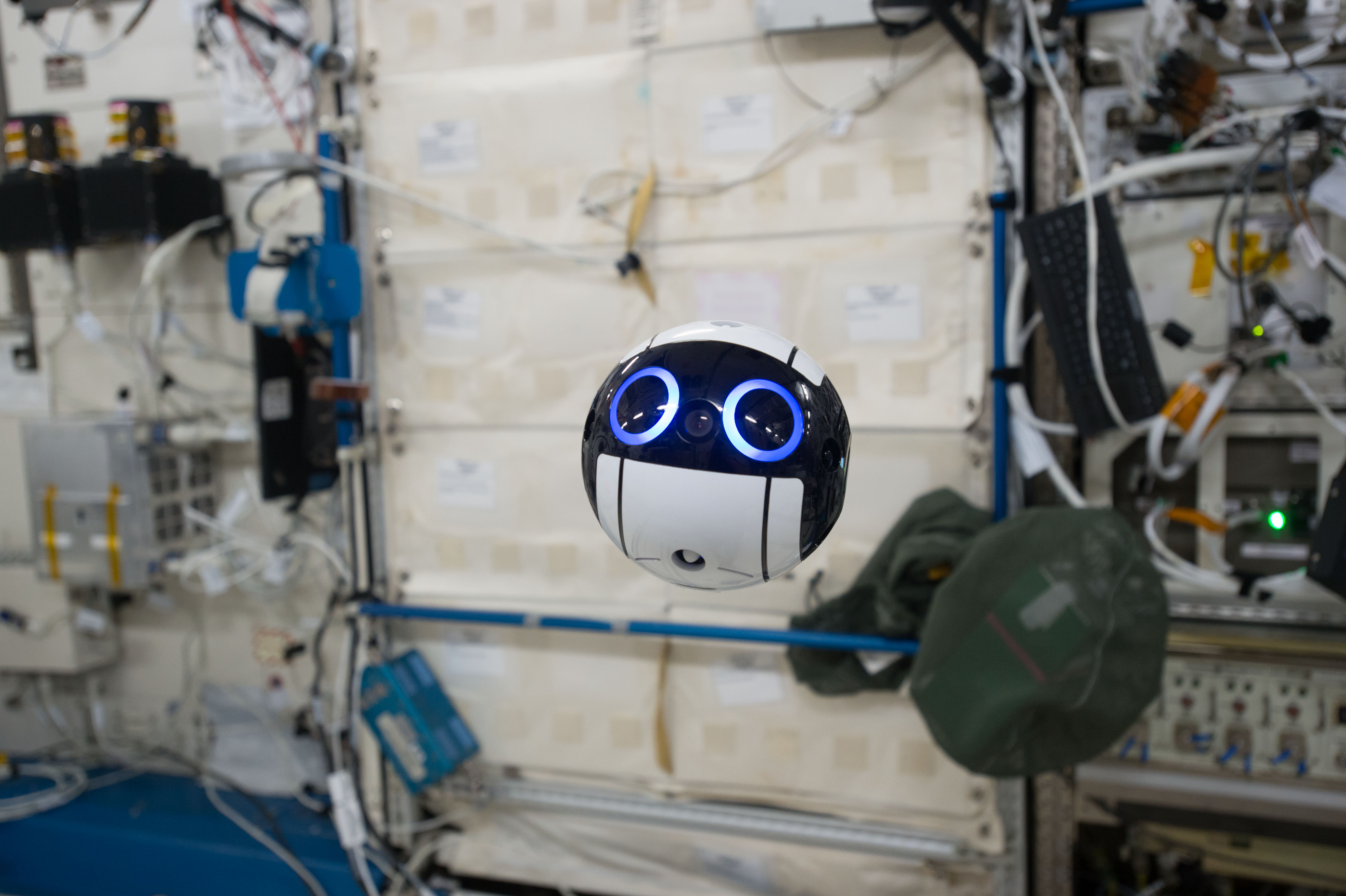
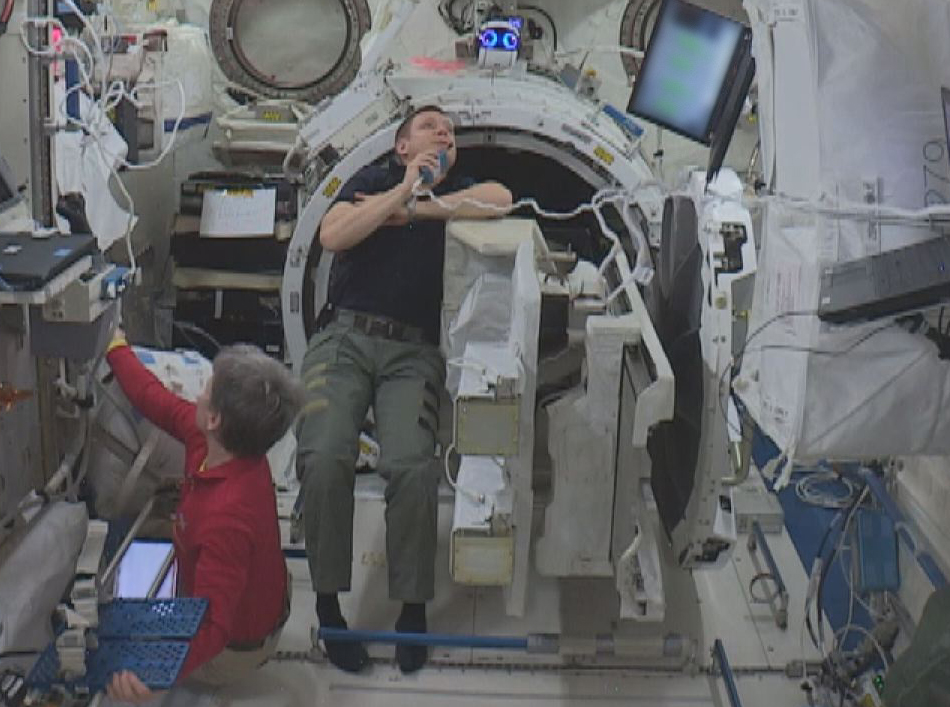
    The Japan Aerospace Exploration Agency (JAXA) will release updated images and movies of the JEM Internal Ball Camera called “Int-Ball”–its first camera drone that can record video while moving in space under remote control from the ground. As the first “Int-Ball Letter vol. 1,” we will introduce the movies of Int-Ball’s arrival at the International Space Station (ISS) and its first successful autonomous flight.

    JEM Internal Ball Camera (Int-Ball) (1m43s)

    See here for further information on Int-Ball and the first disclosures of images: 
    First disclosure of images taken by the Kibo’s internal drone “Int-Ball”
    See here for further information on the Miniaturized Attitude Control Sensors and Actuators in an All-in-one Module installed in the Int-Ball: 
    JAXA Research and Development Directorate

    *All times are Japan Standard Time (JST)

    Let’s block ads! (Why?)

  • [International Cooperation] Dr. Horikawa Publishes on IAPS Dialogue

    Topics List

    Jul. 19, 2017 Updated
    Dr. Horikawa Publishes on IAPS Dialogue

    The piece contributed by Dr. Horikawa, former JAXA technical counselor, got published on IAPS Dialogue. (Institute of Asia and Pacific Studies, The University of Nottingham)
    In the piece themed “The Race for Asian Space Collaboration”, Horikawa notes “Utilizing space applications for sustainable development of the Earth is extremely important.”
    Dr. Horikawa served as the first Asian Chairman of the fifty-fifth to the fifty-seventh United Nations Committee on Peaceful Uses of Outer Space.

    (Image credit: ESA)

    Dr. Horikawa Publishes on IAPS Dialogue

    Nov. 4, 2016 Updated
    Turkey hands over samples to Japan for space environment long-term exposure experiment to be conducted under Turkey-Japan cooperation on Kibo utilization!

    In September, JAXA and the Ministry of Transport, Maritime Affairs and Communications (MTMAC) of the Republic of Turkey signed a cooperation agreement on CubeSat deployment from the International Space Station (ISS) Japanese Experiment Module (Kibo) and exposure experiments using Experiment Handrail Attachment Mechanism (ExHAM). In this regard, samples from Tukey were handed over to JAXA today for the first joint space environment exposure experiment.

    This summer, JAXA initiated a full-scale technical examination and international coordination of the loading of samples toward the joint Kibo utilization project. The first experiment sample was hand-carried by Turkish officials to JAXA Tsukuba Space Center on November 2. The samples are confirmed that they are ready for the experiment in Kibo, and will be transported to “KOUNOTORI6” (HTV6) in Tanegashima Space Center, which is scheduled to be launched on December 9.

    MTMAC comments on completing the delivery of samples

    As Directorate General of Aeronautics and Space Technologies, the Ministry of Transport, Maritime and Communication of the Republic of Turkey, we are pleased with the studies which is conducted under the Memorandum of Understanding (MoU) on Satellite and Space Technologies signed between Turkey and Japan in 2010. Within this cooperation framework, we will perform joint experiments on International Space Station Japanese Experiment Module (KIBO) and jointly deploy a CubeSat from the International Space Station. We believe that such studies will serve as a bridge to strengthen the cooperation between our countries, and hope to elevate our cooperation to much higher levels than it is today. In this context, we would like to thank the Ministry of Education, Culture, Sports, Science and Technology (MEXT), the Minister for Space Policy of Japan and JAXA for their valuable contribution to our joint projects. We hope that our collaborative relationship will be further enhance especially in the space technologies field and Turkey-Japan friendship will continue to develop heretofore in the future.

    Turkey hands over samples to Japan for space environment long-term exposure experiment to be conducted under Turkey-Japan cooperation on Kibo utilization!

    Sep. 30, 2016 Updated
    IAF President Kiyoshi Higuchi Completes his Term, Handing Over to Dr. Le Gall of CNES

    Mr. Kiyoshi Higuchi of JAXA completed his term as President of the International Astronautical Federation (IAF) at the 67th International Astronautical Congress (IAC) held in Guadalajara in September. He handed the Presidency over to Dr. Le Gall, President of the French Space Agency (CNES). IAF is one of the co-organizers of the IAC. During his four-year term, Mr. Higuchi held four successful IACs and brought many changes to the Federation including the amendment of the IAF Constitution, increasing the membership by 81 to reach a total of 327 members, and promoting the involvement of emerging actors and the young generation.

    Photo: Mr. Higuchi giving the opening speech at the 67th IAC

    IAF President Kiyoshi Higuchi Completes his Term, Handing Over to Dr. Le Gall of CNES

    Sep. 27, 2016 Updated
    UNOOSA and JAXA open second round of KiboCUBE

    JAXA and the United Nations Office for Outer Space Affairs (UNOOSA) launched a three year “KiboCUBE” programme in September 2015, which offered developing countries the opportunity to deploy cube satellites from the Japanese Experiment Module “Kibo” on the International Space Station (ISS).
    This initiative aims to contribute to the technological advancement of space activities in developing countries by providing the opportunity to deploy micro-satellites using unique capabilities of Kibo. The applicants are the educational or research institutes in developing countries that are member states of the United Nations.

    JAXA held a media briefing with UNOOSA in the 67th International Astronautical Congress (IAC 2016) at Guadalajara, Mexico. During the briefing, there was an announcement of the second round along with introduction of the programme. Moreover, the representative of the University of Nairobi presented a summary of a satellite “1KUNS-PF”, which was the first to benefit from KiboCUBE.

    Photo: Media Briefing at IAC 2016 in Guadalajara, Mexico on 26 September 2016
    Dr. Koichi WAKATA, ISS Program Manager in JAXA (left), Simonetta Di Pippo, Director of UNOOSA (center) and Professor Mwangi Mbuthia, Dean, Department of Engineering, the University of Nairobi (right)

    UNOOSA and JAXA open second round of KiboCUBE

    Sep. 26, 2016 Updated
    Dr. Okumura Participated in the 67th IAC in Guadalajara

    On September 26-30, Dr. Okumura and a number of JAXA staff participated in the International Astronautical Congress (IAC) held in Guadalajara, Mexico. This year’s IAC was attended by a record number of 5,000 participants from over 300 member organizations including space agencies, universities and industry. Dr. Okumura joined the Heads of Agencies Panel and the Space and Climate event, introducing JAXA’s activities as well as the importance of international cooperation.

    Photo: Heads of Agencies Panel at the 67th IAC

    Dr. Okumura Participated in the 67th IAC in Guadalajara

    Sep. 23, 2016 Updated
    Dr. Okumura Visits U.S.A., Delivers Speeches in Washington D.C.

    On September 22-23, President Naoki Okumura of JAXA visited Washington D.C. and met with the heads of NASA and NOAA, reaffirming to further strengthen mutual cooperation. Dr. Okumura also gave speeches at the Dirksen Senate Office Building and the Japanese Ambassador’s residence. The talks, attended by many participants related to the Congress, space agencies and industry, were valuable opportunities to provide an overview of the Japanese space plans and activities including future perspectives.

    Photo: Dr. Okumura speaks at the Japanese Ambassador’s residence

    Dr. Okumura Visits U.S.A., Delivers Speeches in Washington D.C.

    Sep. 9, 2016 Updated
    JAXA and the MTMAC, Republic of Turkey sign a Cooperation Agreement

    On September 8, 2016, Mr. Yuichi Yamaura, Vice President of the JAXA and H.E. Dr. Cihan Kanl?goz, Director General of the Aeronautics and Space Technologies, the Ministry of Transport, Maritime Affairs and Communications of the Republic of Turkey, newly signed a Cooperation Arrangement concerning the utilization of the International Space Station (ISS) Japanese Experiment Module (Kibo).

    The cooperation is to offer opportunities to deploy a cube satellite (CubeSat) from the Kibo module and to conduct space experiments in an exposed environment using the Exposed Experiment Handrail Attachment Mechanism called ExHAM on board Kibo. With this agreement, both parties intend to promote concrete cooperation by utilizing experience in the field of space technology and its utilization that JAXA has practiced. Both parties will discuss further to enhance the collaborative relationship in such areas as support for the establishment of a space agency, which the Republic of Turkey aims to, and promotion of capacity-building activities.

    Photo:Mr. Yamaura, JAXA Vice President (right) and H.E. Dr.Kanlıgöz, Director General of Ministry of Transport,
    Maritime Affairs and Communications of the Republic of Turkey (left) shake hands after signing the agreement

    JAXA and the MTMAC, Republic of Turkey sign a Cooperation Agreement

    Sep. 2, 2016 Updated
    JICA Earth Observation Capacity Development Program Focusing on Rader (South Africa)/ Tanegashima Space Center & Tsukuba Space Center

    On June 15 and 16, 2016, remote sensing specialists namely from the South African National Space Agency (SANSA), together with the officers from the South African Maritime Safety Authority (SAMSA) and Department of Agriculture, Forestry and Fisheries (DAFF) visited JAXA’s Tanegashima Space Center and Tsukuba Space Center as part of the Earth Observation Capacity Development Program Focusing on Rader organized by the Japan International Cooperation Agency (JICA). The visit to Japan was a second part of a three-year JICA Program, which welcomed participants from a variety of agencies depending on the purposes of the satellite data use.

    Program participants visited the Tanegashima Space Center on June 15 and the Tsukuba Space Center on the following day. This was followed up with a seminar on JAXA’s earth observation activities, including earth-observation satellites such as DAICHI-2 (ALOS-2), and a lively Q&A session.

    Photo: Tsukuba Space Center

    Photo: Tanegashima Space Center

    JICA Earth Observation Capacity Development Program Focusing on Rader (South Africa)/ Tanegashima Space Center & Tsukuba Space Center

    Aug. 25, 2016 Updated
    University of Nairobi team selected for UNOOSA-JAXA KiboCUBE project

    The United Nations Office for Outer Space Affairs (UNOOSA) and JAXA have selected a team from the University of Nairobi to be the first to benefit from the UNOOSA-JAXA KiboCUBE programme.

    KiboCUBE was launched in September 2015 as a capacity-building initiative between UNOOSA and JAXA to offer educational and research institutions from developing countries the opportunity to deploy cube satellites (CubeSats) from the Kibo module of the International Space Station. Applications for the first round of KiboCUBE selection closed in March 2016 and a number of impressive applications were received.

    As the successful candidate, the University of Nairobi team plans to use its KiboCUBE CubeSat to test technologies it has developed for the future launch of a larger earth observation satellite. The team also hopes to apply data acquired from its CubeSat deployment to monitoring of agriculture and coastal areas.

    Messages from Key People

    Koichi Wakata, ISS Program Manager/JEM Mission Operations and Integration Center

    I am excited on the announcement by a cooperative effort by the United Nations Office for Outer Space Affairs (UNOOSA) and JAXA that a small satellite developed by University of Nairobi of Republic of Kenya will be deployed from the Japanese Experiment Module “Kibo” onboard the International Space Station (ISS) as the first satellite from the country. As “Kibo” is the only module onboard the ISS that has a capability to deploy small satellites, I am proud that JAXA is contributing to the development of space technologies of the various countries around the world utilizing the unique capacity of “Kibo”.

    Ms.Simonetta Di Pippo, UNOOSA Director

    “This is a very exciting moment and an important step in UNOOSA’s movement towards tangible initiatives in our capacity-building efforts. Innovative projects like KiboCUBE can achieve concrete results and have a real impact on space science and technology development for the benefit of all.”

    Prof. J. Mwangi Mbuthia, Dean, School of Engineering/University of Nairobi

    “As the winner of the call for the the opportunity to launch our Cubesat through Japanese Experiment Module “Kibo” as a ‘KiboCUBE’ program, the University of Nairobi is very excited and the team plans to use its KiboCUBE CubeSat to test technologies developed for the future launch of a larger earth observation satellite. The team also hopes to apply data acquired from its CubeSat deployment in monitoring of wildlife migration, agricultural activities in coastal and semi-arid areas.”

    University of Nairobi team selected for UNOOSA-JAXA KiboCUBE project

    Jun. 15, 2016 Updated
    First shot of earth images captured by the Philippine satellite deployed by Kibo

    On June 2, Tohoku University released images of the earth taken by ‘DIWATA-1’, the first Philippine microsatellite successfully deployed from the ISS by Japanese Experiment Module, ‘Kibo’, on April 27.

    This satellite is one of a realization of international cooperation in peaceful uses of outer space through the close collaboration between Japan and the Philippines. A team of young engineers from the Department of Science and Technology (DOST) of the Republic of the Philippines, in collaboration withTohoku University and Hokkaido University were responsible for the development and production of this satellite. JAXA was in charge of its launch and deployment into orbit. The success of deploying this 50 kg-class microsatellite also signified that JAXA has enhanced its satellite deployment capacity in addition to that of the CubeSat-class satellite.

    Photo:Satellite images of the Tohoku province, Japan, captured by DIWATA-1 on board with a wide field color camera (released by Tohoku University)

    Photo: Deployment of DIWATA-1 from Kibo

    Photo: DOST staffs pleased with the successful DIWATA-1deployment (April 27)

    First shot of earth images captured by the Philippine satellite deployed by Kibo

    Jun. 15, 2016 Updated
    JAXA holds its 1st Joint Committee with United Arab Emirates Space Agency (UAESA)

    The first joint committee between JAXA and the United Arab Emirates Space Agency (UAESA) was held on Wednesday, May 11, 2016 where both agencies entered into an interagency agreement earlier on March 22. The conference was chaired by Mr. Yamaura, Vice President of JAXA Members, and was attended by UAESA members (H.E. Dr. Khalifa Mohammad Thani Al-Romaithi, Chairman, Dr. Mohammed Naser Al Ahbabi, Director General, Mr. Hamad Al Mutawa, Head of Strategic Partnerships) and Dr. Ilias M. Fernini Associate Professor from University of Sharjah, UAE). Participating members and representatives of various collaborative projects opened up the conference with current updates on the successful deployment of small satellites from the Japanese Experiment Module (‘Kibo’, which means ‘hope’ in Japanese) from the ISS, and the materials science experiments conducted with the Exposed Experiment Handrail Attachment Mechanism (ExHAM) of Kibo’s Exposed Facility. They also discussed the interoperability of deep space network and explored potential future collaborations.

    During the visit, the Japanese Government (Cabinet Office, Ministry of Education, Culture, Sports, Science and Technology, and Ministry of Economy, Trade and Industry) also signed a Memorandum of Cooperation with the UAESA on promoting the future exchange and collaboration in R&D, expertise/capacity development, and the creation of space-related industries between the two countries.

    Photo: At Tsukuba Space Center (TKSC)

    Photo: 1st Joint Committee between JAXA and UAESA

    JAXA holds its 1st Joint Committee with United Arab Emirates Space Agency (UAESA)

    May 16, 2016 Updated
    JAXA Vice President Shizuo Yamamoto participated in the panel discussion of the 10th SPIE Asia-Pacific Remote Sensing Symposium

    The 10th International Society for Optics and Photonics (SPIE) Asia-Pacific Remote Sensing Symposium (APRS) was held in New Delhi, India from April 4 to 7, 2016. A special panel discussion featuring top-level space agency leaders from around the world was organized in the same symposium that commemorated the inaugural APRS conference in India and the 10th anniversary of SPIE. Mr. Shizuo Yamamoto, Vice President of JAXA (in charge of earth observations) was one of the panelists.

    Photo: Mr. A. S. Kiran Kumar, Chairman of ISRO on the right with Mr. Shizuo Yamamoto, Vice President of JAXA at the conference venue.

    In the session led by space agency heads, Mr. Yamamoto cited real-world instances (using JAXA’s observation data) of how space technologies have become an indispensable element in solving the challenges posed by disaster prevention and climate change as part of the social infrastructure. He also introduced future plans and the activities of the Asia-Pacific Regional Space Agency Forum (APRSAF) as a regional collaboration.

    In the panel discussion, space agency heads discussed various challenges and effective utilization strategies to manage global climate change and natural disasters. They also actively exchanged opinions on the integration and standardization of observation data collected by each national agency, and the promotion of further cooperation and international collaboration between ground networks and space agencies. Reinforcement of international cooperation by leveraging space technology to its fullest is also required to deal with various global issues.

    Photo: Special panel discussion by space agency leaders (April 4)
    From left to right, Maj. Gen. Charles Frank Bolden, Jr. – Administrator of the National Aeronautics and Space Administration (NASA, USA), Mr. A. S. Kiran Kumar – Chairman of the Indian Space Research Organization (ISRO, India), Mr. Jean-Yves Le Gall – President of the Centre National D’Études Spatiales (CNES, France), Mr. Shizuo Yamamoto – Vice President of Japan Space Exploration Agency (JAXA, Japan), Mr. Yan Hua Wu – Deputy Administrator of the Chinese National Space Agency (CNSA, China), Mr. Alain Ratier – Director-General of European Organisation for the Exploitation of Meteorological Satellites (EUMETSAT), Dr. Francisco Javier Mendieta Jiménez – General Director of the Mexican Space Agency (AEM, Mexico).

    JAXA Vice President Shizuo Yamamoto participated in the panel discussion of the 10th SPIE Asia-Pacific Remote Sensing Symposium

    Mar. 22, 2016 Updated
    JAXA and UAESA sign a Cooperation Arrangement

    On March 22, 2016, Dr. Naoki Okumura, President of the JAXA and H.E Dr.
    Khalifa Mohammed Thani Al-Romaithi, Chairman of the Board of Directors
    for the UAESA, newly signed an “Arrangement between the Japan Aerospace
    Exploration Agency and the United Arab Emirates Space Agency regarding
    Cooperation in Space Activities and Use of Outer Space for Peaceful
    Purposes” to strengthen the cooperation between JAXA and UAESA.
    JAXA have already started cooperation with UAE including JAXA’s microwave discharge neutralizer onboard UAE’s “DubaiSat-2” satellite launched in 2013. The UAESA was newly established in 2014 and has been actively promoting space activities including the Mars exploration mission. With this Arrangement, both agencies intend to develop a mutually beneficial relationship by utilizing technologies and human resources for space exploration and utilization JAXA have accumulated for a long time. The both agencies will discuss further to enhance the cooperation in the areas such as research and development, space applications, utilization of the International Space Station (ISS) “KIBO,” capacity building, and so on.

    JAXA and UAESA sign a Cooperation Arrangement

    Feb. 25, 2016 Updated
    DLR and JAXA strengthen cooperation

    On February 25, 2016, the German Aerospace Center (Deutsches Zentrum für
    Luft- und Raumfahrt; DLR) and JAXA have signed an “Inter Agency
    Arrangement between DLR and JAXA for Strategic Partnership” at the
    German Embassy in Tokyo, Japan. With this arrangement, both partners
    intend to jointly undertake the new role of space agencies and
    significantly contribute to the advancement of the world’s space
    development.

    The main goals of the Arrangement are:

    • the development and utilisation of aerospace technologies to provide solutions to global societal challenges
    • develop substantial joint work on research and development projects and missions
    • the development of synergies in German-Japanese cooperation, thereby strengthening the competitiveness of both countries

    In this context, DLR and JAXA intend to collaborate in the area of Space
    Utilization and R&D, use, for example, L- and X-band radar technologies
    for Earth observation, work together in disaster management, and conduct
    study into reusable launchers. Another important area is the exploration
    of the Solar System; at present, the DLR MASCOT lander is on board the
    JAXA Hayabusa 2 spacecraft, en route to asteroid Ryugu (previously 1999
    JU3), where it will land after 2018 and explore its surface. Germany and
    Japan also utilise the International Space Station (ISS) intensively to
    answer questions in the fields of medicine, materials science and
    fundamental research.
    Industrial cooperation between the two countries will also be intensified.

    Photo: JAXA President Naoki Okumura (left) and Chair of the DLR Executive Board, Pascale Ehrenfreund (right) shake hands after signing.

    DLR and JAXA strengthen cooperation

    Feb. 18, 2016 Updated
    Space Education Seminar in the Philippines

    JAXA Space Education Center offers a space education seminar for educators in various Asian countries under the framework of the Space Education Working Group (SE WG) of the Asia-Pacific Regional Space Agency Forum (APRSAF).
    This fiscal year, we held a two-day seminar in Angeles city on February 16 and 17 for 25 high school science teachers from all over the Philippines.
    The contents of the seminar are customized according to the request of the host country. This year five activities, namely microgravity experiment, vacuum experiment, robot arm crafting, communication activity using rovers, and a lecture on the utilization of Earth observation satellites, were conducted. The teachers performed a mock class to implement what they had learned throughout the seminar. All teachers smoothly conducted their class while incorporating their own methods while teaching technical matters. We look forward to the implementation of their acquired knowledge to their real classes.

    Space Education Seminar in the Philippines

    Feb. 9, 2016 Updated
    Presentation at the Space Exploration Education Conference (SEEC) in Houston, Texas.

    JAXA sends Japanese educators who engage in space education to the Space Exploration Education Conference (SEEC) held in Houston every year. This year’s session from JAXA was performed by Mr. Aikawa from Okinawa Prefecture and Ms. Fukai from Hiroshima Prefecture. Mr. Aikawa’s presentation included constructing a plastic propeller stick and Ms. Fukai’s presentation had participants making an LED optical communication device.
    Prior to their presentation at SEEC, the selected teachers had the opportunity to visit a local elementary school and give their presentation directly to the local school children. This visit also allows the teachers to see what an American school is like and exchange ideas with the local teachers.
    JAXA’s teachers were given two sessions to present during SEEC. In addition, JAXA staff and the selected teachers attended other sessions during the conference to learn what other teachers are doing in their classrooms in regards to space education. We then bring back what we learned and see how we could implement such activities in Japan.

    Presentation at the Space Exploration Education Conference (SEEC) in Houston, Texas.

    Jan. 22, 2016 Updated
    Meeting Held Between DOST Delegation and JAXA President Dr. Okumura

    – First Filipino CubeSat delivered to the JAXA Tsukuba Space Center (TKSC) in preparation for deployment from the International Space Station (ISS) Japanese Experiment Module (Kibo) –

    On January 12, 2016, Dr. Amelia P. Guevara, Undersecretary for Research & Development, and Dr. Rowena Cristina L. Guevara, Undersecretary for Science & Technology at DOST (Department of Science Technology of the Philippines) visited the JAXA Headquarters in Tokyo and had a meeting with Dr. Naoki Okumura, President of JAXA.

    They visited Japan in conjunction with the development of DIWATA -1 (DIWATA means fairy in Filipino), the first Filipino CubeSat developed jointly by DOST, the University of the Philippines, Tohoku University and Hokkaido University. DIWATA-1 will be the first 50KG class CubeSat to be deployed from“Kibo”by JAXA’s JEM Small Satellite Orbital Deployer (J-SSOD). The cost of deployment will be borne by the government of the Philippines, and an agreement was drawn up between JAXA and Tohoku University to allow DIWATA-1 to be deployed from “Kibo” for a fee.

    Photo Right: From left to right, Dr. Rowena Cristina L. Guevara, Undersecretary for Science & Technology at DOST, Dr. Amelia P. Guevara, Undersecretary for Research & Development at DOST and Dr. Naoki Okumura, President of JAXA

    DIWATA-1(left), 50kg Class J-SSOD Container (right)

    In the meeting between the DOST delegation and Dr. Okumura, both parties confirmed that the joint development and active acceptance of Filipino students has facilitated interpersonal exchanges, and that the joint project has been progressing smoothly. They also talked about the importance of working together to solve common issues by utilizing satellite data

    As the 23rd session of the Asia Pacific Regional Space Agency Forum (APRSAF-23) is scheduled to be held in the Philippines at the end of 2016, they also confirmed their expectation for increased interchange and enhanced cooperation through this meeting.

    On the following day, January 13, a hand-over ceremony of DIWATA-1 to JAXA and a press conference were held at Tsukuba Space Center. The CubeSat is equipped with four kinds of Earth observation cameras, and will be utilized for disaster monitoring, agriculture, forestry and fishery.

    Meeting Held Between DOST Delegation and JAXA President Dr. Okumura

    Jan. 20, 2016 Updated
    Revision of the Memorandum of Cooperation between JAXA and LAPAN

    On December 3, 2015, Dr. Thomas Djamaluddin, Chairman of the Indonesian National Institute of Aeronautics and Space (LAPAN) and Naoki Okumura, President of JAXA signed an agreement that has been revised to strengthen cooperation between JAXA and LAPAN in the field of aerospace research and development.

    The signing ceremony for the Memorandum of Cooperation (MOC) between the two parties took place during the 22nd Session of the Asia-Pacific Regional Space Agency Forum (APRSAF-22), held in Bali, Indonesia. At the ceremony the heads of both organizations recognized the importance of solving social issues through the utilization of space technologies and their applications, and resolved to pursue deeper cooperation between the two agencies in the field of aerospace, and promote of the utilization of space for peaceful purposes through regional and global cooperation.

    The newly signed MOC includes potential cooperation in the fields of space science, and research and development in space exploration and aerospace technology, in addition to earth science, and the use of satellites in remote sensing, communication and navigation.

    Revision of the Memorandum of Cooperation between JAXA and LAPAN

    Jan. 6, 2016 Updated
    APRSAF-22 successfully held in Bali, Indonesia

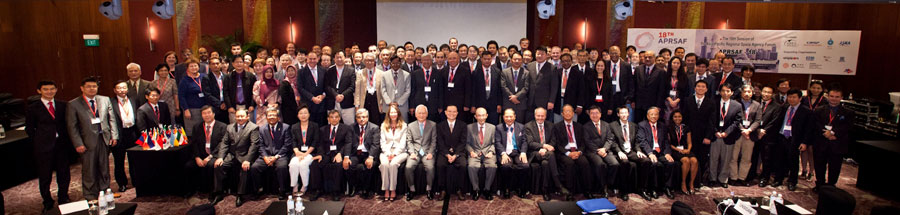
    The 22nd session of the Asia-Pacific Regional Space Agency Forum (APRSAF-22) was successfully held from December 1 to 4, 2015 in Bali, Indonesia, jointly organized by the Ministry of Research, Technology and Higher Education of Indonesia(RISTEK-DIKTI), the National Institute of Aeronautics and Space of Indonesia (LAPAN), the Ministry of Education, Culture, Sports, Science and Technology of Japan (MEXT) and the Japan Aerospace Exploration Agency (JAXA).

    APRSAF, established in 1993, has been growing to become one of the largest international forums today in the Asia-Pacific region. It is annually organized by MEXT, JAXA and organizations of host countries. APRSAF-22 was organized under the main theme entitled “Sharing Solutions through Synergy in Space” with the aim of further promoting regional cooperation. The participants — around 480 representatives and experts from 28 countries and regions and from 10 international organizations — actively contributed to discussions on various topics under the main theme.

    Photo Top: The APRSAF-22 plenary session, Denpasar, Bali, Indonesia

    Photo Bottom: The first day of the APRSAF-22 plenary session, Denpasar, Bali, Indonesia (December 3, 2015)

    APRSAF-22 successfully held in Bali, Indonesia

    Dec. 21, 2015 Updated
    JICA and JAXA Announce Forest Monitoring System Using ALOS-2 Satellite

    Constant monitoring of deforestation throughout the tropics and open data access on the Internet

    On December 1, the Japan International Cooperation Agency (JICA) and the Japan Aerospace Exploration Agency (JAXA) announced the Initiative for Improvement of Forest Governance at the twenty-first session of the Conference of the Parties (COP21) to the United Nations Framework Convention on Climate Change (UNFCCC) in Paris. The initiative will create a new tropical forest monitoring system that tracks deforestation and forest loss with JAXA’s Advanced Land Observing Satellite-2 (ALOS-2).

    The initiative will be conducted by a partnership between JICA and JAXA, and supporting private corporations are expected to join the initiative to contribute to the conservation of the world’s tropical forests. Activities will include building a forest monitoring system, training human resources in developing countries on how to use the system, and spreading knowledge about successful forest conservation projects around the world.

    The forest monitoring system will maintain a constant watch on deforestation and forest loss in tropical regions of the globe and provide open access to its findings. With a resolution to 50 meters, the findings of the monitoring system will be updated about every six weeks on average to the JAXA website and other resources by March 2017. It is expected that these efforts will help countries with serious deforestation issues restrain illegal logging, and in the long term, help control the reduction of forests as an effective measure against climate change.

    Tropical forests serve as an immense storage tank to hold carbon dioxide in the form of carbon, and conserving the forests is critical in the fight against climate change. However, the loss of tropical forests continues unabated due to illegal logging and other factors, and implementing measures to stop the loss is a global priority. Aboard the ALOS-2 satellite is PALSAR-2 (L-band Synthetic Aperture Radar-2), a system that uses L band radio waves suitable for forest observation and capable of monitoring the ground surface 24 hours a day regardless of weather. PALSAR-2 can thus monitor for illegal logging and other changes in tropical forests despite the cloud cover that is typical found in such areas.

    With technical cooperation provided by JICA in Brazil from 2009 to 2012 and data gathered by ALOS, the predecessor to ALOS-2, illegal foresting was monitored and assistance provided in near-real time. More than 2,000 incidents were discovered and the action taken contributed to a 40 percent reduction in the amount of forest area destroyed. The ALOS-2 improves on the earlier satellite model by using two types of reflecting radio waves that make it possible to analyze the data and detect deforestation with greater precision.

    JICA and JAXA signed a partnership agreement in April 2014 with the objective of using aerospace technology to solve the many development challenges that developing countries face along with global issues. The Initiative for Improvement of Forest Governance with its incorporation of ALOS-2 was launched under the framework created by that agreement. Both agencies will continue to use satellite technology to conserve the world’s tropical forests.

    An example of how the data will be provided on the JAXA website

    * Polygon shapes outline areas where forest loss has been detected. The data will be provided about every six weeks in images with a resolution of 50 meters showing reduced forest cover.

    JICA and JAXA Announce Forest Monitoring System Using ALOS-2 Satellite

    Nov. 26, 2015 Updated
    International Advisory Board Workshop “Assessing the Impact of Satellite Earth Observation on Society and Policy”

    JAXA organised an International Advisory Board on 9-10 November 2015 in Tokyo jointly with the National Institute of Information and Communications Technologies (NICT), Keio University, Institute for Global Environmental Strategies (IGES), in support of the project funded by Japan Science and Technology Agency (JST), with the goal of “Assessing the Impact of Satellite Earth Observation on Society and Policy”. A series of discussions invited perspectives from experts to
    understand how Earth observations contribute to environmental and other policy-making, and how space agencies establish links between their programmes, scientific advance, industrial innovation, and societal well-being. The Advisory Board concluded with some *key findings* from
    the two days of meetings.

    International Advisory Board Workshop

    Oct. 5, 2015 Updated
    Revision of the Mutual Cooperation Agreement between JAXA and CNES

    Dr. Naoki Okumura, President of the Japan Aerospace Exploration Agency (hereinafter referred to as JAXA), and Dr. Jean-Yves Le Gall, President of the Centre National d’Etudes Spatiales (hereinafter referred to as CNES), signed the revised agreement for the “Inter-Agency Arrangement between NASDA and CNES Concerning the Preparation of a Long Term Cooperation in the Field of Space Programs ” on 5 October 2015.

    The purpose of the revision is to achieve effective cooperation between space agencies of Japan and France, in light of the changes in the business environment., This includes the increasing presence of emerging countries and the private sector in space development and utilization, as well as changes in Japan such as the enactment of the new Basic Plan for Space Policy and the transition of JAXA to a National Research and Development Agency.

    On the occasion of the visit by Mr. Manuel Valls, Prime Minister of France to Japan, the exchange ceremony of signing agreement took place at the Prime Minister’s Office of Japan in the presence of Prime Ministers Shinzo Abe and Manuel Valls.

    Revision of the Mutual Cooperation Agreement between JAXA and CNES

    Sep. 8, 2015 Updated
    Collaboration between JAXA and UNOOSA to Offer Small Satellite Deployment Opportunity from Kibo

    JAXA and the United Nations Office for Outer Space Affairs (UNOOSA) agreed to cooperate in providing opportunities to deploy cube satellites (CubeSats) from the Japanese Experiment Module “Kibo” of the International Space Station (ISS).

    The Kibo is equipped with a special airlock system and robotic arm; hence a small satellite can be released to space from it by utilizing the Kibo’s distinct functions. Satellite deployment capability is the Kibo’s unique feature on the ISS.

    Small satellites can be manufactured at low cost and by utilizing relatively simple technology; therefore that can be useful for education, communication, disaster mitigation, and human resource development. With the agreement for collaboration this time, we can provide an opportunity for using space and verifying technology there to countries that do not possess the capacity to launch satellites.

    While taking maximum advantage of the Kibo’s strong points and employing the network and know-how with UN member countries, JAXA will offer opportunities of small satellite utilization from the Kibo to developing countries so that we continue to contribute to the improvement of their space technology.

    Collaboration between JAXA and UNOOSA to Offer Small Satellite Deployment Opportunity from Kibo

    Mar. 19, 2015 Updated
    JAXA, NIES, MOE and NASA signed a Memorandum of Understanding for cooperation on GOSAT, OCO-2 and GOSAT-2 missions

    The Ministry of the Environment (MOE), the Japan Aerospace Exploration Agency (JAXA), the National Institute for Environmental Studies (NIES), and the National Aeronautics and Space Administration (NASA) have come to an understanding regarding cooperation on the Greenhouse Gases Observation Satellite (GOSAT), the Greenhouse Gases Observing Satellite-2 (GOSAT-2) and the Orbiting Carbon Observatory-2 (OCO-2) missions. H.E. Mr. Mochizuki, Minister of the Environment, Dr. Okumura, President of JAXA, Dr. Sumi, President of NIES and Mr. Bolden, Administrator of NASA, signed a Memorandum of Understanding on March 17, 2015, in Tokyo.

    GOSAT, its successor GOSAT-2, and OCO-2 are satellite missions that observe the concentration and distribution of greenhouse gases in the Earth’s atmosphere from outer space for the purpose of studying climate change. In addition, GOSAT/GOSAT-2 contribute to the international effort toward the prevention of warming, including monitoring greenhouse gas absorption and emissions.

    The calibration and validation of space-based greenhouse gas data among different satellite missions has been limited. Cooperation under this MOU will enable the Parties to improve the quality of satellite data through calibration campaigns and the effective use of ground-based observation data.

    Under the MOU, the Parties will cross-calibrate instruments on the 3 CO2 missions, implement common validation, participate in joint mission science teams, and conduct joint presentations in international conferences.

    [Photo: Signing of the MOU
    (From Left)Mr.Bolden, Administrator of NASA / Mr.O’Brien, Associate Administrator of NASA / Dr. Okumura, President of JAXA / Mr.Yamamoto Vice President of JAXA / Mr.Hirabayashi GOSAT-2 Project Manager of JAXA
    ]

    JAXA, NIES, MOE and NASA signed a Memorandum of Understanding  for cooperation on GOSAT, OCO-2 and GOSAT-2 missions

    Dec. 25, 2014 Updated
    APRSAF-21 successfully held in Tokyo

    The 21st session of the Asia-Pacific Regional Space Agency Forum (APRSAF-21) was successfully held from December 2 to 5, 2014 at the National Museum of Emerging Science and Innovation (Miraikan) and the Tokyo International Exchange Center (Plaza Heisei), jointly organized by the Ministry of Education, Culture, Sports, Science and Technology of Japan (MEXT) and the Japan Aerospace Exploration Agency (JAXA).

    APRSAF, established in 1993, is the largest international forum in the Asia-Pacific region, annually organized by MEXT, JAXA and local host organizations. It was the first time in nine years since APRSAF had been held in Japan last time. Reaching a record high of 580 participants from 33 countries/regions and 12 international organizations, participants actively discussed under the main theme titled “Leap to the Next Stage: Delivering Innovative Ideas and Solutions” to promote further regional cooperation.

    Based on the Recommendations agreed in APRSAF-20 last year, newly-structured four working group sessions (Space Applications, Space Technology, Space Environment Utilization, and Space Education) were held in parallel in the first two days of APRSAF-21. Participants of the working groups confirmed the status of regional cooperative projects and discussed future activities in the areas of disaster management, environmental issues, utilization of the International Space Station (ISS), education and capacity building, etc.

    At the plenary session in the latter two days, activity reports were made by representatives from space agencies and related ministries in the region and international organizations. The special session titled “Societal Needs and Space for Practical Applications” was organized with the participation of space agencies, local implementation organizations and development aid agencies. Another special session titled “ISS and Beyond – Toward Global Space Exploration,” moderated by Mr. Soichi Noguchi, Japanese Astronaut and President of the Association of Space Explorers, also took place for sharing significance and prospect of human space activities, and then special presentations on international space exploration were delivered.

    Furthermore, the Asia-Pacific Space Leaders Meeting (AP-SLM) session was held in the afternoon of December 4 with the participation of high-level officers from space agencies and related ministries in the region and announced the Joint Statement for promoting further regional cooperation.

    During the week, there were also relevant events in conjunction with APRSAF-21 such as workshops of international projects (“Initiatives”) created through APRSAF (SAFE and Kibo-ABC), educational activities for the young generation (a water rocket event and a poster contest), and an exhibition.

    It was announced that the next session, APRSAF-22, will be hosted by National Institute of Aeronautics and Space of Indonesia (LAPAN), MEXT and JAXA and will take place in Denpasar, Indonesia.

    [Photo right: Announcement of the Joint Statement “Toward the Advancement of Activities in Exploration and Utilization of Outer Space for a Better Future of People on Earth” by the Asia-Pacific Space Leaders (5PM, December 4, 2014)]

    First Day of APRSAF-21 Plenary Session (December 4, 2014 at the Tokyo International Exchange Center (Plaza Heisei))

    APRSAF-21 successfully held in Tokyo

    Nov. 28, 2014 Updated
    JAXA and NASA signed a Memorandum of Understanding for cooperation on the Hayabusa2 mission and OSIRIS-REx mission -Strengthen Relationships in Asteroid Exploration-

    The Japan Aerospace Exploration Agency (JAXA) and the National Aeronautics and Space Administration (NASA) came to an understanding regarding a Hayabusa2-OSIRIS-REx (Origins-Spectral Interpretation-Resource Identification-Security-Regolith EXplorer) mission agreement and Dr. Okumura, President of JAXA and Mr. Bolden, Administrator of NASA signed the Memorandum of Understanding on November 17, 2014 at the JAXA Tokyo Office.

    Asteroid explorer “Hayabusa2” will detect clues regarding the mystery of the origin and evolution of the Earth, sea and life by conducting sample return from a carbonaceous asteroid (C-type), which is more primitive than the asteroid Itokawa (S-type) explored by asteroid explorer “Hayabusa”. Furthermore “Hayabusa2” will lead the world by developing and maturing the deep space round-trip exploration technology that was demonstrated by “Hayabusa”, through new technological challenges such as creating an artificial crater on the asteroid.

    Similar to JAXA-NASA cooperation on the original Hayabusa mission, NASA provides support for Hayabusa2 including the NASA Deep Space Network which enables advanced and reliable mission operations. In addition, through scientific cooperation, asteroid sample exchange and joint participation during key mission phases with NASA’ s asteroid explorer OSIRIS-REx, JAXA and NASA will mutually maximize their missions’ results. OSIRIS-REx is scheduled to be launched in 2016, and its primary objective is also sample return from a carbonaceous asteroid.

    Memorandum Signature Ceremony
    [Photo: (Left)Dr. Okumura, President of JAXA , (Right)Mr. Bolden, Administrator of NASA]

    JAXA and NASA signed a Memorandum of Understanding  for cooperation on the Hayabusa2 mission and OSIRIS-REx mission -Strengthen Relationships in Asteroid Exploration-

    Nov. 7, 2014 Updated
    JAXA Vice President Shizuo Yamamoto assumed the post of Chairman of the CEOS.

    On Oct. 30, JAXA Vice President Shizuo Yamamoto assumed the post of Chairman of the Committee of Earth Observation Satellites (CEOS.) The CEOS was established in 1984 to internationally coordinate activities of Earth observation missions from space. It is the only organization that specializes in Earth observation satellites in the world. For the last 30 years, the CEOS has been organizing Earth observation satellite missions planned by each country to facilitate collaboration with data users by promoting data sharing and problem solving for social issues by using acquired data.

    The year 2015 will be important to plan future Earth observations while JAXA plays the important role of the chairmanship of the CEOS. In this coming March, the United Nations World Conference on Disaster Reduction is scheduled to establish the international disaster preparation framework action plan, the post-Hyogo framework, for the next 10 years. The Group of Earth Observations will also decide the Earth observation strategic plan for the next 10 years within 2015. In the last 30 years, observation methods have been improving and diversifying thanks to technological developments; therefore, we are in an era of using space to solve social issues that Earth observation technologies face. For that, Earth observation satellites are expected to contribute to solving various issues for human beings with many projects and missions around the world through GEOS.

    JAXA assumes the CEOS chairmanship for a year until November 2015, and will promote the important role played by Earth observation satellites while aiming at making contributions to various activities in the next 10 years.

    [Photo: The passing of the chairmanship at the 28th CEOS (EUMETSAT Director General Alain Ratier, former chairman, hands over the chairman hammer to JAXA Vice President Shizuo Yamamoto.)]

    JAXA Vice President Shizuo Yamamoto assumed the post of Chairman of the CEOS.

    Oct. 20, 2014 Updated
    Party led by Deputy Prime Minister Phuc of Vietnam visited TKSC on Oct. 10

    A party led by Mr. Nguyen Xuan Phuc, Deputy Prime Minister of the Socialist Republic of Vietnam, visited the Tsukuba Space Center on October 10, 2014. JAXA President Naoki Okumura welcomed the party of 42 consisting of seven minister-level members including Prof. Dr. Chau Van Minh of the Vietnam Academy of Science and Technology (VAST) and media people from Vietnam.

    In conjunction with this visit, JAXA-VAST collaboration results were confirmed and a Joint Statement of Intent for Enhancing Partnership between VAST and JAXA was signed in the presence of Deputy Prime Minister Phuc.

    Pertinent agencies in Vietnam and JAXA are jointly working for various projects such as co-hosting the Asia-Pacific Regional Space Agency Forum (APRSAF), use of satellite data, development of a small satellite and its release from the Kibo on the International Space Station, and human resourse development.

    International cooperation is indispensable in many areas of aerospace activities. JAXA hopes to contribute to promoting space technology development and utilization and construction of good relations between Japan and those countries in facilitating effective cooperation with pertinent agencies in each country.

    [Photo: From left: Mr. Nguyen Xuan Phuc, Deputy Prime Minister of the Socialist Republic of Vietnam, Dr. Chau Van Minh of the Vietnam Academy of Science and Technology (VAST), JAXA President Naoki Okumura]

    Tsukuba Space Center at the H-IIA Launch Vehicle before

    Party led by Deputy Prime Minister Phuc of Vietnam visited TKSC on Oct. 10

    Sep. 9, 2014 Updated
    Mr. Elon Musk, CEO/CTO of Space Exploration Technologies (SpaceX) Visited JAXA

    Dr. Naoki Okumura, President of JAXA received a courtesy call from Mr. Elon Musk, CEO/CTO of Space Exploration Technologies (SpaceX), September 9, 2014 during his visit to Japan.

    They exchanged their views on current technical challenges, future space development including space transportation systems, space market. And also they exchanged their management vision.

    Both JAXA and SpaceX agreed on continuing their efforts to strengthen their contribution for space development.

    [Photo: JAXA President Okumura (Left), SpaceX CEO, Mr. Musk (Right)]

    Mr. Elon Musk, CEO/CTO of Space Exploration Technologies (SpaceX) Visited JAXA

    May 22, 2014 Updated
    JAXA co-hosted the First JAXA-NSC Polar Workshop in Tokyo

    JAXA and Norway Space Centre (NSC) hosted the First JAXA-NSC Polar Workshop on Friday, March 28, 2014 at the Royal Norwegian Embassy in Tokyo.

    This workshop was held under the JAXA-NSC agreement for cooperation in the civil uses of outer space. The experts from NSC, JAXA, and the organizations related to polar researches attended the workshop and discussed issues involving polar researches and space. The workshop helped to advance participants’ mutual understanding.

    Japan and Norway have a long history of cooperation. Japanese sounding rockets have been launched from Andøya Rocket Range and Svalbard in Norway; and the data from JAXA’s Earth Observation satellites, including Shizuku (GCOM-W1) and Ibuki (GOSAT), has been received at the Svalbard station.

    The issues in the arctic region – environmental management, energy and resources, fishing resources, Northern Sea routes, etc. – have become internationally critical. Eight countries in the Arctic region including Norway established the Arctic Council in 1996 to discuss common issues. The importance of the Arctic Region to Japan has also been rising and last year Japan became one of the observers of the Arctic Council, contributing through participation to working groups and other occasions.

    NSC and JAXA both recognizes the importance of NSC-JAXA bilateral cooperation for Earth Observation and polar researches. At the workshop, among various topics, potential cooperation projects such as observation of sea ice in the Northern Sea and comparison of radar data from European and Japanese satellites were suggested. NSC and JAXA agreed to continue the dialogue and to hold the 2nd Polar Workshop in early 2015 in Norway.

    [Photo: at Arctic Hall, Royal Norwegian Embassy, Tokyo]

    From left: JAXA President Okumura, Norwegian Ambassador Walther, NSC General Director Andersen, JAXA Vice President Yamamoto

    JAXA President Okumura and NSC General Director Andersen

    JAXA co-hosted the First JAXA-NSC Polar Workshop in Tokyo

    Apr. 23, 2014 Updated
    Signing of Partnership Agreement between JAXA and JICA

    Today, the Japan International Cooperation Agency (JICA) and the Japan
    Aerospace Exploration Agency (JAXA) signed a partnership agreement. The
    objective of the agreement is to promote collaboration between two
    institutions to contribute to solving various development challenges
    that developing countries are facing. The two institutions will also
    work on global issues using aerospace technology by further
    strengthening ties and exhibiting combined abilities to utilizing
    respective unique features and human resources.

    JICA President Akihiko Tanaka and JAXA President Naoki Okumura signed
    the agreement at a signing ceremony held in JAXA Tokyo Office. At the
    signing ceremony, referring to the plan that the Advanced Land Observing
    Satellite-2 “DAICHI-2” (ALOS-2) will be launched on May 24th, 2014,
    Okumura said “JAXA will be able to provide more accurate topography
    data, which can be utilized in various sectors such as flood disaster
    prevention.” Tanaka showed his expectation by adding that “Utilization
    of satellite information for ASEAN disaster management and protection of
    forests and preventing illegal deforestation of the Amazon are the best
    examples that aerospace technology provides effective solutions to
    development challenges. JAXA’s cutting edge technology becomes a
    comparative advantage of Japanese development cooperation, enabling JICA
    to work more effectively.”

    With this partnership agreement in place, collaboration between JICA and
    JAXA is expected to strengthen, and higher quality cooperation will be
    implemented in developing countries utilizing aerospace technologies.

    Signing of Partnership Agreement between JAXA and JICA

    Feb. 6, 2014 Updated
    20th APRSAF co-hosted by Japan and Vietnam

    *Click for Large Image

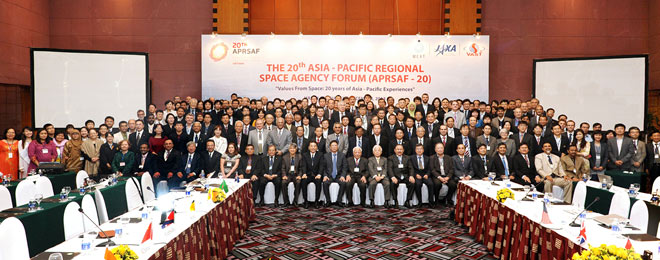
    The 20th session of the Asia-Pacific Regional Space Agency Forum (APRSAF-20), under the main theme entitled “Values From Space: 20 years of Asia-Pacific Experiences,” successfully concluded its four-day program on Friday, December 6, 2013, at Melia Hanoi Hotel, in Hanoi, Vietnam. APRSAF-20 was jointly organized by the Vietnam Academy of Science and Technology (VAST), the Ministry of Education, Culture, Sports, Science and Technology of Japan (MEXT), and the Japan Aerospace Exploration Agency (JAXA). Approximately 420 participants from 28 countries and 8 international organizations attended the session.
    APRSAF-20, as in the past, consisted of four working-group sessions that were held in parallel in the first two days and a plenary session in the second half of the forum. There were also relevant events in conjunction with APRSAF-20 such as a water rocket event, a SAFE workshop, a Kibo-ABC workshop, a poster contest, and an exhibition.
    Dr. Keisuke Isogai, Deputy Director General, Research and Development Bureau, MEXT, participated in the event as the general co-chair, Mr. Eigo Nomura, Counsellor, Office of National Space Policy, Cabinet Office of JAPAN, made a keynote address, Prof. Setsuko Aoki, Faculty of Policy Management, Keio University, made a special speech in the plenary session.
    Annual activity reports were made by space agency representatives from each country. Dr. Naoki Okumura, President of JAXA, reported on the recent JAXA activities (the deployment of the Vietnam small satellite “PicoDragon” from the ISS, the inaugural launch of the Epsilon rocket, Earth observation projects on disaster management and environment) and a future action plan (GPM and ALOS-2 satellites), and expressed the expectation for further development of the APRSAF. We also had presentations from international organizations such as the Group on Earth Observation (GEO), the United Nations Committee on the Peaceful Uses of Outer Space (UN-COPUOS), the United Nations Economic and Social Commission for Asia and the Pacific (UN-ESCAP) and the International Astronautical Federation (IAF) about their expectations for expansion of cooperation in the region.
    This time, the first trial of its kind in APRSAF has been made. The first joint statement for further space cooperation in the region by representatives from space agencies in the Asia-Pacific and past co-organizers of APRSAF was released through a panel discussion at the plenary. As part of a memorable 20th session, a special event “Values From ISS,” moderated by Dr. Satoshi Furukawa, Japanese Astronaut, also took place and a video message from Dr. Koichi Wakata, the Japanese Astronaut now aboard the International Space Station (ISS), was delivered from space. At the event, some cooperation missions were introduced with Asian countries for the utilization of the Japanese Experiment Module “Kibo” to encourage further cooperation in the region through the ISS.
    It was announced at the last plenary session, on December 6, that the next session, APRSAF-21, will be hosted by MEXT and JAXA and would take place in Tokyo, Japan.

    Nov. 25, 2013 Updated
    20th APRSAF to be held in Vietnam from Dec. 3

    The 20th Session of the Asia-Pacific Regional Space Agency Forum (APRSAF-20) will be held in Hanoi, Vietnam, between Dec. 3 (Tue.) to 6 (Fri.), 2013, hosted by Japan (Ministry of Education, Culture, Sports, Science and Technology and JAXA) and Vietnam (Vietnam Academy of Science and Technology, VAST).

    Space-related organizations, government agencies, space application organizations, researchers and people from universities in the Asia and Pacific region will get together for this forum to actively engage in discussions along with this year’s theme “Value from Space: 20 years of Asia-Pacific Experiences.”

    The forum consists of the plenary session and four working group sessions (for Earth Observation, Communication satellite Applications, Space Environment Utilization, and Space Education and Awareness.) Working group sessions will take place for the first two days, and the latter two days will be allocated for the plenary session for activity/initiative reports of participating organizations/agencies. The APRSAF, celebrating its 20th anniversary, will also hold various extra special sessions for promoting further cooperation in the space field in the Asia-Pacific region such as a special session aimed at finding new cooperation, a special guest lecture, and a special session by heads of space organizations of Asian countries including JAXA President Okumura.

    As of Nov. 22, some 420 people have already registered for participation from seven international organizations from 32 countries and regions mainly from the Asia-Pacific region.

    Jun. 19, 2013 Updated
    JAXA and ESA sign Amendment to the agreement concerning cooperation in the field of space parts

    JAXA and the European Space Agency (hereinafter referred to as ESA) have extended the Agreement concerning cooperation in the field of space parts and amended the Agreement by adding a field of materials in order to promote the cooperation relationship in the field of space parts and materials between JAXA and ESA. The agreement was signed on June 18, 2013.

    On June 19, 2007, JAXA and ESA have entered into an Agreement concerning cooperation in the field of space parts for a period of six years with the purpose of exchanging information regarding the procurement of space parts between Japan and Europe and promoting the usage of each other’s parts. We have been working toward this goal trying to avoid the overlapping of the part development by exchanging personnel, and exchanging information regarding the test/inspection requirements for space parts in order to promote mutual understanding in the field of space parts between Japan and Europe. From this, we achieved steady results; Japanese space parts began to be used in Europe and European space parts are now considered to be used in Japan. With this achievement, we agreed to sign the extended Agreement on the cooperation in the space parts field. We also agreed on including the field of material in addition to the field of space parts. With this Agreement signed, we hope to contribute to the advance of space activities in both Japan and Europe by promoting various efforts in cooperation such as mutual evaluation and use, and joint research and development of space parts.

    Jan. 27, 2013 Updated
    JAXA held 19 th APRSAF

    *Click for Large Image

    The nineteenth session of the Asia-Pacific Regional Space Agency Forum (APRSAF-19), under the main theme entitled “Enriching the quality of life through innovative space programs,” successfully concluded its 4-day program on Friday, December 14, 2012, at the Berjaya Times Square Hotel Malaysia, in Kuala Lumpur, Malaysia. APRSAF-19 was jointly organized by the Ministry of Science, Technology and Innovation of Malaysia (MOSTI), the National Space Agency of Malaysia (ANGKASA), the Ministry of Education, Culture, Sports, Science and Technology of Japan (MEXT), and the Japan Aerospace Exploration Agency (JAXA). Approximately 380 participants from 33 countries and 14 international organizations attended the session.

    APRSAF-19, as was the case in the past, consisted of four working group (EO WG, CSA WG, SEA WG, and SEU WG) sessions that were held in parallel and the plenary. There were also relevant events in conjunctions with APRSAF-19 such as the water rocket event, Colloquium on Astronomy from ISS Kibo, SAFE workshop, Kibo-ABC workshop, Poster Contest, and APRSAF-19 exhibition.

    At the plenary session on Day 3, on December 13, opening remarks were made by the general co-chairs, Dr. Mustafa Din Subari, Director General, ANGKASA, Malaysia and Dr. Satoru Otake, Deputy Director General, Research and Development Bureau, MEXT, Japan, and Keynote addresses were delivered by Mr. Yoshinari Akeno, Deputy Director-General, Office of National Space Policy, Cabinet Office, Japan and Prof. Datin Paduka Dr. Khatijah Bt. Mohd. Yusoff, Deputy Secretary General (Science), MOSTI, Malaysia. In the afternoon, a special session entitled “Enriching the quality of life through innovative space programs” was held with the participation as speakers of representatives of space agencies, such as ISRO/India, LAPAN/Indonesia, JAXA/Japan, KAZCOSMOS/Kazakhstan, GISTDA/Thailand and VAST/Vietnam. The session was chaired by Dr. Mustafai, Director General, ANGKASA.

    It was announced at the last plenary session, on December 14, that the next session, APRSAF-20, would be hosted by the Vietnam Academy of Science and Technology (VAST) and would take place in Hanoi, Vietnam.

    Jun. 6, 2012 Updated
    Dr. Yasushi Horikawa, JAXA’s Technical Counselor, appointed as the Chair of the United Nations Committee on the Peaceful Uses of Outer Space (COPUOS)

    The Japan Aerospace Exploration Agency (JAXA) would like to announce that on June 6th, on the outset of the fifty-fifth session of the Committee on the Peaceful Uses of Outer Space (COPUOS), Dr. Yasushi Horikawa, JAXA’s Technical Counselor, became its first Japanese Chair. He will chair the 55th and 56th sessions of COPUOS.

    COPUOS was established as a permanent Committee of the United Nations in 1959, to review the scope of international cooperation in the peaceful uses of outer space, to devise programmes in this field to be undertaken under United Nations auspices, to encourage continued research and development and the dissemination of information on outer space matters, and to study legal problems arising from the exploration of outer space. There are two Subcommittees of COPUOS, namely the Science and Technical Subcommittee and the Legal Subcommittee, and each of these bodies meets. once a year in Vienna. Consisting of 71 members, COPUOS has been working in the recent years, on developing guidelines for ensuring the long-term sustainability of outer space activities.
    Please refer to the links below for more information.

    As space activities have become increasingly diversified and dynamic in many countries, involving the participation from the private sector, COPUOS is expected to play an increasingly important role in promoting international cooperation in space science and technology areas, as well as legal areas.

    Dr. Horikawa’s assumption of the chairmanship of UN COPUOS is considered as part of Japanese contributions to the UN, by making its experts available to support the work of the UN in space activities, and it reflects JAXA’s readiness to actively participate in and contribute to the work of COPUOS.

    [Reference]
    Brief Bio of Dr. Yasushi Horikawa:
    Dr. Horikawa joined the National Space Development Agency of Japan (NASDA) in 1973. He was engaged in the development of both Geostationary meteorological and Earth observation satellites, as well as leading planning and international coordination duties. He was also engaged in the Japanese Experiment Module (JEM) development project for International Space Station from 1987. He has been a Technical Counselor for JAXA since 2009 after acting as a project manager for the JEM development project as well as for the Japanese International Space Station project. Most recently he has assumed a position of Executive Director of JAXA.

    Dec. 26, 2011 Updated
    JAXA held 18th APRSAF

    *Click for Large Image

    The eighteenth session of the Asia-Pacific Regional Space Agency Forum (APRSAF-18), under the main theme entitled “A regional collaboration for tomorrow’s environment”, successfully concluded its 4-day program on Friday, December 9, 2011, at Marina Mandarin Singapore. APRSAF-18 was jointly organized by the Singapore Space and Technology Association (SSTA), the Centre for Remote Imaging, Sensing and Processing, National University of Singapore (CRISP), the Ministry of Education, Culture, Sports, Science and Technology of Japan (MEXT), and the Japan Aerospace Exploration Agency (JAXA). Approximately 280 participants from 28 countries and region and 11 international organizations attended the session.

    APRSAF-18, as was the case in the past, consisted of four working group (Earth Observation WG, Communication Satellite Applications WG, Space Education and Awareness WG, and Space Environment Utilization WG) sessions that were held in parallel and the plenary. There were also relevant events in conjunction with APRSAF-18 such as the water rocket event, SAFE workshop, poster contest, and the special astronaut event entitled “Asians in Space: Achievements of Human Spaceflight in Asian Countries”.

    At the plenary session on Day3, on 8 December, opening remarks were made by Mr. Joseph Hui, Deputy Chief Executive, Technology & Corporate Development, National Environment Agency, Singapore, and keynote addresses were delivered by the representatives of the countries that co-organized APRSAF-18, namely, Dr. Tetsuhiko Ikegami, Chairman, Space Activities Commission (SAC), the Ministry of Education, Culture, Sports, Science and Technology (MEXT), Japan and Mr. Tan Choo Shian, Deputy Managing Director, Economic Development Board (EDB), Singapore.

    At a country report session, Dr. Keiji Tachikawa, President, JAXA made a presentation and introduced Japan’s climate change studies and adaptations. He also spoke about the utilization of KIBO (Japanese experimental module for International Space Station) and QZSS-1 (Quazi-Zenith Satellite System).

    It was announced at the last plenary session, on 9 December, that the next Session, APRSAF-19, would be hosted by ANGKASA (Malaysia) and take place in Kuala Lumpur, Malaysia from December 11 to 14, 2012.

    Oct. 28, 2011 Updated
    62nd International Astronautical Congress

    The 62nd International Astronautical Congress (IAC) was held for five days between October 3 and 7, in Cape Town, South Africa. The IAC is annuallly held in autumn cosponsored by International Astronautical Federation (IAF), International Academy of Astronautics (IAA), and International Instutite of Science of Space Law (IISL). It is the world’s largest space-related conference both nominally and practically attended by the agency heads and senior exectives of the world’s space agencies along with industry and academics. It is a first IAC held in the African continent under the theme of “African Astronaissance”, and about 3,000 space-related people from all over the world participated in the event.
    At the Heads of Agency Plenary session on the first day of the congress, Dr. Tachikawa, President of JAXA, Dr. Dordain, Director General of European Space Agency (ESA), Mr. Bolden, Administrator of National Aeronautics and Space Administration (NASA), Mr. Popovkin, Head of Russian Federal Space Agency (FSA), and Dr. Navalgund, Director of Space Applications Centre of Indian Space Research Organisation (ISRO) explained each organisation’s overview on current and future programs, followed by active discussions coordinated by the moderator. Each heads of agencies presented the view that international cooperation is essential to advance space activities. JAXA also set up the exhibition booth and made public relations activities for about 1,400 visitors introducing the development of space technologies and space related companies. JAXA participated in the Head of Agency Q&A Session with students organized as a part of activities of International Space Education Board (ISEB). In addition, JAXA introduced the overview of its space development in the seminar jointly held by the Embassy of Japan in South Africa and the Ministry of Science and Technology of South Africa. This event contributed to deepen the knowledge on space development of both countries.

    May 2, 2011 Updated
    Workshop on GIS and Space Technology for Sustainable Development of Asia

    The Workshop on GIS and Space Technology for Sustainable Development of Asia was held in Manila, Philippines, between February 21 and 22, 2011.
    The Workshop aimed to help countries to share knowledge on appropriate geographical information system (GIS) and space technologies for their various development sectors by identifying users’ problems in each country, match-make between demand and supply of available technologies, and create a national roadmap for their use and development towards sustainable development. Its focus sectors include disaster management, survey, urban development, agriculture, environment, forest, transport and infrastructure.
    Thoughts and cases on GIS and space technology were presented to brainstorm on new ideas for utilization, research, and development. Technical, legal, administrative and standardizing barriers in developing and introducing the space-technology-based system were discussed and ways to increase national support to GIS and space technologies were explored.
    A chair’s summary was produced to encourage and help all users and developers of the technologies in pursuing actions in their home countries. Participants’ input on specific requirement of technologies, (e.g. accuracy of satellite data,) will be reflected in satellite development program of space agencies, e.g. Japan Aerospace Exploration Agency (JAXA). Results of the workshop should lead to project formulation by ADB and other bilateral and multilateral financing institutions in partnership with countries in the region.

    Dec. 7, 2010 Updated
    JAXA held 17th APRSAF

    JAXA co-hosted the seventeenth session of the Asia-Pacific Regional Space Agency Forum (APRSAF-17) in Melbourne, Australia, between November 23 and 26, 2010. Approximately 230 delegates from 23 countries and region and 11 international organizations were in attendance. The following are the major achievements of APRSAF-17.

    1.Disaster Management Support System in the Asia-Pacific Region (Sentinel-Asia Project)
    We confirmed a smooth operation including: the increase of available satellites through the new STEP-2 system; coordination of the data analysis system; improvement of data transmission thanks to setting a ground station of the Wideband InterNetworking engineering test and Demonstration Satellite “KIZUNA” (WINDS); and the start of cooperation with the International Disaster Charter.

    2.Space Applications for Environment (SAFE)
    It was reported that eight verification and research initiatives (prototypings) are in progress including four new initiatives (prototypings,) namely fishery forecasts in Sri Lanka, water resource management in Pakistan, fishing ground management in Thailand and mangrove monitoring in Vietnam.

    3.Cooperation for coping with climate change in the Asia-Pacific region
    The theme this time was “the role of space technology and industry in addressing climate change,” and a panel discussion was held focusing on climate change. During the discussion, the following were reported: an activity report on the Global Climate Observation System (GCOS); prioritized challenges including water, forest, urban and transportation issues by the Asian Development Bank and the United Nations; report of a forest carbon accounting system from Indonesia; and introduction of JAXA’s activities for climate change observations and examples of satellite data applications. As a result, we reconfirmed the importance of continuing observations and information exchange, collaboration of space and ground technologies, and the APRSAF’s role for coordination. In addition, Australia proposed a new initiative called the “Climate Change Regional Readiness Review for key climate missions (Climate R3)” through which the needs of climate change information in the Asia-Pacific region can be grasped. With this initiative, Australia will cooperate with organizations that share the same interests to study the scope of research and implementation method, engage in pilot phase activities for a year, and report its achievements at the next annual meeting.

    4.Development of talent in the Asia-Pacific region
    We listened to a report about a new enterprise called “UNIFORM” (University International Formation Mission, micro satellite research and development by the alliance of Japanese universities) proposed by the Ministry of Education Culture Sports Science and Technology of Japan. Within the framework of the APRSAF, the Satellite Technology for the Asia-Pacific Region (STAR) program began in June 2009 for member countries to cooperate in satellite development in order to nurture talents in the region. We recognized that STAR program participants would join UNIFORM’s OJT to realize micro-satellites early.

    5.Application promotion of the Japanese Experiment Module “Kibo” of the International Space Station in the Asia-Pacific region
    To optimize use of the Kibo in the region, JAXA introduced activities using Kibo and HTV (a cargo transporter to the ISS) including a plant seed shipment/retrieval mission, proposal and promotion of Kibo/HTV collaborative use, and implementation of some educational programs at the ISS. JAXA called for active participation of member countries and region in such JAXA projects.

    6.Facilitating the use of the quasi-zenith satellite in the Asia-Pacific region
    JAXA launched the first quasi-zenith satellite “MICHIBIKI” in September 2010. The Asia-Pacific region is ahead of other regions in realizing an environment where the positioning system using a multiple number of satellites can become available. Along with the APRSAF-17, the second Asia Oceania Regional Workshop on GNSS (Global Navigation Satellite System) was held at the Royal Melbourne Institute of Technology on November 21 and 22. At the workshop, a new framework was established for a feasibility study on the use and joint research of the positioning system with multiple satellites including cooperative study for the use of the MICHIBIKI. Participants in the workshop were asked to join the multi-GNSS verification campaign.

    7.Further space education promotion
    We had a meaningful discussion on various issues including the further promotion and sharing of educational material development, next-step activities such as a sophisticated plastic rocket launch competition, and practical application of external funds. Also, it was reported that Bangladesh would hold a space education seminar, and Thailand was also scheduled to have a satellite data educational workshop in 2011. As side events, we held a water rocket competition and a poster contest, and successfully stirred interest in space education among youths.

    Nov. 22, 2010 Updated
    APRSAF-17 is being held in Australia from Nov. 23 to 26

    The 17th Asia-Pacific Regional Space Agency Forum (APRSAF-17) has been held in Melbourne, Australia, between November 23 and 26. The APRSAF is the largest space-related conference in the Asia-Pacific region. The APRSAF-17 this time is co-hosted with Japan (Ministry of Education, Culture, Sports, Science and Technology, and JAXA) and Australia (Department of Innovation, Industry, Science and Research) .
    As of November 18, some 290 participants from 27 countries and region and 7 international organizations mainly in the Asia-Pacific region have already registered for participation.
    During the conference, we are expecting significant discussions under the theme of “The role of space technology and industry in addressing climate change”. Space agencies, governmental bodies, and international organizations as well as companies, universities and research institutes take part in APRSAF. In addition to the plenary session, APRSAF organizes four working groups: Earth Observation (EO), Communication Satellite Applications (CSA), Space Environment Utilization (SEU), and Space Education and Awareness (SEA).
    Also, at the plenary session, we will hear some reports of achievements about on-going initiatives such as the Sentinel Asia.
    For more information about the APRSAF-17, please check the following site.

    Nov. 8, 2010 Updated
    JAXA and INPE Signing Letter of Intention in cooperation for REDD+ using DAICHI

    JAXA and the Instituto Nacional de Pesquisas Espaciai (INPE), a Brazilian national space research institute, signed a Letter of Intention (LOI) to cooperate in the program on Reducing Emissions from Deforestation and Forest Degradation in Developing Countries (REDD+) using the JAXA’s Advanced Land Observing Satellite “DAICHI.”
    JAXA will verify the effectiveness of observations by the DAICHI’s synthetic aperture radar to measure tropical forestry in cooperation with INPE in order to contribute to the cooperative action plan agreed at the Ministerial Meeting of the Conference of the Parties to the Convention on Biological Diversity last month. The plan is designed mainly to provide more support to developing countries in parallel with the REDD+.
    JAXA and IPEN will compare JAXA’s high resolution image data acquired by the DAICHI synthetic aperture radar and INPE’s local observation data to verify the accuracy.

    Oct. 18, 2010 Updated
    Agreement on wetland survey by DAICHI with Ramsar Convention Secretariat

    On October 18, JAXA and the Ramsar Convention Secretariat participated in the 10th Conference of the Parties (COP 10) to the Convention on Biological Diversity entitled “The role of the Ramsar Convention in the implementation of the Convention on Biological Diversity,” and agreed to cooperate in a global survey of the Wetlands of International Importance through the use of the Advanced Land Observing Satellite “DAICHI.” We have since signed the cooperation agreement.
    Although wetlands are extremely important for flora and fauna, many wetlands are under the threat of disappearance in the world. Data from the DAICHI can contribute to the appropriate maintenance of those wetlands all over the world as it can continuously monitor flora and fauna.
    After signing the agreement, images captured by the DAICHI will be published as a database to be useful for evaluating and maintaining wetlands as well as for compiling a wetland list.

    Sep. 30, 2010 Updated
    Inter-agency Cooperation Agreement with Italian, Norwegian, and French Space Agencies

    JAXA signed an inter-agency cooperation agreement with the Italian space agency, Agency Spaziale Italiana (ASI), the Norwegian Space Center (NSC) and the French space agency, Centre National d’Etudes Spatial (CNES), respectively.

    1. Agency Spaziale Italiana (ASI): Agreement outline

    • After the joint statement by both Presidents in 2004 to promote cooperative relations, cooperation activities have been specified. Accordingly, the agreement this time is for clarifying the framework and implementation conditions concerning space development and utilization activities for peaceful purposes.
    • Both organizations will study possible cooperation in space and astronautic science, earth observations, space transportation, the International Space Station and space environment utilization, and training and education.
    • Both organizations will hold an inter-agency meeting annually.
    • Both organizations determined the applicable general conditions for implementing a specific cooperative activity (including conditions concerning intellectual property rights, transfer of goods and technical data, and cross-waiver of liability).

    2. Norwegian Space Center (NSC): Agreement outline

    • Both organizations will identify potential cooperative areas and coordination procedures for promoting space cooperation for peaceful purposes.
    • Both organizations will study possible cooperation mainly in space science including sounding rocket activities, earth observations and utilization, space transportation, ground station operations, satellite communications, research and development, and other areas of mutual interests.
    • Both organizations will exchange information through contact points, and jointly carry out feasibility studies if any promising projects are specified.

    3. Centre National d’Etudes Spatial (CNES): Agreement outline

    • After the signing of “Inter-Agency Arrangement between CNES and NASDA* concerning the preparation of long-term cooperation in the field of space programs” in 1996, cooperative activities have been specified. Accordingly, the agreement this time is for clarifying the framework and terms of conditions concerning space development and utilization activities for peaceful purposes. (*current JAXA)
    • Both organizations will study possible cooperation mainly in space transportation, International Space Station utilization, earth observations and monitoring, space science and exploration of the universe, space research and technology, and ground network operations.
    • Both organizations will hold an inter-agency meeting annually.
    • Both organizations determined the applicable general conditions for implementing specific cooperative activities (including conditions concerning intellectual property rights, transfer of goods and technical data, and cross-waiver of liability).

    Jul. 21, 2010 Updated
    Signing a Letter of Intent (LOI) with Asia Development Bank (ADB)

    The JAXA and the Asian Development Bank (ADB) agreed to cooperate in promoting the application of satellite technology to disaster management, climate change mitigation and adaptation, forest monitoring, and water resource management.
    Based on this LOI, ADB will cooperate in providing technical assistance to ADB supported projects using satellite data and will work on capacity development on the use of satellite data through the training of persons from national institutions in Asia and the Pacific region. In addition, ADB will share cooperative achievements through workshops with JAXA, and study the possibility of accepting experts from JAXA.

    May 26, 2010 Updated
    Vietnam’s Deputy Prime Minister Nhan visits TKSC

    On May 19, Vietnam’s Deputy Prime Minister Nguyen Thien Nhan visited and toured around the Tsukuba Space Center (TKSC.)
    President Tachikawa of JAXA showed him the life-size models of Kibo, the Japanese Experiment Module of the International Space Station, and satellites, as well as training facilities for astronauts. The deputy prime minister also keenly listened to explanations presented by representatives of each project.
    JAXA and Vietnam’s space agency hold a cooperative agreement, and are working together on small satellite technology.

    Apr. 13, 2010 Updated
    Memorandum of Understanding between The Netherlands Space Office and JAXA

    JAXA is pleased to announce that President Keiji Tachikawa of JAXA and Dr. Ger Nieuwpoort, the Director of The Netherlands Space Office (NSO), concluded a Memorandum of understanding between JAXA and NSO for cooperation in space for peaceful purposes at the Netherlands Embassy in Japan on April 12, 2010. With this Memorandum of Understanding (MOU), the two organizations will identify potential areas for mutual cooperation to promote our collaborative efforts.
    With regard to cooperative relations with the Netherlands, JAXA and the Netherlands Institute for Space Research (SRON) concluded a cooperation agreement in the field of space science including the X-ray Astronomy Satellite “ASTRO-H,” for which collaborative areas have been specified. This cooperation in the space science field continues to be promoted under the MOU concluded at this time.

    Feb. 17, 2010 Updated
    JAXA held 16th APRSAF

    JAXA cosponsored the 16th Asia-Pacific Regional Space Agency Forum (APRSAF-16) in Bangkok, Thailand, between January 26 and 29, 2010. APRSAF-16 saw a gathering of 310 participants from 27 countries and region and 10 international organizations. The following are the major achievements of the forum.

    1.Enhancing our efforts to understand and manage the real status of disaster-stricken areas using satellites (Sentinel Asia Project)
    We will further promote work to build and begin operating a cooperative system between the Sentinel Asia Project and the International Disaster Charter. We decided to newly set up a working group on the Glacial Lake Outburst Flood Monitoring.

    2.Starting projects to tackle environmental problems using satellites (SAFE Program)
    Under this framework, we confirmed that we would work on six issues including two newly added projects namely in Indonesia (observing a potential drought) and Sri Lanka (risk of sea-level rise along coastal areas) .

    3.Improving a human resource development project such as fostering more skilled satellite engineers (STAR Program)
    This program started on a full scale in April 2009, and, at the APRSAF-16, it was reported that JAXA Sagamihara Campus has been accepting engineers dispatched from member organizations since June 2009.

    4.Expanding the applicable area of the Space Environment Utilization
    We decided to further promote the use of the space environment aiming at activating cooperation using the Japanese Experiment Module “Kibo”.

    5.Expanding the applicable area of the utilization of the Global Navigation Satellite Systems (GNSS)
    We held a workshop on the Global Navigation Satellite Systems (GNSS) including the utilization methods of the Quasi-Zenith Satellite System (QZSS) in Bangkok between January 25 and 26, 2010. Based on our discussion results, we decided to strive for a new initiative for the use of multiple navigation satellites including utilization of the QZSS in the next APRSAF.

    6.Promoting Space Education Awareness
    Concerning space education, we decided to enhance the new efforts including activating educational outreach activities and strengthening collaborative initiatives with international organizations for further development and activation.

    The next session, APRSAF-17 will be held in Australia in late November 2010.

    The results of APRSAF-16 including the Recommendations adopted by all the participants are now posted here.

    Feb. 16, 2010 Updated
    Signing an agreement with Kazcosmos for the future cooperation

    On January 27, 2010, President Tachikawa of JAXA and Chairman Musabayaev of the National Space Agency of the Republic of Kazakhstan (Kazcosmos) signed an agreement “Establishment of Cooperation in the Field of Space Activities for Peaceful Purposes” for the future cooperation between the two agencies in Bangkok, Thailand. We will proceed to the future cooperation in four specific areas namely space science, earth observation, satellite communication, and global satellite navigation.

    Jan. 21, 2010 Updated
    The 16th APRSAF to be held in Bangkok

    Japan (Ministry of Education, Culture, Sports, Science and Technology and JAXA) and Thailand (Ministry of Science and Technology and Geo-Informatics and Space Technology Development Agency, GISTDA) will jointly hold the 16th Asia-Pacific Regional Space Agency Forum (APRSAF-16) between January 26 and 29 in Bangkok, Thailand. This international forum is the largest of its kind for space agencies in the Asia-Pacific region.
    Currently, we expect some 320 participants from 79 agencies in 29 countries and seven international organizations mainly from the Asia-Pacific Region.
    At the forum all sorts of space development agencies and organizations who utilize space will get together from the region to actively discuss issues under the theme, “Space Applications: Contributions towards Human Safety and Security.” The forum will consist of a plenary session and four working groups (Earth Observation, Communication Satellite Applications, Space Environment Utilization, and Space Education and Awareness working groups.)
    At the forum, the following issues are scheduled to be discussed in addition to the space utilization and space development status of each country:

    1.the Sentinel Asia Project, a watchman for Asia to manage and control disaster prevention using earth surface images taken by satellites,

    2.the SAFE (Space Applications for Environment) project, which also uses earth surface images for better land use plans to cope with environmental changes, and

    3.the STAR (Satellite Technology for the Asia-Pacific Region) project, the human resource development program for satellite development.

    Nov. 10, 2009 Updated
    Lecture & Panel Discussion Featuring New NASA Administrator Charles F. Bolden

    The Japan Aerospace Exploration Agency (JAXA) will hold a lecture and panel discussion, “NASA-JAXA Cooperation: Into the Future,” from 10:00 a.m. on November 17 (Tuesday) at Takeda Hall, University of Tokyo.

    Newly-appointed NASA Administrator and former astronaut Charles F. Bolden will discuss U.S. space policy, NASA’s newest projects, and future plans. JAXA President Keiji Tachikawa, JAXA Astronaut Chiaki Mukai, and Professor Shinichi Nakasuka of the Department of Aeronautics and Astronautics at the School of Engineering, Graduate School of the University of Tokyo, will also join discussion on future directions for this important partnership.

    Oct. 28, 2009 Updated
    60th International Astronautical Congress
    JAXA booth received the “2009 BEST EXHIBITOR” award

    The 60th International Astronautical Congress (IAC) was held for five days between October 12 and 16, 2009, at the Daejeon Convention Centre in Daejeon, which is known as a science and technology city in South Korea. The IAC is the world’s largest space-related conference both nominally and practically. South Korea became the fourth Asian country to host this big event following Japan, India, and China. Under this year’s theme of “Space for Sustainable Peace and Progress,” about 2,200 space-related people participated in the event. At the opening ceremony, South Korean President Lee Myung-bak gave a speech to show his country’s strong determination to actively engage in space development for peaceful purposes by further promoting mutual cooperation between countries in the area of space. At the Heads of Agency Plenary session on the first day of the congress, the heads of National Aeronautics and Space Administration (NASA), Canadian Space Agency (CAS), European Space Agency (ESA), Indian Space Research Organization (ISRO), Russian Federal Space Agency (FSA), Korea Aerospace Research Institute (KARI) and JAXA explained each organization’s overview on current and future programs, followed by active discussions coordinated by the moderator mainly on measures for climate change issues and moon exploration. JAXA participated in not only the Heads of Agency Plenary session, but also played an important role as a panelist and a moderator in other sessions and academic sessions and held discussions with space-related people from other countries. In the area of space education, JAXA was actively involved in holding educational events, dispatching 41 Japanese students to the IAC, and supporting participation in the 18th Manfred Lachs Space Law Moot Court Competition from the Asia-Pacific Region. Some 1,800 people visited the JAXA exhibition booth during the five days, and we received the “2009 BEST EXHIBITOR” award.


    JAXA President Tachikawa at the Heads of Agency Plenary session.
    The JAXA booth at the Space Exhibition.

    Aug. 24, 2009 Updated
    JAXA and DLR initiated R&D Cooperation in Satellite Disaster Monitoring

    On the occasion of JAXA-DLR Strategy Dialogue in Tokyo, Dr. Keiji Tachikawa, President of Japan Aerospace Exploration Agency (JAXA), and Prof. Dr. –Ing. Johann-Dietrich Wörner, Chairman of the Executive Board of German Aerospace Center (DLR), signed today Letter of Intent (LOI) concerning Mutual cooperation for Satellite disaster monitoring

    In this LOI, both parties acknowledged the necessity to promote satellite application, especially Synthetic Aperture Radar (SAR) satellites, as well as related applied research, and to pursue such activities in an international manner.

    In addition, both parties confirmed the mutual intention of the following R&D cooperation, using on-orbit SAR satellites, ALOS and TerraSAR-X.

    Jun. 11, 2009 Updated
    Two former JAXA executive directors receive a letter of appreciation from NASA

    On June 4, 2009, Mr. Yasushi Horikawa (former JAXA executive director in charge of satellites) and Mr. Kiyo Higuchi (former JAXA executive director in charge of international cooperation and planet probe missions) received a letter of appreciation from NASA at the Embassy of the United States for their great contributions to cooperative relations between JAXA and NASA. They received the letters from Mr. James P. Zumwalt, Charge d’Affaires of the U.S. Embassy, on behalf of the NASA international administrator.


    Photo: at the U.S. Embassy, left: Mr. Horikawa, center: Mr. Zumwalt, right: Mr. Higuchi

    * Mr. Horikawa and Mr. Higuchi had been involved in the International Space Station (ISS) project since the 1980s, and greatly contributed to the development of the ISS Japanese Experiment Module and cooperative development of the ISS with the U.S. After leaving the ISS project, Mr. Horikawa became a JAXA executive director in charge of satellite development and utilization, and made remarkable contributions to global scale environmental issues in corporation with NASA through the development and utilization of the Tropical Rainfall Measuring Mission (TRMM,) which was a JAXA-NASA collaborative mission. Mr. Higuchi became a JAXA executive director in change of planet probe missions after leaving the ISS project, and made numerous significant achievements that have been highly evaluated internationally including the development and operation of the lunar explorer “KAGUYA.”

    The letters of appreciations are proof that JAXA’s and Japan’s technology levels and earnest commitments are recognized through various Japan-U.S. cooperation fields in the area of the International Space Station project and other satellite utilization projects.

    Dec. 24, 2008 Updated
    APRSAF-15 held in Vietnam

    The 15th Session of the Asia-Pacific Regional Space Agency Forum (APRSAF-15) was held in Hanoi and Ha Long Bay, Vietnam, between December 9 and 12, 2008.
    The following were the major issues discussed at the forum.

    1. We confirmed the smooth progress of the “Sentinel Asia,” which is a project to utilize images acquired by satellites for disaster measures through data provided by the South Korean and Thai space agencies in addition to JAXA and the Indian Space Research Organization (ISRO.)

    2. The STAR (Satellite Technology for the Asia-Pacific Region) program was established, and research and development on a satellite will be started collaboratively at the JAXA Sagamihara Campus in April 2009 by APRSAF participating countries.

    3. The SAFE (Satellite Application for Environment) project for monitoring environmental changes by earth observation satellites including the JAXA “DAICHI” satellite was also established.

    The APRSAF-16 next year will be held in Thailand.

    Dec. 5, 2008 Updated
    The 15th Session of the Asia-Pacific Regional Space Agency Forum (APRSAF-15)

    The 15th Session of the Asia-Pacific Regional Space Agency Forum (APRSAF-15) will be held in Hanoi and Ha Long Bay, Vietnam, between December 9-12, 2008.
    The forum is one of the largest space related international conferences in the Asia Pacific region.
    The forum this year is co-sponsored by Japan (Ministry of Education, Culture, Sports, Science and Technology (MEXT) and JAXA,) and Vietnam (Ministry of Information and Communication (MIC) and the Space Technology Institute (STI). Over 200 people from 65 organizations in 22 countries and six international institutions will participate (as of Dec. 4.)

    In the general sessions, various issues will be discussed for cooperation in the promotion of space utilization and how to solve its challenges in the Asia Pacific region based on the forum’s theme, “Space for Sustainable Development.” More specifically, discussions are scheduled on the Space Application for Environment (SAFE) project, which is an environment monitoring system using earth observation satellites, the APRSAF satellite Project, a collaborative satellite development project by APRSAF participating countries, and the expansion of the use of the Sentinel Asia Project for utilizing satellite data for disaster monitoring in Asian countries.

    Many splinter meetings are also scheduled for space education, space environment utilization, communication technology using satellites, and earth observations. Many space specialists from Asian countries will get together at the APRSAF.

    Nov. 27, 2008 Updated
    JAXA participated in the 59th IAC

    The 59th International Astronautical Congress (IAC) 2008 was held in Glasgow, Scotland, for five days between September 29 (Mon.) and October 3 (Fri.) 2008.
    The IAC is held every autumn and is cosponsored by the International Astronautical Federation (IAF,) the International Academy of Astronautics (IAA) and the International Academy of Astronautics (IAA.) It is the world’s largest space conference both nominally and actually as its participants are from various global space related organizations, companies, universities and other institutions.
    This year’s theme was “From Imagination to Reality,” and over 3,000 people attended from all over the world.
    During the IAC general session on the first day, activities and plans for the future of each organization were explained, then a question and answer session followed, with the participation of the heads or acting heads of major organizations including President Tachikawa of JAXA, Director General Dordain of the European Space Agency (ESA,) Administrator Griffin of NASA, President MacLean of the Canadian Space Agency (CSA,) Deputy Head Medvedchikov of the Russian Federal Space Agency, Administrator Sun of the China National Space Administration (CNSA,) and Suresh Deputy Chair of the Indian Space Research Organization (ISRO.)
    President Tachikawa of JAXA explained JAXA’s activities over the past year and future plans, and lectured under the theme of “the next expected big step in the space field.”


    President Tachikawa making a speech with the image taken by KAGUYA at the preliminary session


    JAXA booth at the IAC exhibition area

    Aug. 1, 2008 Updated
    JAXA joined the ISS Heads of Agency (HOA) meeting

    In July 2008, a meeting of the Heads of Agency (HOA) was held for the International Space Station project in Paris, France.


    From left to right: Guy Bujold, Canadian Space Agency president;
    Jean-Jacques Dordain, European Space Agency director-general;
    Anatolii N. Perminov, Russian Federal Space Agency head;
    and Keiji Tachikawa, Japan Aerospace Exploration Agency president. Credit: ESA.

    At this meeting, the heads of each space agency from Japan , the U.S., Canada, Europe, and Russia got together to discuss the development, operations, and other issues concerning the ISS. As all the major modules from the respective space agencies had arrived at the ISS by the second launch of the Kibo in June, the participants at the HOA this time celebrated the development of the ISS so far, and talked about the possibility of operating the ISS after 2015.

    Jun. 19, 2008 Updated
    26th ISTS in Hamamatsu, Japan

    The 26th International Symposium on Space Technology and Science (ISTS) took place on July 1 through 8, 2008 in Hamamatsu, Japan. ISTS is the biggest international conference in Japan in the area of space technology and science, and has been held basically biennially since 1959. It aims to provide specialists in space engineering, space science, space medicine and space law with a forum to exchange information through presentations and discussions, and to promote space related activities. This year, 852 participants from 26 countries attended ISTS, and around 700 papers were submitted. These figures are the highest in the ISTS history.

    At the “Space Agencies Session: National Space Programs” on the first day of the 26th ISTS, Vice President Kaoru Mamiya of JAXA as well as representatives of other space agencies in Asia such as the Korea Aerospace Research Institute (KARI), Thailand’s Geo-Informatics and Space Technology Development Agency (GISTDA) and Malaysian National Space Agency (ANGKASA) gave presentations on their respective space activities, along with the National Aeronautics and Space Administration (NASA) and European Space Agency (ESA). The strong presence of Asian space agencies made this session truly suitable for an international conference held in Japan. Mr. Mamiya elaborated JAXA’s Second Mid-term Plan which is a comprehensive plan of JAXA’s space activities in the next 5 years.


    Presentation by JAXA Vice President Mamiya at “National Space Program”


    JAXA Booth at “International Space Exhibition”

    The “International Space Exhibition” was also held in conjunction with the 26th ISTS. JAXA showed examples of space businesses in Japan, a full-scale model of the Greenhouse gases Observing SATellite (GOSAT), and a high-vision movie of the moon and earth taken by the SELenological and ENgineering Explorer (SELENE), “KAGUYA.” There were also exhibits displayed by 14 aerospace-related companies and 28 local companies, and 13,706 people in total visited and looked at these exhibits with interest.

    The 27th ISTS which commemorates ISTS’s 50th anniversary will be held as a special “Golden Jubilee Symposium” in Tsukuba, Japan in June 2009. JAXA plans to continue its support for international activities relating to space such as ISTS.

    Oct. 7, 2007 Updated
    JAXA Booth Wins Best Design Award – The 58th International Space Expo –

    The 58th International Astronautical Congress (IAC) was held between September 24 and 28, 2007 at Hyderabad, India.
    JAXA had a booth at the “International Space Expo,” which was also held as part of the IAC. About 3,500 visitors dropped by the booth where we displayed explanatory panels as well as models of the “KAGUYA,” which was launched on September 14, the “WINDS,” the “Kibo,” and the “HTV,” which are scheduled to be launched in the future.
    Exhibition booths were evaluated by the organization committee, and the JAXA booth received the Best Design Award.

    Jul. 9, 2005 Updated
    Former JAXA President Shuichiro Yamanouchi received the NASA medal

    On July 5, Former JAXA President Shuichiro Yamanouchi was awarded the NASA Distinguished Public Service Medal.

    This medal is the highest award among those granted at the 15 NASA agencies and organizations. It is awarded to an individual who made great contributions to NASA missions. NASA decided to give the medal to Mr. Yamanouchi for his exceptional efforts and significant achievements to strengthen relations in space development between Japan and the United States, including the International Space Station Project, while serving as president of NASDA from 2001 and JAXA from 2003.

    NASA decided to give the medal to Mr. Yamanouchi for his exceptional efforts and significant achievements to strengthen relations in space development between Japan and the United States, including the International Space Station Project.

    Mr. Yamanouchi is the first receiver of the NASA medal in Japan. President Bensoussan of the Centre National d’Etudes Spatiales (CNES, France) and Director-General Rododa of the European Space Agency (ESA) also received the medal in 2001 and 2002 respectively.

    Photos: At the medal award ceremony at the American Embassy on July 5

    Let’s block ads! (Why?)

  • First disclosure of images taken by the JEM Kibo's internal drone "Int-Ball"

    First disclosure of images taken by the JEM Kibo’s internal drone “Int-Ball”

    Last Updated:
    July 14, 2017

    The Japan Aerospace Exploration Agency (JAXA) has for the first time disclosed images and movies taken by the JEM Internal Ball Camera called “Int-Ball”-its first camera drone that can record video while moving in space under remote control from the ground.

    JEM Internal Ball Camera (Int-Ball) (Short Version:1m18s)

    JEM Internal Ball Camera (Int-Ball) (Full-version:2m21s)

    Int-Ball was delivered to Japanese Experiment Module “Kibo” on the International Space Station by the US Dragon spacecraft launched on June 4, 2017, and is currently undergoing initial verification.

    Features of Int-Ball

    • The camera can move autonomously in space and record still and moving images under remote control by the JAXA Tsukuba Space Center.
    • The recorded images and videos can be checked in real time by flight controllers and researchers on the ground, and then be fed back to the onboard crew.
    • The camera adopts existing drone technology and its exterior and inner structures were all manufactured by 3D-printing.

    JEM Internal Ball Camera taking a video(Credit:JAXA/NASA)

    Objectives of Int-Ball

    • Acquiring the capability to move anywhere at any time via autonomous flight and record images from any angle.
    • Realizing “zero” photographing time by the onboard crew in the end, which amounts to about 10% of their working hours at present.
    • Enabling flight controllers and researchers on the ground to check the crew’s work from the same viewpoint as the crew. The effective cooperative work between in space and on the ground will contribute to maximized results of “Kibo” utilization experiments.
    • Striving to further improve Int-Ball’s performance, enhance its functions, and promote the automation and autonomy of extra- and intra-vehicular experiments, while seeking to acquire the robotics technology available for future exploration missions.

    Int-Ball with Astronaut Whitson and Astronaut Fischer(Credit:JAXA/NASA)

    See here for further information on the Miniaturized Attitude Control Sensors and Actuators in an All-in-one Module installed in the Int-Ball:
       http://www.kenkai.jaxa.jp/eng/research/electrical/triaxial.html

    *All times are Japan Standard Time (JST)

    Let’s block ads! (Why?)

  • JAXA, Tohoku University and Hokkaido University on Comprehensive Cooperation Agreement on ISS/Kibo Microsatellite deployment Projects

    JAXA, Tohoku University and Hokkaido University on Comprehensive Cooperation Agreement on ISS/Kibo Microsatellite deployment Projects

    Last Updated:
    July 14, 2017

    March 10th, 2017
    National Research and Development Agency
    Japan Aerospace Exploration Agency (JAXA)
    Tohoku University
    Hokkaido University

    JAXA, Tohoku University and Hokkaido University made a comprehensive agreement on the promotion of microsatellites. Through the agreement the three entities will seek to facilitate the future use of microsatellites which will be deployed from the Kibo, Japanese Experiment Module onboard the International Space Station(ISS).

    Last October, JAXA drew up a strategic plan to make the best use of Kibo. Since then, JAXA is working on building the framework where Kibo serves as the central establishment for the nation’s space research and development and where application of collected data is maximized. In the framework, priority is given to the platform of microsatellite deployment. JAXA will establish strategic partnerships with reputable universities and consortiums which have satellite integration technology and a record of producing spacecraft for domestic and foreign enterprises. This agreement allows JAXA to work with partners in the process as early as the user selection stage all the way to the launch of the finished product to expand the utilization of Kibo.

    Tohoku University and Hokkaido University have promoted the development and operation of several microsatellites through mutual cooperation and with the aid of Japanese and oversees governmental agencies and academic institutions. Last April, the two universities successfully worked together with JAXA on the deployment of DIWATA-1*, the first Filipino microsatellite deployed from Kibo. They also played a central role last November in setting up the AMC, Asian Micro-Satellite Consortium, which comprises 16 agencies and universities from 9 Asian countries. Through the AMC, the involved universities can utilize the data collected from microsatellites.

    This collaboration showcases the strengths of the two universities and JAXA, and will attract international public agencies, universities, and other planning to use Kibo’s platform to deploy microsatellites and Cubesat. From the 2017 Japanese fiscal year, JAXA will continue strengthening microsatellite platforms to deploy satellites from. JAXA is moving from its sole endeavor to the complementing collaborative approach with the two universities in establishing new services and creating the groundwork for future business applications.

    Successful Deployment of the Philippines’ first microsatellite “DIWATA-1” from the Kibo/ISS.

    The DIWATA-1 project members of the DOST-ASTI, the University of Philippines, Tohoku University and Hokkaido University watched the deployment at the MCR(Kibo Mission Control Room) in the Tsukuba Space Center of JAXA.

    *Weighing approximately 50-kilograms, DIWATA-1 is a microsatellite deployed into orbit from Kibo on April 27th, 2016. JAXA offered the use of the Kibo platform to the Philippines’ DOST (Department of Science and Technology), the University of the Philippines Diliman, Tohoku University and Hokkaido University, who coproduced the satellite.

    Correspondence regarding JAXA’s Kibo partnership agreement:
    JAXA Public Relations Department
    Tel: 050-3362-4374
    Fax: 03-3258-5051

    Regarding microsatellite projects of Hokkaido University:
    Professor Yukihiro Takahashi,
    Faculty of Science
    Hokkaido University
    Tel: 011-706-9244
    E-mail: smc@cris.hokudai.ac.jp

    Regarding microsatellite projects of Tohoku University:
    Professor Kazuya Yoshida
    School of Engineering
    Tohoku University
    Tel: 022-795-6992
    E-mail: yoshida@astro.mech.tohoku.ac.jp

    *All times are Japan Standard Time (JST)

    Let’s block ads! (Why?)

  • [ISS / Japanese Experiment Module (KIBO)] Successful deployment of five "BIRDS project" CubeSats from the "Kibo"

    Successful deployment of five “BIRDS project” CubeSats from the “Kibo”

    Last Updated:
    July 7, 2017

    On July 7, 2017, from 5:45 p.m. – 6:30 p.m. , a total of five “BIRDS project” CubeSats were successfully deployed from the Japanese Experiment Module “Kibo”.

    Deployments of CubeSats (Credit: JAXA/NASA)

    The Joint Global Multi-Nation Birds Satellite project acronym as “BIRDS project” is a international joint development and operations project of CubeSats. Kyushu Institute of Technology, Japan and Asian-African Nations are participated this project. These five CubeSats are first round of project and called BIRDS 1.

    Joint Global Multi Nation Birds(Kyushu Institute of Technology press-release)

    At the Tsukuba Space Center (TKSC), the personnel concerned of this project or countries are monitored and applauded the successful deployment.

    Personnel concerned monitoring the deployments (Credit: JAXA)

    These five BIRDS project CubeSats were launched on Jun 4, 2017 aboard the Dragon CRS-11 (SpX-11) and prepared for pre-deployment works such as setting up of JEM Small Satellite Orbital Deployer (J-SSOD) in the “Kibo” module.

    Five “BIRDS project” CubeSats
    Names Countries
    TOKI Japan
    GhanaSat1 Ghana
    Mazaalai Mongolia
    Nigeria Edusat1 Nigeria
    BRAC Onnesha Bangladesh

    Personnel concerned of this project or countries
    with J-SSOD and CubeSats (Credit: JAXA)

    For more information, please refer to the BIRDS project homepage (Kyushu Institute of Technology)

    *About CubeSats:
    CubeSat is a microsatellite whose basic size is 10 cubic cm (called 1U), with 2U (20 cm in height) and 3U (30 cm in height) sizes also being available. JAXA’s J-SSOD was made in compliance with the CubeSat specification and can deploy a total of 12U at one deployment opportunity. In the near future, the deployment capacity of J-SSOD will be upgraded up to 48U.

    *All times are Japan Standard Time (JST)

    Let’s block ads! (Why?)

  • Space mice and normalcy of spermatozoa DNA preserved long-term onboard "Kibo" on the International Space Station-Demonstrating the potential of mankind's reproduction in space-

    Space mice and normalcy of spermatozoa DNA preserved long-term onboard “Kibo” on the International Space Station
    -Demonstrating the potential of mankind’s reproduction in space-

    Last Updated:
    July 6, 2017

    National University Corporation University of Yamanashi
    National Research and Development Agency, Japan Aerospace Exploration Agency

    【Overview】

    The research group led by Sayaka Wakayama (specially appointed assistant professor), Teruhiko Wakayama (professor of advanced technology, department of interdisciplinary research, graduate school, the University of Yamanashi), and Yukiko Yano (chief research and development officer, JAXA) clarified the extent of DNA damage in mouse spermatozoa preserved for a long period onboard the Japanese Experiment Module (“Kibo”) on the International Space Station (ISS), and successfully produced healthy offspring for the first time ever in space.

    Being nominated for “In This Issue” of the Proceedings of the National Academy of Sciences (PNAS), the result of this experiment was posted online (as of May 22 US time; at 4:00 a.m. on May 23 (Tue.) (JST).

    Title: Healthy offspring from freeze-dried mouse spermatozoa held on the International Space Station for 9 months

    【Linchpin of the research】

    • The world’s first mice (space mice) originated from space spermatozoa were born by using freeze-dried mouse spermatozoa, which were returned to the ground after having been preserved on the ISS for a long period.
    • Space radiation does not affect fertilization or the generation, although it damages spermatozoa DNA.
    • Comprehensive gene expression analysis and other means have proved the normalcy of space mice.
    • This is the world’s first report that examined mammalian reproduction in space and its influence on the next generation.

    【Background】

    Figure 1.A Sticker of this project
    This project is titled “Space Pup” (space pup mice). The joint research conducted by JAXA and the University of Yamanashi is titled the “JAXA Reproductive Biology Experiment,” which aims to clarify the potential of mammalian fertilization for breeding in space.

    In a future era when a moon base and space colonies are constructed as permanent habitation sites, humans as well as domestic animals will require reproduction and breeding there. However, the weightlessness and strong cosmic radiation that affect us will be serious concerns for the next generation. Unlike fish and amphibians, mammals such as mice, which are sensitive to environmental changes and difficult to breed, have achieved little success in space reproduction experiments.

    Reproductive cells cannot be used in space experiments as a substitute for individual animals because the cells can only be cultured in vitro for a couple of days. They can be preserved frozen onboard for a long period, but are difficult to use in space experiments using the same method as on Earth as the handling of only few dozen μm of reproductive cells requires extremely advanced expertise and experience. Such constraints have seriously restricted mammalian reproduction experiments in space.

    However, the research group of the University of Yamanashi, which has conducted diverse research on mammalian reproduction to date, also reported an on-ground simulation experiment related to reproduction in space.(Note 1) Hampered by the difficulty to precisely realize a stable and long-term microgravity and cosmic radiation environment on the ground as in space, the group has been exploring ways to examine the influence on reproductive cells in the actual space environment. In 2009, a space reproductive cell experiment using “freeze-dried spermatozoa”(Note 2) developed by the principal instigator and other members of the research group was selected as one of the space experiment themes in Announcement of Opportunity for ISS Reserch made for JAXA International Space Station utilization experiments.

    Aside from eliminating the many constraints that restrict mammalian reproduction experiments in space, freeze-dried spermatozoa that are light in weight, require little space, and which can be launched even at room temperature have dramatically increased the flexibility for space experiments. On the ISS, cosmic radiation exposure sometimes reaches several hundred times the level on Earth, depending on solar activity and the intravehicular shielded environment. This project successfully clarified how cosmic radiation affects mammalian spermatozoa DNA, by preserving freeze-dried spermatozoa in that intravehicular environment of the ISS.

    This project titled Space Pup (Figure 1. A) is joint research conducted by Sayaka Wakayama (specially appointed assistant professor), Teruhiko Wakayama (professor of advanced technology, department of interdisciplinary research, graduate school, the University of Yamanashi), Fumitoshi Ishino (professor), Takashi Kohda (associate professor of the Medical Research Institute, Tokyo Medical and Dental University), Yukiko Yano (chief research and development officer, JAXA), Aiko Nagamatsu Ph.D., JAXA, Hiromi Suzuki (researcher), Toru Shimazu (senior researcher, Japan Space Forum (JSF)), Motoki Tada and Ikuko Nagata (researchers, Japan Manned Space Systems Corporation (JMSS)), and others.

    【Research method】

    Kinds of launched samples and their preservation periods

    Figure 1. B Mouse spermatozoa being loaded on the H-II Transfer Vehicle “KOUNOTORI” 4
    A thermal insulation box containing freeze-dried spermatozoa being stowed into the HTV “KOUNOTORI” 4.

    From 12 male mice of four pedigrees with four different genetic backgrounds (BDF1, BCF1, C57BL/6 and 129B6F1-GFP), 24 ampoule bottles of freeze-dried spermatozoa were prepared for each (Figure 2. A-C) and packed in six boxes by four each, which were divided into halves: three boxes for preservation in space and the other three for preservation on the ground for control. The three boxes for space preservation will be preserved for approximately nine months, three years, and five years, respectively, in the freezer in “Kibo” on the ISS, and then retrieved. The other boxes for on-ground preservation are being preserved in a freezer at the JAXA Tsukuba Space Center under the same temperature conditions and for the same preservation periods as those for preservation in space.

    The three boxes for space preservation were launched onboard the H-IIB Launch Vehicle/H-II Transfer Vehicle “KOUNOTORI” 4 (Figure 1. B). The first space-preserved box for the first retrieval was returned to the ground on May 19, 2014 by the SpX-3 Dragon spacecraft of SpaceX. The retrieved first sample was preserved onboard the ISS for 288 days, or about nine months.

    Experiment conducted

    The retrieved spermatozoa (for preservation in space and on the ground) were analyzed to examine the influence of cosmic radiation due to their long-period preservation.

    1. Measurement of spermatozoa DNA damage
    2. Measurement of fertilization capability by intra-cytoplasmic sperm injection (ICSI)
    3. Measurement of spermatozoa-oriented DNA damage in fertilized eggs
    4. Early development of fertilized eggs and normalcy of blastocysts
    5. The world’s first production of space mice and measurement of pup birth rate
    6. Observation of the health condition and fertility of space (mouse) pups
    7. Comprehensive gene expression analysis of space pups (RNA-Seq)

    【Experiment results】

    The cosmic radiation exposure of freeze-dried spermatozoa was 0.6 MSv/day (0.4 mGy), and 178 MSv in total for nine months (117 mGy). This value is nearly 100 times the level measured in the radiation environment on the ground for the same period (1.8 MSv for nine months).

    Examining the damage of space-preserved spermatozoa DNA revealed the DNA damage rate of three of the four pedigrees was significantly higher than that of the ground-preserved spermatozoa DNA (Figure 2. G-I). However, when intra-cytoplasmic sperm injection (ICSI) was conducted, most of the space-preserved spermatozoa and ovum were fertilized, developing into normal blastocysts (Figure 3. A-F). When the DNA damage after fertilization was examined, the damage rate of spermatozoa-oriented nucleus DNA decreased, with DNA damage only being observed in one pedigree among the four (Figure 2. J-L). This suggests that normal embryos were developed, possibly because the spermatozoa DNA damage was repaired immediately after fertilization due to the DNA repair capability of eggs.

    Next, when the space-preserved, spermatozoa-oriented fertilized eggs were transferred to pseudopregnant females (borrowed wombs), 73 space-preserved, spermatozoa-oriented pups (space pups) were successfully obtained from spermatozoa of all four pedigree mice (Table 1, Figure 3. G, H). Each pedigree showed nearly the same birth rate as that of ground-preserved mice, and no influence of space preservation on the birth rate was observed. Space pups grew steadily and showed normal fertility, and no abnormality was observed in pups born between space pups. Comprehensive gene expression analysis found no difference between the space mice and control mice on the ground (Figure 3. I).

    Consequently, this experiment revealed the following: the spermatozoa-oriented nucleus DNA was slightly damaged in the cosmic radiation environment in the ISS from August 4, 2013 to May 19, 2014 due to its preservation for about nine months; however, the damage was within a range that did not affect fertilization and delivery, and almost all of the newborn pups were normal.

    Figure 2. Freeze-dried mouse spermatozoa and spermatozoa damage preserved in “Kibo” on the ISS (Credit: JAXA/University of Yamanashi)

    Preservation of spermatozoa on the ISS and assessment of DNA integrity after return to Earth. (A and B) Ampules of freeze-dried spermatozoa were wrapped with polyimide film, and then four ampules from each donor mouse were wrapped together. Twelve groups of ampules derived from 12 male mice were selected for this study. The small white square (right side of B) represents the PADLES monitor, used to detect the irradiation dose. (C) All ampules were inserted into a small case, and a PADLES radiation monitor was placed on top of the case. (D) The etch pits corresponding to the tracks of atomic nuclei produced during space flight. (E and F) Observation of ground control (E) and space-preserved spermatozoa (F) by light microscopy. (G-I) Comet DNA breakage assays of ground control (G) and space-preserved spermatozoa (H). The lengths of DNA in the comet tails were standardized against the mean lengths of ground control sperm results for each mouse strain (I). The orange bars represent the mean lengths of ground control sperm samples after standardization, and blue bars indicate the space sperm samples. The asterisk denotes significant differences between samples (*P < 0.001). (J and K) Immunostaining of zygotes derived from ground control sperm samples (J) or space sperm samples (K) by the anti-gamma-H2AX antibody. Both male and female pronuclei were detected by nuclear staining with DAPI (Upper Left, blue). Female pronuclei were detected by H3K9me2 immunostaining (Upper Right, green). The foci of gamma-H2AX signals show DNA double-strand breaks (Lower Left, red), and merged images (Lower Right). (L) The brightness of each male pronucleus was plotted. Black circles indicate zygotes derived from ground control sperm samples; white circles, zygotes derived from space sperm samples. The brightness of the male pronucleus in K was 1.3. In I and L, mouse strains: B6, C57BL/6N; BD, B6D2F1; BC, B6C3F1; Tg, 129B6F1 expressing GFP. Asterisks indicate significant differences (I, *P < 0.001; L, *P < 0.05).

    Figure 3. Development of embryos fertilized with space-preserved spermatozoa and birth of space mouse pups (Credit: JAXA/ University of Yamanashi)

    Developmental potential of embryos. (A-D) In vitro development of embryos fertilized by ICSI with space sperm samples. (E and F) Immunostaining of blastocysts fertilized with ground control (E) and space sperm (F) samples. CDX2+ cells (trophectoderm; TE) are shown in green, and Oct4+ cells (inner cell mass; ICM) are in red. (G) Full-term development of embryos fertilized with original, ground control, or space-preserved spermatozoa. Gray, orange, and blue bars represent the mean birth rates of embryos derived from original, ground control, and space sperm samples, respectively. Mouse strains: B6, C57BL/6N; BD, B6D2F1; BC, B6C3F1; Tg, 129B6F1 expressing GFP. (H) Space pups derived from space-preserved spermatozoa. (I) The results of RNA-seq analysis shown as heat maps. Six neonates derived from ground control sperm samples (G) and seven neonates derived from space sperm samples (S) are denoted G1-G6 and S1-S7, respectively.

    Table 1 (Please refer following page)
    http://www.pnas.org/content/114/23/5988/T2.expansion.html

    【Expectations for the future】

    In the future when mankind lives in space, in-vitro fertilization technology for producing offspring from frozen spermatozoa and artificial fertilization technology for domestic animals will be increasingly utilized. This research showed for the first time in history that reproduction using preserved spermatozoa is also possible in space. At the same time, the research has revealed that preserving spermatozoa for only about nine months damages the spermatozoa DNA due to cosmic radiation.

    Though the DNA damage did not affect the delivered pups in this experiment, it is essential to examine the influence that may occur when spermatozoa are preserved in space for a longer period because artificial fertilization conducted in the livestock industry sometimes uses spermatozoa preserved for decades. We currently preserve part of our samples in the ISS. By conducting experiments with the freeze-dried spermatozoa preserved for long periods, such as three years and five years, we will clarify how cosmic radiation affects reproduction cells and successive generations.

    If any significant increase in DNA damage is confirmed after long-period preservation, a method of reducing the influence of cosmic radiation must be studied. For example, by storing spermatozoa in a shielded thick lava cave found on the moon, the indefinite preservation of freeze-dried spermatozoa may be possible with the influence of radiation on it reduced as much as possible. Like Noah’s Ark, this could be an ultimate storage for genetic resources in case a great disaster occurs on Earth (as plant seeds are now being preserved in Svalbard (Note 3)).

    We will conduct experiments to culture early embryos of mice in zero gravity in space (project selected by the ISS Announcement of Opportunity for ISS Reserch in 2015).(Note 4) Along with these experiments, we will clarify all mammalian reproduction in space.

    【Supplement】

    (Note 1) Influence of zero gravity on embryo development

    The research group led by Prof. Wakayama previously conducted an experiment that examined the possibility of in-vitro fertilization and embryo development of mice in zero gravity by using a device which reproduces a pseudo-zero gravity environment on the ground. Consequently, the experiment showed that early embryos of mice did not grow well in the zero gravity environment, resulting in a significantly decreased birth rate. (Thesis: Wakayama et al., Detrimental effects of microgravity on mouse preimplantation development in vitro. PloS One, 2009, 4:e6753)
    http://journals.plos.org/plosone/article?id=10.1371/journal.pone.0006753

    (Note 2) Freeze-dried spermatozoa

    Mouse spermatozoa that die when freeze-dried can be preserved for several months at room temperature and almost indefinitely when frozen. When freeze-dried spermatozoa are injected into an ovum under a microscope (Intra-cytoplasmic sperm injection; ICSI), healthy pups can be obtained. This is the technology that we successfully achieved for the first time in the world in 1998 (Wakayama and Yanagimachi, Nature Biotechnology 1998,16:639-641).

    (Note 3) Svalbard Global Seed Vault

    The vault has preserved seeds from all over the world, aiming to help resume their production in case similar seeds are lost in case a large-scale disaster occurs on Earth.

    (Note 4)Space Embryo (JAXA Japanese site), Project for culturing early mouse embryos on the ISS

    This theme was applied to the Announcement of Opportunity for ISS Reserch in 2014 and was selected as a candidate for launch in 2015.

    *All times are Japan Standard Time (JST)

    Let’s block ads! (Why?)

  • [Project Topics] Updates on Development of LE-5B-3 Engine – Firing Test Begins

    Topics List

    Jun. 30, 2017 Updated
    Updates on Development of LE-5B-3 Engine – Firing Test Begins

    JAXA tested LE-5B-3, the liquid rocket engine designed to propel the second stage of H3 Launch Vehicle now under development. LE-5B-3 enhances the LE-5B-2 engine that likewise boosts the second stage of H-IIA and H-IIB. LE-5B-2 has earned the time-tested record of reliability after scores of successful H-II launches. Improvements are being made to lower the cost of LE-5B-3, without compensating the dynamics to blast off H3, a larger rocket and to sustain its flight.

    JFollowing the design improvements for affordability and performance which reached the desired level in August 2016, JAXA successfully conducted the test of the liquid hydrogen turbopump in December 2016 through January 2017. The liquid hydrogen turbopump — equivalent of the heart of a human body — draws in the propellants into the engine thrust chamber.

    JSince March 2017, the first engineering model equipped with the hydrogen turbopump was assembled, kicking off its preliminary firing testing. The test is proceeding on schedule. By September 2017, test results will expectedly prove the soundness of the basic design improvements.

    Updates on Development of LE-5B-3 Engine – Firing Test Begins

    Mar. 31, 2017 Updated
    LE-9 Engine Assembled, Shipped for Testing

    On March 31, in Tanegashima Space Center, LE-9 engine for the new H3 type of launch vehicles was installed on the facility’s firing test stand used for liquid fuel boosters. The test schedule will be available on the website as soon as determined.

    LE-9 Engine Assembled, Shipped for Testing

    Jul. 7, 2016 Updated
    Logo mark for development of H3 Launch Vehicle created

    JAXA created a logo for the development of the H3 Launch Vehicle to unify engineers’ minds with a single goal.
    The logo is composed of geometric lines to simply express “a powerful flight to space by H3, which supports Japan’s space development.” Orange is the H3’s image color, and white on both sides indicates an image of smoke and plume from the solid rocket boosters.

    Logo mark for development of H3 Launch Vehicle created

    Let’s block ads! (Why?)

  • [Aeronautical Technology Directorate] JAXA begins demonstration tests on snow and ice monitoring sensors

    March 24, 2017

    JAXA begins demonstration tests on snow and ice monitoring sensors

    Demonstration tests on snow and ice monitoring sensors, which JAXA has led the way in researching and developing, have begun at Kitami Institute of Technology (Kitami, Hokkaido) in December 2016. For the tests, researchers have created outdoor, underground installations of the sensors to demonstrate the technology’s ability to detect the thickness and quality of the snow that accumulates on the glass covering the sensors. By illuminating snow or ice with laser light, the sensors measure the accumulation, density, and other characteristics of the target substances. The observations from the sensors will enable airports to predict runway slipperiness, notify pilots accordingly, and implement snow-removal measures at the optimal times by detecting snow accumulation thickness. (See FLIGHT PATH No. 11/12 for more information.)

    Researchers install a snow and ice monitoring sensor

    After conducting tests through the end of FY2017, JAXA is planning to start installing snow and ice monitoring sensors under road surfaces in Hokkaido after FY2018. Researchers will then begin demonstration testing on the road installations to evaluate sensor operations.

    Let’s block ads! (Why?)

  • [ISS / Japanese Experiment Module (KIBO)] Press release announcing an experimental outcome of the CubeSat FREEDOM:

    Press release announcing an experimental outcome of the CubeSat FREEDOM:

    Last Updated:
    May 19, 2017

    Nakashimada Engineering Works, Ltd. and Tohoku University jointly issued a press release on March 1, 2017, announcing an experimental outcome of their 1U sized CubeSat called FREEDOM (Falling and Re-Entering Equipment called DOM), which was deployed into orbit from the Japanese Experiment Module “Kibo” on January 16, 2017.

    For further details, refer to the link below (only available in Japanese).
    http://www.nakashimada.co.jp/dcms_media/other/nakashimada-press_2017_03_01_1400a.pdf

    FREEDOM

    Deployment of CubeSats: ITF-2/WASEDA-SAT3/FREEDOM on January 16, 2017 FREEDOM is the leftmost in the yellow circle above. (Credit: JAXA/NASA)

    *All times are Japan Standard Time (JST)

    Let’s block ads! (Why?)

  • [Institute of Space and Astronautical Science (ISAS)] First Direct Exploration of Magnetic Fields in the Upper Solar Atmosphere – Ultraviolet spectropolarimetry opens a new window for solar physics research –

    National Astronomical Observatory of Japan (NAOJ)
    Institute of Space and Astronautical Science / Japan Aerospace Exploration Agency (ISAS/JAXA)
    National Aeronautics and Space Administration / Marshall Space Flight Center (NASA/MSFC)
    Instituto de Astrofísica de Canarias (IAC)
    Institut D’Astrophysique Spatiale (IAS)

    Polarization spectra of the hydrogen Lyman-α line from the Sun taken by the  CLASP sounding rocket experiment for the first time in the world.  ([Credit] NAOJ, JAXA, NASA/MSFC; background full-Sun image: NASA/SDO)

    Polarization spectra of the hydrogen Lyman-α line from the Sun taken by theCLASP sounding rocket experiment for the first time in the world. (Credit: NAOJ, JAXA, NASA/MSFC; background full-Sun image: NASA/SDO)

    For the first time in the world, scientists have explored the magnetic field in the upper solar atmosphere by observing the polarization of ultraviolet light from the Sun. They accomplished this by analyzing data taken by the CLASP sounding rocket experiment during its 5-minute flight in space on September 3, 2015. The data show that the structures of the solar chromosphere and transition region are more complicated than expected. Now that ultraviolet spectropolarimetry, the method used in the CLASP project, has been proven to work, it can be used in future investigations of the magnetic fields in the upper chromosphere and the transition region to better understand activity in the solar atmosphere.

    Please see the Solar Science Observatory’s site (Links) for more details.

    Let’s block ads! (Why?)

  • [Earth Observation Research Center (EORC)] Global Precipitation Measurement (GPM) Products (Version 5) Release

    May 9, 2017 (JST)
    Japan Aerospace Exploration Agency

    Global Precipitation Measurement (GPM) Products (Version 5) Release

    JAXA and NASA have started to provide a new version (Version 5) of Global Precipitation Measurement (GPM) standard products. The following GPM products were started updating to product version 5 (V05A) from May 9th, 2017.The data from March 2014 will be reprocessed.

    GPM satellite/DPR L1~L3 ver. 05A
    GPM satellite/GMI L1~L3 ver.05A
    GPM satellite/DPR-GMI(Comb) L2~L3 ver.05A
    GPM constellation satellites/MWS L1C ver.05A

    GPM Version 5 products are available from G-Portal.

    There are following improvements in DPR Version 5 from Version 4.
    1) Changes of DPR calibration coefficients, corresponding to orbital calibration results obtained during the prime mission period.
    2) Reflecting the findings obtained in the DPR algorithms, to make more accurate precipitation estimation based upon the dual-frequency information of the DPR.

    Particularly for 2), Ku & Ka single products will become more consistent with the dual-frequency product, by introducing the rain drop size distribution (DSD) database derived from the dual-frequency product as initial values. Also, with the accumulation of DPR data and advanced research and development, it became possible to introduce a method that utilizes dual-frequency information more highly, new variables will be added for precipitation particle information such as hail and ice (flagHeavyIcePrecip) and surface snowfall diagnosis (flagSurfaceSnowfall) (Fig. 1).

    Please see the following URL for more details.
    http://www.eorc.jaxa.jp/GPM/doc/product_info_e.htm

    And please see the following URL for the improvements of GMI, DPR-GMI(Comb), and GPM constellation satellites/MWS L1C products.
    https://pps.gsfc.nasa.gov/GPMprelimdocs.html

    The version 5 of GPM/DPR Spectral Latent Heating (SLH) and Convective Stratiform Heating (CSH) will be released after July. So GPM/DPR SLH and CSH processing and delivery with version 4 will be suspended until version 5 is released.

    flagSurfaceSnowfall (surface snowfall diagnostic information) in the DPR-Level 2 product (left figure) on January 18, 2016 snowfall case, and classification of the surface precipitation intensity (blue or red) based on flagSurfaceSnowfall & Japan Meteorological Agency (JMA)’s ground observation (AMeDAS) (symbol) (right figure). It turns out that flagSurfaceSnowfall corresponds well with the classification in the AMeDAS.

    Figure 1: flagSurfaceSnowfall (surface snowfall diagnostic information) in the DPR-Level 2 product (left figure) on January 18, 2016 snowfall case, and classification of the surface precipitation intensity (blue or red) based on flagSurfaceSnowfall & Japan Meteorological Agency (JMA)’s ground observation (AMeDAS) (symbol) (right figure). It turns out that flagSurfaceSnowfall corresponds well with the classification in the AMeDAS.

    Let’s block ads! (Why?)

  • [Special] Solving the Problem of Space Debris – Protecting Our Space Environment –

    Solving the Problem of Space Debris – Protecting Our Space Environment –

    Since Sputnik 1 was launched in 1957, humankind has launched thousands of satellites. Many old, worn-out spacecraft, as well as the upper stages of rockets, remain in orbit around the earth – part of what is known as “space junk” or “space debris.” The amount of space junk continues to grow every year – more than 17,000 pieces of debris 10 cm in diameter or larger have been identified. These pieces travel at extremely high speeds, and objects only a few centimeters across can cause devastating damage to spacecraft upon impact, so countermeasures are urgently needed. This special feature presents some of the efforts that are being made to combat the problem of space debris.

    Preventing Collisions Between Debris and Spacecraft Mayumi Matsuura
    Global Efforts to Deal with the Problem of Space Debris Michiru Nishida
    Harnessing the Power of the Private Sector to Clean Up Space Junk Nobu Okada

    [ April 26, 2017 ]

    Let’s block ads! (Why?)

  • [JAXA President Monthly Press Conference] JAXA President Monthly Press Conference April 2017

    JAXA President Monthly Press Conference

    Speech Abstracts by Naoki Okumura, President of JAXA
    Date and time: From 1:30 – 2:00 p.m. on April 7 (Fri), 2017
    Venue: JAXA Tokyo Office Presentation Room (B1 floor)
    MC: Yoshikazu Shoji, Director, Public Affairs Department

    April, New Japanese Fiscal Year Starts

    This April marks the beginning of the final year of the current term of JAXA’s mid-term plan. JAXA has thus far pursued its projects in harmony with Japanese government’s Basic Space Plan. In the meantime, significant political changes occurred. For one, JAXA became National Research and Development Agency. Last year, in addition, the Japanese Diet passed The New Space Activities Act and The Satellite Remote-Sensing Act, collectively called The Two Space Acts. These changing circumstances put JAXA in new environment. Throughout this fiscal year, JAXA will focus its attention on wrapping up the ongoing projects and implementing the next mid-term plan.
    JAXA has also led organizational management reform, which I have not yet disclose details. The reform strategizes and reinforces the management structure within the budgetary and human resources constraints. Previously we employed the branch based business structure. The reform has centralized the space businesses, allowing multiple departments to work together. For instance, in the past, functions of research and development existed in each section, which have been replaced with one body. This united body governs all of JAXA’s research and development activities. The new strategic structure creates cross-departmental operation. The fledgling reform has already yielded some positive results. I will continue to lead the management reform. On behalf of JAXA, I express my appreciation for the support and the understanding by all.

    Board Appointments

    Two new board members were appointed on April 1. Vice President Hiroshi Tsuboi, in charge of the head office management including General Affairs, Human Resources and Financial departments, and Vice President Yasuhiro Funo, of Space Technology Directorate I and other duties. The appointments were made partly due to the change of duties of Vice President Shizuo Yamamoto, who formerly supervised Space Technology Directorate I, and now does Strategic Planning and Management, International Relations and Research departments. More information is available on our website. The board members, both new and reelected, are responsible for formulating the next mid-term plan. I, President of JAXA expect that the new board will do a great job.

    SS-520 Relaunch Attempt

    In the previous briefing, I mentioned JAXA’s intentions of retrying SS-520 launch. Today I gladly announce that SS-520 will relaunch. The decision results from a consensus among the Ministries and the private businesses involved. In this world where science advances rapidly, JAXA believes SS-520, with significant scientific missions, should fly as soon as possible. Relaunch requires thorough review on the last failure, countermeasures, and analysis of potential challenges and verification. JAXA, using all its technology earnestly seeks to learn from the failure and to retry by the end of this fiscal year.

    ARASE Updates

    On March 24, JAXA confirmed completion of the commissioning phase of ARASE, an exploration satellite of energization and radiation in Geospace. ARASE has entered its science operations phase. Since launched on December 20, 2016, ARASE has been in good shape, with all of its monitoring equipment functioning as anticipated. Full-scale observation has begun.
    ARASE’s primary mission is deepening the understanding of the Van Allen belts. JAXA, in close cooperation with other space agencies and educational institutions around the world, hopes to accomplish the mission. In particular, working with Van Allen Probes launched by National Aeronautics and Space Administration (NASA) a few years ago will help reveal the nature of the radiation belts.
    Van Allen belts still hold basic scientific mysteries; how the radiation belts are generated with highly charged particles, and what causes space storms. I hope data from ARASE will shed light on the unknown. JAXA will gladly inform further updates.

    Engineering Test Satellite Ⅸ Project

    Engineering Test Satellite-Ⅸ project just took off this month. Hereafter development will be in full swing. Compared to that of other satellites, the process of Engineering Test Satellite Ⅸ is unique; JAXA maintains the clear vision of future competitiveness of the complete product in the potential market. Prior to launch of the project, JAXA sought for a project partner who agrees with and shares the vision. In the process JAXA weighs in on the intentions of the partner regarding the design and the specifications of the satellite. JAXA tried this approach on the R&D of H3 launch vehicle. We will do our best to make success the Engineering Test Satellite-Ⅸ project. It will prove the competitiveness of future satellites developed in like manner.
    Mitsubishi Electric Corporation. has been selected as principle partner on this project. The power source of the complete satellite will rely solely on electricity. It requires high power Hall thrusters. JAXA and Mitsubishi Electric Corporation are planning to realize domestic production of such thrusters and GPS transmitters onboard the satellite. JAXA meets other unprecedented challenges head-on. We are looking at 25 kW class input power. Our engineering design process involves a set of double-axis solar array wings, which will be deployed horizontally and vertically. It will never be an easy mission but must be accomplished, given the significance of future application. The endeavor, if successful, will perhaps set a new world standard. JAXA is fully up to the task.

    Let’s block ads! (Why?)