Tag: solar system

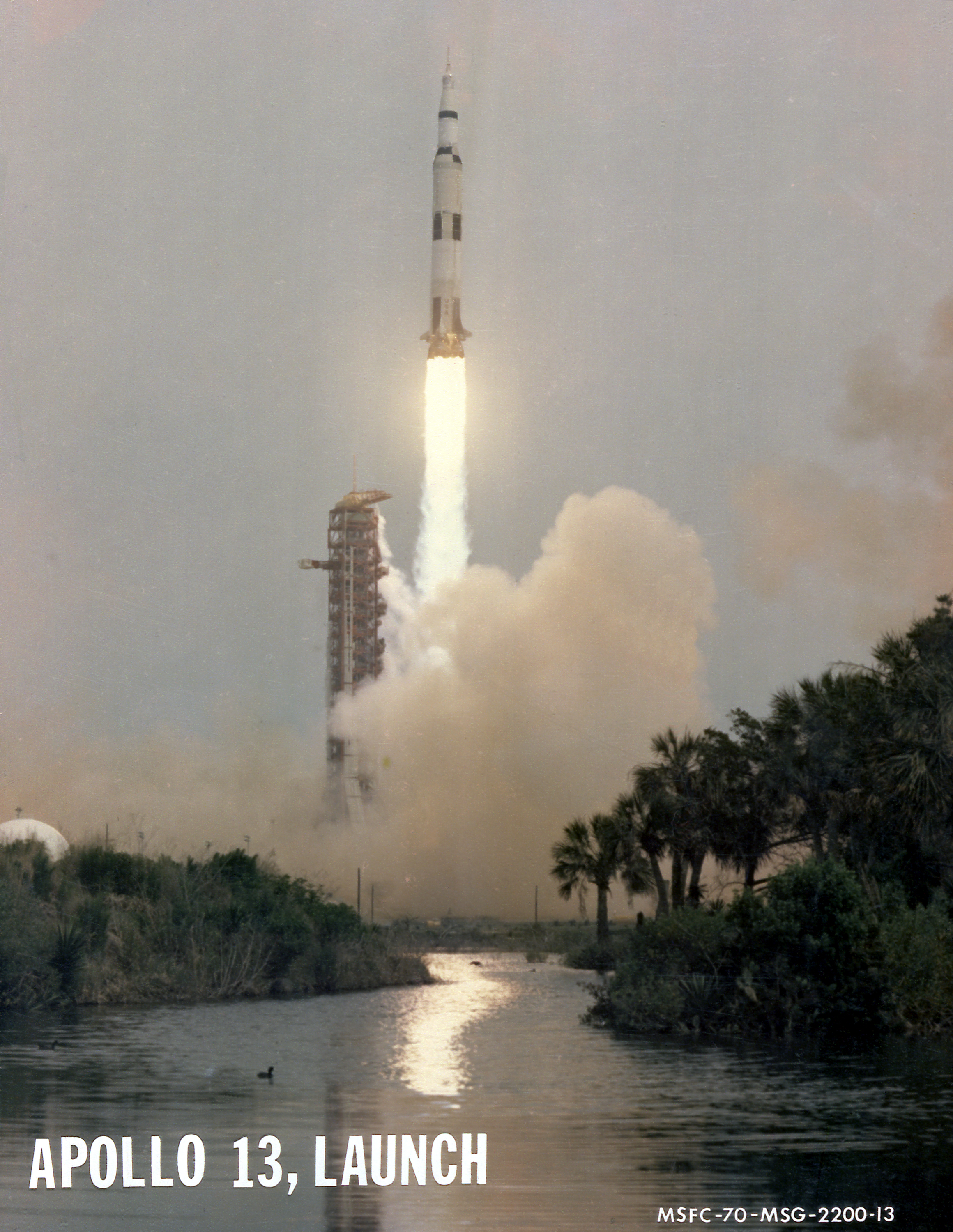
  • Apollo 13 Launch: 55 Years Ago

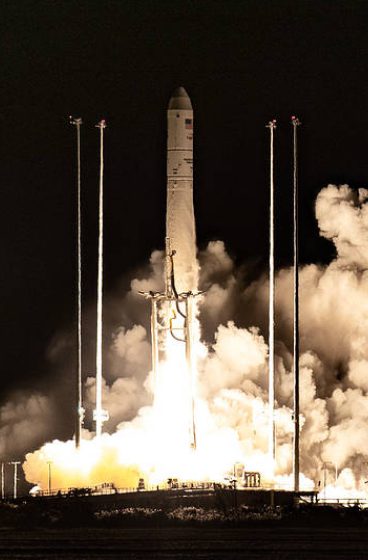
    Apollo 13 launches upward, leaving a column of flames and light brown vapor behind it. Trees and vegetation frame the water at the bottom of the photo. Outlines of small animals can be see in the water. At bottom left is written
    NASA

    NASA astronauts Jim Lovell, Fred Haise, and Jack Swigert launch aboard the Apollo 13 spacecraft from NASA’s Kennedy Space Center in Florida on April 11, 1970. The mission seemed to be going smoothly until 55 hours and 55 minutes in when an oxygen tank ruptured. The new mission plan involved abandoning the Moon landing, looping around the Moon and getting the crew home safely as quickly as possible. The crew needed to go into “lifeboat mode,” using the lunar module Aquarius to save the spacecraft and crew. On April 17, the crew returned to Earth, splashing down in the Pacific Ocean near Samoa.

    Image credit: NASA

  • NASA’s IMAP Arrives at NASA Marshall For Testing in XRCF  

    3 Min Read

    NASA’s IMAP Arrives at NASA Marshall For Testing in XRCF  

    The IMAP mission inside the circular thermal vacuum chamber with a purple background.

    On March 18, NASA’s IMAP (Interstellar Mapping and Acceleration Probe) arrived at NASA’s Marshall Space Flight Center in Huntsville, Alabama, for thermal vacuum testing at the X-ray and Cryogenic Facility, which simulates the harsh conditions of space.

    The IMAP mission is a modern-day celestial cartographer that will map the solar system by studying the heliosphere, a giant bubble created by the Sun’s solar wind that surrounds our solar system and protects it from harmful interstellar radiation. 

    NASA’s IMAP mission being loaded into the thermal vacuum chamber of NASA Marshall Space Flight Center’s X-Ray and Cryogenic Facility (XRCF) in Huntsville, Alabama. IMAP arrived at Marshall March 18 and was loaded into the chamber March 19.
    Credit: NASA/Johns Hopkins APL/Princeton/Ed Whitman

    Testing performed in the X-ray and Cryogenic Facility will help to assess the spacecraft before its journey toward the Sun. The IMAP mission will orbit the Sun at a location called Lagrange Point 1 (L1), which is about one million miles from Earth towards the Sun. From this location, IMAP can measure the local solar wind and scan the distant heliosphere without background from planets and their magnetic fields. The mission will use its suite of ten instruments to map the boundary of the heliosphere, analyze the composition of interstellar particles that make it through, and investigate how particles change as they move through the solar system. 

    Furthermore, IMAP will maintain a continuous broadcast of near real-time space weather data from five instruments aboard IMAP that will be used to test new space weather prediction models and improve our understanding of effects impacting our human exploration of space. 

    Team members from Marshall Space Flight Center in Huntsville, Alabama, install IMAP into the XRCF’s chamber dome before the start of the thermal vacuum test. 
    NASA/Johns Hopkins APL/Princeton/Ed Whitman

    While inside the Marshall facility, the spacecraft will undergo dramatic temperature changes to simulate the environment during launch, on the journey toward the Sun, and at its final orbiting point. The testing facility has multiple capabilities including a large thermal vacuum chamber which simulates the harsh conditions of space such as extreme temperatures and the near-total absence of an atmosphere. Simulating these conditions before launch allow scientists and engineers to identify successes and potential failures in the design of the spacecraft. 

    Team members from Marshall Space Flight Center in Huntsville, Alabama work to close the chamber door of the XRCF for IMAP testing. The chamber is 20 feet in diameter and 60 feet long making it one of the largest across NASA.
    NASA/Johns Hopkins APL/Princeton/Ed Whitman

    “The X-ray and Cryogenic Facility was an ideal testing location for IMAP given the chamber’s size, availability, and ability to meet or exceed the required test parameters including strict contamination control, shroud temperature, and vacuum level,” said Jeff Kegley, chief of Marshall’s Science Test Branch. 

    The facility’s main chamber is 20 feet in diameter and 60 feet long, making it the 5th largest thermal vacuum chamber at NASA. It’s the only chamber that is adjoined to an ISO 6 cleanroom — a controlled environment that limits the number and size of airborne particles to minimize contamination. 

    The IMAP mission will launch on a SpaceX Falcon 9 rocket from NASA’s Kennedy Space Center in Florida, no earlier than September. 

    The IMAP mission inside the circular thermal vacuum chamber with a purple background.
    NASA’s IMAP mission was loaded into NASA Marshall’s XRCF thermal vacuum chamber where the spacecraft will undergo testing such as dramatic temperature changes to simulate the harsh environment of space.
    NASA/Johns Hopkins APL/Princeton/Ed Whitman

    Media Contact:

    Lane Figueroa
    Marshall Space Flight Center
    Huntsville, Alabama
    256.544.0034
    lane.e.figueroa@nasa.gov

  • How NASA Science Data Defends Earth from Asteroids

    5 min read

    How NASA Science Data Defends Earth from Asteroids

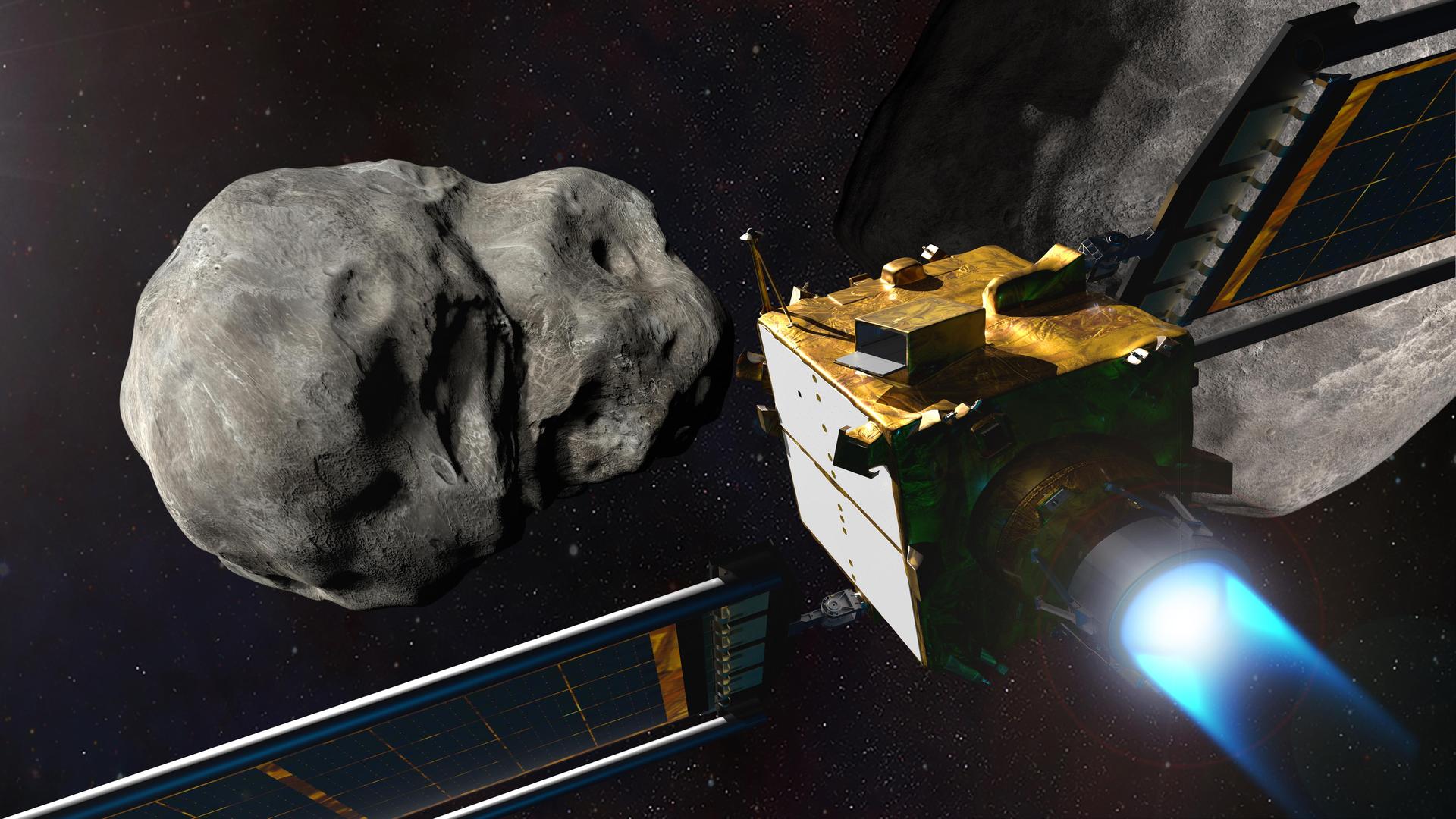
    This illustration depicts NASA's Double Asteroid Redirection Test (DART) spacecraft prior to impact at the Didymos binary asteroid system.
    Artist’s impression of NASA’s DART mission, which collided with the asteroid Dimorphos in 2022 to test planetary defense techniques. Open science data practices help researchers identify asteroids that pose a hazard to Earth, opening the possibility for deflection should an impact threat be identified.
    NASA/Johns Hopkins APL/Steve Gribben

    The asteroid 2024 YR4 made headlines in February with the news that it had a chance of hitting Earth on Dec. 22, 2032, as determined by an analysis from NASA’s Center for Near Earth Object Studies (CNEOS) at the agency’s Jet Propulsion Laboratory in Southern California. The probability of collision peaked at over 3% on Feb. 18 — the highest ever recorded for an object of its size. This sparked concerns about the damage the asteroid might do should it hit Earth.

    New data collected in the following days lowered the probability to well under 1%, and 2024 YR4 is no longer considered a potential Earth impactor. However, the event underscored the importance of surveying asteroid populations to reveal possible threats to Earth. Sharing scientific data widely allows scientists to determine the risk posed by the near-Earth asteroid population and increases the chances of identifying future asteroid impact hazards in NASA science data.

    “The planetary defense community realizes the value of making data products available to everyone,” said James “Gerbs” Bauer, the principal investigator for NASA’s Planetary Data System Small Bodies Node at the University of Maryland in College Park, Maryland.

    How Scientists Spot Asteroids That Could Hit Earth

    Professional scientists and citizen scientists worldwide play a role in tracking asteroids. The Minor Planet Center, which is housed at the Smithsonian Astrophysical Observatory in Cambridge, Massachusetts, collects and verifies vast numbers of asteroid and comet position observations submitted from around the globe. NASA’s Small Bodies Node distributes the data from the Minor Planet Center for anyone who wants to access and use it.

    A near-Earth object (NEO) is an asteroid or comet whose orbit brings it within 120 million miles of the Sun, which means it can circulate through Earth’s orbital neighborhood. If a newly discovered object looks like it might be an NEO, information about the object appears on the Minor Planet Center’s NEO Confirmation Page. Members of the planetary science community, whether or not they are professional scientists, are encouraged to follow up on these objects to discover where they’re heading.

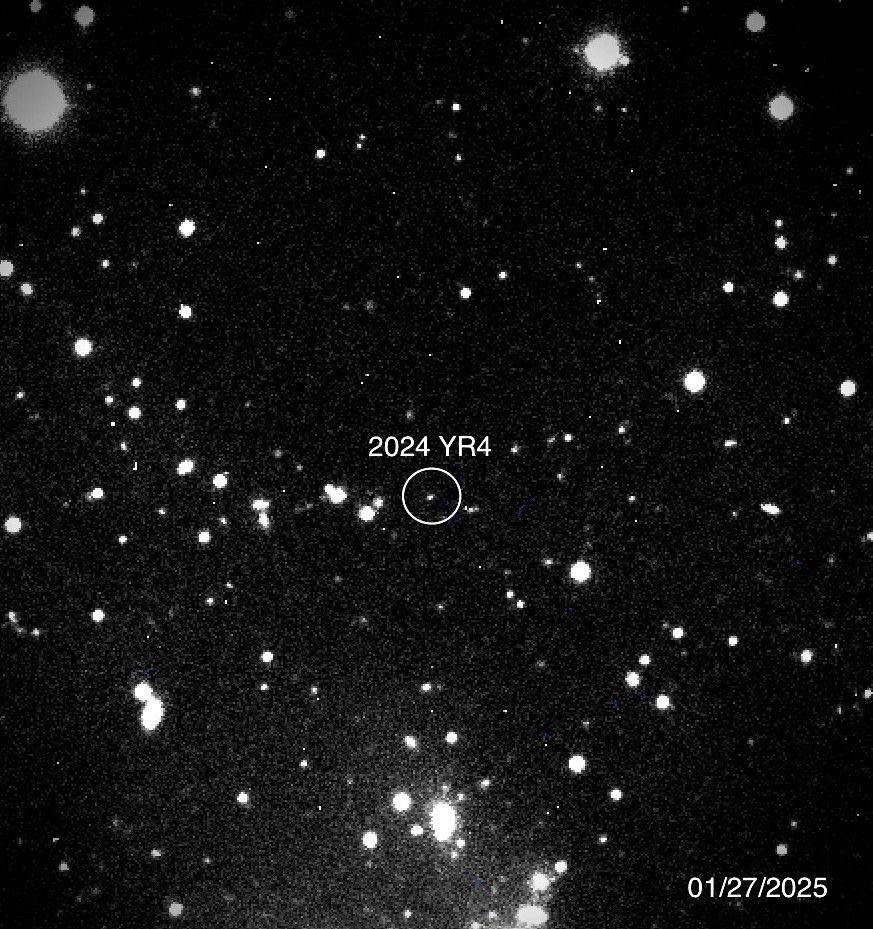
    Image of asteroid 2024 YR4
    The asteroid 2024 YR4 as viewed on January 27, 2025. The image was taken by the Magdalena Ridge 2.4m telescope, one of the largest telescopes in NASA’s Planetary Defense network. Asteroid position information from observations such as this one are shared through the Minor Planet Center and NASA’s Small Bodies Node to help scientists pinpoint the chances of asteroids colliding with Earth.
    NASA/Magdalena Ridge 2.4m telescope/New Mexico Institute of Technology/Ryan

    When an asteroid’s trajectory looks concerning, CNEOS alerts NASA’s Planetary Defense Coordination Office at NASA Headquarters in Washington, which manages NASA’s ongoing effort to protect Earth from dangerous asteroids. NASA’s Planetary Defense Coordination Office also coordinates the International Asteroid Warning Network (IAWN), which is the worldwide collaboration of asteroid observers and modelers.

    Orbit analysis centers such as CNEOS perform finer calculations to nail down the probability of an asteroid colliding with Earth. The open nature of the data allows the community to collaborate and compare, ensuring the most accurate determinations possible.

    How NASA Discovered Risks of Asteroid 2024 YR4

    The asteroid 2024 YR4 was initially discovered by the NASA-funded ATLAS (Asteroid Terrestrial-impact Last Alert System) survey, which aims to discover potentially hazardous asteroids. Scientists studied additional data about the asteroid from different observatories funded by NASA and from other telescopes across the IAWN.


    At first, 2024 YR4 had a broad uncertainty in its future trajectory that passed over Earth. As the planetary defense community collected more observations, the range of possibilities for the asteroid’s future position on Dec. 22, 2032 clustered over Earth, raising the apparent chances of collision. However, with the addition of even more data points, the cluster of possibilities eventually moved off Earth.

    This visualization from the NASA JPL Center for Near-Earth Object Studies shows the evolution of the risk corridor for asteroid 2024 YR4, using data from observations made up to Feb. 23, 2025. Each yellow dot represents the asteroid’s possible location on Dec. 22, 2032. As the range of possible locations narrowed, the dots at first converged on Earth, before skewing away harmlessly.
    This visualization from NASA’s Center for Near Earth Object Studies shows the evolution of the risk corridor for asteroid 2024 YR4, using data from observations made up to Feb. 23, 2025. Each yellow dot represents the asteroid’s possible location on Dec. 22, 2032. As the range of possible locations narrowed, the dots at first converged on Earth, before skewing away harmlessly.
    NASA/JPL/CNEOS

    Having multiple streams of data available for analysis helps scientists quickly learn more about NEOs. This sometimes involves using data from observatories that are mainly used for astrophysics or heliophysics surveys, rather than for tracking asteroids.

    “The planetary defense community both benefits from and is beneficial to the larger planetary and astronomy related ecosystem,” said Bauer, who is also a research professor in the Department of Astronomy at the University of Maryland. “Much of the NEO survey data can also be used for searching astrophysical transients like supernova events. Likewise, astrophysical sky surveys produce data of interest to the planetary defense community.”

    How Does NASA Stop Asteroids From Hitting Earth?

    In 2022, NASA’s DART (Double Asteroid Redirection Test) mission successfully impacted with the asteroid Dimorphos, shortening the time it takes to orbit around its companion asteroid Didymos by 33 minutes. Didymos had no chance of hitting Earth, but the DART mission’s success means that NASA has a tested technique to consider when addressing a future asteroid potential impact threat.

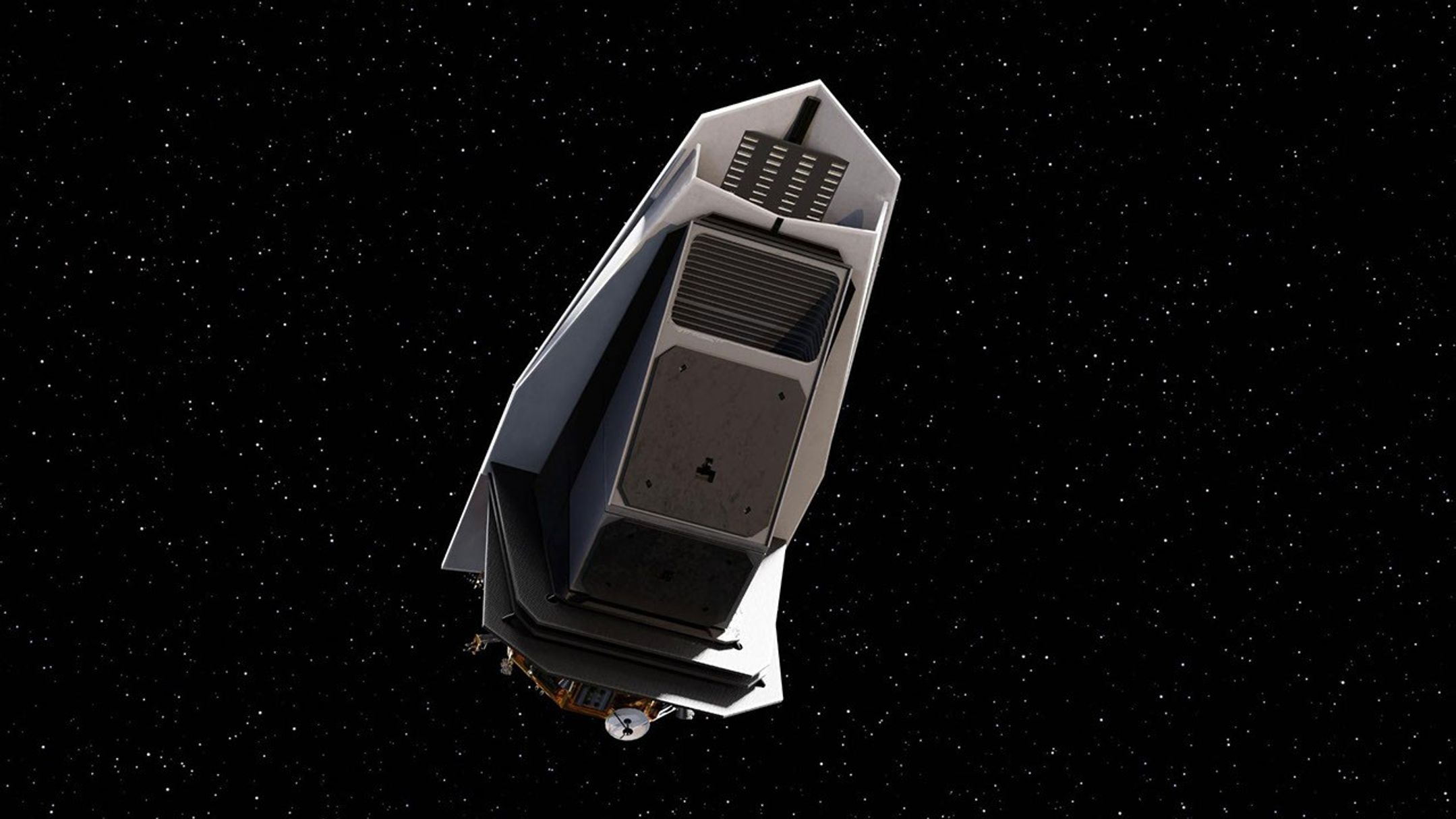
    Artist’s impression of NASA’s upcoming NEO Surveyor mission, which will search for potentially hazardous near-Earth objects. The mission will follow open data practices to improve the chances of identifying dangerous asteroids.
    NASA/JPL-Caltech

    To increase the chances of discovering asteroid threats to Earth well in advance, NASA is working on a new space-based observatory, NEO Surveyor, which will be the first spacecraft specifically designed to look for asteroids and comets that pose a hazard to Earth. The mission is expected to launch in the fall of 2027, and the data it collects will be available to everyone through NASA archives.

    “Many of the NEOs that pose a risk to Earth remain to be found,” Bauer said. “An asteroid impact has a very low likelihood at any given time, but consequences could be high, and open science is an       important component to being vigilant.”

    For more information about NASA’s approach to sharing science data, visit:

    https://science.nasa.gov/open-science.

    By Lauren Leese 
    Web Content Strategist for the Office of the Chief Science Data Officer 

    Details

    Last Updated

    Apr 10, 2025

  • GLOBE, NASA, and the Monsignor McClancy Memorial High School in Queens, New York

    4 min read

    GLOBE, NASA, and the Monsignor McClancy Memorial High School in Queens, New York

    When students actively participate in scientific investigations that connect to their everyday lives, something powerful happens: they begin to see themselves as scientists. This sense of relevance and ownership can spark a lifelong interest in science, technology, engineering, and math (STEM), paving the way for continued education and even future careers in these fields. Opportunities to engage directly with NASA science—like the one you’ll read about in this story—not only deepen students’ understanding of STEM concepts, but also nourish their curiosity and confidence. With the support of passionate educators, these moments of participation become stepping stones to a future in which students see themselves as contributors to real-world science.

    In September 2021, Ms. Deanna Danke, a Monsignor McClancy Memorial High School mathematics teacher in Queens, New York, began teaching her students how to measure tree heights using trigonometry. Soon enough, Ms. Danke discovered the Global Learning and Observations to Benefit the Environment (GLOBE) Observer Trees Tool, and with her 150+ students, began taking tree height observations around the school, an activity that Ms. Danke and her students continue to participate in today. Her and her students’ hundreds of repeat tree height observations have provided student and professional researchers with clusters of measurements that can coincide with measurements made by NASA satellite instruments, allowing for a comparison of datasets that can be analyzed over time.

    Due to the consistent tree height data collection resulting from this effort, Ms. Danke was asked to be a co-author on a peer-reviewed research paper that was published on June 21, 2022 in the Environmental Research Letters special journal “Focus on Public Participation in Environmental Research.” The paper, “The potential of citizen science data to complement satellite and airborne lidar tree height measurements: lessons from The GLOBE Program,” included data from the tree height observations reported by Ms. Danke and her students—an incredible achievement for everyone involved.

    On March 21, 2025, Ms. Danke’s former and current students continued their inspiring adventures with NASA science by taking a trip to the NASA Wallops Flight Facility in Wallops Island, Virginia. Highlights from this trip included science and technology presentations by personnel from the Ice, Cloud, and land Elevation Satellite-2 (ICESat-2) and Global Precipitation Measurement (GPM) Missions, the Wallops Balloon Program Office, and the Wallops Machine Shop for Fabrication and Testing. The ICESat-2 presentation, in particular, included a discussion on the student-collected tree height data and how the ICESat-2 satellite makes tree height observations from space.

    Ms. Danke’s work is a testament to the incredible impact educators can have when they connect classroom learning to authentic scientific discovery. By introducing her students to tools like the GLOBE Observer Trees Tool and facilitating meaningful contributions to NASA science, she opened the door to experiences most students only dream of—from collecting data that supports satellite missions to co-authoring peer-reviewed research and visiting NASA facilities. Stories like this remind us that when students are empowered to be part of real science, the possibilities—for learning, inspiration, and future careers in STEM—are truly limitless.

    The GLOBE Observer app, used by Ms. Danke and her students, is made possible by the NASA Earth Science Education Collaborative (NESEC). This free mobile app includes four tools that enable citizen scientists to participate in NASA science: Clouds, Mosquito Habitat Mapper, Land Cover, and Trees. Learn more about ways that you can join and participate in this and other NASA Citizen Science projects. Through these projects, sometimes called “participatory science” projects, volunteers and amateurs have helped make thousands of important scientific discoveries, and they are open to everyone around the world (no citizenship required).

    NESEC is supported by NASA under cooperative agreement award number NNX16AE28A and is part of NASA’s Science Activation Portfolio. Learn more about how Science Activation connects NASA science experts, real content, and experiences with community leaders to do science in ways that activate minds and promote deeper understanding of our world and beyond: https://science.nasa.gov/learn

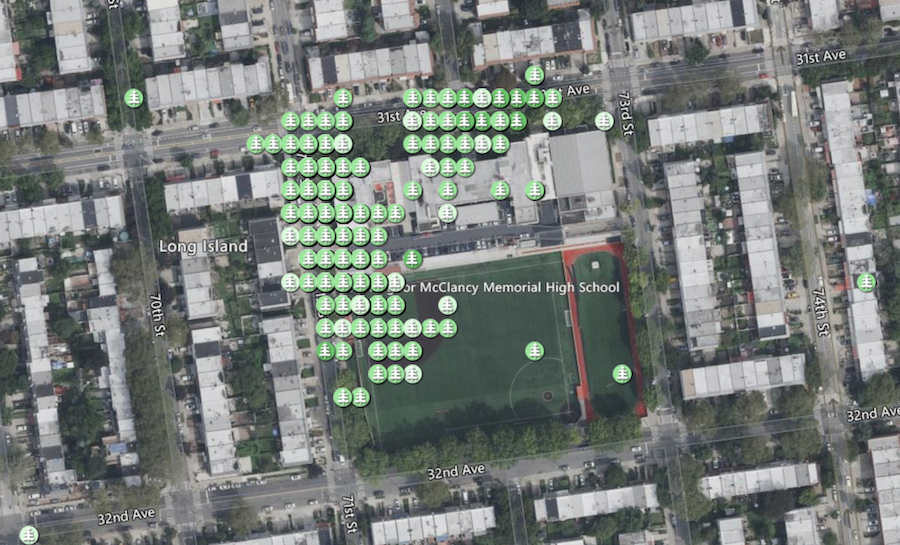
    An image of a map with buildings, vegetation, green circles containing a drawings of trees.
    Map of tree height around the Monsignor McClancy Memorial High School from the GLOBE Program’s Visualization System.

    I know this was an experience they will remember forever and they have already told me that they cannot wait to tell their future children about it. It was wonderful meeting you in person and being on site to get a real sense of what you are working on. The boys were especially fascinated by the last two stops on the tour and appreciated learning a little more about how tree height is measured. Thank you again for this incredible opportunity.”

    Ms. Deanna Danke

    Ms. Deanna Danke

    Monsignor McClancy Memorial High School

    Details

    Last Updated

    Apr 10, 2025

    Editor
    NASA Science Editorial Team
    Location
    Wallops Flight Facility
  • NASA Measures Moonlight to Improve Earth Observations

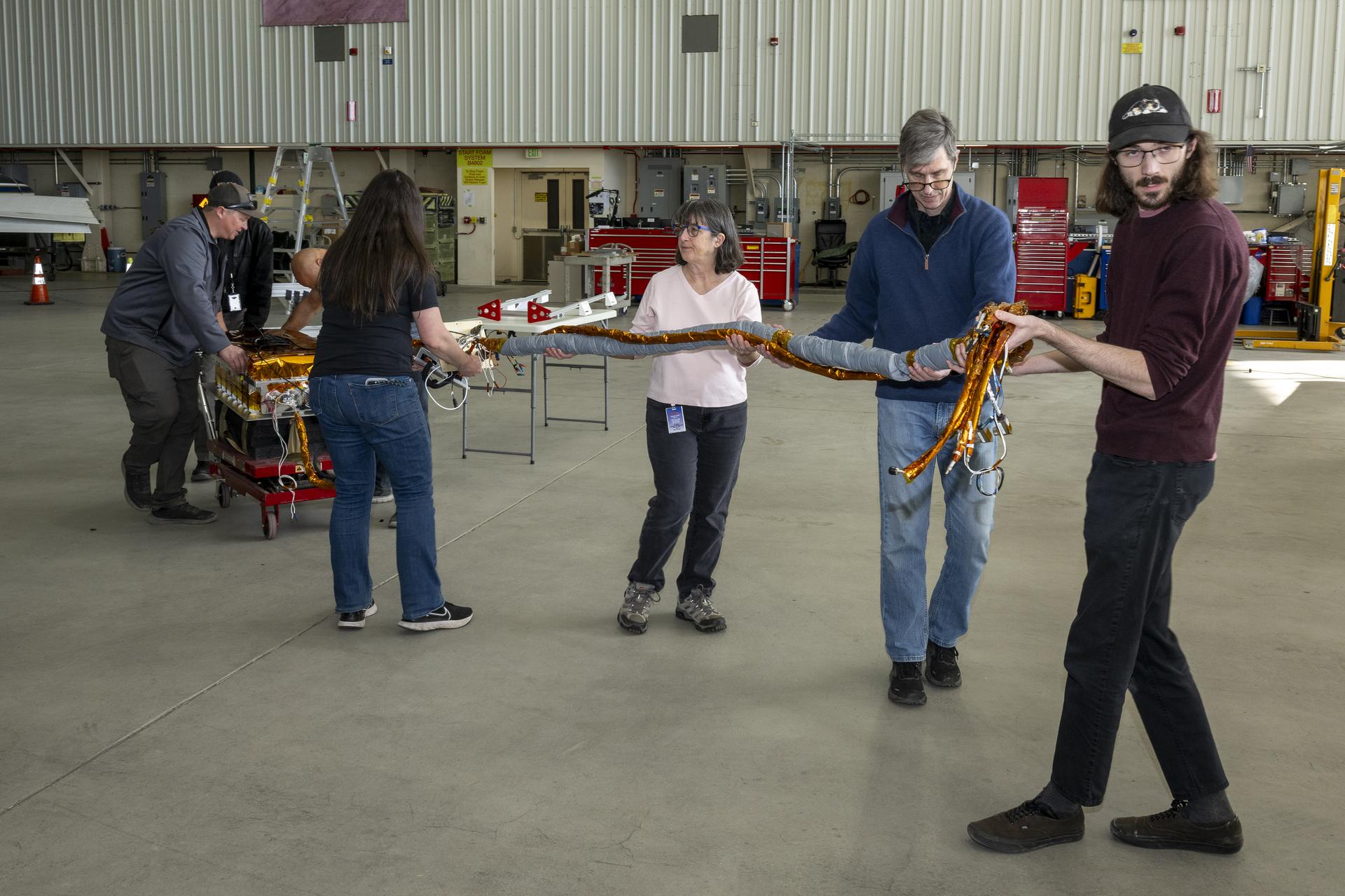
    A team of people carry a science instrument across a hangar floor. Two men at the back left of the frame roll a cart carrying the instrument body while four others ahead of the cart walk toward the right of the frame carrying a heavy twine of cables attached to the instrument.
    The airborne Lunar Spectral Irradiance (air-LUSI) instrument is moved across the hangar floor by robotic engineer Alexander McCafferty-Leroux ,from right to left, co-investigator Dr. John Woodward, NIST astronomer Dr. Susana Deustua, air-LUSI chief system engineer Dr. Kathleen “Kat” Scanlon, and members of the ER-2 ground crew at NASA’s Armstrong Flight Research Center in Edwards, California, in March 2025.
    NASA/Genaro Vavuris

    Flying high above the clouds and moon-gazing may sound like a scene from a timeless romance, but NASA did just that in the name of Earth science research. In March 2025 pilots took the agency’s ER-2 science aircraft on a series of night flights over NASA’s Armstrong Flight Research Center in Edwards, California, as the Moon increased in visible size. For those few nights, the high-flying plane was converted into a one-of-a-kind airborne lunar observatory.

    The Airborne Lunar Spectral Irradiance, or air-LUSI, mission observed the Moon at different phases and measured the sunlight reflected by the lunar surface. Specifically, the instrument tracks the amount of light reflected at different wavelengths. This information enables scientists to use the Moon as a calibration tool for Earth-observing sensors.

    As an “absolute reference, the Moon also becomes the perfect benchmark for satellites to consistently and accurately measure processes on Earth,” said Kevin Turpie, air-LUSI’s principal investigator and a researcher based at NASA’s Goddard Space Flight Center in Greenbelt, Maryland. This helps scientists to improve the precision of many different measurements, including data on weather patterns, vegetation growth, and ocean conditions.

    As the highest-flying platform for airborne science, the ER-2 can fly the air-LUSI instrument in the stratosphere, above 95% of the atmosphere. Data collected at an altitude nearing 70,000 feet are highly accurate because the air is predominantly clear of the gases and particles found in the lower atmosphere that can interfere with measurements.

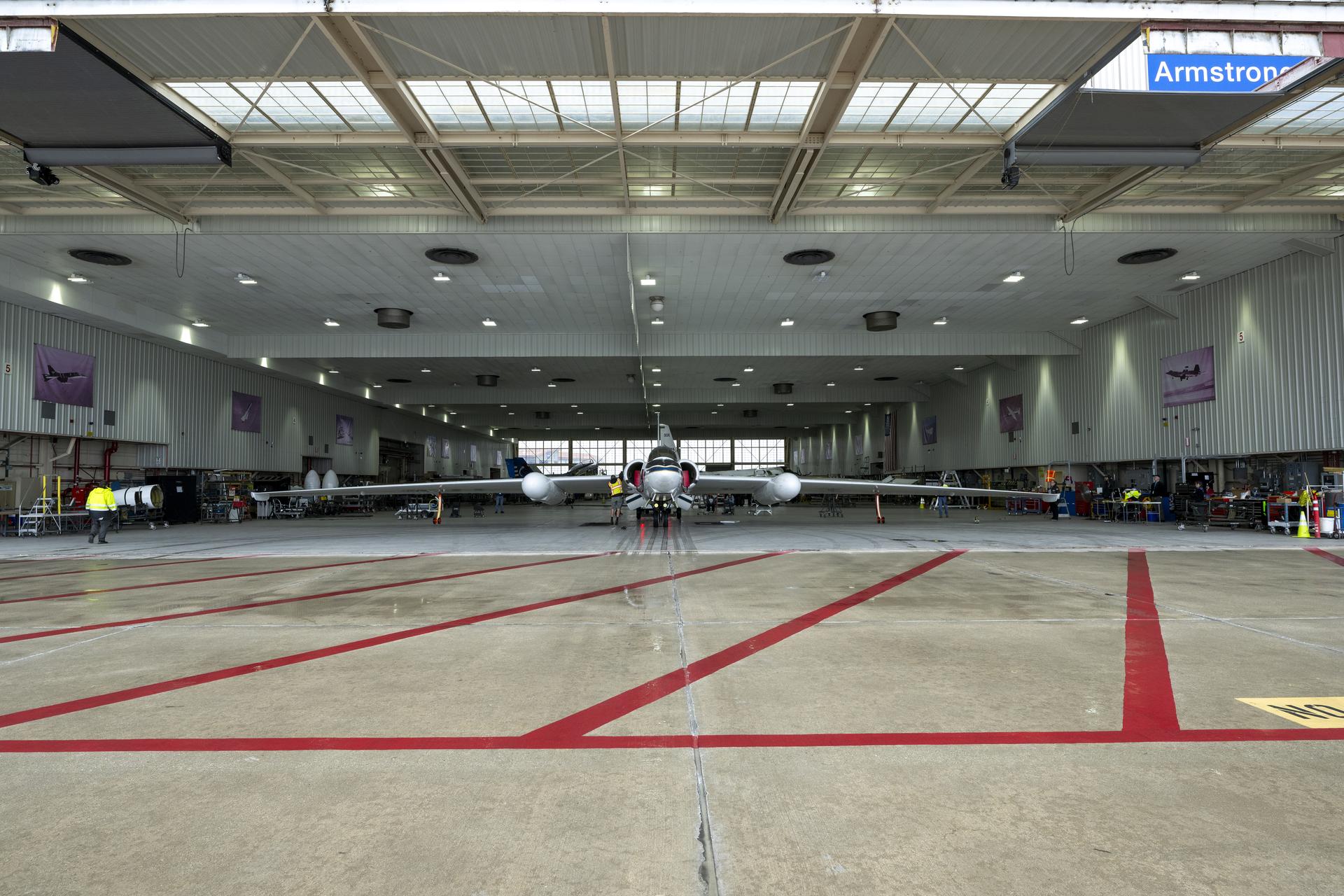
    In the center of a hangar floor, a plane faces the open hangar doors. Overhead, hangar lights illuminate the aircraft’s wide wingspan. There are red lines on the asphalt in front of the hangar.
    The ER-2 aircraft is parked in a hangar at NASA’s Armstrong Flight Research Center in Edwards, California, in March 2025. The plane is prepared for takeoff to support the airborne Lunar Spectral Irradiance, or air-LUSI, mission.
    NASA/Genaro Vavuris

    “To date, air-LUSI measurements of the Moon are the most accurate ever made,” said Kelsey Bisson, the NASA program scientist supporting the mission. “Air-LUSI data can advance our ability to understand the Earth and our weather, and they provide a new way to calibrate satellites that can result in cost savings.”

    The quality of these data has transformative implications for satellite and Earth observing systems. The improved accuracy and enhanced ability provided by air-LUSI data flown on the ER-2 reduces the need for onboard reference devices, effectually cutting satellite costs.

    The air-LUSI project is a collaboration between scientists and engineers from NASA, the National Institute of Standards and Technology, the U.S. Geological Survey, the University of Maryland Baltimore County, and McMaster University in Ontario.

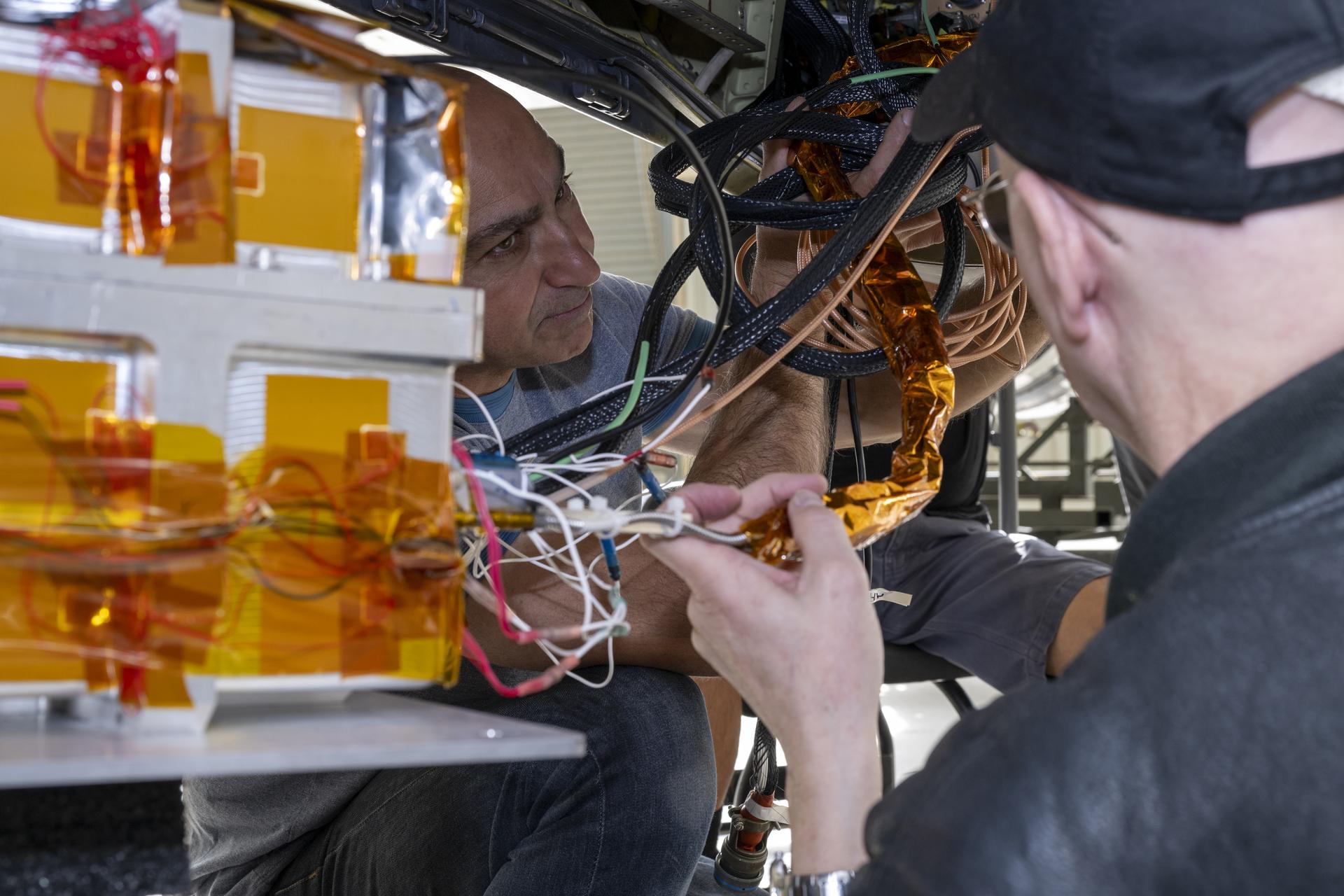
    Two men manipulate some entwined cables in the cozy space beneath an aircraft. The cables vary in thickness and color and are attached to a box with bright orange tape enclosing the scientific instrument.
    The ER-2 ground crew Wissam Habbal, left, and Dr. Kevin Turpie, airborne Lunar Spectral Irradiance (air-LUSI) principal investigator, guide delicate fiber optic and electric cabling into place while uploading the air-LUSI instrument onto the ER-2 aircraft in March 2025 at NASA’s Armstrong Flight Research Center in Edwards, California.
    NASA/Genaro Vavuris

    “The collective effort of the American and Canadian team members offers an opportunity for truly exciting engineering and science collaboration,” said Andrew Gadsden, associate professor and associate chair for graduate studies in mechanical engineering at McMaster University, and co-investigator on the air-LUSI project. The McMaster team developed the Autonomous Robotic Telescope Mount Instrument System and High-Altitude Aircraft Mounted Robotic (HAAMR) telescope mount, which support the air-LUSI system.

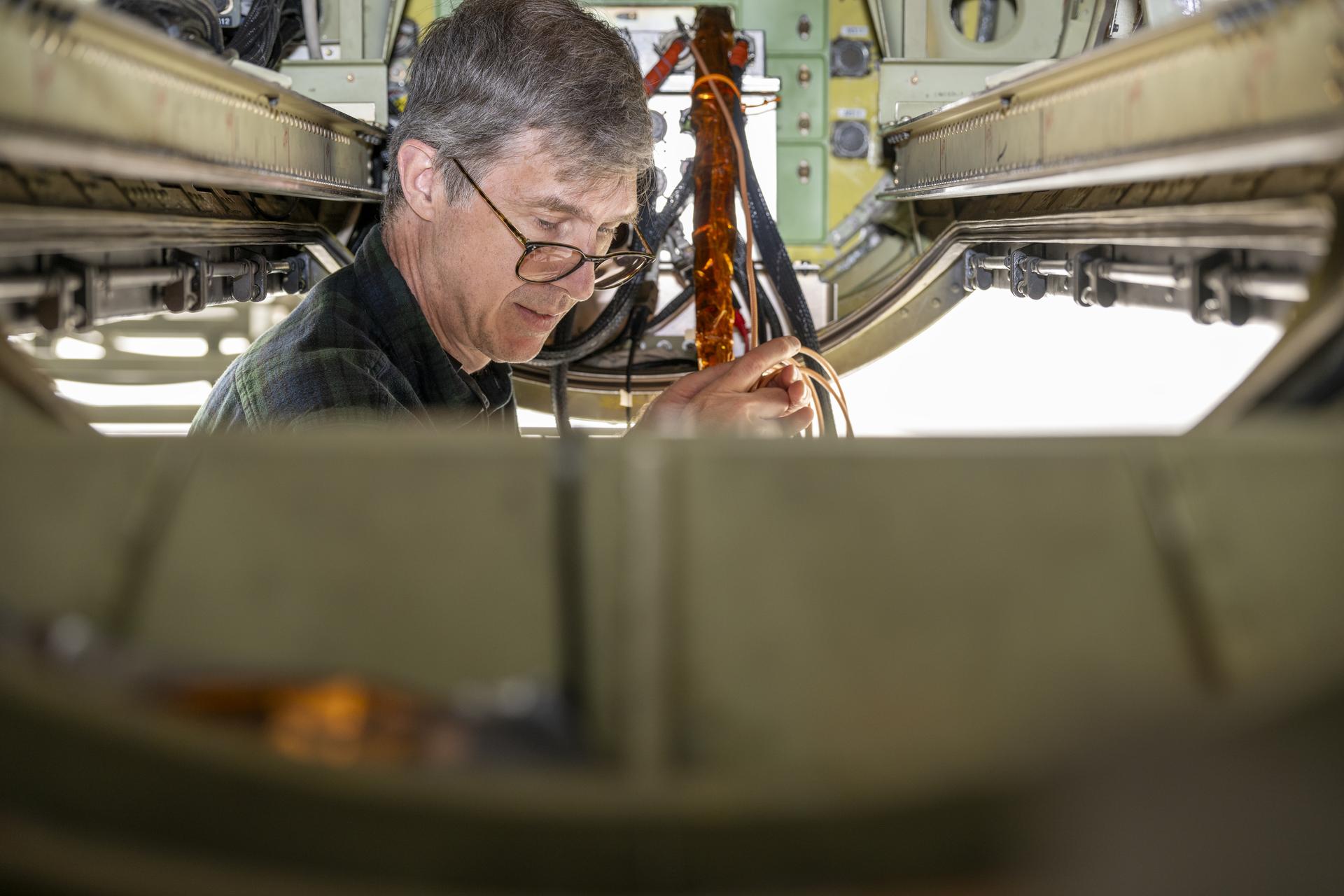
    A man’s head and shoulders are just visible as he stands in the open trapdoor to an aircraft’s instrument pod. His hands hold the cables protruding from the interior of the instrument installed on the aircraft, and he focuses on some unseen instrument element beneath the frame of the photo. He has short gray hair and wears glasses that sit at the tip of his nose.
    Dr. John Woodward, of the National Institute of Standards and Technology and co-investigator on the airborne Lunar Spectral Irradiance (air-LUSI) mission, prepares the instrument for upload onto the ER-2 aircraft in March 2025 at NASA’s Armstrong Flight Research Center in Edwards, California.
    NASA/Genaro Vavuris

    The HAAMR telescope mount was integrated onto the ER-2 and flown for the first time during the science flights in March. This new lunar tracking system is contributing to what John Woodward IV, co-investigator for air-LUSI, called the “highest accuracy measurements” of moonlight. To improve Earth observation technology, air-LUSI represents an important evolutionary step.

  • Have We Been to Uranus? We Asked a NASA Expert: Episode 56

    2 min read

    Preparations for Next Moonwalk Simulations Underway (and Underwater)

    Have we ever been to Uranus?

    The answer is simple, yes, but only once. The Voyager II spacecraft flew by the planet Uranus back in 1986, during a golden era when the Voyager spacecraft explored all four giant planets of our solar system. It revealed an extreme world, a planet that had been bowled over onto its side by some extreme cataclysm early in the formation of the solar system.

    That means that its seasons and its magnetic field get exposed to the most dramatic seasonal variability of any place that we know of in the solar system. The atmosphere was a churning system made of methane and hydrogen and water, with methane clouds showing up as white against the bluer background of the planet itself.

    The densely packed ring system is host to a number of very fine, narrow and dusty rings surrounded by a collection of icy satellites. And those satellites may harbor deep, dark, hidden oceans beneath an icy crust of water ice.

    Taken together, this extreme and exciting system is somewhere that we simply must go back to explore and hopefully in the next one to two decades NASA and the European Space Agency will mount an ambitious mission to go out there and explore the Uranian system. It’s important not just for solar system science, but also for the growing field of exoplanet science. As planets of this particular size, the size of Uranus, about four times wider than planet Earth, seem to be commonplace throughout our galaxy.

    So how have we been to Uranus? Yes, but it’s time that we went back.

    [END VIDEO TRANSCRIPT]

    Full Episode List

    Full YouTube Playlist

  • Linear Sand Dunes in the Great Sandy Desert

    A view of linear dunes in the Great Sandy Desert in Australia from the International Space Station. The sand is mostly orange, with some red spots and some dark brown spots. There is a thick white line that cuts through the middle of the dunes; this is a lake with sediment and salts from evaporated flood waters.
    In northwest Australia, the Great Sandy Desert holds great geological interest as a zone of active sand dune movement. While a variety of dune forms appear across the region, this astronaut photograph features numerous linear dunes (about 25 meters high) separated in a roughly regular fashion (0.5 to 1.5 kilometers apart).
    NASA

    On March 25, 2013, an astronaut aboard the International Space Station took this photo of the Great Sandy Desert in northwest Australia, showcasing linear dunes separated in a roughly regular fashion. When you fly over such dune fields—either in an airplane or the space station—the fire scars stand out. Where thin vegetation has been burned, the dunes appear red from the underlying sand; dunes appear darker where the vegetation remains.

    Strings of narrow lakes that represent ancient rivers are also present in the region. The white feature down the center of the image is Lake Auld. The color is the result of a cemented combination of fine, clay-like sediment and salts from the evaporation of flood waters that occasionally fill the lake. Linear dunes can be seen entering Lake Auld on the east side. During flooding events, the sand of the dune noses is dispersed, becoming incorporated into the muds and salts of the lake floor sediments. During the long, intervening dry periods, sand can blow across the lake floor to build thinner, smaller dunes, visible as linear accumulations on the west side of the lake.

    See more photos taken by astronauts.

    Text credit: NASA/M. Justin Wilkinson

    Image credit: NASA

  • Station Nation: Meet Nick Kopp, SpaceX Dragon Flight Lead 

    Nick Kopp is a Dragon flight lead in the Transportation Integration Office at Johnson Space Center in Houston. He is currently leading NASA’s efforts to prepare, launch, and return the agency’s 32nd SpaceX commercial resupply services mission. He works directly with SpaceX and collaborates with NASA’s many internal, external, and international partners to ensure the success of this and other cargo missions to the International Space Station. 

    Read on to learn about his career with NASA and more! 

    Nick Kopp’s official portrait.
    NASA/Bill Stafford

    The time and effort spent building, maintaining, and conducting science on the International Space Station is spent by people in our community and communities around the world to further humanity’s collective understanding of the universe around us.

    Nick Kopp

    Nick Kopp

    Transportation Integration Office Flight Lead

    Where are you from? 

    I am from Cleveland, Ohio. 

    Tell us about your role at NASA.  

    I work directly with SpaceX to ensure the Dragon cargo spacecraft meets NASA’s requirements to visit the space station. I also collaborate with NASA’s various partners who are safely flying science investigations and other cargo to and from the space station. For the upcoming flight, I’ve worked extensively with SpaceX to prepare to return the Dragon cargo spacecraft off the coast of California. 

    How would you describe your job to family or friends who may not be familiar with NASA?  

    I’m responsible for getting stuff to and from the International Space Station safely. 

    How long have you been working for NASA?  

    I have been working for NASA for about 15 years at both Marshall Space Flight Center in Alabama and Johnson Space Center in Texas. 

    What advice would you give to young individuals aspiring to work in the space industry or at NASA?  

    It takes so many different people with all kinds of different skills working together to make missions happen. I would suggest looking at NASA’s websites to find the skill or task that makes you want to learn more and then focusing your energy into that skill. Surround yourself with people with similar goals. Connect with people in the industry and ask them questions. You are in control of your destiny! 

    Nick Kopp in front of the International Space Station Payload Operations Center at the agency’s Marshall Space Flight Center in Huntsville, Alabama.

    What was your path to NASA?  

    I’ve wanted to work at NASA since I was a kid and my grandfather showed me the Moon through his home-built telescope. I studied aerospace engineering at the University of Illinois, where I joined Students for the Exploration and Development of Space and attended a conference at NASA’s Goddard Space Flight Center in Maryland. I met some folks from the Payload Operations Integration Center and learned of the awesome space station science operations at Marshall. I was lucky enough to be chosen for a contractor job working directly with astronauts on the space station to conduct science experiments! 

    Is there someone in the space, aerospace, or science industry that has motivated or inspired you to work for the space program? Or someone you discovered while working for NASA who inspires you?   

    After working with him from the ground when he was aboard the space station, I was lucky enough to spend many overnight shifts getting to know NASA astronaut and Flight Director TJ Creamer. TJ’s path to NASA and his servant leadership have left an ongoing legacy for people at the agency. His general attitude, extreme competence, friendly demeanor, and genuine care for people around him continue to inspire me every day to become a great leader.   

    What is your favorite NASA memory?  

    My favorite NASA memory is being selected as a payload operations director on the International Space Station Payload Operations and Integration Center flight control team. I looked up to those in this position for 10 years and did everything I could to gather the skills and knowledge I needed to take on the role. I became responsible for the minute-to-minute operations of astronauts conducting science investigations on the space station. I vividly remember the joy I felt learning of the news of my assignment, taking my first shift, my first conversation with an astronaut in space, and the bittersweet decision to leave and continue my career goals at NASA in a different role. 

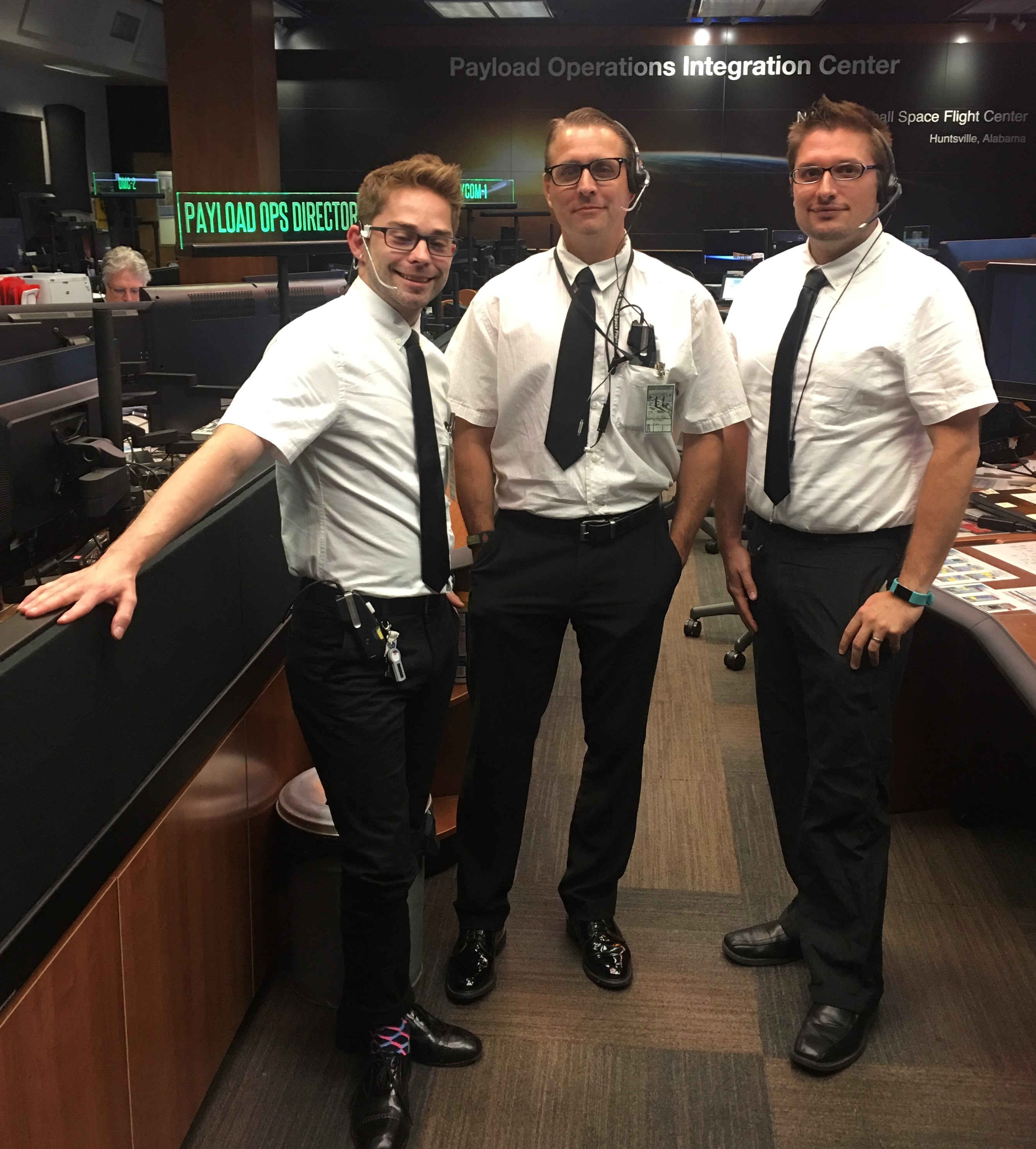
    Three men wearing white button downs and black tie and pants stand inside of a control room.
    Nick Kopp, right, behind a console in the International Space Station Payload Operations Integration Center at the agency’s Marshall Space Flight Center.

    What do you love sharing about station? What’s important to get across to general audiences to help them understand the benefits to life on Earth?  

    Although it takes place off the planet, research on the space station is conducted for people on Earth. The time and effort spent building, maintaining, and conducting science on the International Space Station is spent by people in our community and communities around the world to further humanity’s collective understanding of the universe around us. When we understand more about science, we can be more successful. So many people around the planet have had life-changing benefits from experiments that can only be done by people conducting research in microgravity, above the atmosphere, where you can view most of Earth. 

    If you could have dinner with any astronaut, past or present, who would it be?  

    I would have dinner with anyone from the Apollo 13 crew. I’d love to learn how they felt that NASA’s culture drove the outcome of that mission. 

    Do you have a favorite space-related memory or moment that stands out to you?  

    While working a night shift at the operations center in Huntsville, Alabama, we were monitoring payloads returning to Earth on a Dragon cargo spacecraft. We took a quick break outside the control center to watch as the spacecraft re-entered Earth’s atmosphere above us on its way to splash down off the coast of Florida. It was a clear night. As the spacecraft flew overhead, we saw the ablative heat shield create a shimmering trail of fire and sparkles that stretched across the whole night sky. It looked as though Tinker Bell just flew over us!   

    What are some of the key projects you’ve worked on during your time at NASA? What have been your favorite?   

    Some of my favorite projects I’ve worked on include: 

    • Serving as the International Space Station Program’s representative as flight lead for NASA’s SpaceX Crew-8 mission 
    • Troubleshooting unexpected results when conducting science on the space station 
    • Writing instructions for astronauts filming a virtual reality documentary on the space station 
    • Assessing design changes on the Space Launch System rocket’s core stage  
    • Managing and training a team of flight controllers 
    • Helping NASA move Dragon spacecraft returns from Florida to California 
    Nick Kopp enjoys sailing on his days off.

    What are your hobbies/things you enjoy outside of work?  

    I love playing board games with my wife, sailing, flying, traveling around the world, and learning about leadership and project management theory. 

    Day launch or night launch?   

    The Crew-8 night launch, specifically, where the Falcon 9 booster landed just above me! 

    Favorite space movie?  

    Spaceballs 

    NASA “worm” or “meatball” logo?  

    Meatball 

    NASA Insignia

    Every day, we’re conducting exciting research aboard our orbiting laboratory that will help us explore further into space and bring benefits back to people on Earth. You can keep up with the latest news, videos, and pictures about space station science on the Station Research & Technology news page. It’s a curated hub of space station research digital media from Johnson and other centers and space agencies.  

    Sign up for our weekly email newsletter to get the updates delivered directly to you.  

    Follow updates on social media at @ISS_Research on Twitter, and on the space station accounts on Facebook and Instagram.  
  • NASA’s Perseverance Mars Rover Studies Trove of Rocks on Crater Rim

    6 min read

    Preparations for Next Moonwalk Simulations Underway (and Underwater)

    This mosaic showing the Martian surface outside of Jezero Crater
    This mosaic showing the Martian surface outside of Jezero Crater was taken by NASA’s Perseverance on Dec. 25, 2024, at the site where the rover cored a sample dubbed “Silver Mountain” from a rock likely formed during Mars’ earliest geologic period.
    NASA/JPL-Caltech/ASU/MSSS

    The diversity of rock types along the rim of Jezero Crater offers a wide glimpse of Martian history.

    Scientists with NASA’s Perseverance rover are exploring what they consider a veritable Martian cornucopia full of intriguing rocky outcrops on the rim of Jezero Crater. Studying rocks, boulders, and outcrops helps scientists understand the planet’s history, evolution, and potential for past or present habitability. Since January, the rover has cored five rocks on the rim, sealing samples from three of them in sample tubes. It’s also performed up-close analysis of seven rocks and analyzed another 83 from afar by zapping them with a laser. This is the mission’s fastest science-collection tempo since the rover landed on the Red Planet more than four years ago.

    Perseverance climbed the western wall of Jezero Crater for 3½ months, reaching the rim on Dec. 12, 2024, and is currently exploring a roughly 445-foot-tall (135-meter-tall) slope the science team calls “Witch Hazel Hill.” The diversity of rocks they have found there has gone beyond their expectations.

    “During previous science campaigns in Jezero, it could take several months to find a rock that was significantly different from the last rock we sampled and scientifically unique enough for sampling,” said Perseverance’s project scientist, Katie Stack Morgan of NASA’s Jet Propulsion Laboratory in Southern California. “But up here on the crater rim, there are new and intriguing rocks everywhere the rover turns. It has been all we had hoped for and more.”

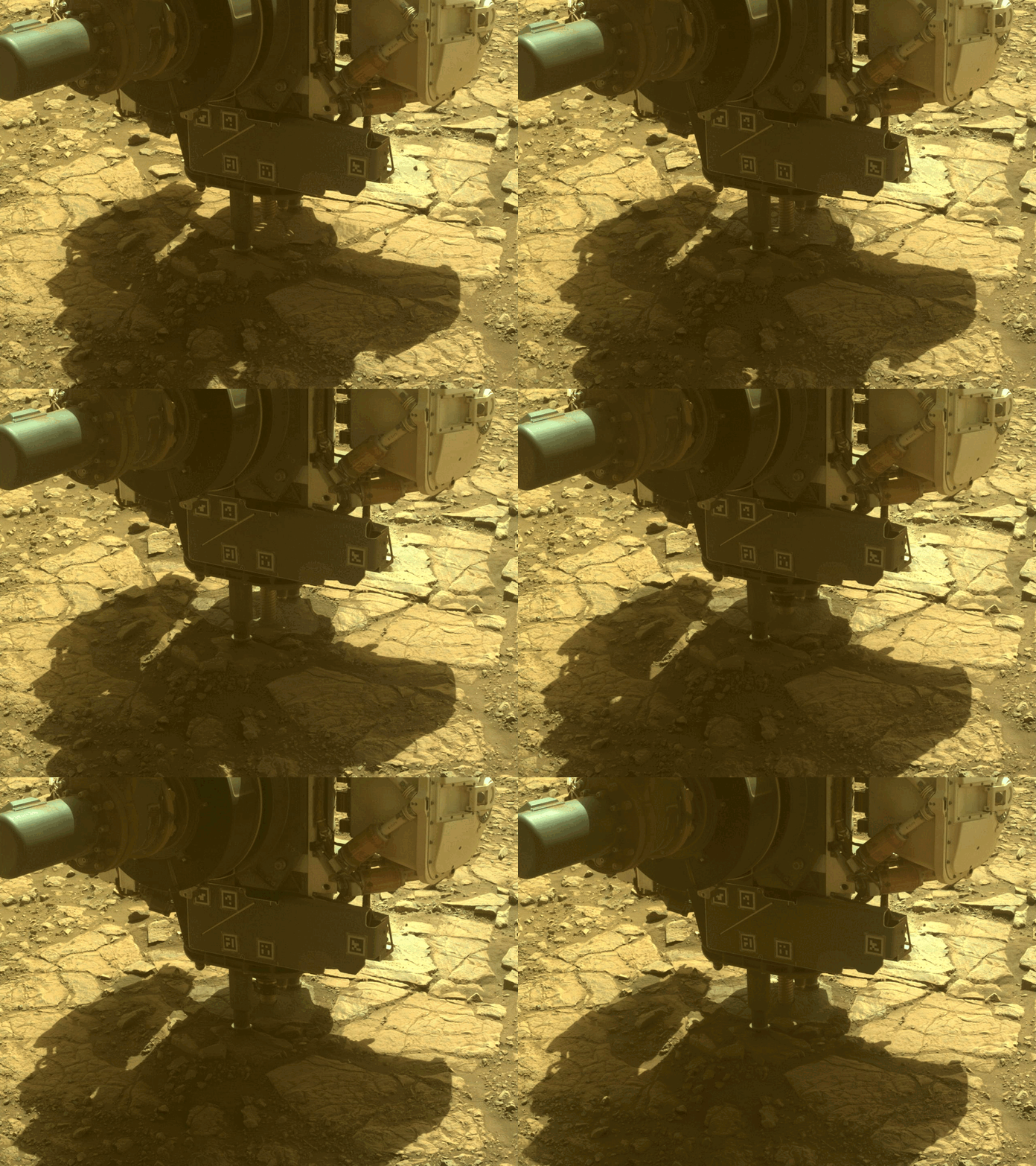
    Perseverance’s hazard cameras captured the rover’s coring drill
    One of Perseverance’s hazard cameras captured the rover’s coring drill collecting the “Main River” rock sample on “Witch Hazel Hill” on March 10, 2025, the 1,441st Martian day, or sol, of the mission.
    NASA/JPL-Caltech

    That’s because Jezero Crater’s western rim contains tons of fragmented once-molten rocks that were knocked out of their subterranean home billions of years ago by one or more meteor impacts, including possibly the one that produced Jezero Crater. Perseverance is finding these formerly underground boulders juxtaposed with well-preserved layered rocks that were “born” billions of years ago on what would become the crater’s rim. And just a short drive away is a boulder showing signs that it was modified by water nestled beside one that saw little water in its past.

    Oldest Sample Yet?

    Perseverance collected its first crater-rim rock sample, named “Silver Mountain,” on Jan. 28. (NASA scientists informally nickname Martian features, including rocks and, separately, rock samples, to help keep track of them.) The rock it came from, called “Shallow Bay,” most likely formed at least 3.9 billion years ago during Mars’ earliest geologic period, the Noachian, and it may have been broken up and recrystallized during an ancient meteor impact.

    About 360 feet (110 meters) away from that sampling site is an outcrop that caught the science team’s eye because it contains igneous minerals crystallized from magma deep in the Martian crust. (Igneous rocks can form deep underground from magma or from volcanic activity at the surface, and they are excellent record-keepers — particularly because mineral crystals within them preserve details about the precise moment they formed.) But after two coring attempts (on Feb. 4 and Feb. 8) fizzled due to the rock being so crumbly, the rover drove about 520 feet (160 meters) northwest to another scientifically intriguing rock, dubbed “Tablelands.”

    Data from the rover’s instruments indicates that Tablelands is made almost entirely of serpentine minerals, which form when large amounts of water react with iron- and magnesium-bearing minerals in igneous rock. During this process, called serpentinization, the rock’s original structure and mineralogy change, often causing it to expand and fracture. Byproducts of the process sometimes include hydrogen gas, which can lead to the generation of methane in the presence of carbon dioxide. On Earth, such rocks can support microbial communities.

    Coring Tablelands went smoothly. But sealing it became an engineering challenge.

    NASA’s Perseverance Mars rover from a rock dubbed “Tablelands”
    Sealing the “Green Gardens” sample — collected by NASA’s Perseverance Mars rover from a rock dubbed “Tablelands” along the rim of Jezero Crater on Feb. 16, 2025 — presented an engineering challenge. The sample was finally sealed on March 2.
    NASA/JPL-Caltech/ASU/MSSS

    Flick Maneuver

    “This happened once before, when there was enough powdered rock at the top of the tube that it interfered with getting a perfect seal,” said Kyle Kaplan, a robotics engineer at JPL. “For Tablelands, we pulled out all the stops. Over 13 sols,” or Martian days, “we used a tool to brush out the top of the tube 33 times and made eight sealing attempts. We even flicked it a second time.”

    During a flick maneuver, the sample handling arm — a little robotic arm in the rover’s belly — presses the tube against a wall inside the rover, then pulls the tube away, causing it to vibrate. On March 2, the combination of flicks and brushings cleaned the tube’s top opening enough for Perseverance to seal and store the serpentine-laden rock sample. 

    Eight days later, the rover had no issues sealing its third rim sample, from a rock called “Main River.” The alternating bright and dark bands on the rock were like nothing the science team had seen before.

    Up Next

    Following the collection of the Main River sample, the rover has continued exploring Witch Hazel Hill, analyzing three more rocky outcrops (“Sally’s Cove,” “Dennis Pond,” and “Mount Pearl”). And the team isn’t done yet.  

    “The last four months have been a whirlwind for the science team, and we still feel that Witch Hazel Hill has more to tell us,” said Stack. “We’ll use all the rover data gathered recently to decide if and where to collect the next sample from the crater rim. Crater rims — you gotta love ’em.”

    More About Perseverance

    A key objective for Perseverance’s mission on Mars is astrobiology, including the search for signs of ancient microbial life. The rover is characterizing the planet’s geology and past climate, to help pave the way for human exploration of the Red Planet and is the first mission to collect and cache Martian rock and regolith.

    NASA’s Mars Sample Return Program, in cooperation with ESA (European Space Agency), is designed to send spacecraft to Mars to collect these sealed samples from the surface and return them to Earth for in-depth analysis.

    The Mars 2020 Perseverance mission is part of NASA’s Mars Exploration Program portfolio and the agency’s Moon to Mars exploration approach, which includes Artemis missions to the Moon that will help prepare for human exploration of the Red Planet.

    NASA’s Jet Propulsion Laboratory, managed for the agency by Caltech in Pasadena, California, built and manages operations of the Perseverance rover.

    For more about Perseverance:

    https://science.nasa.gov/mission/mars-2020-perseverance

    News Media Contacts

    DC Agle
    Jet Propulsion Laboratory, Pasadena, Calif.
    818-393-9011
    agle@jpl.nasa.gov

    Karen Fox / Molly Wasser
    NASA Headquarters, Washington
    202-358-1600
    karen.c.fox@nasa.gov / molly.l.wasser@nasa.gov  

    2025-051

    Details

    Last Updated

    Apr 10, 2025

  • NASA Webb’s Autopsy of Planet Swallowed by Star Yields Surprise

    6 Min Read

    NASA Webb’s Autopsy of Planet Swallowed by Star Yields Surprise

    An illustration of a host star, which looks like an orange globe with flares coming out on various sides with a very transparent cloud of blue dust spread out from the star. A dark orange horizontal ring of material circles the host star.

    NASA’s James Webb Space Telescope’s observations of what is thought to be the first-ever recorded planetary engulfment event revealed a hot accretion disk surrounding the star, with an expanding cloud of cooler dust enveloping the scene. Webb also revealed that the star did not swell to swallow the planet, but the planet’s orbit actually slowly depreciated over time, as seen in this artist’s concept. Full illustration below.

    Credits:
    NASA, ESA, CSA, R. Crawford (STScI)

    Observations from NASA’s James Webb Space Telescope have provided a surprising twist in the narrative surrounding what is believed to be the first star observed in the act of swallowing a planet. The new findings suggest that the star actually did not swell to envelop a planet as previously hypothesized. Instead, Webb’s observations show the planet’s orbit shrank over time, slowly bringing the planet closer to its demise until it was engulfed in full.

    “Because this is such a novel event, we didn’t quite know what to expect when we decided to point this telescope in its direction,” said Ryan Lau, lead author of the new paper and astronomer at NSF NOIRLab (National Science Foundation National Optical-Infrared Astronomy Research Laboratory) in Tucson, Arizona. “With its high-resolution look in the infrared, we are learning valuable insights about the final fates of planetary systems, possibly including our own.”

    Two instruments aboard Webb conducted the post-mortem of the scene – Webb’s MIRI (Mid-Infrared Instrument) and NIRSpec (Near-Infrared Spectrograph). The researchers were able to come to their conclusion using a two-pronged investigative approach.

    Image A: Planetary Engulfment Illustration

    A four panel illustration, with two boxes on the top row and two boxes on the bottom row. They are labeled: 1, 2, 3, 4. Panel 1 shows a host star, which looks like an orange globe with flares coming out on various sides. There is a blue line with arrows forming a spiral around the star. At 2 o’clock in the outer spiral, furthest away from the star, there is a blue planet. Panel 2 shows the same star and lines, but the planet is now at 7 o’clock and closer to the star. It is a little stretched out toward the star, appearing like an American football or rugby ball instead of a sphere. Panel 3 shows the same star and lines, but the planet is fully engulfed by the star, with big flares coming out where the planet and star collided. Panel 4 shows the aftermath, with a very transparent cloud of blue dust spread out from the star. A dark orange horizontal ring of material circles the host star.
    NASA’s James Webb Space Telescope’s observations of what is thought to be the first-ever recorded planetary engulfment event revealed a hot accretion disk surrounding the star, with an expanding cloud of cooler dust enveloping the scene. Webb also revealed that the star did not swell to swallow the planet, but the planet’s orbit actually slowly depreciated over time, as seen in this artist’s concept.
    NASA, ESA, CSA, R. Crawford (STScI)

    Constraining the How

    The star at the center of this scene is located in the Milky Way galaxy about 12,000 light-years away from Earth.

    The brightening event, formally called ZTF SLRN-2020, was originally spotted as a flash of optical light using the Zwicky Transient Facility at Caltech’s Palomar Observatory in San Diego, California. Data from NASA’s NEOWISE (Near-Earth Object Wide-field Infrared Survey Explorer) showed the star actually brightened in the infrared a year before the optical light flash, hinting at the presence of dust. This initial 2023 investigation led researchers to believe that the star was more Sun-like, and had been in the process of aging into a red giant over hundreds of thousands of years, slowly expanding as it exhausted its hydrogen fuel.

    However, Webb’s MIRI told a different story. With powerful sensitivity and spatial resolution, Webb was able to precisely measure the hidden emission from the star and its immediate surroundings, which lie in a very crowded region of space. The researchers found the star was not as bright as it should have been if it had evolved into a red giant, indicating there was no swelling to engulf the planet as once thought.

    Reconstructing the Scene

    Researchers suggest that, at one point, the planet was about Jupiter-sized, but orbited quite close to the star, even closer than Mercury’s orbit around our Sun. Over millions of years, the planet orbited closer and closer to the star, leading to the catastrophic consequence.

    “The planet eventually started to graze the star’s atmosphere. Then it was a runaway process of falling in faster from that moment,” said team member Morgan MacLeod of the Harvard-Smithsonian Center for Astrophysics and the Massachusetts Institute of Technology in Cambridge, Massachusetts. “The planet, as it’s falling in, started to sort of smear around the star.”

    In its final splashdown, the planet would have blasted gas away from the outer layers of the star. As it expanded and cooled off, the heavy elements in this gas condensed into cold dust over the next year.

    Inspecting the Leftovers

    While the researchers did expect an expanding cloud of cooler dust around the star, a look with the powerful NIRSpec revealed a hot circumstellar disk of molecular gas closer in. Furthermore, Webb’s high spectral resolution was able to detect certain molecules in this accretion disk, including carbon monoxide.

    “With such a transformative telescope like Webb, it was hard for me to have any expectations of what we’d find in the immediate surroundings of the star,” said Colette Salyk of Vassar College in Poughkeepsie, New York, an exoplanet researcher and co-author on the new paper. “I will say, I could not have expected seeing what has the characteristics of a planet-forming region, even though planets are not forming here, in the aftermath of an engulfment.”

    The ability to characterize this gas opens more questions for researchers about what actually happened once the planet was fully swallowed by the star.

    “This is truly the precipice of studying these events. This is the only one we’ve observed in action, and this is the best detection of the aftermath after things have settled back down,” Lau said. “We hope this is just the start of our sample.”

    These observations, taken under Guaranteed Time Observation program 1240, which was specifically designed to investigate a family of mysterious, sudden, infrared brightening events, were among the first Target of Opportunity programs performed by Webb. These types of study are reserved for events, like supernova explosions, that are expected to occur, but researchers don’t exactly know when or where. NASA’s space telescopes are part of a growing, international network that stands ready to witness these fleeting changes, to help us understand how the universe works.

    Researchers expect to add to their sample and identify future events like this using the upcoming Vera C. Rubin Observatory and NASA’s Nancy Grace Roman Space Telescope, which will survey large areas of the sky repeatedly to look for changes over time.

    The team’s findings appear today in The Astrophysical Journal.

    The James Webb Space Telescope is the world’s premier space science observatory. Webb is solving mysteries in our solar system, looking beyond to distant worlds around other stars, and probing the mysterious structures and origins of our universe and our place in it. Webb is an international program led by NASA with its partners, ESA (European Space Agency) and CSA (Canadian Space Agency).

    To learn more about Webb, visit: https://science.nasa.gov/webb

    Downloads

    Click any image to open a larger version.

    View/Download all image products at all resolutions for this article from the Space Telescope Science Institute.

    View/Download the science paper from the The Astrophysical Journal.

    Media Contacts

    Laura Betz – laura.e.betz@nasa.gov
    NASA’s Goddard Space Flight Center, Greenbelt, Md.

    Hannah Braunhbraun@stsci.edu
    Space Telescope Science Institute, Baltimore, Md.

    Read more about Webb’s impact on exoplanet research

    Video: How to Study Exoplanets

    Learn more about exoplanets

    More Webb News

    More Webb Images

    Webb Science Themes

    Webb Mission Page

    What is the Webb Telescope?

    SpacePlace for Kids

    En Español

    Ciencia de la NASA

    NASA en español 

    Space Place para niños

  • NASA’s SpaceX 32nd Resupply Mission Launches New Research to Station

    4 min read

    Preparations for Next Moonwalk Simulations Underway (and Underwater)

    NASA and SpaceX are launching the company’s 32nd commercial resupply services mission to the International Space Station later this month, bringing a host of new research to the orbiting laboratory. Aboard the SpaceX Dragon spacecraft are experiments focused on vision-based navigation, spacecraft air quality, materials for drug and product manufacturing, and advancing plant growth with less reliance on photosynthesis.

    This and other research conducted aboard the space station advances future space exploration, including missions to the Moon and Mars, and provides many benefits to humanity.

    Investigations traveling to the space station include:

    Robotic spacecraft guidance

    Smartphone Video Guidance Sensor-2 (SVGS-2) uses the space station’s Astrobee robots to demonstrate using a vision-based sensor developed by NASA to control a formation flight of small satellites. Based on a previous in-space demonstration of the technology, this investigation is designed to refine the maneuvers of multiple robots and integrate the information with spacecraft systems.

    Potential benefits of this technology include improved accuracy and reliability of systems for guidance, navigation, and control that could be applied to docking crewed spacecraft in orbit and remotely operating multiple robots on the lunar or Martian surface.

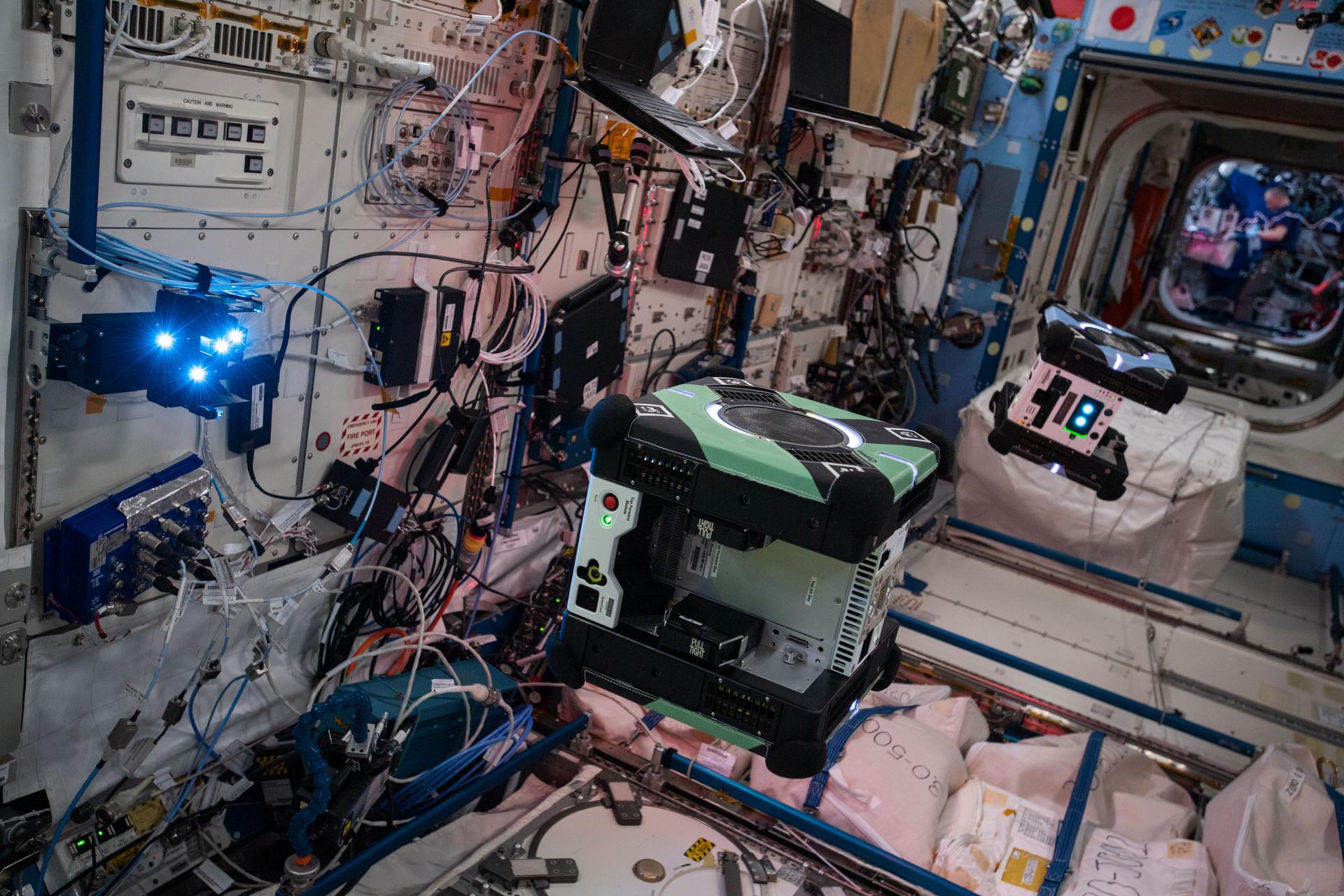
    Two cube-shaped robots each about the size of a small suitcase, one green and one blue, float in the middle of a module on the space station. Below them are white storage bags and behind them a wall covered with equipment, laptops, cords, and wires. A black device mounted on the wall at the left of the image has four bright blue lights.
    Two of the space station’s Astrobee robots are used to test a vision-based guidance system for Smartphone Video Guidance Sensor (SVGS)
    NASA

    Protection from particles

    During spaceflight, especially long-duration missions, concentrations of airborne particles must be kept within ranges safe for crew health and hardware performance. The Aerosol Monitors investigation tests three different air quality monitors in space to determine which is best suited to protect crew health and ensure mission success. The investigation also tests a device for distinguishing between smoke and dust. Aboard the space station, the presence of dust can cause false smoke alarms that require crew member response. Reducing false alarms could save valuable crew time while continuing to protect astronaut safety.

    Better materials, better drugs

    The DNA Nano Therapeutics-Mission 2 produces a special type of molecule formed by DNA-inspired, customizable building blocks known as Janus base nanomaterials. It also evaluates how well the materials reduce joint inflammation and whether they can help regenerate cartilage lost due to arthritis. These materials are less toxic, more stable, and more compatible with living tissues than current drug delivery technologies.

    Environmental influences such as gravity can affect the quality of these materials and delivery systems. In microgravity, they are larger and have greater uniformity and structural integrity. This investigation could help identify the best formulations and methods for cost-effective in-space production. These nanomaterials also could be used to create novel systems targeting therapy delivery that improves patient outcomes with fewer side effects.

    The image shows stem cells embedded within a network of scaffolding material. The scaffold is densely populated with cells adhered throughout. 
    Stem cells grown along the Janus base nanomaterials (JBNs) made aboard the International Space Station.
    University of Connecticut

    Next-generation pharmaceutical nanostructures

    The newest Industrial Crystallization Cassette (ADSEP-ICC) investigation adds capabilities to an existing protein crystallization facility. The cassette can process more sample types, including tiny gold particles used in devices that detect cancer and other diseases or in targeted drug delivery systems. Microgravity makes it possible to produce larger and more uniform gold particles, which improves their use in research and real-life applications of technologies related to human health.

    Helping plants grow

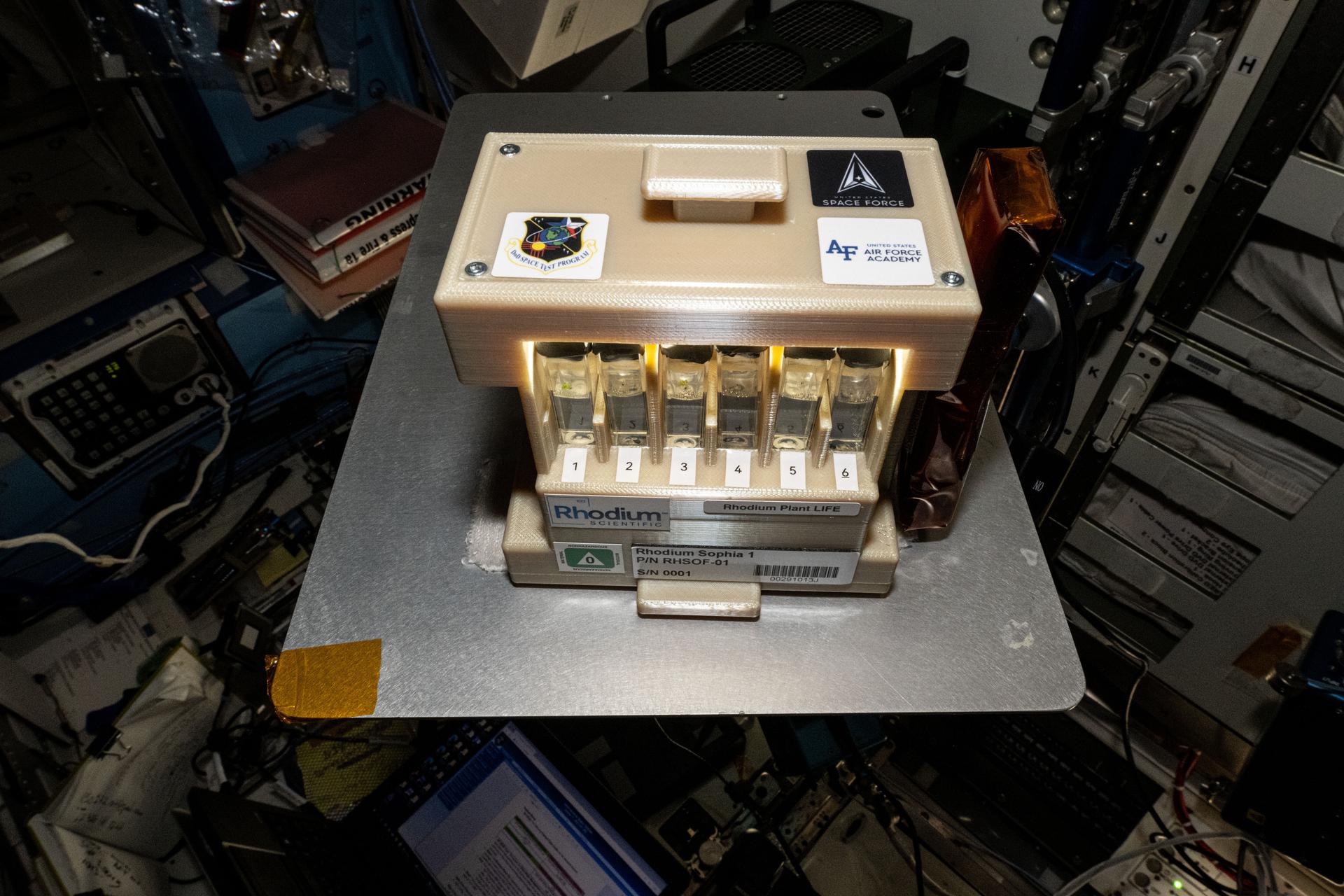
    Rhodium USAFA NIGHT examines how tomato plants respond to microgravity and whether a carbon dioxide replacement can reduce how much space-grown plants depend on photosynthesis. Because photosynthesis needs light, which requires spacecraft power to generate, alternatives would reduce energy use. The investigation also examines whether using supplements increases plant growth on the space station, which has been observed in preflight testing on Earth. In future plant production facilities aboard spacecraft or on celestial bodies, supplements could come from available organic materials such as waste.

    Understanding how plants adapt to microgravity could help grow food during long-duration space missions or harsh environments on Earth.

    A tan box about the size of a small microwave sits on top of a silver metal tray. The box has stickers on the top that say, “DoD Space Test Program,” “United States Air Force Academy,” and “United States Space Force.” On its front are six numbered chambers holding vials filled with a clear liquid, and more labels below them, including one that says, “Rhodium Plant Life” and a barcode.
    Hardware for the Rhodium Plant LIFE, which was the first in a series used to study how space affects plant growth.
    NASA

    Atomic clocks in space

    An ESA (European Space Agency) investigation, Atomic Clock Ensemble in Space (ACES), examines fundamental physics concepts such as Einstein’s theory of relativity using two next-generation atomic clocks operated in microgravity. Results have applications to scientific measurement studies, the search for dark matter, and fundamental physics research that relies on highly accurate atomic clocks in space. The experiment also tests a technology for synchronizing clocks worldwide using global navigation satellite networks.

    An illustration of the space station fills the top two-thirds of this image, with a silver, cylindrical module in the middle. A large silver box is attached to the bottom of it. A blue, cloud-dappled Earth fills the right lower corner, with the blackness of space in the background.
    An artist’s concept shows the Atomic Clock Ensemble in Space hardware mounted on the Earth-facing side of the space station’s exterior.
    ESA

    Download high-resolution photos and videos of the research mentioned in this article.

  • NASA Offers Free High School Engineering Program This Summer

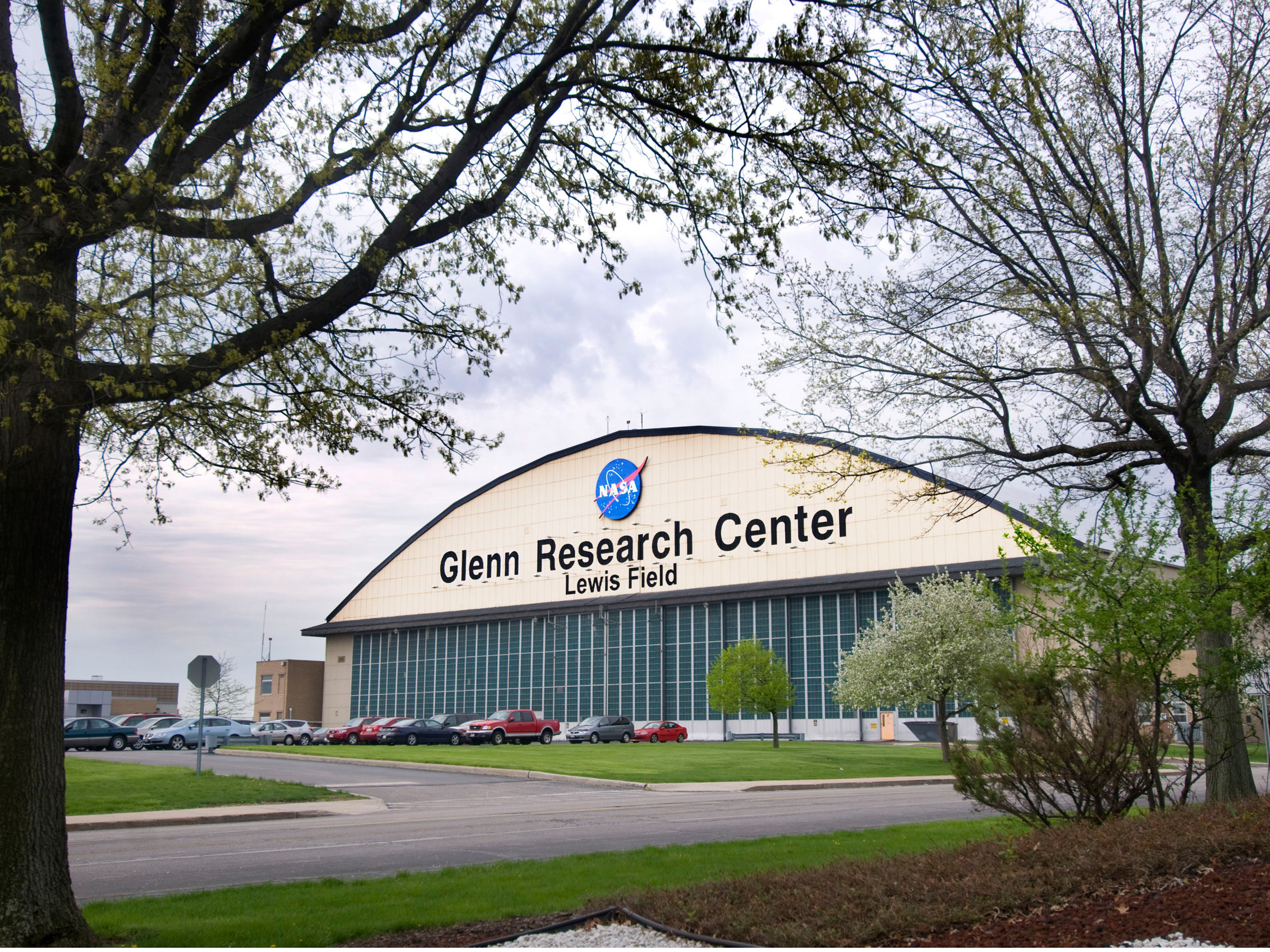
    This summer, NASA’s Glenn Research Center in Cleveland is offering a free summer STEM program for high school students in their junior and senior years.
    Credit: NASA

    NASA’s Glenn Research Center in Cleveland is launching the NASA Glenn High School Engineering Institute this summer. The free, work-based learning experience is designed to help high school students prepare for a future in the aerospace workforce.

    Rising high school juniors and seniors in Northeast Ohio can submit applications for this new, in-person summer program from Friday, April 11, through Friday, May 9.

    The NASA Glenn High School Engineering Institute will immerse students in NASA’s work while providing essential career readiness tools to help them in future science, technology, engineering, and mathematics-focused academic and professional pursuits.

    Throughout the five-day institute, students will use authentic NASA mission content and work alongside Glenn’s technical experts to gain a deeper understanding of the engineering design process, develop practical engineering solutions to real-world challenges, and test prototypes to answer questions in key mission areas:

    • Acoustic dampening – How can we reduce noise pollution from jet engines?
    • Power management and distribution – How can we develop a smart power system for future space stations?
    • Simulated lunar operations – Can we invent tires that don’t use air?

    Program Dates
    Selected students will participate in one of the following week-long sessions.

    • Session 1: July 7 – 11, 2025
    • Session 2: July 14 – 18, 2025
    • Session 3: July 21 – 25, 2025

    Eligibility and Application Requirements
    To be eligible for this program, students must:

    • Be entering 11th or 12th grade for the 2025-2026 academic year
    • Have a minimum 3.2 GPA, verified by their school counselor
    • Submit a letter of recommendation from a teacher

    Additional application requirements are outlined in the Supplemental Application.

    How to Apply:
    To be considered for this opportunity, complete and submit the NASA Gateway application and the Supplemental Application by Friday May 9.

    Questions pertaining to the NASA Glenn High School Engineering Institute should be directed to Gerald Voltz at GRC-Ed-Opportunities@mail.nasa.gov.

    For information about NASA Glenn, visit:

    https://www.nasa.gov/glenn

    -end-

    Debbie Welch
    Glenn Research Center, Cleveland
    216-433-8655
    debbie.welch@nasa.gov

    Details

    Last Updated

    Apr 10, 2025

    Editor
    Jennifer M. Dooren
    Location
    Glenn Research Center

  • NASA’s Juno Back to Normal Operations After Entering Safe Mode

    3 min read

    NASA’s Juno Back to Normal Operations After Entering Safe Mode

    This illustration depicts NASA's Juno spacecraft in orbit above Jupiter's Great Red Spot.
    NASA’s Juno flies above Jupiter’s Great Red Spot in this artist’s concept.
    NASA/JPL-Caltech

    The spacecraft was making its 71st close approach to Jupiter when it unexpectedly entered into a precautionary status.

    Data received from NASA’s Juno mission indicates the solar-powered spacecraft went into safe mode twice on April 4 while the spacecraft was flying by Jupiter. Safe mode is a precautionary status that a spacecraft enters when it detects an anomaly. Nonessential functions are suspended, and the spacecraft focuses on essential tasks like communication and power management. Upon entering safe mode, Juno’s science instruments were powered down, as designed, for the remainder of the flyby.

    The mission operations team has reestablished high-rate data transmission with Juno, and the spacecraft is currently conducting flight software diagnostics.The team will work in the ensuing days to transmit the engineering and science data collected before and after the safe-mode events to Earth.

    Juno first entered safe mode at 5:17 a.m. EDT, about an hour before its 71st close passage of Jupiter — called perijove. It went into safe mode again 45 minutes after perijove. During both safe-mode events, the spacecraft performed exactly as designed, rebooting its computer, turning off nonessential functions, and pointing its antenna toward Earth for communication.

    Of all the planets in our solar system, Jupiter is home to the most hostile environment, with the radiation belts closest to the planet being the most intense. Early indications suggest the two Perijove 71 safe-mode events occurred as the spacecraft flew through these belts. To block high-energy particles from impacting sensitive electronics and mitigate the harmful effects of the radiation, Juno features a titanium radiation vault.

    Including the Perijove 71 events, Juno has unexpectedly entered spacecraft-induced safe mode four times since arriving at Jupiter in July 2016: first, in 2016 during its second orbit, then in 2022 during its 39th orbit. In all four cases, the spacecraft performed as expected and recovered full capability.

    Juno’s next perijove will occur on May 7 and include a flyby of the Jovian moon Io at a distance of about 55,300 miles (89,000 kilometers).

    More About Juno

    NASA’s Jet Propulsion Laboratory, a division of Caltech in Pasadena, California, manages the Juno mission for the principal investigator, Scott Bolton, of the Southwest Research Institute in San Antonio. Juno is part of NASA’s New Frontiers Program, which is managed at NASA’s Marshall Space Flight Center in Huntsville, Alabama, for the agency’s Science Mission Directorate in Washington. The Italian Space Agency (ASI) funded the Jovian InfraRed Auroral Mapper. Lockheed Martin Space in Denver built and operates the spacecraft. Various other institutions around the U.S. provided several of the other scientific instruments on Juno.

    More information about Juno is available at:

    https://www.nasa.gov/juno

    News Media Contacts

    DC Agle
    Jet Propulsion Laboratory, Pasadena, Calif.
    818-393-9011
    agle@jpl.nasa.gov

    Karen Fox / Molly Wasser
    NASA Headquarters, Washington
    202-358-1600
    karen.c.fox@nasa.gov / molly.l.wasser@nasa.gov

    Deb Schmid
    Southwest Research Institute, San Antonio
    210-522-2254
    dschmid@swri.org

    2025-049

    Details

    Last Updated

    Apr 09, 2025

    Related Terms