Tag: solar system

  • NASA Announces 31st Human Exploration Rover Challenge Winners

    NASA has announced the winners of it’s 31st Human Exploration Rover Challenge . The annual engineering competition – one of the agency’s longest standing student challenges – wrapped up on April 11 and April 12, at the U.S. Space & Rocket Center in Huntsville, Alabama, near NASA’s Marshall Space Flight Center.
    NASA

    NASA has announced the winning student teams in the 2025 Human Exploration Rover Challenge. This year’s competition challenged teams to design, build, and test a lunar rover powered by either human pilots or remote control. In the human-powered division, Parish Episcopal School in Dallas, Texas, earned first place in the high school division, and the Campbell University in Buies Creek, North Carolina, captured the college and university title. In the remote-control division, Bright Foundation in Surrey, British Columbia, Canada, earned first place in the middle and high school division, and the Instituto Tecnologico de Santa Domingo in the Dominican Republic, captured the college and university title.

    The annual engineering competition – one of NASA’s longest standing student challenges – wrapped up on April 11 and April 12, at the U.S. Space & Rocket Center in Huntsville, Alabama, near NASA’s Marshall Space Flight Center. The complete list of 2025 award winners is provided below:

    Human-Powered High School Division 

    • First Place: Parish Episcopal School, Dallas, Texas
    • Second Place: Ecambia High School, Pensacola, Florida
    • Third Place: Centro Boliviano Americano – Santa Cruz, Bolivia

    Human-Powered College/University Division 

    • First Place: Campbell University, Buies Creek, North Carolina
    • Second Place: Instituto Tecnologico de Santo Domingo, Dominican Republic
    • Third Place: University of Alabama in Huntsville

    Remote-Control Middle School/High School Division

    • First Place: Bright Foundation, Surrey, British Columbia, Canada
    • Second Place: Assumption College, Brangrak, Bangkok, Thailand
    • Third Place: Erie High School, Erie, Colorado

    Remote-Control College/University Division

    • First Place: Instituto Tecnologico de Santo Domingo, Dominican Republic
    • Second Place: Campbell University, Buies Creek, North Carolina
    • Third Place: Tecnologico de Monterey – Campus Cuernvaca, Xochitepec, Morelos, Mexico

    Ingenuity Award 

    •  Queen’s University, Kingston, Ontario, Canada

    Phoenix Award 

    • Human-Powered
      • High School Division: International Hope School of Bangladesh, Uttara, Dhaka, Bangladesh
      • College/University Division: Auburn University, Auburn, Alabama
    • Remote-Control
      • Middle School/High School Division: Bright Foundation, Surrey, British Columbia, Canada
      • College/University Division: Southwest Oklahoma State University, Weatherford, Oklahoma

    Task Challenge Award 

    • Remote-Control
      • Middle School/High School Division: Assumption College, Bangrak, Bangkok, Thailand
      • College/University Division: Instituto Tecnologico de Santo Domingo, Dominican Republic

    Project Review Award 

    • Human-Powered
      • High School Division: Parish Episcopal School, Dallas, Texas
      • College/University Division: Campbell University, Buies Creek, North Carolina
    • Remote-Control
      • Middle School/High School Division: Bright Foundation, Surrey, British Columbia, Canada
      • College/University Division: Instituto Tecnologico de Santo Domingo, Dominican Republic

    Featherweight Award 

    • Campbell University, Buies Creek, North Carolina

    Safety Award 

    • Human-Powered
      • High School Division: Parish Episcopal School, Dallas, Texas
      • College/University Division: University of Alabama in Huntsville

    Crash and Burn Award 

    • Universidad de Monterrey, Nuevo Leon, Mexico (Human-Powered Division)

    Team Spirit Award 

    • Instituto Tecnologico de Santo Domingo, Dominican Republic (Human-Powered Division)

    STEM Engagement Award 

    • Human-Powered
      • High School Division: Albertville Innovation School, Albertville, Alabama
      • College/University Division: Instituto Tecnologico de Santo Domingo, Dominican Republic
    • Remote-Control
      • Middle School/High School Division: Instituto Salesiano Don Bosco, Santo Domingo, Dominican Republic
      • College/University Division: Tecnologico de Monterrey, Nuevo Leon, Mexico

    Social Media Award

    • Human-Powered
      • High School Division: International Hope School of Bagladesh, Uttara, Dhaka, Bangladesh
      • College/University Division: Universidad Catolica Boliviana “San Pablo” La Paz, Bolivia
    • Remote-Control
      • Middle School/High School Division: ATLAS SkillTech University, Mumbai, Maharashtra, India
      • College/University Division: Instituto Salesiano Don Bosco, Santo Domingo, Dominican Republic

    Most Improved Performance Award

    • Human-Powered
      • High School Division: Space Education Institute, Leipzig, Germany
      • College/University Division: Purdue University Northwest, Hammond, Indiana
    • Remote-Control
      • Middle School/High School Division: Erie High School, Erie, Colorado
      • College/University Division: Campbell University, Buies Creek, North Carolina

    Pit Crew Award

    • Human-Powered
      • High School Division: Academy of Arts, Career, and Technology, Reno, Nevada
      • College/University Division: Queen’s University, Kingston, Ontario, Canada

    Artemis Educator Award

    • Fabion Diaz Palacious from Universidad Catolica Boliviana “San Pablo” La Paz, Bolivia

    Rookie of the Year

    • Deira International School, Dubai, United Arab Emirates

    More than 500 students with 75 teams from around the world participated in the  31st year of the competition. Participating teams represented 35 colleges and universities, 38 high schools, and two middle schools from 20 states, Puerto Rico, and 16 other nations. Teams were awarded points based on navigating a half-mile obstacle course, conducting mission-specific task challenges, and completing multiple safety and design reviews with NASA engineers. 

    NASA expanded the 2025 challenge to include a remote-control division, Remote-Operated Vehicular Research, and invited middle school students to participate. 

    “This student design challenge encourages the next generation of scientists and engineers to engage in the design process by providing innovative concepts and unique perspectives,” said Vemitra Alexander, who leads the challenge for NASA’s Office of STEM Engagement at Marshall. “This challenge also continues NASA’s legacy of providing valuable experiences to students who may be responsible for planning future space missions, including crewed missions to other worlds.”

    The rover challenge is one of NASA’s eight Artemis Student Challenges reflecting the goals of the Artemis campaign, which will land Americans on the Moon while establishing a long-term presence for science and exploration, preparing for future human missions to Mars. NASA uses such challenges to encourage students to pursue degrees and careers in the fields of science, technology, engineering, and mathematics. 

    The competition is managed by NASA’s Southeast Regional Office of STEM Engagement at Marshall. Since its inception in 1994, more than 15,000 students have participated – with many former students now working at NASA, or within the aerospace industry.    

    To learn more about the Human Exploration Rover Challenge, please visit: 

    https://www.nasa.gov/roverchallenge/home/index.html

    News Media Contact

    Taylor Goodwin
    Marshall Space Flight Center, Huntsville, Ala.
    256.544.0034
    taylor.goodwin@nasa.gov

  • NASA Wallops Breaks Ground on New Causeway Bridge

    2 min read

    Preparations for Next Moonwalk Simulations Underway (and Underwater)

    NASA’s Wallops Flight Facility commemorated the start of construction of its new Wallops Island causeway bridge during a groundbreaking ceremony at 10 a.m., Monday, April 14, 2025, on the island.  

    A group of people pose behind ceremonial pile of dirt. Six individuals are holding golden shovels in the dirt before they toss it into the air.
    NASA’s Wallops Flight Facility commemorated the start of construction of its new Wallops Island causeway bridge during a groundbreaking ceremony at 10 a.m., Monday, April 14, 2025, on the island. NASA’s Wallops Flight Facility Facility Director David Pierce, NASA’s Goddard Space Flight Center Associate Center Director Ray Rubilotta, and Virgnia Sen. Bill DeSteph attended the ceremony.
    NASA/Danielle Johnson

    The ceremony was held at the base of the old Wallops Island causeway bridge. Virgina state Sen. Bill DeSteph attended the groundbreaking, along with staffers from the offices of Sen. Mark Warner, Sen. Tim Kaine, Congresswomen Jen Kiggans, Sen. Chris Van Hollen, and Sen. Angela Alsobrooks. NASA Wallops Facility Director David Pierce and NASA’s Goddard Space Flight Center Associate Center Director Ray Rubilotta attended on behalf of the agency. 

    “Much has changed over the decades, but one thing that has remained the same is our reliance on the causeway bridge as the only means for vehicular access to and from the island,” said Pierce. “Our bridge supports a growing portfolio of commercial launch and government partners. The work we do advances science, technology, and national security missions. This vital work for our nation is enabled by our bridge.” 

    In 2023, NASA Wallops was awarded $103 million in federal funds to fully construct and replace the current 65-year-old causeway bridge that serves as the only vehicular access from NASA Wallops Mainland facilities to its Wallops Island facilities and launch range. After years of exposure to coastal weather and repeated repairs to extend its viability, the existing causeway bridge is reaching the end of its service life.  

    The new causeway bridge, slated for completion in early 2028, will feature a flatter structure, capable of accommodating the increase in heavier loads transported to and from the island in support of an increased cadence of launch operations by NASA, its tenants, and commercial partners. This vital investment in NASA’s infrastructure supports the launch range’s continued growth, strengthening its role as a key asset in Virginia and the nation.   

    An architectural rendering showing the new Wallops Island causeway bridge next to the old causeway bridge. There are two bridges side-by-side, one flat and the other more arched over the waterway.
    An architectural rendering showing the new Wallops Island causeway bridge next to the old causeway bridge.
    Courtesy of Kokosing

    NASA is partnering with the Federal Highway Administration to lead the delivery of the design-build project. The project has been awarded to Kokosing Construction Company. 

    For more information on NASA’s Wallops Flight Facility, visit www.nasa.gov/wallops

    Details

    Last Updated

    Apr 14, 2025

    Related Terms

  • NASA Sets Coverage for SpaceX 32nd Station Resupply Launch, Arrival

    A tall black and white rocket stands ready to launch, with the night sky behind it.
    A SpaceX Falcon 9 rocket, with the company’s Dragon spacecraft atop, stands at Launch Complex 39A at NASA’s Kennedy Space Center in Florida on Nov. 4, 2024, in preparation for the agency’s SpaceX 31st Commercial Resupply Services mission to the International Space Station.
    Credit: SpaceX

    NASA and SpaceX are targeting 4:15 a.m. EDT, Monday, April 21, for the next launch to deliver science investigations, supplies, and equipment to the International Space Station. This is the 32nd SpaceX commercial resupply services mission to the orbiting laboratory for the agency.

    Filled with more than 6,400 pounds of supplies, a SpaceX Dragon spacecraft on a Falcon 9 rocket will lift off from Launch Complex 39A at NASA’s Kennedy Space Center in Florida.

    Live launch coverage will begin at 3:55 a.m. on NASA+. Learn how to watch NASA content through a variety of platforms.

    NASA’s coverage of Dragon’s arrival to the orbital outpost will begin at 6:45 a.m. Tuesday, April 22, on NASA+. The spacecraft will dock autonomously to the zenith port of the space station’s Harmony module.

    Along with food and essential equipment for the crew, Dragon is delivering a variety of science experiments, including a demonstration of refined maneuvers for free-floating robots. Dragon also carries an enhanced air quality monitoring system that could protect crew members on exploration missions to the Moon and Mars, and two atomic clocks to examine fundamental physics concepts such as relativity and test worldwide synchronization of precision timepieces.

    The Dragon spacecraft is scheduled to remain at the space station until May, when it will depart and return to Earth with research and cargo, splashing down off the coast of California.

    NASA’s mission coverage is as follows (all times Eastern and subject to change based on real-time operations):

    Wednesday, April 16

    1 p.m. – International Space Station National Lab Science Webinar with the following participants:

    • Jennifer Buchli, chief scientist, NASA’s International Space Station Program
    • Michael Roberts, chief scientific officer, International Space Station National Lab
    • Claire Fortenberry, research aerospace engineer, NASA’s Glenn Research Center in Cleveland
    • Yupeng Chen, co-founder, Eascra Biotech
    • Mari Anne Snow, CEO, Eascra Biotech
    • Maj. Travis Tubbs, U.S. Air Force Academy
    • Heath Mills, co-founder, Rhodium Scientific
    • Sarah Wyatt, researcher, Ohio University

    Media who wish to participate must register for Zoom access no later than one hour before the start of the webinar.

    Audio of the teleconference will stream live on the International Space Station National Lab website.

    Friday, April 18

    3 p.m. – Prelaunch media teleconference (no earlier than one hour after completion of the Launch Readiness Review) with the following participants:

    • Zebulon Scoville, deputy manager, Transportation Integration Office, NASA’s International Space Station Program
    • Jennifer Buchli, chief scientist, NASA’s International Space Station Program
    • Sarah Walker, director, Dragon Mission Management, SpaceX
    • Jimmy Taeger, launch weather officer, 45th Weather Squadron, Cape Canaveral Space Force Station

    Media who wish to participate by phone must request dial-in information by 5 p.m. Thursday, April 17, by emailing Kennedy’s newsroom at: ksc-media-accreditat@mail.nasa.gov.

    Audio of the teleconference will stream live on the agency’s website.

    Monday, April 21:

    3:55 a.m. – Launch coverage begins on NASA+.

    4:15 a.m. – Launch

    Tuesday, April 22:

    6:45 a.m. – Arrival coverage begins on NASA+.

    8:20 a.m. – Docking

    NASA website launch coverage
    Launch day coverage of the mission will be available on the NASA website. Coverage will include live streaming and blog updates beginning no earlier than 3:55 a.m., April 21, as the countdown milestones occur. On-demand streaming video on NASA+ and photos of the launch will be available shortly after liftoff. For questions about countdown coverage, contact the NASA Kennedy newsroom at 321-867-2468. Follow countdown coverage on our International Space Station blog for updates.

    Attend Launch Virtually

    Members of the public can register to attend this launch virtually. NASA’s virtual guest program for this mission also includes curated launch resources, notifications about related opportunities or changes, and a stamp for the NASA virtual guest passport following launch.

    Watch, Engage on Social Media

    Let people know you’re watching the mission on X, Facebook, and Instagram by following and tagging these accounts:

    X: @NASA, @NASAKennedy, @NASASocial, @Space_Station@ISS_Research

    @ISS National Lab

    Facebook: NASANASAKennedyISSISS National Lab

    Instagram: @NASA, @NASAKennedy, @ISS, @ISSNationalLab

    Coverage en Espanol

    Did you know NASA has a Spanish section called NASA en Espanol? Check out NASA en Espanol on X, Instagram, Facebook, and YouTube for additional mission coverage.

    Para obtener información sobre cobertura en español en el Centro Espacial Kennedy o si desea solicitar entrevistas en español, comuníquese con Antonia Jaramillo o Messod Bendayan a: antonia.jaramillobotero@nasa.gov o messod.c.bendayan@nasa.gov.

    Learn more about the commercial resupply mission at:

    https://www.nasa.gov/mission/nasas-spacex-crs-32/

    -end-

    Julian Coltre / Josh Finch
    Headquarters, Washington
    202-358-1100
    julian.n.coltre@nasa.gov / joshua.a.finch@nasa.gov

    Stephanie Plucinsky / Steven Siceloff
    Kennedy Space Center, Florida
    321-876-2468
    stephanie.n.plucinsky@nasa.gov / steven.p.siceloff@nasa.gov

    Sandra Jones
    Johnson Space Center, Houston
    281-483-5111
    sandra.p.jones@nasa.gov

  • NASA to Host Webinar with Small Business Administration Leadership

    The logo of NASA's Office of Small Business Programs. Blue text shows the acronym of the office
    Credit: NASA

    NASA’s Office of Small Business Programs will host the U.S. Small Business Administration (SBA) for the first time at its monthly webinar for small businesses at 1 p.m. EDT Wednesday, April 16.

    The webinar, currently open for registration, will focus on a new SBA manufacturing initiative and provide information about SBA’s flagship 7(a) loan program in addition to small business program updates from NASA.

    Participants in the webinar include:

    • Casey Swails, deputy associate administrator, NASA
    • Dwight Deneal, assistant administrator, Office of Small Business Programs (OSBP), NASA Headquarters in Washington
    • Charles Williams, program manager, NASA OSBP
    • SBA Administrator Kelly Loeffler
    • Dianna Seaborn, deputy associate administrator, Office of Capital Access, SBA

    The NASA OSBP Learning Series is a collection of webinars that provide small businesses with an opportunity to receive training and ask questions to experts at the agency. Upcoming webinars are listed on OSBP website. Previous webinars the office has hosted can be found on the OSBP Learning Series Archives.

    For more information about NASA OSBP’s learning series and other outreach events, visit:

    https://www.nasa.gov/osbp

    -end-

    Details

    Last Updated

    Apr 14, 2025

  • Exploring the Universe Through Sight, Touch, and Sound

    3 min read

    Exploring the Universe Through Sight, Touch, and Sound

    For the first time in history, we can explore the universe through a rich blend of senses—seeing, touching, and hearing astronomical data—in ways that deepen our understanding of space. While three-dimensional (3D) models are essential tools for scientific discovery and analysis, their potential extends far beyond the lab.

    Space can often feel distant and abstract, like watching a cosmic show unfold on a screen light-years away. But thanks to remarkable advances in technology, software, and science, we can now transform telescope data into detailed 3D models of objects millions or even billions of miles away. These models aren’t based on imagination—they are built from real data, using measurements of motion, light, and structure to recreate celestial phenomena in three dimensions.

    What’s more, we can bring these digital models into the physical world through 3D printing. Using innovations in additive manufacturing, data becomes something you can hold in your hands. This is particularly powerful for children, individuals who are blind or have low vision, and anyone with a passion for lifelong learning. Now, anyone can quite literally grasp a piece of the universe.

    These models also provide a compelling way to explore concepts like scale. While a 3D print might be just four inches wide, the object it represents could be tens of millions of billions of times larger—some are so vast that a million Earths could fit inside them. Holding a scaled version of something so massive creates a bridge between human experience and cosmic reality.

    In addition to visualizing and physically interacting with the data, we can also listen to it. Through a process called sonification, telescope data is translated into sound, making information accessible and engaging in a whole new way. Just like translating a language, sonification conveys the essence of astronomical data through audio, allowing people to “hear” the universe.

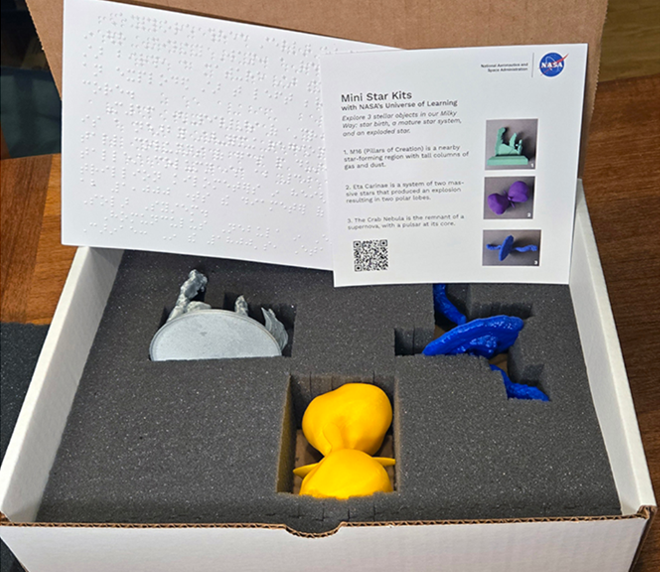
    To bring these powerful experiences to communities across the country, NASA’s Universe of Learning, in collaboration with the Library of Congress, NASA’s Chandra X-ray Observatory, and the Space Telescope Science Institute, has created Mini Stars 3D Kits that explore key stages of stellar evolution. These kits have been distributed to Library of Congress state hubs across the United States to engage local learners through hands-on and multisensory discovery.

    Each Mini Stars Kit includes:

    • Three 3D-printed models of objects within our own Milky Way galaxy:
      • Pillars of Creation (M16/Eagle Nebula) – a stellar nursery where new stars are born
      • Eta Carinae – a massive, unstable star system approaching the end of its life
      • Crab Nebula – the aftermath of a supernova, featuring a dense neutron star at its core
    • Audio files with data sonifications for each object—mathematical translations of telescope data into sound
    • Descriptive text to guide users through each model’s scientific significance and sensory interpretation

    These kits empower people of all ages and abilities to explore the cosmos through touch and sound—turning scientific data into a deeply human experience. Experience your universe through touch and sound at: https://chandra.si.edu/tactile/ministar.html

    Credits:

    3D Prints Credit: NASA/CXC/ K. Arcand, A. Jubett, using software by Tactile Universe/N. Bonne & C. Krawczyk & Blender

    Sonifications: Dr. Kimberly Arcand (CXC), astrophysicist Dr. Matt Russo, and musician Andrew Santaguida (both of the SYSTEM Sounds project)

    3D Model: K. Arcand, R. Crawford, L. Hustak (STScI)

    Photo of the 3D printed mini star kits sent to the Library of Congress state library hubs. The box shows three 3D printed models of stars, and descriptive handouts with text and braille.
    Photo of NASA’s Universe of Learning (UoL) 3D printed mini star kits sent to the Library of Congress state library hubs. The kits include 3D printed models of stars, sonifications, data converted into sound, and descriptive handouts available in both text and braille.

    Details

    Last Updated

    Apr 14, 2025

    Editor
    NASA Science Editorial Team
  • Sculpted by Luminous Stars

    Bright blue stars curve gently toward the center of the image. Nestled around, in front of, and behind the clustered stars are large arcs of dense, reddish-brown dust. Thin, pale-blue wisps of clouds fill the background while denser areas of pinkish clouds appear stacked upon the wispier clouds. Thousands of orange stars are visible in the background behind the clouds of the nebula.
    ESA/Hubble and NASA, A. Nota, P. Massey, E. Sabbi, C. Murray, M. Zamani (ESA/Hubble)

    This new image, released on April 4, 2025, showcases the dazzling young star cluster NGC 346. Although both the James Webb Space Telescope and the Hubble Space Telescope have released images of NGC 346 previously, this image includes new data and is the first to combine Hubble observations made at infrared, optical, and ultraviolet wavelengths into an intricately detailed view of this vibrant star-forming factory.

    Hubble’s exquisite sensitivity and resolution were instrumental in uncovering the secrets of NGC 346’s star formation. Using two sets of observations taken 11 years apart, researchers traced the motions of NGC 346’s stars, revealing them to be spiraling in toward the center of the cluster. This spiraling motion arises from a stream of gas from outside of the cluster that fuels star formation in the center of the turbulent cloud.

    Learn more about NGC 346 and the nebula it has shaped.

    Image credit: ESA/Hubble and NASA, A. Nota, P. Massey, E. Sabbi, C. Murray, M. Zamani (ESA/Hubble)

  • NASA’s Lucy Spacecraft Prepares Second Asteroid Encounter

    NASA’s Lucy spacecraft is 6 days and less than 50 million miles (80 million km) away from its second close encounter with an asteroid; this time, the small main belt asteroid Donaldjohanson.

    Download high-resolution video and images from NASA’s Scientific Visualization Studio.
    NASA/Dan Gallagher

    This upcoming event represents a comprehensive “dress rehearsal” for Lucy’s main mission over the next decade: the exploration of multiple Trojan asteroids that share Jupiter’s orbit around the Sun. Lucy’s first asteroid encounter – a flyby of the tiny main belt asteroid Dinkinesh and its satellite, Selam, on Nov. 1, 2023 – provided the team with an opportunity for a systems test that they will be building on during the upcoming flyby.

    Lucy’s closest approach to Donaldjohanson will occur at 1:51pm EDT on April 20, at a distance of 596 miles (960 km). About 30 minutes before closest approach, Lucy will orient itself to track the asteroid, during which its high-gain antenna will turn away from Earth, suspending communication. Guided by its terminal tracking system, Lucy will autonomously rotate to keep Donaldjohanson in view. As it does this, Lucy will carry out a more complicated observing sequence than was used at Dinkinesh. All three science instruments – the high-resolution greyscale imager called L’LORRI, the color imager and infrared spectrometer called L’Ralph, and the far infrared spectrometer called L’TES – will carry out observation sequences very similar to the ones that will occur at the Trojan asteroids.

    However, unlike with Dinkinesh, Lucy will stop tracking Donaldjohanson 40 seconds before the closest approach to protect its sensitive instruments from intense sunlight.

    “If you were sitting on the asteroid watching the Lucy spacecraft approaching, you would have to shield your eyes staring at the Sun while waiting for Lucy to emerge from the glare. After Lucy passes the asteroid, the positions will be reversed, so we have to shield the instruments in the same way,” said encounter phase lead Michael Vincent of Southwest Research Institute (SwRI) in Boulder, Colorado. “These instruments are designed to photograph objects illuminated by sunlight 25 times dimmer than at Earth, so looking toward the Sun could damage our cameras.” 

    Fortunately, this is the only one of Lucy’s seven asteroid encounters with this challenging geometry. During the Trojan encounters, as with Dinkinesh, the spacecraft will be able to collect data throughout the entire encounter.

    After closest approach, the spacecraft will “pitch back,” reorienting its solar arrays back toward the Sun. Approximately an hour later, the spacecraft will re-establish communication with Earth.

    “One of the weird things to wrap your brain around with these deep space missions is how slow the speed of light is,” continued Vincent. “Lucy is 12.5 light minutes away from Earth, meaning it takes that long for any signal we send to reach the spacecraft. Then it takes another 12.5 minutes before we get Lucy’s response telling us we were heard. So, when we command the data playback after closest approach, it takes 25 minutes from when we ask to see the pictures before we get any of them to the ground.”

    Once the spacecraft’s health is confirmed, engineers will command Lucy to transmit the science data from the encounter back to Earth, which is a process that will take several days.

    Donaldjohanson is a fragment from a collision 150 million years ago, making it one of the youngest main belt asteroids ever visited by a spacecraft. 

    “Every asteroid has a different story to tell, and these stories weave together to paint the history of our solar system,” said Tom Statler, Lucy mission program scientist at NASA Headquarters in Washington. “The fact that each new asteroid we visit knocks our socks off means we’re only beginning to understand the depth and richness of that history. Telescopic observations are hinting that Donaldjohanson is going to have an interesting story, and I’m fully expecting to be surprised – again.”

    NASA’s Goddard Space Flight Center in Greenbelt, Maryland, designed and built the L’Ralph instrument and provides overall mission management, systems engineering and safety and mission assurance for Lucy. Hal Levison of SwRI’s office in Boulder, Colorado, is the principal investigator. SwRI, headquartered in San Antonio, also leads the science team and the mission’s science observation planning and data processing. Lockheed Martin Space in Littleton, Colorado, built the spacecraft, designed the original orbital trajectory and provides flight operations. Goddard and KinetX Aerospace are responsible for navigating the Lucy spacecraft. The Johns Hopkins Applied Physics Laboratory in Laurel, Maryland, designed and built the L’LORRI (Lucy Long Range Reconnaissance Imager) instrument. Arizona State University in Tempe, Arizona, designed and build the L’TES (Lucy Thermal Emission Spectrometer) instrument. Lucy is the thirteenth mission in NASA’s Discovery Program, which is managed by NASA’s Marshall Space Flight Center in Huntsville, Alabama.

    By Katherine Kretke, Southwest Research Institute

    Media Contact:
    Karen Fox / Molly Wasser
    Headquarters, Washington
    202-358-1600
    karen.c.fox@nasa.gov / molly.l.wasser@nasa.gov

    Nancy N. Jones
    NASA’s Goddard Space Flight Center, Greenbelt, Md.

    Details

    Last Updated

    Apr 14, 2025

    Editor
    Madison Olson
    Contact
    Nancy N. Jones
    Location
    Goddard Space Flight Center

  • NASA Sets Coverage for Astronaut Don Pettit, Crewmates Return

    This long-duration photograph highlights the Roscosmos segment of the International Space Station with the Soyuz MS-26 spacecraft docked to the Rassvet module. Star trails and Earth’s atmospheric glow also are pictured from the orbital outpost as it soared 258 miles above the Pacific Ocean.
    Credit: NASA

    NASA astronaut Don Pettit, along with Roscosmos cosmonauts Alexey Ovchinin and Ivan Vagner, will depart the International Space Station aboard the Soyuz MS-26 spacecraft and return to Earth on Saturday, April 19.

    Pettit, Ovchinin, and Vagner will undock from the orbiting laboratory’s Rassvet module at 5:57 p.m. EDT, heading for a parachute-assisted landing at 9:20 p.m. (6:20 a.m. Kazakhstan time, Sunday, April 20) on the steppe of Kazakhstan, southeast of the town of Dzhezkazgan. Landing will occur on Pettit’s 70th birthday.

    NASA’s live coverage of return and related activities will stream on NASA+. Learn how to stream NASA content through a variety of platforms.

    A change of command ceremony also will stream on NASA platforms at 2:40 p.m. Friday, April 18. Ovchinin will handover station command to JAXA (Japan Aerospace Exploration Agency) astronaut Takuya Onishi for Expedition 73, which begins at the time of undocking.

    Spanning 220 days in space, Pettit and his crewmates will have orbited the Earth 3,520 times and completed a journey of 93.3 million miles over the course of their mission. The Soyuz MS-26 spacecraft launched and docked to the station on Sept. 11, 2024.

    This was Pettit’s fourth spaceflight, where he served as flight engineer for Expedition 71 and 72. He has a career total of 590 days in orbit. Ovchinin completed his fourth flight in space, totaling 595 days, and Vagner has earned an overall total of 416 days in space during two trips to the orbiting laboratory.

    After returning to Earth, the three crew members will fly on a helicopter from the landing site to the recovery staging city of Karaganda, Kazakhstan. Pettit will board a NASA plane and return to Houston, while Ovchinin and Vagner will depart for a training base in Star City, Russia.

    NASA’s coverage is as follows (all times Eastern and subject to changed based on real-time operations):

    Friday, April 18:

    2:40 p.m. – Expedition 72/73 change of command ceremony begins on NASA+.

    Saturday, April 19:

    2 p.m. – Farewells and hatch closing coverage begins on NASA+.

    2:25 p.m. – Hatch closing

    5:30 p.m. – Undocking coverage begins on NASA+.

    5:57 p.m. – Undocking

    8 p.m. – Coverage begins for deorbit burn, entry, and landing on NASA+

    8:26 p.m. – Deorbit burn

    9:20 p.m. – Landing

    For more than two decades, people have lived and worked continuously aboard the International Space Station, advancing scientific knowledge, and making research breakthroughs that are not possible on Earth. The station is a critical testbed for NASA to understand and overcome the challenges of long-duration spaceflight and to expand commercial opportunities in low Earth orbit. As commercial companies focus on providing human space transportation services and destinations as part of a robust low Earth orbit economy, NASA is focusing more resources on deep space missions to the Moon as part of Artemis in preparation for future human missions to Mars.

    Learn more about International Space Station research and operations at:

    https://www.nasa.gov/station

    -end-

    Claire O’Shea / Josh Finch
    Headquarters, Washington
    202-358-1100
    claire.a.o’shea@nasa.gov / joshua.a.finch@nasa.gov

    Sandra Jones
    Johnson Space Center, Houston
    281-483-5111
    sandra.p.jones@nasa.gov

    Details

    Last Updated

    Apr 14, 2025

  • With NASA’s Webb, Dying Star’s Energetic Display Comes Into Full Focus

    5 Min Read

    With NASA’s Webb, Dying Star’s Energetic Display Comes Into Full Focus

    What looks like a single large, bright star (but is two) shines with bright purple diffraction spikes at the center of a large, diffuse cylinder of gas and dust that is tipped to the right. At the center is a bright pink clumpy cloud that takes up about 25% of the view. The pink region has some holes and diffuse areas. Beyond that are two large rings seen at a roughly 60-degree angle that appear joined at top left and bottom right. The edges are denser, and form shallow V-shapes that go inward. The rings appear orange at top left and bottom right, and are blue at bottom and center right. There is diffuse orange material around the body. The black background of space is speckled with tiny stars and galaxies mostly in blues and yellows. A bigger blue star with spikes is just below and to the left of the central stars, but it is slightly smaller. Areas Webb did not observe are along the top edges, a thin vertical near the nebula at top left, and at the bottom left and right corners.

    NASA’s James Webb Space Telescope has taken the most detailed image of planetary nebula NGC 1514 to date thanks to its unique mid-infrared observations. Webb shows its rings as intricate clumps of dust. It’s also easier to see holes punched through the bright pink central region.

    Credits:
    NASA, ESA, CSA, STScI, Michael Ressler (NASA-JPL), Dave Jones (IAC)

    Gas and dust ejected by a dying star at the heart of NGC 1514 came into complete focus thanks to mid-infrared data from NASA’s James Webb Space Telescope. Its rings, which are only detected in infrared light, now look like “fuzzy” clumps arranged in tangled patterns, and a network of clearer holes close to the central stars shows where faster material punched through.

    “Before Webb, we weren’t able to detect most of this material, let alone observe it so clearly,” said Mike Ressler, a researcher and project scientist for Webb’s MIRI (Mid-Infrared Instrument) at NASA’s Jet Propulsion Laboratory in southern California. He discovered the rings around NGC 1514 in 2010 when he examined the image from NASA’s Wide-field Infrared Survey Explorer (WISE). “With MIRI’s data, we can now comprehensively examine the turbulent nature of this nebula,” he said.

    This scene has been forming for at least 4,000 years — and will continue to change over many more millennia. At the center are two stars that appear as one in Webb’s observation, and are set off with brilliant diffraction spikes. The stars follow a tight, elongated nine-year orbit and are draped in an arc of dust represented in orange.

    One of these stars, which used to be several times more massive than our Sun, took the lead role in producing this scene. “As it evolved, it puffed up, throwing off layers of gas and dust in in a very slow, dense stellar wind,” said David Jones, a senior scientist at the Institute of Astrophysics on the Canary Islands, who proved there is a binary star system at the center in 2017.

    Once the star’s outer layers were expelled, only its hot, compact core remained. As a white dwarf star, its winds both sped up and weakened, which might have swept up material into thin shells.

    Image A: Planetary Nebula NGC 1514 (MIRI Image)

    What looks like a single large, bright star (but is two) shines with bright purple diffraction spikes at the center of a large, diffuse cylinder of gas and dust that is tipped to the right. At the center is a bright pink clumpy cloud that takes up about 25% of the view. The pink region has some holes and diffuse areas. Beyond that are two large rings seen at a roughly 60-degree angle that appear joined at top left and bottom right. The edges are denser, and form shallow V-shapes that go inward. The rings appear orange at top left and bottom right, and are blue at bottom and center right. There is diffuse orange material around the body. The black background of space is speckled with tiny stars and galaxies mostly in blues and yellows. A bigger blue star with spikes is just below and to the left of the central stars, but it is slightly smaller. Areas Webb did not observe are along the top edges, a thin vertical near the nebula at top left, and at the bottom left and right corners.
    NASA’s James Webb Space Telescope has taken the most detailed image of planetary nebula NGC 1514 to date thanks to its unique mid-infrared observations. Webb shows its rings as intricate clumps of dust. It’s also easier to see holes punched through the bright pink central region.
    NASA, ESA, CSA, STScI, Michael Ressler (NASA-JPL), Dave Jones (IAC)

    Image B: Planetary Nebula NGC 1514 (WISE and Webb Images Side by Side)

    Two views of the same planetary nebula cataloged NGC 1514, split down the middle. Both show roughly the same features, an outline of a cylinder tipped to the right with a large blob of material in the middle. At the center of the blob is a bright star. At left is the Wide-field Infrared Survey Explorer (WISE) view. The outlines of the cylinder are orange and thicker, and within it is a bright green irregular cloud with a larger blue central star. This view has hazier lines, and colors that appear to bleed into one another. At right is the view from the James Webb Space Telescope. The outline of the cylinder is clearer with crisp, wispy details. Where the cylinder appears to connect at top left and bottom right, the outline forms shallow V-shapes. It’s a lot easier to see where material begins, ends, and overlaps. In both images, the background of space is black. The WISE image shows bright blue orbs. The Webb image shows tiny pinpoints of light.
    Two infrared views of NGC 1514. At left is an observation from NASA’s Wide-field Infrared Survey Explorer (WISE). At right is a more refined image from NASA’s James Webb Space Telescope.
    NASA, ESA, CSA, STScI, NASA-JPL, Caltech, UCLA, Michael Ressler (NASA-JPL), Dave Jones (IAC)

    Its Hourglass Shape

    Webb’s observations show the nebula is tilted at a 60-degree angle, which makes it look like a can is being poured, but it’s far more likely that NGC 1514 takes the shape of an hourglass with the ends lopped off. Look for hints of its pinched waist near top left and bottom right, where the dust is orange and drifts into shallow V-shapes.

    What might explain these contours? “When this star was at its peak of losing material, the companion could have gotten very, very close,” Jones said. “That interaction can lead to shapes that you wouldn’t expect. Instead of producing a sphere, this interaction might have formed these rings.”

    Though the outline of NGC 1514 is clearest, the hourglass also has “sides” that are part of its three-dimensional shape. Look for the dim, semi-transparent orange clouds between its rings that give the nebula body.

    A Network of Dappled Structures

    The nebula’s two rings are unevenly illuminated in Webb’s observations, appearing more diffuse at bottom left and top right. They also look fuzzy, or textured. “We think the rings are primarily made up of very small dust grains,” Ressler said. “When those grains are hit by ultraviolet light from the white dwarf star, they heat up ever so slightly, which we think makes them just warm enough to be detected by Webb in mid-infrared light.”

    In addition to dust, the telescope also revealed oxygen in its clumpy pink center, particularly at the edges of the bubbles or holes.

    NGC 1514 is also notable for what is absent. Carbon and more complex versions of it, smoke-like material known as polycyclic aromatic hydrocarbons, are common in planetary nebulae (expanding shells of glowing gas expelled by stars late in their lives). Neither were detected in NGC 1514. More complex molecules might not have had time to form due to the orbit of the two central stars, which mixed up the ejected material. A simpler composition also means that the light from both stars reaches much farther, which is why we see the faint, cloud-like rings.

    What about the bright blue star to the lower left with slightly smaller diffraction spikes than the central stars? It’s not part of this nebula. In fact, this star lies closer to us.

    This planetary nebula has been studied by astronomers since the late 1700s. Astronomer William Herschel noted in 1790 that NGC 1514 was the first deep sky object to appear genuinely cloudy — he could not resolve what he saw into individual stars within a cluster, like other objects he cataloged. With Webb, our view is considerably clearer.

    NGC 1514 lies in the Taurus constellation approximately 1,500 light-years from Earth.

    The James Webb Space Telescope is the world’s premier space science observatory. Webb will solve mysteries in our solar system, look beyond to distant worlds around other stars, and probe the mysterious structures and origins of our universe and our place in it. Webb is an international program led by NASA with its partners, ESA (European Space Agency) and the Canadian Space Agency.

    To learn more about Webb, visit: https://science.nasa.gov/webb

    Downloads

    Click any image to open a larger version.

    View/Download all image products at all resolutions for this article from the Space Telescope Science Institute.

    Media Contacts

    Laura Betz – laura.e.betz@nasa.gov
    NASA’s Goddard Space Flight Center, Greenbelt, Md.

    Claire Blomecblome@stsci.edu
    Space Telescope Science Institute, Baltimore, Md.

    Christine Pulliamcpulliam@stsci.edu
    Space Telescope Science Institute, Baltimore, Md.

    Science Advisor

    Michael Ressler (NASA-JPL)

    Read more about other planetary nebulae

    Watch: ViewSpace video about planetary nebulae

    View images of other planetary nebulae on AstroPix

    More Webb News

    More Webb Images

    Webb Science Themes

    Webb Mission Page

    What is the Webb Telescope?

    SpacePlace for Kids

    En Español

    Ciencia de la NASA

    NASA en español 

    Space Place para niños

  • NASA Announces Call for New Computing Approaches to Earth Science

    A geometric image of dark blue in the background. Waves of pixelated light blue and teal are in the foreground, creating an almost digital-looking cloud.

    In an open challenge, NASA is seeking innovative business models that propose new approaches to solving complex Earth science problems using unconventional computing methods and is holding an informational webinar on Monday, April 28.  

    The agency’s Beyond the Algorithm Challenge, sponsored by NASA’s Earth Science Technology Office, asks for proposals to more rapidly and accurately understand our home planet using transformative computing methods such as quantum computing, quantum machine learning, neuromorphic computing, in-memory computing, or other approaches.  

    The Beyond the Algorithm Challenge kicked off in March and consists of three phases. Participant submissions, which are due on July 25, will be evaluated based on creativity, technical feasibility, impact, business model evaluation, and presentation. Up to 10 finalists will be invited to present their ideas to a panel of judges at a live pitch event, and winners will a monetary prize.  

    For details about the challenge, interested participants can sign up for the informational webinar on Monday, April 28, here

    Using the vantage point of space, NASA’s observations of Earth increase our understanding of our home planet, improve lives, and safeguard our future. The capabilities of NASA’s Earth Science Division include developing new technology, delivering actionable science, and providing environmental information to meet the increased demand for more sophisticated, more accurate, more trustworthy, and more actionable environmental information for decision-makers and policymakers.  

    For example, rapid flood analysis is one area that may benefit from computing advancements. Flood hazards affect personal safety and land use, directly affecting individual livelihoods, community property, and infrastructure development and resilience. Advanced flood analysis capability enables contributions to protect and serve impacted communities, making a tangible difference in areas such as disaster preparedness, recovery, and resilience.  

    Advancements in computing capabilities show promise in overcoming processing power, efficiency, and performance limitations of conventional computing methods in addressing Earth science challenges like rapid flood analysis. Quantum computers offer a fundamentally different paradigm of computation and can solve certain classes of problems exponentially faster than their classical counterparts. Likewise, quantum machine learning offers the potential to reduce required training data or produce more accurate models. The emerging field of neuromorphic, or brain-inspired, computing holds significant promise for algorithm development optimized for high-speed, low power. And in-memory computing saves time and energy for data-heavy processes like artificial intelligence training. 

    Blue Clarity is hosting the Beyond the Algorithm Challenge on behalf of NASA. The NASA Tournament Lab, part of the Prizes, Challenges, and Crowdsourcing program in the Space Technology Mission Directorate, manages the challenge. The program supports global public competitions and crowdsourcing as tools to advance NASA research and development and other mission needs. 

    For more information about the contest and a full list of rules and eligibility requirements, visit:  

    https://www.nasa-beyond-challenge.org

  • Sols 4507-4508: “Just Keep Driving”

    2 min read

    Sols 4507-4508: “Just Keep Driving”

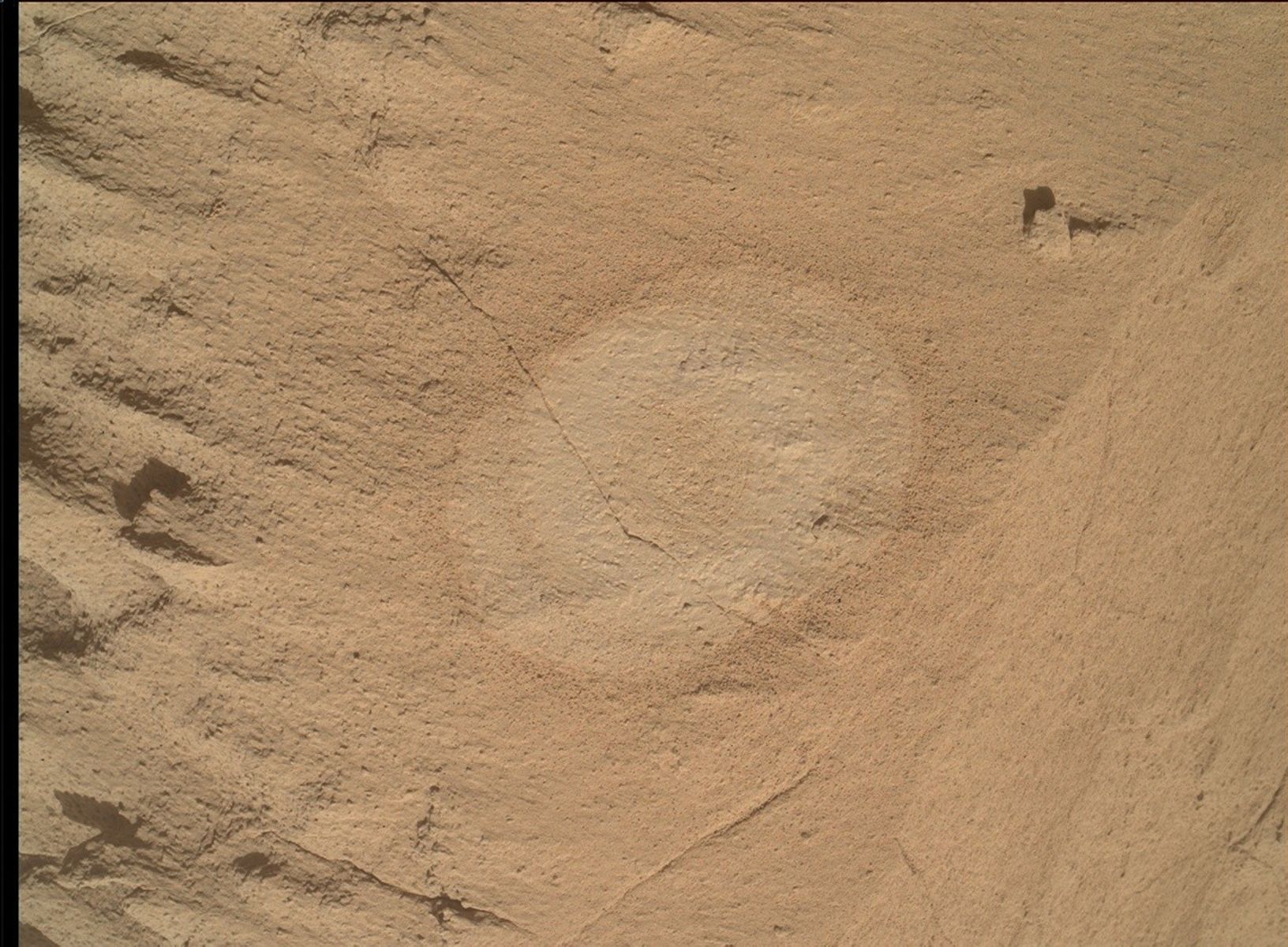
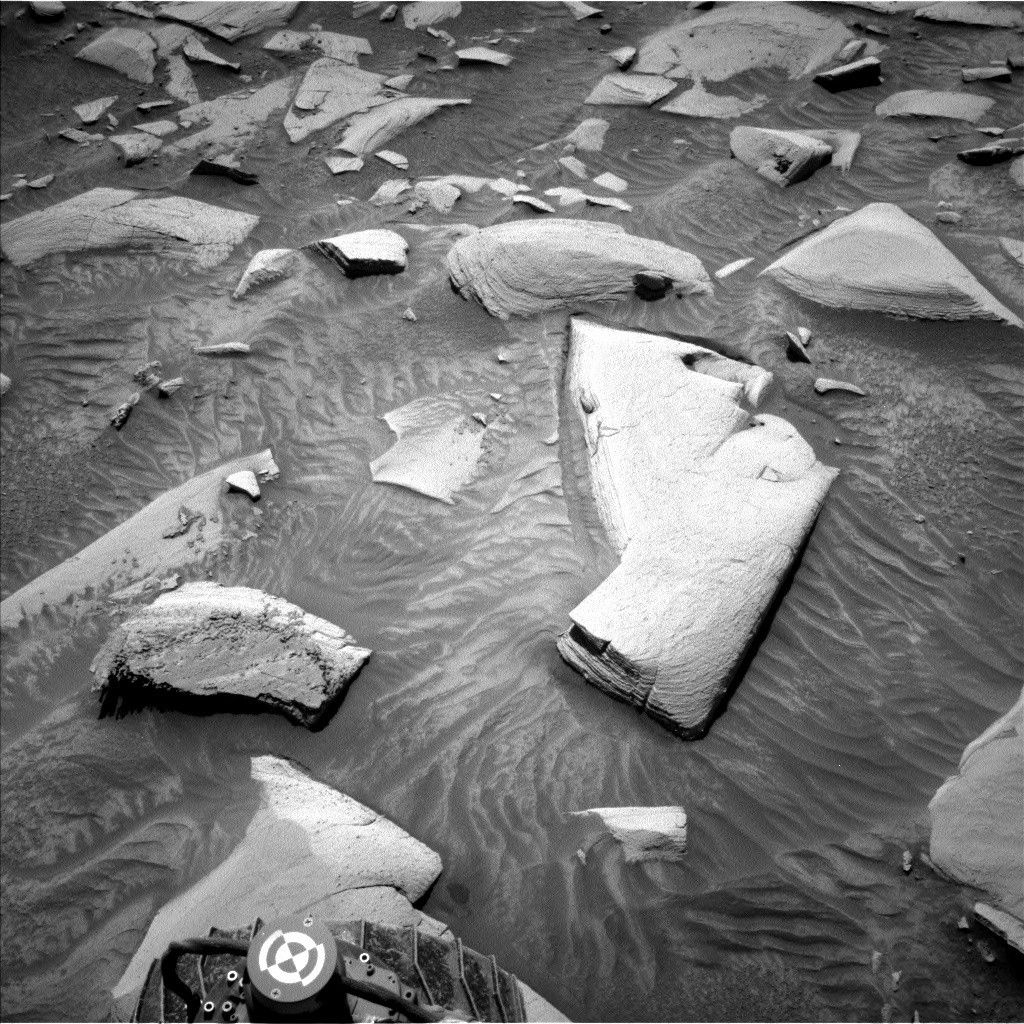
    NASA's Mars rover Curiosity acquired this image using its Mars Hand Lens Imager
    NASA’s Mars rover Curiosity acquired this image using its Mars Hand Lens Imager (MAHLI), located on the turret at the end of the rover’s robotic arm, on April 9, 2025, Sol 4505 of the Mars Science Laboratory Mission, at 00:56:30 UTC.
    NASA/JPL-Caltech/MSSS

    Written by Natalie Moore, Mission Operations Specialist at Malin Space Science Systems

    Earth planning date: Wednesday, April 9, 2025

    Our drive from Monday’s plan was mostly successful, putting us ~22 meters down the “road” out of an expected 30 meters. A steering command halted the drive a little short when we tried to turn-in-place but instead turned into a rock, which also had the effect of making our position too unstable for arm activities. Oh well! APXS data has been showing the recent terrain as being pretty similar in composition, so the team isn’t complaining about trying again after another drive. Plus, keeping the arm stowed should give us a little more power to play with in the coming sols (an ongoing struggle this Martian winter).

    Recently, my job on Mastcam has been to make sure our science imaging is as concurrent as possible with required rover activities. This strategy helps save rover awake time, AKA power consumption. Today we did a pretty good job with this, only increasing the total awake time by ~2 minutes even though we planned 52 images! Our imaging today included a mosaic of the “Devil’s Gate” ridge including some nodular bedrock and distant “Torote Bowl,” a mosaic of a close-by vein network named “Moonstone Beach,” and several sandy troughs surrounding the bedrock blocks we see here. 

    ChemCam is planning a LIBS raster on a vertical vein in our workspace named “Jackrabbit Flat,” and a distant RMI mosaic of “Condor Peak” (a butte to the north we’re losing view of). Our drive will happen in the 1400 hour on the first sol, hopefully landing us successfully 53 meters further into this new valley on our way to the boxwork structures to the west! Post-drive, we’re including a test of a “Post Traverse Autonav Terrain Observation” AKA PoTATO – an easy drop-in activity for ground analysis of a rover-built navigation map of our new terrain. Plus we get to say PoTATO a lot.

  • NASA-Developed Tools at Marshall Support Operations to Space Station

    3 min read

    Preparations for Next Moonwalk Simulations Underway (and Underwater)

    Three men standing inside a computer room reviewing information on a computer screen.
    From left, Ramon Pedoto, Nathan Walkenhorst, and Tyrell Jemison review information at NASA’s Marshall Space Flight Center in Huntsville, Alabama. The three team members developed new automation tools at Marshall for flight controllers working with the International Space Station (Credit:
    NASA/Tyrell Jemison

    Two new automation tools developed at NASA’s Marshall Space Flight Center in Huntsville, Alabama, are geared toward improving operations for flight controllers working with the International Space Station from the Huntsville Operations Support Center.

    The tools, called AutoDump and Permanently Missing Intervals Checker, will free the flight control team to focus on situational awareness, anomaly response, and real-time coordination.

    The space station experiences routine loss-of-signal periods based on communication coverage as the space station orbits the Earth. When signal is lost, an onboard buffer records data that could not be downlinked during that period. Following acquisition of signal, flight controllers previously had to send a command to downlink, or “dump,” the stored data.

    The AutoDump tool streamlines a repetitive data downlinking command from flight controllers by detecting a routine loss-of-signal, and then autonomously sending the command to downlink data stored in the onboard buffer when the signal is acquired again. Once the data has been downlinked, the tool will automatically make an entry in the console log to confirm the downlink took place.

    “Reliably and quickly sending these dump commands is important to ensure that space station payload developers can operate from the most current data,” said Michael Zekoff, manager of Space Systems Operations at Marshall.

    As a direct result of this tool, we have eliminated the need to manually perform routine data dump commands by as much as 40% for normal operations.

    Michael Zekoff

    Michael Zekoff

    Space Systems Operations Manager

    AutoDump was successfully deployed on Feb. 4 in support of the orbiting laboratory.

    The other tool, known as the Permanently Missing Intervals Checker, is another automated process coming online that will improve team efficiency.

    Permanently missing intervals are gaps in the data stream where data can be lost due to a variety of reasons, including network fluctuations. The missing intervals are generally short but are documented so the scientific community and other users have confirmation that the missing data is unable to be recovered.

    “The process of checking for and documenting permanently missing intervals is challenging and incredibly time-consuming to make sure we capture all the payload impacts,” said Nathan Walkenhorst, a NASA contractor with Bailey Collaborative Solutions who serves as a flight controller specialist.

    The checker will allow NASA to quickly gather and assess payload impacts, reduce disruptions to operations, and allow researchers to get better returns on their science investigations. It is expected to be deployed later this year.

    In addition to Walkenhorst, Zekoff also credited Ramon Pedoto, a software architect, and Tyrell Jemison, a NASA contractor and data management coordinator with Teledyne Brown Engineering Inc, for their work in developing the automation tools. The development of the tools also requires coordination between flight control and software teams at Marshall, followed by extensive testing in both simulated and flight environments, including spacecraft operations, communications coverage, onboard anomalies, and other unexpected conditions.

    “The team solicited broad review to ensure that the tool would integrate correctly with other station systems,” Zekoff said. “Automated tools are evaluated carefully to prevent unintended commanding or other consequences. Analysis of the tools included thorough characterization of the impacts, risk mitigation strategies, and approval by stakeholders across the International Space Station program.”

    The Huntsville Operations Support Center provides payload, engineering, and mission operations support to the space station, the Commercial Crew Program, and Artemis missions, as well as science and technology demonstration missions. The Payload Operations Integration Center within the Huntsville Operations Support Center operates, plans, and coordinates the science experiments onboard the space station 365 days a year, 24 hours a day.

    For more information on the International Space Station, visit:

    www.nasa.gov/international-space-station/

    Details

    Last Updated

    Apr 11, 2025

    Editor
    Beth Ridgeway

  • GLOBE Mission Earth Supports Career Technical Education

    4 min read

    GLOBE Mission Earth Supports Career Technical Education

    The NASA Science Activation program’s GLOBE Mission EARTH (GME) project is forging powerful connections between career technical education (CTE) programs and real-world science, inspiring students across the United States to pursue careers in Science, Technology, Engineering, and Mathematics (STEM).

    GME is a collaborative effort between NASA scientists, educators, and schools that brings NASA Earth science and the GLOBE Program into classrooms to support hands-on, inquiry-based learning. GLOBE (Global Learning and Observations to Benefit the Environment) is an international science and education program that provides students and the public with the opportunity to participate in data collection and the scientific process, contributing meaningfully to our understanding of the Earth system.

    By connecting students directly to environmental research and NASA data, GME helps make science more relevant, engaging, and applicable to students’ futures. In CTE programs—where project-based and work-based learning are key instructional strategies—GME’s integration of GLOBE protocols offers students the chance to develop not only technical skills, but also essential data literacy and professional competencies like collaboration, critical thinking, and communication. These cross-cutting skills are valuable across a wide range of industries, from agriculture and advanced manufacturing to natural resources and public safety.

    The real-world, hands-on approach of CTE makes it an ideal setting for implementing GLOBE to support STEM learning across industries. At Skyline High School in Oakland, California, for example, GLOBE has been embedded in multiple courses within the school’s Green Energy Pathway, originally launched by GLOBE partner Tracy Ostrom. Over the past decade, nearly 1,000 students have participated in GLOBE activities at Skyline. Many of these students describe their experiences with environmental data collection and interactions with NASA scientists as inspiring and transformative. Similarly, at Toledo Technology Academy, GME is connecting students with NASA science and renewable energy projects—allowing them to study how solar panels impact their local environment and how weather conditions affect wind energy generation.

    To expand awareness of how GLOBE can enhance CTE learning and career preparation, WestEd staff Svetlana Darche and Nico Janik presented at the Educating for Careers Conference on March 3, 2025, in Sacramento, California. This event, sponsored by the California chapter of the Association for Career and Technical Education (ACTE), brought together over 2,600 educators dedicated to equipping students with the tools they need to succeed in an evolving job market. Darche and Janik’s session, titled “Developing STEM Skills While Contributing to Science,” showcased GLOBE’s role in work-based learning and introduced new federal definitions from the Carl D. Perkins Act (Perkins V) that emphasize:

    • Interactions with industry professionals
    • A direct link to curriculum and instruction
    • First-hand engagement with real-world tasks in a given career field

    GLOBE’s approach to scientific data collection aligns perfectly with these criteria. Janik led 40 educators through a hands-on experience using the GLOBE Surface Temperature Protocol, demonstrating how students investigate the Urban Heat Island Effect while learning critical technical and analytical skills. By collecting and analyzing real-world data, students gain firsthand experience with the tools and methods used by scientists, bridging the gap between classroom learning and future career opportunities.

    Through GME’s work with CTE programs, students are not only learning science—they are doing science. These authentic experiences inspire, empower, and prepare students for careers where data literacy, scientific inquiry, and problem-solving are essential. With ongoing collaborations between GLOBE, NASA, and educators nationwide, the next generation of STEM professionals is already taking shape—one real-world investigation at a time.

    GME is supported by NASA under cooperative agreement award number NNX16AC54A and is part of NASA’s Science Activation Portfolio. Learn more about how Science Activation connects NASA science experts, real content, and experiences with community leaders to do science in ways that activate minds and promote deeper understanding of our world and beyond: https://science.nasa.gov/learn

    Teacher using PowerPoint to talk about the Green Energy Pathway CTE program developed by Tracy Ostrom.
    GreenEnergyPathway presenting the Green Energy Pathway CTE program.

    Details

    Last Updated

    Apr 11, 2025

    Editor
    NASA Science Editorial Team