Tag: solar system

  • NASA’s Webb Telescope Improves Simulation Software

    5 min read

    NASA’s Webb Telescope Improves Simulation Software

    Stars forming in space with brilliant colors.
    The James Webb Space Telescope captures a tightly bound pair of actively forming stars, known as Herbig-Haro 46/47, in high-resolution near-infrared light.

    The James Webb Space Telescope truly explores the unknown, displaying stunning images of previously unseen corners of the universe only possible because of the telescope’s 21-foot segmented mirror that unfurled and assembled itself in space.

    Decades of testing went into the materials, design, and processes needed to develop the largest telescope in space. However, the whole project was too complex to test on the ground, at scale, at minus 400 degrees Fahrenheit, and in other space-like conditions.

    Instead, engineers relied on software simulations to understand how the telescope would behave under different in-space conditions, and that work has helped advance the whole field of integrated computer modeling.

    Animation of the OpticStudio software package.
    The Ansys Zemax OpticStudio software package, pictured here in a demo of James Webb Space Telescope mirror modeling, was equipped with new capabilities and features as a result of being used in the observatory’s development.
    Ansys Inc.

    “We pushed everything, all the simulation, just as hard as it would go,” said Erin Elliott, an optical engineer at Ansys, Inc., which makes Ansys Zemax OpticStudio, one of the design software suites used to develop hardware and software for the Webb telescope.

    Simulation technology has improved dramatically over the last two decades because of increases in computing power and new ways of accessing offsite computing power as a cloud service. But additional improvements trace back directly to Webb’s development.

    Elliott used OpticStudio to support the Webb telescope while working for other NASA contractors, beginning in the early 2000s, before starting work in 2015 for Zemax ¬– which later became Ansys Zemax ¬– headquartered in Canonsburg, Pennsylvania.

    In the early days, Elliott said, Zemax tweaked its software for the Webb telescope effort. “They made some specific changes for us at the time having to do with handling the coordinate systems of the segments,” she said, referring to the 18 hexagonal segments that make up the telescope’s primary mirror.

    Elliott also recalled talking to Zemax leadership numerous times about the need for the software to communicate better with other Microsoft Windows programs. The company introduced an API, or application programming interface, for OpticStudio, which enables the suite to work with other programs and allows for further customization. There were plenty of reasons to add that technology but Webb demands were likely significant among them, Elliott said.

    Engineer examining telescope mirror.
    An engineer examines the Webb telescope primary mirror Engineering Design Unit segment in the clean room at NASA’s Goddard Space Flight Center.
    NASA

    Joseph Howard, an optical engineer at NASA’s Goddard Space Flight Center in Greenbelt, Maryland, where Webb and its science instrument module were assembled, noted that using several modeling packages helped drive innovation in the field. “It’s important to have multiple software companies out there that can help you not only for cross-checking the modeling, but because they make each other better through competition,” he said.

    In addition to improvements made to OpticStudio during Webb telescope development, Ansys Zemax in 2021 introduced the Structural, Thermal, Analysis, and Results (STAR) module, which benefited from the knowledge Elliott gained working on the NASA project.

    Telescope mirror testing.
    The first six flight-ready James Webb Space Telescope primary mirror segments are prepped to begin final cryogenic testing at NASA’s Marshall Space Flight Center.
    NASA

    When a mirror or lens changes shape due to temperature swings, the optics move. Much of the OpticStudio modeling was completed in smaller pieces — engineers would run a thermal simulation independently and add that data to the next optical model, generating more data for the next run.

    The STAR module incorporates analyses from other simulation software directly into OpticStudio optical models — an efficiency applicable to telescope and aerospace designs. This feature is also increasingly important for autonomous vehicles, cell phone lenses, and other optics working in tough environments.

    Future telescopes and other spacecraft are likely to involve elements of the Webb design. More will travel in segments that must self-assemble in space, and the development of the increasingly complicated robotics and optics will rely on improved modeling software.
    “When we built Webb, we knew we couldn’t fully test it on the ground prior to flight, so we depended a whole lot upon modeling and doing analysis to get ready for flight,” Howard said. “The next great observatory will be even more dependent on modeling software.”
    Meanwhile, designers of more earthly technologies are already seeing the benefits of an improved OpticStudio, using it to design precision endoscopes, a thermal imager to detect COVID-19 exposures in a crowd, augmented reality displays and headsets, a laser thruster technology for nanosatellites, and, of course, more telescopes.
    Elliott also noted that the Webb telescope project trained the next cohort of telescope and optical device builders – those designing and using the telescope’s technological spinoffs.
    “The people who built the Hubble Space Telescope were leading the Webb Telescope,” she said. “And now the younger engineers who cut our teeth on this project and learned from it are becoming the group of people who will build the next structures.”
    Elliott maintains that the project “was worth it alone for training this huge cohort of young engineers and releasing them into high-tech fields.”

    NASA has a long history of transferring technology to the private sector. The agency’s Spinoff publication profiles NASA technologies that have transformed into commercial products and services, demonstrating the broader benefits of America’s investment in its space program. Spinoff is a publication of the Technology Transfer program in NASA’s Space Technology Mission Directorate (STMD).

    For more information on how NASA brings space technology down to Earth, visit:

    www.spinoff.nasa.gov

    Details

    Last Updated

    Oct 31, 2023

    Editor

    Loura Hall

    Contact

    Ann M. Harkey
    ann.m.harkey@nasa.gov

  • Salts and Organics Observed on Ganymede’s Surface by NASA’s Juno

    Data collected by NASA’s Juno mission indicates a briny past may be bubbling to the surface on Jupiter’s largest moon.

    NASA’s Juno mission has observed mineral salts and organic compounds on the surface of Jupiter’s moon Ganymede. Data for this discovery was collected by the Jovian InfraRed Auroral Mapper (JIRAM) spectrometer aboard the spacecraft during a close flyby of the icy moon. The findings, which could help scientists better understand the origin of Ganymede and the composition of its deep ocean, were published on Oct. 30 in the journal Nature Astronomy.

    Larger than the planet Mercury, Ganymede is the biggest of Jupiter’s moons and has long been of great interest to scientists due to the vast internal ocean of water hidden beneath its icy crust. Previous spectroscopic observations by NASA’s Galileo spacecraft and Hubble Space Telescope as well as the European Southern Observatory’s Very Large Telescope hinted at the presence of salts and organics, but the spatial resolution of those observations was too low to make a determination.

    Processed data from the Jovian InfraRed Auroral Mapper (JIRAM) spectrometer
    Processed data from the Jovian InfraRed Auroral Mapper (JIRAM) spectrometer aboard NASA’s Juno mission is superimposed on a mosaic of optical images from the agency’ s Galileo and Voyager spacecraft that show grooved terrain on Jupiter’s moon Ganymede.
    NASA/JPL-Caltech/SwRI/ASI/INAF/JIRAM/Brown University

    On June 7, 2021, Juno flew over Ganymede at a minimum altitude of 650 miles (1,046 kilometers). Shortly after the time of closest approach, the JIRAM instrument acquired infrared images and infrared spectra (essentially the chemical fingerprints of materials, based on how they reflect light) of the moon’s surface. Built by the Italian Space Agency, Agenzia Spaziale Italiana, JIRAM was designed to capture the infrared light (invisible to the naked eye) that emerges from deep inside Jupiter, probing the weather layer down to 30 to 45 miles (50 to 70 kilometers) below the gas giant’s cloud tops. But the instrument has also been used to offer insights into the terrain of moons Io, Europa, Ganymede, and Callisto (known collectively as the Galilean moons for their discoverer, Galileo).

    The JIRAM data of Ganymede obtained during the flyby achieved an unprecedented spatial resolution for infrared spectroscopy – better than 0.62 miles (1 kilometer) per pixel. With it, Juno scientists were able to detect and analyze the unique spectral features of non-water-ice materials, including hydrated sodium chloride, ammonium chloride, sodium bicarbonate, and possibly aliphatic aldehydes.

    “The presence of ammoniated salts suggests that Ganymede may have accumulated materials cold enough to condense ammonia during its formation,” said Federico Tosi, a Juno co-investigator from Italy’s National Institute for Astrophysics in Rome and lead author of the paper. “The carbonate salts could be remnants of carbon dioxide-rich ices.”

    Exploring Other Jovian Worlds

    Previous modeling of Ganymede’s magnetic field determined the moon’s equatorial region, up to a latitude of about 40 degrees, is shielded from the energetic electron and heavy ion bombardment created by Jupiter’s hellish magnetic field. The presence of such particle fluxes is well known to negatively impact salts and organics.

    During the June 2021 flyby, JIRAM covered a narrow range of latitudes (10 degrees north to 30 degrees north) and a broader range of longitudes (minus 35 degrees east to 40 degrees east) in the Jupiter-facing hemisphere.

    “We found the greatest abundance of salts and organics in the dark and bright terrains at latitudes protected by the magnetic field,” said Scott Bolton, Juno’s principal investigator from the Southwest Research Institute in San Antonio. “This suggests we are seeing the remnants of a deep ocean brine that reached the surface of this frozen world.”

    Ganymede is not the only Jovian world Juno has flown by. The moon Europa, thought to harbor an ocean under its icy crust, also came under Juno’s gaze, first in October 2021 and then in September 2022. Now Io is receiving the flyby treatment. The next close approach to that volcano-festooned world is scheduled for Dec. 30, when the spacecraft will come within 932 miles (1,500 kilometers) of Io’s surface.

    More About the Mission

    NASA’s Jet Propulsion Laboratory, a division of Caltech in Pasadena, California, manages the Juno mission for the principal investigator, Scott Bolton, of the Southwest Research Institute in San Antonio. Juno is part of NASA’s New Frontiers Program, which is managed at NASA’s Marshall Space Flight Center in Huntsville, Alabama, for the agency’s Science Mission Directorate in Washington. The Italian Space Agency (ASI) funded the Jovian InfraRed Auroral Mapper. Lockheed Martin Space in Denver built and operates the spacecraft.

    More information about Juno is available at:

    https://www.nasa.gov/juno

    News Media Contacts

    DC Agle
    Jet Propulsion Laboratory, Pasadena, Calif.
    818-393-9011
    agle@jpl.nasa.gov

    Karen Fox / Alana Johnson
    NASA Headquarters, Washington
    301-286-6284 / 202-358-1501
    karen.c.fox@nasa.gov / alana.r.johnson@nasa.gov

    Deb Schmid
    Southwest Research Institute, San Antonio
    210-522-2254
    dschmid@swri.org

    Marco Galliani
    National Institute for Astrophysics
    +39 06 355 33 390
    Marco.galliani@inaf.it

    2023-157

  • 25 Years Ago: STS-95, John Glenn Returns to Space

    On Oct. 29, 1998, NASA astronaut John H. Glenn made history again when he returned to space aboard space shuttle Discovery’s STS-95 mission, nearly 37 years after becoming the first American in orbit during his February 1962 Friendship 7 mission. The seven-member STS-95 crew consisted of Commander Curtis L. Brown, Pilot Steven W. Lindsey, Mission Specialists Stephen K. Robinson, Dr. Scott E. Parazynski, and Pedro F. Duque of the European Space Agency, and Payload Specialists Dr. Chiaki Mukai of the National Space Development Agency of Japan, now the Japan Aerospace Exploration Agency, and Glenn, who at age 77 became the oldest person to orbit the Earth, a record that stands to this day. During the nine-day mission, they conducted more than 80 experiments, many of them to study how exposure to weightlessness might relate to the aging process.

    The STS-95 crew during their introductory press conference President William J. “Bill” Clinton introduces the STS-95 crew
    Left: The STS-95 crew during their introductory press conference. Right: President William J. “Bill” Clinton introduces the STS-95 crew, including Senator John H. Glenn, during a ceremony at NASA’s Johnson Space Center in Houston.

    Glenn, whom NASA essentially grounded after his historic 1962 mission for fear of losing a national hero in a spaceflight accident, had always dreamed of returning to space. Upon learning about the physiological changes that occur during spaceflight, and how they somewhat resemble those brought about by aging, now Senator Glenn began lobbying NASA Administrator Daniel S. Goldin for an opportunity to put that theory to the test, by volunteering himself as a subject. Goldin agreed in principle, providing Glenn passed the same physicals as all the other astronauts and that the flight included valuable peer-reviewed research. Glenn did, and teams at NASA working with the National Institutes of Health’s National Institute on Aging to put together a research program of experiments to study bone and muscle loss, balance disorders, sleep disturbances, and changes in the immune system. In addition, the mission conducted other experiments in fields such as materials processing, protein crystal growth, cell biology, and plant growth. Also part of the mission, the SPARTAN 201-5 free-flyer pallet carried instruments to study the Sun’s corona and the solar wind. On Jan. 16, 1998, NASA announced that Glenn would fly as a payload specialist on STS-95. On Feb. 13, the agency announced the rest of the STS-95 crew, who held a press conference at NASA’s Johnson Space Center (JSC) on Feb. 20, coincidentally the 36th anniversary of Glenn’s Friendship 7 flight. During a visit to JSC on April 14, President William J. “Bill” Clinton introduced the STS-95 astronauts.

    STS-95 astronauts Steven W. Lindsey, seated left, and Curtis L. Brown; Scott E. Parazynski, standing left, Stephen K. Robinson, Chiaki Mukai of the National Space Development Agency of Japan, now the Japan Aerospace Exploration Agency, Pedro F. Duque of the European Space Agency, and John H. Glenn The STS-95 crew patch Liftoff of space shuttle Discovery on the STS-95 mission, returning Glenn to orbit
    Left: STS-95 astronauts Steven W. Lindsey, seated left, and Curtis L. Brown; Scott E. Parazynski, standing left, Stephen K. Robinson, Chiaki Mukai of the National Space Development Agency of Japan, now the Japan Aerospace Exploration Agency, Pedro F. Duque of the European Space Agency, and John H. Glenn. Middle: The STS-95 crew patch. Right: Liftoff of space shuttle Discovery on the STS-95 mission, returning Glenn to orbit.

    Space shuttle Discovery’s 25th liftoff took place at 2:19 p.m. EDT on Oct. 29, 1998, from Launch Pad 39B at NASA’s Kennedy Space Center (KSC) in Florida, carrying a double Spacehab module filled with scientific equipment. Brown, making his fifth trip into space and second as commander, and Pilot Lindsey on his second launch, monitored Discovery’s systems as they climbed into orbit, assisted by Mission Specialist Parazynski, a physician making his third trip into space, serving as the flight engineer. Mission Specialist Duque accompanied them on the flight deck. Mission Specialist Robinson, on his second mission, and Payload Specialists Mukai, also a physician and on her second trip to space, and Glenn experienced launch in the shuttle’s middeck.

    View of the Spacehab module and the Canadian robotic arm in Discovery’s payload bay The crew’s first view of the interior of the Spacehab module Chiaki Mukai, left, and Stephen K. Robinson begin activating the Spacehab
    Left: View of the Spacehab module and the Canadian robotic arm in Discovery’s payload bay. Middle: The crew’s first view of the interior of the Spacehab module. Right: Chiaki Mukai, left, and Stephen K. Robinson begin activating the Spacehab.

    Upon reaching orbit, the crew opened the payload bay doors, thus deploying the shuttle’s radiators. Shortly after, the crew opened the hatch from the shuttle’s middeck, translated down the transfer tunnel, and entered Spacehab for the first time, activating the module and turning on the first experiments. These included the life sciences experiments that Glenn conducted to compare the effects of weightlessness and aging.

    Physician astronaut Dr. Scott E. Parazynski, left, prepares to draw a blood sample from John H. Glenn Glenn, left, and Parazynski prepare to centrifuge the collected blood sample Glenn, instrumented for a sleep study, prepares to begin his sleep period
    Left: Physician astronaut Dr. Scott E. Parazynski, left, prepares to draw a blood sample from John H. Glenn. Middle: Glenn, left, and Parazynski prepare to centrifuge the collected blood sample. Right: Glenn, instrumented for a sleep study, prepares to begin his sleep period.

    The STS-95 astronauts use the Canadian-built Remote Manipulator system, or robotic arm, to release the SPARATAN 201-5 free flyer Stephen K. Robinson operates the RMS to retrieve the SPARTAN after its four-day autonomous flight Robinson places the SPARTAN back in the shuttle’s payload bay
    Left: The STS-95 astronauts use the Canadian-built Remote Manipulator system, or robotic arm, to release the SPARATAN 201-5 free flyer. Middle: Stephen K. Robinson operates the RMS to retrieve the SPARTAN after its four-day autonomous flight. Right: Robinson places the SPARTAN back in the shuttle’s payload bay.

    On the mission’s second day, the crew deployed the PANSAT, a small experimental communications satellite built by the Naval Postgraduate School in Monterey, California. Later in the day, Robinson used the Canadian-built Remote Manipulator System (RMS) or robotic arm to grapple the SPARTAN free flyer. He removed it from its cradle in the payload bay and deployed it for its four-day independent mission. It successfully completed its autonomous flight, traveling up to 30 miles from the shuttle. On flight day 6, Robinson used the RMS to capture SPARTAN and placed it back in its cradle in the payload bay.

    Stephen K. Robinson processes a sample in the Advanced Gradient Heating Facility (AGHF) John H. Glenn operates the Osteoporosis Experiment in Orbit (OSTEO) payload investigating the behavior of bone cells in microgravity
    Left: Stephen K. Robinson processes a sample in the Advanced Gradient Heating Facility (AGHF). Right: John H. Glenn operates the Osteoporosis Experiment in Orbit (OSTEO) payload investigating the behavior of bone cells in microgravity.

    Scott E. Parazynski prepares an experiment in the Microgravity Science Glovebox Chiaki Mukai examines plants grown in the Biological Research in Canisters (BRIC) experiment
    Left: Scott E. Parazynski prepares an experiment in the Microgravity Science Glovebox. Right: Chiaki Mukai examines plants grown in the Biological Research in Canisters (BRIC) experiment.

    For the remainder of the mission, the seven-member crew busied itself with conducting the 80 experiments in the shuttle’s middeck, the Spacehab, and in the payload bay.

    Chiaki Mukai operates the Vestibular Function Experiment Unit (VFEU) investigation the vestibular systems of toadfish John H. Glenn removes cartridges from the Advanced Separation (ADSEP) experiment Steven Lindsey operates the BIOBOX used to store biological samples
    Left: Chiaki Mukai operates the Vestibular Function Experiment Unit (VFEU) investigation the vestibular systems of toadfish. Middle: John H. Glenn removes cartridges from the Advanced Separation (ADSEP) experiment. Right: Steven Lindsey operates the BIOBOX used to store biological samples.

    Pedro F. Duque operates the Microencapsulation Electrostatic Processing System (MEPS) experiment Chiaki Mukai operates the high-definition camcorder provided by the Japanese company NHK John H. Glenn takes one of the 2,500 Earth observation images obtained during the STS-95 mission
    Left: Pedro F. Duque operates the Microencapsulation Electrostatic Processing System (MEPS) experiment. Middle: Chiaki Mukai operates the high-definition camcorder provided by the Japanese company NHK. Right: John H. Glenn takes one of the 2,500 Earth observation images obtained during the STS-95 mission.

    Photograph of the Hawaiian Islands  taken by the STS-95 crew Photograph of Houston taken by the STS-95 crew Photograph of Florida taken by the STS-95 crew Photograph of Yemen and the Horn of Africa taken by the STS-95 crew
    A selection of the Earth observation photographs taken by the STS-95 crew. Left: The Hawaiian Islands. Middle left: Houston. Middle right: Florida. Right: Yemen and the Horn of Africa.

    STS-95 astronauts, clockwise from lower left, Pedro F. Duque, Chiaki Mukai, Scott E. Parazynski, John H. Glenn, Curtis L. Brown, Steven W. Lindsey, and Stephen K. Robinson Brown, left, and Lindsey review entry checklists before donning their launch and entry suits in preparation for returning to Earth Mukai, left, and Duque help Glenn, center, put on his launch and entry suit for reentry
    Left: STS-95 astronauts, clockwise from lower left, Pedro F. Duque, Chiaki Mukai, Scott E. Parazynski, John H. Glenn, Curtis L. Brown, Steven W. Lindsey, and Stephen K. Robinson. Middle: Brown, left, and Lindsey review entry checklists before donning their launch and entry suits in preparation for returning to Earth. Right: Mukai, left, and Duque help Glenn, center, put on his launch and entry suit for reentry.

    On their last day in space, the crew finished the experiments, closed up the Spacehab module, donned their launch and entry suits, and strapped themselves into their seats to prepare for their return to Earth. They fired the shuttle’s Orbital Maneuvering System engines to begin the descent from orbit. Brown piloted Discovery to a smooth landing at KSC’s Shuttle Landing Facility on Nov. 7, after completing 134 orbits around the Earth in 8 days, 21 hours, and 44 minutes. The astronauts exited Discovery about one hour after landing and immediately began their postflight data collection to measure their immediate physiological responses after returning to a 1 g environment. Ground crews towed Discovery to the Orbiter Processing Facility to begin preparing it for its next mission, STS-96, the first shuttle docking to the International Space Station. The astronauts returned to Houston’s Ellington Field, where a large crowd of well-wishers, including government officials and the media, welcomed them home.

    Space Shuttle Discovery lands at NASA’s Kennedy Space Center (KSC) in Florida to end the nine-day STS-95 mission sts-95 postlanding Dignitaries including Isao Uchida, president of Japan’s National Space
    Left: Space Shuttle Discovery lands at NASA’s Kennedy Space Center (KSC) in Florida to end the nine-day STS-95 mission. Middle: Dignitaries including Isao Uchida, president of Japan’s National Space Development Agency, KSC Director Roy D. Bridges, and NASA Administrator Daniel S. Goldin greet the returning STS-95 crew after their landing. Right: Dignitaries including Houston Mayor Lee P. Brown, left, U.S. Representative Sheila Jackson Lee, U.S. Senator Kay Bailey Hutchison, Administrator Goldin, and Johnson Space Center Director George W.S. Abbey greet the STS-95 crew at Ellington Field in Houston.

    U.S. Senator Kay Bailey Hutchison addresses the crowd at Ellington Field gathered to welcome the STS-95 crew back to Houston NASA Administrator Daniel S. Goldin addresses the crowd at Ellington as the STS-95 astronauts listen
    Left: U.S. Senator Kay Bailey Hutchison addresses the crowd at Ellington Field gathered to welcome the STS-95 crew back to Houston. Right: NASA Administrator Daniel S. Goldin addresses the crowd at Ellington as the STS-95 astronauts listen.

    Enjoy the crew-narrated video about the STS-95 mission.

  • Daily Minor Planet Volunteers Spot an Asteroid Passing Close to Earth

    2 min read

    Daily Minor Planet Volunteers Spot an Asteroid Passing Close to Earth

    A starry night sky with a telescope in the foreground.
    The Catalina Sky Survey telescope “G96” with the follow-up telescope “I52” in the background.
    Credit: David Rankin

    Volunteers working with The Daily Minor Planet have made the project’s first big discovery: an asteroid passing very near planet Earth. On the night of October 3rd, a telescope for the Catalina Sky Survey snapped four pictures of a far northern section of the sky. The next day, volunteers  H. N. DiRuscio, X. Liao, V. Gonano and E. Chaghafi spotted a clear streak moving through each image and quickly notified the Daily Minor Planet team.

    Other telescopes from around the world went on the hunt for this space rock to find where it was heading. Observations of the asteroid came in from New Mexico and Croatia confirming the asteroid’s trajectory. It was found that the asteroid would pass by Earth about twice as far as the moon the next week and that it was about 50 meters (164 feet) in diameter! 

    The Catalina Sky Survey is a NASA funded project to find dangerous Near Earth Asteroids (NEAs) based at the Lunar and Planetary Laboratory of the University of Arizona. The Daily Minor Planet is a citizen science project hosted by the Zooniverse that asks volunteers to review animated nightly images taken by this survey to determine if they are real asteroids or false detections. The Daily Minor Planet team has already submitted observations of over 1,000 main belt asteroids and a few dozen NEA candidates since it started in May of this year. This is the first one to be independently confirmed and published by the Minor Planet Center.

    Fortunately, further observations of this object ruled out any possibility of this asteroid hitting the Earth. But the Daily Minor Planet volunteers continue to search! New data is uploaded after each clear night of observing, so there are always new discoveries to be made. To join the search, visit https://www.zooniverse.org/projects/fulsdavid/the-daily-minor-planet

    NASA’s Citizen Science Program:
    Learn about NASA citizen science projects
    Follow on X
    Follow on Facebook 

  • Accounts Receivable

    6 Min Read

    Accounts Receivable

    ACH Credit Payment

    ACH Credit is a payment method that allows a payer to initiate payment through their financial institution through the ACH/Federal Reserve network. ACH Credit allows the payer to control the initiation and timing of payments as well as when the date the funds are sent. Please view the instructions by accessing ACH Credit Payment Instructions.

    Payments to NASA

    For your convenience and fast results, you have the following options to pay online:
    Option 1: Pay Via Bank Account (ACH Direct Debit, also known as electronic check); or
    Option 2: Pay Via Plastic Card (any credit or debit card with Visa, MasterCard, American Express or Discover, debit cards are accepted by Pay.gov).
    For information on other payment, options please contact NASA Shared Services Center (NSSC) Customer Contact Center: 1.877.677.2123.

    NSSC Accounts Receivable does not process checks for returned funds from Grantees.
    Grantees should refer to Health and Human Services website for instructions on returning funds.

    For other payment options, please contact the Customer Contact Center.

    Check Payments
    Make checks payable to: NSSC/For the account (s) of [applicable center]
    Please include the bill number on your check.
    Send all check payments to the following address:
    NASA Shared Services Center (NSSC)
    Building 1111, Jerry Hlass Road
    Stennis Space Center, MS 39529

    Credit/Debit Card Payments to NASA

    To begin, please go to the Treasury Financial Manual at: https://tfm.fiscal.treasury.gov/v1/p5/c700.html.  
    Please reference the following sections for more guidance on the following items: 

    Credit Card

    Section 7045—Limitations on Card Collection Transactions
    Section 7045.10—Transaction Maximums

    Debit Card

    Section 7010—Scope, Applicability, and Network Rules
    Section 7025—Honoring of Cards and Surcharges
    Section 7025.10—Honoring of Cards
    Section 7025.20—Surcharges

    Testing
    Agencies wishing to test the new credit card daily dollar value limits can do so using the Vanity emulator. Use the $1.72 amount. The return code will be V2. Please refer to section 10.10 and Appendix A of the Pay.gov Agency Guide to the Collections Service for additional information on using the Vanity emulator.  

    Fedwire Payments for NASA

    The Federal Reserve Banks provide the Fedwire Funds Service, a real-time gross settlement system that enables participants to initiate funds transfer that are immediate, final, and irrevocable once processed. Depository institutions and certain other financial institutions that hold an account with a Federal Reserve Bank are eligible to participate in the Fedwire Funds Services. There are approximately 7,300 participants who make Fedwire funds transfers. The Fedwire Funds Service is generally used to make large-value, time-critical payments. International and Domestic financial institutions can use Fedwire to send a wire transfer in United States dollars directly to the bank to the United States Treasury, which then forwards the payment to NASA.

    The Fedwire Funds Service is a credit transfer service. Participants originate funds transfers by instructing a Federal Reserve Bank to debit funds from its own account and credit funds to the account of another participant. Participants may originate funds transfers online, by initiating a secure electronic message, or off line, via telephone procedures.

    The Fedwire Funds Service business day begins at 9:00 p.m. Eastern Time (ET) on the preceding calendar day and ends at 6:30 p.m. ET, Monday through Friday, excluding designated holidays. For example, the Fedwire Funds Service opens for Monday at 9:00 p.m. on the preceding Sunday. The deadline for initiating transfers for the benefit of a third party (such as a bank’s customer) is 6:00 p.m. ET each business day. Under certain circumstances, Fedwire Funds Service operating hours may be extended by the Federal Reserve Banks.

    For more information, please visit: https://frbservices.org/financial-services/wires/index.html

    Sending A Fedwire


    Payments can be made through your Financial Institution. Your Financial Institution may charge additional fees for this service which will be incurred by the customer. Please also include a point of contact for your business in case NASA has any questions about the payment once it is received. Include any other identifying information with the payment, such as the bill of collection number, reference numbers and identify where to apply the payment. Customers should use the following instructions that meet their payment requirements.
    Note: NASA does not charge the Fedwire fee.

    Pay.Gov Payments

    Online payments to NASA can be made through Pay.Gov through NASA Online Payment link only. Customers should use the following instructions for Pay.Gov that meet their payment requirements:

    1. Reimbursable Customers requesting to make an Advance Payment, please view instructions by accessing NASA Online Payments via Pay.Gov (Advances).
    2. Direct Customers (Non-Reimbursable) requesting to make a payment on a Bill of Collection, please view instructions by accessing NASA Online Payments via Pay.Gov (Direct).

    3. Solutions for Enterprise-Wide Procurement (SEWP) Customers requesting to make a payment on a SEWP Fee, please view instructions by accessing NASA Online Payments via Pay.Gov (SEWP).
    4. Click to view a Pay.Gov Screen Shot Example.

    SWIFT Payment

    Society for Worldwide Interbank Financial Telecommunication (SWIFT) payment is an interbank communications system in which financial institutions worldwide can send and receive information about financial transactions in a secure, standardized and reliable environment. SWIFT does not facilitate funds transfer; rather, it sends payment orders, which must be settled by correspondent accounts that the institutions have with each other. 
     
    Each financial institution, to exchange banking transactions, must have a banking relationship by either being a bank or affiliating itself with one or more. SWIFT is linked to more than 9,000 financial institutions in 209 countries and territories. For payments to NASA, the SWIFT message directs funds to a United States Treasury account, which then references and forwards the payment to a NASA Center. Please view the instructions by accessing SWIFT Payment Instructions.
     
    Note: NASA does not charge the SWIFT fee.
     

    Foreign Payments

    International Treasury Service (ITS) or ITS.gov is a comprehensive payment and collection system.  ITS.gov is the federal government’s single portal for all types of international transactions, including payments and collections. Wire transfers allow for the individualized transmission of funds from single individuals or entities to others while still maintaining the efficiencies associated with the fast and secure movement of money. By using a wire transfer, people in different geographic locations can safely transfer money to locales and financial institutions around the globe.

    International wire transfers are monitored by the Office of Foreign Assets Control (OFAC), and agency of the U.S. Treasury tasked with preventing money from going to or coming from countries that are the subject of sanctions by the U.S. government.

    Please reference Foreign Currency Accounts and ITS Collection Instructions for more information.

  • NASA X-ray Telescopes Reveal the “Bones” of a Ghostly Cosmic Hand

    4 min read

    NASA X-ray Telescopes Reveal the “Bones” of a Ghostly Cosmic Hand

    This release features a composite image of a pulsar wind nebula, which strongly resembles a ghostly purple hand with sparkling fingertips. A pulsar is a highly magnetized collapsed star that rotates and creates jets of matter flowing away from its poles. These jets, along with intense winds of particles, form pulsar wind nebulae. Here, the pulsar wind nebula known as MSH 15-52 resembles a hazy purple cloud set against a black, starry backdrop. Both NASA's Chandra X-ray Observatory and the Imaging X-ray Polarimetry Explorer (IXPE) have observed MSH 15-52. Their observations revealed that the shape of this pulsar wind nebula strongly resembles a human hand, including five fingers, a palm and wrist. The bright white spot near the base of the palm is the pulsar itself. The three longest fingertips of the hand-shape point toward our upper right, or 1:00 on a clock face. There, a small, mottled, orange and yellow cloud appears to sparkle or glow like embers. This orange cloud is part of the remains of the supernova explosion that created the pulsar. The backdrop of stars was captured in infrared light.
    Credit: X-ray: NASA/CXC/Stanford Univ./R. Romani et al. (Chandra); NASA/MSFC (IXPE); Infared: NASA/JPL-Caltech/DECaPS; Image Processing: NASA/CXC/SAO/J. Schmidt)

    In 1895, Wilhelm Röntgen discovered X-rays and used them to image the bones in his wife’s hand, kicking off a revolutionary diagnostic tool for medicine. Now two of NASA’s X-ray space telescopes have combined their imaging powers to unveil the magnetic field “bones” of a remarkable hand-shaped structure in space. Together, these telescopes reveal the behavior of a dead collapsed star that lives on through plumes of particles of energized matter and antimatter. 

    Around 1,500 years ago, a giant star in our Galaxy ran out of nuclear fuel to burn. When this happened, the star collapsed onto itself and formed an extremely dense object called a neutron star. 

    Rotating neutron stars with strong magnetic fields, or pulsars, provide laboratories for extreme physics, with conditions that cannot be replicated on Earth. Young pulsars can create jets of matter and antimatter moving away from the poles of the pulsar, along with an intense wind, forming a “pulsar wind nebula”.

    This release features a composite image of a pulsar wind nebula, which strongly resembles a ghostly white hand with sparkling fingertips
    By combining data from Chandra and IXPE, astronomers are learning more about how a pulsar is injecting particles into space and shaping its environment. The X-ray data are shown along with infrared data from the Dark Energy Camera in Chile. Young pulsars can create jets of matter and antimatter moving away from the poles of the pulsar, along with an intense wind, forming a “pulsar wind nebula”. This one, known as MSH 15-52, has a shape resembling a human hand and provides insight into how these objects are formed.
    Credit: X-ray: NASA/CXC/Stanford Univ./R. Romani et al. (Chandra); NASA/MSFC (IXPE); Infared: NASA/JPL-Caltech/DECaPS; Image Processing: NASA/CXC/SAO/J. Schmidt

    In 2001, NASA’s Chandra X-ray Observatory first observed the pulsar PSR B1509-58 and revealed that its pulsar wind nebula (referred to as MSH 15-52) resembles a human hand. The pulsar is located at the base of the “palm” of the nebula. MSH 15-52 is located 16,000 light-years from Earth.

    Now, NASA’s newest X-ray telescope, the Imaging X-ray Polarimetry Explorer (IXPE), has observed MSH 15-52 for about 17 days, the longest it has looked at any single object since it launched in December 2021.

    “The IXPE data gives us the first map of the magnetic field in the ‘hand’,” said Roger Romani of Stanford University in California, who led the study. “The charged particles producing the X-rays travel along the magnetic field, determining the basic shape of the nebula, like the bones do in a person’s hand.”

    IXPE provides information about the electric field orientation of X-rays, determined by the magnetic field of the X-ray source. This is called X-ray polarization. In large regions of MSH 15-52 the amount of polarization is remarkably high, reaching the maximum level expected from theoretical work. To achieve that strength, the magnetic field must be very straight and uniform, meaning there is little turbulence in those regions of the pulsar wind nebula. 

    “We’re all familiar with X-rays as a diagnostic medical tool for humans,” said co-author Josephine Wong, also of Stanford. “Here we’re using X-rays in a different way, but they are again revealing information that is otherwise hidden from us.” 

    One particularly interesting feature of MSH 15-52 is a bright X-ray jet directed from the pulsar to the “wrist” at the bottom of the image. The new IXPE data reveal that the polarization at the start of the jet is low, likely because this is a turbulent region with complex, tangled magnetic fields associated with the generation of high-energy particles. By the end of the jet the magnetic field lines appear to straighten and become much more uniform, causing the polarization to become much larger.

    A ghostly looking purple hand in space.
    Credit: X-ray: NASA/CXC/Stanford Univ./R. Romani et al. (Chandra); NASA/MSFC (IXPE); Infared: NASA/JPL-Caltech/DECaPS; Image Processing: NASA/CXC/SAO/J. Schmidt

    These results imply that particles are given an energy boost in complex turbulent regions near the pulsar at the base of the palm, and flow to areas where the magnetic field is uniform along the wrist, fingers and thumb.

    “We’ve uncovered the life history of super energetic matter and antimatter particles around the pulsar,” said co-author Niccolò Di Lalla, also of Stanford. “This teaches us about how pulsars can act as particle accelerators.”

    IXPE has also detected similar magnetic fields for the Vela and Crab pulsar wind nebulae, which implies that they may be surprisingly common in these objects.

    These results are published in a new paper in The Astrophysical Journal. 

    IXPE is a collaboration between NASA and the Italian Space Agency with partners and science collaborators in 12 countries. IXPE is led by Marshall. Ball Aerospace, headquartered in Broomfield, Colorado, manages spacecraft operations together with the University of Colorado’s Laboratory for Atmospheric and Space Physics in Boulder.

    NASA’s Marshall Space Flight Center manages the Chandra program. The Smithsonian Astrophysical Observatory’s Chandra X-ray Center controls science operations from Cambridge, Massachusetts, and flight operations from Burlington, Massachusetts.

    Read more from NASA’s Chandra X-ray Observatory.

    For more Chandra images, multimedia and related materials, visit:

    https://www.nasa.gov/chandra

    Megan Watzke
    Chandra X-ray Center
    Cambridge, Mass.
    617-496-7998

    Jonathan Deal
    Marshall Space Flight Center
    Huntsville, Ala.
    256-544-0034

  • NASA, Partners Explore Sustainable Fuel’s Effects on Aircraft Contrails

    3 min read

    NASA, Partners Explore Sustainable Fuel’s Effects on Aircraft Contrails

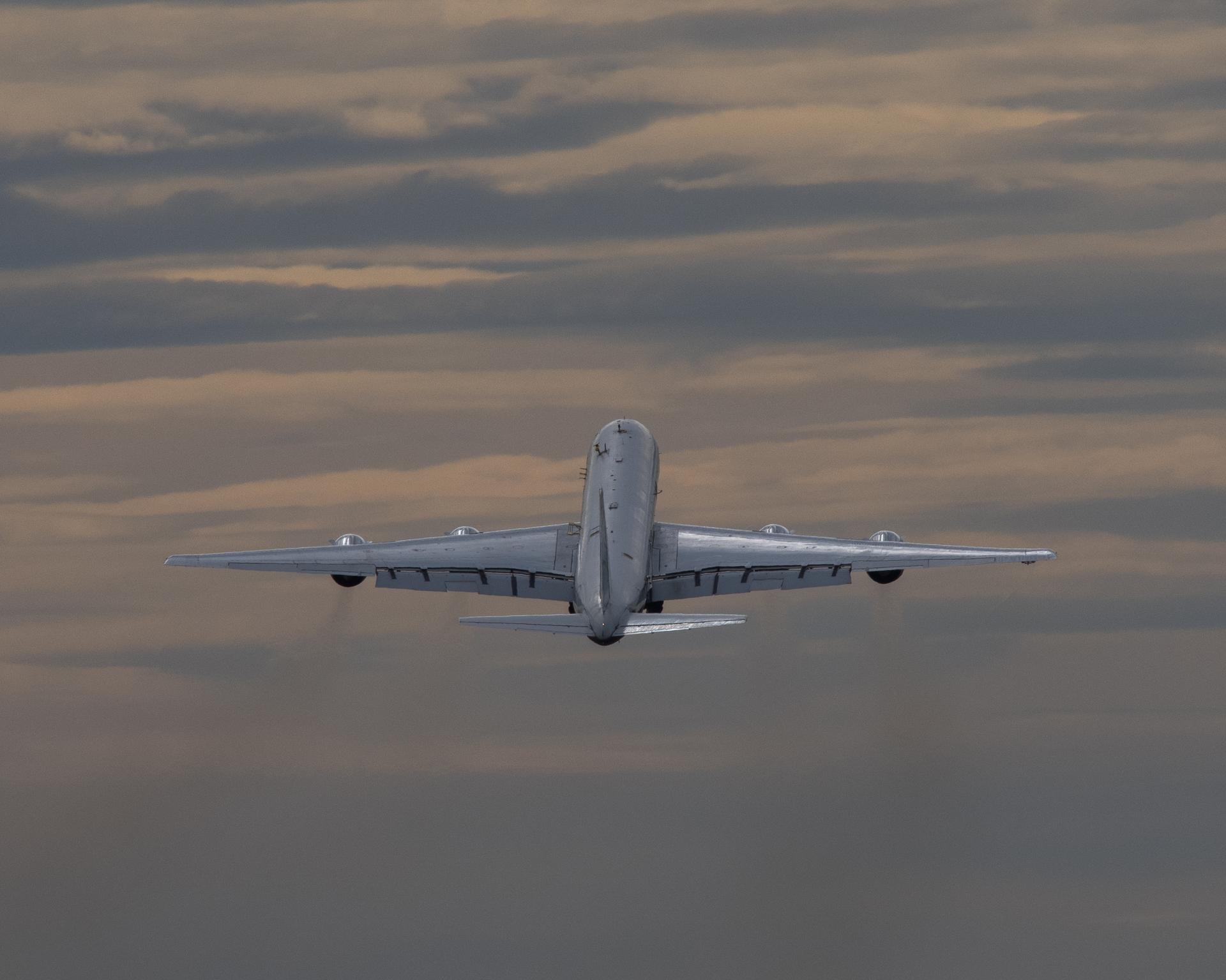
    NASA Armstrong Flight Research Center’s DC-8 aircraft takes flight over the northwestern U.S. to monitor emissions from Boeing’s ecoDemonstrator Explorer aircraft.
    NASA Armstrong’s DC-8 aircraft flies over the northwestern U.S. to monitor emissions from Boeing’s ecoDemonstrator Explorer aircraft.  As the largest flying science laboratory in the world, the DC-8 is equipped to collect crucial data about the sustainable aviation fuel and its effects on condensation trail formation.
    NASA/Jim Ross

    Contrails, the lines of clouds left by high-flying aircraft that crisscross the skies, are familiar sights, but they may have an unseen effect on the planet – trapping heat in the atmosphere. Working with Boeing, United Airlines, and other industry, government, and international partners, NASA researchers are collecting data to see how new, greener aviation fuels can help reduce the problem.

    Throughout October, NASA has supported contrail research through Boeing’s ecoDemonstrator program, a multi-year effort to analyze sustainable aviation fuel its capacity to benefit the environment.

    Boeing’s current ecoDemonstrator Explorer aircraft, a 737-10, has conducted test flights switching between tanks filled either with 100% sustainable aviation fuel or conventional fuel. NASA’s DC-8 aircraft, the world’s largest flying science laboratory, has followed, measuring emissions and contrail ice formation from each type of fuel. This data will help determine whether sustainable aviation fuels help reduce the formation of contrails.

    “Contrails are believed to be a major source of pollution,” said Rich Moore, a research physical scientist in NASA’s Langley Aerosol Research Group Experiment. Moore was among the researchers who flew aboard the DC-8. “With this mission, we’re looking not so much at correcting contrails, but at preventing them.”

    In addition to the DC-8, which is based at NASA’s Armstrong Flight Research Center in Edwards,

    California, the agency contributed other critical capabilities, including a mobile laboratory for ground testing. Other collaborators for the ecoDemonstrator flights include General Electric Aerospace, the German Aerospace Center, National Research Council Canada, and the Federal Aviation Administration.

    Within a year, the researchers will publish their results.

    “One of the most amazing things about this collaboration is that this data will be released publicly with the world,” Moore said.

    Contrail clouds form when aircraft operate in the cold temperatures at high altitudes and water vapor in engine exhaust condenses and freezes. Made up of ice particles, contrail clouds can have both a cooling and warming effect based on ambient conditions, timing, and persistence – but scientists estimate that their warming effect is greater on a global scale.

    Over the past decade, NASA-funded research has shown that sustainable aviation fuels have significant benefits for reducing engine particle emissions that can influence local air quality near airports and contribute to the formation of contrails.

    Efforts to develop and evaluate sustainable aviation fuels focus on delivering the performance of conventional jet fuel without releasing new carbon dioxide into the environment. These fuels can be derived from sustainable sources such as feedstocks and waste resources.

    Flight testing remains the gold standard for understanding aerospace innovations and their environmental impacts, making partnerships like ecoDemonstrator and research aircrafts like NASA’s DC-8 important sources for data that can help make aviation more sustainable, protecting the environment and improving life on Earth.

  • Data From NASA’s WISE Used to Preview Lucy Mission’s Asteroid Dinkinesh

    Two artist’s concepts show the WISE spacecraft, left, in front of an image of the infrared sky it observed during its prime mission, and NASA’s Lucy mission, right, during its Nov. 1 encounter with asteroid Dinkinesh.
    NASA/JPL-Caltech and NASA’s Goddard Space Flight Center

    Researchers have utilized infrared survey data to refine the asteroid’s size and surface brightness in support of the Nov. 1 encounter by NASA’s Lucy mission.

    NASA’s Lucy mission will soon have its first asteroid encounter as the spacecraft travels through deep space en route to Jupiter’s orbit. But before the spacecraft passes 265 miles (425 kilometers) from the surface of the small asteroid Dinkinesh, researchers have used 13-year-old infrared data from NASA’s Wide-field Infrared Survey Explorer (WISE) to support the mission’s flyby. Their new study provides updated estimates of the asteroid’s size and albedo – a measurement of surface reflectivity – that could help scientists better understand the nature of some near-Earth objects.

    Located between Mars and Jupiter, the main asteroid belt is home to most asteroids in our solar system, including Dinkinesh, which is following an orbit around the Sun that places it near Lucy’s path. The Lucy mission is using the Dinkinesh encounter as an opportunity to test systems and procedures that are designed to keep the asteroid within the science instruments’ fields of view as the spacecraft flies past at 10,000 mph (4.5 kilometers per second). This will help the team prepare for the mission’s primary objective: investigating the Jupiter Trojan asteroids, a population of primitive small bodies orbiting in tandem with Jupiter.

    In the new study, published in the Astrophysical Journal Letters, University of Arizona researchers used observations made by the WISE spacecraft, which serendipitously scanned Dinkinesh in 2010 during its prime mission. Managed by NASA’s Jet Propulsion Laboratory in Southern California, WISE launched on Dec. 14, 2009, to create an all-sky infrared map of the universe.

    Although the signal was weak in the exposures captured by WISE, the authors managed to identify 17 infrared observations of the region of sky where Dinkinesh’s signal could be seen. Then they used an algorithm to align and stack the images. The observations were made in March 2010 and represent 36.5 hours of observing time.

    “Dinkinesh wasn’t initially detected by WISE, because the asteroid’s infrared signal was too weak for the software that was designed to find objects in a single exposure,” said Kiana De’Marius McFadden, a graduate student at the University of Arizona and lead author of the study. “But the asteroid’s dim infrared signal was still there, so our main challenge was to first find Dinkinesh and then to stack multiple exposures of the same region of sky to get its signal to emerge from the noise.”

    Beyond WISE

    Dinkinesh was discovered in 1999 – over a decade before WISE made the observations – and although its approximate size has been known, the new analysis refines not only its size, but also its albedo. The WISE observations suggest the asteroid has a diameter of about a half-mile (760 meters) and an albedo consistent with stony (S-type) asteroids.

    Although WISE’s purpose wasn’t to detect asteroids, the spacecraft was sensitive to the infrared light (which is invisible to the naked eye) radiating from them as a result of sunlight heating their rocky surfaces. WISE had recorded about 190,000 asteroid observations by the end of its prime mission. In 2013, NASA reactivated WISE and renamed the mission Near-Earth Object Wide-field Survey Explorer (NEOWISE). Its purpose: to detect and track asteroids and comets that stray close to Earth’s orbit.

    “Dinkinesh is the smallest main belt asteroid to be studied up-close and could provide valuable information about this type of object,” said the University of Arizona’s Amy Mainzer, a study co-author and the principal investigator for NEOWISE. “This population of main-belt asteroids overlap in size with the potentially hazardous near-Earth object population. Studying Dinkinesh could provide insights as to how these small main-belt asteroids form and where near-Earth asteroids come from.”

    Targeting a late-2027 launch, NASA’s Near-Earth Object Surveyor (NEO Surveyor) will take over where NEOWISE leaves off. Scanning the sky in infrared wavelengths for hard-to-find asteroids and comets, NEO Surveyor could also utilize the same technique used to detect faint signals hiding in WISE observations, boosting the next-generation space telescope’s power. Mainzer is the principal investigator for NEO Surveyor.

    More About the Mission

    Lucy’s principal investigator, Hal Levison, is based at the Boulder, Colorado, branch of Southwest Research Institute, headquartered in San Antonio, Texas. NASA’s Goddard Space Flight Center in Greenbelt, Maryland, provides overall mission management, systems engineering, and safety and mission assurance. Lockheed Martin Space in Littleton, Colorado, built the spacecraft. Lucy is the 13th mission in NASA’s Discovery Program. NASA’s Marshall Space Flight Center in Huntsville, Alabama, manages the Discovery Program for the Science Mission Directorate at NASA Headquarters in Washington.

    News Media Contact

    Ian J. O’Neill
    Jet Propulsion Laboratory, Pasadena, Calif.
    818-354-2649
    ian.j.oneill@jpl.nasa.gov

    2023-155

  • Rusty Red Waters in Madagascar

    The waters of the Betsiboka River Delta, as seen from the International Space Station, are a vibrant orange. From left to right, the river branches off into many pathways, looking almost like the roots of a tree.
    NASA

    Iron-rich sediment colors the red-orange waters of the Betsiboka River Delta in Madagascar in this image taken by an astronaut on the International Space Station on Sept. 30, 2023. The sediment can clog waterways in the delta’s estuarial environment, but it can also form new islands that become colonized by mangroves. Despite its rusty color, this artery of water is important for biodiversity. Within the Betsiboka River Delta, the estuary supplies food, such as seagrasses, to the endangered green turtle and vulnerable dugong, or sea cow.

    Text credit: Sara Schmidt

    Image Credit: NASA

  • See SWOT Mission’s Unprecedented View of Global Sea Levels

    This animation shows global sea level data collected by the Surface Water and Ocean Topography satellite from July 26 to Aug. 16. Red and orange indicate higher-than-average ocean heights, while blue represents lower-than-average heights. Image Credit: NASA/JPL-Caltech

    Data on sea surface heights around the world from the international Surface Water and Ocean Topography mission yields a mesmerizing view of the planet’s ocean.

    The Surface Water and Ocean Topography (SWOT) satellite is sending down tantalizing views of Earth’s water, including a global composite of sea surface heights. The satellite collected the data visualized above during SWOT’s first full 21-day science orbit, which it completed between July 26 and Aug. 16.

    SWOT is measuring the height of nearly all water on Earth’s surface, providing one of the most detailed, comprehensive views yet of the planet’s oceans and freshwater lakes and rivers. The satellite is a collaboration between NASA and the French space agency, CNES (Centre National d’Études Spatiales).

    The animation shows sea surface height anomalies around the world: Red and orange indicate ocean heights that were higher than the global mean sea surface height, while blue represents heights lower than the mean. Sea level differences can highlight ocean currents, like the Gulf Stream coming off the U.S. East Coast or the Kuroshio current off the east coast of Japan. Sea surface height can also indicate regions of relatively warmer water – like the eastern part of the equatorial Pacific Ocean during an El Niño – because water expands as it warms.

    The SWOT science team made the measurements using the groundbreaking Ka-band Radar Interferometer (KaRIn) instrument. With two antennas spread 33 feet (10 meters) apart on a boom, KaRIn produces a pair of data swaths (tracks visible in the animation) as it circles the globe, bouncing radar pulses off the water’s surface to collect surface-height measurements.

    “The detail that SWOT is sending back on sea levels around the world is incredible,” said Parag Vaze, SWOT project manager at NASA’s Jet Propulsion Laboratory in Southern California. “The data will advance research into the effects of climate change and help communities around the world better prepare for a warming world.”

    More About the Mission

    Launched on Dec. 16, 2022, from Vandenberg Space Force Base in central California, SWOT is now in its operations phase, collecting data that will be used for research and other purposes.

    SWOT was jointly developed by NASA and CNES, with contributions from CSA (Canadian Space Agency) and the UK Space Agency. JPL, which is managed for the agency by Caltech in Pasadena, California, leads the U.S. component of the project. For the flight system payload, NASA provided the KaRIn instrument, a GPS science receiver, a laser retroreflector, a two-beam microwave radiometer, and NASA instrument operations. CNES provided the Doppler Orbitography and Radioposition Integrated by Satellite (DORIS) system, the dual frequency Poseidon altimeter (developed by Thales Alenia Space), the KaRIn radio-frequency subsystem (together with Thales Alenia Space and with support from the UK Space Agency), the satellite platform, and ground operations. CSA provided the KaRIn high-power transmitter assembly. NASA provided the launch vehicle and the agency’s Launch Services Program, based at Kennedy Space Center, managed the associated launch services.

    To learn more about SWOT, visit:
    https://swot.jpl.nasa.gov/

    News Media Contacts

    Jane J. Lee / Andrew Wang
    Jet Propulsion Laboratory, Pasadena, Calif.
    818-354-0307 / 626-379-6874
    jane.j.lee@jpl.nasa.gov / andrew.wang@jpl.nasa.gov

    2023-156

  • NASA C-130 Makes First-Ever Flight to Antarctica for GUSTO Balloon Mission

    4 Min Read

    NASA C-130 Makes First-Ever Flight to Antarctica for GUSTO Balloon Mission

    The C-130 aircraft, a white plane with a blue strip down the side, sits on a snowy runway with a grey C-17 aircraft in the background.

    NASA’s Wallops Flight Facility C-130 aircraft delivered the agency’s Galactic/Extragalactic ULDB Spectroscopic Terahertz Observatory (GUSTO) payload to McMurdo Station, Antarctica, on Oct. 28, 2023. The GUSTO mission will launch on a scientific balloon in December 2023.

    Credits:
    NASA/Scott Battaion

    On Oct. 28, 2023, NASA’s C-130 Hercules and crew safely touched down at McMurdo Station, Antarctica, after an around-the-globe journey to deliver the agency’s Galactic/Extragalactic ULDB Spectroscopic Terahertz Observatory (GUSTO). The United States research station, operated by the National Science Foundation, is host to NASA’s Antarctic long-duration balloon campaign in which the GUSTO mission will take a scientific balloon flight beginning December 2023.

    The C-130 crew, which has now completed half of the 26,400-nautical-mile round-trip journey, first stopped at Fort Cavazos, Texas, on Oct. 17, to load the GUSTO observatory and members of its instrument team. Additional stops to service the aircraft and for crew rest included Travis Air Force Base (AFB), California; Hickman AFB, Hawaii; Pago Pago, American Samoa; and Christchurch, New Zealand, before finally reaching McMurdo, Antarctica – a mere 800 miles from the South Pole.

    The C-130 aircraft, a white plane with a blue strip down the side, taking off from a runway with a thick tree line in the background.
    Aircraft Office teams prepare the C-130 aircraft for departure at NASA’s Wallops Flight Facility in Virginia. The aircraft will deliver the agency’s Galactic/Extragalactic ULDB Spectroscopic Terahertz Observatory (GUSTO) payload to McMurdo Station, Antarctica. The GUSTO mission will launch on a scientific balloon in December 2023.
    NASA/Terry Zaperach

    GUSTO, part of NASA’s Astrophysics Explorers Program, is set to fly aboard a football-stadium-sized, zero-pressure scientific balloon 55 days and beyond, on a mapping mission of a portion of the Milky Way Galaxy and nearby Large Magellanic Cloud. A telescope with carbon, oxygen, and nitrogen emission line detectors will measure the interstellar medium, the cosmic material found between stars, and trace the full lifecycle of that matter. GUSTO’s science observations will be performed in a balloon launch from Antarctica to allow for enough observation time aloft, access to astronomical objects, and solar power provided by the austral summer in the polar region.

    NASA’s Wallops Flight Facility Aircraft Office in Wallops Island, Virginia, which manages the C-130, spent nearly a year in coordination efforts preparing for GUSTO’s trip to its launch site. From international clearances with agencies, cargo configurations with NASA’s Balloon Program Office, logistical support with the National Science Foundation at McMurdo, to specialized training on nontraditional navigation systems in Antarctica, the Aircraft Office developed an extensive plan to safely deliver the intricate science payload.

    The first-ever mission to Antarctica for the NASA C-130 aircraft presented several long-haul cargo flight challenges. Mission managers and NASA’s Office of International and Interagency Relations (OIIR) started early to stay ahead of coordination of international flight clearances.

    “We work very hard to make sure that we execute the mission at a high standard of technical competence and professionalism to maintain NASA’s international reputation,” said John Baycura, Wallops research pilot on the GUSTO mission.

    Large time-zone changes challenge the crew’s circadian rhythm. Ninety hours in flight across multiple time zones requires an extra pilot and flight engineer on the mission to share the workload. Mandatory crew rest days at strategic locations, per NASA policy, ensure the crew receives enough time to rest, adjust to the schedule, and proceed safely.

    NASA C-130 Delivers GUSTO Payload to Antarctica
    Visit NASA’s Goddard Space Flight Center Flickr for more photos.

    Unexpected weather also tops the list of most pressing challenges for this type of flight. Oceanic crossings come with the added risk of weather complicated by no radar coverage over the ocean. The crew uses DOD and civilian weather agencies to identify hazardous weather and adjust flight routes, altitude, and timings accordingly. “For the specific case of McMurdo, while en route, we called the weather shop at McMurdo Station to get a forecast update before we reached our ‘safe return’ point. Using a conservative approach, we decided whether to continue to McMurdo Station or return to Christchurch and try again the next day,” said Baycura.

    For this mission, no commercial entities supported the final leg to Antarctica. U.S. Air Force C-17’s and the New York Air National Guard LC-130’s that typically transport to McMurdo Station had limited space in their schedules. By using NASA’s C-130 for this specialized cargo mission, “the balloon program gained a dedicated asset with a highly experienced crew and support team. This greatly reduced the standard project risks to schedule, cargo, and cost,” said Baycura.

    For more information, visit nasa.gov/wallops.

    Details

    Last Updated

    Oct 30, 2023

    Editor

    Jamie Adkins

    Contact

    Olivia F. Littleton
    olivia.f.littleton@nasa.gov

    Location

    Wallops Flight Facility

  • NASA Supports Tests of Dust Sensor to Aid Lunar Landings

    2 min read

    NASA Supports Tests of Dust Sensor to Aid Lunar Landings

    University of Central Florida researchers tested an instrument designed to measure the size and speed of surface particles kicked up by the exhaust from a rocket-powered lander on the Moon or Mars. The four tethered flights on Astrobotic’s Xodiac rocket-powered lander took place in Mojave, California, from Sept. 12 through Oct. 4, 2023. Researchers tested the Ejecta STORM technology’s integration with a lander and operation in flight conditions that simulated the plume effects of a lunar lander.

    Credits: Astrobotic

    A research team from the University of Central Florida recently tested an instrument designed to measure the size and speed of surface particles kicked up by the exhaust from a rocket-powered lander on the Moon or Mars. Supported by NASA’s Flight Opportunities program, researchers evaluated the instrument in a series of flight tests on Astrobotic’s Xodiac rocket-powered lander in Mojave, California.

    When spacecraft land on the Moon or Mars, the rocket exhaust plume creates regolith ejecta – abrasive dust and large particles moving at high speeds – that can damage the lander and surrounding structures. Understanding how a rocket engine’s exhaust affects this ejecta will help mission designers plan more effectively for lunar landings by allowing them to model the soil erosion rate, the particle size distribution, and the velocities associated with plume-surface interaction.

    Researchers at the University of Central Florida developed the laser-based instrument, named Ejecta STORM (Sheet Tracking, Opacity, and Regolith Maturity), to answer this need while embracing the Flight Opportunities program’s “fly, fix, fly” ethos to quickly advance the technology.

    Four tethered flights enabled researchers to test the system’s integration with a lander and operation in flight conditions that simulated the plume effects of a lunar lander. These tests build on data collected during a 2020 flight campaign leveraging Xodiac. These 2020 flight tests, funded by the program’s TechFlights solicitation, allowed researchers to measure the density and size of particles during terrestrial simulations of lunar landings.

    Researchers expect the technology to inform model development and reduce risk for future lunar landings, ultimately improving mission design for rover-based planetary science missions, crewed missions to the Moon and other bodies, and in-situ resource utilization. Flight Opportunities is managed at NASA’s Armstrong Flight Research Center in Edwards, California, and is part of the agency’s Space Technology Mission Directorate.

    By Chloe Tuck

    NASA’s Armstrong Flight Research Center

    Details

    Last Updated

    Oct 27, 2023

    Editor

    Loura Hall

    Contact

  • NASA Technologies Receive Multiple Nods in TIME Inventions of 2023

    As NASA explores, innovates, and inspires through its work, agency inventions aimed at monitoring atmospheric pollution, studying samples from asteroids, extracting oxygen from the Martian atmosphere, and revolutionizing flight have been named TIME’s Inventions of 2023. TIME announced the honorees on Oct. 24.

    “For more than 65 years, NASA has innovated for the benefit of humanity,” said NASA Administrator Bill Nelson. “From turning carbon dioxide to oxygen on Mars, to delivering the largest asteroid sample to Earth, helping improve air quality across North America, and changing the way we fly, our MOXIE, TEMPO, OSIRIS-REx and X-59 Quesst missions are proof that NASA turns science fiction into science fact. It’s all made possible by our world-class workforce who, time after time, show us nothing is beyond our reach when we work together.”

    Improving Air Quality Data

    NASA graphic showing basic path of TEMPO scanning. Image Credit: NASA
    NASA graphic showing basic path of TEMPO scanning.
    Image Credit: NASA

    NASA’s TEMPO (Tropospheric Emissions: Monitoring of Pollution) mission is the first space-based instrument to measure pollution hourly during the daytime across North America, spanning from Mexico City to Northern Canada and coast-to-coast.

    Launched in April 2023, TEMPO provides unprecedented daytime measurement and monitoring of major air pollutants. The first-of-its-kind instrument can monitor pollution within a four-square-mile area and is helping climate scientists improve life on Earth by providing openly accessible air quality data for studies of rush hour pollution, the transport of pollution from forest fires and volcanoes, and even the effects of fertilizers, and it also has the potential to help improve air quality alerts.

    Making Oxygen on Mars

    Technicians lower the Mars Oxygen In-Situ Resource Utilization Experiment (MOXIE) instrument into the belly of the Perseverance rover. Photo credit: NASA/JPL-CalTech
    Technicians lower the Mars Oxygen In-Situ Resource Utilization Experiment (MOXIE) instrument into the belly of the Perseverance rover.
    Photo credit: NASA/JPL-Caltech

    In September, a microwave-size device known as MOXIE (Mars Oxygen In-Situ Resource Utilization Experiment) aboard NASA’s Perseverance rover generated oxygen from the Martian atmosphere for the 16th and final time. 

    Extracting oxygen from the atmospheric resources found on Mars via In-situ Resource Utilization processes will be critical to long-term human exploration of the Red Planet, providing explorers with breathable air and rocket propellant. 

    Since Perseverance landed in 2021, MOXIE has proven far more successful than expected, generating 122 grams of oxygen, including 9.8 grams on its final run. At its most efficient, MOXIE produced 12 grams of oxygen an hour – twice as much as NASA’s original goals for the instrument – at least 98% purity.

    Asteroid Sampler

    Curation teams process the sample return capsule from NASA’s OSIRIS-REx mission in a cleanroom, Sunday, Sept. 24, 2023, at the Department of Defense's Utah Test and Training Range. Photo Credit: NASA/Keegan Barber
    Curation teams process the sample return capsule from NASA’s OSIRIS-REx mission in a cleanroom, Sunday, Sept. 24, 2023, at the Department of Defense’s Utah Test and Training Range.
    Photo Credit: NASA/Keegan Barber

    On Sept. 24, NASA’s OSIRIS-REx mission returned a sample from asteroid Bennu to Earth. The sample is the first asteroid collected in space by NASA, and the largest ever collected from an asteroid. The rock and dust represent relics of our early solar system and could shed light on the origins of life.

    Early analysis of the sample at NASA’s Johnson Space Center in Houston has revealed high carbon content and water, which together could indicate the building blocks of life on Earth may be found in the rock. The Bennu sample will be divided and shared with partner space agencies and other institutions, providing generations of scientists a window about 4.5 billion years into the past.

    Quiet Sonic Thumps

    The X-59 Quesst aircraft is rolled out at Lockheed Martin’s facility in Palmdale, California. Photo credit: Lockheed Martin
    The X-59 aircraft is rolled out at Lockheed Martin’s facility in Palmdale, California.
    Photo credit: Lockheed Martin

    NASA’s X-59 experimental aircraft, the agency’s first purpose-built, supersonic X-plane in decades, is currently scheduled to take to the skies in 2024.

    The centerpiece of NASA’s Quesst mission, the agency will fly the X-59 to demonstrate the ability to fly faster than the speed of sound while reducing the typically loud sonic boom to a quieter “sonic thump”. NASA will use the X-59 to provide data to help regulators amend current rules that ban commercial supersonic flight over land, opening the door to greatly reduced flight times.

    NASA will fly the X-59 over several U.S. cities in the final phase of the mission, gathering public input to the hushed sonic thumps. 

    The TEMPO instrument is managed by NASA Langley’s Science Directorate in collaboration with the Smithsonian Astrophysical Observatory. It was built by Ball Aerospace and integrated onto Intelsat 40E by Maxar.

    The MOXIE experiment was built Massachusetts Institute of Technology (MIT), and NASA’s Jet Propulsion Laboratory manages the project for the agency’s Space Technology Mission Directorate.

    The OSIRIS-REx mission, launched on Sept. 8, 2016, was led by the University of Arizona. It is managed by NASA’s Goddard Space Flight Center in Greenbelt, Maryland, under the agency’s Science Mission Directorate’s New Frontiers Program. 

    The Low-Boom Flight Demonstrator project is managed by NASA’s Armstrong Flight Research Center in Edwards, California, the Quesst mission is managed by NASA’s Langley Research Center in Hampton, Virginia, and both efforts are led by NASA’s Aeronautics Research Mission Directorate.

    For more information about the agency’s missions, visit:

    https://www.nasa.gov