This new image of supernova remnant SN 1006 combines data from NASA’s Imaging X-ray Polarimetry Explorer and NASA’s Chandra X-ray Observatory. The red, green, and blue elements reflect low, medium, and high energy X-rays, respectively, as detected by Chandra. The IXPE data, which measure the polarization of the X-ray light, is show in purple in the upper left corner, with the addition of lines representing the outward movement of the remnant’s magnetic field.
NASA’s IXPE (Imaging X-ray Polarimetry Explorer) telescope has captured the first polarized X-ray imagery of the supernova remnant SN 1006. The new results expand scientists’ understanding of the relationship between magnetic fields and the flow of high-energy particles from exploding stars.
“Magnetic fields are extremely difficult to measure, but IXPE provides an efficient way for us to probe them,” said Dr. Ping Zhou, an astrophysicist at Nanjing University in Jiangsu, China, and lead author of a new paper on the findings, published in The Astrophysical Journal. “Now we can see that SN 1006’s magnetic fields are turbulent, but also present an organized direction.”
Situated some 6,500 light-years from Earth in the Lupus constellation, SN 1006 is all that remains after a titanic explosion, which occurred either when two white dwarfs merged or when a white dwarf pulled too much mass from a companion star. Initially spotted in spring of 1006 CE by observers across China, Japan, Europe, and the Arab world, its light was visible to the naked eye for at least three years. Modern astronomers still consider it the brightest stellar event in recorded history.
Since modern observation began, researchers have identified the remnant’s strange double structure, markedly different from other, rounded supernova remnants. It also has bright “limbs” or edges identifiable in the X-ray and gamma-ray bands.
“Close-proximity, X-ray-bright supernova remnants such as SN 1006 are ideally suited to IXPE measurements, given IXPE’s combination of X-ray polarization sensitivity with the capability to resolve the emission regions spatially,” said Douglas Swartz, a Universities Space Research Association researcher at NASA’s Marshall Space Flight Center in Huntsville, Alabama. “This integrated capability is essential to localizing cosmic-ray acceleration sites.”
Previous X-ray observations of SN 1006 offered the first evidence that supernova remnants can radically accelerate electrons, and helped identify rapidly expanding nebulae around exploded stars as a birthplace for highly energetic cosmic rays, which can travel at nearly the speed of the light.
Scientists surmised that SN 1006’s unique structure is tied to the orientation of its magnetic field, and theorized that supernova blast waves in the northeast and southwest move in the direction aligned with the magnetic field, and more efficiently accelerate high-energy particles.
IXPE’s new findings helped validate and clarify those theories, said Dr. Yi-Jung Yang, a high-energy astrophysicist at the University of Hong Kong and coauthor of the paper.
“The polarization properties obtained from our spectral-polarimetric analysis align remarkably well with outcomes from other methods and X-ray observatories, underscoring IXPE’s reliability and strong capabilities, Yang said.
For the first time, we can map the magnetic field structures of supernova remnants at higher energies with enhanced detail and accuracy – enabling us to better understand the processes driving the acceleration of these particles.
Dr. Yi-Jung Yang
High-energy astrophysicist at the University of Hong Kong
Researchers say the results demonstrate a connection between the magnetic fields and the remnant’s high-energy particle outflow. The magnetic fields in SN 1006’s shell are somewhat disorganized, per IXPE’s findings, yet still have a preferred orientation. As the shock wave from the original explosion passes through the surrounding gas, the magnetic fields become aligned with the shock wave’s motion. Charged particles are trapped by the magnetic fields around the original point of the blast, where they quickly receive bursts of acceleration. Those speeding high-energy particles, in turn, transfer energy to keep the magnetic fields strong and turbulent.
IXPE has observed three supernova remnants – Cassiopeia A, Tycho, and now SN 1006 – since launching in December 2021, helping scientists develop a more comprehensive understanding of the origin and processes of the magnetic fields surrounding these phenomena.
Scientists were surprised to find that SN 1006 is more polarized than the other two supernova remnants, but that all three show magnetic fields oriented such that they point outward from the center of the explosion. As researchers continue to explore IXPE data, they are re-orienting their understanding of how particles get accelerated in extreme objects like these.
IXPE is a collaboration between NASA and the Italian Space Agency with partners and science collaborators in 12 countries. IXPE is led by NASA’s Marshall Space Flight Center in Huntsville, Alabama. Ball Aerospace, headquartered in Broomfield, Colorado, manages spacecraft operations together with the University of Colorado’s Laboratory for Atmospheric and Space Physics in Boulder.
La astronauta Callie Rodríguez continúa sus aventuras espaciales como la primera mujer en pisar la Luna en la nueva novela gráfica de la NASA, “La primera mujer: Expandiendo nuestro universo”.
La astronauta de ficción Callie Rodríguez continúa explorando el espacio como la primera mujer que camina en la Luna en un nuevo tomo de la serie novelada “La primera mujer” de la NASA. Actualmente disponible en formato digital en inglés y español, “La primera mujer: Expandiendo nuestro universo” sigue la historia de Callie y sus compañeros de tripulación mientras trabajan juntos para explorar lo desconocido, hacer descubrimientos científicos y cumplir los objetivos de su misión.
Este segundo número de la serie de novelas gráficas presenta a una tripulación de astronautas diversa en la superficie de la Luna, que aprenden y crecen como equipo enfrentándose a situaciones inesperadas mientras realizan experimentos y demostraciones de tecnología para el beneficio de la humanidad.
Mediante la serie “La primera mujer”, la NASA está inspirando a la nueva generación de exploradores, la Generación Artemis, mientras trabaja en la vida real para llevar a la primera mujer y a la primera persona de color a la Luna con el programa Artemis.
“La diversidad está en el núcleo de las misiones de la NASA y es la razón por la que seguimos superando los límites de lo posible. “La primera mujer” encarna la rica historia de innumerables mujeres que rompieron barreras y siguen guiando a la NASA hacia las estrellas”, dijo el administrador de la NASA, Bill Nelson. “Gran parte de lo que hace la NASA es inspirar a futuros exploradores, porque cada miembro de la Generación Artemis debe sentirse representado en nuestras misiones. La historia de Callie nos recuerda que haremos lo que nunca se ha hecho antes: llevar a la primera mujer a la Luna, y esto inspirará al mundo.”
La última vez que los lectores vieron a Callie, ella y su robot RT estaban refugiados dentro de un túnel de lava en la Luna. Descubre lo que sucede a continuación visitando el renovado sitio web de “La primera mujer” —el cual incluye una nueva opción en español— y la aplicación actualizada First Woman de la NASA, que está disponible para descargar en iOS y Android.
El sitio web y la aplicación inmersiva permiten al público explorar un nuevo entorno virtual en 3D, tecnologías y objetos relacionados con la exploración lunar. Los seguidores también pueden explorar contenido actualizado de “La primer mujer”, que incluye videos, juegos interactivos y otros materiales relacionados con las misiones actuales y futuras de la NASA.
“Callie es un personaje inspirador para las comunidades subrepresentadas y, como persona de ascendencia india con hijos pequeños, entiendo profundamente el poder de una base diversa de seguidores que se ven a sí mismos ocupando un lugar dentro de
nuestras ambiciosas misiones. Para resolver los numerosos desafíos de la exploración lunar sostenible, necesitamos ideas innovadoras que provengan de diversas fuentes y de comunidades no tradicionales”, dijo el doctor Prasun Desai, administrador asociado interino de la Dirección de Misiones de Tecnología Espacial en la sede de la NASA en Washington. “Continuamos con ese tema aspiracional en nuestro segundo tomo, profundizando en la compleja misión y los antecedentes personales de la tripulación, a la vez que ampliamos una gran cantidad de contenido interactivo y en varios idiomas sobre ciencia, tecnología, ingeniería y matemáticas en nuestras plataformas digitales”.
El tomo que marcó el debut de la serie, “La primera mujer: Del sueño a la realidad”, obtuvo una gran respuesta en Estados Unidos y en el resto del mundo, logrando una distribución de casi 100.000 copias impresas. La audiencia digital acumuló casi 300.000 visitas a la página web y miles de usuarios descargaron la aplicación First Woman, lo que le valió un Premio Webby 2022 a la Mejor Experiencia Móvil Integrada.
En el futuro, la NASA colaborará con sus socios internacionales para traducir “La primera mujer” a más idiomas.
Para obtener más información sobre la novela gráfica y las experiencias interactivas, visita la página web:
“Astronaut Callie Rodriguez continues her space adventures as the first woman to walk on the Moon in NASA’s new graphic novel, “First Woman: Expanding Our Universe.”
Fictional astronaut Callie Rodriguez continues exploring space as the first woman to walk on the Moon in a new issue of NASA’s First Woman graphic novel series. Now available digitally in English and Spanish, “First Woman: Expanding Our Universe,” follows Callie and her crewmates as they work together to explore the unknown, make scientific discoveries, and accomplish their mission objectives.
This second issue of the graphic novel series features a diverse crew of astronauts on the Moon’s surface, learning and growing as a team navigating the unexpected while conducting experiments and technology demonstrations for the benefit of humanity.
Through the First Woman series, NASA is inspiring the next generation of explorers – the Artemis Generation – as it works in real life to land the first woman and first person of color on the Moon under the Artemis program.
“Diversity is at the core of NASA’s missions, and the reason we continue breaking the boundaries of what’s possible. First Woman embodies the rich history of countless women who broke barriers and continue to lead NASA to the stars,” said NASA Administrator Bill Nelson. “So much of what NASA does is to inspire future explorers because each member of the Artemis Generation should feel represented in our missions. Callie’s story reminds us that we will do what has never been done before — land the first woman on the Moon, and it will inspire the world.”
When readers last met Callie, she and her robot RT were sheltering inside of a lunar lava tunnel. Find out what happens next by visiting the revamped First Woman website, which includes a new Spanish-language option, and the agency’s updated First Woman app available for download on Android and iOS.
The website and immersive app allow audiences to explore a new virtual 3D environment, technologies and objects related to lunar exploration. Fans also can explore updated First Woman content, including videos, interactive games, and other materials related to ongoing and future NASA missions.
“Callie is an inspirational character for underrepresented communities and, as a person of Indian descent with young children, I deeply understand the power of a diverse fanbase seeing a place for themselves within our ambitious missions. To solve the many challenges of sustainable lunar exploration, we need innovative ideas from diverse sources and non-traditional communities,” said Dr. Prasun Desai, acting associate administrator, Space Technology Mission Directorate at NASA Headquarters in Washington. “We continue that aspirational theme with our second issue, diving further into the crew’s complex mission and personal backgrounds while expanding a wealth of interactive, multilingual science, technology, engineering, and mathematics content across our digital platforms.”
The series debut, “First Woman: Dream to Reality,” saw a large response across the United States and abroad, with nearly 100,000 print copies distributed. The digital audience garnered nearly 300,000 webpage views, and the First Woman app was downloaded by thousands of users, earning a 2022 Webby Award for Best Integrated Mobile Experience.
NASA will collaborate with its international partners to translate First Woman into more languages in the future.
To learn more about the graphic novel and interactive experiences, visit:
Lilia Miller and Molly Kearns, employees from NASA’s Glenn Research Center, discuss communication in space as they build paper satellites with students during a STEM event at Rocket Mortgage Field House in Cleveland, Ohio.
NASA’s Glenn Research Center in Cleveland is seeking to collaborate with organizations across the country to bring the NASA experience to new, diverse audiences.
This opportunity is designed to provide organizations with:
Interactive NASA exhibits and historical artifacts to showcase NASA’s missions and research.
Access to NASA subject matter experts for interactive speaking engagements.
The center is requesting event proposals to:
Reach larger audiences by leveraging the experiences of community organizations with existing high-quality events.
Strengthen community relationships by collaborating on efforts that result in increased returns on mutually desired outcomes.
Raise awareness of NASA’s contributions to the nation’s aeronautics and space programs.
NASA’s Glenn Research Center
NASA’s Glenn Research Center in Cleveland designs, develops, and tests innovative technology to revolutionize air travel, advance space exploration, and improve life on Earth. As one of 10 NASA centers, and the only one in the Midwest, Glenn is a vital contributor to the region’s economy and culture. Many NASA missions have Glenn contributions, and every U.S. aircraft has NASA Glenn technology on board, making flight cleaner, safer, and quieter.
Glenn is conducting revolutionary aeronautics research in electrified aircraft propulsion, advanced materials, and alternative fuels to help the nation achieve its climate change goals. The center is also exploring next-generation supersonic and hypersonic aircraft.
In addition to its aeronautics research, NASA Glenn’s world-class test facilities and unrivaled expertise in power, propulsion, and communications are crucial to advancing the Artemis program. Glenn’s solar electric propulsion will help propel future missions to the Moon and eventually Mars, where astronauts will conduct scientific research and establish a presence on the surface. The road to the Moon goes through Ohio.
Glenn’s Expertise:
Air-Breathing Propulsion (Jet Engines)
Communications
In-Space Propulsion and Cryogenic Fluids Management
Power, Energy Storage, and Conversion
Materials and Structures for Extreme Environments
Physical Sciences and Biomedical Technologies in Space
Eligibility Requirements
NASA is seeking:
Organizations with established events that have direct connections to their communities and reach diverse audiences. Greater consideration will be given to organizations reaching underserved and/or underrepresented communities. For purposes of this solicitation, underserved and/or underrepresented communities include Black, Latino, Indigenous, and Native American persons; Asian Americans, Pacific Islanders, and other persons of color; members of religious minorities; lesbian, gay, bisexual, transgender, and queer (LGBTQ+) persons; persons with disabilities; persons who live in rural areas; and persons otherwise adversely affected by persistent poverty or inequality (source: NASA’s Mission Equity). Greater consideration may also be given to organizations throughout the Great Lakes Region (Illinois, Indiana, Michigan, Minnesota, Ohio, and Wisconsin) based on factors such as schedule and budget availability.
Events scheduled to occur between Jan. 1, 2024, and Dec. 31, 2024.
Selected organizations must agree to the following:
Attend mutually agreed-upon planning meetings held virtually through an online business communication platform.
Be responsible for coordinating all marketing, media communications, and logistics as described in the event proposal.
Provide final attendance data within one week of the conclusion of the event including the following:
Number of attendees
Estimated percentage of attendees from underrepresented audiences
Submitting a Proposal
All proposals are to be submitted through the online proposal form here. Proposals must be submitted by 5 p.m. Eastern time on Nov. 24, 2023. Only proposals submitted online will be accepted.
Proposal Review Process
Proposals will be evaluated to determine the likelihood of event success using the following criteria:
Number of proposed audience participants.
Percentage of audience from underrepresented populations as defined in the solicitation.
Alignment of the program’s goals and objectives to those of this opportunity.
Expected return on investment of NASA resources.
Plans to maximize audience participation through marketing and media communications.
Evidence of historical attendance at this or similar events hosted by the proposing organization.
Proposing organizations will be notified of their selection status by Dec. 15, 2022.
Point of Contact
If you have questions about the project or the online proposal form, contact NASA Glenn Research Center’s Office of Communications at: GRC-Public-Engagement@mail.nasa.gov
NASA Glenn Seeking Proposals to Support 2024 Events
Oct. 26, 2023
RELEASE: 23-011
NASA’s Glenn Research Center in Cleveland wants to collaborate with organizations across the country to bring the NASA experience to new, diverse audiences.
Glenn has a collection of engaging exhibits and a pool of experts who can speak on space and aeronautics topics. NASA engagement is popular, and each year Glenn receives more event requests than it can accommodate.
Organizations are invited to take advantage of this opportunity and submit proposals for established events taking place in 2024 that could benefit from a NASA engagement presence.
This opportunity is designed to provide organizations with:
Interactive NASA exhibits and historical artifacts to showcase NASA’s missions and research.
Access to NASA subject matter experts for interactive speaking engagements.
A man with an open-mouthed smile wears a balloon hat made at the Fall Family Fest alongside children who are also enjoying their balloon toys during a Bingo round.
Credits: NASA/Charles Beason
Marshall Team Members Enjoy Beginning of Autumn at Fall Family Fest
By Celine Smith
Team members at NASA’s Marshall Space Flight Center and their family members participated in the festivities of Fall Family Fest Oct. 19 at the walking trail behind Building 4315.
“Once the rain threat was gone, it was the perfect fall afternoon to welcome back over a thousand NASA family members for the first time since COVID-19,” said Jose Matienzo, who is the operations manager of the Marshall Exchange, which hosted the event.
A man with an open-mouthed smile wears a balloon hat made at the Fall Family Fest alongside children who are also enjoying their balloon toys during a Bingo round.
NASA/Charles Beason
The Exchange provided free barbecue and beverages for attendees. A food truck also provided ice cream treats.
Several rocket inflatables and a balloon artist were present for children to enjoy. Falcon Punch, a band comprised of Marshall engineers, performed rocking classics for attendees. Additionally, the Exchange hosted several rounds of Bingo for guests as well.
Fall Family Fest also featured activities for participants to share their interests with others. Artisans displayed their handcrafted goods, paintings, and photographs. Bakers brought deserts for attendees to sample and judge who made the best one. Car enthusiasts entered their prized vehicles into a competition with the crowd choosing their favorites.
“I had a great time meeting some of our new employees and reconnecting with longtime friends at the Fall Festival,” said Joseph Pelfrey, acting center director. “It’s fun to see the Marshall family not just working together but having fun together. This is how we build the cultural fabric of Marshall for the future.”
The event was a space for team members and families to unwind, reconnect and enjoy the turn of the season.
“It felt so good to see so many old friends, new faces, their families, and retirees on a beautiful fall afternoon having a good time,” Matienzo said.
Smith, a Media Fusion employee, supports the Marshall Office of Communications.
Priorities, Leadership Stressed at Mission Success is in Our Hands Forum; Jennifer Robinson Receives Golden Eagle Award
By Wayne Smith
Garrett Harencak, a retired Air Force major general and Jacobs vice president and president of Mission Support and Test Services LLC, said determining priorities and practice are crucial steps toward establishing a culture focused on mission success and safety during his keynote address for the Mission Success is in Our Hands Shared Experiences Forum.
The Oct. 19 event was in Building 4203 at NASA’s Marshall Space Flight Center. Mission Success is in Our Hands is a safety initiative collaboration between Marshall and Jacobs.
Garrett Harencak, Jacobs vice president and president of Mission Support and Test Services LLC, makes a point during his presentation at the Mission Success is in Our Hands hybrid Shared Experiences Forum on Oct. 19.
NASA/Danielle Burleson
Harencak also shared his experiences in working and leading nuclear safety, high hazard projects, and conducting operations in the nuclear and national security industries. Using the analogy of a lion chasing chipmunks or zebras, he said leaders must focus on the most important tasks in a mission as opposed to spending time on lesser objectives. Harencak said that while a lion is quick and nimble enough to chase chipmunks, the rodent does not provide as much nutritional value to a lion’s pride when compared to a zebra.
“Are you chasing chipmunks or zebras?” Harencak asked during his presentation. “You have to focus on what matters most. And when you tell your team members to chase chipmunks, they know it’s not the most important thing they should be doing that day.”
He also stressed the importance of practicing a routine to be prepared for an unplanned event to happen. “The value of practice and repetition is that it allows you to overcome when things go wrong, and things will go wrong,” Harencak said. “Practice reduces fear. Without practice, what follows fear is panic, and what follows panic are bad decisions.”
Golden Eagle Award winner Jennifer Robinson, center, receives a plaque commemorating her award during the Oct. 19 Mission Success is in Our Hands event. Joining Robinson are Bill Hill, left, director of the Safety and Mission Assurance Directorate at Marshall, and Jeff Haars, Jacobs vice president and program manager for Jacobs Space Exploration Group.
NASA/Danielle Burleson
In talking about leadership, Harencak said it’s everyone’s responsibility to “be the boss you always wanted to work for” in building a culture of mission success, particularly in a high-hazard business.
“It’s a constant struggle as leaders to build an atmosphere that allows everyone to do what’s necessary to make sure we do it safely and securely,” Harencak said.
Jennifer Robinson was awarded the Golden Eagle Award during the event. Robinson, a Jacobs Space Exploration Group employee, is the SLS (Space Launch System) debris analysis team lead. The team is responsible for analyzing the launch debris environment and identifying the debris risk to SLS. Bill Hill, director of the Safety and Mission Assurance Directorate at Marshall, said Robinson’s team developed a process for evaluating potential debris issues during countdown in the months leading up to the Artemis I launch.
Eight new testimonial banners are displayed as part of the Mission Success is in Our Hands Shared Experiences Forum
NASA/Danielle Burleson
“This process subsequently was adopted as the standing operating procedure that allows for imagery and debris teams to work together to disposition debris findings during critical hours leading to launch,” Hill said.
Since 2015, the Golden Eagle Award has been presented by Mission Success is in Our Hands. The award promotes awareness and appreciation for flight safety, as demonstrated through the connections between employees’ everyday work, the success of NASA and Marshall’s missions, and the safety of NASA astronauts. The award recognizes individuals who have made significant contributions to flight safety and mission assurance above and beyond their normal work requirements. Management or peers can nominate any team member for the award. Honorees are typically recognized at quarterly Shared Experiences forums.
As part of the final Shared Experiences Forum of the year, the Mission Success committee displayed eight new testimonial banners featuring Marshall team members as part of its rebranding. The banners will be placed across the center.
Smith, a Media Fusion employee and the Marshall Star editor, supports the Marshall Office of Communications.
Marshall Kicks Off Participation in 2023 Combined Federal Campaign
NASA’s Marshall Space Flight Center kicked off its participation in the CFC (Combined Federal Campaign) Oct. 17 after raising more funds than any other large federal agency in the Greater Tennessee Valley Zone last year.
The CFC Kickoff Charities Fair was held in Marshall’s Activities Building 4316. Ten charities from the Tennessee Valley participated in the event to talk about their needs and how Marshall team members could help or get involved through volunteering. This year’s theme is “Give Happy.”
Marshall Associate Director, Technical, Larry Leopard, welcomes team members to the CFC Kickoff Charities Fair.
NASA/Alex Russell
Every year, federal workers come together to raise money and volunteer for their favorite charities. The CFC, in its 62nd year, is the world’s largest and most successful annual workplace charity campaign for federal employees and retirees. Since its inception, the campaign has raised nearly $8.7 billion for charities and people in need.
During the 2022 campaign year, Marshall team members pledged $295,454. The 2023 CFC solicitation period started Oct. 2 and runs through Jan. 15, 2024. Marshall’s goal this year is to increase participation by 15%. Last year, 343 people at Marshall contributed.
Donors can contribute financially via credit or debit card payment or PayPal, with some team members able to donate a portion of their paycheck during the campaign period. Donors can also contribute their time at a participating charity, with each volunteer hour counted toward the overall fundraising goal. Team members can visit Inside Marshall for more information about this year’s campaign.
Marshall team members visit some of the different charities represented at the CFC kickoff event.
NASA/Alex Russell
In the Greater Tennessee Valley Zone, there are 69 charities currently listed as active CFC participants, from community health clinics and animal rescues to veteran and social justice groups.
“We can create change by supporting our favorite causes and promoting a greater good,” Marshall Associate Director, Technical, Larry Leopard said at the event kickoff. “For this year’s campaign, I want to challenge everyone at Marshall to donate or volunteer at a local charity. Take the time to discover a cause that you and your family can connect with. Make a small donation, or volunteer as a family or with friends. These actions matter so much to our local nonprofits and our community.”
Learn more about CFC and see the list of participating charities in your community by visiting https://cfcgiving.opm.gov.
Keith Savoy credits his father for teaching him how to do a number of things. His father also inspired him to pursue a career in engineering.
“My dad, a U.S. Marine, sugar cane farmer, and shipping and loading supervisor for CF Industries, inspired me to do lots of things,” said Savoy, chief operating officer at NASA’s Michoud Assembly Facility. “Although he did not have a college degree, he was a jack of all trades and could rebuild vehicle engines, weld, perform carpentry, and do many other tasks that are essential to our daily lives.”
Keith Savoy is the chief operating officer at NASA’s Michoud Assembly Facility.
NASA/Michael DeMocker
In his role, Savoy oversees the day-to-day administrative and operational functions at Michoud, helping sustain NASA’s SLS (Space Launch System) and Orion spacecraft production efforts, and coordinating requirements and logistics with the facility’s tenant leadership for approximately 3,500 employees. Michoud is managed by NASA’s Marshall Space Flight Center.
In addition to learning from his father, Savoy credits an internship with Lockheed Martin for spurring his interest in working with NASA.
“During my junior year in college, I was selected to an intern program with Lockheed Martin, working for Mr. George Hasting during the summer,” Savoy said. “As a mentor, he provided insight and leadership, as well as piquing my interest in the space program. This is what led me to ultimately accepting a position with Lockheed Martin at Michoud after I graduated.”
Question: What excites you most about the future of human space exploration and your team’s role it?
Savoy: What excites me most about the future of human space exploration is the continued involvement of the Michoud Assembly Facility in the manufacturing of several components for Artemis, including the SLS core stage, future SLS Exploration Upper Stage, and the Orion pressure vessel. Michoud has been involved in the manufacturing and assembly of space flight hardware since the 1960s. I have been fortunate to be involved in the External Tank Program for shuttle and Artemis. I am very proud of the Michoud team’s accomplishment of successfully executing all facility and program modifications to support these two major NASA programs.
Question: What has been the proudest moment of your career and why?
Savoy: I believe the proudest moments of my career have been every time I have watched a shuttle launch and most recently the Artemis I launch, knowing Michoud and everyone working there contributed to the successful launch. I usually get nervous right before the powerful RS-25 engines ignite and the vehicle slowly pulls away from the launch pad.
Question: Who or what drives/motivates you?
Savoy: I have always been a self-motivated individual, whether it was sports, education, or my career. I am very passionate about a lot of things, as most people who work around me know.
Question: What advice do you have for employees early in their NASA career or those in new leadership roles?
Savoy: Take every opportunity to cross train in multiple jobs if available. I started my career as an engineer in the Operations and Maintenance organization with Lockheed Martin during the External Tank Program. I held numerous jobs with Lockheed with increasing areas of responsibility to include new business planner, environmental engineer, electrical engineering supervisor, critical systems associate manager, Enhancement Team manager and Operational Planning and Layout manager. After my 20 years with Lockheed Martin, I transitioned to NASA as a logistics engineer for the site and later to the facilities operations manager. Finally, in 2023 I accepted the responsibility of NASA chief operating officer. Each one of these learning opportunities/challenges has provided me with necessary technical and leadership attributes to effectively manage a complex site like Michoud with multiple program and site tenants.
Question: What do you enjoy doing with your time while away from work?
Savoy: I enjoy working out/exercising, relaxing at my camp in Pierre Part, Louisiana, watching or going to LSU Tigers and New Orleans Saints football games, and traveling with my family. We typically have a family vacation once a year; the next one is Yellowstone National Park.
Higgins, a Manufacturing Technical Solutions Inc. employee, works in communications at Michoud Assembly Facility.
NASA’s Innovative Rocket Nozzle Paves Way for Deep Space Missions
By Ray Osorio
NASA recently built and tested an additively-manufactured – or 3D printed – rocket engine nozzle made of aluminum, making it lighter than conventional nozzles and setting the course for deep space flights that can carry more payloads.
Under the agency’s Announcement of Collaborative Opportunity, engineers from NASA’s Marshall Space Flight Center partnered with Elementum 3D, in Erie, Colorado, to create a weldable type of aluminum that is heat resistant enough for use on rocket engines. Compared to other metals, aluminum is lower density and allows for high-strength, lightweight components.
The RAMFIRE nozzle performs a hot fire test at Marshall’s East test area stand 115. The nozzle, made of the novel aluminum alloy 6061-RAM2, experiences huge temperature gradients. As hot gasses approach 6000 degrees Fahrenheit and undergo combustion, icicles are forming on the outside of the engine nozzle.
NASA
However, due to its low tolerance to extreme heat and its tendency to crack during welding, aluminum is not typically used for additive manufacturing of rocket engine parts – until now.
Meet NASA’s latest development under the Reactive Additive Manufacturing for the Fourth Industrial Revolution, or RAMFIRE, project. Funded under NASA’s STMD (Space Technology Mission Directorate), RAMFIRE focuses on advancing lightweight, additively manufactured aluminum rocket nozzles. The nozzles are designed with small internal channels that keep the nozzle cool enough to prevent melting.
With conventional manufacturing methods, a nozzle may require as many as thousand individually joined parts. The RAMFIRE nozzle is built as a single piece, requiring far fewer bonds and significantly reduced manufacturing time.
At the RPM Innovation facility in Rapid City, South Dakota, manufacturing for a large-scale aerospike demonstration nozzle with integral channels is underway. The laser powder directed energy deposition process creates a melt pool using a laser and blows powder into the melt pool to deposit material layer by layer. NASA engineers will use the nozzle as a proof of concept to inform future component designs.
RPM Innovation
NASA and Elementum 3D first developed the novel aluminum variant known as A6061-RAM2 to build the nozzle and modify the powder used with LP-DED (laser powder directed energy deposition) technology. Another commercial partner, RPM Innovations in Rapid City, South Dakota, used the newly invented aluminum and specialized powder to build the RAMFIRE nozzles using their LP-DED process.
“Industry partnerships with specialty manufacturing vendors aid in advancing the supply base and help make additive manufacturing more accessible for NASA missions and the broader commercial and aerospace industry,” said Paul Gradl, RAMFIRE principal investigator at Marshall.
NASA’s Moon to Mars objectives require the capability to send more cargo to deep space destinations. The novel alloy could play an instrumental role in this by enabling the manufacturing of lightweight rocket components capable of withstanding high structural loads.
Seen here at NASA’s Marshall Space Flight Center, and developed with the same 6061-RAM2 aluminum material used under the RAMFIRE project, is a vacuum jacket manufacturing demonstrator tank. The component, made for cryogenic fluid application, is designed with a series of integral cooling channels that have a wall thickness of about 0.06 inches.
NASA
“Mass is critical for NASA’s future deep space missions,” said John Vickers, principal technologist for STMD advanced manufacturing. “Projects like this mature additive manufacturing along with advanced materials, and will help evolve new propulsion systems, in-space manufacturing, and infrastructure needed for NASA’s ambitious missions to the Moon, Mars, and beyond.”
Earlier this summer at Marshall’s East Test Area, two RAMFIRE nozzles completed multiple hot-fire tests using liquid oxygen and liquid hydrogen, as well as liquid oxygen and liquid methane fuel configurations. With pressure chambers in excess of 825 pounds per square inch – more than anticipated testing pressures – the nozzles successfully accumulated 22 starts and 579 seconds, or nearly 10 minutes, of run time. This event demonstrates the nozzles can operate in the most demanding deep-space environments.
“This test series marks a significant milestone for the nozzle,” Gradl said. “After putting the nozzle through the paces of a demanding hot-fire test series, we’ve demonstrated the nozzle can survive the thermal, structural, and pressure loads for a lunar lander scale engine.”
NASA engineers Tessa Fedotowsky and Ben Williams, from Marshall, inspect the RAMFIRE nozzle following successful hot-fire testing.
NASA
In addition to successfully building and testing the rocket engine nozzles, the RAMFIRE project has used the RAMFIRE aluminum material and additive manufacturing process to construct other advanced large components for demonstration purposes. These include a 36-inch diameter aerospike nozzle with complex integral coolant channels and a vacuum-jacketed tank for cryogenic fluid applications.
NASA and industry partners are working to share the data and process with commercial stakeholders and academia. Various aerospace companies are evaluating the novel alloy and the LP-DED additive manufacturing process and looking for ways it can be used to make components for satellites and other applications.
Osorio is a public affairs officer with the Marshall Office of Communications.
Vicky Garcia Speaker for Oct. 30 Marshall Association Event
Vicky Garcia, a launch vehicle systems engineer at NASA’s Marshall Space Flight Center, will be the guest speaker for the Marshall Association Speaker Series on Oct. 30.
Vicky Garcia, a launch vehicle systems engineer at NASA’s Marshall Space Flight Center, will be the guest speaker for the Marshall Association Speaker Series on Oct. 30.
NASA
The event will be 11 a.m.-12 p.m. The event is free to attend and open to everyone via Teams. Marshall team members can attend in Building 4221, Conference Room 1103. The meeting topic follows this year’s theme of Breaking Boundaries.
In recognition of National Disability Month, Garcia will discuss AstroAccess, a project dedicated to promoting inclusion in human space exploration by paving the way for disabled astronauts.
Since its founding in 2021, AstroAccess has conducted five microgravity missions in which disabled scientists, engineers, veterans, students, athletes, and artists perform demonstrations onboard parabolic flights with the Zero Gravity Corporation, as the first step in a progression toward flying a diverse range of people to space. This project is part of SciAccess, an international non-profit dedicated to advancing disability inclusion in STEM. Read more about AstroAccess.
Email the Marshall Association for questions about the event. For more information on the Marshall Association and how to join, team members can visit their page on Inside Marshall.
The curation team processing NASA’s asteroid Bennu sample has removed and collected 2.48 ounces (70.3 grams) of rocks and dust from the sampler hardware – surpassing the agency’s goal of bringing at least 60 grams to Earth.
And the good news is, there’s still more of NASA’s OSIRIS-REx (Origins, Spectral Interpretation, Resource Identification, and Security–Regolith Explorer) sample to collect.
The curation team processing NASA’s asteroid Bennu sample from the OSIRIS-REx mission has surpassed the agency’s goal of bringing at least 60 grams to Earth, removing and collecting 2.48 ounces (70.3 grams) of rocks and dust from the sampler hardware.
NASA
The sample processed so far includes the rocks and dust found on the outside of the sampler head, as well as a portion of the bulk sample from inside the head, which was accessed through the head’s mylar flap. Additional material remaining inside the sampler head, called the Touch-and-Go Sample Acquisition Mechanism, or TAGSAM, is set for removal later, adding to the mass total.
In the last week, the team at NASA’s Johnson Space Center changed its approach to opening the TAGSAM head, which contained the bulk of the rocks and dust collected by the spacecraft in 2020. After multiple attempts at removal, the team discovered two of the 35 fasteners on the TAGSAM head could not be removed with the current tools approved for use in the OSIRIS-REx glovebox. The team has been working to develop and implement new approaches to extract the material inside the head, while continuing to keep the sample safe and pristine.
As a first step, the team successfully accessed some of the material by holding down the head’s mylar flap and removing the sample inside with tweezers or a scoop, depending on material size. The collection and containment of material through this method, combined with the earlier collection of material located outside the head, yielded a total mass exceeding the 60 grams required.
The team will spend the next few weeks developing and practicing a new procedure to remove the remaining asteroid sample from the TAGSAM sampler head while simultaneously processing the material that was collected last week. The OSIRIS-REx science team will also proceed with its plan to characterize the extracted material and begin analysis of the bulk sample obtained so far.
All curation work on the sample – and the TAGSAM head – is performed in a specialized glovebox under a flow of nitrogen to keep it from being exposed to Earth’s atmosphere, preserving the sample’s pristine state for subsequent scientific analysis. The tools for any proposed solution to extract the remaining material from the head must be able to fit inside the glovebox and not compromise the scientific integrity of the collection, and any procedures must be consistent with the clean room’s standards.
While the procedure to access the final portion of the material is being developed, the team has removed the TAGSAM head from the active flow of nitrogen in the glovebox and stored it in its transfer container, sealed with an O-ring and surrounded by a sealed Teflon bag to make sure the sample is kept safe in a stable, nitrogen-rich, environment.
OSIRIS-REx is the third mission in NASA’s New Frontiers Program, managed by NASA’s Marshall Space Flight Center for the agency’s Science Mission Directorate in Washington. Read more about Marshall’s role in OSIRIS-REx.
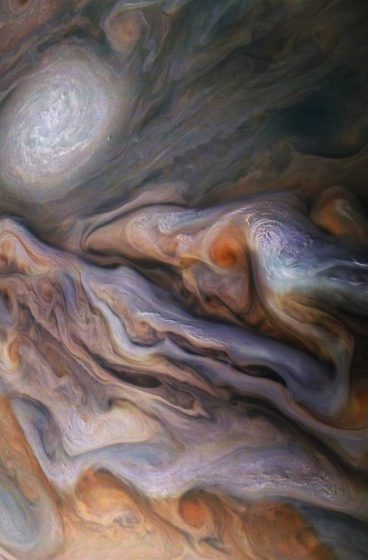
On Sept. 7, 2023, during its 54th close flyby of Jupiter, NASA’s Juno mission captured this view of an area in the giant planet’s far northern regions called Jet N7. The image shows turbulent clouds and storms along Jupiter’s terminator, the dividing line between the day and night sides of the planet. The low angle of sunlight highlights the complex topography of features in this region, which scientists have studied to better understand the processes playing out in Jupiter’s atmosphere.
As often occurs in views from Juno, Jupiter’s clouds in this picture lend themselves to pareidolia, the effect that causes observers to perceive faces or other patterns in largely random patterns.
Citizen scientist Vladimir Tarasov made this image using raw data from the JunoCam instrument. At the time the raw image was taken, the Juno spacecraft was about 4,800 miles (about 7,700 kilometers) above Jupiter’s cloud tops, at a latitude of about 69 degrees north.
AWE Launching to Space Station to Study Atmospheric Waves via Airglow
NASA’s Atmospheric Waves Experiment, or AWE, mission is scheduled to launch to the International Space Station in November 2023, where it will make use of a natural, ethereal glow in Earth’s sky to study waves in our planet’s atmosphere.
Built by Utah State University’s Space Dynamics Laboratory in North Logan, Utah, AWE will be mounted on the exterior of the space station. From this perch, AWE will stare down toward Earth, tracking undulations in the air known as atmospheric gravity waves (AGWs).
Primarily originating in the lowest level of the atmosphere, AGWs may be caused by strong weather events such as tornadoes, hurricanes, or even thunderstorms. These weather events can momentarily push pockets of high-density air upwards into the atmosphere before the air sinks back down. This up-and-down bobbing often leaves behind distinctive ripples patterns in the clouds.
This photo shows examples of cloud patterns caused by atmospheric gravity waves (AGWs). Warmer, denser air from lower in the atmosphere holds more water, so as weather events like wind and storms push those pockets of air to higher altitudes, that water forms clouds at the crests of those waves.
Courtesy Alexa Halford; used with permission
But AGWs continue all the way to space, where they contribute to what’s known as space weather – the tumultuous exchange of energy in the area surrounding our planet that can disrupt satellite and communications signals. AWE will measure AGWs at an atmospheric layer that begins some 54 miles (87 kilometers) in altitude, known as the mesopause.
“This is the first time that AGWs, especially the small-scale ones, will be measured globally at the mesopause, the gateway to the space,” said Michael Taylor, professor of physics at Utah State University and principal investigator for the mission. “More importantly, this is the first time we will be able to quantify the impacts of AGWs on space weather.”
This image taken from the International Space Station shows swaths of airglow hovering in Earth’s atmosphere. NASA’s new Atmospheric Waves Experiment will observe airglow from a perch on the space station to help scientists understand, and ultimately improve forecasts of, space weather changes in the upper atmosphere.
NASA
At the mesopause, where AWE will make its measurements, AGWs are revealed by colorful bands of light in our atmosphere known as airglow. AWE will “see” these waves by recording variations of airglow in infrared light, a wavelength range too long for human eyes to see. At these altitudes our atmosphere dips to its coldest temperatures – reaching as low as -150 degrees Fahrenheit (-101 degrees Celsius) – and the faint glow of infrared light is at its brightest.
By watching that infrared airglow grow brighter and dimmer as waves move through it, AWE will enable scientists to compute the size, power, and dispersion of AGWs like never before. It was also designed to see smaller AGWs, detecting short-scale ripples in airglow that previous missions would miss.
“AWE will be able to resolve waves at finer horizontal scales than what satellites can usually see at those altitudes, which is part of what makes the mission unique,” said Ruth Lieberman, AWE mission scientist at NASA’s Goddard Space Flight Center in Greenbelt, Maryland.
This artist’s conception depicts AWE scanning the atmosphere from aboard the International Space Station. AWE will measure variations in infrared airglow to track atmospheric gravity waves as they move up from the lower atmosphere into space.
Utah State University Space Dynamics Laboratory
From its vantage point on the space station, AWE’s Advanced Mesospheric Temperature Mapper (AMTM) instrument will scan the mesopause below it. AWE’s AMTM consists of four identical telescopes, which together comprise a wide-field-of-view imaging radiometer, an instrument that measures the brightness of light at specific wavelength ranges. The relative brightness of different wavelengths can be used to create temperature maps, which in turn reveal how AGWs are moving through the atmosphere. It will be the most thorough study of AGWs and their effects on the upper atmosphere ever conducted.
From its unique vantage point on the International Space Station, NASA’s Atmospheric Waves Experiment (AWE) will look directly down into Earth’s atmosphere to study how gravity waves travel through the upper atmosphere. Data collected by AWE will enable scientists to determine the physics and characteristics of atmospheric gravity waves and how terrestrial weather influences the ionosphere, which can affect communication with satellites. Credit: NASA’s Goddard Space Flight Center Conceptual Image Lab
As a payload headed to the space station, AWE was required to hold four crucial safety reviews. The mission was successfully certified as a station payload at its last review in July 2023. Part of this certification involved “sharp edge” testing with astronaut gloves to ensure safety during AWE’s installation and maintenance on the exterior of the space station.
AWE is the first NASA mission to attempt this type of science to provide insight into how terrestrial and space weather interactions may affect satellite communications and tracking in orbit.
Following AWE’s installation on the International Space Station, the team’s focus will be to share the instrument’s data and results with the science community and the public. More information about AWE is available on the mission website: https://www.awemission.org/.
By J. Titus Stupfel, NASA’s Goddard Space Flight Center
As NASA scientists study the returned fragments of asteroid Bennu, the team that helped navigate the mission on its journey refines their technology for potential use in future robotic and crewed missions.
The optical navigation team at NASA’s Goddard Space Flight Center in Greenbelt, Maryland, served as a backup navigation resource for the OSIRIS-REx (Origins, Spectral Interpretation, Resource Identification, and Security – Regolith Explorer) mission to near-Earth asteroid Bennu. They double-checked the primary navigation team’s work and proved the viability of navigation by visual cues.
The sample return capsule from NASA’s OSIRIS-REx mission is seen shortly after touching down in the desert, Sunday, Sept. 24, 2023, at the Department of Defense’s Utah Test and Training Range. The sample was collected from the asteroid Bennu in October 2020 by NASA’s OSIRIS-REx spacecraft.
NASA/Keegan Barber
Optical navigation uses observations from cameras, lidar, or other sensors to navigate the way humans do. This cutting edge technology works by taking pictures of a target, such as Bennu, and identifying landmarks on the surface. GIANT software – that’s short for the Goddard Image Analysis and Navigation Tool – analyzes those images to provide information, such as precise distance to the target, and to develop three-dimensional maps of potential landing zones and hazards. It can also analyze a spinning object to help calculate the target’s mass and determine its center – critical details to know for a mission trying to enter an orbit.
“Onboard autonomous optical navigation is an enabling technology for current and future mission ideas and proposals,” said Andrew Liounis, lead developer for GIANT at Goddard. “It reduces the amount of data that needs to be downlinked to Earth, reducing the cost of communications for smaller missions, and allowing for more science data to be downlinked for larger missions. It also reduces the number of people required to perform orbit determination and navigation on the ground.”
Asteroid Bennu ejecting particles from its surface on Jan. 19, created by combining two images from NASA’s OSIRIS-REx spacecraft. GIANT optical navigation technology used to process images like these helped establish the size and velocity of the particles.
NASA / Goddard / University of Arizona
During OSIRIS-REx’s orbit of Bennu, GIANT identified particles flung from the asteroid’s surface. The optical navigation team used images to calculate the particles’ movement and mass, ultimately helping determine they did not pose a significant threat to the spacecraft.
Since then, lead developer Andrew Liounis said they have refined and expanded GIANT’s backbone collection of software utilities and scripts.
New GIANT developments include an open-source version of their software released to the public, and celestial navigation for deep space travel by observing stars, the Sun, and solar system objects. They are now working on a slimmed-down package to aid in autonomous operations throughout a mission’s life cycle.
“We’re also looking to use GIANT to process some Cassini data with partners at the University of Maryland in order to study Saturn’s interactions with its moons,” Liounis said.
Other innovators like Goddard engineer Alvin Yew are adapting the software to potentially aid rovers and human explorers on the surface of the Moon or other planets.
Adaptation, Improvement
Shortly after OSIRIS-REx left Bennu, Liounis’ team released a refined, open-source version for public use. “We considered a lot of changes to make it easier for the user and a few changes to make it run more efficiently,” he said.
An intern modified their code to make use of a graphics processor for ground-based operations, boosting the image processing at the heart of GIANT’s navigation.
A simplified version called cGIANT works with Goddard’s autonomous Navigation, Guidance, and Control software package, or autoNGC in ways that can be crucial to both small and large missions, Liounis said.
Liounis and colleague Chris Gnam developed a celestial navigation capability which uses GIANT to steer a spacecraft by processing images of stars, planets, asteroids, and even the Sun. Traditional deep space navigation uses the mission’s radio signals to determine location, velocity, and distance from Earth. Reducing a mission’s reliance on NASA’s Deep Space Network frees up a valuable resource shared by many ongoing missions, Gnam said.
Next on their agenda, the team hopes to develop planning capabilities so mission controllers can develop flight trajectories and orbits within GIANT – streamlining mission design.
“On OSIRIS-REx, it would take up to three months to plan our next trajectory or orbit,” Liounis said. “Now we can reduce that to a week or so of computer processing time.”
Their innovations have earned the team continuous support from Goddard’s Internal Research and Development program, individual missions, and NASA’s Space Communications and Navigation program.
“As mission concepts become more advanced,” Liounis said, “optical navigation will continue to become a necessary component of the navigation toolbox.”
By Karl B. Hille
NASA’s Goddard Space Flight Center in Greenbelt, Md.
An engineer prepares a small rover for testing in a thermal vacuum chamber on Oct. 24, 2023, at NASA’s Jet Propulsion Laboratory in Southern California. This rover is part of the agency’s Cooperative Autonomous Distributed Robotic Exploration (CADRE) technology demonstration that’s headed to the Moon as part of the Commercial Lunar Payload Services initiative. CADRE is designed to demonstrate that multiple robots can cooperate and explore together autonomously – without direct input from human mission controllers.
NASA’s First Two-way End-to-End Laser Communications System
NASA’s ILLUMA-T payload communicating with LCRD over laser signals.
Credits: NASA/Dave Ryan
NASA is demonstrating laser communications on multiple missions – showcasing the benefits infrared light can have for science and exploration missions transmitting terabytes of important data.
The International Space Station is getting a “flashy” technology demonstration this November. The ILLUMA-T (Integrated Laser Communications Relay Demonstration Low Earth Orbit User Modem and Amplifier Terminal) payload is launching to the International Space Station to demonstrate how missions in low Earth orbit can benefit from laser communications.
Laser communications uses invisible infrared light to send and receive information at higher data rates, providing spacecraft with the capability to send more data back to Earth in a single transmission and expediting discoveries for researchers.
NASA’s ILLUMA-T payload was delivered to SpaceX Dragonland, and the team integrated the payload into the Dragon trunk in preparation for its November launch.
SpaceX
Managed by NASA’s Space Communications and Navigation (SCaN) program, ILLUMA-T is completing NASA’s first bi-directional, end-to-end laser communications relay by working with the agency’s LCRD (Laser Communications Relay Demonstration). LCRD launched in December 2021 and is currently demonstrating the benefits of laser communications from geosynchronous orbit by transmitting data between two ground stations on Earth in a series of experiments.
Some of LCRD’s experiments include studying atmospheric impact on laser signals, confirming LCRD’s ability to work with multiple users, testing network capabilities like delay/disruption tolerant networking (DTN) over laser links, and investigating improved navigation capabilities.
The Laser Communications Relay Demonstration (LCRD) launched in December 2021. Together, LCRD and ILLUMA-T will complete NASA’s first bi-directional end-to-end laser communications system.
Dave Ryan
Once ILLUMA-T is installed on the space station’s exterior, the payload will complete NASA’s first in-space demonstration of two-way laser relay capabilities.
How It Works:
ILLUMA-T’s optical module is comprised of a telescope and two-axis gimbal which allows pointing and tracking of LCRD in geosynchronous orbit. The optical module is about the size of a microwave and the payload itself is comparable to a standard refrigerator.
NASA’s ILLUMA-T payload in a Goddard cleanroom. The payload will be installed on the International Space Station and demo higher data rates with NASA’s Laser Communications Relay Demonstration.
Dennis Henry
ILLUMA-T will relay data from the space station to LCRD at 1.2 gigabits-per-second, then LCRD will send the data down to optical ground stations in California or Hawaii. Once the data reaches these ground stations, it will be sent to the LCRD Mission Operations Center located at NASA’s White Sands Complex in Las Cruces, New Mexico. After this, the data will be sent to the ILLUMA-T ground operations teams at the agency’s Goddard Space Flight Center in Greenbelt, Maryland. There, engineers will determine if the data sent through this end-to-end relay process is accurate and of high-quality.
“NASA Goddard’s primary role is to ensure successful laser communications and payload operations with LCRD and the space station,” said ILLUMA-T Deputy Project Manager Matt Magsamen. “With LCRD actively conducting experiments that test and refine laser systems, we are looking forward to taking space communications capabilities to the next step and watching the success of this collaboration between the two payloads unfold.”
ILLUMA-T and LCRD demonstrating laser communications.
Once ILLUMA-T transmits its first beam of laser light through its optical telescope to LCRD, the end-to-end laser communications experiment begins. After its experimental phase with LCRD, ILLUMA-T could become an operational part of the space station and substantially increase the amount of data NASA can send to and from the orbiting laboratory.
Transmitting data to relay satellites is no new feat for the space station. Since its completion in 1998 the orbiting laboratory has relied on the fleet of radio frequency relay satellites known as NASA’s Tracking and Data Relay Satellites, which are part of the agency’s Near Space Network. Relay satellites provide missions with constant contact with Earth because they can see the spacecraft and a ground antenna at the same time.
Laser communications could be a game-changer for researchers on Earth with science and technology investigations aboard the space station. Astronauts conduct research in areas like biological and physical sciences, technology, Earth observations, and more in the orbiting laboratory for the benefit of humanity. ILLUMA-T could provide enhanced data rates for these experiments and send more data back to Earth at once. In fact, at 1.2 Gbps, ILLUMA-T can transfer the amount of data equivalent to an average movie in under a minute.
The ILLUMA-T / LCRD end-to-end laser communications relay system is one small step for NASA, but one giant leap for space communications capabilities. Together with previous and future demonstrations, NASA is showcasing the benefits laser communications systems can have for both near-Earth and deep space exploration.
The goal of these demonstrations is to integrate laser communications as a capability within NASA’s space communications networks: the Near Space Network and Deep Space Network. If you are a mission planner interested in using laser communications, please reach out to scan@nasa.gov.
NASA’s Laser Communications Roadmap – proving the technology’s validity in a variety of regimes.
NASA / Dave Ryan
The ILLUMA-T payload is funded by the Space Communications and Navigation (SCaN) program at NASA Headquarters in Washington. ILLUMA-T is managed by NASA’s Goddard Space Flight Center in Greenbelt, Maryland. Partners include the International Space Station program office at NASA’s Johnson Space Center in Houston and the Massachusetts Institute of Technology (MIT) Lincoln Laboratory in Lexington, Massachusetts.
LCRD is led by Goddard and in partnership with NASA’s Jet Propulsion Laboratory in Southern California and the MIT Lincoln Laboratory. LCRD is funded through NASA’s Technology Demonstration Missions program, part of the Space Technology Mission Directorate, and the Space Communications and Navigation (SCaN) program at NASA Headquarters in Washington.
NASA’s Scientists and Volunteers Tackle the October 14 Solar Eclipse
In this image captured during the October 14 annular solar eclipse we can see that the disk of the Sun was almost totally blocked by the smaller dark Moon. Between the horns of the crescent is a Baily’s Bead, a spot of sunlight peeking through a valley on the Moon’s apparent edge.
Credits: Clinton Lewis, West Kentucky University
Did you see October 14th’s solar eclipse? Most of the time we can easily forget that we are on a planet spinning and orbiting in space with other celestial bodies. Watching the Moon move across the face of the Sun reminds us of our place in the solar system.
Several NASA science teams and many NASA volunteers used the October 14 eclipse to collect data and test observation protocols, software, hardware, and logistics. They met enthusiastic crowds of people taking in the spectacle and making unique observations. The October eclipse was an “annular” eclipse, meaning that some sunlight always leaked around the edges of the moon. The next solar eclipse, on April 8, 2024, will be a total eclipse. Total eclipses are rare scientific opportunities, so NASA teams used the October eclipse to practice and prepare for the upcoming April eclipse.
In New Mexico, the annual Albuquerque International Balloon Fiesta rolled right into an Annular Eclipse event! An estimated 100,000 people took in the view of the annular eclipse of the Sun from Albuquerque, which was directly on the path where the eclipse reached its maximum – the path of annularity.
The crowd gathered for the Albuquerque International Balloon Fiesta and annular eclipse.
Credit: Heather Fischer
The 3-D NASA logo sits outside an exhibit tent at the Albuquerque Balloon fiesta and subsequent eclipse viewing event.
Credit: Heather Fischer
Elsewhere in New Mexico, the Eclipse Soundscapes team gathered in the Randall Davey Audubon Center & Sanctuary in Sante Fe. The project team deployed eight AudioMoth recording devices the day before the eclipse and retrieved them the day after the eclipse to support research on whether or not eclipses affect life – and sounds – on Earth.
They also recruited staff and visitors to the nearby Valles Caldera National Preserve to participate in Eclipse Soundscapes as Observers. Many folks used the prompting worksheets – and eclipse glasses – provided by Eclipse Soundscapes to record and report their multisensory experience of the eclipse.
Eclipse Soundscapes Team members Dr. Henry “Trae” Winter and MaryKay Severino, getting ready to deploy an AudioMoth device at the Randall Davey Audubon Center & Sanctuary in Sante Fe, NM
Credit: MaryKay Severino
Valles Caldera Park visitors used the Eclipse Soundscapes worksheet and eclipse glasses distributed by Park Rangers to learn more about the Eclipse Soundscapes project, take notes on what nature changes they heard, saw, or felt during the annular eclipse, and then use a QR code to submit their observations to the project.
Credit: MaryKay Severino
The SunSketcher team gathered in Odessa, TX, together with other eclipse chasers, to test their new cell phone app. This app will allow volunteers to help measure the size and shape of the Sun during April’s total eclipse.
Credit: Clinton Lewis, West Kentucky University
In this image captured during the October 14 annular solar eclipse we can see that the disk of the Sun was almost totally blocked by the smaller dark Moon. Between the horns of the crescent is a Baily’s Bead, a spot of sunlight peeking through a valley on the Moon’s apparent edge.
Credit: Clinton Lewis, West Kentucky University
The Dynamic Eclipse Broadcasting Initiative was also on the move. Project leader Bob Baer, student Nathan Culli, and collaborator Mike Kentrianakis gathered in Midland, TX, for a good view of the annular eclipse. They tested their set-up and managed to successfully broadcast their telescope view from sunny Texas back to their home institution of Southern Illinois University in cloudy Carbondale.
The DEB Initiative set up for testing pre-eclipse.
Credit: Bob Baer and Mike Kentrianakis
Members of the DEB Initiative under their reflective tent in Midland, TX, ready to broadcast their telescope view of the eclipse back to the stadium at their home institution of Southern Illinois University in Carbondale.
Credit: Bob Baer and Mike Kentrianakis.
Members of the Salt Lake Astronomical Society, NASA volunteers and others gather in anticipation of the October 14, 2023 annular eclipse.
Credit: NASA volunteer Danny Roylance
All in all, the day was a great success! On to April 8, 2024 and the total eclipse!
New Video Highlights Accessibility and Inclusion at NASA
NASA’s mission to explore the secrets of the universe for the benefit of all is made possible through the contributions of its diverse workforce, including employees with disabilities. To promote accessibility and inclusion, NASA’s Mission Support Directorate (MSD) released a video in October 2023 for National Disability Employment Awareness Month. MSD fuels NASA’s Mission Support community, which provides the essential services for NASA’s missions and centers to accomplish their work.
Bob Gibbs, the associate administrator of MSD, says the video underscores the importance of accessibility and inclusion at NASA. “People are our special sauce at NASA, and they must have the opportunity to bring who they truly are to work,” says Gibbs. “Inclusion and belonging foster innovation and groundbreaking ideas, and that leads to even greater success.”
Titled Explorers, Adventurers, and Innovators with a Disability at NASA, the video features four NASA employees who share their perspectives on accessibility and inclusion at NASA. Featured employees include Gibbs; Theodore (Ted) Gutman, deputy associate administrator for the Office of Diversity and Equal Opportunity; Dana Bolles, the NASA responsible official for Science.NASA.gov in the Science Mission Directorate; and Jimmy Acevedo, an education outreach specialist in Exploration and Space Communications.
The video also shares resources for employees and supervisors to learn about the disability community at NASA, how to access information and resources about disability in the workplace, and how to support accessibility and inclusion at NASA. Accessibility focuses on creating an organization in which all people, including people with disabilities, can fully and independently participate. As one of NASA’s core values, inclusion creates an environment where all employees feel welcome, respected, and engaged.
To promote accessibility and inclusion, NASA’s Mission Support Directorate (MSD) released a video in October 2023 for National Disability Employment Awareness Month.
National Disability Employment Awareness Month is an effort to educate the public about the issues related to disability and employment. According to the Library of Congress, it began in 1945 when Congress enacted Public Law 176, declaring the first week of October each year as National Employ the Physically Handicapped Week. In 1962, the word “physically” was removed to acknowledge the employment needs and contributions of individuals with all types of disabilities. Some 25 years later, Congress expanded the week to a month and changed the name to National Disability Employment Awareness Month.
Discover How You Can Champion Accessibility and Inclusion
For a deeper understanding of disability in the workplace, the talented disability community at NASA, and to discover how you can champion accessibility and inclusion, explore:
This website uses cookies to improve your experience. We'll assume you're ok with this, but you can opt-out if you wish.AcceptRead More
Privacy & Cookies Policy
Privacy Overview
This website uses cookies to improve your experience while you navigate through the website. Out of these, the cookies that are categorized as necessary are stored on your browser as they are essential for the working of basic functionalities of the website. We also use third-party cookies that help us analyze and understand how you use this website. These cookies will be stored in your browser only with your consent. You also have the option to opt-out of these cookies. But opting out of some of these cookies may affect your browsing experience.
Necessary cookies are absolutely essential for the website to function properly. This category only includes cookies that ensures basic functionalities and security features of the website. These cookies do not store any personal information.
Any cookies that may not be particularly necessary for the website to function and is used specifically to collect user personal data via analytics, ads, other embedded contents are termed as non-necessary cookies. It is mandatory to procure user consent prior to running these cookies on your website.