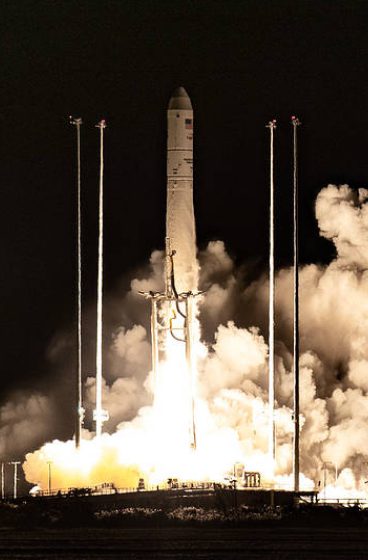
NASA has selected Firefly Aerospace, Inc. of Cedar Park, Texas, to provide launch services for the National Oceanic and Atmospheric Administration (NOAA) QuickSounder mission.
The selection is part of NASA’s Venture-Class Acquisition of Dedicated and Rideshare (VADR) launch services contract. This contract allows the agency to make fixed-price indefinite-delivery/indefinite-quantity awards during VADR’s five-year ordering period, with a maximum total value of $300 million across all contracts.
The QuickSounder mission will support NOAA’s next generation satellite architecture for its future low Earth orbit program, which will provide mission-critical data for the agency’s National Weather Service, the nation’s weather industry, and other users worldwide.
QuickSounder is the first small satellite in NOAA’s Near Earth Orbit Network (NEON). A collaborative effort between NASA and NOAA, NEON will provide a new approach to developing a new global environmental satellite system by quickly building small to medium-sized satellites with Earth-observing instruments for weather forecasting, disaster management, and climate monitoring. QuickSounder has a launch readiness date of February 2026.
NASA will manage the development and launch of the satellites for NOAA. As the mission lead, NOAA provides funding, technical requirements, and will manage post-launch operations. NASA and NOAA will work with commercial partners to design and build the network’s spacecraft and instruments.
For information about NASA and agency programs, visit:
In September 1969, celebrations continued to mark the successful first human Moon landing two months earlier, and NASA prepared for the next visit to the Moon. The hometowns of the Apollo 11 astronauts held parades in their honor, the postal service recognized their accomplishment with a stamp, and the Smithsonian put a Moon rock on display. They addressed Congress and embarked on a 38-day presidential round the world goodwill tour. Eager scientists received the first samples of lunar material to study in their laboratories. Meanwhile, NASA prepared Apollo 12 for November launch as the astronauts trained for the mission with an increased emphasis on lunar science. Plans called for additional Moon landings in 1970, with spacecraft under construction and astronauts in training.
Apollo 11
For Apollo 11 astronauts Neil A. Armstrong, Michael Collins, and Edwin E. “Buzz” Aldrin, their busy August 1969 postflight schedule continued into September with events throughout the United States and beyond. These included attending hometown parades, dedicating a stamp to commemorate their historic mission, unveiling a display of a Moon rock they collected, addressing a Joint Meeting of Congress, and visiting contractor facilities that built parts of their rocket and spacecraft. They capped off the hectic month with their departure, accompanied by their wives, on a presidential round-the-world goodwill tour that lasted into early November.
Left: Neil A. Armstrong at his hometown parade in Wapakoneta, Ohio. Image credit: Ohio Historical Society. Middle: Edwin E. “Buzz” Aldrin at his hometown parade in Montclair, New Jersey. Image credit: Star-Register. Right: Michael Collins at his adopted hometown parade in New Orleans, Louisiana. Image credit: AP Photo.
On Sep. 6, each astronaut appeared at hometown events held in their honor. Apollo 11 Commander Armstrong’s hometown of Wapakoneta, Ohio, welcomed him with a parade and other events. Montclair, New Jersey, held a parade to honor hometown hero Lunar Module Pilot (LMP) Aldrin. And New Orleans, Louisiana, the adopted hometown of Command Module Pilot (CMP) Michael Collins, honored him with a parade.
Left: Apollo 11 astronauts Michael Collins, left, Neil A. Armstrong, and Edwin E. “Buzz” Aldrin with Postmaster General Winton M. Blount display an enlargement of the stamp commemorating the first Moon landing. Right: Aldrin, left, Collins, and Armstrong examine a Moon rock with Smithsonian Institution Director General of Museums Frank A. Taylor.
Three days later, the astronauts reunited in Washington, D.C., where they appeared at the dedication ceremony of a new postage stamp that honored their mission. The U.S. Postal Service had commissioned artist Paul Calle in 1968 to design the stamp. The Apollo 11 astronauts had carried the stamp’s master die to the Moon aboard the Lunar Module (LM) Eagle and after its return to Earth the Postal Service used it to make the printing pages for the 10¢ postage stamp. At the National Postal Forum, Armstrong, Collins, and Aldrin unveiled the stamp together with Postmaster General Winton M. Blount, and each astronaut received an album with 30 of the “First Man on the Moon” stamps. On Sep. 15, the crew returned to Washington to present a two-pound rock they collected in the Sea of Tranquility during their historic Moon walk to Frank A. Taylor, the Director General of Museums at the Smithsonian Institution in Washington, D.C. The rock went on public display two days later at the Smithsonian’s Arts and Industries Building, the first time the public could view a Moon rock.
Left: Apollo 11 astronauts Michael Collins, left, Edwin E. “Buzz Aldrin, and Neil A. Armstrong each addressed a Joint Meeting of Congress, with Vice President Spiro T. Agnew and Speaker of the House John W. McCormack seated behind them. Middle: Apollo 11 astronauts’ wives Joan Aldrin, left, Patricia Collins, and Janet Armstrong receive recognition in the Visitors Gallery of the House Chamber. Right: The Apollo 11 astronauts and their wives cut at a cake at a reception at the Capitol.
With their wives observing from the Visitors Gallery of the House of Representatives, on Sep. 16 Armstrong, Aldrin, and Collins addressed a Joint Meeting of Congress. In this same chamber in May 1961, President John F. Kennedy committed the nation to land a man on the Moon and return him safely to the Earth before the end of decade. In a sense, the astronauts reported on the safe and successful completion of that challenge. Speaker of the House John W. McCormack introduced the astronauts to the gathering, as Vice President Spiro T. Agnew looked on. Each astronaut reflected on the significance of the historic mission.
Armstrong noted that their journey truly began in the halls of Congress when the Space Act of 1958 established NASA. Aldrin commented that “the Apollo lesson is that national goals can be met when there is a strong enough will to do so.” Collins shared a favorite quotation of his father’s to describe the value of the Apollo 11 mission: “He who would bring back the wealth of the Indies must take the wealth of the Indies with him.” Armstrong closed with, “We thank you, on behalf of all the men of Apollo, for giving us the privilege of joining you in serving – for all mankind.” After their speeches, the astronauts presented one American flag each to Vice President Agnew in his role as President of the Senate and to Speaker McCormack. The flags, that had flown over the Senate and House of Representatives, had traveled to the Moon and back with the astronauts. Speaker McCormack recognized the astronauts’ wives Jan Armstrong, Joan Aldrin, and Pat Collins for their contributions to the success of the Apollo 11 mission.
Left: Neil A. Armstrong and Michael Collins address North American Rockwell employees in Downey, California. Right: Presidential Boeing VC-137B jet at Ellington Air Force Base in Houston to take the Apollo 11 astronauts and their wives on the Giantstep goodwill world tour.
On Sep. 26, Armstrong and Collins visited two facilities in California of North American Rockwell (NAR) Space Division, the company that built parts of the Saturn V rocket and Apollo 11 spacecraft. First, they stopped at the Seal Beach plant that built the S-II second stage of the rocket, where 3,000 employees turned out to welcome them. Armstrong commented to the assembled crowd that during the July 16, 1969, liftoff, “the S-II gave us the smoothest ride ever.” Collins added that despite earlier misgivings about using liquid hydrogen as a rocket fuel, “after the ride you people gave us, I sure don’t have doubts any longer.” About 7,000 employees greeted the two astronauts and showered them with confetti at their next stop, the facility in Downey that built the Apollo Command and Service Modules. Both Armstrong and Collins thanked the team for building an outstanding spacecraft that took them to the Moon and returned them safely to Earth. The astronauts inspected the Command Module (CM) for Apollo 14, then under construction at the plant.
On the morning of Sep. 29, a blue and white Boeing VC-137Bpresidential jet touched down at Ellington Air Force Base in Houston. Neil and Jan Armstrong, Buzz and Joan Aldrin, and Mike and Pat Collins boarded the plane and joined their entourage of State Department and NASA support personnel. They departed Houston for Mexico City, the first stop on the Apollo 11 Giantstep goodwill world tour. They didn’t return to the United States until Nov. 5, having visited 29 cities in 24 countries, just nine days before Apollo 12 took off on humanity’s second journey to land on the Moon.
Distribution of Apollo 11 lunar samples to scientists at the Lunar Receiving Laboratory at the Manned Spacecraft Center, now NASA’s Johnson Space Center in Houston.
Back in Houston, distribution to scientists of samples of the lunar material returned by the Apollo 11 astronauts began on Sep. 17 at the Lunar Receiving Laboratory (LRL) at the Manned Spacecraft Center (MSC), now NASA’s Johnson Space Center in Houston. Daniel H. Anderson, curator of lunar samples at the LRL, supervised the distribution of approximately 18 pounds – about one-third of the total Apollo 11 lunar material – to 142 principal investigators from the United States and eight other countries according to prior agreements. The scientists examined the samples at their home institutions and reported their results at a conference in Houston in January 1970. They returned to the LRL any of the samples not destroyed during the examination process.
Apollo 12
In September 1969, NASA continued preparations for the second Moon landing mission, Apollo 12, scheduled for launch on Nov. 14. The Apollo 12 mission called for a pinpoint landing in Oceanus Procellarum (Ocean of Storms) near where the robotic spacecraft Surveyor 3 had touched down in April 1967. They planned to stay on the lunar surface for about 32 hours, compared to Apollo 11’s 21 hours, and conduct two surface spacewalks totaling more than 5 hours. During the first of their two excursions, the astronauts planned to deploy the Apollo Lunar Surface Experiments Package (ALSEP) and collect lunar samples. During the second spacewalk, they planned to visit Surveyor 3 and remove some of its equipment for return to Earth and collect additional lunar samples. The Apollo 12 prime crew of Commander Charles “Pete” Conrad, CMP Richard F. Gordon, and LMP Alan L. Bean and their backups David R. Scott, Alfred M. Worden, and James B. Irwin continued intensive training for the mission.
Left: The Apollo 12 Saturn V exits the Vehicle Assembly Building on its way to Launch Pad 39A. Middle: The Apollo 12 Saturn V rolling up the incline as it approaches Launch Pad 39A. Right: Apollo 12 astronauts Alan L. Bean, left, Richard F. Gordon, and Charles “Pete” Conrad pose in front of their Saturn V during the rollout to the pad.
On Sep. 8, the Saturn V rocket with the Apollo 12 spacecraft on top rolled out from Kennedy Space Center’s (KSC) Vehicle Assembly Building to Launch Pad 39A. The rocket made the 3.5-mile trip to the pad in about 6 hours, with Conrad, Gordon, and Bean on hand to observe the rollout. Workers at the pad spent the next two months thoroughly checking out the rocket and spacecraft to prepare it for its mission to the Moon. The two-day Flight Readiness Test at the end of September ensured that the launch vehicle and spacecraft systems were in a state of flight readiness. In addition to spending many hours in the spacecraft simulators, Conrad and Bean as well as their backups Scott and Irwin rehearsed their lunar surface spacewalks including the visit to Surveyor 3. Workers at NASA’s Jet Propulsion Laboratory in Pasadena, California, shipped an engineering model of the robotic spacecraft to KSC, and for added realism, engineers there mounted the model on a slope to match its relative position on the interior of the crater in which it stood on the Moon. Conrad and Scott used the Lunar Landing Training Vehicle (LLTV) at Ellington Air Force Base (AFB) near MSC to train for the final 200 feet of the descent to the lunar surface.
Left: Apollo 12 astronauts Alan L. Bean, left, and Charles “Pete” Conrad rehearse their lunar surface spacewalks at NASA’s Kennedy Space Center in Florida. Middle: Conrad trains in the use of the Hasselblad camera he and Bean will use on the Moon. Right: Bean, left, and Conrad train with an engineering model of a Surveyor spacecraft.
With regard to lunar geology training, the Apollo 12 astronauts had one advantage over their predecessors – they could inspect actual Moon rocks and soil returned by the Apollo 11 crew. On Sep. 19, Conrad and Bean arrived at the LRL, where Lunar Sample Curator Anderson met them. Anderson brought out a few lunar rocks and some lunar soil that scientists had already tested and didn’t require to be stored under vacuum or other special conditions, allowing Conrad and Bean to examine them closely and compare them with terrestrial rocks and soil they had seen during geology training field trips. This first-hand exposure to actual lunar samples significantly augmented Conrad and Bean’s geology training. To highlight the greater emphasis placed on lunar surface science, the Apollo 12 crews (prime and backup) went on six geology field trips compared to just one for the Apollo 11 crews.
Left: Apollo 12 astronauts Charles “Pete” Conrad, left, Richard F. Gordon, and Alan L. Bean prepare for water egress training aboard the MV Retriever in the Gulf of Mexico. Middle: Wearing Biological Isolation Garments and assisted by a decontamination officer, standing in the open hatch, Apollo 12 astronauts await retrieval in the life raft. Right: The recovery helicopter hoists the third crew member using a Billy Pugh net.
Although the Apollo 11 astronauts returned from the Moon in excellent health and scientists found no evidence of any harmful lunar microorganisms, NASA managers still planned to continue the postflight quarantine program for the Apollo 12 crew members, their spacecraft, and the lunar samples they brought back. The first of these measures involved the astronauts donning Biological Isolation Garments (BIG) prior to exiting the spacecraft after splashdown. Since they didn’t carry the BIGs with them to the Moon and back, one of the recovery personnel, also clad in a BIG, opened the hatch to the capsule after splashdown and handed the suits to the astronauts inside, who donned them before exiting onto a life raft.
On Sep. 20, the Apollo 12 astronauts rehearsed these procedures, identical to the ones used after the first Moon landing mission, in the Gulf of Mexico near Galveston, Texas, using a boilerplate Apollo CM and supported by the Motorized Vessel (MV) Retriever. As it turned out, NASA later removed the requirement for the crew to wear BIGs, and after their splashdown the Apollo 12 crew wore overalls and respirators.
Apollo 13
Left: Apollo 13 prime crew members James A. Lovell and Thomas K. “Ken” Mattingly in the Command Module (CM) for an altitude chamber test – Fred W. Haise is out of the picture at right – at NASA’s Kennedy Space Center in Florida. Middle: Apollo 13 backup astronaut John L. “Jack” Swigert prepares to enter the CM for an altitude chamber test. Right: Apollo 13 backup crew members John W. Young, left, and Swigert in the CM for an altitude chamber test – Charles M. Duke is out of the picture at right.
Preparations for Apollo 13 continued in parallel. In KSC’s Manned Spacecraft Operations Building (MSOB), Apollo 13 astronauts completed altitude chamber tests of their mission’s CM and LM. Prime crew members Commander James A. Lovell, CMP Thomas K. “Ken” Mattingly, and LMP Fred W. Haise completed the CM altitude test on Sep. 10, followed by their backups John W. Young, Jack L. Swigert, and Charles M. Duke on Sep. 17. The next day, Lovell and Haise completed the altitude test of the LM, followed by Young and Duke on Sep. 22. At the time of these tests, Apollo 13 planned to launch on March 12, 1970, on a 10-day mission to visit the Fra Mauro highlands region of the Moon. To prepare for their lunar surface excursions, Lovell, Haise, Young, and Duke, accompanied by geologist-astronaut Harrison H. “Jack” Schmitt and Caltech geologist Leon T. “Lee” Silver, spent the last week of September in Southern California’s Orocopia Mountains immersed in a geology boot camp.
Apollo 14 and 15
Left: At North American Rockwell’s (NAR) Downey, California, facility, workers assemble the Apollo 14 Command Module (CM), left, and Service Module. Right: NAR engineers work on the CM originally intended for Apollo 15.
Looking beyond Apollo 13, the Apollo 14 crew of Commander Alan B. Shepard, CMP Stuart A. Roosa, and LMP Edgar D. Mitchell and their backups Eugene A. Cernan, Ronald E. Evans, and Joe H. Engle had started training for their mission planned for mid-year 1970. At the NAR facility in Downey, engineers prepared the CM and SM and shipped them to KSC in November 1969. Also at Downey, workers continued assembling the CM and SM planned for the Apollo 15 mission in late 1970. As events transpired throughout 1970, plans for those two missions changed significantly.
NASA management changes
Left: Portrait of NASA astronaut James A. McDivitt. Right: NASA Administrator Thomas O. Paine, right, swears in George M. Low as NASA deputy administrator.
On Sept. 25, NASA appointed veteran astronaut James A. McDivitt as the Manager of the Apollo Spacecraft Program Office at MSC. McDivitt, selected as an astronaut in 1962, commanded two spaceflights, Gemini IV in June 1965 that included the first American spacewalk and Apollo 9 in March 1969, the first test of the LM in Earth orbit. He succeeded George M. Low who, in that position since April 1967, led the agency’s efforts to recover from the Apollo 1 fire and originated the idea to send Apollo 8 on a lunar orbital mission. Under his tenure, NASA successfully completed five crewed Apollo missions including the first human Moon landing. MSC Director Robert R. Gilruth initially assigned Low to plan future programs until Nov. 13, when President Richard M. Nixon nominated him as NASA deputy administrator. The Senate confirmed Low’s nomination on Nov. 25, and NASA Administrator Thomas O. Paine swore him in on Dec. 3. Low filled the position vacant since March 20, 1969.
To be continued …
News from around the world in September 1969:
September 2 – The first automated teller machine is installed at a Chemical Bank branch in Rockville Center, New York.
September 13 – Hannah-Barbera’s “Scooby Doo, Where Are You?” debuts on CBS.
September 20 – John Lennon announces in a private meeting his intention to leave The Beatles.
September 22 – San Francisco Giant Willie Mays becomes the second player, after Babe Ruth, to hit 600 career home runs.
September 23 – “Butch Cassidy and the Sundance Kid,” starring Paul Newman and Robert Redford, premieres.
September 24 – Tokyo’s daily newspaper Asahi Shimbun announced that it would be the first to deliver an edition electronically, using a FAX machine that could print a page in five minutes.
September 26 – Apple Records releases “Abbey Road,” The Beatles’ 11th studio album.
NASA’s Hidden Figures Honored with Congressional Gold Medals
Sen. Shelly Moore Capito (R-WV), delivers remarks during a Congressional Gold Medal ceremony recognizing NASA’s Hidden Figures, Wednesday, Sept. 18, 2024, in Emancipation Hall at the U.S. Capitol in Washington.
Credits: NASA/Joel Kowsky
A simple turn of phrase was all it took for U.S. Sen. Shelley Moore Capito of Katherine Johnson’s home state of West Virginia to capture the feeling in Emancipation Hall at the U.S. Capitol in Washington.
“It’s been said that Katherine Johnson counted everything,” she said. “But today we’re here to celebrate the one thing even she couldn’t count, and that’s the impact that she and her colleagues have had on the lives of students, teachers, and explorers.”
That sense of admiration and awe toward the legacy and impact of NASA’s Hidden Figures was palpable Wednesday during a Congressional Gold Medal Ceremony to honor the women’s work and achievements during the space race.
The Congressional Gold Medal in recognition of Katherine Johnson in recognition of her service to the United States as a Mathematician is seen during a ceremony recognizing NASA’s Hidden Figures, Wednesday, Sept. 18, 2024, in Emancipation Hall at the U.S. Capitol in Washington. Katherine Johnson’s family accepted this gold medal on her behalf.
NASA/Joel Kowsky
The ceremony, hosted by House Speaker Mike Johnson, honored Johnson, Dorothy Vaughan, Mary Jackson, and Dr. Christine Darden of NASA’s Langley Research Center in Hampton, Virginia, along with all the other women who served at the agency and its precursor, the National Advisory Committee for Aeronautics, or the NACA, as computers, mathematicians, and engineers.
“The pioneers we honor today, these Hidden Figures — their courage and imagination brought us to the Moon. And their lessons, their legacy, will send us back to the Moon,” said NASA Administrator Bill Nelson.
Margot Lee Shetterly, whose 2016 nonfiction book “Hidden Figures: The American Dream and the Untold Story of the Black Women Who Helped Win the Space Race,” brought awareness to the stories of NASA’s human computers, spoke at the event.
NASA/Joel Kowsky
Author Margot Lee Shetterly detailed the stories of the women from NASA Langley in her 2016 nonfiction book “Hidden Figures: The American Dream and the Untold Story of the Black Women Who Helped Win the Space Race.” Though the book focused on NASA Langley, where Shetterly’s father worked, it helped raise awareness of similar stories around NASA.
A film adaptation of the book starring Taraji Henson as Johnson, Octavia Spencer as Vaughan, and Janelle Monáe as Jackson came out later that year and further elevated the topic. NASA participated under a Space Act Agreement with 20th Century Fox in activities around the movie, to provide historical guidance and advice during the filmmaking process.
In her remarks, Shetterly noted that even as the Hidden Figures made such key contributions to NASA and the NACA before it, they remained active in their communities, leading Girl Scout troops and delivering meals to the hungry.
“They spent countless hours tutoring kids so that those kids, too, would see the power and the beauty of numbers they believed in, tending to the small D democracy that binds us to each other as neighbors and as American citizens,” she said.
The medal citations were as follows:
Congressional Gold Medal to Katherine Johnson, in recognition of her service to the United States as a mathematician
Congressional Gold Medal to Dr. Christine Darden, for her service to the United States as an aeronautical engineer
Congressional Gold Medals in commemoration of the lives of Dorothy Vaughan and Mary Jackson, in recognition of their service to the United States during the space race
Congressional Gold Medal in recognition of all the women who served as computers, mathematicians, and engineers at the National Advisory Committee
Family members of Johnson, Vaughn, Jackson and Dr. Darden accepted medals on their behalves. Dr. Darden watched the ceremony from home.
House Speaker Mike Johnson and Andrea Mosie, senior Apollo sample processor and lab manager who oversees the 842 pounds of Apollo lunar samples. Mosie accepted the medal awarded in recognition of all the women who served as computers, mathematicians, and engineers at the National Advisory Committee for Aeronautics and NASA between the 1930s and the 1970s.
NASA/Joel Kowsky
Andrea Mosie, senior Apollo sample processor and lab manager who oversees the 842 pounds of Apollo lunar samples, accepted the medal awarded to all NASA’s Hidden Figures. She began her career at NASA’s Johnson Space Center in Houston in the 1970s.
Mosie thanked Congress for supporting NASA’s campaign to send the first woman and first person of color to the Moon as part of Artemis and the agency’s efforts to provide “opportunities for people, more representative of the way our country looks, to understand humanity’s place in the universe.”
Several NASA Langley officials attended the event to honor the legacies of the women who worked there.
“I am humbled by the significant contributions and lasting impact of these women to America’s aeronautics and space programs. Their brilliance and perseverance still echo not just through the halls of NASA Langley, but through the entire Agency,” said NASA Langley’s Acting Center Director Dawn Schaible. “They are an inspiration to me and countless others who have benefited from the paths they forged.”
Rep. Eddie Bernice Johnson of Texas, who passed away in 2023, introduced H.R. 1396 – Hidden Figures Congressional Gold Medal Act on Feb. 27, 2019. It was signed into law later that year.
In 2015, President Barack Obama presented Katherine Johnson with the Presidential Medal of Freedom, the nation’s highest civilian honor.
Brittny McGraw and Joe Atkinson NASA Langley Research Center
Students participating in NASA’s Minority University Research AND Education Project (MUREP) Innovation and Tech Transfer Idea Competition on-site experience. Credit: Josh Valcarcel
NASA is awarding $7.2 million to six minority-serving institutions to grow initiatives in engineering-related disciplines and fields for learners who have historically been underrepresented and underserved in science, technology, engineering, and math (STEM) fields.
“NASA is excited to award funding to six minority-serving institutions, paving the way for greater diversity in engineering and STEM,” said Shahra Lambert, NASA senior advisor for engagement and equity, NASA’s Headquarters in Washington. “NASA is committed to fostering diversity and providing essential academic resources to empower the next generation of innovators.”
NASA’s Minority University Research and Education Project (MUREP), in partnership with the National Science Foundation’s Nation of Communities of Learners of Underrepresented Discoverers in Engineering and Science (INCLUDES) network, provides support to increase diversity in engineering. It offers academic resources to college students, aiming to have a long-term impact on the engineering field.
“With these awards, we are continuing to create pathways that increase access and opportunities in STEM for underrepresented and underserved groups,” said Keya Briscoe, MUREP manager. “NASA continues to invest in initiatives that are critical in driving innovation, fostering inclusion, and providing access to the STEM ecosystem for everyone.”
The awardees and their project titles are as follows:
Alabama A&M University
Pathways to NASA: Empowering Underrepresented STEM Talent through Strategic Partnerships and Innovative Learning
Morgan State University – Baltimore
Developing NASA Pathways to Broadening Participation in Space Exploration Technology
North Carolina Agricultural and Technical State University
Strengthening Opportunities in Aerospace Research and Education
University of Central Florida
Hy-POWERED: Hydrogen-POWered Engineering Research and Education for Diversity
University of Colorado, Denver
Seed, Support, and Cultivate: Innovative Strategies for Underrepresented Minorities in STEM Education
University of Houston
Partnership for Inclusivity in Engineering Education and Research for Space
NASA administers the grants through its Office of STEM Engagement. These investments enhance the research, academic and technology capabilities of minority-serving institutions through multiyear cooperative agreements, while advancing NASA’s vision for a diverse and inclusive workforce.
To learn more about NASA STEM Engagement Funding Opportunities, visit:

NASA Deputy Administrator Pam Melroy (left) and Center Director at NASA’s Ames Research Center Eugene Tu (right) hear from Ames employees Sept. 16, 2024.
NASA/Brandon Torres Navarrete
NASA Deputy Administrator Pam Melroy spent time at NASA’s Ames Research Center in California’s Silicon Valley, on Sept. 16, 2024, engaging with center leaders and employees to discuss strategies that could drive meaningful changes to ensure NASA remains the preeminent institution for research, technology, and engineering, and to lead science, aeronautics, and space exploration for humanity. Melroy’s visit also provided an opportunity to meet with early- and mid-career employees, who shared their perspectives and feedback.
On Sept. 18, 2024, five Congressional Gold Medals were awarded to women who contributed to the space race, including the NASA mathematicians who helped land the first astronauts on the Moon under the agency’s Apollo Program.
Credit: NASA
NASA Administrator Bill Nelson released his remarks as prepared for Wednesday’s Hidden Figures Congressional Gold Medal ceremony in Washington. The awards recognized the women who contributed to the space race, including the NASA mathematicians who helped land the first astronauts on the Moon under the agency’s Apollo Program.
“Good afternoon.
“The remarkable things that NASA achieves…and that America achieves…build on the pioneers who came before us.
“People like the women of Mercury, Gemini, and Apollo.
“People like Mary Jackson. Dr. Christine Darden. Dorothy Vaughan. Katherine Johnson.
“Thanks to all the Members of Congress who made today possible. The late Congresswoman Eddie Bernice Johnson, who we miss, and who led the effort in 2019 alongside Senator Chris Coons to bring these medals to life. Thanks to the champions for the legislation, then-Senator Kamala Harris, Senators Lisa Murkowski and Shelley Moore Capito, and Congressman Frank Lucas.
“The women we honor today made it possible for Earthlings to lift beyond the bounds of Earth, and for generations of trailblazers to follow.
“We did not come this far only to come this far.
“We continue this legacy, as one member of the audience here with us does every single day – the remarkable Andrea Mosie.
“Andrea, who has worked at NASA for nearly 50 years, is the lead processor for the Apollo sample program. She oversees the Moon rocks and lunar samples NASA brought back from Apollo, 842 pounds of celestial science! These samples are national treasures. So is Andrea.
“The pioneers we honor today, these Hidden Figures – their courage and imagination brought us to the Moon. And their lessons, their legacy, will send us back to the Moon… and then…imagine – just imagine – when we leave our footprints on the red sands of Mars.
“Thanks to these people who are part of our NASA family, we will continue to sail on the cosmic sea to far off cosmic shores.”
As the hub of human spaceflight, NASA’s Johnson Space Center in Houston holds a variety of unique responsibilities and privileges. Those include being the home of NASA’s astronaut corps.
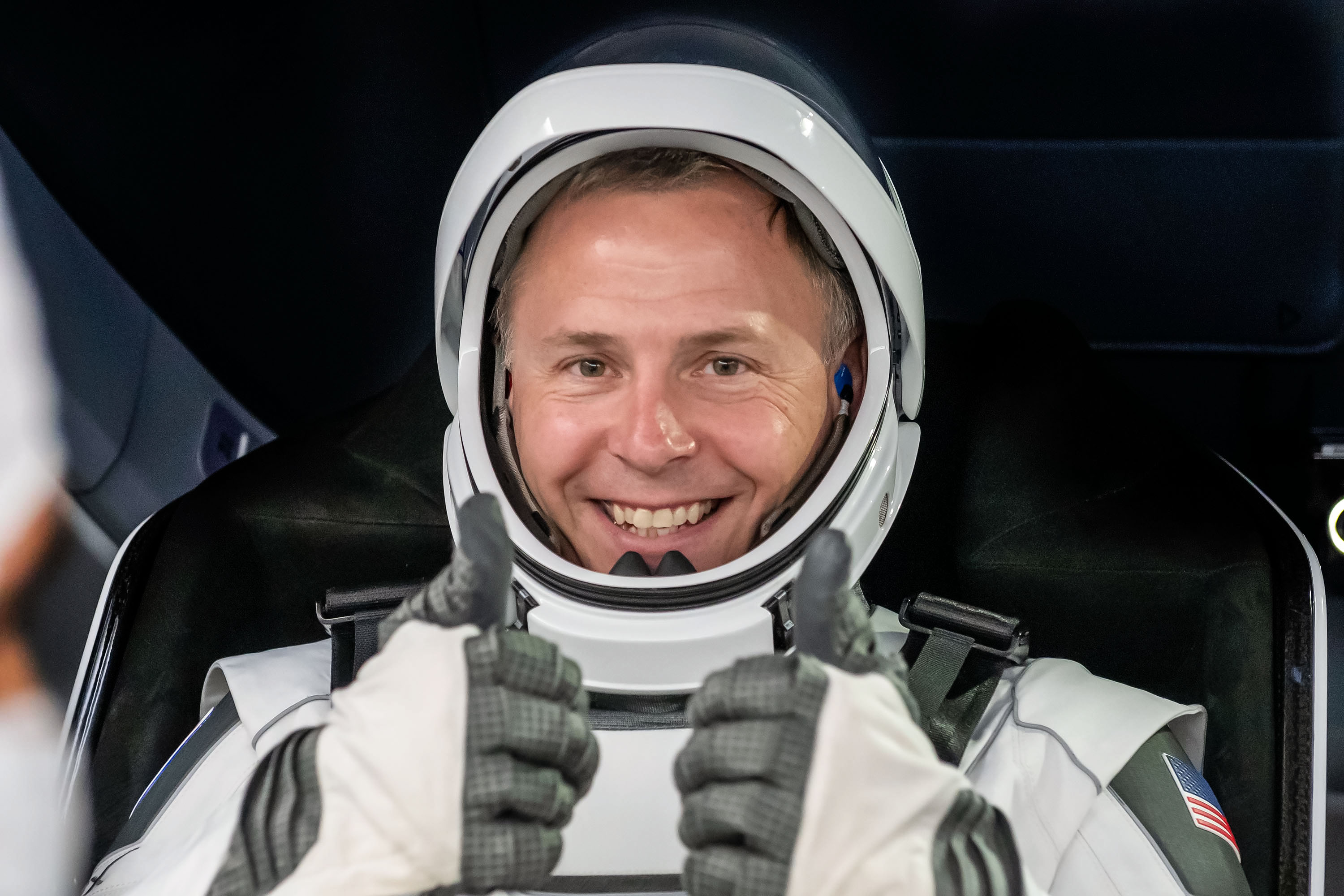
One of those astronauts – Nick Hague – is now preparing to launch to the International Space Station along with Roscosmos cosmonaut Aleksandr Gorbunov on the ninth rotational mission under NASA’s Commercial Crew Program. This will be the third launch and second mission to the space station for Hague, who was selected as a NASA astronaut in 2013 and has spent 203 days in space.
NASA’s SpaceX Crew-9 Commander Nick Hague smiles and gives two thumbs up during the crew equipment interface test at SpaceX’s Dragon refurbishing facility at Kennedy Space Center in Florida.
SpaceX
Hague was born and raised in Kansas but has crisscrossed the country for college and career. He earned degrees from the United States Air Force Academy in Colorado and the Massachusetts Institute of Technology in Cambridge, and he attended the U.S. Air Force Test Pilot School at Edwards Air Force Base in California. Hague’s military career has taken him to New Mexico, Colorado, Virginia, and Washington, D.C., and included a five-month deployment to Iraq. Hague transferred from the Air Force to the U.S. Space Force in 2020 after serving as the Space Force’s director of test and evaluation at the Pentagon.
No stranger to new places, Hague vividly recalls making his first trip to Johnson when he was interviewing to join NASA’s astronaut corps. “I had no idea what to expect, and it was a bit overwhelming. I knew everyone was watching me and judging me,” he said. “Luckily, even though I wasn’t selected then, I got another chance a few years later. It’s a pretty magical place.”
Hague completed his astronaut training in July 2015 as part of NASA’s 21st astronaut class. He was the first astronaut from that group to be assigned to a mission, which launched in October 2018 but was aborted shortly after takeoff. His next spaceflight occurred in 2019, when he joined three of his classmates – NASA astronauts Jessica Meir, Christina Koch, and Andrew Morgan – aboard the International Space Station for Expeditions 59 and 60.
NASA astronaut Nick Hague suits up for spacewalk training in the Neutral Buoyancy Laboratory.
NASA/James Blair
Hague has made many memories at Johnson, but one that stands out is his experience working onsite amid the 2013 government shutdown. “I’m active-duty military so I still came to work,” he explained. “I remember being onsite and the center being completely empty. Being able to ride around an empty campus on the free-range bikes – it was peaceful and surreal.” It was also a preview of what many Johnson employees experienced during the pandemic and how NASA maintains round-the-clock support for spaceflight operations regardless of extenuating circumstances.
Hague now looks ahead to another journey to low Earth orbit. NASA and SpaceX officials currently plan to launch the Crew-9 mission no earlier than Wednesday, Sept. 25. The crew will lift off from Launch Complex 40 from the Cape Canaveral Space Force Station in Florida aboard a SpaceX Falcon 9 rocket and Dragon spacecraft.
Roscosmos cosmonaut Aleksandr Gorbunov (left) and NASA astronaut Nick Hague during a visit to Kennedy Space Center for training.
SpaceX
Hague and Gorbonov will become members of the Expedition 72 crew aboard the station. They will join NASA astronauts Butch Wilmore, Suni Williams, and Don Pettit, and Roscosmos cosmonauts Alexey Ovchinin and Ivan Vagner, and will spend about six months conducting scientific research in microgravity and completing a range of operational activities before returning home.
This NASA/ESA Hubble Space Telescope image features the spiral galaxy IC 4709 located around 240 million light-years away in the southern constellation Telescopium. Hubble beautifully captures its faint halo and swirling disk filled with stars and dust bands. The compact region at its core might be the most remarkable sight. It holds an active galactic nucleus (AGN).
If IC 4709’s core just held stars, it wouldn’t be nearly as bright. Instead, it hosts a gargantuan black hole, 65 million times more massive than our Sun. A disk of gas spirals around and eventually into this black hole, crashing together and heating up as it spins. It reaches such high temperatures that it emits vast quantities of electromagnetic radiation, from infrared to visible to ultraviolet light and X-rays. A lane of dark dust, just visible at the center of the galaxy in the image above, obscures the AGN in IC 4709. The dust lane blocks any visible light emission from the nucleus itself. Hubble’s spectacular resolution, however, gives astronomers a detailed view of the interaction between the quite small AGN and its host galaxy. This is essential to understanding supermassive black holes in galaxies much more distant than IC 4709, where resolving such fine details is not possible.
This image incorporates data from two Hubble surveys of nearby AGNs originally identified by NASA’s Swift telescope. There are plans for Swift to collect new data on these galaxies. Swift houses three multiwavelength telescopes, collecting data in visible, ultraviolet, X-ray, and gamma-ray light. Its X-ray component will allow SWIFT to directly see the X-rays from IC 4709’s AGN breaking through the obscuring dust. ESA’s Euclid telescope — currently surveying the dark universe in optical and infrared light — will also image IC 4709 and other local AGNs. Their data, along with Hubble’s, provides astronomers with complementary views across the electromagnetic spectrum. Such views are key to fully research and better understand black holes and their influence on their host galaxies.
Preparations for Next Moonwalk Simulations Underway (and Underwater)
While astronaut Gene Cernan was on the lunar surface during the Apollo 17 mission, his spacesuit collected loads of lunar dust. The gray, powdery substance stuck to the fabric and entered the capsule causing eye, nose, and throat irritation dubbed “lunar hay fever.” Credit: NASA
Credit: NASA
Moon dust, or regolith, isn’t like the particles on Earth that collect on bookshelves or tabletops – it’s abrasive and it clings to everything. Throughout NASA’s Apollo missions to the Moon, regolith posed a challenge to astronauts and valuable space hardware.
During the Apollo 17 mission, astronaut Harrison Schmitt described his reaction to breathing in the dust as “lunar hay fever,” experiencing sneezing, watery eyes, and a sore throat. The symptoms went away, but concern for human health is a driving force behind NASA’s extensive research into all forms of lunar soil.
The need to manage the dust to protect astronaut health and critical technology is already beneficial on Earth in the fight against air pollution.
Working as a contributor on a habitat for NASA’s Next Space Technologies for Exploration Partnerships (NextSTEP) program, Lunar Outpost Inc. developed an air-quality sensor system to detect and measure the amount of lunar soil in the air that also detects pollutants on Earth.
Originally based in Denver, the Golden, Colorado-based company developed an air-quality sensor called the Space Canary and offered the sensor to Lockheed Martin Space for its NextSTEP lunar orbit habitat prototype. After the device was integrated into the habitat’s environmental control system, it provided distinct advantages over traditional equipment.
Rebranded as Canary-S (Solar), the sensor is now meeting a need for low-cost, wireless air-quality and meteorological monitoring on Earth. The self-contained unit, powered by solar energy and a battery, transmits data using cellular technology. It can measure a variety of pollutants, including particulate matter, carbon monoxide, methane, sulfur dioxide, and volatile organic compounds, among others. The device sends a message up to a secure cloud every minute, where it’s routed to either Lunar Outpost’s web-based dashboard or a customer’s database for viewing and analysis.
The oil and gas industry uses the Canary-S sensors to provide continuous, real-time monitoring of fugitive gas emissions, and the U.S. Forest Service uses them to monitor forest-fire emissions.
“Firefighters have been exhibiting symptoms of carbon monoxide poisoning for decades. They thought it was just part of the job,” explained Julian Cyrus, chief operating officer of Lunar Outpost. “But the sensors revealed where and when carbon monoxide levels were sky high, making it possible to issue warnings for firefighters to take precautions.”
The Canary-S sensors exemplify the life-saving technologies that can come from the collaboration of NASA and industry innovations.
NASA has awarded a contract to Intuitive Machines, LLC of Houston, to support the agency’s lunar relay systems as part of the Near Space Network, operated by the agency’s Goddard Space Flight Center in Greenbelt, Maryland.
This Subcategory 2.2 GEO to Cislunar Relay Services is a new firm-fixed-price, multiple award, indefinite-delivery/indefinite-quantity task order contract. The contract has a base period of five years with an additional 5-year option period, with a maximum potential value of $4.82 billion. The base ordering period begins Tuesday, Oct. 1, 2024, through Sept. 30, 2029, with the option period potentially extending the contract through Sept. 30, 2034.
Lunar relays will play an essential role in NASA’s Artemis campaign to establish a long-term presence on the Moon. These relays will provide vital communication and navigation services for the exploration and scientific study of the Moon’s South Pole region. Without the extended coverage offered by lunar relays, landing opportunities at the Moon’s South Pole will be significantly limited due to the lack of direct communication between potential landing sites and ground stations on Earth.
The lunar relay award also includes services to support position, navigation, and timing capabilities, which are crucial for ensuring the safety of navigation on and around the lunar surface. Under the contract, Intuitive Machines also will enable NASA to provide communication and navigation services to customer missions in the near space region.
The initial task award will support the progressive validation of lunar relay capabilities/services for Artemis. NASA anticipates these lunar relay services will be used with human landing systems, the LTV (lunar terrain vehicle), and CLPS (Commercial Lunar Payload Services) flights.
As lunar relay services become fully operational, they will be integrated into the Near Space Network’s expanding portfolio, enhancing communications and navigation support for future lunar missions. By implementing these new capabilities reliance on NASA’s Deep Space Network will be reduced.
NASA’s goal is to provide users with communication and navigation services that are secure, reliable, and affordable, so that all NASA users receive the services required by their mission within their latency, accuracy, and availability requirements.
This is another step in NASA partnering with U.S. industry to build commercial space partners to support NASA missions, including NASA’s long-term Moon to Mars objectives for interoperable communications and navigation capabilities. This award is part of the Space Communications and Navigation (SCaN) Program and will be executed by the Near Space Network team at NASA Goddard.
For information about NASA and agency programs, visit:
NASA, on behalf of the National Oceanic and Atmospheric Administration (NOAA), has selected Lockheed Martin Corp. of Littleton, Colorado, to develop a lightning mapping instrument as part of NOAA’s Geostationary Extended Observations (GeoXO) satellite program.
This cost-plus-award-fee contract is valued at approximately $297.1 million. It includes the development of two flight instruments as well as options for two additional units. The anticipated period of performance for this contract includes support for 10 years of on-orbit operations and five years of on-orbit storage, for a total of 15 years for each flight model. The work will take place at Lockheed Martin’s facilities in Sunnyvale, California, and Littleton, Colorado, NASA’s Goddard Space Flight Center in Greenbelt, Maryland, and the agency’s Kennedy Space Center in Florida.
The GeoXO Lightning Mapper will detect, locate, and measure the intensity, duration, and extent of lightning flashes. The instrument will continue critical observations provided by the Geostationary Operational Environmental Satellites-R (GOES-R) Series Geostationary Lightning Mapper. Data from Lightning Mapper will be used to analyze severe storms, increase warning lead time for hazardous weather, and provide earlier indications of impending lightning strikes to the ground. The data will also be used for hurricane intensity prediction, wildfire detection and response, precipitation estimation, and to mitigate aviation hazards.
Forecasters need lightning information from geostationary orbit because the data are available where other sources are more limited, especially over oceans and in mountainous and rural areas. The data are also available more frequently than local radar and fill in radar coverage gaps.
The contract scope includes the tasks and deliverables necessary to design, analyze, develop, fabricate, integrate, test, verify, and evaluate the lightning mapper instrument in addition to supporting the launch; supplying and maintaining the instrument ground support equipment; and supporting mission operations at the NOAA Satellite Operations Facility in Suitland, Maryland.
The GeoXO Program is the follow-on to the GOES-R Series Program. The GeoXO satellite system will advance Earth observations from geostationary orbit. The mission will supply vital information to address major environmental challenges of the future in support of weather, ocean, and climate operations in the United States. The advanced capabilities from GeoXO will help address our changing planet and the evolving needs of the nation’s data users. Both NASA and NOAA are working to ensure these critical observations are in place by the early 2030s when the GOES-R Series nears the end of its operational lifetime.
Together, NOAA and NASA oversee the development, launch, testing, and operation of all the satellites in the GeoXO Program. NOAA funds and manages the program, operations, and data products. On behalf of NOAA, NASA and commercial partners develop and build the instruments and spacecraft and launch the satellites.
Preparations for Next Moonwalk Simulations Underway (and Underwater)
Credit: NASA
NASA’s Marshall Space Flight Center in Huntsville, Alabama, invites media to its annual Small Business Industry and Advocate Awards ceremony on Thursday, Sept. 19. The awards recognize small businesses and small business champions from government and industry for their outstanding achievements in fiscal year 2024.
The ceremony will take place during the 38th meeting of Marshall’s Small Business Alliance, from 8 a.m. to 12:30 p.m. CDT at the U.S. Space & Rocket Center’s Davidson Center for Space Exploration. The event will also highlight new opportunities for small businesses to take part in NASA’s procurement processes. Afterward, attendees will have the open opportunity to network with NASA officials, prime contractors, and other members of Marshall’s small business community. Exhibitors will provide valuable information to support their business.
NASA speakers include:
Dwight Deneal, assistant administrator, Office of Small Business Programs, NASA Headquarters
Joseph Pelfrey, center director, NASA Marshall
John Cannaday, director, Office of Procurement, NASA Marshall
Davey Jones, strategy lead, NASA Marshall
David Brock, small business specialist, Office of Small Business Programs, NASA Marshall
Media interested in covering the event should contact Molly Porter at molly.a.porter@nasa.gov or 256-424-5158 by 4:30 p.m. on Wednesday, Sept. 18.
About the Marshall Small Business Alliance
For 17 years, the Marshall Small Business Alliance has aided small businesses in pursuit of NASA procurement and subcontracting opportunities. Its primary focus is to inform, educate, and advocate on behalf of the small business community. At each half day meeting, businesses will gain valuable insight to guide them in their marketing endeavors.
To learn more about Marshall’s small business initiatives, visit:
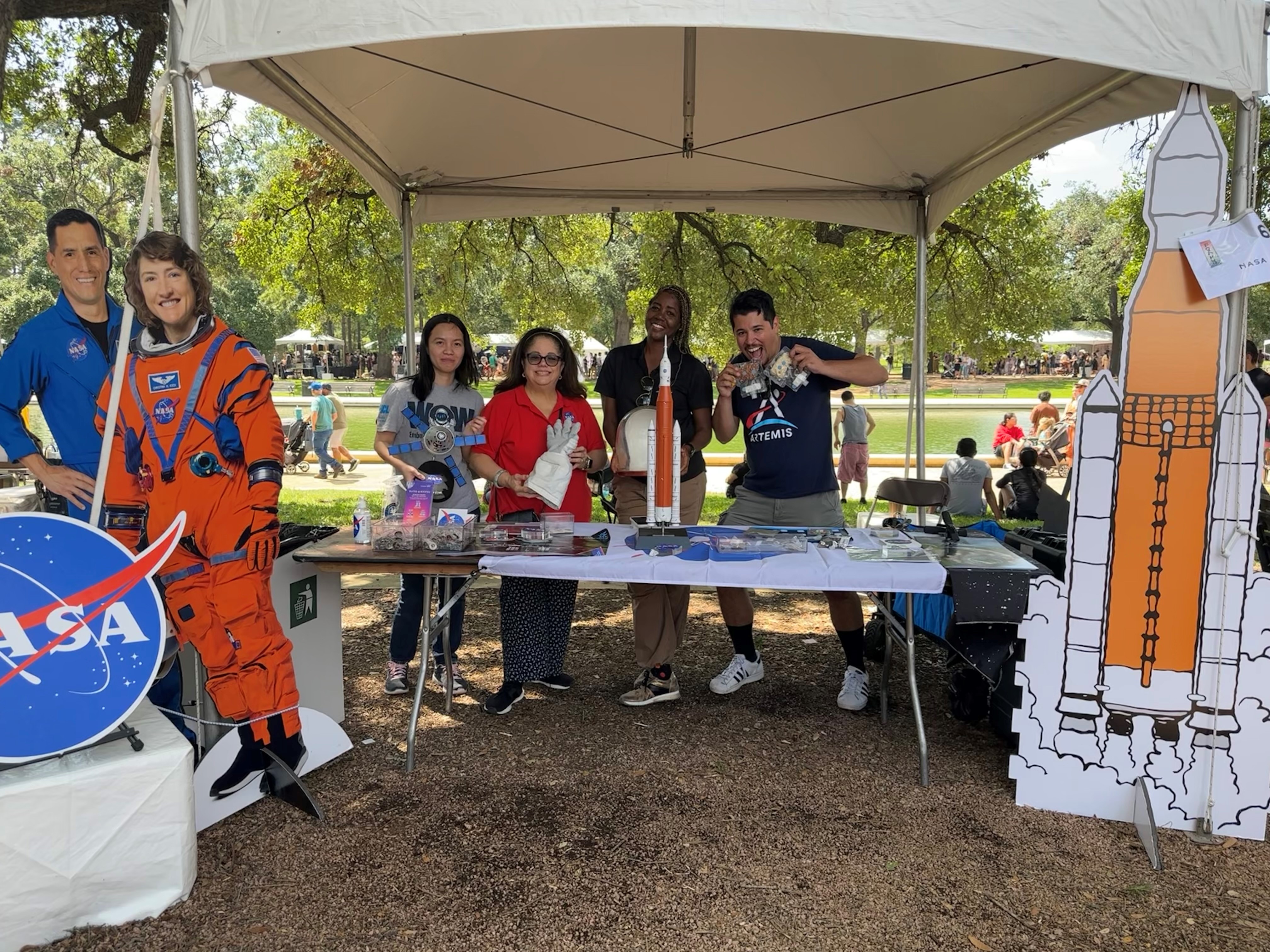
From Sept. 6-7, 2024, NASA’s Johnson Space Center brought the excitement of space exploration to the annual Japan Festival at Hermann Park in Houston.
The lively cultural event featured traditional food, dance, martial arts, and more, while Johnson’s booth attracted attendees with interactive space exhibits and STEM (science, technology, engineering, and mathematics) activities.
Johnson Space Center volunteers share NASA’s mission and student opportunities at the annual Japan Festival in Houston.
NASA
Johnson employees passed along information about High School Aerospace Scholars (HAS), a NASA-unique program offering Texas high school juniors an opportunity to explore STEM fields.
The program kicks off with an online course and, for top performers, culminates in an on-site summer experience at Johnson, where students can learn from NASA scientists and engineers. Program graduates may also apply for NASA internships and scholarships, including the Houston Livestock Show and Rodeo™ and Rotary National Award for Space Achievement scholarships.
Attendees enjoy Johnson Space Center’s exhibit booth at Hermann Park in Houston.
NASA/Johnnie Joseph
Festival attendees explored interactive displays, including models of the Space Launch System and Orion spacecraft, space food samples, and a real spacesuit glove and helmet. Johnson volunteers distributed NASA meatball stickers, mission stickers, and Artemis bookmarks with QR codes, offering students and space enthusiasts opportunities to dive deeper into STEM education and NASA’s missions.
Johnson volunteers share NASA’s mission and student opportunities to festival attendees.
NASA/Johnnie Joseph
NASA’s long-standing partnership with Japan was front and center as JAXA (Japan Aerospace Exploration Agency) set up a neighboring booth. JAXA astronaut Satoshi Furukawa delighted festival-goers by posing for photos, signing autographs, and visiting NASA’s booth to greet Johnson employees.
The event highlighted the collaborative spirit of space exploration between NASA and its international partners, who are working together on missions around the Moon and beyond as part of the Artemis campaign. Japan, alongside other global partners, has committed to supporting the International Space Station through 2030.
Festival attendees explore NASA’s booth, captivated by the space exhibits.
NASA/Johnnie Joseph
This website uses cookies to improve your experience. We'll assume you're ok with this, but you can opt-out if you wish.AcceptRead More
Privacy & Cookies Policy
Privacy Overview
This website uses cookies to improve your experience while you navigate through the website. Out of these, the cookies that are categorized as necessary are stored on your browser as they are essential for the working of basic functionalities of the website. We also use third-party cookies that help us analyze and understand how you use this website. These cookies will be stored in your browser only with your consent. You also have the option to opt-out of these cookies. But opting out of some of these cookies may affect your browsing experience.
Necessary cookies are absolutely essential for the website to function properly. This category only includes cookies that ensures basic functionalities and security features of the website. These cookies do not store any personal information.
Any cookies that may not be particularly necessary for the website to function and is used specifically to collect user personal data via analytics, ads, other embedded contents are termed as non-necessary cookies. It is mandatory to procure user consent prior to running these cookies on your website.