Tag: planethunt

  • 55 Years Ago: Apollo 13, Preparations for the Third Moon Landing

    As 1969, an historic year that saw not just one but two successful human lunar landings, drew to a close, NASA continued preparations for its planned third Moon landing mission, Apollo 13, then scheduled for launch on March 12, 1970. The Apollo 13 prime crew of Commander James A. Lovell, Command Module Pilot (CMP) Thomas K. “Ken” Mattingly, and Lunar Module Pilot (LMP) Fred W. Haise, and their backups John W. Young, John L. “Jack” Swigert, and Charles M. Duke, continued intensive training for the mission. NASA announced the selection of the Fra Mauro region of the Moon as the prime landing site for Apollo 13, favored by geologists because it forms an extensive geologic unit around Mare Imbrium, the largest lava plain on the Moon. The Apollo 13 Saturn V rolled out to its launch pad.

    Apollo 11

    Apollo 11 astronauts Neil A. Armstrong, Michael Collins, and Edwin E. “Buzz” Aldrinhad returned from their Giantstep Presidential goodwill tour on Nov. 5, 1969. Due to scheduling conflicts, a visit to Canada could not be included in the same time frame as the rest of the tour, so the astronauts made a special trip to Ottawa and Montreal on Dec. 2 and 3, meeting with local officials.

    Armstrong joined famed comedian Bob Hope’s USO Christmas tour in December 1969. He participated in several shows at venues in South Vietnam, Thailand, and Guam, kidding around with Hope and answering questions from the assembled service members. He received standing ovations and spent much time shaking hands with the troops. The USO troupe also visited the hospital ship U.S.S. Sanctuary (AH-17) stationed in the South China Sea.

    Apollo 12

    For the first time in nearly four weeks, on Dec. 10, Apollo 12 astronauts Charles “Pete” Conrad, Richard F. Gordon, and Alan L. Bean stepped out into sunshine and breathed unfiltered air. Since their launch on Nov. 14, 1969, the trio had traveled inside their spacecraft for 10 days on their mission to the Moon and back, wore respirators during their recovery in the Pacific Ocean, stayed in the Mobile Quarantine Facility during the trip from the prime recovery ship U.S.S. Hornet back to Houston, and lived in the Lunar Receiving Laboratory (LRL) at the Manned Spacecraft Center (MSC), now NASA’s Johnson Space Center in Houston. Like the Apollo 11 crew before them, Conrad, Gordon, and Bean exhibited no symptoms of any infections with lunar microorganisms and managers declared them fit to be released from quarantine. MSC Director Robert L. Gilruth, other managers, and a crowd of well-wishers greeted Conrad, Gordon, and Bean.

    Addressing the crowd gathered outside the LRL, Conrad commented that “the LRL was really quite pleasant,” but all three were glad to be breathing non man-made air! While the men went home to their families for a short rest, work inside the LRL continued. Scientists began examining the first of the 75 pounds of rocks returned by the astronauts as well as the camera and other hardware they removed from Surveyor 3 for effects of 31 months exposed to the harsh lunar environment. Preliminary analysis of the TV camera that failed early during their first spacewalk on the lunar surface indicated that the failure was due to partial burnout of the Videocon tube, likely caused by the crew accidentally pointing the camera toward the Sun. Other scientists busied themselves with analyzing the data returning from the Apollo Lunar Surface Experiment Package (ALSEP) instruments Conrad and Bean deployed on the lunar surface. Mission planners examining the photographs taken from lunar orbit of the Fra Mauro area were confident that the next mission, Apollo 13, would be able to make a safe landing in that geologically interesting site, the first attempt to land in the lunar highlands.

    Two days after leaving the LRL, Conrad, Gordon, and Bean held their postflight press conference in the MSC auditorium. Addressing the assembled reporters, the astronauts first introduced their wives as their “number one support team,” then provided a film and photo summary of their mission, and answered numerous questions. Among other things, the astronauts praised the spacesuits they wore during the Moon walks, indicating they worked very well and, looking ahead, saw no impediments to longer excursions on future missions. Their only concern centered around the ever-present lunar dust that clung to their suits, raising that as a potential issue for future lunar explorers.

    Conrad, Gordon, and Bean returned to NASA’s Kennedy Space Center (KSC) in Florida on Dec. 17, where their mission began more than a month earlier and nearly ended prematurely when lightning twice struck their Saturn V rocket. KSC Director Kurt H. Debus presented each astronaut with a framed photograph of their launch in front of 8,000 workers assembled in the Vehicle Assembly Building (VAB). Of their nearly ill-fated liftoff Conrad expressed his signature confidence, “Had we to do it again, I would launch exactly under the same conditions.” Guenter Wendt and his pad closeout team had collected a piece of grounding rod from the umbilical tower, cut it into three short pieces, mounted them with the inscription “In fond memory of the electrifying launch of Apollo 12,” and presented them to the astronauts. Three days later, President Richard M. Nixon and First Lady Pat Nixon welcomed Conrad, Gordon, and Bean and their wives Jane, Barbara, and Sue, respectively, to a dinner at the White House. After dinner, they watched a film about the Apollo 12 mission as well as the recently released motion picture Marooned about three astronauts stranded in space. President Nixon requested that the astronauts pay a visit to former President Lyndon B. Johnson, who for many years championed America’s space program, and brief him on their mission, which they did in January 1970.

    On Dec. 22, the city of Fort Worth, Texas, honored native son Bean, with Conrad, Gordon, and their families joining him for the Alan Bean Day festivities. An estimated 150,000 people lined the streets of the city to welcome Bean and his crewmates, dumping a blizzard of ticker tape and shredded office paper on the astronauts and their families during the parade. City workers cleared an estimated 60 tons of paper from the streets after the event. 

    Apollo 13

    On Dec. 10, 1969, NASA announced the selection of the Fra Mauro region of the Moon as the prime landing site for Apollo 13, located about 110 miles east of the Apollo 12 touchdown point. Geologists favored the Fra Mauro area for exploration because it forms an extensive geologic unit around Mare Imbrium, the largest lava plain on the Moon. Unlike the Apollo 11 and 12 sites located in the flat lunar maria, Fra Mauro rests in the relatively more rugged lunar highlands. The precision landing by the Apollo 12 crew and their extensive orbital photography of the Fra Mauro region gave NASA confidence to attempt a landing at Fra Mauro. Workers in KSC’s VAB had stacked the three stages of Apollo 13’s Saturn V in June and July 1969. On Dec. 10, they topped the rocket with the Apollo 13 spacecraft, comprising the Command and Service Modules (CSM) and the Lunar Module (LM) inside the Spacecraft LM Adapter. Five days later, the Saturn V exited the VAB and made the 3.5-mile journey out to Launch Pad 39A to begin a series of tests to prepare it for the launch of the planned 10-day lunar mission. During their 33.5 hours on the Moon’s surface, Lovell and Haise planned to conduct two four-hour spacewalks to set up the ALSEP, a suite of five investigations designed to collect data about the lunar environment after the astronauts’ departure, and to conduct geologic explorations of the landing site. Mattingly planned to remain in the CSM, conducting geologic observations from lunar orbit including photographing potential future landing sites.

    During the first of the two spacewalks, Apollo 13 Moon walkers Lovell and Haise planned to deploy the five ALSEP experiments, comprising:

    • Charged Particle Lunar Environment Experiment (CPLEE) – flying for the first time, this experiment sought to measure the particle energies of protons and electrons reaching the lunar surface from the Sun.
    • Lunar Atmosphere Detector (LAD) – this experiment used a Cold Cathode Ion Gauge (CCIG) to measure the pressure of the tenuous lunar atmosphere.
    • Lunar Heat Flow Experiment (LHE) – designed to measure the steady-state heat flow from the Moon’s interior.
    • Passive Seismic Experiment (PSE) – similar to the device left on the Moon during Apollo 12, consisted of a sensitive seismometer to record Moon quakes and other seismic activity.
    • Lunar Dust Detector (LDD) – measured the amount of dust deposited on the lunar surface.
    • A Central Station provided command and communications to the ALSEP experiments, while a Radioisotope Thermoelectric Generator using heat from the radioactive decay of a Plutonium-238 sample provided uninterrupted power. Additionally, the astronauts planned to deploy and retrieve the Solar Wind Collector experiment to collect particles of the solar wind, as did the Apollo 11 and 12 crews before them.

    Apollo 13 astronauts Lovell, Haise, Young, and Duke participated in a geology training field trip between Dec. 17 and 20 on the Big Island of Hawaii. Geologist Patrick D. Crosland of the National Park Service in Hawaii provided the astronauts with a tour of recent volcanic eruption sites in the Kilauea area, with the thought that the Fra Mauro formation might be of volcanic origin. During several traverses in the Kilauea Volcano area, NASA geologists John W. Dietrich, Uel S. Clanton, and Gary E. Lofgren and US Geological Survey geologists Gordon A. “Gordie” Swann, M.H. “Tim” Hait, and Leon T. “Lee” Silver accompanied the astronauts. The training sessions honed the astronauts’ geology skills and refined procedures for collecting rock samples and for documentary photography.

    Apollo 14

    Preparations for the fourth Moon landing mission, Apollo 14, continued as well. At the time tentatively planned for launch in July 1970, mission planners considered the Littrow area on the eastern edge of the Mare Serenitatis, characterized by dark material possibly of volcanic origin, as a potential landing site. Apollo 14 astronauts Commander Alan B. Shepard, CMP Stuart A. Roosa, and LMP Edgar D. Mitchell and their backups Eugene A. Cernan, Ronald E. Evans, and Joe H. Engle had already begun training for their mission. At KSC’s Manned Spacecraft Operations Building (MSOB), the Apollo 14 CSM arrived from its manufacturer North American Rockwell in Downey, California, as did the two stages of the LM from the Grumman Aerospace and Engineering Company in Bethpage, New York, in November 1969. Engineers began tests of the spacecraft shortly after their arrival. The three stages of the Apollo 14 Saturn V were scheduled to arrive at KSC in January 1970.

    To be continued …

    News from around the world in December 1969:

    December 2 – Boeing’s new 747 Jumbo Jet makes its first passenger flight, from Seattle to New York.

    December 3 – George M. Low sworn in as NASA deputy administrator.

    December 4 – A Boy Named Charlie Brown, the first feature film based on the Peanuts comic strip, is released to theaters for the first time.

    December 7 – The animated Christmas special Frosty the Snowman, makes its television debut.

    December 14 – The Jackson 5 make their first appearance on The Ed Sullivan Show.

    December 18 – The sixth James Bond film, On Her Majesty’s Secret Service, held its world premiere in London, with George Lazenby as Agent 007.

  • NASA, Axiom Space Change Assembly Order of Commercial Space Station

    3 min read

    Preparations for Next Moonwalk Simulations Underway (and Underwater)

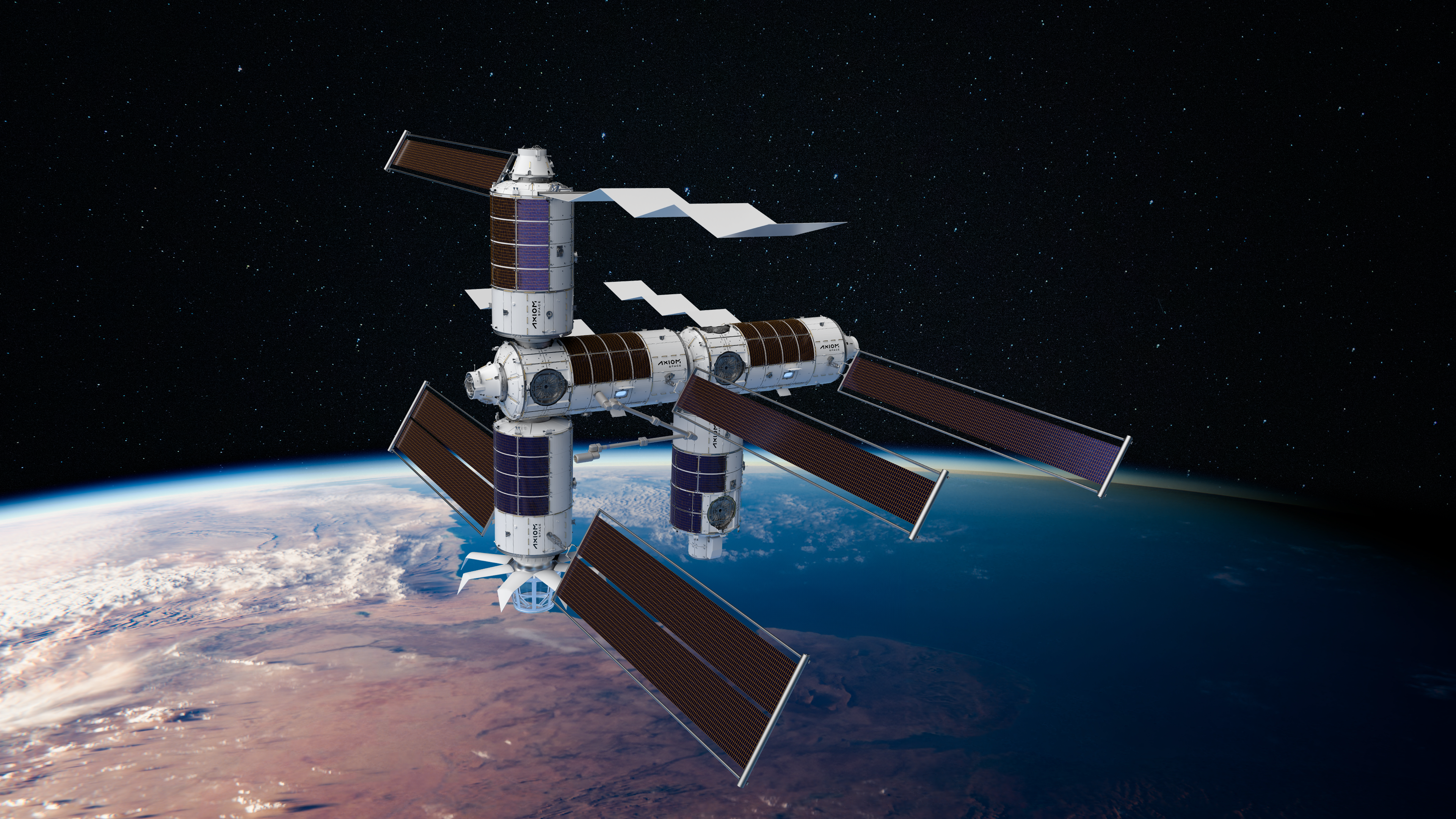
    A digital rendering of the completed Axiom Station, which includes the Payload, Power, and Thermal Module, Habitat 1, an airlock, Habitat 2, and the Research and Manufacturing Facility. Credits: Axiom Space
    A digital rendering of the completed Axiom Station, which includes the Payload, Power, and Thermal Module, Habitat 1, an airlock, Habitat 2, and the Research and Manufacturing Facility.
    Credits: Axiom Space

    In coordination with NASA, Axiom Space modified its planned assembly sequence to accelerate its ability to operate as a viable free-flying space station and reduce International Space Station reliance during assembly.

    NASA awarded Axiom Space a firm-fixed price, indefinite-delivery, indefinite-quantity contract in January 2020, as the agency continues to open the space station for commercial use. The contract provides insight into the development of at least one habitable commercial module to be attached to the space station with the goal of becoming a free-flying destination in low Earth orbit prior to retirement of the orbiting laboratory in 2030.

    The initial Axiom Space plan was to launch and attach its first module, Habitat 1, to the space station, followed by three additional modules.

    Under the company’s new assembly sequence, the Payload, Power, and Thermal Module will launch to the orbiting laboratory first, allowing it to depart as early as 2028 and become a free-flying destination known as Axiom Station. In free-flight, Axiom Space will continue assembly of the commercial destination, adding the Habitat 1 module, an airlock, Habitat 2 module, and the Research and Manufacturing Facility.

    “The updated assembly sequence has been coordinated with NASA to support both NASA and Axiom Space needs and plans for a smooth transition in low Earth orbit,” said Angela Hart, manager, Commercial Low Earth Orbit Development Program at NASA’s Johnson Space Center in Houston. “The ongoing design and development of commercial destinations by our partners is critical to the agency’s plan to procure services in low Earth orbit to support our needs in microgravity.”

    The revised assembly sequence will enable an earlier departure from the space station, expedite Axiom Station’s ability to support free-flight operations, and ensure the orbiting laboratory remains prepared for the U.S. Deorbit Vehicle and end of operational life no earlier than 2030.

    “The International Space Station has provided a one-of-a-kind scientific platform for nearly 25 years,” said Dana Weigel, manager, International Space Station Program at NASA Johnson. “As we approach the end of space station’s operational life, it’s critically important that we look to the future of low Earth orbit and support these follow-on destinations to ensure we continue NASA’s presence in microgravity, which began through the International Space Station.”

    NASA is supporting the design and development of multiple commercial space stations, including Axiom Station, through funded and unfunded agreements. The current design and development phase will be followed by the procurement of services from one or more companies.

    NASA’s low Earth orbit microgravity strategy builds on the agency’s extensive human spaceflight experience to advance future scientific and exploration goals. As the International Space Station nears the end of operations, NASA plans to transition to a new low Earth orbit model to continue leveraging microgravity benefits. Through commercial partnerships, NASA aims to maintain its leadership in microgravity research and ensure continued benefits for humanity.

    Learn more about NASA’s low Earth orbit microgravity strategy at:

    https://www.nasa.gov/leomicrogravitystrategy

    News Media Contacts
    Claire O’Shea
    Headquarters, Washington
    202-358-1100
    claire.a.o’shea@nasa.gov

    Anna Schneider
    Johnson Space Center, Houston
    281-483-5111
    anna.c.schneider@nasa.gov

  • Orion Spacecraft Tested in Ohio After Artemis I Mission

    5 min read

    Preparations for Next Moonwalk Simulations Underway (and Underwater)

    The Orion Environmental Test Article, blackened from its spaceflight, is photographed sitting on a white platform inside the shadowed aluminum vacuum chamber at NASA’s Neil Armstrong Test Facility. A woman with dark hair wearing a black sweatshirt appears in the lower right corner of the photo.
    The Orion Environmental Test Article photographed inside the Thermal Vacuum Chamber on April 11, 2024, in the Space Environments Complex at NASA’s Neil Armstrong Test Facility in Sandusky, Ohio.
    Credit: NASA/Quentin Schwinn 

    Making the voyage 1.4 million miles around the Moon and back — the farthest a spacecraft built for humans has ever gone — the Orion spacecraft has faced a battery of tests over the years. Though Orion successfully proved its capabilities in the harsh environment of space during the Artemis I mission, Orion’s evaluation did not end at splashdown.  

    The crew module, now known as the Orion Environmental Test Article (ETA), returned to NASA’s Neil Armstrong Test Facility in Sandusky, Ohio, in January 2024 and completed an 11-month test campaign necessary for the safety and success of Artemis II, the first crewed mission under NASA’s Artemis campaign.  

    Engineers and technicians from NASA and Lockheed Martin subjected the test article to the extreme conditions Orion may experience in a launch abort scenario. In the event of an emergency, Orion — and astronauts inside — will jettison away from the SLS (Space Launch System) rocket for a safe landing in the ocean.  

    “This event would be the maximum stress and highest load that any of the systems would see,” said Robert Overy, Orion ETA project manager, NASA’s Glenn Research Center in Cleveland. “We’re taking a proven vehicle from a successful flight and pushing it to its limits. The safety of the astronaut crew depends on this test campaign.” 

    Experts conducted tests that simulated the noise levels of an abort during launch in addition to the electromagnetic effects of lightning strikes. The test campaign also jettisoned the test article’s docking module and parachute covers, as well as the crew module uprighting system, which consists of five airbags on top of the spacecraft that inflate upon splashdown.  

    “It’s been a successful test campaign,” Overy said. “The data has matched the prediction models, and everything operated as expected after being subjected to nominal and launch abort acoustic levels. We are still analyzing data, but the preliminary results show the vehicle and facility operated as desired.” 

    On. Nov. 23, 2024, after subjecting the Orion test article to launch abort-level acoustics, experts tested the functionality of the forward bay cover, which is the last piece that must eject before parachutes deploy.
    Credit: NASA/Jordan Salkin and Quentin Schwinn

    Testing Orion at such high acoustic levels was a major milestone for Artemis. The Reverberant Acoustic Test Facility, the world’s most powerful spacecraft acoustic test chamber, was built in 2011 in anticipation of this specific test campaign.   

    “These tests are absolutely critical because we have to complete all of these tests to say the spacecraft design is safe and we’re ready to fly a crew for the first time on Artemis II,” said Michael See, ETA vehicle manager, Orion Program. “This is the first time we’ve been able to test a spacecraft on the ground in such an extreme abort-level acoustic environment.” 

    The Orion Environmental Test Article with Launch Abort System installed moves to the Reverberant Acoustic Test Facility, the most powerful spacecraft acoustic test chamber in the world, on Sept. 9, 2024, at NASA’s Neil Armstrong Test Facility in Sandusky, Ohio. 
    Credit: NASA/Jordan Salkin and Quentin Schwinn 

    Part of NASA Glenn, Armstrong Test Facility is home to the world’s largest and most powerful space environment simulation chambers capable of testing full-sized spacecraft for all the extreme conditions of launch and spaceflight. The facility not only houses an acoustic test chamber, but also a thermal-vacuum chamber and spacecraft vibration system.  

    “The facility is unique because there’s no other place in the world capable of testing spacecraft like this,” Overy said. “Armstrong Test Facility is a one-stop-shop for all your testing needs to prepare your spacecraft for the severe and challenging journey to and from space.” 

    Orion’s Round-Trip Journey to Ohio 

    This is not the first time Orion has been inside the walls of the Space Environments Complex at Armstrong Test Facility. The spacecraft underwent mission-critical testing in 2019, where it was subjected to extreme temperatures and an electromagnetic environment before it launched on Artemis I in 2022. 

    “I remember when it first arrived, the gravity of its importance really hit home,” said Joshua Pawlak, test manager, NASA Glenn. “I thought to myself, on future Artemis missions, astronauts will be inside Orion heading to the Moon, and they’ll be depending on it for survival.” 

    Pawlak was a mechanical test engineer when Orion made its first trip to the Sandusky facility. He participated in planning and coordinating testing of the vehicle and trained personnel. He managed the vehicle from the moment it arrived, through testing, and up until it departed for NASA’s Kennedy Space Center in Florida.  

    A man in a hat, long-sleeve shirt, and jeans stands with his hands in his pocket, smiling toward the camera. Behind him across the water, the Artemis I Space Launch System rocket awaits launch. The rocket is lit by flood lights, and the light is reflected in both the water and the sky above.
    Joshua Pawlak poses in front of the Artemis I Space Launch System rocket on Nov. 16, 2022, in Cape Canaveral, Florida.
    Credit: Joshua Pawlak

    “When it returned, I felt like I had a small part in this really big and exciting thing,” Pawlak said. “Seeing it come back blackened and scarred from the harsh environment of space was incredible. Space is not a friendly space, and I felt proud knowing that if there were astronauts on that vehicle, they would have survived. 

    After the Orion test article departs from Glenn, it will head to Kennedy for additional testing. 

    “When Artemis II launches and those astronauts are sitting on board, I’ll know that I did everything I could to ensure the vehicle is ready for them and going to perform as expected,” Pawlak said. “That’s why I do what I do.” 

  • Hubble Images a Grand Spiral

    2 min read

    Hubble Images a Grand Spiral

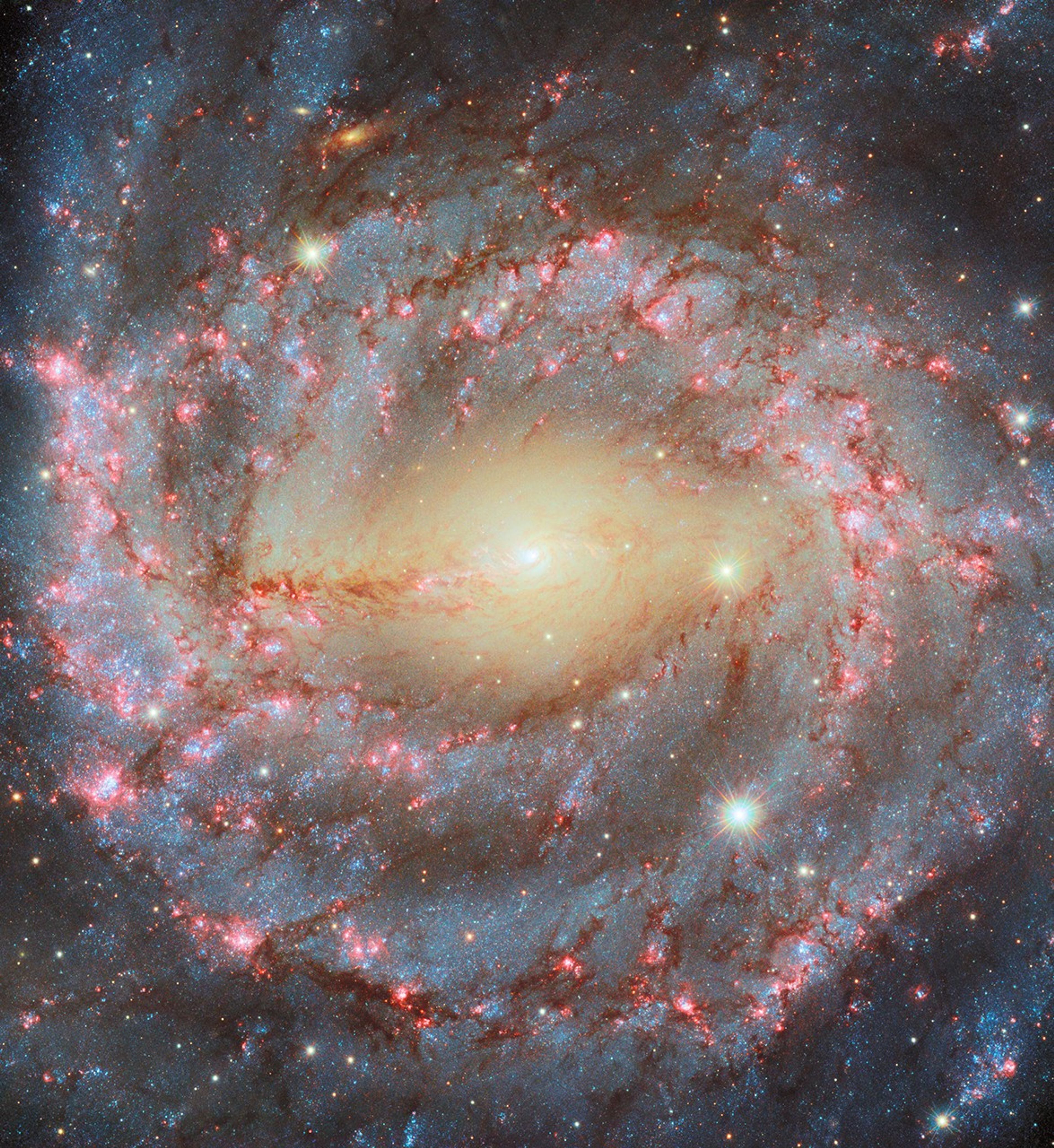
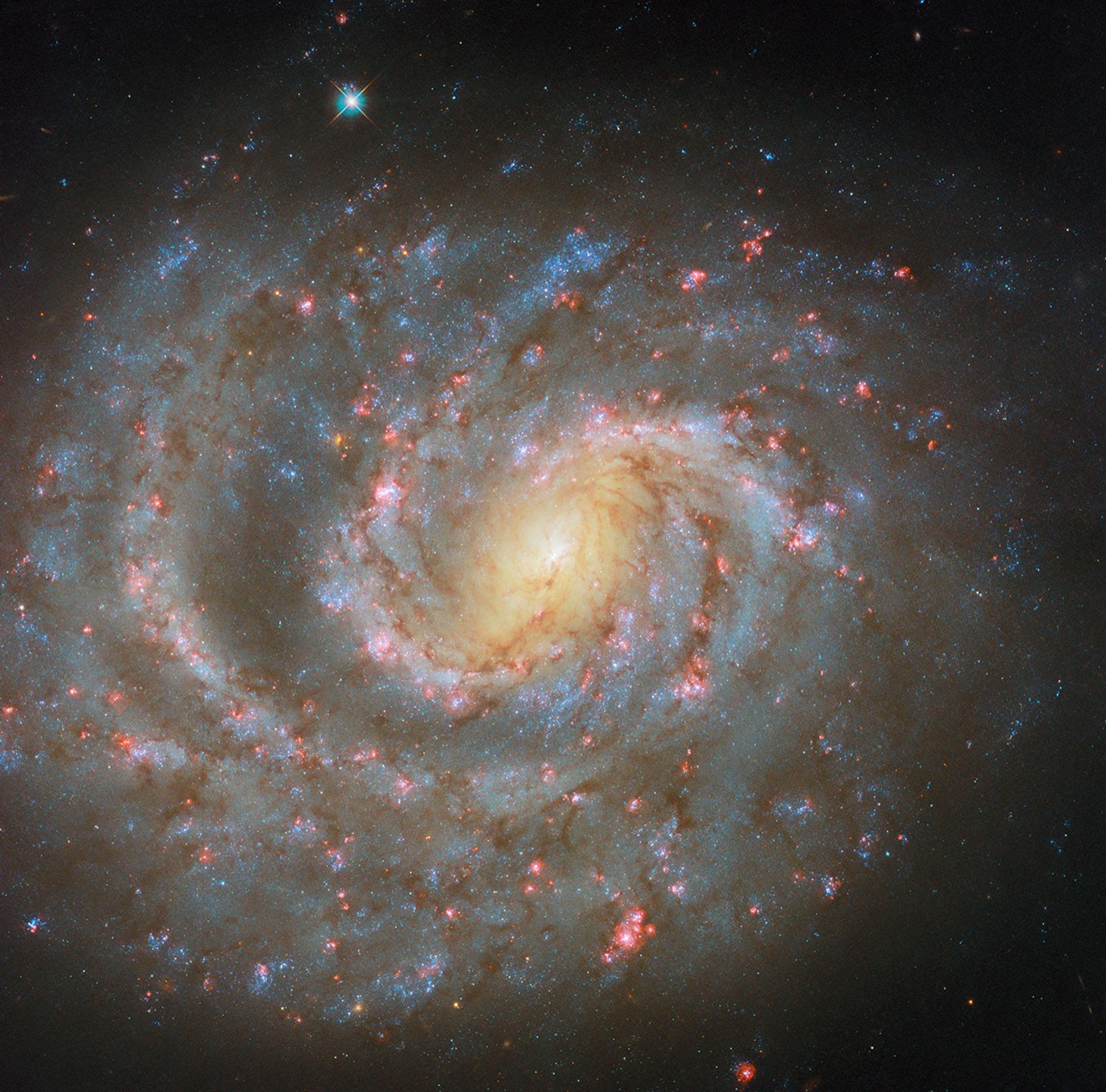
    A close-up of a spiral galaxy, seen face-on. Its center is a bright white point, surrounded by a large yellowish oval with thin lines of dust swirling in it. From the sides of the oval emerge two bright spiral arms which wind through the round disk of the galaxy, filled with shining pink spots where stars are forming and more dark reddish dust. Many stars are visible in the foreground, over and around the galaxy.
    This NASA/ESA Hubble Space Telescope image features the spiral galaxy NGC 5643.
    ESA/Hubble & NASA, A. Riess, D. Thilker, D. De Martin (ESA/Hubble), M. Zamani (ESA/Hubble)

    This NASA/ESA Hubble Space Telescope image features the glorious spiral galaxy NGC 5643, which is located roughly 40 million light-years away in the constellation Lupus, the Wolf. NGC 5643 is a grand design spiral, which refers to the galaxy’s symmetrical form with two large, winding spiral arms that are clearly visible. Bright-blue stars define the galaxy’s spiral arms, along with lacy reddish-brown dust clouds and pink star-forming regions.

    As fascinating as the galaxy appears at visible wavelengths, some of NGC 5643’s most interesting features are invisible to the human eye. Ultraviolet and X-ray images and spectra of NGC 5643 show that the galaxy hosts an active galactic nucleus: an especially bright galactic core powered by a feasting supermassive black hole. When a supermassive black hole ensnares gas from its surroundings, the gas collects in a disk that heats up to hundreds of thousands of degrees. The superheated gas shines brightly across the electromagnetic spectrum, but especially at X-ray wavelengths.

    NGC 5643’s active galactic nucleus isn’t the brightest source of X-rays in the galaxy, though. Researchers using ESA’s XMM-Newton discovered an even brighter X-ray-emitting object, called NGC 5643 X-1, on the galaxy’s outskirts. What could be a more powerful source of X-rays than a supermassive black hole? Surprisingly, the answer appears to be a much smaller black hole! While the exact identity of NGC 5643 X-1 is unknown, evidence points to a black hole that is about 30 times more massive than the Sun. Locked in an orbital dance with a companion star, the black hole ensnares gas from its stellar companion, creating a superheated disk that outshines the NGC 5643’s galactic core.

    NGC 5643 was also the subject of a previous Hubble image. The new image incorporates additional wavelengths of light, including the red color that is characteristic of gas heated by massive young stars.

    Explore More

    Media Contact:

    Claire Andreoli (claire.andreoli@nasa.gov)
    NASA’s Goddard Space Flight CenterGreenbelt, MD

  • Sols 4386-4388: Powers of Ten

    3 min read

    Sols 4386-4388: Powers of Ten

    A grayscale photograph of the Martian surface shows very uneven rocky terrain, with bright-toned, flat, lined and multi-angled rocks covering the surface, with darker soil in between, looking like the entire foreground stretching off into the distance had shattered. In the background, about three quarters of the way up the frame, is a darker, smoother feature rising from the ground and extending all the way across the frame, and beyond that is a lighter, distant band of peaks, resembling a ghostly pale fog bank.
    NASA’s Mars rover Curiosity acquired this image using its Left Navigation Camera on sol 4384 — Martian day 4,384 of the Mars Science Laboratory mission — Dec. 5, 2024, at 19:08:43 UTC.
    NASA/JPL-Caltech

    Earth planning date: Friday, Dec. 6, 2024

    We successfully arrived in our new exploration quadrangle — the Altadena quad — which is named after a town on Earth very near our own Jet Propulsion Laboratory! The names from this quad will recognize the incredible interaction between Altadena and its surrounding environs with the San Andreas and other major faults, which led to the formation of several major mountain ranges, and with the rich human history of the area. The start of our activities in the Altadena quad was fairly typical, including observations both near to and far from the rover, depending on what catches our eye across the terrain. Today’s observations were no exception, but it strikes me that they fit into fairly neat order of magnitude bins that really crystallize how far-reaching (pun intended) Curiosity’s science is.

    The nearest observation is of the rover itself, with MAHLI placed around 10 centimeters (about 4 inches) from its calibration target for a series of images tracking the amount of dust clinging to the target. 

    One meter (about 39 inches) from the front of the rover, MAHLI and APXS planned an analysis of a small float block, “Icehouse Canyon,” that resembled rocks we saw in Gediz Vallis. MAHLI, APXS, and ChemCam teamed up to analyze the DRT target located on typical bedrock in the workspace at “Sunland,” and ChemCam rastered across one the many veins in the workspace at target “Echo Mountain.” One meter (about one yard) in back of (and underneath) the rover, DAN scheduled multiple analyses that look to provide insight into water in the subsurface. 

    Tens of meters (tens of yards) from the rover, our interest in recording the many veins of this area continued. Mastcam planned three mosaics covering different collections of these long, linear features, some of which are visible in the lower left corner of the image above, to support study of their orientations. 

    Hundreds of meters from the rover, ChemCam looked back at Gediz Vallis, planning RMI mosaics of materials on both Gediz Vallis Ridge and within Gediz Vallis itself. The mosaics add more insight to that which we gained as we traversed through Gediz Vallis as the team tries to interpret the formation of the ridge and valley. Mastcam added coverage of this same area and extended their imaging a bit farther to include a small crater, “Grant Lake,” well south of the rover. 

    Thousands of meters from the rover (five-eighths of a mile, and beyond), ChemCam acquired a mosaic of the wind-sculpted structures that cap Mount Sharp, known as yardangs. 

    Finally, gazing up into the Martian atmosphere that extends tens of thousands of meters into space (6 miles, and multiples beyond that), Navcam planned early morning and midday imaging to assess the amount of dust in the atmosphere and search for clouds and dust devils. ChemCam planned a passive sky observation to measure certain chemical compounds in the atmosphere, and REMS and RAD included their regular schedule of weather and radiation monitoring, respectively. 

    The weekend plan is truly science across the scales!

    Written by Michelle Minitti, Planetary Geologist at Framework

    Details

    Last Updated

    Dec 10, 2024

    Related Terms

  • Hubble Spots a Spiral in the Celestial River

  • Hubble Space Telescope
 

2 min read

Hubble Spots a Spiral in the Celestial River

A spiral galaxy filling the view. Its disk holds many bright red spots where stars are forming, dark reddish threads of dust that obscure light, and bluish glowing areas that hold concentrations of older stars. It has a large, glowing yellow oval area at the center, from which two spiral arms wind through the galaxy’s disk. One side of the disk appears rounded (bottom of the image) while the opposite side appears somewhat squared-off (top of the image).
This NASA/ESA Hubble Space Telescope image features the spiral galaxy NGC 1637.
ESA/Hubble & NASA, D. Thilker

The subject of this NASA/ESA Hubble Space Telescope image is NGC 1637, a spiral galaxy located 38 million light-years from Earth in the constellation Eridanus, the River.

This image comes from an observing program dedicated to studying star formation in nearby galaxies. Stars form in cold, dusty gas clouds that collapse under their own gravity. As young stars grow, they heat their nurseries through starlight, winds, and powerful outflows. Together, these factors play a role in controlling the rate at which future generations of stars form.

NGC 1637 holds evidence of star formation scattered throughout its disk, if you know where to look. The galaxy’s spiral arms have pockets of pink clouds, many with bright blue stars. The pinkish color comes from hydrogen atoms excited by ultraviolet light from young, massive stars forming within the clouds. This contrasts with the warm yellow glow of the galaxy’s center, which is home to a densely packed collection of older, redder stars.

The stars that set their cloudy birthplaces aglow are comparatively short-lived, and many of these stars will explode as supernovae just a few million years after they’re born. In 1999, NGC 1637 played host to a supernova named SN 1999EM, lauded as the brightest supernova seen that year. When a massive star expires as a supernova, the explosion outshines its entire home galaxy for a short time. While a supernova marks the end of a star’s life, it can also jump start the formation of new stars by compressing nearby clouds of gas, beginning the stellar lifecycle anew.

Explore More

Media Contact:

Claire Andreoli (claire.andreoli@nasa.gov)
NASA’s Goddard Space Flight CenterGreenbelt, MD

Details

Last Updated

Dec 05, 2024

Editor
Andrea Gianopoulos
  • Interview with Luke Sollitt

    Let’s begin by Inquiring into your early years, your childhood, where you were born, where you grew up, what your family was like? Do you have siblings? What did your parents do, and how young were you when you developed an interest in what has become your career?

    I was born in Boston. My mom lived in Vermont at the time, so it’s kind of a home state. We moved to the Washington DC area, to Alexandria, when I was about four. I have a brother whose name is Ian. He is not quite 2 years older than I am. He lives in Maine. Unfortunately, my mom, my father, and my stepfather, I’ll talk all about them, none of them are with us anymore. When my mom lived in Vermont, she was a postal carrier but was dissatisfied with that life. She had been an executive at the age of 22 In New York City, in the early 1960’s, which was very unusual at the time. She worked for the Wool Bureau.

    For the what bureau? The Wool Bureau? I didn’t know there was one.

    You’ve seen the wool label in wool clothes? The one that says “It’s Real Wool”? Well, that’s her. She actually made that happen. She’s the one who turned that into a nationwide thing. Anyway, she and my father parted ways when I was quite young, so she was a single mother and decided that she was going to take a one way trip to Virginia to throw herself into the mill there. She started a newsletter as a single parent with two little kids.

    I was five years old when Star Wars came out. The movie had a pretty significant effect on my life, particularly given that the main character has the same name I do. But my first inkling that I wanted to do something associated with the stars and space exploration may have actually come a little bit before that, when I was four. One day we were at a laundromat, and I was left in the back of the station wagon. Let’s remember that this was the ‘70s. My mom had some library books in the car, and there was this book on astronomy. I was young enough at the time that reading for me was still very new, and I looked at big paragraphs as scary things. I remember just looking at the pictures of the stars and thinking how wonderful it all was. And by the time I was nine years old it was all over and I wanted to be – am I really going say this to the whole world? – I wanted to be a scientist, an engineer, and an astronaut. All those things.

    What’s the matter with saying that to the whole world? Those are laudable goals.

    What I wanted to do at such an early age seems embarrassing but the fun part is I’ve actually gotten two of the three.

    Yes!

    I suppose I’ve made my peace with it all.  I had figured out very early that I wanted to be in science, but my stepfather didn’t think much of it. He used to tell me things like “a physicist is a boy with a toy” and other disparaging things about my chosen vocation. We moved from Alexandria to Calvert County, Maryland, and I lived there from the age of 9 to 14. So I spent those really formative years in what I felt as a kid to be a very boring part of the world with not a lot of friends, and I was an intense geek at the time. Being a geek is OK now, being a nerd is cool, right? We’re all nerds. That wasn’t true when I was ten, and so I didn’t have the best time growing up. I was so dissatisfied with life in Calvert County that I decided I was going to get the heck out of Dodge and go to college, and so I did that at the age of 14 by going to Simon’s Rock College in Western Massachusetts.  I was there for two years and then I went to the University of Maryland. But there was a little problem for me, going to college at 14: I’d never done homework. Homework wasn’t a thing for me. I didn’t care. If you’re in college and you sit down at the physics class, I was the kid that you despised because I was the kid that would come in, take the test, and ace it, having never done anything.

    Well,  let me interrupt because you mentioned that you went to college at age 14 and I was about to ask if you were in Mensa or something? Because that’s quite an accomplishment to be able to do that. And then you said you didn’t do any homework, and that’s even more amazing. So how did that come about? Do you just have natural ability?

    Truth is, I was actually bored and it was kind of unhealthy. The not doing homework thing is really bad, you don’t want to do that. I got over it later, I’ll come to that, but I’ve learned lots of lessons on the way, chief of which is that brains are neither necessary nor sufficient a condition to do great things in life. It helps, but it’s neither necessary nor sufficient. Anyway, I was never in Mensa, I never bothered with Mensa. I went to one Mensa meeting and I found it impossibly boring. So yeah, I was a little bit weird. I was a little bit of a mutant in school but truth is, I was terribly bored and I only started doing better in school when they skipped me a grade and started letting me skip ahead and do other things. I started doing summer programs with the Center for Advancement of Academically Talented Youth (CTY). They sent me to Arizona State University for a summer. I went to Franklin and Marshall University in Pennsylvania the following summer. I learned Greek. After that I went to the Rock, but when I was 16, I went to the University of Maryland as a junior . . . and promptly fell apart because you can get away with what I did for only so long. Not doing homework might have worked in the introductory physics classes, but once I got into the upper division classes, that’s when reality hit and it hit hard. I was weeded out. I flunked out of physics. I did. My last semester as a physics major the first time around I had a C, a D and an F on my transcript in physics. I got a C in quantum mechanics, largely because the professor was being kind. I got a D in electricity and magnetism because that’s what I deserved, and I got an F in my lab class. My lab class! Remember that one for later, because I absolutely deserved it. I did nothing. I was horrible. I was really out of it.

    You have more than the average number of degrees, so I’m trying to put this all together. You’re going to walk us through how that all came about, right? How despite all this you are very well credentialed?

    Yeah, I can do that. So I got the C, D and the F and my stepfather, who never wanted me to be a physicist anyway, took the opportunity, since I’d been in college for 4 1/2 years, to apply a little pressure. And so he said to me: “You will graduate by the end of the year or you’re just out. We’re not paying for you anymore.” And I said (to myself), “Well, I want to graduate, so what can I graduate in?” And I thought, I can graduate in German, because in addition to physics, I had also been taking German classes. I’ve also studied Russian, Latin, Greek, Gothic and Middle High German. So I know a very little bit of a whole bunch of languages, but I love language. Language is great!

    Let me jump in here again because I saw that German was one of your B.A. degrees and I thought, well maybe you have German ancestry and you were trying to connect in that way with your family history?

    Nope. The closest my family gets to Germany is that my grandfather’s parents came from Brest-Litovsk, in what is now Belarus near the Polish border. It was invaded by Germany. They were Jews.

    Well, that wasn’t what I was thinking. I thought perhaps Sollitt might be a German name. But anyway, this is very impressive. Please continue.

    OK.  Well so I flunked out and I thought, well, I can get a degree in German because I’ve been studying German. I started taking German when I was 12 or something, 11 or 12, and I kept at it. Then I did Russian for a couple of years. I did German when I transferred to University of Maryland, so I said “I can do that”. I had to take all the senior level requirements in a single semester. The chairman of the department said, “I don’t think you’re going to make it” but I did and he wasn’t very happy: I didn’t do any homework.  It wasn’t a big deal to take a couple of summer classes, and then I was out. I got my degree in German, a degree that I had never wanted. I had wanted a physics degree. And I was 19, I had just turned 19. I was, in fact, a little disappointed that I didn’t get my degree at age 18, but I got it at 19, and graduated in August of 1990. That was right around the time when Saddam Hussein invaded Kuwait and we had the biggest recession since the Great Depression, and you had Harvard graduates waiting tables in Boston, that was all they could get. That was the environment into which I graduated with my unwanted degree in German with, you know, some lousy grades, although my GPA wasn’t awful. My first job was doing temp work for WFTY-TV channel 50. I did accounts receivable. I worked with a temp agency and I had to learn the job of accounts receivable by taking the test to see if I could do the job. So I thought “I don’t know how to do this, but OK, I’ll take the test.” It’s like this is how you do this and that’s how you do that, so OK, you can do receivables now!  I worked for them for a couple months and then I went through the Administrative Careers with America test, a very, very brief resurrection of the Civil Service Exam. And very foolishly, where it said you can indicate where you’re willing to work, for some insane reason, I said “Los Angeles.” I’d never been there but it sounded like fun. So I put that down as a potential location, with a bunch of other places, and the only offer I got was from the Internal Revenue Service in the Los Angeles district.

    I read about the IRS in your bio, and I was going to ask about it, so please tell us about that experience.

    I was employed as a Revenue Officer.

    It so doesn’t fit with what you’ve been telling us about who you are. But go ahead (laughs).

    Let’s just say it’s been a circuitous route! I joined the IRS as a Revenue Officer in the middle of the worst recession since the Great Depression, thanking my lucky stars that I had an actual job. And it was for a rather miserable salary that I drove my mom’s car across the country to get there. A Revenue Officer is the person who knocks on doors and collects the taxes.  I was hired as a GS-7. This was not a job that I liked. In fact, it was a job I viscerally hated but I did this job for nearly 4 1/2 years of my life. It taught me some really important lessons.

    My first lesson came on the very first day, when I attended a training session for hundreds of people (there had been a huge District-wide hire). About the first thing the first speaker said was that because we are now in the government, we must not only avoid impropriety, but the very appearance of impropriety. And that is something that I have lived by ever since. I think it’s the way you must be. I was in what they sometimes call retail government. My job was to literally go knock on doors of delinquent taxpayers and say, “Hi, you owe the government money or there are government tax returns that you haven’t filed”. I would do this driving my own car. And back in 1991, when I started, April of 1991, I was 19 years old. One taxpayer joked that he didn’t realize that the IRS was hiring from high school these days! (laughs)  Yeah, I looked pretty young. I started off wearing a suit and tie and the whole bit with the badge and everything. Everybody was terrified of me. So I ditched the suit. I ditched the tie. I grew my hair out. I wore rumpled blue jeans and a rumpled shirt. I mean, I looked terrible. But everybody talked to me. I never brought out the pocket commission unless I had to. And what I found was that I ended up being really, really good at the job. I was the number two rated Revenue Officer at GS-9, the year I was rated in the district. The first-rated GS-9 Revenue Officer in LA District that year was a really nice lady named Gail, a really neat lady, a grandmother.

    As a Revenue Officer, my attitude was markedly different from many. I didn’t approach delinquent taxpayers as, well, delinquents. I just went there thinking that they were people with a problem that needed to get fixed. My attitude was, “Hi, I’m from the IRS, I’m here to help, and I’m serious. Let me help you”. I never, ever, ever wanted to seize things. I never seized a car. I never seized a house. Other people did. They were keen to do it but I wasn’t. I managed to avoid all that stuff by basically dealing with taxpayers like real people. And I ended up closing tons and tons and tons of cases, something like three or four times as many cases as the next person in my group, because of the way I dealt with people, treating them differently, respectfully.

    I got my GS-11 at the age of 22. I was the youngest GS-11 that anyone could think of, and one day one of my co-workers said that I would eventually be the Assistant Commissioner of the IRS. That idea filled me with dread… But I mean no disrespect to the hardworking Revenue Officers and others at the IRS – their job is truly thankless, but so utterly necessary. So I was doing the job, although I despised it, and then one of the best jobs in the IRS came up, which was to do the exact same job for the International District. I transferred to L’Enfant Plaza in Washington, DC and International sent me as far as eastern Canada for my first training trip. I went from Montreal to Quebec City to New Brunswick to Halifax to Prince Edward Island to Newfoundland. What a great trip. It was wonderful. I met interesting new people and it’s a very different sort of thing there because you have no enforcement authority whatsoever. You basically have to ask very nicely, but I was pretty good at that because that’s how I did my job in LA.

    Had people gone there to escape the oversight of the IRS?

    No, it’s not that they were trying to escape the long arm of the IRS, it’s just that people who live abroad still have U.S. tax obligations. They still have to pay tax on their worldwide income, whether they live in America or live outside of America. A U.S. citizen living in Canada still has to file a U.S. tax return, and they run into tax trouble, too.

    But you were talking about enforcement authority. You don’t have it in Canada or overseas, right?

    Yeah, the way it works is the revenue officer gets a case once it’s been through the automated collection system. Automated collection systems are at the big IRS centers and they’re the ones who make the phone calls, send the registered letters, and all that stuff. I’m not sure what they do today. This was 30 years ago. And once the automated collection system runs through all the stuff they do, they ship it out to revenue officers who go and knock on the doors and say “You need to talk to me”. And if they get ignored, or they don’t comply with the agreements that they make with the revenue officer, which would have to be signed off by group managers, then the Revenue Officer can take action under civil enforcement authority. Civil enforcement authority includes things like seizures and levies. You can levy wages, you can levy bank accounts, you can levy rents. You can levy any form of income, any asset. You can place a notice of federal tax lien on the person, which then attaches to all their real estate. You can actually make seizures of anything a taxpayer owns. If they have nice artwork, you can seize that, too. It’s a lot of power, and to be honest it’s pretty scary. But the reason you can do that is because the long arm of federal law exists throughout the country.

    When you go to a place like Canada, you’re way past federal law. You can’t seize anything or levy anything unless there’s a tax treaty with that country. And if there is, then you can do things according to the way the treaty is written. I think in Canada that enforcement was done through requests to Revenue Canada. But to first order, you have no power in Canada, so what you’re reduced to is “Let’s try to make this work”, because if you have somebody who’s been living in Canada for 40 years and doesn’t want to go back, well, then their obvious move is to renounce U.S. citizenship and tell you to go away. That’s if they never want to go back, if they don’t care about their U.S. citizenship. But most folks do.

    Anyway, so I did that trip and I was planning my next one, until one day, and you have to understand I went to the University of Maryland in College Park, which is literally down the road from L’Enfant Plaza. It’s like 10 miles away or so, and I was back in familiar areas. In fact, I grew up in the area when I lived in Maryland and Alexandria, so I knew the place really, really well. I was living on Capitol Hill at the time. And one day, I’m not kidding here, at International, I was literally sitting at my desk scribbling physics equations, just like the Gary Larson cartoon (The Far Side): “What’s this? Jenkins, physics equations? Do you enjoy your job here as a cartoonist?” The cartoon character Jenkins, was literally me. I was scribbling physics equations, and I looked down and I said, “Oh, God, I really have unfinished business”. So I went right up to the University of Maryland, to my old faculty advisor, a guy named Joe Redish. And I marched into his office, waved my hand, and said “Hi, Joe. How do I restart? How do I get back in? What do I do?” And he started off listing books for me on how to get ready for it, saying “Do this book, do that book”. And then he stopped, thought about it for a moment, and said “No, forget all that. Go get the Feynman Lectures on Physics and give them a read.”  And I said “OK, sure”. So I got the Feynman Lectures on Physics and started reading them. They’re brilliant. I mean brilliant.

    I’m sure they are.

    But they’re not effective if you’re learning physics for the first time. It’s the last thing you want to do. It is effective if you’re doing something like what I was doing, which is getting back into the field or getting a different perspective, or as a great reference book. They’re wonderful for the right purposes, and I started reading the Feynman lectures that summer. I read them every day, all day. I read them on the subway to and from work. I read them on lunch hour. I read them on breaks. And as I read the lectures, I finally decided that I had to see about going back to school. So I went back up to the University of Maryland, walked into the registrar’s office and said “OK, I graduated a bunch of years ago and I want to come back. What’s the process?” And they said, “Well, here’s a 3×5 card.  Fill it out, please.” So I filled it out and handed it back to them, and they said “You’re in!”  And I said, “What? That’s it?” I just filled out a 3×5 card and then arranged for student loans.

    I told my mom what I was doing – I was talking to her about returning to physics before I re-enrolled. She was very, very supportive of my going back to get my physics degree. It was unfinished business. But I didn’t tell my stepfather right away because I knew he wouldn’t approve. I knew I would have to tell him eventually. My opportunity came on Father’s Day, 1995. By this time, my Mom and stepfather had divorced. But it was a crowded affair: my step-siblings were there with spouses and families, other friends were there. And I finally announced to everyone what I was going to do at the end of summer, which was leave the IRS and go back to school to get my degree in physics. Everybody in the room congratulated me, saying what a wonderful idea that was, and isn’t that great. Except my stepfather. He didn’t say a word. I knew he would not be happy about this – especially the way I ambushed him with it, in front of this huge crowd. But I knew that I absolutely had to present my decision as a fait accompli: if I had gone to him to tell him I was thinking about doing this, he would have been on me until I dropped it. At the end of the day I was the last person there and he walked up to me and he said, “I don’t know how to react to this news, that you’re going back to school. It’s as if you’ve told me that you’re quitting your successful government career to go back and study remedial English”. That’s a quote.

    Oh my!

    Yeah.

    So it wasn’t just a matter that he was paying for your education. He really objected to what you wanted to become through your education.

    Yes, that’s why he would say things like “A physicist is a boy with a toy”. He saw physicists as unserious, as non-intellectuals, which is a huge mistake.

    I should say.

    But I went back and set myself a goal. Now you remember those classes that I got the C, the D, and the F in? I registered for the same three classes and the graduate secretary told me “You can’t do that. It’s too much work. You’re going to die!” But I thought that I needed to do it and I knew if I got 3 A’s I was doing the right thing. If I got one A or less, I knew that at least I’d given it the good college try. I’d gone back and addressed this one great failure in my life, one that made my whole life feel incomplete. At least I’d done it and I could move on to other things in life now and not worry about it anymore. If I got two A’s, I didn’t know what it would mean, but if I got three A’s, I knew it was cool.

    So I went back and within two weeks, I was just drowning in the work. It turns out there’s a Physics Class Invariance Principle: every upper division undergraduate physics class takes 20 hours of homework per week. 20 hours, plus all the time that you’re in class. Three classes means 60 hours of work per week, more than a full-time job. But my attitude was very different in that I now had five years of work experience under my belt. I had been away from physics for five years when I went back and my attitude was that I went to Maryland in the morning and my classes were just part of my work day. I spent the rest of the day working in the library and other places at Maryland, and I went home at night, and was done, except when I started having experiments.

    I remember that first semester I was in the advanced undergraduate lab, the one I had got the F in, and something had changed. Suddenly, it was my favorite class!  I had the exact same lab manual, and I despised it just as much the second time around. Only this time I had enough confidence to look at it and say, “This thing is horribly written. I mean, this is awful. Where does this come from? Oh, they have a source in here. Adrian Melissinos.”  Anyway, it was Melissinos’ “Experiments in Modern Physics”. I went and found it in the library and started reading it and that became my textbook. Not just that book – I looked up every single source cited in all those experiment write-ups: books, monographs, reference materials. One of the sources was the book “Alpha-, Beta- and Gamma-Ray Spectroscopy” by Kai Siegbahn. I read the source material to actually learn what they were doing, and I had a blast. Oh my God, that was fun! I mean fun.

    One of the most fun things I did was the cosmic ray experiment. It was a timing experiment that used scintillator paddles. As a particle passed through a scintillator paddle, it would knock electrons off of the sodium iodide crystals. The electrons would be reabsorbed into the matrix, releasing light that would then be picked up by photomultiplier tubes. The four paddles were hooked up to some simple logic boards to generate a coincidence circuit, where a coincidence gate would be opened by triggering the first paddle. You’d get simple yes/no signals from subsequent paddles, and if you got four yesses (energy deposited in each of the paddles within the timing gate duration), you’d have a coincidence, and add that particle to your measured  cosmic ray flux. You learn something about the energies of the cosmic rays by varying the shielding between pairs of scintillator paddles. More shielding means you get fewer yesses in the paddles below the shielding. And I thought, OK, that’s cool. What about trying a direct measurement of the energies of these things?

    I went to the professor, Phillip Roos, who was a member of the board of directors of the Jefferson Laboratory (the Thomas Jefferson National Accelerator Facility, a high-energy electron-positron collider in Virginia). He loaned me a very thick scintillator and I started doing actual spectroscopy with this thing. And I learned all about the Landau curve. Basically, it’s what happens when a high energy particle penetrates a thin layer. How much energy does it give up? It’s a quasi-stochastic process, but the distribution of energies deposited in the layer by particles from a monoenergetic beam is something called the Landau Curve. It is incredibly complicated and way past the purview of an undergraduate class to try to model or do anything with. But I did my best. And so I put that together as one of my experiments for the class and I just absolutely loved it. I just loved it.

    In quantum mechanics, I absolutely died. Completely.  And I realized that I had major problems. I even had a call with my mom, telling her “I don’t know if I’m doing the right thing”. Looking for a way forward, I realized I couldn’t do it myself. I needed to join a study group, so I started looking around, asking folks, “Can I join your study group?” And I kept getting the cold shoulder. What I didn’t realize was that they didn’t have study groups. And finally, at one point I just said OK, nobody wants me to join their study group, not realizing they didn’t exist, and I decided to do a study group of my own. I started inviting people, and they were eager to join. Quantum mechanics is still the thing I know best from that period, because I ended up teaching it. I had about five or six people, mostly from a student group called Students for the Exploration and Development of Space (SEDS). It was the undergraduate space exploration gang. And I ended up teaching them quantum mechanics. It was wonderful, you’re jumping into it and the book is throwing all the math at you up front, like it’s hitting you with a baseball bat. And at the same time, I took E&M as well. In that class I did actually fall in with a couple of guys and the three of us became an established study group for that and kept it going for a number of classes.

    But it ended up being 20 hours a week per class, 60 hours easy. I was in the lab at times until midnight or later, as well as on weekends, and I ended up getting 3 A’s! So in the end, I did it right. So I stuck around. I could have finished my degree in a year but I had a strategy: I wanted to get into a good grad school and I figured that no grad school would touch me with those C, D, & F grades on my transcript. Remember those? I think a C or a D in one of my math classes is really bad, but I knew no one would touch me if I didn’t have really, really  good follow up grades, so I needed to take two years, not one. So that’s what I did and I also knew that I needed a really good recommendation to get into a good grad school, so I signed up with something that fell out of the cosmic ray work. Originally, I didn’t understand what I was getting with the energy measurements from the thick scintillator. I didn’t realize yet that I was looking at a Landau curve. And Dr. Roos said. “Hey, go talk to Dr. Jordan Goodman, who is one of our younger professors. He does cosmic rays.” So I talked to Dr. Goodman, and he literally laughed me out of his office. He was brutal. He was in particle astrophysics. He said I was doing things wrong. He told me what I was doing wrong. He said I had put my big thick simulator between the four paddles. There’s two paddles above, two paddles below. I put the simulator in between them. He wanted me to put the simulator at the bottom.

    And so having been chased out of his office like a scolded dog, I went back to my experiment. I played with what I was doing. I got the Landau curve. That’s how I learned about the Landau curve. And I actually went and studied up on it. I found out by looking through things. And then I went back. I took Kai Siegbahn’s book “Alpha-, Beta- and Gamma-Ray Spectroscopy”, a really good book, and I got my new results. I tried it his way and I tried it my way and my way worked better, and I marched right back into his office and said “OK, I did this and I did this and I did this and I get this, this is the Landau curve. It looks like this crazy equation, but here’s where it’s coming from with the physics. I tried it your way and I tried it my way and my way worked better. He didn’t laugh and I ended up working for him. He sent me first to New Mexico to work on the MILAGRO detector. This was a Cherenkov detector. Cherenkov detectors, they’re water, ultra-pure water, and particles go through them at very, very high speed, faster than the speed of light in water, and they are giving off shock waves, just like supersonic shockwaves. Only this is light. It’s called Cherenkov radiation. It’s blue. I forget exactly why the physics makes it blue, but it does, and there’s an opening angle cone, it’s the same physics, just with light instead of sound, and you pick those up with photomultiplier, tubes set in the water. It’s actually quite similar to the work with scintillators, but you’re putting photomultiplier tubes in the water instead of on a scintillator. Same kind of deal. Different physics makes the light, but from the photomultiplier tube out, it’s the same thing. So I had a one heck of an adventure one summer in New Mexico. One of the other two guys in my study group, named Aaron Eichelberger, went out with me. And we both worked on the detector over the summer. That was good times. Up at 10,000 feet, I was in the best shape I’ve ever been in my life.

    I’ll bet.

    Just about. We were building. We had these sand filled PVC pipes at 100 pounds a pop and I  would pick one up and take it into the detector, you know? I was basically doing grunt construction work. I helped tear down the Cygnus detector too, which was another scintillation detector. The following winter Jordan Goodman sent me to the Super-K detector in Japan. He also wrote my recommendation letters for grad school. And my plan, long story short, paid off. I was accepted by the University of Colorado at Boulder’s APS Department, which is Atmospheric and Planetary Sciences.  That’s a very, very good program and I was going to go there until I was accepted by Caltech. Caltech is where I always wanted to go. I had applied to Caltech for transfer when I was fifteen and they said no, but for grad school they said yes. I figured they might because I was weird and Caltech does weird. Caltech is weird. (laughs)

    I applied to Berkeley, too, mostly for my stepfather because he was a Berkeley man, but I figured Berkeley wouldn’t touch me with a 10 foot pole, and they didn’t. They said: “No, thank you!” So I went to Tech and I ended up working in cosmic rays. I worked for Ed Stone, who was the director of JPL, who went from managing 5,000 people at JPL when he retired to managing me! (smiles).  That was kind of an intense experience, but he taught me wonderful, wonderful things. I started off as an anomalous cosmic ray physicist. That’s what I wanted to do, looking for the termination shock, but Voyager didn’t get there during my time in graduate school. I remember spending a long six months trying to figure out, can I do this? I did my candidacy exam and advanced to candidacy based on anomalous cosmic rays, but then realized I didn’t have enough for a thesis. That was a low point. I was depressed but one day I came into my office and there on my chair was a stack of papers about solar particles. And I said “OK, I’m a solar particle physicist now!” So I ended up doing a thesis on solar particles. And I found, you know, cosmic rays, solar particles, the guy who did the thesis before me put into his acknowledgements that “it is often a dry field.”  That’s a hard thing. Most folks who get cosmic ray, space cosmic ray degrees, end up elsewhere, and I did too. I was in grad school. I graduated. I did my thing and actually my defense was fun.  I didn’t want my defense to last forever, so I wanted to schedule it for 11:00 o’clock, right before lunch, because noon rolls around and everybody at Caltech goes to lunch at noon, the whole campus, everyone turns out for lunch. It’s the only time you ever see people on campus, noon. And I figured that my thesis wasn’t nearly as important to my thesis committee as lunch, so I figured they would give me an easy pass. So I proposed this time to my advisor, and he said no. He rescheduled it for, I think, 8:00 o’clock in the morning or something horrible like that, 9:00 o’clock, and I gave my talk, I did my thing. I even had one of the guys there who loves to kill grad students. We were required to have at least one of those people on our committee and I had them both times (candidacy and defense). They just love to murder the ill-prepared grad student. So I gave my talk, it was like forty, fifty minutes, and I solicited questions. And one of them said, “Well, you’ve got a typo on page 2”. And the other one said “It’s kind of thin, it’s only 125 pages. Did you do more than that? And I said, “Well, I did. I worked on anomalous cosmic rays, but I didn’t think that was worthy of going into this thesis because it’s different.   And they said “OK”.  They had essentially no questions for me. Ed looked at me and said, “I’ve been doing this for 35 years and I’ve never seen that!” So apparently I did pretty well.

    You know, you would have ace’d a PhD in behavioral psychology!  There are so many ways that you did things, interacting with other human beings, understanding their motivations and what impels them, developing your own strategies for success.

    Well, you know, I learned a lot of that in the IRS. There you’re walking into a situation which is absolutely beyond question, adversarial.

    Yeah, you changed the job that you had there. The way they set you up to go out with a suit and tie on, and then you found that what works better is to be human and meet people at their level. And your results bore that out.

    Yep. they did.

    But that was you. It was almost reverse psychology that you worked on people. Instead of coming in with a hammer, you came in with a handshake, saying “What can I do to help you comply?”

    Yeah, I had people actually thank me for coming into their lives. Because my assumption, my feeling, is there’s this willful naivete, which I call honor. But one mustn’t misunderstand. It is a naivete about the world and the people in it, and I decide to be that way. I decide that people have good intentions, generally speaking, but not all of them. Clearly there’s some bad apples out there. There’s no question that if you do life this way you’re going to get hurt. It does happen. But you live better. You just live better.

    I think that’s a good philosophy. Now let me direct this a bit because we’ve already gone longer than most of these interviews go, but your story is fascinating. I’ve pretty much thrown away the interview questions because you’re telling about yourself and that’s what we wanted you to do. It’s just a wonderful story. It’s been different from the other ones that we’ve done and probably better for that, so I’m not concerned, but there are a couple of things we want to touch on, get your thoughts on, and then when we get this back to you on paper, if there’s more you want to say about this, or if you want to talk about something else, you can conduct your own interview and just write the way you want it. I don’t think it matters how long it is. It’ll probably be one of the longer ones, but I think when we post it, it can go down as far as there are words and people are willing to hang in there and read it. It’s a fascinating read, that’s for sure. But one of the things we like to ask is, OK, you’ve had a very, as you said “circuitous” route to getting your job, but you’re good at it, and it’s what you apparently love, because you went back to it twice, into physics, and now planetary physics. But if you weren’t a NASA research scientist, or a physicist, what would your dream job be?

    Well, I mean, the dream job for me, I have to admit, as I told you: scientist, engineer, astronaut.

    OK, you did answer that already.

    The neat part is, when I got out of grad school, I went to work for Northrop Grumman as a system engineer and I learned about system engineering. So I’ve actually ticked off two of the three.

    Yes, you have.

    Let me give you a slightly different and slightly better answer than that, which is I have had a cataract in my left eye, starting from when I was very, very young, so I was unable to pursue what I otherwise might have done, which is that I would have gone after being a pilot in the Air Force or the Navy. That’s the other thing I wanted to do. I love to fly.

    You’ve told us a lot about your education and about your work, but what do you do for fun?

    Well, I have a family, first off.

    Tell us about your family. We want to know about that, too.

    My wife, Marie, actually has a PhD in developmental psychology from Cornell, which she completed in my living room at Caltech.

    Really?

    Because I sat her down and fed her for a summer, and allowed her to do nothing but her thesis for the summer. I feel very proud of that. But her real passion is books; she’s a librarian. So I actually put her through library school too. She’s now a librarian over at San Jose City Library and loving it, I hope. At least I think she is. We have two children, a daughter, Lynn, who is 17 and a senior in high school.  And she loves cats. We have a cat, it’s a long story. Our son Tristan is 14. He just started high school. He likes building stuff. I need to get him focused on his math, but he likes building things and that’s very cool. I want him to keep doing that. He can be wildly creative. Mostly he likes to work in paper, but now I’m trying to get him to work in other things. So that’s the family. We like to travel. We like to go places, just go visit stuff, you know. I’m trying to sell them on California too, because I did uproot them from South Carolina, which they had known basically their whole lives, and it’s been quite a readjustment. But in terms of other things I like to do, well there’s the standard stuff, you know, music and various things and reading. And in fact, if you’re wondering about what kind of books I like to read the most, it used to be science fiction. I like science fiction, but I‘ve got to be honest: the latest thing I’m into is primary sources. That’s actually always been true and I’m going to sound really horrible here, but I’m the kind of guy who reads the original Marco Polo. I’ve read Voltaire, Giraldus Cambrensis, also called Gerald of Wales, who wrote in the 13th century. I read the English translations. Sometimes I try to read the others, but it’s difficult. My ancient languages aren’t that good. I kind of wish they were. I’d like them to be, but they’re not. I like reading histories as well, and biography and things like that. I’ve been doing a lot of that lately. I’ve been trying to learn a lot about the history of the Spanish-American War period and the First World War. It’s very, very interesting. Other things I do: I’m a private pilot and in fact, I am in the middle of a long odyssey to pick up an airplane and bring it home. It’s my own. It’s called a Varga, and it’s a tandem two-seat training aircraft. It’s got a glass canopy and a low wing, and looks like a little fighter airplane from the ‘40s or something. I’m halfway through flying it from Minnesota to here. I had a few problems along the way, and had to stop in Amarillo for repairs. Hopefully I’ll be finishing the trip soon. So in the near future I’m going to have a blast. I like driving, too. I have a Jeep. It’s a funky diesel from Japan. I also like to hike, though I haven’t done a whole lot of hiking lately.

    You mentioned music. Do you play an instrument?

    No, no, not really. I tried. I failed.

    Where does your taste run in music, then?

    Oh, to all kinds of things.  I grew up in the ‘70s and the ‘80s and you know, I was poisoned by Sting, The Police, Genesis, stuff like that. But I’m a big fan of folk music. American folk music, but also English folk music and Scottish and Irish folk music as well. Even Welsh. That’s really great stuff actually. Breton and other things like that.  I’m a big fan of Newfoundland folk music, I discovered that in Newfoundland on my trip for the IRS. So I do a lot of that sort of thing and lately in the last 15 years or so, I’ve actually become a devotee of some forms of country music, so shoot me!  No, no, no, it’s all good stuff. I mean, music is music. It’s good stuff. I like classical music too. I’m a big fan of all sorts of things classical. I used to love Baroque music exclusively, but my tastes have become a little more sophisticated since then. I like all sorts of things now.

    That’s very eclectic and I appreciate that. I think about when people ask me what my favorite color is and I’ve thought, how can you answer a question like that? The colors are all in context, they’re all beautiful. They’re all wonderful. We would miss any one of them if they weren’t there.

    On the kids, by the way, our daughter is a violist and our son’s a cellist, so they like music too.

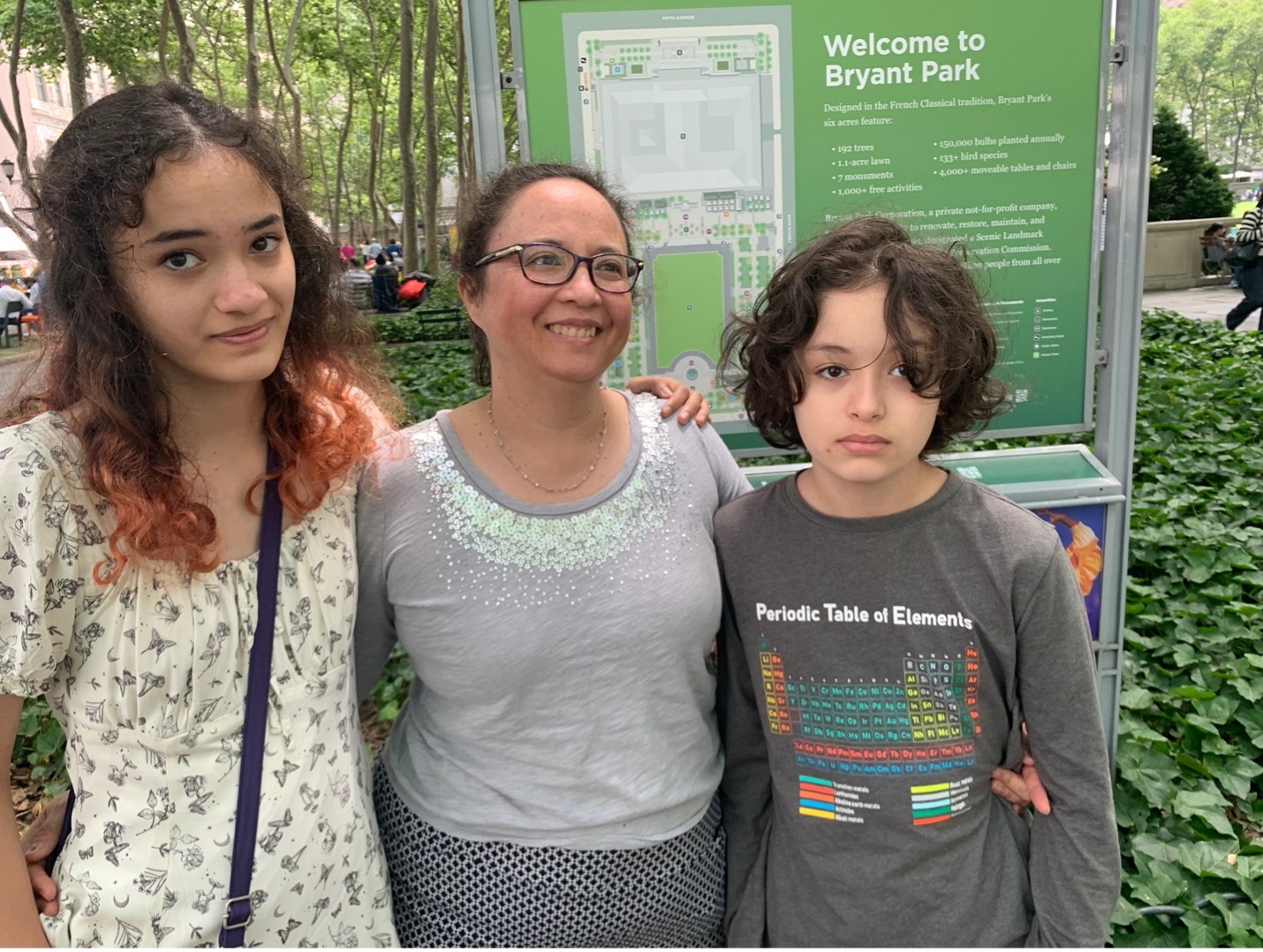
    My kids at Badwater Basin, Death Valley. I gave a talk at the Dark Sky Festival, February 2024

    Yes, you mentioned you have an airplane and a Jeep. Are you interested in mechanics at all? I know Jeeps tend to have a good amount of repairs. I don’t know if pilots fix their own planes, how does that end up going?

    Luke’s Varga airplane parked at Reid-Hillview airport after he flew it to California from Minnesota.
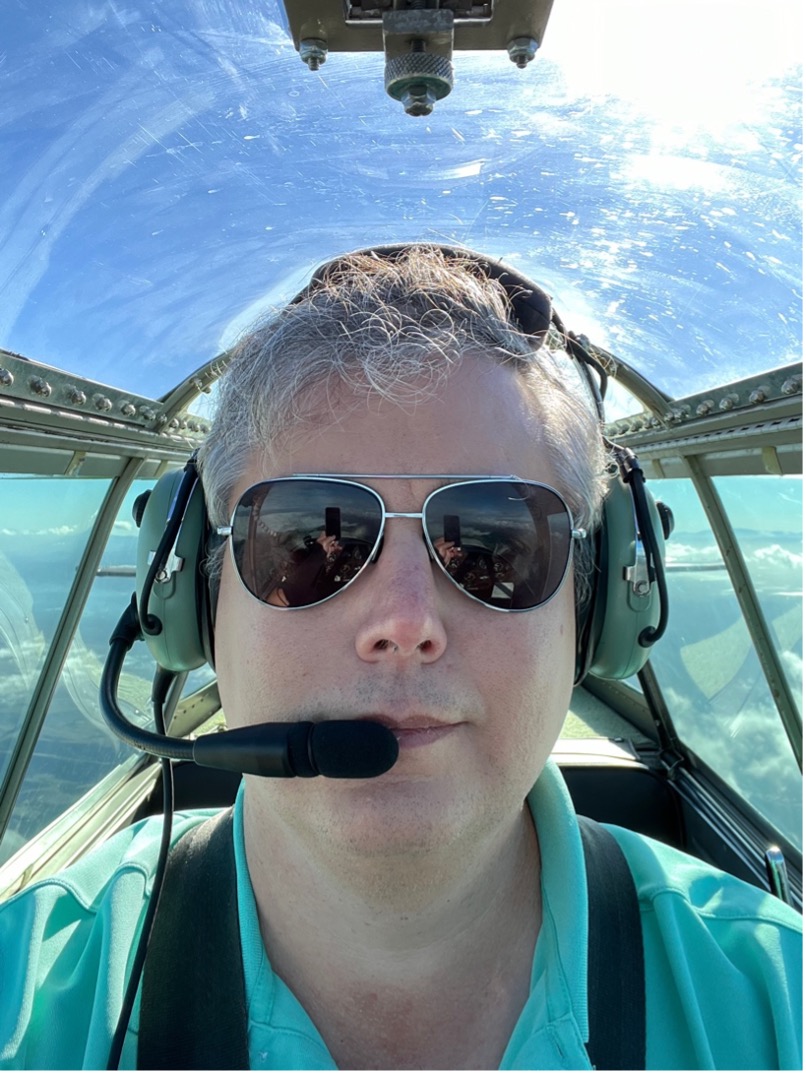
    Luke flying solo.
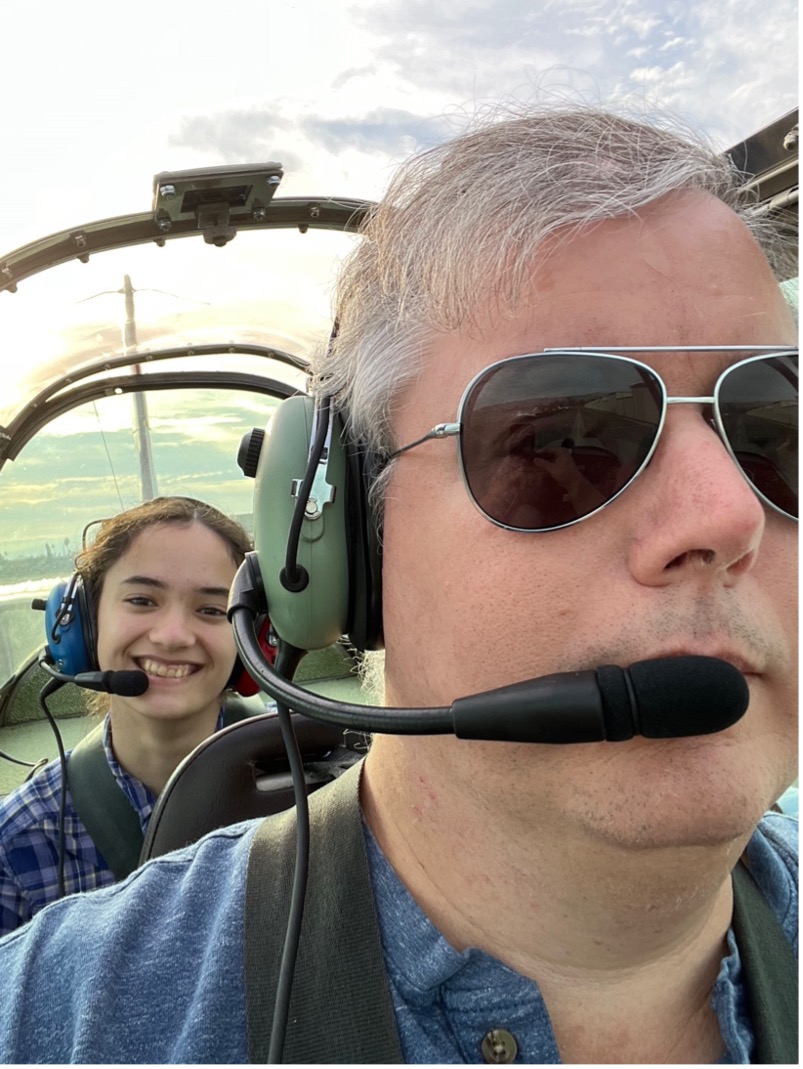
    And with his daughter.

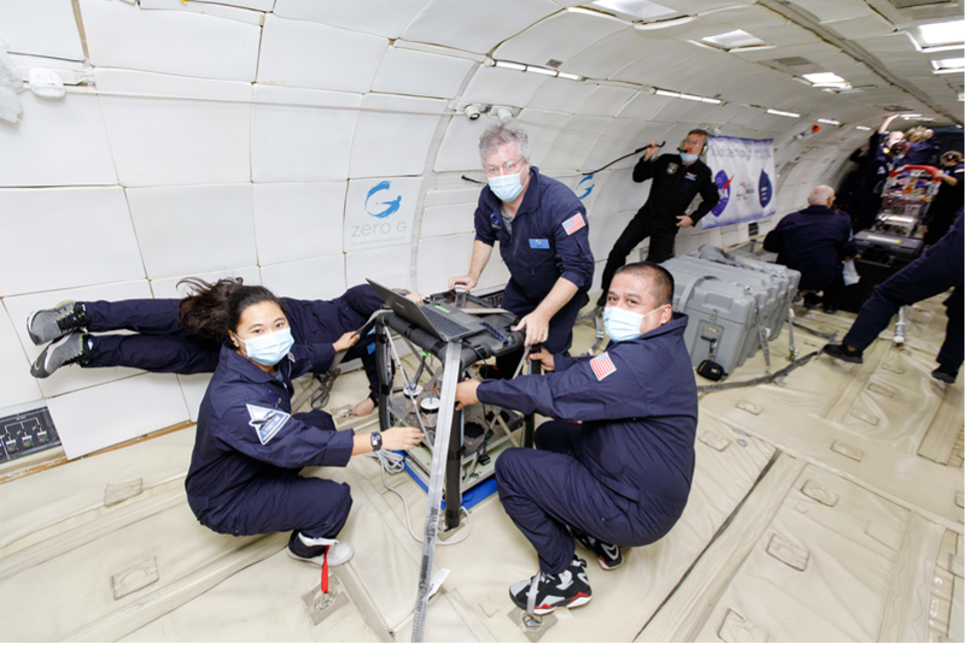
    You don’t do a lot of fixing of your plane as a pilot (unless you really want to). The Jeep I have is a diesel from Japan, so it’s incredibly reliable. I’ve never breaks. But I have to admit, when I was in grad school, I desperately wanted to get involved in lab work. I went downstairs one day and I talked to the post doc who was leading a balloon flight project for high energy cosmic rays. And I said, “I want to get into lab work”.  And she said, “Great! I’m so glad you want to get into lab work. Here, analyze this data.” And I got pegged as a theorist, my whole career. But that all changed after I left grad school and I started working with JPL. Northrup Grumman sent me to work at JPL two days a week for a good long time, and I learned about lab work. I learned all sorts of fun things. I learned about experiment design and I started doing it. I started building things and I have really found the joy of building an experiment and making it work. I adore it. I love it. I’m doing it on a project called SPARTA, right now. I’ve actually had to build it, build the experiment, a couple of times. The last time was for Zero-G flight, and when I showed up at the airport, the PI was there and he handed me a bag. That’s not hyperbole. He handed me a bag of broken parts that I had never seen and said “Here’s your experiment. And it has to be ready in 40 hours. And we don’t know how to do it.” So I had to figure it out and make it work, in 40 hours. From nothing. And I did. And we flew and we got data and I was very, very proud of that.

    Aboard Zero-G light for SPARTA

    You are absolutely one of the most fascinating people that I have ever had to privilege of talking with and knowing. I’m just incredulous at your story. It’s wonderful. It’ll play very well in our series, but it really belongs in a book or a biography or something like that. A lot of people could learn from it.

    Well, I have to tell you, coming here to Ames is in many ways absolutely a culmination. I giggle when I come to work, are you kidding me? And I tell everybody this, I’m a NASA fan boy. And I will put the disclaimer out first that I understand that NASA is a large, dysfunctional government agency that is going to break your heart. OK, it’s going to do it because that’s what big dysfunctional government agencies do. It’s going to enrage. It’s going to make you frustrated. You’re going to want to kill it. But I love it. I am a massive fan.

    Yes, you’re absolutely right. But it needs people like you.

    Yeah, but when I come in, I like coming into Ames because I just giggle! I can’t believe I’m here. I can’t believe that I’m a bona fide NASA rocket scientist! After all this time, I get to finally do it. I wanted to be a scientist, you know. And the other thing that comes to me is I can’t believe they took me. I had the exact same reaction in grad school at Caltech. And by the way, so did everybody else.  I went and talked to lots of graduate students at Caltech and they all said the same thing:  “I can’t believe they took me”. It wasn’t until I got to the NSF that I learned about imposter syndrome.

    Right.

    It’s like, whoa, that’s my problem: imposter syndrome. Everybody has it.

    I’m hesitant to bring this to a close, but we do need to and I need to explain a couple of things to you.

    Sure.

    One of them is that when we finally get this into a transcript narrative that you’re comfortable with, then we would like to include pictures from your life, from yourself, from your family, not just of your work, but things we’ve talked about. Anything that would go along with the narrative, You can think about that because there will be a few weeks, but we’d like you to provide a few pictures. If you’ve seen some of the other interviews you’ve seen the pictures. Pictures go a long way to illustrate and bring to life what you’ve talked about, helping people understand who you are. And we also like to ask if you have a favorite quote, something we might see on your desk or wall, something that motivates you or that you find particularly meaningful. You’ve already said one earlier in this conversation that comes from you that I really liked.

    Which one was that?

    It was toward the beginning, you were talking about the people who do great things. It was something like “brains are neither necessary nor sufficient to do great things”.

    They’re not. Now you’ve got to work hard. You got to work hard.

    Yeah. That resonated with me when I heard it. That’s a good quote.

    For me the difference was that I actually sorted myself out and actually started figuring out how to do the work and that made all the difference. You don’t need genius to succeed. And genius is not enough to succeed.

    I like that. And if there’s something that has been sort of a lodestar for you, maybe from Feynman or from someone along the line that you just thought, “Oh, I like that, that’s motivating” or something, that helps people understand who you are, what motivates or impels your life toward who you are today. It’s just an opportunity and you can think about it and put it in later. It’s not a problem. It’s just something that helps tell your story.

    I don’t know. I used to put a quote, I thought it was from Alcuin, an 8th century philosopher, a neat guy, he taught Charlamagne, and was a student of  Venerable Bede. Anyway, from early medieval history and I have found it to be a very significant quote. It may not be eloquent, but it is (he quotes it in Latin: “Claudit iter bellis, qui portam pandit in Astris”): “That road does not lead toward war, whose gate lies open to the stars”.

    That’s profound.

    It is and what’s particularly profound about it is that this is coming out of the medieval Christian period and you would have thought it would be “heavens”, as in “heaven”. But it’s not. It’s astris, stars, and what that means to me is that exploration is where it’s at. Exploration keeps us away from the darker aspects of our being. We can avoid war by exploring. If war expresses the worst parts of humanity, exploration expresses the best parts of humanity.

    OK. And first of all, I think that’s the first quote we’ve gotten in spoken Latin. That was Latin you were speaking?

    Yes, it was.

    I thought so. OK. But this is something that brings us together in a cooperative venture. The explorations that we’ve done that have included cooperation with other nations have certainly been among the few things in our world that have brought nations together. There are a lot of things that push nations apart and cause them to go to war but this is something that brings them together in a cooperative venture that transcends earth, really.

    Absolutely.

    That’s a wonderful quote.

    It is particularly true of what we do here at NASA.

    Yes.

    I mean exploration. Ask me sometime about the defense value of ISS. Because the ISS is probably one of the most important national security things we’ve ever done and for reasons that are completely out of left field.

    Yes, absolutely. You’re right. And we’ve seen that recently with the whole thing that’s going on over in the Ukraine.

    Yeah.

    They pulled out of a lot of things, but they didn’t pull out of the space station.

    They didn’t. Not yet.

    Anyway, this has been an absolutely fascinating interview so let’s put a close to it and then we’ll see what we’ve got when it comes out on paper. And then you can do with it what you want. And no matter what we do, this will have a limited audience on our website, but I hope you’ll give some thought to eventually writing an autobiography. It’s a story well worth hearing. I would buy it and read it, I’ll tell you that.

    I was actually told to do that 20 years ago. And I thought, “What?”

    Well, you’re still young!

    Alright.

    Thank you, Luke. This has been a joy, a delight and we’ll get back to you when we have something, and I think this will make a wonderful addition to our interview series.

    I’m glad to help, alright.

    OK. And yes, anything else? Any other questions or anything?

    No, that’s all I got for now.

    Thank you.

    Take care, gentlemen.

    Luke and his children in the shadow of SOFIA, NASA’s Stratospheric Observatory for Infrared Astronomy.

    Interview conducted by Fred Van Wert on January 25, 2023

  • Sols 4362-4363: Plates and Polygons

    2 min read

    Sols 4362-4363: Plates and Polygons

    A close-up color photo from the Martian surface shows a pale orange rocky outcropping, which looks on top like a sheet of coarse sandpaper, and on the side facing the camera like the feature is made from numerous, stacked thin layers, with undulating edges that make it look like a topographic map. Atop the feature are multiple plates of smooth stone in the same pale orange color, in different shapes, at different angles to each other, with a texture resembling clippings of thick, dense felt.
    NASA’s Mars rover Curiosity acquired this image using its Mars Hand Lens Imager (MAHLI) on Nov. 11, 2024 – sol 4360, or Martian day 4,360 of the Mars Science Laboratory Mission – at 00:06:13 UTC.
    NASA/JPL-Caltech/MSSS

    Earth planning date: Monday, Nov. 11, 2024

    After a successful 23-meter (about 75 feet) drive today in pre-planning we found ourselves in front of some rocks with a curious dark, platy topping. This is similar to material we have seen previously including over the weekend where MAHLI imaged “Buttress Tree.” This beautiful hand-lens image is shown above, where you can see this more resistant platy texture at the top of the layered rock. Unfortunately it was deemed too unsafe to move the arm today, so no contact science observations were made on this dark material, but a plethora of remote science made up for it!

    A curious curved fracture along a rock in the workspace became the target of our ChemCam LIBS laser shots called “Pioneer Basin.” ChemCam will then take a long-distance RMI looking back at Gediz Vallis channel, which we have been driving away from. Mastcam is focusing on taking two mosaics of areas of rocks that exhibit light- and dark-toned bands from orbit. We previously drove across these bands in January before we crossed the Gediz Vallis channel. Now that we are over the channel, we are about to drive on the dark, banded material once again. Mastcam is also imaging some interesting polygonal textures we see in a few rocks around the rover. To keep it simple, the science team named all four targets of polygonal rocks “Acrodectes Peak.”

    As Curiosity drives further away from the Gediz Vallis channel, the exploration of the sulfate unit continues. Although the driving is tough at times, the beautiful discoveries and amazing geology make the tough times worth it. Let’s hope we can get some contact science activities safe and sound in the next plan.

    Written by Emma Harris, Graduate Student at Natural History Museum, London

    Details

    Last Updated

    Nov 13, 2024

    Related Terms

  • The Next Full Moon Will Be the Last of Four Consecutive Supermoons

    24 Min Read

    The Next Full Moon Will Be the Last of Four Consecutive Supermoons

    Guardians of Traffic statue in Cleveland, Ohio, in front of the supermoon that was visible on Sept. 17, 2024. On this day, the full moon was a partial lunar eclipse; a supermoon; and a harvest moon.

    Credits:
    NASA/GRC/Sara Lowthian-Hanna

    The Next Full Moon is a Supermoon; the Beaver, Frost, Frosty, or Snow Moon; Kartik Purnima; Loy Krathong; the Bon Om Touk (”Boat Racing Festival”) Moon, the Tazaungdaing Festival Moon; and Ill Poya.
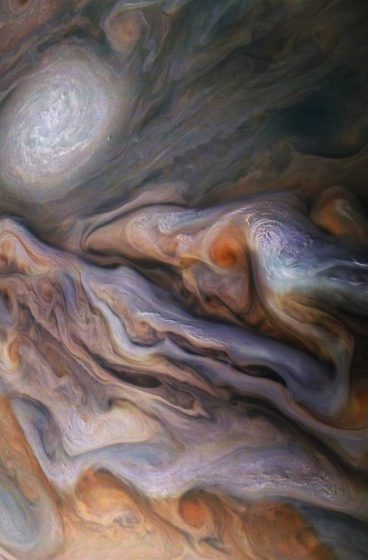
    The next full Moon will be Friday afternoon, November 15, 2024, at 4:29 PM EST. This will be early Saturday morning from Kamchatka and Fiji Time eastwards to the International Date Line. The Pleiades star cluster will appear near the full Moon. The Moon will appear full for about 3 days around this time, from a few hours before sunrise on Thursday morning to a few hours before sunrise on Sunday morning.

    This full Moon will be the last of four consecutive supermoons, slightly closer and brighter than the first of the four in mid-August.

    The Maine Farmers’ Almanac began publishing Native American names for full Moons in the 1930s. Over time these names have become widely known and used. According to this almanac, as the full Moon in November this is the Beaver Moon, the Frost or Frosty Moon, or the Snow Moon. For the Beaver Moon, one interpretation is that mid-Fall was the time to set beaver traps before the swamps freeze to ensure a supply of warm winter furs. Another interpretation suggests that the name Beaver Moon came from how active the beavers are in this season as they prepare for winter. The Frost, Frosty, or Snow Moon names come from the frosts and early snows that begin this time of year, particularly in northeastern North America.

    This is Kartik Purnima (the full Moon of the Hindu lunar month of Kartik) and is celebrated by Hindus, Jains, and Sikhs (each for different reasons).

    In Thailand and nearby countries this full Moon is Loy Krathong, a festival that includes decorating baskets and floating them on a river.

    In Cambodia this full Moon corresponds with the 3-day Bon Om Touk (“Boat Racing Festival”), the Cambodian Water Festival featuring dragon boat races.

    In Myanmar this is the Tazaungdaing Festival, a festival that predates the introduction of Buddhism and includes the launching of hot air balloons (sometimes flaming or laden with fireworks).

    In Sri Lanka this is Ill (or Il) Poya, commemorating the Buddha’s ordination of sixty disciples as the first Buddhist missionaries.

    In many traditional Moon-based calendars the full Moons fall on or near the middle of each month. This full Moon is near the middle of the tenth month of the Chinese year of the Dragon, Marcheshvan in the Hebrew calendar, a name often shortened to Cheshvan or Heshvan, and Jumādā al-ʾŪlā, the fifth month of the Islamic year.

    As usual, the wearing of suitably celebratory celestial attire is encouraged in honor of the full Moon. Get ready for winter, visit a local river (particularly if there are any festivals or boat races), but please don’t launch flaming hot air balloons filled with fireworks (some online videos make it quite clear why this is a bad idea), especially in areas subject to wildfires!

    The next month or two should be a great time for Jupiter and Saturn watching. Both will continue to shift westward each night, gradually making them easier to see earlier in the evening sky.

    Gordon Johnston

    Gordon Johnston

    Retired NASA Program Executive

    As for other celestial events between now and the full Moon after next (with specific times and angles based on the location of NASA Headquarters in Washington, DC):

    As Autumn continues the daily periods of sunlight continue shortening.

    On Friday, November 15, (the day of the full Moon), morning twilight will begin at 5:51 AM EST, sunrise will be at 6:51 AM, solar noon will be at 11:53 AM when the Sun will reach its maximum altitude of 32.4 degrees, sunset will be at 4:54 PM, and evening twilight will end at 5:55 PM.

    Our 24-hour clock is based on the average length of the solar day. The day of the winter solstice is sometimes called the “shortest day of the year” (because it has the shortest period of sunlight). But it could also be called the “longest day of the year” because the longest solar day is on or just after the solstice. Because the solar days are longer, the earliest sunset of the year occurs before the solstice and the latest sunrise of the year (ignoring Daylight Savings Time) occurs after the solstice. For the Washington, DC area, the sunsets on Friday and Saturday, December 6 and 7, 2024, are tied for the earliest sunsets. On Friday, morning twilight will begin at 6:10 AM EST, sunrise will be at 7:13 AM, solar noon will be at 11:59 AM when the Sun will reach its maximum altitude of 28.5 degrees, sunset will be at 4:45:50 PM, and evening twilight will end at 5:49 PM. On Saturday, morning twilight will begin at 6:11 AM EST, sunrise will be at 7:14 AM, solar noon will actually be at noon (12:00 PM) when the Sun will reach its maximum altitude of 28.4 degrees, sunset will be at 4:45:50 PM, and evening twilight will end at 5:49 PM.

    By Sunday, December 15, (the day of the full Moon after next), morning twilight will begin at 6:16 AM EST, sunrise will be at 7:20 AM, solar noon will be at 12:04 PM when the Sun will reach its maximum altitude of 27.8 degrees, sunset will be at 4:47 PM, and evening twilight will end at 5:51 PM.

    The next month or two should be a great time for Jupiter and Saturn watching, especially with a backyard telescope. Saturn was at its closest and brightest on September 7 and is high in the southern sky as evening twilight ends. Jupiter will be shifting into the evening sky during this lunar cycle. On November 15 Jupiter will be rising about a half hour after evening twilight ends. Jupiter will be at its closest and brightest on December 7, rising around sunset and setting around sunrise. By the full Moon after next on December 15, Jupiter will be 19 degrees above the horizon as evening twilight ends. Both Jupiter and Saturn will continue to shift westward each night, gradually making them easier to see earlier in the evening sky (and friendlier for backyard stargazing, especially if you have young ones with earlier bedtimes). With clear skies and a telescope you should be able to see Jupiter’s four bright moons, Ganymede, Callisto, Europa, and Io, noticeably shifting positions in the course of an evening. For Saturn, you should be able to see Saturn’s rings and its bright moon Titan. The rings are appearing thinner and will be edge-on to the Earth in March 2025. We won’t get the “classic” view of Saturn showing off its rings until 2026.

    Comets

    Of the two comets described in my last Moon Missive, one remains visible through large binoculars or a telescope during this lunar cycle. The sungrazing Comet C/2024 S1 (ATLAS) disintegrated during its very close pass by the Sun and is no longer visible. Comet C/2023 A3 (Tsuchinshan-ATLAS) will be in the evening sky, fading from visual magnitude 8 to 10.3 as it moves away from the Earth and Sun.

    In addition, comet 33P/LINEAR should be visible with large binoculars or a telescope in November and December, shining at about magnitude 10 around its perihelion on November 29 and closest approach to Earth on December 9. The next comet that we anticipate might be visible to the unaided eye is C/2024 G3 (ATLAS), which will reach its closest to the Sun and Earth in mid January 2025. It is another sungrazing comet that might put on a good show or might break apart and vanish.

    Meteor Showers

    Unfortunately, one of the three major meteor showers of the year, the Geminids (004 GEM), will peak the morning of December 14, with the light of the nearly full Moon interfering. According to the International Meteor Organization, observers south of about 30 degrees north might be able to see these meteors for an hour or so between moonset and the first light of dawn (although the radiant for this meteor shower is at 33 degrees north latitude, so observers too far south of the equator will also have limited visibility). In a good year, this shower can produce 150 visible meteors per hour under ideal conditions, but this will not be a good year. For the Washington, DC area the MeteorActive app predicts that at about 2 AM EST on the morning of December 14, under bright suburban sky conditions, the peak rate from the Geminids and all other background sources might reach 20 meteors per hour.

    If the weather cooperates by being clear with no clouds or hazes and you do go looking for meteors, try to find a place as far as possible from light sources that has a clear view of a wide expanse of the sky. Give your eyes plenty of time to adapt to the dark. Your color vision (cone cells), concentrated in the center of your field of view, will adapt to darkness in about 10 minutes. Your more sensitive night vision rod cells will continue to improve for an hour or more (with most of the improvement in the first 35 to 45 minutes). The more sensitive your eyes are, the more chance you will have of seeing meteors. Since some meteors are faint, you will tend to see more meteors from the “corner of your eye.” Even a short exposure to light (from passing car headlights, etc.) will start the adaptation over again (so no turning on a light or your cell phone to check what time it is).

    In addition, a number of relatively minor meteor showers will peak during this lunar cycle. The light of the waning Moon will interfere with the Leonids (013 LEO) on November 17, α-Monocerotids (246 AMO) on November 21, and November Orionids (250 NOO) on November 28. The Phoenicids (254 PHO), best seen from the Southern Hemisphere, may peak around December 1. Models predict low rates and faint meteors this year but not much is known about this meteor shower. Most years the rates are low, but as reported by the International Meteor Organization, significant activity was observed in 2014. Once, in 1956, the Phoenicids reached an estimated rate of 100 visible meteors per hour. Another Southern Hemisphere shower is the Puppid-Velids (301 PUP), expected to peak sometime around December 4 at about 10 meteors per hour (under ideal conditions). The Monocerotids (019 MON) and σ-Hydrids (016 HYD) are both expected to peak on December 9 at 3 meteors per hour and 7 meteors per hour, respectively. These rates are low enough that seeing them from our light-polluted urban areas will be unlikely.

    Evening Sky Highlights

    On the evening of Friday, November 15 (the evening of the full Moon), as twilight ends (at 5:55 PM EST), the rising Moon will be 14 degrees above the east-northeastern horizon with the Pleiades star cluster 5 degrees to the lower left. The brightest planet in the sky will be Venus at 12 degrees above the southwestern horizon. Next in brightness will be Mercury at less than a degree above the west-southwestern horizon. Saturn will be 38 degrees above the south-southeastern horizon. Comet C/2023 A3 (Tsuchinshan-ATLAS) will be 39 degrees above the west-southwestern horizon, with its current brightness curve predicting it will have faded to magnitude 8, too faint to see with the unaided eye. The bright star closest to overhead will be Deneb at 79 degrees above the northwestern horizon. Deneb (visual magnitude 1.3) is the 19th brightest star in our night sky and is the brightest star in the constellation Cygnus the swan. One of the three bright stars of the “Summer Triangle” (along with Vega and Altair). Deneb is about 20 times more massive than our Sun but has used up its hydrogen, becoming a blue-white supergiant about 200 times the diameter of the Sun. If Deneb were where our Sun is, it would extend to about the orbit of the Earth. Deneb is about 2,600 light years from us.

    As this lunar cycle progresses, Saturn and the background of stars will appear to shift westward each evening (as the Earth moves around the Sun). Bright Venus will shift to the left and higher in the sky along the southwestern horizon. Mercury, shining brighter than Saturn, will initially shift left along the southwestern horizon until November 19, after which it will shift to the right. On November 22 Jupiter will join the planets Venus, Mercury and Saturn in the sky as twilight ends, shining brighter than Mercury. November 24 will be the last evening Mercury will be above the horizon as evening twilight ends, although it will remain visible in the glow of dusk for a few more evenings as it dims and shifts towards its passage between the Earth and the Sun on December 5. Jupiter will be at its closest and brightest for the year on December 7. The waxing Moon will pass by Venus on December 4, Saturn on December 7, and the Pleiades on December 13.

    By the evening of Saturday, December 14 (the start of the night of the December 15 full Moon), as twilight ends (at 5:50 PM EST), the rising Moon will be 19 degrees above the east-northeastern horizon with bright planet Jupiter 6 degrees to the right and the bright star Aldebaran father to the right. The brightest planet visible will be Venus at 21 degrees above the southwestern horizon. Next in brightness will be Jupiter. Saturn will be 43 degrees above the southern horizon. The bright star closest to overhead will still be Deneb at 61 degrees above the west-northwestern horizon.

    Morning Sky Highlights

    On the morning of Friday, November 15 (the morning of the full Moon after next), as twilight begins (at 5:51 AM EST), the setting full Moon will be 7 degrees above the west-northwestern horizon. The brightest planet in the sky will be Jupiter at 35 degrees above the western horizon. Mars will be at 68 degrees above the southwestern horizon. Comet C/2024 S1 (ATLAS) will not be visible, even with a telescope, as it broke apart into pieces too small to see as it passed its closest to the Sun on October 28. The bright star appearing closest to overhead will be Pollux at 69 degrees above the west-southwestern horizon (higher than Mars by about a half degree). Pollux is the 17th brightest star in our night sky and the brighter of the twin stars in the constellation Gemini. It is an orange tinted star about 34 lightyears from Earth. Pollux is not quite twice the mass of our Sun but about 9 times the diameter and 33 times the brightness.

    As this lunar cycle progresses, Jupiter, Mars, and the background of stars will appear to shift westward each evening, with Mars passing near the Beehive star cluster in early December. The waning Moon will pass by the Pleiades star cluster on November 16, Jupiter on November 17, Mars and Pollux on November 20, appear on the other side of Mars on November 21, Regulus on November 22 and 23, and Spica on November 27 (passing in front of Spica for parts of the USA and Canada). Jupiter will be at its closest and brightest on December 7, rising around sunset and setting around sunrise. December 12 will be the first morning Mercury will be above the east-southeastern horizon as morning twilight begins, though it will be visible in the glow of dawn for a few days before.

    By the morning of Sunday, December 15 (the morning of the full Moon after next), as twilight begins (at 6:16 AM EST), the setting full Moon will be 15 degrees above the west-northwestern horizon. The brightest planet in the sky will be Jupiter, appearing below the Moon at 5 degrees above the horizon. Second in brightness will be Mars at 46 degrees above the western horizon, then Mercury at 4 degrees above the east-southeastern horizon. The bright star appearing closest to overhead will be Regulus at 55 degrees above the southwestern horizon, with Arcturus a close second at 52 degrees above the east-southeastern horizon. Regulus is the 21st brightest star in our night sky and the brightest star in the constellation Leo the lion. The Arabic name for Regulus translates as “the heart of the lion.” Although we see Regulus as a single star, it is actually four stars (two pairs of stars orbiting each other). Regulus is about 79 light years from us. Arcturus is the brightest star in the constellation Boötes the herdsman or plowman and the 4th brightest star in our night sky. It is 36.7 light years from us. While it has about the same mass as our Sun, it is about 2.6 billion years older and has used up its core hydrogen, becoming a red giant 25 times the size and 170 times the brightness of our Sun. One way to identify Arcturus in the night sky is to start at the Big Dipper, then follow the arc of the handle as it “arcs towards Arcturus.”

    Detailed Daily Guide

    Here for your reference is a day-by-day listing of celestial events between now and the full Moon on December 15, 2024. The times and angles are based on the location of NASA Headquarters in Washington, DC, and some of these details may differ for where you are (I use parentheses to indicate times specific to the DC area). If your latitude is significantly different than 39 degrees north (and especially for my Southern Hemisphere readers), I recommend using an astronomy app set for your location or a star-watching guide from a local observatory, news outlet, or astronomy club.

    Thursday morning, November 14, at 6:18 EST, the Moon will be at perigee, its closest to the Earth for this orbit.

    As mentioned above, the full Moon will be Friday afternoon, November 15, 2024, at 4:29 PM EST. This will be early Saturday morning from Kamchatka and Fiji Time eastwards to the International Date Line. It will be the last of four consecutive supermoons. The Pleiades star cluster will appear near the full Moon. The Moon will appear full for about 3 days around this time, from a few hours before sunrise Thursday morning to a few hours before sunrise Sunday morning.

    Friday evening into Saturday morning, November 15 to 16, the Pleiades star cluster will appear near the full Moon. This may best be viewed with binoculars, as the brightness of the full Moon may make it hard to see the stars in this star cluster. As evening twilight ends (at 5:55 PM EST), the Pleiades will appear 5 degrees to the lower left of the full Moon. By the time the Moon reaches its highest for the night (Saturday morning at 12:07 AM), the Pleiades will be 2 degrees to the upper left. The Moon will pass in front of the Pleiades in the early morning hours. By the time morning twilight begins (at 5:52 AM) the Pleiades will be a degree to the lower right of the Moon.

    Saturday, November 16, will be when the planet Mercury reaches its greatest angular separation from the Sun as seen from the Earth for this apparition (called greatest elongation). Because the angle between the line from the Sun to Mercury and the line of the horizon changes with the seasons, the date when Mercury and the Sun are farthest apart as seen from the Earth is not always the same as when Mercury appears highest above the southwestern horizon as evening twilight ends, which will occur three evenings later, on November 19.

    Saturday night into Sunday morning, November 16 to 17, the planet Uranus will be at its closest and brightest for the year, called “opposition” because on Saturday night it will be opposite the Earth from the Sun. At opposition Uranus can be bright enough to see with the unaided eye (under very clear, dark sky conditions). From our light-polluted urban locations you will need binoculars or a telescope.

    Also on Saturday night into Sunday morning, November 16 to 17, the planet Jupiter will appear near the full Moon. As Jupiter rises on the east-northeastern horizon (at 6:14 PM EST) it will be 10 degrees to the lower left of the Moon. The Moon will reach its highest for the night about 7 hours later (at 1:09 AM), with Jupiter 7.5 degrees to the lower left. By the time morning twilight begins (at 5:52 AM) Jupiter will be 6 degrees to the left of the Moon.

    Tuesday night into Wednesday morning, November 19 to 20, the bright star Pollux and the bright planet Mars will appear near the waning gibbous Moon. As the Moon rises on the northeastern horizon (at 8:20 PM EST), Pollux will be 2.5 degrees to the upper left of the Moon. By the time the Moon reaches its highest in the sky (at 4:11 AM) Pollux will be 5 degrees to the upper right of the Moon, with Mars 7.5 degrees to the lower left of the Moon, such that these three appear aligned. By the time morning twilight begins (at 5:55 AM) Mars will be 7 degrees to the upper left and Pollux 5.5 degrees to the lower right.

    Wednesday night into Thursday morning, November 20 to 21, the waning gibbous Moon will have shifted to the other side of Mars. As the Moon rises on the east-northeastern horizon (at 9:29 PM EST) Mars will be 4 degrees to the upper right of the Moon. By the time the Moon reaches its highest for the night (at 5:03 AM) Mars will be 7 degrees to the right of the Moon. Morning twilight will begin less than an hour later (at 5:56 AM) with Mars 7 degrees to the lower right of the Moon.

    Friday evening, November 22, will be the first evening the bright planet Jupiter will be above the east-northeastern horizon as evening twilight ends (at 5:51 PM EST).

    Also on Friday evening, the waning Moon will appear half-full as it reaches its last quarter at 8:28 PM EST (when we can’t see it).

    Friday night into Saturday morning, November 22 to 23, the bright star Regulus will appear near the waning half-Moon. As Regulus rises on the east-northeastern horizon (at 11:29 PM EST) it will be 9 degrees below the Moon, with Mars farther to the upper right and Pollux beyond Mars. By the time the Moon reaches its highest for the night (at 5:49 AM) Regulus will be 7 degrees to the lower left, and morning twilight will begin 8 minutes later (at 5:57 AM).

    Saturday night into Sunday morning, November 23 to 24, the waning crescent Moon will have shifted to the other side of Regulus. When the Moon rises on the east-northeastern horizon (at 11:38 PM EST) Regulus will be 4 degrees to the upper right of the Moon. The pair will separate as the night progresses. By the time morning twilight begins (at 5:58 AM) Regulus will be 6.5 degrees to the upper right of the Moon.

    Sunday evening, November 24, will be the last evening the planet Mercury will be above the west-southwestern horizon as evening twilight ends, although it should remain visible in the glow of dusk before twilight ends for a few more evenings as it dims and shifts towards its passage between the Earth and the Sun on December 5.

    Tuesday morning, November 26, at 6:57 AM EST, the Moon will be at apogee, its farthest from the Earth for this orbit.

    On Wednesday morning, November 27, the bright star Spica will appear near the waning crescent Moon. As Spica rises on the east-southeastern horizon (at 3:41 AM EST) it will be a degree below the Moon. As morning progresses the Moon will shift towards Spica, and for much of the Eastern USA and Canada the Moon will block Spica from view. See http://www.lunar-occultations.com/iota/bstar/1127zc1925.htm for a map and information on the areas that will be able to see this eclipse. Times will vary by location, but for the Washington, DC area, Spica will vanish behind the illuminated limb of the Moon at 5:34 AM and the Moon will still be blocking Spica from sight as morning twilight begins at 6:02 AM.

    Early Sunday morning, December 1, at 1:22 AM EST, will be the new Moon, when the Moon passes between the Earth and the Sun and will not be visible from the Earth.

    The day of or the day after the New Moon marks the start of the new month for most moon-based calendars. The eleventh month of the Chinese year of the Dragon starts on Sunday, December 1. Sundown on Sunday, December 1, marks the start of Kislev in the Hebrew calendar. Hanukkah will begin towards the end of Kislev. In the Islamic calendar the months traditionally start with the first sighting of the waxing crescent Moon. Many Muslim communities now follow the Umm al-Qura Calendar of Saudi Arabia, which uses astronomical calculations to start months in a more predictable way. Using this calendar, sundown on Sunday, December 1, will probably mark the beginning of Jumādā ath-Thāniyah, also known as Jumādā al-ʾĀkhirah.

    Wednesday evening, December 4, the bright planet Venus will appear 3 degrees to the upper right of the waxing crescent Moon. The Moon will be 15 degrees above the southwestern horizon as evening twilight ends (at 5:49 PM EST). The Moon will set 2 hours later (at 7:46 PM).

    Thursday evening, December 5, the planet Mercury will be passing between the Earth and the Sun as seen from the Earth, called inferior conjunction. Planets that orbit inside of the orbit of Earth can have two types of conjunctions with the Sun, inferior (when passing between the Earth and the Sun) and superior (when passing on the far side of the Sun as seen from the Earth). Mercury will be shifting from the evening sky to the morning sky and will begin emerging from the glow of dawn on the eastern horizon in less than a week.

    Saturday afternoon, December 7, the planet Jupiter will be at its closest and brightest for the year, called “opposition” because it will be opposite the Earth from the Sun, effectively a “full” Jupiter. Jupiter will be 12 degrees above the east-northeastern horizon as evening twilight ends (at 5:49 PM EST), will reach its highest in the sky right around midnight (11:59 PM), and will be 11 degrees above the west-northwestern horizon as morning twilight begins (Sunday morning at 6:11 AM). Only planets that orbit farther from the Sun than the Earth can be seen at opposition.

    Saturday evening, December 7, the planet Saturn will appear to the upper left of the waxing crescent Moon. They will be 6 degrees apart as evening twilight ends (at 5:49 PM EST). Saturn will appear to shift clockwise and closer to the Moon, so that by the time the Moon sets 5.5 hours later (at 11:18 PM) Saturn will be 3.5 degrees above the Moon on the west-southwestern horizon. For a swath in the Pacific Ocean off the coast of Asia the Moon will actually block Saturn from view, see http://lunar-occultations.com/iota/planets/1208saturn.htm for a map and information on the locations that can see this eclipse.

    Sunday morning, December 8, the Moon will appear half-full as it reaches its first quarter at 10:27 AM EST (when we can’t see it).

    Thursday morning, December 12, will be the first morning the planet Mercury will be above the east-southeastern horizon as morning twilight begins (at 6:14 AM EST).

    Thursday morning, December 12, at 8:18 AM EST, the Moon will be at perigee, its closest to the Earth for this orbit.

    Friday evening into Saturday morning, December 13 to 14, the Pleiades star cluster will appear near the full Moon. This may best be viewed with binoculars, as the brightness of the full Moon may make it hard to see the stars in this star cluster. As evening twilight ends (at 5:50 PM EST), the Pleiades will appear 4 degrees to the upper right of the full Moon. By the time the Moon reaches its highest for the night (at 10:49 PM), the Pleiades will be 6 degrees to the right. By about 2 AM the Pleiades will be 8 degrees to the lower right of the Moon and they will continue to separate as the morning progresses.

    As mentioned above, one of the three major meteor showers of the year, the Geminids (004 GEM), will peak Saturday morning, December 14. The light of the nearly full Moon will interfere. In a good year, this shower can produce 150 visible meteors per hour under ideal conditions, but this will not be a good year. For the Washington, DC area the MeteorActive app predicts that at about 2 AM EST on the morning of December 14, under bright suburban sky conditions, the peak rate from the Geminids and all other background sources might reach 20 meteors per hour. See the meteor summary above for suggestions for meteor viewing.

    Saturday morning, December 14, the full Moon, the bright planet Jupiter, and the bright star Aldebaran will form a triangle. As Aldebaran sets on the west-northwestern horizon (at 6:10 AM EST) it will be 9 degrees to the lower left of the Moon with Jupiter 7 degrees to the upper left of the Moon. Morning twilight will begin 6 minutes later.

    Saturday evening, December 15, the full Moon will have shifted to the other side of Jupiter. Jupiter will be 6 degrees to the right of the Moon as evening twilight ends (at 5:50 PM EST) and the pair will separate as the night progresses.  

    The full Moon after next will be Sunday morning, December 15, 2024, at 4:02 AM EST. This will be Saturday evening from Alaska Time westwards to the International Date Line. The Moon will appear full for about 3 days around this time, from Friday evening through Monday morning, making this a full Moon weekend.

    Details

    Last Updated

    Nov 13, 2024

  • Sols 4350-4351: A Whole Team Effort

    2 min read

    Sols 4350-4351: A Whole Team Effort

    A grayscale image from the Martian surface shows medium gray soil interspersed with numerous lighter colored flat rocks. Wheel tracks from the rover are visible on the ground in the upper right corner of the frame. Portions of the rover are also visible in the middle of the frame.
    NASA’s Mars rover Curiosity acquired this image using its Right Navigation Camera on sol 4348 — Martian day 4,348 of the Mars Science Laboratory mission — on Oct. 29, 2024, at 14:20:08 UTC.
    NASA/JPL-Caltech

    Earth planning date: Wednesday, Oct. 30, 2024

    Just like you and me, the Curiosity rover has a few idiosyncratic tendencies — special ways that the rover behaves that we, the team on Earth, have come to understand to be harmless but still throw a curveball to our planning. 

    Unfortunately, the set of activities that were planned to execute on Monday behaved in one of these special ways — leaving the rover’s arm down on the ground without completing the planned set of activities, including the remainder of our contact science, remote sensing, or drive. 

    When this happens the whole team gets together to review the information Curiosity sends to us, and we ensure as a team that we understand the quirky way the rover acted and that we are good to proceed. While not ideal for keeping up with our scientific cadence, I appreciate these moments because they remind me of all the experts we have evaluating the rover’s health and safety day in and day out.

    So for today’s plan — we completed the contact science observations of “Reds Meadow” that had been planned on Monday and picked up a second suite of contact science measurements of “Ladder Lake.” Both of these are bedrock targets and the APXS and MAHLI observations we make will continue our characterization of changes in bedrock composition and morphology in this area. We also repeated the remote sensing observations planned on Monday that did not execute.

    With a fresh set of Rover Planner eyes, we reassessed if the drive planned on Monday was still the best we could do and, impressively, today’s RP agreed. So the drive remains the same, making excellent progress toward our next imaging waypoint.

    The remainder of the plan contained our usual atmospheric measurements!

    We’ll see what Friday holds!

    Written by Elena Amador-French, Science Operations Coordinator at NASA’s Jet Propulsion Laboratory

    Details

    Last Updated

    Nov 01, 2024

    Related Terms

  • Can Life Exist on an Icy Moon? NASA’s Europa Clipper Aims to Find Out

    6 min read

    Preparations for Next Moonwalk Simulations Underway (and Underwater)

    Europa looms large in this reprocessed color view
    The puzzling surface of Jupiter’s icy moon Europa looms large in this reprocessed color view made from images taken by NASA’s Galileo spacecraft in the late 1990s. The images were assembled into a realistic color view of the surface that approximates how Europa would appear to the human eye.
    NASA/JPL-Caltech/SETI Institute

    With a spacecraft launching soon, the mission will try to answer the question of whether there are ingredients suitable for life in the ocean below Europa’s icy crust.

    Deep down, in an ocean beneath its ice shell, Jupiter’s moon Europa might be temperate and nutrient-rich, an ideal environment for some form of life — what scientists would call “habitable.” NASA’s Europa Clipper mission aims to find out.

    NASA now is targeting launch no earlier than Monday, Oct. 14, on a SpaceX Falcon Heavy rocket from Launch Complex 39A at NASA’s Kennedy Space Center in Florida.

    Europa Clipper’s elongated, looping orbit around Jupiter will minimize the spacecraft’s exposure to intense radiation while allowing it to dive in for close passes by Europa. Using a formidable array of instruments for each of the mission’s 49 flybys, scientists will be able to “see” how thick the moon’s icy shell is and gain a deeper understanding of the vast ocean beneath. They’ll inventory material on the surface that might have come up from below, search for the fingerprints of organic compounds that form life’s building blocks, and sample any gases ejected from the moon for evidence of habitability.

    Mission scientists will analyze the results, probing beneath the moon’s frozen shell for signs of a water world capable of supporting life.

    This artist’s concept (not to scale) depicts what Europa’s internal structure could look like
    This artist’s concept (not to scale) depicts what Europa’s internal structure could look like: an outer shell of ice, perhaps with plumes of material venting from beneath the surface; a deep, global layer of liquid water; and a rocky interior, potentially with hydrothermal vents on the seafloor.
    NASA/JPL-Caltech

    “It’s important to us to paint a picture of what that alien ocean is like — the kind of chemistry or even biochemistry that could be happening there,” said Morgan Cable, an astrobiologist and member of the Europa Clipper science team at NASA’s Jet Propulsion Laboratory in Southern California, which manages the mission.

    Ice Investigation

    Central to that work is hunting for the types of salts, ices, and organic material that make up the key ingredients of a habitable world. That’s where an imager called MISE (Mapping Imaging Spectrometer for Europa) comes in. Operating in the infrared, the spacecraft’s MISE divides reflected light into various wavelengths to identify the corresponding atoms and molecules.

    The mission will also try to locate potential hot spots near Europa’s surface, where plumes could bring deep ocean material closer to the surface, using an instrument called E-THEMIS (Europa Thermal Emission Imaging System), which also operates in the infrared.

    Capturing sharply detailed pictures of Europa’s surface with both a narrow and a wide-image camera is the task of the EIS (Europa Imaging System). “The EIS imagers will give us incredibly high-resolution images to understand how Europa’s surface evolved and is continuing to change,” Cable said.

    Gases and Grains

    NASA’s Cassini mission spotted a giant plume of water vapor erupting from multiple jets near the south pole of Saturn’s ice-covered moon Enceladus. Europa may also emit misty plumes of water, pulled from its ocean or reservoirs in its shell. Europa Clipper’s instrument called Europa-UVS (Europa Ultraviolet Spectrograph) will search for plumes and can study any material that might be venting into space.

    Whether or not Europa has plumes, the spacecraft carries two instruments to analyze the small amount of gas and dust particles ejected from the moon’s surface by impacts with micrometeorites and high-energy particles: MASPEX (MAss SPectrometer for Planetary EXploration/Europa) and SUDA (SUrface Dust Analyzer) will capture the tiny pieces of material ejected from the surface, turning them into charged particles to reveal their composition.  

    “The spacecraft will study gas and grains coming off Europa by sticking out its tongue and tasting those grains, breathing in those gases,” said Cable.

    Inside and Out

    The mission will look at Europa’s external and internal structure in various ways, too, because both have far-reaching implications for the moon’s habitability.

    To gain insights into the ice shell’s thickness and the ocean’s existence, along with its depth and salinity, the mission will measure the moon’s induced magnetic field with the ECM (Europa Clipper Magnetometer) and combine that data with measurements of electrical currents from charged particles flowing around Europa — data provided by PIMS (Plasma Instrument for Magnetic Sounding).

    In addition, scientists will look for details on everything from the presence of the ocean to the structure and topography of the ice using REASON (Radar for Europa Assessment and Sounding to Near-surface), which will peer up to 18 miles (29 kilometers) into the shell — itself a potentially habitable environment. Measuring the changes that Europa’s gravity causes in radio signals should help nail down ice thickness and ocean depth.

    “Non-icy materials on the surface could get moved into deep interior pockets of briny water within the icy shell,” said Steve Vance, an astrobiologist and geophysicist who also is a member of the Europa Clipper science team at JPL. “Some might be large enough to be considered lakes, or at least ponds.”

    Using the data gathered to inform extensive computer modeling of Europa’s interior structure also could reveal the ocean’s composition and allow estimates of its temperature profile, Vance said.

    Whatever conditions are discovered, the findings will open a new chapter in the search for life beyond Earth. “It’s almost certain Europa Clipper will raise as many questions or more than it answers — a whole different class than the ones we’ve been thinking of for the last 25 years,” Vance said.

    More About Europa Clipper

    Europa Clipper’s three main science objectives are to determine the thickness of the moon’s icy shell and its interactions with the ocean below, to investigate its composition, and to characterize its geology. The mission’s detailed exploration of Europa will help scientists better understand the astrobiological potential for habitable worlds beyond our planet.

    To learn more about the science instruments aboard Europa Clipper and the institutions provide them, visit:

    https://europa.nasa.gov/spacecraft/instruments

    Managed by Caltech in Pasadena, California, NASA’s Jet Propulsion Laboratory leads the development of the Europa Clipper mission in partnership with the Johns Hopkins Applied Physics Laboratory in Laurel, Maryland, for NASA’s Science Mission Directorate in Washington. APL designed the main spacecraft body in collaboration with JPL and NASA’s Goddard Space Flight Center in Greenbelt, Maryland, NASA’s Marshall Space Flight Center in Huntsville, Alabama, and NASA’s Langley Research Center in Hampton, Virginia. The Planetary Missions Program Office at Marshall executes program management of the Europa Clipper mission.

    NASA’s Launch Services Program, based at Kennedy, manages the launch service for the Europa Clipper spacecraft, which will launch on a SpaceX Falcon Heavy rocket from Launch Complex 39A at Kennedy.

    Find more information about Europa here:

    https://europa.nasa.gov

    News Media Contacts

    Gretchen McCartney
    Jet Propulsion Laboratory, Pasadena, Calif. 
    818-393-6215 
    gretchen.p.mccartney@jpl.nasa.gov 

    Karen Fox / Molly Wasser
    NASA Headquarters, Washington
    202-358-1600
    karen.c.fox@nasa.gov / molly.l.wasser@nasa.gov

    Written by Pat Brennan

    2024-138

  • NASA Project Manager Honors Mother’s Impact

    2 min read

    Preparations for Next Moonwalk Simulations Underway (and Underwater)

    A woman in a gray suit stands smiling in front of a NASA building. Behind her to the left, the X-1E experimental aircraft is displayed.
    NASA project manager Patricia Ortiz stands in front of the X-1E research aircraft at NASA’s Armstrong Flight Research Center in Edwards, California.
    NASA

    Lee esta historia en Español aquí.

    Patricia Ortiz is proud to be a first-generation Salvadoran American. Her mother, born and raised in El Salvador, came to the United States for a better opportunity despite not knowing anyone or the English language.

    As a project manager for Space Projects and Partnerships at NASA’s Armstrong Flight Research Center in Edwards, California, Ortiz manages various space and aeronautics projects for new technologies that begin from the early stages to the execution. This involves meeting with partners, working with leadership and managing the project for performance and mission success.

    While reflecting on her journey to NASA, Ortiz honors her mother for her resiliency and the impact she had on her. “My mom faced a lot of hardship in coming to this country, but she came to this country so that I could do this.” This brave decision to move to an unfamiliar place was what opened the door for Ortiz to eventually work for NASA.

    Ortiz enjoys staying connected to her Salvadoran roots and one way she does this is through food. Her favorite dish: the pupusa. “My mom makes the best pupusas with chicharrón [pork], cheese, and curtido [cabbage slaw]. It’s so delicious!”

    NASA is celebrating Hispanic Heritage Month by sharing the rich histories, cultures and passions of employees who contribute to advancing the agency’s mission and success for the benefit of all humanity. This month-long, annual celebration honors and recognizes the Hispanic and Latino Americans who have positively influenced and enriched our nation and society.

  • Una gerente de proyectos de la NASA rinde homenaje a la influencia de su madre

    2 min read

    Preparations for Next Moonwalk Simulations Underway (and Underwater)

    Una mujer con traje gris sonríe delante de un edificio de la NASA. A la izquierda se muestra el avión experimental X-1E.
    La gerente de proyectos de la NASA Patricia Ortiz se muestra delante del avión de investigación X-1E en el Centro de Investigación de Vuelo Armstrong de la NASA en Edwards, California.
    NASA

    Read this story in English here.

    Patricia Ortiz está orgullosa de ser una salvadoreña americana de primera generación. Su madre, nacida y criada en El Salvador, vino a Estados Unidos por una oportunidad mejor sin conocer a nadie ni el idioma inglés.

    En su función de gerente de proyectos y asociaciones espaciales en el Centro de Investigación de Vuelo Armstrong de la NASA en Edwards, California, Ortiz dirige diversos proyectos espaciales y aeronáuticos de nuevas tecnologías que van desde las primeras fases hasta su ejecución. Esto implica reunirse con los socios, trabajar con directivos y dirigir el proyecto para lograr el rendimiento y el éxito de la misión.

    Al reflexionar sobre su trayectoria hacia la NASA, Ortiz rinde honores a su madre por su tenacidad y por el impacto que tuvo en ella. “Mi madre se enfrentó a muchos obstáculos al venir a este país, pero vino a este país para que yo pudiera hacer esto”. Su valiente decisión de desplazarse a un lugar desconocido fue lo que le abrió las puertas a Ortiz para acabar trabajando en la NASA.

    A Ortiz le gusta mantenerse unida a sus raíces salvadoreñas y una forma de hacerlo es a través de la comida. Su plato favorito: la pupusa. “Mi madre hace las mejores pupusas con chicharrón, queso y curtido. ¡Están deliciosas!”

    La NASA celebra el Mes de la Herencia Hispana compartiendo las ricas historias, culturas y pasiones de los empleados que contribuyen al avance de la misión y el éxito de la agencia en beneficio de toda la humanidad. Esta celebración anual, que dura un mes, honra y reconoce a los hispanos y latinos estadounidenses que han influido positivamente y enriquecido nuestra nación y nuestra sociedad.

    Details

    Last Updated

    Oct 07, 2024

    Editor
    Dede Dinius
    Contact
    Elena Aguirre