Tag: planethunt

  • NASA’s LEXI Will Provide X-Ray Vision of Earth’s Magnetosphere

    5 min read

    NASA’s LEXI Will Provide X-Ray Vision of Earth’s Magnetosphere

    A NASA X-ray imager is heading to the Moon as part of NASA’s Artemis campaign, where it will capture the first global images of the magnetic field that shields Earth from solar radiation.

    The Lunar Environment Heliospheric X-ray Imager, or LEXI, instrument is one of 10 payloads aboard the next lunar delivery through NASA’s CLPS (Commercial Lunar Payload Services) initiative, set to launch from the agency’s Kennedy Space Center in Florida no earlier than mid-January, with Firefly Aerospace’s Blue Ghost Lander. The instrument will support NASA’s goal to understand how our home planet responds to space weather, the conditions in space driven by the Sun.

    NASA’s next mission to the Moon will carry an instrument called LEXI (the Lunar Environment Heliospheric X-ray Imager), which will provide the first-ever global view of the magnetic environment that shields Earth from solar radiation. This video can be freely shared and downloaded at https://svs.gsfc.nasa.gov/14739.
    Credits: NASA’s Goddard Space Flight Center

    Once the dust clears from its lunar landing, LEXI will power on, warm up, and direct its focus back toward Earth. For six days, it will collect images of the X-rays emanating from the edges of our planet’s vast magnetosphere. This comprehensive view could illustrate how this protective boundary responds to space weather and other cosmic forces, as well as how it can open to allow streams of charged solar particles in, creating aurora and potentially damaging infrastructure. 

    “We’re trying to get this big picture of Earth’s space environment,” said Brian Walsh, a space physicist at Boston University and LEXI’s principal investigator. “A lot of physics can be esoteric or difficult to follow without years of specific training, but this will be science that you can see.”

    What LEXI will see is the low-energy X-rays that form when a stream of particles from the Sun, called the solar wind, slams into Earth’s magnetic field. This happens at the edge of the magnetosphere, called the magnetopause. Researchers have recently been able to detect these X-rays in a patchwork of observations from other satellites and instruments. From the vantage point of the Moon, however, the whole magnetopause will be in LEXI’s field of view.
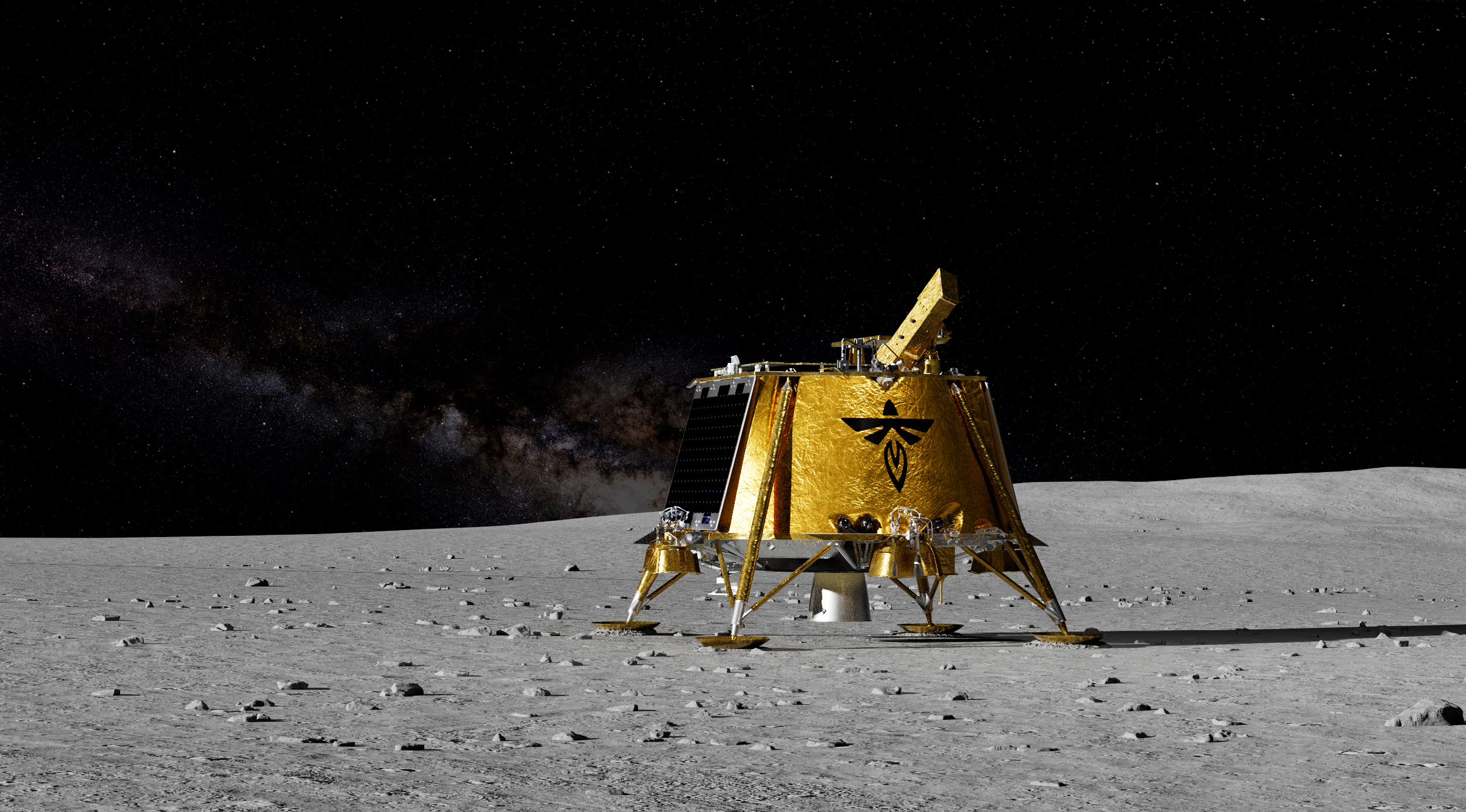
    An artist’s rendering of the surface of the moon, gray and rocky with a dark sky above it. In the foreground is a gold-colored lunar lander, round and on atop four lets. The LEXI instrument juts out from the top.
    In this visualization, the LEXI instrument is shown onboard Firefly Aerospace’s Blue Ghost Mission 1, which will deliver 10 Commercial Lunar Payload Services (CLPS) payloads to the Moon.
    Firefly Aerospace

    The team back on Earth will be working around the clock to track how the magnetosphere expands, contracts, and changes shape in response to the strength of the solar wind.

    “We expect to see the magnetosphere breathing out and breathing in, for the first time,” said Hyunju Connor, an astrophysicist at NASA’s Goddard Space Flight Center in Greenbelt, Maryland, and the NASA lead for LEXI. “When the solar wind is very strong, the magnetosphere will shrink and push backward toward Earth, and then expand when the solar wind weakens.”

    The LEXI instrument will also be poised to capture magnetic reconnection, which is when the magnetosphere’s field lines merge with those in the solar wind and release energetic particles that rain down on Earth’s poles. This could help researchers answer lingering questions about these events, including whether they happen at multiple sites simultaneously, whether they occur steadily or in bursts, and more.

    These solar particles streaming into Earth’s atmosphere can cause brilliant auroras, but they can also damage satellites orbiting the planet or interfere with power grids on the ground.

    “We want to understand how nature behaves,” Connor said, “and by understanding this we can help protect our infrastructure in space.”

    Several people dressed in white protective clothing handle the LEXI X-ray instrument and a sheet of silvery metallic film. The instrument is a boxy, rectangular shape and mostly gray metal.
    The LEXI team packs the instrument at Boston University.
    Michael Spencer/Boston University

    The CLPS delivery won’t be LEXI’s first trip to space. A team at Goddard, including Walsh, built the instrument (then called STORM) to test technology to detect low-energy X-rays over a wide field of view. In 2012, STORM launched into space on a sounding rocket, collected X-ray images, and then fell back to Earth.

    It ended up in a display case at Goddard, where it sat for a decade. When NASA put out a call for CLPS projects that could be done quickly and with a limited budget, Walsh thought of the instrument and the potential for what it could see from the lunar surface.

    “We’d break the glass — not literally — but remove it, restore it, and refurbish it, and that would allow us to look back and get this global picture that we’ve never had before,” he said. Some old optics and other components were replaced, but the instrument was overall in good shape and is now ready to fly again. “There’s a lot of really rich science we can get from this.”

    Under the CLPS model, NASA is investing in commercial delivery services to the Moon to enable industry growth and support long-term lunar exploration. As a primary customer for CLPS deliveries, NASA aims to be one of many customers on future flights. NASA Goddard is a lead science collaborator on LEXI. NASA’s Marshall Space Flight Center in Huntsville, Alabama, manages the development of seven of the 10 CLPS payloads carried on Firefly’s Blue Ghost lunar lander, including LEXI.

    Learn more about CLPS and Artemis at:
    https://www.nasa.gov/clps

    By Kate Ramsayer
    NASA’s Goddard Space Flight Center, Greenbelt, Md.

  • NASA, NOAA to Announce 2024 Global Temperatures, Climate Conditions

    This map depicts global temperature anomalies for meteorological summer in 2024 (June, July, and August). It shows how much warmer or cooler different regions of Earth were compared to the baseline average from 1951 to 1980. (Credit: NASA/NOAA)

    Climate researchers from NASA and NOAA (National Oceanic and Atmospheric Administration) will release their annual assessments of global temperatures and discuss the major climate trends of 2024 during a media briefing at 12 p.m. EST Friday, Jan. 10.

    NASA will share the briefing on the agency’s website at: https://www.nasa.gov/live.

    Participants will include:

    • Gavin Schmidt, director, NASA’s Goddard Institute for Space Studies
    • Russ Vose, chief, Monitoring and Assessment Branch, NOAA National Centers for Environmental Information

    Media interested in participating must RSVP to NOAA by the time of the event.

    NASA and NOAA are stewards of global temperature data and independently produce a record of Earth’s surface temperatures and changes based on historical observations over land and ocean.

    For more information about NASA’s Earth science programs, visit:

    https://www.nasa.gov/earth

    -end-

    Liz Vlock
    Headquarters, Washington
    202-358-1600
    elizabeth.a.vlock@nasa.gov

    Peter Jacobs
    Goddard Space Flight Center, Greenbelt, Maryland
    301-286-0535
    peter.jacobs@nasa.gov

  • Lagniappe for January 2025

    4 Min Read

    Lagniappe for January 2025

    A pair of young visitors to INFINITY Science Center

    Explore the January 2025 issue, highlighting the year in review at NASA Stennis, and how to become a NASA test conductor at the official visitor center and more!

    Explore Lagniappe for January 2025 featuring:

    • NASA Stennis Celebrates Key Testing, Operations Milestones in 2024
    • NASA Exhibit Puts Visitors in Test Conductor Seat
    • NASA Stennis Hosts Mississippi Kween

    Gator Speaks

    Gator, a fictional character, is shown on a festive dark background filled with bursting fireworks
    Gator Speaks
    NASA/Stennis

    This time of year is one Gator enjoys. The ending of one year and beginning of another provides the opportunity to reflect, reset, and refocus.

    This is true at NASA Stennis, a place that powers space dreams, or for someone who enjoys staying up to date with all the happenings around NASA Stennis – you!

    In 2024, Gator witnessed the legacy of excellence continue at the south Mississippi NASA center. There were milestones reached with RS-25 engine testing and preparations for testing NASA’s new exploration upper stage for future Artemis missions, the center continued to fuel the space market with its support of commercial companies at the E Test Complex, and it was announced the historic in-space payload mission for the NASA Stennis Autonomous Systems Laboratory team would continue.

    Another bright spot at NASA Stennis is range operations. The partnership between NASA Stennis and Skydweller Aero represents the first big step in this area. In 2024, NASA Stennis entered into an agreement with Skydweller Aero for the company to operate its solar-powered autonomous aircraft in the site’s restricted airspace.

    It marks the first agreement between NASA Stennis and a commercial company to use the center’s unique capabilities to support testing and operation of uncrewed systems.

    The future is indeed bright. The new year is like the NASA Stennis buffer zone. The 125,000-plus acre buffer zone enables many opportunities for site achievement and advancement, much like a new year does.  

    We all can make 2025 the best year to date by building on what we have accomplished and setting bold, new goals.

    Here is to 2025 – a year of focus, ambition, and collaboration. Together, we can turn our goals into achievements and make this year one of our best yet.

    Happy New Year!

    > Back to Top

    NASA Stennis Top News

    NASA Stennis Celebrates Key Testing, Operations Milestones in 2024 

    NASA’s Stennis Space Center near Bay St. Louis, Mississippi, celebrated propulsion testing and site operations milestones in 2024, all while inspiring the Artemis Generation and welcoming new leadership that will help NASA Stennis innovate and grow into the future.

    NASA Exhibit Puts Visitors in Test Conductor Seat

    NASA’s Stennis Space Center near Bay St. Louis, Mississippi, is helping the Artemis Generation learn how to power space dreams with an interactive exhibit at INFINITY Science Center.

    > Back to Top

    Center Activities

    NASA Stennis Hosts Mississippi Kween

    SLS Rocket on Display at Governor’s Mansion

    A model of NASA’s SLS (Space Launch System) rocket is part of the holiday display in the Mississippi Governor’s Mansion in Jackson, MS
    A model of NASA’s SLS (Space Launch System) rocket is part of the holiday display in the Mississippi Governor’s Mansion in Jackson, the official residence of state Gov. Tate Reeves. The model symbolizes the longtime relationship and shared history between the state of Mississippi and NASA’s Stennis Space Center near Bay St. Louis, Mississippi, the nation’s largest rocket propulsion test site. Built in the 1960s, NASA Stennis tested Apollo rocket stages that carried humans to the Moon and every main engine that helped launch 135 space shuttle missions. It now is testing engines and systems for NASA’s Artemis missions and operates as a powerful aerospace and technology hub for the region and state. “We are grateful for our ongoing relationship with the state of Mississippi,” NASA Stennis Director John Bailey said. “We appreciate every opportunity to highlight the role NASA Stennis and the state play in helping to power the nation’s human space exploration program. We look forward to 2025 and continuing our work to test engines and systems that will help launch Artemis missions back to the Moon and beyond.”
    NASA Stennis/Troy Frisbie

    NASA Stennis Director Hosts Java with John

    NASA Stennis Director John Bailey hosts a Java with John session on Dec. 10 with employees
    NASA Stennis Director John Bailey hosts a Java with John session on Dec. 10 with employees representing the Office of the Chief Financial Officer, Office of STEM Engagement, Office of Diversity and Equal Opportunity, Office of the Chief Human Capital Officer, and the center’s Autonomous Systems Laboratory team. Java with John is an employee-led discussion in a casual environment aimed at fostering a culture in which employees are welcome to share what matters most to them at work.
    NASA/Danny Nowlin

    NASA Assistant Administrator for Procurement Visits NASA Stennis

    The NASA assistant administrator for procurement stands with leaders of NASA’s Stennis Space Center and the NASA Shared Services Center
    The NASA assistant administrator for procurement stands with leaders of NASA’s Stennis Space Center and the NASA Shared Services Center during a visit to the south Mississippi site Dec. 11 to deliver an agency update, highlighting key initiatives and priorities across NASA’s procurement activities. The visit focused on fostering open communications and collaboration, and included an opportunity for Jackson to engage with procurement staff, provide updates, and respond to questions. The assistant administrator met with NASA leadership to align on strategic goals, discuss procurement-related challenges and opportunities, and reinforce support for the NASA Stennis mission. The visit highlighted NASA’s continued commitment to innovation, efficiency, and mission success through effective procurement strategies. Pictured (left to right) are James Bailey, NASA Shared Services Center/NASA Stennis deputy procurement officer; NASA Stennis Deputy Director Christine Powell; NASA Stennis Director John Bailey; Karla Smith, NASA assistant administrator for procurement; Eli Ouder, NASA Shared Services Center/NASA Stennis procurement officer; and Jamiel Charlton, NASA executive officer.
    Photo Credit: NASA/Danny Nowlin

    > Back to Top

    NASA in the News

    > Back to Top

    Employee Profile: Heather Seagren

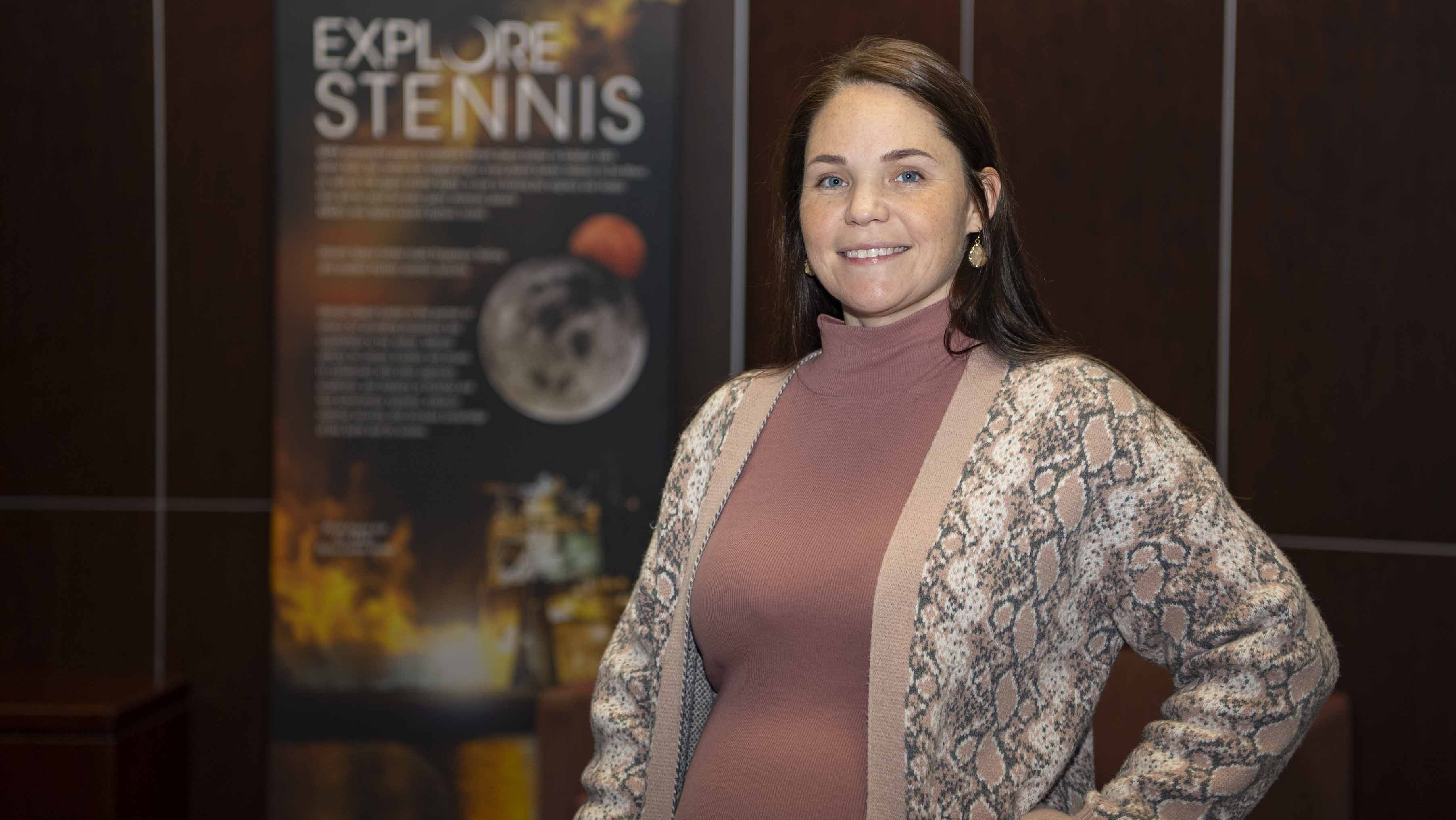
    Heather Seagren pauses for a photo in front of an Explore Stennis poster
    Heather Seagren grew up near NASA’s Stennis Space Center and visited for field trips as a child. Now, as a financial management specialist, Seagren coordinates work trips for NASA employees at the south Mississippi NASA center.
    NASA/Danny Nowlin

    A leap of faith for Heather Seagren eight years ago brought the Gulf Coast native to something new, yet also returned her to a familiar place at NASA’s Stennis Space Center near Bay St. Louis, Mississippi.

    > Back to Top

    Additional Resources

    Subscription Info

    Lagniappe is published monthly by the Office of Communications at NASA’s Stennis Space Center. The NASA Stennis office may be contacted by at 228-688-3333 (phone); ssc-office-of-communications@mail.nasa.gov (email); or NASA OFFICE OF COMMUNICATIONS, Attn: LAGNIAPPE, Mail code IA00, Building 1111 Room 173, Stennis Space Center, MS 39529 (mail).

    The Lagniappe staff includes: Managing Editor Lacy Thompson, Editor Bo Black, and photographer Danny Nowlin.

    To subscribe to the monthly publication, please email the following to ssc-office-of-communications@mail.nasa.gov – name, location (city/state), email address.

  • Mission Possible: Coordinating Travel for NASA Employees

    2 min read

    Preparations for Next Moonwalk Simulations Underway (and Underwater)

    Heather Seagren pauses for a photo in front of an Explore Stennis poster
    Heather Seagren grew up near NASA’s Stennis Space Center and visited for field trips as a child. Now, as a financial management specialist, Seagren coordinates work trips for NASA employees at the south Mississippi NASA center.
    NASA/Danny Nowlin

    A leap of faith for Heather Seagren eight years ago brought the Gulf Coast native to something new, yet also returned her to a familiar place at NASA’s Stennis Space Center near Bay St. Louis, Mississippi.

    Following graduation from Pearl River Community College, Seagren worked as an office manager at a pediatric office. Seagren anticipated a full career in the medical field until an opportunity at the south Mississippi NASA center “kind of fell in my lap,” she said.

    The NASA Shared Services Center, located at NASA Stennis, was hiring for its travel department, so Seagren applied. 

    “There are many different roles here, and my biggest thing was, do not second guess your decisions,” she said. “It was a big change for me, and I made the leap and ended up where I am today, even though it was a completely different career field.”

    A new career field, yes, but not a new place. Seagren grew up in Pearlington, Mississippi, less than 10 miles from the nation’s largest propulsion test site. Her grandfather, Grover “Shu-Shu” Bennett, retired from NASA Stennis as a tugboat captain, helping to deliver rocket propellants along the site canal system to the test stands at NASA Stennis.

    Just as her grandfather ensured the rocket engine fuel made it to its destination on time, Seagren does the same for NASA employees by coordinating travel plans. She now is in a similar role as a NASA Stennis financial management specialist.

    Working with astronauts, engineers, and many other NASA employees, no two trips are alike, which is a part of the job Seagren enjoys.

    What is similar is the trips coordinated by Seagren align with NASA’s mission to explore the secrets of the universe for the benefit of all.

    The Kiln, Mississippi, resident plays a vital role in the NASA mission by bringing together the details of booking flights, arranging accommodations, and managing schedules.   

    “The best thing about working at NASA Stennis is getting to experience everything,” she said. “It is always interesting to see what other projects and duties everybody is doing. The process kind of starts with the travel department. … It is a small step, but we are involved, making sure everybody is where they need to be, when they need to be there, so, I think that is pretty cool.”

  • January’s Night Sky Notes: The Red Planet

    3 min read

    January’s Night Sky Notes: The Red Planet

    by Kat Troche of the Astronomical Society of the Pacific

    Have you looked up at the night sky this season and noticed a bright object sporting a reddish hue to the left of Orion? This is none other than the planet Mars! January will be an excellent opportunity to spot this planet and some of its details with a medium-sized telescope. Be sure to catch these three events this month.

    Martian Retrograde

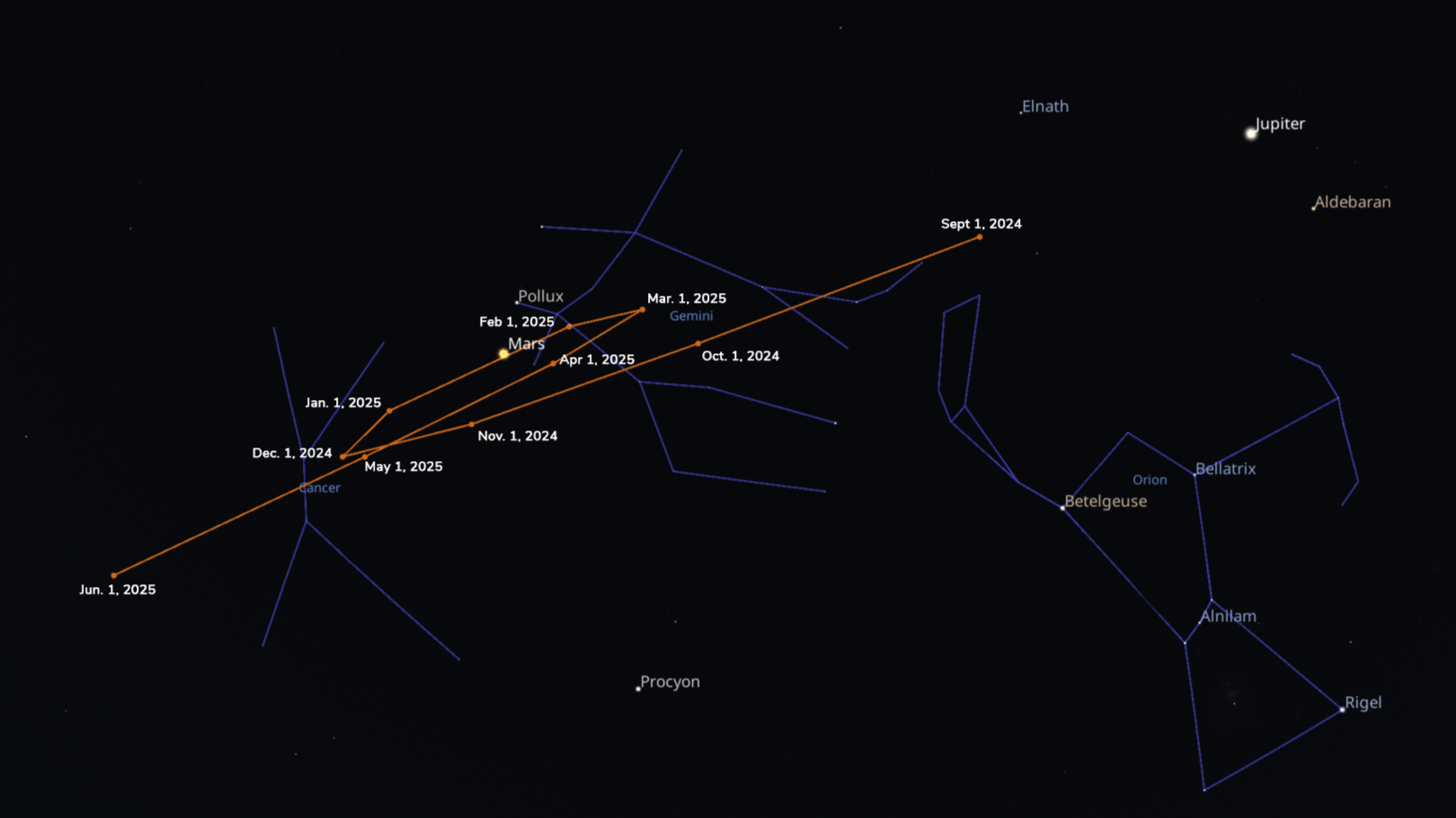
    Mars entered retrograde (or backward movement relative to its usual direction) on December 7, 2024, and will continue throughout January into February 23, 2025. You can track the planet’s progress by sketching or photographing Mars’ position relative to nearby stars. Be consistent with your observations, taking them every few nights or so as the weather permits. You can use free software like Stellarium or Stellarium Web (the browser version) to help you navigate the night as Mars treks around the sky. You can find Mars above the eastern horizon after 8:00 PM local time.

    A star chart depicting the path of Mars through the constellations Gemini and Cancer over several months. The path of Mars is marked with an orange line and labeled with specific dates (e.g., Sept. 1, 2024, Nov. 1, 2024, Feb. 1, 2025, Jun. 1, 2025). The background includes constellations such as Cancer, Gemini, and Orion, labeled with star names like Betelgeuse, Rigel, Pollux, and Procyon. Jupiter is also visible in the upper right. The chart shows Mars’ apparent retrograde motion as it loops and crosses its previous path.
    This mid-January chart shows the path of Mars from September 2024 to June 2025 as it enters and then exits in retrograde motion. Mars appears to change its direction of motion in the sky because Earth is passing the slower-moving Mars in its orbit.
    Stellarium

    Hide and Seek

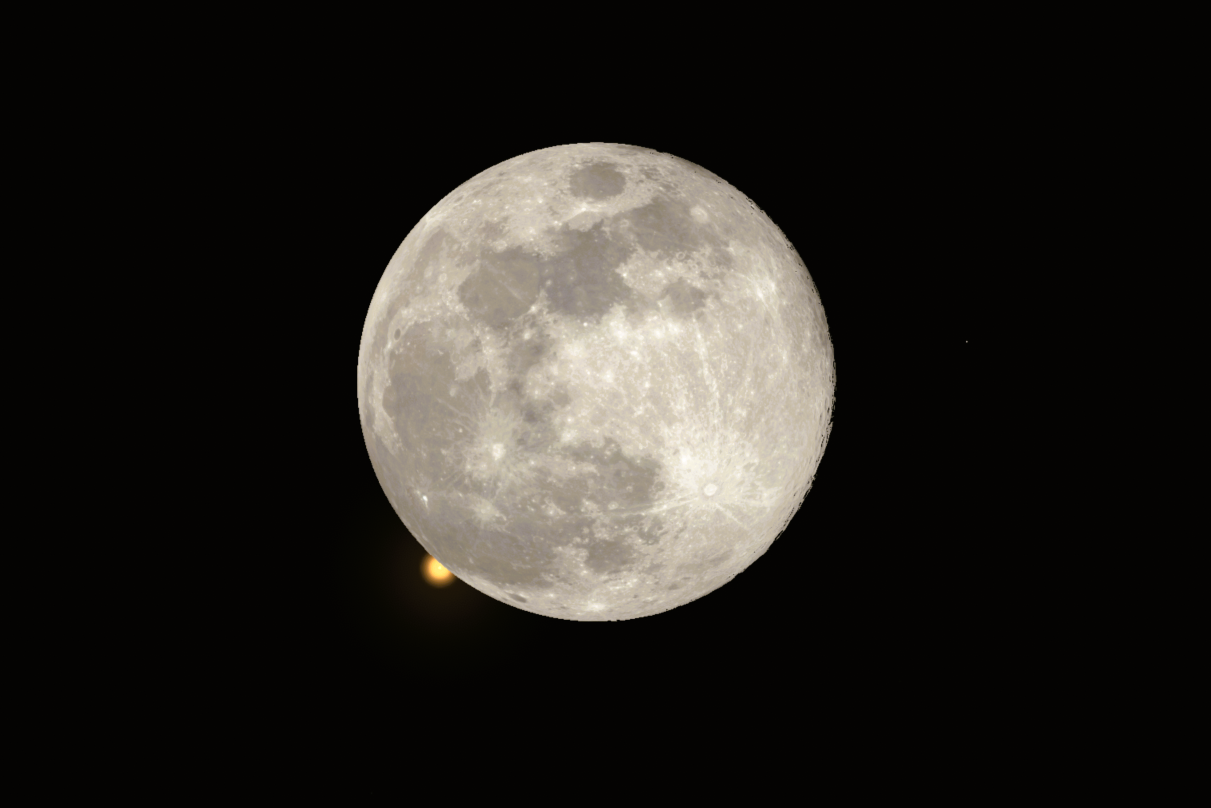
    On the night of January 13th, you can watch Mars ‘disappear’ behind the Moon during an occultation. An occultation is when one celestial object passes directly in front of another, hiding the background object from view. This can happen with planets and stars in our night sky, depending on the orbit of an object and where you are on Earth, similar to eclipses.

    A detailed image of the Full Moon dominating the frame against a black night sky. Below the lower-left edge of the Moon, Mars appears as a small, bright reddish-orange dot, partially hidden as it undergoes an occultation by the Moon. The Moon's surface is detailed with visible craters and maria.
    A simulated view of the Moon as Mars begins its occultation on January 13, 2025.
    Stellarium

    Depending on where you are within the contiguous United States, you can watch this event with the naked eye, binoculars, or a small telescope. The occultation will happen for over an hour in some parts of the US. You can use websites like Stellarium Web or the Astronomical League’s ‘Moon Occults Mars’ chart to calculate the best time to see this event.

    Closer and Closer

    As you observe Mars this month to track its retrograde movement, you will notice that it will increase in brightness. This is because Mars will reach opposition by the evening of January 16th. Opposition happens when a planet is directly opposite the Sun, as seen from Earth. You don’t need to be in any specific city to observe this event; you only need clear skies to observe that it gets brighter. It’s also when Mars is closest to Earth, so you’ll see more details in a telescope.

    Want a quick and easy way to illustrate what opposition is for Jupiter, Saturn, Mars, or other outer worlds? Follow the instructions on our Toolkit Hack: Illustrating Opposition with Exploring the Solar System page using our Exploring Our Solar System activity!

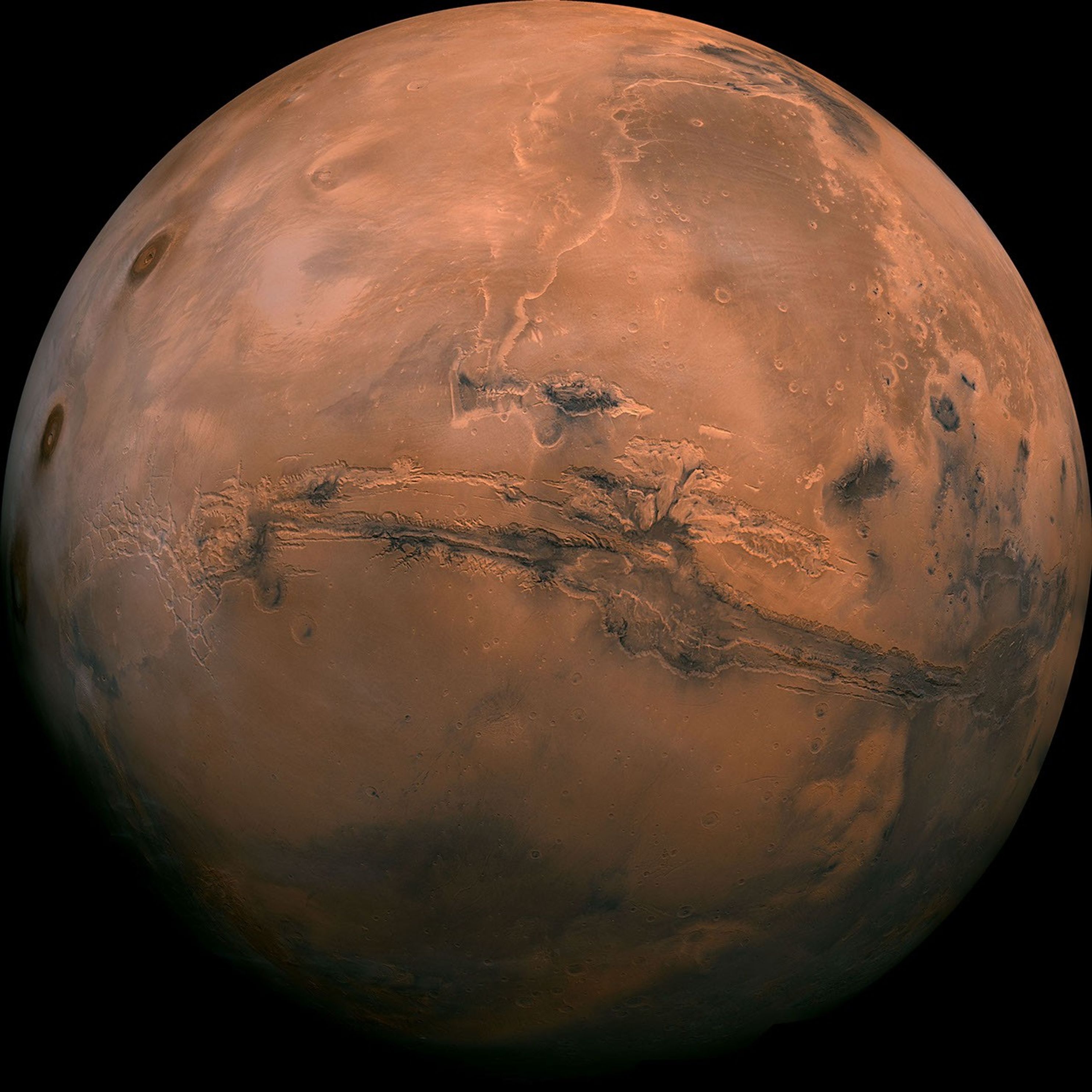
    A full globe view of reddish Mars featuring Valles Marineris - which looks like a huge gash on the planet.
    A mosaic of the Valles Marineris hemisphere of Mars projected into point perspective, a view similar to that which one would see from a spacecraft. The mosaic is composed of 102 Viking Orbiter images of Mars.
    NASA/JPL-Caltech

    Mars has fascinated humanity for centuries, with its earliest recorded observations dating back to the Bronze Age. By the 17th century, astronomers were able to identify features of the Martian surface, such as its ice caps and darker regions. Since the 1960s, exploration of the Red Planet has intensified with robotic missions from various space organizations. Currently, NASA has five active missions, including rovers and orbiters, with the future focused on human exploration and habitation. Mars will always fill us with a sense of wonder and adventure as we reach for its soil through initiatives such as the Moon to Mars Architecture and the Mars Sample Return campaign.

  • Earth to Space Call: NASA Leaders to Speak with Station Astronauts

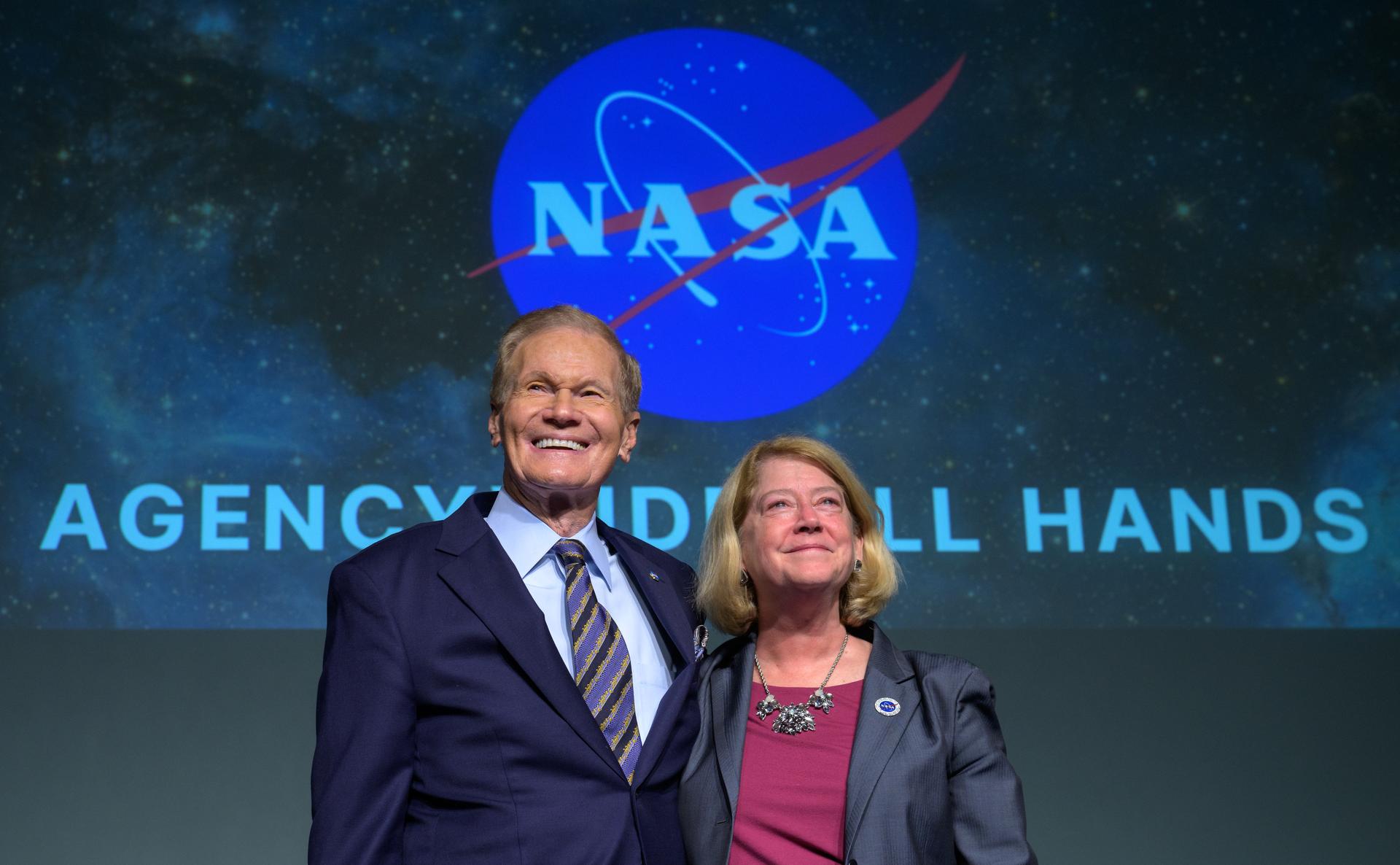
    NASA Administrator Bill Nelson, and NASA Deputy Administrator Pam Melroy, react as they are recognized by employees during a NASA agencywide all hands on Dec. 6, 2024, at the NASA Headquarters Mary W. Jackson Building in Washington.
    NASA Administrator Bill Nelson, and NASA Deputy Administrator Pam Melroy, react as they are recognized by employees during a NASA agencywide all hands on Dec. 6, 2024, at the NASA Headquarters Mary W. Jackson Building in Washington.
    Credit: NASA/Bill Ingalls

    NASA Administrator Bill Nelson and Deputy Administrator Pam Melroy will speak with NASA astronauts Nick Hague, Butch Wilmore, Suni Williams, and Don Pettit on Monday, Jan. 6, to discuss their mission aboard the International Space Station.

    The Earth to space call coverage begins at 1:30 p.m. EST on NASA+. Learn how to watch NASA content through a variety of platforms, including social media. 

    NASA’s Commercial Crew Program has delivered on its goal of safe, reliable, and cost-effective transportation to and from the International Space Station from the United States through a partnership with American private industry. This partnership is opening access to low Earth orbit and the space station to more people, science, and commercial opportunities. The space station remains the springboard to NASA’s next great leap in space exploration, including future missions to the Moon and eventually, to Mars.

    For NASA’s launch blog and more information about the mission, visit:

    https://www.nasa.gov/commercialcrew

    -end-

    Meira Bernstein / Josh Finch
    Headquarters, Washington
    202-358-1100
    meira.b.bernstein@nasa.gov / joshua.a.finch@nasa.gov

  • Mechanical Systems TDT Support Reaches Across NASA Programs

    The NESC Mechanical Systems TDT provides broad support across NASA’s mission directorates. We are a diverse group representing a variety of sub-disciplines including bearings, gears, metrology, lubrication and tribology, mechanism design, analysis and testing, fastening systems, valve engineering, actuator engineering, pyrotechnics, mechatronics, and motor controls. In addition to providing technical support, the
    TDT owns and maintains NASA-STD-5017, “Design and Development Requirements for Space Mechanisms.”

    Mentoring the Next Generation
    The NESC Mechanical Systems TDT actively participates in the Structures, Loads & Dynamics, Materials, and Mechanical Systems (SLAMS) Early Career Forum that mentors early-career engineers. The TDT sent three members to this year’s forum at WSTF, where early-career engineers networked with peers and NESC mentors, gave presentations on tasks they worked on at their home centers, and attended splinter sessions where they collaborated with mentors.

    New NASA Valve Standard to Reduce Risk and Improve Design and Reliability

    Valve issues have been encountered across NASA’s programs and continue to compromise mission performance and increase risk, in many cases because the valve hardware was not qualified in the environment as specified in NASA-STD-5017. To help address these issues, the Mechanical Systems TDT is developing a NASA standard for valves. The TDT assembled a team of subject matter experts from across the Agency representing several disciplines including mechanisms, propulsion, environmental control and life support systems, spacesuits, active thermal control systems, and materials and processes. The team has started their effort by reviewing lessons learned and best practices for valve design and hope to have a draft standard ready by the end of 2025.

    Bearing Life Testing for Reaction Wheel Assemblies

    The Mechanical Systems TDT just concluded a multiyear bearing life test on 40 motors, each containing a pair of all steel bearings of two different conformities or a pair of hybrid bearings containing silicon nitride balls. The testing confirmed that hybrid bearings outperformed their steel counterparts, and bearings with higher conformity (54%) outperformed bearings with lower conformity (52%). The team is disassembling and inspecting the bearings, and initial results have been surprising. The TDT was able to “recover” some of the bearings that failed during the life test and get them running as well as they did when testing began. Some bearings survived over five billion revolutions and appeared like new when they were disassembled and inspected. These results will be published once analysis is complete.


    X-57 Design Assessment

     The Mechanical Systems TDT was asked by the Aeronautics Mission Directorate to assess the design of the electric cruise motors installed on X-57. The team responded quickly to meet the Project’s schedule, making an onsite visit and attending numerous technical interchange meetings. After careful review of the design, the TDT identified areas for higher-level consideration and risk assessment and attended follow-on reviews to provide additional comments and advice.

    Attendees gathered at the 13th annual NASA SLAMS Early Career Forum, July 2024

    CLARREO Pathfinder Inner Radial Bearing Anomaly

    The Climate Absolute Radiance and Refractivity Observatory (CLARREO) Pathfinder was designed to take highly accurate measurements of reflected solar radiation to better-understand Earth’s climate. During payload functional testing, engineers detected a noise as the HySICS pointing system was rotated from its normal storage orientation. Mechanical Systems TDT members reviewed the design and inspection reports after disassembly of the inner bearing unit, noticing contact marks on the bore of the inner ring and the shaft that confirmed that the inner ring of the bearing was moving on the shaft with respect to the outer ring. Lubricant applied to this interface resolved the noise problem and allowed the project to maintain schedule without any additional costs.

    An illustration of how CLARREO Pathfinder will take measurements of Earth (red) and use the Sun (orange) and Moon (green) for regular instrument calibration on ISS

    JPL Wheel Drive Actuator Extended Life Test Independent Review Team

    A consequence of changes to its mission on Mars will require the Perseverance Rover to travel farther than originally planned. Designed to drive 20 km, the rover will now need to drive ~91 km to rendezvous and support Mars sample tube transfer to the Sample Retrieval Lander. The wheel drive actuators with integral brakes had only been life tested to 40 km, so a review was scheduled to discuss an extended life test. The OCE Science Mission Directorate Chief Engineer assembled an independent review team (IRT) that included NESC Mechanical Systems TDT members. This IRT issued findings and guidance that questioned details of the JPL assumptions and plan. Several important recommendations were made that improved the life test plan and led to the identification of brake software issues that were reducing brake life. The life test has achieved 40 km of its 137 km goal and is ongoing. In addition, software updates were sent to the rover to improve brake life.

    Orion Crew Module Hydrazine Valve

    When an Orion crew module hydrazine valve failed to close, the production team asked the Mechanical Systems TDT for help. A TDT member attended two meetings and then visited the valve manufacturer, where it was determined this valve was a scaled-down version of the 12-inch SLS prevalve that was the subject of a previous NESC assessment and shared similar issues. The Orion Program requested NESC materials and mechanical systems support. The Mechanical Systems TDT member then worked closely with a Lockheed Martin (LM) Fellow for Mechanisms to review all the valve vendor’s detailed drawings and assembly procedures and document any issues. A follow-on meeting was held to brief both the LM and NASA Technical Fellows for Propulsion that a redesign and requalification was recommended. These recommendations have now been elevated to the LM Vice President for Mission Success and the LM Chief Engineer for Orion.

    NASA’s Perseverance Mars rover selfie taken in July 2024.
    NASA’s Perseverance Mars rover selfie taken in July 2024.
  • NESC Assists in Heatshield Investigation

    NASA’s uncrewed Artemis I mission launched from KSC on November 16, 2022. After a successful mission that included orbiting the Moon, the Orion spacecraft returned to Earth splashing down in the Pacific Ocean on December 11, 2022. While the spacecraft made a safe return to Earth, postflight inspection of Orion’s thermal protection indicated that the base heatshield did not perform as expected. The heatshield is composed of Avcoat, an ablative material designed to protect the crew module during the nearly 5000ºF temperatures experienced during atmospheric entry upon return from the Moon. Specifically, inspection revealed more than 100 locations where the charred Avcoat material chipped away from the heatshield.

    The NESC formed a team of subject matter experts from across and outside of the Agency to assist the Orion Program team in the overall investigation. NESC team members are supporting or leading efforts in multi-physics analysis, material testing, fault tree and root cause analysis, aeroscience review, analysis peer review, nondestructive evaluation (NDE), as well as investigation of alternative heatshield concepts.

     The NESC works closely with the Artemis I Char Loss Team to ensure the observed material loss is thoroughly understood so that decisions may be made regarding use for upcoming crewed missions. To date, NESC contributions have included pathfinding NDE techniques for postflight heatshield inspection, investigation of key Avcoat material properties and behavior, and providing key inputs to the fault tree development and disposition to guide a thorough investigation of possible causes.

    View from Artemis I crew cabin window showing material loss during entry (foreground).
    An artist's illustration of Orion crew module entering the Earth's atmosphere.
    An artist’s illustration of Orion crew module entering the Earth’s atmosphere.
  • Laboratory Director Tawnya Plummer Laughinghouse

    Tawnya Laughinghouse is standing in a high-tech industrial facility, smiling and crossing her arms. She is wearing a textured black jacket and a gold bracelet. Behind her are large pieces of machinery and industrial equipment, with bright lighting highlighting the space.

    “When I transitioned from Spelman to Georgia Tech, it was probably the first time in my life that I had a professor that made me question if I belonged or had what it takes. Previously, I was always used as an example of how students should study, and now, in my first chemical engineering class, I would raise my hand for a question and wouldn’t get recognized, or my question would be followed by, ‘I’m not sure I understand what you’re saying, Miss Plummer.’

    “I was struggling with imposter syndrome before I knew what that was, wondering, ‘Have I just been in some dream world up until now? Am I not as smart as I thought I was?’ I would be in my room just knocking out homework problems, no problem, but I would get in class, and it was almost like I’d freeze up. [My professor] would be walking around the room, and I could not make my brain work. I really struggled through that and did not pass that class – the first time I had ever not passed a class – and this was supposed to be my major!

    “…Sometimes you look around and wonder why you don’t see a lot of [people of color] in some positions, and it’s probably because of situations like this where we have such high standards but feel we cannot meet them. We don’t give ourselves grace. We assume, ‘This obviously isn’t for me.’ 

    “…But I knew I could do it. I had to, number one, get out of my head and, two, realize not everyone will be a fan or in your corner cheering for you… As a young college student, it was the first time I ever faced [this situation], and it buckled me. It set me back until I realized that I could do it and that my worth wasn’t based on what someone else thought of me or my abilities…I went back that next semester with a new mindset and determination, and I passed that class with an A and moved on through the rest of my engineering classes.

    “That [experience] really informed the type of leader I am and taught me how to make sure that everybody has a voice and feels like they belong. Looking back, I thought it was the worst thing in the world when I was going through it, but now I see it was exactly what I needed at that point in my life to understand that I’m meant to be here doing what I am doing. I learned to give myself grace. If I had pulled myself out of that STEM major, I would never have been managing a technology demonstration program for NASA that launched ten technologies into space.”

    – Tawnya Plummer Laughinghouse, Director of the Materials and Processes Laboratory, Engineering Directorate, NASA’s Marshall Space Flight Center

    Image Credit: NASA/Charles Beason
    Interviewer: NASA/Tahira Allen

    Check out some of our other Faces of NASA. 

  • 25 Years Ago: STS-103, The Hubble Servicing Mission-3A

     “Trying to do stellar observations from Earth is like trying to do birdwatching from the bottom of a lake.” James B. Odom, Hubble Program Manager 1983-1990.

    The third servicing mission to the Hubble Space Telescope, placed in orbit in 1990, occurred during the STS-103 mission in December 1999. During the mission, originally planned for June 2000 but accelerated by six months following unexpected failures of the telescope’s attitude control gyroscopes, the astronauts restored the facility to full functionality. During their eight-day mission that featured the first space shuttle crew to spend Christmas in space, the seven-member U.S. and European crew rendezvoused with and captured Hubble, and four astronauts in rotating teams of two conducted three lengthy and complex spacewalks to service and upgrade the telescope. They redeployed the telescope with greater capabilities than ever before to continue its mission to help scientists unlock the secrets of the universe.

    The discovery after the Hubble Space Telescope’s launch in 1990 that its primary mirror suffered from a flaw called spherical aberration disappointed scientists who could not obtain the sharp images they had expected. But thanks to the Hubble’s built-in feature of on-orbit servicing, NASA devised a plan to correct the telescope’s optics during the first planned repair mission in 1993. A second servicing mission in 1997 upgraded the telescope’s capabilities until the next mission planned for three years later. But after three of the telescope’s six gyroscopes failed in 1997, 1998, and 1999, mission rules dictated a call up mission in case additional gyroscope failures sent Hubble into a safe mode. NASA elected to move up some of the servicing tasks from the third mission, splitting it into missions 3A and 3B, planning to fly 3A in October 1999 on Discovery’s STS-103 mission primarily to replace the failed gyroscopes. Delays to the shuttle fleet resulting from anomalies during the launch of STS-93 in July 1993 slipped STS-103 first into November and ultimately into December. Technical issues with Discovery itself pushed the launch date to mid-December, and raised concerns about having a shuttle in orbit during the Y2K transition. Once the launch had slipped to Dec. 19, mission planners cut the mission from 10 to eight days, deleting one of the four spacewalks, to ensure a return before the end of the calendar year. The servicing mission couldn’t come soon enough, as a fourth gyroscope failed aboard Hubble in mid-November, with Discovery already poised on the launch pad to prepare for STS-103. Controllers placed Hubble in a safe mode until the astronauts arrived.

    To execute the third Hubble Servicing Mission, in July 1998 NASA selected an experienced four-person team to carry out a record-breaking six spacewalks on the flight then planned for June 2000. The spacewalkers included Mission Specialists Steven L. Smith serving as payload commander, John M. Grunsfeld, C. Michael Foale, and European Space Agency (ESA) astronaut Claude Nicollier from Switzerland. The addition in March 1999 of Commander Curtis L. Brown, Pilot Scott J. Kelly, and Mission Specialist ESA astronaut Jean-François A. Clervoy of France rounded out the highly experienced crew with 18 previous spaceflights among them. Brown earned the distinction as only the fifth person to fly in space six times. For Kelly, STS-103 marked his first spaceflight. Smith, Clervoy, and Grunsfeld each had flown two previous missions, Foale four including a long-duration mission aboard Mir, and Nicollier three. Smith participated in three spacewalks during the second Hubble Servicing Mission and Nicollier served as the Remote Manipulator System (RMS) or robotic arm operator during the first.

    Discovery arrived back to KSC at the end of the STS-96 mission on June 6, 1999, and workers towed it to the Orbiter Processing Facility the same day to begin readying it for STS-103. The vehicle rolled over to the Vehicle Assembly Building on Nov. 4, where workers mated it with its external tank and twin solid rocket boosters, before rolling the stack out to Launch Pad 39B on Nov. 13.

    Beginning its 27th trip into space, Discovery lifted off from Launch Pad 39B at 7:50 p.m. EST on Dec. 19 to fix the ailing space telescope. Two days later, Brown and Kelly maneuvered Discovery to within range of Hubble so Clervoy operating the 50-foot-long RMS could grapple the telescope and berth it into the payload bay.

    Smith and Grunsfeld conducted the mission’s first spacewalk on Dec. 22, the flight’s fourth day in space. The duo, aided by Clervoy operating the RMS from inside Discovery, completed two of mission’s highest priority objectives. They replaced the failed gyroscopes, installing three new Rate Sensor Units, each containing two gyroscopes, to return control to the ailing telescope. They also installed six Voltage/Temperature Improvement Kits to prevent the telescope’s batteries from overheating as they aged. The excursion lasted eight hours 15 minutes, at the time the second longest spacewalk.

    The next day, Nicollier and Foale conducted the mission’s second spacewalk. The main task for this excursion involved installing a new computer aboard Hubble, replacing the original 1970s vintage unit. The new radiation-hardened system ran 20 times faster and carried six times more memory while using one-third the electrical power. They also installed a fine guidance sensor before concluding the eight-hour 10-minute spacewalk.

    Smith and Grunsfeld ventured outside for a second time to complete the flight’s third and final spacewalk on Dec. 24, the first spacewalk conducted on Christmas Eve day. First, they replaced an old reel-to-reel tape recorder with a solid state unit providing a 10-fold increase in recording capability and replaced a failed data transmitter. They installed seven new covers on Hubble’s electronics bay doors for added protection of the telescope’s insulation. This third spacewalk lasted eight hours eight minutes.

    The next day, the STS-103 astronauts earned the distinction as the first space shuttle crew to spend Christmas Day in space. Clervoy grappled Hubble, lifted it out of the payload bay and released it to continue its mission. Hubble Space Telescope Program Manager John H. Campbell said after the release, “The spacecraft is being guided by its new gyros under the control of its brand new computer. [It] is now orbiting freely and is in fantastic shape.” After deploying Hubble, the astronauts enjoyed a well-deserved Christmas dinner, with Clervoy providing French delicacies. The crew spent Dec. 26 readying Discovery for its return to Earth, including testing its reaction control system thrusters and aerodynamic surfaces and stowing unneeded gear.

    On Dec. 27, the astronauts donned their launch and entry suits and prepared for the return to Earth. They closed the payload bay doors and fired Discovery’s engines to bring them out of orbit. Just before landing, Kelly lowered the craft’s landing gear and Brown guided Discovery to a smooth night landing at KSC, concluding a flight of seven days, 23 hours, 11 minutes. They circled the Earth 119 times. The flight marked Discovery’s last solo flight as all its subsequent missions docked with the International Space Station. Workers at KSC began readying it for its next mission, STS-92 in October 2000.

    The Hubble Space Telescope continues to operate today, far exceeding the five-year life extension expected from the last of the servicing missions in 2009. Joined in space by the James Webb Space Telescope in 2021, the two instruments together continue to image the skies across a broad range of the electromagnetic spectrum to provide scientists with the tools to gain unprecedented insights into the universe and its formation.

    Watch the STS-103 crew narrate a video of their Hubble servicing mission.

  • NASA Study Shows Ferns Facilitate Recovery from Environmental Disaster 

    NASA-supported scientists have suggested an updated framework for the role of ferns in environmental recovery from disaster. Instead of competing with other organisms, ferns may act as facilitators that ease the way for other plants and animals to re-establish themselves in a damaged landscape.

    The study examines how a biosphere recovers from major upheaval, be it from wildfires or asteroid impacts, using what scientists call a ‘facilitative’ framework (where the actions of organisms help each other) rather than the long-held ‘competition-based’ framework. 

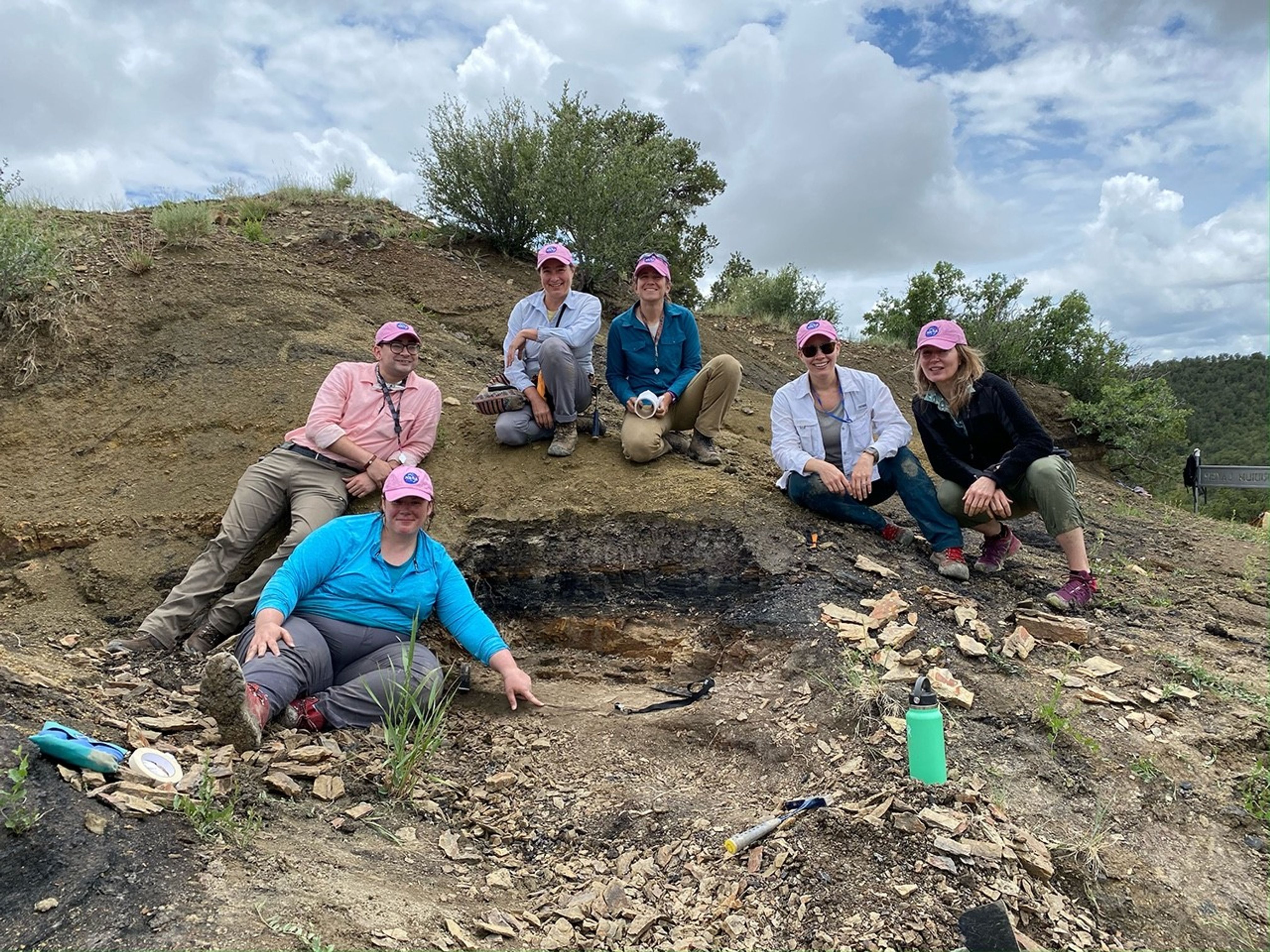
    Six scientists sit atop a rock outcrop smiling toward the camera. They all where pink baseball caps with the NASA logo. Tools and Rocks that they have collected can be seen on the ground around them. Bushes and scrubland grass are the only vegetation. The blue sky above is filled with puffy white clouds.
    NASA supported researchers at a fossil plant quarry near the Old Raton Pass Cretaceous–Paleogene (K-Pg) boundary in New Mexico.
    Ellen Currano

    Ferns are a common type of vascular plant found in woodlands, gardens, and many a plant pot on apartment shelves. Unlike many other vascular plants, ferns do not flower or seed. Instead, they reproduce via spores. Ferns first appeared on Earth some 360 million years ago during the Devonian period and, prior to the evolution of flowering plants, were the most common vascular plant on Earth.

    Ferns are often one of the first plants to re-establish in areas affected by large-scale upheaval events, and it has been suggested that this is because ferns produce spores in great amounts that are widely distributed on the wind. Some scientists, particularly in the fields of geology and paleontology, have used this ‘competitive’ success of ferns as a foundation for ecological theories about how recolonization happens after upheavals.

    However, in recent years, growing research has shown that recovery is not only about competition. Positive interactions, known as facilitation, between ferns and other species also play a significant role. The authors of the recent study believe that it is time to re-examine positive interactions within ecosystems, rather than defaulting to a competition framework.  

    Ferns in History

    “I love to imagine ecosystems through time and play a game in my head where I ask myself, ’if I could stand here for 1 million years, would this fossilize?’” said lead author Lauren Azevedo Schmidt of the University of California at Davis. “Because of the mental time gymnastics I do, my research questions follow the same pathway. How do I create synergy between modern and paleo research?”

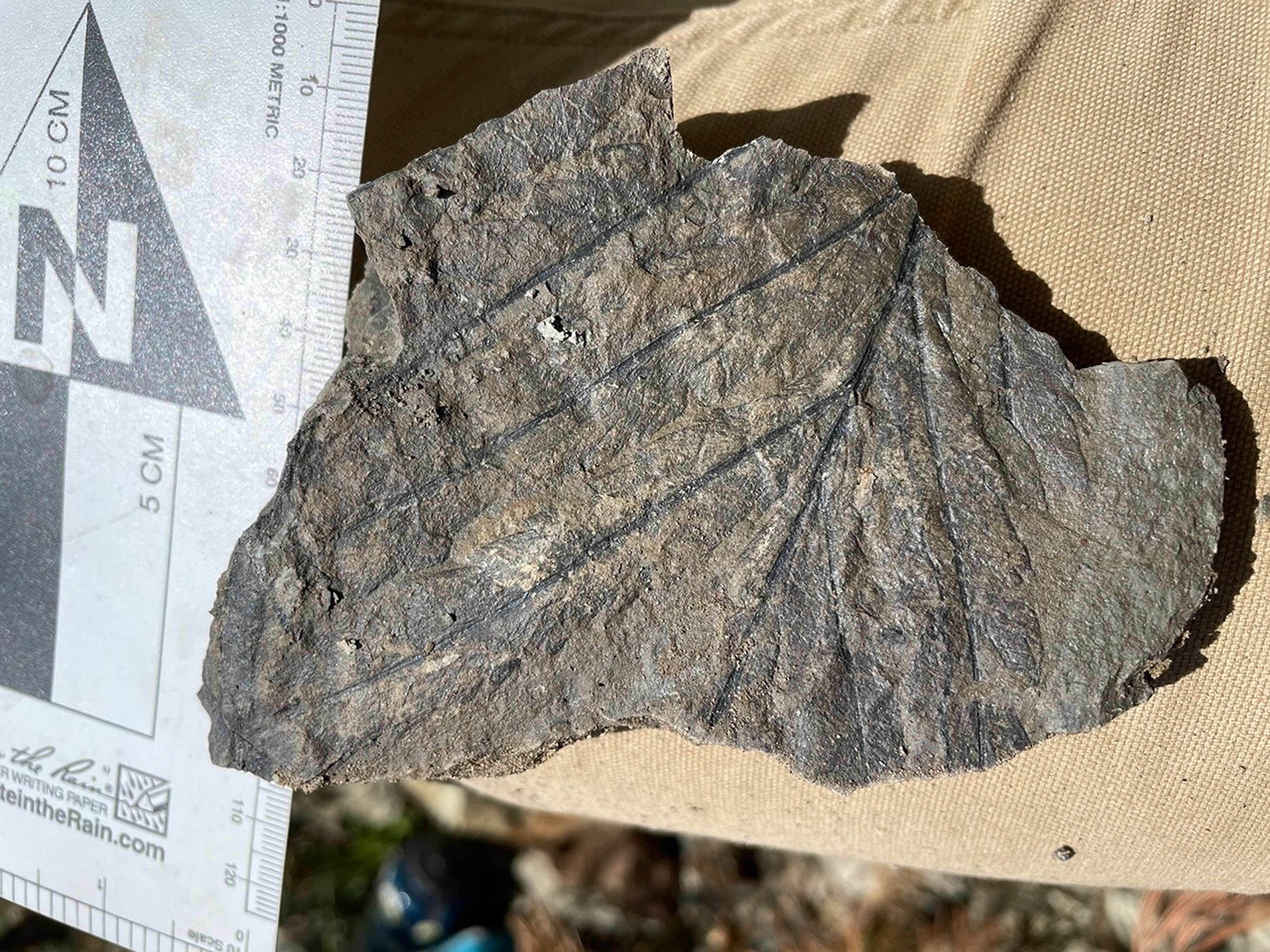
    A close up of a fossilized fern. The branching leaves can be seen preserved in the rock.
    Early Paleocene fern fossil discovered on the Vermejo Park Ranch, NM. Photo by Ellen Currano.
    Ellen Currano

    The team examined ideas that have been developed based on observing modern organisms as well as ancient populations in the fossil record. They propose that, rather than out-competing other species, ferns act as facilitators for ecosystem recovery by stabilizing the ground, enhancing properties of the soil, and mediating competition between other organisms. This repositions ferns as facilitators of ecological recovery within disturbed habitats. This has broad implications for understanding how a community recovers and the importance of positive interactions following disturbance events. Because ferns are among the oldest lineages of plants on Earth and have experienced unimaginable climates and extinction events, they provide critical information to better understand the fossil record and Earth before humans.

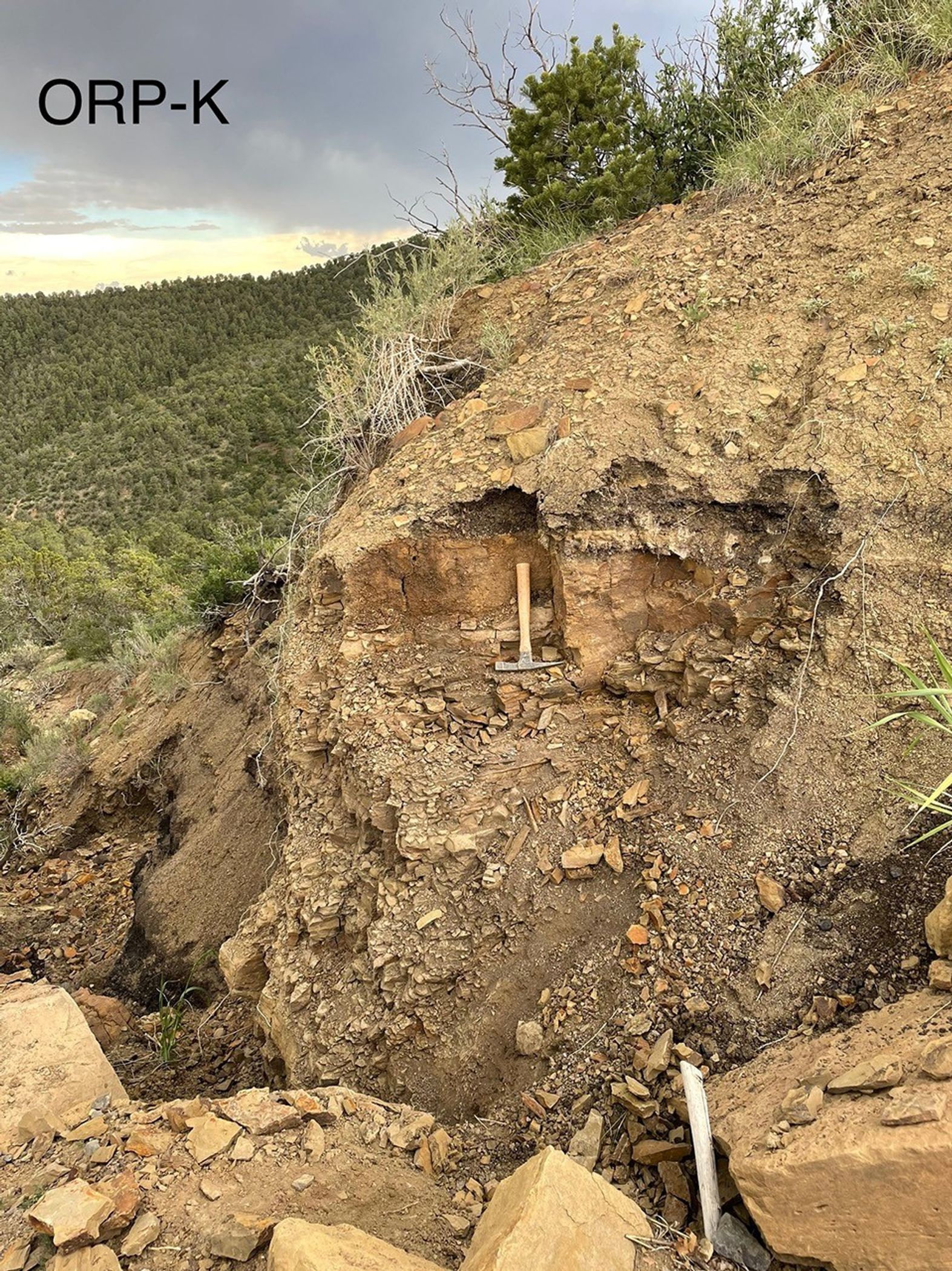
    A rock outcrop fills most of the frame with a portion of scrubland visible in the background to the left of frame. Amongst the outcrop is a rock hammer for scale. The rock ledge is around 15 feet tall.
    Fossil plant excavation in the Cretaceous rocks just below the K-Pg boundary at Old Raton Pass, NM. Photo by Ellen Currano.
    Ellen Currano

    “The Cretaceous – Paleogene [K-Pg] extinction event reworked Earth’s biosphere, resulting in approximately 75% of species going extinct, with up to 90% of plants going extinct,” said Azevedo Schmidt. “This magnitude of devastation is something humans (luckily) have never had to deal with, making it hard to even think about. But it is something we must consider when tackling research/issues surrounding exobiology.” 

    The longevity of ferns on Earth provides a view into the evolution of life on Earth, even through some of the planet’s most devastating disasters. This is of interest to astrobiology and exobiology because exploring how environmental factors can and have impacted the large-scale evolution of life on Earth through mass extinctions and mass radiation events can help us understand the potential for the origin, evolution and distribution for life elsewhere in the Universe.   

    Ferns in Space

    In addition to their relevance to astrobiology, the resilience of ferns and their ability to help heal a damaged environment could also make them important partners for future human missions in space. NASA’s Space Biology program has supported experiments to study how plants adapt to space with the expectation that knowledge gained can lead to ways by which crops can be cultivated for fresh food. Lessons learned from studying resilient plants, such as ferns, could guide efforts to make crops adapt better to harsh space conditions so they can serve as a reliable food source as humans explore destinations beyond our planet. Previous studies have also looked at how plants might keep air clean in enclosed spaces like the International Space Station or in habitats on the Moon or Mars.

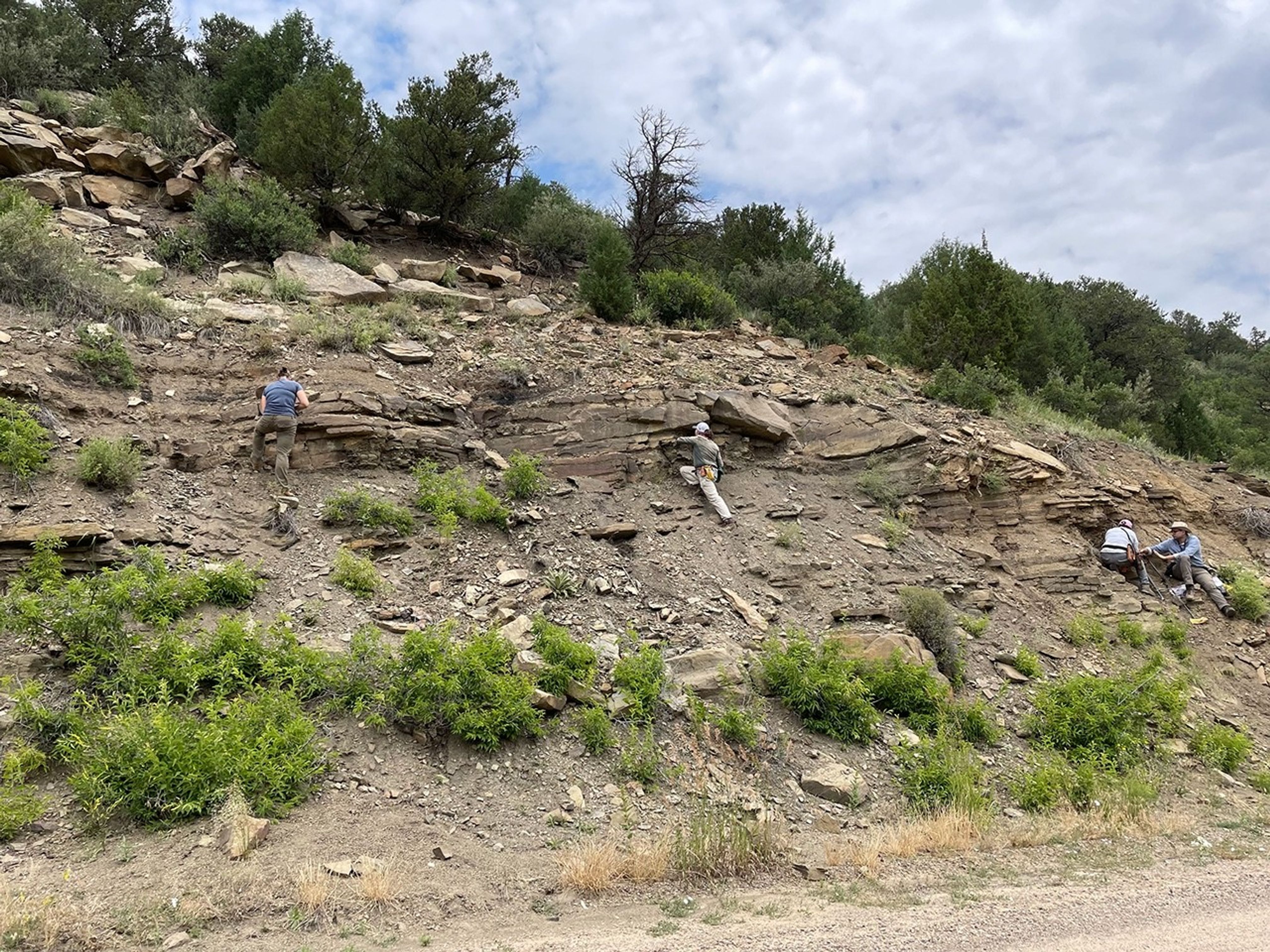
    Four scientists are spread out along a rock ridge looking for samples to collect. Small trees line the top of the otherwise exposed ridge.
    NASA supported scientists can be seen prospecting for plant fossils in Berwind Canyon, CO. Photo by Ellen Currano.
    Ellen Currano

    “Ferns were able to completely transform Earth’s biosphere following the devastation of the K-Pg [Cretaceous–Paleogene] extinction event. The environment experienced continental-scale fires, acid rain, and nuclear winter, but ferns were able to tolerate unbelievable stress and make their environment better,” says Azevedo Schmidt. “I think we can all learn something from the mighty ferns.”  

    The study, “Ferns as facilitators of community recovery following biotic upheaval,” was published in the journal BioScience [doi:10.1093/biosci/biae022]

    For more information on NASA’s Astrobiology program, visit:

    https://www.science.nasa.gov/astrobiology

    -end-

    Karen Fox / Molly Wasser

    Headquarters, Washington

    202-358-1600

    karen.c.fox@nasa.gov / molly.l.wasser@nasa.gov 

    Details

    Last Updated

    Dec 20, 2024

    Related Terms

  • NASA, Notre Dame Connect Students to Inspire STEM Careers

    2 min read

    Preparations for Next Moonwalk Simulations Underway (and Underwater)

    Portage School of Leaders High School junior Rebecca Anderson, wearing a black short-sleeved shirt and glasses, stands smiling beside NASA Glenn’s Daniel Sutliff, an acoustic engineer, on the campus of the University of Notre Dame. Sutliff is wearing a NASA ballcap and black jacket. He and Anderson are holding an autographed NASA mug, which Sutliff signed with a black ink permanent magic marker. Anderson is holding the black marker and a small cardboard box.
    Rebecca Anderson, a junior enrolled at the Portage School of Leaders High School in South Bend, Indiana, spent time with NASA Glenn Research Center’s Daniel Sutliff, an acoustic engineer, on the campus of the University of Notre Dame on Nov. 7, 2024. Students witnessed the operation of the Advanced Noise Control Fan owned by NASA and on loan to the university for STEM experiences.
    Credit: Matt Cashore/University of Notre Dame

    High school students in Indiana are contributing to NASA’s groundbreaking research to develop quieter, more fuel-efficient aircraft engines.

    Their learning experience is a collaboration between aircraft noise researchers from NASA’s Glenn Research Center in Cleveland and educators from the University of Notre Dame’s Turbomachinery Laboratory. The collaboration aims to encourage students’ interest in science, technology, engineering, and math (STEM) careers.

    Recently, Notre Dame hosted students from The Portage School of Leaders High School and a team from NASA Glenn to see the Advanced Noise Control Fan operate in an outdoor setting. The fan is a NASA-owned test rig that has been configured to enable the study of a quieter aircraft engine technology. Known as the open rotor fan concept, the configuration involves an engine fan without a cover. Ground microphones were used during the test operated by Notre Dame to evaluate the radiated sound as the open rotor fan spun at various speeds.

    NASA’s Advanced Noise Control Fan features an open aircraft engine fan concept, which means it is uncovered. The fan is surrounded by a beige frame designed to prevent lateral winds from interfering with the test.
    NASA’s Advanced Noise Control Fan is on loan at the University of Notre Dame through a Space Act Agreement. It provides a hands-on learning laboratory for students in STEM.
    Credit: Matt Cashore/University of Notre Dame

    Students from the high school, which is part of the Career Academy Network of Public Schools, used 3D printers from the school’s facilities to fabricate parts for the open rotor test fan. The parts, known as stator blades, help direct and control airflow, ensuring smooth operation of the large, exposed fan blades that are the defining feature of an open fan engine design.

    “It was beyond words,” said Rebecca Anderson, a junior from the high school. “The part I enjoyed most was when they got the fan running. It was really impressive to see how quiet it was. I feel like everyone involved in STEM would love to work for NASA, including me.”

    NASA researcher Dr. Daniel Sutliff was part of the team from NASA Glenn to spend time mentoring the students.

    “This is real-world, hands-on research for them,” Sutliff said. “If airlines are able to use technologies to make flight quieter and cleaner, passengers will have more enjoyable flights.”

    The Advanced Noise Control Fan is on loan to Notre Dame from NASA through a Space Act Agreement. The fan research is supported by NASA’s Advanced Air Transport Technology project and its Efficient Quiet Integrated Propulsors technical challenge.

  • NASA Flight Rerouting Tool Curbs Delays, Emissions

    2 min read

    Preparations for Next Moonwalk Simulations Underway (and Underwater)

    People walk in a room with monitors in an American Airlines facility.
    NASA Deputy Administrator Pam Melroy and Deputy Associate Administrator Casey Swails visit the American Airlines Integrated Operations Center near Dallas Fort Worth International Airport on a recent trip to see NASA’s digital tools for aviation efficiency in operational use.
    American Airlines

    It’s the holiday season — which means many are taking to the skies to join their loved ones.

    If you’ve ever used an app to navigate on a road trip, you’ve probably noticed how it finds you the most efficient route to your destination, even before you depart. To that end, NASA has been working to make flight departures out of major international airports more efficient — thereby saving fuel and reducing delays — in close collaboration with the aviation industry and the Federal Aviation Administration (FAA). 

    The savings are possible thanks to a NASA-developed tool called Collaborative Digital Departure Rerouting

    This tool determines where potential time savings could be gained by slightly altering a departure route, based on existing data about delays. The software presents its proposed more-efficient route in real time to an airline, who can then decide whether or not to use it and coordinate with air traffic control through a streamlined digital process. 

    The capability is being tested thoroughly at Dallas Fort Worth International Airport and Love Field Airport in Texas in collaboration with several major air carriers, including American Airlines, Delta, JetBlue, Southwest, and United. 

    Now, these capabilities are expanding out of the Dallas area to other major airports in Houston for further research. 

    “We’re enabling the use of digital services to greatly improve aviation efficiency,” said Shivanjli Sharma, manager of NASA’s Air Traffic Management — eXploration project which oversees the research on aviation services. “Streamlining airline operations, reducing emissions, and saving time are all part of making an efficient next-generation airspace system.” 

    Animation of an airplane over a blue background showing aviation emissions and delays savings
    NASA / Maria Werries

    The animation above shows the savings Collaborative Digital Departure Rerouting is responsible for at just a single airport. As the tool is expanded to be used at other airports, the savings begin to add up even more. 

    It’s all part of NASA’s vision for transforming the skies above our communities to be more sustainable, efficient, safer, and quieter. 

    Collaborative Digital Departure Rerouting is one of a series of new cloud-based digital air traffic management tools NASA and industry plan to develop and demonstrate as part of the agency’s Sustainable Flight National Partnership. These new flight management capabilities will contribute to the partnership’s goal of accelerating progress towards aviation achieving net-zero greenhouse gas emissions by 2050. 

    About the Author

    John Gould

    John Gould

    Aeronautics Research Mission Directorate

    John Gould is a member of NASA Aeronautics’ Strategic Communications team at NASA Headquarters in Washington, DC. He is dedicated to public service and NASA’s leading role in scientific exploration. Prior to working for NASA Aeronautics, he was a spaceflight historian and writer, having a lifelong passion for space and aviation.