Tag: Kepler

  • The Overview Effect: Astronaut Perspectives from 25 Years in Low Earth Orbit

    To see Earth from space is to be forever changed by the view. Since Alan Shepard became the first American to lay eyes on our home planet from above, countless NASA astronauts have described feeling awed by the astonishing sight and a profound shift in perspective that followed.
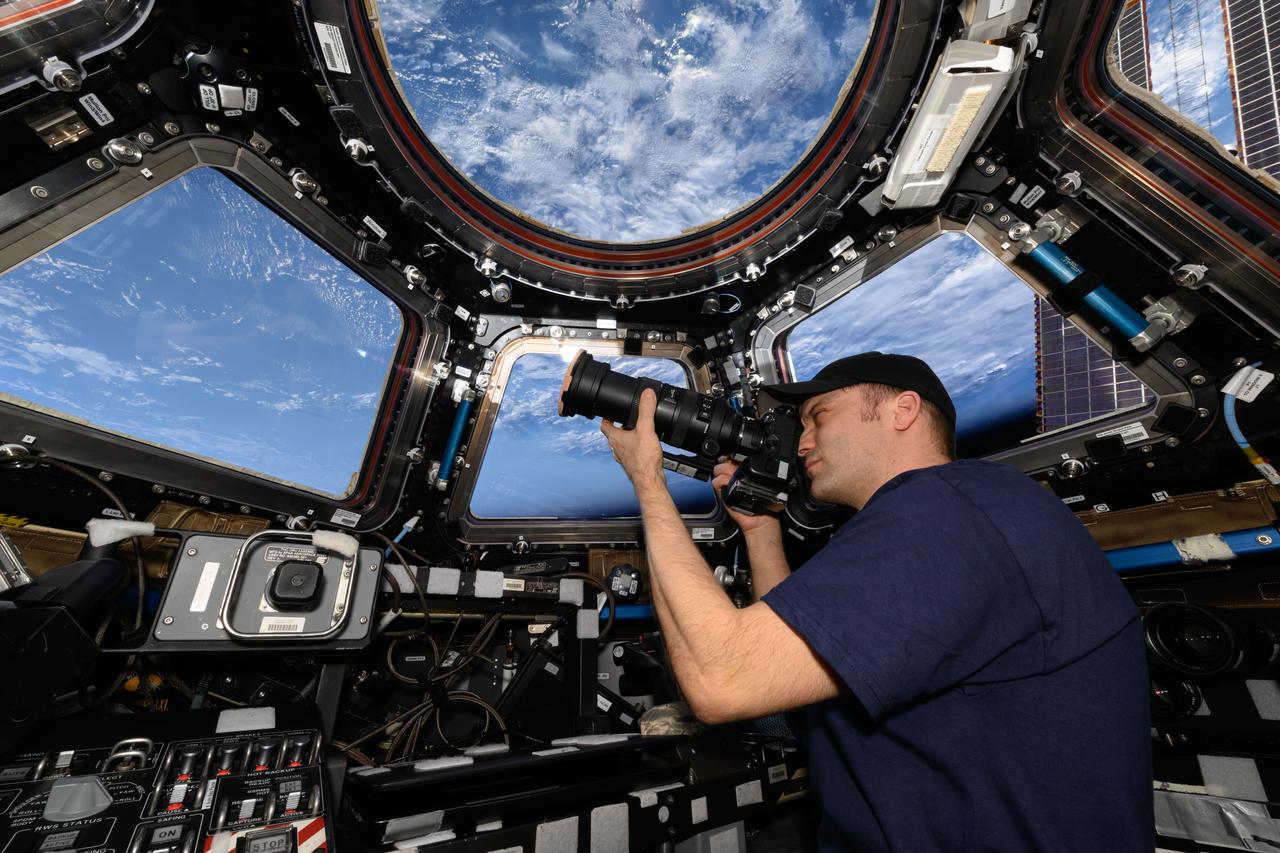
    NASA astronaut Matthew Dominick points his camera through a cupola window as the International Space Station orbits 262 miles above the Atlantic Ocean off the coast of Africa.
    NASA astronaut Matthew Dominick points his camera through a cupola window as the International Space Station orbits 262 miles above the Atlantic Ocean off the coast of Africa.
    NASA

    This unique experience is known as the overview effect – a term coined in 1987 by space philosopher and author Frank White in a book of the same name. The phenomenon creates powerful changes in the way astronauts think about Earth and life and can be particularly strong for those who lived and worked aboard the International Space Station during its 25 years of continuous human presence. The orbiting laboratory’s cupola module, equipped with seven windows looking down on Earth, provides the perfect place for observation and reflection.
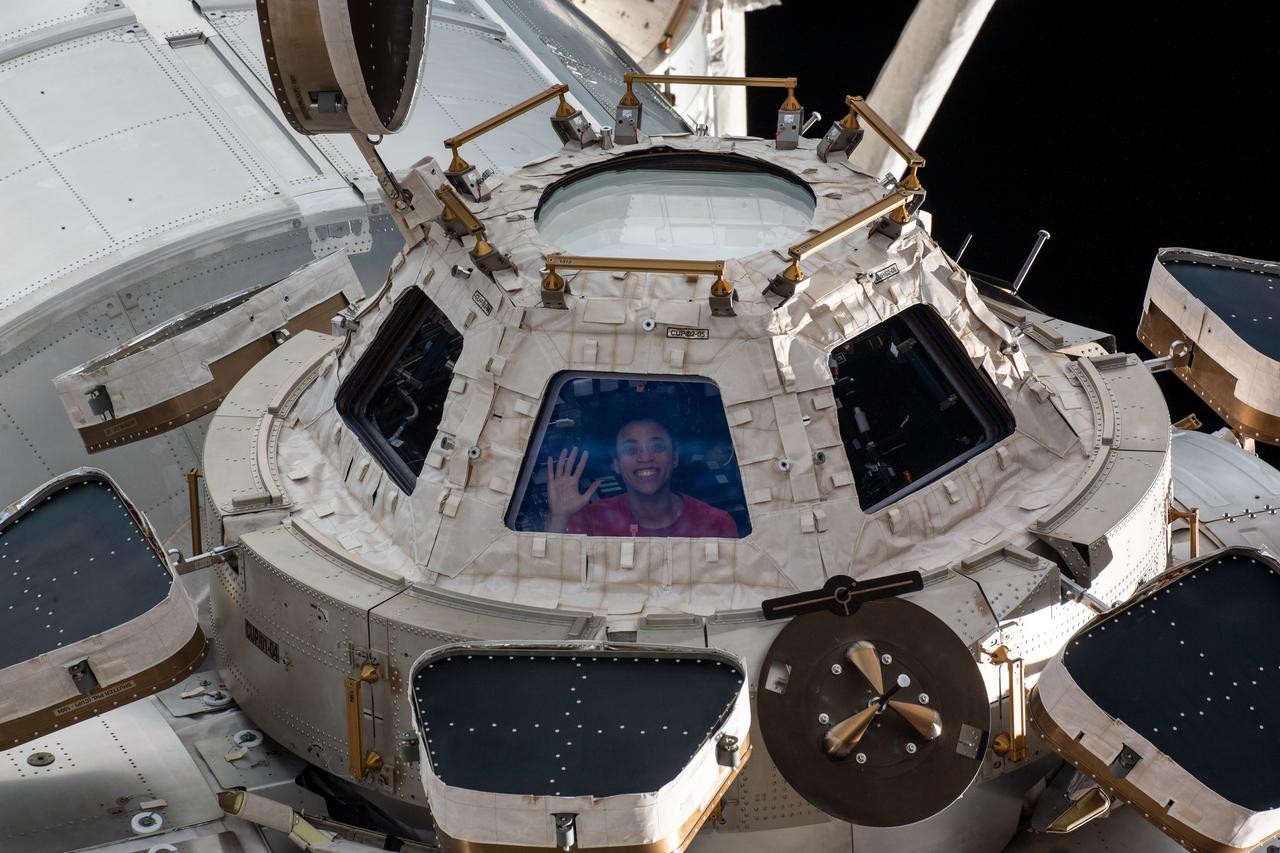
    NASA astronaut Jessica Watkins is pictured looking out from the International Space Station's cupola window.
    NASA astronaut Jessica Watkins is pictured looking out from the International Space Station’s “window to the world” – the cupola. Astronauts use the seven-windowed observation module to monitor the arrival of spacecrafts at the orbiting laboratory and view the Earth below.
    NASA

    As Artemis II Mission Specialist Christina Koch explained:

      “The overview effect is when you’re looking through the cupola and you see the Earth as it exists with the whole universe in the background. You see the thin blue line of the atmosphere, and then when you’re on the dark side of the Earth, you actually see this very thin green line that shows you where the atmosphere is. What you realize is every single person that you know is sustained and inside of that green line and everything else outside of it is completely inhospitable. You don’t see borders, you don’t see religious lines, you don’t see political boundaries. All you see is Earth and you see that we are way more alike than we are different.”

    Koch’s Artemis II crewmate, NASA astronaut Victor Glover, said the overview effect’s potency is closely tied to the “sea level effect” – humanity’s shared experience on Earth. “You come back to sea level, and then you have a choice,” he explained. “Are you going to try to live your life a little differently? Are you going to really choose to be a member of this community of Earth?”
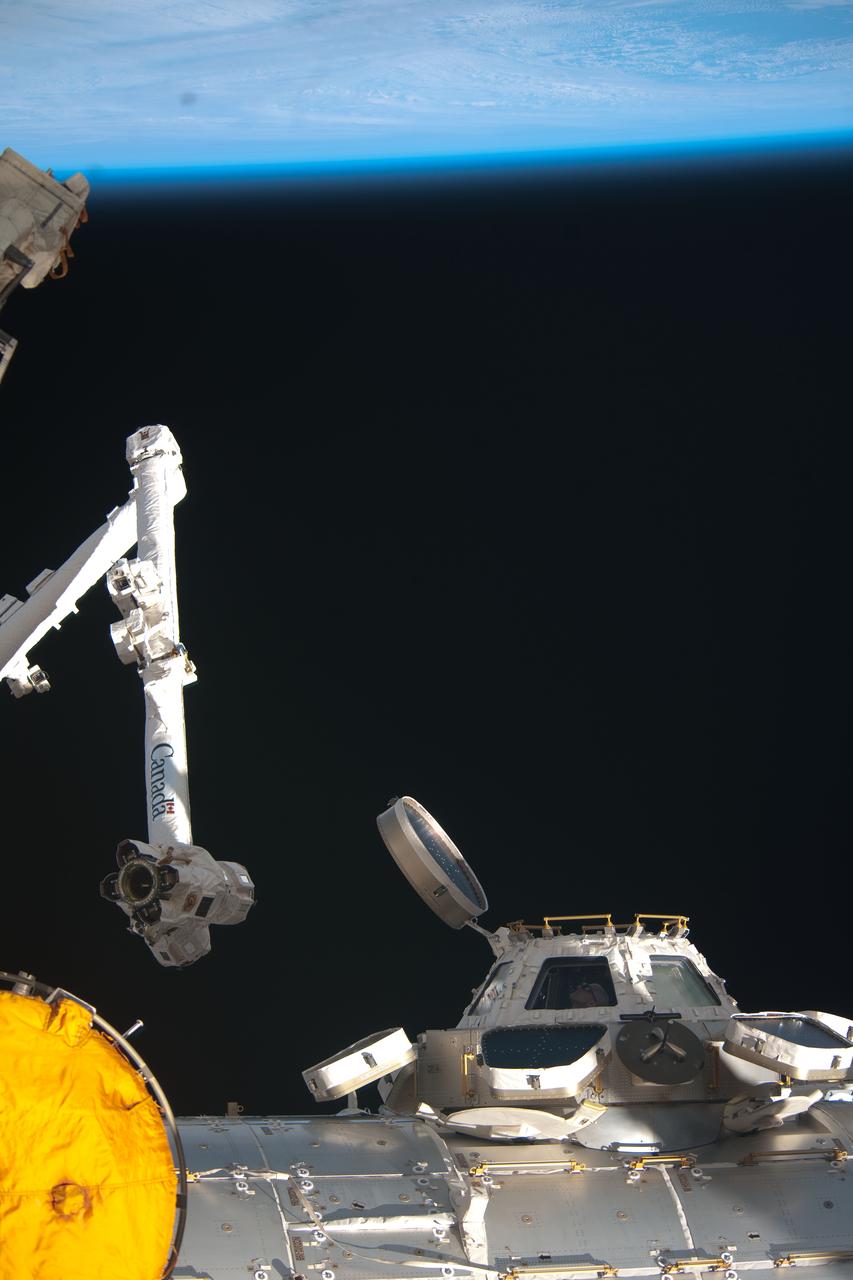
    NASA astronaut Don Pettit, Expedition 30 flight engineer, is pictured in a window of the cupola of the International Space Station, backdropped by Earth’s horizon and the blackness of space.
    NASA astronaut Don Pettit, Expedition 30 flight engineer, is pictured in a window of the cupola of the International Space Station, backdropped by Earth’s horizon and the blackness of space.
    NASA

    Many astronauts emphasize the importance of unity after experiencing the overview effect. “You see that it’s a single planet with a shared atmosphere. It’s our shared place in this universe,” said former NASA astronaut Bob Behnken. “I think that perspective, as we go through things like the pandemic or we see the challenges across our nation or across the world, we recognize that we all face them together.”

    Seeing the Earth from space can also change their concept of home. Former NASA astronaut Nicole Stott recalls wanting to see her home state of Florida during her first mission to the International Space Station. “Finally, we were flying over Florida. I wanted to go to the window and see it, and then realized somewhere down the line that I wasn’t looking at Florida that same way anymore,” she said. “I still wanted to see Florida, but Florida had just become this special part of home, which is Earth. We’re all earthlings.”
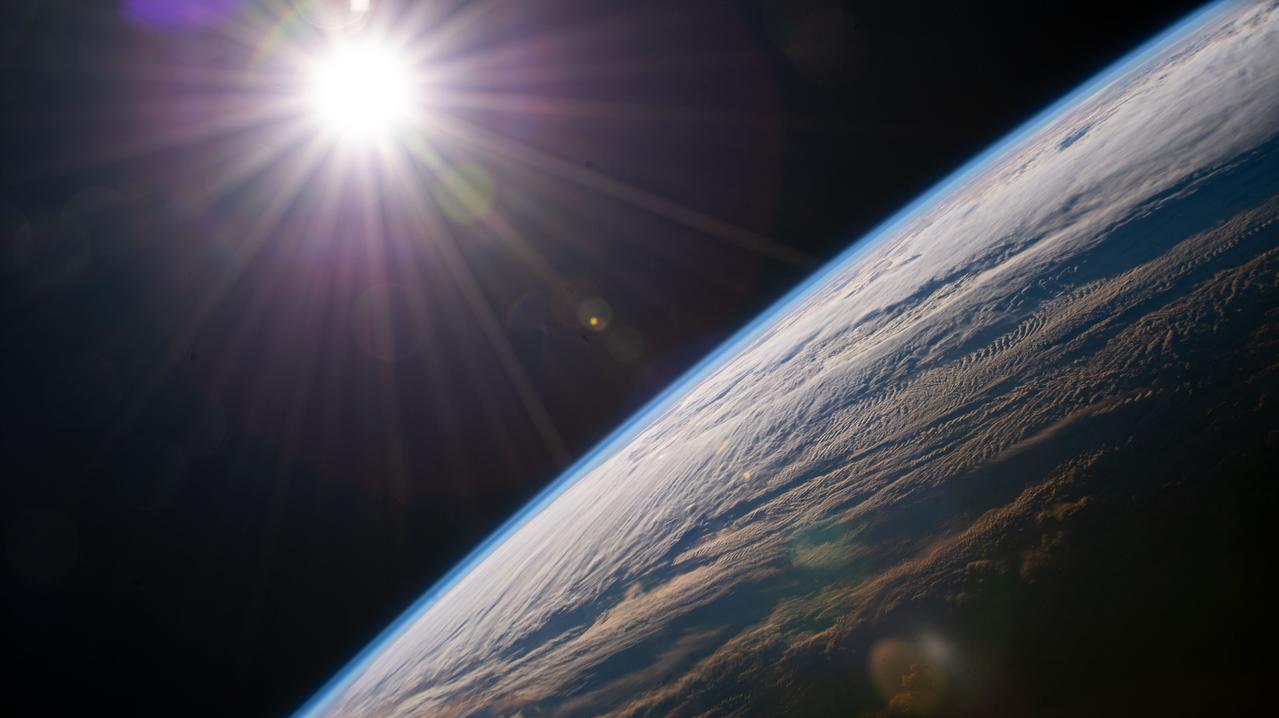
    The sun shines above Earth's horizon as the space station orbits 264 miles above the Canadian province of Quebec.
    The sun shines above Earth’s horizon as the space station orbits 264 miles above the Canadian province of Quebec.
    NASA

    For some astronauts, their perspective shift inspired them to make changes on the ground. “I think if you’re not a conservationist before you go to space, you’re at least partly a conservationist when you come back. Because when you see how thin that atmosphere is, that protective layer that we have here, you think, wow, we really have to take care of this because it does look so fragile from space,” said retired NASA astronaut Mike Foreman.

    Others hope to share the overview effect with more people. “That perspective helps you grow. It has really inspired me to try to get more people this experience and to get a permanent foothold in the stars for our species,” said former NASA astronaut Jack Fischer. “I want to do everything I possibly can to help the human species, humanity as a whole, go further and grow and evolve like I know they’re capable of.”
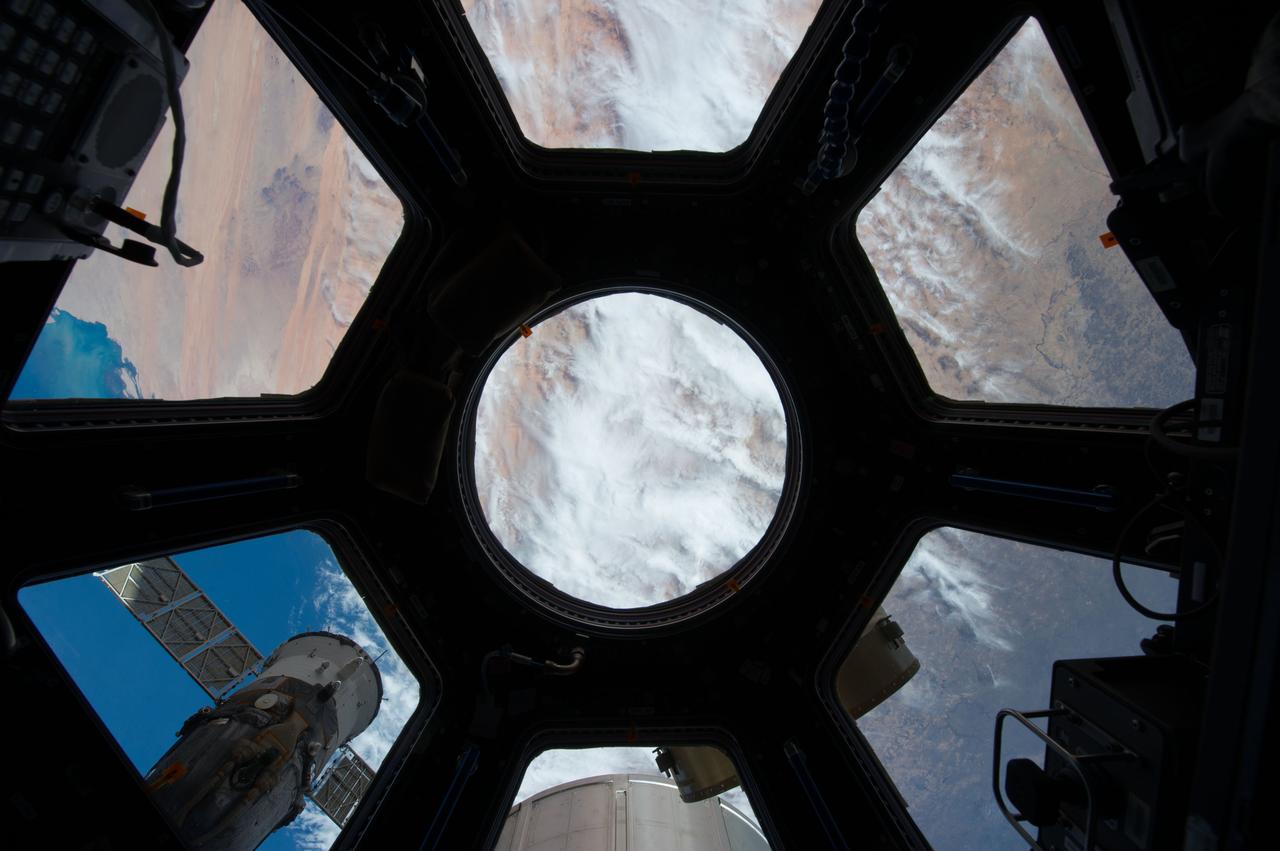
    An Earth observation taken through cupola windows by the Expedition 39 crew. Portions of the International Space Station are in view.
    An Earth observation taken through cupola windows by the Expedition 39 crew. Portions of the International Space Station are in view.
    NASA

    Future crews to the orbiting laboratory can look forward to a similar experience. “In that instant, when you’re overwhelmed with that vista, when your eyes see nothing but the beauty of the Earth – every single crew member that I brought in [the cupola] for that exposure, cried,” said retired NASA astronaut T.J. Creamer. “It is heart stopping. It is soul pounding. It is breathtaking.”

    For more astronaut perspectives from the International Space Station, watch “Down to Earth” on NASA+.

  • NASA Awards Liquid Hydrogen Supply Contracts

    The letters NASA on a blue circle with red and white detail, all surrounded by a black background
    Credit: NASA

    NASA has selected Plug Power, Inc., of Slingerlands, New York, and Air Products and Chemicals, Inc., of Allentown, Pennsylvania, to supply up to approximately 36,952,000 pounds of liquid hydrogen for use at facilities across the agency.

    The NASA Agency-wide Supply of Liquid Hydrogen awards are firm-fixed-price requirements contracts that include multiple firm-fixed-price delivery orders critical for the agency’s centers as they use liquid hydrogen, combined with liquid oxygen, as fuel in cryogenic rocket engines, and the commodity’s unique properties support the development of aeronautics. The total value for the combined awards is about $147.2 million.

    The contracts begin Monday, Dec. 1, and each consists of a two-year base period followed by three one-year option periods that, if exercised, would extend the contracts to Nov. 30, 2030.

    Air Products and Chemicals Inc. will supply up to about 36.5 million pounds of liquid hydrogen to NASA’s Kennedy Space Center and Cape Canaveral Space Force Station in Florida; NASA’s Marshall Space Flight Center in Huntsville, Alabama; and NASA’s Stennis Space Center in Bay St. Louis, Mississippi, for a maximum contract value of approximately $144.4 million.

    Plug Power, Inc. will deliver up to approximately 480,000 pounds of the commodity to NASA’s Glenn Research Center in Cleveland, Ohio, and at Neil A. Armstrong Test Facility in Sandusky, Ohio, for a maximum contract value of about $2.8 million.

    For additional information about NASA and agency programs, visit:

    https://www.nasa.gov/

    -end-

    Tiernan Doyle
    Headquarters, Washington
    tiernan.doyle@nasa.gov
    202-358-1600

    Amanda Griffin
    Kennedy Space Center, Fla.
    amanda.griffin@nasa.gov
    321-593-6244

  • Hubble Captures Puzzling Galaxy

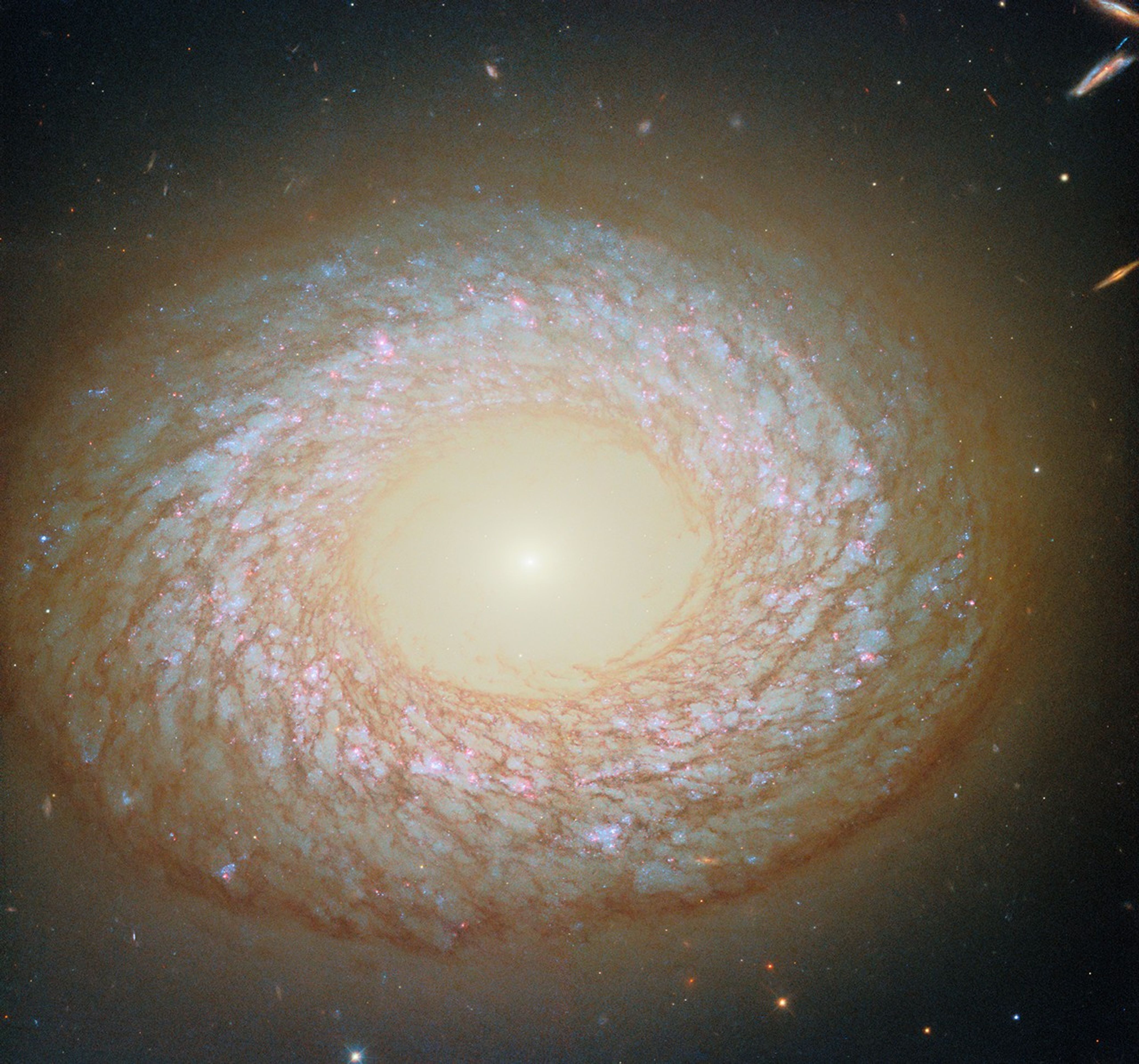
    A galaxy seen face-on, with a slightly elliptical disk that appears to have a hole in the center like a doughnut. In the hole, the core is a brightly glowing point that shines light out beyond the edge of the disk. Around the hole is an inner ring of dust, and at the galaxy’s edge is a thicker outer ring of dust, with a swirling web of dust strands in between. Blue stars and red nebulae are visible behind the dust.
    This NASA/ESA Hubble Space Telescope image features a galaxy, NGC 2775, that’s hard to categorize.
    ESA/Hubble & NASA, F. Belfiore, J. Lee and the PHANGS-HST Team

    This NASA/ESA Hubble Space Telescope image features a galaxy that’s hard to categorize. The galaxy in question is NGC 2775, which lies 67 million light-years away in the constellation Cancer (the Crab). NGC 2775 sports a smooth, featureless center that is devoid of gas, resembling an elliptical galaxy. It also has a dusty ring with patchy star clusters, like a spiral galaxy. Which is it: spiral or elliptical — or neither?

    Because we can only view NGC 2775 from one angle, it’s difficult to say for sure. Some researchers classify NGC 2775 as a spiral galaxy because of its feathery ring of stars and dust, while others classify it as a lenticular galaxy. Lenticular galaxies have features common to both spiral and elliptical galaxies.

    Astronomers aren’t certain of exactly how lenticular galaxies come to be, and they might form in a variety of ways. Lenticular galaxies might be spiral galaxies that merged with other galaxies, or that have mostly run out of star-forming gas and lost their prominent spiral arms. They also might have started out more like elliptical galaxies, then collected gas into a disk around them.

    Some evidence suggests that NGC 2775 merged with other galaxies in the past. Invisible in this Hubble image, NGC 2775 has a tail of hydrogen gas that stretches almost 100,000 light-years around the galaxy. This faint tail could be the remnant of one or more galaxies that wandered too close to NGC 2775 before being stretched apart and absorbed. If NGC 2775 merged with other galaxies in the past, it could explain the galaxy’s strange appearance today.

    Most astronomers classify NGC 2775 as a flocculent spiral galaxy. Flocculent spirals have poorly defined, discontinuous arms that are often described as “feathery” or as “tufts” of stars that loosely form spiral arms.

    Hubble previously released an image of NGC 2775 in 2020. This new version adds observations of a specific wavelength of red light emitted by clouds of hydrogen gas surrounding massive young stars, visible as bright, pinkish clumps in the image. This additional wavelength of light helps astronomers better define where new stars are forming in the galaxy.

  • 25 Years of Scientific Discovery Aboard the International Space Station

    8 Min Read

    25 Years of Scientific Discovery Aboard the International Space Station

    NASA astronaut Kate Rubins is looking towards the left at her hands while working on an experiment on the International Space Station.

    November marks 25 years of human presence aboard the International Space Station, a testament to international collaboration and human ingenuity. Since the first crew arrived on Nov. 2, 2000, NASA and its partners have conducted thousands of research investigations and technology demonstrations to advance exploration of the Moon and Mars and benefit life on Earth.

    Researchers have taken advantage of the unique microgravity environment to conduct experiments impossible to replicate on Earth, transforming research across disciplines. More than 4,000 experiments have pushed the boundaries of science, sparked discoveries, and driven scientific breakthroughs.

    “25 years ago, Expedition 1 became the first crew to call the International Space Station home, beginning a period of continuous human presence in space that still continues to this day,” said NASA acting administrator Sean Duffy. “This historic milestone would not have been possible without NASA and its partners, as well as every astronaut and engineer who works to keep the lights on in low Earth orbit.”

    To celebrate a quarter century of innovation in microgravity, NASA is highlighting 25 scientific breakthroughs that exemplify the station’s enduring impact on science, technology, and exploration.

    Building the road to the Moon and Mars

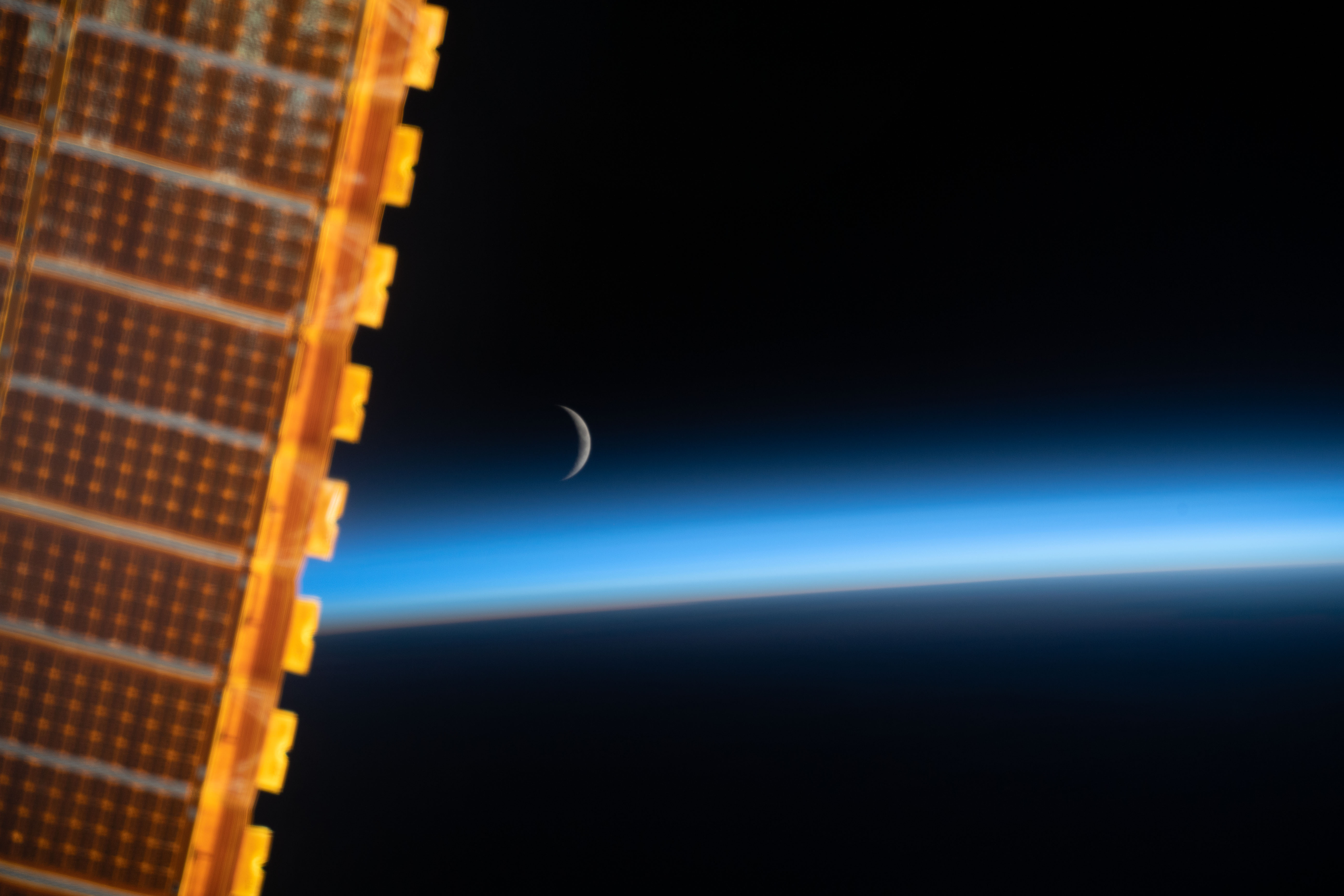
    A sliver of the Moon rises above Earth’s thin blue atmosphere, seen against the blackness of space. On the left side of the image, part of the International Space Station’s orange solar array comes into view with square grid sections along its surface.
    The waxing crescent moon appears just above the Earth’s atmosphere as the International Space Station orbits the Earth.
    NASA

    NASA uses the space station as a proving ground to develop new systems and technologies for missions beyond low Earth orbit.

    • Navigation, communication, and radiation shielding technologies proven aboard the space station are being integrated into spacecraft and missions to reach the Moon and Mars.
    • Robotic systems, for example a robotic surgeon and autonomous assistants, will expand available medical procedures and allow astronauts to dedicate time to more crucial tasks during missions far from Earth. 
    • Astronauts have used recycled plastic and stainless steel to 3D print tools and parts. The ability to 3D print in space lays the groundwork for on-demand repair and fabrication during future deep space missions where resupply isn’t readily available.
    • From the deployment of the first wooden satellite to laser communications and self-healing quantum communications, the space station is a proving ground for cutting-edge space technologies.

    Why this matters:

    Humanity’s push to the Moon and Mars begins with discoveries in low Earth orbit. From demonstrating how astronauts can live, work, and repair equipment off Earth to testing life-support systems and advanced materials, every innovation aboard the station helps to advance NASA’s Artemis and other exploration initiatives and brings humanity closer to thriving beyond our planet.

    Sustaining life beyond Earth

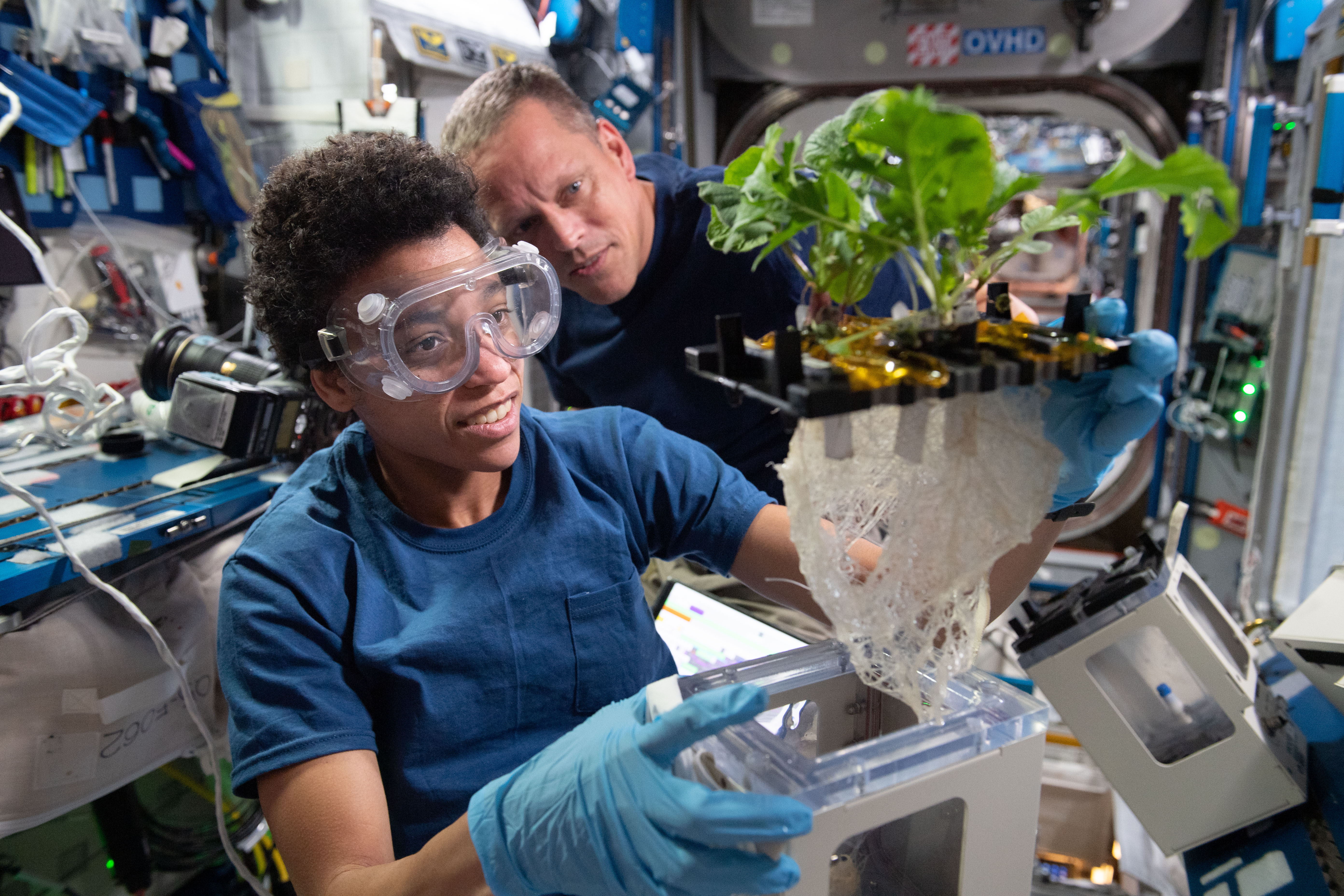
    Jessica Watkins wears safety goggles and blue gloves while holding a plant growth unit with leafy greens and a large tangle of roots exposed. Bob Hines, in a black shirt, looks on from the background inside the space station laboratory.
    NASA astronauts Jessica Watkins, front, and Bob Hines, back, work on XROOTS aboard the International Space Station. This experiment used the station’s Veggie facility to test soilless hydroponic and aeroponic plant growth.
    NASA

    As NASA prepares to return humans to the Moon through the Artemis program and push onward to Mars, sustaining life beyond Earth is more critical than ever.

    • Astronauts have grown more than 50 species of plants in space, including tomatoes, bok choi, romaine lettuce, and chili peppers.
    • Advanced life support systems are capable of recycling up to 98% of water in the U.S. segment aboard the space station, the ideal level needed for exploration missions.
    • Crew health data shows how space affects the brain, vision, balance and control, and  muscle and bone density, guiding strategies to maintain astronaut performance during extended missions and improve health on Earth.
    • Researchers have sequenced DNA in orbit and are advancing techniques to enable real-time assessment of microbial life in space, which is essential to maintaining astronaut health.

    Why this matters:

    By growing food, recycling water, and improving medical care in space, NASA is paving the way for future long-duration missions to the Moon and Mars while revolutionizing agriculture and medicine back home.

    Helping humanity on Earth

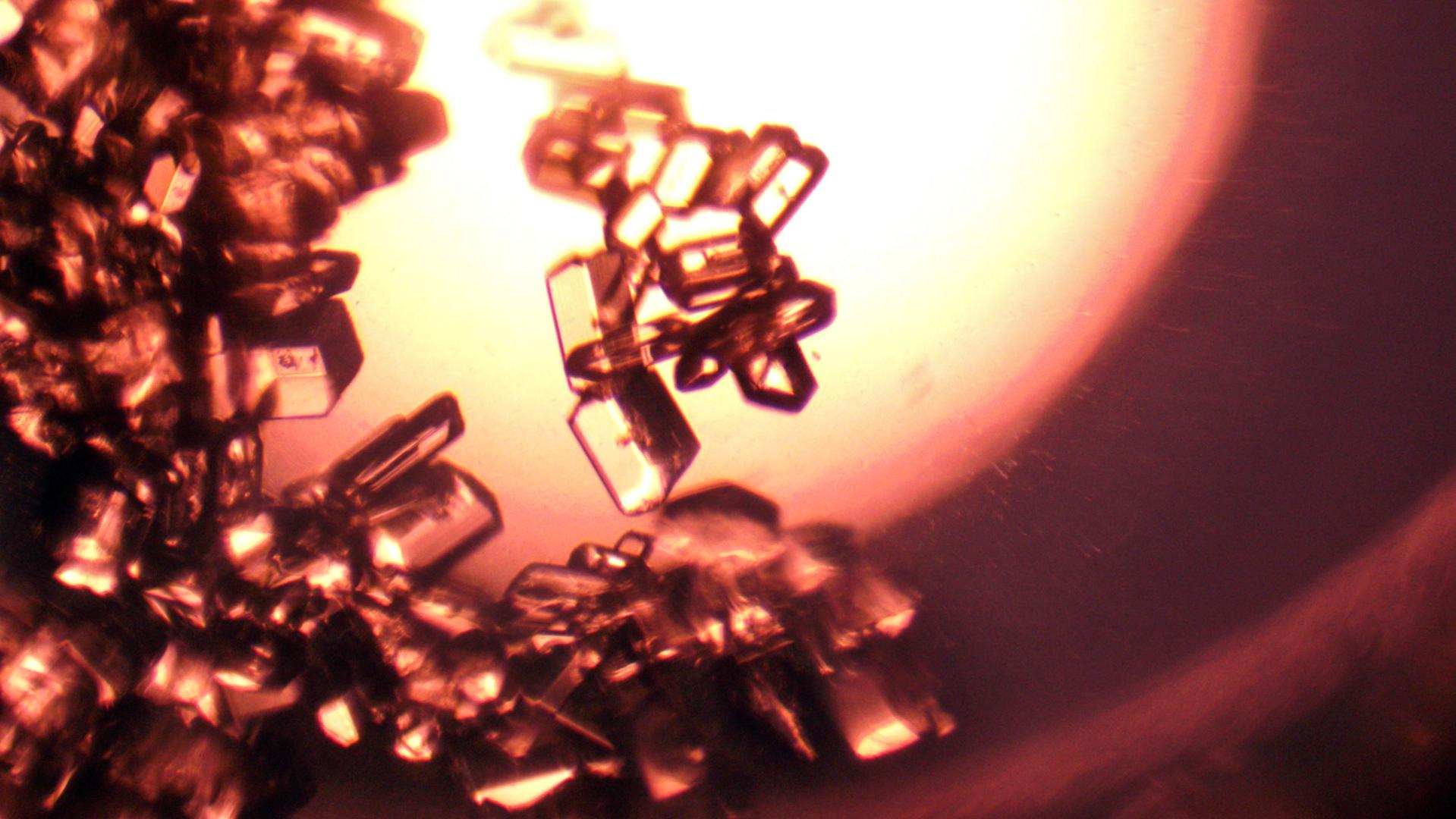
    Crystals cover the left side of the frame against a rust-colored background. The crystals are translucent and vary in shape and size, most resemble a rectangular prism. A bright yellow light shines through the crystals from the background.
    Pharmaceutical crystals grown aboard the International Space Station are shown after returning to Earth.
    Redwire

    Research aboard the orbiting laboratory not only pushes humanity farther into the cosmos but can help address complex human health issues on the ground. By providing a platform for long-term microgravity research, the space station fosters breakthroughs that yield direct benefits to people on Earth.

    • Research aboard the space station provides new insights to develop treatments for diseases like cancer, Alzheimer’s, Parkinson’s, and heart disease by revealing how microgravity alters cellular functions.
    • New developments in medicine for cancer, muscular dystrophy, and neurodegenerative diseases have come from growing protein crystals in microgravity with larger, more organized structures.
    • High quality stem cells can be grown in greater quantities in space, helping to develop new regenerative therapies for neurological, cardiovascular, and immunological conditions.
    • Pioneering efforts in 3D bioprinting, which uses cells, proteins, and nutrients as source material, have produced human tissue structures such as a knee meniscus and heart tissue, a major step toward manufacturing organs in space for transplant patients on Earth.
    • Researchers are using miniaturized tissue models to observe how space affects tissues and organ systems, offering new ways to develop and test medicines to protect astronauts on future missions and improve treatments on Earth.
    • Photos taken by astronauts have supported emergency response to natural disasters, such as hurricanes, with targeted views from space.
    • Instruments mounted on the space station protect critical space infrastructure and provide data on the planet’s natural patterns by measuring Earth’s resources and space weather.

    Why this matters:

    Microgravity research is moving us closer to manufacturing human organs in space for transplant and revealing new ways to fight cancer, heart disease, osteoporosis, neurodegenerative disease, and other serious illnesses that affect millions of people worldwide. The station also serves as an observation platform to monitor natural disasters, weather patterns, and Earth’s resources.

    Understanding our universe

    Six red lasers shine into the middle of a clear, rectangular chamber, fixating on a small, blueish white sphere.
    Artist concept of operations inside NASA’s Cold Atom Laboratory aboard the International Space Station.
    NASA

    The space station offers scientists an unparalleled vantage point to learn about the fundamental behavior of the universe. By studying cosmic phenomena typically blocked or absorbed by Earth’s atmosphere and observing physics at an atomic level, researchers can probe mysteries impossible to study from Earth.

    Why this matters:

    Research aboard the space station is helping us unravel the deepest mysteries of our universe, from the smallest quantum particles to the most powerful cosmic explosions. Observations of collapsing stars and black holes could inspire new navigation tools using cosmic signals and expand our grasp of space-time. Studies of antimatter and dark matter bring us closer to understanding the 95% of the universe invisible to the human eye. Creating the fifth state of matter in space unlocks new quantum pathways that could transform technology on Earth and in space.

    Learning new physics

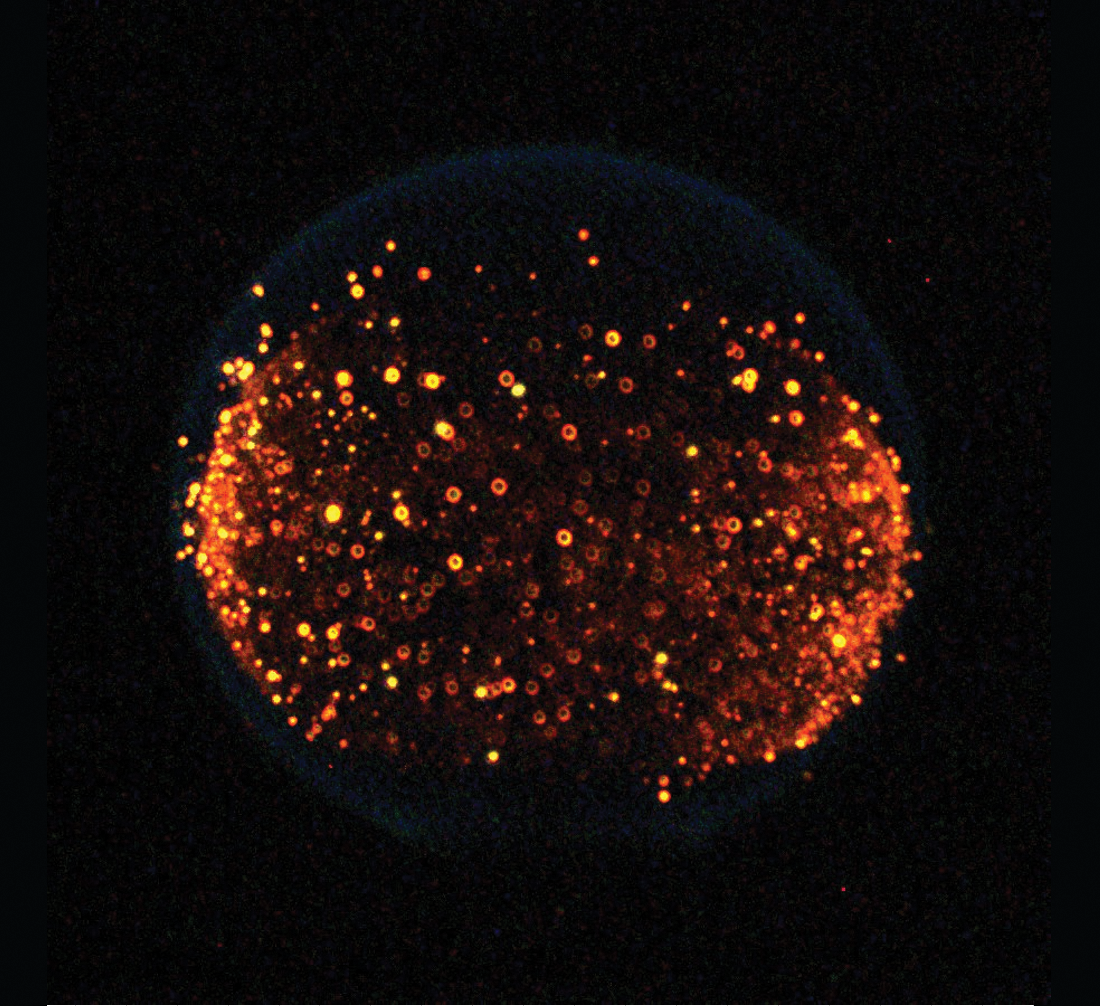
    Small yellow flame spots cover a spherical space against a dark background. There is a faint blue ring surrounding the yellow clusters.
    This image shows a flame ignited as part of the Flame Design investigation on the International Space Station.
    NASA

    Physical processes behave differently in microgravity, offering scientists a new lens for discovery.

    • Engineers can design more efficient fuel and life support systems for future spacecraft thanks to studies of fluid boiling, containment, and flow.
    • Analyzing gels and liquids mixed with tiny particles in space helps researchers fine-tune material compositions and has led to new patents for consumer products.
    • The discovery of cool flames in space, a phenomenon difficult to study on Earth, has opened new frontiers in combustion science and engine design.  

    Why this matters:

    Breakthroughs in fundamental physics aboard the space station drive innovation on Earth and advance spacecraft fuel, thermal control, plant watering, and water purification systems. Research in soft materials is improving products in medicine, household products, and renewable energy, while cool flames studies may lead to cleaner, more efficient engines.

    Enabling global access to space

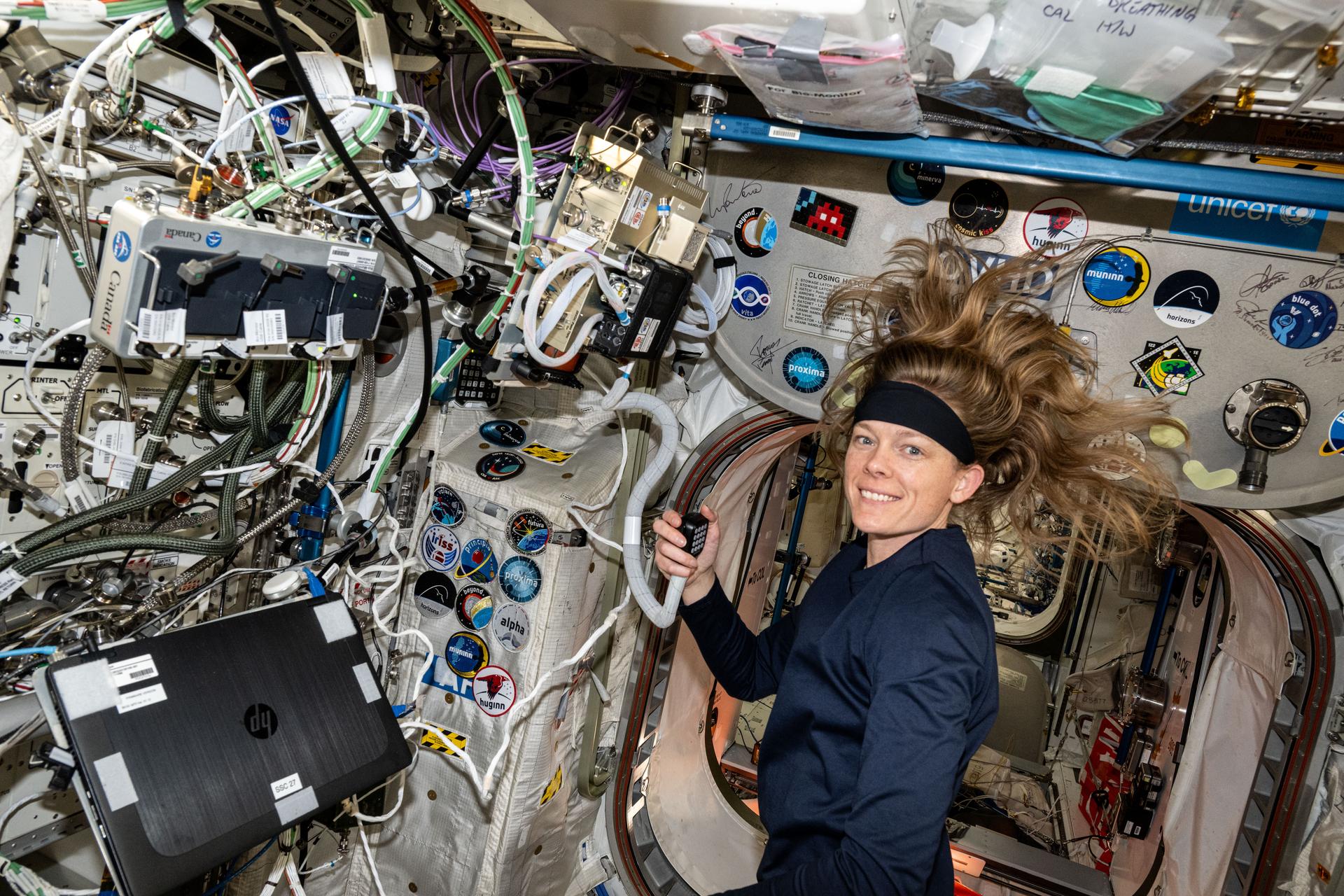
    Nichole Ayers smiles at the camera while holding a hand-held radio aboard the space station. Her long blonde hair floats upward in microgravity. To her left, a laptop and cables are mounted on the wall, and the wall behind her is decorated with several mission stickers.
    NASA astronaut Nichole Ayers talks on a ham radio with students from Lakeside Junior High School in Springdale, Arkansas. Ayers answered questions from the students about her experience living and working aboard the International Space Station.
    NASA

    Since 2000, the space station has opened doors for private companies, researchers, students, and astronauts around the world to participate in exploration and help propel humanity forward to the Moon and Mars.

    • The space station is a launchpad for the commercial space economy, enabling private astronaut missions and hosting hundreds of experiments from commercial companies, giving them the chance to strengthen their technologies through in-orbit research, manufacturing demonstrations, and innovation.
    • CubeSats deployed from the space station enable students and innovators around the world to test radio antennas, small telescopes, and other scientific demonstrations in space.
    • More than one million students have engaged with astronauts via ham radio events, inspiring the next generation to participate in science, technology, engineering, and mathematics.
    • More than 285 crew members from more than 25 countries have visited humanity’s longest-operating outpost in space, making it a symbol of global collaboration.

    Why this matters:

    The space station has enabled the space economy, where commercial research, manufacturing, and technology demonstrations are shaping a new global marketplace. NASA and its international partners have established a leadership position in low Earth orbit, creating new opportunities for industry and paving the way for exploration missions to the Moon, Mars, and beyond.

    Learn more about the research aboard the International Space Station at:

    www.nasa.gov/iss-science

    Revisit the 20th anniversary for more information.

  • Hubble Seeks Clusters in ‘Lost Galaxy’

    2 min read

    Hubble Seeks Clusters in ‘Lost Galaxy’

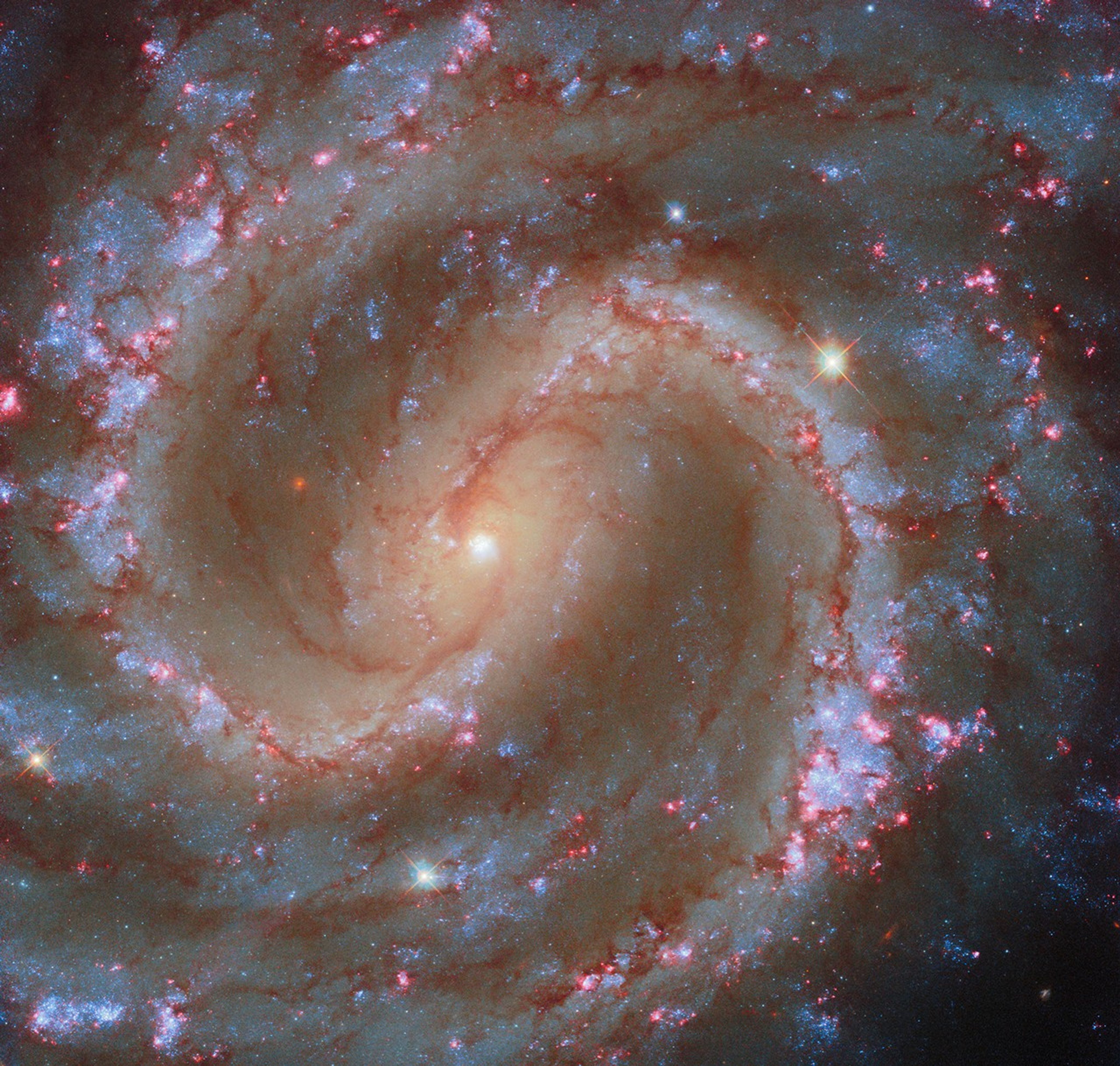
    A close-in view of a spiral galaxy that faces the viewer. Brightly lit spiral arms swing outward through the galaxy’s disk, starting from an elliptical region in its center. Thick strands of dark reddish dust spread across the disk, primarily along the spiral arms. The arms also contain many glowing, pink-red spots where stars form and clumps of bright-blue star clusters. Beyond its spiral arms, the galaxy is a bit fainter and speckled with blue stars.
    This NASA/ESA Hubble Space Telescope image features the spiral galaxy NGC 4535.
    ESA/Hubble & NASA, F. Belfiore, J. Lee and the PHANGS-HST Team

    Today’s NASA/ESA Hubble Space Telescope image features the spiral galaxy NGC 4535, which is situated about 50 million light-years away in the constellation Virgo (the Maiden). Through a small telescope, this galaxy appears extremely faint, giving it the nickname ‘Lost Galaxy’. With a mirror spanning nearly eight feet (2.4 meters) across and its location above Earth’s light-obscuring atmosphere, Hubble can easily observe dim galaxies like NGC 4535 and pick out features like its massive spiral arms and central bar of stars.

    This image features NGC 4535’s young star clusters, which dot the galaxy’s spiral arms. Glowing-pink clouds surround many of these bright-blue star groupings. These clouds, called H II (‘H-two’) regions, are a sign that the galaxy is home to especially young, hot, and massive stars that blaze with high-energy radiation. Such massive stars shake up their surroundings by heating their birth clouds with powerful stellar winds, eventually exploding as supernovae.

    The image incorporates data from an observing program designed to catalog roughly 50,000 H II regions in nearby star-forming galaxies like NGC 4535. Hubble released a previous image of NGC 4535 in 2021. Both the 2021 image and this new image incorporate observations from the PHANGS observing program, which seeks to understand the connections between young stars and cold gas. Today’s image adds a new dimension to our understanding of NGC 4535 by capturing the brilliant red glow of the nebulae that encircle massive stars in their first few million years of life.

    Media Contact:

    Claire Andreoli (claire.andreoli@nasa.gov)
    NASA’s Goddard Space Flight CenterGreenbelt, MD

  • Europa Clipper Captures Uranus With Star Tracker Camera

    2 Min Read

    Europa Clipper Captures Uranus With Star Tracker Camera

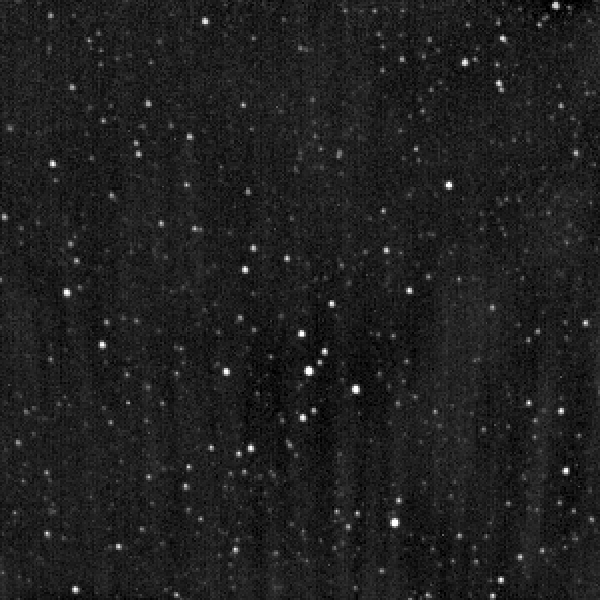
    NASA’s Europa Clipper captured this image of a starfield — and the planet Uranus — on Nov. 5, 2025, while experimenting with one of its two stellar reference units

    PIA26544

    Credits:
    NASA/JPL-Caltech

    Description

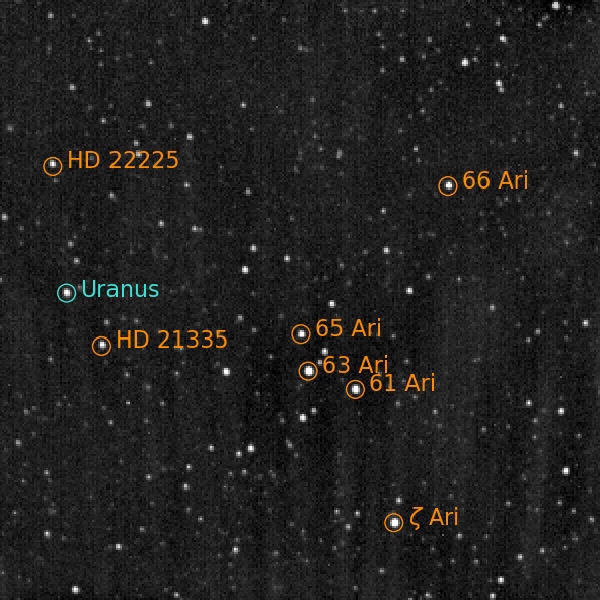
    NASA’s Europa Clipper captured this image of a starfield — and the planet Uranus — on Nov. 5, 2025, while experimenting with one of its two stellar reference units. These star-tracking cameras are used for maintaining spacecraft orientation. Within the camera’s field of view — representing 0.1% of the full sky around the spacecraft — Uranus is visible as a larger dot near the left side of the image.

    PIA26544_figA
    Figure A is an annotated version of the image with Uranus and several background stars labeled.
    NASA/JPL-Caltech
    PIA26544_figB
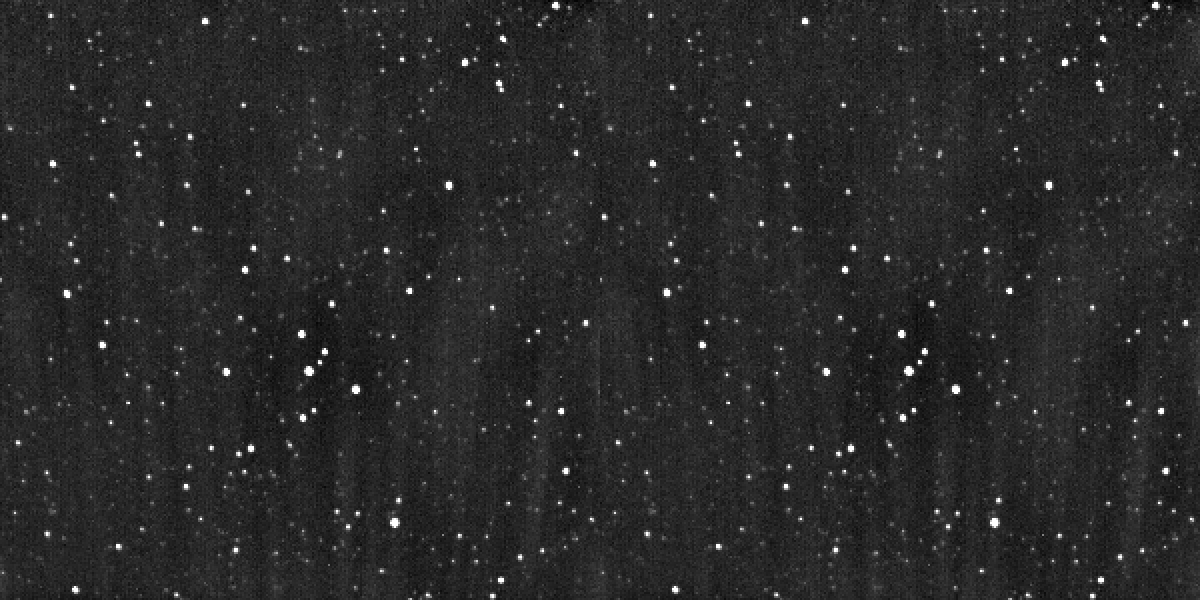
    Figure B is an animated GIF made of a pair of images taken 10 hours apart. In this version, Uranus can be seen moving very slightly, relative to the background stars.
    NASA/JPL-Caltech

    At the time the images were taken, Europa Clipper was about 2 billion miles (3.2 billion kilometers) from Uranus. The spacecraft is currently en route to the Jupiter system to study the icy moon Europa.

    Europa Clipper launched in October 2024 and will arrive at the Jupiter system in 2030 to conduct about 50 flybys of Europa. The mission’s main science goal is to determine whether there are places below Europa’s surface that could support life. The mission’s three main science objectives are to determine the thickness of the moon’s icy shell and its surface interactions with the ocean below, to investigate its composition, and to characterize its geology. The mission’s detailed exploration of Europa will help scientists better understand the astrobiological potential for habitable worlds beyond our planet.

    For more information about Europa and Europa Clipper, go to: https://science.nasa.gov/mission/europa-clipper/

  • NASA’s Quesst Mission Marks X-59’s Historic First Flight

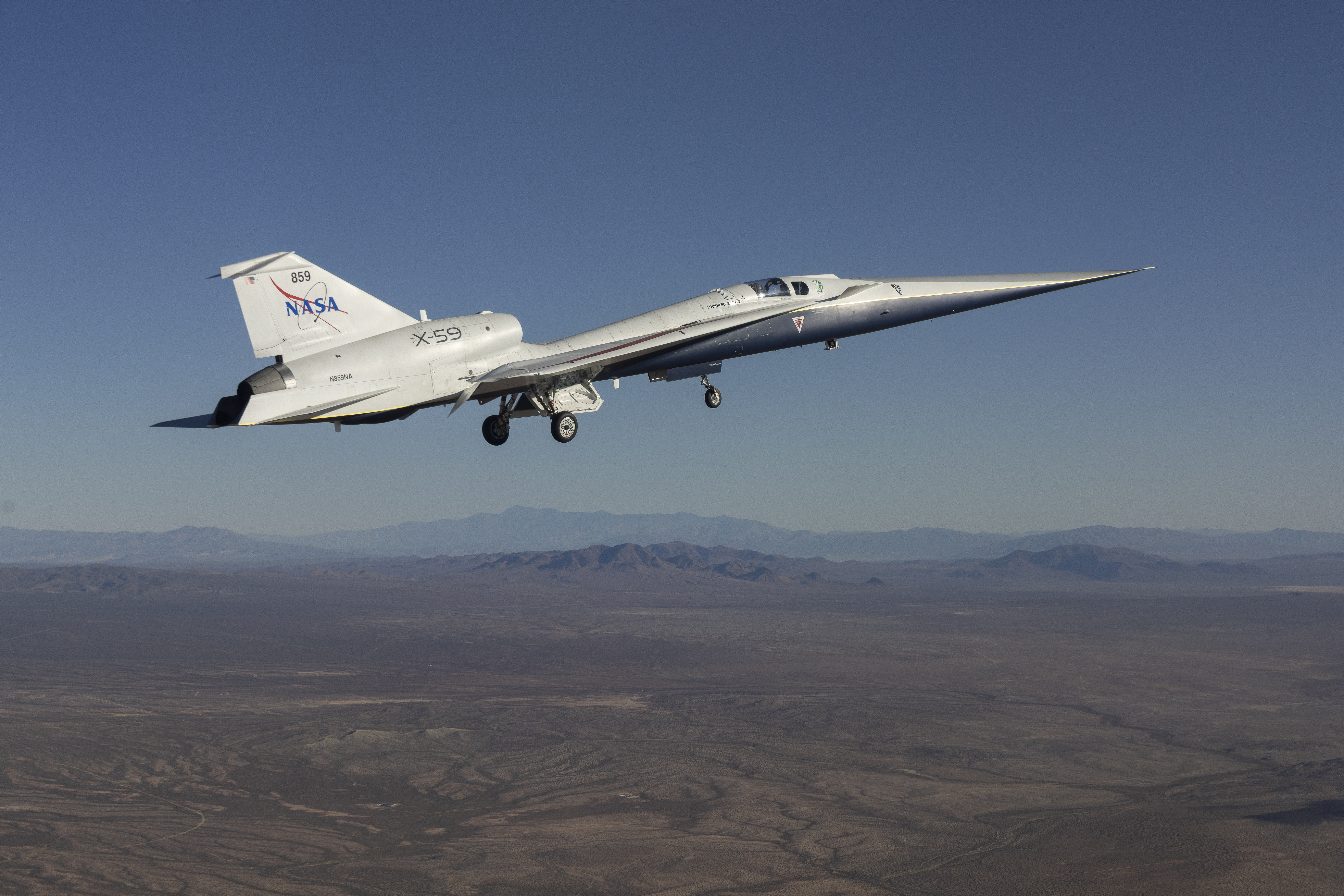
    The X-59 quiet supersonic research aircraft flies above California. The plane has a distinctive shape with a long, sharply pointed nose. The nose is silver, while the rest of the body looks white. The words
    NASA/Lori Losey

    NASA’s X-59 quiet supersonic research aircraft took off for its historic first flight on Oct. 28, 2025, at 11:14 a.m. EDT from Lockheed Martin Skunk Works in Palmdale, California. The one-of-a-kind aircraft flew for 67 minutes before landing and taxiing to NASA’s Armstrong Flight Research Center in Edwards, California.

    NASA test pilot Nils Larson flew the X-59 up to an altitude of about 12,000 feet and an approximate top speed of 230 mph, precisely as planned. The plane’s landing gear remained down during the entire flight, a common practice for experimental aircraft flying for the first time.

    Now that the X-59’s first flight is in the books, the team is focused on preparing for a series of test flights where the aircraft will operate at higher altitudes and supersonic speeds. This test flight phase of NASA’s Quesst mission will ensure the X-59 meets performance and safety expectations.

    Through the Quesst mission, NASA aims to usher in a new age of quiet supersonic flight, achieved through the unique design and technology of the X-59 in future supersonic transport aircraft.

    Image Credit: NASA/Lori Losey

  • NASA’s Scott Tingle to Serve as Agency’s Chief Astronaut

    Nasa Astronaut with American Flag
    NASA astronaut Scott Tingle

    NASA named astronaut Scott Tingle as chief of the Astronaut Office at the agency’s Johnson Space Center in Houston, effective Nov. 10. A decorated spaceflight veteran and former captain in the United States Navy, Tingle has logged more than 4,500 flight hours in 51 different aircraft and served as a flight engineer aboard the International Space Station.

    As chief astronaut, Tingle is responsible for managing astronaut resources and operations. He also will help develop astronaut flight crew operations and make crew assignments for future human spaceflight missions, including Artemis missions to the Moon.

    “Our Johnson Space Center team congratulates Scott on his selection as chief of the Astronaut Office. We wish him well as he takes on this new and exciting leadership role,” said Johnson Space Center Director Vanessa Wyche. “I extend my sincerest thanks to Joe Acaba, for his dedicated service to the Astronaut Office, as he completed the tremendous task of preparing our astronaut corps for daring missions to and from the International Space Station and integrated their expertise and space knowledge to develop and test future technologies, software, and procedures making space travel safer and more attainable for our nation’s explorers.”

    A native of Randolph, Massachusetts, Tingle was selected as a NASA astronaut in 2009. He holds a bachelor’s degree in mechanical engineering from Southeastern Massachusetts University and a master’s degree in mechanical engineering from Purdue University in West Lafayette, Indiana.

    Tingle most recently served as a flight engineer aboard the space station, spending more than six months in orbit during Expedition 54/55. He was the flight engineer and United States Operational Segment lead for the mission, which launched from the Baikonur Cosmodrome aboard a Soyuz spacecraft on Dec. 17, 2017, and concluded with landing on June 3, 2018. Since returning to Earth, he has supported the Astronaut Office in various roles, including mission support, technical leadership, and crew readiness activities.

    Before coming to NASA, Tingle worked for The Aerospace Corporation in El Segundo, California, where he served as a technical staff member supporting the company’s propulsion department. He was commissioned as a naval officer in 1991 and went on to complete a distinguished career, earning the rank of captain before retiring. Follow Tingle on X.

    Tingle succeeds NASA astronaut Joe Acaba, who had served as chief of the Astronaut Office since February 2023. Acaba has transitioned to the center director’s staff, where he provides technical advice on mission planning and strategy at NASA Johnson. In this new role, he leads the center’s alignment with NASA’s strategic plan and human spaceflight priorities, supports the agency’s STEM workforce goals, and advances collaboration with commercial space, academia, and other government partners as NASA continues its exploration beyond low Earth orbit.

    Learn more about the International Space Station:

    https://www.nasa.gov/international-space-station

    -end-

    Shaneequa Vereen

    Johnson Space Center, Houston
    281-483-5111

    shaneequa.y.vereen@nasa.gov

  • NASA Celebrates Five Years of Artemis Accords, Welcomes 3 New Nations

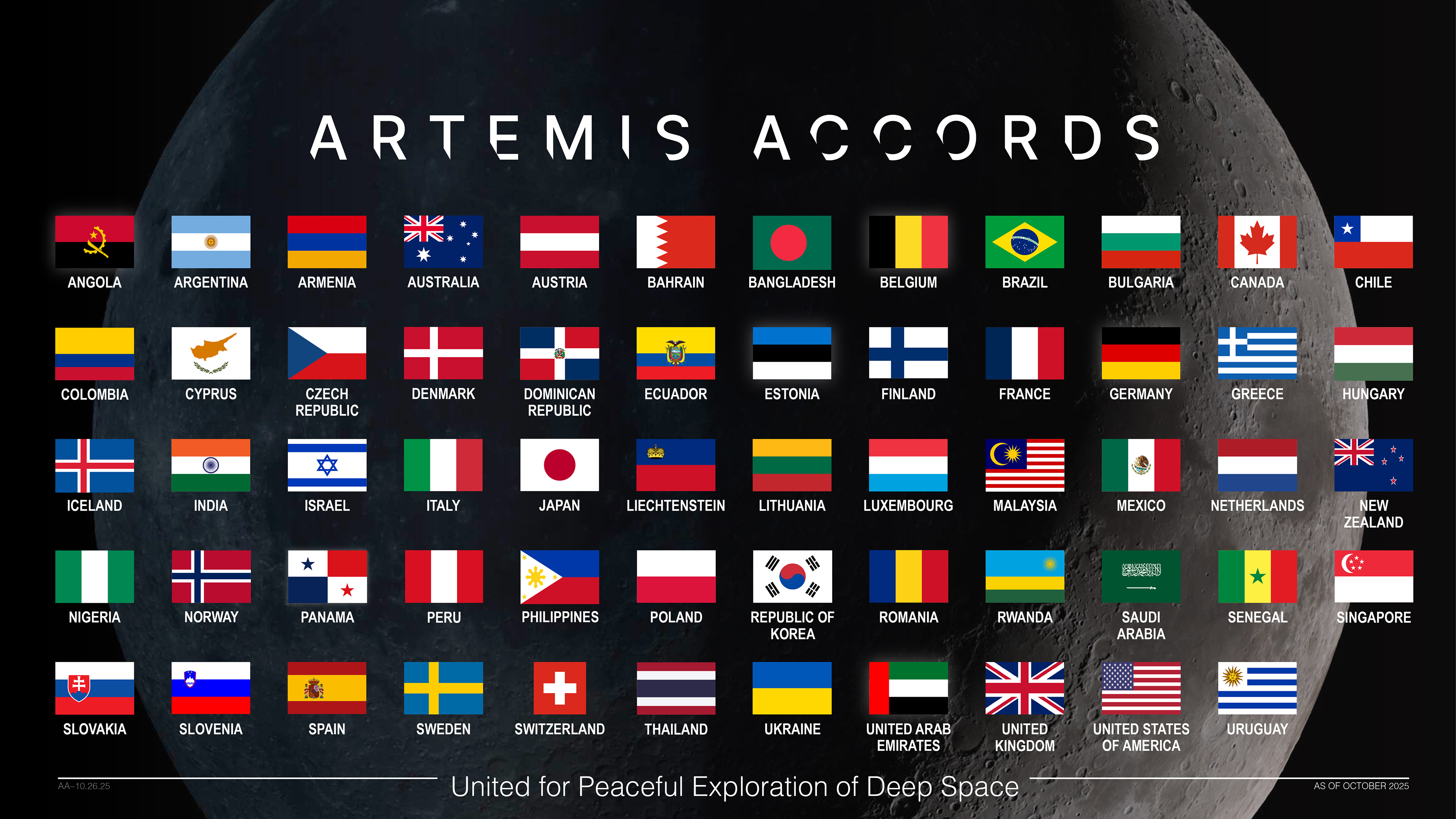
    National flags of Artemis Accords signatories.
    NASA

    October marked the fifth anniversary of NASA and the original founders signing the Artemis Accords, as well as the recognition of Hungary, Malaysia and the Philippines joining the expanding coalition dedicated to the peaceful exploration of space. The number of countries involved now totals 59.

    “NASA welcomes the newest signatories, whose participation strengthens the global commitment to responsible exploration,” said acting NASA Administrator Sean Duffy. “Their decision to sign the Artemis Accords affirms a shared commitment to safe, transparent, and peaceful exploration — at a time when others seek to weaponize the final frontier. Together we are building the foundation for the Golden Age of space exploration.”

    Both Malaysia and the Philippines signed the Artemis Accords as part of President Trump’s visit to Kuala Lumpur for the annual Association of Southeast Asian Nations Summit. The separate signings were announced by the White House on Oct. 26.

    Foreign Minister Péter Szijjártó of Hungary signed the Artemis Accords on Oct. 22 while in Washington during an official visit, in the lead up to President Trump’s meeting with Prime Minister Viktor Orbán.

    Hungary’s signing came three months after Hungarian to Orbit (HUNOR) astronaut Tibor Kapu launched to space in a mission aboard a SpaceX Dragon spacecraft to the International Space Station. The private astronauts, part of the NASA-supported Axiom Mission 4 crew, spent about two weeks conducting science, outreach, and commercial activities, alongside NASA astronauts.  

    Five years of progress

    On Oct. 13, 2020, during the first Trump Administration, the United States, led by NASA and the U.S. Department of State, joined with seven other founding nations to establish the Artemis Accords, responding to the growing interest in lunar activities by both governments and private companies.

    Since then, the Artemis Accords have grown into an international coalition. What began with a handful of founding nations has multiplied with seven countries signing in 2025 alone. The surge in participation highlights an increased global commitment to shaping a safe, peaceful, and prosperous future in space.

    In September, NASA co-chaired the Artemis Accords Principals’ Meeting in Sydney alongside the space agencies of Australia and the United Arab Emirates. The gathering brought together dozens of signatory nations to deepen dialogue and strengthen shared commitments to the sustainable and responsible use of space. Global space leaders discussed the following topics:

    • Non-interference in each other’s space activities, including transparency on expected launch dates, general nature of activities, and landing location
    • Orbital debris mitigation
    • Interoperability of systems for safer and more efficient operations
    • Release of scientific data

    At the meeting, NASA committed to hosting an Artemis Accords workshop in 2026 for signatories focused on transparency and the sharing of data. The agency has taken additional steps since the accords were established to release more information about lunar missions, promoting openness and preventing harmful interference.

    The progress made by signatories, and their continued commitment to implementing the accords’ principles, is essential to advancing sustainable exploration of the Moon under the Artemis campaign, Mars, and beyond. Following a call to Artemis Accords signatories, four CubeSats from South Korea, Saudi Arabia, Argentina, and Germany, will fly on Artemis II.

    More nations are expected to sign the accords in the months and years ahead, as NASA and its partners continue to advance the principles of the accords.

    Learn more about the Artemis Accords at:

    https://www.nasa.gov/artemis-accords

  • NASA Sets Coverage for Crew Launch to Join Station Expedition

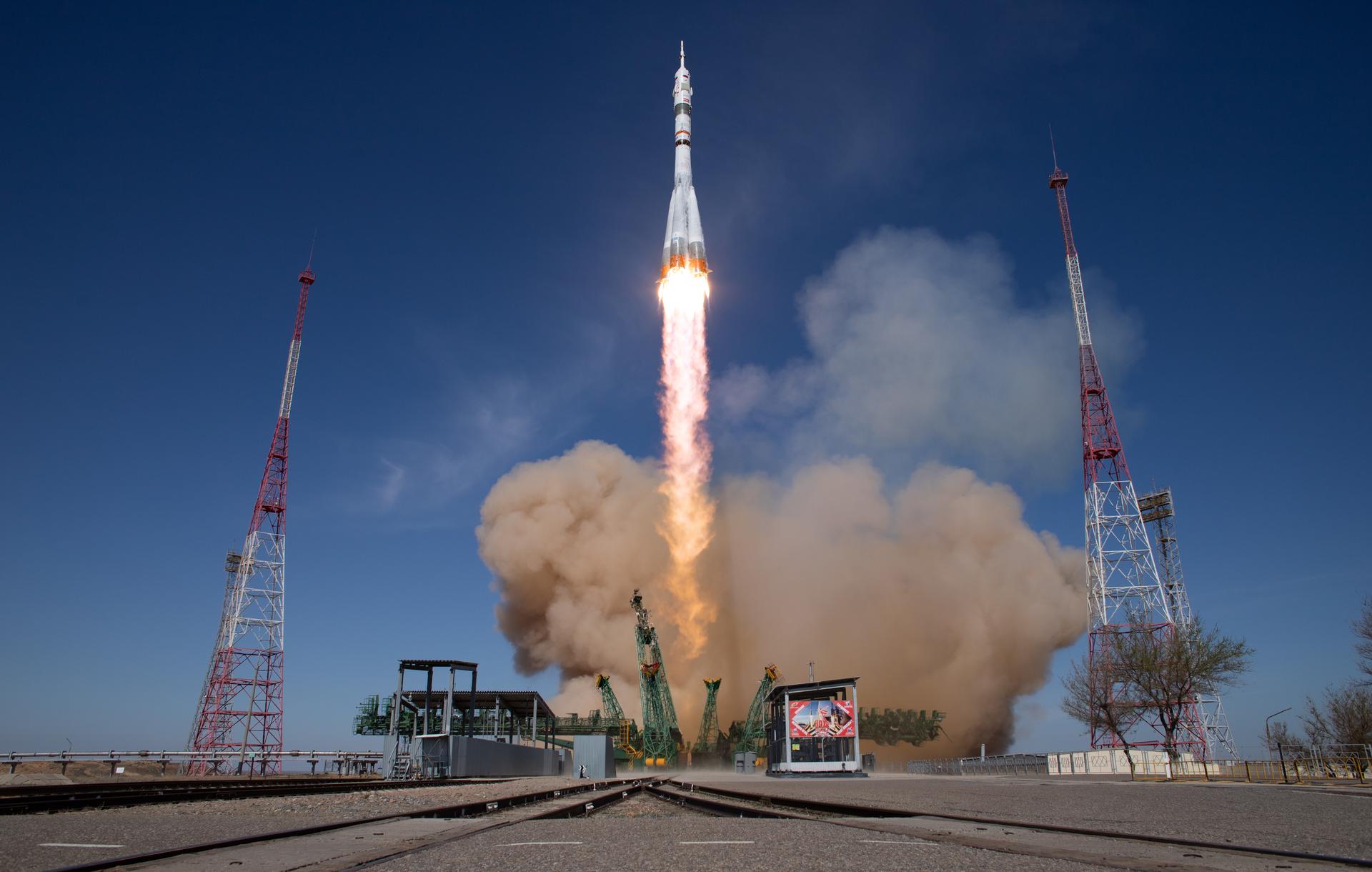
    A Soyuz rocket launches to the International Space Station with Expedition 73 crew members aboard, Tuesday, April 8, 2025, at the Baikonur Cosmodrome in Kazakhstan.
    NASA/Joel Kowsky

    NASA astronaut Chris Williams will launch aboard the Roscosmos Soyuz MS-28 spacecraft to the International Space Station on Thursday, Nov. 27, accompanied by cosmonauts Sergey Kud-Sverchkov and Sergei Mikaev, where they will join the Expedition 73 crew advancing scientific research.

    Williams, Kud-Sverchkov, and Mikaev will lift off at 4:27 a.m. EST (2:27 p.m. Baikonur time) from the Baikonur Cosmodrome in Kazakhstan. Live launch and docking coverage will be available on NASA+, Amazon Prime, and the agency’s YouTube channel. Learn how to watch NASA content through a variety of platforms, including social media.

    After a two-orbit, three-hour trip to the orbital complex, the spacecraft will automatically dock to the station’s Rassvet module at approximately 7:38 a.m. Shortly after, hatches will open between Soyuz and the space station.

    Once aboard, the trio will join NASA astronauts Mike Fincke, Zena Cardman, and Jonny Kim, JAXA (Japan Aerospace Exploration Agency) astronaut Kimiya Yui, and Roscosmos cosmonauts Sergei Ryzhikov, Alexey Zubritsky, and Oleg Platonov.

    NASA’s coverage is as follows (all times Eastern and subject to change based on real-time operations):

    Thursday, Nov. 27

    3:30 a.m. – Launch coverage begins on NASA+, Amazon Prime, and YouTube.

    4:27 a.m. – Launch

    6:45 a.m. – Rendezvous and docking coverage begins on NASA+, Amazon Prime, and YouTube.

    7:38 a.m. – Docking to the space station

    9:50 a.m. – Hatch opening and welcome remarks coverage begins on NASA+, Amazon Prime, and YouTube.

    10:10 a.m. – Hatch opening

    Williams, Kud-Sverchkov, and Mikaev will spend approximately eight months aboard the space station as Expedition 73/74 crew members, before returning to Earth in summer 2026. This will be the first spaceflight for Williams and Mikaev, and the second for Kud-Sverchkov.

    During his stay aboard station, Williams will conduct scientific research and technology demonstrations aimed at advancing human space exploration and benefiting life on Earth. He will help install and test a new modular workout system for long-duration missions, support experiments to improve cryogenic fuel efficiency and grow semiconductor crystals in space, and assist NASA in designing new re-entry safety protocols to protect crews during future missions.

    For more than 25 years, people have lived and worked continuously aboard the International Space Station, advancing scientific knowledge and making research breakthroughs that are not possible on Earth. The station is a critical testbed for NASA to understand and overcome the challenges of long-duration spaceflight and to expand commercial opportunities in low Earth orbit. As commercial companies concentrate on providing human space transportation services and destinations as part of a robust low Earth orbit economy, NASA is focusing its resources on deep space missions to the Moon as part of the Artemis campaign in preparation for future human missions to Mars.

    Learn more about International Space Station research and operations at:

    https://www.nasa.gov/station

    -end-

    Joshua Finch / Jimi Russell
    Headquarters, Washington
    202-358-1100
    joshua.a.finch@nasa.gov / james.j.russell@nasa.gov

    Sandra Jones / Joseph Zakrzewski 
    Johnson Space Center, Houston 
    281-483-5111 
    sandra.p.jones@nasa.gov / joseph.a.zakrzewski@nasa.gov 

    Details

    Last Updated

    Nov 20, 2025

  • What’s Up: November 2025 Skywatching Tips from NASA

    Mars and Mercury cozy up, the Leonids sparkle, and Saturn’s rings are…disappearing? 

    Mars and Mercury get close for a conjunction, the Leonid meteor shower delights, and Saturn’s rings are…disappearing?

    Skywatching Highlights

    • Nov. 12: A conjunction between Mars and Mercury
    • Nov. 16-18: Leonid meteor shower peak viewing
    • Nov. 23: Saturn’s rings disappear

    Transcript

    Mars and Mercury have a cozy conjunction, the Leonid meteor shower delights, and Saturn’s rings are…disappearing?

    That’s What’s Up for November.

    Conjunction:

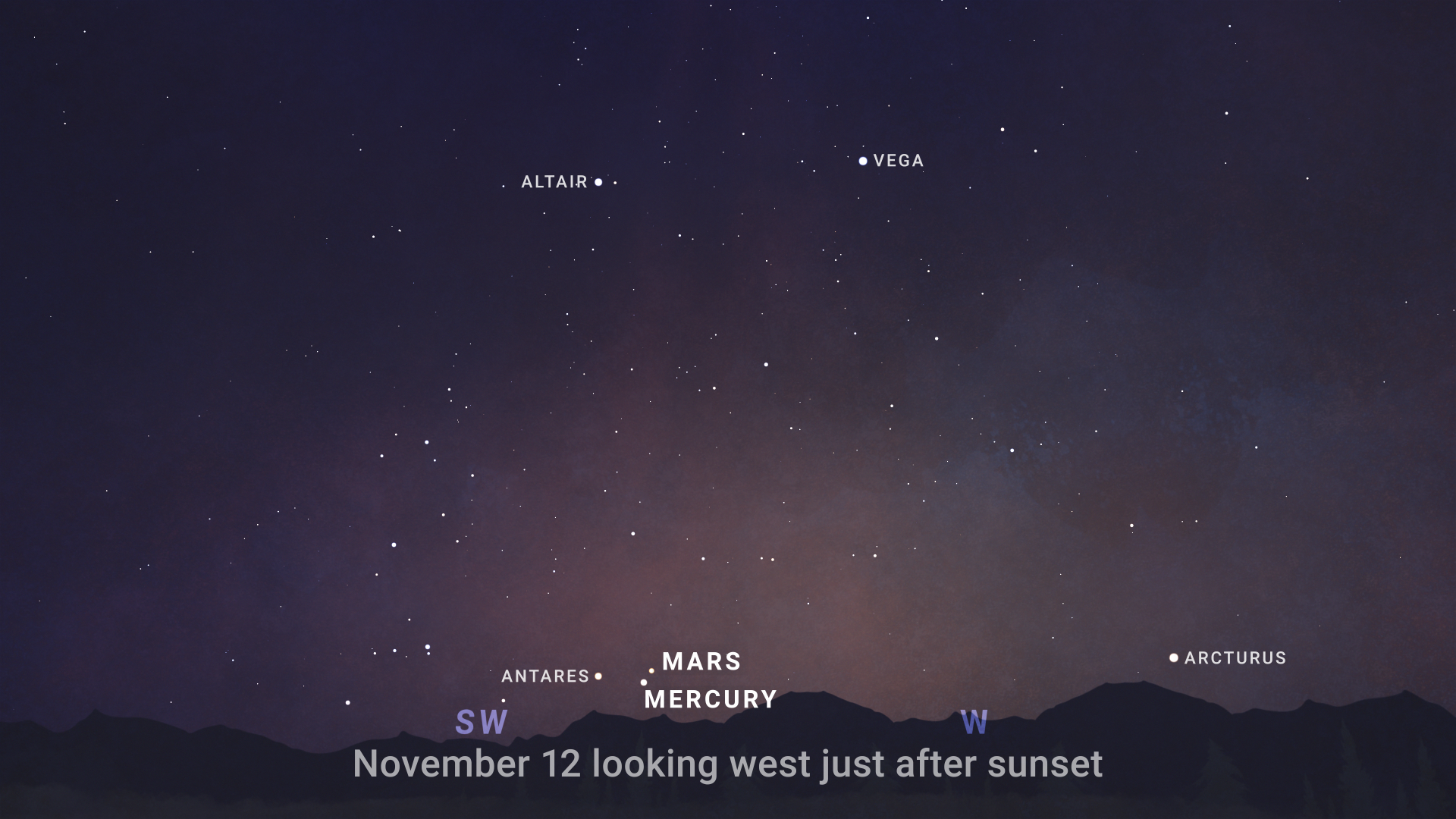
    Mars and Mercury will cozy up together in the night sky just after sunset on November 12th.

    The planets will experience what is known as a conjunction, meaning they appear close together in the sky from our view (even though in real life, Mars and Mercury are well over 100 million miles apart). 

    But you can see these two long distance pals close together if you look slightly southwest just after sunset in the early evening sky on November 12th. 

    A night sky view of the Mars-Mercury conjunction on November 12 just after sunset, looking west. Labeled stars include Antares, Altair, Vega, and Arcturus.
    NASA/JPL-Caltech

    Mars will be just to the right above Mercury, and you’ll know it’s Mars by its distinctive reddish-orange color.

    Leonid Meteor Shower: 

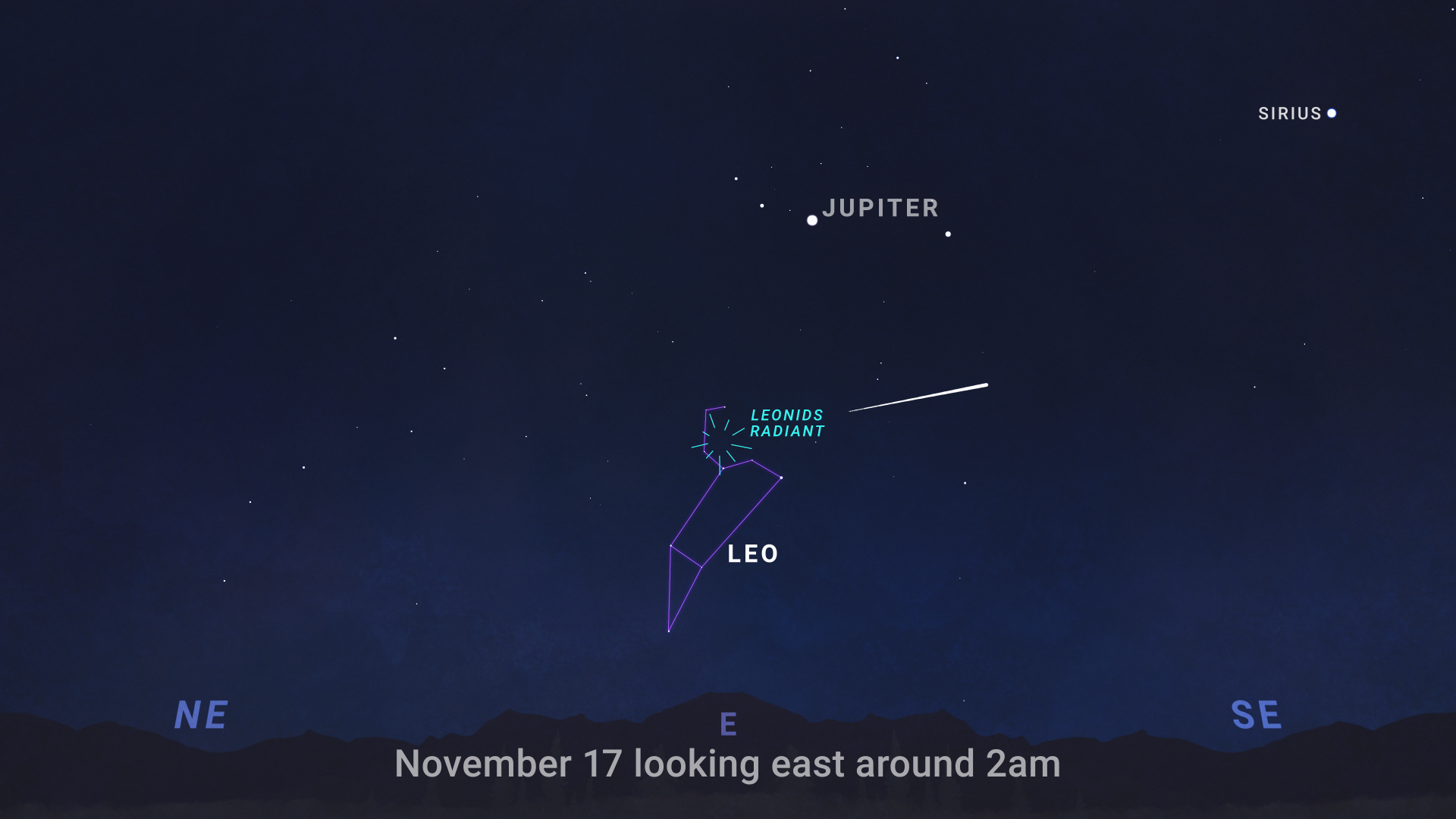
    The Leonid meteor shower will sparkle across the skies this month, peaking on November 17th.

    A night sky chart for the Leonids meteor shower on November 17 looking east around 2 am. It highlights the constellation Leo and the Leonids Radiant point. The planets Jupiter and the star Sirius are also visible.
    NASA/JPL-Caltech

    While the meteor shower stretches from November 3rd through December 2nd, it will be at its most visible late on the night of November 16th into the dawn of November 17th, even into the early morning of November 18th.

    Look for meteors coming from the shower’s radiant point within the constellation Leo in the eastern sky.

    With dark skies, you might see 10-15 meteors per hour with this shower which happens when we travel through the debris trailing the comet 55P/Tempel-Tuttle.

    Saturn’s rings disappear

    Saturn’s rings will disappear from view this November! 

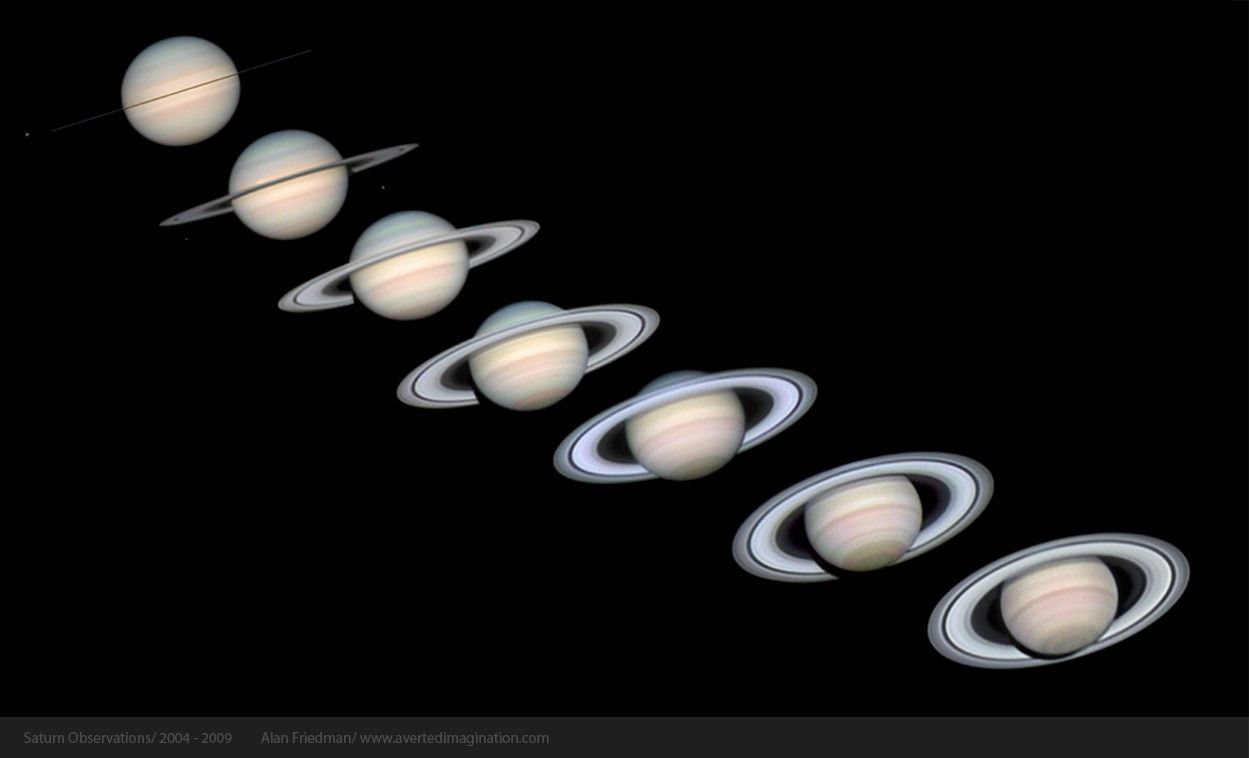
    Saturn orbits the sun leaning at an angle of 26.7 degrees. This means that from our view, its rings shift up and down over time. 

    On November 23, Saturn will be angled in such a way that its rings face us, and since they are so thin they’ll just disappear from view. 

    A composite image of seven observations of Saturn from 2004 to 2009, showing the changing tilt of its rings from edge-on (top) to wide-open (bottom), illustrating Saturn's orbital motion.
    Alan Friedman/avertedimagination.com

    But don’t worry, the rings aren’t gone from view forever. As the planet continues to orbit, its rings will gradually become more visible again. 

    Conclusion + Moon Phases

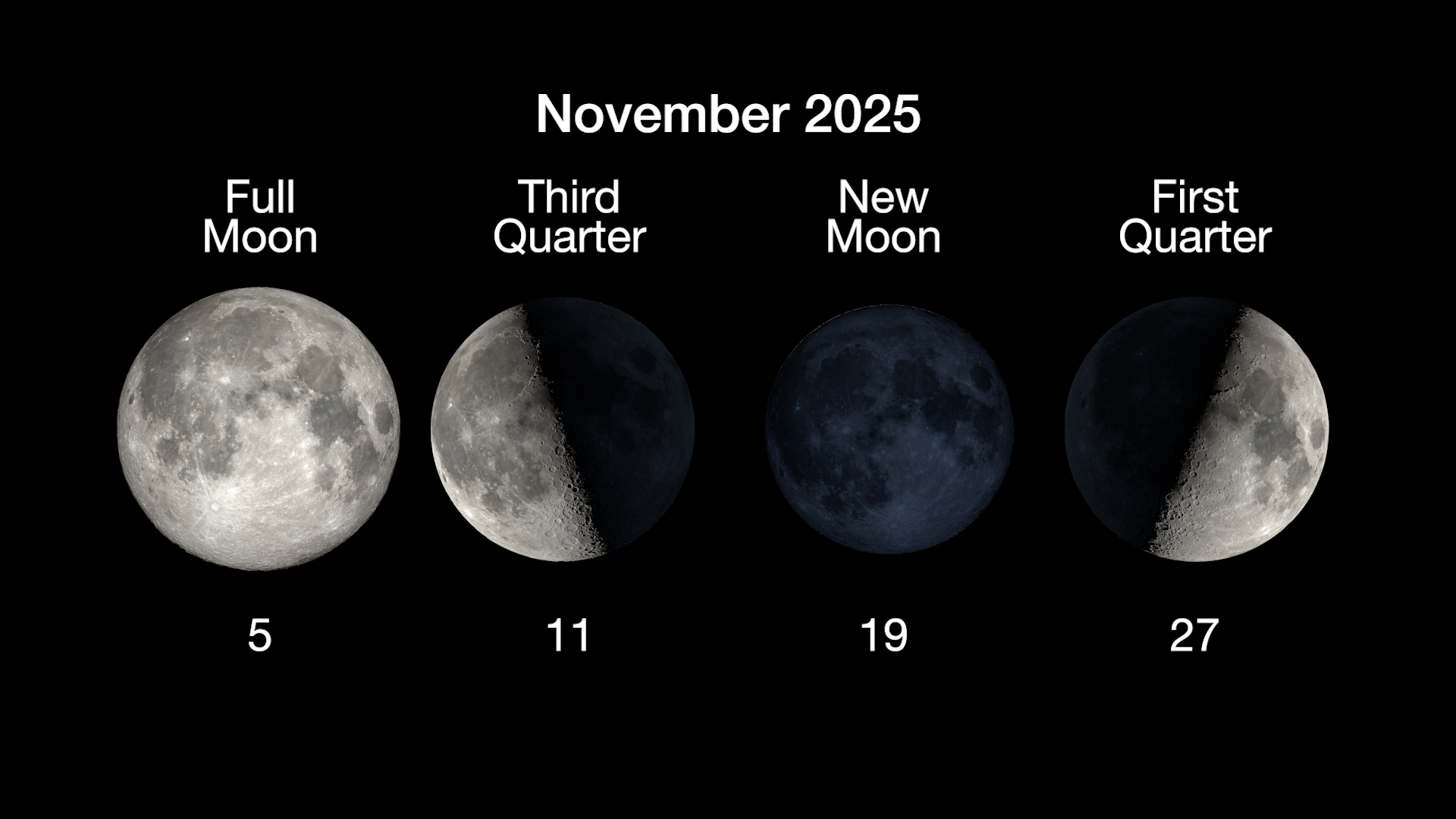
    Here are the phases of the Moon for November.

    An image showing the four primary Moon phases for November 2025. From left: Full Moon (Day 5), Third Quarter (Day 11), New Moon (Day 19), and First Quarter (Day 27), illustrating the cycle of lunar illumination.
    NASA/JPL-Caltech

    You can stay up to date on all of NASA’s missions exploring the solar system and beyond at science.nasa.gov.

    I’m Chelsea Gohd from NASA’s Jet Propulsion Laboratory, and that’s What’s Up for this month.

    Keep Exploring

    Discover More Topics From NASA

  • Celebrating 25 Years of Humanity in Space 

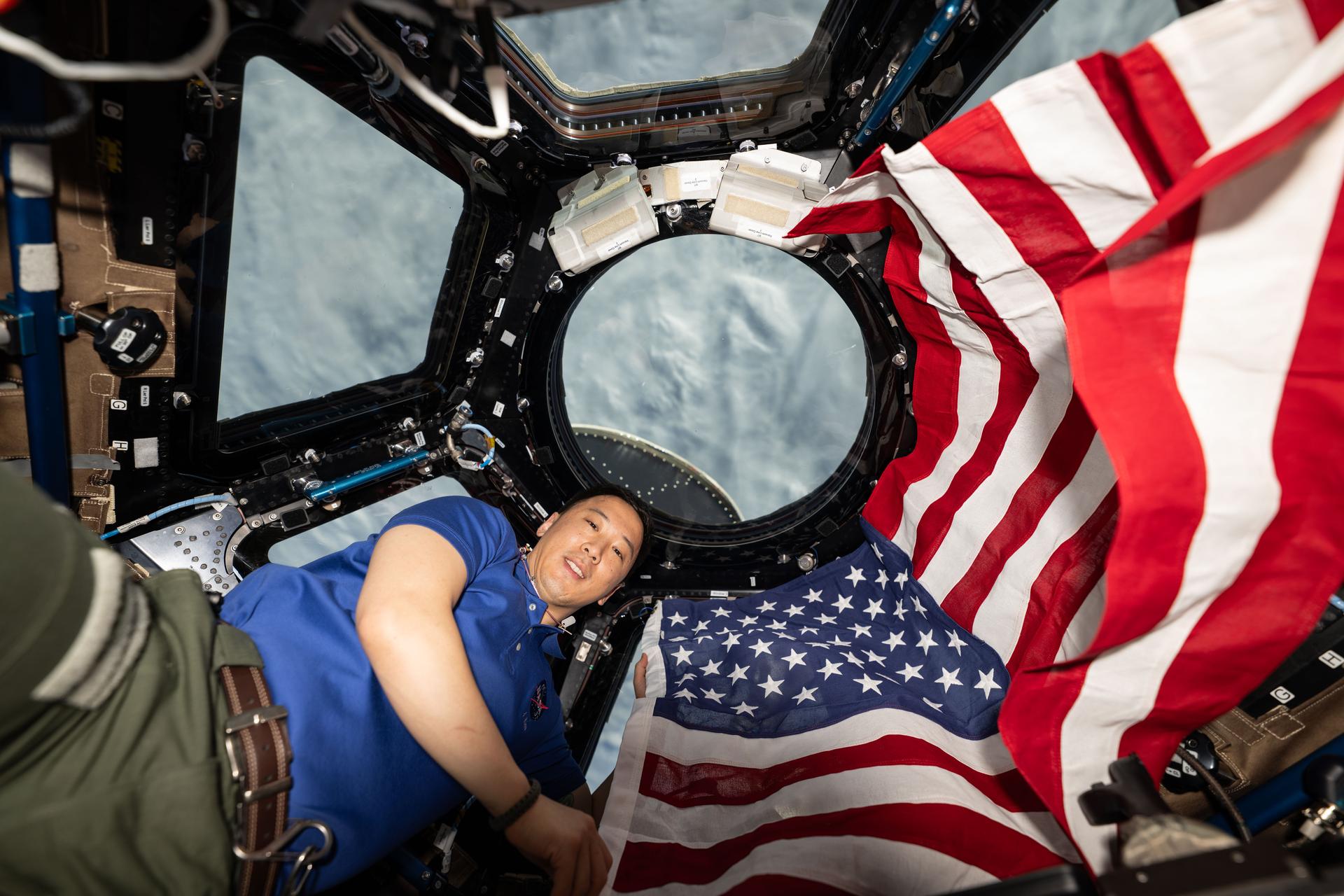
    NASA astronaut and Expedition 73 Flight Engineer Jonnny Kim poses for a portrait with the American flag on the Fourth of July, or Independence Day, inside the International Space Station's
    NASA astronaut Jonny Kim poses for a portrait with the American flag inside the International Space Station’s “window to the world,” the cupola.
    NASA

    In 2025, NASA and its international partners celebrate 25 years of continuous human presence aboard the International Space Station. Since November 2, 2000, more than 290 people from 26 countries have lived and worked aboard the orbiting laboratory, conducting thousands of experiments that have advanced science and technology on Earth and paved the way for Artemis missions to the Moon and future journeys to Mars. 

    Beyond its role as a science platform, the station has been a bridge—connecting cultures, sparking creativity, and inspiring generations. The memories of Johnson Space Center employees reflect how the orbiting laboratory is not only an engineering marvel but also a deeply human endeavor.  

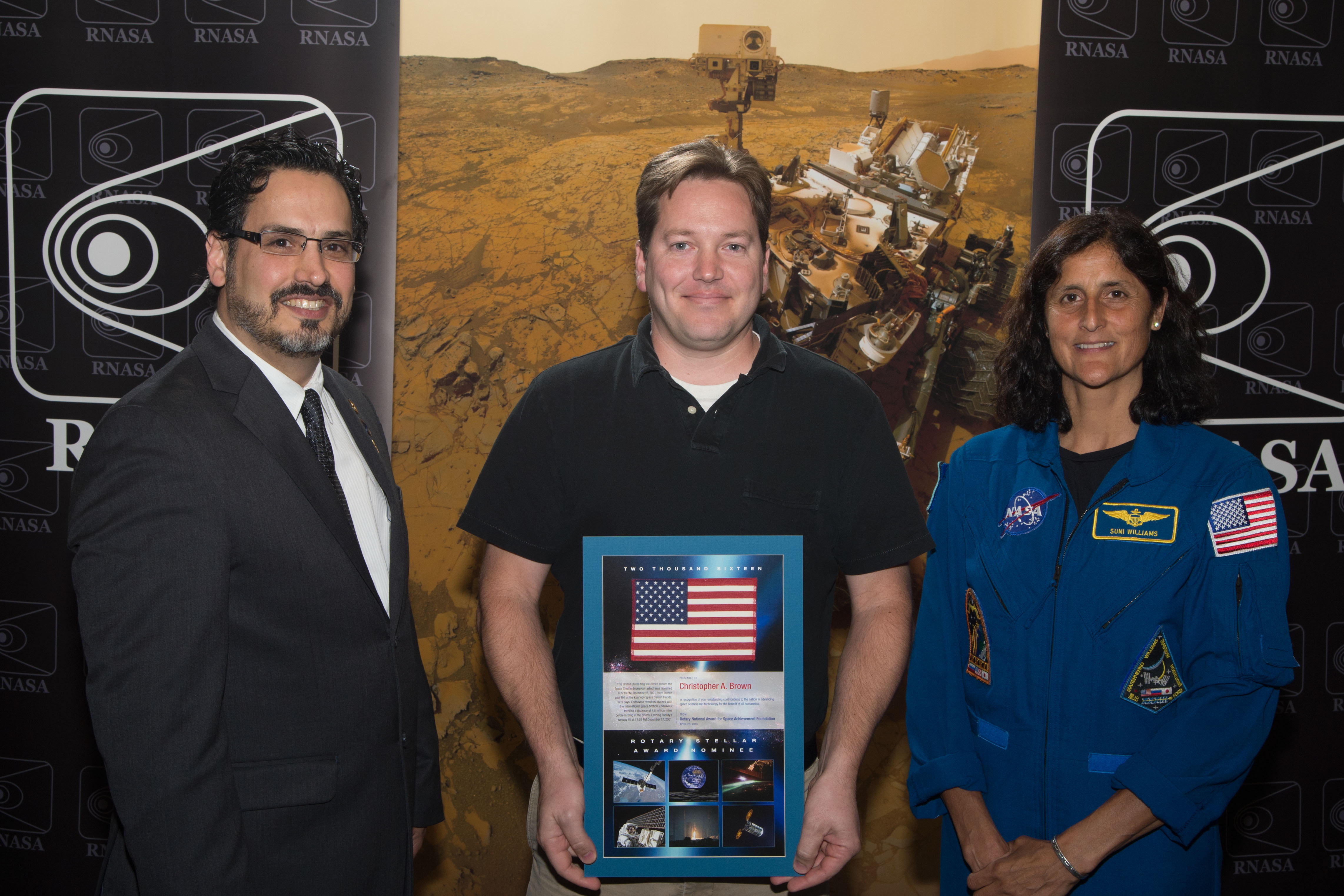
    Christopher Brown – Advancing Life Support Systems for Future Exploration 

    Christopher Brown (center) receives the Rotary National Award for Space Achievement alongside NASA astronaut Sunita Williams.
    NASA/James Blair

    As a space station Environmental Control and Life Support System (ECLSS) integrator, Christopher Brown’s role has been ensuring astronauts have clean air and water. ECLSS removes carbon dioxide from the air, supplies oxygen for breathing, and recycles wastewater—turning yesterday’s coffee into tomorrow’s coffee. Today, these systems can recover nearly 98% of the water brought to the station.  

    His proudest memory was commissioning regenerative life support systems and raising a symbolic toast with the crew while on console in mission control. He also helped activate the Water Storage System, saving crew time and improving operations on station. For Brown, these milestones were vital steps toward future long-duration missions beyond Earth. 

    Stephanie Sipila – The Heart of Microgravity Research  

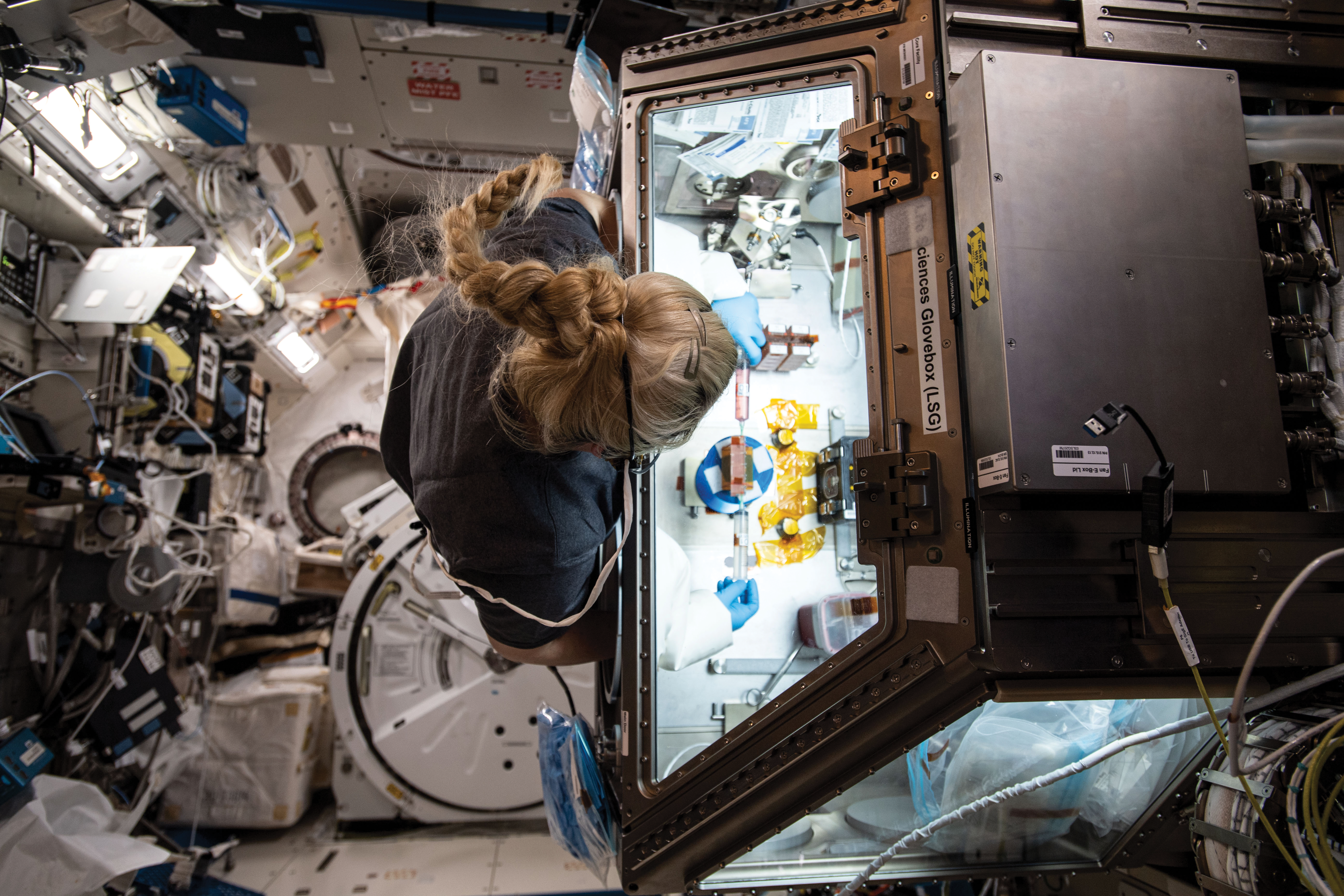
    image of an astronaut working with an experiment at a glovebox
    NASA astronaut Kate Rubins works on the Cardinal Heart study, which seeks to help scientists understand the aging and weakening of heart muscles in the search for new treatments for astronauts and people on Earth.
    NASA/Mike Hopkins

    Stephanie Sipila, now integration manager for NASA’s Extravehicular Activity and Human Surface Mobility Program, began her career as a mechanical and robotic systems instructor for the orbital outpost. Her favorite experiment, Engineered Heart Tissues, studies microgravity’s effect on the human heart to help develop new treatments for cardiovascular disease. She recalls NASA astronaut Sunita Williams running the Boston Marathon on a treadmill aboard station, becoming the first person to complete the race in space and showing how astronauts stay connected to Earth while living on orbit.  

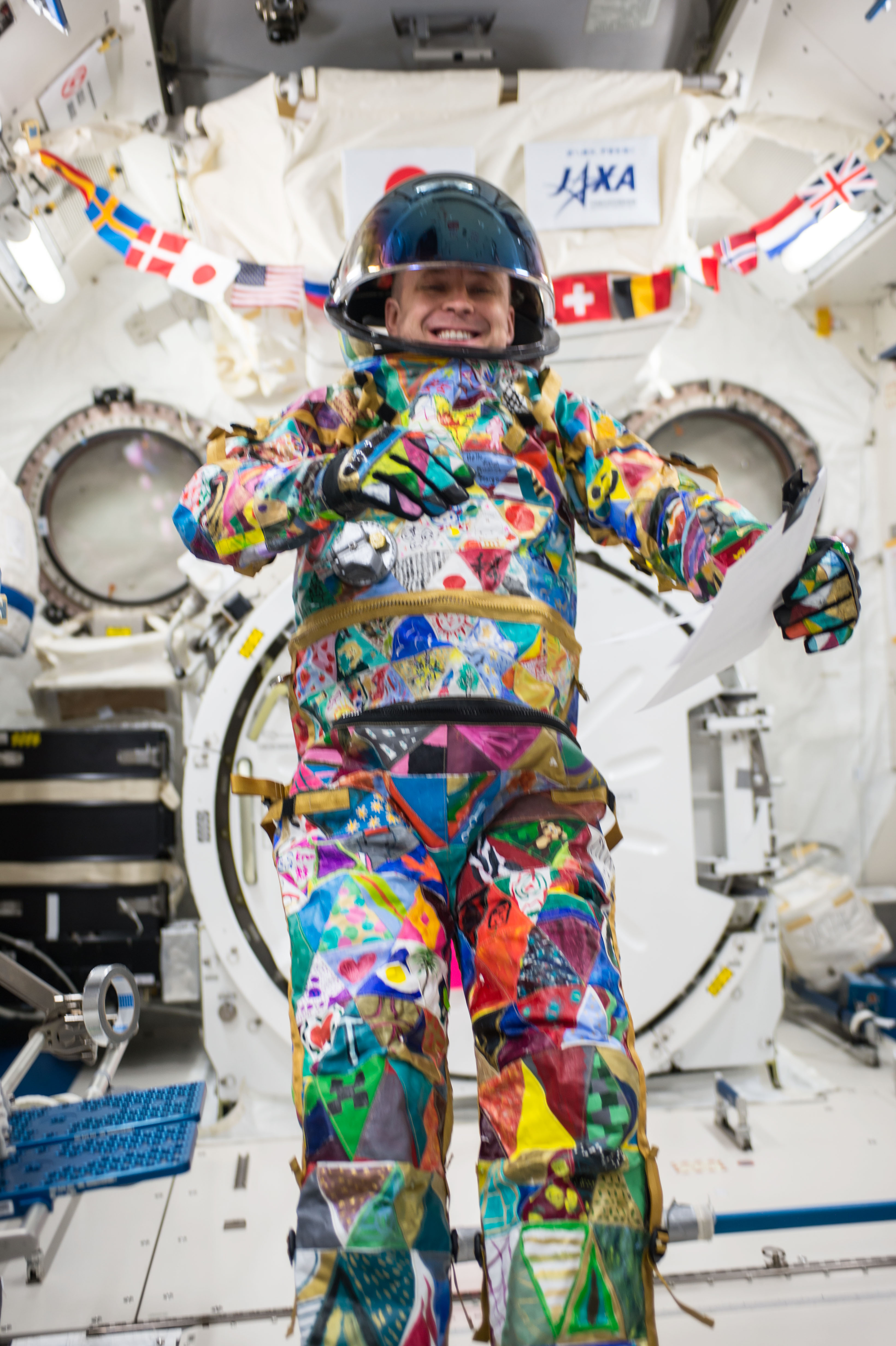
    Sipila also highlights the Spacesuit Art Project, an initiative that turned artwork from children with cancer into spacesuits flown to and worn aboard the orbital outpost during live downlinks, connecting science, art, and hope — and raising awareness of cancer research conducted aboard the orbital outpost.  

    Liz Warren – Where Exploration Meets Humanity 

    An image of an astronaut aboard the space station wearing a colorful spacesuit.
    NASA astronaut Jack Fischer wearing the Unity spacesuit painted by patients at MD Anderson Cancer Center in Houston.
    NASA/Randy Bresnik

    Space station Associate Chief Scientist Liz Warren has seen firsthand how the Spacesuit Art Project uplifted children on Earth. During Expedition 52, she watched astronaut Jack Fischer wear a suit covered in artwork created by young cancer patients, including his own daughter, a survivor. “It was incredibly touching to note the power of art and inspiration. Human spaceflight requires fortitude, resilience, and teamwork—so does fighting childhood cancer,” Warren said. 

    Her memories also extend to her time as an operations lead for NASA’s Human Research Program, which uses research to develop methods to protect the health and performance of astronauts in space to prepare for long-duration missions. While out for a weekend run, Warren received a call from the Payload Operations and Integration Center in Huntsville, Alabama. An astronaut on station, following a prescribed diet for a research study, wanted to swap out a food item. Warren coordinated with her support team and relayed the decision back to orbit—all while continuing her run. The moment, she recalls, underscored the constant, real-time connection between astronauts in space and teams on the ground. 

    Adam Baker – Checkmate: Space Debris Cleanup 

    A man sitting at a desk on console with several monitors in front of him.
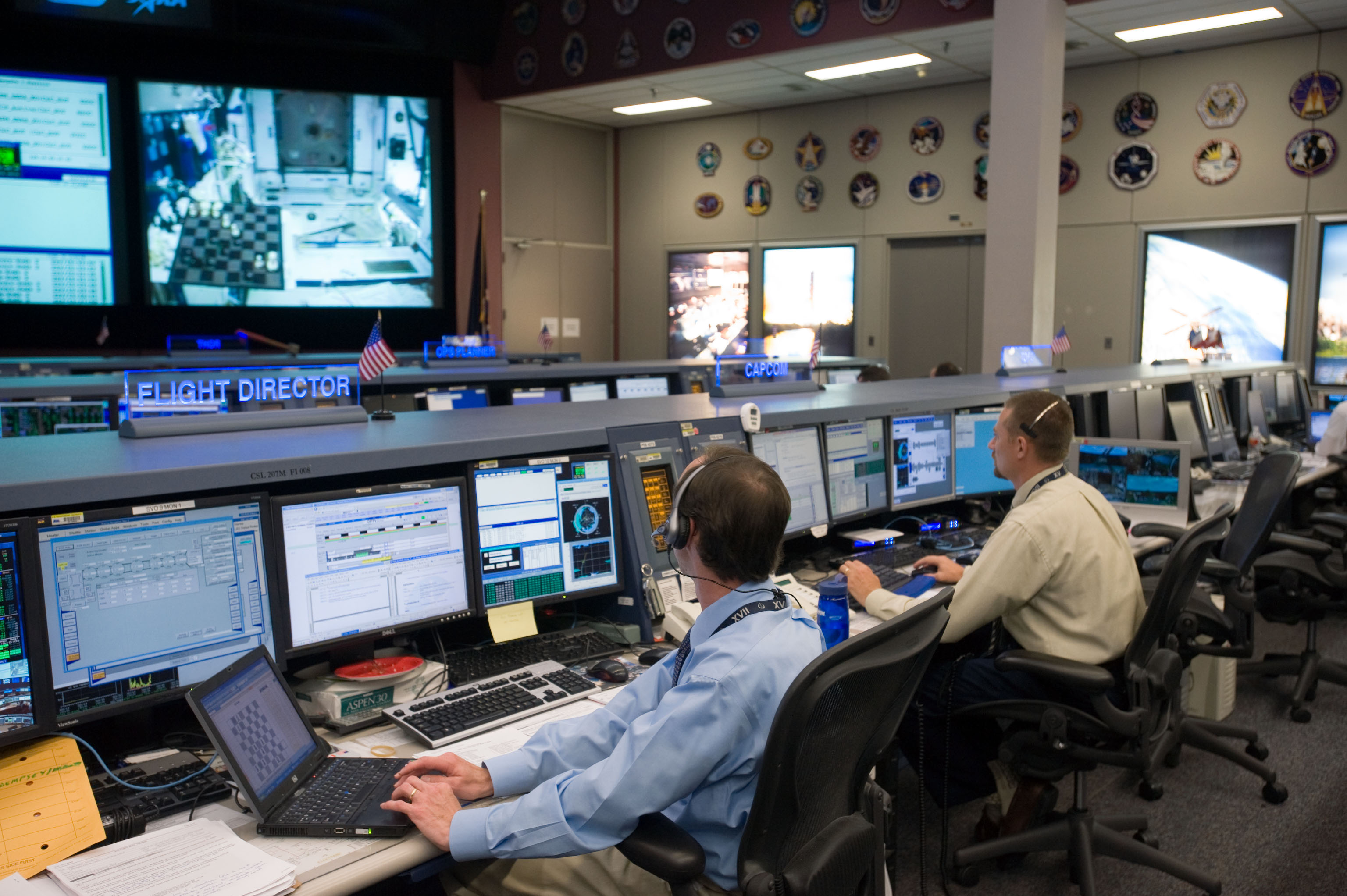
    Flight Director Chris Edelen, left, and capsule communicator Jay Marschke discuss their next chess move during a match with NASA astronaut Greg Chamitoff, Expedition 17 flight engineer aboard the space station.
    NASA/Robert Markowitz

    As an aerospace engineer, Adam Baker helped track experiments and spacecraft operations from mission control. Baker remembers when mission control played a live chess match with astronaut Greg Chamitoff during Expedition 17, a moment that showed the unique ways the station connects crews in orbit with people on Earth. His favorite technical project, though, was the RemoveDebris small satellite, deployed from the station in 2018 to test technologies for cleaning up space junk. “Knowing these experiments could one day help keep the orbital environment safe made it even more meaningful,” he said.   

    Michael McFarlane – Training for Success 

    An image of people walking through an Earth dome simulation with a spacec.
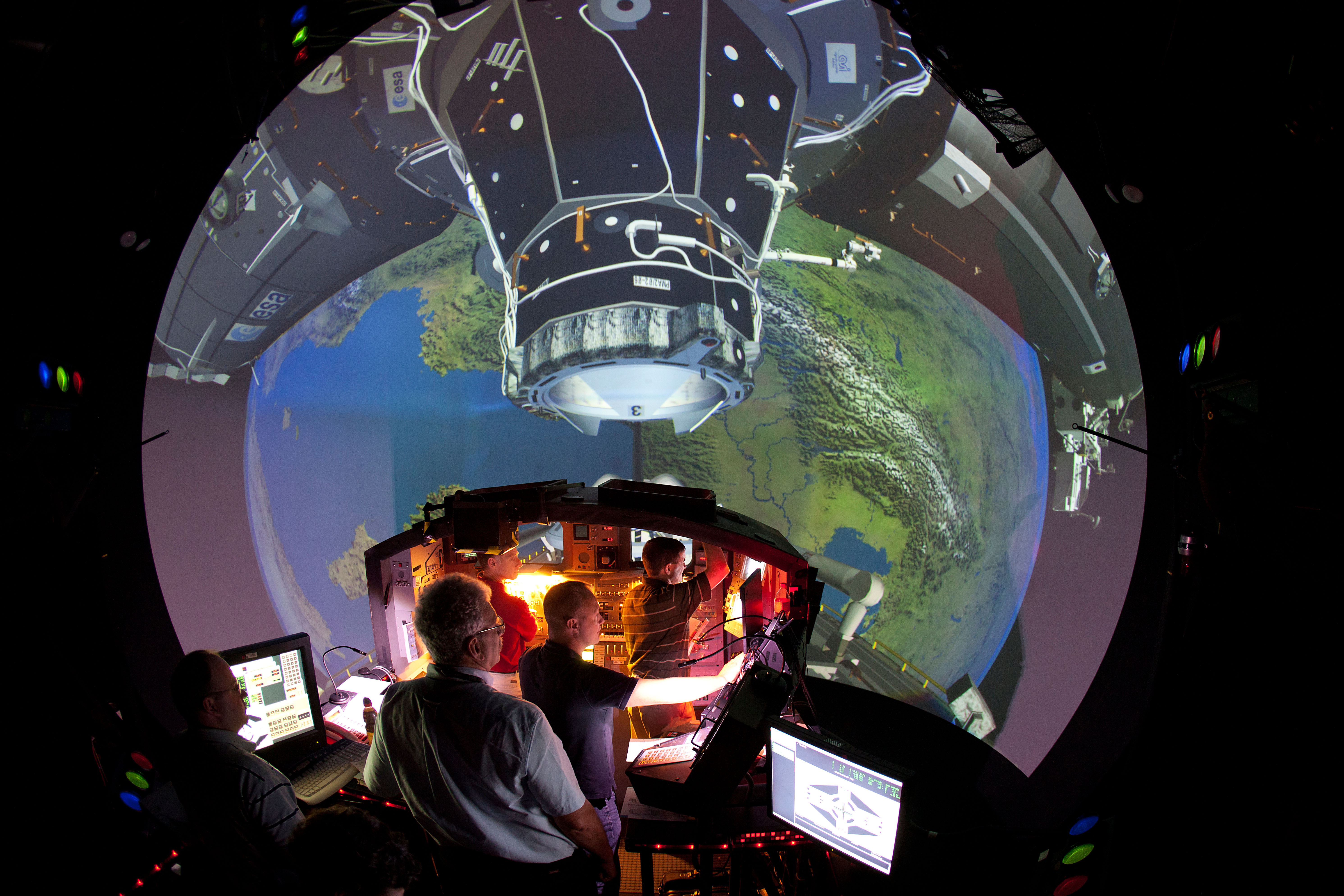
    Engineers run simulations inside Johnson’s Systems Engineering Simulator during a shuttle-to-station docking simulation.
    Smiley Pool/Houston Chronicle

    As chief of the Simulation and Graphics Branch, Michael McFarlane prepared astronauts for space station assembly missions using high-fidelity simulators. “My greatest memory is seeing the station grow as we successfully executed assembly missions that looked very much like what we analyzed and trained for in our ground-based simulations,” he said. 

    A Legacy of Ingenuity and Community 

    A group of people dressed in Halloween costumes pose inside of a room.
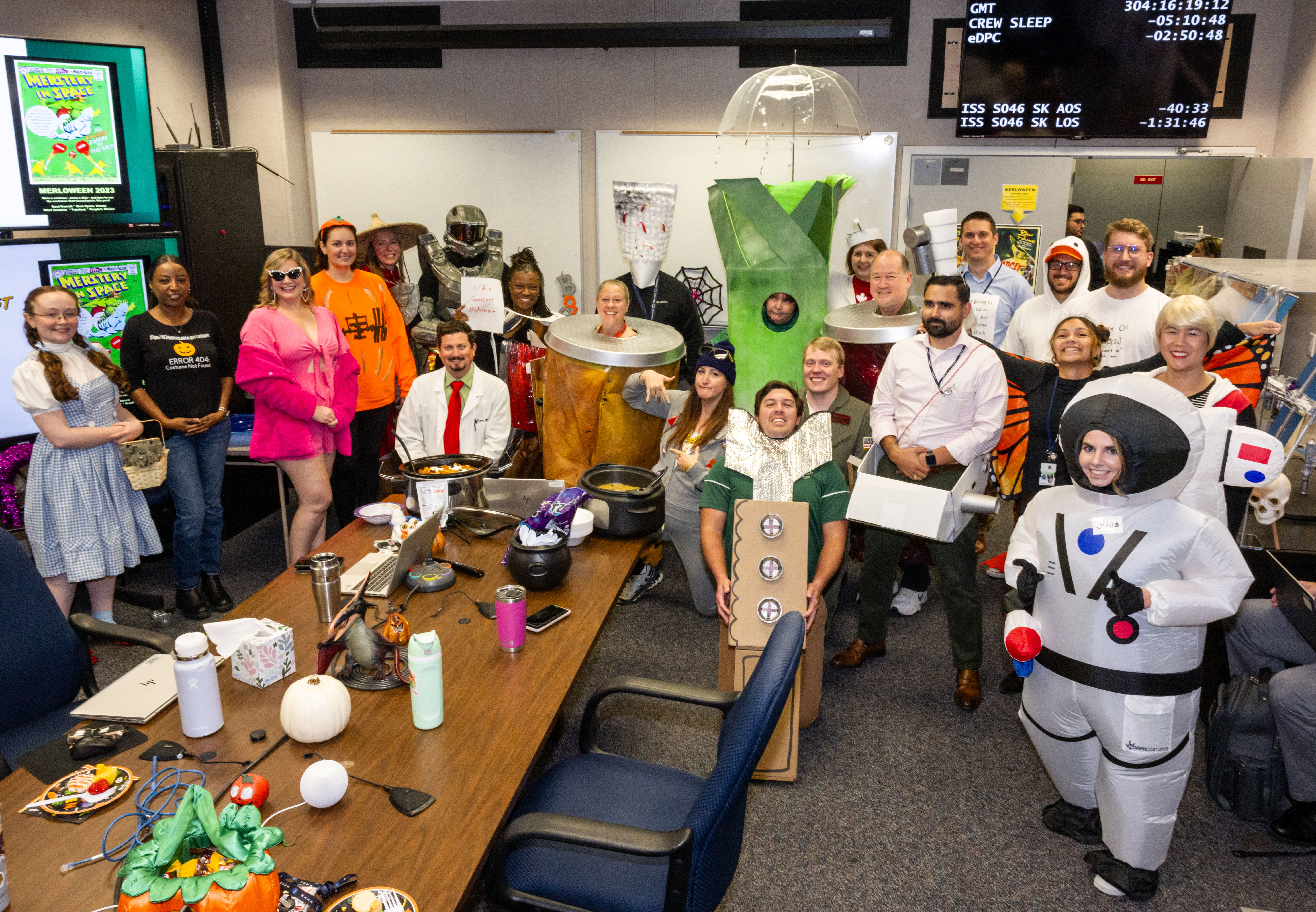
    Date: 10-31-2023 Location: Bldg 30 MCC, ISS MER Subject: Mission Evaluation Room (MER) Halloween Celebration “MERloween” Photographer: James Blair
    NASA/James Blair

    In the Mission Evaluation Room, engineers not only troubleshoot in real time but also celebrate milestones with traditions like “MERloween,” where controllers dress in space-themed costumes to honor the year’s lessons learned. 

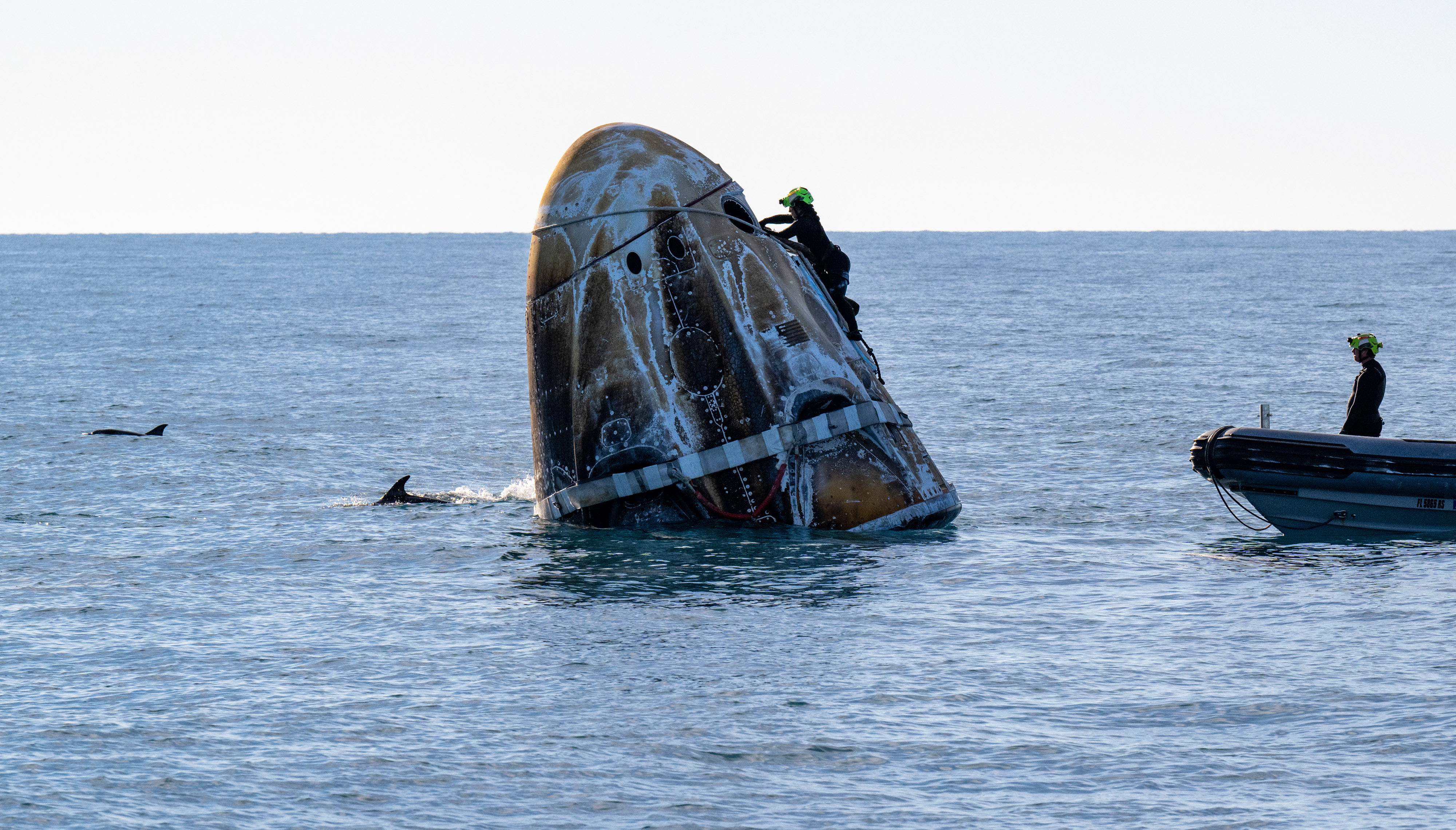
    A spacecraft in the ocean surrounded by dolphins. A boat is approaching from the right.
    NASA’s SpaceX Dragon Freedom spacecraft splashed down in the Gulf of America, off the coast of Tallahassee, Florida, returning Crew-9 to Earth on March 18, 2025.
    NASA/Keegan Barber

    For social media consultant Mark Garcia, sharing the station story with the public has been the highlight of his career. His favorite moment was watching NASA’s SpaceX Crew-9 splash down in 2025, greeted by dolphins in the Gulf of America. “I love writing about the science aboard the station that benefits people on Earth,” he said. 

    For 25 years, the International Space Station has shown what humanity can accomplish together. The lessons learned aboard will guide Artemis missions to the Moon and future journeys to Mars—ensuring the next 25 years are built on innovation, resilience, and the human spirit. 

  • NASA’s X-59 Completes First Flight, Prepares for More Flight Testing

    5 min read

    Preparations for Next Moonwalk Simulations Underway (and Underwater)

    After years of design, development, and testing, NASA’s X-59 quiet supersonic research aircraft took to the skies for the first time Oct. 28, marking a historic moment for the field of aeronautics research and the agency’s Quesst mission.

    The X-59, designed to fly at supersonic speeds and reduce the sound of loud sonic booms to quieter sonic thumps, took off at 11:14 a.m. EDT and flew for 67 minutes. The flight represents a major step toward quiet supersonic flight over land.

    “Once again, NASA and America are leading the way for the future of flight,” said acting NASA Administrator Sean Duffy. “The X-59 is the first of its kind, and a major breakthrough in America’s push toward commercial air travel that’s both quiet and faster than ever before. Thanks to the X-59 team’s innovation and hard work, we’re revolutionizing air travel. This machine is a prime example of the kind of ingenuity and dedication America produces.”

    Following a short taxi from contractor Lockheed Martin’s Skunk Works facility, NASA X-59 test pilot Nils Larson approached U.S. Air Force Plant 42’s runway in Palmdale, California, where he completed final system checks and called the tower for clearance.

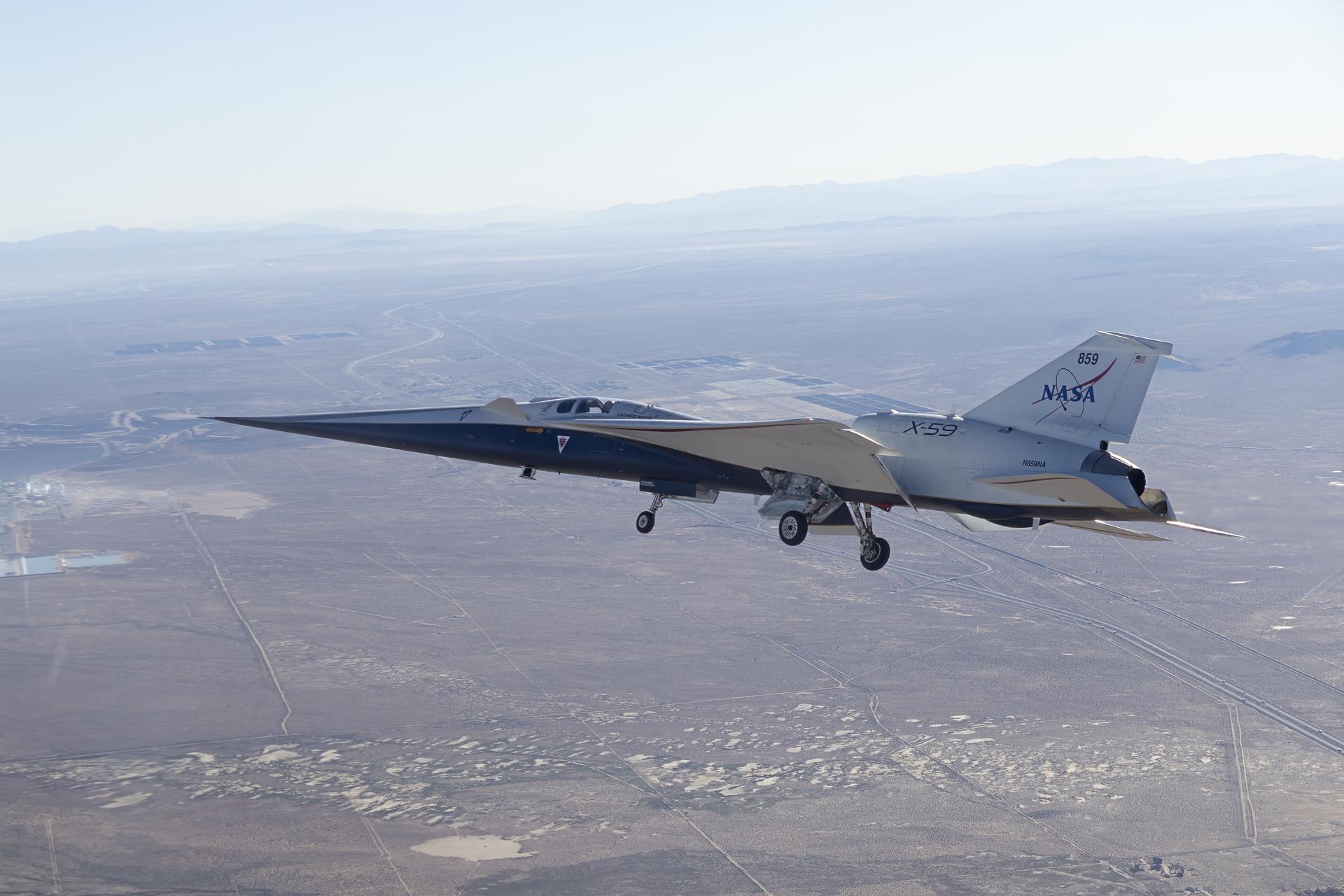
    NASA’s X-59 is seen in flight, with a blue sky and mountains behind it and land below it. The aircraft’s long nose and distinct silhouette are visible as it ferries to NASA’s Armstrong Flight Research Center in Edwards, California 
    NASA’s X-59 quiet supersonic research aircraft cruises above Palmdale and Edwards, California, during its first flight, Tuesday, Oct. 28, 2025. The aircraft traveled to NASA’s Armstrong Flight Research Center in Edwards, California.
    NASA/Lori Losey

    Then, with a deep breath, steady hands, and confidence in the labor of the X-59’s team, Larson advanced his throttle, picking up speed and beginning his climb – joining the few who have taken off in an experimental aircraft for the first time.

    “All the training, all the planning that you’ve done prepares you,” Larson said. “And there is a time when you realize the weight of the moment. But then the mission takes over. The checklist starts. And it’s almost like you don’t even realize until it’s all over – it’s done.”

    The X-59’s first flight went as planned, with the aircraft operating slower than the speed of sound at 230 mph and a maximum altitude of about 12,000 feet, conditions that allowed the team to conduct in-flight system and performance checks. As is typical for an experimental aircraft’s first flight, landing gear was kept down the entire time while the team focused on ensuring the aircraft’s airworthiness and safety.

    The aircraft traveled north to Edwards Air Force Base, circled before landing, and taxied to its new home at NASA’s Armstrong Flight Research Center in Edwards, California, officially marking the transition from ground testing to flight operations.

    “In this industry, there’s nothing like a first flight,” said Brad Flick, center director of NASA Armstrong. “But there’s no recipe for how to fly an X-plane. You’ve got to figure it out, and adapt, and do the right thing, and make the right decisions.”

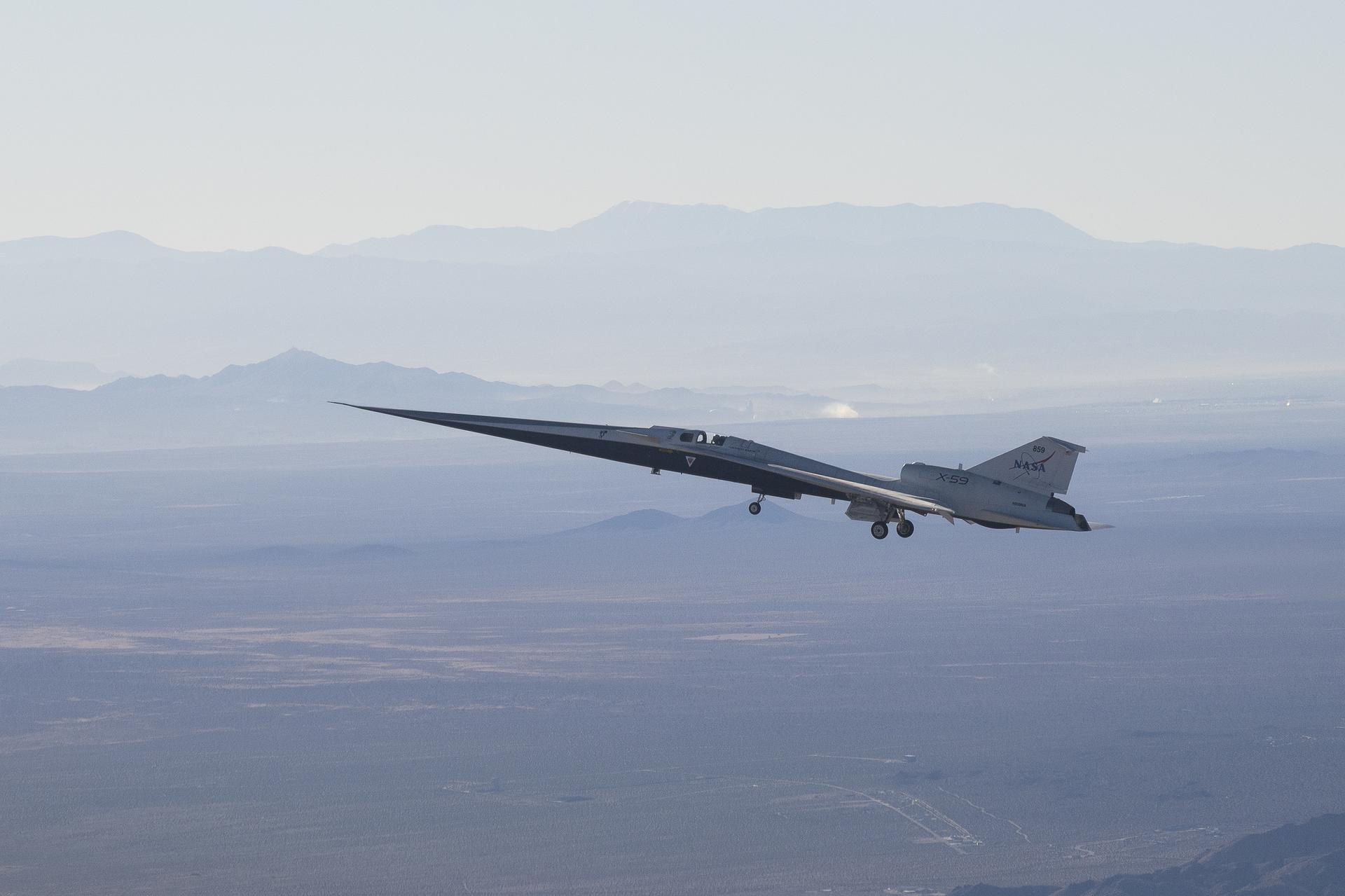
    NASA’s X-59 flies above the Mojave Desert against a blue sky. The aircraft’s long nose is angled slightly upward to the left, with its landing gear down. Layers of mountains are visible in the background. The aircraft is backlit, appearing to float as it ferries to NASA’s Armstrong Flight Research Center in Edwards, California.
    NASA’s X-59 quiet supersonic research aircraft flies above Palmdale and Edwards, California, on its first flight Tuesday, Oct. 28, 2025. The aircraft traveled to NASA’s Armstrong Flight Research Center in Edwards, California, where it will begin flight testing for NASA’s Quesst mission, which aims to demonstrate quiet supersonic flight over land.
    NASA/Jim Ross

    Historic flight

    The X-59 is the centerpiece of NASA’s Quesst mission and its first flight connects with the agency’s roots of flying bold, experimental aircraft.

     “The X-59 is the first major, piloted X-plane NASA has built and flown in over 20 years – a unique, purpose-built aircraft,” said Bob Pearce, NASA associate administrator for the Aeronautics Research Mission Directorate. “This aircraft represents a validation of what NASA Aeronautics exists to do, which is to envision the future of flight and deliver it in ways that serve U.S. aviation and the public.”

    NASA Armstrong has a long history of flying X-planes that pushed the edges of flight. In 1947, the X-1 broke the sound barrier. More than a decade later, the X-15 pushed speed and altitude to new extremes. Starting in the 1960s, the X-24 shaped how we understand re-entry from space, and in the 1980s the X-29 tested forward-swept wings that challenged aerodynamic limits.

    Each of those aircraft helped answer a question about aeronautics. The X-59 continues that tradition with a mission focused on sound – reducing loud sonic booms to sonic thumps barely audible on the ground. The X-59 was built for one purpose: to prove that supersonic flight over land can be quiet enough for public acceptance.

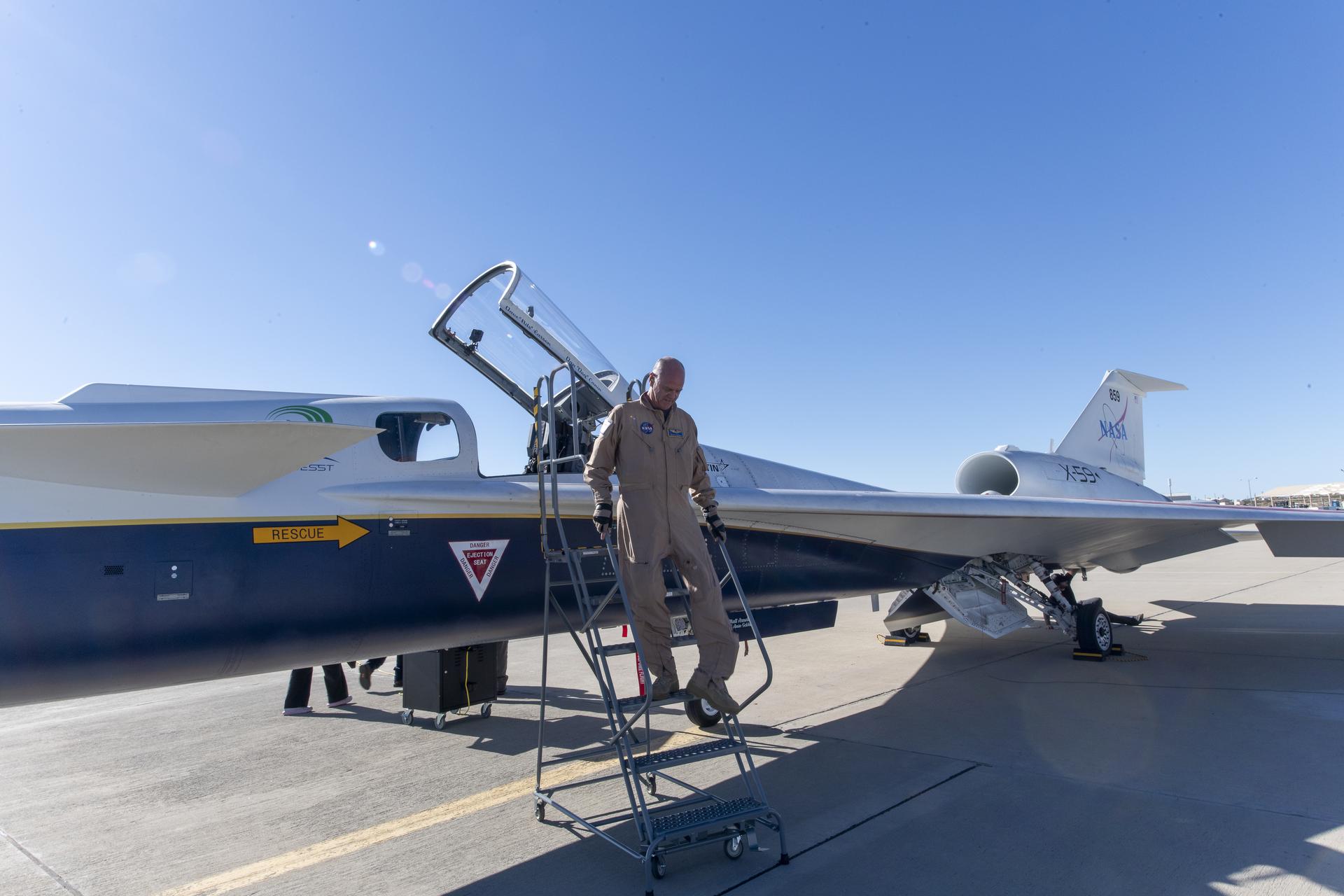
    Nils Larson steps down a ladder beside the X-59’s cockpit. He is wearing a tan flight suit with the aircraft parked on the ramp and its canopy open behind him.
    NASA test pilot Nils Larson steps out of the X-59 after successfully completing the aircraft’s first flight Tuesday, Oct. 28, 2025. The mission marked a key milestone in advancing NASA’s Quesst mission to enable quiet supersonic flight over land.
    NASA/Genaro Vavuris

    Next steps

    Getting off the ground was only the beginning for the X-59. The team is now preparing the aircraft for full flight testing, evaluating how it will handle and, eventually, how its design will shape shock waves, which typically result in a sonic boom, in supersonic flight. The X-59 will eventually reach its target cruising speed of about 925 mph (Mach 1.4) at 55,000 feet.

    The aircraft’s design sits at the center of that testing, shaping and distributing shock-wave formation. Its engine is mounted on top of the fuselage – the main body of the aircraft – to redirect air flow upward and away from the ground.

    The cockpit sits mid-fuselage, with no forward-facing window. Instead, NASA developed an eXternal Vision System – cameras and advanced high-definition displays that allow the pilot to see ahead and below the aircraft, which is particularly critical during landing.

    These design choices reflect years of research and modeling – all focused on changing how the quieter sonic thump from a supersonic aircraft will be perceived by people on the ground.

    NASA’s goal is to gather community response data to support the development of new standards for acceptable levels of sound from commercial supersonic flight over land. To do this, NASA will fly the X-59 over different U.S. communities, collecting ground measurement data and survey input from residents to better understand people’s perception of the X-59’s sonic thump.

    “Most X-planes only live in the restricted airspace here on center,” Flick said. “This one is going to go out and fly around the country.”

    When the X-59 lifted off the ground for the first time, it carried a piece of NASA’s history back into the air. And with it, a reminder that advancing aeronautics remains central to NASA’s mission.