This image shows the galaxy Messier 94, which lies in the small northern constellation of the Hunting Dogs, about 16 million light-years away.
Tag: image
-
Mexico City

Earth observation image of the week: a natural-colour Sentinel-2A image of Mexico City, also featured on the Earth from Space video programme -
Reentry data will help improve prediction models

A rare reentry of a suspected rocket body from a very high orbit next month offers an excellent opportunity to gather data to improve our knowledge of how objects interact with Earth’s atmosphere.
-
[Event] [PEOIC2015] Innovative Earth Observation for Society and Policy
Satellite Earth observations can provide valuable data and information for understanding the interconnections on a global scale between nature and society. There is a pressing need to better understand whether present and future satellite technologies and systems are meeting this expectation to contribute to policy, society and economy.
This international seminar will invite international experts on science, policy and the social and economic benefits of satellite observation from academia, space agencies, international organisations and industry to discuss the possibility of objectively evaluating the impact of satellite observations on environmental policy, society and economy. The seminar aims to provide feedback on new technological innovations for the next generation of satellite observation, as well as recommendations for future models and missions to contribute to global needs.
It is being organised as part of the Policy and Earth Observation Innovation Cycle (PEOIC) project, which is being jointly implemented by the National Institute of Information and Communications Technology (NICT), Keio University, the Institute for Global Environmental Strategies (IGES) and the Japan Aerospace Exploration Agency (JAXA). The PEOIC project is under the Japan Science and Technology Agency (JST) Research Institute of Science and Technology for Society (RISTEX).
This entry passed through the Full-Text RSS service – if this is your content and you’re reading it on someone else’s site, please read the FAQ at fivefilters.org/content-only/faq.php#publishers.
-

NASA's Space Launch System Design 'Right on Track' for Journey to Mars
For the first time in almost 40 years, a NASA human-rated rocket has completed all steps needed to clear a critical design review (CDR). The agency’s Space Launch System (SLS) is the first vehicle designed to meet the challenges of the journey to Mars and the first exploration class rocket since the Saturn V.
-

Artist Concept: Space Launch System Takes Flight
Artist concept of NASA’s Space Launch System (SLS) 70-metric-ton configuration launching to space.
-
NASA's Space Launch System Design 'Right on Track' for Journey to Mars
For the first time in almost 40 years, a NASA human-rated rocket has completed all steps needed to clear a critical design review (CDR). The agency’s Space Launch System (SLS) is the first vehicle designed to meet the challenges of the journey to Mars and the first exploration class rocket since the Saturn V.
-
African high point

Technology image of the week: the glacier topping Africa’s Mount Kilimanjaro, imaged by Proba-V minisatellite -
Navigation winners

Starting with 515 ideas from 40 countries in this year’s European Satellite Navigation Competition, 37 winners were announced in Berlin -
Landing site recommended for ExoMars 2018

Oxia Planum has been recommended as the primary candidate for the landing site of the ExoMars 2018 mission.
-
[ISS / Japanese Experiment Module (KIBO)] Japanese and Brazilian CubeSats deployed from Kibo
Japanese and Brazilian CubeSats deployed from Kibo
Last Updated: October 22, 2015

Astronaut Kimiya Yui announces the success of S-CUBE deployment (Credit: JAXA)
On September 17, 2015, two CubeSats — SERPENS developed by the University of Brasilia (UnB) and S-CUBE of the Chiba Institute of Technology — were successfully deployed from the Japanese Experiment Module (“Kibo”).
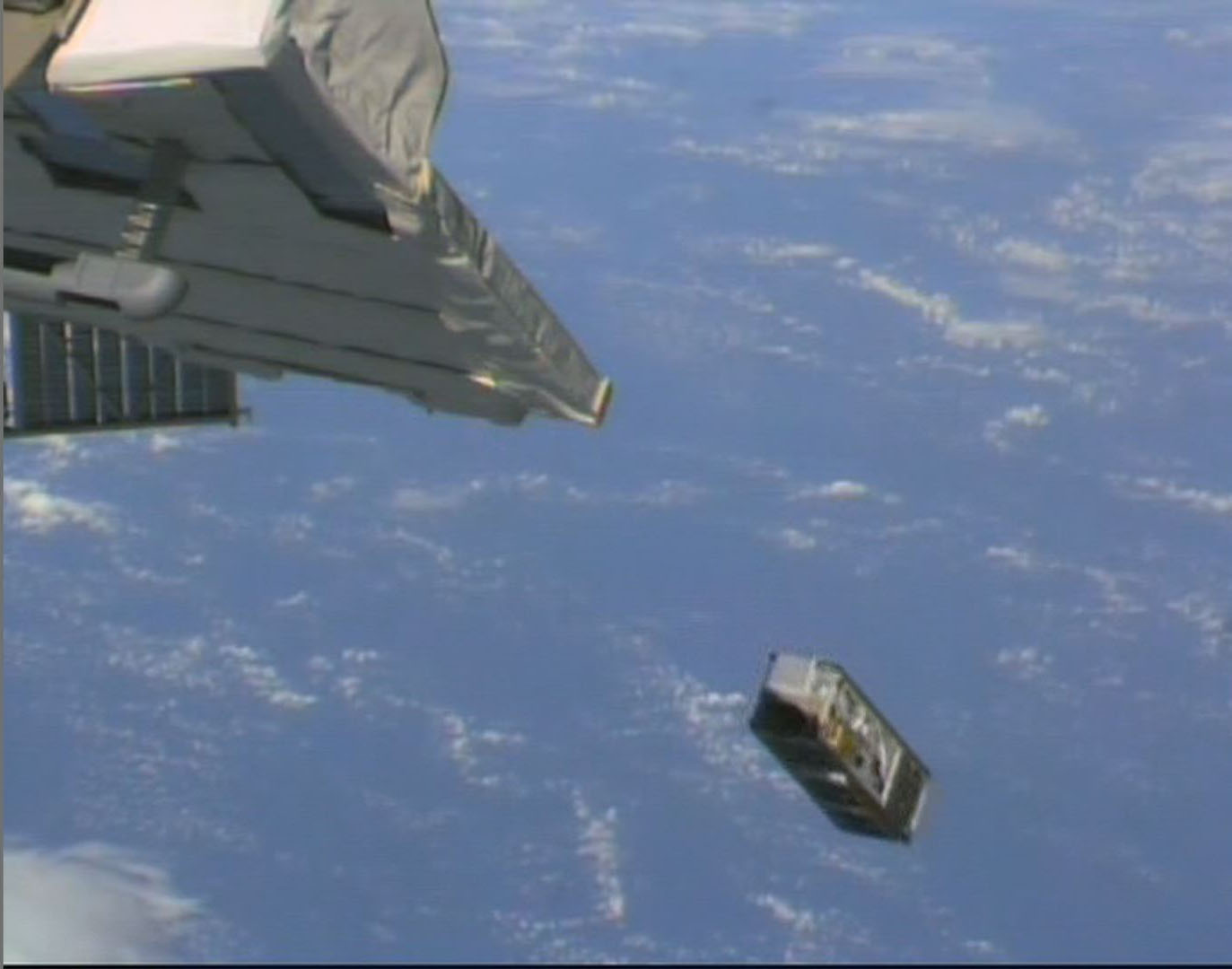
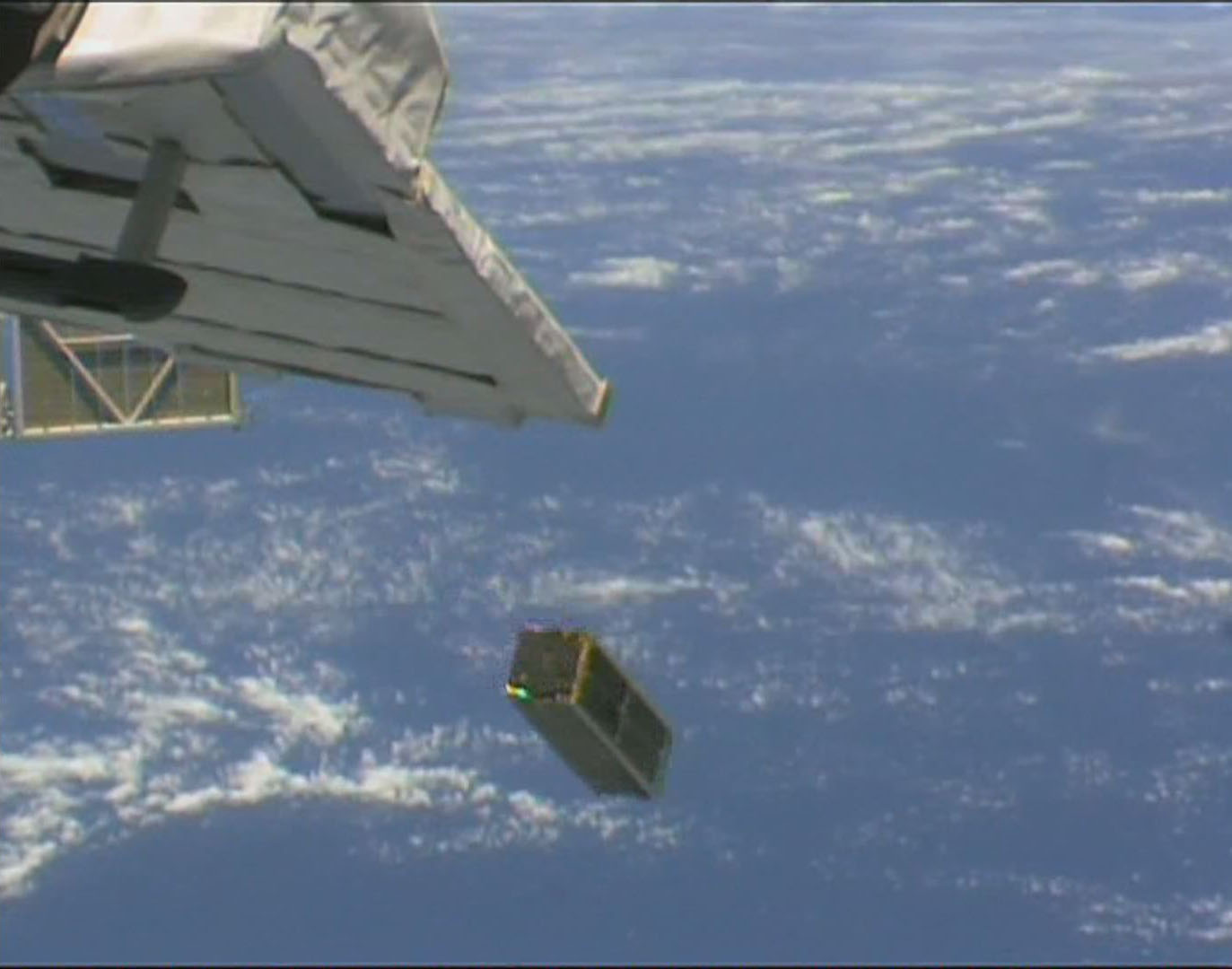
First, at 9:02, p.m., S-CUBE was deployed via command operation by Astronaut Kimiya Yui aboard the International Space Station (ISS). Then at 9:12 p.m., SERPENS was deployed under command of the JAXA Flight Control Team (JFCT) at the Tsukuba Space Center (TKSC).

Deployment of S-CUBE (Credit: JAXA/NASA)

Deployment of SERPENS (Credit: JAXA/NASA)
This series of deployment marks the fourth (12th satellite) deployment using the JEM Small Satellite Orbital Deployer (J-SSOD), and 90 satellites in total have been deployed from Kibo.

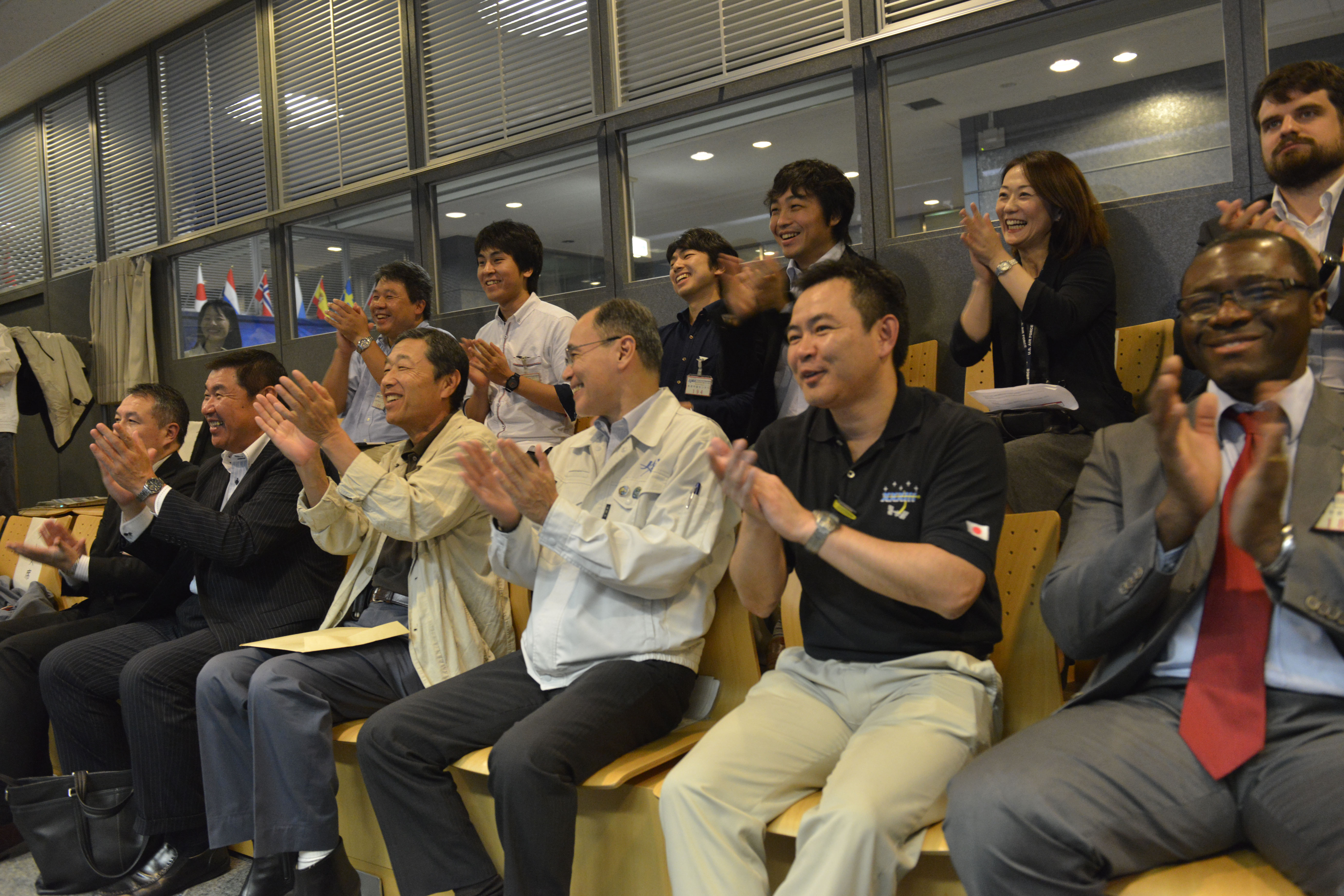
At the TKSC, representatives of the Chiba Institute of Technology and JAXA applauding the successful deployment (Credit: JAXA)

At the TKSC, representatives of the University of Brasilia and JAXA applauding the successful deployment (Credit: JAXA)
Developed by JAXA for deploying satellites designed in compliance with the CubeSat design specification (10 cubic cm), J-SSOD is a mechanism that transfers satellites from Kibo’s airlock to the space environment and then releases them into orbit.
SERPENS and S-CUBE are both 3U-sized micro satellites (10 cm×10 cm×30 cm)and were delivered aboard the H-II Transfer Vehicle (HTV) KOUNOTORI5.
There are now more opportunities for CubeSat deployment from Kibo. And various projects are ongoing, such as AOBA-VELOX-Ⅲ (of Singapore and Kyushu Institute of Technology) and a 50-kg-level CubeSat PHL-MICROSAT (jointly developed by the Philippines, Tohoku University, and Hokkaido University).
Since September 8, 2015, JAXA has collaborated with the UNITED NATIONS Office for Outer Space Affairs (UNOOSA) in order to provide opportunities for CubeSat deployment. In particular, JAXA and UNOOSA will strive to offer opportunities for CubeSat deployment from Kibo to developing nations, so as to contribute to their advancement of space and related technologies.
断りの無い限り、日時は日本時間です。
*All times are Japan Standard Time (JST)
This entry passed through the Full-Text RSS service – if this is your content and you’re reading it on someone else’s site, please read the FAQ at fivefilters.org/content-only/faq.php#publishers.
-

New Perspective on a Galaxy Cluster
The galaxy cluster MS 0735.6+7421 is home to one of the most powerful eruptions ever observed. X-rays detected by NASA’s Chandra X-Ray Observatory (blue) show the hot gas that comprises much of the mass of this enormous object. This image is part of a collection of new images released from the Chandra archive to celebrate American Archive Month.