
An asteroid four times the size of a football pitch will miss Earth on All Hallows’ Eve. The flyby highlights the need to watch for space rocks.
An asteroid four times the size of a football pitch will miss Earth on All Hallows’ Eve. The flyby highlights the need to watch for space rocks.
NASA’s Jet Propulsion Laboratory (JPL) announced the winner of the 8th edition of the Global Trajectory Optimization Competition (GTOC), and ACT-ISAS team won this year’s first place. The ACT-ISAS team was born as collaboration between ESA (European Space Agency) and ISAS (Institute of Space and Astronautical Science of Japan), including former ESA’s Advanced Concepts Team (ACT) members now working at ISAS.
The competition is also known as the America’s Cup of rocket science for its prestige and its rules on the organization. The Global Trajectory Optimization Competition is an event taking place every one-two years over roughly one month during which the best aerospace engineers and mathematicians world wide challenge themselves to solve a “nearly-impossible” problem of interplanetary trajectory design.
The problem needs to be related to interplanetary trajectory design and its complexity high enough to ensure a clear competition winner.
The problem is released by the winning team of the previous edition which this time was JPL.
The challenge for this time is to observe objects from the given 420 of radio sources as many as possible in the best condition: Each observation is carried out when the normal direction of a virtual surface created by the three spacecraft directs towards the specific target and the surface area at the observation is used as an index of the observation condition. The spacecraft would observe the sources using an astronomical technique called ‘very-long-baseline interferometry (VLBI)’ – by precisely combining their separate observations through long-distance formation-flying they can acquire an equivalent imaging resolution to a single giant radio telescope.
In order to achieve this they have to be lined up along a plane and pointed at the radio source, and to save scarce propellant, lunar gravity assists and low-thrust propulsion had to be used to perform each manoeuvre.
Thirty-six teams registered for this edition of the competition, including teams from the United States, China, Europe, Brazil and India (team list). Seventeen teams returned a solution which had to be validated and ranked during the summer. Full rankings can be downloaded here (http://sophia.estec.esa.int/gtoc_portal/?page_id=560).
“It is an outstanding team achievement”, remarked Dario Izzo leading the team and ACT scientific coordinator. “Within one month of intense computation, we had to develop and test several new mission analysis techniques in order to propose our best design. It is remarkable that our team was composed of experts not only of mission analysis but also artificial intelligence, applied mathematics and fundamental physics. This eclectic mix was crucial in obtaining our result.”
“The GTOC is not just a competition, it’s a commitment to dedicate your time and effort with your teammates to tackle a new problem.”, Chit Hong Yam, one of the ACT-ISAS team members described.” It’s not just about winning or losing, it’s a challenge to push yourself to the limit to reinvent the wheel. “
Stefano Campagnola (International Top Young Fellow, ISAS) says, “The growing number of space exploration missions are enabled by advanced techniques in astrodynamics. GTOC is pushing the boundaries of this field, and we are honored to be in the frontline of this international community.”
Details on the techniques developed by all participating teams will be presented in February during a JPL-organized workshop in the United States. It will then be up to the ACT-ISAS team to organize the next edition of the Global Trajectory Optimization Competition.
[embedded content]
This entry passed through the Full-Text RSS service – if this is your content and you’re reading it on someone else’s site, please read the FAQ at fivefilters.org/content-only/faq.php#publishers.

Human spaceflight and operations image of the week: All Hallows’ Eve celebrates the cycle of destruction and rebirth, which our Cluster mission knows well
Expedition 45 Commander Scott Kelly tries on his spacesuit for a fit check inside the U.S. Quest airlock of the International Space Station. Kelly and Flight Engineer Kjell Lindgren will venture outside the station for a pair of spacewalks on Wednesday, Oct. 28 and Friday, Nov. 6.

Expedition 45 Commander Scott Kelly tries on his spacesuit for a fit check inside the U.S. Quest airlock of the International Space Station. Kelly and Flight Engineer Kjell Lindgren will venture outside the station for a pair of spacewalks on Wednesday, Oct. 28 and Friday, Nov. 6.

An underwater robot initially built to help astronauts train for life in weightlessness is now being tested in the Mediterranean Sea. One day, robots like this may carry out sophisticated missions on our ocean floors, from finding lost aircraft blackboxes to mining minerals or maintaining the sites of ancient pirate shipwrecks.
Enceladus is a world divided. To the north, the terrain is covered in impact craters, much like other icy moons.

Enceladus is a world divided. To the north, the terrain is covered in impact craters, much like other icy moons.

Space Science Image of the Week: An intense burst of charged particles from the Sun created this eerie celestial display, captured in the skies above Norway

The International Charter Space and Major Disasters celebrates 15 years of free access to the best-available satellite images
Kibo-ABC Member Countries’ News: Indonesia and Japan
Last Updated: October 26, 2015

Indonesian Youth talked with Astronaut Soichi Noguchi in the communication event of Space Science Festival in Bandung, Indonesia

The communication event with JAXA astronaut Soichi Noguchi, has been held as a part of Space Science Festival in Indonesia, organized by National Institute of Aeronautics and Space, Indonesia (LAPAN).
They connected with him from Auditorium room in LAPAN Space science center in Bandung, where 170 participants including 115 students gathered. This communication was held using the video conference system, and the audiences were excited to see JAXA astronaut in live video for the first time.

Astronaut Noguchi started his talk with the greeting to participants by Indonesian language “Selamat pagi”, meaning “good morning”. He explained his experience in his two missions on ISS, showing some pictures taken while he was on-board ISS. He also gave information of Kibo-ABC/Kibo utilization collaboration activity of LAPAN and JAXA.
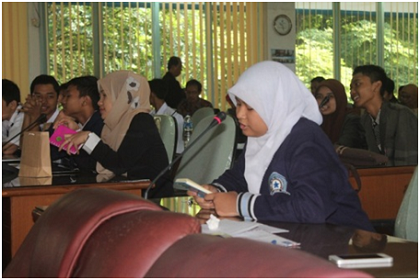
Students had chance to ask him questions after the lecture. Students asked him questions mainly in English, where some students who tried to use Japanese to talk with him. Many questions were answered, including questions such as ‘what is your favorite space food?’, ‘how the earth looked like when seen from space?’ and ‘how did you feel when you got back to the earth?’ Astronaut Noguchi insisted on how beautiful the earth is seen from the space and the photos cannot tell its beauty enough, thus you need to go to space to see it with your own eyes. He also mentioned that he “felt home” when he came back to the earth, but on the very next day he missed the space and wanted to go back there.
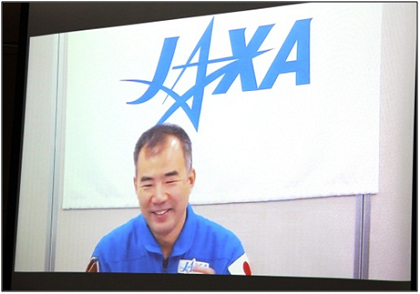
The last question from the student was ‘what are the requirements to become an astronaut?’ and astronaut Noguchi answered, ‘it requires a lot of aspect to become an astronaut, such as majoring scientific field in university, being physically fit and also ability of using multi-languages. But the most important thing is to have a strong motivation for exploring into space.’
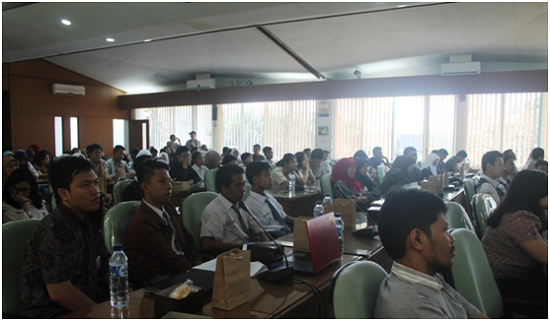
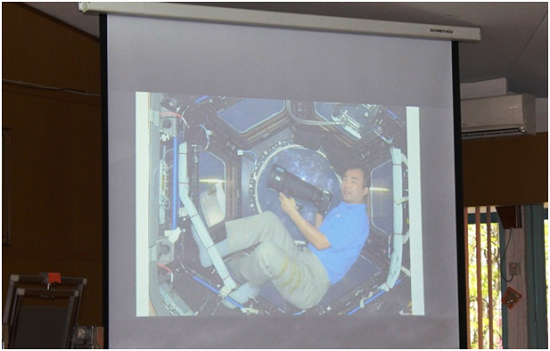
Space Science Festival is an annual event organized by LAPAN to celebrate World Space Week (worldspaceweek.org). The event encourages students to learn more about space science and astronomy, and also promotes space experiments for better utilization of space technology.
For further information, please visit LAPAN’s website: http://pussainsa.lapan.go.id/fsa

This entry passed through the Full-Text RSS service – if this is your content and you’re reading it on someone else’s site, please read the FAQ at fivefilters.org/content-only/faq.php#publishers.

Displaying the essential role satellites play in monitoring our changing world, the Climate Cube on the Champs-Elysées in Paris was inaugurated in the presence of ESA’s Director General Jan Woerner

This image shows the galaxy Messier 94, which lies in the small northern constellation of the Hunting Dogs, about 16 million light-years away.