jsc2022e068688_alt (Sept. 6, 2023) — Official portrait of NASA astronaut Jasmin Moghbeli in a spacesuit. Credit: NASA/Robert Markowitz
NASA


3 min read
The International Academy of Astronautics has awarded its 2023 Laurels for Team Achievement award to the international team that supported NASA’s Artemis I mission.
The academy presented the award Oct. 1 during their Academy Day program, taking place in Baku, Azerbaijan, for extraordinary performance and achievement by a team of scientists, engineers, technicians, and managers in the field of astronautics.
Amit Kshatriya, deputy associate administrator for the Moon to Mars Program in the Exploration Systems Development Mission Directorate at NASA Headquarters, accepted the award on behalf of the Artemis I team. The award recognizes the contributions from NASA and partners around the world that supported the Artemis I flight test. Artemis I was the first of a series of increasingly complex missions to establish long-term exploration at the Moon and prepare to send astronauts to Mars.
“Contributions from teams at NASA and our international and industry partners made the success of the Artemis I mission possible,” said Kshatriya. “Together with this growing community, we’re conducting groundbreaking science at the Moon and preparing for humanity’s next giant leap to explore the Red Planet.”
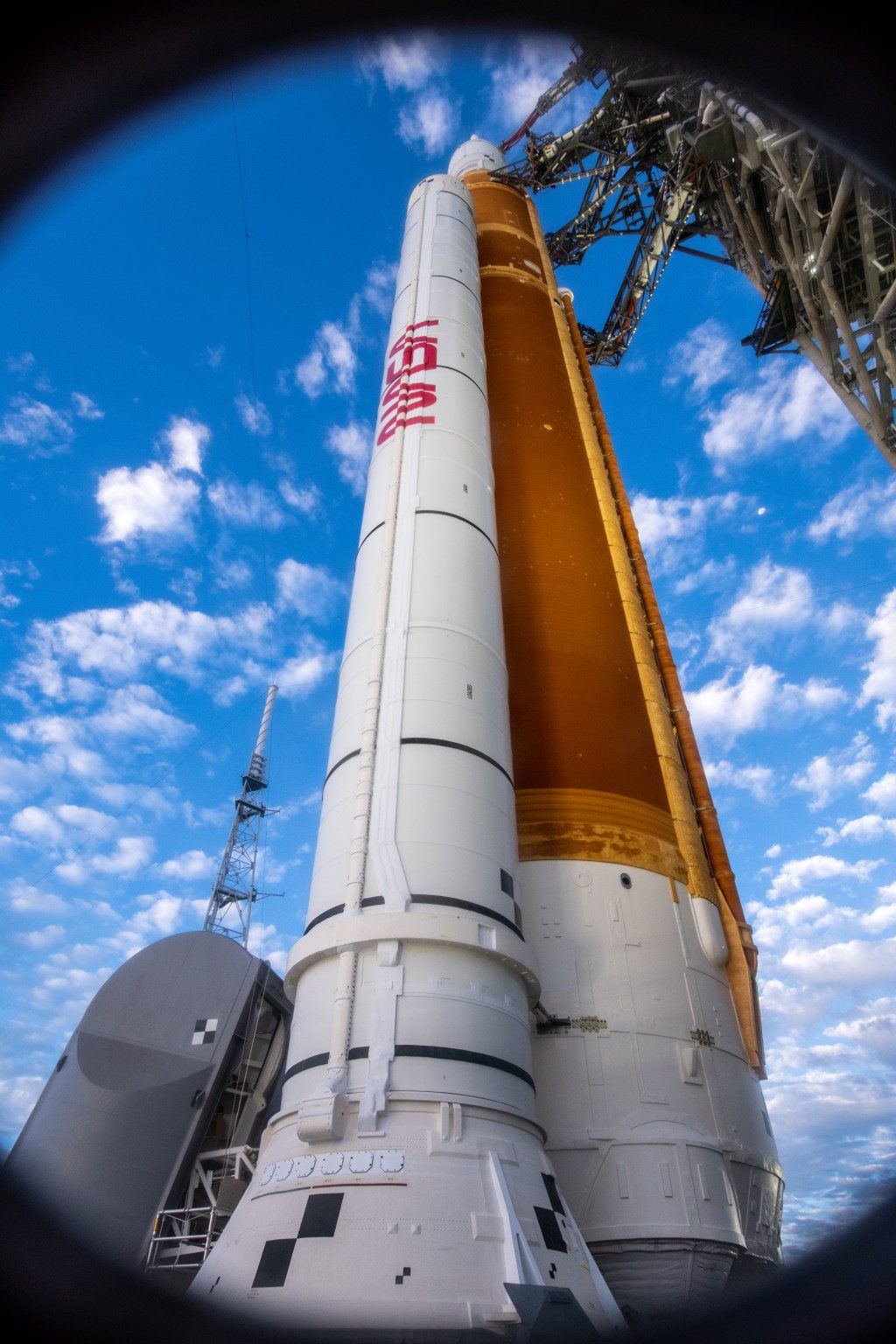
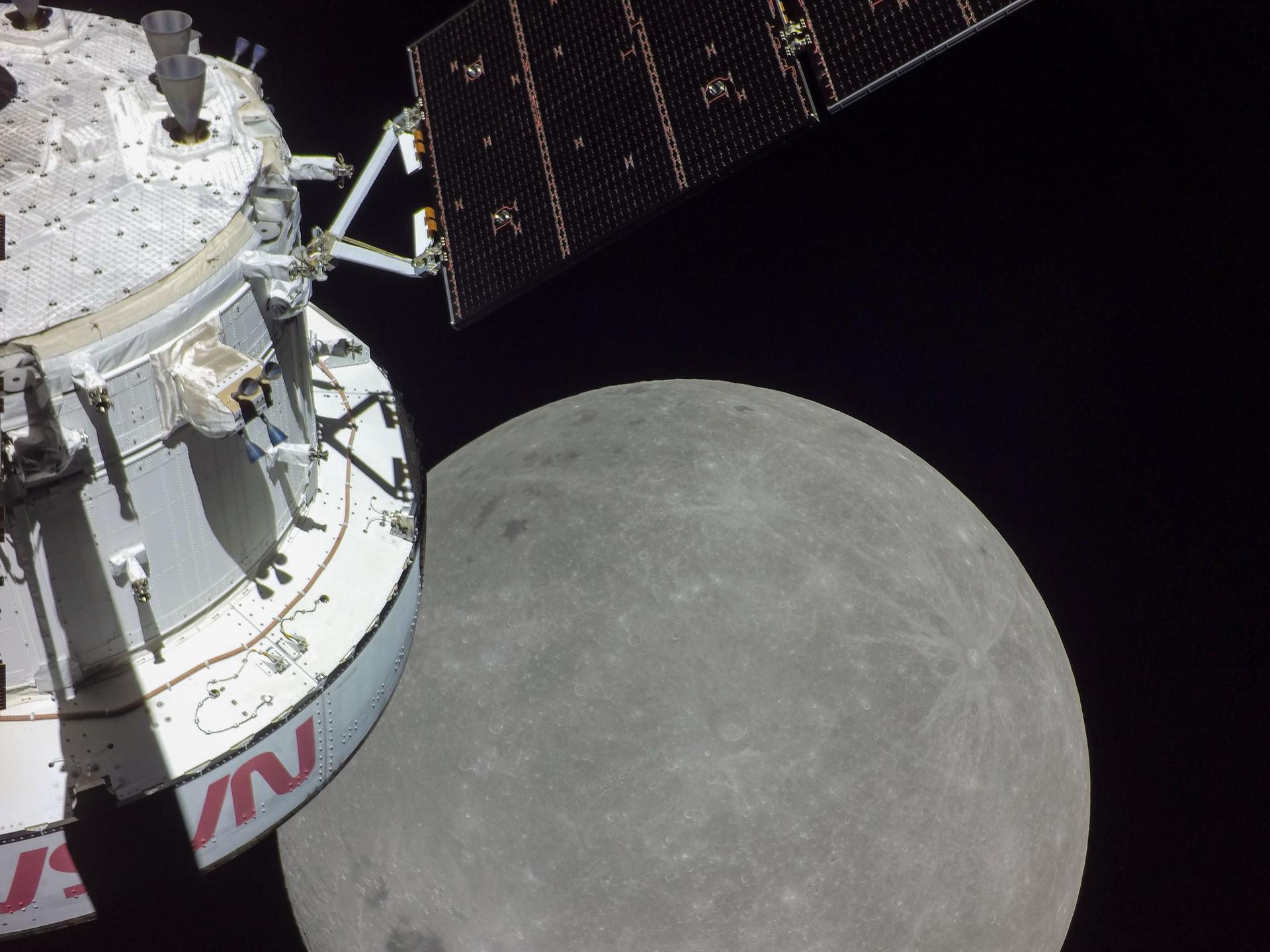
The SLS (Space Launch System) rocket launched the uncrewed Orion spacecraft Nov. 16, 2022 from NASA’s Kennedy Space Center in Florida for a 25.5-day flight test that traveled a total of more than 1.4 million miles around the Moon and back to Earth. SLS flew as designed and with precision, and the Orion spacecraft successfully completed all test objectives while flying farther than any spacecraft built for humans has flown, reaching nearly 270,000 miles beyond the Moon. The mission paved the way for the first flight test with astronauts on Artemis II.
NASA is collaborating with commercial and international partners and establish the first long-term presence on the Moon through Artemis. The Laurels award recognized the contributions to Artemis I from ESA (European Space Agency), JAXA (Japan Aerospace Exploration Agency), Italian Space Agency, Israel Space Agency, and the German Aerospace Center. Additionally, the Deep Space Network facilitated space communications and navigation for Artemis I through ground stations in Australia and Spain. Industry partners recognized as part of the Artemis I team for the award included Aerojet Rocketdyne, Jacobs, Lockheed Martin, Boeing, Teledyne Brown, United Launch Alliance, Northrop Grumman, and Airbus.
“This award belongs to the thousands of skilled workers and their families that dedicated themselves to the development of the rocket, spacecraft, and supporting systems that demonstrated the beginning of what we can achieve in this new era of exploration,” said Kshatriya. “From factories around the world, to the assembly and launch from Kennedy, around the Moon and safely recovered from the Pacific Ocean, each contribution shares in this accomplishment.”
The International Academy of Astronautics is an independent non-governmental organization recognized by the United Nations with members are from more than 80 countries. Since its founding in 1960, the IAA has brought together experts in the disciplines of astronautics on a regular basis to recognize the accomplishments of their peers, explore and discuss cutting-edge issues in space research and technology, and provide direction and guidance in the non-military uses of space and the ongoing exploration of the solar system.
Through Artemis, NASA will land the first woman and first person of color on the Moon as we learn how to live and work on another world and inspire the next generation of explorers. The agency and its partners will explore more of the lunar surface than ever before using innovative technologies to unlock the mysteries of our solar system and our home planet for the benefit of all.

“I can almost directly trace my entire career back to [my extracurriculars] in high school and a mentor I had. My first foray into engineering was this high school program called the Robotics Science Academy. It was basically my high school’s attempt to put together a curriculum that was designed specifically to prepare students for an engineering track in college. But since it was the first year of trying this program, there were only about eight of us. The high school teacher leading the robotics track, Mr. Donelson, was always [encouraging] about trying new things and getting out of our comfort zone. And I think that always really helped me.
“So I owe a lot to him, for sure. He would stay after school with us and walk us through our assignments, and ended up encouraging us to enter an underwater robotics competition. Because we were fairly landlocked — which is obviously not great for underwater robotics that are meant for deep sea missions — we sort of lucked our way into the international competition.
“Even so, we ended up winning a ‘bang for your buck’ award based on the amount of tasks we completed in the mission and the cost of our robot, because the cost was very, very low. It was just this Frankenstein monstrosity of PVC pipes and messy high schooler soldering and wiring. But no matter how it looked, I was lucky to have teachers like Mr. Donelson to push all of us forward.”
— Jennifer Hamilton, Communications Lead, ISS Research Integration Office, NASA’s Johnson Space Center
Image Credit: NASA / James Blair
Interviewer: NASA / Thalia Patrinos

Three employees from NASA’s Glenn Research Center in Cleveland have been chosen to receive awards that recognize the achievements of outstanding Hispanic engineers, scientists, and STEM professionals.
Janette C. Briones, Azlin Biaggi-Labiosa, and Nelson Morales will be presented with Hispanic Engineer National Achievement Award Corporation (HENAAC) and Luminary awards during the Great Minds in STEM conference in Pasadena, California, held from Oct. 11 through 14.
Learn more about the NASA Glenn honorees and each of their recognitions:


A SpaceX Falcon Heavy rocket with the Psyche spacecraft onboard is seen as it is rolled out of the horizontal integration facility on Oct. 10, 2023, at NASA’s Kennedy Space Center in Florida as preparations continue for the Psyche mission. NASA’s Psyche spacecraft will travel to a metal-rich asteroid by the same name orbiting the Sun between Mars and Jupiter to study its composition. The spacecraft also carries the agency’s Deep Space Optical Communications technology demonstration, which will test laser communications beyond the Moon.
If all goes as planned, asteroid Psyche’s gravity will capture the spacecraft in late July 2029, and Psyche will begin its prime mission in August. It will spend about two years orbiting the asteroid to take pictures, map the surface, and collect data to determine Psyche’s composition.
NASA and SpaceX are targeting Friday, Oct. 13, 2023, at 10:19 a.m. EDT for launch from Kennedy Space Center. Watch the launch on NASA TV.
Image Credit: NASA/Aubrey Gemignani
1 min read

NASA’s Radio JOVE project wants your help to study the Sun! Radio JOVE, in partnership with the SunRISE Ground Radio Lab, is planning to use radio telescopes to make coordinated observations of the Sun for the 2024 solar eclipse. With our plans and training modules, you can build and use your own radio telescope and contribute data to this research effort.
Radio JOVE’s amateur scientists from around the world observe and analyze natural radio emissions of Jupiter, the Sun, and our galaxy using their own easy to construct radio telescopes. Now Radio JOVE is studying the Sun at radio frequencies below 30 MHz to better understand the radio emissions caused by solar activity. We will learn about how energetic plasma in the sun’s corona generates these waves, and how the waves travel through the Earth’s ionosphere.
Learn more and join us here: https://radiojove.gsfc.nasa.gov/joinin.php
NASA’s Citizen Science Program:
Learn about NASA citizen science projects
Follow on X
Follow on Facebook

NASA has selected 72 student teams to begin an engineering design challenge to build human-powered rovers that will compete next April at the U.S. Space & Rocket Center in Huntsville, Alabama, near the agency’s Marshall Space Flight Center.
Celebrating its 30th anniversary in 2024, the Human Exploration Rover Challenge tasks high school, college, and university students to design, build, and test lightweight, human-powered rovers on an obstacle course simulating lunar and Martian terrain, all while completing mission-focused science tasks.
Participating teams represent 42 colleges and universities and 30 high schools from 24 states, the District of Columbia, Puerto Rico, and 13 other nations from around the world. NASA’s handbook has complete proposal guidelines and task challenges.
“Throughout this authentic learning challenge, NASA encourages students to improve their understanding of collaboration, inquiry, and problem-solving strategies,” said Vemitra Alexander, rover challenge activity lead, Office of STEM Engagement at NASA Marshall. “Improving these critical real-world skills will benefit our students throughout their academic and professional careers.”
Throughout the nine-month challenge, students will complete design and safety reviews to mirror the process used by NASA engineers and scientists. The agency also incorporates vehicle weight and size requirements encouraging students to consider lightweight construction materials and stowage efficiency to be replicate similar payload restrictions of NASA launch operations.
Teams earn points throughout the year by successfully completing design reviews and fabricating a rover capable of meeting all criteria while completing course obstacles and mission tasks. The teams with the highest number of points accumulated throughout the project year will win their respective divisions. The challenge will conclude with an event April 19 and April 20, 2024, at the U.S. Rocket and Space Center.
This competition is one of nine Artemis Student Challenges and reflects the goals of NASA’s Artemis program, which includes landing the first woman and first person of color on the Moon. It is managed by NASA’s Southeast Regional Office of STEM Engagement at Marshall. NASA uses challenges and competitions to further the agency’s goal of encouraging students to pursue degrees and careers in science, technology, engineering, and mathematics.
For more information about the challenge, visit:
https://www.nasa.gov/roverchallenge/home/index.html
-end-
Claire O’Shea
Headquarters, Washington
202-358-1600
claire.a.oshea@nasa.gov
Christopher Blair
Marshall Space Flight Center, Huntsville, Ala.
256-544-0034
christopher.e.blair@nasa.gov
3 min read

NASA’s Quesst mission has adjusted the scheduled first flight of its X-59 quiet supersonic aircraft to 2024.
A one-of-a-kind experimental aircraft, the X-59 has required complex engineering from NASA researchers working with prime contractor Lockheed Martin Skunk Works. In addition to the aircraft’s design, the X-59 also combines new technology with systems and components from multiple, established aircraft, such as its landing gear from an F-16 and its life-support system adapted from an F-15.
As part of the demands of developing this unique aircraft, the Quesst team is working through several technical challenges identified over the course of 2023, when the X-59 had been scheduled to make its first flight. Extra time is needed to fully integrate systems into the aircraft and ensure they work together as expected. The team is also resolving intermittent issues with some of the safety-redundant computers that control the aircraft’s systems.
Quesst made steady progress toward flight over the past year. The team installed the finishing touches to the X-59’s tail structure, which allowed them to finalize its electrical wiring and proceed to critical ground tests, and moved it from its assembly facility to the flight line to perform structural testing.
The X-59 will demonstrate the ability to fly supersonic, or faster than the speed of sound, while reducing the normally loud sonic boom to a quiet sonic thump. NASA plans to fly the X-59 over several communities to gather data on how people perceive the sound it produces. The agency will provide that information to U.S. and international regulators to potentially adjust rules that currently prohibit commercial supersonic flight over land.
NASA’s top priorities for any mission are safety and ensuring success. For Quesst, that means not only being sure that the X-59 is safe before it flies, but safe in the long term and reliable during the community test phase. The aircraft is currently undergoing integrated testing, which must be completed before it flies. Once that stage is complete, the aircraft will continue its journey with a flight readiness review, at which point NASA plans to release a more specific timeline for first flight.
Quesst is a mission with the potential to revolutionize commercial aviation travel by dramatically reducing travel time. Safely and reliably flying the X-59 is critical for NASA to achieve those benefits. The agency is committed to a thorough review and testing process that results in the success of that mission.
The month of October marks National Disability Employment Awareness Month (NDEAM). The NDEAM observance was declared in 1988 by the United States Congress in efforts to raise awareness of disability employment needs and to celebrate the many and varied contributions of individuals with all types of disabilities.
This year’s NDEAM theme, chosen by the Office of Disability Employment Policy, is “Advancing Access and Equity” to honor the 50th anniversary of the Rehabilitation Act of 1973, the first major legislation to prohibit disability discrimination by federal agencies.
One such disability many people know about is depression. Promoting awareness, reducing stigma, and improving access to mental health support are crucial steps in advancing equity for this population.
Over the years, there has been extensive knowledge shared about depression, but there are still many stereotypes today. The American Psychiatric Society defines depression as “a common and serious medical illness that negatively affects how you feel, the way you think and how you act.” This disability will affect one in 15 adults in any given year and has been found to affect one to six people during their lifetime. Depression can happen to anyone, even those who appear to be happy who laugh and smile. As described in a medical article titled, Survey of Public Knowledge and Stigma Towards Depression,“some depressed persons hide their distress and might smile in public, which makes it difficult for others to notice that they are depressed.”
Symptoms of depression vary from mild, to moderate, to severe and can include feeling sad, having a loss of energy, losing interest in things that used to be enjoyed, insomnia, feeling guilty or worthless, difficulty making decisions, and in severe cases suicide.
One common misconception regarding depression is that it is the same as grief, however it is different than grief even though they may have common attributes. When someone grieves, (for example, over the loss of a loved one) they will feel sad but one’s self-esteem is typically not affected throughout the grieving process, whereas someone suffering from depression will often have feelings of worthlessness.
Another misconception, or negative stigma regarding depression is that someone with depression is violent, weak, or lazy. These are also inaccurate, and negatively impact those with depression from seeking help. Untreated depression will often cause a decline in employee work performance as well as increase presenteeism (an employee is at work but not engaged) or absenteeism (employees missing days of work). In addition to this, employees often do not seek treatment out of fear of how it will affect their job or out of concern for their confidentiality. The best way to support a colleague or employee who is struggling with mental health is by being empathic and supportive.
Employees who are experiencing depression are protected under the Rehabilitation Act and cannot be discriminated or harassed at work because of their condition. If an employee is experiencing depression, they may also request a Reasonable Accommodation from their supervisor or the Disability Program Manager. Reasonable Accommodations help to make the workplace more accessible (such as physical barriers that make facilities/equipment inaccessible) and equitable by making a modification or adjustment to a job, an employment practice, or the work environment that makes it possible for a qualified individual with a disability to enjoy equal employment opportunities.
For information about NASA’s Reasonable Accommodations policy and process, please visit: nasa.gov/reasonable accommodations.
For more information regarding NDEAM, Depression, or Reasonable Accommodations, please visit the following sites: