Tag: planethunt

  • New U.S. Postal Service Stamps Feature Iconic NASA Webb Images

    3 min read

    New U.S. Postal Service Stamps Feature Iconic NASA Webb Images

    Finger-like cloud structures in blue against a red background are a cosmic object called the Pillars of Creation
    The U.S. Postal Service issued a Priority Mail stamp Jan. 22, 2024, featuring an image of the Pillars of Creation from NASA’s James Webb Space Telescope. Greg Breeding, an art director for the U.S. Postal Service, designed the stamp with an image provided by NASA, ESA, CSA, and the Space Telescope Science Institute.
    U.S. Postal Service

    The U.S. Postal Service has issued two new Priority Mail stamps celebrating NASA’s James Webb Space Telescope, the largest, most powerful, and most complex telescope ever put in space. The stamps, issued Jan. 22, feature images of the cosmos captured by Webb since it began its science mission in 2022. Webb is a mission led by NASA in partnership with ESA (European Space Agency) and CSA (Canadian Space Agency).

    “NASA’s James Webb Space Telescope is the perfect intersection of science, engineering, and art as it reveals the greatest secrets of our cosmos through the beautiful images it captures,” said Nicola Fox, associate administrator, Science Mission Directorate at NASA Headquarters in Washington. “With these stamps, people across the country can have their own snapshot of Webb’s captivating images – and the incredible science they represent – at their fingertips, and know that they, too, are part of this ground-breaking new era in astronomy.”

    Orange mountain-like structures against a blue background form the Cosmic Cliffs
    The U.S. Postal Service issued a Priority Mail Express stamp Jan. 22, 2024, highlighting an image of the Carina Nebula from NASA’s James Webb Space Telescope. Greg Breeding, an art director for the U.S. Postal Service, designed the stamp with an image provided by NASA, ESA, CSA, and the Space Telescope Science Institute.
    US Postal Service

    The first of the new stamps, a Priority Mail Express stamp, features Webb’s NIRCam (Near-Infrared Camera) image of the “Cosmic Cliffs” in the Carina Nebula, located roughly 7,600 light-years away. The image shows emerging stellar nurseries and individual stars that were previously hidden from sight. This scene was one of the first full-color images revealed from Webb in July 2022, demonstrating the telescope’s ability to peer through cosmic dust and shed new light on how stars form.

    The other stamp, a Priority Mail stamp, features an image of the Pillars of Creation captured by Webb’s MIRI (Mid-Infrared Instrument). Webb’s look at this familiar landscape, which was first made famous by NASA’s Hubble Space Telescope, shows pillars flush with gas and dust, enshrouding stars that are slowly forming over many millennia. The Pillars of Creation is set within the vast Eagle Nebula, which lies 6,500 light-years away.

    These new stamps join a Forever stamp issued by the U.S. Postal Service in 2022, featuring an artist’s digital illustration of Webb against a background of stars.

    The U.S. Postal Service stamps honor Webb’s achievements as it continues its mission to explore the unknown in our universe and study every phase in cosmic history. Webb has already pulled back the curtain on some of the farthest galaxiesstars, and black holes ever observed; solved a longstanding mystery about the early universe; given us a more detailed look at the atmospheres of planets outside our solar system than ever before; and offered new views and insights into our own cosmic backyard.

    To learn more about Webb, visit:

    https://www.nasa.gov/webb

    The James Webb Space Telescope is the world’s premier infrared space science observatory. Webb is solving mysteries in our solar system, looking beyond to distant worlds around other stars, and probing the mysterious structures and origins of our universe and our place in it. Webb is an international program led by NASA with its partners, ESA (European Space Agency) and CSA (Canadian Space Agency).

    NASA Headquarters oversees the mission for the agency’s Science Mission Directorate. NASA’s Goddard Space Flight Center in Greenbelt, Maryland, manages Webb for the agency and oversees work on the mission performed by the Space Telescope Science Institute, Northrop Grumman, and other mission partners. In addition to Goddard, several NASA centers contributed to the project, including the agency’s Johnson Space Center in Houston; Jet Propulsion Laboratory (JPL) in Southern California; Marshall Space Flight Center in Huntsville, Alabama; Ames Research Center in California’s Silicon Valley; and others.

  • NASA Sets Briefings for Crew-8, International Space Station Missions

    The four crew members representing NASA’s SpaceX Crew-8 mission to the International Space Station pose for an official portrait at the agency’s Johnson Space Center in Houston.

    NASA will host a pair of news conferences Thursday, Jan. 25, from the agency’s Johnson Space Center in Houston to highlight upcoming crew rotation missions to the International Space Station.

    A mission overview news conference will begin at 1 p.m. EST and cover NASA’s SpaceX Crew-8 mission to the microgravity laboratory and Expeditions 70/71. A crew news conference will start at 2:30 p.m., followed by individual astronaut interviews at 3:30 p.m.

    Both news conferences will be available on the NASA+ streaming service via the web or NASA app, and will air live on NASA Television, the NASA app, YouTube, and the agency’s website. Learn how to stream NASA TV through a variety of platforms including social media.

    The Crew-8 mission, targeted to launch in mid-February, will carry NASA astronauts Matthew Dominick, Michael Barratt, and Jeannette Epps, as well as Alexander Grebenkin of Roscosmos to the space station. NASA astronaut Tracy C. Dyson, scheduled to launch to the space station on the Soyuz MS-25 spacecraft on March 21, also will participate in the crew briefing and interviews.

    For the Crew-8 mission, a SpaceX Falcon 9 rocket will launch the crew aboard a Dragon spacecraft from Launch Complex 39A at NASA’s Kennedy Space Center in Florida on the company’s eighth crew rotation mission for NASA. Dyson will launch from the Baikonur Cosmodrome in Kazakhstan.

    This event is the final media opportunity to speak to the Crew-8 astronauts before they travel to Kennedy for launch. Media wishing to participate in person or seeking a remote interview with the crew must request credentials no later than 5 p.m. Wednesday, Jan. 24, from the Johnson newsroom at 281-483-5111 or jsccommu@mail.nasa.gov.

    Media interested in participating by phone must contact the Johnson newsroom by 9:45 a.m. the day of the event.

    Briefing participants include (all times Eastern):

    1 p.m.: Mission Overview News Conference

    • Ken Bowersox, associate administrator, Space Operations Mission Directorate at NASA Headquarters in Washington
    • Steve Stich, manager, Commercial Crew Program, NASA Johnson
    • Joel Montalbano, manager, International Space Station Program, NASA Johnson
    • Sarah Walker, director, Dragon Mission Management, SpaceX
    • Sergei Krikalev, executive director, Human Space Flight Programs, Roscosmos

    2:30 p.m.: Crew News Conference

    • Tracy Dyson, flight engineer
    • Matthew Dominick, spacecraft commander
    • Michael Barratt, pilot
    • Jeanette Epps, mission specialist
    • Alexander Grebenkin, mission specialist

    3:30 p.m.: Individual Crew Interview Opportunities

    • Crew-8 members and Dyson available for a limited number of interviews

    More about space station crew

    Full crew biographies are linked above. Below are highlights of their spaceflight experience.

    NASA selected Tracy C. Dyson as an astronaut in June 1998, and during her previous two flights, she logged more than 188 days in space. Dyson first launched aboard the space shuttle Endeavour on STS-118 in 2007, serving as a mission specialist. During the mission, the crew added the starboard-5 truss segment to the station’s “backbone” and a new gyroscope. In 2010, Dyson served as flight engineer for Expedition 23/24 and performed three spacewalks, logging 22 hours and 49 minutes outside the station as she helped remove and replace a failed pump module for one of two external ammonia circulation loops that keep internal and external equipment cool.

    Matthew Dominick will serve as commander for Crew-8, his first spaceflight after being selected as an astronaut in 2017. During Expedition 70/71 aboard the space station, he will serve as a mission specialist. Follow @dominickmatthew on X.

    Michael Barratt is the Crew-8 pilot, making his third visit to the space station. In 2009, Barratt served as a flight engineer for Expeditions 19/20 as the station transitioned its standard crew complement from three to six, and performed two spacewalks. He flew aboard the space shuttle Discovery in 2011 on STS-133, which delivered the Permanent Multipurpose Module and fourth Express Logistics Carrier. Barratt has spent a total of 212 days in space. During Expedition 70/71, he will serve as a mission specialist.

    Jeanette Epps was selected by NASA as an astronaut in 2009 and is a mission specialist aboard Crew-8, her first spaceflight, working with the commander and pilot to monitor the spacecraft during the dynamic launch and re-entry phases of flight. She will serve as a flight engineer during Expeditions 70/71. Follow @Astro_Jeanette on X.

    Roscosmos cosmonaut Alexander Grebenkin is flying on his first mission. He will serve as a flight engineer during Expeditions 70/71.

    Learn more about how NASA innovates for the benefit of humanity through NASA’s Commercial Crew Program at:

    https://www.nasa.gov/commercialcrew

    -end-

    Joshua Finch
    Headquarters, Washington
    202-358-1100
    joshua.a.finch@nasa.gov

    Leah Cheshier
    Johnson Space Center, Houston
    281-483-5111
    leah.d.cheshier@nasa.gov

    Details

    Last Updated

    Jan 17, 2024

  • An Aurora in Another Light

    The aurora borealis on Nov. 5, 2023, is seen as swirls of white smoke and sparse, but bright splashes of white light against a dark background.
    NASA/Lauren Dauphin and Wanmei Liang; NOAA

    The Visible Infrared Imaging Radiometer Suite sensor on the NOAA-NASA Suomi NPP satellite captured this image of the aurora borealis, or northern lights, over western Canada at 3:23 a.m. MST (5:23 a.m. EST) on November 5, 2023.

    Auroras are colorful ribbons of light appearing in night skies, incited by a strong geomagnetic storm in Earth’s magnetosphere. Multiple coronal mass ejections from the Sun sent a surge of charged particles toward Earth. After colliding with Earth’s magnetosphere, some particles trapped in the magnetic field are accelerated into Earth’s upper atmosphere where they excite nitrogen and oxygen molecules and release photons of light, known as the aurora.

    If you like watching displays such as these, you can help scientists verify aurora sightings so they can analyze and include them in space weather models.

    Image Credit: NASA/Lauren Dauphin and Wanmei Liang, NOAA

  • NASA’s Wallops C-130 Plays Vital Role in Successful Parachute Airdrop Test

    1 min read

    Preparations for Next Moonwalk Simulations Underway (and Underwater)

    A NASA C-130 cargo aircraft, flying in clear skies, has dropped a test vehicle from its open cargo door. The test vehicle is shaped like a dart and has a large ring-like parachute attached to it.
    NASA’s C-130 cargo aircraft releases a dart-shaped test vehicle above the U.S. Army’s Yuma Proving Ground on Jan. 9 to begin the testing sequence for a Boeing Starliner parachute system.
    Credit: U.S. Army Yuma Proving Ground

    NASA’s C-130 Hercules, managed at Wallops Flight Facility’s Aircraft Office in Virginia, provided aerial delivery support for a successful commercial crew parachute airdrop test Jan. 9 at the U.S. Army’s Yuma Proving Ground, Arizona. This week’s testing was in support of NASA’s Commercial Crew Program and partner, Boeing, which are developing crew transportation capability to and from the International Space Station.

    Up for testing was a modified parachute system for Boeing’s Starliner spacecraft. The system, which involved two ringsail parachutes, required a demonstration set in stressed conditions to certify successful deployment.

    During the demonstration, the Wallops C-130 team deployed a 27,000-pound payload comprised of the Parachute Compartment Drop Test Vehicle and Mid-Altitude Deployment System. The team released the payload from an altitude of 13,000 feet while coordinating and timing their efforts with U.S. Army UH-60s and a NASA AFRC B-200 aircraft used to capture photos and video documentation of the mission.

    The Wallops C-130 team has supported 16 successful commercial crew parachute airdrop tests since 2018. For more information, visit nasa.gov/wallops.

    Details

    Last Updated

    Jan 12, 2024

    Editor
    Olivia F. Littleton
    Contact
    Olivia F. Littleton

  • Engage with NASA Glenn

    5 min read

    Preparations for Next Moonwalk Simulations Underway (and Underwater)

    NASA Glenn Research Center’s public engagement team member Matt Baeslack helps students better understand solar eclipses by showing them how to make their own handheld solar eclipse viewer to use for the event.
    Credit: NASA/Chris Hartenstine

    At NASA’s Glenn Research Center in Cleveland, we pride ourselves on making the seemingly impossible, possible. From creating more fuel-efficient jet engines and exploring advances in air mobility, to enhancing radio frequency and optical communications technology, Glenn plays an important role in many of NASA’s most prestigious missions.

    Each year, Glenn highlights its research and technology at a variety of events across the county. We invite you to engage with us during our 2024 outreach season to learn more. Visit us at the following events:

    Jan. 15: Martin Luther King Jr. Day at Great Lakes Science Center — Cleveland, Ohio
    Join us as we celebrate Martin Luther King Jr. Day with Great Lakes Science Center on Jan. 15 from 10 a.m. to 5 p.m. Learn about NASA’s Fluids and Combustion Facility on the International Space Station and the microgravity research NASA Glenn supports. Eclipse glasses will be available at this event.

    Jan. 20 – 21: Monster Jam! — Milwaukee, Wisconsin

    Feb. 17: Monster Jam! — Cleveland, Ohio
    Come learn about how NASA Glenn is reinventing the wheel during Monster Jam! Glenn’s work with shape memory alloy is redefining how we look at developing tires for lunar and Mars rovers. Eclipse glasses will be available at this event.

    March 3: Cleveland Cavaliers’ Score with STEM — Cleveland, Ohio
    NASA will be present at the Cleveland Cavaliers’ Score with STEM event to showcase the Graphics and Visualization Lab, which develops graphics visualizations to provide researchers, engineers, and scientists with visual tools to develop scientific solutions for their work. Experience 3D visualizations and virtual reality firsthand as we aim to inspire the next generation of explorers. Eclipse glasses will be available at this event.

    April 6-8: Total Eclipse Festival at Great Lakes Science Center — Cleveland, Ohio
    On April 8, a total solar eclipse will cross North America, and Cleveland is in the path of totality. Join us at Great Lakes Science Center during their three-day festival to celebrate this celestial event, participate in hands-on activities, and learn about the testing and research happening right here in Cleveland. Eclipse glasses will be available at this event.

    May 4: COSI Science Festival — Columbus, Ohio
    We’re heading to the Center of Science and Industry (COSI) Science Festival. Be sure to find us as we highlight Glenn’s role in supporting NASA’s Artemis missions, our work in power and propulsion, and the support we provide to the International Space Station through microgravity research.

    May 8: Guardians STEM Day – Cleveland, Ohio
    Meet us at the ballpark as we support the Guardians’ STEM Fair at Progressive Field. Glenn will showcase the Graphics and Visualization Lab, which develops graphics visualizations to provide researchers, engineers, and scientists with visual tools to develop scientific solutions for their work. Experience 3D visualizations and virtual reality firsthand as we aim to inspire the next generation of explorers.

    May 18-19: Duluth Air and Aviation Expo — Duluth, Minnesota
    The first “A” in NASA stands for Aeronautics. Join us at the Duluth Air and Aviation Expo to learn about our work to create more fuel-efficient jet engines and make flight safer, faster, and quieter.

    June 8-9: Selfridge Open House STEAM Expo — Selfridge Air National Guard Base, Michigan
    The first “A” in NASA stands for Aeronautics. Join us at the Selfridge Open House to learn about our work to create more fuel-efficient jet engines and make flight safer, faster, and quieter.

    June 22-23: U.S. Air and Trade Show — Vandalia, Ohio
    The first “A” in NASA stands for Aeronautics. Join us at the U.S. Air and Trade Show (Dayton Air Show) to learn about our work to create more fuel-efficient jet engines and make flight safer, faster, and quieter.

    June 29 -July 6: National Cherry Festival — Traverse City, Michigan
    Join us at this summer celebration to hear about NASA’s current missions. From the Artemis program, which will take the first woman and first person of color to the Moon, to our work on creating safer, faster, and quieter aircraft – there is something for everyone to learn.

    July 22 -28: AirVenture — Oshkosh, Wisconsin
    Each year, more than 650,000 flight enthusiasts and professionals – including NASA’s aeronautical innovators – descend upon Oshkosh, Wisconsin, for one of the largest aviation events in the world. NASA will be in attendance again at this year’s event.

    July 25- 28: Fiesta Del Sol — Chicago, Illinois
    We hope to see you at Fiesta Del Sol as we celebrate how diversity enables NASA to reach new heights and explore the unknown.

    Aug 31 -Sept. 2: Cleveland Air Show — Cleveland, Ohio
    The first “A” in NASA stands for Aeronautics. Join us at the Cleveland Air Show to learn about our work to create more fuel-efficient jet engines and make flight safer, faster, and quieter.

    Sept. 27: Ingenuity Cleveland — Cleveland, Ohio
    Join us at IngenuityFest to learn about the innovative technology Glenn develops to support NASA’s top missions. Meet members of Glenn’s Graphics and Visualization Lab and our researchers working on the Power and Propulsion Element for NASA’s Gateway lunar space station, which will be the first component to launch to the Moon.

  • Orbital-1 Launch’s 10th Anniversary

    A white rocket launches upward, leaving a short trail of vapor behind it. The flame at the bottom of the rocket is a bright spot near the center of the photo. To the left of the rocket is a white tower and other structures. Thick plumes of white smoke frame the field in the foreground.
    NASA/Bill Ingalls

    An Orbital Sciences Corporation (now Northrop Grumman) Antares rocket carrying the Cygnus spacecraft launches from NASA’s Wallops Flight Facility in Virginia on Thursday, January 9, 2014. The Orbital-1 mission was Orbital Sciences’ first contracted cargo delivery flight to the space station for NASA. Cygnus brought science experiments, crew provisions, spare parts and other hardware to the space station. One NASA experiment studied the decreased effectiveness of antibiotics during spaceflight, while another examined how different fuel samples burned in microgravity.

    Learn more about the first operational Cygnus cargo mission.

    Image Credit: NASA/Bill Ingalls

  • Early Stage Innovations (ESI) 2023

    1 min read

    Preparations for Next Moonwalk Simulations Underway (and Underwater)

    Back to ESI Home

    Advancing Radiation-Hardened Photon Counting Sensor Technologies

    Advancements in Predicting Plume-Surface Interaction Environments During Propulsive Landings

    Advancing the Performance of Refrigeration Systems Based on the Elastocaloric Effect

  • Continuous Bending-mode Elastocaloric Composite Refrigeration System for Compact, Lightweight, High-Efficiency Cooling

    1 min read

    Preparations for Next Moonwalk Simulations Underway (and Underwater)

    Nenad Miljkovic
    University of Illinois at Urbana-Champaign

    Traditional elastocaloric refrigeration systems are based on uniaxial compression of the elastocaloric material which makes them highly constrained by actuator requirements, the physics of column buckling, and limited surface area for heat transfer. Professor Miljkovic will investigate a novel elastocaloric system based on bending of the elastocaloric material, which removes these constraints. The design requires less energy for equivalent performance and can be run in a continuous loop further increasing efficiency. The team will also investigate methods like heat treatment to tune the elastocaloric material to their application.

    Back to ESI 2023

  • Advancing Elastocaloric Refrigeration through Co-design of Materials and Systems

    1 min read

    Preparations for Next Moonwalk Simulations Underway (and Underwater)

    Patrick Shamberger
    Texas A&M University

    Elastocaloric materials heat up or cool down when stress is applied to them or removed. The objective of this grant is to develop improved elastocaloric effect materials that are capable of performing more cooling work per cycle, more efficiently converting mechanical work to cooling work with minimal dissipation, and cycling at a faster rate. Professor Shamberger will use machine learning methods to design new elastocaloric materials, produce them, and characterize their performance. The group will then design and develop a full elastocaloric refrigerator architecture using their new materials to validate system level performance.

    Back to ESI 2023

  • Physics-based Modeling and Tool Development for the Characterization and Uncertainty Quantification of Crater Formation and Ejecta Dynamics due to Plume-surface Interaction

    1 min read

    Preparations for Next Moonwalk Simulations Underway (and Underwater)

    David Scarborough
    Auburn University

    Professor Scarborough will develop and implement tools to extract critical data from experimental measurements of plume surface interaction (PSI) to identify and classify dominant regimes, develop physics-based, semi-empirical models to predict the PSI phenomena, and quantify the uncertainties. The team will adapt and apply state-of-the-art image processing techniques such as edge detection, 3D-stereo reconstruction to extract the cratering dynamics, and particle tracking velocimetry to extract ejecta dynamics and use supervised Machine Learning algorithms to identify patterns. The models developed will establish a relationship between crater geometry and ejecta dynamics, including quantified uncertainties.

    Back to ESI 2023

  • A “Green Monster” Lurks in Star’s Debris

    This image of Cassiopeia A resembles a disk of electric light with red clouds, glowing white streaks, red and orange flames, and an area near the center of the remnant resembling a somewhat circular region of green lightning. X-rays from Chandra are blue and reveal hot gas, mostly from supernova debris from the destroyed star, and include elements like silicon and iron. X-rays are also present as thin arcs in the outer regions of the remnant. Infrared data from Webb is red, green, and blue. Webb highlights infrared emission from dust that is warmed up because it is embedded in the hot gas seen by Chandra, and from much cooler supernova debris. Hubble data shows a multitude of stars that permeate the field of view.
    X-ray: NASA/CXC/SAO; Optical: NASA/ESA/STScl; IR: NASA/ESA/CSA/STScl/Milisavljevic et al., NASA/JPL/CalTech; Image Processing: NASA/CXC/SAO/J. Schmidt and K. Arcand

    For the first time, astronomers have combined data from NASA’s Chandra X-ray Observatory and James Webb Space Telescope to study the well-known supernova remnant Cassiopeia A (Cas A). This work has helped explain an unusual structure in the debris from the destroyed star called the “Green Monster,” because of its resemblance to the wall in the left field of Fenway Park.

    By combining the Webb data with X-rays from Chandra, researchers have concluded that the Green Monster was created by a blast wave from the exploded star slamming into material surrounding it. Detailed analysis found that filaments in the outer part of Cas A, from the blast wave, closely matched the X-ray properties of the Green Monster, including less iron and silicon than in the supernova debris. This interpretation is apparent from the color Chandra image, which shows that the colors inside the Green Monster’s outline best match with the colors of the blast wave rather than the debris with iron and silicon.

    Learn more about the Green Monster.

  • NASA Shares Progress Toward Early Artemis Moon Missions with Crew

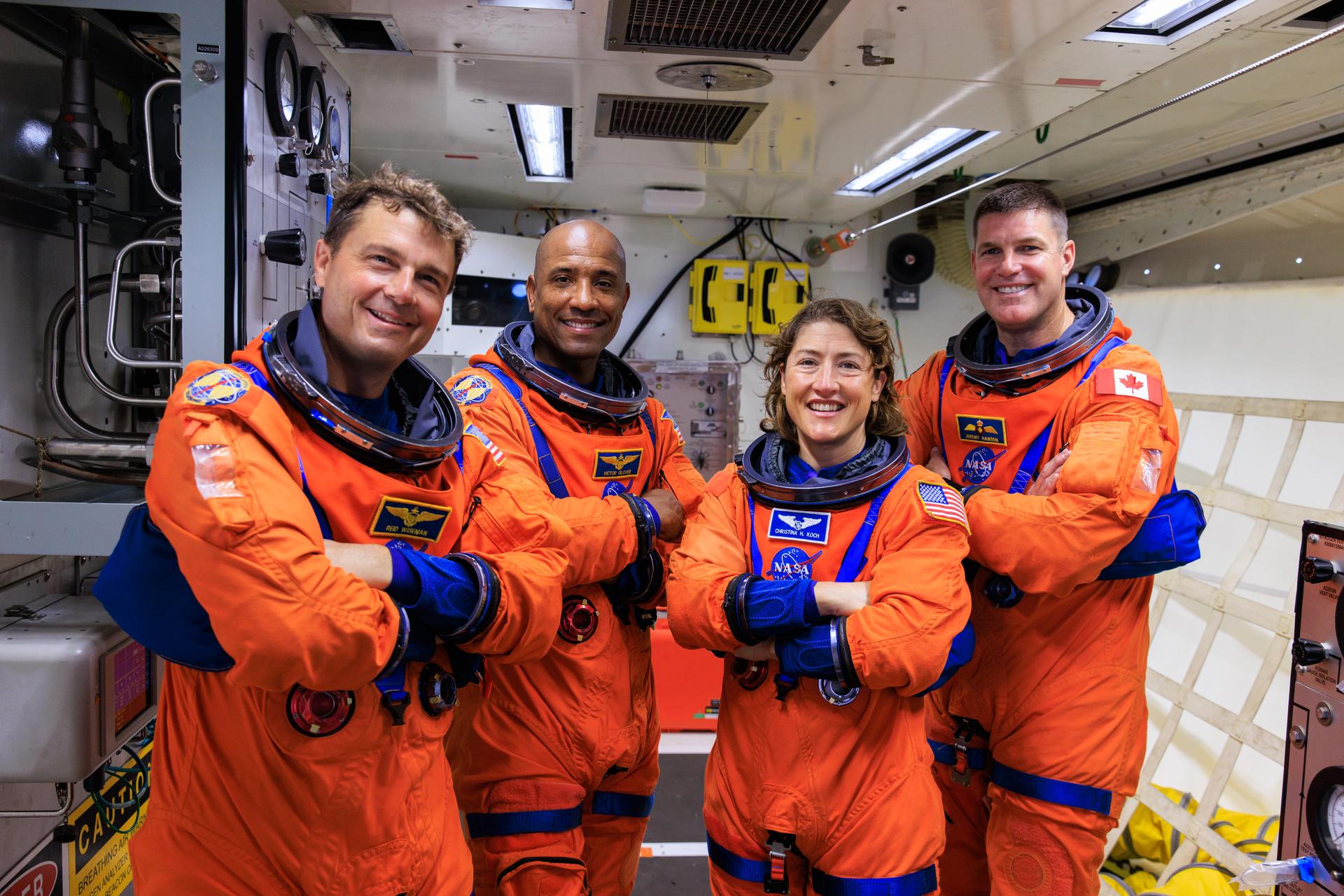
    Artemis II crew members (from left) CSA (Canadian Space Agency) astronaut Jeremy Hansen, and NASA astronauts Christina Koch, Victor Glover, and Reid Wiseman walk out of Astronaut Crew Quarters inside the Neil Armstrong Operations and Checkout Building to the Artemis crew transportation vehicles prior to traveling to Launch Pad 39B as part of an integrated ground systems test at Kennedy Space Center in Florida on Wednesday, Sept. 20, to test the crew timeline for launch day.
    NASA

    NASA announced Tuesday updates to its Artemis campaign that will establish the foundation for long-term scientific exploration at the Moon, land the first woman and first person of color on the lunar surface, and prepare for human expeditions to Mars for the benefit of all. To safely carry out these missions, agency leaders are adjusting the schedules for Artemis II and Artemis III to allow teams to work through challenges associated with first-time developments, operations, and integration.

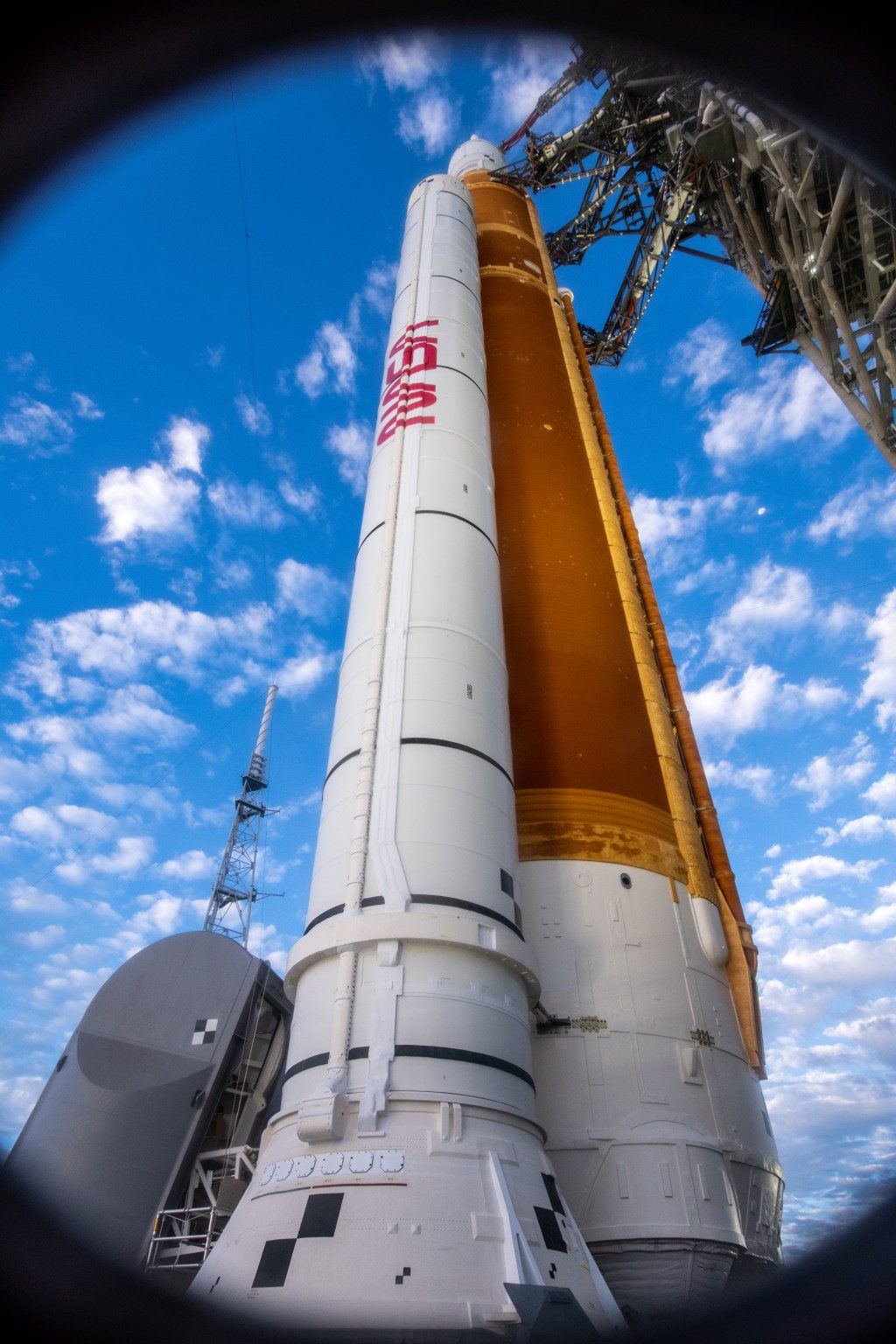
    NASA will now target September 2025 for Artemis II, the first crewed Artemis mission around the Moon, and September 2026 for Artemis III, which is planned to land the first astronauts near the lunar South Pole. Artemis IV, the first mission to the Gateway lunar space station, remains on track for 2028.

    “We are returning to the Moon in a way we never have before, and the safety of our astronauts is NASA’s top priority as we prepare for future Artemis missions,” said NASA Administrator Bill Nelson. “We’ve learned a lot since Artemis I, and the success of these early missions relies on our commercial and international partnerships to further our reach and understanding of humanity’s place in our solar system. Artemis represents what we can accomplish as a nation – and as a global coalition. When we set our sights on what is hard, together, we can achieve what is great.”

    Ensuring crew safety is the primary driver for the Artemis II schedule changes. As the first Artemis flight test with crew aboard the Orion spacecraft, the mission will test critical environmental control and life support systems required to support astronauts. NASA’s testing to qualify components to keep the crew safe and ensure mission success has uncovered issues that require additional time to resolve. Teams are troubleshooting a battery issue and addressing challenges with a circuitry component responsible for air ventilation and temperature control.

    NASA’s investigation into unexpected loss of char layer pieces from the spacecraft’s heat shield during Artemis I is expected to conclude this spring. Teams have taken a methodical approach to understand the issue, including extensive sampling of the heat shield, testing, and review of data from sensors and imagery.

    The new timeline for Artemis III aligns with the updated schedule for Artemis II, ensures the agency can incorporate lessons learned from Artemis II into the next mission, and acknowledges development challenges experienced by NASA’s industry partners. As each crewed Artemis mission increases complexity and adds flight tests for new systems, the adjusted schedule will give the providers developing new capabilities – SpaceX for the human landing system and Axiom Space for the next-generation spacesuits – additional time for testing and any refinements ahead of the mission.

    “We are letting the hardware talk to us so that crew safety drives our decision-making. We will use the Artemis II flight test, and each flight that follows, to reduce risk for future Moon missions,” said Catherine Koerner, associate administrator, Exploration Systems Development Mission Directorate at NASA Headquarters in Washington. “We are resolving challenges associated with first-time capabilities and operations, and we are closer than ever to establishing sustained exploration of Earth’s nearest neighbor under Artemis.”

    In addition to the schedule updates for Artemis II and III, NASA is reviewing the schedule for launching the first integrated elements of Gateway, previously planned for October 2025, to provide additional development time and better align that launch with the Artemis IV mission in 2028.

    NASA also shared that it has asked both Artemis human landing system providers SpaceX and Blue Origin – to begin applying knowledge gained in developing their systems as part of their existing contracts toward future variations to potentially deliver large cargo on later missions.

    “Artemis is a long-term exploration campaign to conduct science at the Moon with astronauts and prepare for future human missions to Mars. That means we must get it right as we develop and fly our foundational systems so that we can safely carry out these missions,” said Amit Kshatriya, deputy associate administrator of Exploration Systems Development, and manager of NASA’s Moon to Mars Program Office at headquarters. “Crew safety is and will remain our number one priority.”

    NASA leaders emphasized the importance of all partners delivering on time so the agency can maximize the flight objectives with available hardware on a given mission. NASA regularly assesses progress and timelines and as a part of integrated programmatic planning to ensure the agency and its partners can successfully accomplish its Moon to Mars exploration goals.

    With Artemis, NASA will explore more of the Moon than ever before, learn how to live and work away from home, and prepare for future human exploration of the Red Planet. NASA’s SLS (Space Launch System) rocket, exploration ground systems, and Orion spacecraft, along with the human landing system, next-generation spacesuits, Gateway lunar space station, and future rovers are NASA’s foundation for deep space exploration.

    For more information about Artemis, visit:

    https://www.nasa.gov/artemis

    -end-

    Kathryn Hambleton / Rachel Kraft
    Headquarters, Washington
    202-358-1100 / 202-365-7575
    kathryn.hambleton@nasa.gov / rachel.h.kraft@nasa.gov