Preparations for Next Moonwalk Simulations Underway (and Underwater)
Two Black Brant IX sounding rockets launched from Poker Flat Research Range in Fairbanks, Alaska, April 17, 2024, during an M-class solar flare for NASA’s sounding rocket solar flare campaign. The first rocket launched at 2:13 p.m. local Alaska time for the Focusing Optics X-ray Solar Imager (FOXSI) mission that used X-ray vision to observe the Sun during the solar flare event by focusing directly on high-energy X-rays. The second rocket launched at 2:14 p.m. for the High Resolution Coronal Imager, or Hi-C, mission designed to observe a large, active region in the Sun’s corona. The rockets reached altitudes up to 168 miles (271 km) and were able to successfully observe the solar flare.
The winners of NASA’s 2024 Power to Explore Student Challenge are: 9-year-old Raine Lin, left, 12-year-old Aadya Karthik, and 18-year-old Thomas Liu. Credit: NASA/Dave Lam
NASA announced the winners on Wednesday of the third annual Power to Explore Challenge, a national writing competition designed to teach K-12 students about the power of radioisotopes for space exploration.
The competition asked students to learn about NASA’s Radioisotope Power Systems (RPS), “nuclear batteries” the agency uses to explore some of the most extreme destinations in the solar system and beyond. In 250 words or less, students wrote about a mission of their own enabled by these space power systems and described their own power to achieve their mission goals.
“The Power to Explore Challenge is the perfect way to inspire students – our Artemis Generation – to reach for the stars and beyond and help NASA find new ways to use radioisotopes to power our exploration of the cosmos,” said Nicola Fox, associate administrator, Science Mission Directorate at NASA Headquarters in Washington.
Entries were split into three groups based on grade level, and a winner was chosen from each. The three winners, along with a guardian, are invited to NASA’s Glenn Research Center in Cleveland for a VIP tour of its world-class research facilities.
The winners are:
Rainie Lin, Lexington, Kentucky, kindergarten through fourth grade
Aadya Karthik, Redmond, Washington, fifth through eighth grade
Thomas Liu, Ridgewood, New Jersey, ninth through 12th grade
“Congratulations to this year’s winners and participants – together, we discover and explore for the benefit of all,” Fox said.
The Power to Explore Challenge offered students the opportunity to learn about space power, celebrate their strengths, and interact with NASA’s diverse workforce. This year’s contest received nearly 1,787 submitted entries from 48 states and Puerto Rico.
Every student who submitted an entry received a digital certificate and an invitation to the Power Up virtual event held on March 15 that announced the 45 national semifinalists. Additionally, the national semifinalists received a NASA RPS prize pack.
NASA announced three finalists in each age group (nine total) during Total Eclipse Fest 2024 in Cleveland on April 8, a day when millions of Americans saw a brief glimpse of life without sunlight, creating an opportunity to shed light on how NASA could power missions without the Sun’s energy at destinations such as deep lunar craters or deep space. Finalists also were invited to discuss their mission concepts with a NASA scientist or engineer during a virtual event.
The challenge is funded by the NASA Science Mission Directorate’s RPS Program Office and administered by Future Engineers under the NASA Open Innovation Services 2 contract. This contract is managed by the NASA Tournament Lab, a part of the Prizes, Challenges, and Crowdsourcing Program in NASA’s Space Technology Mission Directorate.
For more information on radioisotope power systems visit:
Preparations for Next Moonwalk Simulations Underway (and Underwater)
As the Moon blotted out the Sun to viewers across the United States during the April 8 solar eclipse, NASA’s Lunar Reconnaissance Orbiter (LRO) captured an image from some 223,000 miles away of the highly anticipated celestial event.
This spectacular image showing the Moon’s shadow on Earth’s surface was acquired during a 20-second period starting at 2:59 p.m. EDT (18:59:19 UTC) on April 8, 2024, by NASA’s Lunar Reconnaissance Orbiter. When LRO acquired this image, the shadow of the Moon was centered near Cape Girardeau, Mo.
NASA/Goddard/Arizona State University
There are three cameras that comprise the LRO camera (LROC) suite: two Narrow Angle Cameras (NAC) and one Wide Angle Camera. The Earth’s image with the shadow in it was acquired by one of the two Narrow Angle Cameras.
The LROC Narrow Angle Cameras are line scanner cameras: they only have one line of pixels, and images are built up line-by-line by the spacecraft’s motion as it orbits the Moon.
Acquiring an image of Earth requires the spacecraft to rapidly rotate to build up the image.
NASA’s Lunar Reconnaissance Orbiter (LRO) image of the eclipse shadow over Mexico and the southern U.S. was captured starting at 2:59 p.m. EDT (18:59:19 UTC) on April 8, 2024.
NASA/Goddard/Arizona State University
LRO is managed by NASA’s Goddard Space Flight Center in Greenbelt, Maryland, for the Science Mission Directorate at NASA Headquarters in Washington. Launched on June 18, 2009, LRO has collected a treasure trove of data with its seven powerful instruments, making an invaluable contribution to our knowledge about the Moon. NASA is returning to the Moon with commercial and international partners to expand human presence in space and bring back new knowledge and opportunities.
Preparations for Next Moonwalk Simulations Underway (and Underwater)
An illustration of the SERT II spacecraft, which was comprised of the Agena upper stage, the experimental thrusters and associated equipment, and two large solar arrays.
Credit: NASA
“A genuine space success story,” is how Experiments Manager William Kerslake described NASA’s second Space Electric Rocket Test (SERT II), the first long-duration operation of ion thrusters in space. SERT II provided researchers with data for years beyond its expected lifetime and was a rare example of an entire mission – including the launch, propulsion system, spacecraft, and control center – being handled by one organization: NASA’s Lewis Research Center in Cleveland (today, NASA Glenn).
The concept of electric propulsion thrusters dates back to the early 20th century, but because they must operate in a vacuum, there was no practical application for these systems until the space program decades later. In the late 1950s, researchers at NASA Lewis began investigating types of electric propulsion and analyzing missions that could use these systems. They produce low amounts of thrust by creating and accelerating small particles at high velocities, and over time, can accelerate spacecraft at very high rates of speed. Their ability to operate continuously for years at a time with little propellant makes them ideal for long-duration missions or keeping satellites in orbit.
This work was expanded in the early 1960s with the creation of Lewis’ Electromagnetic Propulsion Division and the construction of large vacuum facilities, including the Electric Propulsion and Power Laboratory (EPPL). Lewis engineer Harold Kaufman’s electron bombardment ion engine, which used liquid mercury as its propellant, was the most promising option. While Kaufman’s thruster was undergoing extensive testing in the EPPL tanks, Lewis engineers began developing a spacecraft to test the thruster. During the 50-minute suborbital SERT I flight on July 20, 1964, the Kaufman thruster became the first ion engine to operate in space.
In early 1968, the experimental portion of SERT II underwent six months of testing in Tank 5 at NASA Lewis Research Center’s (now, NASA Glenn’s) Electric Propulsion and Power Laboratory in conditions that simulated the temperatures and pressures it would encounter in space. The two thrusters can be seen in this photograph.
Credit: NASA/ Paul Riedel
Lewis continued improving the thruster system, and in August 1966 received approval for SERT II. Researchers wanted to verify the thrusters could operate for longer durations in space, determine their effect on other spacecraft systems, and measure the degradation of solar arrays over time.
The center began simultaneous development of the SERT II ion thruster system and the spacecraft that would place it into orbit: a Thorad-Agena rocket. SERT II had two 15-centimeter diameter electron bombardment thrusters affixed to the back end and a 5-by-40 foot solar array, the largest ever flown by NASA at that time, at the other end.
After a series of tests in the EPPL, SERT II blasted off on February 3, 1970. Project Manager Raymond Rulis called the launch “one of the smoothest operations I’ve seen.” SERT II was placed into a circular polar orbit that provided its solar arrays with the continuous sunlight required to power its thrusters and electronic systems.
A Thorad-Agena rocket lifts off from Vandenberg Air Force Base on February 3, 1970, with the SERT II spacecraft. NASA Lewis Research Center (now, NASA Glenn) managed the Agena Program between 1962 and 1970, with SERT II being the last of the center’s 28 successful launches.
Credit: NASA
On February 14, 1970, Lewis engineers activated the first thruster, beginning its six-month operational test. Three weeks later, operators shut the thruster down just before the vehicle passed through the path of a solar eclipse. It was restarted without issue afterwards and continued operation as the spacecraft encountered the eclipse a second time later that day.
The thruster operated successfully for five months until an electrical short in the grid caused it to fail on July 22, 1970. Two days later, the second thruster was activated. It operated smoothly for three-and-a-half months until a similar short occurred in mid-October. Though the SERT II thrusters failed to meet their six-month objectives, they did operate for extended periods, confirming data obtained in Lewis’ vacuum tanks.
The mission continued when Lewis engineers reactivated SERT II in 1973 to demonstrate cathode restarting, and the following year, they resolved an electrical short in one of the thrusters. During periods of intermittent sunlight, operators demonstrated restarting the thruster with less than an hour of power available. SERT II’s return to an orbit in continuous sunlight in 1979 provided Lewis researchers the opportunity to conduct over 500 restarts. They operated the thruster for 18,000 hours before the propellant ran out in the spring of 1981.
William Kerslake (seen in this 1981 photograph) and Louis Ignaczak managed the SERT II operations from a specially designed control center in NASA’s Lewis Research Center’s (now, NASA Glenn’s) 10-by 10-Foot Supersonic Wind Tunnel building. The control center allowed engineers to monitor the mission and send commands to the spacecraft through NASA’s satellite communication system.
Credit: NASA/Daniel Laiety
Over eleven years, SERT II provided data on hundreds of thruster restarts, restarts after shutdowns as long as 18 months, ion beam neutralization of one thruster by the other, and discovery of a new plasma thrust mode. SERT II also verified that thruster operation had no harmful impact on spacecraft and solar arrays.
Still, SERT II continued to be an asset to NASA researchers. In the late 1980s, Lewis engineers realized that an auxiliary experiment on SERT II that analyzed the effect of micrometeoroids on solar mirrors could be beneficial to research on solar dynamic systems to power space stations. During six months in sunlight in 1990, the Lewis team determined that after 20 years in orbit, there was no degradation of the solar mirror’s optical properties.
Many technological components of the SERT II thruster system were incorporated into subsequent generations of ion thrusters. By the time the mission was terminated, Lewis was already ground testing thrusters twice the size of those on SERT II. The center has continued to lead NASA’s electric propulsion efforts, developing an array of technologies, including the NEXT-C thrusters that powered the Deep Space 1 and Dawn spacecraft. In support of the agency’s Artemis missions, NASA Glenn recently tested the thrusters that will power Gateway, NASA’s future lunar space station.
Preparations for Next Moonwalk Simulations Underway (and Underwater)
During a research trip to Fiji, Dr. Lola Fatoyinbo poses in a cluster of coastal mangroves, just one of the aspects of forested and coastal ecosystems that she studies.
Courtesy of Dr. Lola Fatoyinbo
Dr. Lola Fatoyinbo, a research scientist at NASA’s Goddard Space Flight Center in Greenbelt, Maryland, received the Esmond B. Martin Royal Geographical Society (RGS) Prize on April 8 in London. The prize, according to the RGS, recognizes “outstanding achievement by an individual in the pursuit and/or application of geographical research, with a particular emphasis on wildlife conservation and environmental research studies.”
The late and renowned conservationist Esmond Bradley Martin founded the annual prize via a bequest; Fatoyinbo is the second recipient. The Esmond B. Martin Royal Geographical Society Prize recognizes outstanding achievement by individuals undertaking research into wildlife conservation and environmental studies, reflecting Esmond’s tireless work for the protection of wildlife and our natural environment.
Fatoyinbo is part of the Biospheric Sciences Lab at NASA Goddard, where she develops and uses advanced remote sensing technologies and data to understand forested and coastal ecosystems. The lab also studies mathematical modelling and advanced analytical techniques that allows scientists to characterise and predict environmental changes due to natural and anthropogenic processes at local to global scales.
“I am deeply honored and grateful to receive this award,” Fatoyinbo said. “Being the recipient right after Dr. Paula Kahumbu, whose work and mission I admire, and in the name of Esmond Bradley Martin, is inspiring and humbling. This recognition also profoundly motivates me to continue producing the environmental data and knowledge that I believe will help protect life on our planet.”
Fatoyinbo has authored or co-authored 60 publications in scientific journals, and she has also partnered with organizations to help protect ecosystems and provide pathways for her research to inform policy decisions.
“In her work, Lola manages to accomplish something of an engineering-theoretical, ecology applications trifecta,” said Woody Turner, NASA’s program manager for ecological conservation, NASA Headquarters in Washington. “By using complex active remote sensing from radars and lidars, she tests cutting edge theories of how tropical and subtropical coastal systems function. But she does all that without losing sight of the practical applications of her team’s work for real people making real decisions in dynamic environments. That kind of synthesis is very difficult to achieve and arises only from an extremely curious individual. Lola brings it all together.”
Her work on airborne light detection and ranging, or lidar, and satellite imagery campaigns after Hurricane Irma in the Caribbean, the impact of oil exploration in the Niger Delta, and studies of mangrove forests across the Americas, Africa, and Asia, have increased global understanding of some of Earth’s most critical systems and supported the voices of those that depend on them.
Fatoyinbo said she is also dedicated to training and mentoring the next generation of scientists looking to understand and help protect our home planet, starting with the junior researchers in her lab.
“Lola’s work exemplifies how geographical research has a real-world impact,” said Nigel Clifford, RGS president and chair of the awarding panel. “Her commitment to ensuring that scientific study influences policy shows true leadership in conservation and environmental research and makes her the perfect recipient for the Esmond B. Martin Royal Geographical Society Prize.”
The Royal Geographical Society (with the Institute of British Geographers) is the learned society and professional body for geography. Formed in 1830, their Royal Charter of 1859 is for the advancement of geographical science.
NASA experts from the Commercial Low Earth Orbit Development Program and Human Health and Performance Directorate with the agency’s commercial space station partners at the medical operations meeting series at Johnson Space Center in Houston (from top to bottom, left to right: Ben Easter, Dan Buckland, Tom Marshburn, Brian Musselman, Ted Duchesne, Darren Locke, Stephen Hart, Dana Levin, Liz Warren, Kris Lehnhardt, Kristin Coffey, Mary Van Baalan, Molly McCormick, Stephanne Plogger, John Allen, Brad Rhodes, Kimberly-Michelle Price Lowe, Lindsey Hieb, Anna Grinberg, Jay Boucher, Rahul Suresh, Jackeylynn Silva-Martinez, Melinda Hailey, Joey Arias, Wayne Surrett).
NASA/David DeHoyos
NASA is opening access to space for more people by working with private industry on the development of new commercial space stations for low Earth orbit where the agency’s astronauts could fly in the future.
New commercial space stations will be available to people beyond government or professional astronauts with years of specialized training and evaluation, so NASA is sharing its lessons learned from decades of human spaceflight experience, including more than 25 years of International Space Station operations, to help ensure future flights are as safe as possible for potential fliers.
“Since the majority of orbital human spaceflight programs have been owned and operated by governments, there are few industry best practices or established government regulations that inform maintaining the health and safety of humans during orbital spaceflight missions,” said Dr. Rahul Suresh, medical officer, Commercial Low Earth Orbit Development Program, NASA Johnson Space Center in Houston. “NASA is keen to fill this void by sharing its practices to assist and inform nascent commercial spaceflight programs and to ensure they are prepared to host future agency crewed missions aboard their platforms.”
Dr. Rahul Suresh, NASA Commercial Low Earth Orbit Development Program medical officer, participates in a discussion during the medical operations meeting series. Topics of discussion included medical risk management, medical selection standards, medical system design, and more.
NASA/David DeHoyos
NASA recently hosted a meeting series at the agency’s Johnson’s Space Center in Houston to share a variety of medical standards, processes, best practices, along with providing access to subject matter experts. Commercial companies in attendance included Axiom Space, Blue Origin, Sierra Space, SpaceX, Vast, and Voyager Space. All companies are working with the agency through funded or unfunded agreements for commercial space station development.
During the meetings and overall development process, the agency is offering guidance for evaluation of potential spaceflight participants from selection and training to in-flight and post-flight support, which are crucial to a platform’s success.
People may be living and working the commercial destinations for different purposes and for different lengths of time. Commercial providers will need to ensure people are ready to fly their mission for the safety of the individual, other fliers, and the destination.
Astronaut selection, training
Commercial Crew Program astronaut Barry “Butch” Wilmore prepares for Expedition 62 International Space Station spacewalk maintenance training at NASA’s Neutral Buoyancy Lab in Houston on Nov. 30, 2018.
NASA/Robert Markowitz
NASA astronauts undergo a rigorous selection process and years of training prior to a mission. For example, the astronaut candidate selection process includes a behavioral health screening program implemented by qualified psychologists and psychiatrists through multiple evaluation methods including validated screen tests, structured interviews, and observation of operational simulations to ensure that the assessments provide a comprehensive measure of a candidate’s behavioral health.
These evaluations help identify important traits such as problem-solving, teamwork, leadership, self-regulation, resilience, and adaptability – traits that NASA has found are directly related to success during training and spaceflight. They also identify disqualifying psychiatric conditions.
NASA has already shared and implemented similar screening requirements, including psychiatric evaluations and psychological testing, for recent private astronaut missions. The agency has publicly released its astronaut medical selection standards that includes both physiological and psychological testing requirements with screening criteria to enable success of these future platforms and commercial missions.
In-flight and post-flight support
View of Koichi Wakata, Expedition 38 flight engineer, exercising on the Advanced Resistive Exercise Device, in Node 3 on the International Space Station on Nov. 15, 2013.
NASA
Additionally, spaceflight poses numerous risks to maintaining the health and performance of astronauts during their missions. For example, the microgravity environment in low Earth orbit can cause bones and muscles to weaken, elevated radiation increases the long-term risk of conditions such as cancer and cataracts, and even otherwise healthy astronauts can develop life-threatening medical conditions such as kidney stones.
NASA has gained a wealth of knowledge over the years on the impacts of space on the human body and has been able to employ countermeasures to prevent these issues and maintain astronaut performance to ensure mission success. For instance, astronauts aboard the station exercise about one hour per day and eat a will balanced nutritional diet to combat bone density and muscle mass losses.
Even with countermeasures in place, astronauts still experience some physiological changes during a mission. Therefore, once an astronaut crew returns to Earth, there is a period of post-flight reconditioning, which begins on landing day and lasts for about 45 days. This reconditioning program is designed to return astronauts to their pre-flight physical condition.
The complex medical operations that go into any spaceflight mission, starting with astronaut selection and training though post-flight support, are critical for commercial space station partners to understand.
“After the success of our payload operations meeting series hosted at the agency’s Marshall Space Flight Center in Huntsville, Alabama, earlier this year, this medical operations series is another great example of how we are providing immense value to our commercial low Earth orbit partners to ensure their success,” said Angela Hart, manager for NASA’s Commercial Low Earth Orbit Development Program. “By enabling companies to have unique access to NASA experts and data, we are actively supporting those build schedules to be ready for the retirement of the space station.”
NASA flight surgeon Dr. William Tarver delivers a presentation on post-launch medical support, mission readiness, and NASA’s health stabilization program.
NASA/David DeHoyos
NASA plans to continue providing best practices documents on its public website along with offering additional meeting series in the future to commercial partners to continue the sharing of knowledge to enable a successful commercial space ecosystem.
For more information about NASA’s commercial space strategy, visit:
NASA’s New Hubble E-Book Spotlights Universe’s Best-Kept Dark Secrets
This e-book is part of a series called Hubble Focus, which presents some of Hubble’s recent cosmic discoveries. Its cover, shown here, features the Abell S1063 galaxy cluster. A soft blue haze, called intracluster light, casts an otherworldly glow among innumerable galaxies. The stars producing this glow were thrown free of their home galaxies. These stars now live solitary lives, no longer part of a galaxy but aligning themselves with the gravity of the overall cluster. Astronomers using Hubble found that tracing intracluster light offers a good indicator of how invisible dark matter is distributed in the cluster.
NASA Goddard Space Flight Center
NASA’s Hubble Space Telescope team has released a new downloadable e-book in the Hubble Focus series, called “Hubble Focus: The Dark Universe.” This e-book highlights the mission’s recent discoveries about two mysterious components of our universe, known as dark energy — an unexplained cosmic pressure that’s speeding up the universe’s expansion — and dark matter, an invisible substance detectable only by seeing how it gravitationally influences visible matter.
“This new e-book is a wonderful summary of all the work that Hubble, in cooperation with other observatories on the ground and in space, has put into improving our understanding of two of the biggest mysteries in astrophysics today: the true nature and origin of dark matter and dark energy,” said Ken Carpenter, Hubble’s operations project scientist. “Much remains to be done, but this book will give you a front row seat to what’s been happening in this quest!”
This Hubble image features an unusually close-knit collection of five galaxies, called The Hickson Compact Group 40. Though such cozy groupings can be found in the heart of huge galaxy clusters, these galaxies are notably isolated in their own small patch of the universe. One possible explanation is that there’s a lot of dark matter holding these galaxies together. Hubble’s sensitivity, resolution, and wavelength range help astronomers probe the fundamental nature of the universe, including its most mysterious components.
NASA, ESA, STScI; Image processing: Alyssa Pagan (STScI)
A Cosmic Ghost Hunt
The trillions of stars, planets, galaxies, and other visible objects strewn throughout the cosmos represent less than 5 percent of what’s truly out there. Visible matter is like the tip of an iceberg, or the foam on top of a latte. All the rest of the universe, dark matter and dark energy, is mired in mystery.
Dark matter is a phantom in the machinery of the universe. Though it makes up the vast majority of the universe’s bulk, dark matter would evade even the best “ghost hunters” because it’s invisible, detectable only through its effects on normal matter. Its gravitational pull is the muscle of the cosmos, holding together both individual galaxies and galaxy clusters. Although scientists have long seen evidence of its existence, dark matter’s true nature remains one of the biggest mysteries in modern physics.
Hubble’s cosmic detective work offers clues by exploring the way matter, both normal and dark, is structured and distributed throughout space. Some of the mission’s observations have even tested theories about the type of particle that could make up dark matter. But Hubble’s observations haven’t always matched predictions, hinting that our theoretical models still have several missing pieces.
Under Pressure
Shock waves of surprise rippled through the scientific community in 1998, when Hubble observations of supernovae in more distant galaxies helped show that the universe actually expanded more slowly in the past than it does today. That meant the expansion of the universe was not slowing down due to the attractive force of gravity, as many thought it should — it was speeding up.
Today, we still don’t know the exact cause of this mysterious acceleration, but theoretical cosmologists coined the term “dark energy” to describe it. Dark energy is so weak that gravity overpowers it on the scale of humans, planets, and even within the galaxy, which is why it was unobserved for so long.
An artist’s impression of the cosmic web. Gravity builds a vast cobweb-like structure of filaments tying galaxies and galaxy clusters together along invisible bridges hundreds of millions of light-years long. Hubble studies the cosmic web to help us better understand the invisible forces that have shaped our universe into this structure.
Volker Springel (Max Planck Institute for Astrophysics) et al.
Dark energy is present in the room with you as you read, even within your body, but gravity is much stronger at smaller scales, which is why you don’t fly out of your seat. It is only on an intergalactic scale that dark energy becomes noticeable — and since it’s everywhere, it even overwhelms the dark matter! Hubble has helped gather very precise measurements of the universe’s expansion rate, but its findings underscore a nagging discrepancy. The universe is expanding faster now than was expected from its trajectory seen shortly after the big bang, and no one yet knows why.
The perplexity surrounding dark energy and dark matter indicates that for all we’ve learned about the universe, we still don’t know much about its underpinnings. Studying these mysteries opens the door to discovering exciting new physics.
“Hubble’s incredible scientific power continues to drive modern astronomy,” said Jennifer Wiseman, Hubble’s senior project scientist. “Dark matter and dark energy were not in mind when Hubble was first designed, and yet by detecting the impacts of these unseen cosmic phenomena, the Hubble Space Telescope is once again transforming our understanding of the universe.”
Scientists will expand upon Hubble’s insights about dark matter and dark energy with complementary observations from the European Space Agency’s Euclid mission, which has NASA contributions; NASA’s upcoming Nancy Grace Roman Space Telescope, and variety of other space and ground-based telescopes. We have far more left to learn among the stars.
As the fifth edition of the series, this e-book builds on the wealth of information shared in previous renditions, which focused on the solar system, galaxies, stars, and exoplanets. Upcoming editions will zoom in on other cosmic topics, such as black holes – astronomical objects with such strong gravity that nothing, not even light, can escape their clutches.
On April 8, 2024, North America will witness its last total solar eclipse for more than twenty years. Other parts of the world will experience the rare celestial event in the coming decade. A total solar eclipse occurs when the Moon passes directly between the Sun and the Earth, blocking its disk from view but making its corona visible in a dazzling display. Although spectacular when seen from the ground, observed from space, solar eclipses appear as large shadows moving across the face of the Earth. The unique geometry of the Earth-Sun-Moon system allows total solar eclipses to occur. Eclipses also occur outside the Earth-Moon system, although the geometries of those worlds rarely if ever produce the stunning display visible on Earth. Spacecraft exploring other worlds have documented these extraterrestrial eclipses.
Left: Schematic geometry of a solar eclipse; sizes and distances not to scale. Right: Path of the April 8, 2024, total solar eclipse. Image credit: courtesy Sky & Telescope.
A solar eclipse occurs when the Moon passes between the Sun and the Earth, with the Moon casting its shadow on its home planet. Although the Sun is much larger than the Moon, it is also much farther away. As seen from Earth, the Sun and Moon have roughly the same angular diameter and appear roughly the same size in the sky. A total eclipse occurs when the Moon blocks out the Sun’s disk entirely. Because the Moon does not orbit in a perfect circle around the Earth, it appears smaller at its farthest point thus creating annular eclipses. Moons around other planets can also create eclipses although their different sizes relative to the Sun do not create our familiar eclipses. Planets with multiple moons can have more than one eclipse occur at the same time.
Left: Gemini XII astronauts photograph the total solar eclipse from Earth orbit in November 1966. Middle: Surveyor 3 observes a solar eclipse from the Moon in April 1967. Right: In November 1969, Apollo 12 astronauts returning from Moon experienced a solar eclipse as the Earth blocked the Sun shortly before splashdown.
Gemini XII astronauts James A. Lovell and Edwin E. “Buzz” Aldrin for the first time photographed a solar eclipse from Earth orbit on Nov. 12, 1966. Sixteen hours into their flight, the nearly total eclipse came into view as they flew over the Galapagos Islands and Aldrin took several photographs and a short film clip. Calculations showed that Gemini XII passed within 3.4 miles of the center of the eclipse’s path that traversed South America. The Surveyor 3 spacecraft observed the first solar eclipse from the Moon on April 24, 1967. Unlike solar eclipses observed on Earth, this time the Earth itself blocked the Sun – observers on Earth saw the event as a lunar eclipse as the Moon passed through the Earth’s shadow. In November 1969, as Apollo 12 astronauts Charles “Pete” Conrad, Richard F. Gordon, and Alan L. Bean neared Earth on their return from the second lunar landing – during which they visited Surveyor 3 – orbital mechanics had a show in store for them. Their trajectory passed through Earth’s shadow, treating them to a total solar eclipse. From their perspective, the Earth appeared about 15 times larger than the Sun. Gordon radioed Mission Control, “We’re getting a spectacular view at eclipse,” and Bean proclaimed it a “fantastic sight.” Conrad reported on the rapidly changing scenery, with the Sun illuminating the Earth’s atmosphere in a 360-degree ring with ever-changing colors while the planet remained pitch black. In the darkness, they could see flashes of lightning in thunderstorms appearing as fireflies. As their eyes adapted to the dark portion of the Earth, they saw landmasses such as India and even city lights. In the center of the Earth’s dark disc they reported seeing a large bright circle that turned out to be the glint of the full Moon reflecting off the Indian Ocean.
Left: The Moon’s shadow photographed from Mir during the August 1999 eclipse. Image credit: courtesy French space agency CNES. Middle: NASA astronaut Donald R. Pettit observed the first solar eclipse from the International Space Station during Expedition 6 in December 2002. Right: Pettit’s second eclipse during Expedition 31 in May 2012.
The credit belongs to French astronaut Jean-Pierre Haigneré for taking the first photograph from Earth orbit of the Moon’s shadow during a solar eclipse. He photographed the Aug. 11, 1999, total eclipse pass over England while onboard the Russian space station Mir as an Expedition 27 flight engineer. NASA astronaut Donald R. Pettit claims the title as the first person to photograph an eclipse from the International Space Station when he observed the Dec. 2, 2002, total eclipse during Expedition 6. As an additional claim, on May 20, 2012, Pettit observed his second eclipse from the space station during Expedition 31, this one an annular eclipse over the Western Pacific Ocean.
Left: Expedition 12 image of the March 2006 total eclipse over the eastern Mediterranean Sea. Middle: Expedition 52 image of the August 2017 total eclipse over North America. Right: Expedition 63 image of the June 2020 annular eclipse.
Left and middle: Two views of the eclipse over Antarctica in December 2021, from the Expedition 66 crew aboard the space station, left, and from the Deep Space Climate Observatory (DSCOVR) satellite. Right: DSCOVR image of the October 2023 annular solar eclipse over North America.
Space station crews have observed and documented a number of solar eclipses in addition to Pettit’s two sightings, their ability to see the Moon’s shadow as it traverses the Earth’s surface determined by their orbital trajectory. Expedition 12 observed the total eclipse on March 29, 2006, Expedition 43 documented the total eclipse on March 25, 2015, Expedition 52 observed the most recent total eclipse visible from North America on Aug. 21, 2017, Expedition 61 observed the annular eclipse on Dec. 26, 2019, Expedition 63 saw the annular eclipse on June 21, 2020, Expedition 66 imaged the total eclipse over Antarctica on Dec. 4, 2021, and Expedition 70 viewed the annular eclipse visible in North America on Oct. 14, 2023. Positioned nearly one million miles away at the L1 Earth-Sun Lagrange point, the National Oceanic and Atmospheric Administration’s Deep Space Climate Observatory (DSCOVR) satellite keeps a watchful eye on Earth’s climate. NASA’s Earth Polychromatic Imaging Camera (EPIC), a camera and telescope aboard DSCOVR, has taken stunning images of the Moon’s shadow during eclipses as well as the Moon transiting across the face of the Earth.
Mars
Beyond the Earth-Moon system, eclipses do not occur on Mercury and Venus since they lack natural satellites to block out the Sun. Mars has two small satellites, Phobos and Deimos, both too small to fully eclipse the Sun, even though it appears only half as big as on Earth. Several rovers have captured Phobos and Deimos as they form annular eclipses. Some astronomers contend that due to the small sizes of the Martian satellites, especially Deimos, compared to the Sun, these are technically transits, not eclipses, but no formal definition exists. The Mars Exploration Rover Opportunity imaged the first eclipses from the surface of Mars shortly after its arrival on the planet, first of Deimos on March 4, 2004, followed by Phobos three days later. More recently, the Mars 2020 Perseverance rover imaged the annular eclipse of Phobos on April 20, 2022, and the eclipse (or transit) of Deimos on Jan. 22, 2024.
Left: Mars Exploration Rover Opportunity images of Deimos, left, and Phobos crossing in front of the Sun. Middle: Perseverance image of a Phobos annular eclipse in April 2022. Right: Perseverance image of a Deimos eclipse (or transit) in January 2024.
Jupiter
Left: Hubble Space Telescope infrared image of a triple eclipse on Jupiter on March 28, 2004, with moons Ganymede, Io, and Callisto casting shadows on the planet. Middle: Hubble Space Telescope image of the Jan. 24, 2015, multiple eclipse on Jupiter, with five of its moons – Callisto, Io, Europa, Amalthea, and Thebe – casting shadows on the planet. Right: Europa eclipses Io in December 2014, as observed through an Earth-based telescope. Image credit: courtesy Jen Miller and Joy Chavez, Gemini Observatory.
Since the outer gas giant planets do not have solid surfaces, no spacecraft has imaged an actual eclipse by one of the multitude of moons orbiting these worlds. What we can observe, through ground-based and orbiting telescopes and spacecraft are the shadows cast by the moons on their home planets. Eclipses on Jupiter are not exceptionally rare given the planet’s large size compared to its many moons and greater distance from the Sun. Only five of Jupiter’s moons, Amalthea, Io, Europe, Ganymede, and Callisto are either large enough or close enough to the planet to completely occult the Sun. And given the low tilts of the moons’ orbits, they cast a shadow on every revolution. Double, triple and multiple simultaneous eclipses are not uncommon. The Hubble Space Telescope has observed numerous such events. Given the number of Jupiter’s moons, especially the four large Galilean moons, and that their orbits all lie very close to Jupiter’s equatorial plane, they occasionally eclipse each other, with the outer moons passing between the Sun and the inner moons. When Earth passes through Jupiter’s equatorial plane, fortunate observers can capture these rare events using ground-based telescopes, sometimes accidentally as they observe the Galilean moons for other reasons.
Left: Juno image of Io’s shadow on Jupiter in September 2019. Right: Juno image of Jupiter’s moon Ganymede casting its shadow on the planet in February 2022.
The Juno spacecraft, in orbit around Jupiter since 2016, has returned stunning images of Jupiter’s cloud patterns. On Sept. 11, 2019, it captured a spectacular image of Io’s shadow on Jupiter’s colorful cloud tops. On Feb. 25, 2022, Juno imaged the largest moon Ganymede’s shadow.
Saturn and beyond
Left: As it orbited Saturn, in November 2009 Cassini imaged eclipses of moons Titan, center, and Enceladus, lower right of Titan, and the planet’s rings. Middle: Titan casts its shadow, elongated by the planet’s curvature, on Saturn in this November 2009 image from the Cassini orbiter. Right: Sequential Hubble Space Telescope February 2009 images of a quadruple eclipse, as Saturn’s moons Enceladus, Dione, Titan, and Mimas cast their shadows on the planet.
Like Jupiter, dozens of moons orbit around the ringed planet Saturn, providing ample opportunities for telescopes and spacecraft to observe them passing in front of and casting their shadows onto the planet. The Cassini spacecraft, in orbit around Saturn between 2004 and 2017, captured thousands of images of the planet, its rings, and its moons. On many occasions, Cassini passed behind the planet and its moons, creating artificial eclipses, while at other times the spacecraft imaged the moons’ shadows on the planet’s cloud tops. The Hubble Space Telescope captured a series of images of a rare quadruple eclipse on Feb. 24, 2009, as Saturn’s moons Enceladus, Dione, Titan, and Mimas transited across the planet, casting their shadows on the cloud tops.
The Cassini spacecraft created this artificial eclipse of Saturn in November 2013 as it traveled beyond Saturn during one of its orbits, with many objects, including Earth, made visible.
On July 19, 2013, Cassini took a series of images from a distance of about 750,000 miles as Saturn eclipsed the Sun. In the event dubbed The Day the Earth Smiled, people on Earth received notification in advance that Cassini would be taking their picture from 900 million miles away, and were encouraged to smile at its camera. In addition to the Earth and Moon, Cassini captured Venus, Mars, and seven of Saturn’s satellites in the photograph.
Left: Composite image showing the relative apparent sizes of the Sun and a selection of planetary moons. Image credit: courtesy sdoisgo.blogspot.com. Middle: July 2006 Hubble Space Telescope image of Uranus and its moon Ariel casting a shadow on the planet. Right: The New Horizons spacecraft created an artificial eclipse as it flew behind Pluto during its July 2015 flyby, the Sun’s rays highlighting its tenuous atmosphere.
The Earth occupies a unique position with the nearly equal apparent diameters of the Moon and the Sun, providing opportunities for annular and total solar eclipses. As viewed from planets farther in the solar system, the Sun’s apparent diameter diminishes, with the apparent sizes of the moons orbiting those planets either larger or smaller than the Sun. Eclipses as we know them do not exist elsewhere in the solar system. Spacecraft exploring those remote worlds easily create artificial eclipses by passing through the planets’ shadows, often revealing important information, such as New Horizons imaging the tenuous atmosphere surrounding Pluto.
Paths of solar eclipses between 2021 and 2030. Image credit: courtesy Greatamericaneclipse.com.
The next total solar eclipse visible in North America will not occur until 2044, but over the next few years, several eclipses visible in other parts of the world will no doubt be targets of opportunity for astronauts’ cameras aboard the space station. And spacecraft exploring planets in the solar system will continue to document eclipses in those faraway places.
On April 8, NASA and its partners will celebrate the wonders of the total solar eclipse as it passes over North America, with the path of totality in the United States, from Kerrville, Texas, to Houlton, Maine.
Eclipses are an important contribution to NASA’s research into the Sun’s outer atmosphere, or corona, and the part of Earth’s atmosphere where space weather happens. They’re also an inspirational opportunity for the public to get involved, learn, and connect with our place in the universe.
“Working with external partners extends NASA’s reach and allows diverse audiences access to information about eclipses and the importance of safe viewing,” said Maureen O’Brien, strategic alliances and partnerships manager for NASA’s Office of Communications. “Our partners bring their creativity in sharing the excitement of the upcoming eclipse and help encourage everyone to safely enjoy this celestial event.”
Here are just some ways NASA is working with partners to engage the public in the upcoming total solar eclipse.
NASA and the Major League Baseball Players Association are collaborating on the development of video and social content to emphasize eclipse awareness and safe viewing.
In partnership with the MLB, NASA will provide video content to air at stadiums during games and agency officials will throw out the first pitch in several games leading up to the eclipse.
Indianapolis Motor Speedway is hosting an eclipse viewing event and live broadcast that will feature NASA exhibits, astronauts, INDY drivers, and STEM engagement talks and activities for visitors.
Peanuts Worldwide is supporting educators with the release of new eclipse learning resources for elementary and middle school students and Snoopy is participating in events in Cleveland.
Krispy Kreme introduced a new doughnut in honor of the eclipse and will share information about the eclipse and safe viewing.
NASA is working with Google on new eclipse content on the Arts & Culture and other Google pages.
Third Rock Radio (TRR) is sharing NASA podcast content and expert interviews, educational and safety messages, and a message from the International Space Station. TRR also will feature a Solar Songs listener request weekend leading up to eclipse day and live NASA TV audio coverage during the eclipse.
Nasdaq will carry coverage of part of the NASA TV broadcast on its screen in Times Square.
“This year’s total solar eclipse represents a unique opportunity for NASA and partners to collaborate to inspire and engage students across the country,” said Rob Lasalvia, partnership manager for NASA’s Office of STEM Engagement.
Crayola Education released an eclipse-themed how-to video about the eclipse with a creative exercise for students.
LEGO Education launched an eclipse education challenge to engage students and the public in learning more about the Sun and the eclipse.
Microsoft will launch a quiz on eclipse safety with links to NASA resources.
Discovery Education will get classrooms excited about space with eclipse resources on its PreK–12 learning platform.
The Achievery will feature a collection of eclipse videos, share NASA’s live eclipse coverage, and host student events at AT&T locations across the country.
NASA experts participated in a Game Jam hosted by the National Esports Association in February in which university students were challenged to create a game simulation of the Eclipse. The student-developed games will be featured during an online eclipse gaming event April 8.
Jack and Jill of America, Inc. will host eclipse watch parties across the country for which NASA will provide viewing eclipse resources and educational materials.
Girl Scouts of the USA is sharing NASA eclipse information and encouraging its chapters and troops to host watch parties or connect to local NASA events.
NASA partnered with the National Park Service and Earth to Sky on activities, including the “Interpreting Eclipses” webinar series, to prepare interpreters and informal educators for the total eclipse and Heliophysics Big Year. Through this partnership, national parks hosting eclipse events also will provide elements designed especially for the blind and low vision, neurodivergent children, the physically impaired, and those with hearing impairments.
NASA is providing eclipse resources and educational materials to local 4-H clubs along the path of totality through a partnership with the U.S. Department of Agriculture.
“At NASA, we believe that science is for everyone. You don’t need a degree in science to be curious, ask questions, and explore how our world and universe work,” said Anita Dey, partnerships manager for outreach and engagement for NASA’s Science Mission Directorate. “We work to help people on their own journeys of scientific exploration.”
The Iconic Photos from STS-41B: Documenting the First Untethered Spacewalk
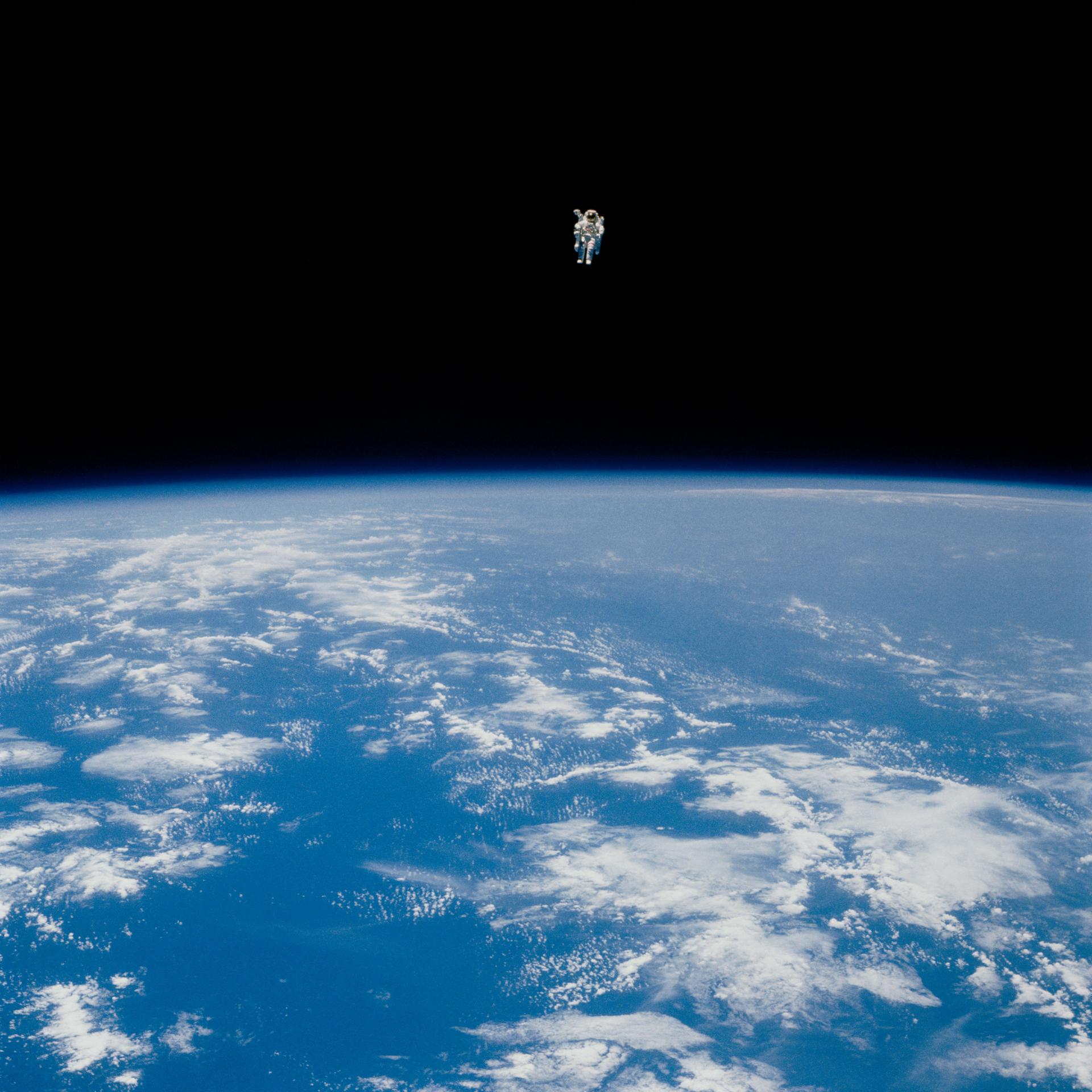
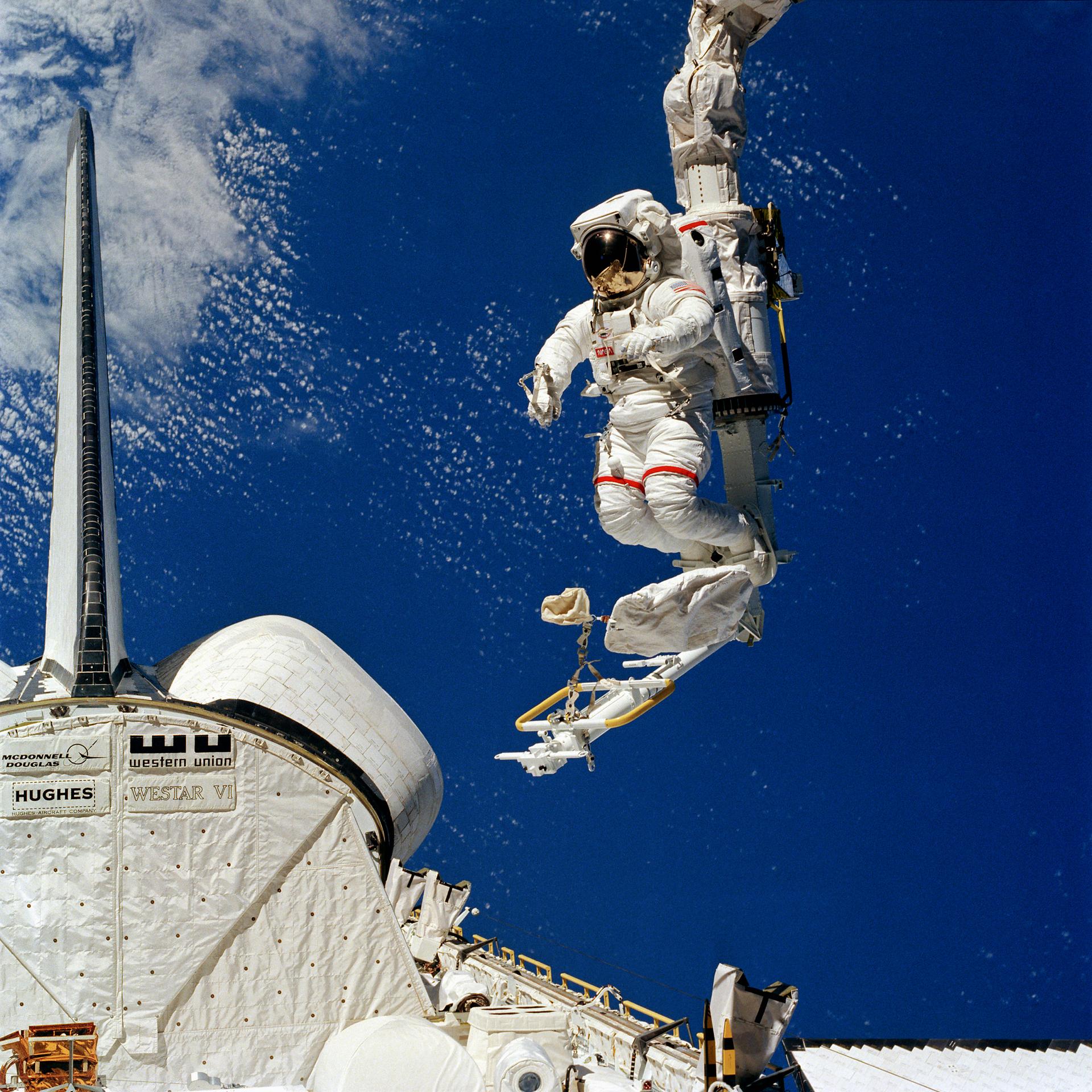
Astronaut Bruce McCandless II, STS-41B mission specialist, reaches his maximum distance from space shuttle Challenger before returning to the spacecraft using the Manned Maneuvering Unit (MMU).
Credits: NASA
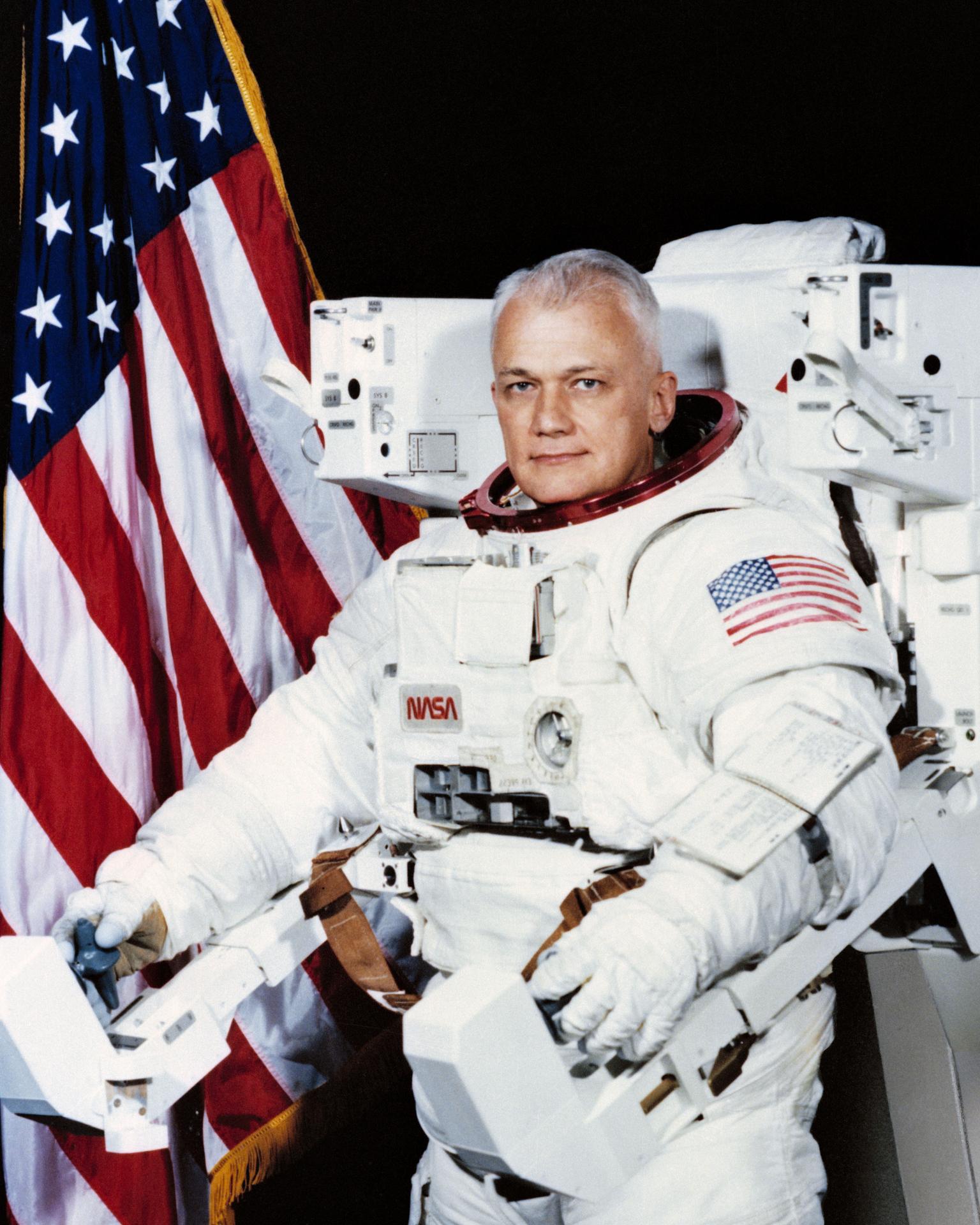
As astronaut Bruce McCandless II flew the Manned Maneuvering Unit (MMU) out of the space shuttle Challenger’s payload bay for the first time on February 7, 1984, many in the agency were fearful about the use of a self-propelled and untethered backpack in space. (Previous spacewalkers remained connected to the vehicle with tethers. This jet-pack allowed crews to move outside of the cargo bay and perform activities away from the safety of the spacecraft.) He remembered trying to ease the tension for his wife and the flight controllers in Mission Control, saying something similar to Neil Armstrong’s declaration as he first stepped on the Moon in 1969. “It may have been one small step for Neil,” he proclaimed, “but it’s a heck of a big leap for me.”
It may have been one small step for Neil, but it’s a heck of a big leap for me.
Bruce McCandless II
NASA Astronaut
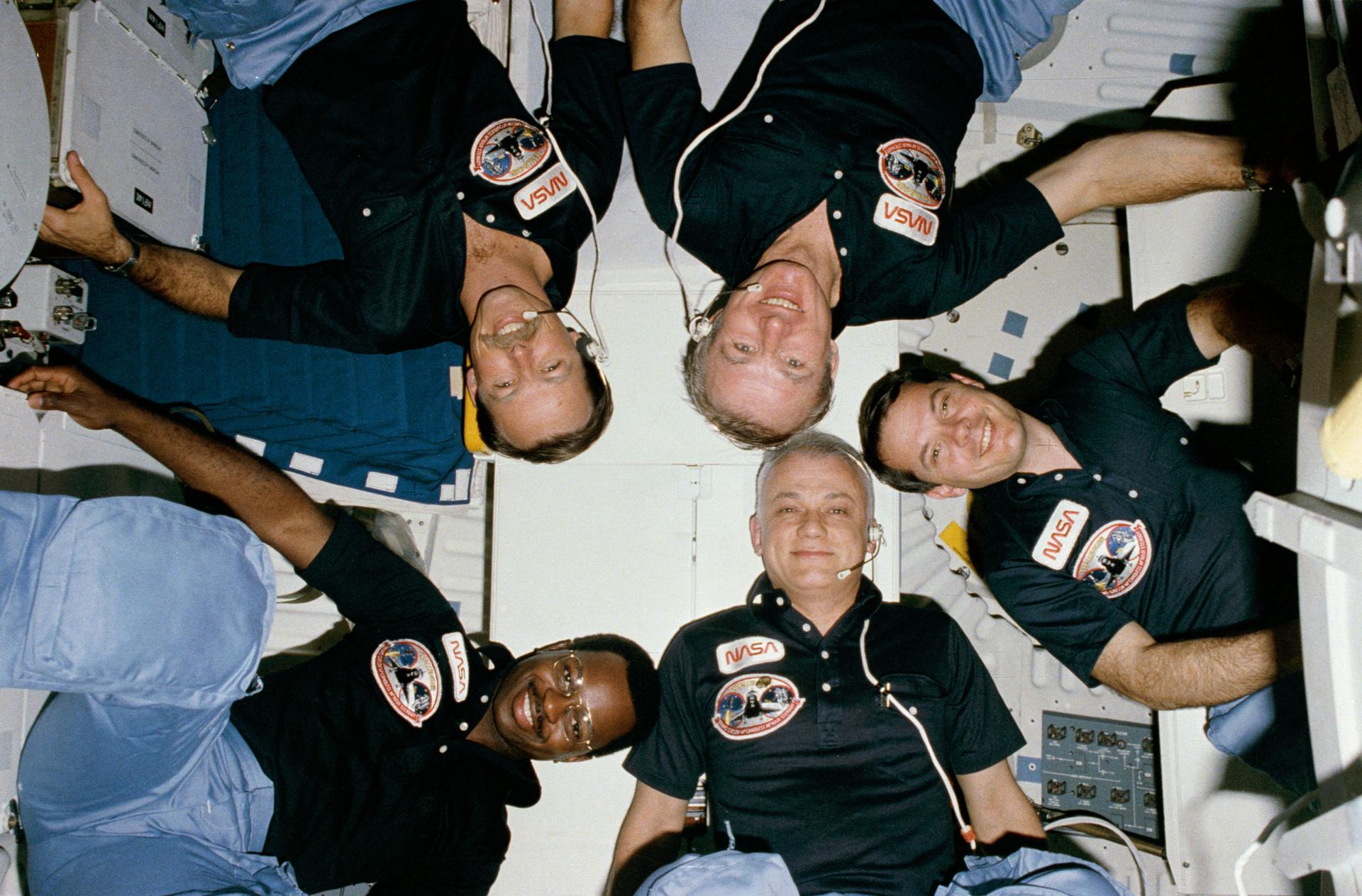
The crew of STS-41B take an informal portrait on the mid-deck of the Earth-orbiting Challenger. Counter clockwise from the top right are astronauts Vance D. Brand commander; Robert L. “Hoot” Gibson, pilot; and Dr. Ronald E. McNair, Bruce McCandless II, and Robert L. Stewart, all mission specialists.
NASA
The MMU was the highlight of the STS-41B mission as demonstrated by the stunning mission photographs that graced the cover of Aviation Week & Space Technology, not once, not twice, but three times.
“Hoot” Gibson, the flight’s pilot, shot the photograph featured on the February 20, 1984, issue of the magazine from the crew cabin. Gibson remembered he was the only one on the crew that “had absolutely nothing to do” as McCandless made his way out into space, so he picked up a Hasselblad camera and began documenting the events. When he first looked through the camera’s viewfinder, he could not believe what an incredible sight it was to see McCandless untethered, floating above the Earth. Gibson wanted to capture what he was seeing and remembered how meticulous he was. For each photograph he took three light meter readings and checked the focus four times. In the crew’s photography training he learned that an off-kilter horizon looked wrong and was not pleasing to the eye. That presented a slight problem because Challenger was at a 28.5-degree inclination, so he “tilted the camera to put the horizon level in the pictures.”
Astronaut Bruce McCandless II is a few meters away from the cabin of the Earth-orbiting space shuttle Challenger in this iconic photo taken by Hoot Gibson, which was featured on the February 20, 1984 issue of Aviation Week & Space Technology.
NASA
The result was one of NASA’s most iconic and requested images. McCandless called the photograph “beautiful, partly because the sun is shining directly on me.” His son, Bruce McCandless III, said his father “appears to be glowing.” Because the sun was in his eyes, he closed the helmet visor, which made it difficult to identify who exactly was inside the spacesuit. “My anonymity means people can imagine themselves doing the same thing,” he said. And, he added, “at visitor centres [sic], they often have life-sized cardboard versions with the visor cut out, so people can peep through.” Perhaps more importantly, as expressed by United States Senator John McCain, the photo “inspired generations of Americans to believe that there is no limit to the human potential.”
A second, but less recognized image, appeared on the cover of Aviation Week & Space Technology the following week: February 27, 1984. Also taken by Gibson, the image featured McCandless on the Manipulator Foot Restraint or “cherry picker” device at end of the Remote Manipulator System (RMS). The restraint was a platform where spacewalkers could work outside the vehicle but remain anchored at the end of the RMS to repair a satellite or other activities. STS-41B marked the first test of the new apparatus. Gibson explained how he chose to capture McCandless on the device. “What I did was I shifted the camera so that he wasn’t right in the center of the picture. I put him on the edge and the orbiter’s rudder on the other edge of the picture. That made a really cool photo.”
The feet of Bruce McCandless II are anchored in the Mobile Foot Restraint (MFR) and moved around by the Remote Manipulator System (RMS). The aft portion of the Challenger, to which the RMS is connected, is seen in lower left corner.
NASA
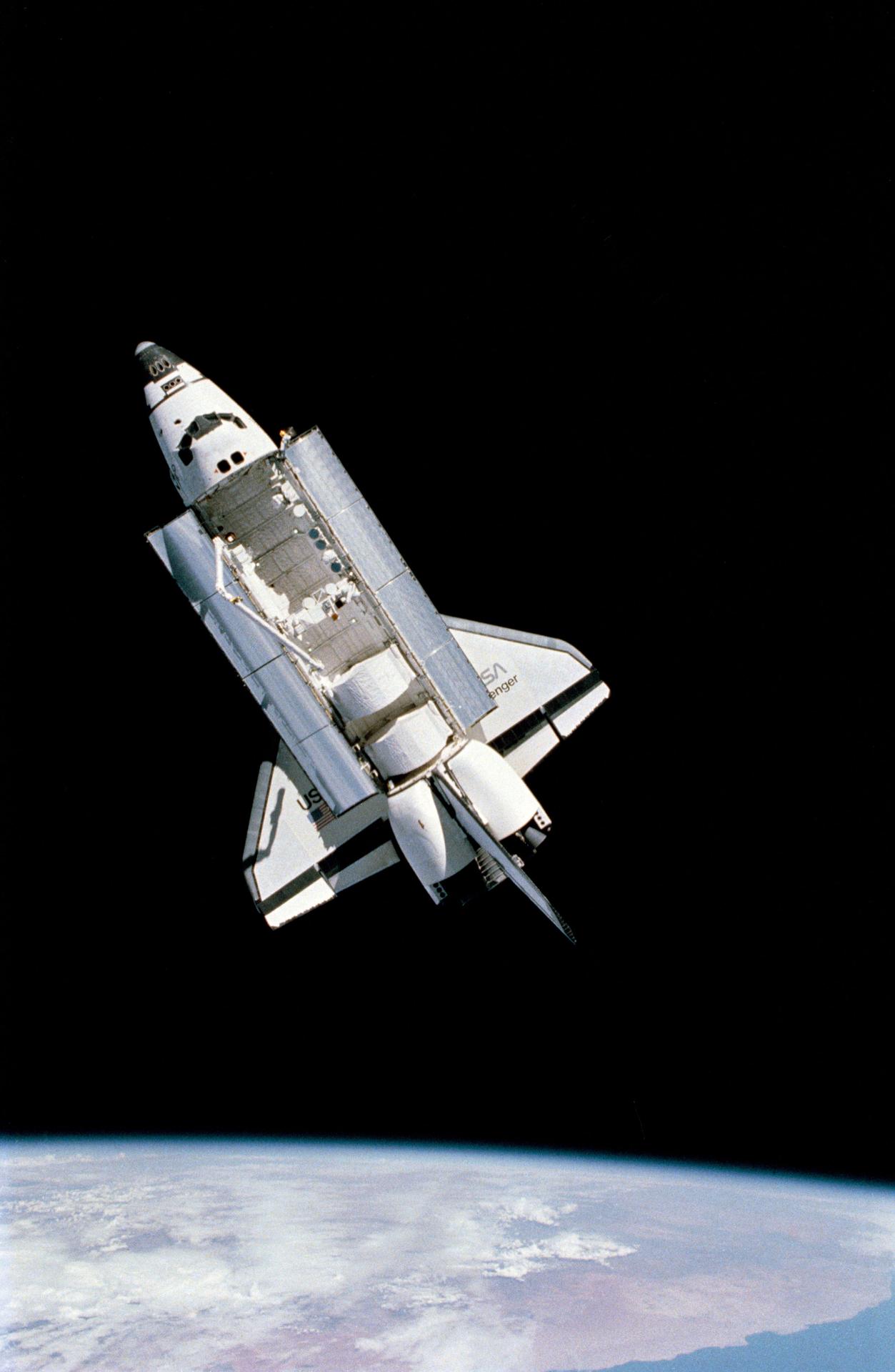
A third image from the mission appeared on the March 12, 1984, cover of the magazine. The photograph, taken by a fixed camera on McCandless’s helmet, captured Challenger in its entirety, which included the payload bay with the Shuttle Pallet Satellite and a glimpse of astronaut Robert Stewart standing just beneath the spacecraft’s RMS.
This photo of Challenger was the third from the STS-41B mission to be featured on the cover of Aviation Week & Space Technology.
NASA
These photographs from STS-41B, from the tenth flight of the space shuttle, illustrate just how engaging and exciting shuttle missions were. While flying in space became more routine in the 1980s, no one, not even the crew, “appreciated how spectacular” the first MMU flight “was going to be.” The STS-41B photos demonstrated that human spaceflight remained just as captivating, breathtaking, and inspiring as it had always been.
Jennifer Ross-Nazzal is the NASA Human Spaceflight Historian. She is the author of Winning the West for Women: The Life of Suffragist Emma Smith DeVoe and Making Space for Women: Stories from Trailblazing Women of NASA’s Johnson Space Center.
The Aerospace Safety Advisory Panel (ASAP), an advisory committee that reports to NASA and Congress, issued its 2023 annual report Thursday examining the agency’s safety performance, accomplishments, and challenges over the past year.
The report highlights 2023 activities and observations on NASA’s:
Strategic Vision and Guiding Principles
Agency Governance
Moon to Mars Program Management
In 2023, NASA continued to make meaningful progress toward meeting the intent of the broad-ranging recommendations the panel made in 2022. As a result, the ASAP’s latest report includes information on the advances NASA made in its operations, decision-making, program and personnel management, and the tasks that remain.
“This report reflects the panel’s strong emphasis on strategic-level aspects of NASA leadership, risk management, and safety culture – a primary focus over the past two years – while also giving attention to the tactical level of technical execution. We believe that the principles and processes the agency employs to evaluate and make decisions, manage programs, and communicate to its workforce have a direct and consequential impact on safety and mission assurance,” said Dr. Patricia Sanders, ASAP chair. “We also highlight some steps that the Congress can take to assist NASA in safely accomplishing its challenging mission.”
The report highlights the progress made toward top recommendations offered in 2022, including the establishment of a Moon to Mars Program Office, as well as the NASA 2040 new agencywide initiative to operationalize the agency’s vision and strategic objectives across headquarters and centers.
Furthermore, this report addresses safety assessments for both the Moon to Mars Program and the operations – current and future – in low Earth orbit. It also touches on relevant areas of human health and medicine in space, regulatory requirements for commercial space operations as they affect NASA, and the impact of budget constraints and uncertainty on safety.
The 2023 report provides details on the concrete actions the agency should take to fulfill the 2022 recommendations. It spotlights recommendations for the agency moving ahead, including the establishment of a comprehensive International Space Station to Commercial low Earth Orbit destination transition plan.
The report is based on the panel’s 2023 fact-finding and quarterly public meetings; direct observations of NASA operations and decision-making; discussions with NASA management, employees, and contractors; and the panel members’ past experiences.
Congress established the panel in 1968 to provide advice and make recommendations to the NASA administrator on safety matters after the 1967 Apollo 1 fire claimed the lives of three American astronauts.
For more information about the ASAP, view the 2023 report or reports from previous years, visit:
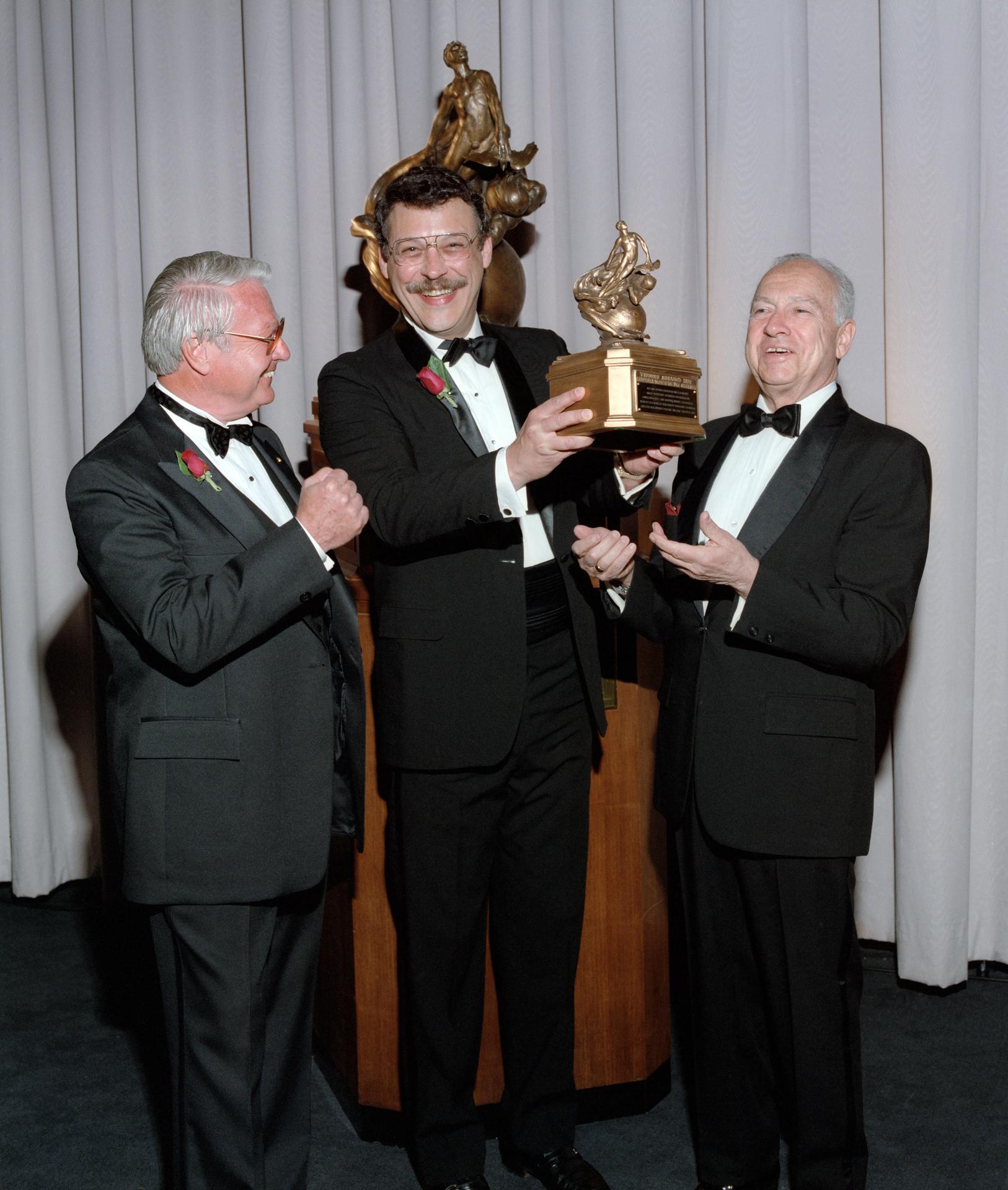
The High Energy Astrophysics Division of the American Astronomical Society (AAS) has awarded the 2024 Bruno Rossi Prize to retired NASA astrophysicist Martin Weisskopf, Italian Space Agency principal investigator Paolo Soffitta, and their team for development of IXPE, “whose novel measurements advance our understanding of particle acceleration and emission from astrophysical shocks, black holes and neutron stars,” according to the AAS announcement.
NASA’s Imaging X-ray Polarimetry Explorer mission, led by retired NASA astrophysicist Martin Weisskopf, left, and Italian Space Agency principal investigator Paolo Soffitta, has received the 2024 Rossi Prize in high-energy astronomy, awarded annually by the American Astronomical Society.
NASA/INAF
“IXPE is a realization of decades of work and belief in the importance of X-ray polarization measurements for X-ray astronomy. I am honored and excited to share this prize with Paolo Soffitta and the entire IXPE team,” said Weisskopf, who was IXPE’s principal investigator during its development. He retired from NASA in 2022.
“IXPE is the demonstration of how an idea pursued for more than 30 years has been transformed into a successful mission, thanks to the collaboration between the United States and Italy,” Soffitta said. “It’s incredible to receive this prize along with Martin Weisskopf and on behalf of so many people whose expertise and enthusiasm have made this breakthrough in astrophysics possible.”
Developed by NASA, the Italian Space Agency, and partners in a dozen countries, IXPE was launched to space on Dec. 9, 2021. Today, it orbits Earth some 340 miles up to observe X-ray emissions from powerful cosmic phenomena hundreds or thousands of light-years away. In 2023 alone, its subjects of study included blazars such as Markarian 501 and Markarian 421, supernova remnants including Tycho and SN 1006, and the supermassive black hole at the center of our own galaxy. Its success led NASA to formally extend the mission for an additional 20 months, through at least September 2025.
An artist’s illustration of the IXPE spacecraft in orbit, studying high-energy phenomena light-years from Earth.
NASA
“We at NASA are incredibly proud of Dr. Weisskopf and the IXPE team around the world,” said acting Marshall Center Director Joseph Pelfrey. “IXPE allows us to look at the universe through a vantage point never seen before. It’s particularly gratifying to continue Marshall’s long association with the Rossi Prize, which identifies singular breakthroughs and unprecedented innovation in high-energy astrophysics – a field in which our researchers excel.”
Weisskopf, together with Harvard astrophysicist Harvey Tananbaum, previously received the Rossi Prize in 2004 for their work to develop and fly NASA’s Chandra X-ray Observatory, which continues to study X-ray phenomena across the cosmos. Marshall researchers Gerald Fishman and Colleen Wilson-Hodge also were awarded the Rossi Prize in 1994 and 2018, respectively. Fishman was honored for his contributions to the Compton Gamma-ray Observatory’s BATSE (Burst and Transient Source Experiment) mission, Wilson-Hodge for her work with the Fermi GBM (Gamma-ray Burst Monitor) in August 2017, detecting gravitational and light waves from the spectacular smashup of two neutron stars in a distant galaxy.
The Rossi Prize is awarded annually for a significant recent contribution to high-energy astrophysics. The honor includes an engraved certificate and a $1,500 award.
Smith, an Aeyon/MTS employee, supports the Marshall Office of Communications.
National Mentoring Month: The Right Type of Mentorship with Erika Alvarez and Dave Reynolds
By Celine Smith
Erika Alvarez’s path to becoming a Systems Engineering & Integration manager at NASA Headquarters has impacted the way she mentors.
“What we do at NASA takes a village,” Alvarez said. “It may take one person to make something, but there could be 10 or 15 or 20 people who help them get there.”
Erika Alvarez, System Engineering and Integration manager at NASA Headquarters, and mentor to Dave Reynolds, a deputy program manager at NASA’s Marshall Space Flight Center.
NASA
Alvarez wants to be one of many guiding others to meet their goals, which is how she began mentoring Dave Reynolds, a deputy program manager at NASA’s Marshall Space Flight Center.
Alvarez and Reynolds don’t have a traditional mentorship. Both began in Marshall’s propulsion systems department in 2004. While Alvarez is younger than Reynolds, Alvarez is mentoring Reynolds.
Alvarez may not have decades more experience than Reynolds, but Alvarez joining the SES (Senior Executive Service) coincided with Reynolds wanting to transition to the SES. Their shared working experience and similar goal made a perfect fit for their mentorship.
Reynolds is currently being mentored by Alvarez in preparation for a Senior Executive Service position.
NASA
Hoping their experience can help others during National Mentoring Month, they discussed their insight about finding the right type of mentorship.
Question: What does mentorship mean to you?
Reynolds: Mentorship is an outside perspective that benefits me by providing a better solution. You can ask your mentor about your ideas to self-examine the path that you’re on. They know you and have your best interest in mind. Your decisions are not directly going to affect them, so they can offer candid advice.
Alvarez: For me, mentorship is worth the time investment because we can get stuck in our day-to-day routine. It’s a refreshing time during the week to sit down with someone knowing what they’re experiencing and helping them, so they don’t have to navigate certain challenges on their own. I have templates, articles, rubrics, books, and other perspectives I gained through my first year in SES. Now I can offer those resources. It’s something that I want to pass on to somebody else because it takes a village to do this. Mentoring is very energizing and fruitful. It reminds me that I love NASA and it’s a great place to work. I hope that I can provide that feeling and energy to someone else and it just keeps going.
Question: What impact has mentorship had on you and your career?
Alvarez: With Dave and I starting from the same department, we had some of the same mentors early on. Mentors give you confidence to move to the next role when you’re down in the details, doing the work, and years into a position. I would also say I was fortunate enough to have a great mentor that was outside of my department. The most important trait she gave to me was resiliency. There are many times when you go for something and are unsuccessful. Having somebody that believes in you during those times is huge.
Reynolds: My first formal mentor was assigned to me while I was in the Mid-Level Leadership Program and she was in SES at NASA’s Glenn Research Center. She encouraged me to get out of engineering, because she believed I was ready for a leadership role. Without her, I wouldn’t have transitioned as quickly as I did. My current mentorship is also kicking me to the next level and informing me of all the options I need to consider. Having a mentor that has known you for a long time, like Alvarez, is beneficial. You can trust their guidance more because they’ve seen you fail, and they still believe in your success.
Question: What was the initial goal and how has that impacted the type of mentoring relationship you built?
Reynolds: The initial goal was Alvarez prepping me to become SES qualified and she’s helped me at every step. Alvarez encouraged me to apply for the ASPIRE program. Programs and tools like that are exactly what I need to know about. She’s provided a lot of information that I didn’t know I would need to consider.
A young Alvarez, third from left, and Reynolds, far right, smile for a photo taken while they were both working in the propulsion systems department at Marshall.
NASA
Alvarez: I mentor a lot of people at different levels. Reynolds is a unique mentee because he is seeking out a big goal. Other mentees coming to me are in different stages, or they’re in a similar field and want to discuss the type of work I do. His goal is personal. I don’t want Reynolds to feel unprepared. I want him to go into his interview and any future roles with confidence and his best foot forward. I want Dave’s future peers to know he’s ready to lead. If Dave is successful in achieving his goal, I want to help him through that transition during the first year of his new role as well, especially with the person who last had the position being gone. I have executive mentors who are the only people I can discuss certain topics with. A part of the goal is Reynolds’ long-term success, which is why it’s important for him to have access to that network of people. If Reynolds needs help with something I’m not well-versed in, I can get him in contact with someone who is.
Question: How do you think the dynamic between mentor and mentee may differ in a formal mentoring relationship compared to an informal, casual mentoringencounter?
Reynolds: Formal mentoring relationships are more deliberate. We have a goal that we set. We’re not just having lunch, we set a scheduled time where we each have ideas we bring to discuss. Formal encounters are more structured. With informal mentorships you can also have casual lunches where good advice is thrown back and forth, but I have noticed if you’re more deliberate, you’ll get concrete progress.
Alvarez: Dave having a specific objective made the mentorship formal. The structure provided time for me to gather materials I found helpful in preparation for SES. With a hands-on approach, I could help Reynolds during his time in the ASPIRE program. We methodically planned how to reach each goal and in turn the objective. As we’re doing the work, we’re checking in consistently. Informal mentorships are hard. There’s no set amount of time spent together, and its disorganization makes it easier to lose momentum toward the objective. Informal mentorships also make it harder to feel a sense of accomplishment because progress is harder to assess.
Question: What advice do you have for someone else considering finding or being a mentor?
Alvarez: Think outside the box. Some people come in with an unconscious bias of what a mentor is. Mentees can become overly concerned with a mentor’s background. Not knowing their background is a good thing. Remain open minded about what someone else can offer you. You’re always going to get some good nuggets out of a mentorship. If someone suggests a mentor to you, take it. They might see something that neither of you do that would make a great pairing. I also recommend that some people choose mentors with a different career path like Dave and me. We shared the same foundation but then we went off in two different branches. Getting to combine those different insights is amazing because it makes us stronger.
Reynolds: As a mentee, check that you have humility. It’d be easy for me to dismiss Alvarez as a mentor because of our similarities. I recognize, she’s had a completely different life and is therefore capable of giving me an outside perspective. She’s also wicked smart, and I listen to wicked smart people. I’ve heard people reject advice from others because they are on the same tier or below career wise. That’s not a good approach. Ask yourself who can help with growth as opposed to finding somebody that that will help you up the ladder.
Editor’s note: This is the second in a Marshall Star series during National Mentoring Month in January. Marshall team members can learn more about the benefits of mentoring on Inside Marshall.
Smith, a Media Fusion employee, supports the Marshall Office of Communications.
Larry Leopard Named Acting Director of Marshall’s Engineering Directorate
Larry Leopard has been named acting director of NASA Marshall Space Flight Center’s Engineering Directorate upon the retirement of Don Holder this month. He will fill the role until a permanent director is named as well as continuing his duties as Marshall’s associate director, technical.
Larry Leopard, Marshall’s associate director, technical, has been named acting director of NASA Marshall Space Flight Center’s Engineering Directorate.
NASA
As Marshall’s associate director, technical, Leopard provides expert advice in all facets of the center’s responsibilities by conducting special studies; provides authoritative advice and assistance in policy review; manages and reports on centerwide and directorate metrics; and develops benchmark strategies. He was appointed to the position in December 2020. Leopard previously served as director of the Engineering Directorate from 2018 to 2020.
Lisa Bates will remain as deputy director of Marshall’s Engineering Directorate.
NASA
Lisa Bates will remain as deputy director and will be responsible for the day-to-day management of the Engineering Directorate.
Whether he’s advising student robotic competitions or managing production of a powerful, new Moon rocket stage, Erick Holsonback meets technical challenges with enthusiasm.
Holsonback, a Jacobs Technology employee, is subsystem manager for production and launch operations of the exploration upper stage (EUS) for NASA’s SLS (Space Launch System) rocket. SLS is NASA’s super heavy lift rocket that will launch the agency’s Artemis campaign to the Moon. The exploration upper stage is one of two upgrades to the SLS rocket as it evolves to the Block 1B variant for missions beginning with Artemis IV. Along with the rocket’s new universal stage adapter, the SLS rocket in its Block 1B configuration will be able to send 40% more payload to the Moon in a single launch.
Eric Holsonback, a Jacobs Technology employee, is subsystem manager for production and launch operations of the exploration upper stage for NASA’s SLS (Space Launch System) rocket.
NASA/Michael DeMocker
Holsonback’s job stretches from setting up production for the future upper stage at NASA’s Michoud Assembly Facility, where it’s built, to preparing it for launch from the agency’s Kennedy Space Center.
“It’s exciting to be part of a capability that will send more crew and cargo to the Moon in a single launch than any other current rocket,” Holsonback said. “That’s going to make operations in the challenging space environment a lot simpler.”
Growing up in North Georgia, Holsonback remembers wanting to be an astronaut and turning street cars into hot rods. He figured he’d wind up in the auto industry, until Pratt & Whitney offered him a job working on space shuttle main engine turbomachinery straight out of college in 1997. He briefly left the space business but jumped at a chance to get back in with the SLS Program in 2016 at NASA’s Marshall Space Flight Center.
“I wanted to come back and do rockets,” he recalled. “It gets in your blood. You’re part of something bigger that just yourself. Through Artemis, we are truly impacting the space program at its foundational level of how we are getting back to the Moon and to Mars.”
Holsonback’s enthusiasm for space challenges doesn’t end at the office door. In his free time, Holsonback has mentored and coached his two daughters’ technology challenge competitions. While the challenge is foremost a robotics contest, Holsonback is proud of the lessons in problem solving, technology, and project management he’s helped impart to the team along the way – which he likens to his NASA job.
You could say Erick Holsonback is working on the future personally as well as professionally, but it’s hard to beat working on a Moon rocket.
“I’ve had some great opportunities with NASA, but my current role is pretty amazing – getting to be part of building and launching,” he reflected. “I get to play a little part in the overall foundation work that is going to be part of the history of our country for years to come.”
NASA is working to land the first woman and first person of color on the Moon under Artemis. SLS is part of NASA’s backbone for deep space exploration, along with the Orion spacecraft, advanced spacesuits and rovers, the Gateway in orbit around the Moon, and commercial human landing systems. SLS is the only rocket that can send Orion, astronauts, and supplies to the Moon in a single launch.
Mission Success is in Our Hands is a safety initiative collaboration between NASA’s Marshall Space Flight Center and Jacobs. As part of the initiative, eight Marshall team members are featured in new testimonial banners placed around the center. This is the third in a Marshall Star series profiling team members featured in the testimonial banners.
Greg Drayer is the JSEG (Jacobs Space Exploration Group) team lead for EV74, the Systems Analysis Branch, working at NASA’s Marshall Space Flight Center. He is also the JSEG Tech Fellow for Modeling and Simulation.
Greg Drayer is the JSEG (Jacobs Space Exploration Group) team lead for EV74, the Systems Analysis Branch, working at NASA’s Marshall Space Flight Center.
NASA/Charles Beason
He previously was a Modeling and Simulation integration systems engineer, representing NASA’s SLS (Space Launch System) Program to the Data Integration Integrated Task Team and supporting the certification of Design Math Models. He started working at Marshall in 2020. A native of Caracas, Venezuela, Drayer is a graduate of both Universidad Simon Bolivar, where he earned a bachelor’s degree in electrical engineering and magister in systems engineering, and the Georgia Institute of Technology, where he earned his doctorate with the School of Electrical and Computer Engineering. He was sponsored by the U.S. Department of State International Fulbright Science and Technology Program.
Question: What are some of your key responsibilities?
Drayer: I am responsible for the proactive management of the EV74 Branch JSEG Task Order and Systems Evaluation personnel to ensure the safe and effective accomplishment of Marshall requirements by providing engineering, scientific, and technical support to various NASA programs. My team is a high-performing group of three different sub-teams executing challenging tasks for Marshall’s Systems Engineering and Integration Division (EV70) in support of SLS, HLS (Human Landing System), and MAV (Mars Ascent Vehicle) programs, providing unique expertise in the following domains:
Program compliance with the NASA Standard for Models and Simulations, NASA-STD-7009.
Vehicle mass properties and weight management.
SLS photogrammetric imaging and analysis.
Data integration tools, systems, and processes.
Adoption of model-based systems engineering methodologies.
Question: How does your work support the safety and success of NASA and Marshall missions?
Drayer: The goal of our Modeling and Simulation Sub-Team at NASA is to help reduce the risks associated with models and simulations-influenced decisions by properly conveying the credibility of results to those making critical decisions in support of program compliance with NASA-STD-7009, Standard for Models and Simulations. We ensure the NASA’s commitment to excellence in satisfying the requirements of NASA-STD-7009, an outcome resulting from the Columbia Accident Investigation Board Report.
Question: What does the Mission Success is in Our Hands initiative mean to you?
Drayer: Working in support of NASA-STD-7009, this initiative hits close to home as another reminder of why we do our work the way we are required. Beyond any statistics, to me this campaign is a reminder and a challenge to ensure that we ‘Know what we build. Test what we build. Test what we fly. Test like we fly.’ We should continue learning from our past to make sure that it does not repeat in the future. This initiative helps us dedicate the time to remember why we do things the way we do them, and how we arrived at today’s NASA culture.
Question: Do you have a story or personal experience you can share that might help others understand the significance of mission assurance or flight safety?
Drayer: Coming back from COVID-19 has been a great challenge to overcome. Incredibly, we all have found some strange comfort zones from which we are now needing to come back to collaborate better. I know how much some of us value our ability to telework at times. However, I would like us all to also understand how some in-person conversations can save us many if not several hours of unending electronic communications. I would like all of us to demonstrate to ourselves why we truly need to be present in our meetings and engage as best as we can to reap the fruit of those interactions. Let us lead by example and ‘preach’ about it along the way with our actions, to the benefit of the NASA culture in a post-COVID era. As an agency, this can greatly impact our ability to ensure mission success and flight safety.
Question: How can we work together better to achieve mission success?
Drayer: We go all the way to the Moon in search of discoveries, science, and developing new technologies. And even beyond all these, we go to the Moon to find ourselves personally and each other. That journey has begun already with each weekday and at times weekends that we dedicate to work with the mission in mind, working hard to meet and exceed the expectations of our customers and our stakeholders, most important of which are our astronauts and their families.
Smith, a Media Fusion employee and the Marshall Star editor, supports the Marshall Office of Communications.
NASA Continues Artemis Moon Rocket Engine Tests with First Hot Fire of 2024
NASA continued a critical test series for future flights of NASA’s SLS (Space Launch System) rocket in support of the Artemis campaign Jan. 17 with a full-duration hot fire of the RS-25 engine on the Fred Haise Test Stand at NASA’s Stennis Space Center.
Data collected from the test series will be used to certify production of new RS-25 engines by lead contractor Aerojet Rocketdyne, an L3Harris Technologies company, to help power the SLS rocket on future Artemis missions to the Moon and beyond, beginning with Artemis V. NASA’s Marshall Space Flight Center manages the SLS Program.
NASA completed a full-duration, 500-second hot fire of an RS-25 certification engine Jan. 17, continuing a critical test series to support future SLS (Space Launch System) missions to the Moon and beyond as NASA explores the secrets of the universe for the benefit of all.
NASA/Danny Nowlin
Teams are evaluating the performance of several new engine components, including a nozzle, hydraulic actuators, flex ducts, and turbopumps. The current series is the second and final series to certify production of the upgraded engines. NASA completed an initial 12-test certification series with the upgraded components in June 2023.
During the Jan. 17 test, operators followed a “test like you fly” approach, firing the engine for the same amount of time – almost eight-and-a-half minutes (500 seconds) – needed to launch SLS and at power levels ranging between 80% to 113%.
The Jan. 17 test comes three months after the current series began in October. During three tests last fall, operators fired the engine for durations from 500 to 650 seconds. The longest planned test of the series occurred on Nov. 29 when crews gimbaled, or steered, the engine during an almost 11-minute (650 seconds) hot fire. The gimbaling technique is used to control and stabilize SLS as it reaches orbit.
Each SLS flight is powered by four RS-25 engines, firing simultaneously during launch and ascent to generate over 2 million pounds of thrust.
The first four Artemis missions with SLS are using modified space shuttle main engines that can power up to 109% of their rated level. The newly produced RS-25 engines will power up to the 111% level to provide additional thrust. Testing to the 113% power level provides an added margin of operational safety.
With the completion of the test campaign in 2024, all systems are expected to be “go” for production of 24 new RS-25 engines for missions beginning with Artemis V.
Through Artemis, NASA will establish a long-term presence at the Moon for scientific exploration with commercial and international partners, learn how to live and work away from home, and prepare for future human exploration of Mars.
Station Crew Assists Ax-3 on Advanced Space Research
The Expedition 70 crew spent Jan. 23 on a host of research activities and spacesuit maintenance while assisting their Axiom Mission 3 (Ax-3) guests on the International Space Station. The four Ax-3 crew members had their hands full as they explored cancer research, space botany, and robotics for Earth and space benefits.
The Ax-3 crew arrived Jan. 20. Astronauts Andreas Mogensen, Loral O’Hara, and Satoshi Furukawa dedicated part of their schedule to the Ax-3 mission. The trio helped the four private astronauts get up to speed with life on orbit as well as conduct advanced microgravity science.
The four Axiom Mission 3 astronauts, front row, and the seven Expedition 70 crew members wave to the camera following a crew greeting ceremony on the International Space Station on Jan. 20.
NASA TV
Mogensen from ESA (European Space Agency) spent a couple of hours ensuring the Ax-3 crewmates are familiarized with systems throughout the orbital lab. O’Hara from NASA set up the LSG (Life Science Glovebox) for an Ax-3 space botany investigation while Furukawa from JAXA (Japan Aerospace Exploration) activated a microscope to look at cell samples for an Ax-3 cancer study.
Ax-3 Commander Michael López-Alegría and Mission Specialist Alper Gezeravcı worked in the Kibo laboratory module’s LSG and tested the genetic editing of space-grown plants. Results may enable genetic modifications allowing plants to adapt to weightlessness and promote crew health. Ax-3 Pilot Walter Villadei peered at cell samples inside the Kermit microscope to learn how to predict and prevent cancer both on Earth and in space.
Ax-3 Mission Specialist Marcus Wandt tested the ability to remotely control robots on Earth from the space station. Working in the Columbus laboratory module, Wandt used a laptop computer to command a team of Earth-bound robots simulating a robotic exploration mission on another planet controlled from a spacecraft.
Mogensen would go on to organize food packs, charge virtual reality hardware for a mental health study, then videotape a space physics demonstration for junior high school students. Furukawa serviced science freezers and combustion research gear before cleaning vents inside the Unity module. Furukawa wrapped up his day with eye checks with NASA Flight Engineer Jasmin Moghbeli. O’Hara operated the medical imaging gear examining the optic nerve, retina, and cornea of both astronauts. Moghbeli earlier installed and tested a camera and lights on a spacesuit helmet.
The orbiting lab’s three cosmonauts from Roscosmos focused on operations in their segment. Veteran Flight Engineer Oleg Kononenko spent his day inspecting the Zvezda service module and servicing communication and computer systems in the Nauka science module. Flight Engineer Nikolai Chub photographed the condition of Zvezda’s windows then studied how microgravity conditions such as magnetic and electrical fields affect fluid physics. Flight Engineer Konstantin Borisov deactivated Earth observation gear, downloaded vibration data the station experiences while orbiting Earth, then worked on orbital plumbing duties.
The Payload Operations Integration Center at NASA’s Marshall Space Flight Center operates, plans, and coordinates the science experiments onboard the space station 365 days a year, 24 hours a day.
Learn more about station activities by following the space station blog.
NASA’S OSIRIS-REx Curation Team Reveals Remaining Asteroid Sample
The astromaterials curation team at NASA’s Johnson Space Center has completed the disassembly of the OSIRIS-REx sampler head to reveal the remainder of the asteroid Bennu sample inside. On Jan. 10, they successfully removed two stubborn fasteners that had prevented the final steps of opening the TAGSAM (Touch-and-Go-Sample-Acquisition-Mechanism) head.
A top-down view of the OSIRIS-REx Touch-and-Go-Sample-Acquisition-Mechanism head with the lid removed, revealing the remainder of the asteroid sample inside.
NASA/Erika Blumenfeld & Joseph Aebersold
Erika Blumenfeld, creative lead for AIVA (Advanced Imaging and Visualization of Astromaterials) and Joe Aebersold, AIVA project lead, captured a photograph of the open TAGSAM head including the asteroid material inside using manual high-resolution precision photography and a semi-automated focus stacking procedure. The result is an image that shows extreme detail of the sample.
Next, the curation team will remove the round metal collar and prepare the glovebox to transfer the remaining sample from the TAGSAM head into pie-wedge sample trays.
These trays will be photographed before the sample is weighed, packaged, and stored at Johnson, home to the most extensive collection of astromaterials in the world. The remaining sample material includes dust and rocks up to about 0.4 inch in size. The final mass of the sample will be determined in the coming weeks. The curation team members had already collected 2.48 ounces of asteroid material from the sample hardware before the lid was removed, surpassing the agency’s goal of bringing at least 2.12 ounces to Earth.
The curation team will release a catalog of all the Bennu samples later this year, which will allow scientists and institutions around the world to submit requests for research or display.
OSIRIS-REx is the third mission in NASA’s New Frontiers Program, managed by the agency’s Marshall Space Flight Center.
The Nova-C lunar lander is seen in the high bay of Intuitive Machines Headquarters in Houston, before it shipped to NASA’s Kennedy Space Center in Florida for integration with a SpaceX Falcon 9 rocket for launch, as part of NASA’s CLPS (Commercial Lunar Payload Services) initiative and Artemis campaign. Credits: Intuitive Machines
As part of NASA’s CLPS (Commercial Lunar Payload Services) initiative and Artemis campaign, media accreditation is open for Intuitive Machines’ first robotic flight to the Moon’s surface. The robotic deliveries will transport agency science and technology demonstrations to the Moon for the benefit of all.
The Intuitive Machines Nova-C lander carrying NASA science and commercial payloads will launch on a SpaceX Falcon 9 rocket. Liftoff is targeted for a multi-day launch window, which opens no earlier than mid-February, from Launch Complex 39A at NASA’s Kennedy Space Center in Florida.
Among the NASA items on its lander, the Intuitive Machines mission will carry instruments focusing on plume-surface interactions, space weather/lunar surface interactions, radio astronomy, precision landing technologies, and a communication and navigation node for future autonomous navigation technologies. A successful landing will help support the CLPS model for commercial payload deliveries to the lunar surface. As the anchor customer of CLPS, NASA is investing in lower-cost methods of Moon deliveries and aims to be one of many customers.
Media prelaunch and launch activities will take place at NASA Kennedy. Media who are U.S. citizens interested in attending in person must apply for credentials no later than 12 p.m. EST on Monday, Jan. 29, by emailing media@spacex.com.
In May 2019, NASA awarded a task order for the delivery to Intuitive Machines. Through Artemis, commercial robotic deliveries will perform science experiments, test technologies, and demonstrate capabilities to help NASA explore the Moon in advance of Artemis Generation astronaut missions to the lunar surface, in preparation for future missions to Mars.
NASA is working with several U.S. companies to deliver science and technology to the lunar surface through the agency’s CLPS initiative. This pool of companies may bid on delivery task orders. A task order award includes payload integration and operations, as well as launching from Earth and landing on the surface of the Moon. NASA’s CLPS contracts are indefinite-delivery/indefinite-quantity contracts with a cumulative maximum contract value of $2.6 billion through 2028.
For more information about the agency’s Commercial Lunar Payload Services initiative, see:
This website uses cookies to improve your experience. We'll assume you're ok with this, but you can opt-out if you wish.AcceptRead More
Privacy & Cookies Policy
Privacy Overview
This website uses cookies to improve your experience while you navigate through the website. Out of these, the cookies that are categorized as necessary are stored on your browser as they are essential for the working of basic functionalities of the website. We also use third-party cookies that help us analyze and understand how you use this website. These cookies will be stored in your browser only with your consent. You also have the option to opt-out of these cookies. But opting out of some of these cookies may affect your browsing experience.
Necessary cookies are absolutely essential for the website to function properly. This category only includes cookies that ensures basic functionalities and security features of the website. These cookies do not store any personal information.
Any cookies that may not be particularly necessary for the website to function and is used specifically to collect user personal data via analytics, ads, other embedded contents are termed as non-necessary cookies. It is mandatory to procure user consent prior to running these cookies on your website.