Tag: Kepler

  • NASA’s SpaceX Crew-10 to Discuss Station Mission, Upcoming Return

    The crew of NASA’s SpaceX Crew-10 mission pictured aboard the International Space Station. From left to right: JAXA (Japan Aerospace Exploration Agency) astronaut Takuya Onishi, NASA astronauts Anne McClain and Nichole Ayers, and Roscosmos cosmonaut Kirill Peskov.
    Credit: NASA

    Media are invited to hear from NASA’s SpaceX Crew-10 during a news conference beginning at 10:40 a.m. EDT, Friday, July 25, from the International Space Station.

    NASA astronauts Anne McClain and Nichole Ayers, JAXA (Japan Aerospace Exploration Agency) astronaut Takuya Onishi, and Roscosmos cosmonaut Kirill Peskov will discuss their upcoming return to Earth on the agency’s YouTube channel.

    Media interested in participating must contact the newsroom at NASA’s Johnson Space Center in Houston no later than 5 p.m., Thursday, July 24, at 281-483-5111 or jsccommu@mail.nasa.gov. To ask questions, media must dial into the news conference no later than 10 minutes prior to the start of the call. A copy of NASA’s media accreditation policy is online.

    Crew-10 joined the Expedition 72 crew when arriving to the station in March. Throughout Expedition 72 and into Expedition 73, the crew aboard the space station contributed to hundreds of experiments, including testing expanded capabilities of existing hardware for pharmaceutical production in space, investigating how cells sense gravity, which is an important aspect of space biology, and examining the effects of microgravity on protein yields in microalgae, a potential source for life support, fuel, and food on long-duration missions.

    The crew will depart the space station after the arrival of Crew-11 and a handover period. Ahead of Crew-10’s return, mission teams will review weather conditions at the splashdown sites off the coast of California prior to departure from station.

    The mission is part of NASA’s Commercial Crew Program, which provides reliable access to space, maximizing the use of the station for research and development and supporting future missions beyond low Earth orbit by partnering with private companies to transport astronauts to and from the space station.

    Follow updates on the Crew-10 mission at:

    https://www.nasa.gov/blogs/crew-10

    -end-

    Claire O’Shea
    Headquarters, Washington
    202-358-1100
    claire.a.o’shea@nasa.gov

    Courtney Beasley
    Johnson Space Center, Houston
    281-483-5111
    courtney.m.beasley@nasa.gov

  • NASA Goddard Center Director Makenzie Lystrup Set to Depart

    Portrait of Dr. Makenzie Lystrup, director of NASA’s Goddard Space Flight Center in Greenbelt, Maryland.
    Credit: NASA

    On Monday, NASA announced Dr. Makenzie Lystrup, director of NASA’s Goddard Space Flight Center in Greenbelt, Maryland, is set to leave the agency on Friday, Aug. 1.

    As center director of Goddard, a role she has held since April 2023, Lystrup also was responsible for guiding the direction and management of multiple other NASA field installations including Wallops Flight Facility in Virginia, Katherine Johnson Independent Verification & Validation Facility in West Virginia, the White Sands Complex in New Mexico, and the Columbia Scientific Balloon Facility in Texas.

    “Having served in a variety of science and aerospace civilian and government roles in her career, Makenzie has led development of, and/or contributed to a variety of NASA’s priority science missions including successful operations of our James Webb Space Telescope and Imaging X-Ray Polarimetry Explorer, as well as development of the agency’s Roman Space Telescope, and more,” said Vanessa Wyche, acting NASA associate administrator. “We’re grateful to Makenzie for her leadership at NASA Goddard for more than two years, including her work to inspire a Golden Age of explorers, scientists, and engineers.”

    Throughout her time at NASA, Lystrup led Goddard’s workforce, which consists of more than 8,000 civil servants and contractors. Before joining the agency, Lystrup served as senior director for Ball’s Civil Space Advanced Systems and Business Development, where she managed new business activities for NASA, National Oceanic and Atmospheric Administration (NOAA), and other civilian U.S. government agencies as well as for academia and other science organizations. In addition, she served in the company’s Strategic Operations organization, based in Washington where she led Ball’s space sciences portfolio.

    Prior to joining Ball, Lystrup worked as an American Institute of Physics – Acoustical Society of American Congressional Fellow from 2011 to 2012 where she managed a portfolio including technology, national defense, nuclear energy, and nuclear nonproliferation.

    Lystrup also has served on boards and committees for several organizations to include the University Corporation for Atmospheric Research, International Society for Optics and Photonic, the University of Colorado, and the American Astronomical Society. She was named an American Association for the Advancement of Science fellow in 2019 for her distinguished record in the fields of planetary science and infrared astronomy, science policy and advocacy, and aerospace leadership. Lystrup also served as an AmeriCorps volunteer focusing on STEM education.

    Lystrup holds a bachelor’s in physics from Portland State University and attended graduate school at University College London earning her doctorate in astrophysics. She was a National Science Foundation Astronomy & Astrophysics Postdoctoral Research Fellow spending time at the Laboratory for Atmospheric & Space Physics in Boulder, Colorado, and University of Liege in Belgium. As a planetary scientist and astronomer, Lystrup’s scientific work has been in using ground- and space-based astronomical observatories to understand the interactions and dynamics of planetary atmospheres and magnetospheres – the relationships between planets and their surrounding space environments.

    Following Lystrup’s departure, NASA’s Cynthia Simmons will serve as acting center director. Simmons is the current deputy center director.

    For more information about NASA’s work, visit:

    https://www.nasa.gov

    -end-

    Cheryl Warner / Kathryn Hambleton
    Headquarters, Washington
    202-358-1600
    cheryl.m.warner@nasa.gov / kathryn.hambleton@nasa.gov

    Katy Mersmann
    Goddard Space Flight Center, Greenbelt, Md.
    301-377-1724
    katy.mersmann@nasa.gov

    Details

    Last Updated

    Jul 21, 2025

    Editor
    Jessica Taveau

  • NASA Shares How to Save Camera 370-Million-Miles Away Near Jupiter

    5 min read

    Preparations for Next Moonwalk Simulations Underway (and Underwater)

    The north polar region of Jupiter’s volcanic moon Io
    The north polar region of Jupiter’s volcanic moon Io was captured by the JunoCam imager aboard NASA’s Juno during the spacecraft’s 57th close pass of the gas giant on Dec. 30, 2023. A technique called annealing was used to help repair radiation damage to the camera in time to capture this image.
    Image data: NASA/JPL-Caltech/SwRI/MSSS Image processing by Gerald Eichstädt

    An experimental technique rescued a camera aboard the agency’s Juno spacecraft, offering lessons that will benefit other space systems that experience high radiation.

    The mission team of NASA’s Jupiter-orbiting Juno spacecraft executed a deep-space move in December 2023 to repair its JunoCam imager to capture photos of the Jovian moon Io. Results from the long-distance save were presented during a technical session on July 16 at the Institute of Electrical and Electronics Engineers Nuclear & Space Radiation Effects Conference in Nashville.

    JunoCam is a color, visible-light camera. The optical unit for the camera is located outside a titanium-walled radiation vault, which protects sensitive electronic components for many of Juno’s engineering and science instruments.

    This is a challenging location because Juno’s travels carry it through the most intense planetary radiation fields in the solar system. While mission designers were confident JunoCam could operate through the first eight orbits of Jupiter, no one knew how long the instrument would last after that.

    Throughout Juno’s first 34 orbits (its prime mission), JunoCam operated normally, returning images the team routinely incorporated into the mission’s science papers. Then, during its 47th orbit, the imager began showing hints of radiation damage. By orbit 56, nearly all the images were corrupted.

    The image, which captures one of the circumpolar cyclones on Jupiter’s north pole, was taken Nov. 22, 2023
    The graininess and horizontal lines seen in this JunoCam image show evidence that the camera aboard NASA’s Juno mission suffered radiation damage. The image, which captures one of the circumpolar cyclones on Jupiter’s north pole, was taken Nov. 22, 2023.
    NASA/JPL-Caltech/SwRI/MSSS

    Long Distance Microscopic Repair

    While the team knew the issue may be tied to radiation, pinpointing what, specifically, was damaged within JunoCam was difficult from hundreds of millions of miles away. Clues pointed to a damaged voltage regulator that is vital to JunoCam’s power supply. With few options for recovery, the team turned to a process called annealing, where a material is heated for a specified period before slowly cooling. Although the process is not well understood, the idea is that the heating can reduce defects in the material.

    “We knew annealing can sometimes alter a material like silicon at a microscopic level but didn’t know if this would fix the damage,” said JunoCam imaging engineer Jacob Schaffner of Malin Space Science Systems in San Diego, which designed and developed JunoCam and is part of the team that operates it. “We commanded JunoCam’s one heater to raise the camera’s temperature to 77 degrees Fahrenheit — much warmer than typical for JunoCam — and waited with bated breath to see the results.”

    Soon after the annealing process finished, JunoCam began cranking out crisp images for the next several orbits. But Juno was flying deeper and deeper into the heart of Jupiter’s radiation fields with each pass. By orbit 55, the imagery had again begun showing problems. 

    “After orbit 55, our images were full of streaks and noise,” said JunoCam instrument lead Michael Ravine of Malin Space Science Systems. “We tried different schemes for processing the images to improve the quality, but nothing worked. With the close encounter of Io bearing down on us in a few weeks, it was Hail Mary time: The only thing left we hadn’t tried was to crank JunoCam’s heater all the way up and see if more extreme annealing would save us.”

    Test images sent back to Earth during the annealing showed little improvement the first week. Then, with the close approach of Io only days away, the images began to improve dramatically. By the time Juno came within 930 miles (1,500 kilometers) of the volcanic moon’s surface on Dec. 30, 2023, the images were almost as good as the day the camera launched, capturing detailed views of Io’s north polar region that revealed mountain blocks covered in sulfur dioxide frosts rising sharply from the plains and previously uncharted volcanos with extensive flow fields of lava.

    Testing Limits

    To date, the solar-powered spacecraft has orbited Jupiter 74 times. Recently, the image noise returned during Juno’s 74th orbit.

    Since first experimenting with JunoCam, the Juno team has applied derivations of this annealing technique on several Juno instruments and engineering subsystems.

    “Juno is teaching us how to create and maintain spacecraft tolerant to radiation, providing insights that will benefit satellites in orbit around Earth,” said Scott Bolton, Juno’s principal investigator from the Southwest Research Institute in San Antonio. “I expect the lessons learned from Juno will be applicable to both defense and commercial satellites as well as other NASA missions.”

    More About Juno

    NASA’s Jet Propulsion Laboratory, a division of Caltech in Pasadena, California, manages the Juno mission for the principal investigator, Scott Bolton, of the Southwest Research Institute in San Antonio. Juno is part of NASA’s New Frontiers Program, which is managed at NASA’s Marshall Space Flight Center in Huntsville, Alabama, for the agency’s Science Mission Directorate in Washington. The Italian Space Agency, Agenzia Spaziale Italiana, funded the Jovian InfraRed Auroral Mapper. Lockheed Martin Space in Denver built and operates the spacecraft. Various other institutions around the U.S. provided several of the other scientific instruments on Juno.

    More information about Juno is at:

    https://www.nasa.gov/juno

    News Media Contact

    DC Agle
    Jet Propulsion Laboratory, Pasadena, Calif.
    818-393-9011
    agle@jpl.nasa.gov

    Karen Fox / Molly Wasser
    NASA Headquarters, Washington
    202-358-1600
    karen.c.fox@nasa.gov / molly.l.wasser@nasa.gov

    Deb Schmid
    Southwest Research Institute, San Antonio
    210-522-2254
    dschmid@swri.org

    2025-091

    Details

    Last Updated

    Jul 21, 2025

  • GLOBE-Trotting Science Lands in Chesapeake with NASA eClips

    2 min read

    GLOBE-Trotting Science Lands in Chesapeake with NASA eClips

    On June 16-17, 2025, 50 students at Camp Young in Chesapeake, Virginia traded their usual summer routines for microscopes. The NASA eClips team from the National Institute of Aerospace Center for Integrative STEM Education (NIA-CISE) taught two engaging lessons focused on macroinvertebrates and plankton, with a surprising star of the show – mosquitoes!

    Camp Young, a Title I camp program serving students from Norfolk Public Schools, provides year-round, environmental science-based learning. The NASA eClips’ visit reinforced their mission to help students explore their environment on the Elizabeth River while seeing its place in the Earth System.

    The lessons, designed for students in grades 3 through 8, were inspired by NASA’s GLOBE (Global Learning and Observations to Benefit the Environment) program, which encourages people around the world to collect and share environmental data as ‘citizen scientists’. This is where mosquitos stole the show! The lesson focuses on how these tiny insects can serve as indicators of climate and habitat change. By identifying mosquito larvae and understanding their breeding environments, students contributed to the bigger picture of global health and environmental monitoring, right from their own backyard.

    During this experience, Camp Young’s stunning waterfront on the Elizabeth River was turned into a living laboratory. With phytoplankton nets, petri dishes, and sample jars in hand, campers ventured into the field to collect real environmental data, bringing their findings back to a cabin-turned-classroom to analyze them with scientific tools, including microscopes provided by the NASA eClips team.

    Rather than just reading about ecosystems and the kinds of scientific questions that arise within them, students got to experience them firsthand and experience real science in the field. “It’s one thing to talk about microscopic marine organisms,” one instructor noted, “but it’s another thing entirely when students can actually see them swimming in a droplet from the river.”

    The NASA eClips project provides educators with standards-based videos, activities, and lessons to increase STEM literacy through the lens of NASA. It is supported by NASA under cooperative agreement award number NNX16AB91A and is part of NASA’s Science Activation Portfolio. Learn more about how Science Activation connects NASA science experts, real content, and experiences with community leaders to do science in ways that activate minds and promote deeper understanding of our world and beyond: https://science.nasa.gov/learn

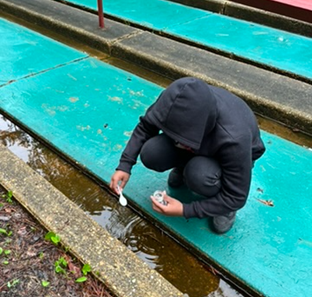
    A student in jeans and a dark hoodie collected a water sample in a white spoon while kneeling on a teal platform.
    A student collects a stagnant water sample, looking for mosquito eggs and larvae.

    Details

    Last Updated

    Jul 21, 2025

    Editor
    NASA Science Editorial Team
  • The Day Earth Smiled

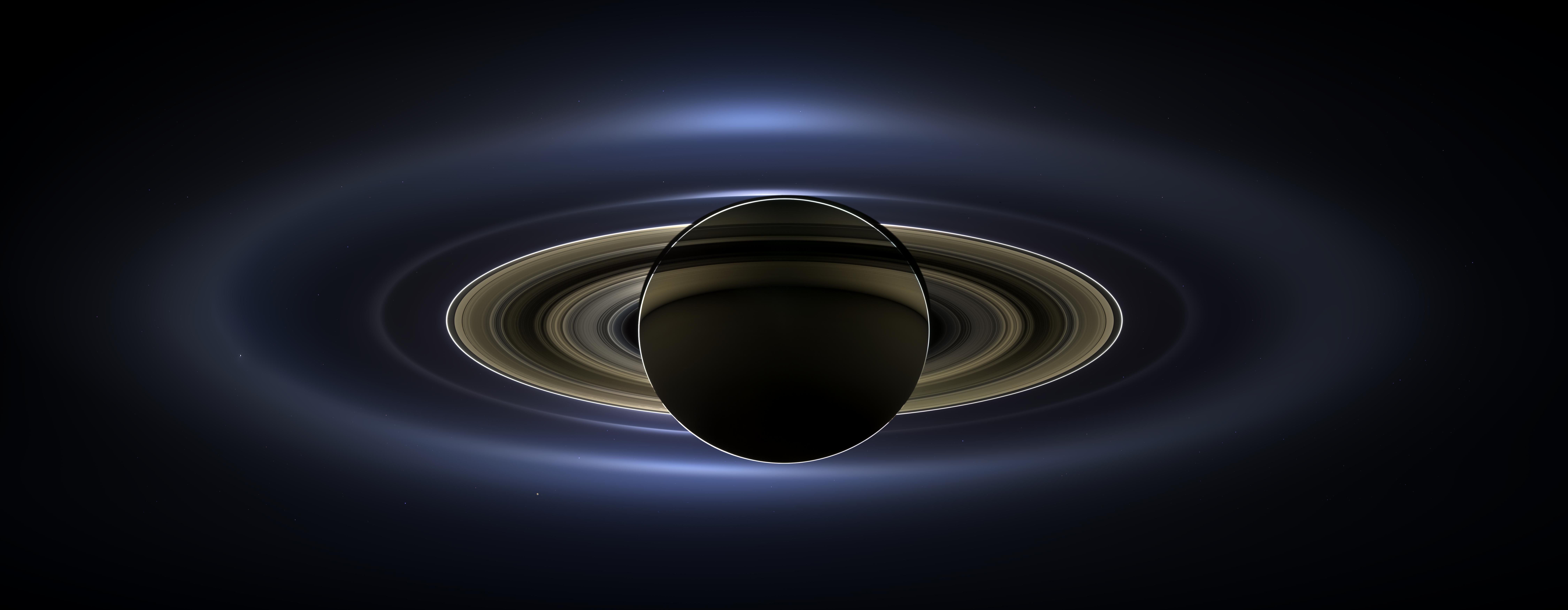
    Saturn is a dark sphere with a bright outline. Its outermost rings are fuzzy and blue. The rings get crisper as you go inward toward the planet. These inner rings are yellow. Earth is a tiny speck of light in the background on the lower right, between the bright blue E ring and the faint but defined G ring.
    On July 19, 2013, in an event celebrated the world over, NASA’s Cassini spacecraft slipped into Saturn’s shadow and turned to image the planet, seven of its moons, its inner rings, and, in the background, our home planet, Earth.
    NASA/JPL-Caltech/SSI

    On July 19, 2013, NASA’s Cassini spacecraft had a rare opportunity to image Saturn and, far in the background, Earth. This image spans about 404,880 miles (651,591 kilometers) across.

    With the Sun’s powerful and potentially damaging rays eclipsed by Saturn itself, Cassini’s onboard cameras were able to take advantage of this unique viewing geometry. They acquired a panoramic mosaic of the Saturn system that allows scientists to see details in the rings and throughout the system as they are backlit by the sun. This mosaic is special as it marks the third time our home planet was imaged from the outer solar system; the second time it was imaged by Cassini from Saturn’s orbit; and the first time ever that inhabitants of Earth were made aware in advance that their photo would be taken from such a great distance.

    Before the mission ended in 2017, Cassini was already a powerful influence on future exploration. Lessons learned during Cassini’s mission are being applied in NASA’s Europa Clipper mission. The mission uses an orbital tour design derived from the way Cassini explored Saturn. Launched in 2024, Europa Clipper will reach Jupiter in April 2030 and make dozens of flybys of the planet’s icy moon to determine whether there are places below the surface that could support life.

    Learn more about this unique image.

    Image credit: NASA/JPL-Caltech/SSI

  • Catherine Staggs: Advancing Artemis Through Contracting Expertise

    A lifelong baseball fan, Catherine Staggs set out with her family to visit all 30 Major League Baseball stadiums across the United States. That love of the game eventually led them to settle in Houston about eight years ago – a choice that helped lead Staggs to NASA’s Johnson Space Center, where she is a contracting officer for the agency’s Commercial Lunar Payload Services (CLPS) initiative. Through CLPS, she helps manage the contracts with commercial companies delivering science and technology to the Moon. These efforts support NASA’s Artemis campaign and lay the groundwork for continuous human presence on the lunar surface.

    A woman with shoulder-length blonde hair, wearing a kelly-green blouse, stands in front of a NASA flag and an American flag in an official portrait.
    Official portrait of Catherine Staggs.
    NASA

    She joined NASA as a civil servant in 2018, but Staggs’ career in the federal government stretches back to her college days. She completed an accounting co-op with the Department of Defense as a student at Clemson University in Clemson, South Carolina, and secured a full-time accounting position with the agency following her graduation. She transitioned to a business financial manager position supporting U.S. Marine Corps projects while earning an MBA from The Citadel in Charleston, South Carolina. “That position is where I started to dabble in contracting,” she said.

    Staggs moved to Texas in 2014 to be closer to her boyfriend – now husband – who was stationed at Fort Hood in Killeen. She was hired as a contract compliance manager for a small, Killeen-based business that specialized in government contracts, officially launching her career in contracting. When Staggs’ husband retired from the Army, the couple decided to move to Houston because they loved to watch the Houston Astros play ball. Staggs continued working for the contracting company from her new home but missed meeting new people and collaborating with colleagues in person.

    “I applied for a contract specialist job with NASA to get back into the office, and the rest is history,” she said.

    Her current role at Johnson involves managing the administrative contract functions for the 13 base contracts that support CLPS, which are valued at $2.6 billion. She is also the contracting officer for Firefly’s Blue Ghost Mission-3 and helps to train and develop up-and-coming contract specialists. “I love to see the development each contract specialist has over their career,” she said. “My first Pathways intern is now working full-time for NASA as a contract specialist, and they are working to become a limited warrant contracting officer.”

    A group of eight men and women in business casual attire stand in front of a shiny silver aircraft.
    The Commercial Lunar Payload Services (CLPS) procurement team celebrates the lunar landing of Intuitive Machines’ second CLPS flight at Ellington Field on March 6, 2025. Front row, from left: Doug York, Josh Smith, Tasha Beasley, Aubrie Henspeter, Jennifer Ariens, Catherine Staggs, and Shayla Martin. Back row: John Trahan.
    NASA

    Her training experience provides valuable perspective on new team members. “Everyone starts at the bottom, not knowing what they don’t know,” she said. “We all have a beginning, and we need to remember that as we welcome new employees.”

    Staggs said that navigating change has at times been difficult in her career, but she strives to remain flexible and open to adjusting work and life to meet the needs of the mission. “My time at NASA has helped develop my leadership skills through confidence in myself and my team,” she said.

    A blonde woman in a knee-length blue dress receives an award from the director of Johnson Space Center, on stage with her husband and young son.
    Catherine Staggs received a 2023 Johnson Space Center Director’s Commendation Award. From left: Johnson Acting Center Director Steve Koerner, Jeremy Staggs, AJ Staggs, Catherine Staggs, NASA Acting Associate Administrator Vanessa Wyche.
    NASA

    She looks forward to mentoring the Artemis Generation and sharing her contracting knowledge with new team members. She also anticipates crossing more baseball stadiums off her family’s list this summer.  

  • NASA Tests Scalable Satellite Tech to Launch Sensors Quicker

    4 min read

    Preparations for Next Moonwalk Simulations Underway (and Underwater)

    NASA’s Athena Economical Payload Integration Cost mission, or Athena EPIC, is a test launch for an innovative, scalable space vehicle design to support future missions. The small satellite platform is engineered to share resources among the payloads onboard by managing routine functions so the individual payloads don’t have to.

    This technology results in lower costs to taxpayers and a quicker path to launch.

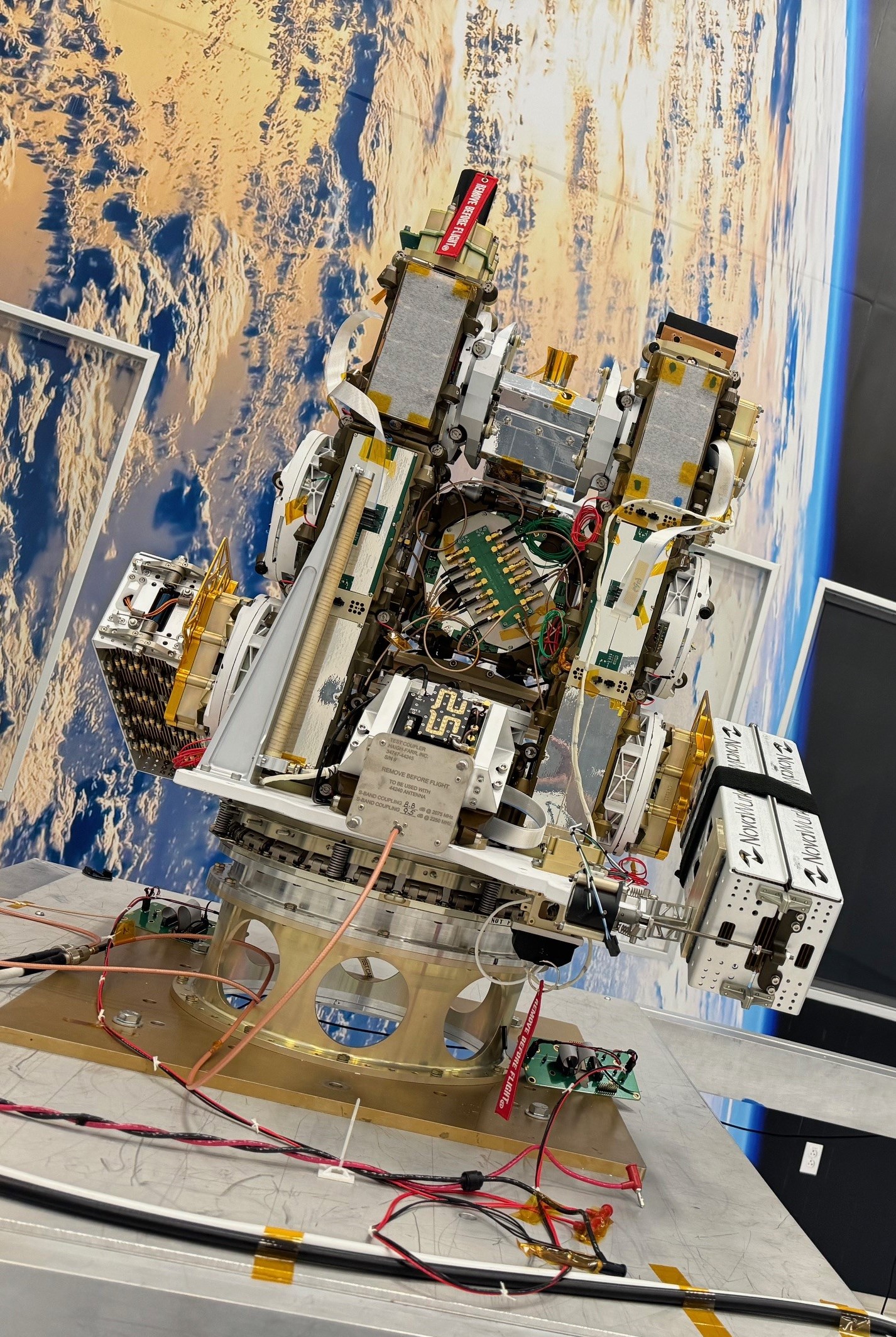
    Fully integrated, the Athena EPIC satellite undergoes performance testing in a NovaWurks cleanroom to prepare the sensor for launch. The optical module payload element may be seen near the top of the instrument with the single small telescope.
    Fully integrated, the Athena EPIC satellite undergoes performance testing in a NovaWurks cleanroom to prepare the sensor for launch. The optical module payload element may be seen near the top of the instrument with the single small telescope.
    NovaWurks

    “Increasing the speed of discovery is foundational to NASA. Our ability to leverage access to innovative space technologies across federal agencies through industry partners is the future,” said Clayton Turner, Associate Administrator for Space Technology Mission Directorate at NASA headquarters in Washington. “Athena EPIC is a valuable demonstration of the government at its best — serving humankind to advance knowledge with existing hardware configured to operate with new technologies.”

    NOAA (National Oceanic and Atmospheric Administration) and the U.S. Space Force are government partners for this demo mission. Athena EPIC’s industry partner, NovaWurks, provided the space vehicle, which utilizes a small satellite platform assembled with a Hyper-Integrated Satlet, or HISat.

    Engineers at NovaWurks in Long Beach prepare to mount the optical payload subassembly (center, silver) consisting of the payload optical module and single telescope mounted between gimbals on each of two HISats on either side of the module which will allow scanning across the Earth’s surface.
    NovaWurks

    The HISat instruments are similar in nature to a child’s toy interlocking building blocks. They’re engineered to be built into larger structures called SensorCraft. Those SensorCraft can share resources with multiple payloads and conform to different sizes and shapes to accommodate them. This easily configurable, building-block architecture allows a lot of flexibility with payload designs and concepts, ultimately giving payload providers easier, less expensive access to space and increased maneuverability between multiple orbits.

    Scientists at NASA’s Langley Research Center in Hampton, Virginia, designed and built the Athena sensor payload, which consists of an optical module, a calibration module, and a newly developed sensor electronics assembly. Athena EPIC’s sensor was built with spare parts from NASA’s CERES (Clouds and the Earth’s Radiant Energy System) mission. Several different generations of CERES satellite and space station instruments have tracked Earth’s radiation budget.

    “Instead of Athena carrying its own processor, we’re using the processors on the HISats to control things like our heaters and do some of the control functions that typically would be done by a processor on our payload,” said Kory Priestley, principal investigator for Athena EPIC from NASA Langley. “So, this is merging an instrument and a satellite platform into what we are calling a SensorCraft. It’s a more integrated approach. We don’t need as many capabilities built into our key instrument because it’s being brought to us by the satellite host. We obtain greater redundancy, and it simplifies our payload.”

    The fully assembled and tested Athena EPIC satellite which incorporates eight HISats mounted on a mock-up of a SpaceX provided launch pedestal which will hold Athena during launch.
    The fully assembled and tested Athena EPIC satellite which incorporates eight HISats mounted on a mock-up of a SpaceX provided launch pedestal which will hold Athena during launch.
    NovaWurks

    This is the first HISat mission led by NASA. Traditional satellites, like the ones that host the CERES instruments — are large, sometimes the size of a school bus, and carry multiple instruments. They tend to be custom units built with all of their own hardware and software to manage control, propulsion, cameras, carousels, processors, batteries, and more, and sometimes even require two of everything to guard against failures in the system. All of these factors, plus the need for a larger launch vehicle, significantly increase costs.

    This transformational approach to getting instruments into space can reduce the cost from billions to millions per mission.  “Now we are talking about something much smaller — SensorCraft the size of a mini refrigerator,” said Priestley. “If you do have failures on orbit, you can replace these much more economically. It’s a very different approach moving forward for Earth observation.”

    The Athena EPIC satellite is shown here mounted onto a vibration table during pre-launch environmental testing. The optical payload is located at the top in this picture with the two solar arrays, stowed for launch, flanking the lower half sides of the satellite.
    NovaWurks

    Athena EPIC is scheduled to launch July 22 as a rideshare on a SpaceX Falcon 9 rocket from Vandenberg Space Force Base, California. The primary NASA payload on the launch will be the TRACERS (Tandem Reconnection and Cusp Electrodynamics Reconnaissance Satellites) mission. The TRACERS mission is led by the University of Iowa for NASA’s Heliophysics Division within the Science Mission Directorate. NASA’s Earth Science Division also provided funding for Athena EPIC.

    “Langley Research Center has long been a leader in developing remote sensing instruments for in-orbit satellites. As satellites become smaller, a less traditional, more efficient path to launch is needed in order to decrease complexity while simultaneously increasing the value of exploration, science, and technology measurements for the Nation,” added Turner.

    For more information on NASA’s Athena EPIC mission:

    https://science.nasa.gov/misshttps://science.nasa.gov/mission/athena/ion/athena/

    About the Author

    Charles G. Hatfield

    Charles G. Hatfield

    Science Public Affairs Officer, NASA Langley Research Center

  • Curiosity Blog, Sols 4602-4603: On Top of the Ridge

    2 min read

    Curiosity Blog, Sols 4602-4603: On Top of the Ridge

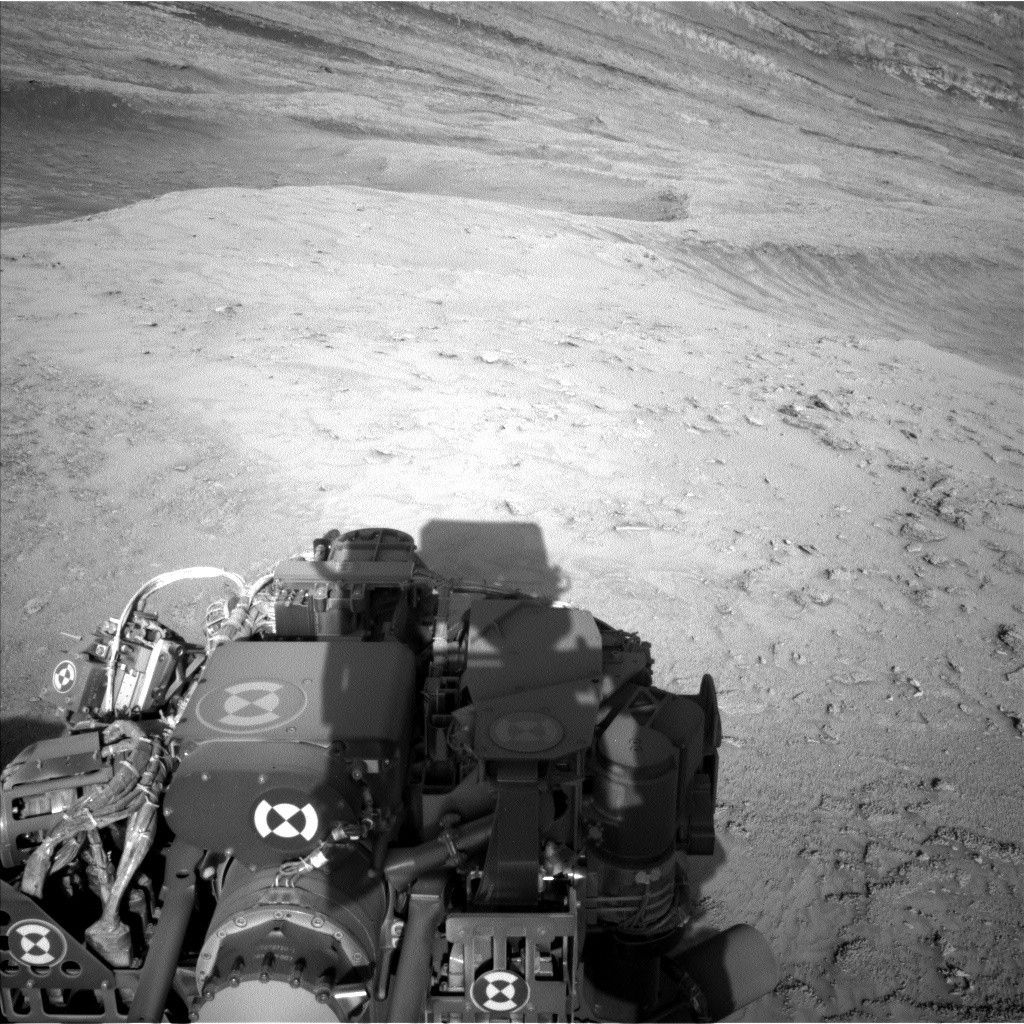
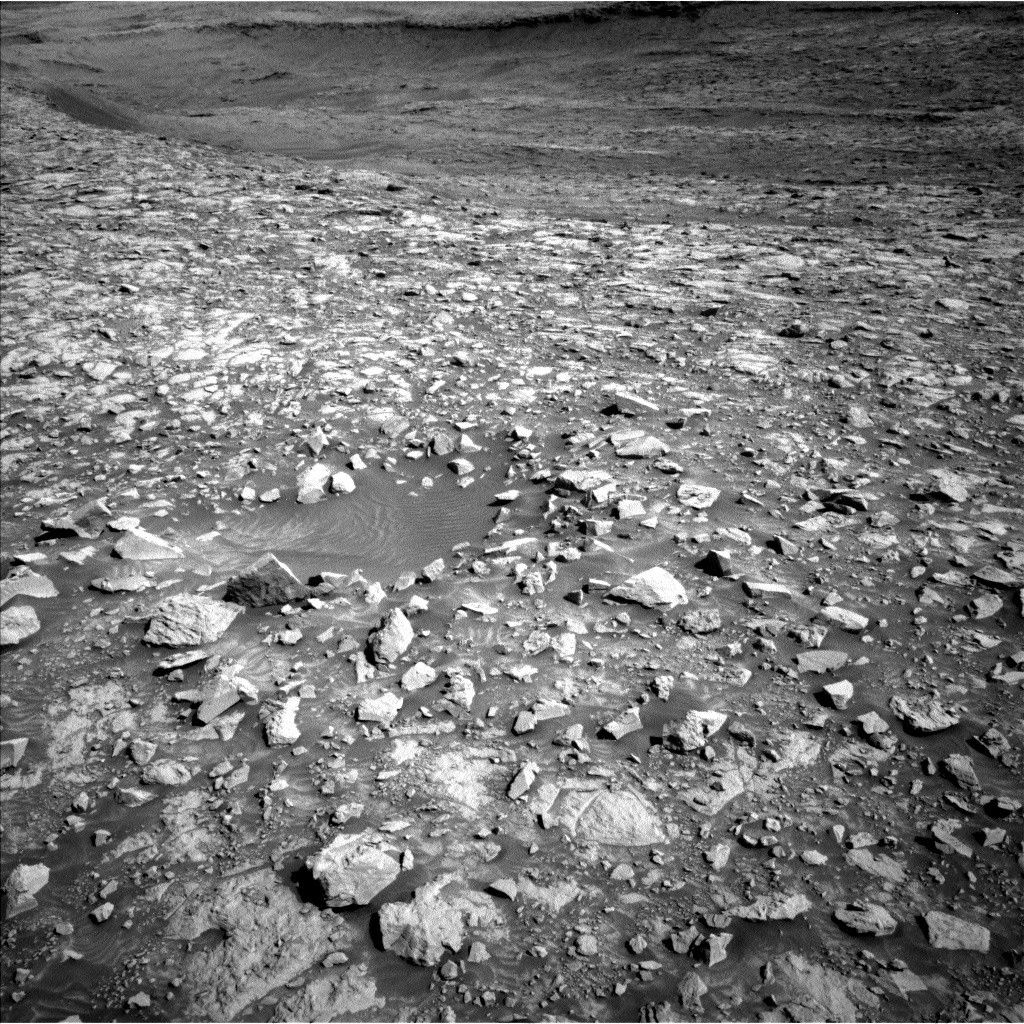
    A grayscale photo shows Martian terrain, which appears medium gray throughout. In front of the Curiosity rover, the ground from the bottom to the middle of the frame appears relatively smooth, with a few scattered small rocks poking above the surface. In the upper part of the image, the terrain appears to slope downward from left to right, with ridges running down along that same direction. Part of the rover is visible in the lower-right corner of the image, casting a shadow on the ground.
    NASA’s Mars rover Curiosity acquired this image looking along the ridge it is exploring during its planned activities for July 16, 2025. Curiosity acquired this image using its Left Navigation Camera on July 15 — Sol 4600, or Martian day 4,600 of the Mars Science Laboratory mission — at 17:12:14 UTC.
    NASA/JPL-Caltech

    Written by Alex Innanen, Atmospheric Scientist at York University

    Earth planning date: Wednesday, July 16, 2025

    As we hoped, we successfully climbed the 11-meter ramp (about 36 feet) and have arrived at the top of the ridge and the start of the main boxwork region. This means we’re moving into the next phase of the boxwork campaign, which is all about assessing these features and how we can navigate our way through them, and learning everything we can about their composition.

    In support of that, we’re taking a good look around at the boxwork ridges with both ChemCam and Mastcam. Both instruments are taking mosaics of the more distant ridges to get a broader view of their features. A bit closer in, Mastcam has three more mosaics: two looking at different views of “El Corral” and “Chapare,” both of which we saw in Monday’s plan, and “Meson,” which is the ridge we’ll be heading for in today’s 15-meter drive (about 49 feet).

    It’s not all looking ahead, though. The workspace in front of us has a lot to offer as well. Mastcam will be turning its sights to some nearby linear features. Our workspace is also full of nodular bedrock, which is getting lots of up-close attention. ChemCam will be turning its LIBS laser on a target called “Altamora,” and MAHLI and APXS will be examining another target called “Nocarane.”

    With all the geological excitement, we can still manage to squeeze in some time to keep an eye on the environment. Though we don’t always mention them, REMS, RAD, and DAN are always there working steadily away to build up our understanding of Mars’ environment. We’ll also round out the plan with a suprahorizon cloud movie and a 360-degree dust-devil survey.

    Details

    Last Updated

    Jul 18, 2025

    Related Terms

  • Stay Cool: NASA Tests Innovative Technique for Super Cold Fuel Storage

    4 Min Read

    Stay Cool: NASA Tests Innovative Technique for Super Cold Fuel Storage

    The tank for NASA’s two-stage cooling tests is lowered into a vacuum chamber in Test Stand 300 at NASA’s Marshall Space Flight Center in Huntsville, Alabama.

    The tank for NASA’s two-stage cooling tests is lowered into a vacuum chamber in Test Stand 300 at NASA’s Marshall Space Flight Center in Huntsville, Alabama.

    Credits:
    NASA/Kathy Henkel

    In the vacuum of space, where temperatures can plunge to minus 455 degrees Fahrenheit, it might seem like keeping things cold would be easy. But the reality is more complex for preserving ultra-cold fluid propellants – or fuel – that can easily overheat from onboard systems, solar radiation, and spacecraft exhaust. The solution is a method called cryogenic fluid management, a suite of technologies that stores, transfers, and measures super cold fluids for the surface of the Moon, Mars, and future long-duration spaceflight missions.

    Super cold, or cryogenic, fluids like liquid hydrogen and liquid oxygen are the most common propellants for space exploration. Despite its chilling environment, space has a “hot” effect on these propellants because of their low boiling points – about minus 424 degrees Fahrenheit for liquid hydrogen and about minus 298 for liquid oxygen – putting them at risk of boiloff.

    In a first-of-its-kind demonstration, teams at NASA’s Marshall Space Flight Center in Huntsville, Alabama, are testing an innovative approach to achieve zero boiloff storage of liquid hydrogen using two stages of active cooling which could prevent the loss of valuable propellant.

    “Technologies for reducing propellant loss must be implemented for successful long-duration missions to deep space like the Moon and Mars,” said Kathy Henkel, acting manager of NASA’s Cryogenic Fluid Management Portfolio Project, based at NASA Marshall. “Two-stage cooling prevents propellant loss and successfully allows for long-term storage of propellants whether in transit or on the surface of a planetary body.”

    The new technique, known as “tube on tank” cooling, integrates two cryocoolers, or cooling devices, to keep propellant cold and thwart multiple heat sources. Helium, chilled to about minus 424 degrees Fahrenheit, circulates through tubes attached to the outer wall of the propellant tank.

    Teams installed the propellant tank in a test stand at NASA Marshall in early June, and the 90-day test campaign is scheduled to conclude in September. The tank is wrapped in a multi-layer insulation blanket that includes a thin aluminum heat shield fitted between layers. A second set of tubes, carrying helium at about minus 298 Fahrenheit, is integrated into the shield. This intermediate cooling layer intercepts and rejects incoming heat before it reaches the tank, easing the heat load on the tube-on-tank system.

    To prevent dangerous pressure buildup in the propellant tank in current spaceflight systems, boiloff vapors must be vented, resulting in the loss of valuable fuel. Eliminating such propellant losses is crucial to the success of NASA’s most ambitious missions, including future crewed journeys to Mars, which will require storing large amounts of cryogenic propellant in space for months or even years. So far, cryogenic fuels have only been used for missions lasting less than a week.  

    “To go to Mars and have a sustainable presence, you need to preserve cryogens for use as rocket or lander return propellant,” Henkel said. “Rockets currently control their propellant through margin, where larger tanks are designed to hold more propellant than what is needed for a mission. Propellant loss isn’t an issue with short trips because the loss is factored into this margin. But, human exploration missions to Mars or longer stays at the Moon will require a different approach because of the very large tanks that would be needed.”

    The Cryogenic Fluid Management Portfolio Project is a cross-agency team based at NASA Marshall and the agency’s Glenn Research Center in Cleveland. The cryogenic portfolio’s work is under NASA’s Technology Demonstration Missions Program, part of NASA’s Space Technology Mission Directorate, and is comprised of more than 20 individual technology development activities.

    Learn more about cryogenic fluid management:

    https://go.nasa.gov/cfm

  • Hubble Snaps Galaxy Cluster’s Portrait

    A cluster of distant, mainly elliptical galaxies. They appear as brightly shining points radiating golden light that each take the shape of a smooth, featureless oval. They crowd around one that is extremely large and bright. A few spiral galaxies of comparable size appear too, bluer in color and with unique shapes. Of the other more small and distant galaxies covering the scene, a few are warped into long lines.
    This NASA/ESA Hubble Space Telescope image features the galaxy cluster Abell 209.
    ESA/Hubble & NASA, M. Postman, P. Kelly

    A massive, spacetime-warping cluster of galaxies is the setting of today’s NASA/ESA Hubble Space Telescope image. The galaxy cluster in question is Abell 209, located 2.8 billion light-years away in the constellation Cetus (the Whale).

    This Hubble image of Abell 209 shows more than a hundred galaxies, but there’s more to this cluster than even Hubble’s discerning eye can see. Abell 209’s galaxies are separated by millions of light-years, and the seemingly empty space between the galaxies is filled with hot, diffuse gas that is visible only at X-ray wavelengths. An even more elusive occupant of this galaxy cluster is dark matter: a form of matter that does not interact with light. Dark matter does not absorb, reflect, or emit light, effectively making it invisible to us. Astronomers detect dark matter by its gravitational influence on normal matter. Astronomers surmise that the universe is comprised of 5% normal matter, 25% dark matter, and 70% dark energy.

    Hubble observations, like the ones used to create this image, can help astronomers answer fundamental questions about our universe, including mysteries surrounding dark matter and dark energy. These investigations leverage the immense mass of a galaxy cluster, which can bend the fabric of spacetime itself and create warped and magnified images of background galaxies and stars in a process called gravitational lensing.

    While this image lacks the dramatic rings that gravitational lensing can sometimes create, Abell 209 still shows subtle signs of lensing at work, in the form of streaky, slightly curved galaxies within the cluster’s golden glow. By measuring the distortion of these galaxies, astronomers can map the distribution of mass within the cluster, illuminating the underlying cloud of dark matter. This information, which Hubble’s fine resolution and sensitive instruments help to provide, is critical for testing theories of how our universe evolved.

    Text Credit: ESA/Hubble

    Image credit: ESA/Hubble & NASA, M. Postman, P. Kelly

  • What You Need to Know About NASA’s SpaceX Crew-11 Mission

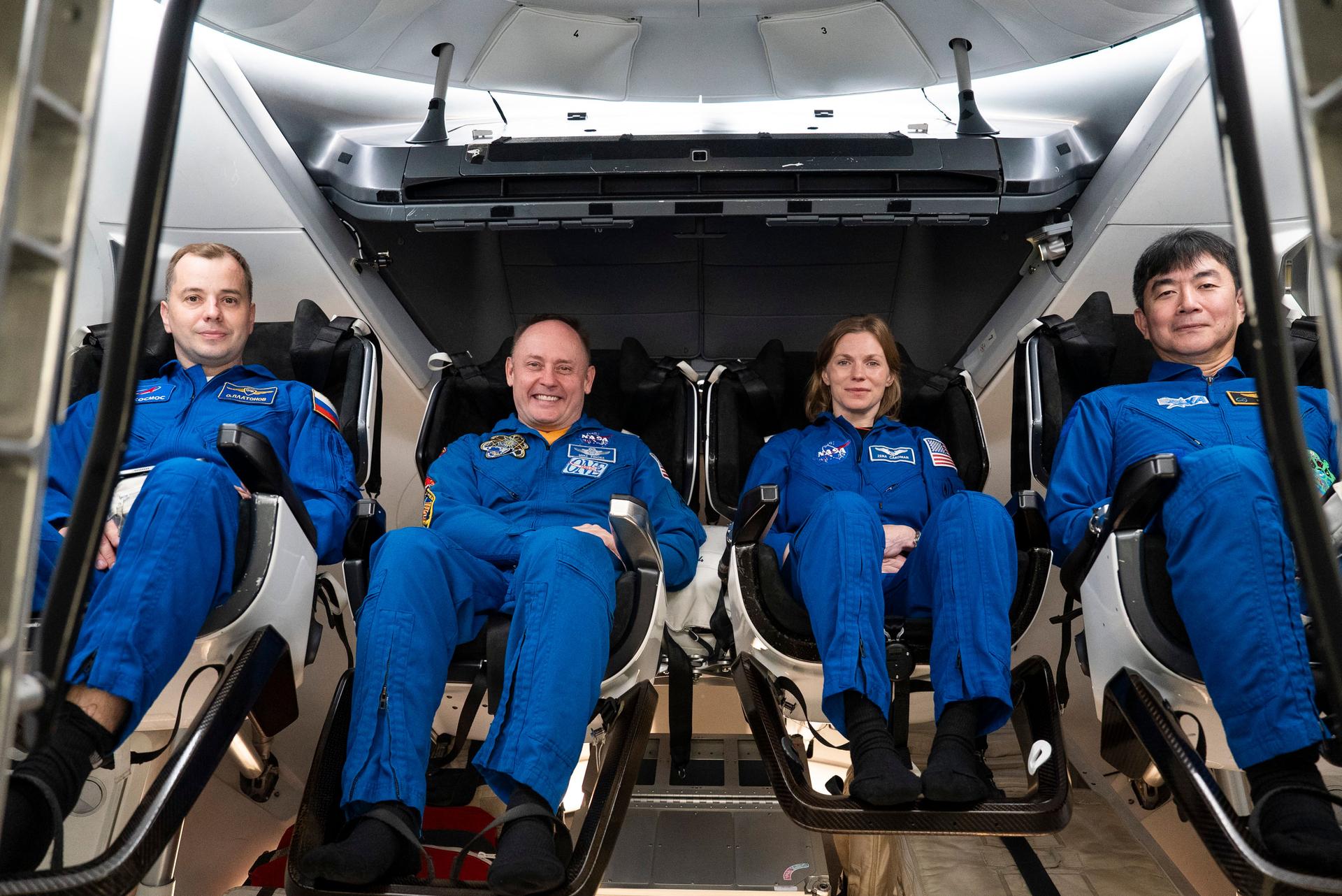
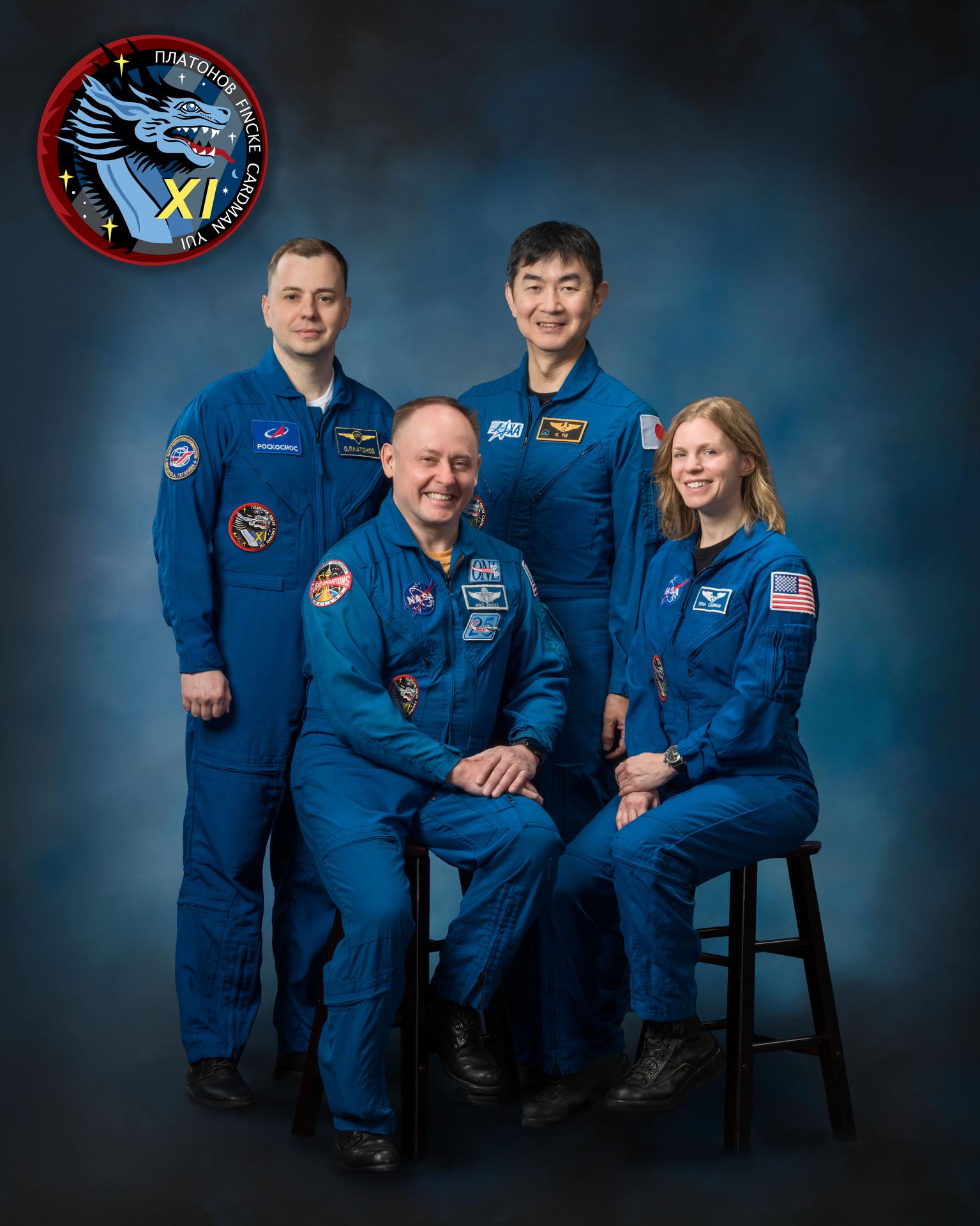
    The four crew members of NASA's SpaceX Crew-11 mission to the International Space Station train inside a Dragon training crew spacecraft at SpaceX in Hawthorne, California. From left to right: Roscosmos cosmonaut Oleg Platonov, NASA astronauts Mike Fincke and Zena Cardman, and JAXA astronaut Kimiya Yui.
    The four crew members of NASA’s SpaceX Crew-11 mission to the International Space Station train inside a SpaceX Dragon spacecraft in Hawthorne, California. From left to right: Roscosmos cosmonaut Oleg Platonov, NASA astronauts Mike Fincke and Zena Cardman, and JAXA astronaut Kimiya Yui
    SpaceX

    Four crew members are preparing to launch to the International Space Station as part of NASA’s SpaceX Crew-11 mission to perform research, technology demonstrations, and maintenance activities aboard the orbiting laboratory.

    During the mission, Crew-11 also will contribute to NASA’s Artemis campaign by simulating Moon landing scenarios that astronauts may encounter near the lunar South Pole, showing how the space station helps prepare crews for deep space human exploration. The simulations will be performed before, during, and after their mission using handheld controllers and multiple screens to identify how changes in gravity affect spatial awareness and astronauts’ ability to pilot spacecraft, like a lunar lander.

    NASA astronauts Zena Cardman and Mike Fincke, JAXA (Japan Aerospace Exploration Agency) astronaut Kimiya Yui, and Roscosmos cosmonaut Oleg Platonov will lift off no earlier than 12:09 p.m. EDT on Thursday, July 31, from Launch Complex 39A at the agency’s Kennedy Space Center in Florida on a long-duration mission. The cadre will fly aboard a SpaceX Dragon spacecraft, named Endeavour, which previously flew NASA’s SpaceX Demo-2, Crew-2, Crew-6, and Crew-8 missions, as well as private astronaut mission Axiom Mission 1.

    The flight is the 11th crew rotation mission with SpaceX to the space station as part of NASA’s Commercial Crew Program. Overall, the Crew-11 mission is the 16th crewed Dragon flight to the space station, including Demo-2 in 2020 and 11 operational crew rotations for NASA, as well as four private astronaut missions.

    As support teams progress through Dragon preflight milestones for Crew-11, they also are preparing a SpaceX Falcon 9 rocket booster for its third flight. Once all rocket and spacecraft system checkouts are complete and all components are certified for flight, teams will mate Dragon to Falcon 9 in SpaceX’s hangar at the launch site. The integrated spacecraft and rocket will then be rolled to the pad and raised vertically for the crew’s dry dress rehearsal and an integrated static fire test before launch.

    Meet Crew-11

    The official crew portrait of NASA's SpaceX Crew-11 members. Front row, from left, are Pilot Mike Fincke and Commander Zena Cardman, both NASA astronauts. In the back from left, are Mission Specialists Oleg Platonov of Roscosmos and Kimiya Yui of JAXA (Japan Aerospace Exporation Agency).
    The official crew portrait of NASA’s SpaceX Crew-11 members. Front row, from left, are Pilot Mike Fincke and Commander Zena Cardman, both NASA astronauts. In the back from left, are Mission Specialists Oleg Platonov of Roscosmos and Kimiya Yui of JAXA (Japan Aerospace Exploration Agency)
    NASA/Robert Markowitz

    Selected as a NASA astronaut in 2017, Cardman will conduct her first spaceflight. The Williamsburg, Virginia, native holds a bachelor’s degree in biology and a master’s degree in marine sciences from the University of North Carolina at Chapel Hill. At the time of selection, she was pursuing a doctorate in geosciences. Cardman’s geobiology and geochemical cycling research focused on subsurface environments, from caves to deep sea sediments. Since completing initial training, Cardman has supported real-time station operations and lunar surface exploration planning. Follow @zenanaut on X and @zenanaut on Instagram.

    This mission will be Fincke’s fourth trip to the space station, having logged 382 days in space and nine spacewalks during Expedition 9 in 2004, Expedition 18 in 2008, and STS-134 in 2011, the final flight of space shuttle Endeavour. Throughout the past decade, Fincke has applied his expertise to NASA’s Commercial Crew Program, advancing the development and testing of Dragon and Boeing’s Starliner spacecraft toward operational certification. The Emsworth, Pennsylvania, native is a graduate of the United States Air Force Test Pilot School and holds bachelors’ degrees from the Massachusetts Institute of Technology, Cambridge, in both aeronautics and astronautics, as well as Earth, atmospheric, and planetary sciences. He also has a master’s degree in aeronautics and astronautics from Stanford University in California. Fincke is a retired U.S. Air Force colonel with more than 2,000 flight hours in over 30 different aircraft. Follow @AstroIronMike on X and Instagram.

    With 142 days in space, this mission will be Yui’s second trip to the space station. After his selection as a JAXA astronaut in 2009, Yui flew as a flight engineer for Expedition 44/45 and became the first Japanese astronaut to capture JAXA’s H-II Transfer Vehicle using the station’s robotic arm. In addition to constructing a new experimental environment aboard Kibo, he conducted a total of 21 experiments for JAXA. In November 2016, Yui was assigned as chief of the JAXA Astronaut Group. He graduated from the School of Science and Engineering at the National Defense Academy of Japan in 1992. He later joined the Air Self-Defense Force at the Japan Defense Agency (currently the Ministry of Defense). In 2008, Yui joined the Air Staff Office at the Ministry of Defense as a lieutenant colonel. Follow @astro_kimiya on X.

    The mission will be Platonov’s first spaceflight. Before his selection as a cosmonaut in 2018, Platonov earned a degree in engineering from Krasnodar Air Force Academy in aircraft operations and air traffic management. He also earned a bachelor’s degree in state and municipal management in 2016 from the Far Eastern Federal University in Vladivostok, Russia. Assigned as a test cosmonaut in 2021, he has experience in piloting aircraft, zero gravity training, scuba diving, and wilderness survival.

    Mission Overview

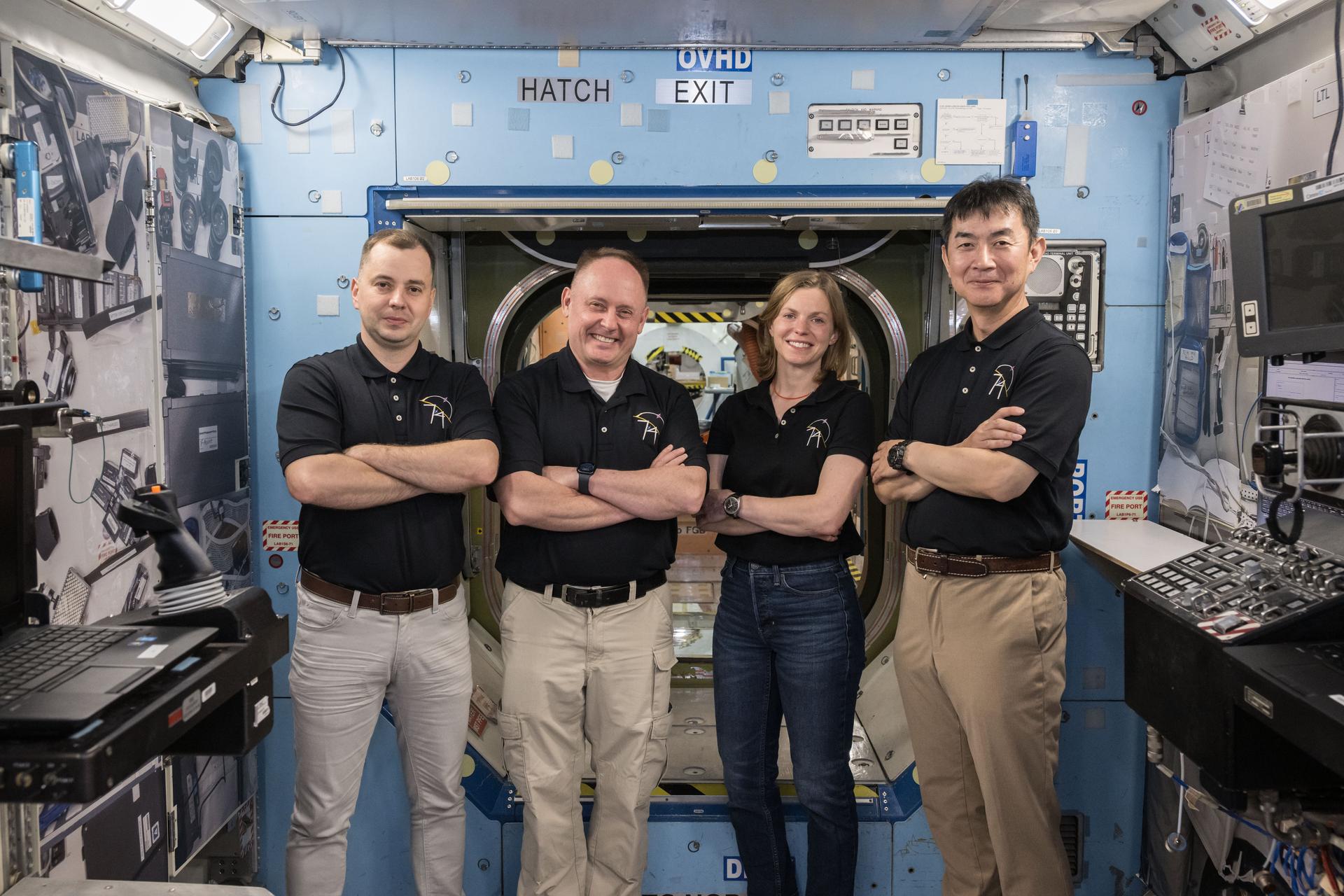
    From left to right: Roscosmos cosmonaut Oleg Platonov, NASA astronauts Mike Fincke and Zena Cardman, and JAXA (Japan Aerospace Exploration Agency) astronaut Kimiya Yui pose for a photo after participating in a training simulation inside a mockup at NASA’s Johnson Space Center in Houston, Texas.
    From left to right: Roscosmos cosmonaut Oleg Platonov, NASA astronauts Mike Fincke and Zena Cardman, and JAXA astronaut Kimiya Yui pictured after participating in a training simulation inside a mockup at NASA’s Johnson Space Center in Houston
    NASA/Robert Markowitz

    Following liftoff, Falcon 9 will accelerate Dragon to approximately 17,500 mph. Once in orbit, the crew, NASA, and SpaceX mission control will monitor a series of maneuvers that will guide Dragon to the forward-facing port of the station’s Harmony module. The spacecraft is designed to dock autonomously, but the crew can pilot it manually, if necessary.

    After docking, Crew-11 will be welcomed aboard the station by the seven-member Expedition 73 crew, before conducting a short handover period on research and maintenance activities with the departing Crew-10 crew members. Then, NASA astronauts Anne McClain, Nichole Ayers, JAXA astronaut Takuya Onishi, and Roscosmos cosmonaut Kirill Peskov will undock from the space station and return to Earth. Ahead of Crew-10’s return, mission teams will review weather conditions at the splashdown sites off the coast of California before departure from the station.

    Cardman, Fincke, and Yui will conduct scientific research to prepare for human exploration beyond low Earth orbit and benefit humanity on Earth. Participating crew members will simulate lunar landings, test strategies to safeguard vision, and advance other human spaceflight studies led by NASA’s Human Research Program. The crew also will study plant cell division and microgravity’s effects on bacteria-killing viruses, as well as perform experiments to produce a higher volume of human stem cells and generate on-demand nutrients.

    While aboard the orbiting laboratory, Crew-11 will welcome a Soyuz spacecraft in November with three new crew members, including NASA astronaut Chris Williams.  They also will bid farewell to the Soyuz carrying NASA astronaut Jonny Kim. The crew also is expected to see the arrival of the Dragon, Roscosmos Progress spacecraft, and Northrop Grumman’s Cygnus spacecraft to resupply the station.

    NASA’s SpaceX Crew-11 mission will be aboard the International Space Station on Nov. 2, when the orbiting laboratory surpasses 25 years of a continuous human presence. Since the first crew expedition arrived, the space station has enabled more than 4,000 groundbreaking experiments in the unique microgravity environment, while becoming a springboard for building a low Earth orbit economy and preparing for NASA’s future exploration of the Moon and Mars.

    Learn more about the space station, its research, and crew, at:

    https://www.nasa.gov/station

  • NASA, Oxford Discover Warmer Uranus Than Once Thought

    KEY POINTS

    • Jupiter, Saturn, and Neptune each emit more energy than they receive from the Sun, meaning they have comparatively warm interiors.
    • NASA’s Uranus flyby with Voyager 2 in 1986 found the planet colder than expected, which challenged ideas of how planets formed and evolved.
    • However, with advanced computer modeling and a new look at old data, scientists think the planet may actually be warmer than previously expected.

    For millennia, astronomers thought Uranus was no more than a distant star. It wasn’t until the late 18th century that Uranus was universally accepted as a planet. To this day, the ringed, blue world subverts scientists’ expectations, but new NASA research helps puzzle out some of the world’s mystique. 

    A glowing, bright blue-white circular sphere in the center of the image, surrounded by multiple concentric, thin rings of varying brightness against a black background. The rings appear as gray, white, and light-colored bands encircling the central blue-white disc. The outer ring appears brighter than the inner rings, with subtle variations in thickness and illumination throughout the ring structure.
    This zoomed-in image of Uranus, captured by the Near-Infrared Camera on NASA’s James Webb Space Telescope on Feb. 6, 2023, reveals stunning views of Uranus’ rings.
    Credits: NASA, ESA, CSA, STScI

    Uranus is unlike any other planet in our solar system. It spins on its side, which means each pole directly faces the Sun for a continuous 42-year “summer.” Uranus also rotates in the opposite direction of all planets except Venus. Data from NASA’s Voyager 2 Uranus flyby in 1986 also suggested the planet is unusually cold inside, challenging scientists to reconsider fundamental theories of how planets formed and evolved throughout our solar system.
    “Since Voyager 2’s flyby, everybody has said Uranus has no internal heat,” said Amy Simon, a planetary scientist at NASA’s Goddard Space Flight Center in Greenbelt, Maryland. “But it’s been really hard to explain why that is, especially when compared with the other giant planets.”

    These Uranus projections came from only one up-close measurement of the planet’s emitted heat made by Voyager 2: “Everything hinges on that one data point,” said Simon. “That is part of the problem.” 

    Now, using an advanced computer modeling technique and revisiting decades of data, Simon and a team of scientists have found that Uranus does in fact generate some heat, as they reported on May 16 in the Monthly Notices of the Royal Astronomical Society journal. 

    A planet’s internal heat can be calculated by comparing the amount of energy it receives from the Sun to the amount it of energy it releases into space in the form of reflected light and emitted heat. The solar system’s other giant planets — Saturn, Jupiter, and Neptune — emit more heat than they receive, which means the extra heat is coming from inside, much of it left over from the high-energy processes that formed the planets 4.5 billion years ago. The amount of heat a planet exudes could be an indication of its age: the less heat released relative to the heat absorbed from the Sun, the older the planet is.
    Uranus stood out from the other planets because it appeared to give off as much heat as it received, implying it had none of its own. This puzzled scientists. Some hypothesized that perhaps the planet is much older than all the others and has cooled off completely. Others proposed that a giant collision — the same one that may have knocked the planet on its side — blasted out all of Uranus’ heat. But none of these hypotheses satisfied scientists, motivating them to solve Uranus’ cold case.

    “We thought, ‘Could it really be that there is no internal heat at Uranus?’” said Patrick Irwin, the paper’s lead author and professor of planetary physics at the University of Oxford in England. “We did many calculations to see how much sunshine is reflected by Uranus and we realized that it is actually more reflective than people had estimated.”

    The researchers set out to determine Uranus’ full energy budget: how much energy it receives from the Sun compared to how much it reflects as sunlight and how much it emits as heat. To do this, they needed to estimate the total amount of light reflected from the planet at all angles. “You need to see the light that’s scattered off to the sides, not just coming straight back at you,” Simon said.

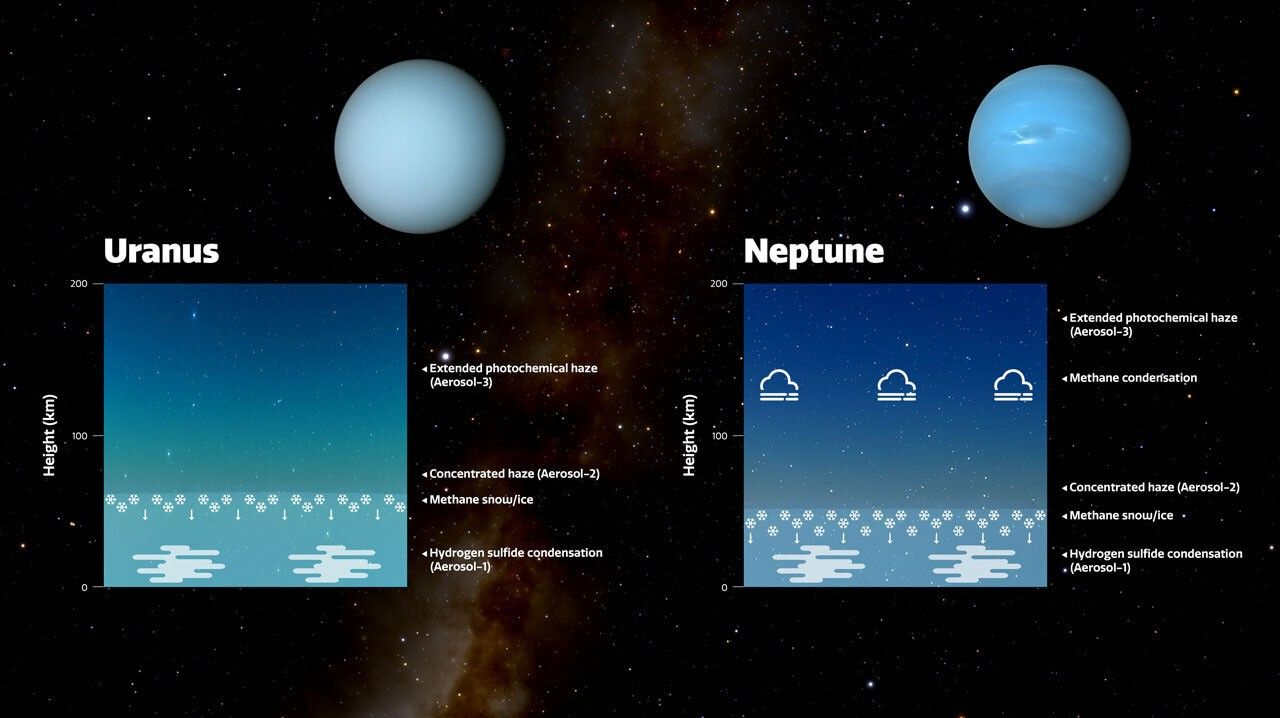
    To get the most accurate estimate of Uranus’ energy budget yet, Oxford researchers developed a computer model that brought together everything known about Uranus’ atmosphere from decades of observations from ground- and space-based telescopes, including NASA’s Hubble Space Telescope and NASA’s Infrared Telescope Facility in Hawaii. The model included information about the planet’s hazes, clouds, and seasonal changes, all of which affect how sunlight is reflected and how heat escapes.

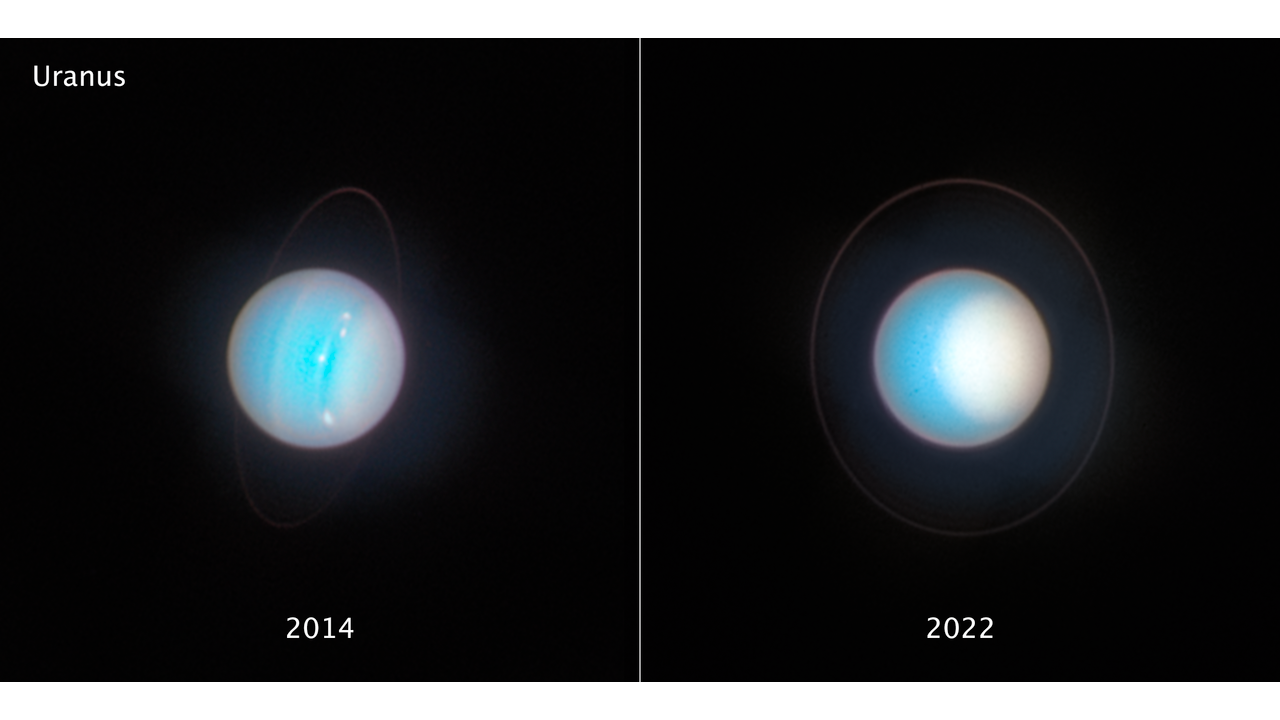
    These side-by-side images of Uranus, taken eight years apart by NASA’s Hubble Space Telescope, show seasonal changes in the planet’s reflectivity. The left image shows the planet seven years after its northern spring equinox when the Sun was shining just above its equator. The second photo, taken six years before the planet’s summer solstice, portrays a bright and large northern polar cap.
    Credit: NASA, ESA, STScI, A. Simon (NASA-GSFC), M. H. Wong (UC Berkeley), J. DePasquale (STScI)

    The researchers found that Uranus releases about 15% more energy than it receives from the Sun, a figure that is similar to another recent estimate from a separate study funded in part by NASA that was published July 14 in Geophysical Research Letters. These studies suggest Uranus it has its own heat, though still far less than its neighbor Neptune, which emits more than twice the energy it receives.

    “Now we have to understand what that remnant amount of heat at Uranus means, as well as get better measurements of it,” Simon said.

    Unraveling Uranus’ past is useful not only for mapping the timeline of when solar system planets formed and migrated to their current orbits, but it also helps scientists better understand many of the planets discovered outside the solar system, called exoplanets, a majority of which are the same size as Uranus.

    By Emma Friedman
    NASA’s Goddard Space Flight Center, Greenbelt, Md.

    Details

    Last Updated

    Jul 17, 2025

    Editor
    Lonnie Shekhtman
    Contact
    Lonnie Shekhtman
  • NASA’s X-59 Quiet Supersonic Aircraft Begins Taxi Tests

    2 min read

    Preparations for Next Moonwalk Simulations Underway (and Underwater)

    NASA/Jacob Shaw

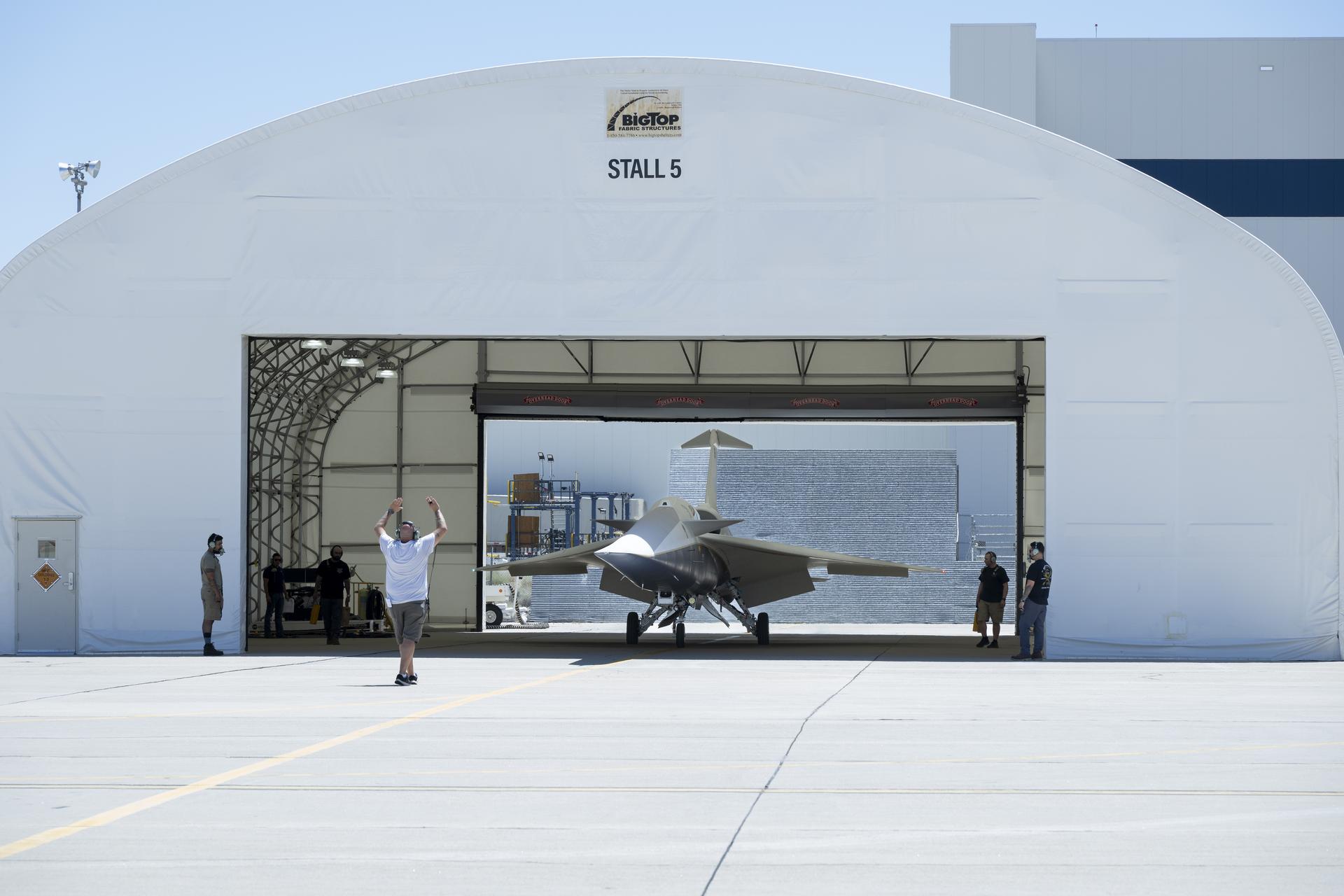
    NASA’s X-59 quiet supersonic research aircraft has officially begun taxi tests, marking the first time this one-of-a-kind experimental aircraft has moved under its own power.

    NASA test pilot Nils Larson and the X-59 team, made up of NASA and contractor Lockheed Martin personnel, completed the aircraft’s first low-speed taxi test at U.S. Air Force Plant 42 in Palmdale, California, on July 10, 2025.

    The taxiing represents the X-59’s last series of ground tests before first flight. Over the coming weeks, the aircraft will gradually increase its speed, leading up to a high-speed taxi test that will take the aircraft just short of the point where it would take off.

    During the low-speed tests, engineers and flight crews monitored how the X-59 handled as it moved across the runway, working to validate critical systems like steering and braking. These checks help ensure the aircraft’s stability and control across a range of conditions, giving pilots and engineers confidence that all systems are functioning as expected.

    The X-59 is the centerpiece of NASA’s Quesst mission, which aims to demonstrate quiet supersonic flight by reducing the loud sonic boom to a quieter “thump.” Data gathered from the X-59 will be shared with U.S. and international regulators to inform the establishment of new, data-driven acceptable noise thresholds related to supersonic commercial flight over land.